Earthquakes are the shaking, rolling or
sudden shock of the earth’s surface.
Earthquakes happen along "fault lines" in
the earth’s crust. Earthquakes can be felt
over large areas although they usually last
less than one minute.
Earthquakes cannot be
predicted -- although
scientists are working on it!
• The intensity of an earthquake can be measured.
One measurement is called the Richter scale.
Earthquakes below 4.0 on the Richter scale
usually do not cause damage, and earthquakes
below 2.0 usually can’t be felt. Earthquakes
over 5.0 on the scale can cause
damage. A magnitude 6.0
earthquake is considered strong
and a magnitude 7.0 is a major
earthquake. The Northridge
Earthquake, which hit Southern
California in 1994, was magnitude 6.7.
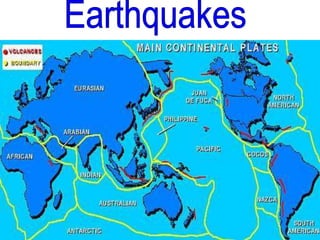
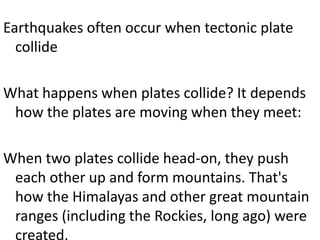
Earthquakes often occur when tectonic plate
collide
What happens when plates collide? It depends
how the plates are moving when they meet:
When two plates collide head-on, they push
each other up and form mountains. That's
how the Himalayas and other great mountain
ranges (including the Rockies, long ago) were
created.
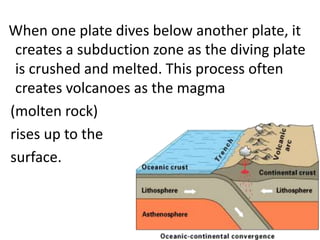
When one plate dives below another plate, it
creates a subduction zone as the diving plate
is crushed and melted. This process often
creates volcanoes as the magma
(molten rock)
rises up to the
surface.
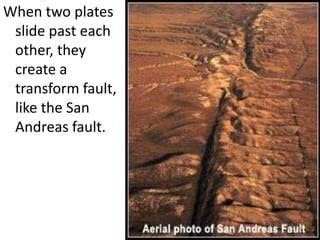
When two plates
slide past each
other, they
create a
transform fault,
like the San
Andreas fault.
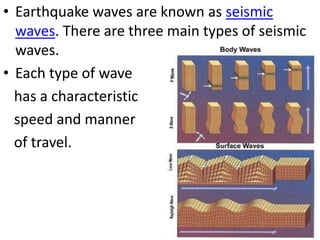
• Earthquake waves are known as seismic
waves. There are three main types of seismic
waves.
• Each type of wave
has a characteristic
speed and manner
of travel.
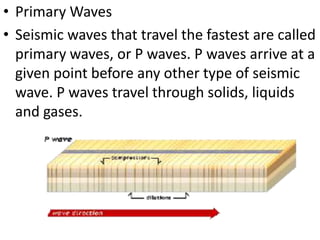
• Primary Waves
• Seismic waves that travel the fastest are called
primary waves, or P waves. P waves arrive at a
given point before any other type of seismic
wave. P waves travel through solids, liquids
and gases.
• P waves are push-pull waves. As P waves
travel, they push rock particles into the
particles ahead of them, thus compressing
the particles. The rock particles then
bounce back. They hit the particles behind
them that are being pushed forward. The
particles move back and forth in the
direction the waves are moving.
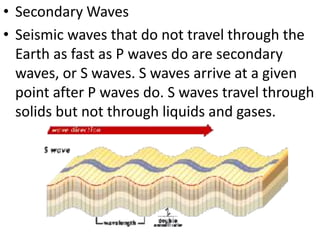
• Secondary Waves
• Seismic waves that do not travel through the
Earth as fast as P waves do are secondary
waves, or S waves. S waves arrive at a given
point after P waves do. S waves travel through
solids but not through liquids and gases.
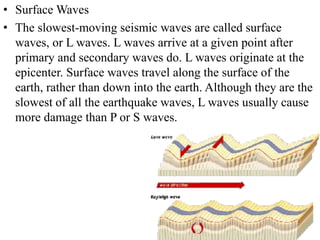
• Surface Waves
• The slowest-moving seismic waves are called surface
waves, or L waves. L waves arrive at a given point after
primary and secondary waves do. L waves originate at the
epicenter. Surface waves travel along the surface of the
earth, rather than down into the earth. Although they are the
slowest of all the earthquake waves, L waves usually cause
more damage than P or S waves.

Earthquake

  • 2.
    Earthquakes are theshaking, rolling or sudden shock of the earth’s surface. Earthquakes happen along "fault lines" in the earth’s crust. Earthquakes can be felt over large areas although they usually last less than one minute. Earthquakes cannot be predicted -- although scientists are working on it!
  • 3.
    • The intensityof an earthquake can be measured. One measurement is called the Richter scale. Earthquakes below 4.0 on the Richter scale usually do not cause damage, and earthquakes below 2.0 usually can’t be felt. Earthquakes over 5.0 on the scale can cause damage. A magnitude 6.0 earthquake is considered strong and a magnitude 7.0 is a major earthquake. The Northridge Earthquake, which hit Southern California in 1994, was magnitude 6.7.
  • 4.
    Earthquakes often occurwhen tectonic plate collide What happens when plates collide? It depends how the plates are moving when they meet: When two plates collide head-on, they push each other up and form mountains. That's how the Himalayas and other great mountain ranges (including the Rockies, long ago) were created.
  • 5.
    When one platedives below another plate, it creates a subduction zone as the diving plate is crushed and melted. This process often creates volcanoes as the magma (molten rock) rises up to the surface.
  • 6.
    When two plates slidepast each other, they create a transform fault, like the San Andreas fault.
  • 7.
    • Earthquake wavesare known as seismic waves. There are three main types of seismic waves. • Each type of wave has a characteristic speed and manner of travel.
  • 8.
    • Primary Waves •Seismic waves that travel the fastest are called primary waves, or P waves. P waves arrive at a given point before any other type of seismic wave. P waves travel through solids, liquids and gases.
  • 9.
    • P wavesare push-pull waves. As P waves travel, they push rock particles into the particles ahead of them, thus compressing the particles. The rock particles then bounce back. They hit the particles behind them that are being pushed forward. The particles move back and forth in the direction the waves are moving.
  • 10.
    • Secondary Waves •Seismic waves that do not travel through the Earth as fast as P waves do are secondary waves, or S waves. S waves arrive at a given point after P waves do. S waves travel through solids but not through liquids and gases.
  • 11.
    • Surface Waves •The slowest-moving seismic waves are called surface waves, or L waves. L waves arrive at a given point after primary and secondary waves do. L waves originate at the epicenter. Surface waves travel along the surface of the earth, rather than down into the earth. Although they are the slowest of all the earthquake waves, L waves usually cause more damage than P or S waves.