Earthquakes are the shaking, rolling or
sudden shock of the earth’s surface.
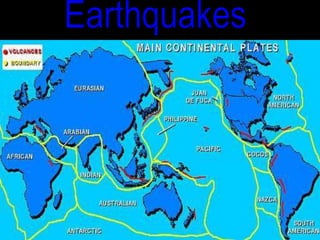
Earthquakes happen along "fault lines" in
the earth’s crust. Earthquakes can be felt
over large areas although they usually last
less than one minute.
Earthquakes cannot be
predicted -- although
scientists are working on it!
• Most of the time, you will notice an earthquake by the
gentle shaking of the ground. You may notice hanging
plants swaying or objects wobbling on shelves.
Sometimes you may hear a low rumbling noise or feel a
sharp jolt. A survivor of the 1906 earthquake in San
Francisco said the sensation was like riding a bicycle
down a long flight of stairs.
• The intensity of an earthquake can be measured. One
measurement is called the Richter scale. Earthquakes
below 4.0 on the Richter scale usually do not cause
damage, and earthquakes below 2.0 usually can’t be felt.
Earthquakes
over 5.0 on the scale can cause
damage. A magnitude 6.0
earthquake is considered strong
and a magnitude 7.0 is a major
earthquake. The Northridge
Earthquake, which hit Southern
California in 1994, was magnitude 6.7.
Earthquakes often occur when tectonic plate
collide
What happens when plates collide? It
depends how the plates are moving when
they meet:
When two plates collide head-on, they push
each other up and form mountains. That's
how the Himalayas and other great
mountain ranges (including the Rockies,
long ago) were created.
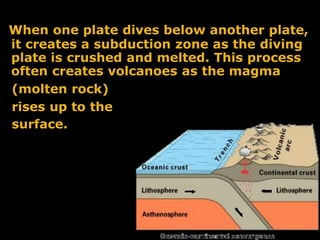
When one plate dives below another plate,
it creates a subduction zone as the diving
plate is crushed and melted. This process
often creates volcanoes as the magma
(molten rock)
rises up to the
surface.
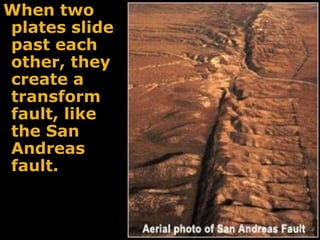
When two
plates slide
past each
other, they
create a
transform
fault, like
the San
Andreas
fault.
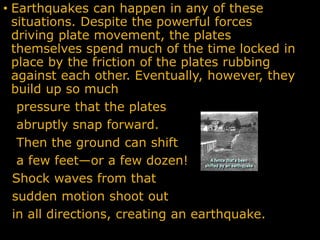
• Earthquakes can happen in any of these
situations. Despite the powerful forces
driving plate movement, the plates
themselves spend much of the time locked in
place by the friction of the plates rubbing
against each other. Eventually, however, they
build up so much
pressure that the plates
abruptly snap forward.
Then the ground can shift
a few feet—or a few dozen!
Shock waves from that
sudden motion shoot out
in all directions, creating an earthquake.
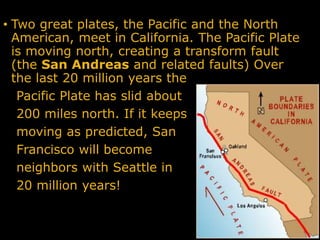
• Two great plates, the Pacific and the North
American, meet in California. The Pacific Plate
is moving north, creating a transform fault
(the San Andreas and related faults) Over
the last 20 million years the
Pacific Plate has slid about
200 miles north. If it keeps
moving as predicted, San
Francisco will become
neighbors with Seattle in
20 million years!
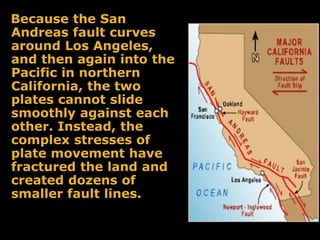
Because the San
Andreas fault curves
around Los Angeles,
and then again into the
Pacific in northern
California, the two
plates cannot slide
smoothly against each
other. Instead, the
complex stresses of
plate movement have
fractured the land and
created dozens of
smaller fault lines.
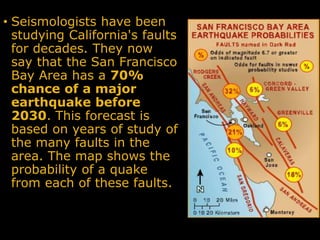
• Seismologists have been
studying California's faults
for decades. They now
say that the San Francisco
Bay Area has a 70%
chance of a major
earthquake before
2030. This forecast is
based on years of study of
the many faults in the
area. The map shows the
probability of a quake
from each of these faults.
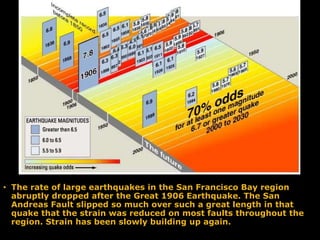
• The rate of large earthquakes in the San Francisco Bay region
abruptly dropped after the Great 1906 Earthquake. The San
Andreas Fault slipped so much over such a great length in that
quake that the strain was reduced on most faults throughout the
region. Strain has been slowly building up again.
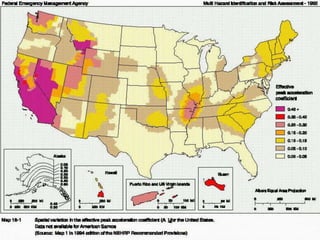
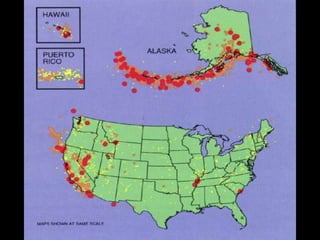
• Earthquakes can also occur within plates,
although plate-boundary earthquakes are much
more common. Less than 10 percent of all
earthquakes occur within plate interiors. The
New Madrid earthquakes of 1811-1812 and the
1886 Charleston earthquake occurred within the
North American plate.
• Earthquakes: Facts and Fiction
• Fiction: Earthquakes usually happen in the morning.
Fact: Earthquakes happen in both the day and the night.
There is no pattern.
• Fiction: There is such a thing as "earthquake weather."
Fact: There is no connection between earthquakes and
weather. Remember, earthquakes happen deep in the earth,
far away from the weather!
• Fiction: Earthquakes are on the increase.
Fact: It may seem like we’re having more earthquakes
because there are more reporting stations, but the truth is
we’re not.
• Fiction: We can prevent earthquakes from happening.
Fact: No. You can protect yourself by doing things to secure
buildings, like your home, but earthquakes can’t be
prevented -- or predicted.
The point beneath the Earth's surface
where the rocks break and move is
called the focus of the earthquake. The
focus is the underground point of origin
of an earthquake.
Directly above the
focus, on the Earth's
surface, is the
epicenter.
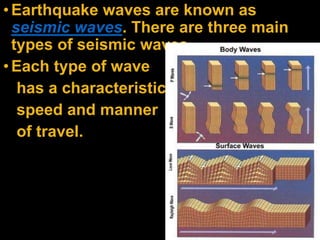
•Earthquake waves are known as
seismic waves. There are three main
types of seismic waves.
•Each type of wave
has a characteristic
speed and manner
of travel.
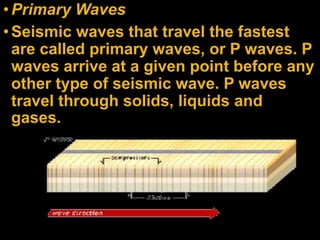
•Primary Waves
•Seismic waves that travel the fastest
are called primary waves, or P waves. P
waves arrive at a given point before any
other type of seismic wave. P waves
travel through solids, liquids and
gases.
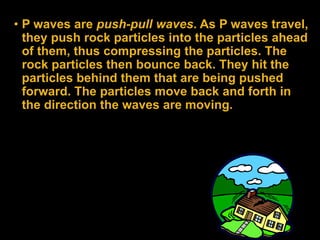
• P waves are push-pull waves. As P waves travel,
they push rock particles into the particles ahead
of them, thus compressing the particles. The
rock particles then bounce back. They hit the
particles behind them that are being pushed
forward. The particles move back and forth in
the direction the waves are moving.
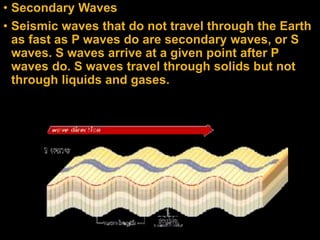
• Secondary Waves
• Seismic waves that do not travel through the Earth
as fast as P waves do are secondary waves, or S
waves. S waves arrive at a given point after P
waves do. S waves travel through solids but not
through liquids and gases.
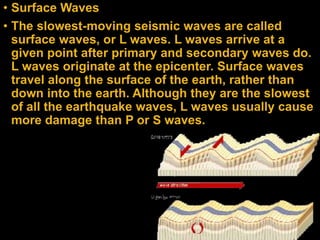
• Surface Waves
• The slowest-moving seismic waves are called
surface waves, or L waves. L waves arrive at a
given point after primary and secondary waves do.
L waves originate at the epicenter. Surface waves
travel along the surface of the earth, rather than
down into the earth. Although they are the slowest
of all the earthquake waves, L waves usually cause
more damage than P or S waves.
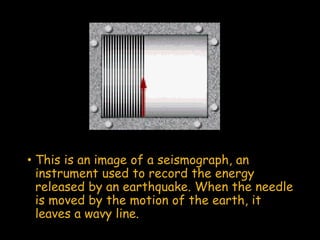
• This is an image of a seismograph, an
instrument used to record the energy
released by an earthquake. When the needle
is moved by the motion of the earth, it
leaves a wavy line.
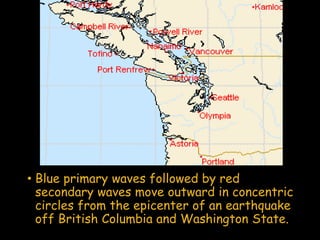
• Blue primary waves followed by red
secondary waves move outward in concentric
circles from the epicenter of an earthquake
off British Columbia and Washington State.

earthquake.ppt

  • 2.
    Earthquakes are theshaking, rolling or sudden shock of the earth’s surface. Earthquakes happen along "fault lines" in the earth’s crust. Earthquakes can be felt over large areas although they usually last less than one minute. Earthquakes cannot be predicted -- although scientists are working on it!
  • 3.
    • Most ofthe time, you will notice an earthquake by the gentle shaking of the ground. You may notice hanging plants swaying or objects wobbling on shelves. Sometimes you may hear a low rumbling noise or feel a sharp jolt. A survivor of the 1906 earthquake in San Francisco said the sensation was like riding a bicycle down a long flight of stairs.
  • 4.
    • The intensityof an earthquake can be measured. One measurement is called the Richter scale. Earthquakes below 4.0 on the Richter scale usually do not cause damage, and earthquakes below 2.0 usually can’t be felt. Earthquakes over 5.0 on the scale can cause damage. A magnitude 6.0 earthquake is considered strong and a magnitude 7.0 is a major earthquake. The Northridge Earthquake, which hit Southern California in 1994, was magnitude 6.7.
  • 5.
    Earthquakes often occurwhen tectonic plate collide What happens when plates collide? It depends how the plates are moving when they meet: When two plates collide head-on, they push each other up and form mountains. That's how the Himalayas and other great mountain ranges (including the Rockies, long ago) were created.
  • 6.
    When one platedives below another plate, it creates a subduction zone as the diving plate is crushed and melted. This process often creates volcanoes as the magma (molten rock) rises up to the surface.
  • 7.
    When two plates slide pasteach other, they create a transform fault, like the San Andreas fault.
  • 8.
    • Earthquakes canhappen in any of these situations. Despite the powerful forces driving plate movement, the plates themselves spend much of the time locked in place by the friction of the plates rubbing against each other. Eventually, however, they build up so much pressure that the plates abruptly snap forward. Then the ground can shift a few feet—or a few dozen! Shock waves from that sudden motion shoot out in all directions, creating an earthquake.
  • 9.
    • Two greatplates, the Pacific and the North American, meet in California. The Pacific Plate is moving north, creating a transform fault (the San Andreas and related faults) Over the last 20 million years the Pacific Plate has slid about 200 miles north. If it keeps moving as predicted, San Francisco will become neighbors with Seattle in 20 million years!
  • 10.
    Because the San Andreasfault curves around Los Angeles, and then again into the Pacific in northern California, the two plates cannot slide smoothly against each other. Instead, the complex stresses of plate movement have fractured the land and created dozens of smaller fault lines.
  • 11.
    • Seismologists havebeen studying California's faults for decades. They now say that the San Francisco Bay Area has a 70% chance of a major earthquake before 2030. This forecast is based on years of study of the many faults in the area. The map shows the probability of a quake from each of these faults.
  • 12.
    • The rateof large earthquakes in the San Francisco Bay region abruptly dropped after the Great 1906 Earthquake. The San Andreas Fault slipped so much over such a great length in that quake that the strain was reduced on most faults throughout the region. Strain has been slowly building up again.
  • 13.
    • Earthquakes canalso occur within plates, although plate-boundary earthquakes are much more common. Less than 10 percent of all earthquakes occur within plate interiors. The New Madrid earthquakes of 1811-1812 and the 1886 Charleston earthquake occurred within the North American plate.
  • 14.
    • Earthquakes: Factsand Fiction • Fiction: Earthquakes usually happen in the morning. Fact: Earthquakes happen in both the day and the night. There is no pattern. • Fiction: There is such a thing as "earthquake weather." Fact: There is no connection between earthquakes and weather. Remember, earthquakes happen deep in the earth, far away from the weather! • Fiction: Earthquakes are on the increase. Fact: It may seem like we’re having more earthquakes because there are more reporting stations, but the truth is we’re not. • Fiction: We can prevent earthquakes from happening. Fact: No. You can protect yourself by doing things to secure buildings, like your home, but earthquakes can’t be prevented -- or predicted.
  • 17.
    The point beneaththe Earth's surface where the rocks break and move is called the focus of the earthquake. The focus is the underground point of origin of an earthquake. Directly above the focus, on the Earth's surface, is the epicenter.
  • 18.
    •Earthquake waves areknown as seismic waves. There are three main types of seismic waves. •Each type of wave has a characteristic speed and manner of travel.
  • 19.
    •Primary Waves •Seismic wavesthat travel the fastest are called primary waves, or P waves. P waves arrive at a given point before any other type of seismic wave. P waves travel through solids, liquids and gases.
  • 20.
    • P wavesare push-pull waves. As P waves travel, they push rock particles into the particles ahead of them, thus compressing the particles. The rock particles then bounce back. They hit the particles behind them that are being pushed forward. The particles move back and forth in the direction the waves are moving.
  • 21.
    • Secondary Waves •Seismic waves that do not travel through the Earth as fast as P waves do are secondary waves, or S waves. S waves arrive at a given point after P waves do. S waves travel through solids but not through liquids and gases.
  • 22.
    • Surface Waves •The slowest-moving seismic waves are called surface waves, or L waves. L waves arrive at a given point after primary and secondary waves do. L waves originate at the epicenter. Surface waves travel along the surface of the earth, rather than down into the earth. Although they are the slowest of all the earthquake waves, L waves usually cause more damage than P or S waves.
  • 23.
    • This isan image of a seismograph, an instrument used to record the energy released by an earthquake. When the needle is moved by the motion of the earth, it leaves a wavy line.
  • 24.
    • Blue primarywaves followed by red secondary waves move outward in concentric circles from the epicenter of an earthquake off British Columbia and Washington State.