Earthquakes  K rystal Ross Mrs.. Smith 4th hour April 8, 2011
Basic Background Information What is an earthquake? An earthquake is caused by a sudden slip on a fault. The tectonic plates are always slowly moving, but they get stuck at their edges due to friction. When the stress on the edge overcomes the friction, there is an earthquake that releases energy in waves that travel through the earth's crust and cause the shaking that we feel. How are earthquakes measured? earthquakes is measured on the Richter scale,  What does magnitude mean? The great size or extent of something How is magnitude measured? The Richter scale assigns a magnitude number to an earthquake based on the maximum amplitude of the seismic waves as recorded on a seismometer and the distance of the seismometer station from the epicenter of the earthquake.
Damage Caused by Earthquakes R oads C limate Buildings
Waves What are earthquake waves called? There are several types of earthquake waves including P, or primary, and S, or secondary, waves, What two types of seismic waves are there? Primary waves Secondary waves What two types of body waves are there? Primary (P) and Secondary (S) waves .
Body   Waves How do P waves travel? P waves are primary seismic waves. They are the fastest seismic waves and they are compression or longitudinal waves, which means the to-and-fro movement of the particles is in the same direction as the wave is traveling. There is an illustration and explanation in the reference below. P waves can propagate through any medium. (solid. liquid or gas) How do S waves travel? As these waves move, they displace rock particles outward, pushing them perpendicular to the path of the waves. This results in the first period of rolling associated with earthquakes. Unlike P waves, S waves don't move straight through the earth. They only travel through solid material, and so are stopped at the liquid layer in the earth's core.   Which move faster? S waves
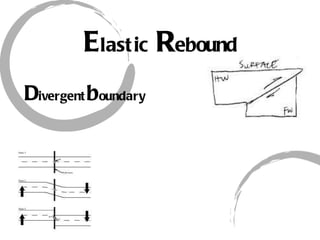
E lastic  R ebound D ivergent b oundary
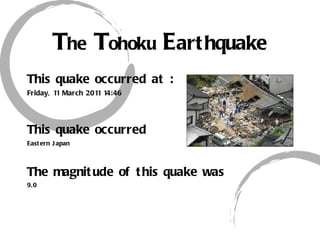
T he   T ohoku   E arthquake This quake occurred at : Friday, 11 March 2011 14:46 This quake occurred   Eastern Japan The magnitude of this quake was 9.0
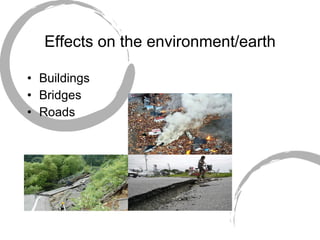
Effects on the environment/earth Buildings  Bridges  Roads
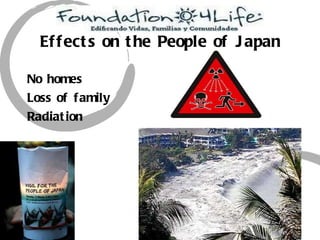
Effects on the People of Japan No homes  Loss of family Radiation
Effects on the Economy of Japan Toyota  Fuji Heavy Industries Nestlé
GPS Sensors One interesting fact about this earthquake is that it moved several GPS sensors. This will require  …(Type answer here) How does elastic rebound explain this movement? Type your answer here .
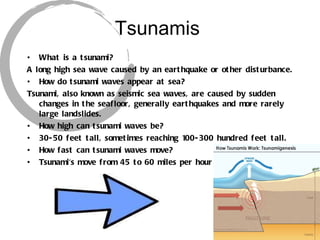
Tsunamis What is a tsunami? A long high sea wave caused by an earthquake or other disturbance. How do tsunami waves appear at sea? Tsunami, also known as seismic sea waves, are caused by sudden changes in the seafloor, generally earthquakes and more rarely large landslides.  How high can tsunami waves be? 30-50 feet tall, sometimes reaching 100-300 hundred feet tall. How fast can tsunami waves move? Tsunami's move from 45 to 60 miles per hour
Websites Used http://www.google.com/images?um=1&hl=en&client=firefox-a&rls=org.mozilla%3Aen-US%3Aofficial&biw=1269&bih=645&tbm=isch&sa=1&q=What+is+a+tsunami%3F&aq=f&aqi=&aql=&oq http://www.google.com/search?q=what+effects+on+japans+econmy+after+the+earthquake&ie=utf-8&oe=utf-8&aq=t&rls=org.mozilla:en-US:official&client=firefox-ahttp://www.audioenglish.net/dictionary/magnitude.htm http://wiki.answers.com/ http://en.wikipedia.org/wiki/2011_T%C5%8Dhoku_earthquake_and_tsunami http://science.howstuffworks.com/nature/natural-disasters/earthquake4.htm

Krystal+ross

  • 1.
    Earthquakes Krystal Ross Mrs.. Smith 4th hour April 8, 2011
  • 2.
    Basic Background InformationWhat is an earthquake? An earthquake is caused by a sudden slip on a fault. The tectonic plates are always slowly moving, but they get stuck at their edges due to friction. When the stress on the edge overcomes the friction, there is an earthquake that releases energy in waves that travel through the earth's crust and cause the shaking that we feel. How are earthquakes measured? earthquakes is measured on the Richter scale, What does magnitude mean? The great size or extent of something How is magnitude measured? The Richter scale assigns a magnitude number to an earthquake based on the maximum amplitude of the seismic waves as recorded on a seismometer and the distance of the seismometer station from the epicenter of the earthquake.
  • 3.
    Damage Caused byEarthquakes R oads C limate Buildings
  • 4.
    Waves What areearthquake waves called? There are several types of earthquake waves including P, or primary, and S, or secondary, waves, What two types of seismic waves are there? Primary waves Secondary waves What two types of body waves are there? Primary (P) and Secondary (S) waves .
  • 5.
    Body Waves How do P waves travel? P waves are primary seismic waves. They are the fastest seismic waves and they are compression or longitudinal waves, which means the to-and-fro movement of the particles is in the same direction as the wave is traveling. There is an illustration and explanation in the reference below. P waves can propagate through any medium. (solid. liquid or gas) How do S waves travel? As these waves move, they displace rock particles outward, pushing them perpendicular to the path of the waves. This results in the first period of rolling associated with earthquakes. Unlike P waves, S waves don't move straight through the earth. They only travel through solid material, and so are stopped at the liquid layer in the earth's core. Which move faster? S waves
  • 6.
    E lastic R ebound D ivergent b oundary
  • 7.
    T he T ohoku E arthquake This quake occurred at : Friday, 11 March 2011 14:46 This quake occurred Eastern Japan The magnitude of this quake was 9.0
  • 8.
    Effects on theenvironment/earth Buildings Bridges Roads
  • 9.
    Effects on thePeople of Japan No homes Loss of family Radiation
  • 10.
    Effects on theEconomy of Japan Toyota Fuji Heavy Industries Nestlé
  • 11.
    GPS Sensors Oneinteresting fact about this earthquake is that it moved several GPS sensors. This will require …(Type answer here) How does elastic rebound explain this movement? Type your answer here .
  • 12.
    Tsunamis What isa tsunami? A long high sea wave caused by an earthquake or other disturbance. How do tsunami waves appear at sea? Tsunami, also known as seismic sea waves, are caused by sudden changes in the seafloor, generally earthquakes and more rarely large landslides. How high can tsunami waves be? 30-50 feet tall, sometimes reaching 100-300 hundred feet tall. How fast can tsunami waves move? Tsunami's move from 45 to 60 miles per hour
  • 13.
    Websites Used http://www.google.com/images?um=1&hl=en&client=firefox-a&rls=org.mozilla%3Aen-US%3Aofficial&biw=1269&bih=645&tbm=isch&sa=1&q=What+is+a+tsunami%3F&aq=f&aqi=&aql=&oqhttp://www.google.com/search?q=what+effects+on+japans+econmy+after+the+earthquake&ie=utf-8&oe=utf-8&aq=t&rls=org.mozilla:en-US:official&client=firefox-ahttp://www.audioenglish.net/dictionary/magnitude.htm http://wiki.answers.com/ http://en.wikipedia.org/wiki/2011_T%C5%8Dhoku_earthquake_and_tsunami http://science.howstuffworks.com/nature/natural-disasters/earthquake4.htm