SEISMIC WAVES
EDITHA G. GONE
OBJECTIVES
• Familiarize what are seismic waves
and how it moves the ground.
• Demonstrate the movement of each
type of seismic waves.
• Promote team work and
participation.
Answer directly in one complete sentence.
1. What is a wave?
2. Why do seismic waves differ from other waves
like sound waves?
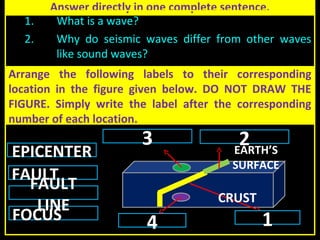
Arrange the following labels to their corresponding
location in the figure given below. DO NOT DRAW THE
FIGURE. Simply write the label after the corresponding
number of each location.
2
4 1
3
EPICENTER
FAULT
FOCUS
FAULT
LINE
EARTH’S
SURFACE
CRUST
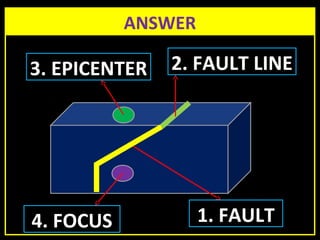
ANSWER
1. What is an wave?
Wave is a rhythmic disturbance that
carries energy without transporting matter
from place to place.
2. Why do seismic waves differ from other
waves like sound waves?
Seismic waves differ from other waves like
sound waves because it is the wave that
carries the energy from beneath the ground
during earthquakes.
QUIZ 2.19ANSWER
2. FAULT LINE
4. FOCUS 1. FAULT
3. EPICENTER
WHAT IS AN EARTHQUAKE
AND WHEN WILL IT OCCUR?
Earthquake is shaking of the ground
cause by a release of an energy from
beneath it.
Earthquake occurs when rocks along a
fault suddenly move due to the release
of energy from the ground as friction
limits between rocks is reached.
2.
Earthquakes occur when rocks slip along faults.
Earthquake and Seismic Wave
•Seismic waves are waves that
travel through the Earth
carrying the energy released
during earthquakes.
Types of Seismic Wave
Body waves travel in all directions from
the focus through the body of the Earth
inner layers(core, mantle, crust).
Surface waves don’t travel through the
Earth but instead they are constrained to
travel along the surface of the Earth only
from the epicenter(outer crust).
Primary Waves
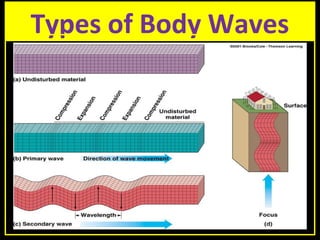
Primary waves (compressional waves) are
the fastest form of wave that can move
through solids, liquids and some gases.
These waves cause rock particles to move
back and forth in the same direction as
the wave is traveling (push-pull).
Primary Waves
Secondary Waves
Secondary waves (shear wave) are slower
than the primary and travel through
solids only.
Cause rock particles to move back and
forth at right angles to the line of wave
movement.
Secondary Waves
Types of Body Waves
Where do Primary and
Secondary wave start to
travel?
From the focus.
Rayleigh Waves
Rayleigh waves are causing the ground to
shake in an elliptical motion.
It moves the ground up and down, and
side-to-side in the same direction that
the wave is moving.
Most of EQ shaking is due to this type of
wave.
Rayleigh Waves
Love Waves
Love waves are waves produce
entirely horizontal motion.
It moves the ground side-to-
side .
Love Waves
Types of Surface Waves
Where do Rayleigh and
Love wave start to
travel?
From the epicenter.
Which type of wave causes
thousands of death and structural
destruction – body or surface?
Explain.
The surface waves because they
are the ones that carries the
released energy in the surface
where infrastructures are built on.
Summary
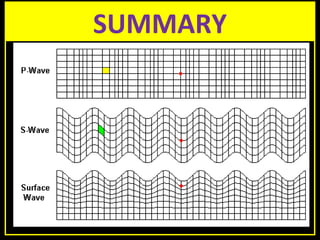
• Seismic waves
– are vibrations that travel through the Earth carrying the
energy released during earthquakes.
• Body waves
– travel in all directions from the focus through the body
of the Earth inner layers(core, mantle, crust).
– Types are primary and secondary waves.
• Surface waves
– don’t travel through the Earth but instead they are
constrained to travel along the surface of the Earth only
from the epicenter(crust).
– Types are Rayleigh and Love waves.
SUMMARY
ACTIVITY
• Make a Pantomimed demonstration.
• Demonstrate the movement of the each type of
seismic wave.
• All members should be part of each chain type of
seismic wave.
• Wave direction is to the right and left.
• You have 5 minutes to practice your demonstration.
• You may make your own moves which are still in
line with the exact movement of the waves.
• YOUR TEACHER WILL BE THE ONE TO CHOOSE
WHAT TYPE OF WAVE YOU ARE GOING TO PRESENT
ACTIVITY
YOU WILL BE GRADED ACCORDING TO THE
FOLLOWING:
Understanding of the concept 50
Mastery 20
Creativity 20
Team Work 10
Example

Seismic waves.

  • 1.
  • 2.
    OBJECTIVES • Familiarize whatare seismic waves and how it moves the ground. • Demonstrate the movement of each type of seismic waves. • Promote team work and participation.
  • 3.
    Answer directly inone complete sentence. 1. What is a wave? 2. Why do seismic waves differ from other waves like sound waves? Arrange the following labels to their corresponding location in the figure given below. DO NOT DRAW THE FIGURE. Simply write the label after the corresponding number of each location. 2 4 1 3 EPICENTER FAULT FOCUS FAULT LINE EARTH’S SURFACE CRUST
  • 5.
    ANSWER 1. What isan wave? Wave is a rhythmic disturbance that carries energy without transporting matter from place to place. 2. Why do seismic waves differ from other waves like sound waves? Seismic waves differ from other waves like sound waves because it is the wave that carries the energy from beneath the ground during earthquakes.
  • 6.
    QUIZ 2.19ANSWER 2. FAULTLINE 4. FOCUS 1. FAULT 3. EPICENTER
  • 7.
    WHAT IS ANEARTHQUAKE AND WHEN WILL IT OCCUR? Earthquake is shaking of the ground cause by a release of an energy from beneath it. Earthquake occurs when rocks along a fault suddenly move due to the release of energy from the ground as friction limits between rocks is reached.
  • 8.
    2. Earthquakes occur whenrocks slip along faults.
  • 9.
    Earthquake and SeismicWave •Seismic waves are waves that travel through the Earth carrying the energy released during earthquakes.
  • 10.
    Types of SeismicWave Body waves travel in all directions from the focus through the body of the Earth inner layers(core, mantle, crust). Surface waves don’t travel through the Earth but instead they are constrained to travel along the surface of the Earth only from the epicenter(outer crust).
  • 11.
    Primary Waves Primary waves(compressional waves) are the fastest form of wave that can move through solids, liquids and some gases. These waves cause rock particles to move back and forth in the same direction as the wave is traveling (push-pull).
  • 12.
  • 13.
    Secondary Waves Secondary waves(shear wave) are slower than the primary and travel through solids only. Cause rock particles to move back and forth at right angles to the line of wave movement.
  • 14.
  • 15.
  • 16.
    Where do Primaryand Secondary wave start to travel? From the focus.
  • 17.
    Rayleigh Waves Rayleigh wavesare causing the ground to shake in an elliptical motion. It moves the ground up and down, and side-to-side in the same direction that the wave is moving. Most of EQ shaking is due to this type of wave.
  • 18.
  • 19.
    Love Waves Love wavesare waves produce entirely horizontal motion. It moves the ground side-to- side .
  • 20.
  • 21.
  • 22.
    Where do Rayleighand Love wave start to travel? From the epicenter.
  • 23.
    Which type ofwave causes thousands of death and structural destruction – body or surface? Explain. The surface waves because they are the ones that carries the released energy in the surface where infrastructures are built on.
  • 24.
    Summary • Seismic waves –are vibrations that travel through the Earth carrying the energy released during earthquakes. • Body waves – travel in all directions from the focus through the body of the Earth inner layers(core, mantle, crust). – Types are primary and secondary waves. • Surface waves – don’t travel through the Earth but instead they are constrained to travel along the surface of the Earth only from the epicenter(crust). – Types are Rayleigh and Love waves.
  • 25.
  • 26.
    ACTIVITY • Make aPantomimed demonstration. • Demonstrate the movement of the each type of seismic wave. • All members should be part of each chain type of seismic wave. • Wave direction is to the right and left. • You have 5 minutes to practice your demonstration. • You may make your own moves which are still in line with the exact movement of the waves. • YOUR TEACHER WILL BE THE ONE TO CHOOSE WHAT TYPE OF WAVE YOU ARE GOING TO PRESENT
  • 27.
    ACTIVITY YOU WILL BEGRADED ACCORDING TO THE FOLLOWING: Understanding of the concept 50 Mastery 20 Creativity 20 Team Work 10
  • 28.