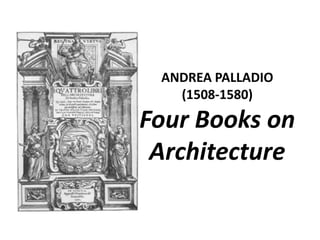
ANDREA PALLADIO
(1508-1580)

Four Books on
Architecture
I quattro libri dell'architettura.
• WHEN: The 16th century Italian architect Andrea Palladio, one of the

great masters of Renaissance culture, has had an enduring influence on
American architecture. Of even greater significance than Palladio's
buildings is his treatise I quattro libri dell'architettura (The Four Books On
Architecture), the most successful architectural treatise of the
Renaissance and one of the two or three most important books in the
literature of architecture. First published in Italian in 1570, it has been
translated into every major Western language.
• WHY: Venice had a tradition of producing high quality illustrated books
and the local aristocracy provided a ready clientele of highly educated
readers.
• HOW: Vitruvius (written in the 1st century BC) and Vignola (published in
1563), was a source of inspiration for Palladio’s treatise. What sets
Palladio’s work apart though is the clarity and precision of both the text
and the illustrations. Palladio concentrates on practical aspects of the
building process while at the same time providing his readers with a set of
rules and principles based on the examples of Roman antiquity.
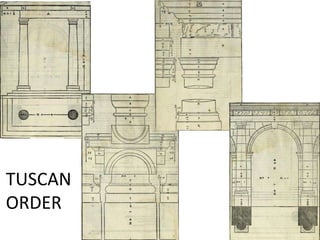
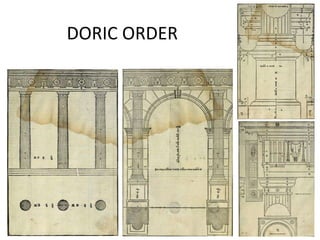
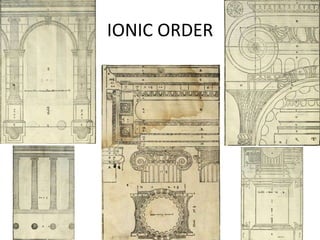
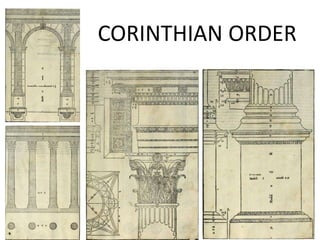
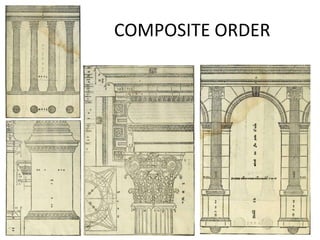
• In his First Book he discusses building
materials and techniques, as well as the five
orders of architecture:
Tuscan, Doric, Ionic, Corinthian, and
Composite. Palladio describes the
characteristics of each order and illustrates
them.
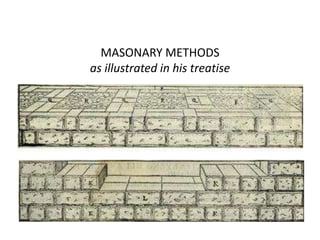
MASONARY METHODS
as illustrated in his treatise
TUSCAN
ORDER
DORIC ORDER
IONIC ORDER
CORINTHIAN ORDER
COMPOSITE ORDER
The second book discusses private town houses and country
estates, almost all designed by Palladio.

CASE STUDY OF VILLA ROTUNDA
• Palladio’s woodcut engravings for the Quattro libri [1570]
were probably intended to express his architectural
ideals, not the buildings as they were actually built.
• Curiously, the history of the ownership of the Rotonda’s
estate is known down to the slightest detail, but little or
nothing is known regarding the villa’s proportions.
• The thickness of the walls and the height of the central vault
are not indicated; only the proportions of the rooms are
given.
It seems thatPalladio wanted us to learn the ideals from his
treatise and the reality from his works,leaving our imagination
to bridge the gap between his theory and practice.
(NEXUS NETWORK JOURNAL – VOL. 10, NO. 2, 2008)
Plan
The significance of “the whole” and “the parts” in Palladio’s architecture becomes
clearer and more comprehensible when it is perceived in perspective allow us to visualize why the villa looks bigger than it
actually is Certainly, after walking for a while in the gardens, one can perceive the building
within a virtual volume, extending its dimensions beyond its walls
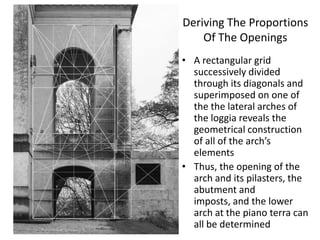
Deriving The Proportions
Of The Openings
• A rectangular grid
successively divided
through its diagonals and
superimposed on one of
the the lateral arches of
the loggia reveals the
geometrical construction
of all of the arch’s
elements
• Thus, the opening of the
arch and its pilasters, the
abutment and
imposts, and the lower
arch at the piano terra can
all be determined

Andrea palladio

  • 1.
  • 2.
    I quattro libridell'architettura. • WHEN: The 16th century Italian architect Andrea Palladio, one of the great masters of Renaissance culture, has had an enduring influence on American architecture. Of even greater significance than Palladio's buildings is his treatise I quattro libri dell'architettura (The Four Books On Architecture), the most successful architectural treatise of the Renaissance and one of the two or three most important books in the literature of architecture. First published in Italian in 1570, it has been translated into every major Western language. • WHY: Venice had a tradition of producing high quality illustrated books and the local aristocracy provided a ready clientele of highly educated readers. • HOW: Vitruvius (written in the 1st century BC) and Vignola (published in 1563), was a source of inspiration for Palladio’s treatise. What sets Palladio’s work apart though is the clarity and precision of both the text and the illustrations. Palladio concentrates on practical aspects of the building process while at the same time providing his readers with a set of rules and principles based on the examples of Roman antiquity.
  • 3.
    • In hisFirst Book he discusses building materials and techniques, as well as the five orders of architecture: Tuscan, Doric, Ionic, Corinthian, and Composite. Palladio describes the characteristics of each order and illustrates them.
  • 4.
  • 5.
  • 6.
  • 7.
  • 8.
  • 9.
  • 10.
    The second bookdiscusses private town houses and country estates, almost all designed by Palladio. CASE STUDY OF VILLA ROTUNDA • Palladio’s woodcut engravings for the Quattro libri [1570] were probably intended to express his architectural ideals, not the buildings as they were actually built. • Curiously, the history of the ownership of the Rotonda’s estate is known down to the slightest detail, but little or nothing is known regarding the villa’s proportions. • The thickness of the walls and the height of the central vault are not indicated; only the proportions of the rooms are given. It seems thatPalladio wanted us to learn the ideals from his treatise and the reality from his works,leaving our imagination to bridge the gap between his theory and practice. (NEXUS NETWORK JOURNAL – VOL. 10, NO. 2, 2008)
  • 11.
  • 12.
    The significance of“the whole” and “the parts” in Palladio’s architecture becomes clearer and more comprehensible when it is perceived in perspective allow us to visualize why the villa looks bigger than it actually is Certainly, after walking for a while in the gardens, one can perceive the building within a virtual volume, extending its dimensions beyond its walls
  • 14.
    Deriving The Proportions OfThe Openings • A rectangular grid successively divided through its diagonals and superimposed on one of the the lateral arches of the loggia reveals the geometrical construction of all of the arch’s elements • Thus, the opening of the arch and its pilasters, the abutment and imposts, and the lower arch at the piano terra can all be determined