A Distinguishing Guide for
Junior Literacy Educators
Lindsay Dunn, May 2015
Click to Advance Slides
Phonemic Awareness
and Phonics
The Phonological
Cueing System
Sales
1st Qtr
2nd Qtr
3rd Qtr
4th Qtr
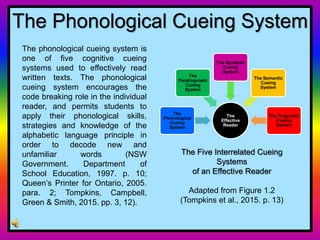
The Phonological Cueing System
The
Effective
Reader
The
Phonological
Cueing
System
The
Paralinguistic
Cueing
System
The Syntactic
Cueing
System
The Semantic
Cueing
System
The Pragmatic
Cueing
System
The Five Interrelated Cueing
Systems
of an Effective Reader
Adapted from Figure 1.2
(Tompkins et al., 2015. p. 13)
The phonological cueing system is
one of five cognitive cueing
systems used to effectively read
written texts. The phonological
cueing system encourages the
code breaking role in the individual
reader, and permits students to
apply their phonological skills,
strategies and knowledge of the
alphabetic language principle in
order to decode new and
unfamiliar words (NSW
Government. Department of
School Education, 1997. p. 10;
Queen’s Printer for Ontario, 2005.
para. 2; Tompkins, Campbell,
Green & Smith, 2015. pp. 3, 12).
0
0.5
1
1.5
2
2.5
3
3.5
0.7 1.8 2.6
Y-Values
Y-Values
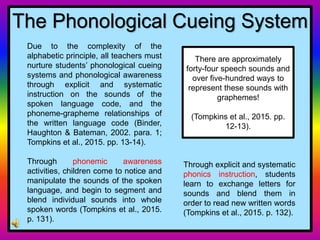
Due to the complexity of the
alphabetic principle, all teachers must
nurture students’ phonological cueing
systems and phonological awareness
through explicit and systematic
instruction on the sounds of the
spoken language code, and the
phoneme-grapheme relationships of
the written language code (Binder,
Haughton & Bateman, 2002. para. 1;
Tompkins et al., 2015. pp. 13-14).
Through phonemic awareness
activities, children come to notice and
manipulate the sounds of the spoken
language, and begin to segment and
blend individual sounds into whole
spoken words (Tompkins et al., 2015.
p. 131).
The Phonological Cueing System
Through explicit and systematic
phonics instruction, students
learn to exchange letters for
sounds and blend them in
order to read new written words
(Tompkins et al., 2015. p. 132).
There are approximately
forty-four speech sounds and
over five-hundred ways to
represent these sounds with
graphemes!
(Tompkins et al., 2015. pp.
12-13).
Phonemic
Awareness
What is Phonemic Awareness?
Whilst explicit phonics instruction helps school-aged students build bridges
between the sounds and letters of the English language code (Frost, 2012.
p. 3; Tompkins et al., 2015. p. 142); phonemic awareness development
begins prior to one’s participation in the classroom and is dominantly
auditory with a focus on the manipulation of the sounds or phonemes of the
spoken language, as opposed to the graphemes and spelling patterns of the
written language (Frost, 2012. p. 2; Tompkins et al., 2015. p. 132; University
of Oregon Centre on Teaching and Learning, [UOCTL] 2009. para. 2).
Whilst most children will have developed phonemic awareness prior to
coming to school and are ready to make connections between the
phonemes and graphemes; early literacy teachers know that phonemic
awareness serves as an indicator for early reading success (UOCTL, 2009.
para. 1), and that the lack of phonemic awareness is the most accurate
predictor of those who will experience difficulties in learning to read (Frost,
2012. p. 1). Therefore, in conjunction with their systematic and explicit
phonics programs, early literacy teachers support the ongoing development
of their students’ phonemic awareness through structured learning activities
which solely manipulate the oral language (Tompkins et al., 2015. p. 133). .
Phonemic Awareness Instruction
Instruction on phonemic awareness in the junior primary classroom involves
students identifying and manipulating the individual sounds of the spoken
language (Frost, 2012. p. 2; Tompkins et al., 2015. p. 133). Through
phonemic awareness instruction, students develop skills to identify and
isolate individual phonemes (Frost, 2012. p. 2); they separate the beginning
sounds or onset from the ending sounds or rhyme, they categorise sounds,
remove and substitute sounds to make new whole words, and apply
strategies of blending and segmenting to form and break down whole words
respectively (Frost, 2012. p. 2; Tompkins et al., 2015. p. 133).
In the classroom, teachers are able to provide their students with endless
opportunities to identify, manipulate, blend and segment sounds through the
creation of language-rich learning environments that nurture the phonemic
awareness skills and strategies (Tompkins et al., 2015. p. 133). As part of a
balanced literacy program, junior primary teachers should use explicit mini
lessons on the phonemic awareness skills alongside routine classroom
activities which include songs, riddles, and other word play elements which
encourage the students’ experimental manipulation of the phonemes
(Tompkins et al., 2015. p. 133).
Phonics
Instruction
What is Phonics?
Phonics instruction extends and continues to encourage the development
of phonemic awareness in students, however, as opposed to phonemic
awareness which is entirely auditory with a focus on the sounds only (Frost,
2012. p. 2; Tompkins et al., 2015. p. 132); explicit or intentional phonics
instruction examines both the phonemes and graphemes, with an emphasis
on their relationships and spelling patterns (Government of South Australia.
Department of Education and Children’s Services, 2011. p. 3; Tompkins et
al., 2015. p. 142).
Through the effective explicit and systematic phonics program, students
learn about the phonics concepts, skills, strategies and spelling rules which
will ultimately assist them in cracking the written language code (Frost,
2012. p. 3; Tompkins et al., 2015. p. 3, 142). In the junior primary setting,
students are actively engaged in explicit and systematic phonics instruction
from the foundation year to the end of year two (Binder, Haughton &
Bateman, 2002. p. 1; Ivey & Baker, 2004. para. 5; Tompkins et al., 2015. p.
149). When planning to teach phonics, it is recommended that junior
literacy teachers plan their phonics programs in respect to the following
sequence and summary of the phonics concepts, skills, rules and strategies
(see concluding slide).
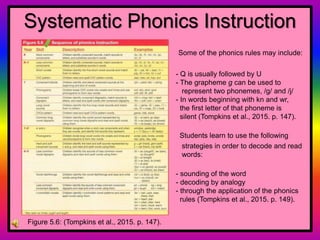
Systematic Phonics Instruction
Some of the phonics rules may include:
- Q is usually followed by U
- The grapheme g can be used to
represent two phonemes, /g/ and /j/
- In words beginning with kn and wr,
the first letter of that phoneme is
silent (Tompkins et al., 2015. p. 147).
Students learn to use the following
strategies in order to decode and read
words:
- sounding of the word
- decoding by analogy
- through the application of the phonics
rules (Tompkins et al., 2015. p. 149).
Figure 5.6: (Tompkins et al., 2015. p. 147).
References
Binder, C., Haughton, E., & Bateman, B. (2002). Fluency: Achieving True Mastery in the Learning Process. Retrieved from: http://
www.curry.edschool.virginia.edu/sped/projects/ose/papers/
Frost, S. (2012). Phonemic Awareness and Phonics Instruction: Program Research Base. Retrieved from: http://www. Doe.in.gov/
sites/default/files/curriculum/research-base-phonemic-awareness-and-phonics.pdf
Government of South Australia. Department of Education and Children’s Services. (2011). Engaging in and Exploring Reading:
Reading in the Early Years. Retrieved from: http://www.decd.sa.gov.au/literacy/files/pages/Programs_and_
Resources/DECS_Reading_in_the_early.pdf
Ivey, G., & Baker, M. I. (2004). Phonics Instruction for Older Students: Just Say No. Educational Leadership, 61 (6). Retrieved
from: http://www.ascd.org/publications/educational-leadership/mar04/vol61/num06/Phonics-Instruction-for-
Older-Students%C2%A2-Just-Say-No.aspx
NSW Government. Department of School Education. (1997). Teaching Reading: A K-6 Framework. Retrieved from: http://www.
curriculumsupport.education.nsw.gov.au/primary/english/assets/pdf/reading/teach_
Queen’s Printer for Ontario. (2005). Critical Literacy – The Four Roles of the Reader. Retrieved from: http://www.eworkshop.on.
ca/edu/pdf/Mod08_four_roles.pdf
Tompkins, G., Campbell, R., Green, D., & Smith, C. (2015). Literacy for the 21st Century: A Balanced Approach (2nd ed.). Melbourne,
Victoria: Pearson Australia.
University of Oregon Centre on Teaching and Learning. (2009). Phonemic Awareness: Concepts and Research. Retrieved from:
http://www.reading.uoregon.edu/resources/bibr_pa_concepts.pdf
Unless otherwise cited, all graphics used in this presentation remain the property of Microsoft Office ClipArt

Presentation

  • 1.
    A Distinguishing Guidefor Junior Literacy Educators Lindsay Dunn, May 2015 Click to Advance Slides Phonemic Awareness and Phonics
  • 2.
  • 3.
    Sales 1st Qtr 2nd Qtr 3rdQtr 4th Qtr The Phonological Cueing System The Effective Reader The Phonological Cueing System The Paralinguistic Cueing System The Syntactic Cueing System The Semantic Cueing System The Pragmatic Cueing System The Five Interrelated Cueing Systems of an Effective Reader Adapted from Figure 1.2 (Tompkins et al., 2015. p. 13) The phonological cueing system is one of five cognitive cueing systems used to effectively read written texts. The phonological cueing system encourages the code breaking role in the individual reader, and permits students to apply their phonological skills, strategies and knowledge of the alphabetic language principle in order to decode new and unfamiliar words (NSW Government. Department of School Education, 1997. p. 10; Queen’s Printer for Ontario, 2005. para. 2; Tompkins, Campbell, Green & Smith, 2015. pp. 3, 12).
  • 4.
    0 0.5 1 1.5 2 2.5 3 3.5 0.7 1.8 2.6 Y-Values Y-Values Dueto the complexity of the alphabetic principle, all teachers must nurture students’ phonological cueing systems and phonological awareness through explicit and systematic instruction on the sounds of the spoken language code, and the phoneme-grapheme relationships of the written language code (Binder, Haughton & Bateman, 2002. para. 1; Tompkins et al., 2015. pp. 13-14). Through phonemic awareness activities, children come to notice and manipulate the sounds of the spoken language, and begin to segment and blend individual sounds into whole spoken words (Tompkins et al., 2015. p. 131). The Phonological Cueing System Through explicit and systematic phonics instruction, students learn to exchange letters for sounds and blend them in order to read new written words (Tompkins et al., 2015. p. 132). There are approximately forty-four speech sounds and over five-hundred ways to represent these sounds with graphemes! (Tompkins et al., 2015. pp. 12-13).
  • 5.
  • 6.
    What is PhonemicAwareness? Whilst explicit phonics instruction helps school-aged students build bridges between the sounds and letters of the English language code (Frost, 2012. p. 3; Tompkins et al., 2015. p. 142); phonemic awareness development begins prior to one’s participation in the classroom and is dominantly auditory with a focus on the manipulation of the sounds or phonemes of the spoken language, as opposed to the graphemes and spelling patterns of the written language (Frost, 2012. p. 2; Tompkins et al., 2015. p. 132; University of Oregon Centre on Teaching and Learning, [UOCTL] 2009. para. 2). Whilst most children will have developed phonemic awareness prior to coming to school and are ready to make connections between the phonemes and graphemes; early literacy teachers know that phonemic awareness serves as an indicator for early reading success (UOCTL, 2009. para. 1), and that the lack of phonemic awareness is the most accurate predictor of those who will experience difficulties in learning to read (Frost, 2012. p. 1). Therefore, in conjunction with their systematic and explicit phonics programs, early literacy teachers support the ongoing development of their students’ phonemic awareness through structured learning activities which solely manipulate the oral language (Tompkins et al., 2015. p. 133). .
  • 7.
    Phonemic Awareness Instruction Instructionon phonemic awareness in the junior primary classroom involves students identifying and manipulating the individual sounds of the spoken language (Frost, 2012. p. 2; Tompkins et al., 2015. p. 133). Through phonemic awareness instruction, students develop skills to identify and isolate individual phonemes (Frost, 2012. p. 2); they separate the beginning sounds or onset from the ending sounds or rhyme, they categorise sounds, remove and substitute sounds to make new whole words, and apply strategies of blending and segmenting to form and break down whole words respectively (Frost, 2012. p. 2; Tompkins et al., 2015. p. 133). In the classroom, teachers are able to provide their students with endless opportunities to identify, manipulate, blend and segment sounds through the creation of language-rich learning environments that nurture the phonemic awareness skills and strategies (Tompkins et al., 2015. p. 133). As part of a balanced literacy program, junior primary teachers should use explicit mini lessons on the phonemic awareness skills alongside routine classroom activities which include songs, riddles, and other word play elements which encourage the students’ experimental manipulation of the phonemes (Tompkins et al., 2015. p. 133).
  • 8.
  • 9.
    What is Phonics? Phonicsinstruction extends and continues to encourage the development of phonemic awareness in students, however, as opposed to phonemic awareness which is entirely auditory with a focus on the sounds only (Frost, 2012. p. 2; Tompkins et al., 2015. p. 132); explicit or intentional phonics instruction examines both the phonemes and graphemes, with an emphasis on their relationships and spelling patterns (Government of South Australia. Department of Education and Children’s Services, 2011. p. 3; Tompkins et al., 2015. p. 142). Through the effective explicit and systematic phonics program, students learn about the phonics concepts, skills, strategies and spelling rules which will ultimately assist them in cracking the written language code (Frost, 2012. p. 3; Tompkins et al., 2015. p. 3, 142). In the junior primary setting, students are actively engaged in explicit and systematic phonics instruction from the foundation year to the end of year two (Binder, Haughton & Bateman, 2002. p. 1; Ivey & Baker, 2004. para. 5; Tompkins et al., 2015. p. 149). When planning to teach phonics, it is recommended that junior literacy teachers plan their phonics programs in respect to the following sequence and summary of the phonics concepts, skills, rules and strategies (see concluding slide).
  • 10.
    Systematic Phonics Instruction Someof the phonics rules may include: - Q is usually followed by U - The grapheme g can be used to represent two phonemes, /g/ and /j/ - In words beginning with kn and wr, the first letter of that phoneme is silent (Tompkins et al., 2015. p. 147). Students learn to use the following strategies in order to decode and read words: - sounding of the word - decoding by analogy - through the application of the phonics rules (Tompkins et al., 2015. p. 149). Figure 5.6: (Tompkins et al., 2015. p. 147).
  • 11.
    References Binder, C., Haughton,E., & Bateman, B. (2002). Fluency: Achieving True Mastery in the Learning Process. Retrieved from: http:// www.curry.edschool.virginia.edu/sped/projects/ose/papers/ Frost, S. (2012). Phonemic Awareness and Phonics Instruction: Program Research Base. Retrieved from: http://www. Doe.in.gov/ sites/default/files/curriculum/research-base-phonemic-awareness-and-phonics.pdf Government of South Australia. Department of Education and Children’s Services. (2011). Engaging in and Exploring Reading: Reading in the Early Years. Retrieved from: http://www.decd.sa.gov.au/literacy/files/pages/Programs_and_ Resources/DECS_Reading_in_the_early.pdf Ivey, G., & Baker, M. I. (2004). Phonics Instruction for Older Students: Just Say No. Educational Leadership, 61 (6). Retrieved from: http://www.ascd.org/publications/educational-leadership/mar04/vol61/num06/Phonics-Instruction-for- Older-Students%C2%A2-Just-Say-No.aspx NSW Government. Department of School Education. (1997). Teaching Reading: A K-6 Framework. Retrieved from: http://www. curriculumsupport.education.nsw.gov.au/primary/english/assets/pdf/reading/teach_ Queen’s Printer for Ontario. (2005). Critical Literacy – The Four Roles of the Reader. Retrieved from: http://www.eworkshop.on. ca/edu/pdf/Mod08_four_roles.pdf Tompkins, G., Campbell, R., Green, D., & Smith, C. (2015). Literacy for the 21st Century: A Balanced Approach (2nd ed.). Melbourne, Victoria: Pearson Australia. University of Oregon Centre on Teaching and Learning. (2009). Phonemic Awareness: Concepts and Research. Retrieved from: http://www.reading.uoregon.edu/resources/bibr_pa_concepts.pdf Unless otherwise cited, all graphics used in this presentation remain the property of Microsoft Office ClipArt