The Instructional Plan
# 1
The INTERLINK instructional plan, developed from the ground up to provide the
most effective language program for its students, departs significantly from the
type of ESL curriculum most teachers are familiar with. This presentation is
intended to help you understand how and why this instructional plan may differ
from others you may have used in the past.
Presentation by Mark Feder, October 2007; revised August 2013
A program is generally defined and characterized by its curriculum. The word
curriculum has been defined in different ways, including:
The Instructional Plan
# 2
a series of planned instruction coordinated and articulated in a manner designed to result in the
achievement by students of specific knowledge and skills and the application of this knowledge
the planned interaction of pupils with instructional content, materials, resources, and processes
for evaluating the attainment of educational objectives
all the planned learning opportunities offered by the ‘educational community’ and the
experiences learners encounter when the curriculum is implemented
a plan or program for all of the experiences which the learner encounters under the direction of
a school and consists of a number of plans, in a written form and of varying scope, which
delineate the desired learning experiences
These definitions are accommodatingly broad, but because the word curriculum
is often associated with a prescribed agenda of materials or content to be taught,
the term instructional plan is more suitable for our purposes.
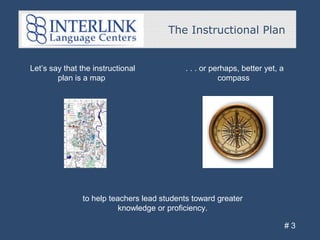
Let’s say that the instructional
plan is a map
The Instructional Plan
# 3
. . . or perhaps, better yet, a
compass
to help teachers lead students toward greater
knowledge or proficiency.
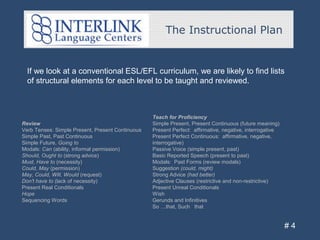
Review
Verb Tenses: Simple Present, Present Continuous
Simple Past, Past Continuous
Simple Future, Going to
Modals: Can (ability, informal permission)
Should, Ought to (strong advice)
Must, Have to (necessity)
Could, May (permission)
May, Could, Will, Would (request)
Don't have to (lack of necessity)
Present Real Conditionals
Hope
Sequencing Words
The Instructional Plan
# 4
If we look at a conventional ESL/EFL curriculum, we are likely to find lists
of structural elements for each level to be taught and reviewed.
Teach for Proficiency
Simple Present, Present Continuous (future meaning)
Present Perfect: affirmative, negative, interrogative
Present Perfect Continuous: affirmative, negative,
interrogative)
Passive Voice (simple present, past)
Basic Reported Speech (present to past)
Modals: Past Forms (review modals)
Suggestion (could, might)
Strong Advice (had better)
Adjective Clauses (restrictive and non-restrictive)
Present Unreal Conditionals
Wish
Gerunds and Infinitives
So …that, Such that
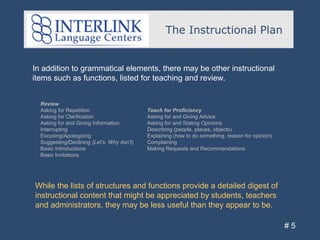
Review
Asking for Repetition
Asking for Clarification
Asking for and Giving Information
Interrupting
Excusing/Apologizing
Suggesting/Declining {Let's, Why don't)
Basic Introductions
Basic Invitations
The Instructional Plan
# 5
In addition to grammatical elements, there may be other instructional
items such as functions, listed for teaching and review.
Teach for Proficiency
Asking for and Giving Advice
Asking for and Stating Opinions
Describing (people, places, objects)
Explaining (how to do something, reason for opinion)
Complaining
Making Requests and Recommendations
While the lists of structures and functions provide a detailed digest of
instructional content that might be appreciated by students, teachers
and administrators, they may be less useful than they appear to be.
The Instructional Plan
# 6
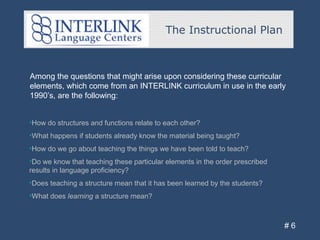
•How do structures and functions relate to each other?
•What happens if students already know the material being taught?
•How do we go about teaching the things we have been told to teach?
•Do we know that teaching these particular elements in the order prescribed
results in language proficiency?
•Does teaching a structure mean that it has been learned by the students?
•What does learning a structure mean?
Among the questions that might arise upon considering these curricular
elements, which come from an INTERLINK curriculum in use in the early
1990’s, are the following:
The Instructional Plan
# 7
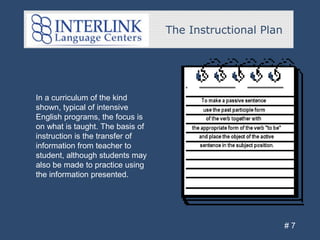
In a curriculum of the kind
shown, typical of intensive
English programs, the focus is
on what is taught. The basis of
instruction is the transfer of
information from teacher to
student, although students may
also be made to practice using
the information presented.
The Instructional Plan
# 8
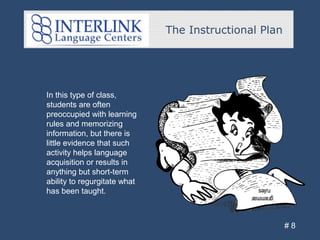
In this type of class,
students are often
preoccupied with learning
rules and memorizing
information, but there is
little evidence that such
activity helps language
acquisition or results in
anything but short-term
ability to regurgitate what
has been taught.
The Instructional Plan
# 9
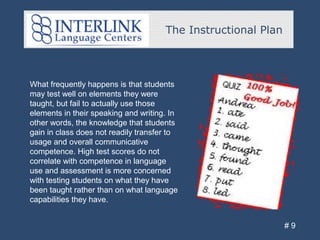
What frequently happens is that students
may test well on elements they were
taught, but fail to actually use those
elements in their speaking and writing. In
other words, the knowledge that students
gain in class does not readily transfer to
usage and overall communicative
competence. High test scores do not
correlate with competence in language
use and assessment is more concerned
with testing students on what they have
been taught rather than on what language
capabilities they have.
The Instructional Plan
# 10
Textbooks add to the emphasis
on content rather than on learning
and the learner. The teacher’s
focus is on covering the material
in the textbooks rather than on
assisting students’ learning.
Teachers may fail to address students’
real needs because they are preoccupied
with going over exercises and getting
through the textbook.
The Instructional Plan
# 11
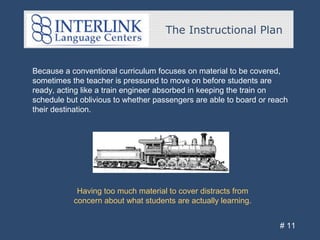
Because a conventional curriculum focuses on material to be covered,
sometimes the teacher is pressured to move on before students are
ready, acting like a train engineer absorbed in keeping the train on
schedule but oblivious to whether passengers are able to board or reach
their destination.
Having too much material to cover distracts from
concern about what students are actually learning.
The Instructional Plan
# 12
In short, the conventional curriculum focuses on what is to be taught
rather than on how the teacher can help the student learn. A typical
ESL/EFL curriculum:
•assumes that we know what structures students need to learn at a given
point in their language development
•provides the same regimen of items to be learned for all students in a
class although their individual needs and readiness may vary
•tells us what to teach but offers little guidance about how to teach
•emphasizes teaching over learning
The Instructional Plan
# 13
In addition we can say that a conventional ESL/EFL curriculum may be
characterized as follows:
•Grammar-based, focusing on rules
•Teacher-centered, based on what is presented
•Theoretical, geared to increasing knowledge about language
•Deductive, makes student dependent on teacher
•Focus on discrete elements of language
The Instructional Plan
# 14
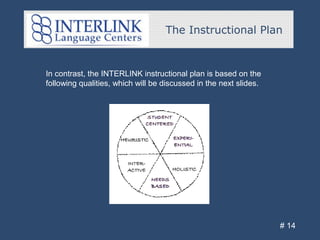
In contrast, the INTERLINK instructional plan is based on the
following qualities, which will be discussed in the next slides.
The Instructional Plan
# 15
A Student-centered classroom
is one in which each individual is respected and the needs of students
come first. The students, rather than the material to be taught is the
central focus. Individual learning styles and preferences are
recognized, appreciated, and accommodated. A student-centered
classroom is not one in which students run wild and do whatever they
wish, but one in which their welfare is the primary concern and in which
they have, as Earl Stevick phrased it, “primacy in a world of meaningful
action.”
The Instructional Plan
# 16
Experiential learning
means that students learn by doing and through exposure to content-
rich learning opportunities. Learning takes place outside as well as
inside the classroom and students learn inductively through their own
language experiences. Students learn not only from their teachers but
from their peers, acquaintances and any language source with which
they come into contact. As Ralph Waldo Emerson put it, “skill to do
comes of doing” and experiential language learning involves students
in learning language rather than learning about language.
The Instructional Plan
# 17
Holistic refers to
a) each student being treated as a whole person with intellectual,
emotional, social, and cultural needs. The student is not raw material to
be molded and shaped through a factory-like educational process but a
complex human being whose various needs must be met for successful
learning to occur.
b) language being learned as a whole system and not a collection of
isolated skills. The skill areas of listening, speaking, reading and writing
are integrated, and authentic language use rather than assimilation of
discrete rules or pieces of information about language is the objective.
The Instructional Plan
# 18
A needs-based class
Is one in which the learning agenda is not pre-determined and planned
in advance but individualized and customized according to what
students know and are able to do. Understanding what students need
to make linguistic progress drives the class rather than a syllabus of
content and information pre-formulated by a textbook or curriculum.
Linguistic, cultural and affective needs are addressed to facilitate the
learning process. Students’ actual needs may differ from their
perceived needs and teachers must be skillful, experienced and
perceptive to determine what activities and classroom arrangements
can achieve the best results.
The Instructional Plan
# 19
Interactive classes
are ones in which students are actively engaged and participate freely
instead of listening passively to lectures or performing tasks devoid of
authentic communicative intent (such as repetition exercises or drills).
The active involvement of the learner is the sine qua non for successful
learning and a necessary ingredient for experiential, heuristic learning.
The Instructional Plan
# 20
Heuristic learning
or learning through discovery is characterized by students solving
problems instead of digesting information fed by a teacher, and tends
to be inductive, experiential, creative, self-motivated, and dynamic.
Discovery promotes learning how to learn rather than accumulating
discrete facts and pieces of information, and results in mastery of a
process which can be used over and over, inside and outside of the
classroom. Setting up situations from which a student can learn
requires more skill and patience than dispensing information, but the
rewards are proportionally great. In the words of Mark van Doren,
“teaching is the art of assisting discovery.”
The Instructional Plan
# 21
THE END
This presentation provides an introduction to the INTERLINK
instructional plan and explanation of how it differs from a conventional
curriculum. The goal of the plan is to help teachers meet students’ needs
by focusing on the learner and not on an agenda of items to teach. Other
presentations will explore specific aspects of the plan and the
pedagogical foundations on which it is based.

Tutorial 1r

  • 1.
    The Instructional Plan #1 The INTERLINK instructional plan, developed from the ground up to provide the most effective language program for its students, departs significantly from the type of ESL curriculum most teachers are familiar with. This presentation is intended to help you understand how and why this instructional plan may differ from others you may have used in the past. Presentation by Mark Feder, October 2007; revised August 2013
  • 2.
    A program isgenerally defined and characterized by its curriculum. The word curriculum has been defined in different ways, including: The Instructional Plan # 2 a series of planned instruction coordinated and articulated in a manner designed to result in the achievement by students of specific knowledge and skills and the application of this knowledge the planned interaction of pupils with instructional content, materials, resources, and processes for evaluating the attainment of educational objectives all the planned learning opportunities offered by the ‘educational community’ and the experiences learners encounter when the curriculum is implemented a plan or program for all of the experiences which the learner encounters under the direction of a school and consists of a number of plans, in a written form and of varying scope, which delineate the desired learning experiences These definitions are accommodatingly broad, but because the word curriculum is often associated with a prescribed agenda of materials or content to be taught, the term instructional plan is more suitable for our purposes.
  • 3.
    Let’s say thatthe instructional plan is a map The Instructional Plan # 3 . . . or perhaps, better yet, a compass to help teachers lead students toward greater knowledge or proficiency.
  • 4.
    Review Verb Tenses: SimplePresent, Present Continuous Simple Past, Past Continuous Simple Future, Going to Modals: Can (ability, informal permission) Should, Ought to (strong advice) Must, Have to (necessity) Could, May (permission) May, Could, Will, Would (request) Don't have to (lack of necessity) Present Real Conditionals Hope Sequencing Words The Instructional Plan # 4 If we look at a conventional ESL/EFL curriculum, we are likely to find lists of structural elements for each level to be taught and reviewed. Teach for Proficiency Simple Present, Present Continuous (future meaning) Present Perfect: affirmative, negative, interrogative Present Perfect Continuous: affirmative, negative, interrogative) Passive Voice (simple present, past) Basic Reported Speech (present to past) Modals: Past Forms (review modals) Suggestion (could, might) Strong Advice (had better) Adjective Clauses (restrictive and non-restrictive) Present Unreal Conditionals Wish Gerunds and Infinitives So …that, Such that
  • 5.
    Review Asking for Repetition Askingfor Clarification Asking for and Giving Information Interrupting Excusing/Apologizing Suggesting/Declining {Let's, Why don't) Basic Introductions Basic Invitations The Instructional Plan # 5 In addition to grammatical elements, there may be other instructional items such as functions, listed for teaching and review. Teach for Proficiency Asking for and Giving Advice Asking for and Stating Opinions Describing (people, places, objects) Explaining (how to do something, reason for opinion) Complaining Making Requests and Recommendations While the lists of structures and functions provide a detailed digest of instructional content that might be appreciated by students, teachers and administrators, they may be less useful than they appear to be.
  • 6.
    The Instructional Plan #6 •How do structures and functions relate to each other? •What happens if students already know the material being taught? •How do we go about teaching the things we have been told to teach? •Do we know that teaching these particular elements in the order prescribed results in language proficiency? •Does teaching a structure mean that it has been learned by the students? •What does learning a structure mean? Among the questions that might arise upon considering these curricular elements, which come from an INTERLINK curriculum in use in the early 1990’s, are the following:
  • 7.
    The Instructional Plan #7 In a curriculum of the kind shown, typical of intensive English programs, the focus is on what is taught. The basis of instruction is the transfer of information from teacher to student, although students may also be made to practice using the information presented.
  • 8.
    The Instructional Plan #8 In this type of class, students are often preoccupied with learning rules and memorizing information, but there is little evidence that such activity helps language acquisition or results in anything but short-term ability to regurgitate what has been taught.
  • 9.
    The Instructional Plan #9 What frequently happens is that students may test well on elements they were taught, but fail to actually use those elements in their speaking and writing. In other words, the knowledge that students gain in class does not readily transfer to usage and overall communicative competence. High test scores do not correlate with competence in language use and assessment is more concerned with testing students on what they have been taught rather than on what language capabilities they have.
  • 10.
    The Instructional Plan #10 Textbooks add to the emphasis on content rather than on learning and the learner. The teacher’s focus is on covering the material in the textbooks rather than on assisting students’ learning. Teachers may fail to address students’ real needs because they are preoccupied with going over exercises and getting through the textbook.
  • 11.
    The Instructional Plan #11 Because a conventional curriculum focuses on material to be covered, sometimes the teacher is pressured to move on before students are ready, acting like a train engineer absorbed in keeping the train on schedule but oblivious to whether passengers are able to board or reach their destination. Having too much material to cover distracts from concern about what students are actually learning.
  • 12.
    The Instructional Plan #12 In short, the conventional curriculum focuses on what is to be taught rather than on how the teacher can help the student learn. A typical ESL/EFL curriculum: •assumes that we know what structures students need to learn at a given point in their language development •provides the same regimen of items to be learned for all students in a class although their individual needs and readiness may vary •tells us what to teach but offers little guidance about how to teach •emphasizes teaching over learning
  • 13.
    The Instructional Plan #13 In addition we can say that a conventional ESL/EFL curriculum may be characterized as follows: •Grammar-based, focusing on rules •Teacher-centered, based on what is presented •Theoretical, geared to increasing knowledge about language •Deductive, makes student dependent on teacher •Focus on discrete elements of language
  • 14.
    The Instructional Plan #14 In contrast, the INTERLINK instructional plan is based on the following qualities, which will be discussed in the next slides.
  • 15.
    The Instructional Plan #15 A Student-centered classroom is one in which each individual is respected and the needs of students come first. The students, rather than the material to be taught is the central focus. Individual learning styles and preferences are recognized, appreciated, and accommodated. A student-centered classroom is not one in which students run wild and do whatever they wish, but one in which their welfare is the primary concern and in which they have, as Earl Stevick phrased it, “primacy in a world of meaningful action.”
  • 16.
    The Instructional Plan #16 Experiential learning means that students learn by doing and through exposure to content- rich learning opportunities. Learning takes place outside as well as inside the classroom and students learn inductively through their own language experiences. Students learn not only from their teachers but from their peers, acquaintances and any language source with which they come into contact. As Ralph Waldo Emerson put it, “skill to do comes of doing” and experiential language learning involves students in learning language rather than learning about language.
  • 17.
    The Instructional Plan #17 Holistic refers to a) each student being treated as a whole person with intellectual, emotional, social, and cultural needs. The student is not raw material to be molded and shaped through a factory-like educational process but a complex human being whose various needs must be met for successful learning to occur. b) language being learned as a whole system and not a collection of isolated skills. The skill areas of listening, speaking, reading and writing are integrated, and authentic language use rather than assimilation of discrete rules or pieces of information about language is the objective.
  • 18.
    The Instructional Plan #18 A needs-based class Is one in which the learning agenda is not pre-determined and planned in advance but individualized and customized according to what students know and are able to do. Understanding what students need to make linguistic progress drives the class rather than a syllabus of content and information pre-formulated by a textbook or curriculum. Linguistic, cultural and affective needs are addressed to facilitate the learning process. Students’ actual needs may differ from their perceived needs and teachers must be skillful, experienced and perceptive to determine what activities and classroom arrangements can achieve the best results.
  • 19.
    The Instructional Plan #19 Interactive classes are ones in which students are actively engaged and participate freely instead of listening passively to lectures or performing tasks devoid of authentic communicative intent (such as repetition exercises or drills). The active involvement of the learner is the sine qua non for successful learning and a necessary ingredient for experiential, heuristic learning.
  • 20.
    The Instructional Plan #20 Heuristic learning or learning through discovery is characterized by students solving problems instead of digesting information fed by a teacher, and tends to be inductive, experiential, creative, self-motivated, and dynamic. Discovery promotes learning how to learn rather than accumulating discrete facts and pieces of information, and results in mastery of a process which can be used over and over, inside and outside of the classroom. Setting up situations from which a student can learn requires more skill and patience than dispensing information, but the rewards are proportionally great. In the words of Mark van Doren, “teaching is the art of assisting discovery.”
  • 21.
    The Instructional Plan #21 THE END This presentation provides an introduction to the INTERLINK instructional plan and explanation of how it differs from a conventional curriculum. The goal of the plan is to help teachers meet students’ needs by focusing on the learner and not on an agenda of items to teach. Other presentations will explore specific aspects of the plan and the pedagogical foundations on which it is based.