South Asia Early Civilizations and Major Religions of South Asia
Early Civilizations Two major early civilizations in India: Indus Valley  Aryan
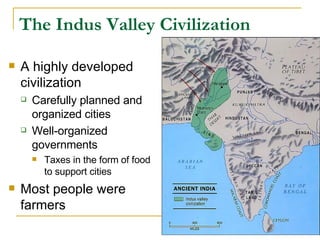
The Indus Valley Civilization A highly developed civilization Carefully planned and organized cities Well-organized governments Taxes in the form of food to support cities Most people were farmers
Arose around 3000 BC and lasted 1500 years Mysteriously disappeared Archaeologists are trying to unravel the mystery of this society Decipher : determine the meaning of something Possible reasons for civilization’s decline: Climate changed No longer able to produce food Aryan migration The Indus Valley Civilization
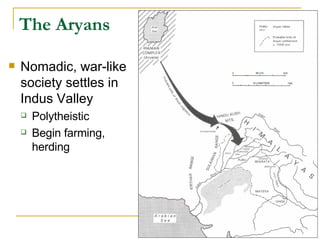
The Aryans Nomadic, war-like society settles in Indus Valley Polytheistic Begin farming, herding
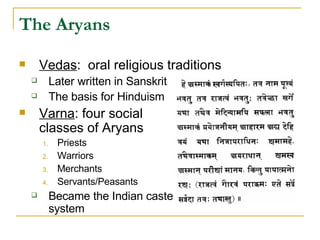
Vedas :  oral religious traditions Later written in Sanskrit The basis for Hinduism Varna : four social  classes of Aryans Priests Warriors Merchants Servants/Peasants Became the Indian caste  system The Aryans
Review Indus Valley Very organized Farming society Mysteriously disappeared Aryan Civilization Nomad, war-like Polytheistic,  Vedas Varna – social organization (7 elements of culture)
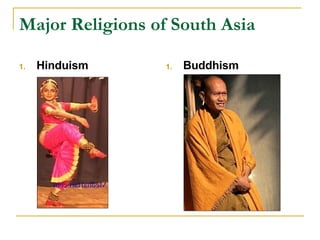
Major Religions of South Asia Hinduism Buddhism
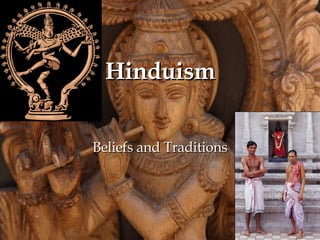
Hinduism Beliefs and Traditions
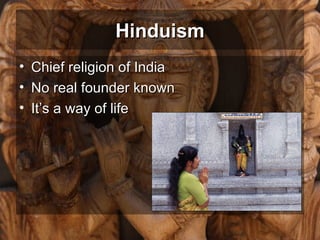
Hinduism Chief religion of India No real founder known It’s a way of life
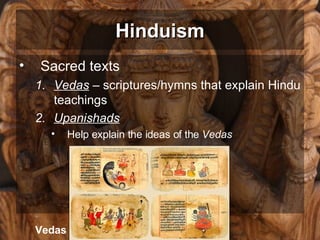
Hinduism Sacred texts Vedas  –  scriptures/hymns that explain Hindu teachings Upanishads Help explain the ideas of the  Vedas Vedas
Hinduism “ The Vedas are the ancient scriptures or revelation (Shruti) of the Hindu teachings. They manifest the Divine Word in human speech. They reflect into human language the language of the Gods, the Divine powers that have created us and which rule over us.” The hymn sections are the oldest. The Upanishads were added at a later date and explain the hymns. “The Vedas were compiled around the time of Krishna (c. 3500 B.C.), and even at that time were hardly understood. Hence they are very ancient and only in recent times has their spiritual import begun to be rediscovered or appreciated even in India.  Like the Egyptian teachings they are veiled, symbolic and subtle and require a special vision to understand and use properly.” Hindunet.org
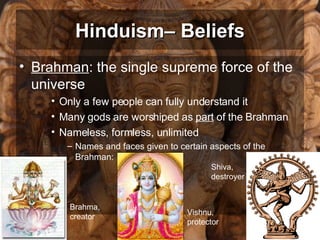
Hinduism– Beliefs Brahman : the single supreme force of the universe Only a few people can fully understand it Many gods are worshiped as  part  of the Brahman Nameless, formless, unlimited Names and faces given to certain aspects of the Brahman: Brahma, creator Vishnu, protector Shiva, destroyer
Hinduism– Beliefs Sect : religious group various religious groups for each god Ganges River Goddess Her sect prays to her and her healing powers. Also, many pray to thousands of local gods and goddesses.
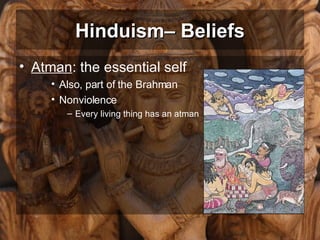
Hinduism– Beliefs Atman : the essential self Also, part of the Brahman Nonviolence Every living thing has an atman
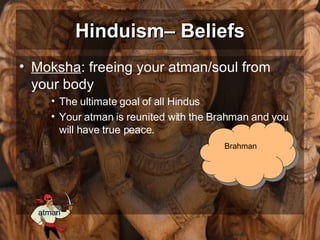
Moksha : freeing your atman/soul from your body The ultimate goal of all Hindus Your atman is reunited with the Brahman and you will have true peace. Hinduism– Beliefs Brahman atman
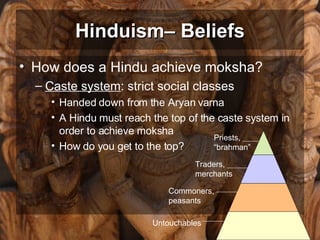
How does a Hindu achieve moksha? Caste system : strict social classes Handed down from the Aryan varna A Hindu must reach the top of the caste system in order to achieve moksha How do you get to the top? Hinduism– Beliefs Priests, “brahman” Traders, merchants Commoners, peasants Untouchables
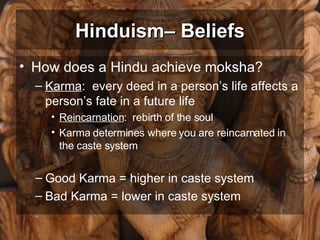
Hinduism– Beliefs How does a Hindu achieve moksha? Karma :  every deed in a person’s life affects a person’s fate in a future life Reincarnation :  rebirth of the soul Karma determines where you are reincarnated in the caste system Good Karma = higher in caste system Bad Karma = lower in caste system
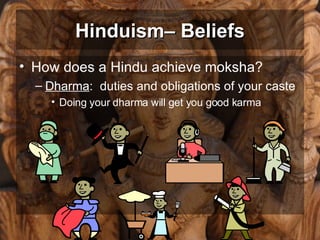
Hinduism– Beliefs How does a Hindu achieve moksha? Dharma :  duties and obligations of your caste Doing your dharma will get you good karma
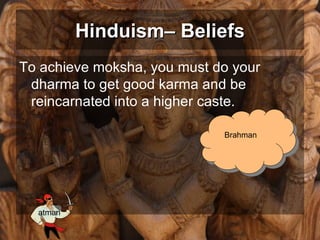
To achieve moksha, you must do your dharma to get good karma and be reincarnated into a higher caste. Hinduism– Beliefs Brahman atman
Hinduism Hinduism– Beliefs
Hinduism Chief religion of India Two sacred texts Vocabulary Review caste system karma reincarnation dharma Brahman atman sect moksha
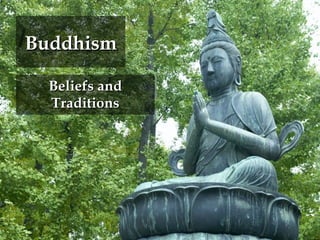
Buddhism Beliefs and Traditions
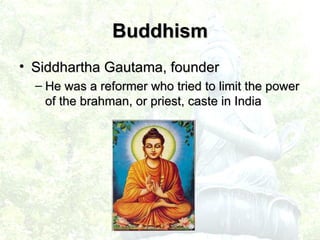
Buddhism Siddhartha Gautama, founder He was a reformer who tried to limit the power of the brahman, or priest, caste in India
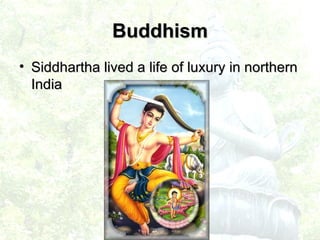
Siddhartha lived a life of luxury in northern India Buddhism
His parents did not allow him out of the palace because they did not want him to see or experience the suffering of the world. Buddhism
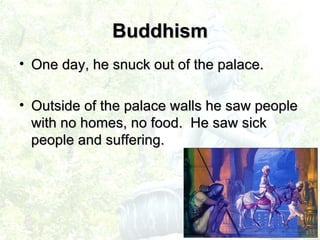
One day, he snuck out of the palace. Outside of the palace walls he saw people with no homes, no food.  He saw sick people and suffering. Buddhism
Realizing the reality of human suffering, Siddhartha left his life of wealth and set out to find the cause of human suffering. Buddhism
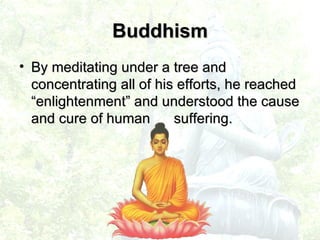
By meditating under a tree and concentrating all of his efforts, he reached “enlightenment” and understood the cause and cure of human  suffering. Buddhism
Siddhartha became known as “Buddha,” or “Enlightened One.” The Buddha decided that he would leave his life of meditation to teach others the way to end suffering. Buddhism
The Four Noble Truths Suffering is universal The cause of suffering is want/desire The only way to end suffering is to end desire Nirvana :  condition of wanting nothing The way to achieve nirvana is to follow the Eightfold Path Compassion for all creatures, kindness, truthfulness, meditation Buddhism
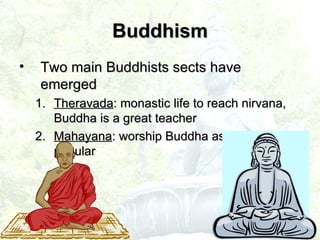
Two main Buddhists sects have emerged Theravada : monastic life to reach nirvana, Buddha is a great teacher Mahayana : worship Buddha as a god, more popular Buddhism
Ultimate goal of Buddhism: End suffering by achieving nirvana.  Once you are in the condition of wanting nothing, you will be Enlightened, or understand the universe and cause of human suffering Buddhism– Beliefs
Similarities with Hinduism 1. Belief in reincarnation 2. Belief in nonviolence Differences with Hinduism Buddhists deny the existence of gods Priests are not necessary, you must seek nirvana on your own Buddhists reject the caste system Buddhism– Beliefs
A similar religion, often confused with Buddhism: Jainism : also grew from an effort to end the power of the brahman caste in India and to end suffering Ahisma : nonviolence for any living creatures vegetarians Jainism
Buddhism Buddhism
Review The Buddha Four Noble Truths Theravada and Mahayana Buddhism Similarities between Hinduism and Buddhism Differences between Hinduism and Buddhism Jainism

Early Civilizations, Hinduism, Buddhism

  • 1.
    South Asia EarlyCivilizations and Major Religions of South Asia
  • 2.
    Early Civilizations Twomajor early civilizations in India: Indus Valley Aryan
  • 3.
    The Indus ValleyCivilization A highly developed civilization Carefully planned and organized cities Well-organized governments Taxes in the form of food to support cities Most people were farmers
  • 4.
    Arose around 3000BC and lasted 1500 years Mysteriously disappeared Archaeologists are trying to unravel the mystery of this society Decipher : determine the meaning of something Possible reasons for civilization’s decline: Climate changed No longer able to produce food Aryan migration The Indus Valley Civilization
  • 5.
    The Aryans Nomadic,war-like society settles in Indus Valley Polytheistic Begin farming, herding
  • 6.
    Vedas : oral religious traditions Later written in Sanskrit The basis for Hinduism Varna : four social classes of Aryans Priests Warriors Merchants Servants/Peasants Became the Indian caste system The Aryans
  • 7.
    Review Indus ValleyVery organized Farming society Mysteriously disappeared Aryan Civilization Nomad, war-like Polytheistic, Vedas Varna – social organization (7 elements of culture)
  • 8.
    Major Religions ofSouth Asia Hinduism Buddhism
  • 9.
  • 10.
    Hinduism Chief religionof India No real founder known It’s a way of life
  • 11.
    Hinduism Sacred textsVedas – scriptures/hymns that explain Hindu teachings Upanishads Help explain the ideas of the Vedas Vedas
  • 12.
    Hinduism “ TheVedas are the ancient scriptures or revelation (Shruti) of the Hindu teachings. They manifest the Divine Word in human speech. They reflect into human language the language of the Gods, the Divine powers that have created us and which rule over us.” The hymn sections are the oldest. The Upanishads were added at a later date and explain the hymns. “The Vedas were compiled around the time of Krishna (c. 3500 B.C.), and even at that time were hardly understood. Hence they are very ancient and only in recent times has their spiritual import begun to be rediscovered or appreciated even in India.  Like the Egyptian teachings they are veiled, symbolic and subtle and require a special vision to understand and use properly.” Hindunet.org
  • 13.
    Hinduism– Beliefs Brahman: the single supreme force of the universe Only a few people can fully understand it Many gods are worshiped as part of the Brahman Nameless, formless, unlimited Names and faces given to certain aspects of the Brahman: Brahma, creator Vishnu, protector Shiva, destroyer
  • 14.
    Hinduism– Beliefs Sect: religious group various religious groups for each god Ganges River Goddess Her sect prays to her and her healing powers. Also, many pray to thousands of local gods and goddesses.
  • 15.
    Hinduism– Beliefs Atman: the essential self Also, part of the Brahman Nonviolence Every living thing has an atman
  • 16.
    Moksha : freeingyour atman/soul from your body The ultimate goal of all Hindus Your atman is reunited with the Brahman and you will have true peace. Hinduism– Beliefs Brahman atman
  • 17.
    How does aHindu achieve moksha? Caste system : strict social classes Handed down from the Aryan varna A Hindu must reach the top of the caste system in order to achieve moksha How do you get to the top? Hinduism– Beliefs Priests, “brahman” Traders, merchants Commoners, peasants Untouchables
  • 18.
    Hinduism– Beliefs Howdoes a Hindu achieve moksha? Karma : every deed in a person’s life affects a person’s fate in a future life Reincarnation : rebirth of the soul Karma determines where you are reincarnated in the caste system Good Karma = higher in caste system Bad Karma = lower in caste system
  • 19.
    Hinduism– Beliefs Howdoes a Hindu achieve moksha? Dharma : duties and obligations of your caste Doing your dharma will get you good karma
  • 20.
    To achieve moksha,you must do your dharma to get good karma and be reincarnated into a higher caste. Hinduism– Beliefs Brahman atman
  • 21.
  • 22.
    Hinduism Chief religionof India Two sacred texts Vocabulary Review caste system karma reincarnation dharma Brahman atman sect moksha
  • 23.
  • 24.
    Buddhism Siddhartha Gautama,founder He was a reformer who tried to limit the power of the brahman, or priest, caste in India
  • 25.
    Siddhartha lived alife of luxury in northern India Buddhism
  • 26.
    His parents didnot allow him out of the palace because they did not want him to see or experience the suffering of the world. Buddhism
  • 27.
    One day, hesnuck out of the palace. Outside of the palace walls he saw people with no homes, no food. He saw sick people and suffering. Buddhism
  • 28.
    Realizing the realityof human suffering, Siddhartha left his life of wealth and set out to find the cause of human suffering. Buddhism
  • 29.
    By meditating undera tree and concentrating all of his efforts, he reached “enlightenment” and understood the cause and cure of human suffering. Buddhism
  • 30.
    Siddhartha became knownas “Buddha,” or “Enlightened One.” The Buddha decided that he would leave his life of meditation to teach others the way to end suffering. Buddhism
  • 31.
    The Four NobleTruths Suffering is universal The cause of suffering is want/desire The only way to end suffering is to end desire Nirvana : condition of wanting nothing The way to achieve nirvana is to follow the Eightfold Path Compassion for all creatures, kindness, truthfulness, meditation Buddhism
  • 32.
    Two main Buddhistssects have emerged Theravada : monastic life to reach nirvana, Buddha is a great teacher Mahayana : worship Buddha as a god, more popular Buddhism
  • 33.
    Ultimate goal ofBuddhism: End suffering by achieving nirvana. Once you are in the condition of wanting nothing, you will be Enlightened, or understand the universe and cause of human suffering Buddhism– Beliefs
  • 34.
    Similarities with Hinduism1. Belief in reincarnation 2. Belief in nonviolence Differences with Hinduism Buddhists deny the existence of gods Priests are not necessary, you must seek nirvana on your own Buddhists reject the caste system Buddhism– Beliefs
  • 35.
    A similar religion,often confused with Buddhism: Jainism : also grew from an effort to end the power of the brahman caste in India and to end suffering Ahisma : nonviolence for any living creatures vegetarians Jainism
  • 36.
  • 37.
    Review The BuddhaFour Noble Truths Theravada and Mahayana Buddhism Similarities between Hinduism and Buddhism Differences between Hinduism and Buddhism Jainism