Early brain
development
Domina Petric, MD
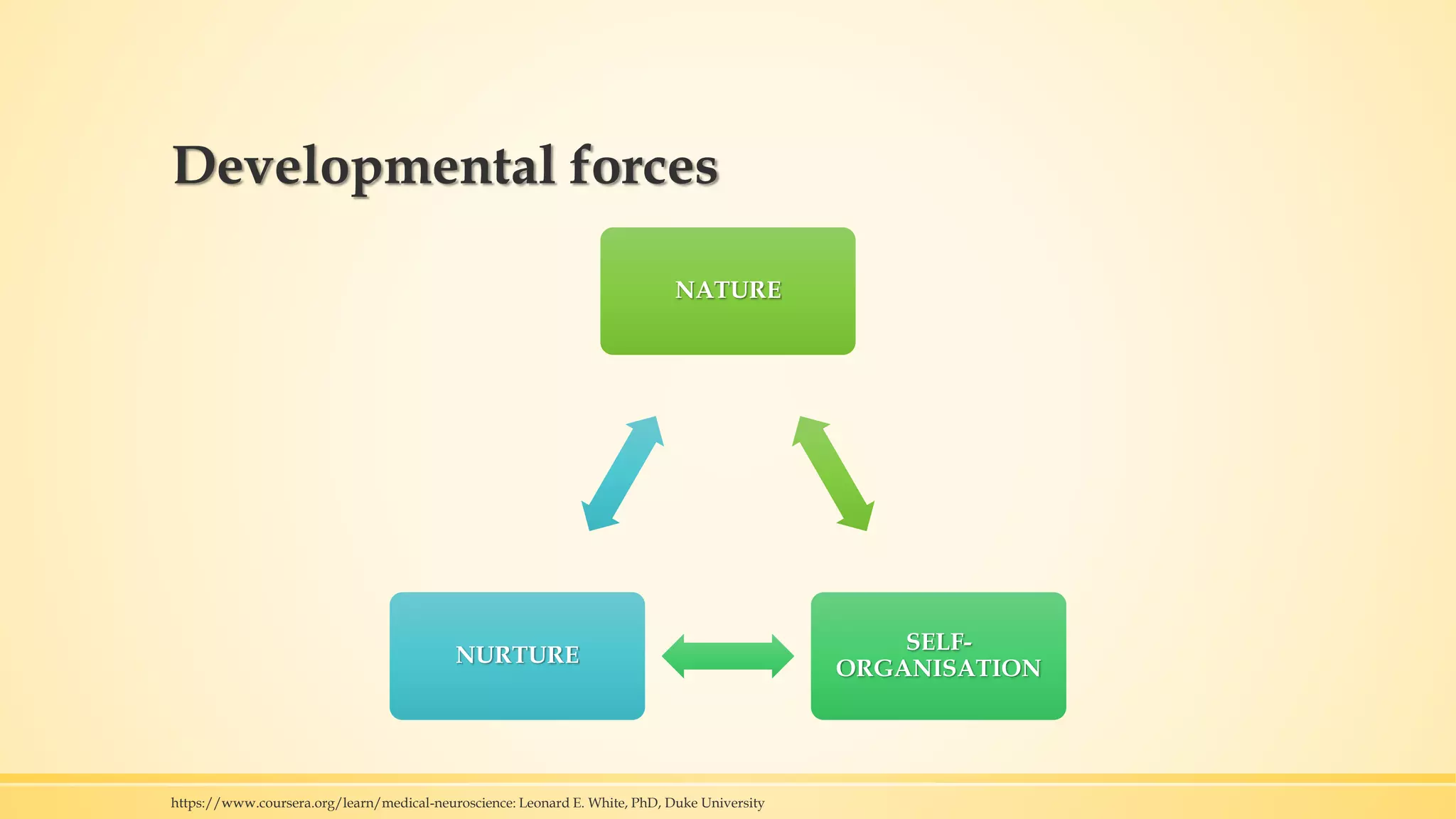
Developmental forces
NATURE
SELF-
ORGANISATION
NURTURE
https://www.coursera.org/learn/medical-neuroscience: Leonard E. White, PhD, Duke University
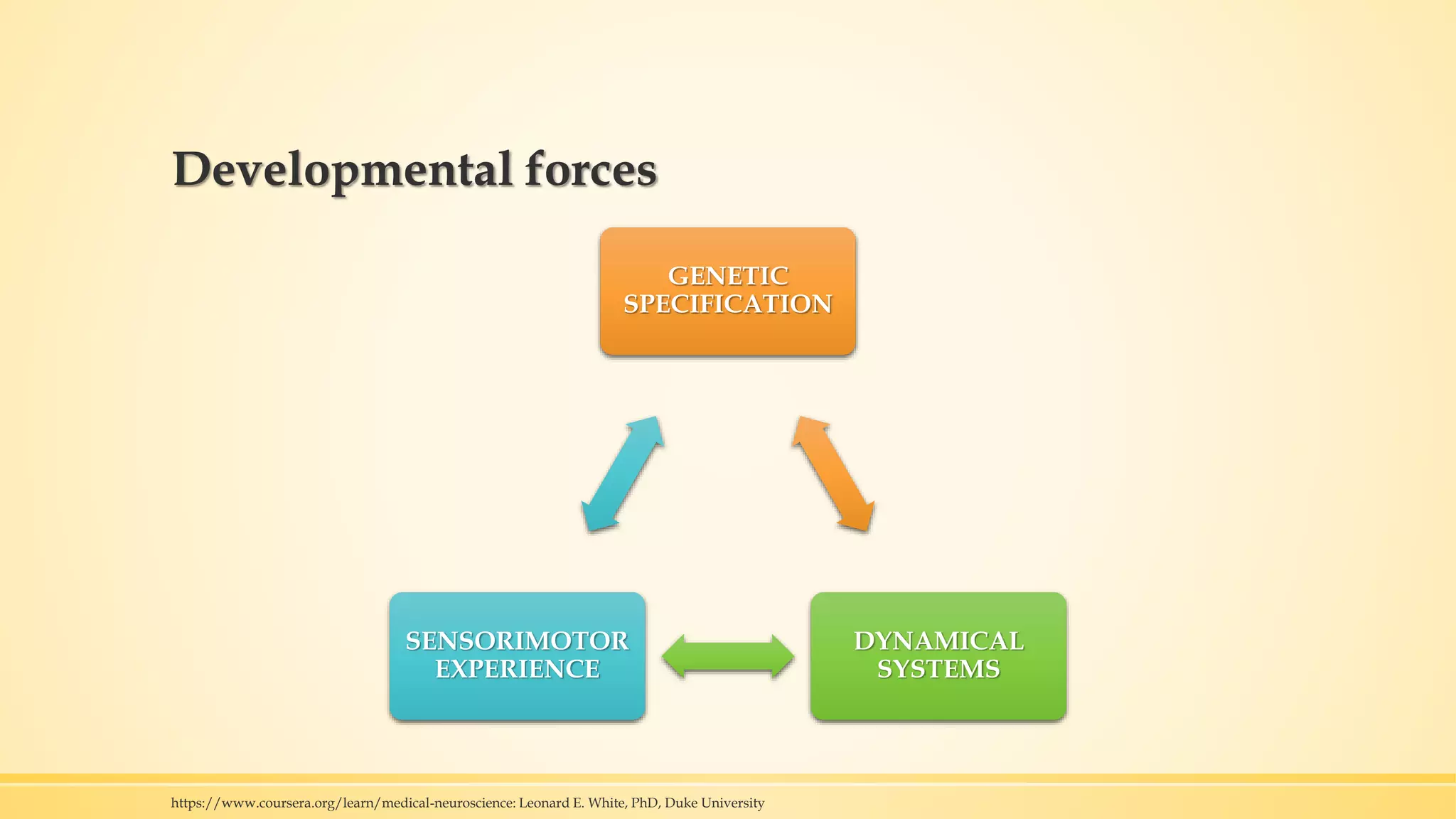
Developmental forces
GENETIC
SPECIFICATION
DYNAMICAL
SYSTEMS
SENSORIMOTOR
EXPERIENCE
https://www.coursera.org/learn/medical-neuroscience: Leonard E. White, PhD, Duke University
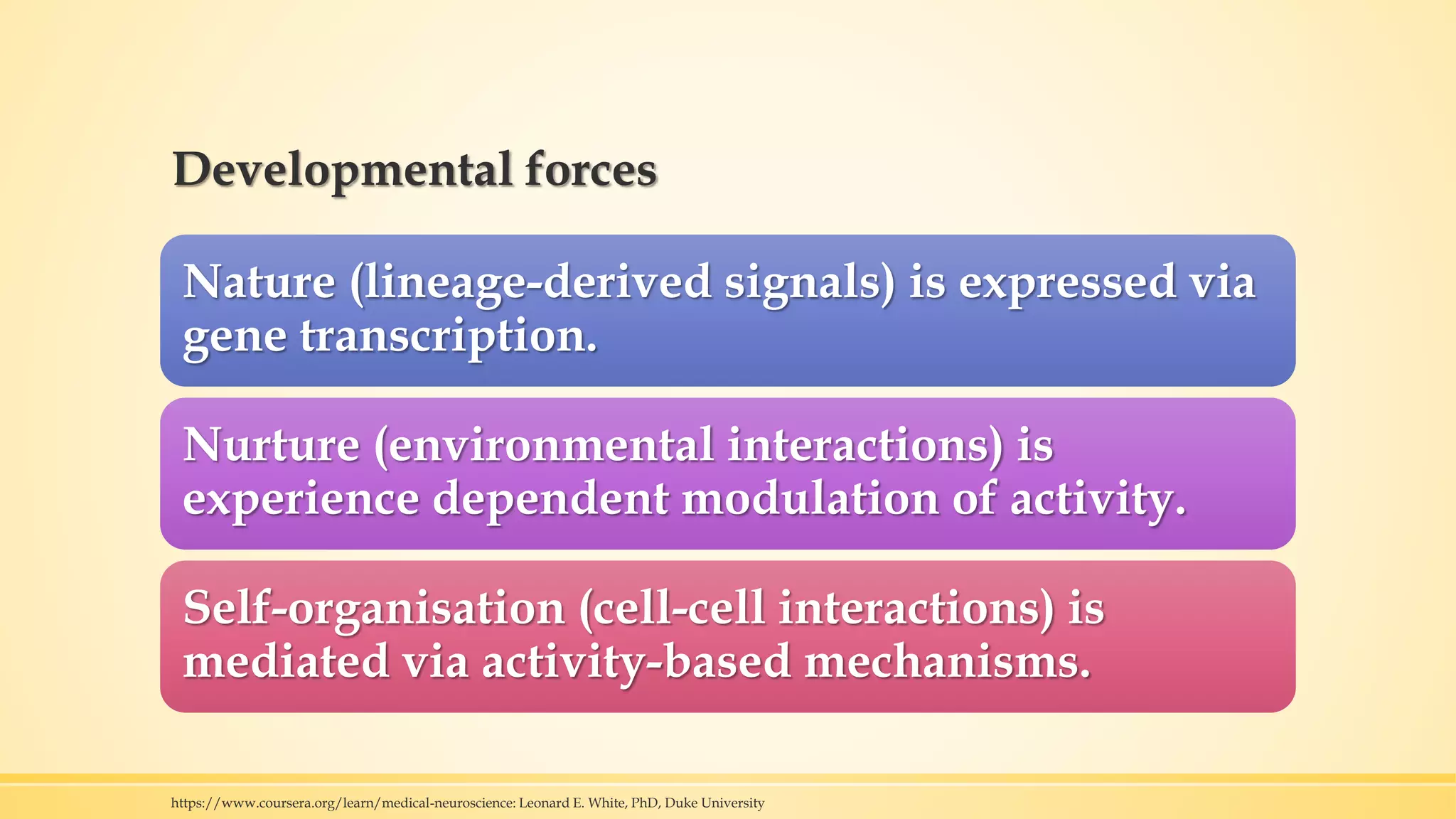
Developmental forces
Nature (lineage-derived signals) is expressed via
gene transcription.
Nurture (environmental interactions) is
experience dependent modulation of activity.
Self-organisation (cell-cell interactions) is
mediated via activity-based mechanisms.
https://www.coursera.org/learn/medical-neuroscience: Leonard E. White, PhD, Duke University
Gastrulation
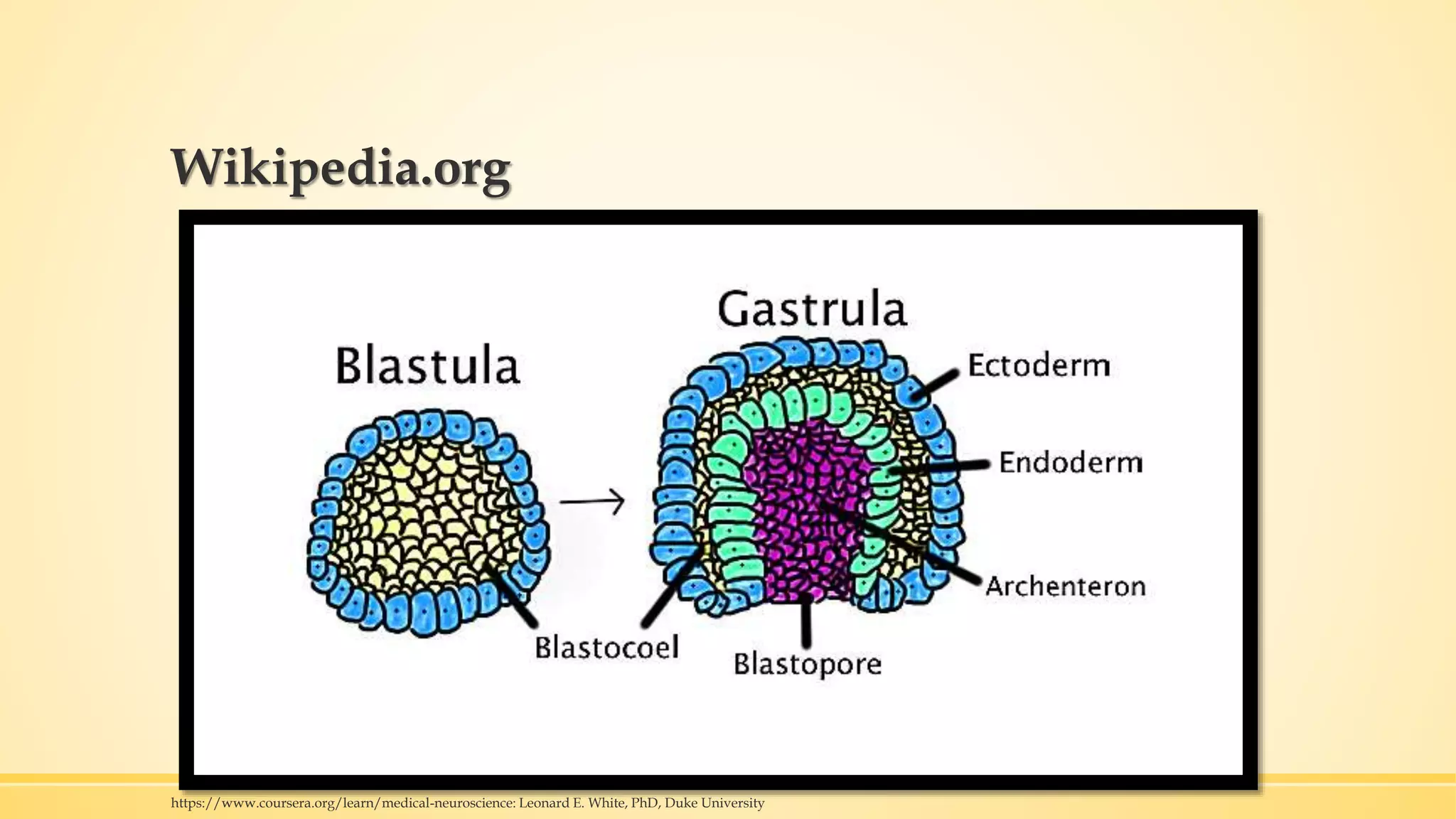
▪ Gastrulation is an invagination of the developing embryo at the stage of the
BLASTULA.
Gastrulation produces three principal germ layers:
▪ ECTODERM (the outermost layer)
▪ MESODERM (the middle layer)
▪ ENDODERM (the innermost layer)
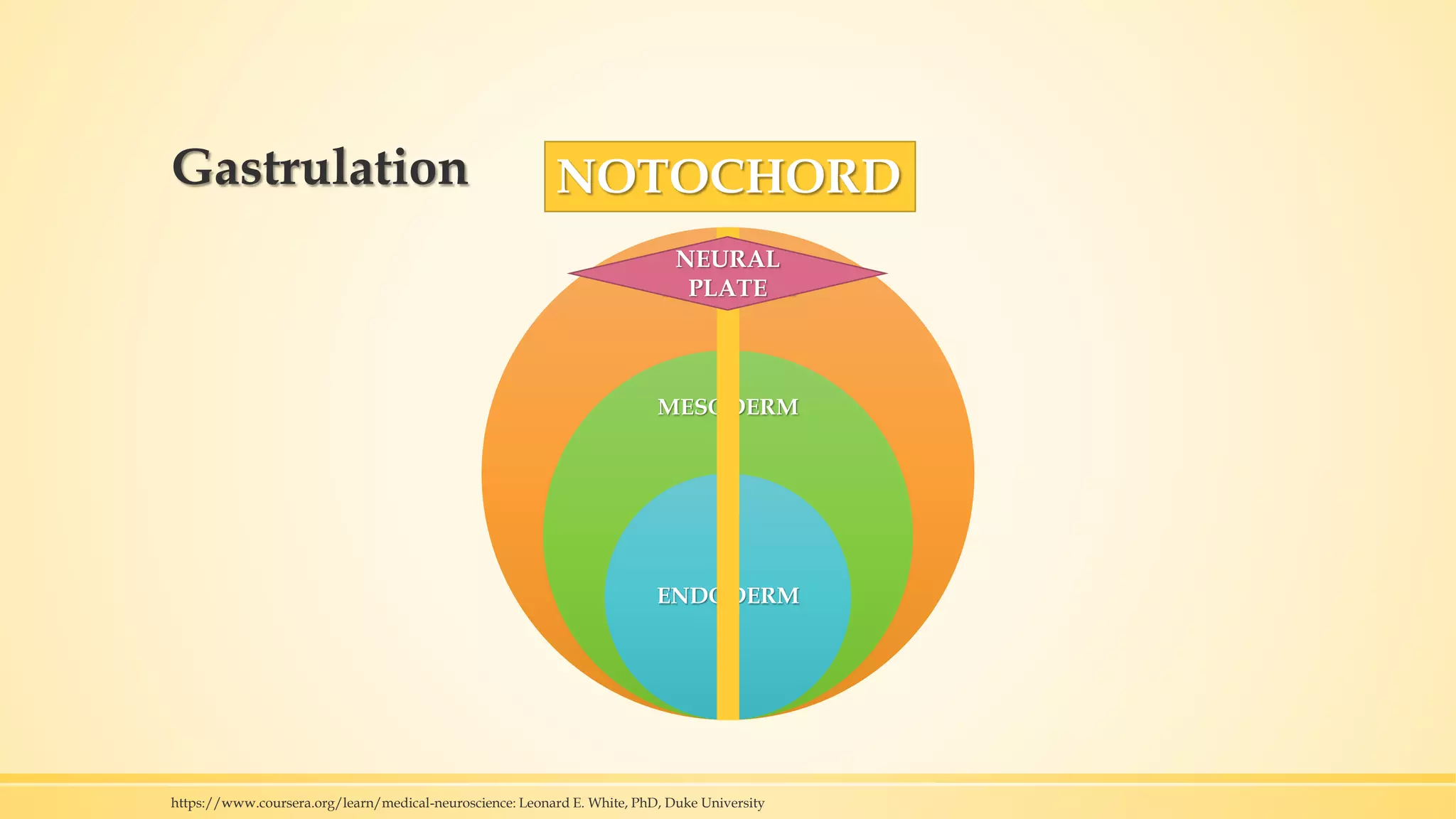
NOTOCHORD is derived from the MESODERM. Notochord is responsible for
sending out chemical signals that interact with ECTODERM: that part of the
ectoderm becomes the NEURAL PLATE. Notochord is important for inducing
the differentiation from the neural plate.
https://www.coursera.org/learn/medical-neuroscience: Leonard E. White, PhD, Duke University
Wikipedia.org
https://www.coursera.org/learn/medical-neuroscience: Leonard E. White, PhD, Duke University
Gastrulation
ECTODERM
MESODERM
ENDODERM
NOTOCHORD
NEURAL
PLATE
https://www.coursera.org/learn/medical-neuroscience: Leonard E. White, PhD, Duke University
Neurulation
▪ Neurulation is initial formation of the nervous system.
▪ The neural plate begins to rise up in its lateral margins and
begins to close up to form a NEURAL TUBE.
▪ Closing of the neural tube begins in the center of the neural
plate and extends in anterior and posterior direction.
▪ In the fourth week of embryonic life there is anterior and
posterior end of the neural tube.
▪ Anterior end is going to be BRAIN.
▪ Rest of the neural tube (posterior part) will be SPINAL CORD.
https://www.coursera.org/learn/medical-neuroscience: Leonard E. White, PhD, Duke University
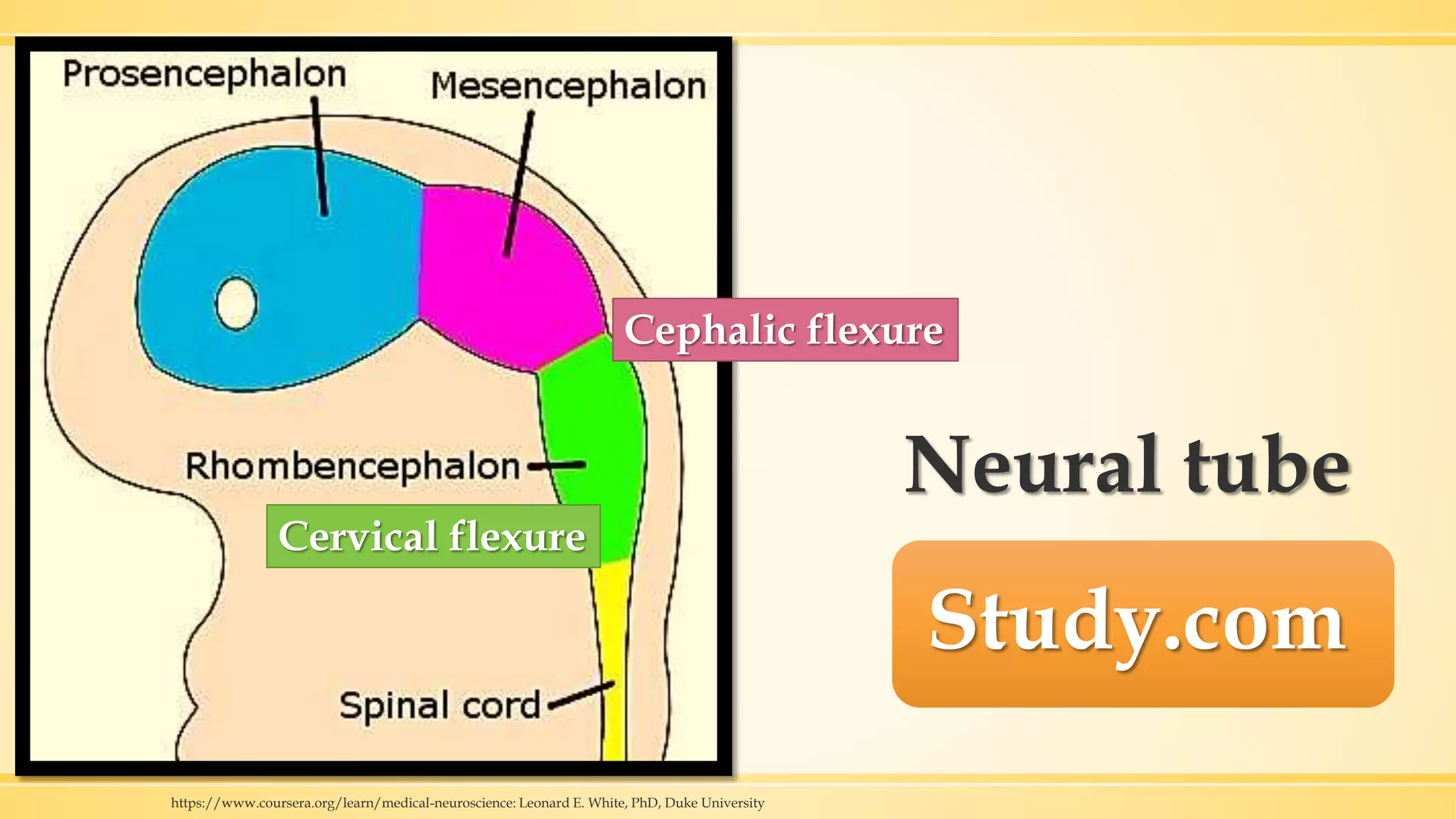
Neural tube
Study.com
https://www.coursera.org/learn/medical-neuroscience: Leonard E. White, PhD, Duke University
Cephalic flexure
Cervical flexure
Neural tube
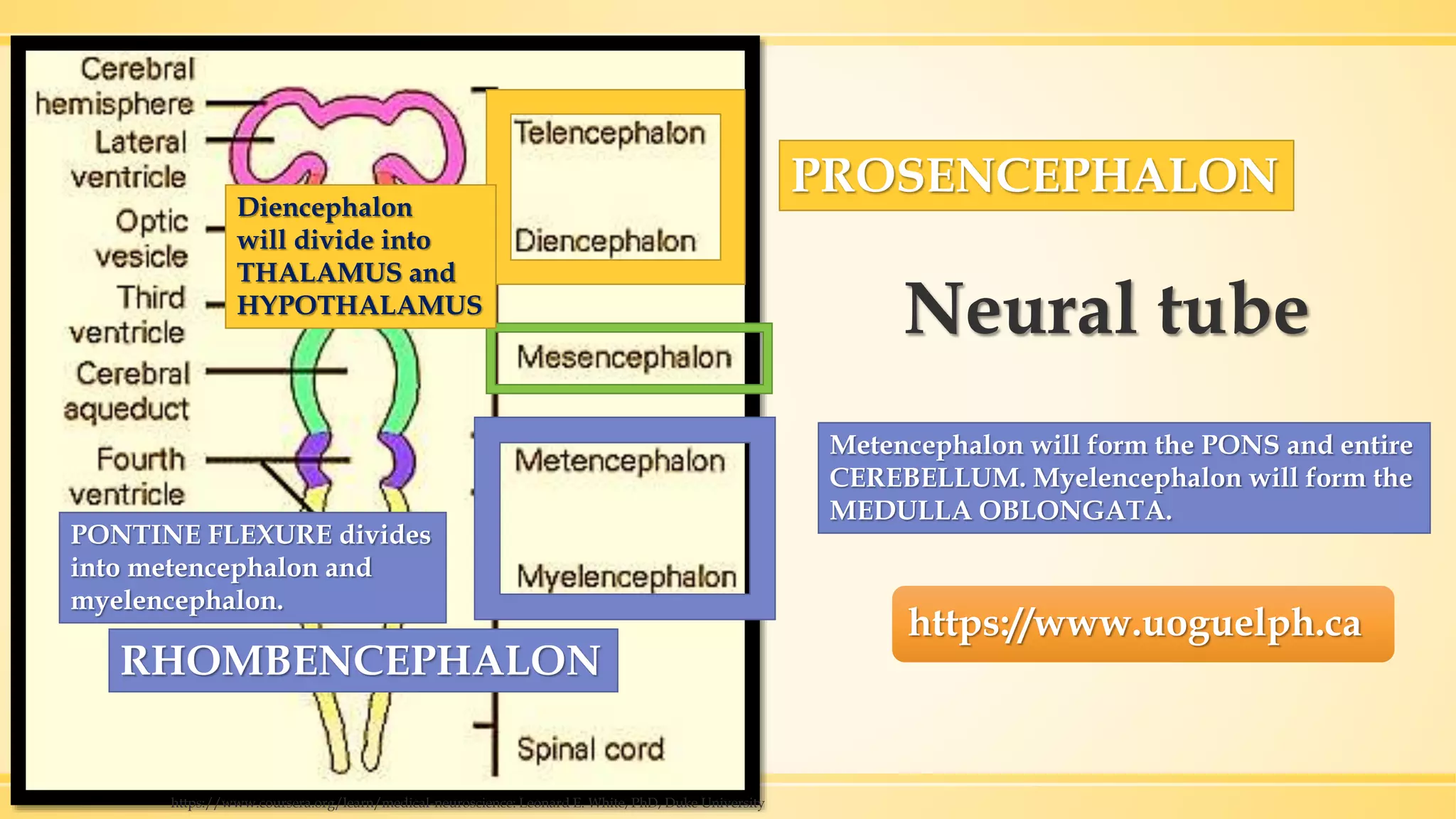
https://www.uoguelph.ca
PROSENCEPHALON
RHOMBENCEPHALON
https://www.coursera.org/learn/medical-neuroscience: Leonard E. White, PhD, Duke University
Metencephalon will form the PONS and entire
CEREBELLUM. Myelencephalon will form the
MEDULLA OBLONGATA.
PONTINE FLEXURE divides
into metencephalon and
myelencephalon.
Diencephalon
will divide into
THALAMUS and
HYPOTHALAMUS
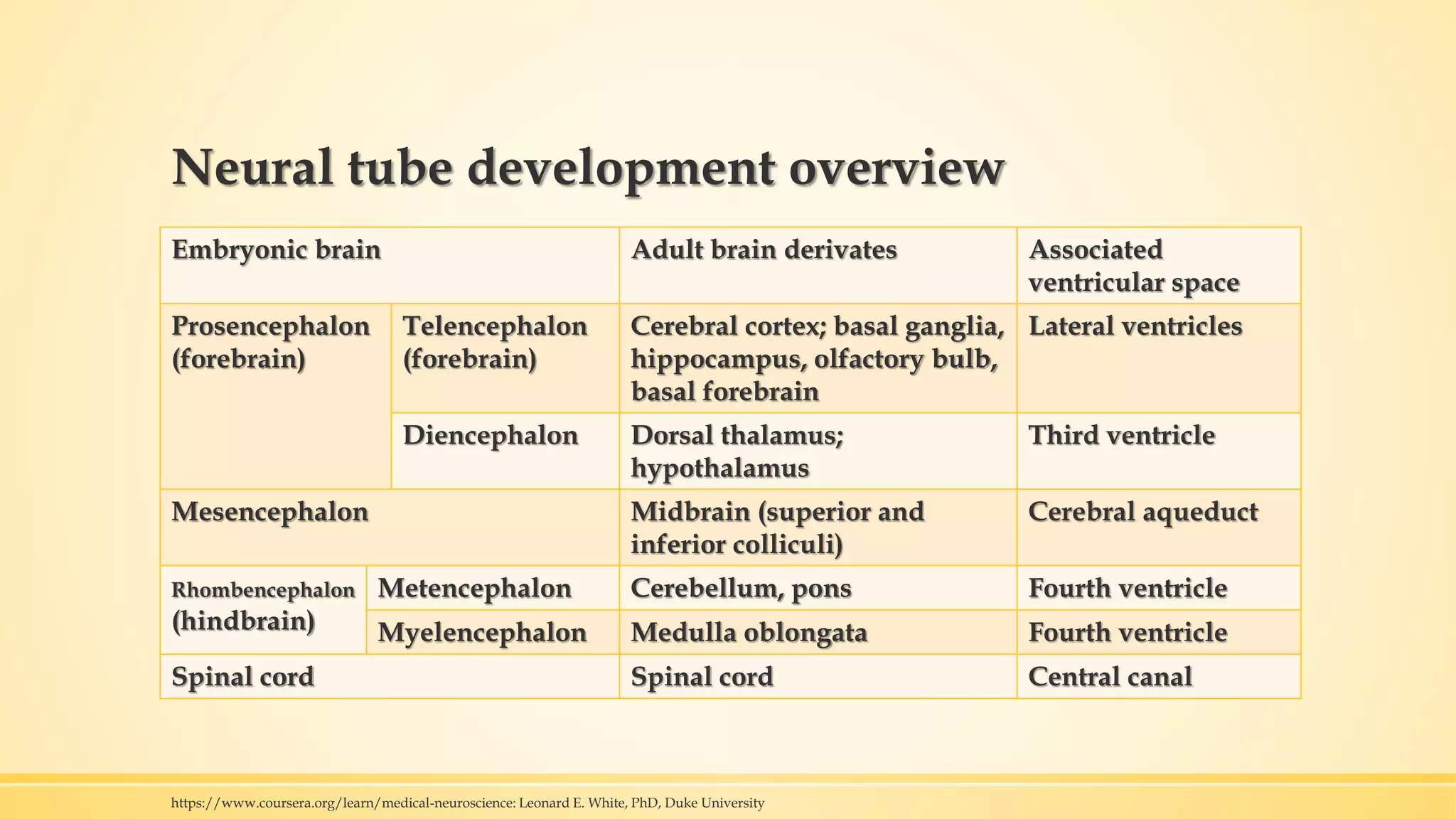
Neural tube development overview
Embryonic brain Adult brain derivates Associated
ventricular space
Prosencephalon
(forebrain)
Telencephalon
(forebrain)
Cerebral cortex; basal ganglia,
hippocampus, olfactory bulb,
basal forebrain
Lateral ventricles
Diencephalon Dorsal thalamus;
hypothalamus
Third ventricle
Mesencephalon Midbrain (superior and
inferior colliculi)
Cerebral aqueduct
Rhombencephalon
(hindbrain)
Metencephalon Cerebellum, pons Fourth ventricle
Myelencephalon Medulla oblongata Fourth ventricle
Spinal cord Spinal cord Central canal
https://www.coursera.org/learn/medical-neuroscience: Leonard E. White, PhD, Duke University
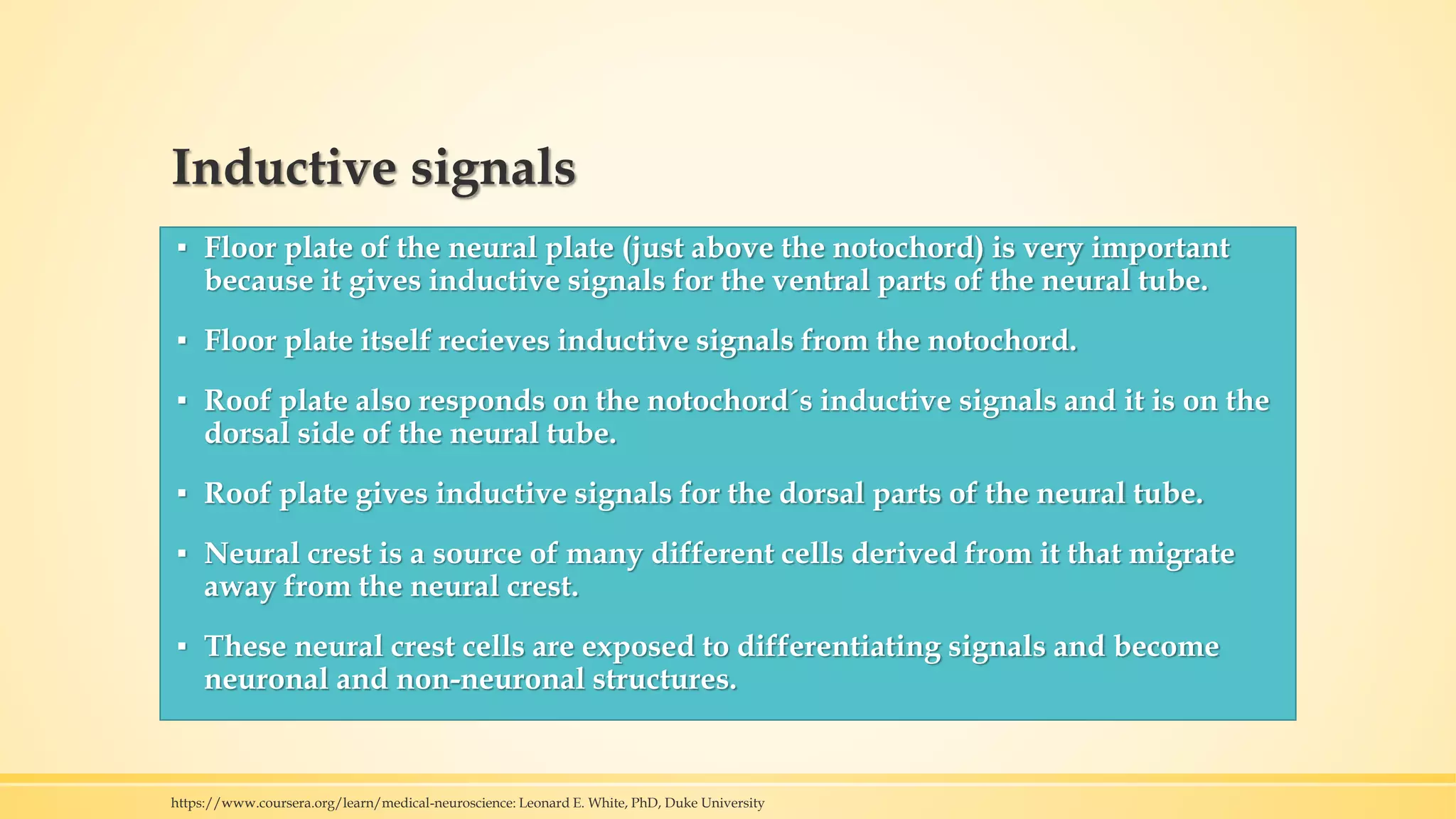
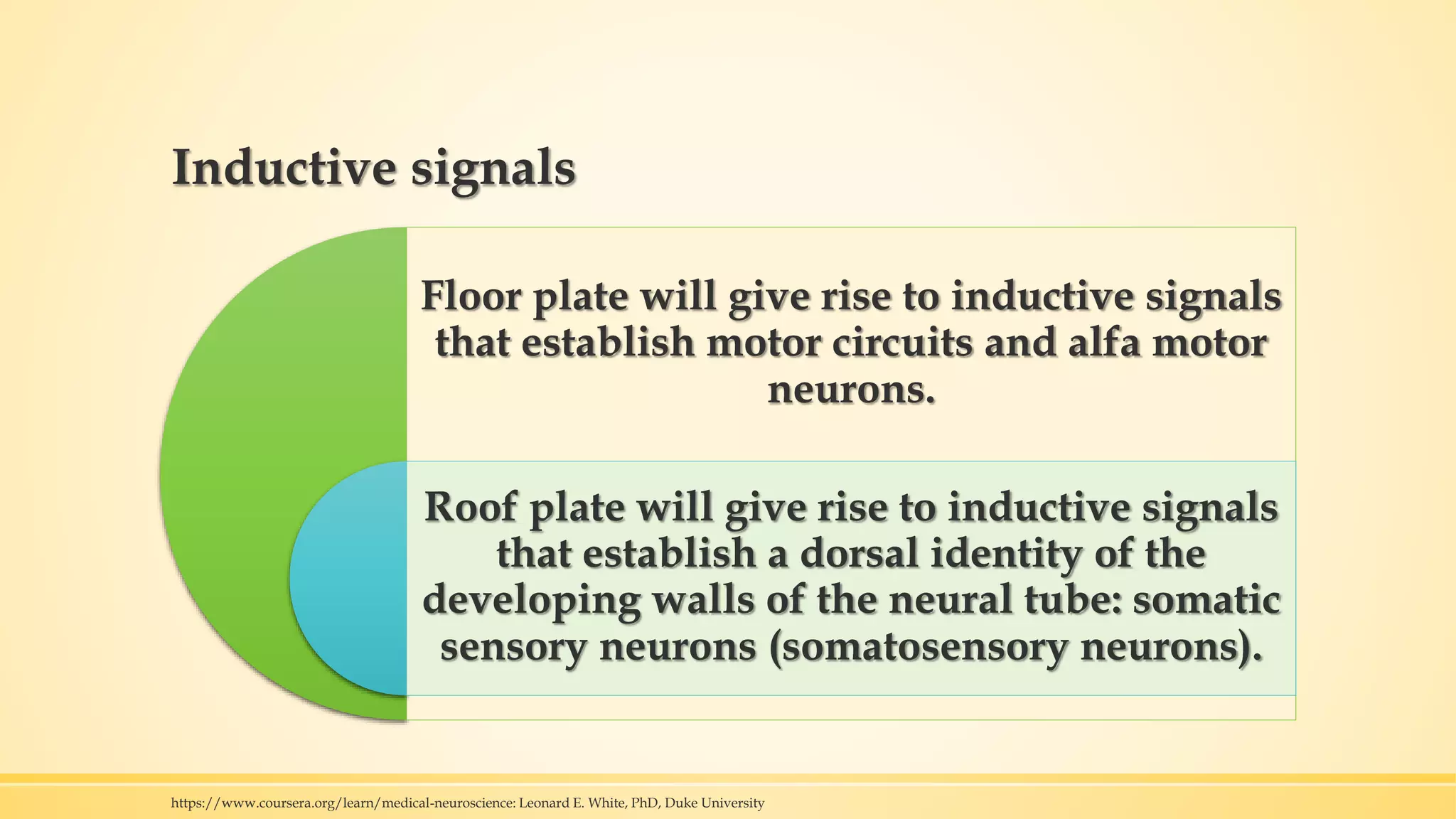
Inductive signals
▪ Floor plate of the neural plate (just above the notochord) is very important
because it gives inductive signals for the ventral parts of the neural tube.
▪ Floor plate itself recieves inductive signals from the notochord.
▪ Roof plate also responds on the notochord´s inductive signals and it is on the
dorsal side of the neural tube.
▪ Roof plate gives inductive signals for the dorsal parts of the neural tube.
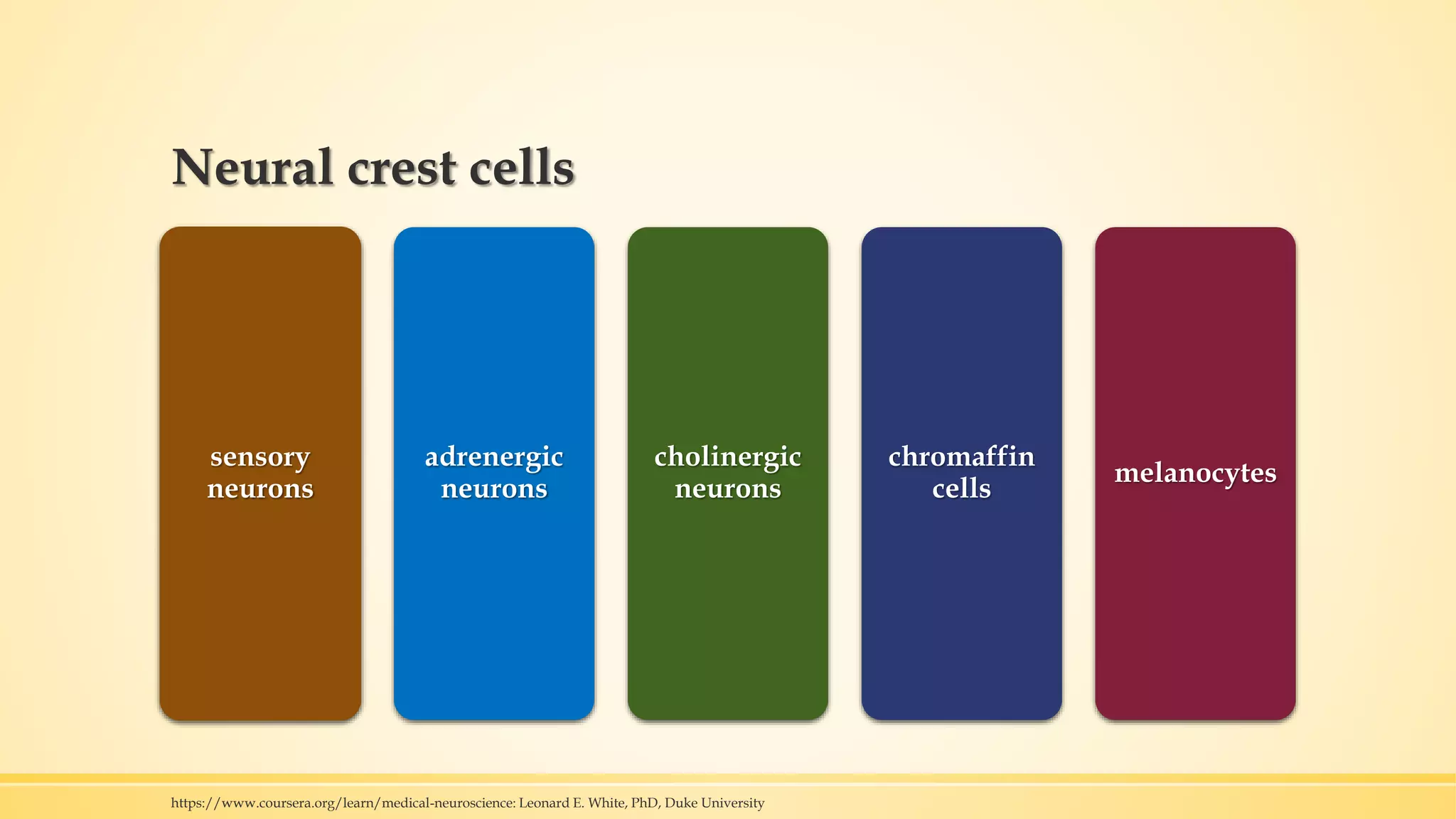
▪ Neural crest is a source of many different cells derived from it that migrate
away from the neural crest.
▪ These neural crest cells are exposed to differentiating signals and become
neuronal and non-neuronal structures.
https://www.coursera.org/learn/medical-neuroscience: Leonard E. White, PhD, Duke University
Inductive signals
Floor plate will give rise to inductive signals
that establish motor circuits and alfa motor
neurons.
Roof plate will give rise to inductive signals
that establish a dorsal identity of the
developing walls of the neural tube: somatic
sensory neurons (somatosensory neurons).
https://www.coursera.org/learn/medical-neuroscience: Leonard E. White, PhD, Duke University
Neural crest cells
sensory
neurons
adrenergic
neurons
cholinergic
neurons
chromaffin
cells
melanocytes
https://www.coursera.org/learn/medical-neuroscience: Leonard E. White, PhD, Duke University
Inductive signaling
It is the ability of a cell or a tissue to influence the fate of nearby
cells during development by the synthesis in secretion of
chemical signals.
These chemical signals are either steroid hormones or peptide
hormones.
The precise timing of the expression of these inductive signals is
crucial for the proper formation of the developing brain.
https://www.coursera.org/learn/medical-neuroscience: Leonard E. White, PhD, Duke University
Inductive signaling
▪ Retinoic acid (metabolised from vitamin A) is a very important
inductive signal (importance of vitamin A in early brain
development).
▪ Retinoic acid can translocate through cellular membranes and it
can bind to a receptor within the cell.
▪ That intracellular receptor becomes a transcription factor that is
translocated to the nucleus and interacts with other binding
proteins so it turns on particular genes.
▪ Excess retinoic acid in developing embryo can be extremely
harmful and becomes teratogen.
https://www.coursera.org/learn/medical-neuroscience: Leonard E. White, PhD, Duke University
Inductive signaling
▪ Most of human brain inductive signals are PEPTIDE HORMONES.
▪ Peptide hormones interact with surface bound receptors.
▪ Bone morphogenetic protein (BMP) interacts with surface receptor SERINE
KINASE that phosphorilates transcriptional regulator SMAD.
▪ Activated SMAD associates with additional helper proteins and this complex
is translocated into the nucleus where it acts as transcription regulator.
▪ BMP signaling is very important in mesodermal tissue: inducing of bone cells
development.
▪ BMP signaling in the ectodermal tissue induces the formation of epidermis.
https://www.coursera.org/learn/medical-neuroscience: Leonard E. White, PhD, Duke University
Inductive signaling
Factors NOGGIN and CHORDIN can antagonise the interaction
of BMP with its receptor.
When noggin and chordin antagonise the interaction of BMP with
ectodermal receptors, that part of ectoderm will contine to
develop in neural direction (neuroectoderm, neural plate).
Without noggin and chordin entire ectoderm would become
SKIN.
https://www.coursera.org/learn/medical-neuroscience: Leonard E. White, PhD, Duke University
Inductive signaling
▪ Sonic hedgehog (SHH) is protein hormone that interacts with
receptors that are bound to the surface of the cell.
▪ SHH receptor is a protein called PATCHED PROTEIN that interacts
with SMOOTHENED PROTEIN.
▪ Interaction bethween the patched and smoothened protein will
activate a series of transcription factors.
▪ Transcription factor GLI 1 becomes induced, binds to DNA and
modulates gene expression.
▪ SHH mediated signaling pathway is crucial for the proper closure
of the neural tube.
https://www.coursera.org/learn/medical-neuroscience: Leonard E. White, PhD, Duke University
Inductive signaling coordination
Inductive signals are
cooordinated both in
location and
developmental time.
https://www.coursera.org/learn/medical-neuroscience: Leonard E. White, PhD, Duke University
Homeotic (HOX) genes
There are four clusters of Hox genes: HoxA (chromosome 7), HoxB
(chromosome 17), HoxC (chromosome 12) and HoxD
(chromosome 2).
These Hox genes clusters are responsible for beginning to
establish regional identity in the developing nervous system.
There is anterior to posterior pattern of expression of these
clusters: development of brain and spinal cord segments.
https://www.coursera.org/learn/medical-neuroscience: Leonard E. White, PhD, Duke University
Proliferation
▪ 250 000 cells are produced every minute in the developing embryo.
▪ The production of neurons is restricted in time to a very narrow period:
SECOND TRIMESTER OF PREGNANCY.
▪ Adult neurogenesis is mostly restricted to the hippocampus: learning and
creation of new memories.
▪ Precursor cell has a body and two processes that make contact with inner and
outer surface of developing neural tube.
▪ The outer neural tube surface will become the PIAL surface of the brain.
▪ The inner surface is going to differentiate into the EPENDYMAL LINING of
the ventricles in the human brain.
https://www.coursera.org/learn/medical-neuroscience: Leonard E. White, PhD, Duke University
Proliferation
▪ Cell body of the precursor cell can migrate via its processes towards the
pial and ependymal surface of the neural tube.
▪ When the cell body migrates close to the pial surface, DNA starts to
replicate.
▪ When the cell body migrates then close to the ependymal surface, mitosis
occurs.
▪ Symmetrical division will produce two precursor cells.
▪ Asymmetrical division produces two different types of cells: one is
precursor (progenitor) cell and other is NEUROBLAST.
▪ Neuroblast can then differentiate into the neurons and glial cells.
https://www.coursera.org/learn/medical-neuroscience: Leonard E. White, PhD, Duke University
Migration
The ventricular zone of the neural tube is where mitosis
is happening.
The cortical plate is the first formation of the cerebral
cortex.
Neuroblasts migrate from ventricular zone towards the
cortical plate along the radial fiber formed by radial
glial cells.
https://www.coursera.org/learn/medical-neuroscience: Leonard E. White, PhD, Duke University
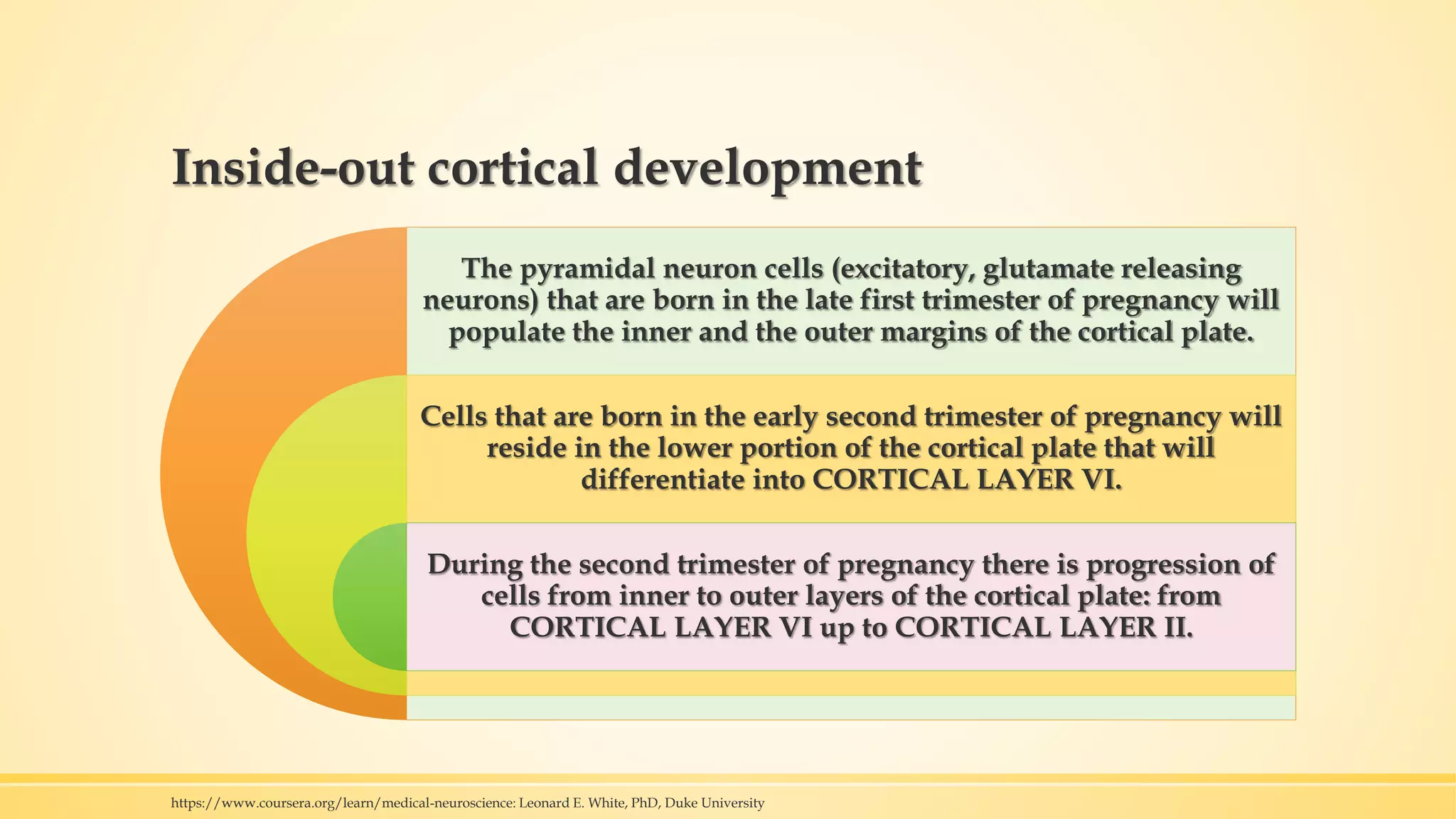
Inside-out cortical development
The pyramidal neuron cells (excitatory, glutamate releasing
neurons) that are born in the late first trimester of pregnancy will
populate the inner and the outer margins of the cortical plate.
Cells that are born in the early second trimester of pregnancy will
reside in the lower portion of the cortical plate that will
differentiate into CORTICAL LAYER VI.
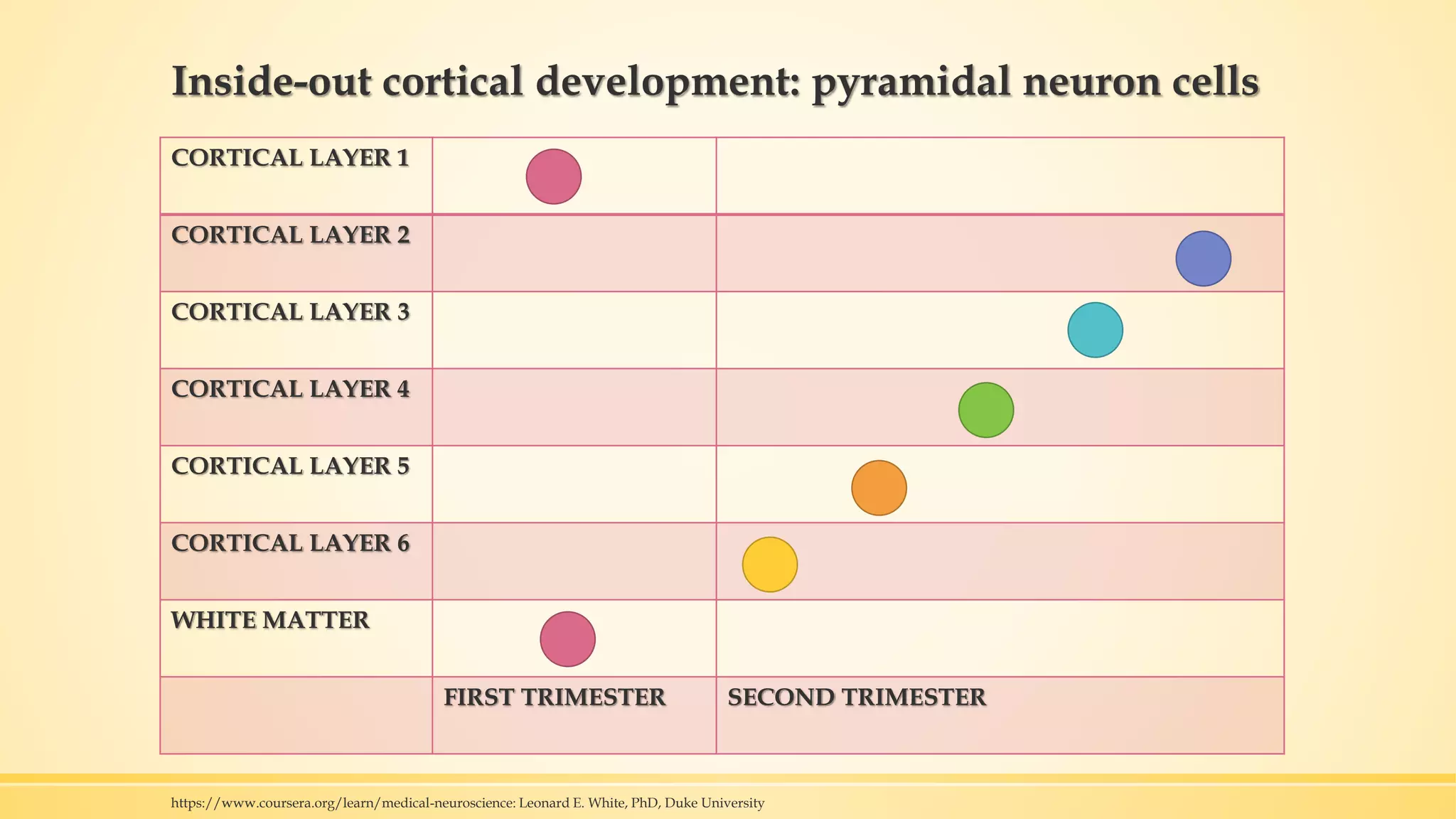
During the second trimester of pregnancy there is progression of
cells from inner to outer layers of the cortical plate: from
CORTICAL LAYER VI up to CORTICAL LAYER II.
https://www.coursera.org/learn/medical-neuroscience: Leonard E. White, PhD, Duke University
Inside-out cortical development: pyramidal neuron cells
CORTICAL LAYER 1
CORTICAL LAYER 2
CORTICAL LAYER 3
CORTICAL LAYER 4
CORTICAL LAYER 5
CORTICAL LAYER 6
WHITE MATTER
FIRST TRIMESTER SECOND TRIMESTER
https://www.coursera.org/learn/medical-neuroscience: Leonard E. White, PhD, Duke University
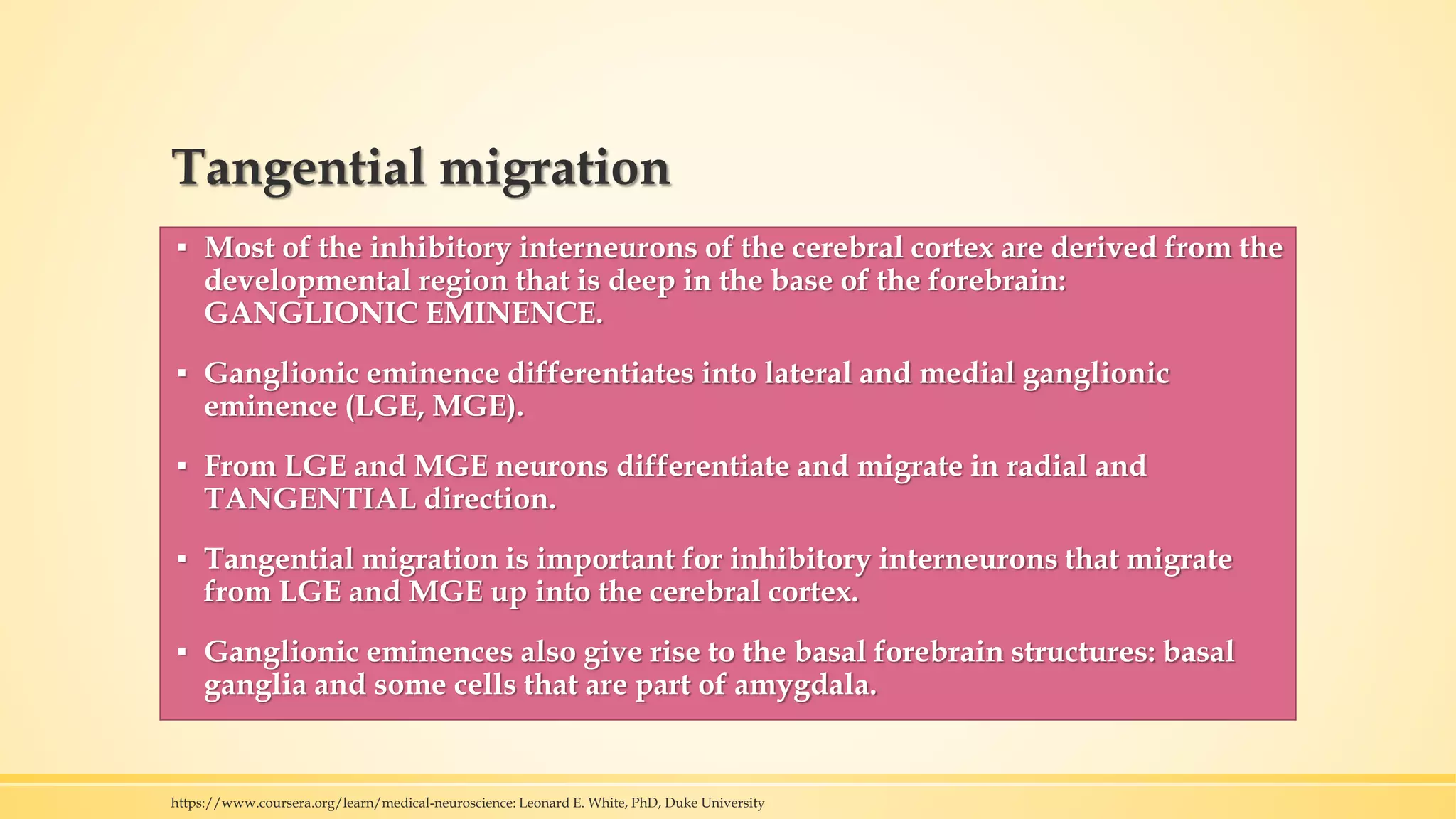
Tangential migration
▪ Most of the inhibitory interneurons of the cerebral cortex are derived from the
developmental region that is deep in the base of the forebrain:
GANGLIONIC EMINENCE.
▪ Ganglionic eminence differentiates into lateral and medial ganglionic
eminence (LGE, MGE).
▪ From LGE and MGE neurons differentiate and migrate in radial and
TANGENTIAL direction.
▪ Tangential migration is important for inhibitory interneurons that migrate
from LGE and MGE up into the cerebral cortex.
▪ Ganglionic eminences also give rise to the basal forebrain structures: basal
ganglia and some cells that are part of amygdala.
https://www.coursera.org/learn/medical-neuroscience: Leonard E. White, PhD, Duke University
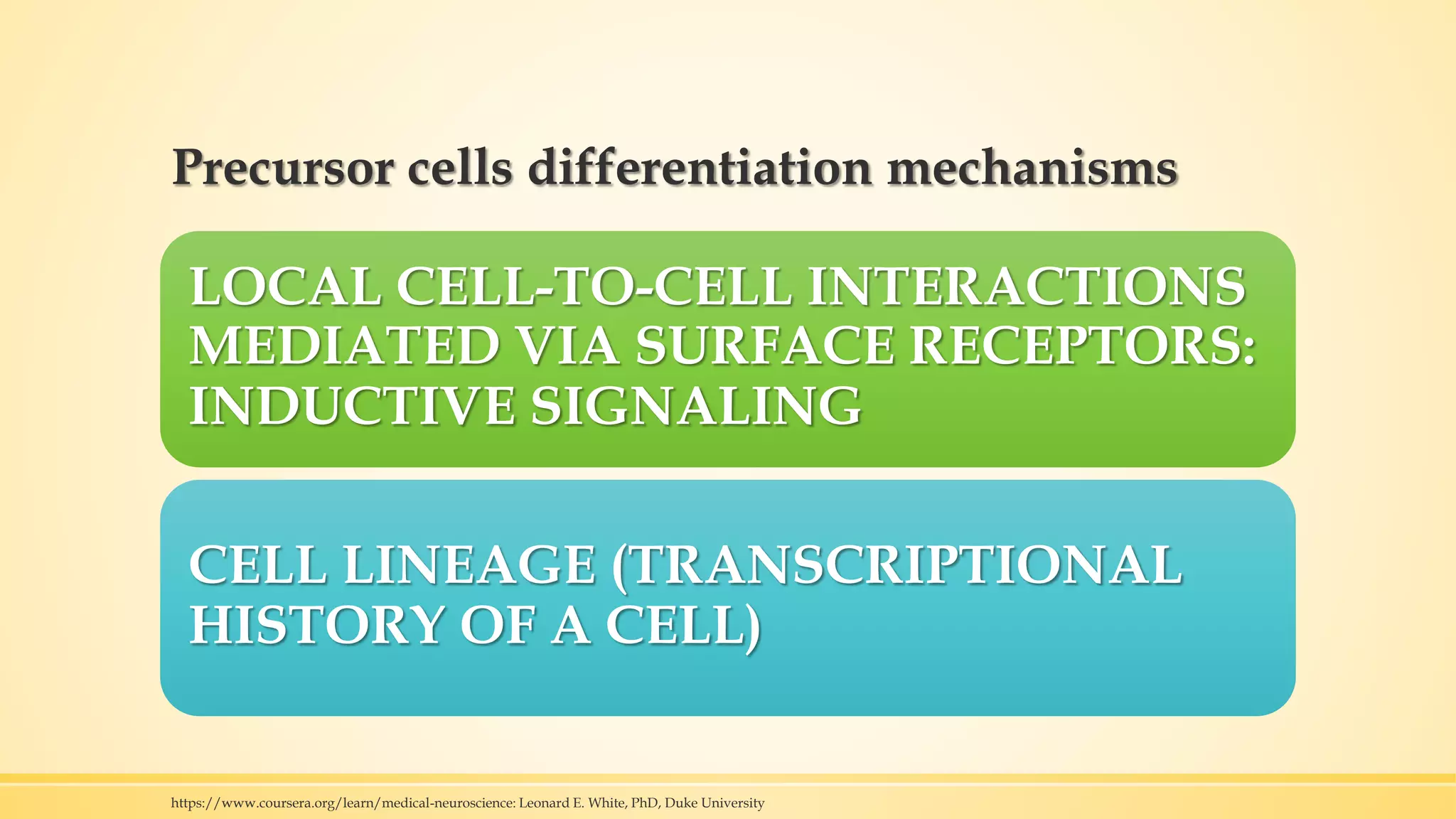
Precursor cells differentiation mechanisms
LOCAL CELL-TO-CELL INTERACTIONS
MEDIATED VIA SURFACE RECEPTORS:
INDUCTIVE SIGNALING
CELL LINEAGE (TRANSCRIPTIONAL
HISTORY OF A CELL)
https://www.coursera.org/learn/medical-neuroscience: Leonard E. White, PhD, Duke University
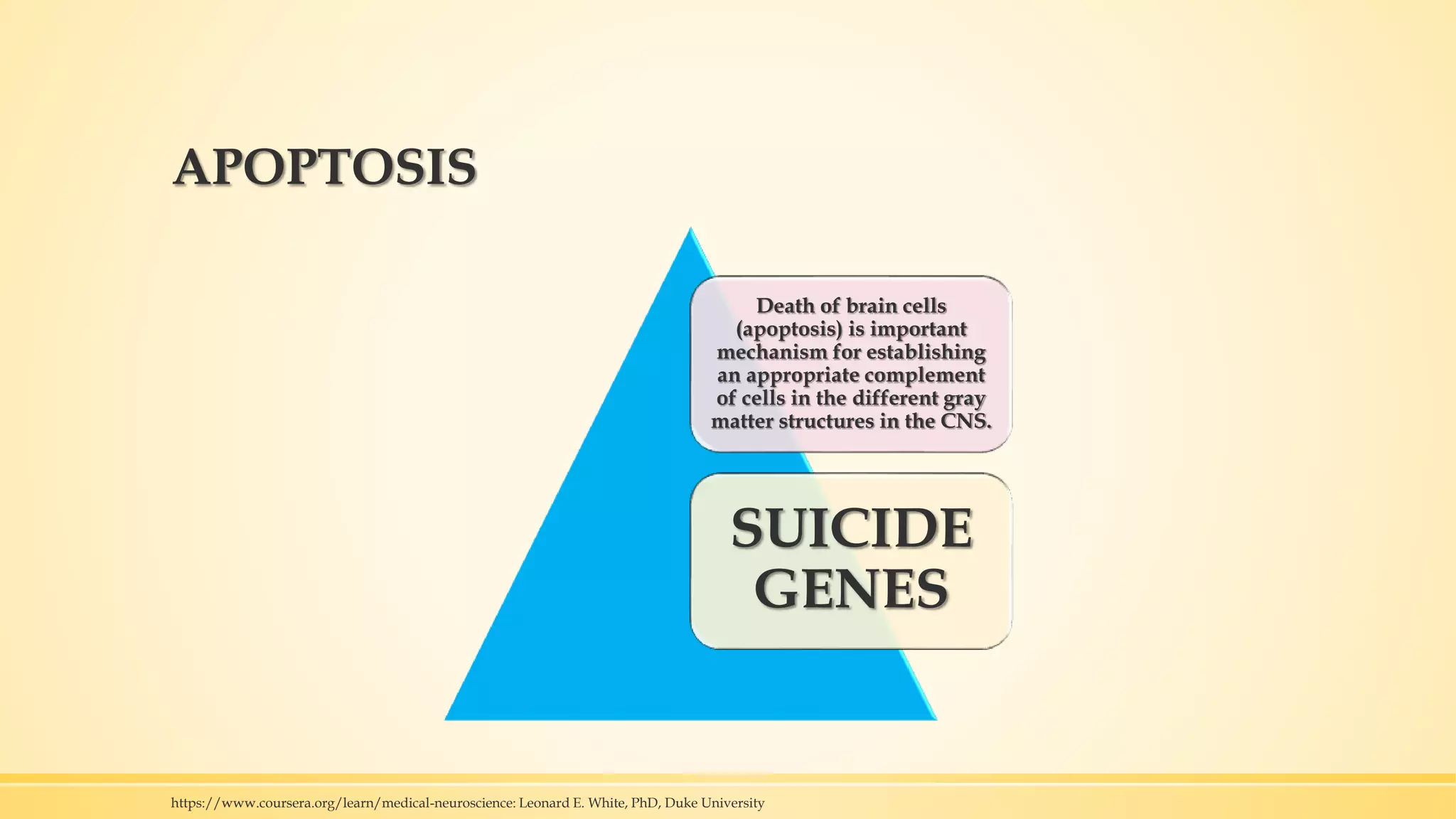
APOPTOSIS
Death of brain cells
(apoptosis) is important
mechanism for establishing
an appropriate complement
of cells in the different gray
matter structures in the CNS.
SUICIDE
GENES
https://www.coursera.org/learn/medical-neuroscience: Leonard E. White, PhD, Duke University
Literature
▪https://www.coursera.org/learn/medical-
neuroscience: Leonard E. White, PhD,
Duke University
▪Study.com
▪https://www.uoguelph.ca
▪Wikipedia.org
https://www.coursera.org/learn/medical-neuroscience: Leonard E. White, PhD, Duke University

Early brain development part one

  • 1.
  • 2.
  • 3.
  • 4.
    Developmental forces Nature (lineage-derivedsignals) is expressed via gene transcription. Nurture (environmental interactions) is experience dependent modulation of activity. Self-organisation (cell-cell interactions) is mediated via activity-based mechanisms. https://www.coursera.org/learn/medical-neuroscience: Leonard E. White, PhD, Duke University
  • 5.
    Gastrulation ▪ Gastrulation isan invagination of the developing embryo at the stage of the BLASTULA. Gastrulation produces three principal germ layers: ▪ ECTODERM (the outermost layer) ▪ MESODERM (the middle layer) ▪ ENDODERM (the innermost layer) NOTOCHORD is derived from the MESODERM. Notochord is responsible for sending out chemical signals that interact with ECTODERM: that part of the ectoderm becomes the NEURAL PLATE. Notochord is important for inducing the differentiation from the neural plate. https://www.coursera.org/learn/medical-neuroscience: Leonard E. White, PhD, Duke University
  • 6.
  • 7.
  • 8.
    Neurulation ▪ Neurulation isinitial formation of the nervous system. ▪ The neural plate begins to rise up in its lateral margins and begins to close up to form a NEURAL TUBE. ▪ Closing of the neural tube begins in the center of the neural plate and extends in anterior and posterior direction. ▪ In the fourth week of embryonic life there is anterior and posterior end of the neural tube. ▪ Anterior end is going to be BRAIN. ▪ Rest of the neural tube (posterior part) will be SPINAL CORD. https://www.coursera.org/learn/medical-neuroscience: Leonard E. White, PhD, Duke University
  • 9.
    Neural tube Study.com https://www.coursera.org/learn/medical-neuroscience: LeonardE. White, PhD, Duke University Cephalic flexure Cervical flexure
  • 10.
    Neural tube https://www.uoguelph.ca PROSENCEPHALON RHOMBENCEPHALON https://www.coursera.org/learn/medical-neuroscience: LeonardE. White, PhD, Duke University Metencephalon will form the PONS and entire CEREBELLUM. Myelencephalon will form the MEDULLA OBLONGATA. PONTINE FLEXURE divides into metencephalon and myelencephalon. Diencephalon will divide into THALAMUS and HYPOTHALAMUS
  • 11.
    Neural tube developmentoverview Embryonic brain Adult brain derivates Associated ventricular space Prosencephalon (forebrain) Telencephalon (forebrain) Cerebral cortex; basal ganglia, hippocampus, olfactory bulb, basal forebrain Lateral ventricles Diencephalon Dorsal thalamus; hypothalamus Third ventricle Mesencephalon Midbrain (superior and inferior colliculi) Cerebral aqueduct Rhombencephalon (hindbrain) Metencephalon Cerebellum, pons Fourth ventricle Myelencephalon Medulla oblongata Fourth ventricle Spinal cord Spinal cord Central canal https://www.coursera.org/learn/medical-neuroscience: Leonard E. White, PhD, Duke University
  • 12.
    Inductive signals ▪ Floorplate of the neural plate (just above the notochord) is very important because it gives inductive signals for the ventral parts of the neural tube. ▪ Floor plate itself recieves inductive signals from the notochord. ▪ Roof plate also responds on the notochord´s inductive signals and it is on the dorsal side of the neural tube. ▪ Roof plate gives inductive signals for the dorsal parts of the neural tube. ▪ Neural crest is a source of many different cells derived from it that migrate away from the neural crest. ▪ These neural crest cells are exposed to differentiating signals and become neuronal and non-neuronal structures. https://www.coursera.org/learn/medical-neuroscience: Leonard E. White, PhD, Duke University
  • 13.
    Inductive signals Floor platewill give rise to inductive signals that establish motor circuits and alfa motor neurons. Roof plate will give rise to inductive signals that establish a dorsal identity of the developing walls of the neural tube: somatic sensory neurons (somatosensory neurons). https://www.coursera.org/learn/medical-neuroscience: Leonard E. White, PhD, Duke University
  • 14.
  • 15.
    Inductive signaling It isthe ability of a cell or a tissue to influence the fate of nearby cells during development by the synthesis in secretion of chemical signals. These chemical signals are either steroid hormones or peptide hormones. The precise timing of the expression of these inductive signals is crucial for the proper formation of the developing brain. https://www.coursera.org/learn/medical-neuroscience: Leonard E. White, PhD, Duke University
  • 16.
    Inductive signaling ▪ Retinoicacid (metabolised from vitamin A) is a very important inductive signal (importance of vitamin A in early brain development). ▪ Retinoic acid can translocate through cellular membranes and it can bind to a receptor within the cell. ▪ That intracellular receptor becomes a transcription factor that is translocated to the nucleus and interacts with other binding proteins so it turns on particular genes. ▪ Excess retinoic acid in developing embryo can be extremely harmful and becomes teratogen. https://www.coursera.org/learn/medical-neuroscience: Leonard E. White, PhD, Duke University
  • 17.
    Inductive signaling ▪ Mostof human brain inductive signals are PEPTIDE HORMONES. ▪ Peptide hormones interact with surface bound receptors. ▪ Bone morphogenetic protein (BMP) interacts with surface receptor SERINE KINASE that phosphorilates transcriptional regulator SMAD. ▪ Activated SMAD associates with additional helper proteins and this complex is translocated into the nucleus where it acts as transcription regulator. ▪ BMP signaling is very important in mesodermal tissue: inducing of bone cells development. ▪ BMP signaling in the ectodermal tissue induces the formation of epidermis. https://www.coursera.org/learn/medical-neuroscience: Leonard E. White, PhD, Duke University
  • 18.
    Inductive signaling Factors NOGGINand CHORDIN can antagonise the interaction of BMP with its receptor. When noggin and chordin antagonise the interaction of BMP with ectodermal receptors, that part of ectoderm will contine to develop in neural direction (neuroectoderm, neural plate). Without noggin and chordin entire ectoderm would become SKIN. https://www.coursera.org/learn/medical-neuroscience: Leonard E. White, PhD, Duke University
  • 19.
    Inductive signaling ▪ Sonichedgehog (SHH) is protein hormone that interacts with receptors that are bound to the surface of the cell. ▪ SHH receptor is a protein called PATCHED PROTEIN that interacts with SMOOTHENED PROTEIN. ▪ Interaction bethween the patched and smoothened protein will activate a series of transcription factors. ▪ Transcription factor GLI 1 becomes induced, binds to DNA and modulates gene expression. ▪ SHH mediated signaling pathway is crucial for the proper closure of the neural tube. https://www.coursera.org/learn/medical-neuroscience: Leonard E. White, PhD, Duke University
  • 20.
    Inductive signaling coordination Inductivesignals are cooordinated both in location and developmental time. https://www.coursera.org/learn/medical-neuroscience: Leonard E. White, PhD, Duke University
  • 21.
    Homeotic (HOX) genes Thereare four clusters of Hox genes: HoxA (chromosome 7), HoxB (chromosome 17), HoxC (chromosome 12) and HoxD (chromosome 2). These Hox genes clusters are responsible for beginning to establish regional identity in the developing nervous system. There is anterior to posterior pattern of expression of these clusters: development of brain and spinal cord segments. https://www.coursera.org/learn/medical-neuroscience: Leonard E. White, PhD, Duke University
  • 22.
    Proliferation ▪ 250 000cells are produced every minute in the developing embryo. ▪ The production of neurons is restricted in time to a very narrow period: SECOND TRIMESTER OF PREGNANCY. ▪ Adult neurogenesis is mostly restricted to the hippocampus: learning and creation of new memories. ▪ Precursor cell has a body and two processes that make contact with inner and outer surface of developing neural tube. ▪ The outer neural tube surface will become the PIAL surface of the brain. ▪ The inner surface is going to differentiate into the EPENDYMAL LINING of the ventricles in the human brain. https://www.coursera.org/learn/medical-neuroscience: Leonard E. White, PhD, Duke University
  • 23.
    Proliferation ▪ Cell bodyof the precursor cell can migrate via its processes towards the pial and ependymal surface of the neural tube. ▪ When the cell body migrates close to the pial surface, DNA starts to replicate. ▪ When the cell body migrates then close to the ependymal surface, mitosis occurs. ▪ Symmetrical division will produce two precursor cells. ▪ Asymmetrical division produces two different types of cells: one is precursor (progenitor) cell and other is NEUROBLAST. ▪ Neuroblast can then differentiate into the neurons and glial cells. https://www.coursera.org/learn/medical-neuroscience: Leonard E. White, PhD, Duke University
  • 24.
    Migration The ventricular zoneof the neural tube is where mitosis is happening. The cortical plate is the first formation of the cerebral cortex. Neuroblasts migrate from ventricular zone towards the cortical plate along the radial fiber formed by radial glial cells. https://www.coursera.org/learn/medical-neuroscience: Leonard E. White, PhD, Duke University
  • 25.
    Inside-out cortical development Thepyramidal neuron cells (excitatory, glutamate releasing neurons) that are born in the late first trimester of pregnancy will populate the inner and the outer margins of the cortical plate. Cells that are born in the early second trimester of pregnancy will reside in the lower portion of the cortical plate that will differentiate into CORTICAL LAYER VI. During the second trimester of pregnancy there is progression of cells from inner to outer layers of the cortical plate: from CORTICAL LAYER VI up to CORTICAL LAYER II. https://www.coursera.org/learn/medical-neuroscience: Leonard E. White, PhD, Duke University
  • 26.
    Inside-out cortical development:pyramidal neuron cells CORTICAL LAYER 1 CORTICAL LAYER 2 CORTICAL LAYER 3 CORTICAL LAYER 4 CORTICAL LAYER 5 CORTICAL LAYER 6 WHITE MATTER FIRST TRIMESTER SECOND TRIMESTER https://www.coursera.org/learn/medical-neuroscience: Leonard E. White, PhD, Duke University
  • 27.
    Tangential migration ▪ Mostof the inhibitory interneurons of the cerebral cortex are derived from the developmental region that is deep in the base of the forebrain: GANGLIONIC EMINENCE. ▪ Ganglionic eminence differentiates into lateral and medial ganglionic eminence (LGE, MGE). ▪ From LGE and MGE neurons differentiate and migrate in radial and TANGENTIAL direction. ▪ Tangential migration is important for inhibitory interneurons that migrate from LGE and MGE up into the cerebral cortex. ▪ Ganglionic eminences also give rise to the basal forebrain structures: basal ganglia and some cells that are part of amygdala. https://www.coursera.org/learn/medical-neuroscience: Leonard E. White, PhD, Duke University
  • 28.
    Precursor cells differentiationmechanisms LOCAL CELL-TO-CELL INTERACTIONS MEDIATED VIA SURFACE RECEPTORS: INDUCTIVE SIGNALING CELL LINEAGE (TRANSCRIPTIONAL HISTORY OF A CELL) https://www.coursera.org/learn/medical-neuroscience: Leonard E. White, PhD, Duke University
  • 29.
    APOPTOSIS Death of braincells (apoptosis) is important mechanism for establishing an appropriate complement of cells in the different gray matter structures in the CNS. SUICIDE GENES https://www.coursera.org/learn/medical-neuroscience: Leonard E. White, PhD, Duke University
  • 30.
    Literature ▪https://www.coursera.org/learn/medical- neuroscience: Leonard E.White, PhD, Duke University ▪Study.com ▪https://www.uoguelph.ca ▪Wikipedia.org https://www.coursera.org/learn/medical-neuroscience: Leonard E. White, PhD, Duke University