Early Application IdentificationEarly Application Identification
LaurentLaurent BernailleBernaille
Renata TeixeiraRenata Teixeira
Kave SalamatianKave Salamatian
UniversitéUniversité Pierre et Marie Curie - LIPPierre et Marie Curie - LIP6/CNRS6/CNRS
2
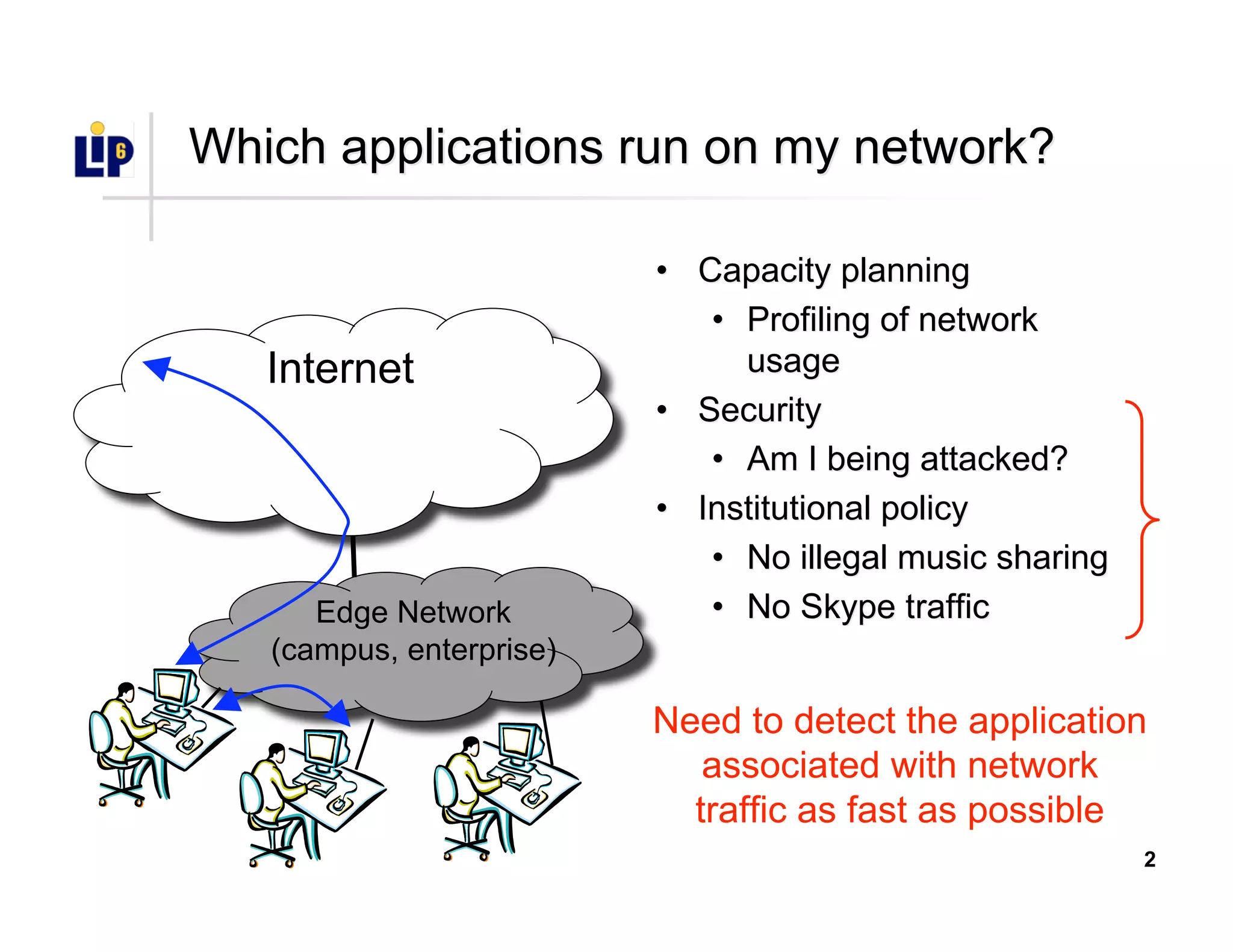
Which applications run on my network?Which applications run on my network?
•• Capacity planningCapacity planning
•• Profiling of networkProfiling of network
usageusage
•• SecuritySecurity
•• Am I being attacked?Am I being attacked?
•• Institutional policyInstitutional policy
•• No illegal music sharingNo illegal music sharing
•• NoNo SkypeSkype traffictrafficEdge Network
(campus, enterprise)
Internet
Need to detect the application
associated with network
traffic as fast as possible
3
Problem statementProblem statement
•• A new classifierA new classifier
•• Inspects all packets entering and exiting the networkInspects all packets entering and exiting the network
•• Only uses information in the TCP/IP headerOnly uses information in the TCP/IP header
•• Identifies the application using the first few applicationIdentifies the application using the first few application
packets in TCP connectionspackets in TCP connections
4
Application identification todayApplication identification today
•• Port-based identificationPort-based identification
•• Use IANA well-known port numbersUse IANA well-known port numbers
•• Often inaccurateOften inaccurate
•• Non-standard portsNon-standard ports
•• Masquerade trafficMasquerade traffic
•• Content-based identificationContent-based identification
•• Inspect packet payload for well-known signaturesInspect packet payload for well-known signatures
•• Very accurate, butVery accurate, but……
•• Does not work for encrypted trafficDoes not work for encrypted traffic
•• Privacy issuesPrivacy issues
•• Computationally intensiveComputationally intensive
5
Behavior-based application identificationBehavior-based application identification
•• Newer proposals based on connection-levelNewer proposals based on connection-level
statisticsstatistics
•• Mean or variance of packet inter-arrival timeMean or variance of packet inter-arrival time
•• Mean or variance of packet sizeMean or variance of packet size
•• Number of packets in the connectionNumber of packets in the connection
•• Duration of a connectionDuration of a connection
•• Accuracy:Accuracy: ~90%~90%
•• Need to wait for connection to endNeed to wait for connection to end
Can we apply similar techniques just to the
first packets of a connection?
6
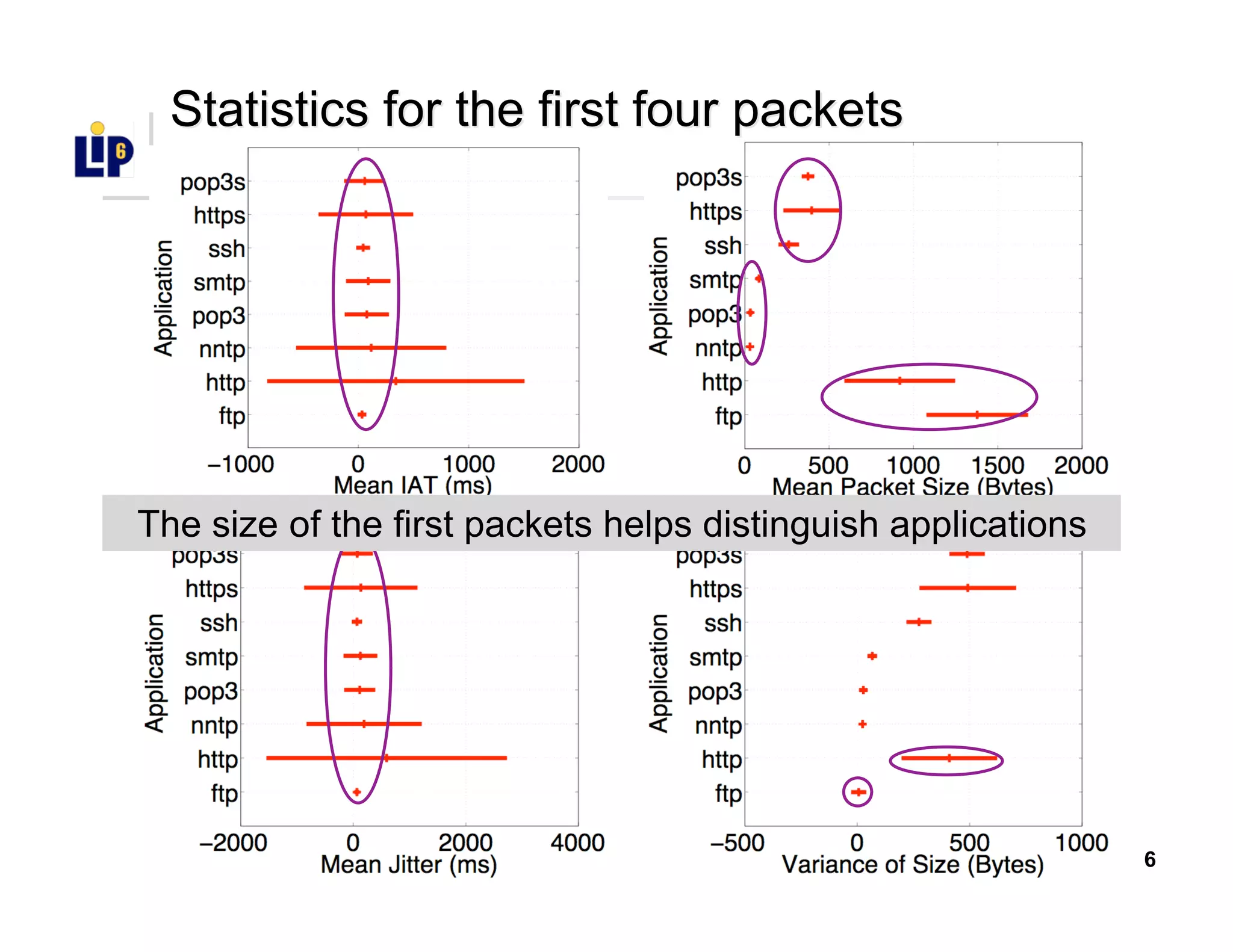
Statistics for the first four packetsStatistics for the first four packets
The size of the first packets helps distinguish applications
7
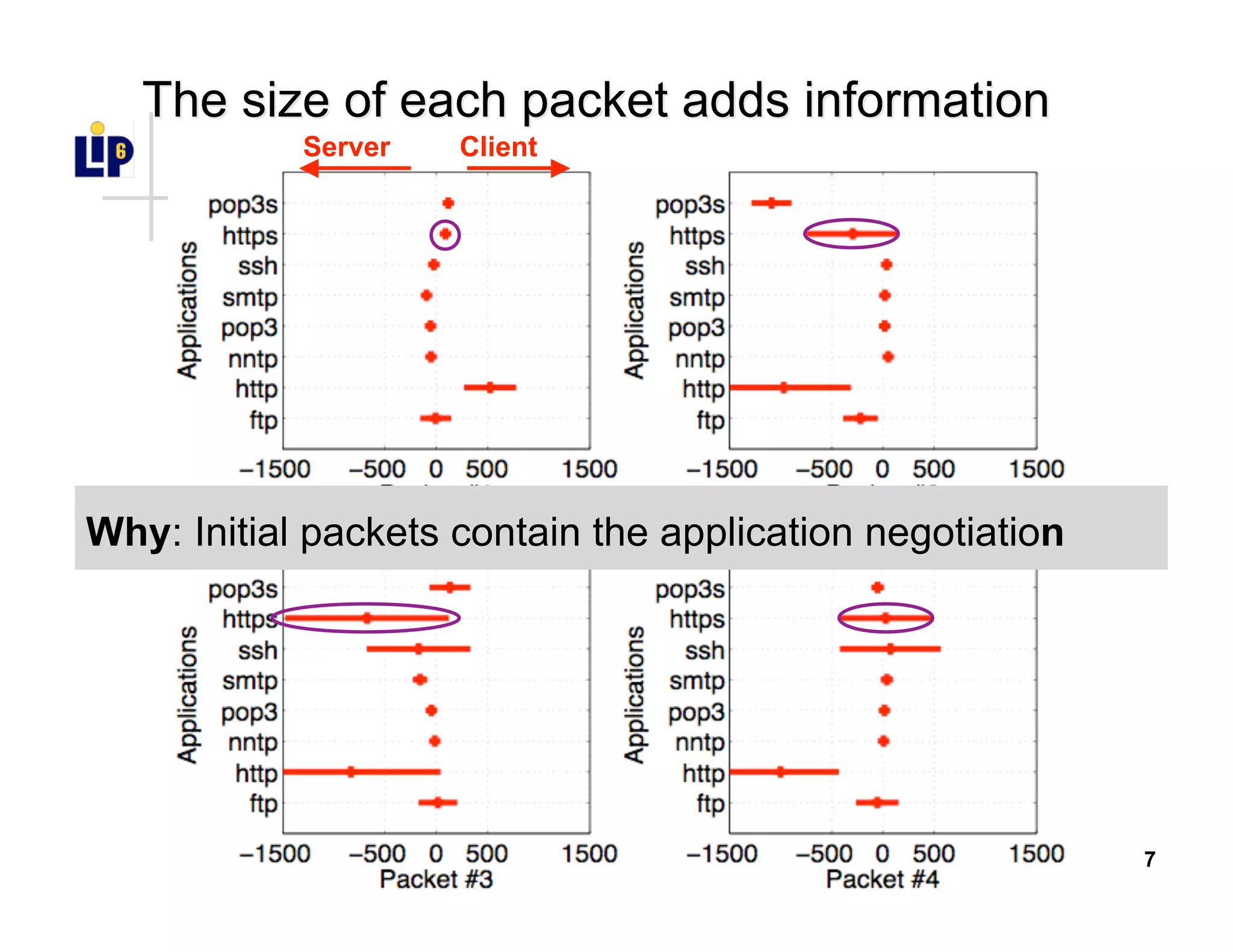
The size of each packet adds informationThe size of each packet adds information
Server Client
Why: Initial packets contain the application negotiation
8
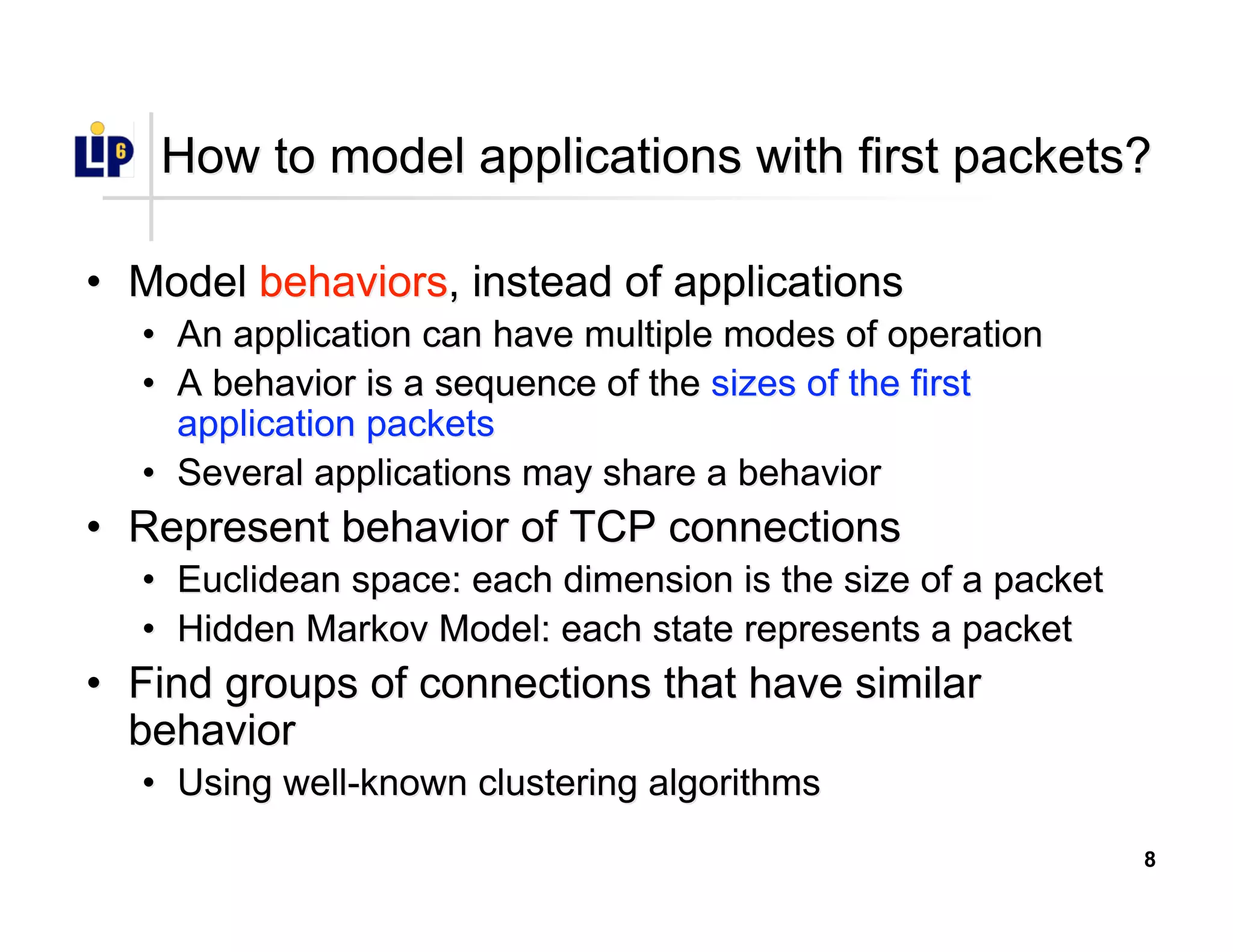
How to model applications with first packets?How to model applications with first packets?
•• ModelModel behaviorsbehaviors, instead of applications, instead of applications
•• An application can have multiple modes of operationAn application can have multiple modes of operation
•• A behavior is a sequence of theA behavior is a sequence of the sizes of the firstsizes of the first
application packetsapplication packets
•• Several applications may share a behaviorSeveral applications may share a behavior
•• Represent behavior of TCP connectionsRepresent behavior of TCP connections
•• Euclidean space: each dimension is the size of a packetEuclidean space: each dimension is the size of a packet
•• Hidden Markov Model: each state represents a packetHidden Markov Model: each state represents a packet
•• Find groups of connections that have similarFind groups of connections that have similar
behaviorbehavior
•• Using well-known clustering algorithmsUsing well-known clustering algorithms
9
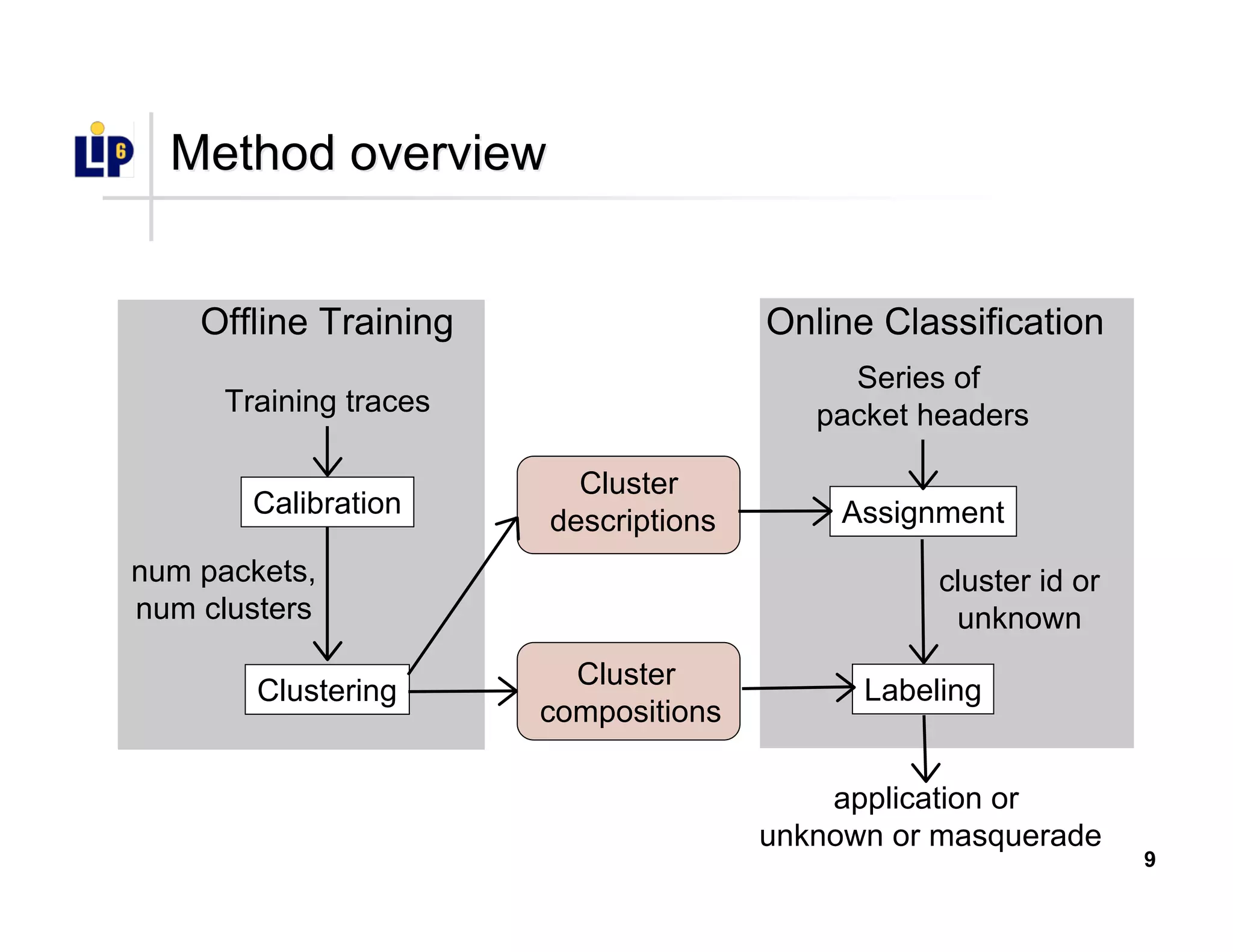
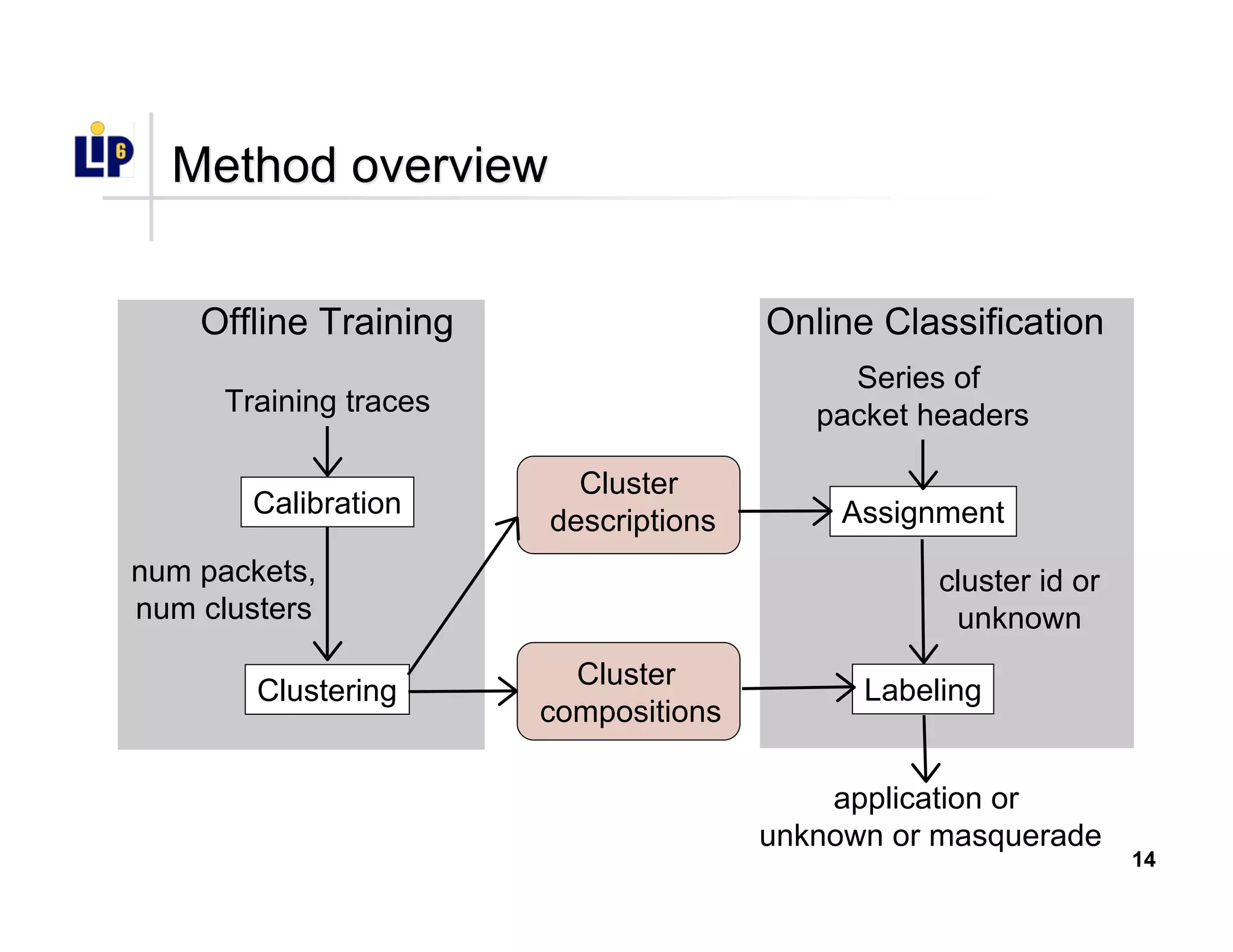
Method overviewMethod overview
Offline Training Online Classification
Training traces
Calibration
num packets,
num clusters
Clustering
Cluster
descriptions
Cluster
compositions
Series of
packet headers
Assignment
Labeling
cluster id or
unknown
application or
unknown or masquerade
10
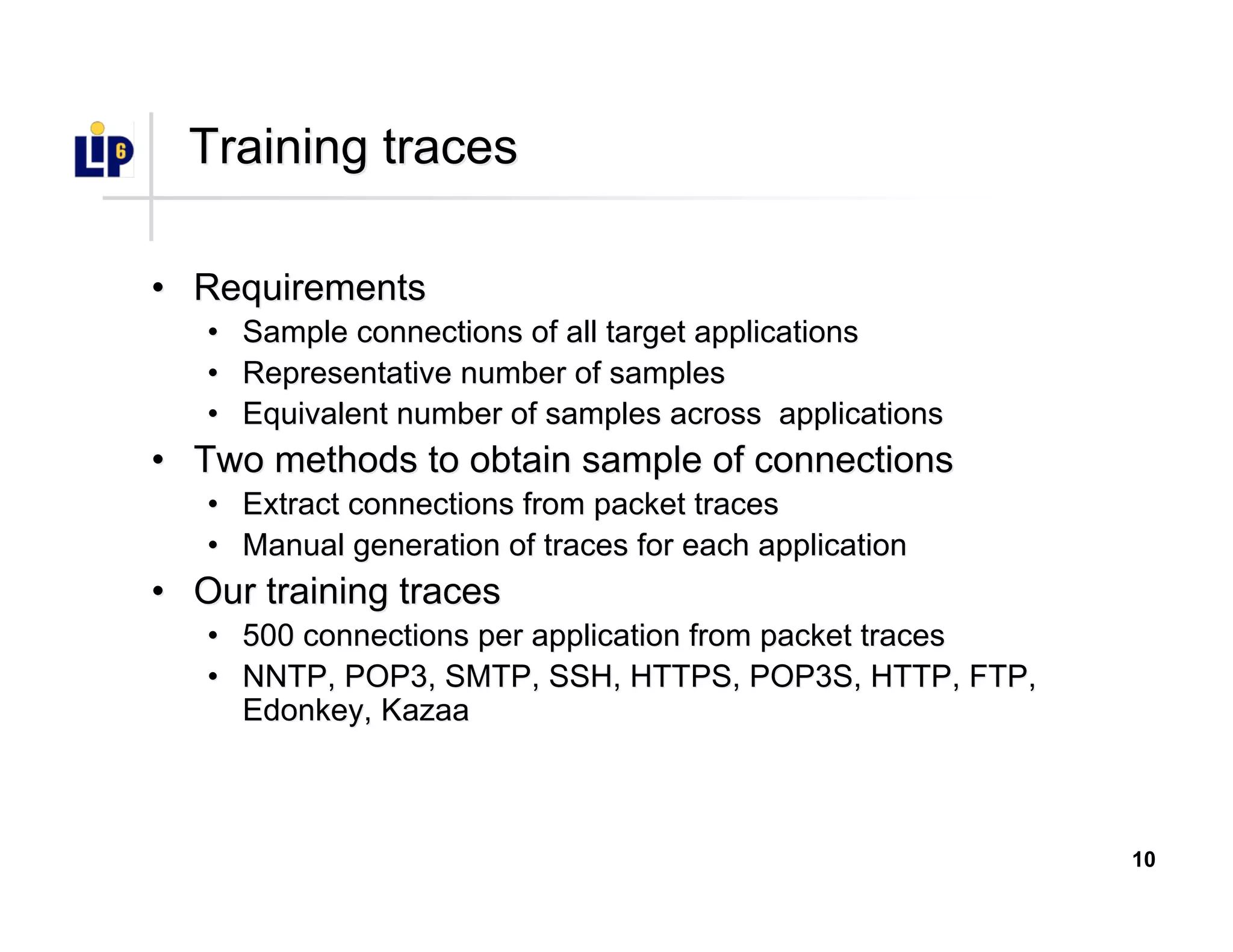
Training tracesTraining traces
•• RequirementsRequirements
•• Sample connections of all target applicationsSample connections of all target applications
•• Representative number of samplesRepresentative number of samples
•• Equivalent number of samples across applicationsEquivalent number of samples across applications
•• Two methods to obtain sample of connectionsTwo methods to obtain sample of connections
•• Extract connections from packet tracesExtract connections from packet traces
•• Manual generation of traces for each applicationManual generation of traces for each application
•• Our training tracesOur training traces
•• 500 connections per application from packet traces500 connections per application from packet traces
•• NNTP, POP3, SMTP, SSH, HTTPS, POP3S, HTTP, FTP,NNTP, POP3, SMTP, SSH, HTTPS, POP3S, HTTP, FTP,
EdonkeyEdonkey,, KazaaKazaa
11
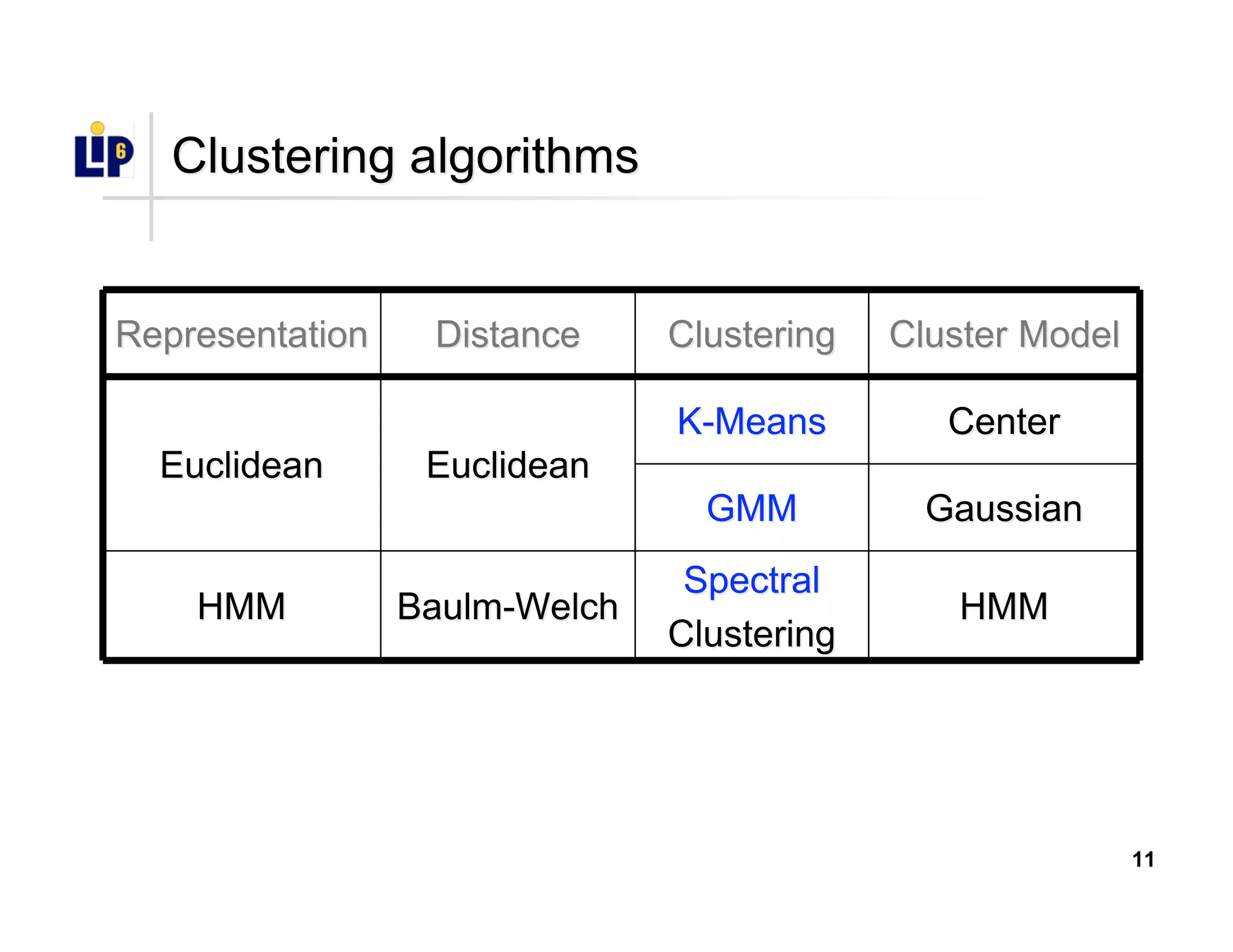
Clustering algorithmsClustering algorithms
HMMHMM
SpectralSpectral
ClusteringClustering
Baulm-WelchBaulm-WelchHMMHMM
GaussianGaussianGMMGMM
CenterCenterK-MeansK-Means
EuclideanEuclideanEuclideanEuclidean
ClusterCluster ModelModelClusteringClusteringDistanceDistanceRepresentationRepresentation
12
CalibrationCalibration
•• Select number of packets and clustersSelect number of packets and clusters
•• Compute clustering spanning a vast parameter spaceCompute clustering spanning a vast parameter space
•• Number of packets: [1, 10]Number of packets: [1, 10]
•• Number of clusters: [5, 100]Number of clusters: [5, 100]
•• Metric of clustering qualityMetric of clustering quality
•• Normalized Mutual Information (NMI)Normalized Mutual Information (NMI)
•• NMI = 1: ideal clusteringNMI = 1: ideal clustering
Distribution of
applications
Distribution of
clusters
Mutual
Information
Normalized by
the entropies
13
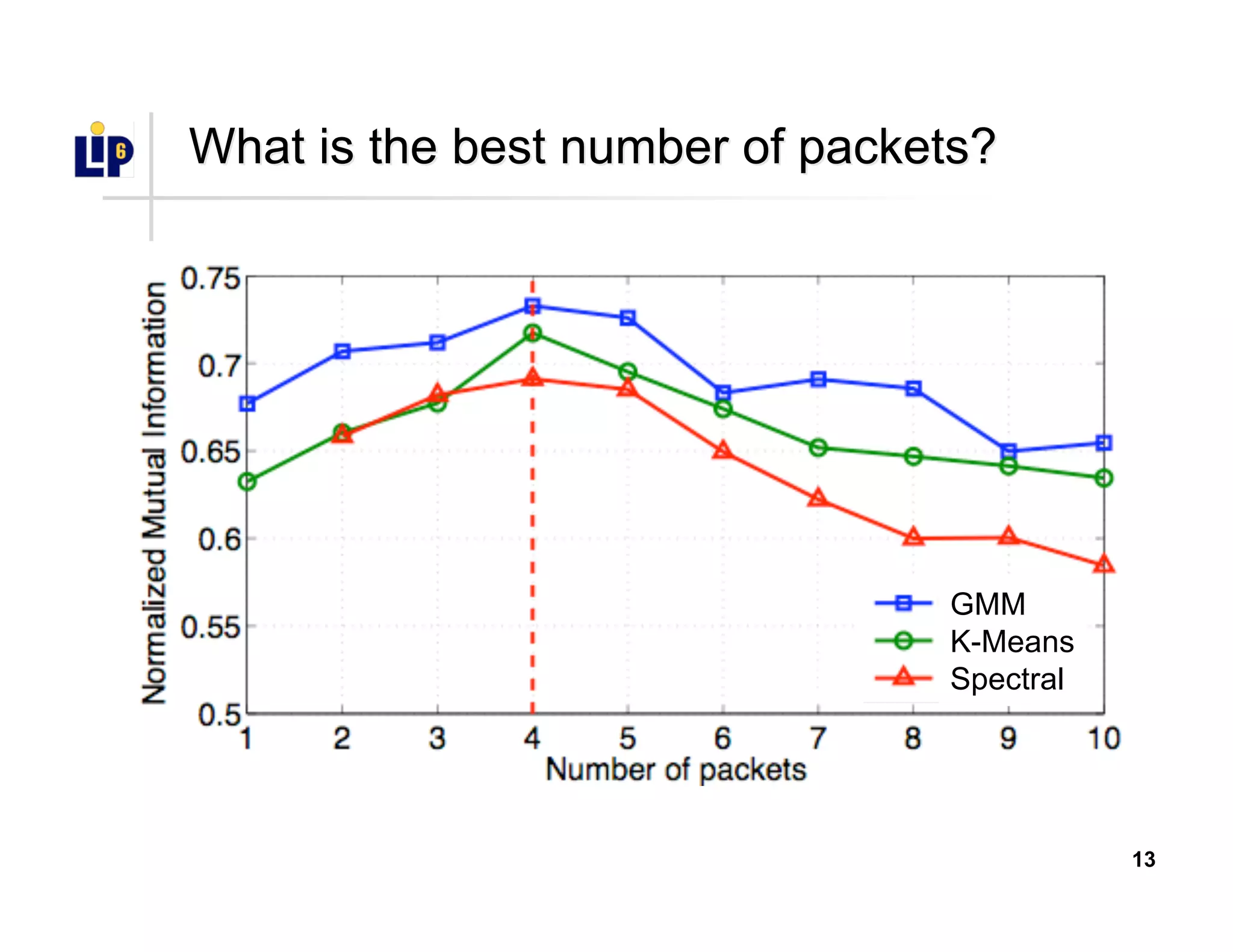
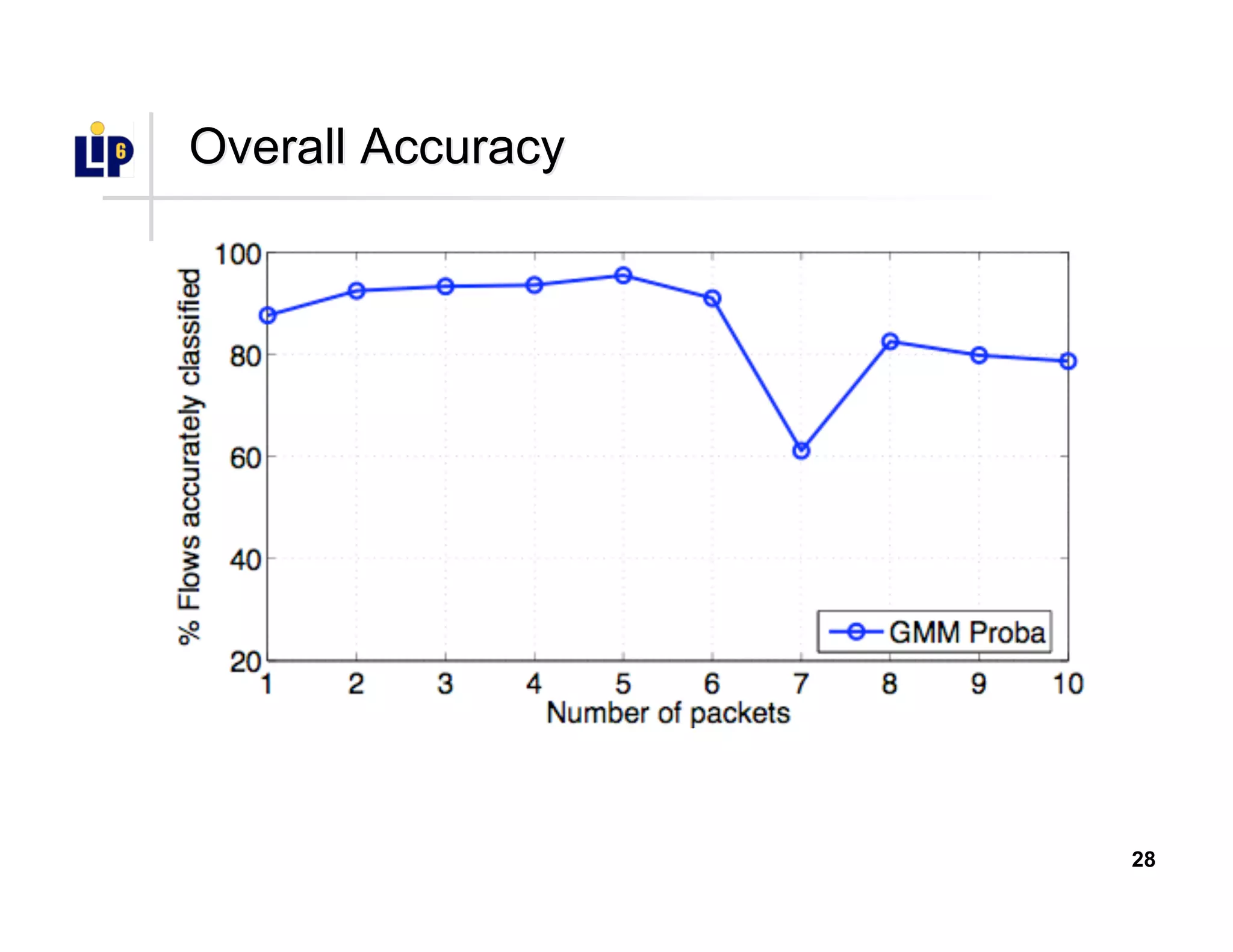
What is the best number of packets?What is the best number of packets?
GMM
K-Means
Spectral
14
Method overviewMethod overview
Offline Training Online Classification
Training traces
Calibration
num packets,
num clusters
Clustering
Cluster
descriptions
Cluster
compositions
Series of
packet headers
Assignment
Labeling
cluster id or
unknown
application or
unknown or masquerade
15
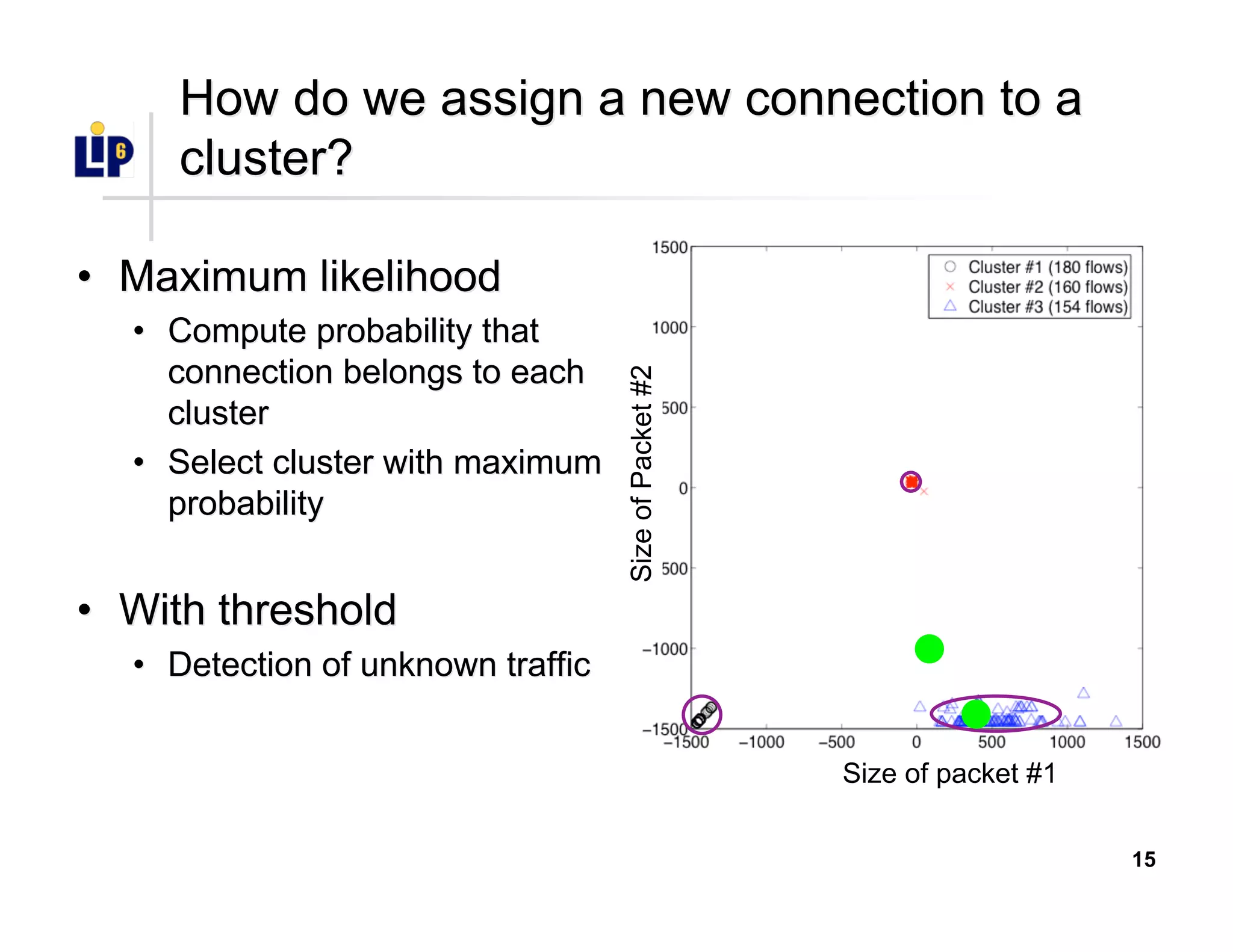
HowHow do we assign a new connection to ado we assign a new connection to a
cluster?cluster?
•• Maximum likelihoodMaximum likelihood
•• Compute probability thatCompute probability that
connection belongs to eachconnection belongs to each
clustercluster
•• Select cluster with maximumSelect cluster with maximum
probabilityprobability
Size of packet #1
SizeofPacket#2
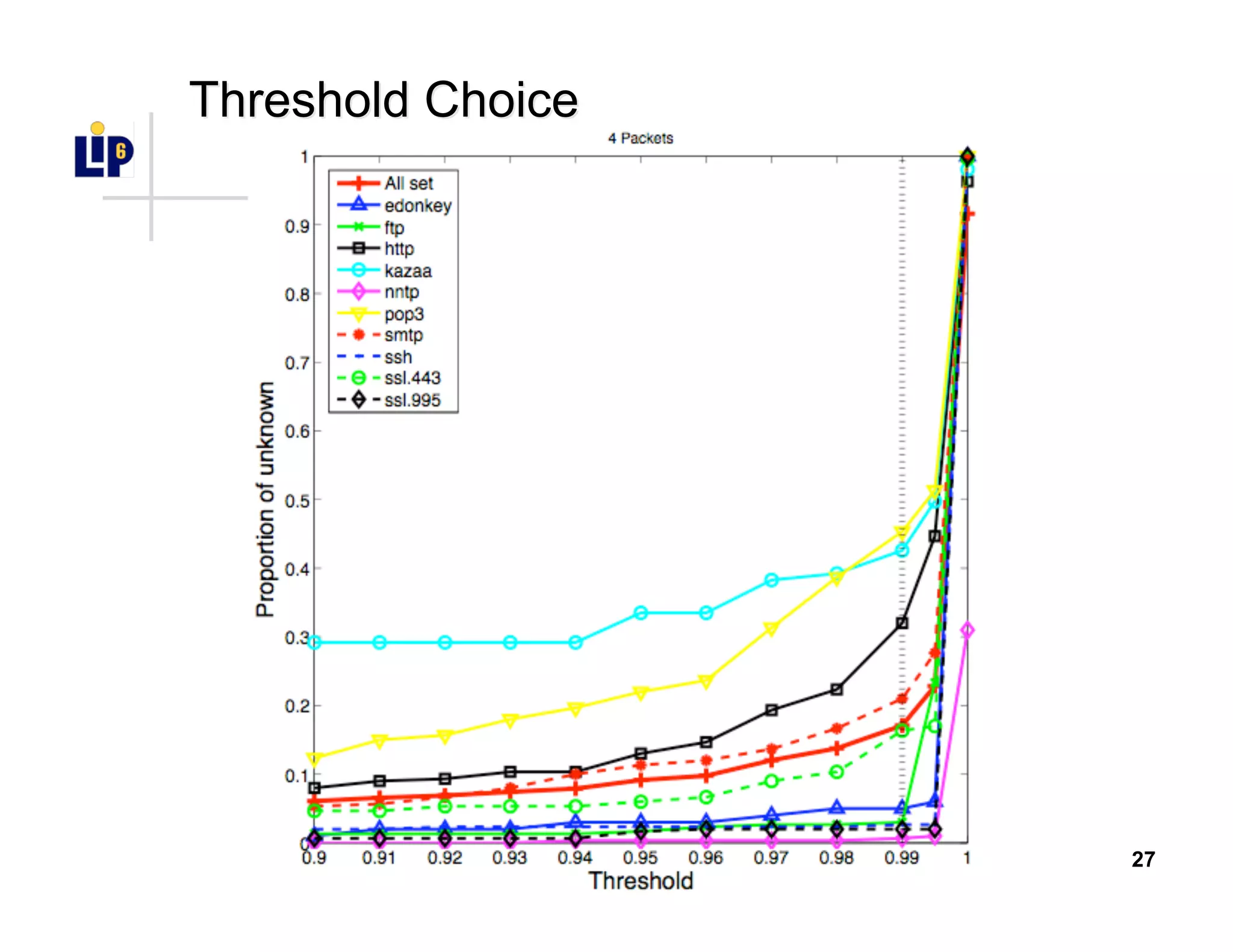
•• With thresholdWith threshold
•• Detection of unknown trafficDetection of unknown traffic
16
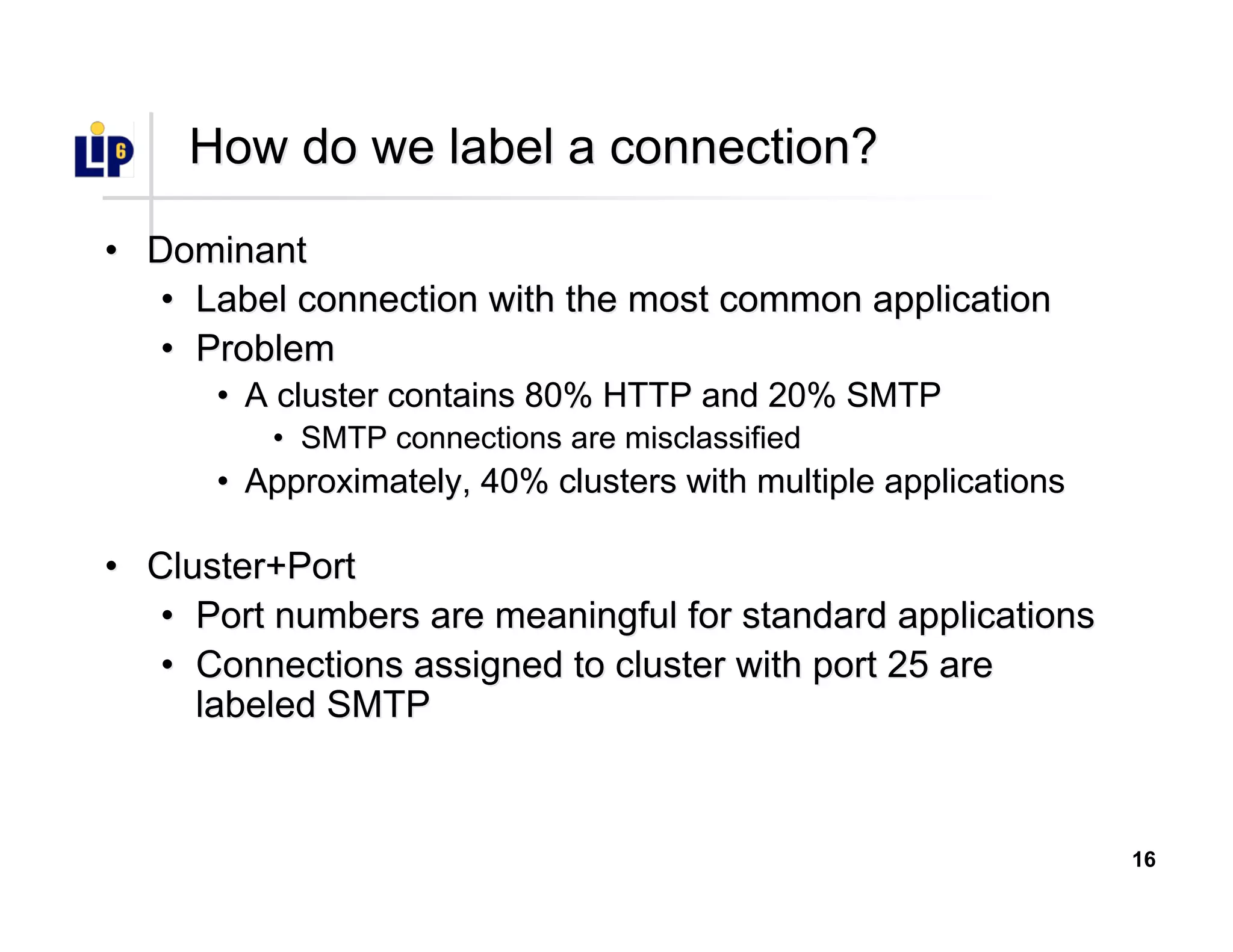
How do we label a connection?How do we label a connection?
•• DominantDominant
•• Label connection with the most common applicationLabel connection with the most common application
•• ProblemProblem
•• A cluster contains 80% HTTP and 20% SMTPA cluster contains 80% HTTP and 20% SMTP
•• SMTP connectionsSMTP connections are misclassifiedare misclassified
•• Approximately, 40% clusters with multiple applicationsApproximately, 40% clusters with multiple applications
•• Cluster+PortCluster+Port
•• Port numbers are meaningful for standard applicationsPort numbers are meaningful for standard applications
•• Connections assigned to cluster with port 25 areConnections assigned to cluster with port 25 are
labeled SMTPlabeled SMTP
17
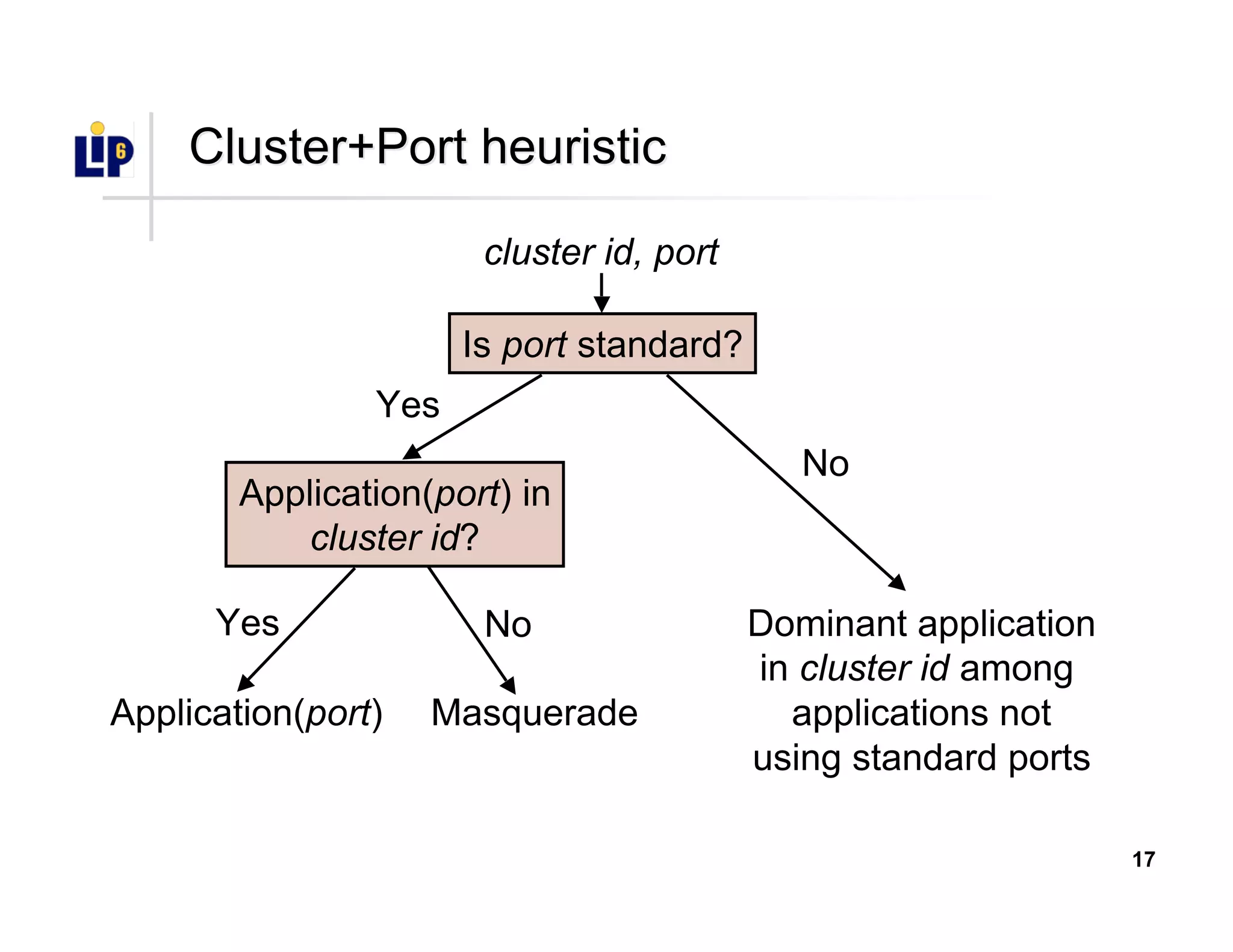
Cluster+Port heuristicCluster+Port heuristic
Is port standard?
Application(port) in
cluster id?
Yes
No
Dominant application
in cluster id among
applications not
using standard ports
Application(port)
cluster id, port
Masquerade
Yes No
18
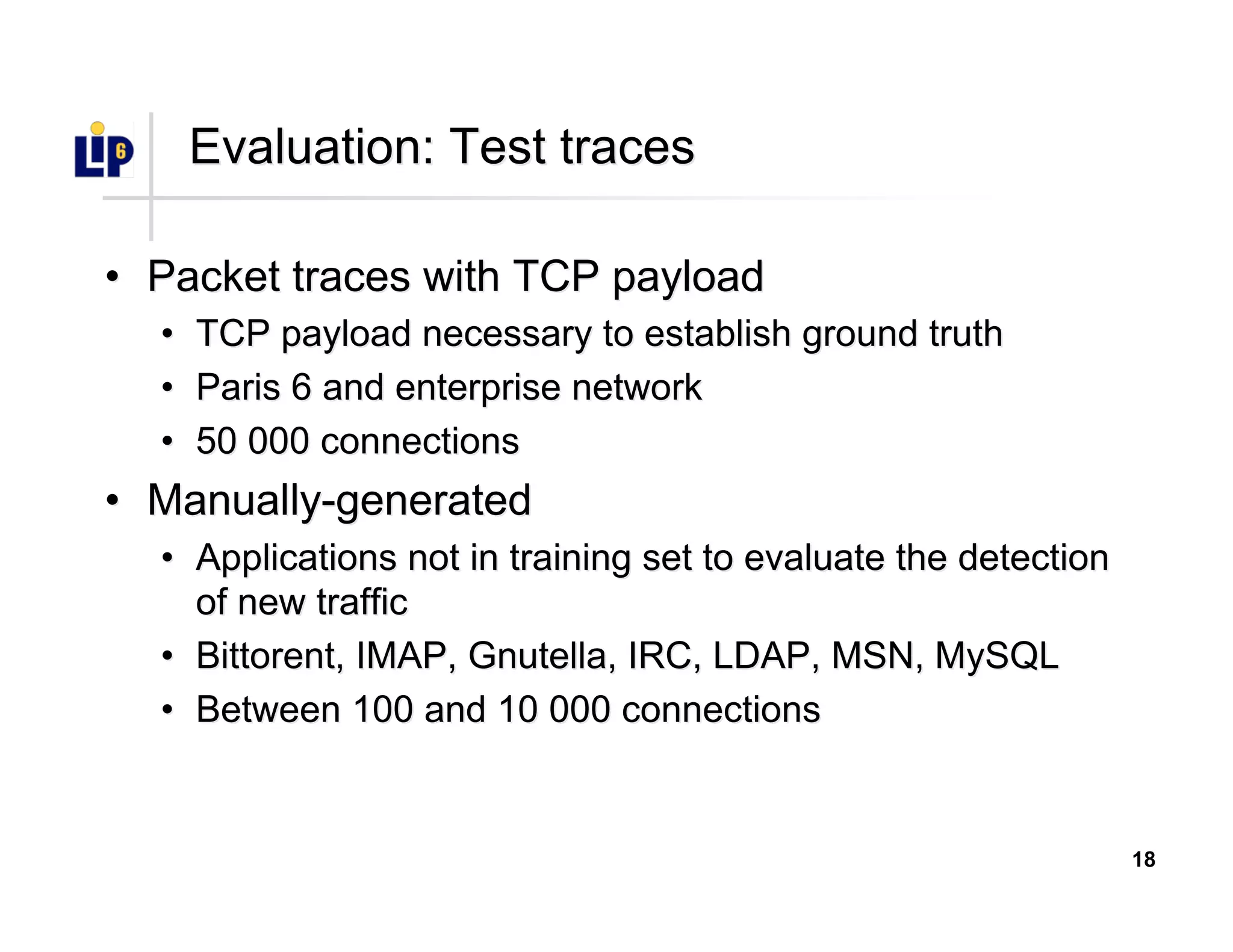
Evaluation: Test tracesEvaluation: Test traces
•• Packet traces with TCP payloadPacket traces with TCP payload
•• TCP payload necessary to establish ground truthTCP payload necessary to establish ground truth
•• Paris 6 and enterprise networkParis 6 and enterprise network
•• 50 000 connections50 000 connections
•• Manually-generatedManually-generated
•• Applications not in training set to evaluate the detectionApplications not in training set to evaluate the detection
of new trafficof new traffic
•• BittorentBittorent, IMAP, Gnutella, IRC, LDAP, MSN,, IMAP, Gnutella, IRC, LDAP, MSN, MySQLMySQL
•• Between 100 and 10 000 connectionsBetween 100 and 10 000 connections
19
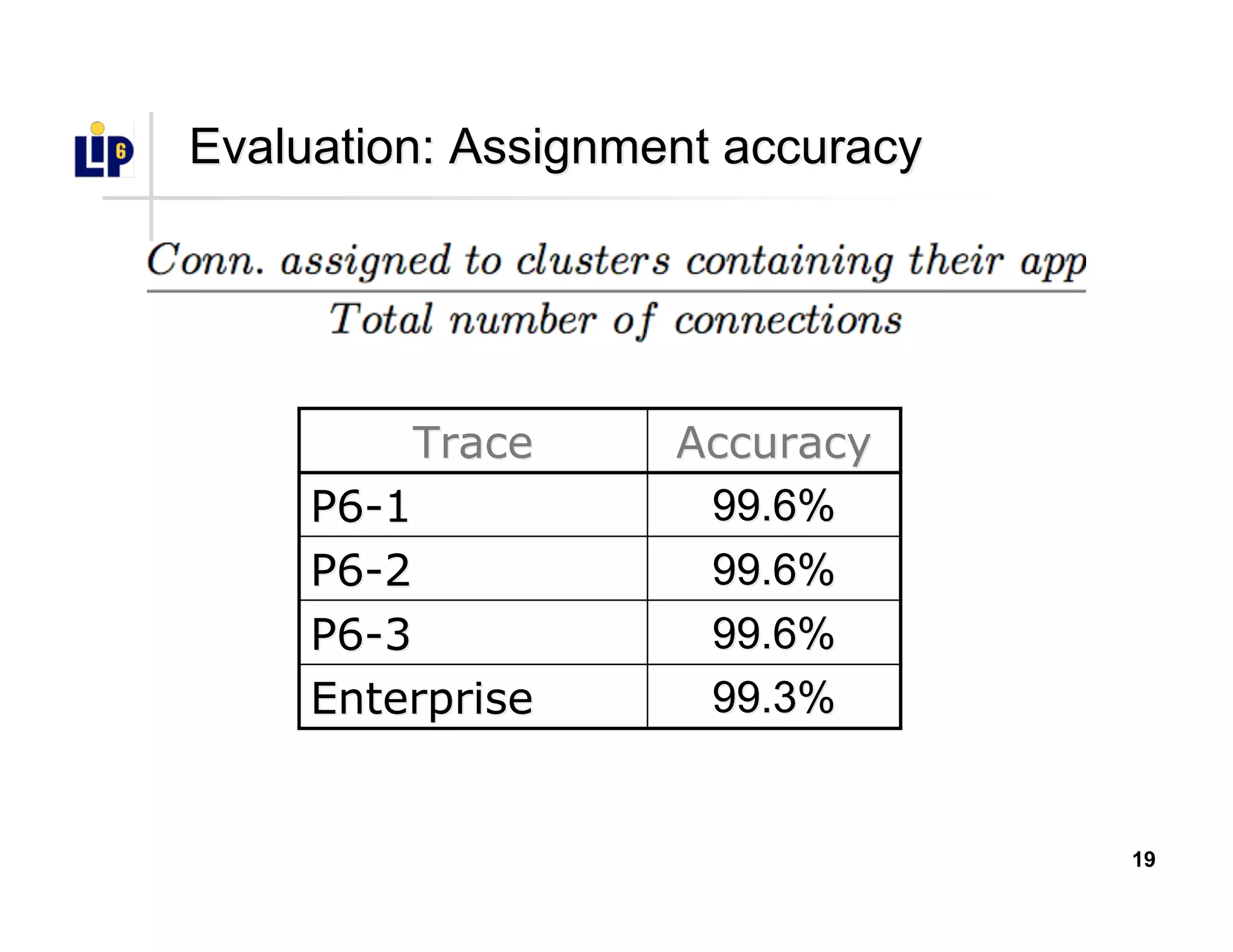
Evaluation: AssignmentEvaluation: Assignment accuracyaccuracy
99.3%99.3%EnterpriseEnterprise
99.6%99.6%P6-3P6-3
99.6%99.6%P6-2P6-2
99.6%99.6%P6-1P6-1
AccuracyAccuracyTraceTrace
20
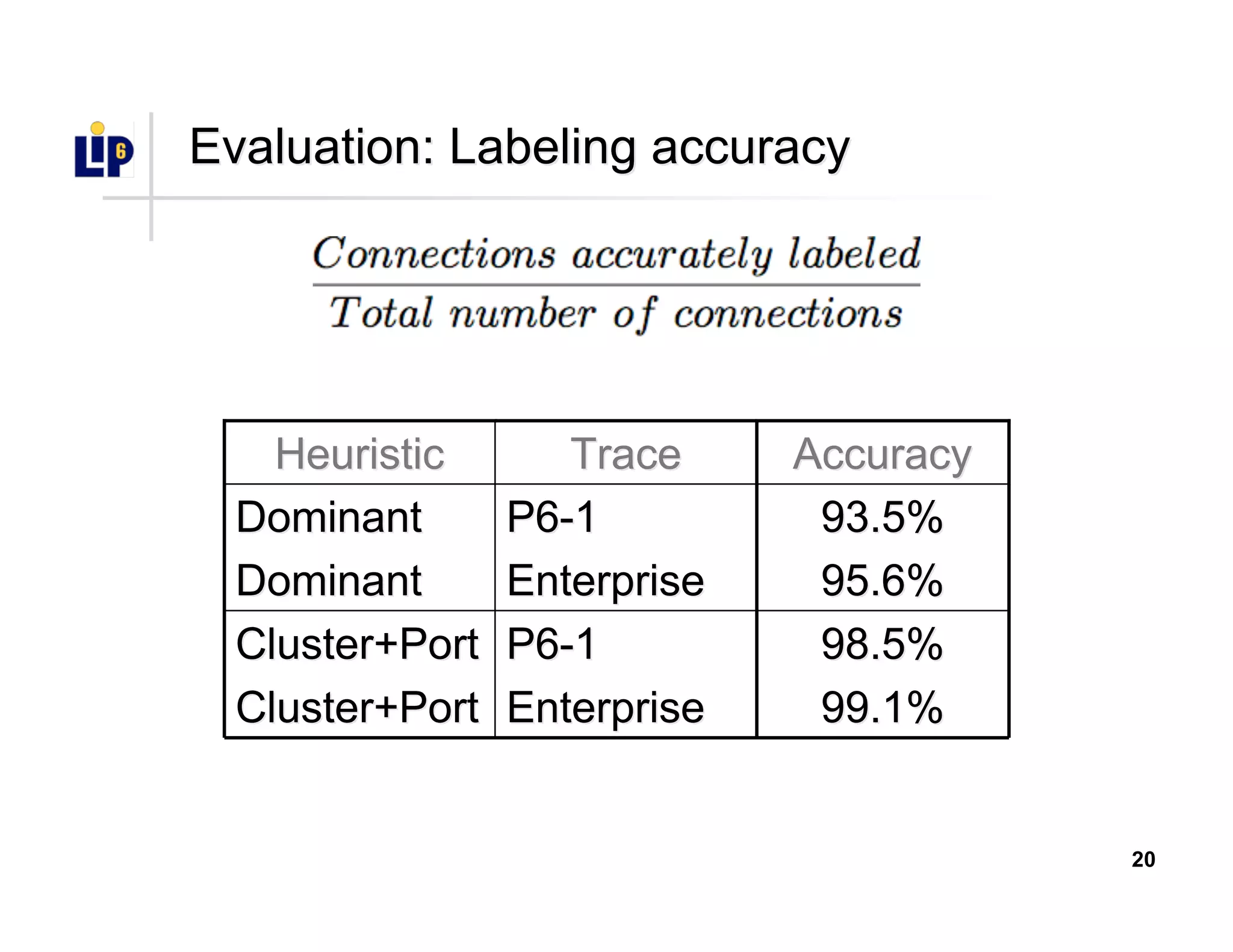
Evaluation: Labeling accuracyEvaluation: Labeling accuracy
99.1%99.1%EnterpriseEnterpriseCluster+PortCluster+Port
98.5%98.5%P6-1P6-1Cluster+PortCluster+Port
95.6%95.6%EnterpriseEnterpriseDominantDominant
93.5%93.5%P6-1P6-1DominantDominant
AccuracyAccuracyTraceTraceHeuristicHeuristic
21
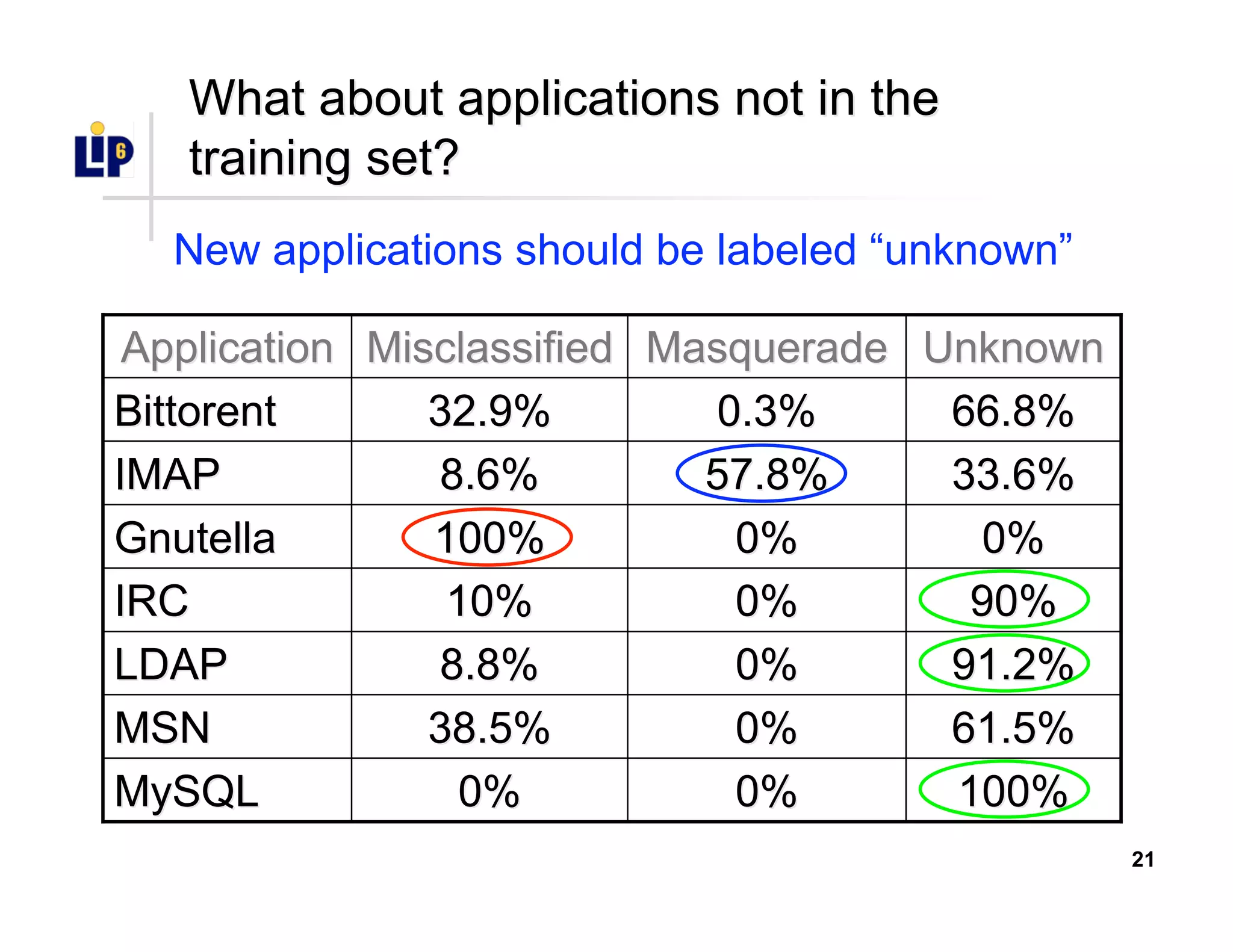
What about applications notWhat about applications not in thein the
training set?training set?
100%100%0%0%0%0%MySQLMySQL
61.5%61.5%0%0%38.5%38.5%MSNMSN
91.2%91.2%0%0%8.8%8.8%LDAPLDAP
90%90%0%0%10%10%IRCIRC
0%0%0%0%100%100%GnutellaGnutella
33.6%33.6%57.8%57.8%8.6%8.6%IMAPIMAP
66.8%66.8%0.3%0.3%32.9%32.9%BittorentBittorent
UnknownUnknownMasqueradeMasqueradeMisclassifiedMisclassifiedApplicationApplication
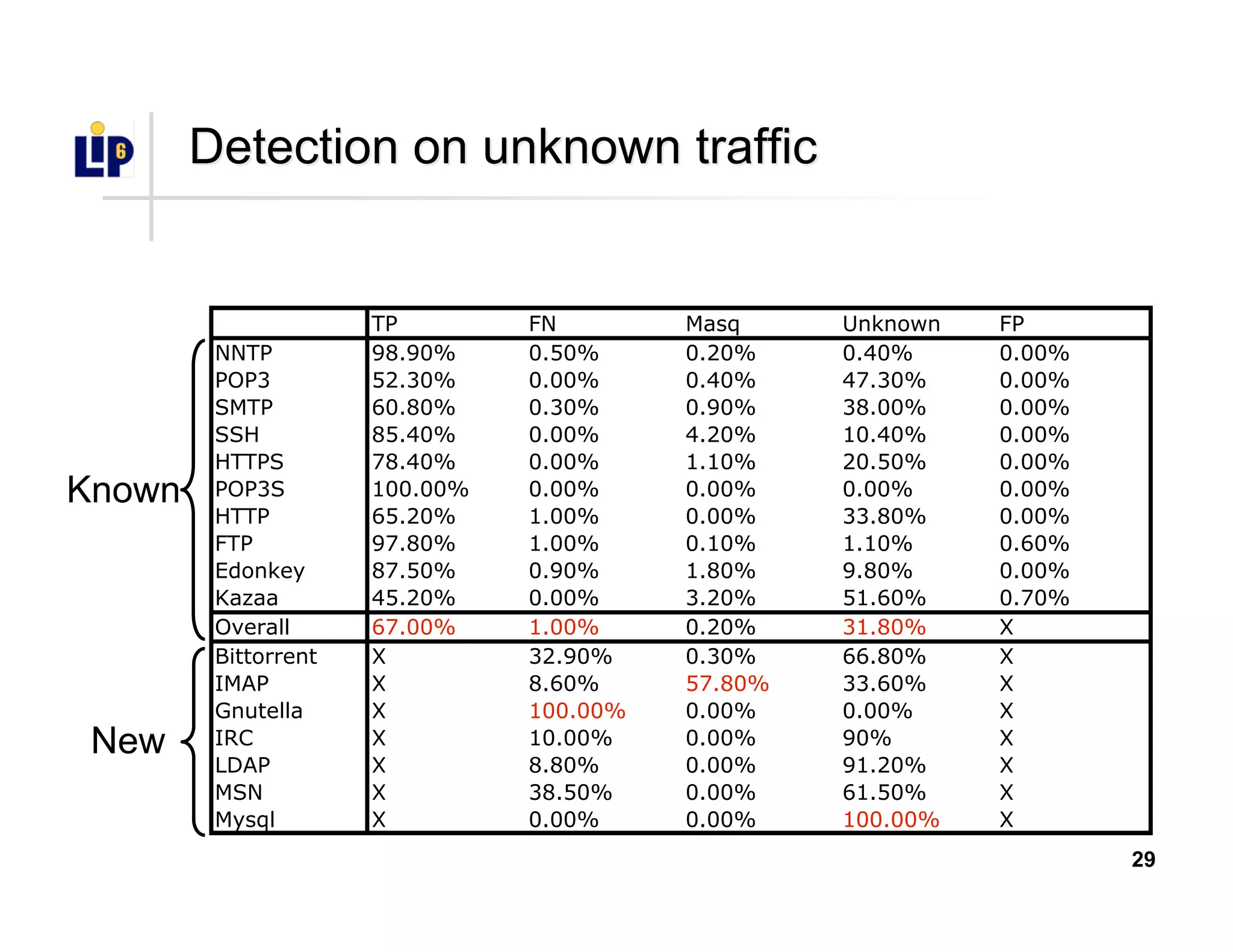
New applications should be labeled “unknown”
22
ConclusionConclusion
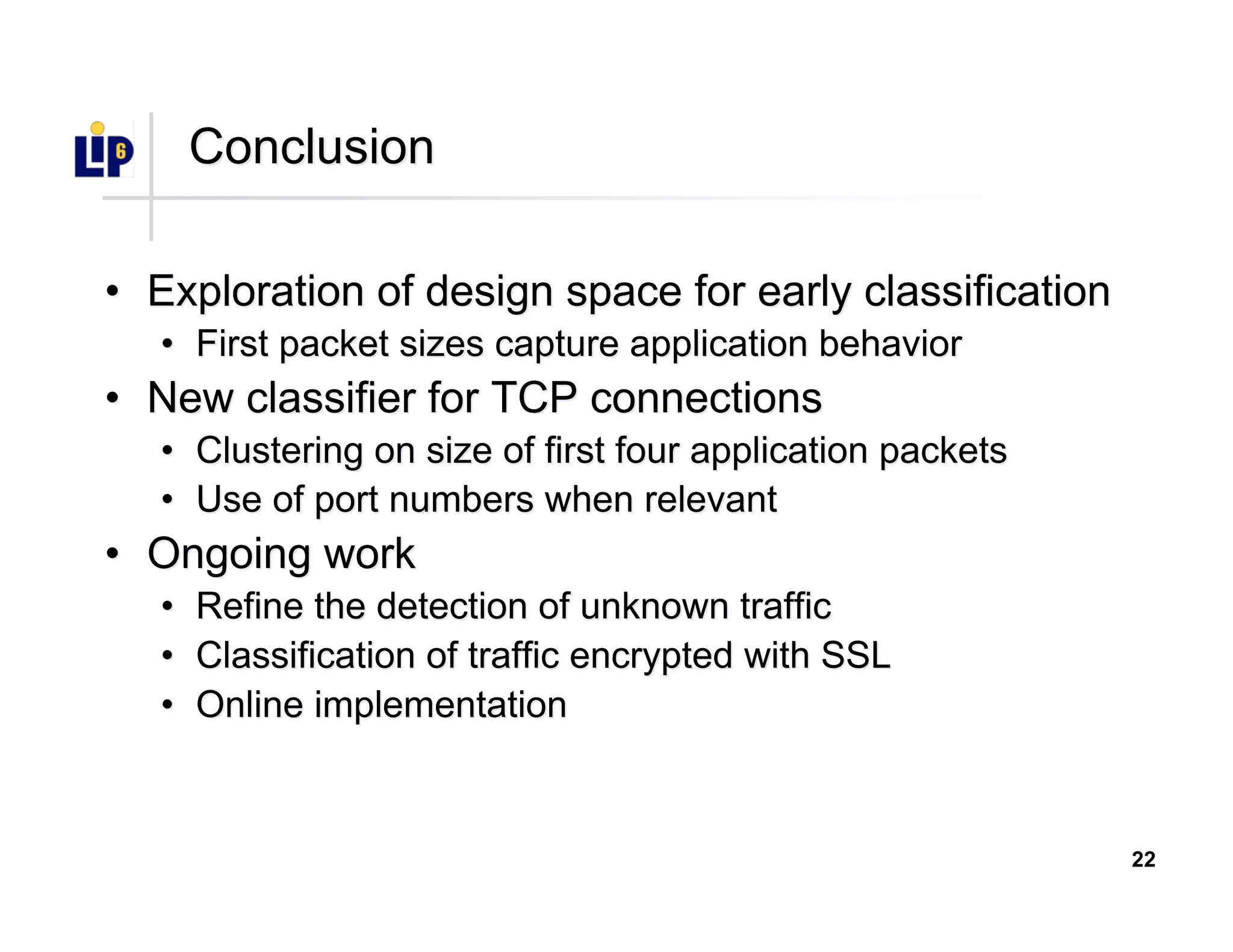
•• Exploration of design space for early classificationExploration of design space for early classification
•• First packet sizes capture application behaviorFirst packet sizes capture application behavior
•• New classifier for TCP connectionsNew classifier for TCP connections
•• Clustering on size of first four application packetsClustering on size of first four application packets
•• Use of port numbers when relevantUse of port numbers when relevant
•• Ongoing workOngoing work
•• Refine the detection of unknown trafficRefine the detection of unknown traffic
•• Classification of traffic encrypted with SSLClassification of traffic encrypted with SSL
•• Online implementationOnline implementation
23
More information onMore information on our webour web pagepage
http://rp.lip6.fr/~bernaill/earlyclassif.html
24
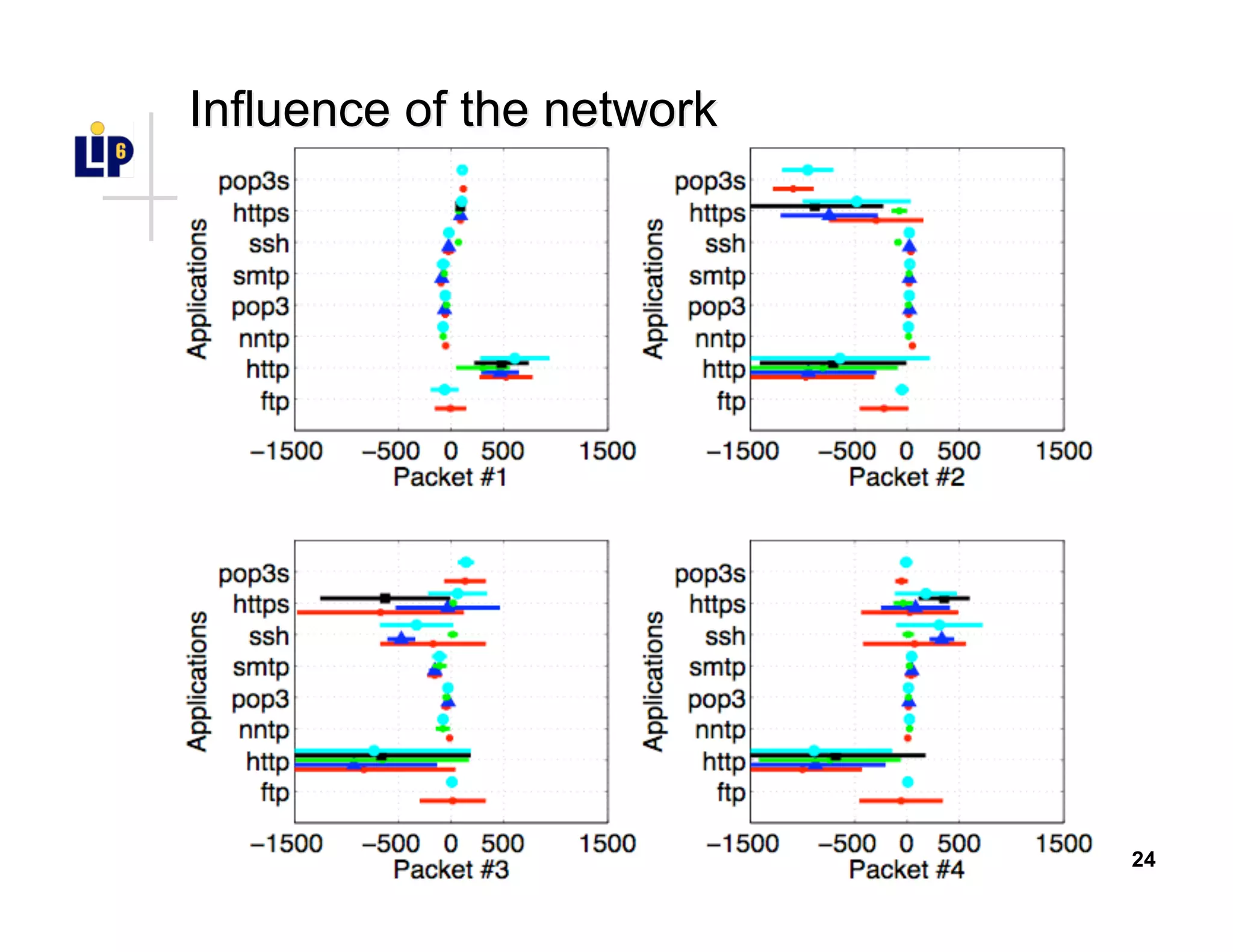
Influence of the networkInfluence of the network
25
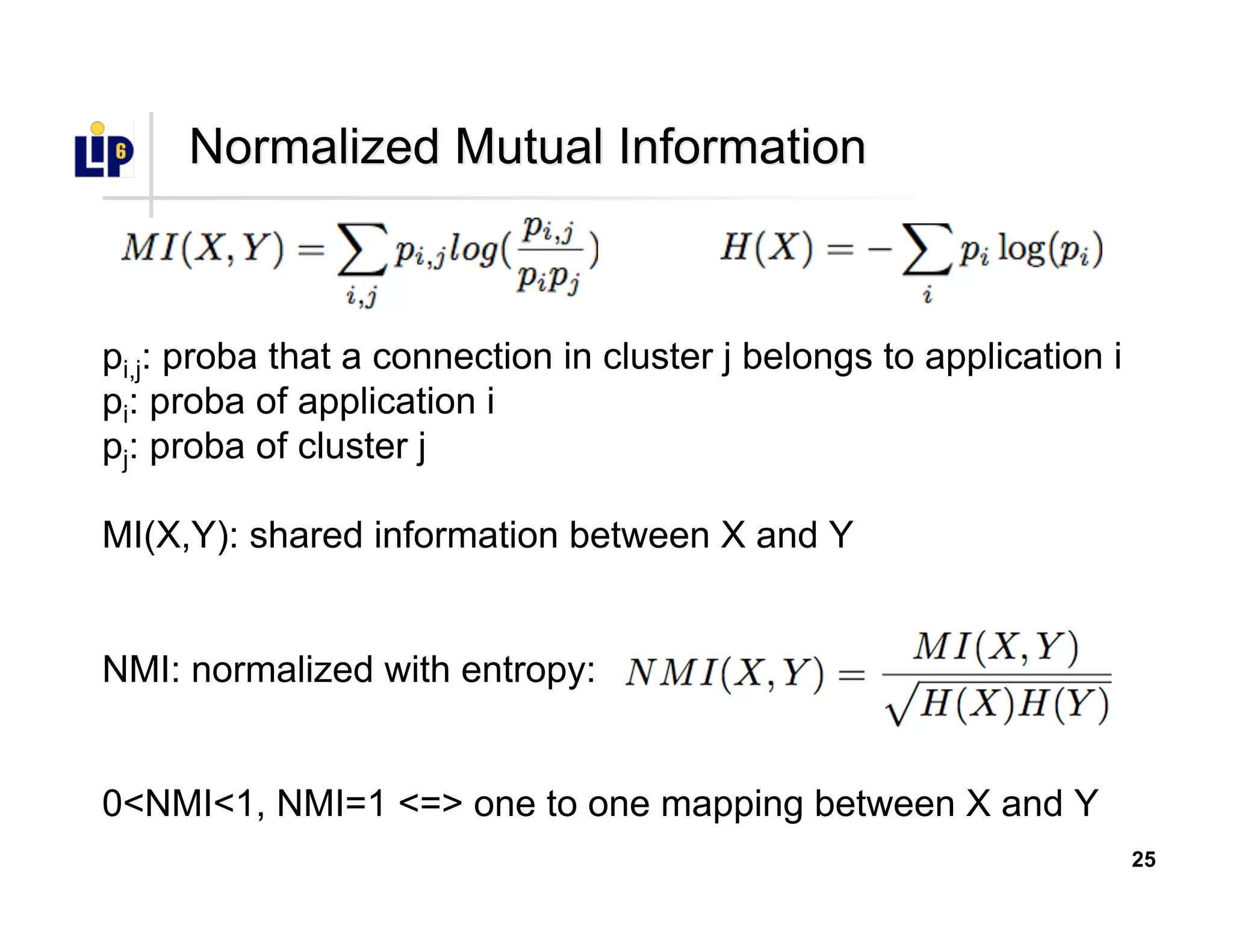
Normalized Mutual InformationNormalized Mutual Information
pi,j: proba that a connection in cluster j belongs to application i
pi: proba of application i
pj: proba of cluster j
MI(X,Y): shared information between X and Y
NMI: normalized with entropy:
0<NMI<1, NMI=1 <=> one to one mapping between X and Y
26
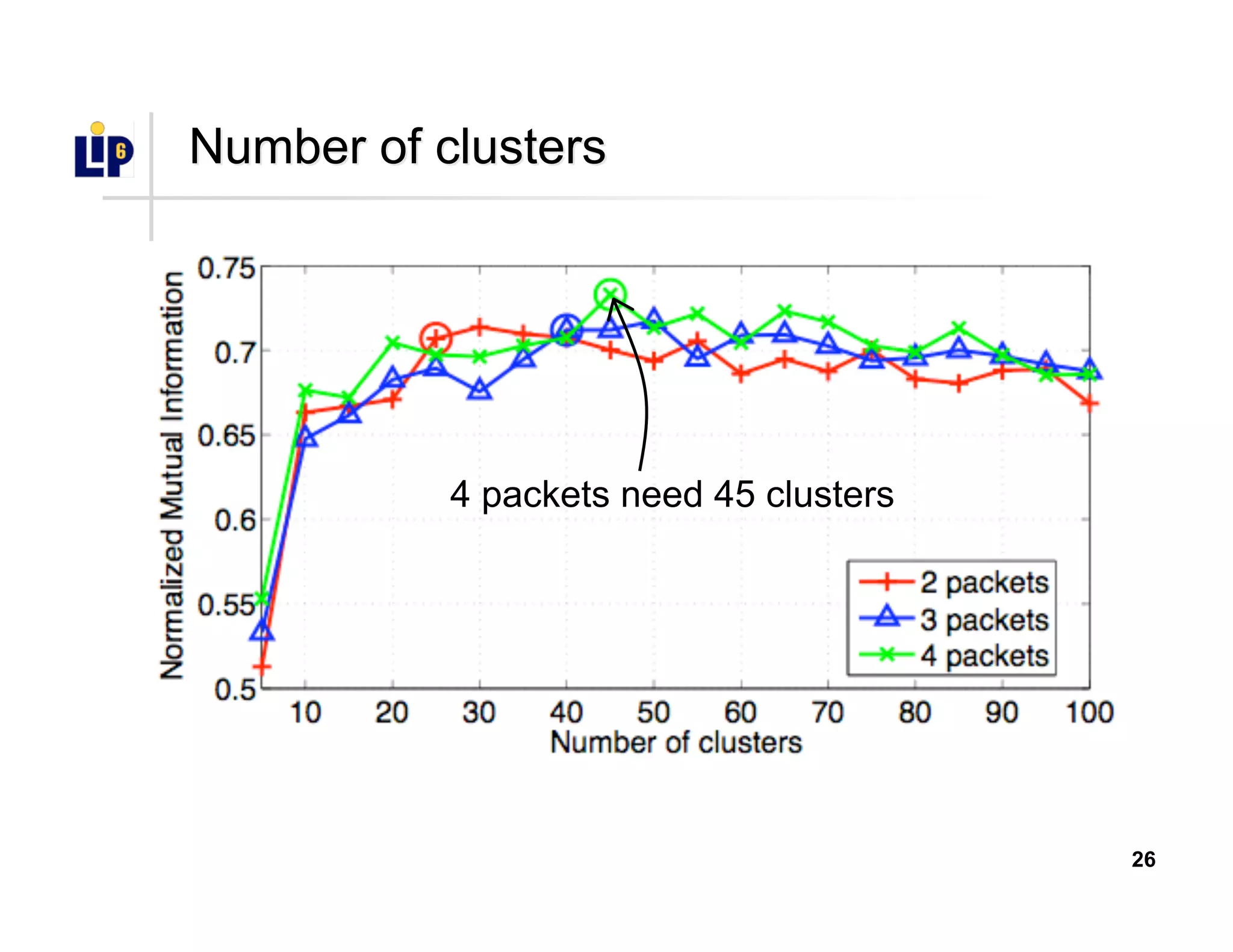
Number of clustersNumber of clusters
4 packets need 45 clusters
27
Threshold ChoiceThreshold Choice
28
Overall AccuracyOverall Accuracy
29
Detection on unknown trafficDetection on unknown traffic
TP FN Masq Unknown FP
NNTP 98.90% 0.50% 0.20% 0.40% 0.00%
POP3 52.30% 0.00% 0.40% 47.30% 0.00%
SMTP 60.80% 0.30% 0.90% 38.00% 0.00%
SSH 85.40% 0.00% 4.20% 10.40% 0.00%
HTTPS 78.40% 0.00% 1.10% 20.50% 0.00%
POP3S 100.00% 0.00% 0.00% 0.00% 0.00%
HTTP 65.20% 1.00% 0.00% 33.80% 0.00%
FTP 97.80% 1.00% 0.10% 1.10% 0.60%
Edonkey 87.50% 0.90% 1.80% 9.80% 0.00%
Kazaa 45.20% 0.00% 3.20% 51.60% 0.70%
Overall 67.00% 1.00% 0.20% 31.80% X
Bittorrent X 32.90% 0.30% 66.80% X
IMAP X 8.60% 57.80% 33.60% X
Gnutella X 100.00% 0.00% 0.00% X
IRC X 10.00% 0.00% 90% X
LDAP X 8.80% 0.00% 91.20% X
MSN X 38.50% 0.00% 61.50% X
Mysql X 0.00% 0.00% 100.00% X
Known
New

Early application identification. CONEXT 2006

  • 1.
    Early Application IdentificationEarlyApplication Identification LaurentLaurent BernailleBernaille Renata TeixeiraRenata Teixeira Kave SalamatianKave Salamatian UniversitéUniversité Pierre et Marie Curie - LIPPierre et Marie Curie - LIP6/CNRS6/CNRS
  • 2.
    2 Which applications runon my network?Which applications run on my network? •• Capacity planningCapacity planning •• Profiling of networkProfiling of network usageusage •• SecuritySecurity •• Am I being attacked?Am I being attacked? •• Institutional policyInstitutional policy •• No illegal music sharingNo illegal music sharing •• NoNo SkypeSkype traffictrafficEdge Network (campus, enterprise) Internet Need to detect the application associated with network traffic as fast as possible
  • 3.
    3 Problem statementProblem statement ••A new classifierA new classifier •• Inspects all packets entering and exiting the networkInspects all packets entering and exiting the network •• Only uses information in the TCP/IP headerOnly uses information in the TCP/IP header •• Identifies the application using the first few applicationIdentifies the application using the first few application packets in TCP connectionspackets in TCP connections
  • 4.
    4 Application identification todayApplicationidentification today •• Port-based identificationPort-based identification •• Use IANA well-known port numbersUse IANA well-known port numbers •• Often inaccurateOften inaccurate •• Non-standard portsNon-standard ports •• Masquerade trafficMasquerade traffic •• Content-based identificationContent-based identification •• Inspect packet payload for well-known signaturesInspect packet payload for well-known signatures •• Very accurate, butVery accurate, but…… •• Does not work for encrypted trafficDoes not work for encrypted traffic •• Privacy issuesPrivacy issues •• Computationally intensiveComputationally intensive
  • 5.
    5 Behavior-based application identificationBehavior-basedapplication identification •• Newer proposals based on connection-levelNewer proposals based on connection-level statisticsstatistics •• Mean or variance of packet inter-arrival timeMean or variance of packet inter-arrival time •• Mean or variance of packet sizeMean or variance of packet size •• Number of packets in the connectionNumber of packets in the connection •• Duration of a connectionDuration of a connection •• Accuracy:Accuracy: ~90%~90% •• Need to wait for connection to endNeed to wait for connection to end Can we apply similar techniques just to the first packets of a connection?
  • 6.
    6 Statistics for thefirst four packetsStatistics for the first four packets The size of the first packets helps distinguish applications
  • 7.
    7 The size ofeach packet adds informationThe size of each packet adds information Server Client Why: Initial packets contain the application negotiation
  • 8.
    8 How to modelapplications with first packets?How to model applications with first packets? •• ModelModel behaviorsbehaviors, instead of applications, instead of applications •• An application can have multiple modes of operationAn application can have multiple modes of operation •• A behavior is a sequence of theA behavior is a sequence of the sizes of the firstsizes of the first application packetsapplication packets •• Several applications may share a behaviorSeveral applications may share a behavior •• Represent behavior of TCP connectionsRepresent behavior of TCP connections •• Euclidean space: each dimension is the size of a packetEuclidean space: each dimension is the size of a packet •• Hidden Markov Model: each state represents a packetHidden Markov Model: each state represents a packet •• Find groups of connections that have similarFind groups of connections that have similar behaviorbehavior •• Using well-known clustering algorithmsUsing well-known clustering algorithms
  • 9.
    9 Method overviewMethod overview OfflineTraining Online Classification Training traces Calibration num packets, num clusters Clustering Cluster descriptions Cluster compositions Series of packet headers Assignment Labeling cluster id or unknown application or unknown or masquerade
  • 10.
    10 Training tracesTraining traces ••RequirementsRequirements •• Sample connections of all target applicationsSample connections of all target applications •• Representative number of samplesRepresentative number of samples •• Equivalent number of samples across applicationsEquivalent number of samples across applications •• Two methods to obtain sample of connectionsTwo methods to obtain sample of connections •• Extract connections from packet tracesExtract connections from packet traces •• Manual generation of traces for each applicationManual generation of traces for each application •• Our training tracesOur training traces •• 500 connections per application from packet traces500 connections per application from packet traces •• NNTP, POP3, SMTP, SSH, HTTPS, POP3S, HTTP, FTP,NNTP, POP3, SMTP, SSH, HTTPS, POP3S, HTTP, FTP, EdonkeyEdonkey,, KazaaKazaa
  • 11.
  • 12.
    12 CalibrationCalibration •• Select numberof packets and clustersSelect number of packets and clusters •• Compute clustering spanning a vast parameter spaceCompute clustering spanning a vast parameter space •• Number of packets: [1, 10]Number of packets: [1, 10] •• Number of clusters: [5, 100]Number of clusters: [5, 100] •• Metric of clustering qualityMetric of clustering quality •• Normalized Mutual Information (NMI)Normalized Mutual Information (NMI) •• NMI = 1: ideal clusteringNMI = 1: ideal clustering Distribution of applications Distribution of clusters Mutual Information Normalized by the entropies
  • 13.
    13 What is thebest number of packets?What is the best number of packets? GMM K-Means Spectral
  • 14.
    14 Method overviewMethod overview OfflineTraining Online Classification Training traces Calibration num packets, num clusters Clustering Cluster descriptions Cluster compositions Series of packet headers Assignment Labeling cluster id or unknown application or unknown or masquerade
  • 15.
    15 HowHow do weassign a new connection to ado we assign a new connection to a cluster?cluster? •• Maximum likelihoodMaximum likelihood •• Compute probability thatCompute probability that connection belongs to eachconnection belongs to each clustercluster •• Select cluster with maximumSelect cluster with maximum probabilityprobability Size of packet #1 SizeofPacket#2 •• With thresholdWith threshold •• Detection of unknown trafficDetection of unknown traffic
  • 16.
    16 How do welabel a connection?How do we label a connection? •• DominantDominant •• Label connection with the most common applicationLabel connection with the most common application •• ProblemProblem •• A cluster contains 80% HTTP and 20% SMTPA cluster contains 80% HTTP and 20% SMTP •• SMTP connectionsSMTP connections are misclassifiedare misclassified •• Approximately, 40% clusters with multiple applicationsApproximately, 40% clusters with multiple applications •• Cluster+PortCluster+Port •• Port numbers are meaningful for standard applicationsPort numbers are meaningful for standard applications •• Connections assigned to cluster with port 25 areConnections assigned to cluster with port 25 are labeled SMTPlabeled SMTP
  • 17.
    17 Cluster+Port heuristicCluster+Port heuristic Isport standard? Application(port) in cluster id? Yes No Dominant application in cluster id among applications not using standard ports Application(port) cluster id, port Masquerade Yes No
  • 18.
    18 Evaluation: Test tracesEvaluation:Test traces •• Packet traces with TCP payloadPacket traces with TCP payload •• TCP payload necessary to establish ground truthTCP payload necessary to establish ground truth •• Paris 6 and enterprise networkParis 6 and enterprise network •• 50 000 connections50 000 connections •• Manually-generatedManually-generated •• Applications not in training set to evaluate the detectionApplications not in training set to evaluate the detection of new trafficof new traffic •• BittorentBittorent, IMAP, Gnutella, IRC, LDAP, MSN,, IMAP, Gnutella, IRC, LDAP, MSN, MySQLMySQL •• Between 100 and 10 000 connectionsBetween 100 and 10 000 connections
  • 19.
    19 Evaluation: AssignmentEvaluation: Assignmentaccuracyaccuracy 99.3%99.3%EnterpriseEnterprise 99.6%99.6%P6-3P6-3 99.6%99.6%P6-2P6-2 99.6%99.6%P6-1P6-1 AccuracyAccuracyTraceTrace
  • 20.
    20 Evaluation: Labeling accuracyEvaluation:Labeling accuracy 99.1%99.1%EnterpriseEnterpriseCluster+PortCluster+Port 98.5%98.5%P6-1P6-1Cluster+PortCluster+Port 95.6%95.6%EnterpriseEnterpriseDominantDominant 93.5%93.5%P6-1P6-1DominantDominant AccuracyAccuracyTraceTraceHeuristicHeuristic
  • 21.
    21 What about applicationsnotWhat about applications not in thein the training set?training set? 100%100%0%0%0%0%MySQLMySQL 61.5%61.5%0%0%38.5%38.5%MSNMSN 91.2%91.2%0%0%8.8%8.8%LDAPLDAP 90%90%0%0%10%10%IRCIRC 0%0%0%0%100%100%GnutellaGnutella 33.6%33.6%57.8%57.8%8.6%8.6%IMAPIMAP 66.8%66.8%0.3%0.3%32.9%32.9%BittorentBittorent UnknownUnknownMasqueradeMasqueradeMisclassifiedMisclassifiedApplicationApplication New applications should be labeled “unknown”
  • 22.
    22 ConclusionConclusion •• Exploration ofdesign space for early classificationExploration of design space for early classification •• First packet sizes capture application behaviorFirst packet sizes capture application behavior •• New classifier for TCP connectionsNew classifier for TCP connections •• Clustering on size of first four application packetsClustering on size of first four application packets •• Use of port numbers when relevantUse of port numbers when relevant •• Ongoing workOngoing work •• Refine the detection of unknown trafficRefine the detection of unknown traffic •• Classification of traffic encrypted with SSLClassification of traffic encrypted with SSL •• Online implementationOnline implementation
  • 23.
    23 More information onMoreinformation on our webour web pagepage http://rp.lip6.fr/~bernaill/earlyclassif.html
  • 24.
    24 Influence of thenetworkInfluence of the network
  • 25.
    25 Normalized Mutual InformationNormalizedMutual Information pi,j: proba that a connection in cluster j belongs to application i pi: proba of application i pj: proba of cluster j MI(X,Y): shared information between X and Y NMI: normalized with entropy: 0<NMI<1, NMI=1 <=> one to one mapping between X and Y
  • 26.
    26 Number of clustersNumberof clusters 4 packets need 45 clusters
  • 27.
  • 28.
  • 29.
    29 Detection on unknowntrafficDetection on unknown traffic TP FN Masq Unknown FP NNTP 98.90% 0.50% 0.20% 0.40% 0.00% POP3 52.30% 0.00% 0.40% 47.30% 0.00% SMTP 60.80% 0.30% 0.90% 38.00% 0.00% SSH 85.40% 0.00% 4.20% 10.40% 0.00% HTTPS 78.40% 0.00% 1.10% 20.50% 0.00% POP3S 100.00% 0.00% 0.00% 0.00% 0.00% HTTP 65.20% 1.00% 0.00% 33.80% 0.00% FTP 97.80% 1.00% 0.10% 1.10% 0.60% Edonkey 87.50% 0.90% 1.80% 9.80% 0.00% Kazaa 45.20% 0.00% 3.20% 51.60% 0.70% Overall 67.00% 1.00% 0.20% 31.80% X Bittorrent X 32.90% 0.30% 66.80% X IMAP X 8.60% 57.80% 33.60% X Gnutella X 100.00% 0.00% 0.00% X IRC X 10.00% 0.00% 90% X LDAP X 8.80% 0.00% 91.20% X MSN X 38.50% 0.00% 61.50% X Mysql X 0.00% 0.00% 100.00% X Known New