Laurent Bernaille
How the OOM-Killer Deleted my Namespace
(and Other Kubernetes Tales)
@lbernail
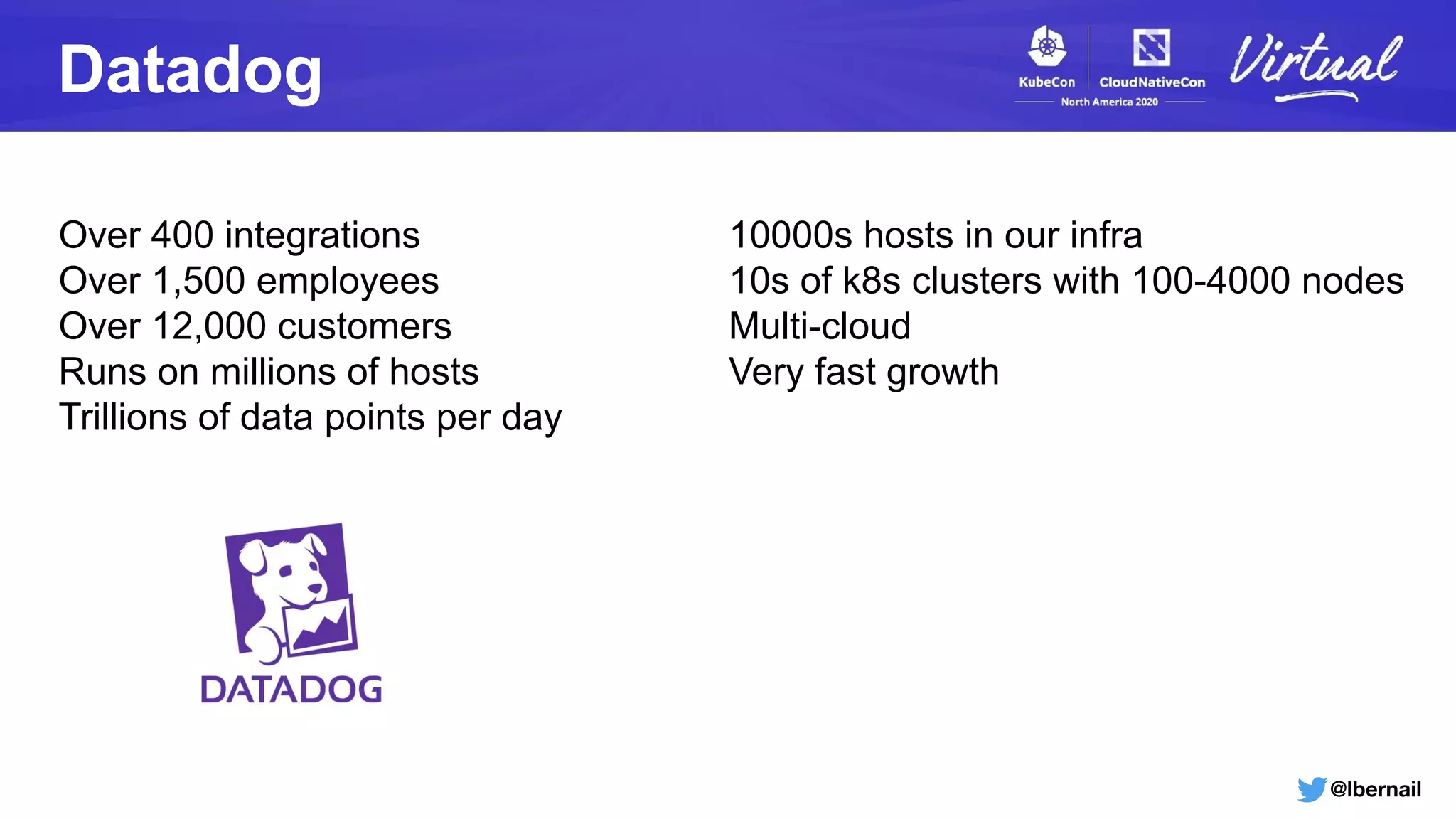
Datadog
Over 400 integrations
Over 1,500 employees
Over 12,000 customers
Runs on millions of hosts
Trillions of data points per day
10000s hosts in our infra
10s of k8s clusters with 100-4000 nodes
Multi-cloud
Very fast growth
@lbernail
Context
● We have shared a few stories already
○ Kubernetes the Very Hard Way
○ 10 Ways to Shoot Yourself in the Foot with Kubernetes
○ Kubernetes DNS horror stories
● The scale of our Kubernetes infra keeps growing
○ New scalability issues
○ But also, much more complex problems
How The OOM-killer Deleted my Namespace
@lbernail
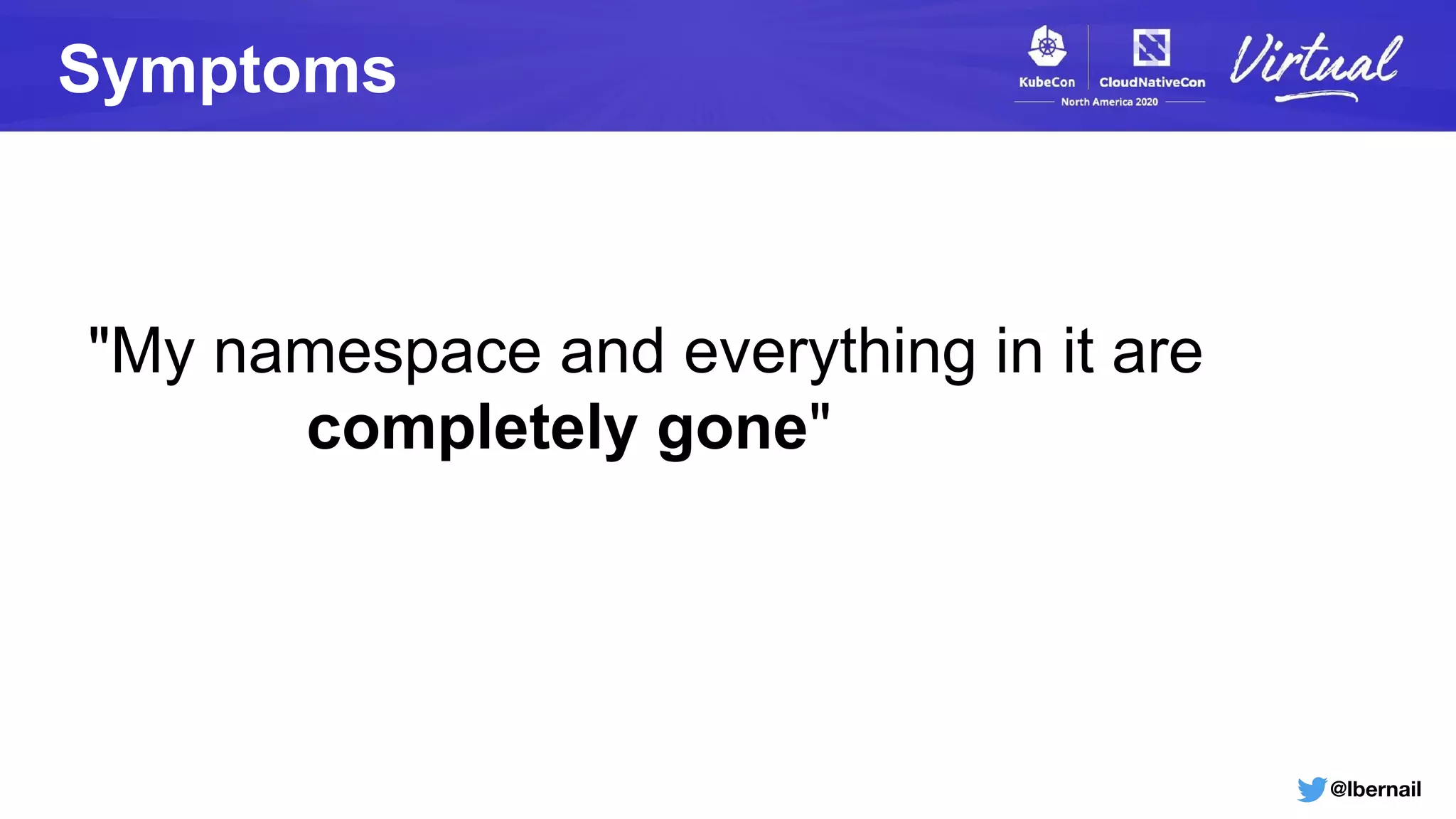
"My namespace and everything in it are
completely gone"
Symptoms
@lbernail
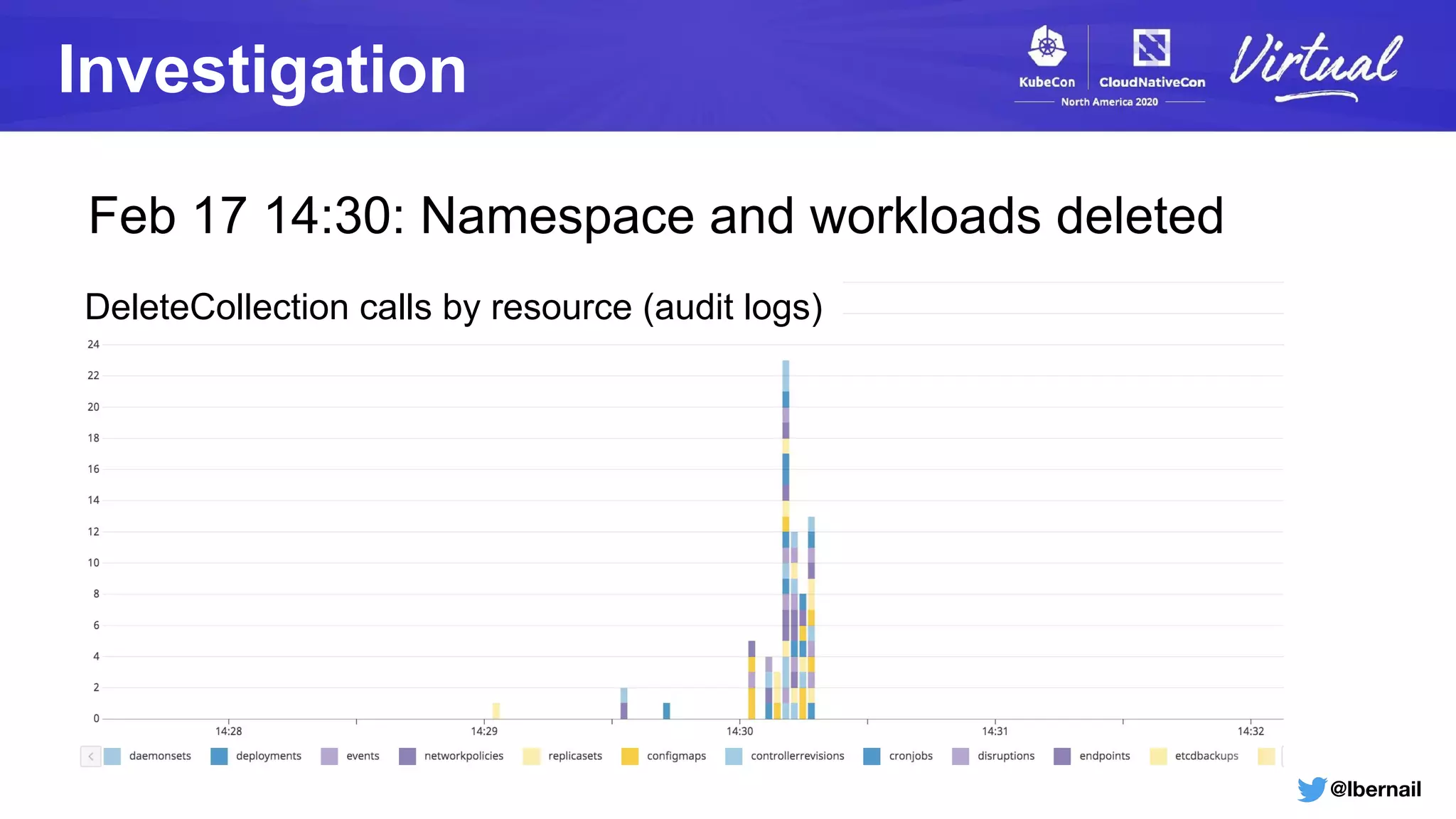
Feb 17 14:30: Namespace and workloads deleted
Investigation
DeleteCollection calls by resource (audit logs)
@lbernail
Audit logs
● Delete calls for all resources in the namespace
● No delete call for the namespace resource
Why was the namespace deleted??
Investigation
@lbernail
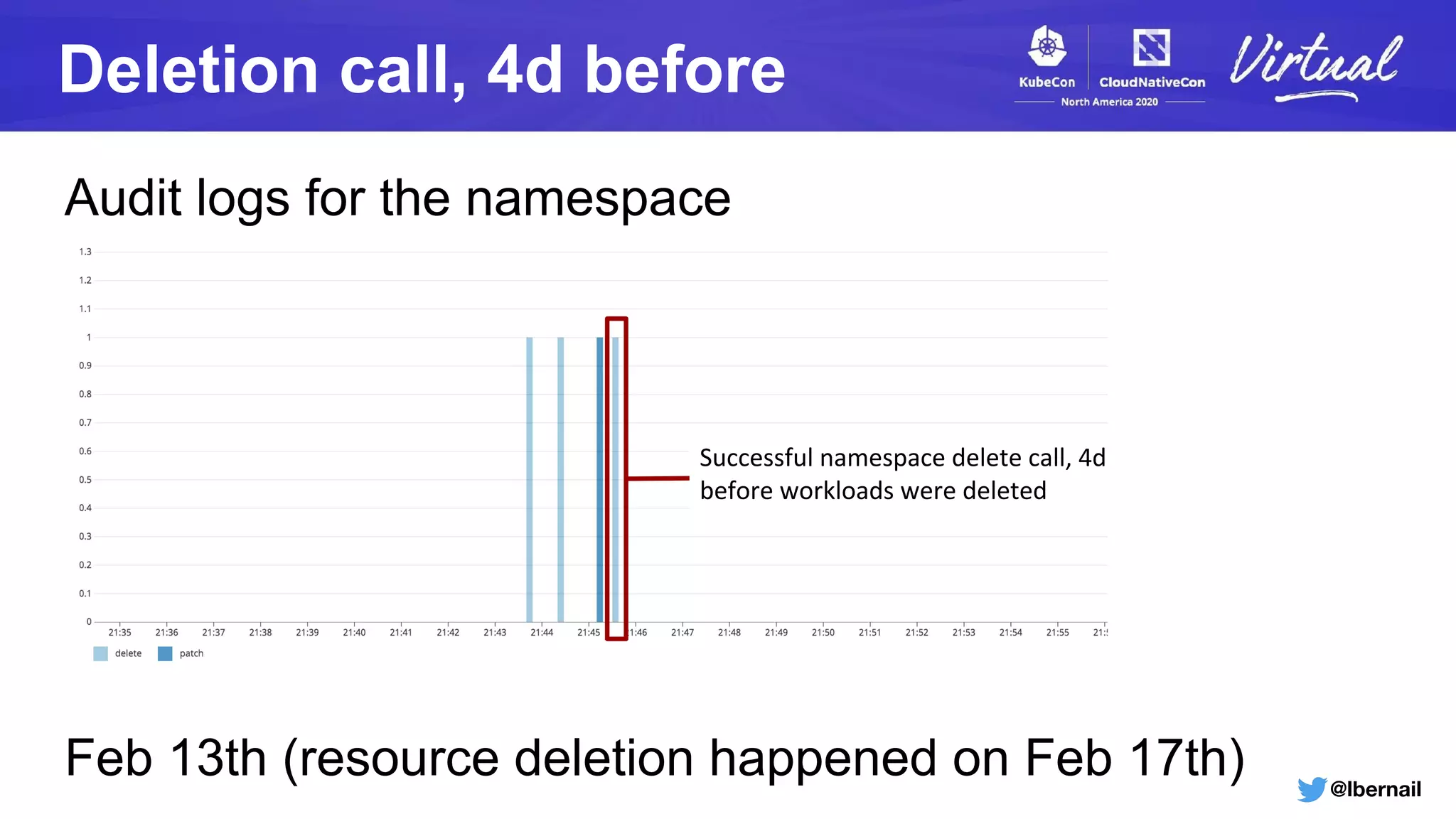
Deletion call, 4d before
Audit logs for the namespace
Feb 13th (resource deletion happened on Feb 17th)
Successful namespace delete call, 4d
before workloads were deleted
@lbernail
Engineer did not delete the namespace
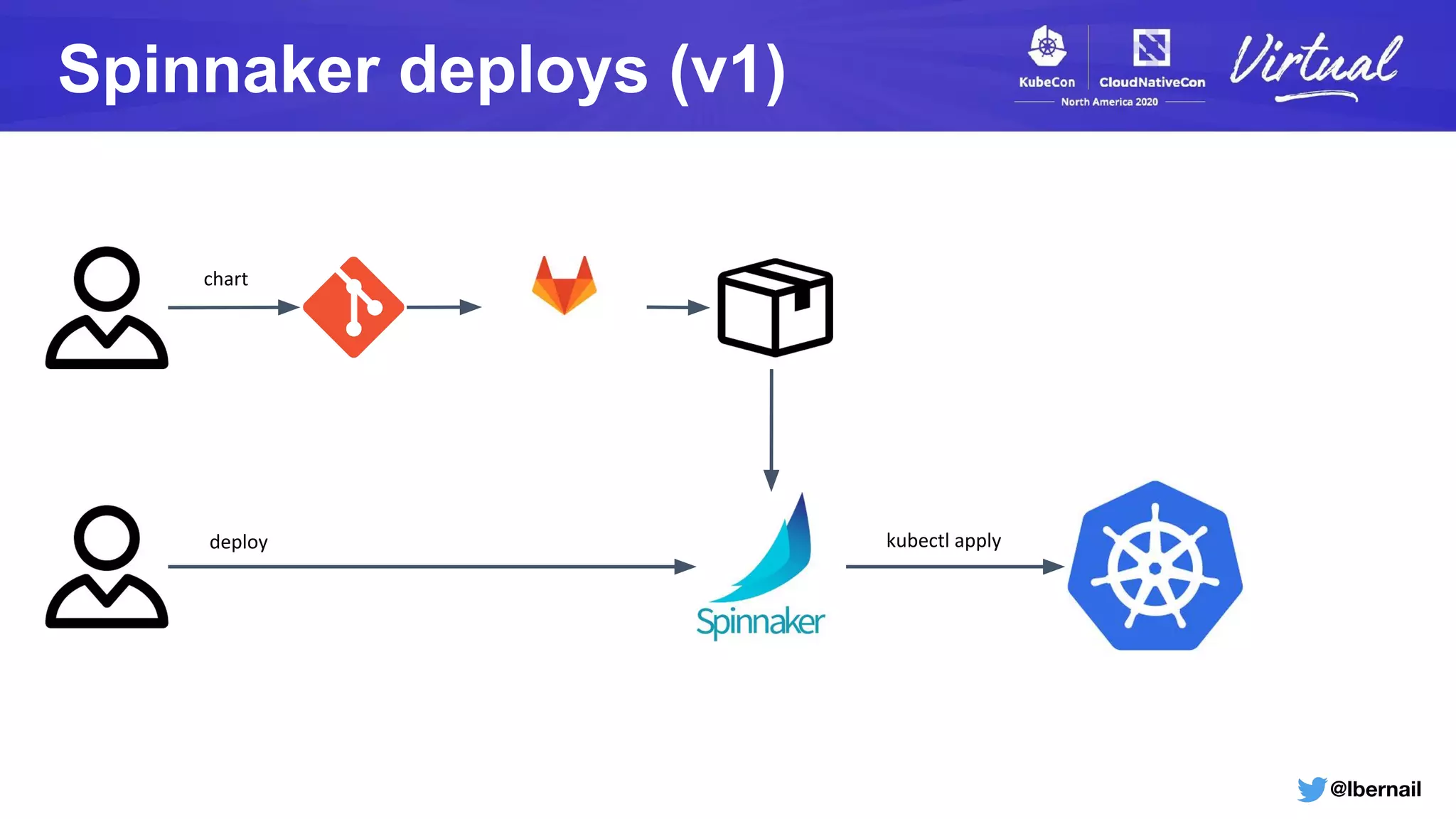
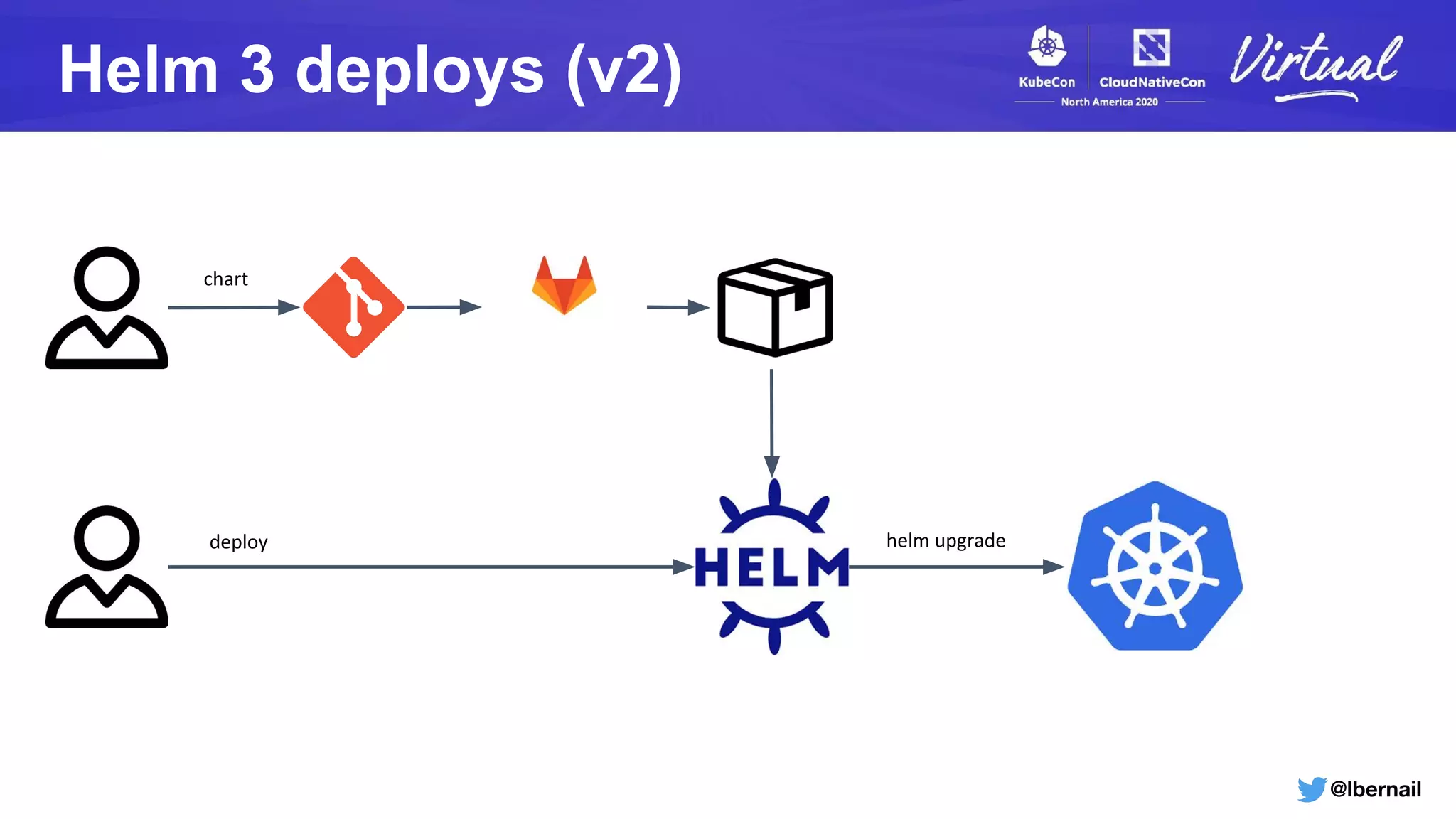
But engineer was migrating to new deployment method
@lbernail
Spinnaker deploys (v1)
chart
deploy kubectl apply
@lbernail
Helm 3 deploys (v2)
chart
deploy helm upgrade
@lbernail
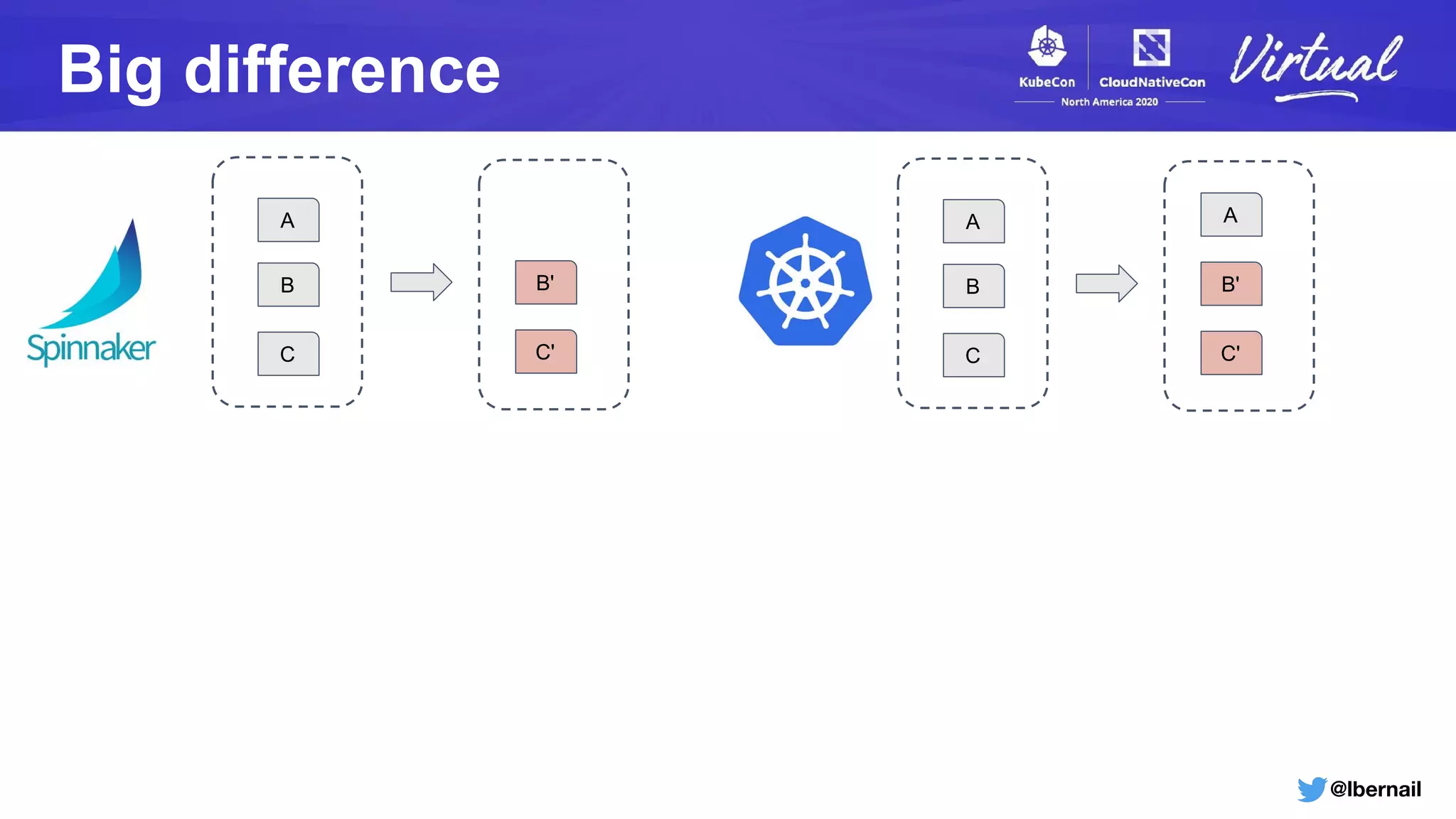
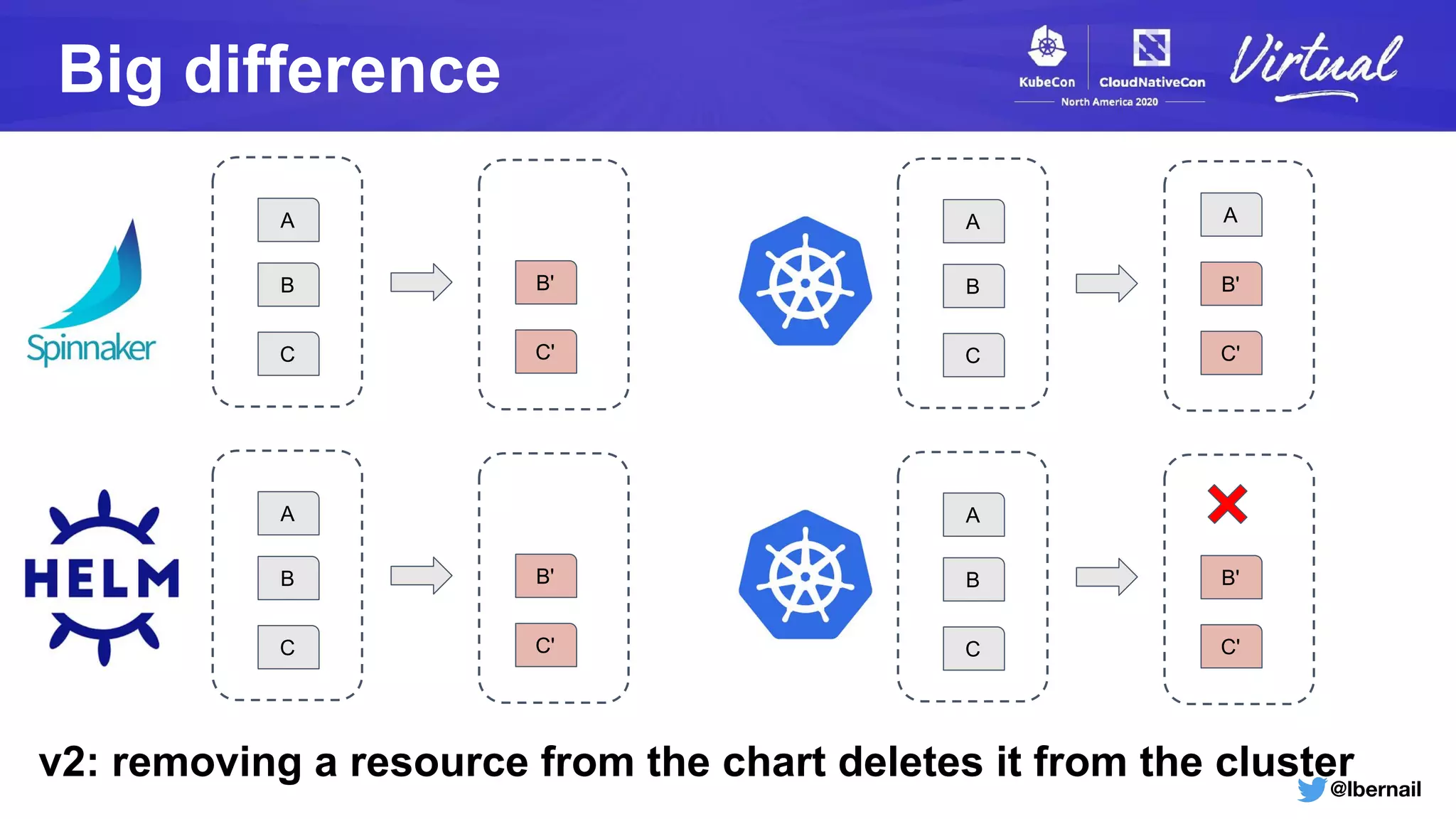
Big difference
A
B
C
B'
C'
A
B
C
B'
C'
A
@lbernail
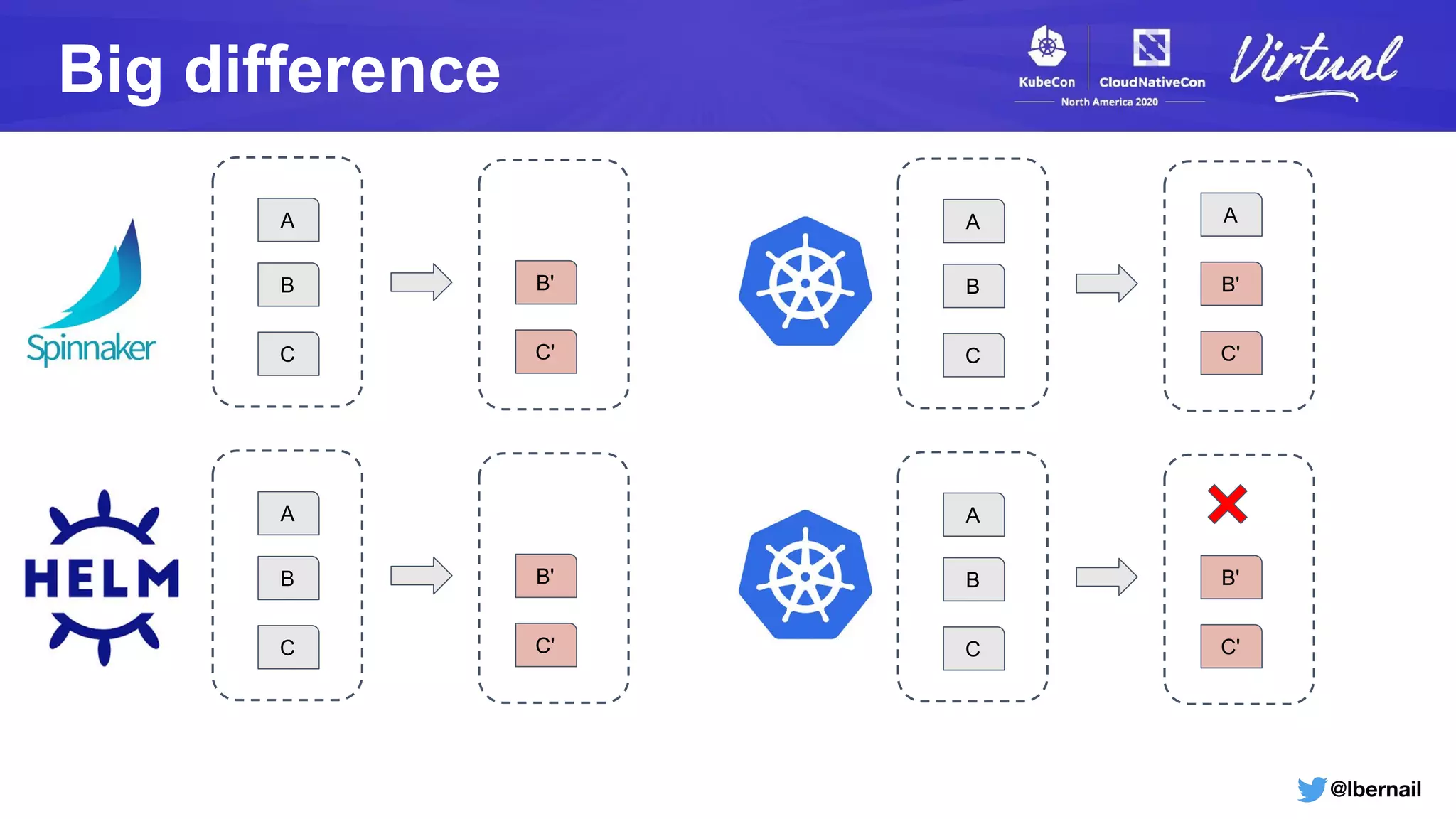
Big difference
A
B
C
B'
C'
A
B
C
B'
C'
A
A
B
C
B'
C'
A
B
C
B'
C'
@lbernail
Big difference
A
B
C
B'
C'
A
B
C
B'
C'
A
A
B
C
B'
C'
A
B
C
B'
C'
v2: removing a resource from the chart deletes it from the cluster
@lbernail
What happened?
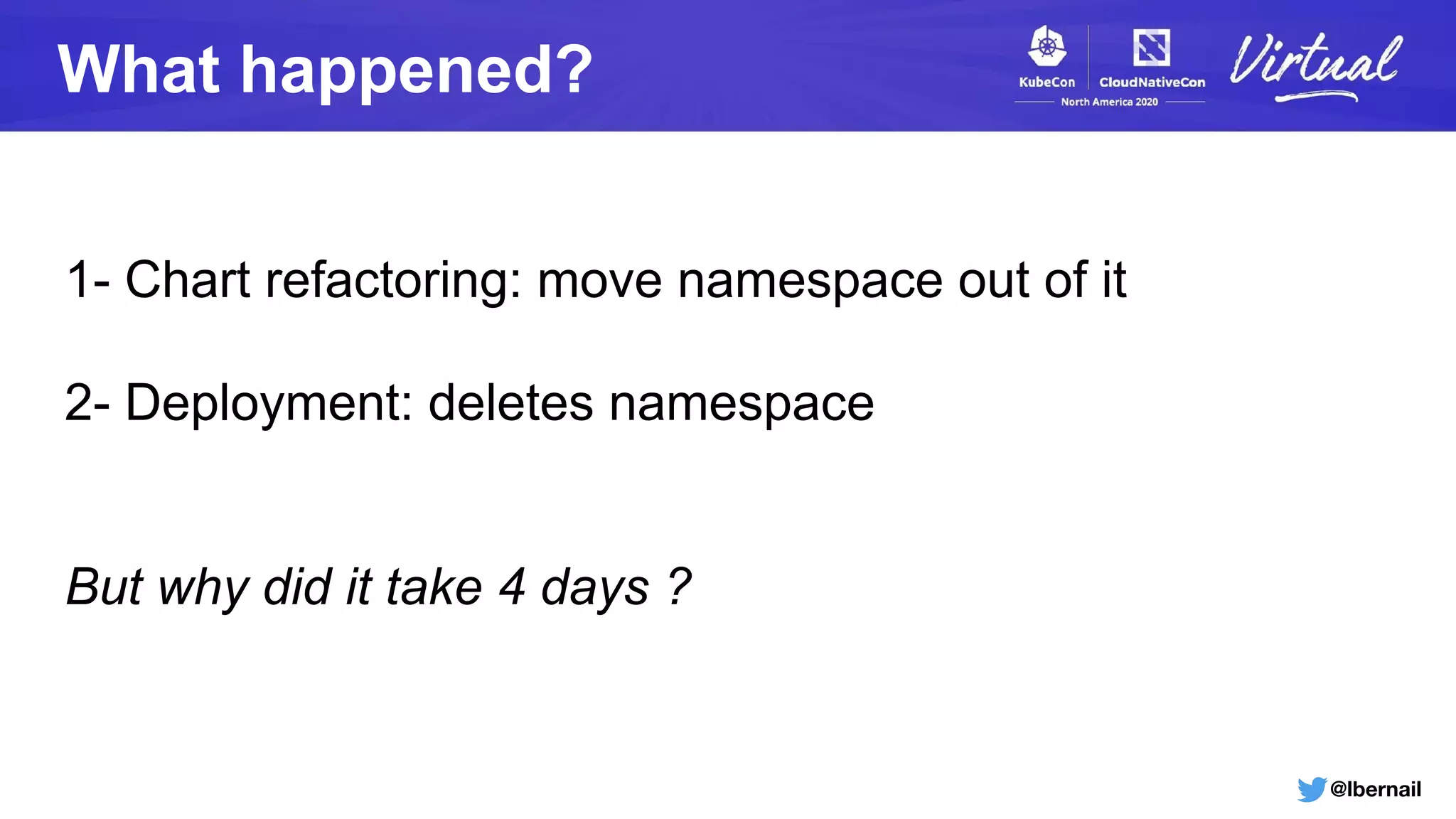
1- Chart refactoring: move namespace out of it
2- Deployment: deletes namespace
But why did it take 4 days ?
@lbernail
Namespace Controller
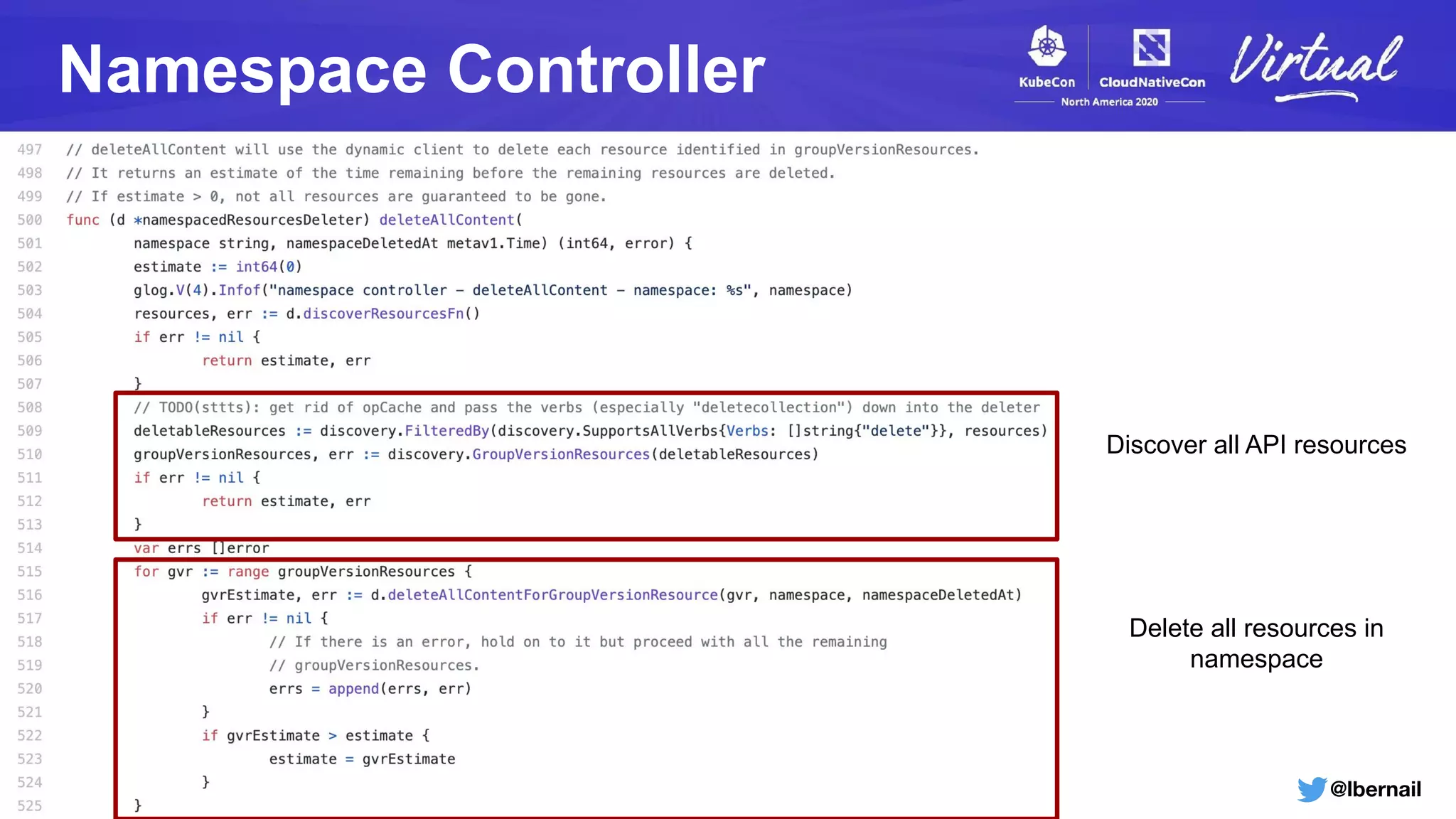
Discover all API resources
Delete all resources in
namespace
@lbernail
Namespace Controller
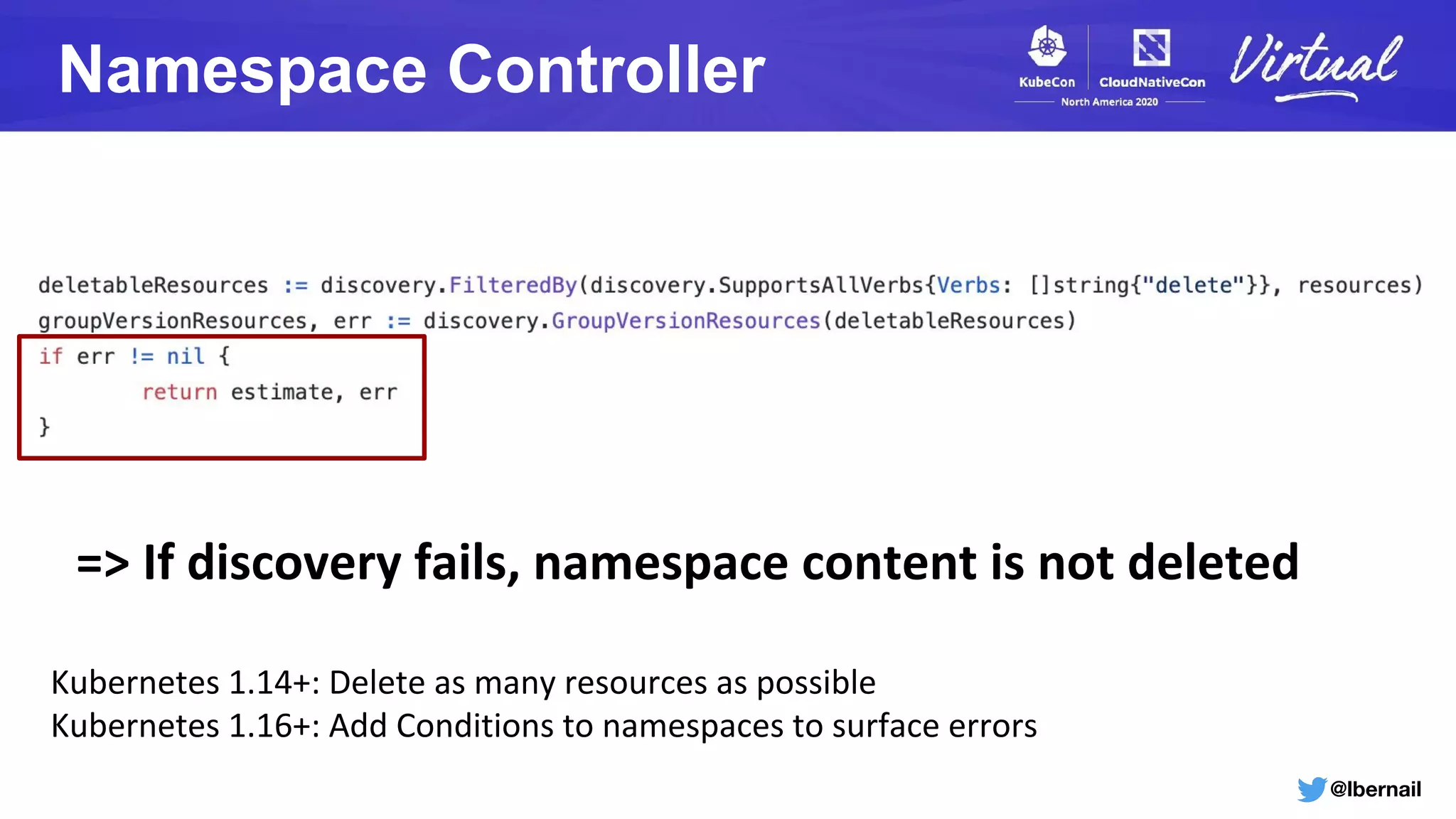
=> If discovery fails, namespace content is not deleted
Kubernetes 1.14+: Delete as many resources as possible
Kubernetes 1.16+: Add Conditions to namespaces to surface errors
@lbernail
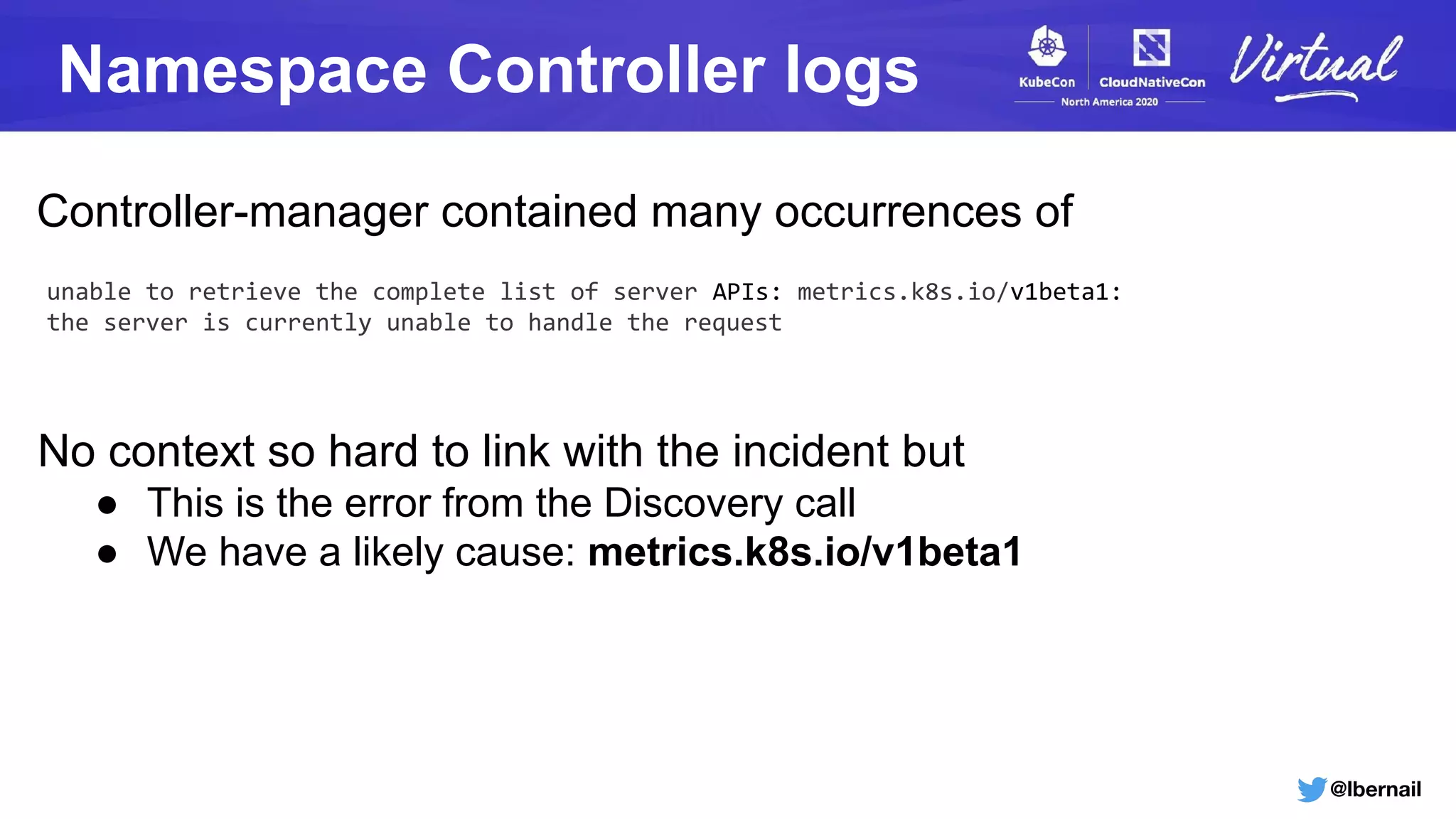
Namespace Controller logs
unable to retrieve the complete list of server APIs: metrics.k8s.io/v1beta1:
the server is currently unable to handle the request
Controller-manager contained many occurrences of
No context so hard to link with the incident but
● This is the error from the Discovery call
● We have a likely cause: metrics.k8s.io/v1beta1
@lbernail
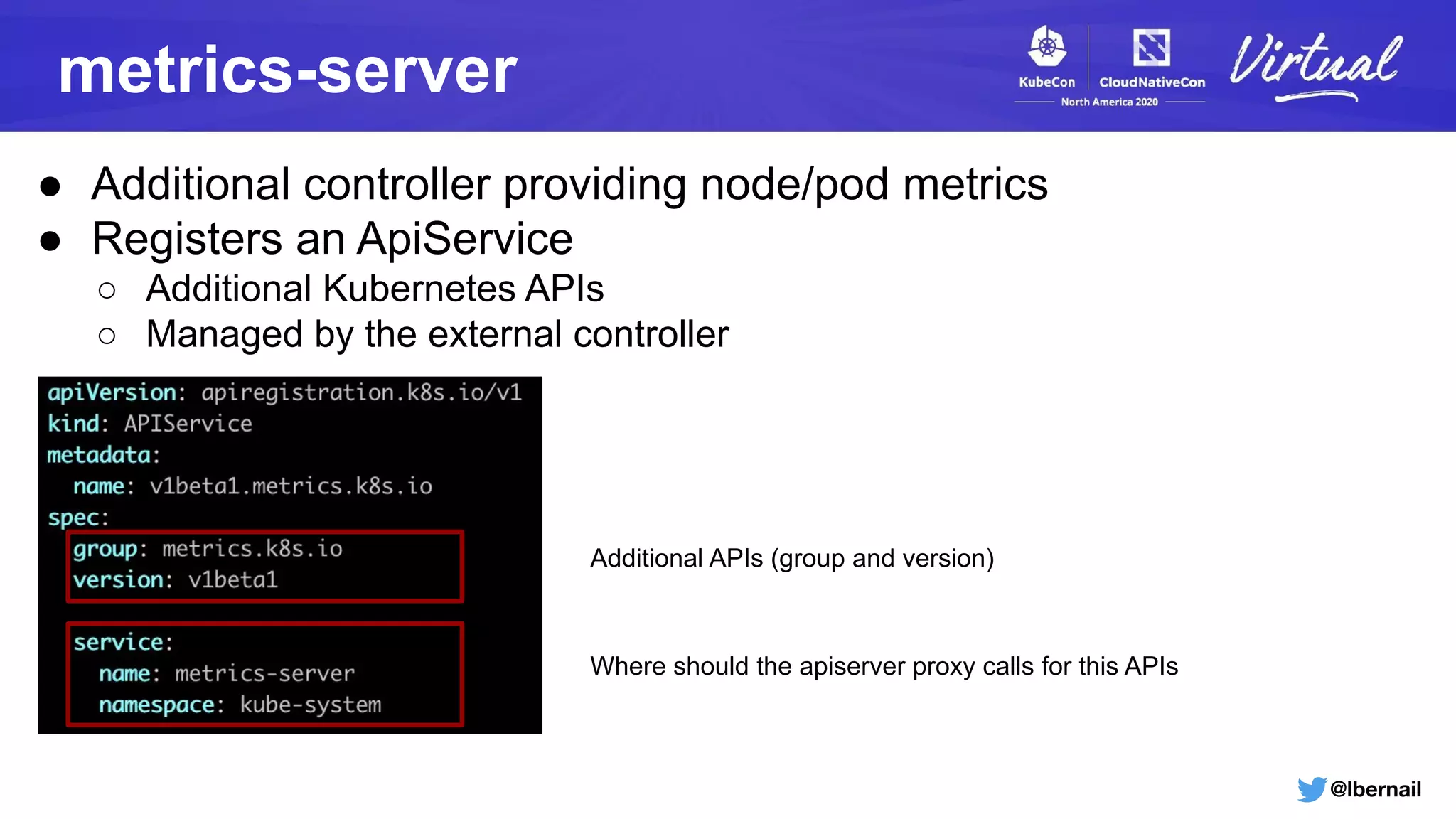
metrics-server
● Additional controller providing node/pod metrics
● Registers an ApiService
○ Additional Kubernetes APIs
○ Managed by the external controller
Additional APIs (group and version)
Where should the apiserver proxy calls for this APIs
@lbernail
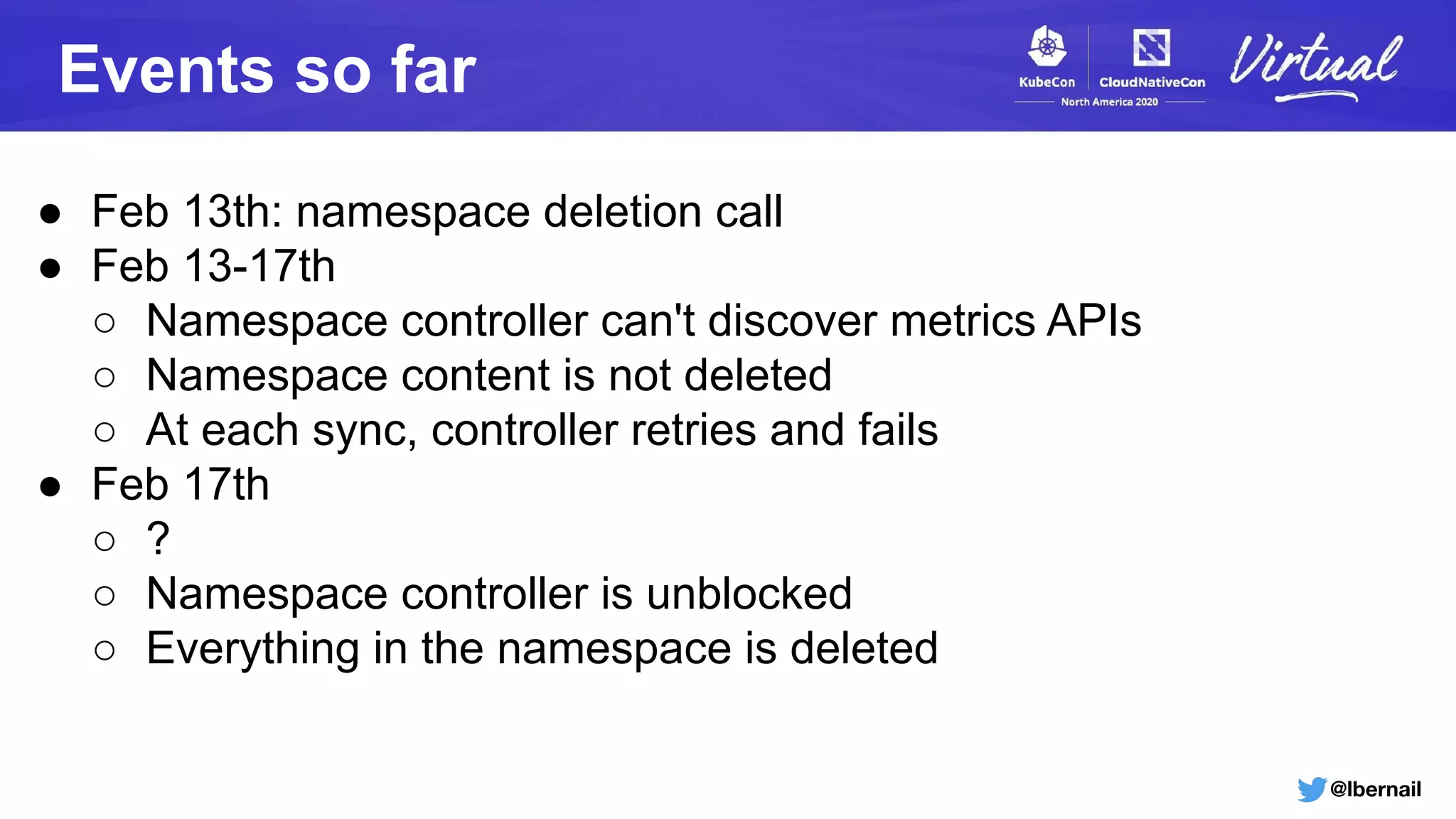
Events so far
● Feb 13th: namespace deletion call
● Feb 13-17th
○ Namespace controller can't discover metrics APIs
○ Namespace content is not deleted
○ At each sync, controller retries and fails
● Feb 17th
○ ?
○ Namespace controller is unblocked
○ Everything in the namespace is deleted
@lbernail
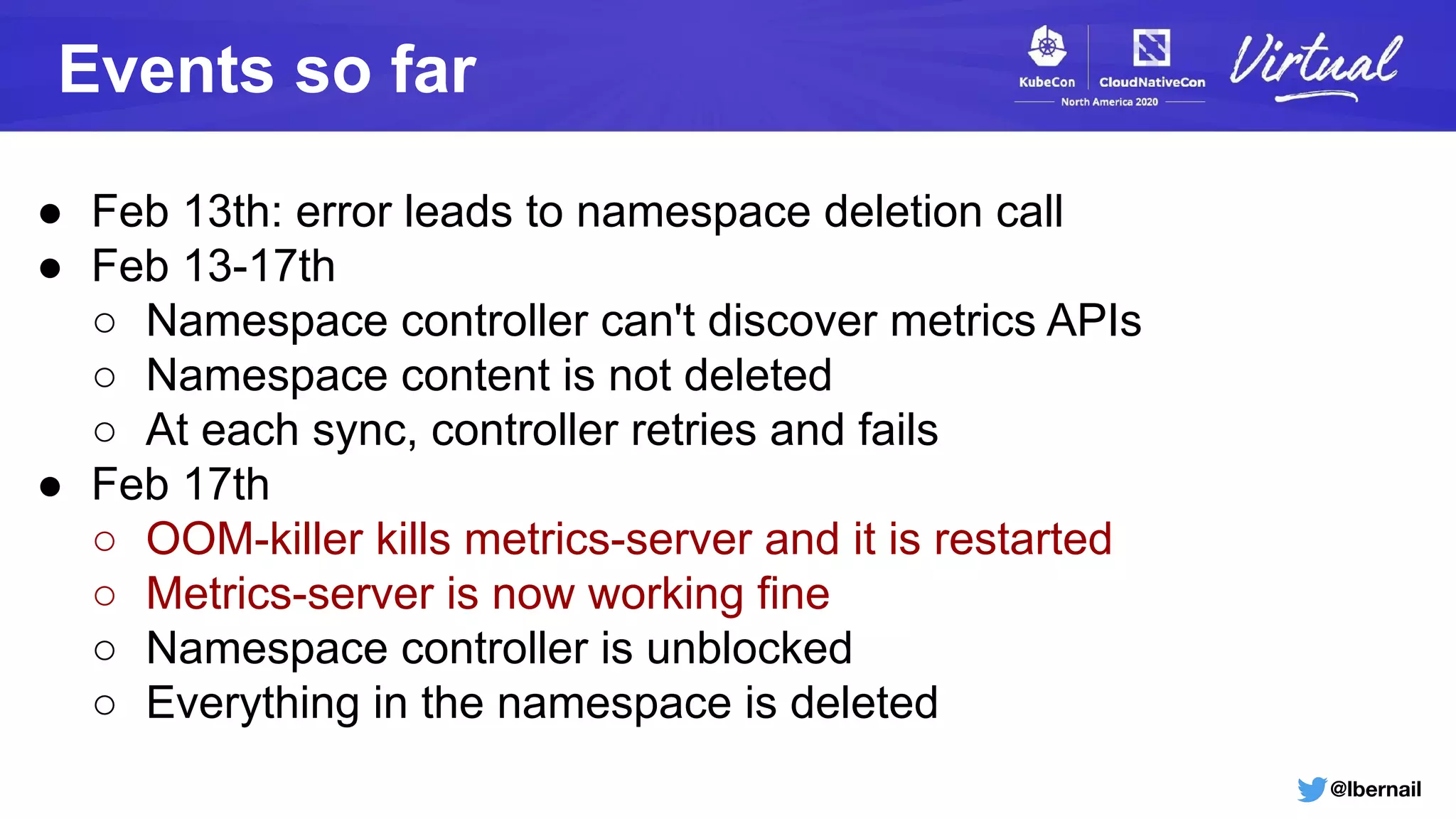
Events so far
● Feb 13th: error leads to namespace deletion call
● Feb 13-17th
○ Namespace controller can't discover metrics APIs
○ Namespace content is not deleted
○ At each sync, controller retries and fails
● Feb 17th
○ OOM-killer kills metrics-server and it is restarted
○ Metrics-server is now working fine
○ Namespace controller is unblocked
○ Everything in the namespace is deleted
@lbernail
Why was metrics-server failing?
@lbernail
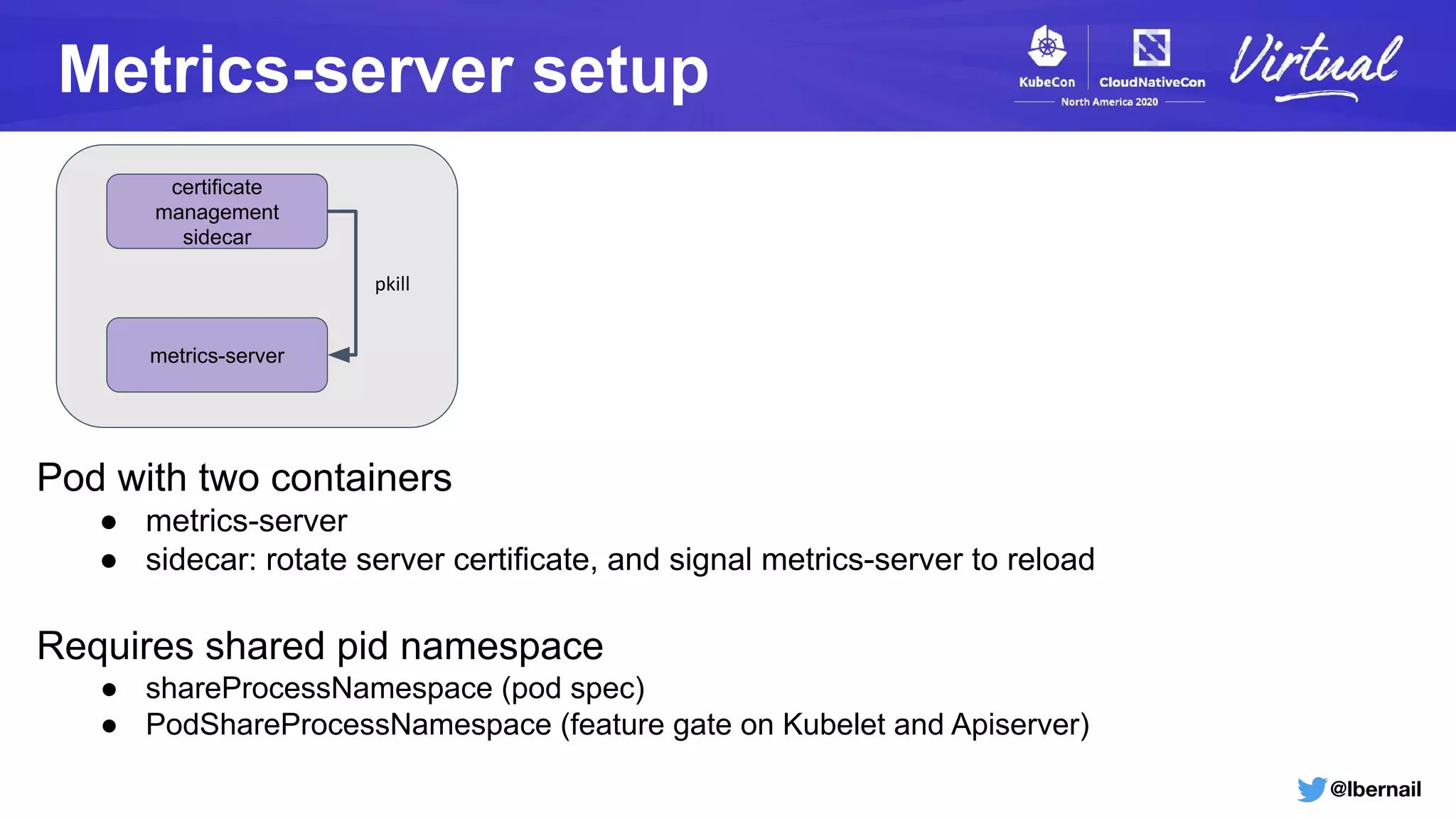
Metrics-server setup
metrics-server
certificate
management
sidecar
pkill
Pod with two containers
● metrics-server
● sidecar: rotate server certificate, and signal metrics-server to reload
Requires shared pid namespace
● shareProcessNamespace (pod spec)
● PodShareProcessNamespace (feature gate on Kubelet and Apiserver)
@lbernail
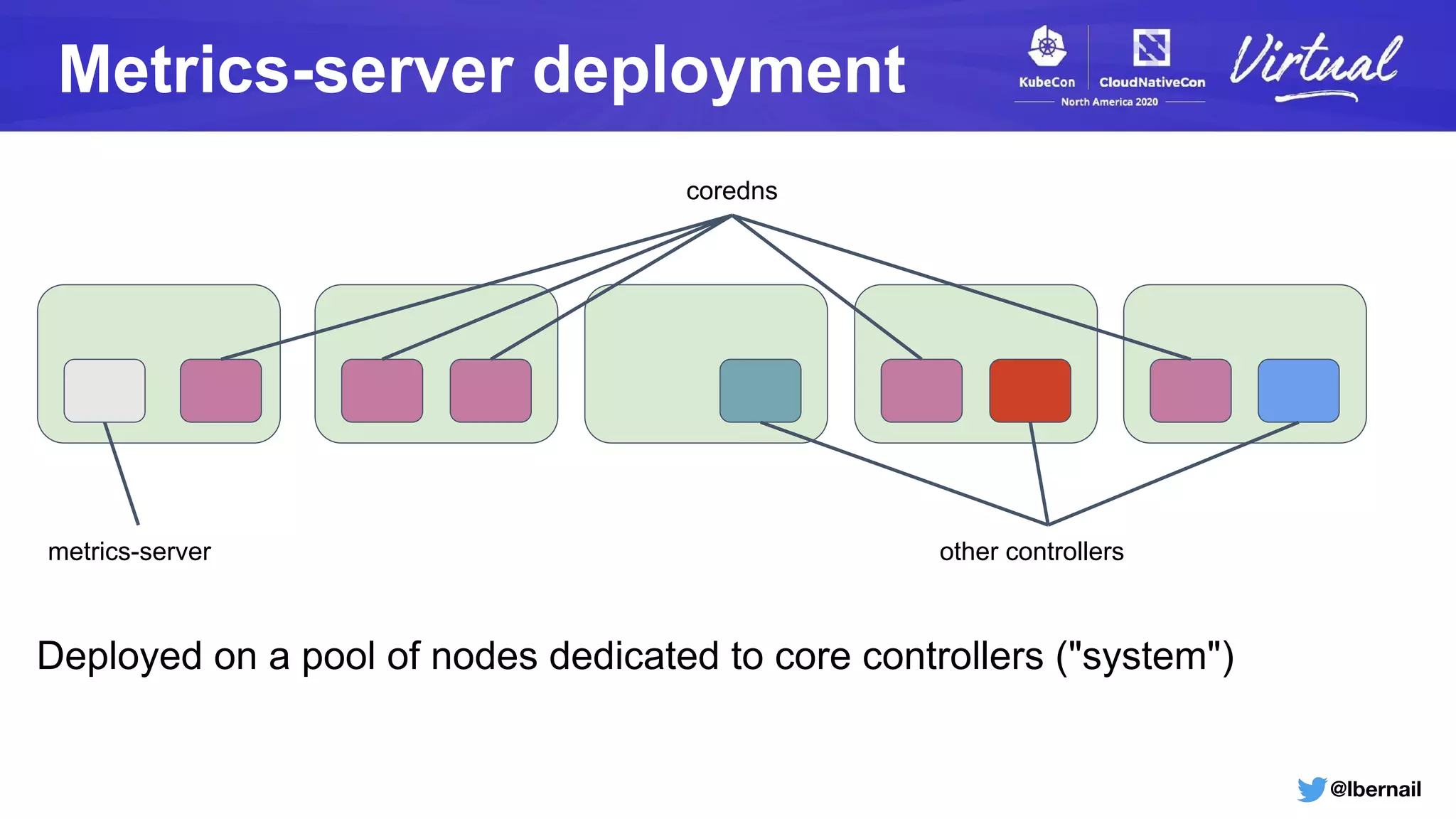
Metrics-server deployment
metrics-server other controllers
coredns
Deployed on a pool of nodes dedicated to core controllers ("system")
@lbernail
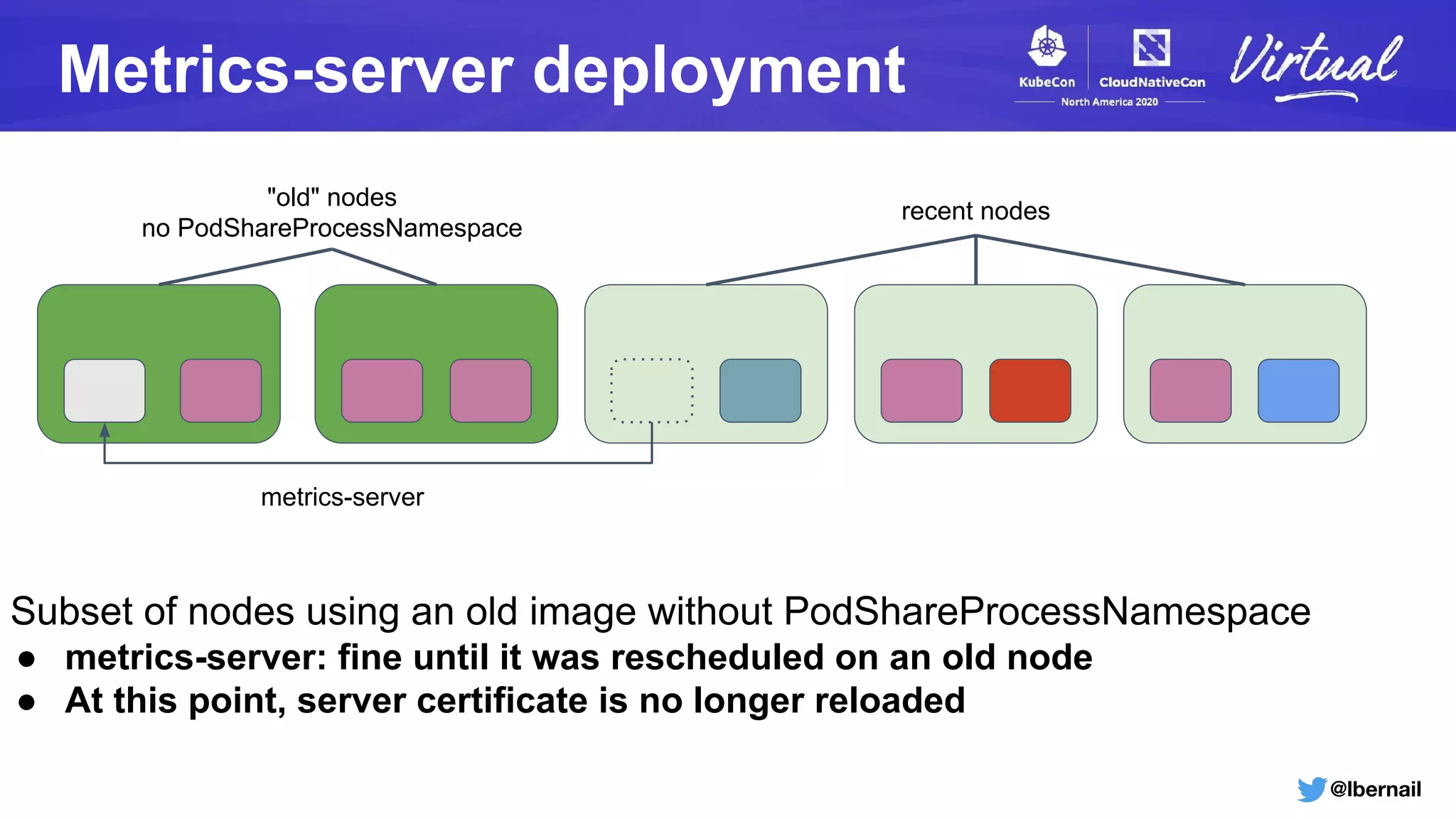
Metrics-server deployment
"old" nodes
no PodShareProcessNamespace
Subset of nodes using an old image without PodShareProcessNamespace
● metrics-server: fine until it was rescheduled on an old node
● At this point, server certificate is no longer reloaded
recent nodes
metrics-server
@lbernail
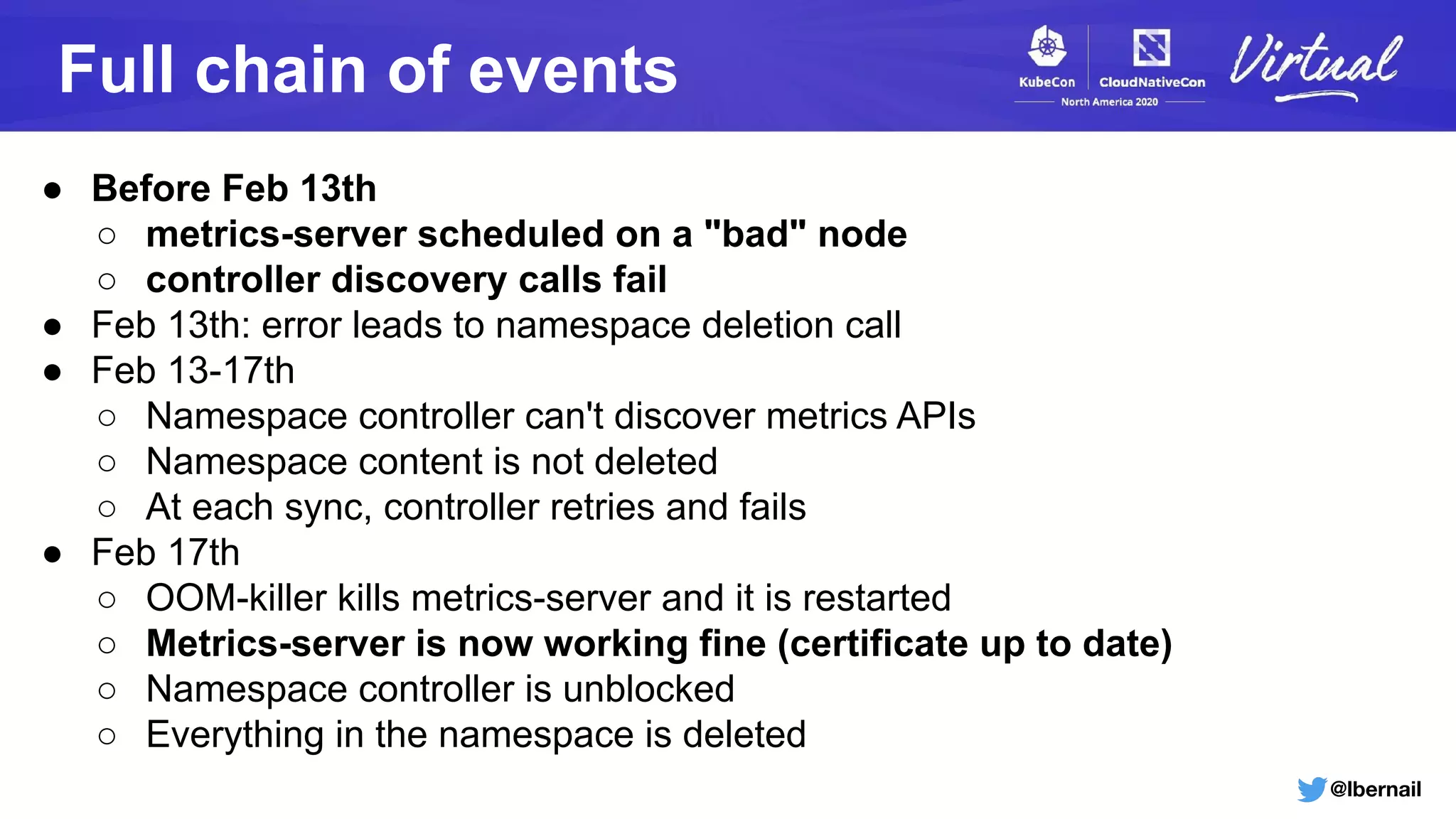
Full chain of events
● Before Feb 13th
○ metrics-server scheduled on a "bad" node
○ controller discovery calls fail
● Feb 13th: error leads to namespace deletion call
● Feb 13-17th
○ Namespace controller can't discover metrics APIs
○ Namespace content is not deleted
○ At each sync, controller retries and fails
● Feb 17th
○ OOM-killer kills metrics-server and it is restarted
○ Metrics-server is now working fine (certificate up to date)
○ Namespace controller is unblocked
○ Everything in the namespace is deleted
@lbernail
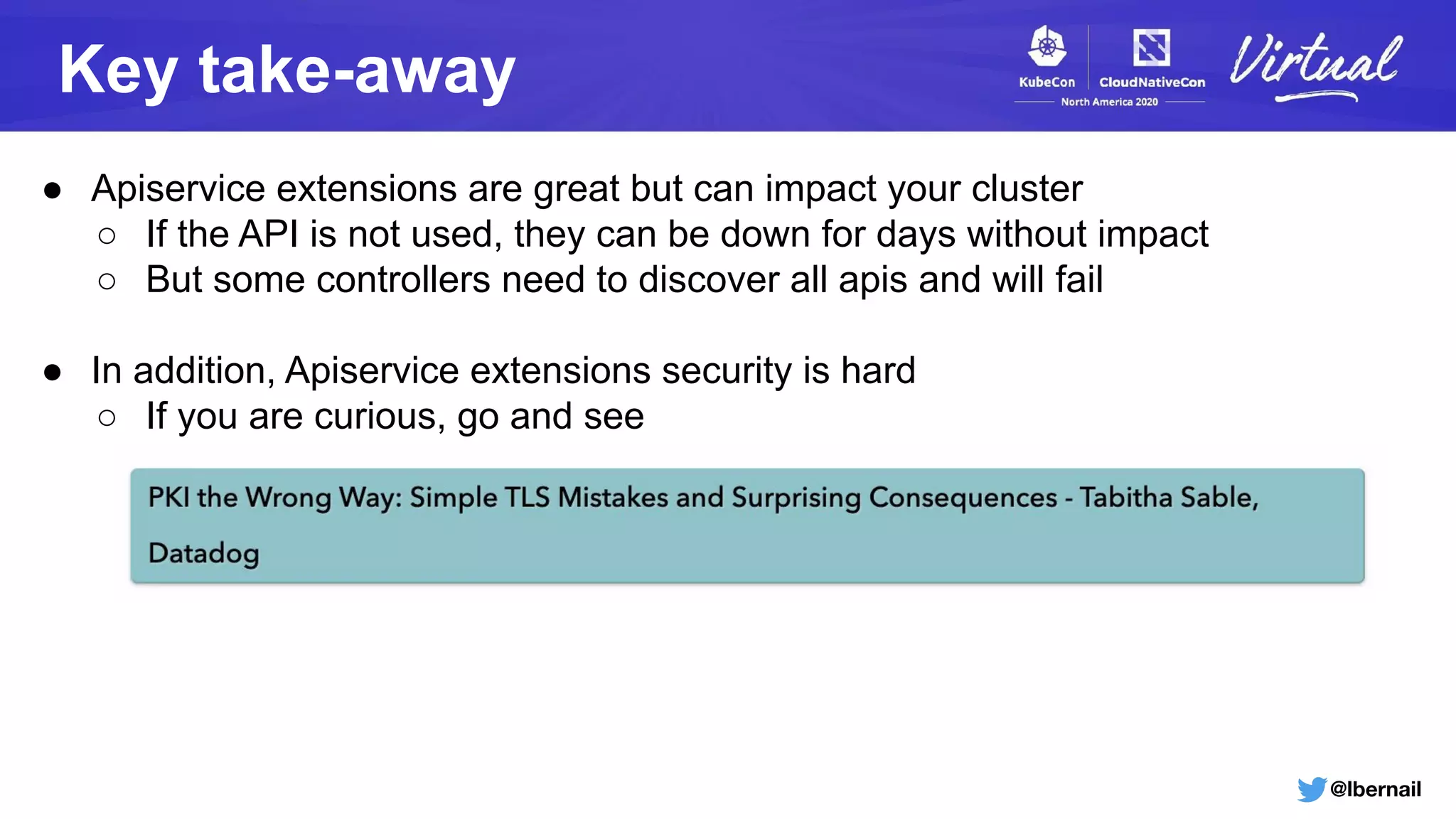
Key take-away
● Apiservice extensions are great but can impact your cluster
○ If the API is not used, they can be down for days without impact
○ But some controllers need to discover all apis and will fail
● In addition, Apiservice extensions security is hard
○ If you are curious, go and see
New node image does not work
and it's Weird...
@lbernail
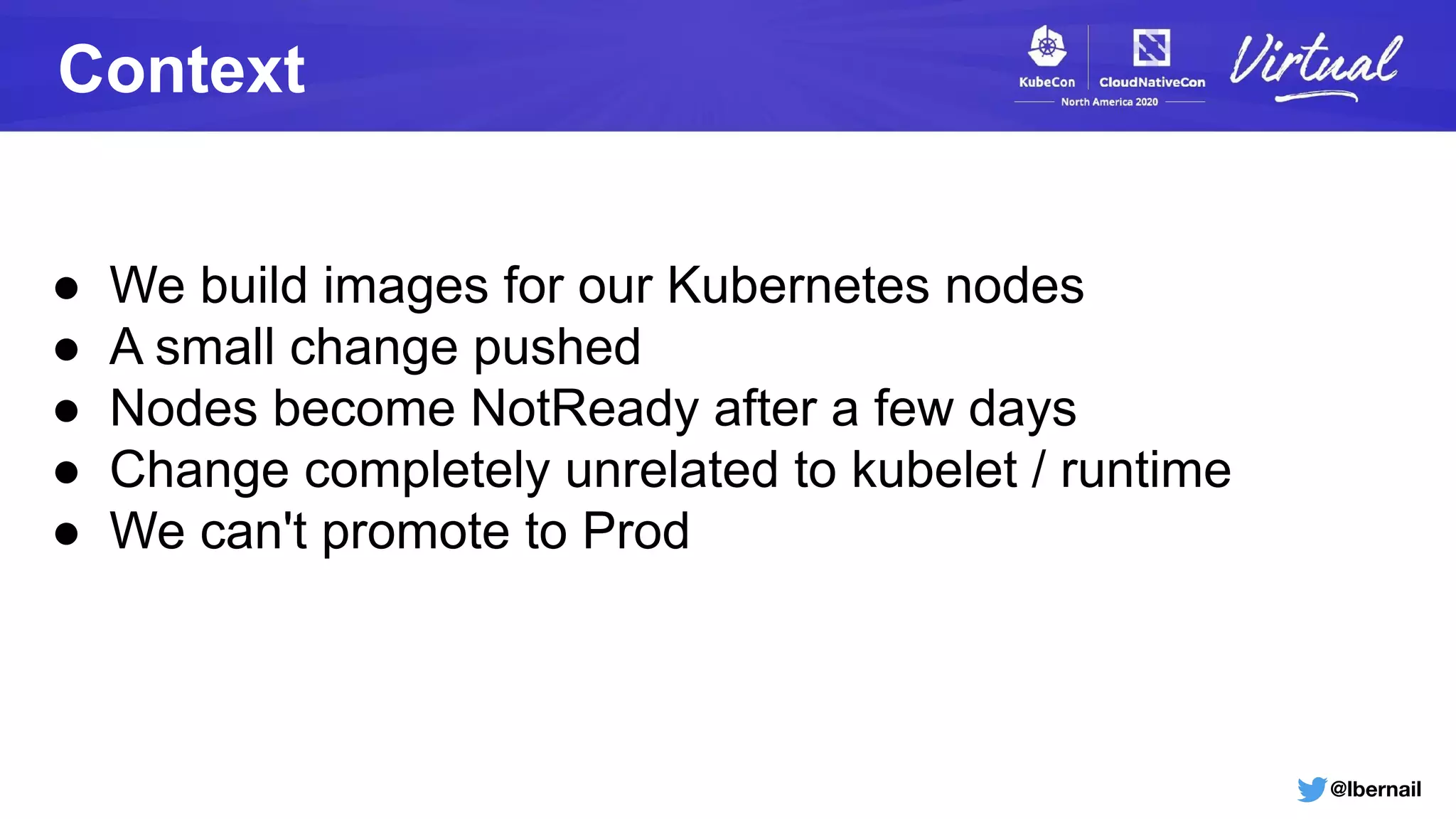
Context
● We build images for our Kubernetes nodes
● A small change pushed
● Nodes become NotReady after a few days
● Change completely unrelated to kubelet / runtime
● We can't promote to Prod
@lbernail
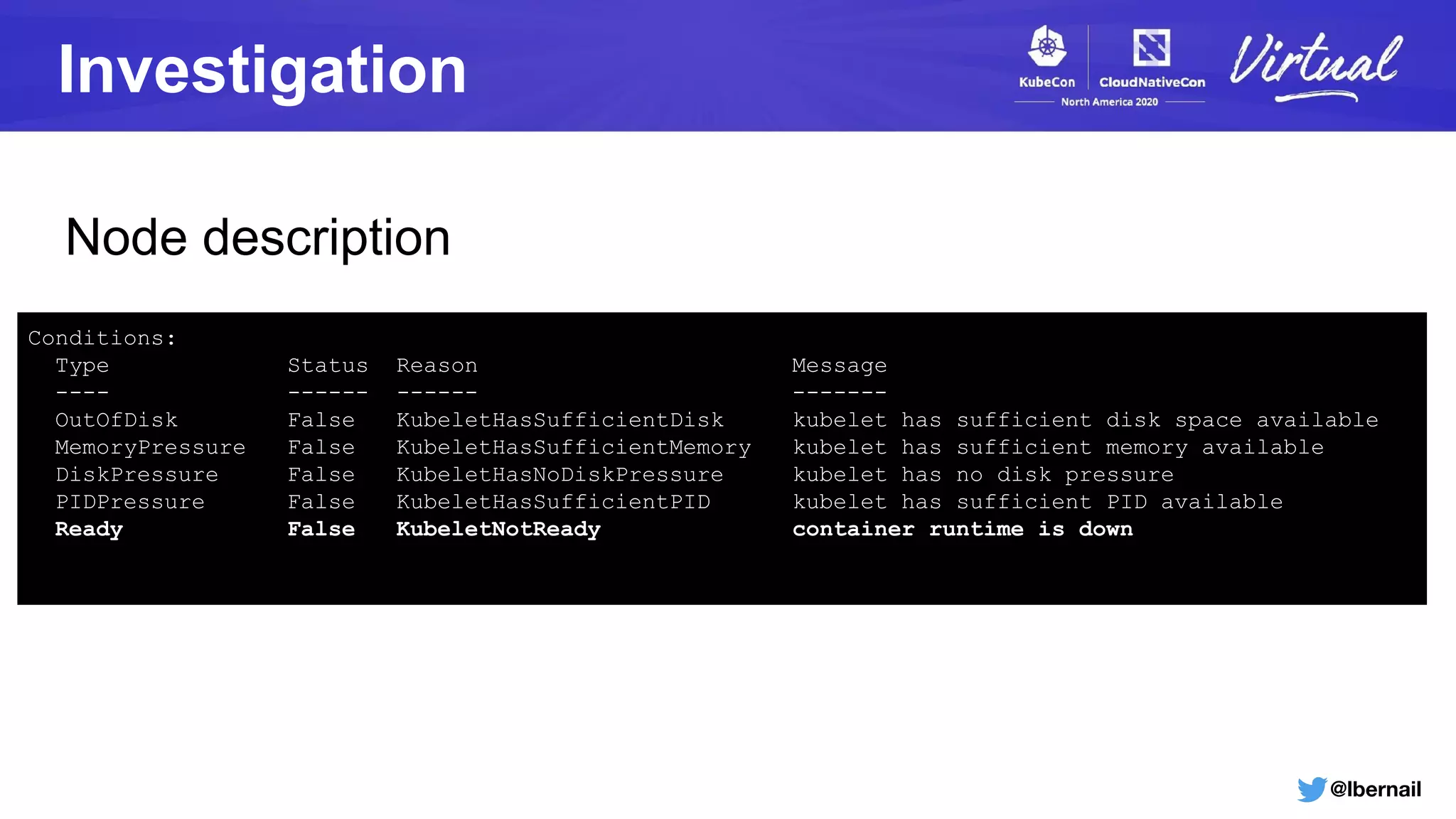
Investigation
Conditions:
Type Status Reason Message
---- ------ ------ -------
OutOfDisk False KubeletHasSufficientDisk kubelet has sufficient disk space available
MemoryPressure False KubeletHasSufficientMemory kubelet has sufficient memory available
DiskPressure False KubeletHasNoDiskPressure kubelet has no disk pressure
PIDPressure False KubeletHasSufficientPID kubelet has sufficient PID available
Ready False KubeletNotReady container runtime is down
Node description
@lbernail
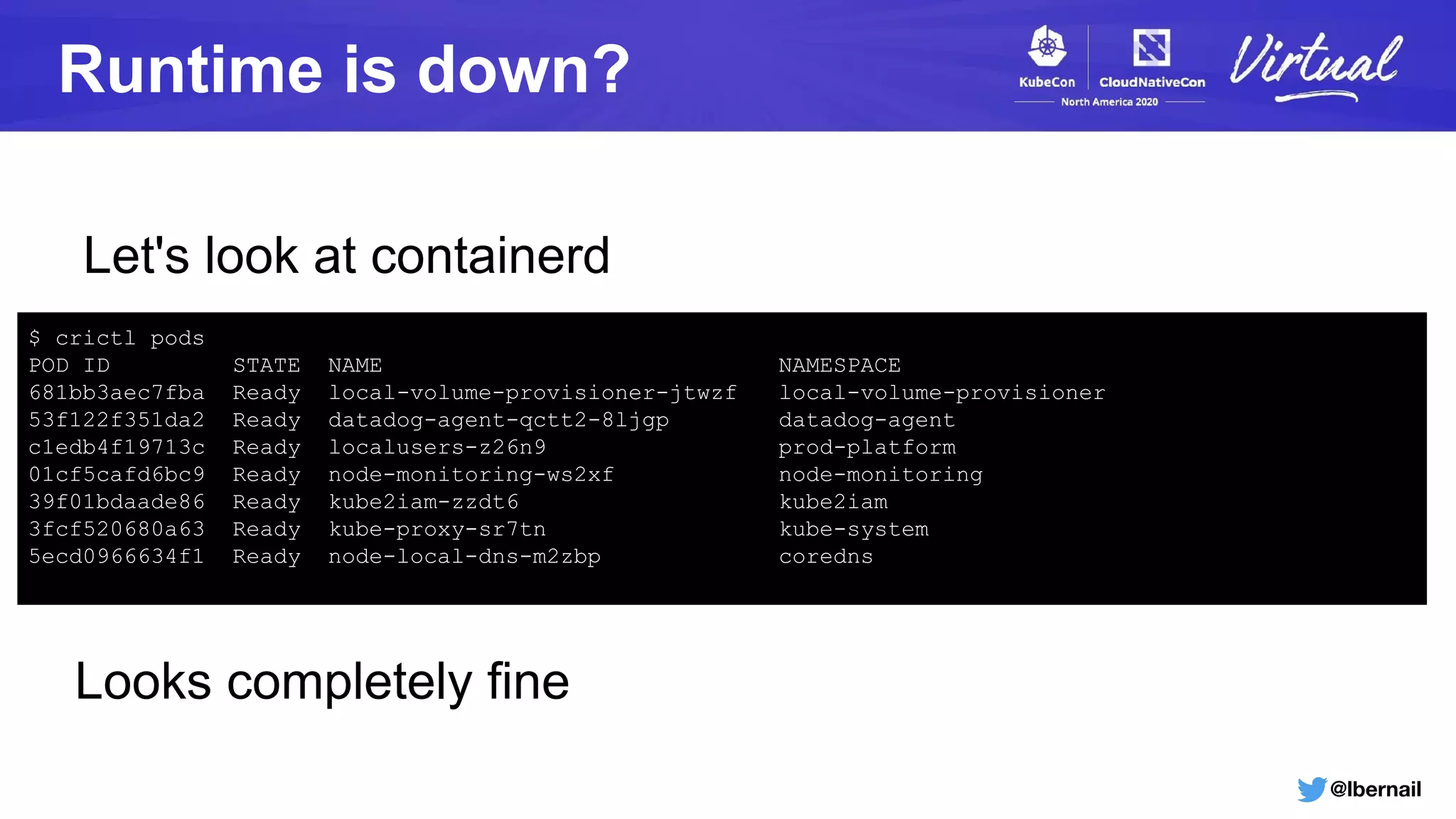
Runtime is down?
$ crictl pods
POD ID STATE NAME NAMESPACE
681bb3aec7fba Ready local-volume-provisioner-jtwzf local-volume-provisioner
53f122f351da2 Ready datadog-agent-qctt2-8ljgp datadog-agent
c1edb4f19713c Ready localusers-z26n9 prod-platform
01cf5cafd6bc9 Ready node-monitoring-ws2xf node-monitoring
39f01bdaade86 Ready kube2iam-zzdt6 kube2iam
3fcf520680a63 Ready kube-proxy-sr7tn kube-system
5ecd0966634f1 Ready node-local-dns-m2zbp coredns
Looks completely fine
Let's look at containerd
@lbernail
Kubelet logs
remote_runtime.go:434] Status from runtime service failed: rpc error: code = DeadlineExceeded desc =
context deadline exceeded
kubelet.go:2130] Container runtime sanity check failed: rpc error: code = DeadlineExceeded desc =
context deadline exceeded
kubelet.go:1803] skipping pod synchronization - [container runtime is down]
"Status from runtime service failed"
➢ Is there a CRI call for this?
Something is definitely wrong
@lbernail
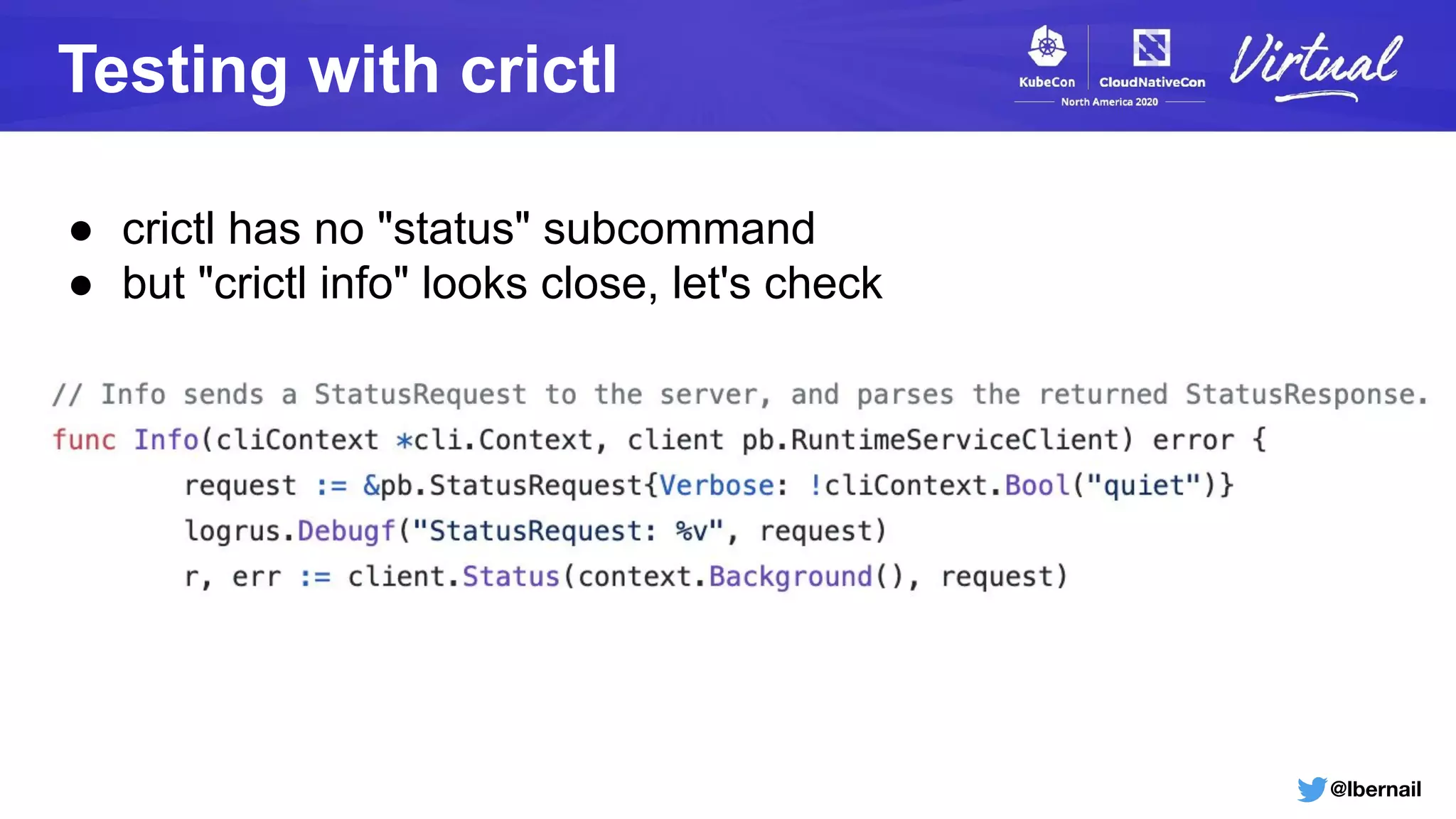
Testing with crictl
● crictl has no "status" subcommand
● but "crictl info" looks close, let's check
@lbernail
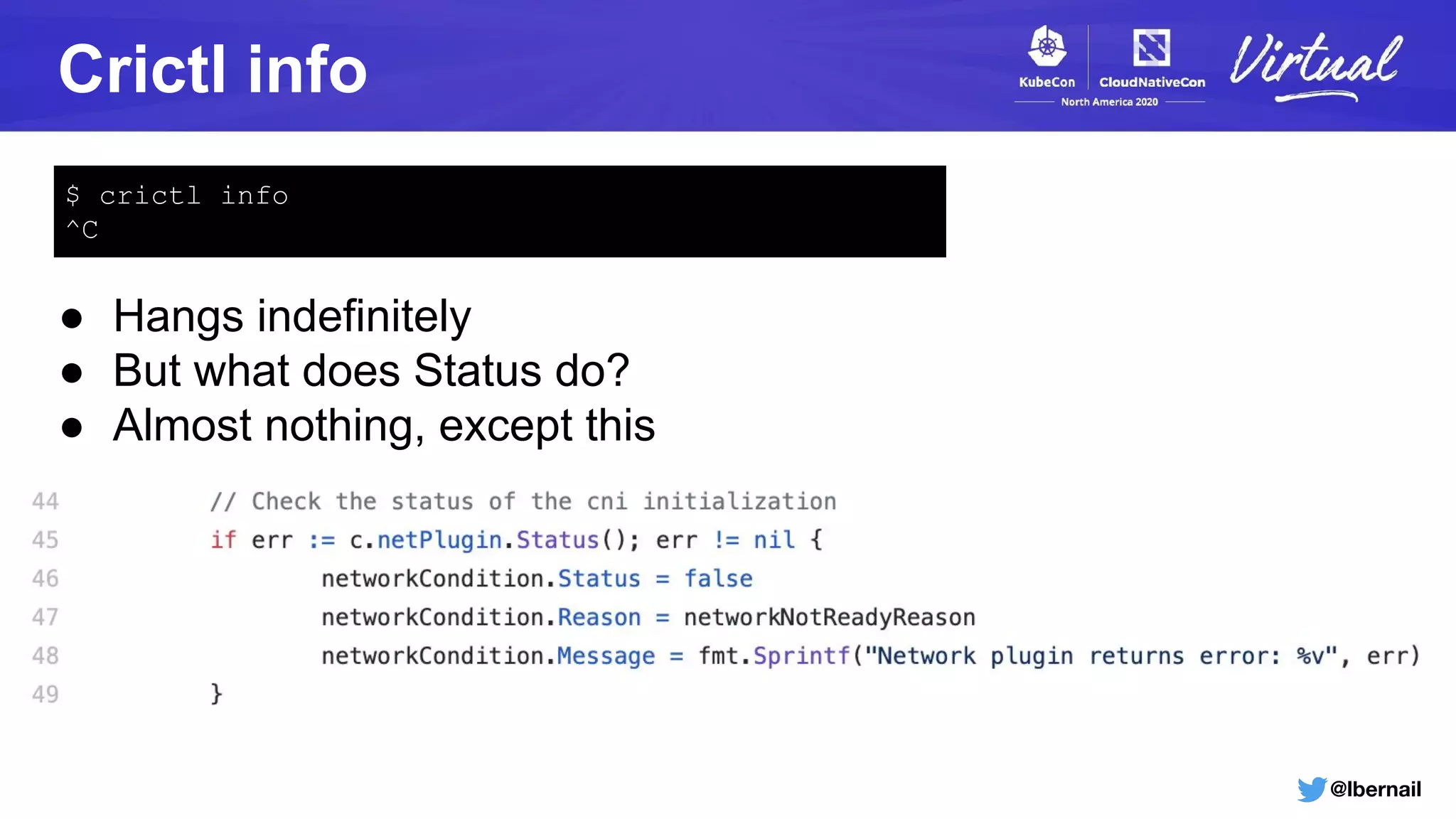
Crictl info
$ crictl info
^C
● Hangs indefinitely
● But what does Status do?
● Almost nothing, except this
@lbernail
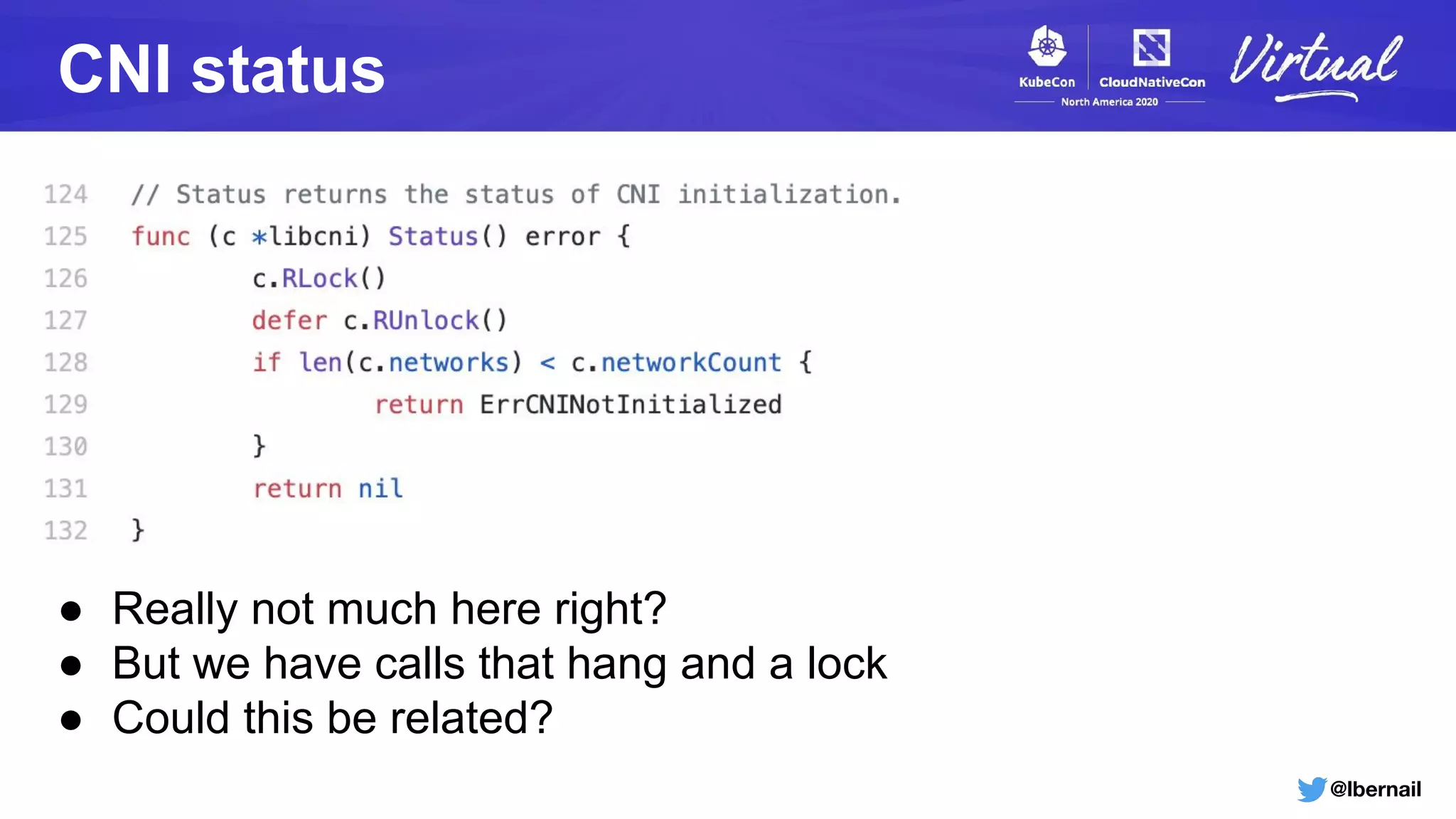
CNI status
● Really not much here right?
● But we have calls that hang and a lock
● Could this be related?
@lbernail
Containerd goroutine dump
containerd[737]: goroutine 107298383 [semacquire, 2 minutes]:
containerd[737]: goroutine 107290532 [semacquire, 4 minutes]:
containerd[737]: goroutine 107282673 [semacquire, 6 minutes]:
containerd[737]: goroutine 107274360 [semacquire, 8 minutes]:
containerd[737]: goroutine 107266554 [semacquire, 10 minutes]:
Blocked goroutines?
The runtime error from the kubelet also happens every 2mn
containerd[737]: goroutine 107298383 [semacquire, 2 minutes]:
...
containerd[737]: .../containerd/vendor/github.com/containerd/go-cni.(*libcni).Status()
containerd[737]: .../containerd/vendor/github.com/containerd/go-cni/cni.go:126
containerd[737]: .../containerd/vendor/github.com/containerd/cri/pkg/server.(*criService).Status(...)
containerd[737]: .../containerd/containerd/vendor/github.com/containerd/cri/pkg/server/status.go:45
Goroutine details match exactly the codepath we looked at
@lbernail
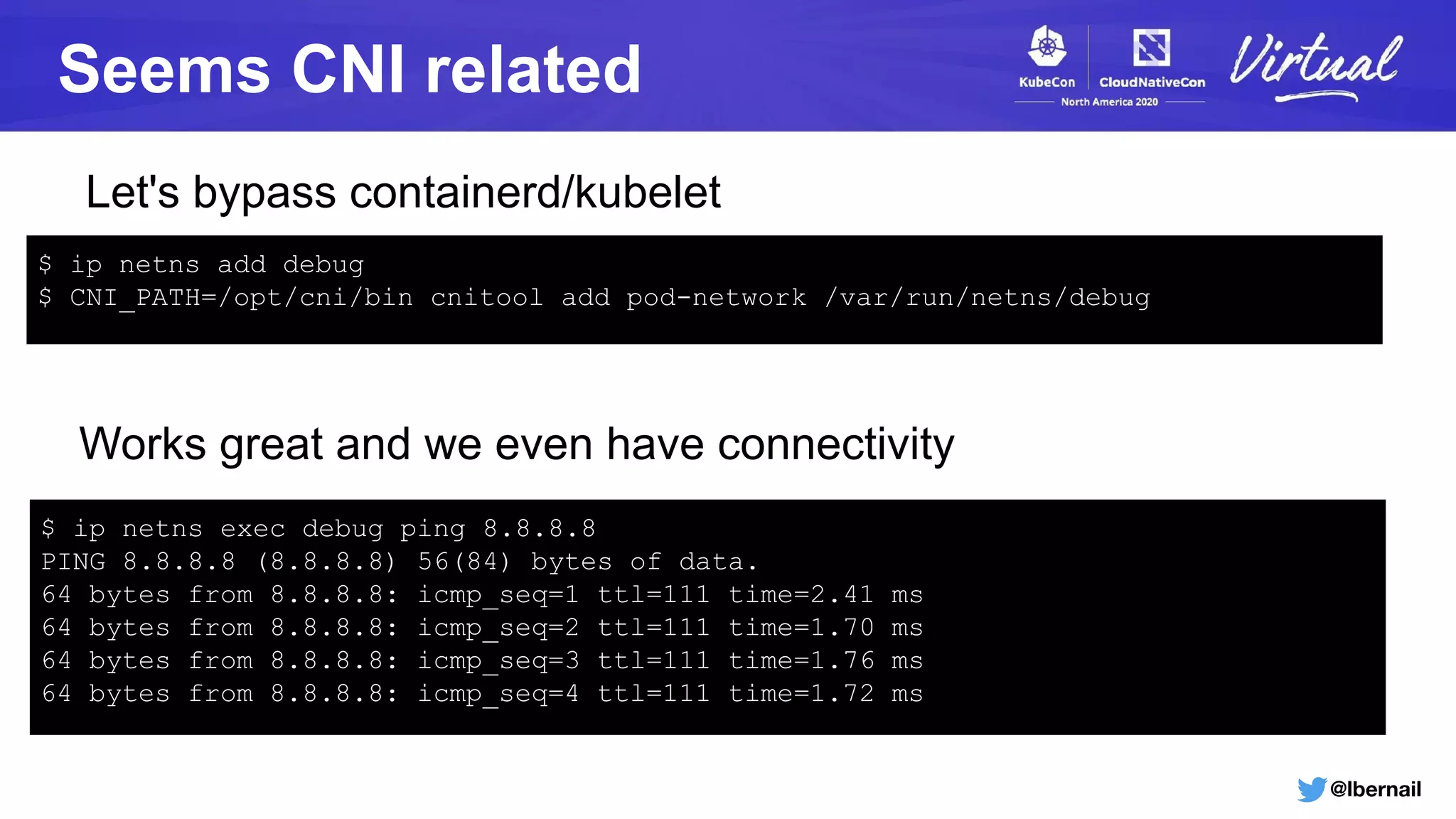
Seems CNI related
Let's bypass containerd/kubelet
$ ip netns add debug
$ CNI_PATH=/opt/cni/bin cnitool add pod-network /var/run/netns/debug
Works great and we even have connectivity
$ ip netns exec debug ping 8.8.8.8
PING 8.8.8.8 (8.8.8.8) 56(84) bytes of data.
64 bytes from 8.8.8.8: icmp_seq=1 ttl=111 time=2.41 ms
64 bytes from 8.8.8.8: icmp_seq=2 ttl=111 time=1.70 ms
64 bytes from 8.8.8.8: icmp_seq=3 ttl=111 time=1.76 ms
64 bytes from 8.8.8.8: icmp_seq=4 ttl=111 time=1.72 ms
@lbernail
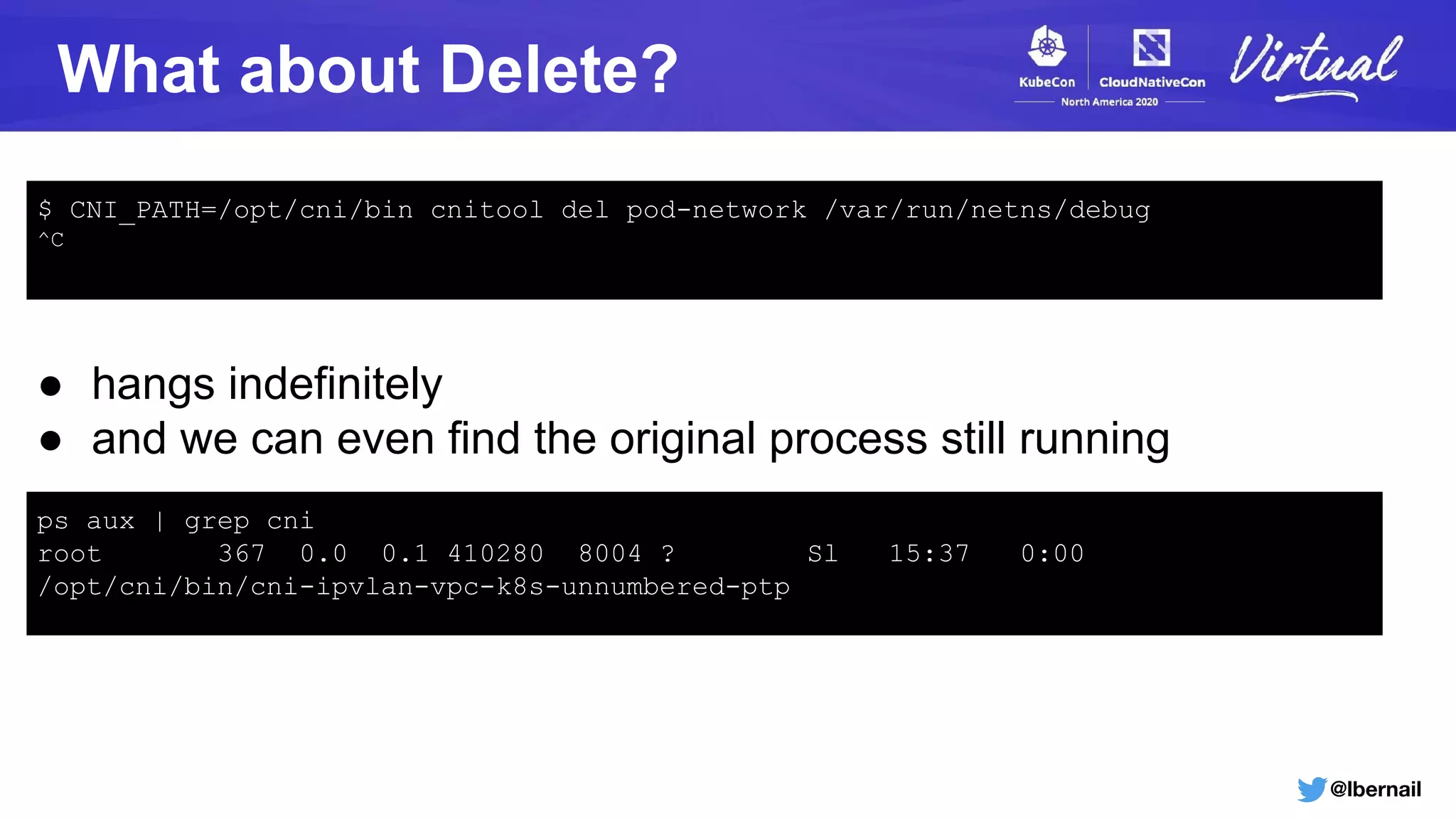
What about Delete?
$ CNI_PATH=/opt/cni/bin cnitool del pod-network /var/run/netns/debug
^C
● hangs indefinitely
● and we can even find the original process still running
ps aux | grep cni
root 367 0.0 0.1 410280 8004 ? Sl 15:37 0:00
/opt/cni/bin/cni-ipvlan-vpc-k8s-unnumbered-ptp
@lbernail
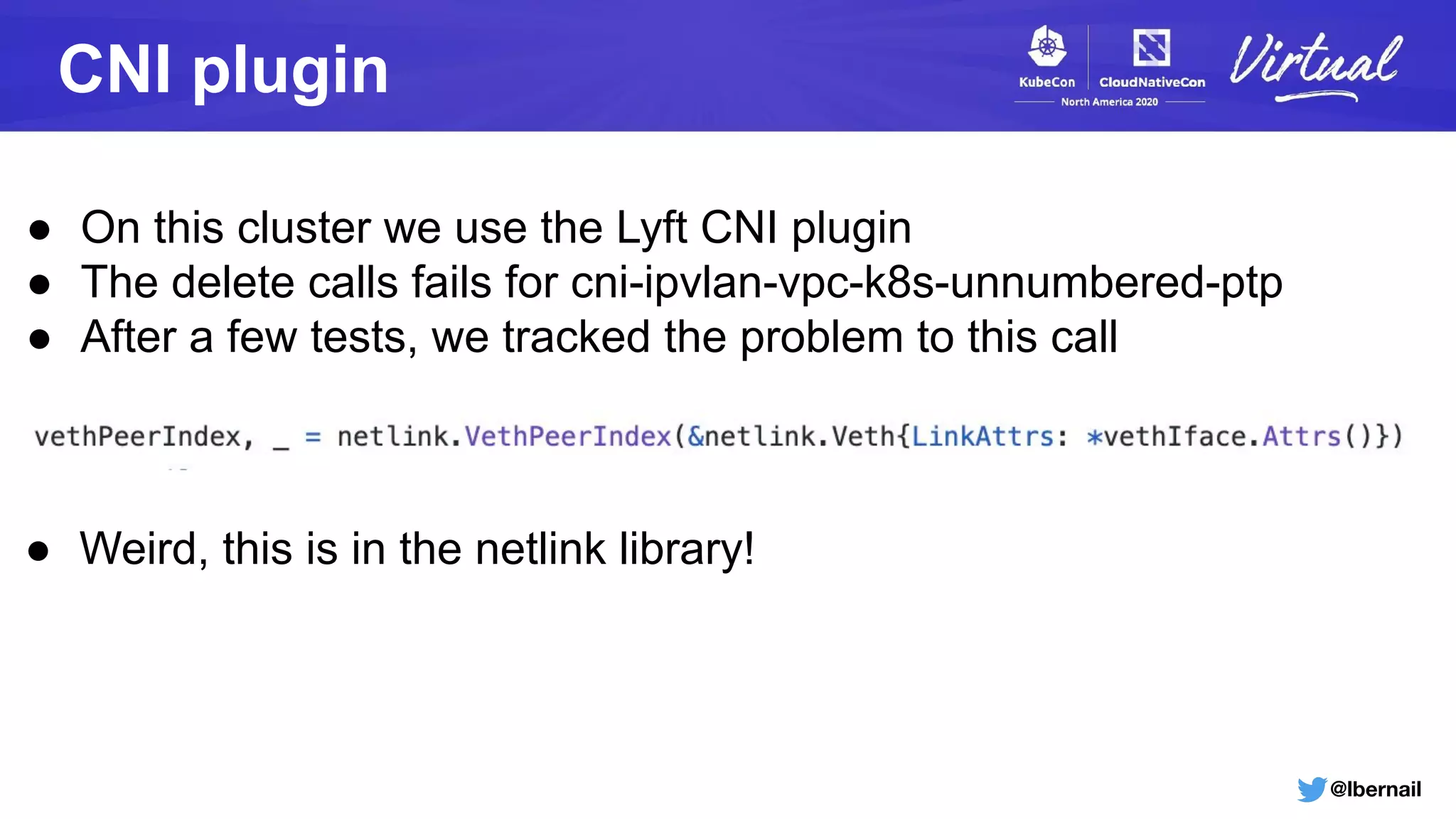
CNI plugin
● On this cluster we use the Lyft CNI plugin
● The delete calls fails for cni-ipvlan-vpc-k8s-unnumbered-ptp
● After a few tests, we tracked the problem to this call
● Weird, this is in the netlink library!
@lbernail
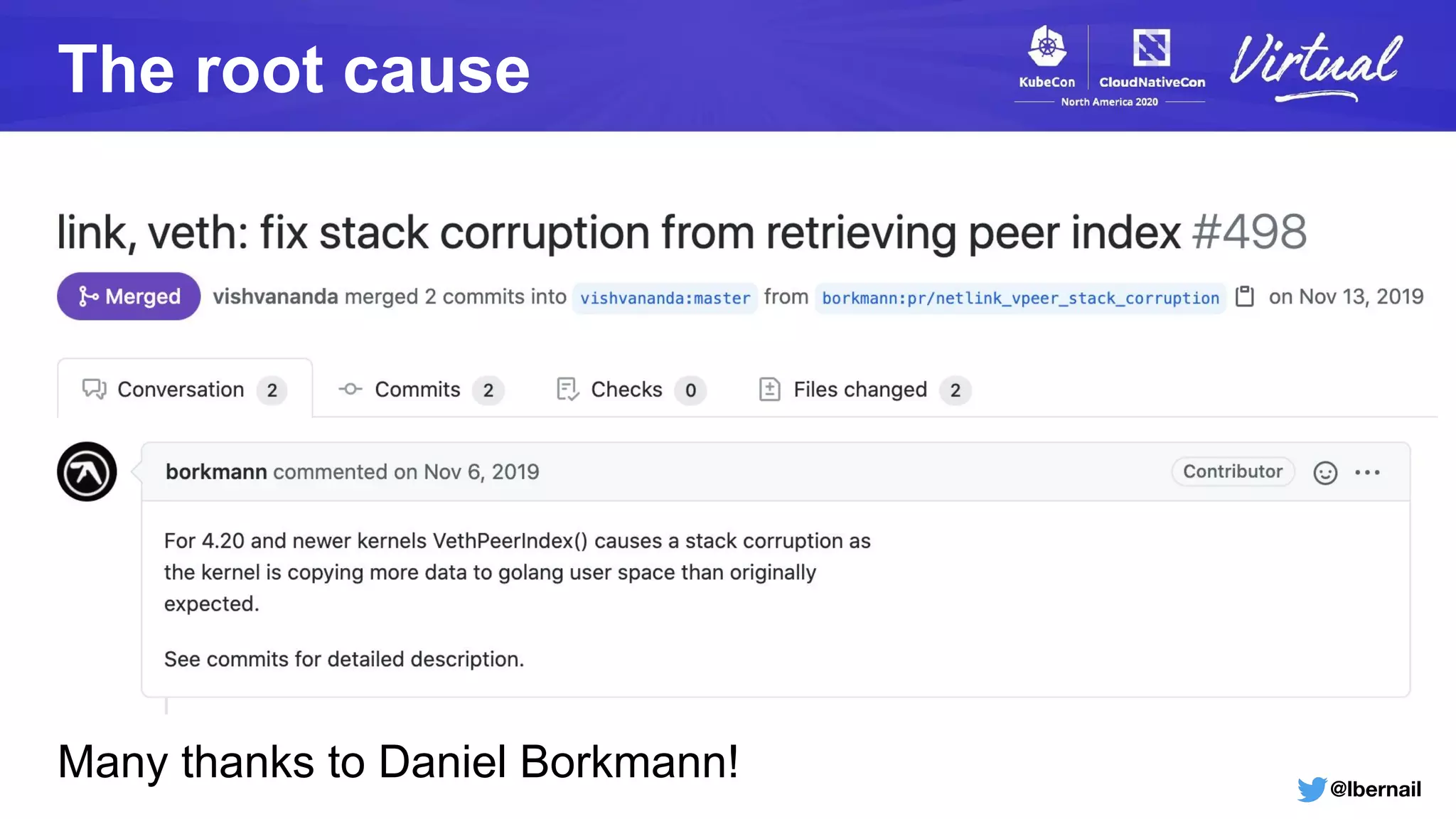
The root cause
Many thanks to Daniel Borkmann!
@lbernail
Summary
● Packer configured to use the latest Ubuntu 18.04
● The default kernel changed from 4.15 to 5.4
● Netlink library had a bug for kernels 4.20+
● Bug only happened on pod deletion
@lbernail
Status
● Containerd
○ Status calls trigger config file reload, which acquires a RWLock on the config mutex
○ CNI Add/Del calls acquire a RLock on the mutex
○ If CNI Add/Del hangs, Status calls block
○ Does not impact containerd 1.4+ (separate fsnotify.Watcher to reload config)
● cni-ipvlan-vpc-k8s ("Lyft" CNI plugin)
○ Bug in Netlink library with kernel 4.20+
○ Does not impact cni-ipvlan-vpc-k8s 0.6.2+ (different function used)
@lbernail
Key take-away
Nodes are not abstract compute resources
● Kernel
● Distribution
● Hardware
Error messages can be misleading
● For CNI errors, runtime usually reports a clear error
● Here we had nothing but a timeout
How a single app can overwhelm the
control plane
@lbernail
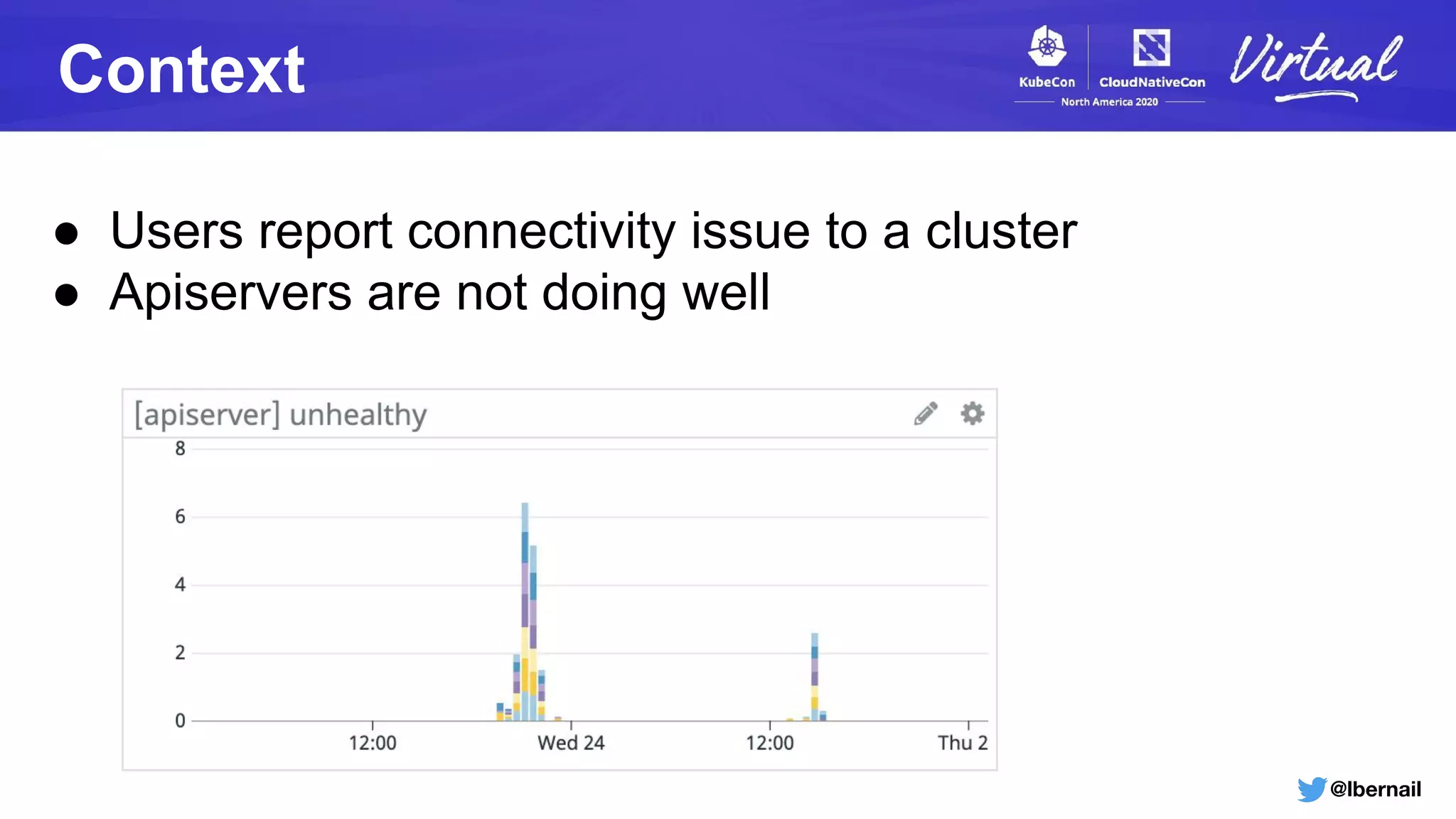
Context
● Users report connectivity issue to a cluster
● Apiservers are not doing well
@lbernail
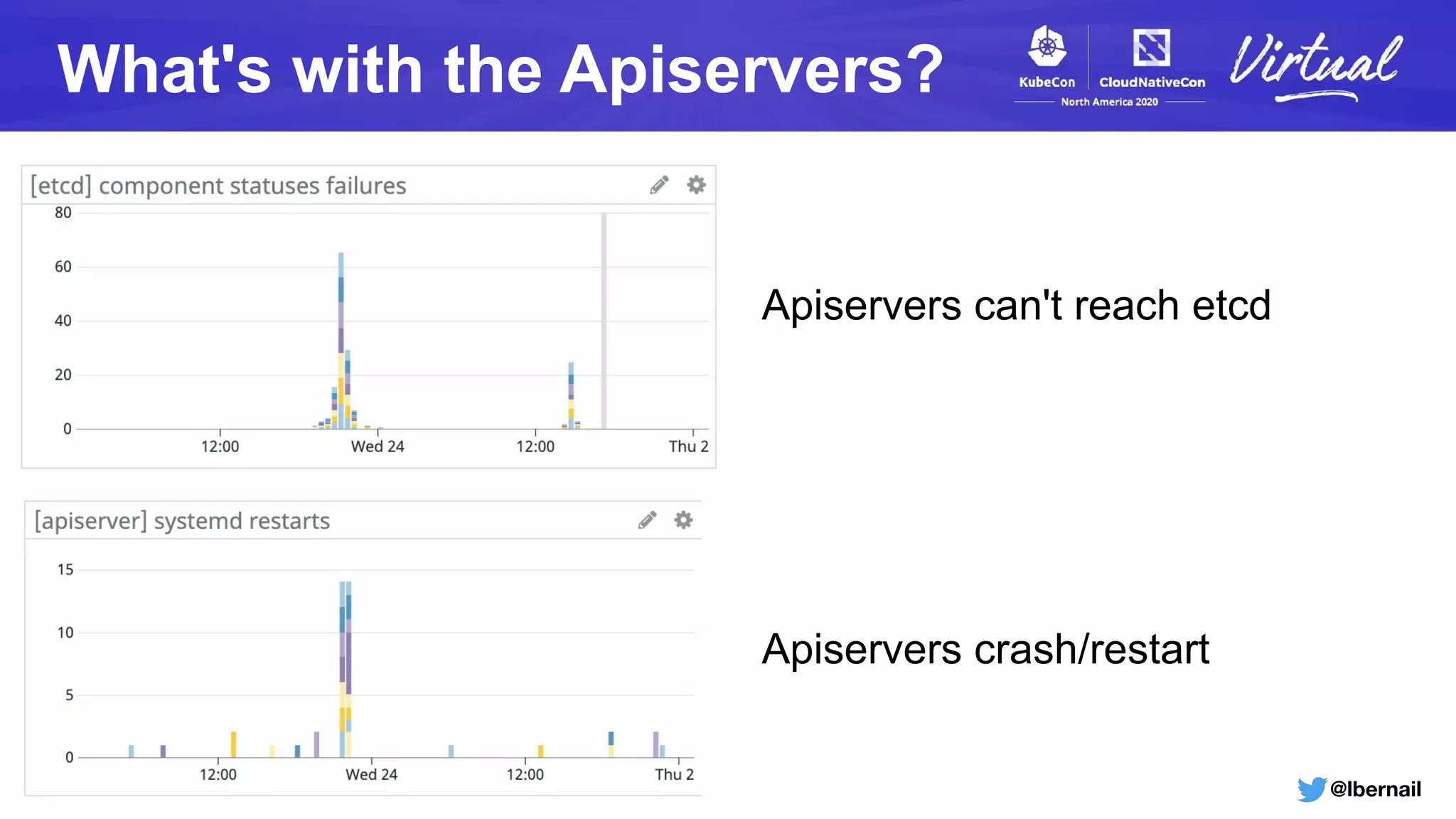
What's with the Apiservers?
Apiservers can't reach etcd
Apiservers crash/restart
@lbernail
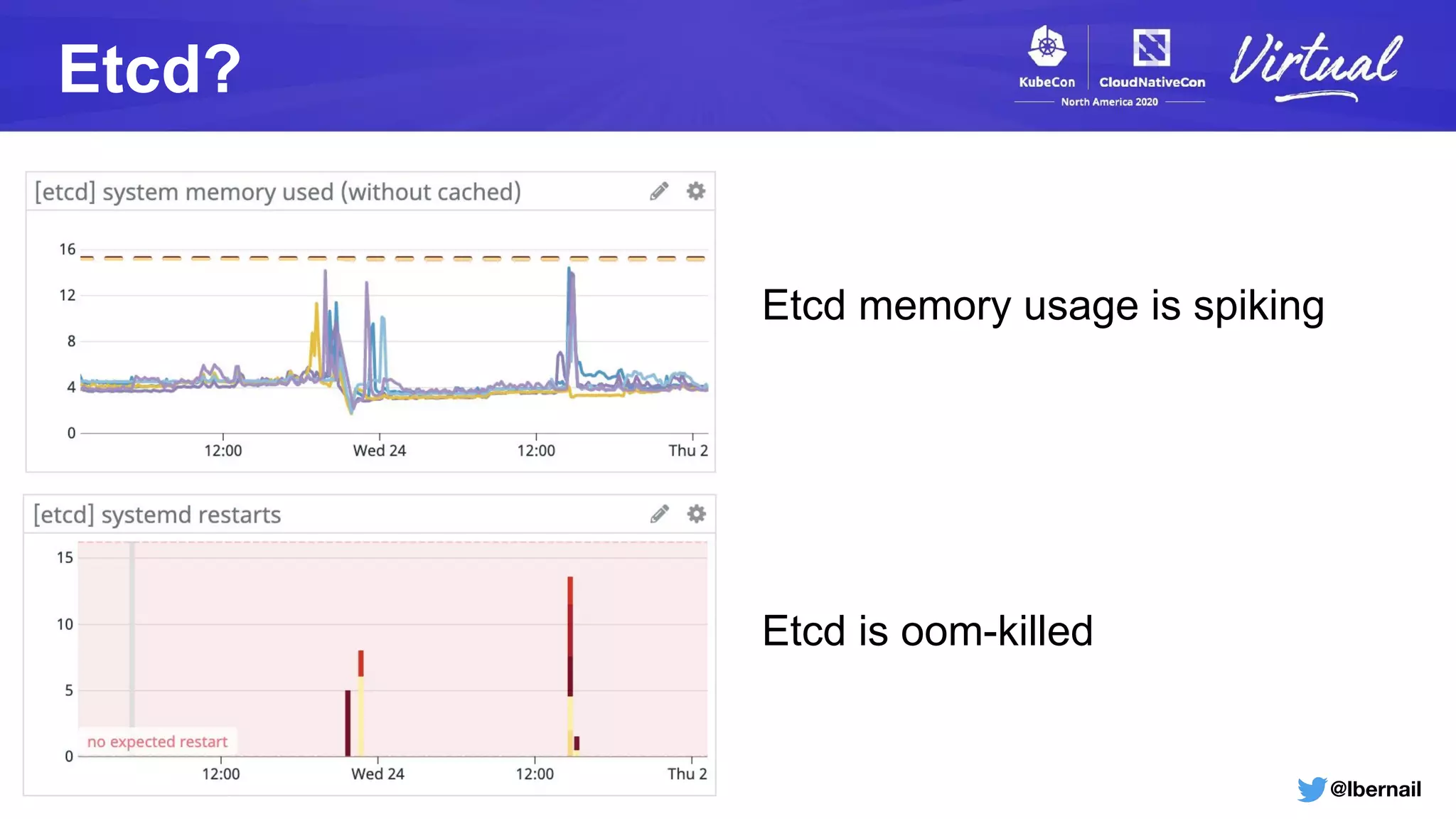
Etcd?
Etcd memory usage is spiking
Etcd is oom-killed
@lbernail
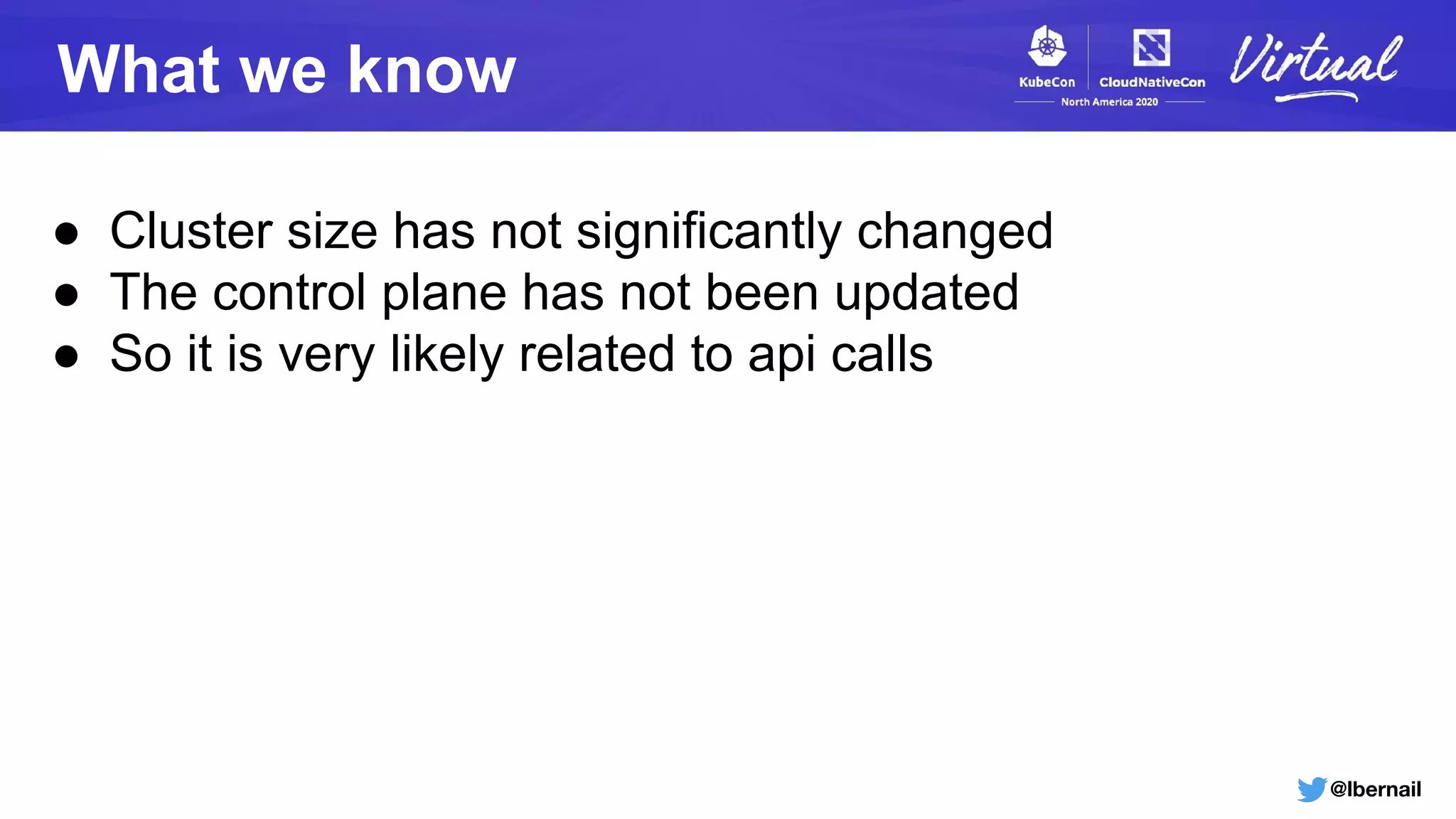
What we know
● Cluster size has not significantly changed
● The control plane has not been updated
● So it is very likely related to api calls
@lbernail
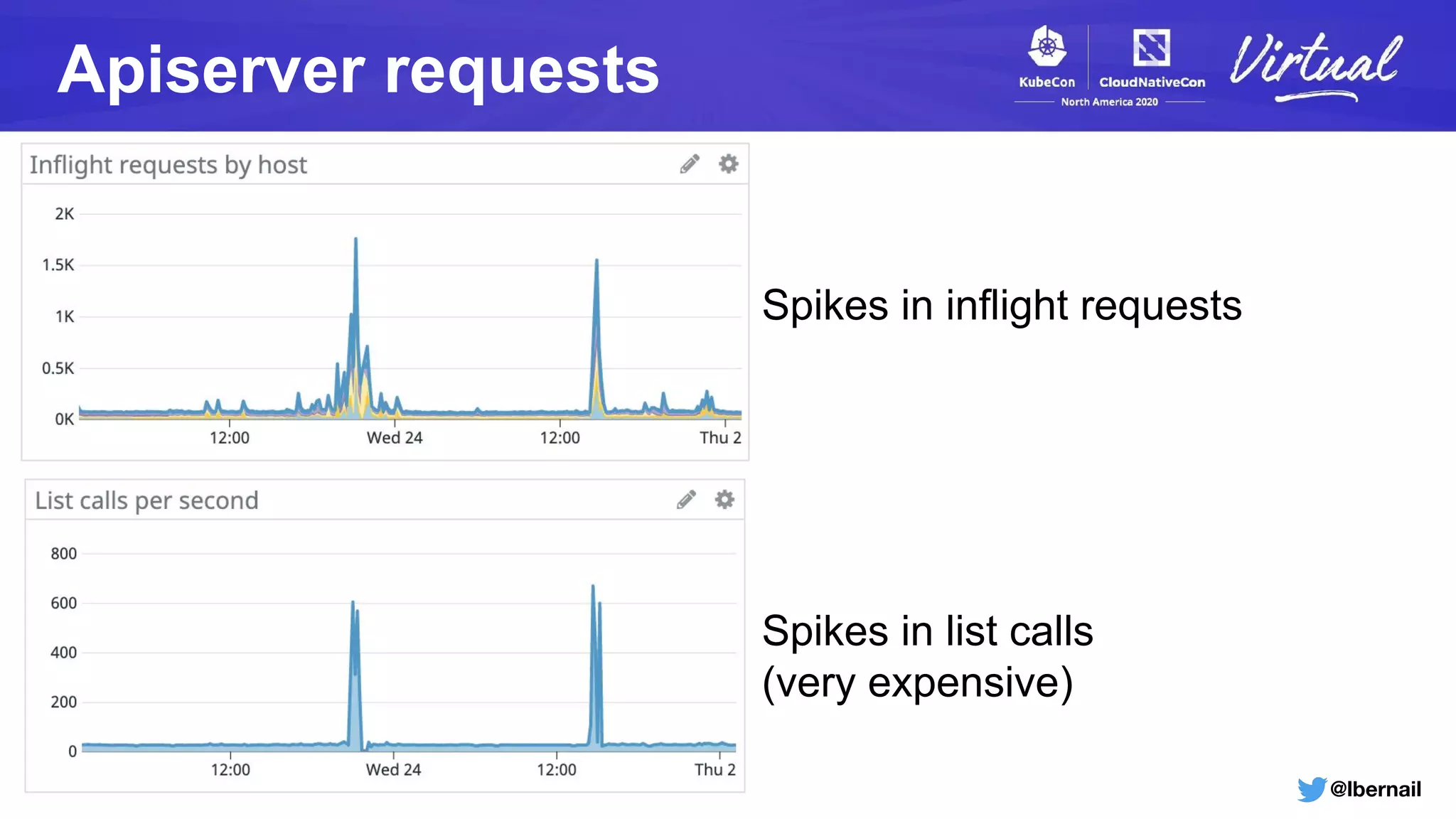
Apiserver requests
Spikes in inflight requests
Spikes in list calls
(very expensive)
@lbernail
Why are list calls expensive?
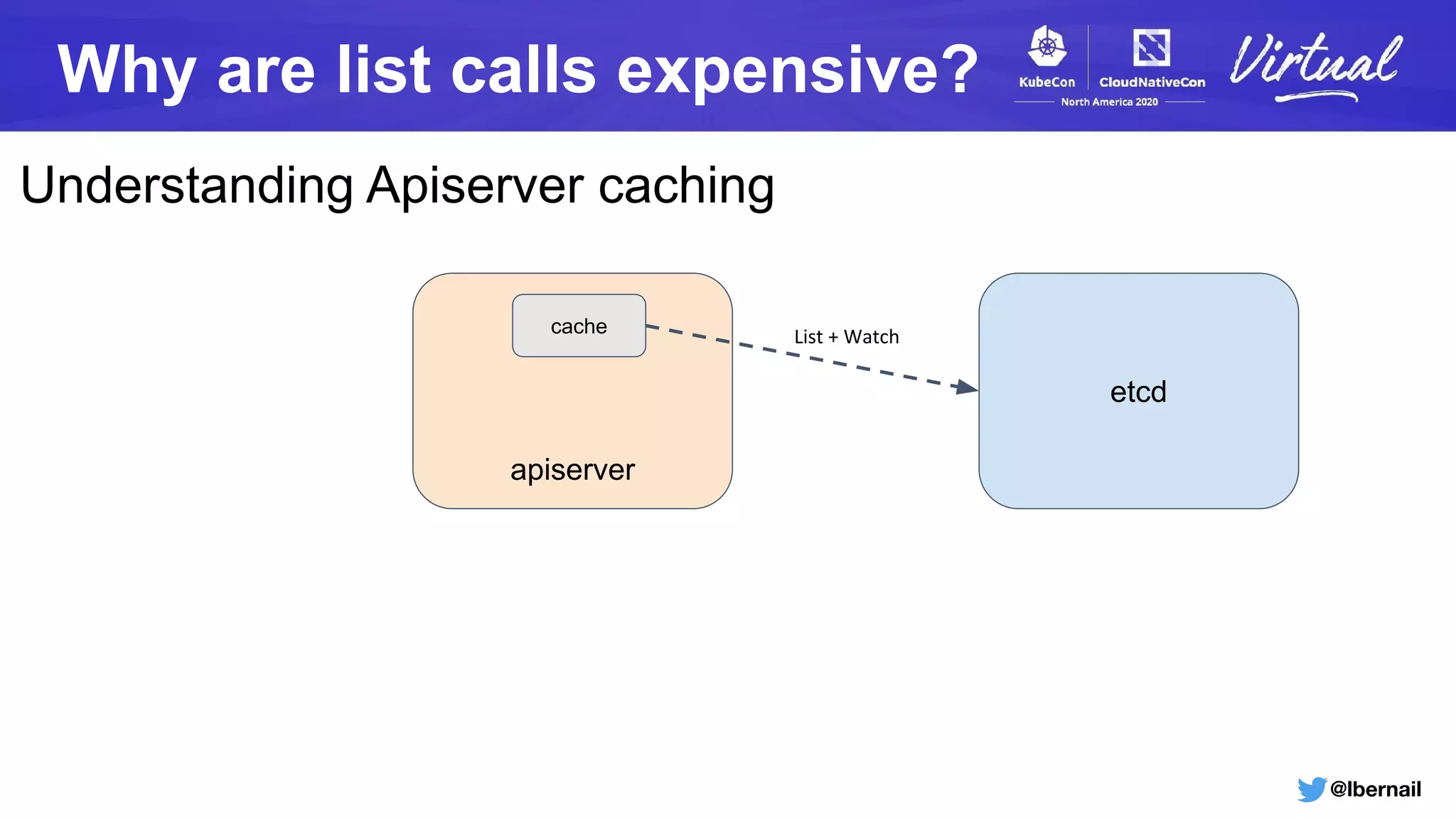
Understanding Apiserver caching
apiserver
etcd
cache List + Watch
@lbernail
Why are list calls expensive?
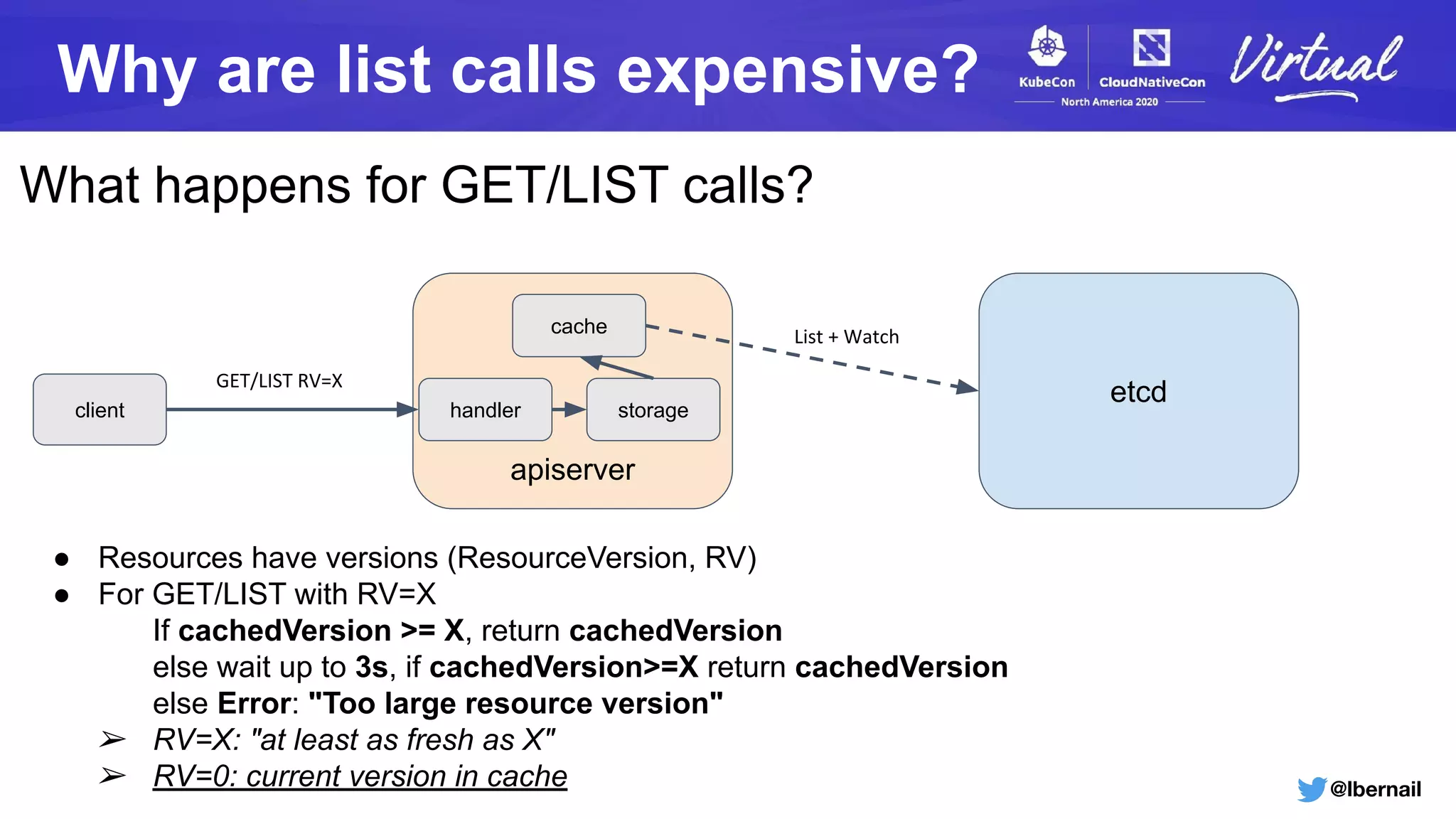
What happens for GET/LIST calls?
apiserver
etcd
cache List + Watch
client storagehandler
GET/LIST RV=X
● Resources have versions (ResourceVersion, RV)
● For GET/LIST with RV=X
If cachedVersion >= X, return cachedVersion
else wait up to 3s, if cachedVersion>=X return cachedVersion
else Error: "Too large resource version"
➢ RV=X: "at least as fresh as X"
➢ RV=0: current version in cache
@lbernail
Why are list calls expensive?
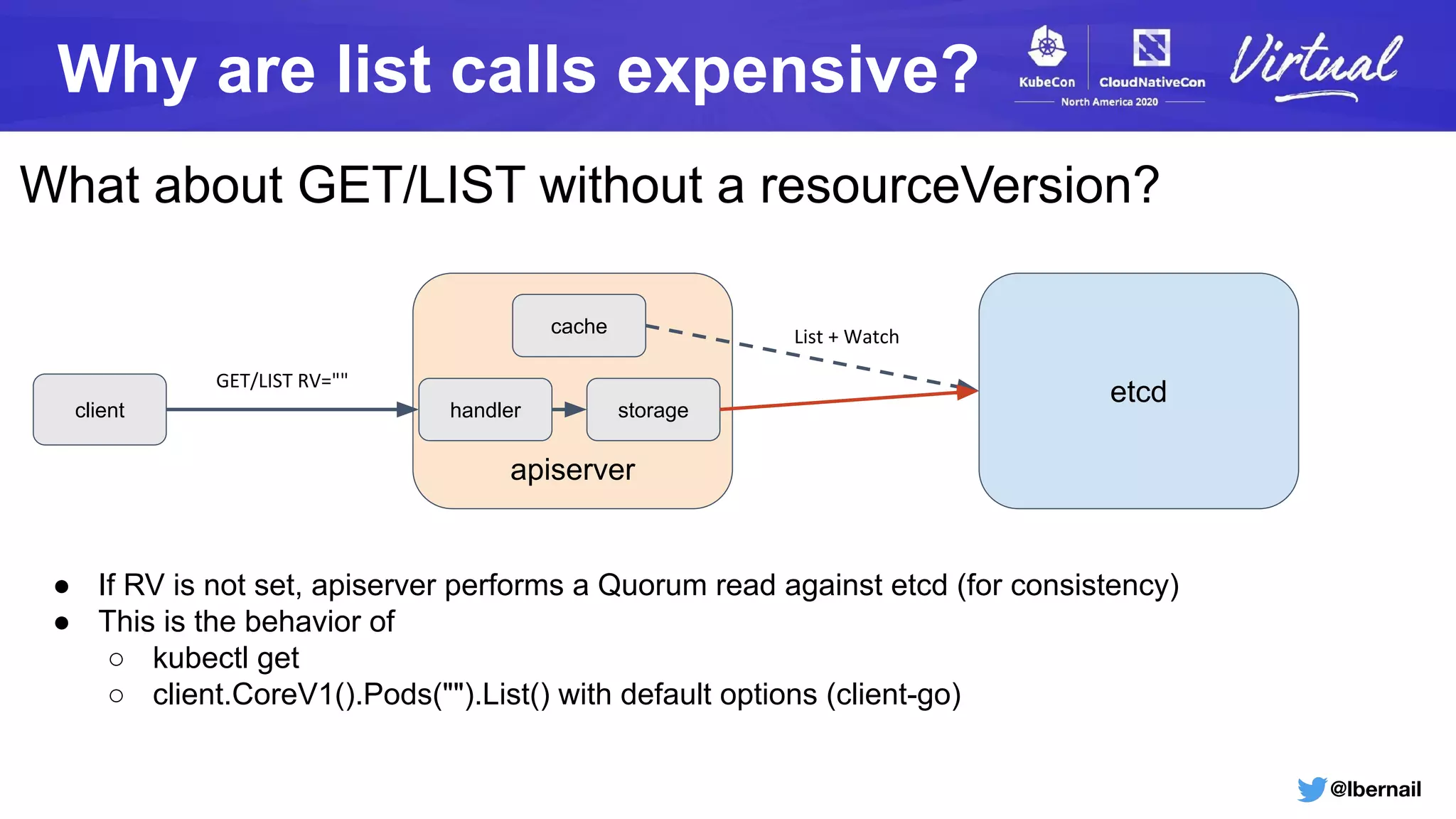
What about GET/LIST without a resourceVersion?
apiserver
etcd
cache List + Watch
client storagehandler
GET/LIST RV=""
● If RV is not set, apiserver performs a Quorum read against etcd (for consistency)
● This is the behavior of
○ kubectl get
○ client.CoreV1().Pods("").List() with default options (client-go)
@lbernail
Illustration
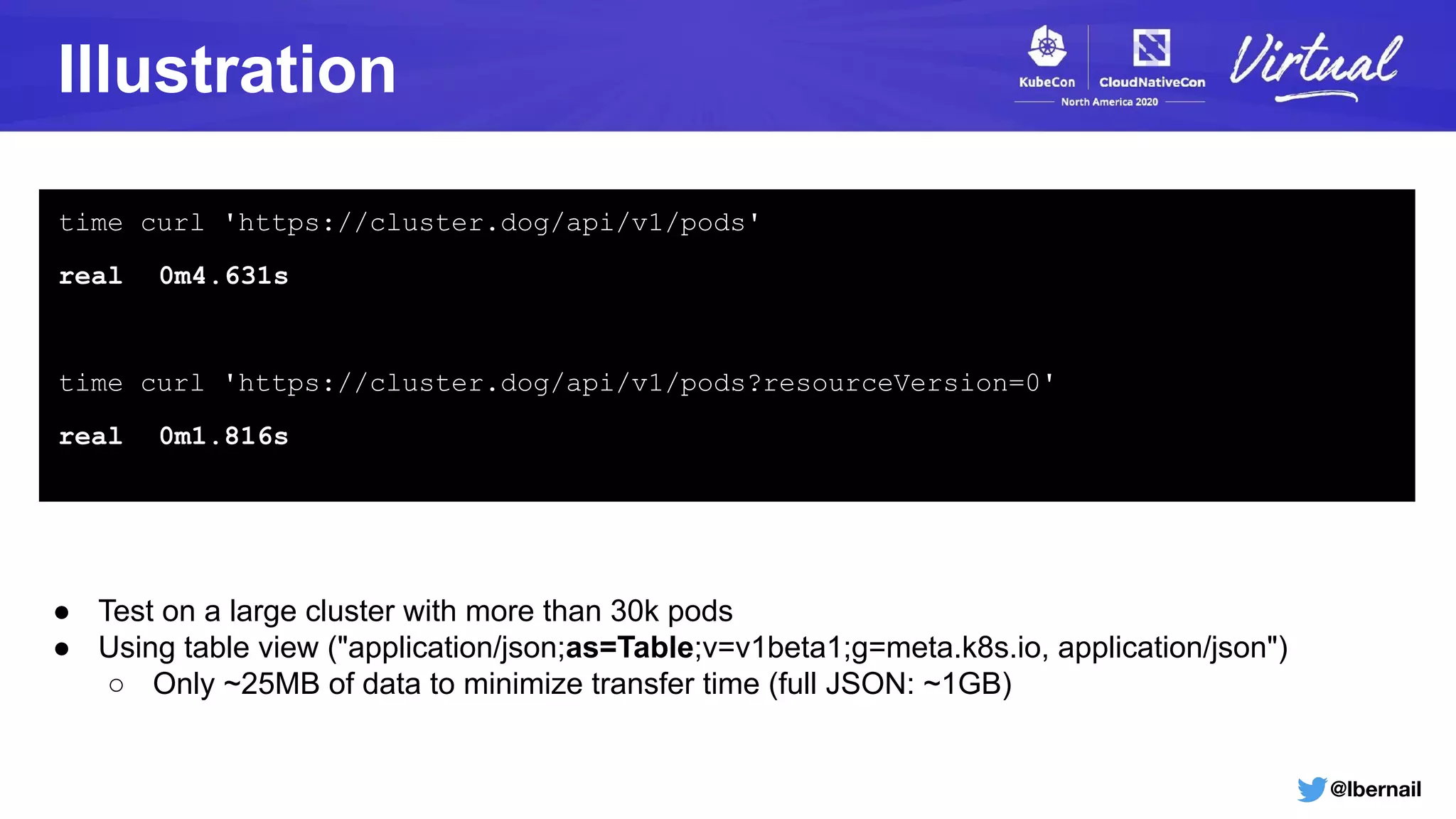
● Test on a large cluster with more than 30k pods
● Using table view ("application/json;as=Table;v=v1beta1;g=meta.k8s.io, application/json")
○ Only ~25MB of data to minimize transfer time (full JSON: ~1GB)
time curl 'https://cluster.dog/api/v1/pods'
real 0m4.631s
time curl 'https://cluster.dog/api/v1/pods?resourceVersion=0'
real 0m1.816s
@lbernail
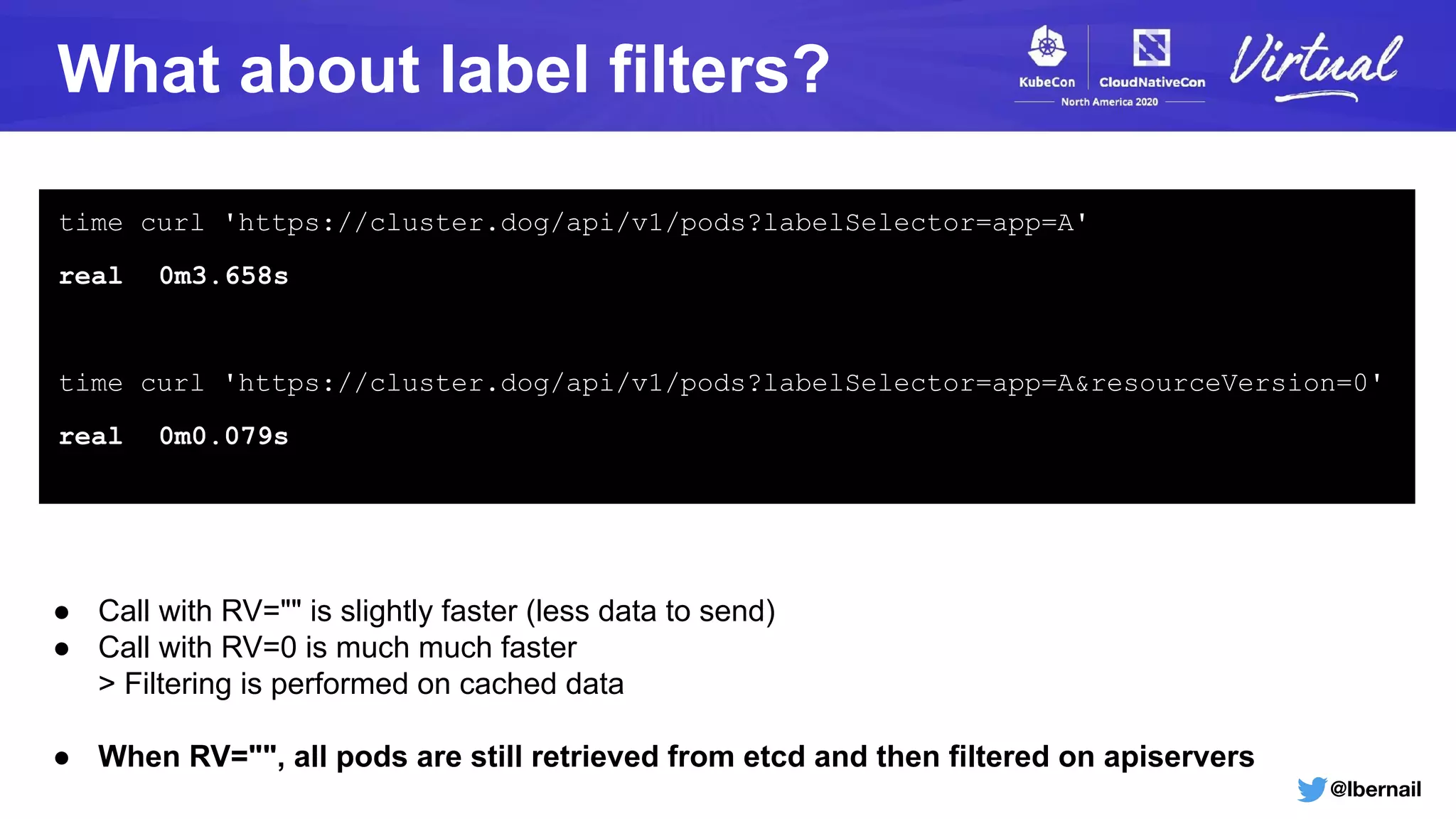
What about label filters?
time curl 'https://cluster.dog/api/v1/pods?labelSelector=app=A'
real 0m3.658s
time curl 'https://cluster.dog/api/v1/pods?labelSelector=app=A&resourceVersion=0'
real 0m0.079s
● Call with RV="" is slightly faster (less data to send)
● Call with RV=0 is much much faster
> Filtering is performed on cached data
● When RV="", all pods are still retrieved from etcd and then filtered on apiservers
@lbernail
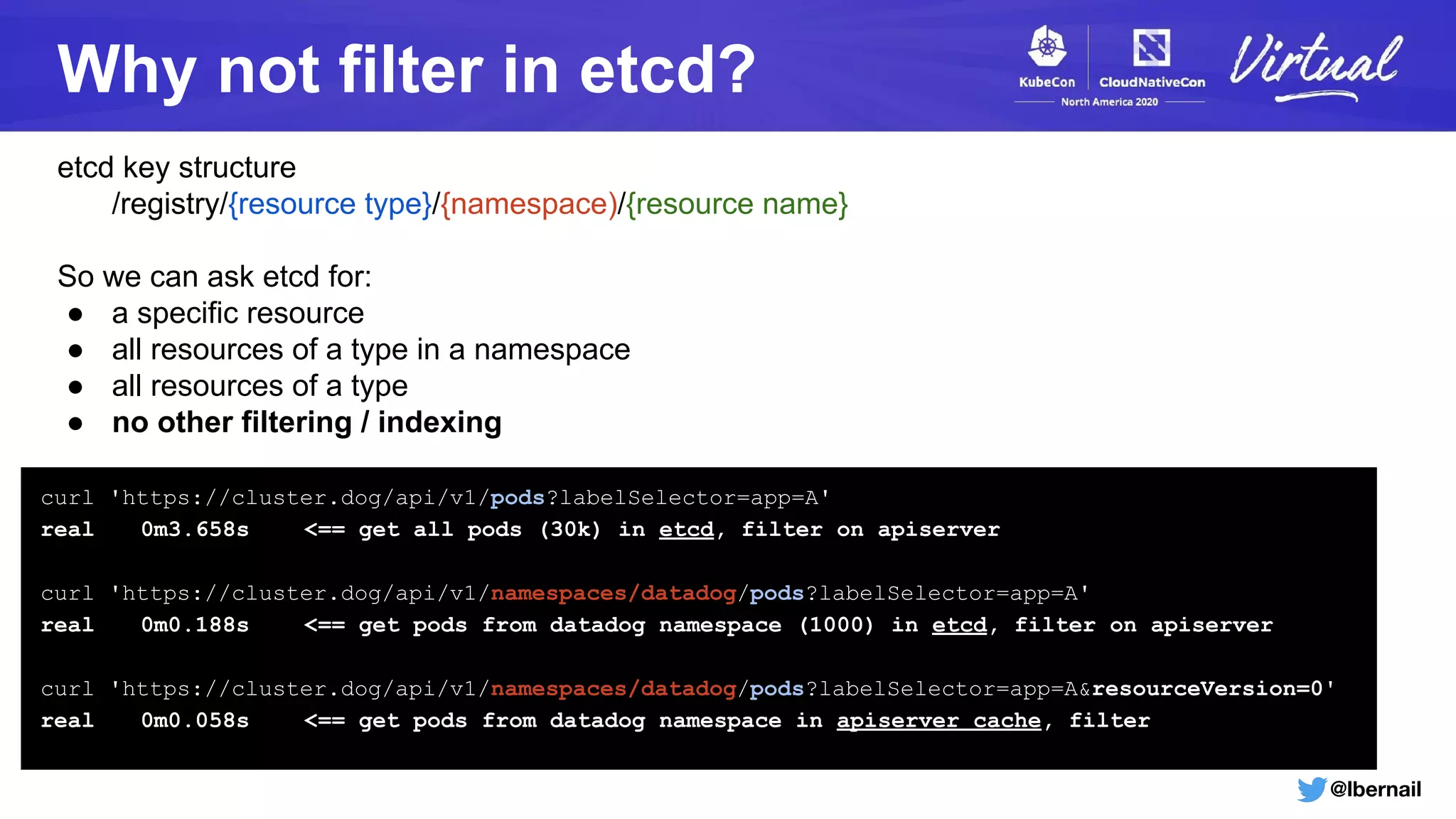
Why not filter in etcd?
etcd key structure
/registry/{resource type}/{namespace)/{resource name}
So we can ask etcd for:
● a specific resource
● all resources of a type in a namespace
● all resources of a type
● no other filtering / indexing
curl 'https://cluster.dog/api/v1/pods?labelSelector=app=A'
real 0m3.658s <== get all pods (30k) in etcd, filter on apiserver
curl 'https://cluster.dog/api/v1/namespaces/datadog/pods?labelSelector=app=A'
real 0m0.188s <== get pods from datadog namespace (1000) in etcd, filter on apiserver
curl 'https://cluster.dog/api/v1/namespaces/datadog/pods?labelSelector=app=A&resourceVersion=0'
real 0m0.058s <== get pods from datadog namespace in apiserver cache, filter
@lbernail
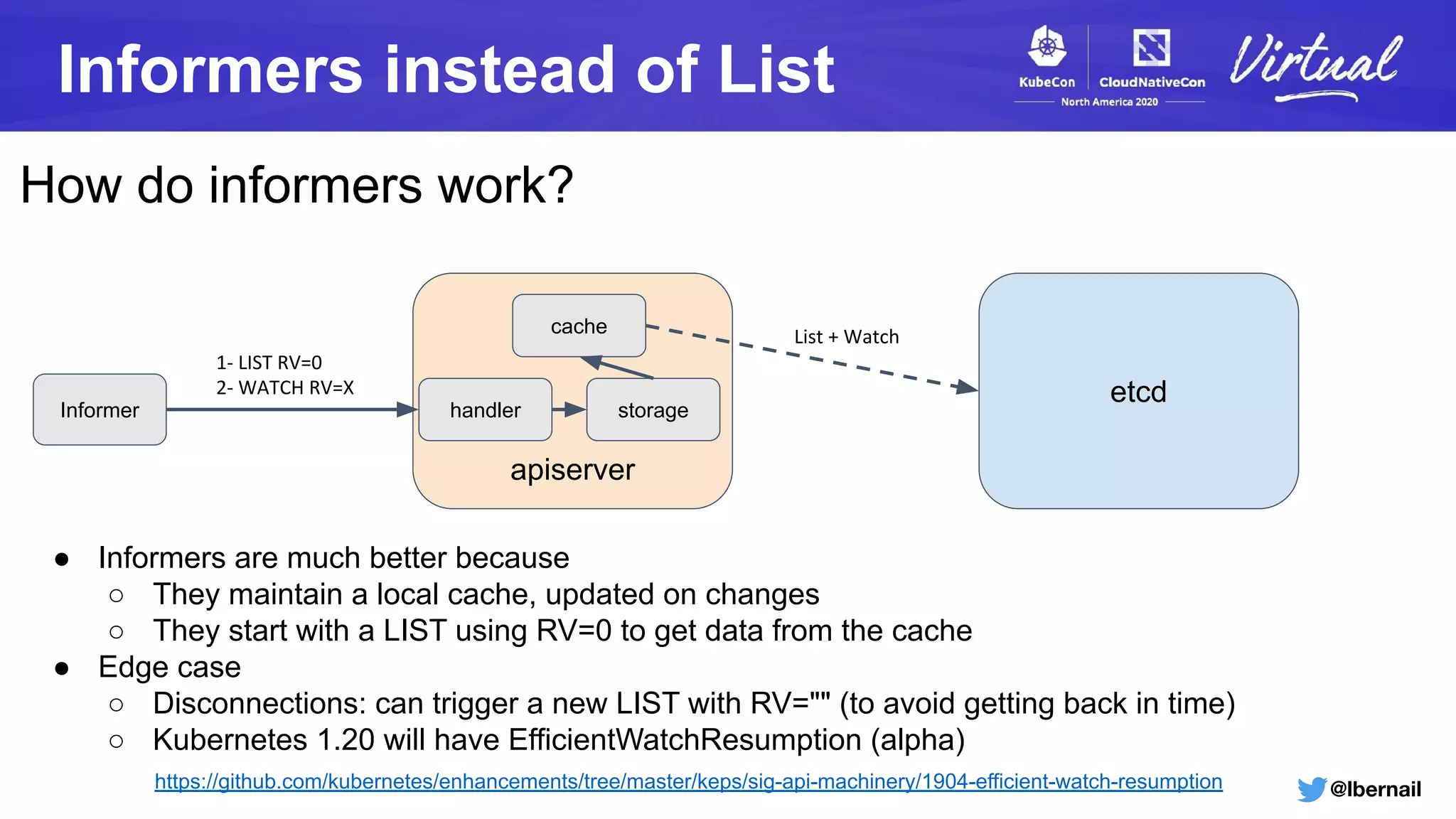
Informers instead of List
How do informers work?
apiserver
etcd
cache List + Watch
Informer storagehandler
1- LIST RV=0
2- WATCH RV=X
● Informers are much better because
○ They maintain a local cache, updated on changes
○ They start with a LIST using RV=0 to get data from the cache
● Edge case
○ Disconnections: can trigger a new LIST with RV="" (to avoid getting back in time)
○ Kubernetes 1.20 will have EfficientWatchResumption (alpha)
https://github.com/kubernetes/enhancements/tree/master/keps/sig-api-machinery/1904-efficient-watch-resumption
@lbernail
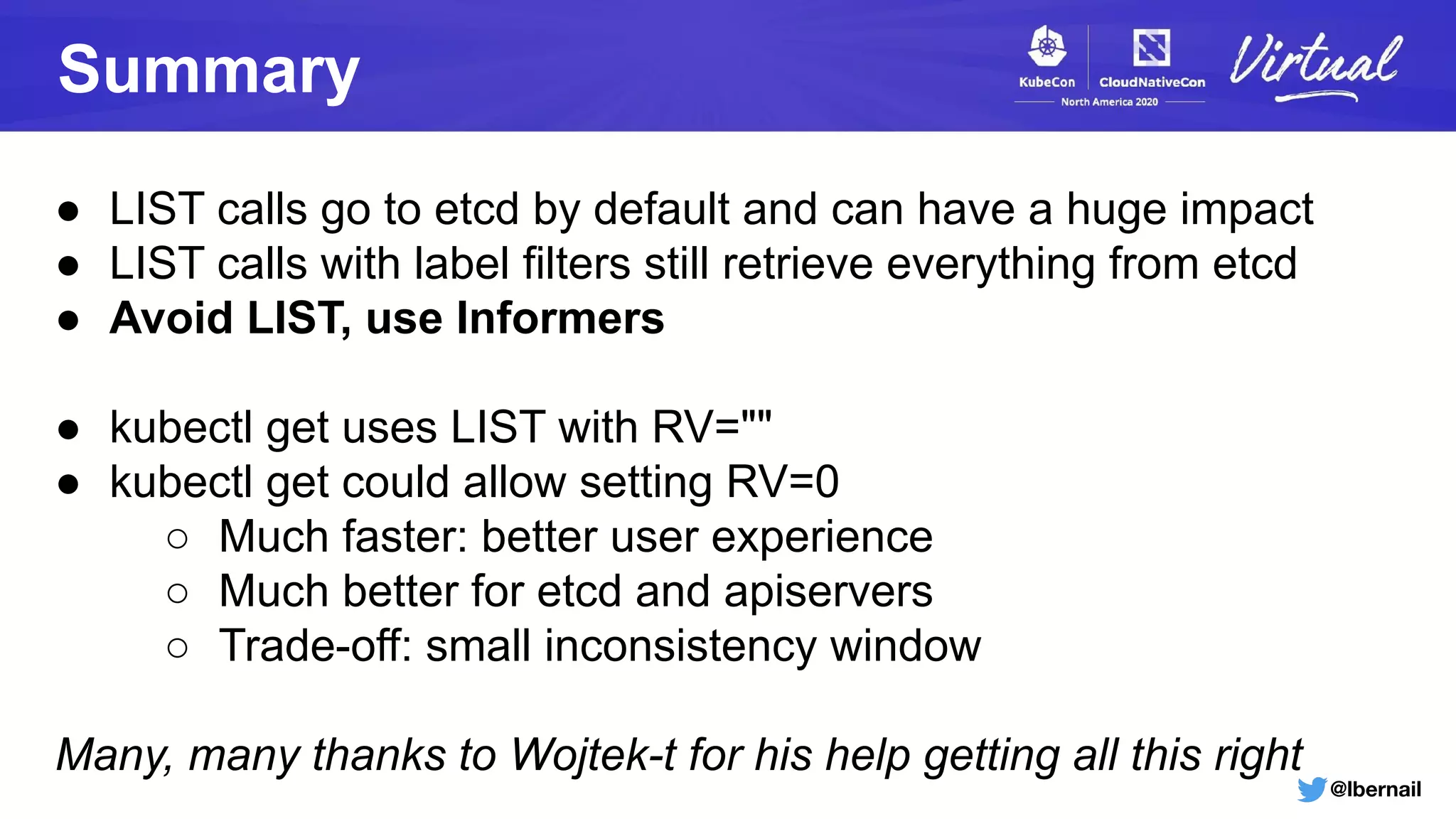
Summary
● LIST calls go to etcd by default and can have a huge impact
● LIST calls with label filters still retrieve everything from etcd
● Avoid LIST, use Informers
● kubectl get uses LIST with RV=""
● kubectl get could allow setting RV=0
○ Much faster: better user experience
○ Much better for etcd and apiservers
○ Trade-off: small inconsistency window
Many, many thanks to Wojtek-t for his help getting all this right
@lbernail
Back to the incident
● We know the problem comes from LIST calls
● What application is issuing these calls?
@lbernail
Audit logs
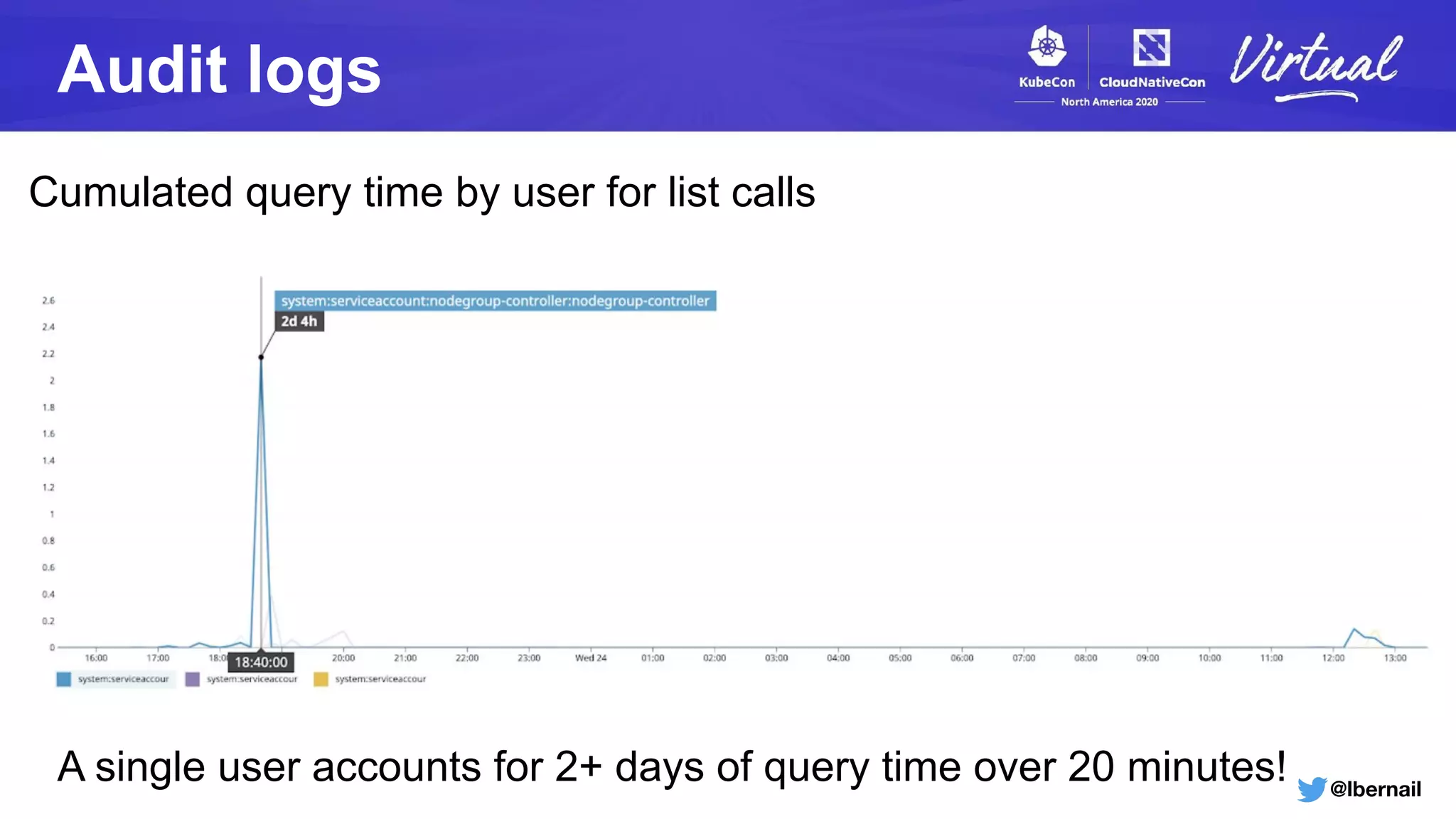
Cumulated query time by user for list calls
A single user accounts for 2+ days of query time over 20 minutes!
@lbernail
Audit logs
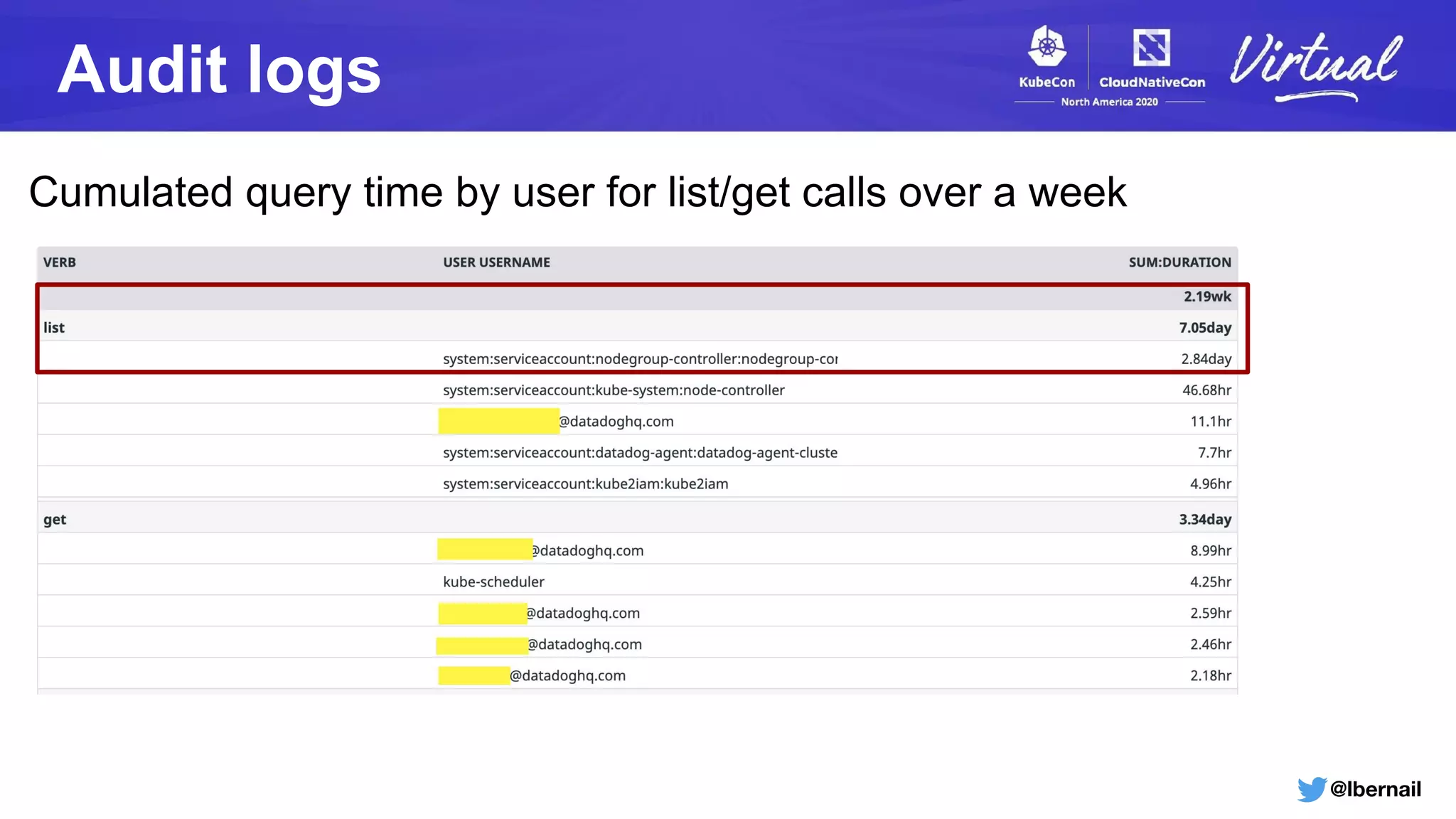
Cumulated query time by user for list/get calls over a week
@lbernail
Nodegroup controller?
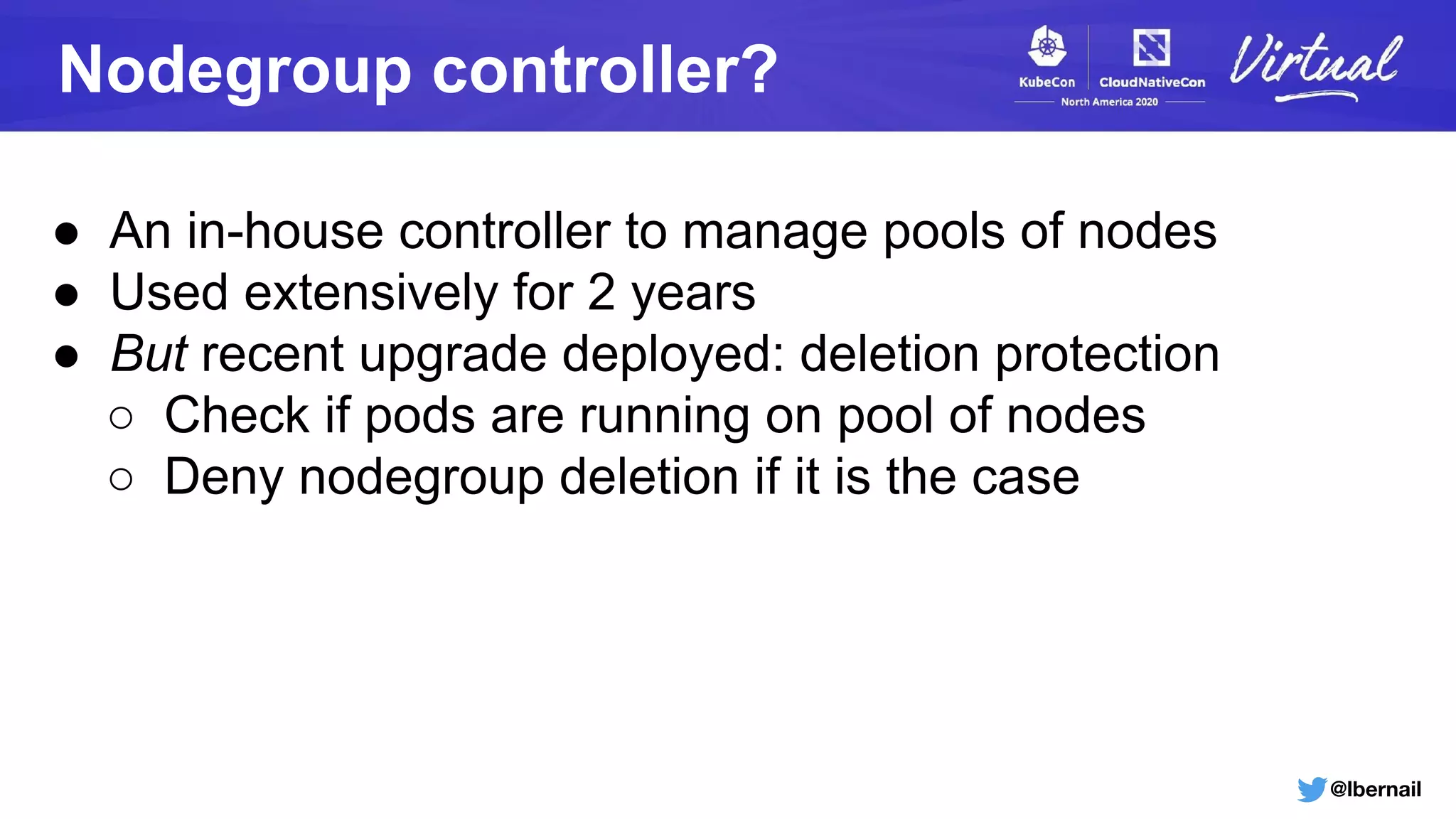
● An in-house controller to manage pools of nodes
● Used extensively for 2 years
● But recent upgrade deployed: deletion protection
○ Check if pods are running on pool of nodes
○ Deny nodegroup deletion if it is the case
@lbernail
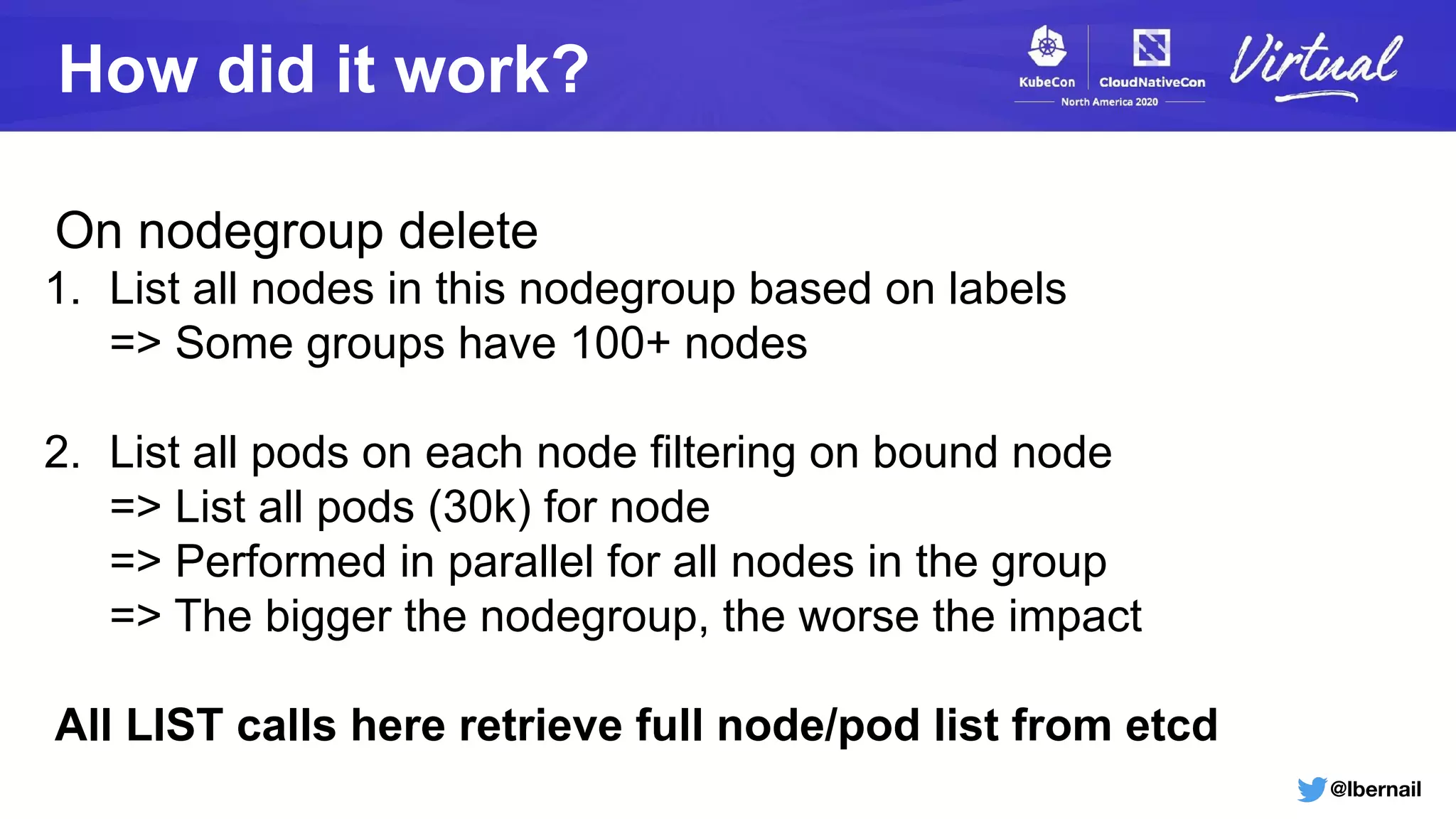
How did it work?
On nodegroup delete
1. List all nodes in this nodegroup based on labels
=> Some groups have 100+ nodes
2. List all pods on each node filtering on bound node
=> List all pods (30k) for node
=> Performed in parallel for all nodes in the group
=> The bigger the nodegroup, the worse the impact
All LIST calls here retrieve full node/pod list from etcd
@lbernail
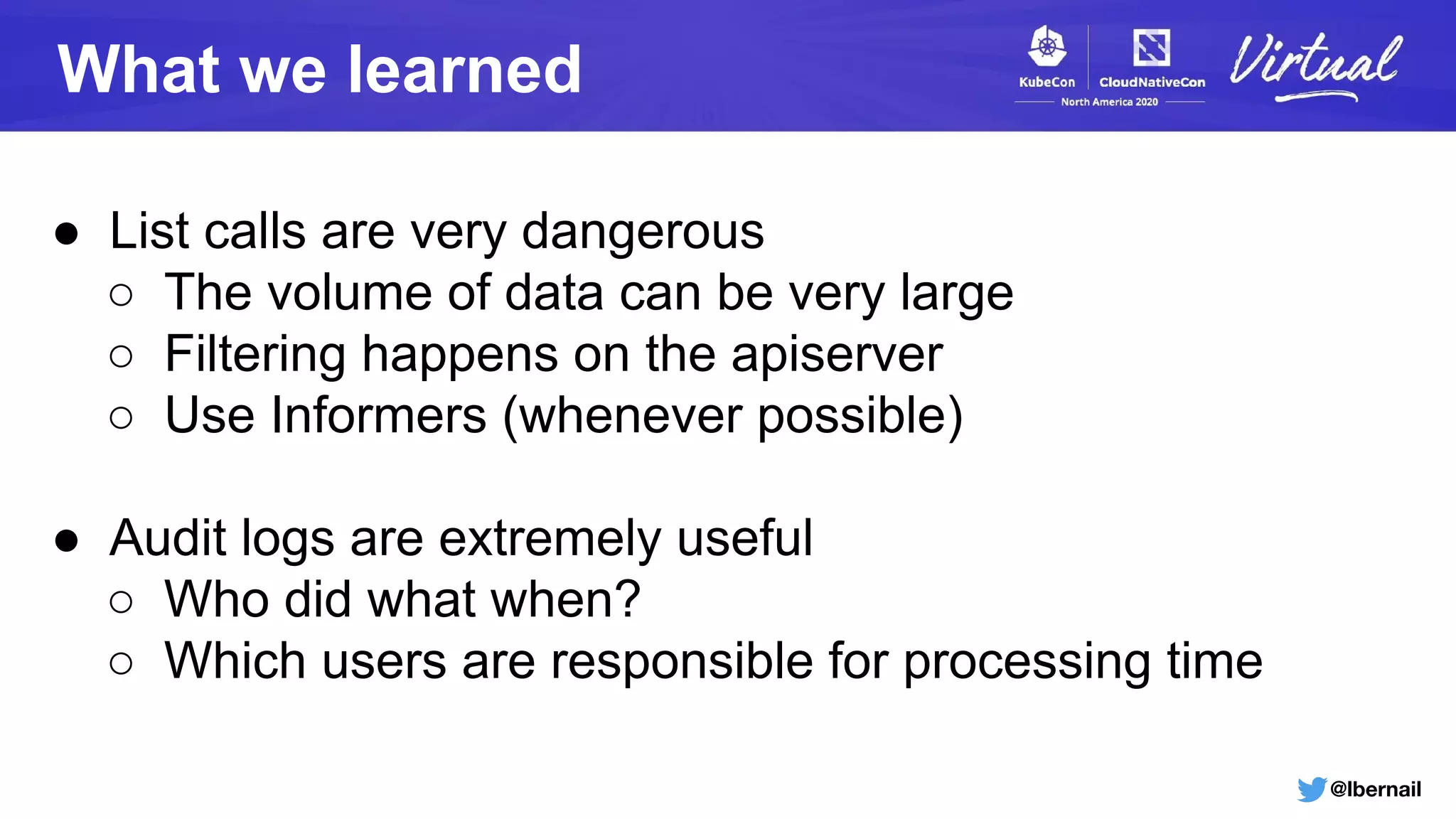
What we learned
● List calls are very dangerous
○ The volume of data can be very large
○ Filtering happens on the apiserver
○ Use Informers (whenever possible)
● Audit logs are extremely useful
○ Who did what when?
○ Which users are responsible for processing time
Conclusion
@lbernail
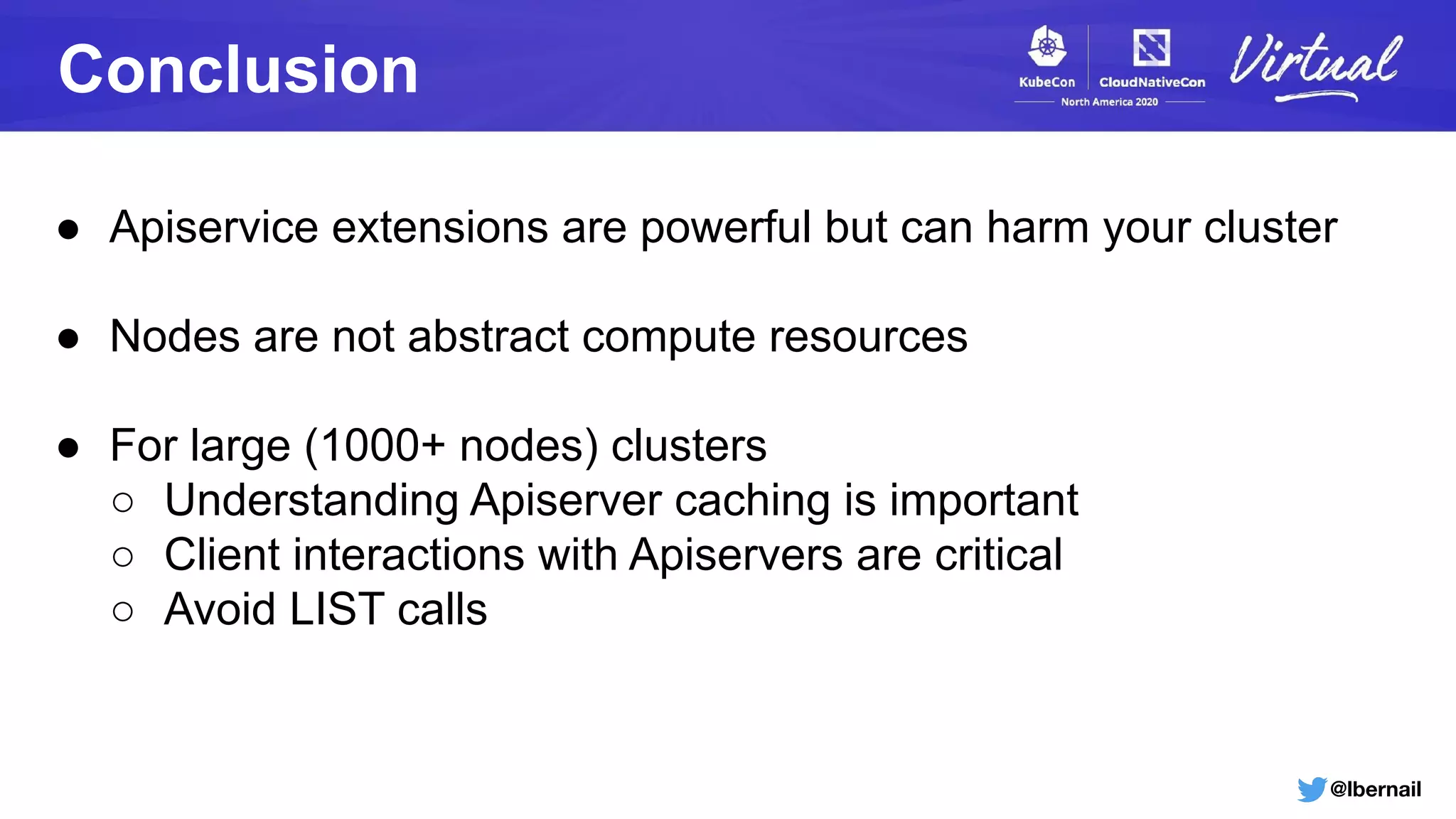
Conclusion
● Apiservice extensions are powerful but can harm your cluster
● Nodes are not abstract compute resources
● For large (1000+ nodes) clusters
○ Understanding Apiserver caching is important
○ Client interactions with Apiservers are critical
○ Avoid LIST calls
@lbernail
Thank you
We’re hiring!
https://www.datadoghq.com/careers/
laurent@datadoghq.com
@lbernail
@lbernail
How the OOM Killer Deleted My Namespace

How the OOM Killer Deleted My Namespace

  • 1.
    Laurent Bernaille How theOOM-Killer Deleted my Namespace (and Other Kubernetes Tales)
  • 2.
    @lbernail Datadog Over 400 integrations Over1,500 employees Over 12,000 customers Runs on millions of hosts Trillions of data points per day 10000s hosts in our infra 10s of k8s clusters with 100-4000 nodes Multi-cloud Very fast growth
  • 3.
    @lbernail Context ● We haveshared a few stories already ○ Kubernetes the Very Hard Way ○ 10 Ways to Shoot Yourself in the Foot with Kubernetes ○ Kubernetes DNS horror stories ● The scale of our Kubernetes infra keeps growing ○ New scalability issues ○ But also, much more complex problems
  • 4.
    How The OOM-killerDeleted my Namespace
  • 5.
    @lbernail "My namespace andeverything in it are completely gone" Symptoms
  • 6.
    @lbernail Feb 17 14:30:Namespace and workloads deleted Investigation DeleteCollection calls by resource (audit logs)
  • 7.
    @lbernail Audit logs ● Deletecalls for all resources in the namespace ● No delete call for the namespace resource Why was the namespace deleted?? Investigation
  • 8.
    @lbernail Deletion call, 4dbefore Audit logs for the namespace Feb 13th (resource deletion happened on Feb 17th) Successful namespace delete call, 4d before workloads were deleted
  • 9.
    @lbernail Engineer did notdelete the namespace But engineer was migrating to new deployment method
  • 10.
  • 11.
    @lbernail Helm 3 deploys(v2) chart deploy helm upgrade
  • 12.
  • 13.
  • 14.
  • 15.
    @lbernail What happened? 1- Chartrefactoring: move namespace out of it 2- Deployment: deletes namespace But why did it take 4 days ?
  • 16.
    @lbernail Namespace Controller Discover allAPI resources Delete all resources in namespace
  • 17.
    @lbernail Namespace Controller => Ifdiscovery fails, namespace content is not deleted Kubernetes 1.14+: Delete as many resources as possible Kubernetes 1.16+: Add Conditions to namespaces to surface errors
  • 18.
    @lbernail Namespace Controller logs unableto retrieve the complete list of server APIs: metrics.k8s.io/v1beta1: the server is currently unable to handle the request Controller-manager contained many occurrences of No context so hard to link with the incident but ● This is the error from the Discovery call ● We have a likely cause: metrics.k8s.io/v1beta1
  • 19.
    @lbernail metrics-server ● Additional controllerproviding node/pod metrics ● Registers an ApiService ○ Additional Kubernetes APIs ○ Managed by the external controller Additional APIs (group and version) Where should the apiserver proxy calls for this APIs
  • 20.
    @lbernail Events so far ●Feb 13th: namespace deletion call ● Feb 13-17th ○ Namespace controller can't discover metrics APIs ○ Namespace content is not deleted ○ At each sync, controller retries and fails ● Feb 17th ○ ? ○ Namespace controller is unblocked ○ Everything in the namespace is deleted
  • 21.
    @lbernail Events so far ●Feb 13th: error leads to namespace deletion call ● Feb 13-17th ○ Namespace controller can't discover metrics APIs ○ Namespace content is not deleted ○ At each sync, controller retries and fails ● Feb 17th ○ OOM-killer kills metrics-server and it is restarted ○ Metrics-server is now working fine ○ Namespace controller is unblocked ○ Everything in the namespace is deleted
  • 22.
  • 23.
    @lbernail Metrics-server setup metrics-server certificate management sidecar pkill Pod withtwo containers ● metrics-server ● sidecar: rotate server certificate, and signal metrics-server to reload Requires shared pid namespace ● shareProcessNamespace (pod spec) ● PodShareProcessNamespace (feature gate on Kubelet and Apiserver)
  • 24.
    @lbernail Metrics-server deployment metrics-server othercontrollers coredns Deployed on a pool of nodes dedicated to core controllers ("system")
  • 25.
    @lbernail Metrics-server deployment "old" nodes noPodShareProcessNamespace Subset of nodes using an old image without PodShareProcessNamespace ● metrics-server: fine until it was rescheduled on an old node ● At this point, server certificate is no longer reloaded recent nodes metrics-server
  • 26.
    @lbernail Full chain ofevents ● Before Feb 13th ○ metrics-server scheduled on a "bad" node ○ controller discovery calls fail ● Feb 13th: error leads to namespace deletion call ● Feb 13-17th ○ Namespace controller can't discover metrics APIs ○ Namespace content is not deleted ○ At each sync, controller retries and fails ● Feb 17th ○ OOM-killer kills metrics-server and it is restarted ○ Metrics-server is now working fine (certificate up to date) ○ Namespace controller is unblocked ○ Everything in the namespace is deleted
  • 27.
    @lbernail Key take-away ● Apiserviceextensions are great but can impact your cluster ○ If the API is not used, they can be down for days without impact ○ But some controllers need to discover all apis and will fail ● In addition, Apiservice extensions security is hard ○ If you are curious, go and see
  • 28.
    New node imagedoes not work and it's Weird...
  • 29.
    @lbernail Context ● We buildimages for our Kubernetes nodes ● A small change pushed ● Nodes become NotReady after a few days ● Change completely unrelated to kubelet / runtime ● We can't promote to Prod
  • 30.
    @lbernail Investigation Conditions: Type Status ReasonMessage ---- ------ ------ ------- OutOfDisk False KubeletHasSufficientDisk kubelet has sufficient disk space available MemoryPressure False KubeletHasSufficientMemory kubelet has sufficient memory available DiskPressure False KubeletHasNoDiskPressure kubelet has no disk pressure PIDPressure False KubeletHasSufficientPID kubelet has sufficient PID available Ready False KubeletNotReady container runtime is down Node description
  • 31.
    @lbernail Runtime is down? $crictl pods POD ID STATE NAME NAMESPACE 681bb3aec7fba Ready local-volume-provisioner-jtwzf local-volume-provisioner 53f122f351da2 Ready datadog-agent-qctt2-8ljgp datadog-agent c1edb4f19713c Ready localusers-z26n9 prod-platform 01cf5cafd6bc9 Ready node-monitoring-ws2xf node-monitoring 39f01bdaade86 Ready kube2iam-zzdt6 kube2iam 3fcf520680a63 Ready kube-proxy-sr7tn kube-system 5ecd0966634f1 Ready node-local-dns-m2zbp coredns Looks completely fine Let's look at containerd
  • 32.
    @lbernail Kubelet logs remote_runtime.go:434] Statusfrom runtime service failed: rpc error: code = DeadlineExceeded desc = context deadline exceeded kubelet.go:2130] Container runtime sanity check failed: rpc error: code = DeadlineExceeded desc = context deadline exceeded kubelet.go:1803] skipping pod synchronization - [container runtime is down] "Status from runtime service failed" ➢ Is there a CRI call for this? Something is definitely wrong
  • 33.
    @lbernail Testing with crictl ●crictl has no "status" subcommand ● but "crictl info" looks close, let's check
  • 34.
    @lbernail Crictl info $ crictlinfo ^C ● Hangs indefinitely ● But what does Status do? ● Almost nothing, except this
  • 35.
    @lbernail CNI status ● Reallynot much here right? ● But we have calls that hang and a lock ● Could this be related?
  • 36.
    @lbernail Containerd goroutine dump containerd[737]:goroutine 107298383 [semacquire, 2 minutes]: containerd[737]: goroutine 107290532 [semacquire, 4 minutes]: containerd[737]: goroutine 107282673 [semacquire, 6 minutes]: containerd[737]: goroutine 107274360 [semacquire, 8 minutes]: containerd[737]: goroutine 107266554 [semacquire, 10 minutes]: Blocked goroutines? The runtime error from the kubelet also happens every 2mn containerd[737]: goroutine 107298383 [semacquire, 2 minutes]: ... containerd[737]: .../containerd/vendor/github.com/containerd/go-cni.(*libcni).Status() containerd[737]: .../containerd/vendor/github.com/containerd/go-cni/cni.go:126 containerd[737]: .../containerd/vendor/github.com/containerd/cri/pkg/server.(*criService).Status(...) containerd[737]: .../containerd/containerd/vendor/github.com/containerd/cri/pkg/server/status.go:45 Goroutine details match exactly the codepath we looked at
  • 37.
    @lbernail Seems CNI related Let'sbypass containerd/kubelet $ ip netns add debug $ CNI_PATH=/opt/cni/bin cnitool add pod-network /var/run/netns/debug Works great and we even have connectivity $ ip netns exec debug ping 8.8.8.8 PING 8.8.8.8 (8.8.8.8) 56(84) bytes of data. 64 bytes from 8.8.8.8: icmp_seq=1 ttl=111 time=2.41 ms 64 bytes from 8.8.8.8: icmp_seq=2 ttl=111 time=1.70 ms 64 bytes from 8.8.8.8: icmp_seq=3 ttl=111 time=1.76 ms 64 bytes from 8.8.8.8: icmp_seq=4 ttl=111 time=1.72 ms
  • 38.
    @lbernail What about Delete? $CNI_PATH=/opt/cni/bin cnitool del pod-network /var/run/netns/debug ^C ● hangs indefinitely ● and we can even find the original process still running ps aux | grep cni root 367 0.0 0.1 410280 8004 ? Sl 15:37 0:00 /opt/cni/bin/cni-ipvlan-vpc-k8s-unnumbered-ptp
  • 39.
    @lbernail CNI plugin ● Onthis cluster we use the Lyft CNI plugin ● The delete calls fails for cni-ipvlan-vpc-k8s-unnumbered-ptp ● After a few tests, we tracked the problem to this call ● Weird, this is in the netlink library!
  • 40.
    @lbernail The root cause Manythanks to Daniel Borkmann!
  • 41.
    @lbernail Summary ● Packer configuredto use the latest Ubuntu 18.04 ● The default kernel changed from 4.15 to 5.4 ● Netlink library had a bug for kernels 4.20+ ● Bug only happened on pod deletion
  • 42.
    @lbernail Status ● Containerd ○ Statuscalls trigger config file reload, which acquires a RWLock on the config mutex ○ CNI Add/Del calls acquire a RLock on the mutex ○ If CNI Add/Del hangs, Status calls block ○ Does not impact containerd 1.4+ (separate fsnotify.Watcher to reload config) ● cni-ipvlan-vpc-k8s ("Lyft" CNI plugin) ○ Bug in Netlink library with kernel 4.20+ ○ Does not impact cni-ipvlan-vpc-k8s 0.6.2+ (different function used)
  • 43.
    @lbernail Key take-away Nodes arenot abstract compute resources ● Kernel ● Distribution ● Hardware Error messages can be misleading ● For CNI errors, runtime usually reports a clear error ● Here we had nothing but a timeout
  • 44.
    How a singleapp can overwhelm the control plane
  • 45.
    @lbernail Context ● Users reportconnectivity issue to a cluster ● Apiservers are not doing well
  • 46.
    @lbernail What's with theApiservers? Apiservers can't reach etcd Apiservers crash/restart
  • 47.
    @lbernail Etcd? Etcd memory usageis spiking Etcd is oom-killed
  • 48.
    @lbernail What we know ●Cluster size has not significantly changed ● The control plane has not been updated ● So it is very likely related to api calls
  • 49.
    @lbernail Apiserver requests Spikes ininflight requests Spikes in list calls (very expensive)
  • 50.
    @lbernail Why are listcalls expensive? Understanding Apiserver caching apiserver etcd cache List + Watch
  • 51.
    @lbernail Why are listcalls expensive? What happens for GET/LIST calls? apiserver etcd cache List + Watch client storagehandler GET/LIST RV=X ● Resources have versions (ResourceVersion, RV) ● For GET/LIST with RV=X If cachedVersion >= X, return cachedVersion else wait up to 3s, if cachedVersion>=X return cachedVersion else Error: "Too large resource version" ➢ RV=X: "at least as fresh as X" ➢ RV=0: current version in cache
  • 52.
    @lbernail Why are listcalls expensive? What about GET/LIST without a resourceVersion? apiserver etcd cache List + Watch client storagehandler GET/LIST RV="" ● If RV is not set, apiserver performs a Quorum read against etcd (for consistency) ● This is the behavior of ○ kubectl get ○ client.CoreV1().Pods("").List() with default options (client-go)
  • 53.
    @lbernail Illustration ● Test ona large cluster with more than 30k pods ● Using table view ("application/json;as=Table;v=v1beta1;g=meta.k8s.io, application/json") ○ Only ~25MB of data to minimize transfer time (full JSON: ~1GB) time curl 'https://cluster.dog/api/v1/pods' real 0m4.631s time curl 'https://cluster.dog/api/v1/pods?resourceVersion=0' real 0m1.816s
  • 54.
    @lbernail What about labelfilters? time curl 'https://cluster.dog/api/v1/pods?labelSelector=app=A' real 0m3.658s time curl 'https://cluster.dog/api/v1/pods?labelSelector=app=A&resourceVersion=0' real 0m0.079s ● Call with RV="" is slightly faster (less data to send) ● Call with RV=0 is much much faster > Filtering is performed on cached data ● When RV="", all pods are still retrieved from etcd and then filtered on apiservers
  • 55.
    @lbernail Why not filterin etcd? etcd key structure /registry/{resource type}/{namespace)/{resource name} So we can ask etcd for: ● a specific resource ● all resources of a type in a namespace ● all resources of a type ● no other filtering / indexing curl 'https://cluster.dog/api/v1/pods?labelSelector=app=A' real 0m3.658s <== get all pods (30k) in etcd, filter on apiserver curl 'https://cluster.dog/api/v1/namespaces/datadog/pods?labelSelector=app=A' real 0m0.188s <== get pods from datadog namespace (1000) in etcd, filter on apiserver curl 'https://cluster.dog/api/v1/namespaces/datadog/pods?labelSelector=app=A&resourceVersion=0' real 0m0.058s <== get pods from datadog namespace in apiserver cache, filter
  • 56.
    @lbernail Informers instead ofList How do informers work? apiserver etcd cache List + Watch Informer storagehandler 1- LIST RV=0 2- WATCH RV=X ● Informers are much better because ○ They maintain a local cache, updated on changes ○ They start with a LIST using RV=0 to get data from the cache ● Edge case ○ Disconnections: can trigger a new LIST with RV="" (to avoid getting back in time) ○ Kubernetes 1.20 will have EfficientWatchResumption (alpha) https://github.com/kubernetes/enhancements/tree/master/keps/sig-api-machinery/1904-efficient-watch-resumption
  • 57.
    @lbernail Summary ● LIST callsgo to etcd by default and can have a huge impact ● LIST calls with label filters still retrieve everything from etcd ● Avoid LIST, use Informers ● kubectl get uses LIST with RV="" ● kubectl get could allow setting RV=0 ○ Much faster: better user experience ○ Much better for etcd and apiservers ○ Trade-off: small inconsistency window Many, many thanks to Wojtek-t for his help getting all this right
  • 58.
    @lbernail Back to theincident ● We know the problem comes from LIST calls ● What application is issuing these calls?
  • 59.
    @lbernail Audit logs Cumulated querytime by user for list calls A single user accounts for 2+ days of query time over 20 minutes!
  • 60.
    @lbernail Audit logs Cumulated querytime by user for list/get calls over a week
  • 61.
    @lbernail Nodegroup controller? ● Anin-house controller to manage pools of nodes ● Used extensively for 2 years ● But recent upgrade deployed: deletion protection ○ Check if pods are running on pool of nodes ○ Deny nodegroup deletion if it is the case
  • 62.
    @lbernail How did itwork? On nodegroup delete 1. List all nodes in this nodegroup based on labels => Some groups have 100+ nodes 2. List all pods on each node filtering on bound node => List all pods (30k) for node => Performed in parallel for all nodes in the group => The bigger the nodegroup, the worse the impact All LIST calls here retrieve full node/pod list from etcd
  • 63.
    @lbernail What we learned ●List calls are very dangerous ○ The volume of data can be very large ○ Filtering happens on the apiserver ○ Use Informers (whenever possible) ● Audit logs are extremely useful ○ Who did what when? ○ Which users are responsible for processing time
  • 64.
  • 65.
    @lbernail Conclusion ● Apiservice extensionsare powerful but can harm your cluster ● Nodes are not abstract compute resources ● For large (1000+ nodes) clusters ○ Understanding Apiserver caching is important ○ Client interactions with Apiservers are critical ○ Avoid LIST calls
  • 66.