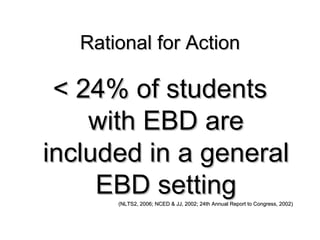
Rational for Action < 24% of students with EBD are included in a general EBD setting (NLTS2, 2006; NCED & JJ, 2002; 24th Annual Report to Congress, 2002)
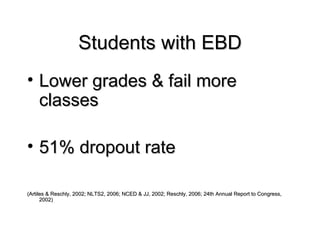
Students with EBD Lower grades & fail more classes 51% dropout rate (Artiles & Reschly, 2002; NLTS2, 2006; NCED & JJ, 2002; Reschly, 2006; 24th Annual Report to Congress, 2002)
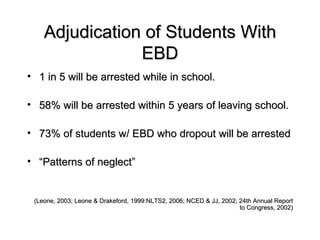
Adjudication of Students With EBD 1 in 5 will be arrested while in school. 58% will be arrested within 5 years of leaving school. 73% of students w/ EBD who dropout will be arrested  “ Patterns of neglect” (Leone, 2003; Leone & Drakeford, 1999:NLTS2, 2006; NCED & JJ, 2002; 24th Annual Report to Congress, 2002)
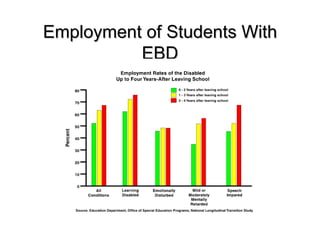
Employment of Students With EBD
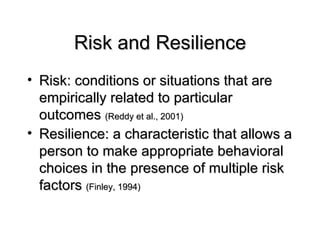
Risk and Resilience Risk: conditions or situations that are empirically related to particular outcomes  (Reddy et al., 2001) Resilience: a characteristic that allows a person to make appropriate behavioral choices in the presence of multiple risk factors  (Finley, 1994)
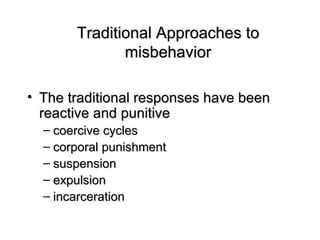
Traditional Approaches to misbehavior The traditional responses have been reactive and punitive  coercive cycles corporal punishment  suspension  expulsion  incarceration
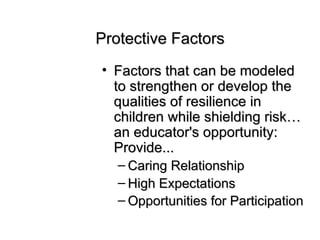
Protective Factors Factors that can be modeled to strengthen or develop the qualities of resilience in children while shielding risk…an educator's opportunity: Provide... Caring Relationship  High Expectations Opportunities for Participation
Risk Factors Domains Individual Family School Community
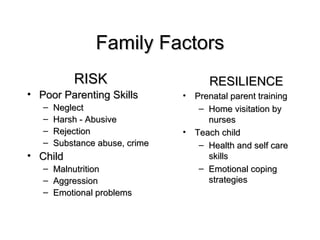
Family Factors RISK Poor Parenting Skills Neglect  Harsh - Abusive  Rejection Substance abuse, crime Child Malnutrition Aggression Emotional problems RESILIENCE Prenatal parent training Home visitation by nurses Teach child  Health and self care skills Emotional coping strategies
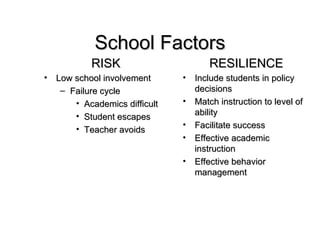
School Factors RISK Low school involvement Failure cycle Academics difficult Student escapes Teacher avoids RESILIENCE Include students in policy decisions Match instruction to level of ability Facilitate success Effective academic instruction Effective behavior management
School Factors RISK Less academics Truancy Suspension Expulsion Dropping out RESILIENCE Increase active participation Meaningful instruction Alternative programs Involve parents
Prevention - Proactive Understand the risk factors Develop effective programs to overcome risk factors Enhance the protective factors that promote resiliency
Prevention of  Juvenile Delinquency Primary Prevention Prevent initial offending Secondary Prevention Prevent re-offending Tertiary Prevention Ameliorate effects of persistent offending
Positive behavior —goal is for students to develop a repertoire of appropriate skills that enable them to participate successfully in a broad range of family, school, and community settings. Support —a continuum of strategies provided at the appropriate level of personalization, given the strengths, needs, and preferences of the student and family. Positive Behavior + Support =
Positive Behavior Support A broad range of systemic and individualized strategies for achieving important social and learning outcomes while preventing problem behavior An integration of (a) valued outcomes, (b) the science of human behavior, (c) validated procedures, and (d) systems change to enhance quality of life and reduce problem behavior
Use what works Build capacity Take responsibility for all students Be proactive Work smarter BIG PBS IDEAS
Resiliency Traits Insight Children are involved in assessing their own work Independence Children help develop standards for their work Relationships Children have many opportunities to work collaboratively Creativity Children can make choices
Resiliency Traits Initiative Children participate in meetings to solve classroom problems Humor Children feel safe and connected in a classroom structured community Morality Children are active in setting rules for classroom/school life ( Bickart & Wolin, 1997 )
Language of Resiliency A language tool that reinforces support systems for students and encourages resiliency I am  (Internal  Sources) I have (External Sources) I can (Social Sources)
Access to curriculum Some texts that students prefer are typically not valued in schools  (Moje, et. al. 2000; Moje, 2002.   Focus on linguistic and logical-mathematical intelligence (Jensen, 1998; Rose, 2003).   Literacy skills prove to be strong predictors of educational success Engaging Memorable Fosters Motivation for Learning
High Expectations Focus on the individual student interests experiences strengths Have necessary materials for success Eliminate fear or threat
Caring Relationships   The Teacher ……The most frequently encountered positive role model outside the family Conveys:  compassion  understanding  respect trustworthiness  sincere interest Utilizes rituals and traditions in the classroom Celebrates traditions Provides one-on-one time
Opportunities for Participation Meaningful involvement and responsibilities Hands-on learning Student involvement  curriculum planning cross-age tutoring or mentoring decision making in school policies/rules
Data Collection On-Site Observations: - Classrooms Effective Practices Transitions Academic foci Behavior management systems On-Site Interviews: -Teachers, staff Academic & behavioral expectations Remedial plans/decision making process School climate Collaboration and partnerships
Data Collection On-Site Observations: - School-wide Hallways Lunchroom w/transitions Common areas Physical surroundings Staffing ratios Expectations & rules Materials & supplies Behavior management Behavioral incidents
References… Artiles, A.J., Harry, B., Reschly, D.J., & Chinn, P.C. (2002). Over-identification of students of color in special education: A critical overview. Multicultural Perspectives. 4(1), p3-10. Christle, C.A., Jolivette, K., Nelson C.M. (2005). Breaking the school to prison pipeline: identifying school risk and protective factors for youth delinquency. Exceptionality, 13(2), 69–88 Fullan, M. (2001). Leading in a Culture of Change. San Francisco, CA: Jossey-Bass.  Individuals with Disabilities Education Improvement Act of 2004, 20 U.S.C. § 1400 et seq. (2004). (Reauthorization of the Individuals with Disabilities Education Act of 1990). Leone, P. E., & Drakeford, W.  (1999).  Alternative education: From a “last chance” to a proactive model. Retrieved October 1, 2006, from The National Center on Education, Disability, and Juvenile Justice site: http://www.edjj.org/Publications/list/leone_drakeford -1999.html Leone, P. E., et. al. (October, 2003). School Failure, Race, and Disability: Promoting  Positive Outcomes, Decreasing Vulnerability for Involvement with the Juvenile Delinquency System. College Park, MD: The National Center on Education, Disability, and Juvenile Justice. Lipsey, M., & Wilson, D. (1998). Effective intervention for serious juvenile offenders. In R. Loeber & D. Farrington (Eds.), Serious and Violent Juvenile Offenders, (pp. 313-345). Thousand Oaks, CA: Sage.
… References  National Longitudinal Transition Study. (1993). Retrieved October 6, 2006, from  http://www. sri . com/policy/cehs/publications/dispub/nlts/nltssum .html No Child Left Behind Act f 2001,  20 U.S.C. § 6310  et seq. (2002) Reschly, A. L., & Christenson, S. L. (2006). Prediction of dropout among students with mild disabilities: A case for the inclusion of student engagement variables. Remedial & Special Education, 27(5), 276-292. Sanders, J. R. & Sullins, C. D. (2006). Evaluating School Programs: An Educators Guide. (3 rd  ed.). Thousand Oaks, CA: Corwin Press. Senge, P. M., Cambron-McCabe, N., Lucas, T., Smith, B., Dutton, J., Kleiner, A. (2000). Schools That Learn. New York, NY: Doubleday.  Thurlow, M.L., Sinclair, M.F., & Johnson, D.R. (2002). Students with disabilities who drop out of school-implications for policy and practice. Issue Brief: Examining Current Challenges in secondary Education and Transition. 1-2. Retrieved October 2, 2006 from the National Center on Secondary Education and Transition website. U.S. Department of Education (2002). Twenty-Fourth Annual Report to Congress on the Implementation of the Individuals with Disabilities Education Act.  Washington DC: Author.

EBD-Change

  • 1.
  • 2.
    Rational for Action< 24% of students with EBD are included in a general EBD setting (NLTS2, 2006; NCED & JJ, 2002; 24th Annual Report to Congress, 2002)
  • 3.
    Students with EBDLower grades & fail more classes 51% dropout rate (Artiles & Reschly, 2002; NLTS2, 2006; NCED & JJ, 2002; Reschly, 2006; 24th Annual Report to Congress, 2002)
  • 4.
    Adjudication of StudentsWith EBD 1 in 5 will be arrested while in school. 58% will be arrested within 5 years of leaving school. 73% of students w/ EBD who dropout will be arrested “ Patterns of neglect” (Leone, 2003; Leone & Drakeford, 1999:NLTS2, 2006; NCED & JJ, 2002; 24th Annual Report to Congress, 2002)
  • 5.
  • 6.
    Risk and ResilienceRisk: conditions or situations that are empirically related to particular outcomes (Reddy et al., 2001) Resilience: a characteristic that allows a person to make appropriate behavioral choices in the presence of multiple risk factors (Finley, 1994)
  • 7.
    Traditional Approaches tomisbehavior The traditional responses have been reactive and punitive coercive cycles corporal punishment suspension expulsion incarceration
  • 8.
    Protective Factors Factorsthat can be modeled to strengthen or develop the qualities of resilience in children while shielding risk…an educator's opportunity: Provide... Caring Relationship High Expectations Opportunities for Participation
  • 9.
    Risk Factors DomainsIndividual Family School Community
  • 10.
    Family Factors RISKPoor Parenting Skills Neglect Harsh - Abusive Rejection Substance abuse, crime Child Malnutrition Aggression Emotional problems RESILIENCE Prenatal parent training Home visitation by nurses Teach child Health and self care skills Emotional coping strategies
  • 11.
    School Factors RISKLow school involvement Failure cycle Academics difficult Student escapes Teacher avoids RESILIENCE Include students in policy decisions Match instruction to level of ability Facilitate success Effective academic instruction Effective behavior management
  • 12.
    School Factors RISKLess academics Truancy Suspension Expulsion Dropping out RESILIENCE Increase active participation Meaningful instruction Alternative programs Involve parents
  • 13.
    Prevention - ProactiveUnderstand the risk factors Develop effective programs to overcome risk factors Enhance the protective factors that promote resiliency
  • 14.
    Prevention of Juvenile Delinquency Primary Prevention Prevent initial offending Secondary Prevention Prevent re-offending Tertiary Prevention Ameliorate effects of persistent offending
  • 15.
    Positive behavior —goalis for students to develop a repertoire of appropriate skills that enable them to participate successfully in a broad range of family, school, and community settings. Support —a continuum of strategies provided at the appropriate level of personalization, given the strengths, needs, and preferences of the student and family. Positive Behavior + Support =
  • 16.
    Positive Behavior SupportA broad range of systemic and individualized strategies for achieving important social and learning outcomes while preventing problem behavior An integration of (a) valued outcomes, (b) the science of human behavior, (c) validated procedures, and (d) systems change to enhance quality of life and reduce problem behavior
  • 17.
    Use what worksBuild capacity Take responsibility for all students Be proactive Work smarter BIG PBS IDEAS
  • 18.
    Resiliency Traits InsightChildren are involved in assessing their own work Independence Children help develop standards for their work Relationships Children have many opportunities to work collaboratively Creativity Children can make choices
  • 19.
    Resiliency Traits InitiativeChildren participate in meetings to solve classroom problems Humor Children feel safe and connected in a classroom structured community Morality Children are active in setting rules for classroom/school life ( Bickart & Wolin, 1997 )
  • 20.
    Language of ResiliencyA language tool that reinforces support systems for students and encourages resiliency I am (Internal Sources) I have (External Sources) I can (Social Sources)
  • 21.
    Access to curriculumSome texts that students prefer are typically not valued in schools (Moje, et. al. 2000; Moje, 2002. Focus on linguistic and logical-mathematical intelligence (Jensen, 1998; Rose, 2003). Literacy skills prove to be strong predictors of educational success Engaging Memorable Fosters Motivation for Learning
  • 22.
    High Expectations Focuson the individual student interests experiences strengths Have necessary materials for success Eliminate fear or threat
  • 23.
    Caring Relationships The Teacher ……The most frequently encountered positive role model outside the family Conveys: compassion understanding respect trustworthiness sincere interest Utilizes rituals and traditions in the classroom Celebrates traditions Provides one-on-one time
  • 24.
    Opportunities for ParticipationMeaningful involvement and responsibilities Hands-on learning Student involvement curriculum planning cross-age tutoring or mentoring decision making in school policies/rules
  • 25.
    Data Collection On-SiteObservations: - Classrooms Effective Practices Transitions Academic foci Behavior management systems On-Site Interviews: -Teachers, staff Academic & behavioral expectations Remedial plans/decision making process School climate Collaboration and partnerships
  • 26.
    Data Collection On-SiteObservations: - School-wide Hallways Lunchroom w/transitions Common areas Physical surroundings Staffing ratios Expectations & rules Materials & supplies Behavior management Behavioral incidents
  • 27.
    References… Artiles, A.J.,Harry, B., Reschly, D.J., & Chinn, P.C. (2002). Over-identification of students of color in special education: A critical overview. Multicultural Perspectives. 4(1), p3-10. Christle, C.A., Jolivette, K., Nelson C.M. (2005). Breaking the school to prison pipeline: identifying school risk and protective factors for youth delinquency. Exceptionality, 13(2), 69–88 Fullan, M. (2001). Leading in a Culture of Change. San Francisco, CA: Jossey-Bass. Individuals with Disabilities Education Improvement Act of 2004, 20 U.S.C. § 1400 et seq. (2004). (Reauthorization of the Individuals with Disabilities Education Act of 1990). Leone, P. E., & Drakeford, W. (1999). Alternative education: From a “last chance” to a proactive model. Retrieved October 1, 2006, from The National Center on Education, Disability, and Juvenile Justice site: http://www.edjj.org/Publications/list/leone_drakeford -1999.html Leone, P. E., et. al. (October, 2003). School Failure, Race, and Disability: Promoting Positive Outcomes, Decreasing Vulnerability for Involvement with the Juvenile Delinquency System. College Park, MD: The National Center on Education, Disability, and Juvenile Justice. Lipsey, M., & Wilson, D. (1998). Effective intervention for serious juvenile offenders. In R. Loeber & D. Farrington (Eds.), Serious and Violent Juvenile Offenders, (pp. 313-345). Thousand Oaks, CA: Sage.
  • 28.
    … References National Longitudinal Transition Study. (1993). Retrieved October 6, 2006, from http://www. sri . com/policy/cehs/publications/dispub/nlts/nltssum .html No Child Left Behind Act f 2001, 20 U.S.C. § 6310 et seq. (2002) Reschly, A. L., & Christenson, S. L. (2006). Prediction of dropout among students with mild disabilities: A case for the inclusion of student engagement variables. Remedial & Special Education, 27(5), 276-292. Sanders, J. R. & Sullins, C. D. (2006). Evaluating School Programs: An Educators Guide. (3 rd ed.). Thousand Oaks, CA: Corwin Press. Senge, P. M., Cambron-McCabe, N., Lucas, T., Smith, B., Dutton, J., Kleiner, A. (2000). Schools That Learn. New York, NY: Doubleday. Thurlow, M.L., Sinclair, M.F., & Johnson, D.R. (2002). Students with disabilities who drop out of school-implications for policy and practice. Issue Brief: Examining Current Challenges in secondary Education and Transition. 1-2. Retrieved October 2, 2006 from the National Center on Secondary Education and Transition website. U.S. Department of Education (2002). Twenty-Fourth Annual Report to Congress on the Implementation of the Individuals with Disabilities Education Act. Washington DC: Author.

Editor's Notes

  • #3 Compared to 46% of all other students with disabilities.
  • #5 Would you want your children subjected to these statistics?
  • #10 Individual: hyperactivity, concentration problems, restlessness, risk-taking, aggressiveness, early involvement in antisocial behavior, and beliefs and attitudes favoring deviancy Family : harsh and ineffective parental discipline, lack of parental involvement, family conflict, parental criminality, child abuse and/or neglect, and rejection . Community: high levels of disorganization, high mobility rates, few adults to monitor children&apos;s behavior, and high neighborhood levels of drug and gang activity . O&apos;Donnell reported that youth involvement with high-risk and deviant peers is one of the best predictors of delinquency. The literature also suggests that a strong association exists between poverty and youth violence. In fact, p overty may be the single most common denominator for risk of behavioral deviation .
  • #11 (Patterson et al, 1998; Walker et al, 1991)
  • #12 Students with negative behaviors receive less academic instruction and more punitive consequences than peers (Wehby et al. 1996; Shores et al. 1996) Academic problems foster behavior problems ( Maguin &amp; Loeber, 1996 ) Children from low income families are far more likely to have print related deficits ( Adams, 1988 ) ,lower vocabulary skills, and lack of familiarity with following directions ( Hart &amp; Risley, 1995 ) higher rates of negative interactions with school personnel r egardless of their behavior higher rates of punitive consequences than their peers this tends to make behaviors worse lower rates academic engaged time with teacher perpetuates cycle of problem behavior (Wehby et al. 1996; Shores et al. 1996) Reactive disciplinary approach Lack of teaching about rules, expectations, &amp; consequences Lack of staff consistency Failure to consider and accommodate individual student differences Academic failure (Mayer, 1995; Sugai &amp; Lewis, 1998; Walker, Colvin, &amp; Ramsey, 1996) From 1974 to 1998 suspension/expulsion rates went from 3.7% to 6.8% Suspended youth are far more likely to drop out and become delinquent (Justice Policy Institute, 2001) From 8 AM - 3 PM, students with challenging behaviors fail 7 of every 10 academic trials Nearly half of third graders in New York’s high minority public schools cannot read at all (1996) Identified poor readers at fourth grade have a .88 probability of remaining a poor reader forever (Adams, 1988) 82% of all crimes are committed by people who have dropped out of school (APA Commission on Youth Violence, 1993) Three years after leaving school, 70% of antisocial youth have been arrested (Walker, Colvin, &amp; Ramsey, 1995) Students with academic failure and problem behaviors are far more likely to: drop out of school be involved with the corrections system be single parents be involved with the social services system be unemployed be involved in automobile accidents use illicit drugs
  • #13 From 1974 to 1998 suspension/expulsion rates went from 3.7% to 6.8% Suspended youth are far more likely to drop out and become delinquent (Justice Policy Institute, 2001) From 8 AM - 3 PM, students with challenging behaviors fail 7 of every 10 academic trials Nearly half of third graders in New York’s high minority public schools cannot read at all (1996) Identified poor readers at fourth grade have a .88 probability of remaining a poor reader forever (Adams, 1988) 82% of all crimes are committed by people who have dropped out of school (APA Commission on Youth Violence, 1993) Three years after leaving school, 70% of antisocial youth have been arrested (Walker, Colvin, &amp; Ramsey, 1995) Students with academic failure and problem behaviors are far more likely to: drop out of school be involved with the corrections system be single parents be involved with the social services system be unemployed be involved in automobile accidents use illicit drugs