Earley
Parsing
Natalie Parde
UIC CS 421
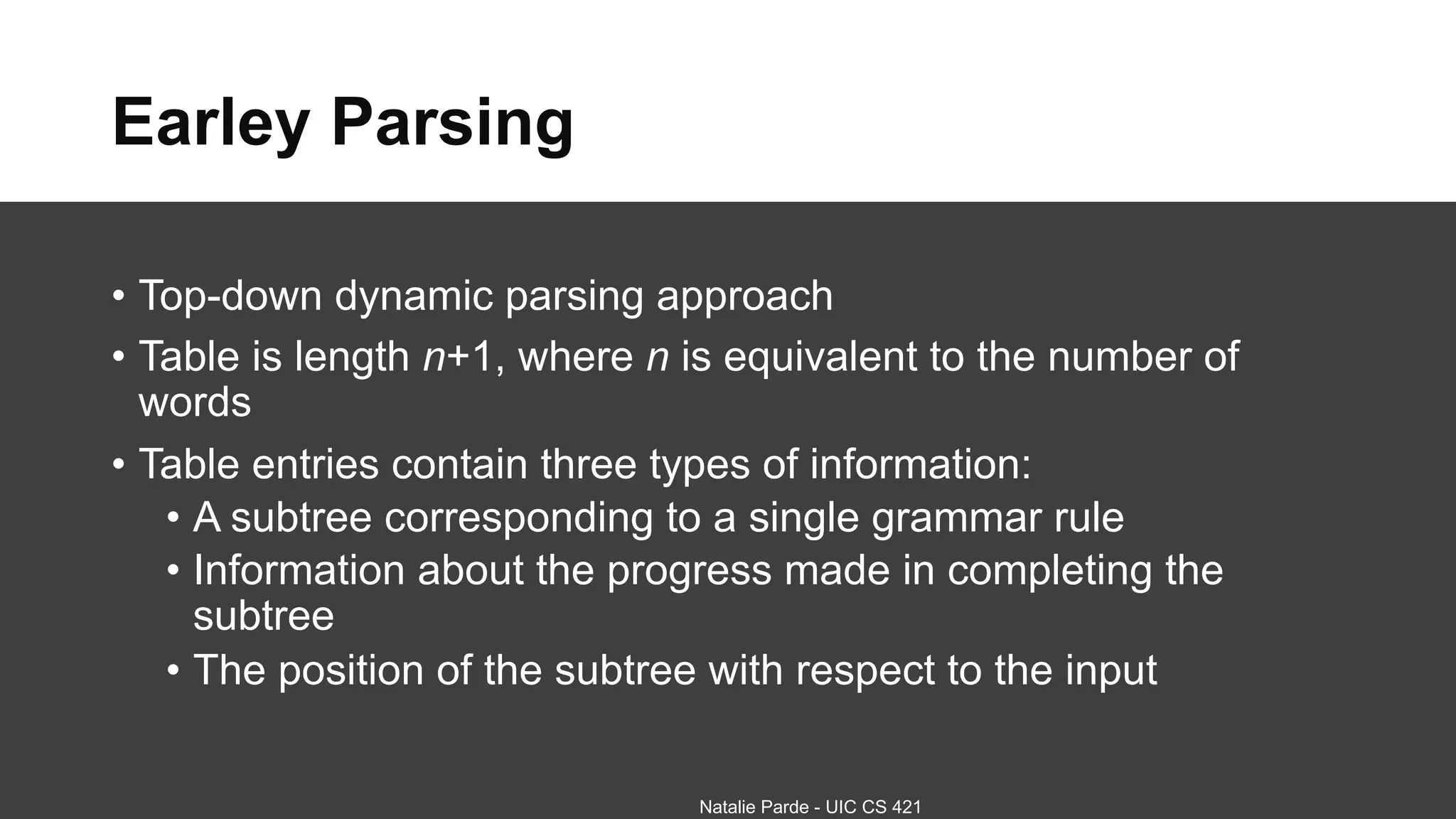
Earley Parsing
• Top-down dynamic parsing approach
• Table is length n+1, where n is equivalent to the number of
words
• Table entries contain three types of information:
• A subtree corresponding to a single grammar rule
• Information about the progress made in completing the
subtree
• The position of the subtree with respect to the input
Natalie Parde - UIC CS 421
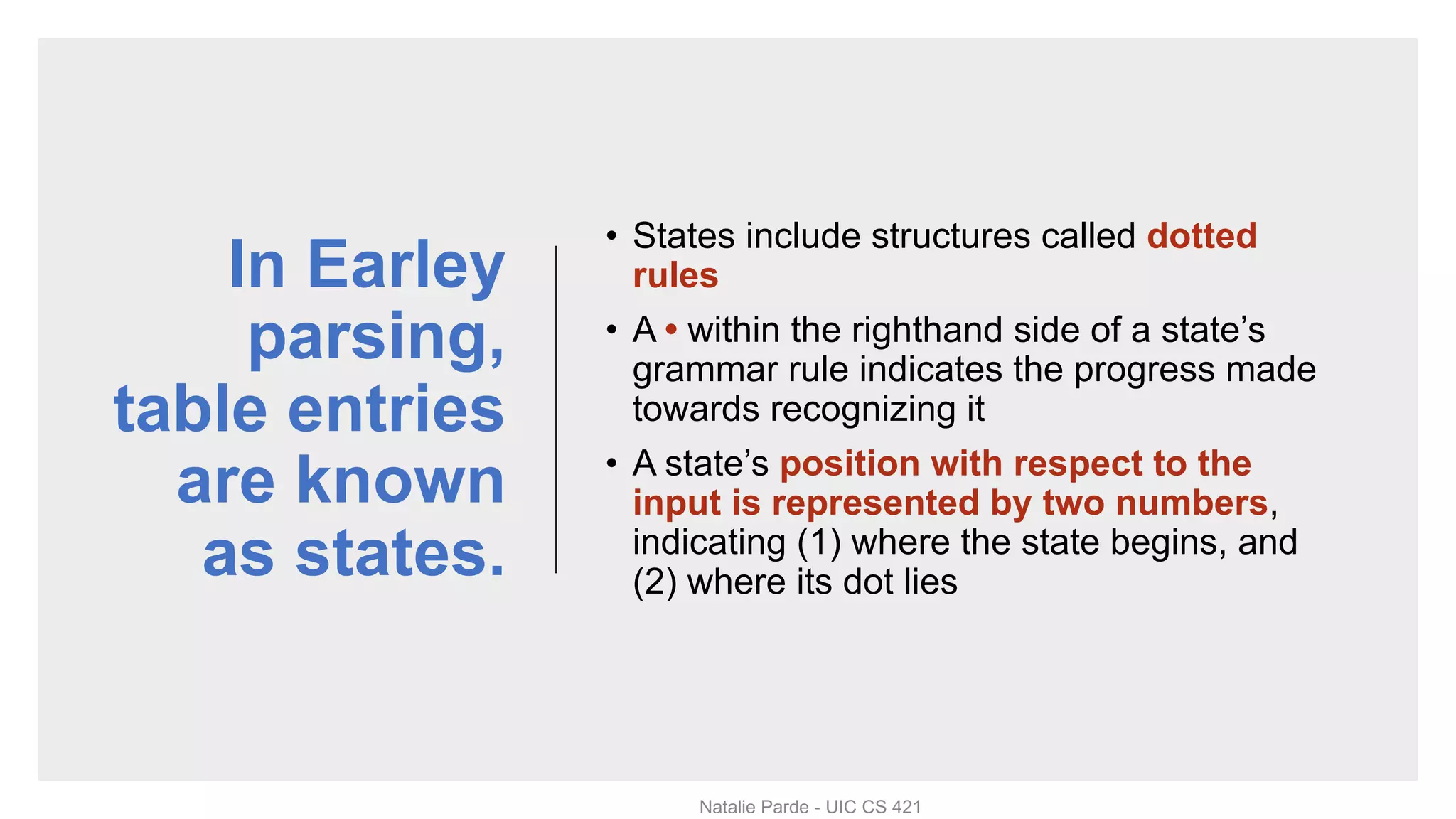
In Earley
parsing,
table entries
are known
as states.
• States include structures called dotted
rules
• A • within the righthand side of a state’s
grammar rule indicates the progress made
towards recognizing it
• A state’s position with respect to the
input is represented by two numbers,
indicating (1) where the state begins, and
(2) where its dot lies
Natalie Parde - UIC CS 421
Example
States
• Input: Book that flight.
• S → • VP, [0,0]
• Top-down prediction for this particular kind of S
• First 0: Constituent predicted by this state should
begin at the start of the input
• Second 0: Dot lies at the start of the input as well
• NP → Det • Nominal, [1,2]
• NP begins at position 1
• Det has been successfully parsed
• Nominal is expected next
• VP → V NP •, [0,3]
• Successful discovery of a tree corresponding to
a VP that spans the entire input
Natalie Parde - UIC CS 421
Earley Algorithm
• An Earley parser moves through the n+1 sets
of states in a chart in order
• At each step, one of three operators is applied
to each state depending on its status
• Predictor
• Scanner
• Completer
• States can be added to the chart, but are
never removed
• The algorithm never backtracks
• The presence of S → 𝛼 •, [0,n] indicates a
successful parse
Natalie Parde - UIC CS 421
Earley
Operators:
Predictor
• Creates new states
• Applied to any state that has a non-terminal
immediately to the right of its dot (as long as
the non-terminal is not a POS category)
• New states are placed into the same chart
entry as the generating state
• They begin and end at the same point in the
input where the generating state ends
Predictor
• VP → • Verb, [0,0]
• VP → • Verb NP, [0,0]
• VP → • Verb NP PP, [0,0]
• VP → • Verb PP, [0,0]
• VP → • VP PP, [0,0]
S → • VP, [0,0]
Natalie Parde - UIC CS 421
Earley Operators: Scanner
• Used when a state has a POS category to the right of the dot
• Examines input and incorporates a state corresponding to the prediction of
a word with a particular POS into the chart
• VP → • Verb NP, [0,0]
• Since category following the dot is a part of speech (Verb)….
• Verb → book •, [0,1]
Natalie Parde - UIC CS 421
Earley Operators: Completer
• Applied to a state when its dot has reached the right end of the rule
• Indicates that the parser has successfully discovered a particular grammatical category
over some span of input
• Finds all previously created states that were searching for this grammatical category, and
creates new states that are copies with their dots advanced past the grammatical
category
• NP → Det Nominal •, [1,3]
• What incomplete states end at position 1 and expect an NP?
• VP → Verb • NP, [0,1]
• VP → Verb • NP PP, [0,1]
• So, add VP → Verb NP •, [0,3] and the new incomplete VP → Verb NP • PP, [0,3] to
the chart
Natalie Parde - UIC CS 421
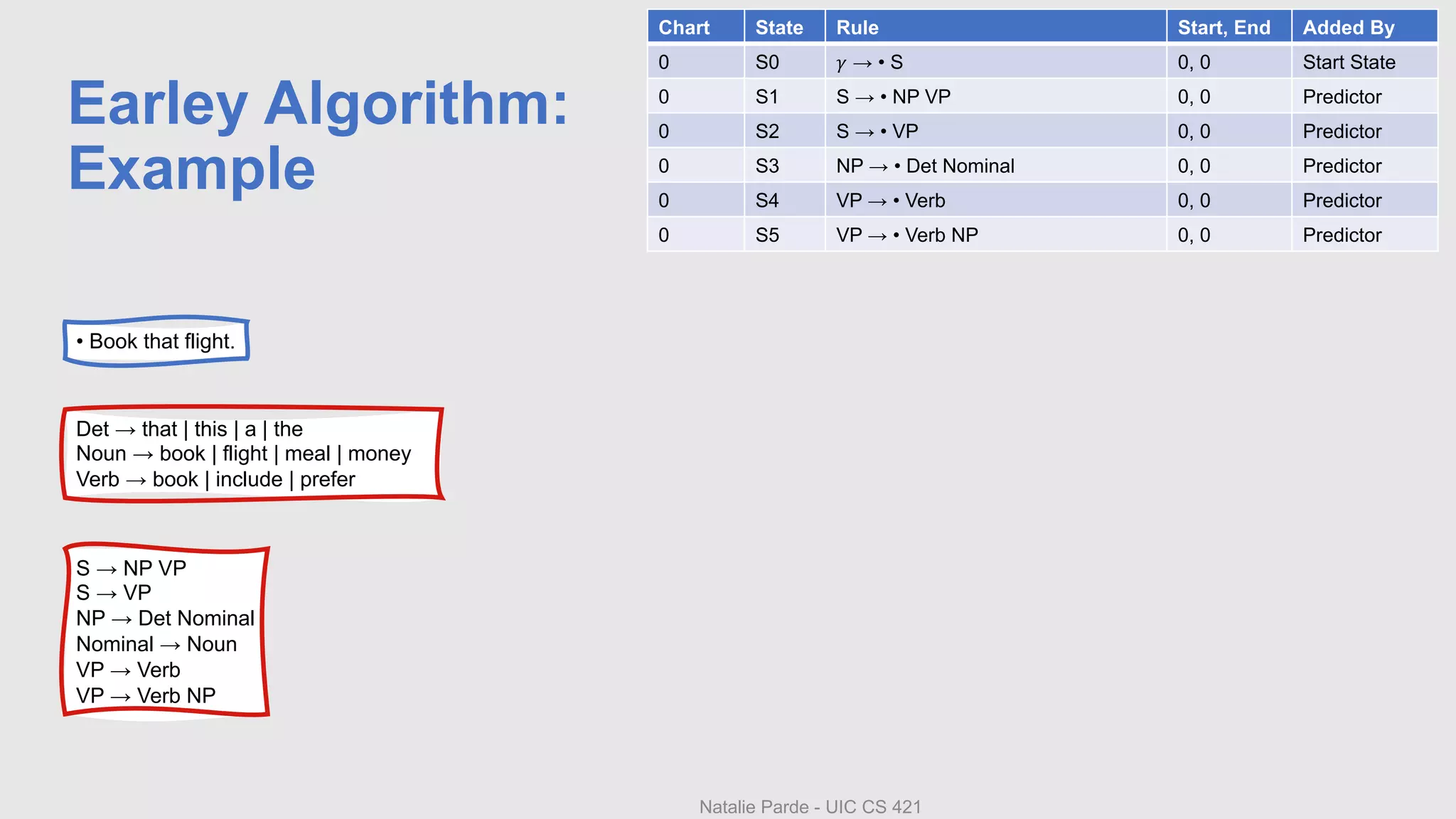
Earley Algorithm:
Example
Chart State Rule Start, End Added By
0 S0 𝛾 → • S 0, 0 Start State
0 S1 S → • NP VP 0, 0 Predictor
0 S2 S → • VP 0, 0 Predictor
0 S3 NP → • Det Nominal 0, 0 Predictor
0 S4 VP → • Verb 0, 0 Predictor
0 S5 VP → • Verb NP 0, 0 Predictor
S → NP VP
S → VP
NP → Det Nominal
Nominal → Noun
VP → Verb
VP → Verb NP
Det → that | this | a | the
Noun → book | flight | meal | money
Verb → book | include | prefer
Natalie Parde - UIC CS 421
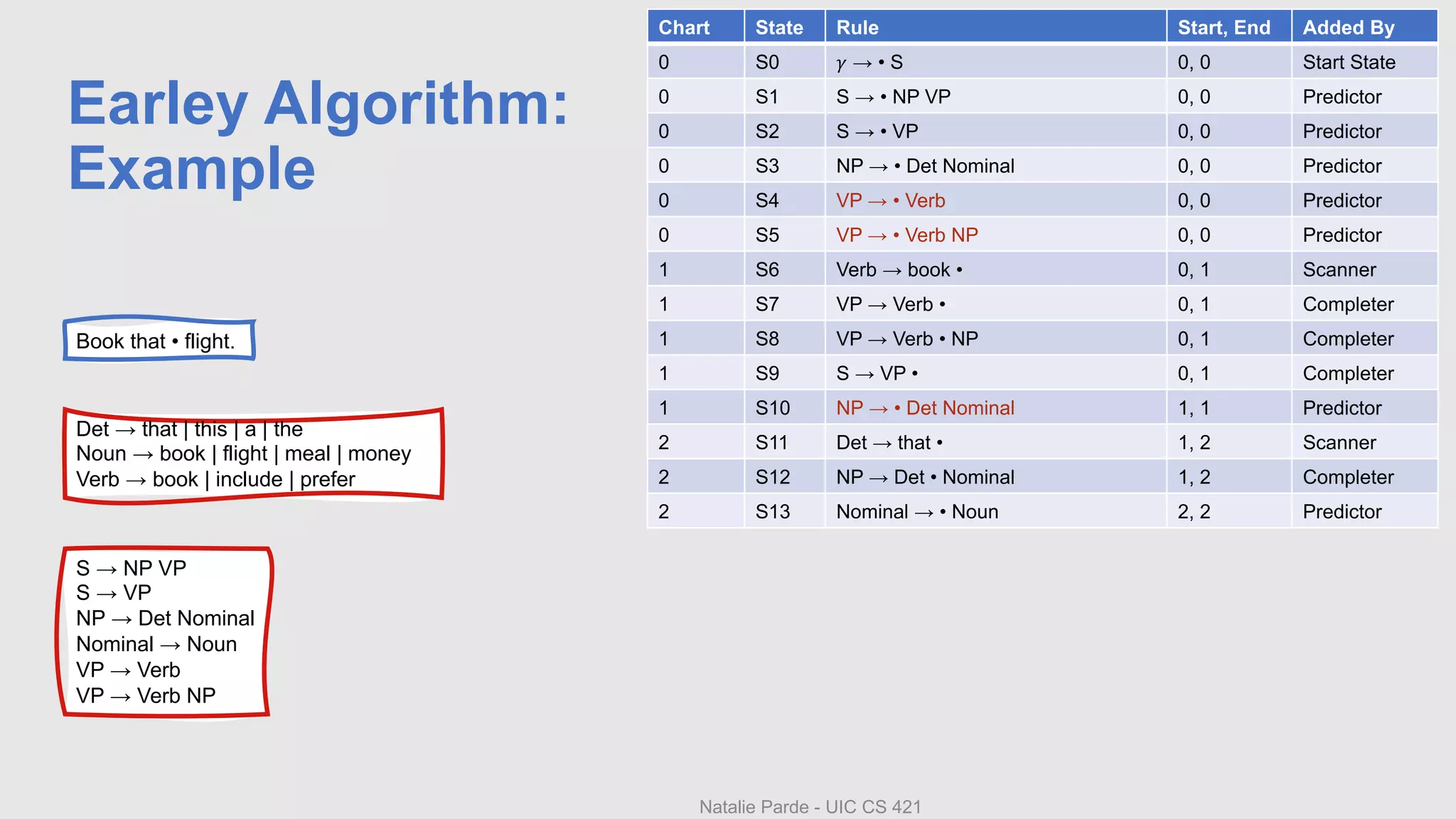
• Book that flight.
Earley Algorithm:
Example
Chart State Rule Start, End Added By
0 S0 𝛾 → • S 0, 0 Start State
0 S1 S → • NP VP 0, 0 Predictor
0 S2 S → • VP 0, 0 Predictor
0 S3 NP → • Det Nominal 0, 0 Predictor
0 S4 VP → • Verb 0, 0 Predictor
0 S5 VP → • Verb NP 0, 0 Predictor
1 S6 Verb → book • 0, 1 Scanner
1 S7 VP → Verb • 0, 1 Completer
1 S8 VP → Verb • NP 0, 1 Completer
1 S9 S → VP • 0, 1 Completer
1 S10 NP → • Det Nominal 1, 1 Predictor
S → NP VP
S → VP
NP → Det Nominal
Nominal → Noun
VP → Verb
VP → Verb NP
Det → that | this | a | the
Noun → book | flight | meal | money
Verb → book | include | prefer
Natalie Parde - UIC CS 421
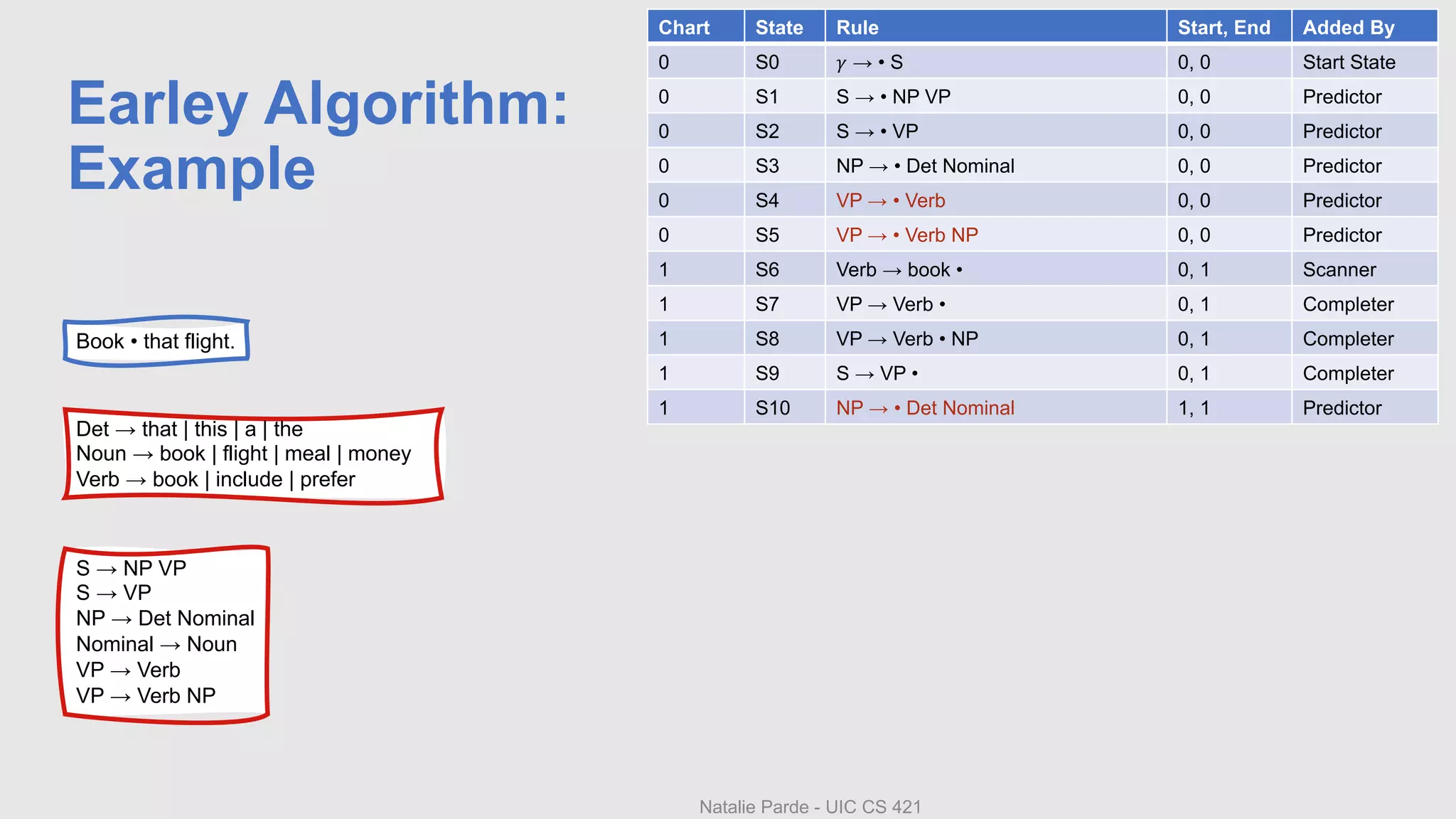
Book • that flight.
Earley Algorithm:
Example
Chart State Rule Start, End Added By
0 S0 𝛾 → • S 0, 0 Start State
0 S1 S → • NP VP 0, 0 Predictor
0 S2 S → • VP 0, 0 Predictor
0 S3 NP → • Det Nominal 0, 0 Predictor
0 S4 VP → • Verb 0, 0 Predictor
0 S5 VP → • Verb NP 0, 0 Predictor
1 S6 Verb → book • 0, 1 Scanner
1 S7 VP → Verb • 0, 1 Completer
1 S8 VP → Verb • NP 0, 1 Completer
1 S9 S → VP • 0, 1 Completer
1 S10 NP → • Det Nominal 1, 1 Predictor
2 S11 Det → that • 1, 2 Scanner
2 S12 NP → Det • Nominal 1, 2 Completer
2 S13 Nominal → • Noun 2, 2 Predictor
S → NP VP
S → VP
NP → Det Nominal
Nominal → Noun
VP → Verb
VP → Verb NP
Det → that | this | a | the
Noun → book | flight | meal | money
Verb → book | include | prefer
Natalie Parde - UIC CS 421
Book that • flight.
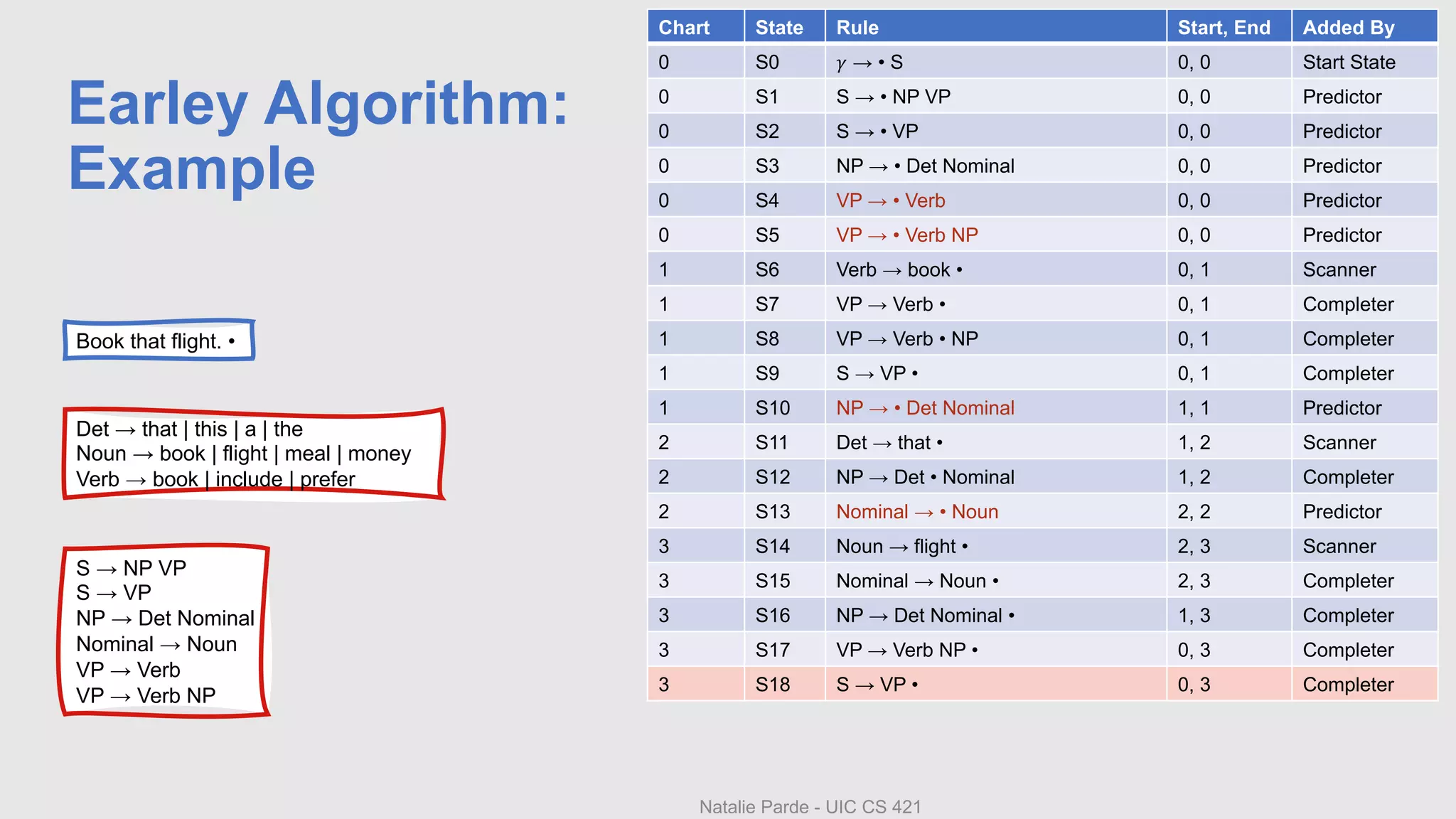
Earley Algorithm:
Example
Chart State Rule Start, End Added By
0 S0 𝛾 → • S 0, 0 Start State
0 S1 S → • NP VP 0, 0 Predictor
0 S2 S → • VP 0, 0 Predictor
0 S3 NP → • Det Nominal 0, 0 Predictor
0 S4 VP → • Verb 0, 0 Predictor
0 S5 VP → • Verb NP 0, 0 Predictor
1 S6 Verb → book • 0, 1 Scanner
1 S7 VP → Verb • 0, 1 Completer
1 S8 VP → Verb • NP 0, 1 Completer
1 S9 S → VP • 0, 1 Completer
1 S10 NP → • Det Nominal 1, 1 Predictor
2 S11 Det → that • 1, 2 Scanner
2 S12 NP → Det • Nominal 1, 2 Completer
2 S13 Nominal → • Noun 2, 2 Predictor
3 S14 Noun → flight • 2, 3 Scanner
3 S15 Nominal → Noun • 2, 3 Completer
3 S16 NP → Det Nominal • 1, 3 Completer
3 S17 VP → Verb NP • 0, 3 Completer
3 S18 S → VP • 0, 3 Completer
S → NP VP
S → VP
NP → Det Nominal
Nominal → Noun
VP → Verb
VP → Verb NP
Det → that | this | a | the
Noun → book | flight | meal | money
Verb → book | include | prefer
Natalie Parde - UIC CS 421
Book that flight. •
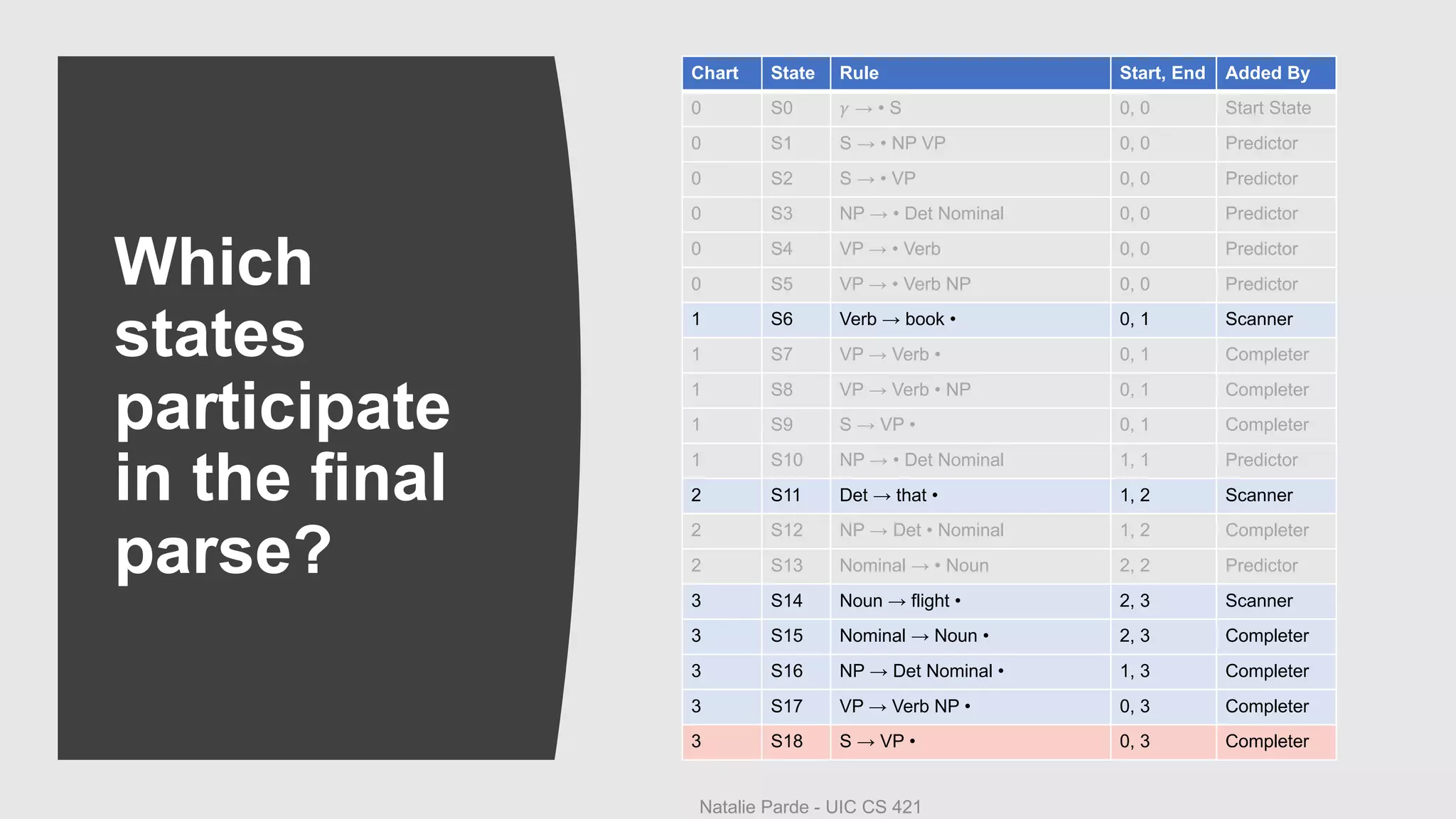
Which
states
participate
in the final
parse?
Chart State Rule Start, End Added By
0 S0 𝛾 → • S 0, 0 Start State
0 S1 S → • NP VP 0, 0 Predictor
0 S2 S → • VP 0, 0 Predictor
0 S3 NP → • Det Nominal 0, 0 Predictor
0 S4 VP → • Verb 0, 0 Predictor
0 S5 VP → • Verb NP 0, 0 Predictor
1 S6 Verb → book • 0, 1 Scanner
1 S7 VP → Verb • 0, 1 Completer
1 S8 VP → Verb • NP 0, 1 Completer
1 S9 S → VP • 0, 1 Completer
1 S10 NP → • Det Nominal 1, 1 Predictor
2 S11 Det → that • 1, 2 Scanner
2 S12 NP → Det • Nominal 1, 2 Completer
2 S13 Nominal → • Noun 2, 2 Predictor
3 S14 Noun → flight • 2, 3 Scanner
3 S15 Nominal → Noun • 2, 3 Completer
3 S16 NP → Det Nominal • 1, 3 Completer
3 S17 VP → Verb NP • 0, 3 Completer
3 S18 S → VP • 0, 3 Completer
Natalie Parde - UIC CS 421
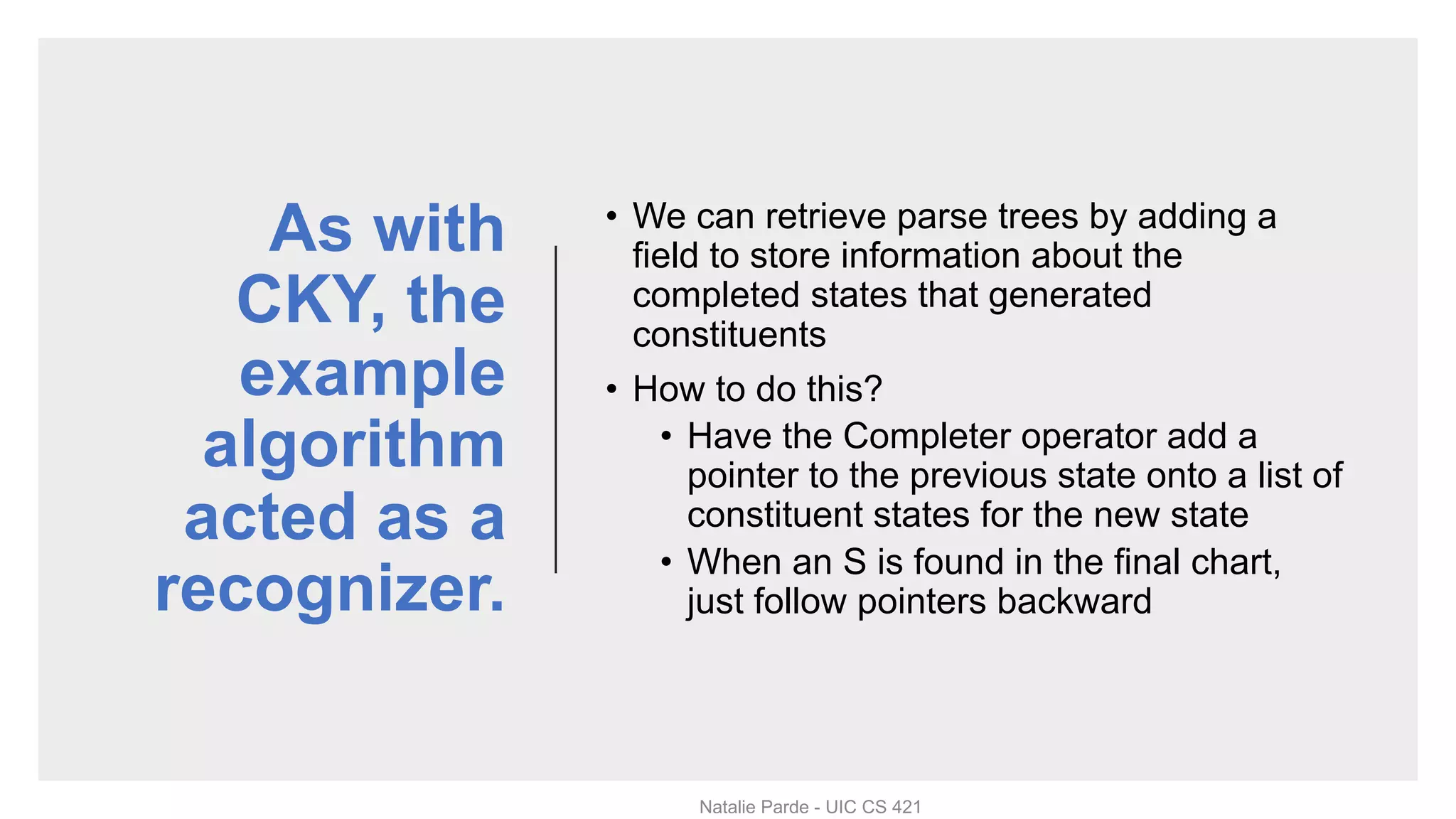
As with
CKY, the
example
algorithm
acted as a
recognizer.
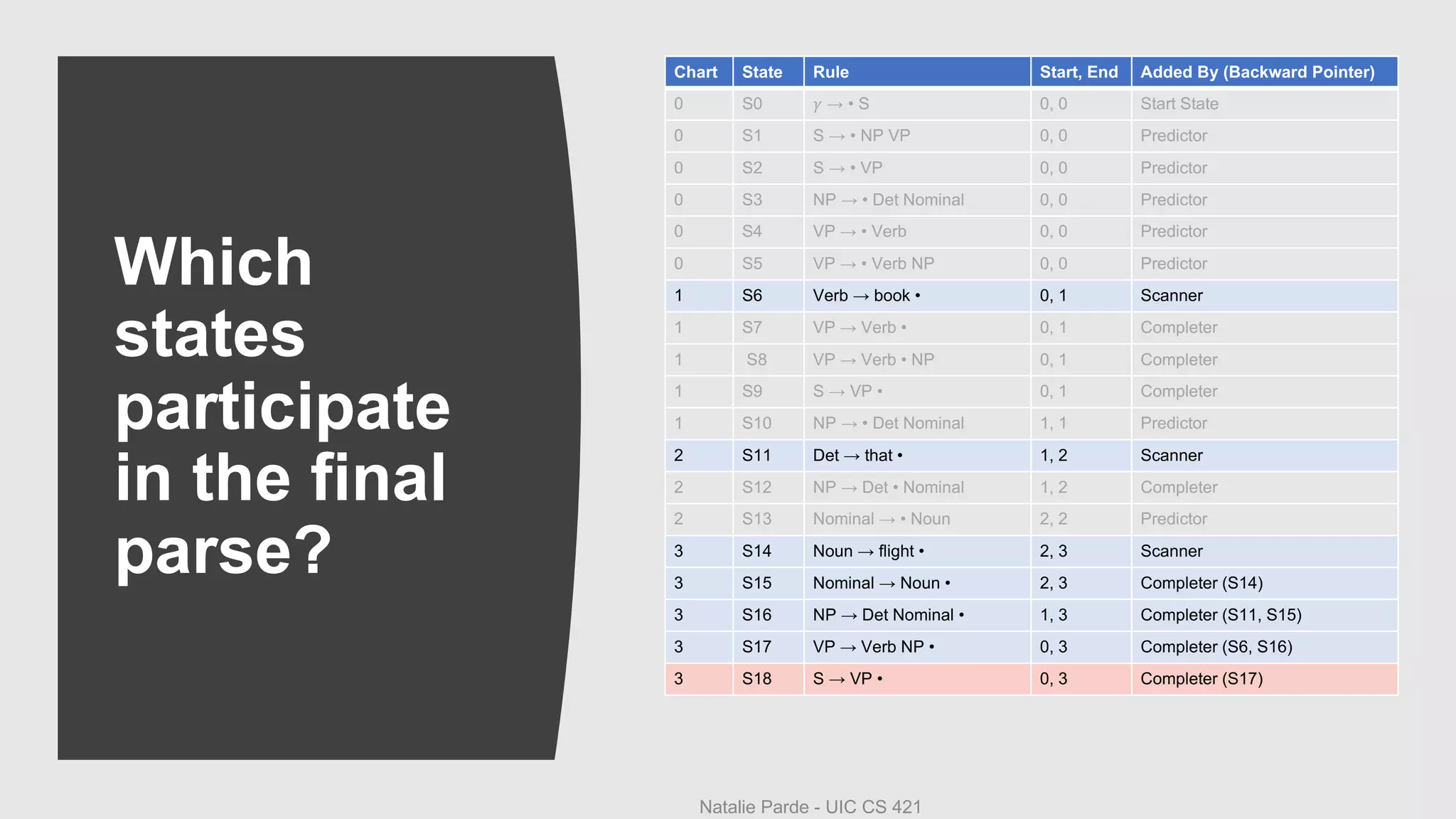
• We can retrieve parse trees by adding a
field to store information about the
completed states that generated
constituents
• How to do this?
• Have the Completer operator add a
pointer to the previous state onto a list of
constituent states for the new state
• When an S is found in the final chart,
just follow pointers backward
Natalie Parde - UIC CS 421
Which
states
participate
in the final
parse?
Chart State Rule Start, End Added By (Backward Pointer)
0 S0 𝛾 → • S 0, 0 Start State
0 S1 S → • NP VP 0, 0 Predictor
0 S2 S → • VP 0, 0 Predictor
0 S3 NP → • Det Nominal 0, 0 Predictor
0 S4 VP → • Verb 0, 0 Predictor
0 S5 VP → • Verb NP 0, 0 Predictor
1 S6 Verb → book • 0, 1 Scanner
1 S7 VP → Verb • 0, 1 Completer
1 S8 VP → Verb • NP 0, 1 Completer
1 S9 S → VP • 0, 1 Completer
1 S10 NP → • Det Nominal 1, 1 Predictor
2 S11 Det → that • 1, 2 Scanner
2 S12 NP → Det • Nominal 1, 2 Completer
2 S13 Nominal → • Noun 2, 2 Predictor
3 S14 Noun → flight • 2, 3 Scanner
3 S15 Nominal → Noun • 2, 3 Completer (S14)
3 S16 NP → Det Nominal • 1, 3 Completer (S11, S15)
3 S17 VP → Verb NP • 0, 3 Completer (S6, S16)
3 S18 S → VP • 0, 3 Completer (S17)
Natalie Parde - UIC CS 421
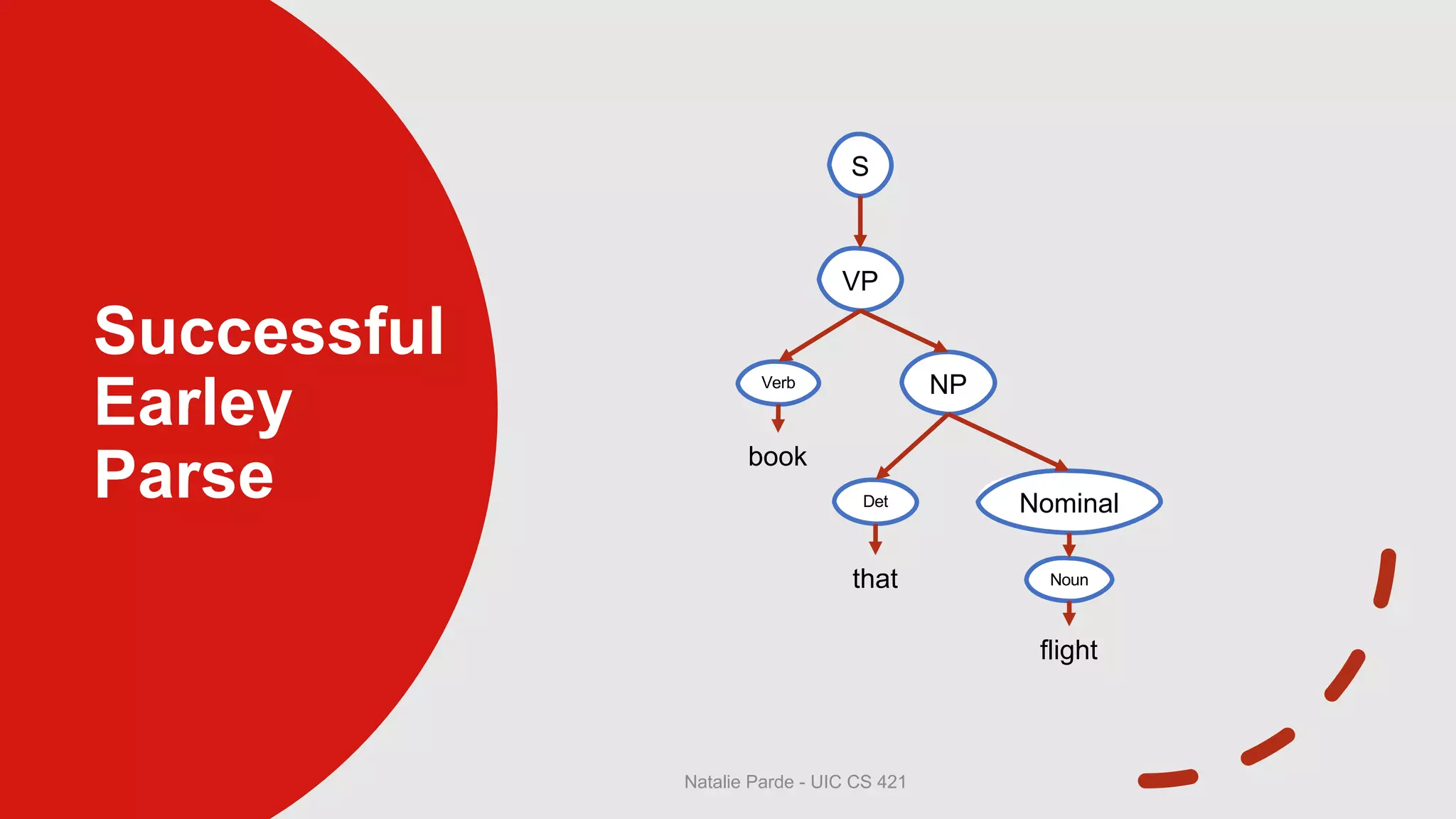
Successful
Earley
Parse
Natalie Parde - UIC CS 421
S
VP
Verb NP
Det Nominal
Noun
book
that
flight

Earley Parsing.pdf

  • 1.
  • 2.
    Earley Parsing • Top-downdynamic parsing approach • Table is length n+1, where n is equivalent to the number of words • Table entries contain three types of information: • A subtree corresponding to a single grammar rule • Information about the progress made in completing the subtree • The position of the subtree with respect to the input Natalie Parde - UIC CS 421
  • 3.
    In Earley parsing, table entries areknown as states. • States include structures called dotted rules • A • within the righthand side of a state’s grammar rule indicates the progress made towards recognizing it • A state’s position with respect to the input is represented by two numbers, indicating (1) where the state begins, and (2) where its dot lies Natalie Parde - UIC CS 421
  • 4.
    Example States • Input: Bookthat flight. • S → • VP, [0,0] • Top-down prediction for this particular kind of S • First 0: Constituent predicted by this state should begin at the start of the input • Second 0: Dot lies at the start of the input as well • NP → Det • Nominal, [1,2] • NP begins at position 1 • Det has been successfully parsed • Nominal is expected next • VP → V NP •, [0,3] • Successful discovery of a tree corresponding to a VP that spans the entire input Natalie Parde - UIC CS 421
  • 5.
    Earley Algorithm • AnEarley parser moves through the n+1 sets of states in a chart in order • At each step, one of three operators is applied to each state depending on its status • Predictor • Scanner • Completer • States can be added to the chart, but are never removed • The algorithm never backtracks • The presence of S → 𝛼 •, [0,n] indicates a successful parse Natalie Parde - UIC CS 421
  • 6.
    Earley Operators: Predictor • Creates newstates • Applied to any state that has a non-terminal immediately to the right of its dot (as long as the non-terminal is not a POS category) • New states are placed into the same chart entry as the generating state • They begin and end at the same point in the input where the generating state ends Predictor • VP → • Verb, [0,0] • VP → • Verb NP, [0,0] • VP → • Verb NP PP, [0,0] • VP → • Verb PP, [0,0] • VP → • VP PP, [0,0] S → • VP, [0,0] Natalie Parde - UIC CS 421
  • 7.
    Earley Operators: Scanner •Used when a state has a POS category to the right of the dot • Examines input and incorporates a state corresponding to the prediction of a word with a particular POS into the chart • VP → • Verb NP, [0,0] • Since category following the dot is a part of speech (Verb)…. • Verb → book •, [0,1] Natalie Parde - UIC CS 421
  • 8.
    Earley Operators: Completer •Applied to a state when its dot has reached the right end of the rule • Indicates that the parser has successfully discovered a particular grammatical category over some span of input • Finds all previously created states that were searching for this grammatical category, and creates new states that are copies with their dots advanced past the grammatical category • NP → Det Nominal •, [1,3] • What incomplete states end at position 1 and expect an NP? • VP → Verb • NP, [0,1] • VP → Verb • NP PP, [0,1] • So, add VP → Verb NP •, [0,3] and the new incomplete VP → Verb NP • PP, [0,3] to the chart Natalie Parde - UIC CS 421
  • 9.
    Earley Algorithm: Example Chart StateRule Start, End Added By 0 S0 𝛾 → • S 0, 0 Start State 0 S1 S → • NP VP 0, 0 Predictor 0 S2 S → • VP 0, 0 Predictor 0 S3 NP → • Det Nominal 0, 0 Predictor 0 S4 VP → • Verb 0, 0 Predictor 0 S5 VP → • Verb NP 0, 0 Predictor S → NP VP S → VP NP → Det Nominal Nominal → Noun VP → Verb VP → Verb NP Det → that | this | a | the Noun → book | flight | meal | money Verb → book | include | prefer Natalie Parde - UIC CS 421 • Book that flight.
  • 10.
    Earley Algorithm: Example Chart StateRule Start, End Added By 0 S0 𝛾 → • S 0, 0 Start State 0 S1 S → • NP VP 0, 0 Predictor 0 S2 S → • VP 0, 0 Predictor 0 S3 NP → • Det Nominal 0, 0 Predictor 0 S4 VP → • Verb 0, 0 Predictor 0 S5 VP → • Verb NP 0, 0 Predictor 1 S6 Verb → book • 0, 1 Scanner 1 S7 VP → Verb • 0, 1 Completer 1 S8 VP → Verb • NP 0, 1 Completer 1 S9 S → VP • 0, 1 Completer 1 S10 NP → • Det Nominal 1, 1 Predictor S → NP VP S → VP NP → Det Nominal Nominal → Noun VP → Verb VP → Verb NP Det → that | this | a | the Noun → book | flight | meal | money Verb → book | include | prefer Natalie Parde - UIC CS 421 Book • that flight.
  • 11.
    Earley Algorithm: Example Chart StateRule Start, End Added By 0 S0 𝛾 → • S 0, 0 Start State 0 S1 S → • NP VP 0, 0 Predictor 0 S2 S → • VP 0, 0 Predictor 0 S3 NP → • Det Nominal 0, 0 Predictor 0 S4 VP → • Verb 0, 0 Predictor 0 S5 VP → • Verb NP 0, 0 Predictor 1 S6 Verb → book • 0, 1 Scanner 1 S7 VP → Verb • 0, 1 Completer 1 S8 VP → Verb • NP 0, 1 Completer 1 S9 S → VP • 0, 1 Completer 1 S10 NP → • Det Nominal 1, 1 Predictor 2 S11 Det → that • 1, 2 Scanner 2 S12 NP → Det • Nominal 1, 2 Completer 2 S13 Nominal → • Noun 2, 2 Predictor S → NP VP S → VP NP → Det Nominal Nominal → Noun VP → Verb VP → Verb NP Det → that | this | a | the Noun → book | flight | meal | money Verb → book | include | prefer Natalie Parde - UIC CS 421 Book that • flight.
  • 12.
    Earley Algorithm: Example Chart StateRule Start, End Added By 0 S0 𝛾 → • S 0, 0 Start State 0 S1 S → • NP VP 0, 0 Predictor 0 S2 S → • VP 0, 0 Predictor 0 S3 NP → • Det Nominal 0, 0 Predictor 0 S4 VP → • Verb 0, 0 Predictor 0 S5 VP → • Verb NP 0, 0 Predictor 1 S6 Verb → book • 0, 1 Scanner 1 S7 VP → Verb • 0, 1 Completer 1 S8 VP → Verb • NP 0, 1 Completer 1 S9 S → VP • 0, 1 Completer 1 S10 NP → • Det Nominal 1, 1 Predictor 2 S11 Det → that • 1, 2 Scanner 2 S12 NP → Det • Nominal 1, 2 Completer 2 S13 Nominal → • Noun 2, 2 Predictor 3 S14 Noun → flight • 2, 3 Scanner 3 S15 Nominal → Noun • 2, 3 Completer 3 S16 NP → Det Nominal • 1, 3 Completer 3 S17 VP → Verb NP • 0, 3 Completer 3 S18 S → VP • 0, 3 Completer S → NP VP S → VP NP → Det Nominal Nominal → Noun VP → Verb VP → Verb NP Det → that | this | a | the Noun → book | flight | meal | money Verb → book | include | prefer Natalie Parde - UIC CS 421 Book that flight. •
  • 13.
    Which states participate in the final parse? ChartState Rule Start, End Added By 0 S0 𝛾 → • S 0, 0 Start State 0 S1 S → • NP VP 0, 0 Predictor 0 S2 S → • VP 0, 0 Predictor 0 S3 NP → • Det Nominal 0, 0 Predictor 0 S4 VP → • Verb 0, 0 Predictor 0 S5 VP → • Verb NP 0, 0 Predictor 1 S6 Verb → book • 0, 1 Scanner 1 S7 VP → Verb • 0, 1 Completer 1 S8 VP → Verb • NP 0, 1 Completer 1 S9 S → VP • 0, 1 Completer 1 S10 NP → • Det Nominal 1, 1 Predictor 2 S11 Det → that • 1, 2 Scanner 2 S12 NP → Det • Nominal 1, 2 Completer 2 S13 Nominal → • Noun 2, 2 Predictor 3 S14 Noun → flight • 2, 3 Scanner 3 S15 Nominal → Noun • 2, 3 Completer 3 S16 NP → Det Nominal • 1, 3 Completer 3 S17 VP → Verb NP • 0, 3 Completer 3 S18 S → VP • 0, 3 Completer Natalie Parde - UIC CS 421
  • 14.
    As with CKY, the example algorithm actedas a recognizer. • We can retrieve parse trees by adding a field to store information about the completed states that generated constituents • How to do this? • Have the Completer operator add a pointer to the previous state onto a list of constituent states for the new state • When an S is found in the final chart, just follow pointers backward Natalie Parde - UIC CS 421
  • 15.
    Which states participate in the final parse? ChartState Rule Start, End Added By (Backward Pointer) 0 S0 𝛾 → • S 0, 0 Start State 0 S1 S → • NP VP 0, 0 Predictor 0 S2 S → • VP 0, 0 Predictor 0 S3 NP → • Det Nominal 0, 0 Predictor 0 S4 VP → • Verb 0, 0 Predictor 0 S5 VP → • Verb NP 0, 0 Predictor 1 S6 Verb → book • 0, 1 Scanner 1 S7 VP → Verb • 0, 1 Completer 1 S8 VP → Verb • NP 0, 1 Completer 1 S9 S → VP • 0, 1 Completer 1 S10 NP → • Det Nominal 1, 1 Predictor 2 S11 Det → that • 1, 2 Scanner 2 S12 NP → Det • Nominal 1, 2 Completer 2 S13 Nominal → • Noun 2, 2 Predictor 3 S14 Noun → flight • 2, 3 Scanner 3 S15 Nominal → Noun • 2, 3 Completer (S14) 3 S16 NP → Det Nominal • 1, 3 Completer (S11, S15) 3 S17 VP → Verb NP • 0, 3 Completer (S6, S16) 3 S18 S → VP • 0, 3 Completer (S17) Natalie Parde - UIC CS 421
  • 16.
    Successful Earley Parse Natalie Parde -UIC CS 421 S VP Verb NP Det Nominal Noun book that flight