Outline
Role ofparser
Context free grammars
Top down parsing
Bottom up parsing
Parser generators
3.
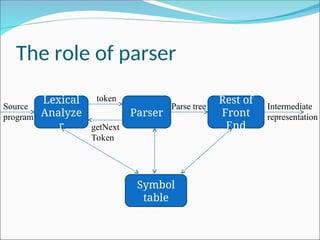
The role ofparser
Lexical
Analyze
r
Parser
Source
program
token
getNext
Token
Symbol
table
Parse tree
Rest of
Front
End
Intermediate
representation
4.
Uses of grammars
E-> E + T | T
T -> T * F | F
F -> (E) | id
E -> TE’
E’ -> +TE’ | Ɛ
T -> FT’
T’ -> *FT’ | Ɛ
F -> (E) | id
5.
Error handling
Commonprogramming errors
Lexical errors
Syntactic errors
Semantic errors
Lexical errors
Error handler goals
Report the presence of errors clearly and accurately
Recover from each error quickly enough to detect
subsequent errors
Add minimal overhead to the processing of correct
progrms
6.
Error-recover strategies
Panicmode recovery
Discard input symbol one at a time until one of
designated set of synchronization tokens is found
Phrase level recovery
Replacing a prefix of remaining input by some
string that allows the parser to continue
Error productions
Augment the grammar with productions that
generate the erroneous constructs
Global correction
Choosing minimal sequence of changes to obtain a
globally least-cost correction
7.
Context free grammars
Terminals
Nonterminals
Start symbol
productions
expression -> expression + term
expression -> expression – term
expression -> term
term -> term * factor
term -> term / factor
term -> factor
factor -> (expression)
factor -> id
8.
Derivations
Productions aretreated as rewriting rules to
generate a string
Rightmost and leftmost derivations
E -> E + E | E * E | -E | (E) | id
Derivations for –(id+id)
E => -E => -(E) => -(E+E) => -(id+E)=>-(id+id)
Ambiguity
For somestrings there exist more than one parse
tree
Or more than one leftmost derivation
Or more than one rightmost derivation
Example: id+id*id
Elimination of ambiguity(cont.)
Idea:
A statement appearing between a then and an
else must be matched
13.
Elimination of leftrecursion
A grammar is left recursive if it has a non-
terminal A such that there is a derivation A=> Aα
Top down parsing methods cant handle left-
recursive grammars
A simple rule for direct left recursion elimination:
For a rule like:
A -> A α|β
We may replace it with
A -> β A’
A’ -> α A’ | ɛ
+
14.
Left recursion elimination(cont.)
There are cases like following
S -> Aa | b
A -> Ac | Sd | ɛ
Left recursion elimination algorithm:
Arrange the nonterminals in some order A1,A2,…,An.
For (each i from 1 to n) {
For (each j from 1 to i-1) {
Replace each production of the form Ai-> Aj γ by the
production Ai -> δ1 γ | δ2 γ | … |δk γ where Aj-> δ1 |
δ2 | … |δk are all current Aj productions
}
Eliminate left recursion among the Ai-productions
}
15.
Left factoring
Leftfactoring is a grammar transformation that is
useful for producing a grammar suitable for
predictive or top-down parsing.
Consider following grammar:
Stmt -> if expr then stmt else stmt
| if expr then stmt
On seeing input if it is not clear for the parser which
production to use
We can easily perform left factoring:
If we have A->αβ1 | αβ2 then we replace it with
A -> αA’
A’ -> β1 | β2
16.
Left factoring (cont.)
Algorithm
For each non-terminal A, find the longest prefix α
common to two or more of its alternatives. If α<>
ɛ, then replace all of A-productions A->αβ1 |αβ2
| … | αβn | γ by
A -> αA’ | γ
A’ -> β1 |β2 | … | βn
Example:
S -> I E t S | i E t S e S | a
E -> b
18.
Introduction
A Top-downparser tries to create a parse tree from the
root towards the leafs scanning input from left to right
It can be also viewed as finding a leftmost derivation
for an input string
Example: id+id*id
E -> TE’
E’ -> +TE’ | Ɛ
T -> FT’
T’ -> *FT’ | Ɛ
F -> (E) | id
E
lm
E
T E’
lm
E
T E’
F T’
lm
E
T E’
F T’
id
lm
E
T E’
F T’
id Ɛ
lm
E
T E’
F T’
id Ɛ
+ T E’
19.
Recursive descent parsing
Consists of a set of procedures, one for each
nonterminal
Execution begins with the procedure for start symbol
A typical procedure for a non-terminal
void A() {
choose an A-production, A->X1X2..Xk
for (i=1 to k) {
if (Xi is a nonterminal
call procedure Xi();
else if (Xi equals the current input symbol a)
advance the input to the next symbol;
else /* an error has occurred */
}
}
20.
Recursive descent parsing(cont)
General recursive descent may require backtracking
The previous code needs to be modified to allow
backtracking
In general form it cant choose an A-production
easily.
So we need to try all alternatives
If one failed the input pointer needs to be reset and
another alternative should be tried
Recursive descent parsers cant be used for left-
recursive grammars
First and Follow
First() is set of terminals that begins strings derived from
If α=>ɛ then is also in First(ɛ)
In predictive parsing when we have A-> α|β, if First(α)
and First(β) are disjoint sets then we can select
appropriate A-production by looking at the next input
Follow(A), for any nonterminal A, is set of terminals a
that can appear immediately after A in some sentential
form
If we have S => αAaβ for some αand βthen a is in Follow(A)
If A can be the rightmost symbol in some sentential form,
then $ is in Follow(A)
*
*
23.
Computing First
Tocompute First(X) for all grammar symbols X,
apply following rules until no more terminals or ɛ
can be added to any First set:
1. If X is a terminal then First(X) = {X}.
2. If X is a nonterminal and X->Y1Y2…Yk is a
production for some k>=1, then place a in First(X) if
for some i a is in First(Yi) and ɛ is in all of First(Y1),
…,First(Yi-1) that is Y1…Yi-1 => ɛ. if ɛ is in First(Yj)
for j=1,…,k then add ɛ to First(X).
3. If X-> ɛ is a production then add ɛ to First(X)
Example!
*
*
24.
Computing follow
Tocompute First(A) for all nonterminals A, apply
following rules until nothing can be added to any
follow set:
1. Place $ in Follow(S) where S is the start symbol
2. If there is a production A-> αBβ then everything
in First(β) except ɛ is in Follow(B).
3. If there is a production A->B or a production
A->αBβ where First(β) contains ɛ, then
everything in Follow(A) is in Follow(B)
Example!
25.
LL(1) Grammars
Predictiveparsers are those recursive descent parsers
needing no backtracking
Grammars for which we can create predictive parsers are
called LL(1)
The first L means scanning input from left to right
The second L means leftmost derivation
And 1 stands for using one input symbol for lookahead
A grammar G is LL(1) if and only if whenever A-> α|βare two
distinct productions of G, the following conditions hold:
For no terminal a do αandβ both derive strings beginning with
a
At most one of α or βcan derive empty string
If α=> ɛ then βdoes not derive any string beginning with a
terminal in Follow(A).
*
26.
Construction of predictive
parsingtable
For each production A->α in grammar do the
following:
For each terminal a in First(α) add A-> in M[A,a]
If ɛ is in First(α), then for each terminal b in
Follow(A) add A-> ɛ to M[A,b]. If ɛ is in First(α)
and $ is in Follow(A), add A-> ɛ to M[A,$] as well
If after performing the above, there is no
production in M[A,a] then set M[A,a] to error
27.
Example
E -> TE’
E’-> +TE’ | Ɛ
T -> FT’
T’ -> *FT’ | Ɛ
F -> (E) | id
F
T
E
E’
T’
First Follow
{(,id}
{(,id}
{(,id}
{+,ɛ}
{*,ɛ}
{+, *, ), $}
{+, ), $}
{+, ), $}
{), $}
{), $}
E
E’
T
T’
F
Non -
terminal
Input Symbol
id + * ( ) $
E -> TE’ E -> TE’
E’ -> +TE’ E’ -> Ɛ E’ -> Ɛ
T -> FT’ T -> FT’
T’ -> *FT’
T’ -> Ɛ T’ -> Ɛ T’ -> Ɛ
F -> (E)
F -> id
28.
Another example
S ->iEtSS’ | a
S’ -> eS | Ɛ
E -> b
S
S’
E
Non -
terminal
Input Symbol
a b e i t $
S -> a S -> iEtSS’
S’ -> Ɛ
S’ -> eS
S’ -> Ɛ
E -> b
Predictive parsing algorithm
Setip point to the first symbol of w;
Set X to the top stack symbol;
While (X<>$) { /* stack is not empty */
if (X is a) pop the stack and advance ip;
else if (X is a terminal) error();
else if (M[X,a] is an error entry) error();
else if (M[X,a] = X->Y1Y2..Yk) {
output the production X->Y1Y2..Yk;
pop the stack;
push Yk,…,Y2,Y1 on to the stack with Y1 on top;
}
set X to the top stack symbol;
}
Error recovery inpredictive parsing
Panic mode
Place all symbols in Follow(A) into synchronization set for
nonterminal A: skip tokens until an element of Follow(A) is
seen and pop A from stack.
Add to the synchronization set of lower level construct the
symbols that begin higher level constructs
Add symbols in First(A) to the synchronization set of
nonterminal A
If a nonterminal can generate the empty string then the
production deriving can be used as a default
If a terminal on top of the stack cannot be matched, pop the
terminal, issue a message saying that the terminal was
insterted
33.
Example
E
E’
T
T’
F
Non -
terminal
Input Symbol
id+ * ( ) $
E -> TE’ E -> TE’
E’ -> +TE’ E’ -> Ɛ E’ -> Ɛ
T -> FT’ T -> FT’
T’ -> *FT’
T’ -> Ɛ T’ -> Ɛ T’ -> Ɛ
F -> (E)
F -> id
synch synch
synch synch synch
synch synch synch synch
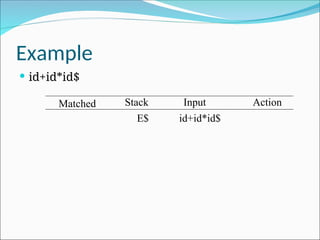
Stack Input Action
E$ )id*+id$ Error, Skip )
E$ id*+id$ id is in First(E)
TE’$ id*+id$
FT’E’$ id*+id$
idT’E’$ id*+id$
T’E’$ *+id$
*FT’E’$ *+id$
+id$
FT’E’$ Error, M[F,+]=synch
+id$
T’E’$ F has been poped
35.
Introduction
Constructs parsetree for an input string
beginning at the leaves (the bottom) and working
towards the root (the top)
Example: id*id
E -> E + T | T
T -> T * F | F
F -> (E) | id id
F * id
id*id T * id
id
F
T * F
id
F id T * F
id
F id
F
T * F
id
F id
F
E
36.
Shift-reduce parser
Thegeneral idea is to shift some symbols of input to
the stack until a reduction can be applied
At each reduction step, a specific substring matching
the body of a production is replaced by the
nonterminal at the head of the production
The key decisions during bottom-up parsing are about
when to reduce and about what production to apply
A reduction is a reverse of a step in a derivation
The goal of a bottom-up parser is to construct a
derivation in reverse:
E=>T=>T*F=>T*id=>F*id=>id*id
37.
Handle pruning
AHandle is a substring that matches the body of a
production and whose reduction represents one
step along the reverse of a rightmost derivation
Right sentential form Handle Reducing production
id*id id F->id
F*id F
id
T->F
T*id F->id
T*F T*F E->T*F
38.
Shift reduce parsing
A stack is used to hold grammar symbols
Handle always appear on top of the stack
Initial configuration:
Stack Input
$ w$
Acceptance configuration
Stack Input
$S $
LR Parsing
Themost prevalent type of bottom-up parsers
LR(k), mostly interested on parsers with k<=1
Why LR parsers?
Table driven
Can be constructed to recognize all programming language
constructs
Most general non-backtracking shift-reduce parsing method
Can detect a syntactic error as soon as it is possible to do so
Class of grammars for which we can construct LR parsers
are superset of those which we can construct LL parsers
44.
States of anLR parser
States represent set of items
An LR(0) item of G is a production of G with the dot
at some position of the body:
For A->XYZ we have following items
A->.XYZ
A->X.YZ
A->XY.Z
A->XYZ.
In a state having A->.XYZ we hope to see a string
derivable from XYZ next on the input.
What about A->X.YZ?
45.
Constructing canonical LR(0)
itemsets
Augmented grammar:
G with addition of a production: S’->S
Closure of item sets:
If I is a set of items, closure(I) is a set of items constructed from I by the
following rules:
Add every item in I to closure(I)
If A->α.Bβ is in closure(I) and B->γ is a production then add the item B-
>.γ to clsoure(I).
Example:
E’->E
E -> E + T | T
T -> T * F | F
F -> (E) | id
I0=closure({[E’->.E]}
E’->.E
E->.E+T
E->.T
T->.T*F
T->.F
F->.(E)
F->.id
46.
Constructing canonical LR(0)
itemsets (cont.)
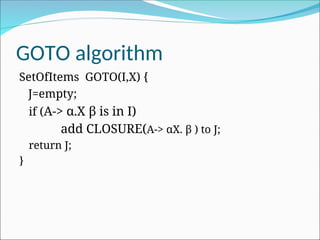
Goto (I,X) where I is an item set and X is a grammar
symbol is closure of set of all items [A-> αX. β]
where [A-> α.X β] is in I
Example
I0=closure({[E’-
>.E]}
E’->.E
E->.E+T
E->.T
T->.T*F
T->.F
F->.(E)
F->.id
E
I1
E’->E.
E->E.+T
I2
E’->T.
T->T.*F
T
I4
F->(.E)
E->.E+T
E->.T
T->.T*F
T->.F
F->.(E)
F->.id
(
47.
Closure algorithm
SetOfItems CLOSURE(I){
J=I;
repeat
for (each item A-> α.Bβ in J)
for (each prodcution B->γ of G)
if (B->.γ is not in J)
add B->.γ to J;
until no more items are added to J on one round;
return J;
Canonical LR(0) items
Voiditems(G’) {
C= CLOSURE({[S’->.S]});
repeat
for (each set of items I in C)
for (each grammar symbol X)
if (GOTO(I,X) is not empty and not in C)
add GOTO(I,X) to C;
until no new set of items are added to C on a round;
}
50.
Example
E’->E
E -> E+ T | T
T -> T * F | F
F -> (E) | id
I0=closure({[E’->.E]}
E’->.E
E->.E+T
E->.T
T->.T*F
T->.F
F->.(E)
F->.id
E
I1
E’->E.
E->E.+T
I2
E’->T.
T->T.*F
T
I4
F->(.E)
E->.E+T
E->.T
T->.T*F
T->.F
F->.(E)
F->.id
(
I5
F->id.
id
I3
T>F.
+
I6
E->E+.T
T->.T*F
T->.F
F->.(E)
F->.id
*
I7
T->T*.F
F->.(E)
F->.id
E I8
E->E.+T
F->(E.)
) I11
F->(E).
I9
E->E+T.
T->T.*F
T
I10
T->T*F.
F
id
+
$
acc
51.
Use of LR(0)automaton
Example: id*id
Lin
e
Stack Symbols Input Action
(1) 0 $ id*id$ Shift to 5
(2) 05 $id *id$ Reduce by F->id
(3) 03 $F *id$ Reduce by T->F
(4) 02 $T *id$ Shift to 7
(5) 027 $T* id$ Shift to 5
(6) 0275 $T*id $ Reduce by F->id
(7) 02710 $T*F $ Reduce by T->T*F
(8) 02 $T $ Reduce by E->T
(9) 01 $E $ accept
52.
LR-Parsing model
a1 …ai … an $
INPUT
LR Parsing
Program
Sm
Sm-1
…
$
ACTION GOTO
Output
53.
LR parsing algorithm
leta be the first symbol of w$;
while(1) { /*repeat forever */
let s be the state on top of the stack;
if (ACTION[s,a] = shift t) {
push t onto the stack;
let a be the next input symbol;
} else if (ACTION[s,a] = reduce A->β) {
pop |β| symbols of the stack;
let state t now be on top of the stack;
push GOTO[t,A] onto the stack;
output the production A->β;
} else if (ACTION[s,a]=accept) break; /* parsing is done */
else call error-recovery routine;
}
54.
Example (0) E’->E
(1)E -> E + T
(2) E-> T
(3) T -> T * F
(4) T-> F
(5) F -> (E)
(6) F->id
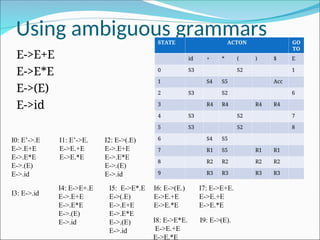
STATE ACTON GOTO
id + * ( ) $ E T F
0 S5 S4 1 2 3
1 S6 Ac
c
2 R
2
S7 R2 R2
3 R
4
R
7
R4 R4
4 S5 S4 8 2 3
5 R
6
R
6
R6 R6
6 S5 S4 9 3
7 S5 S4 10
8 S6 S1
1
9 R
1
S7 R1 R1
10 R
3
R
3
R3 R3
11 R
5
R
5
R5 R5
id*id+id?
Line Stac
k
Symbol
s
Input Action
(1) 0 id*id+id$ Shift to 5
(2) 05 id *id+id$ Reduce by F-
>id
(3) 03 F *id+id$ Reduce by T->F
(4) 02 T *id+id$ Shift to 7
(5) 027 T* id+id$ Shift to 5
(6) 0275 T*id +id$ Reduce by F-
>id
(7) 0271
0
T*F +id$ Reduce by T-
>T*F
(8) 02 T +id$ Reduce by E->T
(9) 01 E +id$ Shift
(10) 016 E+ id$ Shift
(11) 0165 E+id $ Reduce by F-
>id
(12) 0163 E+F $ Reduce by T->F
(13) 0169 E+T` $ Reduce by E-
55.
Constructing SLR parsingtable
Method
Construct C={I0,I1, … , In}, the collection of LR(0) items for
G’
State i is constructed from state Ii:
If [A->α.aβ] is in Ii and Goto(Ii,a)=Ij, then set ACTION[i,a] to “shift
j”
If [A->α.] is in Ii, then set ACTION[i,a] to “reduce A->α” for all a in
follow(A)
If {S’->.S] is in Ii, then set ACTION[I,$] to “Accept”
If any conflicts appears then we say that the grammar is
not SLR(1).
If GOTO(Ii,A) = Ij then GOTO[i,A]=j
All entries not defined by above rules are made “error”
The initial state of the parser is the one constructed from
the set of items containing [S’->.S]
56.
Example grammar whichis not
SLR(1) S -> L=R | R
L -> *R | id
R -> L
I0
S’->.S
S -> .L=R
S->.R
L -> .*R |
L->.id
R ->. L
I1
S’->S.
I2
S ->L.=R
R ->L.
I3
S ->R.
I4
L->*.R
R->.L
L->.*R
L->.id
I5
L -> id.
I6
S->L=.R
R->.L
L->.*R
L->.id
I7
L -> *R.
I8
R -> L.
I9
S -> L=R.
Action
=
2
Shift 6
Reduce R->L
57.
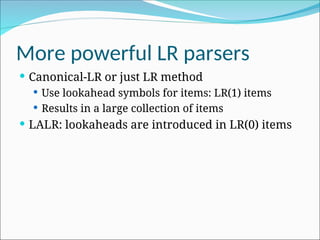
More powerful LRparsers
Canonical-LR or just LR method
Use lookahead symbols for items: LR(1) items
Results in a large collection of items
LALR: lookaheads are introduced in LR(0) items
58.
Canonical LR(1) items
In LR(1) items each item is in the form: [A->α.β,a]
An LR(1) item [A->α.β,a] is valid for a viable
prefix γ if there is a derivation S=>δAw=>δαβw,
where
Γ= δα
Either a is the first symbol of w, or w is ε and a is $
Example:
S->BB
B->aB|b
*
rm
S=>aaBab=>aaaBab
*
rm
Item [B->a.B,a] is valid for γ=aaa
and w=ab
59.
Constructing LR(1) setsof items
SetOfItems Closure(I) {
repeat
for (each item [A->α.Bβ,a] in I)
for (each production B->γ in G’)
for (each terminal b in First(βa))
add [B->.γ, b] to set I;
until no more items are added to I;
return I;
}
SetOfItems Goto(I,X) {
initialize J to be the empty set;
for (each item [A->α.Xβ,a] in I)
add item [A->αX.β,a] to set J;
return closure(J);
}
void items(G’){
initialize C to Closure({[S’->.S,$]});
repeat
for (each set of items I in C)
for (each grammar symbol X)
if (Goto(I,X) is not empty and not in C)
add Goto(I,X) to C;
until no new sets of items are added to C;
}
Canonical LR(1) parsingtable
Method
Construct C={I0,I1, … , In}, the collection of LR(1) items
for G’
State i is constructed from state Ii:
If [A->α.aβ, b] is in Ii and Goto(Ii,a)=Ij, then set ACTION[i,a] to
“shift j”
If [A->α., a] is in Ii, then set ACTION[i,a] to “reduce A->α”
If {S’->.S,$] is in Ii, then set ACTION[I,$] to “Accept”
If any conflicts appears then we say that the grammar
is not LR(1).
If GOTO(Ii,A) = Ij then GOTO[i,A]=j
All entries not defined by above rules are made “error”
The initial state of the parser is the one constructed
from the set of items containing [S’->.S,$]
LALR Parsing Table
For the previous example we had:
I4
C->d. , c/d
I7
C->d. , $
I47
C->d. , c/d/$
State merges cant produce Shift-Reduce conflicts.
Why?
But it may produce reduce-reduce conflict
64.
Example of RRconflict in state
merging
S’->S
S -> aAd | bBd | aBe | bAe
A -> c
B -> c
65.
An easy butspace-consuming
LALR table construction
Method:
1. Construct C={I0,I1,…,In} the collection of LR(1) items.
2. For each core among the set of LR(1) items, find all sets
having that core, and replace these sets by their union.
3. Let C’={J0,J1,…,Jm} be the resulting sets. The parsing
actions for state i, is constructed from Ji as before. If
there is a conflict grammar is not LALR(1).
4. If J is the union of one or more sets of LR(1) items, that
is J = I1 UI2…IIk then the cores of Goto(I1,X), …,
Goto(Ik,X) are the same and is a state like K, then we set
Goto(J,X) =k.
This method is not efficient, a more efficient one is
discussed in the book
66.
Compaction of LRparsing table
Many rows of action tables are identical
Store those rows separately and have pointers to
them from different states
Make lists of (terminal-symbol, action) for each
state
Implement Goto table by having a link list for each
nonterinal in the form (current state, next state)







![Construction of predictive
parsing table
For each production A->α in grammar do the
following:
For each terminal a in First(α) add A-> in M[A,a]
If ɛ is in First(α), then for each terminal b in
Follow(A) add A-> ɛ to M[A,b]. If ɛ is in First(α)
and $ is in Follow(A), add A-> ɛ to M[A,$] as well
If after performing the above, there is no
production in M[A,a] then set M[A,a] to error](https://image.slidesharecdn.com/chapter4-syntaxanalysis-250824160933-7d2fe243/85/Chapter-4-Syntax-Analysis-ppt-with-the-26-320.jpg)


![Predictive parsing algorithm
Set ip point to the first symbol of w;
Set X to the top stack symbol;
While (X<>$) { /* stack is not empty */
if (X is a) pop the stack and advance ip;
else if (X is a terminal) error();
else if (M[X,a] is an error entry) error();
else if (M[X,a] = X->Y1Y2..Yk) {
output the production X->Y1Y2..Yk;
pop the stack;
push Yk,…,Y2,Y1 on to the stack with Y1 on top;
}
set X to the top stack symbol;
}](https://image.slidesharecdn.com/chapter4-syntaxanalysis-250824160933-7d2fe243/85/Chapter-4-Syntax-Analysis-ppt-with-the-30-320.jpg)

![Example
E
E’
T
T’
F
Non -
terminal
Input Symbol
id + * ( ) $
E -> TE’ E -> TE’
E’ -> +TE’ E’ -> Ɛ E’ -> Ɛ
T -> FT’ T -> FT’
T’ -> *FT’
T’ -> Ɛ T’ -> Ɛ T’ -> Ɛ
F -> (E)
F -> id
synch synch
synch synch synch
synch synch synch synch
Stack Input Action
E$ )id*+id$ Error, Skip )
E$ id*+id$ id is in First(E)
TE’$ id*+id$
FT’E’$ id*+id$
idT’E’$ id*+id$
T’E’$ *+id$
*FT’E’$ *+id$
+id$
FT’E’$ Error, M[F,+]=synch
+id$
T’E’$ F has been poped](https://image.slidesharecdn.com/chapter4-syntaxanalysis-250824160933-7d2fe243/85/Chapter-4-Syntax-Analysis-ppt-with-the-33-320.jpg)


![Constructing canonical LR(0)
item sets
Augmented grammar:
G with addition of a production: S’->S
Closure of item sets:
If I is a set of items, closure(I) is a set of items constructed from I by the
following rules:
Add every item in I to closure(I)
If A->α.Bβ is in closure(I) and B->γ is a production then add the item B-
>.γ to clsoure(I).
Example:
E’->E
E -> E + T | T
T -> T * F | F
F -> (E) | id
I0=closure({[E’->.E]}
E’->.E
E->.E+T
E->.T
T->.T*F
T->.F
F->.(E)
F->.id](https://image.slidesharecdn.com/chapter4-syntaxanalysis-250824160933-7d2fe243/85/Chapter-4-Syntax-Analysis-ppt-with-the-45-320.jpg)
![Constructing canonical LR(0)
item sets (cont.)
Goto (I,X) where I is an item set and X is a grammar
symbol is closure of set of all items [A-> αX. β]
where [A-> α.X β] is in I
Example
I0=closure({[E’-
>.E]}
E’->.E
E->.E+T
E->.T
T->.T*F
T->.F
F->.(E)
F->.id
E
I1
E’->E.
E->E.+T
I2
E’->T.
T->T.*F
T
I4
F->(.E)
E->.E+T
E->.T
T->.T*F
T->.F
F->.(E)
F->.id
(](https://image.slidesharecdn.com/chapter4-syntaxanalysis-250824160933-7d2fe243/85/Chapter-4-Syntax-Analysis-ppt-with-the-46-320.jpg)

![Canonical LR(0) items
Void items(G’) {
C= CLOSURE({[S’->.S]});
repeat
for (each set of items I in C)
for (each grammar symbol X)
if (GOTO(I,X) is not empty and not in C)
add GOTO(I,X) to C;
until no new set of items are added to C on a round;
}](https://image.slidesharecdn.com/chapter4-syntaxanalysis-250824160933-7d2fe243/85/Chapter-4-Syntax-Analysis-ppt-with-the-49-320.jpg)
![Example
E’->E
E -> E + T | T
T -> T * F | F
F -> (E) | id
I0=closure({[E’->.E]}
E’->.E
E->.E+T
E->.T
T->.T*F
T->.F
F->.(E)
F->.id
E
I1
E’->E.
E->E.+T
I2
E’->T.
T->T.*F
T
I4
F->(.E)
E->.E+T
E->.T
T->.T*F
T->.F
F->.(E)
F->.id
(
I5
F->id.
id
I3
T>F.
+
I6
E->E+.T
T->.T*F
T->.F
F->.(E)
F->.id
*
I7
T->T*.F
F->.(E)
F->.id
E I8
E->E.+T
F->(E.)
) I11
F->(E).
I9
E->E+T.
T->T.*F
T
I10
T->T*F.
F
id
+
$
acc](https://image.slidesharecdn.com/chapter4-syntaxanalysis-250824160933-7d2fe243/85/Chapter-4-Syntax-Analysis-ppt-with-the-50-320.jpg)


![LR parsing algorithm
let a be the first symbol of w$;
while(1) { /*repeat forever */
let s be the state on top of the stack;
if (ACTION[s,a] = shift t) {
push t onto the stack;
let a be the next input symbol;
} else if (ACTION[s,a] = reduce A->β) {
pop |β| symbols of the stack;
let state t now be on top of the stack;
push GOTO[t,A] onto the stack;
output the production A->β;
} else if (ACTION[s,a]=accept) break; /* parsing is done */
else call error-recovery routine;
}](https://image.slidesharecdn.com/chapter4-syntaxanalysis-250824160933-7d2fe243/85/Chapter-4-Syntax-Analysis-ppt-with-the-53-320.jpg)

![Constructing SLR parsing table
Method
Construct C={I0,I1, … , In}, the collection of LR(0) items for
G’
State i is constructed from state Ii:
If [A->α.aβ] is in Ii and Goto(Ii,a)=Ij, then set ACTION[i,a] to “shift
j”
If [A->α.] is in Ii, then set ACTION[i,a] to “reduce A->α” for all a in
follow(A)
If {S’->.S] is in Ii, then set ACTION[I,$] to “Accept”
If any conflicts appears then we say that the grammar is
not SLR(1).
If GOTO(Ii,A) = Ij then GOTO[i,A]=j
All entries not defined by above rules are made “error”
The initial state of the parser is the one constructed from
the set of items containing [S’->.S]](https://image.slidesharecdn.com/chapter4-syntaxanalysis-250824160933-7d2fe243/85/Chapter-4-Syntax-Analysis-ppt-with-the-55-320.jpg)

![Canonical LR(1) items
In LR(1) items each item is in the form: [A->α.β,a]
An LR(1) item [A->α.β,a] is valid for a viable
prefix γ if there is a derivation S=>δAw=>δαβw,
where
Γ= δα
Either a is the first symbol of w, or w is ε and a is $
Example:
S->BB
B->aB|b
*
rm
S=>aaBab=>aaaBab
*
rm
Item [B->a.B,a] is valid for γ=aaa
and w=ab](https://image.slidesharecdn.com/chapter4-syntaxanalysis-250824160933-7d2fe243/85/Chapter-4-Syntax-Analysis-ppt-with-the-58-320.jpg)
![Constructing LR(1) sets of items
SetOfItems Closure(I) {
repeat
for (each item [A->α.Bβ,a] in I)
for (each production B->γ in G’)
for (each terminal b in First(βa))
add [B->.γ, b] to set I;
until no more items are added to I;
return I;
}
SetOfItems Goto(I,X) {
initialize J to be the empty set;
for (each item [A->α.Xβ,a] in I)
add item [A->αX.β,a] to set J;
return closure(J);
}
void items(G’){
initialize C to Closure({[S’->.S,$]});
repeat
for (each set of items I in C)
for (each grammar symbol X)
if (Goto(I,X) is not empty and not in C)
add Goto(I,X) to C;
until no new sets of items are added to C;
}](https://image.slidesharecdn.com/chapter4-syntaxanalysis-250824160933-7d2fe243/85/Chapter-4-Syntax-Analysis-ppt-with-the-59-320.jpg)

![Canonical LR(1) parsing table
Method
Construct C={I0,I1, … , In}, the collection of LR(1) items
for G’
State i is constructed from state Ii:
If [A->α.aβ, b] is in Ii and Goto(Ii,a)=Ij, then set ACTION[i,a] to
“shift j”
If [A->α., a] is in Ii, then set ACTION[i,a] to “reduce A->α”
If {S’->.S,$] is in Ii, then set ACTION[I,$] to “Accept”
If any conflicts appears then we say that the grammar
is not LR(1).
If GOTO(Ii,A) = Ij then GOTO[i,A]=j
All entries not defined by above rules are made “error”
The initial state of the parser is the one constructed
from the set of items containing [S’->.S,$]](https://image.slidesharecdn.com/chapter4-syntaxanalysis-250824160933-7d2fe243/85/Chapter-4-Syntax-Analysis-ppt-with-the-61-320.jpg)




![Cd2 [autosaved]](https://cdn.slidesharecdn.com/ss_thumbnails/cd2autosaved-161231072301-thumbnail.jpg?width=640&height=640&fit=bounds)


