Ear
Submitted by :
• Amit Kumar Shah
• Deepashree sah
• Kiran Gautam
• Kiran Kathayat
• Neelam Bist
• Nischala Raut
• Sangita Bhajagain
• SimRan Shrestha
• Sudhakar tharu
Submitted TO :
Department of
anatomy
Madan Bhandari
Academy of Health
Sciences
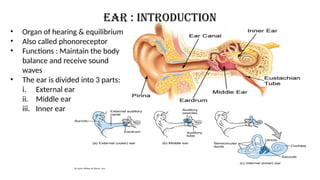
• Organ of hearing & equilibrium
• Also called phonoreceptor
• Functions : Maintain the body
balance and receive sound
waves
• The ear is divided into 3 parts:
i. External ear
ii. Middle ear
iii. Inner ear
Ear : Introduction
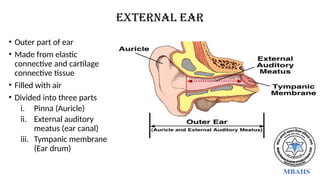
• Outer part of ear
• Made from elastic
connective and cartilage
connective tissue
• Filled with air
• Divided into three parts
i. Pinna (Auricle)
ii. External auditory
meatus (ear canal)
iii. Tympanic membrane
(Ear drum)
External ear
Pinna
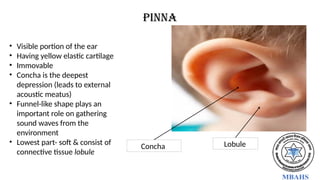
• Visible portion of the ear
• Having yellow elastic cartilage
• Immovable
• Concha is the deepest
depression (leads to external
acoustic meatus)
• Funnel-like shape plays an
important role on gathering
sound waves from the
environment
• Lowest part- soft & consist of
connective tissue lobule
Concha Lobule
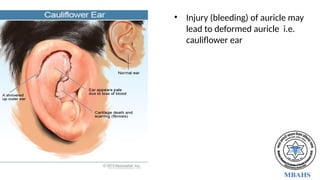
• Injury (bleeding) of auricle may
lead to deformed auricle i.e.
cauliflower ear
External auditory meatus (EAM)
• 24mm long
• S-shaped curved
• Extended from base of pinna (Concha) to inner side (TM)
• Conducts sound waves from the concha to the tympanic
membrane
• It is divided into two parts:
a. Cartilaginous part :
• Yellow elastic cartilage.
• Skin covering cartilage is thick and contains ceruminous
glands which secrets wax/cerumen.
b. Bony part
• Skin lining the bony canal is thin and continuous over the
tympanic membrane. It is devoid of hair and ceruminous
glands.
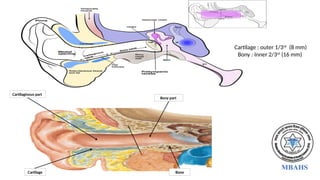
Cartilage : outer 1/3rd
(8 mm)
Bony : Inner 2/3rd
(16 mm)
Cartilaginous part
Cartilage
Bony part
Bone
Tympanic membrane
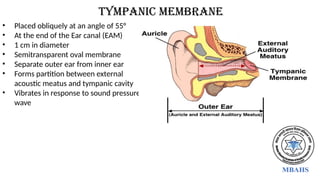
• Placed obliquely at an angle of 55°
• At the end of the Ear canal (EAM)
• 1 cm in diameter
• Semitransparent oval membrane
• Separate outer ear from inner ear
• Forms partition between external
acoustic meatus and tympanic cavity
• Vibrates in response to sound pressure
wave
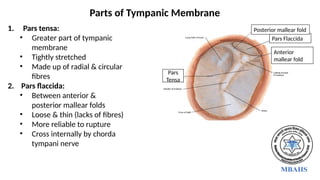
1. Pars tensa:
• Greater part of tympanic
membrane
• Tightly stretched
• Made up of radial & circular
fibres
2. Pars flaccida:
• Between anterior &
posterior mallear folds
• Loose & thin (lacks of fibres)
• More reliable to rupture
• Cross internally by chorda
tympani nerve
Parts of Tympanic Membrane
Pars
Tensa
Pars Flaccida
Anterior
mallear fold
Posterior mallear fold
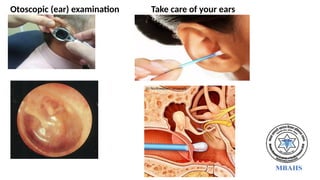
Otoscopic (ear) examination Take care of your ears
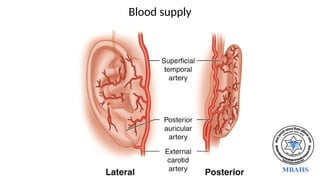
Blood supply
Venous drainage
1. Reteromandibular vein – formed by union of Superficial temporal &
maxillary vein
2. Facial vein
3. External jugular vein
4. Internal jugular vein
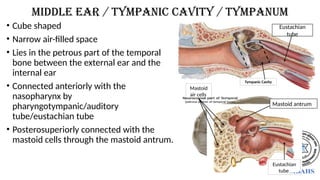
• Cube shaped
• Narrow air-filled space
• Lies in the petrous part of the temporal
bone between the external ear and the
internal ear
• Connected anteriorly with the
nasopharynx by
pharyngotympanic/auditory
tube/eustachian tube
• Posterosuperiorly connected with the
mastoid cells through the mastoid antrum.
middle ear / Tympanic cavity / tympanum
Tympanic Cavity
Eustachian
tube
Mastoid
air cells
Mastoid antrum
Eustachian
tube
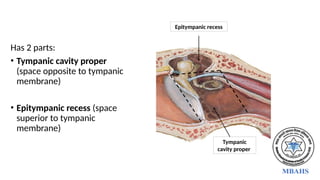
Has 2 parts:
• Tympanic cavity proper
(space opposite to tympanic
membrane)
• Epitympanic recess (space
superior to tympanic
membrane)
Tympanic
cavity proper
Epitympanic recess
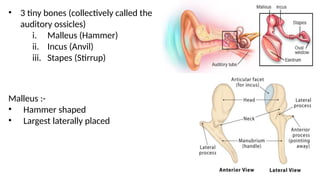
• 3 tiny bones (collectively called the
auditory ossicles)
i. Malleus (Hammer)
ii. Incus (Anvil)
iii. Stapes (Stirrup)
Malleus :-
• Hammer shaped
• Largest laterally placed
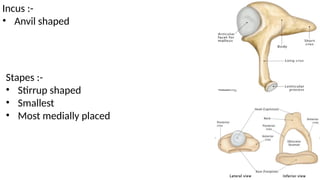
Incus :-
• Anvil shaped
Stapes :-
• Stirrup shaped
• Smallest
• Most medially placed
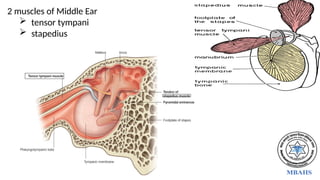
2 muscles of Middle Ear
 tensor tympani
 stapedius
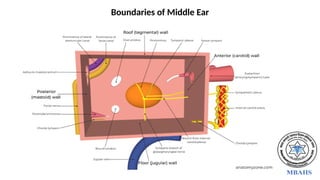
Boundaries of Middle Ear
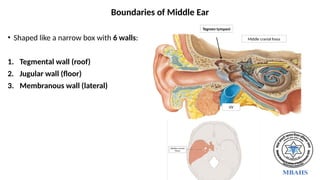
• Shaped like a narrow box with 6 walls:
1. Tegmental wall (roof)
2. Jugular wall (floor)
3. Membranous wall (lateral)
Middle cranial fossa
Tegmen tympani
IJV
Boundaries of Middle Ear
4. Labyrinthine wall (medial)
5. Carotid wall (anterior)
6. Mastoid wall ( posterior)
Promontory
ICA
Eustachian
tube
Tensor
tympani
Mastoid
antrum
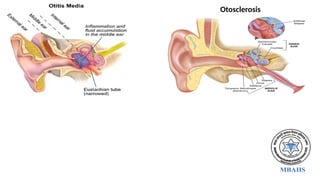
Otosclerosis
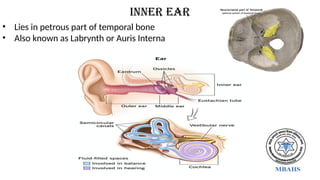
inner ear
• Lies in petrous part of temporal bone
• Also known as Labrynth or Auris Interna
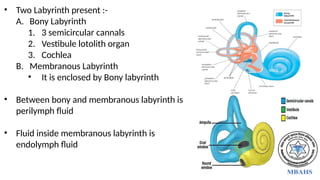
• Two Labyrinth present :-
A. Bony Labyrinth
1. 3 semicircular cannals
2. Vestibule lotolith organ
3. Cochlea
B. Membranous Labyrinth
• It is enclosed by Bony labyrinth
• Between bony and membranous labyrinth is
perilymph fluid
• Fluid inside membranous labyrinth is
endolymph fluid
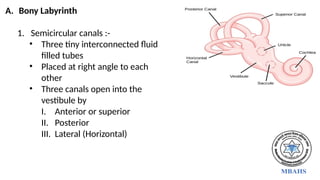
A. Bony Labyrinth
1. Semicircular canals :-
• Three tiny interconnected fluid
filled tubes
• Placed at right angle to each
other
• Three canals open into the
vestibule by
I. Anterior or superior
II. Posterior
III. Lateral (Horizontal)
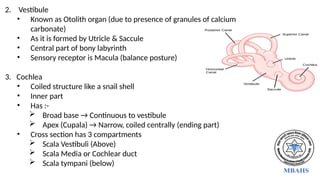
2. Vestibule
• Known as Otolith organ (due to presence of granules of calcium
carbonate)
• As it is formed by Utricle & Saccule
• Central part of bony labyrinth
• Sensory receptor is Macula (balance posture)
3. Cochlea
• Coiled structure like a snail shell
• Inner part
• Has :-
 Broad base → Continuous to vestibule
 Apex (Cupala) → Narrow, coiled centrally (ending part)
• Cross section has 3 compartments
 Scala Vestibuli (Above)
 Scala Media or Cochlear duct
 Scala tympani (below)
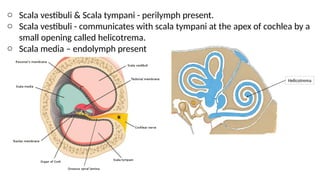
o Scala vestibuli & Scala tympani - perilymph present.
o Scala vestibuli - communicates with scala tympani at the apex of cochlea by a
small opening called helicotrema.
o Scala media – endolymph present
Helicotrema
Scala
vestibuli
Scala
tympani
Scala
media
B. MEMBRANOUS LABYRINTH
• Cavity filled with endolymph
• Parts:-
1. Organ of of Corti / duct of Cochlea
2. Organ of Static balance / The utricle and saccule with maculae
3. Organs of kinetic balance / Semicircular ducts with cristae
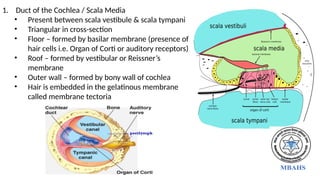
1. Duct of the Cochlea / Scala Media
• Present between scala vestibule & scala tympani
• Triangular in cross-section
• Floor – formed by basilar membrane (presence of
hair cells i.e. Organ of Corti or auditory receptors)
• Roof – formed by vestibular or Reissner’s
membrane
• Outer wall – formed by bony wall of cochlea
• Hair is embedded in the gelatinous membrane
called membrane tectoria
2. Saccule & Utricle
• Saccule lies anteroinferiorly of
vestibule
• Utricle lies posterosuperiorly
of vestibule
• Utricle is larger than saccule
• Utricle receives the ends of 3
semicircular ducts through 5
openings
• They are static balance
receptors
• Maculae are receptors that
give information about
position of head
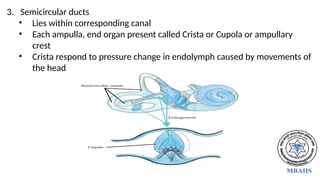
3. Semicircular ducts
• Lies within corresponding canal
• Each ampulla, end organ present called Crista or Cupola or ampullary
crest
• Crista respond to pressure change in endolymph caused by movements of
the head
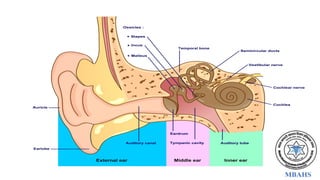
Ear Anatomy - External ear, Middle ear, Inner ear

Ear Anatomy - External ear, Middle ear, Inner ear

  • 1.
    Ear Submitted by : •Amit Kumar Shah • Deepashree sah • Kiran Gautam • Kiran Kathayat • Neelam Bist • Nischala Raut • Sangita Bhajagain • SimRan Shrestha • Sudhakar tharu Submitted TO : Department of anatomy Madan Bhandari Academy of Health Sciences
  • 2.
    • Organ ofhearing & equilibrium • Also called phonoreceptor • Functions : Maintain the body balance and receive sound waves • The ear is divided into 3 parts: i. External ear ii. Middle ear iii. Inner ear Ear : Introduction
  • 4.
    • Outer partof ear • Made from elastic connective and cartilage connective tissue • Filled with air • Divided into three parts i. Pinna (Auricle) ii. External auditory meatus (ear canal) iii. Tympanic membrane (Ear drum) External ear
  • 5.
    Pinna • Visible portionof the ear • Having yellow elastic cartilage • Immovable • Concha is the deepest depression (leads to external acoustic meatus) • Funnel-like shape plays an important role on gathering sound waves from the environment • Lowest part- soft & consist of connective tissue lobule Concha Lobule
  • 7.
    • Injury (bleeding)of auricle may lead to deformed auricle i.e. cauliflower ear
  • 8.
    External auditory meatus(EAM) • 24mm long • S-shaped curved • Extended from base of pinna (Concha) to inner side (TM) • Conducts sound waves from the concha to the tympanic membrane • It is divided into two parts: a. Cartilaginous part : • Yellow elastic cartilage. • Skin covering cartilage is thick and contains ceruminous glands which secrets wax/cerumen. b. Bony part • Skin lining the bony canal is thin and continuous over the tympanic membrane. It is devoid of hair and ceruminous glands.
  • 9.
    Cartilage : outer1/3rd (8 mm) Bony : Inner 2/3rd (16 mm) Cartilaginous part Cartilage Bony part Bone
  • 10.
    Tympanic membrane • Placedobliquely at an angle of 55° • At the end of the Ear canal (EAM) • 1 cm in diameter • Semitransparent oval membrane • Separate outer ear from inner ear • Forms partition between external acoustic meatus and tympanic cavity • Vibrates in response to sound pressure wave
  • 11.
    1. Pars tensa: •Greater part of tympanic membrane • Tightly stretched • Made up of radial & circular fibres 2. Pars flaccida: • Between anterior & posterior mallear folds • Loose & thin (lacks of fibres) • More reliable to rupture • Cross internally by chorda tympani nerve Parts of Tympanic Membrane Pars Tensa Pars Flaccida Anterior mallear fold Posterior mallear fold
  • 12.
    Otoscopic (ear) examinationTake care of your ears
  • 13.
  • 14.
    Venous drainage 1. Reteromandibularvein – formed by union of Superficial temporal & maxillary vein 2. Facial vein 3. External jugular vein 4. Internal jugular vein
  • 15.
    • Cube shaped •Narrow air-filled space • Lies in the petrous part of the temporal bone between the external ear and the internal ear • Connected anteriorly with the nasopharynx by pharyngotympanic/auditory tube/eustachian tube • Posterosuperiorly connected with the mastoid cells through the mastoid antrum. middle ear / Tympanic cavity / tympanum Tympanic Cavity Eustachian tube Mastoid air cells Mastoid antrum Eustachian tube
  • 16.
    Has 2 parts: •Tympanic cavity proper (space opposite to tympanic membrane) • Epitympanic recess (space superior to tympanic membrane) Tympanic cavity proper Epitympanic recess
  • 17.
    • 3 tinybones (collectively called the auditory ossicles) i. Malleus (Hammer) ii. Incus (Anvil) iii. Stapes (Stirrup) Malleus :- • Hammer shaped • Largest laterally placed
  • 18.
    Incus :- • Anvilshaped Stapes :- • Stirrup shaped • Smallest • Most medially placed
  • 19.
    2 muscles ofMiddle Ear  tensor tympani  stapedius
  • 20.
  • 21.
    • Shaped likea narrow box with 6 walls: 1. Tegmental wall (roof) 2. Jugular wall (floor) 3. Membranous wall (lateral) Middle cranial fossa Tegmen tympani IJV Boundaries of Middle Ear
  • 22.
    4. Labyrinthine wall(medial) 5. Carotid wall (anterior) 6. Mastoid wall ( posterior) Promontory ICA Eustachian tube Tensor tympani Mastoid antrum
  • 23.
  • 24.
    inner ear • Liesin petrous part of temporal bone • Also known as Labrynth or Auris Interna
  • 25.
    • Two Labyrinthpresent :- A. Bony Labyrinth 1. 3 semicircular cannals 2. Vestibule lotolith organ 3. Cochlea B. Membranous Labyrinth • It is enclosed by Bony labyrinth • Between bony and membranous labyrinth is perilymph fluid • Fluid inside membranous labyrinth is endolymph fluid
  • 26.
    A. Bony Labyrinth 1.Semicircular canals :- • Three tiny interconnected fluid filled tubes • Placed at right angle to each other • Three canals open into the vestibule by I. Anterior or superior II. Posterior III. Lateral (Horizontal)
  • 27.
    2. Vestibule • Knownas Otolith organ (due to presence of granules of calcium carbonate) • As it is formed by Utricle & Saccule • Central part of bony labyrinth • Sensory receptor is Macula (balance posture) 3. Cochlea • Coiled structure like a snail shell • Inner part • Has :-  Broad base → Continuous to vestibule  Apex (Cupala) → Narrow, coiled centrally (ending part) • Cross section has 3 compartments  Scala Vestibuli (Above)  Scala Media or Cochlear duct  Scala tympani (below)
  • 28.
    o Scala vestibuli& Scala tympani - perilymph present. o Scala vestibuli - communicates with scala tympani at the apex of cochlea by a small opening called helicotrema. o Scala media – endolymph present Helicotrema
  • 29.
  • 30.
    B. MEMBRANOUS LABYRINTH •Cavity filled with endolymph • Parts:- 1. Organ of of Corti / duct of Cochlea 2. Organ of Static balance / The utricle and saccule with maculae 3. Organs of kinetic balance / Semicircular ducts with cristae
  • 31.
    1. Duct ofthe Cochlea / Scala Media • Present between scala vestibule & scala tympani • Triangular in cross-section • Floor – formed by basilar membrane (presence of hair cells i.e. Organ of Corti or auditory receptors) • Roof – formed by vestibular or Reissner’s membrane • Outer wall – formed by bony wall of cochlea • Hair is embedded in the gelatinous membrane called membrane tectoria
  • 32.
    2. Saccule &Utricle • Saccule lies anteroinferiorly of vestibule • Utricle lies posterosuperiorly of vestibule • Utricle is larger than saccule • Utricle receives the ends of 3 semicircular ducts through 5 openings • They are static balance receptors • Maculae are receptors that give information about position of head
  • 33.
    3. Semicircular ducts •Lies within corresponding canal • Each ampulla, end organ present called Crista or Cupola or ampullary crest • Crista respond to pressure change in endolymph caused by movements of the head