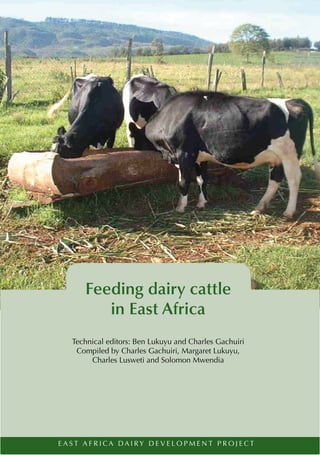
Feeding dairy cattle
           in East Africa
    Technical editors: Ben Lukuyu and Charles Gachuiri
     Compiled by Charles Gachuiri, Margaret Lukuyu,
         Charles Lusweti and Solomon Mwendia


E a s t A f r i c a D a i r y D e v e l o p m e n t PRO J E CT
Feeding dairy cattle
       in East Africa
Technical editors: Ben Lukuyu and Charles Gachuiri
 Compiled by Charles Gachuiri, Margaret Lukuyu,
     Charles Lusweti and Solomon Mwendia

      East Africa Dairy Development Project
© 2012 East Africa Dairy Development Project (EADD)

The East Africa Dairy Development project is a regional industry development program led by Heifer
International in partnership with the International Livestock Research Institute (ILRI), TechnoServe, the World
Agroforestry Centre (ICRAF) and the African Breeders Services Total Cattle Management (ABS TCM). The
project is being implemented in Kenya, Rwanda and Uganda.

Funded by the Bill & Melinda Gates Foundation, the goal of this project is to help one million people—
179,000 families living on small 1–5-acre farms—lift themselves out of poverty through more profitable
production and marketing of milk.

This publication is copyrighted by the EADD project. It is licensed for use under the Creative Commons
Attribution-Non-commercial-Share Alike 3.0 Unported License. To view this licence, visit http://
creativecommons.org/licenses/by-nc-sa/3.0/. Unless otherwise noted, you are free to copy, duplicate
or reproduce, and distribute, display or transmit any part of this publication or portions thereof without
permission, and to make translations, adaptation, or other derivative works under the following conditions:
ATTRIBUTION. The work must be attributed, but not in any way that suggests endorsement by EADD or the
author(s).
NON-COMMERCIAL. This work may not be used for commercial purposes.
SHARE ALIKE. If this work is altered, transformed, or built upon, the resulting work must be distributed only
under the same or similar licence to this one.
NOTICE: For any reuse or distribution, the licence terms of this work must be made clear to others.
Any of the above conditions may be waived if permission is obtained from the copyright holder.
Nothing in this licence impairs or restricts the author’s moral rights. Fair dealing and other rights are in no
way affected by the above. The parts used must not misrepresent the meaning of the publication. EADD
would appreciate being sent a copy of any materials in which text, photos, etc. have been used.

East Africa Dairy Development Project
PO Box 74388 – 00200
Likoni Lane, off Denis Pritt Road
Nairobi, Kenya
Tel: +254 20 261 4877/260 8503
Fax: +254 20 261 4878
http://eadairy.wordpress.com

Technical editors: Ben Lukuyu and Charles Gachuiri
Compiled by Charles Gachuiri, Margaret Lukuyu, Charles Lusweti and Solomon Mwendia

For further information contact:
Ben Lukuyu
International Livestock Research Institute
Markets, Gender and Livelihoods Theme
PO Box 30709 – 00100, Nairobi, Kenya
Tel: +254 20 422 3000

Correct citation: Lukuyu B, Gachuiri CK, Lukuyu MN, Lusweti C and Mwendia S (eds). 2012. Feeding dairy
cattle in East Africa. East Africa Dairy Development Project, Nairobi, Kenya.

ISBN: 92–9146–272–1

Production of this manual was funded by the East Africa Dairy Development Project. However, EADD
accepts no responsibility for any views or conclusions herein presented.

Copyediting: Helen van Houten and Tezira Lore
Illustrations: Simon Ndonye and Conrad Mudibo
Design and layout: Conrad Mudibo
CONTENTS

LIST OF TABLES............................................................................................................. vii
LIST OF FIGURES......................................................................................................... viii
PREFACE........................................................................................................................ ix
ABBREVIATIONS............................................................................................................. x
ACKNOWLEDGEMENTS................................................................................................ xi

CHAPTER 1: INTRODUCTION....................................................................................... 1
  1.1 	Importance of dairy cattle................................................................................... 1
  1.2 	 Qualities of a good dairy cow............................................................................. 1
  1.3 	 Basic needs of a cow for optimum production..................................................... 3
  1.4 	The ruminant digestive system............................................................................. 3
  1.5 	The cow as a milk factory.................................................................................... 3

CHAPTER 2: NUTRIENTS................................................................................................ 5
  2.1 	 Energy................................................................................................................. 5
        2.1.1	Functions................................................................................................ 5
        2.1.2 	Sources................................................................................................... 5
        2.1.3 	Consequences of energy deficiency........................................................ 6
        2.1.4 	Consequences of excessive amounts of energy....................................... 6
        2.1.5 	Special considerations............................................................................ 6
  2.2 	Protein................................................................................................................ 6
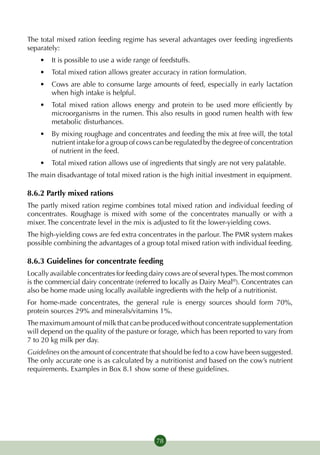
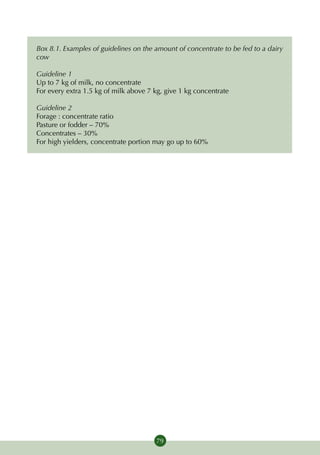
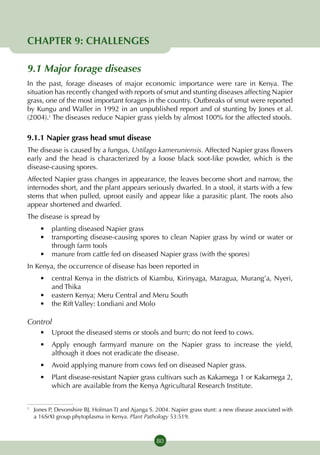
        2.2.1 	Functions................................................................................................ 7
        2.2.2 	Sources................................................................................................... 7
        2.2.3 	Consequences of protein deficiency....................................................... 7
        2.2.4 	Consequences of feeding excess protein................................................. 7
        2.2.5 	Protein and rumen microbes................................................................... 7
        2.2.6 	Protein and milk production................................................................... 8
  2.3 	Minerals.............................................................................................................. 8
        2.3.1 	Functions................................................................................................ 8
        2.3.2 	Sources................................................................................................... 9
        2.3.3 	Consequences of mineral deficiency....................................................... 9
  2.4 	Vitamins.............................................................................................................. 9
        2.4.1 	Functions................................................................................................ 9
        2.4.2 	Consequences of vitamin deficiency..................................................... 10
        2.4.3 	Consequences of feeding excess vitamins............................................. 10
  2.5 	 Water................................................................................................................ 10
  2.6 	Concept of dry matter....................................................................................... 11


                                                                    iii
CHAPTER 3: PRODUCTION SYSTEMS AND PASTURE MANAGEMENT....................... 13
  3.1	Production systems........................................................................................... 13
       3.1.1	Intensive system.................................................................................... 13
       3.1.2 	 Extensive system................................................................................... 13
       3.1.3 	Semi-intensive system........................................................................... 14
       3.1.4 	Other systems....................................................................................... 14
  3.2 	Pasture management......................................................................................... 14
       3.2.1 	 Weed control........................................................................................ 14
       3.2.2 	 Grazing management........................................................................... 15
       3.2.3 	Fertility management............................................................................ 15
  3.3 	Stocking rates for different grasses..................................................................... 15

CHAPTER 4: FORAGE PRODUCTION AND UTILIZATION........................................... 17
  4.1 	Forage production and management................................................................. 17
       4.1.1 	 Establishment and management of ley pastures..................................... 17
  4.2 	Fodder crops..................................................................................................... 21
       4.2.1 	Napier grass.......................................................................................... 21
       4.2.2 	Sweet potato......................................................................................... 25
       4.2.3 	Oats..................................................................................................... 26
       4.2.4 	Fodder sorghums.................................................................................. 26
  4.3 	Forage legumes................................................................................................. 27
       4.3.1 	 Desmodium.......................................................................................... 27
       4.3.2 	Lucerne................................................................................................ 29
       4.3.3 	 Dolichos lablab.................................................................................... 31
       4.3.4 	 Stylosanthes guyanensis........................................................................ 32
       4.3.5 	Fodder trees.......................................................................................... 33
  4.4 	Forage conservation.......................................................................................... 35
       4.4.1 	 Why conserve?..................................................................................... 35
       4.4.2 	 Haymaking........................................................................................... 35
       4.4.3 	Leaf meal.............................................................................................. 37
       4.4.4 	Silage................................................................................................... 37
       4.4.5 	Fodder banks........................................................................................ 42
  4.5 	Crop by-products.............................................................................................. 42
       4.5.1 	 Definition............................................................................................. 42
       4.5.2 	Improving the quality of crop residues.................................................. 43


                                                                 iv
CHAPTER 5: SUPPLEMENTS......................................................................................... 45
  5.1 	Concentrates..................................................................................................... 45
       5.1.1 	 High-energy concentrates..................................................................... 45
       5.1.2 	 High-protein concentrates.................................................................... 45
       5.1.3 	Non-protein nitrogen............................................................................ 45
       5.1.4 	 Urea toxicity......................................................................................... 45
  5.2 	Minerals............................................................................................................ 49
       5.2.1 	Mineral feeding methods...................................................................... 49
  5.3 	Vitamins............................................................................................................ 50
  5.4 	Feed additives................................................................................................... 50
       5.4.1 	 Bloat control products.......................................................................... 51
       5.4.2 	 Buffers.................................................................................................. 51
       5.4.3 	Probiotics (microbial enhancers)........................................................... 51
       5.4.4 	Ionophores........................................................................................... 51
  5.5 	Complete meals vs concentrate mix.................................................................. 51

CHAPTER 6: FEEDING CALVES..................................................................................... 53
  6.1 	Calf feeding....................................................................................................... 53
        6.1.1 	Aim of calf feeding............................................................................... 53
        6.1.2 	Stages of development of the calf rumen............................................... 53
        6.1.3 	Calf feeds............................................................................................. 54
  6.2	Calf feeding methods........................................................................................ 56
        6.2.1 	Individual suckling............................................................................... 56
        6.2.2 	Foster mother or multiple suckling........................................................ 56
        6.2.3 	Nipple suckling.................................................................................... 56
        6.2.4 	 Bucket feeding...................................................................................... 56
  6.3	Nutritional disorders......................................................................................... 57
        6.3.1 	Scours (diarrhoea)................................................................................. 57
        6.3.2 	Pneumonia........................................................................................... 57
  6.4	Calf feeding program......................................................................................... 58
  6.5 	 Weaning........................................................................................................... 58
  6.6 	 Bull calves......................................................................................................... 58

CHAPTER 7: HEIFER FEEDING...................................................................................... 59
  7.1 	Aim of heifer feeding......................................................................................... 59
  7.2 	Feeding............................................................................................................. 59
  7.3 	 Growth rate (weight) vs age............................................................................... 60
  7.4 	Steaming up...................................................................................................... 61
        7.4.1 	Stages of heifer development and expected weight for age................... 62


                                                                   v
CHAPTER 8: FEEDING THE DAIRY COW...................................................................... 63
  8.1 Feeding the lactating cow.................................................................................... 63
        8.1.1 	Aim of feeding the dairy cow................................................................ 63
        8.1.2 	Nutrient requirements of a lactating cow.............................................. 63
        8.1.3	Lactation period................................................................................... 65
        8.1.4 	Milk from pasture and fodder................................................................ 68
        8.1.5 	Challenge feeding................................................................................. 68
  8.2 	 Use of body conditioning to assess feeding....................................................... 68
  8.3 	Nutritional diseases........................................................................................... 70
        8.3.1 	Milk fever............................................................................................. 70
        8.3.2 	 Ketosis.................................................................................................. 71
        8.3.3 	Acidosis................................................................................................ 71
        8.3.4 	 Bloat..................................................................................................... 72
  8.4 	Ration formulation............................................................................................ 73
        8.4.1 	 Balanced rations................................................................................... 74
        8.4.2 	Formulation.......................................................................................... 74
  8.5 	Feed budgeting, planning and costs................................................................... 75
        8.5.1 	Costs of acquisition (consider dry matter and cost of nutrients)............. 76
        8.5.2 	Maximum production vs maximum profit............................................. 77
  8.6 	Feeding systems................................................................................................ 77
        8.6.1 	Total mixed rations............................................................................... 77
        8.6.2 	Partly mixed rations.............................................................................. 78
        8.6.3 	 Guidelines for concentrate feeding....................................................... 78

CHAPTER 9: CHALLENGES........................................................................................... 80
  9.1	 Major forage diseases....................................................................................... 80
        9.1.1	Napier grass head smut disease............................................................ 80
        9.1.2	Napier grass stunting disease................................................................ 81
  9.2 	Cost and quality of commercial concentrates.................................................... 81
  9.3 	 Effect of feed contamination on milk quality..................................................... 82

GLOSSARY.................................................................................................................... 84

APPENDICES................................................................................................................. 85
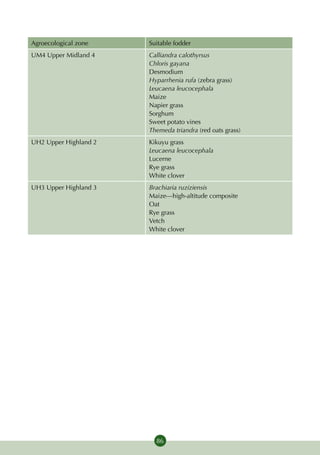
  Appendix 1 	Recommended domains of major forages........................................... 85
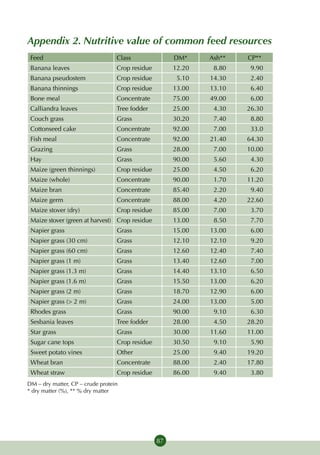
  Appendix 2 	Nutritive value of common feed resources.......................................... 87
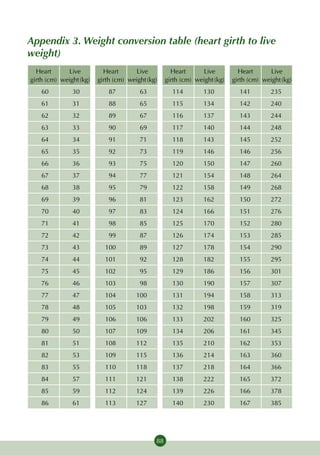
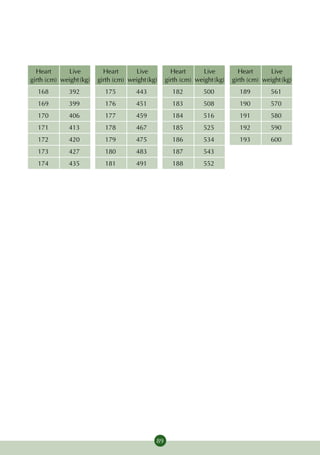
  Appendix 3 	 Weight conversion table (heart girth to live weight)............................. 88
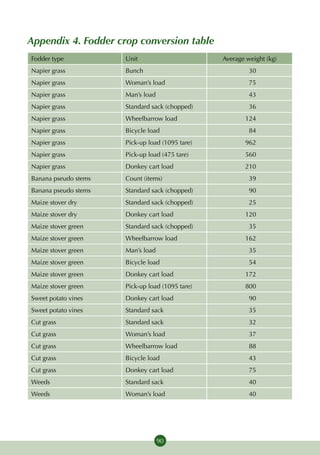
  Appendix 4 	 Fodder crop conversion table.............................................................. 90
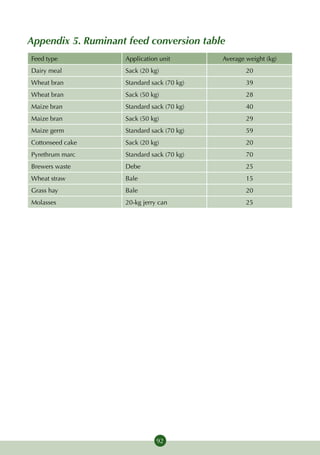
  Appendix 5 	 Ruminant feed conversion table.......................................................... 91
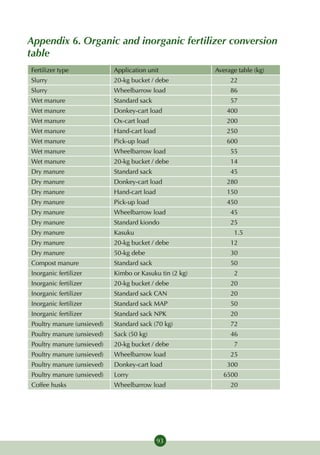
  Appendix 6 	Organic and inorganic fertilizer conversion table................................ 93
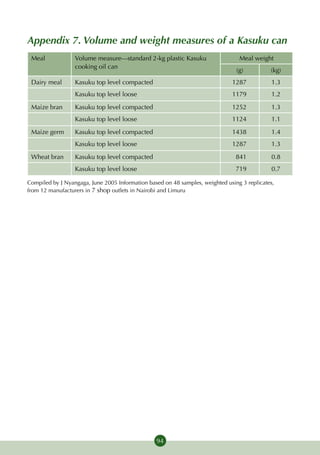
  Appendix 7 	Volume and weight measures of a Kasuku can.................................... 94
  Appendix 8	 Diagram of a zero-grazing unit........................................................... 95


                                                                   vi
LIST OF TABLES
Table 1.1	Characteristics used in judging dairy cattle.................................................. 2
Table 2.1	Minerals required in ruminant diet.............................................................. 8
Table 2.2	Situations in which vitamins may become deficient in dairy cattle............ 10
Table 2.3	 Estimated water requirement by calves, heifers and lactating dairy cattle... 11
Table 3.1	Recommended stocking rates.................................................................... 16
Table 3.2	Yields of different types of fodder at different agroecological zones........... 16
Table 4.1	Recommended forage species for different regions in East Africa............... 18
Table 4.2	Yield of sweet potato varieties................................................................... 25
Table 4.3	Lucerne varieties....................................................................................... 29
Table 4.4	Forages suitable for conservation as hay.................................................... 35
Table 4.5	Fodder bank species suitable for different ecozones.................................. 42
Table 4.6	Typical nutrient content of some crop by-products.................................... 43
Table 5.1	Common energy sources for dairy cattle.................................................... 46
Table 5.2	Common protein sources.......................................................................... 48
Table 5.3	Typical levels of minerals in commonly used supplements........................ 49
Table 5.4	 Kenya Bureau of Standards specifications for dairy cattle concentrates...... 52
Table 6.1	 Example of a calf feeding schedule with weaning at 12 weeks.................. 58
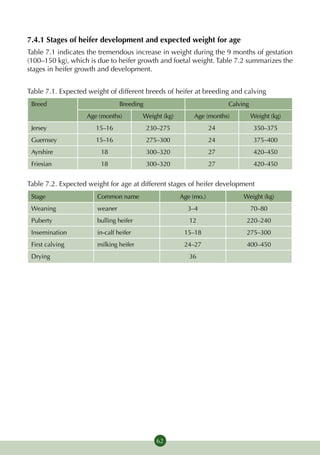
Table 7.1	 Expected weight of different breeds of heifer at breeding and calving........ 62
Table 7.2	 Expected weight for age at different stages of heifer development.............. 62
Table 8.1	Recommended levels of dietary crude protein for dairy cows at
		         different levels of milk yield...................................................................... 64
Table 8.2	 Body-conditioning scores and indications................................................. 69
Table 8.3	Costs of various feedstuffs.......................................................................... 76
Table 9.1	Various feedstuffs and their effect on milk flavour...................................... 82


                                                             vii
LIST OF FIGURES
Figure 1.1	Parts of the dairy cow.................................................................................. 1
Figure 1.2	The cow as a factory.................................................................................... 4
Figure 2.1	 Difference in bulk of feeds before and after water is removed.................... 12
Figure 4.1	Planting Napier grass................................................................................. 22
Figure 4.2	Planting Napier grass using the tumbukiza method................................... 24
Figure 4.3	Planting desmodium.................................................................................. 27
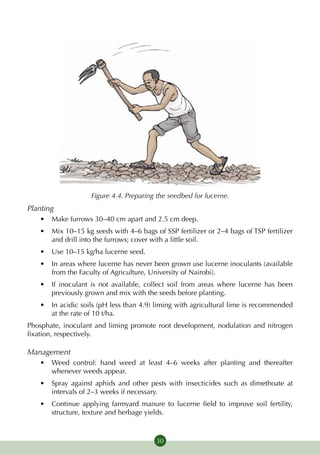
Figure 4.4	Preparing the seedbed for lucerne............................................................. 30
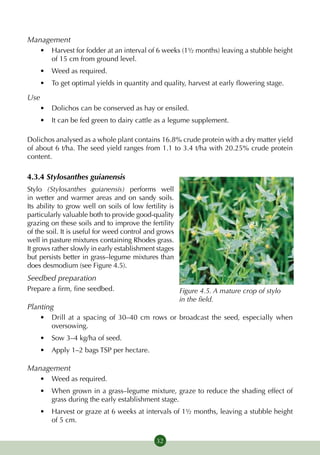
Figure 4.5	A mature crop of stylo in the field............................................................. 32
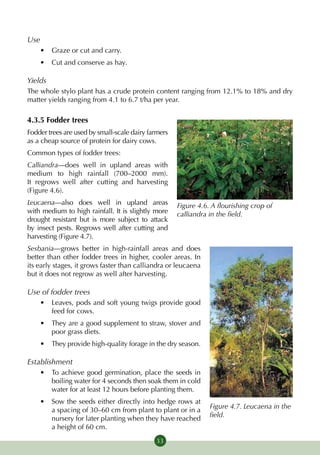
Figure 4.6	A flourishing crop of calliandra in the field................................................ 33
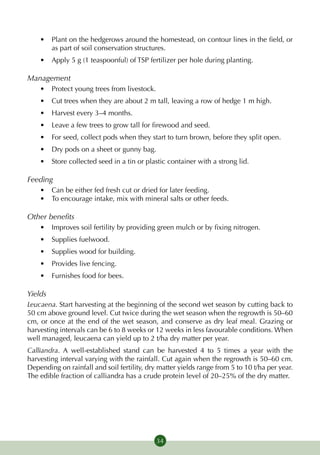
Figure 4.7	Leucaena in the field................................................................................. 33
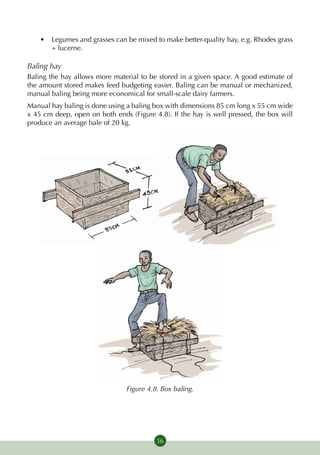
Figure 4.8	 Box baling................................................................................................. 36
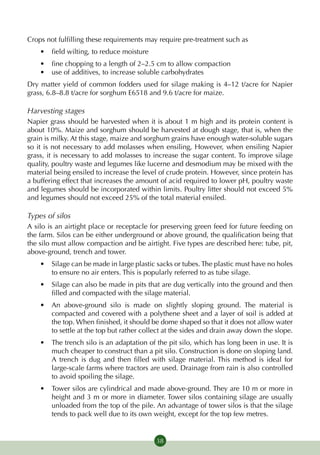
Figure 4.9	Chopping fodder for ensiling..................................................................... 39
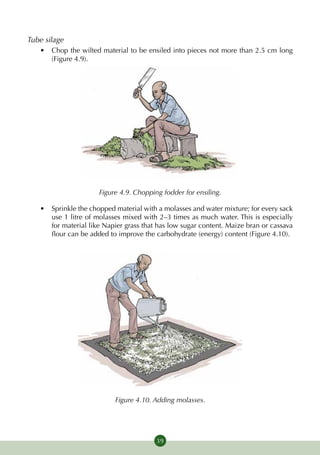
Figure 4.10	Adding molasses....................................................................................... 39
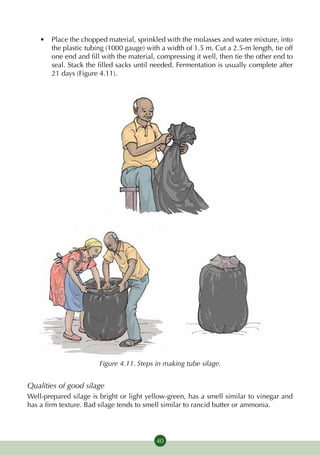
Figure 4.11	Steps in making tube silage....................................................................... 40
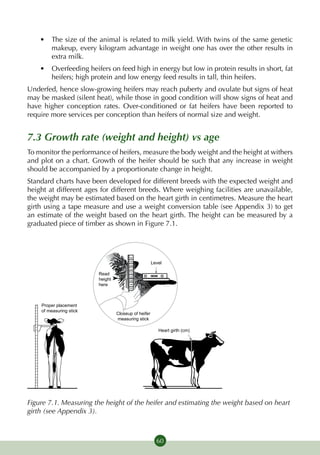
Figure 7.1	Measuring the height of the heifer and estimating the weight based on
		heart girth ................................................................................................. 60
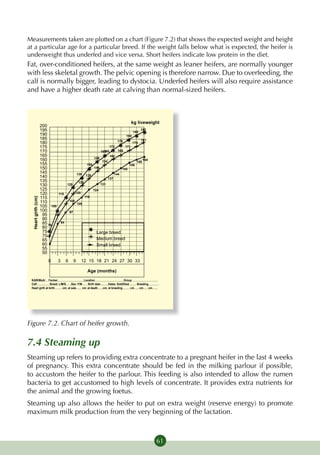
Figure 7.2	Chart of heifer growth............................................................................... 61
Figure 8.1	Typical lactation pattern of a dairy cow..................................................... 65
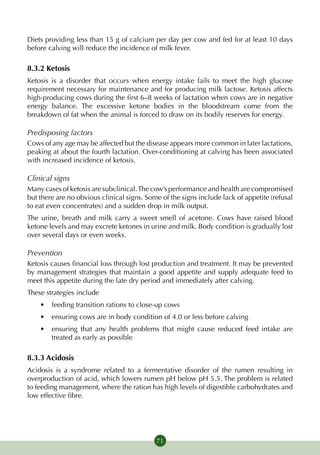
Figure 8.2	Areas assessed in scoring body condition.................................................. 69
Figure 8.3	Calculating feedstuff proportions............................................................... 75


                                                               viii
PREFACE

Dairy cattle production in East Africa has increased recently due to the high demand for
fresh milk for a growing population and demand for value-added milk products for an
expanding urban middle class. To meet this increased demand, there is need to increase
the amount of available milk. This increase can be either by increasing the milk yield
per cow or by increasing the number of animals. Due to pressure on land, increasing the
milk yield per cow is the preferred option.

Dairy farmers have taken up this challenge but are constrained by the lack of technical
information on managing their animals. At times the available information is too
complicated for them to understand.

Though increasing milk production is a combination of good genetics, good management
and good feeding, feed costs constitute the major day-to-day expense. In East Africa,
this cost has been further exacerbated by the progressive shift from an extensive to an
intensive system of dairy in both the high and the medium-to-low potential areas due to
the shrinking land sizes and a lucrative milk market.

With the recent advances in breeding technologies, farmers have gained access to
high-quality dairy genotypes. To realize the full milk production potential of these
genotypes, there is need for proper managerial practices, especially with regard to
feeding. Farmers need to be knowledgeable on how to maximize productivity while
minimizing costs of feeding.

A lot of research has been carried out on various aspects of dairy production, particularly
in the area of feeds and feeding. This information has either remained on the shelf or
been communicated in a form not appropriate to the farmer. This manual synthesizes and
simplifies the information on feeding dairy cows for the farmer, extension worker and
student. Whereas the information has been synthesized in such as way as to be applicable
to the East African region, some information may be site specific, and in some instances
information that is generalized may need to be customized to suit specific areas.

The manual covers information on the basic nutrients a dairy cow requires, the available
feed resources that provide these nutrients and practical aspects of feeding the animals.


                                            ix
ABBREVIATIONS

ABS TCM	African Breeders Services Total Cattle Management
ASN	      ammonium sulphate nitrate
CAN	      calcium ammonium nitrate
DAP	      diammonium phosphate
EADD	     East Africa Dairy Development
ICRAF	    World Agroforestry Centre
ILRI	International Livestock Research Institute
KES	      Kenya shilling, valued at KES 85 to USD 1 in this manual
SSP	      single superphosphate
TSP	      triple superphosphate
USD	      US dollar


                                          x
ACKNOWLEDGEMENTS

The authors would like to acknowledge the East Africa Dairy Development (EADD)
project for sponsoring a workshop for stakeholders, where the outline of this manual
was conceived and agreed upon. In particular we would like to thank the following
stakeholders for their contribution.

•	   Martin Allan Bisagaya, EADD Project, Kampala, Uganda
•	   Charles Githae, Integrated Partnerships for Community Prosperity, Nakuru, Kenya
•	   Agnes Kavatha, Land O’Lakes, Nairobi, Kenya
•	   Nathaniel Makoni, ABS TCM, Nairobi, Kenya
•	   Patrick Mudavadi, EADD, ICRAF, Nairobi, Kenya
•	   Jane Mwangi, Ministry of Livestock Development, Agricultural Information Centre,
     Nairobi, Kenya
•	   Priscilla Ndegwa, Ministry of Livestock Development, Limuru, Kenya
•	   Simon Ndegwa Wakaba, Farmer, Kikuyu Division, Kiambu District, Nairobi, Kenya
•	   Julius Nyangaga, ILRI, Nairobi, Kenya
•	   Benjamin Nzingamasabo, EADD Project, Nyagatare, Rwanda
•	   Edwin Okila, ABS TCM, Nairobi, Kenya
•	   Betty Rwamuhizi, EADD Project, Nyagatare, Rwanda
•	   Ronald Wabwire, EADD Project, Kampala, Uganda
•	   Angela Wokabi, Ministry of Livestock Development, Nairobi, Kenya

We acknowledge the contribution of the International Livestock Research Institute (ILRI),
especially that of Isabelle Baltenweck, for providing logistical support in preparing and
producing this manual. We specifically want to acknowledge the contribution of ICRAF
dissemination facilitators Josephine Kirui, Patrick Mudavadi, Jane Kugonza and Benjamin
Nzingamasabo for their contributions. In addition, we thank Dr Joseph Methu of the
Association for Strengthening Agricultural Research in Eastern and Central Africa and
Prof Paul Mbugua of the University of Nairobi for reviewing the draft manual.

Ben Lukuyu, Charles Gachuiri, Margaret Lukuyu,
Solomon Mwendia and Charles Lusweti
April 2012, Nairobi, Kenya


                                           xi
CHAPTER 1: INTRODUCTION

1.1 Importance of dairy cattle
Dairy cattle make a major contribution to both national and household economies as
well as provide milk, which contains essential nutrients. Milk contributes significantly to
meeting the human requirements for animal protein and is especially important in the
diet of children and the sick.
Regionally, dairy cattle farming contributes to employment on the farm (production),
during value addition (processing) and marketing. The farming also supports a large
service sector that offers specialized services in nutrition and health.
Increase in human population has resulted in pressure on arable land leading to
deterioration of soil fertility and deforestation. Manure from dairy cattle plays a major
role in improving soil fertility and it is a source of energy (biogas) for the household.

1.2 Qualities of a good dairy cow
Though milk production may not be 100% related to the external appearance of a dairy
cow, some physical features are related to milk yield and the longevity (length of time
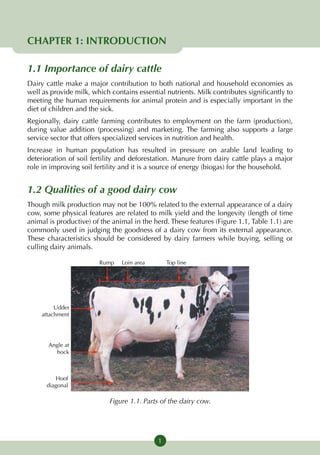
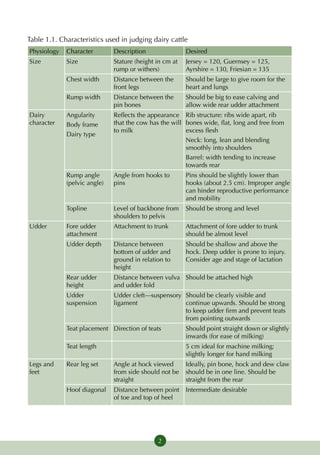
animal is productive) of the animal in the herd. These features (Figure 1.1, Table 1.1) are
commonly used in judging the goodness of a dairy cow from its external appearance.
These characteristics should be considered by dairy farmers while buying, selling or
culling dairy animals.

                        Rump    Loin area       Top line


         Udder
    attachment


       Angle at
         hock


         Hoof
      diagonal

                            Figure 1.1. Parts of the dairy cow.


                                            1
Table 1.1. Characteristics used in judging dairy cattle
Physiology   Character        Description                Desired
Size         Size             Stature (height in cm at   Jersey = 120, Guernsey = 125,
                              rump or withers)           Ayrshire = 130, Friesian = 135
             Chest width      Distance between the       Should be large to give room for the
                              front legs                 heart and lungs
             Rump width       Distance between the       Should be big to ease calving and
                              pin bones                  allow wide rear udder attachment
Dairy        Angularity       Reflects the appearance Rib structure: ribs wide apart, rib
character    Body frame       that the cow has the will bones wide, flat, long and free from
                              to milk                   excess flesh
             Dairy type
                                                        Neck: long, lean and blending
                                                        smoothly into shoulders
                                                        Barrel: width tending to increase
                                                        towards rear
             Rump angle       Angle from hooks to        Pins should be slightly lower than
             (pelvic angle)   pins                       hooks (about 2.5 cm). Improper angle
                                                         can hinder reproductive performance
                                                         and mobility
             Topline          Level of backbone from     Should be strong and level
                              shoulders to pelvis
Udder        Fore udder       Attachment to trunk        Attachment of fore udder to trunk
             attachment                                  should be almost level
             Udder depth      Distance between           Should be shallow and above the
                              bottom of udder and        hock. Deep udder is prone to injury.
                              ground in relation to      Consider age and stage of lactation
                              height
             Rear udder       Distance between vulva Should be attached high
             height           and udder fold
             Udder            Udder cleft—suspensory Should be clearly visible and
             suspension       ligament               continue upwards. Should be strong
                                                     to keep udder firm and prevent teats
                                                     from pointing outwards
             Teat placement Direction of teats           Should point straight down or slightly
                                                         inwards (for ease of milking)
             Teat length                                 5 cm ideal for machine milking;
                                                         slightly longer for hand milking
Legs and     Rear leg set     Angle at hock viewed       Ideally, pin bone, hock and dew claw
feet                          from side should not be    should be in one line. Should be
                              straight                   straight from the rear
             Hoof diagonal    Distance between point     Intermediate desirable
                              of toe and top of heel


                                              2
1.3 Basic needs of a cow for optimum production
The aim of keeping a dairy cow is to obtain the maximum amount of milk. A cow will
perform at its best only if its basic needs are met. These include:
    •	   freedom from hunger and thirst (good feed and clean water)
    •	   freedom from pain, injury and diseases (good health)
    •	   freedom from discomfort (comfortable environment, e.g. tempera­ure, clean floor)
                                                                            t
    •	   freedom from fear and distress (friendly, loving, gentle and caring handler)
To exploit the cow’s full genetic potential, there is need to have a good nutrition program
and meet all other needs.


1.4 The ruminant digestive system
Ruminants are various cud-chewing hoofed mammals having a stomach divided into four
compartments (rumen, reticulum, omasum and abomasum), each one with a specific
role to play. The most important is the rumen. Cattle, sheep and goats are ruminants. All
ruminants ‘chew the cud’. This means that the food they consumed earlier is returned to
the mouth for a second thorough chewing before it is re-swallowed.
The rumen is full of tiny microorganisms (bacteria and protozoa) that digest fibrous
feed, such as fresh grass and hay, foodstuffs that humans and most other animals cannot
digest. After digesting the fibre, the animal makes use of the end products for growth and
milk production. The microorganisms can also convert non-protein nitrogen-containing
ingredients (e.g. urea) into protein that the animal can use.
These microorganisms also manufacture some vitamins, such as the vitamin B group.


1.5 The cow as a milk factory
A dairy cow can be thought of as a milk manufacturing factory. Into any manufacturing
factory go raw materials, which are processed, and out of the factory comes a new
product. The quality and quantity of the product are a combination of both the quality
and the quantity of the raw materials and the efficiency of the factory.
The raw materials that go into milk manufacturing are the nutrients. The quantity and
quality of these nutrients depend on the feed consumed by the cow. If the cow is fed on
poor-quality feed in large quantities or high-quality feed in small quantities, little milk will
be manufactured. The size of the factory can be compared to the size of the cow—where a
large factory will hold more raw materials, so will a large cow have a larger rumen.
The machinery that converts raw materials into milk constitutes the digestive system
(stomachs and intestines) and the udder (mammary gland). All cows can be assumed to
have a similar digestive system but the capacity of the udder will vary depending on the
number of milk-making units (alveolar cells), which is determined by the genetics of the
cow.


                                               3
These cells are housed within the cow, which provides a conducive environment for
them to function (the cow must be comfortable and free from pain). In a factory, this can
be equated to the workers (their number and their comfort).
The factory concept is diagrammatically illustrated in Figure 1.2:


                                                             FACTORY


                                          Genetic capacity:          Management (comfort
     RAW MATERIAL
                                          •	 Workers (number         and health of animal—
                                             of alveolar cells)      good housing, gentle
  Quality and quantity of
                                          •	 Size of rumen           handlers)
  the feed consumed by
         the cow


                                                             PRODUCT

                                                                  Milk


                             Figure 1.2. The cow as a factory.


                                            4
CHAPTER 2: NUTRIENTS

Nutrients are substances obtained from food and used in the body to promote growth,
maintenance, reproduction and production. Feedstuffs contain the nutrients animals
require to perform normal body functions (such as breathing, pumping blood, fighting
diseases, growing, gaining weight, reproducing) and to produce milk. The feedstuff must
be digestible and the products (nutrients) absorbed if the feed is to be useful to the
animal.
Some components of a feedstuff have no nutritive value because they are indigestible
and not absorbable (e.g. some woody plants) and pass out through faeces. In addition,
some plants contain compounds that are toxic to the animal.
The essential nutrients are energy, proteins, minerals, vitamins and water.


2.1 Energy
The energy portion of the feed fuels all body functions, enabling the animal to undertake
various activities including milk synthesis. This is the major nutrient (in terms of quantity)
that dairy cows require.

2.1.1 Functions
Maintenance: Simply to maintain itself, an animal requires energy. The body weight does
not increase or decrease, the animal does not produce; this energy is only for survival
and the amount is affected by body size and the environmental temperature.
Growth and weight gain: Gain is especially important for young animals, who need to
attain the recommended weight for a particular age.
Reproduction: A cow requires more energy during pregnancy for the foetus to grow and
develop normally.
Milk production: The energy requirement of a lactating cow increases with increase in
milk production and butter fat content of the milk.

2.1.2 Sources
Energy can be obtained from several types of feedstuffs that contain either carbohydrates
or lipids (fats and oils).
Carbohydrates are the major source of energy in the diet of dairy cows. They are found in
the staple foods consumed by humans (e.g. rice, maize, wheat, potatoes). Carbohydrates
constitute between 50% and 80% of the dry matter in forages and grains.


                                              5
Feeds contain three major types of carbohydrates:
    •	 Sugars: Sugars are soluble in water, making them readily available to the animal.
       Sources are molasses, sugar beets and sugar cane.
    •	 Starch: Starch is the main form of carbohydrate stored in plants. It is the main
       component of cereal grains and some roots (potato tubers).
    •	 Fibre: Forming the structural part of plants, fibre is present in large quantities in
       roughages. The fibre is broken down by microorganisms in the rumen (microbial
       enzymes) into products that the animal can use. It is also important in maintaining
       high levels of milk fat. Sources include grasses, fodder crops and crop residues.
Lipids (fats) contain about 2.25 times more energy than carbohydrates per unit weight.
Generally, plants are good sources of oils while animal pro­ ucts contain fats. Most
                                                                 d
plant seeds contain a small amount of lipids. The ex­ eption is oilseed plants, which may
                                                    c
contain as much as 20% lipids (cotton, sunflower and soybean seeds) and are better
sources of lipids than animal fats.

2.1.3 Consequences of energy deficiency
The most obvious sign of energy deficiency is poor body condition due to excessive
weight loss. Lactating cows are unable to reach peak milk production in early lactation
resulting in low lactation yields.

2.1.4 Consequences of excessive amounts of energy
Cows consuming too much energy become too fat, resulting in low conception rates.
They are prone to difficult calving, retained placenta, and higher incidence of milk fever
and ketosis.
In early lactation, feeding too much energy, especially in the form of grain, may lead to
too much acid in the rumen (acidosis), increased risk of displaced abomasum, depressed
feed intake and low milk fat percentage.

2.1.5 Special considerations
Usually forages are high in fibre and low in energy, and concentrates are low in fibre
and high in energy. Therefore there is need to balance the two, as too much forage limits
the intake of energy while too much concentrate results in milk fat depression, rumen
acidosis and other health problems.


2.2 Protein
Protein is quantitatively the second most important nutrient in feeding the dairy cow.
Proteins are made up of building blocks referred to as amino acids.


                                             6
2.2.1 Functions
Proteins provide the building material for all body cells and tissues (e.g. blood, skin,
organs and muscles). Proteins are also major components of products such as milk and
meat. Lack of protein therefore adversely affects milk production.

2.2.2 Sources
Good sources of protein for dairy cows include:
    •	 Oilseeds and oilseed cakes: Residues after the oil is removed from oilseeds, e.g.
       cottonseed meal or cake, whole cottonseed, whole soybeans (cracked) or meal
       and sunflower meal or cake.
    •	 Products of animal origin: Such as fish meal, blood meal, meat and bone meal,
       feather meal and by-products from milk processing (e.g. skim milk and whey).
    •	 Herbaceous legumes: Such as lucerne, desmodium and fodder trees (e.g.
       calliandra and sesbania).
    •	 Non-protein nitrogen: Cows can obtain protein from sources that do not contain
       true proteins, such as urea and poultry waste (contains uric acid). These sources
       are referred to as non-protein nitrogen sources. Microorganisms in the rumen
       use the nitrogen in urea to synthesize protein for their own growth.

2.2.3 Consequences of protein deficiency
For lactating cows, there is a sudden drop in milk production if the amount of protein
in the diet is suddenly reduced. Severe deficiency may cause excessive weight loss in
lactating cows, reduced growth rate in calves and heifers, and result in underweight
calves being born.

2.2.4 Consequences of feeding excess protein
Protein is an expensive nutrient and feeding excess is a waste of money as protein is not
stored in the body but is broken down by microorganisms in the rumen and excreted in
the form of urea.

2.2.5 Protein and rumen microbes
Most of the protein in feed is broken down by microorganisms in the rumen (rumen-
degradable protein) and re-synthesized into bacterial protein. Bypass proteins are
proteins resistant to microbial breakdown in the rumen (undegradable protein), and pass
intact to the small intestines where they are digested and absorbed directly into the body.

2.2.6 Protein and milk production
Milk contains approximately 3.2–3.5% protein. Thus a cow producing 25 kg milk per
day secretes 800–900 g protein daily. Cows have little ability to store protein in the body


                                            7
and so it must be supplied in the diet daily to maintain the milk yield. Protein should be
15–18% of the total ration of a dairy cow depending on milk yield.


2.3 Minerals
Minerals are nutrients required in small amounts in the feed. They are required for the
body to function properly, i.e. remain healthy, reproduce and produce milk (Table 2.1).
Some minerals are required in large quantities in the ration dry matter (macro-minerals)
while others are required in small quantities (microminerals). Some minerals are stored
in the body (e.g. iron in the liver and calcium in bones) while others are not (e.g. sodium,
potassium) and have to be supplied in the diet all the time.


Table 2.1. Minerals required in ruminant diet
   Macrominerals                                 Microminerals
   Calcium                                       Cobalt
   Chlorine                                      Copper
   Magnesium                                     Iodine
   Phosphorus                                    Iron
   Potassium                                     Manganese
   Sodium                                        Molybdenum
   Sulphur                                       Selenium
                                                 Zinc

2.3.1 Functions
Specific minerals may have different functions in the body but the minerals are generally
required for
    •	   bone formation
    •	   formation of components of enzymes, vitamins and red blood cells
    •	   production of hormones that control body functions
    •	   control of water balance in the body
    •	   milk synthesis


                                             8
Requirement for minerals is affected by several factors:
    •	 Age: Mineral requirements for young growing animals are higher.
    •	 Physiological status: Pregnant animals require more.
    •	 Level of production: High-producing cows require large quantities of calcium;
       deficiency is more likely to occur in early lactation rather than late.

2.3.2 Sources
Although roughages and concentrates contain minerals, the types and amounts vary
widely and hence may not meet the requirements. During ration formulation, macro-
minerals calcium, phosphorus and magnesium are taken into account. Roughages will
supply adequate amounts of potassium and common salt can adequately provide sodium.
Some ingredients (supplements) are added to supply a specific mineral (e.g. limestone,
salt, magnesium oxide).

2.3.3 Consequences of mineral deficiency
Signs of mineral deficiency may not be obvious but they include
    •	   poor fertility: lack of heat signs and low conception rate
    •	   low milk production
    •	   poorly developed bones in young animals (rickets)
    •	   health disorders, for example, milk fever
    •	   poor body condition, which may be accompanied by a change in coat colour


2.4 Vitamins
Vitamins are nutrients in the feed required by the body in tiny amounts for normal
functioning of the body, through their involvement in many body processes. Some are
synthesized by rumen microbes and/or stored in the body of the animal while others
must be supplied in the diet. The vitamins that must be supplied in the diet include A, D
and E; those that are produced in the body include B complex, C and K.

2.4.1 Functions
Important functions of vitamins include
    •	 maintenance of healthy protective tissues such as skin, stomach, intestinal and
       cell linings (vitamin A)
    •	 improvement of appetite, hence feed intake (vitamin B)
    •	 production of red blood cells, hence preventing anaemia (e.g. vitamins B6 and
       B12)
    •	 enhanced calcium and phosphorus utilization, hence play a role in bone forma-
       tion and growth (vitamin D)


                                            9
•	 enhancing immunity (vitamin E)
     •	 help in blood clotting (vitamin K)

2.4.2 Consequences of vitamin deficiency
Vitamin requirements of dairy cows are normally met through diet, rumen microbial
synthesis or tissue synthesis. Deficiencies are rare under normal conditions but may
occur under certain conditions, shown in Table 2.2.
Table 2.2. Situations in which vitamins may become deficient in dairy cattle
  Situation                                                                      Affected vitamins

                                                                            A       B        D        E
  Feeding poor quality roughage (overgrown), frost-
  damaged maize silage or long-term stored forage, heat-
  damaged forage; periods of prolonged drought                              X
  Very high grain-to-forage ratio                                           X                X        X
  Cattle kept indoors throughout                                                             X
  Feeding of milk or milk replacer rations alone                            X                X        X
  Crop residues as a major component of diet                                X                X
  Prolonged stress period or disease                                        X       X        X        X
  Very young calves (rumen not functional)                                          X
  Deficiency of cobalt                                                              X
Adapted from Wattiaux MA. 1999. Dairy essentials. Babcock Institute for International Dairy Research and
Development, Madison, Wisconsin, USA.


2.4.3 Consequences of feeding excess vitamins
There is no important health consequence of excess vitamins as the body is able to get
rid of the excess. However, vitamin supplements are expensive and hence feeding too
much is an economic loss to the farmer.


2.5 Water
Water, though not classified as a nutrient, is essential for life in all animals. Water
accounts for 74% of the calf’s weight at birth and 59% of that of a mature cow. Every
100 kg of milk contains up to 87 kg of water.


                                                         10
The amount of water consumed at free will is influenced by several factors:
    •	 moisture content of feed. When the diet has a large proportion of dry feeds,
        e.g. hay and grains, the cow drinks more water than when the diet has a larger
        proportion of young or succulent feeds, e.g. young grass and legumes
    •	 amount of dry matter consumed
    •	 milk yield
    •	 environmental temperature
    •	 salt intake
An increase in any of the factors above increases the water requirement	 1for lactating
                                                                     	 5	– 5
cows. The amount of water consumed will also depend on the quality and quantity of
                                                                      	 15	–	 40
water provided (Table 2.3).
                                                                                            	 65	–	 85
Table 2.3. Estimated water requirement by calves, heifers and lactating dairy cattle
                                                                                          	 85	–	 105
  Dairy cattle type                        Level of milk production              Water require­ ent, average
                                                                                                m
                                                 (kg milk/day)                       range (litres40
                                                                                           	 115	–	 1 /day)

  Dairy calves (1–4 months)                                                                 	 130	–	 155

  Dairy heifers (5–24 months)                                                               	 35	–	 50

  Milking cows                                            14
  Milking cows                                            23
  Milking cows                                            36
  Milking cows                                            45
  Dry cows
Adapted from McKague K. 2007. Fact sheet on water requirements of livestock. Ontario Ministry of Agriculture,
Food & Rural Affairs, Toronto, Canada.


2.6 Concept of dry matter
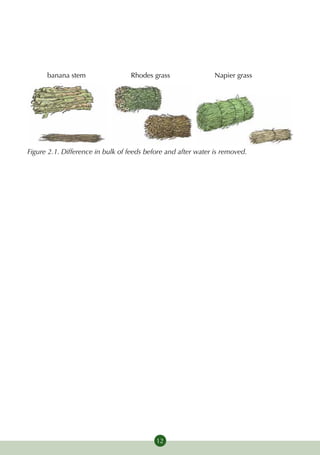
Dry matter is what remains of a feed when all the water has been removed and it contains
the nutrients described above (Figure 2.1). This dry matter portion can be divided
into organic matter comprising energy, protein and vitamins, and inorganic matter
comprising minerals. Animals must consume enough dry matter to obtain the required
nutrients to keep them healthy and to let them grow, reproduce and produce milk.
Dry matter is expressed as a percentage of fresh feed; hence a feed comprising 40% dry
matter means that for every 100 kg of the feed, only 40 kg is dry matter. It is from the 40
kg that the animal will obtain its nutrient requirements. If the same feed contains 10%
crude protein, the amount supplied by the feed will be 10% of 40 kg, which is 4 kg.
Banana stem containing 10% dry matter means that if you feed 100 kg of fresh stems, the
cow will have only 10 kg dry matter and 90 kg water.


                                                         11
banana stem                 Rhodes grass                 Napier grass


Figure 2.1. Difference in bulk of feeds before and after water is removed.


                                           12
CHAPTER 3: PRODUCTION SYSTEMS AND PASTURE
MANAGEMENT

3.1 Production systems
Dairy cattle can be reared in ways that vary depending on the resources available to the
farmer. Farmers in East Africa practise three main systems: intensive, extensive and semi-
intensive.

3.1.1 Intensive system
In the intensive system, dairy cattle are enclosed in zero-grazing units (see design of
zero-grazing unit in Appendix 8), where they are provided with all their requirements for
feed and water. This method is mainly practised where grazing land is scarce. In Kenya it
is mainly practised in high-potential areas of central Kenya and also by urban and peri-
urban farmers; in Tanzania it is practised on the slopes of Mt Kilimanjaro and in Uganda
around Kagada. The forage can be grown on farm or purchased.
This system has its advantages and disadvantages.

Advantages
    •	 The cow does not waste energy walking in search of pasture.
    •	 It avoids diseases associated with communal grazing.
    •	 It allows dairy farmers with no grazing land to produce milk and make money.
    •	 The manure can be accumulated for improving soil fertility or used to generate
       biogas for domestic energy use.

Disadvantages
    •	 The method is labour intensive as feeding and cleaning the unit must be done
       daily.
    •	 The initial cost of putting up a zero-grazing unit is high.
    •	 It may be difficult to detect when a cow is on heat, especially a singly housed
       cow. This is because when cows are housed in a group they mount each other
       and when in the open they show signs of restlessness by moving around.

3.1.2 Extensive system
In the extensive system, the cattle are reared on pasture. It is practised where grazing
land is available. In East Africa the grazing land mainly comprises natural unimproved
grass. In Kenya it is practised in most parts of the Rift Valley, where farmers own large
tracts of land.


                                            13
Advantages
    •	 It is cheaper than the intensive system.
    •	 It is not labour intensive.

Disadvantages
    •	 It requires dedicating much more land to grazing.
    •	 Cows waste a lot of energy by walking while grazing in the field.
    •	 It is difficult to accumulate manure for improving soil fertility in crop fields.
Natural grasses can be improved by oversowing with herbaceous legumes (e.g. Trifolium)
or planting grasses (e.g. Rhodes grass). Oversowing is the method of choice.

3.1.3 Semi-intensive system
In the semi-intensive system, the cattle graze for some time during the day and in the
afternoon or evening they are supplemented with other forages like Napier grass. This
method is a compromise between intensive and extensive systems, whereby land is not
limiting as in the intensive system but on the other hand is not enough to allow free
grazing throughout the day.
Due to population pressure leading to subdivision of land, this system tends towards the
intensive system.

3.1.4 Other systems
Other methods include ‘roadside grazing’ and ‘tethering’. Roadside grazing involves
herding cattle on the roadside where they graze on natural unimproved pastures. It is
popular in areas with land shortage. Tethering restricts the cow to a grazing area by
tying it with a rope to a peg. This can also be done on the roadside or any other public
land. However, in either of these systems the animals may not get enough to satisfy their
requirements.


3.2 Pasture management
Efficient pasture management results in high yields of good-quality pasture that can be
fed to dairy cattle for high milk production. Key activities to be considered include weed
control, grazing management and fertility management.

3.2.1 Weed control
Weeds can reduce the productivity of the sown pastures, particularly during the
establishment year, and should be controlled during the first year by either hand weeding
or using herbicide (2-4D amine at the rate of 2.5 litres per hectare [ha]). In subsequent
years fields are kept clean by slashing, hand pulling or mowing the weeds.


                                            14
3.2.2 Grazing management
The following should be observed:
    •	 In the establishment year grasses reach the early flowering stage 3–4 months after
       planting. At this stage the plant is not firmly anchored in the soil and therefore it
       is usually advisable to make hay rather than graze the pastures to avoid the risk
       of the cattle pulling out the young shoots.
    •	 If the pasture must be grazed during the establishment year, grazing should be
       light enough (use calves) to allow the plants to establish firmly in the soil.
    •	 For maximum benefit, use the pasture not later than the start of the flowering
       stage. Graze or cut at intervals of 4 to 6 weeks, leaving stubble at 5 cm height.
    •	 Graze animals when the grass is at the early flowering stage by moving animals
       from paddock to paddock.
    •	 One animal will need 1–2 acres of improved pasture per year in areas receiving
       over 900 mm rainfall.
    •	 Conserve excess pasture in the form of hay for dry-season feeding.

3.2.3 Fertility management
To attain maximum production from pasture, the grass requires additional nutrients from
inorganic fertilizer or farmyard manure.
    •	 During the establishment year, soil nitrogen is adequate for grass productivity.
    •	 In subsequent seasons, topdress grass with 5–7 bags of calcium ammonium
       nitrate (CAN) or ammonium sulphate nitrate (ASN) per hectare per year in three
       splits during the rainy season or 5–10 tonnes of farmyard manure.
    •	 In areas with phosphate deficiencies topdress with 2 bags of single superphosphate
       (SSP) or 1 bag of triple superphosphate (TSP) per hectare per year after the
       establishment year. This is in addition to nitrogen fertilizer.
    •	 Nitrogen fertilizer may be applied on 1 or 2 months before the dry season to
       increase yields during the dry season.


3.3 Stocking rates for different grasses
Stocking rate is the number of animals (animal unit) for which a grassland unit (hectare)
can provide adequate dry-matter forage for a specified length of time. Stocking rate
influences animal performance, pasture recovery, long-term pasture production and
long-term pasture species composition.
Stocking rates should represent a balance between grazing pressure (pasture demand)
and carrying capacity (pasture supply). The  ultimate goal should be to  optimize both
animal and pasture production over the long term, as opposed to maximizing only one
or the other. In general, improved pastures can support higher stocking rates than native


                                            15
or unimproved pastures. Table 3.1 gives examples of recommended stocking rates for
different improved pastures. Yields of commonly used grasses and legumes are in Table 3.2.

Table 3.1. Recommended stocking rates
 Grass type                                                  Stocking rate (MLU/acre per year)
 Cenchrus ciliaris (blue buffalo grass)                                   0.4–1.2
 Panicum maximum (white buffalo grass)                                    1.2–2.4
 Chloris gayana (Rhodes grass)                                              1.6
 Pennisetum clandestinum (Kikuyu grass)                                   1.2–3.2
MLU – matured livestock unit, equivalent to 500 kg non-lactating bovine


Table 3.2. Yields of different types of fodder at different agroecological zones (AEZs)
 Fodder type                           AEZ          Dry matter yield        Mature dairy cow
                                                   (kg/acre per year)          supported
                                                                               (no. days)*
 Fodder grasses
  Napier grass                      LH1, LH2         4000–12,000                  333–1000
  Fodder sorghum (E6518)              LH 3             6800–8800                  567–733
  Boma Rhodes                      LH 3, LH 4            4868                        406
  Elmba Rhodes                     LH 3, LH 4            3944                        329
  Star grass                       LH 3, LH 4            2988                        249
  Guinea grass                     LH 3, LH 4            2564                        214
  Masaba Rhodes                        LH4               4560                        380
  Guatemala grass                      LH4               4080                        340
  Mbarara Rhodes                      UM1                5640                        470
  Giant setaria                      UH2–3               4000                        333
  Giant panicum                       UM4                4720                        393
  Oat                                 UM4                2680                        223
 Fodder legumes
  Silverleaf desmodium                 LH2                 3448
  Greenleaf desmodium                  LH2                 3060
  Sesbania sesban                      LH4                10880
  Leucaena                             LH4                 5300
  Starleafed sweet potato              LH4                 3868
  Purple-leafed sweet potato           LH4                 3116
  Broadleafed sweet potato             LH4                 2880
  Vetch                                LH4                 1480
LH – lower highland, UH – upper highland, UM – upper midland
* A mature dairy cow weighing about 400 kg consumes about 12 kg dry matter per day


                                                  16
CHAPTER 4: FORAGE PRODUCTION AND UTILIZATION

4.1 Forage production and management
Inadequacy of high-quality forages on the farm is one of the major constraints limiting dairy
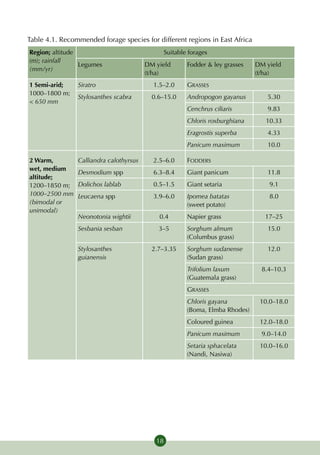
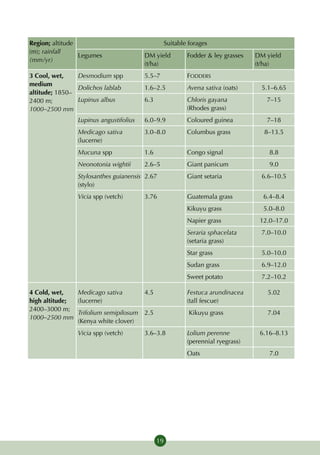
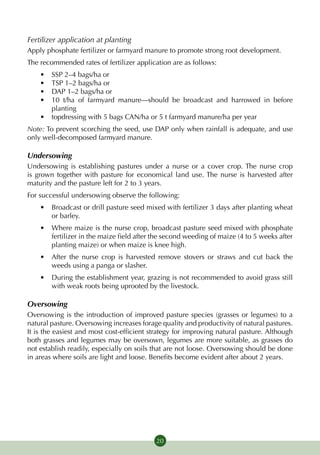
production in East Africa. Various types of forages have been recommended for different
agroecological zones (Table 4.1) depending on the climatic conditions and soils. They are
cultivated on arable land and are either grazed or cut and fed either as fresh green fodder
or conserved as hay or silage. The specific agronomic recommendations for growing of
forages differ from species to species and may be site specific. Table 4.1 gives examples of
different forages and their production potential in different agroecological zones.

4.1.1 Establishment and management of ley pastures
Pasture establishment can be by direct sowing, undersowing or over­ owing.
                                                                  s

Direct sowing
Direct sowing is establishing pasture grasses without a nurse or cover crop.
Seedbed preparation: On previously cropped land, plough towards the end of the
preceding rainy season. Follow with dry-season ploughing and harrowing for weed
control. On virgin land, three ploughings and two harrowings may be required to make
a good seedbed.

Sowing time and method
    •	 Sow as early as possible in the rainy season. In areas that recieve bimodal rainfall
       areas, sow during the short rains to eliminate annual weeds.
    •	 Sow seeds close to the surface to get them in contact with moist soil so they will
       absorb moisture and germinate. Do not bury the seeds deep since initial vigour
       is not sufficient to push through a heavy cap of soil.
    •	 Either broadcast grass seeds or drill in rows 30–40 cm apart.
    •	 Mix the seeds with sawdust, rough sand or phosphate fertilizer for even
       distribution. If the seed is mixed with fertilizer, plant immediately to prevent the
       fertilizer from scorching the seed.
    •	 Grass seeds are most effectively sown with a wheat drill. Hand sowing is
       recommended for small acreages.
    •	 Immediately after sowing compact the seedbed to enhance germination of the
       grass seed by improving contact with the soil. Use tree branches or trample by
       foot on small plots. In mechanized farms, use a roller.


                                             17
Table 4.1. Recommended forage species for different regions in East Africa
Region; altitude                                 Suitable forages
(m); rainfall
                 Legumes                 DM yield        Fodder & ley grasses   DM yield
(mm/yr)
                                         (t/ha)                                 (t/ha)
1 Semi-arid;    Siratro                    1.5–2.0       Grasses
1000–1800 m;
                Stylosanthes scabra        0.6–15.0      Andropogon gayanus        5.30
< 650 mm
                                                         Cenchrus ciliaris         9.83
                                                         Chloris roxburghiana      10.33
                                                         Eragrostis superba        4.33
                                                         Panicum maximum           10.0

2 Warm,         Calliandra calothyrsus     2.5–6.0       Fodders
wet, medium
                Desmodium spp              6.3–8.4       Giant panicum             11.8
altitude;
1200–1850 m;    Dolichos lablab            0.5–1.5       Giant setaria              9.1
1000–2500 mm    Leucaena spp               3.9–6.0       Ipomea batatas             8.0
(bimodal or                                              (sweet potato)
unimodal)
                Neonotonia wightii           0.4         Napier grass              17–25
                Sesbania sesban              3–5         Sorghum almum             15.0
                                                         (Columbus grass)
                Stylosanthes               2.7–3.35      Sorghum sudanense         12.0
                guianensis                               (Sudan grass)
                                                         Trifolium laxum          8.4–10.3
                                                         (Guatemala grass)
                                                         Grasses
                                                         Chloris gayana          10.0–18.0
                                                         (Boma, Elmba Rhodes)
                                                         Coloured guinea         12.0–18.0
                                                         Panicum maximum          9.0–14.0
                                                         Setaria sphacelata      10.0–16.0
                                                         (Nandi, Nasiwa)


                                            18
Region; altitude                                   Suitable forages
(m); rainfall
                 Legumes                DM yield           Fodder & ley grasses   DM yield
(mm/yr)
                                        (t/ha)                                    (t/ha)
3 Cool, wet,    Desmodium spp           5.5–7              Fodders
medium
                Dolichos lablab         1.6–2.5            Avena sativa (oats)      5.1–6.65
altitude; 1850–
2400 m;         Lupinus albus           6.3                Chloris gayana            7–15
1000–2500 mm                                               (Rhodes grass)
                Lupinus angustifolius   6.0–9.9            Coloured guinea           7–18
                Medicago sativa         3.0–8.0            Columbus grass           8–13.5
                (lucerne)
                Mucuna spp              1.6                Congo signal               8.8
                Neonotonia wightii      2.6–5              Giant panicum              9.0
                Stylosanthes guianensis 2.67               Giant setaria            6.6–10.5
                (stylo)
                Vicia spp (vetch)       3.76               Guatemala grass          6.4–8.4
                                                           Kikuyu grass             5.0–8.0
                                                           Napier grass            12.0–17.0
                                                           Seraria sphacelata       7.0–10.0
                                                           (setaria grass)
                                                           Star grass               5.0–10.0
                                                           Sudan grass              6.9–12.0
                                                           Sweet potato             7.2–10.2

4 Cold, wet,   Medicago sativa       4.5                   Festuca arundinacea       5.02
high altitude; (lucerne)                                   (tall fescue)
2400–3000 m;
               Trifolium semipilosum 2.5                    Kikuyu grass             7.04
1000–2500 mm
               (Kenya white clover)
                Vicia spp (vetch)       3.6–3.8            Lolium perenne          6.16–8.13
                                                           (perennial ryegrass)
                                                           Oats                       7.0


                                              19
Fertilizer application at planting
Apply phosphate fertilizer or farmyard manure to promote strong root development.
The recommended rates of fertilizer application are as follows:
    •	 SSP 2–4 bags/ha or
    •	 TSP 1–2 bags/ha or
    •	 DAP 1–2 bags/ha or
    •	 10 t/ha of farmyard manure—should be broadcast and harrowed in before
       planting
    •	 topdressing with 5 bags CAN/ha or 5 t farmyard manure/ha per year
Note: To prevent scorching the seed, use DAP only when rainfall is adequate, and use
only well-decomposed farmyard manure.

Undersowing
Undersowing is establishing pastures under a nurse or a cover crop. The nurse crop
is grown together with pasture for economical land use. The nurse is harvested after
maturity and the pasture left for 2 to 3 years.
For successful undersowing observe the following:
    •	 Broadcast or drill pasture seed mixed with fertilizer 3 days after planting wheat
       or barley.
    •	 Where maize is the nurse crop, broadcast pasture seed mixed with phosphate
       fertilizer in the maize field after the second weeding of maize (4 to 5 weeks after
       planting maize) or when maize is knee high.
    •	 After the nurse crop is harvested remove stovers or straws and cut back the
       weeds using a panga or slasher.
    •	 During the establishment year, grazing is not recommended to avoid grass still
       with weak roots being uprooted by the livestock.

Oversowing
Oversowing is the introduction of improved pasture species (grasses or legumes) to a
natural pasture. Oversowing increases forage quality and productivity of natural pastures.
It is the easiest and most cost-efficient strategy for improving natural pasture. Although
both grasses and legumes may be oversown, legumes are more suitable, as grasses do
not establish readily, especially on soils that are not loose. Oversowing should be done
in areas where soils are light and loose. Benefits become evident after about 2 years.


                                           20
Advantages of oversowing
    •	   land preparation is minimal hence cheap
    •	   less seed and labour are required
    •	   minimal management is needed
    •	   forage output is improved
    •	   soil erosion is controlled
    •	   soil fertility is improved

4.2 Fodder crops
Fodder crops are annual or perennial or permanent crops, cultivated on arable land
and grazed or fed to stock either green or in a conserved form like hay or silage. Fodder
crops are usually grown in rotation with cultivated cash crops. They are characterized by
their high productivity per hectare (dry matter yield) compared with permanent pastures.
Further, these crops are grown as supplementary feed during the dry months of the year.
Fodder crops have been identified as the most important feed on smallholder farms in
East Africa due to their high forage yield per unit area. The most common are
    •	   Napier grass (Pennisetum purpureum)
    •	   sweet potato vines (Ipomea batatas)
    •	   oats (Avena sativa)
    •	   fodder sorghums (Sorghum sudanense)

4.2.1 Napier grass
Varieties
Commonly grown Napier grass varieties
    •	 Bana grass: leafy and with few silica hairs, which cause irritation during
       handling. However, it is susceptible to Napier grass headsmut disease (Ustilago
       kameruniensis).
    •	 Clone 13: resistant to white mould disease. It is a high yielder but its thin stems
       make it difficult to establish. It is also susceptible to Napier grass headsmut
       disease.
    •	 French Cameroon: a high yielder, established easily from canes. Susceptible to
       Napier grass headsmut disease.
    •	 Kakamega 1 and 2: both are tolerant to Napier grass headsmut disease. High
       yielders. Kakamega 1 has a higher growth rate than Kakamega 2 or Bana.
    •	 Pakistan hybrid: does well in dry areas.

Planting
Napier grass can be established from root splits or canes. It can also be planted alone
or intercropped with forage legumes. Two methods of planting Napier grass are the
conventional method and the tumbukiza method.


                                           21
Conventional method
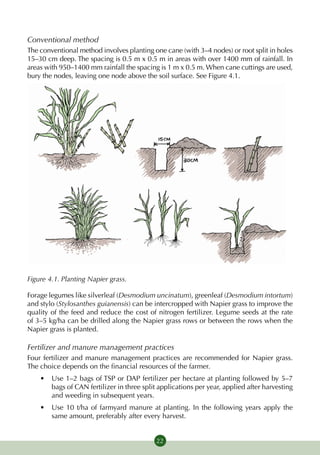
The conventional method involves planting one cane (with 3–4 nodes) or root split in holes
15–30 cm deep. The spacing is 0.5 m x 0.5 m in areas with over 1400 mm of rainfall. In
areas with 950–1400 mm rainfall the spacing is 1 m x 0.5 m. When cane cuttings are used,
bury the nodes, leaving one node above the soil surface. See Figure 4.1.


Figure 4.1. Planting Napier grass.

Forage legumes like silverleaf (Desmodium uncinatum), greenleaf (Desmodium intortum)
and stylo (Stylosanthes guianensis) can be intercropped with Napier grass to improve the
quality of the feed and reduce the cost of nitrogen fertilizer. Legume seeds at the rate
of 3–5 kg/ha can be drilled along the Napier grass rows or between the rows when the
Napier grass is planted.

Fertilizer and manure management practices
Four fertilizer and manure management practices are recommended for Napier grass.
The choice depends on the financial resources of the farmer.
    •	 Use 1–2 bags of TSP or DAP fertilizer per hectare at planting followed by 5–7
       bags of CAN fertilizer in three split applications per year, applied after harvesting
       and weeding in subsequent years.
    •	 Use 10 t/ha of farmyard manure at planting. In the following years apply the
       same amount, preferably after every harvest.


                                            22
•	 Use ½–1 bag of TSP or DAP plus 5 t/ha farmyard manure at planting and apply
       5 t/ha farmyard manure plus 2–3 bags of CAN in three split applications per year
       in subsequent years.
    •	 Apply 60 kg of slurry in furrows at planting followed by split application of the
       same quantity twice a year or more frequently if possible after harvesting.

Management
    •	 Weed after each harvest to maintain high productivity.
    •	 Harvest when 1 m high or every 6–8 weeks to obtain optimal quality and quantity.
    •	 Maintain a stubble height of 5–10 cm from the ground level at each harvest to avoid
       weakening the root system, which leads to low production in subsequent harvests.
    •	 To increase yields during the dry season, one of the split applications of the
       recommended rate of nitrogen fertilizer should be done 1 or 2 months before the
       end of the rainy season.

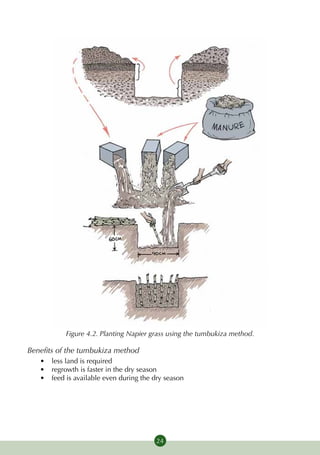
Tumbukiza method
‘Tumbukiza’, a Kiswahili word meaning ‘placing in a hole’, is a new planting method
started by farmers to increase productivity per unit of land. The method, which involves
planting cuttings or root splits in well-manured holes, produces more herbage yields
than the conventional method. Hence less land is required for one dairy cow.
Step 1: Dig round or rectangular pits 60 cm (2 ft) deep and 60–90 cm (2–3 ft) wide.
Alternatively, make trenches 60 cm (2 ft) deep and 60–90 cm (2–3 ft) wide and of various
lengths depending on the farmer’s preference.
Step 2: Separate topsoil from subsoil as you dig the pit or trench.
Step 3: Mix every 20-litre container (‘debe’) of topsoil with 1–2 debes of farmyard manure
and put it into the pit. For the trench, place topsoil and farmyard manure mixture every
metre along the pit.
Step 4: Leave about 15 cm (6 in.) unfilled space at the top of each pit.
Step 5: Plant 5–10 cane cuttings or single root splits in the round and rectangular pits. In
trenches plant 5–10 cane cuttings or single root splits every metre.
Step 6: Plant sweet potatoes or forage legumes between the pits to increase the quality
of forage and to control weeds.
The initial labour cost for digging pits and trenches is higher than for the conventional
method. See Figure 4.2.


                                            23
Figure 4.2. Planting Napier grass using the tumbukiza method.

Benefits of the tumbukiza method
   •	 less land is required
   •	 regrowth is faster in the dry season
   •	 feed is available even during the dry season


                                         24
4.2.2 Sweet potato
Sweet potato vines have a higher nutrient content than does Napier grass and are
normally fed to cattle as a supplement. They are particularly recommended for calves as
they increase the growth rate and promote rumen development. They are also good for
recently calved and sick animals. They increase milk yield when fed to lactating cows.
Their main setback is high moisture content.

Varieties
The main local sweet potato vines varieties include
    •	     Kiganda
    •	     Muibai
    •	     Sandak
    •	     Mugande
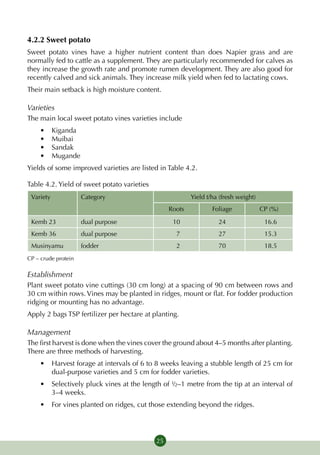
Yields of some improved varieties are listed in Table 4.2.

Table 4.2. Yield of sweet potato varieties
 Variety             Category                             Yield t/ha (fresh weight)
                                                  Roots           Foliage             CP (%)

 Kemb 23             dual purpose                  10               24                 16.6
 Kemb 36             dual purpose                   7               27                 15.3
 Musinyamu           fodder                         2               70                 18.5
CP – crude protein

Establishment
Plant sweet potato vine cuttings (30 cm long) at a spacing of 90 cm between rows and
30 cm within rows. Vines may be planted in ridges, mount or flat. For fodder production
ridging or mounting has no advantage.
Apply 2 bags TSP fertilizer per hectare at planting.

Management
The first harvest is done when the vines cover the ground about 4–5 months after planting.
There are three methods of harvesting.
    •	 Harvest forage at intervals of 6 to 8 weeks leaving a stubble length of 25 cm for
       dual-purpose varieties and 5 cm for fodder varieties.
    •	 Selectively pluck vines at the length of ½–1 metre from the tip at an interval of
       3–4 weeks.
    •	 For vines planted on ridges, cut those extending beyond the ridges.


                                             25
Feeding
Cut and carry to the cow and feed up to 15 kg fresh material per day, as a supplementary
feed to Napier grass or other basal feeds.

4.2.3 Oats
Oats are recommended as a fodder crop for the high-altitude regions of Kenya (over
2100 m) and may be grown in pure stand or as a mixture with vetch.

Establishment
    •	 Drill oat seeds in rows 30–40 cm apart.
    •	 When oat is being grown as a pure stand, 70–80 kg of seed per hectare is
       recommended. When grown as a mixture with vetch, 30–40 kg of oats and 20 kg
       vetch seed per hectare is recommended.
    •	 Apply 2–3 bags TSP fertilizer per hectare at planting.

Management
    •	 Hand weed or spray with herbicide 2,4-D amine 72% at the rate of 2.5 litres per
       hectare (spraying is done when oat is grown as a monocrop but not when grown
       with vetch).
    •	 Cut at milk stage (4 weeks) leaving a stubble height of 5 cm from ground level.
    •	 Topdress with 3 bags of CAN/ha to enhance growth and subsequent fodder yield.

Feeding
    •	 Cut oats at milk stage and wilt it before feeding to prevent bloat.
    •	 Oats can be cut and conserved as hay or silage.
    •	 If being conserved either as silage or hay, oats should be cut when the grain is at
       milk or dough stage.

4.2.4 Fodder sorghums
Sorghums are drought resistant and grow well in dry areas. Sudan grass and Columbus
grass varieties are recommended for the drier parts of the East African region.

Establishment
    •	 Sorghums require a well-prepared seedbed to ensure even germina­ion.
                                                                      t
    •	 Planting should be at the start of the rains.
    •	 At planting drill 25–35 kg of sorghum seed per hectare at a spacing of 30–40 cm
       from row to row or broadcast.


                                            26
•	 Use 1 bag of TSP fertilizer per hectare during planting and topdress with 2–3 bags
       of CAN fertilizer per hectare after cutting or grazing to stimulate new regrowth.

Management
    •	 Sorghums should be cut every 6–8 weeks.
    •	 After 5–6 cuttings it becomes uneconomical to maintain the crop and it should
       be ploughed.
    •	 Do not graze sorghum earlier than 6 weeks to avoid prussic acid poisoning.

Feeding
The quantities required to feed a dairy cow per day are the same as for Napier grass.


4.3 Forage legumes
Forage legumes play an important role in the smallholder farming system as they
    •	 improve soil fertility through nitrogen fixation.
    •	 have high crude protein in the leaves and foliage, which can be used as a protein
       supplement for cattle. Legumes have high crude protein levels in the range of
       15–34%, as compared with grasses, which are in the range of 5–19%.
    •	 are rich in minerals (calcium, phosphorus) and vitamins A and D.

4.3.1 Desmodium
Desmodium can be grown as a sole crop or as an intercrop with grasses (Figure 4.3).


Figure 4.3. Planting desmodium.


                                           27
Establishment
Two methods of establishing desmodium are common: from seeds and from cuttings.

Establishment from seeds
   •	 Desmodium requires a fine, firm and weed-free seedbed.
   •	 Seedbed preparation should be done well before the onset of rains.
   •	 Use 3–5 kg/ha (2 kg/acre) desmodium seeds.
   •	 During planting, mix seed with 2 bags of TSP or 4 bags of SSP fertilizer. Farmers
      can also use 5–10 t/ha of well-decomposed farmyard manure.
   •	 Drill the seed into shallow furrows 2.5 cm deep spaced at 30 cm or 50 cm; cover
      with little soil.
   •	 For intercropping with Napier grass, make furrows between or along the Napier
      rows and drill desmodium seed and fertilizer mixture in the furrows.

Establishment from cuttings
   •	 Use mature parts of desmodium vines.
   •	 Use freshly cut vines.
   •	 Bury 2 nodes leaving 1 or 2 nodes above the ground.
   •	 Space at 30 cm or 50 cm from row to row and 15–30 cm from vine to vine.
   •	 Use the same rates of fertilizer as for seed but place it in holes.
   •	 To maximize germination, ascertain that the amount of rain before planting has
      been adequate.

Management
   •	 Keep the stand free of weeds, especially during the early stages before the crop
      covers the ground, by using hoe or herbicide 2,4-D amine 72% at the rate of 2.5
      litres per hectare.
   •	 Topdress with 2–4 bags of TSP or SSP fertilizer every year to maintain high yields
      of desmodium herbage and seed.
   •	 For herbage production, make first cut 3–4 months from planting. Subsequent
      cuttings should be at intervals of 6–8 weeks.
   •	 Spray against harmful pests, especially when producing desmodium seed.
   •	 Harvest seed when the pods have turned brown by hand stripping the ripe pods
      and store in a dry place after threshing to avoid rotting.


                                           28
Use
     •	 Cut and feed in green form.
     •	 Cut and conserve as hay, whole or chopped.

Yields
Yields of 9–10 t/ha dry matter per year of 18–20% crude protein have been reported
under good management. An acre can produce 30–60 kg of seed.

Other benefits
When intercropped with maize it will
     •	   provide nitrogen to the crop
     •	   inhibit the growth of striga weeds
     •	   reduce damage by the maize stemborer
     •	   control soil erosion

4.3.2 Lucerne
Dairy farmers in the high-rainfall areas of East Africa prefer lucerne over any other forage
legume, primarily because of its palatability and high nutritive value that can sustain high
milk production levels when fed to dairy cattle. Commonly grown lucerne varieties:
     •	 Cuf 101
     •	 Hunter River
     •	 Hairy Peruvian
Hairy Peruvian does well in high altitudes while Hunter River and Cuf 101 are suited to
lower altitudes. Others that have been tested are shown in Table 4.3.

Table 4.3. Lucerne varieties
 Lucerne variety              Agroecological zone   Altitude (m)       Average rainfall (mm)
 SA Standard                  Dry highland (LH5)     2190–2280              800–900
 KKS9595, WL625HQ             Wet highland (LH2)     2070–2400             1000–1200
 WL414, WL625HQ               Wet midland (UM4)      1830–2100             1000–1200
 KKS3864, WL625HQ             Dry midland (UM4)      1840–2010              800–900
LH – lower highland, UM – upper midland


Seedbed preparation
Lucerne requires a fine, firm seedbed, prepared well before the onset of the rains. The
subsoil should be well broken with a forked hoe. Apply 10 t of well-decomposed farmyard
manure or compost manure and dig it in down to the subsoil (Figure 4.4).
Lucerne is deep rooted and requires deep soil.


                                               29
Figure 4.4. Preparing the seedbed for lucerne.
Planting
   •	 Make furrows 30–40 cm apart and 2.5 cm deep.
   •	 Mix 10–15 kg seeds with 4–6 bags of SSP fertilizer or 2–4 bags of TSP fertilizer
      and drill into the furrows; cover with a little soil.
   •	 Use 10–15 kg/ha lucerne seed.
   •	 In areas where lucerne has never been grown use lucerne inoculants (available
      from the Faculty of Agriculture, University of Nairobi).
   •	 If inoculant is not available, collect soil from areas where lucerne has been
      previously grown and mix with the seeds before planting.
   •	 In acidic soils (pH less than 4.9) liming with agricultural lime is recommended
      at the rate of 10 t/ha.
Phosphate, inoculant and liming promote root development, nodulation and nitrogen
fixation, respectively.

Management
   •	 Weed control: hand weed at least 4–6 weeks after planting and thereafter
      whenever weeds appear.
   •	 Spray against aphids and other pests with insecticides such as dimethoate at
      intervals of 2–3 weeks if necessary.
   •	 Continue applying farmyard manure to lucerne field to improve soil fertility,
      structure, texture and herbage yields.


                                         30
•	 Apply 1 bag of TSP fertilizer per hectare annually.
    •	 Harvest lucerne when it starts flowering (about 30 cm high) to a stubble height
       of 4–5 cm from ground level. One can obtain 6–8 cuts in a year.
    •	 The crop can last up to 4 years under good management.

Use
    •	 Cut and feed lucerne in green form after wilting it to avoid bloating.
    •	 Conserve the excess lucerne as hay, whole or chopped.
    •	 Conserve as silage when combined with other types of fodder such as maize.

Yields
Yields of 5–6 t/ha dry matter per year of 20–25% crude protein have been reported
under good management.

4.3.3 Dolichos lablab
A short-lived perennial or annual legume, Dolichos lablab is cultivated as human
food, green manure, cover crop and animal fodder. Dolichos has several advantages:
    •	 It provides better late-season grazing because it is tolerant to seasonal drought.
    •	 It is more compatible than cowpea with forage sorghum or maize when
       intercropped.
    •	 It gives higher yield of materials for conservation than do forages such as cowpea
       when drought sets in.
    •	 It has better resistance to diseases such as phytophthora rust and stem rot, which
       wipe out many cowpea crops.
    •	 It has better resistance than other forages, such as cowpea, to attack by insects
       like the bean fly.

Seedbed preparation
    •	 Dolichos has a large seed thus does not require a fine seedbed as does lucerne.
    •	 Highest yields are obtained on land that has not been previously cultivated
       (fallow land).
    •	 It grows well on acidic soils.

Planting
    •	 Space at 45 cm between rows and 30 cm from plant to plant, placing 2 seeds
       per hole.
    •	 Use 60 kg/ha seed.
    •	 Use 1–2 bags TSP per hectare or 5–10 t/ha of well-decomposed farmyard manure.


                                           31
Management
    •	 Harvest for fodder at an interval of 6 weeks (1½ months) leaving a stubble height
       of 15 cm from ground level.
    •	 Weed as required.
    •	 To get optimal yields in quantity and quality, harvest at early flowering stage.

Use
    •	 Dolichos can be conserved as hay or ensiled.
    •	 It can be fed green to dairy cattle as a legume supplement.

Dolichos analysed as a whole plant contains 16.8% crude protein with a dry matter yield
of about 6 t/ha. The seed yield ranges from 1.1 to 3.4 t/ha with 20.25% crude protein
content.

4.3.4 Stylosanthes guianensis
Stylo (Stylosanthes guianensis) performs well
in wetter and warmer areas and on sandy soils.
Its ability to grow well on soils of low fertility is
particularly valuable both to provide good-quality
grazing on these soils and to improve the fertility
of the soil. It is useful for weed control and grows
well in pasture mixtures containing Rhodes grass.
It grows rather slowly in early establishment stages
but persists better in grass–legume mixtures than
does desmodium (see Figure 4.5).
Seedbed preparation
Prepare a firm, fine seedbed.                           Figure 4.5. A mature crop of stylo
                                                        in the field.
Planting
    •	 Drill at a spacing of 30–40 cm rows or broadcast the seed, especially when
       oversowing.
    •	 Sow 3–4 kg/ha of seed.
    •	 Apply 1–2 bags TSP per hectare.

Management
    •	 Weed as required.
    •	 When grown in a grass–legume mixture, graze to reduce the shading effect of
       grass during the early establishment stage.
    •	 Harvest or graze at 6 weeks at intervals of 1½ months, leaving a stubble height
       of 5 cm.

                                              32
Use
    •	 Graze or cut and carry.
    •	 Cut and conserve as hay.

Yields
The whole stylo plant has a crude protein content ranging from 12.1% to 18% and dry
matter yields ranging from 4.1 to 6.7 t/ha per year.

4.3.5 Fodder trees
Fodder trees are used by small-scale dairy farmers
as a cheap source of protein for dairy cows.
Common types of fodder trees:
Calliandra—does well in upland areas with
medium to high rainfall (700–2000 mm).
It regrows well after cutting and harvesting
(Figure 4.6).
Leucaena—also does well in upland areas              Figure 4.6. A flourishing crop of
with medium to high rainfall. It is slightly more    calliandra in the field.
drought resistant but is more subject to attack
by insect pests. Regrows well after cutting and
harvesting (Figure 4.7).
Sesbania—grows better in high-rainfall areas and does
better than other fodder trees in higher, cooler areas. In
its early stages, it grows faster than calliandra or leucaena
but it does not regrow as well after harvesting.

Use of fodder trees
    •	 Leaves, pods and soft young twigs provide good
       feed for cows.
    •	 They are a good supplement to straw, stover and
       poor grass diets.
    •	 They provide high-quality forage in the dry season.

Establishment
    •	 To achieve good germination, place the seeds in
       boiling water for 4 seconds then soak them in cold
       water for at least 12 hours before planting them.
    •	 Sow the seeds either directly into hedge rows at
                                                                Figure 4.7. Leucaena in the
       a spacing of 30–60 cm from plant to plant or in a
                                                                field.
       nursery for later planting when they have reached
       a height of 60 cm.
                                             33
•	 Plant on the hedgerows around the homestead, on contour lines in the field, or
       as part of soil conservation structures.
    •	 Apply 5 g (1 teaspoonful) of TSP fertilizer per hole during planting.

Management
    •	 Protect young trees from livestock.
    •	 Cut trees when they are about 2 m tall, leaving a row of hedge 1 m high.
    •	 Harvest every 3–4 months.
    •	 Leave a few trees to grow tall for firewood and seed.
    •	 For seed, collect pods when they start to turn brown, before they split open.
    •	 Dry pods on a sheet or gunny bag.
    •	 Store collected seed in a tin or plastic container with a strong lid.

Feeding
    •	 Can be either fed fresh cut or dried for later feeding.
    •	 To encourage intake, mix with mineral salts or other feeds.

Other benefits
    •	 Improves soil fertility by providing green mulch or by fixing nitrogen.
    •	 Supplies fuelwood.
    •	 Supplies wood for building.
    •	 Provides live fencing.
    •	 Furnishes food for bees.

Yields
Leucaena. Start harvesting at the beginning of the second wet season by cutting back to
50 cm above ground level. Cut twice during the wet season when the regrowth is 50–60
cm, or once at the end of the wet season, and conserve as dry leaf meal. Grazing or
harvesting intervals can be 6 to 8 weeks or 12 weeks in less favourable conditions. When
well managed, leucaena can yield up to 2 t/ha dry matter per year.
Calliandra. A well-established stand can be harvested 4 to 5 times a year with the
harvesting interval varying with the rainfall. Cut again when the regrowth is 50–60 cm.
Depending on rainfall and soil fertility, dry matter yields range from 5 to 10 t/ha per year.
The edible fraction of calliandra has a crude protein level of 20–25% of the dry matter.


                                             34
4.4 Forage conservation
4.4.1 Why conserve forage?
Because rain-based pasture and fodder production is seasonal, there are times of plenty
and times of scarcity. It is thus imperative to conserve the excess for use in times of dry-
season scarcity. The aim of conservation is to harvest the maximum amount of dry matter
from a given area and at an optimum stage for utilization by animals. It also allows for
regrowth of the forage.
The two main ways of conserving fodder are by making hay or making silage.

4.4.2 Haymaking
Hay is fodder conserved by drying to reduce the water content so that it can be stored without
rotting or becoming mouldy (reducing the moisture content slows down the rate of growth
of spoilage microorganisms). The moisture content should be reduced to about 15%.
Not all grasses and fodder are suitable for haymaking. Table 4.4 gives examples of fodders
that can be conserved as hay in East Africa.

Table 4.4. Forages suitable for conservation as hay
 Fodder type                  Agroecological zone          Dry matter yield*          20-kg hay bales
                                                               (kg/acre)                   (no.)
 Boma Rhodes grass                     LH3                        4868                       243
 Elmba Rhodes grass                    LH3                        3944                       197
 Lucerne                               LH3                        2718                       136
 Vetch                                 UH1                        1432                         72
LH – lower highland, UH – upper highland
* Yields of Elmba and Boma Rhodes grass are based on 2 harvests a year, lucerne on 3 harvests a year and 1
harvest a year for vetch

Harvesting and curing
     •	 Harvest the fodder for haymaking when the crop has attained 50% flowering.
        At this stage protein and digestibility are at maximum, after which they decline
        with age.
     •	 The fodder should be harvested after 2 to 3 days of dry weather so that drying
        will be possible.
     •	 Where possible, drying should be done under shade so that the dried fodder
        retains its green colour, which is an indicator of quality.
     •	 Turn the fodder using a farm fork to ensure even drying.
     •	 Check the dryness by trying to break the stem. If it bends too much without
        breaking, there is still too much water.


                                                    35
•	 Legumes and grasses can be mixed to make better-quality hay, e.g. Rhodes grass
       + lucerne.

Baling hay
Baling the hay allows more material to be stored in a given space. A good estimate of
the amount stored makes feed budgeting easier. Baling can be manual or mechanized,
manual baling being more economical for small-scale dairy farmers.
Manual hay baling is done using a baling box with dimensions 85 cm long x 55 cm wide
x 45 cm deep, open on both ends (Figure 4.8). If the hay is well pressed, the box will
produce an average bale of 20 kg.


                                Figure 4.8. Box baling.


                                          36
Hay can also be stored without baling by heaping it into a dome-shaped stack
and covering it with a polythene sheet or a tarpaulin.

Storage
Hay should always be stored in a sheltered enclosure away from direct sunlight and
rainfall, e.g. in hay barns. Rats and other rodents should be controlled as they can
damage the hay.

Characteristics of good-quality hay
The quality of the hay should be evident on physical examination. Good-quality hay should
    •	 be leafy and greenish in colour
    •	 have no foreign material mixed with it
    •	 have no smell

Feeding
A dairy cow weighing 400 kg will consume an equivalent of about 3% of its body weight
in dry matter (12 kg dry matter) per day. Since hay contains 85% dry matter, if the cow
consumes nothing else, it will require 14 kg of hay per day.

4.4.3 Leaf meal
Leaf meal is conserved material from the protein-rich fodder legumes, which include
lucerne, calliandra, leucaena and dolichos.

How to make leaf meal
    •	 Harvest the leaves and dry them on a clean floor (under shade).
    •	 Collect the dry leaves and put them in a gunny bag.
    •	 Store the leaf meal in a dry place and away from the sun.
    •	 Feed as a supplement. The meal should not form more than 30% of a daily ration.
    •	 Wet the leaf meal with water before feeding to reduce wastage through spillage.

4.4.4 Silage
Silage is high-moisture fodder preserved through fermentation in the absence of air.
These are fodders that would deteriorate in quality if allowed to dry. Silage can be made
from grasses, fodder sorghum, green oats, green maize or Napier grass.
An ideal crop for silage making should
    •	 contain an adequate level of fermentable sugars in the form of water-soluble
       carbohydrates
    •	 have a dry matter content in the fresh crop of above 20%
    •	 possess a physical structure that will allow it to compact readily in the silo after
       harvesting

                                            37
Crops not fulfilling these requirements may require pre-treatment such as
    •	 field wilting, to reduce moisture
    •	 fine chopping to a length of 2–2.5 cm to allow compaction
    •	 use of additives, to increase soluble carbohydrates
Dry matter yield of common fodders used for silage making is 4–12 t/acre for Napier
grass, 6.8–8.8 t/acre for sorghum E6518 and 9.6 t/acre for maize.

Harvesting stages
Napier grass should be harvested when it is about 1 m high and its protein content is
about 10%. Maize and sorghum should be harvested at dough stage, that is, when the
grain is milky. At this stage, maize and sorghum grains have enough water-soluble sugars
so it is not necessary to add molasses when ensiling, However, when ensiling Napier
grass, it is necessary to add molasses to increase the sugar content. To improve silage
quality, poultry waste and legumes like lucerne and desmodium may be mixed with the
material being ensiled to increase the level of crude protein. However, since protein has
a buffering effect that increases the amount of acid required to lower pH, poultry waste
and legumes should be incorporated within limits. Poultry litter should not exceed 5%
and legumes should not exceed 25% of the total material ensiled.

Types of silos
A silo is an airtight place or receptacle for preserving green feed for future feeding on
the farm. Silos can be either underground or above ground, the qualification being that
the silo must allow compaction and be airtight. Five types are described here: tube, pit,
above-ground, trench and tower.
    •	 Silage can be made in large plastic sacks or tubes. The plastic must have no holes
       to ensure no air enters. This is popularly referred to as tube silage.
    •	 Silage can also be made in pits that are dug vertically into the ground and then
       filled and compacted with the silage material.
    •	 An above-ground silo is made on slightly sloping ground. The material is
       compacted and covered with a polythene sheet and a layer of soil is added at
       the top. When finished, it should be dome shaped so that it does not allow water
       to settle at the top but rather collect at the sides and drain away down the slope.
    •	 The trench silo is an adaptation of the pit silo, which has long been in use. It is
       much cheaper to construct than a pit silo. Construction is done on sloping land.
       A trench is dug and then filled with silage material. This method is ideal for
       large-scale farms where tractors are used. Drainage from rain is also controlled
       to avoid spoiling the silage.
    •	 Tower silos are cylindrical and made above-ground. They are 10 m or more in
       height and 3 m or more in diameter. Tower silos containing silage are usually
       unloaded from the top of the pile. An advantage of tower silos is that the silage
       tends to pack well due to its own weight, except for the top few metres.


                                           38
Tube silage
   •	 Chop the wilted material to be ensiled into pieces not more than 2.5 cm long
      (Figure 4.9).


                      Figure 4.9. Chopping fodder for ensiling.

   •	 Sprinkle the chopped material with a molasses and water mixture; for every sack
      use 1 litre of molasses mixed with 2–3 times as much water. This is especially
      for material like Napier grass that has low sugar content. Maize bran or cassava
      flour can be added to improve the carbohydrate (energy) content (Figure 4.10).


                           Figure 4.10. Adding molasses.


                                         39
•	 Place the chopped material, sprinkled with the molasses and water mixture, into
       the plastic tubing (1000 gauge) with a width of 1.5 m. Cut a 2.5-m length, tie off
       one end and fill with the material, compressing it well, then tie the other end to
       seal. Stack the filled sacks until needed. Fermentation is usually complete after
       21 days (Figure 4.11).


                       Figure 4.11. Steps in making tube silage.


Qualities of good silage
Well-prepared silage is bright or light yellow-green, has a smell similar to vinegar and
has a firm texture. Bad silage tends to smell similar to rancid butter or ammonia.


                                           40
Natural microorganisms ferment the sugars in the plant material and in the added
molasses into weak acids, which then act as a preservative. The result is a sweet-smelling,
moist feed that cattle like to eat once they get used to it.

Storage and feeding
Tube silage should be stored under shade, for example in a store. Rats and other rodents
that could tear the tube need to be controlled. When feeding, open the tube and scoop
a layer and remember to re-tie without trapping air inside.
When feeding from the pit, scoop in layers and cover after removing the day’s ration,
making sure the pit is airtight. Drainage from the top should be guided to avoid rainwater
draining into the pit.
When feeding from the above-ground method, open from the lower side of the slope,
remove the amount you need for the day and re-cover it without trapping air inside.
To avoid off-flavours in milk, feed silage to milking cows after milking, not before, or feed
at least 2 hours before milking.

Losses
Nutrient losses may occur during silage making. In the field during cutting, losses due to
respiration during wilting will be about 2% per day. If it rains, leaching may cause some
loss.
    •	 Overheating due to poor sealing gives a brown product, which may smell like
       tobacco and result in severe damage to nutrients, e.g. proteins.
    •	 Effluent losses of 2–10% that occur from moisture seepage contain soluble and
       highly digestible nutrients; seepage should be avoided by wilting the herbage.

Silage additives
During silage preparation, different types of additives can be incorporated to improve the
quality. These include fermentation stimulants. Some crops may not contain the right type
or the right number of lactic acid bacteria. Bacterial inoculants and enzymes can hasten
and improve fermentation by converting carbohydrates to lactic acid. Most inoculants
contain Lacto­bacillus plantarum.
Fermentation inhibitors include acids such as propionic, formic and sul­ huric. Inorganic
                                                                       p
acids are more effective but are strongly corrosive thus not recommended. Of the organic
acids, formic is more effective than propionic, lactic or acetic.
Substrate or nutrient sources (grains, molasses, urea or ammonia) are used when there
are insufficient soluble carbohydrates in the material to be ensiled (e.g. legumes, Napier
grass, crop residues). They are also used to increase the nutritive value of the silage.
Molasses can be added at the rate of about 9 kg/t of silage.
Note: Use of additives is not a prerequisite for making good silage, but it is good for
crops such Napier grass, lucerne and grasses such as Cynodon dactylon (star grass),


                                             41
Brachiaria brizantha (signal grass), and Setaria sphacelata (bristle grass) because it
improves fermentation and nutritive value of the resultant product.
4.4.5 Fodder banks
Fodder banks refer to fodder left standing in the field to be used during times of feed
scarcity. They can be used all year but are meant to cushion the farmer against forage
scarcity expected during dry seasons. Fodder banks do not supply 100% of nutrients
required but supplement the available dry-season forage. Suitable fodder bank species
are shown in Table 4.5.

Table 4.5. Fodder bank species suitable for different agroecological zones
 Arid and semi-arid tropics     Humid tropics                 Highland tropics
 Cajanus cajan                  Cajanus cajan                 Calliandra calothyrsus
 Sesbania sesban                Calliandra calothyrsus        Leucaena diversifolia
                                Leucaena diversifolia         Sesbania sesban
                                Leucaena leucocephala
                                Sesbania sesban


4.5 Crop by-products
4.5.1 Definition
Crop by-products are fibrous plant materials left behind after harvesting human food
crops and are available in many areas where crop agriculture is practised. They are
generally high in fibre, low in digestibility and low in crude protein. On small farms
in developing countries they form the principal feed of ruminant livestock during dry
seasons.
Crop residues include straw and chaff from cereal grains (rice, wheat, barley, oats), stover
(maize, sorghum), maize cobs, bean haulms, and sugar cane tops and bagasse (see also
Table 4.6).
Crop by-products have common characteristics:
    •	   poor palatability
    •	   low in crude protein (mostly below 6%)
    •	   high in cellulose and other structural carbohydrates (crude fibre)
    •	   low digestibility
    •	   low in calcium and phosphorus
Straw has no vitamin A (carotene content, related to green colour of the plant.


                                             42
Table 4.6. Typical nutrient content of some crop by-products

 By-product                                DM (%)            CP (%)          CF (%)
 Sugar cane bagasse                            95             3.0             43.1
 Rice straw                                    92             4.2             42.3
 Maize stover                                  91             6.0             42.0
 Cassava leaves (dried)                        90            24.7             17.3
 Wheat straw                                   86             4.0             42.0
 Barley straw                                  86             4.0             42.0
 Sugar cane tops                               26             5.0             32.6
 Sorghum stover                                25             6.0             28.1
 Banana stem                                    5             3.2             19.1
 Lucerne hay
 (for comparison)                              90            19.0             25.0
DM – dry matter, CP – crude protein, CF – crude fibre


Crop residues can be used for feeding dairy cattle but cannot supply adequate nutrients
without supplementation. Because of their low digestibility they remain in the rumen for a
long time, limiting intake. The other major limitation is they do not contain enough crude
protein to support adequate microbial activity in the rumen. It is therefore advisable to
feed them with a true protein source (as opposed to a non-protein source, e.g. urea) such
as fodder legumes or commercial suppl­ ments such as cottonseed cake.
                                         e
Crop residues should not be fed in large amounts to growing animals. If used, they
should make up no more than 25% of the diet with the remainder comprising high-
quality feeds.

4.5.2 Improving the quality of crop residues
Several methods have been developed to improve the quality of crop residues, but
chemical treatment has received the most attention.

Physical methods
Chopping straw to 5 cm or a little longer before feeding is a common practice. Scientific
tests have shown that chopping does not improve straw digestibility, but it does increase
intake, reduce wastage and make it easy to mix the straw with other feed components.
There is also the salting method, in which chopped straw is soaked in a dilute salt solution
before feeding. Although this method has not been scientifically tested, many farmers
practise it, considering it effective.


                                                        43
Supplementation
Supplementation of crop residues with grasses, legumes or concentrate feeds significantly
improves feed intake and animal performance. In dryland farming systems where forages
are scarce, crop residues are supplemented with concentrate feeds. Supplementation of
the basal diet with good-quality forage or concentrates helps to overcome the problem
of low palatability.

Urea treatment
Treating crop residues with 4% urea solution at 45–50% moisture improves the nutritive
value by increasing the digestibility, palatability and crude protein content. The process is
simple and farmers can easily practise it. The chopped material is soaked in urea solution
mixed at the rate of 4 kg urea (fertilizer grade) in 100 litres of water (4%). The urea-water
solution is sprinkled on batches of the chopped material as it is added to the pit. After
each addition, the mixing should be thorough. The mixing can be done in the pit or on
a plastic sheet on the ground before packing the pit. It is commonly recommended that
the pit remains closed for at least 3 weeks and preferably 1 month, but treatment times
longer than necessary do not have adverse effects.
The urea is converted to ammonia, which then breaks down some of the bonds in the
fibrous material, making them accessible to microbial enzymes.

Urea–molasses blocks
Urea–molasses blocks provide both energy and nitrogen to the microorganisms in the
rumen and thus improve the digestion of crop residues such as straw.


                                             44
CHAPTER 5: SUPPLEMENTS

5.1 Concentrates
Concentrates are rich in nutrients (energy and/or protein) and provide far more nutrients
than an equivalent weight of roughage. They are low in fibre and usually have higher dry
matter content. They include compounded commercial feeds (e.g. dairy meals, cubes and
pellets) as well as single ingredients, such as pollard, maize germ meal or cottonseed cake.

5.1.1 High-energy concentrates
Concentrates are added to a ration primarily to increase its energy density. They are
mostly cereals or cereal by-products, roots and tubers, or liquid feeds like molasses,
fats and oils. They also contain other nutrients—proteins, minerals and vitamins—but in
small quantities. See Table 5.1 for a list of energy sources for dairy cattle.
Use of whole cereals for feeding dairy cows is not common due to their high cost and
competing use as food for humans, thus their by-products are more commonly used.

5.1.2 High-protein concentrates
All the energy sources discussed earlier also supply protein but usually not in enough
quantity to meet the animal’s requirements. Protein supplements are defined as feedstuffs
that contain more than 20% crude protein on a dry matter basis. The main sources
are animal, marine, plant, microbial or non-protein nitrogen. The choice depends on
availability and cost of the feedstuff (Table 5.2).

5.1.3 Non-protein nitrogen
Non-protein nitrogen includes nitrogen compounds that rumen microorganisms use to
synthesize protein, which the animal can then use. Examples include ammonia, urea and
DAP. In practical feeding, non-protein nitrogen refers to compounds added to feed such
as urea. Non-protein nitrogen is used only in ruminant feeds, since simple-stomached
animals cannot use ammonia from the urea breakdown.
Of all the non-protein nitrogen sources, urea is the cheapest, thus widely used. Animals
fed on poor-quality roughage should not be fed non-protein nitrogen as the energy
required to utilize urea may not be available. Under these circumstances, true proteins
(e.g. cottonseed cake) should be fed or urea mixed with a good energy source such as
molasses.

5.1.4 Urea toxicity
Urea can be toxic or lethal depending on the size and timing of the dose. The level of
urea the animal can tolerate is affected by its adaptation to urea and the type of diet,
among other things. Urea toxicity is treated by administering vinegar (acid) to reduce the
rumen pH and prevent further absorption.

                                            45
Table 5.1. Common energy sources for dairy cattle
 Ingredient       Source                           Remarks
 Maize grain      Whole grain                      Rarely used as feed except for high-
                                                   yielding cows
 Maize bran       Outer coating of the maize       Has moderate energy, CP 11%, CF 10%
                  grain
 Full fat maize   Embryo, which contains a lot     High-energy content
 germ             of oil
 Maize germ       Left over after extraction of    High-protein content
 meal or cake     oil from germ
 Wheat bran       Coarse outer covering—the        Fibre highly digestible, CP 15%, CF
                  husk and some adhering           12%
                  endosperm
 Wheat pollard    Part of endosperm, germ,         Not as palatable as bran due to its
 (middlings)      bran particles and some flour    tendency to form a pasty mass in the
                                                   mouth, CP 16%, CF 7.5%
 Barley           Mostly rejected barley           Low starch content, high fibre. Best
                                                   fed when steam-rolled to increase
                                                   digestibility, CP 11%
 Multiculms       Sprouts and rootlets obtained    Mostly used as protein supplement, CP
 (multisprouts)   from malted barley               27%, CF 16%
 Wet brewers      Insoluble residue left after     High moisture content. Wet grains
 grain            fermentable substrates from      rapidly become rancid. Use
 (‘machicha’)     barley are removed               immediately or ensile in absence of air,
                                                   CP 18%, CF 15%
 Sorghum          Resembles maize                  Should be fed to cattle and horses in
                  nutritionally                    ground form, CP 12%, CF 3%

 Rice hull        Low nutritive value, very        Due to the high fibre, these hulls are of
                  fibrous                          low digestibility and therefore of little
                                                   value
 Rice bran        Pericarp, aleurone layer, germ   Very palatable when fresh; CP 12.5%,
                  and some endosperm               CF 13%, fat 10–13%. Becomes rancid
                                                   with storage due to high fat content
 Rice polishing   Fine powdered material           CP 12%, CF 4%, fat 11%
                  obtained when polishing rice
                  grain after hulls and bran
                  have been removed


                                              46
Ingredient               Source                         Remarks
 Oats                     Whole grain                    Good cereal for cattle due to high fibre
                                                         content from the hull, CP 11–14%, CF
                                                         12%
 Cassava root             Whole                          Freshly harvested cassava has a high
                                                         level of prussic acid; boiling or sun
                                                         drying destroys the poison
 Cane molasses            By-product from sugar cane     Provides energy, improves palatability
                          milling, dry matter 75%, CP    of poor-quality feedstuffs; levels > 25%
                          5.5%, CF 0.3%                  can cause diarrhoea and reduced
                                                         feed efficiency. Molasses is of value in
                                                         reducing dust in feed, as a pellet binder,
                                                         or as a liquid protein supplement when
                                                         mixed with urea
 Fats and oils            Waste fat from eateries        Used to increase the energy density
                                                         and to reduce dust. High levels of fat
                                                         in diets lead to rancidity; > 8% fat in
                                                         ration can cause rumen disturbances
CP – crude protein, CF – crude fibre


                                                    47
Table 5.2. Common protein sources
 Source                Comments
 Soybean/ soybean      Very palatable and highly digestible. The whole seed has 40% CP
 meal                  and 15–21% oil, which is extracted to make the meal. Extracted meal
                       contains 47% CP. Raw beans have less nutritive value than heated beans
                       or soybean meal, due to toxic substances. The toxins are especially
                       harmful to young animals (calves)
 Cottonseed/           Whole cottonseed has been used with good results for early lactating
 cottonseed cake       cows for its energy (fat), protein and highly digestible fibre. CP of whole
                       seed 23%, of cake 35%. Cattle digest it well
 Sunflower cake        In cows has performance similar to soybean and cottonseed cake. CP
                       26%
 Peanut (groundnut)    Remains after extraction of oil from groundnuts. CP 45%; aflatoxin
 meal                  contamination may be a problem
 Corn gluten feed      Mixture of maize bran and gluten. By-product during wet milling of
                       maize. CP 21–23%
 Corn gluten meal      Dried residue from the maize after removal of the larger part of starch
                       and germ and separation with bran in wet milling. CP 40–60%
 Coconut (copra)       Residue after extraction and drying of coconut meat. CP 20–26%. Has
 meal                  high fat content and may become rancid if stored long
 Dried brewers yeast   By-product from brewing. Rich in CP (42%)
 Meat meal, meat       Made from carcass trimmings, condemned carcasses, inedible offal and
 and bone meal         bones. High fat content increases energy. Ash content is high: up to
                       28–36%, 7–10% of this being calcium and about 4–5% phosphorus
 Blood meal            Produced from dried (either spray or cooker dried) ground blood. It has
                       a high by-pass rate, thus is good for cows. CP 85%
 Dry poultry waste     Excreta collected from caged birds, CP 25–28% (dry basis) of which
                       30% is true protein
 Poultry litter        Mostly from broiler operations. Can be fed as is or ensiled with other
                       products
 Fish meal             Clean, dried, ground tissue of undecomposed whole fish or fish cuttings
                       with or without extraction of part of the fat. Locally ‘omena’ is used as
                       fish meal, CP 55%. High levels of fish meal or fish meal with high oil
                       content may give an undesirable flavour to meat or milk. There is no
                       special advantage in feeding fish meal to dairy cattle unless it is for by-
                       pass protein. This protein, however, is expensive.
CP – crude protein


                                              48
It is recommended that not more than 1% of the total nitrogen in concentrates be supplied
by urea or any other non-protein nitrogen compound. In total mixed rations, urea should
be restricted to not more than 0.5% of the diet (dry matter basis). More than this may
make the feed unpalatable and reduce feed intake.


5.2 Minerals
Minerals make up a small portion of the diet but have a major functional contribution.
Often their content in the basal diet is inadequate for high-producing dairy cows and
supplementation is required. As roughages and concentrates cannot supply all the
required minerals, supplementation with a mineral source is recommended.
The level of mineral supplementation depends on the mineral content of the basal diet.
The mineral level in plant material in turn depends on the mineral content of the soil.
As much as possible, the basal diet should meet the mineral requirements. Individual
requirements for minerals depend on age and level of production.
Depending on the amount required, minerals are classified as macrominerals (g/day)
or microminerals (mg/day or ppm). Table 5.3 shows some of the most commonly used
sources for the macrominerals.


Table 5.3. Typical levels of minerals in commonly used supplements
                                                Dry matter (%)
 Supplement             Calcium     Magnesium     Phosphorus     Potassium    Sodium
 Sodium chloride            —            —             —             —         39.34
 Limestone                34.00         2.06         0.02          0.12         0.06
 Magnesium oxide           3.07        56.20           —             —           —
 Di-calcium phosphate     22.00         0.60        19.30          0.10         0.10


Microminerals are commonly added to the ration as pre-mixes obtained from
commercial pre-mix manufacturers or through commercial mineral supplements. The
mineral mixes are specific for age and level of production.

5.2.1 Mineral feeding methods

Force-feeding
Force-feeding is recommended for feeding minerals to dairy cows as it eliminates
palatability problems, daily and cow-to-cow variation in intake, and over-consumption of
minerals. The best method of force-feeding is in a total mixed ration. Another commonly
used method is to use a grain carrier. This method is suitable where the requirements can
be predicted fairly accurately.


                                           49
Free choice
The free choice method is not as accurate as force-feeding but is very practical. The
mineral supplement, which is usually in powder or block form, is purchased and placed
in a mineral box. Construct a mineral box and place it in the housing unit or at a strategic
place in the grazing area. The box should be raised from the ground and covered with a
roof to protect the mineral from the rains. Animals consume the mineral ad libitum (as
much and as often as desired).

Topdressing
The topdressing method is often used for stall-fed cows where individual feeding is
practised. The mineral mixture in powder form is sprinkled on the chopped material and
the animal consumes it as it feeds. The problem is the minerals may separate and settle
at the bottom of the trough.


5.3 Vitamins
Most of the vitamins required by a dairy cow are present in the diet in sufficient amounts.
Water-soluble vitamins are synthesized by rumen bacteria. Animals consuming aged
grasses or improperly cured hay may require vitamin A supplementation.


5.4 Feed additives
Feed additives are non-nutritive in nature but are used to improve performance through
improved feed use or by benefiting in some manner the health or metabolism of the
animal. Several additives have been used for dairy cows. Feed additives are, however,
neither a requirement nor a guarantee of high productivity or profitability.
An additive should be used only if income is increased over the cost of the additive. If
the cost of additive equals the increase in product, there is no financial benefit in using
it. The withdrawal period or product discard period should also be considered.
Factors that should be considered to determine whether to use a feed additive include
anticipated response, economic return and available information. Response refers to
the expected change in performance the user could expect or anticipate when a feed
additive is included. Returns reflect the profitability of using a selected additive. One
guideline is that an additive should return two shillings or more for each shilling invested
to cover non-responsive cows and field conditions that could minimize the anticipated
response.
Some of the changes brought about by different additives include
    •	   higher milk yield (peak milk and/or milk persistency)
    •	   increase in milk components (protein and/or fat)
    •	   higher dry matter intake
    •	   stimulated rumen microbial synthesis of protein and/or energy production
    •	   increased digestion of nutrients within the digestive tract


                                            50
•	   stabilized rumen environment and pH
    •	   improved growth (gain and/or feed efficiency)
    •	   reduced heat stress effects
    •	   improved health, such as reduced ketosis, reduced acidosis or improved immune
         response

5.4.1 Bloat control products
Bloat control products are added to feed to prevent bloat, especially when animals
are grazing on young grasses or legumes. Examples are Bloat Guard® (poloxalene) and
Rumensin®.

5.4.2 Buffers
Buffers are added to dairy cattle rations to mitigate against drastic pH changes in
the rumen. High concentrate rations or sudden change from high roughage to high
concentrate will result in excessive production of acid in the rumen. The resultant low
pH of the rumen changes the microbial populations, favouring acid-producing bacteria.
This leads to rumen upsets and reduced fibre digestion, which can be mitigated by
buffers through stabilizing the rumen pH. Examples are sodium bicarbonate (baking
soda), sodium sesquicarbonate and magnesium oxide.

5.4.3 Probiotics (microbial enhancers)
Probiotics are substances that contain desirable gastrointestinal microbial cultures and/or
ingredients that enhance the growth of desirable gastrointestinal microbes, for example,
Yea-Sac®, effective microorganisms and Diamond V-XP®.

5.4.4 Ionophores
Ionophores are feed additives that change the metabolism within the rumen by altering
the rumen microflora to favour propionic acid production. They are effective in altering
the composition of rumen microflora by favouring some types resulting in increased
propionic acid production and decreasing production of acetic acid, methane and carbon
dioxide. This improves efficiency of feed utilization by reducing gases thus lowering
pollution by dairy cattle. Examples are Bovatec® (lasolacid) and Rumensin® (monensin).


5.5 Complete meals vs concentrate mix
Total mixed ration exemplifies a complete meal. It is defined as a mixture of all diet
ingredients formulated to a specific nutrient requirement, mixed thoroughly and fed ad
libitum to the cow.
Concentrate mix is formulated to supplement a basal diet and thus it is not a balanced
feed (see Table 5.4). Animals supplemented include those grazing or fed on a basal diet
of roughage.


                                            51
Table 5.4. Kenya Bureau of Standards specifications for dairy cattle concentrates

 Nutrient                                         Percentage
                            Dairy calves            Heifers            Mature cows
 Moisture (max)                  12                   12                    12
 Crude protein (min)             18                  14–16                14–16
 Non-protein N (max)              0                     2                    2
 Crude fibre (max)                8                   12                    12
 Crude fat (max)               3.0–8                  3–6                   3–6
 Calcium (min)                  0.7                   0.7                   0.7
 Phosphorus (min)               0.5                   0.5                   0.5
 Common salt                  0.5–0.6               0.5–0.6               0.5–0.6


                                           52
CHAPTER 6: FEEDING CALVES
“Today’s calf is tomorrow’s cow”

6.1 Calf feeding
6.1.1 Aim of calf feeding
The aim of calf feeding should be to reduce the mortality (death) rate while maintaining a
growth rate of at least 400 g/day. For bigger breeds (Friesian and Ayrshire) the aim should
be to wean calves at 12 weeks at approximately 80 kg body weight.
The primary concern in rearing the newborn calf is to ensure it remains healthy. Feeding
management addresses nutrient requirements and in the initial stages should be primarily
directed at encouraging rumen development.

6.1.2 Stages of development of the calf rumen
Calf feeding is divided into four phases, depending on the development stage of the
digestive system.
When the calf is born, the rumen is not functional and forms only a small proportion of
the stomach. As such the calf cannot digest complex fibrous feeds. The calf is thus fed
on liquid feeds and low-fibre solid feeds until the rumen develops. As these feeds are
mostly milk or milk by-products, which are expensive, early rumen development to allow
feeding of cheap feeds is desirable. Early development is stimulated by feeding solid feeds.
Concentrate feeding has been shown to stimulate development faster than fibrous feeds.

Colostrum phase (1–3 days)
The calf is born with low immunity (protection from pathogens found in the environment)
and is therefore susceptible to infections. Colostrum is the first milk extracted from
the mammary gland of the cow after calving. Colostrum is a source of antibodies that
protect the calf from these pathogens. It is therefore imperative for calves to get this milk
immediately after birth as the rate of absorption is highest within the first 3 days.

Pre-ruminant phase (4 days to 20–30 days)
During the pre-ruminant phase, the calf rumen is still not functional and the calf can only
take in liquids. The calf cannot digest complex carbohydrates or complex protein and
thus only milk or milk by-products should be fed. Milk replacers should contain simple
proteins. Rumen development starts towards end of this phase.

Transition phase (2 to 3 weeks before weaning)
Rumen development continues. In addition to liquids, the calf should be encouraged
to consume dry feeds, especially concentrates, as they are known to accelerate rumen
development.


                                             53
Post-weaning phase
In the post-weaning stage, the rumen is fully functional and the calf can handle fibrous
material. However, the calves should be weaned on high-quality pasture and fodder to
maintain a high growth rate. Water should be made available ad libitum.

6.1.3 Calf feeds

Colostrum
Colostrum provides both antibodies and nutrients to the calf. Antibodies protect the calf
against diseases the mother has been exposed to and their absorption in the digestive
tract occurs for an extremely limited period (significantly reduced 12 hours after birth
and very low after 24 hours).
If necessary, help the calf consume colostrum from a nipple bottle. If new animals are
introduced into the herd just before calving, it may be necessary to vaccinate them
against the common diseases so that they can develop antibodies. If for any reason the
calf is not able to get colostrum from the mother, make artificial colostrum (see below),
use stored (frozen) colostrum or use a contemporary mother.
Where possible, the calf should be allowed to suckle for at least 3 days before separating
it from the mother. A supply of high-quality colostrum should be saved and frozen for use
by calves from cows that die at birth or have mastitis or milk fever.

Preserved colostrum
Exotic breeds produce colostrum in excess of the calf’s requirement. As colostrum has
a high nutrient content, do not discard this excess but store it for feeding the calf later.
The colostrum can be preserved by several methods. Freezing is ideal but is not feasible
on small-scale farms without electricity. Other methods include natural fermentation
(store at room temperature) and use of preservatives (formaldehyde 0.05%, or formic
acid 0.1%).
Before feeding the calf, mix the colostrum with warm water at the ratio of 2 parts
colostrum to 1 part water.

Artificial colostrum
If the mother does not produce colostrum, artificial colostrum is recommended. Artificial
colostrum does not provide antibodies but is rich in nutrients.
The recommended composition of artificial colostrum is
           1 egg (beaten) + 400 ml fresh warm water + 600 ml whole milk +
                        1 teaspoonful castor oil or cod liver oil.
Feed this mixture 3 times a day for the first 3 days of life. A calf that has not received any
maternal colostrum requires much more care.


                                             54
Milk
Since milk is the saleable product from a dairy farm, it is necessary to switch young
calves to cheaper feeds as early as possible. However, the diet must be able to promote
health and growth.
Calves should be fed milk at the rate of approximately 10% of their body weight (reducing
this as the calf starts to consume other feeds) to achieve good growth rates. Feed at body
temperature. The milk can be mixed with other milk products (whey or skim milk) to
lower cost. Whey (powder or liquid) can be obtained from creameries making cheese
and skim milk (powder or liquid) from butter makers.

Milk replacer
Before using saleable milk or milk replacer, make proper use of stored excess colostrum.
Use milk replacer only if it has an economic advantage over milk. Compare on the basis
of dry matter. For example, Friesian milk contains about 26% protein and 30% fat on a
dry-matter basis while most milk replacers contain about 23% protein and 15% fat.


   Example
   If the cost of milk replacer is 160 Kenya shillings (KES) per kilogram (KES 85 =
   USD 1) (23% crude protein, 15% fat, 100% dry milk) and the cost of fresh milk
   is KES 20/kg (5% crude protein, 4% fat, 13% dry milk), should the farmer buy the
   replacer or use fresh milk?
   1 kg of dry milk costs KES 20 x 100/13 = Ksh 154
   1 kg dry milk contains 5 x 1000/13 = 387 g crude protein and 4 x 1000/13 = 308 g fat
   1 kg of dry milk replacer = KES 160
   1 kg dry milk replacer contains 230 g crude protein and 150 g fat
   In this scenario the milk is cheaper and supplies more nutrients. Milk replacers are
   always inferior to whole milk and should be fed only if they are cheaper.


Calf starter
The starter contains a slightly higher fibre content than does the pre-starter, a highly
digestible, highly palatable feed specifically formulated as the first dry feed to allow early
intake. At this stage the calf is consuming little milk and its rumen is still not fully developed.
The starter should contain 18% crude protein, low fibre, 0.7% calcium, 0.45% phosphorus
and vitamins A, D and E.

Roughage
Offer calves only high-quality forages early in life and supplement with concentrates
(calf starter). If hay is used, it should be of high quality, fine texture, mixed with legumes
and fed ad libitum. If calves are on pasture, it is best to always graze them ahead of adults


                                                55
to avoid calves consuming parasite eggs or larvae that are normally shed through the
faeces of adult animals onto pastures.
Common roughages offered to calves include sweet potato vines and freshly harvested,
wilted lucerne.

Water
Calves should be offered fresh water in addition to milk. Lack of drinking water slows down
the fermentation process of the starter in the developing rumen, which in turn slows down
development of the rumen lining and it takes longer before calves can be safely weaned.
It is estimated that efficient conversion of feed into body mass growth requires about
4 kg of water for each kilogram of dry feed calves eat. Lack of water thus lowers feed
conversion. Age and stage of development determine how much water calves require:
    •	 From 1 to 6 days of age, calves may drink large quantities of water when it is first
       presented. This novelty water consumption pattern rarely persists more than a
       day or two as long as water is offered ad libitum.
    •	 Calves less than 3 weeks old do not need a lot of water but a steady supply of
       clean, fresh water is recommended.
Between 3 weeks and weaning, calves’ water consumption usually increases and water
should be offered ad libitum.


6.2 Calf feeding methods
6.2.1 Individual suckling
The natural way for a calf to feed is to suckle the dam after she is milked, the farmer
having made sure that the dam is not milked dry. This is the most hygienic way as the calf
gets milk direct from mother, clean and at body temperature.

6.2.2 Foster mother or multiple suckling
One milking cow may be assigned a number of calves to suckle, depending on the level of
milk production. This is practical only on farms with several cows lactating at the same time.

6.2.3 Nipple suckling
A rubber nipple is fixed on a milk bottle and the calf is trained on how to suckle. The
alternative is to put milk into a bucket and insert a flexible plastic hose pipe with one
end attached to a nipple.

6.2.4 Bucket feeding
The most commonly used method is bucket feeding. The calf is trained to drink milk
placed in a bucket (place your finger in the milk and as calf suckles your finger it imbibes


                                             56
milk). Stainless steel buckets, where available, should be used for hygienic reasons as
plastic buckets are difficult to clean. At all times, feed milk at body temperature. This is
especially important during the cold season.
Sick calves should always be fed last to minimize cross-infection.


6.3 Nutritional disorders
A calf’s health can be affected by disorders resulting from improper feeding. Diligent
feeding management is therefore essential to ensure calf health is maintained. Common
problems associated with feeding are diarrhoea and pneumonia.

6.3.1 Scours (diarrhoea)
Scours may be caused by nutritional disorders, viruses or bacteria. Digestive upsets
leading to scours are a major cause of mortality in young calves.
The problem can however be minimized by
    •	 ensuring calves receive adequate colostrum within 6 hours of birth and therefore
       acquire some natural immunity
    •	 feeding the correct amount of milk
    •	 recognizing, segregating and treating scouring calves early
    •	 maintaining hygiene and cleanliness of feeding utensils and the environment
    •	 not rearing calves continually in pens, dirty yards or small paddocks that become
       heavily contaminated; paddock rotation will help prevent disease
    •	 separating sick animals to avoid cross-infection

Closely observing calves at feeding to identify scouring animals as soon as possible for
remedial treatment will prevent dehydration and secondary disease leading to chronic
illness and mortality.
Incidents of scours can be treated simply by using electrolyte replacers fed several times
per day to prevent dehydration. Reduce or omit milk for one or two feeds but provide
fresh water, concentrates and forage. Do not use antibiotics to treat scours resulting from
overfeeding or digestive upsets.
Blood scours (mostly caused by coccidia) require veterinary treatment and management
changes to improve hygiene.

6.3.2 Pneumonia
One cause of pneumonia in young calves is fluid going to the lungs via the windpipe
(trachea). The first feeding of colostrum can cause problems if the feeding rate is faster
than the swallowing rate.
If colostrum is bottle fed it is important to use a nipple that matches the calf’s ability to
swallow. Greedy calves swallow large quantities of milk from the bucket, some of which
may end up in the windpipe, leading to pneumonia.


                                             57
6.4 Calf feeding program
The calf feeding program shown in Table 6.1 should result in a growth rate of approximately
400–500 g/day. The liquid feed (milk) should be fed twice daily and more frequently for
sick or weak calves.
Table 6.1. Example of a calf feeding schedule with weaning at 12 weeks
 Age of calf                       Milk              Total cumula­tive           Calf starter
 (days)                          (kg/day)                milk (kg)                (kg/day)
 1 to 7                         colostrum                    —                        —
 8 to 21                             5                       70                    handful
 22 to 42                            6                     126                       0.5
 43 to 56                            5                       70                      0.5
 57 to 63                            4                       28                      1.0
 64 to 77                            3                       42                      1.0
 78 to 84                            2                       14                      1.5
 Total                                                     350                       4.5

Calves should be given roughage throughout.


6.5 Weaning
Weaning is the withdrawal of milk or milk replacer while the calf becomes fully dependent
on other feeds. Traditionally, dairy calves are weaned based on age, 12 weeks being the
most common. Early weaning is possible if more milk is fed and calves are introduced to
pre-starter and starter early in life.
To minimize stress, wean gradually. Reduce the milk feeding from twice a day to once a day
then to once every other day to allow the calf’s digestive system to adjust to the new diet.
Criteria that have been used to determine weaning time include when the calf attains twice its birth
weight, when the calf can consume 1.5% of its body weight of dry feed and the age of the calf.

6.6 Bull calves
Of the calves born, about 50% will be bull calves, which consume milk and compete with
heifers. Farms dispose of the bull calves in different ways, depending on the economics
and type of production. These include
    •	     selling after birth
    •	     slaughtering after birth
    •	     rearing as beef steers
    •	     rearing as possible future sires
Base the decision to keep or dispose of bull calves mainly on the cost of rearing them—
price of milk vs disposal price—and the genetic value for future sires.

                                                58
CHAPTER 7: HEIFER FEEDING

After weaning, a female calf becomes a heifer, which will eventually replace the culled
animals, increase the herd size or be sold to generate income. After weaning, heifers
should be grouped according to size in small, uniform groups that have adequate access
to forage and concentrate. Balance the ration and consider feeding a total mixed ration.
Heifers should be closely observed and fed correctly to avoid the growth slump that can
occur after milk is withdrawn.


7.1 Aim of heifer feeding
Heifers should achieve a growth rate of 500–700 g/day. This ensures that they will come
on heat at the right time, as puberty is related to size rather than age. Reduce the interval
between weaning and first calving to increase the number of calvings per lifetime (more
lactations) and lead to faster genetic improvement. Achieving first calving at 27 or fewer
months of age is possible only if the growth rate is high.


7.2 Feeding
On most farms, heifers are normally the most neglected group in terms of feeding, resulting
in delayed first calving. When heifers of different ages are fed as a group, aggressiveness
varies such that when concentrate is fed to the group, some get little. Heifers should thus
be reared in groups of similar age or size—weaners, yearlings, bulling heifers (those that
are ready for breeding) and in-calf heifers.
Heifers can be reared on good-quality pasture as their nutrient requirements are low
(growth and maintenance). Supplementation with concentrate should be at 1% of body
weight with 12–14% crude protein for heifers on legume forage and 15–16% crude
protein on grass forage.
Protein is extremely important in the diet of growing heifers to ensure adequate frame
size, wither height and growth. Avoid short heifers by balancing the ration and including
enough crude protein.
While designing heifer feeding programs, it is important to consider the following:
    •	 Puberty, which is related to calving age, is also related to size (a feeding indicator)
       rather than the age of the heifer. The consequences of poor feeding are therefore
       manifested in delayed first calving and commencement of milk production.
    •	 Feeding heifers too much energy leads to fat infiltrating the mammary glands,
       inhibiting development of secretory tissue, thus reducing milk yield.
    •	 Underfeeding results in small-bodied heifers, which experience difficulty during
       calving (dystocia).


                                             59
•	 The size of the animal is related to milk yield. With twins of the same genetic
         makeup, every kilogram advantage in weight one has over the other results in
         extra milk.
      •	 Overfeeding heifers on feed high in energy but low in protein results in short, fat
         heifers; high protein and low energy feed results in tall, thin heifers.
Underfed, hence slow-growing heifers may reach puberty and ovulate but signs of heat
may be masked (silent heat), while those in good condition will show signs of heat and
have higher conception rates. Over-conditioned or fat heifers have been reported to
require more services per conception than heifers of normal size and weight.


7.3 Growth rate (weight and height) vs age
To monitor the performance of heifers, measure the body weight and the height at withers
and plot on a chart. Growth of the heifer should be such that any increase in weight
should be accompanied by a proportionate change in height.
Standard charts have been developed for different breeds with the expected weight and
height at different ages for different breeds. Where weighing facilities are unavailable,
the weight may be estimated based on the heart girth in centimetres. Measure the heart
girth using a tape measure and use a weight conversion table (see Appendix 3) to get
an estimate of the weight based on the heart girth. The height can be measured by a
graduated piece of timber as shown in Figure 7.1.


                                          140
                                          138
                                          136
                                                        Level
                                          134

                           Read           132
                                          130
                           height         128

                           here           126
                                          124


  –
  –
      Proper placement
  –   of measuring stick
  –
  –
                                    Closeup of heifer
  –
  –
                                    measuring stick
  –
  –
  –
                                                           Heart girth (cm)
  –
  –
  –
  –
  –
  –
  –
  –
  –
  –
  –
  –
  –
  –
  –
  –
  –
  –
  –


Figure 7.1. Measuring the height of the heifer and estimating the weight based on heart
girth (see Appendix 3).


                                                          60
Measurements taken are plotted on a chart (Figure 7.2) that shows the expected weight and height
at a particular age for a particular breed. If the weight falls below what is expected, the heifer is
underweight thus underfed and vice versa. Short heifers indicate low protein in the diet.
Fat, over-conditioned heifers, at the same weight as leaner heifers, are normally younger
with less skeletal growth. The pelvic opening is therefore narrow. Due to overfeeding, the
calf is normally bigger, leading to dystocia. Underfed heifers will also require assistance
and have a higher death rate at calving than normal-sized heifers.


                                                                                           kg liveweight
                     200
                     195                                                                   189
                                                                                                 193
                     190                                                             184
                     185                                                                         181
                                                                              178
                     180                                                                   176
                     175                                                172          171
                     170                                          165
                                                                165            166
                     165                                                161
                                                          158
                     160                                         154                           160
                                                                                                     164
                     155                            150                                  156
                     150                                  146                      150
                     145                    139                              144
                     140                           138
                                                                       137
                     135                     129
                     130             129                        131
                     125                                  124
                     120       115          120
                     115                           116
  Heart girth (cm)


                     110              108
                                            108
                     105 100
                     100              97
                      95
                      90
                      85 75     84
                      80
                      75                                   Large breed
                      70
                      65                                   Medium breed
                      60                                   Small breed
                      55
                      50
                        0	 3	 6	 9	 12	15	18	21	24	27	30	33

                                                    Age (months)
 KARI/MoA/… Farmer…………………………Location……………………………Group…………………………
 Calf……………Breed: L/M/S……Sex: F/M…… Birth date………Dates: Sold/Died………Breeding…………
 Heart girth at birth………cm; at sale…… cm; at death……cm; at breeding………cm……cm……cm……


Figure 7.2. Chart of heifer growth.

7.4 Steaming up
Steaming up refers to providing extra concentrate to a pregnant heifer in the last 4 weeks
of pregnancy. This extra concentrate should be fed in the milking parlour if possible,
to accustom the heifer to the parlour. This feeding is also intended to allow the rumen
bacteria to get accustomed to high levels of concentrate. It provides extra nutrients for
the animal and the growing foetus.
Steaming up also allows the heifer to put on extra weight (reserve energy) to promote
maximum milk production from the very beginning of the lactation.


                                                                                                           61
7.4.1 Stages of heifer development and expected weight for age
Table 7.1 indicates the tremendous increase in weight during the 9 months of gestation
(100–150 kg), which is due to heifer growth and foetal weight. Table 7.2 summarizes the
stages in heifer growth and development.


Table 7.1. Expected weight of different breeds of heifer at breeding and calving
 Breed                          Breeding                               Calving
                   Age (months)         Weight (kg)       Age (months)           Weight (kg)
 Jersey                15–16               230–275                24              350–375
 Guernsey              15–16               275–300                24              375–400
 Ayrshire               18                 300–320                27              420–450
 Friesian               18                 300–320                27              420–450


Table 7.2. Expected weight for age at different stages of heifer development
 Stage                 Common name                    Age (mo.)             Weight (kg)
 Weaning               weaner                           3–4                      70–80
 Puberty               bulling heifer                    12                  220–240
 Insemination          in-calf heifer                  15–18                 275–300
 First calving         milking heifer                  24–27                 400–450
 Drying                                                  36


                                             62
CHAPTER 8: FEEDING THE DAIRY COW

8.1 Feeding the lactating cow

8.1.1 Aim of feeding the dairy cow
Maximizing milk yield by meeting the cow’s nutrient requirements is the aim of a feeding
program. The nutrient requirements will largely depend on the amount of milk produced,
which in turn depends on the stage of lactation—the period from calving. Other factors
affecting nutrient requirements are pregnancy and maintenance. The amount required
for maintenance is largely affected by the cow’s weight, environmental temperature and
activity.
Milk production follows a curve (lactation curve), hence the amount of nutrients required
will depend on the point on the curve. During the dry period, the aim should be to feed
a diet that provides for the fast-growing foetus, deposition of an energy reserve and
regeneration of the mammary gland.

8.1.2 Nutrient requirements of a lactating cow

Energy
Quantitatively, energy is the most important nutrient considered during the formulation
of dairy cow rations. Energy requirements of a lactating cow depend on
    •	 maintenance—keeping the cow alive—which depends on body size (bigger
       cows require more), activity (walking long distances to graze increases the
       requirement) and environmental temperature (too cold or too hot increases the
       requirement)
    •	 amount of milk the cow produces
    •	 the energy content of milk, indicated by butter fat content—the higher the fat
       content, the more energy required
    •	 reproductive condition—pregnant cows require more energy to cater for the
       growth of the calf

Protein
Like energy, the protein requirement is dependent on milk yield, maintenance (replaces
the amounts lost in urine, faeces and skin), growth and pregnancy. Protein is not stored
in the body and any excess is removed.
Protein is an expensive component and overfeeding should be avoided to minimize the
cost. In addition, extra energy, which would otherwise be used for milk production, is
used to remove the extra protein (nitrogen) from the body in form of urea in the urine.


                                           63
At the same time, protein deficiency leads to reduced growth and milk yield. See Table
8.1 for recommended levels of dietary crude protein at different levels of milk yield.


Table 8.1. Recommended levels of dietary crude protein for dairy cows at different levels
of milk yield
            Milk yield (kg/day)                  Crude protein in whole ration (%)
                     10                                          13
                     15                                          15
                     20                                          16
                     25                                          17
                     30                                          18


Minerals
Dairy cattle require all minerals in their diet for optimal milk production, reproductive
performance and health. Although classical mineral deficiency symptoms are rare, in
many cases under- and overfeeding of certain minerals does occur.
Even small imbalances or deficiencies can develop into reproductive, health and milk
production problems. As herd milk production increases, it will become more critical to
balance and fine-tune the dairy cow’s mineral and vitamin feeding program. Generally,
the two sources of minerals include natural (organic) feeds (forages and grains) and
inorganic mineral supplements to balance the minerals present in the forages and grains.

Vitamins
The dairy cow, like all ruminants, depends on rumen microorganisms to synthesize the
water-soluble vitamins and vitamin K. Requirements for vitamins A, D and E must be
satisfied from the diet.

Water
Although water is not a nutrient as such, it is essential for life. Water can be obtained
from feed, from drinking or from within the body processes. Lactating cows need larger
proportions of water relative to body weight than do most livestock species since 87%
of milk is water. The amount required depends mainly on milk yield, moisture content of
feed, amount of feed consumed and the environmental temperature.

Cows will drink more water if it is available at all times and when warm water is offered
on cold days. Dairy cows suffer from a limited intake of water more quickly and severely
than from a deficiency of any dietary nutrient. Lack of water has a big effect on feed
intake, especially if the feed is low in moisture.


                                           64
8.1.3 Lactation period

                              Lactation curve

                                                 Energy deficit


                         Feed intake


                                            Body weight


                                100 days             200 days       300 days

Figure 8.1. Typical lactation pattern of a dairy cow.

The lactation period is divided into four phases based on the cow’s physiological cycle
and nutrient requirements. Feeding should be based on these phases.

Phase 1: 1–70 days
The first phase lasts from calving to peak milk production, which occurs at about 70
days. During this phase of lactation, milk production increases rapidly such that the
voluntary feed intake cannot meet the energy demand. This results in an energy deficit
leading to use of body reserves and to weight loss (negative energy).
The health status and feeding of the cow during this phase are critical to its entire lactation
performance. The cow should be fed so as to achieve peak production. If it does not
peak, feeding later in the lactation period will not result in any appreciable increase in
lactation yield.
In an attempt to maximize milk production while maintaining good health, the tendency
is to feed high levels of concentrates in this phase. However, if excessive concentrates
are added too rapidly to the rations of non-accustomed cows, they may lead to digestive
disturbances (e.g. rumen acidosis, loss of appetite, reduced milk production and low
milk fat content). It is therefore recommended that concentrates be limited to 50–60% of
diet dry matter, the rest being forage to ensure rumination (proper function of the rumen).
During this phase, buffers can be helpful for cows fed high levels of concentrates.


   For very high-yielding cows, the necessary energy increase cannot be achieved
   through cereal-based rations—excess leads to digestive problems. Other ingre-
   dients with higher energy density (e.g. fat) can be used. However, not more than
   7% should be included as high fat reduces fibre digestibility by affecting cellulo-
   lytic bacteria. By-pass fat (rumen-protected fat) is available commercially.


                                                65
During this phase, a high-protein diet is important since the body cannot mobilize all the
needed protein from itself, and microbial protein, which is synthesized in the rumen by
microbes, can only partially meet requirements. A protein content of 18% crude protein
is recommended in rations for high-yielding cows.
Animals that are well fed during this phase come on heat and achieve a 365-day calving
interval—a calf every year.

   It is therefore important to ensure that the cow receives adequate nutrients when
   they are required and not later.


Phase 2: 71–150 days
The second phase lasts from peak lactation to mid-lactation. The volun­ary dry matter
                                                                        t
intake is adequate to support milk production and either maintain or slightly increase
body weight. The aim should be to maintain peak milk production for as long as possible
with milk yield declining at the rate of 8–10% per month.
The forage quality should be high. A 15–18% whole ration crude protein content is
recommended. Concentrates high in digestible fibre (e.g. wheat or maize bran rather
than starch) can be used as an energy source.

Phase 3: 151–305 days
The third phase lasts from mid- to end-lactation, during which the decline in milk
production continues. The voluntary feed intake meets energy requirements for milk
production and body weight increase. The increase is because body reserves are being
replenished, and towards the end of lactation, it is because of increased growth of the
foetus. It is more efficient to replenish body weight during late lactation than during the
dry period. Animals can be fed on lower-quality roughage and more limited amounts of
concentrate than during the earlier two phases.

Phase 4: Dry period (306–365 days)
This phase lasts from the time cow is dried to the start of the next lactation. The cow
continues to gain weight primarily due to the weight of the foetus. Proper feeding of
the cow during this stage will help realize the cow’s potential during the next lactation
and minimize health problems at calving time (e.g. ketosis, milk fever and dehydration,
dystocia).

Drying a cow
To minimize stress on the drying cow, consider the following options.
    •	 Reduce feed intake to maintenance level (withdraw concentrates).
    •	 If the cow is a low yielder, just stop milking. Pressure builds up in the udder and
       cuts off milk production.


                                            66
•	 If the cow is a high yielder, practise intermittent milking, skipping some milking
       times (milk only in mornings) so as to reduce milk synthesis caused by pressure
       building up in the udder.
    •	 Temporarily withdraw water or reduce the amount for very high yielders to
       reduce milk synthesis.
    •	 After milking is stopped, treat (infuse) all the quarters with long-acting antibiotics
       to prevent mastitis from developing.
The aims of drying a cow are to
    •	 build up body reserves in time for the next lactation period—if a cow is not dried
       in time, milk production will be reduced during the next lactation period.
    •	 allow the cow to regenerate alveolar tissue (milk-synthesizing tissue) that might
       have degenerated during the lactation period.
    •	 save nutrients for the fast-growing foetus. During the last phase of pregnancy,
       the calf grows rapidly and the cow’s drying saves nutrients for the calf’s growth.
At the time of drying, the cow should be fed a ration that caters for maintenance and
pregnancy, but 2 weeks before calving the cow should be fed on high-level concentrates
in preparation for the next lactation. This extra concentrate (steaming) enables the cow
to store reserves to be used in early lactation.
To avoid over-conditioning, cows should not be fed large amounts of concentrate. The
aim is to achieve a body condition score of 3.5–4.0 (see Table 8.2). If the diet is rich
in energy, limit the intake of concentrates. Feeding bulky roughages can help increase
rumen size to accommodate more feed at parturition (birth).
Before calving, feed concentrate progressively to adapt the rumen microbial population.
This will minimize digestive disturbances in early lactation when the diet changes to
high concentrate.
The amount of calcium fed during the dry period should be restricted to minimize
incidents of milk fever in early lactation. A ration providing 15 g of calcium per day for
the last 10 days of the dry period or an intake of 30–40 g/day over the whole dry period
should reduce the number of incidents.
This extra concentrate (steaming) enables the cow to store reserves to be used in early
lactation. During this phase the cow may be fed good-quality forage or poor-quality
supplemented with concentrate to provide 12% crude protein.

Transitional feeding (3 weeks before and after calving)
During the 3 weeks immediately before and after calving, the cow should be given
high-energy, highly palatable and digestible feed (e.g. commercial dairy meal and maize
germ) or starchy feeds and molasses (this is also referred to as close-up feeding). This is to
prepare the cow to consume large amounts of feed (for high milk production), accustom
the rumen bacteria to high concentrate levels and prevent nutritional disorders (e.g. milk
fever and ketosis) that are common in early lactation without over-fattening the cow.


                                             67
This period is important because there is rapid growth of the unborn calf, regeneration of
the mammary tissue and colostrum production.

8.1.4 Milk from pasture and fodder
Dairy cattle can be fed on forage or on pasture with no supplementation and milk
production will depend on the quality and quantity of the pasture. However, it is difficult
to realize the full genetic potential of a cow fed in this manner.
On Napier grass only, the expected milk production is 7 kg/day; it is 9–12 kg/day when
the cow is fed on a Napier–legume (desmodium) mixture. On grass alone (e.g. Rhodes
grass or Nandi setaria), an average milk yield of 5–7 kg/day has been obtained and 7–10
kg/day on a grass–legume mixture. Oats harvested at milk stage and fed to a dairy animal
can enable it to produce up to 12 kg/day.

8.1.5 Challenge feeding
Lactating cows may be challenged with increasing amounts of concentrate until there is
no corresponding increase in milk production. This method of feeding is recommended
only if the extra milk produced offsets the added cost of the concentrate.
Challenge feeding should take place in the early lactation, when there is a risk of
underfeeding. Feed each cow the maximum amount of concentrates that it can consume,
without reducing its roughage intake. Continue this until the cow reaches peak milk
production, 4 to 10 weeks after calving. By using this strategy, each cow is given the
possibility to show its production potential.


8.2 Use of body conditioning to assess feeding
Body conditioning can assess the appropriateness of a feeding regime for lactating dairy
cows. Dairy cattle deposit their energy reserves around the pelvic area and by scoring
the amount of deposit using a standard score, their condition can be assessed. Condition
scores are normally on a scale of 1–5 with 1 being too thin and 5 too fat. Animals prior to
calving should be in good condition (3.75–4). Table 8.2 shows body-conditioning scores
and indications.
Overweight cows (over-conditioned) have been shown to be more susceptible to
metabolic problems (ketosis) and to both infectious (mastitis) and non-infectious (retained
placenta and lameness) health problems. They are also more likely to have difficulties at
calving. Under-conditioning can lower milk production as there are insufficient energy
and protein reserves for mobilization in early lactation.
Important areas assessed when scoring are short ribs, thurl, tail head, hook and pin bones
(Figure 8.2). An ideal cow has a body condition score of about 3.5, but the system is
designed to have cows at certain stages of lactation at certain body conditions.


                                            68
After calving, cows should lose less than one point before they begin to gain weight;
those losing more than one point are more vulnerable to reproductive problems.


Table 8.2. Body-conditioning scores and indications
 Score          Indications
 1              Skin and bones
 2–2.4          Severe negative energy balance in cow in early lactation; risk of production loss
 2.5–2.9        High producer in early lactation
 3.0–3.4        Milking cow in good nutrient balance
 3.5–3.9        Late lactation and dry cow in good condition
 4              Over-conditioned; potential calving problems if dry
 5              Severely over-conditioned; risk of fat cow syndrome
Source: Heinrichs AJ, Ishler VA and Adams RS. 1989. Feeding and managing dry cows. Pennsylvania State
University, USA.


                                                  Sacral ligament
                       Tail head    Thurl
                                                            Hook bone

 Pin bone                                                                   Short ribs


Figure 8.2. Areas assessed in scoring body condition.

From peak milk production to dry-off, cows should gain back the body condition that was
lost before they reached the peak. Ideally, the body condition score of a cow should be
taken whenever it is handled. At the very minimum, scores should be taken at freshening,
breeding and dry-off. If evaluation indicates over- or under-conditioning, the feeding
strategy for an individu­ l cow or group has to be evaluated. Feed rations may have to be
                        a
recalculated and corrected to satisfy the cow’s demand.


                                                 69
8.3 Nutritional diseases

8.3.1 Milk fever
Milk fever is a common metabolic disorder in dairy cattle. It generally affects older, high-
producing cows. It may also be referred to as parturient paresis or hypocalcaemia.
At the beginning of lactation, high-yielding cows experience a sudden rise in demand for
calcium to replace the large amount lost through milk. This may result in a great decrease
in blood calcium if the cow is not able to replenish the calcium fast enough, causing a
disease called milk fever.
Most milk fever cases occur within 48 to 72 hours of calving when demand for calcium
for milk production exceeds the body’s ability to mobilize calcium reserves. Fever is a
misnomer as body temperature is usually below normal. Low blood calcium interferes
with muscle function throughout the body causing general weakness, loss of appetite
and eventually heart failure.

Signs
At first, the cow experiences muscle tremors, lack of appetite and unsteadiness.
Eventually, the cow is unable to rise, body temperature falls, and constipation occurs.
Cows go down to a sitting position often with a kink in the neck. Death may occur if the
cow is not treated promptly.

Causes
The onset of milk production drains the animal’s blood calcium levels. If the cow is
unable to replace this calcium quickly, due to loss of its ability to mobilize reserves of
calcium in bone and absorb calcium from the gastrointestinal tract, milk fever occurs.
Older cows are more susceptible as they produce more milk and are unable to replenish
calcium quickly enough.

Prevention
Managing the diet can be a valuable aid in preventing milk fever. The key to prevention
is managing a dry (close-up) cow nearing parturition, which should be kept on a low
calcium diet. Such a diet stimulates the calcium regulatory system to keep the blood
levels normal by mobilizing the body stores from the bone. Lucerne, a feed high in
calcium and potassium, should thus not be a major ingredient in close-up dry cow diets
to avoid too high calcium levels before calving.
When the demand for calcium increases at calving, calcium can be mobilized much
more rapidly thus preventing milk fever. In early lactation, high-yielding cows should
receive as much calcium as possible. High-risk cows can be injected with vitamin D3
2–8 days before calving.


                                            70
Diets providing less than 15 g of calcium per day per cow and fed for at least 10 days
before calving will reduce the incidence of milk fever.

8.3.2 Ketosis
Ketosis is a disorder that occurs when energy intake fails to meet the high glucose
requirement necessary for maintenance and for producing milk lactose. Ketosis affects
high-producing cows during the first 6–8 weeks of lactation when cows are in negative
energy balance. The excessive ketone bodies in the bloodstream come from the
breakdown of fat when the animal is forced to draw on its bodily reserves for energy.

Predisposing factors
Cows of any age may be affected but the disease appears more common in later lactations,
peaking at about the fourth lactation. Over-conditioning at calving has been associated
with increased incidence of ketosis.

Clinical signs
Many cases of ketosis are subclinical. The cow’s performance and health are compromised
but there are no obvious clinical signs. Some of the signs include lack of appetite (refusal
to eat even concentrates) and a sudden drop in milk output.
The urine, breath and milk carry a sweet smell of acetone. Cows have raised blood
ketone levels and may excrete ketones in urine and milk. Body condition is gradually lost
over several days or even weeks.

Prevention
Ketosis causes financial loss through lost production and treatment. It may be prevented
by management strategies that maintain a good appetite and supply adequate feed to
meet this appetite during the late dry period and immediately after calving.
These strategies include
    •	 feeding transition rations to close-up cows
    •	 ensuring cows are in body condition of 4.0 or less before calving
    •	 ensuring that any health problems that might cause reduced feed intake are
       treated as early as possible

8.3.3 Acidosis
Acidosis is a syndrome related to a fermentative disorder of the rumen resulting in
overproduction of acid, which lowers rumen pH below pH 5.5. The problem is related
to feeding management, where the ration has high levels of digestible carbohydrates and
low effective fibre.


                                            71
Causes
Acidosis may be caused by
    •	 diets high in readily fermentable carbohydrates and low in roughage
    •	 fast switch from high forage to high concentrate
    •	 excessive particle size reduction by feeding finely chopped forage

Signs
Watery milk: Acetate, one of the end products of fibre digestion, is a precursor of milk
fat synthesis. A diet that is low in fibre will lead to low levels of acetate in milk and thus
low levels of milk fat. As a result, the milk appears watery.
    •	 Diarrhoea—Accumulation of acid causes an influx of water from the tissues
       into the gut resulting in diarrhoea. Faeces are foamy with gas bubbles and have
       mucin or fibrin casts.
    •	 Sore hooves (laminitis)—Endotoxins resulting from high acid production in the
       rumen also affect blood capillaries in the hoof, causing hooves to constrict,
       resulting in laminitis.
    •	 Ulcers, liver abscesses—High levels of acid in the rumen also cause ulcers,
       allowing bacteria to infiltrate the blood and causing liver abscesses, which are
       seen at post-mortem.
    •	 Prevention—Good management practices are needed to prevent predisposing
       situations from occurring. The root problem must be found and corrected.
    •	 Buffers can also be used to prevent a drop in rumen pH when high-concentrate
       diets are fed. Ensuring the presence of effective fibre in the diet promotes
       production of saliva, which is a buffer.

8.3.4 Bloat
Bloat is the abnormal accumulation of gas in the rumen. There are three categories:
    •	 frothy bloat that occurs when diets lead to formation of a stable froth or foam in
       the rumen
    •	 free gas bloat caused by diets that lead to excessive gas production
    •	 free gas bloat caused by failure to belch rumen gases, leading to accumulation
       of gas (e.g. oesophageal obstruction)
Bloat occurs when gases cannot escape but continue to build up causing severe distension
of the abdomen, compression of the heart and lungs, and eventually death.

Predisposing factors
Bloat is a risk when animals are grazing young lush pasture, particularly if the pasture has
a high legume content (e.g. clover or lucerne). Ruminant animals produce large volumes
of gas during the normal process of digestion, which either is belched or passes through
the gastrointestinal tract. If anything interferes with the gas escape from the rumen, bloat
occurs.


                                             72
Natural foaming agents in legumes and some rapidly growing grasses cause a stable
foam to form in the rumen. Gas is trapped in small bubbles in this foam and the animal
cannot belch it up. Pressure builds up in the rumen causing obvious swelling on the left
side of the body.

Signs
    •	   The animal stops grazing and is reluctant to walk.
    •	   The left side of the abdomen is distended.
    •	   The animal strains to urinate and defecate.
    •	   Rapid breathing—the mouth may be open with the tongue protruding.
    •	   The animal staggers.

Prevention
Pasture management: Legumes should be introduced into the diet gradually over several
days. Avoid cows gorging on new pastures by feeding them on other feeds before letting
them out to graze. Silage, hay or mature pasture can be used to reduce the cow’s appetite.
Initially, cows should be allowed access to the pasture only for short periods (an hour
or so) and monitored closely during grazing and immediately after removal. Cutting and
wilting the pasture for 2–3 hours before feeding reduces the risk of bloat.
Preventive medication: Drench with detergents and anti-foaming agents before letting
animals graze.

Treatment
Insert a stomach tube through the oesophagus to release the gas. In an emergency on the
farm, puncture the rumen on the left side of the animal with a sharp knife. Puncturing the
rumen with the standard trocar and cannula is the quickest way to release the gas that
cannot be expelled with a stomach tube.


8.4 Ration formulation
To formulate rations, knowledge of nutrients, feedstuffs (ingredients) and the animal to be
fed is required. The ration formulated must be nutritionally adequate and be consumed
in sufficient amounts to provide for the level of production desired at a reasonable cost.

8.4.1 Balanced rations
A ration is balanced when all the nutrients an animal requires are present in the feed
the animal consumes during a 24-hour period. When an animal consumes nutrients in
excess or in insufficient amounts, the ration is imbalanced.
Some imbalances have drastic consequences and if not corrected may lead to the death
of the animal (e.g. milk fever due to calcium imbalance in dairy cows). However, most
imbalances are difficult to identify as they result in some degree of loss of production,
which causes animals not to realize their genetic potential.


                                            73
8.4.2 Formulation
Ration formulation is the recipe, that is, the list and amounts of feed ingredients to be
included in a ration. Before formulating a ration, the following information is needed.

Nutrients required
Obtain information on nutrients from feed requirement tables developed by various
bodies.

Feedstuffs (ingredients)
Prepare an inventory of all available feedstuffs. For home-made rations, use materials
available at home as much as possible; commercial feeds may use a wider range.
The nutrient composition of each feedstuff should be known. Analysis of the ingredients is
most desirable but if not possible, obtain estimates from textbooks. Book values, however,
can at times be misleading, especially for by-products. Also consider the palatability of
the ingredient and any limitations such as toxicity.
Always consider the cost of the ingredients. Least-cost formulations should be made to
obtain the cheapest ration.

Type of ration
Ration type may be complete (total mixed ration), concentrate mix or a nutrient
supplement of protein, vitamin or mineral.

Expected feed consumption
Rations should be formulated to ensure that the animal consumes the desired amount of
nutrients in a day. For example, if a heifer requires 500 g of crude protein per day and
consumes 5 kg of feed, the crude protein content should be 10%. If it consumes 4 kg per
day the crude protein content should be 12.5%.

Calculations
The simplest formulation is when two ingredients are being mixed to balance one nutrient.
Using a Pearson’s square method allows blending of two feedstuffs or two mixtures.
Figure 8.3 illustrates how to make a ration with 18% crude protein using cottonseed cake
(40% crude protein) and maize (10% crude protein).


                                           74
CSC (40% CP)			                    8 parts CSC


                   		                   18%
                                                                    CSC – cottonseed cake
                   		                 (desired)
                                                                    CP – crude protein


                   Maize (10% CP)			                  22 parts maize
                   			            Total: 30 parts


Figure 8.3. Calculating feedstuff proportions.


Steps
    •	 Subtract the lesser value from the larger diagonally. (Hence from the figure: 40
       minus 18 = 22 and 18 minus 10 = 8.)
    •	 One ingredient must have a higher nutrient content than the desired and the
       other must have a lower value.
    •	 No ration can be formulated with a higher nutrient content than the highest of
       the ingredients or vice versa. (You cannot make a ration of 15% crude protein if
       both ingredients are higher than 15% or lower than 15%.)
    •	 Therefore: If 8 parts of cottonseed cake are mixed with 22 parts of maize, the
       mixture will have 18% crude protein.
If expressed as percentage (100 kg feed) then
        8/30 x 100 = 26.7% cottonseed cake
        22/30 x 100 = 73.3% maize

Confirm crude protein content
The cottonseed cake content in the ration is 26.7%, crude protein 40%; therefore it
contributes 26.7 x 40/100 = 10.7. The maize contributes 73.3% of the mixture, crude
protein 10%; therefore it contributes 73.3 x 10/100 = 7.3.


8.5 Feed budgeting, planning and costs
Feeding high-yielding dairy cows is a challenge to both farmers and nutritionists. Profit
margins in the dairy enterprise vary and are dependent on milk prices and feed cost. Feed
represents the largest input cost to produce milk (estimated to be 35–50% depending on
the production system).
The cheapest way to produce milk is by using farm-grown forages. However, forages are
bulky and low in nutrient content and cannot support optimal milk production.


                                            75
Feed costs for a dairy herd can be budgeted to determine ingredients to be purchased or
grown on farm. Following is an example of how to budget for feed requirements:
   Consider the size of the cow, for example 450 kg. The dry matter requirement is
   estimated at 3% of the body weight (3/100 x 450 = 13.5 kg).
   Dry matter requirement per year is 13.5 x 365 = 4928 kg.
   To obtain 4928 kg dry matter from fresh young Napier grass (contains 15 kg dry matter
   per 100 kg fresh Napier grass) will require 32,850 kg of fresh material. This amount of
   Napier grass can be harvested from about 0.65 ha of land (Napier yield is estimated
   at 8000 kg dry matter/ha per year under smallholder farmer conditions).
   Assume a farmer has 0.4 ha under Napier grass, dry matter production per year =
   3200 kg giving a deficit of 1728 kg dry matter.
   If the deficit is to be covered using a commercial concentrate, the farmer will have to
   buy 1919 kg of concentrate (concentrate 90 kg dry matter per 100 kg fresh weight).
   If the cost of concentrate is KES 21 (USD 0.25) per kg, the farmer will spend
   approximately KES 40,800 (USD 480) per year on it.

8.5.1 Costs of acquisition (consider dry matter and cost of nutrients)
When purchasing feeds off farm, the cost comparison between feedstuffs should be
based on nutrients purchased rather than weight of the feedstuff. Thus the nutrient and
dry matter contents of the material to be purchased should be known (Table 8.3).

Table 8.3. Costs of various feedstuffs
Feedstuff               Cost per kg DM per kg CP content CP per kg       Cost per kg Cost per kg
                          (KES)      feed (g) (DM basis)  DM (g)          DM (KES)    CP (KES)
 Rhodes hay                     6          850               7    59.5       7.0         101
 Napier grass                   2          150               8    12.0      13.0         166
 Lucerne hay                  10           850              18   153.0      11.7          65
 Commercial dairy
 concen­trate                 18           900              16   144.0      20.0         125

KES – Kenya shilling, DM – dry matter, CP – crude protein
Kenya shilling valued at Ksh 85 to USD 1

According to Table 8.3, Napier grass may appear cheap when being purchased but the
nutrient cost is high. The cheapest source of protein is lucerne but it is low in energy.

8.5.2 Maximum production vs maximum profit
As already mentioned, feed costs and farm gate price of milk determine the profitability
of a dairy enterprise. An enterprise may opt to produce the maximum amount of milk
irrespective of the profit margin. This is termed maximum production. If the milk price is
high, this method may coincide with maximum profit.

                                                   76
On the other hand, an enterprise using home-grown forage may or may not produce the
maximum amount of milk but makes a profit. This happens when the cost of concentrate
is too high. Farm gate price of milk also depends on location, with peri-urban farmers
getting better prices.
A true maximum profit ration program includes a least-cost function, incorporates
milk price information, and uses maximum profit (income over feed cost) as one of the
constraints or specifications on which to formulate. To maximize profit the computer
selects feeds and a milk production level to obtain a maximum profit; but for least-cost
or balanced rations the computer selects only feeds to meet the nutrient requirements
specified for a given level of milk production.


8.6 Feeding systems
8.6.1 Total mixed rations
Total mixed ration is a blend of all of the constituents of a ration fed to a confined animal,
mixed to prevent separation to a specific nutrient concentration and fed at free will to the
cow. In the total mixed ration feeding system, the concentrates and roughage are mixed
either by hand, in small-scale operations, or in a mixer wagon. Where a mixer wagon is
used, the mix is often dispensed to the cow directly from the wagon.
Before a total mixed ration is formulated, the following information is needed:

Feedstuffs (ingredients)
    •	 available feedstuffs
    •	 moisture and nutrient content of feedstuffs
    •	 cost
    •	 attributes of feed (e.g. maximum allowed in feed mix, presence of undesirable
       substances)
    •	 degree of processing required before mixing
Cow to be fed:
    •	 body weight (to allow estimation of maintenance requirements and voluntary
       dry matter intake)
    •	 expected milk yield

Total mixed ration feeding
A total mixed ration can be fed to cows using either the same ration to the whole herd
(no grouping) or different rations to different groups. In a non-grouping system one mix is
usually formulated to suit the high-yielding cows, the risk being overweight cows.
Grouping the cows improves the precision of the feeding. The cows can be grouped
according to many criteria: yield, stage of lactation, first-calf heifers etc. The main drawback
of grouping is the time spent moving the cows from one group to another as production
changes. These group changes can result in reduced milk yield due to social adjustment. In
addition, several mixes have to be prepared and dispensed to suit each group.


                                              77
The total mixed ration feeding regime has several advantages over feeding ingredients
separately:
    •	 It is possible to use a wide range of feedstuffs.
    •	 Total mixed ration allows greater accuracy in ration formulation.
    •	 Cows are able to consume large amounts of feed, especially in early lactation
       when high intake is helpful.
    •	 Total mixed ration allows energy and protein to be used more efficiently by
       microorganisms in the rumen. This also results in good rumen health with few
       metabolic disturbances.
    •	 By mixing roughage and concentrates and feeding the mix at free will, the total
       nutrient intake for a group of cows can be regulated by the degree of concentration
       of nutrient in the feed.
    •	 Total mixed ration allows use of ingredients that singly are not very palatable.
The main disadvantage of total mixed ration is the high initial investment in equipment.

8.6.2 Partly mixed rations
The partly mixed ration regime combines total mixed ration and individual feeding of
concentrates. Roughage is mixed with some of the concentrates manually or with a
mixer. The concentrate level in the mix is adjusted to fit the lower-yielding cows.
The high-yielding cows are fed extra concentrates in the parlour. The PMR system makes
possible combining the advantages of a group total mixed ration with individual feeding.

8.6.3 Guidelines for concentrate feeding
Locally available concentrates for feeding dairy cows are of several types. The most common
is the commercial dairy concentrate (referred to locally as Dairy Meal®). Concentrates can
also be home made using locally available ingredients with the help of a nutritionist.
For home-made concentrates, the general rule is energy sources should form 70%,
protein sources 29% and minerals/vitamins 1%.
The maximum amount of milk that can be produced without concentrate supplementation
will depend on the quality of the pasture or forage, which has been reported to vary from
7 to 20 kg milk per day.
Guidelines on the amount of concentrate that should be fed to a cow have been suggested.
The only accurate one is as calculated by a nutritionist and based on the cow’s nutrient
requirements. Examples in Box 8.1 show some of these guidelines.


                                            78
Box 8.1. Examples of guidelines on the amount of concentrate to be fed to a dairy
cow

Guideline 1
Up to 7 kg of milk, no concentrate
For every extra 1.5 kg of milk above 7 kg, give 1 kg concentrate

Guideline 2
Forage : concentrate ratio
Pasture or fodder – 70%
Concentrates – 30%
For high yielders, concentrate portion may go up to 60%


                                       79
CHAPTER 9: CHALLENGES

9.1 Major forage diseases
In the past, forage diseases of major economic importance were rare in Kenya. The
situation has recently changed with reports of smut and stunting diseases affecting Napier
grass, one of the most important forages in the country. Outbreaks of smut were reported
by Kungu and Waller in 1992 in an unpublished report and of stunting by Jones et al.
(2004).1 The diseases reduce Napier grass yields by almost 100% for the affected stools.

9.1.1 Napier grass head smut disease
The disease is caused by a fungus, Ustilago kameruniensis. Affected Napier grass flowers
early and the head is characterized by a loose black soot-like powder, which is the
disease-causing spores.
Affected Napier grass changes in appearance, the leaves become short and narrow, the
internodes short, and the plant appears seriously dwarfed. In a stool, it starts with a few
stems that when pulled, uproot easily and appear like a parasitic plant. The roots also
appear shortened and dwarfed.
The disease is spread by
    •	 planting diseased Napier grass
    •	 transporting disease-causing spores to clean Napier grass by wind or water or
       through farm tools
    •	 manure from cattle fed on diseased Napier grass (with the spores)
In Kenya, the occurrence of disease has been reported in
    •	 central Kenya in the districts of Kiambu, Kirinyaga, Maragua, Murang’a, Nyeri,
       and Thika
    •	 eastern Kenya; Meru Central and Meru South
    •	 the Rift Valley: Londiani and Molo

Control
    •	 Uproot the diseased stems or stools and burn; do not feed to cows.
    •	 Apply enough farmyard manure on the Napier grass to increase the yield,
       although it does not eradicate the disease.
    •	 Avoid applying manure from cows fed on diseased Napier grass.
    •	 Plant disease-resistant Napier grass cultivars such as Kakamega 1 or Kakamega 2,
       which are available from the Kenya Agricultural Research Institute.


	 Jones P, Devonshire BJ, Holman TJ and Ajanga S. 2004. Napier grass stunt: a new disease associated with
1

  a 16SrXI group phytoplasma in Kenya. Plant Pathology 53:519.


                                                  80
9.1.2 Napier grass stunting disease
Napier grass stunting disease is caused by tiny bacterium-like organisms called
Phytoplasma. The affected Napier grass appears pale yellow-green, leaf size is seriously
dwarfed and internodes are shortened. There is normally a proliferation of tillers from the
affected stool. The affected and stunted clumps will later die.
The disease is spread by planting diseased stems and splits and by leafhoppers and
planthoppers. The diseased grass is safe for livestock to eat and the disease cannot be
spread through manure.

Occurrence of disease
    •	   Bungoma, Butere, Kakamega and Mumias in western Kenya
    •	   Kiambu and Murang’a in central Kenya
    •	   Uganda, in areas bordering western Kenya
    •	   Ethiopia

Solution
    •	 Inspect Napier grass fields regularly, remove diseased stools and burn them.
    •	 Use clean planting material from clean areas.
    •	 Avoid harvesting the same area frequently before the grass is at the recommended
       height, as early cutting exposes the stools to sap-sucking planthoppers that
       transmit the disease.
    •	 In areas that are seriously affected, use alternative fodders such as giant panicum,
       Guatemala grass and fodder sorghum.
No Napier grass cultivars presently known resist the disease.


9.2 Cost and quality of commercial concentrates
Commercial concentrates are key to increased milk production as most pastures and
forages are of low quality and cannot meet the nutrient demand of high-yielding cows.
The main limitations in using these concentrates are affordability and quality. The farm
gate price of milk, which is dictated by the processors, also determines affordability.
Price is dictated by the availability of raw materials, which in some cases are also used
for other purposes, especially human food. When there is competition for the use of raw
materials as human food, the price increases. Currently, grain-surplus countries are using
grains to produce biofuels, leading to an increase in world prices of cereals and cereal
by-products.
The quality of these commercial concentrates is also of major concern to the dairy farmer.
Though standards exist in different countries to check on quality they are not always
enforced. Currently, several laboratories can analyse these concentrates and advise the
farmer accordingly.


                                            81
Farmers should also note that concentrates are supplements and their effectiveness
depends on the quality of the basal ration. If the basal ration is very poor, high levels of
concentrates will be required to achieve the desired level of production.


9.3 Effect of feed contamination on milk quality
Several factors can affect both milk quality and flavour. Off-flavours in milk have been
attributed to feed-related causes (80% of cases), oxidation (5%), rancidity (5%), chemical
residues (3%), poor hygiene (3%) and other causes (4%). Some feed-related flavours are
not  objectionable, while others are usually offensive. Table 9.1 indicates examples of
feedstuffs that could cause off-flavour in milk.
Table 9.1. Various feedstuffs and their effect on milk flavour
 Little or no feed flavour at   Off-flavour if fed within 5 hr   Common weeds causing
 normal feeding levels          of next milking                  off-flavour milk
 Napier grass                   Lucerne (green, hay or silage)   Wild garlic and onions
 Most grasses and hay           Silage                           Wild lettuce and carrot
 Beet tops and pulp             Turnips, cabbage, kale
 Carrots and green peas         Fish meal
 Maize, barley and oats
 Soybean and cottonseed
 Safflower and sunflower
 Fish meal, 3–4% of ration


To reduce feed off-flavours in milk, eliminate mouldy feeds and ensure that feeds likely to
impart off-flavours are fed either soon after milking or at least 4 to 5 hours before the next
milking time. Objectionable flavours from some feeds pass from the rumen and digestive
tract, via blood, into the udder and milk. Controlling intake of feeds that impart off-
flavours is not always easy, and the amount of time between feeding and milking varies.

Oxidized flavour is characterized by a metallic or cardboard-carton taste and can be
prevented by using stainless steel or glass equipment. Plastic and rubber are acceptable
but are hard to keep clean. Prolonged exposure of milk to light may also result in
oxidation.
Rancidity is characterized by a bitter, soap-like taste. Maintaining the milk at cool
temperature helps reduce the problem. High levels of bacteria in milk, as from cows
with mastitis, can aggravate the problem.
Chemical flavours: Milk may acquire a medicinal, sometimes minty, taste from
disinfectants and cleaning agents used in disinfecting the milking equipment and milking
area. Care should be taken to use the correct amount of disinfectant for the appropriate


                                              82
length of time. Also, care must be taken to properly clean and rinse equipment and to
avoid the chemical agent coming in contact with milking equipment during milking.
General hygiene in the milking area can affect the flavour and quality of the milk.
Contamination of milk, hence objectionable flavour, can occur through contact with
the udder and from milking equipment. Also, tests have shown that flavours can be
transmitted from the environment to the udder within 15 minutes, by way of the cow’s
respiratory tract.
Another common cause of undesirable milk flavour is mastitis. This is mainly from
the effect mastitis has on increasing the salt and decreasing the sugar content of milk.
Sometimes a flat or watery taste occurs, or both salty and watery tastes occur at the same
time.


                                           83
GLOSSARY

Abomasum: The fourth chamber of the stomach in ruminant animals, and the only one having
glands that secrete digestive acids and enzymes. It can be compared with the simple stomach of
other mammals.
Acidosis: An abnormally high level of acidity of the body’s fluids, In ruminants it may be caused
by accumulation of acids or by depletion of bicarbonates as it happens by ingestion of high
amounts of grain hence poor stimulation of saliva production.
Bulling heifer: A heifer unbred but of an age suitable for breeding.
Challenge feeding: A system of feeding where dairy cows are given more concentrate feed than
is justified by the level of the individual cow’s milk production as a way of stimulating the cow to
produce more. In the early part of the lactation the cow in many instances does so. This is done
until the cow no longer responds to the increased level of feeding. Challenge feeding is also
called lead feeding because the cow is led to produce more heavily.
Dystocia: Difficult calving.
Endotoxin: A toxin present inside a bacterial cell produced and released upon destruction of the
bacterial cell.
Fermentation inhibitor: An additive used to retard or prevent undesirable fermentation action in
a product.
Hypocalcaemia: Low calcium level in the blood.
Hypoglycaemia: Low glucose level in the blood.
Ketone bodies: Chemicals produced in the body when there is low blood sugar and the animal
is forced to break down fat to generate energy. Ketone bodies are toxic acidic chemicals and may
build up in the blood and then spill over into the urine or lungs, giving the breath a fruity odour.
Ketosis: The presence of ketone bodies in the blood.
Laminitis: Inflammation of sensitive layers of tissue (laminae) inside the hoof.
Omasum: The third chamber of the stomach of a ruminant animal located between the reticulum
and the abomasum.
Milk fever (post-parturient paresis): A disease of pregnant and lactating cows characterized by
low calcium levels in the blood. It leads to generalized paralysis and death. The disease commonly
occurs around calving in cows and a few weeks before or after lambing in ewes.
Pollard: Wheat by-product.
Probiotics: Live microorganisms (in most cases, bacteria) that are similar to beneficial
microorganisms in the animals’ digestive system. They are also called ‘friendly bacteria’ or ‘good
bacteria’ and are fed to ruminants as feed additives to enhance growth of rumen microorganisms.
Propionic acid: One of the end products of carbohydrate digestion in ruminants.
Reticulum: The second chamber of the ruminant stomach.
Rumen: The first and largest chamber of the ruminant stomach.
Steaming up: Putting a pregnant animal on a high plane of nutrition a few weeks before it gives
birth.
Stool: Group of Napier grass tillers that have established from one initially planted cane or split.


                                                84
APPENDICES

Appendix 1. Recommended domains of major forages
Agroecological zone     Suitable fodder
LH1 Lower Highland 1    Brachiaria ruziziensis
                        Calliandra calothyrsus
                        Giant setaria
                        Leucaena leucocephala
                        Napier grass
                        Vetch
LH2 Lower Highland 2    Brachiaria ruziziensis
                        Calliandra calothyrsus
                        Chloris gayana
                        Giant setaria
                        Leucaena leucocephala
                        Lucerne
                        Nandi setaria
                        Oat
                        Zea mays
LH3 Lower Highland 3    Maize
                        Nandi setaria
                        Oat
                        Rhodes grass var Mbarara or Masaba
                        Silverleaf desmodium
LH4 Lower Highland 4    Elmba Rhodes
                        Fodder barley
                        Leucaena leucocephala
                        Napier grass
UM2 Upper Midland 2     Chloris gayana
                        Leucaena leucocephala
                        Maize
                        Napier grass
                        Silverleaf desmodium
UM3 Upper Midland 3     Andropogon gayanus
                        Chloris gayana
                        Leucaena leucocephala
                        Maize
                        Napier grass
                        Silverleaf desmodium


                          85
Agroecological zone    Suitable fodder
UM4 Upper Midland 4    Calliandra calothyrsus
                       Chloris gayana
                       Desmodium
                       Hyparrhenia rufa (zebra grass)
                       Leucaena leucocephala
                       Maize
                       Napier grass
                       Sorghum
                       Sweet potato vines
                       Themeda triandra (red oats grass)
UH2 Upper Highland 2   Kikuyu grass
                       Leucaena leucocephala
                       Lucerne
                       Rye grass
                       White clover
UH3 Upper Highland 3   Brachiaria ruziziensis
                       Maize—high-altitude composite
                       Oat
                       Rye grass
                       Vetch
                       White clover


                         86
Appendix 2. Nutritive value of common feed resources
 Feed                             Class               DM*     Ash**   CP**
 Banana leaves                    Crop residue        12.20    8.80    9.90
 Banana pseudostem                Crop residue         5.10   14.30    2.40
 Banana thinnings                 Crop residue        13.00   13.10    6.40
 Bone meal                        Concentrate         75.00   49.00    6.00
 Calliandra leaves                Tree fodder         25.00    4.30   26.30
 Couch grass                      Grass               30.20    7.40    8.80
 Cottonseed cake                  Concentrate         92.00    7.00    33.0
 Fish meal                        Concentrate         92.00   21.40   64.30
 Grazing                          Grass               28.00    7.00   10.00
 Hay                              Grass               90.00    5.60    4.30
 Maize (green thinnings)          Crop residue        25.00    4.50    6.20
 Maize (whole)                    Concentrate         90.00    1.70   11.20
 Maize bran                       Concentrate         85.40    2.20    9.40
 Maize germ                       Concentrate         88.00    4.20   22.60
 Maize stover (dry)               Crop residue        85.00    7.00    3.70
 Maize stover (green at harvest) Crop residue         13.00    8.50    7.70
 Napier grass                     Grass               15.00   13.00    6.00
 Napier grass (30 cm)             Grass               12.10   12.10    9.20
 Napier grass (60 cm)             Grass               12.60   12.40    7.40
 Napier grass (1 m)               Grass               13.40   12.60    7.00
 Napier grass (1.3 m)             Grass               14.40   13.10    6.50
 Napier grass (1.6 m)             Grass               15.50   13.00    6.20
 Napier grass (2 m)               Grass               18.70   12.90    6.00
 Napier grass (> 2 m)             Grass               24.00   13.00    5.00
 Rhodes grass                     Grass               90.00    9.10    6.30
 Sesbania leaves                  Tree fodder         28.00    4.50   28.20
 Star grass                       Grass               30.00   11.60   11.00
 Sugar cane tops                  Crop residue        30.50    9.10    5.90
 Sweet potato vines               Other               25.00    9.40   19.20
 Wheat bran                       Concentrate         88.00    2.40   17.80
 Wheat straw                      Crop residue        86.00    9.40    3.80
DM – dry matter, CP – crude protein
* dry matter (%), ** % dry matter


                                                 87
Appendix 3. Weight conversion table (heart girth to live
weight)
  Heart       Live         Heart       Live          Heart       Live         Heart       Live
girth (cm) weight (kg)   girth (cm) weight (kg)    girth (cm) weight (kg)   girth (cm) weight (kg)
    60         30            87         63           114         130          141         235
    61         31            88         65           115         134          142         240
    62         32            89         67           116         137          143         244
    63         33            90         69           117         140          144         248
    64         34            91         71           118         143          145         252
    65         35            92         73           119         146          146         256
    66         36            93         75           120         150          147         260
    67         37            94         77           121         154          148         264
    68         38            95         79           122         158          149         268
    69         39            96         81           123         162          150         272
    70         40            97         83           124         166          151         276
    71         41            98         85           125         170          152         280
    72         42            99         87           126         174          153         285
    73         43          100          89           127         178          154         290
    74         44          101          92           128         182          155         295
    75         45          102          95           129         186          156         301
    76         46          103          98           130         190          157         307
    77         47          104         100           131         194          158         313
    78         48          105         103           132         198          159         319
    79         49          106         106           133         202          160         325
    80         50          107         109           134         206          161         345
    81         51          108         112           135         210          162         353
    82         53          109         115           136         214          163         360
    83         55          110         118           137         218          164         366
    84         57          111         121           138         222          165         372
    85         59          112         124           139         226          166         378
    86         61          113         127           140         230          167         385


                                              88
Heart       Live         Heart       Live          Heart       Live         Heart       Live
girth (cm) weight (kg)   girth (cm) weight (kg)    girth (cm) weight (kg)   girth (cm) weight (kg)
  168         392          175         443           182         500          189         561
  169         399          176         451           183         508          190         570
  170         406          177         459           184         516          191         580
  171         413          178         467           185         525          192         590
  172         420          179         475           186         534          193         600
  173         427          180         483           187         543
  174         435          181         491           188         552


                                              89
Appendix 4. Fodder crop conversion table
Fodder type           Unit                       Average weight (kg)
Napier grass          Bunch                               30
Napier grass          Woman’s load                        75
Napier grass          Man’s load                          43
Napier grass          Standard sack (chopped)             36
Napier grass          Wheelbarrow load                   124
Napier grass          Bicycle load                        84
Napier grass          Pick-up load (1095 tare)           962
Napier grass          Pick-up load (475 tare)            560
Napier grass          Donkey cart load                   210
Banana pseudo stems   Count (items)                       39
Banana pseudo stems   Standard sack (chopped)             90
Maize stover dry      Standard sack (chopped)             25
Maize stover dry      Donkey cart load                   120
Maize stover green    Standard sack (chopped)             35
Maize stover green    Wheelbarrow load                   162
Maize stover green    Man’s load                          35
Maize stover green    Bicycle load                        54
Maize stover green    Donkey cart load                   172
Maize stover green    Pick-up load (1095 tare)           800
Sweet potato vines    Donkey cart load                    90
Sweet potato vines    Standard sack                       35
Cut grass             Standard sack                       32
Cut grass             Woman’s load                        37
Cut grass             Wheelbarrow load                    88
Cut grass             Bicycle load                        43
Cut grass             Donkey cart load                    75
Weeds                 Standard sack                       40
Weeds                 Woman’s load                        40


                                   90
Fodder type   Unit               Average weight (kg)
Weeds         Man’s load                  25
Weeds         Wheelbarrow load            69
Weeds         Donkey cart load            80
Oats          Standard sack               60
Oats fodder   Standard sack               30
Oats fodder   Pick-up load               250
Oats fodder   Man’s load                  20


                           91
Appendix 5. Ruminant feed conversion table
Feed type           Application unit        Average weight (kg)
Dairy meal          Sack (20 kg)                    20
Wheat bran          Standard sack (70 kg)           39
Wheat bran          Sack (50 kg)                    28
Maize bran          Standard sack (70 kg)           40
Maize bran          Sack (50 kg)                    29
Maize germ          Standard sack (70 kg)           59
Cottonseed cake     Sack (20 kg)                    20
Pyrethrum marc      Standard sack (70 kg)           70
Brewers waste       Debe                            25
Wheat straw         Bale                            15
Grass hay           Bale                            20
Molasses            20-kg jerry can                 25


                               92
Appendix 6. Organic and inorganic fertilizer conversion
table
Fertilizer type             Application unit             Average table (kg)
Slurry                      20-kg bucket / debe               22
Slurry                      Wheelbarrow load                  86
Wet manure                  Standard sack                     57
Wet manure                  Donkey-cart load                 400
Wet manure                  Ox-cart load                     200
Wet manure                  Hand-cart load                   250
Wet manure                  Pick-up load                     600
Wet manure                  Wheelbarrow load                  55
Wet manure                  20-kg bucket / debe               14
Dry manure                  Standard sack                     45
Dry manure                  Donkey-cart load                 280
Dry manure                  Hand-cart load                   150
Dry manure                  Pick-up load                     450
Dry manure                  Wheelbarrow load                  45
Dry manure                  Standard kiondo                   25
Dry manure                  Kasuku                             1.5
Dry manure                  20-kg bucket / debe               12
Dry manure                  50-kg debe                        30
Compost manure              Standard sack                     50
Inorganic fertilizer        Kimbo or Kasuku tin (2 kg)         2
Inorganic fertilizer        20-kg bucket / debe               20
Inorganic fertilizer        Standard sack CAN                 20
Inorganic fertilizer        Standard sack MAP                 50
Inorganic fertilizer        Standard sack NPK                 20
Poultry manure (unsieved)   Standard sack (70 kg)             72
Poultry manure (unsieved)   Sack (50 kg)                      46
Poultry manure (unsieved)   20-kg bucket / debe                7
Poultry manure (unsieved)   Wheelbarrow load                  25
Poultry manure (unsieved)   Donkey-cart load                 300
Poultry manure (unsieved)   Lorry                           6500
Coffee husks                Wheelbarrow load                  20


                                             93
Appendix 7. Volume and weight measures of a Kasuku can
 Meal             Volume measure—standard 2-kg plastic Kasuku                    Meal weight
                  cooking oil can
                                                                                (g)          (kg)
 Dairy meal       Kasuku top level compacted                                  1287            1.3
                  Kasuku top level loose                                      1179            1.2

 Maize bran       Kasuku top level compacted                                  1252            1.3
                  Kasuku top level loose                                      1124            1.1

 Maize germ       Kasuku top level compacted                                  1438            1.4
                  Kasuku top level loose                                      1287            1.3

 Wheat bran       Kasuku top level compacted                                    841           0.8
                  Kasuku top level loose                                        719           0.7

Compiled by J Nyangaga, June 2005 Information based on 48 samples, weighted using 3 replicates,
from 12 manufacturers in 7 shop outlets in Nairobi and Limuru


                                                 94
Appendix 8. Diagram of a zero-grazing unit

                                Cubicle cow shed design 2
                                       Top view B
                            Area roofed


                                                             Chaff cutter
                            Store


          Milking                                                   Calf pen
          place


                                                Cow walking and Feed
                                                manuring passage trough


                                                Young
                                                stock


                     Sleeping
                     cubicle


                    Side elevation of a cubicle dairy cattle shed


                         Roof


                             Neck pole


                       Murram or soil
                                                          Concrete

                    Resting and sleeping           Walking and manuring


                                           95
East Africa Dairy Development Project
                    PO Box 74388 - 00200
      Likoni Lane, off Denis Pritt Road, Nairobi, Kenya
Tel: +254 20 261 4877/260 8503 | Fax: +254 20 261 4878
             http://www.eadairy.wordpress.com/


  h t t p : / / e a d a i r y. w o r d p r e s s . c o m

Eadd dairy manual 19032012

  • 1.
    Feeding dairy cattle in East Africa Technical editors: Ben Lukuyu and Charles Gachuiri Compiled by Charles Gachuiri, Margaret Lukuyu, Charles Lusweti and Solomon Mwendia E a s t A f r i c a D a i r y D e v e l o p m e n t PRO J E CT
  • 3.
    Feeding dairy cattle in East Africa Technical editors: Ben Lukuyu and Charles Gachuiri Compiled by Charles Gachuiri, Margaret Lukuyu, Charles Lusweti and Solomon Mwendia East Africa Dairy Development Project
  • 4.
    © 2012 EastAfrica Dairy Development Project (EADD) The East Africa Dairy Development project is a regional industry development program led by Heifer International in partnership with the International Livestock Research Institute (ILRI), TechnoServe, the World Agroforestry Centre (ICRAF) and the African Breeders Services Total Cattle Management (ABS TCM). The project is being implemented in Kenya, Rwanda and Uganda. Funded by the Bill & Melinda Gates Foundation, the goal of this project is to help one million people— 179,000 families living on small 1–5-acre farms—lift themselves out of poverty through more profitable production and marketing of milk. This publication is copyrighted by the EADD project. It is licensed for use under the Creative Commons Attribution-Non-commercial-Share Alike 3.0 Unported License. To view this licence, visit http:// creativecommons.org/licenses/by-nc-sa/3.0/. Unless otherwise noted, you are free to copy, duplicate or reproduce, and distribute, display or transmit any part of this publication or portions thereof without permission, and to make translations, adaptation, or other derivative works under the following conditions: ATTRIBUTION. The work must be attributed, but not in any way that suggests endorsement by EADD or the author(s). NON-COMMERCIAL. This work may not be used for commercial purposes. SHARE ALIKE. If this work is altered, transformed, or built upon, the resulting work must be distributed only under the same or similar licence to this one. NOTICE: For any reuse or distribution, the licence terms of this work must be made clear to others. Any of the above conditions may be waived if permission is obtained from the copyright holder. Nothing in this licence impairs or restricts the author’s moral rights. Fair dealing and other rights are in no way affected by the above. The parts used must not misrepresent the meaning of the publication. EADD would appreciate being sent a copy of any materials in which text, photos, etc. have been used. East Africa Dairy Development Project PO Box 74388 – 00200 Likoni Lane, off Denis Pritt Road Nairobi, Kenya Tel: +254 20 261 4877/260 8503 Fax: +254 20 261 4878 http://eadairy.wordpress.com Technical editors: Ben Lukuyu and Charles Gachuiri Compiled by Charles Gachuiri, Margaret Lukuyu, Charles Lusweti and Solomon Mwendia For further information contact: Ben Lukuyu International Livestock Research Institute Markets, Gender and Livelihoods Theme PO Box 30709 – 00100, Nairobi, Kenya Tel: +254 20 422 3000 Correct citation: Lukuyu B, Gachuiri CK, Lukuyu MN, Lusweti C and Mwendia S (eds). 2012. Feeding dairy cattle in East Africa. East Africa Dairy Development Project, Nairobi, Kenya. ISBN: 92–9146–272–1 Production of this manual was funded by the East Africa Dairy Development Project. However, EADD accepts no responsibility for any views or conclusions herein presented. Copyediting: Helen van Houten and Tezira Lore Illustrations: Simon Ndonye and Conrad Mudibo Design and layout: Conrad Mudibo
  • 5.
    CONTENTS LIST OF TABLES.............................................................................................................vii LIST OF FIGURES......................................................................................................... viii PREFACE........................................................................................................................ ix ABBREVIATIONS............................................................................................................. x ACKNOWLEDGEMENTS................................................................................................ xi CHAPTER 1: INTRODUCTION....................................................................................... 1 1.1 Importance of dairy cattle................................................................................... 1 1.2 Qualities of a good dairy cow............................................................................. 1 1.3 Basic needs of a cow for optimum production..................................................... 3 1.4 The ruminant digestive system............................................................................. 3 1.5 The cow as a milk factory.................................................................................... 3 CHAPTER 2: NUTRIENTS................................................................................................ 5 2.1 Energy................................................................................................................. 5 2.1.1 Functions................................................................................................ 5 2.1.2 Sources................................................................................................... 5 2.1.3 Consequences of energy deficiency........................................................ 6 2.1.4 Consequences of excessive amounts of energy....................................... 6 2.1.5 Special considerations............................................................................ 6 2.2 Protein................................................................................................................ 6 2.2.1 Functions................................................................................................ 7 2.2.2 Sources................................................................................................... 7 2.2.3 Consequences of protein deficiency....................................................... 7 2.2.4 Consequences of feeding excess protein................................................. 7 2.2.5 Protein and rumen microbes................................................................... 7 2.2.6 Protein and milk production................................................................... 8 2.3 Minerals.............................................................................................................. 8 2.3.1 Functions................................................................................................ 8 2.3.2 Sources................................................................................................... 9 2.3.3 Consequences of mineral deficiency....................................................... 9 2.4 Vitamins.............................................................................................................. 9 2.4.1 Functions................................................................................................ 9 2.4.2 Consequences of vitamin deficiency..................................................... 10 2.4.3 Consequences of feeding excess vitamins............................................. 10 2.5 Water................................................................................................................ 10 2.6 Concept of dry matter....................................................................................... 11 iii
  • 6.
    CHAPTER 3: PRODUCTIONSYSTEMS AND PASTURE MANAGEMENT....................... 13 3.1 Production systems........................................................................................... 13 3.1.1 Intensive system.................................................................................... 13 3.1.2 Extensive system................................................................................... 13 3.1.3 Semi-intensive system........................................................................... 14 3.1.4 Other systems....................................................................................... 14 3.2 Pasture management......................................................................................... 14 3.2.1 Weed control........................................................................................ 14 3.2.2 Grazing management........................................................................... 15 3.2.3 Fertility management............................................................................ 15 3.3 Stocking rates for different grasses..................................................................... 15 CHAPTER 4: FORAGE PRODUCTION AND UTILIZATION........................................... 17 4.1 Forage production and management................................................................. 17 4.1.1 Establishment and management of ley pastures..................................... 17 4.2 Fodder crops..................................................................................................... 21 4.2.1 Napier grass.......................................................................................... 21 4.2.2 Sweet potato......................................................................................... 25 4.2.3 Oats..................................................................................................... 26 4.2.4 Fodder sorghums.................................................................................. 26 4.3 Forage legumes................................................................................................. 27 4.3.1 Desmodium.......................................................................................... 27 4.3.2 Lucerne................................................................................................ 29 4.3.3 Dolichos lablab.................................................................................... 31 4.3.4 Stylosanthes guyanensis........................................................................ 32 4.3.5 Fodder trees.......................................................................................... 33 4.4 Forage conservation.......................................................................................... 35 4.4.1 Why conserve?..................................................................................... 35 4.4.2 Haymaking........................................................................................... 35 4.4.3 Leaf meal.............................................................................................. 37 4.4.4 Silage................................................................................................... 37 4.4.5 Fodder banks........................................................................................ 42 4.5 Crop by-products.............................................................................................. 42 4.5.1 Definition............................................................................................. 42 4.5.2 Improving the quality of crop residues.................................................. 43 iv
  • 7.
    CHAPTER 5: SUPPLEMENTS.........................................................................................45 5.1 Concentrates..................................................................................................... 45 5.1.1 High-energy concentrates..................................................................... 45 5.1.2 High-protein concentrates.................................................................... 45 5.1.3 Non-protein nitrogen............................................................................ 45 5.1.4 Urea toxicity......................................................................................... 45 5.2 Minerals............................................................................................................ 49 5.2.1 Mineral feeding methods...................................................................... 49 5.3 Vitamins............................................................................................................ 50 5.4 Feed additives................................................................................................... 50 5.4.1 Bloat control products.......................................................................... 51 5.4.2 Buffers.................................................................................................. 51 5.4.3 Probiotics (microbial enhancers)........................................................... 51 5.4.4 Ionophores........................................................................................... 51 5.5 Complete meals vs concentrate mix.................................................................. 51 CHAPTER 6: FEEDING CALVES..................................................................................... 53 6.1 Calf feeding....................................................................................................... 53 6.1.1 Aim of calf feeding............................................................................... 53 6.1.2 Stages of development of the calf rumen............................................... 53 6.1.3 Calf feeds............................................................................................. 54 6.2 Calf feeding methods........................................................................................ 56 6.2.1 Individual suckling............................................................................... 56 6.2.2 Foster mother or multiple suckling........................................................ 56 6.2.3 Nipple suckling.................................................................................... 56 6.2.4 Bucket feeding...................................................................................... 56 6.3 Nutritional disorders......................................................................................... 57 6.3.1 Scours (diarrhoea)................................................................................. 57 6.3.2 Pneumonia........................................................................................... 57 6.4 Calf feeding program......................................................................................... 58 6.5 Weaning........................................................................................................... 58 6.6 Bull calves......................................................................................................... 58 CHAPTER 7: HEIFER FEEDING...................................................................................... 59 7.1 Aim of heifer feeding......................................................................................... 59 7.2 Feeding............................................................................................................. 59 7.3 Growth rate (weight) vs age............................................................................... 60 7.4 Steaming up...................................................................................................... 61 7.4.1 Stages of heifer development and expected weight for age................... 62 v
  • 8.
    CHAPTER 8: FEEDINGTHE DAIRY COW...................................................................... 63 8.1 Feeding the lactating cow.................................................................................... 63 8.1.1 Aim of feeding the dairy cow................................................................ 63 8.1.2 Nutrient requirements of a lactating cow.............................................. 63 8.1.3 Lactation period................................................................................... 65 8.1.4 Milk from pasture and fodder................................................................ 68 8.1.5 Challenge feeding................................................................................. 68 8.2 Use of body conditioning to assess feeding....................................................... 68 8.3 Nutritional diseases........................................................................................... 70 8.3.1 Milk fever............................................................................................. 70 8.3.2 Ketosis.................................................................................................. 71 8.3.3 Acidosis................................................................................................ 71 8.3.4 Bloat..................................................................................................... 72 8.4 Ration formulation............................................................................................ 73 8.4.1 Balanced rations................................................................................... 74 8.4.2 Formulation.......................................................................................... 74 8.5 Feed budgeting, planning and costs................................................................... 75 8.5.1 Costs of acquisition (consider dry matter and cost of nutrients)............. 76 8.5.2 Maximum production vs maximum profit............................................. 77 8.6 Feeding systems................................................................................................ 77 8.6.1 Total mixed rations............................................................................... 77 8.6.2 Partly mixed rations.............................................................................. 78 8.6.3 Guidelines for concentrate feeding....................................................... 78 CHAPTER 9: CHALLENGES........................................................................................... 80 9.1 Major forage diseases....................................................................................... 80 9.1.1 Napier grass head smut disease............................................................ 80 9.1.2 Napier grass stunting disease................................................................ 81 9.2 Cost and quality of commercial concentrates.................................................... 81 9.3 Effect of feed contamination on milk quality..................................................... 82 GLOSSARY.................................................................................................................... 84 APPENDICES................................................................................................................. 85 Appendix 1 Recommended domains of major forages........................................... 85 Appendix 2 Nutritive value of common feed resources.......................................... 87 Appendix 3 Weight conversion table (heart girth to live weight)............................. 88 Appendix 4 Fodder crop conversion table.............................................................. 90 Appendix 5 Ruminant feed conversion table.......................................................... 91 Appendix 6 Organic and inorganic fertilizer conversion table................................ 93 Appendix 7 Volume and weight measures of a Kasuku can.................................... 94 Appendix 8 Diagram of a zero-grazing unit........................................................... 95 vi
  • 9.
    LIST OF TABLES Table1.1 Characteristics used in judging dairy cattle.................................................. 2 Table 2.1 Minerals required in ruminant diet.............................................................. 8 Table 2.2 Situations in which vitamins may become deficient in dairy cattle............ 10 Table 2.3 Estimated water requirement by calves, heifers and lactating dairy cattle... 11 Table 3.1 Recommended stocking rates.................................................................... 16 Table 3.2 Yields of different types of fodder at different agroecological zones........... 16 Table 4.1 Recommended forage species for different regions in East Africa............... 18 Table 4.2 Yield of sweet potato varieties................................................................... 25 Table 4.3 Lucerne varieties....................................................................................... 29 Table 4.4 Forages suitable for conservation as hay.................................................... 35 Table 4.5 Fodder bank species suitable for different ecozones.................................. 42 Table 4.6 Typical nutrient content of some crop by-products.................................... 43 Table 5.1 Common energy sources for dairy cattle.................................................... 46 Table 5.2 Common protein sources.......................................................................... 48 Table 5.3 Typical levels of minerals in commonly used supplements........................ 49 Table 5.4 Kenya Bureau of Standards specifications for dairy cattle concentrates...... 52 Table 6.1 Example of a calf feeding schedule with weaning at 12 weeks.................. 58 Table 7.1 Expected weight of different breeds of heifer at breeding and calving........ 62 Table 7.2 Expected weight for age at different stages of heifer development.............. 62 Table 8.1 Recommended levels of dietary crude protein for dairy cows at different levels of milk yield...................................................................... 64 Table 8.2 Body-conditioning scores and indications................................................. 69 Table 8.3 Costs of various feedstuffs.......................................................................... 76 Table 9.1 Various feedstuffs and their effect on milk flavour...................................... 82 vii
  • 10.
    LIST OF FIGURES Figure1.1 Parts of the dairy cow.................................................................................. 1 Figure 1.2 The cow as a factory.................................................................................... 4 Figure 2.1 Difference in bulk of feeds before and after water is removed.................... 12 Figure 4.1 Planting Napier grass................................................................................. 22 Figure 4.2 Planting Napier grass using the tumbukiza method................................... 24 Figure 4.3 Planting desmodium.................................................................................. 27 Figure 4.4 Preparing the seedbed for lucerne............................................................. 30 Figure 4.5 A mature crop of stylo in the field............................................................. 32 Figure 4.6 A flourishing crop of calliandra in the field................................................ 33 Figure 4.7 Leucaena in the field................................................................................. 33 Figure 4.8 Box baling................................................................................................. 36 Figure 4.9 Chopping fodder for ensiling..................................................................... 39 Figure 4.10 Adding molasses....................................................................................... 39 Figure 4.11 Steps in making tube silage....................................................................... 40 Figure 7.1 Measuring the height of the heifer and estimating the weight based on heart girth ................................................................................................. 60 Figure 7.2 Chart of heifer growth............................................................................... 61 Figure 8.1 Typical lactation pattern of a dairy cow..................................................... 65 Figure 8.2 Areas assessed in scoring body condition.................................................. 69 Figure 8.3 Calculating feedstuff proportions............................................................... 75 viii
  • 11.
    PREFACE Dairy cattle productionin East Africa has increased recently due to the high demand for fresh milk for a growing population and demand for value-added milk products for an expanding urban middle class. To meet this increased demand, there is need to increase the amount of available milk. This increase can be either by increasing the milk yield per cow or by increasing the number of animals. Due to pressure on land, increasing the milk yield per cow is the preferred option. Dairy farmers have taken up this challenge but are constrained by the lack of technical information on managing their animals. At times the available information is too complicated for them to understand. Though increasing milk production is a combination of good genetics, good management and good feeding, feed costs constitute the major day-to-day expense. In East Africa, this cost has been further exacerbated by the progressive shift from an extensive to an intensive system of dairy in both the high and the medium-to-low potential areas due to the shrinking land sizes and a lucrative milk market. With the recent advances in breeding technologies, farmers have gained access to high-quality dairy genotypes. To realize the full milk production potential of these genotypes, there is need for proper managerial practices, especially with regard to feeding. Farmers need to be knowledgeable on how to maximize productivity while minimizing costs of feeding. A lot of research has been carried out on various aspects of dairy production, particularly in the area of feeds and feeding. This information has either remained on the shelf or been communicated in a form not appropriate to the farmer. This manual synthesizes and simplifies the information on feeding dairy cows for the farmer, extension worker and student. Whereas the information has been synthesized in such as way as to be applicable to the East African region, some information may be site specific, and in some instances information that is generalized may need to be customized to suit specific areas. The manual covers information on the basic nutrients a dairy cow requires, the available feed resources that provide these nutrients and practical aspects of feeding the animals. ix
  • 12.
    ABBREVIATIONS ABS TCM African BreedersServices Total Cattle Management ASN ammonium sulphate nitrate CAN calcium ammonium nitrate DAP diammonium phosphate EADD East Africa Dairy Development ICRAF World Agroforestry Centre ILRI International Livestock Research Institute KES Kenya shilling, valued at KES 85 to USD 1 in this manual SSP single superphosphate TSP triple superphosphate USD US dollar x
  • 13.
    ACKNOWLEDGEMENTS The authors wouldlike to acknowledge the East Africa Dairy Development (EADD) project for sponsoring a workshop for stakeholders, where the outline of this manual was conceived and agreed upon. In particular we would like to thank the following stakeholders for their contribution. • Martin Allan Bisagaya, EADD Project, Kampala, Uganda • Charles Githae, Integrated Partnerships for Community Prosperity, Nakuru, Kenya • Agnes Kavatha, Land O’Lakes, Nairobi, Kenya • Nathaniel Makoni, ABS TCM, Nairobi, Kenya • Patrick Mudavadi, EADD, ICRAF, Nairobi, Kenya • Jane Mwangi, Ministry of Livestock Development, Agricultural Information Centre, Nairobi, Kenya • Priscilla Ndegwa, Ministry of Livestock Development, Limuru, Kenya • Simon Ndegwa Wakaba, Farmer, Kikuyu Division, Kiambu District, Nairobi, Kenya • Julius Nyangaga, ILRI, Nairobi, Kenya • Benjamin Nzingamasabo, EADD Project, Nyagatare, Rwanda • Edwin Okila, ABS TCM, Nairobi, Kenya • Betty Rwamuhizi, EADD Project, Nyagatare, Rwanda • Ronald Wabwire, EADD Project, Kampala, Uganda • Angela Wokabi, Ministry of Livestock Development, Nairobi, Kenya We acknowledge the contribution of the International Livestock Research Institute (ILRI), especially that of Isabelle Baltenweck, for providing logistical support in preparing and producing this manual. We specifically want to acknowledge the contribution of ICRAF dissemination facilitators Josephine Kirui, Patrick Mudavadi, Jane Kugonza and Benjamin Nzingamasabo for their contributions. In addition, we thank Dr Joseph Methu of the Association for Strengthening Agricultural Research in Eastern and Central Africa and Prof Paul Mbugua of the University of Nairobi for reviewing the draft manual. Ben Lukuyu, Charles Gachuiri, Margaret Lukuyu, Solomon Mwendia and Charles Lusweti April 2012, Nairobi, Kenya xi
  • 15.
    CHAPTER 1: INTRODUCTION 1.1Importance of dairy cattle Dairy cattle make a major contribution to both national and household economies as well as provide milk, which contains essential nutrients. Milk contributes significantly to meeting the human requirements for animal protein and is especially important in the diet of children and the sick. Regionally, dairy cattle farming contributes to employment on the farm (production), during value addition (processing) and marketing. The farming also supports a large service sector that offers specialized services in nutrition and health. Increase in human population has resulted in pressure on arable land leading to deterioration of soil fertility and deforestation. Manure from dairy cattle plays a major role in improving soil fertility and it is a source of energy (biogas) for the household. 1.2 Qualities of a good dairy cow Though milk production may not be 100% related to the external appearance of a dairy cow, some physical features are related to milk yield and the longevity (length of time animal is productive) of the animal in the herd. These features (Figure 1.1, Table 1.1) are commonly used in judging the goodness of a dairy cow from its external appearance. These characteristics should be considered by dairy farmers while buying, selling or culling dairy animals. Rump Loin area Top line Udder attachment Angle at hock Hoof diagonal Figure 1.1. Parts of the dairy cow. 1
  • 16.
    Table 1.1. Characteristicsused in judging dairy cattle Physiology Character Description Desired Size Size Stature (height in cm at Jersey = 120, Guernsey = 125, rump or withers) Ayrshire = 130, Friesian = 135 Chest width Distance between the Should be large to give room for the front legs heart and lungs Rump width Distance between the Should be big to ease calving and pin bones allow wide rear udder attachment Dairy Angularity Reflects the appearance Rib structure: ribs wide apart, rib character Body frame that the cow has the will bones wide, flat, long and free from to milk excess flesh Dairy type Neck: long, lean and blending smoothly into shoulders Barrel: width tending to increase towards rear Rump angle Angle from hooks to Pins should be slightly lower than (pelvic angle) pins hooks (about 2.5 cm). Improper angle can hinder reproductive performance and mobility Topline Level of backbone from Should be strong and level shoulders to pelvis Udder Fore udder Attachment to trunk Attachment of fore udder to trunk attachment should be almost level Udder depth Distance between Should be shallow and above the bottom of udder and hock. Deep udder is prone to injury. ground in relation to Consider age and stage of lactation height Rear udder Distance between vulva Should be attached high height and udder fold Udder Udder cleft—suspensory Should be clearly visible and suspension ligament continue upwards. Should be strong to keep udder firm and prevent teats from pointing outwards Teat placement Direction of teats Should point straight down or slightly inwards (for ease of milking) Teat length 5 cm ideal for machine milking; slightly longer for hand milking Legs and Rear leg set Angle at hock viewed Ideally, pin bone, hock and dew claw feet from side should not be should be in one line. Should be straight straight from the rear Hoof diagonal Distance between point Intermediate desirable of toe and top of heel 2
  • 17.
    1.3 Basic needsof a cow for optimum production The aim of keeping a dairy cow is to obtain the maximum amount of milk. A cow will perform at its best only if its basic needs are met. These include: • freedom from hunger and thirst (good feed and clean water) • freedom from pain, injury and diseases (good health) • freedom from discomfort (comfortable environment, e.g. tempera­ure, clean floor) t • freedom from fear and distress (friendly, loving, gentle and caring handler) To exploit the cow’s full genetic potential, there is need to have a good nutrition program and meet all other needs. 1.4 The ruminant digestive system Ruminants are various cud-chewing hoofed mammals having a stomach divided into four compartments (rumen, reticulum, omasum and abomasum), each one with a specific role to play. The most important is the rumen. Cattle, sheep and goats are ruminants. All ruminants ‘chew the cud’. This means that the food they consumed earlier is returned to the mouth for a second thorough chewing before it is re-swallowed. The rumen is full of tiny microorganisms (bacteria and protozoa) that digest fibrous feed, such as fresh grass and hay, foodstuffs that humans and most other animals cannot digest. After digesting the fibre, the animal makes use of the end products for growth and milk production. The microorganisms can also convert non-protein nitrogen-containing ingredients (e.g. urea) into protein that the animal can use. These microorganisms also manufacture some vitamins, such as the vitamin B group. 1.5 The cow as a milk factory A dairy cow can be thought of as a milk manufacturing factory. Into any manufacturing factory go raw materials, which are processed, and out of the factory comes a new product. The quality and quantity of the product are a combination of both the quality and the quantity of the raw materials and the efficiency of the factory. The raw materials that go into milk manufacturing are the nutrients. The quantity and quality of these nutrients depend on the feed consumed by the cow. If the cow is fed on poor-quality feed in large quantities or high-quality feed in small quantities, little milk will be manufactured. The size of the factory can be compared to the size of the cow—where a large factory will hold more raw materials, so will a large cow have a larger rumen. The machinery that converts raw materials into milk constitutes the digestive system (stomachs and intestines) and the udder (mammary gland). All cows can be assumed to have a similar digestive system but the capacity of the udder will vary depending on the number of milk-making units (alveolar cells), which is determined by the genetics of the cow. 3
  • 18.
    These cells arehoused within the cow, which provides a conducive environment for them to function (the cow must be comfortable and free from pain). In a factory, this can be equated to the workers (their number and their comfort). The factory concept is diagrammatically illustrated in Figure 1.2: FACTORY Genetic capacity: Management (comfort RAW MATERIAL • Workers (number and health of animal— of alveolar cells) good housing, gentle Quality and quantity of • Size of rumen handlers) the feed consumed by the cow PRODUCT Milk Figure 1.2. The cow as a factory. 4
  • 19.
    CHAPTER 2: NUTRIENTS Nutrientsare substances obtained from food and used in the body to promote growth, maintenance, reproduction and production. Feedstuffs contain the nutrients animals require to perform normal body functions (such as breathing, pumping blood, fighting diseases, growing, gaining weight, reproducing) and to produce milk. The feedstuff must be digestible and the products (nutrients) absorbed if the feed is to be useful to the animal. Some components of a feedstuff have no nutritive value because they are indigestible and not absorbable (e.g. some woody plants) and pass out through faeces. In addition, some plants contain compounds that are toxic to the animal. The essential nutrients are energy, proteins, minerals, vitamins and water. 2.1 Energy The energy portion of the feed fuels all body functions, enabling the animal to undertake various activities including milk synthesis. This is the major nutrient (in terms of quantity) that dairy cows require. 2.1.1 Functions Maintenance: Simply to maintain itself, an animal requires energy. The body weight does not increase or decrease, the animal does not produce; this energy is only for survival and the amount is affected by body size and the environmental temperature. Growth and weight gain: Gain is especially important for young animals, who need to attain the recommended weight for a particular age. Reproduction: A cow requires more energy during pregnancy for the foetus to grow and develop normally. Milk production: The energy requirement of a lactating cow increases with increase in milk production and butter fat content of the milk. 2.1.2 Sources Energy can be obtained from several types of feedstuffs that contain either carbohydrates or lipids (fats and oils). Carbohydrates are the major source of energy in the diet of dairy cows. They are found in the staple foods consumed by humans (e.g. rice, maize, wheat, potatoes). Carbohydrates constitute between 50% and 80% of the dry matter in forages and grains. 5
  • 20.
    Feeds contain threemajor types of carbohydrates: • Sugars: Sugars are soluble in water, making them readily available to the animal. Sources are molasses, sugar beets and sugar cane. • Starch: Starch is the main form of carbohydrate stored in plants. It is the main component of cereal grains and some roots (potato tubers). • Fibre: Forming the structural part of plants, fibre is present in large quantities in roughages. The fibre is broken down by microorganisms in the rumen (microbial enzymes) into products that the animal can use. It is also important in maintaining high levels of milk fat. Sources include grasses, fodder crops and crop residues. Lipids (fats) contain about 2.25 times more energy than carbohydrates per unit weight. Generally, plants are good sources of oils while animal pro­ ucts contain fats. Most d plant seeds contain a small amount of lipids. The ex­ eption is oilseed plants, which may c contain as much as 20% lipids (cotton, sunflower and soybean seeds) and are better sources of lipids than animal fats. 2.1.3 Consequences of energy deficiency The most obvious sign of energy deficiency is poor body condition due to excessive weight loss. Lactating cows are unable to reach peak milk production in early lactation resulting in low lactation yields. 2.1.4 Consequences of excessive amounts of energy Cows consuming too much energy become too fat, resulting in low conception rates. They are prone to difficult calving, retained placenta, and higher incidence of milk fever and ketosis. In early lactation, feeding too much energy, especially in the form of grain, may lead to too much acid in the rumen (acidosis), increased risk of displaced abomasum, depressed feed intake and low milk fat percentage. 2.1.5 Special considerations Usually forages are high in fibre and low in energy, and concentrates are low in fibre and high in energy. Therefore there is need to balance the two, as too much forage limits the intake of energy while too much concentrate results in milk fat depression, rumen acidosis and other health problems. 2.2 Protein Protein is quantitatively the second most important nutrient in feeding the dairy cow. Proteins are made up of building blocks referred to as amino acids. 6
  • 21.
    2.2.1 Functions Proteins providethe building material for all body cells and tissues (e.g. blood, skin, organs and muscles). Proteins are also major components of products such as milk and meat. Lack of protein therefore adversely affects milk production. 2.2.2 Sources Good sources of protein for dairy cows include: • Oilseeds and oilseed cakes: Residues after the oil is removed from oilseeds, e.g. cottonseed meal or cake, whole cottonseed, whole soybeans (cracked) or meal and sunflower meal or cake. • Products of animal origin: Such as fish meal, blood meal, meat and bone meal, feather meal and by-products from milk processing (e.g. skim milk and whey). • Herbaceous legumes: Such as lucerne, desmodium and fodder trees (e.g. calliandra and sesbania). • Non-protein nitrogen: Cows can obtain protein from sources that do not contain true proteins, such as urea and poultry waste (contains uric acid). These sources are referred to as non-protein nitrogen sources. Microorganisms in the rumen use the nitrogen in urea to synthesize protein for their own growth. 2.2.3 Consequences of protein deficiency For lactating cows, there is a sudden drop in milk production if the amount of protein in the diet is suddenly reduced. Severe deficiency may cause excessive weight loss in lactating cows, reduced growth rate in calves and heifers, and result in underweight calves being born. 2.2.4 Consequences of feeding excess protein Protein is an expensive nutrient and feeding excess is a waste of money as protein is not stored in the body but is broken down by microorganisms in the rumen and excreted in the form of urea. 2.2.5 Protein and rumen microbes Most of the protein in feed is broken down by microorganisms in the rumen (rumen- degradable protein) and re-synthesized into bacterial protein. Bypass proteins are proteins resistant to microbial breakdown in the rumen (undegradable protein), and pass intact to the small intestines where they are digested and absorbed directly into the body. 2.2.6 Protein and milk production Milk contains approximately 3.2–3.5% protein. Thus a cow producing 25 kg milk per day secretes 800–900 g protein daily. Cows have little ability to store protein in the body 7
  • 22.
    and so itmust be supplied in the diet daily to maintain the milk yield. Protein should be 15–18% of the total ration of a dairy cow depending on milk yield. 2.3 Minerals Minerals are nutrients required in small amounts in the feed. They are required for the body to function properly, i.e. remain healthy, reproduce and produce milk (Table 2.1). Some minerals are required in large quantities in the ration dry matter (macro-minerals) while others are required in small quantities (microminerals). Some minerals are stored in the body (e.g. iron in the liver and calcium in bones) while others are not (e.g. sodium, potassium) and have to be supplied in the diet all the time. Table 2.1. Minerals required in ruminant diet Macrominerals Microminerals Calcium Cobalt Chlorine Copper Magnesium Iodine Phosphorus Iron Potassium Manganese Sodium Molybdenum Sulphur Selenium Zinc 2.3.1 Functions Specific minerals may have different functions in the body but the minerals are generally required for • bone formation • formation of components of enzymes, vitamins and red blood cells • production of hormones that control body functions • control of water balance in the body • milk synthesis 8
  • 23.
    Requirement for mineralsis affected by several factors: • Age: Mineral requirements for young growing animals are higher. • Physiological status: Pregnant animals require more. • Level of production: High-producing cows require large quantities of calcium; deficiency is more likely to occur in early lactation rather than late. 2.3.2 Sources Although roughages and concentrates contain minerals, the types and amounts vary widely and hence may not meet the requirements. During ration formulation, macro- minerals calcium, phosphorus and magnesium are taken into account. Roughages will supply adequate amounts of potassium and common salt can adequately provide sodium. Some ingredients (supplements) are added to supply a specific mineral (e.g. limestone, salt, magnesium oxide). 2.3.3 Consequences of mineral deficiency Signs of mineral deficiency may not be obvious but they include • poor fertility: lack of heat signs and low conception rate • low milk production • poorly developed bones in young animals (rickets) • health disorders, for example, milk fever • poor body condition, which may be accompanied by a change in coat colour 2.4 Vitamins Vitamins are nutrients in the feed required by the body in tiny amounts for normal functioning of the body, through their involvement in many body processes. Some are synthesized by rumen microbes and/or stored in the body of the animal while others must be supplied in the diet. The vitamins that must be supplied in the diet include A, D and E; those that are produced in the body include B complex, C and K. 2.4.1 Functions Important functions of vitamins include • maintenance of healthy protective tissues such as skin, stomach, intestinal and cell linings (vitamin A) • improvement of appetite, hence feed intake (vitamin B) • production of red blood cells, hence preventing anaemia (e.g. vitamins B6 and B12) • enhanced calcium and phosphorus utilization, hence play a role in bone forma- tion and growth (vitamin D) 9
  • 24.
    • enhancing immunity(vitamin E) • help in blood clotting (vitamin K) 2.4.2 Consequences of vitamin deficiency Vitamin requirements of dairy cows are normally met through diet, rumen microbial synthesis or tissue synthesis. Deficiencies are rare under normal conditions but may occur under certain conditions, shown in Table 2.2. Table 2.2. Situations in which vitamins may become deficient in dairy cattle Situation Affected vitamins A B D E Feeding poor quality roughage (overgrown), frost- damaged maize silage or long-term stored forage, heat- damaged forage; periods of prolonged drought X Very high grain-to-forage ratio X X X Cattle kept indoors throughout X Feeding of milk or milk replacer rations alone X X X Crop residues as a major component of diet X X Prolonged stress period or disease X X X X Very young calves (rumen not functional) X Deficiency of cobalt X Adapted from Wattiaux MA. 1999. Dairy essentials. Babcock Institute for International Dairy Research and Development, Madison, Wisconsin, USA. 2.4.3 Consequences of feeding excess vitamins There is no important health consequence of excess vitamins as the body is able to get rid of the excess. However, vitamin supplements are expensive and hence feeding too much is an economic loss to the farmer. 2.5 Water Water, though not classified as a nutrient, is essential for life in all animals. Water accounts for 74% of the calf’s weight at birth and 59% of that of a mature cow. Every 100 kg of milk contains up to 87 kg of water. 10
  • 25.
    The amount ofwater consumed at free will is influenced by several factors: • moisture content of feed. When the diet has a large proportion of dry feeds, e.g. hay and grains, the cow drinks more water than when the diet has a larger proportion of young or succulent feeds, e.g. young grass and legumes • amount of dry matter consumed • milk yield • environmental temperature • salt intake An increase in any of the factors above increases the water requirement 1for lactating 5 – 5 cows. The amount of water consumed will also depend on the quality and quantity of 15 – 40 water provided (Table 2.3). 65 – 85 Table 2.3. Estimated water requirement by calves, heifers and lactating dairy cattle 85 – 105 Dairy cattle type Level of milk production Water require­ ent, average m (kg milk/day) range (litres40 115 – 1 /day) Dairy calves (1–4 months) 130 – 155 Dairy heifers (5–24 months) 35 – 50 Milking cows 14 Milking cows 23 Milking cows 36 Milking cows 45 Dry cows Adapted from McKague K. 2007. Fact sheet on water requirements of livestock. Ontario Ministry of Agriculture, Food & Rural Affairs, Toronto, Canada. 2.6 Concept of dry matter Dry matter is what remains of a feed when all the water has been removed and it contains the nutrients described above (Figure 2.1). This dry matter portion can be divided into organic matter comprising energy, protein and vitamins, and inorganic matter comprising minerals. Animals must consume enough dry matter to obtain the required nutrients to keep them healthy and to let them grow, reproduce and produce milk. Dry matter is expressed as a percentage of fresh feed; hence a feed comprising 40% dry matter means that for every 100 kg of the feed, only 40 kg is dry matter. It is from the 40 kg that the animal will obtain its nutrient requirements. If the same feed contains 10% crude protein, the amount supplied by the feed will be 10% of 40 kg, which is 4 kg. Banana stem containing 10% dry matter means that if you feed 100 kg of fresh stems, the cow will have only 10 kg dry matter and 90 kg water. 11
  • 26.
    banana stem Rhodes grass Napier grass Figure 2.1. Difference in bulk of feeds before and after water is removed. 12
  • 27.
    CHAPTER 3: PRODUCTIONSYSTEMS AND PASTURE MANAGEMENT 3.1 Production systems Dairy cattle can be reared in ways that vary depending on the resources available to the farmer. Farmers in East Africa practise three main systems: intensive, extensive and semi- intensive. 3.1.1 Intensive system In the intensive system, dairy cattle are enclosed in zero-grazing units (see design of zero-grazing unit in Appendix 8), where they are provided with all their requirements for feed and water. This method is mainly practised where grazing land is scarce. In Kenya it is mainly practised in high-potential areas of central Kenya and also by urban and peri- urban farmers; in Tanzania it is practised on the slopes of Mt Kilimanjaro and in Uganda around Kagada. The forage can be grown on farm or purchased. This system has its advantages and disadvantages. Advantages • The cow does not waste energy walking in search of pasture. • It avoids diseases associated with communal grazing. • It allows dairy farmers with no grazing land to produce milk and make money. • The manure can be accumulated for improving soil fertility or used to generate biogas for domestic energy use. Disadvantages • The method is labour intensive as feeding and cleaning the unit must be done daily. • The initial cost of putting up a zero-grazing unit is high. • It may be difficult to detect when a cow is on heat, especially a singly housed cow. This is because when cows are housed in a group they mount each other and when in the open they show signs of restlessness by moving around. 3.1.2 Extensive system In the extensive system, the cattle are reared on pasture. It is practised where grazing land is available. In East Africa the grazing land mainly comprises natural unimproved grass. In Kenya it is practised in most parts of the Rift Valley, where farmers own large tracts of land. 13
  • 28.
    Advantages • It is cheaper than the intensive system. • It is not labour intensive. Disadvantages • It requires dedicating much more land to grazing. • Cows waste a lot of energy by walking while grazing in the field. • It is difficult to accumulate manure for improving soil fertility in crop fields. Natural grasses can be improved by oversowing with herbaceous legumes (e.g. Trifolium) or planting grasses (e.g. Rhodes grass). Oversowing is the method of choice. 3.1.3 Semi-intensive system In the semi-intensive system, the cattle graze for some time during the day and in the afternoon or evening they are supplemented with other forages like Napier grass. This method is a compromise between intensive and extensive systems, whereby land is not limiting as in the intensive system but on the other hand is not enough to allow free grazing throughout the day. Due to population pressure leading to subdivision of land, this system tends towards the intensive system. 3.1.4 Other systems Other methods include ‘roadside grazing’ and ‘tethering’. Roadside grazing involves herding cattle on the roadside where they graze on natural unimproved pastures. It is popular in areas with land shortage. Tethering restricts the cow to a grazing area by tying it with a rope to a peg. This can also be done on the roadside or any other public land. However, in either of these systems the animals may not get enough to satisfy their requirements. 3.2 Pasture management Efficient pasture management results in high yields of good-quality pasture that can be fed to dairy cattle for high milk production. Key activities to be considered include weed control, grazing management and fertility management. 3.2.1 Weed control Weeds can reduce the productivity of the sown pastures, particularly during the establishment year, and should be controlled during the first year by either hand weeding or using herbicide (2-4D amine at the rate of 2.5 litres per hectare [ha]). In subsequent years fields are kept clean by slashing, hand pulling or mowing the weeds. 14
  • 29.
    3.2.2 Grazing management Thefollowing should be observed: • In the establishment year grasses reach the early flowering stage 3–4 months after planting. At this stage the plant is not firmly anchored in the soil and therefore it is usually advisable to make hay rather than graze the pastures to avoid the risk of the cattle pulling out the young shoots. • If the pasture must be grazed during the establishment year, grazing should be light enough (use calves) to allow the plants to establish firmly in the soil. • For maximum benefit, use the pasture not later than the start of the flowering stage. Graze or cut at intervals of 4 to 6 weeks, leaving stubble at 5 cm height. • Graze animals when the grass is at the early flowering stage by moving animals from paddock to paddock. • One animal will need 1–2 acres of improved pasture per year in areas receiving over 900 mm rainfall. • Conserve excess pasture in the form of hay for dry-season feeding. 3.2.3 Fertility management To attain maximum production from pasture, the grass requires additional nutrients from inorganic fertilizer or farmyard manure. • During the establishment year, soil nitrogen is adequate for grass productivity. • In subsequent seasons, topdress grass with 5–7 bags of calcium ammonium nitrate (CAN) or ammonium sulphate nitrate (ASN) per hectare per year in three splits during the rainy season or 5–10 tonnes of farmyard manure. • In areas with phosphate deficiencies topdress with 2 bags of single superphosphate (SSP) or 1 bag of triple superphosphate (TSP) per hectare per year after the establishment year. This is in addition to nitrogen fertilizer. • Nitrogen fertilizer may be applied on 1 or 2 months before the dry season to increase yields during the dry season. 3.3 Stocking rates for different grasses Stocking rate is the number of animals (animal unit) for which a grassland unit (hectare) can provide adequate dry-matter forage for a specified length of time. Stocking rate influences animal performance, pasture recovery, long-term pasture production and long-term pasture species composition. Stocking rates should represent a balance between grazing pressure (pasture demand) and carrying capacity (pasture supply). The  ultimate goal should be to  optimize both animal and pasture production over the long term, as opposed to maximizing only one or the other. In general, improved pastures can support higher stocking rates than native 15
  • 30.
    or unimproved pastures.Table 3.1 gives examples of recommended stocking rates for different improved pastures. Yields of commonly used grasses and legumes are in Table 3.2. Table 3.1. Recommended stocking rates Grass type Stocking rate (MLU/acre per year) Cenchrus ciliaris (blue buffalo grass) 0.4–1.2 Panicum maximum (white buffalo grass) 1.2–2.4 Chloris gayana (Rhodes grass) 1.6 Pennisetum clandestinum (Kikuyu grass) 1.2–3.2 MLU – matured livestock unit, equivalent to 500 kg non-lactating bovine Table 3.2. Yields of different types of fodder at different agroecological zones (AEZs) Fodder type AEZ Dry matter yield Mature dairy cow (kg/acre per year) supported (no. days)* Fodder grasses Napier grass LH1, LH2 4000–12,000 333–1000 Fodder sorghum (E6518) LH 3 6800–8800 567–733 Boma Rhodes LH 3, LH 4 4868 406 Elmba Rhodes LH 3, LH 4 3944 329 Star grass LH 3, LH 4 2988 249 Guinea grass LH 3, LH 4 2564 214 Masaba Rhodes LH4 4560 380 Guatemala grass LH4 4080 340 Mbarara Rhodes UM1 5640 470 Giant setaria UH2–3 4000 333 Giant panicum UM4 4720 393 Oat UM4 2680 223 Fodder legumes Silverleaf desmodium LH2 3448 Greenleaf desmodium LH2 3060 Sesbania sesban LH4 10880 Leucaena LH4 5300 Starleafed sweet potato LH4 3868 Purple-leafed sweet potato LH4 3116 Broadleafed sweet potato LH4 2880 Vetch LH4 1480 LH – lower highland, UH – upper highland, UM – upper midland * A mature dairy cow weighing about 400 kg consumes about 12 kg dry matter per day 16
  • 31.
    CHAPTER 4: FORAGEPRODUCTION AND UTILIZATION 4.1 Forage production and management Inadequacy of high-quality forages on the farm is one of the major constraints limiting dairy production in East Africa. Various types of forages have been recommended for different agroecological zones (Table 4.1) depending on the climatic conditions and soils. They are cultivated on arable land and are either grazed or cut and fed either as fresh green fodder or conserved as hay or silage. The specific agronomic recommendations for growing of forages differ from species to species and may be site specific. Table 4.1 gives examples of different forages and their production potential in different agroecological zones. 4.1.1 Establishment and management of ley pastures Pasture establishment can be by direct sowing, undersowing or over­ owing. s Direct sowing Direct sowing is establishing pasture grasses without a nurse or cover crop. Seedbed preparation: On previously cropped land, plough towards the end of the preceding rainy season. Follow with dry-season ploughing and harrowing for weed control. On virgin land, three ploughings and two harrowings may be required to make a good seedbed. Sowing time and method • Sow as early as possible in the rainy season. In areas that recieve bimodal rainfall areas, sow during the short rains to eliminate annual weeds. • Sow seeds close to the surface to get them in contact with moist soil so they will absorb moisture and germinate. Do not bury the seeds deep since initial vigour is not sufficient to push through a heavy cap of soil. • Either broadcast grass seeds or drill in rows 30–40 cm apart. • Mix the seeds with sawdust, rough sand or phosphate fertilizer for even distribution. If the seed is mixed with fertilizer, plant immediately to prevent the fertilizer from scorching the seed. • Grass seeds are most effectively sown with a wheat drill. Hand sowing is recommended for small acreages. • Immediately after sowing compact the seedbed to enhance germination of the grass seed by improving contact with the soil. Use tree branches or trample by foot on small plots. In mechanized farms, use a roller. 17
  • 32.
    Table 4.1. Recommendedforage species for different regions in East Africa Region; altitude Suitable forages (m); rainfall Legumes DM yield Fodder & ley grasses DM yield (mm/yr) (t/ha) (t/ha) 1 Semi-arid; Siratro 1.5–2.0 Grasses 1000–1800 m; Stylosanthes scabra 0.6–15.0 Andropogon gayanus 5.30 < 650 mm Cenchrus ciliaris 9.83 Chloris roxburghiana 10.33 Eragrostis superba 4.33 Panicum maximum 10.0 2 Warm, Calliandra calothyrsus 2.5–6.0 Fodders wet, medium Desmodium spp 6.3–8.4 Giant panicum 11.8 altitude; 1200–1850 m; Dolichos lablab 0.5–1.5 Giant setaria 9.1 1000–2500 mm Leucaena spp 3.9–6.0 Ipomea batatas 8.0 (bimodal or (sweet potato) unimodal) Neonotonia wightii 0.4 Napier grass 17–25 Sesbania sesban 3–5 Sorghum almum 15.0 (Columbus grass) Stylosanthes 2.7–3.35 Sorghum sudanense 12.0 guianensis (Sudan grass) Trifolium laxum 8.4–10.3 (Guatemala grass) Grasses Chloris gayana 10.0–18.0 (Boma, Elmba Rhodes) Coloured guinea 12.0–18.0 Panicum maximum 9.0–14.0 Setaria sphacelata 10.0–16.0 (Nandi, Nasiwa) 18
  • 33.
    Region; altitude Suitable forages (m); rainfall Legumes DM yield Fodder & ley grasses DM yield (mm/yr) (t/ha) (t/ha) 3 Cool, wet, Desmodium spp 5.5–7 Fodders medium Dolichos lablab 1.6–2.5 Avena sativa (oats) 5.1–6.65 altitude; 1850– 2400 m; Lupinus albus 6.3 Chloris gayana 7–15 1000–2500 mm (Rhodes grass) Lupinus angustifolius 6.0–9.9 Coloured guinea 7–18 Medicago sativa 3.0–8.0 Columbus grass 8–13.5 (lucerne) Mucuna spp 1.6 Congo signal 8.8 Neonotonia wightii 2.6–5 Giant panicum 9.0 Stylosanthes guianensis 2.67 Giant setaria 6.6–10.5 (stylo) Vicia spp (vetch) 3.76 Guatemala grass 6.4–8.4 Kikuyu grass 5.0–8.0 Napier grass 12.0–17.0 Seraria sphacelata 7.0–10.0 (setaria grass) Star grass 5.0–10.0 Sudan grass 6.9–12.0 Sweet potato 7.2–10.2 4 Cold, wet, Medicago sativa 4.5 Festuca arundinacea 5.02 high altitude; (lucerne) (tall fescue) 2400–3000 m; Trifolium semipilosum 2.5 Kikuyu grass 7.04 1000–2500 mm (Kenya white clover) Vicia spp (vetch) 3.6–3.8 Lolium perenne 6.16–8.13 (perennial ryegrass) Oats 7.0 19
  • 34.
    Fertilizer application atplanting Apply phosphate fertilizer or farmyard manure to promote strong root development. The recommended rates of fertilizer application are as follows: • SSP 2–4 bags/ha or • TSP 1–2 bags/ha or • DAP 1–2 bags/ha or • 10 t/ha of farmyard manure—should be broadcast and harrowed in before planting • topdressing with 5 bags CAN/ha or 5 t farmyard manure/ha per year Note: To prevent scorching the seed, use DAP only when rainfall is adequate, and use only well-decomposed farmyard manure. Undersowing Undersowing is establishing pastures under a nurse or a cover crop. The nurse crop is grown together with pasture for economical land use. The nurse is harvested after maturity and the pasture left for 2 to 3 years. For successful undersowing observe the following: • Broadcast or drill pasture seed mixed with fertilizer 3 days after planting wheat or barley. • Where maize is the nurse crop, broadcast pasture seed mixed with phosphate fertilizer in the maize field after the second weeding of maize (4 to 5 weeks after planting maize) or when maize is knee high. • After the nurse crop is harvested remove stovers or straws and cut back the weeds using a panga or slasher. • During the establishment year, grazing is not recommended to avoid grass still with weak roots being uprooted by the livestock. Oversowing Oversowing is the introduction of improved pasture species (grasses or legumes) to a natural pasture. Oversowing increases forage quality and productivity of natural pastures. It is the easiest and most cost-efficient strategy for improving natural pasture. Although both grasses and legumes may be oversown, legumes are more suitable, as grasses do not establish readily, especially on soils that are not loose. Oversowing should be done in areas where soils are light and loose. Benefits become evident after about 2 years. 20
  • 35.
    Advantages of oversowing • land preparation is minimal hence cheap • less seed and labour are required • minimal management is needed • forage output is improved • soil erosion is controlled • soil fertility is improved 4.2 Fodder crops Fodder crops are annual or perennial or permanent crops, cultivated on arable land and grazed or fed to stock either green or in a conserved form like hay or silage. Fodder crops are usually grown in rotation with cultivated cash crops. They are characterized by their high productivity per hectare (dry matter yield) compared with permanent pastures. Further, these crops are grown as supplementary feed during the dry months of the year. Fodder crops have been identified as the most important feed on smallholder farms in East Africa due to their high forage yield per unit area. The most common are • Napier grass (Pennisetum purpureum) • sweet potato vines (Ipomea batatas) • oats (Avena sativa) • fodder sorghums (Sorghum sudanense) 4.2.1 Napier grass Varieties Commonly grown Napier grass varieties • Bana grass: leafy and with few silica hairs, which cause irritation during handling. However, it is susceptible to Napier grass headsmut disease (Ustilago kameruniensis). • Clone 13: resistant to white mould disease. It is a high yielder but its thin stems make it difficult to establish. It is also susceptible to Napier grass headsmut disease. • French Cameroon: a high yielder, established easily from canes. Susceptible to Napier grass headsmut disease. • Kakamega 1 and 2: both are tolerant to Napier grass headsmut disease. High yielders. Kakamega 1 has a higher growth rate than Kakamega 2 or Bana. • Pakistan hybrid: does well in dry areas. Planting Napier grass can be established from root splits or canes. It can also be planted alone or intercropped with forage legumes. Two methods of planting Napier grass are the conventional method and the tumbukiza method. 21
  • 36.
    Conventional method The conventionalmethod involves planting one cane (with 3–4 nodes) or root split in holes 15–30 cm deep. The spacing is 0.5 m x 0.5 m in areas with over 1400 mm of rainfall. In areas with 950–1400 mm rainfall the spacing is 1 m x 0.5 m. When cane cuttings are used, bury the nodes, leaving one node above the soil surface. See Figure 4.1. Figure 4.1. Planting Napier grass. Forage legumes like silverleaf (Desmodium uncinatum), greenleaf (Desmodium intortum) and stylo (Stylosanthes guianensis) can be intercropped with Napier grass to improve the quality of the feed and reduce the cost of nitrogen fertilizer. Legume seeds at the rate of 3–5 kg/ha can be drilled along the Napier grass rows or between the rows when the Napier grass is planted. Fertilizer and manure management practices Four fertilizer and manure management practices are recommended for Napier grass. The choice depends on the financial resources of the farmer. • Use 1–2 bags of TSP or DAP fertilizer per hectare at planting followed by 5–7 bags of CAN fertilizer in three split applications per year, applied after harvesting and weeding in subsequent years. • Use 10 t/ha of farmyard manure at planting. In the following years apply the same amount, preferably after every harvest. 22
  • 37.
    • Use ½–1bag of TSP or DAP plus 5 t/ha farmyard manure at planting and apply 5 t/ha farmyard manure plus 2–3 bags of CAN in three split applications per year in subsequent years. • Apply 60 kg of slurry in furrows at planting followed by split application of the same quantity twice a year or more frequently if possible after harvesting. Management • Weed after each harvest to maintain high productivity. • Harvest when 1 m high or every 6–8 weeks to obtain optimal quality and quantity. • Maintain a stubble height of 5–10 cm from the ground level at each harvest to avoid weakening the root system, which leads to low production in subsequent harvests. • To increase yields during the dry season, one of the split applications of the recommended rate of nitrogen fertilizer should be done 1 or 2 months before the end of the rainy season. Tumbukiza method ‘Tumbukiza’, a Kiswahili word meaning ‘placing in a hole’, is a new planting method started by farmers to increase productivity per unit of land. The method, which involves planting cuttings or root splits in well-manured holes, produces more herbage yields than the conventional method. Hence less land is required for one dairy cow. Step 1: Dig round or rectangular pits 60 cm (2 ft) deep and 60–90 cm (2–3 ft) wide. Alternatively, make trenches 60 cm (2 ft) deep and 60–90 cm (2–3 ft) wide and of various lengths depending on the farmer’s preference. Step 2: Separate topsoil from subsoil as you dig the pit or trench. Step 3: Mix every 20-litre container (‘debe’) of topsoil with 1–2 debes of farmyard manure and put it into the pit. For the trench, place topsoil and farmyard manure mixture every metre along the pit. Step 4: Leave about 15 cm (6 in.) unfilled space at the top of each pit. Step 5: Plant 5–10 cane cuttings or single root splits in the round and rectangular pits. In trenches plant 5–10 cane cuttings or single root splits every metre. Step 6: Plant sweet potatoes or forage legumes between the pits to increase the quality of forage and to control weeds. The initial labour cost for digging pits and trenches is higher than for the conventional method. See Figure 4.2. 23
  • 38.
    Figure 4.2. PlantingNapier grass using the tumbukiza method. Benefits of the tumbukiza method • less land is required • regrowth is faster in the dry season • feed is available even during the dry season 24
  • 39.
    4.2.2 Sweet potato Sweetpotato vines have a higher nutrient content than does Napier grass and are normally fed to cattle as a supplement. They are particularly recommended for calves as they increase the growth rate and promote rumen development. They are also good for recently calved and sick animals. They increase milk yield when fed to lactating cows. Their main setback is high moisture content. Varieties The main local sweet potato vines varieties include • Kiganda • Muibai • Sandak • Mugande Yields of some improved varieties are listed in Table 4.2. Table 4.2. Yield of sweet potato varieties Variety Category Yield t/ha (fresh weight) Roots Foliage CP (%) Kemb 23 dual purpose 10 24 16.6 Kemb 36 dual purpose 7 27 15.3 Musinyamu fodder 2 70 18.5 CP – crude protein Establishment Plant sweet potato vine cuttings (30 cm long) at a spacing of 90 cm between rows and 30 cm within rows. Vines may be planted in ridges, mount or flat. For fodder production ridging or mounting has no advantage. Apply 2 bags TSP fertilizer per hectare at planting. Management The first harvest is done when the vines cover the ground about 4–5 months after planting. There are three methods of harvesting. • Harvest forage at intervals of 6 to 8 weeks leaving a stubble length of 25 cm for dual-purpose varieties and 5 cm for fodder varieties. • Selectively pluck vines at the length of ½–1 metre from the tip at an interval of 3–4 weeks. • For vines planted on ridges, cut those extending beyond the ridges. 25
  • 40.
    Feeding Cut and carryto the cow and feed up to 15 kg fresh material per day, as a supplementary feed to Napier grass or other basal feeds. 4.2.3 Oats Oats are recommended as a fodder crop for the high-altitude regions of Kenya (over 2100 m) and may be grown in pure stand or as a mixture with vetch. Establishment • Drill oat seeds in rows 30–40 cm apart. • When oat is being grown as a pure stand, 70–80 kg of seed per hectare is recommended. When grown as a mixture with vetch, 30–40 kg of oats and 20 kg vetch seed per hectare is recommended. • Apply 2–3 bags TSP fertilizer per hectare at planting. Management • Hand weed or spray with herbicide 2,4-D amine 72% at the rate of 2.5 litres per hectare (spraying is done when oat is grown as a monocrop but not when grown with vetch). • Cut at milk stage (4 weeks) leaving a stubble height of 5 cm from ground level. • Topdress with 3 bags of CAN/ha to enhance growth and subsequent fodder yield. Feeding • Cut oats at milk stage and wilt it before feeding to prevent bloat. • Oats can be cut and conserved as hay or silage. • If being conserved either as silage or hay, oats should be cut when the grain is at milk or dough stage. 4.2.4 Fodder sorghums Sorghums are drought resistant and grow well in dry areas. Sudan grass and Columbus grass varieties are recommended for the drier parts of the East African region. Establishment • Sorghums require a well-prepared seedbed to ensure even germina­ion. t • Planting should be at the start of the rains. • At planting drill 25–35 kg of sorghum seed per hectare at a spacing of 30–40 cm from row to row or broadcast. 26
  • 41.
    • Use 1bag of TSP fertilizer per hectare during planting and topdress with 2–3 bags of CAN fertilizer per hectare after cutting or grazing to stimulate new regrowth. Management • Sorghums should be cut every 6–8 weeks. • After 5–6 cuttings it becomes uneconomical to maintain the crop and it should be ploughed. • Do not graze sorghum earlier than 6 weeks to avoid prussic acid poisoning. Feeding The quantities required to feed a dairy cow per day are the same as for Napier grass. 4.3 Forage legumes Forage legumes play an important role in the smallholder farming system as they • improve soil fertility through nitrogen fixation. • have high crude protein in the leaves and foliage, which can be used as a protein supplement for cattle. Legumes have high crude protein levels in the range of 15–34%, as compared with grasses, which are in the range of 5–19%. • are rich in minerals (calcium, phosphorus) and vitamins A and D. 4.3.1 Desmodium Desmodium can be grown as a sole crop or as an intercrop with grasses (Figure 4.3). Figure 4.3. Planting desmodium. 27
  • 42.
    Establishment Two methods ofestablishing desmodium are common: from seeds and from cuttings. Establishment from seeds • Desmodium requires a fine, firm and weed-free seedbed. • Seedbed preparation should be done well before the onset of rains. • Use 3–5 kg/ha (2 kg/acre) desmodium seeds. • During planting, mix seed with 2 bags of TSP or 4 bags of SSP fertilizer. Farmers can also use 5–10 t/ha of well-decomposed farmyard manure. • Drill the seed into shallow furrows 2.5 cm deep spaced at 30 cm or 50 cm; cover with little soil. • For intercropping with Napier grass, make furrows between or along the Napier rows and drill desmodium seed and fertilizer mixture in the furrows. Establishment from cuttings • Use mature parts of desmodium vines. • Use freshly cut vines. • Bury 2 nodes leaving 1 or 2 nodes above the ground. • Space at 30 cm or 50 cm from row to row and 15–30 cm from vine to vine. • Use the same rates of fertilizer as for seed but place it in holes. • To maximize germination, ascertain that the amount of rain before planting has been adequate. Management • Keep the stand free of weeds, especially during the early stages before the crop covers the ground, by using hoe or herbicide 2,4-D amine 72% at the rate of 2.5 litres per hectare. • Topdress with 2–4 bags of TSP or SSP fertilizer every year to maintain high yields of desmodium herbage and seed. • For herbage production, make first cut 3–4 months from planting. Subsequent cuttings should be at intervals of 6–8 weeks. • Spray against harmful pests, especially when producing desmodium seed. • Harvest seed when the pods have turned brown by hand stripping the ripe pods and store in a dry place after threshing to avoid rotting. 28
  • 43.
    Use • Cut and feed in green form. • Cut and conserve as hay, whole or chopped. Yields Yields of 9–10 t/ha dry matter per year of 18–20% crude protein have been reported under good management. An acre can produce 30–60 kg of seed. Other benefits When intercropped with maize it will • provide nitrogen to the crop • inhibit the growth of striga weeds • reduce damage by the maize stemborer • control soil erosion 4.3.2 Lucerne Dairy farmers in the high-rainfall areas of East Africa prefer lucerne over any other forage legume, primarily because of its palatability and high nutritive value that can sustain high milk production levels when fed to dairy cattle. Commonly grown lucerne varieties: • Cuf 101 • Hunter River • Hairy Peruvian Hairy Peruvian does well in high altitudes while Hunter River and Cuf 101 are suited to lower altitudes. Others that have been tested are shown in Table 4.3. Table 4.3. Lucerne varieties Lucerne variety Agroecological zone Altitude (m) Average rainfall (mm) SA Standard Dry highland (LH5) 2190–2280 800–900 KKS9595, WL625HQ Wet highland (LH2) 2070–2400 1000–1200 WL414, WL625HQ Wet midland (UM4) 1830–2100 1000–1200 KKS3864, WL625HQ Dry midland (UM4) 1840–2010 800–900 LH – lower highland, UM – upper midland Seedbed preparation Lucerne requires a fine, firm seedbed, prepared well before the onset of the rains. The subsoil should be well broken with a forked hoe. Apply 10 t of well-decomposed farmyard manure or compost manure and dig it in down to the subsoil (Figure 4.4). Lucerne is deep rooted and requires deep soil. 29
  • 44.
    Figure 4.4. Preparingthe seedbed for lucerne. Planting • Make furrows 30–40 cm apart and 2.5 cm deep. • Mix 10–15 kg seeds with 4–6 bags of SSP fertilizer or 2–4 bags of TSP fertilizer and drill into the furrows; cover with a little soil. • Use 10–15 kg/ha lucerne seed. • In areas where lucerne has never been grown use lucerne inoculants (available from the Faculty of Agriculture, University of Nairobi). • If inoculant is not available, collect soil from areas where lucerne has been previously grown and mix with the seeds before planting. • In acidic soils (pH less than 4.9) liming with agricultural lime is recommended at the rate of 10 t/ha. Phosphate, inoculant and liming promote root development, nodulation and nitrogen fixation, respectively. Management • Weed control: hand weed at least 4–6 weeks after planting and thereafter whenever weeds appear. • Spray against aphids and other pests with insecticides such as dimethoate at intervals of 2–3 weeks if necessary. • Continue applying farmyard manure to lucerne field to improve soil fertility, structure, texture and herbage yields. 30
  • 45.
    • Apply 1bag of TSP fertilizer per hectare annually. • Harvest lucerne when it starts flowering (about 30 cm high) to a stubble height of 4–5 cm from ground level. One can obtain 6–8 cuts in a year. • The crop can last up to 4 years under good management. Use • Cut and feed lucerne in green form after wilting it to avoid bloating. • Conserve the excess lucerne as hay, whole or chopped. • Conserve as silage when combined with other types of fodder such as maize. Yields Yields of 5–6 t/ha dry matter per year of 20–25% crude protein have been reported under good management. 4.3.3 Dolichos lablab A short-lived perennial or annual legume, Dolichos lablab is cultivated as human food, green manure, cover crop and animal fodder. Dolichos has several advantages: • It provides better late-season grazing because it is tolerant to seasonal drought. • It is more compatible than cowpea with forage sorghum or maize when intercropped. • It gives higher yield of materials for conservation than do forages such as cowpea when drought sets in. • It has better resistance to diseases such as phytophthora rust and stem rot, which wipe out many cowpea crops. • It has better resistance than other forages, such as cowpea, to attack by insects like the bean fly. Seedbed preparation • Dolichos has a large seed thus does not require a fine seedbed as does lucerne. • Highest yields are obtained on land that has not been previously cultivated (fallow land). • It grows well on acidic soils. Planting • Space at 45 cm between rows and 30 cm from plant to plant, placing 2 seeds per hole. • Use 60 kg/ha seed. • Use 1–2 bags TSP per hectare or 5–10 t/ha of well-decomposed farmyard manure. 31
  • 46.
    Management • Harvest for fodder at an interval of 6 weeks (1½ months) leaving a stubble height of 15 cm from ground level. • Weed as required. • To get optimal yields in quantity and quality, harvest at early flowering stage. Use • Dolichos can be conserved as hay or ensiled. • It can be fed green to dairy cattle as a legume supplement. Dolichos analysed as a whole plant contains 16.8% crude protein with a dry matter yield of about 6 t/ha. The seed yield ranges from 1.1 to 3.4 t/ha with 20.25% crude protein content. 4.3.4 Stylosanthes guianensis Stylo (Stylosanthes guianensis) performs well in wetter and warmer areas and on sandy soils. Its ability to grow well on soils of low fertility is particularly valuable both to provide good-quality grazing on these soils and to improve the fertility of the soil. It is useful for weed control and grows well in pasture mixtures containing Rhodes grass. It grows rather slowly in early establishment stages but persists better in grass–legume mixtures than does desmodium (see Figure 4.5). Seedbed preparation Prepare a firm, fine seedbed. Figure 4.5. A mature crop of stylo in the field. Planting • Drill at a spacing of 30–40 cm rows or broadcast the seed, especially when oversowing. • Sow 3–4 kg/ha of seed. • Apply 1–2 bags TSP per hectare. Management • Weed as required. • When grown in a grass–legume mixture, graze to reduce the shading effect of grass during the early establishment stage. • Harvest or graze at 6 weeks at intervals of 1½ months, leaving a stubble height of 5 cm. 32
  • 47.
    Use • Graze or cut and carry. • Cut and conserve as hay. Yields The whole stylo plant has a crude protein content ranging from 12.1% to 18% and dry matter yields ranging from 4.1 to 6.7 t/ha per year. 4.3.5 Fodder trees Fodder trees are used by small-scale dairy farmers as a cheap source of protein for dairy cows. Common types of fodder trees: Calliandra—does well in upland areas with medium to high rainfall (700–2000 mm). It regrows well after cutting and harvesting (Figure 4.6). Leucaena—also does well in upland areas Figure 4.6. A flourishing crop of with medium to high rainfall. It is slightly more calliandra in the field. drought resistant but is more subject to attack by insect pests. Regrows well after cutting and harvesting (Figure 4.7). Sesbania—grows better in high-rainfall areas and does better than other fodder trees in higher, cooler areas. In its early stages, it grows faster than calliandra or leucaena but it does not regrow as well after harvesting. Use of fodder trees • Leaves, pods and soft young twigs provide good feed for cows. • They are a good supplement to straw, stover and poor grass diets. • They provide high-quality forage in the dry season. Establishment • To achieve good germination, place the seeds in boiling water for 4 seconds then soak them in cold water for at least 12 hours before planting them. • Sow the seeds either directly into hedge rows at Figure 4.7. Leucaena in the a spacing of 30–60 cm from plant to plant or in a field. nursery for later planting when they have reached a height of 60 cm. 33
  • 48.
    • Plant onthe hedgerows around the homestead, on contour lines in the field, or as part of soil conservation structures. • Apply 5 g (1 teaspoonful) of TSP fertilizer per hole during planting. Management • Protect young trees from livestock. • Cut trees when they are about 2 m tall, leaving a row of hedge 1 m high. • Harvest every 3–4 months. • Leave a few trees to grow tall for firewood and seed. • For seed, collect pods when they start to turn brown, before they split open. • Dry pods on a sheet or gunny bag. • Store collected seed in a tin or plastic container with a strong lid. Feeding • Can be either fed fresh cut or dried for later feeding. • To encourage intake, mix with mineral salts or other feeds. Other benefits • Improves soil fertility by providing green mulch or by fixing nitrogen. • Supplies fuelwood. • Supplies wood for building. • Provides live fencing. • Furnishes food for bees. Yields Leucaena. Start harvesting at the beginning of the second wet season by cutting back to 50 cm above ground level. Cut twice during the wet season when the regrowth is 50–60 cm, or once at the end of the wet season, and conserve as dry leaf meal. Grazing or harvesting intervals can be 6 to 8 weeks or 12 weeks in less favourable conditions. When well managed, leucaena can yield up to 2 t/ha dry matter per year. Calliandra. A well-established stand can be harvested 4 to 5 times a year with the harvesting interval varying with the rainfall. Cut again when the regrowth is 50–60 cm. Depending on rainfall and soil fertility, dry matter yields range from 5 to 10 t/ha per year. The edible fraction of calliandra has a crude protein level of 20–25% of the dry matter. 34
  • 49.
    4.4 Forage conservation 4.4.1Why conserve forage? Because rain-based pasture and fodder production is seasonal, there are times of plenty and times of scarcity. It is thus imperative to conserve the excess for use in times of dry- season scarcity. The aim of conservation is to harvest the maximum amount of dry matter from a given area and at an optimum stage for utilization by animals. It also allows for regrowth of the forage. The two main ways of conserving fodder are by making hay or making silage. 4.4.2 Haymaking Hay is fodder conserved by drying to reduce the water content so that it can be stored without rotting or becoming mouldy (reducing the moisture content slows down the rate of growth of spoilage microorganisms). The moisture content should be reduced to about 15%. Not all grasses and fodder are suitable for haymaking. Table 4.4 gives examples of fodders that can be conserved as hay in East Africa. Table 4.4. Forages suitable for conservation as hay Fodder type Agroecological zone Dry matter yield* 20-kg hay bales (kg/acre) (no.) Boma Rhodes grass LH3 4868 243 Elmba Rhodes grass LH3 3944 197 Lucerne LH3 2718 136 Vetch UH1 1432 72 LH – lower highland, UH – upper highland * Yields of Elmba and Boma Rhodes grass are based on 2 harvests a year, lucerne on 3 harvests a year and 1 harvest a year for vetch Harvesting and curing • Harvest the fodder for haymaking when the crop has attained 50% flowering. At this stage protein and digestibility are at maximum, after which they decline with age. • The fodder should be harvested after 2 to 3 days of dry weather so that drying will be possible. • Where possible, drying should be done under shade so that the dried fodder retains its green colour, which is an indicator of quality. • Turn the fodder using a farm fork to ensure even drying. • Check the dryness by trying to break the stem. If it bends too much without breaking, there is still too much water. 35
  • 50.
    • Legumes andgrasses can be mixed to make better-quality hay, e.g. Rhodes grass + lucerne. Baling hay Baling the hay allows more material to be stored in a given space. A good estimate of the amount stored makes feed budgeting easier. Baling can be manual or mechanized, manual baling being more economical for small-scale dairy farmers. Manual hay baling is done using a baling box with dimensions 85 cm long x 55 cm wide x 45 cm deep, open on both ends (Figure 4.8). If the hay is well pressed, the box will produce an average bale of 20 kg. Figure 4.8. Box baling. 36
  • 51.
    Hay can alsobe stored without baling by heaping it into a dome-shaped stack and covering it with a polythene sheet or a tarpaulin. Storage Hay should always be stored in a sheltered enclosure away from direct sunlight and rainfall, e.g. in hay barns. Rats and other rodents should be controlled as they can damage the hay. Characteristics of good-quality hay The quality of the hay should be evident on physical examination. Good-quality hay should • be leafy and greenish in colour • have no foreign material mixed with it • have no smell Feeding A dairy cow weighing 400 kg will consume an equivalent of about 3% of its body weight in dry matter (12 kg dry matter) per day. Since hay contains 85% dry matter, if the cow consumes nothing else, it will require 14 kg of hay per day. 4.4.3 Leaf meal Leaf meal is conserved material from the protein-rich fodder legumes, which include lucerne, calliandra, leucaena and dolichos. How to make leaf meal • Harvest the leaves and dry them on a clean floor (under shade). • Collect the dry leaves and put them in a gunny bag. • Store the leaf meal in a dry place and away from the sun. • Feed as a supplement. The meal should not form more than 30% of a daily ration. • Wet the leaf meal with water before feeding to reduce wastage through spillage. 4.4.4 Silage Silage is high-moisture fodder preserved through fermentation in the absence of air. These are fodders that would deteriorate in quality if allowed to dry. Silage can be made from grasses, fodder sorghum, green oats, green maize or Napier grass. An ideal crop for silage making should • contain an adequate level of fermentable sugars in the form of water-soluble carbohydrates • have a dry matter content in the fresh crop of above 20% • possess a physical structure that will allow it to compact readily in the silo after harvesting 37
  • 52.
    Crops not fulfillingthese requirements may require pre-treatment such as • field wilting, to reduce moisture • fine chopping to a length of 2–2.5 cm to allow compaction • use of additives, to increase soluble carbohydrates Dry matter yield of common fodders used for silage making is 4–12 t/acre for Napier grass, 6.8–8.8 t/acre for sorghum E6518 and 9.6 t/acre for maize. Harvesting stages Napier grass should be harvested when it is about 1 m high and its protein content is about 10%. Maize and sorghum should be harvested at dough stage, that is, when the grain is milky. At this stage, maize and sorghum grains have enough water-soluble sugars so it is not necessary to add molasses when ensiling, However, when ensiling Napier grass, it is necessary to add molasses to increase the sugar content. To improve silage quality, poultry waste and legumes like lucerne and desmodium may be mixed with the material being ensiled to increase the level of crude protein. However, since protein has a buffering effect that increases the amount of acid required to lower pH, poultry waste and legumes should be incorporated within limits. Poultry litter should not exceed 5% and legumes should not exceed 25% of the total material ensiled. Types of silos A silo is an airtight place or receptacle for preserving green feed for future feeding on the farm. Silos can be either underground or above ground, the qualification being that the silo must allow compaction and be airtight. Five types are described here: tube, pit, above-ground, trench and tower. • Silage can be made in large plastic sacks or tubes. The plastic must have no holes to ensure no air enters. This is popularly referred to as tube silage. • Silage can also be made in pits that are dug vertically into the ground and then filled and compacted with the silage material. • An above-ground silo is made on slightly sloping ground. The material is compacted and covered with a polythene sheet and a layer of soil is added at the top. When finished, it should be dome shaped so that it does not allow water to settle at the top but rather collect at the sides and drain away down the slope. • The trench silo is an adaptation of the pit silo, which has long been in use. It is much cheaper to construct than a pit silo. Construction is done on sloping land. A trench is dug and then filled with silage material. This method is ideal for large-scale farms where tractors are used. Drainage from rain is also controlled to avoid spoiling the silage. • Tower silos are cylindrical and made above-ground. They are 10 m or more in height and 3 m or more in diameter. Tower silos containing silage are usually unloaded from the top of the pile. An advantage of tower silos is that the silage tends to pack well due to its own weight, except for the top few metres. 38
  • 53.
    Tube silage • Chop the wilted material to be ensiled into pieces not more than 2.5 cm long (Figure 4.9). Figure 4.9. Chopping fodder for ensiling. • Sprinkle the chopped material with a molasses and water mixture; for every sack use 1 litre of molasses mixed with 2–3 times as much water. This is especially for material like Napier grass that has low sugar content. Maize bran or cassava flour can be added to improve the carbohydrate (energy) content (Figure 4.10). Figure 4.10. Adding molasses. 39
  • 54.
    • Place thechopped material, sprinkled with the molasses and water mixture, into the plastic tubing (1000 gauge) with a width of 1.5 m. Cut a 2.5-m length, tie off one end and fill with the material, compressing it well, then tie the other end to seal. Stack the filled sacks until needed. Fermentation is usually complete after 21 days (Figure 4.11). Figure 4.11. Steps in making tube silage. Qualities of good silage Well-prepared silage is bright or light yellow-green, has a smell similar to vinegar and has a firm texture. Bad silage tends to smell similar to rancid butter or ammonia. 40
  • 55.
    Natural microorganisms fermentthe sugars in the plant material and in the added molasses into weak acids, which then act as a preservative. The result is a sweet-smelling, moist feed that cattle like to eat once they get used to it. Storage and feeding Tube silage should be stored under shade, for example in a store. Rats and other rodents that could tear the tube need to be controlled. When feeding, open the tube and scoop a layer and remember to re-tie without trapping air inside. When feeding from the pit, scoop in layers and cover after removing the day’s ration, making sure the pit is airtight. Drainage from the top should be guided to avoid rainwater draining into the pit. When feeding from the above-ground method, open from the lower side of the slope, remove the amount you need for the day and re-cover it without trapping air inside. To avoid off-flavours in milk, feed silage to milking cows after milking, not before, or feed at least 2 hours before milking. Losses Nutrient losses may occur during silage making. In the field during cutting, losses due to respiration during wilting will be about 2% per day. If it rains, leaching may cause some loss. • Overheating due to poor sealing gives a brown product, which may smell like tobacco and result in severe damage to nutrients, e.g. proteins. • Effluent losses of 2–10% that occur from moisture seepage contain soluble and highly digestible nutrients; seepage should be avoided by wilting the herbage. Silage additives During silage preparation, different types of additives can be incorporated to improve the quality. These include fermentation stimulants. Some crops may not contain the right type or the right number of lactic acid bacteria. Bacterial inoculants and enzymes can hasten and improve fermentation by converting carbohydrates to lactic acid. Most inoculants contain Lacto­bacillus plantarum. Fermentation inhibitors include acids such as propionic, formic and sul­ huric. Inorganic p acids are more effective but are strongly corrosive thus not recommended. Of the organic acids, formic is more effective than propionic, lactic or acetic. Substrate or nutrient sources (grains, molasses, urea or ammonia) are used when there are insufficient soluble carbohydrates in the material to be ensiled (e.g. legumes, Napier grass, crop residues). They are also used to increase the nutritive value of the silage. Molasses can be added at the rate of about 9 kg/t of silage. Note: Use of additives is not a prerequisite for making good silage, but it is good for crops such Napier grass, lucerne and grasses such as Cynodon dactylon (star grass), 41
  • 56.
    Brachiaria brizantha (signalgrass), and Setaria sphacelata (bristle grass) because it improves fermentation and nutritive value of the resultant product. 4.4.5 Fodder banks Fodder banks refer to fodder left standing in the field to be used during times of feed scarcity. They can be used all year but are meant to cushion the farmer against forage scarcity expected during dry seasons. Fodder banks do not supply 100% of nutrients required but supplement the available dry-season forage. Suitable fodder bank species are shown in Table 4.5. Table 4.5. Fodder bank species suitable for different agroecological zones Arid and semi-arid tropics Humid tropics Highland tropics Cajanus cajan Cajanus cajan Calliandra calothyrsus Sesbania sesban Calliandra calothyrsus Leucaena diversifolia Leucaena diversifolia Sesbania sesban Leucaena leucocephala Sesbania sesban 4.5 Crop by-products 4.5.1 Definition Crop by-products are fibrous plant materials left behind after harvesting human food crops and are available in many areas where crop agriculture is practised. They are generally high in fibre, low in digestibility and low in crude protein. On small farms in developing countries they form the principal feed of ruminant livestock during dry seasons. Crop residues include straw and chaff from cereal grains (rice, wheat, barley, oats), stover (maize, sorghum), maize cobs, bean haulms, and sugar cane tops and bagasse (see also Table 4.6). Crop by-products have common characteristics: • poor palatability • low in crude protein (mostly below 6%) • high in cellulose and other structural carbohydrates (crude fibre) • low digestibility • low in calcium and phosphorus Straw has no vitamin A (carotene content, related to green colour of the plant. 42
  • 57.
    Table 4.6. Typicalnutrient content of some crop by-products By-product DM (%) CP (%) CF (%) Sugar cane bagasse 95 3.0 43.1 Rice straw 92 4.2 42.3 Maize stover 91 6.0 42.0 Cassava leaves (dried) 90 24.7 17.3 Wheat straw 86 4.0 42.0 Barley straw 86 4.0 42.0 Sugar cane tops 26 5.0 32.6 Sorghum stover 25 6.0 28.1 Banana stem 5 3.2 19.1 Lucerne hay (for comparison) 90 19.0 25.0 DM – dry matter, CP – crude protein, CF – crude fibre Crop residues can be used for feeding dairy cattle but cannot supply adequate nutrients without supplementation. Because of their low digestibility they remain in the rumen for a long time, limiting intake. The other major limitation is they do not contain enough crude protein to support adequate microbial activity in the rumen. It is therefore advisable to feed them with a true protein source (as opposed to a non-protein source, e.g. urea) such as fodder legumes or commercial suppl­ ments such as cottonseed cake. e Crop residues should not be fed in large amounts to growing animals. If used, they should make up no more than 25% of the diet with the remainder comprising high- quality feeds. 4.5.2 Improving the quality of crop residues Several methods have been developed to improve the quality of crop residues, but chemical treatment has received the most attention. Physical methods Chopping straw to 5 cm or a little longer before feeding is a common practice. Scientific tests have shown that chopping does not improve straw digestibility, but it does increase intake, reduce wastage and make it easy to mix the straw with other feed components. There is also the salting method, in which chopped straw is soaked in a dilute salt solution before feeding. Although this method has not been scientifically tested, many farmers practise it, considering it effective. 43
  • 58.
    Supplementation Supplementation of cropresidues with grasses, legumes or concentrate feeds significantly improves feed intake and animal performance. In dryland farming systems where forages are scarce, crop residues are supplemented with concentrate feeds. Supplementation of the basal diet with good-quality forage or concentrates helps to overcome the problem of low palatability. Urea treatment Treating crop residues with 4% urea solution at 45–50% moisture improves the nutritive value by increasing the digestibility, palatability and crude protein content. The process is simple and farmers can easily practise it. The chopped material is soaked in urea solution mixed at the rate of 4 kg urea (fertilizer grade) in 100 litres of water (4%). The urea-water solution is sprinkled on batches of the chopped material as it is added to the pit. After each addition, the mixing should be thorough. The mixing can be done in the pit or on a plastic sheet on the ground before packing the pit. It is commonly recommended that the pit remains closed for at least 3 weeks and preferably 1 month, but treatment times longer than necessary do not have adverse effects. The urea is converted to ammonia, which then breaks down some of the bonds in the fibrous material, making them accessible to microbial enzymes. Urea–molasses blocks Urea–molasses blocks provide both energy and nitrogen to the microorganisms in the rumen and thus improve the digestion of crop residues such as straw. 44
  • 59.
    CHAPTER 5: SUPPLEMENTS 5.1Concentrates Concentrates are rich in nutrients (energy and/or protein) and provide far more nutrients than an equivalent weight of roughage. They are low in fibre and usually have higher dry matter content. They include compounded commercial feeds (e.g. dairy meals, cubes and pellets) as well as single ingredients, such as pollard, maize germ meal or cottonseed cake. 5.1.1 High-energy concentrates Concentrates are added to a ration primarily to increase its energy density. They are mostly cereals or cereal by-products, roots and tubers, or liquid feeds like molasses, fats and oils. They also contain other nutrients—proteins, minerals and vitamins—but in small quantities. See Table 5.1 for a list of energy sources for dairy cattle. Use of whole cereals for feeding dairy cows is not common due to their high cost and competing use as food for humans, thus their by-products are more commonly used. 5.1.2 High-protein concentrates All the energy sources discussed earlier also supply protein but usually not in enough quantity to meet the animal’s requirements. Protein supplements are defined as feedstuffs that contain more than 20% crude protein on a dry matter basis. The main sources are animal, marine, plant, microbial or non-protein nitrogen. The choice depends on availability and cost of the feedstuff (Table 5.2). 5.1.3 Non-protein nitrogen Non-protein nitrogen includes nitrogen compounds that rumen microorganisms use to synthesize protein, which the animal can then use. Examples include ammonia, urea and DAP. In practical feeding, non-protein nitrogen refers to compounds added to feed such as urea. Non-protein nitrogen is used only in ruminant feeds, since simple-stomached animals cannot use ammonia from the urea breakdown. Of all the non-protein nitrogen sources, urea is the cheapest, thus widely used. Animals fed on poor-quality roughage should not be fed non-protein nitrogen as the energy required to utilize urea may not be available. Under these circumstances, true proteins (e.g. cottonseed cake) should be fed or urea mixed with a good energy source such as molasses. 5.1.4 Urea toxicity Urea can be toxic or lethal depending on the size and timing of the dose. The level of urea the animal can tolerate is affected by its adaptation to urea and the type of diet, among other things. Urea toxicity is treated by administering vinegar (acid) to reduce the rumen pH and prevent further absorption. 45
  • 60.
    Table 5.1. Commonenergy sources for dairy cattle Ingredient Source Remarks Maize grain Whole grain Rarely used as feed except for high- yielding cows Maize bran Outer coating of the maize Has moderate energy, CP 11%, CF 10% grain Full fat maize Embryo, which contains a lot High-energy content germ of oil Maize germ Left over after extraction of High-protein content meal or cake oil from germ Wheat bran Coarse outer covering—the Fibre highly digestible, CP 15%, CF husk and some adhering 12% endosperm Wheat pollard Part of endosperm, germ, Not as palatable as bran due to its (middlings) bran particles and some flour tendency to form a pasty mass in the mouth, CP 16%, CF 7.5% Barley Mostly rejected barley Low starch content, high fibre. Best fed when steam-rolled to increase digestibility, CP 11% Multiculms Sprouts and rootlets obtained Mostly used as protein supplement, CP (multisprouts) from malted barley 27%, CF 16% Wet brewers Insoluble residue left after High moisture content. Wet grains grain fermentable substrates from rapidly become rancid. Use (‘machicha’) barley are removed immediately or ensile in absence of air, CP 18%, CF 15% Sorghum Resembles maize Should be fed to cattle and horses in nutritionally ground form, CP 12%, CF 3% Rice hull Low nutritive value, very Due to the high fibre, these hulls are of fibrous low digestibility and therefore of little value Rice bran Pericarp, aleurone layer, germ Very palatable when fresh; CP 12.5%, and some endosperm CF 13%, fat 10–13%. Becomes rancid with storage due to high fat content Rice polishing Fine powdered material CP 12%, CF 4%, fat 11% obtained when polishing rice grain after hulls and bran have been removed 46
  • 61.
    Ingredient Source Remarks Oats Whole grain Good cereal for cattle due to high fibre content from the hull, CP 11–14%, CF 12% Cassava root Whole Freshly harvested cassava has a high level of prussic acid; boiling or sun drying destroys the poison Cane molasses By-product from sugar cane Provides energy, improves palatability milling, dry matter 75%, CP of poor-quality feedstuffs; levels > 25% 5.5%, CF 0.3% can cause diarrhoea and reduced feed efficiency. Molasses is of value in reducing dust in feed, as a pellet binder, or as a liquid protein supplement when mixed with urea Fats and oils Waste fat from eateries Used to increase the energy density and to reduce dust. High levels of fat in diets lead to rancidity; > 8% fat in ration can cause rumen disturbances CP – crude protein, CF – crude fibre 47
  • 62.
    Table 5.2. Commonprotein sources Source Comments Soybean/ soybean Very palatable and highly digestible. The whole seed has 40% CP meal and 15–21% oil, which is extracted to make the meal. Extracted meal contains 47% CP. Raw beans have less nutritive value than heated beans or soybean meal, due to toxic substances. The toxins are especially harmful to young animals (calves) Cottonseed/ Whole cottonseed has been used with good results for early lactating cottonseed cake cows for its energy (fat), protein and highly digestible fibre. CP of whole seed 23%, of cake 35%. Cattle digest it well Sunflower cake In cows has performance similar to soybean and cottonseed cake. CP 26% Peanut (groundnut) Remains after extraction of oil from groundnuts. CP 45%; aflatoxin meal contamination may be a problem Corn gluten feed Mixture of maize bran and gluten. By-product during wet milling of maize. CP 21–23% Corn gluten meal Dried residue from the maize after removal of the larger part of starch and germ and separation with bran in wet milling. CP 40–60% Coconut (copra) Residue after extraction and drying of coconut meat. CP 20–26%. Has meal high fat content and may become rancid if stored long Dried brewers yeast By-product from brewing. Rich in CP (42%) Meat meal, meat Made from carcass trimmings, condemned carcasses, inedible offal and and bone meal bones. High fat content increases energy. Ash content is high: up to 28–36%, 7–10% of this being calcium and about 4–5% phosphorus Blood meal Produced from dried (either spray or cooker dried) ground blood. It has a high by-pass rate, thus is good for cows. CP 85% Dry poultry waste Excreta collected from caged birds, CP 25–28% (dry basis) of which 30% is true protein Poultry litter Mostly from broiler operations. Can be fed as is or ensiled with other products Fish meal Clean, dried, ground tissue of undecomposed whole fish or fish cuttings with or without extraction of part of the fat. Locally ‘omena’ is used as fish meal, CP 55%. High levels of fish meal or fish meal with high oil content may give an undesirable flavour to meat or milk. There is no special advantage in feeding fish meal to dairy cattle unless it is for by- pass protein. This protein, however, is expensive. CP – crude protein 48
  • 63.
    It is recommendedthat not more than 1% of the total nitrogen in concentrates be supplied by urea or any other non-protein nitrogen compound. In total mixed rations, urea should be restricted to not more than 0.5% of the diet (dry matter basis). More than this may make the feed unpalatable and reduce feed intake. 5.2 Minerals Minerals make up a small portion of the diet but have a major functional contribution. Often their content in the basal diet is inadequate for high-producing dairy cows and supplementation is required. As roughages and concentrates cannot supply all the required minerals, supplementation with a mineral source is recommended. The level of mineral supplementation depends on the mineral content of the basal diet. The mineral level in plant material in turn depends on the mineral content of the soil. As much as possible, the basal diet should meet the mineral requirements. Individual requirements for minerals depend on age and level of production. Depending on the amount required, minerals are classified as macrominerals (g/day) or microminerals (mg/day or ppm). Table 5.3 shows some of the most commonly used sources for the macrominerals. Table 5.3. Typical levels of minerals in commonly used supplements Dry matter (%) Supplement Calcium Magnesium Phosphorus Potassium Sodium Sodium chloride — — — — 39.34 Limestone 34.00 2.06 0.02 0.12 0.06 Magnesium oxide 3.07 56.20 — — — Di-calcium phosphate 22.00 0.60 19.30 0.10 0.10 Microminerals are commonly added to the ration as pre-mixes obtained from commercial pre-mix manufacturers or through commercial mineral supplements. The mineral mixes are specific for age and level of production. 5.2.1 Mineral feeding methods Force-feeding Force-feeding is recommended for feeding minerals to dairy cows as it eliminates palatability problems, daily and cow-to-cow variation in intake, and over-consumption of minerals. The best method of force-feeding is in a total mixed ration. Another commonly used method is to use a grain carrier. This method is suitable where the requirements can be predicted fairly accurately. 49
  • 64.
    Free choice The freechoice method is not as accurate as force-feeding but is very practical. The mineral supplement, which is usually in powder or block form, is purchased and placed in a mineral box. Construct a mineral box and place it in the housing unit or at a strategic place in the grazing area. The box should be raised from the ground and covered with a roof to protect the mineral from the rains. Animals consume the mineral ad libitum (as much and as often as desired). Topdressing The topdressing method is often used for stall-fed cows where individual feeding is practised. The mineral mixture in powder form is sprinkled on the chopped material and the animal consumes it as it feeds. The problem is the minerals may separate and settle at the bottom of the trough. 5.3 Vitamins Most of the vitamins required by a dairy cow are present in the diet in sufficient amounts. Water-soluble vitamins are synthesized by rumen bacteria. Animals consuming aged grasses or improperly cured hay may require vitamin A supplementation. 5.4 Feed additives Feed additives are non-nutritive in nature but are used to improve performance through improved feed use or by benefiting in some manner the health or metabolism of the animal. Several additives have been used for dairy cows. Feed additives are, however, neither a requirement nor a guarantee of high productivity or profitability. An additive should be used only if income is increased over the cost of the additive. If the cost of additive equals the increase in product, there is no financial benefit in using it. The withdrawal period or product discard period should also be considered. Factors that should be considered to determine whether to use a feed additive include anticipated response, economic return and available information. Response refers to the expected change in performance the user could expect or anticipate when a feed additive is included. Returns reflect the profitability of using a selected additive. One guideline is that an additive should return two shillings or more for each shilling invested to cover non-responsive cows and field conditions that could minimize the anticipated response. Some of the changes brought about by different additives include • higher milk yield (peak milk and/or milk persistency) • increase in milk components (protein and/or fat) • higher dry matter intake • stimulated rumen microbial synthesis of protein and/or energy production • increased digestion of nutrients within the digestive tract 50
  • 65.
    stabilized rumen environment and pH • improved growth (gain and/or feed efficiency) • reduced heat stress effects • improved health, such as reduced ketosis, reduced acidosis or improved immune response 5.4.1 Bloat control products Bloat control products are added to feed to prevent bloat, especially when animals are grazing on young grasses or legumes. Examples are Bloat Guard® (poloxalene) and Rumensin®. 5.4.2 Buffers Buffers are added to dairy cattle rations to mitigate against drastic pH changes in the rumen. High concentrate rations or sudden change from high roughage to high concentrate will result in excessive production of acid in the rumen. The resultant low pH of the rumen changes the microbial populations, favouring acid-producing bacteria. This leads to rumen upsets and reduced fibre digestion, which can be mitigated by buffers through stabilizing the rumen pH. Examples are sodium bicarbonate (baking soda), sodium sesquicarbonate and magnesium oxide. 5.4.3 Probiotics (microbial enhancers) Probiotics are substances that contain desirable gastrointestinal microbial cultures and/or ingredients that enhance the growth of desirable gastrointestinal microbes, for example, Yea-Sac®, effective microorganisms and Diamond V-XP®. 5.4.4 Ionophores Ionophores are feed additives that change the metabolism within the rumen by altering the rumen microflora to favour propionic acid production. They are effective in altering the composition of rumen microflora by favouring some types resulting in increased propionic acid production and decreasing production of acetic acid, methane and carbon dioxide. This improves efficiency of feed utilization by reducing gases thus lowering pollution by dairy cattle. Examples are Bovatec® (lasolacid) and Rumensin® (monensin). 5.5 Complete meals vs concentrate mix Total mixed ration exemplifies a complete meal. It is defined as a mixture of all diet ingredients formulated to a specific nutrient requirement, mixed thoroughly and fed ad libitum to the cow. Concentrate mix is formulated to supplement a basal diet and thus it is not a balanced feed (see Table 5.4). Animals supplemented include those grazing or fed on a basal diet of roughage. 51
  • 66.
    Table 5.4. KenyaBureau of Standards specifications for dairy cattle concentrates Nutrient Percentage Dairy calves Heifers Mature cows Moisture (max) 12 12 12 Crude protein (min) 18 14–16 14–16 Non-protein N (max) 0 2 2 Crude fibre (max) 8 12 12 Crude fat (max) 3.0–8 3–6 3–6 Calcium (min) 0.7 0.7 0.7 Phosphorus (min) 0.5 0.5 0.5 Common salt 0.5–0.6 0.5–0.6 0.5–0.6 52
  • 67.
    CHAPTER 6: FEEDINGCALVES “Today’s calf is tomorrow’s cow” 6.1 Calf feeding 6.1.1 Aim of calf feeding The aim of calf feeding should be to reduce the mortality (death) rate while maintaining a growth rate of at least 400 g/day. For bigger breeds (Friesian and Ayrshire) the aim should be to wean calves at 12 weeks at approximately 80 kg body weight. The primary concern in rearing the newborn calf is to ensure it remains healthy. Feeding management addresses nutrient requirements and in the initial stages should be primarily directed at encouraging rumen development. 6.1.2 Stages of development of the calf rumen Calf feeding is divided into four phases, depending on the development stage of the digestive system. When the calf is born, the rumen is not functional and forms only a small proportion of the stomach. As such the calf cannot digest complex fibrous feeds. The calf is thus fed on liquid feeds and low-fibre solid feeds until the rumen develops. As these feeds are mostly milk or milk by-products, which are expensive, early rumen development to allow feeding of cheap feeds is desirable. Early development is stimulated by feeding solid feeds. Concentrate feeding has been shown to stimulate development faster than fibrous feeds. Colostrum phase (1–3 days) The calf is born with low immunity (protection from pathogens found in the environment) and is therefore susceptible to infections. Colostrum is the first milk extracted from the mammary gland of the cow after calving. Colostrum is a source of antibodies that protect the calf from these pathogens. It is therefore imperative for calves to get this milk immediately after birth as the rate of absorption is highest within the first 3 days. Pre-ruminant phase (4 days to 20–30 days) During the pre-ruminant phase, the calf rumen is still not functional and the calf can only take in liquids. The calf cannot digest complex carbohydrates or complex protein and thus only milk or milk by-products should be fed. Milk replacers should contain simple proteins. Rumen development starts towards end of this phase. Transition phase (2 to 3 weeks before weaning) Rumen development continues. In addition to liquids, the calf should be encouraged to consume dry feeds, especially concentrates, as they are known to accelerate rumen development. 53
  • 68.
    Post-weaning phase In thepost-weaning stage, the rumen is fully functional and the calf can handle fibrous material. However, the calves should be weaned on high-quality pasture and fodder to maintain a high growth rate. Water should be made available ad libitum. 6.1.3 Calf feeds Colostrum Colostrum provides both antibodies and nutrients to the calf. Antibodies protect the calf against diseases the mother has been exposed to and their absorption in the digestive tract occurs for an extremely limited period (significantly reduced 12 hours after birth and very low after 24 hours). If necessary, help the calf consume colostrum from a nipple bottle. If new animals are introduced into the herd just before calving, it may be necessary to vaccinate them against the common diseases so that they can develop antibodies. If for any reason the calf is not able to get colostrum from the mother, make artificial colostrum (see below), use stored (frozen) colostrum or use a contemporary mother. Where possible, the calf should be allowed to suckle for at least 3 days before separating it from the mother. A supply of high-quality colostrum should be saved and frozen for use by calves from cows that die at birth or have mastitis or milk fever. Preserved colostrum Exotic breeds produce colostrum in excess of the calf’s requirement. As colostrum has a high nutrient content, do not discard this excess but store it for feeding the calf later. The colostrum can be preserved by several methods. Freezing is ideal but is not feasible on small-scale farms without electricity. Other methods include natural fermentation (store at room temperature) and use of preservatives (formaldehyde 0.05%, or formic acid 0.1%). Before feeding the calf, mix the colostrum with warm water at the ratio of 2 parts colostrum to 1 part water. Artificial colostrum If the mother does not produce colostrum, artificial colostrum is recommended. Artificial colostrum does not provide antibodies but is rich in nutrients. The recommended composition of artificial colostrum is 1 egg (beaten) + 400 ml fresh warm water + 600 ml whole milk + 1 teaspoonful castor oil or cod liver oil. Feed this mixture 3 times a day for the first 3 days of life. A calf that has not received any maternal colostrum requires much more care. 54
  • 69.
    Milk Since milk isthe saleable product from a dairy farm, it is necessary to switch young calves to cheaper feeds as early as possible. However, the diet must be able to promote health and growth. Calves should be fed milk at the rate of approximately 10% of their body weight (reducing this as the calf starts to consume other feeds) to achieve good growth rates. Feed at body temperature. The milk can be mixed with other milk products (whey or skim milk) to lower cost. Whey (powder or liquid) can be obtained from creameries making cheese and skim milk (powder or liquid) from butter makers. Milk replacer Before using saleable milk or milk replacer, make proper use of stored excess colostrum. Use milk replacer only if it has an economic advantage over milk. Compare on the basis of dry matter. For example, Friesian milk contains about 26% protein and 30% fat on a dry-matter basis while most milk replacers contain about 23% protein and 15% fat. Example If the cost of milk replacer is 160 Kenya shillings (KES) per kilogram (KES 85 = USD 1) (23% crude protein, 15% fat, 100% dry milk) and the cost of fresh milk is KES 20/kg (5% crude protein, 4% fat, 13% dry milk), should the farmer buy the replacer or use fresh milk? 1 kg of dry milk costs KES 20 x 100/13 = Ksh 154 1 kg dry milk contains 5 x 1000/13 = 387 g crude protein and 4 x 1000/13 = 308 g fat 1 kg of dry milk replacer = KES 160 1 kg dry milk replacer contains 230 g crude protein and 150 g fat In this scenario the milk is cheaper and supplies more nutrients. Milk replacers are always inferior to whole milk and should be fed only if they are cheaper. Calf starter The starter contains a slightly higher fibre content than does the pre-starter, a highly digestible, highly palatable feed specifically formulated as the first dry feed to allow early intake. At this stage the calf is consuming little milk and its rumen is still not fully developed. The starter should contain 18% crude protein, low fibre, 0.7% calcium, 0.45% phosphorus and vitamins A, D and E. Roughage Offer calves only high-quality forages early in life and supplement with concentrates (calf starter). If hay is used, it should be of high quality, fine texture, mixed with legumes and fed ad libitum. If calves are on pasture, it is best to always graze them ahead of adults 55
  • 70.
    to avoid calvesconsuming parasite eggs or larvae that are normally shed through the faeces of adult animals onto pastures. Common roughages offered to calves include sweet potato vines and freshly harvested, wilted lucerne. Water Calves should be offered fresh water in addition to milk. Lack of drinking water slows down the fermentation process of the starter in the developing rumen, which in turn slows down development of the rumen lining and it takes longer before calves can be safely weaned. It is estimated that efficient conversion of feed into body mass growth requires about 4 kg of water for each kilogram of dry feed calves eat. Lack of water thus lowers feed conversion. Age and stage of development determine how much water calves require: • From 1 to 6 days of age, calves may drink large quantities of water when it is first presented. This novelty water consumption pattern rarely persists more than a day or two as long as water is offered ad libitum. • Calves less than 3 weeks old do not need a lot of water but a steady supply of clean, fresh water is recommended. Between 3 weeks and weaning, calves’ water consumption usually increases and water should be offered ad libitum. 6.2 Calf feeding methods 6.2.1 Individual suckling The natural way for a calf to feed is to suckle the dam after she is milked, the farmer having made sure that the dam is not milked dry. This is the most hygienic way as the calf gets milk direct from mother, clean and at body temperature. 6.2.2 Foster mother or multiple suckling One milking cow may be assigned a number of calves to suckle, depending on the level of milk production. This is practical only on farms with several cows lactating at the same time. 6.2.3 Nipple suckling A rubber nipple is fixed on a milk bottle and the calf is trained on how to suckle. The alternative is to put milk into a bucket and insert a flexible plastic hose pipe with one end attached to a nipple. 6.2.4 Bucket feeding The most commonly used method is bucket feeding. The calf is trained to drink milk placed in a bucket (place your finger in the milk and as calf suckles your finger it imbibes 56
  • 71.
    milk). Stainless steelbuckets, where available, should be used for hygienic reasons as plastic buckets are difficult to clean. At all times, feed milk at body temperature. This is especially important during the cold season. Sick calves should always be fed last to minimize cross-infection. 6.3 Nutritional disorders A calf’s health can be affected by disorders resulting from improper feeding. Diligent feeding management is therefore essential to ensure calf health is maintained. Common problems associated with feeding are diarrhoea and pneumonia. 6.3.1 Scours (diarrhoea) Scours may be caused by nutritional disorders, viruses or bacteria. Digestive upsets leading to scours are a major cause of mortality in young calves. The problem can however be minimized by • ensuring calves receive adequate colostrum within 6 hours of birth and therefore acquire some natural immunity • feeding the correct amount of milk • recognizing, segregating and treating scouring calves early • maintaining hygiene and cleanliness of feeding utensils and the environment • not rearing calves continually in pens, dirty yards or small paddocks that become heavily contaminated; paddock rotation will help prevent disease • separating sick animals to avoid cross-infection Closely observing calves at feeding to identify scouring animals as soon as possible for remedial treatment will prevent dehydration and secondary disease leading to chronic illness and mortality. Incidents of scours can be treated simply by using electrolyte replacers fed several times per day to prevent dehydration. Reduce or omit milk for one or two feeds but provide fresh water, concentrates and forage. Do not use antibiotics to treat scours resulting from overfeeding or digestive upsets. Blood scours (mostly caused by coccidia) require veterinary treatment and management changes to improve hygiene. 6.3.2 Pneumonia One cause of pneumonia in young calves is fluid going to the lungs via the windpipe (trachea). The first feeding of colostrum can cause problems if the feeding rate is faster than the swallowing rate. If colostrum is bottle fed it is important to use a nipple that matches the calf’s ability to swallow. Greedy calves swallow large quantities of milk from the bucket, some of which may end up in the windpipe, leading to pneumonia. 57
  • 72.
    6.4 Calf feedingprogram The calf feeding program shown in Table 6.1 should result in a growth rate of approximately 400–500 g/day. The liquid feed (milk) should be fed twice daily and more frequently for sick or weak calves. Table 6.1. Example of a calf feeding schedule with weaning at 12 weeks Age of calf Milk Total cumula­tive Calf starter (days) (kg/day) milk (kg) (kg/day) 1 to 7 colostrum — — 8 to 21 5 70 handful 22 to 42 6 126 0.5 43 to 56 5 70 0.5 57 to 63 4 28 1.0 64 to 77 3 42 1.0 78 to 84 2 14 1.5 Total 350 4.5 Calves should be given roughage throughout. 6.5 Weaning Weaning is the withdrawal of milk or milk replacer while the calf becomes fully dependent on other feeds. Traditionally, dairy calves are weaned based on age, 12 weeks being the most common. Early weaning is possible if more milk is fed and calves are introduced to pre-starter and starter early in life. To minimize stress, wean gradually. Reduce the milk feeding from twice a day to once a day then to once every other day to allow the calf’s digestive system to adjust to the new diet. Criteria that have been used to determine weaning time include when the calf attains twice its birth weight, when the calf can consume 1.5% of its body weight of dry feed and the age of the calf. 6.6 Bull calves Of the calves born, about 50% will be bull calves, which consume milk and compete with heifers. Farms dispose of the bull calves in different ways, depending on the economics and type of production. These include • selling after birth • slaughtering after birth • rearing as beef steers • rearing as possible future sires Base the decision to keep or dispose of bull calves mainly on the cost of rearing them— price of milk vs disposal price—and the genetic value for future sires. 58
  • 73.
    CHAPTER 7: HEIFERFEEDING After weaning, a female calf becomes a heifer, which will eventually replace the culled animals, increase the herd size or be sold to generate income. After weaning, heifers should be grouped according to size in small, uniform groups that have adequate access to forage and concentrate. Balance the ration and consider feeding a total mixed ration. Heifers should be closely observed and fed correctly to avoid the growth slump that can occur after milk is withdrawn. 7.1 Aim of heifer feeding Heifers should achieve a growth rate of 500–700 g/day. This ensures that they will come on heat at the right time, as puberty is related to size rather than age. Reduce the interval between weaning and first calving to increase the number of calvings per lifetime (more lactations) and lead to faster genetic improvement. Achieving first calving at 27 or fewer months of age is possible only if the growth rate is high. 7.2 Feeding On most farms, heifers are normally the most neglected group in terms of feeding, resulting in delayed first calving. When heifers of different ages are fed as a group, aggressiveness varies such that when concentrate is fed to the group, some get little. Heifers should thus be reared in groups of similar age or size—weaners, yearlings, bulling heifers (those that are ready for breeding) and in-calf heifers. Heifers can be reared on good-quality pasture as their nutrient requirements are low (growth and maintenance). Supplementation with concentrate should be at 1% of body weight with 12–14% crude protein for heifers on legume forage and 15–16% crude protein on grass forage. Protein is extremely important in the diet of growing heifers to ensure adequate frame size, wither height and growth. Avoid short heifers by balancing the ration and including enough crude protein. While designing heifer feeding programs, it is important to consider the following: • Puberty, which is related to calving age, is also related to size (a feeding indicator) rather than the age of the heifer. The consequences of poor feeding are therefore manifested in delayed first calving and commencement of milk production. • Feeding heifers too much energy leads to fat infiltrating the mammary glands, inhibiting development of secretory tissue, thus reducing milk yield. • Underfeeding results in small-bodied heifers, which experience difficulty during calving (dystocia). 59
  • 74.
    • The sizeof the animal is related to milk yield. With twins of the same genetic makeup, every kilogram advantage in weight one has over the other results in extra milk. • Overfeeding heifers on feed high in energy but low in protein results in short, fat heifers; high protein and low energy feed results in tall, thin heifers. Underfed, hence slow-growing heifers may reach puberty and ovulate but signs of heat may be masked (silent heat), while those in good condition will show signs of heat and have higher conception rates. Over-conditioned or fat heifers have been reported to require more services per conception than heifers of normal size and weight. 7.3 Growth rate (weight and height) vs age To monitor the performance of heifers, measure the body weight and the height at withers and plot on a chart. Growth of the heifer should be such that any increase in weight should be accompanied by a proportionate change in height. Standard charts have been developed for different breeds with the expected weight and height at different ages for different breeds. Where weighing facilities are unavailable, the weight may be estimated based on the heart girth in centimetres. Measure the heart girth using a tape measure and use a weight conversion table (see Appendix 3) to get an estimate of the weight based on the heart girth. The height can be measured by a graduated piece of timber as shown in Figure 7.1. 140 138 136 Level 134 Read 132 130 height 128 here 126 124 – – Proper placement – of measuring stick – – Closeup of heifer – – measuring stick – – – Heart girth (cm) – – – – – – – – – – – – – – – – – – – Figure 7.1. Measuring the height of the heifer and estimating the weight based on heart girth (see Appendix 3). 60
  • 75.
    Measurements taken areplotted on a chart (Figure 7.2) that shows the expected weight and height at a particular age for a particular breed. If the weight falls below what is expected, the heifer is underweight thus underfed and vice versa. Short heifers indicate low protein in the diet. Fat, over-conditioned heifers, at the same weight as leaner heifers, are normally younger with less skeletal growth. The pelvic opening is therefore narrow. Due to overfeeding, the calf is normally bigger, leading to dystocia. Underfed heifers will also require assistance and have a higher death rate at calving than normal-sized heifers. kg liveweight 200 195 189 193 190 184 185 181 178 180 176 175 172 171 170 165 165 166 165 161 158 160 154 160 164 155 150 156 150 146 150 145 139 144 140 138 137 135 129 130 129 131 125 124 120 115 120 115 116 Heart girth (cm) 110 108 108 105 100 100 97 95 90 85 75 84 80 75 Large breed 70 65 Medium breed 60 Small breed 55 50 0 3 6 9 12 15 18 21 24 27 30 33 Age (months) KARI/MoA/… Farmer…………………………Location……………………………Group………………………… Calf……………Breed: L/M/S……Sex: F/M…… Birth date………Dates: Sold/Died………Breeding………… Heart girth at birth………cm; at sale…… cm; at death……cm; at breeding………cm……cm……cm…… Figure 7.2. Chart of heifer growth. 7.4 Steaming up Steaming up refers to providing extra concentrate to a pregnant heifer in the last 4 weeks of pregnancy. This extra concentrate should be fed in the milking parlour if possible, to accustom the heifer to the parlour. This feeding is also intended to allow the rumen bacteria to get accustomed to high levels of concentrate. It provides extra nutrients for the animal and the growing foetus. Steaming up also allows the heifer to put on extra weight (reserve energy) to promote maximum milk production from the very beginning of the lactation. 61
  • 76.
    7.4.1 Stages ofheifer development and expected weight for age Table 7.1 indicates the tremendous increase in weight during the 9 months of gestation (100–150 kg), which is due to heifer growth and foetal weight. Table 7.2 summarizes the stages in heifer growth and development. Table 7.1. Expected weight of different breeds of heifer at breeding and calving Breed Breeding Calving Age (months) Weight (kg) Age (months) Weight (kg) Jersey 15–16 230–275 24 350–375 Guernsey 15–16 275–300 24 375–400 Ayrshire 18 300–320 27 420–450 Friesian 18 300–320 27 420–450 Table 7.2. Expected weight for age at different stages of heifer development Stage Common name Age (mo.) Weight (kg) Weaning weaner 3–4 70–80 Puberty bulling heifer 12 220–240 Insemination in-calf heifer 15–18 275–300 First calving milking heifer 24–27 400–450 Drying 36 62
  • 77.
    CHAPTER 8: FEEDINGTHE DAIRY COW 8.1 Feeding the lactating cow 8.1.1 Aim of feeding the dairy cow Maximizing milk yield by meeting the cow’s nutrient requirements is the aim of a feeding program. The nutrient requirements will largely depend on the amount of milk produced, which in turn depends on the stage of lactation—the period from calving. Other factors affecting nutrient requirements are pregnancy and maintenance. The amount required for maintenance is largely affected by the cow’s weight, environmental temperature and activity. Milk production follows a curve (lactation curve), hence the amount of nutrients required will depend on the point on the curve. During the dry period, the aim should be to feed a diet that provides for the fast-growing foetus, deposition of an energy reserve and regeneration of the mammary gland. 8.1.2 Nutrient requirements of a lactating cow Energy Quantitatively, energy is the most important nutrient considered during the formulation of dairy cow rations. Energy requirements of a lactating cow depend on • maintenance—keeping the cow alive—which depends on body size (bigger cows require more), activity (walking long distances to graze increases the requirement) and environmental temperature (too cold or too hot increases the requirement) • amount of milk the cow produces • the energy content of milk, indicated by butter fat content—the higher the fat content, the more energy required • reproductive condition—pregnant cows require more energy to cater for the growth of the calf Protein Like energy, the protein requirement is dependent on milk yield, maintenance (replaces the amounts lost in urine, faeces and skin), growth and pregnancy. Protein is not stored in the body and any excess is removed. Protein is an expensive component and overfeeding should be avoided to minimize the cost. In addition, extra energy, which would otherwise be used for milk production, is used to remove the extra protein (nitrogen) from the body in form of urea in the urine. 63
  • 78.
    At the sametime, protein deficiency leads to reduced growth and milk yield. See Table 8.1 for recommended levels of dietary crude protein at different levels of milk yield. Table 8.1. Recommended levels of dietary crude protein for dairy cows at different levels of milk yield Milk yield (kg/day) Crude protein in whole ration (%) 10 13 15 15 20 16 25 17 30 18 Minerals Dairy cattle require all minerals in their diet for optimal milk production, reproductive performance and health. Although classical mineral deficiency symptoms are rare, in many cases under- and overfeeding of certain minerals does occur. Even small imbalances or deficiencies can develop into reproductive, health and milk production problems. As herd milk production increases, it will become more critical to balance and fine-tune the dairy cow’s mineral and vitamin feeding program. Generally, the two sources of minerals include natural (organic) feeds (forages and grains) and inorganic mineral supplements to balance the minerals present in the forages and grains. Vitamins The dairy cow, like all ruminants, depends on rumen microorganisms to synthesize the water-soluble vitamins and vitamin K. Requirements for vitamins A, D and E must be satisfied from the diet. Water Although water is not a nutrient as such, it is essential for life. Water can be obtained from feed, from drinking or from within the body processes. Lactating cows need larger proportions of water relative to body weight than do most livestock species since 87% of milk is water. The amount required depends mainly on milk yield, moisture content of feed, amount of feed consumed and the environmental temperature. Cows will drink more water if it is available at all times and when warm water is offered on cold days. Dairy cows suffer from a limited intake of water more quickly and severely than from a deficiency of any dietary nutrient. Lack of water has a big effect on feed intake, especially if the feed is low in moisture. 64
  • 79.
    8.1.3 Lactation period Lactation curve Energy deficit Feed intake Body weight 100 days 200 days 300 days Figure 8.1. Typical lactation pattern of a dairy cow. The lactation period is divided into four phases based on the cow’s physiological cycle and nutrient requirements. Feeding should be based on these phases. Phase 1: 1–70 days The first phase lasts from calving to peak milk production, which occurs at about 70 days. During this phase of lactation, milk production increases rapidly such that the voluntary feed intake cannot meet the energy demand. This results in an energy deficit leading to use of body reserves and to weight loss (negative energy). The health status and feeding of the cow during this phase are critical to its entire lactation performance. The cow should be fed so as to achieve peak production. If it does not peak, feeding later in the lactation period will not result in any appreciable increase in lactation yield. In an attempt to maximize milk production while maintaining good health, the tendency is to feed high levels of concentrates in this phase. However, if excessive concentrates are added too rapidly to the rations of non-accustomed cows, they may lead to digestive disturbances (e.g. rumen acidosis, loss of appetite, reduced milk production and low milk fat content). It is therefore recommended that concentrates be limited to 50–60% of diet dry matter, the rest being forage to ensure rumination (proper function of the rumen). During this phase, buffers can be helpful for cows fed high levels of concentrates. For very high-yielding cows, the necessary energy increase cannot be achieved through cereal-based rations—excess leads to digestive problems. Other ingre- dients with higher energy density (e.g. fat) can be used. However, not more than 7% should be included as high fat reduces fibre digestibility by affecting cellulo- lytic bacteria. By-pass fat (rumen-protected fat) is available commercially. 65
  • 80.
    During this phase,a high-protein diet is important since the body cannot mobilize all the needed protein from itself, and microbial protein, which is synthesized in the rumen by microbes, can only partially meet requirements. A protein content of 18% crude protein is recommended in rations for high-yielding cows. Animals that are well fed during this phase come on heat and achieve a 365-day calving interval—a calf every year. It is therefore important to ensure that the cow receives adequate nutrients when they are required and not later. Phase 2: 71–150 days The second phase lasts from peak lactation to mid-lactation. The volun­ary dry matter t intake is adequate to support milk production and either maintain or slightly increase body weight. The aim should be to maintain peak milk production for as long as possible with milk yield declining at the rate of 8–10% per month. The forage quality should be high. A 15–18% whole ration crude protein content is recommended. Concentrates high in digestible fibre (e.g. wheat or maize bran rather than starch) can be used as an energy source. Phase 3: 151–305 days The third phase lasts from mid- to end-lactation, during which the decline in milk production continues. The voluntary feed intake meets energy requirements for milk production and body weight increase. The increase is because body reserves are being replenished, and towards the end of lactation, it is because of increased growth of the foetus. It is more efficient to replenish body weight during late lactation than during the dry period. Animals can be fed on lower-quality roughage and more limited amounts of concentrate than during the earlier two phases. Phase 4: Dry period (306–365 days) This phase lasts from the time cow is dried to the start of the next lactation. The cow continues to gain weight primarily due to the weight of the foetus. Proper feeding of the cow during this stage will help realize the cow’s potential during the next lactation and minimize health problems at calving time (e.g. ketosis, milk fever and dehydration, dystocia). Drying a cow To minimize stress on the drying cow, consider the following options. • Reduce feed intake to maintenance level (withdraw concentrates). • If the cow is a low yielder, just stop milking. Pressure builds up in the udder and cuts off milk production. 66
  • 81.
    • If thecow is a high yielder, practise intermittent milking, skipping some milking times (milk only in mornings) so as to reduce milk synthesis caused by pressure building up in the udder. • Temporarily withdraw water or reduce the amount for very high yielders to reduce milk synthesis. • After milking is stopped, treat (infuse) all the quarters with long-acting antibiotics to prevent mastitis from developing. The aims of drying a cow are to • build up body reserves in time for the next lactation period—if a cow is not dried in time, milk production will be reduced during the next lactation period. • allow the cow to regenerate alveolar tissue (milk-synthesizing tissue) that might have degenerated during the lactation period. • save nutrients for the fast-growing foetus. During the last phase of pregnancy, the calf grows rapidly and the cow’s drying saves nutrients for the calf’s growth. At the time of drying, the cow should be fed a ration that caters for maintenance and pregnancy, but 2 weeks before calving the cow should be fed on high-level concentrates in preparation for the next lactation. This extra concentrate (steaming) enables the cow to store reserves to be used in early lactation. To avoid over-conditioning, cows should not be fed large amounts of concentrate. The aim is to achieve a body condition score of 3.5–4.0 (see Table 8.2). If the diet is rich in energy, limit the intake of concentrates. Feeding bulky roughages can help increase rumen size to accommodate more feed at parturition (birth). Before calving, feed concentrate progressively to adapt the rumen microbial population. This will minimize digestive disturbances in early lactation when the diet changes to high concentrate. The amount of calcium fed during the dry period should be restricted to minimize incidents of milk fever in early lactation. A ration providing 15 g of calcium per day for the last 10 days of the dry period or an intake of 30–40 g/day over the whole dry period should reduce the number of incidents. This extra concentrate (steaming) enables the cow to store reserves to be used in early lactation. During this phase the cow may be fed good-quality forage or poor-quality supplemented with concentrate to provide 12% crude protein. Transitional feeding (3 weeks before and after calving) During the 3 weeks immediately before and after calving, the cow should be given high-energy, highly palatable and digestible feed (e.g. commercial dairy meal and maize germ) or starchy feeds and molasses (this is also referred to as close-up feeding). This is to prepare the cow to consume large amounts of feed (for high milk production), accustom the rumen bacteria to high concentrate levels and prevent nutritional disorders (e.g. milk fever and ketosis) that are common in early lactation without over-fattening the cow. 67
  • 82.
    This period isimportant because there is rapid growth of the unborn calf, regeneration of the mammary tissue and colostrum production. 8.1.4 Milk from pasture and fodder Dairy cattle can be fed on forage or on pasture with no supplementation and milk production will depend on the quality and quantity of the pasture. However, it is difficult to realize the full genetic potential of a cow fed in this manner. On Napier grass only, the expected milk production is 7 kg/day; it is 9–12 kg/day when the cow is fed on a Napier–legume (desmodium) mixture. On grass alone (e.g. Rhodes grass or Nandi setaria), an average milk yield of 5–7 kg/day has been obtained and 7–10 kg/day on a grass–legume mixture. Oats harvested at milk stage and fed to a dairy animal can enable it to produce up to 12 kg/day. 8.1.5 Challenge feeding Lactating cows may be challenged with increasing amounts of concentrate until there is no corresponding increase in milk production. This method of feeding is recommended only if the extra milk produced offsets the added cost of the concentrate. Challenge feeding should take place in the early lactation, when there is a risk of underfeeding. Feed each cow the maximum amount of concentrates that it can consume, without reducing its roughage intake. Continue this until the cow reaches peak milk production, 4 to 10 weeks after calving. By using this strategy, each cow is given the possibility to show its production potential. 8.2 Use of body conditioning to assess feeding Body conditioning can assess the appropriateness of a feeding regime for lactating dairy cows. Dairy cattle deposit their energy reserves around the pelvic area and by scoring the amount of deposit using a standard score, their condition can be assessed. Condition scores are normally on a scale of 1–5 with 1 being too thin and 5 too fat. Animals prior to calving should be in good condition (3.75–4). Table 8.2 shows body-conditioning scores and indications. Overweight cows (over-conditioned) have been shown to be more susceptible to metabolic problems (ketosis) and to both infectious (mastitis) and non-infectious (retained placenta and lameness) health problems. They are also more likely to have difficulties at calving. Under-conditioning can lower milk production as there are insufficient energy and protein reserves for mobilization in early lactation. Important areas assessed when scoring are short ribs, thurl, tail head, hook and pin bones (Figure 8.2). An ideal cow has a body condition score of about 3.5, but the system is designed to have cows at certain stages of lactation at certain body conditions. 68
  • 83.
    After calving, cowsshould lose less than one point before they begin to gain weight; those losing more than one point are more vulnerable to reproductive problems. Table 8.2. Body-conditioning scores and indications Score Indications 1 Skin and bones 2–2.4 Severe negative energy balance in cow in early lactation; risk of production loss 2.5–2.9 High producer in early lactation 3.0–3.4 Milking cow in good nutrient balance 3.5–3.9 Late lactation and dry cow in good condition 4 Over-conditioned; potential calving problems if dry 5 Severely over-conditioned; risk of fat cow syndrome Source: Heinrichs AJ, Ishler VA and Adams RS. 1989. Feeding and managing dry cows. Pennsylvania State University, USA. Sacral ligament Tail head Thurl Hook bone Pin bone Short ribs Figure 8.2. Areas assessed in scoring body condition. From peak milk production to dry-off, cows should gain back the body condition that was lost before they reached the peak. Ideally, the body condition score of a cow should be taken whenever it is handled. At the very minimum, scores should be taken at freshening, breeding and dry-off. If evaluation indicates over- or under-conditioning, the feeding strategy for an individu­ l cow or group has to be evaluated. Feed rations may have to be a recalculated and corrected to satisfy the cow’s demand. 69
  • 84.
    8.3 Nutritional diseases 8.3.1Milk fever Milk fever is a common metabolic disorder in dairy cattle. It generally affects older, high- producing cows. It may also be referred to as parturient paresis or hypocalcaemia. At the beginning of lactation, high-yielding cows experience a sudden rise in demand for calcium to replace the large amount lost through milk. This may result in a great decrease in blood calcium if the cow is not able to replenish the calcium fast enough, causing a disease called milk fever. Most milk fever cases occur within 48 to 72 hours of calving when demand for calcium for milk production exceeds the body’s ability to mobilize calcium reserves. Fever is a misnomer as body temperature is usually below normal. Low blood calcium interferes with muscle function throughout the body causing general weakness, loss of appetite and eventually heart failure. Signs At first, the cow experiences muscle tremors, lack of appetite and unsteadiness. Eventually, the cow is unable to rise, body temperature falls, and constipation occurs. Cows go down to a sitting position often with a kink in the neck. Death may occur if the cow is not treated promptly. Causes The onset of milk production drains the animal’s blood calcium levels. If the cow is unable to replace this calcium quickly, due to loss of its ability to mobilize reserves of calcium in bone and absorb calcium from the gastrointestinal tract, milk fever occurs. Older cows are more susceptible as they produce more milk and are unable to replenish calcium quickly enough. Prevention Managing the diet can be a valuable aid in preventing milk fever. The key to prevention is managing a dry (close-up) cow nearing parturition, which should be kept on a low calcium diet. Such a diet stimulates the calcium regulatory system to keep the blood levels normal by mobilizing the body stores from the bone. Lucerne, a feed high in calcium and potassium, should thus not be a major ingredient in close-up dry cow diets to avoid too high calcium levels before calving. When the demand for calcium increases at calving, calcium can be mobilized much more rapidly thus preventing milk fever. In early lactation, high-yielding cows should receive as much calcium as possible. High-risk cows can be injected with vitamin D3 2–8 days before calving. 70
  • 85.
    Diets providing lessthan 15 g of calcium per day per cow and fed for at least 10 days before calving will reduce the incidence of milk fever. 8.3.2 Ketosis Ketosis is a disorder that occurs when energy intake fails to meet the high glucose requirement necessary for maintenance and for producing milk lactose. Ketosis affects high-producing cows during the first 6–8 weeks of lactation when cows are in negative energy balance. The excessive ketone bodies in the bloodstream come from the breakdown of fat when the animal is forced to draw on its bodily reserves for energy. Predisposing factors Cows of any age may be affected but the disease appears more common in later lactations, peaking at about the fourth lactation. Over-conditioning at calving has been associated with increased incidence of ketosis. Clinical signs Many cases of ketosis are subclinical. The cow’s performance and health are compromised but there are no obvious clinical signs. Some of the signs include lack of appetite (refusal to eat even concentrates) and a sudden drop in milk output. The urine, breath and milk carry a sweet smell of acetone. Cows have raised blood ketone levels and may excrete ketones in urine and milk. Body condition is gradually lost over several days or even weeks. Prevention Ketosis causes financial loss through lost production and treatment. It may be prevented by management strategies that maintain a good appetite and supply adequate feed to meet this appetite during the late dry period and immediately after calving. These strategies include • feeding transition rations to close-up cows • ensuring cows are in body condition of 4.0 or less before calving • ensuring that any health problems that might cause reduced feed intake are treated as early as possible 8.3.3 Acidosis Acidosis is a syndrome related to a fermentative disorder of the rumen resulting in overproduction of acid, which lowers rumen pH below pH 5.5. The problem is related to feeding management, where the ration has high levels of digestible carbohydrates and low effective fibre. 71
  • 86.
    Causes Acidosis may becaused by • diets high in readily fermentable carbohydrates and low in roughage • fast switch from high forage to high concentrate • excessive particle size reduction by feeding finely chopped forage Signs Watery milk: Acetate, one of the end products of fibre digestion, is a precursor of milk fat synthesis. A diet that is low in fibre will lead to low levels of acetate in milk and thus low levels of milk fat. As a result, the milk appears watery. • Diarrhoea—Accumulation of acid causes an influx of water from the tissues into the gut resulting in diarrhoea. Faeces are foamy with gas bubbles and have mucin or fibrin casts. • Sore hooves (laminitis)—Endotoxins resulting from high acid production in the rumen also affect blood capillaries in the hoof, causing hooves to constrict, resulting in laminitis. • Ulcers, liver abscesses—High levels of acid in the rumen also cause ulcers, allowing bacteria to infiltrate the blood and causing liver abscesses, which are seen at post-mortem. • Prevention—Good management practices are needed to prevent predisposing situations from occurring. The root problem must be found and corrected. • Buffers can also be used to prevent a drop in rumen pH when high-concentrate diets are fed. Ensuring the presence of effective fibre in the diet promotes production of saliva, which is a buffer. 8.3.4 Bloat Bloat is the abnormal accumulation of gas in the rumen. There are three categories: • frothy bloat that occurs when diets lead to formation of a stable froth or foam in the rumen • free gas bloat caused by diets that lead to excessive gas production • free gas bloat caused by failure to belch rumen gases, leading to accumulation of gas (e.g. oesophageal obstruction) Bloat occurs when gases cannot escape but continue to build up causing severe distension of the abdomen, compression of the heart and lungs, and eventually death. Predisposing factors Bloat is a risk when animals are grazing young lush pasture, particularly if the pasture has a high legume content (e.g. clover or lucerne). Ruminant animals produce large volumes of gas during the normal process of digestion, which either is belched or passes through the gastrointestinal tract. If anything interferes with the gas escape from the rumen, bloat occurs. 72
  • 87.
    Natural foaming agentsin legumes and some rapidly growing grasses cause a stable foam to form in the rumen. Gas is trapped in small bubbles in this foam and the animal cannot belch it up. Pressure builds up in the rumen causing obvious swelling on the left side of the body. Signs • The animal stops grazing and is reluctant to walk. • The left side of the abdomen is distended. • The animal strains to urinate and defecate. • Rapid breathing—the mouth may be open with the tongue protruding. • The animal staggers. Prevention Pasture management: Legumes should be introduced into the diet gradually over several days. Avoid cows gorging on new pastures by feeding them on other feeds before letting them out to graze. Silage, hay or mature pasture can be used to reduce the cow’s appetite. Initially, cows should be allowed access to the pasture only for short periods (an hour or so) and monitored closely during grazing and immediately after removal. Cutting and wilting the pasture for 2–3 hours before feeding reduces the risk of bloat. Preventive medication: Drench with detergents and anti-foaming agents before letting animals graze. Treatment Insert a stomach tube through the oesophagus to release the gas. In an emergency on the farm, puncture the rumen on the left side of the animal with a sharp knife. Puncturing the rumen with the standard trocar and cannula is the quickest way to release the gas that cannot be expelled with a stomach tube. 8.4 Ration formulation To formulate rations, knowledge of nutrients, feedstuffs (ingredients) and the animal to be fed is required. The ration formulated must be nutritionally adequate and be consumed in sufficient amounts to provide for the level of production desired at a reasonable cost. 8.4.1 Balanced rations A ration is balanced when all the nutrients an animal requires are present in the feed the animal consumes during a 24-hour period. When an animal consumes nutrients in excess or in insufficient amounts, the ration is imbalanced. Some imbalances have drastic consequences and if not corrected may lead to the death of the animal (e.g. milk fever due to calcium imbalance in dairy cows). However, most imbalances are difficult to identify as they result in some degree of loss of production, which causes animals not to realize their genetic potential. 73
  • 88.
    8.4.2 Formulation Ration formulationis the recipe, that is, the list and amounts of feed ingredients to be included in a ration. Before formulating a ration, the following information is needed. Nutrients required Obtain information on nutrients from feed requirement tables developed by various bodies. Feedstuffs (ingredients) Prepare an inventory of all available feedstuffs. For home-made rations, use materials available at home as much as possible; commercial feeds may use a wider range. The nutrient composition of each feedstuff should be known. Analysis of the ingredients is most desirable but if not possible, obtain estimates from textbooks. Book values, however, can at times be misleading, especially for by-products. Also consider the palatability of the ingredient and any limitations such as toxicity. Always consider the cost of the ingredients. Least-cost formulations should be made to obtain the cheapest ration. Type of ration Ration type may be complete (total mixed ration), concentrate mix or a nutrient supplement of protein, vitamin or mineral. Expected feed consumption Rations should be formulated to ensure that the animal consumes the desired amount of nutrients in a day. For example, if a heifer requires 500 g of crude protein per day and consumes 5 kg of feed, the crude protein content should be 10%. If it consumes 4 kg per day the crude protein content should be 12.5%. Calculations The simplest formulation is when two ingredients are being mixed to balance one nutrient. Using a Pearson’s square method allows blending of two feedstuffs or two mixtures. Figure 8.3 illustrates how to make a ration with 18% crude protein using cottonseed cake (40% crude protein) and maize (10% crude protein). 74
  • 89.
    CSC (40% CP) 8 parts CSC 18% CSC – cottonseed cake (desired) CP – crude protein Maize (10% CP) 22 parts maize Total: 30 parts Figure 8.3. Calculating feedstuff proportions. Steps • Subtract the lesser value from the larger diagonally. (Hence from the figure: 40 minus 18 = 22 and 18 minus 10 = 8.) • One ingredient must have a higher nutrient content than the desired and the other must have a lower value. • No ration can be formulated with a higher nutrient content than the highest of the ingredients or vice versa. (You cannot make a ration of 15% crude protein if both ingredients are higher than 15% or lower than 15%.) • Therefore: If 8 parts of cottonseed cake are mixed with 22 parts of maize, the mixture will have 18% crude protein. If expressed as percentage (100 kg feed) then 8/30 x 100 = 26.7% cottonseed cake 22/30 x 100 = 73.3% maize Confirm crude protein content The cottonseed cake content in the ration is 26.7%, crude protein 40%; therefore it contributes 26.7 x 40/100 = 10.7. The maize contributes 73.3% of the mixture, crude protein 10%; therefore it contributes 73.3 x 10/100 = 7.3. 8.5 Feed budgeting, planning and costs Feeding high-yielding dairy cows is a challenge to both farmers and nutritionists. Profit margins in the dairy enterprise vary and are dependent on milk prices and feed cost. Feed represents the largest input cost to produce milk (estimated to be 35–50% depending on the production system). The cheapest way to produce milk is by using farm-grown forages. However, forages are bulky and low in nutrient content and cannot support optimal milk production. 75
  • 90.
    Feed costs fora dairy herd can be budgeted to determine ingredients to be purchased or grown on farm. Following is an example of how to budget for feed requirements: Consider the size of the cow, for example 450 kg. The dry matter requirement is estimated at 3% of the body weight (3/100 x 450 = 13.5 kg). Dry matter requirement per year is 13.5 x 365 = 4928 kg. To obtain 4928 kg dry matter from fresh young Napier grass (contains 15 kg dry matter per 100 kg fresh Napier grass) will require 32,850 kg of fresh material. This amount of Napier grass can be harvested from about 0.65 ha of land (Napier yield is estimated at 8000 kg dry matter/ha per year under smallholder farmer conditions). Assume a farmer has 0.4 ha under Napier grass, dry matter production per year = 3200 kg giving a deficit of 1728 kg dry matter. If the deficit is to be covered using a commercial concentrate, the farmer will have to buy 1919 kg of concentrate (concentrate 90 kg dry matter per 100 kg fresh weight). If the cost of concentrate is KES 21 (USD 0.25) per kg, the farmer will spend approximately KES 40,800 (USD 480) per year on it. 8.5.1 Costs of acquisition (consider dry matter and cost of nutrients) When purchasing feeds off farm, the cost comparison between feedstuffs should be based on nutrients purchased rather than weight of the feedstuff. Thus the nutrient and dry matter contents of the material to be purchased should be known (Table 8.3). Table 8.3. Costs of various feedstuffs Feedstuff Cost per kg DM per kg CP content CP per kg Cost per kg Cost per kg (KES) feed (g) (DM basis) DM (g) DM (KES) CP (KES) Rhodes hay 6 850 7 59.5 7.0 101 Napier grass 2 150 8 12.0 13.0 166 Lucerne hay 10 850 18 153.0 11.7 65 Commercial dairy concen­trate 18 900 16 144.0 20.0 125 KES – Kenya shilling, DM – dry matter, CP – crude protein Kenya shilling valued at Ksh 85 to USD 1 According to Table 8.3, Napier grass may appear cheap when being purchased but the nutrient cost is high. The cheapest source of protein is lucerne but it is low in energy. 8.5.2 Maximum production vs maximum profit As already mentioned, feed costs and farm gate price of milk determine the profitability of a dairy enterprise. An enterprise may opt to produce the maximum amount of milk irrespective of the profit margin. This is termed maximum production. If the milk price is high, this method may coincide with maximum profit. 76
  • 91.
    On the otherhand, an enterprise using home-grown forage may or may not produce the maximum amount of milk but makes a profit. This happens when the cost of concentrate is too high. Farm gate price of milk also depends on location, with peri-urban farmers getting better prices. A true maximum profit ration program includes a least-cost function, incorporates milk price information, and uses maximum profit (income over feed cost) as one of the constraints or specifications on which to formulate. To maximize profit the computer selects feeds and a milk production level to obtain a maximum profit; but for least-cost or balanced rations the computer selects only feeds to meet the nutrient requirements specified for a given level of milk production. 8.6 Feeding systems 8.6.1 Total mixed rations Total mixed ration is a blend of all of the constituents of a ration fed to a confined animal, mixed to prevent separation to a specific nutrient concentration and fed at free will to the cow. In the total mixed ration feeding system, the concentrates and roughage are mixed either by hand, in small-scale operations, or in a mixer wagon. Where a mixer wagon is used, the mix is often dispensed to the cow directly from the wagon. Before a total mixed ration is formulated, the following information is needed: Feedstuffs (ingredients) • available feedstuffs • moisture and nutrient content of feedstuffs • cost • attributes of feed (e.g. maximum allowed in feed mix, presence of undesirable substances) • degree of processing required before mixing Cow to be fed: • body weight (to allow estimation of maintenance requirements and voluntary dry matter intake) • expected milk yield Total mixed ration feeding A total mixed ration can be fed to cows using either the same ration to the whole herd (no grouping) or different rations to different groups. In a non-grouping system one mix is usually formulated to suit the high-yielding cows, the risk being overweight cows. Grouping the cows improves the precision of the feeding. The cows can be grouped according to many criteria: yield, stage of lactation, first-calf heifers etc. The main drawback of grouping is the time spent moving the cows from one group to another as production changes. These group changes can result in reduced milk yield due to social adjustment. In addition, several mixes have to be prepared and dispensed to suit each group. 77
  • 92.
    The total mixedration feeding regime has several advantages over feeding ingredients separately: • It is possible to use a wide range of feedstuffs. • Total mixed ration allows greater accuracy in ration formulation. • Cows are able to consume large amounts of feed, especially in early lactation when high intake is helpful. • Total mixed ration allows energy and protein to be used more efficiently by microorganisms in the rumen. This also results in good rumen health with few metabolic disturbances. • By mixing roughage and concentrates and feeding the mix at free will, the total nutrient intake for a group of cows can be regulated by the degree of concentration of nutrient in the feed. • Total mixed ration allows use of ingredients that singly are not very palatable. The main disadvantage of total mixed ration is the high initial investment in equipment. 8.6.2 Partly mixed rations The partly mixed ration regime combines total mixed ration and individual feeding of concentrates. Roughage is mixed with some of the concentrates manually or with a mixer. The concentrate level in the mix is adjusted to fit the lower-yielding cows. The high-yielding cows are fed extra concentrates in the parlour. The PMR system makes possible combining the advantages of a group total mixed ration with individual feeding. 8.6.3 Guidelines for concentrate feeding Locally available concentrates for feeding dairy cows are of several types. The most common is the commercial dairy concentrate (referred to locally as Dairy Meal®). Concentrates can also be home made using locally available ingredients with the help of a nutritionist. For home-made concentrates, the general rule is energy sources should form 70%, protein sources 29% and minerals/vitamins 1%. The maximum amount of milk that can be produced without concentrate supplementation will depend on the quality of the pasture or forage, which has been reported to vary from 7 to 20 kg milk per day. Guidelines on the amount of concentrate that should be fed to a cow have been suggested. The only accurate one is as calculated by a nutritionist and based on the cow’s nutrient requirements. Examples in Box 8.1 show some of these guidelines. 78
  • 93.
    Box 8.1. Examplesof guidelines on the amount of concentrate to be fed to a dairy cow Guideline 1 Up to 7 kg of milk, no concentrate For every extra 1.5 kg of milk above 7 kg, give 1 kg concentrate Guideline 2 Forage : concentrate ratio Pasture or fodder – 70% Concentrates – 30% For high yielders, concentrate portion may go up to 60% 79
  • 94.
    CHAPTER 9: CHALLENGES 9.1Major forage diseases In the past, forage diseases of major economic importance were rare in Kenya. The situation has recently changed with reports of smut and stunting diseases affecting Napier grass, one of the most important forages in the country. Outbreaks of smut were reported by Kungu and Waller in 1992 in an unpublished report and of stunting by Jones et al. (2004).1 The diseases reduce Napier grass yields by almost 100% for the affected stools. 9.1.1 Napier grass head smut disease The disease is caused by a fungus, Ustilago kameruniensis. Affected Napier grass flowers early and the head is characterized by a loose black soot-like powder, which is the disease-causing spores. Affected Napier grass changes in appearance, the leaves become short and narrow, the internodes short, and the plant appears seriously dwarfed. In a stool, it starts with a few stems that when pulled, uproot easily and appear like a parasitic plant. The roots also appear shortened and dwarfed. The disease is spread by • planting diseased Napier grass • transporting disease-causing spores to clean Napier grass by wind or water or through farm tools • manure from cattle fed on diseased Napier grass (with the spores) In Kenya, the occurrence of disease has been reported in • central Kenya in the districts of Kiambu, Kirinyaga, Maragua, Murang’a, Nyeri, and Thika • eastern Kenya; Meru Central and Meru South • the Rift Valley: Londiani and Molo Control • Uproot the diseased stems or stools and burn; do not feed to cows. • Apply enough farmyard manure on the Napier grass to increase the yield, although it does not eradicate the disease. • Avoid applying manure from cows fed on diseased Napier grass. • Plant disease-resistant Napier grass cultivars such as Kakamega 1 or Kakamega 2, which are available from the Kenya Agricultural Research Institute. Jones P, Devonshire BJ, Holman TJ and Ajanga S. 2004. Napier grass stunt: a new disease associated with 1 a 16SrXI group phytoplasma in Kenya. Plant Pathology 53:519. 80
  • 95.
    9.1.2 Napier grassstunting disease Napier grass stunting disease is caused by tiny bacterium-like organisms called Phytoplasma. The affected Napier grass appears pale yellow-green, leaf size is seriously dwarfed and internodes are shortened. There is normally a proliferation of tillers from the affected stool. The affected and stunted clumps will later die. The disease is spread by planting diseased stems and splits and by leafhoppers and planthoppers. The diseased grass is safe for livestock to eat and the disease cannot be spread through manure. Occurrence of disease • Bungoma, Butere, Kakamega and Mumias in western Kenya • Kiambu and Murang’a in central Kenya • Uganda, in areas bordering western Kenya • Ethiopia Solution • Inspect Napier grass fields regularly, remove diseased stools and burn them. • Use clean planting material from clean areas. • Avoid harvesting the same area frequently before the grass is at the recommended height, as early cutting exposes the stools to sap-sucking planthoppers that transmit the disease. • In areas that are seriously affected, use alternative fodders such as giant panicum, Guatemala grass and fodder sorghum. No Napier grass cultivars presently known resist the disease. 9.2 Cost and quality of commercial concentrates Commercial concentrates are key to increased milk production as most pastures and forages are of low quality and cannot meet the nutrient demand of high-yielding cows. The main limitations in using these concentrates are affordability and quality. The farm gate price of milk, which is dictated by the processors, also determines affordability. Price is dictated by the availability of raw materials, which in some cases are also used for other purposes, especially human food. When there is competition for the use of raw materials as human food, the price increases. Currently, grain-surplus countries are using grains to produce biofuels, leading to an increase in world prices of cereals and cereal by-products. The quality of these commercial concentrates is also of major concern to the dairy farmer. Though standards exist in different countries to check on quality they are not always enforced. Currently, several laboratories can analyse these concentrates and advise the farmer accordingly. 81
  • 96.
    Farmers should alsonote that concentrates are supplements and their effectiveness depends on the quality of the basal ration. If the basal ration is very poor, high levels of concentrates will be required to achieve the desired level of production. 9.3 Effect of feed contamination on milk quality Several factors can affect both milk quality and flavour. Off-flavours in milk have been attributed to feed-related causes (80% of cases), oxidation (5%), rancidity (5%), chemical residues (3%), poor hygiene (3%) and other causes (4%). Some feed-related flavours are not  objectionable, while others are usually offensive. Table 9.1 indicates examples of feedstuffs that could cause off-flavour in milk. Table 9.1. Various feedstuffs and their effect on milk flavour Little or no feed flavour at Off-flavour if fed within 5 hr Common weeds causing normal feeding levels of next milking off-flavour milk Napier grass Lucerne (green, hay or silage) Wild garlic and onions Most grasses and hay Silage Wild lettuce and carrot Beet tops and pulp Turnips, cabbage, kale Carrots and green peas Fish meal Maize, barley and oats Soybean and cottonseed Safflower and sunflower Fish meal, 3–4% of ration To reduce feed off-flavours in milk, eliminate mouldy feeds and ensure that feeds likely to impart off-flavours are fed either soon after milking or at least 4 to 5 hours before the next milking time. Objectionable flavours from some feeds pass from the rumen and digestive tract, via blood, into the udder and milk. Controlling intake of feeds that impart off- flavours is not always easy, and the amount of time between feeding and milking varies. Oxidized flavour is characterized by a metallic or cardboard-carton taste and can be prevented by using stainless steel or glass equipment. Plastic and rubber are acceptable but are hard to keep clean. Prolonged exposure of milk to light may also result in oxidation. Rancidity is characterized by a bitter, soap-like taste. Maintaining the milk at cool temperature helps reduce the problem. High levels of bacteria in milk, as from cows with mastitis, can aggravate the problem. Chemical flavours: Milk may acquire a medicinal, sometimes minty, taste from disinfectants and cleaning agents used in disinfecting the milking equipment and milking area. Care should be taken to use the correct amount of disinfectant for the appropriate 82
  • 97.
    length of time.Also, care must be taken to properly clean and rinse equipment and to avoid the chemical agent coming in contact with milking equipment during milking. General hygiene in the milking area can affect the flavour and quality of the milk. Contamination of milk, hence objectionable flavour, can occur through contact with the udder and from milking equipment. Also, tests have shown that flavours can be transmitted from the environment to the udder within 15 minutes, by way of the cow’s respiratory tract. Another common cause of undesirable milk flavour is mastitis. This is mainly from the effect mastitis has on increasing the salt and decreasing the sugar content of milk. Sometimes a flat or watery taste occurs, or both salty and watery tastes occur at the same time. 83
  • 98.
    GLOSSARY Abomasum: The fourthchamber of the stomach in ruminant animals, and the only one having glands that secrete digestive acids and enzymes. It can be compared with the simple stomach of other mammals. Acidosis: An abnormally high level of acidity of the body’s fluids, In ruminants it may be caused by accumulation of acids or by depletion of bicarbonates as it happens by ingestion of high amounts of grain hence poor stimulation of saliva production. Bulling heifer: A heifer unbred but of an age suitable for breeding. Challenge feeding: A system of feeding where dairy cows are given more concentrate feed than is justified by the level of the individual cow’s milk production as a way of stimulating the cow to produce more. In the early part of the lactation the cow in many instances does so. This is done until the cow no longer responds to the increased level of feeding. Challenge feeding is also called lead feeding because the cow is led to produce more heavily. Dystocia: Difficult calving. Endotoxin: A toxin present inside a bacterial cell produced and released upon destruction of the bacterial cell. Fermentation inhibitor: An additive used to retard or prevent undesirable fermentation action in a product. Hypocalcaemia: Low calcium level in the blood. Hypoglycaemia: Low glucose level in the blood. Ketone bodies: Chemicals produced in the body when there is low blood sugar and the animal is forced to break down fat to generate energy. Ketone bodies are toxic acidic chemicals and may build up in the blood and then spill over into the urine or lungs, giving the breath a fruity odour. Ketosis: The presence of ketone bodies in the blood. Laminitis: Inflammation of sensitive layers of tissue (laminae) inside the hoof. Omasum: The third chamber of the stomach of a ruminant animal located between the reticulum and the abomasum. Milk fever (post-parturient paresis): A disease of pregnant and lactating cows characterized by low calcium levels in the blood. It leads to generalized paralysis and death. The disease commonly occurs around calving in cows and a few weeks before or after lambing in ewes. Pollard: Wheat by-product. Probiotics: Live microorganisms (in most cases, bacteria) that are similar to beneficial microorganisms in the animals’ digestive system. They are also called ‘friendly bacteria’ or ‘good bacteria’ and are fed to ruminants as feed additives to enhance growth of rumen microorganisms. Propionic acid: One of the end products of carbohydrate digestion in ruminants. Reticulum: The second chamber of the ruminant stomach. Rumen: The first and largest chamber of the ruminant stomach. Steaming up: Putting a pregnant animal on a high plane of nutrition a few weeks before it gives birth. Stool: Group of Napier grass tillers that have established from one initially planted cane or split. 84
  • 99.
    APPENDICES Appendix 1. Recommendeddomains of major forages Agroecological zone Suitable fodder LH1 Lower Highland 1 Brachiaria ruziziensis Calliandra calothyrsus Giant setaria Leucaena leucocephala Napier grass Vetch LH2 Lower Highland 2 Brachiaria ruziziensis Calliandra calothyrsus Chloris gayana Giant setaria Leucaena leucocephala Lucerne Nandi setaria Oat Zea mays LH3 Lower Highland 3 Maize Nandi setaria Oat Rhodes grass var Mbarara or Masaba Silverleaf desmodium LH4 Lower Highland 4 Elmba Rhodes Fodder barley Leucaena leucocephala Napier grass UM2 Upper Midland 2 Chloris gayana Leucaena leucocephala Maize Napier grass Silverleaf desmodium UM3 Upper Midland 3 Andropogon gayanus Chloris gayana Leucaena leucocephala Maize Napier grass Silverleaf desmodium 85
  • 100.
    Agroecological zone Suitable fodder UM4 Upper Midland 4 Calliandra calothyrsus Chloris gayana Desmodium Hyparrhenia rufa (zebra grass) Leucaena leucocephala Maize Napier grass Sorghum Sweet potato vines Themeda triandra (red oats grass) UH2 Upper Highland 2 Kikuyu grass Leucaena leucocephala Lucerne Rye grass White clover UH3 Upper Highland 3 Brachiaria ruziziensis Maize—high-altitude composite Oat Rye grass Vetch White clover 86
  • 101.
    Appendix 2. Nutritivevalue of common feed resources Feed Class DM* Ash** CP** Banana leaves Crop residue 12.20 8.80 9.90 Banana pseudostem Crop residue 5.10 14.30 2.40 Banana thinnings Crop residue 13.00 13.10 6.40 Bone meal Concentrate 75.00 49.00 6.00 Calliandra leaves Tree fodder 25.00 4.30 26.30 Couch grass Grass 30.20 7.40 8.80 Cottonseed cake Concentrate 92.00 7.00 33.0 Fish meal Concentrate 92.00 21.40 64.30 Grazing Grass 28.00 7.00 10.00 Hay Grass 90.00 5.60 4.30 Maize (green thinnings) Crop residue 25.00 4.50 6.20 Maize (whole) Concentrate 90.00 1.70 11.20 Maize bran Concentrate 85.40 2.20 9.40 Maize germ Concentrate 88.00 4.20 22.60 Maize stover (dry) Crop residue 85.00 7.00 3.70 Maize stover (green at harvest) Crop residue 13.00 8.50 7.70 Napier grass Grass 15.00 13.00 6.00 Napier grass (30 cm) Grass 12.10 12.10 9.20 Napier grass (60 cm) Grass 12.60 12.40 7.40 Napier grass (1 m) Grass 13.40 12.60 7.00 Napier grass (1.3 m) Grass 14.40 13.10 6.50 Napier grass (1.6 m) Grass 15.50 13.00 6.20 Napier grass (2 m) Grass 18.70 12.90 6.00 Napier grass (> 2 m) Grass 24.00 13.00 5.00 Rhodes grass Grass 90.00 9.10 6.30 Sesbania leaves Tree fodder 28.00 4.50 28.20 Star grass Grass 30.00 11.60 11.00 Sugar cane tops Crop residue 30.50 9.10 5.90 Sweet potato vines Other 25.00 9.40 19.20 Wheat bran Concentrate 88.00 2.40 17.80 Wheat straw Crop residue 86.00 9.40 3.80 DM – dry matter, CP – crude protein * dry matter (%), ** % dry matter 87
  • 102.
    Appendix 3. Weightconversion table (heart girth to live weight) Heart Live Heart Live Heart Live Heart Live girth (cm) weight (kg) girth (cm) weight (kg) girth (cm) weight (kg) girth (cm) weight (kg) 60 30 87 63 114 130 141 235 61 31 88 65 115 134 142 240 62 32 89 67 116 137 143 244 63 33 90 69 117 140 144 248 64 34 91 71 118 143 145 252 65 35 92 73 119 146 146 256 66 36 93 75 120 150 147 260 67 37 94 77 121 154 148 264 68 38 95 79 122 158 149 268 69 39 96 81 123 162 150 272 70 40 97 83 124 166 151 276 71 41 98 85 125 170 152 280 72 42 99 87 126 174 153 285 73 43 100 89 127 178 154 290 74 44 101 92 128 182 155 295 75 45 102 95 129 186 156 301 76 46 103 98 130 190 157 307 77 47 104 100 131 194 158 313 78 48 105 103 132 198 159 319 79 49 106 106 133 202 160 325 80 50 107 109 134 206 161 345 81 51 108 112 135 210 162 353 82 53 109 115 136 214 163 360 83 55 110 118 137 218 164 366 84 57 111 121 138 222 165 372 85 59 112 124 139 226 166 378 86 61 113 127 140 230 167 385 88
  • 103.
    Heart Live Heart Live Heart Live Heart Live girth (cm) weight (kg) girth (cm) weight (kg) girth (cm) weight (kg) girth (cm) weight (kg) 168 392 175 443 182 500 189 561 169 399 176 451 183 508 190 570 170 406 177 459 184 516 191 580 171 413 178 467 185 525 192 590 172 420 179 475 186 534 193 600 173 427 180 483 187 543 174 435 181 491 188 552 89
  • 104.
    Appendix 4. Foddercrop conversion table Fodder type Unit Average weight (kg) Napier grass Bunch 30 Napier grass Woman’s load 75 Napier grass Man’s load 43 Napier grass Standard sack (chopped) 36 Napier grass Wheelbarrow load 124 Napier grass Bicycle load 84 Napier grass Pick-up load (1095 tare) 962 Napier grass Pick-up load (475 tare) 560 Napier grass Donkey cart load 210 Banana pseudo stems Count (items) 39 Banana pseudo stems Standard sack (chopped) 90 Maize stover dry Standard sack (chopped) 25 Maize stover dry Donkey cart load 120 Maize stover green Standard sack (chopped) 35 Maize stover green Wheelbarrow load 162 Maize stover green Man’s load 35 Maize stover green Bicycle load 54 Maize stover green Donkey cart load 172 Maize stover green Pick-up load (1095 tare) 800 Sweet potato vines Donkey cart load 90 Sweet potato vines Standard sack 35 Cut grass Standard sack 32 Cut grass Woman’s load 37 Cut grass Wheelbarrow load 88 Cut grass Bicycle load 43 Cut grass Donkey cart load 75 Weeds Standard sack 40 Weeds Woman’s load 40 90
  • 105.
    Fodder type Unit Average weight (kg) Weeds Man’s load 25 Weeds Wheelbarrow load 69 Weeds Donkey cart load 80 Oats Standard sack 60 Oats fodder Standard sack 30 Oats fodder Pick-up load 250 Oats fodder Man’s load 20 91
  • 106.
    Appendix 5. Ruminantfeed conversion table Feed type Application unit Average weight (kg) Dairy meal Sack (20 kg) 20 Wheat bran Standard sack (70 kg) 39 Wheat bran Sack (50 kg) 28 Maize bran Standard sack (70 kg) 40 Maize bran Sack (50 kg) 29 Maize germ Standard sack (70 kg) 59 Cottonseed cake Sack (20 kg) 20 Pyrethrum marc Standard sack (70 kg) 70 Brewers waste Debe 25 Wheat straw Bale 15 Grass hay Bale 20 Molasses 20-kg jerry can 25 92
  • 107.
    Appendix 6. Organicand inorganic fertilizer conversion table Fertilizer type Application unit Average table (kg) Slurry 20-kg bucket / debe 22 Slurry Wheelbarrow load 86 Wet manure Standard sack 57 Wet manure Donkey-cart load 400 Wet manure Ox-cart load 200 Wet manure Hand-cart load 250 Wet manure Pick-up load 600 Wet manure Wheelbarrow load 55 Wet manure 20-kg bucket / debe 14 Dry manure Standard sack 45 Dry manure Donkey-cart load 280 Dry manure Hand-cart load 150 Dry manure Pick-up load 450 Dry manure Wheelbarrow load 45 Dry manure Standard kiondo 25 Dry manure Kasuku 1.5 Dry manure 20-kg bucket / debe 12 Dry manure 50-kg debe 30 Compost manure Standard sack 50 Inorganic fertilizer Kimbo or Kasuku tin (2 kg) 2 Inorganic fertilizer 20-kg bucket / debe 20 Inorganic fertilizer Standard sack CAN 20 Inorganic fertilizer Standard sack MAP 50 Inorganic fertilizer Standard sack NPK 20 Poultry manure (unsieved) Standard sack (70 kg) 72 Poultry manure (unsieved) Sack (50 kg) 46 Poultry manure (unsieved) 20-kg bucket / debe 7 Poultry manure (unsieved) Wheelbarrow load 25 Poultry manure (unsieved) Donkey-cart load 300 Poultry manure (unsieved) Lorry 6500 Coffee husks Wheelbarrow load 20 93
  • 108.
    Appendix 7. Volumeand weight measures of a Kasuku can Meal Volume measure—standard 2-kg plastic Kasuku Meal weight cooking oil can (g) (kg) Dairy meal Kasuku top level compacted 1287 1.3 Kasuku top level loose 1179 1.2 Maize bran Kasuku top level compacted 1252 1.3 Kasuku top level loose 1124 1.1 Maize germ Kasuku top level compacted 1438 1.4 Kasuku top level loose 1287 1.3 Wheat bran Kasuku top level compacted 841 0.8 Kasuku top level loose 719 0.7 Compiled by J Nyangaga, June 2005 Information based on 48 samples, weighted using 3 replicates, from 12 manufacturers in 7 shop outlets in Nairobi and Limuru 94
  • 109.
    Appendix 8. Diagramof a zero-grazing unit Cubicle cow shed design 2 Top view B Area roofed Chaff cutter Store Milking Calf pen place Cow walking and Feed manuring passage trough Young stock Sleeping cubicle Side elevation of a cubicle dairy cattle shed Roof Neck pole Murram or soil Concrete Resting and sleeping Walking and manuring 95
  • 112.
    East Africa DairyDevelopment Project PO Box 74388 - 00200 Likoni Lane, off Denis Pritt Road, Nairobi, Kenya Tel: +254 20 261 4877/260 8503 | Fax: +254 20 261 4878 http://www.eadairy.wordpress.com/ h t t p : / / e a d a i r y. w o r d p r e s s . c o m