A guide to dairy
herd management
Aguidetodairyherdmanagement
Level 1, 165 Walker Street
North Sydney, NSW 2060
Australia
Ph: +61 2 9463 9333
Fax: +61 9463 9393
www.mla.com.au
Suite 202, 32 Walker Street
North Sydney, NSW 2060
Australia
Ph: + 61 2 9929 6755
www.livecorp.com.au
RRP AUD$39.00
A guide to dairy
herd management
Contacts:
Meat & Livestock Australia
Level 1, 165 Walker Street
North Sydney NSW 2060
Australia
Ph: +61 2 9463 9333
www.mla.com.au
Author:
John House, The University of Sydney, New South Wales, Australia
Editor:
Ian Partridge
Acknowledgment:
Dr John Moran, Department of Primary Industries, Victoria, Australia
Published by:
Meat & Livestock Australia Limited
ABN: 39 081 678 364
October 2011
© Meat & Livestock Australia Limited 2011
ISBN: 978-1-74191-653-9
Care is taken to ensure the accuracy of the information contained in this publication. However, LiveCorp
and Meat & Livestock Australia cannot accept responsibility for the accuracy or completeness of the
information or opinions contained in the publication. You should make your own enquiries before mak-
ing decisions concerning your interests. LiveCorp and Meat & Livestock Australia accept no liability for
any losses incurred if you rely solely on this publication.
Reproduction in whole or part of this publication is prohibited without prior consent and acknowledge-
ment of LiveCorp and Meat & Livestock Australia.
The inclusion of trade or company names in this publication does not imply endorsement of any
product or company by LiveCorp, MLA or any contributor to this publication. LiveCorp, MLA and the
contributors to this publication are not liable to you or any third party for any losses, costs or expenses
resulting from any use or misuse of the information contained in this publication.
LiveCorp
Suite 202, 32 Walker Street,
North Sydney, NSW 2060,
Australia
Ph: + 61 2 9929 6755
www.livecorp.com.au
ii A guide to dairy herd management
Introduction
lncreasing numbers of Australian dairy animals are being exported to coun-
tries seeking to improve their production of milk and dairy products.
Some cattle are going to countries in the tropics and subtropics, other
going to countries with more temperate climates.
These Australian dairy cattle are of high genetic potential; they need good
management and good feeding to produce high yields of milk in their new
homes and environments.
The success of such programs depends largely on the awareness and abil-
ity of new owners of these stock to meet these standards of feeding and
general herd management, and this book is designed to provide the infor-
mation needed for good decisions to be made. Key factors in management
include nutrition, cow comfort and reproductive management.
In collaboration with the importing countries, the Australian Government
has instigated procedures for strict animal selection and quarantine prior
to transport, while the exporting agencies are developing post-arrival pro-
tocols to reduce stresses on the newly-arrived stock.
A guide to dairy herd management has been developed for distribution
to dairy farmers and organisations in the countries that source Australian
dairy heifers. It highlights the important dairy herd management practices
required to reduce undue stress on unadapted, high genetic merit dairy
heifers once they arrive at their new destination.
A guide to dairy herd management aiii
Contents
Introduction	 i
1 Principles of dairy farm management	 1
Environment and facilities	 1
Expertise	2
Animals	2
Dairy herd health and production	 3
2 Nutrition	 5
Key points	 5
Feed composition	 6
– nutrients for milk production	 6
Water	6
Energy	6
Protein	6
Fibre	7
Energy and digestibility	 7
Vitamins	8
Minerals	8
Sources of feed	 9
Temperate and tropical grasses	 9
Nutritional requirements	 14
Useful resources	 16
3 Feeding management	 17
Key points	 17
Feeding high-production cows	 17
Useful resources	 21
4 Managing young stock	 22
Key points	 22
Maternity management	 24
Calf management	 24
Calf diseases	 27
Common management procedures	 29
Growth	30
Useful resources 	 31
5 Reproduction management	 32
Key points	 32
Heat detection	 32
Reproductive goals	 36
Nutrition, cow health and reproductive performance	 37
Biosecurity	38
Useful resources	 39
Contents continued on next page ...
iv A guide to dairy herd management
...Contents continued
6 Cow comfort	 40
Key points	 40
Dairy and shed design	 40
Shed design and management	 45
Useful resources	 47
7 Heat stress	 48
Key points	 48
Sources of heat	 48
Cooling strategies	 49
Cooling cows	 50
Feeding management	 51
Useful resources	 52
8 Milk harvesting	 53
Key points	 53
Milking hygiene 	 61
Drying cows off	 62
Post-harvest milk quality	 62
Milk cooling and storage	 62
Milk transport	 62
Useful resources 	 63
9 Common disorders in dairy cattle	 64
Key points	 64
Facilities to manage sick and lame cows	 64
Metabolic disorders	 69
Useful resources	 73
A guide to dairy herd management a1
Three fundamental factors that determine the
health and productivity of a high-potential dairy
cow are nutrition, comfort and reproduction.
Cows need to be well fed, maintained in a
comfortable environment, and bred in a timely
fashion in order to express this potential.
Conversely, the health and productivity of
cows will be restricted by the factor most
limiting.
The limiting factor has a consequence and
an interaction. For example, if nutrition is
poor, milk production drops quickly and cows
in poor condition will not cycle properly for
good reproduction. If cows are stressed and
uncomfortable, they are more likely to develop
lameness and mastitis—which will affect
both production and reproduction. Failure to
conceive leads to protracted lactations with
more cows in the herd in later lactation and less
milk. Poor reproductive performance reduces
the number of offspring, contributes to forced
culling and provides fewer replacement heifers
to replace the culled cows.
While the concepts of nutrition, comfort
and reproduction are simple, the logistics
of catering to the cows’ needs for 365 days
of the year can be challenging as seasonal
conditions and feed availability fluctuate.
This manual outlines the principles and
some of the practical challenges that may be
encountered in dairy cow management.
Environment and facilities
Cows are resilient creatures but an
uncomfortable environment comes at a cost
to their health and productivity.
Facilities – Animal housing design can either
mitigate or create adverse environmental
conditions. Cows need a clean, dry,
comfortable place to lie down. Walking
surfaces should provide sufficient traction to
avoid slipping but should not be too abrasive
or rough. Cattle should have constant access
to fresh clean water and feed with sufficient
trough space for the number of animals in the
group to avoid competition between animals.
Good feed quality demands feed storage
facilities that prevent feed spoilage.
Cow comfort – When cows have to stand
for long periods because they cannot lie
down in a clean dry area, they may become
lame. Cows that are lame or have to stand on
slippery surfaces are less likely to show sexual
behaviour and hence less likely to become
pregnant. If they are forced to lie in wet dirty
areas, the risk of mastitis is increased. The
results can be more disease, lower production
and heavier culling.
Heat stress – The large body mass of cows of
temperate breeds and their high metabolism
makes them susceptible to heat stress under
hot conditions. Hot cows eat less, are more
likely to become sick and more difficult to
get pregnant. Providing adequate shade and
cooling for cows during hot weather promotes
milk production, reduces mortality, and
improves reproductive performance. Cows
should always have access to fresh clean
water.
Cold stress – Adult cows are generally more
resilient to cold stress than humans because of
their larger body mass; however, frost damage
to teats can make them more susceptible to
mastitis. Young calves need more feed during
cold weather.
Hygiene – Good hygiene will prevent
transmission of disease, but waste
management is a significant logistical problem
where cattle are managed intensively. Udder
health is largely influenced by the level of
hygiene practiced before, during and after
milking. Milking wet, dirty udders increases
the risk of mastitis, wiping cows’ teats with
a dirty cloth transmits pathogens between
cows, and failing to sanitise teats after milking
provides opportunity for disease to spread.
Young calves are particularly susceptible to
pathogens that cause diarrhoea, but the risk
of disease is reduced by feeding adequate
colostrum, good milk handling practices,
and reducing exposure to manure from other
animals.
Biosecurity – It is always preferable to
prevent the introduction of disease agents
onto the farm. Biosecurity protocols should
be developed to identify and manage sources
1 Principles of dairy farm management
1. Principles of dairy herd management
2 A guide to dairy herd management
from introduced livestock, people, equipment,
feed, wildlife and water.
Human food quality – The dairy produces
milk and meat for human consumption,
and the consumer expects that the product
will be nutritious and safe. A number of
pathogens can infect both animals and
humans. Properly functioning equipment
for milk harvesting, cooling and storage
and good milking routines are important for
the health of the cows and for milk quality.
Some medications to treat sick cattle or to
facilitate their reproductive management can
have adverse impacts on milk products or
people. Individual identification, good record
keeping of medication and chemical use, and
observance of withholding periods will avoid
contamination of human food.
Expertise
Dairy farming is a sophisticated industry that
calls for diverse knowledge and expertise
relating to animal health, soils, cropping,
mechanics, business, and construction. As
herd size increases, so does the need for extra
staff. The success of the dairy farm is often
constrained by the weakest link in the staff
team. For example, investing in resources
to keep cows comfortable will not achieve
high production if the person responsible for
feeding the cows does not pay attention to
detail and fails to feed cows their appropriate
ration.
The complexity and difficulties associated
with staff management increase as the number
of staff employed increases. Management
needs to be proactive in developing staffing
structure and protocols. Planning increases
the likelihood of good outcomes. Farms that
do not have development plans for staff
and project plans tend to practice crisis
management, moving from one problem to
the next.
Proactive strategies include:
•	 Establishing clear goals for each area of
the business
•	 Developing standard operating procedures
for common tasks
•	 Developing training programs for staff
to implement the operating procedures
effectively
•	 Scheduling staff and defining staff roles
improves staff productivity
•	 Identifying individual animals and keeping
good records
•	 Establishing a monitoring system for each
aspect of the business to provide rapid
feedback regarding program outcomes. It
is difficult to manage practices for which
there is no measure of success.
•	 Identifying knowledge gaps and seeking
professional input in these areas;
examples include nutrition, animal health,
milk harvesting and milking machines, milk
cooling and storage, agronomy, finance.
Animals
There are numerous approaches to
profitability in dairy farming. Some focus on
minimising input costs while accepting lower
milk production; others use high inputs to
maximise production and profitability.
There is no universal ‘best’ system. Which
system is ‘best’ will greatly depend on the
costs of feed and labour and the price for
milk, but will also reflect differences in skills
and resources on any given farm.
The genetic capacity of the cow to produce
large volumes of milk can be realised only if
the amount of nutrients fed meet the nutrient
output in the milk. High-potential cows
cannot produce large volumes of milk if fed
poor-quality or inadequate amounts of feed.
They will attempt to produce milk but at the
expense of body condition and reproduction.
The five conditions of animal care to promote
health, productivity, and longevity are:
•	 freedom from hunger and thirst
•	 freedom from discomfort
•	 freedom from pain, injury or disease
•	 freedom from fear and distress
•	 freedom to express normal behaviour.
1. Principles of dairy herd management
A guide to dairy herd management a3
Dairy herd health and
production
The cycle of life
The life cycle of a dairy cow is predictable
and therefore can largely be managed with
scheduled activities. For dairy farms that
maintain a seasonal calving pattern with cows
calving every twelve months, the life cycle of
the cow can be linked to an annual calendar
of management events. However, maintaining
a 12-month calving interval poses several
reproductive challenges, and farms calving
cows all year round often have a calving
interval closer to 13 months.
This section focuses on the life cycle of the
cow rather than on the calendar year.
Birth – Holstein cows have been selected for
milk production and not for ease of calving or
mothering ability; thus birth is a high risk event
that can lead to the loss of both the cow and
calf. Calf mortality is approximately three per
cent of those born to cows and some six per
cent of those born to heifers. Calf mortality
at birth can be much greater when heifers
are poorly grown, the nutrition of pregnant
stock is poorly managed, the calving area is
disruptive to normal cow behaviour, and when
sire selection does not take calving ease into
consideration.
Strategies to reduce the risk of calving
problems include nutritional management of
young stock so that heifers are well grown
when they have their first calf and use of
‘calving-ease’ sires to breed heifers.
At birth, the calf is immunologically naïve and
highly susceptible to pathogens. Good quality
colostrum promotes calf immunity and should
be fed to calves within six hours of birth.
Colostrum quality is influenced by:
•	 the age and health status of the mother
•	 the timing of colostrum harvest relative to
birth
•	 the hygiene of the equipment used to
harvest and store the colostrum.
As bacteria can multiply in colostrum, it
should either be fed directly to the calf after
being harvested or cooled rapidly to 4o
C for
short-term storage.
The risk of calf disease is reduced when
calves are fed colostrum at birth, fed milk that
has been appropriately handled and stored,
born and raised in a clean dry area and kept
separate from older calves that could be a
source of infection.
Heifer conception – The onset of sexual
maturity is related more to body weight than
to age. Heifers should weigh 85% of the adult
cow weight at the time of calving. Target growth
rates and breeding weights for heifers differ
slightly for those raised in intensive systems
or on pasture. Well-fed Holstein heifers will
gain around 800 grams per day to achieve a
target breeding weight of 350–375kg by 15
months of age; heifers reared on pasture are
more variable, reaching a body weight of 310–
350kg at 18 months.
Weight at joining is related to weight at calving
and subsequently to milk production. Well-
grown heifers are less likely to have calving
difficulties, will produce more milk and get
back in calf more rapidly than poorly grown
heifers.
Calving – Individual animal identification and
good reproductive records and management
are important for management of calving
cows. Reproductive records allow prediction
of when cows are due to calve.
Good nutritional management of cows
before calving reduces the risk of metabolic
diseases that can contribute to weakness and
subsequently calving difficulty. For a good
ration to be effective, it needs to be fed to the
right cow for the appropriate period.
The four weeks prior to calving are recognised
as a crucial time for dairy cattle. Cows that
are fed and managed well before calving are
less likely to have problems with metabolic
diseases such as milk fever, ketosis, retained
placenta, metritis, abomasal displacement or
death.
The health of cows after calving is also
influenced by the environmental conditions at
calving and by the quality of care provided to
calving cows. Cows calving in dirty wet yards
are more likely to develop uterine infections, as
do unhygienic practices or excessive traction
by handlers helping calving cows.
1. Principles of dairy herd management
4 A guide to dairy herd management
Death – Common causes of death include
calving difficulty, mastitis and metabolic
disease; nearly all occur within 60 days of
calving. Strategies to prevent disease and
mortality should deal with the period which
spans the four weeks before and the four
weeks after calving.
Conception – After calving, cows should start
into a reproductive management program
with targets established for average days-to-
first-breeding, efficiency of heat detection and
for pregnancy rate. Contingency plans should
also be in place for cows that experience
calving difficulty, retained placenta, or metritis
so as to minimise their impact on reproductive
performance. The days between calving and
conception dictate the calving interval and
have a large impact on future milk production,
herd structure, and availability of replacement
heifers.
Culling – Cows should be culled from the
herd toward the end of their lactation on the
basis of a lowered future productive potential.
Culling decisions based on voluntary criteria
such as low production, age and conformation
tend to promote herd productivity whereas
those based on involuntary criteria associated
with failure of conception, disease or injury
have a negative impact on herd structure.
Recording the identity of animals culled, stage
of lactation at which they were culled and
reason for culling helps to identify causes of
attrition that need to be investigated.
Dry cows – Cows are dried off 50–60 days
before their projected calving date to allow the
mammary glands to recover. High-risk periods
for new intra-mammary infections include the
early and late dry period and early lactation;
the non-lactating or ‘dry’ period provides an
opportunity to treat existing intra-mammary
infections and to prevent new intra-mammary
infections.
Strategies to reduce the risk of new intra-
mammary infections during the dry period
include intra-mammary therapy at the
time of drying off and implementing good
environmental and nutritional management.
Attention to detail is important when working
with cows—particularly when administering
medications as poor treatment technique
can introduce pathogens. When milking
is stopped, the mammary gland becomes
engorged and some cows may leak milk. This
opens the teat end allowing bacteria to enter
the gland. Similar engorgement and leakage
of milk can be seen before and after calving.
During these times, the cows must be kept in
a clean environment.
Routines – In batch-calving herds where all
cows calve over a short period, the cycle
of life may be incorporated into an annual
calendar. This is not possible with year-
round calving herds where efficiencies
can be gained by scheduling repetitive
routine tasks into daily, weekly or fortnightly
activities. A good record-keeping system
facilitates scheduling of common tasks with
procedures such as vaccination schedules
and reproductive synchrony programs linked
to the stages of the production cycle. Many
dairy software programs can generate lists of
cows according to their stage of lactation or
pregnancy. Establishing a schedule provides
a level of predictability to work routines and
assigns responsibility to individuals promoting
accountability when multiple people are
involved.
1. Principles of dairy herd management
A guide to dairy herd management 5
2 Nutrition
Key points
•	 Feed composition – All feedstuffs fed to
cows contain some water. To account for
the different water contents, the weight of
feed is expressed on a dry matter basis.
The dry matter of a feed is the weight
of the feed after all the water has been
extracted.
•	 The dry matter content of mixed dairy
rations is usually formulated to be
50–75% of the ration. Wetter or drier than
this limits consumption.
•	 Feed utilisation – Dairy cows use feed for
several different functions. These include
‘maintenance’ of bodily functions, growth
(in young stock), pregnancy and milk pro-
duction.
•	 Feed consumption – The daily feed
intake for maintenance of a non-pregnant
mature cow is about 1.2% of her body
weight. Thus a 600kg cow needs to eat
about 7.2kg of good-quality dry matter
per day just to maintain bodily functions.
•	 The amount of dry matter fed to heavily
pregnant, non-lactating cows should be
around 2% of bodyweight. The additional
feed is to meet the needs of advancing
pregnancy.
•	 Lactation dramatically increases the feed
requirements of high-producing dairy
cows. The amount of good-quality dry
matter a milking cow should be fed can
be estimated by adding 5kg per 10 litres
of milk produced to the maintenance
requirement of the cow.
•	 High-producing cows can eat 4% of their
body weight in dry matter per day at peak
lactation when fed highly-digestible feed.
•	 When the nutrient output in milk exceeds
the amount of nutrients eaten during early
lactation, cows lose weight. Excessive
loss of weight or ‘Body Condition’ during
early lactation indicates the nutrient
requirements of the cow have not been
met.
•	 Milk production is driven by dry matter
intake, which is influenced by the quality
or digestibility of the feed fed.
•	 Poor-quality feed takes longer to digest
and therefore limits the amount of feed
a cow can eat each day; this limits the
amount of nutrients available for milk pro-
duction.
•	 Good-quality forage provides the foun-
dation of dairy rations.
•	 Key points in growing good-quality for-
ages for dairy cows:
1.	 Select the most appropriate species
for the region and environment.
2.	 Manage the crop to optimise growth
and quality.
3.	 Harvest the crop at the optimum
stage of maturity for nutritive value.
•	 Excess forage can be conserved as
silage or hay.
•	 Concentrate supplements can be sourced
already formulated or as raw ingredients.
Their selection should be based on the
need for additional energy or protein in
the diet.
2. Nutrition
6 A guide to dairy herd management
Feed composition
– nutrients for milk production
When dairy cows eat, they extract from the
feed water, energy, protein, fibre, vitamins and
minerals. The four requirements that are most
commonly limiting are water, energy, protein
and fibre.
Water
Water is not a nutrient but is vital for all body
functions and in regulating body temperature.
The body of a cow is composed of 70–75%
water including the rumen contents, and milk
is about 87% water. An abundant, continuous
supply of clean drinking water is vital for dairy
cows.
Energy
Energy is not a nutrient but is derived from
most parts of the feed. Cows use energy to
function (breathe, walk, graze, gain weight,
lactate and maintain a pregnancy). Energy
is the key requirement of dairy cows for milk
production as it determines milk yield and milk
composition. The energy content in feeds is
quantified in terms of megajoules of metabo-
lisable energy (MJ of ME) per kg DM. Starch
and fats are common sources of energy.
Grain is the main source of starch in the ration
of a dairy cow. Cereal grains include maize,
wheat, barley and sorghum while dried cas-
sava is a source of highly digestible starch.
Fermentation of grain in the rumen favours
production of propionic acid (one of the vola-
tile fatty acids) which the cow uses to make
glucose and subsequently lactose—the main
sugar in milk. Increased lactose increases milk
volume and the increased energy availability
also promotes synthesis of milk proteins.
Conversely, increased lactose reduces milk
fat.
The mix of different microorganisms in the
cow’s rumen depends on the type of feed
eaten. Too much grain in a ration produces
excess volatile fatty acid and the pH of the
rumen fluid may decline below pH 6 (acidosis).
This favours the starch-digesting micro-
organisms and inhibits those that digest fibre.
Acidosis from consuming excessive starch
contributes to indigestion, laminitis, lameness
and possible death.
Fat is a good energy source that is highly pal-
atable and relatively cheap. However, a ration
containing more than 6% fat (on a dry matter
basis) will decrease the digestion of dietary
fibre, and reduce milk protein and milk fat
to below 3%. Solid fats are much safer to
feed than liquid oils. Examples of feeds con-
taining fat include brewers grain (10%), whole
cottonseed (23%), added oils and added
rumen-protected or bypass fat.
Protein
Protein is a constituent of all tissues (muscle,
skin, organs, foetus), and also builds and
repairs the body’s enzymes and hormones.
Protein is needed for the body’s basic meta-
bolic processes, growth, pregnancy and milk
production. The protein content in feeds is
quantified in terms of per cent of the DM.
The rumen microorganisms can synthesise
protein for their own bodies from plant pro-
tein (and also from simple, inorganic forms
of nitrogen). They cannot breakdown plant
fibre or use energy-rich starch if the supply of
nitrogen compounds in the ration is low. Slow
digestion of fibre prevents the cow from eating
more feed, and milk production declines.
Milk production is the major influence
on protein needs.  
Table 2. 1. Energy requirements for dairy cows
Body function Energy requirement (MJ)
Maintenance 60 MJ for 500kg bodyweight ± 5 MJ for every 50kg change
Milk production 5 MJ/L for Holstein cows; 6 MJ/L for Jersey cows
Weight change –28 MJ/kg weight loss; +34 MJ/kg weight gain   
Pregnancy 5 months = 5 MJ, 6 months = 8 MJ, 7 mths = 11 MJ, 8 mths = 15 MJ, 9 mths = 20 MJ
Exercise 1, 3 or 5 MJ/km for flat, sloping or hilly land respectively (up to 25% maintenance)
2. Nutrition
A guide to dairy herd management 7
Fibre
The fibre fraction of the ration is digested
slowly in the rumen by rumen microorgan-
isms. For efficient digestion, the rumen must
contain fibre from forages. Fibre ensures that
the cow chews its cud (ruminates) and there-
fore produces saliva which buffers the rumen
against sudden changes in acidity (see aci-
dosis).
Fibre can be quantified as Neutral Detergent
Fibre (NDF) and Acid Detergent fibre (ADF).
High levels of NDF reduce the intake of a
ration. High-producing dairy cows are limited
to a NDF intake that is equal to 1.1% of the
cow’s bodyweight.
Dry matter intake (DMI) can be estimated for a
forage or ration
DMI = (1.1 x Body weight)/ NDF %
For example
If a 500kg cow is fed forage with a NDF of
40%
Estimated DMI = (1.1 x 500)/ 40 = 13.75 kg
Figure 2.1. Digestibility of carbohydrate components of feedstuffs
Carbohydrates
Non-structural (non-fibre)	
carbohydrates
Cell wall
Neutral detergent fibre
Acid detergent fibre
Sugar Starch Pectin
Hemi-
cellulose Cellulose Lignin
Rapid to medium
breakdown
Slow
breakdown
Indigestible
In ruminants, energy is released from carbo-
hydrates, lipids (fats and oils), and proteins
through digestion by microorganisms in the
rumen. Some 75% of the dry matter in plants
is composed of carbohydrates, with different
forms serving different roles in the plant.
These forms are broken down differentially
in the rumen (Figure 2.1). Plant cell walls are
made up of cellulose, hemicellulose, lignin,
silica (and some protein), and become harder
(more lignified) as the plant ages. Lignin is
completely indigestible.
Plant fibres require more energy to break
down and are generally digested slowly or
are indigestible, and so are less efficient
sources of energy for the animal.
The plant cells of green leaf contain sugars
which are easily digested; starches are gen-
erally stored in plant seeds, roots and tubers,
while oil is found in the seeds of some plants.
Oils have a high energy content, but are gen-
erally extracted for commercial vegetable oil
with the remaining meal available as animal
feed. Too much oil or fat can upset the diges-
tion of ruminants.
Energy and digestibility
Table 2.2. Crude protein requirement for levels of milk
production
Milk yield (litres/day) Crude Protein %
0 13
10 14
20 15
30 16
40 17
50 18
2. Nutrition
8 A guide to dairy herd management
Acid Detergent Fibre (ADF) is the more indi-
gestible or more slowly digested component
of NDF, and is mostly lignin from plant cell
walls. A high ADF content indicates the forage
is mature and the amount of available energy
will be low. The amount of ADF in the diet is
associated with milk fat percentage.
Vitamins
Vitamins are organic compounds that ani-
mals require in very small amounts. They are
needed for many metabolic processes in the
body, eg for production of enzymes, bone
formation, milk production, reproduction and
disease resistance.
Fresh forages are generally high in vitamins.
Vitamins can be water-soluble or fat-soluble.
The B group of vitamins are water-soluble
and are produced by bacteria in the ani-
mal’s digestive system. Fat-soluble vitamins
(Vitamin A, D, E and K) can be stored in the
liver or fatty tissue for 3–6 months. They may
need to be supplemented if cattle have been
off green feed for a long time as they are lost
with prolonged storage of feeds.
Minerals
Minerals are inorganic elements. They are
needed for bone and teeth formation, for
enzyme, nerve, cartilage and muscle function
or formation, milk production, blood coagu-
lation and efficient utilisation of energy and
protein.
Table 2.3. The macro-mineral requirements for dairy
cows as a percentage of total DM intake.
Mineral Requirement (% of total DMI)
Calcium (Ca) 0.70%
Phosphorus (P) 0.40%
Magnesium (Mg) 0.30%
Potassium (K) 1.06%
Sodium (Na) 0.25%
Chlorine (Cl) 0.28%
Sulphur (S) 0.20%
Examples of deficiencies of macro-minerals
for dairy cows include:
Calcium (Ca) – Deficiency in young animals
leads to soft bones and growth deformities.
Inappropriate management of cow around
calving results in milk fever
Phosphorus (P) – Deficiency results in reduc-
tion in intake, lameness, low milk and poor
fertility
Magnesium (Mg) – Deficiency results in nerv-
ousness, restlessness, twitching of muscle
and the cow will collapse.
Trace or micro-mineral requirements
Table 2.4. Trace mineral requirements for dairy cows in
relation to total DM intake
Symptoms of deficiency of micro-minerals in
dairy cows:
Copper (Cu) – Weak immune system, reduced
conception rate, dilution of coat colour, brittle
bones and diarrhoea.
Zinc (Zn) – Weak immune system, reduced
conception rate, reduced feed intake,
increased incidence of lameness.
Manganese (Mn) – Silent heats, reduced con-
ception rates, cystic ovaries.
Selenium (Se) – Increased retained pla-
centa, reduced fertility, weak or silent heats,
increased incidence of mastitis, muscle weak-
ness in young stock.
Cobalt (Co) – Rough hair coat, poor intake,
anaemia, weakness.
Iodine (I) – Enlarged thyroid gland (goitre).
Trace mineral (mg per kg DM)
Total intake
(mg)
Copper (Cu) 12 265
Zinc (Zn) 52 1140
Manganese (Mn) 40 880
Cobalt (Co) 0.11 3
Selenium (Se) 0.25 5.5
Iodine (I) 0.60 13
Iron (Fe) 15 330
2. Nutrition
A guide to dairy herd management 9
Sources of feed
Forages
Adequate quantities of high-quality forages
are the basis of profitable milk and livestock
production. The cheapest source of forage is
usually home-grown fodder or grasses.
Where land is available, the cheapest source
of forage is usually grazed grass. The aim for
dairy production is to manage pastures by fer-
tiliser, grazing management and water (rainfall
or irrigation) to keep the pastures in a young
vegetative state (see Figure 2.2) and to max-
imise green leaf intake by the cows.
Because of high or low seasonal tempera-
tures and/or lack of rainfall, there is typically
a problem period when the quantity or quality
of grazing is inadequate for high milk produc-
tion. Thus dairy farms may need to integrate a
range of feed resources to maintain produc-
tivity (milk output/unit input) and profitability.
These forage resources will vary with the
region’s climate but include temperate, sub-
tropical and tropical pasture species (grasses
and legumes) and forage crops. High-quality
silages are produced from maize and legume
crops, while acceptable quality silage can
be produced from the surplus growth from
pastures. Feeding silage in combination with
concentrates will balance out the seasonality,
and maintain production per cow.
Where the land use system is too intense
for grazing, cattle are fed harvested forages
from pastures or fodder crops. These systems
require high inputs of fertiliser and manure
to sustain production of high yields of high-
quality forage.
Temperate and tropical
grasses
Tropical grasses have developed to make
efficient use of intense solar radiation and
photosynthesise through a C4 pathway.
Temperate grasses are adapted to
photosynthesis from less intense solar
radiation using a C3 pathway.
The C4 pathway is associated with a
different leaf structure that is more fibrous
than that of the C3 plant, and thus tropical
grasses are always of lower digestibility
than temperate grasses at similar stages
of growth (Figure 2.2). It is thus difficult to
get the highest yields of milk from tropical
pastures.
Similarly tropical grasses are lower in sugars
sothatsilagefermentationsometimesneeds
the addition of extra sugar as molasses.
Figure 2.2 Forage quality of temperate (dotted line) and tropical (solid line) grasses at
different stages of plant development (modified from NSW Ag Primefact 1070)
Energy (MJ/kg DM)Digestibility (%)
>75
65-70
60-65
55-60
<55
>9.9
9.1-9.9
8.2-9.1
7.4-8.2
<7.4
High production
Moderately high
production
Moderate production
Dry stock maintain
weight
Dry stock lose
weight
active green growth
late vegetative,
green leaf
early to mid-flowering,
green
late flowering
with seedheads
dead leaf and stem
2. Nutrition
10 A guide to dairy herd management
The basic principles for producing quality for-
ages are:
1.	Select the most appropriate forage spe-
cies for the region
2.	Prepare the forage production area for
sowing
3.	Manage the crop, particularly with ade-
quate fertiliser, to optimise growth and
quality
4.	Graze the pasture or harvest the crop at
the best stage of maturity for nutritive
value.
The saying “Rubbish in, rubbish out” espe-
cially applies to dairy cow rations where the
quantity and quality of milk produced is a
direct result of the ration being fed. The quality
of all the components of a ration, with special
attention to the forage components, must be
monitored when feeding dairy cattle.
Knowing the nutritional value of plants at
varying stages of their life cycle will help
determine the correct time to harvest forage
for maximum quality and quantity (Figure 2.2).
The leaf of a grass plant is at its highest quality
(nutritional value) when actively growing,
quality declines slightly during the late vege-
tative stage, and then decline markedly once
it flowers and puts up stalks. The quantity
moves through the opposite phase. Forages
should be grazed during their active growth
phase and cut during their late vegetative
phase to maximise forage quality.
Forage harvest and preservation
In pasture-based dairy systems, excess
forage from the peak production is used to
fill feed gaps at the times of year when the
growth of forage is inadequate to meet the
nutritional needs of the herd. Feed gaps may
be caused by low temperatures in temperate
and subtropical regions, and by dry seasons
in tropical and subtropical regions. Irregular
feed gaps may be created by droughts asso-
ciated with inter-annual climate variability.
Conservation may be as hay or silage but the
rule of “Rubbish in, rubbish out" applies; good
quality hay or silage cannot be made from
poor quality forage.
Choice of method of conservation may be
partly driven by rainfall patterns during the
growth season but, with dairy cattle, silage
increases the yield of nutrients, decreases
feed costs, lowers harvest losses, and often
increases forage quality.
Silage
Ensilation is an anaerobic fermentation pro-
cess that converts plant sugars to organic
acids. The resulting acidity effectively ‘pickles’
the forage to maintain its quality for long
periods.
Effective fermentation is controlled by:
•	 moisture content of the forage
•	 sugar content of forage
•	 exclusion of air, aided by fineness of chop
•	 bacterial populations, both naturally
occurring and supplemented.
The forage is generally wilted to 30% dry
matter before being ensiled, with silage addi-
tives added if forage dry matter is below 30%.
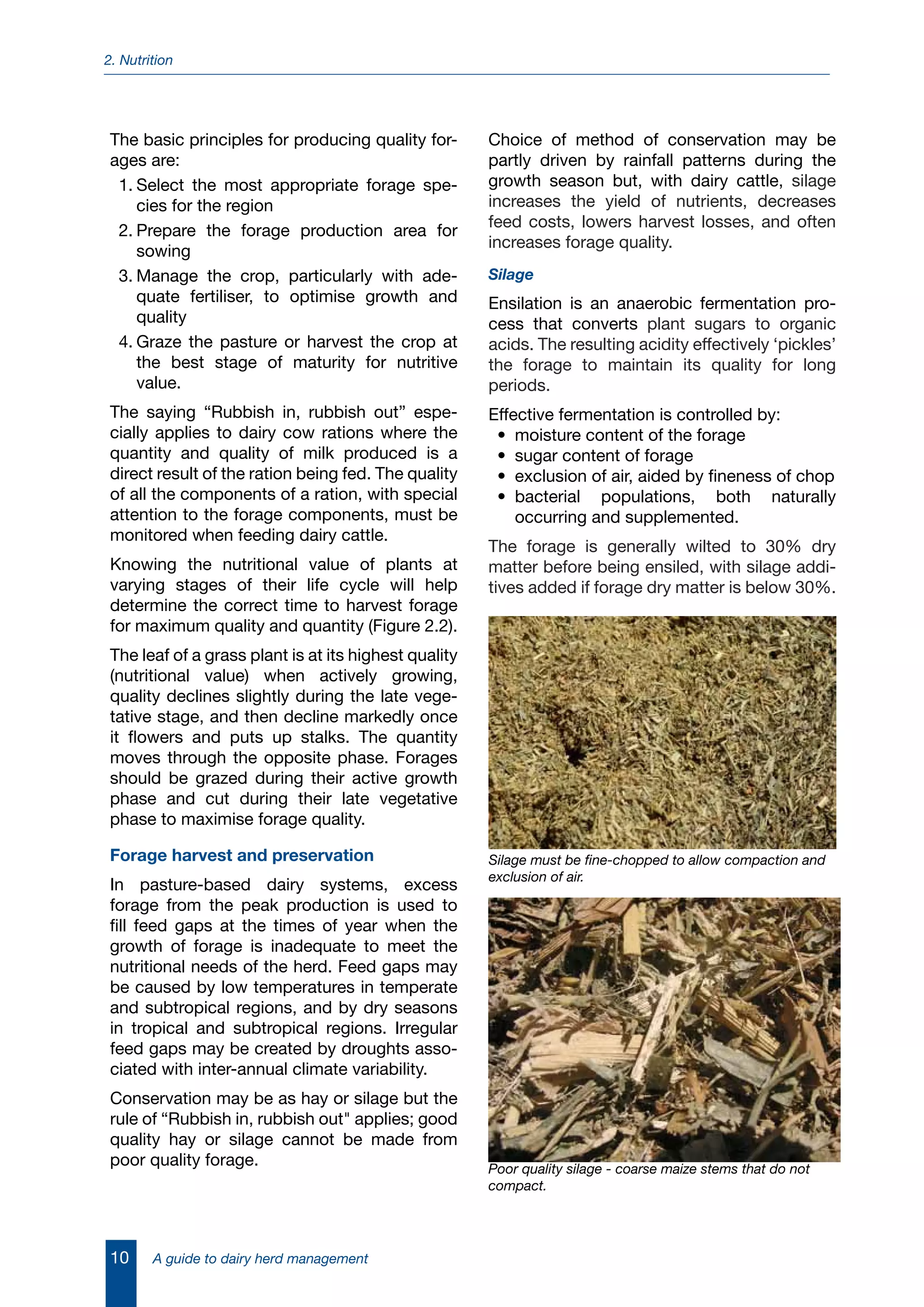
Silage must be fine-chopped to allow compaction and
exclusion of air.
Poor quality silage - coarse maize stems that do not
compact.
2. Nutrition
A guide to dairy herd management 11
Wetter forage requires a lower pH to prevent
undesirable bacteria growth and this means
more sugar must be available for conversion
to acid. Legumes have a natural buffering
capacity and require more acid to reach a low
pH than grasses or corn.
Air is excluded in a silage pit by compac-
tion with heavy tractors; however, suitable
anaerobic conditions can be created by com-
pacting and storing the forage in a sealed
vessel or plastic bag. For good compaction,
the green forage needs to be chopped into
lengths of 1–2cm.
Any contact between the silage and air will
result in mouldy, decayed, inedible, and some-
times toxic, material that becomes waste. Any
small amount of oxygen not removed by com-
pacting is rapidly removed by bacteria.
The quality of fermentation depends on the
types of bacteria; effective fermentation
requires the presence of lactic acid bacteria
and the absence of clostridial bacteria. Lactic
acid bacteria convert plant sugars to acids
efficiently, and produce the non-odorous
fermentation associated with good silage.
Clostridial bacteria are inefficient at converting
plant sugars to acids, and produce silage of
poor nutritional value.
As acidity builds up in the silage, microbial
activity diminishes and the plant material is
preserved. Corn silage should range from pH
3.5 to 4.5 and haylage from pH 4.0 to 5.5.
Silage storage losses can be high if silos are
not sealed properly or become soaked by
rainwater or runoff. Silage must be fed soon
after removal from storage to avoid spoilage
from exposure to air; storage facilities with
an exposed silage surface must be sized to
match the rate of feeding.
The surface area of the open face should
be kept to a minimum to minimise oxidative
spoilage. This is achieved by only opening the
stack on one side and keeping the face ver-
tical and even.
Poor silage management practices can result
in reduced feed quality, low milk production,
and increased risk of health problems.
Hay
Hay is made by mowing a forage grass
or legume and allowing it to dry in the sun.
The dry grass can be baled for ease of han-
dling or stacked. Forage species with heavier
stems are cut with a mower and the stems
then crushed or crimped with a conditioner to
speed drying.
The timing of harvest should be based on the
maturity of the crop (for the balance between
yield and growth stage) and weather condi-
tions. Grass hay crops should be mowed
when or shortly after the plants produce seed
heads; lucerne hay should be mowed before
the crop is in bloom.
Most hay crops will take two to three days
to dry in the spring when the plant is high in
moisture and less time during the summer.
Feed quality will be lost if the cut forage is
rained on. Drying is accelerated by turning the
hay with a side-delivery rake or fluffing it with
a tedder or inverter. Raking should be done
when the hay has dried down to 35 to 45%
moisture. It is best done on the day of baling.
Good silage must be protected against rainfall.
Smaller quantities of silage can be preserved in sealed
plastic bags.
2. Nutrition
12 A guide to dairy herd management
Some forage leaf is lost when mowing or by
raking during curing. The best practice is to
rake the hay once only and that should occur
on the day of baling.
Hay should not be baled until it is under about
20% moisture to prevent spontaneous com-
bustion in the shed or stack.  
Concentrate and protein supplements
Milking cows need concentrates to supple-
ment the forage—with the type of concentrate
depending on the composition of the forage.
Some supplements that are by-products from
processing crops include canola meal, soy-
bean meal, cottonseed meal, beet pulp, citrus
pulp and rice bran; others are formulated con-
centrates from feed millers.
By-products can be categorised as energy or
protein supplements. Table 2.4 classifies sup-
plements to balance cow diets that may be
low in dietary energy or protein.
Products such as citrus pulp may contain a
large amount of water. Calculations regarding
energy and protein to determine how much
should be fed are based on the dry matter
content of the ingredients.
Storage
Good conditions for feed storage are impor-
tant to maintain feed quality, minimise
wastage, and reduce the risk of feed spoilage
and toxicoses.
Important considerations for storing feed
include:
•	 the characteristics of the feed—particu-
larly moisture content
•	 accessibility of the location under different
weather conditions
•	 risks associated with poor storage con-
ditions, for example the build-up of
mycotoxins in mouldy feed
Energy/protein
classification
Poor energy
(<8 MJ/kg DM of
ME)
Moderate energy
(8–10 MJ/kg DM of ME)
Good energy
(>10 MJ/kg DM of ME)
Poor protein
(<10% CP)
Corn stover Rice bran (poor)
Most native grasses
Sweet corn cobs
Molasses
Maize silage
Citrus pulp
Moderate protein
(10–16% CP)
- Well managed grasses
Soybean
Immature grasses
Maize grain
Sorghum grain
Rice bran (good)
Wheat pollard
Good protein
(>16% CP)
Urea Legume hays Whole cottonseed
Brewers grain
Soybean curd
Soybean meal
Cottonseed meal
Table 2.6. Classification of supplements and basal forages according to their energy and protein contents.
Hay baled when too moist will heat up and may
spontaneously combust when stored.
Table 2.5. Recommended moisture contents (%) for
safe storage of various bale types
Bale type
Moisture content
(%)
Small rectangular bales 16–18
Round bales (soft centre) 14–16
Round bales (hard centre) 13–15
Large rectangular bales 12–14
Source: http://new.dpi.vic.gov.au/agriculture/
grain-crops/pastures/haystack-fires-spontane-
ous-combustion
2. Nutrition
A guide to dairy herd management 13
•	 wastage
•	 turnover
Dry commodities need to be kept dry. Wet
commodities should be held in a concrete
silo, and the volume of feed ordered must
be matched to the amount required so that
the feed remains fresh. Wastage is generally
highest when the feed is stored on soil, which
may also contaminate the feed with stones
and dirt. Flies can be a problem with wet pro-
tein sources and wind loss with dry dusty
ingredients.
Feed wastage
Feed may be wasted through physical loss
of dry matter or by spoilage of feed quality.
Physical loss occurs if the feed is trampled
by cows; spoilage with reduced energy and
protein value occurs with contamination by
moulds or fungal toxins, moisture damage
or leaching. The most common example is
mould on spoiled silage.
Feed losses occur during delivery and storage,
when diets are mixed, and especially when
the diet is fed out to cows.
Wastage can be less than 5% with good
feeding systems but as high as 30% when fed
on bare ground.  
Feed digestion and utilisation
Feed eaten by cows is initially digested in
the rumen by the mix of microbes present,
and these rumen microbial flora must be
kept healthy for the health and productivity
of the cow. Good-quality forage provides the
foundation of the ration; concentrates and
by-products are added to provide additional
energy and protein.
Digestion is facilitated by continuous regur-
gitation (rumination) of plant fibre (cud) and
chewing to reduce particle size. Chewing pro-
motes the production of saliva, which contains
high levels of buffering salts and so helps to
maintain a stable pH of the rumen fluid. The
rumen microbes break down plant cell con-
tents and cell walls, including fibres, for their
own multiplication. They use the plant protein
and derive energy from sugars and starchs; in
the process, they generate volatile fatty acids
(VFAs) that are absorbed through the rumen
wall to provide the major source of energy for
the cow. The main VFAs are acetic acid (ace-
tate), propionic acid (propionate) and butyric
acid (butyrate).
The microbes are continually washed out of
the rumen and are in turn digested further
down the digestive system. This microbial
protein is an important source of energy and
protein for the cow.
The type and number of microbes present in
the rumen depends on the type and quality of
feed in the ration. The microbes that break-
down fibre prefer a pH range of 6.2–6.8
whereas the microbes that breakdown starch
prefer a pH range of 5.2–6.0. Under normal
conditions, the pH is maintained at 5.5–6.5 by
the buffering action of the saliva.
Achieving optimal rumen function involves
promoting maximum microbial growth, sur-
vival and activity with a rumen pH of 5.8–6.4.
These cows will waste less than 5% of their feed.
Cows may trample and waste about 30% percent of
hay fed in the field.
2. Nutrition
14 A guide to dairy herd management
Factors that affect rumination are:
•	 order in which the ration is fed
•	 particle size of the ration
•	 number of times the ration is fed per day
•	 type of ration fed.
The stability of rumen pH is normally main-
tained by the inflow of saliva, the rapid
absorption of VFAs from the rumen and the
predominance of acetic acid within the rumen.
Order in which the ration is fed
There are numerous approaches to feeding
cows. In ‘component feeding’, ingredients are
fed separately; this gives variable intakes of
different components and results in an unbal-
anced diet. The greatest risk associated with
component feeding occurs when concen-
trates are fed before the forages as this leads
to rapid fermentation in the rumen and disrup-
tion of the normal rumen flora.
Forages should always be fed before concen-
trates, or the ingredients mixed together as a
‘Total Mixed Ration’ (TMR), to promote con-
sumption of a balanced ration.
Particle size of ration
All forage pieces must be longer than 11mm
but with only 10% of the ration being longer
than 40mm. This will stimulate bolus formula-
tion, increase chewing and saliva production
and hence increased buffering. The overall
affect is to improve the rumination process.
If the forage is cut too short, rumination and
saliva production will be reduced, with the
increased risk of the cow developing ruminal
acidosis. If the particle size is too long, diges-
tion will slowed, reducing feed intake and
limiting the availability of nutrients for milk
production.
Number of times the ration is fed per day
Feeding a cow more than once per day
stimulates continuous saliva production
and buffering, which helps maintain a stable
rumen pH. Cows are also stimulated to eat by
the presentation of fresh feed.
Type of ration fed
A ration high in roughage is associated with
a rumen pH of 6.5 whereas a ration high in
concentrate is associated with a rumen pH
of 5.5. Prolonged acidic conditions within
the rumen increase the risk of damage to the
rumen papillae and their capability to absorb
nutrients.
Nutritional requirements
The nutritional requirements of the cow
change with growth, pregnancy and lactation.
Most health-related problems and deaths in
mature dairy cows occur within 60 days of
calving. Correct management of the ‘transi-
tion period’, which covers the month before
and the month after calving, is particularly
important. Good reproductive management
with accurate pregnancy determination estab-
lishes when the cow is due to calve and that
the correct rations are fed to the right cow at
the right time.
The daily maintenance feed intake of a non-
pregnant mature cow is about 1.2% of her
body weight per day—a 600kg cow needs
to eat about 7.2kg of good-quality dry matter
per day. The amount of dry matter fed to
heavily pregnant non-lactating cows should
be around 2% of bodyweight or 12kg DM to
meet the needs of the developing foetus. The
cow’s appetite will decline during the last 3–4
weeks of pregnancy, particularly during the
last week of gestation when dry matter intake
may be reduced by 50%.
Thus appetite is decreasing while the nutrient
requirements of the developing calf and the
cow are increasing.
Three common nutritional problems that occur
around the time of calving are:
•	 negative energy balance (ketosis and fatty
liver)
•	 hypocalcaemia
•	 ruminal acidosis
Negative Energy Balance – The first aim of the
transition ration is to minimise the energy def-
icit experienced by the cow in the face of a
declining appetite by adding concentrates to
her ration during the last 3–4 weeks of preg-
nancy.
Cows that experience excessive negative
energy balance are more likely to retain their
placenta, develop metritis, and displace their
stomach. These cows also take longer to get
2. Nutrition
A guide to dairy herd management 15
pregnant increasing the risk of culling due to
conception failure.
Hypocalcaemia – High-producing older cows
are prone to experiencing a rapid decline in
blood calcium around the time of calving. This
reflects the large amount of calcium that is
incorporated into the milk produced by the
cow. The second objective of the transition
ration is to minimise the decline in blood cal-
cium around the time of calving to prevent
cows from going down with milk fever (weak-
ness caused by low blood calcium).
Older cows are more likely to have problems
with milk fever than heifers. Cows that suc-
cumb to milk fever are more likely to have
calving difficulty, retain their placenta, and
have problems with mastitis than cows that
do not. Less than 2% of cows should experi-
ence problems with milk fever.
A high incidence of milk fever indicates a
nutritional management problem.
Strategies to prevent milk fever include:
•	 ensuring that there is adequate magne-
sium in the ration by including 50 grams of
magnesium oxide per head per day in the
feed during the last 3–4 weeks of gesta-
tion.
•	 keeping the fat content of the diet below
4% during the last 3–4 weeks as excess
fat binds to magnesium preventing its
absorption in the rumen.
•	 feeding a diet low in calcium, typically by
feeding higher levels of cereal hays such
as oaten or wheaten hay that are low in
calcium. However, it is often difficult to
find feedstuffs that are low in calcium but
provide enough energy and protein to
overcome the negative energy balance.
•	 feeding a diet that contains low levels of
potassium and higher concentrations of
chloride and sulphur by feeding forages
that are low in potassium and adding
salts such as calcium chloride or ammo-
nium sulphate to the feed. As the salts
are not very palatable, it is important to
monitor how much the cows are eating
to avoid inducing negative energy bal-
ance. Commercial salt preparations such
as Biochlor (Arm and Hammer Animal
Nutrition) are reported to be more palat-
able.
Ruminal acidosis – Lactation dramatically
increases the feed requirements of high-
producing dairy cows. An extra 5kg of
high-quality dry matter should be added to
the maintenance ration per 10 litres of milk
produced; high-producing cows can consume
4% of their body weight in dry matter per day
at peak lactation when fed highly digestible
feed. Abrupt increases in the energy content
of the ration causes excessive fermenta-
tion (ruminal acidosis) and disruption of the
microbes in the rumen. Gradual increases in
the energy content of the ration before calving
promote gradual adjustments in the microbes
in the rumen allowing the cow to safely eat the
higher energy lactating-cow ration.
Feeding the milking cow
Milk production is driven by dry matter intake,
which is influenced by the quality or digest-
ibility of the feed fed. Poor-quality feed takes
longer to digest and therefore limits the
amount of feed a cow can eat each day and
the amount of nutrients available to produce
milk. When the nutrient output in milk exceeds
the amount of nutrients ingested during early
lactation, cows lose weight. Excessive loss
of weight or ‘Body Condition’ during early
lactation is associated with reduced milk pro-
duction and an increased risk of disease.
Milk fat and milk protein
Rations high in starch or non-fibre carbohy-
drate are fermented to propionic acid and
have the greatest influence on milk protein.
Cows with milk fever need immediate injection with
calcium boro-gluconate.
2. Nutrition
16 A guide to dairy herd management
Rations high in fibre are fermented to acetic
acid and have the greatest influence on milk
fat.
At least 60% of the ration should be forage as
lower levels will reduce milk fat and increase
the risk of ruminal acidosis. The quality of the
forage determines the intake and digestibility
of a ration.
Milk protein is dependent on the total intake of
digestible energy. A cow eating large amounts
of high-quality feed will produce milk with a
high milk protein (>3.3), whereas a cow con-
suming small amounts of low-quality feed
will produce milk with a very low milk protein
(<2.9).
The ratio of milk protein to milk fat indicates
the energy and fibre balance in the ration.
A milk protein to fat ratio of 0.81–0.85 indi-
cates that the cow is well fed and the ration
is balanced. A ratio of less than 0.75 indicates
insufficient energy; a ration above 1.00 sug-
gests insufficient fibre in the ration.
Manipulating nutrition to improve milk
production
The major influences on milk production from
the herd are nutrition, cow comfort and the
demographics of the milking herd, which is
determined by the reproductive management
of the cows. Dairy herds respond to nutri-
tion when the cows are not stressed by poor
comfort and the herd is not ‘stale’ with a high
proportion of cows in late lactation.
Feeding the non-lactating or ‘dry’ cow
Milk production over the cow’s lifetime is
increased when she is not milked for 50–60
days between lactations. Stopping milking
is referred to as ‘drying off’ and the non-lac-
tating period as the ‘dry’ period. Ideally, cows
should be dried off in the body condition in
which they should calve; this is a body condi-
tion score of 3.25 on a scale of 1 to 5 (where 1
is very skinny and 5 very fat). Dry cows should
be heavily pregnant and should not lose
weight during the dry period.
The amount of dry matter fed to heavily preg-
nant non-lactating cows should be around
2% of bodyweight, or 12kg of good-quality
dry matter for a 600kg cow.
The loss of appetite around calving has to be
minimised. As after she has calved, the cow
will be fed a high-energy ration, she should
be fed increasing amounts of energy from 4
weeks before calving to allow the rumen to
adjust to the new diet.  
Useful resources
•	 Nutrition resources on the Dairy Australia
website. http://www.dairyaustralia.com.
au/ Specific resources include Grains2milk,
Feeding systems, Home grown feeds,
bought in feeds and nutrition manage-
ment.
•	 Dairy Co's Farm Info Center contains infor-
mation on a diversity of topics including
nutrition. http://www.dairyco.org.uk/
about-us/what-is-dairyco.aspx
•	 TheUniversityofPennsylvaniaCooperative
Extension site describes the equipment
required for and the process of making hay.
http://bedford.extension.psu.edu/agricul-
ture/BeginFarmer/HayMakingEquipment.
htm
•	 The infovets website on how to condition
score dairy cattle. http://www.infovets.
com/healthycowinfo/A084.htm
•	 The Nutrient Requirements of Dairy
Cattle (Seventh Edition 2001) outlines
the nutritional requirements of all classes
of dairy stock and the nutrient values of
common feedstuffs. It can be previewed
at the National Academies of Press web-
site. http://www.nap.edu/openbook.
php?isbn=030906997.
Cow soon to calve. Note constant access
to fresh water and feed and quiet low-
traffic area to avoid disturbing the herd
when she goes into labour.
2. Nutrition
A guide to dairy herd management 17
Feeding high-production cows
Water
Lactating dairy cows need 60–70 litres (L) of
water each day for maintenance, plus an extra
4–5L for each litre of milk produced. Water in-
take is influenced by the size of the cow, dry
matter intake, ambient temperature and hu-
midity, and milk production. During hot weath-
er, high-producing cows may drink up to 200
litres of water per day.
As cows drink 50–60% of their daily water
intake immediately after milking, the water
trough must provide 75cm of linear trough
space per cow for at least half of the cows in
the milking parlour when exiting the parlour.
When cows are housed, there should be a
minimum of two water sources per group in
the areas where the cows are housed and
they should never have to walk more than 20
metres to get a drink of water. Water sources
should be close to feed bunks.
Clean water is especially important.
Filling capacity of water troughs
Cows should never have to wait for a slow-
filling trough. Water pipes should be 75mm in
diameter with sufficient pressure to provide
20L per cow per hour to cope with peak de-
mand. Shallow troughs (15–30cm depth) are
better than deep troughs as the more rapid
turnover of water avoids stagnation; they are
also easier to clean.
Feed intake and milk production are de-
pressed when access to water is restricted.
3 Feeding management
Key points
•	 Good-quality feed and water should
always be available.
•	 Sufficient feed bunk and water trough
space will minimise competition at the
feed bunk.
•	 Milking cows need a lot of drinking
water— as much as 150–200 litres per
day for high-producing cows during the
hot season.
•	 Most forages will support only 6–8kg of
milk/cow/day, and must be supplemented
with high-energy concentrates.
•	 As a general guideline, feed 1kg
concentrateforevery2kgofmilkproduced
above that supplied from forages.
•	 Better decisions can be made if the
feeding value of the forages and
concentrates, and their costs are known.
•	 Diets should be balanced for energy,
protein, fibre and certain minerals for
optimum cow performance and to prevent
any metabolic problems.
•	 A well-balanced ration will give production
only if enough is fed.
•	 Simple observations of the cattle
can identify problems with feeding
management.
•	 Maximise feed intakes around calving
and in early lactation by providing enough
high-quality feed.
•	 Avoid sudden changes in diet when cows
calve and join the milking herd.
•	 Do not overcrowd cows before and after
calving.
•	 Manage first-lactation cows as a separate
group to reduce bullying by older cows.
•	 Cows are social animals, and frequent
changes in cow grouping can be
disruptive; for example, introduce cattle
onto the pre-calving ration once a week
rather than daily.
‘If you would not be prepared to drink water
like that in the trough, it is not clean enough
for the cows’.
3. Feeding management
18 A guide to dairy herd management
Forages and supplements
Milking cows should be fed at least 30–40kg
of fresh good-quality forage daily (equivalent
to 6–8kg of dry matter) to provide enough
fibre for optimal rumen function. For optimum
rumen function and hence milk production,
the non-fibre carbohydrate (NFC) proportion
of the diet should be 35–40% of dry matter.
Milk fat will be reduced if NFC is above 40%,
and NFC must be balanced with degradable
protein so that degradable protein is 35% of
NFC.
Effective fibre in a diet will be helped if all for-
age is more than 11mm long but with only
10% greater than 40mm long. The ratio of for-
age NDF to rumen-degradable starch should
be higher than 1.1:1 to support the provision
of effective fibre.
As a general guide, 1kg of concentrate should
be fed above that supplied from forages for
every 2kg of milk produced. This is a safety
measure when the nutritive value of the feeds,
particularly the forages, is not known.
In any dairy system, the principles for feeding
milking cows should be:
•	 Feed sufficient quality forages first
•	 then supplement with concentrates
•	 concentrates should be formulated to
overcoming specific nutrient deficiencies
to achieve target milk yields.
Milk production is highly responsive to nutrient
intake with the cow’s milk yield today being
directly affected by their feeding management
yesterday. No other type of livestock provides
such a rapid feedback to herd management.
Once farmers set their target milk yields, they
can monitor their success or failure in achiev-
ing these by gradually changing one of the
feeds in the cows’ ration.
Intake
Cows require enough feed to satisfy their nu-
tritional requirements, and a well-balanced ra-
tion will provide beneficial results only when
intake is not limiting. High-producing cows
are normally fed 5% more than they are ex-
pected to eat each day to avoid them running
out of feed and limiting production. Feed that
has not been eaten at the end of the day is
collected and fed to young stock.
Feed intake is influenced by the composi-
tion of the ration, the amount of feed offered,
the number of times the cows are fed per
day, water availability, and accessibility of the
feed. Feed bunk access is important for cows
to maximise their dry matter intake. Milking
cows should have at least 65cm of feed bunk
space per cow.
Cows respond strongly to the delivery of fresh
feed; delivering fresh feed after milking keeps
the cows standing and allows the teat sphinc-
ter to close before the cow lies down. The
teat sphincter should close within 30 minutes.
Pushing up feed keeps it in front of cows, but
has little effect on stimulating feeding activity.
Mature forages such as rice straw are digested slowly,
reduce total intake and provide insufficient nutrients for
good milk production.
Cows in a free-stall barn that includes lockups to
facilitate reproductive management. Note the area
where shy cows can access feed without putting their
head in the lockups. Performance is ultimately dictated
by the ration consumed, which is influenced by the way
the feed is delivered.
3. Feeding management
A guide to dairy herd management 19
More frequent feed delivery results in greater
access to the feed bunk and less feed sorting
by the cows.
Dairy cows maintain a social structure that
may impact on the amount of feed consumed
by each cow. If feed bunk space is limited, the
more dominant cows will prevent those less
dominant from eating as much as they should.
Indicators of nutritional problems
Diets should be properly balanced for energy,
protein, fibre and certain minerals for optimum
cow performance.
Important simple indicators of unbalanced
diets include:
•	 Lack of rumination. If fewer than 50% of
the milking herd are ruminating—chewing
their cud—while relaxing, there may not
be enough fibre in the diet. This may
be confirmed by examining the cows’
manure and looking for changes in milk
composition.
•	 Loose manure. Very loose and watery dung
may indicate a lack of fibre in the diet.
Bubbles in the manure indicates acidosis
from a relative excess of starch to fibre.
•	 Many lame cows. Ruminal acidosis is a
common cause of lameness in housed
dairy cattle, but there could be other
causes.
•	 Milk components. Milk analysis provides
useful information about the diet.
– Milk fat. Milk fat test tends to drop when
the herd is placed on a low fibre diet
(such as a diet high in cereal grain).
– Milk protein. Low milk protein or sol-
ids-not-fat (SNF) content is common in
early lactation because the cow’s ener-
gy needs are greater than their intakes
causing them to lose body condition.
Shortages of energy reduce protein use
by the rumen microbes. Generally pro-
viding extra energy in the diet will lift
protein or SNF test.
•	 High incidence of disease in the herd. This
is most commonly observed around the
time of calving and during the first 60 days
of lactation.
– Down cows at calving (>2%).
– Retained foetal membranes following
calving (>8%).
– Displaced stomachs (>3%)
– Uterine infections
The risk of a cow developing a uterine in-
fection following calving is increased by de-
pressed feed intake before calving. For every
A milking cows needs to eat this amount of forage each
day.
Cows that develop milk fever at calving are three times
more likely to retain their placenta and so more likely to
develop a uterine infection.
A high incidence of health problems during
early lactation leads to poor milk production
and poor reproductive efficiency.
3. Feeding management
20 A guide to dairy herd management
10 minutes less feeding time each day before
calving, the risk of cows developing a uterine
infection almost doubles; for every kilogram
dry matter less feed a cow eats each day, the
risk of uterine infection increases threefold.
Trouble-shooting feeding problems
Many simple observations can identify prob-
lems with feeding management. These in-
clude:
•	 Manure consistency, colour and content.
The manure should have moist but
thick consistency. Dry manure suggests
insufficient water and/or carbohydrate
in the diet. Loose manure that contains
bubbles indicates ruminal acidosis, and
reflects incomplete digestion of feed in
the rumen with further fermentation of
nutrients in the lower bowel.
•	 Comparing the composition of the feed
fed with the feed remaining at the end of
the day. If forage fibre length is long, cows
may sort through the feed and consume
the concentrates but not the fibre. This
‘sorting’ can lead to subclinical acidosis
despite an apparently balanced ration. The
ration that dictates performance is that
which is actually eaten by the cows. Chop
the hay to shorter lengths.
•	 Individual cows may ‘sort’ feed differently.
Dominant cows that eat more concentrate
may develop acidosis; timid cows that
are left with the less digestible portion of
the ration eat more fibre and produce less
milk. Variable manure consistency is often
observed in group housing facilities.
•	 Rumination; ideally half the herd should be
ruminating when resting. If the percentage
is low and there are other indicators of
ruminal acidosis (loose manure, lameness,
low milk fat percentage) there is probably
not enough effective fibre in the ration.
This could result from inadequate fibre,
chopping the forage too finely or excessive
fat in the diet, or from cows ‘sorting’ and
failing to eat the fibre.
•	 Physical appearance and smell of forages.
Moist feedstuffs are prone to spoilage
by the growth of moulds. Some moulds
produce toxins.
•	 Physical appearance and smell of
concentrates. Mould can also be a
problem in moist concentrate feeds such
as corn gluten.
•	 Sudden changes in milk yield. Rapid
changes in milk yield most likely reflect
adverse environmental conditions such
Conception rates are compromised in cows that
develop a uterine infection.
Manure consistency reflects feeding management. Normal consistency (left) indicates good feeding, whereas loose
manure (right) is associated with excess starch or insufficient fibre.
3. Feeding management
A guide to dairy herd management 21
as heat stress or changes in nutrition.
Attention to detail and consistency in ration
preparation and delivery are important.
Cows are creatures of habit and do best
when a consistent routine is maintained.
•	 Sudden changes in milk composition,
namely fat and protein (or SNF) contents
•	 Disease incidence, as discussed above
•	 Body condition at different stages of
lactation. Cows should calve in a body
condition score of around 3.25 on a scale
of 1–5 (BCS1 is very skinny and BCS5 is
fat). Cows should not lose more than 0.5
of condition score during the first month
of lactation.
A sudden change in one of these quick checks
may be due just to a temporary change in en-
vironmental conditions. If the check quickly
returns to normal, cow performance may not
be adversely affected. But it is important to
take action when a quick check remains ab-
normal for several consecutive days and/or
several quick checks become abnormal at the
same time.
Good nutritional management during the dry
period and early lactation is the key to pre-
venting or minimising metabolic disorders.
The aim is to:
•	 maximise feed intakes around calving
and in early lactation by providing enough
high-quality feed
•	 avoid decreases in intake and disruption
of rumen function caused by sudden
changes in diet when cows calve and join
the milking herd
•	 avoid overcrowding cows prior to and
following calving
•	 always provide good-quality feed and
water
•	 provide sufficient feed bunk space to
minimise competition at the feed bunk
•	 manage first-lactation cows as a separate
group to reduce bullying by older cows
•	 minimise changes in cow grouping as
cows are social animals; for example,
introduce cattle onto the pre-calving ration
once a week rather than daily.
Useful resources
•	 The nutrition management section of the Grains
2 Milk Dairy Australia program contains a
number of resources regarding the formulation
of diets for dairy cattle, transition cow nutrition,
monitoring and preventing acidosis and
numerous other tools. These can be found
at http://www.dairyaustralia.com.au/Farm/
Feeding-cows/Nutrition-management.aspx.
•	 A good review of transition cow monitoring
is published in the Ireland Veterinary Journal
and can be viewed online. Note that the body
condition score at calving recommended in this
articleis3.0ratherthan3.25.TheNorthAmerican
literature tends to recommend cows calve in
slightly higher body condition than the Irish.
http://www.veterinaryirelandjournal.com/
Links/PDFs/CE-Large/CELA_September_06.
pdf
Cows calving in poor body condition or fed insufficient
nutrients in early lactation lose body condition, reduce
milk production and often fail to cycle.
3. Feeding management
22 A guide to dairy herd management
Maternity management
The risk of difficult calving and calves dying
at or shortly after birth may be influenced by
environmental conditions, nutrition, technical
expertise, age of the cow and sire selection.
Calving environment
Scours is a common disease problem, and the
young calf may be infected by the cow and
the environment into which it is born. As the
cow’s immunity is depressed around the time
of calving, they are more likely to shed patho-
gens in their manure. Some of the pathogens
may also proliferate in a moist environment.
4 Managing young stock
Key points
•	 Good management starts at birth when
calves are born in a clean area.
•	 About 5% of calves die at, or shortly after,
birth. Mortality is higher for calves born to
heifers than for those born to cows.
•	 Calves should be removed from the cow at
birth and placed in a clean dry area.
•	 Calves should be given at least four litres
of good-quality colostrum during their
first twelve hours of life. This can be given
through a bottle or through a stomach tube
if the calf will not suckle.
•	 Calves should be fed 15% of their body
weight in milk each day, with the volume
adjusted as the calf grows.
•	 Feed calves milk twice a day for the first
four weeks of life, then once a day.
•	 Bacteria numbers in warm colostrum
and milk double every 30 minutes—poor
storage will lead to more sick and dying
calves.
•	 Rumen development in calves is promoted
by feeding some high-quality forage with
high-quality concentrates.
•	 Calves can be weaned once they are
eating 900 grams of concentrates per day.
•	 Scours is the most common disease
problem in calves under five weeks old.
Calves can become infected when fed
contaminated milk or colostrum or when
placed in a dirty environment.
•	 Scouring calves should be immediately
rehydrated with oral electrolyte solutions
to keep them on their feet, and may be
given antibiotics depending on veterinary
advice.
•	 Aim for less than 3% pre-weaning calf
mortality. A high proportion of sick calves
indicates high pathogen exposure; high
mortality in affected calves indicates inap-
propriate therapy.
•	 Heifers must be grown well for future
fertility and milk production and to mini-
mise calving difficulties.
•	 Calves should gain 600 grams per day
before weaning and 800 grams per day
after weaning.
Cows should calve in a clean environment with calves
removed at birth and placed in a clean dry pen.
4. Managing young stock
A guide to dairy herd management 23
Nutrition
Cows that are too fat or too thin at calving
are more likely to experience calving difficulty
than appropriately conditioned cows. Fat
cows experience difficulty because fat depos-
ited in the pelvis reduces the diameter of the
birth canal; thin cows may simply be too weak
to deliver the calf normally.
Age
Heifers often have difficulty delivering their first
calf. This is largely influenced by their growth,
nutrition during the last trimester, and by the
sire they conceived to. The most common
cause is a failure of the calf to fit through the
birth canal especially in poorly-grown heifers.
Calving difficulty in older cows is more often
associated with metabolic disease such as
milk fever or negative energy balance.
Technical expertise. Some heifers and cows
will experience calving difficulty associated
with their prior nutrition and management. The
outcome for the calf and the dam is influenced
by the technical skill of the staff that assists
with the delivery.
Key points regarding calving assistance
include:
1.	Timing of intervention. The cervix must be
dilated before attempts are made to deliver
the calf. Most mature cows will either
have delivered the calf or be making good
progress in delivering it within 30 minutes
of starting vigorous pushing. If after 30
minutes of pushing the cow shows no
signs of progress, she should be checked
for complications. As heifers tend to take
longer, wait for 60 minutes.
2.	Sanitation. Washing and cleanliness are
important when calving is assisted to
prevent dirt and manure being introduced
into the uterus. The handler should be as
clean as possible and wash hands and
arms using a couple of buckets of warm
soapy water. They should clean the vulva
before introducing their hand to check the
position of the calf.
3.	Lubrication and patience. The skill of a
calving assistant is not measured by the
speed of the delivery but rather by the
health status of the cow and calf following
the delivery. Lubrication and dilation help
to avoid tearing of the cow’s reproductive
tract. A cycle of lubrication, traction and
relaxation is recommended.
4.	Positioning and angles. When a cow is
standing, the calf should be pulled in a
downward direction. If a cow lies down
on her side during the delivery, the sides
of the crush or race should be able to be
opened so that the calf can be pulled in
the same direction.
Sire selection
In many countries, semen can be ordered
from bulls that are known to produce smaller
calves at birth. This can help reduce the risk
of calving difficulty in heifers delivering their
first calf.
This calf will be exposed at birth to salmonella in the
bedding of packed manure. This dairy experienced a
calf mortality of 60% over a six-week period due to
salmonellosis.
When a cow is standing, the calf should be pulled in a
downward direction
4. Managing young stock
24 A guide to dairy herd management
Calf management
Calf environment
After birth, calves should be removed from
the cow and placed in a clean dry environ-
ment. Newborn calves should not be mixed
with older calves as this could expose them to
pathogens that cause diarrhoea.
There are many systems of calf rearing ranging
from individual calf hutches through to group
rearing systems. Where calves are raised in
groups, it is best to keep them in batches of
similar age and size, and to clean the facility
thoroughly between batches.
Calf-raising facility using individual calf hutches.
There are numerous different systems for
raising calves. In year-round calving herds, it is
best to raise milk-fed calves in individual pens
as pathogen loads build up over time in group
housing systems. If individual housing is not
possible, calves can be raised in batches with
facilities cleaned between batches.
Colostrum quality
The quality of colostrum may be measured
by the amount of immunoglobulin antibody
it contains and by the amount of bacterial
contamination. Immunoglobulins enhance
the calf’s immune function. The immuno-
globulin content of colostrum is influenced
by the timing of harvest relative to when the
cow calves with the best quality colostrum
harvested directly after calving. The immuno-
globulin content of colostrum declines after
calving whether the cow is milked or not.
Colostrum from cows tends to have higher
levels of immunoglobulins than colostrum
from heifers, but all colostrum is valuable. If
there is excess colostrum it may be used to
supplement the milk fed to young calves.
The capacity of calves to absorb the protec-
tive antibodies in colostrum diminishes rapidly
after birth and is lost by 24 hours of age.
Place calves in a clean dry environment after birth. Feed
4 litres of colostrum during the first 12 hours of life to
boost their immunity.
Calves raised in elevated pens. Ideally calves should
not be able to touch each other or contact manure from
other calves.
Keep calves reared in batches grouped by age and size.
4. Managing young stock
A guide to dairy herd management 25
Colostrum is often contaminated by bacteria
in containers that have not been properly
cleaned. Storage at room temperature is
associated with bacterial proliferation as the
number of bacteria may double every 30
minutes. The risk associated with bacterial
contamination can be minimised by feeding
colostrum immediately after harvest from the
cow. A high bacteria count in colostrum inter-
feres with absorption of immunoglobulin by
the calf.
Colostrum feeding
Calves should consume four litres of colos-
trum within the first 12 hours of life given as
two feeds. Calves that will not suckle colos-
trum from a bottle can be tube-fed. Holstein
cows have been selected for their capacity
to produce milk and not for their capacity to
raise calves. As over 60% of calves left with
their mothers for the first 24 hours of life fail to
consume enough colostrum, the manager has
to ensure that they do consume enough.
When colostrum is given through a stomach
tube, it must not be allowed to flow when the
tube is inserted or removed. It is generally
easier to pass the tube with the calf standing
with its tail in a corner and using minimal
restraint. Rough handling tends to cause
calves to fight and makes the procedure trau-
matic.
Calf nutrition
Calf nutrition and calf health are closely
linked, with well-fed calves generally more
robust and less likely to succumb to disease.
Calf nutrition includes colostrum, milk, water,
concentrates, and high-quality forage. Calves
grow well when fed plenty of milk but are often
weaned early because the milk is so valuable
for sale. Early weaning requires good nutri-
tional management to encourage early rumen
development.
Milk feeding
Newborn calves have a small non-functional
rumen. Milk flows from the oesophagus
through an oesophageal groove directly to
the true stomach for efficient digestion. This
groove is formed when the calf suckles but is
less efficient if it drinks from a bucket. Milk that
stays in the rumen may cause scours. The calf
cannot digest sufficient solid feed to survive
and grow until the rumen develops. Calves
should be fed milk at about 15% of their body
weight per day, with milk fed twice a day until
four weeks of age and then only once a day.
The volume of milk fed is increased as the calf
gains weight.
Bacterial contamination of milk, and subse-
quent disease in the calf, is reduced by
harvesting into clean containers and feeding
to the calf soon after milking.
Hygiene
Calves may become infected with diarrhoea
pathogens by contact with other infected
animals, through contaminated milk or colos-
trum, from a contaminated environment or by
contaminated equipment or people.
Important principles with calf rearing include:
•	 Always work from youngest to oldest
Oesophagus
Reticulum
Omasum
Abomasum
Small intestine
Rumen
Calf at 10 weeks old
Rumen
Omasum
Abomasum
Reticulum
Oesophagus
to small intestine
Figure 4.1. The rumen of the young calf develops as it begins to eat fibrous feed
New-born calf
oesophageal
groove
4. Managing young stock
26 A guide to dairy herd management
•	 Never work with sick calves and then give
colostrum to newborn calves. Handler’s
hands and clothes become contaminated
and can transmit infections between
calves.
•	 Pathogens that cause disease in calves
can survive and multiply in milk and dirty
equipment. After every feeding, clean
the equipment with warm soapy water to
remove any fat residue.
•	 Equipment used to give colostrum to
newborn calves should not be used to
feed or treat sick calves. It is best to have
equipment dedicated to handling colos-
trum to avoid the risk of contamination
and infection of newborn calves.
•	 Ninety nine percent of cleaning is achieved
by the physical removal of organic debris.
Disinfectants do not work properly in the
presence of dirt, milk residue, and manure.
The cleanliness of equipment for calf milk and
colostrum handling is important for reducing
the risk of disease. Check its design and wear
as worn rubber and old galvanised buckets
contain cracks and crevices that make effec-
tive cleaning impossible.
Concentrate feeding
Rumen development is stimulated by the
physical scratching of roughage and the prod-
ucts of rumen fermentation. Calves should be
encouraged to eat solid feed at an early age by
offering high-quality concentrates (grain and
or calf pellets) and good-quality hay during
the first week of life.
The calf ration should be specially formulated
with protein levels of 20–22%; milking cow
concentrate formulations contain only 16%.
Initially calves should be fed only a couple
of handfuls a day to keep it fresh, encourage
consumption and avoid wastage; dusty feed
is less palatable. Calves prefer to eat out of
shallow bowls. The amount of concentrate fed
is increased as they eat more; feeding milk
once a day when the calf is over four weeks of
age helps them to develop an appetite for the
concentrates.
It is easy to monitor consumption when calves
are raised in individual pens, but more difficult
in group facilities. Calves should be grouped
on size and age to avoid bullying and uneven
consumption.
Forage feeding
The rumen must be functioning to efficiently
digest forages. Young calves cannot extract
sufficient nutrients from hay and straw alone
to grow well. Calves fed very poor quality
forages and insufficient concentrate are thin
yet have large abdomens reflecting accumula-
tion of poorly digestible feed. It is not essential
to feed forages before weaning; when good-
quality forage is fed it should be limited to
100–200g/calf/day.
Water
Calves should have access to fresh water at
all times. Limiting access to water will reduce
consumption of dry feed and so will delay
weaning.
Calf-feeding equipment must be kept immaculately
clean. Calf eating poor-quality hay—notice the rough coat
and thin condition despite a full rumen. Calves fed poor
quality forages become weak and more susceptible to
infectious diseases and parasites.
4. Managing young stock
A guide to dairy herd management 27
Calf diseases
Scours
Scours (diarrhoea) is the most common health
disorder and cause of mortality during the
first four weeks of life. Pathogens commonly
implicated in calf scours include rotavirus,
coronavirus, Cryptosporidia, Salmonella and
enterotoxigenic E. coli. Sources of infection
have been discussed under the headings of
calving management, colostrum, milk and
feeding management.
Calves often become infected shortly after
birth, with the disease manifesting at four
to seven days of age. During outbreaks of
disease, nearly all calves may develop diar-
rhoea, and up to 80% may die. A high
proportion of calves with scours indicates a
breakdown in biosecurity procedures and the
need to review management procedures for
the calving area, calf housing, colostrum and
milk management. High mortality indicates
treatment failure.
Calves with scours experience a number
of medical problems that may contribute to
death; these include dehydration, acidosis,
bacterial infection, low blood glucose and
hypothermia. Fluid therapy is the corner-
stone of treating calf scours. Calves infected
with bacterial pathogens and calves that are
severely debilitated also benefit from anti-
microbial therapy. Affected calves need a
clean, dry, warm environment and nutritional
support.
Fluid therapy – Young calves with diarrhoea
rapidly become dehydrated and collapse.
As it is difficult to manage collapsed calves
on the farm, sick calves should be identi-
fied and treated early while they still have a
suck reflex. Oral electrolyte solutions are
effective at rehydrating calves. Oral electro-
lyte solutions should contain: sodium; agents
to facilitate absorption of water and sodium
from the intestine (glucose, citrate, acetate,
proprionate, or glycerine); an alkalinising
agent (acetate, proprionate, or bicarbonate to
correct acidosis; and a source of energy such
as glucose.
During a disease outbreak, it is usually
possible to identify the age of onset of diar-
rhoea. Oral electrolytes should be offered to
calves slightly younger than the observed age
of onset as an additional feed spaced evenly
between their normal feedings. It is generally
easier to keep calves hydrated and standing
than it is to resuscitate recumbent calves that
do not want to suckle. The interval between
milk and electrolyte feedings is important.
When calves are sick, appetite is depressed;
they will consume more fluid when the feed-
ings are spaced as widely as possible. Sick
calves may refuse to drink milk yet consume
electrolyte solutions. Electrolytes can be
administered with an oesophageal feeder
or stomach tube if calves refuse to suckle.
Calves with severe diarrhoea may need to be
treated with oral electrolytes several times a
day to remain hydrated. Electrolyte feedings
are usually limited to two litres at each feeding
with the number of feedings tailored to the
needs of the calf. Most calves will get by
with two to three feedings per day but those
severely affected may require more.
Antibiotic therapy – Pathogens such as rota-
virus, coronavirus, and cryptosporidia are not
susceptible to antimicrobial therapy. However,
antibiotics are useful for the treatment of
scours caused by enterotoxigenic E. coli and
Salmonella spp. and for treating secondary
bacterial infections in severely debilitated
calves. As different antibiotics target different
bacteria it is best to seek veterinary assis-
tance.
Nutritional support – Calves with diarrhoea
have depressed appetites, compromised
intestinal function, and often lose nutrients
Dehydrated calves must be given electrolytes
immediately.
4. Managing young stock
28 A guide to dairy herd management
from the damaged gastro-intestinal tract.
Young calves also have limited fat reserves to
maintain bodily functions when they are sick.
The inclusion of glucose in calf oral electrolytes
facilitates sodium absorption and provides
calves with a source of energy. The amount
of energy that can be provided to calves in
the form of glucose each day is limited so it
is desirable to get calves back onto milk as
soon as possible. As the damaged intestine
may not be able to digest and absorb the
volume of nutrients fed, diarrhoea may be
exacerbated when calves are re-introduced
onto milk unless smaller volumes of milk are
fed more frequently.
Environmental support – Sick calves lose
body condition and are vulnerable to cold and
heat stress. In cold climates, calves need to
be provided with a warm dry environment; in
hot climates, they need shade and ventilation.
Umbilical infections and swollen joints
Good colostrum management helps to protect
calves from bacterial pathogens, but poor
colostrum management can be manifested
by an increased incidence of umbilical or joint
infections.
Cows should calve in a clean environment and
the calves should be fed four litres of high-
quality (clean) colostrum during the first 12
hours of life. Dipping the umbilicus with 2%
chlorhexidine at birth may also reduce the risk
of infection, while dipping in an iodine solution
will reduce the risk of screw worm infection in
many tropical regions.
Umbilical infections can be treated with anti-
microbial therapy and may require surgery to
drain and resect the infected umbilical struc-
tures.
Pneumonia
Pneumonia refers to disease of the lungs and
is most common in calves around the time
of weaning. Poor colostrum management,
overcrowding, poor ventilation (especially in
indoor housing), nutritional stress, concurrent
disease, mixing of different age groups and
environmental stress can predispose calves
to pneumonia.
Several viral pathogens can be transmitted
between calves when calves are weaned and
placed into groups, and these may compro-
mise respiratory defence mechanisms.
Coccidiosis around the time of weaning can
make calves more susceptible to respiratory
disease. Coccidiostats such as monensin,
lasalocid or decoquinate should be included
in calf rations to prevent coccidiosis.
Pneumonia is unusual in calves less than four
weeks of age unless they are housed in poorly
ventilated barns. If calves develop pneumonia
during the first two weeks of life, it may be
associated with feeding through stomach
tubes as poor technique or damaged equip-
ment can lead to calves breathing liquid into
their lungs.
Young calves may also develop pneumonia,
joint infections, and ear infections if they
become infected with mycoplasma—an
organism that causes contagious mastitis in
cows. Calves become infected when they are
fed milk from mastitis-infected cows. Other
diseases that may be transmitted through
mastitis milk include salmonella, mycobac-
terium paratuberculosis (Johnes Disease),
bovine leukosis and pestivirus.
If a farm experiences problems with pneu-
monia in calves, it is best to seek veterinary
assistance to diagnose the cause of the
problem and establish an appropriate treat-
ment and management plan.
Damage from an umbilical infection when calf.
4. Managing young stock
A guide to dairy herd management 29
Common management
procedures
Identification
Calves born alive should be ear-tagged at
birth so that their parentage can be traced
and to account for any subsequent losses.
Ear tagging equipment should be kept clean
to avoid infections.
Animal identification and good record keeping
will allow tracing of animals and monitoring of
disease.
Vaccination
Vaccination is another strategy to promote
the immunity of calves. The pregnant cow can
be vaccinated during late pregnancy to boost
her immunity, which is passed onto the calf
through feeding colostrum, or the calf can be
vaccinated.
There is a diversity of diseases and vaccines
available in different countries. An appropriate
vaccination program requires local knowledge
of endemic disease and available vaccines. In
Australia, cattle are commonly administered
vaccines to prevent clostridial diseases and
leptospirosis, while other vaccines are avail-
able against diseases caused by Moraxella
bovis (pinkeye), Salmonella, enterotoxigenic
E. coli, pestivirus, Mannhymia hemolytica,
vibriosis, Babesia bovis and bovine ephem-
eral fever.
Dehorning
The best time to dehorn Holstein calves is
between two and three weeks of age as soon
as the horn buds can be clearly identified. This
early dehorning is less traumatic for the calves
and poses less risk of complications. The calf
should be well restrained for the safety of the
operator and calf.
Cautery with a hot iron is the preferred method.
The dehorning iron should be red hot and
applied to the horn bud to produce a copper
ring around the horn bud.
Cows should be vaccinated for tetanus and
calves fed colostrum from vaccinated cows to
reduce the risk of tetanus. Equipment used for
dehorning needs to be well-maintained, clean
and sharp.
Caustic dehorning chemicals should be
avoided as they can spread if wet and cause
blindness.
Extra teats
Extra teats should be removed at the same
time as calves are dehorned. This is best done
with the calf lying down so that all of the teats
can be seen and the normal teats identified.
Extra teats are removed with a pair of scissors
with the cut lengthwise with the body. The cut
surface should be painted with a topical anti-
septic.
Weaning
Solid concentrate feed, rather than milk,
should provide the bulk of nutrients for calf
growth, and calves can be weaned off milk
when they are eating 900 grams of concen-
trate per day for three consecutive days. This
usually occurs by about six to eight weeks of
age. Feeding poor quality concentrate or too
much milk will reduce concentrate intake and
delay weaning.
When milk is stopped, the calf should remain
in the same location for another week to
check concentrate consumption. If the calf is
not eating well after weaning it may need to be
fed milk again and weaned later.
Weaning to breeding
After weaning, calves are placed in group
pens where they interact socially. They tend
to do better when they are initially placed in
small groups of eight or less of uniform size.
With mixed sizes, the larger calves bully small
ones and take more than their share of feed.
After four weeks in small groups, the groups
can be amalgamated to 16 calves and further
expanded after another four weeks. Calves
that are not doing well can be more easily
detected in a small group.
Wean on concentrate consumption,
—not on the age of the calf.
4. Managing young stock
30 A guide to dairy herd management
This post-weaning calf facility includes lockups for
calves to get the calves familiar with lock-up stations.
Gates can be opened or closed to adjust group size.
A dry-lot pen for older calves. The size of the lockups is
proportional to the size of the calves in the pen.
Growth
Heifers should enter the milking herd at 85% or
greater of the mature cow weight; this requires
an average daily gain of approximately 800
grams per day. Dairy heifers need to be well
fed between weaning and first calving. If
growth rates are not maintained, heifers will
not reach their target live weights for mating
and first calving. Even if well fed after mating,
their ultimate mature size is restricted and any
extra weight tends to be fat.
Most growth in skeletal size occurs before,
not after, puberty.
Under-sized heifers have more calving diffi-
culties, produce less milk and have greater
difficulty getting back into calf during their
first lactation. When lactating, they compete
poorly with older, bigger cows for feed.
Because they are still growing, they use feed
for growth rather than for producing milk.
Poorly grown heifers do not last long in the
milking herd. They are more likely to be culled
for poor milk yield or poor fertility during their
first lactation.
Targets for replacement heifers
Well-grown Holstein heifers should reach a
breeding weight of 350–375kg at 15 months
(455 days) of age. Withers height (or height
at the shoulder) is a good measure of bone
growth and frame size in heifers. Holstein
heifers should be 128–130cm at 15 months of
age.
Measuring heifer growth (both height and
weight) provides an assessment of heifer
nutritional management. Heifers should not
be allowed to lose weight or to grow slowly
for long periods of time. Adequate levels of
protein in the heifer diet will achieve appro-
priate skeletal growth, whereas feeding
excess starch results in target daily weight
gain but inadequate stature. This results in
shorter, heavier heifers that are more prone to
calving difficulty.
Getting good quality heifers into the herd in
a timely fashion reduces the total number of
young stock on feed.
If cattle weighing scales are not available, body
weight can be estimated using an inexpensive
weight tape to measure girth circumference.
Changing environmental conditions can also
result in significant changes in heifer require-
ments and growth. During cold wet weather,
the amount of energy fed may need to be
Calves that are poorly managed after
weaning are disadvantaged for life.
4. Managing young stock
A guide to dairy herd management 31
increased; when weather turns milder, the
extra energy fed may need to be lowered to
avoid over-conditioned heifers.
Breeding to calving
The emphasis of heifer management from
breeding to calving is to maintain appropriate
growth, determine the time of conception,
acclimatise heifers to the milking facility, and
manage the last four weeks of gestation to
minimise the risk of metabolic disease.
Heifers should enter the milking herd with
a weight equal to or greater than 85% of
mature body weight. Growth should be rela-
tively consistent. It is risky to under-feed
heifers during early gestation and then strive
for compensatory growth later as this predis-
poses to heavy calves and calving difficulties.
Establishing the time of conception is impor-
tant for determining when to move heifers
onto the transition ration four weeks before
calving. Reproductive examinations of heifers
also identifies freemartins so that they may be
culled to avoid the expense of feeding non-
productive stock.
The importance of acclimatising heifers to
milking facilities is influenced by the temper-
ament of the heifers and their prior human
exposure. Intensively-reared heifers tend to
be used to people and settle into the milking
parlour routine. Heifers that have not been
handled much tend to be more nervous and
benefit from walking through the milking
parlour with the milking cows before calving.
Although they are not milked at this time, they
get to experience the milking parlour routine.
A high incidence of leg injuries in recently
calved heifers indicates a need to pay more
attention to acclimatising heifers before
calving. A high incidence of leg injuries across
age groups suggests a general problem with
cow handling.
Useful resources
•	 In Calf - The In Calf web site has been
developed by the Australian Dairy Industry
to provide information for dairy producers
regarding reproductive management of
dairy cattle. The site provides useful infor-
mation about raising replacement heifers
ready to enter the milking herd. http://
www.incalf.com.au/
•	 Management of Dairy Heifers
Produced by the University of
Pennsylvania available at: http://www.
das.psu.edu/research-extension/dairy/
nutrition/pdf/management-of-dairy-
heifers.pdf
Additional information is available from
the host site: http://www.das.psu.edu/
research-extension/dairy
•	 The University of Wisconsin presents
useful information about calf health and
tools for investigating calf health problems
http://www.vetmed.wisc.edu/dms/fapm/
forms_info.htm
•	 Meat and Livestock Australia produce a
number of useful documents relating to
animal husbandry. Written for beef cattle
but applicable also to dairy operations.
http://www.mla.com.au/
Livestock-production/Animal-health-
welfare-and-biosecurity/Husbandry
4. Managing young stock
32 A guide to dairy herd management
•	 reduced feed intake
•	 clear stringy mucus hanging from the vulva
•	 swelling and redness of the vulva.
Heat detection must be optimised to limit
missed heats. If the cow is not pregnant, oes-
trous will re-occur 18 to 24 days after the last
heat, and this can be predicted with good
farm records.
At the same time, feeding management must
ensure:
•	 body condition scores are adequate at
calving
•	 losses in body condition are minimised
during early lactation
•	 target live weights are achieved for grow-
ing heifers.
The first step to investigating heat detection
efficiency is to determine which cows are eli-
gible to be bred. After calving, cows are not
normally bred for 40–60 days—referred to as
the voluntary waiting period. Breedings con-
ducted less than 40 days after calving have a
lower conception rate.
Cows eligible for heat detection include
non-pregnant milking cows that are past the
voluntary waiting period and that are not to
be culled.
Even if all these eligible cows are watched
closely for 21 days, only 50–75% will be
Heat detection
A common cause of poor reproductive perfor-
mance in artificially inseminated herds is poor
detection of heat. This can often be addressed
by personnel training, scheduling, and record
keeping.
The average duration of heat or oestrous
activity is about 14 hours in normal weather
conditions. As it may be as long as 28 hours
or as short as 2 hours, twice daily observa-
tions are essential to catch any short heats.
Observations in the cool of early morning and
evening are more likely to detect heat than
those in the middle of the day—particularly
during hot weather.
Signs of oestrous that may be observed
include:
•	 cows standing to be mounted
•	 cows mounting other cows
•	 increased activity (restlessness)
5 Reproduction management
Key points
Key factors that influence reproductive per-
formance include:
•	 heat detection
•	 artificial insemination technique or bull
management
•	 nutrition
•	 environmental conditions
•	 growth of replacement heifers.
All dairy farms should:
•	 have a reproduction plan
•	 a plan for cows that experience prob-
lems during the transition period
•	 have regular routine reproduction exam-
inations to establish which cows:
– are pregnant
– can be bred
– have uterine or ovarian disease.
•	 keep full and up-to-date records
•	 reduce the risk of introducing reproduc-
tive diseases through strict biosecurity.
Routine pregnancy diagnosis is an integral part of good
reproductive management.
5. Reproduction management
A guide to dairy herd management 33
observed to have a heat. This suggests that
between 25 and 50% of heats are missed or
cows are not cycling.
The proportion of eligible cows observed to
have a heat over a 21-day period is referred
to as heat detection efficiency. For example, if
60 of 100 eligible cows are observed to have
a heat, the heat detection efficiency would be
60%.
Poor heat detection efficiency (<60%) reflects
either failure of detection or failure of the cows
to cycle. Rectal palpation to check the pres-
ence of ovarian structures (follicles and corpus
lutea) can distinguish heat detection failure
from failure to cycle while observation of the
cows may reveal rub marks on the pin bones
where the cows have been ridden.
Heat detection can be improved by:
•	 increasing the number of observation peri-
ods
•	 clarifying signs of heat with the people
responsible for detecting cows in oestrous
•	 checking records for days since previous
heat (for closer observation).
•	 using heat detection aids such as tail paint,
kamars, or estrous alerts.
•	 running vasectomised bulls or hormone-
treated steers with the mating herd
•	 using oestrus synchronisation as a man-
agement aid.
Heat synchronisation can offer more efficient
use of labour as the work of heat detection
and AI is shortened into planned, intensive
periods. Synchronising cows to come into
oestrous at the same time increases the num-
ber of sexually-active cows making it more
obvious which cows are in heat.
Cessation of ovarian activity (anoestrous).
Anoestrous or cessation of ovarian activity
may be associated with poor body condition,
small inactive ovaries or cystic ovaries. The
combination of poor body condition and small
inactive ovaries suggests cows are failing to
cycle due to inadequate nutrition.
Inadequate nutrition is often reflected most by
cows in their first lactation as they have the
additional nutritional demand associated with
growth. Holstein cows have been selected for
their capacity to produce milk; when nutrition
is limiting, they will direct available nutrients to
milk production before reproduction.
Anoestrous resulting from poor nutrition is
best prevented through nutritional manage-
ment of the cows before and after calving.
Attempting to promote ovarian activity in
anoestrous cows using hormonal therapies is
not generally effective, and is expensive.
Good nutrition of the herd and good breeding
records are more effective.
Artificial insemination and conception
For artificial insemination to be effective, viable
sperm needs to be delivered to the bifurcation
of a healthy uterus shortly before ovulation.
Key factors are:
•	 timing of insemination
•	 viability of sperm
•	 insemination technique
•	 uterine health.
Timing of insemination
Cows usually ovulate about 12 hours after
the onset of oestrous. Best conception rates
occur following insemination 4 to 12 hours
after the first signs of heat are observed, but it
is not always known at what stage of oestrus
the heat was detected.
Note the blue tail paint on the tailheads of these cows.
Paint rubbing off suggests that they may have been
ridden by other cows.
5. Reproduction management
34 A guide to dairy herd management
Cows should be inseminated at the next
opportunity after detection of standing heat.
The cow does not need to be re-inseminated
if she is still on heat at the next milking, but
should be if still on heat two milkings (24
hours) later.
Sperm viability
The viability of frozen semen is influenced by
tank handling, semen thawing and insemina-
tion technique.
Handling of semen tanks
•	 Check the liquid nitrogen level twice a
week using a dipstick.
•	 Lift the canister only to the frost line—NOT
to the top of the tank
•	 Always use tweezers to remove straws
from the tank.
•	 Keep good records of straw locations to
find straws faster.
Thawing straws
•	 Do not lift straws out of the tank for more
than two seconds.
•	 Only thaw as many straws as you can use
in 10 minutes
•	 Thaw straws in water at 32–38°C
•	 Ensure the water level covers all but the
top one centimetre  of the straw.
•	 Thaw straws for at least 30 seconds.
•	 On cold days, rub the gun briskly with a
dry paper towel to avoid cold shock and
keep the loaded gun warm before use.
•	 Only touch the ends of the straw, and do
not allow it to flick.
•	 Dry each straw thoroughly with a paper
towel before loading into the gun.
•	 Load the straw into the gun, then cut it
at right angles with clean scissors before
covering with a sheath.
•	 Keep the loaded gun free of contamination
and out of direct sunlight.
Insemination technique
Patience, practice and proper hygiene are the
keys to good insemination technique.
•	 Wipe the lips of the cow’s vulva clean of
mucus, dirt and faeces using a clean paper
towel.
•	 Provide a clean entry for the gun through
the vulva – open the lips by pressing your
arm down in the rectum or with the aid of
paper towel.
•	 Direct the gun upwards at 45° to avoid the
opening to the bladder.
•	 Follow the progress of the gun with your
hand in the rectum.
•	 Do not push your hand towards the cervix
ahead of the gun.
•	 Work the gun through the cervix. Place the
index finger at the front of the cervix to feel
the gun passing through, preventing the
gun progressing too deep into the uterus.
•	 Position the gun so it is only just protrud-
ing from the front of the cervix.
•	 Deposit all the semen slowly into the body
of the uterus just through the cervix.
•	 Wait a moment before withdrawing the
gun.
•	 Remove the gun with a smooth action
while the arm is still inserted in the rectum.
Uterine health
The health of the uterine environment is influ-
enced by the prior nutritional management
of the herd, maternity pen management, and
insemination technique.
Cows that have difficulty calving or that
get sick following calving are more likely to
develop uterine infections. Good records
regarding health events helps the identifica-
tion, evaluation, and treatment of these cows
prior to mating.
Good insemination technique is critical for high
conception rates.
5. Reproduction management
A guide to dairy herd management 35
Treatment options include short-cycling the
cows with prostaglandin and/or intra-uterine
infusion with antibiotics, and are best admin-
istered 3–4 weeks after calving.
Conception rates and pregnancy rates
The proportion of cows that conceive following
insemination is referred to as the conception
rate. In the previous example with 100 eligible
cows and a heat detection efficiency of 60%, if
20 of the bred cows conceive, the conception
rate would be 20/60 or 33%. The proportion of
eligible cows that get pregnant during the 21
day period is the pregnancy rate which, in this
example, would be 20/100 or 20%.
Note that heat detection efficiency and preg-
nancy rate relate specifically to the proportion
of cows that cycle and conceive during one
heat cycle respectively. Calculations of con-
ception rate are not necessarily limited to one
heat cycle.
When investigating reproductive perfor-
mance, it is normal to evaluate conception
rates achieved by different inseminators, dif-
ferent sires, and different classes of stock.
Comparisons of conception rates should be
based on a minimum of 50 breeders in each
group. Inseminator-related problems should
be suspected when there is greater than a
15% difference in conception rate between
inseminators. A low first-service conception
rate may indicate transition-related problems
leading to poor uterine involution. Differences
in conception rates are common between dif-
ferent AI sires. When poor conception rates
are observed across sires and inseminators,
the problem may be with semen storage.
Bull breeding
Some herds may choose to use bulls to breed
cows that have failed to conceive to artificial
insemination or to breed all cows. There must
be enough functional bulls for the number of
cows to be bred. In a year-round calving herd,
this means one bull for every fifty cows if these
are not synchronised to come into heat at the
same time; with synchronisation, one bull for
every twenty five cows.
The keyword with bulls is ‘functional’; poor
reproductive performance should be expected
if the bull is lame or sick. Problems with bulls
include fighting between bulls and the poten-
tial for bulls to injure people. Fighting can be
minimised by rotating bulls weekly and group-
ing bulls of similar size, age, and temperament.
With small herds, it is best to avoid using a sin-
gle bull in case it is infertile. Younger bulls are
less likely to charge people than older bulls,
and are less likely to be infected with sexually
transmitted diseases. It is recommended to
use bulls between 15 months and four years
of age, and all bulls should be regularly vac-
cinated against vibriosis.
Herd grouping
Cows in early lactation have high nutrient
demands but may not reach full intake capac-
ity until two to three months post-calving;
thus many lose weight and body condition,
delaying their first heat. When all of the milk-
ing cows are managed together as a single
herd, early-lactation cows have a relatively
higher nutritional deficit relative to their milk
production. Feeding cows according to their
production helps to minimise this disparity
with cow grouping facilitating good nutritional
and reproductive management.
If the reproductive program goes according
to plan, the lower-producing cows should
include the pregnant cows in later lacta-
tion while the higher-producing cows will
include non-pregnant cows in early lactation.
Grouping non-pregnant cows together ena-
bles heat detection to be focused on the cows
that need to be bred.
In larger herds where it may be feasible to
have multiple groups, it is beneficial to group
first-lactation cows together so they do not
have to compete with the heavier, more domi-
nant older cows.
Regular reproductive examinations
Early pregnancy diagnosis is important not
only to identify cows that have conceived but
also cows that have not conceived and need
to be re-bred. Skilled operators can identify
cows that are 6 weeks pregnant. Testing for
pregnancy between 6 and 10 weeks of ges-
tation provides accurate conception dates;
these can be used to determine the appropri-
ate time for cows to be dried off and moved
onto the transition ration.
5. Reproduction management
36 A guide to dairy herd management
Cows to be examined each month include:
•	 Cows mated more than six weeks previ-
ously or those running with a bull for more
than 80 days and not confirmed pregnant.
•	 Cows that are eligible to be bred that
have not been observed to cycle dur-
ing the previous four weeks. Examination
can determine if the heat was missed or
the cow has failed to cycle due to cystic
ovarian disease, an infected uterus, or
inadequate nutrition.
•	 Irregular heats. Cows normally have a heat
every 18–24 days but those with ovarian
dysfunction or low-grade uterine infections
sometimes have short irregular cycles.
Examination is focused at detecting ovar-
ian cysts and potential uterine infections.
•	 Failure-to-conceive cows. Cows that
have had more than 5 breedings but have
failed to conceive may be normal on rec-
tal examination. Occasionally examination
identifies the presence of ovarian (cysts) or
uterine disease (adhesions). The decision
is whether to continue breeding the cow
with artificial insemination, put her with a
bull, or cull her.
•	 Reconfirmation of pregnancy at 120–150
days of gestation. Pregnancy loss is a fact
of life with 5–9% of pregnancies lost prior
to term. Many of these losses occur dur-
ing early gestation when the expulsion of a
foetus may not be noticed.
Reproductive goals
Numerous parameters can be used to assess
reproductive performance. In year-round
breeding herds, the following parameters are
particularly useful.
•	 Average days to first breeding. This is
the average interval from calving to first
breeding for milking cows that have been
bred (target 65 days) This helps determine
if cows are cycling after calving, and pro-
vides an indication of heat detection.
•	 80-day submission rate. This is the propor-
tion of cows bred by 80 days after calving
(target greater than 73%). This parameter
is also useful for determining if cows are
cycling following calving and provides an
indication of heat detection. Average days
to first breeding only considers cows that
have been bred. 80-day submission rate
provides an early indication as to the pro-
portion of cows that have not been bred in
early lactation. A low 80-day submission
rate may be seen when cows have inad-
equate nutrition or when heat detection is
poor.
•	 Heat detection efficiency. The proportion
of eligible cows bred every 21 days (target
70%). Heat detection efficiency is largely
influenced by management’s ability to
identify cows in heat. It provides immedi-
ate feedback as to what has been done
during the preceding three week period.
•	 Conception rate. The proportion of breed-
ings that resulted in a pregnancy. During
Reproductive examinations can be performed manually or with ultrasound. The expertise of the person performing
the procedure is more important than the method adopted.
5. Reproduction management
A guide to dairy herd management 37
monthly visits, the conception rate is nor-
mally calculated for the cows that were
bred 6–10 weeks before the day of exami-
nation.
•	 Pregnancy rate. Pregnancy rate is the pro-
portion of cows that conceive during each
21-day period (target 20%). Pregnancy
rate provides the most up-to-date feed-
back about reproductive performance.
The pregnancy rate for the period 6–10
weeks before the reproductive examina-
tion provides feedback about reproductive
performance to those involved in detect-
ing heats and inseminating cows.
•	 Proportion of cows pregnant by 100 days
in milk (target 40%). This shows the dis-
tribution of pregnancies in the herd. A low
proportion of cows pregnant by 100 days
in milk indicates that the cows are unlikely
to get pregnant by the target of 120 days.
•	 Average days to conception (target 120
days). For cows to maintain a 13-month
calving interval, they need to get pregnant
by 120 days after calving. A long average-
days-to-conception indicates that the
calving interval will be prolonged which
will reduce herd productivity.
•	 Proportion of cows not pregnant by 150
days in milk (target <18%). Failure to
conceive by 150 days after calving is a
measure of reproductive failure. These
cows may be culled from the herd if they
do not conceive soon.
•	 Percentage of pregnancies lost (target
<9%). This figure is affected by when preg-
nancies are diagnosed. If pregnancies are
diagnosed after 150 days of pregnancy,
the percentage tends to be quite low
(<2%) as most pregnancies are lost during
early pregnancy and are often not noticed.
When reproductive examinations are con-
ducted around 42 days of pregnancy, the
presence of the pregnancy is documented
and the loss will be accounted for. Some
infections that cause abortions in cattle
can also infect humans, so handle aborted
foetuses and membranes only with dis-
posable gloves, and avoid contact with
vaginal discharges from aborted cows.
Bury the foetus and membranes so that
dogs cannot get at them.
A breeding wheel may be used to track the
reproductive status of cows in the herd.
Nutrition, cow health and
reproductive performance
Nutrition has an important impact on the
reproductive performance of dairy cattle.
Inadequate energy intake reduces reproduc-
tive activity, and cows under negative energy
balance often fail to cycle for extended peri-
ods. Poor fertility is often associated with
rapid losses in body condition during early
lactation.
Health management problems that can
adversely affect fertility include:
•	 assisted calving
•	 retained foetal membranes (RFMs)
•	 uterine infections and vaginal discharges
•	 lameness
•	 ketosis
•	 displaced abomasum
•	 cystic ovaries
•	 abortions.
Some health problems, such as RFMs and
vaginal discharges, affect the reproductive
tract directly while others (such as lameness
and ketosis) reduce feed intake leading to
rapid body condition loss and interruption of
normal ovarian cycles.
It is important to keep good records and have
a planned approach for treatment and preven-
tion.
5. Reproduction management
38 A guide to dairy herd management
Cows with problems at calving have an
increased risk of infection of the reproductive
tract causing reduced fertility. These infec-
tions can last for weeks (even months) after
calving even if the cow shows normal heats
and no abnormal discharge. She may cure
herself with time but is more likely to show
repeat heat cycles. Any immediate treatment
can be followed up with treatments such as
prostaglandin or antibiotics.
Keep accurate records and seek veterinary
advice if the per cent of naturally calving cows
with this problem exceed the number shown
in brackets below:
•	 Any assistance required to deliver a calf
(seek advice if >5%).
•	 Any calf born dead or that died within 24
hours of birth (seek advice if >5%).
•	 RFMs—membranes visible externally
more than 12 hours after calving (seek
advice if >4%).
•	 Vaginal discharge or pus discharging from
the vulva more than 14 days after calving
(seek advice if >6%).
•	 Lameness or cows not bearing full weight
on at least one leg, which affects walking
(seek advice if >3% of first calvers or >2%
of older cows).
•	 Other health problems including ketosis,
displaced abomasum or cystic ovaries
(seek advice if >5%).
Biosecurity
Several pathogens can cause reproductive
losses. One of the risks associated with bring-
ing cattle onto a farm is the introduction of
an infected animal. Biosecurity protocols will
reduce this risk.
Risk management options include maintaining
a closed herd, purchasing stock from farms or
sources known to carry a low risk of disease,
and testing stock for some pathogens before
purchase.
Examples of testing programs would include
identification of cattle persistently infected
with pestivirus, screening cows for evidence of
exposure to Brucella abortus and testing bulls
for Trichomonas foetus and Campylobacter
fetus venerealis. Vaccines can enhance
immunity to a number of pathogens includ-
ing Leptospira pomona, pestivirus, Infectious
Bovine Rhinotracheitis (IBR) virus and Brucella
abortus. Brucellosis has been eradicated from
Australia. In countries that have brucellosis,
vaccination of livestock reduces the risk of
disease in cattle and humans, similarly vac-
cinating cows against leptospirosis as it can
affect cattle and humans.
Pathogens frequently implicated in reproduc-
tive loss in cattle include:
Viruses
Pestivirus
IBR
Bacteria
Brucella abortus
Leptospira pomona
Campylobacter fetus venerealis
Bacillus licheniformis
Protozoa	
Neospora caninum
Trichomonas foetus
Fungi
Mortierella wolfii
Aspergillus fumigatus
Bulls should be tested for the venereal dis-
eases Trichomonas foetus and Campylobacter
fetus venerealis before entering the herd.
Bulls should be routinely vaccinated for
Campylobacter fetus venerealis (Vibrio) to fur-
ther reduce disease risk should the bull be
exposed to an infected cow.
Aborted foetus can be caused by infection with certain
viruses and bacteria.
5. Reproduction management
A guide to dairy herd management 39
Non-infectious causes of foetal loss
Many toxins and plants may cause foetal loss;
these include nitrate, alfatoxins, mouldy sweet
clover, veratrum, locoweed, and zearalones.
Investigating causes of abortion is expensive
and often has a low diagnostic yield unless the
problem is clearly defined with unique indi-
vidual animal identification, early pregnancy
diagnosis and good record keeping.
The first step is to determine what proportion
of pregnancies are lost, 5–9% loss follow-
ing early pregnancy diagnosis (40–50 days
gestation) is considered ‘normal’. As more
pregnancies are lost during early gestation,
less than 2% loss might be expected if cat-
tle are pregnancy checked at the completion
of their lactation. Veterinary advice should be
sought should these thresholds be exceeded.
Culling decisions
It is normal for a proportion of cows to be
difficult to get back in calf; the size of this
group is largely influenced by the nutritional
management of the herd, heat detection effi-
ciency, and the expertise of the inseminators.
From an economic perspective, farms need to
establish guidelines as to when a cow is to be
culled from the herd.
It is common for 20–30 % of a dairy herd to be
replaced each year. In herds with good nutri-
tional and reproductive management, most
cows are culled because they are less produc-
tive than other cows or they have problems
with recurrent mastitis or lameness. Voluntary
culling of less productive cows leads to
improvement in herd productivity.
Poor reproductive performance leads to
forced culling of non-pregnant cows that are
in late lactation but producing insufficient milk
to pay the costs of maintaining them. In this
case, cows with problems of mastitis or lame-
ness are often retained to maintain herd size.
Forced culling decisions are generally associ-
ated with static or declining herd productivity.
Herd-level factors that influence culling deci-
sions include:
•	 herd expansion plans
•	 milk price
•	 feed costs
•	 cost of buying replacement stock
•	 historical reproductive performance and
availability of home-bred replacement
stock.
•	 value of cull cows.
Decisions on culling individual cows are influ-
enced by:
•	 current milk production
•	 age
•	 previous milk production
•	 prior health history (mastitis, lameness)
•	 days since calving
•	 pregnancy status
•	 genetic merit.
Older, over-condition (too fat) cows in late lac-
tation that have been bred numerous times
are notoriously difficult to get pregnant.
Features of a successful reproductive
program
•	 The farm has a plan for each stage of the
cow’s life cycle
•	 Good attention to detail
•	 Accurate records, particularly of all insemi-
nations
•	 Consistent predicable work routines
•	 Established targets and monitoring pro-
gram to assess performance
•	 Maintains a biosecurity program.
Useful resources
•	 Dairy Australia has developed many tools
for reproductive dairy reproductive man-
agement. See the 'In Calf' program that
may be accessed via the web http://www.
incalf.com.au/ .
•	 A useful North American resource for
reproductive management can be found
at http://www.extension.org/pages/Dairy_
Cattle_Reproduction.
•	 A resource useful for investigating poten-
tial causes of health problems in cattle is
a program produced by Cornell University
called “Consultant”. This resource is par-
ticularly useful for veterinarians conducting
disease investigations. http://www.vet.
cornell.edu/consultant/consult.asp
5. Reproduction management
40 A guide to dairy herd management
Group lounging systems
In open lounging systems such as dry-lot and
compost barns, cows can lie down anywhere.
As dry lot facilities house cows in open dirt
lots, the costs of setting up a dry-lot dairy
are less than for sheds to house cattle. Dry
lot dairies are generally used in low-rainfall
regions as they are vulnerable to rainfall; con-
verting dry lots into mud lots leads to a high
incidence of mastitis and lameness. In North
America, there has been a trend away from
dry-lot dairies to free-stall facilities.
Cows in a wet loafing area. The teats are close to the
manure and constantly wet feet are susceptible to
injury.
Dairy and shed design
There are many housing options for dairy
cows. Industry is tending toward the use of
free-stall, tunnel, and compost barns with a
move away from dry lot and tie-stall facilities.
The best dairy design depends on the local
climatic conditions, budgetary constraints
and availability of bedding materials.
Facilities that use group bedding systems are
generally cheaper to build; those that provide
individual bedding stalls for cows are more
expensive to build but may offer some advan-
tages.
All systems have strengths and weaknesses
with similar management principles but spe-
cific management requirements.
6 Cow comfort
Key points
•	 When cows are confined, their level of
comfort is determined by the facility and
management. Good comfort equates
with good production while poor com-
fort results in lower production and a
higher incidence of disease.
•	 High-producing milking cows will lie
down for 12 hours a day if they are pro-
vided with a comfortable place to lie.
•	 Cows provided with a clean dry place
to lie have less problems with lameness
and mastitis.
•	 Cows with no comfortable place to
lie will spend more time standing; this
reduces blood flow to the feet and can
lead to lameness.
•	 Wet bedding material encourages bac-
teria to multiply and predisposes to
environmental mastitis.
•	 Non-slip flooring will reduce the risk of
injury and allow cows to show signs of
oestrous.
•	 Dairy cows are sensitive to human and
animal interactions. Adverse interac-
tions reduce productivity and increase
the incidence of lameness, injury, and
mastitis.
In a dry-lot system, dry manure forms the bedding for
the pen, and works well under dry conditions. Rainfall
creates mud predisposing to mastitis and lameness.
Shade must be provided in hot climates.
A guide to dairy herd management 41
Compost barns
Compost barns are becoming more popular.
Compost barns use sawdust in a large shed
to create a comfortable place for cows to lie
down. Affordable bedding material to com-
post must be available.
Recommendations for management of com-
post barns include:
•	 Provide at least 7.5–8m2
per cow for
Holsteins and similar-sized breeds and
6m2
for Jerseys. Some producers provide
9m2
per cow.
•	 Use fine, dry wood shavings or sawdust
for bedding.
•	 Aerate the packed bedding twice daily
25cm or deeper to keep it aerobic and
fluffy. Biological activity helps dry the pack.
These cows find wet manure more comfortable than
hard concrete. But wet manure increases the risk of
environmental mastitis.
Cows in a compost barns; cows can access the feed lane.
Source http://www.extension.org/pages/Compost_Bedded_Pack_Barns_for_
Dairy_Cows#Compost_Dairy_Barns
42 A guide to dairy herd management
•	 Have bedding material available to add to
the bedding when it begins to stick to the
cows.
•	 Enhance biological activity to generate
heat to drive off moisture, and ventilate the
barn well to remove the moisture.
•	 Prepare udders carefully at milking time
to prevent problems with environmental
mastitis.
With open lounging systems, compost or
manure must be removed to avoid the build
up of a manure slurry which would increase
the risk of environmental mastitis and lame-
ness.
Individual loafing area dairy designs
Tie-stall barns
Historically, tie-stall dairies have been popu-
lar in cold climates where cows are housed
during the winter months. There has been a
recent shift away from tie-stall dairies because
they are relatively labour intensive.
Cows in tie-stall dairies are tethered in a cubi-
cle where feed and water is provided, and
they are milked in place. A track behind the
cows allows the manure to be scraped away
to an effluent pond.
Heat detection is more difficult in tie-stalls as
cows are not able to mount or be mounted by
other cows.
Adequate bedding must be provided to avoid
problems with lameness and mastitis.
Free-stall barns
Free-stall facilities provide each cow with a
cubicle, which she may enter and leave at will.
Cubicles can be arranged in a single row, in
more than one row with a central feeding alley,
or with feeding alleys along the sidewalls.
The cubicles can be arranged with cows fac-
ing one another (head-to-head), head-to-side
wall, or tail-to-tail.
The tail-to-tail arrangement has a central flush
alley 2.2m wide between the cubicles; head-
to-head cubicles have a flush alley behind
each row. Usually one of the flush alleys is
combined with the feeding alley behind the
feed troughs.
A well managed tie-stall dairy with ventilation giving
good air quality. Note the clean dry bedding
Cows are tethered in place using a neck chain in a tie-
stall dairy.
Building a free-stall barn represents a signifi-
cant investment and specialised engineering.
It is cheaper to do the job properly the first
time than it is to attempt fixing design prob-
lems once the concrete has been poured.
Some people with little experience in con-
finement dairy farming try to save money by
taking shortcuts on matters that they do not
fully understand. The long-term cost is often
significantly more than the short-term saving.
A guide to dairy herd management 43
•	 ‘Bob’ space – Can the cow ‘bob’ her muz-
zle at end of lunge?
•	 Rising room – Can the cow rise without
hitting the neck rail?
•	 Surface moisture – Is the bedding dry?
Indices used to assess free-stall use include:
•	 Stall use index (SUI) = [(# cows lying
in stalls) / (# cows not eating)]*100
(Recommended >75% following morning
milking)
•	 Stall standing index (SSI) = [# cows
standing or perching in stalls / all cows in
stalls]*100 (Recommended <20% 2 hours
after morning milking)
•	 Cow comfort index (CCI) = [(# cows lying
in stalls) / (# cows lying + # cows standing
in a stall)]*100 (Recommended 80–85%,
2 hours following morning milking)
Examining different facilities and enlisting the
services of a professional dairy designer is
recommended to avoid costly mistakes.
The design and dimensions of free-stalls is
important to achieve good cow comfort and
function. The concept of free-stalls is to pro-
vide a comfortable place for cows to lay and
at the same time control the position of the
cow so that urine and faeces does not con-
taminate the bedding material which the cow
lies on.
The dimensions of the free-stalls are impor-
tant as cows will be reluctant to lie down if it
is difficult to get into or out of the free-stalls.
Comfortable bedding material is also impor-
tant. A test is to drop from a standing position
onto your knees ('knee test'). If this can be
done comfortably, the beds are soft enough.
The recommended dimensions of free-stalls
takes into consideration the size of the cows
to be housed. Note that the dimensions in the
figure and table are for specific classes and
weights of cattle of Holsteins. Cows provide
feedback about the adequacy of their facilities
through their behaviour and by diseases and
injuries they may sustain.
Cows in confinement facilities should be
observed for the following evaluations:
•	 Surface cushion – Does the surface pass
the ‘knee test’ and supply traction?
•	 Body resting space – Is there adequate
space for resting body?
•	 Lunge space – Can the cow successfully
‘lunge’ to the front or side?
The cows on the left are standing half in and half out
of the bed. This ‘perching’ indicates a problem related
to the bedding softness as cows on the right are lying
down on newly laid rice hulls. Free-stalls should be
topped up with bedding twice a week and raked daily
to keep the bedding material soft and dry.
The cubicles can be arranged with cows facing one another (head-to-head), head-to-side wall, or tail-to-tail.
44 A guide to dairy herd management
Note: The measurements in Figure 6.1 are in inches and feet; those in Table 6.1 are in metres.
Recommendations
Stall dimension (metres)
First lactation
(635kg)
Mature cow
(725kg)
Pre-Fresh
(820kg)
Total stall length facing wall 2.74 3.05 3.05
Head to head platform 5.18 5.49 5.49
Stall length from rear curb to brisket board 1.73-1.78 1.78-1.83 1.83
Stall divider placement on centre (width) 1.22 1.27 1.37
Height of brisket board 0.1 0.1 0.1
Height of lower divider rail (maximum) 0.3 0.3 0.3
Height below neck rail 1.22 1.27 1.27
Horizontal distance between rear curb and neck rail 1.73-1.78 1.78-1.83 1.83
Rear curb height 0.2 0.2 0.2
In a well-designed free-stall barn, cows
should be eating, lying down, drinking or mov-
ing between these activities. There should be
few cows just standing about or lying in the
flush alleys.
Maintaining bedding
Sand is generally considered the optimal bed-
ding material as it stays cool in the summer
and, being inorganic, minimises bacterial
proliferation and the risk of environmental
mastitis. Dry composted manure is a good
bedding material—but must be kept dry.
Packed bedding can be aerated with a rake
that opens and turns the pack.
Nigel Cook. Notes on Free-stall
design 2004
http://128.118.11.160/dairynutrition/
documents/cookFree-stalldesign.pdf
Figure 6.1 Dimensions of free-stall cubicle
Table 6.1. Dimensions for free-stall cubicles for Holstein cows of different size
Sand beds can be raked by driving a 'bobcat' fitted with
a low-placed and offset bar carrying scarifier points
down the flush alley.
A guide to dairy herd management 45
Shed design and management
Good dairy sheds have many simple design
features to improve cow and farmer comfort.
These include:
•	 good ventilation
•	 non-slip flooring in lane ways
•	 good effluent management
•	 adequate space for water and feed.
Good shed design makes the best use of
natural ventilation, having open sides, and a
high and well-pitched roof with an open top
vent to allow heat to escape during the hotter
months.
Grooving concrete reduces the incidence of
injury from slipping. The best grooving pattern
is a diamond cut with diamond oriented in the
direction of cow flow.
Side curtains are used in sheds in colder climates. They
can be raised in summer and lowered in winter.
In flush alleys, concrete is grooved in the direction of
cow and effluent flow.
Slippery floors can lead to dislocated hips
from cows doing the splits and ruptured
cruciate ligaments from cows slipping when
they turn corners.
Cows should always be moved quietly and
calmly over concrete floors.
A free-stall barn with side curtains closed to keep the
barn warm. The flush alley has a rubber matt running
the length of the barn for the cows’ comfort and
reduced wear on the cows’ feet.
Examples of poor design of free-stalls
These free-stalls are short and the cows have nowhere
to lung forward or to the side when they attempt to
stand up. There is insufficient bedding and the bedding
that is present is hard. Not surprisingly, all of the cows
chose to lie outside in a muddy yard.
High incidence of lameness or mastitis
could indicate problems with stall design or
maintenance.
46 A guide to dairy herd management
Composting
Composting accelerates the breakdown of
solids and makes a product that can be used
as a fertiliser or for bedding free-stalls.
Effluent management and disposal
Effluent can be directed into a separating
pond or run over a solids separator to harvest
the solids for use as fertiliser.
Flush alleys should slope in the direction of the effluent
flow with a 3% slope to allow quick and free drainage of
effluent.
Cows that have to lie on concrete tend to develop
abrasions on the outside of the hocks and sometimes
on the knees. Poor bed comfort also increases the time
cows spend standing which leads to more lameness.
Cow behaviour indicating a problem with the free-stalls.
Note that most of the cows are standing, with one lying
down in the flush alley.
Composting makes a product that can be used as
fertiliser or for bedding.
Screening dried compost
A guide to dairy herd management 47
Useful resources
•	 The Victorian Department of Primary
Industries has developed resources for
making decisions on the installation of
feed-out facilities.
http://new.dpi.vic.gov.au/agriculture/
dairy/feeding-and-nutrition/feedout-
checkout/manual
•	 Guidelines for the design of feed pads
and feed stalls can be found at
http://www.dairyextension.com.au/edit/
resources_nrm/feedpads%20and%20
Free-stalls.pdf
•	 Notes on free-stall design written
by Nigel Cook can be found at
http://128.118.11.160/dairynutrition/
documents/cookFree-stalldesign.pdf
•	 Information regarding compost barns can
be found on
http://www.extension.org/pages/
Compost_Bedded_Pack_Barns_for_
Dairy_Cows#Compost_Dairy_Barns
Access to water
Cows must have access to clean drinking
water at all times, especially after milking.
Adequate watering troughs are required to
ensure this and to prevent dominant cows
from preventing younger or less assertive
cows from drinking.
Troughs should be fed from large diameter
pipe and use large float valves for rapid and
automatic filling.
When water trough space is inadequate, dominant
cows will stand over the water trough preventing others
from drinking.
48 A guide to dairy herd management
Comfort zone
The comfort zone for milking Friesian and
Jersey cows is between 6 and 18o
C. Between
–5o
C and +5o
C, appetite will be stimulated.
Above 24o
C, dry matter (DM) intake decreases
by about 3% for every rise of 1.2o
C; then,at
the upper level for discomfort above 27o
C,
appetite is depressed and both biological and
economic efficiencies decline.
As cattle have a limited ability to sweat, and
have to lose heat mainly through evaporative
cooling from the respiratory tract. They in-
crease their breathing rate to increase move-
ment of air over the moistened surface of the
mouth and the nasal passages. However, if
humidity levels are high, this evaporative cool-
ing is less effective, and cattle may be unable
to dissipate accumulated body heat.
Sources of heat
•	 Environmental conditions
•	 Fermentation of rumen contents
•	 Body heat from other cows
Normally the degree of heat stress is dictated
by both the ambient temperature and humid-
ity although fermentation of feed in the rumen
also generates heat. Stressed cows are not
likely to want to eat as much because it fur-
ther contributes to their discomfort.
More heat can come from body heat from
other cows when they are all clustered to-
gether in yards as occurs before milking. The
movement of cows into a holding yard before
milking can therefore exacerbate heat stress if
there are no cooling systems in place.
Symptoms of heat stress
Cow behaviour consistent with mild to moder-
ate heat stress includes:
•	 body aligned with direction of solar radia-
tion
•	 seeking shade
•	 refusal to lie down
•	 reduced feed intake and/or eating smaller
amounts more often
•	 crowding over water trough
•	 body splashing
•	 agitation and restlessness
•	 reduced or halted rumination
•	 grouping to seek shade from other animals
•	 open-mouthed and laboured breathing
•	 excessive salivation.
The severity of heat stress is influenced by
many factors including:
•	 temperature and humidity
•	 length of the heat stress period
•	 degree of night cooling available
•	 ventilation and air flow
•	 cow breed and size
Key points
•	 The comfort zone of milking Holstein
and Jersey cows is between 6 and 18o
C.
•	 Cows have a large body mass to sur-
face area making them inefficient at dis-
sipating heat. Heat stress depresses
dry matter intake, milk production and
reproductive efficiency.
•	 During hot weather, milking cows must
be provided with means of dissipating
heat.
•	 Cooling measures for milking cows in-
clude designing sheds for maximum
ventilation, sprinklers, fans, and modi-
fying feeding management.
7 Heat stress
Heat stressed cows eat less, produce less
milk, and are more difficult to get pregnant.
10 20 30 40 50 60 70 80 90 100
45
40
35
30
25
Temperature(˚C)
Relative humidity (%)
Mild stress
Distressed
Severe stress
Fatal
Figure 7.1. Degree of heat stress is related to the
ambient temperature and the relative humidity.
7. Heat stress
A guide to dairy herd management 49
•	 level of milk production and dry matter in-
take prior to heat stress
•	 housing type
•	 overcrowding
•	 water availability
•	 coat colour, if exposed to sun
•	 hair coat depth
Signs of heat stress
The following signs can be used to assess the
degree of heat stress:
•	 Mild heat stress: drooling, increased respi-
ration to 80–100 breaths/minute.
•	 Moderate heat stress: drooling, respiration
of 100–120 breaths/minute and occasional
open-mouth panting.
•	 Severe heat stress: drooling, respiration
rate greater than 120 breath/minute and
open-mouth panting with tongue out.
Cattle also have an agitated appearance,
hunched stance and will often have their
head down.
•	 Cattle can move from mild to severe heat
stress very quickly, within 30 minutes to a
few hours. Therefore extra vigilance is re-
quired once mild heat stress is detected.
Cooling strategies
Milk yields can be increased by up to 3–5kg/
day through effective cooling strategies.
Shed design
In a hot climate, maximum use should be made
of ventilation by using open-sided sheds.
Good orientation of the shed allows early
morning and late afternoon sunlight to reach
and dry out the floor while protecting cattle
from the hot mid-day sun. Roof slope allows
hot air to rise and escape through ventila-
tion along the top of the roof. The roof slope
should be greater than for feed sheds, namely
3–4o
per 2.3m, with the opening at least 50cm
wide for the full length of the shed.
Another design has a roof slope of 33o
(4 in
12), with a vent at the top of 30cm plus 50mm
per 3m of width for sheds more than 6m wide.
The lowest point of the roof should be at least
3m from the ground. The steeper roof pitch
increases air flow across and above the roof,
thus creating negative pressure over the open-
ing. This hastens the flow of air out the top as
well as creating turbulence of air movement
around the cows.
The ideal orientation for ventilation would
allow the prevailing winds to hit the shed per-
pendicular to the side. This allows the wind to
travel the shortest distance before exiting the
shed so improving the rate of air exchange and
providing the cows with fresh air. This is espe-
cially important with long sheds. Other factors
to consider are exposure of the outside stalls
to sunshine, future expansion plans, cow flow,
traffic flow and manure flow.
The shed should be sited so that the prevail-
ing wind is not blocked by obstacles or other
buildings. There should be a minimum of four
times the height of the nearest wind barrier
as a horizontal separation. Ideally, the shed
should be on the highest ground possible,
which will also be good for drainage of efflu-
ent, with other buildings located downwind.
A north–south orientation is preferable to
allow the sun to dry underneath both sides
of the shed. Trees should be planted on the
western side of the shed to reduce solar radi-
ation. Shade cloth that blocks 80% of the light
Figure 7.2. Signs of heat stress
7. Heat stress
50 A guide to dairy herd management
can also provide protection provided it does
not interfere with ventilation within the shed.
Eaves that extend one third the side height will
provide good sun protection.
White painted buildings reflect the solar ra-
diation better than dark-painted buildings.
Reflecting roof materials such as galvanised
or aluminium are good long-term investments.
Insulation under the roof can reduce the heat
load.
Loafing yards
Loafing yards should be provided with shades
in a north-south orientation The cows will move
as the shadow moves and this will spread out
the manure and urine reducing the build up of
moist areas. Water or moisture should not be
allowed to build up under shade structures as
cows will seek out the moisture for coolness
increasing the risk of mastitis. There should be
sufficient shade for all cows to prevent cows
crowding and sometimes stepping on anoth-
er cow’s udder. This will be reflected by fresh
blood in the milk.
Cooling cows
Wetting cows
Evaporative cooling is an efficient way of cool-
ing cows. Heat-stressed cattle can be cooled
by applying water to the head and back so it
runs down their sides.
Sprinklers work well in hot dry weather but
are less effective in humid conditions with-
out forced ventilation to promote evaporative
cooling. Sprinklers are placed above feed-
bunks positioned to wet the neck and back
of the cows without wetting the feed. Large
droplets are more effective than small while
misters tend to increase the humidity without
forced ventilation. A filter should be installed
at the beginning of the waterline and the
sprinkler nozzles should be easily removable
for cleaning. The nozzles should be directional
so that they can be adjusted to reduce wetting
of feed under seasonal shifts in the prevailing
wind.
The low height and shallow pitch of this roof would
make the shed very hot in summer and contribute to
heat stress.
Figure 7.3. Shed orientation and roof overhang should allow entry of morning sun to dry the floor.
Well-maintained loafing yard with provision of shade.
Ideally sunlight should be able to reach all areas under
the shade at some point of the day to help keep the
surface dry.
7. Heat stress
A guide to dairy herd management 51
and tilted to blow down to the floor directly
under the next fan (about 30o
from the verti-
cal).
Feeding management
When given continual access to feed, cows
actively seek it from 5 to 9 in the morning and
again from 5 to 7 pm. Milking should be fin-
ished before 6 am and 6 pm. Cows prefer to
eat and drink following milking, after which
they should be offered a dry surface on which
to rest. They should stand for at least 30 min-
utes after milking so the teat end can close to
protect the teat canal from bacterial invasion.
The cooler the drinking water, the better for
both intake and temperature balance in the
body. Feed the best quality forages at night
and feed more concentrates during hot peri-
ods. Offer more salt to replace the minerals
lost in sweat.
Heat stress can lead to higher incidences of
lactic acidosis. Depressed feed intake will
reduce saliva production, which buffers the
rumen against rapid changes in pH, and then
reduce rumen contractions and the move-
ment of digesta out of the rumen. Rapid respi-
ration rates for lengthy periods can reduce the
concentration of sodium bicarbonate in the
saliva, reducing its buffering capacity further.
As feeding cows so that their heads are low
Applying water to cows every five minutes re-
duces heat stress more than applying every
10 or 15 minutes. Ideally, cows should be
sprinkled for 1-3 minutes, applying 1–2mm
of water per 15 minute cycle. Pipe size de-
pends on the length and area of the shed to
be sprinkled, the number of sprinklers and the
flow rate. Pipe diameter should be 32mm for
up to 30 metres length or 51mm diameter pipe
for 60 to 150 metre length. Nozzles should be
spaced at twice the radius of their throw, for
example, every 2.4m for nozzles with a 1.2m
radius.
Installing sprinklers and fans is expensive.
The best return on investment is in the hold-
ing yard for cows before milking.
Cows can be hosed down at the same time as
their udders and teats are cleaned in prepara-
tion for milking, but this should occur at least
30 minutes before milking so that the udders
and teats are dry at milking.
Cooling fans
A cooling fan increases the rate of cooling.
Permanent ceiling fans can be arranged in
many ways. A 0.38KW, 0.91m diameter fan
rated at 5–6 cu m/min will blow a distance of
9 metres, while a 0.75KW, 1.21m diameter fan
rated at 9–10 cu m/min will blow a distance of
12 metres. Fans should blow with the prevail-
ing wind.
In wide sheds, 0.9m fans should be spaced
side-by-side about 6m apart; 1.2m diameter
fans should be spaced 9m apart. Fans should
be positioned about 2 to 2.2m above the floor,
Sprinklers wetting the backs of cows at the feedbunk.
This system is controlled by a thermostat and timer.
Cows in this holding yard are cooled through the
combined action of sprinklers that wet the back of the
cows and fans that promote evaporation. The sprinklers
under the cows contribute to cooling but their primary
function is to clean the udder and teats before milking.
Hot cows eat less as fermentation of the
feed in the rumen generates heat.
7. Heat stress
52 A guide to dairy herd management
increases saliva production by 17 per cent, it
is preferable to feed cows at this level rather
than feeding with their head in a horizontal or
raised position.
During hot weather, cows may preferentially
select concentrates and reject forages, pre-
disposing them to acidosis. Sodium bicarbo-
nate is often added to the ration to provide
additional buffering during hot weather.
Reduced forage intake can decrease milk fat
contents, while milk protein (or SNF) contents
may fall because of lower dietary energy in-
takes. Heat stressed compromises the cow’s
immunity which may be reflected by higher
levels of somatic cells in the milk.
Useful resources
Dairy Australia has developed the ‘Cool Cows’
resource to help dairy producers implement
strategies to minimise heat stress in Australian
dairy herds. This resource can be accessed at
http://www.coolcows.com.au/Infrastructure/
Dairy%20yard/sprinklers-and-fans.htm
Monsanto developed a useful article re-
garding heat stress that provides specif-
ic guidelines regarding sprinkler and fan
design and setup. This can be found at
http://www.rennut.com/bucknell/
Bucknell2006/BOOK/Heat%20Stress%20
Relief%20-%20Monsanto.pdf
7. Heat stress
A guide to dairy herd management 53
Milk harvesting involves interaction between
cows, people and equipment. The behaviour
of the cows is determined by their interac-
tion with the milkers and the equipment.
The milkers work rate is determined by cow
flow, facilities and equipment. The design of
the facility influences how milkers and cows
interact with the equipment. Efficient dairies
have facilities designed for the comfort of the
cows and the people who work with them.
The response of cows to people and facilities
is influenced by how people manage them. If
milkers take care to operate in a positive man-
ner to the cows, the cows will respond by
being more relaxed providing for a safe and
productive working environment.
Cattle handling
Cows respond well to positive consistent rou-
tines; good stock handlers manage cows in a
quiet positive manner to maintain good cow
flow, low levels of fear, good milk let-down
and high levels of milk production.
Sudden changes in facilities or routines can
make the cow overly fearful of people or a
specific location, and this fear makes cow
8 Milk harvesting
Key points
•	 Milk harvesting involves interaction
between cows, people and equipment.
Efficient dairies have facilities designed
for the comfort of the cows and the peo-
ple who work with them.
•	 If milkers operate in a positive manner,
the cows will respond providing for a safe
and productive working environment.
•	 During milking, cows should be com-
fortable and relaxed, milking equipment
should be applied to a clean dry teat and
teats dipped with an antiseptic following
milking.
•	 Good cow handling and flow through the
milking parlour will maximise cow com-
fort and milk letdown. It will also minimise
adverse health impacts, particularly
lameness.
•	 Good cow comfort involves the harvest
of milk without damaging the cow’s teats
or introducing bacteria into the udder. For
this, the milking equipment needs to be:
– functioning properly
– clean
– correctly applied and removed.
•	 When machines are used to harvest milk,
they must be tested and maintained reg-
ularly.
•	 The basics of good cleaning of milk-
ing equipment can be summarised as
WATCH—Water, Action, Time, Chemicals
and Heat.
•	 Hygiene includes health and personal
hygiene, environmental hygiene, milking
procedures and milk handling, and post-
milking procedures.
handling more difficult, dangerous and time-
consuming. Milk let-down is compromised;
milk yield declines and cow injuries become
more frequent.
Positive stock handling behaviour includes
interactions such as stroking, rubbing, resting
a hand on the cows back, slow and deliberate
movement and talking. Negative stock han-
dling behaviour includes hits, slaps, tail twists,
quick or sudden movements and shouting.
Strategies to reduce fear in cows include:
•	 Keep the milking routine calm and consist-
ent.
•	 Allow cows time to learn changes in the
milking routine or environment.
•	 Use positive interactions such as stroking
and talking when working with cattle.
•	 Use slow and deliberate movement and
talking.
•	 Avoid shouting.
•	 Minimise loud noise such as banging
gates.
•	 Do not stare at a cow directly for a long
period.
8. Milk harvesting
54 A guide to dairy herd management
•	 Move cows by working on the edge of
their flight zone.
•	 When possible, avoid painful procedures
in the dairy.
•	 Move cattle as a group rather than individ-
ually when possible.
•	 Use rewards such as feed and positive
interactions to minimise unpleasant expe-
riences.
Gathering cows for milking
Milking typically starts when cows are col-
lected from a pen or paddock. When they
are relaxed, cows walk with their head down
watching where they are going to place their
front feet. If they are walking comfortably, the
hind foot will land in the same place as the
front foot. Given the choice, they will avoid
stones and adverse surfaces to avoid the pain
associated with sole bruising.
On a good laneway, cows will walk at 4.5kph,
but will slow down to avoid injury if the surface
is rough or irregular and when concrete sur-
faces are littered with loose stones.
When walking, cows like to focus on foot
placement and prefer little physical con-
tact with other cows. Pushing cows to make
them move quickly causes them to lift up
their heads and not watch the safe placement
of their feet; this increases the risk of foot
bruising. Bunched cows shorten their stride
causing the back feet to land in a different
location to the front feet increasing the risk of
foot trauma.
It is important to understand cow behaviour
when moving cows as it determines cow flow.
Cows maintain a social group. When the herd
is walking, dominant cows tend to position
themselves in the middle of the herd. When
a dominant cow stops, less dominant cows
behind her will also stop and avoid walking
past her. Pushing the tail of the mob causes
bunching at the back of the mob, but does not
necessarily increase the speed of the whole
group.
The design of laneways and gateways has a
significant impact on cow flow and the risk
of lameness and mastitis. Gates need to be
wide enough to avoid bottlenecks in cow flow.
Right-angle turns should be avoided where
possible as they slow cow flow.
A good laneway surface will reduce the risk
of foot injury and soiling of teats. Dirt lane-
ways in a paddock and loafing areas should
be made with a foundation of compacted soil
or rock base. The lane surface should have
efficient drainage and a camber of 5–10% to
shed water but more than 10% will cause the
cows to walk only on the centre and edge of
the laneway. The junction of dirt laneways and
concrete holding yards are prone to break up,
spilling stones onto the concrete and build-
ing up manure. The easiest way to drain water
away from the junction is to make it the high
point. A 150mm kerb at the junction helps to
keep the laneway dry and stop stones going
onto the concrete, as will placing sawdust on
the last 50 metres of lane before the junction.
Facilities
Well-designed facilities take into account the
anatomy and behaviour of cows. Cow-flow
is enhanced by entries and exits which allow
cows to clearly see and follow others.
Cow flow is promoted by:
•	 Wide, clear well-lit pathways
•	 Visual contact with cows ahead of them
•	 Consistent floor and wall surfaces.
•	 Avoid:
– loud noises
– flapping objects
– solid projections in the path of cows that
may cause injury.
– large changes in lighting.
Minimise distractions:
•	 The sight of stationary cattle next to a race
will slow movement; the race wall should
be screened.
•	 Paint all walls one colour to avoid con-
trasts.
•	 Ramps with covered sides will not allow
animals to judge height so they will move
better.
Cow flow in the milking parlour
The order cows enter the holding yard impacts
flow into the dairy. Cows sort themselves into
8. Milk harvesting
A guide to dairy herd management 55
dominance groups as they leave the pad-
dock or pen, and disturbing this order means
they have to reorganise in the yard. The best
entries to the milking yard are at the back or
back corner of the yard.
The size of the holding yard depends on the
average size of the cow and the maximum
number of cows—small cows need 1.2m2
per
cow and large cows 1.5m2
. Training heifers to
enter the dairy is facilitated if they are well-
grown and able to compete with herd mates.
Training should follow a consistent routine and
give the heifers time to become familiar with
the environment. Ideally, heifers should be
given an opportunity to become familiar with
the dairy environment before they need to be
milked. Heifers normally take two weeks to
become familiar with milking routines.
Cows can be encouraged to enter the dairy by
offering feed in the bail and or by installing a
backing gate, but neither aid should be essen-
tial. Feeding in the bail can promote bullying
by dominant cows and make cows reluctant
to leave the milking platform after milking.
Problems associated with feeding in the bail
can be overcome by using an entry race, stall
gates or individual feeding stalls in the dairy.
Backing gates reduce the size of the yard as
the number of cows declines during milk-
ing; they keep the remaining cows close to
the dairy entrance but are not designed to
physically push cows into the dairy. Backing
gates are less important on dairies with good
entrance design and cattle handling skills.
Backing gates should move only at 10–15m
per minute with audible, but not loud, alerts
warning cows that the gate is advancing.
Movement of the backing gate should be
observable and able to be activated from
the milking pit. Automatic moving of backing
gates is potentially dangerous; electrification
is not recommended as it punishes the least
dominant cows.
Yard surface
The surface of the yard needs to provide
traction in all conditions to minimise injuries
associated with cows slipping. The concrete
surface should be textured or grooved but not
so abrasive or uneven as to cause excessive
wear or bruising of the cows’ feet. A simple
test of the yard surface is that it should be
comfortable to walk on with bare feet.
Diamond-shaped grooving should be 12mm
wide by 12mm deep with a long axis of
100mm and a width of 75mm. The long points
of the diamond point up and down the slope
to facilitate washing.
Excessive wear of cow’s feet that may occur
where they have to turn can be reduced by
installing cushioned rubber floor mats. These
should have a textured surface so that they do
not become slippery when wet or soiled with
manure. Recycled conveyor belts are some-
times used but tend to be slippery when wet.
The slope of the holding yard affects cow
flow, washing and drainage. Upward slopes
of 3–4 % encourage cows to face the dairy
and facilitate drainage and washing. Cows
are often reluctant to go down slopes greater
than 5%, and slopes greater than 4% at the
yard platform junction lead to excessive wear
contributing to smoother concrete and an
increased risk of slips and falls.
In hot climates, shade and cooling should be
provided in the holding yard. Sprinklers for
cooling should be turned on before the cows
enter the yard to cool the concrete. Large-
droplet sprinklers will wet the cows whereas
misting sprinklers increase the humidity mak-
ing them less effective. Sprinklers should be
installed above the cows to avoid wetting the
udders and the risk of environmental mastitis.
Installing fans to promote evaporative cooling
improves the effectiveness of sprinklers.
Dairy entrance design
The interface of the holding yard and the
dairy should encourage cows to enter the
dairy. Important considerations include foot-
ing, lighting, and space or width. Safe reliable
footing will give cows confidence to enter
the dairy. Cows will pause before crossing
sharp, dark shadows slowing cow flow so the
dairy should have good lighting. Clear cow
entrances and exits and wide clear platform
areas are best with straight in and out path-
ways quickest and easiest.
8. Milk harvesting
56 A guide to dairy herd management
Milking parlour
There are many different types of milking par-
lours and milking system. The choice is largely
influenced by individual preferences.
Factors to consider include:
•	 How many cows are to be milked
•	 How many people are available to milk the
cows
•	 How many times a day the cows are to be
milked
•	 The amount of time available for each
milking
•	 Milk production at peak and average milk
production
•	 Calving pattern
•	 Personal preference.
In Australia, from most to least common dairy
designs are herringbone-swingover, herring-
bone-double up, rotary and walkthrough
dairies.
The advantages and disadvantages of each
design are described.
Herringbone-swingover
For
•	 Most affordable
•	 Minimal cluster idle time
•	 Highest cows per cluster per hour rate –
cows enter and exit while the other side is
milking
•	 Narrow shed compared to a double up
•	 Fewer clusters so cheaper to automate
•	 Time from cows entering to cluster attach-
ment is longer – this can lead to better milk
let-down
•	 Cows are in full view of the milker while in
the dairy for the duration of milking.
but
•	 The milk line has to be a highline or midline
- higher teat end vacuum can potentially
lead to teat end damage.
•	 Can be a cluttered milking environment,
particularly if workers are tall.
•	 Cows are frequently over-milked
•	 Swing-over dairies are not ideally suited to
automatic cup removers (ACRs), and their
installation is more complicated.
•	 It may be difficult to align cluster well
because of the drag of the milk line, par-
ticularly if cows are not standing in the
correct place.
•	 Slow milkers slow down the milking of all
cows.
Herringbone-double up
For
•	 Usually a more spacious, uncluttered,
brighter pit
•	 Shorter shed for the same number of clus-
ters compared to a swing-over design with
the same number of clusters
•	 Can be a low-line milk line
•	 Lower vacuum levels than swing-over
design
•	 Ideally suited to ACRs
•	 Cows in full view of the milkers.
but
•	 More cluster idle time compared to a
swing-over
•	 Higher capital investment (more clusters)
for the same number of cows per hour
compared to a swing-over dairy
•	 Slow milking cows can slow down one
side of the dairy.
Some herringbone dairies are set up with
rapid exit where a bar lifts up and the cows
step forward rather than having to wait for
all the cows to walk the length of the barn
to exit. This system improves cow flow and
throughput but increases expense as the dairy
building has to be wider to allow the cows to
step forward.
Herringbone milking parlour
8. Milk harvesting
A guide to dairy herd management 57
Rotary dairies
For
•	 Cows come to the milker, nil entry and exit
times if the system is working well
•	 Low-line milking system
•	 Little walking is required by the milker
•	 Slow cows do not hold up more than one
cluster
•	 Platform speed sets the milking rate
•	 Platform speed can be varied with the
herds level of production
•	 Automatic ID and feeding easy to install
•	 Generally bright airy working environment
•	 Cows generally like to get onto the plat-
form
•	 Easy to delay cupping until after milk let-
down.
but
•	 Expensive to build and automate due to
number of clusters
•	 More moving parts needing maintenance
•	 Occupational health and safety issues
associated with the repetitive task of
attaching cups in a single location
•	 Difficult to see cows during much of milking
•	 Without automation, two milkers are
required
•	 Using automation, a one-milker operation
may be possible, but then cows are not
checked after cup removal and herd health
problems may not be detected.
•	 Cows frequently milked out before they
get to the cup removal station
•	 If much udder preparation is required, plat-
form throughput can suffer.
Milking machines for smallholders
Small dairy farms in South-East Asia cannot
afford the type of milking parlours suitable for
the large commercial or state-run dairies.
These farms can use units on a common vac-
uum line but with dedicated milk buckets, or
even single self-contained units running an
electric motor from an extension lead.
These self-contained units can also be used in
large dairies to prevent milk from a mastitis or
antibiotic-treated cow contaminating the bulk
milk in a large parlour.
Separate milking machine with a common vacuum line.
A self-contained milking machine with an electric motor
can be used to keep milk from a contaminated cow
entering bulk milk storage.Rotary dairy
8. Milk harvesting
58 A guide to dairy herd management
Milking machine function
The most common problems with milking
machines are caused by inadequate routine
maintenance of mechanical components and
the rubber ware. A routine of daily, weekly and
monthly checks guides preventative mainte-
nance and keeps the equipment functioning
properly.
Daily checks
1.	Check the air admission holes (air vents)
on the cluster. If vent is blocked, the claw
bowl fills with milk and leads to more cup
falling, slow or incomplete milking, and
difficulty removing clusters. Remove any
debris with the probe designed for the task
– avoid using drill bits or other tools that
may enlarge the holes.
2.	Check the milk vacuum.
3.	Listen to pulsators. The sound of air enter-
ing the external air port should be both
regular and intermittent. It should be the
same sound for all pulsators.
4.	Watch milk entering the receival can for an
even flow.
5.	Check teats as the cups come off at the
end of milking. Look for discolouration
(reddish, bluish or purplish teat skin col-
our). Look or feel for swelling or hardness
at the top, middle or end of the teats.
6.	Examine teat openings for signs of crack-
ing, sores or teat canal lining pulled out of
the opening.
7.	Check cow behaviour. Are cows nervous
and uncomfortable when teat cups are put
on or removed from teats, or during milk-
ing?
Weekly checks
1.	 Check for twisted liners. Align marks on
mouthpiece and stem of liner, or place
your thumb in each liner.
2.	 Check liner condition for cracks, splits,
and distortion of the mouthpiece.
3.	 Check filters on pulsator airlines.
Monthly checks
1.	Measure completeness of milking and
milking times.
2.	Count cup squawks and slips requiring
correction by milker. There should be no
more than 5 cup slips per 100 cows dur-
ing 15 minutes of milking (exclude cows
with very poor udder conformation which
always have cups slip).
3.	Check for under milking. Hand stripping of
at least 10 cows should give an average
residual milk volume of less than 250 mL/
cow.
4.	Note average milking time. With good milk
let-down (teats plump with milk) and cor-
rectly adjusted milking equipment, 95% of
cows giving:
10 L/milking should milk in 5 minutes (+/–
1 minute)
15 L/milking in 6 minutes (+/– 1 minute)
20 L/milking in 7 minutes (+/– 1 minute)
Routine maintenance
Change liners at regular intervals. Teatcup lin-
ers are designed to flex and squeeze the teat
during each pulsation. This is essential to
massage the teat and maintain its blood sup-
ply. As soon as they start work, liners begin
to lose tension, absorb fat and hold bacteria.
After 2000–2500 cow milkings, the deterio-
ration is sufficient to reduce the speed and
completeness of milking, increase teat end
damage, and increase spread of bacteria, and
liners should be changed. Some manufactur-
ers recommend 4–6 months as maximum life
for liners.
Cleaning and sanitising dairy equipment
Cleaning milk harvesting equipment is a
separate operation to sanitising. Both opera-
tions are needed to ensure minimal bacterial
contamination. Cleaning removes residual
milk and dirt from surfaces while sanitising
removes bacteria from cleaned surfaces.
The general guide to cleaning is to:
•	 Remove all loose dirt and debris, and rinse
or wet the equipment with cold or warm
(not hot) water.
•	 Hot-wash using detergent solution to
remove surface deposits.
•	 Rinse with cold water and drain.
•	 Apply sanitiser to contact surfaces and
allow to dry.
8. Milk harvesting
A guide to dairy herd management 59
The equipment that contacts the teats must be clean.
If cows defecate during milking, the manure must be
rinsed off before applying the cups to the next cow.
The basics of good cleaning and sanitising
dairy utensils can be summarised as WATCH:
•	 Water quality – how dirty is the water?
•	 Action: mechanical action (with pumps or
vacuum) to encourage agitation, or man-
ual cleaning, such as using a brush.
•	 Time: Time should be long enough for
the chemical to work but not too long for
redepositing of soils. The longer a surface
is manually cleaned, the better. Cleaning-
in-place (CIP) systems are best as they
require the least physical effort.
•	 Chemicals: Match the chemicals for the
job, use them at the recommended dilu-
tion rate and in the right sequence. Wear
protective clothing if necessary.
•	 Heat: Chemical activity doubles for every
10o
C over 50o
C. Excess heat can denature
some sanitisers.
Different types of detergents have different
roles. Neutral detergents are the most conven-
ient to use as they require no skin protection.
Alkali detergents remove protein, fats and car-
bohydrates, whereas acid detergents are best
at removing milk stones and hard-water scale.
Good cleaning practices require regular use of
both alkali and acid detergents, but they may
be less effective when used in cooler water.
Milk stones are hardened deposits, formed
from residual milk, that bond to metal, rubber
and plastic surfaces; water high in dissolved
minerals (hard water) will form a hard-water
scale. Both residues provide a suitable envi-
ronment for bacteria which can contaminate
any milk coming in contact with them.
Milking procedure
Calm and relaxed. Cows should be calm and
relaxed during milking. This will occur only if
the cows are handled gently, routines are con-
sistent, the milking equipment is functioning
properly and the equipment fits the cows been
milked. Calm cows manure less frequently,
kick the cups off less frequently and have bet-
ter milk let-down.
Legs tied together suggests that the cows have a
history of kicking and that the cows associate milking
with pain. This indicates a need to evaluate the milking
procedure and function of the milking equipment
Fore-strip. Good milkers take care to avoid
getting milk on their hands as this can spread
bacteria from teat to teat. An effective tech-
nique is to squeeze the base of each teat
between the thumb and the first two fingers,
then pull gently downwards. If no clots, flecks
or other abnormalities appear in the first
two squirts, move to the next teat. The risk
of spreading mastitis is reduced by milkers
wearing disposable rubber gloves
Clean and dry. Ideally, teat cups should only
go onto clean and dry teats. Milking wet teats
increases the risk of mastitis and contaminates
the milk with bacteria. If the teats are wet, dry
them with a disposable paper towel first. If the
teats are dry, avoid wetting the udder.
Pre-dip. Pre-milking teat disinfection (apply-
ing a sanitiser before attaching the milking
machine) is an effective way of decreasing
mastitis due to environmental bacteria. Use
only a product approved for pre-milking dis-
infection, and apply according to the label
directions. The teats should be clean and dry
before applying sanitisers as organic material
will neutralise their effectiveness and moisture
8. Milk harvesting
60 A guide to dairy herd management
will dilute the product. The sanitiser should
remain in contact with the teat for 30 seconds,
and then removed with paper towels or suit-
able woven cloths to avoid contaminating the
milk. Each cloth must be used for only one
cow per milking. Cloths should then be placed
in disinfectant solution, washed and dried
before the next milking.
Contamination on the udder can be reduced
by trimming or flaming hair on udders, trim-
ming the long hair on the end of the tail and by
maintaining laneways and beds so that cows
do not need to wade through, or lie in, mud.
Milk let-down. The optimum time to apply
teat cups is immediately after milk let-down,
seen by the teats becoming plump with milk.
Putting the cups on too soon may result in
them crawling during the first minute of milk-
ing, and constricting the base of the teat; this
leads to prolonged incomplete milking. Milk
letdown usually occurs 60–90 seconds after
the cow’s teats and udder are first touched
by the milker, or is stimulated by the sights
and sounds of milking and the predictability of
a calm, consistent milking routine. Attaching
machines within two minutes after first stim-
ulation makes maximum use of the let-down
effect.
Application. Air leakage through the teat
cups during milking should be minimised by
first checking that the teat cups hang over
the claw correctly. The cluster should be bal-
anced, each teat cup lifted with a ‘kink’ in the
short milk tube until the moment of attach-
ment, and then the units adjusted for proper
alignment.
Detachment. At the end of milking, the vac-
uum to the cluster should be cut by kinking
the milk line so that the teat cups release.
Pulling the unit off the cow without cutting the
vacuum can damage the teats.
Confirm. Check the cow after milking to avoid
under- and over- milking.
Teat dip. Disinfect each teat after milking with
a spray or dip.
Bacteria in milk from infected quarters may
contaminate the skin of other teats during
milking. For example, after a liner has milked
an infected quarter, bacteria may be trans-
ferred to the next 5–6 cows milked with that
cup. After milking, these bacteria multiply on
the teat skin and may extend into the teat
canal.
Teat disinfection after milking reduces by 50%
new infections due to cow-associated or ‘con-
Good milking hygiene practice, with separate cleaning
towels for each cow.
Using the same cloth and dirty water to wipe teats
on multiple cows before milking can spread bacteria
through the herd.
Teat should be disinfected after milking.
8. Milk harvesting
A guide to dairy herd management 61
tagious’ bacteria. Teat dips include an active
ingredient to kill bacteria and an emollient to
keep the teat skin healthy.
To be effective, the ingredients have to be
mixed at the correct concentration with clean
water. Water with high organic matter or min-
eral content will deactivate the disinfectant.
All the teat surface touched by the teat cup
liner must be covered—a drop of teat disin-
fectant seen at the end of the teat does not
indicate adequate coverage. Failure to cover
the whole teat of every cow at every milking
is the most common error in teat disinfection.
Dipping uses about 10mL per cow per milking.
Teat spray. Spray upwards from beneath
teats, not from the side. Sprays should use
about 20mL of prepared teat disinfectant per
cow per milking.
Milking hygiene
Bacteria are present in milk from any
infected quarter, and can be spread
between cows during milking by milkers’
hands, teat cup liners and cross flow of
milk between teat cups. Milking cows with
mastitis last reduces the risk of spreading
infection to healthy, young cows. If clinical
cases of mastitis are not milked last, using
a separate cluster for mastitis cows on the
test bucket also reduces the risk of spread
from contaminated liners.
Clots of milk in this collection bowl indicate that the
previous cow had mastitis which would contaminate
other cows. Ideally cows with mastitis are milked last
so that the bacteria are not transferred to clean cows.
Cleaning equipment will avoid spreading mastitis.
Early detection and treatment of clinical masti-
tis reduces the risk of severe disease, disease
transmission, and progression to chronic
infection. Gloves, liners and other equipment
should be cleaned with running water and
disinfectant solution to remove infected milk.
Rinsing with running water for about 30 sec-
onds provides a physical wash followed by
a sanitising dip in disinfecting solution such
as 1% Iodophor. Disinfectants take time to
kill bacteria, any other unit or cow should not
be touched for at least 20 seconds. Drying
hands on a paper towel after this will also help
reduce the bacteria that remain. Do not dip
clusters or hands unless you have rinsed them
first because progressive contamination of the
bucket leads to a soup of bacteria.
Teat spray should cover all teat surfaces. Check with a
paper towel or look at the front of the teats as the cow
walks out of the milking parlour.
Teat dip can be applied with a dip cup refilled from
a bottle. The white bucket here contains clean cloth
towels used to wipe teats before milking. Each cloth is
used to wipe only one cow.
Early detection and treatment of mastitis
are essential.
8. Milk harvesting
62 A guide to dairy herd management
Drying cows off
After each lactation, all cows require a dry
period of six to eight weeks to allow the udder
tissue to repair and rejuvenate before calving.
Udder infections during the dry period can be
minimised by management at drying-off. The
aim is to shut down milk secretion and seal
the teat canal as rapidly as possible–this seal-
ing usually takes about two weeks. Nearly all
new infections occur in quarters where the
teat canal has not sealed.
During the first two weeks after drying-off, the
number of bacteria that contaminate the teats
should be minimised by teat dipping after the
last milking and making sure the areas where
the cows lie is dry.
With higher-producing cows, it is beneficial
to reduce milk yield to 5–12 litres/day before
drying the cow off. One week before the
final milking date, no more concentrates are
fed, then four days later, the cow is put on a
maintenance ration of 7–8kg hay (for a cow
weighing 500kg). Water should be available at
all times. At the last milking, the cow is milked
out completely, and each teat is dipped in
freshly prepared teat disinfectant.
Dry cow therapy
The cows should be placed in a clean dry pen
or paddock for 3–4 days well away from the
milking herd and the milking area, so they do
not have the stimulus to let down milk. The
maintenance diet should be continued over
this time. To minimise milk and antibiotic
leakage, cows should not be walked long dis-
tances for 3–4 days after drying off.
Cows are susceptible to new infections dur-
ing the first week of the dry period before their
teats have sealed, and these infections must
be identified and treated so that they do not
persist and create problems after calving. If
suspicious, treat as a clinical case. Do not
remove milk or secretion from adjacent normal
quarters. Treat clinical quarters by stripping
out completely and using a full course of lac-
tation antibiotic.
Treat again with Dry Cow Treatment follow-
ing the course of lactating cow therapy. Dry
Cow Treatment is a formulation of antibiotic
for administration into the udder immedi-
ately after the last milking of a lactation. It is
designed to remain in the udder in concen-
trations high enough to kill mastitis bacteria
for a period for 20–70 days depending on the
product used. The prolonged time of expo-
sure to antibiotic and the formulation enhance
penetration and increase the chance of cur-
ing infections embedded deep in the udder.
Dry Cow Treatment products do not protect
against some environmental bacteria which
may be introduced into the udder if the treat-
ment is not done cleanly. These environmental
bacteria may cause severe clinical mastitis.
Entry of bacteria can be prevented by forming
a physical barrier using a product called Teat
Seal® from Pfizer Animal Health.
Post-harvest milk quality
Milk filtering. With hand milking, immediately
after milking, the milk should be filtered into a
clean, sterile storage container. The filter cloth
should be thoroughly cleaned in detergent
and sanitiser, then dried in the sun.
Milk cooling and storage
Milk must be chilled to below 3–4ºC as soon
as possible after milking.
Milk transport
For smallholders without refrigeration, milk
needs to be transported carefully and as soon
as possible after the completion of milking to
be cooled at the Milk Collection Centre. Heat,
light, excessive movement and time all cause
warm milk to deteriorate. Transport contain-
ers should be made of food-grade materials,
which are capable of being cleaned and sani-
tised properly, and able to be sealed with lids.
Dry Cow Therapy is used to:
•	 treat existing infections which have not
been cured during lactation
•	 reduce the number of new infections
which may occur during the dry period.
8. Milk harvesting
A guide to dairy herd management 63
Useful resources
The information regarding facilities and cow
flow is largely based on material sourced from
the Dairy Australia Cowtime program. Further
detailcanbefoundontheCowtimewebpageat
http://www.cowtime.com.au/Main.
asp?_=Home
An excellent resource regarding animal behav-
iour and animal handling that can be found at
http://www.grandin.com/index.html.
Dairy Australia has developed a compre-
hensive resource for dairy farmers called
Countdown Downunder. This site includes
useful information regarding milking proce-
dures and strategies to prevent, manage, and
treat mastitis. http://www.countdown.org.au/
Milking parlour
(Source: http://www.cowtime.com.au/Main.
asp?_=Home)
8. Milk harvesting
64 A guide to dairy herd management
Facilities to manage sick and
lame cows
The likelihood of a cow recovering from health
problems is influenced by the facilities availa-
ble to treat and house the cow. Sick cows are
particularly vulnerable to heat stress as they
are more likely to be recumbent and can have
problems regulating their body temperature.
Recumbent cows are also vulnerable to mus-
cle damage if there is inadequate bedding.
9 Common disorders in dairy cattle
Key points
•	 Good treatment outcomes for sick cows
is strongly influenced by the facilities
available to manage them.
•	 Mastitis is the most costly disease of
dairy cows. Infections are classified as
contagious if infection spreads from cow
to cow, or as environmental if derived
from the cow's environment.
•	 Clinical mastitis is treated with intra-
mammary infusion of antibiotics during
the lactation. Sub-clinical infections are
treated by antimicrobial therapy during
the dry period.
•	 Strategies that are designed to prevent
mastitis promote teat health and mini-
mise microbial challenge to the teat end.
•	 Key control strategies for the manage-
ment of contagious mastitis include
biosecurity, milking procedure, milking
equipment function, post-milking teat
dip, treatment of clinical and subclini-
cal infections and culling of chronically
infected cows.
•	 Strategies for the control of environ-
mental mastitis include environmental
management to minimise the exposure
of the teat end to mud and manure and
the use of a pre-milking teat dip.
•	 Lameness is the second most costly
problem of dairy cattle, and significantly
compromises animal welfare.
•	 Risk factors for lameness include exces-
sive time standing on concrete, abrasive
surfaces, stones on concrete, excessive
turns, inadequate bedding, excessive
moisture, poor stockmanship, inade-
quate foot care, slippery surfaces and
poor nutrition.
•	 Eighty percent of lameness is associated
with lesions in the foot, and 80% of foot
lesions occur in the back feet. Treatment
involves paring out the lesion and reliev-
ing weight bearing on the affected claw
by applying a block on the healthy claw.
•	 Eighty percent of health problems in
dairy cattle occur during the first 60 days
after calving. Metabolic disorders are
commonly associated with energy and
calcium balance.
•	 Clinical and subclinical ruminal acidosis
may occur during early lactation following
changes in the energy content of rations
including an excess of rapidly ferment-
able feed. Ruminal acidosis contributes
to the risk of abomasal displacement and
lameness.
Sick cows need:
•	 Pens or a location with good footing and
adequate bedding — slippery floors may
lead to secondary injuries.
•	 Access to shade
•	 Ready access to water and feed
•	 Hay – as sick cows often prefer forages to
mixed rations
•	 Location close to the milking area so they
do not have far to walk
•	 A means of safely catching and restraining
the cow.
9. Common disorders in dairy cattle
A guide to dairy herd management 65
Mastitis
Mastitis is an inflammation of the udder
caused by any of a variety of microbes (mostly
bacteria) that gain access to the interior of the
mammary gland through the teat canal. These
microbes live on the cow, its udder and in the
environment—the floor, faeces, soil, feed-
stuffs, water, plants and milking equipment
and utensils.
The economic impact of mastitis is through reduced
milk production, culling and treatment costs.
Subclinical mastitis reduces milk production,
adversely affects milk quality and constitutes
a reservoir of mastitis organisms that may
spread to other cows in the herd.
At low levels of infection, subclinical mastitis
may go unnoticed, but may cause changes
in the milk, mammary gland, and occasion-
ally the cow. As long as it persists, infected
quarters can lose up to 25 per cent of their
potential milk production and produce poor-
quality milk. If the infection is not cleared up, it
may develop into chronic mastitis.
Losses caused by clinical mastitis include dis-
carded milk with antibiotic residues, drug and
veterinary costs, the sale or possible death of
infected animals, udder damage and the inter-
ruption to breeding improvement programs.
Most mastitis may be attributed to poor man-
agement, improper milking procedures, faulty
milking equipment, inadequate housing, but
also the climate, season, type of housing,
nutrition and stress. These all interact with
genetic and physiological factors such as
stage of lactation, milk yield, milk flow rate
and pregnancy.
More than one hundred types of microbes can
cause mastitis; they can be grouped into two
main types:
•	 Environmental bacteria, commonly pre-
sent in the cow’s environment.
•	 Contagious bacteria that spread from
infected quarters to other quarters.
Contagious pathogens may be introduced
into a herd through the introduction of
infected stock.
For each case of clinical mastitis in the
herd, there will generally be 15 to 40 sub-
clinical cases.
A crush or stanchion that provides good restraint
facilitates examination and treatment of cows, and
provides a safe work environment.
Cow in the hospital pen following surgery. Note the
clean and thick bedding so that the cow can lie down
comfortably. The red paint on the back and the legs
indicates antibiotic treatment so that her milk is not sold
for human consumption.
9. Common disorders in dairy cattle
66 A guide to dairy herd management
checked again next milking. Milk containing
infection may be spread during this proce-
dure, so avoid splashes or sprays of milk, and
always use gloves.
It is easy to introduce bacteria into the teat
with a treatment nozzle if the teat end has not
been disinfected. Operators can be injured
by cows when administering intramammary
treatments. It is important to take time and
have help; more than one person is often
needed to do the job well, especially if cows
are not used to having their teats handled.
The steps involved in intramammary infusion
include:
1.	 Restrain the cow.
2.	 Milk the quarter out completely.
3.	 Ensure that your hands and the teats are
clean and dry.
4.	 Put on disposable gloves.
5.	 Completely disinfect the end of the teats
to be treated. This is critical. Disinfect
by vigorously scrubbing the teat open-
ing with a cotton ball and alcohol (or teat
wipes) for a minimum of 10 seconds.
6.	 Check the cotton ball. If there is any dirty
colour, repeat the scrub using a clean cot-
ton ball until there is no more dirt seen.
7.	 If treating more than one teat, treat the
nearest one first, then the more distant
teats to reduce the risk of unintentionally
contaminating an already disinfected teat.
8.	 Remove the cap of the tube of antibiotic
and, without touching its tip, gently insert
the nozzle into the teat canal.
9.	 It is not necessary to insert the nozzle to
its full depth as this can dilate the teat
canal excessively and predispose the cow
to mastitis.
10.	Squeeze the contents of the tube into the
teat. Massage it up the teat into the udder.
11.	Teat dip treated quarters with freshly
made-up teat dip immediately after
treatment.
Environmental mastitis
The keys to controlling environmental mastitis
are good udder hygiene, correct use of good
milking machines, pre-milking teat disinfec-
tion, dipping teats after milking and dry cow
therapy. The order of milking is heifers first,
then uninfected cows, and infected cows last.
Despite good preventative procedures, new
infections will occur while cows may some-
times recover spontaneously. Infection with
environmental bacteria can cause severe
mastitis
Drug therapy is the main treatment, and
involves drugs reaching all sites of infection in
the affected quarters, and remaining at ade-
quate therapeutic levels for sufficient time to
kill all infecting microbes. Chronic cases that
resist antibiotics should be culled.
Contagious mastitis
The main mechanism of transmission of con-
tagious mastitis is spread of pathogens from
cow to cow at milking. These bacteria live on
the teat skin or in the udder, and are spread
when infected milk contaminates the teat skin
of clean quarters or other cows. This can be
by milk on milkers’ hands or teat cup liners,
through splashes or aerosols of milk during
stripping, and by cross flow of milk between
teat cups.
Spread of contagious mastitis infections can
be minimised by good hygiene, keeping teat
ends healthy, using milking equipment that is
operating well, and disinfecting teat skin after
milking.
Treatment of clinical mastitis
Cows should be treated for mastitis when
there is heat, swelling or pain in the udder, or
there are changes in the milk (wateriness or
clots) that persist for more than three squirts
of milk. Particular attention should be paid to
swollen quarters that do not milk out. Stripping
foremilk involves squirting more than three
streams of milk—preferably onto a black sur-
face—to look for clots, watery or discoloured
milk. Quarters with a few small flecks only in
the first three squirts may be left untreated and
9. Common disorders in dairy cattle
A guide to dairy herd management 67
Controlling mastitis
Mastitis is best viewed as a problem with the
herd rather than with individual cows. The
level of infection in the herd must be known
to be able to assess seriousness, and source
and risk of spread of infections.
Regular monitoring will indicate the level of
infection, and the proportion of cows or quar-
ters infected. If the rate of infection is reduced,
the level of infection will fall—though very
slowly. If the duration of infection is effectively
shortened, the level of infection will soon be
reduced, provided no new infections occur.
To keep mastitis at a low level, new infec-
tions must be prevented, and the duration of
those that do occur must be shortened, then
eliminated. Table 9.1 summarises an effective
approach to controlling mastitis.
Culling infected (particularly older) cows is a
key strategy in mastitis control by removing
bacterial challenge to clean cows. These older
cows with chronic infections are difficult to
cure, and some types of bacteria are resistant
to treatment. However, culling is an expensive
option and will not resolve herd mastitis prob-
lems if steps have not been taken to prevent
new infections.
Teat sores and cracks
Bacteria multiplying in teat sores increase
the risk of mastitis. Painful teat sores lead to
poor cow behaviour and poor milk let-down.
Teat skin health is affected by extreme cold,
exposure to mud and water, flies, and milking
machine factors.
Investigating possible causes of teat sores
involves assessing:
•	 Teat skin and teat ends at milking; discol-
ouration (red, blue or purplish) suggests
teat end damage from faulty machine
function.
•	 The cow’s environment. Reduce mud prob-
lems by maintaining dry trough and loafing
areas, laneways, and entrances and exits
to the dairy area. Minimise use of water on
cows in the dairy. Ideally, teat cups should
go only onto clean, dry teats. Use clean,
low-pressure water to wash dirty teats
but avoid wetting the whole udder. Cow
behaviour. Biting flies will cause cows to
bunch together and swish their tails.
Lameness
Diseases of the foot account for most lame-
ness in dairy cattle. Eighty percent of lameness
is seem in the hind feet and eighty percent of
this is in the lateral claw.
The number of lame cows in the herd can be
assessed by watching cows walking to and
from the milking parlour. Lame cows may walk
with an arched back and often come in last.
Factors that can contribute to lameness
include:
•	 inadequate bedding leading to excessive
time standing
Table 9.1 Controlling mastitis
Management task Specific actions
Milking hygiene Milk teats that are both clean and dry
Milking machines Stable milking vacuum, no slipping or squawking of liners
Shutting off vacuum before removing
Post-milking teat dipping Immediately after removing teat cups
Full teat immersion, not spraying
Drying off All quarters of all cows after last milking
Treatment of clinical cases Early detection and treatment; keep records of treatment
Culling Cull chronic cases
Environment Clean and dry; uncrowded and well ventilated
Herd replacement Test new animals before adding to herd; check new animals regularly
Cull persistently infected cows.
9. Common disorders in dairy cattle
68 A guide to dairy herd management
•	 poor nutritional management leading to
subclinical acidosis
•	 cows standing in mud or manure slurry—
the feet become soft and more prone to
bruising.
•	 abrasive or rough laneways that increase
foot wear and foot bruising. Stones may
abrade the skin between the claws allow-
ing bacteria to invade and cause foot rot.
•	 excessive turns on rough surfaces lead-
ing into and out of the milking parlour. The
soles of the cows’ feet are abraded when
they pivot to turn. Thin soles increase the
risk of bruising.
•	 poor stockmanship. Cows are normally
careful as to where they place their feet.
When cows are harassed, they lift their
heads and do not watch where they place
their feet and are more likely to step in
holes or on stones.
•	 inadequate hoof care. Confined cows
should have their feet trimmed every 6
months.
Strategies to prevent lameness include:
•	 Design yards to keep cow flow as direct as
possible with minimal turns.
•	 Move cows gently without pressure.
•	 Maintain surface quality of laneways.
•	 Limit the time cows spend standing on
concrete.
•	 Provide cows with a comfortable place to
lie down.
•	 Acclimatise heifers to facilities before they
start being milked.
•	 Maintain routine foot care.
•	 Install foot baths to medicate feet (5% for-
malin, 5% copper sulphate or 10% zinc
sulfate). Foot baths are useful for treat-
ment of footrot and foot warts and 5%
formalin can be used to harden the claw.
Foot baths should be the same width as the
passage, at least 3m long and 15cm deep.
Muddy roadways may contain stones that damage the
cow's feet.
Hooves of cows that do not walk much need to be
trimmed regularly. With little wear from walking, the toes
become long and the cow’s weight is shifted abnormally
toward the heel.
Note the use of two footbaths—the first is to wash off
dirt and the second to medicate the feet.
Lame cow, notice the arch in her back.
9. Common disorders in dairy cattle
A guide to dairy herd management 69
The footbath medication should be changed
after 200 cows have walked through as the
manure neutralises the active ingredients.
Foot injuries can be painful. Corrective trim-
ming removes excessive horn to align the foot
for normal weight bearing and to relieve pres-
sure on the site of the injury. Pressure can be
relieved by gluing a wooden or plastic block
on the healthy claw on the same foot.
Metabolic disorders
Hypocalcaemia (Milk fever)
Milk fever is typically seen in cows around the
time of calving. Clinical signs start with a brief
stage of excitement and muscle tremor of the
head and limbs that is often missed when
cows are found down and unable to stand.
Affected cows tend to be quiet, and turn their
head to the flank, the nose is dry and extremi-
ties are cool (unless environmental conditions
are hot). The heart beats weakly at 90–100
beats per minute. If not treated, the cow may
progress to lie lateral and die.
Recumbent cows are treated by intravenous
infusion of calcium gluconate administered
slowly to reduce the risk of death from rapid
or excessive administration of calcium. Five
A foot-trimming crush with belly bands to support
the cow and winches to lift the feet makes trimming
overgrown feet easier. .
Portable foot-trimming crushes allow their cost to be
shared across farms.
Cow’s hind foot restrained in a hoof-trimming crush.
A green plastic block has been glued onto the claw
opposite the one with a sole ulcer. This relieves the
pain from weight on the diseased claw, and allows the
damaged part of the hoof to heal.
9. Common disorders in dairy cattle
70 A guide to dairy herd management
hundred mL of 23 % calcium gluconate (10g
of calcium) is typically adequate to restore
blood calcium levels. To avoid recurrence, an
additional 300mL of calcium gluconate may
be given subcutaneously, or calcium chloride
or calcium proprionate may be administered
orally.
Favourable responses to calcium admin-
istration include: belching, muscle tremor,
decrease in heart rate and increase in strength
of contractions, sweating of the muzzle, def-
ecation, and urination. If cardiac arrhythmias
are noticed during intravenous administra-
tion of calcium, the rate of infusion should be
slowed or stopped. If cardiac irregularities are
encountered on repeated attempts to admin-
ister the calcium intravenously, the remainder
of the infusion may be administered subcuta-
neously. Oral administration of calcium salts
may rapidly correct serum calcium levels.
The need to treat cows for hypocalcaemia
reflects failure of prevention strategies during
the transition period. Well-managed dairies
commonly keep the incidence of clinical milk
fever below 2%.
Hypomagnesemia (Grass tetany)
Hypomagnesemia or low blood levels of
magnesium may be seen following a sud-
den change in diet, especially when cattle are
put on rapidly-growing, young spring pas-
tures. The amount of magnesium present
in these grasses may be normal suggesting
that hypomagnesemia does not always sim-
ply reflect dietary magnesium deficiency.
High potassium diets reduce magnesium
absorption from the gastrointestinal tract.
Weather, pasture growth, and the concentra-
tion of magnesium, potassium, and sodium
in the diet dictate the risk of disease. Disease
is most commonly observed in older cows
grazing cereal crops or lush grass-dominant
pasture during or following inclement weather.
Hypomagnesemia may also be observed
in 2–4-month-old milk-fed calves that have
restricted access to grain or forage.
Clinical signs observed with hypomagnesemia
include: poor coordination, restlessness, mus-
cular spasms, convulsions and death.
Treatment involves the administration of mag-
nesium or a combination of magnesium and
calcium solutions intravenously or subcutane-
ously, but the response may be slower than
that with hypocalcaemia, and the margin of
safety is less. Subcutaneous administration
of magnesium may be less stressful than
intra-venous administration and avoids pre-
cipitating seizures.
Prevention is achieved through grazing man-
agement and magnesium supplementation.
Pastures fertilised with high levels of pot-
ash and nitrogen represent a higher risk, and
grasses and cereal crops are a greater risk
than legumes. Cold wet windy conditions
increase risk.
Ketosis and fatty liver
The late-gestation dry cow has a rapidly
increasing requirement for energy because of
foetal growth at a time when her appetite is
falling. During the last week of gestation, dry
matter intake (DMI) is typically 50–70% of ear-
lier intake. Cows typically have a larger decline
in DMI than heifers, and may eat only 8–10kg
per day in the last few days before birth. Over-
conditioned cows have a greater drop in DMI
at calving and more health problems. Rapid
increases in energy concentrations of the
ration at this time may contribute to sub-clin-
ical rumen acidosis and ketosis during early
lactation.
Ketosis and fatty liver are usually seen shortly
after parturition—well before peak milk pro-
duction. Cows with clinical ketosis typically
display diminished appetite, frequently have
hard dry faeces, decreased milk production,
loss of body weight, and may display neuro-
logic signs.
Treatment of ketosis is directed at promot-
ing glucose availability and synthesis, and
appetite. Treatment options include intrave-
nous glucose (300mL of 50% glucose IV), oral
drenching with propylene glycol (240–300mL
orally daily for 3 days) and intramuscular
administration of 5–20mg of dexamethasone.
Sick cows are more likely to eat hay in pref-
erence to mixed rations and providing sick
cows with a range of feedstuffs may help to
get them back on feed.
9. Common disorders in dairy cattle
A guide to dairy herd management 71
Risk factors for ketosis include increasing
parity, a prolonged previous calving interval,
excessive body condition at parturition, heat
stress, cold stress, inadequate bunk space,
high levels of butyrate in forages, and inad-
equate housing and free-stalls.
Cows with ketosis have an increased risk of
developing metritis, retained placenta, masti-
tis, and abomasal displacement. Conversely
metritis, mastitis, and abomasal displace-
ment may lead to ketosis through depression
of appetite. Subclinical ketosis is more com-
mon than clinical ketosis. Milk fat percentage
is increased in cows with subclinical and clini-
cal ketosis, and milk protein percent may be
lower in cows with sub-clinical ketosis. This
may be the result of a reduced energy sup-
ply because milk protein percent is positively
associated with net energy balance. First test
milk components may be used as a herd-
screening test for negative energy balance
through the transition period. A large num-
ber of cows with a first test fat percent >5%
reflects a negative energy balance during late
gestation. Problems with the transition period
are also reflected by poor production during
early lactation.
Because ketosis occurs in early lactation, rec-
ommendations for prevention focus on the
nutritional management of the dry and transi-
tion cow. The dry period is divided into two
feeding groups: far-off and close-up. The
goals of the transition diet (close-up) fed to
cows during the 21–28 days prior to calving
are specifically designed to prevent sub-clin-
ical ketosis by maximising dry matter intake
and providing adequate energy density.
General principles relevant to preventing
ketosis and feed additives purported to help
prevent ketosis are:
•	 Avoid ketogenic feedstuffs (silages high in
butyrate).
•	 Feed concentrates in the close up period.
•	 Avoid over conditioning cows during late
lactation and the early dry period.
•	 Monitor dry matter intake and DCAD in the
close up ration. Excessive use of anionic
salts can depress palatability and dry mat-
ter intake.
•	 Niacin fed prior to calving at the rate of
6 to 12 grams per day may be helpful in
reducing blood levels of BHB.
•	 Propylene glycol requires repeated daily
oral administration (240–300mL).
•	 Inclusion of monensin (300-450mg/day) in
the lactating cow ration during the first 28
days postpartum.
Ruminal acidosis
Ruminal acidosis occurs when animals are
fed an excessive amount of digestible carbo-
hydrate. Common scenarios include animals
breaking through fences and consuming grain,
accidental overfeeding, and introduction to
new commodities. Offending feeds include
anything that contains an abundance of highly
digestible carbohydrate such as grain, bread,
brewers grain, molasses, potatoes, and bak-
ery by-products. The condition often reflects
a failure to acclimatise animals to a ration or
disruptions in feeding routine. The amount of
feed required to cause illness depends on the
nature of the feed, the prior diet of the animal,
nutritional status of the animal, and the nature
of the rumen microflora.
Sub-clinical acidosis
Sub-clinical ruminal acidosis is a less severe
but economically important manifestation of
the disease. Sub-acute ruminal acidosis may
be a problem in dairy cattle when they transi-
tion from a relatively low energy ration during
the dry period to a high energy ration after
calving. Problems associated with sub-clinical
ruminal acidosis include depressed and vari-
able feed intake, depressed milk production,
and an increased incidence of lameness sec-
ondary to laminitis. While engorgement with
wheat has been shown to decrease rumen pH
to 4 or less and to result in critical systemic
disease, pH levels less than 5.5 are sufficient
to predispose to subclinical rumen acidosis.
Low-fibre high-starch diets are associated
with an increased incidence of laminitis and
greater severity of corium lesions. Reduced
particle size also exacerbates acidosis through
increasing the ruminal digestion of starch.
Ruminal microflora and papillae take approxi-
mately 3–5 weeks to adapt to the change from
9. Common disorders in dairy cattle
72 A guide to dairy herd management
a forage-based ration to a high-energy lac-
tating cow ration. The net energy of a ration
can be safely increased at 10% increments.
Adaptation to the lactating cow ration may be
achieved in part by feeding a transition ration
to cows prior to calving. This ration has an
energy level in between the dry cow and lac-
tating cow rations and may also be formulated
to help prevent milk fever.
If affected animals are examined within a few
hours of engorgement, ruminal distension and
occasionally abdominal discomfort (kicking at
the abdomen) may be the only abnormalities
observed. In mild cases, cattle are anorexic,
but fairly bright and alert and have soft faeces.
Rumen motility is depressed but not absent.
Affected cattle do not ruminate for 2–3 days
but will begin to eat by the third to fourth day
without treatment. In outbreaks of severe
engorgement, animals will be recumbent
within 24–48 hours, some will be staggering
and others standing quietly, separated from
the herd. Affected cattle have depressed or no
rumen motility, fluid-filled distended rumens,
diarrhoea, sunken eyes, depressed menta-
tion, and may grind their teeth. When acidosis
is secondary to grain overload the faeces usu-
ally contain incompletely digested grain. The
diarrhoea is profuse and the faeces have a
foul odour.
Treatment
When animals are found engorging them-
selves they should be removed from the feed,
given access to good quality palatable hay, be
held off water for 12–24 hours, and be encour-
aged to exercise every hour for 12–24 hours.
Animals that have consumed a toxic amount
of grain will become depressed and anorexic
in 6–8 hours; these animals should be treated
individually.
Moderately affected cases may be managed
by administering 500g of magnesium hydrox-
ide or magnesium oxide in 10L of warm water.
Veterinary attention will be required for more
severely affected animals.
Prevention
Prevention of ruminal acidosis is achieved
by preventing accidental access to grain
and through controlled gradual introduction
of ruminants onto highly digestible carbohy-
drates. Feeding grain in a Total Mixed Ration
with forages is one of the most effective ways
of avoiding problems with ruminal acidosis. If
grain is to be fed separately to forages, prob-
lems may be avoided by small incremental
increases in the amount of grain fed. When
feeding grain separate to forage, it is important
to consider the social behaviour of cattle and
to provide sufficient feed bunk space so that
the dominant cattle are prevented from eat-
ing a disproportionate percentage of the grain
fed. Sodium bentonite (2%) and limestone
(1%) are buffers that may be added to grain
for the first two weeks of feeding. Ionophores
alter rumen fermentation and help prevent
acidosis by reducing the relative production
of lactic acid. Virginamycin (Escalin) may be
added to the ration to reduce the number of
acid-producing bacteria in the rumen.
Left-displaced abomasum
Left-sided displacement of the abomasum
occurs most commonly in concentrate-fed,
large-sized, high-producing adult dairy cat-
tle during the first four weeks of lactation. A
left-displaced abomasum may be caused by
many factors; anything that causes a cow to
go off feed or abruptly change dietary intake
just before or soon after calving is a potential
cause. Risk factors for abomasal displace-
ment include pre-partum negative energy
balance, hypocalcemia, a high body condition
score, winter season, and low parity. The gas-
filled abomasum becomes displaced under
the rumen and upward along the left abdomi-
nal wall. Eighty percent of displaced abomasa
occur within the first 3 weeks following par-
turition. Clinical signs include depressed
appetite, reduced milk production, ketosis,
reduced rumen fill, with 'sprung' ribs, faeces
range from scant pasty to diarrhoea. On pal-
pation of the rumen, it is difficult to feel the
doughy dorsal sac in the paralumbar fossa
as it is displaced medially. Percussion using a
flick of the finger and simultaneous ausculta-
tion over an area between the upper third of
the 9th and 12th ribs of the abdominal wall
commonly elicits a characteristic high-pitched
'ping'.
9. Common disorders in dairy cattle
A guide to dairy herd management 73
When a high incidence of displaced abomasa
is observed, the rations of dry, transition, and
lactating cows should be evaluated. If possi-
ble, dry matter intakes for each ration should
be determined. Check for mouldy hay and
silage. The neutral detergent fibre of forages
should be checked to determine if levels are
too low (insufficient roughage) or too high
(limiting dry matter intake). The possibility of
overcrowding should be investigated and the
as-fed ration should be examined to check
for mixing errors and sorting. If anionic salts
are fed to eliminate or reduce milk fever, urine
pH should be checked. In the week before
calving, the urine pH of Holsteins should be
6.2–6.8 and, of Jerseys, 5.8–6.3. Urine pH
below 5.8 suggests excessive anionic salts
which are likely to depress dry matter intake.
The ratio of milk protein to fat may be used as
an indicator of negative energy balance during
early lactation. Ratios less than 0.71 are asso-
ciated with a 2:1 odds ratio that an abomasal
displacement will occur within the following
three weeks. Negative energy balance is also
reflected by loss in body condition.
Treatment requires correction of the abomasal
displacement. This may be achieved by roll-
ing the cow (roll from right lateral recumbancy
to dorsal and then left lateral recumbancy).
Approximately 40% of cows will re-displace
following rolling. Alternatively the abomasum
can be repositioned surgically and sutured
into the correct location. Supportive treat-
ments include oral fluids supplemented with
100g of lite salt (NaCl/KCl mix), 240–320 mL
of propylene glycol orally daily for three days
and an intravenous injection of 400mL of 50%
dextrose.
Metritis
Metritis results from uterine contamination
with bacteria during parturition. In the majority
of cattle that experience a normal parturi-
tion, this infection is resolved spontaneously.
Lochia, or normal postpartum uterine fluid, is
normally mucoid and light yellow to brown or
red. Passage of lochia begins three days post-
partum, and all of the fluid is normally expelled
by 18 days’ postpartum. With uterine infec-
tions, the uterine fluid develops a foul odour,
becomes more abundant and watery. Clinical
signs include fever, depressed mentation,
anorexia, and reduced milk production. Rectal
examination reveals a large thin-walled uterus
that contains a foetid watery uterine discharge.
Therapeutic options for uterine infections
include hormonal manipulation to promote
oestrus, anti-inflammatories and antimicrobial
therapy. The objective of hormonal therapy
in resolving postpartum metritis is to induce
oestrous cycles, thereby increasing oestrogen
levels. Oestrogen stimulates uterine tone aid-
ing evacuation of abnormal uterine contents
and increases production of mucus that con-
tains host defence compounds.
Prostaglandin treatment of cows with peri-
partum health disorders, including RFMs,
dystocia, or both, is likely to benefit their
reproductive performance. However, blanket
treatment of all postpartum cows with pros-
taglandin is not recommended. Antimicrobial
therapy is indicated for the treatment of
invasive metritis in which affected cows are
systemically ill. Antimicrobials may be admin-
istered by intrauterine and or systemic routes.
Intrauterine antimicrobial drug use achieves a
high concentration of drug in the uterine lumen
and on the lining of the uterus but an inad-
equate concentration of drug in the deeper
tissues. Intrauterine therapy alone is unlikely
to achieve good therapeutic outcomes, and
systemic treatment of metritis is more effica-
cious as it provides better drug distribution to
all layers of the uterus and ovaries. Veterinary
advice should be sought to guide antimicro-
bial drug use.
Useful resources
•	 The Dairy Australia website 'Countdown
Downunder' - investigating and managing
mastitis problems in dairy cattle.
http://www.countdown.org.au/
•	 Lameness in dairy cattle – Dairy Extension
Centre:
http://www.dairyextension.com.au/Main.
asp?_=Lameness%20and%20Laneways
•	 Merck Veterinary Manual at:
http://www.merckvetmanual.com/mvm/
index.jsp and the Cornell Consultant
http://www.vet.cornell.edu/consultant/
consult.asp.
9. Common disorders in dairy cattle
A guide to dairy
herd management
Aguidetodairyherdmanagement
Level 1, 165 Walker Street
North Sydney, NSW 2060
Australia
Ph: +61 2 9463 9333
Fax: +61 9463 9393
www.mla.com.au
Suite 202, 32 Walker Street
North Sydney, NSW 2060
Australia
Ph: + 61 2 9929 6755
www.livecorp.com.au
RRP AUD$39.00

A guide to dairy herd management (australia)

  • 1.
    A guide todairy herd management Aguidetodairyherdmanagement Level 1, 165 Walker Street North Sydney, NSW 2060 Australia Ph: +61 2 9463 9333 Fax: +61 9463 9393 www.mla.com.au Suite 202, 32 Walker Street North Sydney, NSW 2060 Australia Ph: + 61 2 9929 6755 www.livecorp.com.au RRP AUD$39.00
  • 2.
    A guide todairy herd management Contacts: Meat & Livestock Australia Level 1, 165 Walker Street North Sydney NSW 2060 Australia Ph: +61 2 9463 9333 www.mla.com.au Author: John House, The University of Sydney, New South Wales, Australia Editor: Ian Partridge Acknowledgment: Dr John Moran, Department of Primary Industries, Victoria, Australia Published by: Meat & Livestock Australia Limited ABN: 39 081 678 364 October 2011 © Meat & Livestock Australia Limited 2011 ISBN: 978-1-74191-653-9 Care is taken to ensure the accuracy of the information contained in this publication. However, LiveCorp and Meat & Livestock Australia cannot accept responsibility for the accuracy or completeness of the information or opinions contained in the publication. You should make your own enquiries before mak- ing decisions concerning your interests. LiveCorp and Meat & Livestock Australia accept no liability for any losses incurred if you rely solely on this publication. Reproduction in whole or part of this publication is prohibited without prior consent and acknowledge- ment of LiveCorp and Meat & Livestock Australia. The inclusion of trade or company names in this publication does not imply endorsement of any product or company by LiveCorp, MLA or any contributor to this publication. LiveCorp, MLA and the contributors to this publication are not liable to you or any third party for any losses, costs or expenses resulting from any use or misuse of the information contained in this publication. LiveCorp Suite 202, 32 Walker Street, North Sydney, NSW 2060, Australia Ph: + 61 2 9929 6755 www.livecorp.com.au
  • 3.
    ii A guideto dairy herd management Introduction lncreasing numbers of Australian dairy animals are being exported to coun- tries seeking to improve their production of milk and dairy products. Some cattle are going to countries in the tropics and subtropics, other going to countries with more temperate climates. These Australian dairy cattle are of high genetic potential; they need good management and good feeding to produce high yields of milk in their new homes and environments. The success of such programs depends largely on the awareness and abil- ity of new owners of these stock to meet these standards of feeding and general herd management, and this book is designed to provide the infor- mation needed for good decisions to be made. Key factors in management include nutrition, cow comfort and reproductive management. In collaboration with the importing countries, the Australian Government has instigated procedures for strict animal selection and quarantine prior to transport, while the exporting agencies are developing post-arrival pro- tocols to reduce stresses on the newly-arrived stock. A guide to dairy herd management has been developed for distribution to dairy farmers and organisations in the countries that source Australian dairy heifers. It highlights the important dairy herd management practices required to reduce undue stress on unadapted, high genetic merit dairy heifers once they arrive at their new destination.
  • 4.
    A guide todairy herd management aiii Contents Introduction i 1 Principles of dairy farm management 1 Environment and facilities 1 Expertise 2 Animals 2 Dairy herd health and production 3 2 Nutrition 5 Key points 5 Feed composition 6 – nutrients for milk production 6 Water 6 Energy 6 Protein 6 Fibre 7 Energy and digestibility 7 Vitamins 8 Minerals 8 Sources of feed 9 Temperate and tropical grasses 9 Nutritional requirements 14 Useful resources 16 3 Feeding management 17 Key points 17 Feeding high-production cows 17 Useful resources 21 4 Managing young stock 22 Key points 22 Maternity management 24 Calf management 24 Calf diseases 27 Common management procedures 29 Growth 30 Useful resources 31 5 Reproduction management 32 Key points 32 Heat detection 32 Reproductive goals 36 Nutrition, cow health and reproductive performance 37 Biosecurity 38 Useful resources 39 Contents continued on next page ...
  • 5.
    iv A guideto dairy herd management ...Contents continued 6 Cow comfort 40 Key points 40 Dairy and shed design 40 Shed design and management 45 Useful resources 47 7 Heat stress 48 Key points 48 Sources of heat 48 Cooling strategies 49 Cooling cows 50 Feeding management 51 Useful resources 52 8 Milk harvesting 53 Key points 53 Milking hygiene 61 Drying cows off 62 Post-harvest milk quality 62 Milk cooling and storage 62 Milk transport 62 Useful resources 63 9 Common disorders in dairy cattle 64 Key points 64 Facilities to manage sick and lame cows 64 Metabolic disorders 69 Useful resources 73
  • 6.
    A guide todairy herd management a1 Three fundamental factors that determine the health and productivity of a high-potential dairy cow are nutrition, comfort and reproduction. Cows need to be well fed, maintained in a comfortable environment, and bred in a timely fashion in order to express this potential. Conversely, the health and productivity of cows will be restricted by the factor most limiting. The limiting factor has a consequence and an interaction. For example, if nutrition is poor, milk production drops quickly and cows in poor condition will not cycle properly for good reproduction. If cows are stressed and uncomfortable, they are more likely to develop lameness and mastitis—which will affect both production and reproduction. Failure to conceive leads to protracted lactations with more cows in the herd in later lactation and less milk. Poor reproductive performance reduces the number of offspring, contributes to forced culling and provides fewer replacement heifers to replace the culled cows. While the concepts of nutrition, comfort and reproduction are simple, the logistics of catering to the cows’ needs for 365 days of the year can be challenging as seasonal conditions and feed availability fluctuate. This manual outlines the principles and some of the practical challenges that may be encountered in dairy cow management. Environment and facilities Cows are resilient creatures but an uncomfortable environment comes at a cost to their health and productivity. Facilities – Animal housing design can either mitigate or create adverse environmental conditions. Cows need a clean, dry, comfortable place to lie down. Walking surfaces should provide sufficient traction to avoid slipping but should not be too abrasive or rough. Cattle should have constant access to fresh clean water and feed with sufficient trough space for the number of animals in the group to avoid competition between animals. Good feed quality demands feed storage facilities that prevent feed spoilage. Cow comfort – When cows have to stand for long periods because they cannot lie down in a clean dry area, they may become lame. Cows that are lame or have to stand on slippery surfaces are less likely to show sexual behaviour and hence less likely to become pregnant. If they are forced to lie in wet dirty areas, the risk of mastitis is increased. The results can be more disease, lower production and heavier culling. Heat stress – The large body mass of cows of temperate breeds and their high metabolism makes them susceptible to heat stress under hot conditions. Hot cows eat less, are more likely to become sick and more difficult to get pregnant. Providing adequate shade and cooling for cows during hot weather promotes milk production, reduces mortality, and improves reproductive performance. Cows should always have access to fresh clean water. Cold stress – Adult cows are generally more resilient to cold stress than humans because of their larger body mass; however, frost damage to teats can make them more susceptible to mastitis. Young calves need more feed during cold weather. Hygiene – Good hygiene will prevent transmission of disease, but waste management is a significant logistical problem where cattle are managed intensively. Udder health is largely influenced by the level of hygiene practiced before, during and after milking. Milking wet, dirty udders increases the risk of mastitis, wiping cows’ teats with a dirty cloth transmits pathogens between cows, and failing to sanitise teats after milking provides opportunity for disease to spread. Young calves are particularly susceptible to pathogens that cause diarrhoea, but the risk of disease is reduced by feeding adequate colostrum, good milk handling practices, and reducing exposure to manure from other animals. Biosecurity – It is always preferable to prevent the introduction of disease agents onto the farm. Biosecurity protocols should be developed to identify and manage sources 1 Principles of dairy farm management 1. Principles of dairy herd management
  • 7.
    2 A guideto dairy herd management from introduced livestock, people, equipment, feed, wildlife and water. Human food quality – The dairy produces milk and meat for human consumption, and the consumer expects that the product will be nutritious and safe. A number of pathogens can infect both animals and humans. Properly functioning equipment for milk harvesting, cooling and storage and good milking routines are important for the health of the cows and for milk quality. Some medications to treat sick cattle or to facilitate their reproductive management can have adverse impacts on milk products or people. Individual identification, good record keeping of medication and chemical use, and observance of withholding periods will avoid contamination of human food. Expertise Dairy farming is a sophisticated industry that calls for diverse knowledge and expertise relating to animal health, soils, cropping, mechanics, business, and construction. As herd size increases, so does the need for extra staff. The success of the dairy farm is often constrained by the weakest link in the staff team. For example, investing in resources to keep cows comfortable will not achieve high production if the person responsible for feeding the cows does not pay attention to detail and fails to feed cows their appropriate ration. The complexity and difficulties associated with staff management increase as the number of staff employed increases. Management needs to be proactive in developing staffing structure and protocols. Planning increases the likelihood of good outcomes. Farms that do not have development plans for staff and project plans tend to practice crisis management, moving from one problem to the next. Proactive strategies include: • Establishing clear goals for each area of the business • Developing standard operating procedures for common tasks • Developing training programs for staff to implement the operating procedures effectively • Scheduling staff and defining staff roles improves staff productivity • Identifying individual animals and keeping good records • Establishing a monitoring system for each aspect of the business to provide rapid feedback regarding program outcomes. It is difficult to manage practices for which there is no measure of success. • Identifying knowledge gaps and seeking professional input in these areas; examples include nutrition, animal health, milk harvesting and milking machines, milk cooling and storage, agronomy, finance. Animals There are numerous approaches to profitability in dairy farming. Some focus on minimising input costs while accepting lower milk production; others use high inputs to maximise production and profitability. There is no universal ‘best’ system. Which system is ‘best’ will greatly depend on the costs of feed and labour and the price for milk, but will also reflect differences in skills and resources on any given farm. The genetic capacity of the cow to produce large volumes of milk can be realised only if the amount of nutrients fed meet the nutrient output in the milk. High-potential cows cannot produce large volumes of milk if fed poor-quality or inadequate amounts of feed. They will attempt to produce milk but at the expense of body condition and reproduction. The five conditions of animal care to promote health, productivity, and longevity are: • freedom from hunger and thirst • freedom from discomfort • freedom from pain, injury or disease • freedom from fear and distress • freedom to express normal behaviour. 1. Principles of dairy herd management
  • 8.
    A guide todairy herd management a3 Dairy herd health and production The cycle of life The life cycle of a dairy cow is predictable and therefore can largely be managed with scheduled activities. For dairy farms that maintain a seasonal calving pattern with cows calving every twelve months, the life cycle of the cow can be linked to an annual calendar of management events. However, maintaining a 12-month calving interval poses several reproductive challenges, and farms calving cows all year round often have a calving interval closer to 13 months. This section focuses on the life cycle of the cow rather than on the calendar year. Birth – Holstein cows have been selected for milk production and not for ease of calving or mothering ability; thus birth is a high risk event that can lead to the loss of both the cow and calf. Calf mortality is approximately three per cent of those born to cows and some six per cent of those born to heifers. Calf mortality at birth can be much greater when heifers are poorly grown, the nutrition of pregnant stock is poorly managed, the calving area is disruptive to normal cow behaviour, and when sire selection does not take calving ease into consideration. Strategies to reduce the risk of calving problems include nutritional management of young stock so that heifers are well grown when they have their first calf and use of ‘calving-ease’ sires to breed heifers. At birth, the calf is immunologically naïve and highly susceptible to pathogens. Good quality colostrum promotes calf immunity and should be fed to calves within six hours of birth. Colostrum quality is influenced by: • the age and health status of the mother • the timing of colostrum harvest relative to birth • the hygiene of the equipment used to harvest and store the colostrum. As bacteria can multiply in colostrum, it should either be fed directly to the calf after being harvested or cooled rapidly to 4o C for short-term storage. The risk of calf disease is reduced when calves are fed colostrum at birth, fed milk that has been appropriately handled and stored, born and raised in a clean dry area and kept separate from older calves that could be a source of infection. Heifer conception – The onset of sexual maturity is related more to body weight than to age. Heifers should weigh 85% of the adult cow weight at the time of calving. Target growth rates and breeding weights for heifers differ slightly for those raised in intensive systems or on pasture. Well-fed Holstein heifers will gain around 800 grams per day to achieve a target breeding weight of 350–375kg by 15 months of age; heifers reared on pasture are more variable, reaching a body weight of 310– 350kg at 18 months. Weight at joining is related to weight at calving and subsequently to milk production. Well- grown heifers are less likely to have calving difficulties, will produce more milk and get back in calf more rapidly than poorly grown heifers. Calving – Individual animal identification and good reproductive records and management are important for management of calving cows. Reproductive records allow prediction of when cows are due to calve. Good nutritional management of cows before calving reduces the risk of metabolic diseases that can contribute to weakness and subsequently calving difficulty. For a good ration to be effective, it needs to be fed to the right cow for the appropriate period. The four weeks prior to calving are recognised as a crucial time for dairy cattle. Cows that are fed and managed well before calving are less likely to have problems with metabolic diseases such as milk fever, ketosis, retained placenta, metritis, abomasal displacement or death. The health of cows after calving is also influenced by the environmental conditions at calving and by the quality of care provided to calving cows. Cows calving in dirty wet yards are more likely to develop uterine infections, as do unhygienic practices or excessive traction by handlers helping calving cows. 1. Principles of dairy herd management
  • 9.
    4 A guideto dairy herd management Death – Common causes of death include calving difficulty, mastitis and metabolic disease; nearly all occur within 60 days of calving. Strategies to prevent disease and mortality should deal with the period which spans the four weeks before and the four weeks after calving. Conception – After calving, cows should start into a reproductive management program with targets established for average days-to- first-breeding, efficiency of heat detection and for pregnancy rate. Contingency plans should also be in place for cows that experience calving difficulty, retained placenta, or metritis so as to minimise their impact on reproductive performance. The days between calving and conception dictate the calving interval and have a large impact on future milk production, herd structure, and availability of replacement heifers. Culling – Cows should be culled from the herd toward the end of their lactation on the basis of a lowered future productive potential. Culling decisions based on voluntary criteria such as low production, age and conformation tend to promote herd productivity whereas those based on involuntary criteria associated with failure of conception, disease or injury have a negative impact on herd structure. Recording the identity of animals culled, stage of lactation at which they were culled and reason for culling helps to identify causes of attrition that need to be investigated. Dry cows – Cows are dried off 50–60 days before their projected calving date to allow the mammary glands to recover. High-risk periods for new intra-mammary infections include the early and late dry period and early lactation; the non-lactating or ‘dry’ period provides an opportunity to treat existing intra-mammary infections and to prevent new intra-mammary infections. Strategies to reduce the risk of new intra- mammary infections during the dry period include intra-mammary therapy at the time of drying off and implementing good environmental and nutritional management. Attention to detail is important when working with cows—particularly when administering medications as poor treatment technique can introduce pathogens. When milking is stopped, the mammary gland becomes engorged and some cows may leak milk. This opens the teat end allowing bacteria to enter the gland. Similar engorgement and leakage of milk can be seen before and after calving. During these times, the cows must be kept in a clean environment. Routines – In batch-calving herds where all cows calve over a short period, the cycle of life may be incorporated into an annual calendar. This is not possible with year- round calving herds where efficiencies can be gained by scheduling repetitive routine tasks into daily, weekly or fortnightly activities. A good record-keeping system facilitates scheduling of common tasks with procedures such as vaccination schedules and reproductive synchrony programs linked to the stages of the production cycle. Many dairy software programs can generate lists of cows according to their stage of lactation or pregnancy. Establishing a schedule provides a level of predictability to work routines and assigns responsibility to individuals promoting accountability when multiple people are involved. 1. Principles of dairy herd management
  • 10.
    A guide todairy herd management 5 2 Nutrition Key points • Feed composition – All feedstuffs fed to cows contain some water. To account for the different water contents, the weight of feed is expressed on a dry matter basis. The dry matter of a feed is the weight of the feed after all the water has been extracted. • The dry matter content of mixed dairy rations is usually formulated to be 50–75% of the ration. Wetter or drier than this limits consumption. • Feed utilisation – Dairy cows use feed for several different functions. These include ‘maintenance’ of bodily functions, growth (in young stock), pregnancy and milk pro- duction. • Feed consumption – The daily feed intake for maintenance of a non-pregnant mature cow is about 1.2% of her body weight. Thus a 600kg cow needs to eat about 7.2kg of good-quality dry matter per day just to maintain bodily functions. • The amount of dry matter fed to heavily pregnant, non-lactating cows should be around 2% of bodyweight. The additional feed is to meet the needs of advancing pregnancy. • Lactation dramatically increases the feed requirements of high-producing dairy cows. The amount of good-quality dry matter a milking cow should be fed can be estimated by adding 5kg per 10 litres of milk produced to the maintenance requirement of the cow. • High-producing cows can eat 4% of their body weight in dry matter per day at peak lactation when fed highly-digestible feed. • When the nutrient output in milk exceeds the amount of nutrients eaten during early lactation, cows lose weight. Excessive loss of weight or ‘Body Condition’ during early lactation indicates the nutrient requirements of the cow have not been met. • Milk production is driven by dry matter intake, which is influenced by the quality or digestibility of the feed fed. • Poor-quality feed takes longer to digest and therefore limits the amount of feed a cow can eat each day; this limits the amount of nutrients available for milk pro- duction. • Good-quality forage provides the foun- dation of dairy rations. • Key points in growing good-quality for- ages for dairy cows: 1. Select the most appropriate species for the region and environment. 2. Manage the crop to optimise growth and quality. 3. Harvest the crop at the optimum stage of maturity for nutritive value. • Excess forage can be conserved as silage or hay. • Concentrate supplements can be sourced already formulated or as raw ingredients. Their selection should be based on the need for additional energy or protein in the diet. 2. Nutrition
  • 11.
    6 A guideto dairy herd management Feed composition – nutrients for milk production When dairy cows eat, they extract from the feed water, energy, protein, fibre, vitamins and minerals. The four requirements that are most commonly limiting are water, energy, protein and fibre. Water Water is not a nutrient but is vital for all body functions and in regulating body temperature. The body of a cow is composed of 70–75% water including the rumen contents, and milk is about 87% water. An abundant, continuous supply of clean drinking water is vital for dairy cows. Energy Energy is not a nutrient but is derived from most parts of the feed. Cows use energy to function (breathe, walk, graze, gain weight, lactate and maintain a pregnancy). Energy is the key requirement of dairy cows for milk production as it determines milk yield and milk composition. The energy content in feeds is quantified in terms of megajoules of metabo- lisable energy (MJ of ME) per kg DM. Starch and fats are common sources of energy. Grain is the main source of starch in the ration of a dairy cow. Cereal grains include maize, wheat, barley and sorghum while dried cas- sava is a source of highly digestible starch. Fermentation of grain in the rumen favours production of propionic acid (one of the vola- tile fatty acids) which the cow uses to make glucose and subsequently lactose—the main sugar in milk. Increased lactose increases milk volume and the increased energy availability also promotes synthesis of milk proteins. Conversely, increased lactose reduces milk fat. The mix of different microorganisms in the cow’s rumen depends on the type of feed eaten. Too much grain in a ration produces excess volatile fatty acid and the pH of the rumen fluid may decline below pH 6 (acidosis). This favours the starch-digesting micro- organisms and inhibits those that digest fibre. Acidosis from consuming excessive starch contributes to indigestion, laminitis, lameness and possible death. Fat is a good energy source that is highly pal- atable and relatively cheap. However, a ration containing more than 6% fat (on a dry matter basis) will decrease the digestion of dietary fibre, and reduce milk protein and milk fat to below 3%. Solid fats are much safer to feed than liquid oils. Examples of feeds con- taining fat include brewers grain (10%), whole cottonseed (23%), added oils and added rumen-protected or bypass fat. Protein Protein is a constituent of all tissues (muscle, skin, organs, foetus), and also builds and repairs the body’s enzymes and hormones. Protein is needed for the body’s basic meta- bolic processes, growth, pregnancy and milk production. The protein content in feeds is quantified in terms of per cent of the DM. The rumen microorganisms can synthesise protein for their own bodies from plant pro- tein (and also from simple, inorganic forms of nitrogen). They cannot breakdown plant fibre or use energy-rich starch if the supply of nitrogen compounds in the ration is low. Slow digestion of fibre prevents the cow from eating more feed, and milk production declines. Milk production is the major influence on protein needs. Table 2. 1. Energy requirements for dairy cows Body function Energy requirement (MJ) Maintenance 60 MJ for 500kg bodyweight ± 5 MJ for every 50kg change Milk production 5 MJ/L for Holstein cows; 6 MJ/L for Jersey cows Weight change –28 MJ/kg weight loss; +34 MJ/kg weight gain Pregnancy 5 months = 5 MJ, 6 months = 8 MJ, 7 mths = 11 MJ, 8 mths = 15 MJ, 9 mths = 20 MJ Exercise 1, 3 or 5 MJ/km for flat, sloping or hilly land respectively (up to 25% maintenance) 2. Nutrition
  • 12.
    A guide todairy herd management 7 Fibre The fibre fraction of the ration is digested slowly in the rumen by rumen microorgan- isms. For efficient digestion, the rumen must contain fibre from forages. Fibre ensures that the cow chews its cud (ruminates) and there- fore produces saliva which buffers the rumen against sudden changes in acidity (see aci- dosis). Fibre can be quantified as Neutral Detergent Fibre (NDF) and Acid Detergent fibre (ADF). High levels of NDF reduce the intake of a ration. High-producing dairy cows are limited to a NDF intake that is equal to 1.1% of the cow’s bodyweight. Dry matter intake (DMI) can be estimated for a forage or ration DMI = (1.1 x Body weight)/ NDF % For example If a 500kg cow is fed forage with a NDF of 40% Estimated DMI = (1.1 x 500)/ 40 = 13.75 kg Figure 2.1. Digestibility of carbohydrate components of feedstuffs Carbohydrates Non-structural (non-fibre) carbohydrates Cell wall Neutral detergent fibre Acid detergent fibre Sugar Starch Pectin Hemi- cellulose Cellulose Lignin Rapid to medium breakdown Slow breakdown Indigestible In ruminants, energy is released from carbo- hydrates, lipids (fats and oils), and proteins through digestion by microorganisms in the rumen. Some 75% of the dry matter in plants is composed of carbohydrates, with different forms serving different roles in the plant. These forms are broken down differentially in the rumen (Figure 2.1). Plant cell walls are made up of cellulose, hemicellulose, lignin, silica (and some protein), and become harder (more lignified) as the plant ages. Lignin is completely indigestible. Plant fibres require more energy to break down and are generally digested slowly or are indigestible, and so are less efficient sources of energy for the animal. The plant cells of green leaf contain sugars which are easily digested; starches are gen- erally stored in plant seeds, roots and tubers, while oil is found in the seeds of some plants. Oils have a high energy content, but are gen- erally extracted for commercial vegetable oil with the remaining meal available as animal feed. Too much oil or fat can upset the diges- tion of ruminants. Energy and digestibility Table 2.2. Crude protein requirement for levels of milk production Milk yield (litres/day) Crude Protein % 0 13 10 14 20 15 30 16 40 17 50 18 2. Nutrition
  • 13.
    8 A guideto dairy herd management Acid Detergent Fibre (ADF) is the more indi- gestible or more slowly digested component of NDF, and is mostly lignin from plant cell walls. A high ADF content indicates the forage is mature and the amount of available energy will be low. The amount of ADF in the diet is associated with milk fat percentage. Vitamins Vitamins are organic compounds that ani- mals require in very small amounts. They are needed for many metabolic processes in the body, eg for production of enzymes, bone formation, milk production, reproduction and disease resistance. Fresh forages are generally high in vitamins. Vitamins can be water-soluble or fat-soluble. The B group of vitamins are water-soluble and are produced by bacteria in the ani- mal’s digestive system. Fat-soluble vitamins (Vitamin A, D, E and K) can be stored in the liver or fatty tissue for 3–6 months. They may need to be supplemented if cattle have been off green feed for a long time as they are lost with prolonged storage of feeds. Minerals Minerals are inorganic elements. They are needed for bone and teeth formation, for enzyme, nerve, cartilage and muscle function or formation, milk production, blood coagu- lation and efficient utilisation of energy and protein. Table 2.3. The macro-mineral requirements for dairy cows as a percentage of total DM intake. Mineral Requirement (% of total DMI) Calcium (Ca) 0.70% Phosphorus (P) 0.40% Magnesium (Mg) 0.30% Potassium (K) 1.06% Sodium (Na) 0.25% Chlorine (Cl) 0.28% Sulphur (S) 0.20% Examples of deficiencies of macro-minerals for dairy cows include: Calcium (Ca) – Deficiency in young animals leads to soft bones and growth deformities. Inappropriate management of cow around calving results in milk fever Phosphorus (P) – Deficiency results in reduc- tion in intake, lameness, low milk and poor fertility Magnesium (Mg) – Deficiency results in nerv- ousness, restlessness, twitching of muscle and the cow will collapse. Trace or micro-mineral requirements Table 2.4. Trace mineral requirements for dairy cows in relation to total DM intake Symptoms of deficiency of micro-minerals in dairy cows: Copper (Cu) – Weak immune system, reduced conception rate, dilution of coat colour, brittle bones and diarrhoea. Zinc (Zn) – Weak immune system, reduced conception rate, reduced feed intake, increased incidence of lameness. Manganese (Mn) – Silent heats, reduced con- ception rates, cystic ovaries. Selenium (Se) – Increased retained pla- centa, reduced fertility, weak or silent heats, increased incidence of mastitis, muscle weak- ness in young stock. Cobalt (Co) – Rough hair coat, poor intake, anaemia, weakness. Iodine (I) – Enlarged thyroid gland (goitre). Trace mineral (mg per kg DM) Total intake (mg) Copper (Cu) 12 265 Zinc (Zn) 52 1140 Manganese (Mn) 40 880 Cobalt (Co) 0.11 3 Selenium (Se) 0.25 5.5 Iodine (I) 0.60 13 Iron (Fe) 15 330 2. Nutrition
  • 14.
    A guide todairy herd management 9 Sources of feed Forages Adequate quantities of high-quality forages are the basis of profitable milk and livestock production. The cheapest source of forage is usually home-grown fodder or grasses. Where land is available, the cheapest source of forage is usually grazed grass. The aim for dairy production is to manage pastures by fer- tiliser, grazing management and water (rainfall or irrigation) to keep the pastures in a young vegetative state (see Figure 2.2) and to max- imise green leaf intake by the cows. Because of high or low seasonal tempera- tures and/or lack of rainfall, there is typically a problem period when the quantity or quality of grazing is inadequate for high milk produc- tion. Thus dairy farms may need to integrate a range of feed resources to maintain produc- tivity (milk output/unit input) and profitability. These forage resources will vary with the region’s climate but include temperate, sub- tropical and tropical pasture species (grasses and legumes) and forage crops. High-quality silages are produced from maize and legume crops, while acceptable quality silage can be produced from the surplus growth from pastures. Feeding silage in combination with concentrates will balance out the seasonality, and maintain production per cow. Where the land use system is too intense for grazing, cattle are fed harvested forages from pastures or fodder crops. These systems require high inputs of fertiliser and manure to sustain production of high yields of high- quality forage. Temperate and tropical grasses Tropical grasses have developed to make efficient use of intense solar radiation and photosynthesise through a C4 pathway. Temperate grasses are adapted to photosynthesis from less intense solar radiation using a C3 pathway. The C4 pathway is associated with a different leaf structure that is more fibrous than that of the C3 plant, and thus tropical grasses are always of lower digestibility than temperate grasses at similar stages of growth (Figure 2.2). It is thus difficult to get the highest yields of milk from tropical pastures. Similarly tropical grasses are lower in sugars sothatsilagefermentationsometimesneeds the addition of extra sugar as molasses. Figure 2.2 Forage quality of temperate (dotted line) and tropical (solid line) grasses at different stages of plant development (modified from NSW Ag Primefact 1070) Energy (MJ/kg DM)Digestibility (%) >75 65-70 60-65 55-60 <55 >9.9 9.1-9.9 8.2-9.1 7.4-8.2 <7.4 High production Moderately high production Moderate production Dry stock maintain weight Dry stock lose weight active green growth late vegetative, green leaf early to mid-flowering, green late flowering with seedheads dead leaf and stem 2. Nutrition
  • 15.
    10 A guideto dairy herd management The basic principles for producing quality for- ages are: 1. Select the most appropriate forage spe- cies for the region 2. Prepare the forage production area for sowing 3. Manage the crop, particularly with ade- quate fertiliser, to optimise growth and quality 4. Graze the pasture or harvest the crop at the best stage of maturity for nutritive value. The saying “Rubbish in, rubbish out” espe- cially applies to dairy cow rations where the quantity and quality of milk produced is a direct result of the ration being fed. The quality of all the components of a ration, with special attention to the forage components, must be monitored when feeding dairy cattle. Knowing the nutritional value of plants at varying stages of their life cycle will help determine the correct time to harvest forage for maximum quality and quantity (Figure 2.2). The leaf of a grass plant is at its highest quality (nutritional value) when actively growing, quality declines slightly during the late vege- tative stage, and then decline markedly once it flowers and puts up stalks. The quantity moves through the opposite phase. Forages should be grazed during their active growth phase and cut during their late vegetative phase to maximise forage quality. Forage harvest and preservation In pasture-based dairy systems, excess forage from the peak production is used to fill feed gaps at the times of year when the growth of forage is inadequate to meet the nutritional needs of the herd. Feed gaps may be caused by low temperatures in temperate and subtropical regions, and by dry seasons in tropical and subtropical regions. Irregular feed gaps may be created by droughts asso- ciated with inter-annual climate variability. Conservation may be as hay or silage but the rule of “Rubbish in, rubbish out" applies; good quality hay or silage cannot be made from poor quality forage. Choice of method of conservation may be partly driven by rainfall patterns during the growth season but, with dairy cattle, silage increases the yield of nutrients, decreases feed costs, lowers harvest losses, and often increases forage quality. Silage Ensilation is an anaerobic fermentation pro- cess that converts plant sugars to organic acids. The resulting acidity effectively ‘pickles’ the forage to maintain its quality for long periods. Effective fermentation is controlled by: • moisture content of the forage • sugar content of forage • exclusion of air, aided by fineness of chop • bacterial populations, both naturally occurring and supplemented. The forage is generally wilted to 30% dry matter before being ensiled, with silage addi- tives added if forage dry matter is below 30%. Silage must be fine-chopped to allow compaction and exclusion of air. Poor quality silage - coarse maize stems that do not compact. 2. Nutrition
  • 16.
    A guide todairy herd management 11 Wetter forage requires a lower pH to prevent undesirable bacteria growth and this means more sugar must be available for conversion to acid. Legumes have a natural buffering capacity and require more acid to reach a low pH than grasses or corn. Air is excluded in a silage pit by compac- tion with heavy tractors; however, suitable anaerobic conditions can be created by com- pacting and storing the forage in a sealed vessel or plastic bag. For good compaction, the green forage needs to be chopped into lengths of 1–2cm. Any contact between the silage and air will result in mouldy, decayed, inedible, and some- times toxic, material that becomes waste. Any small amount of oxygen not removed by com- pacting is rapidly removed by bacteria. The quality of fermentation depends on the types of bacteria; effective fermentation requires the presence of lactic acid bacteria and the absence of clostridial bacteria. Lactic acid bacteria convert plant sugars to acids efficiently, and produce the non-odorous fermentation associated with good silage. Clostridial bacteria are inefficient at converting plant sugars to acids, and produce silage of poor nutritional value. As acidity builds up in the silage, microbial activity diminishes and the plant material is preserved. Corn silage should range from pH 3.5 to 4.5 and haylage from pH 4.0 to 5.5. Silage storage losses can be high if silos are not sealed properly or become soaked by rainwater or runoff. Silage must be fed soon after removal from storage to avoid spoilage from exposure to air; storage facilities with an exposed silage surface must be sized to match the rate of feeding. The surface area of the open face should be kept to a minimum to minimise oxidative spoilage. This is achieved by only opening the stack on one side and keeping the face ver- tical and even. Poor silage management practices can result in reduced feed quality, low milk production, and increased risk of health problems. Hay Hay is made by mowing a forage grass or legume and allowing it to dry in the sun. The dry grass can be baled for ease of han- dling or stacked. Forage species with heavier stems are cut with a mower and the stems then crushed or crimped with a conditioner to speed drying. The timing of harvest should be based on the maturity of the crop (for the balance between yield and growth stage) and weather condi- tions. Grass hay crops should be mowed when or shortly after the plants produce seed heads; lucerne hay should be mowed before the crop is in bloom. Most hay crops will take two to three days to dry in the spring when the plant is high in moisture and less time during the summer. Feed quality will be lost if the cut forage is rained on. Drying is accelerated by turning the hay with a side-delivery rake or fluffing it with a tedder or inverter. Raking should be done when the hay has dried down to 35 to 45% moisture. It is best done on the day of baling. Good silage must be protected against rainfall. Smaller quantities of silage can be preserved in sealed plastic bags. 2. Nutrition
  • 17.
    12 A guideto dairy herd management Some forage leaf is lost when mowing or by raking during curing. The best practice is to rake the hay once only and that should occur on the day of baling. Hay should not be baled until it is under about 20% moisture to prevent spontaneous com- bustion in the shed or stack. Concentrate and protein supplements Milking cows need concentrates to supple- ment the forage—with the type of concentrate depending on the composition of the forage. Some supplements that are by-products from processing crops include canola meal, soy- bean meal, cottonseed meal, beet pulp, citrus pulp and rice bran; others are formulated con- centrates from feed millers. By-products can be categorised as energy or protein supplements. Table 2.4 classifies sup- plements to balance cow diets that may be low in dietary energy or protein. Products such as citrus pulp may contain a large amount of water. Calculations regarding energy and protein to determine how much should be fed are based on the dry matter content of the ingredients. Storage Good conditions for feed storage are impor- tant to maintain feed quality, minimise wastage, and reduce the risk of feed spoilage and toxicoses. Important considerations for storing feed include: • the characteristics of the feed—particu- larly moisture content • accessibility of the location under different weather conditions • risks associated with poor storage con- ditions, for example the build-up of mycotoxins in mouldy feed Energy/protein classification Poor energy (<8 MJ/kg DM of ME) Moderate energy (8–10 MJ/kg DM of ME) Good energy (>10 MJ/kg DM of ME) Poor protein (<10% CP) Corn stover Rice bran (poor) Most native grasses Sweet corn cobs Molasses Maize silage Citrus pulp Moderate protein (10–16% CP) - Well managed grasses Soybean Immature grasses Maize grain Sorghum grain Rice bran (good) Wheat pollard Good protein (>16% CP) Urea Legume hays Whole cottonseed Brewers grain Soybean curd Soybean meal Cottonseed meal Table 2.6. Classification of supplements and basal forages according to their energy and protein contents. Hay baled when too moist will heat up and may spontaneously combust when stored. Table 2.5. Recommended moisture contents (%) for safe storage of various bale types Bale type Moisture content (%) Small rectangular bales 16–18 Round bales (soft centre) 14–16 Round bales (hard centre) 13–15 Large rectangular bales 12–14 Source: http://new.dpi.vic.gov.au/agriculture/ grain-crops/pastures/haystack-fires-spontane- ous-combustion 2. Nutrition
  • 18.
    A guide todairy herd management 13 • wastage • turnover Dry commodities need to be kept dry. Wet commodities should be held in a concrete silo, and the volume of feed ordered must be matched to the amount required so that the feed remains fresh. Wastage is generally highest when the feed is stored on soil, which may also contaminate the feed with stones and dirt. Flies can be a problem with wet pro- tein sources and wind loss with dry dusty ingredients. Feed wastage Feed may be wasted through physical loss of dry matter or by spoilage of feed quality. Physical loss occurs if the feed is trampled by cows; spoilage with reduced energy and protein value occurs with contamination by moulds or fungal toxins, moisture damage or leaching. The most common example is mould on spoiled silage. Feed losses occur during delivery and storage, when diets are mixed, and especially when the diet is fed out to cows. Wastage can be less than 5% with good feeding systems but as high as 30% when fed on bare ground. Feed digestion and utilisation Feed eaten by cows is initially digested in the rumen by the mix of microbes present, and these rumen microbial flora must be kept healthy for the health and productivity of the cow. Good-quality forage provides the foundation of the ration; concentrates and by-products are added to provide additional energy and protein. Digestion is facilitated by continuous regur- gitation (rumination) of plant fibre (cud) and chewing to reduce particle size. Chewing pro- motes the production of saliva, which contains high levels of buffering salts and so helps to maintain a stable pH of the rumen fluid. The rumen microbes break down plant cell con- tents and cell walls, including fibres, for their own multiplication. They use the plant protein and derive energy from sugars and starchs; in the process, they generate volatile fatty acids (VFAs) that are absorbed through the rumen wall to provide the major source of energy for the cow. The main VFAs are acetic acid (ace- tate), propionic acid (propionate) and butyric acid (butyrate). The microbes are continually washed out of the rumen and are in turn digested further down the digestive system. This microbial protein is an important source of energy and protein for the cow. The type and number of microbes present in the rumen depends on the type and quality of feed in the ration. The microbes that break- down fibre prefer a pH range of 6.2–6.8 whereas the microbes that breakdown starch prefer a pH range of 5.2–6.0. Under normal conditions, the pH is maintained at 5.5–6.5 by the buffering action of the saliva. Achieving optimal rumen function involves promoting maximum microbial growth, sur- vival and activity with a rumen pH of 5.8–6.4. These cows will waste less than 5% of their feed. Cows may trample and waste about 30% percent of hay fed in the field. 2. Nutrition
  • 19.
    14 A guideto dairy herd management Factors that affect rumination are: • order in which the ration is fed • particle size of the ration • number of times the ration is fed per day • type of ration fed. The stability of rumen pH is normally main- tained by the inflow of saliva, the rapid absorption of VFAs from the rumen and the predominance of acetic acid within the rumen. Order in which the ration is fed There are numerous approaches to feeding cows. In ‘component feeding’, ingredients are fed separately; this gives variable intakes of different components and results in an unbal- anced diet. The greatest risk associated with component feeding occurs when concen- trates are fed before the forages as this leads to rapid fermentation in the rumen and disrup- tion of the normal rumen flora. Forages should always be fed before concen- trates, or the ingredients mixed together as a ‘Total Mixed Ration’ (TMR), to promote con- sumption of a balanced ration. Particle size of ration All forage pieces must be longer than 11mm but with only 10% of the ration being longer than 40mm. This will stimulate bolus formula- tion, increase chewing and saliva production and hence increased buffering. The overall affect is to improve the rumination process. If the forage is cut too short, rumination and saliva production will be reduced, with the increased risk of the cow developing ruminal acidosis. If the particle size is too long, diges- tion will slowed, reducing feed intake and limiting the availability of nutrients for milk production. Number of times the ration is fed per day Feeding a cow more than once per day stimulates continuous saliva production and buffering, which helps maintain a stable rumen pH. Cows are also stimulated to eat by the presentation of fresh feed. Type of ration fed A ration high in roughage is associated with a rumen pH of 6.5 whereas a ration high in concentrate is associated with a rumen pH of 5.5. Prolonged acidic conditions within the rumen increase the risk of damage to the rumen papillae and their capability to absorb nutrients. Nutritional requirements The nutritional requirements of the cow change with growth, pregnancy and lactation. Most health-related problems and deaths in mature dairy cows occur within 60 days of calving. Correct management of the ‘transi- tion period’, which covers the month before and the month after calving, is particularly important. Good reproductive management with accurate pregnancy determination estab- lishes when the cow is due to calve and that the correct rations are fed to the right cow at the right time. The daily maintenance feed intake of a non- pregnant mature cow is about 1.2% of her body weight per day—a 600kg cow needs to eat about 7.2kg of good-quality dry matter per day. The amount of dry matter fed to heavily pregnant non-lactating cows should be around 2% of bodyweight or 12kg DM to meet the needs of the developing foetus. The cow’s appetite will decline during the last 3–4 weeks of pregnancy, particularly during the last week of gestation when dry matter intake may be reduced by 50%. Thus appetite is decreasing while the nutrient requirements of the developing calf and the cow are increasing. Three common nutritional problems that occur around the time of calving are: • negative energy balance (ketosis and fatty liver) • hypocalcaemia • ruminal acidosis Negative Energy Balance – The first aim of the transition ration is to minimise the energy def- icit experienced by the cow in the face of a declining appetite by adding concentrates to her ration during the last 3–4 weeks of preg- nancy. Cows that experience excessive negative energy balance are more likely to retain their placenta, develop metritis, and displace their stomach. These cows also take longer to get 2. Nutrition
  • 20.
    A guide todairy herd management 15 pregnant increasing the risk of culling due to conception failure. Hypocalcaemia – High-producing older cows are prone to experiencing a rapid decline in blood calcium around the time of calving. This reflects the large amount of calcium that is incorporated into the milk produced by the cow. The second objective of the transition ration is to minimise the decline in blood cal- cium around the time of calving to prevent cows from going down with milk fever (weak- ness caused by low blood calcium). Older cows are more likely to have problems with milk fever than heifers. Cows that suc- cumb to milk fever are more likely to have calving difficulty, retain their placenta, and have problems with mastitis than cows that do not. Less than 2% of cows should experi- ence problems with milk fever. A high incidence of milk fever indicates a nutritional management problem. Strategies to prevent milk fever include: • ensuring that there is adequate magne- sium in the ration by including 50 grams of magnesium oxide per head per day in the feed during the last 3–4 weeks of gesta- tion. • keeping the fat content of the diet below 4% during the last 3–4 weeks as excess fat binds to magnesium preventing its absorption in the rumen. • feeding a diet low in calcium, typically by feeding higher levels of cereal hays such as oaten or wheaten hay that are low in calcium. However, it is often difficult to find feedstuffs that are low in calcium but provide enough energy and protein to overcome the negative energy balance. • feeding a diet that contains low levels of potassium and higher concentrations of chloride and sulphur by feeding forages that are low in potassium and adding salts such as calcium chloride or ammo- nium sulphate to the feed. As the salts are not very palatable, it is important to monitor how much the cows are eating to avoid inducing negative energy bal- ance. Commercial salt preparations such as Biochlor (Arm and Hammer Animal Nutrition) are reported to be more palat- able. Ruminal acidosis – Lactation dramatically increases the feed requirements of high- producing dairy cows. An extra 5kg of high-quality dry matter should be added to the maintenance ration per 10 litres of milk produced; high-producing cows can consume 4% of their body weight in dry matter per day at peak lactation when fed highly digestible feed. Abrupt increases in the energy content of the ration causes excessive fermenta- tion (ruminal acidosis) and disruption of the microbes in the rumen. Gradual increases in the energy content of the ration before calving promote gradual adjustments in the microbes in the rumen allowing the cow to safely eat the higher energy lactating-cow ration. Feeding the milking cow Milk production is driven by dry matter intake, which is influenced by the quality or digest- ibility of the feed fed. Poor-quality feed takes longer to digest and therefore limits the amount of feed a cow can eat each day and the amount of nutrients available to produce milk. When the nutrient output in milk exceeds the amount of nutrients ingested during early lactation, cows lose weight. Excessive loss of weight or ‘Body Condition’ during early lactation is associated with reduced milk pro- duction and an increased risk of disease. Milk fat and milk protein Rations high in starch or non-fibre carbohy- drate are fermented to propionic acid and have the greatest influence on milk protein. Cows with milk fever need immediate injection with calcium boro-gluconate. 2. Nutrition
  • 21.
    16 A guideto dairy herd management Rations high in fibre are fermented to acetic acid and have the greatest influence on milk fat. At least 60% of the ration should be forage as lower levels will reduce milk fat and increase the risk of ruminal acidosis. The quality of the forage determines the intake and digestibility of a ration. Milk protein is dependent on the total intake of digestible energy. A cow eating large amounts of high-quality feed will produce milk with a high milk protein (>3.3), whereas a cow con- suming small amounts of low-quality feed will produce milk with a very low milk protein (<2.9). The ratio of milk protein to milk fat indicates the energy and fibre balance in the ration. A milk protein to fat ratio of 0.81–0.85 indi- cates that the cow is well fed and the ration is balanced. A ratio of less than 0.75 indicates insufficient energy; a ration above 1.00 sug- gests insufficient fibre in the ration. Manipulating nutrition to improve milk production The major influences on milk production from the herd are nutrition, cow comfort and the demographics of the milking herd, which is determined by the reproductive management of the cows. Dairy herds respond to nutri- tion when the cows are not stressed by poor comfort and the herd is not ‘stale’ with a high proportion of cows in late lactation. Feeding the non-lactating or ‘dry’ cow Milk production over the cow’s lifetime is increased when she is not milked for 50–60 days between lactations. Stopping milking is referred to as ‘drying off’ and the non-lac- tating period as the ‘dry’ period. Ideally, cows should be dried off in the body condition in which they should calve; this is a body condi- tion score of 3.25 on a scale of 1 to 5 (where 1 is very skinny and 5 very fat). Dry cows should be heavily pregnant and should not lose weight during the dry period. The amount of dry matter fed to heavily preg- nant non-lactating cows should be around 2% of bodyweight, or 12kg of good-quality dry matter for a 600kg cow. The loss of appetite around calving has to be minimised. As after she has calved, the cow will be fed a high-energy ration, she should be fed increasing amounts of energy from 4 weeks before calving to allow the rumen to adjust to the new diet. Useful resources • Nutrition resources on the Dairy Australia website. http://www.dairyaustralia.com. au/ Specific resources include Grains2milk, Feeding systems, Home grown feeds, bought in feeds and nutrition manage- ment. • Dairy Co's Farm Info Center contains infor- mation on a diversity of topics including nutrition. http://www.dairyco.org.uk/ about-us/what-is-dairyco.aspx • TheUniversityofPennsylvaniaCooperative Extension site describes the equipment required for and the process of making hay. http://bedford.extension.psu.edu/agricul- ture/BeginFarmer/HayMakingEquipment. htm • The infovets website on how to condition score dairy cattle. http://www.infovets. com/healthycowinfo/A084.htm • The Nutrient Requirements of Dairy Cattle (Seventh Edition 2001) outlines the nutritional requirements of all classes of dairy stock and the nutrient values of common feedstuffs. It can be previewed at the National Academies of Press web- site. http://www.nap.edu/openbook. php?isbn=030906997. Cow soon to calve. Note constant access to fresh water and feed and quiet low- traffic area to avoid disturbing the herd when she goes into labour. 2. Nutrition
  • 22.
    A guide todairy herd management 17 Feeding high-production cows Water Lactating dairy cows need 60–70 litres (L) of water each day for maintenance, plus an extra 4–5L for each litre of milk produced. Water in- take is influenced by the size of the cow, dry matter intake, ambient temperature and hu- midity, and milk production. During hot weath- er, high-producing cows may drink up to 200 litres of water per day. As cows drink 50–60% of their daily water intake immediately after milking, the water trough must provide 75cm of linear trough space per cow for at least half of the cows in the milking parlour when exiting the parlour. When cows are housed, there should be a minimum of two water sources per group in the areas where the cows are housed and they should never have to walk more than 20 metres to get a drink of water. Water sources should be close to feed bunks. Clean water is especially important. Filling capacity of water troughs Cows should never have to wait for a slow- filling trough. Water pipes should be 75mm in diameter with sufficient pressure to provide 20L per cow per hour to cope with peak de- mand. Shallow troughs (15–30cm depth) are better than deep troughs as the more rapid turnover of water avoids stagnation; they are also easier to clean. Feed intake and milk production are de- pressed when access to water is restricted. 3 Feeding management Key points • Good-quality feed and water should always be available. • Sufficient feed bunk and water trough space will minimise competition at the feed bunk. • Milking cows need a lot of drinking water— as much as 150–200 litres per day for high-producing cows during the hot season. • Most forages will support only 6–8kg of milk/cow/day, and must be supplemented with high-energy concentrates. • As a general guideline, feed 1kg concentrateforevery2kgofmilkproduced above that supplied from forages. • Better decisions can be made if the feeding value of the forages and concentrates, and their costs are known. • Diets should be balanced for energy, protein, fibre and certain minerals for optimum cow performance and to prevent any metabolic problems. • A well-balanced ration will give production only if enough is fed. • Simple observations of the cattle can identify problems with feeding management. • Maximise feed intakes around calving and in early lactation by providing enough high-quality feed. • Avoid sudden changes in diet when cows calve and join the milking herd. • Do not overcrowd cows before and after calving. • Manage first-lactation cows as a separate group to reduce bullying by older cows. • Cows are social animals, and frequent changes in cow grouping can be disruptive; for example, introduce cattle onto the pre-calving ration once a week rather than daily. ‘If you would not be prepared to drink water like that in the trough, it is not clean enough for the cows’. 3. Feeding management
  • 23.
    18 A guideto dairy herd management Forages and supplements Milking cows should be fed at least 30–40kg of fresh good-quality forage daily (equivalent to 6–8kg of dry matter) to provide enough fibre for optimal rumen function. For optimum rumen function and hence milk production, the non-fibre carbohydrate (NFC) proportion of the diet should be 35–40% of dry matter. Milk fat will be reduced if NFC is above 40%, and NFC must be balanced with degradable protein so that degradable protein is 35% of NFC. Effective fibre in a diet will be helped if all for- age is more than 11mm long but with only 10% greater than 40mm long. The ratio of for- age NDF to rumen-degradable starch should be higher than 1.1:1 to support the provision of effective fibre. As a general guide, 1kg of concentrate should be fed above that supplied from forages for every 2kg of milk produced. This is a safety measure when the nutritive value of the feeds, particularly the forages, is not known. In any dairy system, the principles for feeding milking cows should be: • Feed sufficient quality forages first • then supplement with concentrates • concentrates should be formulated to overcoming specific nutrient deficiencies to achieve target milk yields. Milk production is highly responsive to nutrient intake with the cow’s milk yield today being directly affected by their feeding management yesterday. No other type of livestock provides such a rapid feedback to herd management. Once farmers set their target milk yields, they can monitor their success or failure in achiev- ing these by gradually changing one of the feeds in the cows’ ration. Intake Cows require enough feed to satisfy their nu- tritional requirements, and a well-balanced ra- tion will provide beneficial results only when intake is not limiting. High-producing cows are normally fed 5% more than they are ex- pected to eat each day to avoid them running out of feed and limiting production. Feed that has not been eaten at the end of the day is collected and fed to young stock. Feed intake is influenced by the composi- tion of the ration, the amount of feed offered, the number of times the cows are fed per day, water availability, and accessibility of the feed. Feed bunk access is important for cows to maximise their dry matter intake. Milking cows should have at least 65cm of feed bunk space per cow. Cows respond strongly to the delivery of fresh feed; delivering fresh feed after milking keeps the cows standing and allows the teat sphinc- ter to close before the cow lies down. The teat sphincter should close within 30 minutes. Pushing up feed keeps it in front of cows, but has little effect on stimulating feeding activity. Mature forages such as rice straw are digested slowly, reduce total intake and provide insufficient nutrients for good milk production. Cows in a free-stall barn that includes lockups to facilitate reproductive management. Note the area where shy cows can access feed without putting their head in the lockups. Performance is ultimately dictated by the ration consumed, which is influenced by the way the feed is delivered. 3. Feeding management
  • 24.
    A guide todairy herd management 19 More frequent feed delivery results in greater access to the feed bunk and less feed sorting by the cows. Dairy cows maintain a social structure that may impact on the amount of feed consumed by each cow. If feed bunk space is limited, the more dominant cows will prevent those less dominant from eating as much as they should. Indicators of nutritional problems Diets should be properly balanced for energy, protein, fibre and certain minerals for optimum cow performance. Important simple indicators of unbalanced diets include: • Lack of rumination. If fewer than 50% of the milking herd are ruminating—chewing their cud—while relaxing, there may not be enough fibre in the diet. This may be confirmed by examining the cows’ manure and looking for changes in milk composition. • Loose manure. Very loose and watery dung may indicate a lack of fibre in the diet. Bubbles in the manure indicates acidosis from a relative excess of starch to fibre. • Many lame cows. Ruminal acidosis is a common cause of lameness in housed dairy cattle, but there could be other causes. • Milk components. Milk analysis provides useful information about the diet. – Milk fat. Milk fat test tends to drop when the herd is placed on a low fibre diet (such as a diet high in cereal grain). – Milk protein. Low milk protein or sol- ids-not-fat (SNF) content is common in early lactation because the cow’s ener- gy needs are greater than their intakes causing them to lose body condition. Shortages of energy reduce protein use by the rumen microbes. Generally pro- viding extra energy in the diet will lift protein or SNF test. • High incidence of disease in the herd. This is most commonly observed around the time of calving and during the first 60 days of lactation. – Down cows at calving (>2%). – Retained foetal membranes following calving (>8%). – Displaced stomachs (>3%) – Uterine infections The risk of a cow developing a uterine in- fection following calving is increased by de- pressed feed intake before calving. For every A milking cows needs to eat this amount of forage each day. Cows that develop milk fever at calving are three times more likely to retain their placenta and so more likely to develop a uterine infection. A high incidence of health problems during early lactation leads to poor milk production and poor reproductive efficiency. 3. Feeding management
  • 25.
    20 A guideto dairy herd management 10 minutes less feeding time each day before calving, the risk of cows developing a uterine infection almost doubles; for every kilogram dry matter less feed a cow eats each day, the risk of uterine infection increases threefold. Trouble-shooting feeding problems Many simple observations can identify prob- lems with feeding management. These in- clude: • Manure consistency, colour and content. The manure should have moist but thick consistency. Dry manure suggests insufficient water and/or carbohydrate in the diet. Loose manure that contains bubbles indicates ruminal acidosis, and reflects incomplete digestion of feed in the rumen with further fermentation of nutrients in the lower bowel. • Comparing the composition of the feed fed with the feed remaining at the end of the day. If forage fibre length is long, cows may sort through the feed and consume the concentrates but not the fibre. This ‘sorting’ can lead to subclinical acidosis despite an apparently balanced ration. The ration that dictates performance is that which is actually eaten by the cows. Chop the hay to shorter lengths. • Individual cows may ‘sort’ feed differently. Dominant cows that eat more concentrate may develop acidosis; timid cows that are left with the less digestible portion of the ration eat more fibre and produce less milk. Variable manure consistency is often observed in group housing facilities. • Rumination; ideally half the herd should be ruminating when resting. If the percentage is low and there are other indicators of ruminal acidosis (loose manure, lameness, low milk fat percentage) there is probably not enough effective fibre in the ration. This could result from inadequate fibre, chopping the forage too finely or excessive fat in the diet, or from cows ‘sorting’ and failing to eat the fibre. • Physical appearance and smell of forages. Moist feedstuffs are prone to spoilage by the growth of moulds. Some moulds produce toxins. • Physical appearance and smell of concentrates. Mould can also be a problem in moist concentrate feeds such as corn gluten. • Sudden changes in milk yield. Rapid changes in milk yield most likely reflect adverse environmental conditions such Conception rates are compromised in cows that develop a uterine infection. Manure consistency reflects feeding management. Normal consistency (left) indicates good feeding, whereas loose manure (right) is associated with excess starch or insufficient fibre. 3. Feeding management
  • 26.
    A guide todairy herd management 21 as heat stress or changes in nutrition. Attention to detail and consistency in ration preparation and delivery are important. Cows are creatures of habit and do best when a consistent routine is maintained. • Sudden changes in milk composition, namely fat and protein (or SNF) contents • Disease incidence, as discussed above • Body condition at different stages of lactation. Cows should calve in a body condition score of around 3.25 on a scale of 1–5 (BCS1 is very skinny and BCS5 is fat). Cows should not lose more than 0.5 of condition score during the first month of lactation. A sudden change in one of these quick checks may be due just to a temporary change in en- vironmental conditions. If the check quickly returns to normal, cow performance may not be adversely affected. But it is important to take action when a quick check remains ab- normal for several consecutive days and/or several quick checks become abnormal at the same time. Good nutritional management during the dry period and early lactation is the key to pre- venting or minimising metabolic disorders. The aim is to: • maximise feed intakes around calving and in early lactation by providing enough high-quality feed • avoid decreases in intake and disruption of rumen function caused by sudden changes in diet when cows calve and join the milking herd • avoid overcrowding cows prior to and following calving • always provide good-quality feed and water • provide sufficient feed bunk space to minimise competition at the feed bunk • manage first-lactation cows as a separate group to reduce bullying by older cows • minimise changes in cow grouping as cows are social animals; for example, introduce cattle onto the pre-calving ration once a week rather than daily. Useful resources • The nutrition management section of the Grains 2 Milk Dairy Australia program contains a number of resources regarding the formulation of diets for dairy cattle, transition cow nutrition, monitoring and preventing acidosis and numerous other tools. These can be found at http://www.dairyaustralia.com.au/Farm/ Feeding-cows/Nutrition-management.aspx. • A good review of transition cow monitoring is published in the Ireland Veterinary Journal and can be viewed online. Note that the body condition score at calving recommended in this articleis3.0ratherthan3.25.TheNorthAmerican literature tends to recommend cows calve in slightly higher body condition than the Irish. http://www.veterinaryirelandjournal.com/ Links/PDFs/CE-Large/CELA_September_06. pdf Cows calving in poor body condition or fed insufficient nutrients in early lactation lose body condition, reduce milk production and often fail to cycle. 3. Feeding management
  • 27.
    22 A guideto dairy herd management Maternity management The risk of difficult calving and calves dying at or shortly after birth may be influenced by environmental conditions, nutrition, technical expertise, age of the cow and sire selection. Calving environment Scours is a common disease problem, and the young calf may be infected by the cow and the environment into which it is born. As the cow’s immunity is depressed around the time of calving, they are more likely to shed patho- gens in their manure. Some of the pathogens may also proliferate in a moist environment. 4 Managing young stock Key points • Good management starts at birth when calves are born in a clean area. • About 5% of calves die at, or shortly after, birth. Mortality is higher for calves born to heifers than for those born to cows. • Calves should be removed from the cow at birth and placed in a clean dry area. • Calves should be given at least four litres of good-quality colostrum during their first twelve hours of life. This can be given through a bottle or through a stomach tube if the calf will not suckle. • Calves should be fed 15% of their body weight in milk each day, with the volume adjusted as the calf grows. • Feed calves milk twice a day for the first four weeks of life, then once a day. • Bacteria numbers in warm colostrum and milk double every 30 minutes—poor storage will lead to more sick and dying calves. • Rumen development in calves is promoted by feeding some high-quality forage with high-quality concentrates. • Calves can be weaned once they are eating 900 grams of concentrates per day. • Scours is the most common disease problem in calves under five weeks old. Calves can become infected when fed contaminated milk or colostrum or when placed in a dirty environment. • Scouring calves should be immediately rehydrated with oral electrolyte solutions to keep them on their feet, and may be given antibiotics depending on veterinary advice. • Aim for less than 3% pre-weaning calf mortality. A high proportion of sick calves indicates high pathogen exposure; high mortality in affected calves indicates inap- propriate therapy. • Heifers must be grown well for future fertility and milk production and to mini- mise calving difficulties. • Calves should gain 600 grams per day before weaning and 800 grams per day after weaning. Cows should calve in a clean environment with calves removed at birth and placed in a clean dry pen. 4. Managing young stock
  • 28.
    A guide todairy herd management 23 Nutrition Cows that are too fat or too thin at calving are more likely to experience calving difficulty than appropriately conditioned cows. Fat cows experience difficulty because fat depos- ited in the pelvis reduces the diameter of the birth canal; thin cows may simply be too weak to deliver the calf normally. Age Heifers often have difficulty delivering their first calf. This is largely influenced by their growth, nutrition during the last trimester, and by the sire they conceived to. The most common cause is a failure of the calf to fit through the birth canal especially in poorly-grown heifers. Calving difficulty in older cows is more often associated with metabolic disease such as milk fever or negative energy balance. Technical expertise. Some heifers and cows will experience calving difficulty associated with their prior nutrition and management. The outcome for the calf and the dam is influenced by the technical skill of the staff that assists with the delivery. Key points regarding calving assistance include: 1. Timing of intervention. The cervix must be dilated before attempts are made to deliver the calf. Most mature cows will either have delivered the calf or be making good progress in delivering it within 30 minutes of starting vigorous pushing. If after 30 minutes of pushing the cow shows no signs of progress, she should be checked for complications. As heifers tend to take longer, wait for 60 minutes. 2. Sanitation. Washing and cleanliness are important when calving is assisted to prevent dirt and manure being introduced into the uterus. The handler should be as clean as possible and wash hands and arms using a couple of buckets of warm soapy water. They should clean the vulva before introducing their hand to check the position of the calf. 3. Lubrication and patience. The skill of a calving assistant is not measured by the speed of the delivery but rather by the health status of the cow and calf following the delivery. Lubrication and dilation help to avoid tearing of the cow’s reproductive tract. A cycle of lubrication, traction and relaxation is recommended. 4. Positioning and angles. When a cow is standing, the calf should be pulled in a downward direction. If a cow lies down on her side during the delivery, the sides of the crush or race should be able to be opened so that the calf can be pulled in the same direction. Sire selection In many countries, semen can be ordered from bulls that are known to produce smaller calves at birth. This can help reduce the risk of calving difficulty in heifers delivering their first calf. This calf will be exposed at birth to salmonella in the bedding of packed manure. This dairy experienced a calf mortality of 60% over a six-week period due to salmonellosis. When a cow is standing, the calf should be pulled in a downward direction 4. Managing young stock
  • 29.
    24 A guideto dairy herd management Calf management Calf environment After birth, calves should be removed from the cow and placed in a clean dry environ- ment. Newborn calves should not be mixed with older calves as this could expose them to pathogens that cause diarrhoea. There are many systems of calf rearing ranging from individual calf hutches through to group rearing systems. Where calves are raised in groups, it is best to keep them in batches of similar age and size, and to clean the facility thoroughly between batches. Calf-raising facility using individual calf hutches. There are numerous different systems for raising calves. In year-round calving herds, it is best to raise milk-fed calves in individual pens as pathogen loads build up over time in group housing systems. If individual housing is not possible, calves can be raised in batches with facilities cleaned between batches. Colostrum quality The quality of colostrum may be measured by the amount of immunoglobulin antibody it contains and by the amount of bacterial contamination. Immunoglobulins enhance the calf’s immune function. The immuno- globulin content of colostrum is influenced by the timing of harvest relative to when the cow calves with the best quality colostrum harvested directly after calving. The immuno- globulin content of colostrum declines after calving whether the cow is milked or not. Colostrum from cows tends to have higher levels of immunoglobulins than colostrum from heifers, but all colostrum is valuable. If there is excess colostrum it may be used to supplement the milk fed to young calves. The capacity of calves to absorb the protec- tive antibodies in colostrum diminishes rapidly after birth and is lost by 24 hours of age. Place calves in a clean dry environment after birth. Feed 4 litres of colostrum during the first 12 hours of life to boost their immunity. Calves raised in elevated pens. Ideally calves should not be able to touch each other or contact manure from other calves. Keep calves reared in batches grouped by age and size. 4. Managing young stock
  • 30.
    A guide todairy herd management 25 Colostrum is often contaminated by bacteria in containers that have not been properly cleaned. Storage at room temperature is associated with bacterial proliferation as the number of bacteria may double every 30 minutes. The risk associated with bacterial contamination can be minimised by feeding colostrum immediately after harvest from the cow. A high bacteria count in colostrum inter- feres with absorption of immunoglobulin by the calf. Colostrum feeding Calves should consume four litres of colos- trum within the first 12 hours of life given as two feeds. Calves that will not suckle colos- trum from a bottle can be tube-fed. Holstein cows have been selected for their capacity to produce milk and not for their capacity to raise calves. As over 60% of calves left with their mothers for the first 24 hours of life fail to consume enough colostrum, the manager has to ensure that they do consume enough. When colostrum is given through a stomach tube, it must not be allowed to flow when the tube is inserted or removed. It is generally easier to pass the tube with the calf standing with its tail in a corner and using minimal restraint. Rough handling tends to cause calves to fight and makes the procedure trau- matic. Calf nutrition Calf nutrition and calf health are closely linked, with well-fed calves generally more robust and less likely to succumb to disease. Calf nutrition includes colostrum, milk, water, concentrates, and high-quality forage. Calves grow well when fed plenty of milk but are often weaned early because the milk is so valuable for sale. Early weaning requires good nutri- tional management to encourage early rumen development. Milk feeding Newborn calves have a small non-functional rumen. Milk flows from the oesophagus through an oesophageal groove directly to the true stomach for efficient digestion. This groove is formed when the calf suckles but is less efficient if it drinks from a bucket. Milk that stays in the rumen may cause scours. The calf cannot digest sufficient solid feed to survive and grow until the rumen develops. Calves should be fed milk at about 15% of their body weight per day, with milk fed twice a day until four weeks of age and then only once a day. The volume of milk fed is increased as the calf gains weight. Bacterial contamination of milk, and subse- quent disease in the calf, is reduced by harvesting into clean containers and feeding to the calf soon after milking. Hygiene Calves may become infected with diarrhoea pathogens by contact with other infected animals, through contaminated milk or colos- trum, from a contaminated environment or by contaminated equipment or people. Important principles with calf rearing include: • Always work from youngest to oldest Oesophagus Reticulum Omasum Abomasum Small intestine Rumen Calf at 10 weeks old Rumen Omasum Abomasum Reticulum Oesophagus to small intestine Figure 4.1. The rumen of the young calf develops as it begins to eat fibrous feed New-born calf oesophageal groove 4. Managing young stock
  • 31.
    26 A guideto dairy herd management • Never work with sick calves and then give colostrum to newborn calves. Handler’s hands and clothes become contaminated and can transmit infections between calves. • Pathogens that cause disease in calves can survive and multiply in milk and dirty equipment. After every feeding, clean the equipment with warm soapy water to remove any fat residue. • Equipment used to give colostrum to newborn calves should not be used to feed or treat sick calves. It is best to have equipment dedicated to handling colos- trum to avoid the risk of contamination and infection of newborn calves. • Ninety nine percent of cleaning is achieved by the physical removal of organic debris. Disinfectants do not work properly in the presence of dirt, milk residue, and manure. The cleanliness of equipment for calf milk and colostrum handling is important for reducing the risk of disease. Check its design and wear as worn rubber and old galvanised buckets contain cracks and crevices that make effec- tive cleaning impossible. Concentrate feeding Rumen development is stimulated by the physical scratching of roughage and the prod- ucts of rumen fermentation. Calves should be encouraged to eat solid feed at an early age by offering high-quality concentrates (grain and or calf pellets) and good-quality hay during the first week of life. The calf ration should be specially formulated with protein levels of 20–22%; milking cow concentrate formulations contain only 16%. Initially calves should be fed only a couple of handfuls a day to keep it fresh, encourage consumption and avoid wastage; dusty feed is less palatable. Calves prefer to eat out of shallow bowls. The amount of concentrate fed is increased as they eat more; feeding milk once a day when the calf is over four weeks of age helps them to develop an appetite for the concentrates. It is easy to monitor consumption when calves are raised in individual pens, but more difficult in group facilities. Calves should be grouped on size and age to avoid bullying and uneven consumption. Forage feeding The rumen must be functioning to efficiently digest forages. Young calves cannot extract sufficient nutrients from hay and straw alone to grow well. Calves fed very poor quality forages and insufficient concentrate are thin yet have large abdomens reflecting accumula- tion of poorly digestible feed. It is not essential to feed forages before weaning; when good- quality forage is fed it should be limited to 100–200g/calf/day. Water Calves should have access to fresh water at all times. Limiting access to water will reduce consumption of dry feed and so will delay weaning. Calf-feeding equipment must be kept immaculately clean. Calf eating poor-quality hay—notice the rough coat and thin condition despite a full rumen. Calves fed poor quality forages become weak and more susceptible to infectious diseases and parasites. 4. Managing young stock
  • 32.
    A guide todairy herd management 27 Calf diseases Scours Scours (diarrhoea) is the most common health disorder and cause of mortality during the first four weeks of life. Pathogens commonly implicated in calf scours include rotavirus, coronavirus, Cryptosporidia, Salmonella and enterotoxigenic E. coli. Sources of infection have been discussed under the headings of calving management, colostrum, milk and feeding management. Calves often become infected shortly after birth, with the disease manifesting at four to seven days of age. During outbreaks of disease, nearly all calves may develop diar- rhoea, and up to 80% may die. A high proportion of calves with scours indicates a breakdown in biosecurity procedures and the need to review management procedures for the calving area, calf housing, colostrum and milk management. High mortality indicates treatment failure. Calves with scours experience a number of medical problems that may contribute to death; these include dehydration, acidosis, bacterial infection, low blood glucose and hypothermia. Fluid therapy is the corner- stone of treating calf scours. Calves infected with bacterial pathogens and calves that are severely debilitated also benefit from anti- microbial therapy. Affected calves need a clean, dry, warm environment and nutritional support. Fluid therapy – Young calves with diarrhoea rapidly become dehydrated and collapse. As it is difficult to manage collapsed calves on the farm, sick calves should be identi- fied and treated early while they still have a suck reflex. Oral electrolyte solutions are effective at rehydrating calves. Oral electro- lyte solutions should contain: sodium; agents to facilitate absorption of water and sodium from the intestine (glucose, citrate, acetate, proprionate, or glycerine); an alkalinising agent (acetate, proprionate, or bicarbonate to correct acidosis; and a source of energy such as glucose. During a disease outbreak, it is usually possible to identify the age of onset of diar- rhoea. Oral electrolytes should be offered to calves slightly younger than the observed age of onset as an additional feed spaced evenly between their normal feedings. It is generally easier to keep calves hydrated and standing than it is to resuscitate recumbent calves that do not want to suckle. The interval between milk and electrolyte feedings is important. When calves are sick, appetite is depressed; they will consume more fluid when the feed- ings are spaced as widely as possible. Sick calves may refuse to drink milk yet consume electrolyte solutions. Electrolytes can be administered with an oesophageal feeder or stomach tube if calves refuse to suckle. Calves with severe diarrhoea may need to be treated with oral electrolytes several times a day to remain hydrated. Electrolyte feedings are usually limited to two litres at each feeding with the number of feedings tailored to the needs of the calf. Most calves will get by with two to three feedings per day but those severely affected may require more. Antibiotic therapy – Pathogens such as rota- virus, coronavirus, and cryptosporidia are not susceptible to antimicrobial therapy. However, antibiotics are useful for the treatment of scours caused by enterotoxigenic E. coli and Salmonella spp. and for treating secondary bacterial infections in severely debilitated calves. As different antibiotics target different bacteria it is best to seek veterinary assis- tance. Nutritional support – Calves with diarrhoea have depressed appetites, compromised intestinal function, and often lose nutrients Dehydrated calves must be given electrolytes immediately. 4. Managing young stock
  • 33.
    28 A guideto dairy herd management from the damaged gastro-intestinal tract. Young calves also have limited fat reserves to maintain bodily functions when they are sick. The inclusion of glucose in calf oral electrolytes facilitates sodium absorption and provides calves with a source of energy. The amount of energy that can be provided to calves in the form of glucose each day is limited so it is desirable to get calves back onto milk as soon as possible. As the damaged intestine may not be able to digest and absorb the volume of nutrients fed, diarrhoea may be exacerbated when calves are re-introduced onto milk unless smaller volumes of milk are fed more frequently. Environmental support – Sick calves lose body condition and are vulnerable to cold and heat stress. In cold climates, calves need to be provided with a warm dry environment; in hot climates, they need shade and ventilation. Umbilical infections and swollen joints Good colostrum management helps to protect calves from bacterial pathogens, but poor colostrum management can be manifested by an increased incidence of umbilical or joint infections. Cows should calve in a clean environment and the calves should be fed four litres of high- quality (clean) colostrum during the first 12 hours of life. Dipping the umbilicus with 2% chlorhexidine at birth may also reduce the risk of infection, while dipping in an iodine solution will reduce the risk of screw worm infection in many tropical regions. Umbilical infections can be treated with anti- microbial therapy and may require surgery to drain and resect the infected umbilical struc- tures. Pneumonia Pneumonia refers to disease of the lungs and is most common in calves around the time of weaning. Poor colostrum management, overcrowding, poor ventilation (especially in indoor housing), nutritional stress, concurrent disease, mixing of different age groups and environmental stress can predispose calves to pneumonia. Several viral pathogens can be transmitted between calves when calves are weaned and placed into groups, and these may compro- mise respiratory defence mechanisms. Coccidiosis around the time of weaning can make calves more susceptible to respiratory disease. Coccidiostats such as monensin, lasalocid or decoquinate should be included in calf rations to prevent coccidiosis. Pneumonia is unusual in calves less than four weeks of age unless they are housed in poorly ventilated barns. If calves develop pneumonia during the first two weeks of life, it may be associated with feeding through stomach tubes as poor technique or damaged equip- ment can lead to calves breathing liquid into their lungs. Young calves may also develop pneumonia, joint infections, and ear infections if they become infected with mycoplasma—an organism that causes contagious mastitis in cows. Calves become infected when they are fed milk from mastitis-infected cows. Other diseases that may be transmitted through mastitis milk include salmonella, mycobac- terium paratuberculosis (Johnes Disease), bovine leukosis and pestivirus. If a farm experiences problems with pneu- monia in calves, it is best to seek veterinary assistance to diagnose the cause of the problem and establish an appropriate treat- ment and management plan. Damage from an umbilical infection when calf. 4. Managing young stock
  • 34.
    A guide todairy herd management 29 Common management procedures Identification Calves born alive should be ear-tagged at birth so that their parentage can be traced and to account for any subsequent losses. Ear tagging equipment should be kept clean to avoid infections. Animal identification and good record keeping will allow tracing of animals and monitoring of disease. Vaccination Vaccination is another strategy to promote the immunity of calves. The pregnant cow can be vaccinated during late pregnancy to boost her immunity, which is passed onto the calf through feeding colostrum, or the calf can be vaccinated. There is a diversity of diseases and vaccines available in different countries. An appropriate vaccination program requires local knowledge of endemic disease and available vaccines. In Australia, cattle are commonly administered vaccines to prevent clostridial diseases and leptospirosis, while other vaccines are avail- able against diseases caused by Moraxella bovis (pinkeye), Salmonella, enterotoxigenic E. coli, pestivirus, Mannhymia hemolytica, vibriosis, Babesia bovis and bovine ephem- eral fever. Dehorning The best time to dehorn Holstein calves is between two and three weeks of age as soon as the horn buds can be clearly identified. This early dehorning is less traumatic for the calves and poses less risk of complications. The calf should be well restrained for the safety of the operator and calf. Cautery with a hot iron is the preferred method. The dehorning iron should be red hot and applied to the horn bud to produce a copper ring around the horn bud. Cows should be vaccinated for tetanus and calves fed colostrum from vaccinated cows to reduce the risk of tetanus. Equipment used for dehorning needs to be well-maintained, clean and sharp. Caustic dehorning chemicals should be avoided as they can spread if wet and cause blindness. Extra teats Extra teats should be removed at the same time as calves are dehorned. This is best done with the calf lying down so that all of the teats can be seen and the normal teats identified. Extra teats are removed with a pair of scissors with the cut lengthwise with the body. The cut surface should be painted with a topical anti- septic. Weaning Solid concentrate feed, rather than milk, should provide the bulk of nutrients for calf growth, and calves can be weaned off milk when they are eating 900 grams of concen- trate per day for three consecutive days. This usually occurs by about six to eight weeks of age. Feeding poor quality concentrate or too much milk will reduce concentrate intake and delay weaning. When milk is stopped, the calf should remain in the same location for another week to check concentrate consumption. If the calf is not eating well after weaning it may need to be fed milk again and weaned later. Weaning to breeding After weaning, calves are placed in group pens where they interact socially. They tend to do better when they are initially placed in small groups of eight or less of uniform size. With mixed sizes, the larger calves bully small ones and take more than their share of feed. After four weeks in small groups, the groups can be amalgamated to 16 calves and further expanded after another four weeks. Calves that are not doing well can be more easily detected in a small group. Wean on concentrate consumption, —not on the age of the calf. 4. Managing young stock
  • 35.
    30 A guideto dairy herd management This post-weaning calf facility includes lockups for calves to get the calves familiar with lock-up stations. Gates can be opened or closed to adjust group size. A dry-lot pen for older calves. The size of the lockups is proportional to the size of the calves in the pen. Growth Heifers should enter the milking herd at 85% or greater of the mature cow weight; this requires an average daily gain of approximately 800 grams per day. Dairy heifers need to be well fed between weaning and first calving. If growth rates are not maintained, heifers will not reach their target live weights for mating and first calving. Even if well fed after mating, their ultimate mature size is restricted and any extra weight tends to be fat. Most growth in skeletal size occurs before, not after, puberty. Under-sized heifers have more calving diffi- culties, produce less milk and have greater difficulty getting back into calf during their first lactation. When lactating, they compete poorly with older, bigger cows for feed. Because they are still growing, they use feed for growth rather than for producing milk. Poorly grown heifers do not last long in the milking herd. They are more likely to be culled for poor milk yield or poor fertility during their first lactation. Targets for replacement heifers Well-grown Holstein heifers should reach a breeding weight of 350–375kg at 15 months (455 days) of age. Withers height (or height at the shoulder) is a good measure of bone growth and frame size in heifers. Holstein heifers should be 128–130cm at 15 months of age. Measuring heifer growth (both height and weight) provides an assessment of heifer nutritional management. Heifers should not be allowed to lose weight or to grow slowly for long periods of time. Adequate levels of protein in the heifer diet will achieve appro- priate skeletal growth, whereas feeding excess starch results in target daily weight gain but inadequate stature. This results in shorter, heavier heifers that are more prone to calving difficulty. Getting good quality heifers into the herd in a timely fashion reduces the total number of young stock on feed. If cattle weighing scales are not available, body weight can be estimated using an inexpensive weight tape to measure girth circumference. Changing environmental conditions can also result in significant changes in heifer require- ments and growth. During cold wet weather, the amount of energy fed may need to be Calves that are poorly managed after weaning are disadvantaged for life. 4. Managing young stock
  • 36.
    A guide todairy herd management 31 increased; when weather turns milder, the extra energy fed may need to be lowered to avoid over-conditioned heifers. Breeding to calving The emphasis of heifer management from breeding to calving is to maintain appropriate growth, determine the time of conception, acclimatise heifers to the milking facility, and manage the last four weeks of gestation to minimise the risk of metabolic disease. Heifers should enter the milking herd with a weight equal to or greater than 85% of mature body weight. Growth should be rela- tively consistent. It is risky to under-feed heifers during early gestation and then strive for compensatory growth later as this predis- poses to heavy calves and calving difficulties. Establishing the time of conception is impor- tant for determining when to move heifers onto the transition ration four weeks before calving. Reproductive examinations of heifers also identifies freemartins so that they may be culled to avoid the expense of feeding non- productive stock. The importance of acclimatising heifers to milking facilities is influenced by the temper- ament of the heifers and their prior human exposure. Intensively-reared heifers tend to be used to people and settle into the milking parlour routine. Heifers that have not been handled much tend to be more nervous and benefit from walking through the milking parlour with the milking cows before calving. Although they are not milked at this time, they get to experience the milking parlour routine. A high incidence of leg injuries in recently calved heifers indicates a need to pay more attention to acclimatising heifers before calving. A high incidence of leg injuries across age groups suggests a general problem with cow handling. Useful resources • In Calf - The In Calf web site has been developed by the Australian Dairy Industry to provide information for dairy producers regarding reproductive management of dairy cattle. The site provides useful infor- mation about raising replacement heifers ready to enter the milking herd. http:// www.incalf.com.au/ • Management of Dairy Heifers Produced by the University of Pennsylvania available at: http://www. das.psu.edu/research-extension/dairy/ nutrition/pdf/management-of-dairy- heifers.pdf Additional information is available from the host site: http://www.das.psu.edu/ research-extension/dairy • The University of Wisconsin presents useful information about calf health and tools for investigating calf health problems http://www.vetmed.wisc.edu/dms/fapm/ forms_info.htm • Meat and Livestock Australia produce a number of useful documents relating to animal husbandry. Written for beef cattle but applicable also to dairy operations. http://www.mla.com.au/ Livestock-production/Animal-health- welfare-and-biosecurity/Husbandry 4. Managing young stock
  • 37.
    32 A guideto dairy herd management • reduced feed intake • clear stringy mucus hanging from the vulva • swelling and redness of the vulva. Heat detection must be optimised to limit missed heats. If the cow is not pregnant, oes- trous will re-occur 18 to 24 days after the last heat, and this can be predicted with good farm records. At the same time, feeding management must ensure: • body condition scores are adequate at calving • losses in body condition are minimised during early lactation • target live weights are achieved for grow- ing heifers. The first step to investigating heat detection efficiency is to determine which cows are eli- gible to be bred. After calving, cows are not normally bred for 40–60 days—referred to as the voluntary waiting period. Breedings con- ducted less than 40 days after calving have a lower conception rate. Cows eligible for heat detection include non-pregnant milking cows that are past the voluntary waiting period and that are not to be culled. Even if all these eligible cows are watched closely for 21 days, only 50–75% will be Heat detection A common cause of poor reproductive perfor- mance in artificially inseminated herds is poor detection of heat. This can often be addressed by personnel training, scheduling, and record keeping. The average duration of heat or oestrous activity is about 14 hours in normal weather conditions. As it may be as long as 28 hours or as short as 2 hours, twice daily observa- tions are essential to catch any short heats. Observations in the cool of early morning and evening are more likely to detect heat than those in the middle of the day—particularly during hot weather. Signs of oestrous that may be observed include: • cows standing to be mounted • cows mounting other cows • increased activity (restlessness) 5 Reproduction management Key points Key factors that influence reproductive per- formance include: • heat detection • artificial insemination technique or bull management • nutrition • environmental conditions • growth of replacement heifers. All dairy farms should: • have a reproduction plan • a plan for cows that experience prob- lems during the transition period • have regular routine reproduction exam- inations to establish which cows: – are pregnant – can be bred – have uterine or ovarian disease. • keep full and up-to-date records • reduce the risk of introducing reproduc- tive diseases through strict biosecurity. Routine pregnancy diagnosis is an integral part of good reproductive management. 5. Reproduction management
  • 38.
    A guide todairy herd management 33 observed to have a heat. This suggests that between 25 and 50% of heats are missed or cows are not cycling. The proportion of eligible cows observed to have a heat over a 21-day period is referred to as heat detection efficiency. For example, if 60 of 100 eligible cows are observed to have a heat, the heat detection efficiency would be 60%. Poor heat detection efficiency (<60%) reflects either failure of detection or failure of the cows to cycle. Rectal palpation to check the pres- ence of ovarian structures (follicles and corpus lutea) can distinguish heat detection failure from failure to cycle while observation of the cows may reveal rub marks on the pin bones where the cows have been ridden. Heat detection can be improved by: • increasing the number of observation peri- ods • clarifying signs of heat with the people responsible for detecting cows in oestrous • checking records for days since previous heat (for closer observation). • using heat detection aids such as tail paint, kamars, or estrous alerts. • running vasectomised bulls or hormone- treated steers with the mating herd • using oestrus synchronisation as a man- agement aid. Heat synchronisation can offer more efficient use of labour as the work of heat detection and AI is shortened into planned, intensive periods. Synchronising cows to come into oestrous at the same time increases the num- ber of sexually-active cows making it more obvious which cows are in heat. Cessation of ovarian activity (anoestrous). Anoestrous or cessation of ovarian activity may be associated with poor body condition, small inactive ovaries or cystic ovaries. The combination of poor body condition and small inactive ovaries suggests cows are failing to cycle due to inadequate nutrition. Inadequate nutrition is often reflected most by cows in their first lactation as they have the additional nutritional demand associated with growth. Holstein cows have been selected for their capacity to produce milk; when nutrition is limiting, they will direct available nutrients to milk production before reproduction. Anoestrous resulting from poor nutrition is best prevented through nutritional manage- ment of the cows before and after calving. Attempting to promote ovarian activity in anoestrous cows using hormonal therapies is not generally effective, and is expensive. Good nutrition of the herd and good breeding records are more effective. Artificial insemination and conception For artificial insemination to be effective, viable sperm needs to be delivered to the bifurcation of a healthy uterus shortly before ovulation. Key factors are: • timing of insemination • viability of sperm • insemination technique • uterine health. Timing of insemination Cows usually ovulate about 12 hours after the onset of oestrous. Best conception rates occur following insemination 4 to 12 hours after the first signs of heat are observed, but it is not always known at what stage of oestrus the heat was detected. Note the blue tail paint on the tailheads of these cows. Paint rubbing off suggests that they may have been ridden by other cows. 5. Reproduction management
  • 39.
    34 A guideto dairy herd management Cows should be inseminated at the next opportunity after detection of standing heat. The cow does not need to be re-inseminated if she is still on heat at the next milking, but should be if still on heat two milkings (24 hours) later. Sperm viability The viability of frozen semen is influenced by tank handling, semen thawing and insemina- tion technique. Handling of semen tanks • Check the liquid nitrogen level twice a week using a dipstick. • Lift the canister only to the frost line—NOT to the top of the tank • Always use tweezers to remove straws from the tank. • Keep good records of straw locations to find straws faster. Thawing straws • Do not lift straws out of the tank for more than two seconds. • Only thaw as many straws as you can use in 10 minutes • Thaw straws in water at 32–38°C • Ensure the water level covers all but the top one centimetre of the straw. • Thaw straws for at least 30 seconds. • On cold days, rub the gun briskly with a dry paper towel to avoid cold shock and keep the loaded gun warm before use. • Only touch the ends of the straw, and do not allow it to flick. • Dry each straw thoroughly with a paper towel before loading into the gun. • Load the straw into the gun, then cut it at right angles with clean scissors before covering with a sheath. • Keep the loaded gun free of contamination and out of direct sunlight. Insemination technique Patience, practice and proper hygiene are the keys to good insemination technique. • Wipe the lips of the cow’s vulva clean of mucus, dirt and faeces using a clean paper towel. • Provide a clean entry for the gun through the vulva – open the lips by pressing your arm down in the rectum or with the aid of paper towel. • Direct the gun upwards at 45° to avoid the opening to the bladder. • Follow the progress of the gun with your hand in the rectum. • Do not push your hand towards the cervix ahead of the gun. • Work the gun through the cervix. Place the index finger at the front of the cervix to feel the gun passing through, preventing the gun progressing too deep into the uterus. • Position the gun so it is only just protrud- ing from the front of the cervix. • Deposit all the semen slowly into the body of the uterus just through the cervix. • Wait a moment before withdrawing the gun. • Remove the gun with a smooth action while the arm is still inserted in the rectum. Uterine health The health of the uterine environment is influ- enced by the prior nutritional management of the herd, maternity pen management, and insemination technique. Cows that have difficulty calving or that get sick following calving are more likely to develop uterine infections. Good records regarding health events helps the identifica- tion, evaluation, and treatment of these cows prior to mating. Good insemination technique is critical for high conception rates. 5. Reproduction management
  • 40.
    A guide todairy herd management 35 Treatment options include short-cycling the cows with prostaglandin and/or intra-uterine infusion with antibiotics, and are best admin- istered 3–4 weeks after calving. Conception rates and pregnancy rates The proportion of cows that conceive following insemination is referred to as the conception rate. In the previous example with 100 eligible cows and a heat detection efficiency of 60%, if 20 of the bred cows conceive, the conception rate would be 20/60 or 33%. The proportion of eligible cows that get pregnant during the 21 day period is the pregnancy rate which, in this example, would be 20/100 or 20%. Note that heat detection efficiency and preg- nancy rate relate specifically to the proportion of cows that cycle and conceive during one heat cycle respectively. Calculations of con- ception rate are not necessarily limited to one heat cycle. When investigating reproductive perfor- mance, it is normal to evaluate conception rates achieved by different inseminators, dif- ferent sires, and different classes of stock. Comparisons of conception rates should be based on a minimum of 50 breeders in each group. Inseminator-related problems should be suspected when there is greater than a 15% difference in conception rate between inseminators. A low first-service conception rate may indicate transition-related problems leading to poor uterine involution. Differences in conception rates are common between dif- ferent AI sires. When poor conception rates are observed across sires and inseminators, the problem may be with semen storage. Bull breeding Some herds may choose to use bulls to breed cows that have failed to conceive to artificial insemination or to breed all cows. There must be enough functional bulls for the number of cows to be bred. In a year-round calving herd, this means one bull for every fifty cows if these are not synchronised to come into heat at the same time; with synchronisation, one bull for every twenty five cows. The keyword with bulls is ‘functional’; poor reproductive performance should be expected if the bull is lame or sick. Problems with bulls include fighting between bulls and the poten- tial for bulls to injure people. Fighting can be minimised by rotating bulls weekly and group- ing bulls of similar size, age, and temperament. With small herds, it is best to avoid using a sin- gle bull in case it is infertile. Younger bulls are less likely to charge people than older bulls, and are less likely to be infected with sexually transmitted diseases. It is recommended to use bulls between 15 months and four years of age, and all bulls should be regularly vac- cinated against vibriosis. Herd grouping Cows in early lactation have high nutrient demands but may not reach full intake capac- ity until two to three months post-calving; thus many lose weight and body condition, delaying their first heat. When all of the milk- ing cows are managed together as a single herd, early-lactation cows have a relatively higher nutritional deficit relative to their milk production. Feeding cows according to their production helps to minimise this disparity with cow grouping facilitating good nutritional and reproductive management. If the reproductive program goes according to plan, the lower-producing cows should include the pregnant cows in later lacta- tion while the higher-producing cows will include non-pregnant cows in early lactation. Grouping non-pregnant cows together ena- bles heat detection to be focused on the cows that need to be bred. In larger herds where it may be feasible to have multiple groups, it is beneficial to group first-lactation cows together so they do not have to compete with the heavier, more domi- nant older cows. Regular reproductive examinations Early pregnancy diagnosis is important not only to identify cows that have conceived but also cows that have not conceived and need to be re-bred. Skilled operators can identify cows that are 6 weeks pregnant. Testing for pregnancy between 6 and 10 weeks of ges- tation provides accurate conception dates; these can be used to determine the appropri- ate time for cows to be dried off and moved onto the transition ration. 5. Reproduction management
  • 41.
    36 A guideto dairy herd management Cows to be examined each month include: • Cows mated more than six weeks previ- ously or those running with a bull for more than 80 days and not confirmed pregnant. • Cows that are eligible to be bred that have not been observed to cycle dur- ing the previous four weeks. Examination can determine if the heat was missed or the cow has failed to cycle due to cystic ovarian disease, an infected uterus, or inadequate nutrition. • Irregular heats. Cows normally have a heat every 18–24 days but those with ovarian dysfunction or low-grade uterine infections sometimes have short irregular cycles. Examination is focused at detecting ovar- ian cysts and potential uterine infections. • Failure-to-conceive cows. Cows that have had more than 5 breedings but have failed to conceive may be normal on rec- tal examination. Occasionally examination identifies the presence of ovarian (cysts) or uterine disease (adhesions). The decision is whether to continue breeding the cow with artificial insemination, put her with a bull, or cull her. • Reconfirmation of pregnancy at 120–150 days of gestation. Pregnancy loss is a fact of life with 5–9% of pregnancies lost prior to term. Many of these losses occur dur- ing early gestation when the expulsion of a foetus may not be noticed. Reproductive goals Numerous parameters can be used to assess reproductive performance. In year-round breeding herds, the following parameters are particularly useful. • Average days to first breeding. This is the average interval from calving to first breeding for milking cows that have been bred (target 65 days) This helps determine if cows are cycling after calving, and pro- vides an indication of heat detection. • 80-day submission rate. This is the propor- tion of cows bred by 80 days after calving (target greater than 73%). This parameter is also useful for determining if cows are cycling following calving and provides an indication of heat detection. Average days to first breeding only considers cows that have been bred. 80-day submission rate provides an early indication as to the pro- portion of cows that have not been bred in early lactation. A low 80-day submission rate may be seen when cows have inad- equate nutrition or when heat detection is poor. • Heat detection efficiency. The proportion of eligible cows bred every 21 days (target 70%). Heat detection efficiency is largely influenced by management’s ability to identify cows in heat. It provides immedi- ate feedback as to what has been done during the preceding three week period. • Conception rate. The proportion of breed- ings that resulted in a pregnancy. During Reproductive examinations can be performed manually or with ultrasound. The expertise of the person performing the procedure is more important than the method adopted. 5. Reproduction management
  • 42.
    A guide todairy herd management 37 monthly visits, the conception rate is nor- mally calculated for the cows that were bred 6–10 weeks before the day of exami- nation. • Pregnancy rate. Pregnancy rate is the pro- portion of cows that conceive during each 21-day period (target 20%). Pregnancy rate provides the most up-to-date feed- back about reproductive performance. The pregnancy rate for the period 6–10 weeks before the reproductive examina- tion provides feedback about reproductive performance to those involved in detect- ing heats and inseminating cows. • Proportion of cows pregnant by 100 days in milk (target 40%). This shows the dis- tribution of pregnancies in the herd. A low proportion of cows pregnant by 100 days in milk indicates that the cows are unlikely to get pregnant by the target of 120 days. • Average days to conception (target 120 days). For cows to maintain a 13-month calving interval, they need to get pregnant by 120 days after calving. A long average- days-to-conception indicates that the calving interval will be prolonged which will reduce herd productivity. • Proportion of cows not pregnant by 150 days in milk (target <18%). Failure to conceive by 150 days after calving is a measure of reproductive failure. These cows may be culled from the herd if they do not conceive soon. • Percentage of pregnancies lost (target <9%). This figure is affected by when preg- nancies are diagnosed. If pregnancies are diagnosed after 150 days of pregnancy, the percentage tends to be quite low (<2%) as most pregnancies are lost during early pregnancy and are often not noticed. When reproductive examinations are con- ducted around 42 days of pregnancy, the presence of the pregnancy is documented and the loss will be accounted for. Some infections that cause abortions in cattle can also infect humans, so handle aborted foetuses and membranes only with dis- posable gloves, and avoid contact with vaginal discharges from aborted cows. Bury the foetus and membranes so that dogs cannot get at them. A breeding wheel may be used to track the reproductive status of cows in the herd. Nutrition, cow health and reproductive performance Nutrition has an important impact on the reproductive performance of dairy cattle. Inadequate energy intake reduces reproduc- tive activity, and cows under negative energy balance often fail to cycle for extended peri- ods. Poor fertility is often associated with rapid losses in body condition during early lactation. Health management problems that can adversely affect fertility include: • assisted calving • retained foetal membranes (RFMs) • uterine infections and vaginal discharges • lameness • ketosis • displaced abomasum • cystic ovaries • abortions. Some health problems, such as RFMs and vaginal discharges, affect the reproductive tract directly while others (such as lameness and ketosis) reduce feed intake leading to rapid body condition loss and interruption of normal ovarian cycles. It is important to keep good records and have a planned approach for treatment and preven- tion. 5. Reproduction management
  • 43.
    38 A guideto dairy herd management Cows with problems at calving have an increased risk of infection of the reproductive tract causing reduced fertility. These infec- tions can last for weeks (even months) after calving even if the cow shows normal heats and no abnormal discharge. She may cure herself with time but is more likely to show repeat heat cycles. Any immediate treatment can be followed up with treatments such as prostaglandin or antibiotics. Keep accurate records and seek veterinary advice if the per cent of naturally calving cows with this problem exceed the number shown in brackets below: • Any assistance required to deliver a calf (seek advice if >5%). • Any calf born dead or that died within 24 hours of birth (seek advice if >5%). • RFMs—membranes visible externally more than 12 hours after calving (seek advice if >4%). • Vaginal discharge or pus discharging from the vulva more than 14 days after calving (seek advice if >6%). • Lameness or cows not bearing full weight on at least one leg, which affects walking (seek advice if >3% of first calvers or >2% of older cows). • Other health problems including ketosis, displaced abomasum or cystic ovaries (seek advice if >5%). Biosecurity Several pathogens can cause reproductive losses. One of the risks associated with bring- ing cattle onto a farm is the introduction of an infected animal. Biosecurity protocols will reduce this risk. Risk management options include maintaining a closed herd, purchasing stock from farms or sources known to carry a low risk of disease, and testing stock for some pathogens before purchase. Examples of testing programs would include identification of cattle persistently infected with pestivirus, screening cows for evidence of exposure to Brucella abortus and testing bulls for Trichomonas foetus and Campylobacter fetus venerealis. Vaccines can enhance immunity to a number of pathogens includ- ing Leptospira pomona, pestivirus, Infectious Bovine Rhinotracheitis (IBR) virus and Brucella abortus. Brucellosis has been eradicated from Australia. In countries that have brucellosis, vaccination of livestock reduces the risk of disease in cattle and humans, similarly vac- cinating cows against leptospirosis as it can affect cattle and humans. Pathogens frequently implicated in reproduc- tive loss in cattle include: Viruses Pestivirus IBR Bacteria Brucella abortus Leptospira pomona Campylobacter fetus venerealis Bacillus licheniformis Protozoa Neospora caninum Trichomonas foetus Fungi Mortierella wolfii Aspergillus fumigatus Bulls should be tested for the venereal dis- eases Trichomonas foetus and Campylobacter fetus venerealis before entering the herd. Bulls should be routinely vaccinated for Campylobacter fetus venerealis (Vibrio) to fur- ther reduce disease risk should the bull be exposed to an infected cow. Aborted foetus can be caused by infection with certain viruses and bacteria. 5. Reproduction management
  • 44.
    A guide todairy herd management 39 Non-infectious causes of foetal loss Many toxins and plants may cause foetal loss; these include nitrate, alfatoxins, mouldy sweet clover, veratrum, locoweed, and zearalones. Investigating causes of abortion is expensive and often has a low diagnostic yield unless the problem is clearly defined with unique indi- vidual animal identification, early pregnancy diagnosis and good record keeping. The first step is to determine what proportion of pregnancies are lost, 5–9% loss follow- ing early pregnancy diagnosis (40–50 days gestation) is considered ‘normal’. As more pregnancies are lost during early gestation, less than 2% loss might be expected if cat- tle are pregnancy checked at the completion of their lactation. Veterinary advice should be sought should these thresholds be exceeded. Culling decisions It is normal for a proportion of cows to be difficult to get back in calf; the size of this group is largely influenced by the nutritional management of the herd, heat detection effi- ciency, and the expertise of the inseminators. From an economic perspective, farms need to establish guidelines as to when a cow is to be culled from the herd. It is common for 20–30 % of a dairy herd to be replaced each year. In herds with good nutri- tional and reproductive management, most cows are culled because they are less produc- tive than other cows or they have problems with recurrent mastitis or lameness. Voluntary culling of less productive cows leads to improvement in herd productivity. Poor reproductive performance leads to forced culling of non-pregnant cows that are in late lactation but producing insufficient milk to pay the costs of maintaining them. In this case, cows with problems of mastitis or lame- ness are often retained to maintain herd size. Forced culling decisions are generally associ- ated with static or declining herd productivity. Herd-level factors that influence culling deci- sions include: • herd expansion plans • milk price • feed costs • cost of buying replacement stock • historical reproductive performance and availability of home-bred replacement stock. • value of cull cows. Decisions on culling individual cows are influ- enced by: • current milk production • age • previous milk production • prior health history (mastitis, lameness) • days since calving • pregnancy status • genetic merit. Older, over-condition (too fat) cows in late lac- tation that have been bred numerous times are notoriously difficult to get pregnant. Features of a successful reproductive program • The farm has a plan for each stage of the cow’s life cycle • Good attention to detail • Accurate records, particularly of all insemi- nations • Consistent predicable work routines • Established targets and monitoring pro- gram to assess performance • Maintains a biosecurity program. Useful resources • Dairy Australia has developed many tools for reproductive dairy reproductive man- agement. See the 'In Calf' program that may be accessed via the web http://www. incalf.com.au/ . • A useful North American resource for reproductive management can be found at http://www.extension.org/pages/Dairy_ Cattle_Reproduction. • A resource useful for investigating poten- tial causes of health problems in cattle is a program produced by Cornell University called “Consultant”. This resource is par- ticularly useful for veterinarians conducting disease investigations. http://www.vet. cornell.edu/consultant/consult.asp 5. Reproduction management
  • 45.
    40 A guideto dairy herd management Group lounging systems In open lounging systems such as dry-lot and compost barns, cows can lie down anywhere. As dry lot facilities house cows in open dirt lots, the costs of setting up a dry-lot dairy are less than for sheds to house cattle. Dry lot dairies are generally used in low-rainfall regions as they are vulnerable to rainfall; con- verting dry lots into mud lots leads to a high incidence of mastitis and lameness. In North America, there has been a trend away from dry-lot dairies to free-stall facilities. Cows in a wet loafing area. The teats are close to the manure and constantly wet feet are susceptible to injury. Dairy and shed design There are many housing options for dairy cows. Industry is tending toward the use of free-stall, tunnel, and compost barns with a move away from dry lot and tie-stall facilities. The best dairy design depends on the local climatic conditions, budgetary constraints and availability of bedding materials. Facilities that use group bedding systems are generally cheaper to build; those that provide individual bedding stalls for cows are more expensive to build but may offer some advan- tages. All systems have strengths and weaknesses with similar management principles but spe- cific management requirements. 6 Cow comfort Key points • When cows are confined, their level of comfort is determined by the facility and management. Good comfort equates with good production while poor com- fort results in lower production and a higher incidence of disease. • High-producing milking cows will lie down for 12 hours a day if they are pro- vided with a comfortable place to lie. • Cows provided with a clean dry place to lie have less problems with lameness and mastitis. • Cows with no comfortable place to lie will spend more time standing; this reduces blood flow to the feet and can lead to lameness. • Wet bedding material encourages bac- teria to multiply and predisposes to environmental mastitis. • Non-slip flooring will reduce the risk of injury and allow cows to show signs of oestrous. • Dairy cows are sensitive to human and animal interactions. Adverse interac- tions reduce productivity and increase the incidence of lameness, injury, and mastitis. In a dry-lot system, dry manure forms the bedding for the pen, and works well under dry conditions. Rainfall creates mud predisposing to mastitis and lameness. Shade must be provided in hot climates.
  • 46.
    A guide todairy herd management 41 Compost barns Compost barns are becoming more popular. Compost barns use sawdust in a large shed to create a comfortable place for cows to lie down. Affordable bedding material to com- post must be available. Recommendations for management of com- post barns include: • Provide at least 7.5–8m2 per cow for Holsteins and similar-sized breeds and 6m2 for Jerseys. Some producers provide 9m2 per cow. • Use fine, dry wood shavings or sawdust for bedding. • Aerate the packed bedding twice daily 25cm or deeper to keep it aerobic and fluffy. Biological activity helps dry the pack. These cows find wet manure more comfortable than hard concrete. But wet manure increases the risk of environmental mastitis. Cows in a compost barns; cows can access the feed lane. Source http://www.extension.org/pages/Compost_Bedded_Pack_Barns_for_ Dairy_Cows#Compost_Dairy_Barns
  • 47.
    42 A guideto dairy herd management • Have bedding material available to add to the bedding when it begins to stick to the cows. • Enhance biological activity to generate heat to drive off moisture, and ventilate the barn well to remove the moisture. • Prepare udders carefully at milking time to prevent problems with environmental mastitis. With open lounging systems, compost or manure must be removed to avoid the build up of a manure slurry which would increase the risk of environmental mastitis and lame- ness. Individual loafing area dairy designs Tie-stall barns Historically, tie-stall dairies have been popu- lar in cold climates where cows are housed during the winter months. There has been a recent shift away from tie-stall dairies because they are relatively labour intensive. Cows in tie-stall dairies are tethered in a cubi- cle where feed and water is provided, and they are milked in place. A track behind the cows allows the manure to be scraped away to an effluent pond. Heat detection is more difficult in tie-stalls as cows are not able to mount or be mounted by other cows. Adequate bedding must be provided to avoid problems with lameness and mastitis. Free-stall barns Free-stall facilities provide each cow with a cubicle, which she may enter and leave at will. Cubicles can be arranged in a single row, in more than one row with a central feeding alley, or with feeding alleys along the sidewalls. The cubicles can be arranged with cows fac- ing one another (head-to-head), head-to-side wall, or tail-to-tail. The tail-to-tail arrangement has a central flush alley 2.2m wide between the cubicles; head- to-head cubicles have a flush alley behind each row. Usually one of the flush alleys is combined with the feeding alley behind the feed troughs. A well managed tie-stall dairy with ventilation giving good air quality. Note the clean dry bedding Cows are tethered in place using a neck chain in a tie- stall dairy. Building a free-stall barn represents a signifi- cant investment and specialised engineering. It is cheaper to do the job properly the first time than it is to attempt fixing design prob- lems once the concrete has been poured. Some people with little experience in con- finement dairy farming try to save money by taking shortcuts on matters that they do not fully understand. The long-term cost is often significantly more than the short-term saving.
  • 48.
    A guide todairy herd management 43 • ‘Bob’ space – Can the cow ‘bob’ her muz- zle at end of lunge? • Rising room – Can the cow rise without hitting the neck rail? • Surface moisture – Is the bedding dry? Indices used to assess free-stall use include: • Stall use index (SUI) = [(# cows lying in stalls) / (# cows not eating)]*100 (Recommended >75% following morning milking) • Stall standing index (SSI) = [# cows standing or perching in stalls / all cows in stalls]*100 (Recommended <20% 2 hours after morning milking) • Cow comfort index (CCI) = [(# cows lying in stalls) / (# cows lying + # cows standing in a stall)]*100 (Recommended 80–85%, 2 hours following morning milking) Examining different facilities and enlisting the services of a professional dairy designer is recommended to avoid costly mistakes. The design and dimensions of free-stalls is important to achieve good cow comfort and function. The concept of free-stalls is to pro- vide a comfortable place for cows to lay and at the same time control the position of the cow so that urine and faeces does not con- taminate the bedding material which the cow lies on. The dimensions of the free-stalls are impor- tant as cows will be reluctant to lie down if it is difficult to get into or out of the free-stalls. Comfortable bedding material is also impor- tant. A test is to drop from a standing position onto your knees ('knee test'). If this can be done comfortably, the beds are soft enough. The recommended dimensions of free-stalls takes into consideration the size of the cows to be housed. Note that the dimensions in the figure and table are for specific classes and weights of cattle of Holsteins. Cows provide feedback about the adequacy of their facilities through their behaviour and by diseases and injuries they may sustain. Cows in confinement facilities should be observed for the following evaluations: • Surface cushion – Does the surface pass the ‘knee test’ and supply traction? • Body resting space – Is there adequate space for resting body? • Lunge space – Can the cow successfully ‘lunge’ to the front or side? The cows on the left are standing half in and half out of the bed. This ‘perching’ indicates a problem related to the bedding softness as cows on the right are lying down on newly laid rice hulls. Free-stalls should be topped up with bedding twice a week and raked daily to keep the bedding material soft and dry. The cubicles can be arranged with cows facing one another (head-to-head), head-to-side wall, or tail-to-tail.
  • 49.
    44 A guideto dairy herd management Note: The measurements in Figure 6.1 are in inches and feet; those in Table 6.1 are in metres. Recommendations Stall dimension (metres) First lactation (635kg) Mature cow (725kg) Pre-Fresh (820kg) Total stall length facing wall 2.74 3.05 3.05 Head to head platform 5.18 5.49 5.49 Stall length from rear curb to brisket board 1.73-1.78 1.78-1.83 1.83 Stall divider placement on centre (width) 1.22 1.27 1.37 Height of brisket board 0.1 0.1 0.1 Height of lower divider rail (maximum) 0.3 0.3 0.3 Height below neck rail 1.22 1.27 1.27 Horizontal distance between rear curb and neck rail 1.73-1.78 1.78-1.83 1.83 Rear curb height 0.2 0.2 0.2 In a well-designed free-stall barn, cows should be eating, lying down, drinking or mov- ing between these activities. There should be few cows just standing about or lying in the flush alleys. Maintaining bedding Sand is generally considered the optimal bed- ding material as it stays cool in the summer and, being inorganic, minimises bacterial proliferation and the risk of environmental mastitis. Dry composted manure is a good bedding material—but must be kept dry. Packed bedding can be aerated with a rake that opens and turns the pack. Nigel Cook. Notes on Free-stall design 2004 http://128.118.11.160/dairynutrition/ documents/cookFree-stalldesign.pdf Figure 6.1 Dimensions of free-stall cubicle Table 6.1. Dimensions for free-stall cubicles for Holstein cows of different size Sand beds can be raked by driving a 'bobcat' fitted with a low-placed and offset bar carrying scarifier points down the flush alley.
  • 50.
    A guide todairy herd management 45 Shed design and management Good dairy sheds have many simple design features to improve cow and farmer comfort. These include: • good ventilation • non-slip flooring in lane ways • good effluent management • adequate space for water and feed. Good shed design makes the best use of natural ventilation, having open sides, and a high and well-pitched roof with an open top vent to allow heat to escape during the hotter months. Grooving concrete reduces the incidence of injury from slipping. The best grooving pattern is a diamond cut with diamond oriented in the direction of cow flow. Side curtains are used in sheds in colder climates. They can be raised in summer and lowered in winter. In flush alleys, concrete is grooved in the direction of cow and effluent flow. Slippery floors can lead to dislocated hips from cows doing the splits and ruptured cruciate ligaments from cows slipping when they turn corners. Cows should always be moved quietly and calmly over concrete floors. A free-stall barn with side curtains closed to keep the barn warm. The flush alley has a rubber matt running the length of the barn for the cows’ comfort and reduced wear on the cows’ feet. Examples of poor design of free-stalls These free-stalls are short and the cows have nowhere to lung forward or to the side when they attempt to stand up. There is insufficient bedding and the bedding that is present is hard. Not surprisingly, all of the cows chose to lie outside in a muddy yard. High incidence of lameness or mastitis could indicate problems with stall design or maintenance.
  • 51.
    46 A guideto dairy herd management Composting Composting accelerates the breakdown of solids and makes a product that can be used as a fertiliser or for bedding free-stalls. Effluent management and disposal Effluent can be directed into a separating pond or run over a solids separator to harvest the solids for use as fertiliser. Flush alleys should slope in the direction of the effluent flow with a 3% slope to allow quick and free drainage of effluent. Cows that have to lie on concrete tend to develop abrasions on the outside of the hocks and sometimes on the knees. Poor bed comfort also increases the time cows spend standing which leads to more lameness. Cow behaviour indicating a problem with the free-stalls. Note that most of the cows are standing, with one lying down in the flush alley. Composting makes a product that can be used as fertiliser or for bedding. Screening dried compost
  • 52.
    A guide todairy herd management 47 Useful resources • The Victorian Department of Primary Industries has developed resources for making decisions on the installation of feed-out facilities. http://new.dpi.vic.gov.au/agriculture/ dairy/feeding-and-nutrition/feedout- checkout/manual • Guidelines for the design of feed pads and feed stalls can be found at http://www.dairyextension.com.au/edit/ resources_nrm/feedpads%20and%20 Free-stalls.pdf • Notes on free-stall design written by Nigel Cook can be found at http://128.118.11.160/dairynutrition/ documents/cookFree-stalldesign.pdf • Information regarding compost barns can be found on http://www.extension.org/pages/ Compost_Bedded_Pack_Barns_for_ Dairy_Cows#Compost_Dairy_Barns Access to water Cows must have access to clean drinking water at all times, especially after milking. Adequate watering troughs are required to ensure this and to prevent dominant cows from preventing younger or less assertive cows from drinking. Troughs should be fed from large diameter pipe and use large float valves for rapid and automatic filling. When water trough space is inadequate, dominant cows will stand over the water trough preventing others from drinking.
  • 53.
    48 A guideto dairy herd management Comfort zone The comfort zone for milking Friesian and Jersey cows is between 6 and 18o C. Between –5o C and +5o C, appetite will be stimulated. Above 24o C, dry matter (DM) intake decreases by about 3% for every rise of 1.2o C; then,at the upper level for discomfort above 27o C, appetite is depressed and both biological and economic efficiencies decline. As cattle have a limited ability to sweat, and have to lose heat mainly through evaporative cooling from the respiratory tract. They in- crease their breathing rate to increase move- ment of air over the moistened surface of the mouth and the nasal passages. However, if humidity levels are high, this evaporative cool- ing is less effective, and cattle may be unable to dissipate accumulated body heat. Sources of heat • Environmental conditions • Fermentation of rumen contents • Body heat from other cows Normally the degree of heat stress is dictated by both the ambient temperature and humid- ity although fermentation of feed in the rumen also generates heat. Stressed cows are not likely to want to eat as much because it fur- ther contributes to their discomfort. More heat can come from body heat from other cows when they are all clustered to- gether in yards as occurs before milking. The movement of cows into a holding yard before milking can therefore exacerbate heat stress if there are no cooling systems in place. Symptoms of heat stress Cow behaviour consistent with mild to moder- ate heat stress includes: • body aligned with direction of solar radia- tion • seeking shade • refusal to lie down • reduced feed intake and/or eating smaller amounts more often • crowding over water trough • body splashing • agitation and restlessness • reduced or halted rumination • grouping to seek shade from other animals • open-mouthed and laboured breathing • excessive salivation. The severity of heat stress is influenced by many factors including: • temperature and humidity • length of the heat stress period • degree of night cooling available • ventilation and air flow • cow breed and size Key points • The comfort zone of milking Holstein and Jersey cows is between 6 and 18o C. • Cows have a large body mass to sur- face area making them inefficient at dis- sipating heat. Heat stress depresses dry matter intake, milk production and reproductive efficiency. • During hot weather, milking cows must be provided with means of dissipating heat. • Cooling measures for milking cows in- clude designing sheds for maximum ventilation, sprinklers, fans, and modi- fying feeding management. 7 Heat stress Heat stressed cows eat less, produce less milk, and are more difficult to get pregnant. 10 20 30 40 50 60 70 80 90 100 45 40 35 30 25 Temperature(˚C) Relative humidity (%) Mild stress Distressed Severe stress Fatal Figure 7.1. Degree of heat stress is related to the ambient temperature and the relative humidity. 7. Heat stress
  • 54.
    A guide todairy herd management 49 • level of milk production and dry matter in- take prior to heat stress • housing type • overcrowding • water availability • coat colour, if exposed to sun • hair coat depth Signs of heat stress The following signs can be used to assess the degree of heat stress: • Mild heat stress: drooling, increased respi- ration to 80–100 breaths/minute. • Moderate heat stress: drooling, respiration of 100–120 breaths/minute and occasional open-mouth panting. • Severe heat stress: drooling, respiration rate greater than 120 breath/minute and open-mouth panting with tongue out. Cattle also have an agitated appearance, hunched stance and will often have their head down. • Cattle can move from mild to severe heat stress very quickly, within 30 minutes to a few hours. Therefore extra vigilance is re- quired once mild heat stress is detected. Cooling strategies Milk yields can be increased by up to 3–5kg/ day through effective cooling strategies. Shed design In a hot climate, maximum use should be made of ventilation by using open-sided sheds. Good orientation of the shed allows early morning and late afternoon sunlight to reach and dry out the floor while protecting cattle from the hot mid-day sun. Roof slope allows hot air to rise and escape through ventila- tion along the top of the roof. The roof slope should be greater than for feed sheds, namely 3–4o per 2.3m, with the opening at least 50cm wide for the full length of the shed. Another design has a roof slope of 33o (4 in 12), with a vent at the top of 30cm plus 50mm per 3m of width for sheds more than 6m wide. The lowest point of the roof should be at least 3m from the ground. The steeper roof pitch increases air flow across and above the roof, thus creating negative pressure over the open- ing. This hastens the flow of air out the top as well as creating turbulence of air movement around the cows. The ideal orientation for ventilation would allow the prevailing winds to hit the shed per- pendicular to the side. This allows the wind to travel the shortest distance before exiting the shed so improving the rate of air exchange and providing the cows with fresh air. This is espe- cially important with long sheds. Other factors to consider are exposure of the outside stalls to sunshine, future expansion plans, cow flow, traffic flow and manure flow. The shed should be sited so that the prevail- ing wind is not blocked by obstacles or other buildings. There should be a minimum of four times the height of the nearest wind barrier as a horizontal separation. Ideally, the shed should be on the highest ground possible, which will also be good for drainage of efflu- ent, with other buildings located downwind. A north–south orientation is preferable to allow the sun to dry underneath both sides of the shed. Trees should be planted on the western side of the shed to reduce solar radi- ation. Shade cloth that blocks 80% of the light Figure 7.2. Signs of heat stress 7. Heat stress
  • 55.
    50 A guideto dairy herd management can also provide protection provided it does not interfere with ventilation within the shed. Eaves that extend one third the side height will provide good sun protection. White painted buildings reflect the solar ra- diation better than dark-painted buildings. Reflecting roof materials such as galvanised or aluminium are good long-term investments. Insulation under the roof can reduce the heat load. Loafing yards Loafing yards should be provided with shades in a north-south orientation The cows will move as the shadow moves and this will spread out the manure and urine reducing the build up of moist areas. Water or moisture should not be allowed to build up under shade structures as cows will seek out the moisture for coolness increasing the risk of mastitis. There should be sufficient shade for all cows to prevent cows crowding and sometimes stepping on anoth- er cow’s udder. This will be reflected by fresh blood in the milk. Cooling cows Wetting cows Evaporative cooling is an efficient way of cool- ing cows. Heat-stressed cattle can be cooled by applying water to the head and back so it runs down their sides. Sprinklers work well in hot dry weather but are less effective in humid conditions with- out forced ventilation to promote evaporative cooling. Sprinklers are placed above feed- bunks positioned to wet the neck and back of the cows without wetting the feed. Large droplets are more effective than small while misters tend to increase the humidity without forced ventilation. A filter should be installed at the beginning of the waterline and the sprinkler nozzles should be easily removable for cleaning. The nozzles should be directional so that they can be adjusted to reduce wetting of feed under seasonal shifts in the prevailing wind. The low height and shallow pitch of this roof would make the shed very hot in summer and contribute to heat stress. Figure 7.3. Shed orientation and roof overhang should allow entry of morning sun to dry the floor. Well-maintained loafing yard with provision of shade. Ideally sunlight should be able to reach all areas under the shade at some point of the day to help keep the surface dry. 7. Heat stress
  • 56.
    A guide todairy herd management 51 and tilted to blow down to the floor directly under the next fan (about 30o from the verti- cal). Feeding management When given continual access to feed, cows actively seek it from 5 to 9 in the morning and again from 5 to 7 pm. Milking should be fin- ished before 6 am and 6 pm. Cows prefer to eat and drink following milking, after which they should be offered a dry surface on which to rest. They should stand for at least 30 min- utes after milking so the teat end can close to protect the teat canal from bacterial invasion. The cooler the drinking water, the better for both intake and temperature balance in the body. Feed the best quality forages at night and feed more concentrates during hot peri- ods. Offer more salt to replace the minerals lost in sweat. Heat stress can lead to higher incidences of lactic acidosis. Depressed feed intake will reduce saliva production, which buffers the rumen against rapid changes in pH, and then reduce rumen contractions and the move- ment of digesta out of the rumen. Rapid respi- ration rates for lengthy periods can reduce the concentration of sodium bicarbonate in the saliva, reducing its buffering capacity further. As feeding cows so that their heads are low Applying water to cows every five minutes re- duces heat stress more than applying every 10 or 15 minutes. Ideally, cows should be sprinkled for 1-3 minutes, applying 1–2mm of water per 15 minute cycle. Pipe size de- pends on the length and area of the shed to be sprinkled, the number of sprinklers and the flow rate. Pipe diameter should be 32mm for up to 30 metres length or 51mm diameter pipe for 60 to 150 metre length. Nozzles should be spaced at twice the radius of their throw, for example, every 2.4m for nozzles with a 1.2m radius. Installing sprinklers and fans is expensive. The best return on investment is in the hold- ing yard for cows before milking. Cows can be hosed down at the same time as their udders and teats are cleaned in prepara- tion for milking, but this should occur at least 30 minutes before milking so that the udders and teats are dry at milking. Cooling fans A cooling fan increases the rate of cooling. Permanent ceiling fans can be arranged in many ways. A 0.38KW, 0.91m diameter fan rated at 5–6 cu m/min will blow a distance of 9 metres, while a 0.75KW, 1.21m diameter fan rated at 9–10 cu m/min will blow a distance of 12 metres. Fans should blow with the prevail- ing wind. In wide sheds, 0.9m fans should be spaced side-by-side about 6m apart; 1.2m diameter fans should be spaced 9m apart. Fans should be positioned about 2 to 2.2m above the floor, Sprinklers wetting the backs of cows at the feedbunk. This system is controlled by a thermostat and timer. Cows in this holding yard are cooled through the combined action of sprinklers that wet the back of the cows and fans that promote evaporation. The sprinklers under the cows contribute to cooling but their primary function is to clean the udder and teats before milking. Hot cows eat less as fermentation of the feed in the rumen generates heat. 7. Heat stress
  • 57.
    52 A guideto dairy herd management increases saliva production by 17 per cent, it is preferable to feed cows at this level rather than feeding with their head in a horizontal or raised position. During hot weather, cows may preferentially select concentrates and reject forages, pre- disposing them to acidosis. Sodium bicarbo- nate is often added to the ration to provide additional buffering during hot weather. Reduced forage intake can decrease milk fat contents, while milk protein (or SNF) contents may fall because of lower dietary energy in- takes. Heat stressed compromises the cow’s immunity which may be reflected by higher levels of somatic cells in the milk. Useful resources Dairy Australia has developed the ‘Cool Cows’ resource to help dairy producers implement strategies to minimise heat stress in Australian dairy herds. This resource can be accessed at http://www.coolcows.com.au/Infrastructure/ Dairy%20yard/sprinklers-and-fans.htm Monsanto developed a useful article re- garding heat stress that provides specif- ic guidelines regarding sprinkler and fan design and setup. This can be found at http://www.rennut.com/bucknell/ Bucknell2006/BOOK/Heat%20Stress%20 Relief%20-%20Monsanto.pdf 7. Heat stress
  • 58.
    A guide todairy herd management 53 Milk harvesting involves interaction between cows, people and equipment. The behaviour of the cows is determined by their interac- tion with the milkers and the equipment. The milkers work rate is determined by cow flow, facilities and equipment. The design of the facility influences how milkers and cows interact with the equipment. Efficient dairies have facilities designed for the comfort of the cows and the people who work with them. The response of cows to people and facilities is influenced by how people manage them. If milkers take care to operate in a positive man- ner to the cows, the cows will respond by being more relaxed providing for a safe and productive working environment. Cattle handling Cows respond well to positive consistent rou- tines; good stock handlers manage cows in a quiet positive manner to maintain good cow flow, low levels of fear, good milk let-down and high levels of milk production. Sudden changes in facilities or routines can make the cow overly fearful of people or a specific location, and this fear makes cow 8 Milk harvesting Key points • Milk harvesting involves interaction between cows, people and equipment. Efficient dairies have facilities designed for the comfort of the cows and the peo- ple who work with them. • If milkers operate in a positive manner, the cows will respond providing for a safe and productive working environment. • During milking, cows should be com- fortable and relaxed, milking equipment should be applied to a clean dry teat and teats dipped with an antiseptic following milking. • Good cow handling and flow through the milking parlour will maximise cow com- fort and milk letdown. It will also minimise adverse health impacts, particularly lameness. • Good cow comfort involves the harvest of milk without damaging the cow’s teats or introducing bacteria into the udder. For this, the milking equipment needs to be: – functioning properly – clean – correctly applied and removed. • When machines are used to harvest milk, they must be tested and maintained reg- ularly. • The basics of good cleaning of milk- ing equipment can be summarised as WATCH—Water, Action, Time, Chemicals and Heat. • Hygiene includes health and personal hygiene, environmental hygiene, milking procedures and milk handling, and post- milking procedures. handling more difficult, dangerous and time- consuming. Milk let-down is compromised; milk yield declines and cow injuries become more frequent. Positive stock handling behaviour includes interactions such as stroking, rubbing, resting a hand on the cows back, slow and deliberate movement and talking. Negative stock han- dling behaviour includes hits, slaps, tail twists, quick or sudden movements and shouting. Strategies to reduce fear in cows include: • Keep the milking routine calm and consist- ent. • Allow cows time to learn changes in the milking routine or environment. • Use positive interactions such as stroking and talking when working with cattle. • Use slow and deliberate movement and talking. • Avoid shouting. • Minimise loud noise such as banging gates. • Do not stare at a cow directly for a long period. 8. Milk harvesting
  • 59.
    54 A guideto dairy herd management • Move cows by working on the edge of their flight zone. • When possible, avoid painful procedures in the dairy. • Move cattle as a group rather than individ- ually when possible. • Use rewards such as feed and positive interactions to minimise unpleasant expe- riences. Gathering cows for milking Milking typically starts when cows are col- lected from a pen or paddock. When they are relaxed, cows walk with their head down watching where they are going to place their front feet. If they are walking comfortably, the hind foot will land in the same place as the front foot. Given the choice, they will avoid stones and adverse surfaces to avoid the pain associated with sole bruising. On a good laneway, cows will walk at 4.5kph, but will slow down to avoid injury if the surface is rough or irregular and when concrete sur- faces are littered with loose stones. When walking, cows like to focus on foot placement and prefer little physical con- tact with other cows. Pushing cows to make them move quickly causes them to lift up their heads and not watch the safe placement of their feet; this increases the risk of foot bruising. Bunched cows shorten their stride causing the back feet to land in a different location to the front feet increasing the risk of foot trauma. It is important to understand cow behaviour when moving cows as it determines cow flow. Cows maintain a social group. When the herd is walking, dominant cows tend to position themselves in the middle of the herd. When a dominant cow stops, less dominant cows behind her will also stop and avoid walking past her. Pushing the tail of the mob causes bunching at the back of the mob, but does not necessarily increase the speed of the whole group. The design of laneways and gateways has a significant impact on cow flow and the risk of lameness and mastitis. Gates need to be wide enough to avoid bottlenecks in cow flow. Right-angle turns should be avoided where possible as they slow cow flow. A good laneway surface will reduce the risk of foot injury and soiling of teats. Dirt lane- ways in a paddock and loafing areas should be made with a foundation of compacted soil or rock base. The lane surface should have efficient drainage and a camber of 5–10% to shed water but more than 10% will cause the cows to walk only on the centre and edge of the laneway. The junction of dirt laneways and concrete holding yards are prone to break up, spilling stones onto the concrete and build- ing up manure. The easiest way to drain water away from the junction is to make it the high point. A 150mm kerb at the junction helps to keep the laneway dry and stop stones going onto the concrete, as will placing sawdust on the last 50 metres of lane before the junction. Facilities Well-designed facilities take into account the anatomy and behaviour of cows. Cow-flow is enhanced by entries and exits which allow cows to clearly see and follow others. Cow flow is promoted by: • Wide, clear well-lit pathways • Visual contact with cows ahead of them • Consistent floor and wall surfaces. • Avoid: – loud noises – flapping objects – solid projections in the path of cows that may cause injury. – large changes in lighting. Minimise distractions: • The sight of stationary cattle next to a race will slow movement; the race wall should be screened. • Paint all walls one colour to avoid con- trasts. • Ramps with covered sides will not allow animals to judge height so they will move better. Cow flow in the milking parlour The order cows enter the holding yard impacts flow into the dairy. Cows sort themselves into 8. Milk harvesting
  • 60.
    A guide todairy herd management 55 dominance groups as they leave the pad- dock or pen, and disturbing this order means they have to reorganise in the yard. The best entries to the milking yard are at the back or back corner of the yard. The size of the holding yard depends on the average size of the cow and the maximum number of cows—small cows need 1.2m2 per cow and large cows 1.5m2 . Training heifers to enter the dairy is facilitated if they are well- grown and able to compete with herd mates. Training should follow a consistent routine and give the heifers time to become familiar with the environment. Ideally, heifers should be given an opportunity to become familiar with the dairy environment before they need to be milked. Heifers normally take two weeks to become familiar with milking routines. Cows can be encouraged to enter the dairy by offering feed in the bail and or by installing a backing gate, but neither aid should be essen- tial. Feeding in the bail can promote bullying by dominant cows and make cows reluctant to leave the milking platform after milking. Problems associated with feeding in the bail can be overcome by using an entry race, stall gates or individual feeding stalls in the dairy. Backing gates reduce the size of the yard as the number of cows declines during milk- ing; they keep the remaining cows close to the dairy entrance but are not designed to physically push cows into the dairy. Backing gates are less important on dairies with good entrance design and cattle handling skills. Backing gates should move only at 10–15m per minute with audible, but not loud, alerts warning cows that the gate is advancing. Movement of the backing gate should be observable and able to be activated from the milking pit. Automatic moving of backing gates is potentially dangerous; electrification is not recommended as it punishes the least dominant cows. Yard surface The surface of the yard needs to provide traction in all conditions to minimise injuries associated with cows slipping. The concrete surface should be textured or grooved but not so abrasive or uneven as to cause excessive wear or bruising of the cows’ feet. A simple test of the yard surface is that it should be comfortable to walk on with bare feet. Diamond-shaped grooving should be 12mm wide by 12mm deep with a long axis of 100mm and a width of 75mm. The long points of the diamond point up and down the slope to facilitate washing. Excessive wear of cow’s feet that may occur where they have to turn can be reduced by installing cushioned rubber floor mats. These should have a textured surface so that they do not become slippery when wet or soiled with manure. Recycled conveyor belts are some- times used but tend to be slippery when wet. The slope of the holding yard affects cow flow, washing and drainage. Upward slopes of 3–4 % encourage cows to face the dairy and facilitate drainage and washing. Cows are often reluctant to go down slopes greater than 5%, and slopes greater than 4% at the yard platform junction lead to excessive wear contributing to smoother concrete and an increased risk of slips and falls. In hot climates, shade and cooling should be provided in the holding yard. Sprinklers for cooling should be turned on before the cows enter the yard to cool the concrete. Large- droplet sprinklers will wet the cows whereas misting sprinklers increase the humidity mak- ing them less effective. Sprinklers should be installed above the cows to avoid wetting the udders and the risk of environmental mastitis. Installing fans to promote evaporative cooling improves the effectiveness of sprinklers. Dairy entrance design The interface of the holding yard and the dairy should encourage cows to enter the dairy. Important considerations include foot- ing, lighting, and space or width. Safe reliable footing will give cows confidence to enter the dairy. Cows will pause before crossing sharp, dark shadows slowing cow flow so the dairy should have good lighting. Clear cow entrances and exits and wide clear platform areas are best with straight in and out path- ways quickest and easiest. 8. Milk harvesting
  • 61.
    56 A guideto dairy herd management Milking parlour There are many different types of milking par- lours and milking system. The choice is largely influenced by individual preferences. Factors to consider include: • How many cows are to be milked • How many people are available to milk the cows • How many times a day the cows are to be milked • The amount of time available for each milking • Milk production at peak and average milk production • Calving pattern • Personal preference. In Australia, from most to least common dairy designs are herringbone-swingover, herring- bone-double up, rotary and walkthrough dairies. The advantages and disadvantages of each design are described. Herringbone-swingover For • Most affordable • Minimal cluster idle time • Highest cows per cluster per hour rate – cows enter and exit while the other side is milking • Narrow shed compared to a double up • Fewer clusters so cheaper to automate • Time from cows entering to cluster attach- ment is longer – this can lead to better milk let-down • Cows are in full view of the milker while in the dairy for the duration of milking. but • The milk line has to be a highline or midline - higher teat end vacuum can potentially lead to teat end damage. • Can be a cluttered milking environment, particularly if workers are tall. • Cows are frequently over-milked • Swing-over dairies are not ideally suited to automatic cup removers (ACRs), and their installation is more complicated. • It may be difficult to align cluster well because of the drag of the milk line, par- ticularly if cows are not standing in the correct place. • Slow milkers slow down the milking of all cows. Herringbone-double up For • Usually a more spacious, uncluttered, brighter pit • Shorter shed for the same number of clus- ters compared to a swing-over design with the same number of clusters • Can be a low-line milk line • Lower vacuum levels than swing-over design • Ideally suited to ACRs • Cows in full view of the milkers. but • More cluster idle time compared to a swing-over • Higher capital investment (more clusters) for the same number of cows per hour compared to a swing-over dairy • Slow milking cows can slow down one side of the dairy. Some herringbone dairies are set up with rapid exit where a bar lifts up and the cows step forward rather than having to wait for all the cows to walk the length of the barn to exit. This system improves cow flow and throughput but increases expense as the dairy building has to be wider to allow the cows to step forward. Herringbone milking parlour 8. Milk harvesting
  • 62.
    A guide todairy herd management 57 Rotary dairies For • Cows come to the milker, nil entry and exit times if the system is working well • Low-line milking system • Little walking is required by the milker • Slow cows do not hold up more than one cluster • Platform speed sets the milking rate • Platform speed can be varied with the herds level of production • Automatic ID and feeding easy to install • Generally bright airy working environment • Cows generally like to get onto the plat- form • Easy to delay cupping until after milk let- down. but • Expensive to build and automate due to number of clusters • More moving parts needing maintenance • Occupational health and safety issues associated with the repetitive task of attaching cups in a single location • Difficult to see cows during much of milking • Without automation, two milkers are required • Using automation, a one-milker operation may be possible, but then cows are not checked after cup removal and herd health problems may not be detected. • Cows frequently milked out before they get to the cup removal station • If much udder preparation is required, plat- form throughput can suffer. Milking machines for smallholders Small dairy farms in South-East Asia cannot afford the type of milking parlours suitable for the large commercial or state-run dairies. These farms can use units on a common vac- uum line but with dedicated milk buckets, or even single self-contained units running an electric motor from an extension lead. These self-contained units can also be used in large dairies to prevent milk from a mastitis or antibiotic-treated cow contaminating the bulk milk in a large parlour. Separate milking machine with a common vacuum line. A self-contained milking machine with an electric motor can be used to keep milk from a contaminated cow entering bulk milk storage.Rotary dairy 8. Milk harvesting
  • 63.
    58 A guideto dairy herd management Milking machine function The most common problems with milking machines are caused by inadequate routine maintenance of mechanical components and the rubber ware. A routine of daily, weekly and monthly checks guides preventative mainte- nance and keeps the equipment functioning properly. Daily checks 1. Check the air admission holes (air vents) on the cluster. If vent is blocked, the claw bowl fills with milk and leads to more cup falling, slow or incomplete milking, and difficulty removing clusters. Remove any debris with the probe designed for the task – avoid using drill bits or other tools that may enlarge the holes. 2. Check the milk vacuum. 3. Listen to pulsators. The sound of air enter- ing the external air port should be both regular and intermittent. It should be the same sound for all pulsators. 4. Watch milk entering the receival can for an even flow. 5. Check teats as the cups come off at the end of milking. Look for discolouration (reddish, bluish or purplish teat skin col- our). Look or feel for swelling or hardness at the top, middle or end of the teats. 6. Examine teat openings for signs of crack- ing, sores or teat canal lining pulled out of the opening. 7. Check cow behaviour. Are cows nervous and uncomfortable when teat cups are put on or removed from teats, or during milk- ing? Weekly checks 1. Check for twisted liners. Align marks on mouthpiece and stem of liner, or place your thumb in each liner. 2. Check liner condition for cracks, splits, and distortion of the mouthpiece. 3. Check filters on pulsator airlines. Monthly checks 1. Measure completeness of milking and milking times. 2. Count cup squawks and slips requiring correction by milker. There should be no more than 5 cup slips per 100 cows dur- ing 15 minutes of milking (exclude cows with very poor udder conformation which always have cups slip). 3. Check for under milking. Hand stripping of at least 10 cows should give an average residual milk volume of less than 250 mL/ cow. 4. Note average milking time. With good milk let-down (teats plump with milk) and cor- rectly adjusted milking equipment, 95% of cows giving: 10 L/milking should milk in 5 minutes (+/– 1 minute) 15 L/milking in 6 minutes (+/– 1 minute) 20 L/milking in 7 minutes (+/– 1 minute) Routine maintenance Change liners at regular intervals. Teatcup lin- ers are designed to flex and squeeze the teat during each pulsation. This is essential to massage the teat and maintain its blood sup- ply. As soon as they start work, liners begin to lose tension, absorb fat and hold bacteria. After 2000–2500 cow milkings, the deterio- ration is sufficient to reduce the speed and completeness of milking, increase teat end damage, and increase spread of bacteria, and liners should be changed. Some manufactur- ers recommend 4–6 months as maximum life for liners. Cleaning and sanitising dairy equipment Cleaning milk harvesting equipment is a separate operation to sanitising. Both opera- tions are needed to ensure minimal bacterial contamination. Cleaning removes residual milk and dirt from surfaces while sanitising removes bacteria from cleaned surfaces. The general guide to cleaning is to: • Remove all loose dirt and debris, and rinse or wet the equipment with cold or warm (not hot) water. • Hot-wash using detergent solution to remove surface deposits. • Rinse with cold water and drain. • Apply sanitiser to contact surfaces and allow to dry. 8. Milk harvesting
  • 64.
    A guide todairy herd management 59 The equipment that contacts the teats must be clean. If cows defecate during milking, the manure must be rinsed off before applying the cups to the next cow. The basics of good cleaning and sanitising dairy utensils can be summarised as WATCH: • Water quality – how dirty is the water? • Action: mechanical action (with pumps or vacuum) to encourage agitation, or man- ual cleaning, such as using a brush. • Time: Time should be long enough for the chemical to work but not too long for redepositing of soils. The longer a surface is manually cleaned, the better. Cleaning- in-place (CIP) systems are best as they require the least physical effort. • Chemicals: Match the chemicals for the job, use them at the recommended dilu- tion rate and in the right sequence. Wear protective clothing if necessary. • Heat: Chemical activity doubles for every 10o C over 50o C. Excess heat can denature some sanitisers. Different types of detergents have different roles. Neutral detergents are the most conven- ient to use as they require no skin protection. Alkali detergents remove protein, fats and car- bohydrates, whereas acid detergents are best at removing milk stones and hard-water scale. Good cleaning practices require regular use of both alkali and acid detergents, but they may be less effective when used in cooler water. Milk stones are hardened deposits, formed from residual milk, that bond to metal, rubber and plastic surfaces; water high in dissolved minerals (hard water) will form a hard-water scale. Both residues provide a suitable envi- ronment for bacteria which can contaminate any milk coming in contact with them. Milking procedure Calm and relaxed. Cows should be calm and relaxed during milking. This will occur only if the cows are handled gently, routines are con- sistent, the milking equipment is functioning properly and the equipment fits the cows been milked. Calm cows manure less frequently, kick the cups off less frequently and have bet- ter milk let-down. Legs tied together suggests that the cows have a history of kicking and that the cows associate milking with pain. This indicates a need to evaluate the milking procedure and function of the milking equipment Fore-strip. Good milkers take care to avoid getting milk on their hands as this can spread bacteria from teat to teat. An effective tech- nique is to squeeze the base of each teat between the thumb and the first two fingers, then pull gently downwards. If no clots, flecks or other abnormalities appear in the first two squirts, move to the next teat. The risk of spreading mastitis is reduced by milkers wearing disposable rubber gloves Clean and dry. Ideally, teat cups should only go onto clean and dry teats. Milking wet teats increases the risk of mastitis and contaminates the milk with bacteria. If the teats are wet, dry them with a disposable paper towel first. If the teats are dry, avoid wetting the udder. Pre-dip. Pre-milking teat disinfection (apply- ing a sanitiser before attaching the milking machine) is an effective way of decreasing mastitis due to environmental bacteria. Use only a product approved for pre-milking dis- infection, and apply according to the label directions. The teats should be clean and dry before applying sanitisers as organic material will neutralise their effectiveness and moisture 8. Milk harvesting
  • 65.
    60 A guideto dairy herd management will dilute the product. The sanitiser should remain in contact with the teat for 30 seconds, and then removed with paper towels or suit- able woven cloths to avoid contaminating the milk. Each cloth must be used for only one cow per milking. Cloths should then be placed in disinfectant solution, washed and dried before the next milking. Contamination on the udder can be reduced by trimming or flaming hair on udders, trim- ming the long hair on the end of the tail and by maintaining laneways and beds so that cows do not need to wade through, or lie in, mud. Milk let-down. The optimum time to apply teat cups is immediately after milk let-down, seen by the teats becoming plump with milk. Putting the cups on too soon may result in them crawling during the first minute of milk- ing, and constricting the base of the teat; this leads to prolonged incomplete milking. Milk letdown usually occurs 60–90 seconds after the cow’s teats and udder are first touched by the milker, or is stimulated by the sights and sounds of milking and the predictability of a calm, consistent milking routine. Attaching machines within two minutes after first stim- ulation makes maximum use of the let-down effect. Application. Air leakage through the teat cups during milking should be minimised by first checking that the teat cups hang over the claw correctly. The cluster should be bal- anced, each teat cup lifted with a ‘kink’ in the short milk tube until the moment of attach- ment, and then the units adjusted for proper alignment. Detachment. At the end of milking, the vac- uum to the cluster should be cut by kinking the milk line so that the teat cups release. Pulling the unit off the cow without cutting the vacuum can damage the teats. Confirm. Check the cow after milking to avoid under- and over- milking. Teat dip. Disinfect each teat after milking with a spray or dip. Bacteria in milk from infected quarters may contaminate the skin of other teats during milking. For example, after a liner has milked an infected quarter, bacteria may be trans- ferred to the next 5–6 cows milked with that cup. After milking, these bacteria multiply on the teat skin and may extend into the teat canal. Teat disinfection after milking reduces by 50% new infections due to cow-associated or ‘con- Good milking hygiene practice, with separate cleaning towels for each cow. Using the same cloth and dirty water to wipe teats on multiple cows before milking can spread bacteria through the herd. Teat should be disinfected after milking. 8. Milk harvesting
  • 66.
    A guide todairy herd management 61 tagious’ bacteria. Teat dips include an active ingredient to kill bacteria and an emollient to keep the teat skin healthy. To be effective, the ingredients have to be mixed at the correct concentration with clean water. Water with high organic matter or min- eral content will deactivate the disinfectant. All the teat surface touched by the teat cup liner must be covered—a drop of teat disin- fectant seen at the end of the teat does not indicate adequate coverage. Failure to cover the whole teat of every cow at every milking is the most common error in teat disinfection. Dipping uses about 10mL per cow per milking. Teat spray. Spray upwards from beneath teats, not from the side. Sprays should use about 20mL of prepared teat disinfectant per cow per milking. Milking hygiene Bacteria are present in milk from any infected quarter, and can be spread between cows during milking by milkers’ hands, teat cup liners and cross flow of milk between teat cups. Milking cows with mastitis last reduces the risk of spreading infection to healthy, young cows. If clinical cases of mastitis are not milked last, using a separate cluster for mastitis cows on the test bucket also reduces the risk of spread from contaminated liners. Clots of milk in this collection bowl indicate that the previous cow had mastitis which would contaminate other cows. Ideally cows with mastitis are milked last so that the bacteria are not transferred to clean cows. Cleaning equipment will avoid spreading mastitis. Early detection and treatment of clinical masti- tis reduces the risk of severe disease, disease transmission, and progression to chronic infection. Gloves, liners and other equipment should be cleaned with running water and disinfectant solution to remove infected milk. Rinsing with running water for about 30 sec- onds provides a physical wash followed by a sanitising dip in disinfecting solution such as 1% Iodophor. Disinfectants take time to kill bacteria, any other unit or cow should not be touched for at least 20 seconds. Drying hands on a paper towel after this will also help reduce the bacteria that remain. Do not dip clusters or hands unless you have rinsed them first because progressive contamination of the bucket leads to a soup of bacteria. Teat spray should cover all teat surfaces. Check with a paper towel or look at the front of the teats as the cow walks out of the milking parlour. Teat dip can be applied with a dip cup refilled from a bottle. The white bucket here contains clean cloth towels used to wipe teats before milking. Each cloth is used to wipe only one cow. Early detection and treatment of mastitis are essential. 8. Milk harvesting
  • 67.
    62 A guideto dairy herd management Drying cows off After each lactation, all cows require a dry period of six to eight weeks to allow the udder tissue to repair and rejuvenate before calving. Udder infections during the dry period can be minimised by management at drying-off. The aim is to shut down milk secretion and seal the teat canal as rapidly as possible–this seal- ing usually takes about two weeks. Nearly all new infections occur in quarters where the teat canal has not sealed. During the first two weeks after drying-off, the number of bacteria that contaminate the teats should be minimised by teat dipping after the last milking and making sure the areas where the cows lie is dry. With higher-producing cows, it is beneficial to reduce milk yield to 5–12 litres/day before drying the cow off. One week before the final milking date, no more concentrates are fed, then four days later, the cow is put on a maintenance ration of 7–8kg hay (for a cow weighing 500kg). Water should be available at all times. At the last milking, the cow is milked out completely, and each teat is dipped in freshly prepared teat disinfectant. Dry cow therapy The cows should be placed in a clean dry pen or paddock for 3–4 days well away from the milking herd and the milking area, so they do not have the stimulus to let down milk. The maintenance diet should be continued over this time. To minimise milk and antibiotic leakage, cows should not be walked long dis- tances for 3–4 days after drying off. Cows are susceptible to new infections dur- ing the first week of the dry period before their teats have sealed, and these infections must be identified and treated so that they do not persist and create problems after calving. If suspicious, treat as a clinical case. Do not remove milk or secretion from adjacent normal quarters. Treat clinical quarters by stripping out completely and using a full course of lac- tation antibiotic. Treat again with Dry Cow Treatment follow- ing the course of lactating cow therapy. Dry Cow Treatment is a formulation of antibiotic for administration into the udder immedi- ately after the last milking of a lactation. It is designed to remain in the udder in concen- trations high enough to kill mastitis bacteria for a period for 20–70 days depending on the product used. The prolonged time of expo- sure to antibiotic and the formulation enhance penetration and increase the chance of cur- ing infections embedded deep in the udder. Dry Cow Treatment products do not protect against some environmental bacteria which may be introduced into the udder if the treat- ment is not done cleanly. These environmental bacteria may cause severe clinical mastitis. Entry of bacteria can be prevented by forming a physical barrier using a product called Teat Seal® from Pfizer Animal Health. Post-harvest milk quality Milk filtering. With hand milking, immediately after milking, the milk should be filtered into a clean, sterile storage container. The filter cloth should be thoroughly cleaned in detergent and sanitiser, then dried in the sun. Milk cooling and storage Milk must be chilled to below 3–4ºC as soon as possible after milking. Milk transport For smallholders without refrigeration, milk needs to be transported carefully and as soon as possible after the completion of milking to be cooled at the Milk Collection Centre. Heat, light, excessive movement and time all cause warm milk to deteriorate. Transport contain- ers should be made of food-grade materials, which are capable of being cleaned and sani- tised properly, and able to be sealed with lids. Dry Cow Therapy is used to: • treat existing infections which have not been cured during lactation • reduce the number of new infections which may occur during the dry period. 8. Milk harvesting
  • 68.
    A guide todairy herd management 63 Useful resources The information regarding facilities and cow flow is largely based on material sourced from the Dairy Australia Cowtime program. Further detailcanbefoundontheCowtimewebpageat http://www.cowtime.com.au/Main. asp?_=Home An excellent resource regarding animal behav- iour and animal handling that can be found at http://www.grandin.com/index.html. Dairy Australia has developed a compre- hensive resource for dairy farmers called Countdown Downunder. This site includes useful information regarding milking proce- dures and strategies to prevent, manage, and treat mastitis. http://www.countdown.org.au/ Milking parlour (Source: http://www.cowtime.com.au/Main. asp?_=Home) 8. Milk harvesting
  • 69.
    64 A guideto dairy herd management Facilities to manage sick and lame cows The likelihood of a cow recovering from health problems is influenced by the facilities availa- ble to treat and house the cow. Sick cows are particularly vulnerable to heat stress as they are more likely to be recumbent and can have problems regulating their body temperature. Recumbent cows are also vulnerable to mus- cle damage if there is inadequate bedding. 9 Common disorders in dairy cattle Key points • Good treatment outcomes for sick cows is strongly influenced by the facilities available to manage them. • Mastitis is the most costly disease of dairy cows. Infections are classified as contagious if infection spreads from cow to cow, or as environmental if derived from the cow's environment. • Clinical mastitis is treated with intra- mammary infusion of antibiotics during the lactation. Sub-clinical infections are treated by antimicrobial therapy during the dry period. • Strategies that are designed to prevent mastitis promote teat health and mini- mise microbial challenge to the teat end. • Key control strategies for the manage- ment of contagious mastitis include biosecurity, milking procedure, milking equipment function, post-milking teat dip, treatment of clinical and subclini- cal infections and culling of chronically infected cows. • Strategies for the control of environ- mental mastitis include environmental management to minimise the exposure of the teat end to mud and manure and the use of a pre-milking teat dip. • Lameness is the second most costly problem of dairy cattle, and significantly compromises animal welfare. • Risk factors for lameness include exces- sive time standing on concrete, abrasive surfaces, stones on concrete, excessive turns, inadequate bedding, excessive moisture, poor stockmanship, inade- quate foot care, slippery surfaces and poor nutrition. • Eighty percent of lameness is associated with lesions in the foot, and 80% of foot lesions occur in the back feet. Treatment involves paring out the lesion and reliev- ing weight bearing on the affected claw by applying a block on the healthy claw. • Eighty percent of health problems in dairy cattle occur during the first 60 days after calving. Metabolic disorders are commonly associated with energy and calcium balance. • Clinical and subclinical ruminal acidosis may occur during early lactation following changes in the energy content of rations including an excess of rapidly ferment- able feed. Ruminal acidosis contributes to the risk of abomasal displacement and lameness. Sick cows need: • Pens or a location with good footing and adequate bedding — slippery floors may lead to secondary injuries. • Access to shade • Ready access to water and feed • Hay – as sick cows often prefer forages to mixed rations • Location close to the milking area so they do not have far to walk • A means of safely catching and restraining the cow. 9. Common disorders in dairy cattle
  • 70.
    A guide todairy herd management 65 Mastitis Mastitis is an inflammation of the udder caused by any of a variety of microbes (mostly bacteria) that gain access to the interior of the mammary gland through the teat canal. These microbes live on the cow, its udder and in the environment—the floor, faeces, soil, feed- stuffs, water, plants and milking equipment and utensils. The economic impact of mastitis is through reduced milk production, culling and treatment costs. Subclinical mastitis reduces milk production, adversely affects milk quality and constitutes a reservoir of mastitis organisms that may spread to other cows in the herd. At low levels of infection, subclinical mastitis may go unnoticed, but may cause changes in the milk, mammary gland, and occasion- ally the cow. As long as it persists, infected quarters can lose up to 25 per cent of their potential milk production and produce poor- quality milk. If the infection is not cleared up, it may develop into chronic mastitis. Losses caused by clinical mastitis include dis- carded milk with antibiotic residues, drug and veterinary costs, the sale or possible death of infected animals, udder damage and the inter- ruption to breeding improvement programs. Most mastitis may be attributed to poor man- agement, improper milking procedures, faulty milking equipment, inadequate housing, but also the climate, season, type of housing, nutrition and stress. These all interact with genetic and physiological factors such as stage of lactation, milk yield, milk flow rate and pregnancy. More than one hundred types of microbes can cause mastitis; they can be grouped into two main types: • Environmental bacteria, commonly pre- sent in the cow’s environment. • Contagious bacteria that spread from infected quarters to other quarters. Contagious pathogens may be introduced into a herd through the introduction of infected stock. For each case of clinical mastitis in the herd, there will generally be 15 to 40 sub- clinical cases. A crush or stanchion that provides good restraint facilitates examination and treatment of cows, and provides a safe work environment. Cow in the hospital pen following surgery. Note the clean and thick bedding so that the cow can lie down comfortably. The red paint on the back and the legs indicates antibiotic treatment so that her milk is not sold for human consumption. 9. Common disorders in dairy cattle
  • 71.
    66 A guideto dairy herd management checked again next milking. Milk containing infection may be spread during this proce- dure, so avoid splashes or sprays of milk, and always use gloves. It is easy to introduce bacteria into the teat with a treatment nozzle if the teat end has not been disinfected. Operators can be injured by cows when administering intramammary treatments. It is important to take time and have help; more than one person is often needed to do the job well, especially if cows are not used to having their teats handled. The steps involved in intramammary infusion include: 1. Restrain the cow. 2. Milk the quarter out completely. 3. Ensure that your hands and the teats are clean and dry. 4. Put on disposable gloves. 5. Completely disinfect the end of the teats to be treated. This is critical. Disinfect by vigorously scrubbing the teat open- ing with a cotton ball and alcohol (or teat wipes) for a minimum of 10 seconds. 6. Check the cotton ball. If there is any dirty colour, repeat the scrub using a clean cot- ton ball until there is no more dirt seen. 7. If treating more than one teat, treat the nearest one first, then the more distant teats to reduce the risk of unintentionally contaminating an already disinfected teat. 8. Remove the cap of the tube of antibiotic and, without touching its tip, gently insert the nozzle into the teat canal. 9. It is not necessary to insert the nozzle to its full depth as this can dilate the teat canal excessively and predispose the cow to mastitis. 10. Squeeze the contents of the tube into the teat. Massage it up the teat into the udder. 11. Teat dip treated quarters with freshly made-up teat dip immediately after treatment. Environmental mastitis The keys to controlling environmental mastitis are good udder hygiene, correct use of good milking machines, pre-milking teat disinfec- tion, dipping teats after milking and dry cow therapy. The order of milking is heifers first, then uninfected cows, and infected cows last. Despite good preventative procedures, new infections will occur while cows may some- times recover spontaneously. Infection with environmental bacteria can cause severe mastitis Drug therapy is the main treatment, and involves drugs reaching all sites of infection in the affected quarters, and remaining at ade- quate therapeutic levels for sufficient time to kill all infecting microbes. Chronic cases that resist antibiotics should be culled. Contagious mastitis The main mechanism of transmission of con- tagious mastitis is spread of pathogens from cow to cow at milking. These bacteria live on the teat skin or in the udder, and are spread when infected milk contaminates the teat skin of clean quarters or other cows. This can be by milk on milkers’ hands or teat cup liners, through splashes or aerosols of milk during stripping, and by cross flow of milk between teat cups. Spread of contagious mastitis infections can be minimised by good hygiene, keeping teat ends healthy, using milking equipment that is operating well, and disinfecting teat skin after milking. Treatment of clinical mastitis Cows should be treated for mastitis when there is heat, swelling or pain in the udder, or there are changes in the milk (wateriness or clots) that persist for more than three squirts of milk. Particular attention should be paid to swollen quarters that do not milk out. Stripping foremilk involves squirting more than three streams of milk—preferably onto a black sur- face—to look for clots, watery or discoloured milk. Quarters with a few small flecks only in the first three squirts may be left untreated and 9. Common disorders in dairy cattle
  • 72.
    A guide todairy herd management 67 Controlling mastitis Mastitis is best viewed as a problem with the herd rather than with individual cows. The level of infection in the herd must be known to be able to assess seriousness, and source and risk of spread of infections. Regular monitoring will indicate the level of infection, and the proportion of cows or quar- ters infected. If the rate of infection is reduced, the level of infection will fall—though very slowly. If the duration of infection is effectively shortened, the level of infection will soon be reduced, provided no new infections occur. To keep mastitis at a low level, new infec- tions must be prevented, and the duration of those that do occur must be shortened, then eliminated. Table 9.1 summarises an effective approach to controlling mastitis. Culling infected (particularly older) cows is a key strategy in mastitis control by removing bacterial challenge to clean cows. These older cows with chronic infections are difficult to cure, and some types of bacteria are resistant to treatment. However, culling is an expensive option and will not resolve herd mastitis prob- lems if steps have not been taken to prevent new infections. Teat sores and cracks Bacteria multiplying in teat sores increase the risk of mastitis. Painful teat sores lead to poor cow behaviour and poor milk let-down. Teat skin health is affected by extreme cold, exposure to mud and water, flies, and milking machine factors. Investigating possible causes of teat sores involves assessing: • Teat skin and teat ends at milking; discol- ouration (red, blue or purplish) suggests teat end damage from faulty machine function. • The cow’s environment. Reduce mud prob- lems by maintaining dry trough and loafing areas, laneways, and entrances and exits to the dairy area. Minimise use of water on cows in the dairy. Ideally, teat cups should go only onto clean, dry teats. Use clean, low-pressure water to wash dirty teats but avoid wetting the whole udder. Cow behaviour. Biting flies will cause cows to bunch together and swish their tails. Lameness Diseases of the foot account for most lame- ness in dairy cattle. Eighty percent of lameness is seem in the hind feet and eighty percent of this is in the lateral claw. The number of lame cows in the herd can be assessed by watching cows walking to and from the milking parlour. Lame cows may walk with an arched back and often come in last. Factors that can contribute to lameness include: • inadequate bedding leading to excessive time standing Table 9.1 Controlling mastitis Management task Specific actions Milking hygiene Milk teats that are both clean and dry Milking machines Stable milking vacuum, no slipping or squawking of liners Shutting off vacuum before removing Post-milking teat dipping Immediately after removing teat cups Full teat immersion, not spraying Drying off All quarters of all cows after last milking Treatment of clinical cases Early detection and treatment; keep records of treatment Culling Cull chronic cases Environment Clean and dry; uncrowded and well ventilated Herd replacement Test new animals before adding to herd; check new animals regularly Cull persistently infected cows. 9. Common disorders in dairy cattle
  • 73.
    68 A guideto dairy herd management • poor nutritional management leading to subclinical acidosis • cows standing in mud or manure slurry— the feet become soft and more prone to bruising. • abrasive or rough laneways that increase foot wear and foot bruising. Stones may abrade the skin between the claws allow- ing bacteria to invade and cause foot rot. • excessive turns on rough surfaces lead- ing into and out of the milking parlour. The soles of the cows’ feet are abraded when they pivot to turn. Thin soles increase the risk of bruising. • poor stockmanship. Cows are normally careful as to where they place their feet. When cows are harassed, they lift their heads and do not watch where they place their feet and are more likely to step in holes or on stones. • inadequate hoof care. Confined cows should have their feet trimmed every 6 months. Strategies to prevent lameness include: • Design yards to keep cow flow as direct as possible with minimal turns. • Move cows gently without pressure. • Maintain surface quality of laneways. • Limit the time cows spend standing on concrete. • Provide cows with a comfortable place to lie down. • Acclimatise heifers to facilities before they start being milked. • Maintain routine foot care. • Install foot baths to medicate feet (5% for- malin, 5% copper sulphate or 10% zinc sulfate). Foot baths are useful for treat- ment of footrot and foot warts and 5% formalin can be used to harden the claw. Foot baths should be the same width as the passage, at least 3m long and 15cm deep. Muddy roadways may contain stones that damage the cow's feet. Hooves of cows that do not walk much need to be trimmed regularly. With little wear from walking, the toes become long and the cow’s weight is shifted abnormally toward the heel. Note the use of two footbaths—the first is to wash off dirt and the second to medicate the feet. Lame cow, notice the arch in her back. 9. Common disorders in dairy cattle
  • 74.
    A guide todairy herd management 69 The footbath medication should be changed after 200 cows have walked through as the manure neutralises the active ingredients. Foot injuries can be painful. Corrective trim- ming removes excessive horn to align the foot for normal weight bearing and to relieve pres- sure on the site of the injury. Pressure can be relieved by gluing a wooden or plastic block on the healthy claw on the same foot. Metabolic disorders Hypocalcaemia (Milk fever) Milk fever is typically seen in cows around the time of calving. Clinical signs start with a brief stage of excitement and muscle tremor of the head and limbs that is often missed when cows are found down and unable to stand. Affected cows tend to be quiet, and turn their head to the flank, the nose is dry and extremi- ties are cool (unless environmental conditions are hot). The heart beats weakly at 90–100 beats per minute. If not treated, the cow may progress to lie lateral and die. Recumbent cows are treated by intravenous infusion of calcium gluconate administered slowly to reduce the risk of death from rapid or excessive administration of calcium. Five A foot-trimming crush with belly bands to support the cow and winches to lift the feet makes trimming overgrown feet easier. . Portable foot-trimming crushes allow their cost to be shared across farms. Cow’s hind foot restrained in a hoof-trimming crush. A green plastic block has been glued onto the claw opposite the one with a sole ulcer. This relieves the pain from weight on the diseased claw, and allows the damaged part of the hoof to heal. 9. Common disorders in dairy cattle
  • 75.
    70 A guideto dairy herd management hundred mL of 23 % calcium gluconate (10g of calcium) is typically adequate to restore blood calcium levels. To avoid recurrence, an additional 300mL of calcium gluconate may be given subcutaneously, or calcium chloride or calcium proprionate may be administered orally. Favourable responses to calcium admin- istration include: belching, muscle tremor, decrease in heart rate and increase in strength of contractions, sweating of the muzzle, def- ecation, and urination. If cardiac arrhythmias are noticed during intravenous administra- tion of calcium, the rate of infusion should be slowed or stopped. If cardiac irregularities are encountered on repeated attempts to admin- ister the calcium intravenously, the remainder of the infusion may be administered subcuta- neously. Oral administration of calcium salts may rapidly correct serum calcium levels. The need to treat cows for hypocalcaemia reflects failure of prevention strategies during the transition period. Well-managed dairies commonly keep the incidence of clinical milk fever below 2%. Hypomagnesemia (Grass tetany) Hypomagnesemia or low blood levels of magnesium may be seen following a sud- den change in diet, especially when cattle are put on rapidly-growing, young spring pas- tures. The amount of magnesium present in these grasses may be normal suggesting that hypomagnesemia does not always sim- ply reflect dietary magnesium deficiency. High potassium diets reduce magnesium absorption from the gastrointestinal tract. Weather, pasture growth, and the concentra- tion of magnesium, potassium, and sodium in the diet dictate the risk of disease. Disease is most commonly observed in older cows grazing cereal crops or lush grass-dominant pasture during or following inclement weather. Hypomagnesemia may also be observed in 2–4-month-old milk-fed calves that have restricted access to grain or forage. Clinical signs observed with hypomagnesemia include: poor coordination, restlessness, mus- cular spasms, convulsions and death. Treatment involves the administration of mag- nesium or a combination of magnesium and calcium solutions intravenously or subcutane- ously, but the response may be slower than that with hypocalcaemia, and the margin of safety is less. Subcutaneous administration of magnesium may be less stressful than intra-venous administration and avoids pre- cipitating seizures. Prevention is achieved through grazing man- agement and magnesium supplementation. Pastures fertilised with high levels of pot- ash and nitrogen represent a higher risk, and grasses and cereal crops are a greater risk than legumes. Cold wet windy conditions increase risk. Ketosis and fatty liver The late-gestation dry cow has a rapidly increasing requirement for energy because of foetal growth at a time when her appetite is falling. During the last week of gestation, dry matter intake (DMI) is typically 50–70% of ear- lier intake. Cows typically have a larger decline in DMI than heifers, and may eat only 8–10kg per day in the last few days before birth. Over- conditioned cows have a greater drop in DMI at calving and more health problems. Rapid increases in energy concentrations of the ration at this time may contribute to sub-clin- ical rumen acidosis and ketosis during early lactation. Ketosis and fatty liver are usually seen shortly after parturition—well before peak milk pro- duction. Cows with clinical ketosis typically display diminished appetite, frequently have hard dry faeces, decreased milk production, loss of body weight, and may display neuro- logic signs. Treatment of ketosis is directed at promot- ing glucose availability and synthesis, and appetite. Treatment options include intrave- nous glucose (300mL of 50% glucose IV), oral drenching with propylene glycol (240–300mL orally daily for 3 days) and intramuscular administration of 5–20mg of dexamethasone. Sick cows are more likely to eat hay in pref- erence to mixed rations and providing sick cows with a range of feedstuffs may help to get them back on feed. 9. Common disorders in dairy cattle
  • 76.
    A guide todairy herd management 71 Risk factors for ketosis include increasing parity, a prolonged previous calving interval, excessive body condition at parturition, heat stress, cold stress, inadequate bunk space, high levels of butyrate in forages, and inad- equate housing and free-stalls. Cows with ketosis have an increased risk of developing metritis, retained placenta, masti- tis, and abomasal displacement. Conversely metritis, mastitis, and abomasal displace- ment may lead to ketosis through depression of appetite. Subclinical ketosis is more com- mon than clinical ketosis. Milk fat percentage is increased in cows with subclinical and clini- cal ketosis, and milk protein percent may be lower in cows with sub-clinical ketosis. This may be the result of a reduced energy sup- ply because milk protein percent is positively associated with net energy balance. First test milk components may be used as a herd- screening test for negative energy balance through the transition period. A large num- ber of cows with a first test fat percent >5% reflects a negative energy balance during late gestation. Problems with the transition period are also reflected by poor production during early lactation. Because ketosis occurs in early lactation, rec- ommendations for prevention focus on the nutritional management of the dry and transi- tion cow. The dry period is divided into two feeding groups: far-off and close-up. The goals of the transition diet (close-up) fed to cows during the 21–28 days prior to calving are specifically designed to prevent sub-clin- ical ketosis by maximising dry matter intake and providing adequate energy density. General principles relevant to preventing ketosis and feed additives purported to help prevent ketosis are: • Avoid ketogenic feedstuffs (silages high in butyrate). • Feed concentrates in the close up period. • Avoid over conditioning cows during late lactation and the early dry period. • Monitor dry matter intake and DCAD in the close up ration. Excessive use of anionic salts can depress palatability and dry mat- ter intake. • Niacin fed prior to calving at the rate of 6 to 12 grams per day may be helpful in reducing blood levels of BHB. • Propylene glycol requires repeated daily oral administration (240–300mL). • Inclusion of monensin (300-450mg/day) in the lactating cow ration during the first 28 days postpartum. Ruminal acidosis Ruminal acidosis occurs when animals are fed an excessive amount of digestible carbo- hydrate. Common scenarios include animals breaking through fences and consuming grain, accidental overfeeding, and introduction to new commodities. Offending feeds include anything that contains an abundance of highly digestible carbohydrate such as grain, bread, brewers grain, molasses, potatoes, and bak- ery by-products. The condition often reflects a failure to acclimatise animals to a ration or disruptions in feeding routine. The amount of feed required to cause illness depends on the nature of the feed, the prior diet of the animal, nutritional status of the animal, and the nature of the rumen microflora. Sub-clinical acidosis Sub-clinical ruminal acidosis is a less severe but economically important manifestation of the disease. Sub-acute ruminal acidosis may be a problem in dairy cattle when they transi- tion from a relatively low energy ration during the dry period to a high energy ration after calving. Problems associated with sub-clinical ruminal acidosis include depressed and vari- able feed intake, depressed milk production, and an increased incidence of lameness sec- ondary to laminitis. While engorgement with wheat has been shown to decrease rumen pH to 4 or less and to result in critical systemic disease, pH levels less than 5.5 are sufficient to predispose to subclinical rumen acidosis. Low-fibre high-starch diets are associated with an increased incidence of laminitis and greater severity of corium lesions. Reduced particle size also exacerbates acidosis through increasing the ruminal digestion of starch. Ruminal microflora and papillae take approxi- mately 3–5 weeks to adapt to the change from 9. Common disorders in dairy cattle
  • 77.
    72 A guideto dairy herd management a forage-based ration to a high-energy lac- tating cow ration. The net energy of a ration can be safely increased at 10% increments. Adaptation to the lactating cow ration may be achieved in part by feeding a transition ration to cows prior to calving. This ration has an energy level in between the dry cow and lac- tating cow rations and may also be formulated to help prevent milk fever. If affected animals are examined within a few hours of engorgement, ruminal distension and occasionally abdominal discomfort (kicking at the abdomen) may be the only abnormalities observed. In mild cases, cattle are anorexic, but fairly bright and alert and have soft faeces. Rumen motility is depressed but not absent. Affected cattle do not ruminate for 2–3 days but will begin to eat by the third to fourth day without treatment. In outbreaks of severe engorgement, animals will be recumbent within 24–48 hours, some will be staggering and others standing quietly, separated from the herd. Affected cattle have depressed or no rumen motility, fluid-filled distended rumens, diarrhoea, sunken eyes, depressed menta- tion, and may grind their teeth. When acidosis is secondary to grain overload the faeces usu- ally contain incompletely digested grain. The diarrhoea is profuse and the faeces have a foul odour. Treatment When animals are found engorging them- selves they should be removed from the feed, given access to good quality palatable hay, be held off water for 12–24 hours, and be encour- aged to exercise every hour for 12–24 hours. Animals that have consumed a toxic amount of grain will become depressed and anorexic in 6–8 hours; these animals should be treated individually. Moderately affected cases may be managed by administering 500g of magnesium hydrox- ide or magnesium oxide in 10L of warm water. Veterinary attention will be required for more severely affected animals. Prevention Prevention of ruminal acidosis is achieved by preventing accidental access to grain and through controlled gradual introduction of ruminants onto highly digestible carbohy- drates. Feeding grain in a Total Mixed Ration with forages is one of the most effective ways of avoiding problems with ruminal acidosis. If grain is to be fed separately to forages, prob- lems may be avoided by small incremental increases in the amount of grain fed. When feeding grain separate to forage, it is important to consider the social behaviour of cattle and to provide sufficient feed bunk space so that the dominant cattle are prevented from eat- ing a disproportionate percentage of the grain fed. Sodium bentonite (2%) and limestone (1%) are buffers that may be added to grain for the first two weeks of feeding. Ionophores alter rumen fermentation and help prevent acidosis by reducing the relative production of lactic acid. Virginamycin (Escalin) may be added to the ration to reduce the number of acid-producing bacteria in the rumen. Left-displaced abomasum Left-sided displacement of the abomasum occurs most commonly in concentrate-fed, large-sized, high-producing adult dairy cat- tle during the first four weeks of lactation. A left-displaced abomasum may be caused by many factors; anything that causes a cow to go off feed or abruptly change dietary intake just before or soon after calving is a potential cause. Risk factors for abomasal displace- ment include pre-partum negative energy balance, hypocalcemia, a high body condition score, winter season, and low parity. The gas- filled abomasum becomes displaced under the rumen and upward along the left abdomi- nal wall. Eighty percent of displaced abomasa occur within the first 3 weeks following par- turition. Clinical signs include depressed appetite, reduced milk production, ketosis, reduced rumen fill, with 'sprung' ribs, faeces range from scant pasty to diarrhoea. On pal- pation of the rumen, it is difficult to feel the doughy dorsal sac in the paralumbar fossa as it is displaced medially. Percussion using a flick of the finger and simultaneous ausculta- tion over an area between the upper third of the 9th and 12th ribs of the abdominal wall commonly elicits a characteristic high-pitched 'ping'. 9. Common disorders in dairy cattle
  • 78.
    A guide todairy herd management 73 When a high incidence of displaced abomasa is observed, the rations of dry, transition, and lactating cows should be evaluated. If possi- ble, dry matter intakes for each ration should be determined. Check for mouldy hay and silage. The neutral detergent fibre of forages should be checked to determine if levels are too low (insufficient roughage) or too high (limiting dry matter intake). The possibility of overcrowding should be investigated and the as-fed ration should be examined to check for mixing errors and sorting. If anionic salts are fed to eliminate or reduce milk fever, urine pH should be checked. In the week before calving, the urine pH of Holsteins should be 6.2–6.8 and, of Jerseys, 5.8–6.3. Urine pH below 5.8 suggests excessive anionic salts which are likely to depress dry matter intake. The ratio of milk protein to fat may be used as an indicator of negative energy balance during early lactation. Ratios less than 0.71 are asso- ciated with a 2:1 odds ratio that an abomasal displacement will occur within the following three weeks. Negative energy balance is also reflected by loss in body condition. Treatment requires correction of the abomasal displacement. This may be achieved by roll- ing the cow (roll from right lateral recumbancy to dorsal and then left lateral recumbancy). Approximately 40% of cows will re-displace following rolling. Alternatively the abomasum can be repositioned surgically and sutured into the correct location. Supportive treat- ments include oral fluids supplemented with 100g of lite salt (NaCl/KCl mix), 240–320 mL of propylene glycol orally daily for three days and an intravenous injection of 400mL of 50% dextrose. Metritis Metritis results from uterine contamination with bacteria during parturition. In the majority of cattle that experience a normal parturi- tion, this infection is resolved spontaneously. Lochia, or normal postpartum uterine fluid, is normally mucoid and light yellow to brown or red. Passage of lochia begins three days post- partum, and all of the fluid is normally expelled by 18 days’ postpartum. With uterine infec- tions, the uterine fluid develops a foul odour, becomes more abundant and watery. Clinical signs include fever, depressed mentation, anorexia, and reduced milk production. Rectal examination reveals a large thin-walled uterus that contains a foetid watery uterine discharge. Therapeutic options for uterine infections include hormonal manipulation to promote oestrus, anti-inflammatories and antimicrobial therapy. The objective of hormonal therapy in resolving postpartum metritis is to induce oestrous cycles, thereby increasing oestrogen levels. Oestrogen stimulates uterine tone aid- ing evacuation of abnormal uterine contents and increases production of mucus that con- tains host defence compounds. Prostaglandin treatment of cows with peri- partum health disorders, including RFMs, dystocia, or both, is likely to benefit their reproductive performance. However, blanket treatment of all postpartum cows with pros- taglandin is not recommended. Antimicrobial therapy is indicated for the treatment of invasive metritis in which affected cows are systemically ill. Antimicrobials may be admin- istered by intrauterine and or systemic routes. Intrauterine antimicrobial drug use achieves a high concentration of drug in the uterine lumen and on the lining of the uterus but an inad- equate concentration of drug in the deeper tissues. Intrauterine therapy alone is unlikely to achieve good therapeutic outcomes, and systemic treatment of metritis is more effica- cious as it provides better drug distribution to all layers of the uterus and ovaries. Veterinary advice should be sought to guide antimicro- bial drug use. Useful resources • The Dairy Australia website 'Countdown Downunder' - investigating and managing mastitis problems in dairy cattle. http://www.countdown.org.au/ • Lameness in dairy cattle – Dairy Extension Centre: http://www.dairyextension.com.au/Main. asp?_=Lameness%20and%20Laneways • Merck Veterinary Manual at: http://www.merckvetmanual.com/mvm/ index.jsp and the Cornell Consultant http://www.vet.cornell.edu/consultant/ consult.asp. 9. Common disorders in dairy cattle
  • 79.
    A guide todairy herd management Aguidetodairyherdmanagement Level 1, 165 Walker Street North Sydney, NSW 2060 Australia Ph: +61 2 9463 9333 Fax: +61 9463 9393 www.mla.com.au Suite 202, 32 Walker Street North Sydney, NSW 2060 Australia Ph: + 61 2 9929 6755 www.livecorp.com.au RRP AUD$39.00