The University of Cambodia
ead303: communication in
the classroom
Lectured by:
Mut Somoeun (M.Ed)
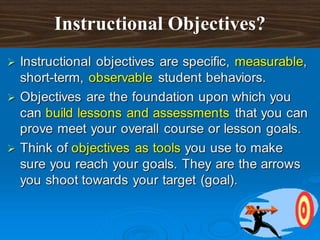
Instructional Objectives?
Purposes of Instruction?
• The purpose of instruction is to help people
learn. The goal of instructional designers is to
make learning easier, quicker, and more
enjoyable.
• It is to reach the development of the learning
outcomes/ learners’ objectives.
Types of Instructional Objectives
There are three types of instructional
objectives:
• Cognitive Objectives
• Affective Objectives
• Psychomotor Objectives
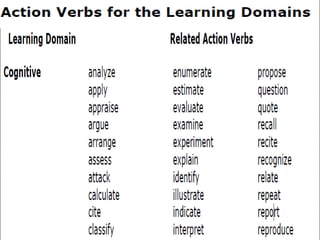
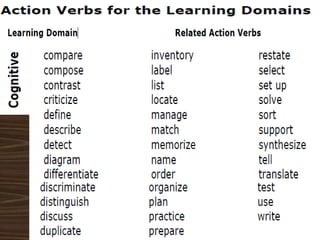
Cognitive Objectives
• Cognitive objectives are designed to increase an
individual's knowledge relating to understandings,
awareness, insights.
• This includes knowledge or information recall,
comprehension or conceptual understanding, the
ability to apply knowledge, to analyze a situation,
to synthesize information, to evaluate a given
situation, and to create something new.
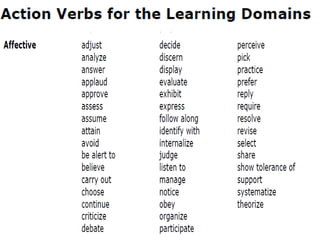
Affective Objectives
• Affective objectives are designed to change an
individual's attitude.
• They refer to positive attitudes and relationships
(e.g., the opportunity to work in a team with
several people of different races, the student will
demonstrate an positive increase in attitude
towards non-discrimination of race.
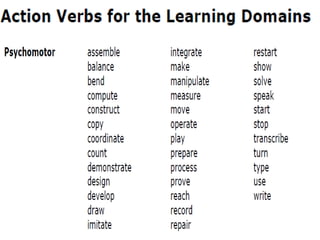
Psychomotor Objectives
• Psychomotor objectives are designed to
build a physical skill.
–Ex. The student will be able to ride a two-
wheel bicycle without assistance and
without pause as demonstrated in gym class.
Communicating With Instructional
Objectives
• It is vital that teachers be able to communicate
their instructional goals to their students.
• Tyler (1949) suggests there are four
fundamental questions that must be answered
in developing any curriculum or plan of
instructional goal.
• 1. What outcomes should the school (course, a
unit) seek to attain?
• 2. What experiences can be provided that are
likely to attain these outcomes?
• 3. How can these experiences be effectively
organized?
• 4. How can we determine whether these
outcomes are being attained?
Communicating With Instructional
Objectives
a. What it is intended that the teacher will do (an
aim or a teacher-driven objective);
b. What it is intended that the student will have
learnt, or will be able to do, as a result of a
learning experience, (an objective or learning
outcome).
Communicating With Instructional
Objectives
• A learning objective is a statement that specifies
in behavioral (measurable) terms what a learner
will be able to do as a result of instruction.
• It describes the intended outcome of your
instruction rather than a description or summary
of your content.
Communicating With Instructional
Objectives
• Learner-centred, not teacher-centred.
• Outcomes-driven, not process-driven.
• Objective measures, not subjective measures.
• Specific behaviors, not vague behaviors.
Communicating With Instructional
Objectives
The Value of Objectives
• Objectives have informative and
communicative value for teachers, students,
administrators, parents, and the community at
large.
• Help the teacher to choose content, activities, and
instructional materials with a coherent sense of
purpose.
• Make evaluation easier, directing the kinds of
questions that should be on a test, the criteria
against which an essay or project assignment
should be assessed.
• Provide direct feedback to the teacher regarding
how well he or she is doing; rather than the feeling
of being an entertainer or a warden.
The Value of Objectives
• Help students understand the direction a unit or
course of study is taking so they can direct their
attention to important concepts and skills instead
of trying to guess what the teacher wants of them.
• Help students assess how they are doing
throughout the unit rather than being surprised by
their final grades.
The Value of Objectives
What Objectives Should Communicate
• Instructional objectives should, in their most
complete form, communicate clearly and
concisely what is to be learned and how it will
be demonstrated.
1. Who is to perform the desired act?
2. What behavior will serve as evidence that the
instructional goal has been achieved?
3. What is the object of the action verb?
4. Under what conditions -- with what limitations and
constraints will the behaviors be performed?
5. What standards will be applied to evaluate whether or
not the student's performance is an acceptable
indication of mastery?
What Objectives Should Communicate
THANKS FOR YOUR ATTENTION.
Q & A

Ead303 2

  • 1.
    The University ofCambodia ead303: communication in the classroom Lectured by: Mut Somoeun (M.Ed)
  • 2.
  • 3.
    Purposes of Instruction? •The purpose of instruction is to help people learn. The goal of instructional designers is to make learning easier, quicker, and more enjoyable. • It is to reach the development of the learning outcomes/ learners’ objectives.
  • 4.
    Types of InstructionalObjectives There are three types of instructional objectives: • Cognitive Objectives • Affective Objectives • Psychomotor Objectives
  • 5.
    Cognitive Objectives • Cognitiveobjectives are designed to increase an individual's knowledge relating to understandings, awareness, insights. • This includes knowledge or information recall, comprehension or conceptual understanding, the ability to apply knowledge, to analyze a situation, to synthesize information, to evaluate a given situation, and to create something new.
  • 6.
    Affective Objectives • Affectiveobjectives are designed to change an individual's attitude. • They refer to positive attitudes and relationships (e.g., the opportunity to work in a team with several people of different races, the student will demonstrate an positive increase in attitude towards non-discrimination of race.
  • 7.
    Psychomotor Objectives • Psychomotorobjectives are designed to build a physical skill. –Ex. The student will be able to ride a two- wheel bicycle without assistance and without pause as demonstrated in gym class.
  • 8.
    Communicating With Instructional Objectives •It is vital that teachers be able to communicate their instructional goals to their students. • Tyler (1949) suggests there are four fundamental questions that must be answered in developing any curriculum or plan of instructional goal.
  • 9.
    • 1. Whatoutcomes should the school (course, a unit) seek to attain? • 2. What experiences can be provided that are likely to attain these outcomes? • 3. How can these experiences be effectively organized? • 4. How can we determine whether these outcomes are being attained? Communicating With Instructional Objectives
  • 10.
    a. What itis intended that the teacher will do (an aim or a teacher-driven objective); b. What it is intended that the student will have learnt, or will be able to do, as a result of a learning experience, (an objective or learning outcome). Communicating With Instructional Objectives
  • 11.
    • A learningobjective is a statement that specifies in behavioral (measurable) terms what a learner will be able to do as a result of instruction. • It describes the intended outcome of your instruction rather than a description or summary of your content. Communicating With Instructional Objectives
  • 12.
    • Learner-centred, notteacher-centred. • Outcomes-driven, not process-driven. • Objective measures, not subjective measures. • Specific behaviors, not vague behaviors. Communicating With Instructional Objectives
  • 13.
    The Value ofObjectives • Objectives have informative and communicative value for teachers, students, administrators, parents, and the community at large.
  • 14.
    • Help theteacher to choose content, activities, and instructional materials with a coherent sense of purpose. • Make evaluation easier, directing the kinds of questions that should be on a test, the criteria against which an essay or project assignment should be assessed. • Provide direct feedback to the teacher regarding how well he or she is doing; rather than the feeling of being an entertainer or a warden. The Value of Objectives
  • 15.
    • Help studentsunderstand the direction a unit or course of study is taking so they can direct their attention to important concepts and skills instead of trying to guess what the teacher wants of them. • Help students assess how they are doing throughout the unit rather than being surprised by their final grades. The Value of Objectives
  • 16.
    What Objectives ShouldCommunicate • Instructional objectives should, in their most complete form, communicate clearly and concisely what is to be learned and how it will be demonstrated.
  • 17.
    1. Who isto perform the desired act? 2. What behavior will serve as evidence that the instructional goal has been achieved? 3. What is the object of the action verb? 4. Under what conditions -- with what limitations and constraints will the behaviors be performed? 5. What standards will be applied to evaluate whether or not the student's performance is an acceptable indication of mastery? What Objectives Should Communicate
  • 22.
    THANKS FOR YOURATTENTION. Q & A