March 9, 2011Literature: Finish “The Tell-Tale Heart”New Story: “All Summer in a Day”
HousekeepingHand in vocab paragraph
“The Tell-Tale Heart” Literary Elements ActivityYou will need:“The Tell Tale Heart” Story and QuestionsHandout: “Reviewing Story Elements”Handout: “Fiction Terms”
“The Tell-Tale Heart” Literary Elements ActivityIn your assigned group, work through the questions on “Reviewing Story Elements.”  (Not for marks; for study purposes)Discuss how each element applies to the story “The Tell-Tale Heart.”  Refer to the “Fiction Terms” handout as needed.Refer to the information on Point of View on the bottom of p. 143 of “The Tell Tale Heart” questions handout.Ask me for help/clarification as needed.If you disagree with your group, make note on your sheet and we will discuss Time: 30 minutes
Class Review of Literary ElementsPoint of View (POV ) First person point of view, probably maleWe know the narrrator/character’s thoughts and feelings directly.We can only take his word for it that the events are truehe is an “unreliable narrator” – a narrator whose version of the story details may be misleading we don’t have any description about him, we don’t know what he looks like, or any background information about him or the setting
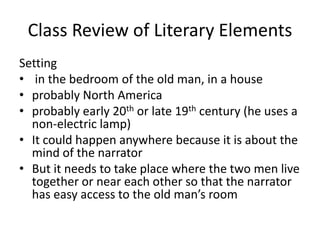
Class Review of Literary ElementsSetting    in the bedroom of the old man, in a houseprobably North Americaprobably early 20th or late 19thcentury (he uses a non-electric lamp)It could happen anywhere because it is about the mind of the narratorBut it needs to take place where the two men live together or near each other so that the narrator has easy access to the old man’s room
Class Review (Cont’d.)Characters  - is the narrator round or flat?evidence for round – we have lots of info: we know everything in his mind over lots of time – you feel that you know the character- understand how he/she feels and can predict what he tries to do next – first person pov helps to know himevidence for flat – all we know is that he is crazy – he’s focused on killing the old man – obsessed about that one thing.  - his main quality is his selfishness and arrogance
Class Review (Cont’d.)Characters Dynamic vs. StaticEvidence for Dynamic – confesses his secret to the police - due to his increasing madness more than guiltEvidence for Static – he wanted to commit the murder and he did it; he doesn’t regret it – he would probably do it again; he is proud of himself and what he has done; he doesn’t think he did anything wrong; his insanity made him confess
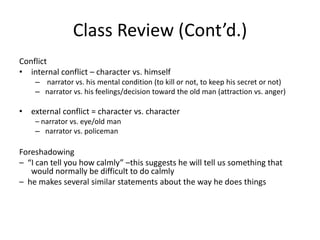
Class Review (Cont’d.)Conflict   internal conflict – character vs. himself narrator vs. his mental condition (to kill or not, to keep his secret or not)narrator vs. his feelings/decision toward the old man (attraction vs. anger)external conflict = character vs. character – narrator vs. eye/old mannarrator vs. policemanForeshadowing –  “I can tell you how calmly” –this suggests he will tell us something that would normally be difficult to do calmly–  he makes several similar statements about the way he does things
Class Review (Cont’d.)Outcome Negative – he got caught – he didn’t get away with his crimePositve– his confession relieved him of his mental pain– He got rid of the pressure of the eye; he was satisfied with his actionsThemeSometimes we can harm others without an acceptable reason.It is difficult to live with your crimes, sooner or later they will emerge.(Other themes are possible, but they must be based on the details and overall meaning of the story)
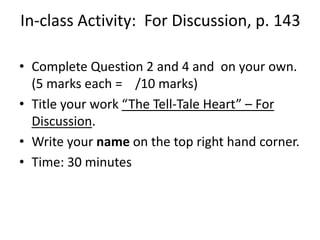
In-class Activity:  For Discussion, p. 143 Complete Question 2 and 4 and  on your own.      (5 marks each =    /10 marks)Title your work “The Tell-Tale Heart” – For Discussion. Write your name on the top right hand corner.Time: 30 minutes
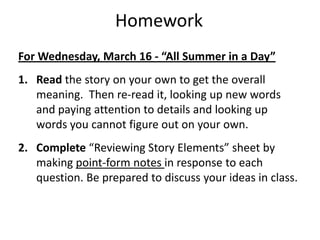
HomeworkFor Wednesday, March 16 - “All Summer in a Day”Read the story on your own to get the overall meaning.  Then re-read it, looking up new words and paying attention to details and looking up words you cannot figure out on your own.Complete “Reviewing Story Elements” sheet by making point-form notes in response to each question. Be prepared to discuss your ideas in class.

E10 march9 2011

  • 1.
    March 9, 2011Literature:Finish “The Tell-Tale Heart”New Story: “All Summer in a Day”
  • 2.
  • 3.
    “The Tell-Tale Heart”Literary Elements ActivityYou will need:“The Tell Tale Heart” Story and QuestionsHandout: “Reviewing Story Elements”Handout: “Fiction Terms”
  • 4.
    “The Tell-Tale Heart”Literary Elements ActivityIn your assigned group, work through the questions on “Reviewing Story Elements.” (Not for marks; for study purposes)Discuss how each element applies to the story “The Tell-Tale Heart.” Refer to the “Fiction Terms” handout as needed.Refer to the information on Point of View on the bottom of p. 143 of “The Tell Tale Heart” questions handout.Ask me for help/clarification as needed.If you disagree with your group, make note on your sheet and we will discuss Time: 30 minutes
  • 5.
    Class Review ofLiterary ElementsPoint of View (POV ) First person point of view, probably maleWe know the narrrator/character’s thoughts and feelings directly.We can only take his word for it that the events are truehe is an “unreliable narrator” – a narrator whose version of the story details may be misleading we don’t have any description about him, we don’t know what he looks like, or any background information about him or the setting
  • 6.
    Class Review ofLiterary ElementsSetting in the bedroom of the old man, in a houseprobably North Americaprobably early 20th or late 19thcentury (he uses a non-electric lamp)It could happen anywhere because it is about the mind of the narratorBut it needs to take place where the two men live together or near each other so that the narrator has easy access to the old man’s room
  • 7.
    Class Review (Cont’d.)Characters - is the narrator round or flat?evidence for round – we have lots of info: we know everything in his mind over lots of time – you feel that you know the character- understand how he/she feels and can predict what he tries to do next – first person pov helps to know himevidence for flat – all we know is that he is crazy – he’s focused on killing the old man – obsessed about that one thing. - his main quality is his selfishness and arrogance
  • 8.
    Class Review (Cont’d.)CharactersDynamic vs. StaticEvidence for Dynamic – confesses his secret to the police - due to his increasing madness more than guiltEvidence for Static – he wanted to commit the murder and he did it; he doesn’t regret it – he would probably do it again; he is proud of himself and what he has done; he doesn’t think he did anything wrong; his insanity made him confess
  • 9.
    Class Review (Cont’d.)Conflict internal conflict – character vs. himself narrator vs. his mental condition (to kill or not, to keep his secret or not)narrator vs. his feelings/decision toward the old man (attraction vs. anger)external conflict = character vs. character – narrator vs. eye/old mannarrator vs. policemanForeshadowing – “I can tell you how calmly” –this suggests he will tell us something that would normally be difficult to do calmly– he makes several similar statements about the way he does things
  • 10.
    Class Review (Cont’d.)OutcomeNegative – he got caught – he didn’t get away with his crimePositve– his confession relieved him of his mental pain– He got rid of the pressure of the eye; he was satisfied with his actionsThemeSometimes we can harm others without an acceptable reason.It is difficult to live with your crimes, sooner or later they will emerge.(Other themes are possible, but they must be based on the details and overall meaning of the story)
  • 11.
    In-class Activity: For Discussion, p. 143 Complete Question 2 and 4 and on your own. (5 marks each = /10 marks)Title your work “The Tell-Tale Heart” – For Discussion. Write your name on the top right hand corner.Time: 30 minutes
  • 12.
    HomeworkFor Wednesday, March16 - “All Summer in a Day”Read the story on your own to get the overall meaning. Then re-read it, looking up new words and paying attention to details and looking up words you cannot figure out on your own.Complete “Reviewing Story Elements” sheet by making point-form notes in response to each question. Be prepared to discuss your ideas in class.