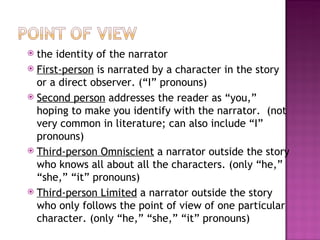
 the identity of the narrator
 First-person is narrated by a character in the story
  or a direct observer. (“I” pronouns)
 Second person addresses the reader as “you,”
  hoping to make you identify with the narrator. (not
  very common in literature; can also include “I”
  pronouns)
 Third-person Omniscient a narrator outside the story
  who knows all about all the characters. (only “he,”
  “she,” “it” pronouns)
 Third-person Limited a narrator outside the story
  who only follows the point of view of one particular
  character. (only “he,” “she,” “it” pronouns)
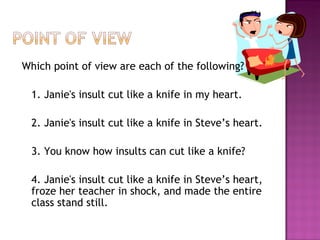
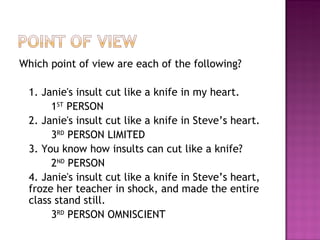
Which point of view are each of the following?

 1. Janie's insult cut like a knife in my heart.

 2. Janie's insult cut like a knife in Steve’s heart.

 3. You know how insults can cut like a knife?

 4. Janie's insult cut like a knife in Steve’s heart,
 froze her teacher in shock, and made the entire
 class stand still.
Which point of view are each of the following?

 1. Janie's insult cut like a knife in my heart.
      1ST PERSON
 2. Janie's insult cut like a knife in Steve’s heart.
      3RD PERSON LIMITED
 3. You know how insults can cut like a knife?
      2ND PERSON
 4. Janie's insult cut like a knife in Steve’s heart,
 froze her teacher in shock, and made the entire
 class stand still.
      3RD PERSON OMNISCIENT
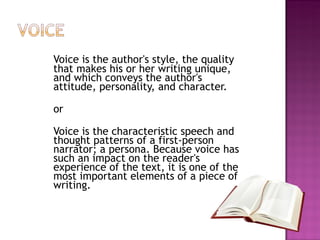
Voice is the author's style, the quality
that makes his or her writing unique,
and which conveys the author's
attitude, personality, and character.

or

Voice is the characteristic speech and
thought patterns of a first-person
narrator; a persona. Because voice has
such an impact on the reader's
experience of the text, it is one of the
most important elements of a piece of
writing.
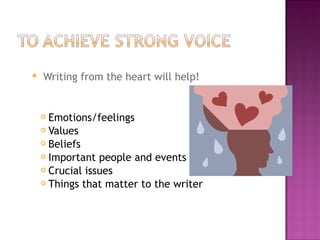
   Writing from the heart will help!


     Emotions/feelings
     Values

     Beliefs

     Important people and events

     Crucial issues

     Things that matter to the writer
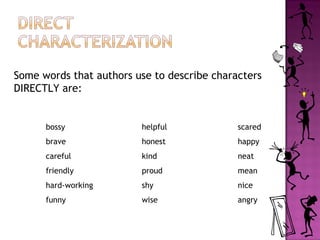
Some words that authors use to describe characters
DIRECTLY are:


      bossy              helpful             scared
      brave              honest              happy
      careful            kind                neat
      friendly           proud               mean
      hard-working       shy                 nice
      funny              wise                angry
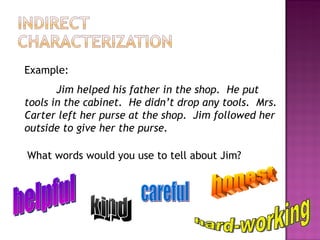
Example:
       Jim helped his father in the shop. He put
tools in the cabinet. He didn’t drop any tools. Mrs.
Carter left her purse at the shop. Jim followed her
outside to give her the purse.

What words would you use to tell about Jim?
 Use of words to create a sensory experience
 Uses the five senses
 Example:
       Thanksgiving dinner was a “combination of animated
        discussion, dry-as-a-bone turkey, and the scent of
        sugary pumpkin pie.”
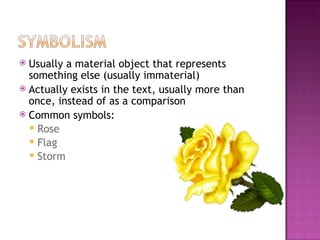
 Usually a material object that represents
  something else (usually immaterial)
 Actually exists in the text, usually more than
  once, instead of as a comparison
 Common symbols:
   Rose
   Flag
   Storm
   “All this last day Frodo had not spoken,
    but had walked half-bowed, often
    stumbling, as if his eyes no longer saw
    the way before his feet. Sam guessed
    that among all their pains he bore the
    worst, the growing weight of the Ring,
    a burden on the body and a torment to
    his mind.” -J.R.R. Tolkien
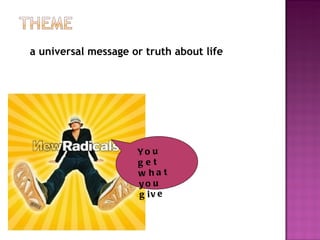
a universal message or truth about life


                     Yo u
                     get
                     w ha t
                     yo u
                     g iv e
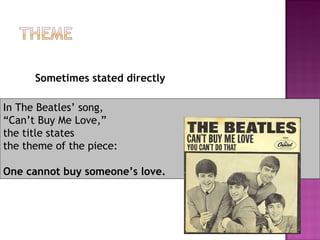
Sometimes stated directly

In The Beatles’ song,
“Can’t Buy Me Love,”
the title states
the theme of the piece:

One cannot buy someone’s love.
The following literary works all
                                 express the same theme:

                                 You shouldn’t judge a book by
More often implied               it’s cover.

        Through metaphor        “Beauty and the Beast”
          Through simile
                                 The Hunchback of Notre Dame
      Through personification
                                 To Kill a Mockingbird
         Through imagery
      Through tone of voice     “The Ugly Duckling”

         Through symbols

Narrative Elements and Devices

  • 2.
     the identityof the narrator  First-person is narrated by a character in the story or a direct observer. (“I” pronouns)  Second person addresses the reader as “you,” hoping to make you identify with the narrator. (not very common in literature; can also include “I” pronouns)  Third-person Omniscient a narrator outside the story who knows all about all the characters. (only “he,” “she,” “it” pronouns)  Third-person Limited a narrator outside the story who only follows the point of view of one particular character. (only “he,” “she,” “it” pronouns)
  • 3.
    Which point ofview are each of the following? 1. Janie's insult cut like a knife in my heart. 2. Janie's insult cut like a knife in Steve’s heart. 3. You know how insults can cut like a knife? 4. Janie's insult cut like a knife in Steve’s heart, froze her teacher in shock, and made the entire class stand still.
  • 4.
    Which point ofview are each of the following? 1. Janie's insult cut like a knife in my heart. 1ST PERSON 2. Janie's insult cut like a knife in Steve’s heart. 3RD PERSON LIMITED 3. You know how insults can cut like a knife? 2ND PERSON 4. Janie's insult cut like a knife in Steve’s heart, froze her teacher in shock, and made the entire class stand still. 3RD PERSON OMNISCIENT
  • 5.
    Voice is theauthor's style, the quality that makes his or her writing unique, and which conveys the author's attitude, personality, and character. or Voice is the characteristic speech and thought patterns of a first-person narrator; a persona. Because voice has such an impact on the reader's experience of the text, it is one of the most important elements of a piece of writing.
  • 6.
    Writing from the heart will help!  Emotions/feelings  Values  Beliefs  Important people and events  Crucial issues  Things that matter to the writer
  • 7.
    Some words thatauthors use to describe characters DIRECTLY are: bossy helpful scared brave honest happy careful kind neat friendly proud mean hard-working shy nice funny wise angry
  • 8.
    Example: Jim helped his father in the shop. He put tools in the cabinet. He didn’t drop any tools. Mrs. Carter left her purse at the shop. Jim followed her outside to give her the purse. What words would you use to tell about Jim?
  • 9.
     Use ofwords to create a sensory experience  Uses the five senses  Example:  Thanksgiving dinner was a “combination of animated discussion, dry-as-a-bone turkey, and the scent of sugary pumpkin pie.”
  • 10.
     Usually amaterial object that represents something else (usually immaterial)  Actually exists in the text, usually more than once, instead of as a comparison  Common symbols:  Rose  Flag  Storm
  • 11.
    “All this last day Frodo had not spoken, but had walked half-bowed, often stumbling, as if his eyes no longer saw the way before his feet. Sam guessed that among all their pains he bore the worst, the growing weight of the Ring, a burden on the body and a torment to his mind.” -J.R.R. Tolkien
  • 12.
    a universal messageor truth about life Yo u get w ha t yo u g iv e
  • 13.
    Sometimes stated directly InThe Beatles’ song, “Can’t Buy Me Love,” the title states the theme of the piece: One cannot buy someone’s love.
  • 14.
    The following literaryworks all express the same theme: You shouldn’t judge a book by More often implied it’s cover.  Through metaphor “Beauty and the Beast”  Through simile The Hunchback of Notre Dame  Through personification To Kill a Mockingbird  Through imagery  Through tone of voice “The Ugly Duckling”  Through symbols