The Tell-Tale HeartThe Tell-Tale Heart
By Edgar Allen PoeBy Edgar Allen Poe
Learning IntentionsLearning Intentions
Gathering:Gathering:
• To identify different types of short story.To identify different types of short story.
• To identify and describe narrative structure.To identify and describe narrative structure.
• To identify and describe key features of a short text.To identify and describe key features of a short text.
Processing:Processing:
• To explain and provide evidence for each point of the narrative structure.To explain and provide evidence for each point of the narrative structure.
• To explain and provide evidence for key features of a short text.To explain and provide evidence for key features of a short text.
Applying:Applying:
• To analyse the narrative structure and evaluate its effectiveness.To analyse the narrative structure and evaluate its effectiveness.
• To analyse key features of a short text and evaluate their impact.To analyse key features of a short text and evaluate their impact.
Success CriteriaSuccess Criteria
ProcessingProcessing
• To demonstrate knowledge of different types of short storyTo demonstrate knowledge of different types of short story
through class discussion.through class discussion.
• To demonstrate knowledge of narrative structure byTo demonstrate knowledge of narrative structure by
labeling the studied text.labeling the studied text.
ApplyingApplying
• To demonstrate knowledge of the key features of a shortTo demonstrate knowledge of the key features of a short
text in a detailed analytical essay.text in a detailed analytical essay.
AuthorAuthor
BackgroundBackground
Edgar Allan Poe (born Edgar Poe; January 19, 1809 –
October 7, 1849) was an American author, poet, editor, and
literary critic, considered part of the American Romantic
Movement. Best known for his tales of mystery and the
macabre, Poe was one of the earliest American practitioners
of the short story and is generally considered the inventor of
the detective fiction genre. He is further credited with
contributing to the emerging genre of science fiction. He
was the first well-known American writer to try to earn a
living through writing alone, resulting in a financially difficult
life and career.
Animated version of the story
http://youtu.be/wDLLHTdVSgU
Types of short storyTypes of short story
• Classical plot storyClassical plot story: conflict – action -solution: conflict – action -solution
• Formula/magazine storyFormula/magazine story: formulaic. Action centered,: formulaic. Action centered,
fast paced, move rapidly to climax.fast paced, move rapidly to climax.
• Slice of lifeSlice of life: psychology, inner life focus, can be: psychology, inner life focus, can be
plotless, suggestions and implications.plotless, suggestions and implications.
• Expressionistic/surrealisticExpressionistic/surrealistic: deep symbolic meaning,: deep symbolic meaning,
• Identify the type of short story thatIdentify the type of short story that The Tell-Tale HeartThe Tell-Tale Heart is.is.
Narrative StructureNarrative Structure
• ExpositionExposition: Setting the scene of the story and introducing: Setting the scene of the story and introducing
the main characters and a problem they face.the main characters and a problem they face.
• Rising ActionRising Action: The development of the problem and the: The development of the problem and the
building of tension.building of tension.
• ClimaxClimax: The problem comes to a head and a solution has: The problem comes to a head and a solution has
to be found.to be found.
• Falling ActionFalling Action:: The problem becomes less intense andThe problem becomes less intense and
solutions are looked for.solutions are looked for.
• DenouementDenouement: The solution to the problem is found.: The solution to the problem is found.
Narrative StructureNarrative Structure
1.1. Plot the main points of the story on a plot structure graph.Plot the main points of the story on a plot structure graph.
2.2. Explain what you learn in the exposition or introduction of the story.Explain what you learn in the exposition or introduction of the story.
3.3. List the events that are included in the rising action of the story.List the events that are included in the rising action of the story.
4.4. Identify the conflict in this story.Identify the conflict in this story.
5.5. Describe the climax of the story.Describe the climax of the story.
6.6. List the events that are included in the falling action of the story.List the events that are included in the falling action of the story.
7.7. Explain how the conflict is resolved.Explain how the conflict is resolved.
8.8. Describe how the writer uses suspense in developing the plot of thisDescribe how the writer uses suspense in developing the plot of this
story.story.
Thinking
Using language, text and
symbols
Managing self
Participating and
contributing
ContextContext
• Imagine what may have happened before thisImagine what may have happened before this
event.event.
• Predict what may happen next in the story.Predict what may happen next in the story.
• Discuss ideas as a class.Discuss ideas as a class.
Thinking
Relating to others
Managing self
Participating and contributing
Narrative ViewpointNarrative Viewpoint
Narrative voice is the use of 1st, 2nd or 3rd person.Narrative voice is the use of 1st, 2nd or 3rd person.
• 1st person1st person = I= I
• 2nd person2nd person = you= you
• 3rd person3rd person = he, she, they or the character's name.= he, she, they or the character's name.
1.1. Identify the narrative viewpoint of the story.Identify the narrative viewpoint of the story.
2.2. Is the story written in past or present tense?Is the story written in past or present tense?
Thinking
Using language, text and
symbols
Managing self
Narrative Viewpoint: PurposeNarrative Viewpoint: Purpose
• 1st person1st person is good because you get all thatis good because you get all that
character's thoughts and motivations. The drawbackscharacter's thoughts and motivations. The drawbacks
are that you only get that person's perspective.are that you only get that person's perspective.
• 2nd person2nd person is weird and not often used. It places theis weird and not often used. It places the
reader firmly in the story and it is as if you are the mainreader firmly in the story and it is as if you are the main
character and are doing everything.character and are doing everything.
• 3rd person3rd person is good because you get everyis good because you get every
characters' thoughts and motivations. The drawback ischaracters' thoughts and motivations. The drawback is
that going through every characters' thoughts can slowthat going through every characters' thoughts can slow
the pace of the story. Often authors don't want to dothe pace of the story. Often authors don't want to do
this so we don't get to know every character as well asthis so we don't get to know every character as well as
we would the character in a first person narration.we would the character in a first person narration.
Setting
11. Identify the main setting.. Identify the main setting.
2. Create a brainstorm of adjectives to describe it.2. Create a brainstorm of adjectives to describe it.
3. Locate at least 3 quotes to support your descriptions.3. Locate at least 3 quotes to support your descriptions.
4. Evaluate whether this setting is realistic or not. Explain4. Evaluate whether this setting is realistic or not. Explain
why with reference to the story.why with reference to the story.
Thinking
Using language, text and
symbols
Managing self
EssayEssay
1. “The setting that is most accessible and relevant to the
reader is the one that is grounded in realism.”
To what extent do you agree with this statement? Respond
to this question with close reference to one or more text(s)
you have studied.
2. “While the conclusion of a text is important, what really
matters is the foundation of a good opening.”
To what extent do you agree with this statement? Respond
to this question with close reference to one or more text(s)
you have studied.
Thinking
Using language, text and
symbols
Managing self
1. Explain the
outcome of this
change. What did
the character learn
from this?
2. What does the
author want us as
readers to learn
from this change?
3. Include quotes.
1. Identify and
describe the event
or person that
influenced a
change in the
character.
2. Explain how the
character changed.
3. Include quotes.
Change in a characterChange in a character
Choose a character
and…
1. Describe the
character at the
beginning of the
story.
2. Include quotes to
support your
description.
Thinking
Using language, text
and symbols
Managing self
Work in pairs to -Work in pairs to -
1.1. Identify an important theme in the story.Identify an important theme in the story.
2.2. Identify and describe 3 examples of the theme being shownIdentify and describe 3 examples of the theme being shown
in the story. Which characters are linked to this theme?in the story. Which characters are linked to this theme?
3.3. Explain the themeExplain the theme’s relevance to today’s world. Record’s relevance to today’s world. Record
examples of which are seen in real life.examples of which are seen in real life.
4.4. Describe the authorDescribe the author’s intention in relation to this message.’s intention in relation to this message.
What did Edgar Allen Poe want the viewer to learn or thinkWhat did Edgar Allen Poe want the viewer to learn or think
about?about?
5.5. Identify and describe the social issues that are represented inIdentify and describe the social issues that are represented in
the story.the story.
6.6. Explain what lessons we can learn about human behaviour.Explain what lessons we can learn about human behaviour.
ThemesThemes
Thinking
Relating to others
Using language, text and
symbols
Managing self
Participating and contributing
StyleStyle
• The style of language used (poetic techniques)The style of language used (poetic techniques)
• The narrative viewpoint of the textThe narrative viewpoint of the text
• Symbols and motifsSymbols and motifs
• AllusionsAllusions
• ImageryImagery
1. “Major characters can find themselves in collision with forces
beyond their control, and in many cases their responses to the collision
can be described as morally questionable.”
To what extent do you agree with this statement? Respond to this
question with close reference to one or more text(s) you have studied.
2. “Forget the big players in the world; it is the people in the margins of
our society whose stories are most compelling.”
To what extent do you agree with this statement? Respond to this
question with close reference to one or more text(s) you have studied.
EssayEssay
Thinking
Using language, text and
symbols
Managing self
Language questionsLanguage questions
1.1. Explain what type of language the author uses. Is itExplain what type of language the author uses. Is it
formal or informal? Include examples.formal or informal? Include examples.
2.2. Describe how time is handled in the story. Is itDescribe how time is handled in the story. Is it
chronological? Are there flashbacks?chronological? Are there flashbacks?
3.3. Record an example of something that the narratorRecord an example of something that the narrator
says. What do we learn about her personality fromsays. What do we learn about her personality from
what she says?what she says?
4.4. Describe the tone of the story. Is it positive,Describe the tone of the story. Is it positive,
negative, menacing, scary etc? Explain why younegative, menacing, scary etc? Explain why you
think this. Include an example.think this. Include an example.
Thinking
Using language, text and
symbols
Managing self
Participating and contributing
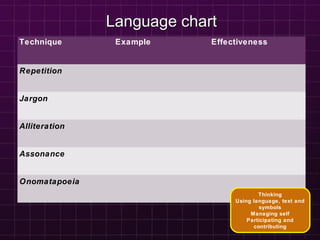
Language chartLanguage chart
Technique Example Effectiveness
Repetition
Jargon
Alliteration
Assonance
Onomatapoeia
Thinking
Using language, text and
symbols
Managing self
Participating and
contributing
Symbols & MotifsSymbols & Motifs
• Symbols are objects, characters, figures, andSymbols are objects, characters, figures, and
colours used to represent abstract ideas orcolours used to represent abstract ideas or
concepts.concepts.
• Motifs are recurring structures, contrasts, andMotifs are recurring structures, contrasts, and
literary devices that can help to develop and informliterary devices that can help to develop and inform
the textthe text’s major themes.’s major themes.
Symbols & MotifsSymbols & Motifs
Choose 3 symbols or motifs and complete the chart.Choose 3 symbols or motifs and complete the chart.
Symbol/Motif &
where it appears
Theme associated Significance
Thinking
Relating to others
Using language, text and
symbols
Managing self
Participating and contributing
ReferencesReferences
• http://www.sfgateway.com/authors/s/saxton-http://www.sfgateway.com/authors/s/saxton-
josephine/josephine/
• http://web.cn.edu/Kwheeler/lit_terms_I.htmlhttp://web.cn.edu/Kwheeler/lit_terms_I.html
• Ideas from my colleague, Phil Mitchinson andIdeas from my colleague, Phil Mitchinson and
Christine Wells.Christine Wells.

Tell Tale Heart

  • 1.
    The Tell-Tale HeartTheTell-Tale Heart By Edgar Allen PoeBy Edgar Allen Poe
  • 2.
    Learning IntentionsLearning Intentions Gathering:Gathering: •To identify different types of short story.To identify different types of short story. • To identify and describe narrative structure.To identify and describe narrative structure. • To identify and describe key features of a short text.To identify and describe key features of a short text. Processing:Processing: • To explain and provide evidence for each point of the narrative structure.To explain and provide evidence for each point of the narrative structure. • To explain and provide evidence for key features of a short text.To explain and provide evidence for key features of a short text. Applying:Applying: • To analyse the narrative structure and evaluate its effectiveness.To analyse the narrative structure and evaluate its effectiveness. • To analyse key features of a short text and evaluate their impact.To analyse key features of a short text and evaluate their impact.
  • 3.
    Success CriteriaSuccess Criteria ProcessingProcessing •To demonstrate knowledge of different types of short storyTo demonstrate knowledge of different types of short story through class discussion.through class discussion. • To demonstrate knowledge of narrative structure byTo demonstrate knowledge of narrative structure by labeling the studied text.labeling the studied text. ApplyingApplying • To demonstrate knowledge of the key features of a shortTo demonstrate knowledge of the key features of a short text in a detailed analytical essay.text in a detailed analytical essay.
  • 4.
    AuthorAuthor BackgroundBackground Edgar Allan Poe(born Edgar Poe; January 19, 1809 – October 7, 1849) was an American author, poet, editor, and literary critic, considered part of the American Romantic Movement. Best known for his tales of mystery and the macabre, Poe was one of the earliest American practitioners of the short story and is generally considered the inventor of the detective fiction genre. He is further credited with contributing to the emerging genre of science fiction. He was the first well-known American writer to try to earn a living through writing alone, resulting in a financially difficult life and career.
  • 5.
    Animated version ofthe story http://youtu.be/wDLLHTdVSgU
  • 6.
    Types of shortstoryTypes of short story • Classical plot storyClassical plot story: conflict – action -solution: conflict – action -solution • Formula/magazine storyFormula/magazine story: formulaic. Action centered,: formulaic. Action centered, fast paced, move rapidly to climax.fast paced, move rapidly to climax. • Slice of lifeSlice of life: psychology, inner life focus, can be: psychology, inner life focus, can be plotless, suggestions and implications.plotless, suggestions and implications. • Expressionistic/surrealisticExpressionistic/surrealistic: deep symbolic meaning,: deep symbolic meaning, • Identify the type of short story thatIdentify the type of short story that The Tell-Tale HeartThe Tell-Tale Heart is.is.
  • 7.
  • 8.
    Narrative StructureNarrative Structure •ExpositionExposition: Setting the scene of the story and introducing: Setting the scene of the story and introducing the main characters and a problem they face.the main characters and a problem they face. • Rising ActionRising Action: The development of the problem and the: The development of the problem and the building of tension.building of tension. • ClimaxClimax: The problem comes to a head and a solution has: The problem comes to a head and a solution has to be found.to be found. • Falling ActionFalling Action:: The problem becomes less intense andThe problem becomes less intense and solutions are looked for.solutions are looked for. • DenouementDenouement: The solution to the problem is found.: The solution to the problem is found.
  • 9.
    Narrative StructureNarrative Structure 1.1.Plot the main points of the story on a plot structure graph.Plot the main points of the story on a plot structure graph. 2.2. Explain what you learn in the exposition or introduction of the story.Explain what you learn in the exposition or introduction of the story. 3.3. List the events that are included in the rising action of the story.List the events that are included in the rising action of the story. 4.4. Identify the conflict in this story.Identify the conflict in this story. 5.5. Describe the climax of the story.Describe the climax of the story. 6.6. List the events that are included in the falling action of the story.List the events that are included in the falling action of the story. 7.7. Explain how the conflict is resolved.Explain how the conflict is resolved. 8.8. Describe how the writer uses suspense in developing the plot of thisDescribe how the writer uses suspense in developing the plot of this story.story. Thinking Using language, text and symbols Managing self Participating and contributing
  • 10.
    ContextContext • Imagine whatmay have happened before thisImagine what may have happened before this event.event. • Predict what may happen next in the story.Predict what may happen next in the story. • Discuss ideas as a class.Discuss ideas as a class. Thinking Relating to others Managing self Participating and contributing
  • 11.
    Narrative ViewpointNarrative Viewpoint Narrativevoice is the use of 1st, 2nd or 3rd person.Narrative voice is the use of 1st, 2nd or 3rd person. • 1st person1st person = I= I • 2nd person2nd person = you= you • 3rd person3rd person = he, she, they or the character's name.= he, she, they or the character's name. 1.1. Identify the narrative viewpoint of the story.Identify the narrative viewpoint of the story. 2.2. Is the story written in past or present tense?Is the story written in past or present tense? Thinking Using language, text and symbols Managing self
  • 12.
    Narrative Viewpoint: PurposeNarrativeViewpoint: Purpose • 1st person1st person is good because you get all thatis good because you get all that character's thoughts and motivations. The drawbackscharacter's thoughts and motivations. The drawbacks are that you only get that person's perspective.are that you only get that person's perspective. • 2nd person2nd person is weird and not often used. It places theis weird and not often used. It places the reader firmly in the story and it is as if you are the mainreader firmly in the story and it is as if you are the main character and are doing everything.character and are doing everything. • 3rd person3rd person is good because you get everyis good because you get every characters' thoughts and motivations. The drawback ischaracters' thoughts and motivations. The drawback is that going through every characters' thoughts can slowthat going through every characters' thoughts can slow the pace of the story. Often authors don't want to dothe pace of the story. Often authors don't want to do this so we don't get to know every character as well asthis so we don't get to know every character as well as we would the character in a first person narration.we would the character in a first person narration.
  • 13.
    Setting 11. Identify themain setting.. Identify the main setting. 2. Create a brainstorm of adjectives to describe it.2. Create a brainstorm of adjectives to describe it. 3. Locate at least 3 quotes to support your descriptions.3. Locate at least 3 quotes to support your descriptions. 4. Evaluate whether this setting is realistic or not. Explain4. Evaluate whether this setting is realistic or not. Explain why with reference to the story.why with reference to the story. Thinking Using language, text and symbols Managing self
  • 14.
    EssayEssay 1. “The settingthat is most accessible and relevant to the reader is the one that is grounded in realism.” To what extent do you agree with this statement? Respond to this question with close reference to one or more text(s) you have studied. 2. “While the conclusion of a text is important, what really matters is the foundation of a good opening.” To what extent do you agree with this statement? Respond to this question with close reference to one or more text(s) you have studied. Thinking Using language, text and symbols Managing self
  • 15.
    1. Explain the outcomeof this change. What did the character learn from this? 2. What does the author want us as readers to learn from this change? 3. Include quotes. 1. Identify and describe the event or person that influenced a change in the character. 2. Explain how the character changed. 3. Include quotes. Change in a characterChange in a character Choose a character and… 1. Describe the character at the beginning of the story. 2. Include quotes to support your description. Thinking Using language, text and symbols Managing self
  • 16.
    Work in pairsto -Work in pairs to - 1.1. Identify an important theme in the story.Identify an important theme in the story. 2.2. Identify and describe 3 examples of the theme being shownIdentify and describe 3 examples of the theme being shown in the story. Which characters are linked to this theme?in the story. Which characters are linked to this theme? 3.3. Explain the themeExplain the theme’s relevance to today’s world. Record’s relevance to today’s world. Record examples of which are seen in real life.examples of which are seen in real life. 4.4. Describe the authorDescribe the author’s intention in relation to this message.’s intention in relation to this message. What did Edgar Allen Poe want the viewer to learn or thinkWhat did Edgar Allen Poe want the viewer to learn or think about?about? 5.5. Identify and describe the social issues that are represented inIdentify and describe the social issues that are represented in the story.the story. 6.6. Explain what lessons we can learn about human behaviour.Explain what lessons we can learn about human behaviour. ThemesThemes Thinking Relating to others Using language, text and symbols Managing self Participating and contributing
  • 17.
    StyleStyle • The styleof language used (poetic techniques)The style of language used (poetic techniques) • The narrative viewpoint of the textThe narrative viewpoint of the text • Symbols and motifsSymbols and motifs • AllusionsAllusions • ImageryImagery
  • 18.
    1. “Major characterscan find themselves in collision with forces beyond their control, and in many cases their responses to the collision can be described as morally questionable.” To what extent do you agree with this statement? Respond to this question with close reference to one or more text(s) you have studied. 2. “Forget the big players in the world; it is the people in the margins of our society whose stories are most compelling.” To what extent do you agree with this statement? Respond to this question with close reference to one or more text(s) you have studied. EssayEssay Thinking Using language, text and symbols Managing self
  • 19.
    Language questionsLanguage questions 1.1.Explain what type of language the author uses. Is itExplain what type of language the author uses. Is it formal or informal? Include examples.formal or informal? Include examples. 2.2. Describe how time is handled in the story. Is itDescribe how time is handled in the story. Is it chronological? Are there flashbacks?chronological? Are there flashbacks? 3.3. Record an example of something that the narratorRecord an example of something that the narrator says. What do we learn about her personality fromsays. What do we learn about her personality from what she says?what she says? 4.4. Describe the tone of the story. Is it positive,Describe the tone of the story. Is it positive, negative, menacing, scary etc? Explain why younegative, menacing, scary etc? Explain why you think this. Include an example.think this. Include an example. Thinking Using language, text and symbols Managing self Participating and contributing
  • 20.
    Language chartLanguage chart TechniqueExample Effectiveness Repetition Jargon Alliteration Assonance Onomatapoeia Thinking Using language, text and symbols Managing self Participating and contributing
  • 21.
    Symbols & MotifsSymbols& Motifs • Symbols are objects, characters, figures, andSymbols are objects, characters, figures, and colours used to represent abstract ideas orcolours used to represent abstract ideas or concepts.concepts. • Motifs are recurring structures, contrasts, andMotifs are recurring structures, contrasts, and literary devices that can help to develop and informliterary devices that can help to develop and inform the textthe text’s major themes.’s major themes.
  • 22.
    Symbols & MotifsSymbols& Motifs Choose 3 symbols or motifs and complete the chart.Choose 3 symbols or motifs and complete the chart. Symbol/Motif & where it appears Theme associated Significance Thinking Relating to others Using language, text and symbols Managing self Participating and contributing
  • 23.