“The Tell Tale Heart”
 By: Edgar Allan Poe
 By: Edgar Allan Poe
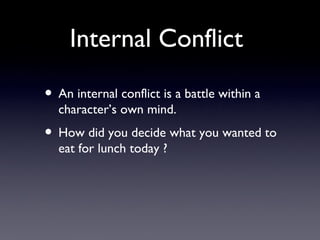
Internal Conflict

• An internal conflict is a battle within a
  character’s own mind.
• How did you decide what you wanted to
  eat for lunch today ?
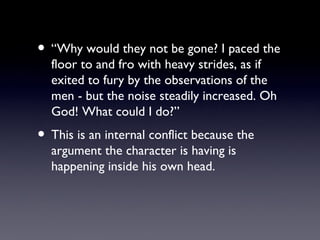
• “Why would they not be gone? I paced the
  floor to and fro with heavy strides, as if
  exited to fury by the observations of the
  men - but the noise steadily increased. Oh
  God! What could I do?”
• This is an internal conflict because the
  argument the character is having is
  happening inside his own head.
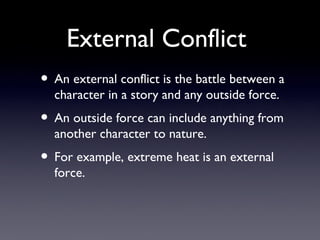
External Conflict
• An external conflict is the battle between a
  character in a story and any outside force.
• An outside force can include anything from
  another character to nature.
• For example, extreme heat is an external
  force.
• “And I did this for seven long nights- every
  night just at midnight- but I found the eye
  always closed; and so it was impossible to
  do the work.”
• This is an external conflict between the
  main character and time.
Overstatement
• An overstatement is when a statement is
  exaggerated.
• “I have a ton of homework”
• This is an example of overstatement
  because literally they do not have a ton, as
  in 2,000 pounds, of homework.
• “I kept quite still and said nothing. For a
  whole hour I did not move a muscle...”
• This is an example of overstatement
  because it is impossible not to move a
  muscle for an hour. The author is just
  trying to convey that the main character
  kept very, very still.
Understatement
• An understatement is used to make a fact
  of a situation seem less important than it
  really is.
• Saying, “It only rained a little,” after
  realizing your house flooded would be an
  understatement.
• “...- I made up my mind to take the life of
  the old man, and thus rid myself of the eye
  forever. Now at this point. You fancy me
  mad.”
• This is an understatement, at this point in
  the story the reader begins to think that
  the main character is much more than mad.
Theme
• A theme is the main thought or idea of a
  story.
• A theme is the idea the author is trying to
  get across to his or her readers.
• A theme is usually an abstract idea that is
  recurring.
What is the theme in
“The Tell Tale Heart?”
• The theme in “The Tell Tale Heart” is guilt.
• Edgar Allen Poe is trying to convince the
  readers that the main character feels guilty
  for killing the old man.
• There are many parts in the story where
  Poe wants the reader to understand that
  even though the main character seems
  crazy he still feels remorse.
Evidence
•   “ I loved the old man. He never wronged me. He
    had never given me insult. For his gold I had no
    desire. I think it was his eye!”

•   “Meantime, the hellish tattoo of the heart
    increased. It grew quicker and quicker, and louder
    and louder every instant. The old man’s terror
    must have been extreme! It grew louder, I say
    louder every moment! - do you mark me well I
    have told you that I am nervous: so I am.”

•   “Villains,” I shrieked, “dissemble no more! I admit
    the deed! - tear up the planks! here, here! - It is
    the beating of his hideous heart!”
Symbolism

• A symbol can be anything that stands for
  something else.
• Uncle Sam is often used to symbolize
  America.
• Often in literature symbols have a deeper
  meaning.
Symbolism in “The Tell
    Tale Heart”
• What does the beating heart symbolize?
• “Almighty God! - no, no! They heard!-
  they suspected ! - they knew! - they were
  making a mockery of my horror- this I
  thought and this I think. But anything was
  better than this agony! Anything was more
  tolerable than this derision. I could bear
  those hypocritical smiles no longer! I felt
  that I must scream or die! and now- again!
  - hark! louder! louder! louder! louder!”
Guilt
• Through out the story the beating heart
  symbolizes guilt.
• This contributes to the theme and creates
  suspense when building up to the end
  where the main character can no longer
  take the guilt.
• “Villains!” I shrieked, “dissemble no more! I
  admit the deed” - tear up the planks! here,
  here! - It is the beating of his hideous
  heart!”
Citations


•       Poe, E. A. (2008 ). The Tell Tale Heart

    (Vols. Volume II ). Project Gutenberg .

Tell tale heart

  • 1.
    “The Tell TaleHeart” By: Edgar Allan Poe By: Edgar Allan Poe
  • 2.
    Internal Conflict • Aninternal conflict is a battle within a character’s own mind. • How did you decide what you wanted to eat for lunch today ?
  • 3.
    • “Why wouldthey not be gone? I paced the floor to and fro with heavy strides, as if exited to fury by the observations of the men - but the noise steadily increased. Oh God! What could I do?” • This is an internal conflict because the argument the character is having is happening inside his own head.
  • 4.
    External Conflict • Anexternal conflict is the battle between a character in a story and any outside force. • An outside force can include anything from another character to nature. • For example, extreme heat is an external force.
  • 5.
    • “And Idid this for seven long nights- every night just at midnight- but I found the eye always closed; and so it was impossible to do the work.” • This is an external conflict between the main character and time.
  • 6.
    Overstatement • An overstatementis when a statement is exaggerated. • “I have a ton of homework” • This is an example of overstatement because literally they do not have a ton, as in 2,000 pounds, of homework.
  • 7.
    • “I keptquite still and said nothing. For a whole hour I did not move a muscle...” • This is an example of overstatement because it is impossible not to move a muscle for an hour. The author is just trying to convey that the main character kept very, very still.
  • 8.
    Understatement • An understatementis used to make a fact of a situation seem less important than it really is. • Saying, “It only rained a little,” after realizing your house flooded would be an understatement.
  • 9.
    • “...- Imade up my mind to take the life of the old man, and thus rid myself of the eye forever. Now at this point. You fancy me mad.” • This is an understatement, at this point in the story the reader begins to think that the main character is much more than mad.
  • 10.
    Theme • A themeis the main thought or idea of a story. • A theme is the idea the author is trying to get across to his or her readers. • A theme is usually an abstract idea that is recurring.
  • 11.
    What is thetheme in “The Tell Tale Heart?” • The theme in “The Tell Tale Heart” is guilt. • Edgar Allen Poe is trying to convince the readers that the main character feels guilty for killing the old man. • There are many parts in the story where Poe wants the reader to understand that even though the main character seems crazy he still feels remorse.
  • 12.
    Evidence • “ I loved the old man. He never wronged me. He had never given me insult. For his gold I had no desire. I think it was his eye!” • “Meantime, the hellish tattoo of the heart increased. It grew quicker and quicker, and louder and louder every instant. The old man’s terror must have been extreme! It grew louder, I say louder every moment! - do you mark me well I have told you that I am nervous: so I am.” • “Villains,” I shrieked, “dissemble no more! I admit the deed! - tear up the planks! here, here! - It is the beating of his hideous heart!”
  • 13.
    Symbolism • A symbolcan be anything that stands for something else. • Uncle Sam is often used to symbolize America. • Often in literature symbols have a deeper meaning.
  • 14.
    Symbolism in “TheTell Tale Heart” • What does the beating heart symbolize? • “Almighty God! - no, no! They heard!- they suspected ! - they knew! - they were making a mockery of my horror- this I thought and this I think. But anything was better than this agony! Anything was more tolerable than this derision. I could bear those hypocritical smiles no longer! I felt that I must scream or die! and now- again! - hark! louder! louder! louder! louder!”
  • 15.
    Guilt • Through outthe story the beating heart symbolizes guilt. • This contributes to the theme and creates suspense when building up to the end where the main character can no longer take the guilt. • “Villains!” I shrieked, “dissemble no more! I admit the deed” - tear up the planks! here, here! - It is the beating of his hideous heart!”
  • 16.
    Citations • Poe, E. A. (2008 ). The Tell Tale Heart (Vols. Volume II ). Project Gutenberg .