EWRT 30 Class 8
AGENDA
Terms 1-8
Review: POV and Plot
Discussion: Fiction
Lecture: Character and
Setting
Terms
1. Character
2. Flat characters
3. Round characters
4. Protagonist
5. Antagonist
6. Motivation
7. Plot
8. Chronological Order
1. Character
2. Flat characters
3. Round characters
4. Protagonist
5. Antagonist
6. Motivation
7. Plot
8. Chronological Order
1. Protagonist: The protagonist or hero
is the central character in the story
who engages our interest or
sympathy. Sometimes, the term
protagonist is preferable to hero,
because the central character can be
despicable as well as heroic.
2. Antagonist: the character or force
that opposes the antagonist.
1. Protagonist: The protagonist or hero
is the central character in the story
who engages our interest or
sympathy. Sometimes, the term
protagonist is preferable to hero,
because the central character can be
despicable as well as heroic.
2. Antagonist: the character or force
that opposes the antagonist.
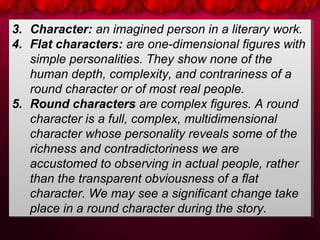
3. Character: an imagined person in a literary work.
4. Flat characters: are one-dimensional figures with
simple personalities. They show none of the
human depth, complexity, and contrariness of a
round character or of most real people.
5. Round characters are complex figures. A round
character is a full, complex, multidimensional
character whose personality reveals some of the
richness and contradictoriness we are
accustomed to observing in actual people, rather
than the transparent obviousness of a flat
character. We may see a significant change take
place in a round character during the story.
3. Character: an imagined person in a literary work.
4. Flat characters: are one-dimensional figures with
simple personalities. They show none of the
human depth, complexity, and contrariness of a
round character or of most real people.
5. Round characters are complex figures. A round
character is a full, complex, multidimensional
character whose personality reveals some of the
richness and contradictoriness we are
accustomed to observing in actual people, rather
than the transparent obviousness of a flat
character. We may see a significant change take
place in a round character during the story.
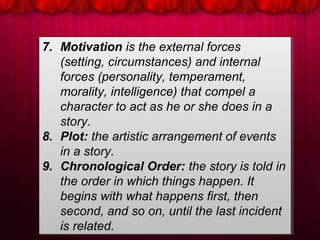
7. Motivation is the external forces
(setting, circumstances) and internal
forces (personality, temperament,
morality, intelligence) that compel a
character to act as he or she does in a
story.
8. Plot: the artistic arrangement of events
in a story.
9. Chronological Order: the story is told in
the order in which things happen. It
begins with what happens first, then
second, and so on, until the last incident
is related.
7. Motivation is the external forces
(setting, circumstances) and internal
forces (personality, temperament,
morality, intelligence) that compel a
character to act as he or she does in a
story.
8. Plot: the artistic arrangement of events
in a story.
9. Chronological Order: the story is told in
the order in which things happen. It
begins with what happens first, then
second, and so on, until the last incident
is related.
The Review
Plot and POV
“The Tell Tale Heart”
“A Very Short Story”
“Dr. Chevalier’s Lie”
Review: In your groups,
discuss plot and POV. Consider
the three stories from your
reading
Review: In your groups,
discuss plot and POV. Consider
the three stories from your
reading
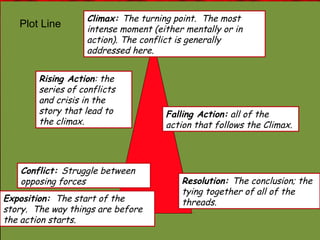
Plot Line
Exposition: The start of the
story. The way things are before
the action starts.
Rising Action: the
series of conflicts
and crisis in the
story that lead to
the climax.
Climax: The turning point. The most
intense moment (either mentally or in
action). The conflict is generally
addressed here.
Falling Action: all of the
action that follows the Climax.
Resolution: The conclusion; the
tying together of all of the
threads.
Conflict: Struggle between
opposing forces
The Tell Tale
Heart
Exposition: The narrator offers a
story as proof he is not insane. He
describes the situation with old man
and his eye.
Rising Action:
2. The narrator makes
a noise and wakes the
man up: he opens the
eye.
1. He goes to the room
every night for a week,
but the eye is closed
Climax: The narrator kills the old man,
cuts up the body, and hides it under the
floor
Falling Action:
1.The police show up and he shows
them the house. They settle in
the old man’s bedroom.
2.The noise gets louder and louder
until the narrator tells the cops to
look under the floorboards.
Resolution: The narrator
identifies the source of the
“sound” as “the beating of [the
man’s] hideous heart.”
Conflict: The narrator wants to
kill the old man
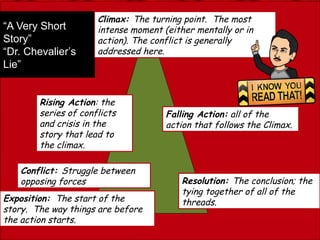
“A Very Short
Story”
“Dr. Chevalier’s
Lie”
Exposition: The start of the
story. The way things are before
the action starts.
Rising Action: the
series of conflicts
and crisis in the
story that lead to
the climax.
Climax: The turning point. The most
intense moment (either mentally or in
action). The conflict is generally
addressed here.
Falling Action: all of the
action that follows the Climax.
Resolution: The conclusion; the
tying together of all of the
threads.
Conflict: Struggle between
opposing forces
Review:
Three Common Points of View
Review:
Three Common Points of View
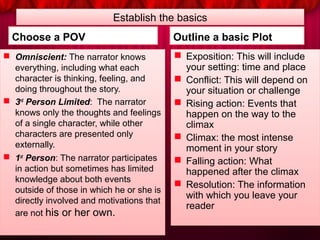
 Omniscient: The narrator knows everything,
including what each character is thinking,
feeling, and doing throughout the story.
 3rd
Person Limited: The narrator knows only
the thoughts and feelings of a single character,
while other characters are presented only
externally.
 1st
Person: The narrator participates in action
but sometimes has limited knowledge about
both events outside of those in which he or she
is directly involved and motivations that are not
his or her own.
 Omniscient: The narrator knows everything,
including what each character is thinking,
feeling, and doing throughout the story.
 3rd
Person Limited: The narrator knows only
the thoughts and feelings of a single character,
while other characters are presented only
externally.
 1st
Person: The narrator participates in action
but sometimes has limited knowledge about
both events outside of those in which he or she
is directly involved and motivations that are not
his or her own.
Point of View
 “The Tell Tale Heart”
by Edgar Allan Poe
What kind of narrator
tells this story?
Point of View
 “The Tell Tale Heart”
by Edgar Allan Poe
 1st
person narrator
 Unreliable: he is trying to prove he is
sane, which he obviously is not! The
narrator admits that "he can hear all
things in the heaven and in the earth
[and] many things in hell"
 He occasionally pretends to be an
omniscient narrator. When he says,
"Presently I heard a slight groan,
and I knew it was the groan of
mortal terror. […] I knew the sound
well. Many a night […] it has welled
up from my own bosom,” he is
telling us how the hold man feels
and what he thinks.
Point of View
 “A Very Short Story”
by Ernest Hemingway
 What kind of narrator tells
this story?
Point of View
 “A Very Short Story”
by Ernest
Hemingway
 Omniscient or 3rd
person limited narrator?
 The narrator seems to be external, yet he
generally speaks from the point of view of the
man. Note that he neither names him nor
identifies him. Furthermore, the last sentences
are like the description of the scene that this
man sees.
 But, the narrator doesn't obviously enter the
man’s mind, so he appears to be an
objective narrator in that he leaves the
interpretation of the actions of the characters to
the reader.
 Yet, there are signs of anger in the text, which
suggests that the narrator is manipulating the
reader into seeing the story from his point of
view. This would conflict with the objective
narrator POV.
Point of View
 “Dr. Chevalier’s Lie”
by Kate Chopin
 What kind of narrator
tells this story?
Point of View
 “Dr. Chevalier’s Lie”
by Kate Chopin
 The (objective) omniscient
narrator
 The story includes details about
both the doctor’s and the
townspeople’s behavior.
 The neutral tone in the conclusion
shows that the narrator does not
editorialize about society’s
thoughts about the girl or
Chevalier’s lie.
In Groups, discuss POV. Prepare to read a paragraph or two
demonstrating each of the following perspectives:
1st
person Wolf
1st
person little Pig
1st
person Mother Pig or another minor character
3rd
person Wolf
3rd
person little Pig
3rd
person Mother Pig or another minor character
Omniscient Objective: Just tells facts
Omniscient Subjective: Enters the minds and shares feelings of
multiple characters
Lecture Subject
Character and Setting
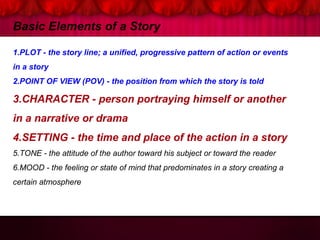
Basic Elements of a Story
1.PLOT - the story line; a unified, progressive pattern of action or events
in a story
2.POINT OF VIEW (POV) - the position from which the story is told
3.CHARACTER - person portraying himself or another
in a narrative or drama
4.SETTING - the time and place of the action in a story
5.TONE - the attitude of the author toward his subject or toward the reader
6.MOOD - the feeling or state of mind that predominates in a story creating a
certain atmosphere
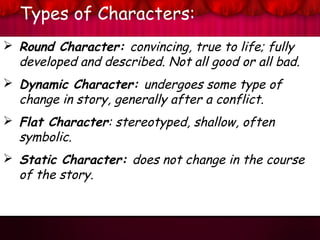
Types of Characters:
 Round Character: convincing, true to life; fully
developed and described. Not all good or all bad.
 Dynamic Character: undergoes some type of
change in story, generally after a conflict.
 Flat Character: stereotyped, shallow, often
symbolic.
 Static Character: does not change in the course
of the story.
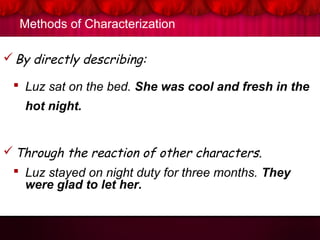
Methods of Characterization
By directly describing:
 Luz sat on the bed. She was cool and fresh in the
hot night.
Through the reaction of other characters.
 Luz stayed on night duty for three months. They
were glad to let her.
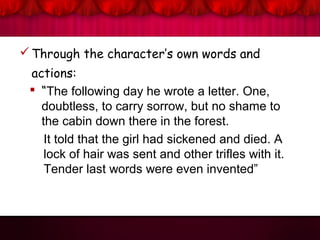
Through the character’s own words and
actions:
 “The following day he wrote a letter. One,
doubtless, to carry sorrow, but no shame to
the cabin down there in the forest.
It told that the girl had sickened and died. A
lock of hair was sent and other trifles with it.
Tender last words were even invented”
By detailing physical appearance, particularly
features that symbolize character.
 It was open --wide, wide open --and I grew
furious as I gazed upon it. I saw it with
perfect distinctness --all a dull blue, with a
hideous veil over it that chilled the very
marrow in my bones; but I could see nothing
else of the old man's face or person: for I had
directed the ray as if by instinct, precisely
upon the damned spot.
By sharing the characters own thoughts.
 Was it possible they heard not? Almighty God!
--no, no! They heard! --they suspected! --they
knew! --they were making a mockery of my
horror!-this I thought, and this I think.
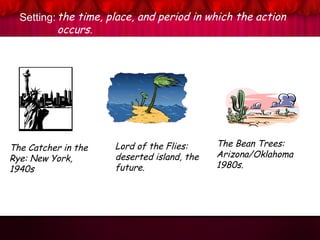
Setting: the time, place, and period in which the action
occurs.
The Bean Trees:
Arizona/Oklahoma
1980s.
The Catcher in the
Rye: New York,
1940s
Lord of the Flies:
deserted island, the
future.
Setting can help in the portrayal of character.
“it was so quiet and lonesome out, even though it
was Saturday night. I didn’t see hardly anybody on
the street. Now and then you just saw a man and a
girl crossing the street with their arms around
each other’s waists and all, or a bunch of
hoodlumy-looking guys and their dates, all of them
laughing like hyenas at something you could bet
wasn’t funny. New York’s terrible when somebody
laughs on the street very late at night. You can
hear it for miles. It makes you feel so lonesome
and depressed” (Salinger 81).
The Catcher in the Rye
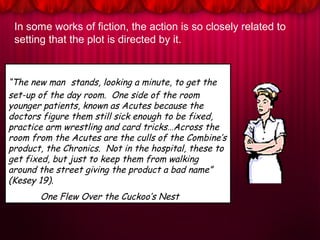
In some works of fiction, the action is so closely related to
setting that the plot is directed by it.
“The new man stands, looking a minute, to get the
set-up of the day room. One side of the room
younger patients, known as Acutes because the
doctors figure them still sick enough to be fixed,
practice arm wrestling and card tricks…Across the
room from the Acutes are the culls of the Combine’s
product, the Chronics. Not in the hospital, these to
get fixed, but just to keep them from walking
around the street giving the product a bad name”
(Kesey 19).
One Flew Over the Cuckoo’s Nest
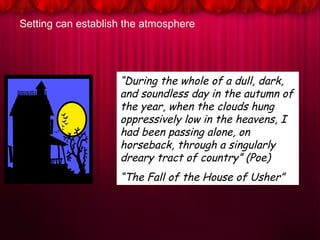
Setting can establish the atmosphere
“During the whole of a dull, dark,
and soundless day in the autumn of
the year, when the clouds hung
oppressively low in the heavens, I
had been passing alone, on
horseback, through a singularly
dreary tract of country” (Poe)
“The Fall of the House of Usher”
Guided Writing
Creative Writing Prompt
Write the following four words on your
paper:
 Character
 Place
 Time
 Situation
 Now chose four numbers between 1
and10. Write one number next to
each of the four words.
 You may chose any numbers that
you want. They can be the same
or different for each category.
Character
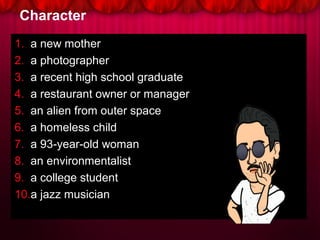
1. a new mother
2. a photographer
3. a recent high school graduate
4. a restaurant owner or manager
5. an alien from outer space
6. a homeless child
7. a 93-year-old woman
8. an environmentalist
9. a college student
10.a jazz musician
Setting: Place
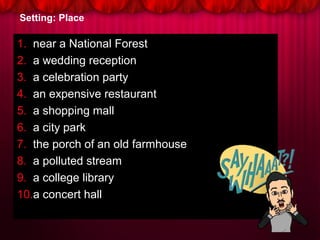
1. near a National Forest
2. a wedding reception
3. a celebration party
4. an expensive restaurant
5. a shopping mall
6. a city park
7. the porch of an old farmhouse
8. a polluted stream
9. a college library
10.a concert hall
Setting: Time
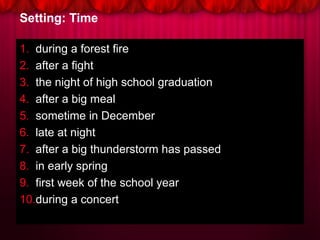
1. during a forest fire
2. after a fight
3. the night of high school graduation
4. after a big meal
5. sometime in December
6. late at night
7. after a big thunderstorm has passed
8. in early spring
9. first week of the school year
10.during a concert
Situation/Challenge
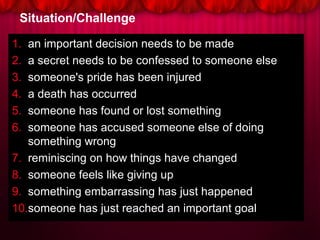
1. an important decision needs to be made
2. a secret needs to be confessed to someone else
3. someone's pride has been injured
4. a death has occurred
5. someone has found or lost something
6. someone has accused someone else of doing
something wrong
7. reminiscing on how things have changed
8. someone feels like giving up
9. something embarrassing has just happened
10.someone has just reached an important goal
Establish the basicsEstablish the basics
Choose a POV
 Omniscient: The narrator knows
everything, including what each
character is thinking, feeling, and
doing throughout the story.
 3rd
Person Limited: The narrator
knows only the thoughts and feelings
of a single character, while other
characters are presented only
externally.
 1st
Person: The narrator participates
in action but sometimes has limited
knowledge about both events
outside of those in which he or she is
directly involved and motivations that
are not his or her own.
 Omniscient: The narrator knows
everything, including what each
character is thinking, feeling, and
doing throughout the story.
 3rd
Person Limited: The narrator
knows only the thoughts and feelings
of a single character, while other
characters are presented only
externally.
 1st
Person: The narrator participates
in action but sometimes has limited
knowledge about both events
outside of those in which he or she is
directly involved and motivations that
are not his or her own.
Outline a basic Plot
 Exposition: This will include
your setting: time and place
 Conflict: This will depend on
your situation or challenge
 Rising action: Events that
happen on the way to the
climax
 Climax: the most intense
moment in your story
 Falling action: What
happened after the climax
 Resolution: The information
with which you leave your
reader
 Exposition: This will include
your setting: time and place
 Conflict: This will depend on
your situation or challenge
 Rising action: Events that
happen on the way to the
climax
 Climax: the most intense
moment in your story
 Falling action: What
happened after the climax
 Resolution: The information
with which you leave your
reader
Homework
Post #8: Guided
Writing
Reading: “The
Celebrated Jumping
Frog of Calaveras
County”
Study Terms: 1-8
Post #8: Guided
Writing
Reading: “The
Celebrated Jumping
Frog of Calaveras
County”
Study Terms: 1-8

Ewrt 30 class 8

  • 1.
  • 2.
    AGENDA Terms 1-8 Review: POVand Plot Discussion: Fiction Lecture: Character and Setting
  • 3.
    Terms 1. Character 2. Flatcharacters 3. Round characters 4. Protagonist 5. Antagonist 6. Motivation 7. Plot 8. Chronological Order 1. Character 2. Flat characters 3. Round characters 4. Protagonist 5. Antagonist 6. Motivation 7. Plot 8. Chronological Order
  • 4.
    1. Protagonist: Theprotagonist or hero is the central character in the story who engages our interest or sympathy. Sometimes, the term protagonist is preferable to hero, because the central character can be despicable as well as heroic. 2. Antagonist: the character or force that opposes the antagonist. 1. Protagonist: The protagonist or hero is the central character in the story who engages our interest or sympathy. Sometimes, the term protagonist is preferable to hero, because the central character can be despicable as well as heroic. 2. Antagonist: the character or force that opposes the antagonist.
  • 5.
    3. Character: animagined person in a literary work. 4. Flat characters: are one-dimensional figures with simple personalities. They show none of the human depth, complexity, and contrariness of a round character or of most real people. 5. Round characters are complex figures. A round character is a full, complex, multidimensional character whose personality reveals some of the richness and contradictoriness we are accustomed to observing in actual people, rather than the transparent obviousness of a flat character. We may see a significant change take place in a round character during the story. 3. Character: an imagined person in a literary work. 4. Flat characters: are one-dimensional figures with simple personalities. They show none of the human depth, complexity, and contrariness of a round character or of most real people. 5. Round characters are complex figures. A round character is a full, complex, multidimensional character whose personality reveals some of the richness and contradictoriness we are accustomed to observing in actual people, rather than the transparent obviousness of a flat character. We may see a significant change take place in a round character during the story.
  • 6.
    7. Motivation isthe external forces (setting, circumstances) and internal forces (personality, temperament, morality, intelligence) that compel a character to act as he or she does in a story. 8. Plot: the artistic arrangement of events in a story. 9. Chronological Order: the story is told in the order in which things happen. It begins with what happens first, then second, and so on, until the last incident is related. 7. Motivation is the external forces (setting, circumstances) and internal forces (personality, temperament, morality, intelligence) that compel a character to act as he or she does in a story. 8. Plot: the artistic arrangement of events in a story. 9. Chronological Order: the story is told in the order in which things happen. It begins with what happens first, then second, and so on, until the last incident is related.
  • 7.
    The Review Plot andPOV “The Tell Tale Heart” “A Very Short Story” “Dr. Chevalier’s Lie” Review: In your groups, discuss plot and POV. Consider the three stories from your reading Review: In your groups, discuss plot and POV. Consider the three stories from your reading
  • 8.
    Plot Line Exposition: Thestart of the story. The way things are before the action starts. Rising Action: the series of conflicts and crisis in the story that lead to the climax. Climax: The turning point. The most intense moment (either mentally or in action). The conflict is generally addressed here. Falling Action: all of the action that follows the Climax. Resolution: The conclusion; the tying together of all of the threads. Conflict: Struggle between opposing forces
  • 9.
    The Tell Tale Heart Exposition:The narrator offers a story as proof he is not insane. He describes the situation with old man and his eye. Rising Action: 2. The narrator makes a noise and wakes the man up: he opens the eye. 1. He goes to the room every night for a week, but the eye is closed Climax: The narrator kills the old man, cuts up the body, and hides it under the floor Falling Action: 1.The police show up and he shows them the house. They settle in the old man’s bedroom. 2.The noise gets louder and louder until the narrator tells the cops to look under the floorboards. Resolution: The narrator identifies the source of the “sound” as “the beating of [the man’s] hideous heart.” Conflict: The narrator wants to kill the old man
  • 10.
    “A Very Short Story” “Dr.Chevalier’s Lie” Exposition: The start of the story. The way things are before the action starts. Rising Action: the series of conflicts and crisis in the story that lead to the climax. Climax: The turning point. The most intense moment (either mentally or in action). The conflict is generally addressed here. Falling Action: all of the action that follows the Climax. Resolution: The conclusion; the tying together of all of the threads. Conflict: Struggle between opposing forces
  • 11.
    Review: Three Common Pointsof View Review: Three Common Points of View  Omniscient: The narrator knows everything, including what each character is thinking, feeling, and doing throughout the story.  3rd Person Limited: The narrator knows only the thoughts and feelings of a single character, while other characters are presented only externally.  1st Person: The narrator participates in action but sometimes has limited knowledge about both events outside of those in which he or she is directly involved and motivations that are not his or her own.  Omniscient: The narrator knows everything, including what each character is thinking, feeling, and doing throughout the story.  3rd Person Limited: The narrator knows only the thoughts and feelings of a single character, while other characters are presented only externally.  1st Person: The narrator participates in action but sometimes has limited knowledge about both events outside of those in which he or she is directly involved and motivations that are not his or her own.
  • 12.
    Point of View “The Tell Tale Heart” by Edgar Allan Poe What kind of narrator tells this story?
  • 13.
    Point of View “The Tell Tale Heart” by Edgar Allan Poe  1st person narrator  Unreliable: he is trying to prove he is sane, which he obviously is not! The narrator admits that "he can hear all things in the heaven and in the earth [and] many things in hell"  He occasionally pretends to be an omniscient narrator. When he says, "Presently I heard a slight groan, and I knew it was the groan of mortal terror. […] I knew the sound well. Many a night […] it has welled up from my own bosom,” he is telling us how the hold man feels and what he thinks.
  • 14.
    Point of View “A Very Short Story” by Ernest Hemingway  What kind of narrator tells this story?
  • 15.
    Point of View “A Very Short Story” by Ernest Hemingway  Omniscient or 3rd person limited narrator?  The narrator seems to be external, yet he generally speaks from the point of view of the man. Note that he neither names him nor identifies him. Furthermore, the last sentences are like the description of the scene that this man sees.  But, the narrator doesn't obviously enter the man’s mind, so he appears to be an objective narrator in that he leaves the interpretation of the actions of the characters to the reader.  Yet, there are signs of anger in the text, which suggests that the narrator is manipulating the reader into seeing the story from his point of view. This would conflict with the objective narrator POV.
  • 16.
    Point of View “Dr. Chevalier’s Lie” by Kate Chopin  What kind of narrator tells this story?
  • 17.
    Point of View “Dr. Chevalier’s Lie” by Kate Chopin  The (objective) omniscient narrator  The story includes details about both the doctor’s and the townspeople’s behavior.  The neutral tone in the conclusion shows that the narrator does not editorialize about society’s thoughts about the girl or Chevalier’s lie.
  • 18.
    In Groups, discussPOV. Prepare to read a paragraph or two demonstrating each of the following perspectives: 1st person Wolf 1st person little Pig 1st person Mother Pig or another minor character 3rd person Wolf 3rd person little Pig 3rd person Mother Pig or another minor character Omniscient Objective: Just tells facts Omniscient Subjective: Enters the minds and shares feelings of multiple characters
  • 19.
  • 20.
    Basic Elements ofa Story 1.PLOT - the story line; a unified, progressive pattern of action or events in a story 2.POINT OF VIEW (POV) - the position from which the story is told 3.CHARACTER - person portraying himself or another in a narrative or drama 4.SETTING - the time and place of the action in a story 5.TONE - the attitude of the author toward his subject or toward the reader 6.MOOD - the feeling or state of mind that predominates in a story creating a certain atmosphere
  • 21.
    Types of Characters: Round Character: convincing, true to life; fully developed and described. Not all good or all bad.  Dynamic Character: undergoes some type of change in story, generally after a conflict.  Flat Character: stereotyped, shallow, often symbolic.  Static Character: does not change in the course of the story.
  • 22.
    Methods of Characterization Bydirectly describing:  Luz sat on the bed. She was cool and fresh in the hot night. Through the reaction of other characters.  Luz stayed on night duty for three months. They were glad to let her.
  • 23.
    Through the character’sown words and actions:  “The following day he wrote a letter. One, doubtless, to carry sorrow, but no shame to the cabin down there in the forest. It told that the girl had sickened and died. A lock of hair was sent and other trifles with it. Tender last words were even invented”
  • 24.
    By detailing physicalappearance, particularly features that symbolize character.  It was open --wide, wide open --and I grew furious as I gazed upon it. I saw it with perfect distinctness --all a dull blue, with a hideous veil over it that chilled the very marrow in my bones; but I could see nothing else of the old man's face or person: for I had directed the ray as if by instinct, precisely upon the damned spot.
  • 25.
    By sharing thecharacters own thoughts.  Was it possible they heard not? Almighty God! --no, no! They heard! --they suspected! --they knew! --they were making a mockery of my horror!-this I thought, and this I think.
  • 26.
    Setting: the time,place, and period in which the action occurs. The Bean Trees: Arizona/Oklahoma 1980s. The Catcher in the Rye: New York, 1940s Lord of the Flies: deserted island, the future.
  • 27.
    Setting can helpin the portrayal of character. “it was so quiet and lonesome out, even though it was Saturday night. I didn’t see hardly anybody on the street. Now and then you just saw a man and a girl crossing the street with their arms around each other’s waists and all, or a bunch of hoodlumy-looking guys and their dates, all of them laughing like hyenas at something you could bet wasn’t funny. New York’s terrible when somebody laughs on the street very late at night. You can hear it for miles. It makes you feel so lonesome and depressed” (Salinger 81). The Catcher in the Rye
  • 28.
    In some worksof fiction, the action is so closely related to setting that the plot is directed by it. “The new man stands, looking a minute, to get the set-up of the day room. One side of the room younger patients, known as Acutes because the doctors figure them still sick enough to be fixed, practice arm wrestling and card tricks…Across the room from the Acutes are the culls of the Combine’s product, the Chronics. Not in the hospital, these to get fixed, but just to keep them from walking around the street giving the product a bad name” (Kesey 19). One Flew Over the Cuckoo’s Nest
  • 29.
    Setting can establishthe atmosphere “During the whole of a dull, dark, and soundless day in the autumn of the year, when the clouds hung oppressively low in the heavens, I had been passing alone, on horseback, through a singularly dreary tract of country” (Poe) “The Fall of the House of Usher”
  • 30.
  • 31.
    Creative Writing Prompt Writethe following four words on your paper:  Character  Place  Time  Situation  Now chose four numbers between 1 and10. Write one number next to each of the four words.  You may chose any numbers that you want. They can be the same or different for each category.
  • 32.
    Character 1. a newmother 2. a photographer 3. a recent high school graduate 4. a restaurant owner or manager 5. an alien from outer space 6. a homeless child 7. a 93-year-old woman 8. an environmentalist 9. a college student 10.a jazz musician
  • 33.
    Setting: Place 1. neara National Forest 2. a wedding reception 3. a celebration party 4. an expensive restaurant 5. a shopping mall 6. a city park 7. the porch of an old farmhouse 8. a polluted stream 9. a college library 10.a concert hall
  • 34.
    Setting: Time 1. duringa forest fire 2. after a fight 3. the night of high school graduation 4. after a big meal 5. sometime in December 6. late at night 7. after a big thunderstorm has passed 8. in early spring 9. first week of the school year 10.during a concert
  • 35.
    Situation/Challenge 1. an importantdecision needs to be made 2. a secret needs to be confessed to someone else 3. someone's pride has been injured 4. a death has occurred 5. someone has found or lost something 6. someone has accused someone else of doing something wrong 7. reminiscing on how things have changed 8. someone feels like giving up 9. something embarrassing has just happened 10.someone has just reached an important goal
  • 36.
    Establish the basicsEstablishthe basics Choose a POV  Omniscient: The narrator knows everything, including what each character is thinking, feeling, and doing throughout the story.  3rd Person Limited: The narrator knows only the thoughts and feelings of a single character, while other characters are presented only externally.  1st Person: The narrator participates in action but sometimes has limited knowledge about both events outside of those in which he or she is directly involved and motivations that are not his or her own.  Omniscient: The narrator knows everything, including what each character is thinking, feeling, and doing throughout the story.  3rd Person Limited: The narrator knows only the thoughts and feelings of a single character, while other characters are presented only externally.  1st Person: The narrator participates in action but sometimes has limited knowledge about both events outside of those in which he or she is directly involved and motivations that are not his or her own. Outline a basic Plot  Exposition: This will include your setting: time and place  Conflict: This will depend on your situation or challenge  Rising action: Events that happen on the way to the climax  Climax: the most intense moment in your story  Falling action: What happened after the climax  Resolution: The information with which you leave your reader  Exposition: This will include your setting: time and place  Conflict: This will depend on your situation or challenge  Rising action: Events that happen on the way to the climax  Climax: the most intense moment in your story  Falling action: What happened after the climax  Resolution: The information with which you leave your reader
  • 37.
    Homework Post #8: Guided Writing Reading:“The Celebrated Jumping Frog of Calaveras County” Study Terms: 1-8 Post #8: Guided Writing Reading: “The Celebrated Jumping Frog of Calaveras County” Study Terms: 1-8

Editor's Notes

  • #12 We are going to talk about three points of view today; there are, of course, others. The Omniscient narrator knows all, including the thoughts, feelings, and actions of every character in the story. This is much different from the 3rd person limited narrator, who only knows the thoughts and feelings of a single character. He or she sees other characters and reports on their behavior but not their motivations or feelings. The first person narrator tells his or her story, but he or she often has limited knowledge about events other than those which directly affect him or her.
  • #21 So far we have talked about Plot, Setting, Tone, Mood, and Character. Today, we will look at POV-the position from which the story is told. Why You ask? Because the POV helps us to understand the author’s intentions. It also influences the method and timing of revealing details to the reader.