IOSR Journal of Electrical and Electronics Engineering (IOSR-JEEE)
e-ISSN: 2278-1676 Volume 5, Issue 1 (Mar. - Apr. 2013), PP 28-33
www.iosrjournals.org

   Chebyshev Filter at 197.12 MHz Frequency for Radar System
                              Denny Permana1, Novita Dwi Susanti2
  Research Center for Electronics and Telecommunication – Indonesian Institute of Sciences Kampus LIPI Jl.
                       Sangkuriang Building 20 4th floor Bandung, 40135 – Indonesia

Abstract : This paper describes the design and simulation of bandpass filter at 197.12 MHz frequency cut off.
which use Chebyshev methode, Chebyshev Filter is allowing ripple on the frequency response. But this type of
filter is easy for tunning at cut off frequency. This Filter is used for Radar system, which have small bandwidth,
it’s around 4 MHz, and also compatible to baseband frequency. In order to design this filter, first of all, we
calculate the value of inductor and capasitor, and then simulate it with software. The design filter was
simulated using Elsie Tonne version 2.4. From the simulation results, we can see that the VSWR is 1.0021,
return loss -59.74 dB.
Keywords – Filter, Chebyshev, bandwidth, insertion loss, vswr,

                                           I.                  INTRODUCTION
         Every Project in Radar Communication needs special specification for each component which can’t find
in the market. One of this component is Band Pass Filter at 197.12 MHz, which use Chebyshev method.
Chebyshev method used to make special specification because the order of the filter can be higher than
Butterworth. Bandpass filter is combination of low-pass filter and high-pass filter. So the bandwidth of this filter
is between upper and lower cut off frequencies, it can be measured at half power points (gain -3dB).
         The “ideal” Bandpass filter is no ripple and attenuate all frequencies outside the passband. But sometime
we need Bandpass Filter which have some ripple on the Frequency respons, because we can tune the cut off
frequency more easier. However the filter which use this type is more difficult to pabricated.


                                  Figure 1. Respon Frequency of Chebyshev Filter

        Chebysev filter have ripple in passband and stopband. From the figure we can see the respon frequency
of chebysev which has ripple in passband. This filter used to separate one band of frequencies from another.

                                          II.                  FILTER DESIGN
          First of all for this design we have to calculate the element value of series capasitor , series inductor,
parallel capasitor and parallel inductor as follows :
                                                          𝑅0
                                                     𝑓 𝑐2 −𝑓 𝑐1 𝜋
                                     𝐿 𝑠𝑒𝑟𝑖𝑒𝑠 =            2
                                                                               (1)

                                                      𝑓 𝑐2 −𝑓 𝑐1
                                  𝐶 𝑠𝑒𝑟𝑖𝑒𝑠 = 2     𝑅0 𝑓 𝑐2 .𝑓 𝑐1 4𝜋
                                                                               (2)

                                                           𝑅0 𝑓 𝑐2 −𝑓 𝑐1
                                     𝐿 𝑝𝑎𝑟𝑎𝑙𝑙𝑒𝑙 = 2                            (3)
                                                               𝑓 𝑐2 .𝑓 𝑐1 4𝜋

                                                         1
                                                 𝑅 0 𝑓 𝑐2 −𝑓 𝑐1 𝜋
                                  𝐶 𝑝𝑟𝑎𝑙𝑙𝑒𝑙 =          2
                                                                               (4)


                                                 www.iosrjournals.org                                     28 | Page
Chebyshev Filter at 197.12 MHz Frequency for Radar System

           From the formula we can calculate element value of component and put to the figure 4. So the design
filter can be simulate with elsie Tonne.
           According to formula (1), (2), (3), and (4) we can calculate series capasitor , series inductor, parallel
capasitor and parallel inductor with some of parameter such as lower frequency cut off (fcl), upper frequency cut
off (fc2), Impedance input (Ro), Bandwidth (BW).
         fcl = 195.12 MHz = 195.12 x 10⁶ Hz
         fc2= 199.12 MHz = 199.12 x 10⁶ Hz
         BW = fc2- fcl = 4 MHz
         R0 = 50 Ω
To find the value of
    1. Lseries =
                                                                                       𝑅0
                                                                                  𝑓𝑐2 − 𝑓𝑐1 𝜋
                                                            𝐿 𝑠𝑒𝑟𝑖𝑒𝑠 =
                                                                                       2
                                                                          50
                                                                              22
                                                  195.12 𝑥 106 − 199.12 𝑥 106 7
                              𝐿 𝑠𝑒𝑟𝑖𝑒𝑠 =                                         = 1,988 𝑢𝐻
                                                                2
    2.   Cseries =
                                                                                𝑓𝑐2 − 𝑓𝑐1
                                                         𝐶 𝑠𝑒𝑟𝑖𝑒𝑠 = 2
                                                                             𝑅0 𝑓𝑐2 . 𝑓𝑐1 4𝜋
                                                        199.12 − 195.12 106
                𝐶 𝑠𝑒𝑟𝑖𝑒𝑠 = 2                                                                         = 0,3275809 𝑝𝐹
                                                                          22
                                      50 199.12 𝑥 106 𝑥 (195. 12 𝑥 106 ) 4 7

    3.   Lparallel =
                                                                                  𝑅0 𝑓𝑐2 − 𝑓𝑐1
                                                          𝐿 𝑝𝑎𝑟𝑎𝑙𝑙𝑒𝑙 = 2
                                                                                    𝑓𝑐2 . 𝑓𝑐1 4𝜋
                                              50 199. 12 𝑥 106 − (195.12𝑥 106 )
                       𝐿 𝑝𝑎𝑟𝑎𝑙𝑙𝑒𝑙 = 2                                               = 0,8189524 𝑛𝐻
                                                                                 22
                                               199. 12 𝑥 106 𝑥 (195. 12 𝑋 106 ) 4 7
    4.   Cparallel =

                                                                                           1
                                                                                    𝑅0 𝑓𝑐2 − 𝑓𝑐1 𝜋
                                                                    𝐶 𝑝𝑟𝑎𝑙𝑙𝑒𝑙 =
                                                                                           2

                                              1
                                                                   22
                         50    199 .12 𝑋 10 6 −(195 .12 𝑋 10 6 )
                                                                    7
          𝐶 𝑝𝑟𝑎𝑙𝑙𝑒𝑙 =                         2
                                                                        = 0,795454 𝑛𝐻

                                                        III.               SIMULATION
          Before realization the filter based on the element value from calculation with formula (1), (2), (3) and
(4). We can simulate the element value on the software simulation which called Elsie Tonne 2.4 version. Some
parameters needs to design such as the type of filter (Chebysev or Butterworth), Bandwidth, order etc, as can see
in the figure 2.


                                                             www.iosrjournals.org                                     29 | Page
Chebyshev Filter at 197.12 MHz Frequency for Radar System


                                    Figure 2. The parameter of filter design
    We choose topology from the filter use shunt-input bandpass with compare the element value in the market.
Other parameters are needed to analysis such as start and stop frequency, VSWR (Voltage Standing Wave
Ratio), Q of inductor and Q of capasitor etc, as can see in figure 3.


                                        Figure 3. Analysis Parameters

              The frequency response from simulation, we get the response wich no ripple and have steepness of
the response curve as can see in figure 4.


                                          www.iosrjournals.org                                       30 | Page
Chebyshev Filter at 197.12 MHz Frequency for Radar System


                           Figure 4. Frequency Response at BPF 197.12 MHz (dB)
        The Phase on 197.12 MHz is 0 degree , it means the input signal and output signal have a same position
wave degree. We also can see the result in the figure 5.


                                     Figure 5. The Tabulate Result of the design
         For the VSWR in 197.12 MHz is 1.0021, so no reflected wave. It’s indicate the input signal is wholly
transferred by the filter 100%, the transmission is 0 dB and the return loss is more than -59.74 dB.

                                        IV.           PABRICATION
          The Pabrication of this filter is use PCB duroid 5870, which has Dielectric constant is around 2.33, and
the cut off of frequency is less than 1 GHz.
   Using the Trimmer Capasitor is make us easy to find the value of capasitor because from the calculation
result the value of the capasitor is not available in the market.
          For the Inductor, we use the SMT Inductor to get the smalles dimention and appropriate the value that
we needed.
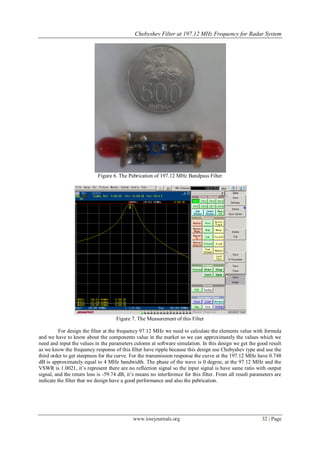
          After we made this filter, we can measure the characteristic of this filter with Vector Network Analyzer
and the result is show in the fig. 7. we can see that the measurement result for this filter is approximately same
with the simulation.


                                              www.iosrjournals.org                                      31 | Page
Chebyshev Filter at 197.12 MHz Frequency for Radar System


                            Figure 6. The Pabrication of 197.12 MHz Bandpass Filter


                                     Figure 7. The Measurement of this Filter

          For design the filter at the frequency 97.12 MHz we need to calculate the elements value with formula
and we have to know about the components value in the market so we can approximately the values which we
need and input the values in the parameters culomn at software simulation. In this design we get the good result
as we know the frequency response of this filter have ripple because this design use Chebyshev type and use the
third order to get steepness for the curve. For the transmission response the curve at the 197.12 MHz have 0.748
dB is approximately equal to 4 MHz bandwidth. The phase of the wave is 0 degree, at the 97.12 MHz and the
VSWR is 1.0021, it’s represent there are no reflection signal so the input signal is have same ratio with output
signal, and the return loss is -59.74 dB, it’s means no interference for this filter. From all result parameters are
indicate the filter that we design have a good performance and also the pabrication.


                                             www.iosrjournals.org                                         32 | Page
Chebyshev Filter at 197.12 MHz Frequency for Radar System

                                                     V.             Conclusion
         The result of the simulation show that the calculation that we made is approximately with the real value
of the capasitor and inductor. The design from simulation we can pabricated to get the real Bandpass filter,
which has small dimention and good result for the measurement.

                                                         Acknowledgements
The author would like to thank to all my colleagues who have assistance on designed and discussed about the filter in this pa per.

                                                             REFERENCES
[1]   Sayre, Cotter W. 2008. “Complete Wireless Design”. New York. Mc Graw Hill.
[2]   Liu. Y, Dou W.B, and Zhao.Y. 2010. A Tri Band Bandpass Filter realized using tri-mode T shape branches. Progress in
      Electromagnetic Research, Vol. 105, 425–444, 2010
[3]   Christiano, Lawrence J and Fitzgerald, Terry J. “The Band Pass Filter”. NBER Working Paper
[4]   White, F.J. 2004. “High Frequency Technique”. New Jersey: John Wiley & Sons, Inc.
[5]   Susanti, D.N, Permana D. 2012. “Design and Simulation of 160 MHz Bandpass Filter with 60 MHz Bandwidth”.IJEN Journal Vol:12
      Issue : 05 2012


                                                       www.iosrjournals.org                                                          33 | Page

E0512833

  • 1.
    IOSR Journal ofElectrical and Electronics Engineering (IOSR-JEEE) e-ISSN: 2278-1676 Volume 5, Issue 1 (Mar. - Apr. 2013), PP 28-33 www.iosrjournals.org Chebyshev Filter at 197.12 MHz Frequency for Radar System Denny Permana1, Novita Dwi Susanti2 Research Center for Electronics and Telecommunication – Indonesian Institute of Sciences Kampus LIPI Jl. Sangkuriang Building 20 4th floor Bandung, 40135 – Indonesia Abstract : This paper describes the design and simulation of bandpass filter at 197.12 MHz frequency cut off. which use Chebyshev methode, Chebyshev Filter is allowing ripple on the frequency response. But this type of filter is easy for tunning at cut off frequency. This Filter is used for Radar system, which have small bandwidth, it’s around 4 MHz, and also compatible to baseband frequency. In order to design this filter, first of all, we calculate the value of inductor and capasitor, and then simulate it with software. The design filter was simulated using Elsie Tonne version 2.4. From the simulation results, we can see that the VSWR is 1.0021, return loss -59.74 dB. Keywords – Filter, Chebyshev, bandwidth, insertion loss, vswr, I. INTRODUCTION Every Project in Radar Communication needs special specification for each component which can’t find in the market. One of this component is Band Pass Filter at 197.12 MHz, which use Chebyshev method. Chebyshev method used to make special specification because the order of the filter can be higher than Butterworth. Bandpass filter is combination of low-pass filter and high-pass filter. So the bandwidth of this filter is between upper and lower cut off frequencies, it can be measured at half power points (gain -3dB). The “ideal” Bandpass filter is no ripple and attenuate all frequencies outside the passband. But sometime we need Bandpass Filter which have some ripple on the Frequency respons, because we can tune the cut off frequency more easier. However the filter which use this type is more difficult to pabricated. Figure 1. Respon Frequency of Chebyshev Filter Chebysev filter have ripple in passband and stopband. From the figure we can see the respon frequency of chebysev which has ripple in passband. This filter used to separate one band of frequencies from another. II. FILTER DESIGN First of all for this design we have to calculate the element value of series capasitor , series inductor, parallel capasitor and parallel inductor as follows : 𝑅0 𝑓 𝑐2 −𝑓 𝑐1 𝜋 𝐿 𝑠𝑒𝑟𝑖𝑒𝑠 = 2 (1) 𝑓 𝑐2 −𝑓 𝑐1 𝐶 𝑠𝑒𝑟𝑖𝑒𝑠 = 2 𝑅0 𝑓 𝑐2 .𝑓 𝑐1 4𝜋 (2) 𝑅0 𝑓 𝑐2 −𝑓 𝑐1 𝐿 𝑝𝑎𝑟𝑎𝑙𝑙𝑒𝑙 = 2 (3) 𝑓 𝑐2 .𝑓 𝑐1 4𝜋 1 𝑅 0 𝑓 𝑐2 −𝑓 𝑐1 𝜋 𝐶 𝑝𝑟𝑎𝑙𝑙𝑒𝑙 = 2 (4) www.iosrjournals.org 28 | Page
  • 2.
    Chebyshev Filter at197.12 MHz Frequency for Radar System From the formula we can calculate element value of component and put to the figure 4. So the design filter can be simulate with elsie Tonne. According to formula (1), (2), (3), and (4) we can calculate series capasitor , series inductor, parallel capasitor and parallel inductor with some of parameter such as lower frequency cut off (fcl), upper frequency cut off (fc2), Impedance input (Ro), Bandwidth (BW). fcl = 195.12 MHz = 195.12 x 10⁶ Hz fc2= 199.12 MHz = 199.12 x 10⁶ Hz BW = fc2- fcl = 4 MHz R0 = 50 Ω To find the value of 1. Lseries = 𝑅0 𝑓𝑐2 − 𝑓𝑐1 𝜋 𝐿 𝑠𝑒𝑟𝑖𝑒𝑠 = 2 50 22 195.12 𝑥 106 − 199.12 𝑥 106 7 𝐿 𝑠𝑒𝑟𝑖𝑒𝑠 = = 1,988 𝑢𝐻 2 2. Cseries = 𝑓𝑐2 − 𝑓𝑐1 𝐶 𝑠𝑒𝑟𝑖𝑒𝑠 = 2 𝑅0 𝑓𝑐2 . 𝑓𝑐1 4𝜋 199.12 − 195.12 106 𝐶 𝑠𝑒𝑟𝑖𝑒𝑠 = 2 = 0,3275809 𝑝𝐹 22 50 199.12 𝑥 106 𝑥 (195. 12 𝑥 106 ) 4 7 3. Lparallel = 𝑅0 𝑓𝑐2 − 𝑓𝑐1 𝐿 𝑝𝑎𝑟𝑎𝑙𝑙𝑒𝑙 = 2 𝑓𝑐2 . 𝑓𝑐1 4𝜋 50 199. 12 𝑥 106 − (195.12𝑥 106 ) 𝐿 𝑝𝑎𝑟𝑎𝑙𝑙𝑒𝑙 = 2 = 0,8189524 𝑛𝐻 22 199. 12 𝑥 106 𝑥 (195. 12 𝑋 106 ) 4 7 4. Cparallel = 1 𝑅0 𝑓𝑐2 − 𝑓𝑐1 𝜋 𝐶 𝑝𝑟𝑎𝑙𝑙𝑒𝑙 = 2 1 22 50 199 .12 𝑋 10 6 −(195 .12 𝑋 10 6 ) 7 𝐶 𝑝𝑟𝑎𝑙𝑙𝑒𝑙 = 2 = 0,795454 𝑛𝐻 III. SIMULATION Before realization the filter based on the element value from calculation with formula (1), (2), (3) and (4). We can simulate the element value on the software simulation which called Elsie Tonne 2.4 version. Some parameters needs to design such as the type of filter (Chebysev or Butterworth), Bandwidth, order etc, as can see in the figure 2. www.iosrjournals.org 29 | Page
  • 3.
    Chebyshev Filter at197.12 MHz Frequency for Radar System Figure 2. The parameter of filter design We choose topology from the filter use shunt-input bandpass with compare the element value in the market. Other parameters are needed to analysis such as start and stop frequency, VSWR (Voltage Standing Wave Ratio), Q of inductor and Q of capasitor etc, as can see in figure 3. Figure 3. Analysis Parameters The frequency response from simulation, we get the response wich no ripple and have steepness of the response curve as can see in figure 4. www.iosrjournals.org 30 | Page
  • 4.
    Chebyshev Filter at197.12 MHz Frequency for Radar System Figure 4. Frequency Response at BPF 197.12 MHz (dB) The Phase on 197.12 MHz is 0 degree , it means the input signal and output signal have a same position wave degree. We also can see the result in the figure 5. Figure 5. The Tabulate Result of the design For the VSWR in 197.12 MHz is 1.0021, so no reflected wave. It’s indicate the input signal is wholly transferred by the filter 100%, the transmission is 0 dB and the return loss is more than -59.74 dB. IV. PABRICATION The Pabrication of this filter is use PCB duroid 5870, which has Dielectric constant is around 2.33, and the cut off of frequency is less than 1 GHz. Using the Trimmer Capasitor is make us easy to find the value of capasitor because from the calculation result the value of the capasitor is not available in the market. For the Inductor, we use the SMT Inductor to get the smalles dimention and appropriate the value that we needed. After we made this filter, we can measure the characteristic of this filter with Vector Network Analyzer and the result is show in the fig. 7. we can see that the measurement result for this filter is approximately same with the simulation. www.iosrjournals.org 31 | Page
  • 5.
    Chebyshev Filter at197.12 MHz Frequency for Radar System Figure 6. The Pabrication of 197.12 MHz Bandpass Filter Figure 7. The Measurement of this Filter For design the filter at the frequency 97.12 MHz we need to calculate the elements value with formula and we have to know about the components value in the market so we can approximately the values which we need and input the values in the parameters culomn at software simulation. In this design we get the good result as we know the frequency response of this filter have ripple because this design use Chebyshev type and use the third order to get steepness for the curve. For the transmission response the curve at the 197.12 MHz have 0.748 dB is approximately equal to 4 MHz bandwidth. The phase of the wave is 0 degree, at the 97.12 MHz and the VSWR is 1.0021, it’s represent there are no reflection signal so the input signal is have same ratio with output signal, and the return loss is -59.74 dB, it’s means no interference for this filter. From all result parameters are indicate the filter that we design have a good performance and also the pabrication. www.iosrjournals.org 32 | Page
  • 6.
    Chebyshev Filter at197.12 MHz Frequency for Radar System V. Conclusion The result of the simulation show that the calculation that we made is approximately with the real value of the capasitor and inductor. The design from simulation we can pabricated to get the real Bandpass filter, which has small dimention and good result for the measurement. Acknowledgements The author would like to thank to all my colleagues who have assistance on designed and discussed about the filter in this pa per. REFERENCES [1] Sayre, Cotter W. 2008. “Complete Wireless Design”. New York. Mc Graw Hill. [2] Liu. Y, Dou W.B, and Zhao.Y. 2010. A Tri Band Bandpass Filter realized using tri-mode T shape branches. Progress in Electromagnetic Research, Vol. 105, 425–444, 2010 [3] Christiano, Lawrence J and Fitzgerald, Terry J. “The Band Pass Filter”. NBER Working Paper [4] White, F.J. 2004. “High Frequency Technique”. New Jersey: John Wiley & Sons, Inc. [5] Susanti, D.N, Permana D. 2012. “Design and Simulation of 160 MHz Bandpass Filter with 60 MHz Bandwidth”.IJEN Journal Vol:12 Issue : 05 2012 www.iosrjournals.org 33 | Page