IOSR Journal of Computer Engineering (IOSR-JCE)
e-ISSN: 2278-0661,p-ISSN: 2278-8727, Volume 17, Issue 5, Ver. II (Sep. – Oct. 2015), PP 34-39
www.iosrjournals.org
DOI: 10.9790/0661-17523439 www.iosrjournals.org 34 | Page
The Role of Information Communication Technology (Ict) In the
Management of Schools: A Case Study of Primary and Secondary
Schools in the Zimbabwean Harare Province (2006)
Dr Farai Choga,
Senior Lecturer, Faculty of Commerce and Law, Zimbabwe Open University, Harare, Zimbabwe,
Abstract: The study covered schools in the province of Harare. A representative stratified sample was carried
out in coming up with the number of both the primary and secondary schools. Ninety-four schools were sampled
and this represented one third of all Harare schools. These comprised of 18 government secondary schools,
eight non-government secondary schools, 36 government primary schools, and 32 non-government primary
schools. A quantitative methodology was employed. The main instrument used was a questionnaire and
telephone interview was used to follow-up and clarify unclear issues. The heads of schools were used as the
research subjects. The study showed that ICT played an important role in the management of schools and this
was supported by literature. It showed that 86% of the schools had office computers and 26% had Internet
connections. Business software, PASTEL and PAYPLUS, were used by only one school. Many advantages like
data storage and speedy document processing were being experienced in the use of ICT although there were
problems and challenges such as high inflation, material shortages, skilled manpower shortages and insufficient
funds. The education ministry had a challenge of connecting the schools to its offices although many schools
had office computers. The study recommended that the Ministry should connect school business systems to its
own system. The Ministry could make use of existing facilities to improve communication between different
education structures. Further research was recommended to assess the effects of ICT on e-learning
I. Background of the Study
In the 1980s typewriters and duplicating machines were being replaced by ICT. Before the introduction
of ICT more work and many people were employed to produce documents. One document could be re-typed
many times until they were no corrections to be made on it. If more copies were required it was typed on a
stencil for it to be run on a duplicating machine. This process resulted not only in time wastage but also in the
loss of man-working hours and paper. The introduction of computers made the work easier as corrections on
documents were made on the computer screen and more copies were easily produced. This saved time and less
people were employed for the same job leading to the reduction of costs and improvement of efficiency.
In the 1970s manual systems were used in the management of schools followed by a computerization
fever in the 1980s and 1990s. The year 2000 compliance brought another dimension which saw the private
sector shading off their hardware to schools to avoid the millennium bug. These machines were not 2000
compliant which meant that it was not possible to change the date beyond 1999. The computers needed to be
replaced. The argument then was that these machines could be used in schools to impart basic skills to both
pupils and school management. Some of the donations came from both local companies and international
organizations such as the World Bank and UK Peace Child. The World Bank hardware was used in the WorLD
Links programme. The programme computerised secondary schools although it also focused on community
service, that catered for the entire local communities. This certainly was expected to benefit primary schools as
well.
The Government was active in promoting ICT. Syllabuses were developed for both primary and
secondary schools. Secondary school teachers were trained at Belvedere, Chinhoyi Technical Teachers Colleges
and universities. It was a requirement for a teacher to be computer literate at both primary and secondary
schools. The school administration was also required to be computerised. Rural electrification programme
brought power to rural schools and this made it easy to use computers. The country President, himself, had gone
out of his way and donated sets of computers to schools. In addition to this, the Ministry of Science and
Technology produced a Government ICT policy from the Zimbabwe e-Readiness Survey Report (2005) which
was yet to be published. However, it was not clear whether these efforts had an impact on school administration.
II. Statement of the Problem
The impact of introducing computers in school administration functions was yet to be determined. A
lot was going on but no research was carried out to determine the school administration benefits and challenges.
The Role of Information Communication Technology (Ict) In the Management of Schools: A Case Study…
DOI: 10.9790/0661-17523439 www.iosrjournals.org 35 | Page
III. Purpose of Study
The aim of this study was to investigate the role played by ICT in the management of primary and
secondary schools in the Harare Province in Zimbabwe.
The objectives of this study were to:
 explain the role played by ICT in enhancing school management in both primary and secondary
schools and
 reveal the challenges and benefits brought about by ICT in school management.
IV. Literature Review
A computerized management information system has several advantages. Authors came up with some
advantages cited below.
Bassett, Campbell and Licciardi (2003) argued that a human resources information system (HRIS)
provided an organization with data storage and retrieval, primary administrative support, reporting and statistics,
and programme monitoring capabilities. They also pointed out that the capabilities provided a platform for more
strategic use of information resources planning. Another advantage they put across was that of streamlining of
recruitment and selection processes, matching jobs with people. They continued to say that in the administration
role:
The HRIS allows higher output for given labour cost in that processes are streamlined, standardized
and more accurate, leading to a reduction in costs.
Line management shared information. The strategic role facilitated human resources vision and creativity as a
vital component of organizational strategic planning. Current data was made available.
Asch (2002) had this to say about the human resource system:
It offers flexible personnel and compensation tools or policies that efficiently promote the
organization's missions.
The author said that managers had the discretion over how the personnel and compensation tools were
used. Policies were made transparent and appropriately linked to the organization goals.
Legislative Council of Hong Kong (2001) justified their budget on HRIS by stating that the advantages of the
personnel management information system maintained a personnel database containing comprehensive up-to-
date and accurate personnel particulars of all staff. It was expected to facilitate short-listing of candidates for
recruitment, posting and training purposes and staff maintenance posting history and training records. The
system maintained establishment related information for manpower planning and generated both regular and ad-
hoc statistical reports.
Akinyokun and Uzoka (year not given) agreed with the other authors by saying that the human
resources system developed a deep understanding of people's productivity and how this contributed towards
organizational goals. Knowledge on all employment costs and contributions were revealed. They argued that the
organization had full skills inventory and skills acquisition and a comprehensive planning process could be put
in place.
Heeks (1998) looked at the advantages at the three levels of management. At the operational level,
management information system was used to support day-to-day monitoring and control. At the tactical level,
emphasis was placed on the human resources decision-making. Strategic management emphasised on the
planning and the integrated views of the organization. The author pointed out that the other advantages brought
about by computerization were faster decision making and control, better decision making and control. The
system improved job satisfaction and reduced the number of paper records that were to be held.
Legislative Office of Education Oversight (1998) believed that a relational database for their education
management information system would lead into more efficient and accurate data collection, greater flexibility
and more sophisticated analysis, improved usability of the system and integration of all education data.
Ngai (1998) pointed out that the Hong Kong industries showed that HRIS implementation had benefits
such as quick response and access to information, improved data control and reduced manpower.
Carnoy (1999) said that globalization was intimately associated with information and communication
technology. The Internet globalised information and computers were seen as tools that processed information
quickly in an interactive fashion as part of a cure for poor education.
Problems were experienced in any computerization programme. Authors cited many problems and
some of the problems are discussed below.
Bassett, Campbell and Licciardi (2003) pointed out that at implementation stage, little concern was
given to organizational needs. Interfacing with other existing systems in the organization proved difficult. They
also expressed lack of interest on the part of senior management and this subsequently restricted use of ICT.
Legislative Council of Hong Kong (2001) cited another problem. The personnel information in the
Education Department was handled:
The Role of Information Communication Technology (Ict) In the Management of Schools: A Case Study…
DOI: 10.9790/0661-17523439 www.iosrjournals.org 36 | Page
Either manually or through different computer databases which do not integrate with one another. This
is inefficient and not conducive to effective human resource management.
Such a situation gave rise to many problems. Staff profiles were compiled manually as the information was in
paper files. Time was lost in searching for relevant information. Management had no overall picture of staffing
position. Duplication of database and staff effort was common.
Legislative Office of Education Oversight, Ohio, (1998) cited staff shortages as one of their Education
Management Information System (EMIS) problems. This showed an example of the low priority given to EMIS.
This had a significant impact on the quality and type of services provided to data acquisition sites, districts, and
other EMIS data users. It proved difficult to recruit and retain:
Individuals with the necessary knowledge and skills because of higher paying jobs in the private sector.
This problem was supported by Ngai (1998) who indicated that the greatest barriers were insufficient financial
support and lack of expertise in information technology.
Lucy (1997) summaried the problems faced by ICT systems. The author’s evidence was based on surveys
carried out in UK and USA. The author argued that lack of management involvement with the design of
management information system and narrow and/or inappropriate emphasis of the computer system were some
of the problems. The author went on to say:
Undue concentration on low level data processing applications, lack of management knowledge of
computers, poor appreciation by information specialists of management's true information requirements and of
organizational problems and lack of management support.
Cain and Thurston (1997) emphasised the problem of senior management. The senior managers had
little understanding of the limitations of computers and were not conversant with the numerous pitfalls that
bedeviled automation projects. They cited Uganda and Ghana where senior managers exaggerated expectations
for IT projects and did not understand the resources (both human and material) needed to achieve these. The
managers lacked experience in managing ICT projects. Responsibility was passed on to the juniors who become
scapegoats in case of failures.
Unite Nations (1995) stated that in Africa, institutional weakness, human resources, funding and
availability of hardware and software were all the major constraints to successful implementation of
computerisation. The top management's awareness of the role that the government information systems were to
play and how to provide support to government agency's decision-making, policy development, administration
and management, was crucial if government information systems were to be successfully developed. The better
understanding of the information systems led to success.
V. Research Design and Methodology
A quantitative methodology was employed. This was chosen because the researcher wanted to have a
wider coverage of both primary and secondary schools. A survey approach was found suitable for the research.
A closed questionnaire was used and distributed through district education offices. Telephone calls were used to
supplement the collection of data. The response rate was 57%.
VI. Results and Discussions
The data analysis showed that three schools did not indicate whether they were government or non-
government as well as their location. Two of these did not show the number of office computers they had. It was
noted that one government school did not have a computer in its office and three non-government schools were
in the same position. However, there was one non-government school with a computer but without electricity.
Of the 59 schools that responded, 51 of them had office computers.
Computers in schools were being used for different purposes. Data analysis showed that most of the
schools used their office computers for typing, storing school records, accounting, personnel details as well as
student information storage. Only 10 schools indicated that they used computers for their library activities and
communication using computers was minimal.
The Role of Information Communication Technology (Ict) In the Management of Schools: A Case Study…
DOI: 10.9790/0661-17523439 www.iosrjournals.org 37 | Page
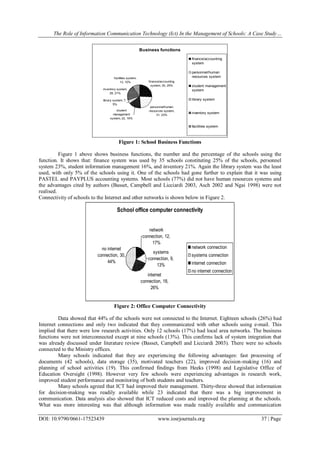
Figure 1: School Business Functions
Figure 1 above shows business functions, the number and the percentage of the schools using the
function. It shows that: finance system was used by 35 schools constituting 25% of the schools, personnel
system 23%, student information management 16%, and inventory 21%. Again the library system was the least
used, with only 5% of the schools using it. One of the schools had gone further to explain that it was using
PASTEL and PAYPLUS accounting systems. Most schools (77%) did not have human resources systems and
the advantages cited by authors (Basset, Campbell and Licciardi 2003, Asch 2002 and Ngai 1998) were not
realised.
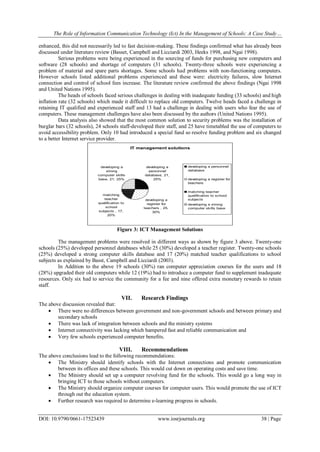
Connectivity of schools to the Internet and other networks is shown below in Figure 2.
Figure 2: Office Computer Connectivity
Data showed that 44% of the schools were not connected to the Internet. Eighteen schools (26%) had
Internet connections and only two indicated that they communicated with other schools using e-mail. This
implied that there were low research activities. Only 12 schools (17%) had local area networks. The business
functions were not interconnected except at nine schools (13%). This confirms lack of system integration that
was already discussed under literature review (Basset, Campbell and Licciardi 2003). There were no schools
connected to the Ministry offices.
Many schools indicated that they are experiencing the following advantages: fast processing of
documents (42 schools), data storage (35), motivated teachers (22), improved decision-making (16) and
planning of school activities (19). This confirmed findings from Heeks (1998) and Legislative Office of
Education Oversight (1998). However very few schools were experiencing advantages in research work,
improved student performance and monitoring of both students and teachers.
Many schools agreed that ICT had improved their management. Thirty-three showed that information
for decision-making was readily available while 23 indicated that there was a big improvement in
communication. Data analysis also showed that ICT reduced costs and improved the planning at the schools.
What was more interesting was that although information was made readily available and communication
Business functions
student
management
system, 22, 16%
library system, 7,
5%
inventory system,
28, 21%
facilities system,
13, 10%
personnel/human
resources system,
31, 23%
finance/accounting
system, 35, 25%
finance/accounting
system
personnel/human
resources system
student management
system
library system
inventory system
facilities system
School office computer connectivity
network
connection, 12,
17%
systems
connection, 9,
13%
internet
connection, 18,
26%
no internet
connection, 30,
44%
network connection
systems connection
internet connection
no internet connection
The Role of Information Communication Technology (Ict) In the Management of Schools: A Case Study…
DOI: 10.9790/0661-17523439 www.iosrjournals.org 38 | Page
enhanced, this did not necessarily led to fast decision-making. These findings confirmed what has already been
discussed under literature review (Basset, Campbell and Licciardi 2003, Heeks 1998, and Ngai 1998).
Serious problems were being experienced in the sourcing of funds for purchasing new computers and
software (28 schools) and shortage of computers (31 schools). Twenty-three schools were experiencing a
problem of material and spare parts shortages. Some schools had problems with non-functioning computers.
However schools listed additional problems experienced and these were: electricity failures, slow Internet
connection and control of school fees increase. The literature review confirmed the above findings (Ngai 1998
and United Nations 1995).
The heads of schools faced serious challenges in dealing with inadequate funding (33 schools) and high
inflation rate (32 schools) which made it difficult to replace old computers. Twelve heads faced a challenge in
retaining IT qualified and experienced staff and 13 had a challenge in dealing with users who fear the use of
computers. These management challenges have also been discussed by the authors (United Nations 1995).
Data analysis also showed that the most common solution to security problems was the installation of
burglar bars (32 schools), 24 schools staff-developed their staff, and 25 have timetabled the use of computers to
avoid accessibility problem. Only 10 had introduced a special fund so resolve funding problem and six changed
to a better Internet service provider.
Figure 3: ICT Management Solutions
The management problems were resolved in different ways as shown by figure 3 above. Twenty-one
schools (25%) developed personnel databases while 25 (30%) developed a teacher register. Twenty-one schools
(25%) developed a strong computer skills database and 17 (20%) matched teacher qualifications to school
subjects as explained by Basst, Campbell and Licciardi (2003).
In Addition to the above 19 schools (30%) ran computer appreciation courses for the users and 18
(28%) upgraded their old computers while 12 (19%) had to introduce a computer fund to supplement inadequate
resources. Only six had to service the community for a fee and nine offered extra monetary rewards to retain
staff.
VII. Research Findings
The above discussion revealed that:
 There were no differences between government and non-government schools and between primary and
secondary schools
 There was lack of integration between schools and the ministry systems
 Internet connectivity was lacking which hampered fast and reliable communication and
 Very few schools experienced computer benefits.
VIII. Recommendations
The above conclusions lead to the following recommendations:
 The Ministry should identify schools with the Internet connections and promote communication
between its offices and these schools. This would cut down on operating costs and save time.
 The Ministry should set up a computer revolving fund for the schools. This would go a long way in
bringing ICT to those schools without computers.
 The Ministry should organize computer courses for computer users. This would promote the use of ICT
through out the education system.
 Further research was required to determine e-learning progress in schools.
IT management solutions
developing a
personnel
database, 21,
25%
developing a
register for
teachers , 25,
30%
matching
teacher
qualification to
school
subjects , 17,
20%
developing a
strong
computer skills
base, 21, 25%
developing a personnel
database
developing a register for
teachers
matching teacher
qualification to school
subjects
developing a strong
computer skills base
The Role of Information Communication Technology (Ict) In the Management of Schools: A Case Study…
DOI: 10.9790/0661-17523439 www.iosrjournals.org 39 | Page
References
[1]. Akinyokun O.C. and Uzoka F.M.E., A Prototype of Information Technology Based Human Resources System, Federal University
of Technology, Akure, Nigeria.
[2]. Asch B.J. (2002), Ensuring successful Personnel Management in the Department of Homeland Security, RAND Issue Paper.
[3]. Basset P., Campbell G. and Licciardi R. (2003), Tunnel Vision: Limited use of Human Resource Information Systems (HRIS):
Working Paper, Victoria University, Melbourne, Australia.
[4]. Cain P. and Thurston A. (1997), Personnel Records: A Strategic Resource for Public Sector Management, A Research Report
Submitted to ODA ESCOR, University College London.
[5]. Carnoy M. (1999), Globalization and Education Reform: What Planners Need To Know, UNESCO: International Institute for
Educational Planning, Paris.
[6]. Heeks R. (1998), Public sector management Information Systems, Paper No 5, Working Paper Series, University of Manchester,
www.man.ac.uk.
[7]. Legislative Office of Education Oversight Ohio (1998), Improving Ohio’s Education Management Information System (EMIS),
Columbus, Ohio, www.loed.state.oh.us.
[8]. Lucy T. (1997), Management Information Systems, 8th Edition, DP Publications, London.
[9]. Ngai E.W.T. (1998), Potential Barriers to HRIS Implementation, Hong Kong Polytechnic University, Hong Kong.
[10]. The National University of Science and Technology (2005), Zimbabwe e-Readiness Survey Report (Unpublished).
[11]. United Nations (1995), Government Information Systems, A guide to Effective Use of Information Technology in the Public Sector
of Developing Countries, New York.

E017523439

  • 1.
    IOSR Journal ofComputer Engineering (IOSR-JCE) e-ISSN: 2278-0661,p-ISSN: 2278-8727, Volume 17, Issue 5, Ver. II (Sep. – Oct. 2015), PP 34-39 www.iosrjournals.org DOI: 10.9790/0661-17523439 www.iosrjournals.org 34 | Page The Role of Information Communication Technology (Ict) In the Management of Schools: A Case Study of Primary and Secondary Schools in the Zimbabwean Harare Province (2006) Dr Farai Choga, Senior Lecturer, Faculty of Commerce and Law, Zimbabwe Open University, Harare, Zimbabwe, Abstract: The study covered schools in the province of Harare. A representative stratified sample was carried out in coming up with the number of both the primary and secondary schools. Ninety-four schools were sampled and this represented one third of all Harare schools. These comprised of 18 government secondary schools, eight non-government secondary schools, 36 government primary schools, and 32 non-government primary schools. A quantitative methodology was employed. The main instrument used was a questionnaire and telephone interview was used to follow-up and clarify unclear issues. The heads of schools were used as the research subjects. The study showed that ICT played an important role in the management of schools and this was supported by literature. It showed that 86% of the schools had office computers and 26% had Internet connections. Business software, PASTEL and PAYPLUS, were used by only one school. Many advantages like data storage and speedy document processing were being experienced in the use of ICT although there were problems and challenges such as high inflation, material shortages, skilled manpower shortages and insufficient funds. The education ministry had a challenge of connecting the schools to its offices although many schools had office computers. The study recommended that the Ministry should connect school business systems to its own system. The Ministry could make use of existing facilities to improve communication between different education structures. Further research was recommended to assess the effects of ICT on e-learning I. Background of the Study In the 1980s typewriters and duplicating machines were being replaced by ICT. Before the introduction of ICT more work and many people were employed to produce documents. One document could be re-typed many times until they were no corrections to be made on it. If more copies were required it was typed on a stencil for it to be run on a duplicating machine. This process resulted not only in time wastage but also in the loss of man-working hours and paper. The introduction of computers made the work easier as corrections on documents were made on the computer screen and more copies were easily produced. This saved time and less people were employed for the same job leading to the reduction of costs and improvement of efficiency. In the 1970s manual systems were used in the management of schools followed by a computerization fever in the 1980s and 1990s. The year 2000 compliance brought another dimension which saw the private sector shading off their hardware to schools to avoid the millennium bug. These machines were not 2000 compliant which meant that it was not possible to change the date beyond 1999. The computers needed to be replaced. The argument then was that these machines could be used in schools to impart basic skills to both pupils and school management. Some of the donations came from both local companies and international organizations such as the World Bank and UK Peace Child. The World Bank hardware was used in the WorLD Links programme. The programme computerised secondary schools although it also focused on community service, that catered for the entire local communities. This certainly was expected to benefit primary schools as well. The Government was active in promoting ICT. Syllabuses were developed for both primary and secondary schools. Secondary school teachers were trained at Belvedere, Chinhoyi Technical Teachers Colleges and universities. It was a requirement for a teacher to be computer literate at both primary and secondary schools. The school administration was also required to be computerised. Rural electrification programme brought power to rural schools and this made it easy to use computers. The country President, himself, had gone out of his way and donated sets of computers to schools. In addition to this, the Ministry of Science and Technology produced a Government ICT policy from the Zimbabwe e-Readiness Survey Report (2005) which was yet to be published. However, it was not clear whether these efforts had an impact on school administration. II. Statement of the Problem The impact of introducing computers in school administration functions was yet to be determined. A lot was going on but no research was carried out to determine the school administration benefits and challenges.
  • 2.
    The Role ofInformation Communication Technology (Ict) In the Management of Schools: A Case Study… DOI: 10.9790/0661-17523439 www.iosrjournals.org 35 | Page III. Purpose of Study The aim of this study was to investigate the role played by ICT in the management of primary and secondary schools in the Harare Province in Zimbabwe. The objectives of this study were to:  explain the role played by ICT in enhancing school management in both primary and secondary schools and  reveal the challenges and benefits brought about by ICT in school management. IV. Literature Review A computerized management information system has several advantages. Authors came up with some advantages cited below. Bassett, Campbell and Licciardi (2003) argued that a human resources information system (HRIS) provided an organization with data storage and retrieval, primary administrative support, reporting and statistics, and programme monitoring capabilities. They also pointed out that the capabilities provided a platform for more strategic use of information resources planning. Another advantage they put across was that of streamlining of recruitment and selection processes, matching jobs with people. They continued to say that in the administration role: The HRIS allows higher output for given labour cost in that processes are streamlined, standardized and more accurate, leading to a reduction in costs. Line management shared information. The strategic role facilitated human resources vision and creativity as a vital component of organizational strategic planning. Current data was made available. Asch (2002) had this to say about the human resource system: It offers flexible personnel and compensation tools or policies that efficiently promote the organization's missions. The author said that managers had the discretion over how the personnel and compensation tools were used. Policies were made transparent and appropriately linked to the organization goals. Legislative Council of Hong Kong (2001) justified their budget on HRIS by stating that the advantages of the personnel management information system maintained a personnel database containing comprehensive up-to- date and accurate personnel particulars of all staff. It was expected to facilitate short-listing of candidates for recruitment, posting and training purposes and staff maintenance posting history and training records. The system maintained establishment related information for manpower planning and generated both regular and ad- hoc statistical reports. Akinyokun and Uzoka (year not given) agreed with the other authors by saying that the human resources system developed a deep understanding of people's productivity and how this contributed towards organizational goals. Knowledge on all employment costs and contributions were revealed. They argued that the organization had full skills inventory and skills acquisition and a comprehensive planning process could be put in place. Heeks (1998) looked at the advantages at the three levels of management. At the operational level, management information system was used to support day-to-day monitoring and control. At the tactical level, emphasis was placed on the human resources decision-making. Strategic management emphasised on the planning and the integrated views of the organization. The author pointed out that the other advantages brought about by computerization were faster decision making and control, better decision making and control. The system improved job satisfaction and reduced the number of paper records that were to be held. Legislative Office of Education Oversight (1998) believed that a relational database for their education management information system would lead into more efficient and accurate data collection, greater flexibility and more sophisticated analysis, improved usability of the system and integration of all education data. Ngai (1998) pointed out that the Hong Kong industries showed that HRIS implementation had benefits such as quick response and access to information, improved data control and reduced manpower. Carnoy (1999) said that globalization was intimately associated with information and communication technology. The Internet globalised information and computers were seen as tools that processed information quickly in an interactive fashion as part of a cure for poor education. Problems were experienced in any computerization programme. Authors cited many problems and some of the problems are discussed below. Bassett, Campbell and Licciardi (2003) pointed out that at implementation stage, little concern was given to organizational needs. Interfacing with other existing systems in the organization proved difficult. They also expressed lack of interest on the part of senior management and this subsequently restricted use of ICT. Legislative Council of Hong Kong (2001) cited another problem. The personnel information in the Education Department was handled:
  • 3.
    The Role ofInformation Communication Technology (Ict) In the Management of Schools: A Case Study… DOI: 10.9790/0661-17523439 www.iosrjournals.org 36 | Page Either manually or through different computer databases which do not integrate with one another. This is inefficient and not conducive to effective human resource management. Such a situation gave rise to many problems. Staff profiles were compiled manually as the information was in paper files. Time was lost in searching for relevant information. Management had no overall picture of staffing position. Duplication of database and staff effort was common. Legislative Office of Education Oversight, Ohio, (1998) cited staff shortages as one of their Education Management Information System (EMIS) problems. This showed an example of the low priority given to EMIS. This had a significant impact on the quality and type of services provided to data acquisition sites, districts, and other EMIS data users. It proved difficult to recruit and retain: Individuals with the necessary knowledge and skills because of higher paying jobs in the private sector. This problem was supported by Ngai (1998) who indicated that the greatest barriers were insufficient financial support and lack of expertise in information technology. Lucy (1997) summaried the problems faced by ICT systems. The author’s evidence was based on surveys carried out in UK and USA. The author argued that lack of management involvement with the design of management information system and narrow and/or inappropriate emphasis of the computer system were some of the problems. The author went on to say: Undue concentration on low level data processing applications, lack of management knowledge of computers, poor appreciation by information specialists of management's true information requirements and of organizational problems and lack of management support. Cain and Thurston (1997) emphasised the problem of senior management. The senior managers had little understanding of the limitations of computers and were not conversant with the numerous pitfalls that bedeviled automation projects. They cited Uganda and Ghana where senior managers exaggerated expectations for IT projects and did not understand the resources (both human and material) needed to achieve these. The managers lacked experience in managing ICT projects. Responsibility was passed on to the juniors who become scapegoats in case of failures. Unite Nations (1995) stated that in Africa, institutional weakness, human resources, funding and availability of hardware and software were all the major constraints to successful implementation of computerisation. The top management's awareness of the role that the government information systems were to play and how to provide support to government agency's decision-making, policy development, administration and management, was crucial if government information systems were to be successfully developed. The better understanding of the information systems led to success. V. Research Design and Methodology A quantitative methodology was employed. This was chosen because the researcher wanted to have a wider coverage of both primary and secondary schools. A survey approach was found suitable for the research. A closed questionnaire was used and distributed through district education offices. Telephone calls were used to supplement the collection of data. The response rate was 57%. VI. Results and Discussions The data analysis showed that three schools did not indicate whether they were government or non- government as well as their location. Two of these did not show the number of office computers they had. It was noted that one government school did not have a computer in its office and three non-government schools were in the same position. However, there was one non-government school with a computer but without electricity. Of the 59 schools that responded, 51 of them had office computers. Computers in schools were being used for different purposes. Data analysis showed that most of the schools used their office computers for typing, storing school records, accounting, personnel details as well as student information storage. Only 10 schools indicated that they used computers for their library activities and communication using computers was minimal.
  • 4.
    The Role ofInformation Communication Technology (Ict) In the Management of Schools: A Case Study… DOI: 10.9790/0661-17523439 www.iosrjournals.org 37 | Page Figure 1: School Business Functions Figure 1 above shows business functions, the number and the percentage of the schools using the function. It shows that: finance system was used by 35 schools constituting 25% of the schools, personnel system 23%, student information management 16%, and inventory 21%. Again the library system was the least used, with only 5% of the schools using it. One of the schools had gone further to explain that it was using PASTEL and PAYPLUS accounting systems. Most schools (77%) did not have human resources systems and the advantages cited by authors (Basset, Campbell and Licciardi 2003, Asch 2002 and Ngai 1998) were not realised. Connectivity of schools to the Internet and other networks is shown below in Figure 2. Figure 2: Office Computer Connectivity Data showed that 44% of the schools were not connected to the Internet. Eighteen schools (26%) had Internet connections and only two indicated that they communicated with other schools using e-mail. This implied that there were low research activities. Only 12 schools (17%) had local area networks. The business functions were not interconnected except at nine schools (13%). This confirms lack of system integration that was already discussed under literature review (Basset, Campbell and Licciardi 2003). There were no schools connected to the Ministry offices. Many schools indicated that they are experiencing the following advantages: fast processing of documents (42 schools), data storage (35), motivated teachers (22), improved decision-making (16) and planning of school activities (19). This confirmed findings from Heeks (1998) and Legislative Office of Education Oversight (1998). However very few schools were experiencing advantages in research work, improved student performance and monitoring of both students and teachers. Many schools agreed that ICT had improved their management. Thirty-three showed that information for decision-making was readily available while 23 indicated that there was a big improvement in communication. Data analysis also showed that ICT reduced costs and improved the planning at the schools. What was more interesting was that although information was made readily available and communication Business functions student management system, 22, 16% library system, 7, 5% inventory system, 28, 21% facilities system, 13, 10% personnel/human resources system, 31, 23% finance/accounting system, 35, 25% finance/accounting system personnel/human resources system student management system library system inventory system facilities system School office computer connectivity network connection, 12, 17% systems connection, 9, 13% internet connection, 18, 26% no internet connection, 30, 44% network connection systems connection internet connection no internet connection
  • 5.
    The Role ofInformation Communication Technology (Ict) In the Management of Schools: A Case Study… DOI: 10.9790/0661-17523439 www.iosrjournals.org 38 | Page enhanced, this did not necessarily led to fast decision-making. These findings confirmed what has already been discussed under literature review (Basset, Campbell and Licciardi 2003, Heeks 1998, and Ngai 1998). Serious problems were being experienced in the sourcing of funds for purchasing new computers and software (28 schools) and shortage of computers (31 schools). Twenty-three schools were experiencing a problem of material and spare parts shortages. Some schools had problems with non-functioning computers. However schools listed additional problems experienced and these were: electricity failures, slow Internet connection and control of school fees increase. The literature review confirmed the above findings (Ngai 1998 and United Nations 1995). The heads of schools faced serious challenges in dealing with inadequate funding (33 schools) and high inflation rate (32 schools) which made it difficult to replace old computers. Twelve heads faced a challenge in retaining IT qualified and experienced staff and 13 had a challenge in dealing with users who fear the use of computers. These management challenges have also been discussed by the authors (United Nations 1995). Data analysis also showed that the most common solution to security problems was the installation of burglar bars (32 schools), 24 schools staff-developed their staff, and 25 have timetabled the use of computers to avoid accessibility problem. Only 10 had introduced a special fund so resolve funding problem and six changed to a better Internet service provider. Figure 3: ICT Management Solutions The management problems were resolved in different ways as shown by figure 3 above. Twenty-one schools (25%) developed personnel databases while 25 (30%) developed a teacher register. Twenty-one schools (25%) developed a strong computer skills database and 17 (20%) matched teacher qualifications to school subjects as explained by Basst, Campbell and Licciardi (2003). In Addition to the above 19 schools (30%) ran computer appreciation courses for the users and 18 (28%) upgraded their old computers while 12 (19%) had to introduce a computer fund to supplement inadequate resources. Only six had to service the community for a fee and nine offered extra monetary rewards to retain staff. VII. Research Findings The above discussion revealed that:  There were no differences between government and non-government schools and between primary and secondary schools  There was lack of integration between schools and the ministry systems  Internet connectivity was lacking which hampered fast and reliable communication and  Very few schools experienced computer benefits. VIII. Recommendations The above conclusions lead to the following recommendations:  The Ministry should identify schools with the Internet connections and promote communication between its offices and these schools. This would cut down on operating costs and save time.  The Ministry should set up a computer revolving fund for the schools. This would go a long way in bringing ICT to those schools without computers.  The Ministry should organize computer courses for computer users. This would promote the use of ICT through out the education system.  Further research was required to determine e-learning progress in schools. IT management solutions developing a personnel database, 21, 25% developing a register for teachers , 25, 30% matching teacher qualification to school subjects , 17, 20% developing a strong computer skills base, 21, 25% developing a personnel database developing a register for teachers matching teacher qualification to school subjects developing a strong computer skills base
  • 6.
    The Role ofInformation Communication Technology (Ict) In the Management of Schools: A Case Study… DOI: 10.9790/0661-17523439 www.iosrjournals.org 39 | Page References [1]. Akinyokun O.C. and Uzoka F.M.E., A Prototype of Information Technology Based Human Resources System, Federal University of Technology, Akure, Nigeria. [2]. Asch B.J. (2002), Ensuring successful Personnel Management in the Department of Homeland Security, RAND Issue Paper. [3]. Basset P., Campbell G. and Licciardi R. (2003), Tunnel Vision: Limited use of Human Resource Information Systems (HRIS): Working Paper, Victoria University, Melbourne, Australia. [4]. Cain P. and Thurston A. (1997), Personnel Records: A Strategic Resource for Public Sector Management, A Research Report Submitted to ODA ESCOR, University College London. [5]. Carnoy M. (1999), Globalization and Education Reform: What Planners Need To Know, UNESCO: International Institute for Educational Planning, Paris. [6]. Heeks R. (1998), Public sector management Information Systems, Paper No 5, Working Paper Series, University of Manchester, www.man.ac.uk. [7]. Legislative Office of Education Oversight Ohio (1998), Improving Ohio’s Education Management Information System (EMIS), Columbus, Ohio, www.loed.state.oh.us. [8]. Lucy T. (1997), Management Information Systems, 8th Edition, DP Publications, London. [9]. Ngai E.W.T. (1998), Potential Barriers to HRIS Implementation, Hong Kong Polytechnic University, Hong Kong. [10]. The National University of Science and Technology (2005), Zimbabwe e-Readiness Survey Report (Unpublished). [11]. United Nations (1995), Government Information Systems, A guide to Effective Use of Information Technology in the Public Sector of Developing Countries, New York.