1
CHAPTER ONE
INTRODUCTION
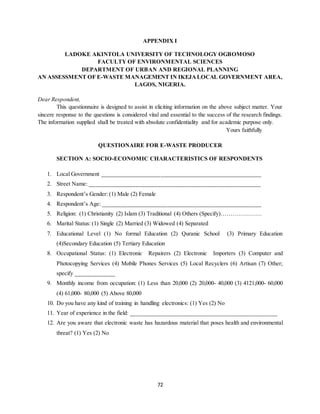
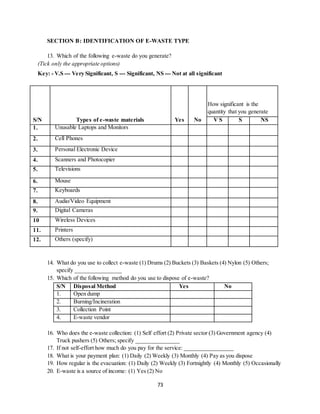
1.1 Background to the study
The alertness of environmental problems from inappropriate recycling of e-waste has
long been important topics for waste managers and policy makers in industrialized countries. It’s
only a few years ago, that international attention shifted towards the increasing e-waste problem
in emerging economies and developing countries. For Nigeria, attention was particularly
enhanced by the film “The digital dump” on e-waste imports and uncontrolled disposal in 2005
(Puckett 2005).
The rapid obsolescence of electronics goods, compounded by dumping of electronic
goods by the developed countries, has brought the e-waste problem in Nigeria into an acute
crisis. E-waste including computers, mobile phones and printers contain more than 1,000
different toxic materials and are non-biodegradable. Improper disposal or contact with these
materials can lead to contamination of the surrounding ecosystem and can be a major health
hazard. According to Greenpeace International Report (2005) study conducted found that toxic
heavy metals and organic compounds can be released from e-waste, particularly as computers are
broken down during the recycling and disposal processes.
In Nigeria, the consumption rate of electrical and electronic devices is increasing rapidly,
which is leading to rapidly growing e-waste volumes. According to the survey results of
component 1 and 2 of the E-waste Africa Project, Nigeria is by far the highest e-waste generator
in all West African countries. These quantities, along with the absence of environmentally sound
management systems for this particular waste stream, have manifold impacts on the
environment, local communities and the economic system in Nigeria. Although obsolete electric
2
and electronic devices undergo some basic form of recycling in Nigeria, many e-waste fractions
cannot be managed appropriately, which is resulting in the accumulation of large hazardous
waste quantities in and around major refurbishing and recycling centers. Furthermore, some
recycling practices – like the open burning of cables and plastic parts – cause severe emissions of
pollutants such as heavy metals and dioxins. Additionally, electrical and electronic equipment
contains a whole range of valuable metals like copper, palladium, gold, silver, indium and
germanium that are lost if not recovered in an early stage of waste treatment. Although the
current recycling practices mainly focus on the recovery of steel, aluminium and copper, they are
quite inefficient for other metals. On a global perspective, this loss of scarce metals has to be
compensated by intensified mining activities, which in turn have severe sustainability impacts in
mining areas worldwide.
Africa has been known as a dumping ground for toxic chemical and electronic waste
from developed countries with as much as 80% of world’s high-tech trash ending up in Asia and
Africa, with an estimated 65% and 35% getting into China and Nigeria, respectively (Uduma,
2007). The global market of electronic and electrical equipment over the past two decades has
continued to expand exponentially with the life span of these products becoming shorter and
shorter thus posing a new challenge to business and waste management officials (Bhutta et al,
2001; Hilty et al, 2004; Hilty, 2005) and indeed the soil and other environments.
The term electronic waste includes all types of obsolete, discarded or unwanted electronic
equipment. Electronic waste (sometimes called e-waste, waste electrical and electronic
equipment (WEEE) or e-scrap) has been defined as ‘an unwanted electronic or electrical
appliance that have been discarded by their original users such as old and outdated computers,
laptops, televisions, cellular phones, mp3 players, telecommunications equipment, keyboards,
3
mouse, photocopiers typewriters among others (PPCC, 2006; Ogbomo et al, 2012). Thus, used
computers, cell phones, radio sets, refrigerators etc. all constitute what is referred to as e-waste.
These items produce complicated multi-material waste with different proportions of metals,
plastics and glass. They can be polluting if they are not adequately treated before disposal.
Internationally, the rapid advances of electrical technology have created a rapid pace of
electrical and electronic equipment becoming obsolete and disposal of these items is becoming
more problematic. Majority of the e-waste contain items that could be recovered and utilized for
new products even though electronic equipment contains hazardous material capable of affecting
human health and the environment if not properly managed (PPCC, 2006; Ogbomo et al, 2012).
With the increasing quest for information Communication (ICT) for provision of
information Technology (IT) and networking service in addition to the ever increasing demand
for electronic gadgets in Nigeria, there is the need to put mechanisms in place to harness and
manage properly these material which when obsolete and unserviceable will add to the pool of e-
waste in the country.
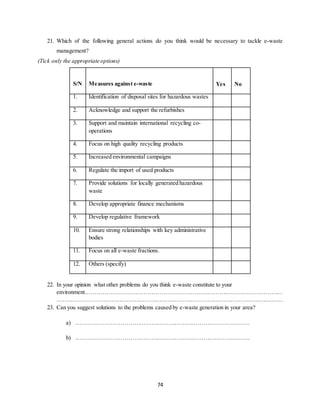
It is against this background that this study seeks to assess e-waste management in Ikeja
computer village of Lagos state, Nigeria.
1.2 Statement of the Problem
The amount of electronic products discarded globally has skyrocketed recently, with 20-
50 million tons generated every year. Electronic waste now makes up five percent of all
municipal solid waste worldwide, nearly the same amount as all plastic packaging, but it is much
more hazardous. Not only developed countries generate e-waste, also developing countries
(Greenpeace International, 2006).
4
E-waste is now the fastest growing component of the municipal solid waste stream
because people are upgrading their mobile phones, computers, televisions, audio equipment and
printers more frequently than ever before. Mobile phones and computers are causing the biggest
problem because they are replaced most often. In Europe e-waste is increasing at three to five
percent a year, almost three times faster than the total waste stream. Developing countries are
also expected to triple their e-waste production over the next five years.
Conservative estimates put the number of computers that arrives Lagos ports on monthly
basis at about 500,000; with about 75% of these being obsolete and unserviceable. Hence, they
end up being dismantled, and the residual scrap taken to land-fills and other dump sites (Cees
Harmon, 2015).
Collection and recycling of e-waste is almost exclusively carried out by non-registered
individuals widely referred to as “scavengers”. These collectors use handcarts and go from house
to house to collect metallic wastes. Usually, collectors pay small amounts of money for each
item. The collected materials are brought to scrap metal markets where they are dismantled to
recover materials such as steel, aluminum and copper (Cees Harmon, 2015).
Beyond the quick money (by way of refurbishing and re-selling some of the computers)
being made by the traders, one may literally shudder when the enormity of health hazards
associated with this trade is considered. It is pertinent to weigh the tradeoff between the sea of
disemboweled electronic gadgets that have been discarded, and virtually taken over the cities’
landscape and the hazardous substances (including heavy metals) to which these largely ignorant
traders are exposed to. Even when such discarded TV or computers parts find their way to dump
5
sites, the sites themselves are usually set ablaze indiscriminately, with the burning metals
producing fumes to be inhaled by all and sundry (Cees Harmon, 2015).
It is especially bothersome that the health hazards resulting from accumulation of e-waste
transcends the laborers working with the electronic devices. The practice for dealers in second-
hand electronic gadgets is to dismantle serviceable items, extract perceived valuable metals from
the equipment and send the remaining scrap to landfills or incinerators. Consequently, both the
laborers dismantling devices in the second-hand electronics market as well as scavengers and
members of the public within the vicinity of the landfills (or dumpsites) are exposed to many
chemicals and their negative health effects (Cees Harmon, 2015).
The damage done to the soil within the vicinity of the dumpsites is incalculable better
imagined than experienced. The significance of this trend can be better appreciated when viewed
against the frightening reality that just one-seventh of a teaspoon of mercury contaminates 20
water acres of lake, making the fish unfit to eat. High levels of lead, cadmium and mercury been
exposed to in the environment has been linked to adverse effects on human health and wildlife.
These include subtle neurobehavioral effects for lead, chronic kidney damage for cadmium, and
sensory or neurological impairments for mercury.
Electronics include a host of environmentally deleterious chemicals like mercury,
cadmium, lead, phosphors, arsenic, and beryllium. When they end up in a landfill, these
chemicals eventually seep into the ground and into our water supply. Some 41.5 million tons of
electronic waste was generated in 2011, and that number is expected to rise to 93.5 million by
2016, according to the research firm MarketsandMarkets. Right now, 70 to 80 percent of all that
old gadgetry goes straight to landfills (Christina Bonnington, 2014).
6
Waste electrical and electronic equipment (WEEE or e-waste) is one of the largest and
most socially- and environmentally-problematic waste streams in the world today (StEP
initiative, 2007).
The question to be answered by this research is:
- What is the available e-waste in the study area?
- What is the condition of e-waste composition, generation, and method of disposal in
the study area?
- Who are the stakeholders in the management system and what are their roles in e-
waste management?
- How can the management of this e-waste be improved upon in the study area?
1.3 Aim and Objectives
The aim of this study is to assess the e-waste management in Ikeja Area of Lagos State,
Nigeria with a view to suggesting appropriate strategies on efficient management of e-waste.
In order to achieve the above stated aim, the study focused on the following objectives;
1. Assess the socio-economic characteristics of the respondents.
2. Identify the incidence and spatial variation of e-waste.
3. Evaluate the roles of the stakeholders in the management of e-waste in the study area.
4. Examine method of disposal and management in the study area.
5. Recommend measures towards sustainable and healthy e-waste management in the study
area.
7
1.4 Research Hypotheses
For the purpose of this research work, the following hypothesis was stated
 There is no variation in the incidence of e-waste in the study area.
1.5 Justification of the Study
The study will create awareness on condition of e-waste management and their negative
impact in ikeja. Awareness will be created on the dangers of indiscriminate e-waste dumping in
the environment without any effort to educate the public on modern e-waste disposal methods.
The study will contribute on existing literature on e-waste management and processing in
Nigeria. Ikeja Computer village is a transit point for electronic devices to all 37 states in Nigeria
and neighboring West African countries.
The study area will be considered suitable for two major reasons;
i. Its population size – it is a highly populated area with so many compact e-waste
generator.
ii. Its location – being an area within the metropolis of the administrative capital of Lagos
State thereby placing it in a strategic economic region and it level of international
recognition. These two characteristics of the study area will afford the carrying out of a
comprehensive study like this.
According to Afon, Abodunrin and Kollie (2001), in their research on urban solid waste
management in Nigeria, revealed that poverty is the main cause of waste and their research
focused on the investigation of the effect of poverty as an urban problem on solid waste
management in term of volume and composition of solid waste generation, storage and disposal
strategies.
8
1.6 Scope of the Study
The scope of this study covers eight (8) street located within Ikeja Computer Village
which is located within Ikeja Local Government area in Lagos State. The eight streets which
includes; Obafemi Awolowo way, Francis Street, Adepele Street, Ola Ayeni Street, Oshitelu
Street, Oremeji Street, Kodeosho Street, and Simbiat Abiola road were chosen purposively to
represent the Ikeja Computer Village. The Ikeja Computer Village was chosen as a result of it so
many compact e-wastes which includes; Unusable Laptops and Monitors, Cell Phones, Personal
Electronic Device, Scanners and Photocopier, Mouse, Keyboards, Digital Cameras, Wireless
Devices, Printers and others.
1.7 The Study Area
Lagos State is sandwiched by latitudes 6 22’N and it straddles longitudes 2 42’ to 4
20’E. It is bounded in the North by Ogun State and in the east by Ondo State. It shares an
international boundary of about 45 kilometers with the Republic of Benin while the vast, deep
blue Atlantic ocean constitute the approximately 180 kilometers long southern limit. Although,
the total land area is just about 35,773g km yet creeks, lagoons and estuaries constitute nearly
800 (22) 5gkm.
1.7.1 Geographical Location
Nigeria has 36 states in which Lagos is one, Nigeria is located wholly in the tropics
between latitude 4 N and 14 N. this location gives the country an environment that is ever
warm, sometimes humid and enervating. The location gives the country almost equal numbers
of hours of day and night with few hours of twilight. It also makes the Republic of Benin her
western neighbor, the Cameroon republic on the eastern side, the Sahara desert is the northern
boundary and the gulf of Guinea, an arm of the Atlantic Ocean, its southern boundary.
9
Although, Lagos State covers just 0.4 percent of Nigeria, a mere 3,577 square kilometers, out of
which one quarter is liquid surface; lagoons, creeks and coaster river estuaries. It contains
within its tiny territory about 50 percent of banking, industrial and commercial activities of the
country. More than 90 percent of banking and financial institutions have their headquarters in
Lagos.
1.7.2 Historical Background of Lagos state
With the attainment of independence in 1960, Lagos became the capital of the Nigeria
federation. Consequently, the economic activities of Lagos played a prime role in the economy
of Nigeria. In Lagos at this time, there existed many banks, various companies like UAC, AG
Leventis, John Holt, SCOA, CFAO and many oil companies like Agip, British Petroleum,
Texaco and other prime movers of the Nigerian economy established in the headquarters in
Lagos. To this extend, Lagos played a dominant role in the Nigeria economy. By 1967, when
Lagos state was created, many things started to change. The old- western Nigerian government
strongly criticized the creation of the state saying that it will not be viable. But today, Lagos
state is the evidence that the western Nigerian government was merely making sentimental and
political statements.
There existed in Lagos state today the largest industrial estate in Africa at Apapa and
Ikeja. And there are newly developed industrial estate of Matori, Ilupeju, Gbagada and Isolo
industrial estate. These industries engaged in the production of products ranging from textiles,
tobacco, tea, milk, cocoa produce, plastic, paints, building materials, soft- drinks, alcohol and
many small and medium scale industrial outputs. Today, the Lagos economy is clearly the
biggest in Africa. Alongside, these industries also exist in government establishments that now
provide jobs for thousands of Lagosians. In addition to all these industries and government
10
establishments, there existed many traders in Lagos along Balogun, Kosoko, Martins and
Nnamdi Azikwe streets on the Lagos Island. Coming to the mainland, one will see large
markets like the Oyingbo, Ojuwoye and Awolowo in Mushin area. In Isolo area, we noticed
Ajegunle, Orile and Alaba market. In Oshodi, there existed kayero market and the largest open
market in Africa along the railway- line in oshodi. In Ikeja, there is Alade and Ipobo markets in
Agege, one will see the Agege and Ayobo markets. In all the market mentioned, there existed
various articles one can think of ranging from agricultural to manufactured articles.
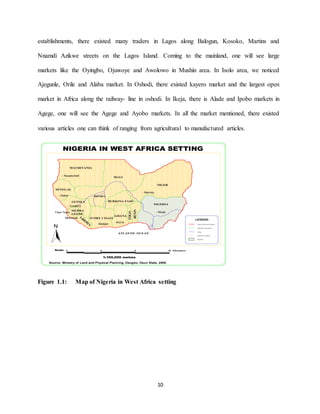
Figure 1.1: Map of Nigeria in West Africa setting
#
#
#
#
#
#
#
#
#
#
5 0 5 10 Kilometers
N
NIGERIA IN WEST AFRICA SETTING
Nouakchott
Dakar
Conakry
Free Town
Monrovia
Abidjan
Accra
Bamako
Niamey
Abuja
MALI
SENEGAL
GUINEA
SIERRA
LEONE
IVORY COAST
GHANA
TOGO
BENIN
NIGERIA
BURKINA FASO
NIGER
MAURITANIA
LIB
E
R
IA
W e st A fr ica B oun da ry
N ation al Bo un dar y
R iver
N ation al C ap ital#
N ige ria
LEGEND
Source: Ministry of Land and Physical Planning, Osogbo, Osun State, 2009.
Scale:
1:100,000 metres
ATLANTIC OCEAN
11
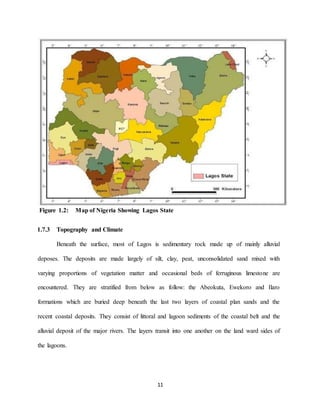
Figure 1.2: Map of Nigeria Showing Lagos State
1.7.3 Topography and Climate
Beneath the surface, most of Lagos is sedimentary rock made up of mainly alluvial
deposes. The deposits are made largely of silt, clay, peat, unconsolidated sand mixed with
varying proportions of vegetation matter and occasional beds of ferruginous limestone are
encountered. They are stratified from below as follow: the Abeokuta, Ewekoro and Ilaro
formations which are buried deep beneath the last two layers of coastal plan sands and the
recent coastal deposits. They consist of littoral and lagoon sediments of the coastal belt and the
alluvial deposit of the major rivers. The layers transit into one another on the land ward sides of
the lagoons.
12
However, the main relief features of the states is the low lying nature of its terrain more than
half of the entire has an elevation below 15 meter above the mean sea level most of the area
along the sea line hardly rise to five meters above the sea level.
The major problem arising from this physical environment is perennial flooding,
especially during the long rainy season. Since the surface is flat, the rain water cannot “run-
off”. And because the water table is high due to proximity to the sea, the water cannot percolate
quickly enough to keep dry surfaces by the large population present; through road construction,
concrete floors.
In addition to blocked drainages and creeks. Rain water that can neither run- off nor sink
into the ground can only form at the surface to be removed only through the slow process of
evaporation. Lagos state is located within the wet equatorial climate require which is
characterized by high temperature, high humidity and heavy rainfall with double maxima. For
the area, the specific determinant factors are: the proximity to the equation, the gulf of Guinea
and the influence of the rain bearing south- west trade wind. To a less extend, the effect of the
harmattan bearing north- east trade wind is usually noticeable in the area between November
and January, other factors include land use change, pollutants in the atmosphere and the
topography.
Lagos state is located within the equatorial climatic regime which is characterized by
high temperature, high humidity and heavy rainfall with double maxima. For the area, the
specific determinant factors are: the proximity in the equator, the gulf of Guinea, and the
influence of the rain bearing north-east trade wind is usually noticeable in the area between
13
November and January, other factors include land use change, pollutants in the atmosphere and
the topography.
1.7.4 Rainfall
While there is no month that is totally dry, the rainy season in Lagos state generally
covers April to October with a short cool but dry spell in August, the rainfall figure drops from
247.166mm in July to mere 86.11mm in the month and picks up to 159.07 in September. This
phenomenon is usually referred to “August break” the amount of rainfall in the first peak period
(1125.28mm) is usually more than in the second peak period (409.14mm).the mean annual
rainfall in Lagos is 1620.59mm, but this is with some variations from place to place
Another rainfall characteristics is that for most months except March the probability of
rainfall in Lagos is higher at night and early morning than in the afternoon or evening and June
is the peak month
1.7.5 Temperature
Temperature is constantly high in the state; this is a common feature of the tropic
climate. The range is further narrowed due to proximity to the sea which mitigates temperature
extremes. This averages duly temperature is 27.60C. The maximum and minimum daily
temperatures are 29.60 C and 24.50 C respectively while the range is recorded during the popular
“August break”. The uniformity of the temperature is demonstrated by the fact that the
minimum values are generally higher than the lowest daily maximum temperatures.
14
1.7.6 Humidity
Humidity is the amount of water vapor in the air while Relative Humidity (RH) is the
amount of water vapor held in the relationship to the total amount the air condition hold. This
climatic element is very important because it determine the rate at which perspiration
evaporates. This has been used extensively to determine the degree of human comfort.
Extremely low humidity creates excessive dry skin and lips as prevalent during the harmattan
season, while high humidity and high temperature have been found to be very enervating.
Consequently, schools have shown great interest in weather element of temperature and
humidity: Olaniran in Ilorin, Oguntoyinbo at Ibadan, Oke in Mentreal and Adeigbe in Lagos.
(Source: Nigeria Melereologicalser 2001).
Generally, Relative Humidity (RH) is very high in Lagos being a tropical close to the
sea. Although there are variations in RH from point to point, the disparity is more significant in
respect of the hour of the day. The recorded extremes are for 07.00 hours when it is very high
and 01300 hours when it is very low. This is so because the higher the temperature the higher
the capacity of the air mass to hold water hence RH normally record lower figures in the
afternoon. The mean RH ranges from 76% to 80.5%. The morning hours recorded annual
average of 90% while 01300 hours has annual mean of 719.
1.7.7 Key Environmental Challenges in Metropolitan Lagos state
Lagos is the one of the world’s largest cities and the economic centre of Nigeria. With
its 17.5 million inhabitants and considerable economic growth rates in the last years, the local
consumption of electrical and electronic equipment (EEE) reached high levels in absolute
figures. While this growth is desirable from a development perspective and in particular
regarding living standard and access to Information and Communication Technologies (ICTs),
15
it also raises the question on sound end-of-life solutions which are not yet in place in the
country.
In addition to the local consumption, Lagos has developed into West Africa’s main
entry point for used and end-of-life electrical and electronic equipment. Although this
equipment is mostly refurbished and sold to households and traders from Nigeria and other
West and Central African countries, this sector generates significant amounts of e-waste, a
problem that was first brought to public attention in 2005 with the film “The digital dump” by
the NGO Basel Action Network (BAN).
Although, the rapid growth witnessed by Lagos State has been a boost to its economy,
Lagos has also had to grapple with an array of environmental challenges arising from its
growth which could be described as astonishing. The need to ensure that development efforts
are carried out with utmost concern for conservation of natural resources in the state in
particular for the sustenance of the environment in general therefore becomes opposite. Some
of the environmental challenges the state has to grapple with include; overcrowding and
unplanned human settlement; sprawl development arising from rapid population growth; poor
sanitation in slums/blighted communities and increase in the number of settlements requiring
regeneration/renewal, the low lying terrain of Lagos and its implication on storm water
management and flooding control; threats to and abuse of wetlands arising from human
activities; pollution of surface and underground water bodies; as well as land and the
atmosphere pollution arising from domestic, commercial and industrial activities. Ways of
ameliorating these problem vary from; attitudinal change and re – orientation among key
players/stakeholders to adopt or adapt sustainable resource utilization strategies; as well as
communicating the negative implications of climate change; building strong institutional
16
framework for policy formulation and implementation; funds to sustain the delivery of public
utilities/key services like water supply; solid waste management, environmental beautification
and so on; increasing poverty among urban and rural dwellers and its implication on resource
utilization/consumption vis – a – vis energy, sanitation; paucity of reliable data for effective
environmental planning and management.
1.7.8 The Historical Background of Ikeja
Historically, Ikeja consists of seventy-eight communities and the earlier settlers are the
Aworis, who migrated from Isheri in Ogun state. Some of the traditional settlement includes
Ipodo, Alausa, Olusosun Oregun, Ojodu, Onigbongbo etc. However, the population of the
Aworis is now a minority, given the enormity of migration and urbanization in the area. The
name “Ikeja” was derived from Akeja Onigorun, one of the ancestral gods of Aworis in the Ota
home land,.Ikeja became the capital city of Lagos state in 1976 after the creation of 19 states in
the country and since then, there industrial and commercial hub of the state.
Today, Ikeja has been classified as one of the major city of the world (UN-HABBITAT,
2004) particularly in the Nigeria news daily. This might be attributed to the fact that the new
Lagos mega city will have it root from the area, because it is the administrative capital and one
of the most populous cities in the world, which is Lagos state. It has also attracted development
in terms of upgrading and beautification. Ikeja is located at approximately 300 30 west latitude
700 70 north. It lies in the upland area of Lagos state. It is at the south-facing scarp slope, which
is a part of the coastal plans.
Ikeja can be classified as a high area. The heavy industrial establishment at the L.G.A
makes it one of the most important areas for manufacturing activities in the entire federation. It
also forms the hub for emergence of the proposed megacity in Lagos. With the classification of
17
the city in a model city and the development of model city plan for Ikeja (NTDA, 2012), it will
soon find its place among major economic cities of the world.
1.7.9 Ikeja Computer Village
Ikeja is home to a large computer market, popularly known as Otigba. Begun in 1997 as a
small market of only 10 shops, the current market now has well over 3000. While most vendors
provide the expected computer sales and repair services, it is also possible to find sales and
repair services for various types of office equipment and electronic devices.
As the market is unplanned, it has experienced growing pains. Some local residents are
upset at the expanding market. Traffic around the area has become very congested, and it can be
almost impossible to find a place to park. The electrical infrastructure, already overloaded and
unreliable, has become highly stressed with the new market. Computer and electronics stores
require power to work on computers and demonstrate their products to potential customers, and
this added load has made the supply erratic.
Ikeja Computer Village, with a size of about 1.1 km, is no longer completely residential
but occupies well over 3,000 businesses in new computers, mobile phones, printers and
communication equipment. The market serves as an outlet for Lagos and Nigeria as well as the
neighboring West African countries.
18
Figure 1.3: Map of Lagos State showing Ikeja LGA
19
CHAPTER TWO
CONCEPTUAL FRAMEWORK, LITERATURE REVIEW AND THEORETICAL
FRAMEWORK
2.1 Conceptual Framework
2.1.1 Concept of e-waste
Waste refers to anything that is no longer privately valued by its owner or has reached its
end-of-life (Porter, 2002). ‘Electronic Waste’, or e-waste, is therefore an end-of life electronic
product that has ceased to be of any value for its owner.
There is considerable ambiguity on what constitutes e-waste. The two main issues of
contention are:
1. What constitutes an electronic appliance?
2. When does an appliance become waste?
Referring to the first question, often e-waste is restricted to old electronic products like
computers and TVs (‘brown goods’), while excluding products such as washing machines or
refrigerators (‘white goods’). However, this brown and white distinction is blurred when one
considers an oven with an electronic control panel. As a result, most legislation treats both
discarded electrical and electronic equipment as a largely similar and overlapping waste stream.
According to the Basel Action Network, ‘E-waste encompasses a broad and growing range of
electronic devices ranging from large household devices such as refrigerators, air conditioners,
cell phones, personal stereos, and consumer electronics to computers which have been discarded
by their users’ (Puckett and Smith, 2002). While this definition gives an indication of what could
be the constituents of e-waste, a more precise definition is necessary not only for legal, but also
20
for practical purposes. Thus, a more rigorous definition of e-waste could be any appliance using
an electric power supply that has reached its end-of-life (OECD, 2001).
Rose & Stevels’ attempted the second question regarding when a product reaches end-of-
life. Their definition states that a product’s end-of-life is ‘the point in time when the product no
longer satisfies the initial purchaser’. However this does not accommodate appliances which
have reached the end-of-life for their initial purchaser, but are still useful to second or third hand
buyers. Just because the utility of a durable good has fallen to zero for its current owner, it does
not mean that it holds no positive value for anyone else. Therefore, current user instead of initial
purchaser is more accurate statement of ownership. Therefore, according to (Deepali Sinha,
2004) which says e-waste is ‘an electrically powered appliance that no longer satisfies the
current owner for its original purpose’.
2.1.2 Importance of e-waste management
E-waste has been put on the priority waste streams list, and is among the fastest growing
waste streams (EEB, 2001). Managing e-waste encompasses not just the disposal or recycling,
but also the pre-disposal logistics involved in collecting and transporting the waste. It also
includes strategies for reducing the total waste generated, in line with the 4R principle - ‘Reduce,
Recover, Reuse and Recycle’. Organized management of e-waste is necessary because of several
reasons:
a) The growing volume of e-waste:
With the growth of the electronics industry, the quantities of discarded electronics have also
grown. Rising incomes and falling prices of electronic products have ensured that more people
are able to afford electronics. Furthermore, rapid technological progress has resulted not only in
a multitude of new electronic products but also reduced their lifespan, making products obsolete
21
faster. In addition, substantial quantities of discarded electronic equipment which had been
stored away in garages and basements for lack of better disposal options are being taken out.
b) Resource depletion:
Waste is regarded as a resource which should and could be reclaimed (Lindhqvist, 2000).
Though disparate in their composition, electronic and electrical products contain valuable metals
such as gold and silver as well of hundreds of other materials. However, these can be broadly
categorized as plastic, ferrous metal, non-ferrous metals, precious metals and glass. Studies in
Switzerland show more than 50% various metals, plastics and plastic metal mixtures of 20%,
CRT glass of 9% and the rest consisting of various other substances (SENS report 2003).
c) Health and environment hazard:
The main environmental concerns related to the management of electronic waste are the
uncontrolled release of hazardous substances into the environment and the sub-optimal use of
recyclable materials. Incorrect disposal can be extremely hazardous for the environment and
health. Documented health hazards include various kinds of ailments from coming in contact
with toxins such as cadmium, mercury, lead and dioxins and furans among others, emitted when
land filled or incinerated. Recycling e-waste is also dangerous and care needs to be taken to
prevent emissions and effluents from the processing.
d) Trans-boundary movements of e-waste:
NGOs (BAN, Toxics Link) and newspaper reports (San Jose Mercury News, NZZ, Time of
India, Indian Express) have all found the alarming volume of e-wastes being shipped from one
country to another, mainly from developed countries to developing countries. This is not only
considered illegal in many countries – exporting as well as importing; it goes against the
principal of environmental justice. This trans-boundary movement is particularly dangerous
22
because the recipient countries often do not recycle and dispose the waste in an environmentally
sound manner, which is not compatible with the standards set in the country of export.
2.1.3 Methods of e-waste Disposal
In 1990s, governments of the EU, Japan and some of the US states set up E-waste 'recycling'
systems, whereas, a large member of countries did not have the capacity to deal with the sheer
quantity of E-waste they have generated or with its hazardous nature. Therefore, they began
exporting the issue to developing countries, where laws to protect workers and the environment
are inadequate or is not enforced. It is also cheaper to 'recycle' waste in developing countries; the
cost of glass-to-glass recycling of computer monitors in the U.S. is ten times more than in China.
Demand in Asia for electronic waste began to grow, when they found out that they could
extract valuable substances, such as, copper, iron, silicon, nickel and gold during the recycling
process in scrapyards. A cell phone, for instance, contains 19 percent copper and eight percent
iron. Almost two million tonnes of E-waste were landfilled in 2005, that is, while toxic materials
comprise only a small amount of this volume, which does not take much lead or mercury to
contaminate the soil of an area or water supply. One should keep this in mind, when deciding
what to do with those old electronic devices.
(i) Landfill
According to the US EPA [14], more than 4.6 million tonnes of E-waste ended up in the U.S.
landfills in 2000. Toxic chemicals in electronic products can leach into the land over time or are
released into the atmosphere, impacting nearby communities and the environment. Regulations
have been declared to prevent electronic waste being dumped in landfills due to its hazardous
content in many European countries. However, the practice still continues in numerous countries.
23
In Hong Kong, for example, it is estimated that 10-20 percent of discarded computers penetrate
into landfill.
(ii) Incineration
This product releases heavy metals, such as lead, cadmium, mercury and also into the air.
Mercury released into the atmosphere can bio accumulates in the food chain, particularly in fish -
the main route of exposure for the general public. If the products contain PVC plastic, highly
toxic dioxins and furans are also released. Brominated flame retardants generate brominated
dioxins and furans when E-waste is burnt.
(iii)Reusing
Increasing a product lifespan is a desirable method. Many old products are exported to
developing countries. Although the benefits of reusing electronics in such a method are clear, the
practice causes serious problems, because the old products are dumped after a short period of use
in the areas that are having hazardous waste facilities.
(iv)Recycling
Although recycling can be an appropriate way to reuse the raw materials in a product, the
hazardous chemicals in E-waste can be harmful to workers in the recycling yards, as well as their
neighboring communities and environment.
Electronics recycling is carried out particular built recycling plants under controlled
conditions in developed countries, for example, in many EU states. In order to avoid brominated
furans and dioxins being released into the atmosphere, plastics from E-waste are not recycled.
However, such contacts are not available in developing countries. Recycling is conducted by
hand in scrapyards, often by children.
24
(v) Exportation
E-waste is routinely exported to developing countries by developed ones, often in violation
of the international law. Inspections of 18 European seaports in 2005 found the amount of 47
percent of waste destined for export, including E-waste, which was illegal. In the UK, at least
23,000 metric tonnes of undeclared or 'grey' market electronic waste was illegally shipped to the
Far East, India, Africa and China. It is estimated that, 50-80 percent of the waste collected for
recycling is being exported in this way in the US. This practice is legal because, the US has not
ratified the Basel Convention.
2.1.4 Challenges on management of E-waste
There is no logical and strict legislative framework to determine the collection and disposal
of E-waste generated from commercial buildings. In order to have a developed country, much
more efforts are needed, so as to legislate on protection of the environment, particularly, lack of
infrastructure for the collection of the end of life products, as well as, facilities to dispose such an
environmentally sound manner in the EE sector.
Controlling over raw materials, used in manufacturing is significantly important to reduce
waste generation that is while, reduction of hazardous materials will ultimately lead to reduce of
the waste generated quantity with the advent of inventory management. Production and related
process modification will change production process, which will lead to reduction of waste
generation. Improving operation and maintenance procedures, material change and process-
equipment, modification, volume reduction, techniques used to diminish some areas of waste-
stream volume are as follows:
25
Source segregation waste containing different types of metals can be treated separately to
recover metal value. Waste Concentration-Concentration of waste stream to increase recyclable
and reusable material.
a) Recovery and Reuse
Waste can be recovered on-site, or off-site recovery facility or through industry exchange.
Physical and chemical techniques, such as electrolysis, reverse osmosis and filtration could be
used to reclaim a waste material. Metals, such as copper, in PCB manufacturing could be
reclaimed using electrolytic recovery.
Many parts of discarded computers and television sets can be re-employed for newer
products either in the same state or by passing through a revamping process. However, at present
in many of the developing countries (even in developed countries) there are no proper
mechanisms to collect the material in such a way that the stocks can be classified and deliver to
processing centers for re-using. Such mechanism will not only reduce the addition of waste into
the surrounding but also increase the job opportunities to the public.
b) Sustainable Product Design
Products should be designed in such a way that defected parts could be troubleshooted and
replaced component wise. However, in the modern world the trend is towards integration of all
parts, thus addressing individual components at trouble shooting stage is almost impossible. The
result is the discarding of a large part of equipment or the equipment itself, which adds more
burdens into the waste management. However, it is advisable to reverse this trend up to some
extent (considering cost constraints and physical factors) so that components can be examined
and replaced individually, in the future. However, note that integration of electronics also has its
own advantages such has greatly reducing the amount of material needed for a given task.
26
It is also recommended to design equipment powered by rechargeable batteries in place
of disposable type wherever possible. That will considerably reduce the addition of heavy metals
and acids into the environment.
It is also the high time to look for a more environment friendly and less or no toxic
replacement for lead as a soldering medium.
Following are the other recommendations make for sustainable eco-friendly producing
1. Designing products with less hazardous and less quantities of materials: E.g.: Reduce
material for new computer design by flatter, lighter and more integrated components.
2. Use of renewable materials and energy: E.g. Bio based materials, as bio plastics made
from plant-based polymers and the use of solar energy.
3. Use of no-renewable materials that are safer: Designers should ensure that such a product
ais manufactured for reuse, repair/or upgradability.
4. Use of bio-degradable materials in non-conducting parts of equipment: E.g.
Biodegradable polymers for equipment covers and PCB bases.
c) Policies of E-wastes
Malaysia does not allow importation of used electronic and electrical equipment’s into the
country for direct reuse, unless the date of providing such equipment is not more than three years
from the date of its manufacture. Also, the import of E-waste for recovery or disposal is
disallowed. This policy is described under the “Guidelines for the Classification of Used
Electrical and Electronic Equipment in Malaysia”, published by the Department of Environment
in 2008.
27
Since, there are already recovery facilities established to process and recover useful materials
from E-waste in Malaysia, it is also the policy of the Malaysian Government not to allow E-
waste to be exported out of the country. If the local recovery facilities do not have capability and
capacity to carry out such activity, Malaysia will only allow the exportation of E-waste for
recovery overseas. The E-waste generator/exporter must be able submit proves before the
Department of Environment can allow E-waste to be exported.
2.1.5 Contemporary Electronic Waste Management System at Bangalore
The authors conducted a comprehensive study of the existing e-waste management
system in Bangalore. The study provides insights into the existing e-waste practices of the
various stakeholders in the system. Figure below illustrates the existing e-waste management
system in Bangalore and the following paragraphs discuss the same.
Fig 2.1 Electronic waste management system in Bangalore
28
Informal Recyclers: The Hindu Report (2005) says that “The e-wastes produced in
small and medium sectors mainly end up with the informal recyclers where recycling is done in a
very crude and hazardous manner causing danger to not only to the environment but also to the
people involved in the recycling activity”. The e-Waste Guide reports that “The informal sector
is handling and recycling over 95% of India’s e-waste which is not only generated within India,
but imported illegally as well. As 94% of Indian companies still do not have an e-waste disposal
policy, this material has captured the attention of the large, existing network of the informal
sector. It is estimated that around 25,000 people work in the informal e-waste sector and earn
wholly or partly their living out of it, as per an e-waste case study Bangalore city. However e-
waste has been kept away from the dump sites so far. But, its activity still generates a high
environmental and social impact (use of toxic chemicals, poor working conditions, child labour,
etc.)”.
The study conducted by the authors, zooming in on the small scale generators of e-waste
further reveals the channels that enable movement of e-wastes to the informal recyclers include
Kabadiwalas, Rag-Pickers and Auctions. Rag-picker picks discarded waste from local garbage
dumps or open fields. Kabadiwala goes door-to-door and collects waste including papers, bottles,
and medium sized electronic items from households in exchange for money. Various
organizations dispose the waste including the e-waste through auctions. In the existing system
the e-wastes collected by the Rag picker or the Kabadiwalas end up in the hands of informal
recyclers through Local Waste Marts and the K R Market. Thus, new channels have to be
developed and the existing channels should be tweaked to ensure that e-wastes end up with
authorized formal recyclers.
29
Electronic Goods Supply Chain: In a pilot study conducted by the authors, 50
organizations in Bangalore were considered. The objective of the study was to understand the
prevailing reverse logistics practices in the electronics goods manufacturing and selling
organizations. The general response includes: 58% of the companies do not want to recycle or
retreat the products since they feel that this activity involves additional cost, 32% of companies
follow the strategy of purchase recyclable products and design products which are environment
friendly and 6.9 % of the companies opt for pre-design, through which they focus on designing
the product that can be completely recycled.
The systems of reverse logistics prevailing in various organizations; 47% of the
manufacturing companies responded that those organizations do Remanufacturing/Refurbishing.
Majority of the retailers and wholesalers sell the returned products to brokers who are part of
informal channel resulting in disposing the returned product in an unscientific manner. Some
companies (0.58 %) throw to land-fill which indicates the apathy towards environment. The
barriers to initiate the scientific reverse logistics practices were listed; more than 30% of the
companies feel that lack of financial resources, 52% attribute to the absence of a comprehensive
system, 10% indicate management inattention and 30% of the companies have mentioned more
than one barrier.
The primary goal of reverse logistics activities; 42 % of the companies responded that
they are proactive i.e. their main focus is on satisfying the customer needs by involving them in
the design stage. 33% are reactive and focus on complying with the existing laws and competing
with others. 18% are value seeking and develop products that are completely recyclable and
include the environmental aspects in to business strategies. The responses for why they initiate
reverse logistics practices; 72% say protect margin, refurbishing the returned products or selling
30
the components of the products. 47% opt for competitive reasons, 27.7% recapture of value in
the returned products, 11.1% feared Legal disposal issues and 8.3% wanted to build clean
channel image.
Domestic Users: The authors performed a survey of 250 household across Bangalore
using random sampling. The focus of the survey was to study the buying and disposal pattern of
the electronic products and to assess the e-waste awareness among the domestic users. The main
residential areas in Bangalore were considered for the study. The survey threw light on the
product usage, purchase and disposal awareness of the toxic substances present in the e- waste
and knowledge of the hazards to human health and the environment and the peoples’ expected
value from the products that were disposed and/or recycled. The analysis shows that most of the
people are aware of the hazardous materials present in the electronics products but only a few
actually knew the practices adopted to recycle this waste. The type of collection center preferred
by the people to dispose of these wastes was also obtained. Three feasible alternatives were listed
for the people to dump their waste:
1. Door-to-door type of collection system, where a mobile vehicle would collect the e-waste
right from the doorstep;
2. Stationary collection points and the people bring their wastes to the points. The stationary
system was of three types: Temporary collection center, Permanent collection center,
Non-profit collection center;
3. Mobile collection system, where in a vehicle would come to the central part of an area on
certain days and people have to take their e-waste to that point to dispose. These vehicles
would operate either in milk runs or in specific location coverage;
31
The results reveal that a large percentage of the users preferred the mobile collection to the
stationary and door-to-door collection.
2.2 Literature Review
In Nigeria, an estimated 500 containers of second-hand computer related electronic
equipment of various states of condition and age enter the country each month. Most of it ends
up in Lagos the computer village, Ikeja. On average, each contain about 800 computers and
monitors which amounts to about 400,000 arriving each month or 5 million units a year (Puckett
and Fogel 2005; Osibanjo & Nnorom 2007). In 2005, more than 1,000 units of used television
sets on average arrive every day in Nigeria. And these figures apply only to television sets and
not the total amount of electronic waste (computers, printers, scanners, photocopiers, monitors,
typewriters, mouse, keyboard etc.) (EEA 2009)
According to Wooddell (2008) he categorized e-waste as high-tech trash that includes
cast-off Televisions, Computer, Monitors, Printers, Scanners, Keyboard, Mice, CPU, Fax
Machine, Pocket Computers (PDA) walkie-talkies, baby monitors, certain kinds of watches and
cell phones. In other words, anything digital that is no longer being used. Also Wikipedia (2010),
categorized e-waste into computers, entertainment device, electronic, mobile phones and other
items such as televisions, scanners etc. discarded by their original owners.
African countries still lag behind when it comes to enacting legislation to deal with E-
waste. This is despite well documented evidence showing that certain African countries have
been the recipients of near end of life electronics which are illegally exported from various
affluent nations. It has been observed that informal collection, dismantling and recycling of E-
waste is beginning to take shape in several countries such as Ghana, Kenya and Nigeria. In South
32
Africa, there is both formal and informal mobile phone E-waste recycling taking place (BAN,
2005; Nnorom and Osibanjo, 2008).
L.-G. Scheidt, et al. (1995) reported that “CARE “VISION 2000” (Comprehensive
Approach for the Recycling of Electronics) at Europe is to increase the value of recycling by
driving down costs, reducing the amount of e-waste and hazardous material and thus the impact
on the environment. Ultimately, the objective of CARE “VISION 2000” is to transform
recycling into an industrial system.”
Rickard Svensson, et al. (2005) reported that “Most of the Waste Electrical and
Electronic Equipment (WEEE) in Sweden are collected at manned recycling centers, which play
a key role for the downstream handling in order to ensure high collection rates of WEEE and a
proper initial sorting. The Swedish concept for collection of WEEE is based on manual work
which is quite risky for the employees”.
2.2.1 E-waste and new concepts of creating value
A significant proportion of studies on e-waste management have focused on themes of
negative health effects and toxicology as well as on themes of environmental justice (Lepawsky
and Billah, 2011). In West Africa, this is reflected in the works of Fuhriman (2008), Nnorom and
Osibanjo (2009) and Robinson (2009) to name a few. Additional studies like that of Williams
(2004, [cited by Lepawsky and Billah, 2011] address the energy flows in production of
electronics and in the disposal process. However, Lepawsky and Billah (2011) highlight the need
to also address e-waste recycling from a perspective that does not automatically assume
electronics to be valueless after they stop functioning. The very fact that informal waste
recycling occurs in developing countries is proof of this.
33
In light of this, recent studies have begun to re-assess the way used goods are analysed in
the production chain. Various authors (Crang et al., 2002; Gregson et al., 2007; Lepawsky and
Billah, 2011) challenge the idea of a unidirectional global production network in which
electronic goods are dismissed as valueless after they have stopped functioning. Lepawsky and
Billah (2011) suggest instead that value is created not just in the assembly of products but also in
the process of disassembly. Furthermore, there is a need for theories on commodity and value
chains to be analyzed within their social and spatial contexts of production which consequently
attaches a deeper meaning to goods otherwise considered as waste (Lepawsky and Mathar,
2011). As opposed to analyzing e-waste in the global production and value chain network as
linear with pre-defined beginning and end points, Lepawsky and Mathar (2011) thus advocate for
analytical thinking characterized by ‘boundaries and edges.’ In the case of e-waste management,
thinking in terms of boundaries and edges means having no pre-set notions that there is a
theoretical end point at which one expects to find valueless waste.
Rather than value being intrinsic to these goods, it is generated along the production
network as the products are reused for different things (Lepawsky and Billah, 2011). Empirical
studies in Bangladesh (Lepawsky and Billah, 2011) and Canada (Lepawsky and Mather, 2011)
illustrate the complex multi-directional and non-linear processes that convert end-of-life goods
into resources that are used for production of other goods.
2.3 Theoretical Framework
The literature on production networks and its role in the international trading system has
been analysed using different theoretical frameworks. Hopkins and Wallerstein (1986) defined
the production network as ‘commodity chains’, i.e. “a network of labour and production
processes whose end result is a finished commodity”. In this approach, the chain links together
34
different productive activities and agents. It particularly puts emphasis on labour as a significant
input in commodity chains, highlighting its function as a production factor. The commodity
chain approach described by Hopkins and Wallerstein identifies them as being a sign of the
emergence of modern capitalism, and not a distinctive feature of the last decades.
Porter (1985) proposed the ‘value chain’ definition as a practical tool to analyze the
relationships between various actors and activities within a specific organisation. Porter’s
analysis paid attention to the internal functions of the organisation and on how each single
element of the production chain could achieve maximum efficiency. This, in turn, would bring
about successful management of the organisation. Porter’s value chain approach contained an
element of international coordination defined as ‘value systems’. This means recognizing the
inter-firm linkages between each individual firm in the chain and its suppliers as well as its
distributional channels. Porter did not clearly mention labour as an element of value chains, but
assumed labour as a factor of production that can facilitate the increased efficiency of each
activity of the value chain.
Gereffi (1994) introduced the global commodity chain (GCC) concept. From this
perspective, actors not only interact with each other but also with world markets, making them
the “infrastructure of international trade”. According to this approach, GCCs are defined by three
dimensions: (i) an input-output structure that characterises the transformation of raw materials
into a finished product; (ii) a territoriality aspect that ties them to a particular geographical
location; and (iii) a governance structure that defines the power relationships among different
firm actors across the chain, as well as the lead firms that control the production process and
outcome and capture the highest shares of value.
35
CHAPTER THREE
RESEARCH METHODOLOGY
3.1 Introduction
The methodology deals with the general procedure adopted in carrying out the study. It
shows the diverse methods and approaches employed in this research.
3.2 Data Type and Sources:
3.2.1 Primary Sources of Data
The Primary data for this research work were obtained through reconnaissance survey
and questionnaire administration.
 Reconnaissance survey
This is the first step that was carried out in order to execute the project. A preliminary
survey was made to the study area- Ikeja computer village so as to get familiarized with the area.
This enabled the researcher to observe and assess the general physical attribute and some other
important features of the area.
 Questionnaire Administration
It shall be aimed at obtaining information on the subject matter. The questionnaire will
be categorized into 2 forms:
a) General question from e-waste generator: The e-waste generators are the
people producing e-waste in the study area. Information on the social structure
of the people will be obtained in this section. This will help in obtaining
general information on socio-economic characteristics of the respondents.
Sex, marital status, educational status, employment status of respondent,
location, and also disposers perception on different types of waste, method of
36
disposal, management technique, and it constraints are some of the
information to be obtain herein this part.
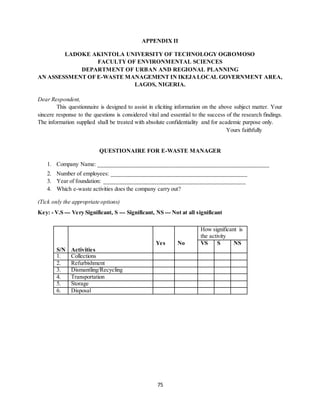
b) Manager perception on e-waste management: Managers are the
professional body or organization in charge of managing e-waste in the study
area. Information necessary was investigated for undertaking the analysis to
which the hypotheses of this research were ascertained. Do you like the e-
waste available in your area? Do you like the e-waste management method in
your area? What is the constraint of e-waste management in your area? What
is the effect of e-waste management to the environment? How can the quality
of e-waste management be improved? And many more will be ask in section
B of the questionnaire.
3.2.2 Secondary Source Data
These are the second hand information to be obtained from published and unpublished
works which will provide background information on the study such as the physical and
geographical features of the study area, information on e-waste and e-waste management,
delineation and population figure for the study area obtained from the internet among many
others.
3.3 Sampling Frame and Size
The sample frame utilized for this study consisted of eight (8) streets in ikeja computer
village. They are Obafemi Awolowo way, Francis Street, Adepele Street, Ola Ayeni Street,
Oshitelu Street, Oremeji Street, Kodeosho Street, and Simbiat Abiola road.
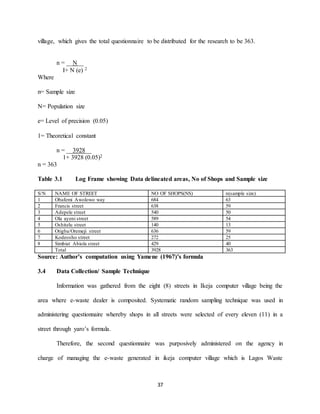
Ikeja computer village has 3928 shops (Field survey, 2015). Using yaro yamene’s
formula (1967) with the total number of shops located within each street of the computer
37
village, which gives the total questionnaire to be distributed for the research to be 363.
n = __N__
I+ N (e) 2
Where
n= Sample size
N= Population size
e= Level of precision (0.05)
1= Theoretical constant
n = __3928__
1+ 3928 (0.05)2
n = 363
Table 3.1 Log Frame showing Data delineated areas, No of Shops and Sample size
S/N NAME OF STREET NO OF SHOPS(NS) n(sample size)
1 Obafemi Awolowo way 684 63
2 Francis street 638 59
3 Adepele street 540 50
4 Ola ayeni street 589 54
5 Oshitelu street 140 13
6 Otigba/Oremeji street 636 59
7 Kodeosho street 272 25
8 Simbiat Abiola street 429 40
Total 3928 363
Source: Author’s computation using Yamene (1967)’s formula
3.4 Data Collection/ Sample Technique
Information was gathered from the eight (8) streets in Ikeja computer village being the
area where e-waste dealer is composited. Systematic random sampling technique was used in
administering questionnaire whereby shops in all streets were selected of every eleven (11) in a
street through yaro’s formula.
Therefore, the second questionnaire was purposively administered on the agency in
charge of managing the e-waste generated in ikeja computer village which is Lagos Waste
38
Management Authority (LAWMA) and Photographs was also taken to show the existing
situation of e-waste management procedure.
3.5 Analysis of data
Both descriptive and inferential statistics were employed for this study. Descriptive
analysis to be used includes percentage and cross-tabulations to describe information on the
socio-economic characteristics of the respondents and Incidence of e-waste types.
Inferential statistics was also used to test the stated hypotheses. ANOVA was used to
examine the variation in the incidence of e-waste. Data was analyzed through a computer
application called Statistical Package for Social Science (SPSS).
39
CHAPTER FOUR
INCIDENCE AND SPATIAL VARIATION OF E-WASTE
4.1 Introduction
Computer village is a transit point for electronic devices to all 37 states in Nigeria and
neighboring West African countries. It is a highly populated area with many compact e-waste
generated. This section analyses the incidence and spatial variation of e-waste generated in Ikeja
Computer Village. However, the socio-economic characteristics of respondents were first anaysed.
The spatial patterns of e-waste generated as well as e-waste types were also analysed. It has to be
noted, however, that since it is difficult to have physical measurement of the e-waste, the study
relied on the responses of electronic handlers for the analysis in this section. In view of this,
dummy variables were used to sort e-waste generator responses (i.e. very significant, significant,
not at all significant) into mutually exclusive categories such that very significant, significant and
not at all significant were scaled 3, 2 and 1 respectively. The means score was thereafter computed
for each variable in such that the mean scores range between 1,2 and 3; and the higher the value
recorded the higher the e-waste generated and vice versa.
4.2 Socio-economic of the Respondents
There is no doubt that certain socio-economic variables such as age, sex, marital status,
education, etc., do have strong influence on man’s knowledge, attitude and perception of issues
generally (Adeboyejo, 1998). The variable used here are age and gender, marital status the
educational level, the occupation and the income level of the respondents.
4.2.1 Gender of respondents
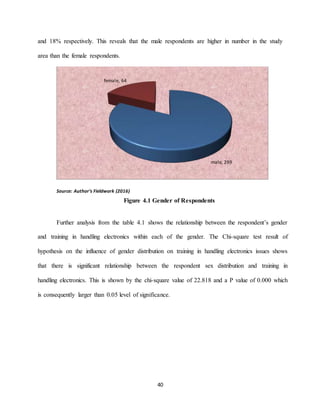
Figure 4.1 shows the nature of the sex distribution in the Computer Village. It was
observed that the percentages of the male and female individual in the selected streets are 82%
40
and 18% respectively. This reveals that the male respondents are higher in number in the study
area than the female respondents.
Source: Author’s Fieldwork (2016)
Figure 4.1 Gender of Respondents
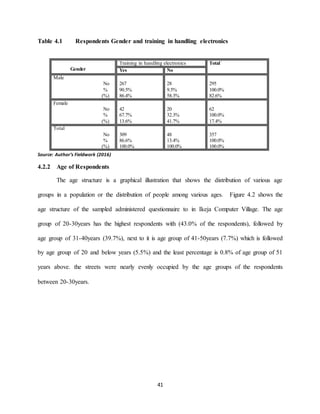
Further analysis from the table 4.1 shows the relationship between the respondent’s gender
and training in handling electronics within each of the gender. The Chi-square test result of
hypothesis on the influence of gender distribution on training in handling electronics issues shows
that there is significant relationship between the respondent sex distribution and training in
handling electronics. This is shown by the chi-square value of 22.818 and a P value of 0.000 which
is consequently larger than 0.05 level of significance.
male, 299
female, 64
41
Table 4.1 Respondents Gender and training in handling electronics
Source: Author’s Fieldwork (2016)
4.2.2 Age of Respondents
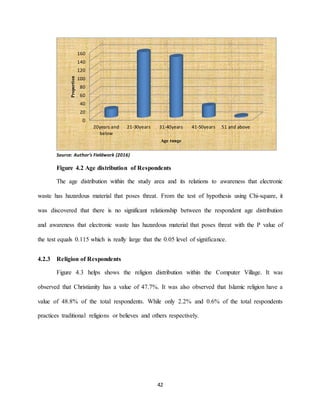
The age structure is a graphical illustration that shows the distribution of various age
groups in a population or the distribution of people among various ages. Figure 4.2 shows the
age structure of the sampled administered questionnaire to in Ikeja Computer Village. The age
group of 20-30years has the highest respondents with (43.0% of the respondents), followed by
age group of 31-40years (39.7%), next to it is age group of 41-50years (7.7%) which is followed
by age group of 20 and below years (5.5%) and the least percentage is 0.8% of age group of 51
years above. the streets were nearly evenly occupied by the age groups of the respondents
between 20-30years.
Gender
Training in handling electronics Total`
Yes No
Male
No
%
(%)
267
90.5%
86.4%
28
9.5%
58.3%
295
100.0%
82.6%
Female
No
%
(%)
42
67.7%
13.6%
20
32.3%
41.7%
62
100.0%
17.4%
Total
No
%
(%)
309
86.6%
100.0%
48
13.4%
100.0%
357
100.0%
100.0%
42
Source: Author’s Fieldwork (2016)
Figure 4.2 Age distribution of Respondents
The age distribution within the study area and its relations to awareness that electronic
waste has hazardous material that poses threat. From the test of hypothesis using Chi-square, it
was discovered that there is no significant relationship between the respondent age distribution
and awareness that electronic waste has hazardous material that poses threat with the P value of
the test equals 0.115 which is really large that the 0.05 level of significance.
4.2.3 Religion of Respondents
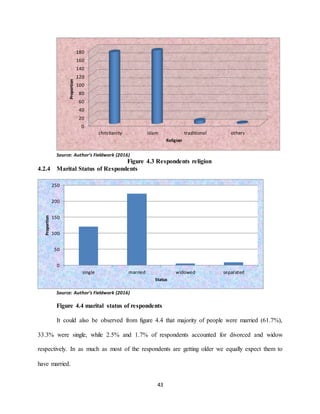
Figure 4.3 helps shows the religion distribution within the Computer Village. It was
observed that Christianity has a value of 47.7%. It was also observed that Islamic religion have a
value of 48.8% of the total respondents. While only 2.2% and 0.6% of the total respondents
practices traditional religions or believes and others respectively.
0
20
40
60
80
100
120
140
160
20years and
below
21-30years 31-40years 41-50years 51 and above
Proportion
Age range
43
Source: Author’s Fieldwork (2016)
Figure 4.3 Respondents religion
4.2.4 Marital Status of Respondents
Source: Author’s Fieldwork (2016)
Figure 4.4 marital status of respondents
It could also be observed from figure 4.4 that majority of people were married (61.7%),
33.3% were single, while 2.5% and 1.7% of respondents accounted for divorced and widow
respectively. In as much as most of the respondents are getting older we equally expect them to
have married.
0
20
40
60
80
100
120
140
160
180
christianity islam traditional others
Proportion
Religion
0
50
100
150
200
250
single married widowed separated
Proportion
Status
44
4.2.5 Education Level of Respondents
Source: Author’s Fieldwork (2016)
Figure 4.5 Respondents education level
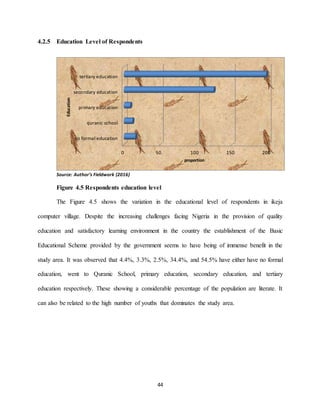
The Figure 4.5 shows the variation in the educational level of respondents in ikeja
computer village. Despite the increasing challenges facing Nigeria in the provision of quality
education and satisfactory learning environment in the country the establishment of the Basic
Educational Scheme provided by the government seems to have being of immense benefit in the
study area. It was observed that 4.4%, 3.3%, 2.5%, 34.4%, and 54.5% have either have no formal
education, went to Quranic School, primary education, secondary education, and tertiary
education respectively. These showing a considerable percentage of the population are literate. It
can also be related to the high number of youths that dominates the study area.
0 50 100 150 200
no formal education
quranic school
primary education
secondary education
tertiary education
proportion
Education
45
4.2.6 Occupation of Respondents
Source: Author’s Fieldwork (2016)
Figure 4.6 Respondents occupation status
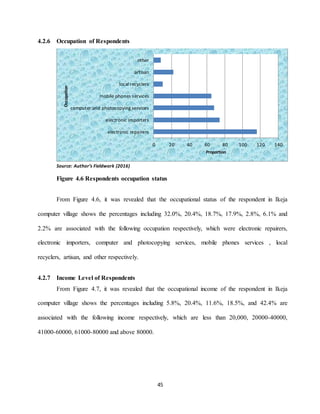
From Figure 4.6, it was revealed that the occupational status of the respondent in Ikeja
computer village shows the percentages including 32.0%, 20.4%, 18.7%, 17.9%, 2.8%, 6.1% and
2.2% are associated with the following occupation respectively, which were electronic repairers,
electronic importers, computer and photocopying services, mobile phones services , local
recyclers, artisan, and other respectively.
4.2.7 Income Level of Respondents
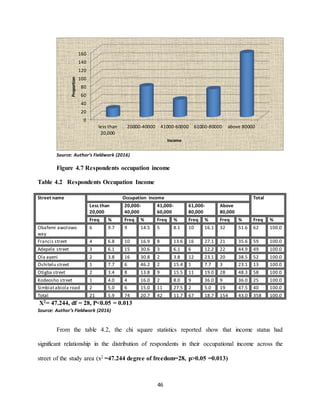
From Figure 4.7, it was revealed that the occupational income of the respondent in Ikeja
computer village shows the percentages including 5.8%, 20.4%, 11.6%, 18.5%, and 42.4% are
associated with the following income respectively, which are less than 20,000, 20000-40000,
41000-60000, 61000-80000 and above 80000.
0 20 40 60 80 100 120 140
electronic repairers
electronic importers
computer and photocopying services
mobile phones services
local recyclers
artisan
other
Proportion
Occupation
46
Source: Author’s Fieldwork (2016)
Figure 4.7 Respondents occupation income
Table 4.2 Respondents Occupation Income
Street name Occupation income Total
Less than
20,000
20,000-
40,000
41,000-
60,000
61,000-
80,000
Above
80,000
Freq % Freq % Freq % Freq % Freq % Freq %
Obafemi awolowo
way
6 9.7 9 14.5 5 8.1 10 16.1 32 51.6 62 100.0
Francis street 4 6.8 10 16.9 8 13.6 16 27.1 21 35.6 59 100.0
Adepele street 3 6.1 15 30.6 3 6.1 6 12.2 22 44.9 49 100.0
Ola ayeni 2 3.8 16 30.8 2 3.8 12 23.1 20 38.5 52 100.0
Oshitelu street 1 7.7 6 46.2 2 15.4 1 7.7 3 23.1 13 100.0
Otigba street 2 3.4 8 13.8 9 15.5 11 19.0 28 48.3 58 100.0
Kodeosho street 1 4.0 4 16.0 2 8.0 9 36.0 9 36.0 25 100.0
Simbiatabiola road 2 5.0 6 15.0 11 27.5 2 5.0 19 47.5 40 100.0
Total 21 5.9 74 20.7 42 11.7 67 18.7 154 43.0 358 100.0
X2= 47.244, df = 28, P<0.05 = 0.013
Source: Author’s Fieldwork (2016)
From the table 4.2, the chi square statistics reported show that income status had
significant relationship in the distribution of respondents in their occupational income across the
street of the study area (x2 =47.244 degree of freedom=28, p>0.05 =0.013)
0
20
40
60
80
100
120
140
160
less than
20,000
20000-40000 41000-60000 61000-80000 above 80000
Proportion
Income
47
4.3 Spatial Pattern of e-waste in Computer Village
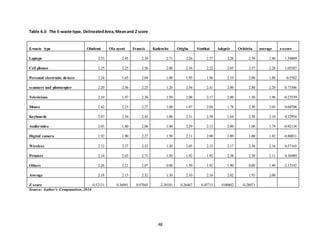
The spatial analysis of e-waste generated was attempted in this sub-section. The main
findings of the study are presented in Table 4.3. The Table was transformed for necessary
analyses that follow.
48
Table 4.3: The E-waste type, DelineatedArea, Meanand Z score
Source: Author’s Computation, 2016
E-waste type Obafemi Ola ayeni Francis Kodeosho Otigba Simbiat Adepele Oshitelu average z-score
Laptops 2.33 2.45 2.34 2.71 2.26 2.37 2.26 2.50 2.40 1.54009
Cell phones 2.25 2.25 2.56 2.00 2.36 2.22 2.05 2.57 2.28 1.05587
Personal electronic devices 2.24 1.65 2.04 1.00 1.95 1.96 2.19 2.00 1.88 -0.5582
scanners and photocopier 2.20 2.36 2.25 1.20 2.34 2.41 2.00 2.80 2.20 0.73306
Televisions 2.19 1.97 2.30 1.50 2.08 2.17 2.00 1.50 1.96 -0.23539
Mouse 2.42 2.23 2.27 1.00 1.97 2.04 1.78 2.50 2.03 0.04708
Keyboards 2.07 2.34 2.43 1.00 2.31 2.50 1.64 2.50 2.10 0.32954
Audio/video 2.03 1.80 2.06 1.00 2.29 2.13 2.00 1.00 1.79 -0.92136
Digital camera 1.92 1.90 2.27 1.50 2.11 2.00 1.89 1.00 1.82 -0.80031
Wireless 2.12 2.37 2.53 1.20 2.05 2.33 2.17 2.50 2.16 0.57165
Printers 2.14 2.03 2.71 1.50 1.92 1.92 2.38 2.30 2.11 0.36989
Others 2.26 2.21 2.07 0.00 1.59 1.92 1.90 0.00 1.49 -2.13192
Average 2.18 2.13 2.32 1.30 2.10 2.16 2.02 1.93 2.00
Z score 0.52131 0.36091 0.97045 -2.30181 0.26467 0.45715 0.00802 -0.28071
49
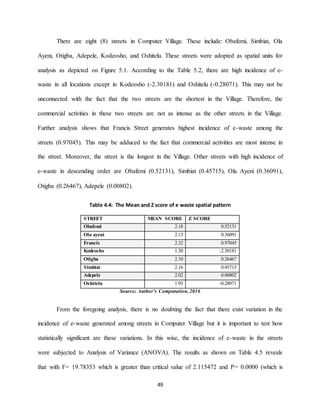
There are eight (8) streets in Computer Village. These include: Obafemi, Simbiat, Ola
Ayeni, Otigba, Adepele, Kodeosho, and Oshitelu. These streets were adopted as spatial units for
analysis as depicted on Figure 5.1. According to the Table 5.2, there are high incidence of e-
waste in all locations except in Kodeosho (-2.30181) and Oshitelu (-0.28071). This may not be
unconnected with the fact that the two streets are the shortest in the Village. Therefore, the
commercial activities in these two streets are not as intense as the other streets in the Village.
Further analysis shows that Francis Street generates highest incidence of e-waste among the
streets (0.97045). This may be adduced to the fact that commercial activities are most intense in
the street. Moreover, the street is the longest in the Village. Other streets with high incidence of
e-waste in descending order are Obafemi (0.52131), Simbiat (0.45715), Ola Ayeni (0.36091),
Otigba (0.26467), Adepele (0.00802).
Table 4.4: The Mean and Z score of e waste spatial pattern
STREET MEAN SCORE Z SCORE
Obafemi 2.18 0.52131
Ola ayeni 2.13 0.36091
Francis 2.32 0.97045
Kodeosho 1.30 -2.30181
Otigba 2.10 0.26467
Simbiat 2.16 0.45715
Adepele 2.02 0.00802
Oshitelu 1.93 -0.28071
Source: Author’s Computation, 2016
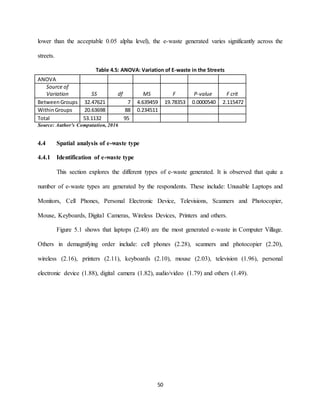
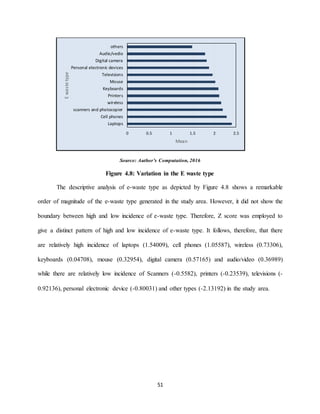
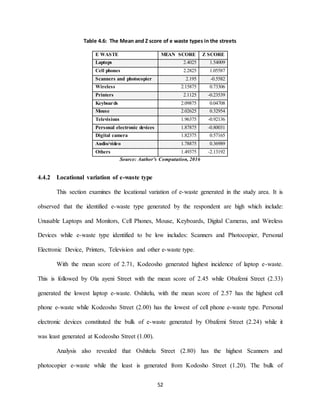
From the foregoing analysis, there is no doubting the fact that there exist variation in the
incidence of e-waste generated among streets in Computer Village but it is important to test how
statistically significant are these variations. In this wise, the incidence of e-waste in the streets
were subjected to Analysis of Variance (ANOVA). The results as shown on Table 4.5 reveals
that with F= 19.78353 which is greater than critical value of 2.115472 and P= 0.0000 (which is
50
lower than the acceptable 0.05 alpha level), the e-waste generated varies significantly across the
streets.
Table 4.5: ANOVA: Variation of E-waste in the Streets
ANOVA
Source of
Variation SS df MS F P-value F crit
BetweenGroups 32.47621 7 4.639459 19.78353 0.0000540 2.115472
WithinGroups 20.63698 88 0.234511
Total 53.1132 95
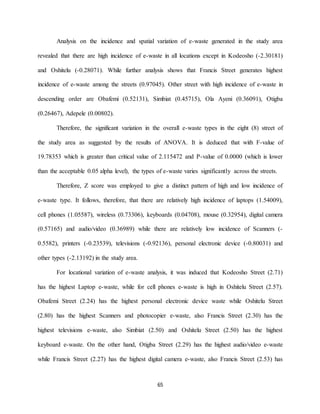
Source: Author’s Computation, 2016
4.4 Spatial analysis of e-waste type
4.4.1 Identification of e-waste type
This section explores the different types of e-waste generated. It is observed that quite a
number of e-waste types are generated by the respondents. These include: Unusable Laptops and
Monitors, Cell Phones, Personal Electronic Device, Televisions, Scanners and Photocopier,
Mouse, Keyboards, Digital Cameras, Wireless Devices, Printers and others.
Figure 5.1 shows that laptops (2.40) are the most generated e-waste in Computer Village.
Others in demagnifying order include: cell phones (2.28), scanners and photocopier (2.20),
wireless (2.16), printers (2.11), keyboards (2.10), mouse (2.03), television (1.96), personal
electronic device (1.88), digital camera (1.82), audio/video (1.79) and others (1.49).
51
Source: Author’s Computation, 2016
Figure 4.8: Variation in the E waste type
The descriptive analysis of e-waste type as depicted by Figure 4.8 shows a remarkable
order of magnitude of the e-waste type generated in the study area. However, it did not show the
boundary between high and low incidence of e-waste type. Therefore, Z score was employed to
give a distinct pattern of high and low incidence of e-waste type. It follows, therefore, that there
are relatively high incidence of laptops (1.54009), cell phones (1.05587), wireless (0.73306),
keyboards (0.04708), mouse (0.32954), digital camera (0.57165) and audio/video (0.36989)
while there are relatively low incidence of Scanners (-0.5582), printers (-0.23539), televisions (-
0.92136), personal electronic device (-0.80031) and other types (-2.13192) in the study area.
0 0.5 1 1.5 2 2.5
Laptops
Cell phones
scanners and photocopier
wireless
Printers
Keyboards
Mouse
Televisions
Personal electronic devices
Digital camera
Audio/vedio
others
Mean
Ewastetype
52
Table 4.6: The Mean and Z score of e waste types in the streets
E WASTE MEAN SCORE Z SCORE
Laptops 2.4025 1.54009
Cell phones 2.2825 1.05587
Scanners and photocopier 2.195 -0.5582
Wireless 2.15875 0.73306
Printers 2.1125 -0.23539
Keyboards 2.09875 0.04708
Mouse 2.02625 0.32954
Televisions 1.96375 -0.92136
Personal electronic devices 1.87875 -0.80031
Digital camera 1.82375 0.57165
Audio/video 1.78875 0.36989
Others 1.49375 -2.13192
Source: Author’s Computation, 2016
4.4.2 Locational variation of e-waste type
This section examines the locational variation of e-waste generated in the study area. It is
observed that the identified e-waste type generated by the respondent are high which include:
Unusable Laptops and Monitors, Cell Phones, Mouse, Keyboards, Digital Cameras, and Wireless
Devices while e-waste type identified to be low includes: Scanners and Photocopier, Personal
Electronic Device, Printers, Television and other e-waste type.
With the mean score of 2.71, Kodeosho generated highest incidence of laptop e-waste.
This is followed by Ola ayeni Street with the mean score of 2.45 while Obafemi Street (2.33)
generated the lowest laptop e-waste. Oshitelu, with the mean score of 2.57 has the highest cell
phone e-waste while Kodeosho Street (2.00) has the lowest of cell phone e-waste type. Personal
electronic devices constituted the bulk of e-waste generated by Obafemi Street (2.24) while it
was least generated at Kodeosho Street (1.00).
Analysis also revealed that Oshitelu Street (2.80) has the highest Scanners and
photocopier e-waste while the least is generated from Kodosho Street (1.20). The bulk of
53
television e-waste is generated from Francis Street (2.30) while the least comes from Kodeosho
Street (1.50). Oshitelu Street (2.50) generated the highest incidence of mouse but the lowest of
this e-waste type was generated from Kodeosho Street (1.00).
From the forgoing analysis, it could be deduced that e-waste types generated in Computer
Village differ from location to locations. One can intuitively inferred, therefore, that the
variability in e-waste generated from location to locations is a reflection of diversifications of
electronic types in different streets. For instance, laptops is the prominent electronic types in
Kodeosho while Television is more prominent at Obafemi Street.
54
CHAPTER FIVE
MANAGEMENT OF E-WASTE IN COMPUTER VILLAGE
5.1 Introduction
According to Tchobanoglous et al (1993), “solid waste management is that discipline
associated with the control of generation, storage, collection, transfer and transport, processing
and disposal of solid wastes in a manner that is in accord with the best principles of public
health, economics, engineering, conservation, aesthetics and other environmental considerations
and that is also responsive to public attitudes”. This study examines the management of e-waste
in the study area.
5.2 Process of e-waste management
In the literature (Tchobanoglous et al 1993) there are five processes of waste
management. These include: waste generation, storage, collection, transportation and disposal.
These processes were examined in Computer Village. While e-waste generation has been
extensively discussed in the previous chapter, the e-waste storage, collection, transportation and
disposal are examined in this chapter
5.2.1 Collection Method
The respondents were asked to identify methods of e-waste collection. The responses as
shown on Figure 5.1 revealed that majority of respondents (37.2%) make use of drum to collect
e-waste. This is followed by 24% of the respondents who make use of baskets. 6% and 12.1%
make use of buckets and nylon respectively while 2.5% make use of other methods
55
Source: Author’s Fieldwork (2016)
Fig. 5.1 Methods e-waste Collection
5.2.2 Disposal Method
Table 5.1 shows the e-waste disposal method in the study area. According to the table: It
was revealed that in Obafemi Street, 71.4% of respondent use open dump while 27.3% and
40.0% of respondent use collection point and e-waste vendor respectively. Therefore, 52.4% of
the respondents in Francis Street use Open dump while 43.3% and 72.9% of respondent use
collection point and e-waste vendor respectively. In Adepele Street, 57.9% of respondent use
open dump while 52.6% and 70.5% of respondent use collection point and e-waste vendor
respectively. In Ola ayeni Street, 81.1% of respondent use open dump while 32.5% and 28.9% of
respondent use collection point and e-waste vendor respectively.
All respondents at Oshitelu Street use open dump while 7.9%, 48.6% and 40.8% of
respondent in this Street use incineration, collection point and e-waste vendor respectively. For
Otigba Street, 57.5% of respondent use open dump while 52.6% and 70.5% of respondent use
collection point and e-waste vendor respectively. While all the sampled respondents in Kodeosho
Street use both collection point and e-waste vendor disposal method. Simbiat Street 64.0% of
0
20
40
60
80
100
120
140
160
drums buckets baskets nylon others
Proportion
use to collect e-waste
56
respondent use open dump while 13.0%, 40.6% and 44.4% of respondent use incineration,
collection point and e-waste vendor respectively.
Table 5.1 Spatial Variation of Disposal Method
S/N STREETS OPEN
DUMP
BURNING/INCINERATION COLLECTION
POINT
E-WASTE
VENDOR
FREQ % FREQ % FREQ % FREQ %
1 Obafemi
Awolowo
30 71.4 0 0 12 27.3 24 40.0
2 Francis 11 52.4 0 0 13 43.3 35 72.9
3 Adepele 11 57.9 0 0 10 52.6 31 70.5
4 Ola ayeni 30 81.1 0 0 13 32.5 13 28.9
5 Oshitelu 3 100 0 0 3 60.0 8 72.7
6 Otigba 23 57.5 3 7.9 18 48.6 20 40.8
7 Kodeosho 0 0.0 0 0 4 100 21 100
8 Simbiat 16 64.0 3 13.0 13 40.6 12 44.4
Total 124 66.3 6 3.4 86 40.8 164 53.8
Source: Author’s Fieldwork (2016)
Table 5.2 Chi square: Spatial Variation of Disposal Method
S/N METHOD X2 df P-VALUE REMARK
1. Open dump 9.509 6 0.145 Not significant
2. Incineration 12.864 6 0.045 Not significant
3. Collection point 13.170 7 0.068 Not significant
4. E-waste vendor 51.688 7 0.000 Significant
Source: Author’s Fieldwork (2016)
According to Table 5.2, all disposal methods show no significant variations across the
streets except the use of e-waste vendors which shows significant variation across the streets.
This implies that the use of all other methods of e-waste disposal except e-waste vendor remain
similar across the streets.
5.2.3 E-waste Collector
According to Figure 5.2, majority of respondents (50.7%) confirm that government agents
are responsible for the collection of the e-waste they generate. 35.5% make use of truck pushers
to dispose off their e-waste. About 6% confirm they make personal effort to collect their waste.
57
Source: Author’s Fieldwork (2016)
5.2.4 Amount pay for service
Figure 5.3 shows that majority of the respondents pay as low as N400 to dispose off their
e-waste while 19% and 8% of the respondents pay between N401- N800 and between N801-
N1200 respectively. It is important to note that about 3% pay more than 1600 to dispose off their
e-waste while about 2% spend between N1201 and N1600 for their e-waste.
Source: Author’s Fieldwork (2016)
0 20 40 60 80 100 120 140 160 180 200
self-effort
private sector
government agency
truck pushers
others
Proportion
E-wastecollector Fig. 5.2 Respondents E-waste collector
Fig. 5.3 Respondents payment for e-waste collection
400 naira and below 401-800 naira 801-1200 naira 1201-1600 naira 1601 naira and above
58
5.2.5 Payment plan
From figure 5.4, it shows respondents payment plan. According to the figure, it was
observed that 1.4% of the respondents declared that they pay daily, while 5.5% and 42.4%
declared weekly and monthly respectively. Respondents that declared pay as you dispose
accounted for 46.0%. It could be noted that the majority of the respondents pay payment plan of
pay as you go.
Source: Author’s Fieldwork (2016)
5.2.6 Regular Evacuation
From figure 5.5, it shows how regular the evacuation is. According to the figure, it was
observed that 15.4% of the respondents declared that they evacuate daily, while 25.3% and
19.6% declared weekly and monthly respectively. Respondents that declared occasionally
accounted for 36.9%. It could be noted that the majority of the respondents evacuate
occasionally.
0 20 40 60 80 100 120 140 160 180
daily
weekly
monthly
pay as you dispose
Proportion
Paymentplan
Fig. 5.4 Respondents payment plan
59
Source: Author’s Fieldwork (2016)
5.2.7 E-waste source of income
Table 5.3 Respondents E-waste is a source of Income
Street name E-waste is a source of income Total
Yes No
Freq % Freq % Freq %
Obafemi awolowo way 55 90.2 6 9.8 61 100.0
Francis street 55 93.2 4 6.8 59 100.0
Adepele street 42 84.0 8 16.0 50 100.0
Ola ayeni 48 84.0 6 11.1 54 100.0
Oshitelu street 11 91.7 1 8.3 12 100.0
Otigba street 49 89.1 6 10.9 55 100.0
Kodeosho street 22 88.0 3 12.0 25 100.0
Simbiat abiola road 35 92.1 3 7.9 38 100.0
Total 317 89.5 37 10.5 354 100.0
X2= 2.944, df = 7, P>0.05 = 0.890
Source: Author’s Fieldwork (2016)
The response of the respondents of e-waste as a source of income as contained in table
5.3. Accordingly, 89.5% of respondents declare e-waste as a source of income area this
representing a large proportion of the respondent in the study area. While 10.5% of the
respondent declared e-waste not to be a source of income. It can be deduced here that e-waste is a
source of income in the study area due to large awareness of e-waste.
0
20
40
60
80
100
120
140
160
daily weekly monthly occationally
Proportion
Evacuation
Fig. 5.5 Respondents regular Evacuation
60
5.3 Management of E-Waste
It has being presented in this section the role of stakeholder in managing e-waste in the
study area. Roles of stakeholders in management includes e-waste activities, types of e-waste
recycling process, perception of e-waste, involvement of partners etc.
Stakeholders responsible in e-waste management in the study area is Lagos State Waste
Management Authority (LAWMA), they play the needed roles effectively in order to help curb e-
waste hazardous effect and reach its fullest potentials.
The Lagos State Waste Management Authority (LAWMA) has the responsibility of
managing dumpsites in Lagos state. To gain access to current e-waste management techniques,
permission and assistance was obtained at the headquarters of LAWMA at Ijora Olokpa, Lagos. I
was allowed to take supervised picture and a 15 minutes interview which was purposively
allotted to the authority in charge of e-waste generated in ikeja computer village with the aid of a
questionnaire data to the public relation department (See Appendix II).
5.3.1 Data gathered at LAWMA
Table 5.4 and 5.5 shows the response of the stakeholder responsible for e-waste
management in ikeja computer village. The questionnaire was administered by the public relation
department.
Table 5.4 Questionnaire gathered response from stakeholder
Company name Year of
foundation
E-waste activities Types of e-waste
manage
Recycling
process
Lagos waste
management
authority
1977 Collections(VS),
dismantling/recycling(VS),
transportation(VS), and
storage(VS)
Laptops and
monitors(VS), cell
phones,Keyboards
Manual
dismantling
Source: Author’s Fieldwork (2016)
61
Table 5.5 Questionnaire gathered response from stakeholder
Perception of e-waste Do you engage
in private
partners
Rate level
efficiency
Solutions to the problems
caused by e-waste in the
environment
People engage manual recycling of e-
waste(DK), people face hazards like
burnt hands and bruises(VS), people
face hazards like muscle weakness(VS),
people face hazards like breathing
difficulties(VS)
No Collection(VS),
recycling(VS),
transportation(VS),
storage (VS)
Reuse and Recycling
Source: Author’s Fieldwork (2016)
5.3.2 E-Waste Collection and Dismantling in LAWMA
The Authority recently commenced the collection of E-waste across the metropolis. This
waste collected is stored in a container sited at the Olusosun landfill within the recycling centre.
The e-waste products collected by the Authority are currently being dismantled.
Plate 5.1 Showing LAWMA e-waste collection and dismantling process
Source: LAWMA 2015
62
Plate 5.2 Showing LAWMA e-waste container at OLUSOSUN
E-waste container
Source: LAWMA 2015
5.4 Various Measures against E-waste
It has being presented in this section the various measures against e-waste in the selected
shops in the study area. Measures taken against e-waste includes identification of disposal sites
for hazardous wastes, Acknowledge and support the refurbishes, support and maintain
international recycling cooperation’s, focus on quality recycling products etc.
Table 5.6 Respondents measure against e-waste
S/N Measures against e-waste
Yes No NR Total
Freq % Freq % Freq % Freq %
1. Identification of disposalsites for
hazardous wastes
242 66.7 2 0.6 119 32.8 363 100
2. Acknowledge and support the
refurbishes
239 65.8 3 0.8 121 33.3 363 100
3. Support and maintain international
recycling co-operations
251 69.1 4 1.1 108 29.8 363 100
4. Focus on high quality recycling
products
269 74.1 17 4.7 77 21.2 363 100
63
5. Increased environmental
campaigns
241 66.4 2 0.6 120 33.1 363 100
6. Regulate the import of used
products
232 63.9 17 4.7 114 31.4 363 100
7. Provide solutions for locally
generated hazardous waste
252 69.4 4 1.1 107 29.5 363 100
8. Develop appropriate finance
mechanisms
222 61.2 2 0.6 139 38.3 363 100
9. Develop regulative framework 222 61.2 5 1.4 136 37.5 363 100
10. Ensure strong relationships with
key administrative bodies
230 63.4 2 0.6 131 36.1 363 100
11. Focus on all e-waste fractions. 247 68.0 2 0.6 114 31.4 363 100
12. Others (specify) 178 49.0 0 0 185 51.0 363 100
Source: Author’s Fieldwork (2016)
From table 5.6 which shows the measures to be taken against e-waste in the study area.
According to the table: It was revealed that 66.7% of respondent adopt the identification of
disposal sites for hazardous wastes measures, while 65.8% and 61.9% of the respondent adopt
Acknowledge/support the refurbishes and Support/maintain international recycling co-operations
measures respectively. However, it was also revealed that 74.1%, 66.4%, 63.9%, 69.4% and
61.2% of the respondent adopt Focus on high quality recycling products, increase environmental
campaigns, regulate the import of used products, Provide solutions for locally generated
hazardous waste and developing of appropriate finance mechanisms measures respectively.
Therefore, 61.2%, 63.4%, 68.0% and 49.0% of the respondents adopt development of regulative
framework, ensuring strong relationships with key administrative bodies, focusing on all e-waste
fractions and other measures respectively.
64
CHAPTER SIX
SUMMARY, RECOMMENDATION AND CONCLUSION
6.1 Introduction
This section summarized the key findings in the study. It essentially submits major
findings on the assessment of e-waste management in Ikeja computer village. The major
summary of findings is listed out here, followed by appropriate recommendations, and the
conclusion of the project.
6.2 Summary of Finding
This section summarizes the key findings in the study. It essentially summarizes the
findings on the socio economic characteristics of respondents, Identification of e-waste type and
e-waste type variation, e-waste composition, generation, method of disposal and management in
the study area.
6.2.1 Incidence and spatial variation of e-waste
From the analysis made on respondents’ sex distribution in the study area, the result reveals
that the male respondents (82%) are higher in number in the study area than the female
respondents (18%). When age structure of the total respondents was analyzed, it was deduced that
age group of 20-30years is the highest with 43.0%, followed by 31-40years (39.7%), 41-50years
(7.7%), 20 and below years (5.5%) and 51 years above (0.8%).
When occupation status was analyzed, it was deduced that electronic repairers were the
highest with 32.0%, followed by electronic importers (20.4%), computer and photocopying
services (18.7%), mobile phones services (17.9%), local recyclers (2.8%), artisan (6.1%) and
others (2.2%). Therefore, analysis on respondent awareness of hazardous threat from e-waste
reveals that 88.5% of the respondent were aware of the threat while 11.5% of the respondent were
not aware of the threat it poses.
65
Analysis on the incidence and spatial variation of e-waste generated in the study area
revealed that there are high incidence of e-waste in all locations except in Kodeosho (-2.30181)
and Oshitelu (-0.28071). While further analysis shows that Francis Street generates highest
incidence of e-waste among the streets (0.97045). Other street with high incidence of e-waste in
descending order are Obafemi (0.52131), Simbiat (0.45715), Ola Ayeni (0.36091), Otigba
(0.26467), Adepele (0.00802).
Therefore, the significant variation in the overall e-waste types in the eight (8) street of
the study area as suggested by the results of ANOVA. It is deduced that with F-value of
19.78353 which is greater than critical value of 2.115472 and P-value of 0.0000 (which is lower
than the acceptable 0.05 alpha level), the types of e-waste varies significantly across the streets.
Therefore, Z score was employed to give a distinct pattern of high and low incidence of
e-waste type. It follows, therefore, that there are relatively high incidence of laptops (1.54009),
cell phones (1.05587), wireless (0.73306), keyboards (0.04708), mouse (0.32954), digital camera
(0.57165) and audio/video (0.36989) while there are relatively low incidence of Scanners (-
0.5582), printers (-0.23539), televisions (-0.92136), personal electronic device (-0.80031) and
other types (-2.13192) in the study area.
For locational variation of e-waste analysis, it was induced that Kodeosho Street (2.71)
has the highest Laptop e-waste, while for cell phones e-waste is high in Oshitelu Street (2.57).
Obafemi Street (2.24) has the highest personal electronic device waste while Oshitelu Street
(2.80) has the highest Scanners and photocopier e-waste, also Francis Street (2.30) has the
highest televisions e-waste, also Simbiat (2.50) and Oshitelu Street (2.50) has the highest
keyboard e-waste. On the other hand, Otigba Street (2.29) has the highest audio/video e-waste
while Francis Street (2.27) has the highest digital camera e-waste, also Francis Street (2.53) has
66
the highest wireless e-waste. Therefore, also Francis Street has the highest printers (2.71) e-waste
and Obafemi Street (2.26) has the highest other e-waste waste.
6.2.2 Management of E-waste in Ikeja computer village
Analysis on the respondent use of collecting e-waste within the Computer Village was
observed that respondent of 37.2% use drums followed by baskets (24.0%), buckets (6.0%),
nylon (12.1%) and others (2.5%,).
For the respondent method of disposing waste, it is induced that 66.3% use open dump
method while 3.4% use burning method followed by collection point (40.8%) and e-waste
vendor method (53.8%). Therefore, respondent who does the e-waste collection was analyze
whereby self-effort (5.8%) followed by private sector (5.8%), government agency (50.7%), truck
pushers (35.5%) and others (0.8%).
For if not self-effort how much do you pay for e-waste collection service analysis, it was
induced that 400 naira and below were 68%, while 401-800 (19%), 801-1200 (8%), 1201-1600
(2%), and 1601 naira and above (3%). For payment plan, it was induced that 1.4% 0f respondent
declared daily pay while weekly (5.5%), monthly (42.4%) and pay as you dispose (46.0%).
Therefore, 15.4% declared daily evacuation while weekly (25.3%), monthly (19.6%) and
occasionally (36.9%). On the other hand, 89.5% of respondent declared e-waste as a source of
income while 10.5% declared e-waste not to be a source of income.
Data gathered shows that the Lagos State Waste Management Authority (LAWMA) has
the responsibility of managing dumpsites in Lagos state. Therefore, the Authority recently
commenced the collection of e-waste across the metropolis. This e-waste collected is stored in a
container sited at the Olusosun landfill within the recycling Centre. The e-waste products
collected by the Authority are currently being dismantled.
67
For the measures to be taken against e-waste in the study area. It was induced that 66.7%
of respondent adopt the identification of disposal sites for hazardous wastes measures, while
acknowledge/support the refurbishes (65.8%), Support/maintain international recycling co-
operations (61.9%), focus on high quality recycling products (74.1%), increase environmental
campaigns (66.4%), regulate the import of used products (63.9%), Provide solutions for locally
generated hazardous waste (69.4%), developing of appropriate finance mechanisms (61.2%),
development of regulative framework (61.2%), ensuring strong relationships with key
administrative bodies (63.4%), focusing on all e-waste fractions (68.0%) and other measures
(49.0%).
6.3 Contribution of the Research Work to Planning Knowledge
E-waste is one of the massive new problems in the environment because it possesses a
serious threat to the people plan for. The hazardous materials found in E-waste will affect their
health, water, environment and overall food chain.
Planning as a profession ensures orderliness in the environment. Also Planning is a
systematic way of making decision among options that appear open for the future in the
environment i.e. planning is managing the environment.
As e-waste management is regarded “environmental management” according to (UN,
Developments environment, 1972) it covers functions designed to facilitate comprehensive
planning that takes into account the side effects of man’s activities and thereby protects and
improves the human environment for the present and future generation.
Environmental management refers to all the systematic planned efforts by the policy makers,
directed towards regulating and managing the utilization of natural resources and minimizing
irreversible damages to the environment through all types of human activities.
68
Thus, the effort of e-waste management i.e. environmental management covers the
conscious and planned effort and activities undertaken by the policy makers which are planners
to minimize damages to the environment and measures undertaken to regulate the on-going
activities in different areas.
6.4 Recommendations
Based on the findings outlined from the study area the following recommendation will help
guide into a more effective e-waste management, especially with regards to e-waste management
in the study area.
Environmental sanitation awareness
The authority should enlighten e-waste generators in the study area on the need to keep
the environment clean as well as minimizing e-waste through recycling, reusing or reclaiming.
This can be achieved by organizing lectures and symposium, passing through the media in
various languages as well as using mobile vehicles with public address system. Therefore, the
Lagos State Waste Management Authority and the Ikeja local government environmental
sanitation unit need to be revamped for efficient services delivery.
Regular collection
The collection of e-waste from depot and disposal of the study area should be done
regularly and during working hours when the traffic is expected to be free, so as to avoid delay
when transporting e-waste from collection to disposal point.
Adequate recycling scheme
Recycling of e-waste should be encouraged as much as possible, because of some
benefits such as employment generation, reduction of disposable e-waste load and reduction in
contamination level. In other words, modern equipment for collection, recycling, processing,
69
disposal and reuse of e-waste should be procured for more effective running of the waste
management authorities to generate wealth for the state.
Agency empowerment
Government should strengthen the federal environment protection agency (FEPA), the
apex body established by the federal government decree 58 of December 30, 1988 to take
responsibility for the protection of the Nigerian environment, to perform its statutory duty by
properly funding it. Also, the government needs to employ more staffs into its e-waste
management authorities so as to improve their service delivery.
Guiding Statutory laws
At this junction, it is pertinent to note that existing laws on e-waste management must be
enforced while new ones, if and when necessary need to be promulgated to aid efficient service
delivery. Therefore, adoption of developed countries constitution can aid in the guiding smooth
e-waste management in the study area.
6.5 Conclusion
Since generation of e-waste is a daily affair in the Computer village. Its management
ought not to be a problem if correct approaches are employed. Therefore, E-waste management
should be given adequate attention by both state and local government even though Non-
governmental organization due to it advantageous generation of wealth for any particular
community.
In order to enhance the ability, the above recommendations if put in place will greatly
improve the environmental quality of the environment in terms of adequate e-waste
management.
70
REFERENCE
Afon, A., Abodunrin, F. & Kollie, T. (2001). Urban Solid Waste Management in Nigeria:
Poverty Factors as a Constraint: Department of Geography, University of Ibadan,
Unpublished Research report.
Bala Krishnamoorthy (2005). Environmental Management.
Bangalore – A Review, www.IndianJournals.com.
Basel Convention (1989). Basel Convention on the Control of Trans boundary Movements of
Hazardous Wastes and Their Disposal, adopted by the conference of the
Plenipotentiaries on 22nd March, 1989. Article 2 Definitions, Article 4:2e, 2g.9a of
General Obligation, 4-7.
Benedicta A. Ideho (2012). E-Waste Management: A Case Study of Lagos State, Nigeria.
C K Nagendra Guptha and G L Shekar (2009). Electronic Waste Management System.
Cees Harmon, (2015). Newswatch Times: who will stem the menace of e-waste?
Christina Bonnington (2014). Our E-Waste Problem Is Ridiculous, and Gadget Makers Aren’t
Helping.
Deepali Sinha (2004). The Management of Electronic Waste: A Comparative Study on India
and Switzerland.
Eunice Jemutai Cherutich (2013). E-Waste Management in Kenya: A Case Study of Mobile
Phone Waste in Nairobi.
European Journal of Business and Management (2014). E-Waste Management: Towards an
Appropriate Policy.
EWUIM, Sylvanus C., AKUNNE, Chidi E., ABAJUE, Maduamaka C., NWANKWO, Edith N.
and FANIRAN, Olalekan, J. (2014). Challenges of e-waste pollution to soil
environments in Nigeria – a review.
Greenpeace (2009). Greenpeace homepage.
Greenpeace International Report, Hi-Tech: Highly Toxic, (2005).
http://www.greenpeace.org/international/press/releases/greenpeace-pulls-plugon-
dirty, http://www.greenpeace.org/denmark/press/pressemeddelelser/gps-sendere-
afslorer- elektroni, visited on April 26, 2009.
Ijeoma Okolo (2013). E-waste management in Accra. Examining informal workers and
informal-formal linkages for sustainable recycling.
71
Lagos Bureau of Statistics Ministry of Economic Planning and Budget Secretariat, Lagos State
(2012). Abstract of Local Government Statistics.
Ogbomo, Monday Obaidjevwe; Obuh, Alex Ozoemelem; and Ibolo, Elizabeth (2012).
"Managing ICT Waste: The Case of Delta State University Abraka, Nigeria". Library
Philosophy and Practice (e-journal). Paper 736.
Puckett, J., & Fogel, F. (2005). The digital dump, exporting reuse and abuse to Africa, Basel
Action Network. Available: http://ban.org/BANreports/10-24- 05/index.htm.
Secretariat of the Basel Convention (2011). Development of a National Implementation Plan
(NIP) for E–waste Management in Sri Lanka.
Wikipedia (2009). Ikeja.
72
APPENDIX I
LADOKE AKINTOLA UNIVERSITY OF TECHNOLOGY OGBOMOSO
FACULTY OF ENVIRONMENTAL SCIENCES
DEPARTMENT OF URBAN AND REGIONAL PLANNING
AN ASSESSMENT OF E-WASTE MANAGEMENT IN IKEJALOCAL GOVERNMENT AREA,
LAGOS, NIGERIA.
Dear Respondent,
This questionnaire is designed to assist in eliciting information on the above subject matter. Your
sincere response to the questions is considered vital and essential to the success of the research findings.
The information supplied shall be treated with absolute confidentiality and for academic purpose only.
Yours faithfully
QUESTIONAIRE FOR E-WASTE PRODUCER
SECTION A: SOCIO-ECONOMIC CHARACTERISTICS OF RESPONDENTS
1. Local Government ___________________________________________________
2. Street Name: _______________________________________________________
3. Respondent’s Gender: (1) Male (2) Female
4. Respondent’s Age: ___________________________________________________
5. Religion: (1) Christianity (2) Islam (3) Traditional (4) Others (Specify)…………………
6. Marital Status: (1) Single (2) Married (3) Widowed (4) Separated
7. Educational Level (1) No formal Education (2) Quranic School (3) Primary Education
(4)Secondary Education (5) Tertiary Education
8. Occupational Status: (1) Electronic Repairers (2) Electronic Importers (3) Computer and
Photocopying Services (4) Mobile Phones Services (5) Local Recyclers (6) Artisan (7) Other;
specify _____________
9. Monthly income from occupation: (1) Less than 20,000 (2) 20,000- 40,000 (3) 4121,000- 60,000
(4) 61,000- 80,000 (5) Above 80,000
10. Do you have any kind of training in handling electronics: (1) Yes (2) No
11. Year of experience in the field: _______________________________________________
12. Are you aware that electronic waste has hazardous material that poses health and environmental
threat? (1) Yes (2) No
73
SECTION B: IDENTIFICATION OF E-WASTE TYPE
13. Which of the following e-waste do you generate?
(Tick only the appropriate options)
Key: - V.S --- Very Significant, S --- Significant, NS --- Not at all significant
S/N Types of e-waste materials
How significant is the
quantity that you generate
Yes No V S S NS
1. Unusable Laptops and Monitors
2. Cell Phones
3. Personal Electronic Device
4. Scanners and Photocopier
5. Televisions
6. Mouse
7. Keyboards
8. Audio/Video Equipment
9. Digital Cameras
10 Wireless Devices
11. Printers
12. Others (specify)
14. What do you use to collect e-waste (1) Drums (2) Buckets (3) Baskets (4) Nylon (5) Others;
specify ________________
15. Which of the following method do you use to dispose of e-waste?
S/N Disposal Method Yes No
1. Open dump
2. Burning/Incineration
3. Collection Point
4. E-waste vendor
16. Who does the e-waste collection: (1) Self effort (2) Private sector (3) Government agency (4)
Truck pushers (5) Others; specify _______________
17. If not self-effort how much do you pay for the service: _________________
18. What is your payment plan: (1) Daily (2) Weekly (3) Monthly (4) Pay as you dispose
19. How regular is the evacuation: (1) Daily (2) Weekly (3) Fortnightly (4) Monthly (5) Occasionally
20. E-waste is a source of income: (1) Yes (2) No
74
21. Which of the following general actions do you think would be necessary to tackle e-waste
management?
(Tick only the appropriate options)
S/N Measures against e-waste Yes No
1. Identification of disposal sites for hazardous wastes
2. Acknowledge and support the refurbishes
3. Support and maintain international recycling co-
operations
4. Focus on high quality recycling products
5. Increased environmental campaigns
6. Regulate the import of used products
7. Provide solutions for locally generated hazardous
waste
8. Develop appropriate finance mechanisms
9. Develop regulative framework
10. Ensure strong relationships with key administrative
bodies
11. Focus on all e-waste fractions.
12. Others (specify)
22. In your opinion what other problems do you think e-waste constitute to your
environment…………………………………………………………………………………………
………………………………………………………………………………………………………
23. Can you suggest solutions to the problems caused by e-waste generation in your area?
a) ………………………………………………………………………………
b) ………………………………………………………………………………
75
APPENDIX II
LADOKE AKINTOLA UNIVERSITY OF TECHNOLOGY OGBOMOSO
FACULTY OF ENVIRONMENTAL SCIENCES
DEPARTMENT OF URBAN AND REGIONAL PLANNING
AN ASSESSMENT OF E-WASTE MANAGEMENT IN IKEJALOCAL GOVERNMENT AREA,
LAGOS, NIGERIA.
Dear Respondent,
This questionnaire is designed to assist in eliciting information on the above subject matter. Your
sincere response to the questions is considered vital and essential to the success of the research findings.
The information supplied shall be treated with absolute confidentiality and for academic purpose only.
Yours faithfully
QUESTIONAIRE FOR E-WASTE MANAGER
1. Company Name: _______________________________________________________
2. Number of employees: _______________________________________________
3. Year of foundation: _________________________________________________
4. Which e-waste activities does the company carry out?
(Tick only the appropriate options)
Key: - V.S --- Very Significant, S --- Significant, NS --- Not at all significant
S/N Activities
How significant is
the activity
Yes No VS S NS
1. Collections
2. Refurbishment
3. Dismantling/Recycling
4. Transportation
5. Storage
6. Disposal
76
SECTION B: IDENTIFICATION OF E-WASTE TYPE
5. Which of the following e-waste do you manage?
(Tick only the appropriate options)
Key: - V.S --- Very Significant, S --- Significant, NS --- Not at all significant
S/N Types of e-waste
How significant is the
quantity that you
manage
Yes No V S S NS
1. Laptops and Monitors
2. Cell Phones
3. Personal Electronic Device
4. Scanners and Photocopier
5. Televisions
6. Mouse
7. Keyboards
8. Audio/Video Equipment
9. Digital Cameras
10 Wireless Devices
11. Printers
12. Others (specify)
6. Which recycling processes does your company carry out? (1) Sorting of products (2) Manual
dismantling (3) Shredding (4) Separation of (shredded) fractions (5) Cable stripping/granulation
(6) Other; specify ______________________________
7. E-waste contribute to the national economy (1) Yes (2) No
8. What is done with parts or products which cannot be recycled? ______________________
9. From your point of view, what should be done to facilitate e-waste management?
a) __________________________________________________________
b) __________________________________________________________
c) ___________________________________________________________
10. Like how much can a company make from e-waste business? ____________________
77
11. Which of the following are perceptions of e-waste? Rate their significance
S/N PERCEPTION Very
Significant
Significant Not
Significant
Don’t
Know
1. People engage in
manual recycling of
e-waste
2. People face hazards
like burnt hands and
bruises
3. People face hazards
like muscle
weakness
4. People face hazards
like breathing
difficulties
12. Do you engage private partners (1) Yes (2) No
13. At what level do you involve private partners (1) Collection (2) Refurbishing (3) Recycling (4)
Transportation (5) Storage (6) Disposal (7) All levels
14. Kindly rate their efficiency
S/N Level Very
Significant
Significant Not
Significant
Don’t
Know
1. Collection
2. Refurbishing
3. Recycling
4. Transportation
5. Storage
6. Disposal
15. What environmental measures does your company undertake to prevent the release of hazardous
substances?
______________________________________________________________________________
______________________________________________________________________________
16. In your opinion what other problems do you think e-waste constitute to the environment?
______________________________________________________________________________
___________________________________________________________________
17. Can you suggest solutions to the problems caused by e-waste generation in the environment?
a) __________________________________________________________
b) __________________________________________________________
c) __________________________________________________________

Main project

  • 1.
    1 CHAPTER ONE INTRODUCTION 1.1 Backgroundto the study The alertness of environmental problems from inappropriate recycling of e-waste has long been important topics for waste managers and policy makers in industrialized countries. It’s only a few years ago, that international attention shifted towards the increasing e-waste problem in emerging economies and developing countries. For Nigeria, attention was particularly enhanced by the film “The digital dump” on e-waste imports and uncontrolled disposal in 2005 (Puckett 2005). The rapid obsolescence of electronics goods, compounded by dumping of electronic goods by the developed countries, has brought the e-waste problem in Nigeria into an acute crisis. E-waste including computers, mobile phones and printers contain more than 1,000 different toxic materials and are non-biodegradable. Improper disposal or contact with these materials can lead to contamination of the surrounding ecosystem and can be a major health hazard. According to Greenpeace International Report (2005) study conducted found that toxic heavy metals and organic compounds can be released from e-waste, particularly as computers are broken down during the recycling and disposal processes. In Nigeria, the consumption rate of electrical and electronic devices is increasing rapidly, which is leading to rapidly growing e-waste volumes. According to the survey results of component 1 and 2 of the E-waste Africa Project, Nigeria is by far the highest e-waste generator in all West African countries. These quantities, along with the absence of environmentally sound management systems for this particular waste stream, have manifold impacts on the environment, local communities and the economic system in Nigeria. Although obsolete electric
  • 2.
    2 and electronic devicesundergo some basic form of recycling in Nigeria, many e-waste fractions cannot be managed appropriately, which is resulting in the accumulation of large hazardous waste quantities in and around major refurbishing and recycling centers. Furthermore, some recycling practices – like the open burning of cables and plastic parts – cause severe emissions of pollutants such as heavy metals and dioxins. Additionally, electrical and electronic equipment contains a whole range of valuable metals like copper, palladium, gold, silver, indium and germanium that are lost if not recovered in an early stage of waste treatment. Although the current recycling practices mainly focus on the recovery of steel, aluminium and copper, they are quite inefficient for other metals. On a global perspective, this loss of scarce metals has to be compensated by intensified mining activities, which in turn have severe sustainability impacts in mining areas worldwide. Africa has been known as a dumping ground for toxic chemical and electronic waste from developed countries with as much as 80% of world’s high-tech trash ending up in Asia and Africa, with an estimated 65% and 35% getting into China and Nigeria, respectively (Uduma, 2007). The global market of electronic and electrical equipment over the past two decades has continued to expand exponentially with the life span of these products becoming shorter and shorter thus posing a new challenge to business and waste management officials (Bhutta et al, 2001; Hilty et al, 2004; Hilty, 2005) and indeed the soil and other environments. The term electronic waste includes all types of obsolete, discarded or unwanted electronic equipment. Electronic waste (sometimes called e-waste, waste electrical and electronic equipment (WEEE) or e-scrap) has been defined as ‘an unwanted electronic or electrical appliance that have been discarded by their original users such as old and outdated computers, laptops, televisions, cellular phones, mp3 players, telecommunications equipment, keyboards,
  • 3.
    3 mouse, photocopiers typewritersamong others (PPCC, 2006; Ogbomo et al, 2012). Thus, used computers, cell phones, radio sets, refrigerators etc. all constitute what is referred to as e-waste. These items produce complicated multi-material waste with different proportions of metals, plastics and glass. They can be polluting if they are not adequately treated before disposal. Internationally, the rapid advances of electrical technology have created a rapid pace of electrical and electronic equipment becoming obsolete and disposal of these items is becoming more problematic. Majority of the e-waste contain items that could be recovered and utilized for new products even though electronic equipment contains hazardous material capable of affecting human health and the environment if not properly managed (PPCC, 2006; Ogbomo et al, 2012). With the increasing quest for information Communication (ICT) for provision of information Technology (IT) and networking service in addition to the ever increasing demand for electronic gadgets in Nigeria, there is the need to put mechanisms in place to harness and manage properly these material which when obsolete and unserviceable will add to the pool of e- waste in the country. It is against this background that this study seeks to assess e-waste management in Ikeja computer village of Lagos state, Nigeria. 1.2 Statement of the Problem The amount of electronic products discarded globally has skyrocketed recently, with 20- 50 million tons generated every year. Electronic waste now makes up five percent of all municipal solid waste worldwide, nearly the same amount as all plastic packaging, but it is much more hazardous. Not only developed countries generate e-waste, also developing countries (Greenpeace International, 2006).
  • 4.
    4 E-waste is nowthe fastest growing component of the municipal solid waste stream because people are upgrading their mobile phones, computers, televisions, audio equipment and printers more frequently than ever before. Mobile phones and computers are causing the biggest problem because they are replaced most often. In Europe e-waste is increasing at three to five percent a year, almost three times faster than the total waste stream. Developing countries are also expected to triple their e-waste production over the next five years. Conservative estimates put the number of computers that arrives Lagos ports on monthly basis at about 500,000; with about 75% of these being obsolete and unserviceable. Hence, they end up being dismantled, and the residual scrap taken to land-fills and other dump sites (Cees Harmon, 2015). Collection and recycling of e-waste is almost exclusively carried out by non-registered individuals widely referred to as “scavengers”. These collectors use handcarts and go from house to house to collect metallic wastes. Usually, collectors pay small amounts of money for each item. The collected materials are brought to scrap metal markets where they are dismantled to recover materials such as steel, aluminum and copper (Cees Harmon, 2015). Beyond the quick money (by way of refurbishing and re-selling some of the computers) being made by the traders, one may literally shudder when the enormity of health hazards associated with this trade is considered. It is pertinent to weigh the tradeoff between the sea of disemboweled electronic gadgets that have been discarded, and virtually taken over the cities’ landscape and the hazardous substances (including heavy metals) to which these largely ignorant traders are exposed to. Even when such discarded TV or computers parts find their way to dump
  • 5.
    5 sites, the sitesthemselves are usually set ablaze indiscriminately, with the burning metals producing fumes to be inhaled by all and sundry (Cees Harmon, 2015). It is especially bothersome that the health hazards resulting from accumulation of e-waste transcends the laborers working with the electronic devices. The practice for dealers in second- hand electronic gadgets is to dismantle serviceable items, extract perceived valuable metals from the equipment and send the remaining scrap to landfills or incinerators. Consequently, both the laborers dismantling devices in the second-hand electronics market as well as scavengers and members of the public within the vicinity of the landfills (or dumpsites) are exposed to many chemicals and their negative health effects (Cees Harmon, 2015). The damage done to the soil within the vicinity of the dumpsites is incalculable better imagined than experienced. The significance of this trend can be better appreciated when viewed against the frightening reality that just one-seventh of a teaspoon of mercury contaminates 20 water acres of lake, making the fish unfit to eat. High levels of lead, cadmium and mercury been exposed to in the environment has been linked to adverse effects on human health and wildlife. These include subtle neurobehavioral effects for lead, chronic kidney damage for cadmium, and sensory or neurological impairments for mercury. Electronics include a host of environmentally deleterious chemicals like mercury, cadmium, lead, phosphors, arsenic, and beryllium. When they end up in a landfill, these chemicals eventually seep into the ground and into our water supply. Some 41.5 million tons of electronic waste was generated in 2011, and that number is expected to rise to 93.5 million by 2016, according to the research firm MarketsandMarkets. Right now, 70 to 80 percent of all that old gadgetry goes straight to landfills (Christina Bonnington, 2014).
  • 6.
    6 Waste electrical andelectronic equipment (WEEE or e-waste) is one of the largest and most socially- and environmentally-problematic waste streams in the world today (StEP initiative, 2007). The question to be answered by this research is: - What is the available e-waste in the study area? - What is the condition of e-waste composition, generation, and method of disposal in the study area? - Who are the stakeholders in the management system and what are their roles in e- waste management? - How can the management of this e-waste be improved upon in the study area? 1.3 Aim and Objectives The aim of this study is to assess the e-waste management in Ikeja Area of Lagos State, Nigeria with a view to suggesting appropriate strategies on efficient management of e-waste. In order to achieve the above stated aim, the study focused on the following objectives; 1. Assess the socio-economic characteristics of the respondents. 2. Identify the incidence and spatial variation of e-waste. 3. Evaluate the roles of the stakeholders in the management of e-waste in the study area. 4. Examine method of disposal and management in the study area. 5. Recommend measures towards sustainable and healthy e-waste management in the study area.
  • 7.
    7 1.4 Research Hypotheses Forthe purpose of this research work, the following hypothesis was stated  There is no variation in the incidence of e-waste in the study area. 1.5 Justification of the Study The study will create awareness on condition of e-waste management and their negative impact in ikeja. Awareness will be created on the dangers of indiscriminate e-waste dumping in the environment without any effort to educate the public on modern e-waste disposal methods. The study will contribute on existing literature on e-waste management and processing in Nigeria. Ikeja Computer village is a transit point for electronic devices to all 37 states in Nigeria and neighboring West African countries. The study area will be considered suitable for two major reasons; i. Its population size – it is a highly populated area with so many compact e-waste generator. ii. Its location – being an area within the metropolis of the administrative capital of Lagos State thereby placing it in a strategic economic region and it level of international recognition. These two characteristics of the study area will afford the carrying out of a comprehensive study like this. According to Afon, Abodunrin and Kollie (2001), in their research on urban solid waste management in Nigeria, revealed that poverty is the main cause of waste and their research focused on the investigation of the effect of poverty as an urban problem on solid waste management in term of volume and composition of solid waste generation, storage and disposal strategies.
  • 8.
    8 1.6 Scope ofthe Study The scope of this study covers eight (8) street located within Ikeja Computer Village which is located within Ikeja Local Government area in Lagos State. The eight streets which includes; Obafemi Awolowo way, Francis Street, Adepele Street, Ola Ayeni Street, Oshitelu Street, Oremeji Street, Kodeosho Street, and Simbiat Abiola road were chosen purposively to represent the Ikeja Computer Village. The Ikeja Computer Village was chosen as a result of it so many compact e-wastes which includes; Unusable Laptops and Monitors, Cell Phones, Personal Electronic Device, Scanners and Photocopier, Mouse, Keyboards, Digital Cameras, Wireless Devices, Printers and others. 1.7 The Study Area Lagos State is sandwiched by latitudes 6 22’N and it straddles longitudes 2 42’ to 4 20’E. It is bounded in the North by Ogun State and in the east by Ondo State. It shares an international boundary of about 45 kilometers with the Republic of Benin while the vast, deep blue Atlantic ocean constitute the approximately 180 kilometers long southern limit. Although, the total land area is just about 35,773g km yet creeks, lagoons and estuaries constitute nearly 800 (22) 5gkm. 1.7.1 Geographical Location Nigeria has 36 states in which Lagos is one, Nigeria is located wholly in the tropics between latitude 4 N and 14 N. this location gives the country an environment that is ever warm, sometimes humid and enervating. The location gives the country almost equal numbers of hours of day and night with few hours of twilight. It also makes the Republic of Benin her western neighbor, the Cameroon republic on the eastern side, the Sahara desert is the northern boundary and the gulf of Guinea, an arm of the Atlantic Ocean, its southern boundary.
  • 9.
    9 Although, Lagos Statecovers just 0.4 percent of Nigeria, a mere 3,577 square kilometers, out of which one quarter is liquid surface; lagoons, creeks and coaster river estuaries. It contains within its tiny territory about 50 percent of banking, industrial and commercial activities of the country. More than 90 percent of banking and financial institutions have their headquarters in Lagos. 1.7.2 Historical Background of Lagos state With the attainment of independence in 1960, Lagos became the capital of the Nigeria federation. Consequently, the economic activities of Lagos played a prime role in the economy of Nigeria. In Lagos at this time, there existed many banks, various companies like UAC, AG Leventis, John Holt, SCOA, CFAO and many oil companies like Agip, British Petroleum, Texaco and other prime movers of the Nigerian economy established in the headquarters in Lagos. To this extend, Lagos played a dominant role in the Nigeria economy. By 1967, when Lagos state was created, many things started to change. The old- western Nigerian government strongly criticized the creation of the state saying that it will not be viable. But today, Lagos state is the evidence that the western Nigerian government was merely making sentimental and political statements. There existed in Lagos state today the largest industrial estate in Africa at Apapa and Ikeja. And there are newly developed industrial estate of Matori, Ilupeju, Gbagada and Isolo industrial estate. These industries engaged in the production of products ranging from textiles, tobacco, tea, milk, cocoa produce, plastic, paints, building materials, soft- drinks, alcohol and many small and medium scale industrial outputs. Today, the Lagos economy is clearly the biggest in Africa. Alongside, these industries also exist in government establishments that now provide jobs for thousands of Lagosians. In addition to all these industries and government
  • 10.
    10 establishments, there existedmany traders in Lagos along Balogun, Kosoko, Martins and Nnamdi Azikwe streets on the Lagos Island. Coming to the mainland, one will see large markets like the Oyingbo, Ojuwoye and Awolowo in Mushin area. In Isolo area, we noticed Ajegunle, Orile and Alaba market. In Oshodi, there existed kayero market and the largest open market in Africa along the railway- line in oshodi. In Ikeja, there is Alade and Ipobo markets in Agege, one will see the Agege and Ayobo markets. In all the market mentioned, there existed various articles one can think of ranging from agricultural to manufactured articles. Figure 1.1: Map of Nigeria in West Africa setting # # # # # # # # # # 5 0 5 10 Kilometers N NIGERIA IN WEST AFRICA SETTING Nouakchott Dakar Conakry Free Town Monrovia Abidjan Accra Bamako Niamey Abuja MALI SENEGAL GUINEA SIERRA LEONE IVORY COAST GHANA TOGO BENIN NIGERIA BURKINA FASO NIGER MAURITANIA LIB E R IA W e st A fr ica B oun da ry N ation al Bo un dar y R iver N ation al C ap ital# N ige ria LEGEND Source: Ministry of Land and Physical Planning, Osogbo, Osun State, 2009. Scale: 1:100,000 metres ATLANTIC OCEAN
  • 11.
    11 Figure 1.2: Mapof Nigeria Showing Lagos State 1.7.3 Topography and Climate Beneath the surface, most of Lagos is sedimentary rock made up of mainly alluvial deposes. The deposits are made largely of silt, clay, peat, unconsolidated sand mixed with varying proportions of vegetation matter and occasional beds of ferruginous limestone are encountered. They are stratified from below as follow: the Abeokuta, Ewekoro and Ilaro formations which are buried deep beneath the last two layers of coastal plan sands and the recent coastal deposits. They consist of littoral and lagoon sediments of the coastal belt and the alluvial deposit of the major rivers. The layers transit into one another on the land ward sides of the lagoons.
  • 12.
    12 However, the mainrelief features of the states is the low lying nature of its terrain more than half of the entire has an elevation below 15 meter above the mean sea level most of the area along the sea line hardly rise to five meters above the sea level. The major problem arising from this physical environment is perennial flooding, especially during the long rainy season. Since the surface is flat, the rain water cannot “run- off”. And because the water table is high due to proximity to the sea, the water cannot percolate quickly enough to keep dry surfaces by the large population present; through road construction, concrete floors. In addition to blocked drainages and creeks. Rain water that can neither run- off nor sink into the ground can only form at the surface to be removed only through the slow process of evaporation. Lagos state is located within the wet equatorial climate require which is characterized by high temperature, high humidity and heavy rainfall with double maxima. For the area, the specific determinant factors are: the proximity to the equation, the gulf of Guinea and the influence of the rain bearing south- west trade wind. To a less extend, the effect of the harmattan bearing north- east trade wind is usually noticeable in the area between November and January, other factors include land use change, pollutants in the atmosphere and the topography. Lagos state is located within the equatorial climatic regime which is characterized by high temperature, high humidity and heavy rainfall with double maxima. For the area, the specific determinant factors are: the proximity in the equator, the gulf of Guinea, and the influence of the rain bearing north-east trade wind is usually noticeable in the area between
  • 13.
    13 November and January,other factors include land use change, pollutants in the atmosphere and the topography. 1.7.4 Rainfall While there is no month that is totally dry, the rainy season in Lagos state generally covers April to October with a short cool but dry spell in August, the rainfall figure drops from 247.166mm in July to mere 86.11mm in the month and picks up to 159.07 in September. This phenomenon is usually referred to “August break” the amount of rainfall in the first peak period (1125.28mm) is usually more than in the second peak period (409.14mm).the mean annual rainfall in Lagos is 1620.59mm, but this is with some variations from place to place Another rainfall characteristics is that for most months except March the probability of rainfall in Lagos is higher at night and early morning than in the afternoon or evening and June is the peak month 1.7.5 Temperature Temperature is constantly high in the state; this is a common feature of the tropic climate. The range is further narrowed due to proximity to the sea which mitigates temperature extremes. This averages duly temperature is 27.60C. The maximum and minimum daily temperatures are 29.60 C and 24.50 C respectively while the range is recorded during the popular “August break”. The uniformity of the temperature is demonstrated by the fact that the minimum values are generally higher than the lowest daily maximum temperatures.
  • 14.
    14 1.7.6 Humidity Humidity isthe amount of water vapor in the air while Relative Humidity (RH) is the amount of water vapor held in the relationship to the total amount the air condition hold. This climatic element is very important because it determine the rate at which perspiration evaporates. This has been used extensively to determine the degree of human comfort. Extremely low humidity creates excessive dry skin and lips as prevalent during the harmattan season, while high humidity and high temperature have been found to be very enervating. Consequently, schools have shown great interest in weather element of temperature and humidity: Olaniran in Ilorin, Oguntoyinbo at Ibadan, Oke in Mentreal and Adeigbe in Lagos. (Source: Nigeria Melereologicalser 2001). Generally, Relative Humidity (RH) is very high in Lagos being a tropical close to the sea. Although there are variations in RH from point to point, the disparity is more significant in respect of the hour of the day. The recorded extremes are for 07.00 hours when it is very high and 01300 hours when it is very low. This is so because the higher the temperature the higher the capacity of the air mass to hold water hence RH normally record lower figures in the afternoon. The mean RH ranges from 76% to 80.5%. The morning hours recorded annual average of 90% while 01300 hours has annual mean of 719. 1.7.7 Key Environmental Challenges in Metropolitan Lagos state Lagos is the one of the world’s largest cities and the economic centre of Nigeria. With its 17.5 million inhabitants and considerable economic growth rates in the last years, the local consumption of electrical and electronic equipment (EEE) reached high levels in absolute figures. While this growth is desirable from a development perspective and in particular regarding living standard and access to Information and Communication Technologies (ICTs),
  • 15.
    15 it also raisesthe question on sound end-of-life solutions which are not yet in place in the country. In addition to the local consumption, Lagos has developed into West Africa’s main entry point for used and end-of-life electrical and electronic equipment. Although this equipment is mostly refurbished and sold to households and traders from Nigeria and other West and Central African countries, this sector generates significant amounts of e-waste, a problem that was first brought to public attention in 2005 with the film “The digital dump” by the NGO Basel Action Network (BAN). Although, the rapid growth witnessed by Lagos State has been a boost to its economy, Lagos has also had to grapple with an array of environmental challenges arising from its growth which could be described as astonishing. The need to ensure that development efforts are carried out with utmost concern for conservation of natural resources in the state in particular for the sustenance of the environment in general therefore becomes opposite. Some of the environmental challenges the state has to grapple with include; overcrowding and unplanned human settlement; sprawl development arising from rapid population growth; poor sanitation in slums/blighted communities and increase in the number of settlements requiring regeneration/renewal, the low lying terrain of Lagos and its implication on storm water management and flooding control; threats to and abuse of wetlands arising from human activities; pollution of surface and underground water bodies; as well as land and the atmosphere pollution arising from domestic, commercial and industrial activities. Ways of ameliorating these problem vary from; attitudinal change and re – orientation among key players/stakeholders to adopt or adapt sustainable resource utilization strategies; as well as communicating the negative implications of climate change; building strong institutional
  • 16.
    16 framework for policyformulation and implementation; funds to sustain the delivery of public utilities/key services like water supply; solid waste management, environmental beautification and so on; increasing poverty among urban and rural dwellers and its implication on resource utilization/consumption vis – a – vis energy, sanitation; paucity of reliable data for effective environmental planning and management. 1.7.8 The Historical Background of Ikeja Historically, Ikeja consists of seventy-eight communities and the earlier settlers are the Aworis, who migrated from Isheri in Ogun state. Some of the traditional settlement includes Ipodo, Alausa, Olusosun Oregun, Ojodu, Onigbongbo etc. However, the population of the Aworis is now a minority, given the enormity of migration and urbanization in the area. The name “Ikeja” was derived from Akeja Onigorun, one of the ancestral gods of Aworis in the Ota home land,.Ikeja became the capital city of Lagos state in 1976 after the creation of 19 states in the country and since then, there industrial and commercial hub of the state. Today, Ikeja has been classified as one of the major city of the world (UN-HABBITAT, 2004) particularly in the Nigeria news daily. This might be attributed to the fact that the new Lagos mega city will have it root from the area, because it is the administrative capital and one of the most populous cities in the world, which is Lagos state. It has also attracted development in terms of upgrading and beautification. Ikeja is located at approximately 300 30 west latitude 700 70 north. It lies in the upland area of Lagos state. It is at the south-facing scarp slope, which is a part of the coastal plans. Ikeja can be classified as a high area. The heavy industrial establishment at the L.G.A makes it one of the most important areas for manufacturing activities in the entire federation. It also forms the hub for emergence of the proposed megacity in Lagos. With the classification of
  • 17.
    17 the city ina model city and the development of model city plan for Ikeja (NTDA, 2012), it will soon find its place among major economic cities of the world. 1.7.9 Ikeja Computer Village Ikeja is home to a large computer market, popularly known as Otigba. Begun in 1997 as a small market of only 10 shops, the current market now has well over 3000. While most vendors provide the expected computer sales and repair services, it is also possible to find sales and repair services for various types of office equipment and electronic devices. As the market is unplanned, it has experienced growing pains. Some local residents are upset at the expanding market. Traffic around the area has become very congested, and it can be almost impossible to find a place to park. The electrical infrastructure, already overloaded and unreliable, has become highly stressed with the new market. Computer and electronics stores require power to work on computers and demonstrate their products to potential customers, and this added load has made the supply erratic. Ikeja Computer Village, with a size of about 1.1 km, is no longer completely residential but occupies well over 3,000 businesses in new computers, mobile phones, printers and communication equipment. The market serves as an outlet for Lagos and Nigeria as well as the neighboring West African countries.
  • 18.
    18 Figure 1.3: Mapof Lagos State showing Ikeja LGA
  • 19.
    19 CHAPTER TWO CONCEPTUAL FRAMEWORK,LITERATURE REVIEW AND THEORETICAL FRAMEWORK 2.1 Conceptual Framework 2.1.1 Concept of e-waste Waste refers to anything that is no longer privately valued by its owner or has reached its end-of-life (Porter, 2002). ‘Electronic Waste’, or e-waste, is therefore an end-of life electronic product that has ceased to be of any value for its owner. There is considerable ambiguity on what constitutes e-waste. The two main issues of contention are: 1. What constitutes an electronic appliance? 2. When does an appliance become waste? Referring to the first question, often e-waste is restricted to old electronic products like computers and TVs (‘brown goods’), while excluding products such as washing machines or refrigerators (‘white goods’). However, this brown and white distinction is blurred when one considers an oven with an electronic control panel. As a result, most legislation treats both discarded electrical and electronic equipment as a largely similar and overlapping waste stream. According to the Basel Action Network, ‘E-waste encompasses a broad and growing range of electronic devices ranging from large household devices such as refrigerators, air conditioners, cell phones, personal stereos, and consumer electronics to computers which have been discarded by their users’ (Puckett and Smith, 2002). While this definition gives an indication of what could be the constituents of e-waste, a more precise definition is necessary not only for legal, but also
  • 20.
    20 for practical purposes.Thus, a more rigorous definition of e-waste could be any appliance using an electric power supply that has reached its end-of-life (OECD, 2001). Rose & Stevels’ attempted the second question regarding when a product reaches end-of- life. Their definition states that a product’s end-of-life is ‘the point in time when the product no longer satisfies the initial purchaser’. However this does not accommodate appliances which have reached the end-of-life for their initial purchaser, but are still useful to second or third hand buyers. Just because the utility of a durable good has fallen to zero for its current owner, it does not mean that it holds no positive value for anyone else. Therefore, current user instead of initial purchaser is more accurate statement of ownership. Therefore, according to (Deepali Sinha, 2004) which says e-waste is ‘an electrically powered appliance that no longer satisfies the current owner for its original purpose’. 2.1.2 Importance of e-waste management E-waste has been put on the priority waste streams list, and is among the fastest growing waste streams (EEB, 2001). Managing e-waste encompasses not just the disposal or recycling, but also the pre-disposal logistics involved in collecting and transporting the waste. It also includes strategies for reducing the total waste generated, in line with the 4R principle - ‘Reduce, Recover, Reuse and Recycle’. Organized management of e-waste is necessary because of several reasons: a) The growing volume of e-waste: With the growth of the electronics industry, the quantities of discarded electronics have also grown. Rising incomes and falling prices of electronic products have ensured that more people are able to afford electronics. Furthermore, rapid technological progress has resulted not only in a multitude of new electronic products but also reduced their lifespan, making products obsolete
  • 21.
    21 faster. In addition,substantial quantities of discarded electronic equipment which had been stored away in garages and basements for lack of better disposal options are being taken out. b) Resource depletion: Waste is regarded as a resource which should and could be reclaimed (Lindhqvist, 2000). Though disparate in their composition, electronic and electrical products contain valuable metals such as gold and silver as well of hundreds of other materials. However, these can be broadly categorized as plastic, ferrous metal, non-ferrous metals, precious metals and glass. Studies in Switzerland show more than 50% various metals, plastics and plastic metal mixtures of 20%, CRT glass of 9% and the rest consisting of various other substances (SENS report 2003). c) Health and environment hazard: The main environmental concerns related to the management of electronic waste are the uncontrolled release of hazardous substances into the environment and the sub-optimal use of recyclable materials. Incorrect disposal can be extremely hazardous for the environment and health. Documented health hazards include various kinds of ailments from coming in contact with toxins such as cadmium, mercury, lead and dioxins and furans among others, emitted when land filled or incinerated. Recycling e-waste is also dangerous and care needs to be taken to prevent emissions and effluents from the processing. d) Trans-boundary movements of e-waste: NGOs (BAN, Toxics Link) and newspaper reports (San Jose Mercury News, NZZ, Time of India, Indian Express) have all found the alarming volume of e-wastes being shipped from one country to another, mainly from developed countries to developing countries. This is not only considered illegal in many countries – exporting as well as importing; it goes against the principal of environmental justice. This trans-boundary movement is particularly dangerous
  • 22.
    22 because the recipientcountries often do not recycle and dispose the waste in an environmentally sound manner, which is not compatible with the standards set in the country of export. 2.1.3 Methods of e-waste Disposal In 1990s, governments of the EU, Japan and some of the US states set up E-waste 'recycling' systems, whereas, a large member of countries did not have the capacity to deal with the sheer quantity of E-waste they have generated or with its hazardous nature. Therefore, they began exporting the issue to developing countries, where laws to protect workers and the environment are inadequate or is not enforced. It is also cheaper to 'recycle' waste in developing countries; the cost of glass-to-glass recycling of computer monitors in the U.S. is ten times more than in China. Demand in Asia for electronic waste began to grow, when they found out that they could extract valuable substances, such as, copper, iron, silicon, nickel and gold during the recycling process in scrapyards. A cell phone, for instance, contains 19 percent copper and eight percent iron. Almost two million tonnes of E-waste were landfilled in 2005, that is, while toxic materials comprise only a small amount of this volume, which does not take much lead or mercury to contaminate the soil of an area or water supply. One should keep this in mind, when deciding what to do with those old electronic devices. (i) Landfill According to the US EPA [14], more than 4.6 million tonnes of E-waste ended up in the U.S. landfills in 2000. Toxic chemicals in electronic products can leach into the land over time or are released into the atmosphere, impacting nearby communities and the environment. Regulations have been declared to prevent electronic waste being dumped in landfills due to its hazardous content in many European countries. However, the practice still continues in numerous countries.
  • 23.
    23 In Hong Kong,for example, it is estimated that 10-20 percent of discarded computers penetrate into landfill. (ii) Incineration This product releases heavy metals, such as lead, cadmium, mercury and also into the air. Mercury released into the atmosphere can bio accumulates in the food chain, particularly in fish - the main route of exposure for the general public. If the products contain PVC plastic, highly toxic dioxins and furans are also released. Brominated flame retardants generate brominated dioxins and furans when E-waste is burnt. (iii)Reusing Increasing a product lifespan is a desirable method. Many old products are exported to developing countries. Although the benefits of reusing electronics in such a method are clear, the practice causes serious problems, because the old products are dumped after a short period of use in the areas that are having hazardous waste facilities. (iv)Recycling Although recycling can be an appropriate way to reuse the raw materials in a product, the hazardous chemicals in E-waste can be harmful to workers in the recycling yards, as well as their neighboring communities and environment. Electronics recycling is carried out particular built recycling plants under controlled conditions in developed countries, for example, in many EU states. In order to avoid brominated furans and dioxins being released into the atmosphere, plastics from E-waste are not recycled. However, such contacts are not available in developing countries. Recycling is conducted by hand in scrapyards, often by children.
  • 24.
    24 (v) Exportation E-waste isroutinely exported to developing countries by developed ones, often in violation of the international law. Inspections of 18 European seaports in 2005 found the amount of 47 percent of waste destined for export, including E-waste, which was illegal. In the UK, at least 23,000 metric tonnes of undeclared or 'grey' market electronic waste was illegally shipped to the Far East, India, Africa and China. It is estimated that, 50-80 percent of the waste collected for recycling is being exported in this way in the US. This practice is legal because, the US has not ratified the Basel Convention. 2.1.4 Challenges on management of E-waste There is no logical and strict legislative framework to determine the collection and disposal of E-waste generated from commercial buildings. In order to have a developed country, much more efforts are needed, so as to legislate on protection of the environment, particularly, lack of infrastructure for the collection of the end of life products, as well as, facilities to dispose such an environmentally sound manner in the EE sector. Controlling over raw materials, used in manufacturing is significantly important to reduce waste generation that is while, reduction of hazardous materials will ultimately lead to reduce of the waste generated quantity with the advent of inventory management. Production and related process modification will change production process, which will lead to reduction of waste generation. Improving operation and maintenance procedures, material change and process- equipment, modification, volume reduction, techniques used to diminish some areas of waste- stream volume are as follows:
  • 25.
    25 Source segregation wastecontaining different types of metals can be treated separately to recover metal value. Waste Concentration-Concentration of waste stream to increase recyclable and reusable material. a) Recovery and Reuse Waste can be recovered on-site, or off-site recovery facility or through industry exchange. Physical and chemical techniques, such as electrolysis, reverse osmosis and filtration could be used to reclaim a waste material. Metals, such as copper, in PCB manufacturing could be reclaimed using electrolytic recovery. Many parts of discarded computers and television sets can be re-employed for newer products either in the same state or by passing through a revamping process. However, at present in many of the developing countries (even in developed countries) there are no proper mechanisms to collect the material in such a way that the stocks can be classified and deliver to processing centers for re-using. Such mechanism will not only reduce the addition of waste into the surrounding but also increase the job opportunities to the public. b) Sustainable Product Design Products should be designed in such a way that defected parts could be troubleshooted and replaced component wise. However, in the modern world the trend is towards integration of all parts, thus addressing individual components at trouble shooting stage is almost impossible. The result is the discarding of a large part of equipment or the equipment itself, which adds more burdens into the waste management. However, it is advisable to reverse this trend up to some extent (considering cost constraints and physical factors) so that components can be examined and replaced individually, in the future. However, note that integration of electronics also has its own advantages such has greatly reducing the amount of material needed for a given task.
  • 26.
    26 It is alsorecommended to design equipment powered by rechargeable batteries in place of disposable type wherever possible. That will considerably reduce the addition of heavy metals and acids into the environment. It is also the high time to look for a more environment friendly and less or no toxic replacement for lead as a soldering medium. Following are the other recommendations make for sustainable eco-friendly producing 1. Designing products with less hazardous and less quantities of materials: E.g.: Reduce material for new computer design by flatter, lighter and more integrated components. 2. Use of renewable materials and energy: E.g. Bio based materials, as bio plastics made from plant-based polymers and the use of solar energy. 3. Use of no-renewable materials that are safer: Designers should ensure that such a product ais manufactured for reuse, repair/or upgradability. 4. Use of bio-degradable materials in non-conducting parts of equipment: E.g. Biodegradable polymers for equipment covers and PCB bases. c) Policies of E-wastes Malaysia does not allow importation of used electronic and electrical equipment’s into the country for direct reuse, unless the date of providing such equipment is not more than three years from the date of its manufacture. Also, the import of E-waste for recovery or disposal is disallowed. This policy is described under the “Guidelines for the Classification of Used Electrical and Electronic Equipment in Malaysia”, published by the Department of Environment in 2008.
  • 27.
    27 Since, there arealready recovery facilities established to process and recover useful materials from E-waste in Malaysia, it is also the policy of the Malaysian Government not to allow E- waste to be exported out of the country. If the local recovery facilities do not have capability and capacity to carry out such activity, Malaysia will only allow the exportation of E-waste for recovery overseas. The E-waste generator/exporter must be able submit proves before the Department of Environment can allow E-waste to be exported. 2.1.5 Contemporary Electronic Waste Management System at Bangalore The authors conducted a comprehensive study of the existing e-waste management system in Bangalore. The study provides insights into the existing e-waste practices of the various stakeholders in the system. Figure below illustrates the existing e-waste management system in Bangalore and the following paragraphs discuss the same. Fig 2.1 Electronic waste management system in Bangalore
  • 28.
    28 Informal Recyclers: TheHindu Report (2005) says that “The e-wastes produced in small and medium sectors mainly end up with the informal recyclers where recycling is done in a very crude and hazardous manner causing danger to not only to the environment but also to the people involved in the recycling activity”. The e-Waste Guide reports that “The informal sector is handling and recycling over 95% of India’s e-waste which is not only generated within India, but imported illegally as well. As 94% of Indian companies still do not have an e-waste disposal policy, this material has captured the attention of the large, existing network of the informal sector. It is estimated that around 25,000 people work in the informal e-waste sector and earn wholly or partly their living out of it, as per an e-waste case study Bangalore city. However e- waste has been kept away from the dump sites so far. But, its activity still generates a high environmental and social impact (use of toxic chemicals, poor working conditions, child labour, etc.)”. The study conducted by the authors, zooming in on the small scale generators of e-waste further reveals the channels that enable movement of e-wastes to the informal recyclers include Kabadiwalas, Rag-Pickers and Auctions. Rag-picker picks discarded waste from local garbage dumps or open fields. Kabadiwala goes door-to-door and collects waste including papers, bottles, and medium sized electronic items from households in exchange for money. Various organizations dispose the waste including the e-waste through auctions. In the existing system the e-wastes collected by the Rag picker or the Kabadiwalas end up in the hands of informal recyclers through Local Waste Marts and the K R Market. Thus, new channels have to be developed and the existing channels should be tweaked to ensure that e-wastes end up with authorized formal recyclers.
  • 29.
    29 Electronic Goods SupplyChain: In a pilot study conducted by the authors, 50 organizations in Bangalore were considered. The objective of the study was to understand the prevailing reverse logistics practices in the electronics goods manufacturing and selling organizations. The general response includes: 58% of the companies do not want to recycle or retreat the products since they feel that this activity involves additional cost, 32% of companies follow the strategy of purchase recyclable products and design products which are environment friendly and 6.9 % of the companies opt for pre-design, through which they focus on designing the product that can be completely recycled. The systems of reverse logistics prevailing in various organizations; 47% of the manufacturing companies responded that those organizations do Remanufacturing/Refurbishing. Majority of the retailers and wholesalers sell the returned products to brokers who are part of informal channel resulting in disposing the returned product in an unscientific manner. Some companies (0.58 %) throw to land-fill which indicates the apathy towards environment. The barriers to initiate the scientific reverse logistics practices were listed; more than 30% of the companies feel that lack of financial resources, 52% attribute to the absence of a comprehensive system, 10% indicate management inattention and 30% of the companies have mentioned more than one barrier. The primary goal of reverse logistics activities; 42 % of the companies responded that they are proactive i.e. their main focus is on satisfying the customer needs by involving them in the design stage. 33% are reactive and focus on complying with the existing laws and competing with others. 18% are value seeking and develop products that are completely recyclable and include the environmental aspects in to business strategies. The responses for why they initiate reverse logistics practices; 72% say protect margin, refurbishing the returned products or selling
  • 30.
    30 the components ofthe products. 47% opt for competitive reasons, 27.7% recapture of value in the returned products, 11.1% feared Legal disposal issues and 8.3% wanted to build clean channel image. Domestic Users: The authors performed a survey of 250 household across Bangalore using random sampling. The focus of the survey was to study the buying and disposal pattern of the electronic products and to assess the e-waste awareness among the domestic users. The main residential areas in Bangalore were considered for the study. The survey threw light on the product usage, purchase and disposal awareness of the toxic substances present in the e- waste and knowledge of the hazards to human health and the environment and the peoples’ expected value from the products that were disposed and/or recycled. The analysis shows that most of the people are aware of the hazardous materials present in the electronics products but only a few actually knew the practices adopted to recycle this waste. The type of collection center preferred by the people to dispose of these wastes was also obtained. Three feasible alternatives were listed for the people to dump their waste: 1. Door-to-door type of collection system, where a mobile vehicle would collect the e-waste right from the doorstep; 2. Stationary collection points and the people bring their wastes to the points. The stationary system was of three types: Temporary collection center, Permanent collection center, Non-profit collection center; 3. Mobile collection system, where in a vehicle would come to the central part of an area on certain days and people have to take their e-waste to that point to dispose. These vehicles would operate either in milk runs or in specific location coverage;
  • 31.
    31 The results revealthat a large percentage of the users preferred the mobile collection to the stationary and door-to-door collection. 2.2 Literature Review In Nigeria, an estimated 500 containers of second-hand computer related electronic equipment of various states of condition and age enter the country each month. Most of it ends up in Lagos the computer village, Ikeja. On average, each contain about 800 computers and monitors which amounts to about 400,000 arriving each month or 5 million units a year (Puckett and Fogel 2005; Osibanjo & Nnorom 2007). In 2005, more than 1,000 units of used television sets on average arrive every day in Nigeria. And these figures apply only to television sets and not the total amount of electronic waste (computers, printers, scanners, photocopiers, monitors, typewriters, mouse, keyboard etc.) (EEA 2009) According to Wooddell (2008) he categorized e-waste as high-tech trash that includes cast-off Televisions, Computer, Monitors, Printers, Scanners, Keyboard, Mice, CPU, Fax Machine, Pocket Computers (PDA) walkie-talkies, baby monitors, certain kinds of watches and cell phones. In other words, anything digital that is no longer being used. Also Wikipedia (2010), categorized e-waste into computers, entertainment device, electronic, mobile phones and other items such as televisions, scanners etc. discarded by their original owners. African countries still lag behind when it comes to enacting legislation to deal with E- waste. This is despite well documented evidence showing that certain African countries have been the recipients of near end of life electronics which are illegally exported from various affluent nations. It has been observed that informal collection, dismantling and recycling of E- waste is beginning to take shape in several countries such as Ghana, Kenya and Nigeria. In South
  • 32.
    32 Africa, there isboth formal and informal mobile phone E-waste recycling taking place (BAN, 2005; Nnorom and Osibanjo, 2008). L.-G. Scheidt, et al. (1995) reported that “CARE “VISION 2000” (Comprehensive Approach for the Recycling of Electronics) at Europe is to increase the value of recycling by driving down costs, reducing the amount of e-waste and hazardous material and thus the impact on the environment. Ultimately, the objective of CARE “VISION 2000” is to transform recycling into an industrial system.” Rickard Svensson, et al. (2005) reported that “Most of the Waste Electrical and Electronic Equipment (WEEE) in Sweden are collected at manned recycling centers, which play a key role for the downstream handling in order to ensure high collection rates of WEEE and a proper initial sorting. The Swedish concept for collection of WEEE is based on manual work which is quite risky for the employees”. 2.2.1 E-waste and new concepts of creating value A significant proportion of studies on e-waste management have focused on themes of negative health effects and toxicology as well as on themes of environmental justice (Lepawsky and Billah, 2011). In West Africa, this is reflected in the works of Fuhriman (2008), Nnorom and Osibanjo (2009) and Robinson (2009) to name a few. Additional studies like that of Williams (2004, [cited by Lepawsky and Billah, 2011] address the energy flows in production of electronics and in the disposal process. However, Lepawsky and Billah (2011) highlight the need to also address e-waste recycling from a perspective that does not automatically assume electronics to be valueless after they stop functioning. The very fact that informal waste recycling occurs in developing countries is proof of this.
  • 33.
    33 In light ofthis, recent studies have begun to re-assess the way used goods are analysed in the production chain. Various authors (Crang et al., 2002; Gregson et al., 2007; Lepawsky and Billah, 2011) challenge the idea of a unidirectional global production network in which electronic goods are dismissed as valueless after they have stopped functioning. Lepawsky and Billah (2011) suggest instead that value is created not just in the assembly of products but also in the process of disassembly. Furthermore, there is a need for theories on commodity and value chains to be analyzed within their social and spatial contexts of production which consequently attaches a deeper meaning to goods otherwise considered as waste (Lepawsky and Mathar, 2011). As opposed to analyzing e-waste in the global production and value chain network as linear with pre-defined beginning and end points, Lepawsky and Mathar (2011) thus advocate for analytical thinking characterized by ‘boundaries and edges.’ In the case of e-waste management, thinking in terms of boundaries and edges means having no pre-set notions that there is a theoretical end point at which one expects to find valueless waste. Rather than value being intrinsic to these goods, it is generated along the production network as the products are reused for different things (Lepawsky and Billah, 2011). Empirical studies in Bangladesh (Lepawsky and Billah, 2011) and Canada (Lepawsky and Mather, 2011) illustrate the complex multi-directional and non-linear processes that convert end-of-life goods into resources that are used for production of other goods. 2.3 Theoretical Framework The literature on production networks and its role in the international trading system has been analysed using different theoretical frameworks. Hopkins and Wallerstein (1986) defined the production network as ‘commodity chains’, i.e. “a network of labour and production processes whose end result is a finished commodity”. In this approach, the chain links together
  • 34.
    34 different productive activitiesand agents. It particularly puts emphasis on labour as a significant input in commodity chains, highlighting its function as a production factor. The commodity chain approach described by Hopkins and Wallerstein identifies them as being a sign of the emergence of modern capitalism, and not a distinctive feature of the last decades. Porter (1985) proposed the ‘value chain’ definition as a practical tool to analyze the relationships between various actors and activities within a specific organisation. Porter’s analysis paid attention to the internal functions of the organisation and on how each single element of the production chain could achieve maximum efficiency. This, in turn, would bring about successful management of the organisation. Porter’s value chain approach contained an element of international coordination defined as ‘value systems’. This means recognizing the inter-firm linkages between each individual firm in the chain and its suppliers as well as its distributional channels. Porter did not clearly mention labour as an element of value chains, but assumed labour as a factor of production that can facilitate the increased efficiency of each activity of the value chain. Gereffi (1994) introduced the global commodity chain (GCC) concept. From this perspective, actors not only interact with each other but also with world markets, making them the “infrastructure of international trade”. According to this approach, GCCs are defined by three dimensions: (i) an input-output structure that characterises the transformation of raw materials into a finished product; (ii) a territoriality aspect that ties them to a particular geographical location; and (iii) a governance structure that defines the power relationships among different firm actors across the chain, as well as the lead firms that control the production process and outcome and capture the highest shares of value.
  • 35.
    35 CHAPTER THREE RESEARCH METHODOLOGY 3.1Introduction The methodology deals with the general procedure adopted in carrying out the study. It shows the diverse methods and approaches employed in this research. 3.2 Data Type and Sources: 3.2.1 Primary Sources of Data The Primary data for this research work were obtained through reconnaissance survey and questionnaire administration.  Reconnaissance survey This is the first step that was carried out in order to execute the project. A preliminary survey was made to the study area- Ikeja computer village so as to get familiarized with the area. This enabled the researcher to observe and assess the general physical attribute and some other important features of the area.  Questionnaire Administration It shall be aimed at obtaining information on the subject matter. The questionnaire will be categorized into 2 forms: a) General question from e-waste generator: The e-waste generators are the people producing e-waste in the study area. Information on the social structure of the people will be obtained in this section. This will help in obtaining general information on socio-economic characteristics of the respondents. Sex, marital status, educational status, employment status of respondent, location, and also disposers perception on different types of waste, method of
  • 36.
    36 disposal, management technique,and it constraints are some of the information to be obtain herein this part. b) Manager perception on e-waste management: Managers are the professional body or organization in charge of managing e-waste in the study area. Information necessary was investigated for undertaking the analysis to which the hypotheses of this research were ascertained. Do you like the e- waste available in your area? Do you like the e-waste management method in your area? What is the constraint of e-waste management in your area? What is the effect of e-waste management to the environment? How can the quality of e-waste management be improved? And many more will be ask in section B of the questionnaire. 3.2.2 Secondary Source Data These are the second hand information to be obtained from published and unpublished works which will provide background information on the study such as the physical and geographical features of the study area, information on e-waste and e-waste management, delineation and population figure for the study area obtained from the internet among many others. 3.3 Sampling Frame and Size The sample frame utilized for this study consisted of eight (8) streets in ikeja computer village. They are Obafemi Awolowo way, Francis Street, Adepele Street, Ola Ayeni Street, Oshitelu Street, Oremeji Street, Kodeosho Street, and Simbiat Abiola road. Ikeja computer village has 3928 shops (Field survey, 2015). Using yaro yamene’s formula (1967) with the total number of shops located within each street of the computer
  • 37.
    37 village, which givesthe total questionnaire to be distributed for the research to be 363. n = __N__ I+ N (e) 2 Where n= Sample size N= Population size e= Level of precision (0.05) 1= Theoretical constant n = __3928__ 1+ 3928 (0.05)2 n = 363 Table 3.1 Log Frame showing Data delineated areas, No of Shops and Sample size S/N NAME OF STREET NO OF SHOPS(NS) n(sample size) 1 Obafemi Awolowo way 684 63 2 Francis street 638 59 3 Adepele street 540 50 4 Ola ayeni street 589 54 5 Oshitelu street 140 13 6 Otigba/Oremeji street 636 59 7 Kodeosho street 272 25 8 Simbiat Abiola street 429 40 Total 3928 363 Source: Author’s computation using Yamene (1967)’s formula 3.4 Data Collection/ Sample Technique Information was gathered from the eight (8) streets in Ikeja computer village being the area where e-waste dealer is composited. Systematic random sampling technique was used in administering questionnaire whereby shops in all streets were selected of every eleven (11) in a street through yaro’s formula. Therefore, the second questionnaire was purposively administered on the agency in charge of managing the e-waste generated in ikeja computer village which is Lagos Waste
  • 38.
    38 Management Authority (LAWMA)and Photographs was also taken to show the existing situation of e-waste management procedure. 3.5 Analysis of data Both descriptive and inferential statistics were employed for this study. Descriptive analysis to be used includes percentage and cross-tabulations to describe information on the socio-economic characteristics of the respondents and Incidence of e-waste types. Inferential statistics was also used to test the stated hypotheses. ANOVA was used to examine the variation in the incidence of e-waste. Data was analyzed through a computer application called Statistical Package for Social Science (SPSS).
  • 39.
    39 CHAPTER FOUR INCIDENCE ANDSPATIAL VARIATION OF E-WASTE 4.1 Introduction Computer village is a transit point for electronic devices to all 37 states in Nigeria and neighboring West African countries. It is a highly populated area with many compact e-waste generated. This section analyses the incidence and spatial variation of e-waste generated in Ikeja Computer Village. However, the socio-economic characteristics of respondents were first anaysed. The spatial patterns of e-waste generated as well as e-waste types were also analysed. It has to be noted, however, that since it is difficult to have physical measurement of the e-waste, the study relied on the responses of electronic handlers for the analysis in this section. In view of this, dummy variables were used to sort e-waste generator responses (i.e. very significant, significant, not at all significant) into mutually exclusive categories such that very significant, significant and not at all significant were scaled 3, 2 and 1 respectively. The means score was thereafter computed for each variable in such that the mean scores range between 1,2 and 3; and the higher the value recorded the higher the e-waste generated and vice versa. 4.2 Socio-economic of the Respondents There is no doubt that certain socio-economic variables such as age, sex, marital status, education, etc., do have strong influence on man’s knowledge, attitude and perception of issues generally (Adeboyejo, 1998). The variable used here are age and gender, marital status the educational level, the occupation and the income level of the respondents. 4.2.1 Gender of respondents Figure 4.1 shows the nature of the sex distribution in the Computer Village. It was observed that the percentages of the male and female individual in the selected streets are 82%
  • 40.
    40 and 18% respectively.This reveals that the male respondents are higher in number in the study area than the female respondents. Source: Author’s Fieldwork (2016) Figure 4.1 Gender of Respondents Further analysis from the table 4.1 shows the relationship between the respondent’s gender and training in handling electronics within each of the gender. The Chi-square test result of hypothesis on the influence of gender distribution on training in handling electronics issues shows that there is significant relationship between the respondent sex distribution and training in handling electronics. This is shown by the chi-square value of 22.818 and a P value of 0.000 which is consequently larger than 0.05 level of significance. male, 299 female, 64
  • 41.
    41 Table 4.1 RespondentsGender and training in handling electronics Source: Author’s Fieldwork (2016) 4.2.2 Age of Respondents The age structure is a graphical illustration that shows the distribution of various age groups in a population or the distribution of people among various ages. Figure 4.2 shows the age structure of the sampled administered questionnaire to in Ikeja Computer Village. The age group of 20-30years has the highest respondents with (43.0% of the respondents), followed by age group of 31-40years (39.7%), next to it is age group of 41-50years (7.7%) which is followed by age group of 20 and below years (5.5%) and the least percentage is 0.8% of age group of 51 years above. the streets were nearly evenly occupied by the age groups of the respondents between 20-30years. Gender Training in handling electronics Total` Yes No Male No % (%) 267 90.5% 86.4% 28 9.5% 58.3% 295 100.0% 82.6% Female No % (%) 42 67.7% 13.6% 20 32.3% 41.7% 62 100.0% 17.4% Total No % (%) 309 86.6% 100.0% 48 13.4% 100.0% 357 100.0% 100.0%
  • 42.
    42 Source: Author’s Fieldwork(2016) Figure 4.2 Age distribution of Respondents The age distribution within the study area and its relations to awareness that electronic waste has hazardous material that poses threat. From the test of hypothesis using Chi-square, it was discovered that there is no significant relationship between the respondent age distribution and awareness that electronic waste has hazardous material that poses threat with the P value of the test equals 0.115 which is really large that the 0.05 level of significance. 4.2.3 Religion of Respondents Figure 4.3 helps shows the religion distribution within the Computer Village. It was observed that Christianity has a value of 47.7%. It was also observed that Islamic religion have a value of 48.8% of the total respondents. While only 2.2% and 0.6% of the total respondents practices traditional religions or believes and others respectively. 0 20 40 60 80 100 120 140 160 20years and below 21-30years 31-40years 41-50years 51 and above Proportion Age range
  • 43.
    43 Source: Author’s Fieldwork(2016) Figure 4.3 Respondents religion 4.2.4 Marital Status of Respondents Source: Author’s Fieldwork (2016) Figure 4.4 marital status of respondents It could also be observed from figure 4.4 that majority of people were married (61.7%), 33.3% were single, while 2.5% and 1.7% of respondents accounted for divorced and widow respectively. In as much as most of the respondents are getting older we equally expect them to have married. 0 20 40 60 80 100 120 140 160 180 christianity islam traditional others Proportion Religion 0 50 100 150 200 250 single married widowed separated Proportion Status
  • 44.
    44 4.2.5 Education Levelof Respondents Source: Author’s Fieldwork (2016) Figure 4.5 Respondents education level The Figure 4.5 shows the variation in the educational level of respondents in ikeja computer village. Despite the increasing challenges facing Nigeria in the provision of quality education and satisfactory learning environment in the country the establishment of the Basic Educational Scheme provided by the government seems to have being of immense benefit in the study area. It was observed that 4.4%, 3.3%, 2.5%, 34.4%, and 54.5% have either have no formal education, went to Quranic School, primary education, secondary education, and tertiary education respectively. These showing a considerable percentage of the population are literate. It can also be related to the high number of youths that dominates the study area. 0 50 100 150 200 no formal education quranic school primary education secondary education tertiary education proportion Education
  • 45.
    45 4.2.6 Occupation ofRespondents Source: Author’s Fieldwork (2016) Figure 4.6 Respondents occupation status From Figure 4.6, it was revealed that the occupational status of the respondent in Ikeja computer village shows the percentages including 32.0%, 20.4%, 18.7%, 17.9%, 2.8%, 6.1% and 2.2% are associated with the following occupation respectively, which were electronic repairers, electronic importers, computer and photocopying services, mobile phones services , local recyclers, artisan, and other respectively. 4.2.7 Income Level of Respondents From Figure 4.7, it was revealed that the occupational income of the respondent in Ikeja computer village shows the percentages including 5.8%, 20.4%, 11.6%, 18.5%, and 42.4% are associated with the following income respectively, which are less than 20,000, 20000-40000, 41000-60000, 61000-80000 and above 80000. 0 20 40 60 80 100 120 140 electronic repairers electronic importers computer and photocopying services mobile phones services local recyclers artisan other Proportion Occupation
  • 46.
    46 Source: Author’s Fieldwork(2016) Figure 4.7 Respondents occupation income Table 4.2 Respondents Occupation Income Street name Occupation income Total Less than 20,000 20,000- 40,000 41,000- 60,000 61,000- 80,000 Above 80,000 Freq % Freq % Freq % Freq % Freq % Freq % Obafemi awolowo way 6 9.7 9 14.5 5 8.1 10 16.1 32 51.6 62 100.0 Francis street 4 6.8 10 16.9 8 13.6 16 27.1 21 35.6 59 100.0 Adepele street 3 6.1 15 30.6 3 6.1 6 12.2 22 44.9 49 100.0 Ola ayeni 2 3.8 16 30.8 2 3.8 12 23.1 20 38.5 52 100.0 Oshitelu street 1 7.7 6 46.2 2 15.4 1 7.7 3 23.1 13 100.0 Otigba street 2 3.4 8 13.8 9 15.5 11 19.0 28 48.3 58 100.0 Kodeosho street 1 4.0 4 16.0 2 8.0 9 36.0 9 36.0 25 100.0 Simbiatabiola road 2 5.0 6 15.0 11 27.5 2 5.0 19 47.5 40 100.0 Total 21 5.9 74 20.7 42 11.7 67 18.7 154 43.0 358 100.0 X2= 47.244, df = 28, P<0.05 = 0.013 Source: Author’s Fieldwork (2016) From the table 4.2, the chi square statistics reported show that income status had significant relationship in the distribution of respondents in their occupational income across the street of the study area (x2 =47.244 degree of freedom=28, p>0.05 =0.013) 0 20 40 60 80 100 120 140 160 less than 20,000 20000-40000 41000-60000 61000-80000 above 80000 Proportion Income
  • 47.
    47 4.3 Spatial Patternof e-waste in Computer Village The spatial analysis of e-waste generated was attempted in this sub-section. The main findings of the study are presented in Table 4.3. The Table was transformed for necessary analyses that follow.
  • 48.
    48 Table 4.3: TheE-waste type, DelineatedArea, Meanand Z score Source: Author’s Computation, 2016 E-waste type Obafemi Ola ayeni Francis Kodeosho Otigba Simbiat Adepele Oshitelu average z-score Laptops 2.33 2.45 2.34 2.71 2.26 2.37 2.26 2.50 2.40 1.54009 Cell phones 2.25 2.25 2.56 2.00 2.36 2.22 2.05 2.57 2.28 1.05587 Personal electronic devices 2.24 1.65 2.04 1.00 1.95 1.96 2.19 2.00 1.88 -0.5582 scanners and photocopier 2.20 2.36 2.25 1.20 2.34 2.41 2.00 2.80 2.20 0.73306 Televisions 2.19 1.97 2.30 1.50 2.08 2.17 2.00 1.50 1.96 -0.23539 Mouse 2.42 2.23 2.27 1.00 1.97 2.04 1.78 2.50 2.03 0.04708 Keyboards 2.07 2.34 2.43 1.00 2.31 2.50 1.64 2.50 2.10 0.32954 Audio/video 2.03 1.80 2.06 1.00 2.29 2.13 2.00 1.00 1.79 -0.92136 Digital camera 1.92 1.90 2.27 1.50 2.11 2.00 1.89 1.00 1.82 -0.80031 Wireless 2.12 2.37 2.53 1.20 2.05 2.33 2.17 2.50 2.16 0.57165 Printers 2.14 2.03 2.71 1.50 1.92 1.92 2.38 2.30 2.11 0.36989 Others 2.26 2.21 2.07 0.00 1.59 1.92 1.90 0.00 1.49 -2.13192 Average 2.18 2.13 2.32 1.30 2.10 2.16 2.02 1.93 2.00 Z score 0.52131 0.36091 0.97045 -2.30181 0.26467 0.45715 0.00802 -0.28071
  • 49.
    49 There are eight(8) streets in Computer Village. These include: Obafemi, Simbiat, Ola Ayeni, Otigba, Adepele, Kodeosho, and Oshitelu. These streets were adopted as spatial units for analysis as depicted on Figure 5.1. According to the Table 5.2, there are high incidence of e- waste in all locations except in Kodeosho (-2.30181) and Oshitelu (-0.28071). This may not be unconnected with the fact that the two streets are the shortest in the Village. Therefore, the commercial activities in these two streets are not as intense as the other streets in the Village. Further analysis shows that Francis Street generates highest incidence of e-waste among the streets (0.97045). This may be adduced to the fact that commercial activities are most intense in the street. Moreover, the street is the longest in the Village. Other streets with high incidence of e-waste in descending order are Obafemi (0.52131), Simbiat (0.45715), Ola Ayeni (0.36091), Otigba (0.26467), Adepele (0.00802). Table 4.4: The Mean and Z score of e waste spatial pattern STREET MEAN SCORE Z SCORE Obafemi 2.18 0.52131 Ola ayeni 2.13 0.36091 Francis 2.32 0.97045 Kodeosho 1.30 -2.30181 Otigba 2.10 0.26467 Simbiat 2.16 0.45715 Adepele 2.02 0.00802 Oshitelu 1.93 -0.28071 Source: Author’s Computation, 2016 From the foregoing analysis, there is no doubting the fact that there exist variation in the incidence of e-waste generated among streets in Computer Village but it is important to test how statistically significant are these variations. In this wise, the incidence of e-waste in the streets were subjected to Analysis of Variance (ANOVA). The results as shown on Table 4.5 reveals that with F= 19.78353 which is greater than critical value of 2.115472 and P= 0.0000 (which is
  • 50.
    50 lower than theacceptable 0.05 alpha level), the e-waste generated varies significantly across the streets. Table 4.5: ANOVA: Variation of E-waste in the Streets ANOVA Source of Variation SS df MS F P-value F crit BetweenGroups 32.47621 7 4.639459 19.78353 0.0000540 2.115472 WithinGroups 20.63698 88 0.234511 Total 53.1132 95 Source: Author’s Computation, 2016 4.4 Spatial analysis of e-waste type 4.4.1 Identification of e-waste type This section explores the different types of e-waste generated. It is observed that quite a number of e-waste types are generated by the respondents. These include: Unusable Laptops and Monitors, Cell Phones, Personal Electronic Device, Televisions, Scanners and Photocopier, Mouse, Keyboards, Digital Cameras, Wireless Devices, Printers and others. Figure 5.1 shows that laptops (2.40) are the most generated e-waste in Computer Village. Others in demagnifying order include: cell phones (2.28), scanners and photocopier (2.20), wireless (2.16), printers (2.11), keyboards (2.10), mouse (2.03), television (1.96), personal electronic device (1.88), digital camera (1.82), audio/video (1.79) and others (1.49).
  • 51.
    51 Source: Author’s Computation,2016 Figure 4.8: Variation in the E waste type The descriptive analysis of e-waste type as depicted by Figure 4.8 shows a remarkable order of magnitude of the e-waste type generated in the study area. However, it did not show the boundary between high and low incidence of e-waste type. Therefore, Z score was employed to give a distinct pattern of high and low incidence of e-waste type. It follows, therefore, that there are relatively high incidence of laptops (1.54009), cell phones (1.05587), wireless (0.73306), keyboards (0.04708), mouse (0.32954), digital camera (0.57165) and audio/video (0.36989) while there are relatively low incidence of Scanners (-0.5582), printers (-0.23539), televisions (- 0.92136), personal electronic device (-0.80031) and other types (-2.13192) in the study area. 0 0.5 1 1.5 2 2.5 Laptops Cell phones scanners and photocopier wireless Printers Keyboards Mouse Televisions Personal electronic devices Digital camera Audio/vedio others Mean Ewastetype
  • 52.
    52 Table 4.6: TheMean and Z score of e waste types in the streets E WASTE MEAN SCORE Z SCORE Laptops 2.4025 1.54009 Cell phones 2.2825 1.05587 Scanners and photocopier 2.195 -0.5582 Wireless 2.15875 0.73306 Printers 2.1125 -0.23539 Keyboards 2.09875 0.04708 Mouse 2.02625 0.32954 Televisions 1.96375 -0.92136 Personal electronic devices 1.87875 -0.80031 Digital camera 1.82375 0.57165 Audio/video 1.78875 0.36989 Others 1.49375 -2.13192 Source: Author’s Computation, 2016 4.4.2 Locational variation of e-waste type This section examines the locational variation of e-waste generated in the study area. It is observed that the identified e-waste type generated by the respondent are high which include: Unusable Laptops and Monitors, Cell Phones, Mouse, Keyboards, Digital Cameras, and Wireless Devices while e-waste type identified to be low includes: Scanners and Photocopier, Personal Electronic Device, Printers, Television and other e-waste type. With the mean score of 2.71, Kodeosho generated highest incidence of laptop e-waste. This is followed by Ola ayeni Street with the mean score of 2.45 while Obafemi Street (2.33) generated the lowest laptop e-waste. Oshitelu, with the mean score of 2.57 has the highest cell phone e-waste while Kodeosho Street (2.00) has the lowest of cell phone e-waste type. Personal electronic devices constituted the bulk of e-waste generated by Obafemi Street (2.24) while it was least generated at Kodeosho Street (1.00). Analysis also revealed that Oshitelu Street (2.80) has the highest Scanners and photocopier e-waste while the least is generated from Kodosho Street (1.20). The bulk of
  • 53.
    53 television e-waste isgenerated from Francis Street (2.30) while the least comes from Kodeosho Street (1.50). Oshitelu Street (2.50) generated the highest incidence of mouse but the lowest of this e-waste type was generated from Kodeosho Street (1.00). From the forgoing analysis, it could be deduced that e-waste types generated in Computer Village differ from location to locations. One can intuitively inferred, therefore, that the variability in e-waste generated from location to locations is a reflection of diversifications of electronic types in different streets. For instance, laptops is the prominent electronic types in Kodeosho while Television is more prominent at Obafemi Street.
  • 54.
    54 CHAPTER FIVE MANAGEMENT OFE-WASTE IN COMPUTER VILLAGE 5.1 Introduction According to Tchobanoglous et al (1993), “solid waste management is that discipline associated with the control of generation, storage, collection, transfer and transport, processing and disposal of solid wastes in a manner that is in accord with the best principles of public health, economics, engineering, conservation, aesthetics and other environmental considerations and that is also responsive to public attitudes”. This study examines the management of e-waste in the study area. 5.2 Process of e-waste management In the literature (Tchobanoglous et al 1993) there are five processes of waste management. These include: waste generation, storage, collection, transportation and disposal. These processes were examined in Computer Village. While e-waste generation has been extensively discussed in the previous chapter, the e-waste storage, collection, transportation and disposal are examined in this chapter 5.2.1 Collection Method The respondents were asked to identify methods of e-waste collection. The responses as shown on Figure 5.1 revealed that majority of respondents (37.2%) make use of drum to collect e-waste. This is followed by 24% of the respondents who make use of baskets. 6% and 12.1% make use of buckets and nylon respectively while 2.5% make use of other methods
  • 55.
    55 Source: Author’s Fieldwork(2016) Fig. 5.1 Methods e-waste Collection 5.2.2 Disposal Method Table 5.1 shows the e-waste disposal method in the study area. According to the table: It was revealed that in Obafemi Street, 71.4% of respondent use open dump while 27.3% and 40.0% of respondent use collection point and e-waste vendor respectively. Therefore, 52.4% of the respondents in Francis Street use Open dump while 43.3% and 72.9% of respondent use collection point and e-waste vendor respectively. In Adepele Street, 57.9% of respondent use open dump while 52.6% and 70.5% of respondent use collection point and e-waste vendor respectively. In Ola ayeni Street, 81.1% of respondent use open dump while 32.5% and 28.9% of respondent use collection point and e-waste vendor respectively. All respondents at Oshitelu Street use open dump while 7.9%, 48.6% and 40.8% of respondent in this Street use incineration, collection point and e-waste vendor respectively. For Otigba Street, 57.5% of respondent use open dump while 52.6% and 70.5% of respondent use collection point and e-waste vendor respectively. While all the sampled respondents in Kodeosho Street use both collection point and e-waste vendor disposal method. Simbiat Street 64.0% of 0 20 40 60 80 100 120 140 160 drums buckets baskets nylon others Proportion use to collect e-waste
  • 56.
    56 respondent use opendump while 13.0%, 40.6% and 44.4% of respondent use incineration, collection point and e-waste vendor respectively. Table 5.1 Spatial Variation of Disposal Method S/N STREETS OPEN DUMP BURNING/INCINERATION COLLECTION POINT E-WASTE VENDOR FREQ % FREQ % FREQ % FREQ % 1 Obafemi Awolowo 30 71.4 0 0 12 27.3 24 40.0 2 Francis 11 52.4 0 0 13 43.3 35 72.9 3 Adepele 11 57.9 0 0 10 52.6 31 70.5 4 Ola ayeni 30 81.1 0 0 13 32.5 13 28.9 5 Oshitelu 3 100 0 0 3 60.0 8 72.7 6 Otigba 23 57.5 3 7.9 18 48.6 20 40.8 7 Kodeosho 0 0.0 0 0 4 100 21 100 8 Simbiat 16 64.0 3 13.0 13 40.6 12 44.4 Total 124 66.3 6 3.4 86 40.8 164 53.8 Source: Author’s Fieldwork (2016) Table 5.2 Chi square: Spatial Variation of Disposal Method S/N METHOD X2 df P-VALUE REMARK 1. Open dump 9.509 6 0.145 Not significant 2. Incineration 12.864 6 0.045 Not significant 3. Collection point 13.170 7 0.068 Not significant 4. E-waste vendor 51.688 7 0.000 Significant Source: Author’s Fieldwork (2016) According to Table 5.2, all disposal methods show no significant variations across the streets except the use of e-waste vendors which shows significant variation across the streets. This implies that the use of all other methods of e-waste disposal except e-waste vendor remain similar across the streets. 5.2.3 E-waste Collector According to Figure 5.2, majority of respondents (50.7%) confirm that government agents are responsible for the collection of the e-waste they generate. 35.5% make use of truck pushers to dispose off their e-waste. About 6% confirm they make personal effort to collect their waste.
  • 57.
    57 Source: Author’s Fieldwork(2016) 5.2.4 Amount pay for service Figure 5.3 shows that majority of the respondents pay as low as N400 to dispose off their e-waste while 19% and 8% of the respondents pay between N401- N800 and between N801- N1200 respectively. It is important to note that about 3% pay more than 1600 to dispose off their e-waste while about 2% spend between N1201 and N1600 for their e-waste. Source: Author’s Fieldwork (2016) 0 20 40 60 80 100 120 140 160 180 200 self-effort private sector government agency truck pushers others Proportion E-wastecollector Fig. 5.2 Respondents E-waste collector Fig. 5.3 Respondents payment for e-waste collection 400 naira and below 401-800 naira 801-1200 naira 1201-1600 naira 1601 naira and above
  • 58.
    58 5.2.5 Payment plan Fromfigure 5.4, it shows respondents payment plan. According to the figure, it was observed that 1.4% of the respondents declared that they pay daily, while 5.5% and 42.4% declared weekly and monthly respectively. Respondents that declared pay as you dispose accounted for 46.0%. It could be noted that the majority of the respondents pay payment plan of pay as you go. Source: Author’s Fieldwork (2016) 5.2.6 Regular Evacuation From figure 5.5, it shows how regular the evacuation is. According to the figure, it was observed that 15.4% of the respondents declared that they evacuate daily, while 25.3% and 19.6% declared weekly and monthly respectively. Respondents that declared occasionally accounted for 36.9%. It could be noted that the majority of the respondents evacuate occasionally. 0 20 40 60 80 100 120 140 160 180 daily weekly monthly pay as you dispose Proportion Paymentplan Fig. 5.4 Respondents payment plan
  • 59.
    59 Source: Author’s Fieldwork(2016) 5.2.7 E-waste source of income Table 5.3 Respondents E-waste is a source of Income Street name E-waste is a source of income Total Yes No Freq % Freq % Freq % Obafemi awolowo way 55 90.2 6 9.8 61 100.0 Francis street 55 93.2 4 6.8 59 100.0 Adepele street 42 84.0 8 16.0 50 100.0 Ola ayeni 48 84.0 6 11.1 54 100.0 Oshitelu street 11 91.7 1 8.3 12 100.0 Otigba street 49 89.1 6 10.9 55 100.0 Kodeosho street 22 88.0 3 12.0 25 100.0 Simbiat abiola road 35 92.1 3 7.9 38 100.0 Total 317 89.5 37 10.5 354 100.0 X2= 2.944, df = 7, P>0.05 = 0.890 Source: Author’s Fieldwork (2016) The response of the respondents of e-waste as a source of income as contained in table 5.3. Accordingly, 89.5% of respondents declare e-waste as a source of income area this representing a large proportion of the respondent in the study area. While 10.5% of the respondent declared e-waste not to be a source of income. It can be deduced here that e-waste is a source of income in the study area due to large awareness of e-waste. 0 20 40 60 80 100 120 140 160 daily weekly monthly occationally Proportion Evacuation Fig. 5.5 Respondents regular Evacuation
  • 60.
    60 5.3 Management ofE-Waste It has being presented in this section the role of stakeholder in managing e-waste in the study area. Roles of stakeholders in management includes e-waste activities, types of e-waste recycling process, perception of e-waste, involvement of partners etc. Stakeholders responsible in e-waste management in the study area is Lagos State Waste Management Authority (LAWMA), they play the needed roles effectively in order to help curb e- waste hazardous effect and reach its fullest potentials. The Lagos State Waste Management Authority (LAWMA) has the responsibility of managing dumpsites in Lagos state. To gain access to current e-waste management techniques, permission and assistance was obtained at the headquarters of LAWMA at Ijora Olokpa, Lagos. I was allowed to take supervised picture and a 15 minutes interview which was purposively allotted to the authority in charge of e-waste generated in ikeja computer village with the aid of a questionnaire data to the public relation department (See Appendix II). 5.3.1 Data gathered at LAWMA Table 5.4 and 5.5 shows the response of the stakeholder responsible for e-waste management in ikeja computer village. The questionnaire was administered by the public relation department. Table 5.4 Questionnaire gathered response from stakeholder Company name Year of foundation E-waste activities Types of e-waste manage Recycling process Lagos waste management authority 1977 Collections(VS), dismantling/recycling(VS), transportation(VS), and storage(VS) Laptops and monitors(VS), cell phones,Keyboards Manual dismantling Source: Author’s Fieldwork (2016)
  • 61.
    61 Table 5.5 Questionnairegathered response from stakeholder Perception of e-waste Do you engage in private partners Rate level efficiency Solutions to the problems caused by e-waste in the environment People engage manual recycling of e- waste(DK), people face hazards like burnt hands and bruises(VS), people face hazards like muscle weakness(VS), people face hazards like breathing difficulties(VS) No Collection(VS), recycling(VS), transportation(VS), storage (VS) Reuse and Recycling Source: Author’s Fieldwork (2016) 5.3.2 E-Waste Collection and Dismantling in LAWMA The Authority recently commenced the collection of E-waste across the metropolis. This waste collected is stored in a container sited at the Olusosun landfill within the recycling centre. The e-waste products collected by the Authority are currently being dismantled. Plate 5.1 Showing LAWMA e-waste collection and dismantling process Source: LAWMA 2015
  • 62.
    62 Plate 5.2 ShowingLAWMA e-waste container at OLUSOSUN E-waste container Source: LAWMA 2015 5.4 Various Measures against E-waste It has being presented in this section the various measures against e-waste in the selected shops in the study area. Measures taken against e-waste includes identification of disposal sites for hazardous wastes, Acknowledge and support the refurbishes, support and maintain international recycling cooperation’s, focus on quality recycling products etc. Table 5.6 Respondents measure against e-waste S/N Measures against e-waste Yes No NR Total Freq % Freq % Freq % Freq % 1. Identification of disposalsites for hazardous wastes 242 66.7 2 0.6 119 32.8 363 100 2. Acknowledge and support the refurbishes 239 65.8 3 0.8 121 33.3 363 100 3. Support and maintain international recycling co-operations 251 69.1 4 1.1 108 29.8 363 100 4. Focus on high quality recycling products 269 74.1 17 4.7 77 21.2 363 100
  • 63.
    63 5. Increased environmental campaigns 24166.4 2 0.6 120 33.1 363 100 6. Regulate the import of used products 232 63.9 17 4.7 114 31.4 363 100 7. Provide solutions for locally generated hazardous waste 252 69.4 4 1.1 107 29.5 363 100 8. Develop appropriate finance mechanisms 222 61.2 2 0.6 139 38.3 363 100 9. Develop regulative framework 222 61.2 5 1.4 136 37.5 363 100 10. Ensure strong relationships with key administrative bodies 230 63.4 2 0.6 131 36.1 363 100 11. Focus on all e-waste fractions. 247 68.0 2 0.6 114 31.4 363 100 12. Others (specify) 178 49.0 0 0 185 51.0 363 100 Source: Author’s Fieldwork (2016) From table 5.6 which shows the measures to be taken against e-waste in the study area. According to the table: It was revealed that 66.7% of respondent adopt the identification of disposal sites for hazardous wastes measures, while 65.8% and 61.9% of the respondent adopt Acknowledge/support the refurbishes and Support/maintain international recycling co-operations measures respectively. However, it was also revealed that 74.1%, 66.4%, 63.9%, 69.4% and 61.2% of the respondent adopt Focus on high quality recycling products, increase environmental campaigns, regulate the import of used products, Provide solutions for locally generated hazardous waste and developing of appropriate finance mechanisms measures respectively. Therefore, 61.2%, 63.4%, 68.0% and 49.0% of the respondents adopt development of regulative framework, ensuring strong relationships with key administrative bodies, focusing on all e-waste fractions and other measures respectively.
  • 64.
    64 CHAPTER SIX SUMMARY, RECOMMENDATIONAND CONCLUSION 6.1 Introduction This section summarized the key findings in the study. It essentially submits major findings on the assessment of e-waste management in Ikeja computer village. The major summary of findings is listed out here, followed by appropriate recommendations, and the conclusion of the project. 6.2 Summary of Finding This section summarizes the key findings in the study. It essentially summarizes the findings on the socio economic characteristics of respondents, Identification of e-waste type and e-waste type variation, e-waste composition, generation, method of disposal and management in the study area. 6.2.1 Incidence and spatial variation of e-waste From the analysis made on respondents’ sex distribution in the study area, the result reveals that the male respondents (82%) are higher in number in the study area than the female respondents (18%). When age structure of the total respondents was analyzed, it was deduced that age group of 20-30years is the highest with 43.0%, followed by 31-40years (39.7%), 41-50years (7.7%), 20 and below years (5.5%) and 51 years above (0.8%). When occupation status was analyzed, it was deduced that electronic repairers were the highest with 32.0%, followed by electronic importers (20.4%), computer and photocopying services (18.7%), mobile phones services (17.9%), local recyclers (2.8%), artisan (6.1%) and others (2.2%). Therefore, analysis on respondent awareness of hazardous threat from e-waste reveals that 88.5% of the respondent were aware of the threat while 11.5% of the respondent were not aware of the threat it poses.
  • 65.
    65 Analysis on theincidence and spatial variation of e-waste generated in the study area revealed that there are high incidence of e-waste in all locations except in Kodeosho (-2.30181) and Oshitelu (-0.28071). While further analysis shows that Francis Street generates highest incidence of e-waste among the streets (0.97045). Other street with high incidence of e-waste in descending order are Obafemi (0.52131), Simbiat (0.45715), Ola Ayeni (0.36091), Otigba (0.26467), Adepele (0.00802). Therefore, the significant variation in the overall e-waste types in the eight (8) street of the study area as suggested by the results of ANOVA. It is deduced that with F-value of 19.78353 which is greater than critical value of 2.115472 and P-value of 0.0000 (which is lower than the acceptable 0.05 alpha level), the types of e-waste varies significantly across the streets. Therefore, Z score was employed to give a distinct pattern of high and low incidence of e-waste type. It follows, therefore, that there are relatively high incidence of laptops (1.54009), cell phones (1.05587), wireless (0.73306), keyboards (0.04708), mouse (0.32954), digital camera (0.57165) and audio/video (0.36989) while there are relatively low incidence of Scanners (- 0.5582), printers (-0.23539), televisions (-0.92136), personal electronic device (-0.80031) and other types (-2.13192) in the study area. For locational variation of e-waste analysis, it was induced that Kodeosho Street (2.71) has the highest Laptop e-waste, while for cell phones e-waste is high in Oshitelu Street (2.57). Obafemi Street (2.24) has the highest personal electronic device waste while Oshitelu Street (2.80) has the highest Scanners and photocopier e-waste, also Francis Street (2.30) has the highest televisions e-waste, also Simbiat (2.50) and Oshitelu Street (2.50) has the highest keyboard e-waste. On the other hand, Otigba Street (2.29) has the highest audio/video e-waste while Francis Street (2.27) has the highest digital camera e-waste, also Francis Street (2.53) has
  • 66.
    66 the highest wirelesse-waste. Therefore, also Francis Street has the highest printers (2.71) e-waste and Obafemi Street (2.26) has the highest other e-waste waste. 6.2.2 Management of E-waste in Ikeja computer village Analysis on the respondent use of collecting e-waste within the Computer Village was observed that respondent of 37.2% use drums followed by baskets (24.0%), buckets (6.0%), nylon (12.1%) and others (2.5%,). For the respondent method of disposing waste, it is induced that 66.3% use open dump method while 3.4% use burning method followed by collection point (40.8%) and e-waste vendor method (53.8%). Therefore, respondent who does the e-waste collection was analyze whereby self-effort (5.8%) followed by private sector (5.8%), government agency (50.7%), truck pushers (35.5%) and others (0.8%). For if not self-effort how much do you pay for e-waste collection service analysis, it was induced that 400 naira and below were 68%, while 401-800 (19%), 801-1200 (8%), 1201-1600 (2%), and 1601 naira and above (3%). For payment plan, it was induced that 1.4% 0f respondent declared daily pay while weekly (5.5%), monthly (42.4%) and pay as you dispose (46.0%). Therefore, 15.4% declared daily evacuation while weekly (25.3%), monthly (19.6%) and occasionally (36.9%). On the other hand, 89.5% of respondent declared e-waste as a source of income while 10.5% declared e-waste not to be a source of income. Data gathered shows that the Lagos State Waste Management Authority (LAWMA) has the responsibility of managing dumpsites in Lagos state. Therefore, the Authority recently commenced the collection of e-waste across the metropolis. This e-waste collected is stored in a container sited at the Olusosun landfill within the recycling Centre. The e-waste products collected by the Authority are currently being dismantled.
  • 67.
    67 For the measuresto be taken against e-waste in the study area. It was induced that 66.7% of respondent adopt the identification of disposal sites for hazardous wastes measures, while acknowledge/support the refurbishes (65.8%), Support/maintain international recycling co- operations (61.9%), focus on high quality recycling products (74.1%), increase environmental campaigns (66.4%), regulate the import of used products (63.9%), Provide solutions for locally generated hazardous waste (69.4%), developing of appropriate finance mechanisms (61.2%), development of regulative framework (61.2%), ensuring strong relationships with key administrative bodies (63.4%), focusing on all e-waste fractions (68.0%) and other measures (49.0%). 6.3 Contribution of the Research Work to Planning Knowledge E-waste is one of the massive new problems in the environment because it possesses a serious threat to the people plan for. The hazardous materials found in E-waste will affect their health, water, environment and overall food chain. Planning as a profession ensures orderliness in the environment. Also Planning is a systematic way of making decision among options that appear open for the future in the environment i.e. planning is managing the environment. As e-waste management is regarded “environmental management” according to (UN, Developments environment, 1972) it covers functions designed to facilitate comprehensive planning that takes into account the side effects of man’s activities and thereby protects and improves the human environment for the present and future generation. Environmental management refers to all the systematic planned efforts by the policy makers, directed towards regulating and managing the utilization of natural resources and minimizing irreversible damages to the environment through all types of human activities.
  • 68.
    68 Thus, the effortof e-waste management i.e. environmental management covers the conscious and planned effort and activities undertaken by the policy makers which are planners to minimize damages to the environment and measures undertaken to regulate the on-going activities in different areas. 6.4 Recommendations Based on the findings outlined from the study area the following recommendation will help guide into a more effective e-waste management, especially with regards to e-waste management in the study area. Environmental sanitation awareness The authority should enlighten e-waste generators in the study area on the need to keep the environment clean as well as minimizing e-waste through recycling, reusing or reclaiming. This can be achieved by organizing lectures and symposium, passing through the media in various languages as well as using mobile vehicles with public address system. Therefore, the Lagos State Waste Management Authority and the Ikeja local government environmental sanitation unit need to be revamped for efficient services delivery. Regular collection The collection of e-waste from depot and disposal of the study area should be done regularly and during working hours when the traffic is expected to be free, so as to avoid delay when transporting e-waste from collection to disposal point. Adequate recycling scheme Recycling of e-waste should be encouraged as much as possible, because of some benefits such as employment generation, reduction of disposable e-waste load and reduction in contamination level. In other words, modern equipment for collection, recycling, processing,
  • 69.
    69 disposal and reuseof e-waste should be procured for more effective running of the waste management authorities to generate wealth for the state. Agency empowerment Government should strengthen the federal environment protection agency (FEPA), the apex body established by the federal government decree 58 of December 30, 1988 to take responsibility for the protection of the Nigerian environment, to perform its statutory duty by properly funding it. Also, the government needs to employ more staffs into its e-waste management authorities so as to improve their service delivery. Guiding Statutory laws At this junction, it is pertinent to note that existing laws on e-waste management must be enforced while new ones, if and when necessary need to be promulgated to aid efficient service delivery. Therefore, adoption of developed countries constitution can aid in the guiding smooth e-waste management in the study area. 6.5 Conclusion Since generation of e-waste is a daily affair in the Computer village. Its management ought not to be a problem if correct approaches are employed. Therefore, E-waste management should be given adequate attention by both state and local government even though Non- governmental organization due to it advantageous generation of wealth for any particular community. In order to enhance the ability, the above recommendations if put in place will greatly improve the environmental quality of the environment in terms of adequate e-waste management.
  • 70.
    70 REFERENCE Afon, A., Abodunrin,F. & Kollie, T. (2001). Urban Solid Waste Management in Nigeria: Poverty Factors as a Constraint: Department of Geography, University of Ibadan, Unpublished Research report. Bala Krishnamoorthy (2005). Environmental Management. Bangalore – A Review, www.IndianJournals.com. Basel Convention (1989). Basel Convention on the Control of Trans boundary Movements of Hazardous Wastes and Their Disposal, adopted by the conference of the Plenipotentiaries on 22nd March, 1989. Article 2 Definitions, Article 4:2e, 2g.9a of General Obligation, 4-7. Benedicta A. Ideho (2012). E-Waste Management: A Case Study of Lagos State, Nigeria. C K Nagendra Guptha and G L Shekar (2009). Electronic Waste Management System. Cees Harmon, (2015). Newswatch Times: who will stem the menace of e-waste? Christina Bonnington (2014). Our E-Waste Problem Is Ridiculous, and Gadget Makers Aren’t Helping. Deepali Sinha (2004). The Management of Electronic Waste: A Comparative Study on India and Switzerland. Eunice Jemutai Cherutich (2013). E-Waste Management in Kenya: A Case Study of Mobile Phone Waste in Nairobi. European Journal of Business and Management (2014). E-Waste Management: Towards an Appropriate Policy. EWUIM, Sylvanus C., AKUNNE, Chidi E., ABAJUE, Maduamaka C., NWANKWO, Edith N. and FANIRAN, Olalekan, J. (2014). Challenges of e-waste pollution to soil environments in Nigeria – a review. Greenpeace (2009). Greenpeace homepage. Greenpeace International Report, Hi-Tech: Highly Toxic, (2005). http://www.greenpeace.org/international/press/releases/greenpeace-pulls-plugon- dirty, http://www.greenpeace.org/denmark/press/pressemeddelelser/gps-sendere- afslorer- elektroni, visited on April 26, 2009. Ijeoma Okolo (2013). E-waste management in Accra. Examining informal workers and informal-formal linkages for sustainable recycling.
  • 71.
    71 Lagos Bureau ofStatistics Ministry of Economic Planning and Budget Secretariat, Lagos State (2012). Abstract of Local Government Statistics. Ogbomo, Monday Obaidjevwe; Obuh, Alex Ozoemelem; and Ibolo, Elizabeth (2012). "Managing ICT Waste: The Case of Delta State University Abraka, Nigeria". Library Philosophy and Practice (e-journal). Paper 736. Puckett, J., & Fogel, F. (2005). The digital dump, exporting reuse and abuse to Africa, Basel Action Network. Available: http://ban.org/BANreports/10-24- 05/index.htm. Secretariat of the Basel Convention (2011). Development of a National Implementation Plan (NIP) for E–waste Management in Sri Lanka. Wikipedia (2009). Ikeja.
  • 72.
    72 APPENDIX I LADOKE AKINTOLAUNIVERSITY OF TECHNOLOGY OGBOMOSO FACULTY OF ENVIRONMENTAL SCIENCES DEPARTMENT OF URBAN AND REGIONAL PLANNING AN ASSESSMENT OF E-WASTE MANAGEMENT IN IKEJALOCAL GOVERNMENT AREA, LAGOS, NIGERIA. Dear Respondent, This questionnaire is designed to assist in eliciting information on the above subject matter. Your sincere response to the questions is considered vital and essential to the success of the research findings. The information supplied shall be treated with absolute confidentiality and for academic purpose only. Yours faithfully QUESTIONAIRE FOR E-WASTE PRODUCER SECTION A: SOCIO-ECONOMIC CHARACTERISTICS OF RESPONDENTS 1. Local Government ___________________________________________________ 2. Street Name: _______________________________________________________ 3. Respondent’s Gender: (1) Male (2) Female 4. Respondent’s Age: ___________________________________________________ 5. Religion: (1) Christianity (2) Islam (3) Traditional (4) Others (Specify)………………… 6. Marital Status: (1) Single (2) Married (3) Widowed (4) Separated 7. Educational Level (1) No formal Education (2) Quranic School (3) Primary Education (4)Secondary Education (5) Tertiary Education 8. Occupational Status: (1) Electronic Repairers (2) Electronic Importers (3) Computer and Photocopying Services (4) Mobile Phones Services (5) Local Recyclers (6) Artisan (7) Other; specify _____________ 9. Monthly income from occupation: (1) Less than 20,000 (2) 20,000- 40,000 (3) 4121,000- 60,000 (4) 61,000- 80,000 (5) Above 80,000 10. Do you have any kind of training in handling electronics: (1) Yes (2) No 11. Year of experience in the field: _______________________________________________ 12. Are you aware that electronic waste has hazardous material that poses health and environmental threat? (1) Yes (2) No
  • 73.
    73 SECTION B: IDENTIFICATIONOF E-WASTE TYPE 13. Which of the following e-waste do you generate? (Tick only the appropriate options) Key: - V.S --- Very Significant, S --- Significant, NS --- Not at all significant S/N Types of e-waste materials How significant is the quantity that you generate Yes No V S S NS 1. Unusable Laptops and Monitors 2. Cell Phones 3. Personal Electronic Device 4. Scanners and Photocopier 5. Televisions 6. Mouse 7. Keyboards 8. Audio/Video Equipment 9. Digital Cameras 10 Wireless Devices 11. Printers 12. Others (specify) 14. What do you use to collect e-waste (1) Drums (2) Buckets (3) Baskets (4) Nylon (5) Others; specify ________________ 15. Which of the following method do you use to dispose of e-waste? S/N Disposal Method Yes No 1. Open dump 2. Burning/Incineration 3. Collection Point 4. E-waste vendor 16. Who does the e-waste collection: (1) Self effort (2) Private sector (3) Government agency (4) Truck pushers (5) Others; specify _______________ 17. If not self-effort how much do you pay for the service: _________________ 18. What is your payment plan: (1) Daily (2) Weekly (3) Monthly (4) Pay as you dispose 19. How regular is the evacuation: (1) Daily (2) Weekly (3) Fortnightly (4) Monthly (5) Occasionally 20. E-waste is a source of income: (1) Yes (2) No
  • 74.
    74 21. Which ofthe following general actions do you think would be necessary to tackle e-waste management? (Tick only the appropriate options) S/N Measures against e-waste Yes No 1. Identification of disposal sites for hazardous wastes 2. Acknowledge and support the refurbishes 3. Support and maintain international recycling co- operations 4. Focus on high quality recycling products 5. Increased environmental campaigns 6. Regulate the import of used products 7. Provide solutions for locally generated hazardous waste 8. Develop appropriate finance mechanisms 9. Develop regulative framework 10. Ensure strong relationships with key administrative bodies 11. Focus on all e-waste fractions. 12. Others (specify) 22. In your opinion what other problems do you think e-waste constitute to your environment………………………………………………………………………………………… ……………………………………………………………………………………………………… 23. Can you suggest solutions to the problems caused by e-waste generation in your area? a) ……………………………………………………………………………… b) ………………………………………………………………………………
  • 75.
    75 APPENDIX II LADOKE AKINTOLAUNIVERSITY OF TECHNOLOGY OGBOMOSO FACULTY OF ENVIRONMENTAL SCIENCES DEPARTMENT OF URBAN AND REGIONAL PLANNING AN ASSESSMENT OF E-WASTE MANAGEMENT IN IKEJALOCAL GOVERNMENT AREA, LAGOS, NIGERIA. Dear Respondent, This questionnaire is designed to assist in eliciting information on the above subject matter. Your sincere response to the questions is considered vital and essential to the success of the research findings. The information supplied shall be treated with absolute confidentiality and for academic purpose only. Yours faithfully QUESTIONAIRE FOR E-WASTE MANAGER 1. Company Name: _______________________________________________________ 2. Number of employees: _______________________________________________ 3. Year of foundation: _________________________________________________ 4. Which e-waste activities does the company carry out? (Tick only the appropriate options) Key: - V.S --- Very Significant, S --- Significant, NS --- Not at all significant S/N Activities How significant is the activity Yes No VS S NS 1. Collections 2. Refurbishment 3. Dismantling/Recycling 4. Transportation 5. Storage 6. Disposal
  • 76.
    76 SECTION B: IDENTIFICATIONOF E-WASTE TYPE 5. Which of the following e-waste do you manage? (Tick only the appropriate options) Key: - V.S --- Very Significant, S --- Significant, NS --- Not at all significant S/N Types of e-waste How significant is the quantity that you manage Yes No V S S NS 1. Laptops and Monitors 2. Cell Phones 3. Personal Electronic Device 4. Scanners and Photocopier 5. Televisions 6. Mouse 7. Keyboards 8. Audio/Video Equipment 9. Digital Cameras 10 Wireless Devices 11. Printers 12. Others (specify) 6. Which recycling processes does your company carry out? (1) Sorting of products (2) Manual dismantling (3) Shredding (4) Separation of (shredded) fractions (5) Cable stripping/granulation (6) Other; specify ______________________________ 7. E-waste contribute to the national economy (1) Yes (2) No 8. What is done with parts or products which cannot be recycled? ______________________ 9. From your point of view, what should be done to facilitate e-waste management? a) __________________________________________________________ b) __________________________________________________________ c) ___________________________________________________________ 10. Like how much can a company make from e-waste business? ____________________
  • 77.
    77 11. Which ofthe following are perceptions of e-waste? Rate their significance S/N PERCEPTION Very Significant Significant Not Significant Don’t Know 1. People engage in manual recycling of e-waste 2. People face hazards like burnt hands and bruises 3. People face hazards like muscle weakness 4. People face hazards like breathing difficulties 12. Do you engage private partners (1) Yes (2) No 13. At what level do you involve private partners (1) Collection (2) Refurbishing (3) Recycling (4) Transportation (5) Storage (6) Disposal (7) All levels 14. Kindly rate their efficiency S/N Level Very Significant Significant Not Significant Don’t Know 1. Collection 2. Refurbishing 3. Recycling 4. Transportation 5. Storage 6. Disposal 15. What environmental measures does your company undertake to prevent the release of hazardous substances? ______________________________________________________________________________ ______________________________________________________________________________ 16. In your opinion what other problems do you think e-waste constitute to the environment? ______________________________________________________________________________ ___________________________________________________________________ 17. Can you suggest solutions to the problems caused by e-waste generation in the environment? a) __________________________________________________________ b) __________________________________________________________ c) __________________________________________________________