Downloaded 10 times
![IJRET: International Journal of Research in Engineering and Technology eISSN: 2319-1163 | pISSN: 2321-7308
_______________________________________________________________________________________
Volume: 04 Issue: 09 | September-2015, Available @ http://www.ijret.org 188
E-VOTING SYSTEM USING MOBILE SMS
Dinesh R. Gawade1
, Amardeep A.Shirolkar2
, Sagar R. Patil3
1
B.Tech (ECT), B.A. (PSY)Student, Department of Technology, Shivaji University, Kolhapur, MS, India.
2
M.Tech (Embedded system) Assistance Professor, Department of Technology, Shivaji University, Kolhapur, MS,
India.
3
M.Tech(ECE) Lecturer, Parikrama Polytechnic Kashti, Ahmednagar India.
Abstract:
E-Electronic voting system have the potential to improve percentage of the voting. In the traditional voting, such as, the
electronics voting and paper based voting, percentage of voting is decreasing. Now a day's most of voters are busy in their work
and most of the voters are living far away from voting centre. some voters don't like to wait in queues. Thus, due to this, voters
don't visit to the polling booth. Thus, percentage of voting is decreasing, which is main and serious drawback of traditional
voting scheme. Now a day's some improvement is needed in this field. Thus, in this paper we are introducing such a system, which
will eliminate drawback of traditional voting scheme. This new voting scheme is based on SMS. SMS is a key future of the second
generation(2G) mobile. In the second generation , GSM (global system for mobile communications) is very famous technology. In
next generation of mobile, such as 2.5G, 2.75G, 3G & 4G, SMS is one of the prime features. So we implement a new voting
system, based on SMS. mobile telephony is widely used, there are more than 6,800,000,000 mobile users worldwide and
population of the voter in world is 7,012,000,000 that is 96.97% voter use mobile worldwide. In these paper an electronic voting
system using SMS is presented but to care of the remaining 212,000,000 voter that is 3.03% of the voter will use the traditional
electronic voting machine as it is. Considering the major crowd of mobile users we developed modified voting machine which
support both electronic voting machine and SMS based voting. we are able to exploit existing mobile authentication mechanism
and provide enhance voter authentication with mobility while maintaining voter privacy. now days additional problem is of
declaring the result of voting, So to declare result normally 8-10 days will be taken. in this day security of voting machine is prime
question and very large cost paid for this. in our modified voting machine we can declare result within 1hr of voting and also the
voting result send to all registered mobile number.
Keyword: SMS, Electronic voting machine, E-electronic voting machine, SMS based voting.
----------------------------------------------------------------***--------------------------------------------------------------------------
1. INTRODUCTION
E-Electronic voting system have the potential to improve
percentage of the voting. in the traditional voting such as
the electronics voting and paper based voting percentage of
voting is decreasing. now a day's most of voters are busy in
his /her work and most of the voter are living far away from
voting centre some voter don't like to wait in queues thus
due to these voters don't visit to the pooling booth and
Percentage of voting is decreasing. these is main and
seriousdrawback of traditional voting scheme. now a day's
some improvement needed in this field, in this paper we are
introducing such a system which eliminate drawback of
traditional voting scheme and this new voting scheme is
based on SMS [1,2] . Now we are developed modified
electronic voting machine (MEVM). we can call this voting
machine as Mobile-Electronic voting machine(M-EVM).
This is embedd with two features, first for those voter who
don't have an mobile. such voter can vote going physically
in voting centre and pressing the key in front of his/her
candidate symbol. Second for those voter having mobile and
living in remote place from voting centre or those who don't
like to wait in queues or don't have time such voter can vote
using his/her personal mobile by sending an SMS. First
facility is same like traditional voting machine. So we
focused on second facility, in this important is voter mobile
number which must be registered and synchronised with
name in M-EVM database. Using only such registered
mobile number voter can vote. In this voter send the SMS
to M-EVM and M-EVM give response to such mobile
number and take vote of particular voter. Once the vote of
the particular persons is taken then mobile number of
respective person is blocked. So once vote massage is done
voting again to that respective person not possible. In this
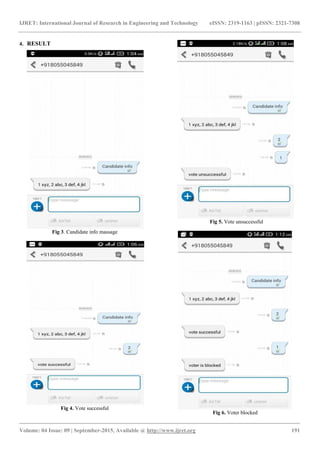
system voter first send a massage ―candidate info‖ to M-
EVM Then M-EVM give reply of all candidate name like
A) ABC, B) XYZ etc. then voter reply this massage
likewise A or B. then voting of such voter is done and vote
is taken. If voter replies more than one option then vote of
such voter is unsuccessful and unable to vote again. After
voting voter receives massage of successful or unsuccessful
voting[3]. we are able to exploit existing mobile
authentication mechanisms and provide enhanced voter
authentication, while maintaining voter privacy. voting
result is declared in 1hr after voting and result will send all
registered mobile number.
2. PROBLEM STATEMENT:
Now a day's most of voters are busy in his /her work and
most of the voter are living far away from voting centre
some voter don't like to wait in queues thus due to these
voters don't visit to the pooling booth and Percentage of
voting is decreasing. Now a days voting system is somehow](https://image.slidesharecdn.com/e-votingsystemusingmobilesms-160916052320/85/E-voting-system-using-mobile-sms-1-320.jpg)
![IJRET: International Journal of Research in Engineering and Technology eISSN: 2319-1163 | pISSN: 2321-7308
_______________________________________________________________________________________
Volume: 04 Issue: 09 | September-2015, Available @ http://www.ijret.org 189
complicated and time consuming now. this process is such
as voter manually going to an voting centre and shows
voter card (Id) to the voting officer. this voting card will be
issued for getting the authentication during the actual
process of voting at the station. where they believe that their
names are made available and if so after authentication With
this, a voters’ list will be generated for each constituency.
then name of the such voter will be search in the list and
then each voter will then have to go to a polling station and
then such person will cast their vote by placing a mark
against the political party symbol of their choice[4,5]. In
some cases, on the voter’s right index finger, an indelible
ink mark is made to show that this person has already voted
and so the voter cannot vote again. this is all time
consuming process. also the large man power is needed for
checking voter id, voter list and marking the figure and at
each polling station. so election commission have need to
pay the so much cost for this man power. After the voting
schedule is complete, voting station officer will then take
the ballot boxes or electronic voting machine to a
centralized place, then declare the voting results after 8-10
days. during this day security of this is big problem. for this
large manpower is need and election commission pay so
much cost for this.
2.1 Proposed System:
Now we are developed modified electronic voting machine
(MEVM). we can call this voting machine is E-Electronic
voting machine(M-EVM). This has two facility, first for
those voter don't have an mobile is voter. such voter can be
vote going physically in voting centre, like pressing the key
in front of his/her candidate symbol. Second for those voter
have mobile and living remote place from voting centre,
don't like to wait in queues, don't have time such voter can
vote using his/her personal mobile to sending the SMS. First
facility is same like traditional voting machine. So we
focused on second facility, in this important is voter mobile
number[6,7] is must registered in M-EVM database. Using
only such registered mobile number voter can be vote. In
this voter send the SMS to M-EVM and M-EVM give
response to such mobile number and take vote of particular
voter. Once the vote of the particular persons is taken then
mobile number of such particular person is blocked. So once
person was done voting he/her unable to vote again. In this
system voter first send massage ―candidate info‖ to M-EVM
Then M-EVM give reply of all candidate name like A)
ABC, B) XYZ etc. then voter reply this massage likewise A
or B. then voting of such voter is done and vote is taken. If
voter reply more than one option then vote of such voter is
unsuccessful and unable to vote again. After voting voter
receives massage of successful or unsuccessful voting. for
the security we can generate the special list of mobile voted
result in personal computer/ laptop and this list is updated
automatically whenever any voter votes . voting officer
cross check the voter, search the name of each voter in this
list for the instant result facility we can connect M-EVM to
the personal computer/ laptop via USB, and division wise
all personal computer and laptop then connected to each
other using the LAN. voting summation of the each
candidate from each division done in respective division
personal computer/ laptop. then we will display the result
after 1 hr of voting. SMS of the result is send all the
registered mobile number.
2.2 System Implementation:
Fig. 1 block diagram
2.3 Arm Cortex M3:
The STM32F103RCT6 [9] medium-density performance
line family incorporates the high performance ARM Corte-
M3 32-bit RISC core operating at a 72 MHz frequency, high
speed embedded memories (Flash memory up to 128 Kbytes
and SRAM up to 20 Kbytes), and an extensive range of
enhanced I/Os and peripherals connected to two APB buses.
All devices offer two 12-bit ADCs, three general purpose
16-bit timers plus one PWM timer, as well as standard and
advanced communication interfaces: up to two I2Cs and
SPIs, three USARTs, an USB and a CAN. The devices
operate from a 2.0 to 3.6 V power supply. They are
available in both the –40 to +85 °C temperature range and
the –40 to +105 °C extended temperature range. A
comprehensive set of power saving mode allows the design
of low power applications. The STM32F103R medium
density performance line family includes devices in six
different package types: from 36 pins to 100 pins.
Depending on the device chosen, different sets of
peripherals are included the description below gives an
overview of the complete
range of peripherals proposed in this family.
2.4 Universal Serial Bus (Usb):
USB was designed to standardize the connection of
computer peripherals to personal computers, both to
communicate and to supply electric power. It has become
commonplace on other devices, such as smart phones,
PDAs. USB has effectively replaced a variety of earlier
interfaces, such as serial and parallel ports, as well as
separate power chargers for portable devices. In our device
we use USB 2.0 adding a higher maximum signaling rate of
480 Mbit/s called High Speed, in addition to the USB 1.x
Full Speed signaling rate of 12 Mbit/s. Due to bus access](https://image.slidesharecdn.com/e-votingsystemusingmobilesms-160916052320/85/E-voting-system-using-mobile-sms-2-320.jpg)
![IJRET: International Journal of Research in Engineering and Technology eISSN: 2319-1163 | pISSN: 2321-7308
_______________________________________________________________________________________
Volume: 04 Issue: 09 | September-2015, Available @ http://www.ijret.org 190
constraints, the effective throughput of the High Speed
signaling rate is limited to 35 MB/s or 280 Mbit/s. [10].
Further modifications to the USB specification have been
made via Engineering Change Notices 1.1.(ECN).
2.5 GSM Moule:
GSM(Global System Mobile) is a digital communication
system which has rapidly gained acceptance and market
sheared worldwide. Mobile services based on GSM
technology were first launched in Finland. GSM, together
with other technologies, is part of the evolution of wireless
mobile telecommunications that includes High-Speed
Circuit-Switched Data (HCSD), General Packet Radio
System (GPRS), Enhanced Data GSM Environment
(EDGE), and Universal Mobile Telecommunications
Service (UMTS). GSM is a digital wireless communication
protocol for mobile phones. It is provided with many other
useful features such as security, authentication and the
ability to switch phones without the need to reconfigure the
phone with the existence of the SIM card. The GSM
network can be divided into three parts.
Mobile Station
Base Station
Network Subsystem
3. FLOWCHART:
Fig 2. Flowchart](https://image.slidesharecdn.com/e-votingsystemusingmobilesms-160916052320/85/E-voting-system-using-mobile-sms-3-320.jpg)
![IJRET: International Journal of Research in Engineering and Technology eISSN: 2319-1163 | pISSN: 2321-7308
_______________________________________________________________________________________
Volume: 04 Issue: 09 | September-2015, Available @ http://www.ijret.org 192
Fig 7. voting result
5. CONCLUSION
By referring this paper security performance is improved,
avoid the security tensions and also avoid the queue in the
voting time at polling booth. Voter can cast his or her vote
easily from any place in given time. It can saves the time of
the voter and avoid the forgery votes. Authentication is
always a difficult requirement to fulfill for remote voting
schemes, most of which apply a public Computer Science &
Information Technology (CS & IT) 303 key based signature
scheme for voter authentication. In our scheme, by using the
existing GSM authentication infrastructure, the public-key
overhead is largely reduced. Our scheme also enhances the
security and provides more mobility and convenience to
voters. In this paper, we presented the basic structure and
protocol of our GSM based mobile voting system.
REFERENCES
[1]. Burmester, M., Magkos, E., :Towards secure and
practical e-elections in the new era. In D.
Gritzalis,editor, Secure Electronic Voting, pages 63–
72. Kluwer Academic Publishers, (2003).
[2]. Chaum, D.,: Untraceable electronic mail, return
addresses, and digital pseudonyms. Communications
of the ACM, 24(2):84–88, February (1981).
[3]. R. Mercuri, ―A Better Ballot Box?‖ IEEE Spectrum,
[4]. Vol.39, No.10, 2002, pp.46-50. [4] Chaum, D., : The
dining cryptographers problem: Unconditional sender
and recipient untraceability.Journal of Cryptology,
(1):65–75, (1988).
[5]. Hirt ,M., Sako, K.,: Efficient receipt-freesvoting based
on homomorphic encryption. In B. Preneel,editor,
Advances in Cryptology— EUROCRYPT ’00, volume
1807 of Lecture Notes in Computer
[6]. ETS 300 506. Security aspects (GSM 02.09 version
4.5.1), Digital cellular telecommunications system
(phase 2), (2000).
[7]. Fujioka, T., Okamoto, K.,Ohta :A practical secret
voting scheme for large scale elections. In J. Seberry
and Y. Zheng, editors, Advances in Cryptology—
Auscrypt’92, volume 718 of Lecture Notes in
Computer Science, pages pp. 244–251, Gold Coast,
Queensland, Austrailia, 13-16 December 1992.
Springer Verlag,(1992).
[8]. T. M. Carbaugh, ―Secretary of State Kevin Shelley
Announces Directives To Ensure Voter Confidence in
Electronic Systems,‖ California Secretary of
State,2003). Science, pages 539 556. Springer-Verlag,
May (2000).
[9]. ―ARM Cortex M3‖, [Online] Available:
http://www.st.com
[10]. 5.5.4". Universal Serial Bus Specification (Technical
report). 2000. p. 40. v2.0.
ABOUT AUTHOR
Mr. Dinesh R. Gawade is currently
pursuing his B.Tech degree in
electronics and communication
technology at department of technology,
Shivaji University Kolhapur, India. He
was received diploma in electronics
telecommunication engineering from
MSBTE Maharashtra, India in 2013, He
was received B.A. degree in psychology from yashwantrao
chavan Maharashtra Open University, Nashik, India in
2014. He published more than two research paper in
international journal. His research interests include
embedded systems, wireless sensor networks, healthcare
systems, electronic measurement techniques and mobile
applications
Mr. Amardeep A. Shirolkarwas
received Diploma in Industrial
Electronics from Government
Polytechnic, Kolhapur, Maharashtra,
India in 1991 and B.E. degree in
electronics engineering from Shivaji
University, Kolhapur, India in 1995. He
was also received M.Tech degree in
Electronics Technology from the same university in 2010.
He is currently working as Assistant Professor of electronics
and communication Technology at Department of
Technology in Shivaji University, Kolhapur,India. He
published research papers in national and international
conferences. His research interests include embedded
systems, signal processing, image processing, wireless
sensor networks, healthcare systems, electronic
measurement techniques.
Mr. Sagar R. Patil was received B.E.
degree in electronics engineering from
collage of engineering Hadpsar, Pune
India in 2010. He was received
M.Tech degree in electronics and
communication engineering from st.
Marry group of institution, Hydrabad
India in 2014. He is currently lecturer
of electronics and telecommunication department in
Parikrama Polytechnic kashti, India. He published more than
two research paper in international journal. His research
interests include embedded systems, wireless sensor
networks, healthcare systems, electronic measurement
techniques, power electronics and control system.](https://image.slidesharecdn.com/e-votingsystemusingmobilesms-160916052320/85/E-voting-system-using-mobile-sms-5-320.jpg)

This paper presents an innovative mobile SMS-based electronic voting system designed to address the declining voter turnout associated with traditional voting methods. The system allows voters to cast their votes via SMS, providing greater accessibility and quicker results, with outcomes available within one hour of voting. By integrating mobile telecommunications technology, it enhances voter authentication while ensuring privacy, significantly streamlining the voting process.


![Internet Of Things (Question Paper) [October – 2018 | Choice Based Syllabus]](https://cdn.slidesharecdn.com/ss_thumbnails/iot-oct-2018-181112024446-thumbnail.jpg?width=640&height=640&fit=bounds)


