Environmental Resources  Unit A Natural Resources
Problem Area 3 Water
Understanding the Water Cycle  and Its Importance to the Environment Lesson 1
Answer the following questions. When was the last time you took a drink of water? Where did you take this drink? Where do think the water came from? Where do you belong in the water cycle?
Learning Objectives Describe the water cycle. Describe the physical and chemical makeup of water. Identify bodies of flowing water. Identify bodies of non-flowing water.
Terms Brackish water Brook Canal Catchment Channel Creek Current Desalination Distillation Drainage divide Estuary Evaporation Flood plain Freshwater Lakes Marshes
Terms Oceans Ponds Precipitation Reservoirs River Saline water Saltwater Sloughs Stream Stream banks Stream bed Stream hydrology Streamflow Transpiration Water cycle
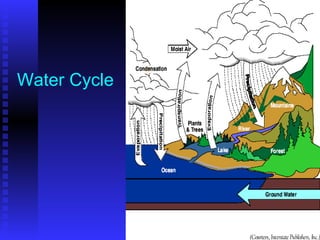
Water Cycle The continuous movement of water from the earth to the atmosphere and back to the earth. The sun provides the energy for the water cycle, also known as the hydrologic cycle. The water cycle occurs in four overlapping spheres.
Water Cycle
Water Cycle Spheres Hydrosphere Atmosphere Biosphere Lithosphere
Hydrosphere Water moves from the earth to the atmosphere through the processes of evaporation and transpiration.  Evaporation is the transformation of water from its liquid form to its gaseous form as a result of coming in contact with heat or the air. Transpiration is the process of plants releasing water through their leaves is called.
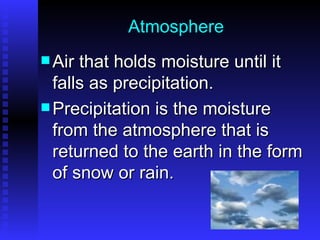
Atmosphere Air that holds moisture until it falls as precipitation. Precipitation is the moisture from the atmosphere that is returned to the earth in the form of snow or rain.
Biosphere Includes all plant and animal life which are consumers of water.
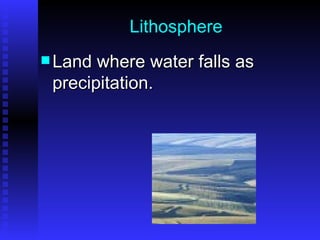
Lithosphere Land where water falls as precipitation.
Physical and Chemical Makeup of Water Water, in its purest form, is tasteless, odorless, and colorless.  It is a chemical compound made up of two atoms of hydrogen and one atom of oxygen.  Its chemical symbol is H 2 O.
Physical States of Water Solid form of water is called ice. Water freezes at 32F or 0C. Gaseous form of water is called water vapor or steam.  When water boils it turns into water vapor or steam. Water boils at 212°F or 100°C. In between the gaseous and solid form, water is in its liquid form.
Chemical Make-up of Water Water that contains salt is called saline water. Sodium chloride, potassium, and magnesium can raise the level of salts in the water.  The amount of salt in the water will determine its usefulness.  Water that is too high in salt cannot be used for drinking or irrigation.
Categories of Saline Water Freshwater Saltwater Brackish water
Freshwater Water with less than 3.0 parts per thousand (ppt) of salt. Most commonly found in drilled wells, streams, and lakes.  Only 3 percent of the water on the earth is considered freshwater, of this 3 percent only 1 percent is available for use.
Saltwater Water with 16.5 ppt or more of salt. Some ocean and sea water is as high as 33 to 37 ppt.  Saltwater makes up about 97 percent of the earth’s water.
Brackish Water A mixture of saltwater and freshwater. Brackish water is found where freshwater flows into the ocean or other bodies of saltwater.  An estuary is the area where a freshwater stream flows into the ocean or a saltwater lake.
Usable Water Two main ways that salt water and contaminated water can be turned into usable water:  distillation and desalination.
Usable Water Distillation is the boiling of water and collection of its vapor.  The vapor then turns into liquid when cooled.  The liquid is pure at this point.
Usable Water Desalination is the removal of salt from water.  It involves the process of distillation but is not economical on a large scale.
Flowing Bodies of Water One of the most important parts of the water cycle is the stream. Streams are flowing bodies of water that are useful resources for irrigation, factories, and local water systems.
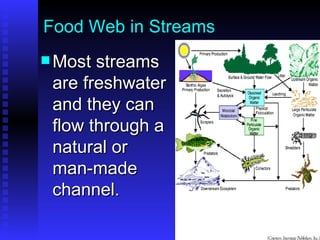
Food Web in Streams Most streams are freshwater and they can flow through a natural or man-made channel.
Types of Streams Stream type is determined by the volume and velocity of the movement of water, or streamflow.  The four types of streams are rivers, creeks, brooks, and canals.
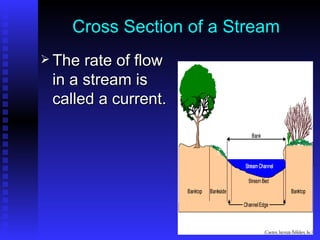
Cross Section of a Stream The rate of flow in a stream is called a current.
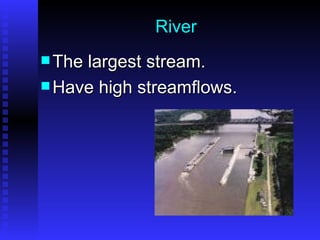
River The largest stream.  Have high streamflows.
Creek A stream that is smaller than a river.  Often flow into rivers, lakes, and oceans.
Brook A small stream.  Often flow into creeks, rivers, lakes, and oceans.
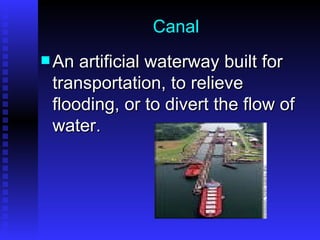
Canal An artificial waterway built for transportation, to relieve flooding, or to divert the flow of water.
Stream Hydrology The study of flowing water and its environment. The physical, chemical, and biological properties of the water and the surrounding environment are tested.  The ecosystems, including food webs, are studied.
Stream Ecosystems Many ecosystems can be found in streams.  Species within the streams survive on nutrients that are provided by the areas surrounding the stream. These nutrients move with the flow of the stream.
Stream Structure Determines how water moves within the stream and through the earth.  A stream is an important part of watershed or catchment.  The edge of a watershed is known as a drainage divide.
Stream Structure The area through which water flows in a stream is called a channel.  A channel is usually formed with rock or soil and it is the sides and bottom of the stream.  The bottom of the channel is called the stream bed, the sides are called the stream banks.
Stream Structure When a channel is not large enough to hold the flow of water the area that overflows is called a flood plain.
Non-Flowing Bodies These bodies may be natural or artificial.  Non-flowing  bodies of water influence the weather and climate of an area.  Commerce, food supply, and recreational activities can also be influenced by the non-flowing bodies of water in an area.
Non-Flowing Bodies Bodies of water that do not flow still have water movement.  The internal movement is caused by temperature changes and salinity.
Types of Non-Flowing Bodies Seven types of non-flowing bodies of water are oceans, lakes, ponds, reservoirs, sloughs, marshes, and estuaries. As in flowing streams, non-flowing bodies of water may contain a variety of ecosystems.
Types of Non-Flowing Bodies The ecosystems at the bottom of the body of water will vary from those at the top.  This is due to the varying water temperature, salinity, and other characteristics.
Oceans Large bodies of saltwater.  Cover almost 75 percent of the surface of the earth.
Lakes Bodies of freshwater that are surrounded by land.  Vary in size, some are natural and others are man-made.
Ponds Non-flowing bodies of water that are smaller than lakes.  Commonly manmade and used as a source of recreation or for use by livestock.
Reservoirs Large bodies of stored water.  Commonly used to generate electric power.
Sloughs Thick, muddy areas of shallow water.
Marshes Areas of land covered with shallow water and plants such as cattails. Do not contain trees and are similar in nature to sloughs.
Estuaries Areas where freshwater streams flow into the ocean or a saltwater lake.
Review / Summary Describe the water cycle. Describe the physical and chemical makeup of water. Identify bodies of flowing water. Identify bodies of non-flowing water.

E Science[1]

  • 1.
    Environmental Resources Unit A Natural Resources
  • 2.
  • 3.
    Understanding the WaterCycle and Its Importance to the Environment Lesson 1
  • 4.
    Answer the followingquestions. When was the last time you took a drink of water? Where did you take this drink? Where do think the water came from? Where do you belong in the water cycle?
  • 5.
    Learning Objectives Describethe water cycle. Describe the physical and chemical makeup of water. Identify bodies of flowing water. Identify bodies of non-flowing water.
  • 6.
    Terms Brackish waterBrook Canal Catchment Channel Creek Current Desalination Distillation Drainage divide Estuary Evaporation Flood plain Freshwater Lakes Marshes
  • 7.
    Terms Oceans PondsPrecipitation Reservoirs River Saline water Saltwater Sloughs Stream Stream banks Stream bed Stream hydrology Streamflow Transpiration Water cycle
  • 8.
    Water Cycle Thecontinuous movement of water from the earth to the atmosphere and back to the earth. The sun provides the energy for the water cycle, also known as the hydrologic cycle. The water cycle occurs in four overlapping spheres.
  • 9.
  • 10.
    Water Cycle SpheresHydrosphere Atmosphere Biosphere Lithosphere
  • 11.
    Hydrosphere Water movesfrom the earth to the atmosphere through the processes of evaporation and transpiration. Evaporation is the transformation of water from its liquid form to its gaseous form as a result of coming in contact with heat or the air. Transpiration is the process of plants releasing water through their leaves is called.
  • 12.
    Atmosphere Air thatholds moisture until it falls as precipitation. Precipitation is the moisture from the atmosphere that is returned to the earth in the form of snow or rain.
  • 13.
    Biosphere Includes allplant and animal life which are consumers of water.
  • 14.
    Lithosphere Land wherewater falls as precipitation.
  • 15.
    Physical and ChemicalMakeup of Water Water, in its purest form, is tasteless, odorless, and colorless. It is a chemical compound made up of two atoms of hydrogen and one atom of oxygen. Its chemical symbol is H 2 O.
  • 16.
    Physical States ofWater Solid form of water is called ice. Water freezes at 32F or 0C. Gaseous form of water is called water vapor or steam. When water boils it turns into water vapor or steam. Water boils at 212°F or 100°C. In between the gaseous and solid form, water is in its liquid form.
  • 17.
    Chemical Make-up ofWater Water that contains salt is called saline water. Sodium chloride, potassium, and magnesium can raise the level of salts in the water. The amount of salt in the water will determine its usefulness. Water that is too high in salt cannot be used for drinking or irrigation.
  • 18.
    Categories of SalineWater Freshwater Saltwater Brackish water
  • 19.
    Freshwater Water withless than 3.0 parts per thousand (ppt) of salt. Most commonly found in drilled wells, streams, and lakes. Only 3 percent of the water on the earth is considered freshwater, of this 3 percent only 1 percent is available for use.
  • 20.
    Saltwater Water with16.5 ppt or more of salt. Some ocean and sea water is as high as 33 to 37 ppt. Saltwater makes up about 97 percent of the earth’s water.
  • 21.
    Brackish Water Amixture of saltwater and freshwater. Brackish water is found where freshwater flows into the ocean or other bodies of saltwater. An estuary is the area where a freshwater stream flows into the ocean or a saltwater lake.
  • 22.
    Usable Water Twomain ways that salt water and contaminated water can be turned into usable water: distillation and desalination.
  • 23.
    Usable Water Distillationis the boiling of water and collection of its vapor. The vapor then turns into liquid when cooled. The liquid is pure at this point.
  • 24.
    Usable Water Desalinationis the removal of salt from water. It involves the process of distillation but is not economical on a large scale.
  • 25.
    Flowing Bodies ofWater One of the most important parts of the water cycle is the stream. Streams are flowing bodies of water that are useful resources for irrigation, factories, and local water systems.
  • 26.
    Food Web inStreams Most streams are freshwater and they can flow through a natural or man-made channel.
  • 27.
    Types of StreamsStream type is determined by the volume and velocity of the movement of water, or streamflow. The four types of streams are rivers, creeks, brooks, and canals.
  • 28.
    Cross Section ofa Stream The rate of flow in a stream is called a current.
  • 29.
    River The largeststream. Have high streamflows.
  • 30.
    Creek A streamthat is smaller than a river. Often flow into rivers, lakes, and oceans.
  • 31.
    Brook A smallstream. Often flow into creeks, rivers, lakes, and oceans.
  • 32.
    Canal An artificialwaterway built for transportation, to relieve flooding, or to divert the flow of water.
  • 33.
    Stream Hydrology Thestudy of flowing water and its environment. The physical, chemical, and biological properties of the water and the surrounding environment are tested. The ecosystems, including food webs, are studied.
  • 34.
    Stream Ecosystems Manyecosystems can be found in streams. Species within the streams survive on nutrients that are provided by the areas surrounding the stream. These nutrients move with the flow of the stream.
  • 35.
    Stream Structure Determineshow water moves within the stream and through the earth. A stream is an important part of watershed or catchment. The edge of a watershed is known as a drainage divide.
  • 36.
    Stream Structure Thearea through which water flows in a stream is called a channel. A channel is usually formed with rock or soil and it is the sides and bottom of the stream. The bottom of the channel is called the stream bed, the sides are called the stream banks.
  • 37.
    Stream Structure Whena channel is not large enough to hold the flow of water the area that overflows is called a flood plain.
  • 38.
    Non-Flowing Bodies Thesebodies may be natural or artificial. Non-flowing bodies of water influence the weather and climate of an area. Commerce, food supply, and recreational activities can also be influenced by the non-flowing bodies of water in an area.
  • 39.
    Non-Flowing Bodies Bodiesof water that do not flow still have water movement. The internal movement is caused by temperature changes and salinity.
  • 40.
    Types of Non-FlowingBodies Seven types of non-flowing bodies of water are oceans, lakes, ponds, reservoirs, sloughs, marshes, and estuaries. As in flowing streams, non-flowing bodies of water may contain a variety of ecosystems.
  • 41.
    Types of Non-FlowingBodies The ecosystems at the bottom of the body of water will vary from those at the top. This is due to the varying water temperature, salinity, and other characteristics.
  • 42.
    Oceans Large bodiesof saltwater. Cover almost 75 percent of the surface of the earth.
  • 43.
    Lakes Bodies offreshwater that are surrounded by land. Vary in size, some are natural and others are man-made.
  • 44.
    Ponds Non-flowing bodiesof water that are smaller than lakes. Commonly manmade and used as a source of recreation or for use by livestock.
  • 45.
    Reservoirs Large bodiesof stored water. Commonly used to generate electric power.
  • 46.
    Sloughs Thick, muddyareas of shallow water.
  • 47.
    Marshes Areas ofland covered with shallow water and plants such as cattails. Do not contain trees and are similar in nature to sloughs.
  • 48.
    Estuaries Areas wherefreshwater streams flow into the ocean or a saltwater lake.
  • 49.
    Review / SummaryDescribe the water cycle. Describe the physical and chemical makeup of water. Identify bodies of flowing water. Identify bodies of non-flowing water.