The e-Readiness Assessment Framework
e-Readiness can be considered as the ability to pursue value creation opportunities for
inclusive economic development facilitated by ICT. Therefore, it is not simply a matter of the
number of computers, websites, internet service providers, internet connections, telephones
and mobiles in the state/UT, but also the ability or readiness to use technology skillfully at
the level of the individual, business and government.
The framework used in the study is based on the NRI, published by WEF that measures “the
degree of preparedness of nation or community to participate in and benefit from ICT
developments”. The framework is modified the NRI to serve purpose of ranking of Indian
States and UTs according to their e-Readiness.
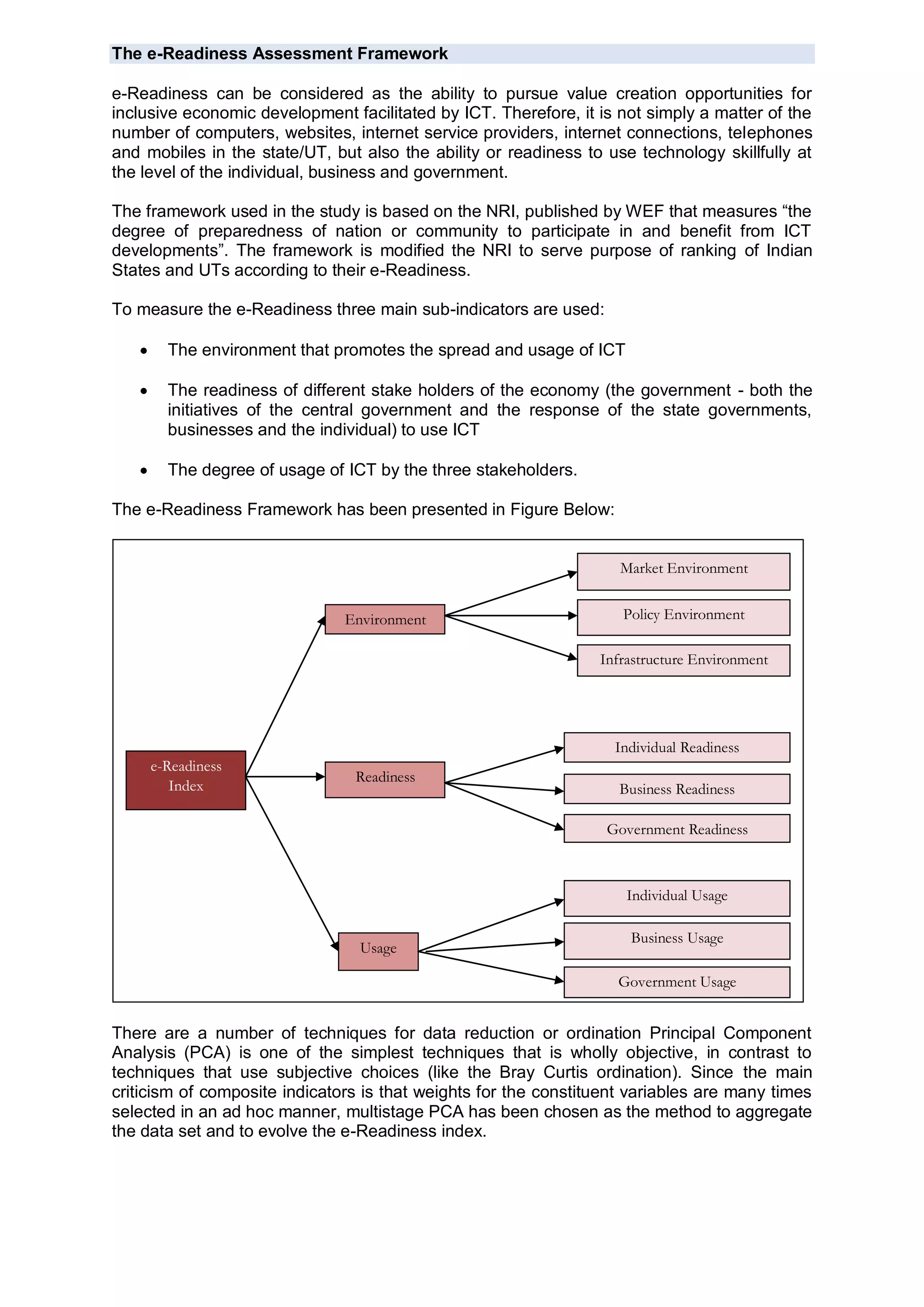
To measure the e-Readiness three main sub-indicators are used:
 The environment that promotes the spread and usage of ICT
 The readiness of different stake holders of the economy (the government - both the
initiatives of the central government and the response of the state governments,
businesses and the individual) to use ICT
 The degree of usage of ICT by the three stakeholders.
The e-Readiness Framework has been presented in Figure Below:
There are a number of techniques for data reduction or ordination Principal Component
Analysis (PCA) is one of the simplest techniques that is wholly objective, in contrast to
techniques that use subjective choices (like the Bray Curtis ordination). Since the main
criticism of composite indicators is that weights for the constituent variables are many times
selected in an ad hoc manner, multistage PCA has been chosen as the method to aggregate
the data set and to evolve the e-Readiness index.
e-Readiness
Index
Environment
Readiness
Usage
Market Environment
Policy Environment
Infrastructure Environment
Individual Readiness
Business Readiness
Government Readiness
Individual Usage
Government Usage
Business Usage

E readiness assessment framework

  • 1.
    The e-Readiness AssessmentFramework e-Readiness can be considered as the ability to pursue value creation opportunities for inclusive economic development facilitated by ICT. Therefore, it is not simply a matter of the number of computers, websites, internet service providers, internet connections, telephones and mobiles in the state/UT, but also the ability or readiness to use technology skillfully at the level of the individual, business and government. The framework used in the study is based on the NRI, published by WEF that measures “the degree of preparedness of nation or community to participate in and benefit from ICT developments”. The framework is modified the NRI to serve purpose of ranking of Indian States and UTs according to their e-Readiness. To measure the e-Readiness three main sub-indicators are used:  The environment that promotes the spread and usage of ICT  The readiness of different stake holders of the economy (the government - both the initiatives of the central government and the response of the state governments, businesses and the individual) to use ICT  The degree of usage of ICT by the three stakeholders. The e-Readiness Framework has been presented in Figure Below: There are a number of techniques for data reduction or ordination Principal Component Analysis (PCA) is one of the simplest techniques that is wholly objective, in contrast to techniques that use subjective choices (like the Bray Curtis ordination). Since the main criticism of composite indicators is that weights for the constituent variables are many times selected in an ad hoc manner, multistage PCA has been chosen as the method to aggregate the data set and to evolve the e-Readiness index. e-Readiness Index Environment Readiness Usage Market Environment Policy Environment Infrastructure Environment Individual Readiness Business Readiness Government Readiness Individual Usage Government Usage Business Usage