[[PowerPointImage("Titlepicture", MasterProperty
("TitlePictures", "Picture"))]]
Carlo Colicchio
IT Business Consultant
A Cloud Readiness Assessment Framework
for EnterpriseContentManagement& Social Software(e-Collaboration)
forSmall and MediumSizedEnterprisesin Switzerland
IEEE - Third International Conference on Enterprise Systems
Date: October 14, 2015
Agenda
[[PowerPointImage("Titlepicture", MasterProperty
("TitlePictures", "Picture"))]]
 Introduction
 Methodology
 Cloud Readiness Assessment
 Findings & Conclusion
Introduction
 Introduction
 Methodology
 CloudReadinessAssessment
 Findings& Conclusion
About the Authors
Carlo Colicchio
MSc. In Business Information Systems (FHNW)
Consultant/Project Manager for UP-GREAT AG
 Business Solutions with Microsoft
SharePoint
 IT-Outsourcing (IT-as-a-Service)
 Enterprise Mobility
Prof. Dr. Stella Gatziu Grivas
Claudio Giovanoli
Head Competence Center “Cloud Computing“
University of Applied Sciences of Northwestern
Switzerland (FHNW)
Research Assistant at the Competence Center
“Cloud Computing“
University of Applied Sciences of Northwestern
Switzerland (FHNW)
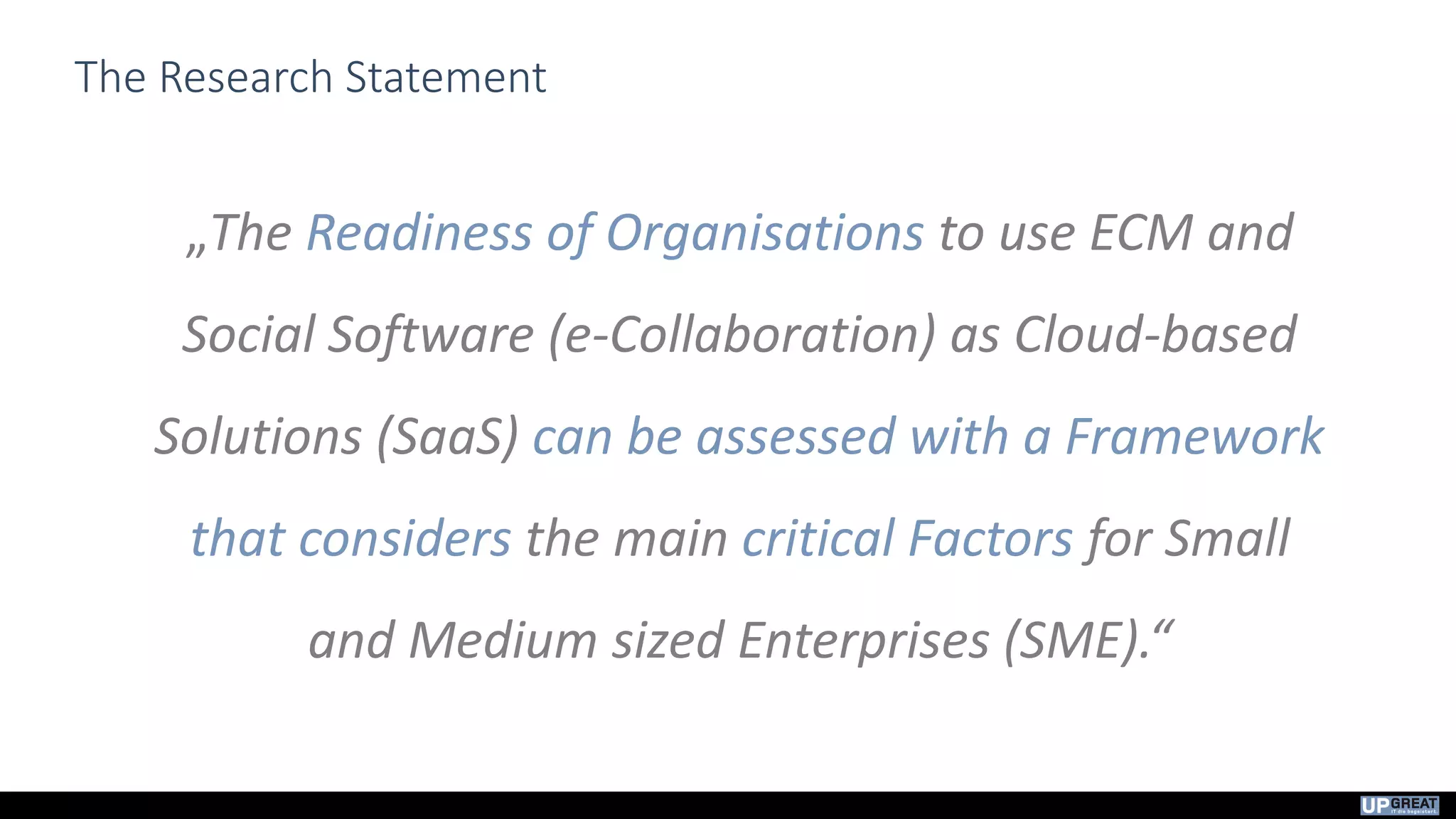
The Research Statement
„The Readiness of Organisations to use ECM and
Social Software (e-Collaboration) as Cloud-based
Solutions (SaaS) can be assessed with a Framework
that considers the main critical Factors for Small
and Medium sized Enterprises (SME).“
What is a Cloud Readiness Assessment?
Cloud Need
Identification
Cloud
Readiness
Assessment
Risk & Benefit
Analysis
Business Case
Cloud Strategy
Transformation
Roadmap
The Cloud Roadmap
Source: Gatziu-Grivas, 2012
“Cloud Readiness represents the maturity of
an organisation, to identify appropriate
Cloud-services, which generate value.
Cloud-services have to be integrated
efficiently and target-oriented within
enterprises in order to be able to manage
their use and allows the agile change of
Cloud-service provider.”
Cloud Readiness:
Source: Nandico, [27/06/14]
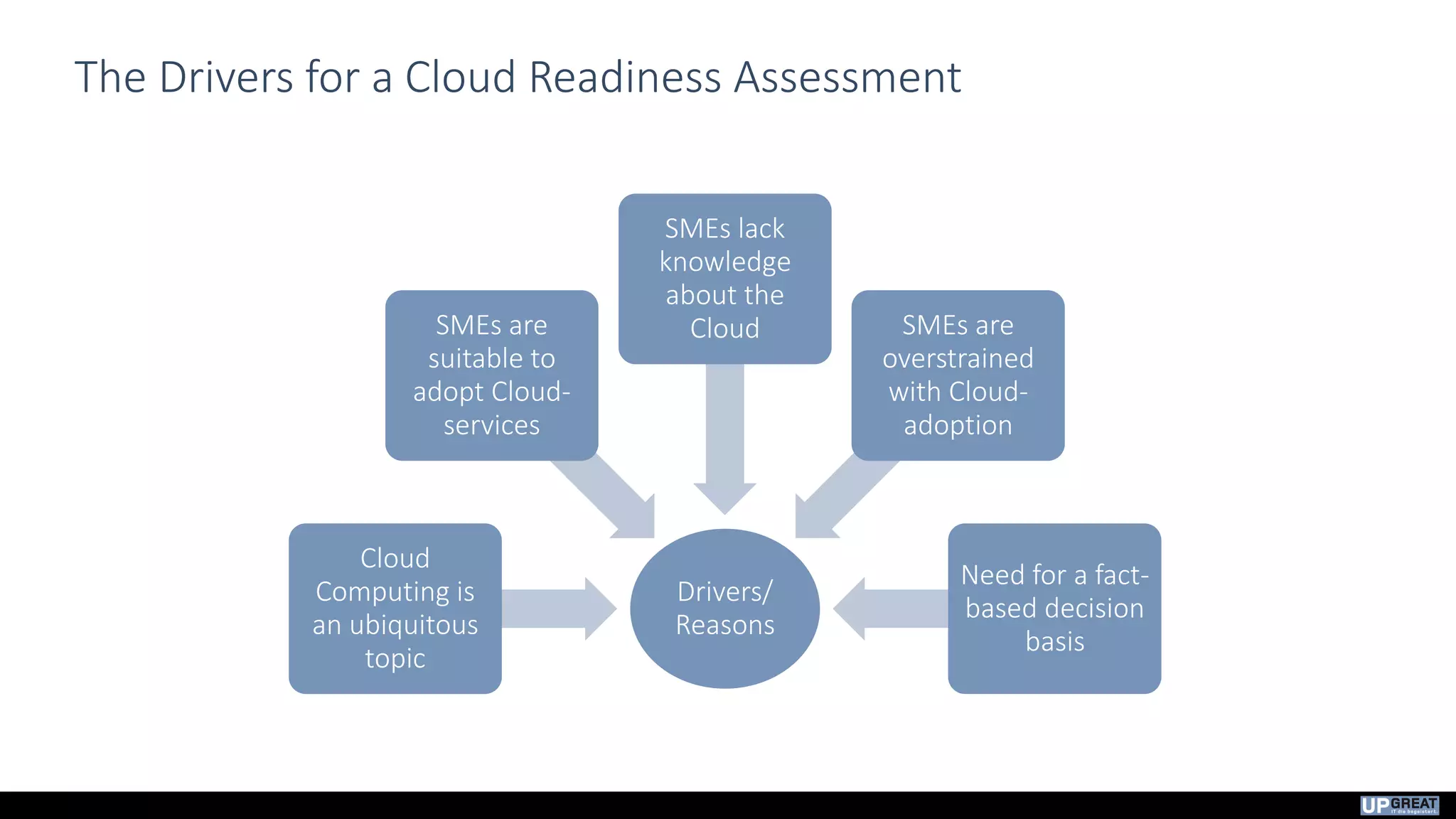
The Drivers for a Cloud Readiness Assessment
Drivers/
Reasons
Cloud
Computing is
an ubiquitous
topic
SMEs are
suitable to
adopt Cloud-
services
SMEs lack
knowledge
about the
Cloud SMEs are
overstrained
with Cloud-
adoption
Need for a fact-
based decision
basis
Methodology
 Introduction
 Methodology
 CloudReadinessAssessment
 Findings& Conclusion
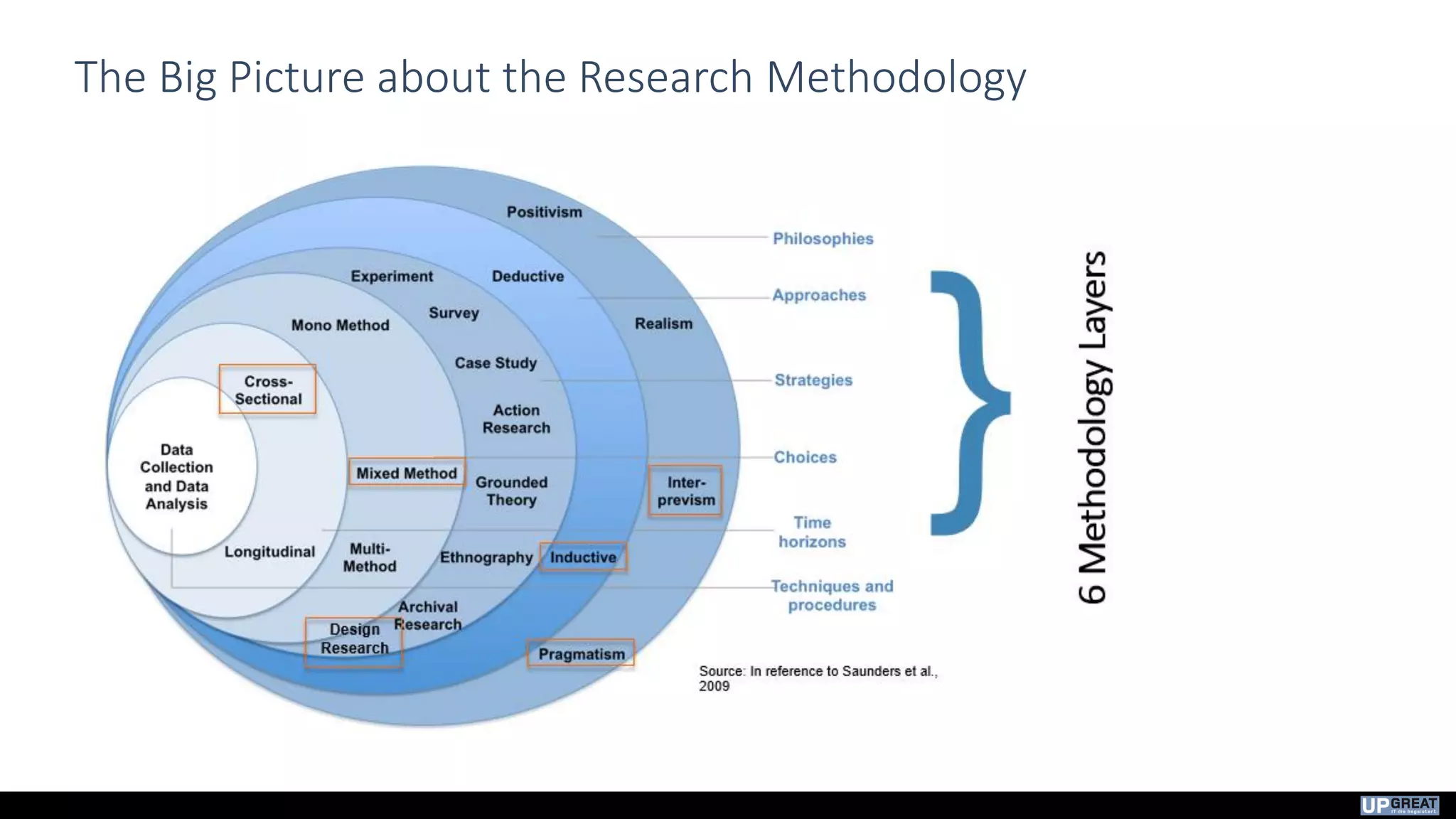
The Big Picture about the Research Methodology
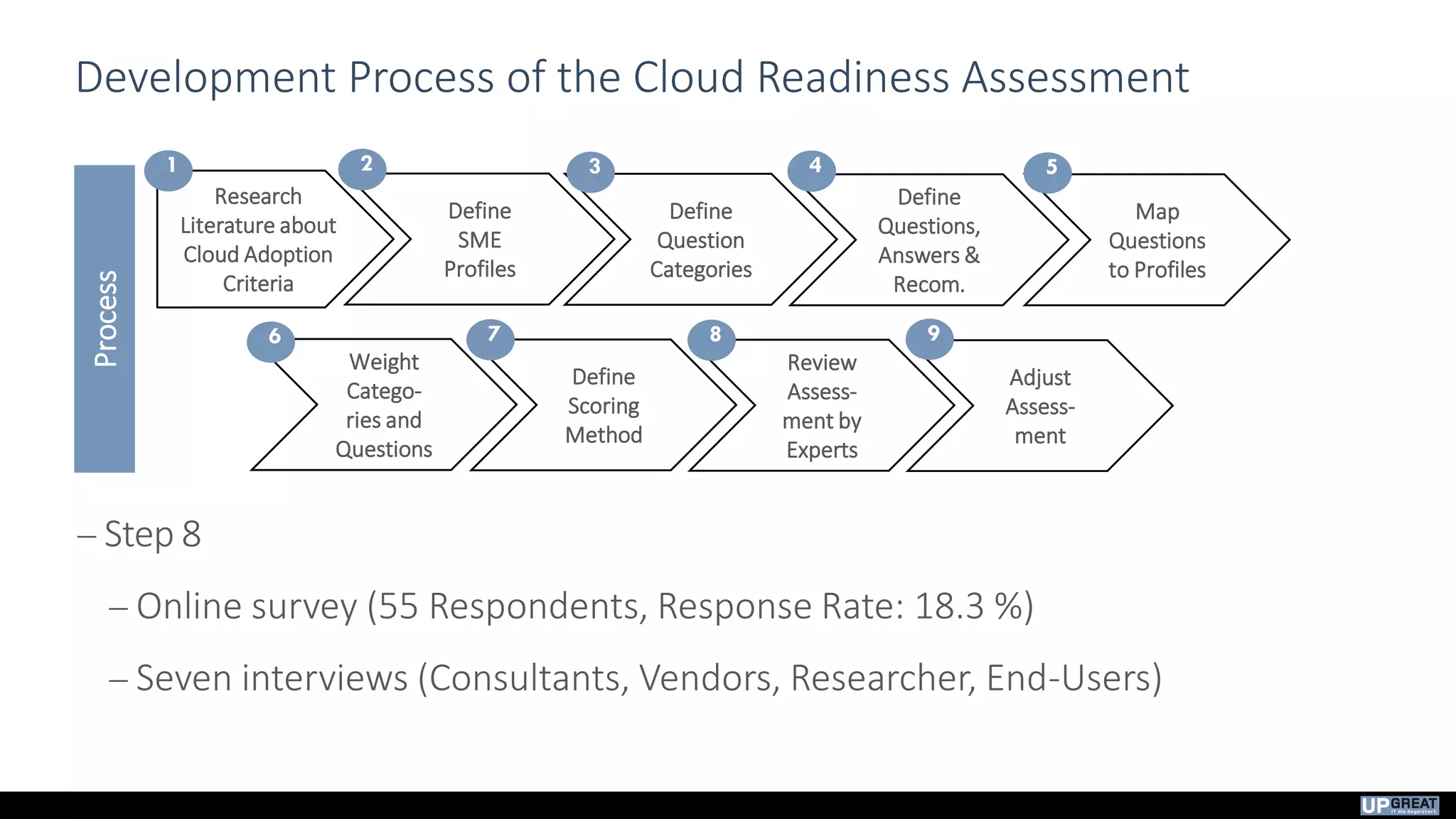
Development Process of the Cloud Readiness Assessment
Research
Literature about
Cloud Adoption
Criteria
Define
SME
Profiles
Define
Question
Categories
Define
Questions,
Answers &
Recom.
Map
Questions
to Profiles
Process
Weight
Catego-
ries and
Questions
Define
Scoring
Method
Review
Assess-
ment by
Experts
Adjust
Assess-
ment
1 2 3 4 5
6 7 8 9
 Step 8
 Online survey (55 Respondents, Response Rate: 18.3 %)
 Seven interviews (Consultants, Vendors, Researcher, End-Users)
Cloud Readiness Assessment
 Introduction
 Methodology
 Cloud Readiness Assessment
 Findings& Conclusion
The major Determinants / Criteria
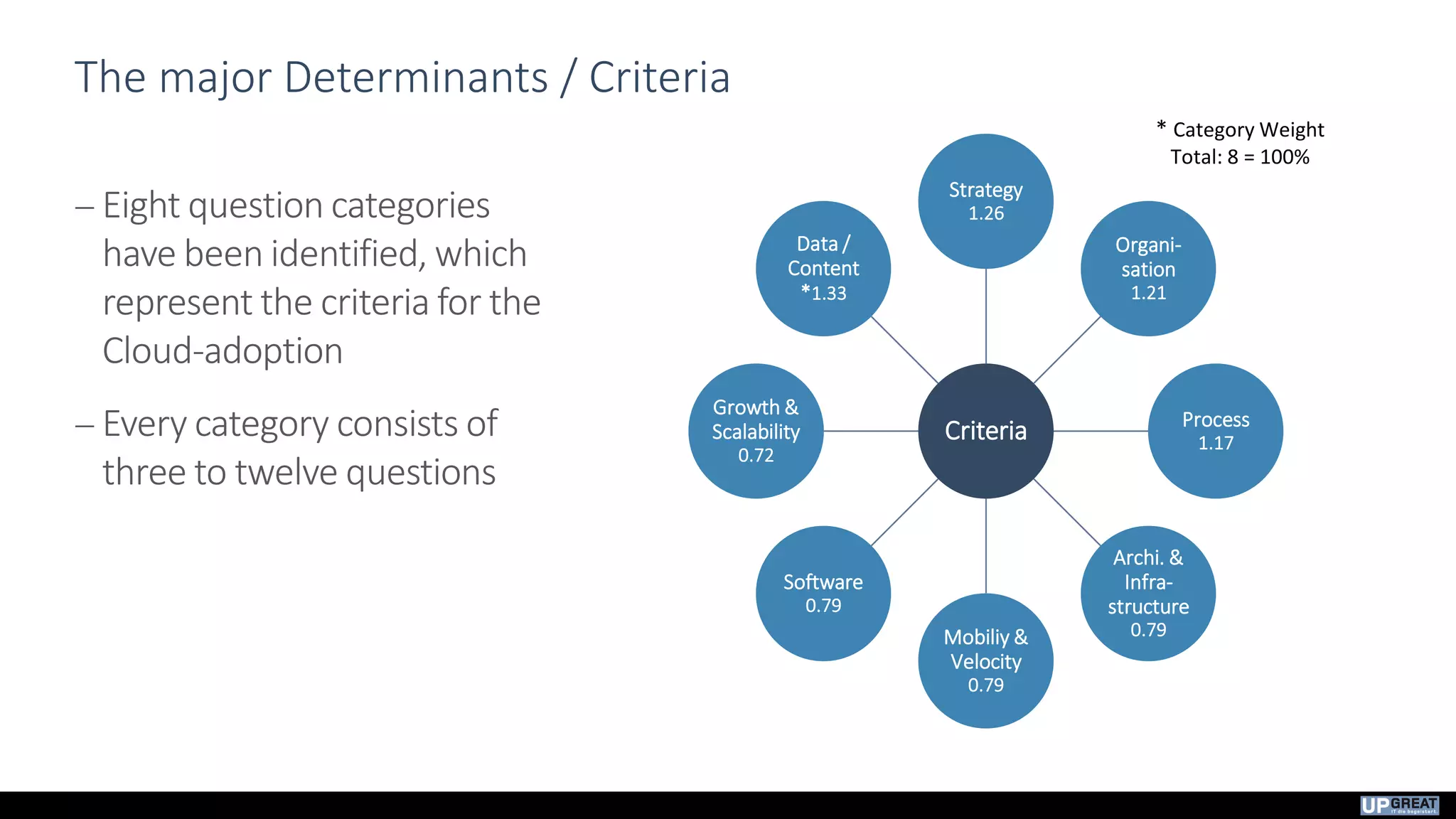
 Eight question categories
have been identified, which
represent the criteria for the
Cloud-adoption
 Every category consists of
three to twelve questions
Criteria
Strategy
1.26
Organi-
sation
1.21
Process
1.17
Archi. &
Infra-
structure
0.79Mobiliy &
Velocity
0.79
Software
0.79
Growth &
Scalability
0.72
Data /
Content
*1.33
* Category Weight
Total: 8 = 100%
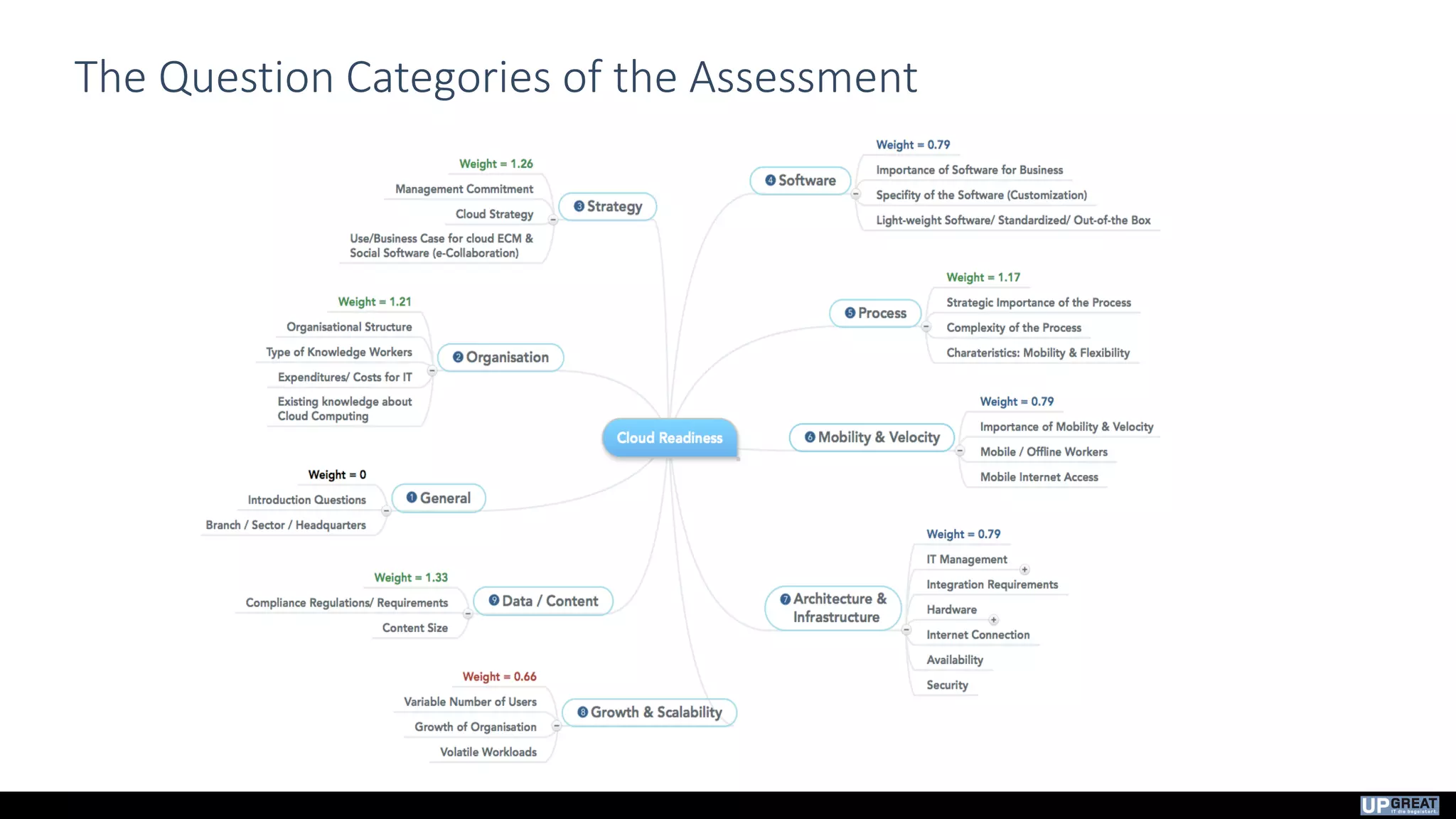
The Question Categories of the Assessment
The Question Templates
 The Assessment consists of 58 questions based on this template
3.1 Do you have defined the goals(s) of your Cloud project (SaaS)? CR VB
1
a) We have clearly defined goals that we want to achieve with Cloud-
services (cost reduction, high availability and performance, increased
flexibility (pay per use) and high user acceptance).
9 5
b) We are still defining the goals that we want to achieve, but the lack of
knowledge about Cloud Computing slowers the process.
5 5
c) No, we do not have defined the goals so far, what we want to achieve
with Cloud-services.
3 3
Desc. It is of vital importance that the organisation knows why it wants to make use of Cloud-services
(SaaS) and for what purpose. Without a proper goal, the whole Cloud journey makes not much
sense.
Rec. [a]: Having already clear targets in mind that your organisation wants to achieve, is a good start-
ing point for the adoption of Cloud-services.
[b]: The definition of the goals is an important factor that is required for every kind of project. If
your organisation is lacking knowledge about the technology Cloud Computing, you may take
advise from external experts/consultants.
[c]: It is of vital importance to have a clear objective, when you introduce a new technology.
Therefore it is recommended to first define the objective you want to achieve, if you are strug-
gling you may take advice form external experts/consultants.
Ref. Arnold
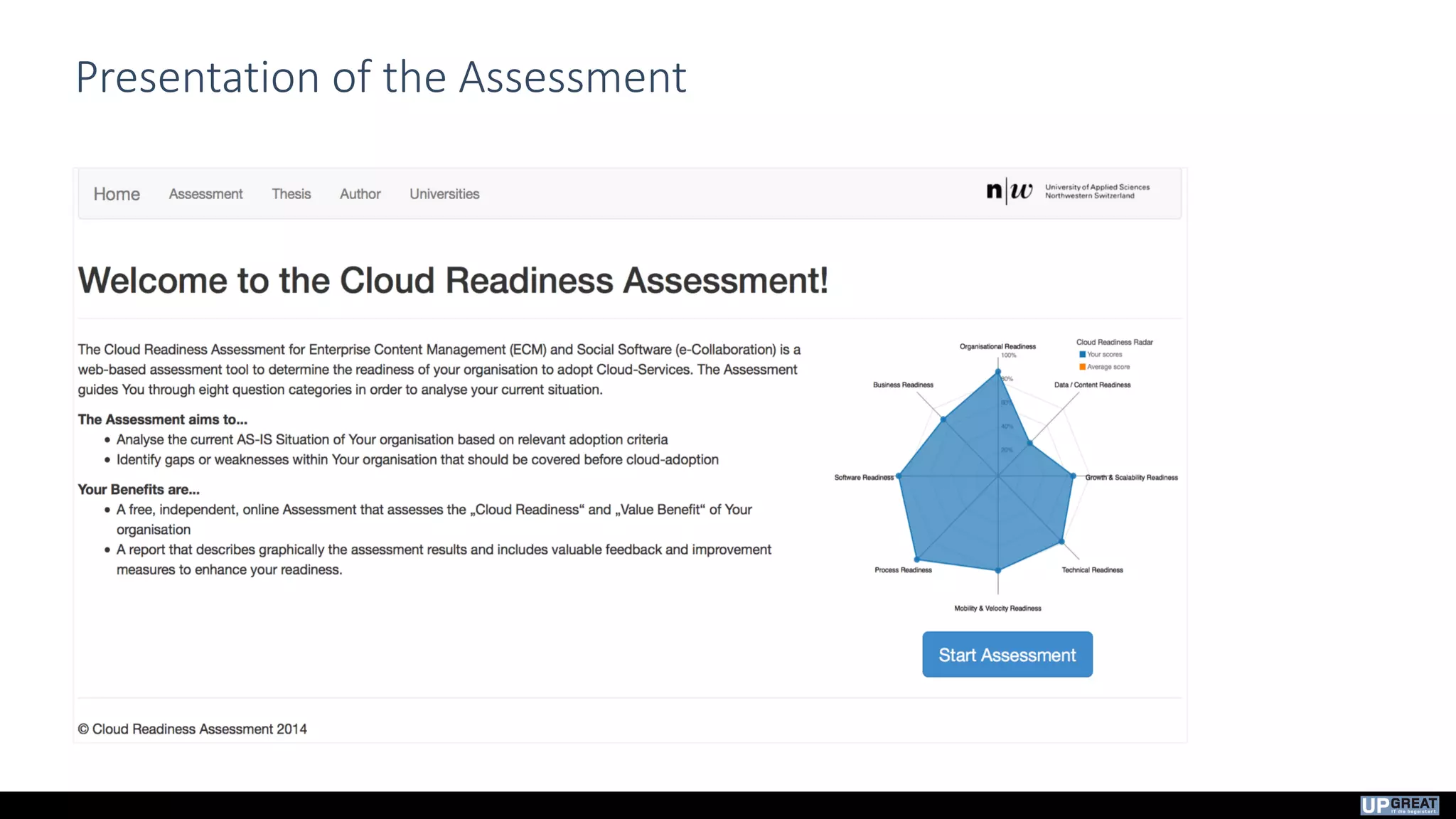
Presentation of the Assessment
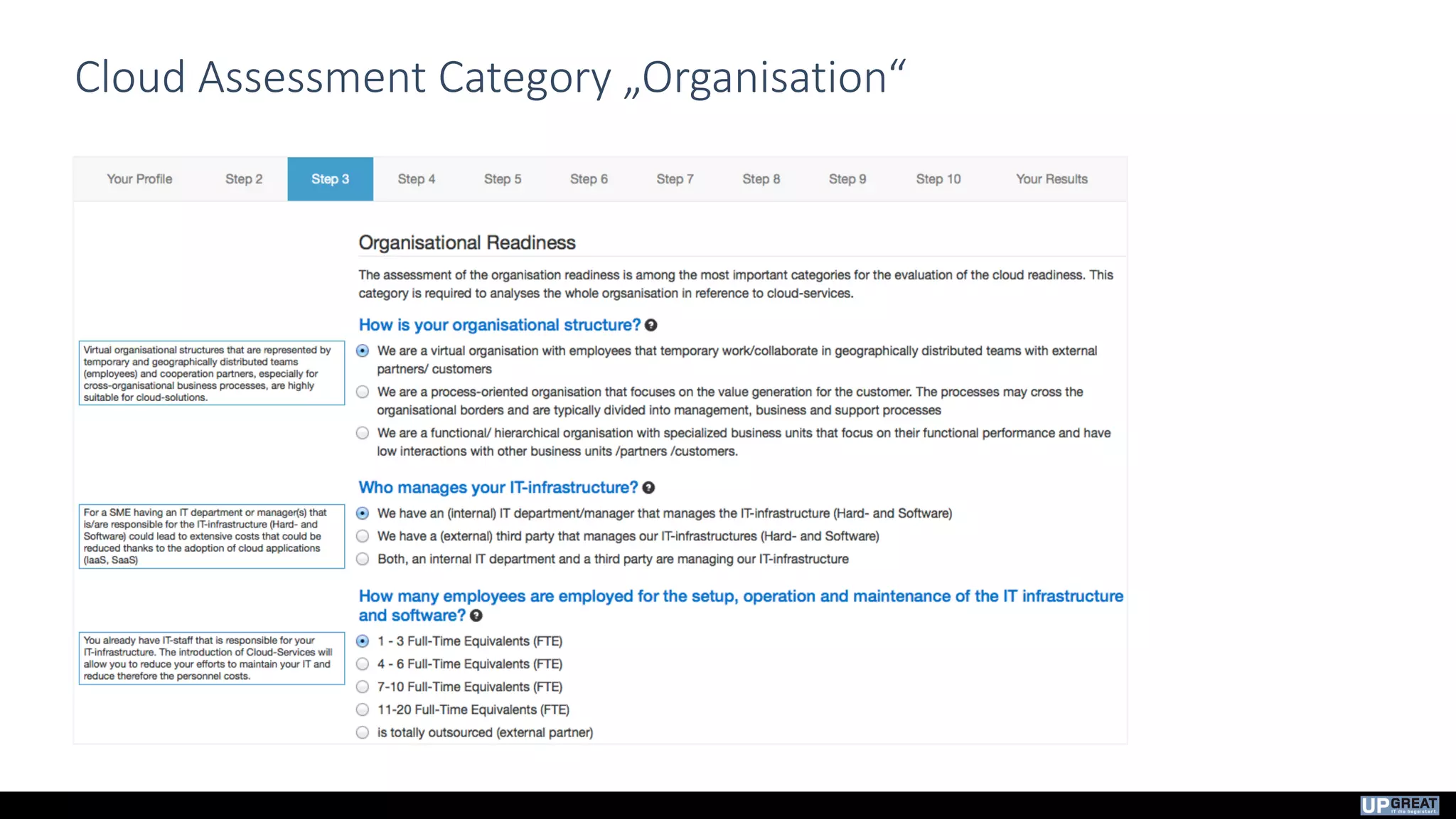
Cloud Assessment Category „Organisation“
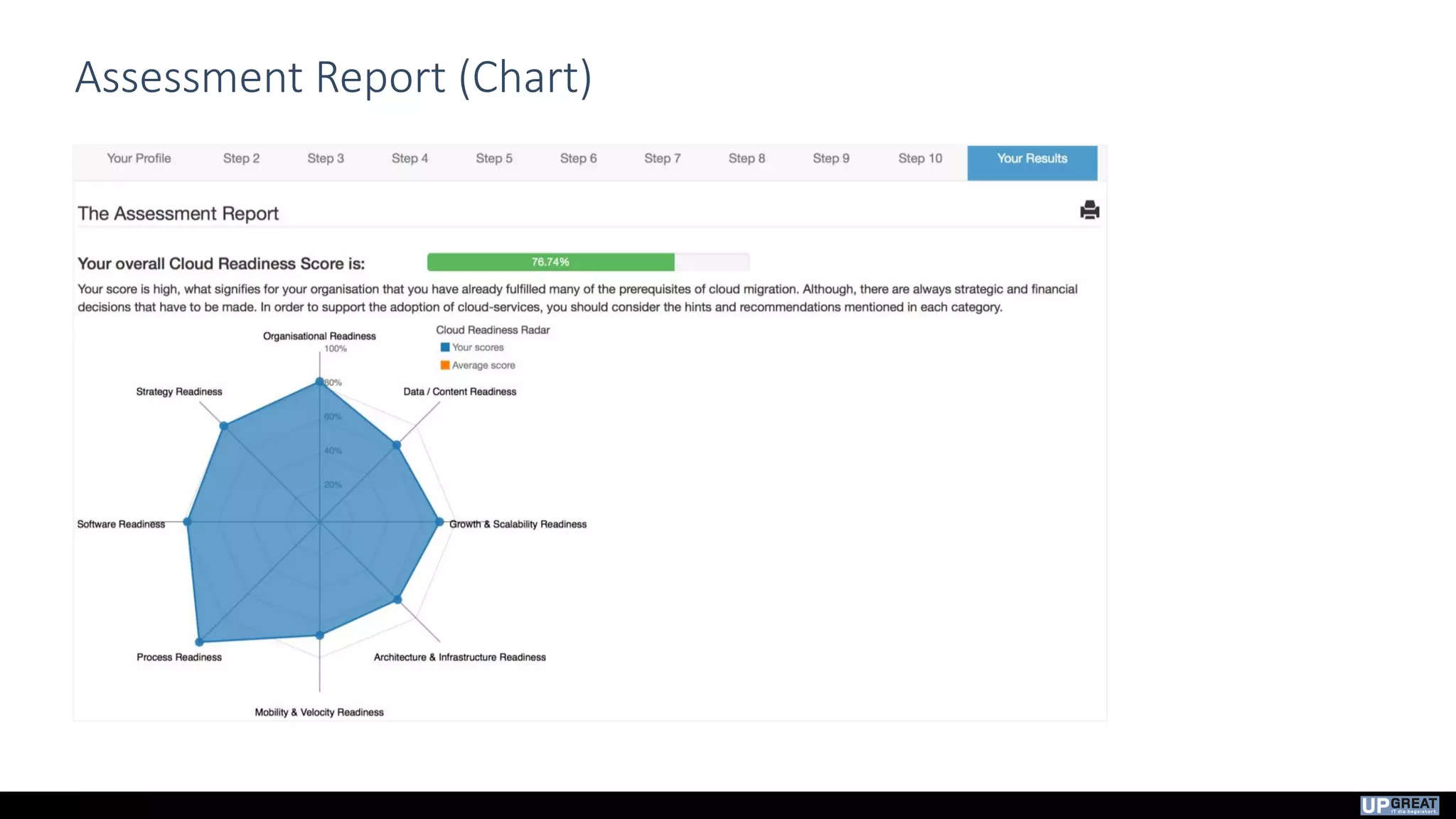
Assessment Report (Chart)
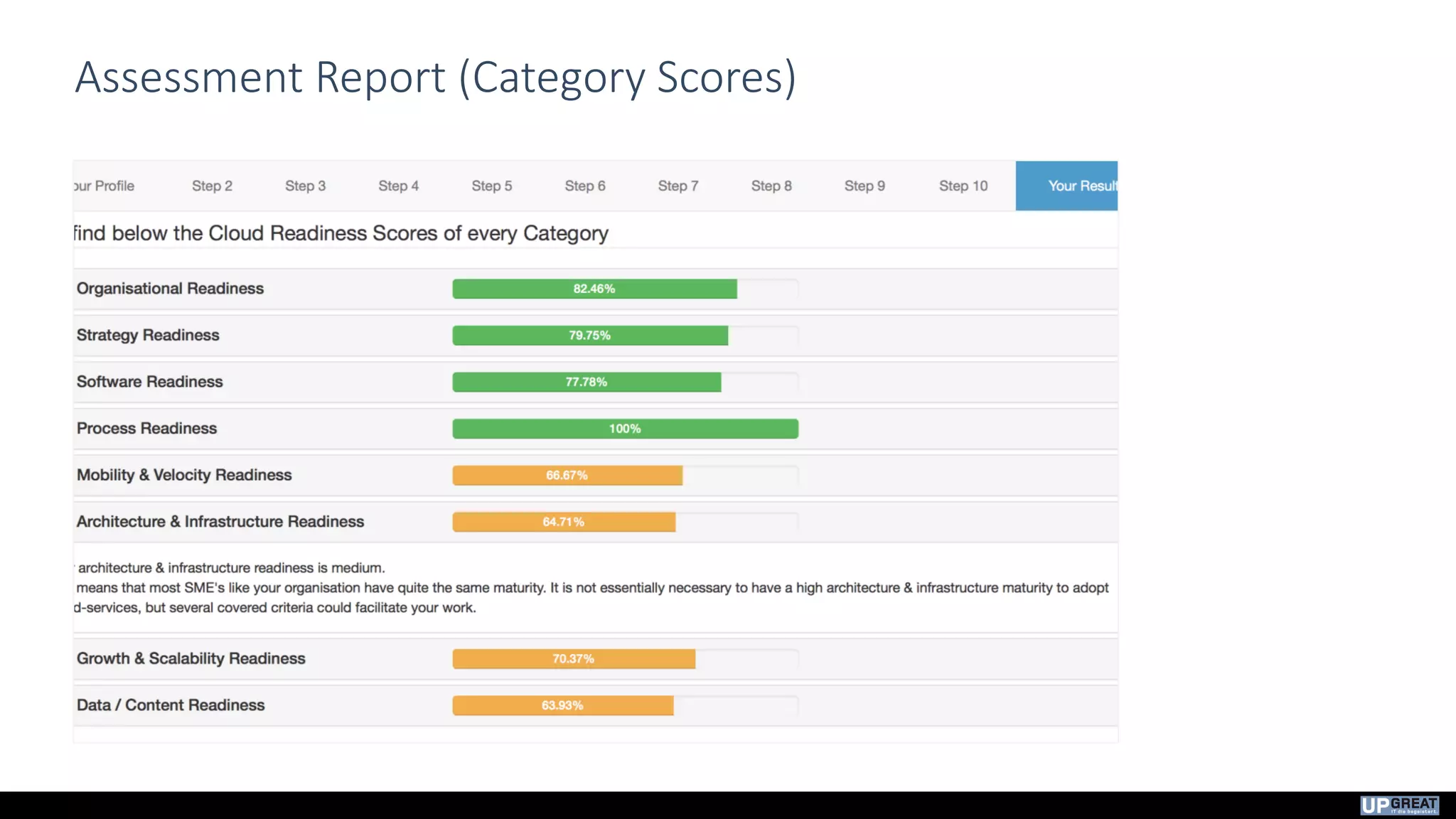
Assessment Report (Category Scores)
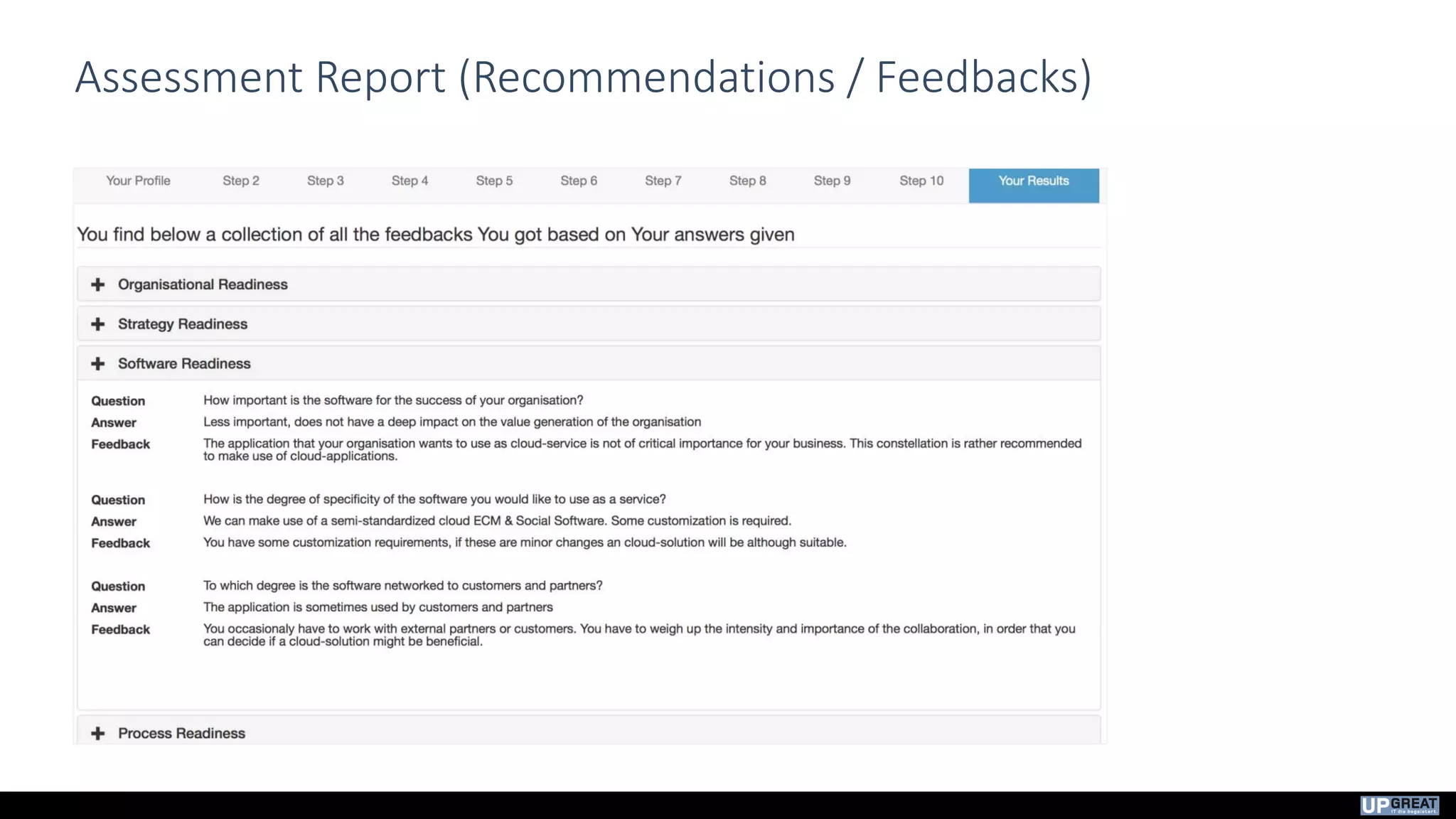
Assessment Report (Recommendations / Feedbacks)
Findings & Conclusion
 Introduction
 Methodology
 CloudReadinessAssessment
 Findings & Conclusion
Need for a Cloud Readiness Assessment
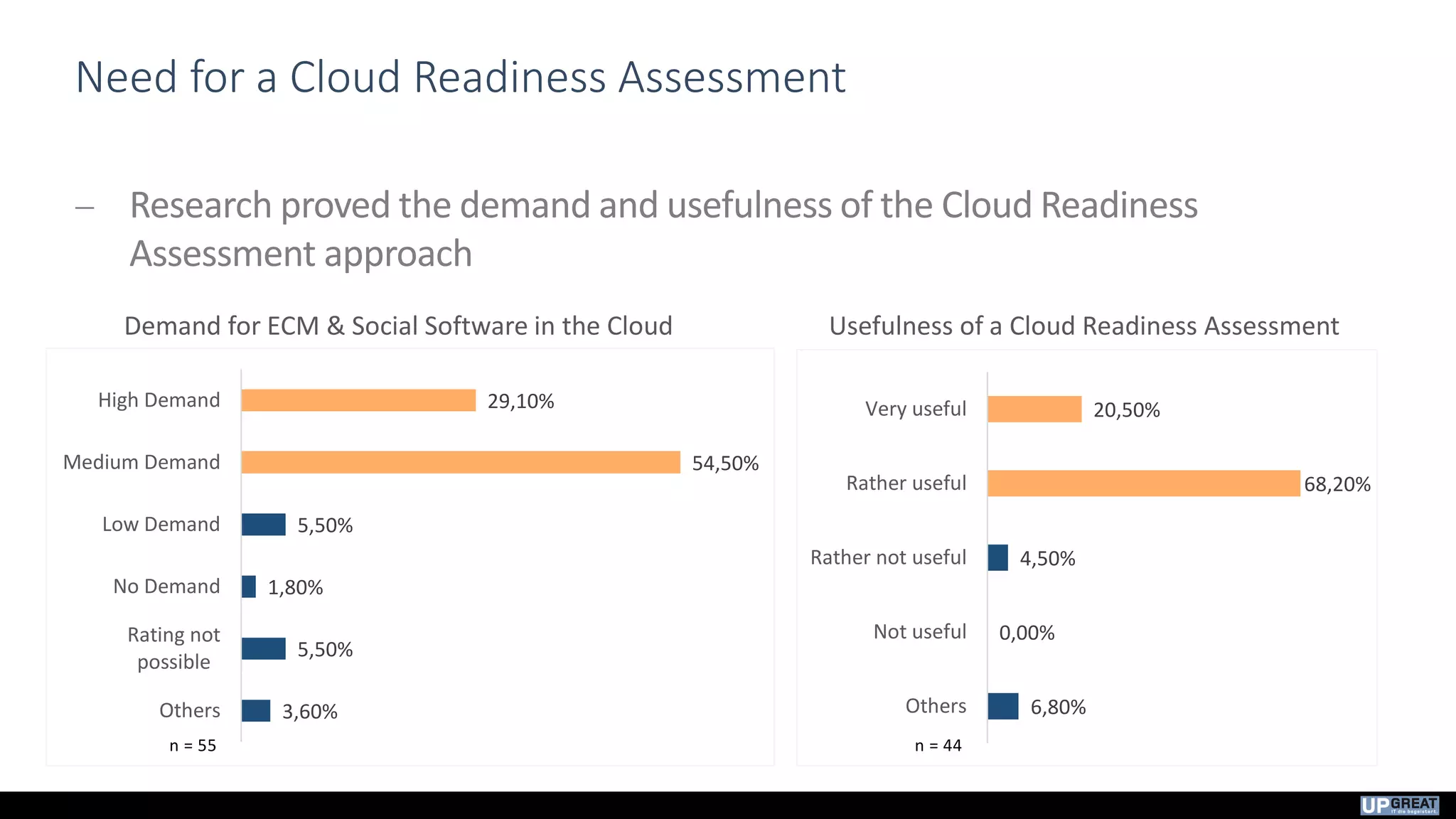
 Research proved the demand and usefulness of the Cloud Readiness
Assessment approach
Demand for ECM & Social Software in the Cloud Usefulness of a Cloud Readiness Assessment
3,60%
5,50%
1,80%
5,50%
54,50%
29,10%
Others
Rating not
possible
No Demand
Low Demand
Medium Demand
High Demand
n = 55
6,80%
0,00%
4,50%
68,20%
20,50%
Others
Not useful
Rather not useful
Rather useful
Very useful
n = 44
Prerequisits for the Cloud
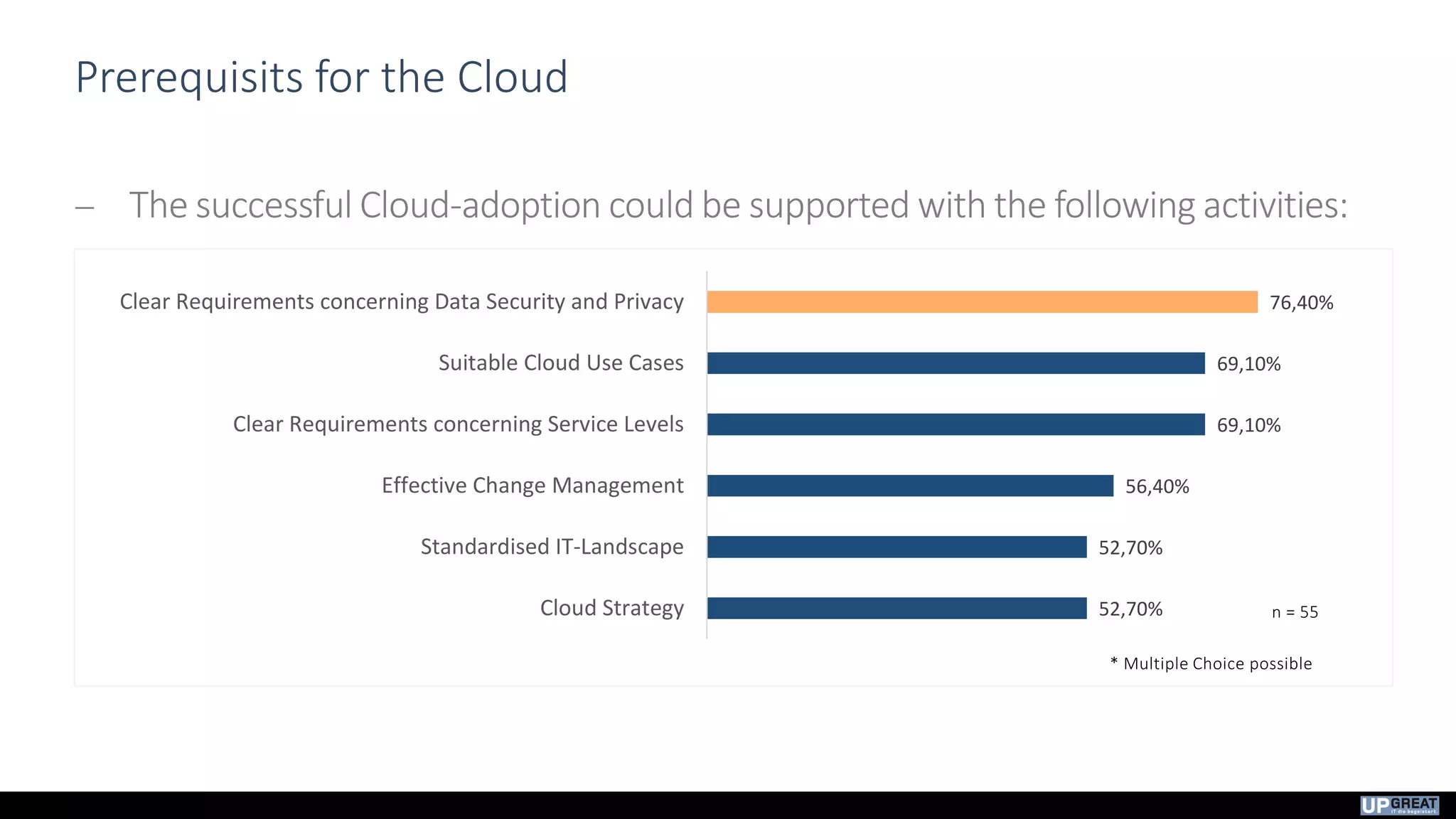
 The successful Cloud-adoption could be supported with the following activities:
52,70%
52,70%
56,40%
69,10%
69,10%
76,40%
Cloud Strategy
Standardised IT-Landscape
Effective Change Management
Clear Requirements concerning Service Levels
Suitable Cloud Use Cases
Clear Requirements concerning Data Security and Privacy
* Multiple Choice possible
n = 55
The Research achieved the Objectives
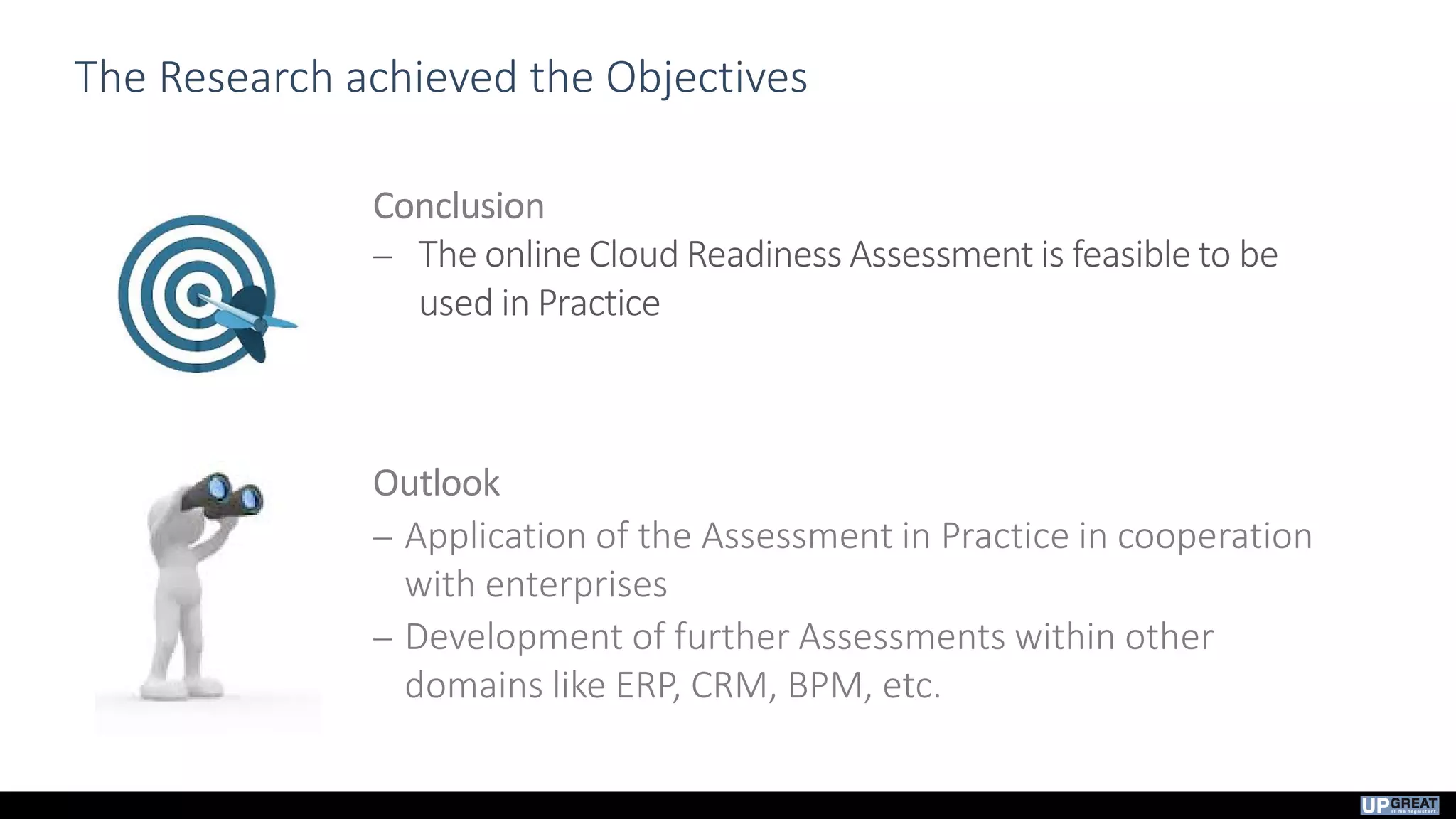
Conclusion
 The online Cloud Readiness Assessment is feasible to be
used in Practice
Outlook
 Application of the Assessment in Practice in cooperation
with enterprises
 Development of further Assessments within other
domains like ERP, CRM, BPM, etc.
Thank you foryour
attention

A cloud readiness assessment framework

  • 1.
    [[PowerPointImage("Titlepicture", MasterProperty ("TitlePictures", "Picture"))]] CarloColicchio IT Business Consultant A Cloud Readiness Assessment Framework for EnterpriseContentManagement& Social Software(e-Collaboration) forSmall and MediumSizedEnterprisesin Switzerland IEEE - Third International Conference on Enterprise Systems Date: October 14, 2015
  • 2.
    Agenda [[PowerPointImage("Titlepicture", MasterProperty ("TitlePictures", "Picture"))]] Introduction  Methodology  Cloud Readiness Assessment  Findings & Conclusion
  • 3.
    Introduction  Introduction  Methodology CloudReadinessAssessment  Findings& Conclusion
  • 4.
    About the Authors CarloColicchio MSc. In Business Information Systems (FHNW) Consultant/Project Manager for UP-GREAT AG  Business Solutions with Microsoft SharePoint  IT-Outsourcing (IT-as-a-Service)  Enterprise Mobility Prof. Dr. Stella Gatziu Grivas Claudio Giovanoli Head Competence Center “Cloud Computing“ University of Applied Sciences of Northwestern Switzerland (FHNW) Research Assistant at the Competence Center “Cloud Computing“ University of Applied Sciences of Northwestern Switzerland (FHNW)
  • 5.
    The Research Statement „TheReadiness of Organisations to use ECM and Social Software (e-Collaboration) as Cloud-based Solutions (SaaS) can be assessed with a Framework that considers the main critical Factors for Small and Medium sized Enterprises (SME).“
  • 6.
    What is aCloud Readiness Assessment? Cloud Need Identification Cloud Readiness Assessment Risk & Benefit Analysis Business Case Cloud Strategy Transformation Roadmap The Cloud Roadmap Source: Gatziu-Grivas, 2012 “Cloud Readiness represents the maturity of an organisation, to identify appropriate Cloud-services, which generate value. Cloud-services have to be integrated efficiently and target-oriented within enterprises in order to be able to manage their use and allows the agile change of Cloud-service provider.” Cloud Readiness: Source: Nandico, [27/06/14]
  • 7.
    The Drivers fora Cloud Readiness Assessment Drivers/ Reasons Cloud Computing is an ubiquitous topic SMEs are suitable to adopt Cloud- services SMEs lack knowledge about the Cloud SMEs are overstrained with Cloud- adoption Need for a fact- based decision basis
  • 8.
    Methodology  Introduction  Methodology CloudReadinessAssessment  Findings& Conclusion
  • 9.
    The Big Pictureabout the Research Methodology
  • 10.
    Development Process ofthe Cloud Readiness Assessment Research Literature about Cloud Adoption Criteria Define SME Profiles Define Question Categories Define Questions, Answers & Recom. Map Questions to Profiles Process Weight Catego- ries and Questions Define Scoring Method Review Assess- ment by Experts Adjust Assess- ment 1 2 3 4 5 6 7 8 9  Step 8  Online survey (55 Respondents, Response Rate: 18.3 %)  Seven interviews (Consultants, Vendors, Researcher, End-Users)
  • 11.
    Cloud Readiness Assessment Introduction  Methodology  Cloud Readiness Assessment  Findings& Conclusion
  • 12.
    The major Determinants/ Criteria  Eight question categories have been identified, which represent the criteria for the Cloud-adoption  Every category consists of three to twelve questions Criteria Strategy 1.26 Organi- sation 1.21 Process 1.17 Archi. & Infra- structure 0.79Mobiliy & Velocity 0.79 Software 0.79 Growth & Scalability 0.72 Data / Content *1.33 * Category Weight Total: 8 = 100%
  • 13.
    The Question Categoriesof the Assessment
  • 14.
    The Question Templates The Assessment consists of 58 questions based on this template 3.1 Do you have defined the goals(s) of your Cloud project (SaaS)? CR VB 1 a) We have clearly defined goals that we want to achieve with Cloud- services (cost reduction, high availability and performance, increased flexibility (pay per use) and high user acceptance). 9 5 b) We are still defining the goals that we want to achieve, but the lack of knowledge about Cloud Computing slowers the process. 5 5 c) No, we do not have defined the goals so far, what we want to achieve with Cloud-services. 3 3 Desc. It is of vital importance that the organisation knows why it wants to make use of Cloud-services (SaaS) and for what purpose. Without a proper goal, the whole Cloud journey makes not much sense. Rec. [a]: Having already clear targets in mind that your organisation wants to achieve, is a good start- ing point for the adoption of Cloud-services. [b]: The definition of the goals is an important factor that is required for every kind of project. If your organisation is lacking knowledge about the technology Cloud Computing, you may take advise from external experts/consultants. [c]: It is of vital importance to have a clear objective, when you introduce a new technology. Therefore it is recommended to first define the objective you want to achieve, if you are strug- gling you may take advice form external experts/consultants. Ref. Arnold
  • 15.
  • 16.
    Cloud Assessment Category„Organisation“
  • 17.
  • 18.
  • 19.
  • 20.
    Findings & Conclusion Introduction  Methodology  CloudReadinessAssessment  Findings & Conclusion
  • 21.
    Need for aCloud Readiness Assessment  Research proved the demand and usefulness of the Cloud Readiness Assessment approach Demand for ECM & Social Software in the Cloud Usefulness of a Cloud Readiness Assessment 3,60% 5,50% 1,80% 5,50% 54,50% 29,10% Others Rating not possible No Demand Low Demand Medium Demand High Demand n = 55 6,80% 0,00% 4,50% 68,20% 20,50% Others Not useful Rather not useful Rather useful Very useful n = 44
  • 22.
    Prerequisits for theCloud  The successful Cloud-adoption could be supported with the following activities: 52,70% 52,70% 56,40% 69,10% 69,10% 76,40% Cloud Strategy Standardised IT-Landscape Effective Change Management Clear Requirements concerning Service Levels Suitable Cloud Use Cases Clear Requirements concerning Data Security and Privacy * Multiple Choice possible n = 55
  • 23.
    The Research achievedthe Objectives Conclusion  The online Cloud Readiness Assessment is feasible to be used in Practice Outlook  Application of the Assessment in Practice in cooperation with enterprises  Development of further Assessments within other domains like ERP, CRM, BPM, etc.
  • 24.