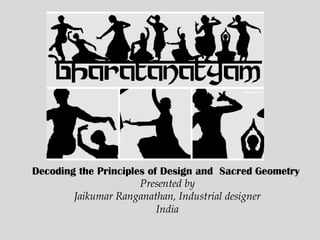
Decoding the Principles of Design and Sacred Geometry
Presented by
Jaikumar Ranganathan, Industrial designer
India
Elements and Principles of Design
Elements
Dot
Line
Shape
Form
Colour
Texture
Principles
Symmetry
Balance
Rhythm
Repetition
Scale and Proportion
Harmony
Unity in Variety
Emphasis
Hierarchy
Direction
Pattern
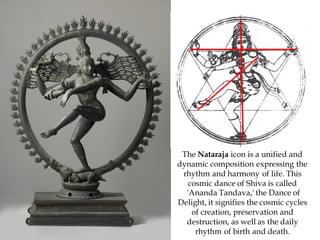
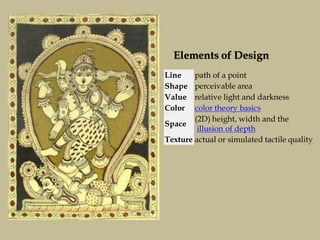
The Nataraja icon is a unified and
dynamic composition expressing the
rhythm and harmony of life. This
cosmic dance of Shiva is called
'Ananda Tandava,' the Dance of
Delight, it signifies the cosmic cycles
of creation, preservation and
destruction, as well as the daily
rhythm of birth and death.
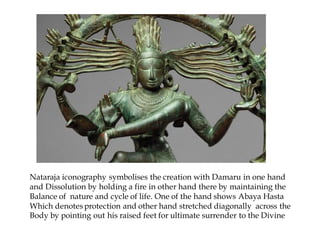
Nataraja iconography symbolises the creation with Damaru in one hand
and Dissolution by holding a fire in other hand there by maintaining the
Balance of nature and cycle of life. One of the hand shows Abaya Hasta
Which denotes protection and other hand stretched diagonally across the
Body by pointing out his raised feet for ultimate surrender to the Divine
Line path of a point
Shape perceivable area
Value relative light and darkness
Color color theory basics
Space
(2D) height, width and the
illusion of depth
Texture actual or simulated tactile quality
Elements of Design
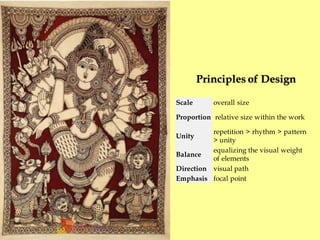
Scale overall size
Proportion relative size within the work
Unity
repetition > rhythm > pattern
> unity
Balance
equalizing the visual weight
of elements
Direction visual path
Emphasis focal point
Principles of Design
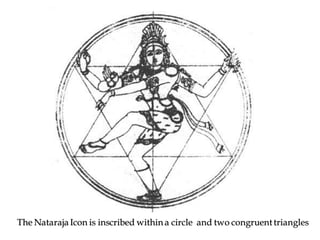
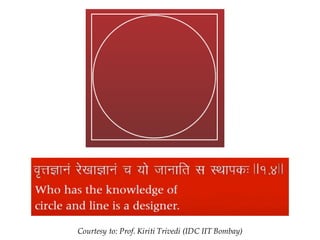
The Nataraja Icon is inscribed within a circle and two congruent triangles
Courtesy to: Prof. Kiriti Trivedi
(IDC IIT Bombay)
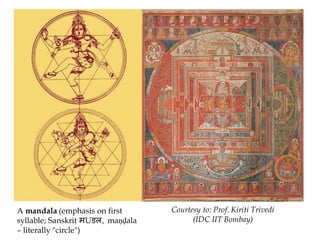
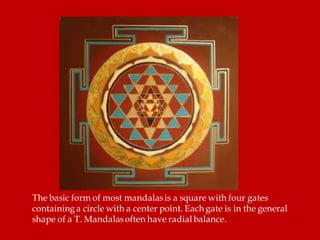
A mandala (emphasis on first
syllable; Sanskrit मUडल, maṇḍala
– literally "circle")
The basic form of most mandalasis a square with four gates
containing a circle with a center point. Each gate is in the general
shape of a T. Mandalasoften have radial balance.
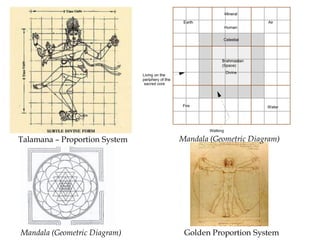
Mandala (Geometric Diagram)
Talamana – Proportion System
Golden Proportion System
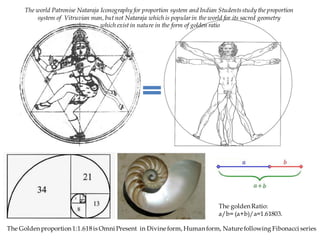
The Golden proportion1:1.618is Omni Present in Divine form, Human form, Nature following Fibonacci series
The goldenRatio:
a/b= (a+b)/a=1.61803.
The world Patronise Nataraja Iconography for proportion system and Indian Studentsstudy the proportion
system of Vitruvian man, but not Nataraja which is popularin the world for its sacred geometry
which exist in nature in the form of golden ratio
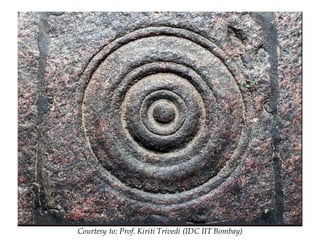
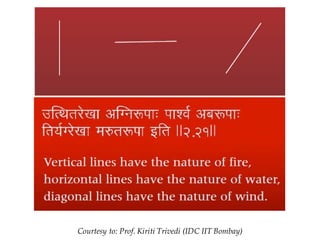
Courtesy to: Prof. Kiriti Trivedi (IDC IIT Bombay)
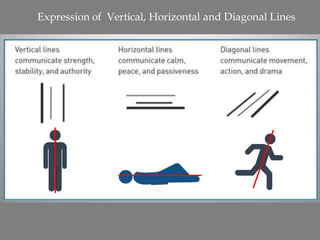
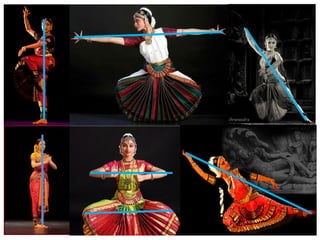
Expression of Vertical, Horizontal and Diagonal Lines
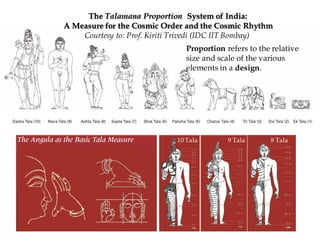
The Talamana Proportion System of India:
A Measure for the Cosmic Order and the Cosmic Rhythm
Courtesy to: Prof. Kiriti Trivedi (IDC IIT Bombay)
10 Tala 9 Tala 8 Tala
Proportion refers to the relative
size and scale of the various
elements in a design.
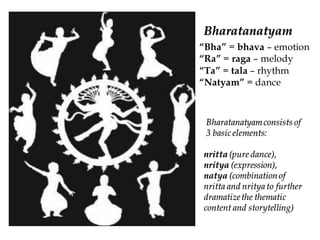
“Bha” = bhava – emotion
“Ra” = raga – melody
“Ta” = tala – rhythm
“Natyam” = dance
Bharatanatyam
Bharatanatyamconsists of
3 basicelements:
nritta (pure dance),
nritya (expression),
natya (combinationof
nritta and nritya to further
dramatizethe thematic
content and storytelling)
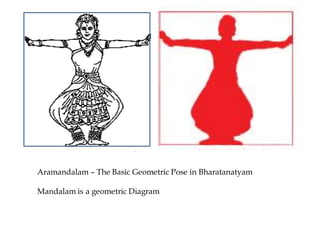
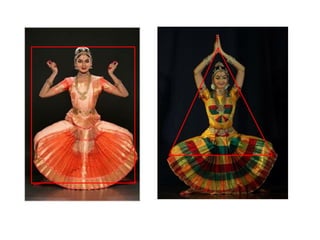
Aramandalam – The Basic Geometric Pose in Bharatanatyam
Mandalam is a geometric Diagram
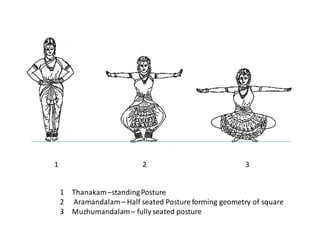
1 2 3
1 Thanakam–standingPosture
2 Aramandalam– Half seated Posture forming geometry of square
3 Muzhumandalam– fully seated posture
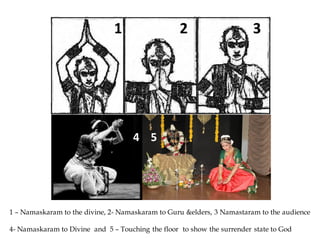
4 5
1 – Namaskaram to the divine, 2- Namaskaram to Guru &elders, 3 Namastaram to the audience
4- Namaskaram to Divine and 5 – Touching the floor to show the surrender state to God
1 2 3
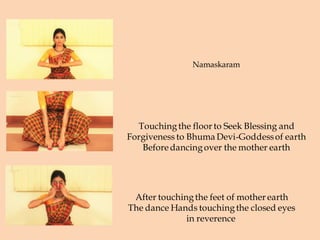
Namaskaram
Touchingthe floor to Seek Blessing and
Forgiveness to Bhuma Devi-Goddessof earth
Before dancingover the mother earth
After touchingthe feet of mother earth
The dance Hands touchingthe closed eyes
in reverence
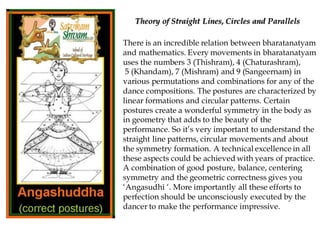
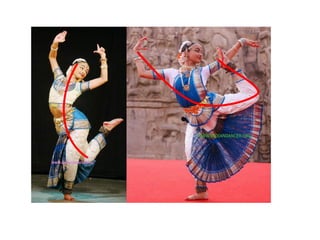
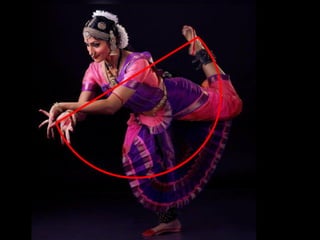
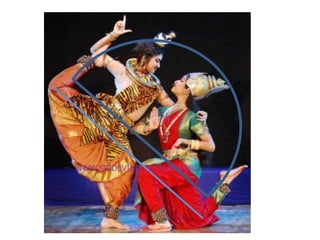
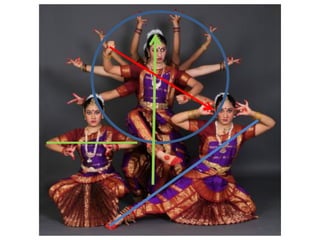
There is an incredible relation between bharatanatyam
and mathematics. Every movements in bharatanatyam
uses the numbers 3 (Thishram), 4 (Chaturashram),
5 (Khandam), 7 (Mishram) and 9 (Sangeernam) in
various permutations and combinations for any of the
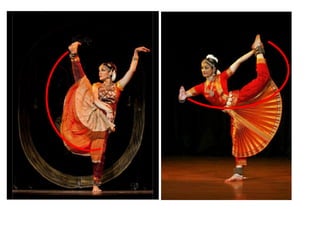
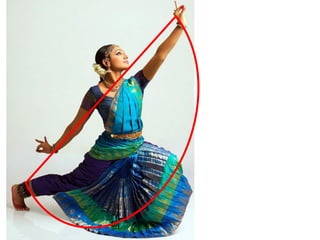
dance compositions. The postures are characterized by
linear formations and circular patterns. Certain
postures create a wonderful symmetry in the body as
in geometry that adds to the beauty of the
performance. So it’s very important to understand the
straight line patterns, circular movements and about
the symmetry formation. A technical excellence in all
these aspects could be achieved with years of practice.
A combination of good posture, balance, centering
symmetry and the geometric correctness gives you
‘Angasudhi ‘. More importantly all these efforts to
perfection should be unconsciously executed by the
dancer to make the performance impressive.
Theory of Straight Lines, Circles and Parallels
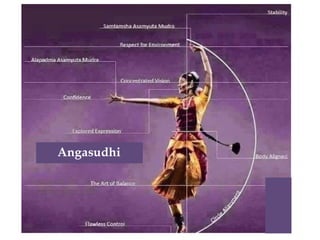
Angasudhi
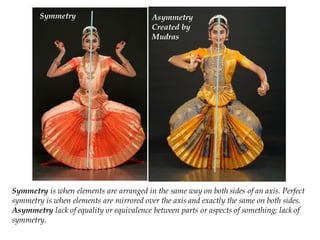
Symmetry is when elements are arranged in the same way on both sides of an axis. Perfect
symmetry is when elements are mirrored over the axis and exactly the same on both sides.
Asymmetry lack of equality or equivalence between parts or aspects of something; lack of
symmetry.
Symmetry Asymmetry
Created by
Mudras
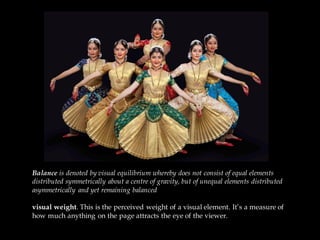
Balance is denoted by visual equilibrium whereby does not consist of equal elements
distributed symmetrically about a centre of gravity, but of unequal elements distributed
asymmetrically and yet remaining balanced.
visual weight. This is the perceived weight of a visual element. It’s a measure of
how much anything on the page attracts the eye of the viewer.
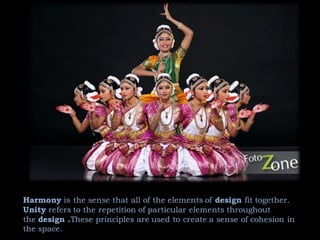
Harmony is the sense that all of the elements of design fit together.
Unity refers to the repetition of particular elements throughout
the design .These principles are used to create a sense of cohesion in
the space.
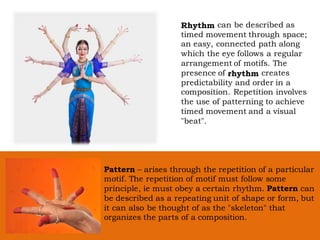
Rhythm can be described as
timed movement through space;
an easy, connected path along
which the eye follows a regular
arrangement of motifs. The
presence of rhythm creates
predictability and order in a
composition. Repetition involves
the use of patterning to achieve
timed movement and a visual
"beat".
Pattern – arises through the repetition of a particular
motif. The repetition of motif must follow some
principle, ie must obey a certain rhythm. Pattern can
be described as a repeating unit of shape or form, but
it can also be thought of as the "skeleton" that
organizes the parts of a composition.
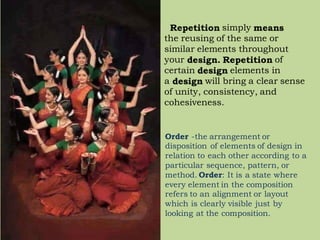
Repetition simply means
the reusing of the same or
similar elements throughout
your design. Repetition of
certain design elements in
a design will bring a clear sense
of unity, consistency, and
cohesiveness.
Order -the arrangement or
disposition of elements of design in
relation to each other according to a
particular sequence, pattern, or
method. Order: It is a state where
every element in the composition
refers to an alignment or layout
which is clearly visible just by
looking at the composition.
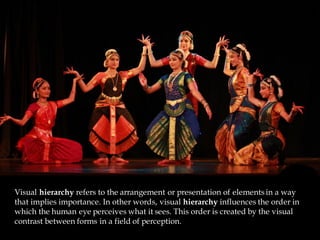
Visual hierarchy refers to the arrangement or presentation of elements in a way
that implies importance. In other words, visual hierarchy influences the order in
which the human eye perceives what it sees. This order is created by the visual
contrast between forms in a field of perception.
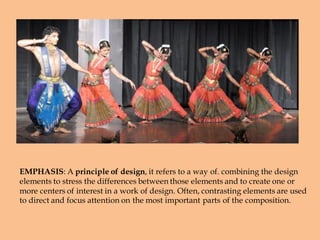
EMPHASIS: A principle of design, it refers to a way of. combining the design
elements to stress the differences between those elements and to create one or
more centers of interest in a work of design. Often, contrasting elements are used
to direct and focus attention on the most important parts of the composition.
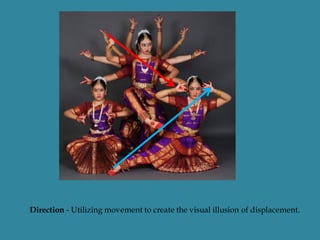
Direction - Utilizing movement to create the visual illusion of displacement.
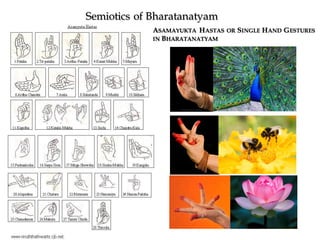
Semiotics of Bharatanatyam
ASAMAYUKTA HASTAS OR SINGLE HAND GESTURES
IN BHARATANATYAM
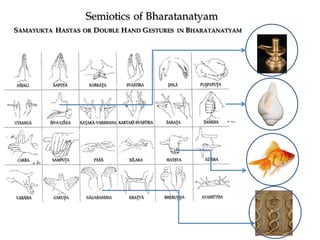
Semiotics of Bharatanatyam
SAMAYUKTA HASTAS OR DOUBLE HAND GESTURES IN BHARATANATYAM
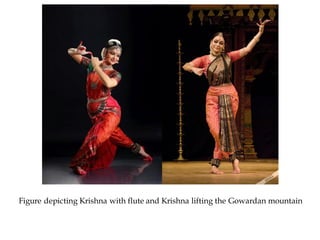
Figure depicting Krishna with flute and Krishna lifting the Gowardan mountain
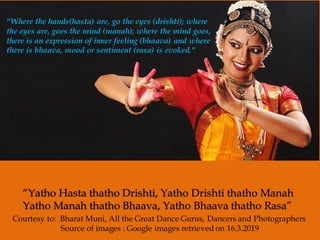
“Yatho Hasta thatho Drishti, Yatho Drishti thatho Manah
Yatho Manah thatho Bhaava, Yatho Bhaava thatho Rasa”
"Where the hands(hasta) are, go the eyes (drishti); where
the eyes are, goes the mind (manah); where the mind goes,
there is an expression of inner feeling (bhaava) and where
there is bhaava, mood or sentiment (rasa) is evoked."
Courtesy to: Bharat Muni, All the Great Dance Gurus, Dancers and Photographers
Source of images : Google images retrieved on 16.3.2019
Jaikumar Ranganathan, Industrial designer
India

Design principles in bharatnatyam

  • 1.
    Decoding the Principlesof Design and Sacred Geometry Presented by Jaikumar Ranganathan, Industrial designer India
  • 2.
    Elements and Principlesof Design Elements Dot Line Shape Form Colour Texture Principles Symmetry Balance Rhythm Repetition Scale and Proportion Harmony Unity in Variety Emphasis Hierarchy Direction Pattern
  • 3.
    The Nataraja iconis a unified and dynamic composition expressing the rhythm and harmony of life. This cosmic dance of Shiva is called 'Ananda Tandava,' the Dance of Delight, it signifies the cosmic cycles of creation, preservation and destruction, as well as the daily rhythm of birth and death.
  • 4.
    Nataraja iconography symbolisesthe creation with Damaru in one hand and Dissolution by holding a fire in other hand there by maintaining the Balance of nature and cycle of life. One of the hand shows Abaya Hasta Which denotes protection and other hand stretched diagonally across the Body by pointing out his raised feet for ultimate surrender to the Divine
  • 5.
    Line path ofa point Shape perceivable area Value relative light and darkness Color color theory basics Space (2D) height, width and the illusion of depth Texture actual or simulated tactile quality Elements of Design
  • 6.
    Scale overall size Proportionrelative size within the work Unity repetition > rhythm > pattern > unity Balance equalizing the visual weight of elements Direction visual path Emphasis focal point Principles of Design
  • 7.
    The Nataraja Iconis inscribed within a circle and two congruent triangles
  • 8.
    Courtesy to: Prof.Kiriti Trivedi (IDC IIT Bombay) A mandala (emphasis on first syllable; Sanskrit मUडल, maṇḍala – literally "circle")
  • 9.
    The basic formof most mandalasis a square with four gates containing a circle with a center point. Each gate is in the general shape of a T. Mandalasoften have radial balance.
  • 10.
    Mandala (Geometric Diagram) Mandala(Geometric Diagram) Talamana – Proportion System Golden Proportion System
  • 11.
    The Golden proportion1:1.618isOmni Present in Divine form, Human form, Nature following Fibonacci series The goldenRatio: a/b= (a+b)/a=1.61803. The world Patronise Nataraja Iconography for proportion system and Indian Studentsstudy the proportion system of Vitruvian man, but not Nataraja which is popularin the world for its sacred geometry which exist in nature in the form of golden ratio
  • 12.
    Courtesy to: Prof.Kiriti Trivedi (IDC IIT Bombay)
  • 13.
    Courtesy to: Prof.Kiriti Trivedi (IDC IIT Bombay)
  • 14.
    Courtesy to: Prof.Kiriti Trivedi (IDC IIT Bombay)
  • 15.
    Expression of Vertical,Horizontal and Diagonal Lines
  • 16.
    The Talamana ProportionSystem of India: A Measure for the Cosmic Order and the Cosmic Rhythm Courtesy to: Prof. Kiriti Trivedi (IDC IIT Bombay) 10 Tala 9 Tala 8 Tala Proportion refers to the relative size and scale of the various elements in a design.
  • 17.
    “Bha” = bhava– emotion “Ra” = raga – melody “Ta” = tala – rhythm “Natyam” = dance Bharatanatyam Bharatanatyamconsists of 3 basicelements: nritta (pure dance), nritya (expression), natya (combinationof nritta and nritya to further dramatizethe thematic content and storytelling)
  • 18.
    Aramandalam – TheBasic Geometric Pose in Bharatanatyam Mandalam is a geometric Diagram
  • 19.
    1 2 3 1Thanakam–standingPosture 2 Aramandalam– Half seated Posture forming geometry of square 3 Muzhumandalam– fully seated posture
  • 20.
    4 5 1 –Namaskaram to the divine, 2- Namaskaram to Guru &elders, 3 Namastaram to the audience 4- Namaskaram to Divine and 5 – Touching the floor to show the surrender state to God 1 2 3
  • 21.
    Namaskaram Touchingthe floor toSeek Blessing and Forgiveness to Bhuma Devi-Goddessof earth Before dancingover the mother earth After touchingthe feet of mother earth The dance Hands touchingthe closed eyes in reverence
  • 22.
    There is anincredible relation between bharatanatyam and mathematics. Every movements in bharatanatyam uses the numbers 3 (Thishram), 4 (Chaturashram), 5 (Khandam), 7 (Mishram) and 9 (Sangeernam) in various permutations and combinations for any of the dance compositions. The postures are characterized by linear formations and circular patterns. Certain postures create a wonderful symmetry in the body as in geometry that adds to the beauty of the performance. So it’s very important to understand the straight line patterns, circular movements and about the symmetry formation. A technical excellence in all these aspects could be achieved with years of practice. A combination of good posture, balance, centering symmetry and the geometric correctness gives you ‘Angasudhi ‘. More importantly all these efforts to perfection should be unconsciously executed by the dancer to make the performance impressive. Theory of Straight Lines, Circles and Parallels
  • 23.
  • 32.
    Symmetry is whenelements are arranged in the same way on both sides of an axis. Perfect symmetry is when elements are mirrored over the axis and exactly the same on both sides. Asymmetry lack of equality or equivalence between parts or aspects of something; lack of symmetry. Symmetry Asymmetry Created by Mudras
  • 33.
    Balance is denotedby visual equilibrium whereby does not consist of equal elements distributed symmetrically about a centre of gravity, but of unequal elements distributed asymmetrically and yet remaining balanced. visual weight. This is the perceived weight of a visual element. It’s a measure of how much anything on the page attracts the eye of the viewer.
  • 34.
    Harmony is thesense that all of the elements of design fit together. Unity refers to the repetition of particular elements throughout the design .These principles are used to create a sense of cohesion in the space.
  • 35.
    Rhythm can bedescribed as timed movement through space; an easy, connected path along which the eye follows a regular arrangement of motifs. The presence of rhythm creates predictability and order in a composition. Repetition involves the use of patterning to achieve timed movement and a visual "beat". Pattern – arises through the repetition of a particular motif. The repetition of motif must follow some principle, ie must obey a certain rhythm. Pattern can be described as a repeating unit of shape or form, but it can also be thought of as the "skeleton" that organizes the parts of a composition.
  • 36.
    Repetition simply means thereusing of the same or similar elements throughout your design. Repetition of certain design elements in a design will bring a clear sense of unity, consistency, and cohesiveness. Order -the arrangement or disposition of elements of design in relation to each other according to a particular sequence, pattern, or method. Order: It is a state where every element in the composition refers to an alignment or layout which is clearly visible just by looking at the composition.
  • 37.
    Visual hierarchy refersto the arrangement or presentation of elements in a way that implies importance. In other words, visual hierarchy influences the order in which the human eye perceives what it sees. This order is created by the visual contrast between forms in a field of perception.
  • 38.
    EMPHASIS: A principleof design, it refers to a way of. combining the design elements to stress the differences between those elements and to create one or more centers of interest in a work of design. Often, contrasting elements are used to direct and focus attention on the most important parts of the composition.
  • 39.
    Direction - Utilizingmovement to create the visual illusion of displacement.
  • 40.
    Semiotics of Bharatanatyam ASAMAYUKTAHASTAS OR SINGLE HAND GESTURES IN BHARATANATYAM
  • 41.
    Semiotics of Bharatanatyam SAMAYUKTAHASTAS OR DOUBLE HAND GESTURES IN BHARATANATYAM
  • 42.
    Figure depicting Krishnawith flute and Krishna lifting the Gowardan mountain
  • 43.
    “Yatho Hasta thathoDrishti, Yatho Drishti thatho Manah Yatho Manah thatho Bhaava, Yatho Bhaava thatho Rasa” "Where the hands(hasta) are, go the eyes (drishti); where the eyes are, goes the mind (manah); where the mind goes, there is an expression of inner feeling (bhaava) and where there is bhaava, mood or sentiment (rasa) is evoked." Courtesy to: Bharat Muni, All the Great Dance Gurus, Dancers and Photographers Source of images : Google images retrieved on 16.3.2019
  • 44.