
E-learning: A Versatile
  Tool For Knowledge
     Management

                NEERAJ
WHAT IS E-LEARNING?
• e-Learning is the use of technology to enable
  people to learn any time and any where.
• e-learning is actually the barometer of the
  development of an individual, organization and
  economy in the changing socio-economic
  scenario.
• E-learning in two ways.
     First , it includes all kinds of the utilization of
  ICT in instruction.
 Second, it is limited to the use of intranet and
  internet in teaching –learning process
Major areas of e-learning
• “education created and delivered by using
  technologies related to computer, the internet and
  telephony, in combination or in isolation”.
• Thus, we could classify the definition of e-learning in
  three major areas as:
e-learning is any learning that is web-enabled
e-learning is a complete learning solution
e-learning      is   delivering     learning    through
  amalgamation of technology.
Components of E-learning
• After so many definitions, I can say e-learning has
  three basic components. These are:
• Content: From traditional learning, content
  continuous to be the backbone of e-learning.
  Now, the learning shifts from distributed learning
  to Internet based and mobile learning, the
  presentation of content is going through a
  metamorphosis.
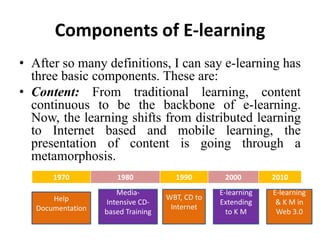
       1970           1980            1990        2000        2010
                      Media-                     E-learning   E-learning
       Help                         WBT, CD to
                   Intensive CD-                 Extending     & K M in
   Documentation                     Internet
                   based Training                  to K M      Web 3.0
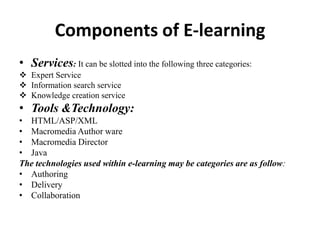
Components of E-learning
• Services: It can be slotted into the following three categories:
 Expert Service
 Information search service
 Knowledge creation service
• Tools &Technology:
• HTML/ASP/XML
• Macromedia Author ware
• Macromedia Director
• Java
The technologies used within e-learning may be categories are as follow:
• Authoring
• Delivery
• Collaboration
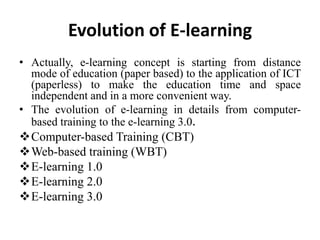
Evolution of E-learning
• Actually, e-learning concept is starting from distance
  mode of education (paper based) to the application of ICT
  (paperless) to make the education time and space
  independent and in a more convenient way.
• The evolution of e-learning in details from computer-
  based training to the e-learning 3.0.
Computer-based Training (CBT)
Web-based training (WBT)
E-learning 1.0
E-learning 2.0
E-learning 3.0
Knowledge Management
• In          addition        to         corporate
  environments, knowledge management is
  increasingly applied also in education, the
  public sector, and other spheres of society.
• Sustainable knowledge management relies on
  intelligent preservation of data for their
  instant retrieval and re-use in new situations.
• Holistic knowledge management strategies
  and applications acknowledge a crucial role of
  digital libraries.
Relation Between Knowledge Management
             and e-learning
• E-learning creates a growing repository of knowledge that will
  continuously deliver to employees just what they need to know at any
  particular moment, and in a style that each learner can understand.
• E-learning permits participants to acquire knowledge, pass it from one
  person to another, apply it to organizational problems/opportunities, and
  store that knowledge for future use.
• E-learning potential benefits to business are numerous. Companies are
  seeking the kind of easy accessible, highly flexible training that E-learning
  can deliver in order to contend with the rapid pace of change in business
  and shorter product cycles. One of the most obvious benefits to E-learning
  is the economic advantage from not having to fly employees to attend
  expensive seminars and thus lose important work time
E-learning becomes an effective tool for Knowledge
                      Management
•   It is the need for firms to keep up with the ever changing businesses environment
    and shorter product lifecycles.
•    Another trend is the growing importance of information sharing.
•   E-learning can be taken outside of company firewalls and can be used to educate
    firm partners, customers, and suppliers, in addition to the firm’s employees. In
    return, the firm can generate new knowledge through the use of chat
    rooms, surveys, etc.
•   Metadata
   metadata can help organize electronic resources, facilitate interoperability and
    legacy resource integration, and provide digital identification, and support archiving
    and preservation.
   metadata in e-learning applications into three categories:
   standard metadata
   semi-semantic metadata
   semantic metadata
   but the trend nowadays is to use semantic metadata for its
    flexibility, extensibility, and reasoning which leads to pleasing results in facilitating
    large scale collaboration.
E learning a versatile tool for knowledge management

E learning a versatile tool for knowledge management

  • 1.
    E-learning: A Versatile Tool For Knowledge Management NEERAJ
  • 2.
    WHAT IS E-LEARNING? •e-Learning is the use of technology to enable people to learn any time and any where. • e-learning is actually the barometer of the development of an individual, organization and economy in the changing socio-economic scenario. • E-learning in two ways.  First , it includes all kinds of the utilization of ICT in instruction.  Second, it is limited to the use of intranet and internet in teaching –learning process
  • 3.
    Major areas ofe-learning • “education created and delivered by using technologies related to computer, the internet and telephony, in combination or in isolation”. • Thus, we could classify the definition of e-learning in three major areas as: e-learning is any learning that is web-enabled e-learning is a complete learning solution e-learning is delivering learning through amalgamation of technology.
  • 4.
    Components of E-learning •After so many definitions, I can say e-learning has three basic components. These are: • Content: From traditional learning, content continuous to be the backbone of e-learning. Now, the learning shifts from distributed learning to Internet based and mobile learning, the presentation of content is going through a metamorphosis. 1970 1980 1990 2000 2010 Media- E-learning E-learning Help WBT, CD to Intensive CD- Extending & K M in Documentation Internet based Training to K M Web 3.0
  • 5.
    Components of E-learning •Services: It can be slotted into the following three categories:  Expert Service  Information search service  Knowledge creation service • Tools &Technology: • HTML/ASP/XML • Macromedia Author ware • Macromedia Director • Java The technologies used within e-learning may be categories are as follow: • Authoring • Delivery • Collaboration
  • 6.
    Evolution of E-learning •Actually, e-learning concept is starting from distance mode of education (paper based) to the application of ICT (paperless) to make the education time and space independent and in a more convenient way. • The evolution of e-learning in details from computer- based training to the e-learning 3.0. Computer-based Training (CBT) Web-based training (WBT) E-learning 1.0 E-learning 2.0 E-learning 3.0
  • 7.
    Knowledge Management • In addition to corporate environments, knowledge management is increasingly applied also in education, the public sector, and other spheres of society. • Sustainable knowledge management relies on intelligent preservation of data for their instant retrieval and re-use in new situations. • Holistic knowledge management strategies and applications acknowledge a crucial role of digital libraries.
  • 8.
    Relation Between KnowledgeManagement and e-learning • E-learning creates a growing repository of knowledge that will continuously deliver to employees just what they need to know at any particular moment, and in a style that each learner can understand. • E-learning permits participants to acquire knowledge, pass it from one person to another, apply it to organizational problems/opportunities, and store that knowledge for future use. • E-learning potential benefits to business are numerous. Companies are seeking the kind of easy accessible, highly flexible training that E-learning can deliver in order to contend with the rapid pace of change in business and shorter product cycles. One of the most obvious benefits to E-learning is the economic advantage from not having to fly employees to attend expensive seminars and thus lose important work time
  • 9.
    E-learning becomes aneffective tool for Knowledge Management • It is the need for firms to keep up with the ever changing businesses environment and shorter product lifecycles. • Another trend is the growing importance of information sharing. • E-learning can be taken outside of company firewalls and can be used to educate firm partners, customers, and suppliers, in addition to the firm’s employees. In return, the firm can generate new knowledge through the use of chat rooms, surveys, etc. • Metadata  metadata can help organize electronic resources, facilitate interoperability and legacy resource integration, and provide digital identification, and support archiving and preservation.  metadata in e-learning applications into three categories:  standard metadata  semi-semantic metadata  semantic metadata  but the trend nowadays is to use semantic metadata for its flexibility, extensibility, and reasoning which leads to pleasing results in facilitating large scale collaboration.