Cindy E. Hmelo-Silver, Rutgers
Cheshta Khurana, Rutgers
Susanne P. Lajoie, McGill
Jingyan Lu, HKU
Jeffrey Wiseman, McGill
Lap-ki Chan, HKU
Ilian Cruz-Panesso, McGill
Why PBL?
Why connect across cultures?
Communities of inquiry framework
Design of PBL
Technology tools
International PBL study
Implications
Need for cultural competence in
communication by physicians
Proposed Solution:
   Problem-based learning (PBL) connecting medical
   students across continents
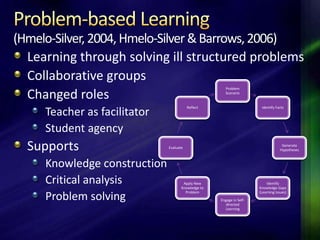
(Hmelo-Silver, 2004, Hmelo-Silver & Barrows, 2006)
  Learning through solving ill structured problems
  Collaborative groups
                                                       Problem

  Changed roles                                        Scenario


                                         Reflect                       Identify Facts
     Teacher as facilitator
     Student agency
  Supports                    Evaluate
                                                                                    Generate
                                                                                   Hypotheses


     Knowledge construction
     Critical analysis                Apply New
                                     Knowledge to
                                                                          Identify
                                                                      Knowledge Gaps
                                       Problem                        (Learning Issues)
     Problem solving                                Engage in Self-
                                                       directed
                                                      Learning
Technology to create communities of
learners
Video to provide:
  Context
  Communication space
Supports collaborative engagement
Research question:
  Can this potential be realized?
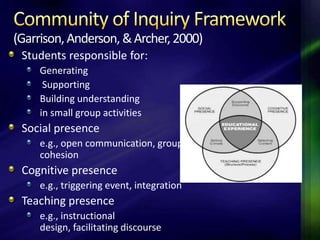
(Garrison, Anderson, & Archer, 2000)
 Students responsible for:
     Generating
      Supporting
     Building understanding
     in small group activities
 Social presence
     e.g., open communication, group
     cohesion
 Cognitive presence
     e.g., triggering event, integration
 Teaching presence
     e.g., instructional
     design, facilitating discourse
1. List difficulties in communicating bad news to a
   patient with strategies for addressing these
   issues.
2. Describe one way of approaching a bad news
   communication session (SPIKES).
3. Use the SPIKES model to analyze a video of a
   bad news communication session.
4. Discuss and reflect on how the use of the
   SPIKES model may have to be changed in
   response to context, culture and language
   barriers.
Context
   Two video-based problems
   Connecting medical students from Canada and
   Hong Kong University using AdobeConnect
Phase I
   Two PBL sessions
   Session 1, Canadian Case, facilitator
   Session 2, Hong Kong case, facilitator
Phase II
   Practice on stnadardized pation
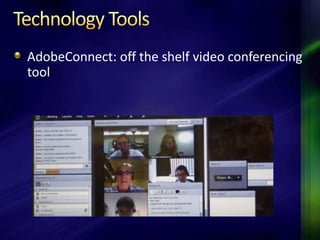
AdobeConnect: off the shelf video conferencing
tool


                                         !
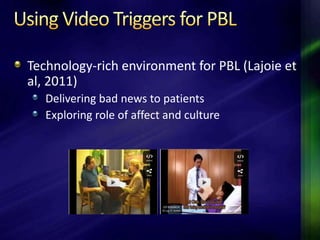
Technology-rich environment for PBL (Lajoie et
al, 2011)
   Delivering bad news to patients
   Exploring role of affect and culture
Participants
   2 Canadian medical students
   2 Hong Kong medical students
Data Sources
   Video transcripts
   Chat logs
   Focus group transcripts
Analysis
   Inductive—facilitation, culture
   Deductive– community of Inquiry
Transcripts examined for emergent themes
   Culture
   Facilitation
   Technology
Students highly engaged
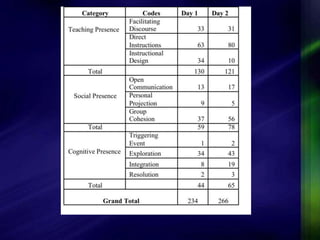
   Day 1: 234 turns
   Day 2: 266 turns
Initially, technology discussion focus (47 turns)
• I am just wondering, the video I guess is taking
  [place] in Canada, what are the procedures like
  are about testing like for HIV. Is.. throughout
  the video, my thoughts in thinking cuz in Hong
  Kong what happens is we have to get consents
  from the patient when we test for HIV viruses.
  And so in that sense um so, so that the patient
  would already given consent for HIV to be
  tested, that means they would have some sort
  of expectation already, so I am not sure ar is this
  the case in Canada? …
Expert facilitator provided advice on PBL process and
group dynamics through chat box:
   Perhaps ask students to go over the whiteboard and remind
   them that they need to get ideas down. Maybe get
   suggestions for how to organize ideas-- can what they
   learned from SPIKES framework…”
HKPE then suggested to the students:
   Looking at the white board, so we have um quite a number
   of facts…from the video. Okay, can we also start to think
   about …the ideas that we have about the performance of
   the doctor in the video how he should or should not have…
   communicating the bad news to the patient. Can we also
   …jot down some of these ideas, …start organizing our you
   know our thoughts about what gone really well in the video
   or not to mention too many ar, and what are the
   improvements we would suggest…
HKPE: ...Supposed we are just making an assumption that this is
a typical patient …would react to that kind of bad news to Hong
Kong, and you was thinking … in a different country the patient
would react in a different way. Right?
C2: Very likely but … I would just say that, there are yes in
Canada probably because of the history with … people people
coming from a lot of different places. We can end up with a lot
of different variability in terms of the type of responses you
might get from the patient because of their background and so
it’ll be a little bit hard harder to make to say what a typical
response might be.
I think the whole international theme that went on the
for … PBL really reminded me of being in Australia. Where
you get a group of Caucasian people sitting with Asian
people in the rooms chatting about the patients and
trying to critique on how things can be improved.

What I am trying get here is that different colors, different
cultures, different language experience or even
knowledge experience I think it really just really shows
that we are living in a global village where we could
acknowledge common themes, acknowledge common
facts, and ideas that are very much comparable.
Teaching presence
   Describes role of online facilitator
Social presence
   Presenting as real people
Cognitive presence
   Critical thinking
   Phases of inquiry
     Triggering events
     Exploration
     Integration
     Resolution
Proof-of-concept
   Synchronous video conference allowed
   engagement DESPITE technology glitches
   Video triggers serve as boundary objects across
   cultures for affective and cognitive issue
   Expert facilitator can provide just-in-time coaching
Culture was explicit focus
   Differences
   Common culture of medicine
Technology, context and human facilitation support the
teaching, social, and cognitive presences
Fruitful demonstration but need to test at larger
scale
Challenges of:
   Coordinating time, technology, bandwidths
   Constructing cases to promote meaningful
   discussions
Implications
   Students develop awareness of similarities and
   differences
   Training PBL facilitators in cross-cultural PBL

Using Online Digital tools and Video to support international problem based learning

  • 1.
    Cindy E. Hmelo-Silver,Rutgers Cheshta Khurana, Rutgers Susanne P. Lajoie, McGill Jingyan Lu, HKU Jeffrey Wiseman, McGill Lap-ki Chan, HKU Ilian Cruz-Panesso, McGill
  • 2.
    Why PBL? Why connectacross cultures? Communities of inquiry framework Design of PBL Technology tools International PBL study Implications
  • 3.
    Need for culturalcompetence in communication by physicians Proposed Solution: Problem-based learning (PBL) connecting medical students across continents
  • 4.
    (Hmelo-Silver, 2004, Hmelo-Silver& Barrows, 2006) Learning through solving ill structured problems Collaborative groups Problem Changed roles Scenario Reflect Identify Facts Teacher as facilitator Student agency Supports Evaluate Generate Hypotheses Knowledge construction Critical analysis Apply New Knowledge to Identify Knowledge Gaps Problem (Learning Issues) Problem solving Engage in Self- directed Learning
  • 5.
    Technology to createcommunities of learners Video to provide: Context Communication space Supports collaborative engagement Research question: Can this potential be realized?
  • 6.
    (Garrison, Anderson, &Archer, 2000) Students responsible for: Generating Supporting Building understanding in small group activities Social presence e.g., open communication, group cohesion Cognitive presence e.g., triggering event, integration Teaching presence e.g., instructional design, facilitating discourse
  • 7.
    1. List difficultiesin communicating bad news to a patient with strategies for addressing these issues. 2. Describe one way of approaching a bad news communication session (SPIKES). 3. Use the SPIKES model to analyze a video of a bad news communication session. 4. Discuss and reflect on how the use of the SPIKES model may have to be changed in response to context, culture and language barriers.
  • 8.
    Context Two video-based problems Connecting medical students from Canada and Hong Kong University using AdobeConnect Phase I Two PBL sessions Session 1, Canadian Case, facilitator Session 2, Hong Kong case, facilitator Phase II Practice on stnadardized pation
  • 9.
    AdobeConnect: off theshelf video conferencing tool !
  • 10.
    Technology-rich environment forPBL (Lajoie et al, 2011) Delivering bad news to patients Exploring role of affect and culture
  • 11.
    Participants 2 Canadian medical students 2 Hong Kong medical students Data Sources Video transcripts Chat logs Focus group transcripts Analysis Inductive—facilitation, culture Deductive– community of Inquiry
  • 12.
    Transcripts examined foremergent themes Culture Facilitation Technology Students highly engaged Day 1: 234 turns Day 2: 266 turns Initially, technology discussion focus (47 turns)
  • 13.
    • I amjust wondering, the video I guess is taking [place] in Canada, what are the procedures like are about testing like for HIV. Is.. throughout the video, my thoughts in thinking cuz in Hong Kong what happens is we have to get consents from the patient when we test for HIV viruses. And so in that sense um so, so that the patient would already given consent for HIV to be tested, that means they would have some sort of expectation already, so I am not sure ar is this the case in Canada? …
  • 14.
    Expert facilitator providedadvice on PBL process and group dynamics through chat box: Perhaps ask students to go over the whiteboard and remind them that they need to get ideas down. Maybe get suggestions for how to organize ideas-- can what they learned from SPIKES framework…” HKPE then suggested to the students: Looking at the white board, so we have um quite a number of facts…from the video. Okay, can we also start to think about …the ideas that we have about the performance of the doctor in the video how he should or should not have… communicating the bad news to the patient. Can we also …jot down some of these ideas, …start organizing our you know our thoughts about what gone really well in the video or not to mention too many ar, and what are the improvements we would suggest…
  • 15.
    HKPE: ...Supposed weare just making an assumption that this is a typical patient …would react to that kind of bad news to Hong Kong, and you was thinking … in a different country the patient would react in a different way. Right? C2: Very likely but … I would just say that, there are yes in Canada probably because of the history with … people people coming from a lot of different places. We can end up with a lot of different variability in terms of the type of responses you might get from the patient because of their background and so it’ll be a little bit hard harder to make to say what a typical response might be.
  • 16.
    I think thewhole international theme that went on the for … PBL really reminded me of being in Australia. Where you get a group of Caucasian people sitting with Asian people in the rooms chatting about the patients and trying to critique on how things can be improved. What I am trying get here is that different colors, different cultures, different language experience or even knowledge experience I think it really just really shows that we are living in a global village where we could acknowledge common themes, acknowledge common facts, and ideas that are very much comparable.
  • 17.
    Teaching presence Describes role of online facilitator Social presence Presenting as real people Cognitive presence Critical thinking Phases of inquiry Triggering events Exploration Integration Resolution
  • 19.
    Proof-of-concept Synchronous video conference allowed engagement DESPITE technology glitches Video triggers serve as boundary objects across cultures for affective and cognitive issue Expert facilitator can provide just-in-time coaching Culture was explicit focus Differences Common culture of medicine Technology, context and human facilitation support the teaching, social, and cognitive presences
  • 20.
    Fruitful demonstration butneed to test at larger scale Challenges of: Coordinating time, technology, bandwidths Constructing cases to promote meaningful discussions Implications Students develop awareness of similarities and differences Training PBL facilitators in cross-cultural PBL

Editor's Notes

  • #5 supports collaborative knowledge construction and in the process learners develop skills of critical analysis, problem solving and content knowledge
  • #6 collaborative engagement-- students taking responsibility for generating, supporting, and building understanding in small group activities. highlight the affordances and constraints of the video conferencing environment for supporting collaborative engagement across cultures.
  • #8 The SPIKES acronym represents Setting up the interview, focusing on Perceptions of the patient, Invitation (for how the patient would like to hear the information), Knowledge-sharing, Emotions, Strategy and Summary
  • #9 Both sessions were conducted in English
  • #10 ----- Meeting Notes (1/8/13 10:12) -----Note that includes video conferencing, chat, whiteboard-- but is a little tricky to get working right and uses lots of bandwidth
  • #11 Created an international technology rich learning module that uses a problem based learning video based approach to trigger student learning issues about giving bad news to HIV patients. The role of emotion and culture is explored in this context. Mixed groups of medical students from Canada and Hong Kong work with facilitators from each country. Technology supports PBL through the use of transparent examples of how experts solve cases involving physician-patient communication. Adobe connect supports the international model through synchronous video interaction and shared applications. After the instructional sessions, each student practices giving bad news to standardized patients using video-conferencing tools. Students receive feedback on their physician-patient communication from experts assessing their performance. Several types of data analyses. Pre-post test measures address students’ motivation and ability to identify the important aspects of physician-patient communication. The instructional discourse will be analyzed for: the type of affective content considered pertinent to each case, cultural differences between Canada and Hong Kong students, and types of instructor facilitation. The practice discourse with standardized patients examines student ability to transfer what they have learned from the instructional models to patient communication skills. We anticipate that medical students will improve their ability to regulate physician-patient communication. Such regulation will include cognitive, metacognitive, and emotional regulation of knowing what to do and when to do it, and knowing how to communicate in a manner that is most appropriate given a set of circumstances. ----- Meeting Notes (1/8/13 10:12) -----Just focus here on slides-- use PBL with video triggers on delivering bad news to HIV patients
  • #12 . In the first analysis, we show examples of ways in which the students were engaged in cross-cultural discourse and how that was facilitated. We anticipated that our inductive analysis might find parallels in the Communities of Inquiry coding because of these attributes are congruent with the goals of problem-based learning, which has parallels with the cognitive, teacher, and social presence described in the Garrison et al model. But, we were not sure how the online environment and cultural differences would attenuate these characteristics. The second analysis presents these results.
  • #14 From one of the HK Students
  • #15 Many e.g. from both daysprovided advice on the PBL process and group dynamics. Again, some of this included suggestions on how to organize the chat screen being used as a whiteboard, suggesting”  Perhaps ask students to go over the whiteboard and remind them that they need to get ideas down. Maybe get suggestions for how to organize ideas-- can what they learned from SPIKES framework…” Shortly after that HKPE suggested to the students “Looking at the at the white board, so we have um quite a number of facts directly from the video. Okay, can we also start to think about …the ideas that we have about the ar performance of the doctor in the video how he should or should not have, in our opinion, … communicating the bad news to the patient. Can we um, can we also you know jot down some of these ideas, that these great ideas, um start organizing our you know our thoughts about what gone really well in the video or not to mention too many ar, and what are the improvements we would suggest…, or
  • #18 HK students----- Meeting Notes (1/8/13 10:12) -----This was a student that had lived in Australiaas well as Hong Kong
  • #19 Teaching presence describes the role of an online facilitator. Establishing curriculum, rules of engagement, providing timely information and feedback, and monitoring student activities are all activities associated with active teaching presence. The long-Social presence defines the ability of the students to present themselves in an online environment as “real people” [17]. Cognitive presence is associated with critical thinking and is described by the phases of practical inquiry model namely triggering event, exploration, integration, and resolution.
  • #20 In the first PBL session, a total of 234 turns were coded. The most frequent indicators coded in this session were direct instruction (63) under teaching presence, group cohesion (37) under social presence, and exploration (34) under cognitive presence..Session 1: Initially, the task of providing for teaching presence was vested with the facilitator, however, as the session progressed students also provided for teaching presence. The instructional design codes were primarily related to the facilitator. Students’ contribution to teaching presence was more visible in facilitating discourse.The facilitators and students provided social presence in this session. Approximately 25% of the total codes was coded as social presence. The facilitator’s contribution to social presence was in the form of group cohesion;majority of the students’ codes were related to open communication. Cognitive presence (45) codes were related to the student turns. Only 5% of the total cognitive presence turns was coded as resolution phase. The resolution phase is defined as the highest level of cognitive presence where students test the applicability of their ideas. The majority of the comments were exploratory in nature; hence, the progression to resolution phase was very limited. Low resolution activity may be a shortage of time, nature of the problem being discussed, and instructional design of the PBL session. Session 2: Since, this was the second session, students were already familiar with the tasks, process, and technology. This is supported by the reduced count of instructional design codes. The most frequent indicators from this session were similar to the previous session. There was an increase in integration codes, which may be a good indicator of creation of community of learners over time. Sesoinswere well facilitated–. both the physician-educators were able to develop a high level of social presence in a very short time. This may be attributed to physician’s expert facilitation and the synchronous environment. Synchronous environment gave students an opportunity to hear and see each other live, get immediate feedback, and finish the tasks within a short time.