What is e-Commerce?
0Making business using computers
0ICT (information and communication technology) is
used as the underlying infrastructure
0A frequent/annoying form: ads (e.g. a simple banner
ad)
0State of the art: webshops
0Main functions of a webshop:
0Maintenance of a product database (add, remove,
edit descriptions, prices, pictures)
0Maintenance of a customer database (can be
automated)
0EPS
The History of e-Commerce
Originally, electronic commerce was identified as the
facilitation of commercial transactions electronically.
Technologies introduced in the 1970s:
0 Electronic Data Interchange (EDI)
0 Electronic Funds Transfer (EFT)
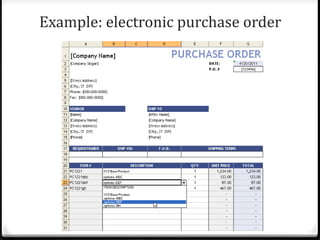
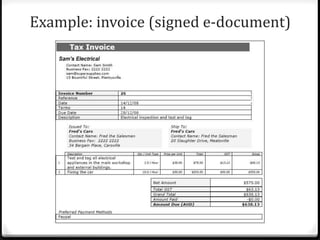
They allowed businesses to send commercial documents
like purchase orders or invoices electronically.
1980s:
0 introduction of credit cards, automated teller machines
(ATMs) and telephone banking in the 1980s
0 airline reservation systems (not directly to travellers)
Example: electronic purchase order
Example: invoice (signed e-document)
The 1990s
0 In 1990, Tim Berners-Lee invented the concept and
actual infractructure of the World Wide Web (www).
0 It took about five years to introduce security protocols
and broadband Internet services allowing fast and
reliable connection to the Internet (HTTPS).
0 By the end of the 20th century, many European and
American business companies offered their services
through the World Wide Web.
0 e-Commerce began to mean the ability of purchasing
various goods through the web using secure protocols
and electronic payment services
Timeline0 1981: Thomson Holidays, UK is first business-to-business online shopping
0 1984: Gateshead SIS/Tesco is first B2C online shopping and Mrs Snowball, 72, is
the first online home shopper
0 1985: Nissan UK sells cars and finance with credit checking to customers online
from dealers' lots.
0 1991: Tim Berners-Lee invents the www
0 1994: The first online bank opens. Pizza Hut offers online ordering on its Web
page. Attempts to offer flower delivery, magazine subscriptions, adult material
online. Netscape 1.0 is introduced in late 1994 SSL encryption that made
transactions secure.
0 1995: VeriSign was founded (public key certificate authority for SSL
communication)
0 1995: Jeff Bezos launches Amazon.com. eBay (AuctionWeb) is founded by a
computer programmer. Dell and Cisco begin to aggressively use the web for
commercial transactions.
0 1998: Electronic postal stamps can be purchased and downloaded for printing
from the Web.
0 2000: The dot-com (speculative EC-related stock market) bubble collapse
0 2002: eBay acquires PayPal for $1.5 billion.
0 2003: Amazon.com posts first yearly profit.
Regulations (US)
Key e-commerce activities are regulated by
the Federal Trade Commission (FTC) incl.
0the use of commercial e-mails,
0online advertising,
0consumer privacy.
(The FTC regulates all forms of advertising,
including online advertising, and requires
that advertising must be truthful and non-
deceptive.)
What is B2B e-commerce?
0e-commerce between companies,
businesses
0Earliest form of EC
0about 80% of e-commerce is of this type,
and most experts predict that B2B e-
commerce will continue to grow quickly
(faster than B2C)
0primary components: e-frastructure and e-
markets
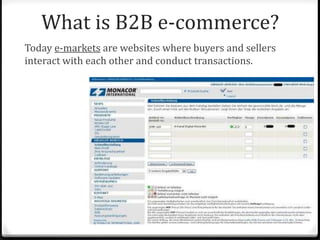
What is B2B e-commerce?
Today e-markets are websites where buyers and sellers
interact with each other and conduct transactions.
What is B2B e-commerce?
Common B2B examples and best practice models include
Hewlett Packard (HP), Cisco and Dell. Cisco, for instance,
receives over 90% of its product orders over the Internet.
Most B2B applications are in the areas of
0 supplier management (especially purchase order
processing),
0 inventory management,
0 distribution management (incl. the transmission of
shipping documents) and
0 payment management (via electronic payment systems
or EPSs).
What is B2C e-commerce?
0 Business-to-consumer e-commerce =
0 commerce between companies and consumers
0 customers gather information and purchase
0 physical goods (e.g. books or consumer products)
0 information goods (games; music, e-books);
0 customers may receive information goods over an
electronic network
0 the second largest and the second earliest form of e-
commerce
0 common B2C business models are the online retailing
companies such as Amazon.com, Drugstore.com,
Beyond.com, Barnes and Noble and ToysRus.
0 other B2C examples: Steam, iTunes, Booking.com.
What is B2C e-commerce?
How does it help customers?
0 B2C makes it easier and cheaper to find the right products and
0 to find the most competitive companies (e.g. in terms of price)
→ it reduces transactions costs
How does it help businesses?
0 It reduces market entry barriers (the cost of putting up and
maintaining a Web site is much cheaper than installing a
“brick-and-mortar” structure for a firm)
0 In the case of information goods, B2C e-commerce saves firms
from factoring in the additional cost of a physical distribution
network.
What is B2G e-commerce?
Business-to-government EC is the commerce between
companies and the public sector (e.g. government instututions).
Examples:
0 public procurement,
0 licensing procedures, etc.
Features:
0 The public sector assumes a pilot/leading role in establishing
e-commerce. It is assumed that the public sector has the
greatest need for making its procurement system more
effective.
0 Web-based purchasing policies increase the transparency of
the procurement process (and reduces the risk of
irregularities).
0 In most countries, B2G is less significant than B2B and B2C.
What is C2C e-commerce?
Consumer-to-consumer e-commerce:
commerce between private individuals
This type of e-commerce comes in at least three forms:
0 auctions facilitated at a portal, such as eBay, which allows
online real-time bidding on items being sold in the Web;
0 peer-to-peer systems, such as the Napster model (a
protocol for sharing files between users) and other file
exchange models; and
0 classified ads at portal sites such as Excite Classifieds and
eWanted (an interactive, online marketplace where
buyers and sellers can negotiate and which features
“Buyer Leads & Want Ads”).
What is C2C e-commerce?
There is little information on the relative size of global C2C
e-commerce. However, C2C figures of popular C2C sites
such as eBay indicate that this market is quite large. These
sites produce millions of dollars in sales every day.
It perhaps has the greatest potential for developing new
markets.
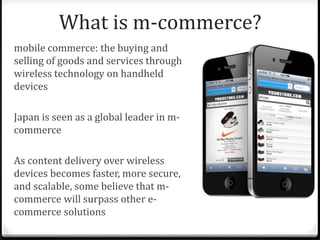
What is m-commerce?
mobile commerce: the buying and
selling of goods and services through
wireless technology on handheld
devices
Japan is seen as a global leader in m-
commerce
As content delivery over wireless
devices becomes faster, more secure,
and scalable, some believe that m-
commerce will surpass other e-
commerce solutions
m-commerce
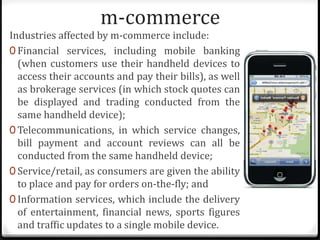
Industries affected by m-commerce include:
0 Financial services, including mobile banking
(when customers use their handheld devices to
access their accounts and pay their bills), as well
as brokerage services (in which stock quotes can
be displayed and trading conducted from the
same handheld device);
0 Telecommunications, in which service changes,
bill payment and account reviews can all be
conducted from the same handheld device;
0 Service/retail, as consumers are given the ability
to place and pay for orders on-the-fly; and
0 Information services, which include the delivery
of entertainment, financial news, sports figures
and traffic updates to a single mobile device.

E com presentation part1 part2

  • 2.
    What is e-Commerce? 0Makingbusiness using computers 0ICT (information and communication technology) is used as the underlying infrastructure 0A frequent/annoying form: ads (e.g. a simple banner ad) 0State of the art: webshops 0Main functions of a webshop: 0Maintenance of a product database (add, remove, edit descriptions, prices, pictures) 0Maintenance of a customer database (can be automated) 0EPS
  • 3.
    The History ofe-Commerce Originally, electronic commerce was identified as the facilitation of commercial transactions electronically. Technologies introduced in the 1970s: 0 Electronic Data Interchange (EDI) 0 Electronic Funds Transfer (EFT) They allowed businesses to send commercial documents like purchase orders or invoices electronically. 1980s: 0 introduction of credit cards, automated teller machines (ATMs) and telephone banking in the 1980s 0 airline reservation systems (not directly to travellers)
  • 4.
  • 5.
  • 6.
    The 1990s 0 In1990, Tim Berners-Lee invented the concept and actual infractructure of the World Wide Web (www). 0 It took about five years to introduce security protocols and broadband Internet services allowing fast and reliable connection to the Internet (HTTPS). 0 By the end of the 20th century, many European and American business companies offered their services through the World Wide Web. 0 e-Commerce began to mean the ability of purchasing various goods through the web using secure protocols and electronic payment services
  • 7.
    Timeline0 1981: ThomsonHolidays, UK is first business-to-business online shopping 0 1984: Gateshead SIS/Tesco is first B2C online shopping and Mrs Snowball, 72, is the first online home shopper 0 1985: Nissan UK sells cars and finance with credit checking to customers online from dealers' lots. 0 1991: Tim Berners-Lee invents the www 0 1994: The first online bank opens. Pizza Hut offers online ordering on its Web page. Attempts to offer flower delivery, magazine subscriptions, adult material online. Netscape 1.0 is introduced in late 1994 SSL encryption that made transactions secure. 0 1995: VeriSign was founded (public key certificate authority for SSL communication) 0 1995: Jeff Bezos launches Amazon.com. eBay (AuctionWeb) is founded by a computer programmer. Dell and Cisco begin to aggressively use the web for commercial transactions. 0 1998: Electronic postal stamps can be purchased and downloaded for printing from the Web. 0 2000: The dot-com (speculative EC-related stock market) bubble collapse 0 2002: eBay acquires PayPal for $1.5 billion. 0 2003: Amazon.com posts first yearly profit.
  • 8.
    Regulations (US) Key e-commerceactivities are regulated by the Federal Trade Commission (FTC) incl. 0the use of commercial e-mails, 0online advertising, 0consumer privacy. (The FTC regulates all forms of advertising, including online advertising, and requires that advertising must be truthful and non- deceptive.)
  • 10.
    What is B2Be-commerce? 0e-commerce between companies, businesses 0Earliest form of EC 0about 80% of e-commerce is of this type, and most experts predict that B2B e- commerce will continue to grow quickly (faster than B2C) 0primary components: e-frastructure and e- markets
  • 11.
    What is B2Be-commerce? Today e-markets are websites where buyers and sellers interact with each other and conduct transactions.
  • 12.
    What is B2Be-commerce? Common B2B examples and best practice models include Hewlett Packard (HP), Cisco and Dell. Cisco, for instance, receives over 90% of its product orders over the Internet. Most B2B applications are in the areas of 0 supplier management (especially purchase order processing), 0 inventory management, 0 distribution management (incl. the transmission of shipping documents) and 0 payment management (via electronic payment systems or EPSs).
  • 13.
    What is B2Ce-commerce? 0 Business-to-consumer e-commerce = 0 commerce between companies and consumers 0 customers gather information and purchase 0 physical goods (e.g. books or consumer products) 0 information goods (games; music, e-books); 0 customers may receive information goods over an electronic network 0 the second largest and the second earliest form of e- commerce 0 common B2C business models are the online retailing companies such as Amazon.com, Drugstore.com, Beyond.com, Barnes and Noble and ToysRus. 0 other B2C examples: Steam, iTunes, Booking.com.
  • 14.
    What is B2Ce-commerce? How does it help customers? 0 B2C makes it easier and cheaper to find the right products and 0 to find the most competitive companies (e.g. in terms of price) → it reduces transactions costs How does it help businesses? 0 It reduces market entry barriers (the cost of putting up and maintaining a Web site is much cheaper than installing a “brick-and-mortar” structure for a firm) 0 In the case of information goods, B2C e-commerce saves firms from factoring in the additional cost of a physical distribution network.
  • 15.
    What is B2Ge-commerce? Business-to-government EC is the commerce between companies and the public sector (e.g. government instututions). Examples: 0 public procurement, 0 licensing procedures, etc. Features: 0 The public sector assumes a pilot/leading role in establishing e-commerce. It is assumed that the public sector has the greatest need for making its procurement system more effective. 0 Web-based purchasing policies increase the transparency of the procurement process (and reduces the risk of irregularities). 0 In most countries, B2G is less significant than B2B and B2C.
  • 16.
    What is C2Ce-commerce? Consumer-to-consumer e-commerce: commerce between private individuals This type of e-commerce comes in at least three forms: 0 auctions facilitated at a portal, such as eBay, which allows online real-time bidding on items being sold in the Web; 0 peer-to-peer systems, such as the Napster model (a protocol for sharing files between users) and other file exchange models; and 0 classified ads at portal sites such as Excite Classifieds and eWanted (an interactive, online marketplace where buyers and sellers can negotiate and which features “Buyer Leads & Want Ads”).
  • 17.
    What is C2Ce-commerce? There is little information on the relative size of global C2C e-commerce. However, C2C figures of popular C2C sites such as eBay indicate that this market is quite large. These sites produce millions of dollars in sales every day. It perhaps has the greatest potential for developing new markets.
  • 18.
    What is m-commerce? mobilecommerce: the buying and selling of goods and services through wireless technology on handheld devices Japan is seen as a global leader in m- commerce As content delivery over wireless devices becomes faster, more secure, and scalable, some believe that m- commerce will surpass other e- commerce solutions
  • 19.
    m-commerce Industries affected bym-commerce include: 0 Financial services, including mobile banking (when customers use their handheld devices to access their accounts and pay their bills), as well as brokerage services (in which stock quotes can be displayed and trading conducted from the same handheld device); 0 Telecommunications, in which service changes, bill payment and account reviews can all be conducted from the same handheld device; 0 Service/retail, as consumers are given the ability to place and pay for orders on-the-fly; and 0 Information services, which include the delivery of entertainment, financial news, sports figures and traffic updates to a single mobile device.

Editor's Notes

  • #5 http://www.vertex42.com/ExcelTemplates/Images/purchase-order-with-price-list.gif
  • #6 http://www.invoiceplace.com/blog/2008/12/14/easy-electronic-invoicing-using-paypal/
  • #11 based on the book “e-Commerce and e-Business” written by Zorayda Andam (2003)
  • #13 (ˈɪn vənˌtɔr i, -ˌtoʊr i)
  • #14 (kənˈsu mər)