Industry     Study


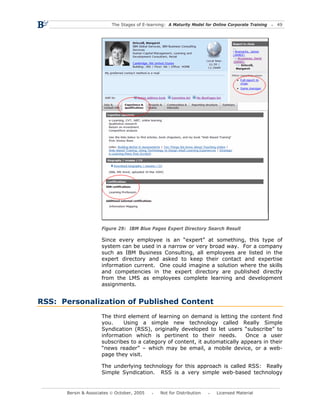
The Four Stages of
E-learning
A maturity model for online corporate training.


                                                  Josh Bersin
                                               October, 2005
                                        © Bersin & Associates
The Stages of E-learning: A Maturity Model for Online Corporate Training              2


Table of Contents
                    Introduction ......................................................................... 4

                    The E-learning Market .......................................................... 5

                       Defining E-learning ..................................................................... 5

                       Market Size and Growth .............................................................. 6

                       E-learning Market Segments ....................................................... 7

                         Content and Content Providers: Catalog vs. Custom ............. 8

                         Learning Management Systems and Infrastructure ................ 9

                         Content Development Tools and Systems........................... 10

                         Emergence of Rapid E-learning ......................................... 11

                         Important Role of Blended Learning .................................. 12

                         Online Books and References ........................................... 16

                         HR and other ERP Systems .............................................. 16

                    Market Maturity Curve........................................................ 18

                       Where Does Your Organization Fit? ........................................... 18

                    The Stages of E-Learning ................................................... 20

                       Stage 1: Getting Started ........................................................... 21

                         Business Drivers............................................................. 21

                         Implementation Focus: Catalog Content or Single Program .. 21

                         Biggest Challenges ......................................................... 22

                         Where is the Market? ...................................................... 23

                         Are you in Stage 1? ........................................................ 24

                       Stage 2: Expand (Growth) ........................................................ 25

                         Key Issues in the Expansion Phase .................................... 25

                         Stage 2 Organization Priorities.......................................... 27

                         Increasing Utilization....................................................... 27

                         Reducing Costs .............................................................. 28

                         Online Books and References ........................................... 29


     Bersin & Associates © October, 2005          Not for Distribution         Licensed Material
The Stages of E-learning: A Maturity Model for Online Corporate Training                    3


                    Are you in Stage 2? ........................................................ 30

                  Stage 3: Integrate and Align .................................................... 31

                    E-learning is No Longer a Standalone Solution .................... 32

                    Two Types of Integration ................................................. 33

                    Technical Integration: Data and Systems .......................... 33

                    The Important Role of IT ................................................. 35

                    Process Integration ......................................................... 36

                    Alignment: Driving Business Results ................................. 37

                    Alignment with Lines of Business ...................................... 37

                    Alignment with HR .......................................................... 39

                    Alignment within Training: Governance............................. 40

                    How do you know if you are in Stage 3?............................. 41

               Stage 4: Learning on Demand ........................................... 44

                  Categorizing Content Types by Use ........................................... 44

                    1. Nature of the Performance Problem .............................. 45

                    2. Time to Solution ........................................................ 45

                  Search ....................................................................................... 46

                  Expert Directories ..................................................................... 47

                  RSS: Personalization of Published Content ............................... 49

                  PodCasts: Personalization of Voice and Music .......................... 50

                  Approaching the Last Mile ......................................................... 50

                  Here Today ................................................................................ 50

               Conclusions: Using this Maturity Model ............................. 51

               Appendix A: Survey Demographics..................................... 52

               Appendix B: Table of Figures.............................................. 54

               About Us ............................................................................ 56

               About This Research........................................................... 56


Bersin & Associates © October, 2005            Not for Distribution           Licensed Material
The Stages of E-learning: A Maturity Model for Online Corporate Training   4


Introduction
                           The market for Internet-enabled training and education has
                           exploded in the last five years, reaching more than $12 billion in
                           products and services today. This research report, based on the
                           results of 526 interviews with North American training and HR
                           managers, reviews the corporate e-learning market in detail. It
                           identifies a maturity model for e-learning: the three stages that
                           organizations go through. For each stage, the study gives the
The term “e-               reader guidelines for their implementations and where they are
learning” refers to        likely to be headed. It then describes the “fourth stage” – the
the use of Internet        coming new approaches which we believe are coming next.
technologies for
                           The objectives of this paper are to:
delivery and
management of                  •     Describe the e-learning market, its size, and growth.
training.
                               •     Describe the three stages of corporate e-learning maturity to
Today, most                          help buyers identify where they are and where they are
organizations                        going.
understand the
potential and have             •     Identify the key technology and usage trends that corporate
                                     training organizations should use in planning for new
adopted e-learning
                                     investments.
for a variety of
initiatives and                •     Provide our perspectives on where the corporate e-learning
programs.                            marketplace is going.


                           The source of research for this paper was a broad-based survey for
                           training managers in the spring of 2005, along with interviews with
                           12 different companies about training and e-learning strategies.
                           Survey demographics are described in Appendix B.


            Bersin & Associates © October, 2005         Not for Distribution      Licensed Material
The Stages of E-learning: A Maturity Model for Online Corporate Training   5


The E-learning Market

Defining E-learning
                      As use of the Internet has become widespread and well understood,
                      the definition of e-learning has changed. In our research, we define
                      e-learning as any form of corporate training that uses Internet-
                      based technology for delivery, management, and measurement.

                      Historically, corporate training managers always have looked for
                      ways to reduce the cost and improve the scalability of training
                      programs through technology.         In the 1970s and 1980s,
                      organizations used mainframe and interactive video approaches. In
                      the 1980s and 1990s, PC-based CD-ROM content was the preferred
                      approach. Since 1998 or so, however, Internet-based approaches
                      clearly have become the dominant delivery method for creating
                      fast, scalable, low cost training.

                      Today, there are two broad categories of Internet-based programs:

                          •     Self-study: Web-based content that allows a learner to start
                                and stop whenever they want, enabling the learner to learn
                                “on-demand.” This usually is called asynchronous training
                                because it is not synchronized with an instructor or another
                                learner.

                          •     Live:   Live Web-based programs use virtual classroom
                                technology from vendors such as Centra, Interwise, WebEx,
                                Microsoft, SkillSoft, NETg, and others to create an online
                                experience which is instructor-led.      These synchronous
                                programs require a student to attend an online event and
                                attempt to replicate and enhance a classroom experience.

                      Within these two broad categories there are many types of content
                      and delivery technologies. Self-study programs include Web-based
                      courseware, online books and references, online documents,
                      assessments, simulations, videos, collaboration systems, blogs, and
                      more to come. Live programs typically include Webcasts (large
                      broadcast events), online labs, mentoring sessions, and virtual
                      classroom events. Live technology has evolved very quickly in the
                      last 12-18 months and, today, an instructor can teach, look over a
                      student’s shoulder, and turn control over to an instructor to test
                      and coach a learner.


       Bersin & Associates © October, 2005         Not for Distribution      Licensed Material
The Stages of E-learning: A Maturity Model for Online Corporate Training                                 6


Market Size and Growth
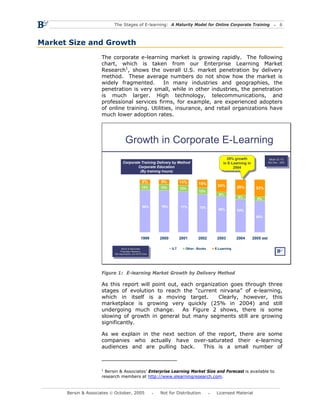
                     The corporate e-learning market is growing rapidly. The following
                     chart, which is taken from our Enterprise Learning Market
                     Research1, shows the overall U.S. market penetration by delivery
                     method. These average numbers do not show how the market is
                     widely fragmented.        In many industries and geographies, the
                     penetration is very small, while in other industries, the penetration
                     is much larger. High technology, telecommunications, and
                     professional services firms, for example, are experienced adopters
                     of online training. Utilities, insurance, and retail organizations have
                     much lower adoption rates.


                                    Growth in Corporate E-Learning
                                                                                                   25% growth
                                                                                                    25% growth               Mean 33.1%
                                                                                                                              Mean 33.1%
                                  Corporate Training Delivery by Method                          in E-Learning in           Std Dev: 26%
                                                                                                                             Std Dev: 26%
                                                                                                  in E-Learning in
                                          Corporate Education                                          2004
                                                                                                        2004
                                           (By training hours)

                                                    8%       9%           11%       15%
                                                   12%       12%
                                                                                             24%         29%
                                                                          12%                                        33%
                                                                                    13%
                                                                                              9%
                                                                                                         8%          8%

                                                    80%      79%          77%       72%
                                                                                              68%        63%
                                                                                                                     60%


                                                   1999      2000         2001      2002     2003        2004    2005 est

                                  Bersin & Associates               ILT     Other - Books   E-Learning
                                    Bersin & Associates
                                 Proprietary Research,
                                   Proprietary Research,
                           526 respondents, and ASTD Data
                            526 respondents, and ASTD Data


                     Figure 1: E-learning Market Growth by Delivery Method

                     As this report will point out, each organization goes through three
                     stages of evolution to reach the “current nirvana” of e-learning,
                     which in itself is a moving target.         Clearly, however, this
                     marketplace is growing very quickly (25% in 2004) and still
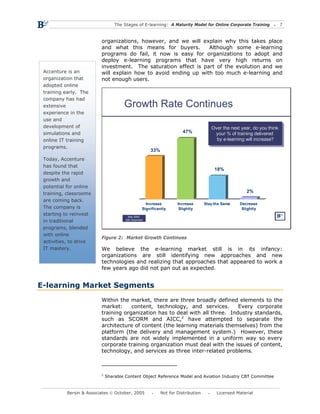
                     undergoing much change.        As Figure 2 shows, there is some
                     slowing of growth in general but many segments still are growing
                     significantly.

                     As we explain in the next section of the report, there are some
                     companies who actually have over-saturated their e-learning
                     audiences and are pulling back.     This is a small number of


                     1
                       Bersin & Associates’ Enterprise Learning Market Size and Forecast is available to
                     research members at http://www.elearningresearch.com.


      Bersin & Associates © October, 2005                    Not for Distribution            Licensed Material
The Stages of E-learning: A Maturity Model for Online Corporate Training            7


                         organizations, however, and we will explain why this takes place
                         and what this means for buyers.        Although some e-learning
                         programs do fail, it now is easy for organizations to adopt and
                         deploy e-learning programs that have very high returns on
                         investment. The saturation effect is part of the evolution and we
 Accenture is an         will explain how to avoid ending up with too much e-learning and
 organization that       not enough users.
 adopted online
 training early. The
 company has had
 extensive                           Growth Rate Continues
 experience in the
 use and
 development of                                                                       Over the next year, do you think
                                                                       47%            Over the next year, do you think
 simulations and                                                                       your % of training delivered
                                                                                        your % of training delivered
 online IT training                                                                     by e-learning will increase?
                                                                                         bye-
                                                                                            e-learning will increase?
 programs.
                                                      33%
 Today, Accenture
 has found that
                                                                                        18%
 despite the rapid
 growth and
 potential for online
 training, classrooms                                                                                  2%
 are coming back.
                                                    Increase        Increase       Stay the Same   Decrease
 The company is                                   Significantly      Slightly                       Slightly
 starting to reinvest                   May 2005,
 in traditional                       526 responses


 programs, blended
 with online
                         Figure 2: Market Growth Continues
 activities, to drive
 IT mastery.             We believe the e-learning market still is in its infancy:
                         organizations are still identifying new approaches and new
                         technologies and realizing that approaches that appeared to work a
                         few years ago did not pan out as expected.


E-learning Market Segments
                         Within the market, there are three broadly defined elements to the
                         market:     content, technology, and services.       Every corporate
                         training organization has to deal with all three. Industry standards,
                         such as SCORM and AICC,2 have attempted to separate the
                         architecture of content (the learning materials themselves) from the
                         platform (the delivery and management system.) However, these
                         standards are not widely implemented in a uniform way so every
                         corporate training organization must deal with the issues of content,
                         technology, and services as three inter-related problems.


                         2
                             Sharable Content Object Reference Model and Aviation Industry CBT Committee


          Bersin & Associates © October, 2005               Not for Distribution         Licensed Material
The Stages of E-learning: A Maturity Model for Online Corporate Training   8


Content and Content Providers: Catalog vs. Custom

                        There are two forms of training content in the e-learning market:

                            •     Catalog, or off-the-shelf: These are programs and materials
                                  that are developed by third-party providers (SkillSoft, NETg,
                                  ElementK, Microsoft, Oracle, and hundreds of other
                                  companies).

                            •     Custom: Programs developed by a company for its internal
                                  own use. Custom programs are often developed internally
                                  and sometimes by third-party consultants.
                        The catalog content providers defined and created the e-learning
                        market. In the 1990s, companies like SkillSoft, SmartForce, NETg,
                        and DigitalThink created exciting, innovative online content for IT
                        and technical training that demonstrated and proved the value of
                        online training. Today, the catalog content market has become
                        very large (more than $1 billion in size) and forms the foundation of
                        any corporate e-learning strategy.

                        The biggest shifts that have taken place in the catalog market are:

                            •     The evolution of catalog content from purely IT and technical
                                  training to more soft skills, management training, and
                                  vertical   and    horizontal     topics    (e.g.,   Healthcare,
                                  manufacturing, compliance and safety, HR, accounting). As
                                  the big players have gotten bigger, there are now hundreds
                                  of small providers of specialized off-the-shelf content.

                            •     Emergence and explosive growth of online books and
                                  reference materials to supplement and complement online
                                  training. The biggest player in this fast-growing market
                                  today is Books24x7, a division of Skillsoft.

                            •     The ability for the largest catalog providers (e.g., SkillSoft
                                  and NETg) to provide an integrated solution that includes a
                                  content catalog along with an integrated platform. These
                                  platforms enable organizations to manage, launch, track,
                                  and report on catalog content and form the basis of a
                                  learning    management      system    solution   for   many
                                  organizations.    The largest players (Skillsoft, NETg, and
                                  ElementK) have very sophisticated platforms and embedded
                                  development tools.

                        As the large players have grown and consolidated (SkillSoft is #1
                        with Thomson NETg #2), hundreds of smaller companies have
                        entered the market with high quality, specialized content that
                        focuses on specific company needs. The growth in the e-learning
                        market has enabled a huge cottage industry of content providers to
                        grow, giving corporate buyers many options to buy instead of build
                        high quality online programs.


         Bersin & Associates © October, 2005         Not for Distribution      Licensed Material
The Stages of E-learning: A Maturity Model for Online Corporate Training   9


Learning Management Systems and Infrastructure

                        Unfortunately for corporate training organizations, there is a lot of
                        underlying technology required to manage online learning
                        programs.    The Learning Management Systems (LMS) market,
                        which is more than $450m in size today, continues to grow and
                        evolve and, as we describe in this report, becomes a critical part of
                        “stage 2” implementations. Other infrastructure, which has become
                        important in the e-learning market, includes development tools
                        (there are dozens and dozens), content management systems
                        (LCMS), measurement systems, assessment tools, simulation tools,
                        and general Web server technologies.

                        We segment the LMS market into four categories:

                            •     Global Enterprise: Software systems designed for global
                                  enterprises, with domain management, multi-language
                                  support, distributed administration, and the scalability to
                                  handle tens of thousands of learners.

                            •     Enterprise:       Software systems designed for tens of
                                  thousands of users but typically run in a single language with
                                  limited distributed administration.

                            •     Mid-market: Systems, designed for small- and medium-
                                  sized organizations, that are easy to install, easy to use, and
                                  low cost to implement. These systems often are hosted
                                  externally and include integrated development tools to help
                                  organizations build and publish content.

                            •     Specialized Solutions:          Many content providers and
                                  consulting firms have full function LMS systems. Systems
                                  such as SkillSoft’s SkillPort, NETg KnowledgeNow, and other
                                  content provider systems are included here.


         Bersin & Associates © October, 2005         Not for Distribution      Licensed Material
The Stages of E-learning: A Maturity Model for Online Corporate Training                               10


                            The Fragmented LMS Market
                                                                                  3%                            LMS Market Share
                                                                                       6%
                                                                                            1%                    by Revenue
                                                      21%                                     3%
                                                                                               2%                 Total Market
                                                                                                 3%
                                                                                                    2%
                                                                                                     3%
                                        2%


                                                                                                      9%


                                         17%
                                                                                                    4%


                                                                                               7%
                                                          1%
                                                                         12%           5%


                                 © Bersin & Associates, 2004 from LMS2004:
                                       Facts, Practical Analysis, and Trends
                                http://store.bersinassociates.com/lms-2004.html


                       Figure 3: LMS Market Fragmentation

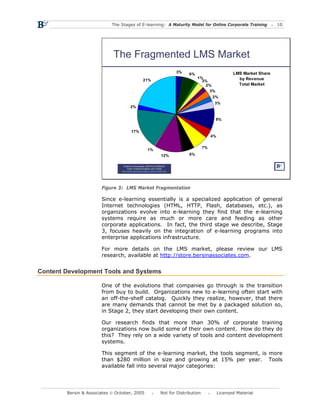
                       Since e-learning essentially is a specialized application of general
                       Internet technologies (HTML, HTTP, Flash, databases, etc.), as
                       organizations evolve into e-learning they find that the e-learning
                       systems require as much or more care and feeding as other
                       corporate applications. In fact, the third stage we describe, Stage
                       3, focuses heavily on the integration of e-learning programs into
                       enterprise applications infrastructure.

                       For more details on the LMS market, please review our LMS
                       research, available at http://store.bersinassociates.com.


Content Development Tools and Systems

                       One of the evolutions that companies go through is the transition
                       from buy to build. Organizations new to e-learning often start with
                       an off-the-shelf catalog. Quickly they realize, however, that there
                       are many demands that cannot be met by a packaged solution so,
                       in Stage 2, they start developing their own content.

                       Our research finds that more than 30% of corporate training
                       organizations now build some of their own content. How do they do
                       this? They rely on a wide variety of tools and content development
                       systems.

                       This segment of the e-learning market, the tools segment, is more
                       than $280 million in size and growing at 15% per year. Tools
                       available fall into several major categories:


        Bersin & Associates © October, 2005                             Not for Distribution             Licensed Material
The Stages of E-learning: A Maturity Model for Online Corporate Training   11


                            •    Rapid e-learning tools (discussed in the next section)

                            •    Traditional courseware development tools

                            •    General purpose Web development tools

                            •    Software application simulation tools

                            •    General purpose business simulation tools

                            •    Microsoft Office tools

                            •    Professional Web developer tools

                        There are more than 100 such tools on the market, with the largest
                        market share going to companies like Articulate, Macromedia,
                        Microsoft, OutStart, Trivantis, and SumTotal. A significant part of
                        the development tools market is the use of live Webcasting tools,
                        such as Centra, Interwise, Microsoft Live Meeting, and WebEx.
                        Although most companies have access to such live systems already,
                        their use as a regular part of training is still growing very rapidly –
                        typically incorporated into blended programs (discussed below).


Emergence of Rapid E-learning

                        Over the last 18-24 months, one of the biggest changes in this
                        market is the emergence of a segment we call rapid e-learning. We
                        coined this term in 2003 and now it is widely used by a variety of
                        tools and solution providers.

                        Rapid e-learning is a revolutionary step in corporate training and
                        communications: it empowers subject matter experts (trainers,
                        product managers, sales managers, executives, engineers, etc.) to
                        build their own instructional content easily and publish it online. It
                        is both an easy way to get started as well as a step in the
                        evolutionary process. For more details on this segment, please
                        read, Rapid E-Learning: What Works™3, our detailed research
                        report on this marketplace.


                        3
                          Rapid E-Learning: What Works™ is available to research members or for purchase
                        at http://store.bersinassociates.com/relstudy-2005.html .


         Bersin & Associates © October, 2005       Not for Distribution      Licensed Material
The Stages of E-learning: A Maturity Model for Online Corporate Training   12


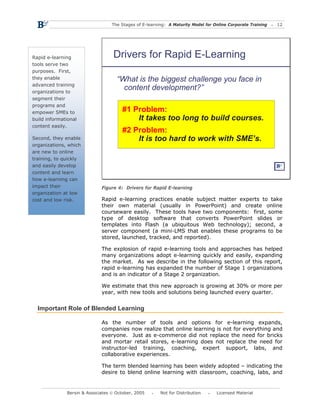
Rapid e-learning                  Drivers for Rapid E-Learning
tools serve two
purposes. First,
they enable                         “What is the biggest challenge you face in
advanced training
organizations to
                                      content development?”
segment their
programs and
empower SMEs to                        #1 Problem:
                                       #1 Problem:
build informational                        It takes too long to build courses.
                                            It takes too long to build courses.
content easily.
                                       #2 Problem:
                                       #2 Problem:
Second, they enable                        It is too hard to work with SME’s.
                                            It is too hard to work with SME’s.
organizations, which
are new to online
training, to quickly
and easily develop
content and learn
how e-learning can
impact their                 Figure 4: Drivers for Rapid E-learning
organization at low
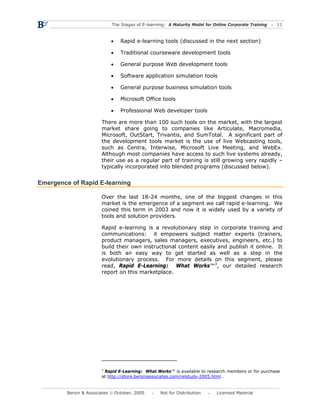
cost and low risk.           Rapid e-learning practices enable subject matter experts to take
                             their own material (usually in PowerPoint) and create online
                             courseware easily. These tools have two components: first, some
                             type of desktop software that converts PowerPoint slides or
                             templates into Flash (a ubiquitous Web technology); second, a
                             server component (a mini-LMS that enables these programs to be
                             stored, launched, tracked, and reported).

                             The explosion of rapid e-learning tools and approaches has helped
                             many organizations adopt e-learning quickly and easily, expanding
                             the market. As we describe in the following section of this report,
                             rapid e-learning has expanded the number of Stage 1 organizations
                             and is an indicator of a Stage 2 organization.

                             We estimate that this new approach is growing at 30% or more per
                             year, with new tools and solutions being launched every quarter.


  Important Role of Blended Learning

                             As the number of tools and options for e-learning expands,
                             companies now realize that online learning is not for everything and
                             everyone. Just as e-commerce did not replace the need for bricks
                             and mortar retail stores, e-learning does not replace the need for
                             instructor-led training, coaching, expert support, labs, and
                             collaborative experiences.

                             The term blended learning has been widely adopted – indicating the
                             desire to blend online learning with classroom, coaching, labs, and


              Bersin & Associates © October, 2005       Not for Distribution      Licensed Material
The Stages of E-learning: A Maturity Model for Online Corporate Training       13


                            other real world experiences. Our research has found that blended
                            learning now is a mainstream approach for all Stage 2 companies.
Wells Fargo has             After experimenting with rapid e-learning and other forms of Web-
been using                  based content, companies typically find that all instructor-led
technology-based            training can be complemented and extended with online materials.
training for IT
employees since             The most frequent use of blended learning is for:
1997. Today, the
                                •    Management and Leadership Training
company has more
than 2,000 titles               •    New Hire Training
available.
                                •    Soft skills (team-building, management, coaching)
For high potential IT
employees, the                  •    “Mastery” programs
company has a
                            What is a mastery program? In all training organizations, there is
Masters program             training needs that range in instructional demands.
that blends online
prerequisites with          To help organizations understand when to use blended approaches
classroom training,         and other media types, we have developed a taxonomy called “The
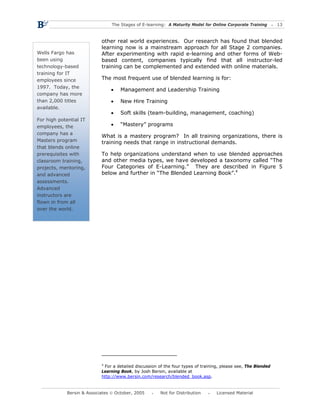
projects, mentoring,        Four Categories of E-Learning.” They are described in Figure 5
and advanced                below and further in “The Blended Learning Book”.4
assessments.
Advanced
instructors are
flown in from all
over the world.


                            4
                             For a detailed discussion of the four types of training, please see, The Blended
                            Learning Book, by Josh Bersin, available at
                            http://www.bersin.com/research/blended_book.asp.


             Bersin & Associates © October, 2005        Not for Distribution       Licensed Material
The Stages of E-learning: A Maturity Model for Online Corporate Training                                         14


                      Four Categories of E-Learning
                      © Bersin & Associates


                           Category               Example               What Learner               Tracking                 Tools
                                                                          will Do
                     1. Information           "There is a new          Read                    None                    Email, PowerPoint,
                     Broadcast                pricing model being                                                         Conf Calls,
                                              announced and                                                             Rapid E-Learning
                                              here it is."


                     2. Critical              "Here is the new         Read, listen, and       Who took this? Did
                     Information              pricing model, how it    answer some             they receive it? Did    Rapid E-Learning
                     Transfer                 works, and how it        questions.              they read and listen?     Webcasting
                                              differs from the
                                              previous model."


                     3. New Skills and        "Learn how to price      Read, listen, and try   Did they really
                     Competencies             complex products         out new skills.         learn? What score did      Courseware
                                              so you can become                                they get? Can they         Simulations
                                              a pricing guru."                                 apply this              Blended Learning
                                                                                               information?


                     4. Certified Skills      "Become a certified      Read, Listen, try new   Did they pass? Are         Courseware,
                     and Proficiencies        pricing expert in the    skills, and become      they certified? Can       Assessments,
                                              regional sales office,   certified.              they apply material        Simulations,
                                              with authority to give                           consistently? When           Manager
                                              discounts."                                      were they certified?       Intervention,
                                                                                               When do they expire?    Blended Learning


               Figure 5: The Four Categories of E-learning

               Each business problem demands a different level of instructional
               focus. Some problems can be solved by distributing information
               (books, email, pamphlets, or slides). Others require strict classroom
               experiences, labs, and on-the-job training. These latter programs
               are what we call mastery programs. The goal of these programs is
               not just to educate, but to create mastery.

               For these programs, a blended approach is mandatory.

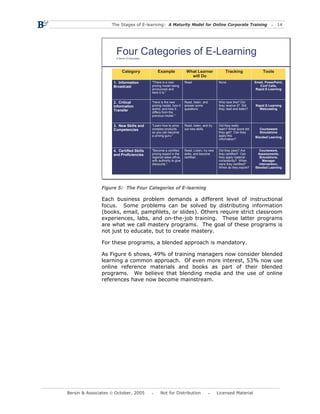
               As Figure 6 shows, 49% of training managers now consider blended
               learning a common approach. Of even more interest, 53% now use
               online reference materials and books as part of their blended
               programs. We believe that blending media and the use of online
               references have now become mainstream.


Bersin & Associates © October, 2005                 Not for Distribution                       Licensed Material
The Stages of E-learning: A Maturity Model for Online Corporate Training                 15


                    What other tools do you use?
                        Wide and growing
                        Wide and growing                 Rapid Adoption
                                                          Rapid Adoption
                    adoption of LMS platforms
                     adoption of LMS platforms        Of Online References
                                                      Of Online References
                                                                                     Blended Learning
                                                                                      Blended Learning
                                                                                     now Mainstream
                                                                                      now Mainstream
                             60%
                                         12%
                             50%
                                                               13%
                             40%
                                                                                          30%
                             30%
                                         48%                                                    Sometimes
                             20%                               40%                              Frequently


                             10%                                                          19%

                              0%
                                         LMS                Online Books          Blended Learning


               Figure 6: Adoption of LMS, Online Books, Blended Learning

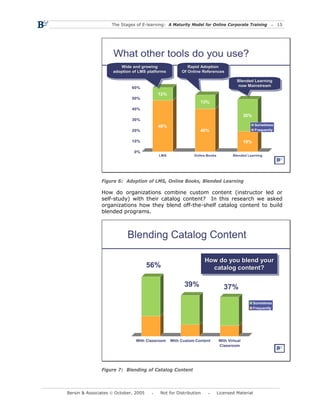
               How do organizations combine custom content (instructor led or
               self-study) with their catalog content? In this research we asked
               organizations how they blend off-the-shelf catalog content to build
               blended programs.


                           Blending Catalog Content

                                                                 How do you blend your
                                                                 How do you blend your
                                      56%                          catalog content?
                                                                    catalog content?

                                                       39%                    37%

                                                                                                Sometimes
                                                                                                Frequently


                               With Classroom    With Custom Content       With Virtual
                                                                           Classroom


               Figure 7: Blending of Catalog Content


Bersin & Associates © October, 2005       Not for Distribution             Licensed Material
The Stages of E-learning: A Maturity Model for Online Corporate Training   16


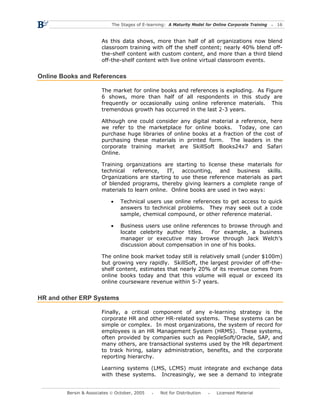
                       As this data shows, more than half of all organizations now blend
                       classroom training with off the shelf content; nearly 40% blend off-
                       the-shelf content with custom content, and more than a third blend
                       off-the-shelf content with live online virtual classroom events.


Online Books and References

                       The market for online books and references is exploding. As Figure
                       6 shows, more than half of all respondents in this study are
                       frequently or occasionally using online reference materials. This
                       tremendous growth has occurred in the last 2-3 years.

                       Although one could consider any digital material a reference, here
                       we refer to the marketplace for online books. Today, one can
                       purchase huge libraries of online books at a fraction of the cost of
                       purchasing these materials in printed form. The leaders in the
                       corporate training market are SkillSoft Books24x7 and Safari
                       Online.

                       Training organizations are starting to license these materials for
                       technical reference, IT, accounting, and business skills.
                       Organizations are starting to use these reference materials as part
                       of blended programs, thereby giving learners a complete range of
                       materials to learn online. Online books are used in two ways:

                           •    Technical users use online references to get access to quick
                                answers to technical problems. They may seek out a code
                                sample, chemical compound, or other reference material.

                           •    Business users use online references to browse through and
                                locate celebrity author titles.  For example, a business
                                manager or executive may browse through Jack Welch’s
                                discussion about compensation in one of his books.

                       The online book market today still is relatively small (under $100m)
                       but growing very rapidly. SkillSoft, the largest provider of off-the-
                       shelf content, estimates that nearly 20% of its revenue comes from
                       online books today and that this volume will equal or exceed its
                       online courseware revenue within 5-7 years.


HR and other ERP Systems

                       Finally, a critical component of any e-learning strategy is the
                       corporate HR and other HR-related systems. These systems can be
                       simple or complex. In most organizations, the system of record for
                       employees is an HR Management System (HRMS). These systems,
                       often provided by companies such as PeopleSoft/Oracle, SAP, and
                       many others, are transactional systems used by the HR department
                       to track hiring, salary administration, benefits, and the corporate
                       reporting hierarchy.

                       Learning systems (LMS, LCMS) must integrate and exchange data
                       with these systems. Increasingly, we see a demand to integrate


        Bersin & Associates © October, 2005       Not for Distribution      Licensed Material
The Stages of E-learning: A Maturity Model for Online Corporate Training           17


               learning systems with Performance Management and Skills
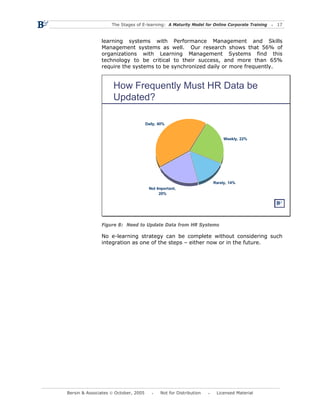
               Management systems as well. Our research shows that 56% of
               organizations with Learning Management Systems find this
               technology to be critical to their success, and more than 65%
               require the systems to be synchronized daily or more frequently.


                    How Frequently Must HR Data be
                    Updated?

                                            Daily, 40%


                                                                                       Weekly, 22%


                                                                                  Rarely, 14%
                                               Not Important,
                                                    20%

                          Study conducted in May 2004, 10,000+ Surveys


               Figure 8: Need to Update Data from HR Systems

               No e-learning strategy can be complete without considering such
               integration as one of the steps – either now or in the future.


Bersin & Associates © October, 2005                        Not for Distribution    Licensed Material
The Stages of E-learning: A Maturity Model for Online Corporate Training              18


Market Maturity Curve
                     It is important to realize that each of the components of an e-
                     learning solution is at a different stage of maturity. When solutions
                     or approaches are new, they are exciting and innovative but often
                     unproven. Companies buy technologies but do not necessarily have
                     proven implementation experiences to draw upon. Later in the
                     maturity cycle, solutions are better established and there are many
                     companies to learn from.


                                 E-Learning Market Maturity Cycle
                                                                     Softskills          IT
                                             LMS                 Industry Specific     Catalog
                                            Market

                                  Blended
                                 Programs


                                   Early               Early              Late              Late
                                                                                                         Laggards
                                  Adopters            Majority           Majority         Adopters
                                                           Rapid
                                                         E-learning

                                            Reference
                                              Ware
                                                                            Mainstream
                                Learning
                               On Demand


                     Figure 9: E-Learning Market Maturity Cycle

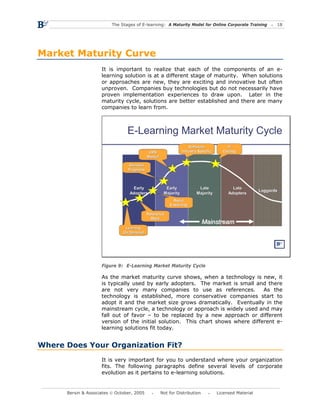
                     As the market maturity curve shows, when a technology is new, it
                     is typically used by early adopters. The market is small and there
                     are not very many companies to use as references.            As the
                     technology is established, more conservative companies start to
                     adopt it and the market size grows dramatically. Eventually in the
                     mainstream cycle, a technology or approach is widely used and may
                     fall out of favor – to be replaced by a new approach or different
                     version of the initial solution. This chart shows where different e-
                     learning solutions fit today.


Where Does Your Organization Fit?
                     It is very important for you to understand where your organization
                     fits. The following paragraphs define several levels of corporate
                     evolution as it pertains to e-learning solutions.


      Bersin & Associates © October, 2005            Not for Distribution            Licensed Material
The Stages of E-learning: A Maturity Model for Online Corporate Training   19


               Early adopters are companies who like to innovate. They are
               willing to use technology to gain a competitive advantage. They
               have IT staff, management, and executives who are used to doing
               things new and differently. Many high technology companies fall
               into this category.

               Early majority companies will adopt new approaches to stay
               ahead of the market, but tend to wait until there are some
               reference customers to learn from. If you are in this type of
               organization, you probably find your executives asking, “What other
               organizations can we benchmark ourselves against?” or “Who else
               is doing this?”

               Late majority companies like to wait until all the bugs are worked
               out.   These organizations gain market share through strong
               customer service, support, and proven solutions – so they are wary
               of doing things first.   They want to be fast followers.      Their
               approach is to let someone else take the arrows, learn from them,
               and do it better. This is the largest segment of any market, with
               about 60-70% of all companies falling into this category.

               Late adopters are companies who tend to show up late. They are
               sometimes disorganized, distracted, or perhaps busy with other
               critical business issues. Many late adopters may, in fact, do the
               best job of implementing a solution because they take the time to
               study, plan, and organize themselves for success. The only risk
               these companies have is that the solution they chose may become
               obsolete during the time they decide to implement.

               Laggards wait until the market is almost over and then jump in.
               These companies are the ones that are now developing web sites,
               for example.

               As an e-learning manager, HR manager, or executive, you must be
               must be aware of your own company culture. If you try to adopt an
               unproven early adopter approach and you are working in a late
               majority company, you may find little or no tolerance for bugs,
               mistakes, or failures. As you read through this study, make sure
               you remember that your stage of evolution is highly dependent on
               the culture of your own organization.


Bersin & Associates © October, 2005       Not for Distribution      Licensed Material
The Stages of E-learning: A Maturity Model for Online Corporate Training                 20


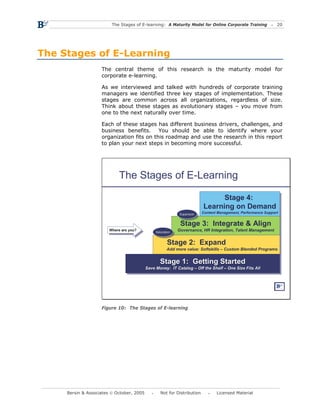
The Stages of E-Learning
                    The central theme of this research is the maturity model for
                    corporate e-learning.

                    As we interviewed and talked with hundreds of corporate training
                    managers we identified three key stages of implementation. These
                    stages are common across all organizations, regardless of size.
                    Think about these stages as evolutionary stages – you move from
                    one to the next naturally over time.

                    Each of these stages has different business drivers, challenges, and
                    business benefits. You should be able to identify where your
                    organization fits on this roadmap and use the research in this report
                    to plan your next steps in becoming more successful.


                            The Stages of E-Learning

                                                                                       Stage 4:
                                                                                        Stage 4:
                                                                             Learning on Demand
                                                                             Learning on Demand
                                                               Expansion    Content Management, Performance Support
                                                                            Content Management, Performance Support
                                                                Expansion

                                                               Stage 3: Integrate & Align
                                                               Stage 3: Integrate & Align
                        Where are you?
                        Where are you?          Saturation
                                                              Governance, HR Integration, Talent Management
                                                              Governance, HR Integration, Talent Management
                                                 Saturation


                                                       Stage 2: Expand
                                                       Stage 2: Expand
                                                       Add more value: Softskills ––Custom Blended Programs
                                                        Add more value: Softskills Custom Blended Programs

                                                  Stage 1: Getting Started
                                                  Stage 1: Getting Started
                                           Save Money: IT Catalog ––Off the Shelf ––One Size Fits All
                                            Save Money: IT Catalog Off the Shelf One Size Fits All


                    Figure 10: The Stages of E-learning


     Bersin & Associates © October, 2005           Not for Distribution            Licensed Material
The Stages of E-learning: A Maturity Model for Online Corporate Training   21


Stage 1: Getting Started
                        Stage 1, “Getting Started”, is where all organizations begin. In this
                        stage, the organization typically is new to online training and has
                        identified one or more important programs that can take advantage
                        of this approach.


Business Drivers

                     In this stage, the company usually is focused on the following business
                     drivers:

                            •    Desire to save money by reducing the cost of travel,
                                 reducing cost of facilities and instructors, and reducing the
                                 inefficiency of poorly attended programs.

                            •    Desire to improve reach by increasing the number of users
                                 who have access to training because they did not have time
                                 or funds to attend training in the past.

                            •    Desire to improve the range of learning offerings by giving
                                 employees and customers access to a wider set of learning
                                 programs, self-study programs, and topics that are too
                                 expensive and difficult to offer in an instructor-led format
                                 but can be purchased and delivered online.

                        The business case for an e-learning solution usually is built around
                        one or more of these three factors. Although cost savings were the
                        genesis of most e-learning investments, companies now know that
                        cost savings are not the ultimate result. Ultimately, e-learning
                        replaces variable costs (instructors and travel) with fixed costs
                        (content, technology, and infrastructure) to increase speed and
                        scale.


Implementation Focus: Catalog Content or Single Program

                        Most organizations start their e-learning initiative with a single
                        program or subject area. In most companies, the e-learning wave
                        starts with online IT training.

                        Organizations usually can start with an off-the-shelf catalog from
                        SkillSoft, NETg, Element K, or another more vertical provider and
                        enhance it with industry-specific content.        Many Stage 1
                        organizations start by purchasing a single course and rolling it out
                        to many people as an experiment.

                        The U.S. Department of Forestry Firefighters, for example, needed
                        an e-learning program to deliver compliance training to volunteer
                        firefighters in many cities and states. They developed and deployed
                        a single course in a content provider’s portal to get started.


         Bersin & Associates © October, 2005       Not for Distribution      Licensed Material
The Stages of E-learning: A Maturity Model for Online Corporate Training   22


                              In Stage 1, companies often realize they need to purchase an LMS
                              as part of their implementation but usually do not have the budget.
                              When purchasing an LMS, these companies typically purchase a
                              solution bundled with content from a content provider. Or, they
                              purchase a low cost, easy to implement hosted suite from a
                              provider such as Blackboard, GeoLearning, Learn.com, NETg,
                              SkillSoft, ViewCentral, Vuepoint, or others.


  Biggest Challenges

                              There usually are three challenges in Stage 1:

Hilton embarked on                •    First, obtaining funding for the first such effort and
an e-learning strategy
                                       developing a business case that justifies the organization’s
                                       entry into e-learning.    Although most companies have
by selecting 70 off-
                                       passed this point, many struggle to cost-justify the high
the-shelf courses
                                       initial investment and have pushback from instructors and
from SkillSoft. The                    managers about the viability of e-learning for their particular
company is very                        audience and business problems.
decentralized with
many remote                       •    Second, selecting the right infrastructure and content.
locations that did not                 Companies at this stage “don’t know what they don’t know”
have access to IT and                  so they can be confused by the large number of vendors,
soft skills training at                content providers, and tools available in the market. Our
all.
                                       research finds that the best way to enter Stage 1 is to
                                       partner with a strategic content provider (SkillSoft, NETg,
Through a series of                    ElementK, or a vertical provider) who can deliver a complete
communications from                    solution that can be deployed quickly.
the CEO and careful
                                  •    Third, and sometimes the biggest challenge, is culture
change management,                     change.     Organizations that are new to this approach
Hilton recruited 2,500                 sometimes find that their employees or customers are afraid
active users and                       or do not have the necessary connectivity to access the
drove completion of                    online programs.     These problems must be overcome
more than 10,000                       through careful change management, marketing, and
courses in the first                   technology standards. You only have one chance to make a
year.                                  first impression and if the initial e-learning programs are
                                       hard to launch or hard to use, many learners will never come
                                       back.


               Bersin & Associates © October, 2005       Not for Distribution      Licensed Material
The Stages of E-learning: A Maturity Model for Online Corporate Training           23


Where is the Market?


                             Where is the market?
                                                                                       How long have you
                                                                                        How long have you
                                                   29%
                                                                                    had your catalog content?
                                                                                    had your catalog content?
                                                              24%
                                                                           21%


                                                                                                    14%
                                                                                        11%


                                             6 Years or     3-5 Years   2-3 Years     1-2 Years   < 1 year
                                                More
                                     May 2005,
                                   526 responses


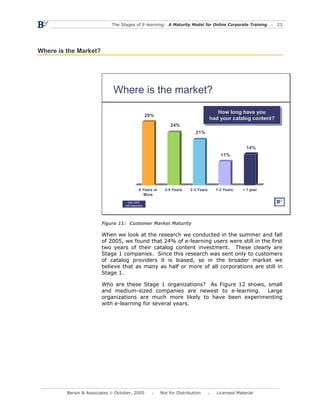
                        Figure 11: Customer Market Maturity

                        When we look at the research we conducted in the summer and fall
                        of 2005, we found that 24% of e-learning users were still in the first
                        two years of their catalog content investment. These clearly are
                        Stage 1 companies. Since this research was sent only to customers
                        of catalog providers it is biased, so in the broader market we
                        believe that as many as half or more of all corporations are still in
                        Stage 1.

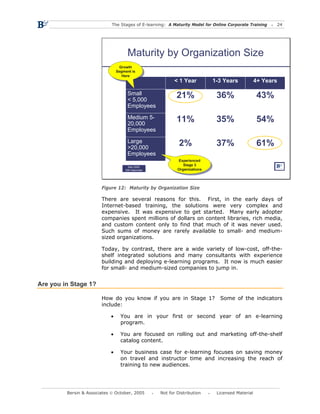
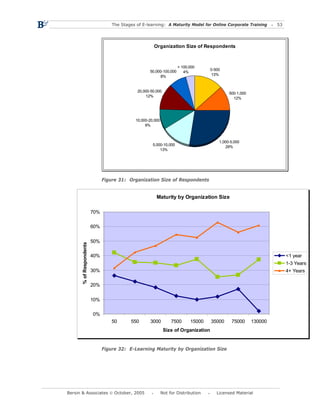
                        Who are these Stage 1 organizations? As Figure 12 shows, small
                        and medium-sized companies are newest to e-learning. Large
                        organizations are much more likely to have been experimenting
                        with e-learning for several years.


         Bersin & Associates © October, 2005              Not for Distribution        Licensed Material
The Stages of E-learning: A Maturity Model for Online Corporate Training     24


                                      Maturity by Organization Size
                                  Growth
                                   Growth
                                Segment is
                                 Segment is
                                   Here
                                    Here
                                                           < 1 Year           1-3 Years            4+ Years

                                      Small                  21%               36%                  43%
                                      < 5,000
                                      Employees
                                      Medium 5-              11%               35%                  54%
                                      20,000
                                      Employees
                                      Large                   2%               37%                  61%
                                      >20,000
                                      Employees
                                                             Experienced
                                                              Experienced
                                       May 2005,
                                                                Stage 33
                                                                 Stage
                                     526 responses           Organizations
                                                              Organizations


                        Figure 12: Maturity by Organization Size

                        There are several reasons for this. First, in the early days of
                        Internet-based training, the solutions were very complex and
                        expensive. It was expensive to get started. Many early adopter
                        companies spent millions of dollars on content libraries, rich media,
                        and custom content only to find that much of it was never used.
                        Such sums of money are rarely available to small- and medium-
                        sized organizations.

                        Today, by contrast, there are a wide variety of low-cost, off-the-
                        shelf integrated solutions and many consultants with experience
                        building and deploying e-learning programs. It now is much easier
                        for small- and medium-sized companies to jump in.


Are you in Stage 1?

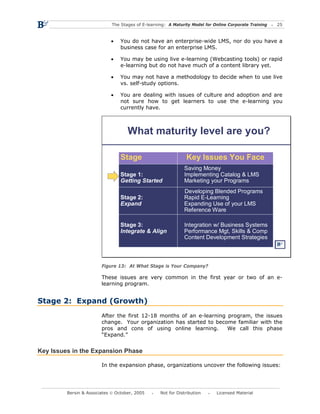
                        How do you know if you are in Stage 1?                  Some of the indicators
                        include:

                            •     You are in your first or second year of an e-learning
                                  program.

                            •     You are focused on rolling out and marketing off-the-shelf
                                  catalog content.

                            •     Your business case for e-learning focuses on saving money
                                  on travel and instructor time and increasing the reach of
                                  training to new audiences.


         Bersin & Associates © October, 2005         Not for Distribution      Licensed Material
The Stages of E-learning: A Maturity Model for Online Corporate Training   25


                            •    You do not have an enterprise-wide LMS, nor do you have a
                                 business case for an enterprise LMS.

                            •    You may be using live e-learning (Webcasting tools) or rapid
                                 e-learning but do not have much of a content library yet.

                            •    You may not have a methodology to decide when to use live
                                 vs. self-study options.

                            •    You are dealing with issues of culture and adoption and are
                                 not sure how to get learners to use the e-learning you
                                 currently have.


                                    What maturity level are you?

                                 Stage                         Key Issues You Face
                                                              Saving Money
                                 Stage 1:                     Implementing Catalog & LMS
                                 Getting Started              Marketing your Programs
                                                              Developing Blended Programs
                                 Stage 2:                     Rapid E-Learning
                                 Expand                       Expanding Use of your LMS
                                                              Reference Ware

                                 Stage 3:                     Integration w/ Business Systems
                                 Integrate & Align            Performance Mgt, Skills & Comp
                                                              Content Development Strategies


                        Figure 13: At What Stage is Your Company?

                        These issues are very common in the first year or two of an e-
                        learning program.


Stage 2: Expand (Growth)
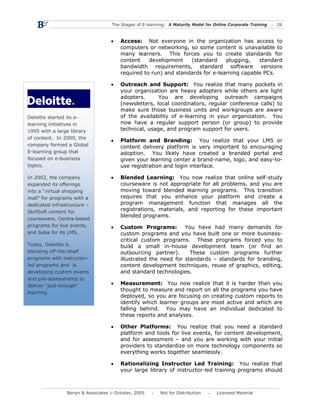
                        After the first 12-18 months of an e-learning program, the issues
                        change. Your organization has started to become familiar with the
                        pros and cons of using online learning.       We call this phase
                        “Expand.”


Key Issues in the Expansion Phase

                        In the expansion phase, organizations uncover the following issues:


         Bersin & Associates © October, 2005       Not for Distribution      Licensed Material
The Stages of E-learning: A Maturity Model for Online Corporate Training   26


                                   •    Access: Not everyone in the organization has access to
                                        computers or networking, so some content is unavailable to
                                        many learners. This forces you to create standards for
                                        content    development    (standard     plugging,   standard
                                        bandwidth requirements, standard software versions
                                        required to run) and standards for e-learning capable PCs.

                                   •    Outreach and Support: You realize that many pockets in
                                        your organization are heavy adopters while others are light
                                        adopters.      You are developing outreach campaigns
                                        (newsletters, local coordinators, regular conference calls) to
                                        make sure those business units and workgroups are aware
Deloitte started its e-                 of the availability of e-learning in your organization. You
learning initiatives in                 now have a regular support person (or group) to provide
1995 with a large library               technical, usage, and program support for users.
of content. In 2000, the
                                   •    Platform and Branding: You realize that your LMS or
company formed a Global                 content delivery platform is very important to encouraging
E-learning group that                   adoption. You likely have created a branded portal and
focused on e-business                   given your learning center a brand-name, logo, and easy-to-
topics.                                 use registration and login interface.

In 2002, the company               •    Blended Learning: You now realize that online self-study
expanded its offerings                  courseware is not appropriate for all problems, and you are
into a “virtual shopping                moving toward blended learning programs. This transition
mall” for programs with a               requires that you enhance your platform and create a
dedicated infrastructure –              program management function that manages all the
SkillSoft content for
                                        registrations, materials, and reporting for these important
                                        blended programs.
courseware, Centra-based
programs for live events,          •    Custom Programs: You have had many demands for
and Saba for its LMS.                   custom programs and you have built one or more business-
                                        critical custom programs. These programs forced you to
Today, Deloitte is                      build a small in-house development team (or find an
blending off-the-shelf                  outsourcing partner).      These custom programs further
programs with instructor-               illustrated the need for standards – standards for branding,
led programs and is                     content development techniques, reuse of graphics, editing,
developing custom exams                 and standard technologies.
and pre-assessments to
deliver “just-enough”              •    Measurement: You now realize that it is harder than you
                                        thought to measure and report on all the programs you have
learning.
                                        deployed, so you are focusing on creating custom reports to
                                        identify which learner groups are most active and which are
                                        falling behind. You may have an individual dedicated to
                                        these reports and analyses.

                                   •    Other Platforms: You realize that you need a standard
                                        platform and tools for live events, for content development,
                                        and for assessment – and you are working with your initial
                                        providers to standardize on more technology components so
                                        everything works together seamlessly.

                                   •    Rationalizing Instructor Led Training: You realize that
                                        your large library of instructor-led training programs should


                Bersin & Associates © October, 2005       Not for Distribution      Licensed Material
The Stages of E-learning: A Maturity Model for Online Corporate Training                                                27


                                  be rationalized. Some of these programs should stay as-is.
                                  Some should be converted completely to online programs.
                                  Some should be blended. This requires that you educate
                                  and familiarize all your content developers and trainers with
                                  the basics of online learning and transition some of them to
                                  new roles. You find that some move easily while others
                                  prefer to remain in the instructor-led world.


Stage 2 Organization Priorities

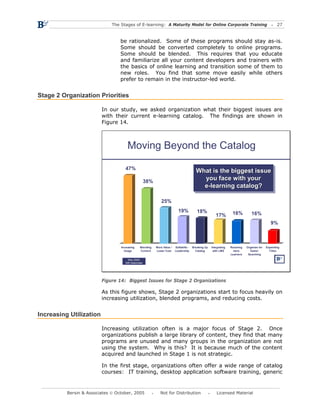
                         In our study, we asked organization what their biggest issues are
                         with their current e-learning catalog. The findings are shown in
                         Figure 14.


                                      Moving Beyond the Catalog

                                     47%
                                                                                           What is the biggest issue
                                                                                           What is the biggest issue
                                                     38%
                                                                                             you face with your
                                                                                              you face with your
                                                                                             e-learning catalog?
                                                                                             e-learning catalog?

                                                               25%
                                                                            19%             18%                       16%
                                                                                                          17%                      16%
                                                                                                                                                  9%


                                  Increasing    Blending   More Value /   Softskills -   Breaking Up   Integrating   Reaching   Organize for   Expanding
                                    Usage       Content    Lower Cost     Leadership       Catalog      with LMS       more       Easier         Titles
                                                                                                                     Learners    Searching
                                       May 2005,
                                     526 responses


                         Figure 14: Biggest Issues for Stage 2 Organizations

                         As this figure shows, Stage 2 organizations start to focus heavily on
                         increasing utilization, blended programs, and reducing costs.


Increasing Utilization

                         Increasing utilization often is a major focus of Stage 2. Once
                         organizations publish a large library of content, they find that many
                         programs are unused and many groups in the organization are not
                         using the system. Why is this? It is because much of the content
                         acquired and launched in Stage 1 is not strategic.

                         In the first stage, organizations often offer a wide range of catalog
                         courses: IT training, desktop application software training, generic


          Bersin & Associates © October, 2005                 Not for Distribution                         Licensed Material
The Stages of E-learning: A Maturity Model for Online Corporate Training   28


                       soft skills training, and compliance programs. These programs,
                       while important and high in value, are not necessarily strategic to
                       the current business issues in the company.


                         Wells Fargo’s initial start in e-learning started in 1997 with the release
                         of a large IT training catalog. Over the years, this catalog grew and, by
                         2000, Wells Fargo realized that the utilization of the course catalog was
                         very low. The company found that people were taking courses, but only
                         the portions they needed. For example, people would jump into a
                         course on Excel to learn how to create a pivot table – but they did not
                         complete the entire course.

                         Today, Wells Fargo’s IT training is a blend of instructor-led programs,
                         self-study, and live online events. The company focuses heavily on the
                         most strategic IT programs and is planning to switch about 2/3 of its
                         ILT programs to a live, online format. The company provides small
                         learning objects whenever possible to give users access to “just-
                         enough” learning and to meet performance support needs.

                         Wells Fargo ensures high utilization by making certain that all training
                         initiatives are closely aligned to IT business initiatives. The IT training
                         executive sits on the committee with strategic IT managers and is
                         intimately involved with the planning for every new system project or
                         rollout.


                       Figure 15: Wells Fargo IT Training Alignment Process

                       The most important transition that organizations make in Stage 2 is
                       from a large library to strategic offerings.       This is a natural
                       transition toward further aligning the e-learning strategy with timely
                       and specific business needs.


Reducing Costs

                       While the initial business case for e-learning usually is cost
                       reduction, after a few years companies realize that the capital
                       investments in technology and content can be high. In Stage 2,
                       they start to look for less expensive ways to increase the scale of
                       the e-learning initiative.

                       One approach they use is to outsource key training functions.


        Bersin & Associates © October, 2005       Not for Distribution      Licensed Material
The Stages of E-learning: A Maturity Model for Online Corporate Training                   29


                                   What do companies outsource?

                                         Fast
                                          Fast                                                  Fast
                                                                                                 Fast         68%
                                       Growing
                                        Growing                                               Growing
                                                                                               Growing
                                         Area
                                          Area                                                  Area
                                                                                                 Area

                                                                     45%
                                         39%           39%

                                                                                   23%           27%


                                         LMS           Virtual   Collaboration     Content      Content      Content
                                    Infrastructure   Classroom       Tools       Management   Development


                                   June 2004,
                                  320 responses


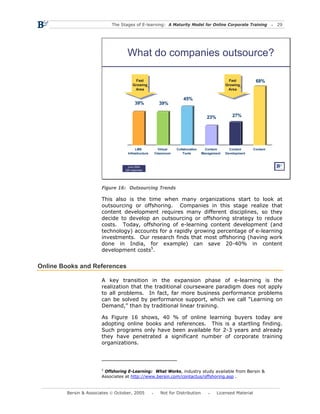
                       Figure 16: Outsourcing Trends

                       This also is the time when many organizations start to look at
                       outsourcing or offshoring. Companies in this stage realize that
                       content development requires many different disciplines, so they
                       decide to develop an outsourcing or offshoring strategy to reduce
                       costs. Today, offshoring of e-learning content development (and
                       technology) accounts for a rapidly growing percentage of e-learning
                       investments. Our research finds that most offshoring (having work
                       done in India, for example) can save 20-40% in content
                       development costs5.


Online Books and References

                       A key transition in the expansion phase of e-learning is the
                       realization that the traditional courseware paradigm does not apply
                       to all problems. In fact, far more business performance problems
                       can be solved by performance support, which we call “Learning on
                       Demand,” than by traditional linear training.

                       As Figure 16 shows, 40 % of online learning buyers today are
                       adopting online books and references. This is a startling finding.
                       Such programs only have been available for 2-3 years and already
                       they have penetrated a significant number of corporate training
                       organizations.


                       5
                         Offshoring E-Learning: What Works, industry study available from Bersin &
                       Associates at http://www.bersin.com/contactus/offshoring.asp .


        Bersin & Associates © October, 2005             Not for Distribution             Licensed Material
The Stages of E-learning: A Maturity Model for Online Corporate Training   30


                        What we find, as in the case of Wells Fargo and many other
                        companies, is that the advent of Google and an internal e-learning
                        system leads learners toward the behavior of looking for answers
                        online. “Answers” and “Training” require very different forms of
                        content. When a programmer, engineer, or manager wants an
                        answer to a question, they do not want to take a course, they want
                        to find a reference, read it, and go back to work. This learning on
                        demand model appeals to they way human beings use the Internet
                        and we are finding that the explosive growth of online books and
                        references supports this demand.

                        Most organizations that adopt online books and references at this
                        stage start with an IT library and then quickly evolve to business
                        skills and specialized areas.     Accounting firms purchase online
                        accounting references, law firms purchase online legal books and
                        references, etc.     Today, companies, like Books24x7 (part of
                        SkillSoft) and Safari Online, provide these solutions.


Are you in Stage 2?

                        How do you know that you are in Stage 2? Here, the indicators are:

                            •    You successfully have rolled out many off-the-shelf
                                 programs, you have a library online, and many learners have
                                 completed courses.

                            •    You have some type of learning management system (LMS)
                                 platform, although it may not be deployed enterprise wide.

                            •    Your organization has not completely adopted or embraced
                                 e-learning in a big way. Some, or many pockets, cannot yet
                                 get access, they hesitate or refuse to take courses, or they
                                 simply do not buy into this approach.

                            •    You have been asked repeatedly for custom content and you
                                 have started to build (or outsource) these programs.

                            •    You are past the initial honeymoon period of saving money
                                 and your e-learning program now is a fixed cost that must
                                 be managed. You are looking for ways to reduce the cost of
                                 content and content development.

                            •    You are starting to replace many ILT programs with blended
                                 programs or virtual classroom technology.         You are
                                 experimenting with blended approaches and working with
                                 instructors and trainers to make sure they are comfortable
                                 with these new approaches.

                            •    You have explored rapid e-learning and are using this
                                 approach for some percentage of your content development
                                 needs.


         Bersin & Associates © October, 2005       Not for Distribution      Licensed Material
The Stages of E-learning: A Maturity Model for Online Corporate Training   31


                         •    You have built or are starting to build a complete set of
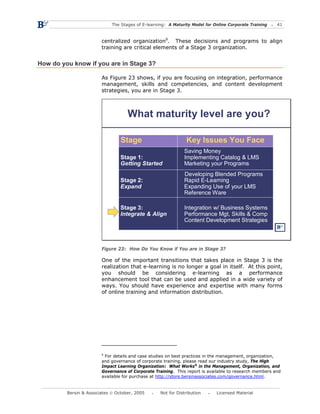
                              standards for content development, for LMS administration,
                              for user support, and for technology and tools.

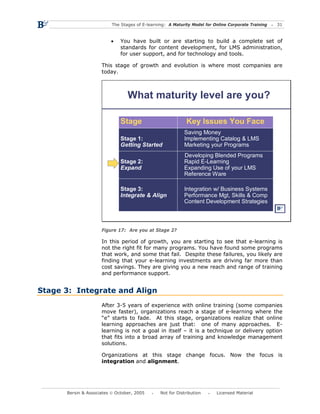
                     This stage of growth and evolution is where most companies are
                     today.


                                 What maturity level are you?

                              Stage                         Key Issues You Face
                                                           Saving Money
                              Stage 1:                     Implementing Catalog & LMS
                              Getting Started              Marketing your Programs
                                                           Developing Blended Programs
                              Stage 2:                     Rapid E-Learning
                              Expand                       Expanding Use of your LMS
                                                           Reference Ware

                              Stage 3:                     Integration w/ Business Systems
                              Integrate & Align            Performance Mgt, Skills & Comp
                                                           Content Development Strategies


                     Figure 17: Are you at Stage 2?

                     In this period of growth, you are starting to see that e-learning is
                     not the right fit for many programs. You have found some programs
                     that work, and some that fail. Despite these failures, you likely are
                     finding that your e-learning investments are driving far more than
                     cost savings. They are giving you a new reach and range of training
                     and performance support.


Stage 3: Integrate and Align
                     After 3-5 years of experience with online training (some companies
                     move faster), organizations reach a stage of e-learning where the
                     “e” starts to fade. At this stage, organizations realize that online
                     learning approaches are just that: one of many approaches. E-
                     learning is not a goal in itself – it is a technique or delivery option
                     that fits into a broad array of training and knowledge management
                     solutions.

                     Organizations at this stage change focus. Now the focus is
                     integration and alignment.


      Bersin & Associates © October, 2005       Not for Distribution      Licensed Material
The Stages of E-learning: A Maturity Model for Online Corporate Training   32


E-learning is No Longer a Standalone Solution

                        One of the important transitions that occurs as e-learning grows is
                        the realization that e-learning programs do not stand alone. They fit
                        into a broad array of communication and knowledge management
                        tools used throughout the organization.

                        For example:

                            •    Sales uses PowerPoint-driven rapid e-learning for product
                                 updates.

                            •    Executives use        online     audio    recordings     for    company
                                 announcements.

                            •    Workgroups use Webcasting technology for collaboration,
                                 meetings, and informal training.

                            •    Product business units set up FAQ databases, help files, and
                                 small online courses in order to help customers.

                            •    Call centers want to integrate courseware “learning how”
                                 with performance support “how do I do…” databases.

                            •    Compliance officers need to track progress, completion, and
                                 expiration of critical compliance programs, some of which
                                 are very simple and some are mastery-oriented.

                            •    The training organization has a wide range of master
                                 programs for managers, executives, and professionals that
                                 use collaboration, discussion databases, and online
                                 assignments.

                            •    The VP of HR insists that the online learning and training
                                 catalog must meet the company’s broader talent
                                 management and skills gap demands.

                        These examples illustrate how e-learning has moved beyond the
                        training department. It is no longer a tool to help reduce the cost
                        or increase the reach of training. It now is a business performance
                        improvement tool that must fit into a wide variety of applications.

                        This transition causes the training and HR organizations to focus on
                        integration and alignment.


         Bersin & Associates © October, 2005       Not for Distribution      Licensed Material
The Stages of E-learning: A Maturity Model for Online Corporate Training   33


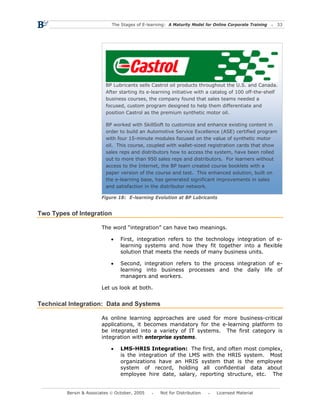
                          BP Lubricants sells Castrol oil products throughout the U.S. and Canada.
                          After starting its e-learning initiative with a catalog of 100 off-the-shelf
                          business courses, the company found that sales teams needed a
                          focused, custom program designed to help them differentiate and
                          position Castrol as the premium synthetic motor oil.

                          BP worked with SkillSoft to customize and enhance existing content in
                          order to build an Automotive Service Excellence (ASE) certified program
                          with four 15-minute modules focused on the value of synthetic motor
                          oil. This course, coupled with wallet-sized registration cards that show
                          sales reps and distributors how to access the system, have been rolled
                          out to more than 950 sales reps and distributors. For learners without
                          access to the Internet, the BP team created course booklets with a
                          paper version of the course and test. This enhanced solution, built on
                          the e-learning base, has generated significant improvements in sales
                          and satisfaction in the distributor network.

                        Figure 18: E-learning Evolution at BP Lubricants


Two Types of Integration

                        The word “integration” can have two meanings.

                            •    First, integration refers to the technology integration of e-
                                 learning systems and how they fit together into a flexible
                                 solution that meets the needs of many business units.

                            •    Second, integration refers to the process integration of e-
                                 learning into business processes and the daily life of
                                 managers and workers.

                        Let us look at both.


Technical Integration: Data and Systems

                        As online learning approaches are used for more business-critical
                        applications, it becomes mandatory for the e-learning platform to
                        be integrated into a variety of IT systems. The first category is
                        integration with enterprise systems.

                            •    LMS-HRIS Integration: The first, and often most complex,
                                 is the integration of the LMS with the HRIS system. Most
                                 organizations have an HRIS system that is the employee
                                 system of record, holding all confidential data about
                                 employee hire date, salary, reporting structure, etc. The


         Bersin & Associates © October, 2005       Not for Distribution      Licensed Material
The Stages of E-learning: A Maturity Model for Online Corporate Training       34


                        LMS, on the other hand, is the system of record for training
                        activity, competencies, certifications, and skills and
                        competencies6.

                        LMS-HRIS integration can take years to implement because
                        of the wide variety of data that must be synchronized. Most
                        organizations develop simple batch integration in Stage 2,
                        but, by Stage 3, organizations find that they need to
                        replicate the corporate hierarchy, skills and competencies,
                        and charge codes.        The data must be synchronized
                        automatically.

                   •    LMS-CRM or Sales System Integration: As organizations
                        deploy e-learning to customers and partners, they realize
                        that the learning history of customers and partners is just as
                        important, or sometimes more important, than the learning
                        history of employees. The customer system of record is not
                        the HRIS, but rather the Customer Relationship Management
                        (CRM) system. The CRM system usually is governed by
                        sales and marketing.

                   •    LMS-Financial Systems Integration:          In both of the
                        above cases, when training is sold to customers or recharged
                        to departments, integration is required to the company’s
                        financial systems.

               The second category of data and systems integration revolves
               around integration with content platforms. Here, the types of
               integration include:

                   •    Integration with Help Systems: Earthlink’s call center,
                        for example, uses a system from Kana to handle all help
                        files. These help files are simple questions and answers,
                        such as, “How do I change a password in system A?” The
                        company’s e-learning programs are used to teach new call
                        center agents basic skills and procedures. How do the two
                        systems stay in sync? The content must be integrated in
                        some way.

                   •    Integration with Performance Support Systems:
                        Aetna’s call centers use a wide range of performance support
                        tools to assist global call centers. These tools provide help
                        files as well as simulation-based training for agents who
                        have time to brush up on new materials. Some content is
                        training-centric, other content is reference materials.
                        Together, the platform provides a complete support solution
                        for call centers.


               6
                 In our report, The Convergence between Learning and Performance Management,
               we explain the reasons for holding skills and competencies in the LMS vs. the HRIS.
               Many organizations attempt to build skills and competency databases in the HRIS,
               but usually this information is far more useful and easier to maintain in a global LMS
               that is integrated with a performance management system. This report is available
               at http://www.bersin.com/convergence.


Bersin & Associates © October, 2005        Not for Distribution       Licensed Material
The Stages of E-learning: A Maturity Model for Online Corporate Training                         35


                            •    Integration with Customer Support Systems: Microsoft,
                                 Oracle, Gateway, EMC, and other product suppliers offer
                                 technical support databases online to customers. They also
                                 offer short e-learning courses to help customers solve
                                 problems. These two systems must be integrated in some
                                 way so a customer can find just what they need.

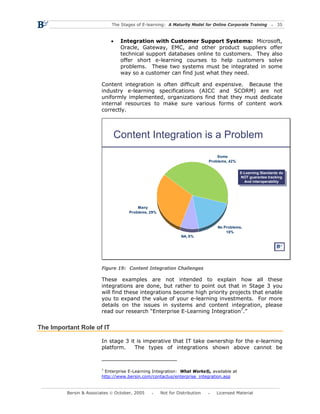
                        Content integration is often difficult and expensive. Because the
                        industry e-learning specifications (AICC and SCORM) are not
                        uniformly implemented, organizations find that they must dedicate
                        internal resources to make sure various forms of content work
                        correctly.


                             Content Integration is a Problem
                                                                                               Some
                                                                                           Problems, 42%


                                                                                                           E-Learning Standards do
                                                                                                            E-Learning Standards do
                                                                                                           NOT guarantee tracking
                                                                                                            NOT guarantee tracking
                                                                                                             And interoperability
                                                                                                              And interoperability


                                         Many
                                     Problems, 29%


                                                                                               No Problems,
                                                                                                   18%
                                                                                  NA, 8%


                                   Study conducted in May 2004, 10,000+ Surveys


                        Figure 19: Content Integration Challenges

                        These examples are not intended to explain how all these
                        integrations are done, but rather to point out that in Stage 3 you
                        will find these integrations become high priority projects that enable
                        you to expand the value of your e-learning investments. For more
                        details on the issues in systems and content integration, please
                        read our research “Enterprise E-Learning Integration7.”


The Important Role of IT

                        In stage 3 it is imperative that IT take ownership for the e-learning
                        platform.    The types of integrations shown above cannot be


                        7
                         Enterprise E-Learning Integration: What Works®, available at
                        http://www.bersin.com/contactus/enterprise_integration.asp


         Bersin & Associates © October, 2005                        Not for Distribution      Licensed Material
The Stages of E-learning: A Maturity Model for Online Corporate Training   36


                        implemented without the corporate or business unit IT department’s
                        involvement and ownership.


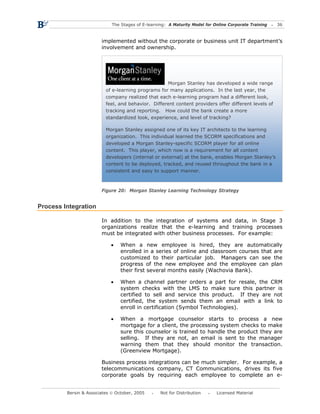
                                                    Morgan Stanley has developed a wide range
                          of e-learning programs for many applications. In the last year, the
                          company realized that each e-learning program had a different look,
                          feel, and behavior. Different content providers offer different levels of
                          tracking and reporting. How could the bank create a more
                          standardized look, experience, and level of tracking?

                          Morgan Stanley assigned one of its key IT architects to the learning
                          organization. This individual learned the SCORM specifications and
                          developed a Morgan Stanley-specific SCORM player for all online
                          content. This player, which now is a requirement for all content
                          developers (internal or external) at the bank, enables Morgan Stanley’s
                          content to be deployed, tracked, and reused throughout the bank in a
                          consistent and easy to support manner.


                        Figure 20: Morgan Stanley Learning Technology Strategy


Process Integration

                        In addition to the integration of systems and data, in Stage 3
                        organizations realize that the e-learning and training processes
                        must be integrated with other business processes. For example:

                            •    When a new employee is hired, they are automatically
                                 enrolled in a series of online and classroom courses that are
                                 customized to their particular job. Managers can see the
                                 progress of the new employee and the employee can plan
                                 their first several months easily (Wachovia Bank).

                            •    When a channel partner orders a part for resale, the CRM
                                 system checks with the LMS to make sure this partner is
                                 certified to sell and service this product. If they are not
                                 certified, the system sends them an email with a link to
                                 enroll in certification (Symbol Technologies).

                            •    When a mortgage counselor starts to process a new
                                 mortgage for a client, the processing system checks to make
                                 sure this counselor is trained to handle the product they are
                                 selling. If they are not, an email is sent to the manager
                                 warning them that they should monitor the transaction.
                                 (Greenview Mortgage).

                        Business process integrations can be much simpler. For example, a
                        telecommunications company, CT Communications, drives its five
                        corporate goals by requiring each employee to complete an e-


         Bersin & Associates © October, 2005       Not for Distribution      Licensed Material
The Stages of E-learning: A Maturity Model for Online Corporate Training                                                  37


                        learning course each year that corresponds to each corporate goal.
                        The goals are high level goals (customer service, quality, teamwork,
                        financial results, and accountability). For each goal, a series of
                        courses is available to meet the requirements for completion. The
                        employee decides which course to take and the manager receives a
                        report on completion.


Alignment: Driving Business Results

                        The second major effort in Stage 3 is what we call alignment:
                        making sure that all training programs align with specific corporate-
                        wide and business-unit urgent needs and priorities.


                                    Top Learning Priorities

                                     61%                                                            What are your Top
                                                                                                    What are your Top
                                                                                                    Priorities for your
                                                                                                     Priorities for your
                                                    47%                                            Learning Programs?
                                                                                                   Learning Programs?
                                                                   45%
                                                                                 37%
                                                                                            34%

                                                                                                          21%
                                                                                                                         20%

                                                                                                                                      7%          4%

                                    Alignment      Increasing     Increasing    Measuring   Reducing   Infrastructure     Faster     Revenue   Outsourcing
                                  with Business      Usage      Effectiveness    Impact      Costs      - Technology    Deployment
                                     Strategy

                                     May 2005,
                                   526 responses


                        Figure 21: Alignment - Top Learning Priorities

                        As Figure 21 shows, the biggest topic on the minds of training
                        managers and executives is alignment. Ultimately, an e-learning
                        strategy must be focused and aligned with the most pressing
                        business needs.

                        There are a variety of alignment programs and projects that
                        become important in Stage 3: alignment with lines of business,
                        alignment with HR, and alignment within training.


Alignment with Lines of Business

                        The first and most important customer of training is the line
                        business manager. Does your e-learning content and program
                        meet their most urgent needs? Typically, much of the off-the-shelf


         Bersin & Associates © October, 2005                    Not for Distribution                      Licensed Material
The Stages of E-learning: A Maturity Model for Online Corporate Training                                                                                                            38


               content companies provide is “nice to have.” Managers like to have
               it available, but it may not address current problems or projects.

               How can you make sure all your e-learning projects and strategies
               focus on today’s most pressing problems? The answer: by building
               trust and performance consulting processes that work directly with
               line organizations.   Let us look at how Wells Fargo uses a
               performance      consulting    process    to     stay     aligned.


              Wells Fargo uses a process for business unit alignment with the IT
              organization they call “causal chain analysis.” This process assumes that
              business successes result from organizational performance, which in turn
              results from individual performance, which in turn results from behaviors,
              knowledge, and skills.


              Wells Fargo uses this process for performance consulting by starting at the
              right (Business Results). The learning team determines where business
              results are failing and tracks back to individual performance – identifying
              behaviors, knowledge, and skills that need improvement.


                                         Designing Curriculum
                  Business                                                                                     Profit
                  Results
                                                                      Expenses                                                            Revenue


                                                                                                                                                              Increase
                                                                                                                                                              Sales
                                                                                                                                                              Revenue


                                                             h
                                                        w i t re
                                         Reduced                      Reduced             Reduced           Reduced                           Higher usage
                 Organization
                                                    rs,
                                         service                      sales               Team              customer                          of products


                                                 ato d befo
                 Performance             expenses                     expenses            Member            attrition

                                                c
                                            ndi
                                                                                          Turnover          (Closed accts)                                               Increase new
                 Indicators
                                                    ie
                                                                                                                                              Increase                   customers


                                        ss I entif d.
                                                                                                                                              customer’s #


                                  sine are id elope
                                         Reduced error                Manage                                                                  of products
                                         related service              risk                      Reduced attrition                                                        Increases

                               B u s,
                                         requests                                                                                                                        referrals


                           ey       t         de  v                                                                                           Increase


                       1. K remen um is
                                                                                                                                              cross-selling


                                      l                                                                                         2.
                         asu urricu                                                                                           Bu Beh
                                                                                                                                                                Increase


                      me
                                                                                                                                                                Customer

                             c                                                                                                  sin avi                         Loyalty

                                                                                                                                   ess ors
                                                                                                                       Engaged Team
                                                                                                                                      Ind tha             Customer                   Increase usage of

                                                                                                                                         ica t ef
                                                        War on Losses              100% of                             Members                            Centric Service            Company Visions
                  Individual
                                                                                                                                            tor fec
                                                        (Audits/ Quality           Business (Sales                     (Emp.Surveys)                      - W OW Service             & Values
                  /Team                                 Control Reports)

                                                                                                                                               sa tt
                                                                                   Scorecard)
                  Performance
                                                                                                                                                 re     h
                  Indicators
                                                                                                                                                    id e e Ke
                                                       ned ills                                                                                         nti y
                                                   esig   k      .                                                                                         fi e
                                               is d and s aviors                                                                                               d.
                                           um
                                       Perform job to            Quick                 Offer the right         Managing                Behaviors around           Provide              Provide clear

                                                   e      h
                                       icul wledg ed be
                                       procedures                recovery              products to the         resources               managing people            WOW                  definition of


                                   urr
                                                                                       right customers         & diversity             Coaching                   service              WOW service
                  Behaviors
                                                    ir
                                                                                                                                       Modeling                                        and V&V
                                            o
                              3. C on kn e des
                                                                                                                                       Developing


                                e d       t th
                             bas to ge
                               ed
                            eed
                                       Process &               Product           Ability to          System            Selecting       Development skills                Customer
                  Skillls &
                  Knowledgen
                                       procedure               knowledge         discover            proficiency       and Hiring      Motivating skills                 service
                                       knowledge                                 customer                              Skills          Coaching Skills                   skills
                                                                                 needs (Sales                                          Situational Leadership?
                                                                                 Skills)


Bersin & Associates © October, 2005                                   Not for Distribution                                                Licensed Material
The Stages of E-learning: A Maturity Model for Online Corporate Training   39


                       Figure 22: Wells Fargo Causal Chain Analysis

                       This performance consulting model is well respected at Wells Fargo.
                       The Wells Fargo training organization has developed so much
                       respect within IT that the IT group invites training personnel into all
                       strategic planning meetings so that training plans are incorporated
                       into every major IT project.

                       In Stage 3 of e-learning, such processes are mandatory. E-learning
                       is no longer a project but now is a tool that should be aligned with
                       critical business demands.


Alignment with HR

                       The second area of alignment in Stage 3 is alignment with HR
                       processes. In most organizations the training group reports to HR
                       but has independent budgets and often a decentralized
                       organization. HR, by contrast, is usually a centralized corporate
                       function that strives to develop and support standardized employee-
                       related processes throughout the company. HR alignment falls into
                       three areas:

                       HR Programs: Once e-learning is well adopted, HR managers will
                       start to request (or demand) that e-learning be used as a tool for
                       corporate compliance, management training, new hire training, and
                       other HR-related programs. These programs typically integrate
                       directly into the daily lives of first line managers and employees.

                       Talent Management: In many companies, HR now is focused on
                       talent management,8 which refers to the use of skills and
                       competency management, assessment, and training to identify
                       critical skills gaps and high achievers, to create succession plans,
                       identify critical skills needed, and enable workforce redeployment to
                       meet urgent needs.

                       Talent management initiatives require the development of a skills
                       and competency database, and targeted learning programs that
                       meet the needs of critical organizational skills. These programs are
                       driven by HR. In Stage 3, training organizations typically work with
                       HR to develop a standard skills library, build or buy courses that
                       support these skills, and implement this library in the LMS.

                       Performance Management8:        A major new initiative in many
                       companies is the automation of performance management
                       (developing   performance   plans,   delivering and   capturing
                       performance reviews, 360 feedback, and assessment). Many of the
                       steps in performance management involve training (creation of a


                       8
                        For a more detailed discussion of Talent Management and Performance
                       Management please read, The Convergence between Learning and Performance
                       Management: What Works, available at http://www.bersin.com/convergence.


        Bersin & Associates © October, 2005       Not for Distribution      Licensed Material
The Stages of E-learning: A Maturity Model for Online Corporate Training   40


                        development plan) and the skills and competency database. In
                        Stage 3, training organizations often need to integrate or enhance
                        the LMS to integrate with the company’s performance management
                        solution.  When implemented, the solution also drives training
                        requirements. This creates a “build-list” for training managers,
                        which aligns their programs with HR and line manager needs.


Alignment within Training: Governance

                        The third form of alignment, which becomes critically important in
                        Stage 3, is alignment across the training organization itself. In
                        large organizations, training often is spread out between a central
                        group and many departmental or divisional organizations. As the e-
                        learning investments grow, there are a variety of new issues that
                        the organization must deal with:

                            •    How will you standardize on content development so that
                                 different groups can build their own content yet share tools,
                                 best practices, graphics, and training content?

                            •    How will you standardize the administration of programs in
                                 the LMS across geographically diverse groups?        What
                                 functions should be centralized vs. distributed?

                            •    How will you standardize assessments and measurement?
                                 Will you have a standardized Level 1 (feedback survey)
                                 across all programs? Will you have standardized Level 2
                                 (scores or competency assessments) assessment policies?
                                 What operational metrics will you measure? How will you
                                 benchmark your e-learning and training from year to year?

                            •    How will you manage content across the training
                                 organization?     Will you have a centralized, version-
                                 controlled, content management system? Will there be a
                                 global library administered in one place?

                            •    How will you standardize content integration and content
                                 conversion? If a business unit wants to purchase or build a
                                 piece of content, how will you make sure that it launches,
                                 tracks, and runs correctly in your LMS?

                            •    How will you handle budgets and recharge? If a business
                                 unit wants to buy a non-standard program, will you let
                                 them? How will you support them?

                        At this stage, organizations focus on building shared service teams,
                        standards, and technical groups that centralize content integration,
                        testing, and measurement. Often in Stage 3, a CLO role is needed
                        to pull these functions together into a highly accountable,


         Bersin & Associates © October, 2005       Not for Distribution      Licensed Material
The Stages of E-learning: A Maturity Model for Online Corporate Training   41


                        centralized organization9. These decisions and programs to align
                        training are critical elements of a Stage 3 organization.


How do you know if you are in Stage 3?

                        As Figure 23 shows, if you are focusing on integration, performance
                        management, skills and competencies, and content development
                        strategies, you are in Stage 3.


                                    What maturity level are you?

                                 Stage                         Key Issues You Face
                                                              Saving Money
                                 Stage 1:                     Implementing Catalog & LMS
                                 Getting Started              Marketing your Programs
                                                              Developing Blended Programs
                                 Stage 2:                     Rapid E-Learning
                                 Expand                       Expanding Use of your LMS
                                                              Reference Ware

                                 Stage 3:                     Integration w/ Business Systems
                                 Integrate & Align            Performance Mgt, Skills & Comp
                                                              Content Development Strategies


                        Figure 23: How Do You Know if You are in Stage 3?

                        One of the important transitions that takes place in Stage 3 is the
                        realization that e-learning is no longer a goal in itself. At this point,
                        you should be considering e-learning as a performance
                        enhancement tool that can be used and applied in a wide variety of
                        ways. You should have experience and expertise with many forms
                        of online training and information distribution.


                        9
                          For details and case studies on best practices in the management, organization,
                        and governance of corporate training, please read our industry study, The High
                        Impact Learning Organization: What Works® in the Management, Organization, and
                        Governance of Corporate Training. This report is available to research members and
                        available for purchase at http://store.bersinassociates.com/governance.html.


         Bersin & Associates © October, 2005       Not for Distribution      Licensed Material
The Stages of E-learning: A Maturity Model for Online Corporate Training   42


                           Signs of Approaching Stage 3

                        Can you say the following?

                        “E-learning is no longer looked upon as a way to drive down
                           the cost of training: it is a business performance
                           improvement tool”

                        “E-learning is a tool for increasing reach, efficiency, and
                           impact – not an end in itself”

                        “We do not measure e-learning adoption any more. We
                          measure its effectiveness.”


               Figure 24: Signs of Approaching Stage 3


Bersin & Associates © October, 2005       Not for Distribution      Licensed Material
The Stages of E-learning: A Maturity Model for Online Corporate Training   43


               An excellent example of a Stage 3 organization is TELUS.


                                                 TELUS is a leading Canadian
                 telecommunications provider in western Canada, with revenues greater
                 than $7 billion. The company saw the opportunity to expand nationally and
                 into the growing markets for Internet, data, and wireless communications.
                 To execute on this change, TELUS realized that it needed its staff to
                 develop new skills and a more entrepreneurial culture.

                 The company took a comprehensive approach to training that started from
                 the CEO on down. TELUS developed a management model based on four
                 key company values and mission-critical competencies for all job roles.
                 TELUS now uses these competencies to evaluate all employees and as the
                 core of the company’s learning and development offerings. All employees
                 must create a development plan that maps their needs in these mission-
                 critical competencies against learning offerings (e-learning, online, or
                 classroom-based).

                 All learning offerings at TELUS are focused on competencies that are either
                 strategic or mission-critical. Strategic competencies allow the company
                 to flourish in new markets. Mission-critical competencies relate to
                 operational and service excellence in day-to-day operations.

                 To integrate learning into the management culture at TELUS, all managers
                 create a customized career development plan with employees as part
                 of the annual performance planning process. This development plan directs
                 the employee toward a blended learning program appropriate to their job
                 role. These involve classroom training, e-learning, or job shadowing.
                 TELUS is developing these learning paths for every job role in the
                 company. Off-the-shelf e-learning is blended within these learning paths.

                 The company measures course completions, assessment results, and
                 feedback surveys carefully to make sure these learning paths are driving
                 results and satisfaction. All learners must achieve an 85% passing rate on
                 assessments to get credit for these job-specific programs.


               Figure 25: Stage 3 Organization: TELUS


Bersin & Associates © October, 2005       Not for Distribution      Licensed Material
The Stages of E-learning: A Maturity Model for Online Corporate Training   44


Stage 4: Learning on Demand
                     What comes next? Is there a Stage 4 of e-learning? Well, we
                     believe that many new directions are taking place today, including:

                          •   Further adoption of blended learning, thereby making all
                              instructor-led programs blended in some way.

                          •   Rapid growth in live online events and higher adoption of
                              Webcast technology as a standard training tool.

                          •   Explosion in PowerPoint-driven rapid e-learning and the
                              growth of these tools into richer training solutions, including
                              collaborative and content management solutions.

                          •   Emergence of the Learning Content Management System
                              (LCMS) as a robust category of product that more and more
                              companies find they need.

                          •   Evolution of simulation tools that are easier to use, enabling
                              application simulations and business simulations to be
                              affordable for more organizations.

                          •   Continuous evolution of LMS and analytics systems to make
                              e-learning solutions more scalable, easy to deploy, easy to
                              measure, and easy to manage.

                     As pragmatic, research-based analysts, we try to avoid predicting
                     the future. But in this case, we would like to highlight a trend that
                     we think is likely to create the fourth stage. We call it Learning on
                     Demand.

                     Learning on Demand (LOD) implies that all the digital learning
                     assets (courses, references, help files, documents, and
                     presentations) are made available on demand – just as a worker
                     needs them. It is the blending of the course-driven approach to
                     training with online performance support. When companies reach
                     the point that they have hundreds of courses, references, FAQ
                     databases, videos, and other objects online, they realize that it is
                     time to make all this information easier to find and use.


Categorizing Content Types by Use
                     In our blended learning research, we found that the key to building
                     effective and cost-efficient blended programs was to clearly
                     understand the pros and cons of each different type of media. In
                     The Blended Learning Book,10 we identify 11 different types of


                     10
                       The Blended Learning Book, by Josh Bersin, available at
                     http://www.bersin.com/research/blended_book.asp.


      Bersin & Associates © October, 2005       Not for Distribution      Licensed Material
The Stages of E-learning: A Maturity Model for Online Corporate Training   45


                        media. We also identify seven criteria for selecting the right media,
                        which is based on instructional strategy, availability of skills,
                        technology, cost, and others.

                        When one considers how learning media is used in practice, it is
                        very useful to think about categorizing content types by use. In
                        corporate applications, we see two essential dimensions of content
                        use:


1. Nature of the Performance Problem

                        What type of problem is the learner facing? We believe there are
                        four types: question, problem, skills-gap, and competency-gap.

                        Let us use the example of a Web developer to illustrate:

                        Question: Do they have a simple question that must be answered
                        immediately? (e.g., “I forget how to code the ‘image’ tag in HTML,
                        can I find an example?”)

                        Problem:     Do they have a problem that warrants seeking a
                        solution? (e.g., “My Web page table has borders that are too fat. I
                        wonder how I can make them thinner.”)

                        Skills Gap: Do they truly need improved skills? (e.g., “I actually
                        have no idea how to use the DIV tag in HTML. Maybe I better just
                        learn the basics.”)

                        Competency Gap: Do they truly need improved competencies?
                        (e.g., “I guess I don’t really understand what HTML is and how it
                        works. I better take a class to get certified.”)


2. Time to Solution

                        The second dimension is time to solution. How much time does this
                        individual, or this project, or this problem have until it must be
                        solved? Seconds? Minutes? Hours? Days? Or months?

                        In the case of a Web developer working on a deadline, the time
                        frame is likely to be hours or less. In the case of a team of Web
                        developers developing a new internal application for loan
                        origination, there may be many months to train and assemble the
                        right team.


         Bersin & Associates © October, 2005       Not for Distribution      Licensed Material
The Stages of E-learning: A Maturity Model for Online Corporate Training                              46


                              Learning on Demand
                            Performance Problem
                                                                                                              Instructor Led
                                                                      Online Lab or                              Program
                              Competency                               Simulation
                              Gap                                                           Web Based
                                                                                            Courseware
                              Skills Gap
                                                                              Event Replay                                   on
                                                                                                                         sti
                                                                              Video/Audio                            Que
                                                                                                                  or
                              Problem                              Online                                      ic
                                                                                                            op
                                                                 References                              yT
                                                                                                  h   –b
                                                                  (books)                      rc
                                                                                            ea
                                                                                        e dS
                              Question              EPSS System                       ex
                                                                                 In d
                                                    FAQ Database

                                                    Seconds       Minutes           Hours                   Days           Weeks

                            © Bersin & Associates                    Time to Solution


                        Figure 26: Learning on Demand Content Map®

                        Using these two dimensions, we see that different types of content
                        fall naturally into a continuum.     Instructor-led training is not
                        appropriate for questions that must be answered in hours. Likewise,
                        online references are not appropriate for developing intimate new
                        skills and competencies.

                        In stage 4 training and IT organizations have assembled enough
                        digital content online that they can categorize it into these different
                        need categories and develop approaches to publishing and serving
                        this content to support the desire for learning on demand.

                        The big driver of this new paradigm is the availability of new search
                        and publishing technologies.     Examples include Search, Expert
                        Directories, and Really Simple Syndication (RSS), representing
                        publishing.


Search
                        Powerful search capabilities, which now are available in SkillSoft
                        Search-and-Learn™, NETg Search & Select™, and through many
                        other technologies, enable learners to search through libraries of
                        courseware, simulations, live replays, books, references, scheduled
                        events, discussion groups, and more. If implemented properly,
                        these searches will bring up a categorized list of learning offerings
                        categorized by relevance and by content type.


         Bersin & Associates © October, 2005           Not for Distribution          Licensed Material
The Stages of E-learning: A Maturity Model for Online Corporate Training   47


                      Figure 27: Learning on Demand – Search Interface


                      If an employee has five minutes, they can watch a short simulation.
                      If they need an immediate answer, they can browse a help file. If
                      they have 15 minutes, they can take a small course. This learning
                      on demand model meets the needs of most knowledge workers
                      today (sales people, service representatives, engineers, IT
                      professionals, managers, executives) and, if well integrated and
                      aligned, can replace the need for many formal training programs.

                      The key challenge in delivering this solution is the need for a
                      “federated search.” When an individual searches for a solution to a
                      problem they should see a list of results which includes all the
                      assets available in the organization, categorized by type.

                      Implementing such a federated search today is difficult.       LMS
                      systems cannot search across content libraries unless all content is
                      loaded into a Learning Content Management System. Stage 4
                      companies are starting to build these solutions internally, often
                      partnering with IT and knowledge management managers.


Expert Directories
                      One of the parts of learning on demand is finding the right person
                      to answer a question or help with a project. Organizations are
                      solving this problem with online expert directories.           These
                      directories, often sponsored by the HR organization, allow workers
                      to publish their capabilities, interests, availability, and preferred
                      mode of contact. As these designated experts are identified, they
                      can be published as resources within formal learning (courses) or
                      through a general portal.


       Bersin & Associates © October, 2005       Not for Distribution      Licensed Material
The Stages of E-learning: A Maturity Model for Online Corporate Training   48


               An excellent example of such a system is the IBM’s Blue Pages.
               The search capability lets learners or knowledge seekers set criteria
               for the person they seek.


               Figure 28: IBM Blue Pages Expert Directory Search

               The results show a hit list of potential fits and then can be mined to
               locate the details on a specific expert.


Bersin & Associates © October, 2005       Not for Distribution      Licensed Material
The Stages of E-learning: A Maturity Model for Online Corporate Training   49


                     Figure 29: IBM Blue Pages Expert Directory Search Result

                     Since every employee is an “expert” at something, this type of
                     system can be used in a narrow or very broad way. For a company
                     such as IBM Business Consulting, all employees are listed in the
                     expert directory and asked to keep their contact and expertise
                     information current. One could imagine a solution where the skills
                     and competencies in the expert directory are published directly
                     from the LMS as employees complete learning and development
                     assignments.


RSS: Personalization of Published Content
                     The third element of learning on demand is letting the content find
                     you.    Using a simple new technology called Really Simple
                     Syndication (RSS), originally developed to let users “subscribe” to
                     information which is pertinent to their needs.         Once a user
                     subscribes to a category of content, it automatically appears in their
                     “news reader” – which may be email, a mobile device, or a web-
                     page they visit.

                     The underlying technology for this approach is called RSS: Really
                     Simple Syndication. RSS is a very simple web-based technology


      Bersin & Associates © October, 2005       Not for Distribution      Licensed Material
The Stages of E-learning: A Maturity Model for Online Corporate Training   50


                     which is widely available to any IT department or web-savvy
                     developer. Using RSS technology learners can have new learning
                     offerings and events automatically fed to their personal computer.
                     Whenever a new article, finding, procedure, or learning offering is
                     available, individuals who want it or need it can see it immediately.

                     This also meets the needs of learners to get “just what they need”
                     to get their job done. One of the requirements for RSS is a content
                     repository that has access to learning, news, information, help, and
                     other assets. We see content management (LCMS systems) as one
                     of the key new technologies that organizations will adopt as they
                     implement learning on demand. (For more information on LCMS
                     systems and the LCMS marketplace, please review our most recent
                     research on the LCMS market at http://www.bersin.com.)


PodCasts: Personalization of Voice and Music
                     When you combine RSS technology and MP3 (music or voice) based
                     content, we have what are called podcasts.          A podcast is a
                     powerful learning tool for the distribution of information, celebrity
                     messages (ie. a message from the CEO), audio tutorials, and much
                     more to come. We are just beginning to understand how to apply
                     this easy-to-use technology to corporate training.


Approaching the Last Mile
                     In the telecommunications industry there is a concept of the last
                     mile – the wire that takes the communications network into your
                     home. In the application of learning technology, there is a similar
                     problem. How do you get the learner to the last mile and the
                     precise answer or learning they desire?

                     One approach has been the use of natural language processing:
                     give the user the ability to actually ask a question and let the
                     search engine find content that answers the question. Another
                     approach is meta-tagging, which is tagging and indexing content so
                     it can be referenced in many ways.

                     The bottom line is that this is an area where solutions are evolving.
                     We believe that today, search tools do a fairly good job of getting
                     you close enough and the human brain does an excellent job of
                     browsing through search results to find the final, needed learning
                     object. Over time, as search tools and XML tagging become more
                     mature, the last mile problem for information and skills will get
                     solved in new and better ways.


Here Today
                     Learning on demand can be implemented today. The technologies
                     required to implement these solutions exist. The key is to evolve to
                     this stage through the three stages shown above so that the


      Bersin & Associates © October, 2005       Not for Distribution      Licensed Material
The Stages of E-learning: A Maturity Model for Online Corporate Training   51


                    learning that is made available is relevant, integrated, and aligned
                    with an organization’s business problems and business strategy.


Conclusions: Using this Maturity Model
                    What is the value of this maturity model? This model has been
                    developed through hundreds of interviews with training managers
                    and executives. It is not just an idea – it is based on what really
                    happens in the evolution of e-learning. To gain best benefit from
                    this research you should map your current organization to the
                    model to identify areas you can improve or plan for the future.

                    How can you use this evolutionary model to help plan and enhance
                    the effectiveness and efficiency of your training investments?
                    Consider where in this evolution you are today. Are you stuck at
                    one point or do you see your organization naturally evolving to the
                    next stage? Can you predict the problems, or challenges, or new
                    investments you will need to make in order to move forward?

                    As these stages point out, at each level in the evolution,
                    organizations deal with different business, technical, and
                    organizational issues. Although we paint the picture of a steady
                    process from stage to stage, many organizations will jump rapidly
                    to Stage 2 or Stage 3 because of their experience and sophisticated
                    process for dealing with new technologies.

                    Each of these stages drives higher and higher overall business
                    value. We hope that by following this taxonomy and the research-
                    based results in this study, you can predict, plan, and move your
                    organization’s learning forward more easily.

                    As this research shows, e-learning has evolved from a technology
                    initiative into a truly integrated part of a corporations’ learning and
                    business processes. It creates a need for new approaches, new
                    organizational models, as well as new technologies. We hope that
                    this research helps you plan, budget, and implement a highly
                    effective e-learning strategy for your organization.


     Bersin & Associates © October, 2005       Not for Distribution      Licensed Material
The Stages of E-learning: A Maturity Model for Online Corporate Training                                52


Appendix A: Survey Demographics
                    Much of the data for this study was collected in the summer of 2005
                    in a broad industry survey. The demographics of this research are
                    shown below. There were 526 total respondents.


                                                                  Industry Breakdown

                                                                              Technology
                                                                          (Computers, Software)
                                                                                 12%
                                                 Manufacturing
                                                    12%                                           Education
                                                                                                    10%


                                                                                                       Government (Federal,
                                                                                                         including Military)
                                                Other                                                           8%
                                                14%


                            Pharmaceuticals                                                            Insurance
                                 1%                                                                       7%


                          Utilities                                                                Banking/Finance
                            2%                                                                           7%
                      Marketing / Advertising
                                                                                                         Professional Services
                         / Entertainment
                                                                                                              / Consultant
                               2%
                                                                                                                  6%
                                                 Government       Retail / Wholesale /                    Health care
                         Transportation                                                  Telecomm
                                                (State / Local)      Distribution                            5%
                              3%                                                             4%
                                                      3%                   4%


                    Figure 30: Industry Breakdown


     Bersin & Associates © October, 2005                Not for Distribution              Licensed Material
The Stages of E-learning: A Maturity Model for Online Corporate Training         53


                                                        Organization Size of Respondents


                                                                       > 100,000
                                                      50,000-100,000                   0-500
                                                                          4%
                                                            8%                          13%


                                               20,000-50,000
                                                                                                500-1,000
                                                    12%
                                                                                                  12%


                                               10,000-20,000
                                                    9%


                                                                                           1,000-5,000
                                                        5,000-10,000
                                                                                               29%
                                                            13%


                                Figure 31: Organization Size of Respondents


                                                          Maturity by Organization Size

                          70%

                          60%


                          50%
       % of Respondents


                          40%                                                                                             <1 year
                                                                                                                          1-3 Years
                          30%                                                                                             4+ Years

                          20%


                          10%

                          0%
                                    50      550       3000          7500     15000     35000     75000      130000
                                                                Size of Organization


                                Figure 32: E-Learning Maturity by Organization Size


Bersin & Associates © October, 2005                            Not for Distribution       Licensed Material
The Stages of E-learning: A Maturity Model for Online Corporate Training       54


Appendix B: Table of Figures
                     Figure 1: E-learning Market Growth by Delivery Method ................ 6

                     Figure 2: Market Growth Continues ................................................ 7

                     Figure 3: LMS Market Fragmentation............................................ 10

                     Figure 4: Drivers for Rapid E-learning .......................................... 12

                     Figure 5: The Four Categories of E-learning ................................. 14

                     Figure 6: Adoption of LMS, Online Books, Blended Learning......... 15

                     Figure 7: Blending of Catalog Content .......................................... 15

                     Figure 8: Need to Update Data from HR Systems ......................... 17

                     Figure 9: E-Learning Market Maturity Cycle.................................. 18

                     Figure 10: The Stages of E-learning ............................................. 20

                     Figure 11: Customer Market Maturity ........................................... 23

                     Figure 12: Maturity by Organization Size ..................................... 24

                     Figure 13: At What Stage is Your Company? ................................ 25

                     Figure 14: Biggest Issues for Stage 2 Organizations .................... 27

                     Figure 15: Wells Fargo IT Training Alignment Process ................. 28

                     Figure 16: Outsourcing Trends ..................................................... 29

                     Figure 17: Are you at Stage 2? ..................................................... 31

                     Figure 18: E-learning Evolution at BP Lubricants ......................... 33

                     Figure 19: Content Integration Challenges................................... 35

                     Figure 20: Morgan Stanley Learning Technology Strategy............ 36

                     Figure 21: Alignment - Top Learning Priorities ............................. 37

                     Figure 22: Wells Fargo Causal Chain Analysis .............................. 39

                     Figure 23: How Do You Know if You are in Stage 3?..................... 41

                     Figure 24: Signs of Approaching Stage 3 ...................................... 42

                     Figure 25: Stage 3 Organization: TELUS ....................................... 43

                     Figure 26: Learning on Demand Content Map® ............................ 46

                     Figure 27: Learning on Demand – Search Interface ..................... 47

                     Figure 28: IBM Blue Pages Expert Directory Search ..................... 48

                     Figure 29: IBM Blue Pages Expert Directory Search Result .......... 49


      Bersin & Associates © October, 2005        Not for Distribution       Licensed Material
The Stages of E-learning: A Maturity Model for Online Corporate Training    55


               Figure 30: Industry Breakdown.................................................... 52

               Figure 31: Organization Size of Respondents ............................... 53

               Figure 32: E-Learning Maturity by Organization Size.................... 53


Bersin & Associates © October, 2005       Not for Distribution      Licensed Material
The Stages of E-learning: A Maturity Model for Online Corporate Training   56


About Us
                    Bersin & Associates is the only research and consulting firm solely
                    focused on What Works® enterprise learning research. With more
                    than 20 years of experience in e-learning, training, and enterprise
                    technology, Bersin & Associates provides a wide range of services,
                    including market research, best practices, benchmarking, vendor
                    and     product   analysis,   corporate      workshops,   corporate
                    implementation plans, and sales and marketing programs. Some of
                    Bersin & Associates innovations include a complete methodology for
                    Learning Management Systems (LMS) selection and application
                    usage, an end-to-end architecture and solution for training
                    analytics,   and   one    of  the     industry’s  largest  research
                    studies       on      blended        learning       implementations.

                    Bersin & Associates offers the industry’s first enterprise learning
                    research subscription, “The Enterprise Learning Research Center”
                    (http://www.elearningresearch.com), which       offers   up-to-date
                    research, product selection guides, white papers, and access to
                    other experts online. This service enables corporate training
                    managers, vendors, and consultants to make faster, better
                    decisions about enterprise learning strategy, programs, and
                    technology.

                    Bersin & Associates can be reached at http://www.bersin.com
                    <http://www.bersin.com/> or at (510) 654-8500.


About This Research
                    Copyright © 2005 Bersin & Associates. All rights reserved. What
                    Works® and related names such as Rapid E-Learning: What Works®
                    are registered trademarks of Bersin & Associates. No materials
                    from this study can be duplicated, copied, republished, or re-used
                    without written permission from Bersin & Associates. The
                    information and forecasts contained in this report reflect the
                    research and studied opinions of Bersin & Associates analysts. This
                    study was sponsored by SkillSoft.


     Bersin & Associates © October, 2005       Not for Distribution      Licensed Material

Four Stages Of E Learning

  • 1.
    Industry Study The Four Stages of E-learning A maturity model for online corporate training. Josh Bersin October, 2005 © Bersin & Associates
  • 2.
    The Stages ofE-learning: A Maturity Model for Online Corporate Training 2 Table of Contents Introduction ......................................................................... 4 The E-learning Market .......................................................... 5 Defining E-learning ..................................................................... 5 Market Size and Growth .............................................................. 6 E-learning Market Segments ....................................................... 7 Content and Content Providers: Catalog vs. Custom ............. 8 Learning Management Systems and Infrastructure ................ 9 Content Development Tools and Systems........................... 10 Emergence of Rapid E-learning ......................................... 11 Important Role of Blended Learning .................................. 12 Online Books and References ........................................... 16 HR and other ERP Systems .............................................. 16 Market Maturity Curve........................................................ 18 Where Does Your Organization Fit? ........................................... 18 The Stages of E-Learning ................................................... 20 Stage 1: Getting Started ........................................................... 21 Business Drivers............................................................. 21 Implementation Focus: Catalog Content or Single Program .. 21 Biggest Challenges ......................................................... 22 Where is the Market? ...................................................... 23 Are you in Stage 1? ........................................................ 24 Stage 2: Expand (Growth) ........................................................ 25 Key Issues in the Expansion Phase .................................... 25 Stage 2 Organization Priorities.......................................... 27 Increasing Utilization....................................................... 27 Reducing Costs .............................................................. 28 Online Books and References ........................................... 29 Bersin & Associates © October, 2005 Not for Distribution Licensed Material
  • 3.
    The Stages ofE-learning: A Maturity Model for Online Corporate Training 3 Are you in Stage 2? ........................................................ 30 Stage 3: Integrate and Align .................................................... 31 E-learning is No Longer a Standalone Solution .................... 32 Two Types of Integration ................................................. 33 Technical Integration: Data and Systems .......................... 33 The Important Role of IT ................................................. 35 Process Integration ......................................................... 36 Alignment: Driving Business Results ................................. 37 Alignment with Lines of Business ...................................... 37 Alignment with HR .......................................................... 39 Alignment within Training: Governance............................. 40 How do you know if you are in Stage 3?............................. 41 Stage 4: Learning on Demand ........................................... 44 Categorizing Content Types by Use ........................................... 44 1. Nature of the Performance Problem .............................. 45 2. Time to Solution ........................................................ 45 Search ....................................................................................... 46 Expert Directories ..................................................................... 47 RSS: Personalization of Published Content ............................... 49 PodCasts: Personalization of Voice and Music .......................... 50 Approaching the Last Mile ......................................................... 50 Here Today ................................................................................ 50 Conclusions: Using this Maturity Model ............................. 51 Appendix A: Survey Demographics..................................... 52 Appendix B: Table of Figures.............................................. 54 About Us ............................................................................ 56 About This Research........................................................... 56 Bersin & Associates © October, 2005 Not for Distribution Licensed Material
  • 4.
    The Stages ofE-learning: A Maturity Model for Online Corporate Training 4 Introduction The market for Internet-enabled training and education has exploded in the last five years, reaching more than $12 billion in products and services today. This research report, based on the results of 526 interviews with North American training and HR managers, reviews the corporate e-learning market in detail. It identifies a maturity model for e-learning: the three stages that organizations go through. For each stage, the study gives the The term “e- reader guidelines for their implementations and where they are learning” refers to likely to be headed. It then describes the “fourth stage” – the the use of Internet coming new approaches which we believe are coming next. technologies for The objectives of this paper are to: delivery and management of • Describe the e-learning market, its size, and growth. training. • Describe the three stages of corporate e-learning maturity to Today, most help buyers identify where they are and where they are organizations going. understand the potential and have • Identify the key technology and usage trends that corporate training organizations should use in planning for new adopted e-learning investments. for a variety of initiatives and • Provide our perspectives on where the corporate e-learning programs. marketplace is going. The source of research for this paper was a broad-based survey for training managers in the spring of 2005, along with interviews with 12 different companies about training and e-learning strategies. Survey demographics are described in Appendix B. Bersin & Associates © October, 2005 Not for Distribution Licensed Material
  • 5.
    The Stages ofE-learning: A Maturity Model for Online Corporate Training 5 The E-learning Market Defining E-learning As use of the Internet has become widespread and well understood, the definition of e-learning has changed. In our research, we define e-learning as any form of corporate training that uses Internet- based technology for delivery, management, and measurement. Historically, corporate training managers always have looked for ways to reduce the cost and improve the scalability of training programs through technology. In the 1970s and 1980s, organizations used mainframe and interactive video approaches. In the 1980s and 1990s, PC-based CD-ROM content was the preferred approach. Since 1998 or so, however, Internet-based approaches clearly have become the dominant delivery method for creating fast, scalable, low cost training. Today, there are two broad categories of Internet-based programs: • Self-study: Web-based content that allows a learner to start and stop whenever they want, enabling the learner to learn “on-demand.” This usually is called asynchronous training because it is not synchronized with an instructor or another learner. • Live: Live Web-based programs use virtual classroom technology from vendors such as Centra, Interwise, WebEx, Microsoft, SkillSoft, NETg, and others to create an online experience which is instructor-led. These synchronous programs require a student to attend an online event and attempt to replicate and enhance a classroom experience. Within these two broad categories there are many types of content and delivery technologies. Self-study programs include Web-based courseware, online books and references, online documents, assessments, simulations, videos, collaboration systems, blogs, and more to come. Live programs typically include Webcasts (large broadcast events), online labs, mentoring sessions, and virtual classroom events. Live technology has evolved very quickly in the last 12-18 months and, today, an instructor can teach, look over a student’s shoulder, and turn control over to an instructor to test and coach a learner. Bersin & Associates © October, 2005 Not for Distribution Licensed Material
  • 6.
    The Stages ofE-learning: A Maturity Model for Online Corporate Training 6 Market Size and Growth The corporate e-learning market is growing rapidly. The following chart, which is taken from our Enterprise Learning Market Research1, shows the overall U.S. market penetration by delivery method. These average numbers do not show how the market is widely fragmented. In many industries and geographies, the penetration is very small, while in other industries, the penetration is much larger. High technology, telecommunications, and professional services firms, for example, are experienced adopters of online training. Utilities, insurance, and retail organizations have much lower adoption rates. Growth in Corporate E-Learning 25% growth 25% growth Mean 33.1% Mean 33.1% Corporate Training Delivery by Method in E-Learning in Std Dev: 26% Std Dev: 26% in E-Learning in Corporate Education 2004 2004 (By training hours) 8% 9% 11% 15% 12% 12% 24% 29% 12% 33% 13% 9% 8% 8% 80% 79% 77% 72% 68% 63% 60% 1999 2000 2001 2002 2003 2004 2005 est Bersin & Associates ILT Other - Books E-Learning Bersin & Associates Proprietary Research, Proprietary Research, 526 respondents, and ASTD Data 526 respondents, and ASTD Data Figure 1: E-learning Market Growth by Delivery Method As this report will point out, each organization goes through three stages of evolution to reach the “current nirvana” of e-learning, which in itself is a moving target. Clearly, however, this marketplace is growing very quickly (25% in 2004) and still undergoing much change. As Figure 2 shows, there is some slowing of growth in general but many segments still are growing significantly. As we explain in the next section of the report, there are some companies who actually have over-saturated their e-learning audiences and are pulling back. This is a small number of 1 Bersin & Associates’ Enterprise Learning Market Size and Forecast is available to research members at http://www.elearningresearch.com. Bersin & Associates © October, 2005 Not for Distribution Licensed Material
  • 7.
    The Stages ofE-learning: A Maturity Model for Online Corporate Training 7 organizations, however, and we will explain why this takes place and what this means for buyers. Although some e-learning programs do fail, it now is easy for organizations to adopt and deploy e-learning programs that have very high returns on investment. The saturation effect is part of the evolution and we Accenture is an will explain how to avoid ending up with too much e-learning and organization that not enough users. adopted online training early. The company has had extensive Growth Rate Continues experience in the use and development of Over the next year, do you think 47% Over the next year, do you think simulations and your % of training delivered your % of training delivered online IT training by e-learning will increase? bye- e-learning will increase? programs. 33% Today, Accenture has found that 18% despite the rapid growth and potential for online training, classrooms 2% are coming back. Increase Increase Stay the Same Decrease The company is Significantly Slightly Slightly starting to reinvest May 2005, in traditional 526 responses programs, blended with online Figure 2: Market Growth Continues activities, to drive IT mastery. We believe the e-learning market still is in its infancy: organizations are still identifying new approaches and new technologies and realizing that approaches that appeared to work a few years ago did not pan out as expected. E-learning Market Segments Within the market, there are three broadly defined elements to the market: content, technology, and services. Every corporate training organization has to deal with all three. Industry standards, such as SCORM and AICC,2 have attempted to separate the architecture of content (the learning materials themselves) from the platform (the delivery and management system.) However, these standards are not widely implemented in a uniform way so every corporate training organization must deal with the issues of content, technology, and services as three inter-related problems. 2 Sharable Content Object Reference Model and Aviation Industry CBT Committee Bersin & Associates © October, 2005 Not for Distribution Licensed Material
  • 8.
    The Stages ofE-learning: A Maturity Model for Online Corporate Training 8 Content and Content Providers: Catalog vs. Custom There are two forms of training content in the e-learning market: • Catalog, or off-the-shelf: These are programs and materials that are developed by third-party providers (SkillSoft, NETg, ElementK, Microsoft, Oracle, and hundreds of other companies). • Custom: Programs developed by a company for its internal own use. Custom programs are often developed internally and sometimes by third-party consultants. The catalog content providers defined and created the e-learning market. In the 1990s, companies like SkillSoft, SmartForce, NETg, and DigitalThink created exciting, innovative online content for IT and technical training that demonstrated and proved the value of online training. Today, the catalog content market has become very large (more than $1 billion in size) and forms the foundation of any corporate e-learning strategy. The biggest shifts that have taken place in the catalog market are: • The evolution of catalog content from purely IT and technical training to more soft skills, management training, and vertical and horizontal topics (e.g., Healthcare, manufacturing, compliance and safety, HR, accounting). As the big players have gotten bigger, there are now hundreds of small providers of specialized off-the-shelf content. • Emergence and explosive growth of online books and reference materials to supplement and complement online training. The biggest player in this fast-growing market today is Books24x7, a division of Skillsoft. • The ability for the largest catalog providers (e.g., SkillSoft and NETg) to provide an integrated solution that includes a content catalog along with an integrated platform. These platforms enable organizations to manage, launch, track, and report on catalog content and form the basis of a learning management system solution for many organizations. The largest players (Skillsoft, NETg, and ElementK) have very sophisticated platforms and embedded development tools. As the large players have grown and consolidated (SkillSoft is #1 with Thomson NETg #2), hundreds of smaller companies have entered the market with high quality, specialized content that focuses on specific company needs. The growth in the e-learning market has enabled a huge cottage industry of content providers to grow, giving corporate buyers many options to buy instead of build high quality online programs. Bersin & Associates © October, 2005 Not for Distribution Licensed Material
  • 9.
    The Stages ofE-learning: A Maturity Model for Online Corporate Training 9 Learning Management Systems and Infrastructure Unfortunately for corporate training organizations, there is a lot of underlying technology required to manage online learning programs. The Learning Management Systems (LMS) market, which is more than $450m in size today, continues to grow and evolve and, as we describe in this report, becomes a critical part of “stage 2” implementations. Other infrastructure, which has become important in the e-learning market, includes development tools (there are dozens and dozens), content management systems (LCMS), measurement systems, assessment tools, simulation tools, and general Web server technologies. We segment the LMS market into four categories: • Global Enterprise: Software systems designed for global enterprises, with domain management, multi-language support, distributed administration, and the scalability to handle tens of thousands of learners. • Enterprise: Software systems designed for tens of thousands of users but typically run in a single language with limited distributed administration. • Mid-market: Systems, designed for small- and medium- sized organizations, that are easy to install, easy to use, and low cost to implement. These systems often are hosted externally and include integrated development tools to help organizations build and publish content. • Specialized Solutions: Many content providers and consulting firms have full function LMS systems. Systems such as SkillSoft’s SkillPort, NETg KnowledgeNow, and other content provider systems are included here. Bersin & Associates © October, 2005 Not for Distribution Licensed Material
  • 10.
    The Stages ofE-learning: A Maturity Model for Online Corporate Training 10 The Fragmented LMS Market 3% LMS Market Share 6% 1% by Revenue 21% 3% 2% Total Market 3% 2% 3% 2% 9% 17% 4% 7% 1% 12% 5% © Bersin & Associates, 2004 from LMS2004: Facts, Practical Analysis, and Trends http://store.bersinassociates.com/lms-2004.html Figure 3: LMS Market Fragmentation Since e-learning essentially is a specialized application of general Internet technologies (HTML, HTTP, Flash, databases, etc.), as organizations evolve into e-learning they find that the e-learning systems require as much or more care and feeding as other corporate applications. In fact, the third stage we describe, Stage 3, focuses heavily on the integration of e-learning programs into enterprise applications infrastructure. For more details on the LMS market, please review our LMS research, available at http://store.bersinassociates.com. Content Development Tools and Systems One of the evolutions that companies go through is the transition from buy to build. Organizations new to e-learning often start with an off-the-shelf catalog. Quickly they realize, however, that there are many demands that cannot be met by a packaged solution so, in Stage 2, they start developing their own content. Our research finds that more than 30% of corporate training organizations now build some of their own content. How do they do this? They rely on a wide variety of tools and content development systems. This segment of the e-learning market, the tools segment, is more than $280 million in size and growing at 15% per year. Tools available fall into several major categories: Bersin & Associates © October, 2005 Not for Distribution Licensed Material
  • 11.
    The Stages ofE-learning: A Maturity Model for Online Corporate Training 11 • Rapid e-learning tools (discussed in the next section) • Traditional courseware development tools • General purpose Web development tools • Software application simulation tools • General purpose business simulation tools • Microsoft Office tools • Professional Web developer tools There are more than 100 such tools on the market, with the largest market share going to companies like Articulate, Macromedia, Microsoft, OutStart, Trivantis, and SumTotal. A significant part of the development tools market is the use of live Webcasting tools, such as Centra, Interwise, Microsoft Live Meeting, and WebEx. Although most companies have access to such live systems already, their use as a regular part of training is still growing very rapidly – typically incorporated into blended programs (discussed below). Emergence of Rapid E-learning Over the last 18-24 months, one of the biggest changes in this market is the emergence of a segment we call rapid e-learning. We coined this term in 2003 and now it is widely used by a variety of tools and solution providers. Rapid e-learning is a revolutionary step in corporate training and communications: it empowers subject matter experts (trainers, product managers, sales managers, executives, engineers, etc.) to build their own instructional content easily and publish it online. It is both an easy way to get started as well as a step in the evolutionary process. For more details on this segment, please read, Rapid E-Learning: What Works™3, our detailed research report on this marketplace. 3 Rapid E-Learning: What Works™ is available to research members or for purchase at http://store.bersinassociates.com/relstudy-2005.html . Bersin & Associates © October, 2005 Not for Distribution Licensed Material
  • 12.
    The Stages ofE-learning: A Maturity Model for Online Corporate Training 12 Rapid e-learning Drivers for Rapid E-Learning tools serve two purposes. First, they enable “What is the biggest challenge you face in advanced training organizations to content development?” segment their programs and empower SMEs to #1 Problem: #1 Problem: build informational It takes too long to build courses. It takes too long to build courses. content easily. #2 Problem: #2 Problem: Second, they enable It is too hard to work with SME’s. It is too hard to work with SME’s. organizations, which are new to online training, to quickly and easily develop content and learn how e-learning can impact their Figure 4: Drivers for Rapid E-learning organization at low cost and low risk. Rapid e-learning practices enable subject matter experts to take their own material (usually in PowerPoint) and create online courseware easily. These tools have two components: first, some type of desktop software that converts PowerPoint slides or templates into Flash (a ubiquitous Web technology); second, a server component (a mini-LMS that enables these programs to be stored, launched, tracked, and reported). The explosion of rapid e-learning tools and approaches has helped many organizations adopt e-learning quickly and easily, expanding the market. As we describe in the following section of this report, rapid e-learning has expanded the number of Stage 1 organizations and is an indicator of a Stage 2 organization. We estimate that this new approach is growing at 30% or more per year, with new tools and solutions being launched every quarter. Important Role of Blended Learning As the number of tools and options for e-learning expands, companies now realize that online learning is not for everything and everyone. Just as e-commerce did not replace the need for bricks and mortar retail stores, e-learning does not replace the need for instructor-led training, coaching, expert support, labs, and collaborative experiences. The term blended learning has been widely adopted – indicating the desire to blend online learning with classroom, coaching, labs, and Bersin & Associates © October, 2005 Not for Distribution Licensed Material
  • 13.
    The Stages ofE-learning: A Maturity Model for Online Corporate Training 13 other real world experiences. Our research has found that blended learning now is a mainstream approach for all Stage 2 companies. Wells Fargo has After experimenting with rapid e-learning and other forms of Web- been using based content, companies typically find that all instructor-led technology-based training can be complemented and extended with online materials. training for IT employees since The most frequent use of blended learning is for: 1997. Today, the • Management and Leadership Training company has more than 2,000 titles • New Hire Training available. • Soft skills (team-building, management, coaching) For high potential IT employees, the • “Mastery” programs company has a What is a mastery program? In all training organizations, there is Masters program training needs that range in instructional demands. that blends online prerequisites with To help organizations understand when to use blended approaches classroom training, and other media types, we have developed a taxonomy called “The projects, mentoring, Four Categories of E-Learning.” They are described in Figure 5 and advanced below and further in “The Blended Learning Book”.4 assessments. Advanced instructors are flown in from all over the world. 4 For a detailed discussion of the four types of training, please see, The Blended Learning Book, by Josh Bersin, available at http://www.bersin.com/research/blended_book.asp. Bersin & Associates © October, 2005 Not for Distribution Licensed Material
  • 14.
    The Stages ofE-learning: A Maturity Model for Online Corporate Training 14 Four Categories of E-Learning © Bersin & Associates Category Example What Learner Tracking Tools will Do 1. Information "There is a new Read None Email, PowerPoint, Broadcast pricing model being Conf Calls, announced and Rapid E-Learning here it is." 2. Critical "Here is the new Read, listen, and Who took this? Did Information pricing model, how it answer some they receive it? Did Rapid E-Learning Transfer works, and how it questions. they read and listen? Webcasting differs from the previous model." 3. New Skills and "Learn how to price Read, listen, and try Did they really Competencies complex products out new skills. learn? What score did Courseware so you can become they get? Can they Simulations a pricing guru." apply this Blended Learning information? 4. Certified Skills "Become a certified Read, Listen, try new Did they pass? Are Courseware, and Proficiencies pricing expert in the skills, and become they certified? Can Assessments, regional sales office, certified. they apply material Simulations, with authority to give consistently? When Manager discounts." were they certified? Intervention, When do they expire? Blended Learning Figure 5: The Four Categories of E-learning Each business problem demands a different level of instructional focus. Some problems can be solved by distributing information (books, email, pamphlets, or slides). Others require strict classroom experiences, labs, and on-the-job training. These latter programs are what we call mastery programs. The goal of these programs is not just to educate, but to create mastery. For these programs, a blended approach is mandatory. As Figure 6 shows, 49% of training managers now consider blended learning a common approach. Of even more interest, 53% now use online reference materials and books as part of their blended programs. We believe that blending media and the use of online references have now become mainstream. Bersin & Associates © October, 2005 Not for Distribution Licensed Material
  • 15.
    The Stages ofE-learning: A Maturity Model for Online Corporate Training 15 What other tools do you use? Wide and growing Wide and growing Rapid Adoption Rapid Adoption adoption of LMS platforms adoption of LMS platforms Of Online References Of Online References Blended Learning Blended Learning now Mainstream now Mainstream 60% 12% 50% 13% 40% 30% 30% 48% Sometimes 20% 40% Frequently 10% 19% 0% LMS Online Books Blended Learning Figure 6: Adoption of LMS, Online Books, Blended Learning How do organizations combine custom content (instructor led or self-study) with their catalog content? In this research we asked organizations how they blend off-the-shelf catalog content to build blended programs. Blending Catalog Content How do you blend your How do you blend your 56% catalog content? catalog content? 39% 37% Sometimes Frequently With Classroom With Custom Content With Virtual Classroom Figure 7: Blending of Catalog Content Bersin & Associates © October, 2005 Not for Distribution Licensed Material
  • 16.
    The Stages ofE-learning: A Maturity Model for Online Corporate Training 16 As this data shows, more than half of all organizations now blend classroom training with off the shelf content; nearly 40% blend off- the-shelf content with custom content, and more than a third blend off-the-shelf content with live online virtual classroom events. Online Books and References The market for online books and references is exploding. As Figure 6 shows, more than half of all respondents in this study are frequently or occasionally using online reference materials. This tremendous growth has occurred in the last 2-3 years. Although one could consider any digital material a reference, here we refer to the marketplace for online books. Today, one can purchase huge libraries of online books at a fraction of the cost of purchasing these materials in printed form. The leaders in the corporate training market are SkillSoft Books24x7 and Safari Online. Training organizations are starting to license these materials for technical reference, IT, accounting, and business skills. Organizations are starting to use these reference materials as part of blended programs, thereby giving learners a complete range of materials to learn online. Online books are used in two ways: • Technical users use online references to get access to quick answers to technical problems. They may seek out a code sample, chemical compound, or other reference material. • Business users use online references to browse through and locate celebrity author titles. For example, a business manager or executive may browse through Jack Welch’s discussion about compensation in one of his books. The online book market today still is relatively small (under $100m) but growing very rapidly. SkillSoft, the largest provider of off-the- shelf content, estimates that nearly 20% of its revenue comes from online books today and that this volume will equal or exceed its online courseware revenue within 5-7 years. HR and other ERP Systems Finally, a critical component of any e-learning strategy is the corporate HR and other HR-related systems. These systems can be simple or complex. In most organizations, the system of record for employees is an HR Management System (HRMS). These systems, often provided by companies such as PeopleSoft/Oracle, SAP, and many others, are transactional systems used by the HR department to track hiring, salary administration, benefits, and the corporate reporting hierarchy. Learning systems (LMS, LCMS) must integrate and exchange data with these systems. Increasingly, we see a demand to integrate Bersin & Associates © October, 2005 Not for Distribution Licensed Material
  • 17.
    The Stages ofE-learning: A Maturity Model for Online Corporate Training 17 learning systems with Performance Management and Skills Management systems as well. Our research shows that 56% of organizations with Learning Management Systems find this technology to be critical to their success, and more than 65% require the systems to be synchronized daily or more frequently. How Frequently Must HR Data be Updated? Daily, 40% Weekly, 22% Rarely, 14% Not Important, 20% Study conducted in May 2004, 10,000+ Surveys Figure 8: Need to Update Data from HR Systems No e-learning strategy can be complete without considering such integration as one of the steps – either now or in the future. Bersin & Associates © October, 2005 Not for Distribution Licensed Material
  • 18.
    The Stages ofE-learning: A Maturity Model for Online Corporate Training 18 Market Maturity Curve It is important to realize that each of the components of an e- learning solution is at a different stage of maturity. When solutions or approaches are new, they are exciting and innovative but often unproven. Companies buy technologies but do not necessarily have proven implementation experiences to draw upon. Later in the maturity cycle, solutions are better established and there are many companies to learn from. E-Learning Market Maturity Cycle Softskills IT LMS Industry Specific Catalog Market Blended Programs Early Early Late Late Laggards Adopters Majority Majority Adopters Rapid E-learning Reference Ware Mainstream Learning On Demand Figure 9: E-Learning Market Maturity Cycle As the market maturity curve shows, when a technology is new, it is typically used by early adopters. The market is small and there are not very many companies to use as references. As the technology is established, more conservative companies start to adopt it and the market size grows dramatically. Eventually in the mainstream cycle, a technology or approach is widely used and may fall out of favor – to be replaced by a new approach or different version of the initial solution. This chart shows where different e- learning solutions fit today. Where Does Your Organization Fit? It is very important for you to understand where your organization fits. The following paragraphs define several levels of corporate evolution as it pertains to e-learning solutions. Bersin & Associates © October, 2005 Not for Distribution Licensed Material
  • 19.
    The Stages ofE-learning: A Maturity Model for Online Corporate Training 19 Early adopters are companies who like to innovate. They are willing to use technology to gain a competitive advantage. They have IT staff, management, and executives who are used to doing things new and differently. Many high technology companies fall into this category. Early majority companies will adopt new approaches to stay ahead of the market, but tend to wait until there are some reference customers to learn from. If you are in this type of organization, you probably find your executives asking, “What other organizations can we benchmark ourselves against?” or “Who else is doing this?” Late majority companies like to wait until all the bugs are worked out. These organizations gain market share through strong customer service, support, and proven solutions – so they are wary of doing things first. They want to be fast followers. Their approach is to let someone else take the arrows, learn from them, and do it better. This is the largest segment of any market, with about 60-70% of all companies falling into this category. Late adopters are companies who tend to show up late. They are sometimes disorganized, distracted, or perhaps busy with other critical business issues. Many late adopters may, in fact, do the best job of implementing a solution because they take the time to study, plan, and organize themselves for success. The only risk these companies have is that the solution they chose may become obsolete during the time they decide to implement. Laggards wait until the market is almost over and then jump in. These companies are the ones that are now developing web sites, for example. As an e-learning manager, HR manager, or executive, you must be must be aware of your own company culture. If you try to adopt an unproven early adopter approach and you are working in a late majority company, you may find little or no tolerance for bugs, mistakes, or failures. As you read through this study, make sure you remember that your stage of evolution is highly dependent on the culture of your own organization. Bersin & Associates © October, 2005 Not for Distribution Licensed Material
  • 20.
    The Stages ofE-learning: A Maturity Model for Online Corporate Training 20 The Stages of E-Learning The central theme of this research is the maturity model for corporate e-learning. As we interviewed and talked with hundreds of corporate training managers we identified three key stages of implementation. These stages are common across all organizations, regardless of size. Think about these stages as evolutionary stages – you move from one to the next naturally over time. Each of these stages has different business drivers, challenges, and business benefits. You should be able to identify where your organization fits on this roadmap and use the research in this report to plan your next steps in becoming more successful. The Stages of E-Learning Stage 4: Stage 4: Learning on Demand Learning on Demand Expansion Content Management, Performance Support Content Management, Performance Support Expansion Stage 3: Integrate & Align Stage 3: Integrate & Align Where are you? Where are you? Saturation Governance, HR Integration, Talent Management Governance, HR Integration, Talent Management Saturation Stage 2: Expand Stage 2: Expand Add more value: Softskills ––Custom Blended Programs Add more value: Softskills Custom Blended Programs Stage 1: Getting Started Stage 1: Getting Started Save Money: IT Catalog ––Off the Shelf ––One Size Fits All Save Money: IT Catalog Off the Shelf One Size Fits All Figure 10: The Stages of E-learning Bersin & Associates © October, 2005 Not for Distribution Licensed Material
  • 21.
    The Stages ofE-learning: A Maturity Model for Online Corporate Training 21 Stage 1: Getting Started Stage 1, “Getting Started”, is where all organizations begin. In this stage, the organization typically is new to online training and has identified one or more important programs that can take advantage of this approach. Business Drivers In this stage, the company usually is focused on the following business drivers: • Desire to save money by reducing the cost of travel, reducing cost of facilities and instructors, and reducing the inefficiency of poorly attended programs. • Desire to improve reach by increasing the number of users who have access to training because they did not have time or funds to attend training in the past. • Desire to improve the range of learning offerings by giving employees and customers access to a wider set of learning programs, self-study programs, and topics that are too expensive and difficult to offer in an instructor-led format but can be purchased and delivered online. The business case for an e-learning solution usually is built around one or more of these three factors. Although cost savings were the genesis of most e-learning investments, companies now know that cost savings are not the ultimate result. Ultimately, e-learning replaces variable costs (instructors and travel) with fixed costs (content, technology, and infrastructure) to increase speed and scale. Implementation Focus: Catalog Content or Single Program Most organizations start their e-learning initiative with a single program or subject area. In most companies, the e-learning wave starts with online IT training. Organizations usually can start with an off-the-shelf catalog from SkillSoft, NETg, Element K, or another more vertical provider and enhance it with industry-specific content. Many Stage 1 organizations start by purchasing a single course and rolling it out to many people as an experiment. The U.S. Department of Forestry Firefighters, for example, needed an e-learning program to deliver compliance training to volunteer firefighters in many cities and states. They developed and deployed a single course in a content provider’s portal to get started. Bersin & Associates © October, 2005 Not for Distribution Licensed Material
  • 22.
    The Stages ofE-learning: A Maturity Model for Online Corporate Training 22 In Stage 1, companies often realize they need to purchase an LMS as part of their implementation but usually do not have the budget. When purchasing an LMS, these companies typically purchase a solution bundled with content from a content provider. Or, they purchase a low cost, easy to implement hosted suite from a provider such as Blackboard, GeoLearning, Learn.com, NETg, SkillSoft, ViewCentral, Vuepoint, or others. Biggest Challenges There usually are three challenges in Stage 1: Hilton embarked on • First, obtaining funding for the first such effort and an e-learning strategy developing a business case that justifies the organization’s entry into e-learning. Although most companies have by selecting 70 off- passed this point, many struggle to cost-justify the high the-shelf courses initial investment and have pushback from instructors and from SkillSoft. The managers about the viability of e-learning for their particular company is very audience and business problems. decentralized with many remote • Second, selecting the right infrastructure and content. locations that did not Companies at this stage “don’t know what they don’t know” have access to IT and so they can be confused by the large number of vendors, soft skills training at content providers, and tools available in the market. Our all. research finds that the best way to enter Stage 1 is to partner with a strategic content provider (SkillSoft, NETg, Through a series of ElementK, or a vertical provider) who can deliver a complete communications from solution that can be deployed quickly. the CEO and careful • Third, and sometimes the biggest challenge, is culture change management, change. Organizations that are new to this approach Hilton recruited 2,500 sometimes find that their employees or customers are afraid active users and or do not have the necessary connectivity to access the drove completion of online programs. These problems must be overcome more than 10,000 through careful change management, marketing, and courses in the first technology standards. You only have one chance to make a year. first impression and if the initial e-learning programs are hard to launch or hard to use, many learners will never come back. Bersin & Associates © October, 2005 Not for Distribution Licensed Material
  • 23.
    The Stages ofE-learning: A Maturity Model for Online Corporate Training 23 Where is the Market? Where is the market? How long have you How long have you 29% had your catalog content? had your catalog content? 24% 21% 14% 11% 6 Years or 3-5 Years 2-3 Years 1-2 Years < 1 year More May 2005, 526 responses Figure 11: Customer Market Maturity When we look at the research we conducted in the summer and fall of 2005, we found that 24% of e-learning users were still in the first two years of their catalog content investment. These clearly are Stage 1 companies. Since this research was sent only to customers of catalog providers it is biased, so in the broader market we believe that as many as half or more of all corporations are still in Stage 1. Who are these Stage 1 organizations? As Figure 12 shows, small and medium-sized companies are newest to e-learning. Large organizations are much more likely to have been experimenting with e-learning for several years. Bersin & Associates © October, 2005 Not for Distribution Licensed Material
  • 24.
    The Stages ofE-learning: A Maturity Model for Online Corporate Training 24 Maturity by Organization Size Growth Growth Segment is Segment is Here Here < 1 Year 1-3 Years 4+ Years Small 21% 36% 43% < 5,000 Employees Medium 5- 11% 35% 54% 20,000 Employees Large 2% 37% 61% >20,000 Employees Experienced Experienced May 2005, Stage 33 Stage 526 responses Organizations Organizations Figure 12: Maturity by Organization Size There are several reasons for this. First, in the early days of Internet-based training, the solutions were very complex and expensive. It was expensive to get started. Many early adopter companies spent millions of dollars on content libraries, rich media, and custom content only to find that much of it was never used. Such sums of money are rarely available to small- and medium- sized organizations. Today, by contrast, there are a wide variety of low-cost, off-the- shelf integrated solutions and many consultants with experience building and deploying e-learning programs. It now is much easier for small- and medium-sized companies to jump in. Are you in Stage 1? How do you know if you are in Stage 1? Some of the indicators include: • You are in your first or second year of an e-learning program. • You are focused on rolling out and marketing off-the-shelf catalog content. • Your business case for e-learning focuses on saving money on travel and instructor time and increasing the reach of training to new audiences. Bersin & Associates © October, 2005 Not for Distribution Licensed Material
  • 25.
    The Stages ofE-learning: A Maturity Model for Online Corporate Training 25 • You do not have an enterprise-wide LMS, nor do you have a business case for an enterprise LMS. • You may be using live e-learning (Webcasting tools) or rapid e-learning but do not have much of a content library yet. • You may not have a methodology to decide when to use live vs. self-study options. • You are dealing with issues of culture and adoption and are not sure how to get learners to use the e-learning you currently have. What maturity level are you? Stage Key Issues You Face Saving Money Stage 1: Implementing Catalog & LMS Getting Started Marketing your Programs Developing Blended Programs Stage 2: Rapid E-Learning Expand Expanding Use of your LMS Reference Ware Stage 3: Integration w/ Business Systems Integrate & Align Performance Mgt, Skills & Comp Content Development Strategies Figure 13: At What Stage is Your Company? These issues are very common in the first year or two of an e- learning program. Stage 2: Expand (Growth) After the first 12-18 months of an e-learning program, the issues change. Your organization has started to become familiar with the pros and cons of using online learning. We call this phase “Expand.” Key Issues in the Expansion Phase In the expansion phase, organizations uncover the following issues: Bersin & Associates © October, 2005 Not for Distribution Licensed Material
  • 26.
    The Stages ofE-learning: A Maturity Model for Online Corporate Training 26 • Access: Not everyone in the organization has access to computers or networking, so some content is unavailable to many learners. This forces you to create standards for content development (standard plugging, standard bandwidth requirements, standard software versions required to run) and standards for e-learning capable PCs. • Outreach and Support: You realize that many pockets in your organization are heavy adopters while others are light adopters. You are developing outreach campaigns (newsletters, local coordinators, regular conference calls) to make sure those business units and workgroups are aware Deloitte started its e- of the availability of e-learning in your organization. You learning initiatives in now have a regular support person (or group) to provide 1995 with a large library technical, usage, and program support for users. of content. In 2000, the • Platform and Branding: You realize that your LMS or company formed a Global content delivery platform is very important to encouraging E-learning group that adoption. You likely have created a branded portal and focused on e-business given your learning center a brand-name, logo, and easy-to- topics. use registration and login interface. In 2002, the company • Blended Learning: You now realize that online self-study expanded its offerings courseware is not appropriate for all problems, and you are into a “virtual shopping moving toward blended learning programs. This transition mall” for programs with a requires that you enhance your platform and create a dedicated infrastructure – program management function that manages all the SkillSoft content for registrations, materials, and reporting for these important blended programs. courseware, Centra-based programs for live events, • Custom Programs: You have had many demands for and Saba for its LMS. custom programs and you have built one or more business- critical custom programs. These programs forced you to Today, Deloitte is build a small in-house development team (or find an blending off-the-shelf outsourcing partner). These custom programs further programs with instructor- illustrated the need for standards – standards for branding, led programs and is content development techniques, reuse of graphics, editing, developing custom exams and standard technologies. and pre-assessments to deliver “just-enough” • Measurement: You now realize that it is harder than you thought to measure and report on all the programs you have learning. deployed, so you are focusing on creating custom reports to identify which learner groups are most active and which are falling behind. You may have an individual dedicated to these reports and analyses. • Other Platforms: You realize that you need a standard platform and tools for live events, for content development, and for assessment – and you are working with your initial providers to standardize on more technology components so everything works together seamlessly. • Rationalizing Instructor Led Training: You realize that your large library of instructor-led training programs should Bersin & Associates © October, 2005 Not for Distribution Licensed Material
  • 27.
    The Stages ofE-learning: A Maturity Model for Online Corporate Training 27 be rationalized. Some of these programs should stay as-is. Some should be converted completely to online programs. Some should be blended. This requires that you educate and familiarize all your content developers and trainers with the basics of online learning and transition some of them to new roles. You find that some move easily while others prefer to remain in the instructor-led world. Stage 2 Organization Priorities In our study, we asked organization what their biggest issues are with their current e-learning catalog. The findings are shown in Figure 14. Moving Beyond the Catalog 47% What is the biggest issue What is the biggest issue 38% you face with your you face with your e-learning catalog? e-learning catalog? 25% 19% 18% 16% 17% 16% 9% Increasing Blending More Value / Softskills - Breaking Up Integrating Reaching Organize for Expanding Usage Content Lower Cost Leadership Catalog with LMS more Easier Titles Learners Searching May 2005, 526 responses Figure 14: Biggest Issues for Stage 2 Organizations As this figure shows, Stage 2 organizations start to focus heavily on increasing utilization, blended programs, and reducing costs. Increasing Utilization Increasing utilization often is a major focus of Stage 2. Once organizations publish a large library of content, they find that many programs are unused and many groups in the organization are not using the system. Why is this? It is because much of the content acquired and launched in Stage 1 is not strategic. In the first stage, organizations often offer a wide range of catalog courses: IT training, desktop application software training, generic Bersin & Associates © October, 2005 Not for Distribution Licensed Material
  • 28.
    The Stages ofE-learning: A Maturity Model for Online Corporate Training 28 soft skills training, and compliance programs. These programs, while important and high in value, are not necessarily strategic to the current business issues in the company. Wells Fargo’s initial start in e-learning started in 1997 with the release of a large IT training catalog. Over the years, this catalog grew and, by 2000, Wells Fargo realized that the utilization of the course catalog was very low. The company found that people were taking courses, but only the portions they needed. For example, people would jump into a course on Excel to learn how to create a pivot table – but they did not complete the entire course. Today, Wells Fargo’s IT training is a blend of instructor-led programs, self-study, and live online events. The company focuses heavily on the most strategic IT programs and is planning to switch about 2/3 of its ILT programs to a live, online format. The company provides small learning objects whenever possible to give users access to “just- enough” learning and to meet performance support needs. Wells Fargo ensures high utilization by making certain that all training initiatives are closely aligned to IT business initiatives. The IT training executive sits on the committee with strategic IT managers and is intimately involved with the planning for every new system project or rollout. Figure 15: Wells Fargo IT Training Alignment Process The most important transition that organizations make in Stage 2 is from a large library to strategic offerings. This is a natural transition toward further aligning the e-learning strategy with timely and specific business needs. Reducing Costs While the initial business case for e-learning usually is cost reduction, after a few years companies realize that the capital investments in technology and content can be high. In Stage 2, they start to look for less expensive ways to increase the scale of the e-learning initiative. One approach they use is to outsource key training functions. Bersin & Associates © October, 2005 Not for Distribution Licensed Material
  • 29.
    The Stages ofE-learning: A Maturity Model for Online Corporate Training 29 What do companies outsource? Fast Fast Fast Fast 68% Growing Growing Growing Growing Area Area Area Area 45% 39% 39% 23% 27% LMS Virtual Collaboration Content Content Content Infrastructure Classroom Tools Management Development June 2004, 320 responses Figure 16: Outsourcing Trends This also is the time when many organizations start to look at outsourcing or offshoring. Companies in this stage realize that content development requires many different disciplines, so they decide to develop an outsourcing or offshoring strategy to reduce costs. Today, offshoring of e-learning content development (and technology) accounts for a rapidly growing percentage of e-learning investments. Our research finds that most offshoring (having work done in India, for example) can save 20-40% in content development costs5. Online Books and References A key transition in the expansion phase of e-learning is the realization that the traditional courseware paradigm does not apply to all problems. In fact, far more business performance problems can be solved by performance support, which we call “Learning on Demand,” than by traditional linear training. As Figure 16 shows, 40 % of online learning buyers today are adopting online books and references. This is a startling finding. Such programs only have been available for 2-3 years and already they have penetrated a significant number of corporate training organizations. 5 Offshoring E-Learning: What Works, industry study available from Bersin & Associates at http://www.bersin.com/contactus/offshoring.asp . Bersin & Associates © October, 2005 Not for Distribution Licensed Material
  • 30.
    The Stages ofE-learning: A Maturity Model for Online Corporate Training 30 What we find, as in the case of Wells Fargo and many other companies, is that the advent of Google and an internal e-learning system leads learners toward the behavior of looking for answers online. “Answers” and “Training” require very different forms of content. When a programmer, engineer, or manager wants an answer to a question, they do not want to take a course, they want to find a reference, read it, and go back to work. This learning on demand model appeals to they way human beings use the Internet and we are finding that the explosive growth of online books and references supports this demand. Most organizations that adopt online books and references at this stage start with an IT library and then quickly evolve to business skills and specialized areas. Accounting firms purchase online accounting references, law firms purchase online legal books and references, etc. Today, companies, like Books24x7 (part of SkillSoft) and Safari Online, provide these solutions. Are you in Stage 2? How do you know that you are in Stage 2? Here, the indicators are: • You successfully have rolled out many off-the-shelf programs, you have a library online, and many learners have completed courses. • You have some type of learning management system (LMS) platform, although it may not be deployed enterprise wide. • Your organization has not completely adopted or embraced e-learning in a big way. Some, or many pockets, cannot yet get access, they hesitate or refuse to take courses, or they simply do not buy into this approach. • You have been asked repeatedly for custom content and you have started to build (or outsource) these programs. • You are past the initial honeymoon period of saving money and your e-learning program now is a fixed cost that must be managed. You are looking for ways to reduce the cost of content and content development. • You are starting to replace many ILT programs with blended programs or virtual classroom technology. You are experimenting with blended approaches and working with instructors and trainers to make sure they are comfortable with these new approaches. • You have explored rapid e-learning and are using this approach for some percentage of your content development needs. Bersin & Associates © October, 2005 Not for Distribution Licensed Material
  • 31.
    The Stages ofE-learning: A Maturity Model for Online Corporate Training 31 • You have built or are starting to build a complete set of standards for content development, for LMS administration, for user support, and for technology and tools. This stage of growth and evolution is where most companies are today. What maturity level are you? Stage Key Issues You Face Saving Money Stage 1: Implementing Catalog & LMS Getting Started Marketing your Programs Developing Blended Programs Stage 2: Rapid E-Learning Expand Expanding Use of your LMS Reference Ware Stage 3: Integration w/ Business Systems Integrate & Align Performance Mgt, Skills & Comp Content Development Strategies Figure 17: Are you at Stage 2? In this period of growth, you are starting to see that e-learning is not the right fit for many programs. You have found some programs that work, and some that fail. Despite these failures, you likely are finding that your e-learning investments are driving far more than cost savings. They are giving you a new reach and range of training and performance support. Stage 3: Integrate and Align After 3-5 years of experience with online training (some companies move faster), organizations reach a stage of e-learning where the “e” starts to fade. At this stage, organizations realize that online learning approaches are just that: one of many approaches. E- learning is not a goal in itself – it is a technique or delivery option that fits into a broad array of training and knowledge management solutions. Organizations at this stage change focus. Now the focus is integration and alignment. Bersin & Associates © October, 2005 Not for Distribution Licensed Material
  • 32.
    The Stages ofE-learning: A Maturity Model for Online Corporate Training 32 E-learning is No Longer a Standalone Solution One of the important transitions that occurs as e-learning grows is the realization that e-learning programs do not stand alone. They fit into a broad array of communication and knowledge management tools used throughout the organization. For example: • Sales uses PowerPoint-driven rapid e-learning for product updates. • Executives use online audio recordings for company announcements. • Workgroups use Webcasting technology for collaboration, meetings, and informal training. • Product business units set up FAQ databases, help files, and small online courses in order to help customers. • Call centers want to integrate courseware “learning how” with performance support “how do I do…” databases. • Compliance officers need to track progress, completion, and expiration of critical compliance programs, some of which are very simple and some are mastery-oriented. • The training organization has a wide range of master programs for managers, executives, and professionals that use collaboration, discussion databases, and online assignments. • The VP of HR insists that the online learning and training catalog must meet the company’s broader talent management and skills gap demands. These examples illustrate how e-learning has moved beyond the training department. It is no longer a tool to help reduce the cost or increase the reach of training. It now is a business performance improvement tool that must fit into a wide variety of applications. This transition causes the training and HR organizations to focus on integration and alignment. Bersin & Associates © October, 2005 Not for Distribution Licensed Material
  • 33.
    The Stages ofE-learning: A Maturity Model for Online Corporate Training 33 BP Lubricants sells Castrol oil products throughout the U.S. and Canada. After starting its e-learning initiative with a catalog of 100 off-the-shelf business courses, the company found that sales teams needed a focused, custom program designed to help them differentiate and position Castrol as the premium synthetic motor oil. BP worked with SkillSoft to customize and enhance existing content in order to build an Automotive Service Excellence (ASE) certified program with four 15-minute modules focused on the value of synthetic motor oil. This course, coupled with wallet-sized registration cards that show sales reps and distributors how to access the system, have been rolled out to more than 950 sales reps and distributors. For learners without access to the Internet, the BP team created course booklets with a paper version of the course and test. This enhanced solution, built on the e-learning base, has generated significant improvements in sales and satisfaction in the distributor network. Figure 18: E-learning Evolution at BP Lubricants Two Types of Integration The word “integration” can have two meanings. • First, integration refers to the technology integration of e- learning systems and how they fit together into a flexible solution that meets the needs of many business units. • Second, integration refers to the process integration of e- learning into business processes and the daily life of managers and workers. Let us look at both. Technical Integration: Data and Systems As online learning approaches are used for more business-critical applications, it becomes mandatory for the e-learning platform to be integrated into a variety of IT systems. The first category is integration with enterprise systems. • LMS-HRIS Integration: The first, and often most complex, is the integration of the LMS with the HRIS system. Most organizations have an HRIS system that is the employee system of record, holding all confidential data about employee hire date, salary, reporting structure, etc. The Bersin & Associates © October, 2005 Not for Distribution Licensed Material
  • 34.
    The Stages ofE-learning: A Maturity Model for Online Corporate Training 34 LMS, on the other hand, is the system of record for training activity, competencies, certifications, and skills and competencies6. LMS-HRIS integration can take years to implement because of the wide variety of data that must be synchronized. Most organizations develop simple batch integration in Stage 2, but, by Stage 3, organizations find that they need to replicate the corporate hierarchy, skills and competencies, and charge codes. The data must be synchronized automatically. • LMS-CRM or Sales System Integration: As organizations deploy e-learning to customers and partners, they realize that the learning history of customers and partners is just as important, or sometimes more important, than the learning history of employees. The customer system of record is not the HRIS, but rather the Customer Relationship Management (CRM) system. The CRM system usually is governed by sales and marketing. • LMS-Financial Systems Integration: In both of the above cases, when training is sold to customers or recharged to departments, integration is required to the company’s financial systems. The second category of data and systems integration revolves around integration with content platforms. Here, the types of integration include: • Integration with Help Systems: Earthlink’s call center, for example, uses a system from Kana to handle all help files. These help files are simple questions and answers, such as, “How do I change a password in system A?” The company’s e-learning programs are used to teach new call center agents basic skills and procedures. How do the two systems stay in sync? The content must be integrated in some way. • Integration with Performance Support Systems: Aetna’s call centers use a wide range of performance support tools to assist global call centers. These tools provide help files as well as simulation-based training for agents who have time to brush up on new materials. Some content is training-centric, other content is reference materials. Together, the platform provides a complete support solution for call centers. 6 In our report, The Convergence between Learning and Performance Management, we explain the reasons for holding skills and competencies in the LMS vs. the HRIS. Many organizations attempt to build skills and competency databases in the HRIS, but usually this information is far more useful and easier to maintain in a global LMS that is integrated with a performance management system. This report is available at http://www.bersin.com/convergence. Bersin & Associates © October, 2005 Not for Distribution Licensed Material
  • 35.
    The Stages ofE-learning: A Maturity Model for Online Corporate Training 35 • Integration with Customer Support Systems: Microsoft, Oracle, Gateway, EMC, and other product suppliers offer technical support databases online to customers. They also offer short e-learning courses to help customers solve problems. These two systems must be integrated in some way so a customer can find just what they need. Content integration is often difficult and expensive. Because the industry e-learning specifications (AICC and SCORM) are not uniformly implemented, organizations find that they must dedicate internal resources to make sure various forms of content work correctly. Content Integration is a Problem Some Problems, 42% E-Learning Standards do E-Learning Standards do NOT guarantee tracking NOT guarantee tracking And interoperability And interoperability Many Problems, 29% No Problems, 18% NA, 8% Study conducted in May 2004, 10,000+ Surveys Figure 19: Content Integration Challenges These examples are not intended to explain how all these integrations are done, but rather to point out that in Stage 3 you will find these integrations become high priority projects that enable you to expand the value of your e-learning investments. For more details on the issues in systems and content integration, please read our research “Enterprise E-Learning Integration7.” The Important Role of IT In stage 3 it is imperative that IT take ownership for the e-learning platform. The types of integrations shown above cannot be 7 Enterprise E-Learning Integration: What Works®, available at http://www.bersin.com/contactus/enterprise_integration.asp Bersin & Associates © October, 2005 Not for Distribution Licensed Material
  • 36.
    The Stages ofE-learning: A Maturity Model for Online Corporate Training 36 implemented without the corporate or business unit IT department’s involvement and ownership. Morgan Stanley has developed a wide range of e-learning programs for many applications. In the last year, the company realized that each e-learning program had a different look, feel, and behavior. Different content providers offer different levels of tracking and reporting. How could the bank create a more standardized look, experience, and level of tracking? Morgan Stanley assigned one of its key IT architects to the learning organization. This individual learned the SCORM specifications and developed a Morgan Stanley-specific SCORM player for all online content. This player, which now is a requirement for all content developers (internal or external) at the bank, enables Morgan Stanley’s content to be deployed, tracked, and reused throughout the bank in a consistent and easy to support manner. Figure 20: Morgan Stanley Learning Technology Strategy Process Integration In addition to the integration of systems and data, in Stage 3 organizations realize that the e-learning and training processes must be integrated with other business processes. For example: • When a new employee is hired, they are automatically enrolled in a series of online and classroom courses that are customized to their particular job. Managers can see the progress of the new employee and the employee can plan their first several months easily (Wachovia Bank). • When a channel partner orders a part for resale, the CRM system checks with the LMS to make sure this partner is certified to sell and service this product. If they are not certified, the system sends them an email with a link to enroll in certification (Symbol Technologies). • When a mortgage counselor starts to process a new mortgage for a client, the processing system checks to make sure this counselor is trained to handle the product they are selling. If they are not, an email is sent to the manager warning them that they should monitor the transaction. (Greenview Mortgage). Business process integrations can be much simpler. For example, a telecommunications company, CT Communications, drives its five corporate goals by requiring each employee to complete an e- Bersin & Associates © October, 2005 Not for Distribution Licensed Material
  • 37.
    The Stages ofE-learning: A Maturity Model for Online Corporate Training 37 learning course each year that corresponds to each corporate goal. The goals are high level goals (customer service, quality, teamwork, financial results, and accountability). For each goal, a series of courses is available to meet the requirements for completion. The employee decides which course to take and the manager receives a report on completion. Alignment: Driving Business Results The second major effort in Stage 3 is what we call alignment: making sure that all training programs align with specific corporate- wide and business-unit urgent needs and priorities. Top Learning Priorities 61% What are your Top What are your Top Priorities for your Priorities for your 47% Learning Programs? Learning Programs? 45% 37% 34% 21% 20% 7% 4% Alignment Increasing Increasing Measuring Reducing Infrastructure Faster Revenue Outsourcing with Business Usage Effectiveness Impact Costs - Technology Deployment Strategy May 2005, 526 responses Figure 21: Alignment - Top Learning Priorities As Figure 21 shows, the biggest topic on the minds of training managers and executives is alignment. Ultimately, an e-learning strategy must be focused and aligned with the most pressing business needs. There are a variety of alignment programs and projects that become important in Stage 3: alignment with lines of business, alignment with HR, and alignment within training. Alignment with Lines of Business The first and most important customer of training is the line business manager. Does your e-learning content and program meet their most urgent needs? Typically, much of the off-the-shelf Bersin & Associates © October, 2005 Not for Distribution Licensed Material
  • 38.
    The Stages ofE-learning: A Maturity Model for Online Corporate Training 38 content companies provide is “nice to have.” Managers like to have it available, but it may not address current problems or projects. How can you make sure all your e-learning projects and strategies focus on today’s most pressing problems? The answer: by building trust and performance consulting processes that work directly with line organizations. Let us look at how Wells Fargo uses a performance consulting process to stay aligned. Wells Fargo uses a process for business unit alignment with the IT organization they call “causal chain analysis.” This process assumes that business successes result from organizational performance, which in turn results from individual performance, which in turn results from behaviors, knowledge, and skills. Wells Fargo uses this process for performance consulting by starting at the right (Business Results). The learning team determines where business results are failing and tracks back to individual performance – identifying behaviors, knowledge, and skills that need improvement. Designing Curriculum Business Profit Results Expenses Revenue Increase Sales Revenue h w i t re Reduced Reduced Reduced Reduced Higher usage Organization rs, service sales Team customer of products ato d befo Performance expenses expenses Member attrition c ndi Turnover (Closed accts) Increase new Indicators ie Increase customers ss I entif d. customer’s # sine are id elope Reduced error Manage of products related service risk Reduced attrition Increases B u s, requests referrals ey t de v Increase 1. K remen um is cross-selling l 2. asu urricu Bu Beh Increase me Customer c sin avi Loyalty ess ors Engaged Team Ind tha Customer Increase usage of ica t ef War on Losses 100% of Members Centric Service Company Visions Individual tor fec (Audits/ Quality Business (Sales (Emp.Surveys) - W OW Service & Values /Team Control Reports) sa tt Scorecard) Performance re h Indicators id e e Ke ned ills nti y esig k . fi e is d and s aviors d. um Perform job to Quick Offer the right Managing Behaviors around Provide Provide clear e h icul wledg ed be procedures recovery products to the resources managing people WOW definition of urr right customers & diversity Coaching service WOW service Behaviors ir Modeling and V&V o 3. C on kn e des Developing e d t th bas to ge ed eed Process & Product Ability to System Selecting Development skills Customer Skillls & Knowledgen procedure knowledge discover proficiency and Hiring Motivating skills service knowledge customer Skills Coaching Skills skills needs (Sales Situational Leadership? Skills) Bersin & Associates © October, 2005 Not for Distribution Licensed Material
  • 39.
    The Stages ofE-learning: A Maturity Model for Online Corporate Training 39 Figure 22: Wells Fargo Causal Chain Analysis This performance consulting model is well respected at Wells Fargo. The Wells Fargo training organization has developed so much respect within IT that the IT group invites training personnel into all strategic planning meetings so that training plans are incorporated into every major IT project. In Stage 3 of e-learning, such processes are mandatory. E-learning is no longer a project but now is a tool that should be aligned with critical business demands. Alignment with HR The second area of alignment in Stage 3 is alignment with HR processes. In most organizations the training group reports to HR but has independent budgets and often a decentralized organization. HR, by contrast, is usually a centralized corporate function that strives to develop and support standardized employee- related processes throughout the company. HR alignment falls into three areas: HR Programs: Once e-learning is well adopted, HR managers will start to request (or demand) that e-learning be used as a tool for corporate compliance, management training, new hire training, and other HR-related programs. These programs typically integrate directly into the daily lives of first line managers and employees. Talent Management: In many companies, HR now is focused on talent management,8 which refers to the use of skills and competency management, assessment, and training to identify critical skills gaps and high achievers, to create succession plans, identify critical skills needed, and enable workforce redeployment to meet urgent needs. Talent management initiatives require the development of a skills and competency database, and targeted learning programs that meet the needs of critical organizational skills. These programs are driven by HR. In Stage 3, training organizations typically work with HR to develop a standard skills library, build or buy courses that support these skills, and implement this library in the LMS. Performance Management8: A major new initiative in many companies is the automation of performance management (developing performance plans, delivering and capturing performance reviews, 360 feedback, and assessment). Many of the steps in performance management involve training (creation of a 8 For a more detailed discussion of Talent Management and Performance Management please read, The Convergence between Learning and Performance Management: What Works, available at http://www.bersin.com/convergence. Bersin & Associates © October, 2005 Not for Distribution Licensed Material
  • 40.
    The Stages ofE-learning: A Maturity Model for Online Corporate Training 40 development plan) and the skills and competency database. In Stage 3, training organizations often need to integrate or enhance the LMS to integrate with the company’s performance management solution. When implemented, the solution also drives training requirements. This creates a “build-list” for training managers, which aligns their programs with HR and line manager needs. Alignment within Training: Governance The third form of alignment, which becomes critically important in Stage 3, is alignment across the training organization itself. In large organizations, training often is spread out between a central group and many departmental or divisional organizations. As the e- learning investments grow, there are a variety of new issues that the organization must deal with: • How will you standardize on content development so that different groups can build their own content yet share tools, best practices, graphics, and training content? • How will you standardize the administration of programs in the LMS across geographically diverse groups? What functions should be centralized vs. distributed? • How will you standardize assessments and measurement? Will you have a standardized Level 1 (feedback survey) across all programs? Will you have standardized Level 2 (scores or competency assessments) assessment policies? What operational metrics will you measure? How will you benchmark your e-learning and training from year to year? • How will you manage content across the training organization? Will you have a centralized, version- controlled, content management system? Will there be a global library administered in one place? • How will you standardize content integration and content conversion? If a business unit wants to purchase or build a piece of content, how will you make sure that it launches, tracks, and runs correctly in your LMS? • How will you handle budgets and recharge? If a business unit wants to buy a non-standard program, will you let them? How will you support them? At this stage, organizations focus on building shared service teams, standards, and technical groups that centralize content integration, testing, and measurement. Often in Stage 3, a CLO role is needed to pull these functions together into a highly accountable, Bersin & Associates © October, 2005 Not for Distribution Licensed Material
  • 41.
    The Stages ofE-learning: A Maturity Model for Online Corporate Training 41 centralized organization9. These decisions and programs to align training are critical elements of a Stage 3 organization. How do you know if you are in Stage 3? As Figure 23 shows, if you are focusing on integration, performance management, skills and competencies, and content development strategies, you are in Stage 3. What maturity level are you? Stage Key Issues You Face Saving Money Stage 1: Implementing Catalog & LMS Getting Started Marketing your Programs Developing Blended Programs Stage 2: Rapid E-Learning Expand Expanding Use of your LMS Reference Ware Stage 3: Integration w/ Business Systems Integrate & Align Performance Mgt, Skills & Comp Content Development Strategies Figure 23: How Do You Know if You are in Stage 3? One of the important transitions that takes place in Stage 3 is the realization that e-learning is no longer a goal in itself. At this point, you should be considering e-learning as a performance enhancement tool that can be used and applied in a wide variety of ways. You should have experience and expertise with many forms of online training and information distribution. 9 For details and case studies on best practices in the management, organization, and governance of corporate training, please read our industry study, The High Impact Learning Organization: What Works® in the Management, Organization, and Governance of Corporate Training. This report is available to research members and available for purchase at http://store.bersinassociates.com/governance.html. Bersin & Associates © October, 2005 Not for Distribution Licensed Material
  • 42.
    The Stages ofE-learning: A Maturity Model for Online Corporate Training 42 Signs of Approaching Stage 3 Can you say the following? “E-learning is no longer looked upon as a way to drive down the cost of training: it is a business performance improvement tool” “E-learning is a tool for increasing reach, efficiency, and impact – not an end in itself” “We do not measure e-learning adoption any more. We measure its effectiveness.” Figure 24: Signs of Approaching Stage 3 Bersin & Associates © October, 2005 Not for Distribution Licensed Material
  • 43.
    The Stages ofE-learning: A Maturity Model for Online Corporate Training 43 An excellent example of a Stage 3 organization is TELUS. TELUS is a leading Canadian telecommunications provider in western Canada, with revenues greater than $7 billion. The company saw the opportunity to expand nationally and into the growing markets for Internet, data, and wireless communications. To execute on this change, TELUS realized that it needed its staff to develop new skills and a more entrepreneurial culture. The company took a comprehensive approach to training that started from the CEO on down. TELUS developed a management model based on four key company values and mission-critical competencies for all job roles. TELUS now uses these competencies to evaluate all employees and as the core of the company’s learning and development offerings. All employees must create a development plan that maps their needs in these mission- critical competencies against learning offerings (e-learning, online, or classroom-based). All learning offerings at TELUS are focused on competencies that are either strategic or mission-critical. Strategic competencies allow the company to flourish in new markets. Mission-critical competencies relate to operational and service excellence in day-to-day operations. To integrate learning into the management culture at TELUS, all managers create a customized career development plan with employees as part of the annual performance planning process. This development plan directs the employee toward a blended learning program appropriate to their job role. These involve classroom training, e-learning, or job shadowing. TELUS is developing these learning paths for every job role in the company. Off-the-shelf e-learning is blended within these learning paths. The company measures course completions, assessment results, and feedback surveys carefully to make sure these learning paths are driving results and satisfaction. All learners must achieve an 85% passing rate on assessments to get credit for these job-specific programs. Figure 25: Stage 3 Organization: TELUS Bersin & Associates © October, 2005 Not for Distribution Licensed Material
  • 44.
    The Stages ofE-learning: A Maturity Model for Online Corporate Training 44 Stage 4: Learning on Demand What comes next? Is there a Stage 4 of e-learning? Well, we believe that many new directions are taking place today, including: • Further adoption of blended learning, thereby making all instructor-led programs blended in some way. • Rapid growth in live online events and higher adoption of Webcast technology as a standard training tool. • Explosion in PowerPoint-driven rapid e-learning and the growth of these tools into richer training solutions, including collaborative and content management solutions. • Emergence of the Learning Content Management System (LCMS) as a robust category of product that more and more companies find they need. • Evolution of simulation tools that are easier to use, enabling application simulations and business simulations to be affordable for more organizations. • Continuous evolution of LMS and analytics systems to make e-learning solutions more scalable, easy to deploy, easy to measure, and easy to manage. As pragmatic, research-based analysts, we try to avoid predicting the future. But in this case, we would like to highlight a trend that we think is likely to create the fourth stage. We call it Learning on Demand. Learning on Demand (LOD) implies that all the digital learning assets (courses, references, help files, documents, and presentations) are made available on demand – just as a worker needs them. It is the blending of the course-driven approach to training with online performance support. When companies reach the point that they have hundreds of courses, references, FAQ databases, videos, and other objects online, they realize that it is time to make all this information easier to find and use. Categorizing Content Types by Use In our blended learning research, we found that the key to building effective and cost-efficient blended programs was to clearly understand the pros and cons of each different type of media. In The Blended Learning Book,10 we identify 11 different types of 10 The Blended Learning Book, by Josh Bersin, available at http://www.bersin.com/research/blended_book.asp. Bersin & Associates © October, 2005 Not for Distribution Licensed Material
  • 45.
    The Stages ofE-learning: A Maturity Model for Online Corporate Training 45 media. We also identify seven criteria for selecting the right media, which is based on instructional strategy, availability of skills, technology, cost, and others. When one considers how learning media is used in practice, it is very useful to think about categorizing content types by use. In corporate applications, we see two essential dimensions of content use: 1. Nature of the Performance Problem What type of problem is the learner facing? We believe there are four types: question, problem, skills-gap, and competency-gap. Let us use the example of a Web developer to illustrate: Question: Do they have a simple question that must be answered immediately? (e.g., “I forget how to code the ‘image’ tag in HTML, can I find an example?”) Problem: Do they have a problem that warrants seeking a solution? (e.g., “My Web page table has borders that are too fat. I wonder how I can make them thinner.”) Skills Gap: Do they truly need improved skills? (e.g., “I actually have no idea how to use the DIV tag in HTML. Maybe I better just learn the basics.”) Competency Gap: Do they truly need improved competencies? (e.g., “I guess I don’t really understand what HTML is and how it works. I better take a class to get certified.”) 2. Time to Solution The second dimension is time to solution. How much time does this individual, or this project, or this problem have until it must be solved? Seconds? Minutes? Hours? Days? Or months? In the case of a Web developer working on a deadline, the time frame is likely to be hours or less. In the case of a team of Web developers developing a new internal application for loan origination, there may be many months to train and assemble the right team. Bersin & Associates © October, 2005 Not for Distribution Licensed Material
  • 46.
    The Stages ofE-learning: A Maturity Model for Online Corporate Training 46 Learning on Demand Performance Problem Instructor Led Online Lab or Program Competency Simulation Gap Web Based Courseware Skills Gap Event Replay on sti Video/Audio Que or Problem Online ic op References yT h –b (books) rc ea e dS Question EPSS System ex In d FAQ Database Seconds Minutes Hours Days Weeks © Bersin & Associates Time to Solution Figure 26: Learning on Demand Content Map® Using these two dimensions, we see that different types of content fall naturally into a continuum. Instructor-led training is not appropriate for questions that must be answered in hours. Likewise, online references are not appropriate for developing intimate new skills and competencies. In stage 4 training and IT organizations have assembled enough digital content online that they can categorize it into these different need categories and develop approaches to publishing and serving this content to support the desire for learning on demand. The big driver of this new paradigm is the availability of new search and publishing technologies. Examples include Search, Expert Directories, and Really Simple Syndication (RSS), representing publishing. Search Powerful search capabilities, which now are available in SkillSoft Search-and-Learn™, NETg Search & Select™, and through many other technologies, enable learners to search through libraries of courseware, simulations, live replays, books, references, scheduled events, discussion groups, and more. If implemented properly, these searches will bring up a categorized list of learning offerings categorized by relevance and by content type. Bersin & Associates © October, 2005 Not for Distribution Licensed Material
  • 47.
    The Stages ofE-learning: A Maturity Model for Online Corporate Training 47 Figure 27: Learning on Demand – Search Interface If an employee has five minutes, they can watch a short simulation. If they need an immediate answer, they can browse a help file. If they have 15 minutes, they can take a small course. This learning on demand model meets the needs of most knowledge workers today (sales people, service representatives, engineers, IT professionals, managers, executives) and, if well integrated and aligned, can replace the need for many formal training programs. The key challenge in delivering this solution is the need for a “federated search.” When an individual searches for a solution to a problem they should see a list of results which includes all the assets available in the organization, categorized by type. Implementing such a federated search today is difficult. LMS systems cannot search across content libraries unless all content is loaded into a Learning Content Management System. Stage 4 companies are starting to build these solutions internally, often partnering with IT and knowledge management managers. Expert Directories One of the parts of learning on demand is finding the right person to answer a question or help with a project. Organizations are solving this problem with online expert directories. These directories, often sponsored by the HR organization, allow workers to publish their capabilities, interests, availability, and preferred mode of contact. As these designated experts are identified, they can be published as resources within formal learning (courses) or through a general portal. Bersin & Associates © October, 2005 Not for Distribution Licensed Material
  • 48.
    The Stages ofE-learning: A Maturity Model for Online Corporate Training 48 An excellent example of such a system is the IBM’s Blue Pages. The search capability lets learners or knowledge seekers set criteria for the person they seek. Figure 28: IBM Blue Pages Expert Directory Search The results show a hit list of potential fits and then can be mined to locate the details on a specific expert. Bersin & Associates © October, 2005 Not for Distribution Licensed Material
  • 49.
    The Stages ofE-learning: A Maturity Model for Online Corporate Training 49 Figure 29: IBM Blue Pages Expert Directory Search Result Since every employee is an “expert” at something, this type of system can be used in a narrow or very broad way. For a company such as IBM Business Consulting, all employees are listed in the expert directory and asked to keep their contact and expertise information current. One could imagine a solution where the skills and competencies in the expert directory are published directly from the LMS as employees complete learning and development assignments. RSS: Personalization of Published Content The third element of learning on demand is letting the content find you. Using a simple new technology called Really Simple Syndication (RSS), originally developed to let users “subscribe” to information which is pertinent to their needs. Once a user subscribes to a category of content, it automatically appears in their “news reader” – which may be email, a mobile device, or a web- page they visit. The underlying technology for this approach is called RSS: Really Simple Syndication. RSS is a very simple web-based technology Bersin & Associates © October, 2005 Not for Distribution Licensed Material
  • 50.
    The Stages ofE-learning: A Maturity Model for Online Corporate Training 50 which is widely available to any IT department or web-savvy developer. Using RSS technology learners can have new learning offerings and events automatically fed to their personal computer. Whenever a new article, finding, procedure, or learning offering is available, individuals who want it or need it can see it immediately. This also meets the needs of learners to get “just what they need” to get their job done. One of the requirements for RSS is a content repository that has access to learning, news, information, help, and other assets. We see content management (LCMS systems) as one of the key new technologies that organizations will adopt as they implement learning on demand. (For more information on LCMS systems and the LCMS marketplace, please review our most recent research on the LCMS market at http://www.bersin.com.) PodCasts: Personalization of Voice and Music When you combine RSS technology and MP3 (music or voice) based content, we have what are called podcasts. A podcast is a powerful learning tool for the distribution of information, celebrity messages (ie. a message from the CEO), audio tutorials, and much more to come. We are just beginning to understand how to apply this easy-to-use technology to corporate training. Approaching the Last Mile In the telecommunications industry there is a concept of the last mile – the wire that takes the communications network into your home. In the application of learning technology, there is a similar problem. How do you get the learner to the last mile and the precise answer or learning they desire? One approach has been the use of natural language processing: give the user the ability to actually ask a question and let the search engine find content that answers the question. Another approach is meta-tagging, which is tagging and indexing content so it can be referenced in many ways. The bottom line is that this is an area where solutions are evolving. We believe that today, search tools do a fairly good job of getting you close enough and the human brain does an excellent job of browsing through search results to find the final, needed learning object. Over time, as search tools and XML tagging become more mature, the last mile problem for information and skills will get solved in new and better ways. Here Today Learning on demand can be implemented today. The technologies required to implement these solutions exist. The key is to evolve to this stage through the three stages shown above so that the Bersin & Associates © October, 2005 Not for Distribution Licensed Material
  • 51.
    The Stages ofE-learning: A Maturity Model for Online Corporate Training 51 learning that is made available is relevant, integrated, and aligned with an organization’s business problems and business strategy. Conclusions: Using this Maturity Model What is the value of this maturity model? This model has been developed through hundreds of interviews with training managers and executives. It is not just an idea – it is based on what really happens in the evolution of e-learning. To gain best benefit from this research you should map your current organization to the model to identify areas you can improve or plan for the future. How can you use this evolutionary model to help plan and enhance the effectiveness and efficiency of your training investments? Consider where in this evolution you are today. Are you stuck at one point or do you see your organization naturally evolving to the next stage? Can you predict the problems, or challenges, or new investments you will need to make in order to move forward? As these stages point out, at each level in the evolution, organizations deal with different business, technical, and organizational issues. Although we paint the picture of a steady process from stage to stage, many organizations will jump rapidly to Stage 2 or Stage 3 because of their experience and sophisticated process for dealing with new technologies. Each of these stages drives higher and higher overall business value. We hope that by following this taxonomy and the research- based results in this study, you can predict, plan, and move your organization’s learning forward more easily. As this research shows, e-learning has evolved from a technology initiative into a truly integrated part of a corporations’ learning and business processes. It creates a need for new approaches, new organizational models, as well as new technologies. We hope that this research helps you plan, budget, and implement a highly effective e-learning strategy for your organization. Bersin & Associates © October, 2005 Not for Distribution Licensed Material
  • 52.
    The Stages ofE-learning: A Maturity Model for Online Corporate Training 52 Appendix A: Survey Demographics Much of the data for this study was collected in the summer of 2005 in a broad industry survey. The demographics of this research are shown below. There were 526 total respondents. Industry Breakdown Technology (Computers, Software) 12% Manufacturing 12% Education 10% Government (Federal, including Military) Other 8% 14% Pharmaceuticals Insurance 1% 7% Utilities Banking/Finance 2% 7% Marketing / Advertising Professional Services / Entertainment / Consultant 2% 6% Government Retail / Wholesale / Health care Transportation Telecomm (State / Local) Distribution 5% 3% 4% 3% 4% Figure 30: Industry Breakdown Bersin & Associates © October, 2005 Not for Distribution Licensed Material
  • 53.
    The Stages ofE-learning: A Maturity Model for Online Corporate Training 53 Organization Size of Respondents > 100,000 50,000-100,000 0-500 4% 8% 13% 20,000-50,000 500-1,000 12% 12% 10,000-20,000 9% 1,000-5,000 5,000-10,000 29% 13% Figure 31: Organization Size of Respondents Maturity by Organization Size 70% 60% 50% % of Respondents 40% <1 year 1-3 Years 30% 4+ Years 20% 10% 0% 50 550 3000 7500 15000 35000 75000 130000 Size of Organization Figure 32: E-Learning Maturity by Organization Size Bersin & Associates © October, 2005 Not for Distribution Licensed Material
  • 54.
    The Stages ofE-learning: A Maturity Model for Online Corporate Training 54 Appendix B: Table of Figures Figure 1: E-learning Market Growth by Delivery Method ................ 6 Figure 2: Market Growth Continues ................................................ 7 Figure 3: LMS Market Fragmentation............................................ 10 Figure 4: Drivers for Rapid E-learning .......................................... 12 Figure 5: The Four Categories of E-learning ................................. 14 Figure 6: Adoption of LMS, Online Books, Blended Learning......... 15 Figure 7: Blending of Catalog Content .......................................... 15 Figure 8: Need to Update Data from HR Systems ......................... 17 Figure 9: E-Learning Market Maturity Cycle.................................. 18 Figure 10: The Stages of E-learning ............................................. 20 Figure 11: Customer Market Maturity ........................................... 23 Figure 12: Maturity by Organization Size ..................................... 24 Figure 13: At What Stage is Your Company? ................................ 25 Figure 14: Biggest Issues for Stage 2 Organizations .................... 27 Figure 15: Wells Fargo IT Training Alignment Process ................. 28 Figure 16: Outsourcing Trends ..................................................... 29 Figure 17: Are you at Stage 2? ..................................................... 31 Figure 18: E-learning Evolution at BP Lubricants ......................... 33 Figure 19: Content Integration Challenges................................... 35 Figure 20: Morgan Stanley Learning Technology Strategy............ 36 Figure 21: Alignment - Top Learning Priorities ............................. 37 Figure 22: Wells Fargo Causal Chain Analysis .............................. 39 Figure 23: How Do You Know if You are in Stage 3?..................... 41 Figure 24: Signs of Approaching Stage 3 ...................................... 42 Figure 25: Stage 3 Organization: TELUS ....................................... 43 Figure 26: Learning on Demand Content Map® ............................ 46 Figure 27: Learning on Demand – Search Interface ..................... 47 Figure 28: IBM Blue Pages Expert Directory Search ..................... 48 Figure 29: IBM Blue Pages Expert Directory Search Result .......... 49 Bersin & Associates © October, 2005 Not for Distribution Licensed Material
  • 55.
    The Stages ofE-learning: A Maturity Model for Online Corporate Training 55 Figure 30: Industry Breakdown.................................................... 52 Figure 31: Organization Size of Respondents ............................... 53 Figure 32: E-Learning Maturity by Organization Size.................... 53 Bersin & Associates © October, 2005 Not for Distribution Licensed Material
  • 56.
    The Stages ofE-learning: A Maturity Model for Online Corporate Training 56 About Us Bersin & Associates is the only research and consulting firm solely focused on What Works® enterprise learning research. With more than 20 years of experience in e-learning, training, and enterprise technology, Bersin & Associates provides a wide range of services, including market research, best practices, benchmarking, vendor and product analysis, corporate workshops, corporate implementation plans, and sales and marketing programs. Some of Bersin & Associates innovations include a complete methodology for Learning Management Systems (LMS) selection and application usage, an end-to-end architecture and solution for training analytics, and one of the industry’s largest research studies on blended learning implementations. Bersin & Associates offers the industry’s first enterprise learning research subscription, “The Enterprise Learning Research Center” (http://www.elearningresearch.com), which offers up-to-date research, product selection guides, white papers, and access to other experts online. This service enables corporate training managers, vendors, and consultants to make faster, better decisions about enterprise learning strategy, programs, and technology. Bersin & Associates can be reached at http://www.bersin.com <http://www.bersin.com/> or at (510) 654-8500. About This Research Copyright © 2005 Bersin & Associates. All rights reserved. What Works® and related names such as Rapid E-Learning: What Works® are registered trademarks of Bersin & Associates. No materials from this study can be duplicated, copied, republished, or re-used without written permission from Bersin & Associates. The information and forecasts contained in this report reflect the research and studied opinions of Bersin & Associates analysts. This study was sponsored by SkillSoft. Bersin & Associates © October, 2005 Not for Distribution Licensed Material