BY:

Naveen Dubey
ME(ECE)-Modular 2012
121614
Internet and Wireless
 IEEE 802.11
 Real Time Transport protocols


 HTTP
 HTTP-DASH

Mobile IP
 Problem Statement
 Related work
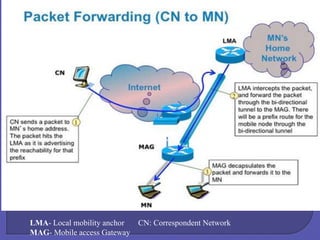
 Proposal


 Dynamic media transport.
 Experimental Results


Today’s mobile market is exploding, and the demand for high-quality online
media has never been greater.

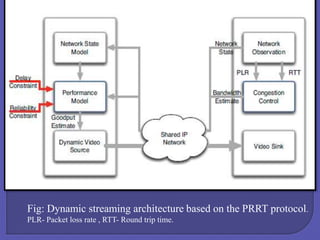
 Due to introduction of iPhone, iPad, iPod Touch, Android and all other
mobile devices in market.


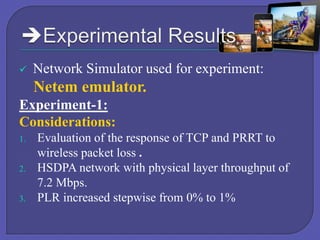
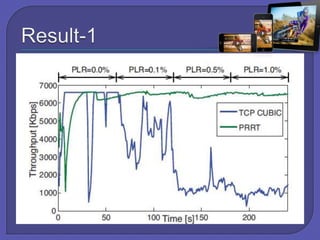
The challenges

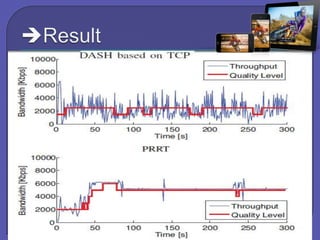
Mobile users expect high quality video experience

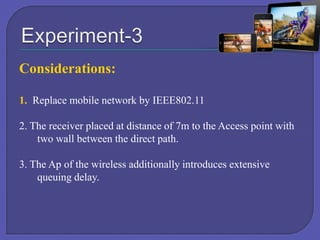
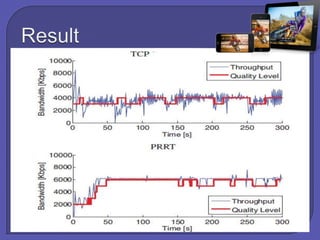
Network operators need to offer quality experience affordably
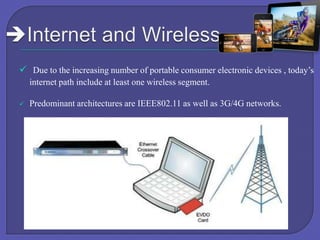
 Due to the increasing number of portable consumer electronic devices , today’s
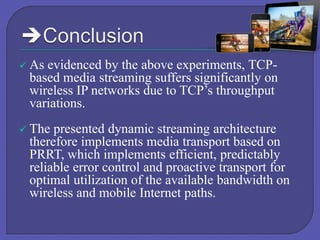
internet path include at least one wireless segment.


Predominant architectures are IEEE802.11 as well as 3G/4G networks.
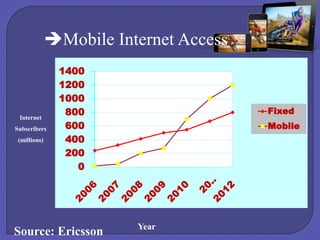
Mobile Internet Access

Internet
Subscribers

(millions)

1400
1200
1000
800
600
400
200
0

Source: Ericsson

Fixed
Mobile

Year
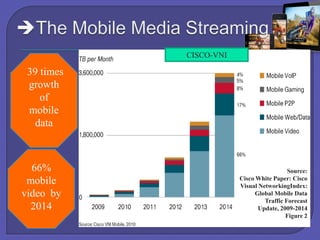
CISCO-VNI

39 times
growth
of
mobile
data

66%
mobile
video by
2014

Source:
Cisco White Paper: Cisco
Visual NetworkingIndex:
Global Mobile Data
Traffic Forecast
Update, 2009-2014
Figure 2





IEEE 802.11 is a set of media access control (MAC) and physical
layer (PHY) specifications for implementing wireless local area
network (WLAN) computer communication in the 2.4, 3.6, 5
and60 GHz frequency bands.
The base version of the standard was released in 1997.
The standard and amendments provide the basis for wireless network
products using the Wi-Fi brand.

 Recent

Standard:
IEEE802.11-2012: This revision specifies technical

corrections and clarifications to IEEE Std 802.11 for wireless local area
networks (WLANS) as well as enhancements to the existing medium
access control (MAC) and physical layer (PHY) functions.

(including all amendments since 2008-2011)
 Real Time Transport Protocol (RTP) defines a standardized

packet format for delivering audio and video over IP networks.


RTP is used extensively in communication and entertainment
systems that involve streaming media, such
as telephony, video teleconference applications, television
services and web-based push-to-talk features.



One of the design considerations of RTP was to carry a
range of multimedia formats (such as H.264, MPEG4, MJPEG, MPEG, etc.) and allow new formats to be added
without revising the RTP standard.


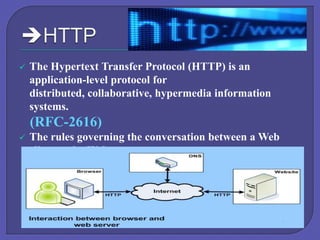
The Hypertext Transfer Protocol (HTTP) is an
application-level protocol for
distributed, collaborative, hypermedia information
systems.

(RFC-2616)


The rules governing the conversation between a Web
client and a Web server
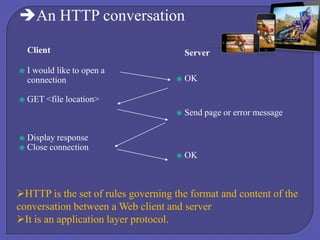
An HTTP conversation
Client


I would like to open a
connection

Server

OK



Send page or error message







OK

GET <file location>

Display response
 Close connection


HTTP is the set of rules governing the format and content of the
conversation between a Web client and server
It is an application layer protocol.


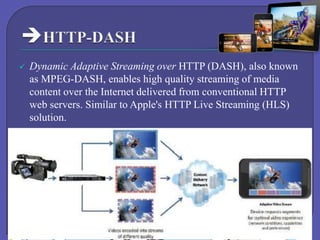
Dynamic Adaptive Streaming over HTTP (DASH), also known
as MPEG-DASH, enables high quality streaming of media
content over the Internet delivered from conventional HTTP
web servers. Similar to Apple's HTTP Live Streaming (HLS)
solution.
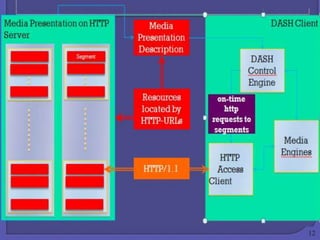
Segment

DASH Client

Media
Presentation
Description

DASH
Control
Engine
Resources
located by
HTTP-URLs

HTTP/1.1

on-time http
requests to
segments

HTTP
Access
Client

Media
Engines

12



A protocol enhancements that allow transparent routing of IP
datagram's to mobile nodes in the Internet.
Each mobile node is always identified by its home
address, regardless of its current point of attachment to the
Internet. While situated away from its home.

[RFC-

2002]




A mobile node is associated with a care-of address, which
provides information about its current point of attachment to
the Internet.
The home agent sends datagram's destined for the mobile node
through a tunnel to the care- of address. After arriving at the
end of the tunnel, each datagram is then delivered to the mobile
LMA- Local mobility anchor
MAG- Mobile access Gateway

CN: Correspondent Network
Manuel Gorius, Yongto Shuai, Thorsten
Herfet “Dynamic media streaming over
wireless and mobile IP Networks”, ICCEBerlin,2012
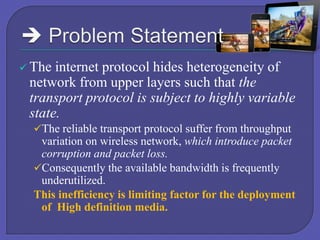
 The

internet protocol hides heterogeneity of
network from upper layers such that the
transport protocol is subject to highly variable
state.
The reliable transport protocol suffer from throughput

variation on wireless network, which introduce packet
corruption and packet loss.
Consequently the available bandwidth is frequently
underutilized.
This inefficiency is limiting factor for the deployment
of High definition media.


As TCP/Http is today’s de facto standard for internet
media streaming.
However, Internet TV solutions based on HTTP are
limited in their quality due to numerous drawbacks of
transport protocols on wireless networks.



To avoid physical packet loss into wireless mobile
standards the protocols rely on H-ARQ is implemented.
 But due to limited number of transmission retires, the

transport protocol is still exposed to small percentage
of residual packet loss.


Related work in this field commonly builds
upon dynamic streaming, packet scheduling
and source rate adjustment of media
streams, as well as partial reliability on
transport layer.

 Recent

development in dynamic HTTP streams
try to address the issue of media streaming
under congestion control by offering the video
stream in multiple resolution at server.


Dynamic adaptive streaming over HTTP
(HTTP-DASH) is in its standardization
process.

 A stream

switching scheme similar to DASH
has been developed by De cicco.


A dynamic streaming architecture based on a
novel transport protocol – Predictably Reliable
Real-time Transport (PART) has been proposed.



The protocol operates under rate based congestion
control. In contrast to window based congestion
control.



It sends datagram of a continuous media stream
proactively according to the rate estimate of a
congestion control equation.


It is a self-managing dynamic streaming
architecture based on three essential
components..
Proactive packet scheduling under an estimate of the

available network bandwidth.
Predictably reliable transport fulfils the QOS
requirements of high data rate, real time media
streaming applications on unmanaged Internet paths.
Delay-based congestion control returns a stable and
continuous estimate of the available bandwidth.
Fig: Dynamic streaming architecture based on the PRRT protocol.
PLR- Packet loss rate , RTT- Round trip time.


Network Simulator used for experiment:

Netem emulator.
Experiment-1:
Considerations:
1.

2.

3.

Evaluation of the response of TCP and PRRT to
wireless packet loss .
HSDPA network with physical layer throughput of
7.2 Mbps.
PLR increased stepwise from 0% to 1%
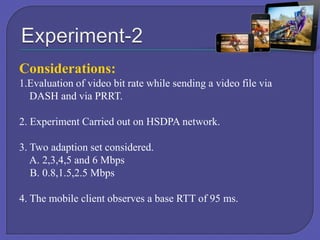
Considerations:
1.Evaluation of video bit rate while sending a video file via
DASH and via PRRT.
2. Experiment Carried out on HSDPA network.
3. Two adaption set considered.
A. 2,3,4,5 and 6 Mbps
B. 0.8,1.5,2.5 Mbps
4. The mobile client observes a base RTT of 95 ms.
Considerations:
1. Replace mobile network by IEEE802.11
2. The receiver placed at distance of 7m to the Access point with
two wall between the direct path.
3. The Ap of the wireless additionally introduces extensive
queuing delay.


As evidenced by the above experiments, TCPbased media streaming suffers significantly on
wireless IP networks due to TCP’s throughput
variations.



The presented dynamic streaming architecture
therefore implements media transport based on
PRRT, which implements efficient, predictably
reliable error control and proactive transport for
optimal utilization of the available bandwidth on
wireless and mobile Internet paths.
Manuel Gorius, Yongato Shuai, Thorsten Herfet “Dyanmic
media srteaming over wireless and mobile IP
Networks”, ICCE-Berlin, 2012
 Naveen Dubey , Sunil Yadav , Anupam Saini “ Mobile IP
based intelligent home”, International
Conference ICETDSMT-2013,March 11-12 ,2013 ,PP 241245, ISBN: 978-93-83083-28-5
RFC’s & Web
 Cisco VNI forecast : http:/bit.ly/bwGYL
 http://www.ericsson.com/res/docs/2013/ericsson-mobilityreport-june-2012.pdf
 http://www.ietf.org/rfc/rfc2616.txt
 http://www.ietf.org/rfc/rfc2002.txt
 http://tools.ietf.org/html/rfc2794

dynamic media streaming over wireless and ip networks

dynamic media streaming over wireless and ip networks

  • 1.
  • 2.
    Internet and Wireless IEEE 802.11  Real Time Transport protocols   HTTP  HTTP-DASH Mobile IP  Problem Statement  Related work  Proposal   Dynamic media transport.  Experimental Results
  • 3.
     Today’s mobile marketis exploding, and the demand for high-quality online media has never been greater.  Due to introduction of iPhone, iPad, iPod Touch, Android and all other mobile devices in market.  The challenges  Mobile users expect high quality video experience  Network operators need to offer quality experience affordably
  • 4.
     Due tothe increasing number of portable consumer electronic devices , today’s internet path include at least one wireless segment.  Predominant architectures are IEEE802.11 as well as 3G/4G networks.
  • 5.
  • 6.
    CISCO-VNI 39 times growth of mobile data 66% mobile video by 2014 Source: CiscoWhite Paper: Cisco Visual NetworkingIndex: Global Mobile Data Traffic Forecast Update, 2009-2014 Figure 2
  • 7.
       IEEE 802.11 isa set of media access control (MAC) and physical layer (PHY) specifications for implementing wireless local area network (WLAN) computer communication in the 2.4, 3.6, 5 and60 GHz frequency bands. The base version of the standard was released in 1997. The standard and amendments provide the basis for wireless network products using the Wi-Fi brand.  Recent Standard: IEEE802.11-2012: This revision specifies technical corrections and clarifications to IEEE Std 802.11 for wireless local area networks (WLANS) as well as enhancements to the existing medium access control (MAC) and physical layer (PHY) functions. (including all amendments since 2008-2011)
  • 8.
     Real TimeTransport Protocol (RTP) defines a standardized packet format for delivering audio and video over IP networks.  RTP is used extensively in communication and entertainment systems that involve streaming media, such as telephony, video teleconference applications, television services and web-based push-to-talk features.  One of the design considerations of RTP was to carry a range of multimedia formats (such as H.264, MPEG4, MJPEG, MPEG, etc.) and allow new formats to be added without revising the RTP standard.
  • 9.
     The Hypertext TransferProtocol (HTTP) is an application-level protocol for distributed, collaborative, hypermedia information systems. (RFC-2616)  The rules governing the conversation between a Web client and a Web server
  • 10.
    An HTTP conversation Client  Iwould like to open a connection Server OK  Send page or error message    OK GET <file location> Display response  Close connection  HTTP is the set of rules governing the format and content of the conversation between a Web client and server It is an application layer protocol.
  • 11.
     Dynamic Adaptive Streamingover HTTP (DASH), also known as MPEG-DASH, enables high quality streaming of media content over the Internet delivered from conventional HTTP web servers. Similar to Apple's HTTP Live Streaming (HLS) solution.
  • 12.
  • 13.
      A protocol enhancementsthat allow transparent routing of IP datagram's to mobile nodes in the Internet. Each mobile node is always identified by its home address, regardless of its current point of attachment to the Internet. While situated away from its home. [RFC- 2002]   A mobile node is associated with a care-of address, which provides information about its current point of attachment to the Internet. The home agent sends datagram's destined for the mobile node through a tunnel to the care- of address. After arriving at the end of the tunnel, each datagram is then delivered to the mobile
  • 14.
    LMA- Local mobilityanchor MAG- Mobile access Gateway CN: Correspondent Network
  • 15.
    Manuel Gorius, YongtoShuai, Thorsten Herfet “Dynamic media streaming over wireless and mobile IP Networks”, ICCEBerlin,2012
  • 16.
     The internet protocolhides heterogeneity of network from upper layers such that the transport protocol is subject to highly variable state. The reliable transport protocol suffer from throughput variation on wireless network, which introduce packet corruption and packet loss. Consequently the available bandwidth is frequently underutilized. This inefficiency is limiting factor for the deployment of High definition media.
  • 17.
     As TCP/Http istoday’s de facto standard for internet media streaming. However, Internet TV solutions based on HTTP are limited in their quality due to numerous drawbacks of transport protocols on wireless networks.  To avoid physical packet loss into wireless mobile standards the protocols rely on H-ARQ is implemented.  But due to limited number of transmission retires, the transport protocol is still exposed to small percentage of residual packet loss.
  • 18.
     Related work inthis field commonly builds upon dynamic streaming, packet scheduling and source rate adjustment of media streams, as well as partial reliability on transport layer.  Recent development in dynamic HTTP streams try to address the issue of media streaming under congestion control by offering the video stream in multiple resolution at server.
  • 19.
     Dynamic adaptive streamingover HTTP (HTTP-DASH) is in its standardization process.  A stream switching scheme similar to DASH has been developed by De cicco.
  • 20.
     A dynamic streamingarchitecture based on a novel transport protocol – Predictably Reliable Real-time Transport (PART) has been proposed.  The protocol operates under rate based congestion control. In contrast to window based congestion control.  It sends datagram of a continuous media stream proactively according to the rate estimate of a congestion control equation.
  • 21.
     It is aself-managing dynamic streaming architecture based on three essential components.. Proactive packet scheduling under an estimate of the available network bandwidth. Predictably reliable transport fulfils the QOS requirements of high data rate, real time media streaming applications on unmanaged Internet paths. Delay-based congestion control returns a stable and continuous estimate of the available bandwidth.
  • 22.
    Fig: Dynamic streamingarchitecture based on the PRRT protocol. PLR- Packet loss rate , RTT- Round trip time.
  • 23.
     Network Simulator usedfor experiment: Netem emulator. Experiment-1: Considerations: 1. 2. 3. Evaluation of the response of TCP and PRRT to wireless packet loss . HSDPA network with physical layer throughput of 7.2 Mbps. PLR increased stepwise from 0% to 1%
  • 25.
    Considerations: 1.Evaluation of videobit rate while sending a video file via DASH and via PRRT. 2. Experiment Carried out on HSDPA network. 3. Two adaption set considered. A. 2,3,4,5 and 6 Mbps B. 0.8,1.5,2.5 Mbps 4. The mobile client observes a base RTT of 95 ms.
  • 27.
    Considerations: 1. Replace mobilenetwork by IEEE802.11 2. The receiver placed at distance of 7m to the Access point with two wall between the direct path. 3. The Ap of the wireless additionally introduces extensive queuing delay.
  • 29.
     As evidenced bythe above experiments, TCPbased media streaming suffers significantly on wireless IP networks due to TCP’s throughput variations.  The presented dynamic streaming architecture therefore implements media transport based on PRRT, which implements efficient, predictably reliable error control and proactive transport for optimal utilization of the available bandwidth on wireless and mobile Internet paths.
  • 30.
    Manuel Gorius, YongatoShuai, Thorsten Herfet “Dyanmic media srteaming over wireless and mobile IP Networks”, ICCE-Berlin, 2012  Naveen Dubey , Sunil Yadav , Anupam Saini “ Mobile IP based intelligent home”, International Conference ICETDSMT-2013,March 11-12 ,2013 ,PP 241245, ISBN: 978-93-83083-28-5 RFC’s & Web  Cisco VNI forecast : http:/bit.ly/bwGYL  http://www.ericsson.com/res/docs/2013/ericsson-mobilityreport-june-2012.pdf  http://www.ietf.org/rfc/rfc2616.txt  http://www.ietf.org/rfc/rfc2002.txt  http://tools.ietf.org/html/rfc2794 

Editor's Notes

  • #7 User experience = fast playback response, minimal playback stalls, highest quality media rate for current network conditionsCongestion is network operator challeng