MSc Electrical and Electronics Engineering
Sai Varrshini Macha Venkata
(1345673)
 Wireless and mobile technology has made a remarkable transmission from
Marconi’s first transatlantic transmission to the worldwide adoption of
cellular mobile services today.
 This paper provides a brief view about some of the early stage key
technologies used and also discusses about the new technologies such as
DSA, white space, SDR, MIMO which has the potential of increasing radio link
speed from MBps to GBps.
 The paper also introduces a number of emerging networking concepts such
as multihoming, ad hoc and multihop mesh, providing a discussion of the
protocol capabilities needed to support these.
 The paper concludes by discussing about the impact these wireless
technology and network techniques on the design of emerging audiovisual
and multimedia applications.
 Information and communication technology field is currently undergoing a
fundamental transformation from personal computers and wired internet
services to wirelessly connecting portable devices to “mobile internet”.
 The introduction of 3G and 4G services enables the wide range use of
internet applications from navigation, search to mobile video streaming.
 With the increasing popularity of mobile applications, mobile data services
are experiencing rapid growth and the authoritative industry report predicts
that mobile generated traffic will exceed that from the PCs by 2015.
 The trend towards mobility of internet will impose major technical challenges
in designing the wireless networks as well as for the emergence of new
designs in the audiovisual and multimedia applications.
 A review of future research challenges in the field of wireless and mobile
communications, roadmap of emerging technologies and technical
developments in this field has been provided in this paper.
 In the period of 2000-2010 there has been a proliferation of new wireless
technology.
 In hardware platform level, new radio equipments such as
◦ 3G, 4G, WiFi, Bluetooth, open mobile handsets, SDR in the initial period.
◦ More recently, open virtualized access points and base stations have been
introduced.
 In terms of radio physical layer,
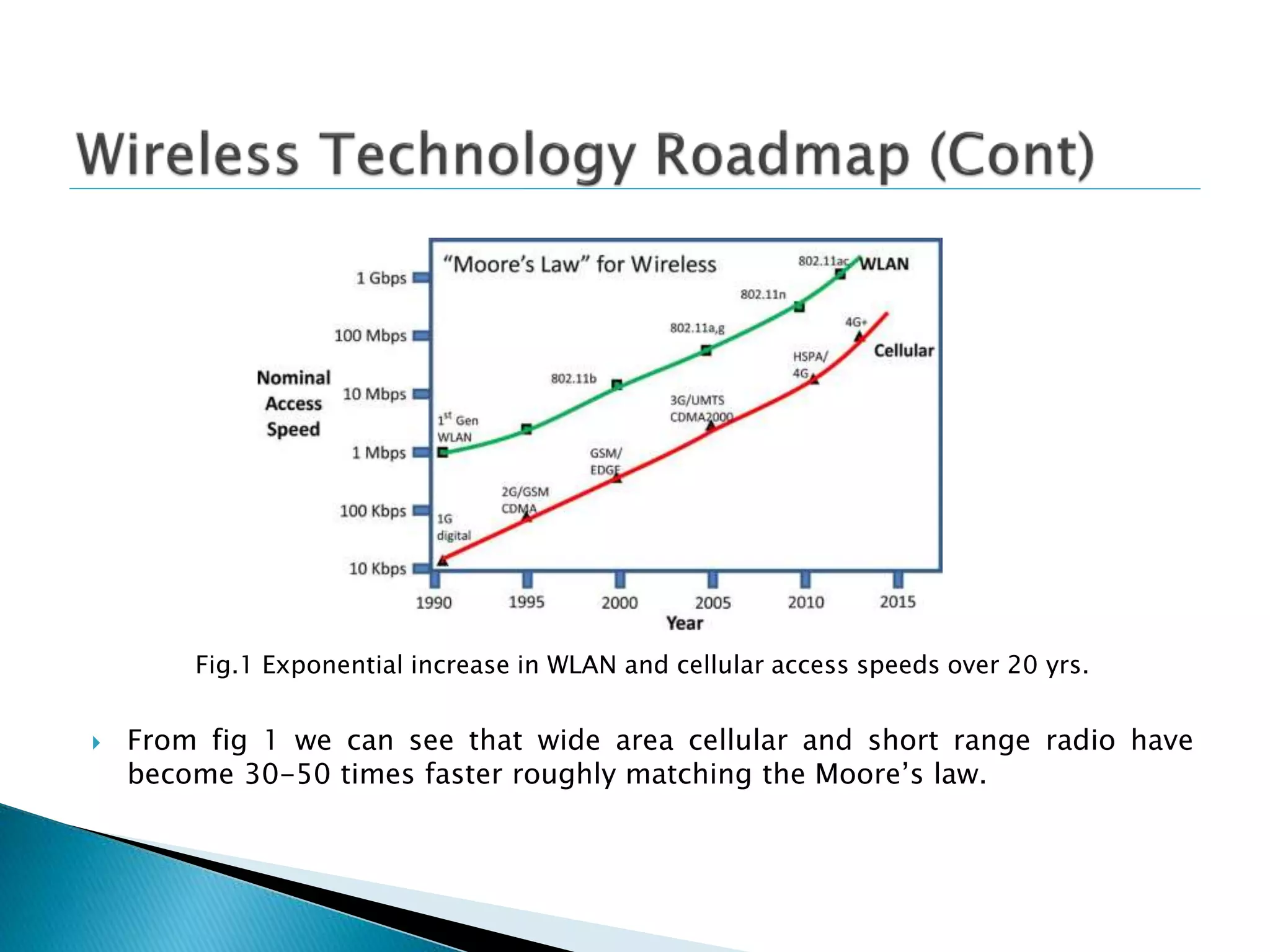
◦ Cellular radio link speed has increased from about 2Mb/s with 3G in 2000
to 100 Mb/s with 4G.
◦ Short range WiFi radio speeds have increased from 11Mb/s 802.11b in
2000 to 300 Mb/s with 802.11n.
Fig.1 Exponential increase in WLAN and cellular access speeds over 20 yrs.
 From fig 1 we can see that wide area cellular and short range radio have
become 30-50 times faster roughly matching the Moore’s law.
 There is also an emerging 802.11p/DSRC standard to P2P ad hoc
communication between vehicular radios.
 Cognitive radio networking protocols are also expected to emerge over next
few years to enable coordination between multiple systems sharing the same
white space band.
 At the mobile systems and application level, we can observe an evolution
from early 3G cellular, WLAN, and personal area network systems to public
wireless local area network, ad hoc, P2P and sensor network applications.
 Video streaming, VOIP applications, location aware applications such as
traffic navigation have also emerged recently in cellular devices.
 It is impossible to predict which applications will become popular but it is
expected that successful ones will involve context- or location aware delivery
of more general forms of audiovisual and multimedia information.
1. Radio technologies and Platforms
 Radio technologies are classified in terms of their modulation and coding
method along with medium access control (MAC) technique.
 GSM :
◦ Uses generalized minimum shift keying modulation.
◦ Block coding
◦ TDMA to achieve circuit switched bit rates 16 kb/s and packet data rate
100 kb/s.
 2G:
◦ CDMA or IS-95 to achieve roughly similar bit rates as GSM.
◦ Spread spectrum modulation.
◦ Convolutional coding.
 GSM and 2G migrated to the so-called “3G” standards known as Universal
Mobile Telecommunication Systems in Europe and CDMA-2000 in US.
 3G :
◦ These standards use wideband spectrum.
◦ Adaptive modulation.
◦ Convolution coding and CDMA to achieve peak service bit rates of up to 2
Mb/s.
 In parallel to these standards, the widely adopted 802.11 specification for
WLAN uses
◦ Direct sequence spreading.
◦ Quadrature phase shift keying modulation.
◦ CSMA/CA MAC at 1 mb/s.
 4G:
◦ 4G cellular including LTE and WiMAX have migrated to orthogonal
frequency division multiplexing, which offers higher spectral efficiency
and performance.
◦ FDMA/TDMA MAC protocol is used to achieve basic service bit rates in the
range of 10-20 Mb/s.
 Looking ahead, it is anticipated that both cellular and WiFi standards will
continue along the OFDM track for physical layer, with enhancements to
achieve higher speeds approaching 300-500 Mb/s for cellular and 1Gb/s for
WLAN.
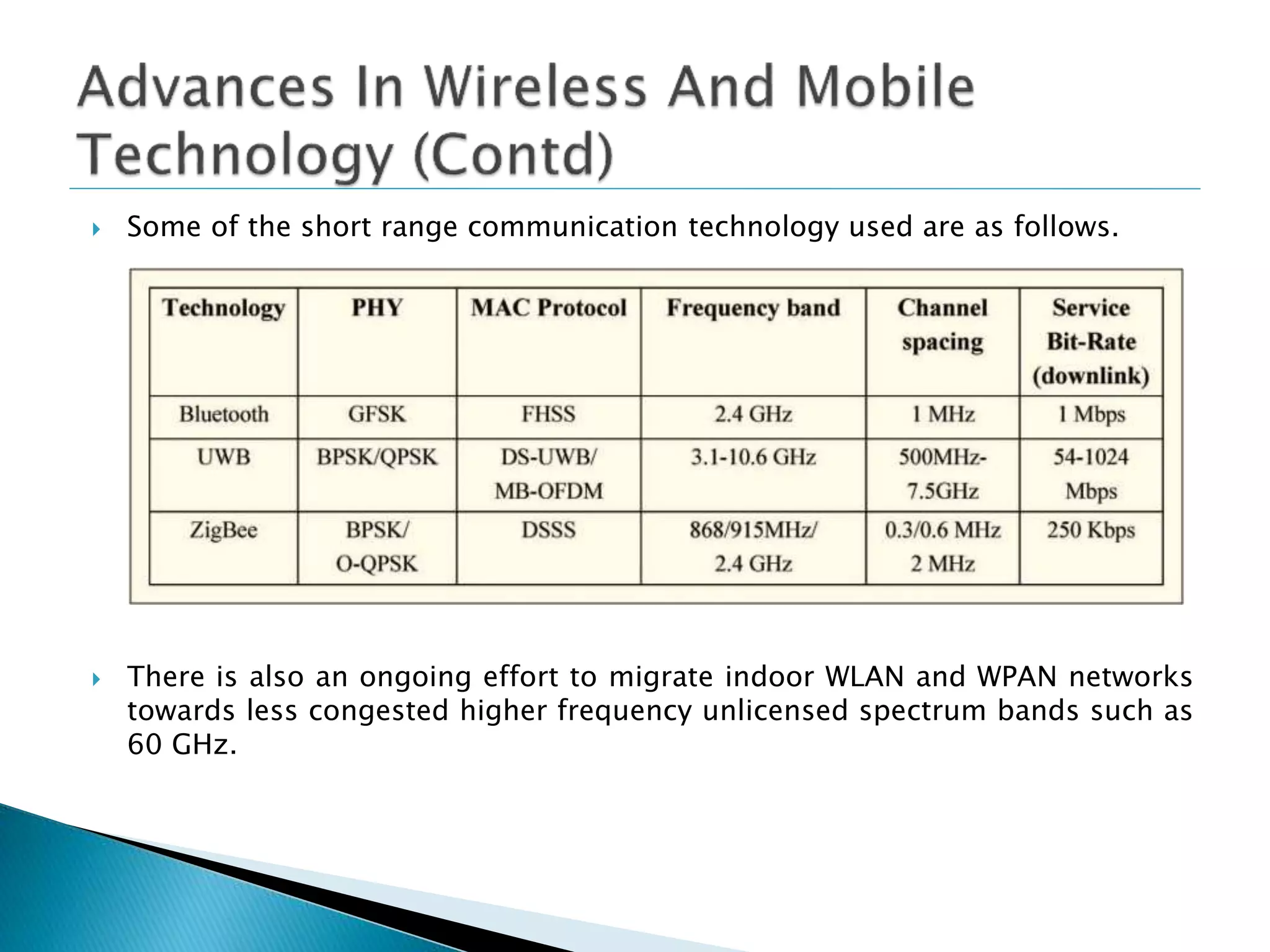
 Some of the short range communication technology used are as follows.
 There is also an ongoing effort to migrate indoor WLAN and WPAN networks
towards less congested higher frequency unlicensed spectrum bands such as
60 GHz.
 Overall, 60 GHz technology is expected to mature and will provide an
important option for high speed indoor connectivity associated with
applications such as device docking and HD video.
 As there are changes in technology, the chip development with particular
standards will in turn results in high cost and longer product development
cycles.
 This has motivated research on SDR.
◦ Goal: Developing generic programmable hardware architecture.
◦ Functionality: Capable of supporting wide range of standards and upgrade
functionality after the product has been shipped.
◦ Uses: It provides solution for cognitive radios, which are capable of
adapting their operating parameters based on actual spectrum availability.
◦ Prototypes: WARP board, GNU/USRP and USRP2 platforms and GENI SDR
platform.
◦ Disadvantage: These prototypes use FPGAs and are costly and consume
significant amount of power.
◦ These are currently used in base stations than for consumer-level mobile
devices.
2. Wireless Communication Algorithms
i. MIMO:
 Application of multiple-antenna system appears to be one of the promising
solutions leading to even higher data rates and the ability to support greater
number of users.
 Multiple antenna technique has now resulted in widespread proposals for the
use of these in variety of contexts
◦ For wide area wireless transmission in next generation cellular systems.
◦ For local area hot-spot data service overlays.
◦ For emerging short range WLAN networks.
◦ For promoting efficient spectrum sharing in the unlicensed bands.
◦ And a variety of techniques in wireless ad hoc networks.
 A key attribute required for multiple antenna system to be successful is the
need for reliable and efficient channel state information (CSI).
 Necessity of CSI
◦ In receiver:
 To realize the potential capacity gain that are promised in such systems.
◦ In transmitter :
 For transmitter optimization technique used in conjunction with
multiple antennas.
 Estimating CSI:
◦ Depends on large number of parameters that have to be estimated for
MIMO channels.
◦ And also need to support higher data rates for video, mobility and
migration of future wireless data services to higher carrier frequency.
 In addition to reliability in CSI information, the feedback of such information
will also have to be fast and frequent for audio/video applications.
ii. Cooperative Communications:
 Advances in radio technology have enabled radios that can manage power,
time and bandwidth resources in ways that share their available spectrum
more efficiently.
 Other techniques involve cooperation between terminals, and are named as
“user- cooperation diversity”.
 These techniques are diverse and include approaches such as collaborative
signal processing, cooperative coding, relaying and forwarding.
 Cooperative techniques lead to better overall result than independent
techniques.
 But they may involve significant costs and immediate benefits will not each
the users who bear the cost.
 Assumption of selfless, cooperative sharing of the spectrum resource may
not be realistic and so, several mechanisms have been proposed to achieve
cooperation among autonomous nodes and are roughly classified as
◦ Reputation based
◦ Credit based incentive.
◦ Network-assisted pricing mechanism.
◦ Mechanisms based on forward forwarding games.
 Cooperative techniques helps to improve power efficiency and hence are
applicable to emerging “green” information technology initiatives.
 As carbon emissions due to information and communication technologies are
2%-4% of the total, energy efficient wireless networks are now in demand.
 Cooperative forwarding by relays reduces cellular base station transmit
power while also improving coverage and capacity.
 The downlink capacity of cellular wireless networks is limited by intercell
interference.
 Depending on the users’ channel conditions, interference caused by the
neighboring cell transmissions can degrade the received signal quality.
 Network MIMO can help to eliminate intercell interference, and result in great
capacity improvement on downlink cellular networks.
iii. Dynamic Spectrum Access (DSA):
 The sharing of spectrum has been an efficient system design since the
earliest stages.
 And hence advances as disparate as tighter filtering to create more channels
and cellular architectures to reuse them more frequently have been
introduced.
 The emerging cognitive radio technology enable DSA compared to the state-
of-the-art radio techniques, protocols and algorithms which are limited to
static, contiguous allocation from few MHz to tens of MHz.
 Cognitive radios can recognize the available systems and adjust their
frequencies, waveforms, and protocols to access those system efficiently.
 Such dynamic access hinges on the development of cognitive protocols and
algorithms that exploit temporal and spatial variability in the spectrum via:
◦ Initial cooperative neighbor discovery.
◦ Spectrum quality estimation and opportunity identification.
◦ Radio bearer management.
 These in turn, imply a framework that senses “neighborhood” conditions to
identify spectrum opportunities for communication by building an awareness
of spectrum policy, local network policy and the capability of local nodes.
 Cognitive radios extend the SDR framework to include
◦ Multiple domains of knowledge.
◦ Model-based reasoning.
◦ Negotiation.
 Knowledge and Reasoning :
◦ It includes all aspects of any radio etiquette such as
◦ RF bands.
◦ Air interfaces.
◦ Protocols and spatial as well as temporal patterns that moderate the use
of the radio spectrum.
 Negotiation: It implies strategy-directed communication with peers about the
use of radio spectrum.
 The key to the enablement of such DSA lies in the ability to program such
radios to become radio-domain aware and intelligent agents to provide the
supporting structure to which to allow awareness and negotiation to take
place.
iv. Network Coding:
 Network coding has been touted as the foundation on which several
applications related to the robust operation of both wired and wireless
network that are built.
 Network coding not only includes traditional disciplines of information
theory, coding theory and networking but also deals with algorithms,
combinatorics, distributed storage, network monitoring, content delivery and
security.
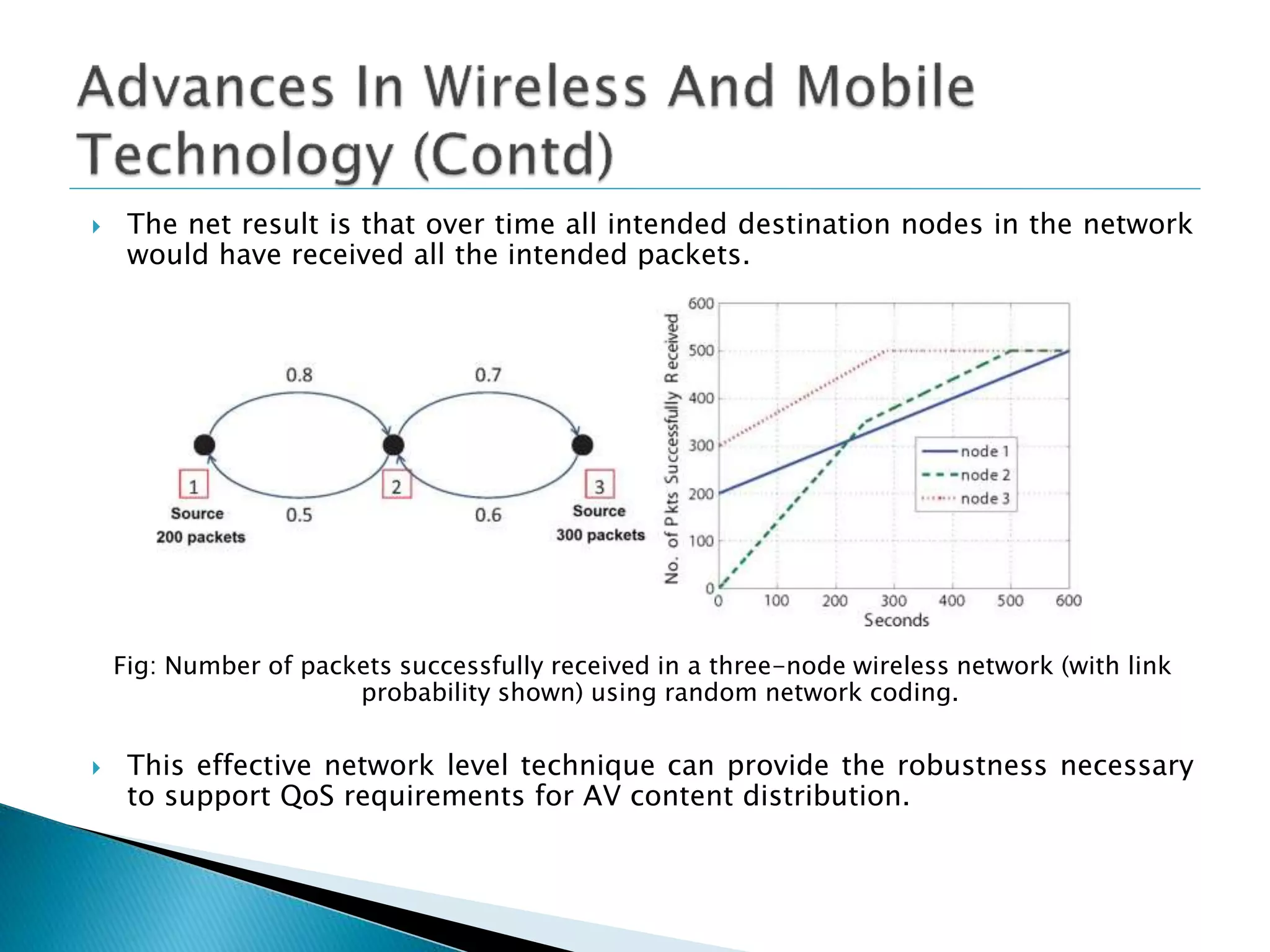
 Under the assumption of an underlying MAC protocol, random network
coding requires all nodes in a network to linearly combine received packets
and retransmit them to other nodes, which in turn execute the same
procedure.
 The net result is that over time all intended destination nodes in the network
would have received all the intended packets.
Fig: Number of packets successfully received in a three-node wireless network (with link
probability shown) using random network coding.
 This effective network level technique can provide the robustness necessary
to support QoS requirements for AV content distribution.
3. Mobile/Wireless Networks.
 Networking is the next layer of the protocol stack needed to build a complete
system with application running on top.
 Existence of network makes it possible to extend the range of coverage and
connect to a multiplicity of devices and applications.
 Mainstream wireless networks for cellular and WiFi applications have been
built by extending the capability of wired networks incrementally adding new
protocol features required to handle mobile service requirements such as
◦ Authentication.
◦ link encryption and user mobility.
 Radio access networks in 2G were built as extensions of digital telephony
systems implementing features which support dynamic mobility.
 3GPP cellular network is steadily migrating towards the concept of an all IP
cellular network with telephony signal protocol replaced by IP for multimedia
support, while user mobility is supported by mobile IPv6.
 IPv4 was designed to provide mobile nodes with a permanent address while
rerouting packets when the node roams into other networks.
 Mobile IP with route optimization was proposed to improve scalability and
reliability and reduce signaling overhead.
 Micromobility was proposed for mobility within small region.
 An alternative approach to support mobility without changes to the routing
protocol is to dynamically migrate the end-to-end transport layer connection
as the mobile devices moves from one network address to the another.
 Instances of connection reconfiguration and migration approaches are the
Stream Control Transmission Protocol and TCP migration.
 The SIP used for voice and video services has also been proposed to support
terminal mobility.
 Storage aware networking has also been proposed as a mechanism for
dealing with disconnection and channel impairments associated with wireless
access and mobility.
 The “Infostations” mobile content cache concept was proposed as a
networking feature that enables opportunistic delivery of media files to
mobile devices which pass through high bandwidth hotspots while roaming
through multiple networks.
 This concept was further developed in the cache-and-forward (CNF)
architecture in which storage is integrated into network routers, access
points and base stations that handles large content files on hop-by-hop
basis.
Fig. Conceptual view of the CNF network with storage routers and hop-by-hop transport.
 Ad hoc:
 Important dimension of wireless networking research has been aimed at
enabling infrastructureless (ad hoc) networking between mobile devices.
◦ Uses: It was proposed for emergency response and tactical military
networks known as mobile ad hoc networks.
◦ Application: Ad hoc commercial technology have also been applied in
commercial usage scenarios such as multihop “mesh networks” for low
cost broadband access networks in both urban and rural areas.
◦ Other Features: Ad hoc networks can also be used to provide P2P
connectivity between short range media and computing devices inside
home or office.
◦ Variations in ad hoc and mesh networks have also been applied to sensor
network scenarios.
◦ Ad hoc and mesh networks differ from conventional cellular and WiFi
systems in the sense that there is no hierarchy of clients and access
points, and each radio node is required to serve as a mobile router.
 Requirement:
 “cross-layer” awareness is needed in order to deal with interactions between
radio link quality, MAC layer congestion and routing.
 Delay tolerant networks:
 It represents another innovation in networking as applied to ad hoc and
heterogeneous radio access scenarios, characterized by occasional
disconnections.
◦ Concept: It should be able to deliver a message without the requirement of
contemporaneous end-to-end path to the destination.
◦ Algorithm: Connectivity between nodes was assumed to be either
scheduled or estimated, hence worked on enhancing shortest path
algorithms such as Dijkstra’s .
 The emergence of wireless communication has led to the development of AV
and multimedia applications in portable wireless devices.
 First implication: Major problem with wireless delivery of multimedia is
caused by the fact
◦ that wide-area cellular access remains relatively slow.
◦ actual radio link bandwidth and
◦ channel rate error can fluctuate.
 Solution with 4G: Introduction of 4G technologies such as WiMax and LTE
offers significantly higher bandwidth but they continue to exhibit large
variations in channel quality.
 Techniques for video rate adaptation for wired networks have been proposed
but it still exhibits variation in stream bit rate.
 These techniques use transport layer protocol such as Real Time Control
Protocol to achieve bit rate and then use this along with receiver buffer
status to adjust video encoding quality and rate.
 Recent work on video rate adaptation for wireless channels has also
considered the use of cross layer feedback to improve end to end
performance.
 With cross layer scheduling, Qos gain can be achieved at intermediate
network nodes.
 Second barrier :
 Key barrier to widespread adoption of high quality media services over
cellular networks is that of limited network capacity.
 Solutions :
◦ Multicasting of media streams as in the commercial MediaFlo system.
◦ Addition of WiFi hot spots to offload traffic in densely populated area.
◦ Content caching at mobile devices and inside the network.
 Future applications may require even more creative methods for retrieval or
delivery of media content from mobile users and real world sensors.
 Wireless has become one of the core technology for a diverse variety of
computing and communications applications.
 It is also of central importance to the future of mobile pervasive AV and
multimedia applications.
 Some of the early stage key technologies, new radio technologies, number of
emerging wireless/mobile networking concepts in wireless area has been
discussed.
 Emerging wireless technologies and mobile scenarios will be of growing
importance for the holistic design of future AV applications that will be
accessed over mobile internet.

Frontiers of Wireless and Mobile Communications

  • 1.
    MSc Electrical andElectronics Engineering Sai Varrshini Macha Venkata (1345673)
  • 2.
     Wireless andmobile technology has made a remarkable transmission from Marconi’s first transatlantic transmission to the worldwide adoption of cellular mobile services today.  This paper provides a brief view about some of the early stage key technologies used and also discusses about the new technologies such as DSA, white space, SDR, MIMO which has the potential of increasing radio link speed from MBps to GBps.  The paper also introduces a number of emerging networking concepts such as multihoming, ad hoc and multihop mesh, providing a discussion of the protocol capabilities needed to support these.  The paper concludes by discussing about the impact these wireless technology and network techniques on the design of emerging audiovisual and multimedia applications.
  • 3.
     Information andcommunication technology field is currently undergoing a fundamental transformation from personal computers and wired internet services to wirelessly connecting portable devices to “mobile internet”.  The introduction of 3G and 4G services enables the wide range use of internet applications from navigation, search to mobile video streaming.  With the increasing popularity of mobile applications, mobile data services are experiencing rapid growth and the authoritative industry report predicts that mobile generated traffic will exceed that from the PCs by 2015.  The trend towards mobility of internet will impose major technical challenges in designing the wireless networks as well as for the emergence of new designs in the audiovisual and multimedia applications.  A review of future research challenges in the field of wireless and mobile communications, roadmap of emerging technologies and technical developments in this field has been provided in this paper.
  • 4.
     In theperiod of 2000-2010 there has been a proliferation of new wireless technology.  In hardware platform level, new radio equipments such as ◦ 3G, 4G, WiFi, Bluetooth, open mobile handsets, SDR in the initial period. ◦ More recently, open virtualized access points and base stations have been introduced.  In terms of radio physical layer, ◦ Cellular radio link speed has increased from about 2Mb/s with 3G in 2000 to 100 Mb/s with 4G. ◦ Short range WiFi radio speeds have increased from 11Mb/s 802.11b in 2000 to 300 Mb/s with 802.11n.
  • 5.
    Fig.1 Exponential increasein WLAN and cellular access speeds over 20 yrs.  From fig 1 we can see that wide area cellular and short range radio have become 30-50 times faster roughly matching the Moore’s law.
  • 6.
     There isalso an emerging 802.11p/DSRC standard to P2P ad hoc communication between vehicular radios.  Cognitive radio networking protocols are also expected to emerge over next few years to enable coordination between multiple systems sharing the same white space band.  At the mobile systems and application level, we can observe an evolution from early 3G cellular, WLAN, and personal area network systems to public wireless local area network, ad hoc, P2P and sensor network applications.  Video streaming, VOIP applications, location aware applications such as traffic navigation have also emerged recently in cellular devices.  It is impossible to predict which applications will become popular but it is expected that successful ones will involve context- or location aware delivery of more general forms of audiovisual and multimedia information.
  • 7.
    1. Radio technologiesand Platforms  Radio technologies are classified in terms of their modulation and coding method along with medium access control (MAC) technique.  GSM : ◦ Uses generalized minimum shift keying modulation. ◦ Block coding ◦ TDMA to achieve circuit switched bit rates 16 kb/s and packet data rate 100 kb/s.  2G: ◦ CDMA or IS-95 to achieve roughly similar bit rates as GSM. ◦ Spread spectrum modulation. ◦ Convolutional coding.
  • 8.
     GSM and2G migrated to the so-called “3G” standards known as Universal Mobile Telecommunication Systems in Europe and CDMA-2000 in US.  3G : ◦ These standards use wideband spectrum. ◦ Adaptive modulation. ◦ Convolution coding and CDMA to achieve peak service bit rates of up to 2 Mb/s.  In parallel to these standards, the widely adopted 802.11 specification for WLAN uses ◦ Direct sequence spreading. ◦ Quadrature phase shift keying modulation. ◦ CSMA/CA MAC at 1 mb/s.
  • 9.
     4G: ◦ 4Gcellular including LTE and WiMAX have migrated to orthogonal frequency division multiplexing, which offers higher spectral efficiency and performance. ◦ FDMA/TDMA MAC protocol is used to achieve basic service bit rates in the range of 10-20 Mb/s.  Looking ahead, it is anticipated that both cellular and WiFi standards will continue along the OFDM track for physical layer, with enhancements to achieve higher speeds approaching 300-500 Mb/s for cellular and 1Gb/s for WLAN.
  • 10.
     Some ofthe short range communication technology used are as follows.  There is also an ongoing effort to migrate indoor WLAN and WPAN networks towards less congested higher frequency unlicensed spectrum bands such as 60 GHz.
  • 11.
     Overall, 60GHz technology is expected to mature and will provide an important option for high speed indoor connectivity associated with applications such as device docking and HD video.  As there are changes in technology, the chip development with particular standards will in turn results in high cost and longer product development cycles.  This has motivated research on SDR. ◦ Goal: Developing generic programmable hardware architecture. ◦ Functionality: Capable of supporting wide range of standards and upgrade functionality after the product has been shipped. ◦ Uses: It provides solution for cognitive radios, which are capable of adapting their operating parameters based on actual spectrum availability.
  • 12.
    ◦ Prototypes: WARPboard, GNU/USRP and USRP2 platforms and GENI SDR platform. ◦ Disadvantage: These prototypes use FPGAs and are costly and consume significant amount of power. ◦ These are currently used in base stations than for consumer-level mobile devices. 2. Wireless Communication Algorithms i. MIMO:  Application of multiple-antenna system appears to be one of the promising solutions leading to even higher data rates and the ability to support greater number of users.
  • 13.
     Multiple antennatechnique has now resulted in widespread proposals for the use of these in variety of contexts ◦ For wide area wireless transmission in next generation cellular systems. ◦ For local area hot-spot data service overlays. ◦ For emerging short range WLAN networks. ◦ For promoting efficient spectrum sharing in the unlicensed bands. ◦ And a variety of techniques in wireless ad hoc networks.  A key attribute required for multiple antenna system to be successful is the need for reliable and efficient channel state information (CSI).  Necessity of CSI ◦ In receiver:  To realize the potential capacity gain that are promised in such systems. ◦ In transmitter :  For transmitter optimization technique used in conjunction with multiple antennas.
  • 14.
     Estimating CSI: ◦Depends on large number of parameters that have to be estimated for MIMO channels. ◦ And also need to support higher data rates for video, mobility and migration of future wireless data services to higher carrier frequency.  In addition to reliability in CSI information, the feedback of such information will also have to be fast and frequent for audio/video applications.
  • 15.
    ii. Cooperative Communications: Advances in radio technology have enabled radios that can manage power, time and bandwidth resources in ways that share their available spectrum more efficiently.  Other techniques involve cooperation between terminals, and are named as “user- cooperation diversity”.  These techniques are diverse and include approaches such as collaborative signal processing, cooperative coding, relaying and forwarding.  Cooperative techniques lead to better overall result than independent techniques.  But they may involve significant costs and immediate benefits will not each the users who bear the cost.
  • 16.
     Assumption ofselfless, cooperative sharing of the spectrum resource may not be realistic and so, several mechanisms have been proposed to achieve cooperation among autonomous nodes and are roughly classified as ◦ Reputation based ◦ Credit based incentive. ◦ Network-assisted pricing mechanism. ◦ Mechanisms based on forward forwarding games.  Cooperative techniques helps to improve power efficiency and hence are applicable to emerging “green” information technology initiatives.  As carbon emissions due to information and communication technologies are 2%-4% of the total, energy efficient wireless networks are now in demand.
  • 17.
     Cooperative forwardingby relays reduces cellular base station transmit power while also improving coverage and capacity.  The downlink capacity of cellular wireless networks is limited by intercell interference.  Depending on the users’ channel conditions, interference caused by the neighboring cell transmissions can degrade the received signal quality.  Network MIMO can help to eliminate intercell interference, and result in great capacity improvement on downlink cellular networks.
  • 18.
    iii. Dynamic SpectrumAccess (DSA):  The sharing of spectrum has been an efficient system design since the earliest stages.  And hence advances as disparate as tighter filtering to create more channels and cellular architectures to reuse them more frequently have been introduced.  The emerging cognitive radio technology enable DSA compared to the state- of-the-art radio techniques, protocols and algorithms which are limited to static, contiguous allocation from few MHz to tens of MHz.  Cognitive radios can recognize the available systems and adjust their frequencies, waveforms, and protocols to access those system efficiently.
  • 19.
     Such dynamicaccess hinges on the development of cognitive protocols and algorithms that exploit temporal and spatial variability in the spectrum via: ◦ Initial cooperative neighbor discovery. ◦ Spectrum quality estimation and opportunity identification. ◦ Radio bearer management.  These in turn, imply a framework that senses “neighborhood” conditions to identify spectrum opportunities for communication by building an awareness of spectrum policy, local network policy and the capability of local nodes.  Cognitive radios extend the SDR framework to include ◦ Multiple domains of knowledge. ◦ Model-based reasoning. ◦ Negotiation.
  • 20.
     Knowledge andReasoning : ◦ It includes all aspects of any radio etiquette such as ◦ RF bands. ◦ Air interfaces. ◦ Protocols and spatial as well as temporal patterns that moderate the use of the radio spectrum.  Negotiation: It implies strategy-directed communication with peers about the use of radio spectrum.  The key to the enablement of such DSA lies in the ability to program such radios to become radio-domain aware and intelligent agents to provide the supporting structure to which to allow awareness and negotiation to take place.
  • 21.
    iv. Network Coding: Network coding has been touted as the foundation on which several applications related to the robust operation of both wired and wireless network that are built.  Network coding not only includes traditional disciplines of information theory, coding theory and networking but also deals with algorithms, combinatorics, distributed storage, network monitoring, content delivery and security.  Under the assumption of an underlying MAC protocol, random network coding requires all nodes in a network to linearly combine received packets and retransmit them to other nodes, which in turn execute the same procedure.
  • 22.
     The netresult is that over time all intended destination nodes in the network would have received all the intended packets. Fig: Number of packets successfully received in a three-node wireless network (with link probability shown) using random network coding.  This effective network level technique can provide the robustness necessary to support QoS requirements for AV content distribution.
  • 23.
    3. Mobile/Wireless Networks. Networking is the next layer of the protocol stack needed to build a complete system with application running on top.  Existence of network makes it possible to extend the range of coverage and connect to a multiplicity of devices and applications.  Mainstream wireless networks for cellular and WiFi applications have been built by extending the capability of wired networks incrementally adding new protocol features required to handle mobile service requirements such as ◦ Authentication. ◦ link encryption and user mobility.
  • 24.
     Radio accessnetworks in 2G were built as extensions of digital telephony systems implementing features which support dynamic mobility.  3GPP cellular network is steadily migrating towards the concept of an all IP cellular network with telephony signal protocol replaced by IP for multimedia support, while user mobility is supported by mobile IPv6.  IPv4 was designed to provide mobile nodes with a permanent address while rerouting packets when the node roams into other networks.  Mobile IP with route optimization was proposed to improve scalability and reliability and reduce signaling overhead.  Micromobility was proposed for mobility within small region.
  • 25.
     An alternativeapproach to support mobility without changes to the routing protocol is to dynamically migrate the end-to-end transport layer connection as the mobile devices moves from one network address to the another.  Instances of connection reconfiguration and migration approaches are the Stream Control Transmission Protocol and TCP migration.  The SIP used for voice and video services has also been proposed to support terminal mobility.  Storage aware networking has also been proposed as a mechanism for dealing with disconnection and channel impairments associated with wireless access and mobility.
  • 26.
     The “Infostations”mobile content cache concept was proposed as a networking feature that enables opportunistic delivery of media files to mobile devices which pass through high bandwidth hotspots while roaming through multiple networks.  This concept was further developed in the cache-and-forward (CNF) architecture in which storage is integrated into network routers, access points and base stations that handles large content files on hop-by-hop basis. Fig. Conceptual view of the CNF network with storage routers and hop-by-hop transport.
  • 27.
     Ad hoc: Important dimension of wireless networking research has been aimed at enabling infrastructureless (ad hoc) networking between mobile devices. ◦ Uses: It was proposed for emergency response and tactical military networks known as mobile ad hoc networks. ◦ Application: Ad hoc commercial technology have also been applied in commercial usage scenarios such as multihop “mesh networks” for low cost broadband access networks in both urban and rural areas. ◦ Other Features: Ad hoc networks can also be used to provide P2P connectivity between short range media and computing devices inside home or office. ◦ Variations in ad hoc and mesh networks have also been applied to sensor network scenarios. ◦ Ad hoc and mesh networks differ from conventional cellular and WiFi systems in the sense that there is no hierarchy of clients and access points, and each radio node is required to serve as a mobile router.
  • 28.
     Requirement:  “cross-layer”awareness is needed in order to deal with interactions between radio link quality, MAC layer congestion and routing.  Delay tolerant networks:  It represents another innovation in networking as applied to ad hoc and heterogeneous radio access scenarios, characterized by occasional disconnections. ◦ Concept: It should be able to deliver a message without the requirement of contemporaneous end-to-end path to the destination. ◦ Algorithm: Connectivity between nodes was assumed to be either scheduled or estimated, hence worked on enhancing shortest path algorithms such as Dijkstra’s .
  • 29.
     The emergenceof wireless communication has led to the development of AV and multimedia applications in portable wireless devices.  First implication: Major problem with wireless delivery of multimedia is caused by the fact ◦ that wide-area cellular access remains relatively slow. ◦ actual radio link bandwidth and ◦ channel rate error can fluctuate.  Solution with 4G: Introduction of 4G technologies such as WiMax and LTE offers significantly higher bandwidth but they continue to exhibit large variations in channel quality.  Techniques for video rate adaptation for wired networks have been proposed but it still exhibits variation in stream bit rate.  These techniques use transport layer protocol such as Real Time Control Protocol to achieve bit rate and then use this along with receiver buffer status to adjust video encoding quality and rate.
  • 30.
     Recent workon video rate adaptation for wireless channels has also considered the use of cross layer feedback to improve end to end performance.  With cross layer scheduling, Qos gain can be achieved at intermediate network nodes.  Second barrier :  Key barrier to widespread adoption of high quality media services over cellular networks is that of limited network capacity.  Solutions : ◦ Multicasting of media streams as in the commercial MediaFlo system. ◦ Addition of WiFi hot spots to offload traffic in densely populated area. ◦ Content caching at mobile devices and inside the network.  Future applications may require even more creative methods for retrieval or delivery of media content from mobile users and real world sensors.
  • 31.
     Wireless hasbecome one of the core technology for a diverse variety of computing and communications applications.  It is also of central importance to the future of mobile pervasive AV and multimedia applications.  Some of the early stage key technologies, new radio technologies, number of emerging wireless/mobile networking concepts in wireless area has been discussed.  Emerging wireless technologies and mobile scenarios will be of growing importance for the holistic design of future AV applications that will be accessed over mobile internet.