Dynamic Batch Parallel
Algorithms for Updating
PageRank
Subhajit Sahu†, Kishore Kothapalli† and Dip Sankar Banerjee‡
†International Institute of Information Technology Hyderabad, India.
‡Indian Institute of Technology Jodhpur, India.
subhajit.sahu@research.,kkishore@iiit.ac.in, dipsankarb@iitj.ac.in
This work is partially supported by a grant from the Department of Science and Technology (DST), India, under the
National Supercomputing Mission (NSM) R&D in Exascale initiative vide Ref. No: DST/NSM/R&D Exascale/2021/16.
Facebook is taking a page out
of Google’s playbook to stop
fake news from going viral
Published Apr 2019 by Salvador Rodriguez
Click-Gap: When is Facebook
is driving disproportionate
amounts of traffic to
websites.
Effort to rid fakes news
from Facebook’s services.
Is a website relying on
Facebook to drive
significant traffic, but not
well ranked by the rest of
the web?
Also News Citation Graph.
PAGERANK APPLICATIONS
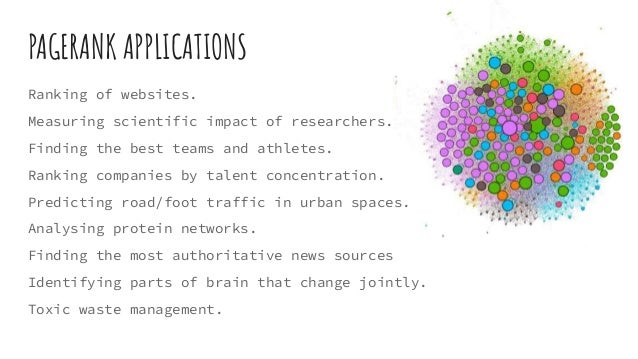
Ranking of websites.
Measuring scientific impact of researchers.
Finding the best teams and athletes.
Ranking companies by talent concentration.
Predicting road/foot traffic in urban spaces.
Analysing protein networks.
Finding the most authoritative news sources
Identifying parts of brain that change jointly.
Toxic waste management.
PAGERANK APPLICATIONS
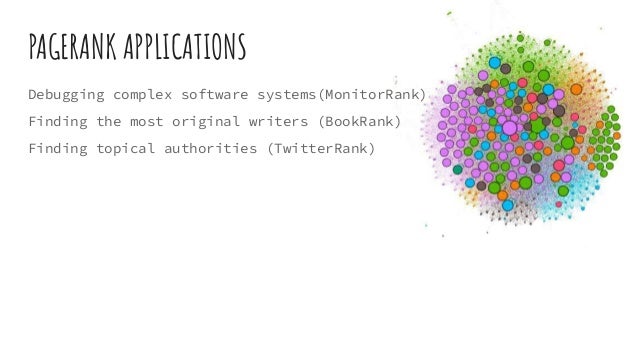
Debugging complex software systems(MonitorRank)
Finding the most original writers (BookRank)
Finding topical authorities (TwitterRank)
WHAT IS PAGERANK
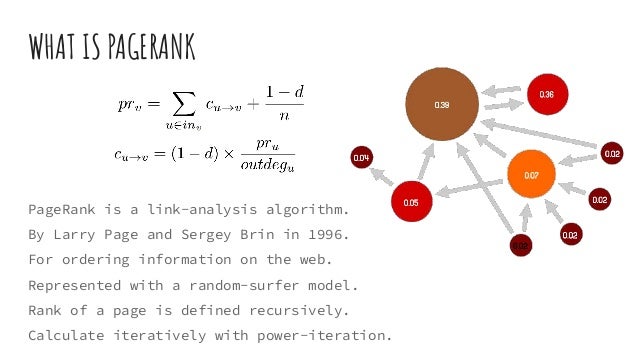
PageRank is a link-analysis algorithm.
By Larry Page and Sergey Brin in 1996.
For ordering information on the web.
Represented with a random-surfer model.
Rank of a page is defined recursively.
Calculate iteratively with power-iteration.
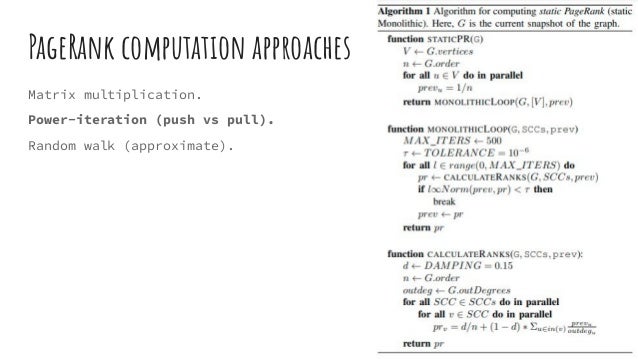
PageRank computation approaches
Matrix multiplication.
Power-iteration (push vs pull).
Random walk (approximate).
Challenges & Limitations
Graphs are massive and constantly updated.
Existing dynamic algorithms do not utilize
reducibility of graphs.
Vertices which are dependent upon other vertices to
converge are still processed.
Locality benefits of SCCs are not explored.
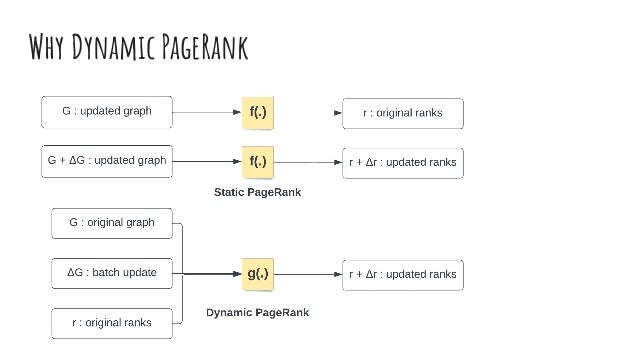
Why Dynamic PageRank
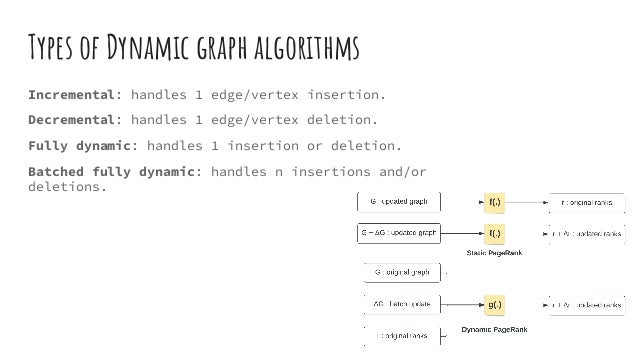
Types of Dynamic graph algorithms
Incremental: handles 1 edge/vertex insertion.
Decremental: handles 1 edge/vertex deletion.
Fully dynamic: handles 1 insertion or deletion.
Batched fully dynamic: handles n insertions and/or
deletions.
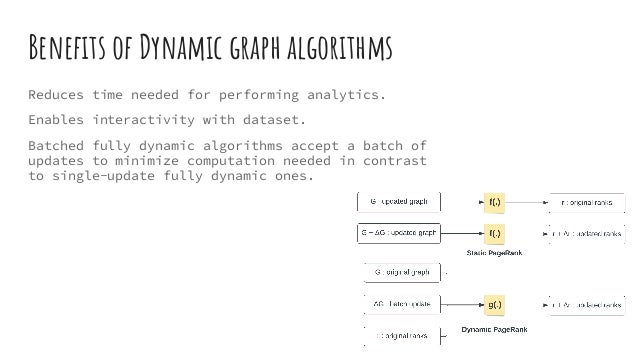
Benefits of Dynamic graph algorithms
Reduces time needed for performing analytics.
Enables interactivity with dataset.
Batched fully dynamic algorithms accept a batch of
updates to minimize computation needed in contrast
to single-update fully dynamic ones.
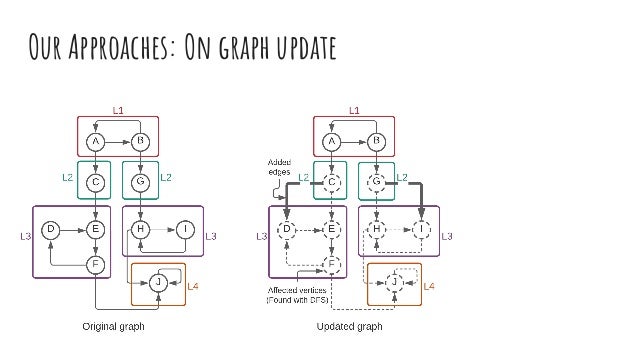
Our Approaches: On graph update
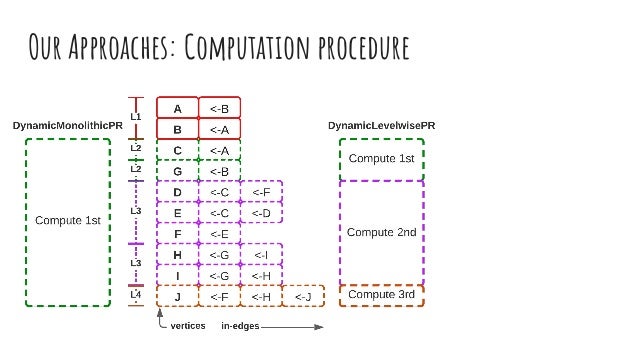
Our Approaches: Computation procedure
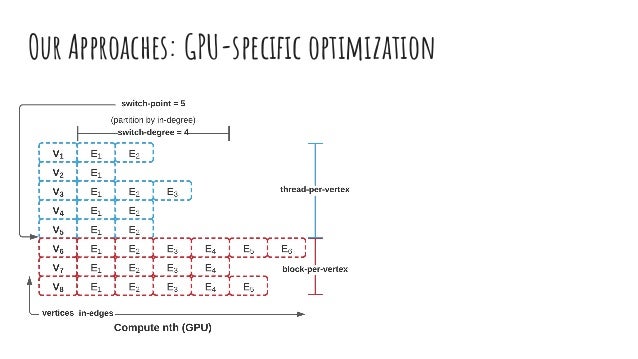
Our Approaches: GPU-specific optimization
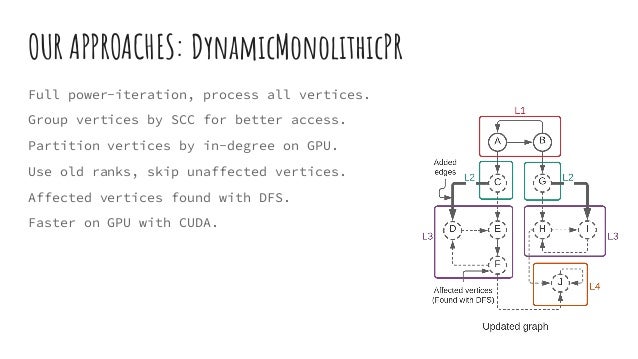
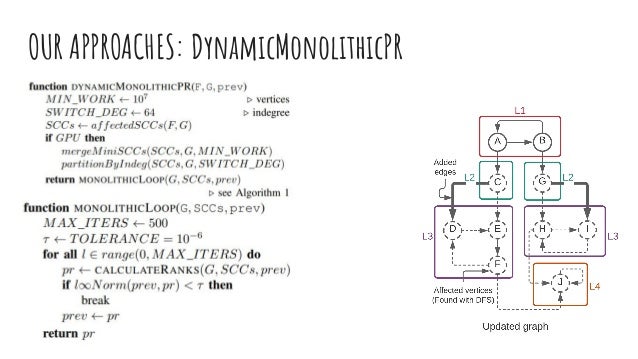
OUR APPROACHES: DynamicMonolithicPR
Full power-iteration, process all vertices.
Group vertices by SCC for better access.
Partition vertices by in-degree on GPU.
Use old ranks, skip unaffected vertices.
Affected vertices found with DFS.
Faster on GPU with CUDA.
OUR APPROACHES: DynamicMonolithicPR
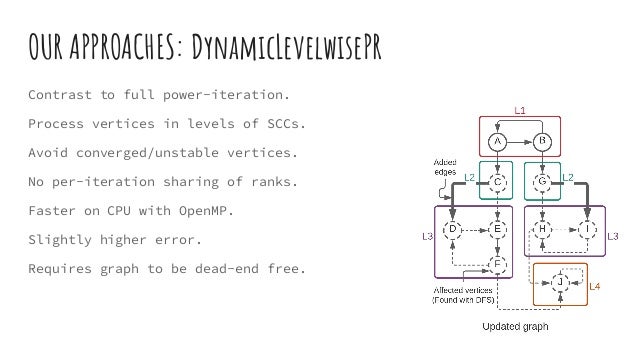
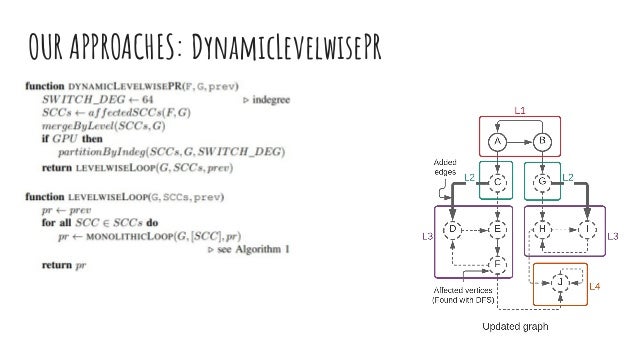
OUR APPROACHES: DynamicLevelwisePR
Contrast to full power-iteration.
Process vertices in levels of SCCs.
Avoid converged/unstable vertices.
No per-iteration sharing of ranks.
Faster on CPU with OpenMP.
Slightly higher error.
Requires graph to be dead-end free.
OUR APPROACHES: DynamicLevelwisePR
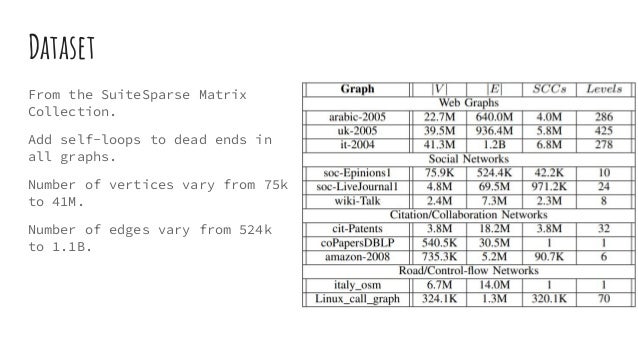
Dataset
From the SuiteSparse Matrix
Collection.
Add self-loops to dead ends in
all graphs.
Number of vertices vary from 75k
to 41M.
Number of edges vary from 524k
to 1.1B.
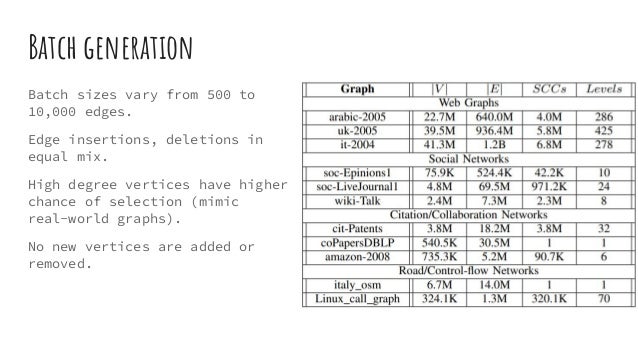
Batch generation
Batch sizes vary from 500 to
10,000 edges.
Edge insertions, deletions in
equal mix.
High degree vertices have higher
chance of selection (mimic
real-world graphs).
No new vertices are added or
removed.
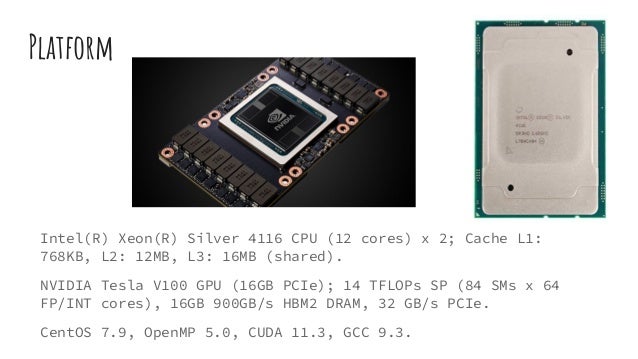
Platform
Intel(R) Xeon(R) Silver 4116 CPU (12 cores) x 2; Cache L1:
768KB, L2: 12MB, L3: 16MB (shared).
NVIDIA Tesla V100 GPU (16GB PCIe); 14 TFLOPs SP (84 SMs x 64
FP/INT cores), 16GB 900GB/s HBM2 DRAM, 32 GB/s PCIe.
CentOS 7.9, OpenMP 5.0, CUDA 11.3, GCC 9.3.
Performance measurement
Damping factor d of 0.15.
Tolerance τ of 10−6.
Maximum of 500 iterations.
32-bit integers for CSR representation.
32-bit floats for rank vector.
L∞-norm for error measurement,
(L2-norm for nvGraph PageRank).
Measured time only rank computation.
Results: Comparison with state-of-the-art
CPU AM time for batches of 500, 1000, 2000, 5000, 10000
6.1×, 8.6× wrt
static plain STIC-D
PR [1].
4.2×, 5.8× wrt Pure
CPU HyPR [2].
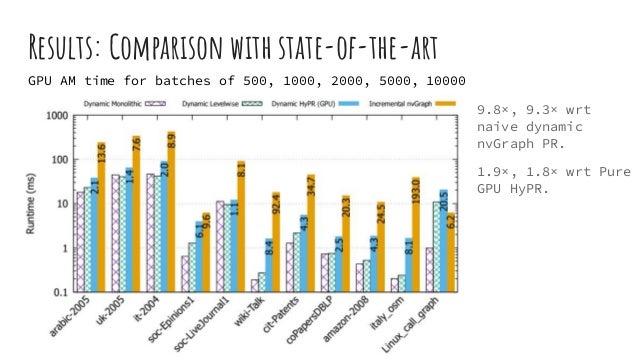
Results: Comparison with state-of-the-art
GPU AM time for batches of 500, 1000, 2000, 5000, 10000
9.8×, 9.3× wrt
naive dynamic
nvGraph PR.
1.9×, 1.8× wrt Pure
GPU HyPR.
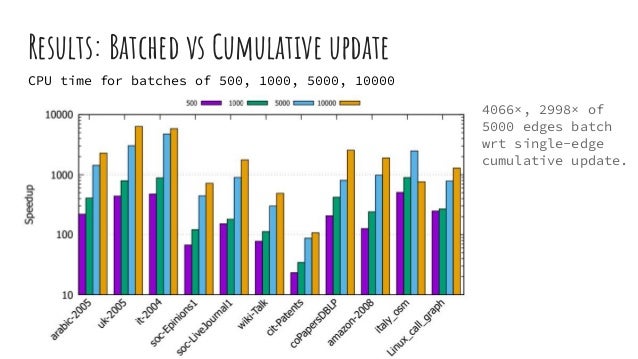
Results: Batched vs Cumulative update
CPU time for batches of 500, 1000, 5000, 10000
4066×, 2998× of
5000 edges batch
wrt single-edge
cumulative update.
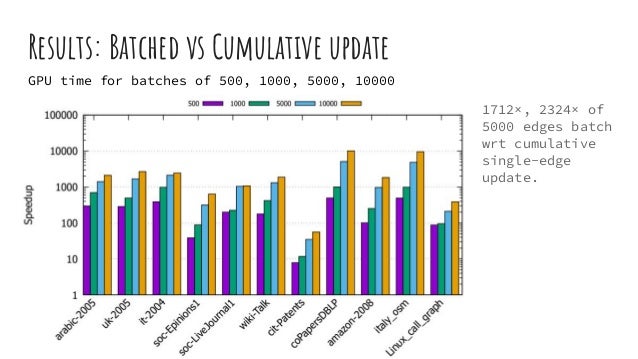
Results: Batched vs Cumulative update
GPU time for batches of 500, 1000, 5000, 10000
1712×, 2324× of
5000 edges batch
wrt cumulative
single-edge
update.
Conclusion
DynamicLevelwisePR is a suitable approach on CPU.
On a GPU, smaller levels should be combined and processed at a time.
On 1 SCC graphs, both algorithms perform ~identically.

Dynamic Batch Parallel Algorithms for Updating Pagerank : SLIDES

  • 1.
    Dynamic Batch Parallel Algorithmsfor Updating PageRank Subhajit Sahu†, Kishore Kothapalli† and Dip Sankar Banerjee‡ †International Institute of Information Technology Hyderabad, India. ‡Indian Institute of Technology Jodhpur, India. subhajit.sahu@research.,kkishore@iiit.ac.in, dipsankarb@iitj.ac.in This work is partially supported by a grant from the Department of Science and Technology (DST), India, under the National Supercomputing Mission (NSM) R&D in Exascale initiative vide Ref. No: DST/NSM/R&D Exascale/2021/16.
  • 2.
    Facebook is takinga page out of Google’s playbook to stop fake news from going viral Published Apr 2019 by Salvador Rodriguez Click-Gap: When is Facebook is driving disproportionate amounts of traffic to websites. Effort to rid fakes news from Facebook’s services. Is a website relying on Facebook to drive significant traffic, but not well ranked by the rest of the web? Also News Citation Graph.
  • 3.
    PAGERANK APPLICATIONS Ranking ofwebsites. Measuring scientific impact of researchers. Finding the best teams and athletes. Ranking companies by talent concentration. Predicting road/foot traffic in urban spaces. Analysing protein networks. Finding the most authoritative news sources Identifying parts of brain that change jointly. Toxic waste management.
  • 4.
    PAGERANK APPLICATIONS Debugging complexsoftware systems(MonitorRank) Finding the most original writers (BookRank) Finding topical authorities (TwitterRank)
  • 5.
    WHAT IS PAGERANK PageRankis a link-analysis algorithm. By Larry Page and Sergey Brin in 1996. For ordering information on the web. Represented with a random-surfer model. Rank of a page is defined recursively. Calculate iteratively with power-iteration.
  • 6.
    PageRank computation approaches Matrixmultiplication. Power-iteration (push vs pull). Random walk (approximate).
  • 7.
    Challenges & Limitations Graphsare massive and constantly updated. Existing dynamic algorithms do not utilize reducibility of graphs. Vertices which are dependent upon other vertices to converge are still processed. Locality benefits of SCCs are not explored.
  • 8.
  • 9.
    Types of Dynamicgraph algorithms Incremental: handles 1 edge/vertex insertion. Decremental: handles 1 edge/vertex deletion. Fully dynamic: handles 1 insertion or deletion. Batched fully dynamic: handles n insertions and/or deletions.
  • 10.
    Benefits of Dynamicgraph algorithms Reduces time needed for performing analytics. Enables interactivity with dataset. Batched fully dynamic algorithms accept a batch of updates to minimize computation needed in contrast to single-update fully dynamic ones.
  • 11.
    Our Approaches: Ongraph update
  • 12.
  • 13.
  • 14.
    OUR APPROACHES: DynamicMonolithicPR Fullpower-iteration, process all vertices. Group vertices by SCC for better access. Partition vertices by in-degree on GPU. Use old ranks, skip unaffected vertices. Affected vertices found with DFS. Faster on GPU with CUDA.
  • 15.
  • 16.
    OUR APPROACHES: DynamicLevelwisePR Contrastto full power-iteration. Process vertices in levels of SCCs. Avoid converged/unstable vertices. No per-iteration sharing of ranks. Faster on CPU with OpenMP. Slightly higher error. Requires graph to be dead-end free.
  • 17.
  • 18.
    Dataset From the SuiteSparseMatrix Collection. Add self-loops to dead ends in all graphs. Number of vertices vary from 75k to 41M. Number of edges vary from 524k to 1.1B.
  • 19.
    Batch generation Batch sizesvary from 500 to 10,000 edges. Edge insertions, deletions in equal mix. High degree vertices have higher chance of selection (mimic real-world graphs). No new vertices are added or removed.
  • 20.
    Platform Intel(R) Xeon(R) Silver4116 CPU (12 cores) x 2; Cache L1: 768KB, L2: 12MB, L3: 16MB (shared). NVIDIA Tesla V100 GPU (16GB PCIe); 14 TFLOPs SP (84 SMs x 64 FP/INT cores), 16GB 900GB/s HBM2 DRAM, 32 GB/s PCIe. CentOS 7.9, OpenMP 5.0, CUDA 11.3, GCC 9.3.
  • 21.
    Performance measurement Damping factord of 0.15. Tolerance τ of 10−6. Maximum of 500 iterations. 32-bit integers for CSR representation. 32-bit floats for rank vector. L∞-norm for error measurement, (L2-norm for nvGraph PageRank). Measured time only rank computation.
  • 22.
    Results: Comparison withstate-of-the-art CPU AM time for batches of 500, 1000, 2000, 5000, 10000 6.1×, 8.6× wrt static plain STIC-D PR [1]. 4.2×, 5.8× wrt Pure CPU HyPR [2].
  • 23.
    Results: Comparison withstate-of-the-art GPU AM time for batches of 500, 1000, 2000, 5000, 10000 9.8×, 9.3× wrt naive dynamic nvGraph PR. 1.9×, 1.8× wrt Pure GPU HyPR.
  • 24.
    Results: Batched vsCumulative update CPU time for batches of 500, 1000, 5000, 10000 4066×, 2998× of 5000 edges batch wrt single-edge cumulative update.
  • 25.
    Results: Batched vsCumulative update GPU time for batches of 500, 1000, 5000, 10000 1712×, 2324× of 5000 edges batch wrt cumulative single-edge update.
  • 26.
    Conclusion DynamicLevelwisePR is asuitable approach on CPU. On a GPU, smaller levels should be combined and processed at a time. On 1 SCC graphs, both algorithms perform ~identically.