
Dying To Be Thin
Dr. Amr Ahmed Kamal
Senior Registrar of psychiatry
Msc (N&P), Ain Shams university
Egyptian board psych
Eating Disorders
An Overview
 Eating disorders have increased threefold in the last 50 years
 10% of the population is afflicted with an eating disorder
 90% of the cases are young women and adolescent girls
What are Eating Disorders?What are Eating Disorders?
 A complex conditions that arise
from a combination of long-
standing behavioral, emotional,
psychological, interpersonal, and
social factors.
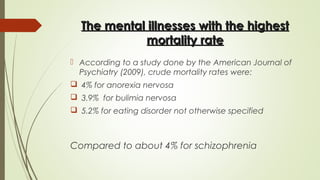
The mental illnesses with the highestThe mental illnesses with the highest
mortality ratemortality rate
 According to a study done by the American Journal of
Psychiatry (2009), crude mortality rates were:
 4% for anorexia nervosa
 3.9%  for bulimia nervosa
 5.2% for eating disorder not otherwise specified
Compared to about 4% for schizophrenia
What are they?What are they?
 People with eating disorders often use
food and the control of food in an
attempt to compensate for feelings and
emotions that may otherwise seem over-
whelming.
 For some; dieting, bingeing, and purging
may begin as a way to cope with painful
emotions and to feel in control of one’s
life
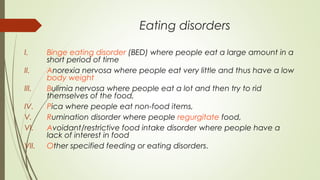
Eating disorders
I. Binge eating disorder (BED) where people eat a large amount in a
short period of time
II. Anorexia nervosa where people eat very little and thus have a low
body weight
III. Bulimia nervosa where people eat a lot and then try to rid
themselves of the food,
IV. Pica where people eat non-food items,
V. Rumination disorder where people regurgitate food,
VI. Avoidant/restrictive food intake disorder where people have a
lack of interest in food
VII. Other specified feeding or eating disorders.
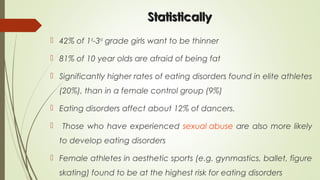
StatisticallyStatistically
 42% of 1st
-3rd
grade girls want to be thinner
 81% of 10 year olds are afraid of being fat
 Significantly higher rates of eating disorders found in elite athletes
(20%), than in a female control group (9%)
 Eating disorders affect about 12% of dancers.
 Those who have experienced sexual abuse are also more likely
to develop eating disorders
 Female athletes in aesthetic sports (e.g. gynmastics, ballet, figure
skating) found to be at the highest risk for eating disorders
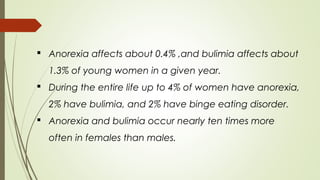
 Anorexia affects about 0.4% ,and bulimia affects about
1.3% of young women in a given year.
 During the entire life up to 4% of women have anorexia,
2% have bulimia, and 2% have binge eating disorder.
 Anorexia and bulimia occur nearly ten times more
often in females than males.
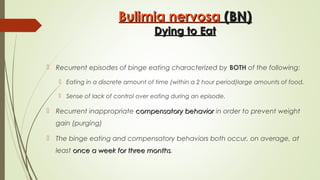
Bulimia nervosaBulimia nervosa (BN)(BN)
Dying to EatDying to Eat
 Recurrent episodes of binge eating characterized by BOTH of the following:
 Eating in a discrete amount of time (within a 2 hour period)large amounts of food.
 Sense of lack of control over eating during an episode.
 Recurrent inappropriate compensatory behaviorcompensatory behavior in order to prevent weight
gain (purging)
 The binge eating and compensatory behaviors both occur, on average, at
least once a week for three monthsonce a week for three months.
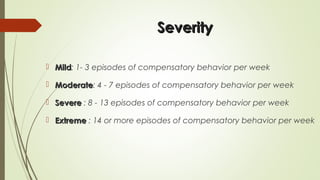
SeveritySeverity
 MildMild: 1- 3 episodes of compensatory behavior per week
 ModerateModerate: 4 - 7 episodes of compensatory behavior per week
 SevereSevere : 8 - 13 episodes of compensatory behavior per week
 ExtremeExtreme : 14 or more episodes of compensatory behavior per week
Anorexia nervosa (AN)Anorexia nervosa (AN)
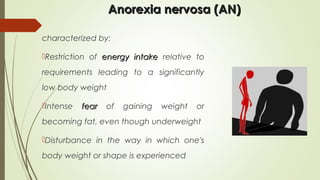
characterized by:
Restriction of energy intakeenergy intake relative to
requirements leading to a significantly
low body weight
Intense fearfear of gaining weight or
becoming fat, even though underweight
Disturbance in the way in which one's
body weight or shape is experienced
 The DSM-5 specifies two subtypes of anorexia nervosa:
the restrictingrestricting type and the binge/purgebinge/purge type.
1.Restricting type restrict food intake and do not engage in
binge eating
2.Binge/purge type lose control over their eating at least
occasionally and may compensate for these binge episodes.
SubtypesSubtypes
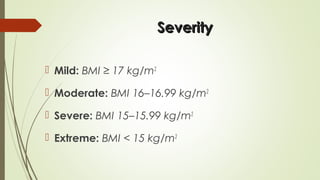
SeveritySeverity
 Mild: BMI ≥ 17 kg/m2
 Moderate: BMI 16–16.99 kg/m2
 Severe: BMI 15–15.99 kg/m2
 Extreme: BMI < 15 kg/m2
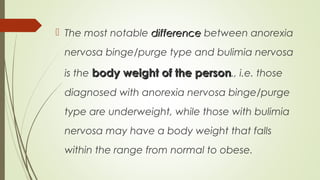
 The most notable differencedifference between anorexia
nervosa binge/purge type and bulimia nervosa
is the body weight of the personbody weight of the person., i.e. those
diagnosed with anorexia nervosa binge/purge
type are underweight, while those with bulimia
nervosa may have a body weight that falls
within the range from normal to obese.
Too Fat to Fit through the Door: First
Evidence for Disturbed Body-Scaled Action
in Anorexia Nervosa
 AN patients started rotating for openings 40% wider than40% wider than
their own shoulderstheir own shoulders, while normal persons started
rotating for apertures only 25% wider than their
shoulders. The results imply abnormalities in AN even at
the level of the unconscious, action oriented body
schema They do not only affect (conscious) cognition
and perception, but (unconscious) actions as well
 Open door test
Anorexia can cause menstruation to stop
(AmenorrheaAmenorrhea) and often leads to bone loss, loss of skin integrity,
etc.
 The DSM-IV required amenorrhea to be present
in order to diagnose a patient with anorexia
This is no longer a requirement in the
DSM-5.
 The risk of DEATH is greatly increased in individuals with this disease (4%)
 The most underlining factor researchers are starting to take notice of is that it
may not just be a vanity, social, or media issue, but it could also be related to
biological and or genetic components.
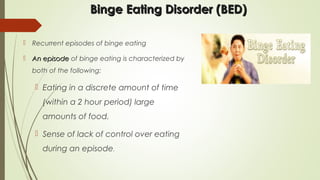
Binge Eating Disorder (BED)Binge Eating Disorder (BED)
 Recurrent episodes of binge eating
 An episodeAn episode of binge eating is characterized by
both of the following:
 Eating in a discrete amount of time
(within a 2 hour period) large
amounts of food.
 Sense of lack of control over eating
during an episode.
 The binge-eating episodes are associatedassociated with three (orthree (or
more)more) of the following:
 Eating much more rapidlyrapidly than normal
 Eating until feeling uncomfortably full uncomfortably full 
 Eating large amounts of food when not feeling physically hungrynot feeling physically hungry 
 Eating aloneEating alone because of feeling embarrassedembarrassed by how much one
is eating
 Feeling disgusted with oneself, depressed, or very guiltyvery guilty afterwards
 At least once a week for three monthsonce a week for three months.
Other Specified Feeding or Eating DisorderOther Specified Feeding or Eating Disorder
(OSFED)(OSFED)
An eating or feeding disorder that does not meet full DSM-5 criteria for AN, BN, or BED.
Atypical anorexia nervosaAtypical anorexia nervosa, who meet all criteria for AN except being underweight,
despite substantial weight loss
Atypical bulimia nervosaAtypical bulimia nervosa, who meet all criteria for BN except that bulimic behaviors
are less frequent or have not been ongoing for long enough
Purging disorder:Purging disorder: recurrent purging (self-induced vomiting, misuse of laxatives,
diuretics, or enemas) to control weight or shape in the absence of binge eating
episodes that occurs in people with normal or near-normal weight
Night eating syndrome (NES)
 Delayed circadian patterncircadian pattern of food intake.
 Currently included in the other specified feeding or eating disorder
category of the DSM-5
 Research diagnostic criteria have been proposed and include eveningevening
hyperphagiahyperphagia (consumption of 25% or more of the total daily calories after
the evening meal) and/or nocturnal awakeningnocturnal awakening and ingestion of food two
or more times per week.
 The person must have awarenessawareness of the night eating to differentiate it from
the parasomnia sleep-related eating disorder (SRED).parasomnia sleep-related eating disorder (SRED).
 Three of five associated symptomsThree of five associated symptoms must also be present:
i. Lack of morning hunger
ii. Urges to eat in the evening/at night
iii. Belief that one must eat in order to fall back to sleep
at night
iv. Depressed mood
v. And/or difficulty sleeping
 NES affects both men and women, between 1 and 2% of the1 and 2% of the
general populationgeneral population, and approximately 10% of obese individuals10% of obese individuals.
 Consuming foods rich in serotoninfoods rich in serotonin has been suggested to aid in the
treatment of NES.
Others
in the appendix
Compulsive overeating (COE)Compulsive overeating (COE)
Individuals habitually graze on large
quantities of food rather than binging,
as would be typical of binge eating
disorder.
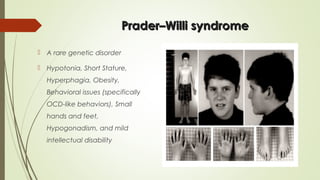
Prader–Willi syndromePrader–Willi syndrome
 A rare genetic disorder
 Hypotonia, Short Stature,
Hyperphagia, Obesity,
Behavioral issues (specifically
OCD-like behaviors), Small
hands and feet,
Hypogonadism, and mild
intellectual disability
Diabulimia,Diabulimia,
 Deliberate manipulation of insulin levels by
diabetics in an effort to control their weight
Orthorexia NervosaOrthorexia Nervosa
 An obsession with a "pure" diet, in which people develop
an obsession with avoiding unhealthy foods to the point
where it interferes with a person's life
Selective eating disorder(SED)Selective eating disorder(SED)
 Also called picky eating
 An extreme sensitivity to how something tastes.
 A person with SED may or may not be a supertaster.
DrunkorexiaDrunkorexia
 Purposely restricting food intake in order to
reserve food calories for alcoholic calories,
exercising excessively in order to burn calories
consumed from drinking, and over-drinking
alcohols in order to purge previously
consumed food.
PregorexiaPregorexia
 Extreme dieting and over-exercising in
order to control pregnancy weight gain
Gourmand syndromeGourmand syndrome
 A rare condition occurring after damage to the frontal
lobe, resulting in an obsessive focus on fine foods.
Assessment of Eating DisordersAssessment of Eating Disorders
 No specific tests to diagnoseNo specific tests to diagnose
 No routine screening for eating disordersNo routine screening for eating disorders
 Medical history, physical exam, and specificMedical history, physical exam, and specific
screening questions, along with otherscreening questions, along with other
assessment tests help to identify eating disordersassessment tests help to identify eating disorders
What should an assessment include?What should an assessment include?
 A full physical exam
 Laboratory and other diagnostic tests
 A general diagnostic interview
 Specific interview that goes into more detail about symptoms
I.I. Thorough Medical AssessmentThorough Medical Assessment
A.A. Physical ExamPhysical Exam
 Check weight
 Blood pressure, pulse, and temperature
 Heart and lungs
 Tooth enamel and gums
A.A. Nutritional assessment/evaluationNutritional assessment/evaluation
 Eating patterns
 Biochemistry assessment—how chemistry with eating disorders
contributes to additional appetite decline and decreased
nutritional intake
C.C. Lab & other diagnostic testsLab & other diagnostic tests
 Blood tests
 X-rays
 Other tests for heart and kidneys
C.C. InterviewsInterviews
 History of body weight
 History of dieting
 Eating behaviors
 All weight-loss related behaviors
 Past and present stressors
 Body image perception and dissatisfaction
II.II. Mental Health AssessmentMental Health Assessment
 Screen for depression
 Self-esteem
 Anxiety
 Appearance, mood, behavior, thinking, memory
 Substance, physical, or sexual abuse
 Any mental disorders?
A.A. Screening QuestionsScreening Questions
 Some sample questions to ask during an interview include:
 How many diets have you been on in the past year?
 Do you think you should be dieting?
 Are you dissatisfied with your body size?
 Does your weight affect the way you think about yourself?
 Any positive responses to these questions should prompt
further evaluation using a more comprehensive questionnaire
B.B. Assessment ToolsAssessment Tools
 There are numerous tests that can be used to
assess eating disorders
 EAT, PBIS, FRS, and SCOFF are some of the more
popular tests
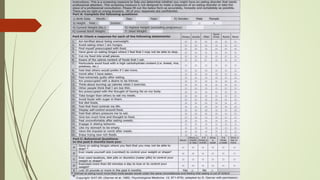
1.1. Eating Attitudes Test (EAT – 26)Eating Attitudes Test (EAT – 26)
 26 item self-reportself-report questionnaire broken down into 3
subscales
 Dieting
 Bulimia & food preoccupation
 Oral control
2.2. PBIS (Perceived Body Image Scale)PBIS (Perceived Body Image Scale)
 Provides an evaluation of body image dissatisfactionbody image dissatisfaction &
distortion in eating disordered patients
 A visual rating scale
 11 cards11 cards containing figure drawings of bodies ranging
from emaciated to obese
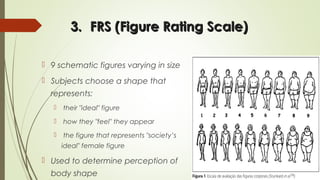
3.3. FRS (Figure Rating Scale)FRS (Figure Rating Scale)
 9 schematic figures varying in size
 Subjects choose a shape that
represents:
 their "ideal" figure
 how they "feel" they appear
 the figure that represents "society’s
ideal" female figure
 Used to determine perception of
body shape
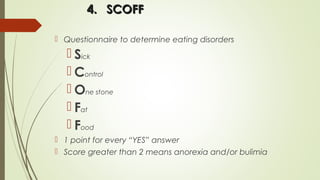
4.4. SCOFFSCOFF
 Questionnaire to determine eating disorders
 Sick
 Control
 One stone
 Fat
 Food
 1 point for every “YES” answer
 Score greater than 2 means anorexia and/or bulimia
Treatment StrategiesTreatment Strategies
for Eating disordersfor Eating disorders
1. Psychiatric management
i. Coordinating care and collaborating with other clinicians
ii. Assessing and monitoring eating disorder symptoms and behaviors
iii. Assessing and monitoring the patient’s general medical condition
iv. Assessing and monitoring the patient’s safety and psychiatric status
v. Providing family assessment and treatment
2. Choosing a treatment site
Ranges from intensive inpatient programsintensive inpatient programs (in which
general medical care is readily available) to residentialresidential
and partial hospitalizationand partial hospitalization programs to varying levels of
outpatient careoutpatient care (in which the patient receives general
medical treatment, nutritional counseling, and/or
individual, group, and family psychotherapy).
3. Choice of specific treatments for
ANOREXIA NERVOSA
a) Nutritional rehabilitation
 Vitamins and minerals
 Electrolytes: hypokalemia and hypophosphatemia
 Osteoporosis
The goals :
a) Restore weight ; an average weekly weight gain of 0.5–1 kg in
inpatient settings and 0.5 kg in outpatient settings should be an aim
of treatment. This requires about 3500 to 7000 extra calories a week.
 Normalize eating patterns
 Achieve normal perceptions of hunger and satiety
 Correct biological and psychological sequelae of malnutrition
Feeding against the will of the patientFeeding against the will of the patient
 A highly specialised procedure requiring expertise in the care and
management of those with severe eating disorders and the physical
complications associated with it.
 This should only be done in the context of the Mental
Health Act
b) Psychosocial interventions
The goals :
 Understand and cooperate with their nutritional and physical
rehabilitation
 Understand and change the behaviors and dysfunctional
attitudes related to their eating disorder
 Improve their interpersonal and social functioning
 Address comorbid psychopathology and psychological conflicts
that reinforce or maintain eating disorder behaviors.
c) Medications and other somatic treatments
I. Weight restoration (Acute illness)
 Antidepressants
 SSRIs in combination with psychotherapySSRIs in combination with psychotherapy are widely used in treating patients
with anorexia nervosa
 FDA black box warning concerning the use of bupropionbupropion in patients with
eating disorders has been issued because of the increased seizure risk in these
patients.
 Adverse reactions to tricyclic antidepressants and monoamine oxidasetricyclic antidepressants and monoamine oxidase
inhibitors (MAOIs)inhibitors (MAOIs) are more pronounced in malnourished individuals, and these
medications should generally be avoided in this patient population
 Second-generation antipsychoticsSecond-generation antipsychotics, particularly olanzapine,olanzapine,
risperidone, and quetiapinerisperidone, and quetiapine, have been used in small series
and individual cases for patients, but controlled studies of
these medications are lacking. Clinical impressions suggest
that they may be useful in patients with severe, unremittingsevere, unremitting
resistance to gaining weight; severe obsessional thinking; andresistance to gaining weight; severe obsessional thinking; and
denial that assumes delusional proportionsdenial that assumes delusional proportions
 Small doses of older antipsychoticsSmall doses of older antipsychotics such as chlorpromazine
may be helpful prior to meals in very disturbed patients
II. Relapse prevention
 Some data suggest that fluoxetine in dosages of
up to 60 mg/day60 mg/day may help prevent relapse
 For patients receiving cognitive-behavioral
therapy (CBT)(CBT) after weight restoration, adding
fluoxetine does not appear to confer additional
benefits with respect to preventing relapse
4. Choice of specific treatments for
BULIMIA NERVOSABULIMIA NERVOSA
1. Reduce and, where possible, eliminateeliminate binge eating and purging
2. Treat physical complicationsphysical complications of bulimia nervosa
3. Enhance patients’ motivationmotivation to cooperate in the restoration of healthy eating patterns
and participate in treatment
4. Provide educationeducation regarding healthy nutrition and eating patterns
5. Help patients reassess and changereassess and change core dysfunctional thoughtsthoughts, attitudes, motives,
conflicts, and feelings related to the eating disorder
6.6. Treat associated psychiatric conditionsTreat associated psychiatric conditions, including deficits in mood and impulse
regulation, self-esteem, and behavior
7. Enlist family supportfamily support and provide family counseling and therapy where appropriate
a) Nutritional rehabilitation
 A primary focus for nutritional rehabilitation is to help the
patient develop a structured mealstructured meal
 Plan as a means of reducing the episodesreducing the episodes of dietary
restriction and the urges to binge and purge.
 AdequateAdequate nutritional intake can prevent craving and
promote satiety
b) Psychosocial interventions
c)Medications
i. Initial treatment (Acute illness)
I. Antidepressants
II. are effective as one component of an initial treatment program for
most bulimia nervosa patients , with SSRI treatment having the most
evidence for efficacy and the fewest difficulties with adverse effects.
III. To date, fluoxetinefluoxetine is the best studied of these and is the only FDA-
approved medication for bulimia nervosa.
IV.IV. SertralineSertraline is the only other SSRI that has been shown to be effective,
as demonstrated in a small, randomized controlled trial.
 In the absence of therapiststherapists qualified to treat bulimia
nervosa with CBT, fluoxetinefluoxetine is recommended as an initial
treatment .
 Dosages of SSRIs higherhigher than those used for depression
(e.g., fluoxetine 60 mg/day) are more effective in
treating bulimic symptoms
 Tricyclic antidepressants and MAOIsTricyclic antidepressants and MAOIs have been rarely
used with bulimic patients and are not recommended as
initial treatments
 Small controlled trials have demonstrated the efficacy of the
anticonvulsant medication topiramate,topiramate, but because adverse
reactions to this medication are common, it should be used
only when other medications have proven ineffective
ii. Maintenance phase
 Limited evidence supports the use of fluoxetinefluoxetine for relapse
prevention , but substantial rates of relapse occur even with
treatment.
 In the absence of adequate data, most clinicians recommend
continuing antidepressant therapy for a minimum of 9 months9 months
and probably for a year in most patients with bulimia nervosa
iii. Combining psychosocial interventions
and medications
 In some research, the combination of antidepressant therapyantidepressant therapy
and CBTand CBT results in the highest remission rates
Dying to be thin eating disorders overview

Dying to be thin eating disorders overview

  • 1.
    Dying To BeThin Dr. Amr Ahmed Kamal Senior Registrar of psychiatry Msc (N&P), Ain Shams university Egyptian board psych
  • 2.
  • 3.
     Eating disordershave increased threefold in the last 50 years  10% of the population is afflicted with an eating disorder  90% of the cases are young women and adolescent girls
  • 4.
    What are EatingDisorders?What are Eating Disorders?  A complex conditions that arise from a combination of long- standing behavioral, emotional, psychological, interpersonal, and social factors.
  • 5.
    The mental illnesseswith the highestThe mental illnesses with the highest mortality ratemortality rate  According to a study done by the American Journal of Psychiatry (2009), crude mortality rates were:  4% for anorexia nervosa  3.9%  for bulimia nervosa  5.2% for eating disorder not otherwise specified Compared to about 4% for schizophrenia
  • 6.
    What are they?Whatare they?  People with eating disorders often use food and the control of food in an attempt to compensate for feelings and emotions that may otherwise seem over- whelming.
  • 7.
     For some;dieting, bingeing, and purging may begin as a way to cope with painful emotions and to feel in control of one’s life
  • 8.
    Eating disorders I. Bingeeating disorder (BED) where people eat a large amount in a short period of time II. Anorexia nervosa where people eat very little and thus have a low body weight III. Bulimia nervosa where people eat a lot and then try to rid themselves of the food, IV. Pica where people eat non-food items, V. Rumination disorder where people regurgitate food, VI. Avoidant/restrictive food intake disorder where people have a lack of interest in food VII. Other specified feeding or eating disorders.
  • 9.
    StatisticallyStatistically  42% of1st -3rd grade girls want to be thinner  81% of 10 year olds are afraid of being fat  Significantly higher rates of eating disorders found in elite athletes (20%), than in a female control group (9%)  Eating disorders affect about 12% of dancers.  Those who have experienced sexual abuse are also more likely to develop eating disorders  Female athletes in aesthetic sports (e.g. gynmastics, ballet, figure skating) found to be at the highest risk for eating disorders
  • 10.
     Anorexia affectsabout 0.4% ,and bulimia affects about 1.3% of young women in a given year.  During the entire life up to 4% of women have anorexia, 2% have bulimia, and 2% have binge eating disorder.  Anorexia and bulimia occur nearly ten times more often in females than males.
  • 11.
    Bulimia nervosaBulimia nervosa(BN)(BN) Dying to EatDying to Eat  Recurrent episodes of binge eating characterized by BOTH of the following:  Eating in a discrete amount of time (within a 2 hour period)large amounts of food.  Sense of lack of control over eating during an episode.  Recurrent inappropriate compensatory behaviorcompensatory behavior in order to prevent weight gain (purging)  The binge eating and compensatory behaviors both occur, on average, at least once a week for three monthsonce a week for three months.
  • 12.
    SeveritySeverity  MildMild: 1-3 episodes of compensatory behavior per week  ModerateModerate: 4 - 7 episodes of compensatory behavior per week  SevereSevere : 8 - 13 episodes of compensatory behavior per week  ExtremeExtreme : 14 or more episodes of compensatory behavior per week
  • 13.
    Anorexia nervosa (AN)Anorexianervosa (AN) characterized by: Restriction of energy intakeenergy intake relative to requirements leading to a significantly low body weight Intense fearfear of gaining weight or becoming fat, even though underweight Disturbance in the way in which one's body weight or shape is experienced
  • 14.
     The DSM-5specifies two subtypes of anorexia nervosa: the restrictingrestricting type and the binge/purgebinge/purge type. 1.Restricting type restrict food intake and do not engage in binge eating 2.Binge/purge type lose control over their eating at least occasionally and may compensate for these binge episodes. SubtypesSubtypes
  • 15.
    SeveritySeverity  Mild: BMI ≥17 kg/m2  Moderate: BMI 16–16.99 kg/m2  Severe: BMI 15–15.99 kg/m2  Extreme: BMI < 15 kg/m2
  • 16.
     The mostnotable differencedifference between anorexia nervosa binge/purge type and bulimia nervosa is the body weight of the personbody weight of the person., i.e. those diagnosed with anorexia nervosa binge/purge type are underweight, while those with bulimia nervosa may have a body weight that falls within the range from normal to obese.
  • 17.
    Too Fat toFit through the Door: First Evidence for Disturbed Body-Scaled Action in Anorexia Nervosa  AN patients started rotating for openings 40% wider than40% wider than their own shoulderstheir own shoulders, while normal persons started rotating for apertures only 25% wider than their shoulders. The results imply abnormalities in AN even at the level of the unconscious, action oriented body schema They do not only affect (conscious) cognition and perception, but (unconscious) actions as well  Open door test
  • 18.
    Anorexia can causemenstruation to stop (AmenorrheaAmenorrhea) and often leads to bone loss, loss of skin integrity, etc.  The DSM-IV required amenorrhea to be present in order to diagnose a patient with anorexia This is no longer a requirement in the DSM-5.
  • 19.
     The riskof DEATH is greatly increased in individuals with this disease (4%)  The most underlining factor researchers are starting to take notice of is that it may not just be a vanity, social, or media issue, but it could also be related to biological and or genetic components.
  • 20.
    Binge Eating Disorder(BED)Binge Eating Disorder (BED)  Recurrent episodes of binge eating  An episodeAn episode of binge eating is characterized by both of the following:  Eating in a discrete amount of time (within a 2 hour period) large amounts of food.  Sense of lack of control over eating during an episode.
  • 21.
     The binge-eatingepisodes are associatedassociated with three (orthree (or more)more) of the following:  Eating much more rapidlyrapidly than normal  Eating until feeling uncomfortably full uncomfortably full   Eating large amounts of food when not feeling physically hungrynot feeling physically hungry   Eating aloneEating alone because of feeling embarrassedembarrassed by how much one is eating  Feeling disgusted with oneself, depressed, or very guiltyvery guilty afterwards  At least once a week for three monthsonce a week for three months.
  • 22.
    Other Specified Feedingor Eating DisorderOther Specified Feeding or Eating Disorder (OSFED)(OSFED) An eating or feeding disorder that does not meet full DSM-5 criteria for AN, BN, or BED. Atypical anorexia nervosaAtypical anorexia nervosa, who meet all criteria for AN except being underweight, despite substantial weight loss Atypical bulimia nervosaAtypical bulimia nervosa, who meet all criteria for BN except that bulimic behaviors are less frequent or have not been ongoing for long enough Purging disorder:Purging disorder: recurrent purging (self-induced vomiting, misuse of laxatives, diuretics, or enemas) to control weight or shape in the absence of binge eating episodes that occurs in people with normal or near-normal weight
  • 23.
    Night eating syndrome(NES)  Delayed circadian patterncircadian pattern of food intake.  Currently included in the other specified feeding or eating disorder category of the DSM-5  Research diagnostic criteria have been proposed and include eveningevening hyperphagiahyperphagia (consumption of 25% or more of the total daily calories after the evening meal) and/or nocturnal awakeningnocturnal awakening and ingestion of food two or more times per week.  The person must have awarenessawareness of the night eating to differentiate it from the parasomnia sleep-related eating disorder (SRED).parasomnia sleep-related eating disorder (SRED).
  • 24.
     Three offive associated symptomsThree of five associated symptoms must also be present: i. Lack of morning hunger ii. Urges to eat in the evening/at night iii. Belief that one must eat in order to fall back to sleep at night iv. Depressed mood v. And/or difficulty sleeping  NES affects both men and women, between 1 and 2% of the1 and 2% of the general populationgeneral population, and approximately 10% of obese individuals10% of obese individuals.  Consuming foods rich in serotoninfoods rich in serotonin has been suggested to aid in the treatment of NES.
  • 25.
  • 26.
    Compulsive overeating (COE)Compulsiveovereating (COE) Individuals habitually graze on large quantities of food rather than binging, as would be typical of binge eating disorder.
  • 27.
    Prader–Willi syndromePrader–Willi syndrome A rare genetic disorder  Hypotonia, Short Stature, Hyperphagia, Obesity, Behavioral issues (specifically OCD-like behaviors), Small hands and feet, Hypogonadism, and mild intellectual disability
  • 28.
    Diabulimia,Diabulimia,  Deliberate manipulationof insulin levels by diabetics in an effort to control their weight
  • 29.
    Orthorexia NervosaOrthorexia Nervosa An obsession with a "pure" diet, in which people develop an obsession with avoiding unhealthy foods to the point where it interferes with a person's life
  • 30.
    Selective eating disorder(SED)Selectiveeating disorder(SED)  Also called picky eating  An extreme sensitivity to how something tastes.  A person with SED may or may not be a supertaster.
  • 31.
    DrunkorexiaDrunkorexia  Purposely restrictingfood intake in order to reserve food calories for alcoholic calories, exercising excessively in order to burn calories consumed from drinking, and over-drinking alcohols in order to purge previously consumed food.
  • 32.
    PregorexiaPregorexia  Extreme dietingand over-exercising in order to control pregnancy weight gain
  • 33.
    Gourmand syndromeGourmand syndrome A rare condition occurring after damage to the frontal lobe, resulting in an obsessive focus on fine foods.
  • 34.
    Assessment of EatingDisordersAssessment of Eating Disorders
  • 35.
     No specifictests to diagnoseNo specific tests to diagnose  No routine screening for eating disordersNo routine screening for eating disorders  Medical history, physical exam, and specificMedical history, physical exam, and specific screening questions, along with otherscreening questions, along with other assessment tests help to identify eating disordersassessment tests help to identify eating disorders
  • 36.
    What should anassessment include?What should an assessment include?  A full physical exam  Laboratory and other diagnostic tests  A general diagnostic interview  Specific interview that goes into more detail about symptoms
  • 37.
    I.I. Thorough MedicalAssessmentThorough Medical Assessment A.A. Physical ExamPhysical Exam  Check weight  Blood pressure, pulse, and temperature  Heart and lungs  Tooth enamel and gums A.A. Nutritional assessment/evaluationNutritional assessment/evaluation  Eating patterns  Biochemistry assessment—how chemistry with eating disorders contributes to additional appetite decline and decreased nutritional intake
  • 38.
    C.C. Lab &other diagnostic testsLab & other diagnostic tests  Blood tests  X-rays  Other tests for heart and kidneys C.C. InterviewsInterviews  History of body weight  History of dieting  Eating behaviors  All weight-loss related behaviors  Past and present stressors  Body image perception and dissatisfaction
  • 39.
    II.II. Mental HealthAssessmentMental Health Assessment  Screen for depression  Self-esteem  Anxiety  Appearance, mood, behavior, thinking, memory  Substance, physical, or sexual abuse  Any mental disorders?
  • 40.
    A.A. Screening QuestionsScreeningQuestions  Some sample questions to ask during an interview include:  How many diets have you been on in the past year?  Do you think you should be dieting?  Are you dissatisfied with your body size?  Does your weight affect the way you think about yourself?  Any positive responses to these questions should prompt further evaluation using a more comprehensive questionnaire
  • 41.
    B.B. Assessment ToolsAssessmentTools  There are numerous tests that can be used to assess eating disorders  EAT, PBIS, FRS, and SCOFF are some of the more popular tests
  • 42.
    1.1. Eating AttitudesTest (EAT – 26)Eating Attitudes Test (EAT – 26)  26 item self-reportself-report questionnaire broken down into 3 subscales  Dieting  Bulimia & food preoccupation  Oral control
  • 44.
    2.2. PBIS (PerceivedBody Image Scale)PBIS (Perceived Body Image Scale)  Provides an evaluation of body image dissatisfactionbody image dissatisfaction & distortion in eating disordered patients  A visual rating scale  11 cards11 cards containing figure drawings of bodies ranging from emaciated to obese
  • 45.
    3.3. FRS (FigureRating Scale)FRS (Figure Rating Scale)  9 schematic figures varying in size  Subjects choose a shape that represents:  their "ideal" figure  how they "feel" they appear  the figure that represents "society’s ideal" female figure  Used to determine perception of body shape
  • 46.
    4.4. SCOFFSCOFF  Questionnaireto determine eating disorders  Sick  Control  One stone  Fat  Food  1 point for every “YES” answer  Score greater than 2 means anorexia and/or bulimia
  • 47.
    Treatment StrategiesTreatment Strategies forEating disordersfor Eating disorders
  • 48.
    1. Psychiatric management i.Coordinating care and collaborating with other clinicians ii. Assessing and monitoring eating disorder symptoms and behaviors iii. Assessing and monitoring the patient’s general medical condition iv. Assessing and monitoring the patient’s safety and psychiatric status v. Providing family assessment and treatment
  • 49.
    2. Choosing atreatment site Ranges from intensive inpatient programsintensive inpatient programs (in which general medical care is readily available) to residentialresidential and partial hospitalizationand partial hospitalization programs to varying levels of outpatient careoutpatient care (in which the patient receives general medical treatment, nutritional counseling, and/or individual, group, and family psychotherapy).
  • 50.
    3. Choice ofspecific treatments for ANOREXIA NERVOSA a) Nutritional rehabilitation  Vitamins and minerals  Electrolytes: hypokalemia and hypophosphatemia  Osteoporosis The goals : a) Restore weight ; an average weekly weight gain of 0.5–1 kg in inpatient settings and 0.5 kg in outpatient settings should be an aim of treatment. This requires about 3500 to 7000 extra calories a week.  Normalize eating patterns  Achieve normal perceptions of hunger and satiety  Correct biological and psychological sequelae of malnutrition
  • 51.
    Feeding against thewill of the patientFeeding against the will of the patient  A highly specialised procedure requiring expertise in the care and management of those with severe eating disorders and the physical complications associated with it.  This should only be done in the context of the Mental Health Act
  • 52.
    b) Psychosocial interventions Thegoals :  Understand and cooperate with their nutritional and physical rehabilitation  Understand and change the behaviors and dysfunctional attitudes related to their eating disorder  Improve their interpersonal and social functioning  Address comorbid psychopathology and psychological conflicts that reinforce or maintain eating disorder behaviors.
  • 53.
    c) Medications andother somatic treatments I. Weight restoration (Acute illness)  Antidepressants  SSRIs in combination with psychotherapySSRIs in combination with psychotherapy are widely used in treating patients with anorexia nervosa  FDA black box warning concerning the use of bupropionbupropion in patients with eating disorders has been issued because of the increased seizure risk in these patients.  Adverse reactions to tricyclic antidepressants and monoamine oxidasetricyclic antidepressants and monoamine oxidase inhibitors (MAOIs)inhibitors (MAOIs) are more pronounced in malnourished individuals, and these medications should generally be avoided in this patient population
  • 54.
     Second-generation antipsychoticsSecond-generationantipsychotics, particularly olanzapine,olanzapine, risperidone, and quetiapinerisperidone, and quetiapine, have been used in small series and individual cases for patients, but controlled studies of these medications are lacking. Clinical impressions suggest that they may be useful in patients with severe, unremittingsevere, unremitting resistance to gaining weight; severe obsessional thinking; andresistance to gaining weight; severe obsessional thinking; and denial that assumes delusional proportionsdenial that assumes delusional proportions  Small doses of older antipsychoticsSmall doses of older antipsychotics such as chlorpromazine may be helpful prior to meals in very disturbed patients
  • 55.
    II. Relapse prevention Some data suggest that fluoxetine in dosages of up to 60 mg/day60 mg/day may help prevent relapse  For patients receiving cognitive-behavioral therapy (CBT)(CBT) after weight restoration, adding fluoxetine does not appear to confer additional benefits with respect to preventing relapse
  • 56.
    4. Choice ofspecific treatments for BULIMIA NERVOSABULIMIA NERVOSA 1. Reduce and, where possible, eliminateeliminate binge eating and purging 2. Treat physical complicationsphysical complications of bulimia nervosa 3. Enhance patients’ motivationmotivation to cooperate in the restoration of healthy eating patterns and participate in treatment 4. Provide educationeducation regarding healthy nutrition and eating patterns 5. Help patients reassess and changereassess and change core dysfunctional thoughtsthoughts, attitudes, motives, conflicts, and feelings related to the eating disorder 6.6. Treat associated psychiatric conditionsTreat associated psychiatric conditions, including deficits in mood and impulse regulation, self-esteem, and behavior 7. Enlist family supportfamily support and provide family counseling and therapy where appropriate
  • 57.
    a) Nutritional rehabilitation A primary focus for nutritional rehabilitation is to help the patient develop a structured mealstructured meal  Plan as a means of reducing the episodesreducing the episodes of dietary restriction and the urges to binge and purge.  AdequateAdequate nutritional intake can prevent craving and promote satiety
  • 58.
  • 59.
    c)Medications i. Initial treatment(Acute illness) I. Antidepressants II. are effective as one component of an initial treatment program for most bulimia nervosa patients , with SSRI treatment having the most evidence for efficacy and the fewest difficulties with adverse effects. III. To date, fluoxetinefluoxetine is the best studied of these and is the only FDA- approved medication for bulimia nervosa. IV.IV. SertralineSertraline is the only other SSRI that has been shown to be effective, as demonstrated in a small, randomized controlled trial.
  • 60.
     In theabsence of therapiststherapists qualified to treat bulimia nervosa with CBT, fluoxetinefluoxetine is recommended as an initial treatment .  Dosages of SSRIs higherhigher than those used for depression (e.g., fluoxetine 60 mg/day) are more effective in treating bulimic symptoms  Tricyclic antidepressants and MAOIsTricyclic antidepressants and MAOIs have been rarely used with bulimic patients and are not recommended as initial treatments
  • 61.
     Small controlledtrials have demonstrated the efficacy of the anticonvulsant medication topiramate,topiramate, but because adverse reactions to this medication are common, it should be used only when other medications have proven ineffective
  • 62.
    ii. Maintenance phase Limited evidence supports the use of fluoxetinefluoxetine for relapse prevention , but substantial rates of relapse occur even with treatment.  In the absence of adequate data, most clinicians recommend continuing antidepressant therapy for a minimum of 9 months9 months and probably for a year in most patients with bulimia nervosa
  • 63.
    iii. Combining psychosocialinterventions and medications  In some research, the combination of antidepressant therapyantidepressant therapy and CBTand CBT results in the highest remission rates