Coloured organic compounds and impart colour to
other substances
REQUIREMENT OF A DYE
 Must have a suitable colour
 Capable of fixing
 After fixing, the colour should
be retained
 Should not react with ordinary
chemicals that are used during
dry cleaning
MALACHITE GREEN
ORANGE-I
ORANGE-II
ALIZARIN
MARTIUS YELLOW
INDIGO
CONGO RED
QUERCETIN
PARA RED
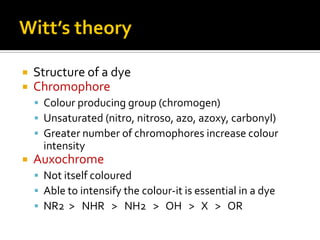
 Witt’s theory
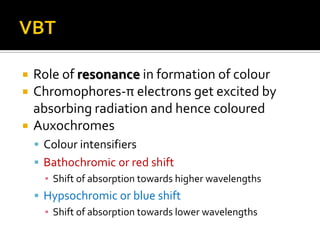
 VBT
 Structure of a dye
 Chromophore
 Colour producing group (chromogen)
 Unsaturated (nitro, nitroso, azo, azoxy, carbonyl)
 Greater number of chromophores increase colour
intensity
 Auxochrome
 Not itself coloured
 Able to intensify the colour-it is essential in a dye
 NR2 > NHR > NH2 > OH > X > OR
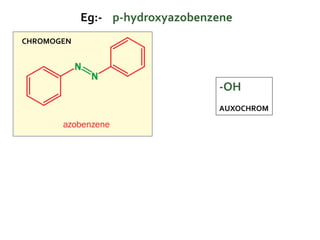
CHROMOGEN
-OH
AUXOCHROM
Eg:- p-hydroxyazobenzene
 Role of resonance in formation of colour
 Chromophores-π electrons get excited by
absorbing radiation and hence coloured
 Auxochromes
 Colour intensifiers
 Bathochromic or red shift
▪ Shift of absorption towards higher wavelengths
 Hypsochromic or blue shift
▪ Shift of absorption towards lower wavelengths
Applications
Dye for silk and wool
Used to dye synthetic fibres
Yellow biological stain
Chemical indicator
Indigoid group
Indigotin
Applications
•Dye cotton, wool and silk
•Indigo carmine, a derivative
of indigo is a food colourant
 An anthroquinone dye
 Applications
 A mordant dye
 Biological stain/
geological stain
 Red pigment in paint
 Printing ink constituent
 Spot test reagent
3 dyes

3 dyes

  • 1.
    Coloured organic compoundsand impart colour to other substances
  • 2.
    REQUIREMENT OF ADYE  Must have a suitable colour  Capable of fixing  After fixing, the colour should be retained  Should not react with ordinary chemicals that are used during dry cleaning MALACHITE GREEN ORANGE-I ORANGE-II ALIZARIN MARTIUS YELLOW INDIGO CONGO RED QUERCETIN PARA RED
  • 3.
  • 4.
     Structure ofa dye  Chromophore  Colour producing group (chromogen)  Unsaturated (nitro, nitroso, azo, azoxy, carbonyl)  Greater number of chromophores increase colour intensity  Auxochrome  Not itself coloured  Able to intensify the colour-it is essential in a dye  NR2 > NHR > NH2 > OH > X > OR
  • 5.
  • 6.
     Role ofresonance in formation of colour  Chromophores-π electrons get excited by absorbing radiation and hence coloured  Auxochromes  Colour intensifiers  Bathochromic or red shift ▪ Shift of absorption towards higher wavelengths  Hypsochromic or blue shift ▪ Shift of absorption towards lower wavelengths
  • 9.
    Applications Dye for silkand wool Used to dye synthetic fibres Yellow biological stain Chemical indicator
  • 10.
    Indigoid group Indigotin Applications •Dye cotton,wool and silk •Indigo carmine, a derivative of indigo is a food colourant
  • 11.
     An anthroquinonedye  Applications  A mordant dye  Biological stain/ geological stain  Red pigment in paint  Printing ink constituent  Spot test reagent