Disaster Risk Reduction Innovation and Excellence. R.P Adhikary, SDE, Department of Water Induced Disaster Prevention
Outline of Presentation Background of Country Types of Water Induced Disaster in Nepal Average annual losses by Water Induced Disaster Innovation
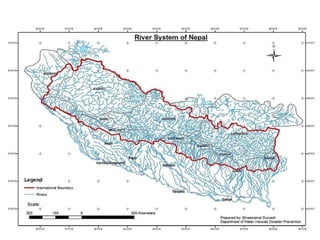
Background Geological Formation of Nepal The plate Tectonic theory Nepal posses more than 6,000  rivers  draining about 225 BMC of water annually High temporal and spatial variation in runoff and  rainfall High instantaneous flood due to high intensity rainfall up to 350 mm/day
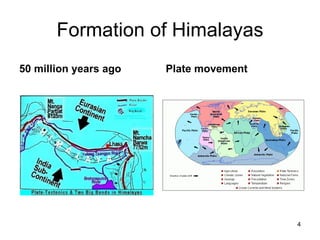
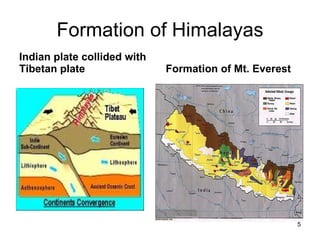
Formation of Himalayas 50 million years ago Plate movement
Formation of Himalayas Indian plate collided with Tibetan plate Formation of Mt. Everest
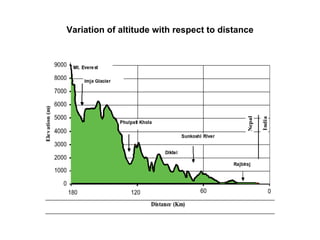
Variation of altitude with respect to distance
 
Types of Water Induced Disaster in Nepal GLOF, Monsoon Flood, Flash Flood Landslide and Debris flow- Fall, Slides, Topples, debris flow Shifting, meandering, widening and braiding, scour bank erosion and under cutting and inundation of lower Terai during monsoon, and siltation along the farm land .
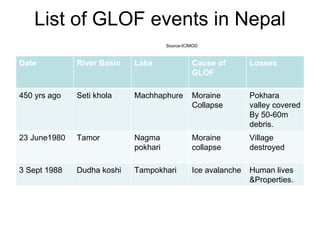
List of GLOF events in Nepal   Source-ICIMOD Date River Basin Lake Cause of GLOF Losses 450 yrs ago Seti khola Machhaphure Moraine Collapse Pokhara valley covered By 50-60m debris. 23 June1980 Tamor Nagma pokhari Moraine collapse Village destroyed 3 Sept 1988 Dudha koshi Tampokhari Ice avalanche Human lives &Properties.
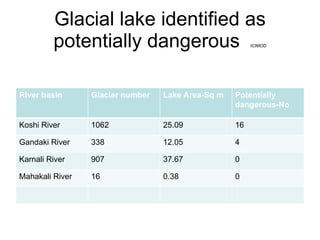
Glacial lake identified as potentially dangerous  ICIMOD River basin Glacier number Lake Area-Sq m Potentially dangerous-No Koshi River 1062 25.09 16 Gandaki River 338 12.05 4 Karnali River 907 37.67 0 Mahakali River 16 0.38 0
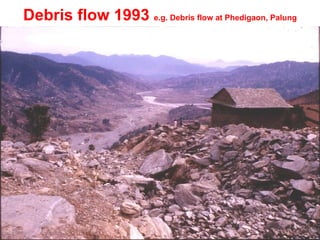
Debris flow 1993  e.g. Debris flow at Phedigaon, Palung
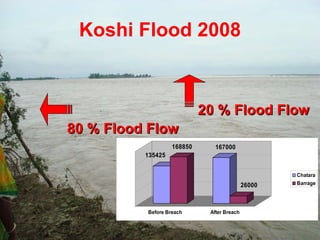
Koshi Flood 2008 80 % Flood Flow 20 % Flood Flow
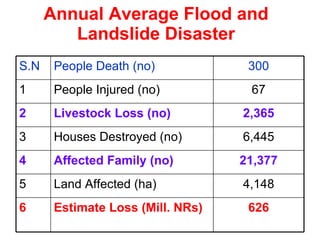
Annual Average Flood and Landslide Disaster S.N People Death (no) 300 1 People Injured (no) 67 2 Livestock Loss (no) 2,365 3 Houses Destroyed (no) 6,445 4 Affected Family (no) 21,377 5 Land Affected (ha) 4,148 6 Estimate Loss (Mill. NRs) 626
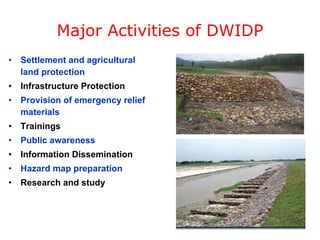
Major Activities of DWIDP Settlement and agricultural land protection Infrastructure Protection Provision of emergency relief materials Trainings Public awareness Information Dissemination Hazard map preparation Research and study
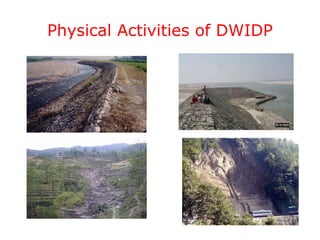
Physical Activities of DWIDP
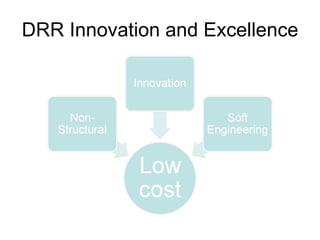
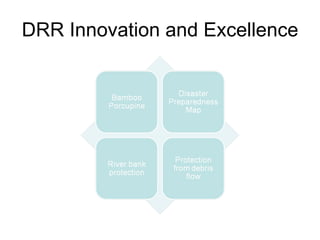
DRR Innovation and Excellence
NON-STRUCTURAL MITIGATION MEASURES Disaster Preparedness Map (DPM): Basically a Map indicating : Disaster Prone Area Shelter Houses Public Facilities Warning System  Evacuation Plan etc.
NON-STRUCTURAL MITIGATION MEASURES Disaster Preparedness Map (DPM): One Important Non-structural Mitigation Measure Advantages: Cheap & Simple for Application DPM Workshop provides opportunity to identify Weaknesses and Strengths for Warning System and Evacuation Plan No any Environmental Impact
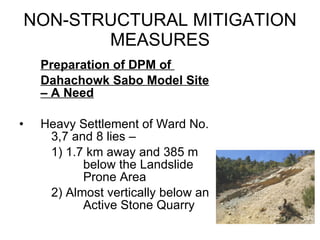
NON-STRUCTURAL MITIGATION MEASURES Preparation of DPM of  Dahachowk Sabo Model Site – A Need Heavy Settlement of Ward No.  3,7 and 8 lies – 1) 1.7 km away and 385 m  below the Landslide  Prone Area 2) Almost vertically below an  Active Stone Quarry
DAHACHOWK SABO MODEL SITE Some Features of Model Site : About 10 km West of Kathmandu Watershed – 1.5 km2 Average Annual Rainfall – 2010 mm  (with max. of 300 mm in 24 hours) Southern Steep Slope Aspects
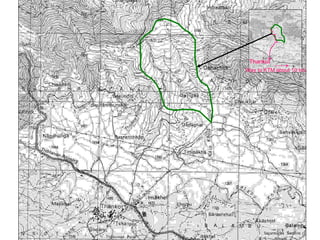
Dahachowk Sabo Model Site Way to KTM about 10 km. Thankot
DAHACHOWK SABO MODEL SITE Major Problems: Landslides in U/S or Head Scar Soil Erosion all over the Catchments Debris Flow in D/S or Foot Hill Rampant Stone Quarrying Low Level of Awareness Lack of Alternatives for Grazing, Fire wood etc.
NON-STRUCTURAL MITIGATION MEASURES Preparation of DPM: For the People by the People DPM Workshop – Detail Discussions Walk Through the Debris Flow Route Steps for Preparation of DPM Highlights of Important steps
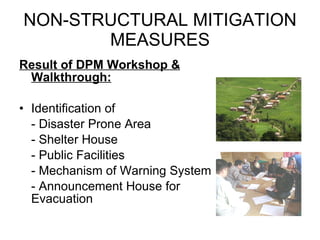
NON-STRUCTURAL MITIGATION MEASURES Result of DPM Workshop & Walkthrough: Identification of - Disaster Prone Area - Shelter House - Public Facilities - Mechanism of Warning System - Announcement House for  Evacuation
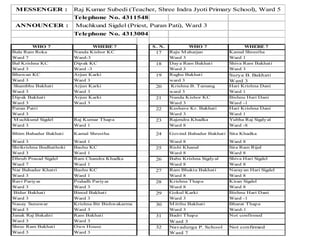
NON-STRUCTURAL MITIGATION MEASURES Warning System: Installment of Extension Meter devised with Sensor – Alarms Siren !!! Siren connected to Indra Jyoti School and/or Head Teacher (Messenger) with Telephone Messenger pass on  Message to Announcer
NON-STRUCTURAL MITIGATION MEASURES Evacuation Plan: Evacuation Announcement is followed by Commencement of Evacuation House to House Evacuation is Devised in absence of any Public Shelter House A Detailed Evacuation Plan prepared for ‘WHO’ should move ‘WHERE’ is probably the most scientific and Best Way to Save Life from Disaster !!!
 
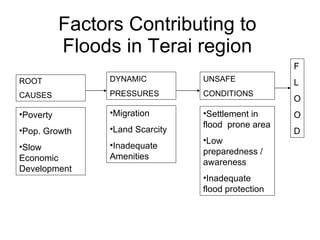
Factors Contributing to Floods in Terai region UNSAFE  CONDITIONS ROOT  CAUSES DYNAMIC  PRESSURES F L O O D Poverty Pop. Growth Slow Economic Development Migration Land Scarcity Inadequate Amenities Settlement in flood  prone area Low preparedness / awareness Inadequate flood protection
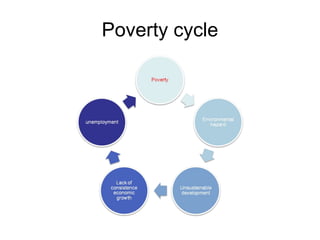
Poverty cycle
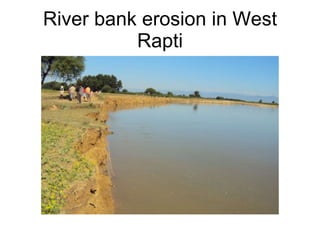
River bank erosion in West Rapti
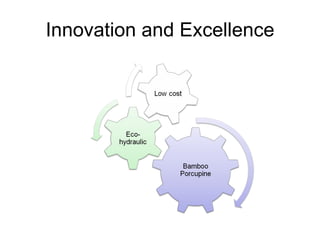
Innovation and Excellence
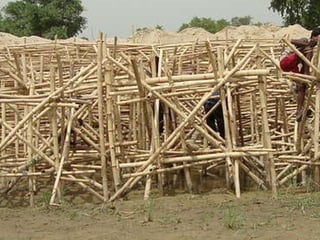
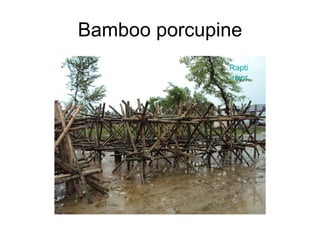
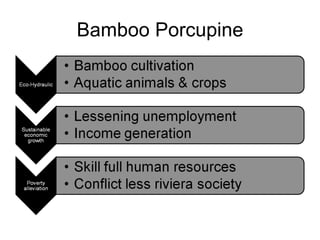
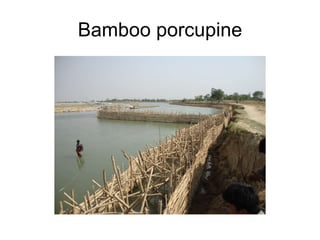
Bamboo porcupine Sprit and soul of eco hydraulic Use of low cost natural material Labor intensive and lessening unemployment Can provide habitat for water animal and crop
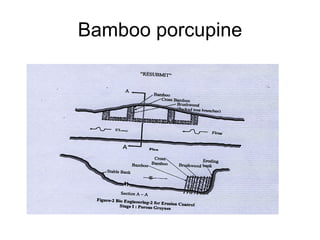
Bamboo porcupine River bank erosion is a single problem in Rivers of alluvial plain River bank protection is avoid bank erosion by current attack Structures are expensive, massive non compatible with environment and eco hydraulic
Bamboo porcupine
Bamboo porcupine According to FAO 75 bamboo genus and 250 species and known as villager wood Bamboo can used more under water Protects river bank from current attack Most suitable condition are Suspended sediments and velocity of current<1.5 m/se
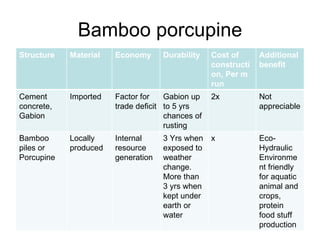
Bamboo porcupine Structure Material Economy Durability Cost of construction, Per m run Additional benefit Cement concrete, Gabion Imported Factor for trade deficit Gabion up to 5 yrs chances of rusting 2x Not appreciable Bamboo piles or Porcupine Locally produced Internal resource generation 3 Yrs when exposed to weather change. More than 3 yrs when kept under earth or water  x Eco-Hydraulic Environment friendly for aquatic animal and crops, protein food stuff production
Bamboo Porcupine
Bamboo porcupine
Bamboo porcupine Rapti  river
DWIDP would like to network  from all concerned. Thank You

Dwidp inovation 1

  • 1.
    Disaster Risk ReductionInnovation and Excellence. R.P Adhikary, SDE, Department of Water Induced Disaster Prevention
  • 2.
    Outline of PresentationBackground of Country Types of Water Induced Disaster in Nepal Average annual losses by Water Induced Disaster Innovation
  • 3.
    Background Geological Formationof Nepal The plate Tectonic theory Nepal posses more than 6,000 rivers draining about 225 BMC of water annually High temporal and spatial variation in runoff and rainfall High instantaneous flood due to high intensity rainfall up to 350 mm/day
  • 4.
    Formation of Himalayas50 million years ago Plate movement
  • 5.
    Formation of HimalayasIndian plate collided with Tibetan plate Formation of Mt. Everest
  • 6.
    Variation of altitudewith respect to distance
  • 7.
  • 8.
    Types of WaterInduced Disaster in Nepal GLOF, Monsoon Flood, Flash Flood Landslide and Debris flow- Fall, Slides, Topples, debris flow Shifting, meandering, widening and braiding, scour bank erosion and under cutting and inundation of lower Terai during monsoon, and siltation along the farm land .
  • 9.
    List of GLOFevents in Nepal Source-ICIMOD Date River Basin Lake Cause of GLOF Losses 450 yrs ago Seti khola Machhaphure Moraine Collapse Pokhara valley covered By 50-60m debris. 23 June1980 Tamor Nagma pokhari Moraine collapse Village destroyed 3 Sept 1988 Dudha koshi Tampokhari Ice avalanche Human lives &Properties.
  • 10.
    Glacial lake identifiedas potentially dangerous ICIMOD River basin Glacier number Lake Area-Sq m Potentially dangerous-No Koshi River 1062 25.09 16 Gandaki River 338 12.05 4 Karnali River 907 37.67 0 Mahakali River 16 0.38 0
  • 11.
    Debris flow 1993 e.g. Debris flow at Phedigaon, Palung
  • 12.
    Koshi Flood 200880 % Flood Flow 20 % Flood Flow
  • 13.
    Annual Average Floodand Landslide Disaster S.N People Death (no) 300 1 People Injured (no) 67 2 Livestock Loss (no) 2,365 3 Houses Destroyed (no) 6,445 4 Affected Family (no) 21,377 5 Land Affected (ha) 4,148 6 Estimate Loss (Mill. NRs) 626
  • 14.
    Major Activities ofDWIDP Settlement and agricultural land protection Infrastructure Protection Provision of emergency relief materials Trainings Public awareness Information Dissemination Hazard map preparation Research and study
  • 15.
  • 16.
  • 17.
  • 18.
    NON-STRUCTURAL MITIGATION MEASURESDisaster Preparedness Map (DPM): Basically a Map indicating : Disaster Prone Area Shelter Houses Public Facilities Warning System Evacuation Plan etc.
  • 19.
    NON-STRUCTURAL MITIGATION MEASURESDisaster Preparedness Map (DPM): One Important Non-structural Mitigation Measure Advantages: Cheap & Simple for Application DPM Workshop provides opportunity to identify Weaknesses and Strengths for Warning System and Evacuation Plan No any Environmental Impact
  • 20.
    NON-STRUCTURAL MITIGATION MEASURESPreparation of DPM of Dahachowk Sabo Model Site – A Need Heavy Settlement of Ward No. 3,7 and 8 lies – 1) 1.7 km away and 385 m below the Landslide Prone Area 2) Almost vertically below an Active Stone Quarry
  • 21.
    DAHACHOWK SABO MODELSITE Some Features of Model Site : About 10 km West of Kathmandu Watershed – 1.5 km2 Average Annual Rainfall – 2010 mm (with max. of 300 mm in 24 hours) Southern Steep Slope Aspects
  • 22.
    Dahachowk Sabo ModelSite Way to KTM about 10 km. Thankot
  • 23.
    DAHACHOWK SABO MODELSITE Major Problems: Landslides in U/S or Head Scar Soil Erosion all over the Catchments Debris Flow in D/S or Foot Hill Rampant Stone Quarrying Low Level of Awareness Lack of Alternatives for Grazing, Fire wood etc.
  • 24.
    NON-STRUCTURAL MITIGATION MEASURESPreparation of DPM: For the People by the People DPM Workshop – Detail Discussions Walk Through the Debris Flow Route Steps for Preparation of DPM Highlights of Important steps
  • 25.
    NON-STRUCTURAL MITIGATION MEASURESResult of DPM Workshop & Walkthrough: Identification of - Disaster Prone Area - Shelter House - Public Facilities - Mechanism of Warning System - Announcement House for Evacuation
  • 26.
    NON-STRUCTURAL MITIGATION MEASURESWarning System: Installment of Extension Meter devised with Sensor – Alarms Siren !!! Siren connected to Indra Jyoti School and/or Head Teacher (Messenger) with Telephone Messenger pass on Message to Announcer
  • 27.
    NON-STRUCTURAL MITIGATION MEASURESEvacuation Plan: Evacuation Announcement is followed by Commencement of Evacuation House to House Evacuation is Devised in absence of any Public Shelter House A Detailed Evacuation Plan prepared for ‘WHO’ should move ‘WHERE’ is probably the most scientific and Best Way to Save Life from Disaster !!!
  • 28.
  • 29.
    Factors Contributing toFloods in Terai region UNSAFE CONDITIONS ROOT CAUSES DYNAMIC PRESSURES F L O O D Poverty Pop. Growth Slow Economic Development Migration Land Scarcity Inadequate Amenities Settlement in flood prone area Low preparedness / awareness Inadequate flood protection
  • 30.
  • 31.
    River bank erosionin West Rapti
  • 32.
  • 33.
    Bamboo porcupine Spritand soul of eco hydraulic Use of low cost natural material Labor intensive and lessening unemployment Can provide habitat for water animal and crop
  • 34.
    Bamboo porcupine Riverbank erosion is a single problem in Rivers of alluvial plain River bank protection is avoid bank erosion by current attack Structures are expensive, massive non compatible with environment and eco hydraulic
  • 35.
  • 36.
    Bamboo porcupine Accordingto FAO 75 bamboo genus and 250 species and known as villager wood Bamboo can used more under water Protects river bank from current attack Most suitable condition are Suspended sediments and velocity of current<1.5 m/se
  • 37.
    Bamboo porcupine StructureMaterial Economy Durability Cost of construction, Per m run Additional benefit Cement concrete, Gabion Imported Factor for trade deficit Gabion up to 5 yrs chances of rusting 2x Not appreciable Bamboo piles or Porcupine Locally produced Internal resource generation 3 Yrs when exposed to weather change. More than 3 yrs when kept under earth or water x Eco-Hydraulic Environment friendly for aquatic animal and crops, protein food stuff production
  • 38.
  • 39.
  • 40.
  • 41.
    DWIDP would liketo network from all concerned. Thank You