Performance Appraisal Methods
Presented by,
Durgaprasad Kallapalli
Sunstone Eduversity
What is performance appraisal?
Performance Appraisal is a methodology of
apprising an individual employee in an organization, with
respect to the job under taken, about his/her strong points
& weak points, with a view to strengthen the strong points
& eradicate the weaknesses, in order of priority, so that
both individual employee and the organization work in
conjunction with each other towards attainment of their
goals.
Why performance appraisal?
• Establishing compensation guidelines
• Track strengths and weaknesses
• Identifying promotion candidates
• Offer feedback
• Introducing training programs
Objectives of Performance Appraisal
Employee Organization
Aims at:
Components of Performance Appraisal
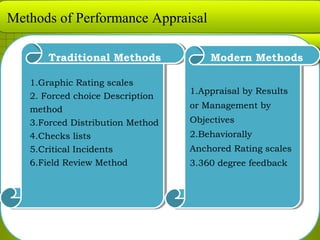
Methods of Performance Appraisal
1.Graphic Rating scales
2. Forced choice Description
method
3.Forced Distribution Method
4.Checks lists
5.Critical Incidents
6.Field Review Method
1.Appraisal by Results
or Management by
Objectives
2.Behaviorally
Anchored Rating scales
3.360 degree feedback
Traditional Methods Modern Methods
Traditional Methods
Graphic Rating scales
Rating scales consists of several numerical scales representing job
related performance criterions such as dependability, initiative,
output, attendance, attitude etc. Each scales ranges from excellent to
poor
Advantages Disadvantages
 Adaptability
 Easy to use
 Low cost
 Every type of job can
be evaluated.
 Large number of
employees covered
 Rater bias
Graph Rating scale
Attitude
No interest
In work:
consistent
complainer
No interest
In work:
consistent
complainer
Careless:
In-different
Instructions
Careless:
In-different
Instructions
Interested in
work:
Accepts
opinions &
advice of
others
Interested in
work:
Accepts
opinions &
advice of
others
Enthusiastic
about job
Enthusiastic
about job
Enthusiastic
opinions &
advice
sought by
others
Enthusiastic
opinions &
advice
sought by
others
0 1 2 3 4
Forced Choice Description Method
The series of statements arranged in the blocks of two or more are
given and the rater indicates which statement is true or false. The
rater is forced to make a choice. HR department does actual
assessment.
Advantages
Disadvantages
Absence of personal biases because of forced choiceAbsence of personal biases because of forced choice
Statements may be wrongly framed.Statements may be wrongly framed.
Forced Choice Method
Criteria Rating
1.Regularity on the job Most Least
•Always regular
•Inform in advance for delay
•Never regular
•Remain absent
•Neither regular nor irregular
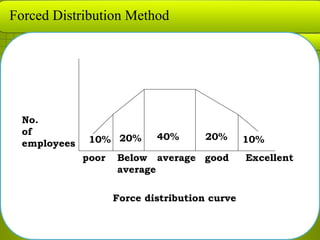
Forced Distribution Method
Here employees are clustered around a high point on a rating scale.
Rater is compelled to distribute the employees on all points on the
scale. It is assumed that the performance is conformed to normal
distributed.
Forced Distribution Method
No.
of
employees 10% 20% 40% 20% 10%
poor Below
average
average good Excellent
Force distribution curve
Checklist Method
Under this method, checklist of statements of traits of
employee in the form of Yes or No based questions is
prepared. Here the rater only does the reporting or checking
and HR department does the actual evaluation.
Advantages Disadvantages
 Ease of administration
 Limited training
required
 Standardization
 Use of improper
weighs by HR.
 Does not allow
rater to give
relative ratings.
Checklist Method
Criteria Yes No
Is the employee really interested in the task assigned?
l Is he respected by his colleagues (co-workers)
2 Does he give respect to his superiors?
3 Does he follow instructions properly?
4 Does he make mistakes frequently?
Critical Incidents Method
The approach is focused on certain critical behaviours of
employee that makes all the difference in the performance.
Supervisors as and when they occur record such incidents.
Advantages Disadvantages
 Valuations are based
on actual job
behaviours
 Ratings are supported
by descriptions,
 Feedback is easy
 Negative incidents
can be prioritized
 Forgetting incidents
 Feedback may be
too much and may
appear to be
punishment.
Critical Incidents Method
Ex: A fire, sudden breakdown, accident
Workers Reaction scale
A Informed the supervisor immediately 5
B Become anxious on loss of output 4
C Tried to repair the machine 3
D Complained for poor maintenance 2
E Was happy to forced test 1
Field Review Method
This is an appraisal done by someone outside employees or
by own department usually from corporate or HR
department.
DisadvantagesAdvantages
 Useful for
managerial level
promotions
 when comparable
information is
needed,
 Outsider is
generally not
familiar with
employees work
environment
 Observation of
actual behaviours
not possible.
Performance subordinate peers superior customer
Dimension
Leadership ^ ^
Communication ^ ^
Interpersonal skills ^ ^
Decision making ^ ^ ^
Technical skills ^ ^ ^
Motivation ^ ^ ^
Field Review Method
Future Oriented Methods
Managerial Objective Method
It means management by objectives and the performance is rated
against the achievement of objectives stated by the management.
DisadvantagesAdvantages
 It is more useful for
managerial
positions.
 Not applicable to all
jobs,
 Allocation of merit
pay may result in
setting short-term
goals rather than
important and long-
term goals
MBO process
Set organizational goals
Defining performance target
Performance review
feedback
Statements of effective and ineffective behaviours determine
the points. They are said to be behaviourally anchored. The
Rater is supposed to say, which behaviour describes the
employee performance
Behaviourally Anchored Rating Scales
DisadvantagesAdvantages
 Helps overcome
rating errors.
 Suffers from
distortions inherent
in most rating
techniques.
Performance Points Behavior
Extremely good 7 Can expect trainee to make valuable suggestions
for increased sales and to have positive
relationships with customers all over the country.
Good 6 Can expect to initiate creative ideas for improved
sales.
Above average 5 Can expect to keep in touch with the customers
throughout the year.
Average 4 Can manage, with difficulty, to deliver the goods in
time.
Below average 3 Can expect to unload the trucks when asked by
the supervisor.
Poor 2 Can expect to inform only a part of the customers.
Extremely poor 1 Can expect to take extended coffee breaks & roam
around purposelessly.
BARS
It is a technique which is systematic collection of performance data
on an individual group, derived from a number of stakeholders like
immediate supervisors, team members, customers, peers and self.
360-Degree Feedback
Advantages
 Measure inter-
personal skills
 Customer
satisfaction
 Team building
skills.
360-Degree Feedback
Durga hrm ppt
Durga hrm ppt

Durga hrm ppt

  • 1.
    Performance Appraisal Methods Presentedby, Durgaprasad Kallapalli Sunstone Eduversity
  • 2.
    What is performanceappraisal? Performance Appraisal is a methodology of apprising an individual employee in an organization, with respect to the job under taken, about his/her strong points & weak points, with a view to strengthen the strong points & eradicate the weaknesses, in order of priority, so that both individual employee and the organization work in conjunction with each other towards attainment of their goals.
  • 3.
    Why performance appraisal? •Establishing compensation guidelines • Track strengths and weaknesses • Identifying promotion candidates • Offer feedback • Introducing training programs
  • 4.
    Objectives of PerformanceAppraisal Employee Organization Aims at:
  • 5.
  • 6.
    Methods of PerformanceAppraisal 1.Graphic Rating scales 2. Forced choice Description method 3.Forced Distribution Method 4.Checks lists 5.Critical Incidents 6.Field Review Method 1.Appraisal by Results or Management by Objectives 2.Behaviorally Anchored Rating scales 3.360 degree feedback Traditional Methods Modern Methods
  • 7.
    Traditional Methods Graphic Ratingscales Rating scales consists of several numerical scales representing job related performance criterions such as dependability, initiative, output, attendance, attitude etc. Each scales ranges from excellent to poor Advantages Disadvantages  Adaptability  Easy to use  Low cost  Every type of job can be evaluated.  Large number of employees covered  Rater bias
  • 8.
    Graph Rating scale Attitude Nointerest In work: consistent complainer No interest In work: consistent complainer Careless: In-different Instructions Careless: In-different Instructions Interested in work: Accepts opinions & advice of others Interested in work: Accepts opinions & advice of others Enthusiastic about job Enthusiastic about job Enthusiastic opinions & advice sought by others Enthusiastic opinions & advice sought by others 0 1 2 3 4
  • 9.
    Forced Choice DescriptionMethod The series of statements arranged in the blocks of two or more are given and the rater indicates which statement is true or false. The rater is forced to make a choice. HR department does actual assessment. Advantages Disadvantages Absence of personal biases because of forced choiceAbsence of personal biases because of forced choice Statements may be wrongly framed.Statements may be wrongly framed.
  • 10.
    Forced Choice Method CriteriaRating 1.Regularity on the job Most Least •Always regular •Inform in advance for delay •Never regular •Remain absent •Neither regular nor irregular
  • 11.
    Forced Distribution Method Hereemployees are clustered around a high point on a rating scale. Rater is compelled to distribute the employees on all points on the scale. It is assumed that the performance is conformed to normal distributed.
  • 12.
    Forced Distribution Method No. of employees10% 20% 40% 20% 10% poor Below average average good Excellent Force distribution curve
  • 13.
    Checklist Method Under thismethod, checklist of statements of traits of employee in the form of Yes or No based questions is prepared. Here the rater only does the reporting or checking and HR department does the actual evaluation. Advantages Disadvantages  Ease of administration  Limited training required  Standardization  Use of improper weighs by HR.  Does not allow rater to give relative ratings.
  • 14.
    Checklist Method Criteria YesNo Is the employee really interested in the task assigned? l Is he respected by his colleagues (co-workers) 2 Does he give respect to his superiors? 3 Does he follow instructions properly? 4 Does he make mistakes frequently?
  • 15.
    Critical Incidents Method Theapproach is focused on certain critical behaviours of employee that makes all the difference in the performance. Supervisors as and when they occur record such incidents. Advantages Disadvantages  Valuations are based on actual job behaviours  Ratings are supported by descriptions,  Feedback is easy  Negative incidents can be prioritized  Forgetting incidents  Feedback may be too much and may appear to be punishment.
  • 16.
    Critical Incidents Method Ex:A fire, sudden breakdown, accident Workers Reaction scale A Informed the supervisor immediately 5 B Become anxious on loss of output 4 C Tried to repair the machine 3 D Complained for poor maintenance 2 E Was happy to forced test 1
  • 17.
    Field Review Method Thisis an appraisal done by someone outside employees or by own department usually from corporate or HR department. DisadvantagesAdvantages  Useful for managerial level promotions  when comparable information is needed,  Outsider is generally not familiar with employees work environment  Observation of actual behaviours not possible.
  • 18.
    Performance subordinate peerssuperior customer Dimension Leadership ^ ^ Communication ^ ^ Interpersonal skills ^ ^ Decision making ^ ^ ^ Technical skills ^ ^ ^ Motivation ^ ^ ^ Field Review Method
  • 19.
    Future Oriented Methods ManagerialObjective Method It means management by objectives and the performance is rated against the achievement of objectives stated by the management. DisadvantagesAdvantages  It is more useful for managerial positions.  Not applicable to all jobs,  Allocation of merit pay may result in setting short-term goals rather than important and long- term goals
  • 20.
    MBO process Set organizationalgoals Defining performance target Performance review feedback
  • 21.
    Statements of effectiveand ineffective behaviours determine the points. They are said to be behaviourally anchored. The Rater is supposed to say, which behaviour describes the employee performance Behaviourally Anchored Rating Scales DisadvantagesAdvantages  Helps overcome rating errors.  Suffers from distortions inherent in most rating techniques.
  • 22.
    Performance Points Behavior Extremelygood 7 Can expect trainee to make valuable suggestions for increased sales and to have positive relationships with customers all over the country. Good 6 Can expect to initiate creative ideas for improved sales. Above average 5 Can expect to keep in touch with the customers throughout the year. Average 4 Can manage, with difficulty, to deliver the goods in time. Below average 3 Can expect to unload the trucks when asked by the supervisor. Poor 2 Can expect to inform only a part of the customers. Extremely poor 1 Can expect to take extended coffee breaks & roam around purposelessly. BARS
  • 23.
    It is atechnique which is systematic collection of performance data on an individual group, derived from a number of stakeholders like immediate supervisors, team members, customers, peers and self. 360-Degree Feedback Advantages  Measure inter- personal skills  Customer satisfaction  Team building skills.
  • 24.