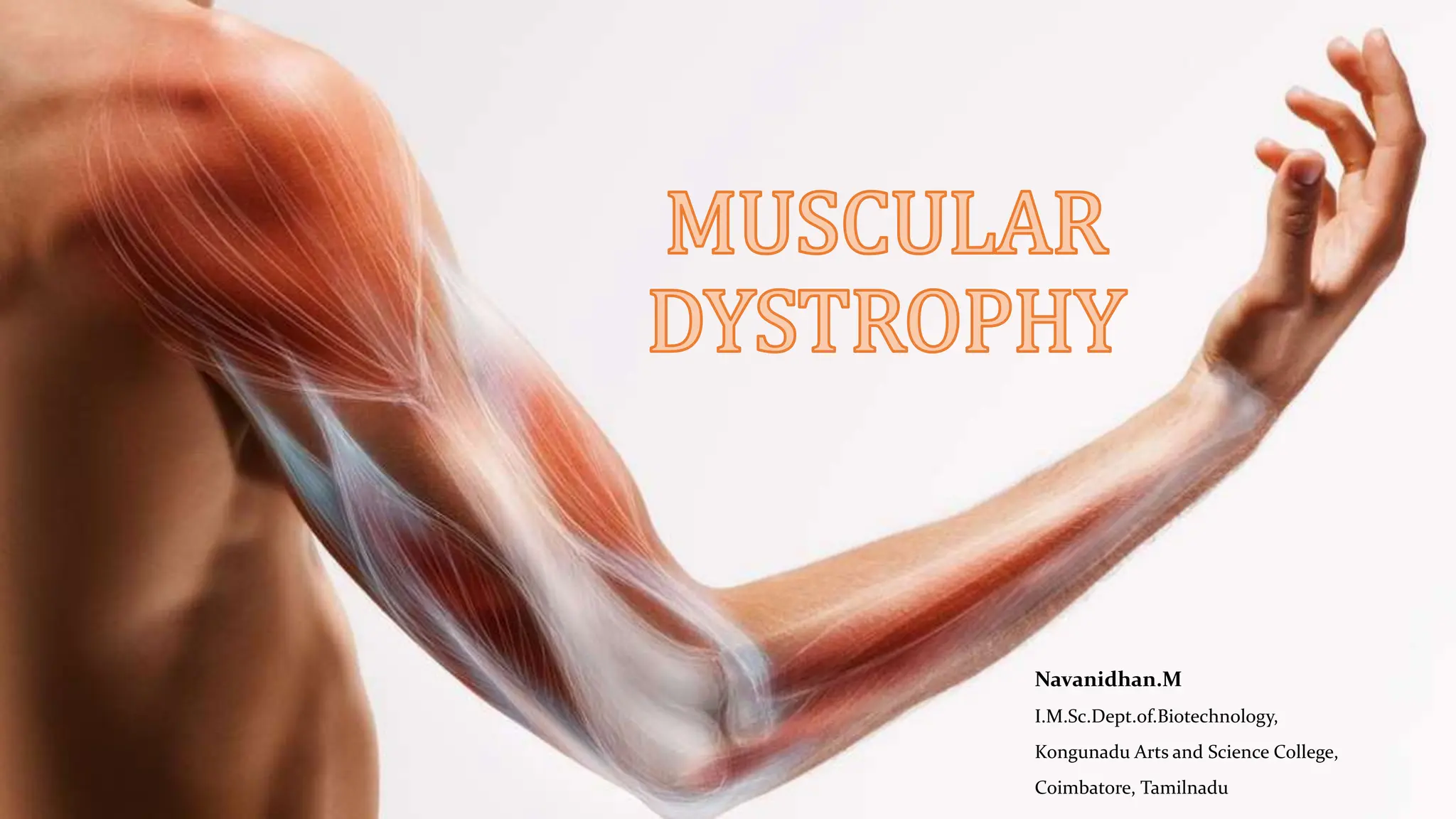
Navanidhan.M
I.M.Sc.Dept.of.Biotechnology,
Kongunadu Arts and Science College,
Coimbatore, Tamilnadu
Muscular A General Term for Tissue Degeneration.
 Muscular Dystrophies are a group of 9 types of muscular Dystrophies
affecting both the boys and Girls.
One of these is, Duchenne Muscular Dystrophy
 A Genetic disorder Characterized by Progressive Muscle Degeneration and weakness due to the
alterations of a protein called Dystrophin.
 Dystrophin helps to keep muscle cells intact.
 1st Described by Guillaume Benjamin Amand Duchenne in the 1860’s.
 In 1986,MDA-Supported researchers identified a particular gene on the X chromosome that ,when
Mutated leads to DMD
 In 1987, Dystrophin was identified and named.
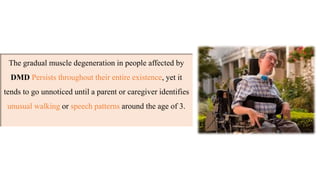
The gradual muscle degeneration in people affected by
DMD Persists throughout their entire existence, yet it
tends to go unnoticed until a parent or caregiver identifies
unusual walking or speech patterns around the age of 3.
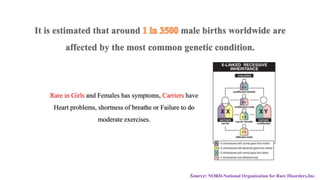
Source: NORD-National Organization for Rare Disorders,Inc.
Rare in Girls and Females has symptoms, Carriers have
Heart problems, shortness of breathe or Failure to do
moderate exercises.
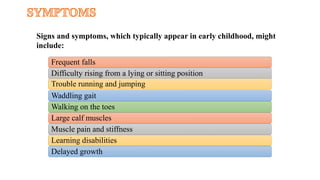
Frequent falls
Difficulty rising from a lying or sitting position
Trouble running and jumping
Waddling gait
Walking on the toes
Large calf muscles
Muscle pain and stiffness
Learning disabilities
Delayed growth
Signs and symptoms, which typically appear in early childhood, might
include:
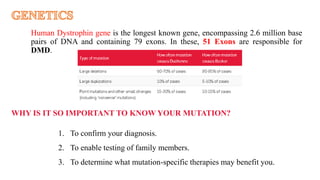
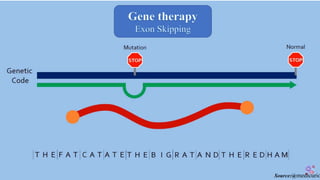
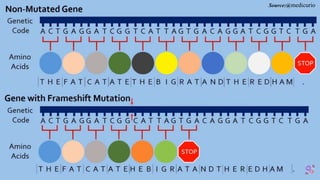
Human Dystrophin gene is the longest known gene, encompassing 2.6 million base
pairs of DNA and containing 79 exons. In these, 51 Exons are responsible for
DMD.
WHY IS IT SO IMPORTANT TO KNOW YOUR MUTATION?
1. To confirm your diagnosis.
2. To enable testing of family members.
3. To determine what mutation-specific therapies may benefit you.
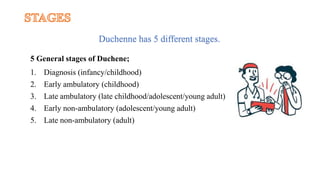
5 General stages of Duchene;
1. Diagnosis (infancy/childhood)
2. Early ambulatory (childhood)
3. Late ambulatory (late childhood/adolescent/young adult)
4. Early non-ambulatory (adolescent/young adult)
5. Late non-ambulatory (adult)
Duchenne has 5 different stages.
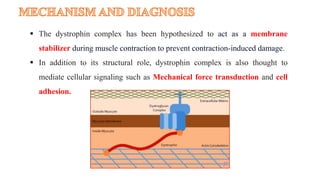
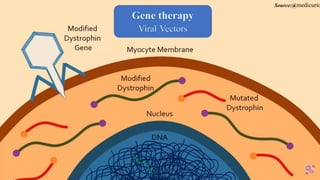
 The dystrophin complex has been hypothesized to act as a membrane
stabilizer during muscle contraction to prevent contraction-induced damage.
 In addition to its structural role, dystrophin complex is also thought to
mediate cellular signaling such as Mechanical force transduction and cell
adhesion.
1. Due to a genetic mutation, dystrophin in
Duchenne Muscular Dystrophy becomes
extremely short and dysfunctional,
lacking the dystroglycan binding end.
2. Whenever muscles contract, minute
ruptures manifest in the membranes.
3. The myocyte's small rips promote
the diffusion of diverse molecules
into and out of its structure.
4. The most important substance
involved in damaging muscle is
calcium.
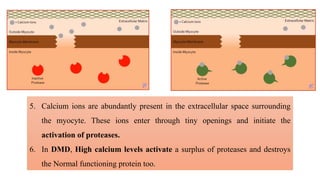
5. Calcium ions are abundantly present in the extracellular space surrounding
the myocyte. These ions enter through tiny openings and initiate the
activation of proteases.
6. In DMD, High calcium levels activate a surplus of proteases and destroys
the Normal functioning protein too.
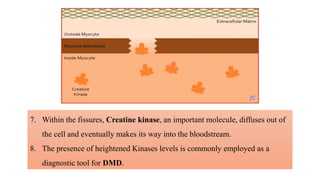
7. Within the fissures, Creatine kinase, an important molecule, diffuses out of
the cell and eventually makes its way into the bloodstream.
8. The presence of heightened Kinases levels is commonly employed as a
diagnostic tool for DMD.
Source:@medicurio
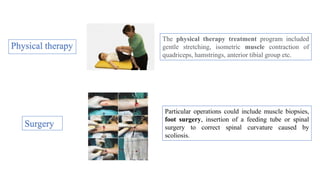
Physical therapy
Particular operations could include muscle biopsies,
foot surgery, insertion of a feeding tube or spinal
surgery to correct spinal curvature caused by
scoliosis.
Surgery
The physical therapy treatment program included
gentle stretching, isometric muscle contraction of
quadriceps, hamstrings, anterior tibial group etc.
Source:@medicurio
Source:@medicurio
Source:@medicurio
Steroids
 Most neurologists recommend that people with Duchenne begin steroids before the
plateau phase (generally around 4-5 years of age).
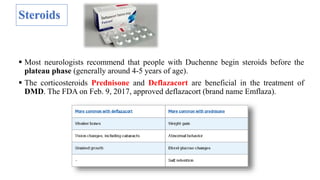
 The corticosteroids Prednisone and Deflazacort are beneficial in the treatment of
DMD. The FDA on Feb. 9, 2017, approved deflazacort (brand name Emflaza).
Duchenne Muscular Dystrophy or DMD .pptx

Duchenne Muscular Dystrophy or DMD .pptx

  • 1.
  • 2.
    Muscular A GeneralTerm for Tissue Degeneration.  Muscular Dystrophies are a group of 9 types of muscular Dystrophies affecting both the boys and Girls. One of these is, Duchenne Muscular Dystrophy
  • 3.
     A Geneticdisorder Characterized by Progressive Muscle Degeneration and weakness due to the alterations of a protein called Dystrophin.  Dystrophin helps to keep muscle cells intact.  1st Described by Guillaume Benjamin Amand Duchenne in the 1860’s.  In 1986,MDA-Supported researchers identified a particular gene on the X chromosome that ,when Mutated leads to DMD  In 1987, Dystrophin was identified and named.
  • 4.
    The gradual muscledegeneration in people affected by DMD Persists throughout their entire existence, yet it tends to go unnoticed until a parent or caregiver identifies unusual walking or speech patterns around the age of 3.
  • 5.
    Source: NORD-National Organizationfor Rare Disorders,Inc. Rare in Girls and Females has symptoms, Carriers have Heart problems, shortness of breathe or Failure to do moderate exercises.
  • 6.
    Frequent falls Difficulty risingfrom a lying or sitting position Trouble running and jumping Waddling gait Walking on the toes Large calf muscles Muscle pain and stiffness Learning disabilities Delayed growth Signs and symptoms, which typically appear in early childhood, might include:
  • 7.
    Human Dystrophin geneis the longest known gene, encompassing 2.6 million base pairs of DNA and containing 79 exons. In these, 51 Exons are responsible for DMD. WHY IS IT SO IMPORTANT TO KNOW YOUR MUTATION? 1. To confirm your diagnosis. 2. To enable testing of family members. 3. To determine what mutation-specific therapies may benefit you.
  • 8.
    5 General stagesof Duchene; 1. Diagnosis (infancy/childhood) 2. Early ambulatory (childhood) 3. Late ambulatory (late childhood/adolescent/young adult) 4. Early non-ambulatory (adolescent/young adult) 5. Late non-ambulatory (adult) Duchenne has 5 different stages.
  • 9.
     The dystrophincomplex has been hypothesized to act as a membrane stabilizer during muscle contraction to prevent contraction-induced damage.  In addition to its structural role, dystrophin complex is also thought to mediate cellular signaling such as Mechanical force transduction and cell adhesion.
  • 10.
    1. Due toa genetic mutation, dystrophin in Duchenne Muscular Dystrophy becomes extremely short and dysfunctional, lacking the dystroglycan binding end. 2. Whenever muscles contract, minute ruptures manifest in the membranes. 3. The myocyte's small rips promote the diffusion of diverse molecules into and out of its structure. 4. The most important substance involved in damaging muscle is calcium.
  • 11.
    5. Calcium ionsare abundantly present in the extracellular space surrounding the myocyte. These ions enter through tiny openings and initiate the activation of proteases. 6. In DMD, High calcium levels activate a surplus of proteases and destroys the Normal functioning protein too.
  • 12.
    7. Within thefissures, Creatine kinase, an important molecule, diffuses out of the cell and eventually makes its way into the bloodstream. 8. The presence of heightened Kinases levels is commonly employed as a diagnostic tool for DMD.
  • 13.
  • 14.
    Physical therapy Particular operationscould include muscle biopsies, foot surgery, insertion of a feeding tube or spinal surgery to correct spinal curvature caused by scoliosis. Surgery The physical therapy treatment program included gentle stretching, isometric muscle contraction of quadriceps, hamstrings, anterior tibial group etc.
  • 15.
  • 16.
  • 17.
  • 18.
    Steroids  Most neurologistsrecommend that people with Duchenne begin steroids before the plateau phase (generally around 4-5 years of age).  The corticosteroids Prednisone and Deflazacort are beneficial in the treatment of DMD. The FDA on Feb. 9, 2017, approved deflazacort (brand name Emflaza).