Duchenne muscular dystrophy
Index
1. definition
2. anatomy
3. pathology
4. sign and symptoms
5. ot assessment objective
6. ot assessment subjective
7. ot goals
8. treatment
9. prognosis
10. differential diagnosis
Definition
Duchenne muscular dystrophy (DMD) is a genetic disorder characterized
by progressive muscle degeneration and weakness due to the alterations
of a protein called dystrophin that helps keep muscle cells
intact(definition by muscular dystrophy association).
Muscular dystrophy (MD) refers to a group of genetic diseases that cause
progressive weakness and degeneration of skeletal muscles.
(National Institute of neurological disorders and stroke)
Aditi ,Rollno.1
Ducchene muscular dystrophy is
a common sex linked recessive
trait appearing in 20to30per
100,000 boys results from
absence of a large cytoskeletal
protein called dystrophin
(reference-essential of pediatrics
by Nelson).
Aditi,Rollno.1
Pathology
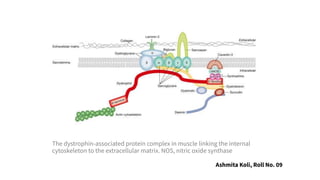
Dystrophin has a major role in muscle as it links the internal cytoskeleton to the extracellular
matrix. The amino-terminus of dystrophin binds to F-actin and the carboxyl terminus to the
dystrophin-associated protein complex (DAPC) at the sarcolemma (Fig 2; Blake et al, 2002). The
DAPC includes the dystroglycans, sarcoglycans, int0egrins and caveolin, and mutations in any
of these components cause autosomally inherited muscular dystrophies. The DAPC is
destabilized when dystrophin is absent, which results in diminished levels of the member
proteins. This in turn leads to progressive fibre damage and membrane leakage. The DAPC has
a signalling role, the loss of which also contributes to pathogenesis. DMD patients are usually
wheelchair-bound by 12 years of age and die of respiratory failure in their late teens or early
twenties. Many boys have an abnormal electrocardiogram by the age of 18, indicating that any
therapeutic agent must also target the diaphragm and cardiac muscle.
Ashmita Koli, Roll No. 09
The dystrophin-associated protein complex in muscle linking the internal
cytoskeleton to the extracellular matrix. NOS, nitric oxide synthase
Ashmita Koli, Roll No. 09
Signs and Symptoms
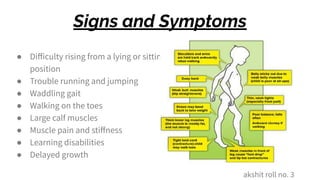
● Difficulty rising from a lying or sitting
position
● Trouble running and jumping
● Waddling gait
● Walking on the toes
● Large calf muscles
● Muscle pain and stiffness
● Learning disabilities
● Delayed growth
akshit roll no. 3
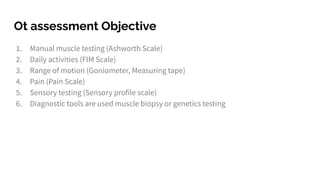
Ot assessment Objective
1. Manual muscle testing (Ashworth Scale)
2. Daily activities (FIM Scale)
3. Range of motion (Goniometer, Measuring tape)
4. Pain (Pain Scale)
5. Sensory testing (Sensory profile scale)
6. Diagnostic tools are used muscle biopsy or genetics testing
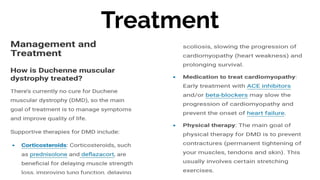
Treatment
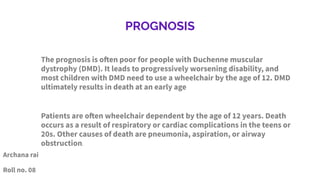
PROGNOSIS
The prognosis is often poor for people with Duchenne muscular
dystrophy (DMD). It leads to progressively worsening disability, and
most children with DMD need to use a wheelchair by the age of 12. DMD
ultimately results in death at an early age
Patients are often wheelchair dependent by the age of 12 years. Death
occurs as a result of respiratory or cardiac complications in the teens or
20s. Other causes of death are pneumonia, aspiration, or airway

obstruction.
Archana rai
Roll no. 08
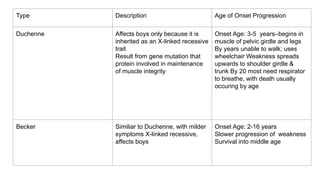
Type Description Age of Onset Progression
Duchenne Affects boys only because it is
inherited as an X-linked recessive
trait
Result from gene mutation that
protein involved in maintenance
of muscle integrity
Onset Age: 3-5 years–begins in
muscle of pelvic girdle and legs
By years unable to walk; uses
wheelchair Weakness spreads
upwards to shoulder girdle &
trunk By 20 most need respirator
to breathe, with death usually
occuring by age
Becker Similiar to Duchenne, with milder
symptoms X-linked recessive,
affects boys
Onset Age: 2-16 years
Slower progression of weakness
Survival into middle age
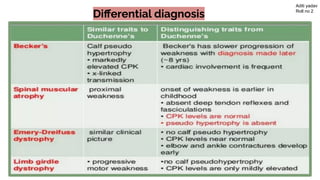
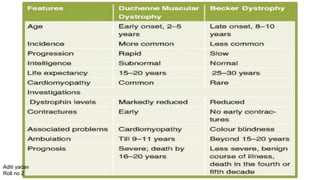
Differential diagnosis
Aditi yadav
Roll no 2
Differential diagnosis
Aditi yadav
Roll no 2
THANK YOU

dmd.pdf duchene muscular dystrophy pdf.

  • 1.
  • 2.
    Index 1. definition 2. anatomy 3.pathology 4. sign and symptoms 5. ot assessment objective 6. ot assessment subjective 7. ot goals 8. treatment 9. prognosis 10. differential diagnosis
  • 3.
    Definition Duchenne muscular dystrophy(DMD) is a genetic disorder characterized by progressive muscle degeneration and weakness due to the alterations of a protein called dystrophin that helps keep muscle cells intact(definition by muscular dystrophy association). Muscular dystrophy (MD) refers to a group of genetic diseases that cause progressive weakness and degeneration of skeletal muscles. (National Institute of neurological disorders and stroke) Aditi ,Rollno.1
  • 4.
    Ducchene muscular dystrophyis a common sex linked recessive trait appearing in 20to30per 100,000 boys results from absence of a large cytoskeletal protein called dystrophin (reference-essential of pediatrics by Nelson). Aditi,Rollno.1
  • 7.
    Pathology Dystrophin has amajor role in muscle as it links the internal cytoskeleton to the extracellular matrix. The amino-terminus of dystrophin binds to F-actin and the carboxyl terminus to the dystrophin-associated protein complex (DAPC) at the sarcolemma (Fig 2; Blake et al, 2002). The DAPC includes the dystroglycans, sarcoglycans, int0egrins and caveolin, and mutations in any of these components cause autosomally inherited muscular dystrophies. The DAPC is destabilized when dystrophin is absent, which results in diminished levels of the member proteins. This in turn leads to progressive fibre damage and membrane leakage. The DAPC has a signalling role, the loss of which also contributes to pathogenesis. DMD patients are usually wheelchair-bound by 12 years of age and die of respiratory failure in their late teens or early twenties. Many boys have an abnormal electrocardiogram by the age of 18, indicating that any therapeutic agent must also target the diaphragm and cardiac muscle. Ashmita Koli, Roll No. 09
  • 8.
    The dystrophin-associated proteincomplex in muscle linking the internal cytoskeleton to the extracellular matrix. NOS, nitric oxide synthase Ashmita Koli, Roll No. 09
  • 9.
    Signs and Symptoms ●Difficulty rising from a lying or sitting position ● Trouble running and jumping ● Waddling gait ● Walking on the toes ● Large calf muscles ● Muscle pain and stiffness ● Learning disabilities ● Delayed growth akshit roll no. 3
  • 11.
    Ot assessment Objective 1.Manual muscle testing (Ashworth Scale) 2. Daily activities (FIM Scale) 3. Range of motion (Goniometer, Measuring tape) 4. Pain (Pain Scale) 5. Sensory testing (Sensory profile scale) 6. Diagnostic tools are used muscle biopsy or genetics testing
  • 18.
  • 21.
    PROGNOSIS The prognosis isoften poor for people with Duchenne muscular dystrophy (DMD). It leads to progressively worsening disability, and most children with DMD need to use a wheelchair by the age of 12. DMD ultimately results in death at an early age Patients are often wheelchair dependent by the age of 12 years. Death occurs as a result of respiratory or cardiac complications in the teens or 20s. Other causes of death are pneumonia, aspiration, or airway obstruction. Archana rai Roll no. 08
  • 22.
    Type Description Ageof Onset Progression Duchenne Affects boys only because it is inherited as an X-linked recessive trait Result from gene mutation that protein involved in maintenance of muscle integrity Onset Age: 3-5 years–begins in muscle of pelvic girdle and legs By years unable to walk; uses wheelchair Weakness spreads upwards to shoulder girdle & trunk By 20 most need respirator to breathe, with death usually occuring by age Becker Similiar to Duchenne, with milder symptoms X-linked recessive, affects boys Onset Age: 2-16 years Slower progression of weakness Survival into middle age
  • 23.
  • 24.
  • 25.