Dubai
Building Code
2021 Edition
Dubai Building Code
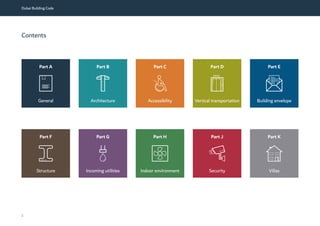
Contents
ii
Part A
Part F Part G Part H Part K
Part B Part C Part E
Part D
General
Structure
Architecture
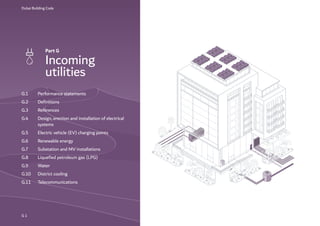
Incoming utilities
Accessibility
Indoor environment
Vertical transportation
Part J
Security
Building envelope
Villas
Dubai Building Code
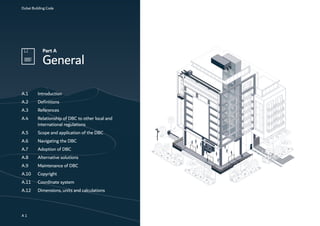
Part A
General
A 1
A.1 Introduction
A.2 Definitions
A.3 References
A.4 Relationship of DBC to other local and
international regulations
A.5 Scope and application of the DBC
A.6 Navigating the DBC
A.7 Adoption of DBC
A.8 Alternative solutions
A.9 Maintenance of DBC
A.10 Copyright
A.11 Coordinate system
A.12 Dimensions, units and calculations
Dubai Building Code Part A: General
A 2
A.1 Introduction
The objective of the Dubai Building Code (DBC) is to unify building design across
Dubai, and to create a building code that is easy to use and clearly mandates the
minimum requirements for:
a) the health, safety, welfare and convenience of people in and around buildings;
b) the health, safety, welfare and convenience of people who might be affected by
buildings;
c) building design to reduce the impact on the surrounding environment; and
d) the sustainable development of buildings.
The content of the DBC is based on the following inputs:
1) existing regulations and technical requirements produced by the various
Authorities and Service Providers;
2) interviews with Government Authorities, Service Providers, Master Developers,
Consultants and other stakeholders to understand gaps or inconsistencies
between existing regulations;
3) benchmarking to international and regional codes.
The DBC is arranged under themes to integrate all relevant elements of building
design.
The regulations stipulated in the DBC are the minimum requirements for building
design. Nothing in the DBC prevents a building design that achieves higher standards
than the minimum set out in the DBC.
Dubai Building Code Part A: General
A 3
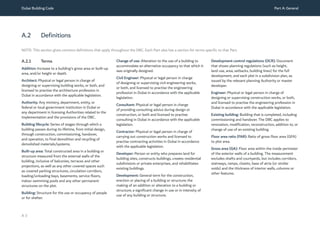
A.2 Definitions
A.2.1 Terms
Addition: Increase to a building’s gross area or built-up
area, and/or height or depth.
Architect: Physical or legal person in charge of
designing or supervising building works, or both, and
licensed to practise the architecture profession in
Dubai in accordance with the applicable legislation.
Authority: Any ministry, department, entity, or
federal or local government institution in Dubai or
any department in licensing Authorities related to the
implementation and the provisions of the DBC.
Building lifecycle: Series of stages through which a
building passes during its lifetime, from initial design,
through construction, commissioning, handover,
and operation, to final demolition and recycling of
demolished materials/systems.
Built-up area: Total constructed area in a building or
structure measured from the external walls of the
building, inclusive of balconies, terraces and other
projections, as well as any other covered spaces such
as covered parking structures, circulation corridors,
loading/unloading bays, basements, service floors,
indoor swimming pools and any other permanent
structures on the plot.
Building: Structure for the use or occupancy of people
or for shelter.
Change of use: Alteration to the use of a building to
accommodate an alternative occupancy to that which it
was originally designed.
Civil Engineer: Physical or legal person in charge
of designing or supervising civil engineering works,
or both, and licensed to practise the engineering
profession in Dubai in accordance with the applicable
legislation.
Consultant: Physical or legal person in charge
of providing consulting advice during design or
construction, or both and licensed to practise
consulting in Dubai in accordance with the applicable
legislation.
Contractor: Physical or legal person in charge of
carrying out construction works and licensed to
practise contracting activities in Dubai in accordance
with the applicable legislation.
Developer: Person or entity who prepares land for
building sites, constructs buildings, creates residential
subdivisions or private enterprises, and rehabilitates
existing buildings.
Development: General term for the construction,
erection or placing of a building or structure; the
making of an addition or alteration to a building or
structure; a significant change in use or in intensity of
use of any building or structure.
Development control regulations (DCR): Document
that shows planning regulations (such as height,
land use, area, setbacks, building lines) for the full
development, and each plot in a subdivision plan, as
issued by the relevant planning Authority or master
developer.
Engineer: Physical or legal person in charge of
designing or supervising construction works, or both,
and licensed to practise the engineering profession in
Dubai in accordance with the applicable legislation.
Existing building: Building that is completed, including
commissioning and handover. The DBC applies to
renovation, modification, reconstruction, addition to, or
change of use of an existing building.
Floor area ratio (FAR): Ratio of gross floor area (GFA)
to plot area.
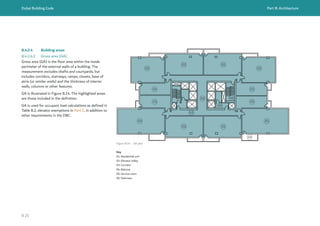
Gross area (GA): Floor area within the inside perimeter
of the exterior walls of a building. The measurement
excludes shafts and courtyards, but includes corridors,
stairways, ramps, closets, base of atria (or similar
voids) and the thickness of interior walls, columns or
other features.
NOTE: This section gives common definitions that apply throughout the DBC. Each Part also has a section for terms specific to that Part.
Dubai Building Code Part A: General
A 4
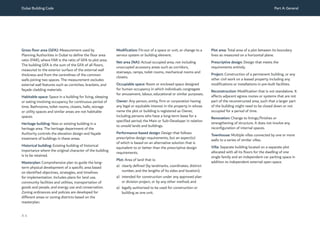
Gross floor area (GFA): Measurement used by
Planning Authorities in Dubai to define the floor area
ratio (FAR), where FAR is the ratio of GFA to plot area.
The building GFA is the sum of the GFA of all floors,
measured to the exterior surface of the external wall
thickness and from the centrelines of the common
walls joining two spaces. The measurement excludes
external wall features such as corniches, brackets, and
façade cladding materials.
Habitable space: Space in a building for living, sleeping
or eating involving occupancy for continuous period of
time. Bathrooms, toilet rooms, closets, halls, storage
or utility spaces and similar areas are not habitable
spaces.
Heritage building: New or existing building in a
heritage area. The heritage department of the
Authority controls the elevation design and façade
treatment of buildings in these areas.
Historical building: Existing building of historical
importance where the original character of the building
is to be retained.
Masterplan: Comprehensive plan to guide the long-
term physical development of a specific area based
on identified objectives, strategies, and timelines
for implementation. Includes plans for land use,
community facilities and utilities, transportation of
goods and people, and energy use and conservation.
Zoning ordinances and policies are developed for
different areas or zoning districts based on the
masterplan.
Modification: Fit-out of a space or unit, or change to a
service system or building element.
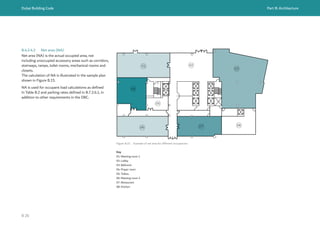
Net area (NA): Actual occupied area, not including
unoccupied accessory areas such as corridors,
stairways, ramps, toilet rooms, mechanical rooms and
closets.
Occupiable space: Room or enclosed space designed
for human occupancy in which individuals congregate
for amusement, labour, educational or similar purposes.
Owner: Any person, entity, firm or corporation having
any legal or equitable interest in the property in whose
name the plot or building is registered as Owner,
including persons who have a long-term lease for a
specified period; the Main or Sub-Developer in relation
to unsold lands and buildings.
Performance-based design: Design that follows
prescriptive design requirements, but an aspect(s)
of which is based on an alternative solution that is
equivalent to or better than the prescriptive design
requirements.
Plot: Area of land that is:
a) clearly defined (by landmarks, coordinates, distinct
number, and the lengths of its sides and location);
a) intended for construction under any approved plan
or division project, or by any other method; and
a) legally authorized to be used for construction or
building as one unit.
Plot area: Total area of a plot between its boundary
lines as measured on a horizontal plane.
Prescriptive design: Design that meets the
requirements entirely.
Project: Construction of a permanent building, or any
other civil work on a leased property including any
modifications or installations in pre-built facilities.
Reconstruction: Modification that is not standalone. It
affects adjacent egress routes or systems that are not
part of the reconstructed area, such that a larger part
of the building might need to be closed down or not
occupied for a period of time.
Renovation: Change to linings/finishes or
strengthening of structure. It does not involve any
reconfiguration of internal spaces.
Townhouse: Multiple villas connected by one or more
walls to a series of similar villas.
Villa: Separate building located on a separate plot
allocated with all its floors for the dwelling of one
single family and an independent car parking space in
addition to independent external open space.
Dubai Building Code Part A: General
A 5
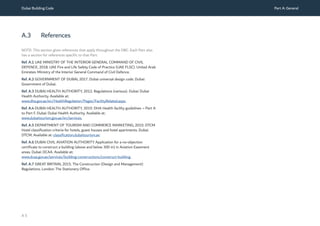
A.3 References
NOTE: This section gives references that apply throughout the DBC. Each Part also
has a section for references specific to that Part.
Ref. A.1 UAE MINISTRY OF THE INTERIOR GENERAL COMMAND OF CIVIL
DEFENCE, 2018. UAE Fire and Life Safety Code of Practice (UAE FLSC). United Arab
Emirates: Ministry of the Interior General Command of Civil Defence.
Ref. A.2 GOVERNMENT OF DUBAI, 2017. Dubai universal design code. Dubai:
Government of Dubai.
Ref. A.3 DUBAI HEAL
TH AUTHORITY, 2012. Regulations (various). Dubai: Dubai
Health Authority. Available at:
www.dha.gov.ae/en/HealthRegulation/Pages/FacilityRelated.aspx.
Ref. A.4 DUBAI HEAL
TH AUTHORITY, 2019. DHA Health facility guidelines – Part A
to Part F. Dubai: Dubai Health Authority. Available at:
www.dubaitourism.gov.ae/en/services.
Ref. A.5 DEPARTMENT OF TOURISM AND COMMERCE MARKETING, 2019. DTCM
Hotel classification criteria for hotels, guest houses and hotel apartments. Dubai:
DTCM. Available at: classification.dubaitourism.ae.
Ref. A.6 DUBAI CIVIL AVIATION AUTHORITY Application for a no-objection
certificate to construct a building (above and below 300 m) in Aviation Easement
areas. Dubai: DCAA. Available at:
www.dcaa.gov.ae/services/building-constructions/construct-building.
Ref. A.7 GREAT BRITAIN, 2015. The Construction (Design and Management)
Regulations. London: The Stationery Office.
Dubai Building Code Part A: General
A 6
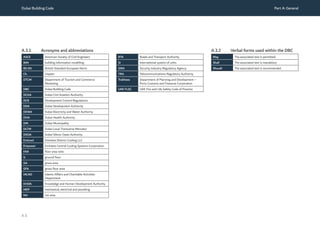
ASCE American Society of Civil Engineers
BIM building information modelling
BS EN British Standard European Norm
Ch. chapter
DTCM Department of Tourism and Commerce
Marketing
DBC Dubai Building Code
DCAA Dubai Civil Aviation Authority
DCR Development Control Regulations
DDA Dubai Development Authority
DEWA Dubai Electricity and Water Authority
DHA Dubai Health Authority
DM Dubai Municipality
DLTM Dubai Local Transverse Mercator
DSOA Dubai Silicon Oasis Authority
Emicool Emirates District Cooling LLC
Empower Emirates Central Cooling Systems Corporation
FAR floor area ratio
G ground floor
GA gross area
GFA gross floor area
IACAD Islamic Affairs and Charitable Activities
Department
KHDA Knowledge and Human Development Authority
MEP mechanical, electrical and plumbing
NA net area
A.3.1 Acronyms and abbreviations A.3.2 Verbal forms used within the DBC
RTA Roads and Transport Authority
SI International system of units
SIRA Security Industry Regulatory Agency
TRA Telecommunications Regulatory Authority
Trakhees Department of Planning and Development –
Ports Customs and Freezone Corporation
UAE FLSC UAE Fire and Life Safety Code of Practice
May The associated text is permitted
Shall The associated text is mandatory
Should The associated text is recommended
Dubai Building Code Part A: General
A 7
A.4 Relationship of DBC to other local and international regulations
A.4.1 Local regulations
The DBC incorporates, unifies and replaces the
regulations related to building design published
by Dubai Municipality (DM), Dubai Development
Authority (DDA), Department of Planning and
Development – Ports Customs and Freezone
Corporation (Trakhees) and Dubai Silicon Oasis
Authority (DSOA).
Regulations related to building design by Dubai
Electricity and Water Authority (DEWA) and Islamic
Affairs and Charitable Activities Department (IACAD)
are incorporated or cross-referenced by the DBC.
Regulations related to building design by the Security
Industry Regulatory Agency (SIRA) are summarized
and cross-referenced in Part J.
Federal regulations also remain in place. The DBC
follows the Federal regulations of Telecommunications
Regulatory Authority (TRA) and the Ministry of
Interior Civil Defence. The TRA regulations are given in
G.11. The UAE Fire and Life Safety Code (UAE FLSC)
[Ref. A.1] is cross-referenced throughout the DBC.
Accessibility requirements of the Dubai Universal
Design Code [Ref. A.2] applicable to building design
are incorporated in Part C and replace these aspects of
the Dubai Universal Design Code.
The Dubai Health Authority (DHA) regulations
[Ref. A.3 and Ref. A.4], along with the relevant Federal
regulations, shall be followed for the design of all
healthcare facilities.
The Department of Tourism and Commerce Marketing
(DTCM) sets out the requirements to achieve star
ratings for hotels, resorts, hotel apartments and
guest houses [Ref. A.5]. Achieving the minimum
requirements of the DBC does not guarantee a rating
from DTCM. DTCM should be consulted at the earliest
stage of design.
The Knowledge and Human Development Authority
(KHDA) and the Ministry of Education both license
education facilities, but they do not provide separate
design requirements. Education facilities are approved
by the main Authorities in accordance with the DBC.
Roads and Transport Authority (RTA) regulations in
relation to the right of way are referenced by the DBC
as appropriate.
Dubai Civil Aviation Authority (DCAA) regulates
maximum building heights within the flight path.
Regulations related to permitting, procedures,
construction and design of non-building elements
such as infrastructure, transportation systems, and
the public realm remain, and can be obtained from, the
relevant Authority.
Planning development regulations published by
Developers or Planning Authorities are not replaced
by the DBC. The DBC contains planning regulations
in Part B, but these shall be followed only where
plot-specific planning development regulations are
unavailable.
A.4.2 International codes and standards
The DBC relies on international codes and standards,
mainly BS EN and American codes. These codes and
standards shall be used in their latest edition except
where the DBC lists an edition.
NOTE: As an example, Part F (Structures) mandates
the 2016 edition of ASCE/SEI 7.
An edition is mandated in the DBC for one of two
reasons.
a) The DBC refers to sections, tables and figures
within that version of the international code or
standard and therefore the cross-references might
not apply to later editions.
b) The edition has been reviewed for its applicability
to Dubai.
Dubai Building Code Part A: General
A 8
A.4.3 Hierarchy of codes and standards
The hierarchy of the adopted codes and standards is
defined as follows.
a) The DBC and UAE Fire and Life Safety Code of
Practice (UAE FLSC) [Ref. A.1] together form the
main regulations for building design in Dubai. The
UAE FLSC is referenced throughout the DBC.
b) The DBC follows the SIRA regulations for
the design of security. These regulations are
summarized and referenced in Part J.
c) The DBC follows the Federal regulations of TRA
for the design of telecommunications. These
regulations are documented in G.11.
d) The international codes and standards for design,
material and product specification listed under the
heading of “Essential references” in each Part, and
referenced in the relevant sections of each Part, are
also requirements of the DBC.
e) Documents listed under the heading of “Further
reading” in each Part are provided for information
as useful guides to building design.
Where there is conflict between the DBC and reference
model codes or standards, the most restrictive/highest
performance requirements shall be met.
Where there is a conflict between a general
requirement and a specific requirement of the DBC
or its referenced codes/standards then the specific
requirement applies.
A.4.4 Safe by design
The principle of “safe by design” requires the
Consultant to address the health and safety of all
occupants, Contractors and users of the building.
This includes Contractors, maintenance staff,
occupants, visitors and demolition teams throughout
the building lifecycle.
This process is documented in a risk register where
the Consultant acknowledges the risk, investigates
mitigation measures and provides a design solution
which reduces the risk to a practicable level, while also
taking account of cost, constructability, other project
goals, etc.
Safe by design principles are not mandated by the
first edition of the DBC, but are likely to be enforced
in future revisions. Consultants should familiarize
themselves with these principles by reference to the
Construction Design and Management Regulations
[Ref. A.7].
Dubai Building Code Part A: General
A 9
A.5 Scope and application of the DBC
A.5.1 General
The DBC applies to new buildings and changes to existing buildings as described in
Table A.1, except where an alternative solution is permitted (see A.8).
Change to an
existing building
Description Applicable codes
Renovation Change to linings/finishes or
strengthening of structure. It does not
involve any reconfiguration of internal
spaces.
DBC and UAE FLSC [Ref. A.1] apply
to interior finish changes or building
envelope changes.
Modification Fit-out of a space/unit, or change to a
service system or building element.
DBC and UAE FLSC [Ref. A.1] apply to
the fit-out or change.
Reconstruction Modification that is not stand-alone.
It affects adjacent egress routes
or systems that are not part of the
reconstruction area such that a larger
part of the building might need to
be closed down or not occupied for a
period of time.
DBC and UAE FLSC [Ref. A.1] apply
to the reconstruction and any areas of
the building which are impacted by the
reconstruction.
Change of use Change of use or occupancy of part or
all of the building.
DBC and UAE FLSC [Ref. A.1] apply
to the change of use and any areas of
the building which are impacted by the
change of use, e.g. existing exit stairs
and routes, vertical transport, quantity
and type of sanitary provisions.
Addition An increase in the building’s gross area
or built-up area, and/or height or depth.
DBC and UAE FLSC [Ref. A.1] apply to
the addition.
If the addition relies on the remainder of
the existing building for escape, vertical
transport, etc., the existing building
shall also be assessed against the DBC
and UAE FLSC [Ref. A.1].
Occupancy Use
Assembly Amusement park, theatre, cinema, restaurant, museum, art gallery, place of
worship, library, exhibition and conference centre, etc.
Business Office, professional services, government centre, post office, bank, etc.
Educational University, college, school, kindergarten, nursery, educational institute
Hotel establishment Hotel, resort, guesthouse, hotel apartment
Residential Apartment, studio, student accommodation, labour accommodation, staff
accommodation
Villas and townhouses
Parking Open, enclosed, mechanical
Retail Shopping centre, department store, shop, kiosk, showroom, stores
Mall Open mall, enclosed mall
Industrial Factory, workshop
Storage Warehouse
Table A.1 Existing building and application of the DBC
Table A.2 Occupancies and use types
The DBC applies to the occupancies and use types described in Table A.2.
Dubai Building Code Part A: General
A 10
The DBC does not apply to:
a) infrastructure such as road and rail bridges, tunnels, culverts, metro stations,
hydraulic structures, buried and overhead utilities, power stations, antennas and
masts, wind turbines and nuclear facilities;
b) marine structures such as canals, dams, dikes, levies, piers, jetties and wharves;
c) oil and gas structures such as petrochemical facilities, oil refineries, liquefied
natural gas terminals, oil platforms and tanks;
d) structures such as tents, cranes, storage racks, scaffolding, formwork and
falsework;
e) structures subject to specific loading conditions such as stadia, grandstands, silos
and chimneys.
The DBC does not apply to historical buildings where the original character of the
building is to be retained. Buildings considered to be historical shall conform to the
guidelines of the relevant Authority as appropriate.
Buildings in heritage areas or considered to be heritage buildings shall follow the
DBC. The heritage department of the Authority controls the elevation design and
façade treatment.
Villas and townhouses are addressed in Part K.
A.5.2 Floor area and building height definitions in DBC
A.5.2.1 Gross floor area (GFA)
Gross floor area (GFA) is used by Planning Authorities in Dubai to define the floor
area ratio (FAR), where FAR is the ratio of GFA to plot area. The building GFA is the
sum of the GFA of all floors, measured to the exterior surface of the external wall
thickness and from the centrelines of the common walls joining two spaces. The
measurement excludes external wall features such as corniches, brackets, and façade
cladding materials.
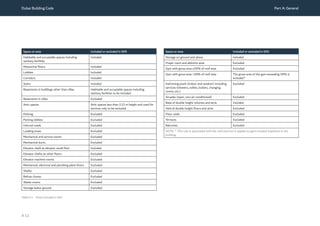
GFA is calculated based on Table A.3.  
GFA might be in development control regulations (DCR). Consultants shall calculate
GFA using the DBC definition and Table A.1 unless GFA is stated in the DCR.
Dubai Building Code Part A: General
A 11
Space or area Included or excluded in GFA
Habitable and occupiable spaces including
sanitary facilities
Included
Mezzanine floors Included
Lobbies Included
Corridors Included
Stairs Included
Basements in buildings other than villas Habitable and occupiable spaces including
sanitary facilities to be included
Basements in villas Excluded
Attic spaces Attic spaces less than 2.15 m height and used for
services only to be excluded
Parking Excluded
Parking lobbies Excluded
Internal roads Excluded
Loading areas Excluded
Mechanical and service rooms Excluded
Mechanical ducts Excluded
Elevator shaft at elevator recall floor Included
Elevator shafts at other floors Excluded
Elevator machine rooms Excluded
Mechanical, electrical and plumbing plant floors Excluded
Shafts Excluded
Refuse chutes Excluded
Waste rooms Excluded
Storage below ground Excluded
Table A.3 Areas included in GFA
Space or area Included or excluded in GFA
Storage on ground and above Included
Prayer room and ablution area Excluded
Gym with gross area ≤50% of roof area Excluded
Gym with gross area >50% of roof area The gross area of the gym exceeding 50% is
included*
Swimming pools (indoor and outdoor) including
services (showers, toilets, lockers, changing
rooms, etc.)
Excluded
Arcades (open, non-air conditioned) Excluded
Base of double height volumes and atria Included
Void of double height floors and atria Excluded
Floor voids Excluded
Terraces Excluded
Balconies Excluded
NOTE: * This rule is associated with the roof area but it applies to gyms located anywhere in the
building.
Dubai Building Code Part A: General
A 12
A.5.2.2 Built-up area
Built-up area is used also by Planning Authorities. It
is defined as the total constructed area in a building
or structure measured from the external walls of the
building, inclusive of balconies, terraces and other
projections as well as any other covered spaces such
as covered parking structures, circulation corridors,
loading/unloading bays, basements, service floors,
indoor swimming pools and any other permanent
structures on the plot. Calculation of total built-up area
shall exclude the following:
a) shafts, courtyards and yards including mechanical,
electrical and plumbing (MEP) shafts, refuse chutes
and similar;
b) non-covered outdoor landscape and hardscape
surfaces and courtyards;
c) lightweight outdoor shading structures such as
pergolas and standalone canopies.
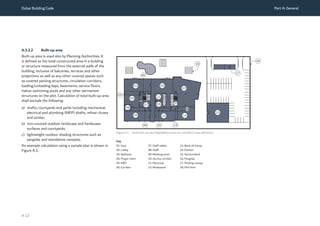
An example calculation using a sample plan is shown in
Figure A.1.
Figure A.1 Total built-up area (highlighted areas are included in area definition)
09
04
05
06
10
12 14
15
01 02
03
07
11
05
16
17
18
08
06 13
Key
01: Gym
02: Lobby
03: Ballroom
04: Prayer room
05: MEP
06: Corridor
07: Staff toilets
08: Staff
09: Meeting room
10: Service corridor
11: Electrical
12: Restaurant
13: Back-of-house
14: Kitchen
15: Service block
16: Pergolas
17: Parking canopy
18: Plot limit
Dubai Building Code Part A: General
A 13
A.5.2.3 Gross area and net area
The terms “gross area” (GA) and “net area” (NA) are
used by the DBC to calculate occupant load in a floor
or space. They are defined in A.2 and further described
and illustrated in Part B.
A.5.2.4 Building height
Building height is a key variable that is checked by
the Authorities for compliance with the DBC, DCR/
affection plans, UAE FLSC [Ref. A.1] and, where
applicable, DCAA restrictions on building heights
located in Aviation easement areas due to overhead
flight paths.
Each definition of building height is slightly different
as they are used to regulate different issues. For this
reason, Consultants shall check building height against
the DBC, DCR/affection plans, UAE FLSC [Ref. A.1]
and, where applicable, DCAA regulations [Ref. A.6].
Dubai Building Code Part A: General
A 14
A.6 Navigating the DBC
A.6.1 Division into Parts
The DBC is divided into Parts as described in Figure A.2.
Each Part is subdivided into sections by topic.
Minimum requirements for sustainability are embedded
within the relevant Parts of the DBC. Developers and
Consultants are encouraged to apply the rating system
adopted by the relevant Authority to assess their
projects and exceed these minimum requirements.
Fire safety requirements are given in the relevant
Parts of the DBC and cross referenced to UAE FLSC
[Ref. A.1]. The aim of this cross-referencing is to help
Consultants navigate and coordinate the requirements
of the two documents. Where an element of UAE FLSC
is not applicable in Dubai, or the DBC contains additional
information not in UAE FLSC, this is indicated in the
text.
Figure A.2 How to use and navigate the DBC
Part H
Indoor environment
Part E
Building envelope
Part J
Security
Part B
Architecture
Part C
Accessibility
Part K
Villas
Part F
Structure
Part D
Vertical transportation
Part G
Incoming utilities
Dubai Building Code Part A: General
A 15
A.6.2 Performance statements
The overarching objectives of the DBC, its intention
and regulatory scope, are set out in A.1.
Each Part of the DBC starts with a set of performance
statements. These set out the broad outcomes that
the completed building is expected to achieve, and
are provided to explain the intent of the prescriptive
design requirements within the Part. If the prescriptive
design requirements of the Part are followed, then the
performance statements of the Part are deemed to be
met and will be accepted by the Authority.
A.6.3 References
Each Part has a section for essential references and
further reading. The requirements of the DBC and
the essential references form the prescriptive design
requirements of the DBC and will be enforced by the
Authority. Websites and webpages shall be checked
regularly for updates.
NOTE: Where websites and webpages have been cited
throughout the DBC, they are provided for ease of
reference and are correct at the time of publication.
Changes to the location of a webpage or website, or its
contents, cannot be guaranteed.
A.6.4 Definitions
In addition to the common definitions in A.2, each Part
has a section for definitions.
A.6.5 Annexes
Any annex material is included at the end of the Part
to which it relates. Annex material contains further
explanatory material.
Dubai Building Code Part A: General
A 16
A.7 Adoption of DBC
Projects in design or construction that have a final
approved design from the Authority do not need to
conform to the DBC.
Projects in design without a final approved design shall
conform to the DBC. The requirements of the DBC are
based on regulations enforced prior to its publication
and in many instances the DBC is less stringent. For
example, requirements unrelated to health, safety,
welfare and environment have generally been removed
from the regulations. Therefore, it is expected that
there will be benefits to Developers and Owners in
adopting the DBC.
A.8 Alternative solutions
The DBC is intended to be a prescriptive design code.
Performance statements are provided at the start of
each Part to describe the outcomes that the completed
building is expected to achieve.
The performance statements form a set of overarching
regulations that convey the requirements of the
DBC (see A.6.2).
The preferred method of meeting the performance
statements of the DBC is to follow the prescriptive
design requirements in each Part.
The inclusion of performance statements sets out the
intent of the DBC and future-proofs it, supporting
a possible transition to a more performance-based
regulatory system in the future.
Alternative solutions which meet the performance
statements of the DBC are permitted:
a) for projects that cannot reasonably meet the
prescribed requirements; and
b) for changes to existing buildings where the
requirements of the DBC would result in a
disproportionate cost to the Owner/Developer.
The Authority will decide if an alternative solution is
permitted.
An alternative solution shall meet the intent of
the performance statements and provide at least
an equivalent level of performance to all of the
prescriptive design requirements.
Alternative solutions shall be applied to a performance-
based design holistically such that a change from
one Part of the DBC does not reduce the building’s
performance in other aspects.
Alternative solutions for changes to existing buildings
shall demonstrate that the existing conditions are
maintained to the current level of compliance or
improved to meet the safety levels of the DBC and
UAE FLSC [Ref. A.1].
The Authority will decide whether or not a
performance-based design is equivalent to the
prescriptive design requirements. The responsibility
is on the Consultant to demonstrate that the
performance-based design is required and that
it is at least equivalent to the prescriptive design
requirements.
The DBC lists preferred international codes and
standards in each Part (see A.4.2). Where permitted
by the Authority, alternative standards can be used
provided that the comparable standard meets the
intent of the DBC.
Dubai Building Code Part A: General
A 17
A.9 Maintenance of DBC
A.9.1 General
The DBC is an interactive document available
electronically.
The DBC will typically be maintained and updated on a
two- to three-year cycle. If necessary, addendums will
be issued between cycles. It is therefore important that
Consultants, Contractors and Engineers check back
regularly to ensure that they are following the latest
version of the DBC.
A.9.2 Latest changes to DBC
This edition is the first edition of the DBC.
Amended content in future editions will be clearly
indicated. For example, new content will be side lined in
the first edition in which it is published.
A.10 Copyright
No content of the DBC, in part or whole, shall be
copied, printed, sold or reproduced in any format.
A.11 Coordinate system
The coordinate system used by the Authority is Dubai
Local Transverse Mercator (DL
TM). The reference
point for levelling is Port Rashid.
Dubai Building Code Part A: General
A 18
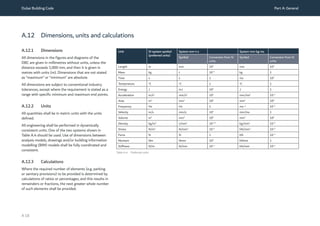
A.12.1 Dimensions
All dimensions in the figures and diagrams of the
DBC are given in millimetres without units, unless the
distance exceeds 1,000 mm, and then it is given in
metres with units (m). Dimensions that are not stated
as “maximum” or “minimum” are absolute.
All dimensions are subject to conventional industry
tolerances, except where the requirement is stated as a
range with specific minimum and maximum end points.
A.12.2 Units
All quantities shall be in metric units with the units
defined.
All engineering shall be performed in dynamically
consistent units. One of the two systems shown in
Table A.4 should be used. Use of dimensions between
analysis models, drawings and/or building information
modelling (BIM) models shall be fully coordinated and
consistent.
A.12.3 Calculations
Where the required number of elements (e.g. parking
or sanitary provisions) to be provided is determined by
calculations of ratios or percentages, and this results in
remainders or fractions, the next greater whole number
of such elements shall be provided.
Unit SI-system symbol
(preferred units)
System mm-t-s System mm-kg-ms
Symbol Conversion from SI
units
Symbol Conversion from SI
units
Length m mm 103
mm 103
Mass kg t 10−3
kg 1
Time s s 1 ms 103
Temperature o
C o
C 1 o
C 1
Energy J mJ 103
J 1
Acceleration m/s2
mm/s2
103
mm/ms2
10−3
Area m2
mm2
106
mm2
106
Frequency Hz Hz 1 ms−1
10−3
Velocity m/s mm/s 103
mm/ms 1
Volume m3
mm3
109
mm3
109
Density kg/m3
t/mm3
10−12
kg/mm3
10−9
Stress N/m2
N/mm2
10−6
kN/mm2
10−9
Force N N 1 kN 10−3
Moment Nm Nmm 103
kNmm 1
Stiffness N/m N/mm 10−3
kN/mm 10−6
Table A.4 Preferred units
A.12 Dimensions, units and calculations
Dubai Building Code
Part B
Architecture
B 1
B.1 Performance statements
B.2 Definitions
B.3 References
B.4 General architectural provisions
B.5 Minimum space requirements
B.6 Circulation requirements and openings
B.7 Building access and vehicular requirements
B.8 Communal provisions in buildings
B.9 Architectural requirements for specific building
types and spaces
B.10 Buildings interaction with outdoor environment
B.11 Wayfinding in buildings
Dubai Building Code Part B: Architecture
B 2
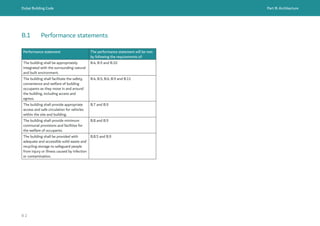
B.1 Performance statements
Performance statement The performance statement will be met
by following the requirements of:
The building shall be appropriately
integrated with the surrounding natural
and built environment.
B.4, B.9 and B.10
The building shall facilitate the safety,
convenience and welfare of building
occupants as they move in and around
the building, including access and
egress.
B.4, B.5, B.6, B.9 and B.11
The building shall provide appropriate
access and safe circulation for vehicles
within the site and building.
B.7 and B.9
The building shall provide minimum
communal provisions and facilities for
the welfare of occupants.
B.8 and B.9
The building shall be provided with
adequate and accessible solid waste and
recycling storage to safeguard people
from injury or illness caused by infection
or contamination.
B.8.5 and B.9
Dubai Building Code Part B: Architecture
B 3
B.2 Definitions
B.2.1 Terms
Accessibility: Ease of independent approach, entry,
evacuation and/or use of a building and its services
and facilities by all of the building’s potential users,
regardless of disability, age or gender, and with an
assurance of individual health, safety and welfare.
Accessible: Site, building, facility or portion thereof
that conforms to Part C.
Advertising: Any identification or description or
drawing or any other means to be fitted or erected or
printed or written or drawn, either directly or indirectly,
or any building or structure or plot, whose purpose is
to draw attention to any business, product, service, etc.
Affection plan: Plan of the plot or site issued by the
Authority, showing information that includes (but is
not limited to) the plot boundaries, plot dimensions,
plot areas, setbacks and surroundings as well as the
land uses. Also called site plan.
Amenity space: Public or private area within the
boundaries of a plot or a development site for the
building occupant’s recreation or convenience (such as
landscaped areas, patios, swimming pools, play areas,
prayer rooms, exercise areas and similar uses).
Annex: Building or installation, attached to or
independent from the main building, the use of which
is secondary or complementary to the function of the
main building.
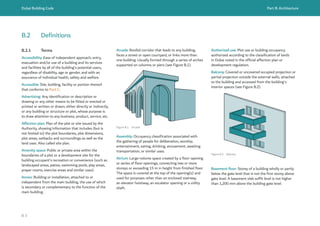
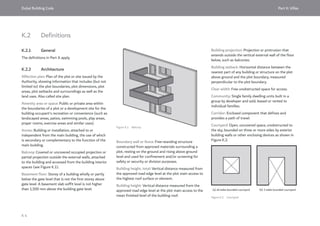
Arcade: Roofed corridor that leads to any building,
faces a street or open courtyard, or links more than
one building. Usually formed through a series of arches
supported on columns or piers (see Figure B.1).
Figure B.1 Arcade
Authorized use: Plot use or building occupancy
authorized according to the classification of lands
in Dubai noted in the official affection plan or
development regulation.
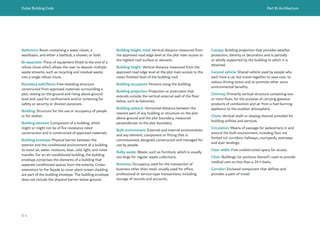
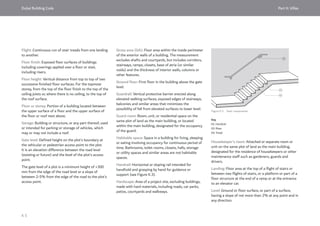
Balcony: Covered or uncovered occupied projection or
partial projection outside the external walls, attached
to the building and accessed from the building's
interior spaces (see Figure B.2).
Assembly: Occupancy classification associated with
the gathering of people for deliberation, worship,
entertainment, eating, drinking, amusement, awaiting
transportation, or similar uses.
Atrium: Large-volume space created by a floor opening
or series of floor openings, connecting two or more
storeys or exceeding 15 m in height from finished floor.
The space is covered at the top of the opening(s) and
used for purposes other than an enclosed stairway,
an elevator hoistway, an escalator opening or a utility
shaft.
Figure B.2 Balcony
Basement floor: Storey of a building wholly or partly
below the gate level that is not the first storey above
gate level. A basement slab soffit level is not higher
than 1,200 mm above the building gate level.
Dubai Building Code Part B: Architecture
B 4
Bathroom: Room containing a water closet, a
washbasin, and either a bathtub, a shower, or both.
Bi-separator: Piece of equipment fitted to the end of a
refuse chute which allows the user to deposit multiple
waste streams, such as recycling and residual waste,
into a single refuse chute.
Boundary wall/fence: Free-standing structure
constructed from approved materials surrounding a
plot, resting on the ground and rising above ground
level and used for confinement and/or screening for
safety or security or division purposes.
Building: Structure for the use or occupancy of people
or for shelter.
Building element: Component of a building, which
might or might not be of fire resistance rated
construction and is constructed of approved materials.
Building envelope: Physical barrier between the
exterior and the conditioned environment of a building
to resist air, water, moisture, heat, cold, light, and noise
transfer. For an air-conditioned building, the building
envelope comprises the elements of a building that
separate conditioned spaces from the exterior. Crown
extensions to the façade to cover plant screen cladding
are part of the building envelope. The building envelope
does not include the physical barrier below ground.
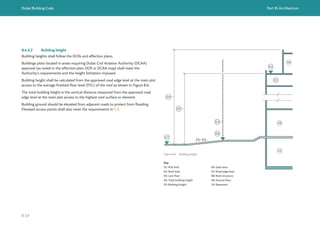
Building height, total: Vertical distance measured from
the approved road edge level at the plot main access to
the highest roof surface or element.
Building height: Vertical distance measured from the
approved road edge level at the plot main access to the
mean finished level of the building roof.
Building occupants: Persons using the building.
Building projection: Projection or protrusion that
extends outside the vertical external wall of the floor
below, such as balconies.
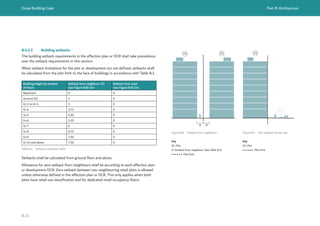
Building setback: Horizontal distance between the
nearest part of any building or structure on the plot
above ground and the plot boundary, measured
perpendicular to the plot boundary.
Built environment: External and internal environments
and any element, component or fitting that is
commissioned, designed, constructed and managed for
use by people.
Bulky waste: Waste, such as furniture, which is usually
too large for regular waste collections.
Business: Occupancy used for the transaction of
business other than retail, usually used for office,
professional or service-type transactions, including
storage of records and accounts.
Canopy: Building projection that provides weather
protection, identity or decoration and is partially
or wholly supported by the building to which it is
attached.
Carpool vehicle: Shared vehicle used by people who
each have a car but travel together to save cost, to
reduce driving stress and to promote other socio
environmental benefits.
Chimney: Primarily vertical structure containing one
or more flues, for the purpose of carrying gaseous
products of combustion and air from a fuel-burning
appliance to the outdoor atmosphere.
Chute: Vertical shaft or sloping channel provided for
building utilities and services.
Circulation: Means of passage for pedestrians in and
around the built environment, including (but not
limited to) corridors, hallways, courtyards, stairways
and stair landings.
Clear width: Free unobstructed space for access.
Clinic: Buildings (or portions thereof) used to provide
medical care on less than a 24 h basis.
Corridor: Enclosed component that defines and
provides a path of travel.
Dubai Building Code Part B: Architecture
B 5
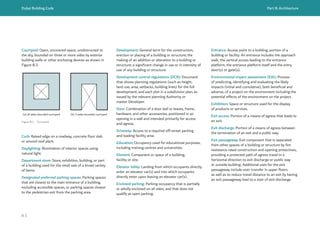
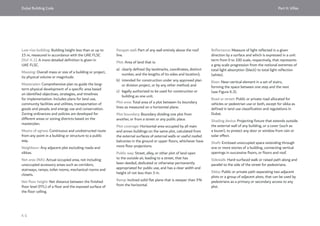
Courtyard: Open, uncovered space, unobstructed to
the sky, bounded on three or more sides by exterior
building walls or other enclosing devices as shown in
Figure B.3.
Curb: Raised edge on a roadway, concrete floor slab
or around roof plant.
Daylighting: Illumination of interior spaces using
natural light.
Department store: Store, exhibition, building, or part
of a building used for the retail sale of a broad variety
of items.
Designated preferred parking spaces: Parking spaces
that are closest to the main entrance of a building,
excluding accessible spaces, or parking spaces closest
to the pedestrian exit from the parking area.
Figure B.3 Courtyard
Entrance: Access point to a building, portion of a
building or facility. An entrance includes the approach
walk, the vertical access leading to the entrance
platform, the entrance platform itself and the entry
door(s) or gate(s).
Environmental impact assessment (EIA): Process
of predicting, identifying and evaluating the likely
impacts (initial and cumulative), both beneficial and
adverse, of a project on the environment including the
potential effects of the environment on the project.
Exhibition: Space or structure used for the display
of products or services.
Exit access: Portion of a means of egress that leads to
an exit.
Exit discharge: Portion of a means of egress between
the termination of an exit and a public way.
Exit passageway: Exit component that is separated
from other spaces of a building or structure by fire
resistance rated construction and opening protectives,
providing a protected path of egress travel in a
horizontal direction to exit discharge or public way
or outside building. Additional uses for the exit
passageway include stair transfer in upper floors
as well as to reduce travel distance to an exit by having
an exit passageway lead to a stair of exit discharge.
(a) all sides bounded courtyard (b) 3 sides bounded courtyard
Development: General term for the construction,
erection or placing of a building or structure; the
making of an addition or alteration to a building or
structure; a significant change in use or in intensity of
use of any building or structure.
Development control regulations (DCR): Document
that shows planning regulations (such as height,
land use, area, setbacks, building lines) for the full
development, and each plot in a subdivision plan, as
issued by the relevant planning Authority or
master Developer.
Door: Combination of a door leaf or leaves, frame,
hardware, and other accessories, positioned in an
opening in a wall and intended primarily for access
and egress.
Driveway: Access to a required off-street parking
and loading facility area.
Education: Occupancy used for educational purposes,
including training centres and universities.
Element: Component or space of a building,
facility or site.
Elevator lobby: Landing from which occupants directly
enter an elevator car(s) and into which occupants
directly enter upon leaving an elevator car(s).
Enclosed parking: Parking occupancy that is partially
or wholly enclosed on all sides, and that does not
qualify as open parking.
Dubai Building Code Part B: Architecture
B 6
Exterior stairway: Stairway that is open on at least one
side, except for required structural columns, beams,
handrails and guardrails. The adjoining open area can
be either yards, courtyards or public ways.
The other sides of the exterior stairway can be closed.
External wall: Wall, load bearing or non-load bearing,
that is used as an enclosing wall for a building and
might form part of the building envelope.
Facility: All or any portion of the buildings, structures,
site improvements, equipment, roads, walks,
passageways, parking lots or other property located
at the site.
Feeding room or lactation room: Private space where a
nursing mother can nurse a child or lactate.
Fixed seating: Furniture or fixture designed and
installed for the use of sitting, and secured in place.
Includes bench-type seats and seats with or without
backs or arm rests.
Flight: Continuous run of stair treads from one landing
to another.
Flood or flooding: General and temporary condition
of partial or complete inundation of normally dry land
from:
a) the overflow of inland or tidal waters;
b) the unusual and rapid accumulation or runoff
of surface waters from any source.
Floor finish: Exposed floor surfaces of buildings
including coverings applied over a floor or stair,
including risers.
Floor height: Vertical distance from top to top of two
successive finished floor surfaces. For the topmost
storey, from the top of the floor finish to the top of the
ceiling joists or, where there is no ceiling, to the top of
the roof surface.
Floor or storey: Portion of a building located between
the upper surface of a floor and the upper surface of
the floor or roof next above.
Fuel dispensing facilities: Facility where motor fuels
are stored and dispensed from fixed equipment into
the fuel tanks of motor vehicles or marine craft or into
approved containers, including all equipment used in
connection therewith.
Gate level: Defined height on the plot boundary at the
vehicular or pedestrian access point to the plot. It is an
elevation difference between the road level (existing or
future) and the level of the plot’s access point.
The gate level of a plot shall be a minimum height
of +300 mm from the edge of the road or a slope of
between 2-5% from the edge of the road to the plot’s
access point.
Glazed element: Individual element within a building
envelope that lets in light, including windows, plastic
panels, clerestories, skylights, doors that are more than
one half glass, and glass block walls.
Glazing: Glass that is installed as one of the
components of a wall, floor, ceiling or roofing system.
Gross area (GA): Floor area within the inside perimeter
of the exterior walls of a building. The measurement
excludes shafts and courtyards, but includes corridors,
stairways, ramps, closets, base of atria (or similar
voids) and the thickness of interior walls, columns or
other features.
Ground floor: First floor in the building above the gate
level.
Guard room: Room, unit, or residential space on the
same plot of land as the main building, or located
within the main building, designated for the occupancy
of the guard.
Guardrail: Vertical protective barrier erected along
elevated walking surfaces, exposed edges of stairways,
balconies and similar areas that minimizes the
possibility of fall from elevated surfaces to lower level.
Habitable space: Space in a building for living, sleeping
or eating involving occupancy for continuous period of
time. Bathrooms, toilet rooms, closets, halls, storage
or utility spaces and similar areas are not habitable
spaces.
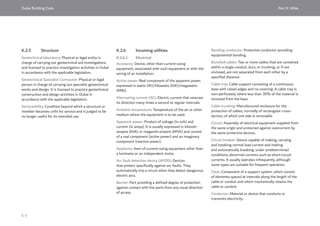
Handrail: Horizontal or sloping rail intended for
handhold and grasping by hand for guidance or
support (see Figure B.4).
Dubai Building Code Part B: Architecture
B 7
Hardscape: Area of a project site, excluding buildings,
made with hard materials, including roads, car parks,
patios, courtyards and walkways.
Hazardous waste: Waste material that can cause
substantial harm to humans, properties and/
or the environment due to its inherent hazardous
characteristics. Hazardous waste takes the form of
solid, liquid, sludge, gas or any combination thereof.
Healthcare: Occupancy used to provide medical,
psychiatric, surgical, therapeutic treatment for people.
Helipad: Dedicated structural surface used for the
landing, taking off, taxiing and parking of helicopters.
High-rise building: Building height greater than or
equal to 23 m and up to 90 m, measured in accordance
with the UAE FLSC [Ref. B.1]. A more detailed
definition is given in UAE FLSC.
Hospital: Building or portion thereof used on a 24 h
basis for the medical, psychiatric, obstetrical or surgical
care of four or more inpatients.
Hotel: Building or groups of buildings under the
same management in which there are sleeping
accommodations for lodging with or without meals for
people on a transient basis.
Hotel apartments: Collection of apartments or studios
that are rented to guests by the day, the week, the
month or the year.
Hotel establishment: Hotels, guest houses, hotel
apartments or resorts.
Hotel suite: Separate guest unit in a hotel that
contains one or more bedrooms with a living room and
other services.
Housekeeper’s room: Attached or separate room or
unit on the same plot of land as the main building,
designated for the residence of housekeepers or other
maintenance staff such as gardeners, guards and
drivers.
Hybrid vehicle: Vehicle using two different forms
of power, such as an electric motor and an internal
combustion engine, or an electric motor with a battery
and fuel cells for energy storage.
Illuminance: Amount of light falling onto a surface area.
Industrial/factory/workshop: Occupancy in which
products are manufactured or in which processing,
assembling, mixing, packaging, finishing, decorating, or
repair operations are conducted.
01
02
03
04
Figure B.4 Stair components
Key
01: Handrail
02: Tactile surface
03: Tread
04: Riser
Dubai Building Code Part B: Architecture
B 8
Intersection: Crossing of two or more roads.
Kiosk: Temporary or permanent structure of
lightweight construction occupied as a retail outlet,
food outlet or service outlet. Kiosks are generally
located at malls, shopping centres, assembly areas and
exhibition centres.
Kitchen: Place for the preparation of meals and
beverages.
Labour accommodation: Building used for group
accommodation for workers of a company or a firm,
for which the sanitary facilities and other services are
common.
Landing: Floor area at the top of a flight of stairs or
between two flights of stairs, or a platform or part of a
floor structure at the end of a ramp or at the entrance
to an elevator car.
Land use: Activities, operations, or purposes that are
employed in a particular geographic area; the specific
manner in which a plot of land is utilized. Land use
is usually regulated through zoning and planning
regulations.
Level: Ground or floor surface, or part of a surface,
having a slope of not more than 2% at any point and in
any direction.
Line of sight: Imaginary line from the eye to a
perceived object or view.
Loading area: Area used for loading or unloading
of vehicles, located entirely on private property and
provided with permanent independent access.
Lobby: Entrance or foyer to a space or building which
acts as a transition area.
Local road: A roadway with the primary function
of providing access to adjacent properties and to
roadways of a higher functional classification.
Local species: Local plants and plants adapted to the
local environment.
Low-rise building: Building height less than or up to
15 m, measured in accordance with the UAE FLSC
[Ref. B.1]. A more detailed definition is given in
UAE FLSC.
Low-depth underground building: Building up to 7 m
below or having up to two basements below the level of
exit discharge, measured in accordance with the UAE
FLSC [Ref. B.1]. A more detailed definition is given in
UAE FLSC.
Main building: Building used for the main or prime
functional use within the plot.
Mall: Pedestrian area within a building that serves as
access for multiple tenants with levels that are open to
each other. A covered mall has an enclosed or roofed
common pedestrian way. An open mall has an unroofed
common pedestrian way.
Massing: Overall mass or size of a building or project,
its physical volume or magnitude.
Masterplan: Comprehensive plan to guide the long-
term physical development of a specific area based
on identified objectives, strategies, and timelines
for implementation. Includes plans for land use,
community facilities and utilities, transportation of
goods and people, and energy use and conservation.
Zoning ordinances and policies are developed for
different areas or zoning districts based on the
masterplan.
Means of egress: Continuous and unobstructed route
from any point in a building or structure to a public
way.
Mechanical parking: Parking areas employing parking
machines, lifts, elevators or other mechanical devices
for vehicles moving from and to street level. Public
occupancy is prohibited above street level.
Mezzanine floor: Intermediate level or levels between
the floor and ceiling of any storey equal to or less than
one-third of the floor it is contained in. A partial floor
greater than one-third of the floor it is contained in is a
floor, not a mezzanine.
Mid-rise building: Building height greater than 15 m
but less than 23 m, measured in accordance with the
UAE FLSC [Ref. B.1]. A more detailed definition is
given in UAE FLSC.
Mixed use building: Building or structure containing
two or more occupancies.
Dubai Building Code Part B: Architecture
B 9
Mosque, Awqat mosque: Mosque building dedicated
for the daily five prayers, usually located in the
surrounding area of residential neighbourhoods.
Mosque, Eid Musalla: Non-roofed open Musalla used
for Eid prayer congregation.
Mosque, Jumaa mosque: Mosque building dedicated
for the daily five prayers and the Friday prayer
attended by a large number of worshippers.
Neighbour: Any adjacent plot excluding roads and
sikkas.
Net area (NA): Actual occupied area, not including
unoccupied accessory areas such as corridors,
stairways, ramps, toilet rooms, mechanical rooms and
closets.
Net floor height: Net distance between the finished
floor level (FFL) of a floor and the exposed surface of
the floor celling.
Nosing: Projecting front edge of a stair tread or
landing that can be rounded, chamfered or otherwise
shaped.
Occupancy: Purpose for which a building or portion
thereof is used or intended to be used.
Occupant load: Total number of persons that might
occupy a building or portion thereof.
Occupiable space: Room or enclosed space designed
for human occupancy in which individuals congregate
for amusement, labour, educational or similar purposes.
Office: Building or space within a building in which
business, clerical, or professional activities are
conducted.
Open parking: Parking occupancy where each parking
level has permanent wall openings for natural
ventilation purposes. The exterior sides of the
structure have uniformly distributed openings on two
or more sides. The area of such openings in external
walls on a level is not less than 20% of the total
perimeter wall area of each level. The total width of
all of the openings considered to be providing natural
ventilation is not less than 40% of the perimeter of the
level.
Open space: Portion of a plot or a building level that
is set aside for public or private use and that is not
occupied by rooms or equipment. The space may
be used for passive or active recreation or may be
reserved to protect or buffer natural areas.
Ornamental elements: Elements that are added to the
building for purpose of beautification or for expressing
a certain message or a symbol.
Pantry: Place for food preparation process or storage.
Parking: Building, structure, or portion thereof used for
the parking, storage, or both, of motor vehicles.
Parking bay: Area occupied by a single vehicle
depending on the position in which the vehicle is
parked.
Parapet wall: Part of a wall entirely above the roof line.
Paved: Use of blacktop, asphalt, concrete or other
similar substance to create a smooth surface, including
bituminous penetration, but not the use of dirt, clay,
slag or stone.
People of determination: People with specific needs
or disabilities, who are suffering from a temporary or
permanent, full or partial deficiency or infirmity in their
physical, sensory, mental, communication, educational
or psychological abilities.
Pergola: Shading device using solid material normally
used for ornamentation or for shading (see Figure B.5).
01
Figure B.5 Pergola Key
01: Pergola
Dubai Building Code Part B: Architecture
B 10
Planning regulations: Control by planning Authorities
for the use of land and buildings, the height and
massing of buildings, the density of population, and
the relation of a plot’s building coverage to open space,
the size and location of yards and setbacks, and the
provision of any ancillary facilities such as parking.
Plot: Area of land that is:
a) clearly defined (by landmarks, coordinates, distinct
number, and the lengths of its sides and location);
a) intended for construction under any approved plan
or division project, or by any other method; and
a) legally authorized to be used for construction or
building as one unit.
Plot area: Total area of a plot between its boundary
lines as measured on a horizontal plane.
Plot boundary: Boundary dividing one plot from
another, or from a street or any public place.
Plot coverage: Horizontal area occupied by all main
and annex buildings on the same plot, calculated from
the external surfaces of external walls or useful roofed
balconies in the ground or upper floors, whichever have
more floor projections.
Podium (tower base): Lower group of floors of a tower
which might or might not include the ground floor, and
have different planning requirements from the typical
floors of the tower.
Post-consumer recycled content: Waste material
generated by households or any other public or private
facilities in their role as end-users of the product,
which can no longer be used for its original intended
purpose.
Prayer room: Dedicated room or space in buildings
used to perform Islamic prayers which might or might
not be used for group prayers.
Pre-consumer recycled content: Material diverted from
the waste stream during the manufacturing process.
Reutilization of materials (i.e. rework, regrind or scrap
generated in a process and capable of being reclaimed
within the same process that generated it) is excluded.
Project: Construction of a permanent building, or any
other civil work on a leased property including any
modifications or installations in pre-built facilities.
Public use: Availability of interior or exterior rooms,
spaces or elements for use by the public. Public use can
be provided at a building or facility that is privately or
publicly owned.
Public way: Street, alley, or other plot of land open
to the outside air, leading to a street, that has
been deeded, dedicated or otherwise permanently
appropriated for public use, and has a clear width and
height of not less than 3 m.
Ramp: Inclined solid flat plane that is steeper than 5%
from the horizontal.
Recovery: Processing waste to serve a useful purpose
by replacing other materials which would otherwise
have been used to fulfil that function. Examples include
using waste to generate energy, or converting organic
waste into compost.
Recycling: Processing used materials into new products
in order to prolong the life of useful material, reduce
the consumption of fresh raw materials, reduce energy
usage, and reduce air and water pollution by reducing
the need for “conventional” waste disposal.
Reflectance: Measure of light reflected in a given
direction by a surface and which is expressed in a unit
term from 0 to 100 scale, respectively, that represents
a grey scale progression from the notional extremes of
total light absorption (black) to total light reflection
(white).
Refuse chute: Passage, commonly used in high-rise
buildings, through which waste is carried by means of
gravity to a waste container at the lower end.
Regulations: Rules and statutes set by permitting or
other governmental Authorities.
Residential: Occupancy that provides sleeping
accommodation with independent cooking and
bathroom facilities where people live on a permanent
basis.
Dubai Building Code Part B: Architecture
B 11
Residential unit: Single unit providing complete,
independent living facilities for one or more persons,
including permanent provisions for living, sleeping,
eating, cooking and sanitation. An apartment can be a
type of residential unit.
Retail: Occupancy used for the stocking, display and
sale of goods, wares or merchandise.
Reuse: Activity that lengthens the life of an item,
typically consisting of returning the item to active use
in the same or related capacity.
Right of way (ROW): Strip of land occupied or intended
to be occupied by a road, sidewalk, crosswalk, railroad,
electric transmission line, oil or gas pipeline, water line,
sanitary storm sewer, and other similar uses; the right
of one to pass over the property of another.
Riser: Near-vertical element in a set of stairs, forming
the space between one step and the next (see Figure
B.4).
Road or street: Public or private road allocated for
vehicles or pedestrian use or both, except for sikka as
defined in land use classification and regulations in
Dubai.
Roof: Floor or part of, located at the top level of the
building and usually used for machinery and services
equipment and/or providing building amenities and
open spaces.
Roof deck: Flat or sloped surface not including its
supporting members or vertical supports.
Self-closing (of a door or other opening protective
device): Equipped with a device that enables closure
from any position, and against any latch fitted, after
having been opened.
Service corridor: Fully enclosed passage used for
transporting of goods and services.
Service entrance: Entrance intended primarily for
delivery of goods or services.
Shading device: Projecting fixture that extends outside
the external wall of any building, or a cover (such as
a louver), to protect any door or window from rain or
solar effect.
Shaft: Enclosed unoccupied space extending through
one or more stories of a building, connecting vertical
openings in successive floors, or floors and roof.
Showroom: Space allocated for conducting a trading
business, such as displaying commodities for purpose
of wholesale or retail sale.
Sidewalk: Hard-surfaced walk or raised path along and
parallel to the side of the street for pedestrians.
Signage: Displayed verbal, symbolic and pictorial
information.
Sikka: Public or private path separating two adjacent
plots or a group of adjacent plots, that can be used by
pedestrians as a primary or secondary access to any
plot.
Site: Plot of land bounded by a plot line or a designated
portion of a public right-of-way. A site can be a single
plot or multiple plots together.
Skylight or overhead glazing: Glass or other
transparent or translucent glazing material installed at
a slope of 15° or more from vertical.
Solar reflectance index (SRI): Index that combines
reflectivity and emissivity, measuring a material’s
ability to reject solar heat. SRI is defined such that a
standard black (reflectance 0.05 and emittance 0.90) is
0 and a standard white (reflectance 0.80 and emittance
0.90) is 100. Materials with higher SRI absorb less heat
and can reduce heat island effect.
Space: Identifiable area including room, toilet, hall,
assembly area, entrance, storage room, alcove,
courtyard or lobby.
Staff accommodation: Building or part thereof in
which sleeping units are provided and/or rented, and
with private toilets and shared cooking facilities, for
joint occupancy by staff members affiliated with a
university, hospital, school or similar institutions.
Stage: Raised area within a building used for the
presentation of music, plays or other entertainment;
the head table for special guests; the raised area for
lecturers and speakers; boxing and wrestling rings;
theatre stages; and similar purposes.
Dubai Building Code Part B: Architecture
B 12
Stair: Change in elevation, consisting of one or more
risers.
Staircase: Space inside the building within which the
stairs are erected.
Stairway: One or more flights of stairs, either
exterior or interior, with necessary landings and
platforms connecting them to form a continuous and
uninterrupted passage from one level to another.
Structure: Constructed, erected material or
combination of materials which requires being located
on the ground or attached to something located on the
ground.
Student accommodation: Building or part thereof
in which sleeping units are provided for occupancy
by university, school or other educational institute’s
students and which is regulated by such institution.
Studio: Independent residential unit with combined
living room and bedroom and space provision for food
preparation and sanitation.
Super high-rise building: Building height greater than
90 m, measured in accordance with the UAE FLSC
[Ref. B.1]. A more detailed definition is given in
UAE FLSC.
Swimming pool: Constructed pool for swimming,
bathing or wading whether above or below the ground
surface regardless of depth or water surface area.
Tandem parking: Two or more parking bays with one of
the spaces placed behind the other.
Terrace: Covered or uncovered platform or roof,
protected by a guardrail or parapet wall and supported
by the structure of the floor below.
Toilet stall: Cubicle within a public toilet constructed
with demountable partitions or walls surrounding a
water closet.
Tread: Stepping space in a stair flight to set the foot
(see Figure B.4).
Vehicle access: Roadway, usually paved, intended to
provide ingress and egress of vehicular traffic from a
public right-of-way to a building entrance or parking
area.
Vehicle barrier: Component or system of components,
near open sides of a parking floor or ramp or building
walls that act as restraints for vehicles.
Warehouse: Occupancy used primarily for the storage
or sheltering of goods, merchandise, products, or
vehicles.
Waste: Unwanted or unusable materials which are
discarded after their primary use.
Waste room: Room dedicated for the purpose of
holding, prior to disposal, waste generated in the
building. This room can be located within the plot limits
or within building enclosure, subject to the approval of
Authorities.
Waste segregation: Separation or sorting of waste
materials into their respective fractions, such as the
separation of recyclables.
Water closet: Toilet bowl and its attached accessories.
Wayfinding: System of providing appropriate
information to assist a person to pass through the built
environment towards a specific destination. Wayfinding
includes orienting oneself, knowing one’s destination,
following the best route, recognizing one’s destination
and finding one’s way back out.
Wind towers: Shelter with 50% of its area open to the
sky usually constructed to enhance the architectural
beauty of a building or to suit a certain climate need.
Dubai Building Code Part B: Architecture
B 13
B.2.2 Acronyms and abbreviations
Ch. Chapter
DCR Development Control Regulations
DBC Dubai Building Code
DCAA Dubai Civil Aviation Authority
DHA Dubai Health Authority
DHCA Dubai Healthcare City Authority
DCD Dubai Civil Defence
DEWA Dubai Electricity and Water Authority
DM Dubai Municipality
DM PH&SD Dubai Municipality, health and safety
department
DTCM Department of Tourism and Commerce
Marketing
EIA environment impact assessment
EIAR environment impact assessment report
EIAS environment impact assessment summary
EMC electromagnetic compatibility
FFL finished floor level
FGI Facility Guidelines Institute
G ground floor
GA gross area
IBC International Building Code
LPG liquefied petroleum gas
MEP mechanical, electrical and plumbing
NA net area
RCC reinforced concrete
RMU ring main unit
RTA Roads and Transport Authority
SRI solar reflectance index
TIA traffic impact assessment
TIS traffic impact study
UAE FLSC United Arab Emirates Fire and Life Safety Code
of Practice
Dubai Building Code Part B: Architecture
B 14
BS EN 14010:2003+A1:2009, Safety of machinery
– Equipment for power driven parking of motor
vehicles – Safety and EMC requirements for design,
manufacturing, erection and commissioning stages
DIN 30722-1, Roller contact tipper vehicles, roller
containers – Part 1:Roller contact tipper vehicles up to
26 t, roller containers type 1570 made from steel
DIN 30722-2, Roller contact tipper vehicles, roller
containers – Part 2: Roller contact tipper vehicles up to
32 t, roller containers type 1570 made from steel.
DIN 30722-3, Roller contact tipper vehicles, roller
containers – Part 3: Roller contact tipper vehicles up to
12 t, roller containers type 900 made from steel
ISO 14021, Environmental labels and declarations
– Self-declared environmental claims (Type II
environmental labelling)
PD ISO/TS 22002-2, Prerequisite programmes on
food safety – Catering
Ref. B.1 UAE MINISTRY OF INTERIOR GENERAL
COMMAND OF CIVIL DEFENCE, 2018. UAE Fire and
Life Safety Code of Practice (UAE FLSC). United Arab
Emirates: Ministry of Interior General Command of
Civil Defence.
Ref. B.2 ROADS AND TRANSPORT AUTHORITY,
2017. RTA Railway Protection Code for the Emirate of
Dubai, Seventh Edition. Dubai: Roads and Transport
Authority.
Ref. B.3 DUBAI HEAL
TH AUTHORITY, 2012. Hospital
regulation. Dubai: Dubai Health Authority.
Ref. B.4 DUBAI HEAL
TH AUTHORITY, 2012.
Standards for day surgery centers. Dubai: Dubai
Health Authority.
Ref. B.5 DUBAI HEAL
TH AUTHORITY, 2012.
Outpatient care facilities regulation. Dubai: Dubai
Health Authority.
Ref. B.6 DUBAI HEAL
TH AUTHORITY, 2012. Clinical
laboratory regulation. Dubai: Dubai Health Authority.
Ref. B.7 DUBAI HEAL
TH AUTHORITY, 2012.
Diagnostic imaging services regulation. Dubai: Dubai
Health Authority.
Ref. B.8 DUBAI HEAL
TH AUTHORITY, 2013. Dental
laboratory regulation. Dubai: Dubai Health Authority.
Ref. B.9 DUBAI HEAL
TH AUTHORITY, 2014. School
clinic regulation. Dubai: Dubai Health Authority.
Ref. B.10 DUBAI HEAL
TH AUTHORITY, 2016.
Regulation for oncology services. Dubai: Dubai Health
Authority.
Ref. B.11 DUBAI HEAL
TH AUTHORITY, 2016. Optical
center and optometry services. Dubai: Dubai Health
Authority.
B.3.1 Essential references
ASCE/SEI 7-16, Minimum design loads and associated
criteria for buildings and other structures
ASTM F1346-91, Standard performance specification
for safety covers and labelling requirements for all
covers for swimming pools, spas and hot tubs
BS 1703, Refuse chutes and hoppers – Specification
BS EN 840-1, Mobile waste and recycling containers
– Containers with 2 wheels with a capacity up to 400 l
for comb listing devices – Dimensions and design
BS EN 840-2, Mobile waste and recycling containers –
Containers with 4 wheels with a capacity up to 1,300 l
with flat lid(s), for trunnion and/or comb lifting devices
– Dimensions and design
BS EN 840-3, Mobile waste and recycling containers –
Containers with 4 wheels with a capacity up to
1,300 l with dome lid(s), for trunnion and/or comb
lifting devices – Dimensions and design
BS EN 840-4, Mobile waste and recycling containers –
Containers with 4 wheels with a capacity up to
1,700 l with flat lid(s), for wide trunnion or BG- and/or
wide comb lifting devices – Dimensions and design
BS EN 12574-1, Stationary waste containers –
Containers with a capacity up to 10,000 l with flat or
dome lid(s), for trunnion, double trunnion or pocket
lifting devices – Dimensions and design
B.3 References
Dubai Building Code Part B: Architecture
B 15
Ref. B.20 DEPARTMENT OF TOURISM AND
COMMERCE MARKETING, 2014. Dubai hotel
classification – Budget hotel criteria. Dubai:
Department of Tourism and commerce marketing.
Ref. B.21 DEPARTMENT OF TOURISM AND
COMMERCE MARKETING, 2014. Hotel 1 star
criteria. Dubai: Department of Tourism and commerce
marketing.
Ref. B.22 DEPARTMENT OF TOURISM AND
COMMERCE MARKETING, 2014. Hotel 2 star
criteria. Dubai: Department of Tourism and commerce
marketing.
Ref. B.23 DEPARTMENT OF TOURISM AND
COMMERCE MARKETING, 2014. Hotel 3 star
criteria. Dubai: Department of Tourism and commerce
marketing.
Ref. B.24 DEPARTMENT OF TOURISM AND
COMMERCE MARKETING, 2014. Hotel 4 star
criteria. Dubai: Department of Tourism and commerce
marketing.
Ref. B.25 DEPARTMENT OF TOURISM AND
COMMERCE MARKETING, 2014. Hotel 5 star
criteria. Dubai: Department of Tourism and commerce
marketing.
Ref. B.26 DEPARTMENT OF TOURISM AND
COMMERCE MARKETING, 2014. Hotel apartment
standard criteria. Dubai: Department of Tourism and
commerce marketing.
Ref. B.27 DEPARTMENT OF TOURISM AND
COMMERCE MARKETING, 2014. Hotel apartment
deluxe criteria. Dubai: Department of Tourism and
commerce marketing.
Ref. B.28 DEPARTMENT OF TOURISM AND
COMMERCE MARKETING, 2014. Hotel apartment
superior criteria. Dubai: Department of Tourism and
commerce marketing.
Ref. B.29 DEPARTMENT OF TOURISM AND
COMMERCE MARKETING, 2014. Resort 3 star
criteria. Dubai: Department of Tourism and commerce
marketing.
Ref. B.30 DEPARTMENT OF TOURISM AND
COMMERCE MARKETING, 2014. Resort 4 star
criteria. Dubai: Department of Tourism and commerce
marketing.
Ref. B.31 DEPARTMENT OF TOURISM AND
COMMERCE MARKETING, 2014. Resort 5 star
criteria. Dubai: Department of Tourism and commerce
marketing.
Ref. B.32 DEPARTMENT OF TOURISM AND
COMMERCE MARKETING, 2014. Guest house
“standard” criteria. Dubai: Department of Tourism and
commerce marketing.
Ref. B.33 DEPARTMENT OF TOURISM AND
COMMERCE MARKETING, 2014. Guest house “deluxe”
criteria. Dubai: Department of Tourism and commerce
marketing.
Ref. B.12 DUBAI HEAL
TH AUTHORITY, 2013.
Regulation for renal dialysis services. Dubai: Dubai
Health Authority.
Ref. B.13 DUBAI HEAL
TH AUTHORITY, 2019. DHA
Health facility guidelines. Part A – Administrative
provisions. Dubai: Dubai Health Authority.
Ref. B.14 DUBAI HEAL
TH AUTHORITY, 2019. Health
facility guidelines. Part B – Health facility briefing and
design.  Dubai: Dubai Health Authority.
Ref. B.15 DUBAI HEAL
TH AUTHORITY, 2019. Health
facility guidelines. Part C – Access, mobility, OH&S.
Dubai: Dubai Health Authority.
Ref. B.16 DUBAI HEAL
TH AUTHORITY, 2019. Health
facility guidelines. Part D – Infection prevention and
control. Dubai: Dubai Health Authority.
Ref. B.17 DUBAI HEAL
TH AUTHORITY, 2019. DHA
Health facility guidelines. Part E – Engineering. Dubai:
Dubai Health Authority.
Ref. B.18 DUBAI HEAL
TH AUTHORITY, 2019. Health
facility guidelines. Part F – Feasibility, planning and
costing. Dubai: Dubai Health Authority.
Ref. B.19 DEPARTMENT OF TOURISM AND
COMMERCE MARKETING, 2019, Hotel classification
criteria for hotels, guest houses and hotel apartments,
Dubai: DTCM. Available from:
www.dubaitourism.gov.ae/en/services.
Dubai Building Code Part B: Architecture
B 16
Ref. B.42 PUBLIC HEAL
TH AND SAFETY
DEPARTMENT, 2010. DM-PH&SD-P4-TG17 –
Guidelines for first aid requirement. Dubai: Public
Health and Safety Department.
Ref. B.43 PUBLIC HEAL
TH AND SAFETY
DEPARTMENT, 2020.  DM-PH&SD-GU81-PSPS2 –
Public swimming pools safety guidelines. Dubai: Public
Health and Safety Department.
Ref. B.44 PUBLIC HEAL
TH AND SAFETY
DEPARTMENT, 2020. DM-PH&SD-GU80-PRSPS2 –
Private swimming pools safety guidelines. Dubai: Public
Health and Safety Department.
Ref. B.45 PUBLIC HEAL
TH AND SAFETY
DEPARTMENT, 2019. DM-PH&SD-P7-TG01 –
Guidelines for swimming pool safety. Dubai: Public
Health and Safety Department.
Ref. B.46 PUBLIC HEAL
TH AND SAFETY
DEPARTMENT, undated. Technical Guidelines. Dubai:
Public Health and Safety Department. Dubai: Public
Health and Safety Department. Available from:
www.dm.gov.ae/municipality-business/health-and-
safety/technical-guidelines-list/
Ref. B.47 PUBLIC HEAL
TH AND SAFETY
DEPARTMENT, 2020. DM-PH&SD-GU13-FCC2 –
Technical guidelines for fitness centres compliance.
Dubai: Public Health and Safety Department.
Ref. B.48 PUBLIC HEAL
TH AND SAFETY
DEPARTMENT, 2020. DM-H & SD-GU02-SEPA –
Guideline for safety in events/play area. Dubai: Public
Health and Safety Department.
Ref. B.49 PUBLIC HEAL
TH AND SAFETY
DEPARTMENT, 2020. DM-PH&SD-GU15-EIC2
–Technical guidelines for educational institutes
compliance.
Ref. B.50 PUBLIC HEAL
TH AND SAFETY
DEPARTMENT, 2020. DM-PH&SD-GU19-CSMC2 –
Technical guidelines for compliance of spa and massage
centers. Dubai: Public Health and Safety Department.
Ref. B.51 PUBLIC HEAL
TH AND SAFETY
DEPARTMENT, 2020. DM-PH&SD-GU73-SUL2 –
Technical guideline on safe use of ladders. Dubai: Public
Health and Safety Department.
Ref. B.52 PUBLIC HEAL
TH AND SAFETY
DEPARTMENT, 2020. DM-PH&SD-P4-TG26 – Safety
and health requirements for laundry operations. Dubai:
Public Health and Safety Department.
Ref. B.53 PUBLIC HEAL
TH AND SAFETY
DEPARTMENT, 2018. DM-PH&SD-P7-WI06 – Health
requirements for health clubs. Dubai: Public Health and
Safety Department.
Ref. B.54 FOOD CONTROL DEPARTMENT, FOOD
STUDIES & PLANNING SECTION, 2015. The general
hygiene requirements of food establishments. Dubai:
Food Control Department.
Ref. B.34 DEPARTMENT OF TOURISM AND
COMMERCE MARKETING, 2014. Youth hostel
criteria. Dubai: Department of Tourism and commerce
marketing.
Ref. B.35 DEPARTMENT OF TOURISM AND
COMMERCE MARKETING, 2014. University campus
criteria. Dubai: Department of Tourism and commerce
marketing.
Ref. B.36 DEPARTMENT OF TOURISM AND
COMMERCE MARKETING, 2019. Licensing and
classification manual for hotels, guest houses and
hotel apartments in the Emirate of Dubai. Dubai:
Department of Tourism and commerce marketing.
Ref. B.37 ROADS AND TRANSPORT AUTHORITY.
Dubai Access management manual. Dubai: Roads and
Transport Authority.
Ref. B.38 ROADS AND TRANSPORT AUTHORITY,
2017. Geometric design manual for Dubai Roads.
Dubai: Roads and Transport Authority.
Ref. B.39 International commission on illumination,
CIE 115:2010, Lighting of roads for motor and
pedestrian traffic
Ref. B.40 ROADS AND TRANSPORT AUTHORITY,
2013. Dubai trip generation and parking rates manual.
Dubai: Roads and Transport Authority.
Ref. B.41 INTERNATIONAL CODE COUNCIL, 2015.
International Building Code. Washington: International
Code Council.
Dubai Building Code Part B: Architecture
B 17
Ref. B.55 DUBAI MUNICIPALITY, 2019. Planning
guidelines for public amenities. Dubai: Dubai
Municipality.
Ref. B.56 FACILITY GUIDELINES INSTITUTE, 2014.
Guidelines for design and construction of hospitals
and outpatient facilities 2014. USA: American Hospital
Association.
Ref. B.57 GOVERNMENT OF DUBAI, 2003. Local
Order No. (11), Public health and safety of the society
in the Emirate of Dubai. Dubai: Dubai Municipality.
Ref. B.58 GOVERNMENT OF DUBAI, 2009.
Administrative resolution No. (29) prescribing the
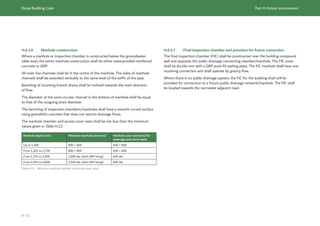
adoption of “Manual of regulating smoking in public
places”. Dubai: Dubai Municipality.
B.3.2 Further reading
There is no further reading in this Part.
Dubai Building Code Part B: Architecture
B 18
B.4 General architectural provisions
B.4.1 General requirements
Buildings shall be designed according to the planning limitations and provisions
required by the Authorities, as stipulated in development control regulations (DCR)
and/or affection plans. Limitations on development include, but are not limited to:
a) authorized use of the building;
b) building setbacks;
c) floor to area ratio;
d) access locations;
e) the gate level;
f) building service lines.
Buildings located in heritage areas shall respect the identity of these areas and shall
adhere to any conservation requirements imposed by the Authorities.
The building or development should take the following into account:
1) Arabic and Islamic cultural identity;
2) local architectural character, especially for buildings of cultural significance;
3) the building’s relationship with the surrounding environment;
4) the building’s compatibility with the planning limitations and urban planning
themes of surrounding developments.
The massing of the proposed building should take into account the visual privacy of
adjacent structures and buildings in the surrounding properties and neighbourhoods,
as well as the privacy of different uses and occupancies within the same development.
B.4.2 Development limitation
B.4.2.1 Gate level
The gate level is a defined height on the plot boundary at the vehicular or pedestrian
access point to the plot. It is an elevation difference between the road level (existing
or future) and the level of the plot’s access point.
The gate level of a plot shall be a minimum height of +300 mm from the edge of the
road or a slope of between 2-5% from the edge of the road to the plot’s access point.
The gate level, and the levels of the plot’s corners, are calculated based on Dubai
Roads and Transport Authority’s (RTA) standard cross-section of road right of way
(ROW), next to the plot.
Dubai Building Code Part B: Architecture
B 19
09
10
08
2%-5%
Figure B.6 Building height
Key
01: Plot limit
02: Roof level
03: Last floor
04: Total building height
05: Building height
B.4.2.2 Building height
Building heights shall follow the DCRs and affection plans.
Buildings plots located in areas requiring Dubai Civil Aviation Authority (DCAA)
approval (as noted in the affection plan, DCR or DCAA map) shall meet the
Authority’s requirements and the height limitation imposed.
Building height shall be calculated from the approved road edge level at the main plot
access to the average finished floor level (FFL) of the roof as shown in Figure B.6.
The total building height is the vertical distance measured from the approved road
edge level at the main plot access to the highest roof surface or element.
Building ground should be elevated from adjacent roads to protect from flooding.
Elevated access points shall also meet the requirements in C.5.
06: Gate level
07: Road edge level
08: Roof structure
09: Ground floor
10: Basement
Dubai Building Code Part B: Architecture
B 20
≤66 m 01
1
2
3
5
6
7
8
9
10
11
4
Figure B.7 Example of allowable building height calculation
Key
01: Maximum allowable total building height
To calculate the total allowable building height, the allowable number of floors,
as defined by the affection plan or DCR, shall be multiplied by 6 m per floor.
This does not impose restrictions on single floor heights.
Example: For a building with G+10 floors limit, the maximum allowable height shall be
calculated as 11 (the number of floors) × 6 m (the factor) = 66 m maximum building
height. See Figure B.7.
Parts of buildings and installations may exceed the maximum allowable height
provided that this increase does not conflict with DCAA or DCR requirements. These
parts include:
a) ornamental elements such as minarets, dome and towers that are embellished
in traditional and aesthetic patterns;
b) chimneys and smokestacks, water reservoirs, elevator shafts, stairways, radio
and television aerials, wind towers, pergolas, helipads and roof shading devices;
c) advertisement boards conforming to Authority regulations for advertising
(see E.10.9 for restrictions on advertising within façades).
When helipads are provided on buildings, they shall conform to standard
specifications approved by DCAA.
Dubai Building Code Part B: Architecture
B 21
Table B.1 Setback calculation table
Building height by number
of floors
Setback from neighbour (X)
(see Figure B.8) (m)
Setback from road
(see Figure B.9) (m)
Basement 0 0
Ground (G) 3 0
G+1 to G+3 3 0
G+4 3.75 0
G+5 4.50 0
G+6 5.25 0
G+7 6 0
G+8 6.75 0
G+9 7.50 0
G+10 and above 7.50 0
B.4.2.3 Building setbacks
The building setback requirements in the affection plan or DCR shall take precedence
over the setback requirements in this section.
When setback limitations for the plot or development are not defined, setbacks shall
be calculated from the plot limit to the face of buildings in accordance with Table B.1.
Setbacks shall be calculated from ground floor and above.
Allowance for zero setback from neighbours shall be according to each affection plan
or development DCR. Zero setback between two neighbouring retail plots is allowed
unless otherwise defined in the affection plan or DCR. This only applies when both
plots have retail use classification and for dedicated retail occupancy floors.
Figure B.8 Setback from neighbours
Key
01: Plot
X: Setback from neighbour (see Table B.1)
Plot limit
x x
01 01 01
Figure B.9 Zero setback facing road
Key
01: Plot
Plot limit
Dubai Building Code Part B: Architecture
B 22
Setbacks are shown in plan view in Figure B.10.
Setbacks shall also allow for fire separation between
buildings and fire truck access routes. To prevent
external fire spread, the building, shall be physically
separated from adjacent plots/buildings or external
walls and openings of the building shall be fire
resistance rated (see Sections 2.7 and 2.8, Ch. 1 of
UAE FLSC [Ref. B.1]).
Fire truck access shall be provided between buildings
and around buildings as required by Ch. 2 of UAE
FLSC [Ref. B.1]. This vehicle access might need to be
accommodated within the plot limits.
Where high-rise and super high-rise buildings (as
defined by UAE FLSC [Ref. B.1]) are built on a podium
and the distance from fire truck accessway to the
façade of the high-rise/super high-rise exceeds 30 m,
fire truck access to the podium shall be provided as
required by Section 2.8, Ch. 2 of UAE FLSC [Ref. B.1].
Setbacks from sikkas shall be calculated from the
centre of the sikka (see Figure B.11). When the sikka
width is more than 6 m, the maximum applicable width
from the centre of the sikka is 3 m. If the building
setback from the plot limit is found to be 1.5 m or less,
no setback is required.
Plots neighbouring cemeteries shall provide a minimum
setback of 3 m.
Plots adjacent to metro stations or metro
infrastructure shall conform to the RTA railway
protection code for the emirate of Dubai [Ref. B.2].
X
Y
X
02
01
02
03
04
Figure B.10 Setback plan
Key
01: Building footprint
02: Neighbour
03: Allowable projection
04: Road
X: Setback from neighbour (see Table B.1)
Y: Setback from centre of sikka
Plot limit
Setback line
Figure B.11 Setback from sikka
Key
01: Plot
Y: Setback from centre of sikka
Plot limit
Y Y
01 01
Dubai Building Code Part B: Architecture
B 23
Figure B.12 Setbacks between buildings in same plot
Key
01: Building footprint
02: Neighbour
03: Allowable projection
04: Road
X: Setback from neighbour, internal setback between buildings
Y: Setback from centre of sikka
Plot limit
Setback line
X
X X
X
02 02
01
01
03
04
Y
The distance between multiple buildings on the same plot shall be equal to the
setback required for both buildings from a neighbouring building plot, identified as (X)
in Figure B.12, measured from the least horizontal distance between buildings. This
distance shall be not less than 3 m between buildings height of ground floor only.
Dubai Building Code Part B: Architecture
B 24
Figure B.13 Allowed construction within setback
Key
01: Building footprint – above ground
02: Basement & building substructure
03: Sikka
04: Road
05: RMU rooms substations
06: Security or guard rooms
Plot limit
Setback line
03
02
01
05 06
04
The following structures shall be allowed within
setbacks up to the plot limit as shown in Figure B.13:
a) plot boundary wall/fence;
b) site enhancement landscape and hardscape;
c) ring main unit (RMU) rooms and substations as
required by service Authorities;
d) basement and building substructure;
e) pergolas and light weight parking shading
structures;
f) uncovered car parking and roadways;
g) security and/or guard rooms;
h) retail structures on plots where the neighbour is
also a retail occupancy.
Such arrangements shall not obstruct exit discharge to
fire vehicle access way/public road (if any).
Dubai Building Code Part B: Architecture
B 25
B.4.2.4 Building areas
B.4.2.4.1 Gross area (GA)
Gross area (GA) is the floor area within the inside
perimeter of the external walls of a building. The
measurement excludes shafts and courtyards, but
includes corridors, stairways, ramps, closets, base of
atria (or similar voids) and the thickness of interior
walls, columns or other features.
GA is illustrated in Figure B.14. The highlighted areas
are those included in the definition.
GA is used for occupant load calculations as defined in
Table B.2, elevator exemptions in Part C, in addition to
other requirements in the DBC.
01
01
02
03
05
04
01
01
06
01
01
01
01
01
01
01
01
Figure B.14 GA plan
Key
01: Residential unit
02: Elevator lobby
03: Corridor
04: Balcony
05: Service room
06: Staircase
Dubai Building Code Part B: Architecture
B 26
Figure B.15 Example of net area for different occupancies
Key
01: Meeting room 1
02: Lobby
03: Ballroom
04: Prayer room
05: Toilets
06: Meeting room 2
07: Restaurant
08: Kitchen
01 02
03
04
05
06 07 08
B.4.2.4.2 Net area (NA)
Net area (NA) is the actual occupied area, not
including unoccupied accessory areas such as corridors,
stairways, ramps, toilet rooms, mechanical rooms and
closets.
The calculation of NA is illustrated in the sample plan
shown in Figure B.15.
NA is used for occupant load calculations as defined
in Table B.2 and parking rates defined in B.7.2.6.1, in
addition to other requirements in the DBC.
Dubai Building Code Part B: Architecture
B 27
B.4.2.5 Balconies, building projections and terraces
B.4.2.5.1 Limitations
A balcony, building projection or terrace (see Figure B.16 and Figure B.17) can be
provided along the whole or part of the building façade constructed on the side of
the plot that overlooks a road or neighbours. Balconies, building projections and
terraces shall meet the following requirements and limitations.
a) The affection plan or DCR shall take precedence over the provisions in this
subclause.
b) A balcony or projecting building element shall be situated at an elevated level
from ground floor, not less than 3 m from FFL of sidewalks and footpaths as
shown in Figure B.16.
c) Projections from vehicle roads shall be set back a minimum of 0.6 m from
the edge of vehicle road, or a height clearance of not less than 5.5 m shall be
maintained from road level as shown in Figure B.16.
d) Projections above fire truck accessways shall be not less than 4.5 m in height from
road level in accordance with Section 2, Ch. 2 of UAE FLSC [Ref. B.1].
e) Projections outside the plot boundary are permitted on the road-facing side when
the width of road in which the balcony or projection protrudes exceeds 9 m.
f) Balconies and building projections shall be limited to 10% of the facing street
width beyond the plot limit and 1.8 m maximum projection into the ROW as
shown in Figure B.16.
g) The minimum horizontal distance of balconies and building projections from other
adjacent buildings, structures or neighbouring plots shall maintain the minimum
required setback (see Figure B.17).
Plots adjacent to metro stations or metro infrastructure shall conform to the RTA
railway protection code for the emirate of Dubai [Ref. B.2].
Privacy of neighbouring plots should be taken into account when setting the location
and orientation of balconies.
A privacy partition shall be provided between connected balconies of different
residential units.
Dubai Building Code Part B: Architecture
B 28
≤10% of x
≤1.8 m
01
≥0.6 m
x
03
02
≥5.5
m
≥3
m
≤1.8 m
≥3
m
Figure B.16 Projection from ROW
Key
01: Road level
02: Sidewalk level
03: Plot limit
X: Road width
Dubai Building Code Part B: Architecture
B 29
Figure B.17 Projections within setbacks
Key
01: Plot limit, if applicable
02: Neighbour
03: Minimum required setback
04: Ground level
≥3
m
01
02
03
04
B.4.2.5.2 Guardrails for fall protection
Guardrails are required for any space, walking or standing which is elevated 760 mm
above the FFL, with the exception of:
a) the loading side of loading docks;
b) the audience side of stages and raised platforms, including stairs leading up to the
stage and raised platforms;
c) raised stage and platform floor areas, such as runways, ramps and side stages;
d) vertical openings in the performance area of stages and platforms;
e) elevated walking surfaces associated with stages and platforms for access/use of
special lighting or equipment; and
f) along vehicle service pits not accessible to the public.
The guardrail height from FFL (or lowest stepping feature, A in Figure B.18) shall be
not less than 1,200 mm.
The separation distance between vertical posts or members (see Figure B.18), curved
frames or design features, of balcony, guardrail or handrail shall not allow the passage
of a 100 mm diameter sphere.
Horizontal climbable elements are not permitted within 865 mm height of the
bottom of the guardrail, i.e. (B) in Figure B.18.
If the design requires any gap between finished floor surface and the bottommost
horizontal component of the railing (see Figure B.18), the gap shall be not more than
100 mm.
The balcony, handrail, guardrail assembly shall be able to withstand the loads
specified in ASCE/SEI 7-16.
If the design demands usage of glass panels in the balcony construction, such glass
shall provide containment and withstand the loads specified in ASCE/SEI 7-16
(see E.9.2).
Dubai Building Code Part B: Architecture
B 30
01
02
≤100
A
≥
1,200
B
≥
865
≤100
Figure B.18 Guardrail specifications
Key
01: Gaps more than 100 mm not acceptable
02: Stepping feature within 865 mm of base of guardrail not acceptable
≤100
01
02
≤100
A
≥
1,200
B
≥
865
≤100
(a) Guardrail with stepping feature within 865 mm from FFL (b) Guardrail without stepping feature within 865 mm from FFL
Dubai Building Code Part B: Architecture
B 31
03
02
01
01 05
04
07
02
06
Figure B.19 Plot coverage
Key
01: Building
02: Pergola
03: Non-functional projection
04: Parking canopy
05: Parking
06: Annex building
07: Roof eaves
Plot limit
B.4.2.6 Plot coverage
Plot coverage shall be calculated as the horizontal area occupied by all main and
annex buildings on the same plot, calculated from the external surfaces of external
walls or useful roofed balconies in the ground or upper floors, whichever have more
floor projections.
The following shall be excluded (see Figure B.19):
a) lightweight structures such as a canopy, parking shade(s), pergola(s); and
b) ornamental and non-accessible building projections such as roof eaves, window
shades.
B.4.2.5.3 Access doors
Balconies and terraces shall not have self-closing, self-latching or self-locking doors,
which can accidentally lock people outside in the balcony or terrace.
Dubai Building Code Part B: Architecture
B 32
B
B
A
A
Figure B.20 Building exit separation
Key
A: Building diagonal distance
B: Direct distance between exit doors
NOTE:
B = 1/3 A for sprinklerled buildings
B = 1/2 A for unsprinklered buildings
B.4.3 Building floors general requirements
B.4.3.1 Ground floor
Ground floor use allowance shall conform to planning regulations. A building
or facility may have more than one ground floor where a split-level entrance
has been provided and where a building plot has significant level difference.
The ground floor shall be connected to the adjacent public ways by lobbies.
The number and location of exits discharging directly from the building to outside
shall conform to Section 3.10, Ch. 3 of UAE FLSC [Ref. B.1]. The points of exit
discharge shall be separated from each other on plan by one third (sprinklered
buildings) or one half (unsprinklered buildings) of the largest measurements
of the building diagonal distance (see Figure B.20).
An emergency command centre conforming to Table 1.9, Ch. 1 and Section 2.9,
Ch. 2 of UAE FLSC [Ref. B.1] shall be provided in malls, amusement park, high-rise
and super high-rise buildings. The emergency command centre may be shared with
a security room, rest area or control room, provided that it meets emergency
command centre specifications.
The emergency command centre shall be at ground floor and separated from the
remainder of the building by a 1 h fire barrier constructed in accordance with Ch. 1
of UAE FLSC [Ref. B.1]. The entrance to the emergency command centre shall
be on the exterior of the building along the fire accessway or if this is not feasible,
at the main entrance lobby of the building. Emergency command centres shall meet
the minimum room sizes specified in B.5.2.
Dubai Building Code Part B: Architecture
B 33
≤1.2
m
01
02
03
04
Figure B.21 Basement height from gate level
Key
01: Upper floor
02: Ground floor
03: Basement floor
04: Gate level
B.4.3.2 Basements
The space use shall conform to planning regulations.
Basement floors shall not extend beyond the plot limits.
The basement shall be connected to the building by means of vertical circulation
(staircases/elevators) in accordance with Ch. 1 to Ch. 10 of UAE FLSC [Ref. B.1].
The basement slab soffit level shall not extend 1.2 m above the building gate level as
shown in Figure B.21.
B.4.3.3 Podium
Building podiums shall conform to planning regulations.
When podium floors are used for habitable and occupiable spaces, these spaces
shall be designed as indoor spaces with building envelope, acoustic treatment
and ventilation/thermal comfort as required by Part E and Part H.
Dubai Building Code Part B: Architecture
B 34
Figure B.22 Roof coverage and setback
Key
01: Staircase or elevator room
02: Roof structure not more than 50% of the roof area
03: Roof
≥1.5 m
≥1.5 m
≥1.5 m
01
02
03
B.4.3.4 Roof
The space use shall conform to planning regulations.
Accessible roofs shall be provided with life safety
features such as fall protection and guardrails in
accordance with B.4.2.5.2.
Water proofing and thermal insulation material shall be
fitted on the roof deck in order to protect it from water
leaks (see E.7.3.2) and solar gain effects (see E.5.2.3).
Structures at roof level shall not exceed 50% of the
roof floor area as shown in Figure B.22.
Roof structures shall be set back a minimum of
1.5 m from the building envelope. Staircases and
elevator rooms are excluded from the 1.5 m setback
requirement, but they shall be calculated as part of the
50% construction area.
Roof structures occupying more than 50% of the roof
floor area or not provided with setback shall be treated
as a regular floor.
Dubai Building Code Part B: Architecture
B 35
B.5 Minimum space requirements
B.5.1 Occupant loads
Occupant load factors shall be determined in accordance with Table B.2.
Occupancy Use Occupant load factor
(m2
per person unless
otherwise stated)
Area used for
calculation
Assembly Concentrated
– ballrooms,
multipurpose-
assembly halls
0.65 Net area
Mosques, prayer halls
and prayer rooms
0.9 for prayer area Net area
Less concentrated
– outdoor buildings,
restaurants, dining
areas, seated waiting
areas
1.4 Net area
Conference rooms,
meeting rooms
1.4 Net area
Exhibition halls,
production studios
1.4 Net area
Bench seating 455 mm linear Net area
Fixed seating spaces
(cinemas, theatres and
similar)
According to number of
fixed seats provided
Net area
Waiting areas –
standing
0.65 Net area
Kitchens (e.g. in
restaurants, not private
residential)
9.3 GA
Library – reading areas 4.6 Net area
Library – stack areas 9.3 GA
Occupancy Use Occupant load factor
(m2
per person unless
otherwise stated)
Area used for
calculation
Assembly Swimming pools –
water surface
4.6 GA
Swimming pools – deck 2.8 GA
Exercise room –
without equipment
1.4 GA
Exercise room – with
equipment
4.6 GA
Stages 1.4 Net area
Gaming, amusement
arcades
1.0 GA
Skating rinks 4.6 GA
Food courts – seating
areas
1.4 Net area
Airport waiting areas 1.4 GA
Airport baggage claim 1.9 GA
Art galleries, museums 5.0 GA
Business Office – enclosed
offices, low
concentration
9.3 GA
Office – open offices,
high concentration
4.6 GA
Table B.2 Occupant load factor per person
Dubai Building Code Part B: Architecture
B 36
Occupancy Use Occupant load factor
(m2
per person unless
otherwise stated)
Area used for
calculation
Retail Retail shops 5.6 GA
Department stores,
multi-level retail
3.7 GA
Floors used for goods
not accessed by public
27.9 GA
Mall Mall – less than
14,000 m2
in area
2.8 Gross leasable area in
accordance with UAE
FLSC [Ref. B.1]
Mall – more than
14,000 m2
in area
3.3 Gross leasable area in
accordance with UAE
FLSC [Ref. B.1]
Industrial Factories 9.3 GA
Storage Warehouse 27.9 GA
Educational Classrooms 1.9 Net area
Laboratories, vocational 4.6 Net area
Residential Accommodation,
shared sleeping spaces
5.0 Net area
Labour accommodation
– sleeping spaces
3.7 Net area
Healthcare Refer to DHA
regulations and
guidelines [Ref. B.3 to
Ref. B.18]
The occupant load factors in Table B.2 generally align with UAE FLSC [Ref. B.1] with
the exception of residential. However, exit widths and number of exits from a room,
space, floor and building shall be calculated using the occupant load factors in Table
3.13, Ch. 3 of UAE FLSC [Ref. B.1].
Any space or building not listed in Table B.2 above shall conform to the occupant load
factors noted in Table 3.13, Ch. 3 of UAE FLSC [Ref. B.1].
Table B.2 Occupant load factor per person (continued)
Dubai Building Code Part B: Architecture
B 37
Occupancy/use Minimum area (m2
) Minimum dimension – length
and width of a room (m)
Residential living space
(bedroom, living room)
10.5 3 (See Figure B.23)
Residential studio (including
bathroom and kitchen space)
21 3
Housekeeper’s/guard rooms
(single occupancy only exclusive
of toilet area)
4.5 2.1
Retail shop — 2.4
Retail showroom — 9
Enclosed office — 2.4
Enclosed kitchen 5.4 1.8
Bathroom and toilets Shall meet fixture clearances noted in B.8.1.5
Toilet stalls Shall conform to B.8.1.4
Hotel establishment Refer to applicable DTCM classification criteria
[Ref. B.19 to Ref. B.36]
Healthcare facilities Refer to DHA regulations and guidelines [Ref. B.3 to Ref. B.18]
Fire pump rooms Refer to Table 1.9, Ch. 1 of UAE FLSC [Ref. B.1] for minimum room
sizes dependent upon equipment selected and other requirements
such as proximity to exit stairways.
Emergency command centre 19 3
Table B.3 Minimum room sizes
≥3.0 m
≥3.0
m
A ≥ 10.5 m2
Figure B.23 Minimum residential living space dimensions
B.5.2 Minimum room sizes
The net area and clear dimension of a room/space shall be not less than the
minimum sizes given in Table B.3. Minimum sizes for some other occupancies are
given in B.9.
Key
A: Room area
Dubai Building Code Part B: Architecture
B 38
The manoeuvring space between kitchen counters or adjacent to a single-sided
kitchen counter shall be not less than 1.2 m, as shown in Figure B.24.
Figure B.24 Manoeuvring space within kitchen
≥1.2 m
≥1.2 m
B.5.3 Minimum clear heights
The clear height of a space shall be not less than the minimum values given in
Table B.4.
The clear heights shall be calculated from FFL to any structural suspended element
or ceiling soffits, as shown in Figure B.25.
Occupancy Use Minimum clear heights (m)
Assembly Awqat mosque prayer hall 3.8
Jumaa mosque prayer hall 5.0
Prayer rooms 2.7
Ballrooms, multipurpose assembly halls 2.7
Business Offices 2.5
Retail, mall Retail shops/stores, showrooms 2.5
Educational Schools, nurseries and kindergartens –
classrooms
2.7
Healthcare — Refer to DHA regulations and
guidelines [Ref. B.3 to Ref. B.18]
Residential,
hotel
Living and bedroom spaces 2.7
Table B.4 Minimum clear heights
Dubai Building Code Part B: Architecture
B 39
Occupancy Use Minimum clear heights (m)
Industrial Industrial equipment areas Minimum headroom for industrial
equipment access shall conform to
Table 3.4, Ch. 3 of UAE FLSC [Ref. B.1].
Common
areas
Parking – for light vehicles 2.3
Corridors, passageways and elevator lobbies 2.3
Occupiable spaces (other than listed above) 2.3
Washrooms and toilets 2.3
Storage and utility space 2.3
Stairways 2.03 m above the stair treads and
2.3 m above the stair landings
(see B.6.4.1.15)
Means of egress 2.3
In not more than 50% of the ceiling
area, protruding objects may extend
below the minimum clear ceiling height,
where a minimum headroom of 2.03 m
from FFL shall be provided.
Fire pump room 2.5 (see Table 1.9, Ch. 1 of UAE FLSC
[Ref. B.1])
Figure B.25 Clear heights
>
2.7
m
>
2.3
m
Table B.4 Minimum clear heights (continued)
Dubai Building Code Part B: Architecture
B 40
B.6 Circulation requirements and openings
B.6.1 Walking surfaces
All walking surfaces, including accessible routes, shall
conform to the requirements of C.5 & C.7.2.
Changes in level in means of egress of more than 13
mm, but not more than 535 mm, shall be achieved
either by a ramp conforming to C.5.9.1 or by a stair
conforming to B.6.4.1.
B.6.2 Corridors
B.6.2.1 Minimum clear widths
The clear width of corridors shall be not less than
the values given in Table B.5. Where a corridor forms
part of an accessible route, it shall also meet the
requirements specified in C.5.
Occupancy/use Minimum clear corridor width (m)
Assembly, other public use buildings 1.5 for single loaded corridors
1.8 for double loaded corridors
Residential (common corridor) 1.5 for single sided residential units
1.8 for double sided residential units
(See Figure B.26 as example for corridor arrangement
in residential building)
Retail 1.8
Mall and retail areas > 3,600 m2
GA per
floor (pedestrian way)
6 for double sided units
3 for single sided units
Healthcare Refer to Dubai Health Authority’s (DHA) regulation and guidelines [Ref. B.3 to Ref. B.18] for
specific requirements and UAE FLSC [Ref. B.1]
Educational 2.1 for single sided classroom
3 for double sided classroom
Business – Offices 1.5 for single loaded corridors
1.8 for double loaded corridors
Hotel establishment
(common corridor)
1.5 for single loaded corridors
1.8 for double loaded corridors
Refer to DTCM classification criteria [Ref. B.19 to Ref. B.36]
for specific requirements.
Internal corridors inside residential and
hotel apartment units
1.0
(See Figure B.26 as example for corridor arrangement in residential building)
Service corridors 1.2
Corridors in all buildings Section 5, Ch. 3 of UAE FLSC [Ref. B.1] mandates minimum clear corridor widths per
occupancy type.
Exit passageways If applicable, Table 3.8, Ch. 3 of UAE FLSC [Ref. B.1] mandates minimum clear exit passageway
widths.
Table B.5 Minimum clear corridor widths
NOTE: Retail units under a single roof or not fire separated and having a ground floor GA of more than 3,600 m2
, irrespective of the number of storeys,
are treated as a mall in accordance with Ch.1 of the UAE FLSC [Ref. B.1].
Dubai Building Code Part B: Architecture
B 41
≥1.0
m
≥1.8
m
01
02
01
Figure B.26 Corridor arrangement in residential building example
Key
01: Apartment
02: Public corridor
Dubai Building Code Part B: Architecture
B 42
B.6.2.2 Fire resistance rating
Exit access corridors shall be 1 h fire resistance rated when required by Table 1.11a,
Ch. 1 of UAE FLSC [Ref. B.1].
Exit passageways shall achieve the fire resistance rating and construction
requirements of Table 3.8, Ch. 3 of UAE FLSC [Ref. B.1].
B.6.2.3 Kiosks in mall pedestrian ways
Kiosks are allowed along a mall pedestrian way under the following conditions
prescribed by Table 1.9, Ch. 1 of UAE FLSC [Ref. B.1].
a) The minimum corridor width between the kiosks and the adjacent shop or
construction shall be 3 m as shown in Figure B.27.
b) The minimum horizontal separation distance between 2 adjacent kiosks shall be
not less than 6 m.
c) The maximum area of a single kiosks or group of kiosks shall be 18 m2
collectively,
or 28 m2
in an open mall.
d) Kiosks shall conform to the fire safety system provisions and construction
materials required of Table 1.9 and Section 7.1.40, Ch. 1 of UAE FLSC [Ref. B.1].
B.6.3 Elevator lobbies
Elevator lobby design shall conform to Part D.
Figure B.27 Kiosk provision within malls
Key
01: Kiosk
02: Adjacent construction
03: Corridor width
≥6
m
≥3 m ≥3 m
01
01
01
02
03 03
02
Dubai Building Code Part B: Architecture
B 43
B.6.4 Vertical circulation in buildings
B.6.4.1 Stairways
B.6.4.1.1 General
The minimum number of exit stairways, stairway width, stairway separation,
exit discharge arrangements and fire resistance rating of the staircase shall
be determined in accordance with Ch. 3 of UAE FLSC [Ref. B.1].
The architectural requirements of a stairway design in this subsection align with
or exceed UAE FLSC [Ref. B.1].
At least one protected exit stairway shall extend to all roofs.
B.6.4.1.2 Exit staircase construction
Exit stairways shall be enclosed in fire resistance rated reinforced concrete (RCC)
staircase construction when required by Table 3.4, Ch. 3 of UAE FLSC [Ref. B.1],
except staircases serving low-rise buildings or low-depth underground buildings
where 2 h fire resistance rated blockwork construction is permitted.
RCC staircases with separate cores but a common RCC divider are acceptable only
in low-rise and mid-rise buildings, provided that the whole staircase conforms
to building construction type and separation distance between exits.
B.6.4.1.3 Stairway width
All stairways shall have a clear width of not less than 1,200 mm. The minimum width
of an exit stair shall be determined in accordance with Section 4, Ch. 3 of UAE FLSC
[Ref. B.1] depending upon the number of occupants it serves.
The required width of a stairway shall be measured from wall to the clear available
width of the step (see Figure B.28). The maximum projections of handrails allowed
in this required width is 100 mm on each side, at a height of 865 mm to 965 mm
(see Figure B.28).
> 1,200
≤100
865-965
1,065
01
02
03
04
05
06
07
Figure B.28 Handrail encroachment
Key
01: Handrail
02: Dual guardrail
03: Wall
04: Handrail height
05: Tread
06: Open side
07: Stair
Dubai Building Code Part B: Architecture
B 44
01
02
A
A
B
B
B.6.4.1.4 Stair risers and treads
Stair riser height as measured in Figure B.29 shall be in the range 100 mm
to 180 mm.
Riser heights shall be as uniform as possible throughout each stair flight between
landings. Where riser heights are adjusted to meet acceptable stair treads, flights
and arrangements, there shall be no more than 10 mm difference in riser height
within a single flight.
Stair treads shall have a depth of not less than 280 mm.
The tread slope shall not exceed 21 mm/m (2% slope).
Tread depth shall be as uniform as possible throughout the stair. There shall be
no more than 10 mm difference in tread depth within a single flight.
Further recommendations on riser height and tread depth provided for regular use
stairs and external steps are given in B.6.4.1.6.
Figure B.29 Stair risers
Key
01: Stair risers = A – B
02: Stair risers = A + B
Dubai Building Code Part B: Architecture
B 45
B.6.4.1.5 Landings
The height between landings shall be not more than
3,660 mm.
Every stair shall have a landing at the door opening.
The landing width shall be not less than the required
stairway width.
A staircase door shall not encroach in its swing into
more than one half of the landing width
(see Figure B.30).
The landing width shall not decrease in width along the
direction of egress travel.
The landing width is not required to exceed 1,200 mm
in the direction of travel, provided that the stairway has
a straight run.
The landing slope shall not exceed 21 mm/m 2% slope.
DN
DN UP
305
305
≥280
≤100
≤100
≥1,200
≥1,200
≥
1
,
2
0
0
≥1,200
≥1,200
A
A
A
01
02
03
04
05 06
07
01
A
2
≥
≤180
Figure B.30 Door opening and landing measurements
Key
01: Greater than or equal to tread depth
02: Finish wall
03: Intermediate landing
04: Dual guardrail
05: Continuous handrail
06: Top landing
07: Return of handrail to wall required
A: Minimum stairway width
Dubai Building Code Part B: Architecture
B 46
B.6.4.1.6 Regular use and external stairs
The following requirements and recommendations apply to stairs used for daily
circulation and external stepping.
a) Building entrance steps, landscaping steps and external circulation shall meet the
requirements given in Table B.6.
b) For regular use stairs in buildings, where the stairs serve as a primary means of
vertical circulation, conformity to Table B.6 is recommended.
Table B.6 Stair flight and steps
Stair element Requirement for stairs
Tread depth ≥300 mm
Riser height 150 mm to 165 mm (see Figure B.31)
Number of steps 2 steps min.
14 steps max.
≤13
≥300
150-165
≤13
25-51
01
02
Figure B.31 Step dimensions for regular use stairs
Key
01: Corner LRV strip profile
02: Tread LRV strip profile
The step edge shall present a slip-resistant surface with a minimum reflectance
contrast of 30 LRV points against the step surface (see Figure B.32).
It is recommended that a warning surface is provided at the descending edge of each
stair flight, in accordance with B.6.4.1.14 and as shown in Figure B.32. The warning
surface shall conform to the requirements in Part C.
Illumination along the whole flight of stairs should be not less than 200 lux.
Figure B.32 Warning surfaces at stairs
300300-400
01
02
Key
01: LRV 30 points contrast at step edge
02: Warning surface
Dubai Building Code Part B: Architecture
B 47
B.6.4.1.7 Handrails
Stairs shall have handrails on both sides in accordance with the arrangement
and dimensions shown in Figure B.33.
Handrails on stairs shall be located between 865 mm and 965 mm above the surface
of the tread, measured vertically to the top of the rail from the leading edge of
the tread.
Regular use stairs and external steps shall have an additional handrail, mounted
at a height between 650 mm and 750 mm, to facilitate use by children and people
of short stature.
Handrails forming part of a guardrail can exceed 965 mm, but shall not exceed 1,065
mm (see B.6.4.1.8), measured vertically to the top of the rail from the leading edge
of the tread.
Handrails shall be installed to provide a clearance of not less than 57 mm between
the handrail and the wall to which it is fastened.
Handrails shall be provided within 760 mm of all portions of the required means
of egress width in stairs. Where intermediate handrails are provided, the clear width
between handrails shall be a minimum of 760 mm along the natural path of travel.
Handrails shall continue for the full length of each flight of stair.
Inside handrails shall be continuous and graspable between flights at landings.
Handrails shall have circular cross-section with an outside diameter of not less than
32 mm and not more than 51 mm.
≥305
≥57
32- 51
38
865 - 965
01
03
02
01
≥57
≥305
≥57
32- 51
38
865 - 965
01
03
02
01
≥57
≥305
≥57
32- 51
38
865 - 965
01
03
02
01
≥57
≥305
≥57
32- 51
38
865 - 965
01
03
02
01
≥57
Figure B.33 Handrail specifications
Key
01: One tread depth handrail extension
02: Return of handrail to wall required
03: Handrail turn required
(a) handrail height
(c) handrail separation from wall (d) handrail alternative profiles
(b) handrail extension
Dubai Building Code Part B: Architecture
B 48
Figure B.34 Cross-sections of handrails
32-51
R3.2
<
57
< 57
01 01
Key
01: 100 mm to 160 mm perimeter
Handrail shape that is other than circular (see Figure B.34) shall be with a perimeter
dimension of not less than 100 mm, but not more than 160 mm, and with the largest
cross-sectional dimension not more than 57 mm, provided that graspable edges are
rounded so as to provide a radius of not less than 3.2 mm.
Figure B.35 Guardrail to a stairway
865
-
965
<100
<100
<100
<150
>760
≥1,200
Handrail brackets shall not project horizontally beyond the sides of the handrail
within 38 mm of the bottom of the handrail and provided that, for each additional
13 mm of handrail perimeter dimension greater than 100 mm, the vertical clearance
dimension of 38 mm is reduced by 3.2 mm.
Handrail brackets shall have edges with radius not less than 0.25 mm.
Handrails shall have a reflectance contrast of not less than 30 points LRV against its
background.
Handrail materials exposed to the sun shall not reach temperatures that can harm
the users.
B.6.4.1.8 Guardrails
Guardrails as shown in Figure B.35 shall be provided for every stairway where the
elevated surface is more than 760 mm from finished ground level.
(a) circular (b) square (c) oval
Such guardrails shall not encroach on the required clear width of the stairway.
Guardrails shall be not less than 1,200 mm high, measured vertically to the top of the
guardrail from the leading edge of the tread.
In case of stairway or ramp handrails that form part of a guardrail, the height of the
guardrail can be reduced to 1,065 mm.
Open guardrails shall have intermediate rails or an ornamental pattern up to a height
of 865 mm, such that a sphere 100 mm in diameter is not able to pass through any
opening.
Dubai Building Code Part B: Architecture
B 49
Figure B.36 Example stair signage
NO ACCESS TO ROOF
7
DOWN TO GROUND FLOOR
FOR EXIT DISCHARGE
WING A ‫اﻟﺟﮭﺔ‬
FLOOR ‫اﻟطﺎﺑﻖ‬
‫اﻟﺳطﺢ‬ ‫ﻋﻠﻰ‬ ‫ﻣﺧرج‬ ‫ﯾوﺟد‬ ‫ﻻ‬
‫اﻹﺧﻼء‬ ‫أﺟل‬ ‫ﻣن‬ ‫اﻷرﺿﻲ‬ ‫اﻟطﺎﺑﻖ‬ ‫اﻟﻰ‬ ‫اﻟﮭروب‬
The triangular openings formed by the riser, tread, and bottom element of a guardrail
at the open side of a stair shall be of such size that a sphere 150 mm in diameter
is not able to pass through the triangular opening.
Guardrails at landings or balconies over stairways shall also conform to B.4.2.5.2.
All staircases shall include signage indicating the floor level, wing of the building (if
applicable), and direction of egress (see Figure B.36).
Signage shall be in English and Arabic and shall conform to B.11.4.5.
Signage shall be provided inside the staircase at floor landings. It is not required on
mid-landings and shall not be located on door leaves. It shall be clearly visible for stair
users, located at a height of not less than 1,220 mm from the floor landing to the
bottom of the sign. The top of the signage shall be located not more than
2,135 mm above the floor landing.
Lettering shall be not less than 25 mm high.
B.6.4.1.10 Exterior stairways
An open outside exit stair shall not be provided in any building at more than 15 m
from finished ground level.
Outside stairs more than 11 m above the finished ground level, shall be provided
with an opaque visual obstruction not less than 1,200 mm in height.
Outside stairs shall be separated from the interior of the building by construction
with the required fire resistance rating in accordance with Table 3.4, Ch. 3 of
UAE FLSC [Ref. B.1].
B.6.4.1.11 Scissor or interlocking stairs
In accordance with Ch. 3 of the UAE FLSC [Ref. B.1], interlocking or scissor stairways
(see Figure B.37) shall be counted as a single exit. As such, the two interlocking
sections of a scissor staircase (see Figure B.38) are not required to be separated by
fire resisting construction.
02
01
01
01 02
02
Figure B.37 Scissor stairways in plan
Key
01: Section 1
02: Section 2
Dubai Building Code Part B: Architecture
B 50
> 255
305
3) All treads shall be identical.
4) Handrails shall be provided in accordance with B.6.4.1.7.
5) The turn of the stairway shall be such that the outer handrail is at the right side
of descending users.
Curved stairs shall have tread depth of not less than 255 mm at a point 305 mm
from narrowest edge (see Figure B.40).
B.6.4.1.12 Winders, spiral or curved stairs
Winders, spiral or curved stairs (see Figure B.38) are not permitted in means of
egress, with the following exceptions:
a) industrial occupancies where the winders provide access/egress from equipment
areas;
b) storage occupancies where the winders provide access/egress from mezzanines
which are only used for storage and not office space; and
c) retail areas where the winders provide access/egress from mezzanines where
goods are stored.
Winders may be used in stairs which are not exit stairs.
Winders shall have a minimum tread depth of 150 mm at their narrowest, and a
minimum tread depth of 280 mm when measured 305 mm from the narrowest edge.
Figure B.38 Examples of curved stairs, spiral stairs and winders
305
≥190
≥660
Figure B.39 Spiral stairs
Spiral stairs shall meet the following requirements.
1) Spiral stairs shall have:
i) a minimum clear width of 660 mm;
ii) a minimum headroom of 2,030 mm;
iii) a maximum riser height of 240 mm.
2) Treads shall have a depth not less than 190 mm at a point 305 mm from the
narrower edge (see Figure B.39).
Figure B.40 Curved stairs
Dubai Building Code Part B: Architecture
B 51
≥280
≥280
≥2,300
≥2,030
≥2,030
≥2,300
865-965
865-965
865-965
≥305
02
01 100-180
B.6.4.1.13 Equipment access
Industrial equipment access shall meet the following requirements.
a) Horizontal dimension of walkway, landing or platform shall be not less than
560 mm.
b) Stair or ramp width shall be not less than 560 mm.
c) Tread width shall be not less than 560 mm.
d) Tread depth shall be not less than 255 mm.
e) Riser height shall be not more than 230 mm
f) Height between landings shall be not more than 3,660 mm.
g) Head room shall be not less than 2,030 mm.
h) Width of door opening shall be not less than 560 mm.
i) Railings shall be 865 mm to 965 mm in height and may terminate directly above
top and bottom risers.
B.6.4.1.14 Surfaces and floor markings
Stair treads and landings shall be free of projections or lips that could trip stair users.
Stair treads and landings within the same stairway shall have consistent surface
traction.
Where contrasting marking is applied to stairs, such marking shall meet the following
requirements.
a) Exit stair treads shall incorporate a marking strip that is applied as a paint/
coating or be made from a material that is integral with the nosing of each step.
b) Surface-applied marking strips using adhesive-backed tapes shall not be used.
c) The marking strip shall be installed along the horizontal leading edge of the step
and shall extend the full width of the step.
d) The marking strip shall have a horizontal width between 25 mm and 51 mm.
e) The marking strip shall be not more than 13 mm from the leading edge of each
step and shall not overlap the leading edge of the step by more than 13 mm down
the vertical face of the step. See Figure B.32.
B.6.4.1.15 Minimum headroom
Head room in stairways shall be not less than 2.03 m, measured vertically above a
plane, parallel to the most forward projection of the stair tread (see Figure B.41), and
not less than 2.3 m above landings.
Figure B.41 Staircase arrangement
Key
01: 1 tread depth extension for handrail
02: Handrail
Dubai Building Code Part B: Architecture
B 52
B.6.4.1.16 Examples of compliant stair arrangements
The stairway designs in Figure B.42 are deemed to be compliant with B.6.4.1 for the
following reasons.
a) They have regular flights and consistent dimensions of steps.
b) There is a direct exit at discharge level from under the stair flight.
c) Where two doors on opposite sides are provided, each door swing does not
obstruct more than half of the required landing width.
Straight run stairs are acceptable, provided that the height between landings is not
more than 3,660 mm.
B.6.4.2 Ramps
Pedestrian ramps in buildings shall conform to C.5.9.
Guardrails shall conform to B.6.4.1.8. Handrails shall conform to C.5 or B.6.4.1.7. as
applicable.
Materials of construction and fire resistance of ramps shall conform to Section 3.7,
Ch. 3 of UAE FLSC [Ref. B.1].
B.6.4.3 Elevators
Elevators and vertical transportation systems shall conform to Part D.
Figure B.42 Examples of compliant stair treads, flights and arrangements
Dubai Building Code Part B: Architecture
B 53
≥915
01
02
Figure B.43 Minimum door clear width
Key
01: Door clear width
02: Door
B.6.5 Building openings
B.6.5.1 Doors
The door clear width shall be not less than the minimum values given in Table B.7 and
Figure B.43.
Figure B.44 Clearances between two adjacent doors.
≥1.2
m
The clear distance between two doors openings shall be not less than 1.2 m, as
shown in Figure B.44.
Accessible door requirements are given in C.5.8.
The design of doors as exits shall conform to the applicable requirements of Section
3.2, Ch. 3 of UAE FLSC [Ref. B.1] depending upon the location and purpose of the
door, including:
Door location Minimum door clear width (mm)
Entry doors, general 915
Bathrooms and toilets (excluding toilet stalls) 815
Exit doors, exit access doors 915 or greater depending upon the occupant load
served, as specified in Section 3, Ch. 3 of UAE
FLSC [Ref. B.1]
Table B.7 Minimum door clear width
a) direction of door swing;
b) limitations on when a particular door
type (side hinged, powered, sliding,
revolving, turnstile) can be used;
c) door hardware;
d) encroachment of the door swing into
corridors/stairs;
e) fire resistance rating; and
f) security arrangement.
Dubai Building Code Part B: Architecture
B 54
Table B.8 Minimum percentage of window to floor area
Occupancy Use Minimum window glazing area
(percentage of window net glazing
area to room area)
Business Offices – workstation areas 10%
Residential and hotel Living, bedroom spaces (excluding
kitchen area)
10%
Educational Schools, nurseries and kindergartens
– classrooms
10%
Assembly Mosques 10%
Figure B.45 Window glazing area to room area ratio
A
W
W ≥ 10% ofA
01
B.6.5.2 Windows and daylighting
B.6.5.2.1 Minimum area of windows
Daylighting provisions for habitable and occupiable spaces shall conform to Table B.8
and Figure B.45. Housekeeper's rooms shall be provided with adequate daylighting
similar to living spaces as shown in Table B.8 and Figure B.45.
The following requirements and recommendations apply to windows.
a) When windows are equipped with mechanical opening means, this shall be
positioned at a height between 900 mm to 1,200 mm from the room FFL.
Window latches for non-accessible spaces can be positioned higher than 1,200
mm.
b) Operable portion of the window shall be positioned at a safe height and equipped
by means of fall protection, according to E.9.4.
c) The required amount of daylighting can be provided through skylights or windows
or combination of both for all building spaces. The skylight glazing should be
positioned at a slope of 15° or more from vertical and directly connected to the
space it serves.
d) Windows may only face neighbouring plots when the required setback is achieved
and when the requirements for external fire spread are achieved as per Sections
2.7 and 2.8, Ch. 1 of UAE FLSC [Ref. B.1].
Daylighting modelling to justify lightling levels can be used to reduce minimum
opening percentage requirements, provided that minimum lux levels are achieved. Lux
levels from daylight shall achieve a minimum of 150 lux in bedrooms and living rooms.
Key
01: Room
A: Room area
W: Window net glazing area
Dubai Building Code Part B: Architecture
B 55
B.6.5.2.2 Daylighting
For habitable spaces to receive adequate natural light through windows, the room
depth should not exceed three times the width of the wall in which the window is
located (see Figure B.46).
When the room depth exceeds three times the width, additional daylighting should
be provided through an additional window meeting the criteria set in B.6.5.2.1, and
along any of the other sides of the room that have direct access to daylighting.
Figure B.46 Windows in rooms
Key
01: Additional opening
01
d<3X w=X
B.6.5.2.3 Access to views
Business, residential, educational and hotel occupancies shall provide direct line of
sight (views) to the outdoor environment in occupiable spaces as shown in
Figure B.47.
Figure B.47 Line of sight to the outdoor
B.6.5.2.4 Safety of windows
Safety requirements for windows are provided in E.9.
Dubai Building Code Part B: Architecture
B 56
B.6.6 Openings between floors
B.6.6.1 Convenience openings and communicating spaces
Convenience openings and communicating spaces are described in Table 1.9, Ch. 1 of
UAE FLSC [Ref. B.1].
Convenience openings for escalators and stairs shall conform to the fire safety
requirements given in Table 1.9, Ch. 1 of UAE FLSC [Ref. B.1] depending upon
whether or not the building is required to be sprinkler protected.
Floor voids forming a communicating space of maximum 3 floors shall conform to
the fire safety requirements of Table 1.9, Ch. 1 of UAE FLSC [Ref. B.1] depending
upon whether or not the building is required to be sprinkler protected.
B.6.6.2 Atria
In most cases, an atrium shall be separated from the rest of the building by 1 h fire
resisting construction, as required by Table 1.9, Ch. 1 of UAE FLSC [Ref. B.1].
This does not apply if an engineered smoke control system is provided, in accordance
with Section 2.7, Ch. 10 of UAE FLSC [Ref. B.1].
B.6.6.3 Courtyards
Courtyards provided through buildings to give light to habitable or occupable spaces
may be located anywhere within the height of a building.
Courtyards shall be a maximum of 23 m high, measured from the base of the
courtyard to the opening at the top of the courtyard, and achieve a minimum of
6 m x 6 m in plan (see Figure B.48 where "h" is the height of the courtyard).
Buildings with courtyards greater than 15 m high, measured from the base of the
courtyard to the opening at the top of the courtyard, shall be fully sprinkler protected
in accordance with Ch. 9 of UAE FLSC [Ref. B.1].
≥6 m
≥6 m ≥6 m
≥6
m
h
Figure B.48 Courtyard dimensions
Dubai Building Code Part B: Architecture
B 57
Courtyards with in plan dimensions less than 6 m x 6 m are not permitted unless the
enclosing walls of the courtyard achieve the same fire resistance rating as the floor
through which they pass, as required by Table 1.9, Ch. 1 and Table 10.2, Ch. 10 of
UAE FLSC [Ref. B.1].
Courtyards may be shaded or covered by a light weight or translucent roofing system,
provided that it is 50% perforate.
B.6.6.4 Shafts
Shafts passing through multiple floors for the passage of MEP services, elevator
hoistways and stairs shall achieve the same fire resistance rating as the floor through
which they pass, as required by Table 1.9, Ch. 1 and Table 10.2, Ch. 10 of
UAE FLSC [Ref. B.1].
Shafts provided through buildings to give light to habitable or occupiable spaces
remote from an external wall are not permitted unless the fire resistance rating of
UAE FLSC [Ref. B.1] is achieved. This means that the shaft construction shall be
fire resistance rated, and any window assemblies in the shaft shall be permanently
closed and fire resistance rated in accordance with the fire testing and certification
requirements given in Table 1.18, Ch 1 of UAE FLSC [Ref. B.1].
Glazed elevators contained entirely within an atrium or communicating space do not
need to be fire resistance rated.
Dubai Building Code Part B: Architecture
B 58
B.7 Building access and vehicular requirements
B.7.1 Building access
The following provisions shall be included when setting the building access strategy
during the design process.
a) Public and service entrances shall be clearly located and identified with signage
as in accordance with B.11. The location of car parking and the main entrance
shall be clearly identified with signage in accordance with B.11.
b) Buildings shall allow for smooth pedestrian access with crossings and pathways.
Pathways shall be provided for building entries from surrounding streets, parking
bays and external sidewalk.
c) Accessible routes shall be provided in accordance with C.5.
d) Buildings providing pick-up and drop-off areas shall conform to Chapter 7.2
of Dubai access management manual requirements [Ref. B.37].
e) For mixed-use buildings containing residential occupancy and other public
or business occupancies, the residential pedestrian access point and lobbies shall
be separated from those serving public/business occupancies. For other mixed-
use buildings, the segregation of pedestrian access points for different building
occupancies is recommended for privacy and security.
f) The number and location of exits discharging directly from the building to outside
shall be in accordance with B.4.3.1.
g) Access routes and accessways for fire trucks shall be provided in accordance
with Ch. 2 of UAE FLSC [Ref. B.1]. Fire trucks shall be able to reach, within the
required distances and as applicable, the building entry points, breeching inlets
and the perimeter façade of the building.
h) Public roadways carrying heavy volumes of traffic shall not be used for access
unless an alternative access point cannot be provided, and it is agreed with RTA
and the Authority.
B.7.2 Vehicle access and movement
B.7.2.1 General requirements
Vehicle access shall be located away from any traffic intersections depending on road
type, vehicle type and other factors as approved by RTA.
Vehicle access shall conform to RTA requirements. Public rights of way shall be
designed in accordance with the RTA Dubai access management manual [Ref. B.37]
and RTA Geometric design manual for Dubai roads [Ref. B.38].
Building developments which are deemed by the Authority to have an impact on the
traffic generation for the surrounding roads and properties shall submit a traffic
impact assessment (TIA) or traffic impact study (TIS) to the Authorities.
Vehicle access shall be separated from local road intersection or minor T junctions by
not less than 15 m from the chamfered edge of the plot (see Figure B.49 and
Figure B.50).  For other road intersections, Dubai access management manual
requirements [Ref. B.37] shall be followed.
If the building is facing more than one road, the vehicle access point should be from
the secondary road, or as specified on the affection plan, as shown in Figure B.49.
Segregation between light and heavy vehicle parking areas inside plots shall
be provided in accordance with B.7.3.
Vehicle access shall not be located opposite a T junction, as shown in Figure B.50.
Dubai Building Code Part B: Architecture
B 59
≥15 m
Figure B.49 Building vehicle access
Key
Plot limit
Figure B.50 T junction vehicle access
Key
Plot limit
≥15 m
Dubai Building Code Part B: Architecture
B 60
Internal roads within plot limits shall be not less than:
a) 3 m clear width road or pavement for one-way traffic;
b) 6 m clear width road or pavement for two-way traffic.
All vehicular roadways and parking areas shall be provided with exterior lighting to
illuminate the surface area in accordance with H.7. All internal roads or access to
plots shall be lit to a CIE 115 (lighting class M5, Lav ≥ 0.5 cd/m2
with uniformity
U0 ≥ 0.35) [Ref. B.39]. Lighting shall be designed, arranged and installed to confine
direct rays onto the plots and to direct light away from adjacent structures or streets.
All parts of the site to which vehicles might have access shall be hard surfaced and
drained.
All vehicular manoeuvring to take place within plot limits without impacting ROW
B.7.2.2 Vehicular ramps
Ramps allocated for vehicular access shall conform to Table B.9 and the following.
a) Curved and helical vehicular ramps are not preferred.
b) Any curved portion of vehicular ramps shall conform to the requirements for
curved ramps.
c) Lane separation for ramps shall be provided through curbs, walls or other
structural segregation.
d) Where a curb is used between lanes to separate traffic flows, each lane shall meet
the minimum width requirement. Curbs shall be not less than 300 mm in width,
and not less than 150 mm in height.
Ramp type Maximum slope
percentage
Minimum single
lane width (m)
Minimum inner
circle radius (m)
Minimum vertical
clear height above
any point (m)
Straight
See Figure B.51
12% 3 - 2.4
Curved
See Figure B.52
12% 3.5 4 2.4
Helical
See Figure B.53
8% 5 6 2.4
Table B.9 Ramp slope and width
Figure B.51 Straight ramp
Key
01: Curb or structure
02: Lane separation
≥
3.0
m
≥3.0
m
01
02
01
Dubai Building Code Part B: Architecture
B 61
Figure B.52 Curved ramp
≥
3
.
5
m
≥
3
.
5
m
≥
4
.
0
m
Vehicular ramps shall meet the following requirements.
1) Floor surfaces shall be of broom finish texture or provided with anti-slip
treatment.
2) Ramps shall be free from any projections or obstacles that could obstruct safe
movement or use.
3) Corners of structural elements adjacent to ramps shall be covered with
protective materials.
4) Ramps shall be provided with reflective mirrors that are appropriately sized
to enhance visibility at directional changes, turns and in areas where visibility
is difficult.
5) Ramps shall be equipped with all necessary connections for rainwater drainage.
6) Floor surfaces shall be non-combustible, graded and equipped with drainage
in accordance with Table 3.37, Ch. 3 of UAE FLSC [Ref. B.1].
Vehicular ramps shall not be used for means of egress, as specified in Table 3.37,
Ch. 3 of UAE FLSC [Ref. B.1], with the following exception. For one level below
or one level above discharge level of parking, vehicular ramps may be used as one of
the means of egress, provided that no shutters or doors are installed in such ramps.
Figure B.53 Helical ramp
< 8%
Dubai Building Code Part B: Architecture
B 62
Ramp design should provide blended transitions to horizontal parking levels.
The transition should be equal to half the percentage of ramp’s slope, according
to the dimensions given in Table B.10 and Figure B.54.
Ramp slope, *R Transition slope, *T Transition length, *L
(minimum) (m)
12% 6% 3.6
10% 5% 3
8% 4% 2.4
Table B.10 Transition and ramp slopes recommendations
Figure B.54 Vehicle ramp slope transition
*T
*T
*L
*L
*R
≥2.4
m
≥2.4
m
Mechanical parking can substitute for vehicular ramps, provided that following
requirements are met.
i) A TIA shall be submitted.
ii) The system used shall be provided with an inspection certificate for installation
and safety in accordance with BS EN 14010:2003+A1:2009.
iii) Building occupants shall not be able to access the structure. A suitable and
airconditioned waiting area shall be provided adjacent to the parking exits.
iv) An emergency auto response system shall be provided, to enable continuity
of use and avoid impact on ROW and traffic flow in the event of system failure.
v) The system shall be capable of operating at 25% minimum capacity through
a standby generator in case of electrical outage.
vi) The net floor height of the parking levels shall match the system specification
requirements, and may be less than the minimum clear heights given in B.5.3.
vii) The mechanical parking shall meet the fire safety requirements of
UAE FLSC [Ref. B.1].
Dubai Building Code Part B: Architecture
B 63
Figure B.55 Parking at slope
≤4% ≤4%
B.7.2.3 Parking floors and structures
B.7.2.3.1 General
Parking areas within a building shall be separated from other occupancies.
Occupiable spaces adjacent to or within parking areas shall be provided with
thermal and acoustic treatment. Ventilation separation conforming to Part H,
and fire separation conforming to Table 1.9, Ch. 1 of UAE FLSC [Ref. B.1], shall be
provided.
Parking areas clear height shall conform to B.5.3.
Floor surfaces shall be non-absorbent, non-combustible, graded and equipped
with drainage in accordance with Table 3.37, Ch. 3 of UAE FLSC [Ref. B.1].
The area of floor used for parking of cars or other vehicles shall be sloped to facilitate
the movement of liquids to a drain or toward the main vehicle entry doorway.
The slope in areas where vehicles are parked shall be not more than 4% (as shown
in Figure B.55). Accessible parking slopes shall be limited to a maximum of 2%.
Vehicle guards not less than 1,200 mm in height shall be placed where the vertical
distance from the floor of a drive lane or parking bay to the ground or surface directly
below is greater than 300 mm, such as parking on podiums roof or adjacent to ramps.
The guards shall conform to Clause 4.5.3 of ASCE/SEI 7-16. Mechanical parking
facilities are exempt from this requirement.
B.7.2.3.2 Open versus enclosed parking
Open parking has permanent wall openings for natural ventilation at each parking
level. The exterior sides of the structure shall have uniformly distributed openings
on two or more sides. The area of such openings in external walls on a level shall
be not less than 20% of the total perimeter wall area of each level. The aggregate
length (i.e. total of widths) of the openings deemed to be providing natural
ventilation shall be not less than 40% of the perimeter of the level. Open parking
facilities shall conform to NFPA 88A for natural ventilation.
Parking facilities that do not meet the definition of open parking shall be designed
as enclosed parking with mechanical ventilation as required by H.4.12.11.
Dubai Building Code Part B: Architecture
B 64
120
750
01
02
Figure B.56 Vehicle wheel stopper
Key
01: Wall/obstruction
02: Wheel stopper
B.7.2.3.3 Parking areas technical requirements
Parking areas (covered or uncovered) shall be provided for vehicles within
the plot limits.
Parking shall not impede fire exit doors, their access and exit discharge path.
Wheel stoppers of a maximum height of 120 mm and a minimum width of 200 mm
shall be installed as shown in Figure B.56 where parking bays are adjacent to fences,
walls, buildings or walkways. Wheel stops should be avoided where they might
be in the path of pedestrians moving to or from parked vehicles.
Figure B.57 Vehicle access barriers
Key
01: Entry or exit barrier
02: Entry or exit
03: Road
≥6.0 m
01
02
03
For parking entry and exit, a straight, and preferably level, 6 m long access should be
provided before vehicle access barriers as shown in Figure B.57. Parking areas shall
be provided with directional arrows and traffic signs, as described in B.11.
A fixed mirror shall be provided for blind corners.
No parking area shall be allowed to be utilized as both a parking bay and a loading
space.
Basement parking areas shall account for the presence of columns and adjacent
walls, which shall be covered with protective angle guards of suitable material. Round
columns do not require protective angle guards.
Dubai Building Code Part B: Architecture
B 65
Figure B.58 Dead end parking
Key
01: Turning bay
02: Maximum eight parking spaces to dead end
8
7
6
5
4
3
2
1
1.8 m
≥6.0 m
≥5.5 m ≥5.5 m
01
02
Dead-end driveways should be avoided. If they are to be included in design,
they should serve a maximum of eight spaces with manoeuvring space provided
(see Figure B.58). Tandem parking may be used in the following situations:
a) residential parking provision of the same residential unit, when the unit requires
two parking bays according to B.7.2.6.1. Tandem parking shall be limited to two
bays.
b) hotel facilities, for parking operated solely through a valet parking service.
Tandem parking shall be limited to three bays.
Dubai Building Code Part B: Architecture
B 66
B.7.2.4 Car parking bay dimensions
The dimension of car parking bays and driveways shall be not less than the minimum
values given in Table B.11.
Figure B.59 Parallel parking
6.0 m
2.5 m
2.5 m
≥3.0 m
≥3.0 m
≥3.3 m
45°
01
02
03
5.5 m
2.5 m
≥2.8 m
Figure B.60 45° angle parking
Key
01: Typical width
02: Typical length
03: Width of bays bounded by
structural elements
Table B.11 Minimum dimensions for parking
Parking type Driveway type Bay width (m) Bay length (m) Driveway width
(m)
Parallel
(See Figure B.59)
One way 2.5 6 3
45°
(See Figure B.60)
One way 2.5 5.5 3.3
60°
(See Figure B.61)
One way 2.5 5.5 3.8
75°
(See Figure B.62)
One way 2.5 5.5 5.5
90° One way 2.5 5.5 5.5
90°
(See Figure B.63)
Two way 2.5 5.5* 6
* For perpendicular (90°) parking bays, the dimensions may be reduced to 5 m × 2.5 m in the following
circumstances:
a) all perpendicular bays in plots less than 30 m in length;
b) up to 10% of perpendicular bays in plots of 30 m length or greater.
In designing parking spaces, bays bounded by building structural elements or walls
shall have an additional space of 300 mm from the structural element if it interrupts
the opening of vehicle doors or manoeuvring or at the end of the driveway.
Dubai Building Code Part B: Architecture
B 67
75°
01
02
2.5 m
5.5 m
≥5.5 m
≥3.0 m
Figure B.62 75° angle parking
5.5 m ≥6.0 m
2.5 m
5.5 m
≥2.8 m
90°
02
01
03
5.5 m
Figure B.63 90° angle parking
≥3.8 m
≥3.0 m
60°
2.5 m
5.5 m
Figure B.61 60° angle parking
Key
01: Typical width
02: Typical length
Key
01: Typical width
02: Typical length
03: Width of bays bounded by structural elements
Dubai Building Code Part B: Architecture
B 68
B.7.2.5 Bus parking bays
Bus parking provisions within plot limits shall conform to Table B.12, Figure B.64
and Figure B.65.
The parking dimensions and manoeuvring clearances are based on a 12 m long bus.
A vehicular manoeuvring analysis shall be conducted to determine requirements
for alternative bus sizes and other parking angles.
Table B.12 Bus parking dimensions
Angle of parking Bay width (m) Bay length (m) Transition length
(m)
Manoeuvring
width minimum
(m)
Parallel to the
road
4 13 16 4.5
Angular – 45° 4 13 - 8
Perpendicular 4 13 - 15
Figure B.64 Parallel bus parking
Key
01: Driveway curb line
02: One way
03: Driveway
04: Transition length
≥16.0 m
≥16.0 m
≥4.5
m
≥4.0 m
≥13.0 m
01 02 03
04
04
Figure B.65 Perpendicular and angular bus parking
13.0 m
15.0 m
8.0 m
4.5 m
R
2
m
R 12 m
R
1
2
m
R 12 m
R
2
m
4
5
°
4
5
°
13.0 m
4.0 m
Dubai Building Code Part B: Architecture
B 69
B.7.2.6 Parking provisions in buildings
B.7.2.6.1 Parking ratios
Parking ratios shall be determined in accordance with Table B.13 for the relevant
building occupancy. Parking requirements set out in the affection plan or DCR shall
take precedent over Table B.13.
Occupancy Use Parking ratio
Assembly Cinema 1 bay for every 50 m2
of NA for staff
office and food and beverage use
1 bay for every 70 m2
of retail NA
1 bay for every 3 seats or 20 m2
of NA of
cinema screen viewing area, whichever is
greater
Exhibition/conference centre 1 bay for every 50 m2
of exhibition/
conference NA
Mosques – residential areas and suburbs 1 bay for every 18 worshippers
Mosques – town centres, industrial areas
and public spaces
1 bay for every 15 worshippers
Library 1 bay for every 50 m2
of library NA
Business Office 1 bay for every 50 m2
of office NA
Government centre 1 bay for each 50 m2
of office NA
Retail, malls Retail shops 1 bay for every 70 m2
of retail NA
Mall 1 bay for every 50 m2
of retail NA
Motor fuel
dispensing
facilities
Petrol/gas station 2 bays for petrol station
1 additional bay for every 70 m2
of
supporting services NA
Educational Children nursery 1 bay per classroom
1 bay for every 50 m2
of staff office NA
1 bus parking
Occupancy Use Parking ratio
Educational Kindergarten 1 bay per classroom
1 bay for every 50 m2
of staff office NA
1 bus parking for every 3 classrooms
School 1 bay per classroom
1 bay for every 50 m2
of staff office NA
1 bus parking for every 3 classrooms
University 1 bay for every 50 m2
of classroom NA
excluding sports hall
1 bus parking for every 200 students
10% additional parking for visitors
Educational institute 1 bay for every 50 m2
of classroom NA
Residential Studio 1 bay per unit
1 Bedroom 1 bay per unit
2 Bedroom 1 bay per unit
3 Bedroom 2 bays per unit
4 Bedroom 2 bays per unit
5 Bedroom, duplex, penthouse 3 bays per unit
Staff accommodation 1 bay for every 450m2
of residential unit
NA
1 bus parking for every 650 m2
of
residential unit NA
Labour accommodation Bus calculation based on total number
of labours/2 shifts (depends on bus
capacity)
Student accommodation 1 bay for every 40 residents
Bus parking for 50% of staff residing
within complex
Table B.13 Parking ratios
Dubai Building Code Part B: Architecture
B 70
Occupancy Use Parking ratio
Hotel
establishment
Hotel – Standard room 1 bay for every 5 rooms
Hotel – Suite room 1 bay for every 2 suites
Hotel apartment 1 bay for every 1 apartment up to 150 m2
2 bays for every 1 apartment above
150 m2
Hotel food and beverage, management
office, retail
1 bay for every 50 m2
of related space NA
Hotel meeting, ballroom, function hall 1 bay for every 20 m2
of related space NA
Healthcare Refer to DHA  guidelines, Part B [Ref. B.3
to Ref. B.18]
Healthcare centres 1 bay per each patient bed
1 bay per each 50 m2
of NA for internal
clinics, staff offices and all occupiable
spaces
Industrial Light medium industry 1 bay for every 70 m2
of management
office NA
Heavy industry 1 bay for every 70 m2
for office if area
exceeds 10%
Warehouse 1 bay for every 70 m2
of management
office NA
Parking ratios for any building occupancy not listed in Table B.13 should
be determined in accordance with RTA parking rates requirements [Ref. B.40].
When the building includes a mix of occupancies, the parking provided should
conform to the requirement for each specific occupancy.
Parking for sport stadiums and event arenas shall be determined according
to a transport study of the type of sport or event, the number of seats, visitors
and the public parking and transportation network.
B.7.2.6.2 Preferred parking
For buildings that have more than 20 parking bays, designated preferred parking
shall be provided for a combination of hybrid vehicles, electrical vehicles and carpool
vehicles.
The number of preferred parking bays shall be calculated based on the total
vehicle parking bays required for the building, as defined in B.7.2.6.1.
The percentage required for preferred parking is 5%. This percentage does
not include parking bays provided for people of determination (see C.6.4).
B.7.2.6.3 Charging equipment for electrical vehicles in malls
For shopping malls, where preferred parking bays are provided in accordance with
B.7.2.6.2, necessary charging equipment for electrical vehicles shall be provided for
20% of the total preferred parking bays. Charging equipment shall conform to G.5.
Table B.13 Parking ratios (continued)
Dubai Building Code Part B: Architecture
B 71
B.7.2.7 Bicycle parking provision in building
Bicycle parking should be located within the building or within a shaded area at
ground level (see Figure B.66) in easily accessible locations within the plot limit and
no more than 30 m from the building entrance.
Parking shall not impede fire exit doors, their access and exit discharge path.
Figure B.66 Shaded bike areas and indoor bike rack area
For student accommodation and labour accommodation buildings, bicycle parking
facilities shall be provided for 10% of building occupants.
Other buildings shall be provided with bicycle parking equivalent to 5% of the
building car parking requirement as specified in B.7.2.6.1.
The dimensions for cycle stands shall be not less than the minimum values given
in Table B.14 and Figure B.67.
Parking angle Inclined stand width
(X) (m)
Distance between two
stands (D) (m)
Inclined stand depth
(Y) (m)
25° 1.60 0.85 0.80
45° 1.45 0.60 1.45
90° — 0.65 1.90
Table B.14 Bicycle stand minimum dimensions
Figure B.67 Bicycle stand minimum dimensions
D
X
Y
Dubai Building Code Part B: Architecture
B 72
B.7.3 Service and maintenance access to buildings
B.7.3.1 Loading and unloading areas
B.7.3.1.1 General
The site layout shall allow for loading and unloading of vehicles to take place within
the plot boundaries. Loading areas shall be located and designed such that the
vehicle intended to use them can manoeuvre safely and conveniently to and from
a ROW and can complete loading and unloading without obstructing or interfering
with any ROW or any parking bay.
Loading and unloading spaces shall be provided for service vehicles within
the plot limits off the public street/area.
The access driveway width for heavy vehicles shall be not less than 9 m two way. One
way driveway and gates for truck access shall be not less than 4.5 m wide.
In general, off-street loading areas shall not be located in front of any type
of building, including industrial buildings. Off-street loading areas shall be located
on rear or side of buildings in accordance with the plot-defined access in the affection
plan and DCRs.
All off-street loading areas shall be drained. They shall be lit in accordance with
Part H.
Loading and offloading areas may be located in the facility basement levels, provided
that appropriate clear height and manoeuvring clearances are maintained to suit the
size of vehicles accessing the facility.
B.7.3.1.2 Minimum bays and areas clearances
The clearances for off-street loading and unloading shall be not less than
the minimum values given in Table B.15 and shown in Figure B.68
Truck length (m) Loading area width (m) Loading bay size (m) Height clearance (m)
12 4 4 x 4 4.5
15 4 4 x 4 5
20 4 4 x 4 5
Table B.15 Required clearances
Figure B.68 Clearance requirements for loading areas
Key
01: Dock leveller
02: Loading area (Truck length)
03: Height clearance
≥4.0 01 02
03
Dubai Building Code Part B: Architecture
B 73
B.7.3.1.3 Building types requirements
Space for loading and unloading should be provided for buildings based on the
building occupancy and operations.
The off-street loading and unloading area provided for specific uses shall be
determined according to the truck sizes as shown in Table B.16.
Table B.16 Loading truck size requirement based on use
Use Minimum loading area/truck size provision
required
Hotels, malls 1 loading area for a 12 m truck
Industrial 1 loading area for a 15 m truck
Any other required off-street loading area 1 loading area for a 9 m truck
B.7.3.1.4 Truck turning radii and clearances
For trucks and other heavy vehicles, shallow parking angles of 10° to 45° are
generally appropriate. Aisle widths are dependent on the design of vehicles but
typically around 15 m to 20 m.
The clearances for loading and unloading bays for 12 m and 15 m long vehicles
shall conform to:
a) Figure B.69 and Figure B.70 for 90° loading and unloading bays; and
b) Figure B.71 and Figure B.72 for 10° and 45° loading and unloading bays.
If a vehicular manoeuvring analysis has been conducted, manoeuvring requirements
based on analysis results can be used instead. For other types of vehicles, minimum
turning radii shall be determined using a vehicular manoeuvring analysis.
Figure B.69 Loading/unloading area with (90°) manoeuvring for 12 m long trucks
Key
01: Dock leveller
02: Loading area (Truck length)
03: Loading bay
04: Draw forward before turning
≥4.0 m
12.0 m
≥4.0 m
≥4.0 m
≥4.0 m
≥4.0 m
≥4.0 m
≥12.0 m
01
02
03
04
Dubai Building Code Part B: Architecture
B 74
≥
4.0
m
≥4.0 m
≥13.7 m 15.0 m
01
02
≥
4.0
m
≥
4.0
m
≥
4.0
m
≥
4.0
m
03
Figure B.70 Loading/unloading area with (90°) manoeuvring for 15 m long trucks
Key
01: Dock leveller
02: Loading area (Truck length)
03: Loading bay
Figure B.71 Loading/unloading area with (10° and 45°) manoeuvring for 12 m long trucks
04
1
2
.
0
m
12.0
m
≥4.0 m
12.0 m
45°
10°
≥4.0 m
≥4.0 m
≥4.0 m
03
≥4.0 m
02
≥4.0 m
≥4.0 m
≥4.0 m
01
≥15.0 m
Key
01: Dock leveller
02: Side loading
03: End loading
04: Draw forward before turning
Dubai Building Code Part B: Architecture
B 75
Figure B.72 Loading/unloading area with (10° and 45°) manoeuvring for 15 m long trucks
15.0 m
15.0
m
≥4.0 m
10°
45°
01
02
03
04
≥4.0 m
≥4.0 m
≥4.0 m
≥4.0 m
≥18.0 m
≥12.0 m
≥4.0 m
≥4.0 m
≥4.0 m
Key
01: Dock leveller
02: Side loading
03: End loading
04: Draw forward before turning
Dubai Building Code Part B: Architecture
B 76
B.7.3.2 Service ramps
Service ramps shall have a width of not less than 1.2 m and a slope of not more than
8%. Service ramps used by waste containers shall be sized to allow for clear passage
and manoeuvring of containers.
At the building entrance door, the ramp landing shall be level, with a 2% maximum
slope where drainage is required.
Landing platforms shall be at least 1.2 m deep if doors swing inwards, and 1.5 m
deep if doors swing outwards, as shown in Figure B.73.
If the vertical height requires two ramps to achieve the properly graded slope,
the ramps shall be not longer than 10 m or provided with an intermediate landing.
The two ramps shall be separated by a level-landing platform of at least 1.2 m long
with 90° or 180° turns.
The ramp surface should be hard surfaced and anti-slip.
Handrails and fall protection shall be provided in accordance with B.6.4.1.7
and B.6.4.1.8.
Figure B.73 Service ramp
Dubai Building Code Part B: Architecture
B 77
B.7.3.3 Maintenance ladders
When a building space requires access by ladder, the ladder shall meet the following
requirements.
a) Ladders inclined at an angle of 75° to 90° shall be provided with handrails
on each side. The handrail shall extend not less than 900 mm above the platform,
parapet wall or roof edge.
b) There shall be a clear width between handrails of not less than 500 mm.
c) Ladders with a climbing height of more than 6 m shall be provided with back
guards, cages or self-retracting lifelines. The climbing height shall be measured
to the top of the parapet wall or roof.
d) When cages are provided, they shall encircle the ladder entirely and have clear
width of not less than 800 mm.
e) Ladders shall be protected from corrosion.
f) Ladders shall be provided with a clear bottom landing that is not less than
900 mm × 900 mm.
g) Ladders dimensions shall be not less than the minimum values given
in Table B.17 and Figure B.74.
Maximum riser
height, R (mm)
Minimum rung
radius (mm)
Minimum ladder
width, W (mm)
Minimum toe
clearance (mm)
Minimum side
clearance (mm)
350 20 800 150 400
Table B.17 Service ladder minimum dimensions
01
≤6,000
≥900
W
R
Figure B.74 Service ladder requirements
Key
01: Maximum height without cage
Dubai Building Code Part B: Architecture
B 78
Ladders are permitted to provide access to the following areas only:
1) spaces frequented by personnel for maintenance, repair or monitoring
of equipment;
2) non-occupiable spaces accessed only by catwalks and crawl spaces;
3) raised areas used primarily for purposes of security, life safety or fire safety
including, but not limited to, observation galleries, prison guard towers, fire
lookout towers or lifeguard stands; and
4) non-occupied roofs that are not required to have stairway access.
B.7.3.4 Access to utilities
UAE FLSC [Ref. B.1] does not permit ladder access in lieu of stairs to roofs, to
liquefied petroleum gas (LPG) tanks on roofs, solar power generation systems on
roofs or fire pump rooms.
At least one RCC protected exit stairway shall extend to all roofs.
At least one RCC protected exit stairway shall reach the level of an LPG tank
installation. Cat ladders, alternate stairs and temporary stairs are not permitted
(see Ch. 11 of UAE FLSC [Ref. B.1]).
Solar power generation systems on roofs shall be accessed by one RCC protected exit
stairway in accordance with Ch. 14 of UAE FLSC [Ref. B.1].
A fire pump room shall be in the basements or the ground floor, within 6 m visibility
of a protected exit stair leading to ground floor in accordance with Table 1.9, Ch. 1
of UAE FLSC [Ref. B.1]. Hatch entry, cat ladders, spiral stairs, winding stairs are not
allowed to access the fire pump room.
Dubai Building Code Part B: Architecture
B 79
B.8 Communal provisions in buildings
B.8.1 Sanitary facilities
B.8.1.1 General
Every occupiable building shall include sanitary facilities.
The use of common sanitary facilities for both sexes is not allowed, except for family
and accessible toilets as specified in C.8.3 and Table C.20.
Sanitary facilities for people of determination and children shall be provided in
accordance with C.8.
B.8.1.2 Sanitary finishes
Water closets, urinals, washbasins, showers and baths shall have a smooth and
readily cleanable non-absorbent surface.
All sanitary fixture finishing materials and fixed fittings shall be moisture-proof and
the floors of these fixtures shall be made of non-slip materials.
Walls, floors and partitions in sanitary facilities shall meet the following
requirements.
a) In wet areas, floor finish material shall have a smooth, hard, non-absorbent and
non-slip surface.
b) Intersections of floors with walls shall have a smooth, hard, non-absorbent
vertical base that extents upward to the walls to a height of not less than 100
mm.
c) Walls and partitions within 600 mm of sanitary fixtures shall have a smooth, hard,
non-absorbent moisture-proof surface, up to a height of not less than 1,200 mm
above FFL.
d) Shower compartments, screens and walls around bathtubs shall be finished with a
smooth, non-absorbent surface to a height of not less than 1,800 mm above the
drain outlet.
Slip resistance shall conform to C.7.2.1.2.
B.8.1.3 Sanitary provisions and fixture calculations
B.8.1.3.1 Occupancy requirements
The minimum number of sanitary fixtures to be provided shall be calculated based
on the occupant load factors given in B.5.1 and Table B.18.
The number of occupants of each gender is calculated by halving the total number
of occupants and rounding up to the next whole number.
For calculations involving multiple occupancies, fractions of numbers for each
occupancy shall first be summed and then rounded up to the next whole number.
Dubai Building Code Part B: Architecture
B 80
Occupancy Use Water closets Washbasins
Male Female Male Female
Assembly Restaurant, dining areas 1 per 75 for the first 300
occupants
1 per 200 occupants for the
remainder exceeding 300
1 per 50 for the first 200
occupants
1 per 75 occupants for the
remainder exceeding 200
1 per 75 for the first 300
occupants
1 per 200 occupants for the
remainder exceeding 300
1 per 50 for the first 200
occupants
1 per 75 occupants for the
remainder exceeding 200
Ball rooms, multipurpose assembly
hall, exhibition hall, production studios,
art gallery, museums, exercise rooms,
fitness centres, waiting areas
1 per 125 occupants 1 per 65 occupants 1 per 125 occupants 1 per 65 occupants
Fixed seating spaces (cinemas, theatres
and similar).
Conference room, meeting rooms,
library – reading area
1 per 125 occupants 1 per 65 occupants 1 per 125 occupants 1 per 65 occupants
Amusement parks, indoor play areas,
skating rinks
1 per 75 occupants for the first
1,500
1 per 120 occupants for the
remainder exceeding 1,500
1 per 40 occupants for the first
1,600
1 per 60 occupants for the
remainder exceeding 1,600
1 per 120 occupants 1 per 60 occupants
Business Offices 1 per 20 occupants for the first 100
1 per 50 occupants for the remainder exceeding 100
1 per 20 occupants for the first 100
1 per 50 occupants for the remainder exceeding 100
Retail, mall Retail shops and malls 1 per 200 occupants 1 per 100 for the first 500
occupants
1 per 200 occupants for the
remainder exceeding 500
1 per 200 occupants 1 per 100 for the first 500
occupants
1 per 200 occupants for the
remainder exceeding 500
Healthcare Hospitals Requirements to be based on DHA regulations and guidelines [Ref. B.3 to Ref. B.18].
Clinics and outpatients’ facilities Requirements to be based on DHA regulations and guidelines [Ref. B.3 to Ref. B.18].
Industrial and
storage
Factories, workshops and warehouses 1 per 25 occupants 1 per 25 occupants 1 per 25 occupants 1 per 25 occupants
Table B.18 Minimum number of sanitary fixtures
Dubai Building Code Part B: Architecture
B 81
Occupancy Use Water closets Washbasins
Male Female Male Female
Educational Schools (students) 1 per one class, sized for children use 1 per one class, sized for children use
Schools (teachers and staff) 1 per 10 classes with minimum 2 for each gender 1 per 10 classes with minimum 2 for each gender
Kindergartens (students) 1 per one class with size suitable to children 1 per one class with size suitable to children
Kindergartens (teachers and staff) 1 per 10 classes with minimum 2 for each gender 1 per 10 classes with minimum 2 for each gender
Nurseries (children) 1 per 1 baby room 1 per 1 baby room
Nurseries (teachers and staff) 1 per 10 rooms with minimum 2 for each gender 1 per 10 rooms with minimum 2 for each gender
Hotels Hotels, resorts and hotel apartments Requirements to be based on DTCM regulations [Ref. B.19 to Ref B.36]
Residential Labour accommodation 1 per 10 occupants 1 per 10 occupants
Water closets shall be separated from wash basins and bathtubs for consolidated services.
Shower facility shall be provided at the rate of 1 per 10 occupants.
Student accommodation 1 per 10 occupants 1 per 10 occupants
1 shower facility per 8 occupants.
Fuel dispensing
facilities
Public and visitors Minimum of 1 male and 1 female toilet with washbasin
Staff 1 per 20 occupants for the first 100
1 per 50 occupants for the remainder exceeding 100
1 per 20 occupants for the first 100
1 per 50 occupants for the remainder exceeding 100
Table B.18 Minimum number of sanitary fixtures (continued)
Dubai Building Code Part B: Architecture
B 82
In all occupancies expect residential, a maximum of 33% of the water closets in male
toilet facilities may be substituted for urinals.
For any occupancy or space not listed in Table B.18, the minimum number of sanitary
fixtures shall be determined in accordance with the IBC [Ref. B.41].
Each residential unit in a building shall be provided with the necessary sanitary
facilities such as bathrooms, toilets, sinks, kitchen sinks. At least one bathroom shall
be provided for every residential unit.
B.8.1.3.2 Mosques and prayer rooms
Sanitary services shall be provided according to the number of worshippers, in
accordance with Table B.19.
Use Water closets Washbasins Ablution
spaces
Male Female Male Female
Mosques,
prayer rooms
1 per 100 worshippers 1 per 100 worshippers 1 per 50
worshippers
Table B.19 Minimum number of sanitary fixtures for mosques and prayer rooms
B.8.1.3.3 Swimming pools
Sanitary services shall be provided in accordance with Table B.20, with the following
exception:
the number of showers in swimming pools intended for residents’ exclusive use in
residential buildings may be reduced by 50%, provided that there is at least one
shower for each gender.
Use Water closets Washbasins Shower and tap for
washing feet
Male Female Male Female Male Female
Swimming
pools
1 per 75
for the
first 1500
occupants
1 per 120
occupants
for the
remainder
exceeding
1,500
1 per 40
for the
first 1,600
occupants
1 per 60
occupants
for the
remainder
exceeding
1,600
1 per 200
occupants
1 per 150
occupants
1 per 10
occupants
1 per 10
occupants
Table B.20 Minimum number of sanitary fixtures for swimming pools
Dubai Building Code Part B: Architecture
B 83
B.8.1.4 Public toilets requirements
B.8.1.4.1 Minimum space dimensions for toilet stalls
Toilet stalls in public toilet shall have the minimum dimensions shown in Table B.21
and Figure B.75. The internal corridors in a public toilet shall be not less than
1.05 m in width. If accessible stalls are provided inside the public toilet block, they
shall conform to C.8.3.
Door opening in stall Width (mm) Length (mm)
Inside 900 1,500
Outside 900 1,250
Table B.21 Minimum space dimensions
Figure B.75 Stall clearance dimensions
≥900
≥1,250
≥1,050
≥900
≥1,500
≥1,050
B.8.1.4.2 Privacy requirements for public toilets
The following requirements and recommendations apply to privacy for water closets
and urinals.
a) In public toilets, required wash basins shall be located in the same toilet block
as the required water closet.
b) Public toilets in buildings should not open directly to a ROW or sikka.
c) Public toilets, including their entry points and doors, should be designed
to provide privacy, especially between men’s and women’s bathrooms.
d) Individual toilet stalls and single-user toilets shall be provided with locking
or latching devices.
e) Stall partitions that are not the full height of the room shall meet the minimum
requirements in Table B.22.
f) Urinals for public toilets shall be provided with walls or partitions that meet
the minimum requirements in Table B.23.
Table B.22 Toilet stalls partitions
Dimension Requirement (mm)
Minimum clearance of partition from FFL 100
Maximum clearance of partition from FFL (except accessible stalls) 150
Minimum height for partitions if terminating below ceiling 2,000
Table B.23 Urinal partitions
Dimension Requirement (mm)
Maximum height from FFL to bottom of urinal partition 300
Minimum height from FFL to top of urinal partition 1,500
Minimum projection from wall surface 500
Minimum projection from outermost front lip of the urinal 1,500
Dubai Building Code Part B: Architecture
B 84
B.8.1.5 Fixture clearances
Fixed fittings in sanitary facilities shall conform to the following requirements
and to Figure B.76.
a) The centres of water closets, urinals, wash basins and faucets shall be not less
than:
1) 400 mm from any side wall, partition, vanity or other obstruction; and
2) 750 mm from the centre of an adjacent fixture.
b) There shall be a 750 mm clearance in front of the water closet, urinal or wash
basin to any opposite wall or door leaf, and 600 mm clearance to any opposite
fixture.
Figure B.76 Fixture clearances
≥400 ≥750 ≥400 ≥750 ≥750
≥750
≥400
≥400
≥600 ≥600
≥750
≥750
≥400
≥750
B.8.1.6 Cleaner’s room
Cleaner’s rooms shall be provided in all buildings exceeding 100 m2
of GA.
Cleaner’s rooms shall have an area of not less than 1.5 m2
. They shall include:
a) a cleaner’s sink or a bucket sink;
b) space for storage of cleaning appliances and materials; and
c) adequate ventilation (see H.4).
Dubai Building Code Part B: Architecture
B 85
Occupancy Space type No. drinking fountains per
occupant load
Assembly Mosques and prayer rooms As required by IACAD
Restaurant, dining areas (where water is served
in restaurants, drinking fountains are not
required)
1 per 1,000
Ballrooms, exhibition hall, multipurpose
assembly halls, production studios, art gallery,
museums
1 per 500
Fixed seating spaces (cinemas, theatres and
similar)
Conference room, meeting rooms, library –
reading areas
1 per 500
Amusement spaces, gaming 1 per 1,000
Swimming pools 1 per 1,000
Business Offices 1 per 100
Retail, mall Shops and malls 1 per 1,000
Industrial and storage Factories, warehouse 1 per 500
Educational Schools 1 per 100 students
Kindergartens 1 per 100 students
Nurseries 1 per 100 children
Residential Labour accommodation 1 per 100
Student accommodation 1 per 100
B.8.2 Facilities for building occupants
B.8.2.1 Drinking fountains
Drinking fountains shall be provided as shown in Table B.24. They shall not be
installed in public restrooms. They shall be placed in safe and clean areas where they
will not obstruct building circulation.
Table B.24 Drinking fountain requirements
B.8.2.2 Feeding rooms (lactation rooms)
Feeding rooms shall be provided in all malls and amusement parks exceeding
1,000 m2
of GA and/or designed for more than 250 occupants.
At least one feeding room shall be provided within 300 m of any part of the building.
It is recommended that one feeding room is provided for each block of public toilets.
Dual feeding rooms may be provided to account for up to 50% of the total number
of feeding rooms required in the building.
A feeding room shall meet the following requirements.
a) Feeding rooms shall be designed to have sufficient space to facilitate ease
of movement with a pram and a child in the arms.
b) Feeding rooms shall be accessible.
c) Feeding rooms shall have an area of not less than 4.5 m2
and a dimension
on both sides of not less than 2.1 m.
An example of an individual feeding room is given in Figure B.77 and a dual feeding
room in Figure B.78.
B.8.2.3 First aid facilities
Public and business buildings shall be provided with first aid storage cupboards and
first aid rooms in accordance with Dubai Municipality Health and Safety guidelines
for first aid requirements [Ref. B.42].
Dubai Building Code Part B: Architecture
B 86
Figure B.77 Example of individual feeding room (plan)
Key
01: Moveable desk
02: Curtain or lockable door
03: Paper towel dispenser
04: Wash basin
05: Dispenser for hot and cold water
06: Microwave
07: Diaper changing station
08: Breastfeeding cubicle
09: Power socket for breast pump
10: Seat for nursing mother
01
02
09
08
03
1,500
04 05
06
07
10
04
01
01
02
03 03
06
05
1,500
Figure B.78 Example of dual feeding room (plan)
Key
01: Power socket for breast pump
02: Foldable chair
03: Diaper changing station
04: Curtain
05: Microwave
06: Wash basin
Dubai Building Code Part B: Architecture
B 87
B.8.3 Building amenities
B.8.3.1 Gymnasiums, exercise rooms and fitness centres
When fitness facilities are provided in buildings, they shall meet the following
requirements.
a) Flooring and walls shall be acoustically insulated (see H.10.3.3), and if the
gymnasium space is located on the roof deck or above the apartments, their
floors and walls shall be treated with effective sound insulation materials.
Acoustic isolation from adjacent habitable spaces and occupiable spaces
shall be attained.
b) Exercise rooms which produce noises of vibrations (such as karate, weightlifting
gymnasiums and similar) should be situated at the lower building levels
or acoustically treated.
c) The number of changing rooms and lockers to be provided shall be determined
according to the expected number of users. At least one changing room/locker
shall be provided for both men and women.
B.8.3.2 Swimming pools
B.8.3.2.1 General requirements
Swimming pool designs shall conform to DM PH&SD guides [Ref. B.43 to Ref. B.45].
Swimming pools and decks shall be constructed of non-toxic, inert, impervious
and durable materials.
A swimming pool shall be configured to be safely patrolled, maintained and cleaned
and to provide good circulation of water.
Swimming pools shall be provided with lighting, both above and under the water
surface in order to provide an adequate illumination for the overall area of the pool.
The design of outdoor swimming pools located at roof, podium roofs and other
elevated locations shall provide privacy to adjacent buildings and shall be provided
with fall protection in accordance with B.4.2.5.2.
Sanitary facilities should be provided in accordance with B.8.1. A minimum of one
from each fixture type and one changing room shall be provided for each gender.
In accordance with Ch.3. of the UAE FLSC [Ref. B.1], two exits shall be provided
from exterior swimming pool decks, jogging tracks and landscaping areas when
the distance to a single exit exceeds 30 m.
B.8.3.2.2 Safety requirements
A suitable place for the lifeguard’s highchair, and notice boards with the guidelines
and policies for the swimmers to follow, shall be provided. A signboard showing water
depth shall be fitted at the pool’s edge. The signboard shall mark the location of
slope changes showing the maximum and minimum depth.
Provide sufficient number of life saving devices (rings, etc.) in the area. All details
shall be in accordance with swimming pools safety guidelines [Ref. B.43 to Ref. B.45].
The slope in the floor of the shallow area of the pool shall not exceed 10%.
The slip resistance of swimming pool floors shall conform to C.7.2.1.2.
Safety signage advising on the danger of diving into shallow areas and on the
prevention of drowning shall be provided as mandated by relevant Authority as
shown in Figure B.79.
Figure B.79 Safety sign (© International Code Council 2014. Figure based on diagram of the 2015 International
swimming pool and spa code. Washington, D.C.: International Code Council. Reproduced with permission. All
rights reserved. www.ICCSAFE.org)
WARNING
RESCUE:
NO DIVING! PREVENT
DROWNING
You can be
permanently injured.
Shallow water.
Watch children
at all time.
Dubai Building Code Part B: Architecture
B 88
B.8.3.2.3 Swimming pool fences
Outdoor swimming pools shall be surrounded by a fence to protect against drowning.
The fence shall meet the following requirements:
a) The top of the fence shall be not less than 1,200 mm above FFL.
b) The vertical clearance between FFL and the bottom of the fence shall not
exceed 50 mm.
c) Openings in the fence shall not allow the passage of a 100 mm diameter sphere.
d) The fence enclosure shall be equipped with self-closing and self-latching gates.
e) Gates in fences shall be equipped with a locking device. Gates shall open away
from the pool.
The fence of a swimming pool shall be set back at least 1,200 mm from plot limits
and adjacent structures.
Swimming pool fences are not required in the following conditions.
1) A swimming pool fence is not required where the walls of adjacent structures
can perform as a fence or a protective barrier to the swimming pool. Doors with
direct access to the pool through the wall shall be equipped with an audio alarm
that provides an audio warning when the door is opened, or the door shall be
self-closing with self-latching devices.
2) A swimming pool that has a power safety cover conforming to ASTM F1346 is
not required to have a swimming pool fence.
3) Where the pool is adjacent to the edge of a natural body of water and public
access is not allowed along the shoreline, a barrier is not required between the
water body and the pool.
4) A swimming pool fence is not required where there are full-time lifeguards
patrolling the pool, together with pool supervision systems in accordance with
Public swimming pools safety guidelines [Ref. B.43].
Swimming pools designated for children shall be separated from swimming pools
designated for adults with protective barriers.
Pools and their surroundings shall be free of any dangerous obstacles.
Operable windows adjacent to the pool shall have a sill height of not less than
1,200 mm above the indoor FFL.
Dubai Building Code Part B: Architecture
B 89
B.8.3.2.4 Decks and walkways
Swimming pools shall be surrounded by a continuous unobstructed deck or walkway.
It shall be not less than 1.2 m wide, excluding the width of the coping or the interior
portion of a gutter. The walkway or deck shall be immediately adjacent to the pool as
shown in Figure B.80.
The deck or walkway shall be constructed in impervious material with a smooth,
non-slip and easily cleanable surface.
All decks and walkways shall have a 2% slope, in order to drain the water effectively
to deck drains.
Allowance for infinity pools or non-fenced pools shall be made according
to permitting Authorities’ approval.
Figure B.80 Swimming pool setback and walkway requirements
≥1.2 m
≥1.2
m
≥1.2
m
≥1.2 m
01
02
03
Key
01: Swimming pool
02: Adjacent structure
03: Plot limit or adjacent obstruction
Dubai Building Code Part B: Architecture
B 90
B.8.3.2.5 Ladders and steps
Pools shall have ladders or steps if the depth exceeds 600 mm.
At least one ladder shall be installed within each 30 m of the pool perimeter.
There shall be at least one ladder located at the deep end, and a ladder or steps
at the shallow end.
Material for the swimming pool ladder shall be corrosion-resistant and shall
be provided with a non-slip stepping surface.
The ladder shall be separated from the pool wall or boundary by at least 100 mm.
If the steps into a swimming pool are recessed, the steps shall:
a) be anti-slip;
b) be provided with a drain to the pool;
c) be easily cleaned;
d) have a tread depth of at least 150 mm;
e) have a clear height between risers for each two recessed steps of not more
than 300 mm; and
f) have a width of at least 400 mm.
Swimming pools with regular steps are permitted only if the following conditions
are met:
1) the pool is shallow, with a depth not exceeding 1,000 mm at any point;
2) the steps are located at one of the corners of the pool, or within a special recess
outside the pool boundaries, and do not encroach into the net area of the pool;
and
3) each tread is not less than 250 mm in depth and not less than 600 mm in width.
The riser shall be not more than 300 mm in height.
Swimming pool ladders shall be provided with side handrails that extend around
the water surface on both sides of the ladder or the recessed wall steps.
Ladders and steps shall meet the requirements shown in Figure B.81.
≤30.0 m
≥250
≤300
≤1.0
m
≥100
≤30.0
m
Figure B.81 Ladders and steps
(a) Pool with regular steps (b) Pool with ladder
Dubai Building Code Part B: Architecture
B 91
B.8.3.2.6 Diving boards
A clear height of not less than 5 m shall be maintained above diving boards.
The depth of water below diving boards shall be not less than the minimum values
given in Table B.25.
Table B.25 Minimum depth of water below diving boards
Height of diving board above water surface (m) Minimum water depth below diving board (m)
Less than or equal to 1 2.5
Greater than 1 2.5 + 0.3 for every additional 1 m of height
(or part thereof) the board is above the water
surface (see Figure B.82)
Diving boards shall be fully covered with anti-slip material. For diving boards more
than 1.5 m above the pool deck, guardrails shall be provided on both sides of the
diving board.
A horizontal space of at least 3 m shall separate adjacent diving boards, or diving
boards and the side wall of the pool.
≥5
m
≥2.5
m
≥1.2 m
≤1.0
m
01
02
Figure B.82 Diving board clearance Key
01: Ceiling or roof
02: Diving board
Plot limit or adjacent construction
Setback
Dubai Building Code Part B: Architecture
01
02
03
04
B 92
B.8.3.3 Prayer rooms
All public use buildings, business buildings and hotel establishments shall provide
prayer rooms for male and females with separate entrances and facilities. Labour
and staff accommodation buildings shall provide prayer rooms for the residents.
An example of a prayer room is shown in Figure B.83.
Figure B.83 Prayer room example
Key
01: Prayer room
02: Ablution
03: Shoe storage and bench
04: Prayer room lobby
The minimum capacity of prayer rooms shall be calculated using Table B.26.
The ratio of male to female prayer rooms shall be based on occupancy estimates.
Equal space shall be allowed for both genders (50% for each) unless otherwise
justified by the expected occupancy (for example, if the building is specifically
planned for a larger use of a single gender, such as single-gender schools).
Prayer rooms should conform to the mosque prayer hall requirements in B.9.4.4 in
terms of orientation, provisions and layout. When the prayer room layout cannot
be aligned to Qibla directions precisely, indication of Qibla through carpet lines and
ornamental Mihrab is acceptable, although not preferred.
Prayer rooms shall be provided with ablution spaces in accordance with B.9.4.7. The
number of ablutions spaces provided shall conform to B.8.1.3.2. Prayer rooms should
provide adequate space for shoe storage and lobby area for prayer room access.
Prayer rooms do not require separate toilet facilities if the building provides adequate
toilet facilities for the number of occupants as set in B.8.1.
Table B.26 Prayer room capacity
Building occupancy Minimum prayer room capacity
Less than 300 occupants 8%
300 or more occupants 5% (for all occupants exceeding the first 300 occupants)
Dubai Building Code Part B: Architecture
B 93
Prayer rooms should be positioned in proximity to toilet facilities in the building to
minimize travel distance between both facilities. If toilet facilities are not available
nearby, additional toilet facilities may be provided that shall meet the following
requirements.
a) Toilets shall not be set or located toward Qibla direction of the prayer rooms,
according to the Islamic doctrine. No single praying space shall face toilet
facilities.
b) The location and entrance of toilet facilities shall be separated from the prayer
room and ablution areas.
B.8.3.4 Open spaces
When open spaces are provided, landscape species shall be selected in accordance
with B.10.5.
Shading calculations and shading provisions in public areas conform to B.10.5.
B.8.4 Service facilities
Service rooms in the basements of buildings shall meet all of the requirements
in Table 1.9, Ch. 1 of UAE FLSC [Ref. B.1].
Table 1.9, Ch. 1 of UAE FLSC [Ref. B.1] does not permit RMU rooms in the
basements of buildings.
Transformer rooms, low voltage switchgear rooms, high voltage rooms and generator
rooms are preferred at ground level, but are permitted in basements by Dubai
Electricity and Water Authority (DEWA) and Dubai Civil Defence (DCD) provided
that the design conforms to G.7.6 and Table 1.9, Ch. 1 of the UAE FLSC [Ref. B.1].
Waste rooms are preferred at ground level, but are permitted in basements by DCD
provided that the design meets the following criteria.
a) The room is 1 h fire resistance rated, including a 1 h fire door and fire resistance
rated opening protectives.
b) The room is no more than one level below ground level.
c) The room is provided with a dedicated mechanical ventilation system direct
to outside to achieve 10 air changes/h, in accordance with Section 2.17, Ch. 10
of UAE FLSC [Ref. B.1].
Dubai Building Code Part B: Architecture
B 94
B.8.5 Waste management
B.8.5.1 Waste management hierarchy
The waste management hierarchy (see Figure B.84) shall be followed when defining
waste storage and management within buildings. This shall include the facilitation
of material reuse, recycling and recovery wherever possible.
Figure B.84 Waste management hierarchy diagram
Prevention
Preparing for reuse
Recycling
Other Recovery
Disposal
Minimise the quantity of materials from
consumptions and those used in design
and manufacturing
Checking, cleaning, repairing or
refurbishing whole items or spare parts
Turning waste into a new substance or
product, including composting
Includes anaerobic digestion and
incineration/thermal treatment with energy
recovery
Landfill and incineration/thermal
treatment without energy recover
B.8.5.2 Waste storage rooms
B.8.5.2.1 General
All buildings shall be provided with suitable storage for general waste and recycling.
This shall include the provision of:
a) Main waste storage room(s) for the final storage of waste and recycling prior
to its collection and transfer offsite to a suitable treatment and/or disposal
facility; and (if appropriate)
b) Interim waste storage room(s) which might be required for the temporary storage
of waste and recycling within the development, prior to transfer to main waste
storage room(s).
If it is not feasible to provide a waste storage room(s) inside the building,
a separate onsite storage area(s) may be provided. This shall meet the relevant
requirements for waste storage in B.8.5.2.2 and B.8.5.2.3 as well as the following
additional requirements.
1) It shall not impede access points to and from a building.
2) It shall not be located less than 2.5 m horizontally and 5 m vertically from
any openable windows of a living space such as a bedroom or living room.
3) It shall be located where interference with pedestrian traffic and other vehicle
access is minimal.
4) It shall be roofed and have a concrete pad designed to handle the load
of the bins.
NOTE: Separate onsite storage areas are generally only permitted when the GA
of the largest storey of the building is less than 250 m2
, regardless of the height
of the building.
Dubai Building Code Part B: Architecture
B 95
B.8.5.2.2 Specification of waste storage rooms
Waste storage room(s) shall meet the following requirements.
a) Waste storage room(s) shall be situated within the boundary of the development
and be easily accessible for both residents and tenants alike. Where access
by a waste management contractor is required, suitable and unimpeded access
shall be provided for waste collection vehicles to allow the easy removal of waste
and recycling from the site. Where possible, the waste storage room(s) shall
be located away from the ingress and egress of the development so as not
to cause obstruction during times of collection.
b) If it is not possible to locate the waste storage room(s) at ground floor level,
they may be placed no more than one level down from the ground floor, at the
first basement level, and shall conform to DCD requirements as stated in B.8.4.
A service elevator shall be provided to transfer waste and recycling to the waste
storage rooms(s) as required. If waste collection occurs on the first basement
level, it shall be designed with suitable access and clearance for a waste collection
vehicle as appropriate.
c) Access to waste storage room(s) shall be sufficient to facilitate the easy entry,
exit and manoeuvring of waste and recycling containers and waste collection
operatives. Where a change in floor level exists, any longitudinal gradient falling
away from the storage location shall not exceed 8.33% (1:12). The width of any
passageway or access route which has to be passed through to reach the waste
storage room(s) should be of a suitable width to allow waste containers to pass
through easily, and not be less than 1.2 m. Access paths should be free of kerbs
and steps, and avoid difficult turns and bends. Drop kerbs shall be provided where
access paths meet roadways. Manual manoeuvring of waste containers from the
interim storage point to the collection point;
1) should be avoided for containers greater than 1,500 l in capacity;
2) shall be limited to a step-free distance of 7 m and maximum slope of 8.33%
(1:12) for containers up to 1,000 l in capacity;
3) shall be limited to a step-free distance of 50 m and maximum slope of 8.33%
(1:12) for containers up to 360 l in capacity.
d) The floor and wall surfacing shall be finished with non-slip concrete, ceramic tiles,
or similar impervious and waterproof material to facilitate cleaning. Textured
finishes should be avoided, as they attract dirt and detritus. The walls, floors and
ceilings of the room shall be finished with a light colour.
e) A water supply and adequate drainage shall be provided to facilitate cleaning
of the waste storage room(s) and waste containers. This may be provided direct
from the water supply network or from a high-level tank. All drains and gullies
should be connected to the drainage pipes of the development and have cleanable
filters and/or grates to prevent blockages to the drainage system caused by waste
residue.
f) Lighting shall be provided with sealed (ingress protection rated) bulkhead fittings
to protect against water from cleaning and washdown.
g) An efficient ventilation system shall be provided to vent any odorous or dense
flammable gases that might escape from the waste. Any waste rooms that contain
organic waste shall be kept at a constant and cooled temperature,
not higher than 18 °C, to prevent waste decomposition and associated odour.
A lower temperature might be required depending upon the occupancy
of adjacent spaces and the frequency with which the waste room door(s) will
be accessed.
h) All windows shall be airtight and protected by a metal mesh wire screen in order
to prevent insects and rodents from accessing the waste storage room(s).
i) All doors shall be made of anti-rust metal (e.g. aluminium) construction and
provided with ventilation louvers or mechanical ventilation. Doors shall open
to the outside and be fitted with automatic door closers. They shall be of
a sufficient width to allow waste containers to pass into and out of the waste
storage room(s).
Dubai Building Code Part B: Architecture
B 96
B.8.5.2.3 Dimensions of waste storage rooms
Suitable storage space for waste and recycling shall be calculated and determined
based on the type and number of containers required and the collection frequency.
The storage space provision shall be sized for two days of waste and recycling
generation as a minimum. This shall include an area appropriate for the storage
of bulky and special waste, sorting of recyclables and any other relevant facilities
or equipment which might be required.
Suitable clearance space shall be provided to enable manoeuvring of containers, easy
access and use of the waste room for residents, tenants, and waste management
contractors, as appropriate. Corridors and doors shall be wide enough to
accommodate waste container sizes.
The required number of containers shall be calculated based on estimates of the
potential waste and recycling quantity to be generated by the development, using
suitable metrics for estimating the waste and recycling produced. Suggested waste
generation rates for Dubai are as follows.
a) Residential use – at the rate of 12 kg for each 100 m2
of NA.
b) Commercial use – at the rate of 12 kg for each 100 m2
of NA.
c) Office use – at the rate of 5 kg for each 100 m2
of NA.
d) Hotels – at the rate of 3 kg for each room and 5 kg for each suite.
To quantify the number of containers required, the total mass of waste shall be
converted to volume using a waste density appropriate to the waste type being
considered. The total volume of waste shall be divided by the volume of the container
type selected to determine the number of containers.
In order to determine the area required for waste storage, the following requirements
shall be met:
a) In buildings with a total GA of more than 230 - 460 m2
, a waste storage room of
1.2 m x 1.8 m shall be provided on the ground floor only.
b) In buildings with a total GA of more than 460 m2
, waste storage room(s) shall
accommodate all required containers according to their standard size. The type
of container required shall be determined based on the quantity of waste and
recycling generated by the development, and the practicalities of access to the
development and removal of waste and recycling by the waste management
contractor.
c) Guideline dimensions and examples of typical containers are shown in
Table B.27, Table B.28 and Figure B.85. Container sizes vary by manufacturer.
Typical standards for waste containers are provided in BS EN 840-1 to BS
EN 840-4 and BS EN 12574-1 and these shall be taken into account when
determining the waste storage requirements.
d) Indicative waste storage rooms sizes are provided in Table B.29. The dimensions
of the waste storage room(s) shall allow for manoeuvring of the required
containers within the room so as to provide suitable access to the containers as
well as easy removal and return to the waste storage room(s). This shall include:
1) a minimum clearance of 150 mm between individual containers and between
containers and surrounding walls of the waste storage room(s);
2) a minimum clearance of 600 mm between individual containers and the front
façade of the room, where the door that leads to the waste room is situated;
3) a minimum door width of 1.2 m. Where utilized for movement of containers,
this shall be of an appropriate size to allow for the easy entry and exit of the
container type required;
4) a minimum clear room height of 2.4 m. In all cases, this shall permit the lids
of waste containers to be opened and closed in-situ.
Dubai Building Code Part B: Architecture
B 97
Capacity (litres) Capacity (m3
) Width (W) (mm) Length (L) (mm) Height (H) (mm)
120 0.12 480 550 940
240 0.24 580 715 1,060
360 0.36 660 880 1,100
Table B.27 Wheeled bins
Capacity (litres) Capacity (m3
) Width (W) (mm) Length (L) (mm) Height (H) (mm)
660 0.66 720 1,250 1,320
1,100 1.1 980 1,250 1,355
2,500 2.5 1,370 2,040 1,540
4,500 4.5 1,700 2,040 1,800
Weight of waste Room should accommodate the following containers:
Up to 100 kg 1 x 1.1 m3
Up to 250 kg 1 x 2.5 m3
Up to 500 kg 2 x 2.5 m3
Up to 750 kg 3 x 2.5 m3
Up to 1,000 kg 4 x 2.5 m3
> 1,000 kg A waste management consultant should advise
NOTE: A single container with a capacity of 4.5 m3
may be used instead of two containers with a
capacity of 2.5 m3
, provided that the waste storage room is directly overlooking the street or it is
possible to easily transfer the 4.5 m3
containers to the street.
Table B.28 Eurobins and bulk storage containers
L
H
W
(a) Wheeled bins
L
H
W
Figure B.85 Example containers and sizes in Table B.27 and Table B.28 (© British Standards Institute. Figures
extracted from BS EN 840-2:2020 and BS EN 12574-1:2017. Permission to reproduce extracts from British
Standards is granted by British Standards Institute (BSI). No other use of this material is permitted).
(b) Eurobins and bulk storage containers
Table B.29 Recommended dimensions of waste collection rooms
Dubai Building Code Part B: Architecture
B 98
B.8.5.3 Recycling and segregation
A sorting area for recyclable waste shall be provided within the main waste
storage area(s). This shall facilitate sorting of recyclables where segregation is not
undertaken at source by a building’s tenants. It is recommended that the floor area
of the waste storage room(s) is increased by not less than 5 m², to allow for
additional space and manoeuvrability for sorting recyclable waste.
B.8.5.4 Special and bulky waste
An area shall be provided for special and bulky wastes such as hazardous wastes,
furniture and electrical appliances. This may be within the main waste storage
room(s) or in a separate location as appropriate. The area shall be appropriately
sized according to the size and type of the development and the expected quantities
of special and bulky waste. It is recommended that an area of not less than 5 m2
is
provided. This storage area shall be easily accessible for residents, tenants and waste
collection contractors alike and shall not restrict access to the building.
B.8.5.5 Chemical and toxic waste
Chemical wastes, toxic substances, chemical/toxic liquids and other dangerous
materials shall not be disposed of in waste containers provided for general waste.
If such wastes arise, they shall be stored in appropriate and separate waste storage
containers, and removed from the development by an appointed and approved waste
management contractor authorized to deal with such wastes by the concerned
departments of the Authority.
If hazardous waste is to be stored, it might need to be separated from the rest
of the waste storage room(s) by walls and/or bunding as required, depending upon
the type and quantity of materials, materials composition and the waste container
to be utilized. DCD, DM Environment Department and DM Public Health and Safety
Department shall be consulted as necessary.
B.8.5.6 Hydraulic skip compactors
In all types of buildings and facilities, hydraulic skip compactors, either portable or
static, are permitted for waste storage in lieu of the number of traditional waste
containers, and where waste quantities are high enough to justify their use. Where
skip compactors are used, at least two shall be provided to ensure facilitation of
recycling; one for general waste and one for recyclables.
The type of compactor provided shall be suitable for the composition of waste and
the amount of waste generated by the development, and shall be in accordance with
the specifications of the Authority and DIN 30722-1 to DIN 30722-3 as appropriate.
The dimensions, manoeuvrability and collection methodology of skip compactors
shall be accounted for in the design of the waste storage room(s) or any provided
service bay(s) as well as the site access. Guideline dimensions and examples of typical
portable skip compactors are shown in Table B.30.
Capacity (litres) Add capacity (m3
) Width (W) (mm) Length (L) (mm) Height (H) (mm)
10,000 1,000 2,015 4,400 2,500
20,000 2,000 2,550 6,390 2,560
Table B.30 Portable skip compactors
Dubai Building Code Part B: Architecture
B 99
B.8.5.7 Refuse chutes
For residential buildings, where building height exceeds G+3 and the floor area
of any storey exceeds 250 m2
, a refuse chute shall be provided. For the purpose
of determining the number of floors, a mezzanine floor shall not be included where
its functional use is connected with the ground floor. Other occupancies may utilize
refuse chutes as appropriate.
In all cases where a refuse chute is required or provided, one of the following shall
be included to facilitate recycling:
a) a second chute, or suitable automated separation system such as a bi-separator
or tri-separator, to handle recyclable material. This shall discharge into a separate
receptacle within the waste management area; or
b) waste rooms provided on each floor, where recyclable waste can be stored.
The waste rooms shall comply with B.8.5.2.2 (d)-(g). The number of rooms
provided shall be appropriate to the size and occupancy of the building. These
shall have a floor area of not less than 2 m2
. Recyclable waste shall be collected by
the building operator daily, transported in a service elevator and discharged into a
designated receptacle within the waste management area.
All refuse chutes shall conform to BS 1703. Refuse chutes for collecting waste
from floors to the collection room shall be not less than 600 mm in diameter.
The material used shall resist corrosion, prevent dampness, be non-combustible
and have a smooth inner surface. All refuse chutes shall be supplied with cleaning
and fire protection systems.
An area of not less than 900 mm × 1,000 mm shall be included on each floor in order
to provide access to the refuse chute. The door entrance shall be not less than
915 mm in width. Doors shall swing outwards and be fitted with automatic door
closing mechanisms. For ground floor residents, suitable access shall be provided to
the main waste storage room(s) or appropriate interim storage room(s) to facilitate
disposal of waste and recycling.
Where the refuse chute is situated at a distance from the roads that surround
the building, the main waste storage room(s) shall be situated near to the access
roads and shall facilitate easy access by waste management contractors for removal
of waste from the site.
Where suitable arrangements are in place for the transfer of waste to the main waste
storage area, service elevators may be used in lieu of refuse chutes. These shall
be located in an area that is isolated from the main passenger elevators and close
to the main waste storage area of the building. In some situations, the use
of passenger elevators is permissible for transfer of waste on a scheduled basis.
This is subject to the occupancy type of the development and other factors
including compliance with food safety regulations.
Interim waste storage rooms shall be provided as appropriate and conform
with the requirements of B.8.5.2.
Dubai Building Code Part B: Architecture
B 100
B.9 Architectural requirements for specific building types and spaces
B.9.1 General applicable requirements
This section details specific requirements for different building types.
These requirements shall be met in addition to all applicable requirements in the rest
of Part B.
The fire safety aspects of building design shall be in accordance with Ch. 1 to Ch.3
of UAE FLSC [Ref. B.1], based on occupancy classification, building height and/
or building depth, together with the occupancy-specific fire separation and egress
requirements given in Section 5, Ch. 3 of UAE FLSC [Ref. B.1].
Building design shall also follow applicable health and safety requirements
[Ref. B.42 to Ref. B.54].
B.9.2 Fire separating construction
Fire separating construction shall be provided in accordance with Table 1.9,
Ch. 1 of UAE FLSC [Ref. B.1].
B.9.3 Cinemas, theatres and auditoria
The architectural design of mezzanines, balconies, aisles and seating arrangements
in cinemas, theatres and auditoria shall conform to the minimum requirements given
in Section 5.1, Ch. 3 of UAE FLSC [Ref. B.1].
Where there is a well-defined main entrance or exit from cinemas, theatres and
auditoria, it shall be designed to accommodate two thirds of the total occupant load.
B.9.4 Mosques
B.9.4.1 General requirements
The following requirements and recommendations apply to the space planning
of mosques.
a) The size of mosques should be sufficient for the population density they serve,
taking into account the number of mosques within proximate locations, as well
as the other plots reserved for mosque construction in the future.
b) Future expansions of mosque facilities should be taken into account.
c) Professionals involved in the design and construction of mosques shall have
knowledge and experience of Islamic architecture.
d) The direction of prayer and flow of movement inside the mosque shall be taken
into account.
e) Vehicular and pedestrian movement inside the mosque plot shall segregated
to avoid interference with the movement of worshippers to and from the
mosque’s buildings and service blocks.
Dubai Building Code Part B: Architecture
B 101
B.9.4.2 Mosque architecture
There are no restrictions on mosque design, provided that the following basic
requirements and recommendations are met.
a) The mosque design should respect Islamic architecture principles and should
be in harmony with local heritage and environment conditions of the region.
b) None of the design elements used shall contradict Islamic principles. This includes
proposed geometry, zoning of spaces to the interior finishes and calligraphy.
c) The architectural style used in mosque design should be implemented consistently
for all mosque elements including the dome and the minaret.
d) The mosque design shall include the aesthetic treatment of mosque spaces
and elements including the internal treatment of prayer halls.
e) The height of mosque elements such as domes and minarets, shall be
proportionate to the mosque general massing. The ratio of the minaret height
to the mosque should be 3:1.
Window openings shall be positioned carefully and treated to avoid distraction
of worshippers and sun glare effect, especially in the direction of prayer.
Examples of mosque design are given in Figure B.86. The mosque prayer hall shall be
provided with a Mihrab for Imam’s space and to indicate the direction of prayer.
Minbar for Friday prayers and Eid prayers shall be provided and should be
appropriately sized and positioned to avoid restricting prayer space in the front lines.
The minbar shall be positioned on the right side of the Mihrab as shown in
Figure B.87.
The minaret shall be provided with a permanent stair constructed from durable
materials, for access. As a minimum, the minaret shall have a spiral access stair from
ground level to the roof. The radius of the spiral stair shall be not less than 900 mm
and shall conform to the requirements for spiral stairs in B.6.4.1.12.
Minaret openings should be covered to reduce maintenance requirements.
Figure B.86 Mosque examples
Figure B.87 Mihrab and Minbar example
Dubai Building Code Part B: Architecture
B 102
Implementation of green planted open spaces within the mosque plot is encouraged.
When the plot area allows, it is recommended that the mosque includes a library,
storage spaces and learning spaces.
The materials used (such as prayer hall carpets, floor finishes and ceiling materials)
shall have hygienic and eco-safety properties designed to prevent the accumulation
of dust, mould, etc. Materials shall be appropriate to the holy nature of the mosque.
Finishes shall be selected to withstand the high frequency of mosque space use.
Acoustic treatment shall be included in the design of the prayer hall to suit the space
and height (see H.10.4.1).
When the mosque requires fences for security or safety purposes, these fences
should allow visibility into the mosque plot. Mosques located in industrial areas
or areas under construction shall be provided with fences.
The mosque design should include courtyard spaces and an Iwan for prayer overspill
as needed.
B.9.4.3 Mosque access strategy
The number and size of entrances to mosques should be proportionate to the area
and expected number of worshippers, avoiding congestion that might occur during
the access and exit of worshippers.
The entrance doors to prayer halls shall be sized proportionately to the number of
worshippers and should be not less than 3 m in height.
Prayer hall door positions shall be carefully planned to avoid impacting prayer space
or creating queues during access or exit. Doors should always be located in the rear
of the prayer hall. Doors shall be provided with vision glass panels.
A separate entrance into the prayer area shall be provided for the Imam from the
Mihrab side. The entrance door shall open towards the direction of egress.
Roof access for maintenance shall be provided with protective ladders for ascending
heights of up to 6 m. If the required ascending height exceeds 6 m, an access stair
should be provided.
Dubai Building Code Part B: Architecture
B 103
Figure B.88 Prayer hall general arrangement example
600
01
02
03
04
05
06
07
1,500
06
B.9.4.4 Mosque prayer hall arrangement
Prayer hall areas shall be planned to accommodate the total number of worshippers
in accordance with the occupant load factor in B.5.1.
Prayer lines shall be 1,330 mm in length, with each line indicated through carpet
patterns. Each person in the mosque is assumed to occupy 675 mm of the line width.
The prayer halls should be rectangular in shape, with the longest edge perpendicular
to the Qibla. Irregular angles, protrusions or recesses within the prayer halls should
be avoided. An example of a general prayer hall arrangement is shown in Figure B.88.
Intermediate structural elements inside prayer halls that impact the continuity of
prayer lines should be avoided.
A 600 mm space shall be provided on the sides of the prayer hall in Jumaa mosques
to facilitate movement and exit from prayer hall.
The net height of prayer halls shall be proportionate to the expected number of
worshippers and to the architectural style chosen. The height of the prayer hall shall
be not less than the minimum value given in B.5.3.
Space for shoe storage shall be provided prior to accessing the prayer hall. The space
shall be adequately sized to serve the expected number of worshippers and shall be
positioned so as not to conflict with prayer hall access.
Prayer halls lighting intensity and homogeneity should be taken into consideration.
Key
01: Prayer hall
02: Qibla Direction
03: Mihrab
04: Area for each worshipper
05: Clear entry
06: Racks for shoes
07: Door should be clear of
prayer space
Dubai Building Code Part B: Architecture
B 104
B.9.4.5 Women’s prayer halls in mosques
All mosques (except for those located in industrial
areas) shall provide a women’s prayer hall with the
required number of sanitary facilities and ablution
spaces.
The area of women’s prayer halls shall be sufficient to
the expected number of female worshippers and shall
be sized to accommodate at least 20% of the total
planned number of worshippers.
The position of women’s prayer halls shall be planned
such that the Imam position is in front of all of the
praying group. The prayer hall shall not be adjacent to
men’s toilet blocks or located in a remote area of the
mosque (see Figure B.89).
Privacy of the women’s entrance and prayer hall shall
be taken into account. Provision shall be made for
direct and private circulation between the women’s
prayer hall and women’s facilities in the mosque
(see Figure B.89).
01
02
03
01
02
03
04
Figure B.89 Prayer hall general arrangement example
Key
01: Men main prayer hall
02: Men secondary prayer hall
03: Women prayer hall
04: Prayer prohibited in this area when the Imam is in the secondary prayer hall
Dubai Building Code Part B: Architecture
B 105
The women’s prayer hall shall be located near to the
main road access and parking areas and shall not be
allocated in the mosque basement floor.
An indicative mihrab or wall recess should be provided
to inform Qibla direction.
Visual and audio connection between women’s and
men’s prayer halls shall be provided. Audio systems
shall provide appropriate sound levels into the women
prayer room.
The connection can be provided through perforated
screen or openings as shown in Figure B.90. The screen
or opening shall be placed at a minimum height of
2.1 m if both prayer halls are located on the ground
floor or at 1.2 m minimum when the female prayer hall
is on the upper level above the male prayer room and
overlooking it.
≥1,200
≥2,100
(c) 1.2 m high screen when women's prayer hall is above men's prayer hall
Figure B.90 Visual and audio connection between women's and men's prayer halls
(a) Screen (b) 2.1 m high screen when both prayer halls are at ground floor
Dubai Building Code Part B: Architecture
B 106
B.9.4.6 Specific requirements for mosque types
B.9.4.6.1 Awqat mosques (daily prayers mosque)
Awqat mosques shall:
a) accommodate 100 to 300 male worshippers (assumed to be 80% of the total
number of planned worshippers);
b) provide prayer rooms for women accommodating 20% of the total number
of planned worshippers.
An example of Awqat mosque layout is provided in Figure B.91.
Figure B.91 Awqat mosque layout example
02
04
06
05
03
01
Key
01: Men prayer hall
02: Iwan
03: Women prayer hall
04: Minaret
05: Ablution
06: Toilet
Dubai Building Code Part B: Architecture
B 107
B.9.4.6.2 Jumaa mosque (Friday prayer)
Jumaa mosques shall:
a) accommodate more than 300 male worshippers (assumed to be 80% of the total
number of planned worshippers);
b) provide prayer rooms for women accommodating 20% of the total number of
worshippers.
Jumaa mosques accommodating more than 500 worshippers shall provide a
secondary prayer hall for the daily prayers. The following requirements and
recommendations apply to the secondary prayer hall.
1) The secondary prayer hall shall be one third of the overall men’s prayer hall area.
2) The secondary prayer hall should be provided with a Mihrab, as shown in
Figure B.88.
3) The division between the main and secondary prayer halls shall be through solid
construction that provides thermal separation properties for air-conditioning,
and maintains visual connection between the two halls when both spaces are
used. Glazed walls may be provided.
An example of Jumaa mosque layout is provided in Figure B.92.
B.9.4.6.3 Eid Mussalla
The space provided for performing Eid al-Fitr and Eid al-Adha prayers shall
be as required by IACAD.
01
02
05
04
03
06
07
Figure B.92 Jumaa mosque layout example
Key
01: Men main prayer hall
02: Men secondary prayer hall
03: Women prayer hall
04: Minaret
05: Iwan
06: Ablution
07: Toilet
Dubai Building Code Part B: Architecture
B 108
B.9.4.7 Ablution spaces
Ablution spaces shall be well planned to avoid restriction of movement during
ablution. Fixture clearances shall conform to B.8.1.5.
Ablution spaces shall meet the following requirements.
a) The required number of ablution spaces (calculated in accordance with B.8.1.3.2)
shall be provided with fixed seats or height adjustable rotatable stools.
b) Accessible ablution spaces shall be provided in accordance with C.8.6.
c) The ablution areas shall be separated from the toilet blocks, see Figure B.93.
Figure B.93 Example of ablution area separation from toilets
01
02
03
04
1.5 m
Key
01: Ablution
02: Wash basins
03: Entrance lobby
04: Toilet
Dubai Building Code Part B: Architecture
B 109
Ablution wash basins and standing ablution spaces with faucets are optional.
The convenience of users and comfortable reach ranges shall be taken into account when
determining the appropriate fixture heights according to the model of ablution chosen.
The clearances allowed shall be not less than the minimum values shown in Figure B.94.
Figure B.94 Ablution seat clearance section
400 ≤600
450
750
400
(a) Section (b) Plan
800 800
400 400
400
400 600
Dubai Building Code Part B: Architecture
B 110
B.9.4.8 Mosque accommodation
For a residence associated with a mosque, the area of a bedroom shall be not less
than 15 m2
.
The location of accommodation shall provide privacy to the residents. The residence
block shall be separate from the mosque main mass and positioned away from heavy
mosque traffic.
Residence units should be adjacent to each other, in order to minimize impact on
mosque outdoor areas or any planned future expansion of the mosque.
An assigned parking bay for the mosque Imam and Moazen shall be provided with an
indicative designated parking board.
Mosque accommodation shall meet the following minimum requirements.
a) Awqat mosque.
1) Mosque cleaner/keeper: the accommodation shall consist of a studio unit with
kitchen and toilet. The unit shall be positioned in proximity to mosque service
blocks.
2) Imam residence: the accommodation shall consist of a minimum two-bedroom
unit with a living room, an enclosed kitchen and three toilets. One of the
bedrooms shall be an en-suite bedroom.
3) Imam residences shall be provided with dedicated outdoor open space or
courtyard.
b) Jumaa mosque.
1) Mosque cleaner/keeper: the accommodation shall consist of a studio unit with
kitchen and toilet. The unit shall be positioned in proximity to mosque service
blocks.
2) Imam residence: the accommodation shall consist of a minimum two-bedroom
unit with a living room, an enclosed kitchen and three toilets. One of the
bedrooms shall be an en-suite bedroom.
3) Moazen residence: the accommodation shall consist of a minimum one-
bedroom unit with a living room, an enclosed kitchen and a toilet.
4) Imam and Moazen residences shall each be provided with dedicated outdoor
open space or courtyard.
B.9.4.9 Mosque-specific sanitary requirements
The positioning of mosque toilets shall be planned carefully with cognisance of the
wind direction. Toilets shall not be positioned in front of or adjacent to the prayer hall.
The entrance of toilets shall be separated from ablution spaces to maintain purity
of ablution spaces.
Mosques shall be provided with a combination of western and eastern water closet.
At least 25% of the total number of male and female toilets shall be eastern style
water closet, or as requested by IACAD depending on the mosque location.
The cleaner’s room shall be provided in proximity to the toilet blocks.
Toilet compartments in a mosque shall be made of solid construction partitions.
Each compartment shall be not less than 1,100 mm × 1,500 mm.
Mosque sanitary provisions shall conform to B.8.1.
Dubai Building Code Part B: Architecture
B 111
B.9.5 Restaurants and food facilities
B.9.5.1.1 General
The requirements in this subsection apply to the following spaces:
a) restaurants;
b) food services and beverage sales outlets such as:
1) coffee shops;
2) juice serving outlets;
3) grocery shops;
4) farm and fruit slate outlets;
5) sweet refreshment;
6) flour mills;
7) roasters;
8) frozen and chilled cold stores for food facilities storage;
9) bakeries and pastries;
10) retail supermarkets; and
11) sea food sales outlets.
Spaces shall be equipped with the necessary sanitary, health and safety facilities and
minimum kitchen areas in accordance with health and safety requirements issued
by DM, General Conditions for Licensing of Food Establishments [Ref. B.55].
B.9.5.1.2 Food preparation
Food preparation areas shall be designed based on the food and beverage items
to be offered and the flow of food between the preparation area and the diner.
The design process in PD ISO/TS 22002-2 shall be followed to control the
operational conditions within a food establishment and to promote environmental
conditions that are favourable for the production of safe food.
Operator brand standards (e.g. hotels, schools) shall be followed where applicable.
Food preparation areas in healthcare facilities shall conform to the DHA regulations
and guidelines [Ref. B.3 to Ref. B.18].
The intersection between the walls, the floors and the ceiling shall be sealed and
rounded to facilitate the cleaning process.
B.9.5.1.3 Kitchen requirements
The floors, walls and ceilings of kitchens shall be made of a smooth material that is
non-absorbent, non-combustible, non-toxic, crack-free and easily cleaned.
Floors shall be hard-surfaced, non-absorbent and drained. They shall be constructed
with waterproof, non-absorbent washable materials without fissures or crevices.
Wall finishes shall be smooth, waterproof, resistant to fracture, light-coloured and
readily cleanable.
Working surfaces for preparation of food shall be manufactured from stainless steel
or other approved impervious material to facilitate cleaning and maintenance of
hygienic conditions.
Gas supplies shall be in accordance with Ch. 11 of UAE FLSC [Ref. B.1].
Kitchen hoods and associated kitchen extract ductwork shall be provided to all areas
involving cooking activities, i.e. stoves, gas rings, tandoors, etc.
Dubai Building Code Part B: Architecture
B 112
Kitchen hoods and associated kitchen extract duct work shall be designed and
installed in accordance with H.4.12.15 and UAE FLSC [Ref. B.1].
Chimneys installed in bakeries, restaurants and roasteries shall be located on the rear
side of the plot, or inside shafts and ducts.
The position, height and ventilation of chimneys shall be determined in accordance
with H.4.12.18.
Cold stores and freezers doors shall be openable from both sides. Safety releases
shall be provided on the insides of doors to avoid risk of accidental entrapment.
B.9.6 Educational facilities
B.9.6.1 General requirements
The requirements in this subsection apply to all educational facilities.
Educational facilities shall be located in designated plots in accordance with the
affection plan, land use classification and DCRs. Building heights and number of
floors allowed shall conform to planning regulations.
Educational buildings shall be designed in accordance with the DM PH&SD guides
[Ref. B.49, Ref. B.50].
Educational facilities shall meet the following requirements.
a) Daylighting provisions and acoustical treatment shall be prioritized for classrooms
and teaching spaces.
b) Educational facilities shall be equipped with a health clinic conforming to DHA
school clinic regulations [Ref. B.9].
c) Facilities shall include rooms for management staff, teachers, administrators and
supervisors, and waiting areas for parents. The areas of these rooms shall be
suitable for the number of staff in the facility.
d) The number of students permitted in each classroom shall be determined in
accordance with DM planning guidelines for public amenities [Ref. B.56] and the
Ministry of Education requirements.
e) Segregation of vehicular and pedestrian movement shall be provided inside the
facility to avoid intersection with movement of students to and from the facility’s
buildings. Bus pick-up and drop-off areas shall be located in a safe area, away
from vehicular traffic, for student circulation.
f) Separate parking areas should be provided for school buses and cars
g) Sanitary requirements for students shall be based on the fixture dimensions
defined in C.8.3.4.4 and the reach ranges defined in C.5.7.3.
B.9.6.2 Schools
Natural and artificial lighting shall be configured to avoid glare on vertical writing
surfaces and on students’ desks. For window orientation, it is preferable that window
openings face the left side of classrooms.
The school shall have a library, with adequate area to accommodate the number
of students in the school.
The school shall include sports courts according to the requirements applied
by the Ministry of Education.
The school shall have at least one canteen or dining hall. The canteen shall
be of an adequate size to serve the students.
The school shall have adequate number of laboratories, computer rooms,
and activities hall (multipurpose hall or auditorium).
School shall have allocated area for playing fields and open spaces. These areas
should not be less than 200% of the area allocated to classrooms, with 30% of these
spaces shaded. A mast for the flag should be provided.
First grade student classrooms shall be located on the ground floor.
Dubai Building Code Part B: Architecture
B 113
Laboratory facilities shall be distanced from classroom areas.
Laboratories shall be provided with sufficient means of exhaust systems when the
facility is planned to be used for conducting chemical experiments.
Stairways for regular use by school students shall conform to B.6.4.1.6.
Minimum fire separation and egress requirements for schools are provided in Section
5.3.2, Ch. 3 of UAE FLSC [Ref. B.1].
B.9.6.3 Kindergartens
Kindergartens shall have playgrounds and open space of an area not less than 200%
of the area allocated to classrooms. At least 30% of this area shall be shaded. Part of
this area shall be planted and part of it shall be provided with sand/playground areas.
Play equipment and recreational facilities shall be provided for children.
Kindergartens shall have at least one canteen and a multipurpose hall. The canteen
shall be of an adequate size to serve the students and shall conform to health and
safety requirements [Ref. B.50, Ref. B.55].
Kindergarten classrooms shall be provided at ground level only.
Minimum fire separation and egress requirements for kindergartens are provided
in Section 5.3.1, Ch. 3 of UAE FLSC [Ref. B.1].
B.9.6.4 Nurseries
The clear distance between beds in the nursery rooms shall be not less than
1,000 mm.
Nurseries shall be provided with a large shaded and planted playground including
a sand pit, covering an area that is suitable in proportion to the number of children
enrolled, with a minimum area of 0.6 m2
per child
Nurseries shall be located at the ground level only.
Minimum fire separation and egress requirements for nurseries are provided
in Section 5.3.1, Ch. 3 of UAE FLSC [Ref. B.1].
B.9.7 Residential buildings
B.9.7.1 Apartment buildings
Apartment buildings shall be located in designated plots in accordance with the
affection plan, land use classification and DCRs.
Minimum fire separation and egress requirements for apartment buildings are
provided in Section 5.5.1, Ch. 3 of UAE FLSC [Ref. B.1].
All dwelling units in apartments shall be separated by 1 h fire resisting construction
as required by Table 1.9, Ch. 1 of UAE FLSC [Ref. B.1].
B.9.7.2 Labour accommodation
B.9.7.2.1 General building requirements
Labour accommodation shall be located in designated plots in accordance with the
affection plan, land use classification and DCRs.
Labour accommodation shall be constructed from permanent use, durable and
sustainable materials. Temporary installations shall not be used.
The accommodation buildings shall be separated from kitchens, workshops and
stores in accordance with UAE FLSC [Ref. B.1].
Prayer rooms shall be provided in accordance with B.8.3.3. Prayer rooms shall be
accessible to all occupants, with proximity to other communal amenities.
All residential rooms, kitchens, dining rooms and halls shall be provided with
ventilation and air conditioning according to H.4.
Minimum fire separation and egress requirements for labour accommodation are
provided in Section 5.5.3, Ch. 3 of UAE FLSC [Ref. B.1].
Dubai Building Code Part B: Architecture
B 114
B.9.7.2.2 Labour accommodation rooms
The number of workers in each room shall not exceed 8 workers.
A supervisor’s room shall be provided for every 40 labourers. The room shall include
separate sanitary facilities for the supervisor.
Doors to rooms shall not open directly into the road or sikka. The building’s main
entrance shall be accessible within plot limits.
If double-deck bunks are used, the clear distance between the lower and upper bunk
shall be not less than 0.9 m. Triple-deck bunks shall not be used.
Toilets and bathroom blocks shall be provided with all necessary fixtures. Water tanks
shall be covered with sun protection to provide room temperature water in summer.
All sleeping units in labour accommodation shall be separated by 1 h fire resisting
construction as required by Table 1.9, Ch. 1 of UAE FLSC [Ref. B.1].
B.9.7.2.3 Labour accommodation amenities
Labour accommodation amenities shall meet the following requirements.
a) Multipurpose halls (dining and TV) shall have areas proportionate to the number
of workers, accommodating at least 30% of building occupants at a single time.
These halls shall be provided with furniture and equipment for its intended
purpose, as follows.
1) An adequately sized kitchen shall be provided for food preparation with a total
area not less than one third of the dining hall area. Kitchens shall be located
such that they are accessible to all users on the ground floor of the building.
2) The dining halls shall be located on the ground floor and connect directly to
the kitchen. The design and furnishings of the kitchen shall meet the general
criteria for licensing food facilities [Ref. B.55].
b) Indoor recreational facilities shall occupy not less than 25% of the total net area.
c) Space provisions for each of these amenities shall conform to B.5.1.
d) The travel distance between water fountains shall be not more than 30 m.
e) A first aid room with an area of not less than 10 m2
shall be provided at the rate
of one per thousand workers and at a minimum of one per labour accommodation
building. The room shall conform to the DM PH&SD guidelines for first aid
[Ref. B.42].
f) A room for workers’ equipment shall be provided at the rate of 0.1 m2
per worker
and an area of not less than 10 m2
.
g) A laundry tray or tub for every 30 persons shall be provided, along with places
for drying laundry.
B.9.7.3 Staff accommodation
Staff accommodation shall be located in designated plots in accordance with the
affection plan, land use classification and DCRs.
Staff accommodation shall be of permanent construction. Temporary structures shall
not be used.
Each floor for staff accommodation shall be provided with communal kitchen, dining
area, and lounge. The dining and lounge area shall be able to accommodate one third
of the floor occupants at a single time. At least one kitchen and one lounge shall be
provided for every 400 m2
of NA. The kitchen area shall be not less than 25 m2
.
Rooms shall be limited to single or double occupancy. Each room shall have an
attached toilet.
Rooms sizes for staff accommodation shall conform to Table B.31.
Room type Minimum area (m2
) Minimum dimensions (m)
Single occupancy – inclusive of en-suite toilet 13 2.7
Double occupancy – inclusive of en-suite toilet 20 2.7
Table B.31 Rooms sizes for staff accommodation
Dubai Building Code Part B: Architecture
B 115
Minimum fire separation and egress requirements for staff accommodation are
provided in Section 5.5.2, Ch. 3 of UAE FLSC [Ref. B.1].
All sleeping units in staff accommodation shall be separated by 1 h fire resisting
construction as required by Table 1.9, Ch. 1 of UAE FLSC [Ref. B.1].
B.9.7.4 Student accommodation
Student accommodation shall be located in designated plots in accordance with
the affection plan, land use classification and DCR.
Rooms sizes for student accommodation shall conform to Table B.32.
The sanitary fixtures numbers specified in Table B.18 shall be provided as a minimum.
Rooms may be provided with separate attached toilets.
Space planning of student accommodation shall take into account safety and security.
Privacy of accommodation shall be provided. Male and female residences shall
be segregated.
Room type Minimum area (m2
) Minimum dimensions – length
and width of a room (m)
Single occupancy – exclusive of
toilet area
7 2.4
Shared occupancy – exclusive of
toilet area
5 for each student 2.4
Table B.32 Rooms sizes for student accommodation
B.9.8 Industrial and warehouse facilities
Industrial/factory/workshop and warehouse/storage buildings shall be located
in a designated industrial plot in accordance with the affection plan, land use
classification and DCRs.
Setbacks for industrial and warehouse plots shall conform to affection plans
and DCRs.
Office space within industrial and warehouse buildings shall be provided according
to planning Authority’s allowance and shall be limited to a maximum of 20% of the
total GA.
When the operation of the building expects a large quantity of heavy vehicle access
of more than one trip per 100 m3
of GA at peak hour [Ref. B.40], segregated access
points should be provided for light vehicles and heavy vehicles or trucks.
No doors shall open directly into roadway side, except for emergency exit doors,
which shall be set at a minimum of 2 m from the roadway edge. A landing shall
be provided on the exterior side of the exit door at the same height as the door
in accordance with Table 3.1, Ch. 3 of UAE FLSC [Ref. B.1].
Vehicular entrances shall lead to loading/unloading areas.
Loading and unloading areas may be open to sky or covered. The manoeuvring area
in the loading and unloading areas shall conform to B.7.3 or be based on specialist
traffic and manoeuvring analysis.
The net internal height of any factory/workshop or warehouse/storage shall
be sufficient to support the processes occurring within.
Adequate space shall be provided for staff dining rooms, pantries and changing
facilities, accommodating at least 25% of staff at the same time.
Dubai Building Code Part B: Architecture
B 116
Kitchen facilities shall be separated from factory/workshop or warehouse/storage as
mandated by UAE FLSC [Ref. B.1].
Minimum fire separation and egress requirements for warehouse/storage buildings
are provided in Section 5.14, Ch. 3 of UAE FLSC [Ref. B.1].
Minimum fire separation and egress requirements for industrial/factory/workshop
buildings are provided in Section 5.15, Ch. 3 of UAE FLSC [Ref. B.1].
Multitenant warehouses shall be separated by 1 h fire resisting construction as
required by Table 1.9, Ch. 1 of UAE FLSC [Ref. B.1].
Dubai Building Code Part B: Architecture
B 117
B.9.9 Motor fuel dispensing facilities
Motor fuel dispensing facilities shall be located in a
designated plot in accordance with the affection plan,
land use classification and DCRs.
Motor fuel dispensing facilities shall conform to all
applicable requirements of Section 3, Ch. 13 of UAE
FLSC [Ref. B.1] and of the operator. All health and
safety and security design requirements shall be
fulfilled to ensure safety of users, workers and the
facility itself.
Vehicle entrances and exits shall meet requirements for
turning radius and dimensions as shown in Figure B.95.
Figure B.95 Access to fuel facility
03
02
04
01
04
≥20.0 m
01
≥25.0 m
R
≥
1
0
.
0
m
R≥10.0 m
R≥10.0
m
R≥10.0
m
6.0 m
6.0 m
45.0°
6.0 m
45.0°
45.0°
6.0 m
≥15.0 m
45.0°
Key
01: Road
02: Gas station with fuel pump islands
obliquely angled (mainly for one-way traffic)
03: Access to corner gas station
Dubai Building Code Part B: Architecture
B 118
The plot use shall be limited to motor fuel dispensing facilities and the following
supporting facilities:
a) servicing sales outlets such as fast food refreshments, and convenience stores;
b) worker facilities with sanitary provision and accommodation rooms as necessary;
and
c) visitors’ toilets, prayer rooms and services.
Fuelling facilities on highways shall provide male and female prayer rooms to
accommodate 15% of expected facility users during peak hour.
The width of the driveway between two gas station islands shall be not less than
5.5 m for islands with one pump each, and not less than 8 m for an island with two
pumps, as shown in Figure B.96.
Figure B.96 Fuel station minimum dimensions
Key
01:Two short islands
02: Two long islands
≥5.5 m
5.65
m
01
≥1.2 m ≥1.2 m
≥8.0 m
≥1.2 m ≥1.2 m
≥10.0
m
02
Dubai Building Code Part B: Architecture
B 119
B.9.10 Healthcare facilities
Healthcare buildings shall be located in a designated plot in accordance with the
affection plan, land use classification and DCRs.
Healthcare buildings, including but not limited to hospitals, outpatients’ facilities,
surgical centres, pharmacies and similar facilities, shall be designed according to DHA
regulations and guidelines [Ref. B.3 to Ref. B.18] in addition to laws set out by the
ministry of health and the DCD in UAE FLSC [Ref. B.1].
Design of healthcare facilities for Dubai Healthcare City Authority shall also follow
the FGI guidelines [Ref. B.56].
The following requirements shall be met in the design of healthcare facilities.
a) The healthcare facility shall be designed ensuring independent access, amenities
and building service systems. The same requirements apply to facilities located
within mixed-use buildings and malls.
b) Prayer rooms shall be provided in healthcare facilities in accordance with B.8.3.3.
c) Privacy of treatment facilities and segregation of men and women shall be
provided.
B.9.11 Hotel establishments
Hotels establishments should adhere to the classification criteria set by the
Department of Tourism and Commerce Marketing (DTCM) according to the level
of classification pursued [Ref. B.19 to Ref. B.36].
Minimum room areas and space provisions shall conform to DTCM requirements
[Ref. B.19 to Ref. B.36].
Minimum fire separation and egress requirements for hotel accommodation
are provided in Section 5.9, Ch. 3 of UAE FLSC [Ref. B.1].
Hotel suites and standard rooms shall be separated by 1 h fire resisting construction
as required by Table 1.9, Ch. 1 of UAE FLSC [Ref. B.1].
Hotel apartments shall be separated by 1 h fire resisting construction as required
by Table 1.9, Ch. 1 of UAE FLSC [Ref. B.1].
B.9.12 Utility buildings
The design of utility buildings, such as substations, waste water treatment plant
and district cooling buildings, shall conform to the minimum requirements
of Ch. 14 of UAE FLSC [Ref. B.1].
Table 14.1, 5 (viii), Ch. 14 of UAE FLSC [Ref. B.1] is amended by DCD to align with
DEWA requirements for access around equipment. Batteries, relay and control panels
and other equipment in the substation shall be arranged such that a minimum
of 1,000 mm exit access width is available between such arrangements or between
equipment and wall.
Detailed requirements for substations are given in G.7.
Dubai Building Code Part B: Architecture
B 120
B.10 Buildings interaction with outdoor environment
B.10.1 Healthy entrances
To capture particulates from occupant shoes at all regularly used entrance(s)
to the building, one of the following shall be installed:
a) A permanent entryway system, comprised of grilles, grates or slots that allow for
easy cleaning underneath. The system shall be at least the width of the entrance
and 3 m long in the primary direction of travel (sum of indoor and outdoor
length);
b) rollout mats, at least the width of the entrance and 3 m long in the primary
direction of travel (sum of indoor and outdoor length);
c) material manufactured as an entryway walk-off system, at least the width
of the entrance and 3 m long in the primary direction of travel (sum of indoor
and outdoor length).
An example of a healthy entrance is shown in Figure B.97.
Figure B.97 Example of a healthy entrance
2 m
1 m
Dubai Building Code Part B: Architecture
B 121
B.10.2 Screening of building equipment
All outdoor mechanical equipment, including antennas, rooftop equipment and refuse
storage areas, should be concealed from public view by solid walls, screens, fences,
parapet walls, enclosing structures or landscape.
B.10.3 Building fences and boundary walls
Building fences and boundary walls shall be provided according to each building
or occupancy operational needs and as specified in affection plan or DCR.
When fences are provided, the fence height shall be limited to a maximum of 3 m,
except for utility service buildings. Utility service building fences shall be provided
according to the utility operational requirements.
B.10.4 Smoking areas
Smoking is strictly prohibited in all public areas in accordance with Local Order
No 11 – 2003 [Ref. B.57].
Places where smoking is allowed shall be determined in accordance with the
conditions listed in the Manual of regulating smoking in public places issued by the
Authority [Ref. B.58]. This manual defines the public places where smoking is strictly
prohibited and places where smoking is allowed under specific conditions.
Designated smoking areas shall be at least 7.5 m away (see Figure B.98) from
the entrances of the building, doors and operable windows and outdoor air intakes
of ventilation systems.
An annual permit is issued from the competent department of the Authority
for all places where smoking is allowed, upon submission of all required documents
and drawings mentioned in the guideline.
Figure B.98 Illustration of acceptable location of designated smoking area
≥7.5m
Dubai Building Code Part B: Architecture
B 122
B.10.5 Landscape and shading
B.10.5.1 Local species
At least 25% of the total planted area within the building plot (see Figure B.99),
including green roofs, shall utilize indigenous plant and tree species, or species that
can adapt to the environment of Dubai.
Figure B.99 Illustration showing ratio of indigenous plants in a provided planted area
01
02
Key
01: 25% indigenous plants and trees
02: Total planted area
B.10.5.2 Shading of public access
All pedestrian links within the plot area shall be shaded using materials that have
a solar reflectance index (SRI) equal to or greater than those specified in Table B.33.
Element Minimum SRI
Steep sloped shading device (slopes steeper than
1:6)
≥29
Flat and low sloped shading device ≥78
Table B.33 SRI requirements
B.10.5.3 Heat island effect reduction - surfaces shading
At least 50% of the hardscape of the development shall achieve at least one of the
following:
a) demonstrate an SRI of at least 33;
b) use an open grid pavement system (see Figure B.100);
c) be shaded by vegetation;
d) be shaded by materials with an SRI equal to or greater than those specified
in Table B.33; or
e) be shaded by solar panels.
Dubai Building Code Part B: Architecture
B 123
B.10.6 Sustainable materials
B.10.6.1 Recycled materials
Based on cost, recycled content (as defined in ISO 14021) shall constitute at least
10% of the total value of the materials in the project. This shall be calculated as
follows:
Value of recycled content = (value of post-consumer recycled content) + half (value of
pre-consumer recycled content)
If only a fraction of a product or material is recycled, then only that percentage
(by weight) can contribute to the recycled content value.
Mechanical, electrical and plumbing components, as well as furniture and specialty
items such as elevators, shall not be included in this calculation. Only materials
permanently installed in the building shall be included.
B.10.6.2 Regional materials
Based on cost, at least 10% of building materials shall have been extracted,
harvested or recovered, as well as manufactured, within 800 km of the project site.
If only a fraction of a product or material is extracted, harvested, or recovered and
manufactured locally, then only that percentage (by weight) can contribute to the
regional value.
Mechanical, electrical and plumbing components as well as furniture and specialty
items such as elevators shall not be included in this calculation. Only materials
permanently installed in the building shall be included.
Figure B.100 Open grid pavement system
Dubai Building Code Part B: Architecture
B 124
B.10.6.3 Asbestos-containing materials
Asbestos-containing materials shall not be used.
B.10.6.4 Lead or heavy metals containing material
Paints or other materials that might contain a percentage of lead or other heavy
metals that is more than the prescribed limits set by DM, shall not be used, unless
the metal is encapsulated in systems such as a photovoltaic cell. All paints and
materials containing lead or other heavy metals shall be accredited/certified from
Dubai Central Laboratory or any source approved by the Authority.
B.10.6.5 Composite timber products
For composite timber products used in the interior of the building, the percentage of
added urea-formaldehyde resins shall be within the limit prescribed by the Authority.
B.10.6.6 Certified/accredited timber
Based on volume, at least 25% of timber and timber-based products used during
construction, and permanently installed in the building, shall be from a certified/
accredited source, approved by the Authority.
B.10.7 Environmental impact assessment
An environmental impact assessment report (EIAR) and/or an environmental impact
assessment summary (EIAS) shall be submitted to and approved by the environment
department of the Authority in the following cases:
a) industrial buildings;
b) buildings with the potential to generate hazardous or toxic wastes, such as
laboratories, waste recycling or waste treatment facilities;
c) buildings with a marina component;
Figure B.101 Illustration of building types
Key
01: Industrial buildings and treatment facilities
02: Buildings with a marina component
03: Buildings adjacent to protected areas
03
01
02
d) buildings located adjacent to or within protected areas or ecologically sensitive
areas; and
e) buildings requiring an environmental assessment where the relevant Authority
requests it.
Some of the types of buildings that require an environmental assessment are
illustrated in Figure B.101.
The relevant Authorities’ regulations or technical guidelines for the development
of the EIA shall be followed.
Buildings in a development with an approved masterplan shall conform to the
requirements in the approved EIA study and DM environmental clearance or other
relevant Authority’s certificate of environmental compliance as applicable.
Dubai Building Code Part B: Architecture
B 125
B.11 Wayfinding in buildings
B.11.1 General
When there is a well-designed wayfinding system, people are able to understand
their environment. This provides users with a sense of control and reduces anxiety,
fear and stress.
From the user perspective, the wayfinding process involves four stages as given
in Table B.34.
Stage of process Description of stage
Orientation The attempt to determine one’s own location in a physical space in
relation to the chosen destination.
Route decision The selection of a course of direction to the destination.
Route monitoring Checking to make sure that the selected route is heading towards to
the destination.
Destination recognition When the destination is recognized.
Table B.34 Wayfinding process
B.11.2 General requirements
The following requirements and recommendations apply to wayfinding elements,
including visual, acoustic and tactile references.
a) People shall be able to identify their location in a building without walking more
than 70 m in open spaces and 30 m inside buildings.
b) All business and administration buildings shall display the name of the building
in the façade and shall provide a directory adjacent to the entrance which lists
all facilities or services contained in the building. This building directory may
be digital/dynamic or static.
c) Orientation signs to the exit, toilet and select destination or amenities shall
be present at corridor intersections and at every 30 m.
d) Fire exit access and fire exits shall be identified by exit signs as mandated
by Ch. 5 of UAE FLSC [Ref. B.1].
e) Visual clutter caused by inappropriately designed or located signage and other
elements in the environment shall be avoided.
f) The environment’s identity shall be clearly and consistently communicated
through the design of graphic elements to increase the users’ recognition during
navigation.
g) Signage should be positioned at key decision-making points on the path of travel.
It should be positioned over the path of travel at a height of not less than 2,100
mm, measured from FFL to the bottom of the sign, and high above head level
in high pedestrian traffic areas. Signage should be positioned to avoid shaded
areas and glare.
h) Information on signs should be kept to a minimum, without duplication.
Complex information should be broken down, beginning with general
information and moving towards more specific information.
i) Standardized nomenclature should be adopted to organize information
in similar environments.
j) Signage should be provided with both English and Arabic text. Arabic,
being the primary language texts, shall be aligned to the right.
Dubai Building Code Part B: Architecture
B 126
Figure B.102 Position of signs during navigation
Key
01: Route decision
02: Directional sign
03: Route monitoring
< 30 m < 30 m
01
02
03
B.11.3 Position
Directional signs on a long route should be repeated sequentially starting from
the decision-making point/junction. These serve as confirmation signs and repeater
signs along the route, as shown in Figure B.102.
Signs shall not be located such as to obstruct openings required for light and
ventilation, any required means of egress or any required access.
An exterior sign shall not be located such as to overhang a sidewalk or other
pedestrian walkway unless the vertical distance, measured from the bottom of the
overhanging portion of the sign to the surface of the sidewalk, is at least 2,100 mm.
Dubai Building Code Part B: Architecture
B 127
Table B.35 Sign types
Wayfinding process Sign type Use of the sign
Orientation Information Indicates specific locations
within an environment, helping
in understanding.
Route decision and monitoring Directional Guides users through
the environment to their
destination.
Recognition Identity Displays necessary information
for users to identify a place.
Advice Advisory and regulatory Draws attention to objects,
situations or behaviours that
might affect the wellbeing
and convenience of users or
activities in the environment.
B.11.4 Signage types
B.11.4.1 Types
Fire exit access and fire exits shall be identified by exit signs as mandated by Ch. 5 of
UAE FLSC [Ref. B.1].
Wayfinding signage is classified according to wayfinding processes as shown in
Table B.35.
Figure B.103 Example of a good arrow design
B.11.4.2 Information signs
Information displaying the nearest exit, nearest toilets and the distance to them shall
be displayed at adequate intervals in buildings, but not more than 30 m apart.
All maps presented in open spaces shall be designed with the North in the upper part
and displaying a North symbol.
Maps and directories shall be mounted in entrances to help building occupants to
navigate.
Maps should be easy to understand, without too much information. They shall use
contracted colours and symbols to aid understanding.
A graphic device such as a red star or red target symbol shall be used to indicate the
user’s positioning on the map.
B.11.4.3 Directional signs
Directional signs shall be used to give information to the users about how to reach
their destination.
Arrows shall be designed with the shaft longer than the header stem. The thickness
shall be the same in all arrow lines. Header lines shall have an angle of 45°
(see Figure B.103). Arrow alignment, typology and hierarchy are shown in Table B.36.
Examples of directional signs are given in Figure B.104.
Dubai Building Code Part B: Architecture
B 128
Hierarchy Arrows to be aligned on the left Arrows to be aligned on the right
Top of the sign — — Straight up
To the left, then
ahead
To the right, then
ahead
Ahead, then to
the left
Ahead, then to the
right
Go up on the left Go up on the right
Bottom of the
sign
Turn left Turn right
Go down on the
left
(to be used
with vertical
transportation
such as stairs or
escalators)
Go down on the
right
(to be used
with vertical
transportation
such as stairs or
escalators)
Go down ahead
(to be used
with vertical
transportation
such as elevators,
stairs or
escalators)
Table B.36 Arrow alignment, typology and hierarchy
Figure B.104 Examples of directional signs with the correct alignment and hierarchy of arrows
Dubai Building Code Part B: Architecture
B 129
B.11.4.4 Identity signs
Identity signs are intended to identify a destination. They shall meet the following
requirements.
a) All fenced open spaces, such as parks, golf courses and hotels, shall display their
name at the entrance door.
b) All building façades shall display the name of the building as well as the Makani
number.
c) All doorframes shall present information on the service(s) available in the space.
Raised standardized pictograms and text with contrasted colour shall be used
to identify the different services. Signage shall be mounted at a height between
1,200 mm and 1,600 mm on the left of the door.
B.11.4.5 Advisory signs
Advisory signs shall be mounted to indicate safety procedures such as fire escape
routes, no smoking areas and other regulatory information.
Advisory signs such as evacuation plans, required by Ch. 5 of UAE FLSC [Ref. B.1]
shall be provided.
Advisory signs shall also be placed at rest areas, elevators, access points, etc., to
inform users about giving priority or give way to others (such as the elderly, people
with prams, pregnant women and persons with disabilities).
B.11.4.6 Digital screens
Screens should be matte, with a wide angle of vision and providing a good contrast. In
all instances, screens shall fulfil the following criteria.
a) Whenever installed in walls, screens should be visible at a height between 1,600
mm and 2,000 mm without interfering with the accessible route and with a slight
inclination (15°to 30°).
b) Digital screens should be visible from a distance of not less than 1,000 mm.
c) An interaction space as noted in Part C shall be provided in front of the screen.
Dubai Building Code Part B: Architecture
B 130
Reading distance (m) Minimum size (mm) Recommended size (mm)
≥50 170 200
20 140 180
5 70 140
4 56 110
3 42 84
2 28 56
1 14 28
0.5 7 14
Table B.37 Accessible text according to reading distances
B.11.5 Typography
In public spaces, internationally recognizable icons and signs are preferred instead
of text.
All relevant textual information shall be provided both in Arabic and English.
When numerals are used, at least Arabic numerals shall be displayed.
A sign’s font size should be adjusted according to reading distance, as shown
in Table B.37.
Signs should present chromatic contrast against their background, and between the
texts or icons and the sign background, avoiding reflections.
Long texts should be aligned to the left in Latin languages and to the right in Arabic
language.
For short texts, tactile format shall be used when the sign is located in the hand
interaction space (in vertical parametrics, between 1,250 mm and 1,750 mm; in
horizontal parametrics, between 900 mm and 1,250 mm).
B.11.6 Symbols
Standard symbols can be used independently or combined with text, where
appropriate. Text may be incorporated to facilitate the understanding of less
established symbols.
For short text, symbols shall be placed as a prefix to the description in text.
Examples of symbols are given in Figure B.105.
Figure B.105 Examples of symbols
(a) Toilet
(d) Telephone
(g) Elevator
(j) Bus
(b) Family toilet
(e) Baby changing/feeding room
(h) Escalator
(k) Coffee shop
(c) Drinking fountain
(f) First aid
(i) Taxi
(l) Restaurant
Dubai Building Code
Part C
Accessibility
C 1
C.1 Performance statements
C.2 Definitions
C.3 References
C.4 Accessibility general requirements
C.5 Accessible routes and circulation
C.6 Building access and vehicular requirements
C.7 Accessible building elements
C.8 Accessible sanitary
C.9 Accessibility features in buildings
C.10 Accessibility requirements for specific building
types and occupancies
C.11 Signage and wayfinding accessibility
requirement
Dubai Building Code Part C: Accessibility
C 2
C.1 Performance statements
Performance statement The performance statement will be met
by following the requirements of:
The building shall make reasonable
provision for all people to gain access to
and use the building and its facilities.
C.4 to C.11
Dubai Building Code Part C: Accessibility
C 3
C.2 Definitions
C.2.1 Terms
Access aisle: Clear, level area parallel to a parking space
for people with additional mobility needs to get in or
out of a passenger vehicle.
Accessibility: Ease of independent approach, entry,
evacuation and/or use of a building and its services
and facilities by all of the building’s potential users,
regardless of disability, age or gender, and with an
assurance of individual health, safety and welfare.
Accessible: Site, building, facility or portion thereof
that conforms to Part C.
Accessible route: Route that allows a continuous
and barrier-free movement. Built elements combine
to guarantee that anyone can enter, move, use, exit,
orient themselves and communicate autonomously and
comfortably, both in the public space and around and
inside the buildings.
Ambulant disability: Disability that is either temporary
or permanent in nature that result in unstable or slow
movement, such that a sufferer is capable of walking
without confinement to a wheelchair or bed, with or
without support of other walking aids.
Assistive listening system (ALS): Amplification system
utilizing transmitters, receivers and coupling devices
to bypass the acoustical space between a sound
source and a listener by means of induction loop, radio
frequency, infrared or direct-wired equipment.
Bollards: Vertical posts that separate a pedestrian path
from vehicular traffic.
Characters: Letters, numbers, punctuation marks and
typographic symbols.
Children’s use: Design of spaces and elements
specifically for use primarily by people 12 years old and
younger.
Clear width: Free unobstructed space for access.
Cross-slope: Slope that is perpendicular to the
direction of travel.
Curb ramp: Element of an accessible pedestrian route
that connects different levels through inclined planes,
usually between the roadway and the sidewalk.
Detectable warning: Standardized surface feature built
into or applied to walking surfaces or other elements to
warn of hazards on a circulation route.
Flare: Sloped surface that flanks a curb ramp and
provides a graded transition between the ramp and the
sidewalk.
Functional limitations: Restrictions in performing
fundamental physical and mental actions in daily life,
such as mobility (physical) or memory (mental).
Gangway: Variable-sloped pedestrian walkway that
links a fixed structure or land with a vessel.
Gross area (GA): Floor area within the inside perimeter
of the exterior walls of a building. The measurement
excludes shafts and courtyards, but includes corridors,
stairways, ramps, closets, base of atria (or similar
voids) and the thickness of interior walls, columns or
other features.
Handrail: Horizontal or sloping rail intended for
handhold and grasping by hand for guidance or
support.
Interaction space: Space required by a person to
interact with another person, furniture, appliance,
machine or another item or to transfer from a
wheelchair to a seat or a toilet or to park a pram.
Landing: Floor area at the top of a flight of stairs or
between two flights of stairs, or a platform or part of a
floor structure at the end of a ramp or at the entrance
to an elevator car.
Light reflectance value (LRV): Proportion of visible
light reflected by a surface at all wavelengths and
directions when illuminated by a light source, expressed
on a scale of 0 to 100, with a value of 0 for pure black
and a value of 100 for pure white.
Luminance: Amount of light emitted from a surface or
source in any given direction.
Manifestation: Clear markings on transparent glazing
to enable occupants to see the glazing as a hazard to
be avoided.
Dubai Building Code Part C: Accessibility
C 4
Manoeuvring space: Minimum three-dimensional
space within which it is possible to complete a
manoeuvre to gain access to a specific facility,
component or fitting, in particular while using a
wheelchair or a walking aid.
Mobility aid: Device used by persons with functional
limitations to assist walking. Examples include canes,
arm crutches and walkers.
Mobility device: Manual or motorized device used by
persons with functional limitations in their mobility.
Examples include manual and sports wheelchairs,
electric powered wheelchairs, and three and four-
wheeled mobility scooters.
Operable with the elbow: Range of manual operations
that can be executed:
a) with one hand only;
b) without wrist turning;
c) without finger grip;
d) without very precise psychomotor skills; or
e) with low strength requirements.
Pendulum test value (PTV): Parameter that provides
information about the slip resistance of a floor surface.
Many floor manufacturers provide a PTV in the
technical specifications of their products.
People of determination: People with specific needs
or disabilities, who are suffering from a temporary or
permanent, full or partial deficiency or infirmity in their
physical, sensory, mental, communication, educational
or psychological abilities.
Pictogram: Pictorial symbol that represents activities,
facilities or concepts.
Power-assisted door: Swinging or sliding door which
opens by reduced activation force on the door-
operating hardware and closes automatically after
the activation force is released and functions with
decreased forces.
Public use: Availability of interior or exterior rooms,
spaces or elements for use by the public. Public use can
be provided at a building or facility that is privately or
publicly owned.
Ramp: Inclined solid flat plane that is steeper than 5%
from the horizontal.
Reflectance: Measure of light reflected in a given
direction by a surface and which is expressed in a unit
term from 0 to 100 scale, respectively, that represents
a grey scale progression from the notional extremes of
total light absorption (black) to total light reflection
(white).
Riser: Near-vertical element in a set of stairs, forming
the space between one step and the next
Running slope: Slope that is parallel to the direction of
travel.
Service animal: Guide dog, signal dog or other animal
individually trained to work or perform tasks for people
of determination and identified with certification,
including (but not limited to):
a) guiding individuals with impaired vision;
b) alerting individuals with impaired hearing to
intruders or sounds;
c) providing minimal protection or rescue work;
d) pulling a wheelchair; and
e) fetching dropped items.
Site: Plot of land bounded by a plot line or a designated
portion of a public right-of-way. A site can be a single
plot or multiple plots together.
Tactile map: Map conveying information to people
who are blind or have impaired vision through a raised
surface perceptible by touch.
Tactile surfaces: Pavements and floors that are
textured surfaces with contrasted colour, which are
perceptible and identifiable by feel or cane or residual
functional vision, that warn or inform people with
visual impairment.
Visual contrast: Visual perception between one
element of a building and another achieved by colour,
textural or reflectance contrast.
Dubai Building Code Part C: Accessibility
C 5
Wayfinding: System of providing appropriate
information to assist a person to pass through the built
environment towards a specific destination. Wayfinding
includes orienting oneself, knowing one’s destination,
following the best route, recognizing one’s destination
and finding one’s way back out.
Wheelchair: Chair fitted with wheels and used as
a means of transport by a person who is unable to
walk as a result of illness, injury, or disability. This
encompasses manual wheelchairs, sports chairs,
electric powered wheelchairs and mobility scooters,
unless otherwise stated.
Dubai Building Code Part C: Accessibility
C 6
C.2.2 Acronyms and abbreviations
ALS assistive listening system
ADA Americans with Disability Act
BS EN British Standard European Norm
Ch. chapter
DBC Dubai Building Code
DHA Dubai Health Authority
FFL finished floor level
G ground floor
GA gross area
ISO International Organization for Standardization
LRV light reflectance value
PTV pendulum test value
RTA Roads and Transport Authority
UAE FLSC UAE Fire and Life Safety Code of Practice
Dubai Building Code Part C: Accessibility
C 7
Ref. C.5 DUBAI HEAL
TH AUTHORITY, 2012. Hospital
regulations. UAE: Ministry of Health and Prevention.
Ref. C.6 DUBAI HEAL
TH AUTHORITY, 2012.
Standards for day surgery centers. Dubai: Dubai Health
Authority.
Ref. C.7 DUBAI HEAL
TH AUTHORITY, 2012.
Outpatient care facilities regulation.
Ref. C.8 DUBAI HEAL
TH AUTHORITY, 2012. Clinical
laboratory regulation. Dubai: Dubai Health Authority.
Ref. C.9 DUBAI HEAL
TH AUTHORITY, 2012.
Diagnostic imaging services regulation. Dubai: Dubai
Health Authority.
Ref. C.10 DUBAI HEAL
TH AUTHORITY, 2013. Dental
laboratory regulation. Dubai: Dubai Health Authority.
Ref. C.11 DUBAI HEAL
TH AUTHORITY, 2014. School
clinic regulation. Dubai: Dubai Health Authority.
Ref. C.12 DUBAI HEAL
TH AUTHORITY, 2016.
Regulation for oncology services. Dubai: Dubai Health
Authority.
Ref. C.13 DUBAI HEAL
TH AUTHORITY, 2016.
Regulation for optical center and optometry services.
Dubai: Dubai Health Authority.
Ref. C.14 DUBAI HEAL
TH AUTHORITY, 2013.
Regulation for renal dialysis services. Dubai: Dubai
Health Authority.
Ref. C.15 DUBAI HEAL
TH AUTHORITY, 2019. DHA
Health facility guidelines – Part C – Access, mobility,
OH&S. Dubai: Dubai Health Authority.
Ref. C.16 ROADS AND TRANSPORT AUTHORITY,
2014. Dubai Access management manual. Dubai:
Roads and Transport Authority.
C.3.2 Further reading
GREAT BRITAIN, 2015. The Building Regulations 2010,
Approved Document M: Access to and use of buildings
– Volume 2: Buildings other than dwellings. 2015 ed.
London: The National Building Specification (NBS).
CANADIAN HUMAN RIGHTS COMMISSION, 2006.
International best practices in universal design, a global
review. Ontario: Canadian Human Rights Commission.
C.3 References
C.3.1 Essential references
BS 8300, Design of buildings and their approaches to
meet the needs of disabled people – Code of practice
BS EN 13036-4, Road and airfield surface
characteristics – Test methods – Part 4: Method for
measurement of slip/skid resistance of a surface: The
pendulum test
ISO 7000, Graphical symbols for use on equipment –
Index and synopsis
ISO 23599, Assistive products for blind and vision-
impaired persons – Tactile walking surface indicators.
Ref. C.1 UAE MINISTRY OF INTERIOR GENERAL
COMMAND OF CIVIL DEFENCE, 2018. UAE Fire and
Life Safety Code of Practice (UAE FLSC). United Arab
Emirates: Ministry of Interior General Command of
Civil Defence.
Ref. C.2 UNITED STATES OF AMERICA, 2010.
Americans with Disability Act – Standards for
accessible design 2010 (ADA). Washington:
Department of Justice.
Ref. C.3 INTERNATIONALPARAL
YMPIC COMMITTEE,
2015. Accessibility Guide. Germany: International
Paralympic Committee.
Ref. C.4 GREAT BRITAIN, 2015. The Building
Regulations 2010, Approved Document M: Access to
and use of buildings – Volume 1: Dwellings. London:
The National Building Specification (NBS).
Dubai Building Code Part C: Accessibility
C 8
C.4.1 General
This Part specifies requirements for building elements, assemblies and components
that make up a building. The requirements relate to building use and circulation, and
to some elements of the exterior building environment, such as the accessibility of
public spaces.
This Part is applicable to common parts of multi-occupancy residential buildings and
accessible residential units within. It is not applicable to individual dwellings, villas or
townhouses. Requirements for individual dwellings are specified in Part K.
Stated dimensions are primarily based on adults, with additional specifications given
to suit children and people of varying heights. Where a facility is intended to serve
children, dimensions and other provisions can be adjusted to make them suitable for
children.
All areas of newly designed and newly constructed buildings and facilities shall
conform to these requirements.
Where a site, building, facility or space contains more than one use, each portion shall
conform to the applicable requirements for that application.
C.4.2 Accessible emergency provisions
People of determination shall be provided with an equal level of emergency
protection as others.
In addition to this Part, the provisions for emergency and alarm systems, refuge,
evacuation and egress shall be in accordance with UAE FLSC [Ref. C.1].
C.4.3 Gender equality
Where a building features segregated use by gender, the same level of accessibility
shall be provided for both genders.
C.4 Accessibility general requirements C.5 Accessible routes and circulation
C.5.1 General principles
Accessible routes shall be provided in accordance with the following requirements.
a) Site arrival points. A minimum of one accessible route shall be provided to each
building or facility’s accessible entrance from any of the following that serve it:
1) accessible parking spaces and accessible passenger loading zones
(see Figure C.1);
2) public streets and sidewalks; and
3) public transportation stops.
b) Within a site. A minimum of one accessible route shall connect accessible
buildings, accessible facilities, accessible elements and accessible spaces that are
on the same site.
c) Building entrances shall be provided in accordance with C.5.4.
d) Multi-storey buildings and facilities. A minimum of one accessible route shall
connect each story and mezzanine. Spaces exempted from the elevator provisions
in C.5.9.3 shall also be exempted from the provision of accessible routes and other
accessibility provisions.
e) Spaces and elements. A minimum of one accessible route shall connect the
accessible entrances of a building or facility with all accessible spaces and
elements within the building or facility.
f) Accessible routes shall be integrated with, or be located adjacent to, general
circulation routes available to building users.
g) Signage indicating accessible and general circulation routes shall be provided in
accordance with C.11.
Dubai Building Code Part C: Accessibility
C 9
Figure C.1 Direct accessible route from parking area to building entrances
Key
01: Accessible route
02: Sign
C.5.2 General requirements for accessible routes
Accessible routes should be linear and continuous. Numerous directional changes
along the path of travel should be avoided.
Accessible routes with a clear width less than 1,500 mm shall provide passing spaces
as shown in Figure C.2. Passing spaces shall be a minimum of 1,500 mm × 1,500 mm,
and spaced at maximum intervals of 50 m.
Figure C.2 Clear widths at turns and minimum dimensions of passing spaces (modified figure based on 2010
ADA Standards for Accessible Design, US Department of Justice 2010, Figure 403.5.2)
≥1,500
≥1,500
(a) Passing spaces
≥1,500
(b) 180° turn
Dubai Building Code Part C: Accessibility
C 10
The maximum running slope and cross-slope gradients in accessible routes shall be
in accordance with Figure C.3. Slopes greater than 5% shall be designed as ramps
conforming to C.5.9.1.
Figure C.3 Permitted slope gradient in accessible routes
A clear height of 2,100 mm shall be maintained along accessible routes in accordance
with Figure C.4. The clear height shall be maintained under suspended elements.
≥2,100
≥2,100
Figure C.4 Clear height of accessible route
(a) Internal (b) external
Dubai Building Code Part C: Accessibility
C 11
Accessible routes shall have a minimum luminance of 100 lux. Lighting changes along
an accessible route shall be gradual to prevent glare.
Floor surfaces shall conform to C.7.2.1.
Uneven surfaces in accessible routes should be avoided. The maximum height of any
irregularity shall be 5 mm.
Accessible routes shall avoid unprotected level changes.
A tactile warning surface shall precede any sudden level change (see C.7.2.2).
Accessible routes intended for walking shall present a reflectance contrast with
surfaces not intended for walking. The contrast shall be a minimum 30 points LRV
and/or by a texture difference that is easily perceptible by foot or using a cane.
NOTE: LRV, also called Albedo, is usually provided for paints and flooring materials.
It can be also measured with an app called Albedo with a balance calibration card
with 18% grey.
C.5.3 External accessible routes
The clear width of external accessible routes should be determined using Table C.1,
allowing for all pedestrians in all directions of travel.
The minimum width of accessible routes shall be kept free of protruding objects such
as doors, vegetation, furniture, equipment and signs.
Route Minimum width (mm) Recommended width (mm)
External accessible route 1,200 (see Figure C.5) 1,800 for two-way movement or
when heavy traffic is anticipated
Turning and change of direction 1,500 (see Figure C.2) 1,575 to accommodate varying
types of wheelchairs
Table C.1 External accessible route widths
To avoid trip hazards, curb heights shall be a maximum of 150 mm and a minimum
of 75 mm.
Where a height change occurs at a pedestrian crossing, curb ramps shall be provided
(see C.6.2).
Vehicular accesses shall not modify the slope or width of an accessible route
(see C.6.1).
Drain grids should not be installed on accessible routes, or on pedestrian crossings
that form part of an accessible route.
Utility covers should not be installed on accessible routes intended for walking.
If this is unavoidable, the maximum height difference between the utility cover
and the accessible route shall be 5 mm.
If a pedestrian bridge forms part of an accessible route it shall be accessible
by ramp (provided in accordance with C.5.9.1) or elevator (provided in accordance
with C.5.9.3). The pedestrian bridge shall provide shade to users.
Dubai Building Code Part C: Accessibility
C 12
Figure C.5 Accessible route free of obstacles
≥1.2
m
C.5.4 Building entrances
C.5.4.1 Accessible entrances
Entrances to buildings shall be located and oriented to provide the shortest
distance for pedestrians between all buildings, parks and beach facilities and public
transportation modes.
The minimum number of accessible entrances shall be in accordance with Table C.2.
Building type or occupancy Number of pedestrian
entrances
Minimum number of accessible
entrances
Residential, hotel, business,
industrial
1 or 2 1
3 or 4 2
More than 4 50% of pedestrian
entrances total
Assembly, mall, retail,
educational, healthcare, and any
other public use
1 or more 100% of pedestrian
entrances total
Table C.2 External accessible route widths
It is recommended that the main entrances of all buildings are accessible. When the
accessible entrance is not the main entrance, the direction to the accessible entrance
shall be marked with the accessibility symbol (see Figure C.6).
The building entrance shall be provided with signage indicating the building name,
identification number (Makani) and address.
Figure C.6 Accessibility symbol with directional arrow
When queuing is required to enter or use a facility, a priority line shall be provided for
people of determination.
Dubai Building Code Part C: Accessibility
C 13
C.5.4.2 Entrance doors
All accessible entrance doors shall conform to C.5.8. It is recommended that entrance
doors are power-operated or assisted in accordance with C.5.8.4. For public building
entrances, all accessible doors shall be power-operated in accordance with C.5.8.4.
Revolving entrance doors are not considered accessible and shall have an adjacent
accessible door.
Doormats shall be level with the floor with a tolerance of ±5 mm.
An example of an accessible building entrance is shown in Figure C.7.
Figure C.7 Building entrance example
Key
01: Sign indicating building name,
identification number (Makani) and address
02: Glass manifestation
C.5.4.3 Access control barriers
Where access control barriers are required, a minimum of one gate shall have a width
of 900 mm minimum in accordance with Figure C.8.
Turnstiles shall not be provided for the accessible gate.
If the access control barrier is glazed, manifestations shall be provided on the glass
surface in accordance with C.7.2.3.
Figure C.8 Access control barriers with minimum one accessible gate
≥900
Dubai Building Code Part C: Accessibility
C 14
C.5.5 Internal accessible routes
The clear width of internal accessible routes should be obtained from Table C.3,
allowing for all pedestrians in all directions of travel.
Route Minimum width (mm) Recommended width (mm)
Internal accessible route 1,000 (see Figure C.9) 1,200
Turning and change of direction 1,500 (see Figure C.2 and
Figure C.10)
1,575 to accommodate varying
types of wheelchairs
Table C.3 External accessible route widths
Access for wheelchair users shall be provided to all accessible rooms, spaces and
elements. Wheelchair users shall be able to pass other people and, where necessary,
turn through 180°. The minimum width of internal accessible routes shall be kept
free of protruding objects such as doors, vegetation, furniture, equipment and signs.
Corridors in buildings shall conform to Part B and Ch. 3 of UAE FLSC [Ref. C.1] in
addition to the accessible route minimum clear width requirements (see Figure C.10).
Figure C.9 Internal accessible route example
≥1,000
Ø1,500
≥1,000
Figure C.10 Accessible route clearances within corridors (© British Standards Institute. Figure extracted from
BS 8300. Permission to reproduce extracts from British Standards is granted by BSI Standards Limited (BSI).
No other use of this material is permitted).
Dubai Building Code Part C: Accessibility
C 15
C.5.6 Minimum clearances
C.5.6.1 Interaction space
Interaction spaces shall be provided in accessible spaces and:
a) shall not encroach upon the accessible route;
b) shall be frontal or to the side as required; and
c) where face to face interaction is intended, shall have a knee clearance in
accordance with C.5.6.2.
Interaction spaces shall conform to the dimensions in Table C.4. Examples of
interaction spaces are shown in Figure C.11 and Figure C.12.
Interaction space Minimum dimensions (mm) Recommended dimensions
(mm)
In front of a desk 800 × 1,300 850 × 1,400
Table C.4 Interaction space dimensions
≥1,300
≥800
Figure C.11 Interaction space example: in front of a desk
≥1,300
≥800
Figure C.12 Interaction space example: beside a bench
Dubai Building Code Part C: Accessibility
C 16
When objects have the potential to encroach upon an interaction space, the
interaction space should be marked with a carpet or painting as shown in Figure C.13.
Examples of encroachment include shoes in a prayer room entrance and a paper bin
in the side approach space to a toilet.
≥1,300
≥800
Figure C.13 “Keep clear” area sign
C.5.6.2 Toe and knee clearance
Space for toe and knee clearance below an element shall be provided in accordance
with the minimum dimensions shown in Table C.5 and Figure C.14.
Area of clearance Toe clearance Knee clearance
Space below an element 250 mm minimum above
ground or floor surface
700 mm minimum above
ground or floor surface
Minimum extension beneath the
element
Minimum 450 mm deep 300 mm at 250 mm above
ground or floor surface level;
and 200 mm at 700 mm above
ground or floor surface
Minimum width 800 mm 800 mm
Table C.5 Toe and knee clearance
≥1,300
≥450
≥800
≥200
≥300
150
≥450
≥250
≥700
Figure C.14 Toe and knee clearance (modified figure based on 2010 ADA Standards for Accessible Design, US
Department of Justice 2010, Figure 306.2.)
Key
01: Toe clearance
Dubai Building Code Part C: Accessibility
C 17
C.5.6.3 Protruding objects
Objects lower than 2,100 mm above finished floor level (FFL) shall not protrude into
the accessible route more than 100 mm. The minimum clear width of the accessible
route shall also be maintained.
Where objects protrude more than 100 mm from façades, columns, walls, posts and
building elements, the protruding edge shall extend to the floor or be a minimum of
300 mm above the floor (see Figure C.15).
≥300
2,100
>100 >100
2,100
Figure C.15 Protruding object limits
Key
01: Obstruction
Where practical, vertical clearance shall be a minimum height of 2,100 mm. Any area
with a vertical clearance of less than 2,100 mm shall be marked by a guardrail or
barrier, as shown in Figure C.16. The leading edge of the guardrail or barrier shall be a
minimum of 700 mm above the ground or FFL.
Figure C.16 Vertical clearance
≥700
2,100
Dubai Building Code Part C: Accessibility
C 18
C.5.7 Reach ranges
C.5.7.1 Forward reach
C.5.7.1.1 Unobstructed forward reach
The range of unobstructed high and low forward reach shall be as shown in Table C.6
and Figure C.17.
Condition – Unobstructed Height (mm)
High forward reach 1,200 max.
Low forward reach 400 min.
Table C.6 Unobstructed forward reach
Figure C.17 Unobstructed forward reach (modified figure based on 2010 ADA Standards for Accessible Design,
US Department of Justice 2010,  Figure 308.2.1.)
C.5.7.1.2 Obstructed forward reach
Where high forward reach is obstructed, clear floor space below the obstruction
shall extend to a depth equal to or greater than the required reach depth over the
obstruction. The range of high forward reach shall be as shown in Table C.7 and
Figure C.18.
Condition – Obstructed Reach depth (mm) (d) Height (mm)
High forward reach (a) 500 max. 1,200 max.
High forward reach (b) >500 up to 600 max. 1,100 max.
Table C.7 Obstructed forward reach
Figure C.18 Obstructed high forward reach (modified figure based on 2010 ADA Standards for Accessible
Design, US Department of Justice 2010, Figure 308.2.2.)
≤1,200
≤500
≥400
≤1,200
≤1,100
500<d≤600
(a) 500 mm max. (b) > 500 mm up to 600 mm max.
Dubai Building Code Part C: Accessibility
C 19
C.5.7.2 Side reach
C.5.7.2.1 Unobstructed side reach
Where clear space allows a parallel approach to an element, the range of
unobstructed high and low side reach shall be as shown in Table C.8 and
Figure C.19. The depth of any obstruction between the clear floor or ground space
and the element shall not exceed 250 mm.
Condition – Unobstructed Height (mm)
High side reach 1,200 max.
Low side reach 400 min.
Table C.8 Unobstructed side reach
Figure C.19 Unobstructed side reach (modified figure based on 2010 ADA Standards for Accessible Design, US
Department of Justice 2010, Figure 308.3.1.)
≤1,200
≥400
≤250
≤1,200
≤250
≤850
250<d≤600
≤1,100
≤850
C.5.7.2.2 Obstructed side reach
Where clear space allows a parallel approach to an element, the high side reach over
an obstruction shall be as shown in Table C.9 and Figure C.20.
Condition –
Obstructed
Reach depth (mm) (d) Height of obstruction
(mm)
Height (mm)
High side reach (a) 250 max. 850 max. 1,200 max.
High side reach (b) >250 up to 600 max. 850 max. 1,100 max.
Table C.9 Obstructed side reach
Figure C.20 Obstructed side reach (modified figure based on 2010 ADA Standards for Accessible Design, US
Department of Justice 2010, Figure 308.3.2.)
(a) 250 mm max. obstruction (b) >250 mm up to 600 mm max. obstruction
Dubai Building Code Part C: Accessibility
C 20
C.5.7.3 Children’s reach ranges
Reach ranges for children in different age groups shall be as shown in Table C.10 and
Figure C.21.
Forward or side reach Reach ranges for ages
3 and 4 (mm)
Reach ranges for ages
5 through 8 (mm)
Reach ranges for ages
9 through 12 (mm)
High (max.) (Y) 900 1,000 1,100
Low (min.) (X) 500 450 400
Table C.10 Children's reach ranges
Figure C.21 Child reach range
C.5.7.4 Switches, controls and socket outlets
Switches, controls and socket outlets shall be installed between 400 mm and
1,200 mm above floor level (see Figure C.22). Controls requiring precise hand
movement should be installed between 750 mm and 1,000 mm above floor level
(see Figure C.22).
Switches and controls shall be located a minimum of 300 mm away from any corner
(see Figure C.23).
1,200
1,000
750
400
≥300
Switch controls and socket outlets shall be installed in accordance with the reach
ranges specified in C.5.7.1 and C.5.7.2.
Switch plates should have a minimum reflectance contrast of 30 points LRV
compared to the surrounding wall.
It shall be possible to activate switches with an elbow or a closed fist as shown in
Figure C.23.
Figure C.22 Switch, control and
socket outlet heights (© British Standards
Institute. Figure extracted from BS
8300:2018. Permission to reproduce
extracts from British Standards is granted
by BSI Standards Limited (BSI). No other
use of this material is permitted).
Figure C.23 Switch, control and socket
outlet position at corners (© British Standards Institute.
Figure extracted from BS 8300:2018. Permission to
reproduce extracts from British Standards is granted by
BSI Standards Limited (BSI). No other use of this material
is permitted).
Dubai Building Code Part C: Accessibility
C 21
C.5.8 Accessible doors
C.5.8.1 Minimum accessible door requirements
NOTE: Doors can be manually operated, or power-assisted. Automatic doors are
preferred for high pedestrian traffic areas.
The following requirements and recommendations apply to accessible doors.
a) Revolving gates, revolving doors and turnstiles shall not be part of an accessible
route. Where they are used for general circulation, adjacent accessible doors shall
be provided, and these shall be available for use at all times.
b) Where double-leaf doors and gates are provided, at least one active leaf shall have
a clear width of 915 mm. The active leaf shall conform to the requirements of this
subsection. Where the active leaf is in a bank of doors it shall be marked with the
symbol for people of determination.
c) Single doors, except toilet doors, shall have a minimum clear width of 915 mm,
measured between the face of the door and the face of the doorstop, with the
door open 90° (see Figure C.24).
d) The opening space of a door shall not encroach upon manoeuvring spaces and
accessible routes (see Figure C.10).
e) Floor surfaces at doors should be levelled to the floor. When levelling is not
achievable, a raised threshold shall have a maximum height of 13 mm and be
bevelled down to a height of 6 mm chamfered (see Figure C.25). The threshold
shall have a maximum slope gradient of 50%.
f) The force required to open a door shall not exceed 25 N, unless the door is
automatic/power-assisted.
g) Swinging door leaves shall be able to open 90 °.
≥915 ≥915
Figure C.24 Clear width of doors (modified figure based on 2010 ADA Standards for Accessible Design, US
Department of Justice 2010,  Figure 404.2.3.)
(a) Swing door (b) Sliding door
≤6
≤13
Figure C.25 Maximum threshold rise
Dubai Building Code Part C: Accessibility
C 22
C.5.8.2 Hardware requirements
C.5.8.2.1 Door opening hardware
Means of opening and closing (such as door handles, pull handles and push plates)
shall be placed at a height between 865 mm and 1,220 mm. They shall be easy to
grasp and use. Pressure mechanisms or levers shall be automatic, or easy to operate
with the elbow or a closed fist as shown in Figure C.26.
Door levers and handles shall be separated from the door by a minimum of 40 mm
(see Figure C.27 and Figure C.28).
To open sliding doors, a vertical fixed bar or pull handle shall be provided. The vertical
bar or pull handle shall be installed between 865 mm and 1,220 mm above the floor
(see Figure C.28).
Figure C.26 Lever mechanism operated by a closed fist
865-1,220
Figure C.27 Door lever
≥865
≤1,220
Figure C.28 Pull handle
Round knobs and thumb latches shall not be used because they require tight grasping
and finger control. Doors equipped with closers shall have a minimum closing time
of 5 s.
In high pedestrian traffic areas (such as washrooms), minimum 250 mm high kick
plates are recommended.
C.5.8.2.2 Vision panels
It is recommended that vision panels are provided for doors in entrance lobbies and
high traffic areas. Vision panels should be a minimum of 100 mm wide and should be
positioned vertically in the viewing range of wheelchair users (as described in C.7.1).
The provision of vision panels in fire doors shall conform to Ch. 1 and Ch. 3 of UAE
FLSC [Ref. C.1]. The guidance given in BS 8300 for door hardware, access control
systems and vision panels should be followed.
Dubai Building Code Part C: Accessibility
C 23
C.5.8.3 Manoeuvring spaces at manual doors and doorways without doors
C.5.8.3.1 Manoeuvring spaces for swinging and sliding doors
Doors on accessible routes shall have a clear manoeuvring space on both sides. The
manoeuvring space shall be free of obstacles and no other swinging doors shall open
into it.
Manoeuvring spaces shall be designed with the dimensions shown in Table C.11.
Door type Minimum clear floor
space (mm)
Minimum space
adjacent to leading
edge of door (mm)
Swing – Front approach, pull side (Figure C.29) 1,500 wide 450 to 600
Swing – Front approach, push side (Figure C.29) 1,200 wide 300
Swing – Side approach, hinge pull side (Figure C.30) 1,500 wide 900
Swing – Side approach, hinge push side (Figure C.30) 1,050 wide 600
Swing – Side approach, latch pull side (Figure C.31) 1,200 wide 600
Swing – Side approach, latch push side (Figure C.31) 1,050 wide 600
Sliding – Both sides (Figure C.32) 1,200 wide 300
Table C.11 Door manoeuvring
≥1,200
≥1,500
≥300
Figure C.29 Manoeuvring for swinging doors – Front approach
Key
01: Pull side
02: Minimum clear area
03: Push side
Dubai Building Code Part C: Accessibility
C 24
≥1,500
≥1,050
≥600
≥900
Figure C.30 Manoeuvring for swinging doors – Side approach – Hinge side
Key
01: Minimum clear area
≥1,200
≥1,050
≥600
≥600
Figure C.31 Manoeuvring for swinging doors – Side approach – Latch side
Key
01: Minimum clear area
≥1,200
≥1,200
≥300
≥300
Figure C.32 Manoeuvringforslidingdoors
– Front approach
Key
01: Minimum clear area
02: Sliding door
Dubai Building Code Part C: Accessibility
C 25
C.5.8.3.2 Manoeuvring spaces for doorways without doors
Manoeuvring spaces shall be designed with the dimensions in Table C.12 and
Figure C.33.
Approach direction Minimum manoeuvring clearance as shown in Figure C.33
Perpendicular to doorway (mm) Parallel to doorway (mm)
From front (a) 1,200 0
From front (b) 1,100 0
Table C.12 Manoeuvring clearances for doorway openings without doors
≥1,200
≥1,100
Figure C.33 Clearances for doorway openings without doors (modified figure based on 2010 ADA Standards
for Accessible Design, US Department of Justice 2010, Figure 404.2.4.2.)
(a) Front approach                                        (b) Side approach
C.5.8.3.3 Manoeuvring spaces for two doors in series
Two doors installed in series shall have a minimum space of 1,200 mm between them
plus the width of the door swinging into that space. Two different arrangements are
shown in Figure C.34 and Figure C.35.
≥1,200
≥300
≥300
Figure C.34 Minimum manoeuvring space for two aligned doors in series
Key
01: Door width
Dubai Building Code Part C: Accessibility
C 26
≥1,200
≥300
Figure C.35 Minimum manoeuvring space for two angled doors in series
C.5.8.4 Power-assisted and automatic accessible doors
Power-assisted and automatic accessible doors can be swinging or sliding. They can
be activated in one of the following two ways:
a) manually: controlled by a push pad, coded entry system, card swipe or remote-
control device; or
b) automatically: controlled by a motion sensor or hands-free proximity reader such
as that shown in Figure C.36.
Figure C.36 Automatic door controlled by a sensor
Automatic sliding doors are preferable. They are most convenient to use and do not
require guardrails for door-swing protection.
Power-assisted and automatic doors are not required to conform to the manual door
requirements of C.5.8.3.
Dubai Building Code Part C: Accessibility
C 27
Where power-assisted swinging doors are selected, they shall:
1) take a minimum of 3 s to move from a closed to a fully open position;
2) remain fully open for a minimum of 5 s;
3) require a maximum force of 66 N to stop door movement; and
4) have one of the following to indicate a door opening into the path:
i) a floor marking as shown in Figure C.37;
ii) variation of floor surface materials; or
iii) a guardrail.
The location of the door control panel shall be indicated before reaching the door.
The controls for opening the door shall:
i) be positioned clear of the door-swing and located between 900 mm and
1,200 mm above the floor;
ii) be positioned on the latch side of the door whenever possible, and adjacent to
the door; and
iii) consist of activation pads that are operable with a closed fist, elbow, or one
hand, and without twisting or turning.
Figure C.37 Power-assisted door floor mark
Dubai Building Code Part C: Accessibility
C 28
C.5.9 Vertical circulation
C.5.9.1 Ramps
C.5.9.1.1 Accessible and pedestrian ramp requirements
The following requirements and recommendations apply to accessible and pedestrian
ramps.
a) Where ramps are used for means of egress, the width and number of ramps
required shall conform to with Section 3.7, Ch.3 of UAE FLSC [Ref. C.1].
b) Ramps shall be provided when a change in level has a gradient greater than 5%.
c) When ramps are provided, it is recommended that stepped access is also provided
for use by people with an ambulant disability.
d) The slope of a ramp shall meet the specifications given in Table C.13.
e) The maximum cross-slope gradient shall be 2%.
f) Ramp landings shall be provided if the ramp run exceeds 10 m (see C.5.9.1.3).
g) If a series of ramp runs rises more than 2.4 m, an alternative means of step-free
access, such as an enclosed elevator or a lift platform conforming to C.5.9.3,
should be provided.
Ramp rise Slope Length between landings
Recommended
(%)
Maximum
(%)
Recommended
(m)
Maximum
(m)
More than 1,000 mm 5 to 6 8.33 4 10
500 mm to 1,000 mm ≤7 8.33
Less than 500 mm ≤8 8.33
Table C.13 Ramp rises
C.5.9.1.2 Ramp runs
Ramp runs shall be designed in accordance with Figure C.38 and Figure C.39. The
following requirements and recommendations apply to ramp runs.
a) The usable clear width shall be a minimum of 1,000 mm when measured between
handrails.
b) The ramp level change should be indicated through a tactile warning surface or
change in the floor surface material with a difference of 30 points LRV.
c) Open ramps shall have outside edge protection as shown in Figure C.39.
d) Guardrails shall be provided in accordance with B.6.4.1.8.
Dubai Building Code Part C: Accessibility
C 29
Figure C.38 Maximum rise and length for ramps
≥1,000
≥1,200
100
650-750
865-965
Figure C.39 Section of a ramp
≤10 m
≥1,500
≥1,500
≥1,200
≥1,000
1,500
1,500
≥300
≥300
≥300
≥300
Dubai Building Code Part C: Accessibility
C 30
C.5.9.1.3 Ramp landings
Landings shall be provided in accordance with Figure C.40 and Figure C.41, and shall
conform to the following requirements.
a) A landing of not less than 1,500 mm × 1,500 mm shall be provided at both ends
of a flight of ramps.
b) A landing of not less than 1,500 mm × 1,500 mm shall be provided where a ramp
run changes direction.
c) Intermediate landings shall have a minimum length of 1,500 mm, and a minimum
width equal to the width of the ramp.
d) Landings should be level, with a maximum 2% slope both in the direction of travel
and as a cross-slope.
e) Doors and door swings shall be located a minimum of 1,500 mm away from the
start or end of each ramp run, in accordance with Figure C.42.
f) Landings subject to wet conditions shall be designed to prevent the accumulation
of water.
≥1,500 ≥1,500
≥1,500
≥1,500
≥1,500
≥1,500
(a) Straight
(b) 90 ° turn (c) 180 ° turn
Figure C.40 Ramp landing arrangements (modified figure based on 2010 ADA Standards for Accessible Design,
US Department of Justice 2010, Figure 405.7.)
Key
01: Landing, at least as wide as ramp run
02: Landing
03: Ramp run
04: First or last landing
Dubai Building Code Part C: Accessibility
C 31
≥1,000
≤8.33%
1
,
5
0
0
≥1,000
≥1,500
≤8.33%
1
,
5
0
0
Figure C.41 Ramp landing encroaching corridors
Key
01: Ramp
02: Corridor
Figure C.42 Ramp landing near doors
Key
01: Ramp
C.5.9.1.4 Ramp edge protection
Ramps requiring handrails shall be designed with edge protection conforming to one
of the following.
a) The floors or ground surfaces of ramp runs and landings shall extend a minimum
of 300 mm beyond the inside face of a handrail (see Figure C.43).
≥300 ≥300
Figure C.43 Extended floor or ground surface edge protection (modified figure based on 2010 ADA Standards
for Accessible Design, US Department of Justice 2010, Figure 405.9.1.)
b) A curb or barrier shall be provided in accordance with Figure C.44. The curb or
barrier shall prevent the passage of a 100 mm diameter sphere, where any portion
of the sphere is within 100 mm of the finish floor or ground surface.
≥300
Figure C.44 Curb or barrier edge protection (modified figure based on 2010 ADA Standards for Accessible
Design, US Department of Justice 2010, Figure 405.9.2.)
Dubai Building Code Part C: Accessibility
C 32
C.5.9.1.5 Curved ramps
Circular curved ramps are not recommended as an accessible means of circulation, as
they continually change direction. Curvilinear ramps with small radii can also create
compound cross-slopes.
If curved ramps are provided, they shall be designed in accordance with Table C.14.
Ramp component Minimum design criteria
Ramp run slope 5% max.
Cross-slope 2% max. at any point in the ramp surface
Min. clear width between handrails 1,500 mm
Min. interior radius of the ramp curve 1,500 mm, and increase according to the ramp
height
Max. ramp run length between landings 10 m
Min. landing size 1,500 mm × 1,500 mm at the smallest dimension
Table C.14 Design criteria for curved ramps
A level landing shall be provided at the beginning and end of the ramp surface. Any
crossfall shall be towards the centre of curvature (see Figure C.45).
≥1,500
≥1,500
≥
1
,
5
0
0
≥1,500
≤5%
≤2%
Figure C.45 Curved ramp
Key
01: Landing
02: Ramp run
Dubai Building Code Part C: Accessibility
C 33
C.5.9.1.6 Ramp handrails
Ramp handrails shall conform to the following requirements.
a) Handrails shall conform to B.6.4.1.7.
b) Ramps with a change in level greater than 300 mm shall have continuous
handrails on both sides.
c) Any ramp wider than 2,100 mm shall have an additional intermediate handrail.
Each segment of the ramp shall have a clear width of 1,000 mm.
d) Handrails shall be mounted at a height between 865 mm and 965 mm. All
pedestrian ramps shall have an additional handrail, mounted at a height between
650 mm and 750 mm, to facilitate use by children and people of short stature
(see Figure C.46). Handrail height shall be measured vertically from the finished
ramp surface.
e) Handrails shall be safely secured. The handrail section and its mounting system
should not interfere with the continuous gripping surface. The handrail shall be
separated from the supporting wall by a minimum of 57 mm.
f) Handrails shall have a reflectance contrast of not less than 30 points LRV against
their background.
g) Handrail materials exposed to the sun shall not reach temperatures that can harm
the users.
h) Handrails shall extend horizontally above the landing for 300 mm minimum
beyond the bottom and top of the ramp runs. Extensions shall return to a wall,
guardrail, or the landing surface, or shall be continuous to the handrail of an
adjacent ramp run.
≥57
650-750
865-965
Figure C.46 Handrail heights
Dubai Building Code Part C: Accessibility
C 34
C.5.9.2 Stairs
Stairs shall conform to B.6.4.1.
C.5.9.3 Elevators
C.5.9.3.1 General
The location, arrangement and total number of elevators in a building shall conform
to Part D.
As part of the overall elevator provision, at least one accessible elevator (or lift
platform as described in C.5.9.4) shall be provided in every building with more than
one floor, with the following exemptions:
a) two-storey restaurants, where an equal level of amenities, views, exterior
terraces and seating options are provided on both storeys. Guest facilities on
the accessible level (such as washrooms, food counters and stations) shall be
accessible and connected to an accessible route. The non-accessible floor seating
and dining area shall be not more than 30% of the overall dining area;
b) service and utility spaces not intended for occupancy, such as mechanical plant
rooms;
c) two-storey buildings (G+1) where the non-accessible floor area is less than
250 m2
of the gross area. The space shall not be used for retail, mall, healthcare or
public transportation and shall not be intended for public use;
d) two-storey buildings with a maximum occupant load of five people on the non-
accessible floor;
e) plot areas less than 250 m2
; and
f) mosques providing two levels of praying area, where the lower level provides
accessible male and female prayer halls and the upper level serves as an extension
to the praying area.
C.5.9.3.2 Accessible elevator requirements
Elevators serving public areas shall be accessible from the accessible entrance level.
Where different means of vertical circulation are provided there shall be a sign
indicating the direction to the accessible elevator
In addition to the minimum and recommended elevator specifications given in Part D,
the following requirements and recommendations apply to accessible elevators.
a) Depending on the number and position of the doors, the dimensions of the
elevator cabin shall be as shown in Table C.15, and the recommended cabin sizes
in Part D depending on building occupancy.
Cabin type Minimum (width × depth)
(mm)
Recommended (width × depth)
(mm)
One entrance cabin 1,200 × 1,500 1,500 × 1,500
Cabin with two opposing
entrances
1,200 × 1,500 1,500 × 1,500
Cabin for stretchers 1,100 × 2,100 1,200 × 2,300
Table C.15 Dimensions of accessible elevator cabins
Dubai Building Code Part C: Accessibility
C 35
b) The dimensions should be appropriate for the
intended number of users and in all instances shall
be equal to or greater than the specified minimum
dimensions of the cabin.
c) The number of elevators required and travel
distance between elevators shall conform to Part D.
d) Wheelchair users should be provided with enough
room to turn around inside the elevator and exit
forwards. Where this is not possible, a mirror shall
be installed inside the elevator to aid reversing out.
The size and position shall be selected to be as
non-visually distracting as possible.
e) The elevator doors shall have a minimum width of
900 mm and a minimum height of 2,100 mm
(see Figure C.47).
f) The elevator doors shall be automatic and shall
remain open for a minimum of 3 s. The doors shall
present a colour contrast against the lobby walls.
g) Where a user is in the doorway, the door shall
automatically reopen and shall not produce a force
greater than 135 N. Sensors should be located at
two levels so that lower items can be detected.
h) A minimum clear manoeuvring space of
1,500 mm × 1,500 mm shall be provided in front of
the elevator access door and in front of the hall
call button.
i) Floor indicators shall be located at a height range of
1,800 mm to 2,000 mm (see Figure C.47).
Figure C.47 Elevator dimensions
≤300
≥2,100
1,800-2,000
900-1,200
≥1,500
≥1,500
1
,
5
0
0
≥900
≥2,1
1,800-2,0
900-1,200
≥1,500
≥1,500
1
,
5
0
0
≥900
Dubai Building Code Part C: Accessibility
C 36
j) A minimum of two handrails shall be installed on each of the side walls at a height
of 900 mm ± 100 mm from the floor.
k) Buttons shall be located at a height between 900 mm and 1,200 mm above the
floor. They shall present high-embossed Arabic (0, 1, 2, 3 etc.) numerals (see
Figure C.48 and Figure C.49). Braille numerals shall be located on the left lower
side of each button in accordance with Figure C.48.
l) For elevators serving multiple floors, the keypad should be installed at a maximum
height of 1,200 mm so that all floors can be called.
Figure C.48 Example of buttons path
with Braille language
m) The button to reach the exit floor (usually ground floor) should be raised a
minimum of 3 mm from the other buttons and be circled with a green line not less
than 2 mm wide, as shown in Figure C.48.
n) Call buttons at each floor may contain tactile icons instead of digits. These should
be colour-contrasted against the background.
o) Where touch screens or buttons are installed, a tactile button shall be included to
activate an alternative interface for blind or visually-impaired passengers, e.g. an
audible floor count system.
p) Braille and tactile signage shall be provided on the door jamb at a height of
1,500 mm.
q) The elevator shall have a hands-free intercom that allows two-way
communication, enabling permanent contact between passengers in the elevator
and a rescue service. The intercom shall have a sign (graphic and tactile)
indicating the phone number of the alarm centre and the appropriate number to
report an emergency.
r) Audible signals shall sound or an audible voice announcement shall be made when
each floor is reached. Visual signals should be provided in public use buildings for
hearing impaired people.
s) To allow users with hearing impairment to communicate in an emergency one of
the following options shall be provided:
1) an audio/visual intercom; or
2) a means of sending and receiving emergency SMS text messages from inside
the cab, either by maintaining the necessary network coverage or through an
alternative system.
t) Lights should be installed to provide a uniform illumination of a minimum of
100 lux.
u) In panoramic elevators it is recommended that a full height opaque wall or corner
section 800 mm wide is provided.
Figure C.49 Example of a keypad with raised dot in
number five key
Dubai Building Code Part C: Accessibility
C 37
C.5.9.4 Lift platforms
For buildings other than private residences, lift platforms shall be installed only
where restrictions in the building do not allow the installation of a passenger
elevator (for example, in existing buildings to navigate changes in floor level).
The following requirements and recommendations apply to vertical lift platforms.
a) The lift platform shall have the minimum dimensions shown in Figure C.50.
b) A landing of 1,500 mm × 1,500 mm shall be provided to give access to the
platform, and shall be kept free of obstacles.
c) A side interaction space in front of the lift-calling button shall be located at
a height between 900 mm and 1,200 mm.
d) The platform access shall have a minimum clear width of 900 mm and be free
of obstacles.
e) Side protection shall be provided to separate users from the walls of the lift
platform shaft.
f) Inside the platform cabin, a minimum of two handrails shall be provided
at a height between 865 mm and 965 mm from the floor.
g) The control buttons shall be located at a height between 900 mm and 1,200 mm.
They shall have a continuous pressure button operation and shall be operable
with the elbow or a closed fist.
h) There should be an additional external control for the platform that can be used
by authorized personnel when necessary.
i) If the cabin is open or not fully enclosed with half height enclosure only reaching
halfway up the cabin, the maximum travel height shall be 2,000 mm in public use
buildings and 3,000 mm in private housing.
Figure C.50 Lift platform dimensions
≥865
900-1,200
≤1,220
≥900
≥1,500
≥1,500
≥1,500
Dubai Building Code Part C: Accessibility
C 38
C.5.9.5 Escalators and moving walks
C.5.9.5.1 General
Escalators and inclined moving walks are not usually considered part of an accessible
route. However, they can be made more accessible. Signage leading to an accessible
route shall be provided for escalators and moving walks.
Escalators and moving walks shall conform to Part D.
C.5.9.5.2 Escalators
Escalators shall include the following:
a) horizontal and vertical edges to the tread nosing of all steps, finished in yellow;
b) handrails that include colour contrast dots or similar;
c) clear information on the direction of travel (e.g. at traffic lights); and
d) approach route and exit area flooring that visually contrasts with the surrounding
floor in texture and colour.
At both ends of the flight, the escalator shall move horizontally for a minimum of four
treads before changing direction vertically.
An audio system indicating the start and end of escalators is recommended.
C.5.9.5.3 Moving walks
Moving walks are considered complementary elements of accessible routes and shall
conform to the following requirements.
a) The moving surface shall present a maximum gradient of 5%.
b) The beginning and the end of the moving walk shall comprise a surface that
visually contrasts with the surroundings.
c) The direction of travel shall be marked.
An audio system indicating the start and end of moving walks is recommended.
C.5.10 Temporary facilities in outdoor spaces
The following requirements and recommendations apply to temporary facilities and
signs located on sidewalks, squares and other outdoor spaces (including signs and
terraces for cafes and restaurants).
a) The minimum clear width and height requirements for accessible routes shall be
maintained.
b) The facility shall not interrupt any guidance element (such as façades, walls and
guardrails) without providing an alternative.
c) The facility should not encroach upon an accessible route. Where an accessible
route is adjacent to a terrace, the perimeter of the terrace should be protected by
a continuous element with a minimum height of 900 mm (except at the access
to the terrace). The continuous element shall be detectable by people with visual
impairment.
d) Where terraces are installed close to vehicular routes, elements such as traffic
bollards and other rigid obstacles shall be installed at minimum intervals of
1,200 mm (see Figure C.51).
Dubai Building Code Part C: Accessibility
C 39
≥1,200
Figure C.51 Terrace on the sidewalk adjacent to an accessible route
Key
01: Bollards
Dubai Building Code Part C: Accessibility
C 40
C.6 Building access and vehicular requirements
C.6.1 Vehicular entries and accessible routes
The level and minimum width of an accessible route shall not be affected by a
vehicular entry (see Figure C.52). The level difference between an accessible sidewalk
and a vehicular access should be resolved as shown in Figure C.53 or Figure C.54.
Barrier access and queuing on a vehicular access shall not obstruct an accessible
route.
Figure C.52 Unacceptable vehicle entry
≤5%
≤5% ≤5%
Figure C.53 Possible solution for vehicle entry
Figure C.54 Depression of sidewalk – Possible vehicle entry alternative
Dubai Building Code Part C: Accessibility
C 41
C.6.2 Curb ramps
C.6.2.1 General
All curb ramp types described in C.6.2.2 shall conform to the following.
a) The running gradient shall be not more than 8%. Depending on the height of the
sidewalk, the length shall conform to Table C.16. The curb height shall be not less
than 75 mm and not more than 150 mm.
b) The total width of curb ramps in pedestrian crossings shall be the same as that
of the accessible route. The total width shall be not less than 1,200 mm, with no
interruptions by any obstacle or raised pavement.
c) Curb ramps shall not interfere with the accessible route. Curb ramps shall be free
of any obstruction such as signposts, traffic lights and similar items.
d) Curb ramps shall have tactile warning paving at 300 mm from the curb edge to
driveways.
e) Curb ramp edge surfaces shall be completely level with the road.
f) The colour and texture of the curb ramp should be similar to the accessible route.
g) The surface of the curb ramp shall conform to C.7.2.1.
h) The maximum cross-slope gradient shall be 2%.
i) Curb ramps shall be located or protected to prevent obstruction by parked
vehicles.
j) Curb ramps located on both sides of a street should align.
k) Visual, audible and tactile warning devices shall be provided when a pedestrian
crossing is required.
Sidewalk height
(mm)
Central passage dimensions Flared sides
Length (mm) Width (mm) Max. gradient
(%)
Length (mm) Max. gradient
(%)
100 1,250 Equal to
crossing area
width –
1,200 min.
8 1,250 8
150 1,875 1,875
200 (only
for existing
sidewalks)
2,500 2,500
Table C.16 Dimensions and gradients of curb ramps
Dubai Building Code Part C: Accessibility
C 42
C.6.2.2 Types of curb ramps
C.6.2.2.1 Curb ramps with flared sides
Curb ramps with flared sides are preferred. They shall have three slopes
(see Figure C.55).
In exceptional cases, the flared sides of ramps located in parking and drop-off areas
can have higher cross-slope gradients, but shall not exceed 12%.
Figure C.55 Example of flared side curb ramps
≥1,200
Key
01: Accessible route
02: Drain grids outside the intersection
C.6.2.2.2 Returned curb ramps
Returned curb ramps comprise a single slope placed longitudinally from the crossing
direction, creating two different levels of variable height on its sides
(see Figure C.56).
The level change on the curb side edges should be protected by a barrier or urban
furniture.
Figure C.56 Example of returned curb ramp
Key
01: Accessible route
≥1,200
≤8%
Dubai Building Code Part C: Accessibility
C 43
C.6.2.2.3 Curb ramps in curb extensions
Curb ramps in curb extensions are appropriate when the sidewalk is narrow.
Extensions in the street corners can be created to reduce the pedestrian crossing
distance (see Figure C.57).
Figure C.57 Example of curb ramps in curb extensions
C.6.2.2.4 Lowered sidewalk curb ramps
Lowered sidewalk curb ramps are permitted when the sidewalk width does not allow
the use of other curb cut types (see Figure C.58).
Two running slopes lower the sidewalk’s full width to the roadway level. A minimum
1,200 mm long landing should be provided between the two slopes. The border level
with the roadway shall include a tactile warning pavement.
This is the only curb ramp that is permitted to obstruct the pedestrian route.
≤5%
≤5%
2,400 2,400
1,200 1,200
75-120
Figure C.58 Example of lowered curb cut in a corner
Key
01: Accessible route
Dubai Building Code Part C: Accessibility
C 44
C.6.3 Pickup and drop-off areas
Drop-off areas shall comply with Dubai Access Management manual requirements
[Ref. C.16] Chapter 7.2. Accessible drop-off areas shall include curb ramps
conforming to C.6.2.
Passenger drop-off and pickup areas shall provide a vehicular pull-up space in
accordance with [Ref. C.16].
C.6.4 Accessible parking
C.6.4.1 Accessible parking provision
Public or private parking areas associated with a public street, open space or building
shall have accessible parking spaces. These parking spaces shall be reserved for
holders of accessible parking stickers issued by any authorized jurisdiction.
The number of accessible parking spaces shall be obtained from Table C.17.
For hospitals and healthcare facilities, 10% of the overall parking capacity should be
accessible.
Accessible van parking should be provided at a rate of 10% of overall accessible
parking count. At least one accessible van parking space should be provided for each
building or facility.
Accessible parking spaces shall conform to the minimum dimensions in Table C.18.
Use of the building, establishment or area Minimum number of accessible spaces
All buildings except private housing 25 to 500 total parking
spaces
2% of the total, and a
minimum of one
More than 500 total
parking spaces
1% for additional
parking spaces over
500
Buildings with reserved seating space for
wheelchair users, such as cinemas and sport
facilities
One for every two reserved seating spaces for
wheelchair users
Buildings and open spaces without parking
facilities but with the following uses:
a) administration headquarters;
b) hospitals;
c) education buildings;
d) sport facilities;
e) beaches with accessible routes;
f) rehabilitation and day care centres; and
g) clinics.
Two bays in the public areas, as close as possible
to the building entrance (maximum 50 m)
Table C.17 Minimum number of accessible parking spaces
Parking type Parking space dimensions (m)
Car – angled and perpendicular 2.5 m × 5.5 m
Car – parallel – along the sidewalk 2.5 m × 6.0 m
Accessible van 3.35 m × 5.5 m
Table C.18 Parking dimensions
Dubai Building Code Part C: Accessibility
C 45
C.6.4.2 Location of accessible parking spaces
The following requirements and recommendations apply to accessible parking spaces.
a) Accessible parking spaces should be located as close as possible to public
facilities.
b) Accessible parking spaces shall be located a maximum of 50 m from the building
entrance. An accessible route shall provide access to the sidewalk from the road,
or an accessible curb ramp shall be provided.
c) A minimum of one accessible parking space shall be provided adjacent to each
accessible entrance.
d) Where a parking area is served by multiple accessible building entrances,
accessible parking spaces shall be a maximum of 50 m from each accessible
entrance. The distribution of accessible parking be such that all accessible parking
spaces are not located in the same area.
e) When multi-level parking is provided, at least one accessible parking space shall
be available at grade level whenever grade parking is provided.
f) Accessible parking spaces shall have an access aisle at least of 1,200 mm wide.
The access aisle shall be connected to an accessible route. Angled parking spaces
shall have a side access aisle, to allow for approach and transfer from the driver’s
side. A rear access aisle shall be provided to parking spaces along a sidewalk.
g) If an accessible parking aisle is shared between two vehicles parking adjacently,
the aisle shall be centrally accessible for both vehicles (see Figure C.59).
h) The parking spaces shall be marked with the symbol for people of determination,
painted on the ground and on a signpost. This sign should be visible from the
driving position and mounted at a height of 2,100 mm (see Figure C.60).
i) For parking areas controlled by vehicle barriers, meters or ticket dispensers,
the equipment shall be installed at an appropriate location and height for use
by people of determination. The guidance given in BS 8300 on these provisions
for people of determination should be followed.
j) Wayfinding signs conforming to C.11 shall be provided to indicate the location
of accessible parking spaces.
k) For enclosed parking areas, wayfinding signs shall be provided at any directional
change option inside the parking area. The signs should use the symbols and
colours of each area and floor to help people find their cars, toilets and exits.
l) Pedestrian routes within parking areas shall be identified by floor painting with
a reflectance contrast of 30 points LRV compared to the vehicular routes.
Dubai Building Code Part C: Accessibility
C 46
≥5.5
m
≥2.5 m
≥3.3 m ≥1.2 m
≤8%
Figure C.59 Example of accessible parking spaces with side aisle
Key
01: Curb to parking
02: Sign
Figure C.60 Example of an accessible parking space along the sidewalk with sign on post
Key
01: Curb to parking
02: Sign
≥6.0 m ≥1.2 m
≥2.5
m
≤8%
2.1
m
Dubai Building Code Part C: Accessibility
C 47
C.7 Accessible building elements
C.7.1 Windows and window hardware
The following requirements and recommendations apply to windows and window
hardware.
a) Any opening window located externally or internally shall not project into
accessible routes within 2,100 mm of FFL.
b) Window controls shall not require wrist turning. They should be easy to
manipulate with one hand or an elbow, or be automatically operated. Windows
shall be capable of being opened and closed using limited force. The force needed
to open the window shall be not more than 22.2 N.
c) Window controls should contrast visually with their background for the benefit
of partially sighted people. The controls should be within accessible reach ranges,
mounted between 900 mm and 1,200 mm.
d) Design should prioritize similar levels of access to natural light for all building
users.
e) To provide exterior views for children, people of short stature and wheelchair
users, the bottom of any glazed opening should be a maximum of 900 mm above
the internal floor level. To provide a minimum clear viewing range, no horizontal
transoms should be positioned between 900 mm and 1,200 mm above floor level
(see Figure C.61 and Figure C.62).
Figure C.61 Window viewing range
≥1,200
≤900
≥1,200
≤900
Key
01: Minimum clear viewing range
Figure C.62 Minimum clear viewing range (© British Standards Institute. Figure extracted from BS 8300:2018.
Permission to reproduce extracts from British Standards is granted by BSI Standards Limited (BSI). No other
use of this material is permitted).
Dubai Building Code Part C: Accessibility
C 48
C.7.2 Surfaces
C.7.2.1 Floor surfaces
C.7.2.1.1 Level change
Changes in level up to a maximum 13 mm shall be designed with a 25% maximum
gradient slope as shown in Figure C.63. Changes in level greater than 13 mm shall
be ramped in accordance with C.5.9.1, or a maximum slope gradient of 5% shall be
provided.
≥13
≤25%
Figure C.63 Maximum gradient slope for changes in level
C.7.2.1.2 Slip resistance
Levels of slip resistance for accessible surfaces, as determined by pendulum testing
(see BS EN 13036-4) shall conform to Table C.19.
Floor surface slopes Pendulum test value (PTV)
Indoor – dry areas
Level surface
Inclined surfaces with slopes less than 5%
Between 15 and 35
Inclined surfaces with 5% slopes or greater 35 or more
Outdoor and wet areas
Level surface Between 35 and 45
Inclined surfaces with slopes less than 5%
Inclined surfaces with 5% slopes or greater 45 or more
Streets pavement, swimming pools and showers 45 or more
Table C.19 Surface slip resistance
Wet areas such as toilets and swimming pools shall have non-slippery floor surfaces.
PTVs shall take account of both shod and barefoot users.
The product provider shall provide technical slip resistance parameters in PTV units.
If the data are not provided, the material should be tested in a laboratory before it is
accepted.
Dubai Building Code Part C: Accessibility
C 49
C.7.2.1.3 Other requirements
Floor surfaces shall be firm, smooth and stable.
Tiles presenting rounded edges and excessive joints should not be used in accessible
routes to prevent wheel vibration, tripping and noise.
Internal and external surfaces shall not have loose elements and shall allow for
movement or dragging.
Rugs and carpets shall be firmly fixed to the floor and shall allow easy movement for
wheelchair users. Rugs and carpets shall not increase the force required to roll over
a ceramic pavement by more than 25%. This can be measured with a dynamometer
comparing the effort required to move a person seating in a wheelchair on both
surfaces. Pile height shall be a maximum of 13 mm. Exposed edges of carpet shall
be fastened to floor surfaces and shall have a trim along the entire length of the
exposed edge.
Carpets installed at entrance lobbies shall be limited to a maximum height difference
of 5 mm from the surrounding floor finish.
Floor surfaces shall be finished with appropriate flooring materials or coatings that
do not produce glare.
Floor patterning that could be mistaken for steps, e.g. stripes, should not be used in
common circulation areas.
Lighting shall not be installed in floors if it produces glare in the area of accessible
routes.
Lighting installed in floors shall not produce heat.
Imperfections or irregularities that create a level difference of more than 5 mm, or
holes larger than 15 mm in diameter, shall not be allowed in a floor surface. Such
differences can be avoided by careful selection of material and regular maintenance.
When grate openings are longitudinal, they shall be installed such that the length of
the openings are perpendicular to the direction of travel over the grate
(see Figure C.64 and Figure C.65).
Key
01: Dominant direction of travel
02: Long dimension perpendicular to dominant direction of travel
Figure C.64 Elongated openings in floor or ground surfaces (modified figure based on 2010 ADA Standards for
Accessible Design, US Department of Justice 2010, Figure 302.3)
≤15
Dubai Building Code Part C: Accessibility
C 50
Key
01: Pedestrian direction of travel
02: Accessible route
03: Grate
Figure C.65 Grate with perpendicular orientation
Grates shall not be installed on curb cuts at pedestrian crossings.
Figure C.66 Walkable grille in tree grate
C.7.2.2 Tactile systems
C.7.2.2.1 General
Tactile systems shall conform to ISO 23599 or be designed and installed to conform
to C.7.2.2.2 to C.7.2.2.3.
Trees adjacent to an accessible route shall be protected with walkable grilles,
especially when they are less than 1,800 mm from a building façade
(see Figure C.66).
<1,800
Dubai Building Code Part C: Accessibility
C 51
C.7.2.2.2 Detectable warning surface
Detectable warnings surfaces are required for level change areas, including stairs,
ramps, rail and port platform borders, and unprotected changes in level. They also
warn of an obstacle on the course of travel.
Warning surfaces shall be constructed of truncated cones arranged in a square grid
or diagonal rows and installed with bands oriented in the crosswise direction of the
course of travel. A detectable warning surface shall be installed along the entire width
of the level change area or obstacle at a minimum distance of 300 mm from the
beginning of the hazardous edge. The warning surface shall have a minimum width of
300 mm (see Figure C.67).
≥300
≥300
Figure C.67 Warning surface example
C.7.2.2.3 Tactile guiding surfaces
Tactile guiding surfaces are used as a directional aid to assist the independent
mobility of people with visual impairment.
Guiding patterns should be constructed of flat-topped elongated strips which are
oriented in the direction of the course of travel.
The tactile guiding surface shall have a minimum width of 400 mm. The distance
between longitudinal strips shall not exceed 32 mm (see Figure C.68).
Figure C.68 Guiding surface example
≤32
≥400
Dubai Building Code Part C: Accessibility
C 52
Tactile wayfinding is very useful for people with impaired vision and people who are
blind and use a mobility aid (e.g. white cane). Tactile references include walls, façades,
doors and changes of texture in pavements and differences between tiles and grass
as shown in Figure C.69.
Figure C.69 Accessible route pavement with different texture from the surrounding pavement
Key
01: Accessible route
When differences in surface treatments are not present, a guiding tactile pavement
shall be provided.
Guiding surface pavements shall be provided in the following:
a) open squares without defined walking routes;
b) metro, tramway, ferry network stations and other transportation hubs; and
c) between building entrances and information or reception desks, and elevators in
public administration buildings, as shown in Figure C.70.
Key
01: Entrance
02: Elevator call button
03: Elevator
Figure C.70 Use of guiding tactile surfaces example
At public transportation stations and hubs, guiding tactile surfaces shall start at
the entrance and be continued to all accessible services, to indicate the walking
route. Warning tactile surfaces shall be provided at any direction change, at any level
change, and in front of all the services provided.
Dubai Building Code Part C: Accessibility
C 53
C.7.2.3 Glass surfaces
Glass surfaces incorporated into accessible spaces should not create distracting
reflections.
The following building elements shall contain manifestation or visual elements to
enable them to be detected:
a) all glass surfaces that could be confused with doors or openings; and
b) glass doors that do not have identifiable elements such as frames or handles.
The zone for manifestation or visual detection elements is illustrated in Figure C.71.
The zone shall:
1) be located between 750 mm and 1,500 mm above FFL;
2) occupy a minimum of 50% of the area horizontally at each 900 mm width
interval, with minimum 50% opacity; and
3) contain visual elements of any type of bands or marks (such as logos and artistic
illustrations).
Figure C.71 Zone for glass manifestation
≥1,500
≤750
Manifestation and visual detection elements are not required in the following cases:
i) where a glass surface is less than 500 mm wide;
ii) where the glass surface does not extend more than 850 mm above FFL;
iii) where a fixed element in front of the glass surface blocks the entire approaching
space;
iv) where façade glazing is in upper floors with no access from outside, and where
there is no possibility of a user confusing it with access glazing.
C.7.2.4 Wall surfaces
Large, repeating patterns that incorporate bold colour contrast should be avoided for
wall surfaces in parts of a building where visual precision is critical.
Service outlets and other functional elements on wall surfaces should be
distinguishable from the wall, using visual contrast and textural contrast.
Protruding objects on walls should visually contrast with the background wall surface
to facilitate detection.
Dubai Building Code Part C: Accessibility
C 54
C.7.3 Furniture and equipment
C.7.3.1 General
Furniture and equipment shall contain no sharp edges, protruding objects or burning
surfaces and shall provide visual contrast with their background for ease of detection.
Materials that retain heat from sun radiation shall not be used for surfaces that are
to be touched.
Furniture shall be made of non-toxic materials.
Accessible furniture and equipment shall be located adjacent to accessible routes,
while avoiding obstruction of the minimum clear width.
C.7.3.2 Storage facilities
Where storage facilities are provided, 20% of shelves, boxes or lockers shall be within
reaching distance for wheelchair users or people of short stature. They shall be
located between 600 mm and 1,200 mm above the floor (see Figure C.72).
Storage facilities should include some knee spaces to allow the option of either
frontal or sideways use from a sitting position. If benches are provided, they shall be
moveable or separated from accessible lockers and storage units. A side approach
interaction space is shown in Figure C.72.
Locker designations should provide visual and tactile contrast.
Figure C.72 Locker space with 20% of units between 600 mm and 1,200 mm
1,200
600
≥1,300
≥800
Dubai Building Code Part C: Accessibility
C 55
C.7.3.3 Tables
The tops of accessible tables shall be in accordance with the dimensions in Figure
C.73. Accessible tables shall not feature integrated seats. Knee and toe clearance
shall be provided in accordance with C.5.6.2.
Figure C.73 Accessible table height
≤850
≥700
Key
01: Front of top table or bench
C.7.3.4 Chairs and benches
The following requirements and recommendations apply to accessible chairs and
benches.
a) The seating height shall be between 430 mm and 480 mm above FFL. The seating
depth shall be between 450 mm and 500 mm (see Figure C.74 and Figure C.75).
b) A backrest with a height of between 400 mm and 500 mm shall be provided.
c) Allowable stresses shall not be exceeded for materials used when a vertical or
horizontal force of 113 kg (1,112 N) is applied at any point on the seat, fastener,
mounting device or supporting structure.
d) A side interaction space shall be provided on at least one side, as shown in
Figure C.74 and Figure C.75. The space shall not encroach on the accessible route.
e) A mixture of seating options (e.g. fixed or removable, with or without arms, wider
seats) should be provided for customers or visitors to a building.
f) It is recommended that furniture with standing support is provided, in
combination with benches of varied height, to allow use by a diverse group of
people. Where possible, seats of varied height and width should be provided for
people of large stature or those with restricted leg movements.
g) Seating should contrast visually with the surrounding surfaces for ease of
identification.
Dubai Building Code Part C: Accessibility
C 56
Figure C.74 Chair with side interaction area – with armrest
Figure C.75 Chair with side interaction area – without armrest
≥800
≥1,300
≥800
≥1,300
The following requirements and recommendations apply to seating, depending on the
location where it is installed.
1) Where installed in wet locations, the surface of the seating shall be slip resistant
and shall not accumulate water.
2) In urban spaces and parks, accessible benches or chairs should be provided every
100 m. In large buildings (such as shopping malls or airports) accessible benches
or seats shall be provided every 50 m.
3) To assist users in transferring to seating, grab bars should be provided on the
wall adjacent to seating where necessary. Grab bars should not be provided on
the wall behind the seating. If provided, grab bars shall not obstruct transfer to
the seating.
Dubai Building Code Part C: Accessibility
C 57
≥1,300
≥800
≥900
C.7.3.5 Counters and checkout aisles
The following requirements apply to checkout aisles, sales counters, service counters
and food service.
a) Where counters are provided, at least one of each type shall be accessible.
b) If the sales area exceeds 500 m2
, 20% of sales counters shall be accessible.
c) The accessible counter height shall not exceed 850 mm for a minimum width of
900 mm. The counter shall allow for a frontal or side interaction space as required
(see Figure C.76).
d) Knee and toe clearance shall be provided to frontal interaction spaces.
e) Where counters or teller windows have security glazing to separate personnel
from the public, a method to facilitate voice communication shall be provided.
Figure C.76 Accessible counter interaction (modified figure based on 2010 ADA Standards for Accessible
Design, US Department of Justice 2010, Figure 904.4)
Key
01: Counter area at ≤850 mm height
02: Counter
Counters should be capable of being staffed by a wheelchair user (see Figure C.77).
Figure C.77 Accessible counters for staff in a wheelchair (© British Standards Institute. Figure extracted from
BS 8300:2018. Permission to reproduce extracts from British Standards is granted by BSI Standards Limited
(BSI). No other use of this material is permitted).
Key
01: Accessible counter height
≤1,200
≤750
≥700
≥450
Dubai Building Code Part C: Accessibility
C 58
C.7.4 Reception and waiting areas
Reception desks should be located so that they are easily identifiable from a building
entrance by visually impaired people. Noise levels should be taken into account when
setting appropriate locations for reception areas (see Part H).
In addition to the requirements of C.5 and C.7.3, the following requirements and
recommendations apply to reception and waiting areas.
a) In high traffic reception and waiting areas and where queues are expected, the
reception space should be planned for wheelchair users to manoeuvre, move in
both directions, and pass other persons in line if needed.
b) Reception desks shall feature interaction spaces with the dimensions shown in
Figure C.78.
c) Counters and waiting areas shall contain seating places and clear spaces to
accommodate wheelchairs, scooters or strollers.
d) Access to seating in general waiting areas should be direct and unobstructed.
e) Seating layouts should allow the option of two wheelchair users sitting next to
each other, or a wheelchair user sitting next to a user of standard seating as a
wheelchair user’s companion (see Figure C.79).
f) In seating areas where public address systems are installed, appropriate acoustical
treatment should be provided through space materials and ceilings.
Figure C.78 Reception desk approach space
≥1,300
≥800
700-850
Dubai Building Code Part C: Accessibility
C 59
≥1,300
≥800
Figure C.79 Seating zone
The guidance given in BS 8300 for the provision of accessible reception areas,
waiting areas and counter work surfaces should be followed.
C.7.5 Balconies
Terraces, verandas and balconies linked to accessible rooms, spaces and facilities shall
be accessible to all people and shall conform to the following requirements.
a) Balcony doors shall conform to C.5.8.
b) The balcony exterior and interior levels shall be the same.
c) The minimum area of an accessible balcony shall be 1,500 mm × 1,500 mm (see
Figure C.80).
d) Walking surfaces shall conform to C.7.2.1.
Figure C.80 Accessible balcony dimensions (© British Standards Institute. Figure extracted from BS 8300:2018.
Permission to reproduce extracts from British Standards is granted by BSI Standards Limited (BSI). No other
use of this material is permitted).
≥1,500
≥1,500
Dubai Building Code Part C: Accessibility
C 60
C.7.6 Accessible dressing or change rooms
In addition to the requirements of C.5, dressing and changing rooms shall conform to
the following requirements.
a) Storage lockers shall conform to C.7.3.2.
b) The approaching space for lockers, benches and furniture shall have a minimum
passageway width of 800 mm and shall connect to the accessible route.
c) If showers are provided, a minimum of one in every ten and a minimum of one in
each location shall be accessible showers as described in C.8.
d) If toilets are provided, a minimum of one in every ten and a minimum of one in
each location shall be accessible toilets as described in C.8.
e) Benches shall be provided with back support or shall be fixed to a wall. Back
support shall be a minimum of 1,050 mm long and a minimum height of 450 mm
above the seat surface.
It is preferable to provide changing places with combined toilet and shower facilities
(see BS 8300).
C.7.7 First aid facilities
Any first aid facility shall conform to C.5. Signage indicating the facility’s availability
shall be provided.
Manoeuvring clearances shall be provided inside the first aid facility.
The first aid facility shall contain a changing table usable by adults.
If the first aid facility is equipped with a sink, this shall conform to C.8.3.6.
C.7.8 Kiosks
Accessible kiosks shall conform to the following requirements.
a) A customer counter, with a frontal or side interaction space which links to an
accessible route, shall be provided.
b) The kiosk shall be equipped with a hearing enhancement system and a sign
indicating such.
c) All controls shall be located at a height of between 900 mm and 1,200 mm.
d) All information shall be provided in audio and visual formats.
e) Information shall have visual contrast and be a minimum size of 14 pt.
Figure C.81 illustrates an example of accessible kiosk.
Figure C.81 Example of an accessible kiosk
≥700
≤850
≥450
Dubai Building Code Part C: Accessibility
C 61
C.8 Accessible sanitary
C.8.1 Minimum requirements
Buildings, public facilities and public spaces shall be provided with accessible toilet
facilities. The minimum number of accessible toilets shall be in accordance with Table
C.20.
Use of the building or area Minimum number of accessible toilet facilities
Public buildings One wheelchair accessible toilet
facility within 150 m of any
part of the building or between
toilets.
One wheelchair accessible toilet
facility for each gender on every
floor and in every toilets group.
or
One independent detached
accessible toilet for both
genders on every floor and in
every toilets group
Public spaces: gardens, parks,
beaches and playgrounds
One wheelchair accessible toilet
facility within 400 m of any
part of the building or between
toilets.
Table C.20 Number of accessible toilets
If only one toilet for each gender is provided, both shall be accessible.
Accessible sanitary fixtures shall be provided in accordance with Table C.21
Sanitary fixture Minimum requirement
Water closet Where provided, at least one in each toilet group and not less than
5% of the overall number of water closets shall be wheelchair
accessible (see C.8.3.4).
Additional (optional) provision: Ambulatory toilet stalls
Urinals At least one urinal in each urinal group shall be accessible (see
C.8.3.5).
Sinks At least one sink in each sink group shall be accessible (see C.8.3.6).
Bathing facilities (showers and
bathtubs)
At least one accessible shower or accessible bathtub shall be
provided in each bathing area (see C.8.3.8 or C.8.3.9).
Table C.21 Sanitary facility requirement
Where the gross area (GA) of a building exceeds 2,000 m2
and the intended building
users include children, 10% of sanitary fixtures provided shall be suitable for children
below the age of ten. At least one toilet for children shall be provided in both male
and female toilet facilities.
Dubai Building Code Part C: Accessibility
C 62
900-1,000
1,100-1,400
865-1,220
Figure C.82 Toilet door accessories position and mounting heights
Every toilet stall door shall be provided with a latch and a coat hanger in accordance
with Figure C.83 and Figure C.84. The latch shall be operable with the elbow or with
a closed fist.
850-1,220
1,100-1,400
Figure C.83 Cabin latch example Figure C.84 Coat hanger
C.8.2 Toilet rooms doors
The following requirements and recommendations apply to toilet room doors.
a) Accessible toilet doors shall have a minimum clear width of 815 mm and conform
to C.5.8.
b) Doors should open outwards or be sliding doors. For a door opening inwards, the
clearances specified in C.5.8.3 shall be met.
c) Toilet doors shall not swing into the minimum required toilet area.
d) A horizontal grab bar shall be provided in accordance with Figure C.82.
Dubai Building Code Part C: Accessibility
C 63
C.8.3 Accessible toilet arrangements
C.8.3.1 General
Wheelchair accessible toilet stalls can be provided as part of blocks of toilet facilities
or separately. Family toilets (see C.8.4) should be located outside blocks of toilet
facilities. Types of toilet stall arrangement are illustrated in Figure C.85.
(a) Wheelchair accessible toilet stall within
a toilet block.
It is recommended that a separate accessible sink is
provided inside the accessible toilet stall.
(b) Ambulant toilet stall within a toilet block that
can be used by people with ambulant disabilities and
non wheelchair uses.
(c) Detached wheelchair accessible toilet that can be
used by both genders if needed.
(d) Family toilet.
Figure C.85 Types of toilet stall arrangements
Ø1,500
Ø
1,500
Ø1,500
Ø
2
,
0
0
0
Dubai Building Code Part C: Accessibility
C 64
Minimum dimensions for accessible toilets shall be in accordance with Table C.22.
Circulation spaces Dimension or provision
Corridor widths in toilets, showers, lockers spaces, etc. 1,050 mm
Manoeuvring space diameter 1,500 mm
Accessible toilets and cubicles
Diameter of manoeuvring space free of obstacles from 0 mm to
700 mm height of FFL
1,500 mm
Side interaction space Minimum of one on either the
left or right side of the water
closet, and beside the shower
where one is provided.
Table C.22 Minimum dimensional parameters for accessible toilets
C.8.3.2 Baby changing stations
Baby changing stations conforming to the following requirements shall be provided.
a) Both male and female toilet facilities shall include at least one baby changing
table, clearly identified with English and Arabic text. The maximum distance
between baby changing stations in a building shall be 150 m.
b) The changing station shall not encroach on the minimum manoeuvring
requirements in Table C.22.
c) Where a baby changing station is provided inside an accessible toilet, it shall not
encroach on the 1,500 mm minimum required clear manoeuvring space.
C.8.3.3 Approach and toe clearance
A minimum clear space of 1,050 mm shall be provided in front of wheelchair
accessible toilet stall doors, as shown in Figure C.86.
Figure C.86 Minimum clearance for accessing accessible toilet stall (modified figure based on 2010 ADA
Standards for Accessible Design, US Department of Justice 2010, Figure 604.8.1.2)
≥1,050
Toilet stalls shall be arranged for a left-hand or right-hand approach to the water
closet, or for dual transfer.
Toe clearance is not required if the toilet stall dimensions are greater than
1,650 mm × 1,650 mm.
Dubai Building Code Part C: Accessibility
C 65
Figure C.87 Toe clearance (modified figure based on 2010 ADA Standards for Accessible Design, US
Department of Justice 2010, Figure 604.8.1.4)
≥250
≥150
≥150
≥150
When the toilet clear space is less than 1,650 mm × 1,650 mm a minimum toe
clearance of 250 mm in height shall be provided above the finish floor and a
minimum 150 mm deep to the front partition and at least one side partition beyond
the toilet stall-side face of the partition, exclusive of partition support members
(see Figure C.87).
Key
01: Partition
C.8.3.4 Water closets
C.8.3.4.1 Position and arrangement of toilets
Depending on the type of water closet, the centre line of the toilet shall be positioned
relative to the side wall or partition in accordance with Figure C.88.
Water closets shall be arranged for a left-hand or right-hand approach, or for dual
transfer.
Figure C.88 Water closet location (modified figure based on 2010 ADA Standards for Accessible Design, US
Department of Justice 2010, Figure 604.2)
(a) Wheelchair accessible
water closet
(b) Ambulatory accessible
water closet
The seat height, measured from FFL to the top of the seat, shall be a minimum of
450 mm and a maximum of 500 mm. Seats shall not be sprung to return to a lifted
position.
The flush controls shall be mounted on the transfer side of the toilet. The flush
controls shall be hand operated or electronically controlled. Flush controls requiring
hand operation shall be lever type.
Dubai Building Code Part C: Accessibility
C 66
C.8.3.4.2 Wheelchair accessible water closets
Wheelchair accessible water closets shall have a minimum clear interaction space
measuring 800 mm perpendicular from the water closet edge, and 1,300 mm
perpendicular from the rear wall [Figure C.89(a)].
Two side transfer water closets can also be used, provided an interaction space of
1,300 mm × 800 mm is provided on both sides of the water closet [Figure C.89(b)].
Figure C.89 Clearance for water closets
(a) Single side transfer (b) Double side transfer
≥1,300
≥800
≥1,300
≥800 ≥800
C.8.3.4.3 Grab bars for water closets
Grab bars shall conform to the general requirements of C.8.3.9.
For the provision of grab bars, either a single-sided transfer approach or a double-
sided transfer approach shall be used.
The following requirements and recommendations apply to single-sided transfer.
a) The minimum dimensions for toilets with single-sided transfer shall be in
accordance with Figure C.90.
b) Transfer horizontal grab bars shall be provided on both the back side of the water
closet and wall side, and shall:
1) have a support length of 750 mm to 900 mm; and
2) be mounted at a height of 700 mm to 850 mm.
c) The side wall grab bar shall have a maximum distance of 300 mm from the rear
wall and shall extend 300 mm minimum in front of the water closet
d) An additional foldable horizontal bar should be provided, mounted at 400 mm
to 450 mm from the water closet centre line, with a minimum length of 750 mm
to 900 mm, and mounted between 700 mm and 850 mm from floor level. When
a foldable horizontal bar is provided, the length of grab bar at the back of water
closet can be reduced to 600 mm.
e) A vertical bar on the side wall shall be provided with a support length of 600 mm
located at a minimum height of 800 mm from the floor as shown in Figure C.91.
The vertical grab bar shall be positioned at a maximum distance of 300 mm in
front of the toilet.
Ø
1
,
5
0
0
Ø
1
,
5
0
0
≥800
≥800
≥1,300
700-850
600
Figure C.90 Minimal dimensions for toilets with single-sided transfer
Dubai Building Code Part C: Accessibility
C 67 ≥800
≥800
≥800
≥1,300
Ø
1
,
5
0
0
Ø
1
,
5
0
0
600
700-850
Figure C.91 Fixed bar positions for single-sided and double-sided transfer
≥800
≥300
≤300
The following requirements and recommendations apply to double-sided transfer.
a) The minimum dimensions for toilets with double-sided transfer shall be in
accordance with Figure C.92.
b) Transfer horizontal grab bars shall be provided on both sides of the water closet
and shall:
1) have a support length of 750 mm to 900 mm; and
2) be mounted at a height between 700 mm to 850 mm.
c) The distance between the transfer grab bars installed on both sides of the water
closet shall be between 650 mm and 700 mm.
d) The vertical bars on the back wall shall be provided with the same dimension as
single-sided transfer.
Figure C.92 Minimal dimensions for toilets with double-sided transfer
Dubai Building Code Part C: Accessibility
C 68
C.8.3.4.4 Children’s water closets
Water closets for children’s use shall conform to the ranges given in Table C.23.
Age ranges (years) Water closet centre
line (mm)
Toilet seat height (mm) Grab bar height (mm)
3 to 4 300 280 to 300 450 to 500
5 to 8 300 to 380 300 to 380 500 to 630
9 to 12 380 to 450 380 to 430 630 to 680
Table C.23 Dimensions for children’s water closets
C.8.3.5 Urinals
Stall type urinals reaching the floor and designed for all male heights are preferred.
Accessible urinals shall conform to the following requirements.
a) The bottom lip shall have a maximum height of 400 mm to allow for use by
wheelchair users and children.
b) Urinals shall be a minimum of 350 mm deep, measured from the outer face of the
urinal rim to the back of the fixture.
c) Urinal shall have a minimum clear interaction space in front of 800 mm ×
1,300 mm.
d) The urinal flush controls shall be positioned at a maximum height of 1,200 mm.
e) Where privacy screens are provided there shall be a clearance of 900 mm between
these.
Grab bars shall be provided on both sides of the urinal, a maximum of 380 mm from
the centre line, as shown in Figure C.93. They shall be mounted vertically, with the
lower edge at a maximum height of 600 mm, and have a minimum length of 600 mm.
The grab bars shall conform to C.8.3.9.
Figure C.93 Urinal dimensions and grab bars
≥1,300
≥800
≥900
≤380
≤400
≤600
≤400
≥600
Dubai Building Code Part C: Accessibility
C 69
C.8.3.6 Sinks and washbasins
The following requirements and recommendations apply to sinks.
a) A minimum clear knee space 700 mm high and 250 mm deep shall be provided
beneath sinks, measured from the faucet to the edge. The usable surface height
shall be between 800 mm and 850 mm (see Figure C.94).
b) A minimum clear interaction space of 800 mm × 1,300 mm shall be provided in
front of the sink space (see Figure C.94).
c) The minimum distance between the centre line of the sink and the side wall shall
be 450 mm (see Figure C.94).
d) For children’s use, the usable surface height for a sink shall be 500 mm.
e) Faucets shall be operated by pressure with a lever handle or with a sensor. Turning
or pressure systems that require significant effort to be operated shall not
be used.
f) The distance from the sink edge to the faucet shall be less than 600 mm.
g) Vertical grab bars shall be provided at each side of the sink in standalone
accessible toilets, with a distance between 600 mm and 700 mm from both sides
of the sink (see Figure C.94). The provision of sink grab bars for other accessible
toilets is recommended.
h) A minimum of one soap dispenser, paper towels/hand dryer shall be located not
more than 600 mm from the accessible sink.
i) The pipes under the sink should be recessed or kept away from the required
clearance specified in item a). Water supply and drainpipes under washbasins and
sinks shall be insulated or otherwise configured to protect against contact.
j) There shall be no sharp or abrasive surfaces beneath washbasins and sinks.
Figure C.94 Dimensions for sinks
≥250
≥700
≥700
≥1,300
≥450
≥800
C.8.3.7 Showers
C.8.3.7.1 Accessible showers
The following requirements and recommendation apply to showers.
a) The shower floor surface shall be flush with the level of the surrounding area.
The maximum slope for water drainage is 4%. Level changes in showers shall be
limited to 5 mm from the surrounding FFL or bevelled to a maximum height of
13 mm.
b) Controls should be located within 500 mm of the seat and placed according to the
reach ranges specified in C.5.7.
Dubai Building Code Part C: Accessibility
C 70
C.8.3.7.2 Transfer type shower compartments
Transfer type showers shall have a clear area of 900 mm × 900 mm. An interaction
space shall be provided adjacent to the transfer shower (see Figure C.95).
Figure C.95 Transfer type showers (modified figure based on 2010 ADA Standards for Accessible Design, US
Department of Justice 2010, Figure 608.2.1)
Key
01: Back wall
02: Seat wall
03: Control wall
≥800
900
≥1,300
C.8.3.7.3 Roll-in type shower compartment
Roll-in type showers shall have a minimum area of 800 mm × 1,500 mm
(see Figure C.96).
Figure C.96 Roll-in type showers (modified figure based on 2010 ADA Standards for Accessible Design, US
Department of Justice 2010, Figure 608.2.2)
Key
01: Back wall
02: Side wall
≥1,500
≥800
≥800
C.8.3.7.4 Shower seats
Shower seats shall be provided for transfer type showers and are recommended
for roll-in type showers.
When shower seats are provided, they shall have a minimum area
of 400 mm × 400 mm.
A shower seat shall be located at a height between 450 mm and 500 mm from
the floor and be separated from the wall by 150 mm to 200 mm.
The seat shall be free of sharp edges.
Adjustable height seats are preferred, especially in hotels and residences. Alternative
systems such as bath chairs with the same features can be provided.
Dubai Building Code Part C: Accessibility
C 71
C.8.3.7.5 Grab bars for showers
Grab bars shall conform to the general requirements of C.8.3.9 and the dimensions in
Figure C.97.
Accessible showers shall have horizontal grab bars on both the back wall and a
minimum of one side wall to assist in transferring.
The horizontal grab bars shall:
a) have a length of 750 mm to 900 mm;
b) be mounted at a height of 700 mm to 850 mm from the floor level; and
c) be installed on both back and side walls.
A vertical grab bar shall also be provided for support.
The vertical bar shall have a length of 750 mm to 900 mm and shall be installed in
the side wall at a height of 800 mm.
Figure C.97 Grab bars for showers
C.8.3.8 Bathtubs
C.8.3.8.1 Position and clearances
Clearances in front of bathtubs shall be as shown in Figure C.98 and shall extend the
length of the bathtub. A sink may be provided at the control end of the clearance.
Where a permanent seat is provided at the head end of the bathtub, the clearance
shall extend a minimum of 300 mm beyond the wall at the head end of the bathtub
(see Figure C.98).
A permanent seat at the head end of the bathtub, or a removable in-tub seat, shall be
provided.
≥800
≥300
≥800
Figure C.98 Grab bars for bathtub (modified figure based on 2010 ADA Standards for Accessible Design, US
Department of Justice 2010, Figure 607.2)
(a) Removable in-tub seat (b) Permanent seat
Key
01: Back wall
02: Control end wall
03: Head end wall
04: Length of bathtub
Dubai Building Code Part C: Accessibility
C 72
C.8.3.8.2 Grab bars for bathtubs with permanent seats
In addition to the general grab bar requirements of C.8.3.9, grab bars for bathtubs
with permanent seats shall conform to the following requirements.
a) Two grab bars shall be installed on the back wall, one located at 850 mm to
900 mm from the floor and the other located a minimum of 200 mm and a
maximum of 250 mm above the rim of the bathtub (see Figure C.99).
b) Each grab bar shall be installed a maximum of 400 mm from the head end wall
and a maximum 300 mm from the control end wall (see Figure C.99).
c) A grab bar of a minimum 600 mm in length shall be installed on the control end
wall at the front edge of the bathtub (see Figure C.99).
Figure C.99 Grab bars for bathtubs with permanent seats (modified figure based on 2010 ADA Standards for
Accessible Design, US Department of Justice 2010, Figure 607.4.1)
Key
01: Back wall
02: Control end wall
03: Head end wall
≥600
≤300 ≤400
C.8.3.8.3 Grab bars for bathtubs without permanent seats
In addition to the general grab bar requirements of C.8.3.9, grab bars for bathtubs
without permanent seats shall conform to the following requirements.
a) Two grab bars shall be installed on the back wall, one located 850 mm to 900 mm
from the floor and the other located a minimum of 200 mm and maximum of
250 mm above the rim of the bathtub (see Figure C.100).
b) Each grab bar shall be a minimum 600 mm in length and shall be installed not
more than 600 mm from the head end wall and not more than 300 mm from the
control end wall (see Figure C.100).
c) A grab bar of a minimum length of 600 mm shall be installed on the control end
wall at the front edge of the bathtub (see Figure C.100).
d) A grab bar of a minimum length of 300 mm shall be installed on the head end wall
at the front edge of the bathtub (see Figure C.100).
Figure C.100 Grab bars for bathtubs with removable seats (modified figure based on 2010 ADA Standards for
Accessible Design, US Department of Justice 2010, Figure 607.4.2)
Key
01: Back wall
02: Control end wall
03: Head end wall
≥600
≤600
≥600
≥300
≤300
Dubai Building Code Part C: Accessibility
C 73
C.8.3.9 Grab bars
Grab bars shall conform to the following requirements.
a) Grab bars with circular cross-sections shall have an outside diameter of 30 mm
minimum and 50 mm maximum, as shown in Figure C.101(a).
b) Grab bars with non-circular cross-sections shall have a maximum cross-section
dimension of 50 mm and a perimeter dimension of 100 mm minimum and
160 mm maximum, as shown in Figure C.101(b) and Figure C.101(c).
Figure C.101 Grab bar cross-sections (modified figure based on 2010 ADA Standards for Accessible Design, US
Department of Justice 2010, Figure 609.2.2)
Key
01: 100 mm to 160 mm perimeter
(a) Grab bar with circular cross
section
(b) Grab bar with non-circular
(square) cross-section
(c) Grab bar with
non-circular (oval)
cross-section
Grab bars shall be structurally stable and separated from the wall by a minimum
of 45 mm. They shall withstand a force of 1 kN in any direction.
Dubai Building Code Part C: Accessibility
C 74
Ø
2,000
09
08
02
Figure C.102 Example of a family toilet
Key
01: Folding adult changing board
02: Waste bin
03: Urinal
04: Folding baby changing board
05: Emergency call bell
06: Toilet
07: Horizontal grab bars
08: Child sink
09: Adult sink
C.8.4 Family toilets
It is recommended that one family toilet is provided for each block of toilets.
A minimum of one family toilet shall be provided within 300 m of any part of the
building.
Family toilets shall be provided in malls, parks and amusement parks.
An accessible family toilet shall conform to the requirements specified for accessible
toilets and the following (see Figure C.102).
a) It shall contain folding changing boards for adults and babies that do not interfere
with any of the approaching manoeuvring and transfer spaces to the water closet
and the sink. The board usable area shall be at a height of 500 mm from the floor.
b) It shall contain a second sink for children at a height of 500 mm from the floor.
c) A clear manoeuvring space of a minimum 2,000 mm diameter shall be provided
that is free of obstacles.
d) In addition to the water closet, a urinal shall be provided with a usable height of
400 mm.
e) A full-length mirror shall be provided for ease of use by children.
f) An emergency call button shall be provided.
Dubai Building Code Part C: Accessibility
C 75
Figure C.103 Mounting heights for restroom accessories
(a) Controls and accessories
≥400
≤1,200
400-1,200
≤1,050
≤900
(b) Toilet dispensers (c) Mirrors
Key
01: Soap dispenser
02: Paper towel dispenser
03: Sanitary napkin dispenser
04: Hand dryer
05: Combined paper towel
dispenser and waste bin
06: Toilet paper dispenser
C.8.5 Controls and accessories
All controls and accessories shall conform to the following requirements.
a) Fixtures shall have a reflectance contrast with the walls of a minimum
30 points LRV.
b) Flushing systems, which are operated by pressure or with a flush handle, shall be
located on the open side of the toilet. Controls shall have a surface operable with
only one hand, closed fist or elbow.
c) Controls and accessories shall be mounted at a height between 400 mm and
1,200 mm as shown in Figure C.103(a) and in accordance with the reach ranges
specified in C.5.7.
d) Dispensers located in toilet facilities for use by children shall align with the reach
ranges of children specified in C.5.7.3.
e) Toilet paper dispensers shall be a minimum 200 mm and maximum 250 mm from
the front of the water closet, measured to the centre line of the dispenser. The
outlet of a dispenser shall be a minimum 400 mm and maximum 1,200 mm above
the finish floor and shall not be located behind grab bars (see Figure C.103(b)).
Dispensers shall not be of a type that controls delivery or that does not allow
continuous paper flow.
f) Mirrors located above washbasins or countertops shall be installed with the
bottom edge of the reflecting surface a maximum 1,050 mm above the finish
floor or ground. Mirrors not located above washbasins or countertops shall be
installed with the bottom edge of the reflecting surface a maximum 900 mm
above the finish floor or ground (see Figure C.103(c)).
Dubai Building Code Part C: Accessibility
C 76
≥1,300
Ø1,500
06
900
Figure C.104 Accessible ablution sink
Key
01: Paper dispenser
02: Shower handset
03: Soap dispenser
04: Drainage grile/grate
05: Horizontal bars
06: Wash basin
C.8.6 Ablution areas
A minimum of one accessible ablution unit shall be available in each ablution area.
Accessible ablution units shall be provided either as an accessible sink or through a
clear approach to the ablution faucet.
In addition to the dimensions and characteristics of the accessible sink specified in
C.8.3.6, each ablution unit shall conform to Figure C.104 or Figure C.105 and the
following requirements.
a) It shall be linked to an accessible route and shall be the closest sink to the
entrance door.
b) Two horizontal grab bars shall be mounted each side of the ablution sink, between
850 mm and 900 mm above FFL. The grab bars shall have a support length equal
to the length of the sink.
c) A hand spray system and soap and paper dispensers shall be mounted within
reaching range of the sink. All accessories, including the bidet shower, should be
mounted between 700 mm and 1,200 mm above FFL.
d) Ablution drainage grates shall be levelled with floor finish with a maximum level
difference of 5mm.
Dubai Building Code Part C: Accessibility
C 77
For a level approach to an ablution unit, a wall-mounted grab bar between 850 mm
and 1,050 mm above FFL is preferable, as shown in Figure C.105. An approaching
free space of 1,300 mm length shall be provided.
≥1,300
850-1,050
Figure C.105 Level approach to ablution faucet
Key
01: Wall mounted grab bar
02: Stainless steel grating
Dubai Building Code Part C: Accessibility
C 78
750-1,200
≥400
C.8.7 Drinking fountains
For drinking fountains in urban spaces and buildings the following and Figure C.106
apply.
a) Two fountains with different heights shall be provided: one between 750 mm and
1,200 mm above the ground or FFL and an accessible fountain between 750 mm
and 900 mm above the ground or FFL.
b) Drinking fountains shall allow a frontal approach and provide the knee and toe
clearance specified in C.5.6.2.
c) If the push button is manual, it shall be an accessible mechanism that is easy
to operate. It shall be positioned between 700 mm and 1,200 mm above FFL or
ground level.
d) Water shall be attainable at a height of between 750 mm and 900 mm above FFL,
and near to the approaching space (see Figure C.106). The design should prevent
the user from getting wet during use.
e) The spout shall be located a minimum 400 mm from the back vertical support and
a maximum 125 mm from the front edge of the fountain unit, including bumpers.
f) Drinking fountains should be provided with bottle fillers.
g) Where possible, drinking fountains should be located in an alcove to avoid a
protrusion hazard.
h) Drinking fountains should be installed against a visually contrasting background
to increase their visibility.
Figure C.106 Drinking fountain dimensions
Key
01: Bottle filler
Dubai Building Code Part C: Accessibility
C 79
C.9 Accessibility features in buildings
C.9.1 Hearing enhancement systems
Hearing enhancement systems that operate using induction loops, infrared or radio
frequency are commonly used to provide enhanced levels of sound. They enable
sound signals to be transmitted to persons using hearing aids without interference
from background noise or excessive reverberation levels.
A hearing enhancement system shall be provided in the following building types and
occupancies:
a) public use reception areas;
b) meeting rooms and waiting areas for more than 25 people;
c) auditoriums;
d) accessible service counters;
e) theatres;
f) mosques;
g) cinemas; and
h) concert halls.
Expert advice should be sought when selecting a hearing enhancement system
appropriate for the situation and purpose.
The guidance on the provision of hearing enhancement systems given in BS 8300
should be followed.
Hearing enhancement systems are compatible with language translation systems.
A sign should be posted indicating that an enhancement system is available. Where
a hearing enhancement system is provided, the accessibility symbol for hearing
impairment shall be provided.
To aid the effectiveness of a hearing enhancement system, rooms shall be designed
with sound absorbing surfaces to reduce the transference of noise (see Part H).
Assistive listening receivers for a hearing enhancement system shall be provided
in accordance with Table C.24. For induction loop systems, it is not mandatory to
provide hearing aid compatible receivers.
Number of occupants Minimum number of receivers Minimum number of receivers
to be hearing aid compatible
50 or less 2 2
51 to 500 2 plus 1 per 25 over 50 1 per 4 receivers
501 to 1,000 20 plus 1 per 50 over 500 1 per 4 receivers
1,001 and above 40 plus 1 per 100 over 1,000 1 per 4 receivers
Table C.24 Minimum number of receivers
C.9.2 Provisions for service animals
In theatres, cinemas, conference rooms, auditoriums and facilities where people are
expected to sit or wait, some seats should have a space for a service animal near their
owner.
In large buildings, such as shopping malls, leisure or entertainment facilities, and
mass transport facilities, it is recommended that a relief facility is provided for
assistance animals.
The following requirements and recommendations apply to the design of relief
facilities.
a) They shall not connect directly to spaces used by persons but shall be connected
to an accessible route.
b) They should have a minimum area of 3,000 mm × 4,000 mm and be surrounded
by a 1,200 mm high fence. The entrance should be easy to find and operate by a
visually impaired person. The surface should be cleanable, with a smooth finish
and a slope for drainage.
c) A waste bin and a supply of plastic bags should be provided close to the entrance.
d) Relief facilities should have an accessible sign stating, “For service animals only”.
Dubai Building Code Part C: Accessibility
C 80
C.10 Accessibility requirements for specific building types and occupancies
C.10.1 General
This section specifies requirements for specific building types and occupancies.
The requirements of C.4 to C.9 and C.11 shall be met in addition to the requirements
of C.10.
C.10.2 Assembly buildings and spaces
C.10.2.1 Cultural buildings, libraries, museums and exhibition rooms
The following requirements and recommendations apply to cultural buildings,
libraries, museums and exhibition rooms.
a) Exhibitions should be designed to allow exploration, discovery and enjoyment of
different sensorial experiences by different abled people. Different users perceive
information using different senses. Lights, smells, sounds, colours and other
multi-sensorial elements can be used to assist visitors.
b) Audio guides should be provided for exhibitions to explain, guide and assist the
visitors. Induction loops shall be provided when acoustic information is provided.
c) Visual displays shall conform to C.11.5.
C.10.2.2 Theatres, cinemas, conference rooms and auditoriums
Theatres, cinemas, conference rooms and auditoriums shall conform to the following
requirements.
a) Venues shall have the capability to support subtitles, sign language and audio
description where performances offer them.
b) Stages shall be accessible (see C.10.2.4).
c) Accessible toilets shall be located in proximity to seating areas, and not more than
150 m away.
C.10.2.3 Accessible auditorium seating spaces
C.10.2.3.1 General
The following requirements and recommendations apply to auditorium seating.
a) It shall be connected by an accessible route to the seating area, and an access
aisle to the designated wheelchair spaces.
b) Accessible seating may be provided with either designated wheelchair spaces or
removable seating that can be converted to wheelchair spaces.
c) Wheelchair spaces shall be provided according to Table C.25 and Figure C.107.
Criteria Minimum dimensions (mm)
Width – single space 900
Width – two adjacent spaces 850
Length – front or rear approach 1,300
Length – side approach 1,500
Manoeuvring space 1,500 x 1,500
Seating access aisle 1,000
Table C.25 Wheelchair space requirements for auditoriums
Dubai Building Code Part C: Accessibility
C 81
Figure C.107 Wheelchair space for auditoriums
(c) Front or rear entry (d) Side entry
(a) Single space (b) Two spaces
≥900 ≥850 ≥850
≥1,300
≥1,500
A variety of seating locations shall be provided for
wheelchair users and their companions, to allow choice
of seating levels and comfortable line of sight. An
example is shown in Figure C.108.
≥1,300 ≥1,000
≥1,000 ≥1,000
Ø1,500
≥1,300 ≥1,000
≥1,000 ≥1,000
Ø1,500
Figure C.108 Example of reserved seating spaces in an auditorium
Key
01: Front seating
02: Aisle seating
03: Rear seating
04: Removable seats
05: Companion seat
06: Accessible aisle
07: Rear wall
08: Steps
09: Guard
10: Wheelchair space
Dubai Building Code Part C: Accessibility
C 82
The number of wheelchair spaces shall conform to Table C.26.
Number of wheelchair spaces
One reserved wheelchair space For every 50 seats or fraction thereof up to 500 seats
One reserved wheelchair space For every 100 seats or fraction thereof above first 500
Table C.26 Required number of wheelchair spaces
Wheelchair sitting spaces shall not overlap the accessible aisle minimum width.
For facilities with fixed seats, it is recommended that wheelchair spaces are arranged
into groups of a maximum two for 50% of the accessible seating capacity. Each
group of wheelchair spaces can have at least an equal number of fixed seats, to allow
a person accompanying a wheelchair user to be seated next to them.
Companion seats conforming to the following should be provided for 50% of
wheelchair spaces.
1) In row seating, companion seats shall be located to provide shoulder alignment
with adjacent wheelchair spaces.
2) The floor surface of the companion seats shall be at the same elevation as the
floor surface of the wheelchair space.
3) Companion seats shall be equivalent in size, quality, comfort and amenities to
the seating in the immediate area. Companion seats can be movable.
For removable or foldable seats provided in the designated wheelchair spaces, the
conversion process shall be quick and easy.
Both the surface of wheelchair spaces and the clear manoeuvring space shall be level,
having a maximum longitudinal gradient of 2%.
Aisle seats shall have foldable or retractable armrests.
In auditoriums with raked floors, wheelchair spaces should have a handrail and
guardrails located at any change of level where no barrier is provided by other means.
A space at the front of the hall or room where a sign language interpreter can easily
be seen shall have an independent overhead light.
A sufficient number of designated accessible seats for people with hearing
impairments should be provided in front of the sign language interpreter.
Wheelchair designated sitting spaces shall be marked with the symbol for people of
determination.
C.10.2.3.2 Lines of sight over seated spectators
Where spectators are expected to remain seated during events, spectators in
wheelchair spaces shall be afforded lines of sight as shown in Figure C.109 and
Figure C.110.
Figure C.109 Line of sight over the heads of seated
spectators (modified figure based on 2010 ADA
Standards for Accessible Design, US Department of
Justice 2010. Figure 802.2.1.1.)
Figure C.110 Lines of sight between the heads
of seated spectators (modified figure based on
2010 ADA Standards for Accessible Design, US
Department of Justice 2010, Figure 802.2.1.2.
Dubai Building Code Part C: Accessibility
C 83
C.10.2.3.3 Lines of sight over standing spectators
Where spectators are expected to stand during events, spectators in wheelchair
spaces shall be afforded lines of sight as shown in Figure C.111 and Figure C.112.
Figure C.111 Lines of sight over the heads
of standing spectators (modified figure based on
2010 ADA Standards for Accessible Design, US
Department of Justice 2010, Figure 802.2.2.2.1.)
Figure C.112 Lines of sight between the heads of
standing spectators (modified figure based on
2010 ADA Standards for Accessible Design, US
Department of Justice 2010, Figure 802.2.2.2.)
C.10.2.4 Stages and backstage
Stages shall be accessible to everyone via a ramp or lift. In an exceptional case a lift
platform can be provided to make a stage accessible. The lift platform shall conform
to C.5.9.4.
All controls to be operated by a speaker/performer shall be operable by a seated
person.
It should be possible to use the assistive listening system on the stage.
The stage area shall contain space for wheelchair manoeuvring clearances.
Buildings for public events with a capacity of more than 300 spectators should have
an accessible backstage area with an accessible toilet, including a shower, a changing
room and a space with an accessible mirror.
The route between the backstage and the stage shall be an accessible route.
C.10.2.5 Libraries and reading
areas
Seating allocated to people of
determination should be on a direct
route, which is free of obstructions and
located so that it is easily identifiable
by visually impaired people. The aisle
spacing for accessing the seating area
shall be minimum of 1,000 mm
(see Figure C.113).
Space should be provided nearby for
storage of a wheelchair, to allow a
wheelchair user to transfer from their
wheelchair to a seat.
Seating designated for people of
determination should not obstruct
other users.
≥1,000
Ø
1
,
5
0
0
≥1,500
≥1,500
≥1,000
Figure C.113 Circulation spaces between study tables/desks (© British
Standards Institute. Figure extracted from BS 8300:2018. Permission to
reproduce extracts from British Standards is granted by BSI Standards Limited
(BSI). No other use of this material is permitted).
Key
01: Double side desk
02: Single side desk
Dubai Building Code Part C: Accessibility
C 84
C.10.2.6 Mosques and prayer rooms
Mosques and prayer rooms shall conform to the following requirements.
a) In addition to the clear area provided at the entrance in accordance with C.5.6.1,
a “KEEP CLEAR” mat shall be provided if the clear entrance is not guaranteed.
b) Seating shall be provided at entrances and at other locations where people are
required to remove their shoes.
c) Seating should be provided within the prayer hall to accommodate people who
cannot bend to pray.
d) The route to the designated area crossing the prayer hall’s carpeting shall have
low pile carpeting or be level with circulation area (see C.7.2.1).
e) The accessible sanitary provision shall be a minimum of one accessible toilet and
one accessible ablution space within each prayer room for each gender.
C.10.2.7 Public spaces
C.10.2.7.1 General
The following requirements and recommendations apply to public spaces, such as
parks, beaches and open spaces for public use, including their facilities, services and
urban furniture.
a) All urban furniture and signage shall not interfere with the accessible route.
b) Where a public space is designed exclusively or mainly for pedestrians, all areas
between buildings or lots shall be as level as possible. A physical speed-calming
element shall be installed at all entrances to the area to limit vehicles to 10 km/h.
c) In outdoor spaces it is recommended that resting places are located at maximum
intervals of 100 m. Benches with and without arms should be provided to
accommodate people of various sizes.
d) Publicly accessible toilets shall be installed near the accessible route (see C.8.1).
It is recommended that they are located on the same level as the accessible
entrance.
e) Electric mobility device chargers with an interaction space shall be installed in the
following locations:
1) accessible routes in the vicinity of park entrances;
2) along public beaches;
3) near tourist attractions;
4) in shopping malls; and
5) in other places as appropriate.
f) The provision of continuous shaded paths is encouraged. Shaded areas should be
provided at minimum intervals of 50 m in streets and squares. Each second area
should be provided with seating places and space for wheelchair users without
invading the accessible route.
Dubai Building Code Part C: Accessibility
C 85
C.10.2.7.2 Parks, beaches and natural spaces
Information about the nearest publicly accessible toilets and interest points within a
park or beach shall as a minimum be installed at every route intersection.
Supplementary routes can be provided at beaches and natural landscape areas where
walking would be difficult.
A supplementary route shall conform to the following.
a) It shall have a minimum clear width of 1,500 mm and be free of obstacles.
b) Where the natural slope of the terrain allows it, the route’s running gradient shall
be not greater than 5% and the crossfall gradients shall be a maximum of 2%.
c) It shall reach as close as possible to the water’s edge or natural landscape area
(see Figure C.114).
d) There should be a minimum of one accessible unit of each utility (such as toilets,
lounges, beach cafes and restaurants, showers, changing rooms, furniture and
emergency services).
e) The utilities should be installed as close as possible to each other and shall be
connected by an accessible route. Access to the utilities shall be via an accessible
route from access point and from the accessible route to the water's edge or
natural landscape area (see Figure C.114).
≤8%
1,500
≥1,500
≥1,500
Figure C.114 Accessible route at a beach
Key
01: Sign
02: Accessible route
03: Water closet
04: Shower
05: Café
06: Awnings area
07: Rope
Dubai Building Code Part C: Accessibility
C 86
C.10.2.7.3 Access to lakes and seas
An orientation rope shall be provided at the point of access into the water. This rope
shall remain floating and its length be adapted to the specific conditions of each
swimming area (see Figure C.115).
Figure C.115 Orientation rope
Key
01: Approx. 400 mm diameter buoy every 10 m
02: Acoustic information point in the first buoy
03: Approx. 200 mm diameter buoy every 10 m
04: Rope
C.10.2.7.4 Outdoor showers
Outdoor accessible showers shall be provided at accessible beaches and swimming
pools. A minimum of one shower shall be provided for every 150 m of beach length.
These showers shall be linked via an accessible route and interaction space. They shall
be a minimum 1,800 mm in width and shall be provided with an accessible bench (see
Figure C.116). The bench should be bolted to the floor to prevent overturning.
Each shower shall be controlled by a button placed between 700 mm and 1,200 mm
above the floor surface. The button shall be operable with an elbow or a closed fist
(see Figure C.116).
700-1,200
Figure C.116 Outdoor shower
Key
01: Shower jet
Dubai Building Code Part C: Accessibility
C 87
C.10.2.7.5 Playgrounds
Playgrounds that offer a variety of play options (visual, auditory and tactile) are
preferred. To be accessible, a playground shall conform to the following requirements.
a) Each playground shall conform to the basic requirements for accessibility of fixed
accessible furniture (see C.7.3).
b) Playground surfaces shall consist of rubber or compacted sand.
c) The surfaces shall be smooth, firm and free of any sharp objects or projections, in
order to avoid injuries.
d) Playgrounds shall be designed to allow all children, regardless of their functional
limitations, and according to the age group for which the playgrounds are
intended, to enjoy and use a minimum of 50% of individual and group expected
activities.
e) All materials exposed to sun radiation shall not reach temperatures that can harm
the users.
f) Materials used to construct children's games (especially sliding ones) shall
not contain plastics or metals that produce electrostatic discharges that can
deprogram hearing aids. Any existing playground that produces this effect shall be
marked with a magnetic warning sign (see Figure C.117).
The provisions of the Americans with Disability Act (ADA) [Ref. C.2] should
be followed.
Figure C.117 Example of ISO and ANSI
magnetic warning signs
C.10.2.8 Swimming pools
C.10.2.8.1 General
For a public use swimming pool, an accessible deck shall be provided on at least two
sides of the pool. An accessible route shall link the pool with facilities and common
areas.
For a residential pool serving multiple units, the pool deck and amenities should
be accessible. Other private use swimming pool accessibility provisions should be
according to operation and users’ needs.
Public use swimming pools longer than 25 m, and other bathing pools, shall have a
minimum of one accessible means of entering the water.
Access to the water shall be by sloped entry or assisted elevation chair if the pool
length exceeds 25 m.
Communication shall be provided in visual and audio format simultaneously.
The ADA [Ref. C.2] requirements for accessible swimming pools should be followed.
The following accessibility features shall also be provided:
a) a safety ladder;
b) underwater illumination if the pool will be used at night; and
c) connection of the swimming pool to an accessible changing room for each gender
in accordance with C.7.6.
Dubai Building Code Part C: Accessibility
C 88
C.10.2.8.2 Sloped entries
Sloped entries shall extend to a depth of not less than 600 mm and not more than
750 mm below the stationary water level (Figure C.118).
Handrails shall be provided on the sloped entry.
Figure C.118 Swimming pool with sloped access
≥1,500
≥1,500
≥1,500
≤8%
Key
01: Accessible peripheral circulation
02: Maximum gradient of 8%
03: Section of the swimming pool wall
04: Depth at sloped entry extension to be 600 mm to 750 mm
C.10.2.8.3 Pool chair lifts
Pool chair lifts shall be located where the water level does not exceed 1,200 mm
within the swimming pool area.
Pool chair lifts shall be located over the deck and at a minimum of 400 mm from the
edge of the pool.
A clear deck space of 1,500 mm × 1,500 mm shall be provided parallel to the seat
(see Figure C.119).
The height of the chair lift seat shall be between 400 mm and 500 mm from the pool
deck level when in the raised position.
Seat width shall be a minimum of 400 mm.
Seats shall be at a minimum depth of 450 mm below the stationary water level when
submerged.
≥1,500
≥1,500
Figure C.119 Swimming pool chair lift
Key
01: Minimum required space
Dubai Building Code Part C: Accessibility
C 89
C.10.2.9 Recreational buildings and amusement parks
The following requirements and recommendations apply to recreational buildings and
amusements parks.
a) When the nature of the facility requires auditorium seating places, accessible
seating spaces shall be provided. These seating spaces shall conform to the
requirements for auditorium seating spaces in C.10.2.3.
b) Amusement facilities should provide equal use for people of determination.
c) Where providing different amusement facilities in the same recreational building
or amusement park, at least 50% of them should be accessible.
d) Amusement facilities shall have wheelchairs or other personal mobility devices
available for users.
The ADA [Ref. C.2] requirements for the provision of recreational facilities, including
amusement rides, boating facilities, fishing piers, golf facilities and spas, should be
followed.
C.10.2.10 Dining spaces
The following requirements and recommendations apply to dining rooms.
NOTE:  An example accessible dining room is shown in Figure C.120.
a) An accessible route shall be provided to at least half of the dining areas.
b) Illumination of a minimum 100 lux shall be provided in at least 10% of the dining
room.
c) Acoustic treatment should be incorporated into dining rooms.
d) At least 10% of the tables shall conform to C.7.3.3 and shall be connected by an
accessible route.
e) An accessible route with a minimum clear width of 1,000 mm shall be provided to
reach the accessible tables, all food service areas, condiments and utensils.
f) Where self-service aisles or counters are provided, all food, condiments and
cutlery shall be within the reach ranges specified in C.5.7. Counters shall conform
to C.7.3.5.
g) For heavy traffic areas and expected two-way passage, a minimum clear passage
of 1,500 mm should be maintained.
h) Space for children strollers and mobility devices shall be provided.
i) A minimum of 10% of seats shall be movable.
Figure C.120 Example of an accessible dining space
≥1,000
Dubai Building Code Part C: Accessibility
C 90
C.10.2.11 Kitchen and kitchenettes
C.10.2.11.1 General
Kitchen work surface shall have sections of a maximum depth of 600 mm and
maximum height of 850 mm above finish floor for wheelchair users. These sections
shall be kept clear of floor-mounted cupboards, equipment or legs.
Kitchens shall conform to the clearances specified in either C.10.2.11.2 or
C.10.2.11.3.
C.10.2.11.2 Pass-through kitchen
In pass-through kitchens (see Figure C.121) a minimum clearance of 1,200 mm shall
be provided.
Figure C.121 Clearanceforpass-throughkitchens(modifiedfigurebasedon2010ADAStandardsforAccessible
Design, US Department of Justice 2010,  Figure 804.2.1.)
≥1,200
C.10.2.11.3 U-shaped kitchen
In U-shaped kitchens (see Figure C.122) a manoeuvring clearance of 1,500 mm shall
be provided.
Figure C.122 Manoeuvring clearance for U-shaped kitchens (modified figure based on 2010 ADA Standards for
Accessible Design, US Department of Justice 2010, Figure 804.2.2. )
Kitchens should be designed in accordance with the ADA [Ref. C.2] and BS 8300.
Ø1,500 Ø1,500
Dubai Building Code Part C: Accessibility
C 91
C.10.2.12 Transport buildings, stations and terminals
C.10.2.12.1 General
This subsection specifies general accessibility requirements for transport related
buildings such as:
a) railway and metro stations;
b) underground railway and rapid transit stations;
c) airports and terminals; and
d) sea terminals.
All platforms and waiting areas shall be connected by accessible routes. Accessible
ticket sales and information counters and seating areas shall be provided. Audio and
visual communication systems shall be provided.
In addition, accessible transportation facilities should be designed in accordance with
the ADA [Ref. C.2] and BS 8300.
C.10.2.12.2 Bus shelters
A bus shelter shall conform to the following requirements.
a) The location of the shelter shall not encroach upon the accessible pedestrian
route, public space or transportation platform.
b) An accessible route shall be provided, free of protruding obstacles on both sides
and with a minimum clear height of 2,100 mm. The route shall have a minimum
clear width of 1,200 mm.
c) There shall be no obstacle between the space covered by the bus shelter and the
transport vehicle.
d) Any glazed walls shall be marked (see C.7.2.3).
e) A minimum of one fixed bench shall be provided.
f) A minimum of one standing support shall be provided, located at a height
between 700 mm and 750 mm above the floor surface and separated from the
wall or vertical enclosure by a minimum of 200 mm.
g) The bus shelter shall have a minimum average illumination of 50 lux, measured at
ground level, during off-service hours. The minimum average illumination shall be
100 lux at the boarding time.
h) The boarding area platform shall have a detectable warning surface.
i) Bus signposts shall not obstruct the accessible routes. No elements shall protrude
below the accessible route clear height requirement.
C.10.2.12.3 Gangways
A gangway shall be used for embarking and disembarking from a berth and to and
from a vessel.
A gangway shall have a maximum gradient of 8%, measured from the vessel or berth
surface to the gangway’s intersection with the berth surface or vessel landing deck
(see Figure C.123).
The width of the gangway should be appropriate to the vessel infrastructure, but
shall be not less than 1,000 mm. It is recommended that this is increased to
1,800 mm for vessels with high pedestrian traffic (see Figure C.124).
The gangway/ramp interface with the berth surface and the vessel landing deck
should be levelled and not exceed a vertical gap of 13 mm chamfered.
A gangway/ramp run with a rise greater than 150 mm should have handrails on both
sides and be of a uniform height above the floor.
The handrails should extend horizontally at least 300 mm beyond the top and
bottom of the gangway/ramp and return to the wall, or post.
Dubai Building Code Part C: Accessibility
C 92
R
1
,
5
0
0
≥1,000
R
1
,
5
0
0
An upper and lower handrail should be provided on each side of the gangway/ramp.
The upper handrail should be 865 mm to 965 mm and the lower handrail 650 mm to
750 mm above the gangway/ramp surface to the top of the handrail.
Handrails shall have:
a) a circular section with an outside diameter of 30 mm to 40 mm; and
b) a reflectance contrast of at least 30 points LRV.
The full run of the gangway/ramp, including all landings, should be evenly illuminated
to at least 100 lux at all interior and exterior gangway/ramps and landings.
The gangway/ramp shall have an anti-slip and non-reflective surface.
Figure C.123 Gangway ramp
≤8%
Key
01: Vessel
02: Landing
03: Berth Figure C.124 Access to vessel
Key
01: Berth
02: Tactile warning strip
03: Vessel
04: Boarding ramp
05: Accessible route
Dubai Building Code Part C: Accessibility
C 93
C.10.2.13 Sport buildings and exercise rooms
C.10.2.13.1 Exercise rooms
An accessible route shall be provided between equipment in sports and exercise
rooms.
Exercise machines and equipment shall have a clear interaction space. Interaction
spaces shall be provided on the access side of the equipment to allow transfer. One
interaction space can be shared between two pieces of equipment.
C.10.2.13.2 Sport buildings
Accessible sports facilities shall conform to the International Paralympics
Committee’s requirements [Ref. C.3].
For sports facilities, an accessible route shall be provided to connect the boundary of
each activity area.
For court sports, at least one accessible route shall connect both sides of the court.
Where bowling lanes are provided, a minimum of 5%, but not less than 1, shall be on
an accessible route conforming to C.5.
Tiered auditorium seating for sports facilities shall conform to C.10.2.3.
C.10.3 Residential buildings
C.10.3.1 General
Apartment buildings, staff accommodation and labour accommodation buildings shall
have an accessible route for accessing the buildings and residential amenities.
A video doorbell should be provided to facilitate communication with residents for
people of determination.
C.10.3.2 Adaptable units in residential buildings
For new housing developments with more than ten units, a minimum of 2% of the
total units and all common spaces in the building should be adaptable to meet the
accessibility needs and conform to the accessibility requirements of this Part.
This allows low-cost conversion of a house to meet the accessibility needs of any
future residents who are persons of determination.
Volume 1, Section 2 of Approved Document M [Ref C.4] provides guidelines for
designing adaptable accessible units.
All adaptable accessible units in new housing buildings shall conform to the following
requirements.
a) The entrance and internals doors shall conform to C.5.8.
b) Wall-mounted switches and socket outlets shall conform to C.5.7.4.
c) The bathroom shall contain sufficient space clearances to contain a minimum
of one accessible bathtub or shower, accessible sink and water closet with
appropriate space clearances.
d) All walls, ducts and boxings shall be strong enough to support grab rails, seats or
other adaptations that could impose a load up to 1.5 kN/m2
.
Dubai Building Code Part C: Accessibility
C 94
e) In accessible residential units with more than one level, at least the kitchen, one
bathroom and one living room or bedroom shall be accessible from the entrance
door without any level changes.
f) Inside an adaptable accessible unit, manoeuvring space inside the kitchen shall be
a minimum 1,200 mm free of door openings and fixed elements, and 1,500 mm
where turning is required as shown in Figure C.125.
1
,
5
0
0
Figure C.125 Manoeuvring space in an adaptable kitchen
Inside an adaptable accessible unit, at
least one bedroom shall conform to the
following requirements and
Figure C.126.
1) A clear access route of 1,000 mm
shall be provided from the doorway
to the window or balcony.
2) A clear access zone of 1,000 mm
shall be provided to one side and
the foot of the bed.
3) A clear space of 1,200 mm ×
1,200 mm shall be provided at
direction changes.
In duplexes and units of two or more
levels a lift platform may be provided.
1,000
1,000
1,000
1,200 x 1,200
1,200 x 1,200
1,200 x 1,200
600
Figure C.126 Manoeuvring space in a bedroom in an adaptable unit (© Crown Copyright 2015. Figure based
on Diagram 3.9 of the Building Regulations (2010), Approved Document Part M, Volume 1, 2015 Edition with
2016 amendments. Contains public sector information licensed under the Open Government Licence v3.0)
Dubai Building Code Part C: Accessibility
C 95
C.10.4 Hotel buildings
C.10.4.1 General
All common spaces in hotel establishment shall be accessible.
Accessible hotel rooms should be dispersed between different hotel room types as
necessary in accordance with C.10.4.2 and C.10.4.3.
C.10.4.2 Accessible guest room with mobility features
A minimum number of accessible guest room with mobility features shall be provided
in accordance with Table C.27.
Hotel rooms count Accessible guest rooms with mobility features
50 to 500 2% of total number of rooms
Above 500 1% for additional rooms over 500
Table C.27 Number of accessible guest room with mobility features
Accessible rooms should be located at the lower levels of the hotel, preferably in the
first three guest room floors of the building.
An accessible toilet with grab bars, an accessible shower and a sink shall be provided
(see Figure C.127 and Figure C.128).
50% of the accessible hotel rooms shall contain roll-in showers. The other 50% shall
contain accessible bathtubs (see Figure C.129). An alarm string shall be provided at
the shower or tub.
The accessible rooms shall be provided with audible and visual fire alarms in
accordance with Ch. 8 of UAE FLSC [Ref. C.1].
Controls shall be placed at a height of 400 mm to 1,200 mm, except for those to be
used from the bed. These should be placed within ready reach of occupants. Electric
outlets shall conform to the ranges and locations specified in C.5.7.
A clear route shall be provided to the bed with a minimum clear space of 1,500 mm
× 1,500 mm beside the bed not obstructed by any furniture (see Figure C.130).
The bed shall have a maximum height of 500 mm.
A dressing mirror shall be provided, in which the user can see their reflection from a
distance of 250 mm to 2,000 mm.
Shelves and drawers shall be provided between 700 mm and 1,200 mm from the
floor. Clothes hangers should be provided between 1,100 mm and 1,400 mm above
the floor.
A minimum illumination of 200 lux shall be provided in the guest room area.
Connecting rooms shall have accessible doors.
A viewing device should be provided in the door, with its bottom at a height of
between 900 mm and 1,200 mm.
Changes in level or lip in the washroom or shower area shall be limited to a maximum
5 mm.
Dubai Building Code Part C: Accessibility
C 96
Figure C.127 Example of double-sided transfer toilet with roll-in shower
Ø
1
,
5
0
0
1,300
Ø
1
,
5
0
0
Ø
1
,
5
0
0
1,300
Ø
1
,
5
0
0
Figure C.128 Example of single-sided transfer toilet with roll-in shower
Dubai Building Code Part C: Accessibility
C 97
Ø
1
,
5
0
0
Figure C.129 Accessible guest bathroom with bathtub
Key
01: Vertical grab bars
02: Horizontal grab bars
03: Emergency pull chord
04: Emergency call bell
1
,
5
0
0
1
,
5
0
0
1
,
5
0
0
1
,
5
0
0
1
,
5
0
0
1
,
5
0
0
Figure C.130 Example of two accessible guest rooms, one with roll-in shower and the other with accessible bathtub
Dubai Building Code Part C: Accessibility
C 98
C.10.4.3 Accessible guest rooms with communication features
It is recommended that a minimum number of guest rooms with communication
features are provided in accordance with Table C.28. This provision can be separate
from that specified in C.10.4.2 and is not required to conform to C.10.4.2.
Hotel rooms count Accessible guest rooms with communication features
50 to 500 4% of total number of rooms
Above 500 rooms 2% for additional rooms over 500
Table C.28 Number of accessible guest rooms with communication features
Where provided, such a guest room shall:
a) provide compatibility with adaptive equipment used by people with hearing
impairments;
b) contain telephone interface jacks that are compatible with both digital and
analogue signal use;
c) contain visible notification devices to alert room occupants of incoming telephone
calls and a door knock or bell; and
d) contain telephones with volume controls compatible with the telephone system.
The ADA [Ref. C.2] requirements for the provision of guest rooms with
communication features and telephones should be followed.
C.10.5 Education buildings
The following requirements and recommendations apply to education buildings, as
necessary.
a) At building entrances, an accessible route shall be provided, segregated from
vehicle circulation.
b) There should be an accessible route from the bus yard to the building entrance.
c) Seats with different characteristics should be provided dependent on the
students’ needs. Space flexibility shall be provided to guarantee that places can
be provided for wheelchair users, left-handed users, and people of large stature,
limited mobility or breathing, and their communication accessories.
d) Accessible seats at desks shall be removable and the dimensions of the desks
shall allow use by people in wheelchairs.
e) In children’s schools and nurseries, toilets and furniture of the appropriate height
shall be provided (see C.8.3.4.4).
f) Accessible toilets shall be provided for teachers, students and visitors.
g) For students using assistive devices such as computers or optical character
recognition systems, electrical socket outlets should be provided as close as
possible to their seats. The cables between the devices and the socket outlets
shall not obstruct the circulation routes.
Dubai Building Code Part C: Accessibility
C 99
C.10.6 Healthcare buildings
In addition to accessibility and design requirements imposed by DHA regulations and
guidelines [Ref. C.5 to Ref. C.15], the following requirements and recommendations
apply to health and social care buildings.
a) Horizontal and vertical circulation should be designed to ease the movement of
beds and gurneys, particularly at changes of directions, at access to rooms from
corridors, and in the dimensions of elevator cabins.
b) Corridors shall have handrails along their entire lengths.
c) All private patient rooms shall be accessible.
d) A minimum of one accessible toilet room for each gender shall be provided in each
department or area.
C.10.7 Business and industrial buildings
All offices, industrial and laboratory facilities including common areas shall be
accessible.
Accessible workstations shall be provided and adapted individually for employees
with functional limitation. Offices, industries and laboratory facilities shall conform to
the following requirements for accessible working areas.
a) The access aisles to workstations shall allow for an accessible route with a
minimum clear width of 1,000 mm.
b) Manoeuvring space shall be provided for persons in wheelchairs to approach the
accessible working area.
c) Work counters used by people of determination shall conform to C.7.3.5.
d) Lighting levels at work areas shall be a minimum of 200 lux.
e) Information on visual displays shall be supplemented by tactile and/or auditory
information, colour contrasted, and located on a glare-free surface.
Dubai Building Code Part C: Accessibility
C 100
C.11 Signage and wayfinding accessibility requirement
C.11.1 Wayfinding guidance for accessibility
Wayfinding can be particularly challenging for some people of determination.
EXAMPLE: Someone who has hearing impairment will rely on visual information but
might not be able to hear someone providing directions. Someone who is blind will
not be able to see a directory, but if it is in a predictable location and has information
in a tactile format, they can read it and use sound and even smell to gather more
information about their environment.
It is important to provide wayfinding information in a variety of different formats:
visual, auditory, olfactory and physical. All people use different forms of information
gathering to find their way to their destination, but this is especially important for
people of determination.
Depending on the diversity of the population, visual, acoustic and tactile references
shall be used to guide a person to avoid risks and to reduce confusion.
C.11.2 General requirements
Signs with texts and symbols, visual references and tactile information like high-
embossed characters or Braille text shall be provided.
Signs provided to assist a person in the wayfinding process shall conform to the
following requirements.
a) Colour coding shall be used to differentiate zones or hierarchies of text messages.
Colours that create confusion for the colour-blind should be avoided. For example,
red and green should not be used together where contrasting colours are
required.
b) Signage shall be positioned in a manner that wheelchair users or children can see
it easily.
c) Letters, numbers, symbols and pictographs shall be glare-free and presented in
high reflectance contrast.
d) Signage with text shall be provided in English and Arabic languages.
e) The colour contrast between text and its background shall have a minimum clear
reflectance contrast of 50 points LRV.
f) Accessibility pictograms shall conform to ISO 7000.
The ADA [Ref. C.2] requirements for accessible signage and wayfinding should be
followed.
C.11.3 Tactile maps and signage
C.11.3.1 General features
Tactile maps that offer embossed visual information and acoustic information should
be provided when possible.
Tactile maps should include only essential information: location of services and
routes, and position of elements such as information, main services and toilets.
Terms and concepts used should be easy to understand.
Graphic plane representation (lines, surfaces) should be defined through
embossment, textures and colour contrasts.
The signs and lettering of the map shall be represented through visual contrast
between fonts and background colours. The font size should be a minimum of 20 mm
in a sans serif type font. The information shall also be represented in Braille.
The maximum area of horizontal fixed tactile maps should be 800 mm × 450 mm.
The symbols used shall be clearly differentiated (by form, colour and texture) and
shall be easily associated with their representation.
For complex tactile maps, buttons for oral information shall be provided.
Dubai Building Code Part C: Accessibility
C 101
C.11.3.2 Location of tactile maps
When a tactile map is provided, it shall be located
within the accessible route and its location shall be
indicated with a tactile orientation and warning surface.
A map should be located in a well-lit area. Obstacles in
front of a tactile map, such as glass protections, shall
be avoided.
When mounted in a busy public place, a tactile map
shall include sound information.
In a large building or open space for public use (park,
beach), a tactile map shall be located in proximity to
the main entrance area. In a building with more than
one floor, it shall be located near the stairs or the
elevator.
When fixed to a vertical surface, a tactile map shall be
centred between 1,250 mm and 1,750 mm above the
floor. On horizontal or inclined surfaces, the height
shall be between 900 mm and 1,200 mm from the
floor and the inclination shall be between 30º and 45º
from the horizontal level.
C.11.3.3 Raised characters for tactile signage
Tactile signage should be provided. Letters, numbers,
symbols and pictographs should be raised a minimum
of 0.8 mm and should be between 16 mm and 50 mm
high. If a tactile sign is mounted on a wall, its centre
should be at a maximum height of 1,500 mm above the
floor.
Long messages should be avoided for letters and
symbols in high embossment.
Raised characters should be provided for rooms’
or spaces’ identification signage. This signage shall
preferably represent a single icon or character, for
example, the number of an elevator floor, restrooms
icon.
High embossment characters shall be sans serif upper
case.
The tactile signage shall be in high embossment and
not engraved.
Symbol height shall be not less than 30 mm. The
embossment thickness shall be between 2 mm and 5
mm for letters and 2 mm for symbols.
Tactile surfaces shall have a reflectance contrast with
the surrounding surfaces of a minimum 50 points LRV.
C.11.4 Braille
Braille dots shall have a domed or rounded shape (see
Figure C.131).
The indication of an upper case letter or letters shall
only be used before the first word of sentences, proper
nouns and names, individual letters of the alphabet,
initials and acronyms.
Braille characters should be located beneath the
corresponding text, at a minimum distance of 10 mm
from the edge of the sign.
Braille characters shall be separated 10 mm minimum
from any other tactile characters or borders.
The ADA [Ref. C.2] requirements for Braille signage
may be followed.
Figure C.131 Example of Braille characters
Top view
Side view
Dubai Building Code Part C: Accessibility
C 102
C.11.5 Position of signage
Signs shall be mounted outside the accessible route.
Signs shall be well illuminated at all times and be positioned such that lighting and
sunshine do not produce shadows or glare on the signs.
Backgrounds of signs in reflective or strong visual textures should be avoided.
Obstacles between signs and the observers shall be avoided.
Signs on walls should be centred at a height of 1.5 m. If this space is intended for use
mainly by children, the bottom edge of any sign should be at a maximum height of
1.25 m (see Figure C.132 and Figure C.133).
When the sign is mounted on a horizontal or inclined plane, inclination should be
between 30 º and 45 º from the horizontal level (see Figure C.134).
Interior signage at doors should be positioned at the latch side of the door.
Figure C.132 Vertical visual reach – Close distance
≤1.25
m
Figure C.133 Vertical visual reach – Far distance
≤1.5
m
Figure C.134 Inclined sign and tactile maps
Dubai Building Code Part C: Accessibility
C 103
C.11.6 Accessibility signs and symbols
Signs to facilities should incorporate the approved accessibility symbols for people of
determination in UAE (see Figure C.135).
Signs should be provided to inform people who have hearing impairment of locations
in the building where hearing enhancement systems are installed, and where they can
obtain the necessary equipment for them.
Accessibility Symbol representing people of determination which is
to be used for any information and/or service for the group, including
wayfinding, and to indicate all accessibility in the built environment.
Visual impairment symbol to indicate services, aids and equipment
and facilities that support the specific group.
Hearing impairment symbol to indicate services, aids and equipment
and facilities that support the specific group, such as induction loops.
Figure C.135 Accessibility symbols (© British Standards Institute. Figure extracted from BS 8300:2018.
Permission to reproduce extracts from British Standards is granted by BSI Standards Limited (BSI). No other
use of this material is permitted).
C.11.7 Combination of communication processes
To ensure an accessible communication process, a combination of different
communication channels shall be provided depending on the building type or
occupancies. The communication shall include a minimum of two of the three
channels of communication: acoustic, visual and tactile.
Several possible valid combinations of an accessible communication process are
shown in Figure C.136.
Alphabetical and symbolic
writing
+
Tactile references/guiding tactile
pavement
+
Braille
Alphabetical and symbolic
writing
+
Alphabetical and symbolic
embossed writing
+
Alphabetical and symbolic
writing
+
Alphabetical and symbolic
embossed writing
+
Alphabetical and symbolic
writing
+
Oral information
+
Alphabetical writing + Braille +
Light signal + Simultaneous sound signal +
Oral communication + Sign language/written text +
Figure C.136 Accessible communication combinations
Dubai Building Code
D 1
Part D
Vertical
transportation
D.1 Performance statements
D.2 Definitions
D.3 References
D.4 General
D.5 Safety and reliability
D.6 Energy conservation
D.7 Location and arrangement of passenger elevators
D.8 Design method 1: prescriptive design using
predefined numbers of passenger elevators
D.9 Design method 2: design parameters for use in
performance-based vertical transportation design
D.10 Annex: Vertical transportation design
summaries and report template
Dubai Building Code Part D: Vertical transportation
D 2
D.1 Performance statements
Performance statement The performance statement will be met
by following the requirements of:
The building shall provide a safe,
sustainable, adequate and effective
vertical transportation service.
D.4 to D.9
Dubai Building Code Part D: Vertical transportation
D 3
Door opening time: Period of time (s) measured from
the instant the car doors start to open until they are
800 mm apart.
Door pre-opening time: Time-saving feature allowing
the elevator doors to open in the safe zone while
arriving at landing within 200 mm from the landing
level.
Flight time: Time between the instant the car doors are
locked and the time when the elevator is level at the
next adjacent floor.
Grouping: Elevators in a common lobby serving all or
part of the floors as one group.
Gross area (GA): Floor area within the inside perimeter
of the exterior walls of a building. The measurement
excludes shafts and courtyards, but includes corridors,
stairways, ramps, closets, base of atria (or similar
voids) and the thickness of interior walls, columns or
other features.
Handling capacity (HC5): Average number of
passengers that an elevator or group of elevators can
transport in a period of 5 min.
Handling capacity (HC5%): Percentage of the
occupant load that an elevator group can transport in a
period of 5 min.
High depth: A building more than 7 m below or more
than two basements below the level of exit discharge,
measured in accordance with the UAE FLSC [Ref. D.1].
A more detailed definition is given in UAE FLSC.
D.2 Definitions
D.2.1 Terms
Acceleration: Rate of change of speed or velocity of an
elevator (m/s2
).
Arrival rate: Rate at which passengers arrive for
service by an elevator system, in persons per 5 min or
percentage of building population per 5 min.
Average time to destination: Average period of time (s)
from when a passenger either registers a landing call
or joins a queue until the responding elevator begins to
open its doors at the destination floor.
Average waiting time: Average period of time (s) from
when a passenger either registers a landing call or joins
a queue until the responding elevator begins to open its
doors at the boarding floor.
Boarding floor: Floor that provides entry into a
building, including ground floors, basements, parking,
podium parking, and connections between towers and
car parks at high level.
Capacity factor: Filling rate of an elevator during each
trip, measured in percentage to rated load.
Door closing time: Period of time (s) measured from
the instant the car doors start to close until the doors
are locked.
Door dwell time: Period of time (s) the elevator doors
are open for a fixed length of time (dwell) after an
elevator arrives at a floor. Passengers can then alight or
board. These times are different to the landing calls and
car calls.
High-rise building: Building height greater than or
equal to 23 m and up to 90 m, measured in accordance
with the UAE FLSC [Ref. D.1]. A more detailed
definition is given in UAE FLSC.
Jerk: Rate of change of acceleration (m/s3
).
Occupant load: Total number of persons that might
occupy a building or portion thereof.
Occupiable floor: Floor designed for human occupancy
in which individuals congregate for accommodation,
amusement, work, educational or similar purposes.
Rated capacity: Load (kg and number of people) for
which an elevator has been built and at which it is
designed to operate.
Rated speed (v): Speed (m/s) for which an elevator has
been built and at which it is designed to operate.
Super high-rise building: Building height greater than
90 m, measured in accordance with the UAE FLSC
[Ref. D.1]. A more detailed definition is given in
UAE FLSC.
Swing mode elevator: Elevator that is used for multiple
purposes, e.g. passenger/service, passenger/fire/
service, or fire/service.
Zoning: Virtual separation of the floors in the buildings
based on the elevator groups, such that the elevators
serving one zone do not serve the other zone.
Dubai Building Code Part D: Vertical transportation
D 4
D.2.2 Acronyms and abbreviations
AC alternating current
ASME American Society of Mechanical Engineers
BS EN British Standard European Norm
Ch. chapter
CSA Canadian Standards Association
d depth
DBC Dubai Building Code
DCD Dubai Civil Defence
DCS destination control system
DD destination dispatch
GA gross area
h height
HC handling capacity
HCDC hall call destination control
RCC reinforced concrete
s seconds
UAE FLSC
United Arab Emirates Fire and Life Safety Code
of Practice
VT vertical transportation
VVVF variable voltage and variable frequency
w width
Dubai Building Code Part D: Vertical transportation
D 5
D.3 References
ASME A17.1/CSA B44, Safety code for elevators and
escalators
ASME A17.2, Guide for inspection of elevators,
escalators and moving walks
ASME A17.3, Safety code for existing elevators and
escalators
ASME A17.4, Guide for emergency personnel
ASME A17.5/CSA B44.1, Elevator and escalator
electrical equipment
ASME A17.6, Standard for elevator suspension,
compensation and governor systems
ASME A17.7/B44.7, Performance-based safety code
for elevators and escalators
BS EN 81-20, Safety rules for the construction and
installation of lifts – Lifts for the transport of persons
and goods – Part 20: Passenger and goods passenger
lifts
BS EN 81-21, Safety rules for the construction and
installation of lifts – Lifts for the transport of persons
and goods – Part 21: New passenger and goods
passenger lifts in existing building
BS EN 81-22, Safety rules for the construction and
installation of lifts – Lifts for the transport of persons
and goods – Part 22: Electric lifts with inclined path
BS EN 81-28, Safety rules for the construction
and installation of lifts – Part 28: Remote alarm on
passenger and goods passenger lifts
BS EN 81-31, Safety rules for the construction and
installation of lifts – Lifts for the transport of goods
only – Part 31: Accessible goods only lifts
BS EN 81-40, Safety rules for the construction and
installation of lifts – Special lifts for the transport of
persons and goods – Part 40: Stairlifts and inclined
lifting platforms intended for persons with impaired
mobility
BS EN 81-41, Safety rules for the construction and
installation of lifts – Special lifts for the transport of
persons and goods – Part 41: Vertical lifting platforms
intended for use by persons with impaired mobility
BS EN 81-50, Safety rules for the construction and
installation of lifts – Examinations and tests – Part 50:
Design rules, calculations, examinations and tests of lift
components
BS EN 81-58, Safety rules for the construction and
installation of lifts – Examination and tests – Part 58:
Landing doors fire resistance test
BS EN 81-70, Safety rules for the construction
and installation of lifts – Particular applications
for passenger and goods passenger lifts – Part 70:
Accessibility to lifts for persons including persons with
disability
BS EN 81-71, Safety rules for the construction
and installation of lifts – Particular applications to
passenger lifts and goods passenger lifts – Part 71:
Vandal resistant lifts
BS EN 81-72, Safety rules for the construction
and installation of lifts – Particular applications
for passenger and goods passenger lifts – Part 72:
Firefighters lifts
BS EN 81-73, Safety rules for the construction
and installation of lifts – Particular applications
for passenger and goods passenger lifts – Part 73:
Behaviour of lifts in the event of fire
BS EN 81-76, Safety rules for the construction
and installation of lifts – Particular applications for
passengers and goods passenger lifts – Part 76:
Evacuation of persons with disabilities using lifts
BS EN 81-77, Safety rules for the construction and
installations of lifts – Particular applications for
passenger and goods passenger lifts – Part 77: Lifts
subject to seismic conditions
BS EN 81-80, Safety rules for the construction and
installation of lifts – Existing lifts – Part 80: Rules for
the improvement of safety of existing passenger and
goods passenger lifts
BS EN 81-82, Safety rules for the construction and
installation of lifts – Existing lifts – Part 82: Rules for
the improvement of the accessibility of existing lifts for
persons including persons with disability
BS EN 115-1, Safety of escalators and moving walks –
Part 1: Construction and installation
Dubai Building Code Part D: Vertical transportation
D 6
Ref. D.1 UAE MINISTRY OF INTERIOR GENERAL
COMMAND OF CIVIL DEFENCE, 2018. UAE Fire and
Life Safety Code of Practice (UAE FLSC). United Arab
Emirates: Ministry of Interior General Command of
Civil Defence.
Dubai Building Code Part D: Vertical transportation
D 7
D.4 General
Vertical transportation includes elevators, escalators and moving walks. This section
prescribes the international standards to be followed for the safety, reliability and
energy conservation of vertical transportation (VT) systems.
It also sets out the following acceptable design methods for establishing the
minimum number of passenger elevators in different building types:
a) design method 1 – prescriptive design using predefined numbers of passenger
elevators for single occupancy building types (e.g. an apartment building with
associated parking and retail at ground floor) (D.8); and
b) design method 2 – design parameters for use in performance-based vertical
transportation design by VT Consultants (D.9).
The accessibility requirements for vertical circulation, including the provision of
accessible elevators, are defined in C.5.9.3.
D.5 Safety and reliability
Vertical transportation shall be designed, installed, tested, commissioned and
maintained in accordance with one of the following suites of standards:
a) ASME A17 suite of standards; or
b) BS EN 81 suite of standards.
One suite of standards shall be selected for a project. The suites of standards shall
not be used interchangeably.
Elevators required for firefighting shall conform to Section 2.9, Ch. 2 and Section
3.9, Ch. 3 respectively of UAE FLSC [Ref. D.1], in addition to the chosen suite of
standards.
In addition, enhanced handrail protection shall be provided at the entry to escalators
and moving walks as shown in Figure D.1.
Figure D.1 Escalator with enhanced protection to handrail
Dubai Building Code Part D: Vertical transportation
D 8
D.6 Energy conservation
D.6.1 Elevators
Elevators in new buildings shall include controls to conserve energy. The following
features shall be incorporated in traction drive elevators:
a) AC variable voltage and variable frequency (VVVF) drives on non-hydraulic
elevators;
b) energy-efficient lighting, including controls that turn off lights when the elevator
has been inactive for a maximum of 5 min. The energy-efficient lighting shall
provide an average luminous efficacy greater than 70 lumens per circuit Watt
inside the elevator; and
c) a standby condition for off-peak periods.
NOTE: Regenerative drives should be used where they are shown to save energy.
D.6.2 Escalators and moving walks
Escalators and moving walks in new buildings shall include the following features to
conserve energy.
a) Reduced speed control. When no activity has been detected for a maximum of 3
min, the escalator or moving walk shall reduce to a slower speed.
b) Use on demand. When no activity has been detected for a maximum of 15 min,
the escalator or moving walk shall shut down. On-demand escalators and moving
walks shall feature energy efficient soft-start technology.
For both features, photocell activation detectors shall be placed at the top and
bottom landing areas as shown in Figure D.2.
Figure D.2 Escalator with detectors at top and bottom landing areas
Dubai Building Code Part D: Vertical transportation
D 9
D.7 Location and arrangement of passenger elevators
D.7.1 General
The location and arrangement of passenger elevators is common to both design
methods (D.8 and D.9) for establishing the minimum number of passenger elevators
in different building types.
D.7.2 Location of passenger elevators
D.7.2.1 General
Passenger elevators and multipurpose (e.g. passenger and service) elevators shall be
located in the entrance lobby, near to the main entrance(s) of the building.
The noise from elevator hoist-ways shall not be heard in adjacent accommodation, in
accordance with H.10.
Elevators shall be separated from enclosed parking areas by an air-conditioned lobby.
The provision of air conditioning and ventilation shall be in accordance with H.4.
Doors from apartments or other residential accommodation (as described in D.8.8 to
D.8.13) shall not open directly into an elevator lobby.
Dubai Building Code Part D: Vertical transportation
D 10
Figure D.3 Floor plan with elevator lobby showing maximum travel distance to an elevator
D.7.2.2 Horizontal distances
Elevator lobbies shall be located in different building
types in accordance with Table D.1.
Building type Maximum travel
distance (m)
Measured between
Accommodation
and residential
60 (see Figure D.3) Elevator lobby
and the entrance
door of the
accommodation
unit furthest away
from the elevator
Open plan office 60 Elevator lobby and
the furthest point
on the office floor
Retail (e.g. malls,
shopping centres)
150 Elevator lobby and
any point on the
floor
Assembly (e.g.
indoor amusement
parks, arenas)
150 Elevator lobby and
any point on the
floor
Educational 150 Elevator lobby and
any point on the
floor
Hotel 60 Elevator lobby
and the entrance
door of the guest
bedroom furthest
away from the
elevator
Table D.1 Maximum horizontal travel distance from elevator lobbies
NOTE: Buildings with a large footprint might require
multiple building entrances and elevator lobbies.
Dubai Building Code Part D: Vertical transportation
D 11
Figure D.4 In-line lobby arrangement (not more than four elevators)
D.7.3 Arrangement of passenger elevators
D.7.3.1 General
A maximum of four elevators shall be accommodated
in one elevator core.
A maximum of eight elevators shall share one elevator
lobby when used with a conventional control system.
D.7.3.2 Elevators in-line
Elevator grouping in a line shall be arranged as shown
in Figure D.4, up to a maximum of four elevators, with
the following exception.
With the exception of residential buildings, the
distance in front of an elevator in a single sided lobby
shall be a minimum of 2.4 m. In the typical floors
(e.g. not entrance lobby) of residential buildings, the
distance can be reduced to the width of the corridor
leading to the elevator lobby or 1.8 m whichever is
greater.
NOTE: If an elevator in the group is sized for stretchers
then a lobby of 1.8 m width might not be sufficient.
(a) Two elevators in-line (b) Three elevators in-line
(c) Four elevators in-line
Dubai Building Code Part D: Vertical transportation
D 12
Figure D.5 Permitted distances between elevator cores
D.7.3.3 Elevators facing each other
Elevator grouping featuring elevators facing each
other shall be arranged as shown in Figure D.5, up to a
maximum of eight elevators. The distance between the
two elevator cores shall be:
a) whichever is greatest of:
1) a minimum of 2.4 m; or
2) two times the depth of the deepest passenger
elevator cabin; or
3) 1.5 times the depth of the firefighting elevator
cabin; and
b) not greater than 4.5 m.
Key
01: Maximum 4.5 m and minimum 2.4 m, or a multiplier of the depth of the deepest elevator cabin
Dubai Building Code Part D: Vertical transportation
D 13
D.8 Design method 1: prescriptive design using predefined numbers of passenger elevators
D.8.1 General
Design method 1 allows designers to establish the minimum number of passenger
elevators required for different single-occupancy building types, based on the
following parameters:
a) building type;
b) population;
c) number of floors occupied by people;
d) number of boarding floors;
e) elevator grouping.
NOTE 1: Design method 1 is appropriate for single occupancy buildings with
associated facilities such as parking or ground floor retail. Design method 2 is
required for mixed use buildings such as a tower comprising 50% hotel and 50%
office.
NOTE 2: The minimum number of passenger elevators can be influenced by other
parameters. It is the design team’s responsibility to include elevators for other
services, not limited to firefighting elevators (see Section 2.9, Ch. 2 of
UAE FLSC [Ref. D.1]), evacuation elevators (see Section 3.9, Ch. 3 of
UAE FLSC [Ref. D.1]), service elevators (D.8.2) and waste elevators, as required
by building operators, the DBC and the Authorities.
NOTE 3: Design method 2 is required for buildings whose height or population
exceeds those given in the method 1 tables.
NOTE 4: Report templates for design method 1 and design method 2 are given in
D.10.1 and D.10.2. A summary of the minimum information required in the design
method 2 report is given in D.10.3.
Firefighting and service elevators are permitted to be used as passenger elevators
provided that they are located within a group of passenger elevators.
D.8.2 Service elevators
D.8.2.1 Number of service elevators
The minimum number of service elevators serving all floors shall be selected using
Table D.2. Any additional elevators to meet the design intent or the requirements of
relevant Authorities shall be included as necessary.
Any authority requirement for clean and dirty elevators shall be met accordingly.
Building type Classifications Minimum Remarks
Residential — One The firefighting elevator or one of the
passenger elevators could be used as
a service elevator. Where a passenger
elevator is used as a service elevator,
scheduled operation for service mode is
required.
Hotel 1- and 2-star One For keys more than 250, add one elevator
for every 200 keys.
3-star Two —
4- and 5-star Two For keys more than 500, add one elevator
for every 200 keys.
Hotel apartment — One —
Office — One The firefighting elevator or one of the
passenger elevators could be used as
a service elevator. Where a passenger
elevator is used as a service elevator,
scheduled operation for service mode is
required.
Retail/shopping
centres/malls
— One For buildings with more than 75 outlets,
add one elevator for every 100 retail
outlets.
NOTE: Minimum and recommended specifications for service elevators in different buildings types are
given in D.8.8 to D.8.18.
Table D.2 Number of service elevators
Dubai Building Code Part D: Vertical transportation
D 14
D.8.2.2 Rated speed
The rated speed of service elevators shall be selected using Figure D.6. Where
a service elevator is grouped with passenger elevators, the rated speed shall be
selected in accordance with D.8.6.
NOTE: It is recommended that service elevators reach the uppermost floor of a
building within 60 s.
Rated
speed
(m/s)
Hotels, hotel apartments
Retail, educational buildings
Travel distance (m)
D.8.3 Firefighting elevators
D.8.3.1 Firefighting elevators
Section 2.9, Ch. 2 of UAE FLSC requires at least one firefighting elevator in a mall, a
multi-storey amusement park and any building which is high-rise, super high-rise or
high depth. Firefighting elevators in super high-rise shall comply with D.8.3.3.
Section 2.9, Ch. 2 of UAE FLSC [Ref. D.1] requires each firefighting elevator to have
access to every floor of the building.
As specified in Ch. 1 Table 1.9 of UAE FLSC [Ref. D.1], either the firefighting elevator
hoistway shall be located within a fire rated shaft constructed of reinforced concrete
(RCC) or all elevators in a common RCC shaft shall be designed as firefighting
elevators.
Firefighting elevators are permitted to be used as passenger elevators provided
that they are located within their own dedicated RCC shaft and are in a group of
passenger elevators (see D.8.7).
Section 2.9, Ch. 2 of UAE FLSC [Ref. D.1] permits firefighting elevators to be used as
service elevators. Firefighting elevators are not permitted to be used as goods lifts.
D.8.3.2 Rated speed of firefighting elevators
The travel time for firefighting elevators to reach the uppermost floor of a building
shall be determined using the suite of standards chosen in D.5.
UAE FLSC [Ref. D.1] requires that firefighting elevators serve all floors of a building.
D.8.3.3 Firefighting elevators in super high-rise buildings
A firefighter’s elevator lobby [minimum gross area (GA) of 9 m2
] shall be provided to
the firefighting elevator in super high-rise buildings (see Section 2.9, Ch. 2 and Table
1.9, Ch. 1 of UAE FLSC [Ref. D.1]). The firefighting elevator lobby shall have direct
access to the firefighting elevator and a fire-rated exit stair.
Where a firefighting elevator has two doors, the second entrance is not required to
open into the firefighting lobby, but it shall be protected by an alternate 1 h
fire-rated lobby.
Figure D.6 Rated speed selection for service elevators
Key
Residential
Hotels, hotel apartments
Offices
Retail, educational buildings
Dubai Building Code Part D: Vertical transportation
D 15
D.8.4 Minimum number of passenger elevators
The minimum number of passenger elevators shall be established based on estimated
population and the number of boarding floors for each building type (see D.8.8 to
D.8.18), as shown in Figure D.7.
Hotel apartment
Retail and mall
Car park
Number of boarding
floors
Educational
Hotels
Office
Figure D.7 Illustration for estimation of number of passenger elevators
For values beyond those shown in the charts and tables for each occupancy type, a
VT Consultant shall be appointed to design a VT system based on design method 2
(see D.9).
Figure D.8 One grouping-one zone
D.8.5 Grouping of passenger elevators and population estimation
D.8.5.1 Single grouping and one floor zone
For buildings with a single elevator grouping and with one zone of floors served as
shown in Figure D.8, the population shall be estimated using the occupancy rates in
D.8.8 to D.8.18.
Key
01: Occupied floors
02: Boarding floors
03: Permitted distance between elevator cores
Dubai Building Code Part D: Vertical transportation
D 16
D.8.5.2 Multiple lobbies serving one zone
For buildings where two elevator groupings serve the same zone of floors, the
groupings shall be located as shown in Figure D.9, based on the proximity of the
lobbies to the individual units (as described in D.7.2.2).
When undertaking traffic analysis, the uneven distribution of building occupants
between the two groupings shall be allowed for. The overall population used in the
analysis shall be 120% of the actual building population.
The population for each elevator grouping shall be distributed based on Figure D9
and the ratios shown in Table D.3.
Figure D.9 Two groupings – one zone
Key
01: Occupied floors
02: Boarding floors
03: Elevator lobby group 1
04: Elevator lobby group 2
Grouping Ratio 1 Ratio 2 Ratio 3 Ratio 4
Actual
pop.
Pop. for
traffic
study
Actual
pop.
Pop. for
traffic
study
Actual
pop.
Pop. for
traffic
study
Actual
pop.
Pop. for
traffic
study
Grouping 1 50% 60% 60% 70% 70% 80% 80% 90%
Grouping 2 50% 60% 40% 50% 30% 40% 20% 30%
Table D.3 Ratio of population for buildings with two elevator groupings
EXAMPLE: The actual population of a residential building is approximately 500
people. Due to its large footprint, the building has two groups of elevators.
There is no definite estimation of the population using each entrance. Under
these conditions, the population for each group shall be estimated as below.
Actual population = 500 people
Weighted population = 500 × 120% = 600 people
Population for traffic analysis for each group = 600/2
Population for traffic analysis for each group = 300
The number of passenger elevators for each grouping shall be selected based on the
charts in D.8.8 to D.8.18.
Where more than two elevator groupings are required, a VT Consultant shall be
appointed.
Dubai Building Code Part D: Vertical transportation
D 17
D.8.5.3 Multiple groupings serving different floor zones
Where multiple elevator groupings serve different floor zones, such as in Figure D.10,
the population for each grouping shall be estimated based on the occupancy rates of
the floors served.
When reading passenger elevator selection charts for the high zone, the low zone
floors (not served) shall be included.
Figure D.10 Two groupings – two zones
Key
01: High zone occupied floors
02: Low zone occupied floors
03: Boarding floors
04: Elevator lobby group 1
05: Elevator lobby group 2
D.8.6 Rated speed of passenger elevators
The rated speed of passenger elevators (see Figure D.11) shall be calculated as
the travel distance between the top most and bottom-most floor divided by the
minimum travel time.
The minimum travel time for different building types shall be determined from
Table D.4.
Building type Classification Travel time (s)
Residential Apartments 40 to 45
Accommodation buildings 50 to 60
Hotel 1- and 2-star 35 to 40
3-star 25 to 30
4- and 5-star 20 to 25
Hotel apartments — 25 to 30
Office Regular 25 to 30
Concentrated 30 to 35
Healthcare Clinics and hospitals 25 to 30
Retail Retail, shopping centres and malls 25 to 30
Educational Schools and universities 25 to 30
Table D.4 Minimum travel time for different building types
Dubai Building Code Part D: Vertical transportation
D 18
Figure D.11 Rated speed selection for passenger elevators
Rated
speed
(m/s)
Hotel apartments
Retail, educational buildings
Travel distance (m)
D.8.7 Passenger elevators serving as multipurpose or swing mode
elevators
Some elevators are designed as passenger elevators, while also meeting the
requirements for a firefighting elevator or the functional requirements of a service
elevator. When these elevators are part of a passenger elevator grouping, they shall
be included in calculations for the minimum number of passenger elevators.
Figure D.12 shows a multipurpose elevator in a passenger elevator grouping.
Figure D.12 Passenger, service and fire-fighting elevator in a passenger elevator grouping
Key
01: Firefighting passenger-service elevator
Table 1.9, Ch. 1 of UAE FLSC [Ref. D.1] requires that the firefighting elevator is
located within its own fire-rated RCC shaft.
Key
Residential
Hotels, hotel apartments
Offices
Retail, educational buildings
Dubai Building Code Part D: Vertical transportation
D 19
Apartment type Occupancy rate (persons)
Studio 1.5
1 bedroom 1.8
2 bedrooms 3
3 bedrooms 4
4 bedrooms 5
For each additional bedroom/live-in
housekeeper room
1
Table D.5 Occupancy rate for residential apartments
For buildings with more than one elevator grouping,
the population shall be estimated in accordance with
D.8.5.
D.8.8 Passenger elevators in residential
apartments
D.8.8.1 Population estimation
For buildings with one elevator grouping, the
population shall be estimated based on the occupancy
rates in Table D.5.
Figure D.13 Elevator chart for population – residential apartments
D.8.8.2 Passenger elevator selection charts
The minimum number of passenger elevators shall be determined from Figure D.13.
Occupied
floors
31-35 3 3 4 4 5 5 5 6 6
26-30 3 3 3 3 4 4 5 5 5 6
21-25 2 3 3 3 4 4 4 5 5 6
16-20 2 3 3 3 3 4 4 4 5 5
11-15 2 2 2 3 3 3 4 4 4 5
6-10 2 2 2 2 3 3 3
1-5 1 1 2 2
≤200 201-300 301-400 401-500 501-600 601-700 701-800 801-900 901-1,000 1,001-1,200
Population
Dubai Building Code Part D: Vertical transportation
D 20
The minimum number of passenger elevators shall be taken as the sum of the
numbers obtained from Figure D.13 and Figure D.14.
Figure D.14 Elevator chart for boarding floors
(a) for population >700
(b) for population ≤700
Occupied
floors
31-35 0 0 1 1 1 1
26-30 0 0 1 1 1 1
21-25 0 0 1 1 1 1
16-20 0 0 1 1 1 1
11-15 0 0 0 1 1 1
6-10 0 0 0 1
1-5 0 0 0
1 2 3 4 5 6
Boarding floors
Occupied
floors
31-35 0 0 1 1 2 2
26-30 0 0 1 1 2 2
21-25 0 0 1 1 1 1
16-20 0 0 1 1 1 1
11-15 0 0 0 1 1 1
6-10 0 0 0 1
1-5 0 0 0
1 2 3 4 5 6
Boarding floors
D.8.8.3 Minimum elevator specifications
Elevators shall meet the minimum specifications given in Table D.6.
Attribute Passenger elevators Service elevators
Minimum for
floors ≤10
Minimum for
floors >10
Recommended
for floors >10
Minimum Recommended
Rated
capacity (kg)
750 1,050 1,350 1,275 1,600
Rated
capacity
(persons)
10 14 18 17 21
Number of
car doors
One One One One One
Cabin size,
w × d (mm)
1,200 × 1,500 1,600 × 1,500 2,000 × 1,500 1,200 × 2,300 1,400 × 2,400
Cabin height,
h (mm)
2,300 2,300 2,300 2,500 2,500
Door size,
w × h (mm)
900 × 2,100 1,100 × 2,100 1,100 × 2,100 1,100 × 2,100 1,200 × 2,100
Door type Two-panel centre opening Two-panel centre opening
Table D.6 Minimum specifications for elevators in residential apartment buildings
Dubai Building Code Part D: Vertical transportation
D 21
D.8.9 Passenger elevators in staff
accommodation
D.8.9.1 Population estimation
For buildings with one elevator grouping, the
population shall be estimated based on the occupancy
rates in Table D.7. If the population required by the
owner/developer and approved by the Authority is
higher, the higher requirement shall be followed.
Apartment type Occupancy rate (persons)
Studio 2
1 bedroom 2
2 bedrooms 4
3 bedrooms 6
For each additional bedroom 2
Table D.7 Occupancy rate for staff accommodation
For buildings with more than one elevator grouping,
the population shall be estimated in accordance with
D.8.5.
Occupied
floors
26-30 4 4 4 5 5
21-25 3 3 4 4 5 5
16-20 3 3 3 4 4 4 5
11-15 2 2 3 3 3 3 4 4
6-10 1 1 2 2 2 3 3
1-5 1 1 2 2
≤200 201-300 301-400 401-500 501-600 601-700 701-800 801-900 901-1,000
Population
D.8.9.2 Passenger elevator selection chart
These requirements assume that staff accommodation buildings are a maximum of two storeys. The
minimum number of passenger elevators shall be determined from Figure D.15.
Figure D.15 Elevator chart for population – staff accommodation
Attribute Minimum Recommended
Passenger Passenger and service
Rated capacity (kg) 750 1,275
Rated capacity (persons) 10 17
Number of car doors One One
Cabin size, w × d (mm) 1,200 × 1,500 1,200 × 2,300
Cabin height, h (mm) 2,300 2,500
Door size, w × h (mm) 900 × 2,100 1,100 × 2,100
Door type Two-panel centre opening Two-panel side opening
Table D.8 Minimum specifications for elevators in staff accommodation
D.8.9.3 Minimum elevator specifications
Elevators shall meet the minimum specifications in Table D.8.
Dubai Building Code Part D: Vertical transportation
D 22
D.8.10 Passenger elevators in labour accommodation
D.8.10.1 Population estimation and passenger elevator selection
These requirements assume that labour accommodation buildings have a maximum
of six occupiable floors and that stairs are the primary means of circulation.
The population shall be estimated based on a rate of eight persons per room, or the
rate required by the owner/developer and permitted by the Authorities.
The provision shall be the higher of either:
a) one elevator for every 1,000 labourers; or
b) one elevator for every two entrances to the building.
D.8.10.2 Minimum elevator specifications
Elevators shall meet the minimum specifications in Table D.9.
Attribute Minimum Recommended
Passenger Passenger and service
Rated capacity (kg) 750 1,275
Rated capacity (persons) 10 17
Number of car doors One One
Cabin size, w × d (mm) 1,200 × 1,500 1,200 × 2,300
Cabin height, h (mm) 2,300 2,500
Door size, w × h (mm) 900 × 2,100 1,100 × 2,100
Door type Two-panel centre opening Two-panel side opening
Table D.9 Minimum specification for elevators in labour accommodation
D.8.11 Passenger elevators in student accommodation
D.8.11.1 Population estimation
The population shall be estimated based on the occupancy rates in Table D.10. If
the population required by the owner/developer and permitted by the Authorities is
higher, the higher requirement shall be used.
Apartment type Occupancy rate (persons)
Studio 2
1 bedroom 2
2 bedrooms 4
3 bedrooms 6
For each additional bedroom 2
Table D.10 Occupancy rate for student accommodation
D.8.11.2 Passenger elevator selection chart
The minimum number of passenger elevators shall be determined from Figure D.16.
Figure D.16 Elevator chart for population – student accommodation
Occupied
floors
16-20 3 4 4 4 5
11-15 3 3 4 4 4 4
6-10 2 2 3 3 3 3 4
1-5 1 2 2 2
≤200 201-300 301-400 401-500 501-600 601-700 701-800
Population
Dubai Building Code Part D: Vertical transportation
D 23
Attribute Minimum Recommended
Passenger Passenger and service
Rated capacity (kg) 750 1,275
Rated capacity (persons) 10 17
Number of car doors One One
Cabin size, w × d (mm) 1,200 × 1,500 1,200 × 2,300
Cabin height, h (mm) 2,300 2,500
Door size, w × h (mm) 900 × 2,100 1,100 × 2,100
Door type Two-panel centre opening Two-panel side opening
Table D.11 Minimum specifications for elevators in student accommodation
D.8.11.3 Minimum elevator specifications
Elevators shall meet the minimum specifications in Table D.11.
D.8.12 Passenger elevators and escalators in hotels
D.8.12.1 Population estimation
Hotel buildings include guest rooms and common spaces. The guest population shall
be estimated based on the occupancy rates in Table D.12.
Building type Occupancy rate (persons)
4- and 5-star 1.8 per room
3-star 1.5 per room
1- and 2-star 1.5 per room
Public areas Occupancy rate (m2
per person)
Meeting rooms 1.2
Ballrooms 1.5
Restaurants 1.5
Food and beverage outlets 1.5
Table D.12 Guest occupancy rate for hotels
Table D.13 Occupancy rate for public areas
It is highly recommended to provide separate elevators for use by the public. Where
there is no provision for public elevators, public populations shall be added to the
hotel guest population and access control measures shall be added to elevator
controls to ensure authorized access to the guest floors/rooms.
The public population shall be estimated based on the occupancy rates in Table D.13.
For buildings with more than one elevator grouping, the population shall be
estimated in accordance with D.8.5.
Dubai Building Code Part D: Vertical transportation
D 24
D.8.12.2 Passenger elevator selection chart
The minimum number of passenger elevators shall be
determined from Figure D.17, Figure D.18 or Figure
D.19, depending on the hotel’s star rating.
Occupied
floors
26-30 4 5 6 6 7
21-25 3 4 4 5 5 6 6
16-20 3 4 4 4 5 5 6
11-15 3 3 3 4 4 5 5
6-10 2 2 3 3 3 4 4 4
1-5 2 2 2
≤200 201-300 301-400 401-500 501-600 601-700 701-800 801-900 901-1,000
Population
Occupied
floors
26-30 4 5 5 7 7 8
21-25 4 5 5 6 6 7
16-20 3 4 4 5 5 6 6
11-15 3 3 4 4 4 5
6-10 2 2 3 3 4 4 4
1-5 2 2 2
≤200 201-300 301-400 401-500 501-600 601-700 701-800 801-900 901-1,000
Population
Figure D.17 Elevator chart for population – 1- and 2-star hotels
Figure D.18 Elevator chart for population – 3-star hotels
Figure D.19 Elevator chart for population – 4- and 5-star hotels
Occupied
floors
26-30 6 6 7 7
21-25 5 5 6 6 7
16-20 4 5 5 6 7
11-15 3 3 4 4 5 5 6
6-10 2 3 3 4 4 5 5 5
1-5 2 2 2
≤200 201-300 301-400 401-500 501-600 601-700 701-800 801-900
Population
Dubai Building Code Part D: Vertical transportation
D 25
D.8.12.3 Minimum elevator specifications
Elevators shall meet the minimum specifications in Table D.14, Table D.15 or Table
D.16, depending on the hotel’s star rating.
J.5 describes access control requirements between hotel floors.
Attribute Passenger elevators Service elevators
Minimum Recommended Minimum Recommended
Rated capacity (kg) 1,050 1,350 1,275 1,600
Rated capacity (persons) 14 18 17 21
Number of car doors One One One One
Cabin size, w × d (mm) 1,600 × 1,500 2,000 × 1,500 1,200 × 2,300 1,400 × 2,400
Cabin height, h (mm) 2,300 2,300 2,500 2,500
Door size, w × h (mm) 1,100 × 2,100 1,100 × 2,100 1,100 × 2,100 1,300 × 2,300
Door type Two-panel centre opening Two-panel side opening
Attribute Passenger elevators Service elevators
Minimum Recommended Minimum Recommended
Rated capacity (kg) 1,350 1,600 1,600 1,600
Rated capacity (persons) 18 21 21 21
Number of car doors One One One One
Cabin size, w × d (mm) 2,000 × 1,500 2,100 × 1,600 1,400 × 2,400 1,400 × 2,400
Cabin height, h (mm) 2,300 2,500 2,500 2,500
Door size, w × h (mm) 1,100 × 2,100 1,100 × 2,300 1,300 × 2,300 1,300 × 2,300
Door type Two-panel centre opening Two-panel side opening
Attribute Passenger elevators Service elevators
Minimum Recommended Minimum Recommended
Rated capacity (kg) 1,350 1,600 1,600 2,000
Rated capacity (persons) 18 21 21 26
Number of car doors One One One One
Cabin size, w × d (mm) 2,000 × 1,500 2,100 × 1,600 1,400 × 2,400 1,500 × 2,700
Cabin height, h (mm) 2,400 2,600 2,500 2,800
Door size, w × h (mm) 1,100 × 2,100 1,100 × 2,100 1,300 × 2,300 1,400 × 2,300
Door type Two-panel centre opening Two-panel side opening
Table D.14 Minimum specifications for elevators in 1- and 2-star hotels
Table D.15 Minimum specifications for elevators in 3-star hotels
Table D.16 Minimum specifications for elevators in 4- and 5-star hotels
D.8.12.4 Minimum escalator specifications
Escalators providing circulation between public floors shall meet the minimum
specifications in Table D.17.
Attribute Minimum Recommended
Practical capacity (people per hour) 4,500 4,500
Number of flat steps* Floor height ≤6 m: Two Three
Floor height >6 m: Three
Step width (mm) 1,000 1,000
Angle of inclination
Floor height ≤6 m: 35° 30°
Floor height >6 m: 30°
*Steps refers to the depth of an escalator step or equivalent length of moving walk.
Table D.17 Minimum specifications for escalators
Dubai Building Code Part D: Vertical transportation
D 26
D.8.13 Passenger elevators in hotel apartments
D.8.13.1 Population estimation
The population shall be estimated based on the occupancy rates in Table D.18.
Apartment type Occupancy rate (persons)
Studio 1
1 bedroom 1.5
2 bedrooms 2.5
3 bedrooms 3.5
For each additional bedroom 1
Table D.18 Guest occupancy rate for hotel apartments
D.8.13.2 Passenger elevator selection charts
The minimum number of passenger elevators shall be determined from Figure D.20.
Figure D.20 Elevator chart for population – hotel apartments
Occupied
floors
26-30 3 4 4 5 5 6 6
21-25 3 3 3 4 4 5 5 6
16-20 3 3 3 3 4 4 5 5
11-15 2 3 3 3 3 4 4 4 5
6-10 2 2 3 3 3 4
1-5 2 2 2 3 3 3
≤200 201-300 301-400 401-500 501-600 601-700 701-800 801-900 901-1,000
Population
(a) for population >700
(b) for population ≤700
Occupied
floors
26-30 0 0 1 1 2
21-25 0 0 0 1 2
16-20 0 0 0 0 1
11-15 0 0 0 0 0
6-10 0 0 0
1-5 0 0
1 2 3 4 5
Boarding floors
Occupied
floors
26-30 0 0 1 1 1
21-25 0 0 0 1 1
16-20 0 0 0 0 1
11-15 0 0 0 0 0
6-10 0 0 0
1-5 0 0
1 2 3 4 5
Boarding floors
The number of additional passenger elevators for the number of boarding floors shall
be determined from Figure D.21. The minimum number of passenger elevators shall
be taken as the sum of the numbers obtained from Figure D.20 and Figure D.21.
Figure D.21 Elevator chart for boarding floors – hotel apartments
Dubai Building Code Part D: Vertical transportation
D 27
D.8.13.3 Minimum elevator specifications
Elevators shall meet the minimum specifications in Table D.19. Part J describes
access control requirements between floors.
Attribute Passenger elevators Service elevators
Minimum Recommended Minimum Recommended
Rated capacity (kg) 1,050 1,350 1,600 1,600
Rated capacity (persons) 14 18 21 21
Number of car doors One One One One
Cabin size, w × d (mm) 1,600 × 1,500 2,000 × 1,500 1,400 × 2,400 1,400 × 2,400
Cabin height, h (mm) 2,300 2,300 2,500 2,500
Door size, w × h (mm) 1,100 × 2,100 1,100 × 2,100 1,200 × 2,300 1,300 × 2,300
Door type Two-panel centre opening Two-panel side opening
Table D.19 Minimum specifications for elevators in hotel apartments
Dubai Building Code Part D: Vertical transportation
D 28
D.8.14 Passenger elevators and escalators in office buildings
D.8.14.1 Passenger elevator selection
For buildings with one elevator grouping, the number of passenger elevators shall be
determined based on the number of boarding floors, the number of occupiable floors
and GA, using Figure D.22.
Figure D.22 Elevator chart for office building
Figure D.22 assumes an occupancy rate of 10 m2
per person on 80% of the GA. For
higher occupancy, a VT Consultant shall be appointed.
For buildings with more than one elevator grouping serving all floors or zones, a VT
Consultant shall be appointed.
Boarding floors 1 2-4 5-8 1 2-4 5-8 1 2-4 5-8 1 2-4 5-8 1 2-4 5-8 1 2-4 5-8 1 2-4 5-8 1 2-4 5-8 1 2-4 5-8 1 2-4 5-8
Occupied
floors
19-20 4 6 6 5 7 7 6 8 8 7 9 9 8 10 11 8 11 12 9 12 13
17-18 4 6 6 5 7 7 6 7 8 6 8 9 7 10 10 8 11 11 9 12 13
15-16 4 5 6 5 6 7 5 7 8 6 8 9 7 9 10 8 10 11 9 12 12
13-14 4 5 6 5 6 7 5 7 8 6 7 8 7 8 10 7 9 10 9 10 11
11-12 3 5 5 4 5 6 4 5 6 5 6 7 6 7 8 6 7 9 7 9 10 9 10 11
9-10 3 4 4 3 5 5 4 5 6 4 5 6 5 6 7 6 7 8 6 7 8 7 9 10 8 10 11
7-8 2 3 3 3 4 4 3 5 5 4 5 6 5 6 7 5 7 8 5 7 8
5-6 2 2 3 2 3 3 2 3 3 3 4 5 4 5 5 4 6 6
3-4 1 2 2 3 2 3 3 4
1-2 1 2 2 2
GA in m2
≤2,500 2,501-5,000 5,001-7,500 7,501-10,000 10,001-12,500 12,501-15,000 15,001-17,500 17,501-20,000 20,001-22,500 22,501-25,000
Dubai Building Code Part D: Vertical transportation
D 29
Attribute Passenger elevators Service elevators
Minimum Recommended Minimum
≤5 floors >5 floors ≤5 floors >5 floors ≤5 floors >5 floors
Rated
capacity (kg)
1,050 1,275 1,350 1,600 1,275 1,600
Rated
capacity
(persons)
14 17 18 21 17 21
Number of
car doors
One One One One One One
Cabin size,
w × d (mm)
1,600 ×
1,500
1,900 ×
1,500
2,000 ×
1,500
2,100 ×
1,600
1,200 ×
2,300
1,400 ×
2,400
Cabin height,
h (mm)
2,300 2,300 2,300 2,300 2,400 2,600
Door size,
w × h (mm)
1,100 ×
2,100
1,100 ×
2,100
1,100 ×
2,100
1,100 ×
2,100
1,100 ×
2,100
1,200 ×
2,300
Door type Two-panel centre opening Two-panel centre opening
Table D.20 Minimum specifications for elevators in office buildings
D.8.14.3 Minimum escalator specifications
When escalators are used for occupant circulation between parking floors and office
floors, they shall meet the minimum specifications in Table D.21.
Attribute Minimum Recommended
Practical capacity (people per hour) 4,500 4,500
Number of flat steps* Floor height ≤6 m: Two Three
Floor height >6 m: Three
Step width (mm) 1,000 1,000
Angle of inclination
Floor height ≤6 m: 35° 30°
Floor height >6 m: 30°
*Steps refers to the depth of an escalator step or equivalent length of moving walk.
Table D.21 Minimum specifications for escalators
D.8.15 Circulation in retail, shopping centres and malls
D.8.15.1 Primary and secondary modes of circulation
Escalators are used by approximately 80% of people. Where shopping trolleys will
be used, inclined moving walks shall be provided instead of escalators. Where moving
walks are not feasible, elevators of sufficient capacities to accommodate passengers
with trolleys and return of trolleys may be provided.
Elevators are a secondary mode of circulation, used by people with specific
requirements. Elevators shall be located next to escalators and moving walks. The
maximum distance between sets of elevators/escalators/moving walks shall be
100 m.
Escalators and moving walks shall not replace elevators as the means of circulation
for people of determination using wheelchairs.
D.8.14.2 Minimum elevator specifications
Elevators shall meet the minimum specifications in Table D.20.
Dubai Building Code Part D: Vertical transportation
D 30
D.8.15.2 Population estimation
The population shall be estimated based on a rate of one person per 5 m2
of gross
leasing area and public circulation area.
D.8.15.3 Selection tables
The minimum number of escalators and elevators shall be determined from
Table D.22.
Population (persons) Escalator Elevator
Less than 600 Optional One set of two elevators
600 to 4,500 One group One set of two elevators
4,501 to 8,000 Two groups Two sets of two elevators
For every additional 4,000 Add one group Add one set of two elevators
Population (persons) Moving walk Elevator
Less than 600 + trolley movement Yes One set of two elevators
600 to 3,600 One group One set of two elevators
3,601 to 7,200 Two groups Two sets of two elevators
For every additional 3,000 Add one group Add one set of two elevators
Table D.22 Escalator and elevator selection chart for retail
Table D.23 Moving walks and elevator selection chart for retail
The minimum number of moving walks and elevators shall be determined from
Table D.23.
D.8.15.4 Minimum specifications
Escalators shall meet the minimum specifications in Table D.24.
Attribute Minimum Recommended
Practical capacity (people per hour) 4,500 4,500
Number of flat steps* Floor height ≤6 m: Two Three
Floor height >6 m: Three
Step width (mm) 1,000 1,000
Angle of inclination
Floor height ≤6 m: 35° 30°
Floor height >6 m: 30°
*Steps refers to the depth of an escalator step or equivalent length of moving walk.
Attribute Minimum Recommended
Practical capacity (people per hour) 3,600 minimum 3,600
Number of flat steps* Not applicable Three
Pallet width (mm) 1,000 minimum 1,000
Angle of inclination 12° maximum 10° or 11°
*Steps refers to the depth of an escalator step or equivalent length of moving walk.
Table D.24 Minimum specifications for escalators
Table D.25 Minimum specification for moving walks in retail buildings
Moving walks shall meet the minimum specifications in Table D.25.
Dubai Building Code Part D: Vertical transportation
D 31
Table D.26 Minimum specifications for elevators in retail buildings
Elevators shall meet the minimum specifications in Table D.26.
Attribute Passenger elevators Passenger elevators for trolley
circulation
Service elevators
Minimum Recommended Minimum Recommended Minimum Recommended
Rated
capacity (kg)
1,600 2,000 2,500 3,200 1,600 2,000 2,500
Rated
capacity
(persons)
21 26 33 43 21 26 33
Number of
car doors
One One One One One One One
Cabin size,
w × d (mm)
2,100 × 1,600 2,350 × 1,700 2,000 x 2,400 2,200 x 3,000 1,400 × 2,400 1,500 × 2,700 1,800 × 2,700
Cabin height,
h (mm)
2,400 2,400 2,400 2,400 2,500 2,500 2,500
Door size,
w × h (mm)
1,100 × 2,100 1,200 × 2,100 1,500 x 2,100 1,600 x 2,100 1,200 × 2,100 1,400 × 2,300 1,600 × 2,300
Door type Two-panel centre opening Four-panel centre opening Two-panel centre opening Four-panel
centre opening
Dubai Building Code Part D: Vertical transportation
D 32
D.8.16 Passenger elevators in car parking buildings
D.8.16.1 Population estimation
These requirements assume that car parking buildings have a maximum of five floors above or below ground. The
population shall be estimated based on the car occupancy rates in Table D.27.
For car parking connected to retail/shopping centres/malls with multi-level entries, a VT Consultant shall
be appointed.
Types of car parking facility Occupancy rate (persons)
Independent car parking building 1.5 per car
Parking in retail/shopping centre/mall 3.0 per car
Table D.27 Occupancy rate for car parking building
For buildings with more than one elevator grouping, the population shall be estimated in accordance with D.8.5.
D.8.16.2 Passenger elevator selection chart
The minimum number of passenger elevators shall be determined from Figure D.23.
Figure D.23 Elevator chart for car parking building
D.8.16.3 Minimum elevator specifications
Elevators shall meet the minimum specifications in
Table D.28.
Attribute Minimum Recommended
Rated capacity (kg) 1,275 1,600
Rated capacity
(persons)
17 21
Number of car
doors
One One
Cabin size, w × d
(mm)
1,200 × 2,300 1,400 × 2,400
Cabin height, h
(mm)
2,300 2,500
Door size, w × h
(mm)
1,100 × 2,100 1,200 × 2,100
Door type Two-panel side
opening
Two-panel side
opening
Table D.28 Minimum specifications for passenger elevators in car
parking buildings
Parking
floors
9 3 3 3 4 4 4
8 3 3 3 3 4 4
7 3 3 3 3 3 3 4
6 2 2 3 3 3 3 3 3
5 1 2 2 2 3 3
4 1 1 2 2 2
3 1 1 1 2
2 1 1 1
1 1 1
≤200 201-300 301-400 401-500 501-600 601-700 701-800 801-900 901-1,000
Population
Dubai Building Code Part D: Vertical transportation
D 33
Attribute Minimum Recommended
Rated capacity (kg) 750 1,275
Rated capacity (persons) 10 17
Number of car doors One One
Cabin size, w × d (mm) 1,200 × 1,500 1,200 × 2,300
Cabin height, h (mm) 2,300 2,500
Door size, w × h (mm) 900 × 2,100 1,100 × 2,100
Door type Two-panel centre opening Two-panel centre opening
Table D.29 Minimum specifications for passenger elevators in schools
Table D.30 Number of passenger elevators in classroom buildings of universities
Table D.31 Minimum specifications for elevators in university classroom buildings
D.8.17 Passenger elevators in schools
These requirements assume that the school building is a maximum of five storeys,
and elevators are for service applications and people of determination only. Two
elevators that meet the minimum specifications in Table D.29 shall be provided.
D.8.18 Passenger elevators in universities
These requirements relate to multi-storey classroom buildings. For other university
building types, the minimum number and specifications for elevators shall be in
accordance with D.8.8 to D.8.17 as required.
The minimum number of elevators shall be determined from Table D.30. Where
classroom buildings have multiple entrances, a minimum of two elevators shall be
provided at each entrance.
Number of people Number of elevators
For first 400 people Two elevators
For every additional 300 people One additional elevator
Elevators shall meet the minimum specifications in Table D.31.
Attribute Passenger elevators Service elevators
Minimum Recommended Minimum Recommended
Rated capacity (kg) 1,350 1,600 1,600 2,000
Rated capacity (persons) 18 21 21 26
Number of car doors One One One One
Cabin size, w × d (mm) 2,000 × 1,500 2,100 × 1,600 1,400 × 2,400 1,500 × 2,700
Cabin height, h (mm) 2,400 2,400 2,500 2,500
Door size, w × h (mm) 1,100 × 2,100 1,100 × 2,100 1,200 × 2,100 1,400 × 2,300
Door type Two-panel centre opening Two-panel side opening
Dubai Building Code Part D: Vertical transportation
D 34
D.9 Design method 2: design parameters for use in performance-based vertical transportation design
D.9.1 General
Design method 2 relies on a series of interrelated parameters, all of which shall be
included in the VT design.
It is the design team’s responsibility to include elevators for other services, not
limited to firefighting and evacuation elevators (D.8.3), service elevators (D.8.2) and
waste elevators, as required by building operators, the DBC and the Authorities.
NOTE: A report template for design method 2 is given in D.10.2. A summary of the
minimum information required in the report is given in D.10.3.
D.9.2 Population estimation
D.9.2.1 General
The occupancy rate tables referred to in D.8.8 to D.8.18 guide the estimation
of population for various building types. The VT Consultant shall use the most
appropriate method for estimating population.
If the population required by the owner/developer and permitted by the Authority is
higher, the higher requirement shall be followed.
D.9.3 Handling capacity and traffic pattern
D.9.3.1 Handling capacity
The handling capacity of elevators shall not exceed the values given in Table D.32 and
Table D.33.
Type Classification Handling capacity HC5%
Residential Apartments 7%
Student accommodation 8%
Staff accommodation 6%
Hotel 1- and 2-star 10%
3-star 11%
4- and 5-star 12% to 15%
Hotel apartment Hotel apartment 10%
Car parking Office/mall 8% to 10%
Office Regular 12%
Concentrated 12%
Healthcare Clinics and hospitals 8% to 10%
Educational Universities 16% to 20%
Retail Retail, shopping centres and malls 8% to 10%
Table D.32 Handling capacity (HC5%)
Type Classification Handling capacity HC5%
Office Regular 13%
Concentrated 13%
Table D.33 Handling capacity (HC5%) during lunch break
Dubai Building Code Part D: Vertical transportation
D 35
D.9.3.2 Traffic pattern
Different building types experience different circulation patterns at different times of
day. The traffic pattern adjustments given in Table D.34 shall be used in the design.
Building type Classification Traffic pattern
Residential Morning 35% up/65% down
Evening 50% up/50% down
Hotel Morning 50% up/50% down
Evening 50% up/50% down
Hotel apartment Evening 50% up/50% down
Car parking Evening 50% up/50% down
Office Morning peak – single tenant 85% up/10% down/5% inter-floor
Morning peak – multi-tenant 85% up/15% down
Lunch peak – single tenant 45% up/45% down/10% inter-floor
Lunch peak – multi-tenant 50% up/50% down
Healthcare Patients 50% up/50% down
Visitors 50% up/50% down
Staff 40% up/40% down/20% inter-floor
Educational Morning 100% up
Breaks 40% up/40% down/20% inter-floor
Retail Weekend evening 40% up/40% down/20% inter-floor
Building type Classification Average waiting time (s)
Residential Apartment ≤40
Student accommodation ≤45
Staff accommodation ≤45
Hotel 1- and 2-star ≤40
3-star ≤35
4- and 5-star ≤30
Hotel apartments ≤35
Car parking Parking in malls/offices/residences ≤40
Office Regular ≤35
Concentrated ≤35
Healthcare Clinics and hospitals ≤40
Educational Universities ≤40
Retail Retail, shopping centres and malls ≤40
Table D.34 Traffic pattern
Table D.35 Average waiting time
D.9.4 Average waiting time
The values in Table D.35 shall be used as the basis for elevator specifications.
Dubai Building Code Part D: Vertical transportation
D 36
D.9.5 Capacity factor
The capacity factor of elevator cars shall not exceed the values in Table D.36. A
maximum capacity factor of 70% shall be used for panoramic elevators.
Figure D.24 illustrates elevator car capacity factors.
Figure D.24 Occupancy in elevator car
Building type Classification Recommended
Residential Apartments 60% to 80%
Accommodation 80%
Hotel 1- and 2-star 80%
3-star 60%
4- and 5-star 50%
Hotel apartments 60%
Car parking Parking in malls/offices 80%
Office Regular 80%
Concentrated 80%
Healthcare Clinics 60% to 80%
In-patient facilities 50%
Educational Universities 80%
Retail Retail, shopping centres and mall 50%
Table D.36 Capacity factor
(a) overcrowded car with capacity factor approx.
80%
(b) less crowded car with capacity factor approx.
60%
Dubai Building Code Part D: Vertical transportation
D 37
Boarding floors Number of parking spaces Population Boarding bias
Podium 2 100 150 15%
Podium 1 100 150 15%
Basement floor B1 100 150 15%
Basement floor B2 100 150 15%
Ground floor — 1,000 minus the sum of above 40%
Table D.37 Example population distribution at boarding floors
D.9.6 Boarding floors
Car parking floors above or below the main boarding floor become boarding floors
for car occupants and distribute the total building population. The population of
podium and basement parking floors shall be estimated based on a rate of 1.5
persons per car.
Table D.37 gives an example population distribution for a residential building with a
total population of 1,000 people and four parking floors (100 parking spaces each).
D.9.7 Magnet floors
A magnet floor is a floor likely to attract traffic from multiple other floors. Examples
include staff dining rooms, restaurants, gyms and conference suites.
NOTE: Magnet floors should have dedicated elevators. If dedicated elevators are not
provided, the population of the magnet floors shall be estimated and added to the
building population to help determine the required number of passenger and service
elevators.
Access control to residential and office floors in the building shall be provided.
D.9.8 Factors influencing VT system efficiency
D.9.8.1 Door timing
Shorter door timings improve the efficiency of an elevator. The most efficient door
parameters shall only be included in the design calculations when they can be fulfilled
by the manufacturer.
NOTE: Table D.38 gives door timings for different elevator operations.
Building
type
Classification Door timing (s)
Door
open
Door
close
Dwell
time
Pre-
opening*
Residential Apartments <120 m in height 2.2 3.2
3 to 5
0
Apartments ≥120 m in height 1.9 2.8
Student accommodation 2.2 3.2
Staff accommodation 2.2 3.2
Hotel 1- and 2-star 2.2 3.2
3-star 1.9 2.8
4- and 5-star 1.9 2.8
Hotel apartments <120 m in height 2.2 3.2
0
Hotel apartments ≥120 m in height 1.9 2.8
Car parking Mall/residences/offices 2.2 3.2
Office Regular 1.9 2.8
0.5
Concentrated 1.9 2.8
Healthcare Clinics and hospitals 2.2 3.2
0
Educational Schools and universities 2.2 3.2
Retail Retail, shopping centres and malls 2.2 3.2
* This is generally recommended in office buildings. This is not recommended in hotels and residential
buildings considering the comfort levels of elders and children.
Table D.38 Door timing based on two-panel centre opening (900 mm wide to 1,100 mm wide)
Dubai Building Code Part D: Vertical transportation
D 38
D.9.8.2 Acceleration and jerk
Lower acceleration and jerk values provide better
perceived comfort for passengers. Table D.39 gives
recommended maximum values.
For bed elevators, acceleration shall not exceed
0.6 m/s2
and jerk shall not exceed 1.0 m/s3
.
Speed (m/s) Acceleration (m/s2
) Jerk (m/s3
)
1 0.7 0.8
1.5 to 1.75 0.8 0.9
2.0 to 2.5 0.9 1
3.0 to 4.0 1 1.1
≥5 1.2 1.4
Table D.39 Recommended maximum acceleration and jerk at a given
speed
D.9.8.3 Destination control systems
Conventional elevator control systems are the most user-friendly, but they can be less efficient compared to
destination dispatch (DD)/hall call destination control (HCDC), or a destination control system (DCS).
Figure D.25 illustrates a conventional control system and Figure D.26 illustrates a DCS. In a DCS, the passenger
enters the destination floor before entering the cabin. The terminal shows floor numbers or a telephone keypad.
Key
01: Typical floors
02: Boarding floors
Figure D.25 Conventional control system Figure D.26 Destination control system
Dubai Building Code Part D: Vertical transportation
D 39
A DCS is preferred under the following conditions.
a) The elevators in the group do not serve an equal number of stops/floors.
b) The up-peak traffic is demanding.
c) There are multiple function areas in floors/mixed use buildings.
d) Tenants and visitors enrol to get into the building/office premises.
A DCS offers the following advantages over a conventional control system.
1) It improves the time to destination by grouping people travelling to the same
floors at learned intervals.
2) It results in organized lobby space, allowing more people to wait in the lobby.
3) It is able to perform express travel with fewer intervening stops.
4) It improves system efficiency and handling capacity, allowing a group of
elevators to transport more passengers in a fixed period of time.
5) It allows terminals to be mounted away from the elevator lobby, reducing
congestion in the elevator lobbies.
A DCS offers the following disadvantages over a conventional control system.
i) It has a relatively lower performance during the lunchtime peak.
ii) For correct and efficient operation of a DCS, each passenger needs to enter their
destination and not tail-gate. Groups of people tend to allow one person to enter
the destination floor, which means the DCS computes that there is only one
person when there could be two, three or more persons.
iii) It is not user-friendly for people unfamiliar with the system. A passenger getting
into the wrong elevator has to exit and take another elevator to reach their
destination.
Table D.40 sets out building types that benefit from a DCS compared to a
conventional control system.
Building type Conventional system Destination control system
Residential apartment – occupants are
familiar with the elevator system P P
Office – occupants are familiar with the
elevator system P P P
Hotel – occupants are unfamiliar with the
elevator system P -
Hotel apartment – occupants are
unfamiliar with the elevator system P -
Educational building – stairs are relied
upon to move between classes P -
Healthcare building (staff area) –
occupants are familiar with the elevator
system
P P
Healthcare building (all other areas) –
mixture of occupants who are familiar and
unfamiliar with the elevator system
P -
Table D.40 Recommendations for destination control systems in buildings
D.9.8.4 Hybrid systems
A hybrid system (historically called an up-peak booster) combines destination control
at the main boarding floor with conventional elevator controls at other floors. A
hybrid system should be used where it is necessary to overcome lag in a DCS during
peak lunchtime occupant circulation.
Dubai Building Code Part D: Vertical transportation
D 40
D.10 Annex: Vertical transportation design summaries and report template
D.10.1 Vertical transportation selection
summary – Design method 1
Vertical transportation selection summary (Design method 1)
Project name Form number
Location Date
Plot no.
Client
Architect
Project type
Project classification
Design Authority
Estimated population
Number of groups
Occupiable floors
Boarding floors including main lobby
Number of passenger elevators based on
population
Number of passenger elevators based on
boarding floors
Number of dedicated firefighting
elevators
Number of dedicated service elevators
Number of other elevators
Total elevators in the project
Number of escalators in the project
Number of moving walks in the project
Authority section
Comments
Reviewed by
Dubai Building Code Part D: Vertical transportation
D 41
D.10.2 Vertical transportation design summary – Design method 2
Vertical transportation performance approval summary (Design method 2)
Project name Plot # Form #
Location Date
Client
Architect
Project type
Project classification
Is there a VT Consultant
involved?
yes no Group 1
Morning
peak
Lunch
peak
Evening
peak
Estimated
population
Handling capacity
HC5%
Occupiable floors Average waiting
time (s)
Boarding floors
including main lobby
Average destination
time (s)
Group 1 Group 2 Group 3 Group 2
Morning
peak
Lunch
peak
Evening
peak
Capacity Handling capacity
HC5%
Speed Average waiting
time (s)
Door open time Average destination
time (s)
Door closing time
Acceleration
Jerk
Group 3
Number of
passenger elevators
Morning
peak
Lunch
peak
Evening
peak
Number of
passenger elevators/
fire/service elevators
Handling capacity
HC5%
Number of dedicated
firefighting elevators
Average waiting
time (s)
Number of dedicated
service elevators
Average destination
time (s)
Number of other
elevators
Total elevators in the
project
Total number of
escalators in the
project
Total number of
moving walks in the
project
Declaration: The vertical transportation system in the project is designed within the recommended
parameters, and the parameters selected shall be met by suppliers approved in the UAE.
Remarks by VT Consultant/Lead Consultant
Authority section
Comments:
Reviewed by Approved by
Dubai Building Code Part D: Vertical transportation
D 42
D.10.3 Vertical transportation report template for VT Consultants
Table D.41 gives a summary of the minimum information required in the report.
Summary of vertical transportation (VT) design report
Section A Main report
A1 Purpose of the report
A2 Project overview
A3 Assumptions
A4 Design of vertical transportation (VT) system
A5 Design elements for residences
A6 Definitions of design parameters
A7 Selection of passenger elevators
A8 Selection of firefighting elevator
A9 Selection of service and other elevators
A10 Conclusions and recommendations
Section B Annexures
B1 Codes and requirements of Authorities
B2 Traffic analysis
B3 Planning information
B4 Requirements from Authorities
Table D.41 Summary of vertical transportation (VT) design report
Dubai Building Code
Part E
Building
envelope
E 1
E.1 Performance statements
E.2 Definitions
E.3 References
E.4 Structural
E.5 Energy conservation
E.6 Sustainable materials
E.7 Moisture
E.8 Acoustics
E.9 Protection from falling, collision and impact
E.10 Fire safety
E.11 Screening of building equipment
E.12 Maintenance
Dubai Building Code Part E: Building envelope
E 2
E.1 Performance statements
Performance statement The performance statement will be met
by following the requirements of:
The building envelope shall safely resist
the loads imposed upon it.
E.4
The building envelope shall reduce the
energy required to cool the building.
E.5
The building envelope shall control
moisture to protect the building, its
users, its mechanical systems and its
contents from physical or chemical
damage.
E.7
The building envelope shall provide
external noise protection to occupants.
E.8
The building envelope shall provide
glazing that safely resists impact, whilst
incorporating measures to prevent
occupants colliding with the glazing.
E.9
The building envelope shall provide
a safe means of opening and closing
windows.
E.9
The building envelope shall adequately
guard against the spread of fire.
E.10
The building shall provide safe access
for cleaning and maintenance of the
building envelope.
E.12
Dubai Building Code Part E: Building envelope
E 3
E.2 Definitions
E.2.1 Terms
Building elevation: View showing the image of one side
of the building. A flat representation of one façade.
Building envelope: Physical barrier between the
exterior and the conditioned environment of a building
to resist air, water, moisture, heat, cold, light, and noise
transfer. For an air-conditioned building, the building
envelope comprises the elements of a building that
separate conditioned spaces from the exterior. Crown
extensions to the façade to cover plant screen cladding
are part of the building envelope. The building envelope
does not include the physical barrier below ground.
Building maintenance unit: Permanently installed
unit that provides easy and safe access to the building
envelope for maintenance, inspections and cleaning.
Containment: Glass barrier resisting penetration and
preventing people from falling even after failure or
breakage.
Damp-proof course: Layer of waterproof material or
construction in the wall of a building near the ground,
primarily to prevent rising damp.
Damp-proof membrane: Material applied to prevent
moisture transmission.
Drained air space: Air layer within a wall that allows
any entering water or moisture to be drained out.
Glazed element: Individual element within a building
envelope that lets in light, including windows, plastic
panels, clerestories, skylights, doors that are more than
one half glass, and glass block walls.
Glazing: Glass that is installed as one of the
components of a wall, floor, ceiling or roofing system.
Gross wall area: Area of the wall that provides the
thermal barrier of the building. It includes the solid
area and any openings in the wall, such as doors
or windows. It is the actual measured area, not the
projected area on a drawing.
Groundwater pressure: Pressure of groundwater held
within a soil or rock, in gaps between particles.
Guardrail: Vertical protective barrier erected along
elevated walking surfaces, exposed edges of stairways,
balconies and similar areas that minimizes the
possibility of fall from elevated surfaces to lower level.
High-rise building: Building height greater than or
equal to 23 m and up to 90 m, measured in accordance
with the UAE FLSC [Ref. E.1]. A more detailed
definition is given in UAE FLSC.
Interstitial condensation: Condensation which occurs
within or between layers of a construction.
Light transmittance: Percentage of incident light
that passes through the glazed elements. When this
percentage increases, the amount of daylight that
passes into the building will increase.
Low-rise building: Building height less than or up to
15 m, measured in accordance with the UAE FLSC
[Ref. E.1]. A more detailed definition is given in
UAE FLSC.
Manifestation: Clear markings on transparent glazing
to enable occupants to see the glazing as a hazard to
be avoided.
Mid-rise building: Building height greater than 15 m
but less than 23 m, measured in accordance with the
UAE FLSC [Ref. E.1]. A more detailed definition is
given in UAE FLSC.
Moisture: Water or other liquid diffused in a small
quantity as vapour, within a solid, or condensed on a
surface.
Mould: Type of fungus that grows on damp or decaying
material surfaces.
Operational forces: Forces sustained by the building
envelope during operation of the building, e.g. impact
from equipment or occupants.
Rope access or abseiling: Form of work positioning
that allows rope access technicians to descend,
ascend and traverse ropes for access and work while
suspended by their harness.
Shading coefficient (SC): Ratio of solar heat gain at
normal incidence through glazing to that occurring
through an approximately 3 mm thick clear float glass.
Dubai Building Code Part E: Building envelope
E 4
Shading device: Projecting fixture that extends outside
the external wall of any building, or a cover (such as
a louver), to protect any door or window from rain or
solar effect.
Skylight or overhead glazing: Glass or other
transparent or translucent glazing material installed at
a slope of 15° or more from vertical.
Solar reflectance index (SRI): Index that combines
reflectivity and emissivity, measuring a material’s
ability to reject solar heat. SRI is defined such that a
standard black (reflectance 0.05 and emittance 0.90) is
0 and a standard white (reflectance 0.80 and emittance
0.90) is 100. Materials with higher SRI absorb less heat
and can reduce heat island effect.
Solid metal panels: factory manufactured panel
consisting of solid metal skin or skins without a core.
Solid metal panels could be aluminium, steel, copper,
zinc, stainless steel, titanium, etc.
Surface condensation: Condensation which occurs on a
visible surface within a building.
Super high-rise building: Building height greater than
90 m, measured in accordance with the UAE FLSC
[Ref. E.1]. A more detailed definition is given in
UAE FLSC.
Thermal bridge: Component or assembly of
components penetrating through an otherwise
continuous thermal line through which heat is
transferred at a substantially higher rate than through
the surrounding envelope areas. Examples could be a
metal fastener, concrete beam, balcony slab or column.
Thermal insulation: Materials/products or the
methods and processes used to reduce heat transfer.
Heat energy can be transferred by conduction,
convection or radiation. The flow of heat can
be delayed by addressing one or more of these
mechanisms and is dependent on the physical
properties of the material employed to do this.
Thermal transmittance: Rate of transfer of heat
through a material(s) or assembly, expressed as a
U-value.
Vapour resistance layer: Material layer within a wall or
roof build-up with a high resistance to moisture vapour.
Window-to-wall ratio (WWR): Percentage determined
by dividing the glazed area by the total external wall
area of the building envelope. WWR can be calculation
per orientation or per entire building.
Dubai Building Code Part E: Building envelope
E 5
E.2.2 Acronyms and abbreviations
ANSI American National Standards Institute
ASCE American Society of Civil Engineers
ASHRAE American Society of Heating, Refrigeration, and
Air-Conditioning Engineers
ASTM ASTM International
BMU building maintenance unit
BRE Building Research Establishment
BS British Standard
BS EN British Standard European Norm
CFR Code of Federal Regulations
Ch. chapter
CPSC Consumer Product Safety Commission
CWCT Centre for Window and Cladding Technology
DCD Dubai Civil Defence
ETA European technical assessment
FFL finished floor level
FM Factory Mutual
IBC International Building Code
IRATA Industrial Rope Access Trade Association
ISO International Organization for Standardization
NFPA National Fire Protection Association
PV photovoltaic
SRI solar reflectance index
TN technical note
UAE FLSC UAE Fire and Life Safety Code of Practice
UL Underwriters Laboratories
WWR window to wall ratio
Dubai Building Code Part E: Building envelope
E 6
E.3 References
E.3.1 Essential references
ANSI Z97.1, Safety glazing materials used in buildings
ASCE/SEI 7-16, Minimum design loads and associated
criteria for buildings and other structures
ASHRAE 90.1:2019, Energy standard for buildings
except low rise residential buildings
ASTM D1929, Standard test method for determining
ignition temperature of plastics
ASTM E1300, Standard practice for determining load
resistance of glass in buildings
ASTM E108, Standard test methods for fire tests of
roof coverings
ASTM E119, Standard test methods for fire tests of
building construction and materials
BS 5250, Code of practice for control of condensation
in building
BS 6262-4, Glazing for buildings – Part 4: Code of
practice for safety related to human impact
BS 8102, Code of practice for protection of below
ground structures against water from the ground
BS 8414-1, Fire performance of external cladding
systems – Part 1: Test method for non-loadbearing
external cladding systems fixed to, and supported by, a
masonry substrate
BS 8414-2, Fire performance of external cladding
systems – Part 2: Test method for non-loadbearing
external cladding systems fixed to and supported by a
structural steel frame
BS EN 12600, Glass in building – Pendulum test –
Impact test method and classification for flat glass
BS EN 13501-1, Fire classification of construction
products and building elements – Part 1: Classification
using data from reaction to fire tests
BS EN 13501-5, Fire classification of construction
products and building elements – Part 5: Classification
using data from external fire exposure to roofs tests
BS EN 1364-3, Fire resistance tests for non-
loadbearing elements – Curtain walling – Part 3: Full
configuration (complete assembly)
BS EN 1364-4, Fire resistance tests for non-
loadbearing elements – Curtain walling – Part 4: Part
configuration
FM 4881, Evaluating exterior wall systems
ISO 13785-2, Reaction-to-fire tests for façades –
Part 2: Large-scale test
NFPA 256, Standard methods of fire tests of roof
coverings
NFPA 276 Standard method of fire test for
determining the heat release rate of roofing assemblies
with combustible above-deck roofing components
NFPA 285, Standard fire test method for evaluation
of fire propagation characteristics of exterior wall
assemblies containing combustible components
UL 263, Standard for fire tests of building construction
and materials
UL 790, Standard for standard test methods for fire
tests of roof coverings
Ref. E.1 UAE MINISTRY OF INTERIOR GENERAL
COMMAND OF CIVIL DEFENCE, 2018. UAE Fire and
Life Safety Code of Practice (UAE FLSC). United Arab
Emirates: Ministry of Interior General Command of
Civil Defence.
Ref. E.2 CENTRE FOR WINDOW AND CLADDING
TECHNOLOGY, 2005. Standard for systemised
building envelopes. Bath: CWCT.
Ref. E.3 INSTITUTION OF STRUCTURAL ENGINEERS,
2014. Structural use of glass in buildings. 2nd ed.
London: IStructE Ltd.
Ref. E.4 EUROPEAN ORGANISATION FOR
TECHNICAL APPROVALS, 2011. Guideline for
European technical approval for structural sealant
glazing systems (SSGS). ETAG 002. Brussels: EOTA.
Ref. E.5 INTERNATIONAL CODE COUNCIL, 2015.
International Building Code. Section 1404,
Section 1405 and Ch. 20 to 24. Washington: ICC.
Dubai Building Code Part E: Building envelope
E 7
Ref. E.6 CENTRE FOR WINDOW AND CLADDING
TECHNOLOGY, 2012. Impact performance of building
envelopes: Guidance on specification. Technical note 75
(TN 75). Bath: CWCT.
Ref. E.7 CENTRE FOR WINDOW AND CLADDING
TECHNOLOGY, 2012. Impact performance of building
envelopes: Method for impact testing cladding panels.
Technical note 76 (TN 76). Bath, UK: CWCT.
Ref. E.8 BUILDING RESEARCH ESTABLISHMENT,
2006. Assessing the effects of thermal bridging at
junctions and around openings. IP 1/06.
Bracknell: BRE.
Ref. E.9 CONSUMER PRODUCT SAFETY
COMMISSION, 2016. Safety standard for architectural
glazing materials. 16 CFR 1201. Bethesda: CPSC.
Ref. E.10 CENTRE FOR WINDOW AND CLADDING
TECHNOLOGY, 2019. Safety and fragility of glazed
roofing: Guidance on specification. Technical note 66
(TN 66). Bath: CWCT.
Ref. E.11 CENTRE FOR WINDOW AND CLADDING
TECHNOLOGY, 2010. Safety and fragility of glazed
roofing: Testing and assessment. Technical note 67
(TN 67). Bath: CWCT.
Ref. E.12 BUILDING RESEARCH ESTABLISHMENT,
2013. Fire performance of external thermal insulation
for walls of multi-storey buildings. BR 135.
Watford: BRE.
Ref. E.13 CENTRE FOR WINDOW AND CLADDING
TECHNOLOGY, 2016. Assessing cradle and suspended
access equipment. Technical note 96 (TN 96).
Bath: CWCT.
Ref. E.14 INDUSTRIAL ROPE ACCESS TRADE
ASSOCIATION (IRATA), 2014. International Code of
Practice. Kent: IRATA International.
E.3.2 Further reading
INSTITUTION OF STRUCTURAL ENGINEERS, 2020.
Structural aspects of cladding. London: IStructE Ltd.
GREAT BRITAIN, 2013. The Building Regulations 2010,
Approved Document C: Site preparation and resistance
to contaminants and moisture. 2004 ed. with 2010
and 2013 amendments. London: The National Building
Specification (NBS).
GREAT BRITAIN, 2013. The Building Regulations 2010,
Approved Document K: Protection from falling collision
and impact. 2013 ed. London: The National Building
Specification (NBS).
Dubai Building Code Part E: Building envelope
E 8
E.4 Structural
E.4.1 Strength and stability
E.4.1.1 General
Any part of the building envelope presents a hazard if it becomes detached from
the building. The building envelope and associated openings shall be designed and
constructed to safely resist the loads required by Part F and those mentioned in this
section.
The building envelope shall:
a) be capable of safely sustaining, and transmitting to the supporting structure
of the building, all static and dynamic design loads (i.e. dead, imposed,
thermal, seismic, wind, etc.) without fracture or permanent deterioration of its
performance;
b) be securely fixed to and supported by the structure of the building. This shall
comprise both vertical support and horizontal restraints;
c) be made, where necessary, to accommodate differential movement of the cladding
and the supporting structure of the building (such as differential settlement,
inter-storey drifts, etc.);
d) be of durable materials/products. The service life of the fixings shall be not less
than the building envelope design life. Fixings shall be corrosion-resistant and of a
material type appropriate for the local environment and exposure conditions;
e) not fully or partially detach from the building (although it may break under the life
safety structural performance level as described in F.7.13); and
f) not be a source of noise or be at risk of resonant excitation caused by wind.
E.4.1.2 Wind loadings
Wind load shall be calculated in accordance with Part F or by wind tunnel testing
carried out in accordance with Part F.
Test loads simulating wind loading shall be applied perpendicularly to the building
envelope at its weakest point.
NOTE: Pressure coefficients often vary across the building envelope. Higher pressure
is expected at corners.
E.4.1.3 Permanent fixture loading
Building envelopes which are intended to support permanent fixtures and/or building
maintenance equipment attached to either internal or external faces shall be capable
of withstanding, without excessive deflection or permanent deterioration of its
performance, the forces arising from these fixtures, including during use.
E.4.1.4 Operational forces
The building envelope shall be capable of sustaining and transferring the following
loads without any reduction in its performance:
a) a horizontal load applied on the surface of panels or on framing members in
accordance with Section 4.5.1 of ASCE/SEI 07-16;
b) a uniformly distributed load of 0.6 kN/m2
or a 1 kN vertical load, whichever is the
most onerous, applied anywhere on internal ledges, horizontal framing members
or horizontal surfaces; and
c) loads resulting from the operation of cleaning cradles, anchor restraint points,
equipment or operators.
Parts of the building envelope protecting occupants from a change in level greater
than 760 mm shall either be designed to withstand the forces given in Section 4.5.1
of ASCE/SEI 7-16 or be provided with a guardrail in accordance with B.4.2.5.2.
Balustrades and guardrails at balconies, terraces, roofs and changes in level greater
than 760 mm shall conform to B.4.2.5.2.
E.4.1.5 Thermal movements
The building envelope shall be capable of accommodating changes in dimension and
shape of its components resulting from changes in service temperatures, and from
differential service temperatures between the inside and outside of the building,
without any reduction in its performance.
Dubai Building Code Part E: Building envelope
E 9
E.4.1.6 Deflection
Under the action of the most onerous combination of loads, the deflections of
building envelope components shall be limited such that no defect occurs, and
deflections are fully recovered after removal of loads.
The allowable limit deflection shall be determined by material properties, the distance
between points of attachment and the methods of attachment.
NOTE: The deflections given in Table E.1 are generally acceptable in line with Part 3
of the CWCT Standard for systemised building envelopes [Ref. E.2].
Component Measurement Maximum deflection
Storey-height assemblies,
other than masonry
Between points of
attachment to structure
1/200 for span ≤ 3,000 mm
5 mm + 1/300 for
3,000 mm < span < 7,500 mm
1/250 for span ≥ 7,500 mm
Opaque infill panels
in secondary framing,
excluding glass
Between points of support 1/360 for brittle material such as stone
1/90 for non-brittle materials such as
aluminium or steel
Manufacturer recommendation shall also
be sought.
Framing containing glass:
Single glass
Insulating glass units
Between ends of frame
Between ends of unit
1/125 span of member
1/175 span of double-glazed unit
Manufacturer recommendation shall also
be sought.
Table E.1 Maximum recoverable deflection under design load
Deflection limits of main structural elements are given in F.8.
E.4.1.7 Fixings
Fixings to secure the building envelope shall be selected based on the proven
performance of the fixing. Manufacturer test data is generally determined using a
European technical assessment (ETA), a British Standard (BS), a European Norm
(EN) or an ASTM International (ASTM) standard.
The strength of fixings shall be selected based on tests using materials
representative of the material into which the fixing is to be anchored, taking account
of any inherent weaknesses that might affect the strength of the fixing (e.g. cracks in
concrete due to shrinkage and flexure, or voids in masonry construction).
The design of any component shall address the consequences of failure of any
individual fixing.
Fixings shall not be welded.
E.4.2 Structural use of glass
Glass used structurally, or glass that is not supported by load-bearing framing or that
is providing in-plane restraints to components, shall be designed with redundancy
in the system. The redundancy shall be such that if failure or breakage of the glass
occurs, the loading is shared by adjacent components.
NOTE: The Institution of Structural Engineer’s report on structural use of glass in
buildings [Ref. E.3] gives further guidance.
E.4.3 Structural use of silicone
The structural use of silicone in the building envelope shall be in accordance with
ETAG 002 [Ref. E.4].
Dubai Building Code Part E: Building envelope
E 10
E.4.4 Materials
Building envelope materials and components shall meet the requirements given in F.6
and IBC [Ref. E.5], Section 1404, Section 1405 and Ch. 23 to Ch. 26.
The properties of glass used in the structural design shall be in accordance with
ASTM E1300.
E.4.5 Impact resistance
The building envelope shall be capable of withstanding applied or transferred impacts
that might occur during normal use (whether accidental, e.g. an object being kicked,
or deliberate, e.g. during maintenance) without sustaining damage that is not
repairable and without deterioration of its performance.
The test energy impacts for opaque areas should be not less than those given in
Table E.2, in accordance with CWCT TN 75 [Ref. E.6].
Soft and hard body testing shall follow the procedures in CWCT TN 76 [Ref. E.7].
Areas of
exposure
Description Soft body Hard body
Safety Serviceability Safety Serviceability
Areas within
1.5 m of ground
or adjacent
finished floor
level (FFL)
Area accessible to the
public and building users.
Chance of accident
occurring and of misuse.
500 J 120 J 10 J 10 J
Other accessible areas.
Some chance of accident
occurring or of misuse.
500 J 120 J 10 J 6 J
Areas between
1.5 m to 6 m
above ground
or above
adjacent FFL
Area liable to impacts
from thrown or kicked
objects.
Might also be subject
to impact during
maintenance which
might impose a higher
impact energy.
350 J 120 J 10 J 6 J
Areas more
than 6 m above
ground or
above adjacent
FFL
Area mainly subject
to impact during
maintenance which
might impose a higher
impact energy.
350 J 120 J 3 J 3 J
Table E.2 Exposure categories and minimum impact test energy for opaque areas
Dubai Building Code Part E: Building envelope
E 11
When subjected to the serviceability impact in Table E.2, materials and products used
in the building envelope shall achieve the following performance.
a) Brittle materials shall present no failure or damage.
b) Other materials shall present no harm to surface finish, no indentation or damage.
Serviceability impacts shall not adversely affect the structural safety of the building,
or damage any part of the building such that it could fall or cause serious injury to
people inside or outside the building.
The impact strength for glazing and plastic glazing sheet materials shall be obtained
from the safety and security recommendations in BS 6262-4.
E.4.6 Load combination
Load shall be factored and combined in accordance with ASCE/SEI 7-16.
Dubai Building Code Part E: Building envelope
E 12
E.5 Energy conservation
E.5.1 Energy compliance method
There are two compliance routes for energy performance, as shown in Figure E.1.
Where the performance method in Figure E.1 is to be used, the reference building
shall be equal in shape, size, orientation and operational patterns to the proposed
building. Calculation shall be determined in accordance with ASHRAE 90.1:2019,
Appendix G, except for the minimum requirements for building envelope, equipment
efficiencies and other parameters and conditions that are listed in the elemental
method in Figure E.1.
Compliance will be demonstrated if the annual energy consumption of the proposed
building is equal to or lower than the annual energy consumption of the
reference building.
Figure E.1 Flow chart for energy compliance method
ENERGY COMPLIANCE METHOD
ELEMENTAL METHOD PERFORMANCE METHOD
All buildings shall conform to:
E.5.2.1 Maximum glazed area
E.5.2.2 Orientation of glazed facades
E.5.2.3 Building envelope
performance
H.4.8.1 Energy efficiency – HVAC
equipment and systems
H.7.2 Lighting power density –
Interior
Using a calculation tool such as
dynamic thermal modelling
Calculation shall compare the annual
energy consumption of the proposed
building with that of a reference
building.
Dubai Building Code Part E: Building envelope
E 13
N
α
α
α
α
N N
Figure E.2 Orientation of glazed façade
E.5.2 Elemental method requirements
E.5.2.1 Maximum glazed area
Except for shopfronts, the total WWR of glazed façades for conditioned spaces shall
not exceed:
a) 40% of the gross wall area for residential buildings; and
b) 60% of the gross wall area for all other building types.
E.5.2.2 Orientation of glazed facades
For every orientation of the building, the percentage of the building elevation that
is glazed shall not exceed the values in Table E.3. Orientation shall be defined by the
angles in Table E.3 and as shown in Figure E.2.
Orientation of glazed element Perpendicular angle from North
(α)
Percentage of glazing per
building elevation
North −22.5° ≤ α < 22.5° ≤80%  
Northeast 22.5° ≤ α < 67.5° ≤70%  
East 67.5° ≤ α < 112.5° ≤60%
Southeast 112.5° ≤ α < 157.5° ≤40%
South 157.5° ≤ α < 202.5° ≤40%
Southwest 202.5° ≤ α < 247.5° ≤40%
West 247.5° ≤ α < 292.5° ≤60%
Northwest 292.5° ≤ α < 337.5° ≤70%
Table E.3 Window to external wall ratio based on orientation
Dubai Building Code Part E: Building envelope
E 14
E.5.2.3 Building envelope performance
E.5.2.3.1 Non-glazed elements
With the exception of non-conditioned enclosed parking areas, the average thermal
transmittance for external walls, roofs, and exposed floors (the underside of the floor
is exposed to ambient conditions) shall not exceed the values in Table E.4 and
Figure E.3.
Figure E.3 Thermal transmittance for non-glazed elements of roof, external wall and exposed floor
≤0.57 W/m2
K
1 m
≤0.57 W/m2
K
≤0.3 W/m2
K
Table E.4 Thermal transmittance for non-glazed elements of roof, external wall and exposed floor
Element Average thermal transmittance (W/m2
K)
Roof ≤0.3
External wall and exposed floor ≤0.57
While the U-value for external walls can be achieved using aerated concrete blocks,
the use of insulation for the entire building envelope is recommended. Insulation
materials shall conform to Sections 4 to 7, Ch. 1 of UAE FLSC [Ref. E.1].
For the floor area that is in contact with the ground, the thermal transmittance
requirement shall be achieved by installing 1 m of perimeter insulation as shown in
Figure E.3.
Dubai Building Code Part E: Building envelope
E 15
Glazed vertical surfaces Total glazed area
<40% 40% to 60% >60%
Thermal transmittance
(U-value) in W/m2
K
≤2.1 ≤1.9 ≤1.7
Shading coefficient ≤0.4 ≤0.32 ≤0.25
Light transmittance ≥40% ≥32% ≥25%
E.5.2.3.2 Glazed elements
The glazed elements shall meet the performance criteria in Table E.5. The total glazed
façade shall conform to E.5.2.1.
Shopfronts and showrooms Required performance criteria
Thermal transmittance (U-value) in W/m2
K ≤1.9
Shading coefficient ≤0.76
Table E.5 Performance criteria for glazed vertical surfaces based on total glazed area
Table E.6 Performance criteria for glazed shopfronts and showrooms, except ground floor
For shopfronts and showrooms, other than those at ground floor level, glazed
elements shall meet the performance criteria in Table E.6.
Skylights Percentage of glazed roof based on total roof area
≤10% >10%
Thermal transmittance (U-value) in W/m2
K ≤1.9 ≤1.9
Shading coefficient ≤0.32 ≤0.25
Light transmittance ≥32% ≥25%
Table E.7 Performance criteria for a glazed roof based on total roof area
For skylights, the performance criteria in Table E.7 shall be met depending on the
area of glazing over the total roof area.
Thermal transmittance values are overall U-values for the glazed elements. Overall
U-values shall be calculated as the area-weighted averages of the centre of pane
U-value (glazing and panel) and frame U-value, including all edge effects (spacer and
frame) and thermal bridges. Glazed elements having back-insulated panels shall also
meet the thermal transmittance requirement, including framing, edges effects and
thermal bridges.
NOTE: The thermal transmittance of an insulating glass unit is higher when the
glazing is installed horizontally instead of vertically.
Dubai Building Code Part E: Building envelope
E 16
01
02
01
02
Key
01: Vertical shading
02: Horizontal shading
E.5.3 Shade effect calculation
The use of external shading is recommended. The impact of external shading
(where used) and adjacent buildings can be taken into account when calculating
external load criteria. Examples of shading devices are shown in Figure E.4.
Figure E.4 Examples of shading arrangements
The impact of external shade factors on the building’s thermal load shall be
calculated when the performance method (see E.5.1) is used to verify energy
compliance.
E.5.4 Thermal bridges
For all new air-conditioned buildings, thermal bridges shall be either eliminated
or insulated to reduce the amount of heat transfer. Thermal bridging can occur at
connection points between concrete or steel beams, external walls and columns, and
around doors and windows (see Figure E.5).
NOTE: The BRE publication on assessing the effects of thermal bridging at junctions
and around openings [Ref. E.8] gives further details.
Figure E.5 Example of linear thermal bridge in buildings
Dubai Building Code Part E: Building envelope
E 17
E.5.5 Durability
The building envelope shall be designed and specified to limit degradation due to
environmental factors throughout the design life of the building.
E.5.6 Sealing of windows and doors
Doors and window frames on the building exterior shall be sealed.
Sealing materials shall conform to Sections 4 to 7, Ch. 1 of UAE FLSC [Ref. E.1]. They
shall also prevent the transmission of air and sound that might occur as a result of
pressure differences across the exterior of the building. Air leakage shall be controlled
in accordance with Part H.
Element SRI value
Steep sloped roofs (slopes steeper than 1:6) ≥29
Flat and low sloped roofs (slopes lower than or equal to 1:6) ≥78
External walls ≥29
Table E.8 Building envelope SRI value requirements
SRI≥29
>1:6
≤1:6
SRI≥78 SRI≥78
SRI≥29
Figure E.6 Illustration of SRI value requirements based on slope of roof
E.5.7 Heat island effect reduction
Opaque building envelope surfaces shall have a solar reflectance index (SRI) value
not less than that shown in Table E.8 and Figure E.6, for a minimum of 75% of the
roof area.
Dubai Building Code Part E: Building envelope
E 18
E.5.8 Exterior light power, pollution and controls
The average lighting power density for the exterior connected lighting load for
building envelopes shall not exceed 2.2 W/m2
for each illuminated wall or surface area
or 16.4 W/linear metre for each illuminated wall or surface length.
Permanently installed exterior lighting shall meet the following requirements.
a) All exterior light fixtures on the building site, other than architectural accent
lighting (see E.5.8b) and Civil Aviation safety lighting, shall be shielded, such that
the full light emitted by the fixture, either directly or indirectly by reflection or
by refraction from any part of the fixture, is projected below the horizontal plane
passing through the lowest part of the fixture (see Figure E.7).
NOTE: Civil Aviation safety lighting is not covered in this Part.
b) Architectural accent lighting shall be aimed or shielded to prevent the lighting
of the night sky. Wall washing lights shall spill no more than 10% of the lighting
past the building façade.
c) Downward directed lighting shall be used for lighting of signage.
d) All exterior lighting shall be fitted with automatic controls, so that the lights can
be set not to operate during daylight hours.
Figure E.7 Example of downward directed lighting projected below the horizontal plane of the lowest part of
the fixture
Dubai Building Code Part E: Building envelope
E 19
E.6 Sustainable materials E.7 Moisture
Construction materials shall be chosen in accordance with B.10.6. E.7.1 General
Moisture control is fundamental to the functioning of any building. Controlling
moisture is important to protect occupants from adverse health effects and to
protect the building, its mechanical systems and its contents from physical or
chemical damage.
The building envelope shall protect the building and occupants from:
a) harmful effects caused by ground moisture;
b) precipitation (including windblown spray); and
c) the risk of interstitial or surface condensation.
E.7.2 Ground moisture
The building envelope walls shall:
a) resist the passage of moisture from the ground to the inside of the building;
b) not be damaged by moisture from the ground; and
c) not carry moisture from the ground to any part of the building which could be
damaged.
For building envelope walls that are not subject to groundwater pressure, a damp-
proof course shall be provided at least 150 mm above the level of the adjoining
ground, as shown in Figure E.8, unless there is a part of the building design that
protects the wall. The damp-proof course shall be continuous with any damp-proof
membrane in the floor.
Dubai Building Code Part E: Building envelope
E 20
01
02
04
05
03
06
07
08
09
10
Figure E.8 Minimum height for damp-proof course at ground level (© Crown Copyright, 2013. Figure based on
Diagram 8 of the Building Regulations (2010), Approved Document Part C, 2004 Edition with 2010 and 2013
amendments. Contains public sector information licensed under the Open Government Licence v3.0)
Key
01: Out
02: In
03: Internal ground floor
04: Continuous damp proof course between wall and floor membrane
05: At least 150 mm if wall is an external wall
06: External ground floor
07: External pavement
08: Insulation
09: Compacted soil
10: Soil
Guidance on protection for building envelope walls that are subject to groundwater
pressure can be found in BS 8102.
E.7.3 Precipitation including windblown spray
E.7.3.1 General
The building envelope shall resist the penetration of precipitation:
a) to the inside of the building; and
b) to any part of the building envelope that might be damaged by moisture.
E.7.3.2 Horizontal and inclined surfaces
Horizontal surfaces or inclined surfaces within the building envelope (see Figure E.9)
shall:
a) be jointless and impermeable to moisture; or
b) have sealed joints and be impermeable to moisture; or
c) have overlapping joints and either be impermeable to moisture or be backed by a
material that directs precipitation towards the outer face.
75°
01
02
03
Key
01: Vertical surfaces
02: Inclined surfaces
03: Horizontal surfaces
Figure E.9 Horizontal, inclined or vertical surfaces
Dubai Building Code Part E: Building envelope
E 21
E.7.3.3 Vertical surfaces
Vertical surfaces within the building envelope (see Figure E.9) shall meet the
following requirements as appropriate to the external wall build-up type. Examples of
external wall build-up types are given in Figure E.10.
a) Solid external walls: The wall shall hold moisture arising from rainwater until the
moisture can be released in a dry period, without penetrating to the inside of the
building or causing damage to the building. If the wall is insulated, the insulation
shall provide resistance to the ingress of moisture to keep the wall dry.
b) Solid external walls with air cavities or with rainscreens: The outer leaf of an
external cavity wall shall either be separated from the inner leaf by a drained air
space, or prevent the precipitation from being carried to the inner leaf.
c) Curtain walling, doors and windows: Joints between curtain walling, doors,
windows and interfaces with other walls shall resist the penetration of
precipitation to the inside of the building. Joints shall not permit moisture to
reach any part of the building which could be damaged.
Figure E.10 Examples of external wall build-up types
Key
01: Cladding
02: Thermal insulation layer (vapour
resistance layer on the outer face)
03: Block wall
04: Plaster
05: Cavity
06: Glass
07: Framing
08: Plaster or gypsum board
09: Aerated blockwork
10: Out
11: In
(a) Solid external walls (b) Windows, doors or curtain walls
(c) Solid external walls with rainscreens (d) Solid external walls with cavaties
08
10 11 11
10
11
10
09
09
10 11
Dubai Building Code Part E: Building envelope
E 22
E.7.3.4 Flashing
Flashing shall be installed to prevent moisture from entering the building envelope or
redirect moisture to the exterior. Flashing shall be installed at:
a) perimeters of exterior door and window assemblies;
b) penetrations and terminations of exterior wall assemblies;
c) exterior wall intersections with roofs, balconies and similar projections; and
d) built-in gutters from which moisture could enter the wall.
E.7.4 Risk of interstitial or surface condensation
The building envelope shall:
a) be designed and constructed such that its structural and thermal performance is
not adversely affected by interstitial condensation; and
b) not promote surface condensation or mould growth, for the given occupancy
conditions.
Technical solutions to minimize condensation risk depend on the wall type.
1) Curtain wall, skylight, doors and windows can incorporate thermal breaks in the
glazed framed systems.
2) Roofs and solid external walls can include a vapour resistance layer.
3) Interfaces and junctions between different elements of the building envelope
(such as windows) can ensure continuity of the vapour resistance layer by
extending and overlapping the vapour resistance layer between elements.
NOTE: BS 5250 gives further guidance on control of condensation in buildings. While
the guidance provides principles to control condensation, some commentary and
forms of construction given in the annexes might not be applicable to Dubai climate.
E.8 Acoustics
The building envelope shall meet the acoustic requirements given in H.10.
Dubai Building Code Part E: Building envelope
E 23
E.9 Protection from falling, collision and impact
E.9.1 Protection against impact with glazing
Safety glazing shall be installed in critical locations in doors, side panels and low level
glazing, as shown in Figure E.11 and Figure E.12.
Figure E.11 Safety glazing at door and adjacent areas (© Crown Copyright, 2013. Figure based on Diagram
5.1 of the Building Regulations (2010), Approved Document Part K, 2013 Edition. Contains public sector
information licensed under the Open Government Licence v3.0)
800
01
Figure E.12 Safety glazing at windows (© Crown Copyright, 2013. Figure based on Diagram 5.1 of the Building
Regulations (2010), Approved Document Part K, 2013 Edition. Contains public sector information licensed
under the Open Government Licence v3.0)
Key
01: FFL
Key
01: FFL
In accordance with the Section 5, Ch. 1 of UAE FLSC [Ref. E.1], safety glazing for use
in critical locations shall conform to the minimum classifications in either Table E.9 or
Table E.10.
Critical location Height Classification in test standard
BS EN 12600
Low level areas All heights Class 1
Doors Below 900 mm from FFL Class 2
Doors side panel Above 900 mm from FFL Class 3
Table E.9 Minimum classification for safety glazing
Area of glazing in critical
location (m2
)
Classification in test standard
ANSI Z97.1 CPSC 16 CFR 1201 [Ref. E.9]
≤0.9 A I
>0.9 B I
Table E.10 Minimum classification for safety glazing
Dubai Building Code Part E: Building envelope
E 24
E.9.2 Containment
Glazing at areas lower than 800 mm from FFL and protecting a change in level
greater than 760 mm shall provide containment, as shown in Figure E.13.
>760
01
02
800
Figure E.13 Examples of glazed areas that need to provide containment
Key
01: Internal FFL
02: External FFL
If a glazing panel covers areas above and below 800 mm from FFL, the entire glazing
panel shall provide containment.
E.9.3 Manifestation
Transparent glazing in the following locations shall incorporate manifestation
features:
a) adjacent to doors;
b) in doors without frames or handles; and
c) in other areas where occupants might inadvertently come into contact with the
glazing.
The manifestation shall:
1) be located between 750 mm and 1,500 mm above FFL;
2) occupy a minimum of 50% of the area horizontally at each 900 mm width
interval, with minimum 50% opacity; and
3) contain visual elements of any type of bands or marks (such as logos and artistic
illustrations).
The manifestation should be permanent if possible, e.g. etching of the glazing, but
alternatively, if applied materials are used, they should be durable and not easily
removed.
Manifestation and visual detection elements are not required in the following cases:
i) where a glass surface is less than 500 mm wide;
ii) where the glass surface does not extend more than 850 mm above FFL;
iii) where a fixed element in front of the glass surface blocks the entire approaching
space; and
iv) where façade glazing is in upper floors with no access from outside, and where
there is no possibility of a user confusing it with access glazing.
Dubai Building Code Part E: Building envelope
E 25
E.9.4 Safe opening and closing of windows
Sliding and operable windows shall be located at a height not less than 900 mm from
FFL.
Operable windows shall be restrained to limit the opening to 100 mm to prevent falls.
There shall not be any construction features at the bottom of the window that can be
exploited as a ladder or climbing feature.
Operable windows, skylights and ventilators shall be constructed or equipped such
that they can be opened, closed and adjusted safely. Wherever practicable, the height
of controls or handles shall be in accordance with Part C as indicated in Figure E.14.
If controls or handles cannot be positioned as indicated in Figure E.14, a manual or
electrical means of remote operation shall be provided in that location instead.
Figure E.14 Height of controls or handles
Key
01: FFL
E.9.5 Overhead glazing
Overhead glazing shall be laminated. It shall include a post-breakage containment
system, such that if the glass breaks, the glass is held in place until it can be replaced.
The safety and fragility of overhead glazing shall be determined in accordance with
CWCT TN 66 [Ref. E.10].
Overhead glazing shall be tested in accordance with CWCT TN 67 [Ref. E.11].
Dubai Building Code Part E: Building envelope
E 26
E.10 Fire safety
E.10.1 General
The fire safety of the façade and roof elements of the building envelope shall conform
to Ch. 1 of UAE FLSC [Ref. E.1] and the specific requirements of this section.
To prevent external fire spread, the building shall be physically separated from
adjacent plots/buildings or the building envelope shall be fire resistance rated (see
Sections 2.7 and 2.8, Ch. 1 of UAE FLSC [Ref. E.1]).
The requirements for guardrails and balustrades as described in Section 2.17, Ch. 1
of UAE FLSC [Ref. E.1] are superseded by B.4.2.5.2.
The requirements for safety glazing in Sections 5.4.2 to 5.4.4, Ch. 1 of
UAE FLSC [Ref. E.1] are superseded by E.9.
E.10.2 Sprinklers
Sprinklers on balconies, as mentioned by Ch. 9 of UAE FLSC [Ref. E.1], are not
mandated by Dubai Civil Defence (DCD), provided that the materials of construction
of the balcony conform to Ch 1. of UAE FLSC [Ref. E.1].
Sprinklers on the inside of rainscreen/glazing/curtainwall, as mentioned by
Ch. 9 of UAE FLSC [Ref. E.1], are not mandated by DCD.
E.10.3 Spandrels
The fire resistance rated spandrel required by Section 2.8.10, Ch. 1 of
UAE FLSC [Ref. E.1] may be less than 915 mm, provided that the perimeter barrier
system in Section 3.2.4d is tested, certified and listed with the intended spandrel
specifications, complete with installation guidelines.
E.10.4 Fire testing of non-fire resistance rated, non-loadbearing
façades and aesthetic features/mashrabiya
The requirements in Section 4.2.1, Ch. 1 of UAE FLSC [Ref. E.1] shall be met, with
the following amendments.
a) The exceptions listed in Section 4.2.1, Ch. 1 of UAE FLSC [Ref. E.1] are expanded
to include concrete, terracotta, glass, ceramics and mineral wool.
b) In addition to the materials listed in Section 4.2.1, Ch. 1 of UAE FLSC [Ref. E.1],
solid metal panels conforming to E.10.5 may be used.
The requirements in Section 4.5, Ch. 1 of UAE FLSC [Ref. E.1] shall be met, with the
following amendments.
1) Steel flashing is not required around window openings.
2) Flashing shall match the flashing included in the NFPA 285 fire test(s) forming
the basis of the fire safety design(s) of the façade.
Dubai Building Code Part E: Building envelope
E 27
Table E.11 Fire test requirements for solid metal panels on non-fire resistance rated and non-load-bearing
building envelope and aesthetic features/mashrabiya
Occupancy and
type of building
Fire testing required for solid
metal panel
Fire testing required for façade assembly
Super high-rise
buildings
High-rise buildings
Malls
Theme parks
Schools
Hospitals
Assembly
Panel shall be tested in the
thickness intended to be used,
including any coatings to
BS EN 13501-1 with pass criteria
A1 or A2-s1-d0.
BS 8414-1 or BS 8414-2
with pass criteria in accordance with
BR 135 [Ref. E.12]
or
NFPA 285 with pass criteria “pass”
or
FM 4881 with pass criteria “pass”
or
ISO 13785-2 with pass criteria “pass”
Low-rise buildings
Mid-rise buildings
Warehouses
Industrial
Panel shall be tested in the
thickness intended to be used,
including any coatings to
BS EN 13501-1 with pass criteria
B-s1-d0.
BS 8414-1 or BS 8414-2
with pass criteria in accordance with
BR 135 [Ref. E.12]
or
NFPA 285 with pass criteria “pass”
or
FM 4881 with pass criteria “pass”
or
ISO 13785-2 with pass criteria “pass”
E.10.5 Solid metal panels
Solid metal panels (including any coatings) shall conform to Sections 4 to 7, Ch. 1
of UAE FLSC [Ref. E.1]. They shall also achieve the fire safety classifications and fire
safety performance criteria shown in Table E.11 to Table E.13 where applicable.
Table E.12 Fire test requirements for solid metal panel on a fire resistance rated exterior wall assembly
Occupancy and
type of building
Fire testing required for solid
metal panel
Fire testing required for façade assembly
Any building with
any height and any
occupancy
Panel shall be tested in the
thickness intended to be used,
including any coatings to
BS EN 13501-1 with pass criteria
A1 or A2-s1-d0.
ASTM E119
with pass criteria 1 h or 2 h or 3 h as per
required fire rating of the wall
or
UL 263
with pass criteria 1 h or 2 h or 3 h as per
required fire rating of the wall
or
BS EN 1364-3
with pass criteria 1 h or 2 h or 3 h as per
required fire rating of the wall
or
BS EN 1364-4
with pass criteria 1 h or 2 h or 3 h as per
required fire rating of the wall
Dubai Building Code Part E: Building envelope
E 28
Table E.13 Fire test requirements for solid metal panel in roofing
Applications Exterior fire exposure to
roofing assemblies
Interior or under deck fire exposure to
roofing assemblies
Roofing in sprinklered buildings
Roofing in buildings protected with fire
suppression systems.
NFPA 256
with pass criteria Class B
or
ASTM E108
with pass criteria Class B
or
BS EN 13501-5
with pass criteria Class BROOF(t4)
or
UL 790
with pass criteria Class B
Roofing in non-sprinklered buildings
Roofing in buildings without fire
suppression.
Roofing in buildings less than 6 m from an
adjacent building.
Roofing in malls, assembly, hospitals and
educational.
NFPA 276
with pass criteria Class 1
or
ASTM E108
with pass criteria Class A
or
BS EN 13501-5
with pass criteria Class BROOF(t4)
or
UL 790
with pass criteria Class A
or
FM 4470 or FM 4471
with pass criteria “Pass”
FM 4450 with pass criteria Class I
or
UL 1256 with pass criteria "pass"
Structural metal panel roof systems shall be
tested with FM 4471
Roof systems with modified bitumen and
other types of membrane roof systems shall
be tested with FM 4470
E.10.6 Fire resistance rated glazing
assemblies
Fire resistance rated glazing assemblies shall conform
to Sections 5.3 and 5.4, Ch. 1 of UAE FLSC [Ref. E.1].
E.10.7 Roof assemblies
Roof assemblies shall conform to the performance
requirements of Section 6, Ch. 1 of
UAE FLSC [Ref. E.1]. They shall have the fire resistance
periods specified in Section 6, Ch. 1 of
UAE FLSC [Ref. E.1].
E.10.8 Roof and façade assemblies
Materials used both on the façade and the roofing shall
be fire tested in both configurations in accordance with
Sections 4 and 6, Ch. 1 of UAE FLSC [Ref. E.1].
If the roof is not horizontal then it shall be fire tested
as a façade system in accordance with Section 4, Ch. 1
of UAE FLSC [Ref. E.1].
Dubai Building Code Part E: Building envelope
E 29
E.10.9 Signboards and billboards
Signboards and billboards on façades shall conform to Section 4, Ch. 1 of
UAE FLSC [Ref. E.1].
When the cumulative surface area of signboards/billboards on a façade is greater
than 50 m2
, or the signboard/billboard straddles more than one storey, then they
shall be fire tested as part of the façade system in accordance with Section 4, Ch. 1 of
UAE FLSC [Ref. E.1].
E.10.10 Solar panels
Photovoltaic (PV) cells or panels installed on roofs or façades shall conform to
Section 2.2, Ch. 14 of UAE FLSC [Ref. E.1]. If PV panels are attached to or integrated
with the façade then they shall also be tested in accordance with Section 4, Ch. 1 of
UAE FLSC [Ref. E.1].
In accordance with B.10.2, all outdoor mechanical equipment (including antennas,
rooftop equipment and refuse storage areas) should be concealed from public view by
solid walls, screens, fences, parapets, enclosing structures or landscaping.
E.11 Screening of building equipment
Dubai Building Code Part E: Building envelope
E 30
E.12 Maintenance
E.12.1 General
A method of safely maintaining the building envelope shall be provided. Manually
operated systems (e.g. rope access) or power operated systems (e.g. cleaning cradles)
and building maintenance units (BMUs) shall conform to E.12.
E.12.2 Rope access
Rope access or abseiling systems shall have permanent dedicated fixed anchors.
E.12.3 Imposed loading
Loading of permanent building maintenance equipment attached to either roof or
façades shall be included as permanent fixture loading (see E.4.1.3).
E.12.4 Cable stabilization and anchors
Hanging lifelines and all untensioned cables of the working platform shall be
stabilized when vertical travel exceeds an initial 61 m, and at further intervals of
61 m or less. Hanging cables, other than suspended wire ropes, that are in constant
tension shall be stabilized when the vertical travel exceeds an initial 183 m distance,
and at further intervals of 183 m or less.
The building anchors and components of the intermittent stabilization system shall
be capable of sustaining without failure at least four times the maximum anticipated
load applied or transmitted to the anchors and components. The design wind load for
each anchor shall be not less than 1,334 N or the design wind load of the building,
whichever is higher.
If there are two anchors on one attachment point, the wind load may be shared.
The building anchors and stabilizer ties shall be capable of sustaining anticipated
horizontal and vertical loads from winds which might act on the platform and wire
ropes if the platform is stranded on a building face. If the building anchors have
different spacing to that of the suspension wire rope, or if the building requires
different suspension spacings on one platform, one building anchor and stabilizer tie
shall be capable of sustaining the wind loads.
Building anchors that extend beyond the face of the building shall be free of sharp
edges or points. Where cables, suspension wire ropes and lifelines might be in contact
with the building face, external building anchors shall not interfere with their handling
or operation.
Tie-down anchors fasteners, and affected structures shall be resistant to corrosion.
E.12.5 Power circuit and operation
The equipment power circuit of power-operated systems shall be an independent
electrical circuit. It shall remain separate from all other equipment within or on the
building (other than power circuits for hand tools that will be used in conjunction
with the equipment).
The equipment power circuit may be connected to an emergency power system, if
the building has one. The power circuit shall be provided with a disconnect switch
that can be locked in the “OFF” and “ON” positions. The switch shall be located in
the primary operating area of the equipment in a convenient position to allow the
operators of the equipment access to the switch. The disconnect switch for the
power circuit shall be locked in the “ON” position when the equipment is in use.
An effective two-way voice communication system shall be provided between the
equipment operators and persons stationed within the building being serviced. The
communications facility shall be operable and shall always be manned by persons
stationed within the building whenever the equipment is being used.
Dubai Building Code Part E: Building envelope
E 31
E.12.6 Protection from impact on building envelope
Hard or sharp components of the maintenance equipment shall be covered with soft
protection to prevent the building envelope from being impacted.
The energy impact that the maintenance equipment or operator might exert on
the building envelope shall be calculated. The building envelope shall be capable of
withstanding applied or transferred impacts that might occur during maintenance
without sustaining damage that is not repairable and without deterioration of its
performance.
NOTE: CWCT TN 96 [Ref. E.13] gives guidance to assess cradle and suspended
access equipment loads.
E.12.7 Health and safety
E.12.7.1 Rope access
Rope access systems shall follow safety guidelines such as IRATA [Ref. E.14].
A back-up fall arrest system shall be provided.
Back-up fall arrest system may be achieved by using two ropes: a working line and a
safety line.
E.12.7.2 Power-operated systems
Means shall be provided to traverse all carriages and their suspended equipment to
a safe area for maintenance and storage. The working platform shall, as part of its
normal operation, be capable of being lowered to a safe surface for access and egress
of the personnel. The working platform shall be provided with a safe means of access
and egress to the lower safe surface.
The following non-exhaustive list of safety features shall be included before
installation of building maintenance unit/glass cleaning cradle:
a) provisions in case of power failure;
b) overload safety device;
c) wire rope equalizer limit switch;
d) emergency stop;
e) secondary brake with over-speed protection (mechanical);
f) slack rope device;
g) lanyard restraint trip assembly;
h) rotational slew limits;
i) factor of safety for wire rope;
j) cradle details (i.e. anti-collision bar, handrail/mid rail height, etc.);
k) horizontal traversing wheel locking device; and
l) working environment (i.e. weather conditions such as temperature, humidity, wind
speed, etc.).
Dubai Building Code
Part F
Structure
F 1
F.1 Performance statements
F.2 Definitions
F.3 References
F.4 Framework
F.5 Structural system requirements
F.6 Materials
F.7 Loads
F.8 Performance and serviceability requirements
F.9 Geotechnics
F.10 Annex: Seismic acceleration and damping
parameters
F.11 Annex: Dubai sustainable concrete baseline (DSCB)
F.12 Annex: Precast stairs
Dubai Building Code Part F: Structure
F 2
Performance statement The performance statement will be met
by following the requirements of:
The building structure shall safely
sustain and transmit to the ground
the combined dead, imposed, thermal,
wind and seismic load conditions for its
intended life.
F.5 to F.9
The building structure shall provide a
structure that protects other property
from physical damage.
F.8 and F.9
The building structure shall provide
a structure that does not sustain
damage or collapse to an extent that is
disproportionate to the cause.
F.5.5
F.1 Performance statements
Dubai Building Code Part F: Structure
F 3
F.2 Definitions
F.2.1 Terms
Floor height: Distance between adjacent floor levels measured from the top of the
floor to the top of the floor above.
Geotechnical laboratory: Physical or legal entity in charge of carrying out
geotechnical soil investigations and licensed to practice investigation activities in
Dubai in accordance with the applicable legislation.
Geotechnical Specialist Contractor: Physical or legal person in charge of carrying
out specialist geotechnical works and design, and licensed to practice geotechnical
construction and design activities in Dubai in accordance with the applicable
legislation.
Ground level: Average level of the ground surface or sidewalk at the centre of all
exterior walls of a building.
Serviceability: Condition beyond which a structure or member becomes unfit for
service and is judged to be no longer useful for its intended use.
Strand: High strength steel wires wound around a central wire, typically a seven-wire
strand, which can be used as a prestressing reinforcement in tendons.
Tendon: Complete assembly consisting of anchorages, prestressing reinforcement,
and sheathing with coating for unbonded applications or ducts filled with grout for
bonded applications.
Dubai Building Code Part F: Structure
F 4
F.2.2 Acronyms and abbreviations
ACI American Concrete Institute
AISC American Institute of Steel Construction
ASCE American Society of Civil Engineers
ASTM ASTM International
ATC Applied Technology Council
AWS American Welding Society
BS British Standard
BS EN British Standard European Norm
Ch. chapter
CHS circular hollow section
CIRIA
Construction Industry Research and Information
Association
CRSI Concrete Reinforcing Steel Institute
Cm cementitious materials
CPT cone penetration test
CRR cyclic resistance ratio
CSR cyclic stress ratio
DBC Dubai Building Code
DCD Dubai Civil Defence
DM Dubai Municipality
DMD Dubai Municipality datum
DSCB Dubai sustainable concrete baseline
EIAC Emirates International Accreditation Centre
FS factor of safety
G ground level floor
GGBS ground granulated blast-furnace slag
GIFR geotechnical investigation factual report
GIR geotechnical interpretative report
HSS hollow structural section
IBC International Building Code
ICE Institution of Civil Engineers
ISO International Organization for Standardization
LCA lifecycle assessment
MEP mechanical, electrical and plumbing
MRI mean recurrence interval
NOC no objection certificate
OPC
ordinary Portland cement (CEM I as defined in
BS 8500-1:2015)
MPa megapascal
PCI Precast/prestressed Concrete Institute
PGA peak ground acceleration
PGD peak ground displacement
PGV peak ground velocity
psi pound per square inch
PT post-tensioned
PTI Post-tensioning Institute
PTP preliminary test pile
RHS rectangular hollow section
SCI Steel Construction Institute
SHS square hollow section
SPT standard penetration test
SPERWall
specification for piling and embedded retaining
walls
TMS The Masonry Society
UAE FLSC
United Arab Emirates Fire and Life Safety Code
of Practice
UFC Unified Facilities Criteria
UK NA UK National Annex to Eurocode
w/c water/cement ratio
WAI weighted average impact
Dubai Building Code Part F: Structure
F 5
Acf gross cross-sectional area of concrete elements
As area of steel in concrete
B building width
Bav
average building width normal to the wind
direction over the top height of the building
bw
width of the column face through which the
reinforcement passes
Cd deflection amplification factor
Ec modulus of elasticity of concrete
Es modulus of elasticity of soil
EI stiffness
Fa short period site coefficient at 0.2 s period
FPGA site coefficient for peak ground acceleration
fcu
compressive cubic strength of concrete at 28
days
f'c
compressive cylindrical strength of concrete at
28 days
fy yield strength
H total height of building
Hs
floor to floor height measured from the top of
the floor to the top of the floor above.
h thickness of concrete slab
hD hydrostatic pressure
hw thickness of concrete wall
Ie importance factor
K0 coefficient of soil pressure at rest
Kd wind directionality factor
F.2.3 Notation
Kh horizontal modulus of sub-grade reactions
Kv vertical spring constants
Ks piles stiffness
LA span of slab
MCER risk-targeted maximum considered earthquake
MCEG
maximum considered earthquake geometric
mean
nh constant of horizontal sub-grade reaction
PGAM
MCEG peak ground acceleration adjusted for site
effects (FPGA)
S1
MCER, 5% damped spectral responses
acceleration parameter at a period of 1s
SD1
design, 5% damped, spectral response
acceleration parameter at a period of 1 s
SDS
design, 5% damped, spectral response
acceleration parameter at a short period
SM1
MCER, 5% damped, spectral response
acceleration parameter at a period of 1 s
adjusted for site class effect
SMS
MCER, 5% damped, spectral response
acceleration parameter at a short period
adjusted for site class effect
SS
MCER, 5% damped spectral responses
acceleration parameter at short period
SS LS
life safety, 5% damped spectral responses
acceleration parameter at short period
S1 LS
life safety, 5% damped spectral responses
acceleration parameter at a period of 1 s
S1ζ adjusted damping parameter at a period of 1 s
SSζ adjusted damping parameter at short period
T fundamental period of the building (s)
TL long-period transition period (s)
Vref
reference wind speed (m/s) in accordance with
ASCE/SEI 7-16 (i.e. 3 s gust speed at 10 m
above the ground in exposure category C)
wk crack width limit
β1 damping adjustment factor for long-period
βS damping adjustment factor for short period
δMT total maximum displacement
δmax
maximum deflection at the location required by
this section determined by an elastic analysis
δM
maximum inelastic response displacement of a
structure
Ф steel reinforcement bar diameter
ζ damping coefficient
∑ sum of
Dubai Building Code Part F: Structure
F 6
F.3 References
F.3.1 Essential references
F.3.1.1 General
ASCE/SEI 7-16, Minimum design loads and associated
criteria for buildings and other structures
ASCE 37, Design loads on structures during
construction
ASCE 41, ASCE 41, Seismic evaluation and retrofit of
existing buildings
ISO 10137, Bases for design of structures –
Serviceability of buildings and walkways against
vibrations
Ref. F.1 UFC 4-023-03:2009. Design of buildings to
resist progressive collapse, with change 3, revision
2016. Whole building design guide [online database].
Available from: www.wbdg.org.
Ref. F.2 UAE MINISTRY OF INTERIOR GENERAL
COMMAND OF CIVIL DEFENCE, 2018. UAE Fire and
Life Safety Code of Practice (UAE FLSC). United Arab
Emirates: Ministry of Interior General Command of
Civil Defence.
Ref. F.3 INTERNATIONAL CODE COUNCIL, 2018.
International Building Code. Washington: International
Code Council.
Ref. F.4 National Centre for Meteorology and
Seismology [online database]. Available from:
www.ncm.ae/en/climate-reports-yearly.html?id=26.
Ref. F.5 KILPATRICK, J., SIFTON, V. and GIBBONS
M., 2020. Dubai wind design parameters review. Final
Report. RWDI.
Ref. F.6 KWOK, K.C.S., BURTON, M.D. and
ABDELRAZAQ, A.K., 2015. Wind-induced motion of
tall buildings: Designing for habitability. Virginia: ASCE.
Ref. F.7 BRITISH GEOLOGICAL SURVEY, 2006.
Geology and geophysics of the United Arab Emirates.
London: British Geological Survey.
Ref. F.8 CRSI, 2008. Design handbook, 10th edition.
Concrete Reinforcing Steel Institute.
Ref. F.9 IDRISS, I.M. and BOULANGER, R.W., 2008. Soil
liquefaction during earthquakes. California: Earthquake
Engineering Research Institute.
F.3.1.2 Concrete
ACI 89-S15, Shrinkage cracking in fully restrained
concrete members
ACI 117-10, Specification for tolerances for concrete
construction and materials and commentary
ACI 209.2R, Guide for modelling and calculating
shrinkage and creep in hardened concrete
ACI 215R, Considerations for design of concrete
structures subjected to fatigue loading
ACI 216.1, Code requirements for determining fire
resistance of concrete and masonry construction
assemblies
ACI 224R, Control of cracking in concrete structures
ACI 315R, Guide to presenting reinforcing steel design
details
ACI 318-19, Metric building code requirements for
structural concrete
ACI 363R-10, Report on high-strength concrete
ACI 408.2R, Report on bond of steel reinforcing bars
under cyclic loads
ACI 435R, Control of deflection in concrete structures
BS EN 206, Concrete – Specification, performance,
production and conformity
BS 8500-1:2015, Concrete – Complementary British
Standard to BS EN 206 – Part 2: Method of specifying
and guidance for the specifier
Ref. F.10 CIRIA C766, 2018, Control of cracking caused
by restrained deformation in concrete. 3rd edition.
London: CIRIA.
Ref. F.11 TR43, 2005. Post-tensioned concrete floors
– Design handbook, 2nd Edition. Camberley: Concrete
Society.
Ref. F.12 PRECAST/PRESTRESSED CONCRETE
INSTITUTE, 2017. Design handbook – Precast and
prestressed concrete, 8th edition and errata vol. I and
II, 2019. Chicago: PCI.
Ref. F.13 APPLIED TECHNOLOGY COUNCIL, 1999.
Design Guide 1 – Minimizing floor vibration.
California: ATC.
Dubai Building Code Part F: Structure
F 7
F.3.1.3 Steel
AISC 341, Seismic provisions for structural steel
buildings
AISC 360, Specification for structural steel buildings
ASTM A307, Specification for carbon steel bolts, studs,
threaded rods and similar externally fasteners with
tensile strength between 60 to 100 ksi
ASTM A36M, Standard specification for carbon
structural steel
ASTM A53M, Standard specification for pipe, steel,
black and hot-dipped, zinc-coated, welded and
seamless
ASTM A500, Standard specification for cold-formed
welded and seamless carbon steel structural tubing in
rounds and shapes
ASTM A501, Standard specification for hot-formed
welded and seamless carbon steel structural tubing
ASTM A992M, Standard specification for structural
steel shapes
ASTM F1554, Standard specification for anchor bolts,
steel, 36, 55 and 105 ksi yield strength
AWS D1.1, Structural welding code – Steel
BS EN 206, Concrete – Specification, performance,
production and conformity
BS EN 10025-1, Hot rolled products of structural
steels – General technical delivery conditions
BS EN 12944 (all parts), Paints and varnishes –
Corrosion protection of steel structures by protective
paint system
BS EN ISO 15614, Specification and qualification of
welding procedures for metallic materials – Welding
procedure test
Ref. F.14 AISC, 2003. Design Guide 19 – Fire resistance
of structural steel framing. Chicago: American Institute
of Steel Construction.
Ref. F.15 AISC, 2016. Steel construction manual.
Chicago: American Institute of Steel Construction.
Ref. F.16 AISC, 2004. Specification for structural joints
using ASTM A325 or A490 bolts. Chicago: American
Institute of Steel Construction.
Ref. F.17 AISC, 2003. Design guide 3 – Serviceability
design considerations for steel buildings, 2nd edition.
Chicago: American Institute of Steel Construction.
Ref. F.18 AISC, 2016. Design guide 11 – Vibrations of
steel-framed structural systems due to human activity,
2nd edition. Chicago: American Institute of Steel
Construction.
Ref. F.19 SMITH, A.L., HICKS, S.J. and DEVINE, P.J.,
2009. SCI P354, Design of floors for vibration: A new
approach. Berkshire: Steel Construction Institute.
F.3.1.4 Masonry
BS EN 1996-1, Eurocode 6 – Design of masonry
structures – General rules for reinforced and
unreinforced masonry structure
BS EN 1996-2, Eurocode 6 – Design of masonry
structures – Design considerations, selection of
materials and execution of masonry
BS EN 1996-3, Eurocode 6 – Design of masonry
structures – Simplified calculation methods for
unreinforced masonry structures
TMS 402/602, Building code requirements and
specifications for masonry structures
F.3.1.5 Geotechnics
F.3.1.5.1 Geotechnics investigation and testing
BS 1377, Methods of test for soils for civil engineering
purposes
BS 5930, Code of practice for ground investigations
BS 10175, Investigation of potentially contaminated
sites – Code of practice
BS EN ISO 14688, Geotechnical investigation and
testing – Identification and classification of soil
BS EN ISO 14689, Geotechnical investigation and
testing – Identification, description and classification
of rock
BS EN ISO 17892, Geotechnical investigation and
testing – Laboratory testing of soil
Dubai Building Code Part F: Structure
F 8
BS 22475, Geotechnical investigation and testing –
Sampling methods and groundwater measurements
BS EN ISO 22476, Geotechnical investigation and
testing – Field testing
BS EN ISO 22282, Geotechnical investigation and
testing – Geohydraulic testing
F.3.1.5.2 Geotechnical design
BS 6031, Code of practice for earthworks
BS 8081, Code of practice for grouted anchors
BS 8102, Code of practice for protection of below
ground structures against water from the ground
BS EN 1997-1:2004+A1:2013, Eurocode 7 –
Geotechnical design – General rules
NA+A1:2014 to BS EN 1997-1:2004+A1:2013, UK
National Annex to Eurocode 7 – Geotechnical design –
General rules
BS EN 1997-2:2007, Eurocode 7 – Ground
investigation and design – Ground investigation and
testing
NA to BS EN 1997-2:2007, UK National Annex
to Eurocode 7 – Geotechnical design – Ground
investigation and testing
BS EN 1993-5:2007, Eurocode 3 – Design of steel
structures – Piling
NA to BS EN 1993-5:2007, UK National Annex to
Eurocode 3 – Design of steel structures – Piling
Ref. F.20 BURLAND J. CHAPMAN T. SKINNER H, and
BROWN M., 2012. Manual of geotechnical engineering,
volume I and II. London: ICE Publishing.
Ref. F.21 CIRIA, 2016. C750, Groundwater control –
Design and practice. London: CIRIA.
F.3.1.5.3 Execution of geotechnical works
ASTM D1195M Standard Test Method for Repetitive
Static Plate Load Tests of Soils and Flexible Pavement
Components, for Use in Evaluation and Design of
Airport and Highway Pavements
ASTM D5778 Standard Test Method for Electronic
Friction Cone and Piezocone Penetration Testing of
Soils
BS EN 1536, Execution of special geotechnical works –
Bored piles
BS EN 1537, Execution of special geotechnical works –
Ground anchors
BS EN 1538, Execution of special geotechnical works –
Diaphragm walls
BS EN 12063, Execution of special geotechnical works
–Sheet pile walls
BS EN 12699, Execution of special geotechnical works
– Displacement piles
BS EN 12715, Execution of special geotechnical works
– Grouting
BS EN 12716, Execution of special geotechnical works
– Jet grouting
BS EN 14199, Execution of special geotechnical works
– Micro piles
BS EN 14475, Execution of special geotechnical works
– Reinforced fill
BS EN 14490, Execution of special geotechnical works
– Soil nailing
BS EN 14679, Execution of special geotechnical works
– Deep soil mixing
BS EN 14731, Execution of special geotechnical works
– Ground treatment by deep vibrations
BS EN 15237, Execution of special geotechnical works
– Vertical drains
Dubai Building Code Part F: Structure
F 9
F.3.2 Further reading
F.3.2.1 Concrete
ACI 301, Specifications for structural concrete
ACI 350, Code requirements for environmental
engineering concrete structures
F.3.2.2 Geotechnics
ACI 543R, Guide to design, manufacture, and
installation of concrete piles
CIRIA, 2017. C760, Guidance on embedded retaining
wall design. London: CIRIA.
INSTITUTION OF CIVIL ENGINEERS, 2016.
Specification for piling and embedded retaining walls
(SPERWall), 3rd edition. London: ICE Publishing.
F.3.2.3 Seismic
NA to BS EN 1998-1, UK National annex to Eurocode
8 – Design of structures for earthquake resistance –
General rules, seismic actions and rules for buildings
Ref. F.22 MALHOTRA, P.K., 2020. Seismic design
ground motion parameters for Dubai. Report Number:
SMI-93-2019 Revision 6, Prepared for Dubai
Municipality.
Ref. F.23 IRFAN, M., KHAN, Z.H., EL-EMAM, M. and
ABDALLA, J., 2012. Seismic Hazard Assessment and
Spectral Accelerations for United Arab Emirates. 15th
World Conference on Earthquake Engineering, Lisbon:
Portugal.
Ref. F.24 SHAMA, A.A., 2011. Site specific probabilistic
seismic hazard analysis at Dubai Creek on the west
coast of the UAE. Earthquake Engineering and
Engineering Vibration. 10(1). pp. 143- 52.
Ref. F.25 ALDAMA-BUSTOS, G., BOMMER, J.J.,
FENTON, C.H. and STAFFORD, P.J., 2009. Probabilistic
seismic hazard analysis for rock sites in the cities of
Abu Dhabi and Ra’s Al Khaymah, United Arab Emirates.
Georisk: Assessment and management of risk for
engineered systems and geohazards, 3(1), pp. 1-29.
Ref. F.26 PASCUCCI, V., FREE, M.W. and LUBKOWSKI,
Z.A., 2008. Seismic hazard and seismic design
requirements for the Arabian Peninsula Region. 14th
World Conference on Earthquake Engineering, 2008.
Beijing: China.
Ref. F.27 MUSSON, R.M.W., NORTHMORE, K..J,
SARGEANT, S.L., PHILLIPS, E.R., BOON, D., LONG,
D., MCCUE, K. and AMBRASEYS, N.N., 2006. The
geology and geophysics of the United Arab Emirates.
Geological Hazards, British Geological Survey, volume
4, Keyworth.
Ref. F.28 SIGBJORNSSON, R., and ELNASHAI, A.S.,
2006. Hazard assessment of Dubai, United Arab
Emirates, for close and distant earthquakes. Journal of
Earthquake Engineering, 10(5), pp. 749-773.
Ref. F.29 ABDALLA, J.A., and AL-HOMOUD, A.,
2004. Earthquake hazard zonation of eastern Arabia.
Proceedings of the 13th World Conference on
Earthquake Engineering, Vancouver, Canada, August
1-6, Paper No. 1008.
Ref. F.30 GRÜNTHAL, G., BOSSE, C., SELLAMI, S.,
MAYER-ROSA, D. and GIARDIN, D., 1999. Compilation
of the GSHAP regional seismic hazard for Europe,
Africa and the Middle East. Annali di Geofisica, 42(6),
pp. 1215-1223.
Ref. F.31 AL-HADDAD, M., SIDDIQI, G.H., AL-ZAID, R.,
ARAFAH, A., NECIOGLU, A. and TURKELLI N., 1994.
A basis for evaluation of seismic hazard and design
criteria for Saudi Arabia. Earthquake Spectra, 10(2),
pp. 231-257.
Ref. F.32 BEYER, K. and BOMMER, J.J., 2006.
Relationships between Median Values and between
Aleatory Variabilities for Different Definitions of the
Horizontal Component of Motion. Bulletin of the
Seismological Society of America, 97(5).
Ref. F.33 LUCO, N., 2011. Development of Risk-
Targeted Earthquake Ground Motions for use in ASCE
7. NEHRP Advisory Committee Meeting. Available
at: www.nehrp.gov/pdf/ACEHRMar2011_ASCE7.pdf
[viewed 15 September 2020].
Ref. F.34 MURRIS, R.J., 1981. Middle East:
Stratigraphic evolution and oil habitat. Geologie en
Mijnbouw, 60, pp. 467-486.
Ref. F.35 HANCOCK, P.L., AL KADHI, A. and SHA’AT,
N.A., 1984. Regional joint sets in the Arabian Platform
as indicators of intraplate processes. Tectonics, 3(1),
pp. 27-43.
Dubai Building Code Part F: Structure
F 10
Ref. F.36 JOHNSON, P.R., 1998. Tectonic map of Saudi
Arabia and adjacent areas – Technical Report USGS-
TR-98-3 (IR-948). Saudi Arabia: Ministry of Petroleum
and Mineral Resources.
Ref. F.37 MEGAHED, A., MILUTINOVIC, Z., AL-
MARZOOGI, Y., ALMULLA, H., ALMAZAM, A.,
ALMARRI, A., and ASKARI, L., 2011. West Coast
Fault – Real or factitious earthquake threat to United
Arab Emirates. First EAGE International Conference on
Engineering Geophysics. Al Ain: UAE.
Dubai Building Code Part F: Structure
F 11
F.4 Framework
F.4.1 Application
This Part applies to the design and construction
of buildings, and structures or appurtenances
connected to a building. Structures that require special
consideration of their characteristics, functions and
environment as listed in Part A are not covered herein.
Villas and townhouses shall be designed in accordance
with Part K.
In calculations, drawings, specifications and basis of
design reports, the Engineer shall state the codes
and standards that are adopted as the basis for the
design and specification of materials and workmanship.
Codes and standards shall be specified by document
number and title, including version/revision and, where
applicable, the units (i.e. metric).
Where there is conflict between this Part and
referenced codes or standards, the most restrictive
requirements shall be met.
F.4.2 Units
Units shall be in accordance with A.12.2.
Dubai Building Code Part F: Structure
OPTIMIZED STRUCTURAL
DESIGN
MATERIAL
SPECIFICATION
BUILDABILITY
AESTHETICS
SUSTAINABILITY
MAINTENANCE MOVEMENT
STRUCTURAL
PERFORMANCE
SUBSOIL PERFORMANCE
COST
SAFETY/RISK
Substructure
Superstructure
Site
Access
Ground conditions
Weather
Recycling
Re-using
Pollution
Energy
Construction
Use
Re-use
Decommissioning
Appearance
Sense of place
Bearing
Settlement
Soil retention
Liquefaction
Groundwater
Design
Construction
Maintenance
Decommissioning
Strength
Stiffness
Durability
Stability
Robustness
Dead load
Live load
Wind
Seismic
Soil pressure
Blast
Wave
Thermal
Alternative sources
Embedded energy
Energy consumption
during building life
Whole
life
costing
Fire
F 12
F.5 Structural system requirements
Figure F.1 Typical issues in relation to structural design requirements
F.5.1 General conditions
The structural design of buildings shall be undertaken
by the Engineer.
The Engineer shall only use appropriate structural
analysis and design software, approved by the
Authority.
The design shall facilitate safe fabrication, transport,
handling and erection of structural elements and
materials, with due regard to site-specific conditions.
As far as is reasonably practicable, it shall also take
account of the needs of maintenance, final demolition,
recycling and reuse of materials.
Typical design issues are presented in Figure F.1 for
inclusion in the design stages.
Dubai Building Code Part F: Structure
F 13
Table F.1 Recommended minimum design life
F.5.2 Design life
Design life shall be specified by the Engineer based
on the minimum recommended values in Table F.1.
The design life of the project shall be agreed between
the Engineer, the Owner and the Authority prior to
commencing design.
Structure type Design life
Temporary structures 10 years
Replaceable structural parts (i.e. bearings,
gantry)
10 to 25 years
Agricultural and similar 15 to 30 years
Buildings 50 years
Special structures (i.e. buildings higher
than 300 m, monumental building or
structures designated as essential for the
community)
100 years
F.5.3 Design acceptance criteria
The design shall honour all design acceptance criteria
defined by the design basis codes and standards.
Ordinarily, these acceptance criteria are defined as limit
states. As applicable, designs shall include:
a) strength limit states including general yielding,
rupture, buckling and transformation into a
mechanism;
b) serviceability limit states including member and
global deflections, vibration and occupancy comfort;
c) stability against overturning and sway;
d) fracture due to fatigue and brittle fracture;
e) corrosion and durability;
f) fire; and
g) accidental loads (blast, impact, etc.).
F.5.4 Structural stability
Measures shall be taken to ensure that the building is
stable under the design basis load conditions. Where
necessary, these measures shall also allow for the
maximum credible loads for which the collapse limit
state might be chosen as being applicable.
Any features of the structure that have a critical
influence on its overall stability shall be identified and
included in the design, including all members that
provide restraint to critical members in compression.
A structure shall provide continuous load paths
transferring actions from their point of application to
the ground (see Figure F.2).
Dubai Building Code Part F: Structure
F 14
Figure F.2 Typical actions and structural system (© ACI. Modified figure based on Figure R12.1.1, ACI 318-19, pg.176)
Key
01: Diaphragm
02: Collector
03: Structural (shear) wall
04: Basement wall
05: Shear transfer in diaphragm
06: Transfer slab/diaphragm
07: Distributor
08: Below grade soil pressure
09: Inclined column
10: Moment resisting frame
11: Out-of-plane wind pressure or inertial loads
12: Gravity loads
13: Structural (shear) wall
14: In-plane inertial loads
15: Collector
16: Thrust
14
15
13
12
09
10
11
01
02
03
04
05
06 07
08
16
Dubai Building Code Part F: Structure
F 15
F.5.5 Robustness against disproportionate collapse
Measures shall be taken to ensure that the building is robust and resistant to
disproportionate collapse under the specified load conditions. One of the following
approaches shall be used.
a) Direct design: Explicit consideration of resistance to progressive collapse during
the design process through either:
1) tie forces method (see Figure F.3);
2) alternate path method; or
3) enhanced local resistance method.
Further details on the direct design methods can be found in
UFC 4-023-03 [Ref. F.1].
b) Indirect design: Implicit consideration of resistance to progressive collapse
during the design process through the provision of minimum levels of strength,
continuity, and ductility.
Further details on the indirect design method can be found in Appendix C of
ASCE/SEI 7-16.
It is recommended that the direct design approach is undertaken in accordance with
UFC 4-023- 03 [Ref. F.1], as illustrated in Table F.2.
Table F.2 Risk category and design requirements
Risk category (per table
1.5-1 of ASCE/SEI 7-16)
Design requirement
I No specific requirements.
II Indirect design approach.
OR
Direct design option 1: Tie forces for the entire structure and enhanced
local resistance for the corner and penultimate columns or walls on the
first storey.
OR
Direct design option 2: Alternate path for specified column and wall
removal locations.
III AP for specified column and wall removal locations and enhanced local
resistance for all perimeter first storey columns or walls.
IV Tie forces and alternate path for specified column and wall removal
locations and enhanced local resistance for all perimeter first storey
columns or walls.
Dubai Building Code Part F: Structure
F 16
Figure F.3 Tie forces method for disproportionate collapse
F.5.6 Durability
F.5.6.1 General
All elements shall be designed with appropriate
detailing and material specifications to achieve the
specified design life, considering the environment of
the project.
F.5.6.2 Concrete structures
The recommendations of BS 8500-1 shall be
implemented in the design and specifications of
concrete structures. Concrete mixes shall conform to
the minimum requirements listed under F.11.
A project-specific durability design report shall be
provided when one of the following conditions is met:
a) structures with a designated design life of more
than 50 years;
b) structures exposed to design sulphate class DS-4
or greater (as defined in Table A.2 of BS 8500
1:2015);
c) structures exposed to design chlorides class XD-3
(as defined in Table A.2 of BS 8500-1:2015); and
d) structures exposed to design chlorides (from sea
water) class XS-2 or greater
(as defined in Table A.2 of BS 8500-1:2015).
Key
Peripheral ties
Vertical ties
Longitudinal ties
Service life modelling may be used at the preliminary
design stage as part of the durability study. Additional
protection measures should be included in the
durability design report. Appropriate provision shall
also be made to enable inspection and maintenance to
be carried out.
F.5.6.3 Steelwork structures
The Engineer shall provide the steelwork material
specifications, stating the steel grades and protective
paint systems which are durable and compatible with
the climate of Dubai.
The protective paint coatings for steelwork shall
be specified in accordance with BS EN 12944 as a
minimum, with additional requirements to address the
susceptibility of the protective coatings to ultra violet
degradation.
The material specifications shall also state the
inspection and maintenance requirements with
definition of the expected coating life.
Dubai Building Code Part F: Structure
F 17
F.5.7 Fire resistance
The construction type and fire resistance rating of structural elements shall
be determined based on the type of building, its height/size and occupancy in
accordance with Section 2, Ch. 1 of UAE FLSC [Ref. F.2].
All proposed fire protection products and systems shall be tested and certified by
accredited laboratories and approved by Dubai Civil Defence (DCD).
The fire resistance rating of the main structural elements shall be taken into account
in the structural design and clearly stated in the structural drawings.
Fire resistance of concrete and masonry elements shall conform to the requirements
of ACI 216.1.
Fire resistance of steel structures shall conform to the requirements of the AISC
Design Guide 19 [Ref. F.14].
F.5.8 Sustainability
Sustainability standards shall be observed when designing the structure, during the
building’s lifecycle.
The design of the permanent works, together with the construction operations
shall fulfil resource efficiency standards in terms of materials. Concrete mixes shall
conform to F.11.
F.6 Materials
F.6.1 General
This section provides the minimum requirements for the design and construction of
building and structural components using reinforced concrete, post-tensioned (PT)
concrete, precast concrete, steel and masonry.
For other materials, such as aluminium, timber, gypsum board, glass and plastic, the
structural requirements stated under Ch. 23 to Ch. 26 of the IBC [Ref. F.3] shall be
followed. These materials shall only be used where also permitted by Sections 2, 4, 6
and 7, Ch. 1 of UAE FLSC [Ref. F.2].
The specification of all constituent materials of the structural system shall be
compatible with the specified codes and clearly detailed in the design documentation.
The design shall take into account how the strength, stiffness and durability of all
materials changes over time.
F.6.2 Structural concrete
F.6.2.1 Design basis
The design of concrete for structural purposes, including plain concrete and concrete
containing non-prestressed reinforcement, prestressed reinforcement or both, shall
conform to the requirements of ACI 318-19 including standards referenced therein.
F.6.2.2 Concrete strength
The concrete used for structural elements shall have compressive strength not less
than fcu = 35 N/mm2
and f’c = 28 N/mm2
.
Concrete for blinding and screeds shall have compressive strength not less
than fcu = 20 N/mm2
.
All concrete in contact with the ground shall be designed for the aggressiveness of
the contact soil (refer to F.5.6.2).
Dubai Building Code Part F: Structure
F 18
F.6.2.3 Concrete mixes
The design and technical specification of concrete mixes shall conform to either Table
F.3 or the alternative Dubai sustainable concrete baseline (DSCB) described in F.11.
Table F.3 sets the minimum requirements for cement/binder content, type of
cement/binder, and maximum water/cement (w/c) ratio for different grades of
concrete used in substructures and superstructures.
For any mix design to be used as an alternative to those in Table F.3, the concrete mix
shall be submitted to the Dubai Municipality (DM) for approval.
The mixes in Table F.3 and F.11 have been developed by DM to account for the
conditions of Dubai and the durability requirements stipulated under BS EN 206 and
BS 8500-1.
The DM mixes provide the minimum durability specifications for concrete structures.
The Engineer shall modify the durability specification based on the structural design
(service life, exposure conditions, concrete grade, concrete cover, etc.).
NOTE: The following notes are applicable to both (Table F.3 and F.11) mix design
approaches.
a) Silica fume may be added to the concrete mixes to achieve the required strength
and/or durability requirements of any project.
b) Testing of concrete specimens at 56 days for compressive strength may be
allowed for mixes with high percentages of cement replacements.
c) Temporary works (such as shoring, shotcrete, etc.) do not need to conform to this
specification.
d) Screed not providing structural protection does not need to conform to this
specification.
e) The use of a high percentage of ground granulated blast-furnace slag (GGBS)
in concrete mixes may cause difficulties in handling concrete (pumping, placing,
finishing, etc.). It is therefore recommended to specify and accept higher slumps
for such mixes in order to avoid any addition of water to the concrete mix on the
construction site.
f) The minimum recommended clear concrete cover to reinforcement for
substructures is 50 mm/75 mm (50 mm for concrete cast against blinding;
75 mm for concrete cast directly against soil) and 30 mm for superstructures. The
final concrete cover shall be specified by the Engineer based on the structural and
durability considerations of the building.
Dubai Building Code Part F: Structure
F 19
Table F.3 Green concrete combinations
Substructures
Options Maximum w/c
ratio
Minimum
combination
content
(kg/m3
)
Composition
1 0.45 360 OPC with 66% to 80% GGBS
2 0.40 380 OPC with 36% to 55% fly ash
3 0.35 380 OPC with 36% to 65% GGBS or 26% to 35% fly ash
Superstructures
Options Compressive
strength
(cylinder/cube)
(N/mm2
)
Maximum
w/c ratio
Minimum
combination
content
(kg/m3
)
Composition
4 ≥ C45/55 0.35 380 OPC with 26% to 35% GGBS
5 ≥ C45/55 0.35 380 OPC with 16% to 20% fly ash
6 C40/50 0.35 380 OPC with 36% to 65% GGBS
7 C40/50 0.35 380 OPC with 26% to 35% fly ash
8 C32/40 0.40 380 OPC with 66% to 80% GGBS
9 C32/40 0.40 380 OPC with 36% to 55% fly ash
10 C32/40 0.45 360 OPC with 36% to 65% GGBS
11 C25/30 0.50 340 OPC with 66% to 80% GGBS
12 C25/30 0.50 340 OPC with 36% to 55% fly ash
13 Blinding concrete 0.55 202 OPC with 36% to 65% GGBS
14 Blinding concrete 0.55 202 OPC with 26% to 35% fly ash
NOTE 1: The specifications are based on the requirements of BS 8500-1.
NOTE 2: The minimum cement/combination content specified is for 20 mm aggregate size.
NOTE 3: OPC is ordinary Portland cement (CEM I).
F.6.2.4 Modulus of elasticity
The modulus of elasticity of concrete (Ec) shall be calculated in accordance with
19.2.2.1 of ACI 318-19. For high strength concrete (f’c > 55 N/mm2
), the Engineer
shall specify a range of acceptable Ec values at a specified test age in accordance
with ACI 318-19. The assumed values should be verified by testing on-site during
construction. In the absence of testing, the Engineer shall adopt equation 6-1
of ACI 363R-10. Values adopted in the design shall be stated by the Engineer
in the design drawings.
F.6.2.5 Section properties
Moment of inertia and cross-sectional areas for linear elastic first order analysis shall
be defined in accordance with 6.6.3 of ACI 318-19.
For non-linear response history analysis, the cracked section properties shall be
defined in accordance with Appendix A of ACI 318-19.
For thermal non-elastic modelling, the effective cracked cross-sectional area of axial
members under tension should be calculated by the Engineer.
In the case of members with direct tension only, reference should be made to
ACI 224.2R-92 for axial stiffness calculations.
F.6.2.6 Detailing of reinforcement
Detailing of reinforcement shall be in accordance with ACI 318-19 Ch.25 and
ACI 315R.
The reinforcement limits shall be within the minimum and maximum limits specified
in the clauses listed in Table F.4.
Dubai Building Code Part F: Structure
F 20
Table F.4 Reinforcement limits requirements
Structural element Reinforcement limits
requirement
Remarks
One-way slab 7.6 of ACI 318-19 -
Two- way slab 8.6 of ACI 318-19 -
Beams 9.6 of ACI 318-19 -
Columns 10.6 of ACI 318-19 -
Walls
11.6 of ACI 318-19
The Engineer should check the effect of creep and
shrinkage.
Diaphragms 12.6 of ACI 318-19 -
Foundations Section 13 of
ACI 318-19
-
The fire resistance of the concrete elements (cover to reinforcing) shall conform to
the reinforcement requirements specified in ACI 216.1.
NOTE: The Engineer and the Contractor are responsible for avoiding reinforcement
congestion that would otherwise lead to poor concrete compaction or similar.
F.6.3 Post-tensioned concrete
F.6.3.1 Design basis
PT concrete elements shall be designed and specified in accordance with ACI 318-19
including standards referenced therein.
NOTE: Further guidance is given in TR43 [Ref. F.11]. The main steps to be followed
are shown in Figure F.4.
CHOOSE
• Structural layout
• Concrete grade
• Member sizes
DETERMINE:
• Loading Tendon profiles
• Force per tendon
• Load to be balanced
• Required pre-stress
• Number of tendons
• Pre-stress losses
CHECK FLEXURAL ADEQUACY AT SLS:
• After all losses
• At transfer of pre-stress
REVISE DESIGN:
• Number and profile of tendons
• Amount of reinforcement
• Floor thickness
• Concrete grade
• Layout
CHECK SERVICEABILITY AT SLS:
• Cracking
• Deflections
• Vibrations
CHECK ULTIMATE CAPACITY:
• Flexure
• Shear
DETAIL STRUCTURE AND
FINALISE DRAWINGS
PERFORM STRUCTURAL ANALYSIS
IF NOT OK
IF NOT OK
IF NOT OK
IF OK
IF OK
IF OK
DESIGN FOR POST-TENSIONED
CONCRETE ELEMENTS
:
Figure F.4 Design flow chart for post-tensioned concrete elements (© The Concrete Society. Post-tensioned
Concrete Floors - Design Handbook, Technical Report 43 2nd Edition, pg.22. The Concrete Society, Camberley,
2005 [Ref. F.11])
Dubai Building Code Part F: Structure
F 21
F.6.3.2 Additional design requirements for post-tensioned concrete
In addition to the requirements specified in ACI 318-19, the following requirements
shall be met in the design of the PT concrete elements.
a) If the structural analysis assumes that a slab provides torsion resistance
(“twisting moments”) in plane, this moment shall be included in the reinforcement
design for the slab and its connections to resisting structures. Otherwise, the
slab shall be taken as a non-torsion element and no torsional stiffness shall be
included in the analysis.
b) For slabs with pre-compression in excess of 2.0 N/mm2
(as an average over an
area away from concentrations) or a dimension in one direction more than 50 m,
or more than one point of stiff restraint, the following shall be taken into account:
1) elastic shortening due to prestressing force;
2) creep (including shortening due to prestress force); and
3) drying shrinkage of concrete.
c) For heavily stressed members (such as transfer beams) where the pre-
compression exceeds 3.0 N/mm2
, the Engineer shall account for the consequence
of shortening of the member. This shall include the effect of the shortening on
connections and design of the supporting elements (typically columns and walls).
d) The minimum thickness of slabs depends on the type of PT concrete system
adopted. It is recommended to keep a minimum slab thickness of 200 mm
with localized thickness reduction, provided that the PT systems can be
accommodated.
e) The designer shall verify that the proposed PT system fits within the slab depth
considering the bursting reinforcement with appropriate concrete cover.
f) For two-ways slabs with varying cross sections along the slab span, the tendons
shall provide an effective pre-compression of 0.9 N/mm2
in accordance with
ACI 318-19.
F.6.3.3 Concrete
The concrete used in PT slabs and beams shall have a compressive strength at
28 days, not less than fcu = 40 N/mm2
or f’c = 32 N/mm2
.
Concrete strengths lower than fcu  = 40 N/mm2
may only be used when it can be
demonstrated that a lower strength is suitable and accepted by the Authority, making
sure the effects of creep and shrinkage are included.
F.6.3.4 Concrete mixes
Concrete mix designs shall be in accordance with F.6.2.3.
F.6.3.5 Tendons
Only tendons with a nominal tensile strength of 1,860 MPa and approved by Dubai
Central Laboratory shall be used.
The jacking force shall not exceed 80% of a tendon’s tensile strength.
F.6.3.6 Ducts
Ducts for grouted multiple wire, multiple strand, or multiple bar tendons shall have
a minimum internal cross-sectional area of two times the cross-sectional area of the
post-tensioning steel.
The wall thickness of metal ducts shall not be less than 0.4 mm.
The profile of the tendons shall conform to the following tolerance levels:
a) vertical tolerance: ±5 mm; and
b) horizontal tolerance: ±100 mm.
F.6.3.7 Grout
Grouts shall have a strength not less than the strength of the concrete at 28 days
and shall contain additives to compensate for and/or minimize shrinkage.
Dubai Building Code Part F: Structure
F 22
F.6.3.8 Permissible stresses in post-tensioning steel
The maximum jacking stress for post-tension elements shall be the lesser of 0.80 fpu,
or the maximum jacking stress recommended by the system supplier.
Immediately after force transfer, the tendons shall have a maximum stress of 0.70 fpu
at anchorages, points and couplers.
F.6.3.9 Minimum bonded reinforcement for post-tensioned concrete
In addition to the requirements of ACI 318-19, a minimum area of bonded un-
tensioned reinforcement shall be provided in all flexural members, as follows.  
a) Negative moment areas at column supports in flat slabs.
1) The minimum area of top un-tensioned reinforcement As in each direction
shall be computed by As = 0.00075 Acf where Acf is the gross cross-sectional
area of the concrete slab-beam strips in each of the two orthogonal equivalent
frames intersecting at a column, in a two-way slab.
2) This reinforcement shall be distributed across an effective width, extending
1.5 h beyond opposite faces of the supporting column, where h is slab
thickness (see Figure F.5).
3) The spacing of un-tensioned reinforcement shall not exceed 350 mm centres.
4) The minimum length of un-tensioned reinforcement in negative moment areas
shall extend one-fifth the clear span, on each side of the support.
5) Non-tensioned reinforcement shall only consist of fully bonded deformed bars.
Figure F.5 Strip for top reinforcement (Modified figure based on Figure 3.1.3, Aalami, Dr B, (2000) Layout of
Post-tensioning and passive reinforcement in floor slabs. PTI Technical Notes, Issue 8, pg. 7)
Key
01: Rebar strip
02: Column
03: Slab
04: Frame direction
05: Design strip
06: Drop
05
02
02
01
04
03
03
1.5 h
1.5 h
h
1.5 h
1.5 h
h
01
01
06
Dubai Building Code Part F: Structure
F 23
45°
45° 45°
01 02
05
03
04 04
05 05
b) Thermal and shrinkage reinforcement.
1) The minimum thermal and shrinkage
reinforcement shall be in accordance with
ACI 318-19. For slab thicknesses of 200 mm
or less, the minimum reinforcement shall
be provided at the bottom layer. For thicker
slabs, the minimum reinforcement can be split
between top and bottom layers.
2) The bottom reinforcement mesh shall run
through the column location.
c) Integrity reinforcement. At the member supports,
at least one tendon comprising at least two strands
shall pass through the columns or walls. The
following shall be observed.
1) If the tendon is not passing through the
columns or walls, then a minimum amount of
bottom un-tensioned reinforcement shall be
provided for structural integrity.
2) Minimum bottom un-tensioned reinforcement
shall be the lower of either 150% of the
minimum calculated flexural reinforcement,
or (2.1 bw h/fy ) where bw is the width of the
column face through which the reinforcement
passes.
3) Un-tensioned reinforcement bars passing
through the column shall extend beyond the
column or shear cap face by a minimum distance
equal to or greater than the bar development
length.
d) Edge reinforcement.
1) Un-tensioned reinforcement shall be provided
in accordance with ACI 318-19 to resist spalling
and longitudinal edge tension forces induced
by the anchorage devices. The quantity shall be
calculated for the anchorage arrangement. The
effects of abrupt changes in section and the
stressing sequence shall also be included.
2) The area of tension reinforcement (and/or
prestressed tendons) provided parallel to
the slab edge shall resist bending moments
from the ultimate vertical loads calculated
for a continuous slab, spanning “LA”. This
reinforcement shall be evenly distributed across
a width equal to 0.7 LA and shall be continuous
along the edge (see Figure F.6).
Figure F.6 Unstressed areas between tendons requiring reinforcement (© The Concrete Society. Post-tensioned Concrete Floors - Design Handbook,
Technical Report 43 2nd Edition, pg.40. The Concrete Society, Camberley, 2005 [Ref. F.11])
3) The area of reinforcement placed perpendicular
to the slab edge shall be the greater of thermal
and shrinkage minimum reinforcement, or a
quarter of the reinforcement provided parallel
to the edge. It shall be placed evenly between
anchorages and extend the greater of LA or
0.7 LA plus a full anchorage length into the slab.
Key
01- 03: Slab Span LA
04: Unstressed areas
05: Tendons
Dubai Building Code Part F: Structure
F 24
> 500
<
500
<
500
01
02
03
04
02
F.6.3.10 Post-tensioned concrete reinforcement
detailing
Reinforcement and PT tendons shall be detailed
in accordance with ACI 318-19 and with the
requirements stipulated herein.
For situations where it is not feasible to place the
prestressing tendons within 0.5 h from the column
face, un-tensioned reinforcement shall be placed to
bridge the vertical force from the adjacent tendon to
the columns, as shown in Figure F.7 and Figure F.8.
At least one reinforcement bar should pass over the
column. Reinforcement bars should be positioned
below the pre-stressed tendon (see Figure F.8).
These un-tensioned reinforcement bars shall extend
beyond the column or shear cap face by a minimum
distance equal to or greater than the bar development.
Figure F.7 Additional reinforcement required where tendons are not within 0.5 h from the column (© The Concrete Society. Post-tensioned Concrete
Floors - Design Handbook, Technical Report 43 2nd Edition, pg.42. The Concrete Society, Camberley, 2005 [Ref. F.11])
Key
01: Reinforcement bars.
02: Tendons
03: Full anchorage length
04: Column
Dubai Building Code Part F: Structure
F 25
01
02
03
04
Figure F.8 Tendon/reinforcement layering at supports
Key
01: Column centre line
02: Slab bottom reinforcement
03: Banded tendons
04: Distributed tendon
Dubai Building Code Part F: Structure
F 26
Additional un-tensioned reinforcement is required where tendons are not within 0.5 h
from the column. This reinforcement shall:
a) be placed under the prestressing tendons;
b) have sufficient area to transmit the vertical component of the prestressing from
the tendon to the column;
c) extend a full anchorage length beyond the tendon; and
d) lie within 0.5 h of the column and at least one bar shall pass over the column.
Additional reinforcement is required in areas of openings in the concrete. For curved
tendons and tendons near the openings, see Figure F.9, Figure F.10 and Figure F.11.
Figure F.9 Tendon placement at opening
Key
01: Opening or centre of
tendon turn
02: Edge of opening
where it occurs
03: PT tendon
04: PT slab
05: 12 mm hairpin placed
radially to hold tendons in
plane of slab. Place over
curved length of tendon
at (2,000 mm/number of
strands) mm on centre
but not more than
450 mm apart
06: Section A-A
Figure F.10 Tendon placement for turns > 1:12
Key
01: 900 mm minimum straight
02: Maximum curvature typical
03: 75 mm minimum cover
04: Tendon
05: Hairpin
06: 300 mm minimum
<1
1
12
12
01
03
04
04
04
06
02
05
750
A
01
02
03
06
04
05
Section A-A
05
A
Figure F.11 Typical hairpin at tendon turns
Key
01: Where tendon turn is greater than
1:12:
- keep tendons minimum 50 mm apart
at turn for unbonded tendons;
- place hairpin.
02: Hairpin
<1
12
01
02
02
Dubai Building Code Part F: Structure
F 27
F.6.4 Precast concrete
F.6.4.1 Design basis
Precast concrete elements, including those that
are normally reinforced and/or prestressed, shall
be designed and specified in accordance with this
subsection, supplemented by the requirements given
in ACI 318-19 and Precast/prestressed Concrete
Institute (PCI) design handbook [Ref. F.12].
F.6.4.2 Concrete
Reinforcement and prestressed strands shall conform
to the requirements stated under Section 1 of the PCI
design handbook [Ref. F.12].
The concrete used for precast structural elements shall
have a compressive strength of not less than
fcu = 40 N/mm2
measured at 28 days. A lower strength
may only be used if its suitability can be demonstrated
and it is accepted by the Authority.
The minimum transfer strength (when prestress force
is transferred to the concrete) shall be 25 N/mm2
,
unless the adequacy of a lower strength can be
demonstrated in the design, making sure the effects of
creep and shrinkage are included.
F.6.4.3 Concrete mixes
Concrete mix designs shall be in accordance with
F.6.2.3.
F.6.4.4 Reinforcement and strands
Reinforcement and prestressed strands shall conform
to the requirements stated under Section 1 of the PCI
design handbook [Ref. F.12].
Precast floor slabs acting compositely with topping
concrete shall have reinforcement in the topping not
less than Ф8 at 200 mm mesh.
In order to allow for composite action of the precast
slab and concrete topping, the Engineer shall specify
that any conduits and pipes shall be installed within
the screed rather than within the structural topping.
Where the above conditions are not met, the
composite action shall not be considered in the design.
The Contractor shall ensure that the surface of the
precast slab is prepared and cleaned before concrete
topping is cast on-site.
Integrity ties shall be provided in accordance with 16.2
of ACI 318-19 (see Figure F.12).
Figure F.12 Integrity ties in large precast panel structures
(© ACI. Modified figure based on Figure R16.2.5, ACI 318-19, pg. 221)
Key
01: Vertical ties
02: Longitudinal ties
03: Transverse ties
04: Perimeter transverse ties
05: Perimeter longitudinal ties
02
02
03
01
04
05
04
03
Dubai Building Code Part F: Structure
F 28
F.6.4.5 Storage, transportation, handling and erection
Precast and prestressed elements often require a separate analysis of the loading
scenarios during storage transportation and handling. The design under these
conditions shall be undertaken in accordance with Section 5 of the PCI design
handbook [Ref. F.12].
In particular, the following requirements shall be included during the design of the
temporary conditions.
a) Precast units shall be designed to resist all stresses induced by storage, handling,
transport and erection, without permanent deformation. They shall be braced for
handling and transportation when necessary.
b) Each element shall be stable after erection and resist wind, accidental impact and
loads that might be imposed due to other construction operations.
c) Surfaces shall remain free of discernible cracks by limiting the elastic flexural
tension to the modulus of rupture, modified by a suitable safety factor.
d) The arrangement of temporary bracing shall not interfere with adjacent erection
and other construction processes. Bracing shall be maintained until permanent
connections are completed.
e) The method used for transporting precast concrete products shall be included in
the structural design including size and weight limitations and the dynamic effects
imposed by road conditions.
f) Temporary handling load conditions are the responsibility of the Contractor.
However, for structures where construction-stage loads might be particularly
onerous and/or govern, the Engineer shall include the implications of one or more
viable construction procedures on the precast concrete component design.
g) The Engineer shall communicate any assumptions they make for the construction
to the Contractor as part of the submission. This is particularly important when
combining precast concrete with steelwork and/or in-situ concrete.
F.6.4.6 Connections
Typical connections for precast elements shall be designed in accordance with
Section 6 of the PCI design handbook [Ref. F.12] and Ch. 16 of ACI 318-19
(see Figure F.13 for typical bearing support).
Figure F.13 Typical bearing support (© ACI. Modified figure based on Figure R16.2.6, ACI 318-19, pg. 222)
Key
01: Support
02: Precast member
03: Unreinforced edge
04: Bearing length
05: 25 mm minimum and not less than the size of the chamfer
06: Clear span/180 ≥ 55 mm (slabs)
Clear span/180 ≥ 80 mm (beams)
01
03
04
05
06
02
Dubai Building Code Part F: Structure
F 29
F.6.5 Structural steel
F.6.5.1 Design basis
The design of structural steel shall be in accordance with AISC 360 including codes
and standards referenced therein. Seismic design shall follow AISC 341.
Compatible materials shall be specified in accordance with standards set by the
ASTM International (ASTM). Welding shall be specified in accordance with standards
set by the American Welding Society (AWS).
F.6.5.2 Steel grades
Table F.5 and Table F.6 summarize the steel grade that shall be adopted in the
design. Steel sections can be selected in accordance with either American or British
specifications. The Engineer is responsible for ensuring compatibility of the material
specification with the design basis, including detailing requirements and ductility in
general.
In particular, the following requirements shall be included during the design of the
permanent and temporary conditions.
a) Connections shall have adequate strength to transfer the forces to which they are
subjected during their lifetime.
b) The stresses across connections caused by restraint of creep, shrinkage and
temperature change (volume change) shall be included in the design.
c) Connections shall meet the durability and fire resistance requirements of the
connecting elements.
d) Connections shall be checked for all load scenarios including horizontal forces
arising from earthquake and wind events.
e) Precast members shall have positive connections (ties) to the supporting
structures unless seating lengths are greater than maximum expected
movements.
F.6.4.7 Precast staircase
Precast staircases may be included in buildings if they are not part of the lateral load
resisting structural frame.
The design of precast stairs shall be in accordance with ACI 318-19 and the
PCI handbook [Ref. F.12]. They shall be designed in such a way that they can be
safely incorporated into the structure. Additional design recommendations are
provided in F.12.
Dubai Building Code Part F: Structure
F 30
Table F.5 Steel grades based on American specifications
Type of section Material specification fy N/mm2
Wide flange ASTM A992M 345
Channels ASTM A36M 250
Angles ASTM A36M 250
Plates ASTM A36M 250
Built-up sections ASTM A36M 345
Hollow structural section (HSS)
rectangular or square
ASTM A500
Grade B
240
HSS round ASTM A500
Grade B
240
Pipe ASTM A501 240
Pipe (alternate) ASTM A53M, Grade B
Type E or S
240
Anchor rods ASTM F1554 380, with supplemental
requirement for weldability fy
= 517
Headed shear stud AWS D1.1, Type B 345
Table F.6 Steel grades based on British specifications
Type of section Material specification fy N/mm2
Beam BS EN 10025-1 Grade 355J0 or
Grade 275J0
295 to 355 (based on thickness)
225 to 275 (based on thickness)
Universal column BS EN 10025-1 Grade 355J0 or
Grade 275J0
295 to 355 (based on thickness)
225 to 275 (based on thickness)
Angles BS EB 10056-2
Grade S275
275
Bars and plates BS EN 10025-1 Grade S275 or
Grade S355
295 to 355 (based on thickness)
225 to 275 (based on thickness)
Hot-finished square, rectangular
and circular hollow sections
(SHS, RHS and CHS)
BS EN 10210 Grade S355J2H 240
Cold-formed SHS, RHS and
CHS
BS EN 10219 Grade S355J2H 240
In addition to the steel grades listed above, high strength steel grades with minimum
yield strength of 460 N/mm2
can be adopted in accordance with the requirements of
BS EN 10025-4:2019.
F.6.5.3 Plate thickness
Steel plate for built-up sections shall have a minimum thickness of 6 mm.
Dubai Building Code Part F: Structure
F 31
F.6.5.4 Structural connections
F.6.5.4.1 Bolted connections
Bolted connections shall be designed and constructed
in accordance with AISC manual of steel construction
[Ref. F.15] including AISC specification for structural
joints using ASTM A325 or A490 bolts [Ref. F.16].
For higher strength applications (> 60,000 psi),
ASTM A307 shall be followed.
F.6.5.4.2 Welded connections
Welding design and procedures shall be in accordance
with AWS D1.1 or BS EN ISO 15614.
Welding should not be undertaken on-site. If
unavoidable, the detailed method of work with the
necessary certificates and tests shall be submitted
for approval. In addition, welding procedures shall be
implemented by accredited welders in accordance with
relevant AWS requirements.
Connections shall not be detailed to rely on the
combined strength of welding and bolting at the same
time under any circumstances.
F.6.5.4.3 Post-installed anchors
Post-installed anchors into reinforced concrete
elements may be used for the purpose of supporting
steelwork where it is impractical to install cast-in
anchors.
Post-installed anchors shall be designed based on the
provisions of ACI 318-19, with consideration for all
conceivable failure mechanisms (see Figure F.14). Figure F.14 Failure modes for anchors (© ACI. Modified figure based on Figure R17.5.1.2, ACI 318-19, pg. 238)
Key
01: Steel failure
02: Pullout
03: Concrete breakout
04: Concrete splitting
05: Side-face blowout
06: Bond failure – Single
07: Bond failure – Group
08: Steel failure preceded by concrete spall
09: Concrete pryout for anchors far from a free edge
10: Concrete breakout
01 02 03
08
09 10
04 05 06 07
N
N
N
N N
N N N
V
V
N
N
N
N
V
V
V
V
V
V
V
(a) Tensile loading
(b) Shear loading
Dubai Building Code Part F: Structure
F 32
F.6.6 Masonry
F.6.6.1 Design basis
The design of load-bearing masonry walls shall be in accordance with TMS 402/602
including codes and standards referenced therein.
The design of non-load-bearing masonry walls which are not part of the main
structural frame, shall be in accordance with either TMS 402/602 or BS EN 1996-1,
BS EN 1996-2 and BS EN 1996-3.
F.6.6.2 Wall panels
Wall panels shall be constructed with suitable strength bricks or concrete blocks,
arranged in an interconnected manner, typically using cement mortar.
Wall panel dimensions between movement joints and/or lateral supporting structures
shall not exceed the capacity of the wall panel. Wall panels shall be tied to all vertical
and horizontal supporting structures. Supporting structures shall have sufficient
strength and stiffness to provide the support required by the wall panel without
incurring movement that would cause distress.
Any cuts/chases into wall panels shall be included in the calculations by the Engineer.
F.6.6.3 Brick and block strengths
Solid bricks and blocks for load-bearing wall panels shall have a compressive strength
of not less than 9 N/mm2
. Bricks and blocks (including hollow blocks) in non-load
bearing walls shall have a compressive strength of not less than 6 N/mm2
.
Dubai Building Code Part F: Structure
F 33
F.7.1 General
Loads shall be defined in accordance with ASCE/SEI 7-16 and this section.
F.7.2 Load combinations
Loads shall be factored and combined in accordance with Ch. 2 of ASCE/SEI 7-16.
The results from compatible linear analyses of load cases acting individually may be
combined and summed algebraically.
F.7.3 Dead loads
Dead loads shall be calculated using the densities and volumes of the materials
making up the construction. Default densities of common materials are scheduled in
Table F.7.
NOTE: More refined densities and the densities of other materials can be sourced
from the referenced codes and standards, material data sheets, or obtained via
testing. The Engineer is responsible for ensuring the densities assumed in design
align with those of the specified construction materials.
F.7 Loads
Table F.7 Default material densities
Description Load (kN/m3
)
Concrete (normal weight, including allowance for reinforcement) 25
Concrete (lightweight, including allowance for reinforcement) 18
Concrete blockwork (normal weight) 20
Concrete blockwork (autoclave aerated block) 7
Steel 78
Screed and blinding 20
Float glass 25
F.7.4 Superimposed dead loads
The Engineer is responsible for determining the superimposed dead loads for
components not included as either live or dead loads (including the anticipated
internal partitions, floor and ceiling finishes, facades and external cladding). Loads
shall be defined as concentrated point loads, uniform loads on plan, and/or uniform
loads on elevation, as appropriate.
The following minimum load allowances (defined as average uniform loads on plan)
shall be adopted for the purpose of evaluating the maximum load effect:
a) internal drywall partitions: 0.75 kN/m2
;
b) suspended services with ceiling finishes: 0.50 kN/m2
; and
c) suspended services without ceiling finishes: 0.30 kN/m2
.
When minimum load effect is critical (e.g. buoyancy check), an appropriate minimum
load criterion shall be assumed. The minimum load for features that are easy or likely
to be removed should be zero (0.0 kN/m2
).
The Engineer shall provide detailed calculations supporting the superimposed dead
load assumptions. If supporting calculations are not provided, the vertical load listed
in Table F.8 shall be included for the partition assumptions.
Where appropriate, dead loads shall make provision for additional weight
concentrated at structural connections.
Table F.8 Minimum superimposed dead load
Type of wall Superimposed dead load applied vertically, including finishes (kN/m2
)
Lightweight block wall 4.5
Normal weight block wall 5.5
Drywall 4.0
Loading plan drawings showing the load provision should be submitted for approval.
The design assumptions shall be validated against the systems installed. Any late
amendments and/or retrospective changes shall not be made without new approval.
Dubai Building Code Part F: Structure
F 34
F.7.5 Live loads
Minimum uniform live loads shall not be less than those listed in Ch. 4
of ASCE/SEI 7-16. The following requirements shall also be applied.
a) Concentrated live load shall be evaluated for objects creating significant point
loads, including machinery, vehicles and storage racks.
b) The minimum live load for garage and car parking is 3.5 kN/m2
which should
be validated based on the type of vehicles accessing the facility. The Engineer
shall also take into account the load imposed by emergency vehicles along the
designated route.
c) The live load for drained areas of floor surrounding a swimming pool is 2 kN/m2
.
Pool tanks and other areas susceptible to flooding are to be designed for a load
not less than the maximum retained head of water.
d) The Engineer shall design the supporting structure to withstand the loading
imposed by the mechanical, electrical and plumbing (MEP) equipment in the
designated areas and along the proposed equipment access route.
F.7.6 Soil loads and hydrostatic pressure
Minimum soil and hydrostatic pressure loads shall not be less than those listed in
Table F.9. Lower values shall not be used without project-specific justification.
Table F.9 Material densities
Description Minimum load (kN/m3
)
Soil for planters (saturated) 19
Compacted soil for trafficable areas 22
Water 10
Brackish water 10.3
In addition to the geotechnical requirements specified in F.9, the Engineer shall
include the following in the design of permanent structures.
a) All foundation elements and retaining walls shall be designed following the
recommendations given in the geotechnical interpretive report (GIR).
b) The design water table shall be established in the GIR considering the fluctuation
of the water table level during the design life of the structure. In particular, the
effect of dewatering in the neighbouring areas, the seasonal variation of the water
table, future developments (such as canal, water bodies, landscaping and similar)
and potential impact of climate change shall be included in the definition of the
design groundwater level. The design groundwater level and its fluctuations shall
be stated by the Engineer in the design drawings and agreed with the Authorities.
c) In any case, the minimum water table level shall be assumed as follows.
1) In proximity to bodies of water: ±0.00 m Dubai Municipality datum (DMD)
plus 1.0 m for seasonal and tidal variations.
2) Away from bodies of water: actual water table level with dewatering taken into
account, as defined in the GIR, plus 1.0 m for seasonal and tidal variations.
d) For structures below the water table, hydrostatic uplift and lateral pressures
shall be checked in accordance with Section 10 of BS EN 1997-1:2004 and the
associated United Kingdom National Annex (UK NA). Any dewatering system,
whether used for construction or throughout the design life, is temporary unless
the system can be demonstrated to be reliable throughout the design life.
e) Where construction of the project is staged, or in case of construction on an
adjacent plot, any possibility of unbalanced lateral soil load shall be included.
f) Any retaining wall assumed to be subjected to lateral pressure during
construction shall be designed according to possible surcharge and hydrostatic
loading. The lateral soil pressure arising from compacted soil placement shall be
included where this exceeds the at rest or passive pressure (as relevant).
Dubai Building Code Part F: Structure
F 35
g) Bracing conditions of the retaining structure and construction sequence shall be
carefully captured in the analysis and design.
h) Uplift due to heave shall also be included for both permanent and temporary
conditions whenever applicable.
F.7.7 Construction load
Minimum design load requirements during construction of buildings shall be defined
in accordance with ASCE 37.
Construction-stage loads, including locked in stresses arising from the construction
sequence and affecting the overall behaviour of the structure, shall be included by the
Engineer.
The Engineer shall clearly state the construction load assumptions on the detailed
design drawings and verify that the structural system can withstand these loads
during all stages of construction.
Any departure from the Engineer’s assumptions by the Contractor’s construction
sequence shall be assessed.
F.7.8 Accidental impact load
Structural elements shall be designed to resist accidental impact loading conditions
specified under Section 4.6 of ASCE/SEI 7-16. A secondary protection system should
be provided to all primary structural members to avoid accidental impact load.
F.7.9 Helipad and heliport loads
The minimum live load allowance for helipad and heliports shall be in accordance with
Section 4.11 of ASCE/SEI 7-16.
F.7.10 Self-straining forces
Structures shall be designed to resist any self-straining forces arising from the
contraction or expansion of structural elements.
Such volume changes can result from shrinkage, creep and/or moisture change in
component materials, including the soil. It might occur at any stage in the structure’s
lifecycle.
The use of details to alleviate self-straining forces may be used when practical and
when not in violation of any assumed load paths. Such details, where permanent,
shall be durable and have provision for maintenance.
F.7.11 Thermally induced forces
Thermally induced forces shall be derived considering the structural restraints, and
the changes in temperature of structural members arising across the construction/
operational phases, seasonal and daily variations.
For effects on covered concrete structural members, mean monthly temperatures
should be used to establish an appropriate temperature range. A default thermal
range of ±20 °C may be used for exposed elements above ground level and ±15 °C
for non-exposed elements (i.e. basement). Gradient thermal analysis (non-uniform)
shall be applied for permanently exposed slabs like roofs and exposed last podium
floors.
For steel structural members and structural members exposed to solar radiation,
a range equivalent to the maximum temperature swing is appropriate. A default
thermal range of ±25 °C may be used for protected steel elements. For exposed
steelwork, this can arise from hourly maxima and minima. The Engineer shall assess
the thermal range and assess the thermally induced forces on a case by case basis
considering the construction stages, exposure and when the steel structure is locked
in the final configuration.
Dubai Building Code Part F: Structure
F 36
NOTE: For further guidance, the mean monthly
temperatures and relative humidity values for specific
sites are available from the National Centre for
Meteorology and Seismology website
(www.ncms.ae/) [Ref. F.4]. Figure F.15 and Figure F.16
show air temperature data and relative humidity data,
respectively, from the National Centre for Meteorology
and Seismology.
Figure F.15 Air temperature data from National Centre for Meteorology
and Seismology
Figure F.16 Relative humidity data from National Centre for
Meteorology and Seismology
0
10
20
Temperature
(˚C)
30
40
50
Jan
Feb
Mar
Apr
May
Jun
Jul
Aug
Sep
Oct
Nov
Dec
Key
Maximum temperature
Mean maximum temperature
Mean temperature
Mean minimum temperature
Minimum temperature
0
10
20
Temperature
(˚C)
30
40
50
Jan
Feb
Mar
Apr
May
Jun
Jul
Aug
Sep
Oct
Nov
Dec
90
0
10
20
30
40
50
60
70
80
Humidity
(%)
Jan
Feb
Mar
Apr
May
Jun
Jul
Aug
Sep
Oct
Nov
Dec
Key
Mean maximum relative humidity
Mean relative humidity
Mean minimum relative humidity
90
0
10
20
30
40
50
60
70
80
Humidity
(%)
Jan
Feb
Mar
Apr
May
Jun
Jul
Aug
Sep
Oct
Nov
Dec
Dubai Building Code Part F: Structure
F 37
F.7.12 Design for wind loading effects
F.7.12.1 Design basis
The Engineer shall calculate the effects of wind loading on buildings. The calculation
shall take into account strength for life safety, and serviceability for buildings
movements affecting cladding or building occupant comfort. Calculations for wind
design shall be based on ASCE/SEI 7-16. The Engineer shall also use supporting
information and additional rules for application in Dubai from the DBC.
NOTE: The rules are intended to fully cover buildings of the kind envisaged in the
writing of a code of practice. For unusual constructions, additional studies are
expected, such as wind tunnel testing, and might result in a need for an appropriate
variation of the rules.
F.7.12.2 Wind pressures
This clause provides the basis for calculation of wind pressures to be used with
ASCE/SEI 7-16. The wind speeds of Table F.10 shall be used instead of the wind
maps in Section 26.5 of ASCE/SEI 7 16.
The 50 MRI wind speed stated in Table F.10 shall only be used in accordance with
Clause 5.3.5 of ACI 318-19.
Table F.10 Reference wind speeds per risk category as defined in Clause 1.5 of ASCE/SEI 7-16 and mean
recurrence interval (MRI) as defined in the RWDI report [Ref. F.5]
ASCE/SEI
7-16 MRI
(years)
Reference wind speed
for 3 s gust at
10 m height on open
terrain, V = Vref (m/s)
Application
1 22 Serviceability – occupancy comfort (refer to F.7.12.4.2)
10 30 Serviceability – displacement (refer to F.7.12.4.1)
50 38 Strength in accordance with Clause 5.3.5 of ACI 318 19
300 44 Strength – category I
700 47 Strength – category II
1,700 51 Strength – category III
3,000 53 Strength – category IV
Where wind tunnel testing is used together with up-crossing or storm-passage
methods to account for directionality, the wind directionality factor (Kd) shall be
taken as 1.0.
In all cases, the design wind pressure shall be not less than 1 kN/m2
.
Dubai Building Code Part F: Structure
F 38
F.7.12.3 Wind tunnel testing
F.7.12.3.1 Requirements for testing
The wind behaviour of buildings meeting any of the following criteria shall be wind
tunnel tested:
a) taller than 120 m;
b) the height of the building is greater than five times its average width normal to
the wind direction over the top of the building (i.e. an aspect ratio, H/Bav > 5);
c) of unusual shape or surroundings not covered by the wind loading provisions of
ASCE/SEI 7-16 or other reliable published data, and which cannot be designed
safely with conservative wind loads; or
d) any other building where the designer wishes to better establish the wind
behaviour.
Wind tunnel testing shall follow the wind tunnel procedure described in Ch. 31 of
ASCE/SEI 7-16.
F.7.12.3.2 Wind direction factors
Wind climate information used for directional evaluation of wind strengths shall be
provided in any wind tunnel reports where these are used.
F.7.12.3.3 Peer review of wind tunnel testing
The Authority might require a peer review for wind tunnel testing of unusual
buildings or where testing provides results which are not readily comparable to
codified values.
Suitable reviewers shall have a recognized engineering qualification and at least
15 years of full-time experience in relevant wind engineering education and practical
application.
F.7.12.4 Allowable building movements for wind
F.7.12.4.1 Allowable displacement
Building overall displacements shall be calculated using 10-year return (MRI) wind
pressures and total building height (H).
Building inter-storey shear shall be calculated using 10-year return (MRI) wind
pressures and floor to floor height (Hs).
These two calculations shall meet the limits given in Table F.11.
Table F.11 Displacement limits
Description Deflection limit
Overall displacement H/500
Inter-storey drift between Hs/400 and Hs/600
The purpose of the overall displacement calculation is to control displacements of the
building which might cause overstress or fatigue damage or loss of effectiveness to
cladding, internal partitions or other non-structural components of buildings.
Inter-storey displacement may be estimated from inter-storey drift or calculated to
include other deformations of the structure.
Dubai Building Code Part F: Structure
F 39
F.7.12.4.2 Motions affecting occupant comfort
Accelerations of the uppermost occupied floor shall be assessed for return periods of
1 year and 10 year return with the structural damping described in F.7.12.5.
The motions shall be compared with internationally recognized criteria such as those
of ISO 10137 (see Figure F.17) or as described in ASCE guide wind-induced motion
of tall buildings: designing for habitability [Ref. F.6].
Motions of a building due to the wind might affect occupants directly or cause
motion of contents such as hanging objects and water, which can also cause concern
to some individuals. Motions should be kept within an appropriate limit, noting
that acceptability of motions is subjective and that other factors, including noises
resulting from building movement, can also trigger concerns.
F.7.12.5 Structural damping for assessment of wind responses
Unless design measures or special construction provide additional damping, the
estimates of structural damping of Table F.12 shall be used to assess motions under
serviceability conditions and for strength design. Values are given for buildings
with main lateral load resisting structure of steel or concrete. For composite steel/
concrete constructions, intermediate values should be used.
50
30
20
14
10
8
6
4
2
0.06 0.1 0.2 0.3 0.5 1 2 3 5
Acceleration
(milli-g)
Natural frequency (Hz)
Office
Residential
Figure F.17 Horizontal motion limits from ISO 10137 (Modified figure based on ISO 10137:2007, Bases
for design of structures - Serviceability of buildings and walkways against vibration. Reproduced with the
permission of the International Organization for Standardization, ISO.
Table F.12 Percentage of critical damping for normal buildings
Design condition Percent of critical damping
Concrete structures Steel structures
Serviceability 1% to 2% 0.75% to 1%
Strength design 1.5% to 2.5% 1% to 1.5%
Dubai Building Code Part F: Structure
F 40
The final damping values chosen shall be based on studies carried out by the
Engineer and wind specialist.
Where additional damping is provided by moving mass dampers, strength shall be
verified taking account of the risk of non-operation. The motions of the damper at
beyond service design limits shall be limited in order to maintain safety in extreme
events.
F.7.13 Design for earthquake effects
F.7.13.1 Scope
Every structure, and portion thereof (including non-structural components that are
permanently attached to structures, and their supports and attachments) shall resist
the effects of earthquake motion in accordance with ASCE/SEI 7-16.
Where any building is modified and there is change to the stiffness or mass of
more than 10%, the seismic behaviour shall be reconfirmed and ASCE/SEI 7-16
requirements shall not be followed (refer to F.7.13.13).
F.7.13.2 Seismic performance criteria
Following the requirements of ASCE/SEI 7-16 would meet the life safety structural
performance level for a probabilistic ground motion, with a 2% probability of
exceedance within a 50-year period. The enhanced ground motion parameters given
in Table F.13 shall be used for design of building structures (refer also to F.10).
Where the Owner requires a specific level of seismic performance (such as the
immediate occupancy structural performance objective), the structural and non-
structural components shall be explicitly analysed and evaluated in line with the
requirements of Section 1.3.1.3 of ASCE/SEI 7-16. Both the proposed target
performance level and ground motion parameters shall be accepted by the Authority.
The performance of the building is dependent on the adequate performance of
both the structure and the non-structural components (e.g. MEP system, façade
and vertical transportation systems, etc.). All the structure and the non-structural
components shall be included in the seismic design process, in line with the
requirements of ASCE/SEI 7-16.
F.7.13.3 Seismic ground motion values
F.7.13.3.1 Near-fault sites
There are no known active faults mapped within 15 km of Dubai, so near-fault effects
do not need to be assessed. It is assumed that the West Coast Fault is not an active
seismotectonic structure [Ref. F.7].
F.7.13.3.2 Dubai acceleration parameters
In line with F.7.13.2, the seismic design criteria shall be modified as given in Table
F.13. These are hazard values and shall be used in ASCE/SEI 7-16 directly. No
corrections to adjust for risk-targeted ground motion shall be carried out.
Table F.13 Enhanced performance seismic ground motion parameters for Dubai (site class B)
Location SS S1 TL (s)
Dubai 0.51 0.18 24
Dubai Building Code Part F: Structure
F 41
F.7.13.4 Site class
Based on the site soil properties, assessed in accordance with F.9, the site shall
be classified as either site class A, B, C, D, E or F in accordance with Ch. 20 and
Table 20.3-1 of ASCE/SEI 7-16. If the soil properties are not known in enough
detail to determine the site class, site class D shall be used unless the Authority or
geotechnical data determines that site class E or F soil is likely to be present at the
site.
F.7.13.5 Site coefficients and risk-targeted maximum considered earthquake
(MCER) spectral response acceleration parameters
The MCER spectral response acceleration parameters for short periods (SMS) and at
1 s (SM1), adjusted for site class effects, shall be determined by Eq. F.1 and Eq. F.2
respectively.
Table F.14 Short- and long-period site coefficients for building design in Dubai
Site class Short-period Fa Long-period Fy
A 0.80 0.80
B 0.90 0.80
C 1.296 1.50
D 1.392 2.24
E 1.684 See F.7.13.9
F See F.7.13.9 See F.7.13.9
SDS=2/3 SMS Eq. F.3
SD1=2/3 SM1 Eq. F.4
SMS=Fa Ss Eq. F.1
SM1=Fy S1 Eq. F.2
where:
SS is the MCER spectral response acceleration parameter at short periods as taken
from Table F.13;  
S1 is the MCER spectral response acceleration parameter at a period of 1 s as taken
from Table F.13; and site coefficients Fa and Fy are defined in Table F.14.
F.7.13.6 Design spectral acceleration parameters
Design earthquake spectral response acceleration parameters at short periods, SDS,
and at 1 s periods, SD1, shall be determined from Eq. F.3 and Eq. F.4, respectively.
Where the alternate simplified design procedure of Section 12.14 of ASCE/SEI 7-16
is used, the value of SDS shall be determined in accordance with Section 12.14.8.1 of
ASCE/SEI 7-16, and the value for SD1 need not be determined.
F.7.13.7 Design response spectrum
Where a design response spectrum is required by this Part and site-specific ground
motion procedures are not used, the design response spectrum curve shall be
developed as indicated in Figure 11.4-1 of ASCE/SEI 7-16 and Section 11.4.6 of
ASCE/SEI 7-16.
F.7.13.8 Risk-targeted maximum considered earthquake (MCER) response
spectrum
Where an MCER response spectrum is required, it shall be determined by multiplying
the design response spectrum by 1.5.
Dubai Building Code Part F: Structure
F 42
F.7.13.9 Site-specific ground motion procedures
A site response analysis shall be performed in accordance with Section 21.1 of
ASCE/SEI 7-16 for structures on-site class F sites.
A site response study or a ground motion hazard analysis is not required in any other
circumstances unless specifically requested by the Authority.
F.7.13.10 Seismic design category
Structures shall be assigned a seismic design category in accordance with Section
11.6 of ASCE/SEI 7-16 and Table F.15. Each building and structure shall be assigned
to the more severe seismic design category in accordance with Table F.15, irrespective
of the fundamental period of vibration of the structure, T. The provisions in Ch. 19
of ASCE/SEI 7-16 shall not be used to modify the spectral response acceleration
parameters for determining seismic design category.
Table F.15 Seismic design category based on short- and long-period response acceleration parameters
Short period value SDS Risk level Long-period value SD1 Risk level
I, II & III IV I, II & III IV
SDS < 0.167 A A SD1 < 0.067 A A
0.167 ≤ SDS < 0.33 B C 0.067 ≤ SD1 < 0.133 B C
0.33 ≤SDS < 0.50 C D 0.133 ≤ SD1 < 0.20 C D
0.50 ≤ SDS D D 0.20 ≤ SD1 D D
F.7.13.11 Geological hazards and geotechnical investigation
Liquefaction shall be assessed in accordance with F.9.4.5.
F.7.13.12 Damping
Damping shall be adjusted for the analysis of structures where non-linear or soil
structure interaction analysis methods are required. A damping value of 0.5% shall
be used for the convective (sloshing) component of tanks or pools. The coefficients
in Table F.16 shall be used together with Eq. F.5 and Eq. F.6 to generate design
parameters for damping other than within 5% of critical.
Table F.16 Damping adjustment factors for short- and long-period values in Dubai
Damping coefficient (ζ) βS β1
0.5 0.47 0.54
2.0 0.72 0.78
5.0 1.00 1.00
10.0 1.40 1.30
20.0 1.90 1.70
SSζ=SS/βS Eq. F.5
S1ζ=S1/β1 Eq. F.6
where:
S1ζ is the adjusted damping parameter at a period of 1 s;
SSζ is the adjusted damping parameter at short-period;
β1 is the damping adjustment factor for long-period; and
βS is the damping adjustment factor for short-period.
Dubai Building Code Part F: Structure
F 43
F.7.13.13 Cracked section stiffness
Stiffness properties of concrete and masonry elements shall include the effects of
cracked sections. Recommendations for computing cracked section properties for
non-linear response history analysis can be found in Appendix A of ACI 318-19.
Where necessary, detailed section analysis can be carried out to determine cracked
section stiffness for reinforced concrete sections.
F.7.13.14 Seismic assessment of existing buildings
The seismic assessment of existing buildings shall be carried out following the
guidelines of ASCE 41. The seismic criteria shall be derived as stated in F.7.13.2.
Dubai Building Code Part F: Structure
F 44
F.8 Performance and serviceability requirements
F.8.1 Design basis
The basis of design shall include these aspects as a minimum:
a) strength;
b) deflection control in concrete and steel structures;
c) crack control in concrete structures;
d) building movement and motions due to wind;
e) building movement due to seismic;
f) movement joint and building separation;
g) vibration;
h) lateral acceleration;
i) fatigue; and
j) additional requirements for transfer elements.
F.8.2 Strength
Buildings, other structures, and parts thereof, shall be designed and constructed to
support safely the factored loads in load combinations defined in this Part without
exceeding the appropriate strength limits states for the construction material.
F.8.3 Deflection control
F.8.3.1 General
Deflection limits shall be adopted that enable functional requirements to be
maintained. Limits may be governed by the requirements of internal and/or external
furniture, finishes, fixtures and fittings.
Vertical and horizontal deflections shall be within the limits specified in the
referenced design standards, as applicable, and the project-specific requirements
dictated by features such as the cladding, crane girders, members supporting
sensitive machinery, etc.
When checking for deflections the most adverse realistic combination and
arrangement of serviceability loads shall be included.
The Engineer shall verify that the adopted deflection limits will enable the functional
performance of the building to be maintained.
F.8.3.2 Concrete beam and slab deflection
Deflection limits for concrete slabs and beams shall be in accordance with Section
24.2.2 of ACI 318-19. The value of the incremental deflection (δINC) shall not exceed
20 mm after the installation of partitions and finishes and shall be calculated in
accordance with ACI 435R and ACI 318-19.
The incremental deflection limits do not consider pre-cambering which may be used
to reduce the effect of total deflection as deemed necessary.
When evaluating the deflection of concrete structures, the detrimental effects
of cracking shall be included by modifying the stiffness (EI) for areas which have
exceeded the allowable tensile stresses. The modified EI shall be chosen based on the
extent of cracking under the design load. Default stiffness modifiers given in
ACI 318-19 may be followed for regular structures subject to approximately uniform
loads.
Dubai Building Code Part F: Structure
F 45
F.8.3.3 Steelwork deflection limits
Deflection limits for steel structures shall conform to the requirements stipulated in
the AISC 360 and AISC design guide 3 [Ref. F.17].
The following points should also be taken into account.
a) For cantilever elements the span length can be equal to double the cantilever
length.
b) The deflection limits do not take into account pre-cambering, which may be used
to reduce the effect total deflection as deemed necessary.
F.8.3.4 Post-tensioned concrete deflection control
Design for strength and serviceability requirements of members shall conform to
ACI 318-19.
Structural calculations shall verify that short- and long-term deflections, camber,
vibration frequency and amplitude are within permissible limits.
Effects of cracking should be included by modifying the stiffness EI properties
as detailed in ACI 318-19.
Most PT concrete structures combine non-prestressed reinforced concrete,
un-cracked PT and cracked PT sections. The design method shall capture the real
behaviour of the structural system by taking into consideration the stiffnesses of the
cracked and un-cracked sections.
F.8.4 Crack control in concrete structure
The significance of cracking is contained within three categories.
a) Cracks that lead to durability problems and consequently a reduction in
structural capacity.
b) Cracks that lead to a loss of serviceability of the structure
(e.g. the leakage of water or damage to finishes).
c) Cracks that are aesthetically unacceptable.
Crack widths shall be controlled in accordance with maximum crack widths defined
in the referenced codes and standards. The Engineer shall perform crack width
calculation checks in accordance with ACI 224R.
It is also recommended that basements and liquid retaining structures be classified in
relation to the degree of protection against leakage. An appropriate limit to cracking
depending on the classification should be selected by the Engineer and Owner’s
representative, paying due regard to the required function of the structure, the
intrinsic durability requirements, and soil and water properties.
CIRIA C766 [Ref. F.10] provides guidance on aesthetically acceptable crack widths.
In the absence of more specific requirements, the following maximum crack width
limits shall be adopted.
1) For sections of the structure in contact with groundwater, the crack width
limits (wk) are defined as a function of the ratio of the hydrostatic pressure, hD
to the wall thickness of the containing structure, hw.
i) For hD/hw <5, wk = 0.2 mm.
ii) For hD/hw >35, wk = 0.05 mm.
2) For intermediate values of hD/hw, linear interpolation between 0.2 mm and
0.05 mm shall be used.
3) Section of the structure not in contact with water, wk = 0.3 mm.
4) Structural elements (such as piles) under permanent tension loads,
wk = 0.1 mm.
The above listed limits may be adopted providing that they do not contradict the
requirements of ACI 224R and that a proprietary waterproofing system is provided
for structural elements in contact with water in accordance with BS 8102.
Dubai Building Code Part F: Structure
F 46
F.8.5 Crack control in restrained members
Where structural walls, columns and piles provide significant restraint to shrinkage
and temperature movements, the reinforcement provisions should be verified against
the requirements stated under either ACI 89-S15 (as in R24.4.2 of ACI 318-19)
or CIRIA C766 [Ref. F.10].
F.8.6 Drift and deformation of buildings
F.8.6.1 General
The Engineer shall assess the drift and deformation of the building considering
the whole life of the structure, including the construction stages.
F.8.6.2 Drift due to permanent gravity load
The Engineer and Contractor shall verify that any deviation from plumbs for the
building and cores, under permanent gravity loads only, conforms to the limits stated
in Section 7 of ACI 117-10.
If necessary, the Engineer shall specify any correction in the setting out of the
building. This should be validated by the Contractor, taking into account the sequence
and method of construction.
F.8.6.3 Drift and deformation due to differential vertical shortening
A non-linear static construction sequence analysis should be performed to assess
deflection and drift due to differential vertical shortening. At a minimum, the analysis
shall be performed by the Engineer and/or Contractor for the following structures:
a) multi-storey buildings with different stresses between the core and perimeter
columns;
b) structures with an asymmetrical structural plan layout and/or asymmetrical
massing;
c) buildings with stepped setbacks;
d) buildings with outriggers.
The Engineer shall assess the impact of the following design aspects:
1) elastic shortening;
2) creep and shrinkage of concrete structures where the Engineer shall refer to
ACI 209.2R and the environmental conditions of Dubai as discussed in F.7.11;
3) foundation settlements;
4) transfer elements, as discussed in F.8.10; and
5) construction stages.
The analysis methodology and parameters adopted shall be discussed and agreed
with the Authority. The Contractor shall review and validate the differential vertical
shortening analysis as it is strongly dependent on the construction stages sequence.
The Contractor shall submit the type of corrections to be implemented on-site to the
Engineer and Authority, for review and approval.
F.8.6.4 Drift and deformation due to wind
Drift and deformation due to wind shall be assessed in accordance with F.7.12.4.
F.8.6.5 Drift and deformation due to seismic
Movements of buildings due to earthquake effects shall conform to the requirements
stipulated under Section 12.12 of ASCE/SEI 7-16.
Dubai Building Code Part F: Structure
F 47
F.8.7 Movement joints and building separation
Movement joints shall be provided, where necessary, to address the requirements of
expansion and/or deflection under load for above-ground structures. The minimum
separations between a structure and any surrounding obstructions shall not be less
than the total maximum displacement (δMT)as specified in Section 12.12 of
ASCE/SEI 7-16:
F.8.8 Vibration
F.8.8.1 Steelwork
The natural frequency of steelwork floor systems for normal occupancy shall be
evaluated in accordance with AISC design guide 11 [Ref. F.18] or
SCI P354 [Ref. F.19].
F.8.8.2 Concrete
Cast-in-place floor systems designed in accordance with the minimum thickness
and deflection requirements of ACI 318-19, have generally been found to provide
vibration performance suitable for human comfort under typical service conditions.
However, there might be situations where serviceability conditions are not satisfied.
For example:
a) long spans and open floor plans;
b) floors with strict vibration performance requirements such as precision
manufacturing and laboratory spaces; and
c) facilities subject to rhythmic loadings or vibrating mechanical equipment.
Further guidance can be sought in the ATC Design Guide 1 [Ref. F.13].
The performance of PT concrete floors may follow the recommendation of
TR43, Table 1 [Ref. F.11]. For those PT concrete floors that do not follow these
recommendations, their performance should be assessed in accordance with the
dynamic assessment method defined in TR43, Appendix G [Ref. F.11].
Precast concrete structures shall be checked for vibration as detailed in Section 9.7 of
PCI design handbook [Ref. F.12].
δMT=√((δM1 )2
+(δM2 )2
) Eq. F.7
Where δM1 and δM2 are the maximum inelastic response displacements of the
adjacent structures at their adjacent edges.
δM=(Cd δmax)/Ie Eq. F.8
Where:
Cd is the deflection amplification factor in Table 12.2-1 of ASCE/SEI 7-16;
δmax is the maximum deflection at the location required by this section, determined by
an elastic analysis; and
Ie is the importance factor determined in accordance with 11.5.1 of ASCE/SEI 7-16.
Movement joints are a common source of water infiltration. Structures should be
designed below ground level, without movement joints to mitigate the risk of water
ingress. Design for construction without permanent joints below ground level can be
achieved by following the recommendations provided in the CIRIA C766 [Ref. F.10].
Dubai Building Code Part F: Structure
F 48
F.8.9 Fatigue
Structural members that support vibrating machinery, vehicles or plant should be
checked for fatigue resistance.
Stress changes due to normal fluctuations in wind loading do not need to be included
in the fatigue check. However, where aerodynamic instability can occur, account
should be taken of wind-induced oscillations.
Where fatigue is critical, the design shall be checked in accordance with the following
codes:
a) Appendix 3 of AISC 360 for steel; and
b) ACI 318-19, ACI 215R and ACI 408.2R for concrete.
All design details shall be fully defined, including clear specification of the
workmanship and quality assurance tests.
F.8.10 Transfer elements
Any beam, slab or truss structure used to redirect the vertical gravity or lateral load
path of upper stories to the vertical structure of the lower stories shall be treated as
a transfer element.
Such elements are typically used where a change of use on a floor dictates a different
column or wall arrangement, or to accommodate architectural features.
Transfer structures have significant design, cost, material and construction schedule
implications, requiring careful consideration of construction logistics, as well as
consideration of the impact of long-term deflections of the transfer members and
supporting elements. As such, transfer structures should be avoided where possible.
The following shall be included in the design of transfer elements.
a) Transfer beams are to be supported on at least two direct supports.
b) Eccentricity between the column axis and the longitudinal axis of the beam is not
permitted. The load transferred to the planted column, transfer beam or slab shall
not be less than the loads calculated by manual method (tributary area).
c) Any structural elements supporting planted/floating columns that might cause
a progressive collapse are to be included as a key element. Reinforcement shall
be detailed to facilitate robustness by means of provision of adequate peripheral,
vertical and horizontal ties.
d) The entire length of the supporting columns shall be included as critical length
and the stirrups shall be spaced closely to provide effective confinement for the
columns.
e) Structural systems elements of the planted portions of the structure shall
have redundancy to provide alternative load paths in the case of failure of any
structural member, as discussed under F.5.5.
f) Any structural members or element that do not fall under the purview of this part
should be analysed and designed for various possible critical combinations.
g) Transfer structure shall be capable of withstanding the reactions from any
attached building components. The reactions should be the maximum values
that might reasonably be transmitted considering the strength of the attached
component and its connection.
h) The Engineer shall check that the deflections of the structural members
supported by the transfer elements are within the deflection limits specified in
F.8.3.
Dubai Building Code Part F: Structure
F 49
F.9 Geotechnics
F.9.1 Introduction
This section provides minimum geotechnical
requirements that are appropriate for the geology,
stratigraphy, geotechnical and groundwater conditions
of Dubai. A major characteristic of the ground in Dubai
is its calcareous origin for both soils (e.g. calcareous
sand) and soft calcareous rocks, with clay minerals of
various expansion potential. Groundwater is saline with
chlorites and sulphates that make a very aggressive
environment for concrete and reinforcement in the
ground.
The geotechnical requirements and design aspects are
discussed in F.9.3 to F.9.5.
The geotechnical design of buildings shall be based
on the requirements stated herein and the referenced
standards (see Figure F.18). This section should be also
read in conjunction with all the other relevant sections
of this Part.
Additional studies are expected for unusual
constructions, and might result in a variation from
these requirements which would require approval from
the Authority.
Geotechnical design and construction shall conform
strictly to the current health and safety regulations
issued by the Authority.
BS EN 1997-1
General rules
Other Eurocodes
BS EN ISO 14689
Identification of rock
BS EN 1993-5
Steel piling
BS EN 1536
Bored piles
BS EN 14199
Micro piles
BS EN 12699
Displacement piles
BS EN 1997-2
Ground investigation
BS EN ISO 22476
Field testing
BS EN ISO 14688
Identification of soil
BS EN ISO 22475
Groundwater
BS EN ISO 17892
Laboratory testing
BS EN ISO 22282
Geohydraulic testing
UK NATIONAL
ANNEX
UK NATIONAL
ANNEX
UK NATIONAL
ANNEX
EXECUTION OF SPECIAL
GEOTECHNICAL WORKS
GEOTECHNICAL
INVESTIGATION & TESTING
GEOTECHNICAL DESIGN
Figure F.18 Suite of standards for geotechnical investigation and testing, design and execution of piling works.
The geotechnical site investigations and testing shall
be undertaken by the geotechnical laboratory. All
geotechnical reports submitted by the geotechnical
laboratory shall be reviewed and approved by the
Engineer who witnessed the execution of soil testing.
Any geotechnical design packages submitted and
executed by the Geotechnical Specialist Contractor
shall be reviewed and approved by the Engineer.
All the geotechnical design works and site investigation
reports shall be submitted to the Authority for the
necessary approval.
All the geotechnical design and execution packages
shall be undertaken by a qualified Geotechnical Civil
Engineer.
Dubai Building Code Part F: Structure
F 50
F.9.2 Standards
Geotechnical site investigations and geotechnical works shall be designed to meet or
exceed the minimum requirements of the codes and standards listed in F.3.
F.9.3 Geotechnical site investigation
F.9.3.1 General
Geotechnical site investigations shall be planned and carried out in accordance with
BS 5930, BS EN 1997-2:2007 and the associated UK NA, BS 1377 and BS 10175.
As indicated in BS 5930, the primary objectives of a geotechnical investigation are as
follows:
a) to assess the general suitability of the site for the proposed works;
b) to enable an adequate and economic design to be prepared;
c) to foresee and provide against difficulties that may arise during construction due
to ground and local conditions; and
d) to predict any adverse effect of the proposed construction on neighbouring
structures.
A schematic representation of the geotechnical site investigation is illustrated in
Figure F.19.
Figure F.19 Schematic organization of a site investigation
DECISION TO DEVELOP SITE AND
CARRY OUT SITE INVESTIGATION
DESK STUDY
FIELD WORKS
AND TESTS
SAMPLES
LABORATORY
TESTING
WALK-OVER SURVEY
GEOTECHNICAL INVESTIGATION
FACTUAL REPORT (GIFR)
GEOTECHNICAL INTERPRETATIVE
REPORT (GIR)
DESIGN
GROUND INVESTIGATION
• Preliminary investigation
• Main investigation
Dubai Building Code Part F: Structure
F 51
F.9.3.2 Geotechnical desk study
The geotechnical desk study shall provide a
conceptual model of the site based on all the available
morphological, geological, hydrological, geotechnical
information, and land use history from public sources
and technical literature. The extent of the study will
vary according to the nature of the project and the
anticipated ground conditions.
F.9.3.3 Planning geotechnical investigation
The extent of the geotechnical investigation is
dependent on the complexity, size and criticality of
the development. Guidance on the spacing and depth
of the investigation points is given in Annex B of BS
EN 1997-2:2007, and the associated UK NA. Soil
investigation for any building shall be defined by:
a) the location of the building;
b) the magnitude of the imposed loads;
c) the number of floors;
d) the shape of the building;
e) previous uses of the land;
f) terrain surface features;
g) geological features; and
h) surface water drainage.
F.9.3.4 Geotechnical on-site investigations
The requirements for geotechnical soil investigations
are provided in BS EN 1997-2 and the associated UK
NA and BS 5930. As a minimum, the investigations
shall include the following:
a) non-intrusive investigations (mapping, geophysics);
b) intrusive investigations (boreholes, trial pits,
observation wells);
c) sampling of soils, rocks and groundwater;
d) in-situ testing including:
1) standard penetration test (SPT);
2) cone penetration test (CPT);
3) pressure meter;
4) permeability;
5) in-situ strength; and
6) deformability.
The depth of investigation shall extend to at least three
times the shortest plan dimension of the proposed
foundation as specified in Annex B of BS EN 1997-
2:2007.
The minimum number of boreholes shall conform to
BS EN 1997-2:2007, the associated UK NA and the
following:
1) for high-rise buildings: more than G+12, one
borehole per 750 m2
and a minimum of five
boreholes;
2) for buildings: less than G+12, one borehole per
750 m2
and a minimum of three boreholes; and
3) for large structures: 60 m grids between boreholes
required.
An example of the organization and phasing of the on-
site investigation is given
in Figure F.20.
Figure F.20 Typical organization and phasing of on-site investigation
RB-1
RB-2
RB-3
RB-4
DMP-1
DMP-2
CP-1 CP-3
CP-2
01
02
03
Key
Soil test boring with SPT
CPT
Dilatometer test
01: Building Layout
02: Utilities line
03: Topographical contour line
RB-1
RB-2
RB-3
RB-4
DMP-1
DMP-2
CP-1 CP-3
CP-2
01
02
03
Dubai Building Code Part F: Structure
F 52
F.9.3.5 Geotechnical laboratory testing
The requirements for geotechnical soil investigations shall conform to BS 1377,
BS EN 1997-2:2007 and the associated UK NA and BS 5930. The following list
indicates a minimum level of laboratory testing:
a) soil classification/index tests;
b) soil engineering properties tests (strength, stiffness, deformability);
c) rock classification/index tests;
d) rock engineering properties tests; and
e) soil, rock and groundwater chemical tests.
Soil tests shall be conducted in laboratories licensed and approved by the EIAC.
All soil tests shall conform to EIAC approved standards.
F.9.3.6 Geotechnical reporting
Throughout, and particularly at the end of the investigation, the geotechnical
laboratory shall issue the geotechnical investigation factual report (GIFR) and
geotechnical interpretative Report (GIR), which are then reviewed and approved
by the Engineer.
For major developments and special projects, the GIR should be issued by the
Engineer based on the GIFRs issued by the geotechnical laboratory.
The following items shall be as a minimum included in the GIFR:
a) clear definition of the site, general topography;
b) site plan/drawing with all as-completed investigation location coordinates;
c) time and duration of on-site investigations;
d) meteorological/weather conditions at the time of investigations;
e) the use and state of the site at the commencement of the on-site investigation;
f) accurate account of the equipment specified, mobilized and used for the on-site
investigation and in-situ testing including the methodologies and standards
adopted;
g) all levels of topography including any lidar scans or other means of obtaining
point cloud data, all site investigation points (e.g. trial pits, boreholes, CPTs, SPTs),
all stratigraphic levels, groundwater levels recorded and similar, to be specified in
the DMD;
h) groundwater monitoring level, period and frequency;
i) groundwater temperature;
j) borehole and trial pit logs with coordinates and description of encountered strata,
levels and types of all specimens taken (soil, rock and groundwater);
k) qualitative and quantitative description of boring (e.g. rock quality designation,
total core recovery, etc.);
l) levels and results of all in-situ tests (e.g. SPT);
m) borehole logs shall be supplemented with all relevant laboratory tests that
facilitate classification of strata (e.g. uniaxial compressive strength);
n) colour photos of borehole cores, including depth labels and colour chart;
o) full documentation of all performed laboratory tests, with suitable illustrative
plots/diagrams;
p) ground profile plot with key information of stratigraphy and groundwater level
(see Figure F.21).
Dubai Building Code Part F: Structure
F 53
Figure F.21 Typical geological section
Key
01-07: Boreholes
08: Ground fill
09: Sand
10: Sandstone
11: Conglomerate
12: Calcisiltite
The GIR shall include the following details as a minimum when submitted to the
Authority:
1) details of the recommended foundation system, with allowable bearing capacity,
modulus of sub-grade reaction and allowable settlement;
2) provision to mitigate the effects of expansive and collapsible soils in accordance
with the recommendations provided in Ch. 32 and 33 of the ICE Manual of
geotechnical engineering (vol. I) [Ref. F.20];
3) provision to mitigate the effect of soil liquefaction, which shall be assessed as
stipulated in F.9.4.5;
4) provision to mitigate the effect of soil settlement and loads from adjacent plots;
5) various seismic parameters for the uppermost 30 m, in accordance with the
specified codes;
6) piles working load capacity under compression and tension for different sizes, at
varying depths and effective length (all levels should be in DMD);
7) if applicable, recommendations for pile groups with modification factors for load
and settlement;
8) values of modulus of elasticity of soil (Es);
9) horizontal modulus of sub-grade reactions (Kh);
10) constant of horizontal sub-grade reaction (nh);
11) vertical spring constants (Kv);
12) Poisson’s ratio;
13) piles stiffness (Ks);
14) optimal spacing between piles within a pile group;
01 02 03 04 05 06 07
08 09 10 11 12
Dubai Building Code Part F: Structure
F 54
15) soil parameters required for shoring and basement wall design, such as:
i) average bulk density;
ii) angle of shearing resistance;
iii) cohesion;
iv) coefficients of soil pressure at rest (K0) pressure; and
v) coefficient of active and passive soil pressure for all soil layers.
16) soil classification and index test results (particle size distribution, plasticity
chart);
17) rock classification and index test results;
18) permeability of soil and rock layers;
19) plan showing boreholes, in-situ test location and coordinates;
20) water table level (in DMD) and temperature;
21) laboratory test results on soil and groundwater samples for the presence
and concentration of pH, sulphate and chloride, or any other chemicals or
components that might affect the structure;
22) type of cement based on the chemical test results of soil types;
23) summary of soil parameters;
24) subsoil conditions and description;
25) recommendation on the earth work, excavation, filling and compaction; and
26) recommendations for suitability of site material to be used as fill material.
F.9.4 Geotechnical design
F.9.4.1 Earthworks (excavation and filling)
Excavation works shall be designed in accordance with BS EN 1997-1:2004 and the
associated UK NA and BS 6031. The design recommendations of Ch.23 of the ICE
manual of geotechnical engineering (vol. I) [Ref. F.20] should also be followed for the
slope stability analysis.
The Geotechnical Specialist Contractor shall provide slope stability analysis for any
open cut excavation (see Figure F.22).
Figure F.22 Open cut excavation
Dubai Building Code Part F: Structure
F 55
The Geotechnical Specialist Contractor shall design remedial actions when slopes
display signs of instability or the geotechnical analysis confirms the risk of failing.
The list below presents some of the common slope stabilization techniques which
may be used in Dubai.
a) Regrading of the slope. If the available land plot permits, the slope can be
regraded to reduce the slope angle.
b) Drainage. Deep drains are perforated plastic tubes that can be embedded into the
slope to reduce the pore water pressure.
c) Retaining wall. Retaining walls shall be designed in accordance with F.9.4.3.
d) Soil nailing. An in-situ reinforcement technique consisting of drilling or driving
steel bars into the soil mass (see Figure F.23 and Figure F.24). The soil nails are
secured to steel plates at the surface and optional erosion and vegetation control
geosynthetic mesh can be placed over the slope face. If the soil is loose on the
surface, concrete can be sprayed to cover the slope face (see Figure F.23). Further
guidance can be sought in Ch. 74 of the ICE manual of geotechnical engineering
(vol. II) [Ref. F.20].
e) Filling material. The material used for backfilling purposes shall be of selected fill
composed of a sand/granular mixture. The plasticity index of the backfill material
should not exceed 10%. The maximum particle size of backfill material shall not
exceed 75 mm. The percentage passing through a 75 mm sieve shall not exceed
20%. The organic materials content shall not exceed 2% and the water-soluble
salt content shall not exceed 5%
f) Compaction. The backfill materials shall be placed in layers of thickness 150 mm
to 250 mm and compacted to not less than 95% of the maximum dry density.
The Engineer shall state whether the material available on site could be used for
general backfilling or not after performing the necessary analysis.
Figure F.23 Soil nailing detail (Modified figure based on Figure 2.1 from CIR 7 FHWAO-IF-03-017, Geotechnical
Engineering Circular No.7, Soil Nail Walls, 2003, United States Department of Transportation Federal Highways
Administration)
Key
01: Permanent facing (e.g.
cast-in-place reinforced
concrete)
02: Temporary facing
(shotcrete)
03: Geocomposite strip drain
04: Grout
05: Steel bar
06: Welded wire mesh
07: Reinforcement
08: Bearing plate
09: Washers
10: Nail head
11: Studded head
11
10
09
08
03
06
07
05
01 02
04
Dubai Building Code Part F: Structure
F 56
Figure F.24 Installation of soil nailing system
F.9.4.2 Foundations design
F.9.4.2.1 General
The geotechnical design of foundations shall be undertaken in accordance with BS
EN 1997-1:2004 and the associated UK NA.
The typical foundation systems in Dubai are illustrated in Figure F.25
Figure F.25 Types of foundation (© ACI. Modified figure based on Figure R13.1.1, ACI 318-19, pg.192)
Key
01: Strip footing
02: Isolated footing
03: Stepped footing
04: Combined footing
05: Mat foundation
06: Deep foundation system
with piles and pile cap
07: Retaining and buttressed
wall foundation
08: Column
09: Piles
10: Pile cap
11: Stem
12: Toe
13: Key (optional)
14: Heel
15: Counterfort
01
03
05
02
04
06
08
07
09
10
11
12
13 14
15
Dubai Building Code Part F: Structure
F 57
F.9.4.2.2 Shallow and raft foundations
The geotechnical design of shallow foundations (i.e. isolated, strip, stepped, combined
footing and raft) shall be in accordance with Section 6 of BS EN 1997-1:2004 and
the associated UK NA.
The most common limit states for spread foundations are:
a) loss of overall stability;
b) bearing resistance failure (the equations for bearing capacity are given in Annex
D, BS EN 1997-1:2004 and the associated UK NA);
c) failure by sliding;
d) combined failure in the ground and in the structure;
e) structural failure due to foundation movement;
f) excessive settlements (refer to Annex H of BS EN 1997-1:2004 and the
associated UK NA);
g) excessive heave due to swelling, frost and other causes; and
h) unacceptable vibrations.
Design of the permanent concrete structural elements shall follow F.6, F.8 and
ACI 318-19.
Raft foundations shall be designed as “rigid” unless a specific geotechnical model and
calculation are adopted to validate the design approach.
F.9.4.2.3 Deep and piled foundations
The geotechnical design of deep and piled foundations shall be in accordance with
Section 7 of BS EN 1997-1:2004 and the associated UK NA.
The following limit states shall be included in the design of deep foundations:
a) loss of overall stability;
b) bearing resistance failure of the pile foundation;
c) uplift or insufficient tensile resistance of the pile foundation;
d) failure in the ground due to transverse loading of the pile foundation;
e) structural failure of the pile in compression, tension, bending, buckling or shear;
f) combined failure in the ground and in the pile foundation;
g) combined failure in the ground and in the structure;
h) excessive settlement;
i) excessive heave;
j) excessive lateral movement;
k) unacceptable vibrations; and
l) liquefaction effects on piles.
The load-bearing mechanism (i.e. end bearing, friction, friction with end bearing piles)
shall be recommended in the GIFR. In particular, the end bearing capacity shall be
agreed with the Authority before the design is commenced.
Design of the permanent concrete structural elements shall be in accordance with F.6,
F.8 and ACI 318-19.
The design criteria listed in Table F.17 are applicable to reinforced concrete
foundations on piles.
Dubai Building Code Part F: Structure
F 58
Design criterion Minimum requirement
Pile design: general Ensure pile design allows for both gravity and lateral loads.
Piles to be designed for out of verticality tolerance of 1/75.
Piles to be designed for eccentricity of vertical load of 75 mm.
Factor of safety shall be at least 2.5, unless geotechnical model
and geotechnical calculations based on the geotechnical site
investigation are provided.
Minimum rock socket length of three times pile diameter.
The use of bentonite is not recommended. If it is used, the shaft
capacity shall be reduced.
Pile caps shall be designed in accordance with the requirements
specified under ACI 318-19 and the CRSI design
handbook [Ref. F.8].
Crack width limit for tension
piles (wk)
0.2 mm considering the tension load.
0.1 mm considering the uplift load due to permanent tension load
(i.e. groundwater uplift, out of balance gravity loads).
Geotechnical design parameters The recommendations provided in the GIR shall be followed unless
a specific geotechnical model and geotechnical calculation are
developed.
Materials test reports
(aggregate, steel, concrete, etc.)
To be implemented by laboratories approved by DM or EIAC.
Minimum bar diameter 12mm
Minimum number of bars Six bars evenly spaced.
Minimum percentage of
reinforcement
To be provided for the full length of the piles in order to provide
ductility and in accordance with Table 18.13.5.7.1 of ACI 318-19.
Minimum stirrup reinforcement Bars of 10 mm diameter for all the piles.
The top region of the pile below the caps or raft, shall be confined
effectively with closely spaced stirrups, for a length of three times
the pile diameter.
Stirrup reinforcement shall be in accordance with Table 18.13.5.7.1
of ACI 318-19.
Design criterion Minimum requirement
Minimum design of horizontal/
lateral force
For the lateral pile design, the following requirements shall be
included:
a) minimum 5% of pile capacity and not less than the horizontal
loads resulting from the superstructure and foundation
analysis;
b) moments due to out of position (75 mm) piles; and
c) horizontal force due to verticality (1/75).
The above design (a) may be excluded if geotechnical calculations
and geotechnical models are provided and the following items are
included in the design:
1) isolated temperature changes within raft, and temperature
distribution from column to raft;
2) detailed pile group assessment considering soil-structure
interaction, building stiffness and foundation stiffness;
3) moments due to slab dishing;
4) kinematic effects of earthquake loading;
5) sensitivity checks should piles be constructed out of position;
6) embedment of raft; and
7) lateral load path analysis and load transfer into the raft slab.
Rational study of pile spacing
not available
Minimum pile spacing shall be 2.5 times the diameter.
Pile stress under compression
load
Maximum 25% of concrete strength.
Lateral stiffness of piles 50% to 100% of vertical stiffness.
Any other percentage (such as 10% to 15% of vertical stiffness)
shall be justified by geotechnical models and calculations including
the piles lateral group effect.
Vertical stiffness of piles The impact of subsidence of the piles group on vertical stiffness,
as well as its effect on the raft and piles, shall be validated by
geotechnical models and calculations.
Table F.17 Piles foundation minimum design criteria
Dubai Building Code Part F: Structure
F 59
F.9.4.3 Shoring and earth retaining system
F.9.4.3.1 General
The geotechnical design of earth retaining systems shall be performed in accordance
with Section 9 of BS EN 1997-1:2004+A1:2013 and the associated UK NA. Design
of the concrete structural elements shall follow F.6, F.8 and ACI 318-19.
Shoring systems and retaining structures are deemed to be temporary if the design
life of the system is less than two years. They shall not be deemed to be part of
the permanent structures and a physical segregation shall be provided between
temporary and permanent structural systems.
The shoring and retaining systems shall be designed to retain the soil and actual
groundwater pressure (including tidal effect).
NOTE: Shoring and earth retaining systems typically used and accepted in Dubai are
as follows:
a) non-watertight shoring systems:
1) soldier piles with lagging system/king post walls;
2) contiguous pile walls;
3) slurry walls;
b) watertight shoring systems:
1) secant pile walls;
2) diaphragm walls;
3) sheet piles;
c) bracing for temporary earth retaining systems:
1) anchors;
2) rakers; and
3) struts.
Alternative techniques specified in accordance with international codes and
standards may also be accepted.
The shoring and bracing systems are further described in Ch. 62, 63 and 64 of the
ICE manual of geotechnical engineering (vol. II) [Ref. F.20].
Dubai Building Code Part F: Structure
F 60
F.9.4.3.2 Required shoring systems
Table F.18 should be followed for different depths of excavation and site conditions.
Type of shoring system Permitted under following criteria
All types up to 5 m deep excavation;
one basement.
All types, except soldier pile
with lagging
up to 9 m depth and no buildings in the adjacent plots.
Shoring system preventing
water leakage
presence of buildings in the adjacent plots;
high groundwater level;
proximity to water bodies.
Table F.18 Type of shoring system
It is possible to adopt shoring systems other than those in Table F.17, based on
the soil examination report, groundwater level, presence of water sources, adjacent
buildings and surrounding constructions.
The minimum requirements listed in Table F.19 shall be included in the design of
temporary shoring systems.
Design criteria Minimum requirement
Minimum additional loads Additional uniform distributed load of 20 kN/m2
shall be taken into
consideration in proximity to roads and land plots. The additional
surcharge load needs to be assessed based on the actual conditions
on-site and adjacent structures.
Minimum distance between
anchors
1.2 m
Maximum length of anchors 10 m
Minimum length of anchors 3 m
Maximum lateral displacement 40 mm
Unplanned excavations Retaining walls shall be designed assuming presence of unplanned
excavations in front of the wall, with depth of not less than 10%
of the total height of vertical walls, or 10% of vertical distance
between the lowest anchor and the bottom of the excavation, but
not less than 0.5 m.
Heave The geotechnical design shall assess heave if swelling and
collapsible soils have been identified in the GIFR. Further guidance
can be sought in Ch. 32 and 33 of the ICE Manual of geotechnical
engineering (vol. I) [Ref. F.20].
Table F.19 Minimum requirements for earth retaining system
Dubai Building Code Part F: Structure
F 61
F.9.4.3.3 Permanent earth retaining system
Any retaining structure is deemed to be permanent if the design life of the system is
more than two years. The permanent retaining system shall be designed to retain the
soil and future groundwater pressure (including tidal effect) without allowing for the
temporary retaining system.
The temporary retaining structures listed under the NOTE to F.9.4.3.1 may be
designed as permanent structures, provided they are included in the analysis of the
overall structure. The same design life, performance and durability requirements shall
be applied to both the main structural system and the permanent retaining system.
In addition to the requirements for temporary retaining systems stipulated under
F.9.4.3.2, the Engineer shall design the retaining system with consideration for
the intended design life. In particular, the Engineer shall consider the applicable
performance, serviceability and durability requirements stated in F.5.6 and F.8.
The geotechnical design of permanent earth retaining systems (including
counterfort/buttressed wall systems) shall be performed in accordance with
Section 9 of BS EN 1997-1:2004 and the associated UK NA. Design of the concrete
structural elements shall be in accordance with F.6, F.8 and ACI 318-19.
F.9.4.3.4 Basement walls
A permanent basement concrete wall should be provided in front of the temporary
retaining systems detailed in F.9.4.3.2. The permanent basement wall shall be
designed to retain the soil and future groundwater pressure (including tidal effect)
without considering the temporary retaining system.
The permanent basement wall shall be fully integrated with the main structural
system of the building. The same design life, performance and durability
requirements shall be applied to the main structural system and the basement walls.
The geotechnical design of permanent basement walls shall be performed in
accordance with Section 9 of BS EN 1997-1:2004 and the associated UK NA. Design
of the concrete structural elements shall follow F.6, F.8 and ACI 318-19.
F.9.4.4 Groundwater control and dewatering
Dewatering systems shall be designed in accordance with BS EN 1997-1:2004, and
the associated UK NA and CIRIA C750 [Ref. F.21], taking into account the following.
a) All existing facilities shall always be protected.
b) The dewatering system shall reduce the loss of soft materials in the soil and any
effect on the surrounding structures. The hydrogeological model shall identify and
assess any piping effect (see Figure F.26).
c) The depth of shoring systems and internal excavations shall prevent soil heave.
This is to avoid the possibility of seepage, and to ensure compatibility between
the designs of the shoring systems and the dewatering system (see Figure F.27).
d) A seepage analysis and groundwater/hydrogeological model shall be prepared for
at least 20 m below the bottom of the excavation. The model shall determine the
following:
1) type of soil and rocks;
2) horizontal permeability of each layer;
3) incoherent or gypsum soils; and
4) other areas exposed to water leakage under the surface.
Figure F.28 shows the permeability of different soil types and recommended
dewatering systems.
Dubai Building Code Part F: Structure
F 62
Figure F.26 Example of situations that might cause piping (© British Standards Institute.
Figure extracted from BS EN 1997-1:2004. Permission to reproduce extracts from British
Standards is granted by BSI Standards Limited (BSI). No other use of this material is
permitted).
Key
01: Free water level
02: Piezometric level in the permeable subsoil
03: Low permeability soil
04: Permeable soil
05: Possible well; starting point for pipe
06: Possible pipe
Figure F.27 Example of a situation where heave might be critical (© British Standards
Institute. Figure extracted from BS EN 1997-1:2004. Permission to reproduce extracts from
British Standards is granted by BSI Standards Limited (BSI). No other use of this material is
permitted).
Key
01: Excavation level (left); free-water level (right)
02: Water
03: Sand
01
02 01
04
03
06 05
01
02
03
01
Dubai Building Code Part F: Structure
F 63
Figure F.28 Permeability of soil and dewatering systems
Key
01: Dewatering not feasible and may not be necessary
02: Vacuum necessary
03: Vacuum beneficial
04: Sump pump
05: Single stage well point system
06: Two stage well point system/deepwell system
07: Deepwell systems
08: Excessive seepage flows: cut-off or wet excavation may be necessary
09: Ejectors
F.9.4.5 Liquefaction
This section shall be read in conjunction with F.7.13 and Section 11.8 of
ASCE/SEI 7-16.
The 2% probability of exceedance within a 50-year period hazard parameters are
given in Table F.20. Specifically, the values of peak ground acceleration (PGA) and the
life safety, 5% damped spectral responses acceleration parameter at short period
(SS LS) and at a period of 1s (S1 LS) are given. The long-period transition period (TL) is
also provided.
Location PGA SS LS S1 LS TL (s)
Dubai 0.13 0.33 0.11 24
Table F.20 Life safety seismic ground motion parameters for Dubai (site class B)
The following amendments to Section 11.8 of ASCE/SEI 7-16 shall be used.
a) Section 11.8.1 of ASCE/SEI 7-16 does not apply to Dubai.
b) Liquefaction shall be assessed using a PGA determined on the basis of either (1)
a site-specific study considering soil amplification effects as specified in F.7.13.9
or (2) the PGAM, from Eq. F.9.
0
Permeability (m/s)
Drawdown
(m)
5
10
15
20
10
-8
10
-7
10
-6
10
-5
10
-4
10
-3
10
-2
10
-1
08
09
02 03
05
04
06
07
01
PGAM=FPGA.PGA Eq. F.9
where, PGA is the MCEG peak ground acceleration taken from Table F.20 and FPGA
is the site coefficient from Table F.21.
Dubai Building Code Part F: Structure
F 64
Site class Short period FPGA
A 0.80
B 0.90
C 1.27
D 1.54
E 2.25
F See F.7.13.9
Table F.21 PGA site coefficient FPGA for liquefaction assessment in Dubai
The factor of safety (FS) against the occurrence of earthquake-induced liquefaction
shall be defined as the available soil resistance to liquefaction, the cyclic resistance
ratio (CRR) divided by the cyclic stress generated by the design event, the cyclic
stress ratio (CSR) as shown in Eq. F.10. The FS shall not be less than 1.5.
The requirements for foundations design in liquefiable sites shall follow the
requirements in Section 12.13.9 of ASCE/SEI 7-16 and associated subclauses. This
shall include consideration of the following issues regarding liquefaction, namely:
a) lateral spreading;
b) global and differential settlements;
c) provision of ties between individual foundations; and
d) negative skin friction (i.e. downdrag) on vertical capacity of piles.
Where the impact of liquefaction exceeds the requirements of ASCE/SEI 7-16
(Table 12.13-2 for lateral spreading and Table 12.13-3 for differential settlement
thresholds), then suitable ground improvement shall be required.
F.9.4.6 Ground improvement
Ground improvement shall be designed according to BS EN 1997-1 and the ICE
Manual of geotechnical engineering (vol. I) Ch.25 [Ref. F.20].
NOTE: The following ground improvement techniques are accepted in Dubai
(see Figure F.29):
a) dynamic compaction;
b) vibro-compaction;
c) soil replacement;
d) soil mixing;
e) grouting; and
f) vertical drains.
Alternative techniques specified in accordance with international codes and
standards may also be accepted.
FS≥1.5(CRR/CSR) Eq. F.10
The groundwater level shall be selected based on the peak over the design period,
which allows natural changes (such as the “spring” tide peak), land use changes and
considerations for global warming.
In calculating the CSR, a magnitude of 6.2 shall be used for Dubai.
When assessing the potential for liquefaction any published and internationally
accepted methodology can be used provided it is internally consistent. It is
recommended to use the “Idriss Boulanger Method” [Ref. F.9]. The impact of
carbonate sands on the liquefaction potential should also be included.
Dubai Building Code Part F: Structure
F 65
Figure F.29 Type of ground improvement systems and type of soil
Figure F.30 illustrates the indicative range of soil type (particle size sieve analysis)
suitable for compaction techniques.
Key
01: Explosive compaction
02: Deep dynamic
compaction
03: Vibratory probes
04: Particulate
(cement) grout
05: Compaction grouting
06: Jet grouting
07: Vibro replacement
08: Drains for liquefaction
09: Drains for compaction
10: Compaction piles
11: Admixtures
12: Deep soil mixing
13: Remove and replace
14: Gravel
15: Sand
16: Silt
17: Clay
Figure F.30 Indictive range of soil type (particle size sieve analysis)
Key
01: Stone columns are a solution for a foundation in these soils. There is a resulting increase in bearing
capacity and reduction on total and differential.
02: Compaction is only possible by adding suitable backfill (material from zones 03 or 04) from the
surface (stone columns or sand columns).
03: The soils in this zone are suited for vibro compaction. They have a fines content of less than 10%.
04: The soils of this zone are very well compactable.
The right borderline indicates an empirically found limit where the amount of cobbles and boulders
prevents compaction because the vibroprobe cannot reach the compaction depth.
100
90
70
60
50
40
30
20
10
0
100
90
70
60
80 80
50
40
30
20
10
0
75 10 1 0.1 0.01 0.001 0.0001
75 4.75 0.075
Particle size (mm)
Percentage
finer
by
weight
0.002 0.0001
01
14 15 16 17
02
04
05
06
07
08
10
11
12
13
09
03
0%
0.001 0.01 0.1 1 10 100 1000
10%
20%
30%
40%
50%
60%
70%
80%
90%
100%
Particle size (mm)
01 02 03 04
Dubai Building Code Part F: Structure
F 66
F.9.5 Execution of geotechnical works
F.9.5.1 General
Geotechnical works shall be carried out in accordance with the BS EN standards
listed in F.3.1.5. The Engineer and Geotechnical Specialist Contractor shall also
conform to the following clauses.
F.9.5.2 Earthworks (excavation and filling)
In addition to the requirements of BS EN 6031, the following requirements shall be
included in the execution of excavation and backfill activities.
a) The materials used for backfilling purposes shall consist of selected materials
such as sand/granular mixture free from organic materials or other biodegradable
materials. The Engineer shall determine whether excavated materials can be used
in general backfilling works after conducting the necessary testing.
b) All excavations exceeding 1.2 m in depth require an excavation permit issued by
the Authority.
c) All health and safety requirements shall be strictly followed while executing any
excavation works.
d) All excavation activities shall be carried out inside the plot limits only.
A no encroachment, no parking, and no stopping zone with a minimum width
of 1 m shall be provided in proximity to the excavated area.
e) For any works required outside of the plot limits, no objection certificate (NOC)
/approval from all the relevant Authorities, departments or plot Owners shall be
submitted.
f) Execution of excavation and filling activities shall conform to the requirements
stipulated in Ch.75 of the ICE manual of geotechnical engineering
(vol. II) [Ref. F.20].
g) Installation of soil nails shall conform to the requirements of BS EN 14490.
Further guidance can be sought in Ch. 88 of the ICE manual of geotechnical
engineering (vol. II) [Ref. F.20].
F.9.5.3 Shoring retaining systems
In addition to the requirements of BS 8081, BS EN 1536, BS EN 1537, BS EN 1538
and BS EN 12063, the following requirements shall be included in the construction of
earth retaining structures.
a) All existing structures and utilities shall always be protected.
b) All works of shoring systems shall be carried out within the land plot. The
Geotechnical Specialist Contractor shall obtain all required approvals from all
concerned Authorities and Owners of the adjacent plots regarding any shoring
system or anchors protruding outside the land plot limits.
c) The top 2 m of the shoring systems on the roads or services side shall be removed
upon completion of the basement wall works.
d) All works of shoring systems shall be continuously monitored by the Geotechnical
Specialist Contractor.
e) Anchors can be removed on-site only after obtaining the written consent
of the Engineer.
F.9.5.4 Foundations
It is envisaged that the following foundation systems will be typically provided
for buildings in Dubai:
a) shallow foundations;
b) deep foundations; and
c) raft foundations.
In addition to the requirements of BS EN 1536, BS EN 12699 and BS EN 14199,
the minimum testing criteria listed in Table F.22 shall be followed during and after
the execution of reinforced concrete foundations on piles.
Dubai Building Code Part F: Structure
F 67
Test Minimum requirement
Static test on working piles Minimum 1% of all piles and each different
diameter
Dynamic test on working piles 5% of all piles
Cross-hole sonic logging (for more than 1 m
diameter and 20 m length)
10% of all piles 900 mm or greater with minimum
four tubes/holes and minimum three tubes for
750 mm. Minimum length of testing 20 m or full
length if shorter. End bearing piles full length
testing
Integrity test working piles 100%
Cubes test (concrete) as per technical specification
Reinforcement test as per technical specification
Table F.22 Minimum testing requirements for pile foundation
It is the responsibility of both the Engineer and the Geotechnical Specialist
Contractor to select a test location which does not interfere with the location of
the permanent structural piles of the main structure. The Geotechnical Specialist
Contractor may propose test locations to be reviewed by the Engineer who may
accept them or propose alternative locations. Non-working preliminary test pile
(PTP) location and arrangement shall be submitted officially to the Authority during
the design stage and shall at least include the following.
1) Detailed drawings that clearly show the location of the test pile and
instrumentation.
2) Information detailing the planned duration of the PTP.
3) An official covering letter from the Engineer and/or the Geotechnical Specialist
Contractor.
4) Minimum 1No. PTP for each project. The maximum diameter and length of pile
should be considered, assuming that they are the most suitable for the site.
PTP results shall be used to optimize the pile design in accordance with
BS EN 1997-1:2004 and the associated UK NA.
F.9.5.5 Groundwater control and dewatering
In addition to the requirements given in CIRIA C750 [Ref. F.21], the following
requirements shall also be included during the execution of dewatering on-site.
a) All existing facilities and utilities shall always be monitored and protected by the
Geotechnical Specialist Contractor.
b) A network shall be developed to monitor the groundwater pressure/piezometric
pressure separated from the dewatering system, the vertical groundwater
gradients as well as the horizontal gradients, and the water rises inside and
outside the excavations/the shoring systems.
c) Dewatering works shall not be stopped without the written approval of the
Engineer, after achieving balance between water pressure and the weight of
construction. The factor of safety shall be at least 1.1, irrespective of the friction
between walls and soil.
d) Care shall be taken during the dewatering process to ensure that fine particles soil
is not removed during pumping, as this may lead to unexpected subsidence in the
surrounding lands and the associated structures.
Dubai Building Code Part F: Structure
F 68
F.9.5.6 Ground improvement
Ground improvement shall be executed in accordance with BS EN 12715,
BS EN 12716, BS EN 14199, BS EN 14475, BS EN 14679, BS EN 14731 and
BS EN 15237.
In addition to the requirements specified in the referenced codes and standards,
the following requirements shall also be included during the execution of ground
improvement on-site.
a) A technical design shall be prepared by the Geotechnical Specialist Contractor and
approved by the Engineer prior to submission to the Authority.
b) Tests shall be conducted before and after the ground improvement activities.
Tests shall be proposed by the Geotechnical Specialist Contractor, reviewed by the
Engineer and approved by the Authority. The Geotechnical Specialist Contractor
should perform the following tests as minimum.
1) Bearing capacity:
i) One plate load test per each 750 m2
area (minimum one test for each
building) to be carried out in accordance with ASTM D1195M.
The recommended acceptance criterion is to achieve the targeted bearing
pressure with total settlements less than 25 mm.
ii) One zone load test in accordance with ASTM D1195M shall be required
for major developments comprising more than one building and special
structures.
2) Improvement to mitigate liquefaction risk: The efficiency of the improvement
shall be verified with CPT readings (in accordance with ASTM D5778 or
BS EN ISO 22476-1:2012). The pre-improvement CPT tests should be carried
out every 900 m2
maximum (or as stipulated in project specifications) to
compare the results with the post-improvement CPT tests. The locations of
post-improvement CPT tests should be selected at the central points between
the improved points. Weighted average of CPT tip resistance for near and far
tested point, should not be less than 6.0 MPa for shallow foundations.
3) Deep piled foundation: It is recommended that, after completion of the
ground improvement, the weighted average of the CPT tip resistance profile is
at least 8.0 MPa.
c) A ground improvement report, based on tests conducted after performing the
ground improvement, shall be approved by the Engineer and submitted to the
Authority.
d) All existing facilities and utilities shall always be monitored and protected by the
Geotechnical Specialist Contractor.
e) All activities are to be carried out inside the plot limits only. For any activity
outside of the plot limits, a NOC from all of the relevant Authority departments
(e.g. DEWA, RTA, etc.) or plot Owners should be submitted to the Authority.
Dubai Building Code Part F: Structure
F 69
F.10 Annex: Seismic acceleration and damping parameters
F.10.1 Seismic hazard in Dubai
A seismic hazard assessment for Dubai was commissioned by DM and carried out by
StrongMotions Inc. [Ref. F.22], for the purposes of supporting the seismic regulations
in this Part.
The acceleration parameters used are taken directly from Malhotra [Ref. F.22].
In this Annex the values are compared with other published studies for the region
(see Table F.23). There is consistency between several studies, but other studies
indicate higher seismicity in Dubai. Those studies have been reviewed by several
authors and are proposed to be inappropriate for the reasons highlighted in the table.
Reference Return periods Comment
475 years 975 years 2,475 years
Malhotra [Ref. F.22] 0.05 0.06 0.08 -
Irfan et al. [Ref. F.23] 0.06 - 0.12 Consistent with
Malhotra [Ref. F.22].
Shama [Ref. F.24] 0.17 - 0.33 Includes the West Coast Fault
as an active structure in their
model.
Aldama et al. [Ref. F.25] 0.05 0.06 0.09 Consistent with
Malhotra [Ref. F.22].
Pascucci et al. [Ref. F.26] 0.06 - 0.11 Consistent with
Malhotra [Ref. F.22].
Musson et al. [Ref. F.27] 0.05 - - Consistent with Malhotra
[Ref. F.22]. Only presents
results for one return period.
Sigbjornsson and
Elnashai [Ref. F.28]
0.16 0.18 0.22 Includes the West Coast Fault
as an active structure in their
model.
Abdalla and Al Homoud
[Ref. F.29]
0.14 - - Source zone model allows
seismicity from Iranian
coastline up to the UAE coast.
Grünthal et al. [Ref. F.30] 0.32 - - Regional study. The result
was not calculated but
extrapolated across the UAE.
Al-Haddad et al.
[Ref. F.31]
< 0.05 - - Consistent with
Malhotra [Ref. F.22], but only
a limited regional study.
Table F.23 Comparison of geometric mean PGA (g) calculated from various references (results to two decimal
places)
Dubai Building Code Part F: Structure
F 70
F.10.2 Seismic parameters for ASCE/SEI 7-16
F.10.2.1 Component of ground motion
ASCE/SEI 7-16 defines the seismic parameters using the maximum rotated
component of ground motion rather than geometric mean component of ground
motion. To account for this variation the component of ground motion,
Malhotra [Ref. F.22] recommends the ratios in Table F.24. The proposed values are
consistent with similar published factors (e.g. Beyer and Bommer [Ref. F.32]).
Parameter Ratio
PGA 1.20
PGV 1.22
PGD 1.25
Table F.24 Resultant/geometric mean ratios (Malhotra, 2020)
ASCE/SEI 7-16 also adjusts the seismic hazard to ensure risk-consistent hazard
parameters for typical USA building stock following the procedure proposed by
Luco [Ref. F.33]. Malhotra [Ref. F.22] recommends that this adjustment is not
made, since the building stock in Dubai is considerably different to the USA and the
uncertainty in the methodology is large.
F.10.2.2 Return period
ASCE/SEI 7-16 defines the hazard in terms of a 2% probability of exceedance in 50
years, otherwise known as a return period of 2,475 years. As discussed in Malhotra
[Ref. F.22], a factor of two-thirds is applied to approximate the hazard in the USA to
approximate a return period of 475 years, as used in the previous degeneration of
seismic codes. This is an arbitrary requirement, which is country specific.
In contrast the Canadian building Code uses a 2,475-year return period directly.
The reason is because this lower probability is considered to provide a more uniform
margin of collapse, one that is much nearer to the probability of structural failure.
Similarly, the UK National Annex to BS EN 1998-1 also uses a 2,475-year return
period. This is to ensure seismic design is applied to the most critical structures in
what is generally a region of very low seismicity.
Since Dubai is principally affected by large distant events in Iran, it is considered
appropriate not to reduce the seismic hazard level using the arbitrary two-thirds
factor used in the USA, but ensure seismic design caters for these larger events.
This should not increase the seismic demand compared to current design practice.
Dubai Building Code Part F: Structure
F 71
F.10.3 West Coast Fault
The West Coast Fault is presented as a structure on the tectonic map of the Arabian
Peninsula in Johnson (1998) [Ref. F.36]. The interpretation was based on figures
presented by Murris [Ref. F.34] and Hancock et al. [Ref. F.35]. Both references show
the West Coast Fault as a right lateral strike slip fault running along the coast from
Abu Dhabi through Dubai and Sharjah to Ras Al Khaimah, whereas
Johnson [Ref. F.36] shows this as a left lateral strike slip fault. They also both focus
on the Dibba line as the principal fault within the UAE and do not even discuss the
West Coast Fault.
The existence of the West Coast Fault is at best contentious. Some tectonic and
seismic hazard studies of the region do not include this fault as a local tectonic
feature (e.g. Pascucci et al., 2008, Aldama-Bustos et al. [Ref. F.25]). Other seismic
hazard studies include the West Coast Fault as a seismic source (e.g. Sigbjornsson
and Elnashai [Ref. F.28]); however details regarding the modelling parameters are
poorly defined.
A study was undertaken by Megahed et al. [Ref. F.37] on behalf of the Abu Dhabi
Department of Municipal Affairs to determine the threat posed to the UAE by the
West Coast Fault. The findings of this study rejected the existence of the West Coast
Fault. This agrees with the conclusions of the geological mapping of the area by the
British Geological Survey [Ref. F.27].
Dubai Building Code Part F: Structure
F 72
F.11 Annex: Dubai sustainable concrete baseline (DSCB)
F.11.1 General
Dubai sustainable concrete baseline (DSCB) is an alternative approach to the
minimum requirements for concrete mixes in F.6.2.3.
DSCB represents the allowable upper limit for the environmental weighted average
impact (WAI) of concrete mixes which was based on an industry-wide lifecycle
assessment (LCA) and environmental product declaration conducted for the most
common concrete mixes used in building construction in Dubai.
The WAI is calculated from the normalized LCA indicators/factors for each concrete
mix including global warming potential, acidification potential, eutrophication
potential, abiotic depletion potential fossil, blue water consumption, reused water for
washing and water for washing.
Table F.25 lists all the concrete mixes forming DSCB. Full details about the concrete
mix proportions, environmental impacts, and WAI can be accessed through a web-
based concrete calculator.
DSCB does not consider the durability aspects for any one of the concrete mixes
listed in Table F.25. It is recommended to consult a design engineer for the right
durability specification for every project based on the prevailing conditions of the
structure (service life, exposure conditions, concrete grade, concrete cover and any
other relevant parameter affecting durability) and in line with F.5.6.
The aim is to encourage the industry to produce more sustainable concrete,
eventually resulting in lowering the impact of concrete construction on the
environment. It is essential to balance the specification of concrete for sustainability
while ensuring other performance parameters are optimized. Engineers are urged
not to over-specify concrete strength and/or durability parameters and to permit
flexibility in designing the concrete mixes in a way that encourages the production of
more sustainable concrete.
F.11.2 DM concrete calculator
DM concrete calculator serves as a tool to help members assess their concrete mixes
against DSCB by changing different parameters and prior to submitting for DM
approval.
DM concrete calculator is a web-based application and includes all the baseline mixes
in its data base.
NOTE: To subscribe to DM concrete calculator, contact Research and Building
Systems Section at dscb@dm.gov.ae.
F.11.3 Standard concrete mixes
A ready-mixed concrete company operating in Dubai might have their standard
concrete mixes approved to be used. For any standard mix to be approved, it needs
to have a WAI less than that of a corresponding baseline mix (see Table F.25) of the
same grade.
Preliminary comparisons may be carried out by the client using DM concrete
calculator. Final approval for every mix is issued by Research & Building Systems
Section of the Building Permits Department.
Proposed mixes are compared to the WAI of the baseline mixes of equivalent grade.
Dubai Building Code Part F: Structure
F 73
Compressive
strength
(cylinder/cube)
(N/mm2
)
Mix description Total
cement/
Cm
content
(kg/m3
)
Cement
(OPC)
(kg/m3
)
GGBS
(slag)
(kg/m3
)
Silica
fume
(kg/m3
)
w/c ratio
C12/15,
C16/20, C20/25
(blinding)
OPC + 36% GGBS 280 179 101 0 0.55
C24/30 OPC + 36% GGBS 360 230 130 0 0.44
C28/35 OPC + 36% GGBS 380 243 137 0 0.42
C32/40 OPC + 36% GGBS 400 256 144 0 0.38
C36/45 OPC + 36% GGBS 410 262 148 0 0.37
C40/50 OPC + 36% GGBS 420 269 151 0 0.36
C44/55 OPC + 26% GGBS
+ 5% SF
430 397 112 21 0.35
C48/60 OPC + 26% GGBS
+ 5% SF
440 303 115 22 0.34
C52/65 OPC + 26% GGBS
+ 6% SF
450 306 117 27 0.33
C56/70 OPC + 26% GGBS
+ 6% SF
460 312 120 28 0.33
C60/75 OPC + 26% GGBS
+ 7% SF
470 315 122 33 0.32
C64/80 OPC + 26% GGBS
+ 7% SF
490 329 127 34 0.31
C68/85 OPC + 26% GGBS
+ 8% SF
500 330 130 40 0.30
C72/90 OPC + 26% GGBS
+ 8% SF
510 336 133 41 0.29
Table F.25 Concrete mixes of DSCB by concrete compressive strength
F.11.4 New sustainable materials
The DSCB mixes are proportioned using the materials specified in F.6.2.3 including
GGBS, fly ash and silica fume. Other sustainable materials are permitted provided
that:
a) the material performance conforms to a standard specification and it is verified
against that specification; and
b) the material has an LCA report and data set submitted to DM for evaluation and
approval.
Once the material is approved, it is added to DSCB environmental impacts model and
DM concrete calculator. Accordingly, it may be used in concrete mixes provided that
those mixes have lower WAIs than those of the corresponding baseline mixes.
F.11.5 Concrete mixes for a specific project
This service permits, for a specific project, the use of mixes different from those
specified in F.6.2.3 The mixes may exceed the WAI of the corresponding baseline
mixes provided that the total WAI for all the concrete mixes used in the project is less
than that of the baseline mixes, as shown in the following equation.
Eq. F.11
∑(WAI of proposed mix . quantity of mix)≤∑(WAI of baseline mix . quantity of mix)
NOTE: Further information on submitting applications can be obtained from
Research and Building Systems Section at dscb@dm.gov.ae.
Dubai Building Code Part F: Structure
F 74
F.12 Annex: Precast stairs
The design of precast stairs should take into account the following.
a) Where precast stair flights are supported on in-situ landings, the landings should
be cast against the precast flight. This avoids the problems of tolerances where
precast flights are placed on previously cast in-situ landings.
b) The design should take into account how the stair is tied to the main structure,
the sequence of construction and the temporary works involved.
c) Ties between precast stair and precast supports are a critical aspect of the design.
Recommended types of connections are illustrated in Figure F.31 and Figure F.32.
d) Precast staircase flight may be supported by steel beams, providing the shear
studs are welded to the steel beam and holes in the precast unit are located over
the studs and then grouted, as shown in Figure F.33.
e) Ties between precast stairs and in-situ concrete landings as shown in Figure F.34
and Figure F. 35.
When landings are cast in-situ after placement of the precast stair flights, the stair
should be propped. It is important that the temporary braced props are supported by
permanent rather than temporary structures.
Typical connections are shown in Figure F.31, Figure F.32, Figure F.33, Figure F.34 and
Figure F.35. The Engineer can provide alternative details as long as the strength and
serviceability requirements are satisfied.  
Figure F.31 Recommended connection between precast flight and precast landing – Lapped horizontal
connection with reinforcement in the topping tied into the structure
Key
01: Reinforcement in structural topping
02: Bar incorporated with reinforcement in precast staircase
03: Nib sized to ensure safety during construction
04: Precast landing
05: Minimum cover
01
02
03
04
05 05
Dubai Building Code Part F: Structure
F 75
04
05
06
07
08
01
02
03
08
07
Figure F.32 Recommended connection between precast flight and precast landing with a dowel tie
Key
01: Part plan of nib
02: Grouted clearance hole
03: Screed
04: Side section of connection
05: Precast landing
06: Precast stair flight
07: U-bar links
08: Dowel
φn
01
02
03
Figure F.33 Recommended connection between precast stair and steel beam with a shear stud tie
Key
01: Precast stair flight
02: Welded connection
03: U-bar link
Dubai Building Code Part F: Structure
F 76
Figure F.34 Recommended connection between precast flight and in-situ landing with a single rebar and nib
(NOTE: Other rebars omitted for clarity)
Key
01: Precast region
02: In-situ region
03: Bar incorporated with reinforcement in precast staircase
04: Reinforcing cast into in-situ landing, and lapped/tied with bar from precast unit
Figure F.35 Recommended connection between precast flight and in-situ landing with a pair of rebars
Key
01: Precast region
02: In-situ region
03: Bar incorporated with reinforcement in precast staircase
04: Reinforcement cast into in-situ landing, and lapped/tied with bar from precast unit
05: Prepared construction joint
03
04
01
02
01
02
03
05
04
Dubai Building Code
Part G
Incoming
utilities
G 1
G.1 Performance statements
G.2 Definitions
G.3 References
G.4 Design, erection and installation of electrical
systems
G.5 Electric vehicle (EV) charging points
G.6 Renewable energy
G.7 Substation and MV installations
G.8 Liquefied petroleum gas (LPG)
G.9 Water
G.10 District cooling
G.11 Telecommunications
Dubai Building Code Part G: Incoming utilities
G 2
G.1 Performance statements
Performance statement The performance statement will be met
by following the requirements of:
The building shall provide electrical
installations that safeguard occupants
against the outbreak of fire and
personal injury due to electric shock.
G.4 to G.7
The building shall be provided with
metered water supplies to monitor
water consumption and inform water
conservation.
G.9
The building shall be coordinated with
the needs of the relevant incoming
district cooling provisions.
G.10
The building shall enable
telecommunications services that are
suitably future-proof and that facilitate
the use of multiple service providers.
G.11
Dubai Building Code Part G: Incoming utilities
G 3
G.2 Definitions
G.2.1 Terms
G.2.1.1 Electrical
Accessory: Device, other than current-using
equipment, associated with such equipment or with the
wiring of an installation.
Active power: Real component of the apparent power,
expressed in watts (W), kilowatts (kW) or
megawatts (MW).
Alternating current (AC): Electric current that reverses
its direction many times a second at regular intervals.
Ambient temperature: Temperature of the air or other
medium where the equipment is to be used.
Apparent power: Product of voltage (V) and current
(A). It is usually expressed in kilovolt-ampere (kVA)
or megavolt-ampere (MVA), and consists of a
real component (active power) and an imaginary
component (reactive power).
Appliance: Item of current-using equipment other than
a luminaire or an independent motor.
Arc fault detection device (AFDD): Device that
protects specifically against arc faults. AFDDs
automatically trip a circuit when they detect dangerous
electric arcs.
Barrier: Part providing a defined degree of protection
against contact with live parts from any usual direction
of access.
Bonding conductor: Protective conductor providing
equipotential bonding.
Bunched cables: Two or more cables that are contained
within a single conduit, duct or trunking, or, if not
enclosed, are not separated from each other by a
specified distance.
Busbar trunking system: Type-tested assembly, in
the form of an enclosed conductor system comprising
solid conductors separated by insulating material. The
assembly may consist of units such as:
a) busbar trunking units, with or without tap-out
facilities;
b) tap-out units where applicable; or
c) flexible, end-feeder and adaptor units.
Cable ladder: Cable support consisting of a series of
transverse supporting elements rigidly fixed to main
longitudinal supporting members.
Cable tray: Cable support consisting of a continuous
base with raised edges and no covering. A cable tray is
non-perforated, where less than 30% of the material is
removed from the base.
Cable trunking: Manufactured enclosure for the
protection of cables, normally of rectangular cross-
section, of which one side is removable.
Circuit: Assembly of electrical equipment supplied from
the same origin and protected against overcurrent by
the same protective devices.
Circuit breaker: Device capable of making, carrying
and breaking normal load current and making
and automatically breaking, under predetermined
conditions, abnormal currents such as short-circuit
currents. It usually operates infrequently, although
some types are suitable for frequent operation.
Cleat: Component of a support system, which consist
of elements spaced at intervals along the length of the
cable or conduit and which mechanically retains the
cable or conduit.
Conductor: Material or device that conducts or
transmits electricity.
Conduit: Part of a closed wiring system for cables in
electrical installations, allowing them to be drawn in
and/or replaced, but not inserted laterally.
Connected load: Total electrical power (W) consumed
by all devices connected to an electrical distribution
system.
Connector: Part of a cable coupler or an appliance
coupler which is provided with female contacts and is
intended to be attached to the end of the flexible cable
remote from the supply.
Current-carrying capacity of a conductor: Maximum
current which can be carried by a conductor under
specified conditions without its steady state
temperature exceeding a specified value.
Dubai Building Code Part G: Incoming utilities
G 4
Current-using equipment: Equipment which converts
electrical energy into another form of energy, such as
light, heat or motive power.
Demand factor: Ratio of maximum demand of the
system to the total connected load.
Design current: Magnitude of the current [root mean
square (RMS) value for AC] to be carried by the circuit
in normal service.
Direct current (DC): Unidirectional flow of an electric
charge.
Distribution board: Assembly containing switching
or protective devices (e.g. fuses, circuit breakers, and
residual current operated devices) associated with
one or more outgoing circuits, fed from one or more
incoming circuits, together with terminals for the
neutral and protective circuit conductors. It may also
include signalling and other control devices. Means
of isolation may be included in the board or may be
provided separately.
Diversity factor (or diversity): Ratio of sum of
individual maximum demands of the different type of
load during a specified period to the maximum demand
of the power station during the same period.
Duct: Enclosure of metal or insulating material, other
than conduit or cable trunking, intended for the
protection of cables which are drawn in after erection
of the ducting.
Earth: Conductive mass of the earth, of which the
electric potential at any point is conventionally taken
as zero.
Earth continuity conductor (ECC): Conductor used
for some measures of protection against electric
shock and intended for connecting together any of the
following parts:
a) exposed conductive parts;
b) extraneous-conductive parts;
c) the main earthing terminal;
d) earth electrode(s); or
e) the earthed point of the source, or an artificial
neutral.
Earth electrode: Conductor or group of conductors
in intimate contact with and providing an electrical
connection to earth.
Earth electrode resistance: Resistance of an earth
electrode to earth.
Earth fault current: Fault current which flows to earth.
Earth fault loop impedance: Impedance of the earth
fault current loop starting and ending at the point of
earth fault.
Earth leakage: Current which flows to earth, or to
extraneous-conductive parts, in a circuit which is
electrically sound.
Earth leakage circuit breaker (ELCB): Safety device
with high earth impedance which interrupts the circuit
if a dangerous voltage (50 V AC or over) is detected.
Earthing: Connection of the exposed conductive parts
of an installation to the main earthing terminal of that
installation.
Earthing conductor: Protective conductor connecting
the main earthing terminal of an installation to an
earth electrode or to other means of earthing.
Electric shock: Dangerous physiological effect resulting
from the passing of an electric current through a
human body or livestock.
Electrical installation: Assembly of associated electrical
equipment supplied from a common origin to fulfil
a specific purpose and having certain coordinated
characteristics.
Emergency switching: Operation intended to remove,
as quickly as possible, danger, which might have
occurred unexpectedly.
Enclosure: Part providing protection of equipment
against certain external influences and in any direction
protection against direct contact.
Equipment: Any item that involves the generation,
conversion, transmission, distribution or utilization
of electrical energy, such as machines, transformers,
apparatus, measuring instruments, protective devices,
wiring systems, accessories, appliances and luminaires.
Dubai Building Code Part G: Incoming utilities
G 5
Equipotential bonding: Electrical connection
maintaining various exposed conductive parts and
extraneous conductive parts at substantially the same
potential.
Exposed conductive part: Conductive part of
equipment which can be touched, and which is not
a live part, but which can become live under fault
conditions.
External influence: Any influence external to an
electrical installation that affects the design and safe
operation of that installation.
Extra-low voltage: Voltage normally not exceeding
50 V AC or 120 V ripple-free DC, whether between
conductors or to earth.
Fault: Circuit condition in which current flows through
an abnormal or unintended path, which can result from
an insulation failure or a bridging of insulation.
Fault current: Current resulting from a fault.
Feeder pillar: Cabinet for electrical protection and
distribution equipment, mounted externally and
supplying several consumers.
Final circuit: Circuit connected directly to current-using
equipment, or to a socket outlet or socket outlets
or other outlet points for the connection of such
equipment.
Fixed equipment: Equipment designed to be fastened
to a support or otherwise secured in a specific location.
Flexible cable: Cable in which the structure and
materials make it suitable to be flexed while in service.
Flexible cord: Cable in which the cross-sectional area of
each conductor does not exceed 4 mm2
.
Fuse: Device which, by the melting of one or more of
its specially designed and proportioned components,
opens the circuit in which it is inserted by breaking the
current when this exceeds a given value for a defined
time. The fuse comprises all the parts that form the
complete device.
Fuse element: Part of a fuse designed to melt when the
fuse operates.
Fuse link: Part of a fuse including the fuse element(s),
which requires replacement by a new or renewable fuse
link after the fuse has operated and before the fuse is
put back into service.
Harmonics: Amount of distortion that occurs to
the voltage or current sine wave, which in electrical
installations can be caused by various sources such
as non-linear loads, variable speed drives, variable
frequency drives, capacitor banks, UPS backup power
supplies, fluorescent light ballasts, fan speed controls,
halogen lights, low voltage transformers for indoor/
outdoor lighting, unfiltered dimmer switches, AC/DC
power supplies, etc. found in various electronic devices
such as computers, printers, fax machines,
televisions, etc.
Insulation: Non-conductive material enclosing,
surrounding or supporting a conductor.
Inverter: Device which converts the direct current (DC)
to alternating current (AC).
Isolator: Mechanical switching device which, in the
open position, meets the requirements specified for
the isolating function.
Live part: Conductor or conductive part intended to be
energized in normal use, including a neutral conductor.
Low smoke and fume (LSF) cable: Cable rated Class
Cca-s1b,d2,a2 in accordance with BS EN 13501-6.
Low voltage: Voltage normally exceeding extra-low
voltage but not exceeding 1,000 V AC or
1,500 V DC between conductors, or 600 V AC or
900 V DC between conductors and earth.
Luminaire: Equipment which distributes, filters or
transforms the light from one or more lamps, and
which includes any parts necessary for supporting,
fixing and protecting the lamps, but not the lamps
themselves, and, where necessary, circuit auxiliaries
together with the means for connecting them to the
supply.
Main earthing terminal: Terminal or bar provided for
the connection of protective conductors, including
equipotential bonding conductors, and conductors for
functional earthing, if any, to the means of earthing.
Dubai Building Code Part G: Incoming utilities
G 6
Maximum demand: Summation of all electrical power
demand that has occurred during a specified period,
measured in kW or kVA.
Megger test: Measure of insulation resistance.
Neutral conductor: Conductor of a three-phase 4-wire
system or the conductor of a single-phase installation
which is earthed at the source of the supply.
Non-combustible: Material which is classified as
Class A1 in accordance with BS EN 13501-1.
Nominal voltage: Voltage by which an installation
(or part of an installation) is designated.
Overcurrent: Current exceeding the rated value. For
conductors the rated value is the current- carrying
capacity.
Overload: Overcurrent occurring in a circuit which is
electrically sound.
Plug: Accessory having pins designed to engage with
the contact of a socket outlet and incorporating means
for the electrical connection and mechanical retention
of a flexible cable or cord.
Point (in wiring): Termination of the fixed wiring
intended for the connection of current-using
equipment.
Protective device: Device which detects abnormal
and intolerable conditions, which initiates appropriate
corrective action to provide protection against electric
shock under fault-free conditions. Backup protection is
provided to operate when a system fault is not cleared
or abnormal condition not detected in the required
time because of failure or inability of other protection
to operate or failure of appropriate circuit breaker.
Protective earthing: Earthing of a point or points in
a system or in an installation or in equipment for the
purpose of safety.
PV: Solar photovoltaic.
PV array: Mechanically and electrically integrated
assembly of PV modules, and other necessary
components, to form a DC power supply unit.
PV array cable: Output cable of a PV array.
PV array junction box: Enclosure where PV strings
of any PV array are electrically connected and where
devices can be located.
PV cell: Basic PV device which can generate electricity
when exposed to light such as solar radiation.
PV DC main cable: Cable connecting the PV generator
junction box to the DC terminal of the PV invertor.
PV generator: Assembly of PV array.
PV generator junction box: Enclosure where PV array
is electrically connected and where devices can be
located.
PV installation: Erected equipment of PV power supply
system.
PV invertor: Device which converts DC voltage and DC
current into AC voltage and AC current.
PV module: Smallest completely environmentally
protected assembly of interconnected PV cells.
PV AC module: Integrated module/invertor assembly
where the electrical interface terminal is AC only, with
no access being provided to the DC side.
PV string: Circuit in which PV modules are connected
in series for a PV array to generate the required output
voltage.
PV string cable: Cable connecting PV modules to form
a PV string.
PVC: Polyvinyl chloride as insulation or sheath of cable.
Rated current: Value of current used for specification
purposes, established for a specified set of operating
conditions of a component, device, equipment or
system.
Reactive power: Imaginary component of the apparent
power expressed in kVAr or MVAr.
Dubai Building Code Part G: Incoming utilities
G 7
Residual current: Vector sum of the instantaneous
values of current flowing through all live conductors of
a circuit at a point in the electrical installation.
Residual current device (RCD): Mechanical switching
device or association of devices intended to cause the
opening of the contacts when the residual current
attains a given value under specified conditions.
Residual current operated circuit breaker with integral
overcurrent protection (RCBO): Residual current
operating device designed to perform the functions of
protection against overall load and/or short-circuit.
Residual current operated circuit breaker without
integral overcurrent protection (RCCB): Residual
current operated switching device not designed to
perform the functions of protection against overload
and/or short-circuit.
Resistance area: Surface area of ground (around an
earth electrode only) on which a significant voltage
gradient may exist.
Ring circuit: Circuit arranged in the form of a ring and
connected to a single point of supply.
Short-circuit current: Overcurrent resulting from a
fault of negligible impedance between live conductors
having a difference in potential under normal operating
conditions.
Short-circuit current under standard test condition
(Isc STC): Short-circuit current of a PV module, PV
string, PV array or PV generator under standard test
conditions.
Shrouded: Enclosure used to cover the cable and cable
gland when the cable is entering an item of equipment,
to avoid water and dust ingress.
Sikka: Public or private path separating two adjacent
plots or a group of adjacent plots, that can be used by
pedestrians as a primary or secondary access to any
plot.
Socket outlet: Device, provided with female contacts,
which is intended to be installed with the fixed wiring,
and intended to receive a plug. A luminaire track
system is not regarded as a socket outlet system.
Space factor: Ratio (expressed as a percentage) of
the sum of the effective overall cross-sectional area of
cables forming a bunch to the internal cross-sectional
area of the conduit, pipe, duct, trunking or channel in
which they are installed.
Stationary appliance: Electrical equipment which is
either fixed, or equipment having a mass exceeding
18 kg and not provided with a carrying handle.
Surge protection device (SPD): Device designed
to protect electrical systems and equipment from
surge events (e.g. caused by lightening or switching
of electrical loads) by limiting transient voltages and
diverting surge currents.
Switch: Mechanical device capable of making, carrying
and breaking current under normal circuit conditions,
which can include specified operating overload
conditions, and carrying for a specified abnormal circuit
conditions such as those of short-circuit, and which
can also be capable of making, but not breaking, short-
circuit currents.
Switchboard: Assembly of switchgear with or without
instruments, excluding groups of local switches in final
circuits.
Switchgear: Assembly of main and auxiliary switching
apparatus for operation, regulation, protection or other
control of an electrical installation.
Temporary electrical systems: Electrical installation
erected for a particular purpose and dismantled when
no longer required for that purpose.
Wiring system: Assembly made up of cables or busbars
and parts which secure and, if necessary, enclose the
cable or busbar.
XLPE cable: Cross-linked polyethylene as insulation of
cable.
Dubai Building Code Part G: Incoming utilities
G 8
G.2.1.2 District cooling
Customer: Building Owner, Developer or other
representative (e.g. designer).
Energy transfer station (ETS): Dedicated plant room in
the facility or building where a cooling energy transfer
system is installed to supply chilled water to the
premises.
Premises: Land and buildings, owned by the Customer,
requiring chilled cooling water.
Provider: Entity that designs, supplies, installs, tests,
cleans and commissions the district cooling plant that
is licensed and approved by the Municipal Authorities.
Valve chamber (VC): Dedicated space in the premises,
either buried or exposed, where the district cooling
Provider provides isolating valves on the district
cooling chilled water pipes that serve the ETS.
G.2.1.3 Telecommunications
Building Industry Consulting Service International
(BICSI): Global professional/trade association
supporting the advancement of the information and
communications technology (ICT) community.
Building entry point (BEP): Point where external ducts
physically enter a building. This can be a standalone
location or incorporated into another telecoms space.
Cable pathway: Any system used to route cables, such
as cable ducting, cable ladder, cable tray, conduit, duct
and maintenance chamber.
Feeder cable: Cable that provides signals to a property
from an ethernet or GPON-based SP network.
Feeder cables can deliver signals for connection to
optical splitters and distribution on the in-building
telecom fibre to the x (FTTx) system, or provide a SP
connection to a local optical line terminal (OL
T) if the
SP requires this locally within a development.
Fibre concentration point (FCP): Point where a high
core count feeder cable is converted to multiple smaller
core count distribution cables. The FCP can be located
within the property boundary in a BEP, or outside the
property in a meet-me-chamber (MMC).
Fibre to the x (FTTx): Delivery of optical fibre signals
directly to a location. For SP telecom services, the x can
be defined as B (building), C (cabinet), H (home) or
P (premise).
Floor telecom room (FTR): Room located at each floor
between the main telecom room (MTR) and multiple
floor optical telecommunication outlets (TO), which
allows the transition from vertical optical fibre cables
to horizontal tenant cabling.
Handhole: Small maintenance chamber installed within
a campus duct system specifically aiding the pulling of
cables on long straight duct routes where cable pulling
forces might otherwise be exceeded.
Meet-me-chamber (MMC): Maintenance chamber
located in the vicinity of the property boundary and
providing the first common element of the outside
plant (OSP) installation, with three separate duct
connections from SPs into the chamber then following
a single OSP route into the development. For multi-
building developments, this can also contain an FCP,
enabling feeder cables to split to separate cables to
individual buildings on a plot when a meet-me-room
(MMR) is not utilized.
Meet-me-room (MMR): Site-specific location for SP
use, as determined by the agreed masterplan. MMRs
form a common location for feeder cables from SPs to
terminate and split to multiple cables feeding MTRs on
different plots of a development.
Dubai Building Code Part G: Incoming utilities
G 9
Main telecom room (MTR): Location where feeder
cables from SPs are terminated, allowing connection to
the building inside plant (ISP) common infrastructure.
Optical line terminal (OLT): Centralized piece of
equipment providing service to many end users
through a PON solution. OL
Ts can support cable
distances up to 20 km from centralized equipment
subject to the optical fibre cabling design.
Optical network terminal (ONT): Active component of
the FTTx optical network located at a tenant premises.
Optical splitter: Passive component of the FTTx optical
network taking signal from either one or two input
optical cores and equally dividing the signal to the
splitter outputs.
Optical telecommunication outlet (TO): Fixed
connecting device where tenant indoor optical
fibre cable terminates. The TO provides an optical
connection for the equipment connection cord of the
ONT.
Passive optical network (PON): Point-to-multipoint
FTTx network architecture utilizing unpowered optical
splitters. Variants of PON using the same topology and
passive components include GPON, XG-PON,
XGS-PON and NG-PON2.
Service Provider (SP): Provider of telecommunication
services. SPs in Dubai include du and Etisalat.
Dubai Building Code Part G: Incoming utilities
G 10
G.2.2 Acronyms and abbreviations
AC alternating current
ACB air circuit breaker
AHU air handling unit
APC angle polished connector
BAPV Building attached photovoltaics
BEP building entry point
BICSI Building Industry Consulting Service International
BIPV Building integrated photovoltaics
cap capita
Ch. chapter
CT current transformer
DB distribution board
DBC Dubai Building Code
DC direct current
DCD Dubai Civil Defence
DEWA Dubai Electricity and Water Authority
DP double-pole
DRRG distributed renewable resource generation
du SP in Dubai
ECC earth continuity conductor
EID Etisalat Identification
ELCB earth leakage circuit breaker
EM electromagnetic
EMI electromagnetic interference
Etisalat SP in Dubai
ETS energy transfer station
EV electric vehicle
EVSE electric vehicle service equipment
FCP fibre concentration point
FCU fan coil unit
FFL finished floor level
FGRP fibre glass reinforced plastic
FTR floor telecom room
FTTx fibre to the x
G ground floor
GAID Global Alliance for ICT and Development
GPON gigabit passive optical network
GS galvanized steel
GSM global system for mobile communication
h height
HDPE high density polyethylene
HDRF heavy duty return flange
HEX heat exchanger
HMI human-machine interface
HV high voltage
IBS in-building service
ICT information and communication technology
IEC International Electrotechnical Commission
IET Institution of Engineering and Technology
IP ingress protection
ISO International Organization for Standardization
ISP inside plant
IT information technology
l length
LC lucent connector
LDPE low density polyethylene
LPG liquefied petroleum gas
LSF low smoke and fume
LSZH low smoke zero halogen
LV low voltage
MCB miniature circuit breaker
MCCB moulded case circuit breaker
MDB main distribution board
MEP mechanical, electrical, plumbing
MMC meet-me-chamber
MMR meet-me-room
MNO mobile network operator
MSR mobile service room
MTR main telecom room
MV medium voltage
NFPA National Fire Protection Association
NG-PON2 next generation PON2
ODF optical distribution frame
OLT optical line terminal
ONT optical network terminal
Dubai Building Code Part G: Incoming utilities
G 11
OSP outside plant
PF power factor
PLC programme logic controller
PoE power-over-ethernet
PON passive optical network
PV photovoltaic
PVC polyvinyl chloride
RCBO
Residual current operated circuit breaker with
integral overcurrent protection
RCCB Residual current operated circuit breaker without
integral overcurrent protection
RCD residual current device
RFI radio frequency interference
RMU ring main unit
RoHS restriction of hazardous substances
RTA Road and Transportation Authority
RTMR rooftop mobile room
RTU remote terminal unit
SC standard connector
SLD single line diagram
SM singlemode
SMDB sub-main distribution board
SP service provider
SPD surge protection device
STP shielded twisted pair
TCL total connected load
TO telecommunication outlet
TP three phrase
TRA Telecommunication Regulatory Authority
UAE FLSC UAE Fire and Life Safety Code of Practice
UTP unshielded twisted pair
UV undervoltage
VC valve chamber
VFD variable frequency drive
VT voltage transformer
w width
XG-PON 10 gigabit PON
XGS-PON symmetric XG-PON
Dubai Building Code Part G: Incoming utilities
G 12
G.3 References
G.3.1 General
Ref. G.1 UAE MINISTRY OF INTERIOR GENERAL
COMMAND OF CIVIL DEFENCE, 2018. UAE Fire and
Life Safety Code of Practice (UAE FLSC). United Arab
Emirates: Ministry of Interior General Command of
Civil Defence.
G.3.2 Electrical
BS 546, Specification – Two-pole and earthing-pin
plugs, socket outlets and socket outlet adaptors
BS 559, Specification for the design and construction
of signs for publicity, decorative and general purposes
BS 1363, 13 A plugs, socket-outlets, adapters and
connection units
BS 4177, Specification for cooker control units
BS 4363, Specification for distribution assemblies
for reduced low voltage electricity supplies for
construction and building sites
BS 4444, Guide to electrical earth monitoring and
protective conductor proving
BS 4573, Specification for 2-pin reversible plugs and
shaver socket outlets
BS 4607, Non-metallic conduits and fittings for
electrical installations. Specification for fittings and
components of insulating material
BS 4662, Boxes for flush mounting of electrical
accessories. Requirements, test methods and
dimensions
BS 5467, Electric cables – Thermosetting insulated,
armoured cables of rated voltages of 600/1,000 V and
1,900/3,300 V for fixed installations
BS 5733, General requirements for electrical
accessories – Specification
BS 6004, Electric cables – PVC insulated and PVC
sheathed cables for voltages up to and including
300/500 V, for electric power and lighting
BS 6121, Mechanical cable glands
BS 6231, Electric cables – Single core PVC insulated
flexible cables of rated voltage 600/1,000 V for
switchgear and controlgear wiring
BS 6724, Electric cables – Thermosetting insulated,
armoured cables for rated voltages of 600/1,000 V
and 1,900/3,300 V, having low emission of smoke and
corrosive gases when affected by fire – Specification
BS 7211, Electric cables – Thermosetting insulated
and thermoplastic sheathed cables for voltages
up to and including 450/750 V for electric power
and lighting and having low emission of smoke and
corrosive gases when affected by fire
BS 7430, Code of practice for protective earthing of
electrical installations
BS 7629-1, Electric cables – Specification for
300/500 V fire-resistant, screened, fixed installation
cables having low emission of smoke and corrosive
gases when affected by fire – Part 1: Multicore cables
BS 7671, Requirements for electrical installations –
IET wiring regulations
BS 7769, Electric cables – Calculation of the current
rating
BS 7846, Electric cables – Thermosetting insulated,
armoured, fire-resistant cables of rated voltage
600/1,000 V for fixed installations, having low
emission of smoke and corrosive gases when affected
by fire – Specification
BS 7889, Electric cables – Thermosetting insulated,
non-armoured cables with a voltage of 600/1,000 V,
for fixed installations
BS 7909, Code of practice for temporary electrical
systems for entertainment and related purposes
BS 8436, Electric cables – Specification for
300/500 V screened electrical cables having low
emission of smoke and corrosive gases when affected
by fire, for use in walls, partitions and building voids –
Multicore cables
BS EN 13501-1, Fire classification of construction
products and building elements – Part 1: Classification
using data from reaction to fire tests
Dubai Building Code Part G: Incoming utilities
G 13
BS EN 13501-6, Fire classification of construction
products and building elements – Part 6: Classification
using data from reaction to fire tests on power, control
and communication cables
BS EN 50085, Cable trunking and cable ducting
systems for electrical installations
BS EN 50160, Voltage characteristics of electricity
supply by public electricity networks
BS EN 50214, Flat polyvinyl chloride sheathed flexible
cables
BS EN 50522, Earthing of power installations
exceeding 1 kV
BS EN 50525, Electric cables – Low voltage energy
cables of rated voltages up to and including 450/
750 V (U0/U)
BS EN 60079, Explosive atmospheres
BS EN 60204, Safety of machinery – Electrical
equipment of machines
BS EN 60269, Low voltage fuses – General
requirements
BS EN 60309, Plugs, socket outlets and couplers for
industrial purposes
BS EN 60335-2, Household and similar electrical
appliances – Part 2: Safety
BS EN 60423, Conduit systems for cable management
– Outside diameters of conduits for electrical
installations and threads for conduits and fittings
BS EN 60529, Degrees of protection provided by
enclosures (IP code)
BS EN 60570, Electrical supply track systems for
luminaires
BS EN 60669, Switches for household and similar fixed
electrical installations
BS EN 60670, Boxes and enclosures for electrical
accessories for household and similar fixed electrical
installations
BS EN 60898-1, Electrical accessories – Circuit
breakers for overcurrent protection for household and
similar installations – Part 1: Circuit-breakers for a.c.
operation
BS EN 60947, Low voltage switch gear and control
gear
BS EN 61008-1, Residual current operated circuit-
breakers without integral overcurrent protection for
household and similar uses (RCCBs) – Part 1: General
rules
BS EN 61009-1, Residual current operated circuit-
breakers with integral overcurrent protection for
household and similar uses (RCBOs) – Part 1: General
rules
BS EN 61140, Protection against electric shock –
Common aspects for installation and equipment
BS EN 61386, Conduit systems for cable management
BS EN 61439, Low voltage switchgear and control gear
assemblies
BS EN 61643, Low voltage surge protective devices
BS EN 61535, Installation couplers intended for
permanent connection in fixed installations
BS EN 61537, Cable management
BS EN 61558, Safety of transformers, reactors, power
supply units and combinations thereof
BS EN 62423, Type F and type B residual current
operated circuit breakers with and without integral
overcurrent protection for household and similar uses
BS EN 62606, General requirements for arc fault
detection devices (AFDDs)
IEC 60038, IEC standard voltages
IEC 60255, Measuring relays and protection equipment
IEC 60364, Low voltage electrical installations
IEC 61000, Electromagnetic compatibility (EMC)
IEC 61140, Protection against electric shock –
Common aspects for installation and equipment
IEC 61439, Low voltage switchgear and control gear
assemblies
IEC 61851, Electric vehicle conductive charging system
IEC 61869, Instrument transformers
Dubai Building Code Part G: Incoming utilities
G 14
IEC 61921, Power capacitors – Low voltage power
factor correction banks
NFPA 70, National electrical code
Ref. G.2 INSTITUTION OF ENGINEERING AND
TECHNOLOGY, 2018. Electrician’s guide to the
building regulations. 5th edition. Stevenage: IET.
Ref. G.3 INSTITUTION OF ENGINEERING AND
TECHNOLOGY, 2018. Guidance note 8: Earthing and
bonding. 4th edition. Stevenage: IET.
Ref. G.4 EXECUTIVE COUNCIL OF DUBAI, 2014.
Executive Council Resolution no. (46) of 2014
concerning the connections of generators of electricity
from solar energy to the power distribution system
in the Emirate of Dubai. Dubai: Executive Council of
Dubai.
Ref. G.5 DUBAI ELECTRICITY AND WATER
AUTHORITY. Publications and resources [online
database]. Available from: www.dewa.gov.ae/en/
consumer/solar-community/publications-resources.
Ref. G.6 DUBAI ELECTRICITY AND WATER
AUTHORITY. Technical publications and resources
[online database]. Available from: www.dewa.gov.ae/
en/builder/useful-tools/tech-publications-resources.
Ref. G.7 DUBAI ELECTRICITY AND WATER
AUTHORITY, 2016. Standards for distributed
renewable resources generators connected to the
distribution network. 2nd edition. Dubai: DEWA.
G.3.3 Water
Ref. G.8 Dubai Electricity and Water Authority
(DEWA). Circulars and Regulations [online database].
Available from: www.dewa.gov.ae/en/builder/useful-
tools/dewa-circulars.
G.3.4 District cooling
Ref. G.9 District cooling Providers’ technical guidance
documentation as supplied by the relevant Providers,
which include:
a) Emaar District Cooling;
b) Tabreed;
c) Empower;
d) Emicool.
G.3.5 Telecommunications
G.3.5.1 Essential reading
BS EN 13501-6, Fire classification of construction
products and building elements – Classification using
data from reaction to fire tests on power, control and
communication cables
IEC/EN 60332-1-2, Tests on electrical and optical
fibre cables under fire conditions – Tests for vertical
flame propagation for a single insulated wire or cable –
Procedure for 1 kW pre-mixed flame
ISO/IEC 11801-1, Information technology – Generic
cabling for customer premises – Part 1: General
requirements
ISO/IEC 11801-2, Information technology – Generic
cabling for customer premises – Part 2: Office
premises
ISO/IEC 11801-3, Information technology – Generic
cabling for customer premises – Part 3: Industrial
premises
ISO/IEC 11801-4, Information technology – Generic
cabling for customer premises – Part 4: Single-tenant
homes
ISO/IEC 11801-6, Information technology – Generic
cabling for customer premises – Part 6: Distributed
building services
ISO/IEC 14763-1, Information technology –
Implementation and operation of customer premises
cabling – Part 1: Administration
ISO/IEC 14763-2, Information technology –
Implementation and operation of customer premises
cabling – Part 2: Planning and installation
ISO/IEC 14763-3, Information technology –
Implementation and operation of customer premises
cabling – Part 3: Testing of optical fibre cabling
Dubai Building Code Part G: Incoming utilities
G 15
ISO/IEC 30129, Information technology –
Implementation and operation of customer
premises cabling – Part 2: Planning and installation
Telecommunications bonding networks for buildings
and other structures
ITU-T G.657 A1/A2, Characteristics of a bending-loss
insensitive single-mode optical fibre and cable
Ref. G.10 TELECOMMUNICATION REGULATORY
AUTHORITY (TRA) n.d. In-Building
Telecommunication Network – Specification Manual
Guidelines for FTTx in new Buildings Version 2.
Dubai: TRA.
G.3.5.2 Further reading
BICSI, 2020. Telecommunications Distribution
Methods Manual (TDMM), 14th ed. Florida: BICSI.
BICSI, 2018. Outside Plant (OSP) Design Reference
Manual (DRM), 6th ed. Florida: BICSI.
BICSI 2017. Information Technology Systems,
Installation Methods Manual (ITSIMM), 7th ed.
Florida: BICSI.
BICSI, 2016. Essentials of bonding and grounding,
1st ed. Florida: BICSI.
Dubai Building Code Part G: Incoming utilities
G 16
G.4 Design, erection and installation of electrical systems
G.4.1 General
Sections G.4 to G.7 outline the requirements for
the design of electrical installations. They are based
on the latest edition of BS 7671 and Institution of
Engineering Technology (IET) documents
[Ref. G.2 and Ref. G.3].
11 kV medium voltage (MV) network installations
shall meet the requirements of G.7. For specific
requirements beyond the scope of G.7, the project shall
be referred to DEWA at the concept design stage.
Sections G.4 to G.7 are not intended to:
a) take the place of a detailed specification;
b) instruct untrained persons; or
c) provide for every circumstance.
Where a situation arises that is not covered or allowed
for within these sections, DEWA shall be consulted to
obtain further clarity and guidance.
G.4.2 Electrical supply
The nominal electric supply voltage from DEWA (see
IEC 60038) is 230/400 V ± 10%, 50 Hz, three-phase,
4-wire with separate neutral and protective conductor
(generally metallic armour of the DEWA service cable).
The neutral is solidly earthed at DEWA’s substations
and shall not be earthed elsewhere in the consumer’s
electrical installations. The design fault level within the
substation is 40 kA (fault duration 1 s), except for fuse
protected equipment/circuits.
All equipment, apparatus, materials and accessories
used in electrical installations shall be designed and
rated for operation on this electric supply. Overload,
short-circuit and earth leakage protective devices shall
be provided. Depending on the design of consumer
installations, protective devices shall also be provided
to protect against the following as required:
a) over voltages;
b) fluctuations;
c) transients and harmonics;
d) loss of one or more phases;
e) unforeseen interruptions.
NOTE: The earth leakage current may have a capacitive
component, including that resulting from the deliberate
use of capacitors.
G.4.3 Incoming supply and metering
Before commencing building design, the consumer
shall obtain confirmation of the availability of a power
supply from DEWA.
NOTE 1: Power supply from DEWA’s network is subject
to all applicable terms and conditions as issued by
DEWA.
The consumer shall protect all elements of DEWA
installations provided for and within the premises. Any
violation, defect or damage to DEWA lines, equipment
or metering shall be reported to DEWA immediately.
Where the total connected load (TCL) exceeds
400 kW, provision shall be made within the building or
plot for a DEWA substation.
NOTE 2: In some circumstances a DEWA substation
might be required for connected loads less than
400 kW.
Meters shall be installed to measure and record the
electricity demand and consumption of the facility. All
meters shall conform to DEWA specifications and be
approved by DEWA.
Tariff metering shall be in accordance with G.4.5.
When a building tariff meter is not present, sub
meters shall be installed for each individual tenancy
in the building. These submeters shall be for demand
management and electricity cost allocation purposes
only. Virtual meters using run-hours shall not be used
as submeters.
Dubai Building Code Part G: Incoming utilities
G 17
G.4.4 Point of Supply
G.4.4.1 General
Point of supply shall be made available at one location
within a plot/project, unless otherwise approved by
DEWA. The point of supply defines the boundary of
DEWA equipment, and shall be decided by DEWA.
The circuit breaker(s) and/or main distribution
board (MDB) provided at the point of supply shall be
designed and rated to suit the required application, and
to conform to all applicable requirements of G.4 to G.7.
The main circuit breaker at the point of supply
(see Figure G.1) shall be marked as such and shall be
identifiable from other breakers for easy operation in
an emergency. Where more than one incoming supply
is available, in any premises, each main circuit breaker
shall be marked to indicate which installation, or
section of the installation, it controls.
Where a main low voltage (LV) distribution panel is
connected directly to the LV side of the transformer,
the main incomer circuit breaker proposed in the LV
panel shall be a fully withdrawable four-pole type air
circuit breaker (ACB) (see Figure G.2).
Where the consumer’s main LV distribution board
(DB)/panel is connected to DEWA’s two or more
distribution transformers, separate bus-sections with
mechanically and electrically interlocked bus-section
breakers/isolators (four-pole) shall be provided.
Figure G.1 Main circuit breaker
Figure G.2 Typical fully withdrawable four-pole circuit breaker
All incoming cable terminations/live connections in
metering cabinets, MDBs and sub-main distribution
boards (SMDBs) shall be shrouded and insulated.
All exposed live terminal connections and busbars in
any LV DB shall be shrouded and/or insulated.
Dubai Building Code Part G: Incoming utilities
G 18
G.4.4.2 Switchgear locations
The main electrical switchroom shall be located near
to the plot entrance, on the ground floor. Where a
substation is provided within the building, the main
electrical switchroom shall be provided in the ground
floor area adjacent to the transformer room.
The consumer’s MDBs, SMDBs and final DBs shall
all be installed in locations to which access is always
available. The minimum dimensions for safe access
shall be in accordance with Figure G.3.
The mounting height [to the top of the board(s)] shall
normally be 2 m from the ground/floor level.
All main electrical switchrooms, and other sub-
electrical switchrooms in which capacitor banks are
installed, shall be air-conditioned. Non-air-conditioned
electrical rooms shall be ventilated and provided with
heavy duty exhaust fans and metallic louvered doors,
as applicable.
As required by Table 1.9, Ch. 1 of UAE FLSC [Ref. G.1],
interior electrical rooms shall be separated from the
rest of the building by a 2 h fire rated enclosure. If the
access door to the room opens to the exterior then it
can be louvered. Where the access door opens to the
interior of the building it shall be 90 min fire rated
without louvers.
Figure G.3 Layout of main electrical switchroom with one cubicle type LV switchboard/panel
Key
01: LV switchboard/panel
02: Capacitor bank
03: SMDB (sample)
04: kWh meters
05: Non-maintained, minimum
3 h rated, self-contained
emergency light
06: Light fitting
07: Non-combustible door in
an exterior wall and 90 min
fire resistance rated, non-
combustible, non-louvered door
in an interior wall
NOTE: The minimum clear space
shown at the sides and rear of
the panel is for switchboards
with rear access requirements
only.
An adequate level of illumination shall be provided to
facilitate safe operation at all times. All electrical rooms
shall be provided with non-maintained emergency
lighting in accordance with Ch. 6 of UAE FLSC [Ref. G.1].
Door openings to electrical switchrooms shall meet the
following requirements.
a) The door shall open outwards in the direction of
egress.
b) The opening shall be kept free from obstructions.
c) The door shall not open towards a driveway,
staircases and steps, or other areas of people or
traffic movement.
1,500
1,500
Dubai Building Code Part G: Incoming utilities
G 19
A minimum illumination of 500 lux shall be provided to
facilitate safe operation at all times.
Incoming supply cables to the consumer’s MDB(s)
shall be completely segregated and identified from the
consumer’s cables.
Electrical switchrooms shall not be located below or
beside the following wet areas:
1) bathrooms;
2) toilets;
3) kitchens;
4) pantries;
5) storage tanks;
6) air conditioning chillers or other liquid/hazardous
materials.
Water pipes shall not be installed within or on electrical
switchroom walls.
G.4.4.3 Main electrical switchroom
The dimensional layout of electrical switchrooms shall
be maintained as shown in Figure G.3 for a single LV
panel, Figure G.4 for switchrooms containing two
freestanding LV panels or Figure G.5 for switchrooms
containing wall mounted LV panels. The electrical
switchroom shall not be used for storage of any
equipment, material, etc.
Figure G.4 Layout of main electrical switchroom with two cubicle type switchboards/panels
NOTE: The minimum clear space shown at the sides and rear of the panel is for switchboards with rear access
requirements only.
Key
01: LV switchboard/panel
02: Capacitor bank
03: SMDB (sample)
04: kWh meters
05: Non-maintained, minimum
3 h rated, self-contained
emergency light
06: Light fitting
07: Non-combustible door in
an exterior wall and 90 min
fire resistance rated, non-
combustible, non-louvered door
in an interior wall
As required by Table 1.9, Ch. 1 of UAE FLSC [Ref. G.1],
interior electrical rooms shall be separated from the
rest of the building by a 2 h fire rated enclosure. If the
access door to the room opens to the exterior then it
can be louvered. Where the access door opens to the
interior of the building it shall be 90 min fire rated
without louvers.
1,200
1,500
1,500
Dubai Building Code Part G: Incoming utilities
G 20
Figure G.5 Layout of typical electrical service room with one MDB (max. 400 A rating)
2,400
1,200
Key
01: Main meter
02: MDB
03: Capacitor bank
04: PVC/GS trunking
05: kWh meters
06: Exhaust fan (for non-air
conditioned room)
07: Non-maintained, minimum
3 h rated, self-contained
emergency light
08: Light fitting
09: Non-combustible door in
an exterior wall and 90 min
fire resistance rated, non-
combustible, non-louvered door
in an interior wall
Dubai Building Code Part G: Incoming utilities
G 21
Figure G.6 Typical arrangement for tariff metering cabinet recessed within compound wall
G.4.5 Tariff metering
G.4.5.1 Individual consumer premises
Individual consumer premises include villas, farms,
gardens and accommodation blocks. The metering
cabinet (including main incomer circuit breaker) in such
premises shall be installed in the compound wall as
illustrated in Figure G.6.
A minimum clearance of 2 m shall be maintained
between electricity and water service cabinets/points.
For CT operated meters, VT fuses shall be sealed type,
located in a sealable enclosure.
Key
01: Compound wall
02: Weatherproof (IP 55)
metering cabinet
03: Hinged door with provision
for wire sealing and pad locking
(hole size: min. 10 mm diameter)
04: Cable (gland) box
05: Transparent meter viewing
window (min. 5 mm thickness,
size: 150 mm × 150 mm)
06: Protection cover with hinges
on top (size: 200 mm × 200 mm)
07: Position of incomer breaker
08: 150/100 mm PVC pipe
sleeve for service cable
09: Conduit/s for earthing
conductors (ECC)
Type of kWh metering Dimensions (mm)
A B C D E F G H I
Direct connected metering
(Up to 125 A)
600 800 250 200 60 60
800
(min.)
1,600
(max.)
1,800
(max.)
CT. Operated metering
(5 A meter and CT ratio up
to 400/5 A)
800 1,000 300 250 80 80
800
(min.)
1,600
(max.)
1,800
(max.)
Dubai Building Code Part G: Incoming utilities
G 22
G.4.5.2 Multiple consumer premises
Multiple consumer premises include residential/
commercial buildings, industries, large utility complexes
and schools. The MDBs and SMDBs, with associated
metering, shall be installed in separate electrical
switchrooms. Switchrooms shall be located close to the
entrance boundary line. Access shall be available at all
times for operation, testing, inspection, maintenance
and repair.
For all buildings having a cooling load of at least 1 MW,
or a gross floor area of 1,000 m2
or greater, additional
electrical submetering (of tariff class accuracy) shall
be installed. The submetering shall record demand and
consumption data for each energy-consuming system
in the building with a load of 100 kW or greater.
All tariff metering shall be smart meters, normally
provided by DEWA and restricted to one for each
consumer installation, unless otherwise approved/
specified by DEWA.
G.4.5.3 Metering cabinet arrangement
The minimum space provided for installation of a kWh
meter shall be 300 mm wide and 500 mm high
(see Figure G.7). A minimum space of 1,200 mm shall
be provided in the front of kWh meter cabinet/meters.
The general arrangement and dimensional layout of
the metering cabinets and array of meters installed
in electrical switchrooms and enclosures, along with
associated wiring, shall be submitted to DEWA for
approval.
A minimum 2 m clearance shall be maintained between
electrical and water service.
The following typical arrangements of kWh metering
cabinets/kWh meters are given for guidance:
a) multi-tenant arrangements (see Figure G.7);
b) single-tenant arrangements (see Figure G.8).
Figure G.7 Typical multi-tenant metering arrangement
Key
01: MDB/SMDB
02: PVC/GS trunking
03: Non-combustible type
board/plate for fixing kWh
meters
04: kWh meter
05: Supply cables
NOTE 1: Layout indicates the
minimum space, maximum
number of rows and
arrangement of kWh meters.
NOTE 2: Earthing details,
outgoing circuits and conduits
terminations are not indicated.
Dimensions (mm)
A B C D E
1,800 600 (min) 500 100 300
Dubai Building Code Part G: Incoming utilities
G 23
Figure G.8 Arrangement of metering in main LV panel
Key
A: CT operated, kWh metering
compartment
B: Transparent viewing window for
meter (size: 1.25 m × 1.25 m)
C: Protection cover with hinges on top
(size: 1.5 m × 1.5 m)
D: Three sealable type VT fuse
carriers in sealable enclosure for data
concentrator
E: kWh meter
F: Pad locking arrangement (hole size:
10 mm diameter)
G: CT shorting terminal block in
sealable enclosure (RS1 and
RS2/YS1 and YS2/BS1 and BS2)
01: Load side busbars (400 mm)
02: Metering
03: Main incomer and CTs
04: Main cable terminal
05: 20 mm conduit from the kWh
metering compartment to the cable
trench
For CT operated meters and data concentrators,
VT fuses shall be sealed type, located in a sealable
enclosure.
To facilitate meter reading, a transparent viewing
window shall be provided in all metering cabinets,
and in doors of enclosures housing the meters with
associated distribution switchgear (see Figure G.8,
item B). The material used for the viewing window shall
be not less than 5 mm thick. The window shall have a
hinged type protection cover.
All metering cabinets and enclosures shall be
constructed from non-combustible material.
When meters are installed in electrical switchrooms,
fire-resistant/non-combustible base plates shall be
provided. Single core PVC or XLPE insulated and PVC
sheathed cables conforming to BS 6004 shall be used
for connection to kWh meters.
All metering cabinets/compartments shall be provided
with padlocking and wire sealing facilities on their
external door/cover, which shall normally be hinged
(see Figure G.9). Generally, all apparatus, circuit
breakers, isolators, busbars, removable lid section of
busbar - trunking, etc., installed on the supply side of
any DEWA’s metering shall have provision for sealing
by DEWA.
A
B
05
C
D
D
E
F
G
Dubai Building Code Part G: Incoming utilities
G 24
Figure G.9 Typical metering cabinet padlocking and wire tag
The metering section/compartment in all MDBs and
SMDBs, if and when incorporated within, shall be
segregated from other sections/compartments.
For consumer premises with groups of villas,
space/provision shall be made for installing DEWA
feeder pillars. The location of such feeder pillars shall
be finalized during estimation taking into account the
cable route, cable route length, road crossing, etc.
G.4.5.4 CT metering requirements
Metering by means of current transformers (CTs) shall
be installed where the circuit breaker rating at the
point of supply is 160 A and above.
NOTE 1: DEWA provides the smart kWh meter(s)
and associated CTs for all tariff metering. In some
circumstances the consumer might be permitted
to provide the kWh meter and CTs as private check
meters for energy monitoring purposes.
NOTE 2: The basic data schedule for the smart
metering is shown in Table G.1 and Table G.2.
The meter and CTs shown in Figure G.8 shall be tested
and calibrated by DEWA prior to installation onsite.
The CTs shall be located on the busbars immediately
after the circuit breaker/isolator at which the complete
installation is to be metered.
Removable links of adequate length shall be provided in
the busbar of each phase to enable easy maintenance
and replacement of CTs.
Three CTs shall be provided for each metering.
The following CT transformation ratios shall be used:
a) 200/5;
b) 300/5;
c) 400/5;
d) 800/5;
e) 1,600/5;
f) 2,400/5.
Each CT shall have the following markings (illustrated
in Figure G.10):
1) manufacturer’s name and/or trademark;
2) rated primary current and secondary current;
3) rated frequency and primary maximum voltage;
4) accuracy class;
5) rated output (VA);
6) terminal (secondary winding) identification
(S1, S2); and
7) power flow direction (P1, P2).
Figure G.10 Typical CT nameplate
Dubai Building Code Part G: Incoming utilities
G 25
Table G.1 Electricity meter specifications
Table G.2 Current transformers (CT) specifications
No. Description Specification
1 Type of meters
Static type
kWh meter
2 Reference voltages and frequency See G.4.2
3
Accuracy class
Meter application
System rating
3.1 Direct metering on LV system ≤120 A Class 1
3.2 CT metering on LV system >125 A 0.5s
4 Register
4.1 Type of register LCD
4.2 Number of digits 8 (minimum)
4.3 Height of numerals 8 mm (minimum)
4.4 LCD screen size
80 mm × 20 mm or
approved by DEWA
5 Service conditions
5.1 Operating temperature range (minimum) 700 °C
5.2 Relative humidity 100%
5.3 Transport and storage temperature range (minimum) 850 °C
6 Type of communication
Modular type with detachable
communication module (to
choose wired or wireless
communication system)
7 Meter communication ports Optical. M-bus, RS485, etc.
No. Description Specification
1 Rated secondary current 5 A
2 Maximum primary voltage 600 V
3 Rated frequency 50 Hz
4
Rated primary current
(only one is applicable)
200 A, 300 A, 400 A, 800 A,
1,600 A or 2,400 A
5 Rated burden 5 VA
6 Number of phases 1
7
Accuracy class
CT application
CT metering on LV system
8 Medium of installation Air
9
Size of busbars (primary)
Rated primary current
a) 200 A, 300 A
b) 400 A
c) 600 A, 800 A
Busbar size
20 mm × 10 mm
30 mm × 10 mm
50 mm × 10 mm or
2 number 30 mm × 10 mm
d) 1,200 A, 1,600 A
e) 2,400 A
2 number 60 mm × 10 mm
2 number 80 mm × 10 mm
Dubai Building Code Part G: Incoming utilities
G 26
Table G.3 Ambient design conditions for Dubai
G.4.6 Ambient design conditions
All equipment, apparatus, materials and accessories
used in electrical installations shall be suitable for
the purpose intended and capable of operating with
satisfactory performance in the climatic conditions
described in Table G.3.
Parameter Condition
Altitude Sea level (coastal)
Maximum outdoor ambient temperature
(shade):
48 °C
Minimum ambient air temperature 2.8 °C
Maximum ambient air temperature 48 °C
Maximum average temperature
over 24 h
37.8 °C
Maximum average over temperature
one year
26.9 °C
Relative humidity 100% (max.)
Thunderstorms per year Occasional
Earthquake loading 0.07 g
Wind speed 45 m/s at 10 m height
Ground temperature 40 °C
Soil thermal resistivity
2.0 °C/m/w at depth
of 0.9 m
NOTE: Heavy condensation and sandstorms also prevail
G.4.7 Cables and conductors
G.4.7.1 General
For general purposes and in normal situations,
LSF/XLPE insulated, stranded copper conductor cables
shall be used for all fixed wiring installations. The
cables shall be appropriate to the building type and
conform to the respective standard from the
following list:
a) BS 5467;
b) BS 6004;
c) BS 6724;
d) BS 7211;
e) BS 7629-1;
f) BS 7846;
g) BS 7889;
h) BS 8436.
In certain circumstances, PVC insulated cabling may
be used for general purpose installations, subject to
approval by DEWA.
In flammable/explosive situations, cables shall be
selected in accordance with the requirements of NFPA
70, as required by Ch. 10 of UAE FLSC [Ref. G.1].
Flexible cables and cords for use in electrical
installations shall be LSF insulated and sheathed,
stranded copper conductors conforming to BS 7211.
Cables for connection between ceiling rose and
luminaire for pendant type light fittings and for
enclosed luminaires shall be heat resistant silicone
rubber insulated with stranded copper conductor
conforming to BS EN 50525.
For elevators and similar applications, rubber insulated
or PVC insulated flexible cables conforming to BS EN
50214 shall be used.
kWh meter tails shall normally be single core PVC
insulated and sheathed cables conforming to BS 6004.
The cables used for control, relays, instrument
panels, etc. shall conform to BS 6231. Single core
cables armoured with steel wire or tape shall not be
used for AC circuits.
G.4.7.2 Minimum size of conductors
The size of conductor used for lighting circuits shall be
not less than 2.5 mm2
.
The size of conductor used for utility sockets shall be
not less than 4 mm2
.
Dubai Building Code Part G: Incoming utilities
G 27
G.4.7.3 Current rating, size and voltage drop
All cables shall be sized to continuously carry the
normal current of the individual circuits based on
various laying conditions as applicable and the
maximum ambient temperature (see BS 7769).
The cable sizes for general purpose applications should
typically be not less than those given in Table G.4,
Table G.5 and Table G.6.
Table G.4 Typical recommended cable sizes – Single core LSF
insulated, non-armoured cables, stranded copper conductors
Size of cables in concealed
conduits
Max. rating of
MCB/MCCB
(A)
Max. load
current/
demand (A)
2 × 1C,
single-phase
(mm2
)
3/4 × 1C,
three-phase
(mm2
)
2.5 2.5 10/15 10/15
4 4 20 20
6 6 25 25
6 10 30 30
10 16 40 40
16 25 50 50
25 25 60 60
35 50 80 80
— 70 100 100
— 95 125 125
— 120 150/160 150/160
Table G.5 Typical recommended cable sizes – Multicore armoured LSF
insulated cables, copper conductors
Table G.6 Typical recommended cable sizes – Multicore armoured
XLPE insulated cables, copper conductors
Size of one 3/4 C LSF/SWA/
LSF cable installed in normal
situations (mm2
)
Max. rating of
MCB/MCCB
(A)
Max. load
current/
demand (A)
2.5 10/15 10/15
4 20 20
6 30 30
10 40 40
16 50 50
25 60 60
35 80 80
50 100 100
70 125 125
65 160 160
120 180 180
150 200 200
185 250 250
240 300 300
300 350 350
400 400 400
Size of one cable installed in
normal situations (mm2
)
Max. rating of
MCB/MCCB
(A)
Max. load
current/
demand (A)
10 50 50
16 60 60
25 80 80
35 100 100
50 125 125
70 160 160
95 200 200
120 225 225
150 250 250
185 300 300
240 350 350
300 400 400
NOTE: The following process can be used to determine
which cable size to select from Table G.4, Table G.5 and
Table G.6.
a) Assess initial demand with safe diversity and
anticipated demand in future, if any, as applicable
to individual circuits, for selection of cable size,
breakers rating, etc.
b) Assess individual fault levels and select
MCBs/MCCBs accordingly.
c) Refer to manufacturer’s catalogues and select
MCBs/MCCBs, cable sizes, etc. for specific
applications, considering inductive/capacitive loads,
laying conditions, voltage drop, correction
factors, etc.
The voltage drop from the point of supply to any point
in the wiring installation shall be not more than 4%
of the nominal voltage of the electric supply, unless
otherwise specified.
Dubai Building Code Part G: Incoming utilities
G 28
G.4.7.4 Cable colour identification
The colour identification of insulated cable cores of
unarmoured, armoured and flexible cables and of
sleeve, band or disc of bare conductors shall be as
indicated in Table G.7 and Table G.8.
Table G.7 Non-flexible cables and bare conductor colour identifiers
Table G.8 Flexible cables and cores colour identifiers
Function Colour identification
Earth continuity
conductor (ECC)
Green and Yellow
Neutral conductor
in single-phase and
three-phase circuits
(N)
Black
Phase conductor in
single-phase circuits
Red
or
Red (R) Yellow (Y)
Blue (B) as
applicable
Phase conductor in
three-phase circuits
R-phase Red
Y-phase Yellow
B-phase Blue
Function Colour identification
Live Brown
Neutral Blue
Earth Green and Yellow
G.4.8 Wiring installations exposed to high
temperatures
Any part of a wiring installation (such as the individual
circuit cables, final connections to equipment,
appliances and light fittings) shall be rated to maintain
its performance at the temperatures likely to be
encountered. Heat-resistant sleeves shall be provided
for individual cores and/or heat-resistant cables.
For end connections to luminaries with incandescent
and halogen lamps, and fixed heating appliances,
heat-resistant sleeves and cables shall be rated for a
minimum operating temperature of 85 °C.
G.4.9 Wiring installations in hazardous
areas
All light fittings, wiring accessories and other electrical
equipment in potentially hazardous atmospheres shall
be selected in accordance with BS EN 60079.
G.4.10 Load balancing
In all cases where a three-phase supply is provided
to premises, the various categories of connected load
(such as lighting, socket outlets, water heaters,
single-phase air conditioning units, equipment,
apparatus, etc.) shall be distributed and connected
on red, yellow and blue phases as evenly as possible,
to maintain load balance between the phases at all
distribution levels.
G.4.11 Wiring accessories
G.4.11.1 Conduits and fittings
High impact rigid PVC conduits and fittings shall
conform to all relevant parts of BS 4607, BS EN 60423
and BS EN 61386. They shall meet the following
requirements:
a) be suitable for use at a maximum ambient
temperature of 48 °C;
b) not soften or suffer structural degradation at a
temperature of 70 °C;
c) be non-hygroscopic;
d) be heat-resistant.
PVC conduits shall be provided with copper/brass
terminals.
Steel conduits and fittings shall conform to the
relevant specifications in BS EN 60423 and
BS EN 61386. They shall be hot-dip galvanized to
Class 4 protection, both inside and outside.
Flexible steel conduits and fittings shall conform to
BS EN 61386.
Conduit systems shall be designed and installed to
exclude moisture, dust and dirt. Small drainage holes
shall be provided at the lowest part of the system to
avoid the accumulation of condensation.
Dubai Building Code Part G: Incoming utilities
G 29
G.4.11.2 Trunking
Where applicable, surface and underfloor (duct)
trunking and their fittings shall conform to
BS EN 50085. Trunking and fittings shall be
constructed of steel, hot-dip galvanized both inside
and outside, or non-combustible insulating material
with removable covers. Installation of the trunking
shall be carried out strictly in accordance with the
manufacturer’s guidelines.
The protective conductor shall run inside the trunking
and not in parallel.
Small insulated cables shall not be installed in
perforated trunking.
Additional supports shall be provided where trunking
changes direction.
Earth bonding shall be provided between sections/gaps
in all trunking runs and bolted connections.
G.4.11.3 Cable trays and supports
Cable trays, accessories and supports shall be either
hot-dip galvanized or PVC-coated steel. Cable trays
shall be either the perforated type or ladder type. They
shall have sufficient strength and rigidity to support
the cables installed, and be provided with upstands of
dimensions sufficient to carry cables on both sides.
Cable tray systems, cable ladder systems and their
fittings shall conform to BS EN 61537.
All fittings, bends, tees, elbows, couplers, etc. and
supports shall be of factory-made sections and of the
same quality as the trays. Cables shall be fastened
securely by purpose-made clips, cleats or saddles.
Earth bonding shall be provided between sections/gaps
in all cable tray runs and bolted connections.
Small insulated cables shall not be installed in
perforated cable trays.
Additional supports shall be provided where cable trays
change direction or cable drops out of the cable tray.
Installation shall be carried out in accordance with
G.4.17.
G.4.12 Low-voltage switchgear and control
gear assemblies
G.4.12.1 Main and sub main distribution boards
MDBs and SMDBs installed within the consumer
installations shall be factory-built assemblies and
conform to the relevant parts of BS EN 61439/
IEC 61439.
The assemblies shall be constructed of materials
capable of withstanding the following when
encountered in normal service:
a) mechanical stress;
b) electrical stress;
c) thermal stress;
d) the effects of humidity.
Apparatus forming part of the assembly shall have
clearances, creepage distances and isolating distances
conforming to BS EN 61439/IEC 61439. These
distances shall be maintained during normal and
relevant service conditions.
The phase busbar, neutral bar and earth bar shall be
copper. They shall be colour identified as indicated in
Table G.7 and Table G.8. The neutral bar shall be of the
same cross-section as the phase busbar.
The circuit breakers, busbars, etc. shall be designed
and rated to suit individual applications at the site
conditions. Table G.9 may be used to indicate the
preferred details and parameters of the equipment
and components in MDBs/SMDBs for an individual
application.
Dubai Building Code Part G: Incoming utilities
G 30
Parameter Specification
I. Reference standards BS EN 61439/IEC 61439
II. Rating of incoming supply 200 A [ ]
300 A [ ]
400 A [ ]
800 A [ ]
1600 A [ ]
2,500 A [ ]
Breaker/isolator +
(+On-load)
Breaker [ ]
Isolator [ ]
III. Construction
1. Mounting Wall [ ]
Floor [ ]
Pedestal [ ]
...................................[ ]
2. Degree of protection of the enclosure for
installation
Indoor-IP41/42 [ ]
Outdoor-IP54/55 [ ]
...................................[ ]
3. Painting/finish (internal/external) Stove enamelled [ ]
Epoxy [ ]
Polyester [ ]
Galvanized [ ]
...................................[ ]
4. Front cover (+neoprene) Hinged [ ]
Bolted [ ]
Panel lock [ ]
Gasketted+ [ ]
Table G.9 Specification of MDBs/SMDBs
Parameter Specification
5. kWh meter reading provision Glass window [ ]
Gasketted [ ]
6. Cable tray Top [ ]
Bottom [ ]
Top and bottom [ ]
7. Ventilation Natural via louvers [ ]
Mechanical exhaust/supply [ ]
...................................[ ]
8. Sealing/pad locking provision
IV. Internal layout/arrangement and fault rating
1. Segregation of live parts: Incoming supply
terminals/lugs
Barrier [ ]
Shroud [ ]
Firmly secured [ ]
Separately mounted and removable by tool [ ]
Busbar, tap-out connections and terminals
(separate and independent of each other)
Firmly secured [ ]
Separately mounted and removable by tool [ ]
Neutral and earth busbars and terminals
Separately mounted with adequate working
clearances/spacing from incoming supply
terminals/lugs [ ]
2. Arrangement of busbars and tap-out
connections to outgoing circuit breakers
Rigid, firmly secured, supported, direct and as
short as possible [ ]
Adequately sized [ ]
Min. number of bolted joints [ ]
3. Rating/size of phase and neural busbars and
terminals (at max. 50 °C ambient)
Rated for max. 70 °C internal ambient, consistent
with the rated incoming supply breaker/isolator
[ ]
Tinned electrolytic copper [ ]
Dubai Building Code Part G: Incoming utilities
G 31
Parameter Specification
4. Rating of main incomer and busbars DEWA’s ...................................[ ]
- Min. fault rating
40 kA [ ]
...................................[ ]
5. Min. and max. rating of outgoing circuit
breakers
...................................[ ]
- Min. fault rating
35 kA [ ]
...................................[ ]
6. Provision of min. working clearance/space for
incoming supply cable terminations
200 A
300 A
400 A
200 A/300 A/400 A incomers (mm)
800 A/1,600 A/2,500 A incomer (mm)
Outgoing circuit cables
250 [ ] 350 [ ] 450 [ ]
750 [ ]
With/without cable box [ ]
Adequate [ ]
7. Provision of supports/facility for dressing/
clamping outgoing circuit cables
Channels [ ]
Trunking [ ]
...................................[ ]
Max. height 2 m (From FFL) [ ]
8. Operational access/convenience for switchgear
incoming supply circuit breaker/isolator outgoing
circuit breaker
From outside of hinged door/bolted cover [ ]
Restricted/lockable [ ]
9. Maintenance access/replacement convenience
for switchgear components
Breaker [ ]
CTs [ ]
4 kWh meter [ ]
Gland plate [ ]
10. Provision for termination of Cu./XLPE/
AWA(S.C.)
Non-ferrous glands plate [ ]
Parameter Specification
V. Identification
1. Rating of incoming supply and outgoing circuit
breakers:
(For the specified rating – refer approved single
line
diagram no.: ................................)
Thermal [ ]
Discrimination [ ]
Fault [ ]
2. Type of circuit breakers:
Incoming
Outgoing
ACB [ ] MCCB [ ] F/S [ ]
MCCB [ ] F/S [ ] C/L MCCB [ ]
3. Terminal ferrules for control/auxiliary circuits
kWh meter [ ] Indicating instruments[ ]
Other...................................[ ]
VI. Earthing Compliance with G.4.19..................... [ ]
1. Rating/size of earth busbar and terminals
Adequate, consistent with the min. fault rating
specified under IV.4 and IV.5 [ ]
Adequate no. and size to terminate main and
circuits ECCs [ ]
2. Earthing of conductive parts
Enclosure [ ]
Hinged door [ ]
Cable glands [ ]
3. Termination of ECCs Copper lugs [ ]
VII. Metering Compliance with G.4.5................... [ ]
1. Standard indicating instruments
Volt meter with selector switch [ ]
Power factor (PF) meter [ ]
Ammeter [ ]
Current transformers [ ]
Indicating lamps [ ]
2. kWh meters/CTs Tested and calibrated in DEWA [ ]
Table G.9 Specification of MDBs/SMDBs (continued)
Dubai Building Code Part G: Incoming utilities
G 32
Parameter Specification
3. Wiring/connections of CT meter “Load” side of Incoming supply breaker [ ]
4. Protection of CT meter wiring (Allow six spare
fuse cartridges in the MDB)
Current coil [ ]
Voltage coil [ ]
“Sealed” type fuse [ ]
Heat resistant/High voltage grade [ ]
5. Mounting height from FFL
Max. 2 m. [ ]
Min. 0.8 m. [ ]
6. Mounting (if door/cover mounted) Hinged door mounted [ ]
7. CTs for tariff metering
Exclusive [ ]
Accuracy class 0.2S [ ]
Matching ratio [ ]
VIII. Tests/Certification
1. Type test
2. Routine tests and checks:
Visual checks;
Screwed/bolted connections;
Operational checks;
Dielectric test.
As specified by the Consultants/Owner [ ]
Certificate for review/reference [ ]
Compliance with specifications [ ]
Tightness [ ]
Mechanical/Electrical [ ]
2,500/2,125 V (85%) [ ]
The following shall be provided in MDBs with a rating of 200 A or more, and may be
provided in SMDBs if appropriate:
a) voltmeter (with R-Y-B “OFF” selector switch);
b) ammeter (with CTs as applicable);
c) maximum demand indicator/recorder;
d) PF meter;
e) indicating lamps;
f) associated protective devices.
The switchgear, equipment and accessories shall conform to the following standards
as applicable:
1) BS EN 60670;
2) BS EN 60898-1;
3) BS EN 60947;
4) BS EN 61439;
5) IEC 61439.
G.4.12.2 Final distribution boards
DBs installed for connection of the final circuits within electrical installations shall be
factory-built conforming to BS EN 61439/IEC 61439. An integral isolator shall be
provided for isolation of the incoming supply.
The circuit breaker accessories shall conform to the standards as specified by the
project designer(s).
Rewireable type fuses shall not be used in any wiring installation. Table G.10 may
be used to indicate the preferred details and parameters of the equipment and
components in final DBs for an individual application.
Table G.9 Specification of MDBs/SMDBs (continued)
Dubai Building Code Part G: Incoming utilities
G 33
Parameter Specification
I. Reference standards BS EN 61439, BS EN 60947, IEC 61439
II. Rating of incoming supply 40 A [ ]
60 A [ ]
100 A [ ]
125 A [ ]
.................... [ ]
(+On-load) Breaker [ ]
Isolator [ ]
III. Construction
1. Mounting Wall [ ]
Pedestal [ ]
Surface [ ]
Recessed [ ]
2. Degree of protection of the enclosure for
installation
Indoor-IP41/42 [ ]
Outdoor-IP54/55 [ ]
...................................[ ]
3. Painting/Finish (internal/external) Stove enamelled [ ]
Epoxy [ ]
Polyester [ ]
Galvanized [ ]
...................................[ ]
4. Front cover (+neoprene) Hinged [ ]
Bolted [ ]
Panel lock [ ]
Gasketted+ [ ]
Table G.10 Specification of DBs
Parameter Specification
5. Cable tray/conduit entry Top [ ]
Bottom [ ]
Top and bottom [ ]
6. Assembly Factory assembled [ ]
...................................[ ]
IV. Internal layout/arrangement and fault training
1. Segregation of live parts:
Incoming supply terminals/lugs
Barrier [ ]
Shroud [ ]
Firmly secured [ ]
Separately mounted and removable by tool [ ]
Busbar, tap-out connections and terminals
(Separate and independent of each other)
Barrier [ ]
Firmly secured [ ]
Separately mounted and removable by tool [ ]
Neutral and earth busbars and terminals Separately mounted with adequate working
clearances/spacing from incoming supply
terminals/lugs [ ] and outgoing terminals of
MCBs/FS [ ]
2. Arrangement of busbars and tap-out
connections to outgoing circuit breakers/neutral
busbars
Segregated for each:
Group of MCBs/TP ways [ ]
ELCB Section [ ]
Rigid, firmly secured, supported, direct and as
short as possible [ ]
Adequately sized [ ]
Min. number of bolted joints [ ]
Min. number of looped connections [ ]
Dubai Building Code Part G: Incoming utilities
G 34
Parameter Specification
3. Rating/size of phase and neural busbars and
terminals (at max. 50 °C ambient)
Rated for max. 70 °C internal ambient, consistent
with the rated incoming supply breaker/isolator
[ ]
Tinned electrolytic copper [ ]
...................................[ ]
4. Min. fault rating of circuit breakers 6 kA (as per designed downstream short-circuit
current) [ ]
5. Provision of supports/facility for dressing
clamping outgoing circuit cables
Channels [ ]
Trunking [ ]
..................... [ ]
6. Operational access/convenience for switchgear.
Incoming supply circuit breaker/isolator
Outgoing circuit breakers
Max. height 1.8 m (from FFL) [ ]
From outside of hinged door/bolted cover [ ]
Restricted/lockable [ ]
7. Maintenance access/replacement convenience
for switchgear components
Breaker(s) [ ]
Isolators [ ]
ELCB/s [ ]
UV relays [ ]
8. Provision for termination of PVC/SWA/PVC/
XLPE/SWA/PVC cables
Gland plate [ ]
Cable gland [ ]
9. ELCBs/RCCBs Window air conditioning [ ]
Split air conditioning [ ]
Lighting [ ]
Small power [ ]
Others..................... [ ]
10. UV Relays with auto-reset timer Window air conditioning [ ]
Split air conditioning [ ]
Others.................... [ ]
Parameter Specification
V. Identification
1. Rating of incoming supply and outgoing circuit
breakers:
(For details of the rating specified – refer to
approved SLD/distribution schedules)
Thermal [ ]
Fault [ ]
Discrimination [ ]
Type of circuit breakers: Incoming Outgoing C/L-
Current Limit
Isolator [ ]
MCCB [ ]
C/L MCCB [ ]
C/L MCCB [ ]
F/S [ ]
C/L [ ]
For general loads, Type 1/L[ ]
For motor load, Type 2/G [ ]
2. Colour codes for internal, main circuits wiring:
Phase
Neutral
Earth
Red/yellow/blue [ ]
Black [ ]
Green and yellow [ ]
3. Terminal ferrules for control/auxiliary circuits Indicating instruments [ ]
Others..................... [ ]
4. Permanent labels, engraved, “Traffolite” or
similar
Board designation [ ]
Controls [ ]
Circuit designation [ ]
Indications [ ]
Warning notice(s) [ ]
ELCB/UV relay section [ ]
Table G.10 Specification of DBs (continued)
Dubai Building Code Part G: Incoming utilities
G 35
Parameter Specification
VI. Earthing Compliance with G.4.19..................... [ ]
1. Rating/size of earth busbar and terminals Adequate, consistent with the min. fault rating
specified under IV.4 [ ]
Adequate no. and size to terminate main and
circuits ECCs [ ]
2. Earthing of conductive parts: Enclosure [ ]
Hinged door [ ]
Cable glands [ ]
3. Termination of ECCs Copper lugs [ ]
VII. Tests/certification
1. Type test
2. Routine tests and checks:
Visual checks
Screwed/bolted connections;
Operational checks
Dielectric test
As specified by the Consultants/Owner [ ]
Certificate for review/reference [ ]
Compliance with specifications [ ]
Tightness [ ]
Mechanical/electrical [ ]
2,500/2,125 V (85%) [ ]
Table G.10 Specification of DBs (continued)
G.4.13 Apparatus and accessories
G.4.13.1 Switches
Switches provided for local isolation of electric supply to individual apparatus and/or
circuits shall conform to BS EN 60669. The rating of the switches shall be selected
based on individual applications, such as for resistive or inductive loads. The current
rating shall be not less than 5 A.
Switches shall be metal clad when used within industrial installations.
Switches installed for control of discharge lighting shall have a minimum current
rating that is twice the steady state continuous current of the circuits.
For large groups of lighting, a gang switch shall be provided with phase barrier inside
the switch boxes.
For outdoor locations, switches with weather protection classified as IP55 in
accordance with BS EN 60529 shall be used.
For areas with a high risk of fire or explosion, gas sealed switches conforming to
BS EN 60079 shall be used.
For appliances rated 20 A and above, and where visual indication of the presence of
power is desired, a DP switch with neon indicator shall be provided.
Dubai Building Code Part G: Incoming utilities
G 36
Figure G.11 Typical 3-pin flat, double-pole, shuttered, switched single
socket
Shaver socket outlets shall conform to:
a) BS EN 61558 in bathrooms; and
b) BS 4573 in rooms other than bathrooms.
In hotel rooms, 5 A plugs and socket outlets for table
lamps which are switched from a dedicated lighting
circuit shall conform to BS 546.
Industrial plugs and socket outlets shall conform to
BS EN 60309. They shall feature a switch that is
integrally built in or attached to them. The rating and
type of socket outlets with plugs shall be selected
to suit individual applications and shall not be
interchangeable for different current ratings.
Weather protected type (classified as IP55 in
accordance with BS EN 60529) socket outlets shall be
used for outdoor applications.
G.4.13.3 Arc fault detection devices (AFDDs)
Additional protection to mitigate the risk of fire due to
arcing is recommended in certain applications. AFDDs
protect against series and parallel arcing by detecting
low-level hazardous arcing that circuit breakers, fuses
and RCDs are not designed to detect.
AFDDs shall be selected in accordance with
BS EN 62606. An AFDD shall be placed at the origin of
the circuit to be protected.
AFDDs are available in the following types:
a) one single device, comprising an AFD unit and
opening means, intended to be connected in series
with a suitable short-circuit protective device
declared by the manufacturer as conforming to one
or more of the following standards:
1) BS EN 60898-1;
2) BS EN 61009-1; or
3) BS EN 60269 series;
b) one single device, comprising an AFD unit
integrated in a protective device conforming to one
or more of the following standards:
1) BS EN 60898-1;
2) BS EN 61008-1;
3) BS EN 61009-1; or
4) BS EN 62423;
c) an AFD unit (add-on module) and a declared
protective device, intended to be assembled onsite.
Examples of where such devices can be used include:
1) premises with sleeping accommodation;
2) locations with a risk of fire due to the nature of
processed or stored materials;
3) locations with combustible construction materials;
4) structures having fire propagating features; and
5) locations with endangered or irreplaceable objects
(such as museums, libraries, art galleries).
G.4.13.2 Plugs and socket outlets
Single-phase plugs and socket outlets used in domestic
and commercial installations shall conform to BS 1363.
The socket outlets shall be of the type illustrated in
Figure G.11.
15 A plugs and socket outlets used in domestic and
commercial installations shall conform to BS 546.
Dubai Building Code Part G: Incoming utilities
G 37
G.4.13.4 Surge protection devices (SPDs)
Surge protection devices shall be implemented on electrical distribution systems
within new buildings. SPDs shall have the necessary capability to deal with the
current levels and durations involved at the point of installation.
For the protection of AC power circuits, SPDs are allocated a type number. The
number corresponds to a test class from the BS EN 61643 series as follows, and as
illustrated in Figure G.12:
a) type 1 – only used where there is a risk of direct lightning current and typically
used at the origin of an installation;
b) type 2 – used at DBs;
c) type 3 – used at or near equipment.
Figure G.12 SPD installation location based on type
Figure G.13 Cooker control unit installed within 2 m of appliance
(© Institution of Engineering and Technology. Figure based on Figure
4.4 in Institution of Engineering and Technology, 2018. Electrician's
guide to the building regulations [Ref. G.2])
01
02
03
Key
01: Type 1 Main switchboard
02: Type 2 Sub distribution
03: Type 3 Final equipment
Key
01: Control switch to be located
within 2 m from controlled appliance
02: Electric hob
03: Electric oven
04: Consumer unit
G.4.13.5 Cooker control units
All stationary cooking appliances in domestic premises shall have a cooker control
switch. The switch shall conform to BS 4177 and be located separately from the
appliance (see Figure G.13). The cooking appliance shall incorporate an integral
earthing terminal.
The cooker control switch shall be two-pole (for a single-phase appliance) or four-
pole (for a three-phase appliance). It shall be connected to a separate final sub-circuit
from the DB, through a 100 mA ELCB.
Dubai Building Code Part G: Incoming utilities
G 38
Cooker control units incorporating a general purpose
socket outlet shall be avoided, to allow grouping of
general socket outlets in a separate 30 mA RCD/ELCB
section.
The breaker rating and wire size shall be selected to be
compatible with the connected load of the appliance.
G.4.13.6 Kitchen appliances
Electrical appliances used in consumer installations (such as water heaters, cookers, hot plates, etc.) shall generally
conform to BS EN 60335. Figure G.14 illustrates the typical setting out details of a kitchen.
Figure G.14 Cooker and kitchen typical installation setting out details (© Institution of Engineering and
Technology. Figure based on Figure 5.2.2 in Institution of Engineering and Technology, 2018. Electrician's guide
to the building regulations [Ref. G.2])
Key
01: No sockets within 300 mm
of edge of sink
02: No sockets or accessories
above gas or electric hobs
03: Cooker switch
04: Dishwasher
05: Fridge
06: 150 vs 250 Cooker
connection
Dubai Building Code Part G: Incoming utilities
G 39
G.4.13.7 Control of water heaters, saunas,
Jacuzzis and washing machines
Double-pole switches with neon indicator shall
be provided, appropriately rated for control of the
equipment. The final connection to the equipment shall
be made from a flex outlet plate. The plate shall be
mounted adjacent to the equipment.
For water heaters installed in a bathroom or water
closet, the control switch shall be installed immediately
outside the room. For saunas and Jacuzzis, the control
gear shall be placed outside the sauna room/cabin.
Water heaters, saunas, Jacuzzis and washing machines
shall be connected to a separate final sub-circuit from
the DB.
Water heaters shall incorporate an integral earthing
terminal adjacent to the phase and neutral terminals.
All terminals shall be housed in a suitable recess with a
splash proof removable cover. Every heater circuit shall
be protected by a 30 mA RCCB/ELCB.
G.4.13.8 Control of air conditioning unit/
equipment
Window-type room air conditioners with a maximum
cooling capacity of 1.5 kW shall be connected by a
15 A switched socket outlet. For other room
air-conditioning units, a double-pole switch of
appropriate rating, with flex outlet, shall be provided
and mounted adjacent to the unit.
Each room air-conditioning unit shall be connected to a
separate final sub-circuit from the DB.
A maximum of two window-type air-conditioning units
are permitted to connect on a single-phase supply.
Where three or more window-type units are installed,
they shall be balanced as evenly as possible over a
three-phase supply.
The breaker rating and wire size shall be selected based
on the connected load of the air conditioning unit,
subject to minimum 20 A with 4 mm2
circuit wires.
G.4.13.9 Extra LV safety apparatus
Extra LV safety apparatus includes:
a) electric buzzers and bells;
b) mirror lights and shaver socket outlets in
bathrooms;
c) light fittings for underwater installations.
Extra-LV safety apparatus shall incorporate an
appropriately rated double wound safety isolation
transformer. The transformer shall either be integral
or mounted separately. A cartridge fuse or MCB shall
be incorporated in the secondary circuit. The safety
isolation transformer shall conform to BS EN 61558.
Segregation of LV and extra-LV circuits shall be in
accordance with G.4.18.4.
G.4.13.10 HV discharge lighting equipment
HV discharge lighting equipment and installations shall
conform to BS 559. They shall be rated for voltages
not exceeding 5 kV, RMS to earth, measured on open
circuit.
HV discharge lighting equipment, including neon signs,
shall not be installed without prior approval from
DEWA.
G.4.13.11 Electric motors and starters
Control of electric motors shall conform to
BS EN 60204 where the equipment is within the scope
of the standard.
All motors shall be protected against overload,
short-circuit and earth leakage. They shall also be
protected against voltage fluctuations and the loss of
one or more phases, as necessary for the individual
application.
Every motor having a rating exceeding 0.37 kW shall be
provided with control equipment incorporating means
of protection against overload of the motor.
Only the installation of single-phase motors rated up
to 3.7 kW, and three-phase motors up to 110 kW, is
permitted, unless otherwise approved by DEWA.
Dubai Building Code Part G: Incoming utilities
G 40
Where multiple motors above 110 kW are proposed,
the advice of DEWA shall be sought on obtaining a bulk
supply.
Starters shall be provided with overload relays
of the thermal type. Relays shall have automatic
compensation for variations in ambient temperature
between 28 °C and 48 °C.
Starting equipment to limit current shall consist of any
of the following:
a) adjustable speed drive;
b) intelligent controllers;
c) another type of device approved by DEWA.
All motors shall be provided with an isolator, to isolate
the motor from the supply during inspection and
maintenance. The isolator shall interrupt the supply on
all phases. The isolator may be integral with the control
gear or separate but shall be in close proximity to the
motor. The control gear shall incorporate emergency
stop pushbutton(s).
When motor starting gear is energized from an
auxiliary circuit, the auxiliary circuit shall also be
isolated during inspection and maintenance.
All starters, isolators and pushbuttons
(see Figure G.15) shall be clearly marked in Arabic and
English stating which machine they control and their
function. To avoid confusion, the words “START” and
“STOP” shall be used (and not “OPEN” and “CLOSED”).
Figure G.15 Push buttons
G.4.14 Standby generators
Standby safety power provision shall be made for all
projects and premises in the category of touristic,
commercial and cultural, that require dedicated
transformer and LV panel supplies. These include, but
are not limited to:
a) shopping malls and shopping centres;
b) hotel buildings;
c) amusement and theme parks;
d) museums;
e) major exhibition halls;
f) hospitals;
g) main government buildings.
NOTE 1: For new and existing buildings, the following
are considered to be essential services/loads.
a) separate main and/or sub-main LV panel;
b) in-house standby generator(s) of sufficient
capacity for 100% backup, with auto-changeover
functionality (ATS).
Motors and their control gear shall be located in well
ventilated areas with adequate space for operation,
inspection and maintenance.
Dubai Building Code Part G: Incoming utilities
G 41
The following loads shall be served by standby
generators:
1) elevators, escalators, security systems, CCTV,
alarm systems, BMS systems, stairways,
entrances, control rooms, data centres, electrical
rooms, generator rooms, etc.;
2) minimum 20% of lighting installations in the
landlord areas (corridors, public lobbies, assembly
points, reception, underground parking, etc.).
NOTE 2: For new buildings, the following are
considered to be non-essential services/loads:
a) additional ACB(s) as incomer with auto-changeover
facility (motorized ACB operation) to connect to
external mobile generator for all non-essential LV
panels;
b) access for transportation and stationing of the
mobile generators, intake arrangements for
cabling and connections, identification labels and
notices for connection of the generator during
emergencies.
NOTE 3: The requirements listed above are for the
standby provision of electrical power under unforeseen
power interruptions only. Emergency and standby
power requirements of fire and life safety systems
are covered in Ch. 6 to Ch.10 of UAE FLSC [Ref. G.1].
Emergency generators for operational continuity can
be shared with those required by UAE FLSC provided
that the shared generator(s) meets the requirements
of both codes.
Generator rooms shall be 2 h fire rated to conform
to Table 1.9, Ch. 1 of UAE FLSC [Ref. G.1]. Exterior
walls do not need to be fire rated unless there is a
risk of exterior fire spread and the wall is fire rated in
accordance with Ch. 1 of UAE FLSC [Ref. G.1]. Louvers
in fire rated walls are not permitted without opening
protection.
NOTE 4: Installing and connecting standby generators
in the consumer’s installation to maintain power supply
in the event of mains failure is permitted only with
prior approval from DEWA.
NOTE 5: The changeover circuit breaker or isolator
should have four poles for three-phase supply and two
poles for single-phase supply. This ensures that the
phases and neutral of the two systems remain separate
and distinct.
NOTE 6: The installation should be carried out in
such a way that there is no possibility of paralleling
generator supply with DEWA supply.
NOTE 7: Adequate mechanical and electrical interlock
should be provided between the incomer circuit
breakers or isolators of both the generator and DEWA
supplies. Full details of the equipment, including details
of the essential loads, and circuit and wiring diagrams,
should be submitted to DEWA for approval before
commencement of the works.
NOTE 8: Provision for connecting a mobile generator
with incomer rating 2,500 A/1,600 A, to maintain
power supply in the event of mains failure, should be
included in the MDB/LV panel. The circuit breaker
should be a four-pole type. Adequate mechanical and
electrical interlock should be provided between the
incomer circuit breakers of both the mobile generator
and DEWA supply.
NOTE 9: The location of main electrical room should
be near to the front entrance/approach road and
sleeves are to be provided for intake generator cables.
This provision is not mandatory for the main LV panel
connected with standby generator in auto/manual
changeover mode.
G.4.15 Power to fire pumps
Table 9.3, Ch. 9 of UAE FLSC [Ref. G.1] requires
a direct power supply from the utility company to
the main electric fire pump and jockey pump via a
dedicated DB located inside the pump room.
NOTE: It is the responsibility of the consumer to
provide this arrangement at the main LV panel.
Dubai Building Code Part G: Incoming utilities
G 42
There are three possible options which are acceptable to both DCD and DEWA for
providing power supplies to main electric fire pump and jockey pump. These are
shown in Figure G.16, Figure G.17 and Figure G.18.
15
14
11
13
12
01
03
05
09
08
10
04
02
LV PANEL (FORM-4)
Figure G.16 Fire pump supply direct from DEWA transformer (substation within plot boundary)
Key
01: DEWA transformer
02: Stand by generator
03: DEWA supply cable
04: LV Panel (Form – 4)
05: Check meter
06: Fire pump ACB – 4P
07: Neutral bar
08: Electro – mechanical interlock - 4P
09: DEWA incomer ACB – 4P
10: Stand by generator incomer ACB – 4P
11: Earth bar
12: Minimum 6 m apart
13: Earth pits
14: Fire pump control panel
15: Fire pump
Dubai Building Code Part G: Incoming utilities
G 43
Figure G.17 Fire pump supply from essential panel/MDB (substation within plot boundary)
Key
01: DEWA transformer
02: Mobile generator
03: DEWA supply cable
04: LV panel (Form – 4)
05: DEWA incomer ACB – 4P
06: Mobile generator incomer ACB – 4P
07: Electro – mechanical interlock – 4P
08: Neutral bar
09: Earth bar
10: Check meter
11: Minimum 6 m apart
12: Earth pits
13: Stand by generator
14: Fire pump control panel
15: Fire pump
15
07
13
08 06
07
10
05 09
02
03
01
11
12
14
LV PANEL (FORM-4)
09
08
4P
4P
04
Dubai Building Code Part G: Incoming utilities
G 44
10
02
06
09
05
04
05
06
07
01 08
12
11
4P
4P
06
05
02
Metric cabinet
03
Figure G.18 Fire pump from essential panel/MDB (external DEWA feeder with
MCCB incomer and CT metering)
NOTE: For fire pumps requiring 300A or 400A direct feeder connections, the MDB
can be replaced with the respective fire pump panel.
Key
01: DEWA supply cable
02: Metering cabinet
03: Main incomer MCCB
04: kWh meter
05: Neutral bar
06: Earth bar
07: Minimum 6 m apart
08: Earth pits
09: Three-pole isolator
10: Electro-mechanical interlock – 4P
11: Fire pump control panel
12: Fire pump
G.4.16 Assessment of connected load and
maximum demand
G.4.16.1 Lighting and small power circuits
All lighting and fan circuits shall be installed as follows:
a) maximum load per circuit of 2,000 W;
b) minimum circuit wire/EEC size of 2.5 mm2
LSF
copper, with maximum circuit breaker protection of
16 A.
If light fixtures are not selected at design stage, a
minimum of 100 W shall be used for each normal
lighting and fan point. Fluorescent lamps shall be
assessed as 1.8 times the lamp wattage.
Wherever fittings with discharge light, compact
fluorescent lamps or low-volt lamps are installed,
the circuit breaker rating, circuit conductor sizes and
number of fittings shall be selected based on the actual
load, including losses, for the specific application.
Prior approval from DEWA shall be obtained for every
installation.
A radial final sub-circuit shall be installed to serve
a maximum of five 13 A switched socket outlets in
rooms other than the kitchen. It shall be controlled by
a 20 A circuit breaker in the DB. A maximum of ten
socket outlets in rooms other than the kitchen shall be
connected to a ring circuit, controlled by a 30 A circuit
breaker.
Dubai Building Code Part G: Incoming utilities
G 45
A current demand of 13 A shall be assumed for each
13 A switched socket outlet circuit. A minimum of 200
W per point shall be used for calculation purposes
for each 13 A switched socket outlet, installed for
general utility purpose, other than the kitchen. All twin
socket outlets shall be taken to be as two separate
socket outlet points. Kitchen area might need separate
circuits.
A current demand of 15 A shall be assumed for each
15 A switched socket outlet circuit. However, for
general purpose utility socket outlets, an assumed load
of 1,000 W per socket outlet installed in commercial
and industrial premises, and 500 W per socket outlet
in residential premises, is permitted.
For stationary appliances and equipment, including
air conditioners, the actual load of each appliance and
equipment shall be taken to be a connected load.
The current demand of specific equipment such as an
electric clock, and other current-using equipment with
a maximum rating of 5 VA, may be omitted from the
assessment of load.
For multi-consumer installations, including commercial
premises such as shops, showrooms, garages and
workshops, where provision for connection of
additional load might be required, the assumed
connected load of additional spaces/circuits shall
also be indicated in the load distribution schedules
submitted for DEWA’s approval (see G.4.16.2).
G.4.16.2 Maximum demand
All DBs shall be rated for the TCL before a demand
factor is applied.
The demand load of each final sub-circuit is
determined by adding the actual or assumed load of
individual points/appliance/equipment, whichever
is higher. An allowance for diversity shall be applied
where appropriate.
The details of load distribution schedules shall be
submitted for DEWA’s approval in the format identified
in Table G.11 to Table G.14.
The TCL of individual distribution levels/circuits shall
be in accordance with G.4.7 to G.4.16. An appropriate
demand factor worked out by a qualified electrical
Engineer is permitted, to determine the maximum
demand at the main or sub-main distribution level.
Demand factor is equal to or less than one.
Dubai Building Code Part G: Incoming utilities
G 46
Table G.11 Typical details of connected load, maximum demand and kWh metering schedule
DETAILS OF CONNECTED LOAD, MAX. DEMAND & kWh METERING
PROJECT: BUILDING/ ________ OWNER: AREA:
PLANNED COMPLETION DATE: CONSULTANT: PLOT NO.:
LVP/MDB/SMDB ______ (OF) _______		 LOCATION OF LVP/MDB:
CIRCUIT/
FEEDER
SMDB/DB
NO.
1-PH/
3-PH
ACB/
MCCB/
ISOLATOR
RATING
(A)
FAULT
DUTY
kA
CABLE SIZE, TYPE
AND
NO. OF CORES
ECC
SIZE
1C,
mm2
LENGTH
OF
CABLE
(m)
CONNECTED LOAD
(KW)
TOTAL
CONNECTED
/INSTALLED
LOAD
(TCL)
*
kW
MAX.
DEMAND/
OPERATIONAL
LOAD
(MDL)
*
kW
PROPOSED TYPE & NO.
OF kWh METERS
REMARKS
NO. OF
CORES
1C/2C/
4C
TYPE
XLPE/
PVC/
SWA
SIZE R-PH
kW
Y-PH
kW
B-PH
kW
1-PH
(1)
3-PH
(2)
* LV/
HV
CT
(3)
Incomer:
Outgoing:
MDB CONNECTED TO: DEWA LV/DB TRANSFORMER
SMDB CONNECTED TO: MDB…..		
TOTAL CONNECTED LOAD
PER PHASE:
TOTAL:
DEMAND FACTOR: MAX. DEMAND: ______ kW * OVERALL TOTAL CONNECTED/INSTALLED LOAD (TCL): __________kW TOTALBUIL
T-UP AREA:
CONSUL
TANT/CONTRACTOR: TEL: FAX:
* TCL - shall include all loads proposed to be installed including standby, spare and future load provisions..
Type of meter (rating of incomer): (1) Up to 60 A (2) Up to 125 A (3) LV CT … / … A        /HV CT … / … A (* 200/5 Amps CT metering)
(1)Phase (3)Phase
Dubai Building Code Part G: Incoming utilities
G 47
Table G.12 Typical load distribution schedule
LOAD DISTRIBUTION SCHEDULE (1-Phase)
PROJECT: BUILDING/ ______ LOCATION OF DB:		
DB No.:
FED FROM: MDB/SMDB ________/ METER ENCLOSURE
RATING
OF
INCOMER
RATING
OF
ELCB
SL.
No.
CIR.
No.
MCB
RTG.
IN
AMPS
CCT
WIRE
SIZE
mm
2
ECC
WIRE
SIZE
mm
2
ROOM/AREA
CONNECTED LOADS/ POINTS
WATT/UNIT
LOAD PER
CIRCUIT - WATT
REMARKS
LTG
C.
FAN
EX.
FAN
SH.
S/O
13
A
S/O
W/H
H/D
COOKER
15
A
S/O
'W'
A/C
'S'
A/C
WAT.
PUMP
R Y B
1 C1
2 C2
3 C3
4 C4
5 C5
6 C6
7 C7
8 C8
9 C9
TOTAL
CABLE SIZE: 1x 2/3/4C… mm2
Cu. PVC/XLPE/SWA/PVC +1 X 1C,…. mm2
Cu. PVC, ECC		 c. fan = ceiling fan, ex. fan = exhaust fan, sh. s/o = shaver socket - outlet
OR
CABLE SIZE: 2 x 1C… mm2
Cu. PVC +1 X 1C,…. mm2
Cu. PVC, ECC w/h = water heater, h/d = Hair Dryer, 'w' = window type & 's' = split type
Dubai Building Code Part G: Incoming utilities
G 48
Table G.13 Typical connected load/points schedule
TYPICAL CONNECTED LOAD/POINTS SCHEDULE
LOCATION OF DB:
LOAD: SCHEDULE:
RATING
OF
INCOMER
RATING
OF
ELCB
SL.
No.
CIR.
No.
MCB
RTG
IN
AMPS
CCT
WIRE
SIZE
mm
2
ECC
WIRE
SIZE
mm
2
ROOM/AREA
CONNECTED LOADS/ POINTS
WATT/UNIT
LOAD CIRCUIT
REMARKS
LTG
C_FAN
EX_FAN
SH_S/O
13A
S.S/O
W/H
H/D
COOKER
15A
S./O
'W'
A/C
'S'
A/C
WAT_PUMP
R Y B
1 R1
2 Y1
3 B1
4 R2
5 Y2
6 B2
7 R3
8 Y3
9 B3
10 R4
11 Y4
12 B4
13 R5
14 Y5
15 B5
16 R6
17 Y6
18 B6
TOTAL
CABLE +1X mm2
Cu, G/Y PVC, ECC    C_ Fan, Socket
OR
CABLE X 1C, mm2
Cu, G/Y PVC, ECC    W/H = Split
Dubai Building Code Part G: Incoming utilities
G 49
Table G.14 Typical details of maximum current on transformer with chiller/motor loads
DETAILS OF MAXIMUM CURRENT ON TRANSFORMER WITH CHILLER/MOTOR LOADS
PROJECT: OWNER: PLOT NUMBER: AREA:
LV Panel No.: Rating:
Sr. No. Type of load
(chiller, motor, etc.)
kW No. of compressors
per chiller
Starting current of
one compressor/
motor
Full load current with all
compressors/motors running
+ other loads
(A)
Max. current when largest compressor
starts + all other compressors/ motors
and other loads running
(A)
Remarks
(model no., make, type
of starter, etc.)
Total
Dubai Building Code Part G: Incoming utilities
G 50
Table G.15 gives the maximum demand permitted at an
MDB connected to DEWA’s supply
feeder/transformer for the distribution of normal
residential and commercial premises without
connecting large motor loads.
Item Feeder/transformer rating (A) Load (kW)
1 60 A – feeder 30
2 100 A – feeder 50
3 125 A – feeder 60
4 160 A – feeder 80
5 200 A – feeder 100
6 300 A – feeder 150
7 400 A – feeder 200
8 1,000 kVA transformer 800
9 1,500 kVA transformer 1,200
Item Transformer rating (kVA) Load (kW)
1 1,500 kVA transformer 950
2 1,000 kVA transformer 650
Table G.15 Limit of maximum demand loads
Table G.16 Limit of maximum demand air conditioning loads
DEWA transformers supplying motors and air
conditioners (maximum individual loads not exceeding
100 kW) shall be limited to the connected loads given
in Table G.16.
Where DEWA transformers supply motors and air
conditioners whose individual loads exceed 100 kW,
the maximum TCL shall be subject to approval by
DEWA.
To ensure the safety of the transformers and
the equipment, approval takes into account the
equipment’s technical specification, including:
a) the rating;
b) the type of starters;
c) the maximum starting current;
d) the number of compressors/motors; and
e) its stages of operation.
The overload protective device/incomer circuit
breaker in the LV panels/MDBs shall be set at the
corresponding design current.
Other methods of establishing maximum demand are
permitted, where calculated by a qualified electrical
Engineer with a suitable degree of knowledge and
experience of the diverse applications of a particular
installation. The design method and proposed diversity
at each level of the distribution shall be submitted to
DEWA for approval. They shall also be clearly indicated
in the design drawings and schedules submitted to
DEWA.
G.4.17 Design criteria for the installation of
conduits, trunking, trays and accessories
G.4.17.1 Trunking and conduits
Trunking and conduits shall be selected to meet the
requirements of G.4.11.
As far as possible, trunking and conduit runs from
electrical switchrooms to individual consumer DBs
shall be routed only within common electrical service
routes and riser ducts.
Long trunking and conduit runs from electrical
switchrooms located on the ground floor to consumer
DBs located on upper floors shall not be installed
unless unavoidable. Where armoured cables are used,
they shall be installed in cable trays.
Cable trunking may be used for housing single core
LSF cables where the installation of conduits is difficult
due to space limitations.
Surface exposed trunking and conduit installations
shall, as far as possible, have straight runs with
branches at right angles only.
Draw-in boxes shall be provided in all straight conduit
runs exceeding 15 m. Conduit runs having 90º bends
shall be provided with draw-in boxes for every two
bends.
Trunking and conduit shall be completely installed
before any cable is drawn in.
Dubai Building Code Part G: Incoming utilities
G 51
Draw-wires shall be provided in all concealed conduits (and ducts) with the ends
left free at the outlet boxes for pulling the wiring cables. Permitted cable routes for
concealed cables are illustrated in Figure G.19.
Figure G.19 Permitted cable routes for concealed cables within walls with a depth of less than
50 mm depth. (© Institution of Engineering and Technology. Figure based on Figure 2.3.3 in Institution of
Engineering and Technology, 2018. Electrician's guide to the building regulations [Ref. G.2])
Key
01: No protection needed
02: Protection required unless depth greater than 50 mm
All the trunking and conduit runs shall be free from sharp edges and burrs
throughout their lengths. Suitable grommets and bushes shall be provided at the
terminal outlets.
Trunking and conduit runs shall be supported at regular intervals (see Table G.17 to
Table G.19).
Method of installation Spacing of support (mm)
Steel Rigid PVC
Horizontal 1,500 1,000
Vertical 1,800 1,200
Method of installation Spacing of support (mm)
Steel Rigid PVC
Horizontal 1,200 1,000
Vertical 1,500 1,200
Method of installation Spacing of support (mm)
Overall diameter
20 mm to 40 mm
Overall diameter
>40 mm
Horizontal 350 600
Vertical 600 800
Table G.17 Trunking – Maximum spacing of clips, cleats, saddles or supports
Table G.18 Conduit – Maximum spacing of clips, cleats, saddles or supports
Table G.19 Armoured cables – Maximum spacing of clips, cleats, saddles or supports
Dubai Building Code Part G: Incoming utilities
G 52
Entries to trunking shall be placed to prevent the
ingress of water and all dead ends shall be closed. Only
unbroken lengths of trunking shall be used for crossing
partitions and walls.
Where cable trunking passes through walls, floors or
other barriers, it shall be provided with a continuous
cover.
Where cable trunking penetrates fire resistance
rated floors, walls, partitions or ceilings, the openings
remaining after passage of the trunking systems shall
be sealed with an approved fire stopping system in
accordance with Section 3, Ch. 1 of UAE
FLSC [Ref. G.1].
The trunking shall be provided with separate
compartments for the different types of circuits in the
following situations:
a) where a common cable trunking is used for housing
both power and communication circuits; or
b) for housing circuits operating at different voltages.
All bends, tees and other accessories of cable trunking
shall be of substantial sections and of the same quality
as the trunking itself.
The different sections of trunking shall be bonded by
copper links. Trunking shall not be used as ECC.
The minimum internal radius of any bend or elbow
fitting in a conduit shall be 2.5 times the diameter of
the conduit, as shown in Figure G.20.
Figure G.20 Minimum internal radius of conduit elbow fitting
All terminal and intermediate ends of PVC conduits
shall be firmly secured with suitable adhesives as
recommended by the manufacturer.
Circuit wires shall be bunched and installed in vertical
trunking runs. They shall be clamped/secured within
the trunking at regular intervals not exceeding 2 m, and
at the terminal ends.
Standard conduit boxes, draw-in boxes and mounting
boxes of light fittings and appliances shall be fixed
to the building structure independently of the wiring
conduits.
All exposed threads, tool-marks or visible damage to
the protective finish of the steel trunking and conduits
shall be coated with zinc rich paint immediately after
installation.
Suitable expansion couplers shall be provided in all
trunking and conduit runs at the expansion joints in
the building structure. They shall also be provided at
regular intervals in all runs exceeding 7 m in length or
as recommended by the manufacturer.
Suitable purpose-made boxes with adaptors, ceiling
roses, etc. shall be provided at all individual outlet
points of the wiring installations.
Light fittings used to house tungsten filament and
halogen lamps shall be segregated protected by PVC
sheathing and terminal outlet boxes such as to prevent
degradation due to the associated high temperatures.
Conduit runs concealed within the building structure
shall be provided with not less than 10 mm of screed
cover.
When the trunking and conduit runs are installed
with chases in the building structure, they shall be
firmly fixed at regular intervals in accordance with the
manufacturer’s recommendations, using purpose-made
crimpers and/or saddles.
The standard conduit boxes, draw-in boxes, floor-
outlet boxes, etc. shall be installed with the cover/lid
flush with the outer finish of the building structure
(see BS 4662, BS 5733, BS EN 61535).
Dubai Building Code Part G: Incoming utilities
G 53
Only flush type switches, socket outlets and
accessories shall be used for concealed wiring.
Where conduit and or conduit fittings are attached
to equipment, smooth bore male brass brushes and
flanged coupling shall be used.
Except where provision is made for fastening, conduits
shall be saddled to the structure of the building in
accordance with the following:
1) within 150 mm of each terminal angle box, bend
or other conduit fittings;
2) at maximum intervals of 1.5 m from couplings and
through fittings.
Through type draw boxes shall be counted as part of a
straight run conduit.
Non-metallic conduits shall not be used in the
following locations and circumstances:
i) where the conduit is exposed to outside ambient
temperatures;
ii) where the conduit is at risk of being affected
by chemicals which cause deterioration in its
construction;
iii) plant rooms;
iv) elevator motor rooms;
v) elevator shafts.
All conduit accessories shall be factory-made sections
and of the same quality as the conduit itself.
G.4.17.2 Flexible conduits
Flexible conduits shall not be used for complete fixed
wiring installations. They shall only be used as and
where permitted.
A flexible conduit run shall be not more than 2.5 m in
length.
Metallic flexible conduits may be used for connecting
electrical motors and other equipment to the fixed
wiring, subject to adjustment of position and vibration.
Flexible conduits shall only be run exposed and shall
be so positioned that they are not susceptible to
mechanical damage. Wherever necessary, flexible
conduits shall be supported in accordance with the
manufacturer’s recommendations.
The end of flexible conduits shall be securely anchored
to the fixed conduit or equipment to which it is
attached. Approved flexible conduit adaptors shall be
used that maintain effective mechanical continuity
without distorting the conduit.
Flexible conduit shall not be used as part of the
earth conductor. A separate earth conductor shall
be installed to meet the same requirements for rigid
conduit installation.
G.4.17.3 Cable trays
Trays for supporting cables shall be used in
warehouses, industrial plant and equipment rooms,
cable trenches, shafts in buildings, etc.
The type and material of the cable trays shall be
selected to suit individual site locations and shall meet
the relevant requirements specified in G.4.11.
The cable trays shall be supported at regular intervals
with purpose-made supports (see Table G.19).
Cable trays installed in outdoor locations and in
locations where cables are exposed to the sun shall
be provided with sun-shade covers. Covers shall be
secured to the trays, and adequate ventilation provided,
in accordance with the manufacturer’s instructions.
Cables shall be fastened securely by purpose-made
clips, cleats or saddles and spaced as shown in
Table G.19.
Cable ties shall not be used to support multicore cables
installed on cable trays that are fitted vertically.
Cable trays shall not be used in locations where they
are likely to be subjected to severe physical damage.
Sufficient space shall be provided and maintained
around cable trays to permit access for installing and
maintaining the cables without causing unnecessary
damage. Vertical clearance above the tray shall be
not less than 1.5 times the height of the tray, or
as given in the cable and cable tray manufacturer’s
recommendations.
Dubai Building Code Part G: Incoming utilities
G 54
Cable trays shall be installed as complete systems with
bends and other accessories. Each run of cable trays
shall be completed before the installation of cables. All
sharp edges, burrs and projection shall be removed,
and the tray shall be finished smooth to prevent injury
to cables.
Metallic cable trays shall be bonded together using
copper links, but shall not be used as an ECC.
Cable trays shall be installed in such a way as to
provide ease of access to cables through the route.
Where cable trays penetrate fire rated floors, walls,
partitions or ceilings, the openings remaining after
passage of the wiring systems shall be sealed with
an approved fire stopping system in accordance with
Section 3, Ch. 1 of UAE FLSC [Ref. G.1].
G.4.18 Design criteria for the installation
of cables, equipment, accessories and wiring
systems
G.4.18.1 Armoured cables
Armoured cables shall be installed in one of the
following ways:
a) directly buried in the ground;
b) drawn through ducts;
c) laid in concrete trenches;
d) cleated to a wall;
e) mounted on cable trays.
Cables shall be installed and used in association with
other equipment in accordance with BS 7671. In
environments or installations not described within the
DBC, the appropriate regulations and standards shall
be observed.
The current-carrying capacity of cables shall be
determined after applying suitable correction factors
based on the installation method of the cables.
Cables shall be selected ensuring voltage drops within
the limit described in G.4.7.3.
Only armoured cables shall be used for underground
installations. Precautions shall be taken to avoid
mechanical damage to the cables before and during
installation. Cables shall be laid as shown in
Figure G.21. Where protective covers are required, they
shall be centred over the cables, throughout
their length.
Figure G.21 Typical armoured cable installation below ground
Key
01: Ground
02: Warning tape at 300 mm below ground
03: 50 mm overlap on either side
04: Armoured cable at 900 mm below ground
05: 150 mm impervious soil layer
Dubai Building Code Part G: Incoming utilities
G 55
Where cables pass underneath driveways or roads,
PVC-U ducts shall be provided with heavy duty (HD)
manhole covers.
Cable routes shall be marked by cable route markers/
marking tape, placed at maximum intervals of
10 m along straight runs and 2 m at deviations.
Route markers shall indicate the voltage level in Arabic
and English, as shown in Figure G.22.
Figure G.23 Cable bending radius
No joints shall be included in any cable runs in the
consumer’s fixed wiring installation.
Where busways penetrate fire rated floors, walls,
partitions or ceilings, the openings remaining after
passage of the wiring systems shall be sealed with
an approved fire stopping system in accordance with
Section 3, Ch. 1 of UAE FLSC [Ref. G.1].
Cable glands used for armoured cables shall be of brass
compression type, conforming to BS 6121, with earth
tags and PVC shroud.
All terminations of cable conductors shall be
mechanically and electrically sound. Terminations shall
be made using a terminal or compression type socket/
lug, approved by DEWA. Terminations shall not impose
any mechanical strain on the terminal or socket/lug.
Separate ECCs shall be installed and terminated for
each feeder/circuit, as specified in G.4.19.
Single core cable shall be arranged in trefoil formation.
Non-ferrous cable gland plate shall be used for
termination of single core armoured cables.
The armour shall be earthed.
No cables shall run in an elevator or hoist shaft unless
the cables are part of the elevator/hoist installation.
Figure G.22 Typical cable route marker (DEWA)
Heavy duty conduit shall be provided for motor
connections, external applications and locations subject
to vibration, risk of mechanical damage or exposure to
moisture.
Cables shall be installed on cable trays at specific
locations and as stipulated in G.4.11.
In the event of crossing or proximity of underground
telecommunication cables and underground power
cables, a minimum vertical clearance of 100 mm shall
be maintained.
For cables in fixed wiring installations, the internal
radius of the bend shall be not less than eight times
the cable diameter (see Figure G.23).
Dubai Building Code Part G: Incoming utilities
G 56
G.4.18.2 Distribution boards
All DBs shall be installed in locations which are
accessible at all times for operation, testing, inspection,
maintenance and repair.
MDBs, SMDBs or final DBs shall not be installed in the
following locations:
a) bathrooms and toilets;
b) damp or wet locations;
c) bedrooms;
d) kitchens;
e) above sinks;
f) store rooms;
g) rooms with an ambient temperature exceeding the
ambient design conditions of the equipment;
h) dangerous or hazardous locations;
i) below any staircase.
All MDBs, SMDBs or final DBs shall be selected and
designed in accordance with G.4.12.
DBs shall incorporate means for isolation of mains
supply in the form of either a circuit breaker or an
incomer isolator, as applicable.
Every circuit breaker or fuse within the DB shall be
identified and labelled to indicate the apparatus or
circuit it controls. Table G.12 and Table G.13 show
typical single-phase and three-phase DB schedules.
Each final DB shall supply only the circuits in the floor
area where the DB is located, as shown in Figure G.24,
except for applications such as staircase and common
corridor lighting in high-rise buildings.
01
01
01
01
02
Figure G.24 Indicative electrical distribution diagram Figure G.25 Maximum DB mounting height diagram
Key
01: DB
02: SMDB
Key
01: DB
02: FFL
In multi-consumer installations, each consumer’s DBs
shall be installed within the respective consumer’s
premises (e.g. retail unit, apartments, etc.) and shall be
near to the entrance of the premises.
Incoming supply cable installed to any DB shall be
segregated and identified from the outgoing circuit
cables/wiring.
All DBs shall be installed flush or surface mounted at a
maximum height of 2 m to the top of the DB as shown
in Figure G.25.
All LV panels of 1,600 A and above shall be of form
4 type.
≤2
m
01
02
Dubai Building Code Part G: Incoming utilities
G 57
500 - 1,800
500 - 1,800
01
01
02
03
G.4.18.3 Busbar trunking systems (busways/bus
risers)
Busways shall be installed only where adequate access
is available for inspection and repair throughout their
entire length.
The design, manufacture, testing and performance of
the busbar trunking system shall be in accordance with
BS EN 61439. The IP rating shall be selected based on
the location, as described in BS EN 60529.
Each piece of busbar trunking shall be subject to the
following factory tests:
a) 3.5 kV dielectric test for 4 s;
b) 1,000 V Megger test in accordance with BS 7671.
Test certificates for these tests shall be produced
during DEWA inspection.
The busbars shall be totally enclosed in an
unventilated, low impedance sandwich design. The
busbar trunking shall be sandwiched throughout its
entire length and shall not be flared at tap-points.
Onsite, each piece and run of busbar trunking shall be
Megger tested at 1,000 V before and after installation.
Busbar risers proposed for installation in high-rise
buildings shall be designed in such a way as to ensure
reliability of power supply. In the event of outage of the
respective busbar riser, not more than 12 floors shall
be interrupted.
Connections to switchgear shall have flanged end units
of specific design and shall be manufactured by the
busbar trunking manufacturer.
The busbar trunking shall be aligned and securely
fixed at centres of not more than 1.5 m or as
recommended by the manufacturer. The busbar
trunking manufacturer shall supply galvanized fixing
brackets, comprising hanger clamp, fixing channel and
damping screw, as means of support to take the weight
of the busbar. Additional supports shall be provided
where required and as recommended by the trunking
manufacturer.
The complete busbar trunking system shall be of the
type, size and location indicated in the DEWA approved
drawings.
The busbar shall carry its rated current without
exceeding 55 ºC (or an ambient temperature of 50 ºC
at 90% relative humidity) in any plane without
de-rating and without affecting the DEWA power
supply requirements.
Where a busbar trunking system is installed on the
supply side of any DEWA kWh metering, provision for
sealing by DEWA shall be made as specified in G.4.5.
The phase busbar, neutral bar and earth bar shall be of
copper, identified by colour as given in Table G.8. The
neutral bar shall be of the same cross-section as the
phase busbar.
ECCs and equipotential bonding shall be provided as
specified in G.4.19.
Where the busway passes through fire rated floors,
walls, partitions or ceilings, the openings remaining
after passage of the wiring systems shall be sealed
with an approved fire stopping system in accordance
with Section 3, Ch. 1 of UAE FLSC [Ref. G.1].
Tap-off units installed in a busbar riser at each floor
level shall be at the height shown in Figure G.26. The
tap-off units shall have adequate access for operation,
maintenance and replacement.
Figure G.26 Busbar tap-off mounting height requirement
Key
01: Tap off
02: MDB/SMDB
03: Busbar
Dubai Building Code Part G: Incoming utilities
G 58
G.4.18.4 Segregation of circuits, phases and
wiring systems
All wiring and accessories shall be selected and
installed to suit individual locations. They shall conform
to G.4.11 and the following requirements.
Circuits from different DBs shall not be installed in a
common conduit or trunking.
The circuit wires of individual categories and of
different voltage grades shall be installed in separate
conduits, or segregated with barriers where installed in
the same trunking run.
The circuit wires of individual categories (such as
lighting, power and emergency) shall be segregated
with barriers in trunking runs or installed in separate
conduits.
Where residential premised are supplied with a
three-phase supply, the light fittings, socket outlets,
water heaters, cookers and other single-phase
apparatus in any room shall not be connected to
more than one phase, unless this is unavoidable. If
connection to more than one phase cannot be avoided,
a minimum distance of 2 m shall be maintained
between outlets, accessories or appliances connected
to different phases.
Where a switch box contains more than one phase,
for group switching, approved switch boxes with phase
barriers shall be used and labelled to indicate that
400 V is present in the back box. All circuit wires shall
be identified by colour as shown in Table G.8.
Where a wiring system is in close proximity to
non-electrical services, the wiring system shall be
segregated and protected against hazards that are
likely to arise from the presence of the other service(s)
in normal use. Provision shall be made for safe and
adequate access to all parts of the wiring system which
might require inspection, maintenance or replacement.
Switches controlling light fittings, water heaters, etc.
shall not be installed in bathrooms. In kitchens and
other areas where water is regularly used, switches
shall not be mounted within 2 m of any water tap, wash
basin or sink where possible. If there is insufficient
space to allow for this, ceiling mounted, insulated,
cord-operated switches shall be used.
Socket outlets shall not be installed in bathrooms.
Where luminaires have a track system, this shall
conform to BS EN 60570.
Dubai Building Code Part G: Incoming utilities
G 59
1,250
450
150
Figure G.27 Typical mounting heights of electrical accessories
Figure G.28 Typical electrical warning label
G.4.18.6 Identification labels and notices
All sections of the consumer installation at the DBs
shall be provided with identification labels to indicate
the location and purpose of each protection device,
piece of connected equipment and circuit. Instructions
or caution notices for correct operation shall also be
provided where necessary. All labels shall be in both
English and Arabic as shown in Figure G.28. Font sizes
shall be chosen to suit the individual application.
G.4.18.5 Mounting heights of accessories
Accessories (as described in G.4.13) shall be mounted
as follows (and as shown in Figure G.27).
a) All lighting switches, DP switches of air
conditioning units and water heaters, ceiling fan
regulators, shaver socket outlets, etc., provided as
part of the electrical installation shall be mounted
1.25 m above the finished floor level.
b) 13 A switched socket outlets used for general
purpose shall be installed at 450 mm above the
finished floor level. 13 A switched socket outlets
provided in kitchens shall be installed 150 mm
above the worktop.
All switches shall be mounted in readily accessible
positions.
Dubai Building Code Part G: Incoming utilities
G 60
G.4.19 Earthing and earth leakage
protection
G.4.19.1 General
Earthing systems shall be designed and installed in
such a way that they remain safe and do not endanger
the health and safety of persons or their surroundings.
Every consumer installation shall be provided with
a separate earthing system within the plot limits,
installed and maintained by the consumer.
An earth system shall remain effective throughout the
life of the plant. It is difficult in many cases to perform
of continuity checks after installation; the system shall
therefore be robust and protected from mechanical
damage and corrosion where necessary.
Each consumer’s earthing system shall comprise
the earth electrode(s) main earth lead conductor
connected between the earth electrode(s) and the
consumer’s main earthing terminal(s) or earth busbar.
ECCs shall be provided for every outgoing circuit from
the MDB, SMDB and final DBs, equipotential bonding
of all metalwork and exposed conductive parts and
enclosures, etc. Guidance is available in BS 7430,
BS EN 50522 and IEC 60364.
Selection of the earthing conductor material shall
be based on its compatibility with the material of
the earth electrode. For a conductor installed in the
ground, the corrosive effect of the soil shall also be
taken into account.
The consumer’s earthing system shall be connected
to the DEWA earthing system [either the incoming
supply cable armour or the earth continuity conductor
(ECC), as approved by DEWA].
The following shall have separate earthing networks
and shall not be connected to the main electrical
earthing system:
a) MV networks;
b) LV networks;
c) Extra LV networks;
d) private generators;
e) lightning protection systems.
The earthing system shall be of low electrical
resistance, good corrosion resistance and able to
dissipate high fault current repeatedly.
The consumer main earthing connection shall be
a TN-S system (see Figure G.29). The exposed
conductive parts of all the electrical equipment of the
installation shall be connected by circuit ECCs to the
main earthing terminal. The earth fault loop impedance
shall be sufficiently low for the protective device (fuse,
circuit breaker, RCD) to operate in the required time in
the event of a fault to earth.
Figure G.29 Typical TN-S earthing arrangement (© British Standards Institute. Figure extracted from BS 7671:2018. Permission to reproduce extracts
from British Standards is granted by BSI Standards Limited (BSI). No other use of this material is permitted).
Key
01: Source of energy
02: Protective conductor (PE)
03: Consumers’ installations
04: Source earth
05: Equipment in installation
06: Exposed-conductive-parts
Dubai Building Code Part G: Incoming utilities
G 61
The neutral and earth conductors shall be kept
separate. They shall not be connected together at
the main earth terminal or at any other point in the
consumer’s installation.
Where several installations have individual earthing
arrangements, any common ECC shall be capable of
either:
1) carrying the maximum fault current likely to flow
through them; or
2) being earthed within one installation only and
insulated from the earthing arrangements of any
other installation.
Foundation metalwork in concrete may be used as
a ready made and effective earth electrode. The
total electrode area formed by the underground
metalwork of a large structure can be used to provide
an earth resistance lower than that obtainable by
other methods. It is important that consideration is
given to the possibility of corrosion of the metalwork
reinforcement. The products of corrosion occupy a
greater volume than the original metal, and cracking
might occur.
Continuous earth leakage currents shall be mitigated
by the designer of the electrical system.
NOTE: Some earth leakage currents might be
incompatible with other buried metalwork, including
other types of earth electrode to which foundation
metalwork might be bonded, such that it might be
necessary to consider the need for cathodic protection.
Damage to the concrete in the form of cracking, due to
arcing or the rapid evaporation of moisture, can occur
where the long-term duration earth fault currents
exceed the carrying capability of the electrode. This
situation is unlikely to arise if the electrode has a
resistance sufficiently low to avoid dangerous voltages
to earth. Where, in structures made of bolted sections,
the electrical continuity of the structural joints cannot
be relied upon to form permanent and reliable earth
bonds, bonding loops across these joints shall be
installed.
Water mains shall not be used for earthing purposes.
Metal pipes (e.g. for gas, oil, compressed air or
drainage) carrying other services shall only be bonded
to the protective conductors and not used for the sole
means of earthing.
Earth electrodes shall not be installed at a distance
from a metal fence less than the buried depth of the
electrode, unless they are used for earthing that fence.
This is to avoid the possibility of the fence becoming
live and thus dangerous at points remote from the
substation, or alternatively giving rise to danger within
the resistance area of the electrode by introducing a
good connection with the general mass of the earth.
G.4.19.2 Consumer’s main earth electrode
A minimum of one main earth electrode shall be
provided for each incoming point of supply/consumer’s
MDB, within the consumer’s premises. For installations
with a main incomer of 200 A and above, a minimum of
two earth pits shall be provided.
The earthing systems shall consist of copper
conductors or steel rods (austenitic steel or copper
clad) of appropriate dimensions, set with a driving
pin and head driven to a minimum depth of 3 m. The
earth electrode shall be installed inside a 300 mm ×
300 mm × 300 mm earth pit with inspection cover.
The connection of the earthing conductor to the earth
electrode or other means of earthing shall be made
using compound filled, encapsulated or substantial
clamps of non-ferrous material.
NOTE: Uncoated buried copper is electro-positive
to uncoated buried steel. When interconnected by
a current-carrying conductor, these metals form
an electrochemical cell that can cause accelerated
corrosion of steel.
The consumer’s main earth electrode shall be installed
within 1.5 m of the MDB. Where more than one earth
electrode is installed within the premises, they shall be
spaced not less than 6 m apart. Load centres located
laterally 50 m or more from the MDBs might require
additional backup earthing.
Dubai Building Code Part G: Incoming utilities
G 62
Apart from the risk of corrosion to the earthing
system, the chemical treatment of soil has
environmental implications and is not a long-term
solution to meet a specified level of resistance.
Coke breeze shall not be used due to its highly
corrosive nature.
For each incoming DEWA supply/MDB, the main earth
electrode resistance shall not exceed 1 Ω.
The resistance from any point of the earth continuity
conductor (ECC) to the main earth electrode shall not
exceed 0.5 Ω.
The consumer’s earth electrode resistance and the
continuity of ECCs shall be periodically checked and
maintained to ensure consumer safety as outlined in
BS 4444.
Lightning protection earthing shall be separate from
the earthing of the incoming DEWA supply/MDBs. A
minimum distance of 7 m shall be maintained between
the earthing inspection pits.
G.4.19.3 Earth continuity conductor (ECC)
Every circuit in the MDBs, SMDBs and final DBs shall
be provided with a separate green and yellow (G/Y)
LSF insulated copper ECC. The minimum size of ECCs
shall be selected as specified in Table G.20.
Cross-sectional
area of phase/
neutral conductor
(S) (mm2
)
Minimum cross-
sectional area of
ECC (G/Y LSF
insulated copper
conductors) (mm2
)
Minimum cross-
sectional area
of equipotential
bonding
conductors (mm2
)
S ≤ 16 S S/2
(not less than 6)
16 < S < 35 16 10
S > 35 S/2 S/4
(need not exceed
25)
Table G.20 Minimum size of earth continuity cables (ECC)
ECCs shall be terminated with tinned copper lugs at
both ends, on purpose-made earth terminals at:
a) electrical equipment, apparatus and distribution
switch gear;
b) light fittings;
c) mounting boxes of switches and socket outlets.
All busbar risers installed for electrical distribution in
high-rise buildings and other consumer installations
shall incorporate an appropriately sized ECC either
within, or run separately along, the riser. BS 7430 gives
guidance on earthing and ECCs.
Joints shall be made such that their current-carrying
capacity is not less than that of the conduit itself.
Joints shall also have the same insulation, mechanical
strength and protection properties as those of the
wiring system or conduit of which they are part.
ECCs shall be covered with green and yellow LFC
insulation and terminated with purpose-made lugs or
fixings.
Where associated with circuits, ECCs shall be labelled
at their termination points with circuit identification
numbers.
Circuit ECCs shall run alongside the associated phase
and neutral conductor.
The following shall not be used as an ECC:
1) gas pipes;
2) oil pipes;
3) metallic conduit, support wires or other flexible
metallic parts;
4) construction elements other than metalwork as
described in G.4.19.1.
ECCs shall be protected against mechanical and
chemical deterioration and electrodynamics effects in
accordance with the manufacturer’s requirements.
Dubai Building Code Part G: Incoming utilities
G 63
Where two ECCs are used, the ends of the ECC shall
be terminated independently of each other at all
connection points throughout the circuit, the DBs,
junction boxes and socket outlets. To achieve this, an
accessory shall be provided with two separate earth
terminals.
Where the cable incorporates metallic armouring, this
shall be clamped to the cable gland. The main earth
conductors shall be placed such that the metallic cable
sheaths can be reliable and readily connected to it by
bonds made to the cable gland.
Earthing conductors shall be accessible for the
connection of any detachable earthing devices used
with the electrical equipment.
G.4.19.4 Earth leakage protection
Earth leakage protection shall be designed and
incorporated in consumer installations in accordance
with BS EN 61140 and IEC 61140.
The ELCBs/RCCBs shall generally conform to
BS EN 61008-1 and BS EN 61009-1. Recommended
values of operating current of ELCBs/RCCBs are
specified in Table G.21, though the designer shall verify
with the manufacturer’s recommendations.
Sr. No. Circuit/equipment/apparatus Rated operating
current (mA)
1 13 A switched socket outlets 30
2 Water heater/coolers/dishwashers 30
3 Refrigerator/washing machine and
similar apparatus
30
4 Domestic water pumps 30
5 Jacuzzi pumps 10
6 Under water lighting 10
7 15 A switched socket outlets
(general purpose)
30
8 General lighting 30/100
9 Flood lighting 100/300
10 Window/split type air conditioner 100
11 Fan coil/AHU/VAV 100
12 Package type air-conditioning unit 100/300
13 Chiller 100/500/1,000
14 Irrigation pump 100
15 Electric cooker 100
16 Industrial machine 100/300
17 Elevators/escalators/hoist 300/500
18 Neon sign 300
Table G.21 Recommended value of operating current for ELCB/RCCB in
consumer installations
NOTE 1: Grouping of circuits under one ELCB/RCCB
is permitted for lighting circuits, general purpose
switched socket outlets, single-phase equipment/
appliances, etc. The maximum number of circuits
proposed under each group should be selected taking
into account the building type and the possible
interruptions.
NOTE 2: Wherever an uninterruptable power supply
is required to provide power to equipment and
circuits as part of a fire protection system (such as
fire pump, jockey pump, sump pump, sprinkler pump,
pressurization pump, smoke extract fans), a suitable
earth leakage detection system with indication and/or
alarm should be provided.
For industrial installations that are designed with
common operating systems for plant and machinery,
the earth leakage protection shall be selected taking
into account the safety and operational requirements.
Operation of the ELCBs/RCCBs, earth leakage
detection system, etc. shall be periodically checked
and tested in accordance with the manufacturer’s
recommendations to ensure consumer safety.
Earth leakage sensors/relays with alarm/indicators
shall be provided for fire pumps, jockey pumps,
submersible pumps, sump pumps, or other essential
circuit/equipment with sensor settings that allow
for pre-fault warning notification and fault warning
notification.
Dubai Building Code Part G: Incoming utilities
G 64
G.4.19.5 Equipotential bonding
All metalwork of the consumer’s installation, other than current-carrying parts, shall
be provided with equipotential bonding conductors as shown in Figure G.30. This
shall include, but is not limited to:
a) cable armour;
b) metal conduits;
c) metal cable tray/trunking sections;
d) metal accessory boxes;
e) exposed metalworks of consumers’ appliances;
f) apparatus;
g) equipment;
h) machines;
i) building structures;
j) metallic enclosures and parts;
k) metal water pipes.
The cross-sectional area of equipotential bonding conductors shall be selected using
Table G.20.
A main protective bonding conductor shall have a minimum cross-sectional area
not less than half the cross-sectional area required for ECC of the installation, and
not less than 6 mm2
. A maximum cross-sectional area of 25 mm2
is sufficient if
the bonding conductor is of copper or a cross sectional area affording equivalent
conductance in other materials.
The equipotential bonding conductors shall be connected to the main earthing
terminal within the consumer’s wiring installations. The continuity shall be tested and
maintained by the consumer.
Figure G.30 Typical example of main equipotential bonding of services (© Institution of
Engineering and Technology. Figure based on Figure 5.6 in Guidance Note 8: Earthing and
Bonding [Ref. G.3]).
Key
01: Other extraneous conductive part
02: Water installation pipe
03: Circuit protective conductors
04: Gas installation pipe
05: Main protective bonding conductors
06: Earthing conductor
07: Means of earthing
Dubai Building Code Part G: Incoming utilities
G 65
G.4.20 Power factor correction, harmonic
and undervoltage (UV) relays
G.4.20.1 PF correction
The PF of every consumer installation shall be within
the range of 0.9 lagging and unity (recommended value
0.95 lagging).
All air-conditioning units/plants/equipment, machines,
motors, light fittings with discharge lamps/mercury
vapour/sodium vapour/fluorescent tubes, etc., shall
be provided with capacitors or other approved means
to achieve and maintain a PF of 0.95 lagging or above,
throughout their normal working range.
For commercial premises that require DEWA service
feeders of 200 A and above, where individual
load compensation cannot be achieved, overall
compensation at main or sub-main distribution levels
shall be provided by incorporating capacitor banks with
automatic regulated steps. For residential premises the
limitation shall be a 400 A feeder.
The PF correction capacitor shall be a dry,
encapsulated, sealed type conforming to IEC 61921.
Capacitors shall be enclosed or guarded to prevent
accidental contact of conducting metal parts with
exposed energized parts, terminals or buses associated
with them.
Capacitors installed for PF correction shall be provided
with the means for automatic, immediate discharge
when the capacitor is disconnected from the source of
supply.
The discharge circuit shall be either permanently
connected to the terminals of the capacitor or
capacitor bank, or provided with automatic means of
connecting it to the terminals of the capacitor bank
on removal of voltage from the line. Manual means of
switching or connecting the discharge circuit shall not
be provided.
The capacitors and associated components [such as
PF regulator, indicating instruments, contactors (of
capacitor switching duty), control switches, etc.] shall
be designed and rated for operation based on:
a) the electric supply;
b) the ambient conditions specified in G.4.6;
c) the selection details recommended in G.4.13.
Capacitor units shall be designed for temperature class
D in accordance with IEC 61921.
The current-carrying capacity of conductors that
connect a capacitor to the terminals of a motor or to
motor circuit conductors shall be:
1) a minimum of one-third of the current-carrying
capacity of the motor circuit conductors; and
2) a minimum of 1.5 times the rated current of the
capacitor in all cases.
An overcurrent device shall be provided in each circuit
for each capacitor bank. A separate overcurrent device
is not required for a capacitor connected on the load
side of a motor overload protective device. The rating
or setting of the overcurrent device shall be as low as
practicable.
The capacitor banks installed for PF correction are
major contributors to potential resonance. Such
resonance conditions can magnify harmonic levels.
Parallel resonance gives rise to a high impedance
across the network and can cause voltage and current
amplification. Network studies shall be carried out to
determine the correct rating of capacitors and their
operation without causing resonance. Mitigation
measures shall be taken such as installing suitable
harmonic filters or reactors. The capacitors shall
be suitable for operation under harmonic current
conditions. To minimize this risk of harmonic currents,
harmonic filter reactors shall be provided in series with
capacitors. Tuning of the capacitors, harmonic filter
reactors shall be made below the lowest harmonic
order present in the network.
The contactors used in the capacitor banks shall be
able to withstand switching surge. Suitable means shall
be installed to isolate each capacitor, capacitor bank, or
capacitor installation from all sources of voltage and to
remove the unit from service.
Dubai Building Code Part G: Incoming utilities
G 66
All non-current-carrying metal parts of capacitors shall
be earthed as specified in G.4.19.
Each capacitor shall be provided with a name plate
indicating the following information:
i) rated voltage;
ii) frequency;
iii) kVAr;
iv) number of phases;
v) discharge device;
vi) name of the manufacturer.
Wherever a capacitor bank/panel is installed on the
supply side of DEWA kWh metering, adequate sealing
provision shall be made as specified in G.4.5.
In premises where capacitor banks are not installed and
individual equipment is provided with suitable means
for PF correction, a PF meter shall be provided in the
MDB for displaying the PF. If PF deviates from the
requirement specified by the designer, consumers shall
arrange for PF correction equipment to maintain the
PF close to 0.95 lagging.
The capacitor bank panel shall be provided with a
suitably rated main incomer isolating switch. This shall
be a three-pole isolator or MCCB. The handle of the
incomer isolator or MCCB shall be interlocked with the
door to ensure that the capacitor bank is de-energized
when the door is open.
Capacitor banks shall be provided with forced
ventilation. They shall have double enclosures to
limit the temperature rise for outdoor/open to sky
area installations. A trip mechanism with alarm shall
be provided to operate in the event of failure of the
ventilation/excess temperature rise.
G.4.20.2 Harmonics and rapid voltage changes
A consumer’s load shall not cause deviations of the
voltage characteristics other than those permitted by
BS EN 50160 and IEC 61000.
The on-site measurements to determine compliance
with the harmonics limits and any excess deviations
shall be carried out by the consumer. The following
characteristics of a supply voltage shall be taken into
account:
a) power frequency;
b) magnitude of the supply voltage;
c) supply voltage variations;
d) rapid voltage changes and flickers;
e) supply voltage dips;
f) short interruptions of the supply voltage;
g) long interruptions of the supply voltage;
h) temporary power frequency over voltages;
i) transient over voltages;
j) supply voltage unbalance;
k) harmonic voltage;
l) inter-harmonic voltage;
m) mains signalling voltage.
G.4.20.3 Undervoltage (UV) relays with auto
reset timer
All air-conditioners and air-conditioning units/plants/
equipment installed within the consumer’s installation
shall be provided with UV relays that trip the circuit
breakers/contactors associated with these relays.
The tripping shall occur immediately and without any
intentional time delay if the supply voltage drops to or
below 75% of nominal and remains at or below 75%
for a duration of 0.2 s. Tripping shall not occur if the
supply voltage recovers above 75% within 0.2 s.
The UV relay’s auto-reset timer shall have an
adjustable time setting between 5 min and 10 min.
The circuit breakers/contactors associated with the
UV relay shall have an auto-closing facility to restore
supply to the chillers/air conditioning units, after
normalization of supply voltage, when the relay is
reset automatically. The auto-closing facility shall
have a motorized operation. The auto-reset timer of
the UV relays shall be set at values specified in the
manufacturer’s schedules, approved by DEWA, to suit
individual installation. Necessary provision for sealing
may be incorporated in the relay to restrict access for
adjustments of the setting.
Dubai Building Code Part G: Incoming utilities
G 67
UV relays with auto-reset timers shall normally be
incorporated within the respective air-conditioning
unit/equipment or in their control panels. For normal
air-conditioners, UV relays with auto-reset timers may
be provided within the consumer’s DB for individual or
group of air-conditioning units. Prior approval shall be
obtained from DEWA for each application.
The UV relays shall only be applied to trip the
respective air-conditioning units/plant or equipment
sensitive to voltage variations. The UV relays shall not
be applied to trip LV incomer circuit-breakers/ACB
within the main LV panel. The UV relays with
associated controls shall be checked and maintained
regularly. The 75% voltage threshold and tripping time
of the air-conditioning units/plants/equipment shall be
confirmed to DEWA after installation.
G.4.21 Construction sites
G.4.21.1 General
Assemblies for the distribution of electricity on
construction sites shall conform to BS 4363 and BS
EN 61439.
Equipment shall be identified by a temporary label
identifying the supply location, and shall be compatible
with the particular supply from which it is energized.
It shall only contain components connected to a single
installation.
Cables shall not be installed across a site, road
or walkway unless the cable is protected against
mechanical damage.
All cables used on construction sites shall have a
metal sheath and/or armour, both of which shall be
effectively earthed and continuous.
Wiring systems shall be arranged such that no strain
is placed on the terminations of conductors, unless the
terminations are designed for this purpose.
Assemblies for construction sites shall incorporate
suitable devices for switching and isolating the
incoming supply.
A circuit breaker shall be provided for isolating the
incoming supply. The circuit breaker shall either be
suitable for securing in the off position by padlock, or
installed inside a lockable enclosure.
Safety and standby supplies shall be connected by
means of devices arranged to prevent interconnection
of the different supplies.
Metering cabinets, DBs and wiring installations
installed outdoors shall be weatherproof
(IP 65 in accordance with BS EN 60529).
G.4.21.2 Wiring systems and distribution boards
Cables which are not installed in conduit or trunking
shall be:
a) armoured;
b) protected against accidental or deliberate
interference by persons; and
c) protected against the weather.
A means of emergency switching shall be provided on
the supply to all equipment from which it might be
necessary to disconnect all live conductors in order to
remove a hazard.
Equipment shall be located, and notices displayed,
in such a way as to facilitate immediate emergency
disconnection of the electricity supply. Locking
arrangements shall be provided that can be removed
in an emergency (e.g. panic bar or keys available in a
break-out box).
Where a proposal for more than one feeder means
that MDBs are installed at different locations, the
emergency power out facility shall be provided at a
single location.
It might be necessary to use a reduced LV supply
for portable tools where there is a high exposure to
potential damage, or where persons are required to
operate such equipment in confined spaces or other
hazardous circumstances. A reduced LV shall be used
where deemed necessary.
Dubai Building Code Part G: Incoming utilities
G 68
Temporary electrical systems for entertainment and
similar purposes shall be provided in accordance with
BS 7909.
G.4.21.3 Earth leakage protection
In addition to the overcurrent and short-circuit
protection, every circuit shall be protected for earth
leakage.
All of the following shall be protected with an
ELCB/RCCB of rated operating current 30 mA:
a) final sub-circuits connected to 13 A switched
socket outlets;
b) portable tools;
c) equipment.
A 100 mA ELCB/RCCB shall be provided for the
protection of other lighting circuits,
fixed equipment, etc. unless otherwise specified.
The consumer shall check and test the earthing
systems, operation of ELCBs/RCCBs, wiring
installation, etc. regularly to verify that the installation
is safe, and shall take remedial action if necessary.
Dubai Building Code Part G: Incoming utilities
G 69
G.5 Electric vehicle (EV) charging points
G.5.1 Charging modes
G.5.1.1 General
IEC 61851 specifies four different modes of conductive charging for electric vehicles. The four modes are summarized in G.5.1.2 to G.5.1.5.
Figure G.31 Electric vehicle Mode 1 charging Figure G.32 Electric vehicle Mode 2 charging
Key
01: Battery
02: EV inlet
03: Connector
04: On-board charger
05: Plug
06: Socket outlet
Key
01: Battery
02: EV inlet
03: Connector
04: On-board charger
05: Plug
06: Socket outlet
07: In-cable control box
G.5.1.2 Mode 1 charging
Mode 1 charging is illustrated in Figure G.31. Alternating current (AC) is delivered
to the on-board charger of the EV, via a standard socket outlet and a charging
cable without communication function. An RCD for shock protection is provided on
the supply side of the fixed electrical installation. Mode 1 is not suitable for longer
periods of charging at home or the work place.
Mode 1 is not permitted due to the lack of safety measures associated with this
mode of charging.
G.5.1.3 Mode 2 charging
Mode 2 charging is illustrated in Figure G.32. The charging cable assembly
incorporates an in-cable control box. The fixed electrical installation for the charging
facility is similar to that of Mode 1 except that the final circuit, protective device and
socket shall be of a suitable rating for the connected load, and shall not exceed 32 A,
in order to cater for the higher level of charging current.
Dubai Building Code Part G: Incoming utilities
G 70
G.5.1.4 Mode 3 charging
Mode 3 charging is illustrated in Figure G.33. It employs dedicated EV service
equipment (EVSE) and a charging cable assembly. The control pilot cable of the
charging cable assembly allows communication between the EVSE and the on-board
charger. Communication functions include:
a) verification of connection with the EV;
b) continuous checking of protective earth conductor integrity;
c) energization and de-energization of the supply;
d) selection of the charging rate.
Figure G.33 Electric vehicle Mode 3 charging Figure G.34 Electric vehicle Mode 4 charging
06
05
Key
01: Battery
02: EV inlet
03: Connector
04: On-board charger
05: Plug
06: Socket outlet
07: AC charger facility
Key
01: Battery
02: EV inlet
03: Connector
04: DC quick charging facility
G.5.1.5 Mode 4 charging
Mode 4 charging is illustrated in Figure G.34. It employs an off-board charger to
deliver direct current to the battery, bypassing the on-board charger. This mode
can charge an EV in a relatively short time because a higher electrical power is used
(ranging from 20 kW to 120 kW).
NOTE: Maximum charging capacity of a DEWA charger shall be limited to 25kW or
below per charging outlet, subject to available load capacity.
Dubai Building Code Part G: Incoming utilities
G 71
G.5.2 EVSE design requirements
For the permitted charging modes described in G.5.1.3
to G.5.1.5, the following requirements shall be met.
a) The following general requirements shall be met.
1) Installation of a private charging outlet shall be
subject to prior DEWA approval.
2) The design of EVSE shall enable maintenance
and service work to be carried out safely.
3) EVSE shall be installed with sufficient space
around it, in accordance with the manufacturer’s
instructions, to allow for ventilation and cooling
of the equipment.
4) EVSE shall be installed in such a way as to
minimize the distance between the EV inlet and
the charging equipment.
5) EVSE shall not be installed in locations where
a potentially explosive atmosphere exists, such
as petrol stations. Where such locations require
EVSE, it shall be installed outside the hazardous
zone.
b) The following requirements shall be met for circuits.
1) EVSE shall be supplied by a separate and a
dedicated radial circuit. The radial circuit shall
supply no other loads, except for ventilation
equipment required by the EVSE.
NOTE: More than one EVSE can be fed from the
same supply circuit, provided that the combined
current demand of the equipment does not
exceed the rating of the supply circuit.
2) Cables supplying EVSE shall be mechanically
protected by means of metal sheath/armour, or
installed inside a conduit made from either:
i) rigid steel;
ii) plastic; or
iii) PVC.
3) Each final circuit shall be sized to carry the rated
current of the EVSE, with limited voltage drop
as required.
4) Where the final circuit supplies more than one
EVSE, there shall be no diversity. A diversity
factor (usually greater than one) may be used
for a dedicated distribution circuit supplying
multiple EVSE charging points, provided that
load control is available.
c) The following requirements shall be met for sockets
and connectors.
1) One socket outlet and/or vehicle connector shall
be used to charge one EV.
2) EVSE shall be installed such that the main
operating controls and any socket outlet are
between 0.75 m and 1.2 m above ground.
3) The EV manufacturer’s instructions shall be
followed when determining the type of socket
outlet to be installed.
d) The following requirements shall be met for
isolation and switching.
1) A means of isolating the supply to the EVSE
circuit shall be provided, in accordance with
G.4.13.2. The isolating device shall be:
i) capable of being locked in the open position;
ii) located in a position that is readily accessible
for maintenance purposes; and
iii) suitably identified by marking and/or
identification.
2) Where an emergency switch is provided, it shall:
i) be located in a position that is readily
accessible, in accordance with the
manufacturer’s recommendations;
ii) be suitably identified by marking and/or
labelling; and
iii) disconnect all live conductors, including the
neutral.
e) The following requirements shall be met for
protection.
1) EVSE and all associated equipment shall
be selected and erected in such a way as to
minimize the risk of overloads and short-
circuits.
2) Each final circuit shall be individually protected
against fault current by a suitably rated
overcurrent protective device.
Dubai Building Code Part G: Incoming utilities
G 72
3) Basic protection against electrical shock shall be
provided by automatic disconnection of supply
or electrical separation (see G.4.13.2).
4) Every charging point shall be individually
protected by a 30 mA RCD. The RCD shall
disconnect all live conductors, including the
neutral.
5) The requirements of G.4.19 shall be met on final
circuits.
f) The following requirements shall be met for
labelling.
1) The labelling and identification requirements
listed in G.4.18.6 shall be met, together with the
following.
2) All labels on EVSE shall be:
i) clear;
ii) easily visible;
iii) written in both Arabic and English; and
iv) constructed and affixed to remain legible for
as long as the enclosure is in use.
3) An operation instruction for the charging facility
shall be displayed at a prominent location at all
parking spaces with EVSE. The instruction shall
include the following information:
i) rated voltage (V);
ii) frequency (Hz);
iii) current (A); and
iv) number of phases.
4) Directional signage inside and outside car parks
is recommended to direct EV drivers to parking
spaces with EVSE.
Dubai Building Code Part G: Incoming utilities
G 73
G.6 Renewable energy
G.6.1 General
As a type of renewable energy, solar energy is clean
and secure. DEWA encourages the use of solar energy
to reduce reliance on traditional energy sources
(such as gas, oil and coal), which are diminishing.
The onsite generation of electricity from a solar PV
shall be by a solar grid-connected system. The grid-
connected solar generator shall be connected to the
DEWA network, and operated and maintained in
accordance with applicable legislation [Ref. G.4] and
DEWA Shams Dubai regulations [Ref. G.5]. System
documentation requirements are described in G.6.2.
NOTE 1: The connection of a solar PV system or
distributed renewable resource generation (DRRG) to
the DEWA grid is subject to DEWA approval.
NOTE 2: Detailed technical requirements are set out in
DEWA Technical publications and resources [Ref. G.6].
The designer shall comply with DEWA specifications,
acceptable standards, procedures and other
requirements published on DEWA website
(Shams Dubai section). The requirements are updated
regularly and form an integral part of the DBC.
Solar power generation systems shall conform to
Section 2, Ch. 14 of the UAE FLSC [Ref. G.1] and
this section.
Building attached photovoltaics (BAPV) systems
attached to roofs, excluding curved or special roofs,
are permitted to achieve a minimum fire classification
of Class C when tested as per the test standards in
Section 2.2.4, Ch. 14 of the UAE FLSC [Ref. G.1].
The minimum fire classification permitted for building
integrated photovoltaics (BIPV) and BAPV systems
other than the above shall be confirmed with DEWA
and DCD upon commencement of design.
G.6.2 System documentation requirements
Consultants and Contractors registered with DEWA
for activities related to grid-connected solar PV
systems (DRRG Solar PV Consultants and DRRG
Solar PV Contractors) shall follow the DEWA
guidelines published on the DEWA website for these
requirements. Applications for solar connections shall
be submitted online and shall include the following
documents:
a) basic system information;
b) details of the system designer;
c) details of the system installer, operation and
maintenance procedure.
NOTE: Detailed requirements are set out in DEWA
Connection guidelines for distributed renewable
resources generators connected to the distribution
network [Ref. G.7].
G.6.3 Wiring diagram datasheets
An annotated/table form single line wiring diagram
that meets the requirements of DEWA Shams Dubai
regulations [Ref. G.5] shall be uploaded with the
DEWA application. It shall include the following
information:
a) PV array general specifications:
1) PV module type(s);
2) total number of PV modules;
3) number of PV strings;
4) PV modules per string;
b) PV string information:
1) string cable specifications – size and type;
2) string fuse specifications (where fitted) – type
and voltage/current ratings;
c) PV array electrical details:
1) PV array main cable specifications, AC and
DC – size and type;
2) PV array junction box locations (where
applicable);
3) DC isolator type, location and rating
(voltage/current);
d) earthing and overvoltage protection:
1) details of all earth/bonding conductors – size
and connection points (to include details of PV
array frame equipotential bonding cable where
fitted);
Dubai Building Code Part G: Incoming utilities
G 74
2) Design verification and details of any
connections to an existing lightning protection
system or supplementary lightning protection
system that is to be provided;
3) details of any surge protection device installed
(on both AC and DC lines), including location,
type and rating;
e) AC electrical details, inbuilt and external
protections:
1) AC isolator location, type and rating;
2) AC overcurrent protective device location, type
and rating;
3) residual current device location, type and rating.
G.6.4 Labelling and identification
A solar PV installation shall meet the requirements of
DEWA Shams Dubai regulations [Ref. G.5], together
with the following requirements.
a) All circuits, protective devices, switches and
terminals shall be labelled to identify all relevant
parts of the installation.
b) All DC junction boxes (PV generator and PV
array boxes) shall be provided with caution labels
indicating the risk due to dual source.
c) The main AC isolating switch shall be clearly
labelled.
d) A single line wiring diagram shall be displayed
within the respective electrical rooms/panels.
e) Inverter protection settings and installation details,
as applicable, shall be displayed.
f) The procedures for emergency shutdown shall be
displayed.
g) All signs and labels shall be suitably affixed.
h) Durable copies of all test and commissioning data
shall be provided to the consumer.
G.6.5 Metering and metering provision
DEWA requires access to meter cabinets for the
installation of smart meters (PV generation check
meters and tariff meters). Contractors shall install
meter cabinets in an easily accessible location, in
accordance with G.4.5.
Dubai Building Code Part G: Incoming utilities
G 75
G.7 Substation and MV installations
G.7.1 MV network design requirements
and guidelines (11 kV)
G.7.1.1 General
G.7 outlines the design requirements where:
a) a DEWA substation is required within the building
or plot boundary; and
b) an 11kV medium voltage (MV) network provides
the primary power to the building or plot.
G.7.1.2 Reliability of supply
A ring supply consisting of two feeders (a two-feed
ring) is the normal feeding arrangement for power
supply. A three-feed ring arrangement may be adopted
for cases where all MV switchgears/RMUs are installed
in one location to ensure specific supply reliability.
For reliable power supply, N-1 line criterion may be
used in some installations. In case of power failure
in one feeder, the other feeder should be capable of
meeting the entire demand for a maximum of 6 h.
G.7.1.3 Standard cable sizes
The DEWA standard 11 kV cable sizes are:
a) 3/C 300 mm2
copper XLPE;
b) 3/C 240 mm2
copper XLPE;
c) 3/C 240 mm2
aluminium XLPE.
G.7.1.4 Cable loads
The maximum sustained loads of 11 kV feeder are:
a) for 300 mm2
copper XLPE cables (summer rating):
175 A/3 MW;
b) for 240 mm2
copper XLPE cables (summer rating):
160 A/2.7 MW.
The single unit load demand shall not exceed the
maximum sustained current of 175 A/3 MW for an
11 kV feeder cable.
All 11 kV private switchgear shall have a rated
symmetrical short-circuit current not less than 31.5kA,
with a short time current rating of 3 s.
For private equipment with bulk loads (e.g. furnaces or
district cooling) requiring direct MV supply, space for
metering units at the customer’s premises/substation
shall be provided. Necessary documents, drawings and
SLDs shall be submitted for comments/approval at
design stage.
G.7.1.5 Parallel operation
Parallel operation of DEWA’s MV feeders are not
allowed in any circumstances. Electrical and mechanical
interlocking shall be provided where required.
Standby generators are not allowed to operate in
parallel with DEWA’s network. Interlocking shall be
provided where required.
The customer shall maintain a PF between 0.95
(lagging) and unity at the point of connection with
DEWA’s MV Network.
The customer shall comply with DEWA’s limits of
maximum allowable motor starting currents, and
corresponding electrical power ratings, as indicated in
Table G.22.
Motor electrical power rating Max. starting current*
Less than or equal to 600 kW 6 × full load current
Above 600 kW and up to 1,200
kW
4 × full load current
Above 1,200 kW and up to
1,800 kW
3 × full load current
Above 1,800 kW and up to
2,400 kW
2 × full load current
Above 2,400 kW and up to
3,000 kW
1.5 × full load current
Motor electrical power rating Max. starting current*
* Maximum current per feeder during motor starting (including
other running motors and loads) should not exceed 350 A at any
circumstances.
Table G.22 DEWA limits of maximum allowable motor starting currents
Dubai Building Code Part G: Incoming utilities
G 76
The following information shall be submitted for
approval at design stage:
a) motor specification;
b) starting method characteristics and specifications;
c) number of motor starts per day and operation
sequence;
d) SLDs and equipment layouts.
G.7.1.6 Harmonics
For loads that inject harmonics currents into DEWA’s
network, harmonic (voltage and current) study at the
point of connection is required. The study shall be
submitted for DEWA approval at the design stage.
The customer shall comply with DEWA’s limits of
harmonic emissions for voltage and current, based on
IEC 61000-3-6:2.0-2008. Detailed specifications and
size of equipment, including harmonics spectrum, shall
be provided for DEWA approval.
After commissioning of the project, harmonics and
flicker site measurements shall be conducted. A report
of the measurements shall be submitted to DEWA.
Where the measured values exceed DEWA’s limits, the
customer shall arrange for a solution to reduce the
harmonic emissions to the permissible limits.
G.7.1.7 Cable trenches
The maximum allowable number of cables per trench
for 11 kV cables is 20. These cables shall be arranged
in a maximum of two layers within a trench with a
maximum width of not more than 3 m on both sides
of the road, close to 132/11 kV substation.
A minimum of 2 m clearance shall be maintained
between any MV cable trench and the surrounding
heat sources such as 132 kV cable trench.
The permitted horizontal spacing between MV cables
is 150 mm (edge to edge for MV cables) and permitted
vertical spacing between layers is 100 mm (edge to
edge for 11 kV cables). Refer to Figure G.35.
Figure G.35 Typical minimum clearance between cables installed within trench
Crossing between 132 kV cables and MV cables
shall not be used unless it is unavoidable. A separate
corridor shall be allocated within the premises for MV
cable laying along the road.
In soil with a resistivity below 1.6 °C-m/W, the backfill
around MV cables shall have a maximum moisture
content of 2% and be at 90% compaction.
An SLD illustrating the protection schemes shall be
submitted with a relay setting calculation at the design
stage.
Dubai Building Code Part G: Incoming utilities
G 77
G.7.2 Substation construction within private plots
G.7.2.1 General
Building-type substations shall be constructed for
projects such as labour accommodation, schools,
nurseries and hospitals.
Pocket (self-contained) substations shall not be
installed at petrol stations and inside buildings.
Expansion joints shall not be used in RMU rooms or
transformer rooms, or on ceilings.
G.7.2.2 Substation location
The substation shall be positioned in a dedicated room
or housing.
Substations located in basement levels shall have
transformer rooms in the first basement level only.
LV electrical rooms shall be adjacent to the substation
room if the main panel is private.
Wet areas shall not be installed above substations
(see G.7.4).
G.7.2.3 Substation parameters
A single room substation at ground floor (see G.7.5.1)
shall have a clear height of not less than 3,700 mm.
For split/basement substation arrangements (see
G.7.5.2), the RMU room at ground floor shall have a
clear height of not less than 3 m.
A basement transformer room shall have a clear height
of not less than 3 m.
The substation finished floor level (FFL) shall be
maintained between 150 mm and 300 mm above
the adjacent ground level (towards the door side).
Additional room parameters are shown in Figure G.36
and Figure G.37.
The FFL of a transformer room at basement level shall
be maintained between 75 mm and 150 mm higher
than the adjacent outside ground level (towards door
side).
Dubai Building Code Part G: Incoming utilities
G 78
Figure G.36 General dimensional details of substations within buildings (m)
Key
01: 150 mm øPVC at trench level
02: Transformer base
03: RMU
04: RTU
05: All louver windows as door details above FFL of
0.6 m x 3 m (w) x 2.15 m (h)
06: 600 mm opening at channel base level
02
01
03
04
05
06
07
08
10
11
0.20
0.40
0.85
0.45
3.0
1.0
1.68 1.68
3.05
6.54
5.00
0.92
0.92 0.60
0.77 0.77
0.60
2.05
0.90
0.40
1.00
1.03
0.87
0.40
2.75
2.15
0.60
3.70
5.00
3.00
0.60
0.45
0.63
03
05
09
07
08
10
11
0.45
3.0
1.68 1.68
3.05
5.00
0.92
0.92 0.60
0.40
1.00
1.03
0.87
0.40
2.75
2.15
0.60
3.70
5.00
3.00
0.60
0.45
0.95
0.15
0.63
07: Door
08: Air intake louver
09: Chequered plate with two lifting holes
10: 25 mm diameter lifting hole
11: Chequered plate cover
Dubai Building Code Part G: Incoming utilities
G 79
02
01 03
04
09
10 12
14
13
11
05
07
08
06
0.40
0.30
0.15
0.65
0.30
0.15
0.95
0
.
5
0
1
.
0
0
0.20
0.40
0.85
0.45
0.92
0.92
0.60
0.77
0.77
0.90
0.40
1.00
1.03
0.40
02
01 03
04
09
10 12
14
13
11
05
07
08
06
0.40
0.30
0.15
0.65
0.30
0.15
0.95
0
.
5
0
1
.
0
0
0.20
0.40
0.85
0.45
0.92
0.92
0.60
0
0
0
0.40
1.00
1.03
0.40
02
01 03
04
09
10 12
14
13
11
05
07
08
06
0.40
0.30
0.15
0.65
0.30
0.15
0.95
0
.
5
0
1
.
0
0
0.20
0.40
0.85
0.45
0.92
0.92
0.60
0.40
1.00
1.03
0.40
Key
01: 150 mm øPVC at trench level
02: Transformer base
03: RMU
04: 13 mm × 6 mm flat bar welded to angle
05: 6 mm thick hot dip galvanized chequered
plate cover
06: 25 mm × 25 mm × 3 mm angle welded to
chequered plate cover on two side
07: 60 mm × 60 mm × 6 mm edge angle
08: T10 anchor welded to angle at 300 mm
centre-to-centre
09: Wall
10: Opening
11: Pre-cast concrete
12: Slope
13: Channel
14: Chequered plate
Figure G.37 Details within Figure G.36 (m)
(a) Transformer and RMU details (b) Chequered plate mounting detail
(c) Incoming trench construction details
Dubai Building Code Part G: Incoming utilities
G 80
G.7.2.4 Earthing
Substation earthing, which forms part of the
consumer’s scope, shall meet DEWA requirements at
design stage.
The following requirements shall be met for substation
neutral earthing schemes (see Figure G.38):
a) Two or more dedicated and interconnected earth
pits shall be provided for transformer earthing
and shall be connected to the substation earth
strips in a loop. The effective earth resistance value
measured from any neutral earthing strip shall be
less than 2.0 Ω.
b) Two or more dedicated and interconnected earth
pits shall be provided for transformer equipment
body earthing and shall be connected to the
transformer equipment body earth strips in a loop.
The effective earth resistance value measured from
any of the equipment body earth strips shall be less
than 2.0 Ω.
c) Interconnection of transformer neutral earthing
and equipment body earthing is not permitted.
d) Earth strips shall be mounted on the cable
trench wall at the nearest point to the respective
equipment, with a minimum clearance of 50 mm
from the wall.
e) Earth strips shall be provided with a minimum of
four 12 mm diameter holes for earth looping.
f) Earth conductors shall be copper material with
a minimum of 95 mm2
diameter. If the length of
conductors exceeds 50 m, 120 mm2
diameter
copper earth conductors shall be used.
g) In substations with multiple transformer and RMU
arrangements, the neutral earthing scheme outlined
shall be repeated for every two transformers and
the same equipment body earthing scheme to be
repeated for every three transformers and their
corresponding RMUs.
Figure G.38 Substation neutral earthing
Key
01: Substation neutral
earth strips
02: Body neutral earth
strips
03: To neutral earth pits
04: To body earth pits
05: Substation room
Dubai Building Code Part G: Incoming utilities
G 81
G.7.3 Substation location and access
The substation room/RMU room shall be directly
located on the RTA/public road or sikka.
Where the substation/RMU room is located on a sikka,
the sikka should have a minimum clear width of 6.1 m.
However, if the proposed RMU room location is less
than 12 m away from the main road then the sikka can
be used with a minimum clear width of 3 m.
Access shall be provided for DEWA staff and vehicles
from the plot limits to the substation and RMU rooms
(if setback is allocated in the affection plan by the
competent authority). The access shall be directly open
to sky and available 24/7.
In a split room/basement room arrangement, the
transformer room may be located on an internal
driveway having a clear (3 m wide x 3 m high) and
direct access from the RTA road.
G.7.4 Requirements for provision of attic
slabs above substations and LV electrical
rooms
Wet facilities shall not normally be located above
the substation/RMU room/LV electrical room.
Occasionally, in exceptional unavoidable cases, this
is permitted at the discretion of DEWA, and in these
cases the following requirements shall be met.
a) A reinforced concrete attic slab shall be provided
above the entire substation/RMU room/LV
electrical room.
b) The entire attic slab and floor slab above, including
the vertical sides above the attic slab, shall be
waterproofed using an approved system.
c) The Consultant shall take full responsibility for
supervision of the waterproofing works, during
execution and testing of waterproofing.
d) All pipes, joints, trap, etc. running in wet areas
shall be enclosed in an approved waterproofing
membrane.
e) The void between the floor and attic slab shall
have a clear height of not less than 600 mm. The
void above the attic slab shall be accessed via an
opening of 1,200 mm × 600 mm, fitted with an
aluminium louvered door. The void shall not be used
for any other purpose and shall have a permanent
lighting arrangement. A drain pipe shall be provided
for the attic slab to drain out any water leakage
through the floor slab. Tiles are not compulsory
above the attic slab.
f) The Consultant shall forward complete floor plans
to DEWA. The plans shall show the location of
the wet area and the substation/RMU room/
LV electrical room. The extent of the attic slab
shall be clearly marked in the plans. Typical cross
sections through the wet area, substation/RMU
room/LV electrical room and attic slab shall be
shown in the drawings, including the waterproofing
arrangement/systems/materials.
The following checklist shall be followed for attic slab
construction:
1) reinforced concrete attic slab above entire
substation/ring main unit/LV;
2) clear depth (void) of 600 mm between attic slab
and floor slab;
3) aluminium louvered access door of
1,200 mm × 600 mm to above clear depth (void)
from outside substation;
4) waterproofing of attic slab, floor slab above attic
slab and vertical side walls;
5) drain pipe of 40 mm diameter projecting out of
the attic slab;
6) waterproofing of all pipe joints, traps, etc. running
in wet areas;
7) lighting inside the void space;
8) drawings showing the above details attached;
9) guarantee letter;
10) no high pressure and vertical pipes passing in the
void area;
11) PVC tray provided with a 1:100 slope towards the
drain pipe.
Dubai Building Code Part G: Incoming utilities
G 82
G.7.5 Substation types and areas
G.7.5.1 Single room substation (RMU and transformer in same room on
ground floor)
The dimensions for a single room substation where the RMU and transformer are in
the same room on the ground floor shall conform to Table G.23 and Figure G.39 to
Figure G.41.
Transformer topologies Area required
(m2
)
Minimum width
of room (m)
1 × 1,000/1,500 kVA 33 4.57
2 × 1,000/1,500 kVA 55 6.1
Additional transformer Additional 25 —
Four or more transformers (including necessary equipment) 10 —
Table G.23 Dimensions of single room substation
Figure G.39 Typical 1 × 1,000 kVA/1,500 kVA substation arrangement (m) (for reference only, not for
construction)
02
01
03
04
05
06
0.20
0.40
0.85
0.45
3.0
1.0
1.68 1.68
3.05
6.54
5.00
0.92
0.92 0.60
0.77 0.77
0.60
2.05
0.90
0.40
1.00
1.03
0.87
0.40
Key
01: 150 mm øPVC at Trench Level  
02: Transformer Base
03: RMU
04: RTU
05: Louvered windows 3.0 m (w) x 2.15 m (h), installed 0.6 m AFFL,
to be constructed to same detail as louvered doors
06: 0.60 m opening at channel base level
Dubai Building Code Part G: Incoming utilities
G 83
Key
01: 150 mm øPVC at trench level
02: Transformer base
03: RMU
04: RTU
02
01 02
01
03
04
0.40
0.60
3.00
6.00
0.20
0.75
0.40
0.45
0.85
0.45
0.92
0.92
0.30
0.60
0.77 1.00
0.77 0.90
0.20
0.40
0.85
0.45
2.10
0.80
1.30
0.90
0.92
0.67
0.92 0.60
1.00
0.77
0.77 0.90
6.00
9.00
2.98 2.98
3.05
Figure G.40 Typical 2 × 1,000/1,500 kVA substation arrangement (m) (for reference only,
not for construction)
Dubai Building Code Part G: Incoming utilities
G 84
Figure G.41 Typical substation arrangement allowing for additional transformers (m) (for reference only, not for construction)
05 06
02
01 02
01
04
03
9.0
6.00
4.15 1.65
0.40
0.60
0.20
0.75
0.40
0.45
0.85
0.45
0.92
0.92
0.30
0.60
0.77 1.00
0.77 0.90
0.20
0.40
0.85
0.45
2.10
0.80
1.30
0.90
0.92
0.67
0.92 0.60
1.00
0.77
0.77 0.90
Key
01: 150mm øPVC at Trench Level
02: Transformer base
03: RMU
04: RTU
05: 25 m2
for extra transformer
06: 10 m2
for extra transformer
Dubai Building Code Part G: Incoming utilities
G 85
G.7.5.2 Split room substation (RMU and transformer in separate rooms on
ground floor)
The dimensions for a split room substation where the RMU and transformer are in
separate rooms on the ground floor shall conform to Table G.24, Figure G.42,
Figure G.43, Table G.25 and Figure G.44.
Transformer topologies Area required
(m2
)
Minimum width
of room (m)
towards door side
For one RMU set controlling two transformers 9 3
Additional RMU set 7 3
Four or more transformers (including necessary equipment) 10 5
Table G.24 Dimensions of RMU room, ground floor
Figure G.42 Typical ground floor RMU room spatial arrangements for one
RMU (m) (for reference only, not for construction)
Figure G.43 Typical ground floor RMU room spatial arrangements for multiple RMUs (m) (for reference only, not for construction)
Key
01: RMU
02: RTU
03: 9 m2
Key
01: RMU
02: RTU
03: 9 m2
04: 7 m2
for extra RMU
05: 10 m2
for four and above transformers
03
01
02
3.0
2.0
3.0
0.40
0.60
1.36
1.55
1.00
0.20
0.28
0.28
2.44
1.03
0.60
04
03
05
02
01
3.0
3.0 2.33 3.33
0.40
0.60
1.36
1.55
1.00
1.03
0.60
Dubai Building Code Part G: Incoming utilities
G 86
Transformer topologies (ground floor) Area required
(m2
)
Minimum width
of room (m)
1 × 1,000/1,500 kVA 21 4.57
Extra area required for an additional transformer 21 —
For 2 × 1,000/1,500 kVA transformers 42 6.1
Table G.25 Dimensions of transformer room, ground floor
02
01
04
03
4.20
3.05
0.20
0.20
5.00
3.05 5.00
0.20
0.40
0.45
0.92
0.92
1.70
0.60
0.77 0.77
1.28
0.90
Figure G.44 Typical ground floor transformer room spatial arrangements (m) (for reference only, not for construction)
Key
01: 150 mm øPVC at trench level
02: Transformer base
03: Trench
04: 21 m2
for extra transformer
Dubai Building Code Part G: Incoming utilities
G 87
G.7.5.3 Basement substation (RMU room in ground floor and transformer
room at basement level)
The dimensions for a basement substation where the RMU room is on the ground
floor shall conform to Table G.26, Table G.27, Figure G.43 and Figure G.44.
RMU room, ground floor Area required
(m2
)
Minimum width
of room (m)
towards door side
One RMU set controlling two transformers 9 3
Additional RMU set 7 –
Four or more transformers (including necessary equipment) 10 5
Transformer topologies (basement level) Area required
(m2
)
Minimum width
of room (m)
1 × 1,000/1,500 kVA 21 4.57
Extra area required for an additional transformer 21 –
For 2 × 1,000/1,500 kVA transformers 42 6.1
Table G.26 Dimensions of RMU room, ground floor and basement substation
Table G.27 Dimensions of transformer room, basement substation
Dubai Building Code Part G: Incoming utilities
G 88
Parameter Requirement
Equipment 1 × 1,000/1,500 kVA transformer and 1 × RMU
Dimensions 6.1 m × 6.1 m
Additional requirements Substation space shall be located along RTA/public road or sikka.
LV room shall be adjacent to the substation room.
Soakaway shall be 3.66 m (minimum) away from the substation.
G.7.5.4 Open to sky dedicated substation with private panel
The dimensions of an open to sky dedicated substation with private panel shall
conform to Table G.28 and Figure G.45.
Table G.28 Open to sky, dedicated substation parameters
Figure G.45 Typical open to sky dedicated substation spatial arrangement (m) (for reference only,
not for construction)
05
02
01
03
06
04
07
6.10
6.10
0.92
0.92 0.60
0.77 0.77 1.53
1.53 0.90
0.60
0.40
0.30
1.03
0.40
0.20
0.40
0.85
0.45
0.60
0.60
0.30
Key
01: 150 mm øPVC at trench level
02: Transformer base
03: RTU
04: RMU
05: Open to sky
06: Compound wall shall not be
more than 2.1 m
07: RTA road/sikka
Dubai Building Code Part G: Incoming utilities
G 89
G.7.5.5 Open to sky pocket substation
The dimensions of an open to sky pocket substation
shall conform to Table G.29, Figure G.46 and
Figure G.47.
Equipment Dimensions (m)
1 × 1,000 kVA 4.57 × 3.66
2 × 1,000 kVA 6.1 × 6.1
Table G.29 Open to sky, dedicated substation parameters
The substation shall be directly located along the RTA/
public road or sikka. The side of the substation with
the dimension 4.57 m or 6.1 m should be facing the
RTA/public road/service road.
The substation shall be suitable for releasing supply
through individual feeders, each of 400 A (maximum
rating).
The height of the compound wall around the
substation foundation (on three sides) shall be not
more than 2,100 mm.
Any soakaway shall be a minimum of 3.66 m from the
substation.
03
04
05
01
02
3.04
0.38
0.30
1.40
0.60
0.20
0.30
0.30
4.57
2.44
0.30
3.66
Figure G.46 Typical 1 × 1,000 kVA pocket substation spatial arrangement (m) (for reference only, not for construction)
Key
01: Pocket substation base
02: Trench
03: Earth pits
04: Open to sky
05: RTA road/sikka
Dubai Building Code Part G: Incoming utilities
G 90
01
02
03
03
04
05
6.10
6.10
0.30
0.30
0.30 1.06
1.06 0.60
0.60 1.58
0.53
0.40
2.74
0.
60
2.36
1.60
0.53
1.66
Key
01: Pocket substation No.1
02: Pocket substation No.2
03: Trench
04: Compound wall less than 2.1m
05: RTA road/sikka
Figure G.47 Typical 2 × 1,000 kVA pocket substation spatial arrangement (m) (for reference only, not for construction)
Dubai Building Code Part G: Incoming utilities
G 91
G.7.5.6 DEWA control room requirements for direct 11 kV supply
The dimensions of a DEWA control room shall conform to Table G.30, Figure G.48
and Figure G.49.
11 kV feeder Area (m2
) Dimension
(m)
Area for
every
additional
feeder (m2
)
Additional requirements
Two feeders 29.16 5.4 × 5.4 8 Regular type of RMU room made of
block work and RCC slab.
Two feeders 37.2 6.1 × 6.1 37.2 Open to sky with FGRP kiosk (to be
supplied by DEWA).
Height of the wall around the
substation foundation (on three sides)
not more than 2.1 m.
Table G.30 DEWA control room requirements, 11 kV supply
Figure G.48 Typical dedicated 11 kV/RMU room (enclosed) (m) (for reference only, not for construction)
Key
01: RTU
02: Trench
03: DB
04: 8 m2
for extra RMU
04
01
02 02
03
5.40
0.90
0.30 0.45 0.85
3.05
0.60
0.42
1.18
1.18
0.60
3.03
3.03
0.42
5.40 1.50
Dubai Building Code Part G: Incoming utilities
G 92
Figure G.49 Typical dedicated 11 kV/RMU enclosure (open air) (m) (for reference only, not for construction)
Key
01: RTU
02: Trench
03: DB
04: Compound wall less than 2.1m
01
02 02
03
04
0.45
0.45
3.70
0.45
0.45
0.45
0.30
0.30
0.45
0.45
0.30
3.00
0.75
0.85
3.00
0.75
0.85
6.10
Dubai Building Code Part G: Incoming utilities
G 93
G.7.6 Substation ventilation and fire
safety provisions
G.7.6.1 General
Substations shall have adequate ventilation
using natural louvers, mechanical ventilation or a
combination of both, depending upon how many sides
of the transformer room have direct access to an
exterior wall.
Substations shall be 2 h fire rated to conform to Table
1.9, Ch. 1 of UAE FLSC [Ref. G.1]. Exterior walls do not
need to be fire rated unless there is a risk of exterior
fire spread and the wall is fire rated in accordance with
Ch. 1 of UAE FLSC [Ref. G.1].
G.7.6.2 Natural ventilation via two exterior walls
Substations at ground floor shall be naturally
ventilated. A minimum of two sides shall be ventilated
using aluminium louvered doors and fixed aluminium
louvers.
Fixed aluminium louver window(s) should be at
600 mm above the outside ground level.
Aluminium louvered doors shall be of the following
sizes:
a) transformer rooms: 3.05 m wide × 2.75 m high;
b) RMU rooms: 2.4 m or 3.05 m wide × 2.75 m high.
NOTE: Door details are shown in Figure G.50 and
Figure G.51.
Substations shall be 2 h fire rated to conform to Table
1.9, Ch. 1 of UAE FLSC [Ref. G.1]. Exterior walls do not
need to be fire rated unless there is a risk of exterior
fire spread and the wall is fire rated in accordance with
Ch. 1 of UAE FLSC [Ref. G.1].
At least one exit door with door swing in the direction
of egress shall be provided. If the door is in a 2 h fire
rated fire rated wall, then the door shall be 90 min fire
rated. Equipment access doors maybe sufficient to
meet this requirement.
Walls enclosing covered parking ramps at the
exit/access of the basement are interior walls. Louvers
shall not be permitted in these walls unless they are
protected in accordance with G.7.6.3.
G.7.6.3 Forced ventilation with no exterior walls
RMU rooms shall be at the ground floor. RMU rooms
shall be 2 h fire rated to conform to Table 1.9, Ch. 1 of
UAE FLSC [Ref. G.1]. Exterior walls do not need to be
fire rated unless there is a risk of exterior fire spread
and the wall is fire rated in accordance with Ch. 1 of
UAE FLSC [Ref. G.1].
Independent mechanical ventilation shall be provided
to transformer rooms with no exterior walls (e.g. in a
basement). All equipment shall be accessed from the
landlord side.
The mechanical ventilation shall be sized to
maintain the ambient temperature in the substation
at maximum of 55 °C based on an outside air
temperature of 48 °C. Supporting calculations shall be
provided to justify the proposed exhaust and supply
rates.
Typical details are shown in Figure G.52.
Louvers shall be provided on two sides of the room as
a back-up to the mechanical ventilation system.
The total grill area shall be not less than 14.9 m2
for
1,000 kVA transformer and not less than 18.6 m2
for
1,500 kVA transformer.
Transformer rooms shall be 2 h fire rated to conform
to Table 1.9, Ch. 1 of UAE FLSC [Ref. G.1].
Louvers shall be protected by automatic 2 h fire rated
shutters or 2 h fire rated curtains on the landlord side
of the louvers (see Figure G.53).
Two combined fire and smoke detectors shall be
provided on the landlord side of the louvers. They
shall be located on the slab soffit within the vicinity
of the louver in accordance with the dimensional
requirements of Table 8.1 (item 25, door release
service), Ch. 8 of UAE FLSC [Ref. G.1].
Dubai Building Code Part G: Incoming utilities
G 94
Upon activation of both combined fire and smoke
detectors, the fire rated shutters or fire rated curtains
shall automatically close and the mechanical ventilation
to the transformer room shall automatically stop.
The fire rated shutters or fire rated curtains shall have
an automatic override switch on the landlord side.
At least one fire rated (90 min) exit door, with door
swing in the direction of egress, shall be provided.
Equipment access doors may include louvers, but they
shall be protected by automatic fire rated shutters or
fire rated curtains on the landlord side of the louvers.
The fire curtains/shutters will close in a fire and block
the equipment doors therefore an alternative exit shall
be provided and the equipment doors shall not be
marked as an exit.
Figure G.50 Details of substation louvers
N
N
L J
K
M
I
O
O
O
P
P
I
M
K
L
J
Dubai Building Code Part G: Incoming utilities
G 95
Figure G.51 Details of substation doors
Key
01: 3.05 m, or 2.44 m if located where it opens onto
a sikka/road, or as per plan
02: Slot
A: Central mullion
B: 40 mm × 20 mm bracing aluminium box
C: Heavy duty hinges
D: Heavy duty aluminium drop with locking hook
E: Heavy duty brass tower bolt (750 mm)
F: Heavy duty brass tower bolt (300 mm)
G: Handles
H: Rawl bolt
a) Elevation
b) Door plan
c) Details of additional locking arrangement
Dubai Building Code Part G: Incoming utilities
G 96
Figure G.52 Forced ventilation of transformer room in basement
4 x 1,000 kVA
Dubai Building Code Part G: Incoming utilities
G 97
Figure G.53 Plan and section view of a basement transformer room with fire rated shutter/curtains over the louvers (m)
Key
01: 150 mm øPVC duct at trench level
02: Transformer base
03: Combined heat/smoke detector
04: 2 h fire/smoke curtain on landlords side to protect louver opening
05: Louvered door
06: 90 min fire rated door  
02
01
04
04
05
06
AA
03
03
03
AA
AA
3.05
5.00
4.20
0.20
0.40
0.85
0.45
1.70
0.45 0.20
0.98
0.92
0.92 0.60
0.77 0.77 1.28
0.90
5.00
Dubai Building Code Part G: Incoming utilities
G 98
G.7.7 Transporting equipment to basement transformer rooms
Transporting transformers between the public road and the transformer room is the
customer’s responsibility. The requirements set out in Table G.31 shall be followed.
Element of transport route Requirements
Ramp Straight, with a minimum width of 3 m. Sloped curves and speed
breakers (humps) are not permitted. A minimum clear height of
3 m shall be maintained between the public road and the transformer
room. The slope of the ramp shall be maintained at a maximum of
1:10 (10%).
Slab cut-out opening The cut-out size shall be 3 m × 3 m and adjacent to the main
RTA/public roadside.
The area below the cut-out at basement level shall be designated as
a loading/unloading bay.
The area above the cut-out shall be open to sky. If there is a floor
above then a minimum clear height of 7 m shall be maintained.
Substation
type
Cable arrangement
General
substation
The cable trench inside a substation shall have a clear depth of 950 mm from the
substation FFL, as indicated in Figure G.54.
Cable route/arrangement from plot limit to the substation (if setback confirmed in
affection plan issued by competent authority) shall be through cable trench with
removable slab as shown in Figure G.55, or cable tray at high level basement.
The cable route/arrangement from RMU room to transformer room for split/
basement substations shall be through cable trench with removable slab as shown in
Figure G.53, or cable tray at high level basement.
If cables are passing through a traffic movement area, concrete encased ducts with
manholes at both ends shall be provided. Spare provision for ducts shall be provided
in accordance with DEWA requirements. Cable ducts shall have an internal diameter
of 150 mm.
NOTE: Cut-out at 950 mm depth from outside level (towards road/sikka) should
be provided for HV cable entry. Typical arrangements are shown in Figure G.54 and
Figure G.55.
Basement
or split
substation
For basement/split substation, the transformer room cable trench depth shall be
500 mm below finished floor, subject to DEWA approval.
For cable tray arrangement, a clear depth of 950 mm shall be provided from the
substation FFL up to the bed of the tray, with minimum clear depth of 450 mm
between bottom of the slab and the bed of the tray.
Cable installation/maintenance space of minimum 1.2 m shall be provided on at least
one side of cable tray arrangement.
The cable tray shall pass through public/open area and not through any closed
area/room (there shall be no services, pipes, etc. below the cable tray).
NOTE: Cable route from RMU to transformer room should be straight (without
turns/bends). Where unavoidable, a minimum bending radius of R = 950 mm might
be accepted.
Table G.31 Transformer transportation requirements – main road to transformer room
Table G.32 Substation cable arrangement
G.7.8 Substation cable arrangement
Cable arrangements are subject to DEWA approval and shall conform to Table G.32.
Dubai Building Code Part G: Incoming utilities
G 99
Figure G.54 Typical substation cable trench setting out details Figure G.55 Cable lying arrangement in concrete trench
300
950
150
150
300
650
Key
01: Wall
02: Chequered plate
03: Channel
04: Opening
05: Slope
06: Pre-cast concrete
Key
01: Pre-cast concrete kerb
02: Cover heavy duty
03: 200 mm thick block work
04: Cables
05: 0.08 m diameter drain in floor at 2 m c/c
06: 30 N/mm2
pre-cast concrete
07: Polythene sheet
08: Compacted earth
09: Channel width – variable according to number of cables
Dubai Building Code Part G: Incoming utilities
G 100
G.7.9 Direct 11 kV supply for super high-
rise towers above 200 m
G.7.9.1 Intake arrangement
The point of supply to a super high-rise tower is the
supply intake of MV switchgear, which is located
adjacent to the DEWA metering/control room. The
switchgear shall be provided with a circuit breaker, with
E/F and O/C protection.
The customer is responsible for all equipment beyond
the point of supply. DEWA does not supply, operate or
maintain any equipment installed above ground level.
All equipment procured by the customer shall have
dual ratio (6.6/11 kV) unless it is clearly stated to be
11 kV.
All equipment shall conform to the relevant
international standards (IEC standards).
Total transformer losses shall not exceed 1.5% of
rated capacity.
Only cast resin transformers shall be installed in
residential/commercial buildings.
Technical justification shall be submitted for availing
direct 11 kV supply to the super high-rise building
for locating transformers above ground level(s). This
depends on the height of the building, size of load, type
of load, etc. When buildings exceed 200 m then DEWA
may accept direct 11 kV supply. The designer shall
consult with DEWA to confirm.
MV switchgear is suitable for termination of maximum
cable size of 3 × 300 mm2
XLPE/PVC/SWA/PE
aluminium/copper cable with heat shrinkable type
cable terminations.
Termination at a private MV switchgear incomer shall
be installed by the consumer. Terminations at a DEWA
RMU shall be installed by DEWA.
G.7.9.2 Protection requirements
Suitable protection and interlocking shall be provided
to ensure that a private substation does not have a
negative impact on the DEWA system.
The private substation shall be configured such that
its protection operates before the DEWA protection
during a fault.
Mechanical and electrical interlocks shall be provided
so that the incomers are not paralleled. In substations
with multiple switchboards, the interlock shall extend
to all of the switchboards.
Incomer protection relays shall conform to IEC 60255.
NOTE 1: Compliance is supported by type test
certificates and guaranteed routine manufacturer’s
works test certificates. Only certificates confirming
that relays have passed the type tests need to be
submitted to DEWA.
The overcurrent relay shall operate correctly for fault
currents up to 31.5 kA.
Instrument transformers shall conform to IEC 61869.
NOTE 2: Compliance is supported by type test
certificates and guaranteed routine manufacturer’s
works test certificates. Only certificates confirming
that current transformers (CT) have passed the type
tests need to be submitted to DEWA.
The incoming current transformer shall be
dimensioned such that the protection scheme operates
effectively for a fault current of 31.5 kA.
Reverse power protection shall be provided to enable
in-feeds to faults within the DEWA 11 kV network to
be cleared within 3 s.
Dubai Building Code Part G: Incoming utilities
G 101
G.8 Liquefied petroleum gas (LPG)
G.8.1 General
LPG installations shall comply with Ch. 11 of UAE FLSC [Ref. G.1]. LPG main
distribution pipes serving multiple floors of a building shall be contained within a
dedicated 2 h fire rated shaft.
Dubai Building Code Part G: Incoming utilities
G 102
G.9 Water
DEWA specification Sample drawing
number
Sample drawing
title
Domestic water
meter installation
in meter room -
guidelines
PEW-STD-
AMI-003
Water meters in
meter room
Bulk meter
installation
in chamber -
guidelines
PEW-STD-
AMI-004
Bulk water meters
in chamber (for bulk
meters 50 mm and
greater diameter
connection)
Bulk meter
installation
in chamber -
guidelines
PEW-STD-
AMI-005
50 mm diameter
bulk water meter
installation in
chamber
(2 in meter with
LDPE connection)
G.9.1 Water metering
A DEWA main meter shall be installed to measure
and record the water demand and consumption of a
building.
Each individual tenancy in a building shall have a sub-
meter installed which is connected to the building main
meter.
Additional requirements for sub-metering are detailed
in H.5.2.6.
Where a building management system or central
control and monitoring system is installed, metering
shall be integrated into the system to allow real time
profiling and management of water demand and
consumption.
G.9.2 Design and installation of water
meters
The design and installation of DEWA water
meters, including smart metering communications
requirements, shall follow the specifications and
sample drawings in the DEWA Circulars and
Regulations [Ref. G.8] and as listed in Table G.33.
Table G.33 DEWA specifications and sample drawings for design and
installation of water meters
Dubai Building Code Part G: Incoming utilities
G 103
G.10 District cooling
G.10.1 General
This section identifies the coordination requirements
and common technical requirements related to district
cooling installations and their connection to building
cooling systems.
G.10.2 Coordination with district cooling
Providers
Depending on the location of the development, the
Customer shall contact the relevant district cooling
Provider to obtain the latest district cooling technical
design guidelines [Ref. G.9].
Coordination shall start in the concept design phase
and continue as necessary in later design stages. The
scope of work shall be agreed as part of the service
agreement between the two parties.
NOTE: district cooling Providers in Dubai include (but
are not limited to) those listed in [Ref. G.9].
The building design parameters shall conform to
the district cooling Provider’s specific technical and
interface requirements [Ref. G.9]. The following
parameters shall be determined as a minimum:
a) cooling capacity requirements;
b) pipe connection size;
c) supply/return chilled water temperature on the
primary and secondary sides;
d) maximum allowable system pressure; and
e) design water velocities/pressure drop.
G.10.3 Common technical requirements
The following common technical requirements shall be
met for all developments featuring district cooling.
NOTE 1: The list is provided to assist Customers but
does not replace requirements from the district cooling
Providers.
a) The energy transfer station (ETS) shall
accommodate the district cooling Provider’s heat
exchangers (HEXs), and all associated equipment
for the primary and secondary sides of the HEXs.
The chilled water system configuration shall be
determined by the Customer and coordinated with
the district cooling Provider.
NOTE 2:  Figure G.56 and Figure G.57 show
examples of installed ETS pipework and pumps.
b) The secondary side shall include all equipment
for supplying chilled water to the premises.
The pipework installation shall conform to the
requirements identified in H.4.13.
c) The location, configuration and space dimension
for the ETS and valve chamber (VC) shall be agreed
taking into account the route and availability of the
main district cooling pipes. Space planning for the
ETS, including accessibility of the ETS plant, shall
be included in the design at the concept design
phase.
d) The structural Engineer shall design the supporting
structure to withstand the loading imposed by
equipment in the ETS and along the equipment
access route.
e) The ETS shall be provided with electric power,
lighting, communication, potable water, drainage,
ventilation and cooling in accordance with Part G
and Part H.
f) The district cooling facility, including but not limited
to the ETS, cooling towers and other mechanical
and electrical plant rooms, shall conform to the fire
safety requirements of Ch. 14 of the
UAE FLSC [Ref. G.1].
g) In accordance with the service agreement, the
district cooling Provider or Customer shall provide
heat exchanger (HEXs) and primary side chilled
water installation (including all piping from the
underground) to the VC, and to and inside the ETS.
h) The district cooling Provider shall design the VC in
coordination with relevant authorities and based
on the premises load demand. VC civil construction
shall be carried out by the Customer or district
cooling Provider in accordance with the service
agreement.
i) A smart energy metering system shall be provided
in accordance with H.4.14 as part of the primary
chiller water system.
j) The Customer shall provide the secondary side
chilled water piping systems pumps, cooling coils,
and control valves and electrical equipment.
k) The secondary chilled water circuit design shall
align with the supply stated by the district
cooling Provider, and shall return chilled water
temperatures.
Dubai Building Code Part G: Incoming utilities
G 104
l) The chilled water distribution system and control
system on the secondary side shall be designed as a
variable flow chilled water system. It shall use two-
way control type valves, e.g. pressure independent
control valves.
m) The secondary side system shall incorporate a
bypass to avoid chilled water stagnation. The
minimum pump flow shall correspond to a
maximum chilled water flow of 5% of the full
design flow.
n) The chilled water pumping system installed in the
secondary side in the ETS shall allow the chilled
water flow to vary between 5% and 100% of the
full design flow. The chilled water pumping design
and arrangement shall account for redundancy
and part load conditions (during winter/night-time
operation).
o) Secondary system pipework shall be flushed,
cleaned and provided with chemical dosing to
provide corrosion protection, and to enable the
minimum required water condition parameters
of the district cooling Provider to be achieved.
Flushing shall be carried out using a bypass to avoid
a flow of contaminated water through the HEXs.
p) A water sample shall be analysed by a district
cooling Provider-approved testing laboratory, to
verify conformity to the specified water quality
parameters. Analysis results shall be submitted to
the district cooling Provider before any water flow
is allowed through the HEXs.
q) The secondary side chilled water distribution
system shall be accurately flow-balanced in order
to achieve the specified temperature difference.
This work shall be performed in accordance with
balancing principles for variable flow systems.
r) The pumps shall be provided with variable
frequency drives (VFDs). The pump VFDs shall
be specified with the necessary communication
protocol to allow the district cooling Provider to
monitor the status of the VFDs.
s) Differential pressure transmitters shall meet the
following minimum requirements.
1) They shall be of industrial grade, and suitable
for the environment in which they are installed.
2) They shall provide a DC output of 4 mA to 20
mA with a maximum loop resistance of 1,000 Ω.
3) They shall be linear in function, with differential
pressure, and capable of isolation from the pipes
that they monitor.
t) The specific products to be used for pumps,
VFDs, and differential pressure and temperature
transmitters utilized on the secondary circuits shall
be agreed and confirmed with the district cooling
Provider.
u) An industrial grade programme logic controller
(PLC)/human machine interface (HMI) controller
with open protocol capability shall be provided
in the ETS. The ETS PLC shall be integrated with
other control systems in the district cooling plant
and associated building. Single mode fibre-optic
connectivity shall be included with district cooling
plant and ETS integration. Sleeves for fibre-optic
shall be included along with a chilled water pipe and
both shall be extended up to the ETS PLC control
panel.
v) The chilled water pipes and fibre-optics to the VC/
interface point shall be routed in accordance with
the service agreement. The ETS room shall be
located as close as possible to the plot VC and plot
limit.
NOTE 3: The district cooling Provider might choose
to review the design of the secondary side chilled
water distribution and air handling equipment, to
give confidence that the allowable chilled water
temperature difference is likely to be achieved.
Dubai Building Code Part G: Incoming utilities
G 105
Figure G.56 Examples of ETS pipework
Figure G.57 Examples of ETS pumps
Dubai Building Code Part G: Incoming utilities
G 106
G.11 Telecommunications
G.11.1 Design and installation of
telecommunications infrastructure
G.11.1.1 General requirements
This section provides the requirements for the design
of all telecommunications (telecom) infrastructure
installations within any development including new
build, “greenfield”, redevelopment, “brownfield”, and
additions, alterations, renovations or refurbishments to
existing buildings, in Dubai.
These requirements are based on version two of the
Telecommunication Regulatory Authority (TRA), In-
Building Telecommunication Network – Specification
Manual Guidelines for FTTx in new
Buildings [Ref. G.10]. If the TRA is updated to give
more stringent requirements, these shall be used in
preference to the DBC.
This section specifies the minimum requirements
to provide a baseline infrastructure. There is no
restriction to extending the baseline, provided that
the design meets the requirements in this section and
does not prevent competition, e.g. by using proprietary
standards.
All telecom infrastructure shall enable each user/
tenant freedom of choice between telecommunication
service providers (SPs).
The requirements cover all of the following aspects of
infrastructure:
a) civil infrastructure and entry ducts;
b) fibre concentration point (FCP) space(s) per
development or plot;
c) meet-me-room (MMR) space(s) per development
or plot;
d) telecom rooms;
e) indoor mobile service and rooftop rooms;
f) building pathways;
g) OSP cables;
h) ISP cables.
Passive optical fibre infrastructure shall be provided to
support deployment of FTTx.
Copper access networks shall not be used for SP
services.
All buildings shall be equipped with physical
infrastructure capable of supporting multiple high-
speed SP networks which can be easily accessed by
the SP. The Developer shall assume a minimum of
two active SPs in the region, but may future-proof the
infrastructure by incorporating provision to support a
possible third SP.
New installations shall be based upon a minimum of
category 6 balanced twisted pair cabling as specified in
ISO 11801 1. Designers may future-proof designs by
providing category 6 A cabling, which supports higher
data rates and provides support for newer power-
over-ethernet (PoE) standards that are typically used
for video surveillance camera and wireless local area
network access points. Where category 6 A is specified,
unshielded twisted pair (UTP) or shielded twisted pair
(STP) may be utilized.
Category 6 cabling (structured cabling system) shall as
a minimum conform to the requirements specified in
G.11.4.10.7.
Cabling within the tenant space (e.g. multi-tenanted
commercial/retail building, home, unit, flat, apartment,
single family home or similar) for onward distribution
of services beyond the tenant equipment is not in the
scope of these requirements.
The requirements of this section do not replace
a detailed specification, act as instruction for
untrained persons, or provide for every specific design
circumstance. For situations beyond the scope of these
requirements, the TRA shall be consulted to obtain
further clarity and guidance.
Dubai Building Code Part G: Incoming utilities
G 107
Special buildings or development areas (e.g. hospitals,
shopping malls, stadiums, data centres, public
buildings) will need further enhanced requirements.
Individual agreements shall be bespoke and beyond
that of the minimum requirements established in this
section.
Installations where special telecom requirements might
exist shall be referred to a registered Dubai SP at the
preliminary design stage to incorporate any specific
requirements above that of this section.
G.11.1.2 Telecoms service
To support the deployment of SP optical broadband
networks and services, the Developer shall design and
install in-building elements of telecom infrastructure
up to and within single and multi-tenant premises
(to include single or multiple buildings, villa complex,
warehouses, etc.).
Standardized telecom infrastructure shall be provided
for FTTx, to enable seamless interworking of all
network parts. All designed infrastructure shall support
ethernet and GPON.
To optimize investments, SPs shall share essential
infrastructure elements including telecom rooms,
ducts, cable pathways and cabling.
Dubai Building Code Part G: Incoming utilities
G 108
G.11.1.3 Reference architecture
The general schematics in Figure G.58 and
Figure G.59 shall be used as the basis for infrastructure
design. Adaptations which enhance the resilience or
performance of telecom infrastructure are permitted,
if agreed by consultation with all stakeholders. Any
such adaptations shall meet the requirements of this
section.
NOTE: The reference architecture shown in
Figure G.58 allows the end user to change SPs.
It also allows service to be provided by multiple SPs
in parallel if required.
Figure G.58 Reference architecture
Key
01: Property boundary
02: External cabling (OSP)
03: In building cabling (ISP)
04: Equipment patch cord
05: Tenant/unit cabling
06: Service provider 1
07: Service provider 2
08: SP feeder cabling
09: SP distribution cabling
10: MMC/MMR
11: MTR
12: FTR
13: Consolidation cabinet
14: Building 1 boundary
15: Building n boundary
Dubai Building Code Part G: Incoming utilities
G 109
Key
01: FTR-7th floor mini ODF (splicing point)
02: FTR-6th floor
03: FTR-5th floor
04: FTR-4th floor mini ODF (splicing point)
05: FTR-3rd floor
06: FTR-2nd floor
07: FTR-1st floor mini ODF (splicing point)
08: Multicore indoor fibre cables
09: 4 core SM drop fibre cables from each unit to
mini ODF (splicing point) in FTR
10: du PoP-A and B
11: Etisalat PoP-A and B
12: MMC/MMR
13: MTR with splitters
14: SP feeder cabling
15: SP distribution cabling
Figure G.59 Schematic diagram for typical building connectivity
Dubai Building Code Part G: Incoming utilities
G 110
The design shall include:
i) shared SP infrastructure;
ii) performance requirements which achieve system
resilience;
iii) a roles and responsibilities matrix (see G.11.2);
iv) safeguards for future adjacent developments and
OSP extensions to these, clearly identified as such
on the design drawings;
v) provision or cessation of service to enable
each tenant to adopt either SP without on-site
intervention;
vi) a choice of SP;
vii) provisions for a minimum of two SPs;
NOTE 1: The design may include an option to
enhance this provision to support a future third
SP.
viii) a minimum of four optical fibre cores per premise,
for a two-SP design, enabling the possibility for
either SP to provide an ethernet-based service;
ix) SP OL
Ts/fibre switches connected directly to the
dedicated fibre cores allocated to them;
NOTE 2: Large developments can have local SP
OL
Ts where high tenant numbers are expected.
x) an MTR for a minimum of two SPs;
xi) rack space and SP cabling allowances in the MTR
for two SPs;
xii) dedicated end-to-end FTTx network with full-
service delivery control for each SP;
xiii) the required splitters for GPON architecture
inside the MTR for each of the two SPs (SPs shall
provide their own feeder fibre connecting the OL
T
to the splitter);
xiv) in-building cabling with multicore optical fibre
cable;
xv) at least one dedicated fibre from each SP OL
T
to each home, commercial/retail unit or other
building;
xvi) within each tenant space, a consolidation cabinet
configured to house a minimum of two ONTs in
parallel.
The infrastructure design shall avoid single points of
failure. The design shall enable physical diversity and
redundancy in feeder and distribution cabling, and in
site-wide distributor cabling. For example, a site with
multiple buildings shall have more than one MMC and
FCP.
The design shall include all the following elements of
reference architecture:
a) duct infrastructure from SP stubs/development
boundary to MMC;
b) development MMC;
c) campus duct from MMC to BEPs, including
handholes, turning chambers and pulling chambers
as required;
d) BEPs to accommodate SP and campus telecom
cabling;
e) FCPs;
f) telecom rooms; and
g) in-building cabling.
h) Design standards shall be applied by building type:
1) residential, designed in accordance with ISO/
IEC 11801-1, ISO/IEC 11801-4 and ISO/IEC
11801-6;
2) commercial, designed in accordance with ISO/
IEC 11801-1, ISO/IEC 11801-2 and ISO/IEC
11801-6;
3) industrial, designed in accordance with ISO/
IEC 11801-1, ISO/IEC 11801-2 and ISO/IEC
11801-3 and ISO/IEC 11801-6.
Dubai Building Code Part G: Incoming utilities
G 111
No. Item description Masterplan
Developer
(site wide)
Building Owner
(individual
buildings)
Service
providers
(SP)
1 Lead-in ducts, including connections
to entry manholes outside building
boundaries.
P
2 Installation of manholes and ducts
outside the building/boundaries
(including cover).
P
3 Entry boxes inside the building/complex
of villas boundaries (including the
cover).
P
4 Supply and installation of 4-core SM
fibre terminal box with duplex LC/APC
adaptors and pigtail and two SC/APC
adaptors.
P
5 Fibre optic cable supply, pulling/
blowing, termination and testing from
the MTR to FTR and drop fibre cables
supply, pulling, termination and testing
from the FTR to consolidation cabinet
(except shell and core offices, which are
under the tenant scope).
P
6 Fibre optic cables supply, pulling,
termination and testing from the MTR
to FTR and drop fibre cables supply,
pulling, termination and testing from
the FTR to consolidation cabinet.
P
7 Supply and installation of mini optical
distribution frame (ODF) splice cabinet
at splice point location.
P
G.11.2 Responsibility matrix
Developers shall comply with the design and supply requirements of the responsibility matrix in Table G.34.
No. Item description Masterplan
Developer
(site wide)
Building Owner
(individual
buildings)
Service
providers
(SP)
8 Splicing and labelling multicore fibre
cables with 4-core drop cables using
wall-mounted mini ODF.
P
9 Horizontal cabling inside the unit/
apartment/office/retail (except shell
and core offices, which are under the
tenant scope).
P
10 FTTx components such as the fibre
cables, 42U 800 mm × 800 mm free
standing racks, ODF, high density fibre
patch panel, low-density fibre patch
panel, patch-free splitters, mini ODF for
splice point, mini ODF for shell and core,
4-port fibre terminal box (with
LC/APC and SC/APC pigtails and
adaptors), GPON splitters, open rack for
splitters and fibre patch cords.
P
11 Fibre optic splitter supply and
installation (from the approved lists
of suppliers/vendors of both du and
Etisalat).
P
12 Supply of fibre patch cords and pre-
patching the fibre patch cords between
splitter downlink ports to building fibre
patch panels (ISP) and between splitter
uplink ports to OSP fibre patch panels. P
Table G.34 Responsibility matrix
Dubai Building Code Part G: Incoming utilities
G 112
No. Item description Masterplan
Developer
(site wide)
Building Owner
(individual
buildings)
Service
providers
(SP)
13 Supply of pigtail cords and splicing of
patch-free splitter downlink cores with
the pigtail cords and terminating pigtail
cords in the fibre patch panels (ISP),
splicing the patch-free splitter uplink
cores with feeder cable (for Etisalat).
P
14 Consolidation cabinet supply and
installation (including accessories and
related elements).
P
15 Supply and installation of vertical and
horizontal cable trays, cable pathways,
ducts and microducts.
P
16 Telecom rooms/spaces and related
electrical, mechanical and civil
requirements.
P
17 Plot of 10 m × 10 m for each MMR.
P
18 Construction of MMR.
P
19 Commissioning of MMR.
P
20 Fibre optic cables supply, pulling,
termination and testing from the MTR
to each MSR and the rooftop room.
P
21 Supply and installation of fibre optic
components for IBS connectivity (GSM) P
22 SP identification labels (GAID and EID),
supply and placement in the building
unit.
P
Table G.34 Responsibility matrix (continued)
Dubai Building Code Part G: Incoming utilities
G 113
The work required to connect a projects infrastructure to any SP infrastructure
shall be minimized. Connection points at the plot boundary shall be designed after
consulting with utilities records to establish existing SP infrastructure in the site area.
All ducts designed and installed by the Developer shall:
a) be made from black PVC-U or HDPE;
b) be of smooth bore construction;
c) be buried to a depth of 600 mm below the finished ground level;
d) be sloping away from the building;
e) be protected by concrete when running under permanent paved surfaces;
f) be sealed at each end to prevent the ingress of water, sub-soil, gas, or pests;
g) have an entry/pull box installed for any right-angled or sharp bends in the lead-in
duct (main and redundant) routes; and
h) include a draw rope in each duct made of twisted, mildew-resistant polypropylene
(minimum outside diameter of 6 mm; minimum tensile strength of 1,000 kg).
OSP shall meet the requirements that are summarized in Table G.35. OSP
requirements for mosques and other places of worship shall be in accordance with
Part K.
G.11.3 Outside plant (OSP) common infrastructure specifications
G.11.3.1 Lead-in ducts
G.11.3.1.1 General
A series of lead-in ducts shall be provided from the BEP (and MMRs where present)
to MMCs within 2 m of the plot boundary. The lead-in ducts shall be reserved for the
use of the SPs.
All developments shall have a minimum of two lead-in routes. These routes shall be
geographically separated to support different SP routes. They shall provide physical
diversity, if required by the development type.
The MMC at each position shall enable separate duct connections from three
independent SPs. The SP connection to the chamber shall be a minimum of two
110 mm ducts. Alignment of each chamber shall allow the SP access face parallel to
the plot boundary. Sealed stubs shall be pre-installed from the chamber to the actual
boundary location.
Campus ducts from the MMC shall be installed to the BEP, installing additional
turning chambers and handholes as required on each specific route. If required, at
the entry to the BEP, a wide-angle long radius bend (factory-made) may be provided;
alternatively, entry boxes (for main and redundant routes) may be provided.
NOTE: The BEP may be located within the MTR.
Where the masterplan includes MMRs, the duct route to the BEP shall be via the
MMR plot(s). Six 110 mm ducts shall be installed to this route.
A maximum of two shallow bends up to 90° each may be included on any duct
section between chambers. The distance between maintenance holes/handholes
shall be not more than 200 m. Handholes shall not be used for turns, junctions or
accommodating any FTTx equipment.
Dubai Building Code Part G: Incoming utilities
G 114
No. Item Complex of villas Building with
less than 50 tenants
or
up to G+5
or
building area up to
3,000 m2
Building with
51 to 100 tenants
or
up to G+10
or
building area up to
7,000 m2
Building with
101 to 300 tenants
or
building area more
than 7,000 m2
Building
with more than 300
tenants
Shopping mall Bulk service
buildings
Group of
warehouses, worker
accommodation and
factories
1 Entry box JRC 12 for every 10
villas
JRC 12 for plot entry
per villa
JRC 12 for main
route
JRC 12 for
redundant route
JRC 12 for main
route
JRC 12 for
redundant route
JRC 12 for main
route
JRC 12 for
redundant route
JRC 12 for main
route
JRC 12 for
redundant route
JRC 12 for main
route
JRC 12 for
redundant route
JRC 12 for main
route
JRC 12 for
redundant route
JRC 12 for every 10
warehouses
JRC 12 for plot entry
per warehouse
2 Entry duct 2 × D56 (50 mm)
per villa
2 × D54 (100 mm)
for plot entry
2 × 100 mm primary
route
2 × 100 mm
secondary route
2 × 100 mm primary
route
2 × 100 mm
secondary route
2 × 100 mm primary
route
2 × 100 mm
secondary route
2 × D54 (100 mm)
primary route
2 × D54 (100 mm)
secondary route
2 × D54 (100 mm)
primary route
2 × D54 (100 mm)
secondary route
2 × D54 (100 mm)
primary route
2 × D54 (100 mm)
secondary route
2 × 100 mm per
warehouse
2 × 100 mm primary
plot entry
2 × 100 mm
secondary plot entry
3 MTR
(w × l × h)
Not applicable 2 m × 2 m × 3 m 3 m × 3 m × 3 m 3 m × 3 m × 3 m 3 m × 3 m × 3 m 3 m × 3 m × 3 m 3 m × 3 m × 3 m 2 m × 2 m × 3 m
4 RTMR
(w × l × h)
Not applicable 3 m × 3 m × 3 m
(considering G+10
floors or less)
3 m × 3 m × 3 m
(considering G+10
floors or less)
3 m × 3 m × 3 m
(considering G+10
floors or more)
3 m × 3 m × 3 m
(considering G+10
floors or more)
To be determined
during design
To be determined
during design
Not applicable
5 MSR
(w × l × h)
Not applicable Not applicable Not applicable 3 m × 3 m × 3 m
every ten floors
starting from the
lowest basement/
ground floor (G+10
floors or more)
3 m × 3 m × 3 m
every ten floors
starting from the
lowest basement/
ground floor (G+10
floors or more)
To be determined
during design
To be determined
during design
Not applicable
6 FTR
(w × l × h)
Not applicable 1 m × 0.6 m × 3 m 1 m × 1 m × 3 m 1.5 m × 1.5 m × 3 m 2 m × 2 m × 3 m To be determined
during design
To be determined
during design
1 m × 1 m × 3 m
7 Riser cable
containment main
risers
Two of 50 mm
conduit
1 × 450 mm × 50
mm cable tray for
fixed services
1 × 300 mm × 50
mm cable tray for
IBS
1 × 450 mm × 50
mm cable tray for
fixed services
1 × 300 mm × 50
mm cable tray for
IBS
1 × 450 mm × 50
mm cable tray for
fixed services
1 × 300 mm × 50
mm cable tray for
IBS
1 × 450 mm × 50
mm cable tray for
fixed services
1 × 300 mm × 50
mm cable tray for
IBS
1 × 450 mm × 50
mm cable tray for
fixed services
IBS tray to be
determined during
design
To be determined
during design
Two of 50 mm
conduit
Table G.35 Summary of OSP requirements
Dubai Building Code Part G: Incoming utilities
G 115
G.11.3.1.2 Scenario 1 – Connection to existing SP
duct infrastructure
The Developer shall connect the development OSP to
the existing SP duct systems or spur provided for the
development plot (see Figure G.60). This shall include
providing handholes, ducts and turning chambers as
required to connect the SP duct to the MMC.
MMC positions shall be coordinated with the existing
SP infrastructure, as the SPs might have different
infrastructure connection points for the specific
development.
01
01
05
04
04
02
05
03
03
02
Figure G.60 Lead-in duct connection to existing infrastructure
Key
01: Developer connection to SP chamber
02: Building Plot
03: Building
04: Footpath  
05: BEP/MTR
Dubai Building Code Part G: Incoming utilities
G 116
04
02
02
05
05
06
01
03
06
Key
01: Building with dual entry points
02: BEP
03: Development MMC A
04: Development MMC B
Figure G.61 Lead-in duct connections prepared for new SP infrastructure
G.11.3.1.3 Scenario 2 – SP duct network is still to be built
The Developer is responsible for extending MMC stub ducts to 1 m outside the plot
boundary (see Figure G.61). The building developer is responsible for locating and
clearly identifying lead-in ducts.
G.11.3.1.4 Entry boxes
Entry boxes and MMC shall be provided for SPs to install their cables through the
main and redundant lead-in ducts inside the plot. The type and size of entry/pull
boxes shall be selected to suit the characteristics of the building development.
All lead-in ducts shall be designed in coordination with the design of other buried
services.
G.11.3.1.5 BEP
The BEP may be the FCP interface between the feeder cabling and the in-building
network if not completed within the MMC.
The transition from outdoor to indoor cable shall be performed in the BEP within 2 m
of the cable exiting the duct where either:
a) sheath material of OSP cables is not suitable for installation within buildings; or
b) metallic armouring forms part of the cable construction.
Where main and redundant lead-in ducts cannot be routed directly into the MTR,
steel cable trays shall be provided from the BEP. The trays shall be located in common
areas, and shall be easily accessible to allow cables to be added in future. The trays
shall be covered if they are in an area accessible to the public and are less than 4.8 m
above the floor.
A cable tray of minimum dimensions 300 mm × 100 mm (w × h) with heavy duty
return flange (HDRF) shall be provided for each plot BEP (main and redundant).
05: Development boundary
06: Developer ducts capped 1 m outside
plot boundary for future SP connection
Dubai Building Code Part G: Incoming utilities
G 117
G.11.3.2 Meet-me-room (MMR)
Where a need for one or more MMRs has been determined by the masterplan, the MMRs shall be positioned in accordance with the agreed site layout (see Figure G.62 and
Figure G.63).
03
02
04
09
08
07
06
01 05
Figure G.62 Incorporation of single MMR in a commercial multi-building development Figure G.63 Incorporation of single MMR in a mixed use multi-building environment
03
02
04
09
10
08
07
06
01 05
Key
Main route cables
Redundant route cables
01: du feeder cables
02: Etisalat feeder cables
03: Distribution cables for buildings
04: Distribution cables for buildings by lead operator
05: MMR
06: du POP-A
07: du POP-B
08: Etisalat POP-B
09: Etisalat POP-A
10: Distribution cables for villas
Dubai Building Code Part G: Incoming utilities
G 118
G.11.4 Inside plant common infrastructure
specifications (ISP)
G.11.4.1 Telecom rooms
G.11.4.1.1 General
The following types of telecom rooms shall be provided
based on the needs of the project.
a) main telecom room (MTR);
b) floor telecom room (FTR);
c) mobile service room (MSR); and
d) rooftop mobile room (RTMR).
In multi-storey buildings, telecom rooms shall be
vertically aligned and linked by a shared cable pathway.
This cable pathway shall not reduce the minimum
required room space.
All telecom rooms shall be for the sole use of SPs. The
rooms shall be accessible to SP personnel 24 hours a
day and be secured from unauthorized entry.
NOTE: It is common for a key to be kept with the
facilities manager.
All telecom rooms shall conform to the fire safety
requirements of UAE FLSC [Ref. G.1]. If the
building Developer has any concerns about access
or the required fire safety provisions, these shall be
highlighted at the design stage.
G.11.4.1.2 Location
Telecom rooms shall be located away from any sources
of:
a) heat;
b) moisture;
c) corrosive atmospheric or environmental conditions;
d) high voltages;
e) radio frequency interference (RFI); and
f) electromagnetic interference (EMI).
Telecom rooms shall not be located directly beneath
or next to wet areas such as showers, washrooms,
swimming pools and waste areas.
G.11.4.1.3 Maintenance
Telecom rooms shall be designed to be free of the
following items unless otherwise indicated in this
section:
a) equipment not associated with the room;
b) utility pipes;
c) cables;
d) sprinkler systems;
e) windows.
Signage shall be added to the room to state “no
storage permitted”.
Rodents often gnaw cables, resulting in damage and
service disruption. Best practice pest control methods
shall be used to prevent pests from entering telecom
spaces and cable pathways.
Additional measures to protect against pests may
involve the installation of covers to cable trays. If used,
covers shall be removable to allow for the installation
of additional cables.
G.11.4.2 Main telecom rooms (MTRs)
The layout and service provision for MTRs shall be in
accordance with Table G.36.
A typical MTR layout is shown in Figure G.64.
MTR frame layouts shall be as detailed in Figure G.65
and Figure G.66.
Dubai Building Code Part G: Incoming utilities
G 119
Parameter Details and requirements
MTR (residential
buildings)
MTR (commercial
and mixed use
buildings)
FTR
Purpose Termination of telecom cables and housing
telecom equipment.
The routing, splicing or
termination of telecom cables.
Location Ground or basement floor level.
NOTE: Where single-tenant buildings have
tenant IT server rooms, the MTR should be
located adjacent to this position.
One per floor of multi-tenant
buildings (e.g. commercial or
residential buildings).
Minimum size
and layout
requirements
See Table G.35.
This shall be reviewed based on the building
use and number of tenants and the size
increased accordingly.
Room design shall enable safe and free
access within the MTR. All equipment
cabinets shall be provided with 1 m free
space to the front and rear of every cabinet
position.
Wall-mounted equipment shall be
positioned to provide safe and adequate
working areas for the installation and
maintenance of equipment.
See Table G.35.
Floor loading 10 kN/m2
(distributed load). 10 kN/m2
(distributed load).
Doors Doors shall swing in the direction of egress
with an automatic door closer system fitted
on the hinged edge.
Minimum opening of 1 m × 2.1 m (w × h).
All doors shall be solid wood core or steel
construction with a minimum fire resistance
rating of 90 min.
Two doors shall swing in the
direction of egress with an
automatic door closer fitted on
the hinged edges. At least one
door shall be 810 mm wide in
accordance with Ch. 3 of UAE
FLSC [Ref. G.1]. Total minimum
opening of 1.5 m × 2.1 m (w × h).
All doors shall be solid wood
core or steel construction with a
minimum fire resistance rating of
90 min.
Table G.36 Layout and service requirements for MTRs and FTRs
Parameter Details and requirements
MTR (residential
buildings)
MTR (commercial
and mixed use
buildings)
FTR
Labelling Doors with du and Etisalat telecom room
labels.
Doors with du and Etisalat
telecom room labels.
Penetrations All penetrations and openings to telecom
rooms shall be protected or fire-stopped in
accordance with Section 2 and Section 3, Ch.
1 of UAE FLSC [Ref. G.1].
All ducts directly entering a telecom room
shall be water-sealed and gas-sealed.
All penetrations and openings to
telecom rooms shall be protected
or fire-stopped in accordance
with Section 2 and Section 3, Ch.
1 of UAE FLSC [Ref. G.1].
All ducts directly entering a
telecom room shall be water-
sealed and gas-sealed.
Access
requirement
In order to move equipment into and out of
telecom rooms, access routes and doorways
from outside the building to these rooms
shall be greater than 1 m × 2.1 m (w × h).
Not applicable.
Wall and floor
finish
Rooms shall be free of contaminants and
pollutants.
All walls, floors and ceilings shall be finished
in such a way as to minimize dust and static
electricity.
Surfaces shall be painted with primer and a
light-coloured finish coat.
Rooms shall be free of
contaminants and pollutants.
All walls, floors and ceilings
shall be finished in such a way
as to minimize dust and static
electricity.
Surfaces shall be painted with
primer and a light-coloured finish
coat.
Compartmentation
and egress
Rooms shall conform to the fire and life
safety requirements of Table 1.9, Ch. 1 and
the applicable sections of Ch. 3 to Ch. 10 of
UAE FLSC [Ref. G.1].
Rooms shall conform to the fire
and life safety requirements
of Table 1.9, Ch. 1 and the
applicable sections of Ch. 3 to Ch.
10 of UAE FLSC [Ref. G.1].
Fire suppression Water sprinklers shall not be used.
Rooms ≥ 10 m2
in gross area shall be
protected with clean agent as required by
Table 9.30, Ch. 9 of UAE FLSC [Ref. G.1].
Water sprinklers shall not be used.
Clean agent suppression systems
are not required in typical FTRs
(see Ch. 9 of UAE FLSC [Ref. G.1])
Dubai Building Code Part G: Incoming utilities
G 120
Parameter Details and requirements
MTR (residential
buildings)
MTR (commercial
and mixed use
buildings)
FTR
Fire extinguishers One handheld CO2 cylinder extinguisher
and one handheld multi-purpose powder
extinguisher to be provided inside the room.
One handheld CO2 cylinder
extinguisher and one handheld
multi-purpose powder
extinguisher to be provided inside
the room.
Task lighting Task lighting shall be provided to the front
and rear face of equipment cabinets, with a
minimum of 500 lux maintained at
1,000 mm above finished floor level (FFL).
Task lighting shall be provided
to the front and rear face of
equipment cabinets with a
minimum of 500 lux maintained
at 1,000 mm above FFL.
Emergency lighting To be provided in accordance with Ch. 6 of
UAE FLSC [Ref. G.1].
To be provided in accordance with
Ch. 8 of UAE FLSC [Ref. G.1].
Smoke detectors To be provided in accordance with Ch. 6 of
UAE FLSC [Ref. G.1].
To be provided in accordance with
Ch. 8 of UAE FLSC [Ref. G.1].
General power Four 13 A twin sockets fed from the
essential power supply with a dedicated
20 A circuit breaker.
One 13 A twin socket.
Telecoms power Two ×32 A TP
isolator fed with
dedicated feeder
from essential power
supply (EDB).
Two × 40 A TP
isolator fed with
dedicated feeder
from essential power
supply (EDB).
Not applicable.
Earthing
arrangements
One room earth bar. Two room earth
bars connected to
dedicated earth pits
with resistance less
than 1 Ω.
One room earth bar.
Parameter Details and requirements
MTR (residential
buildings)
MTR (commercial
and mixed use
buildings)
FTR
Cooling design All cooling shall be designed such that
cold air is delivered to the front working
face of the telecom equipment cabinets.
This may be directly from the air handling
unit (AHU) or by ducted supply. Return air
shall be allowed to circulate to the AHUs
naturally. AHUs shall be positioned such
as to maintain efficiency of the system by
avoiding mixing of the return air and cold
air paths.
All cooling shall be designed such
that cold air is delivered to the
front working face of the telecom
equipment cabinets. This may
be directly from the AHU or by
ducted supply. Return air shall
be allowed to circulate to the
AHUs naturally. AHUs shall be
positioned such as to maintain
efficiency of the system by
avoiding mixing of the return air
and cold air paths.
Cooling Air conditioning
unit to maintain
the temperature at
24 °C.
Dedicated air
conditioning system
to maintain the
temperature at
21 °C ± 1 °C and the
relative humidity at
50% ± 10%.
A/C system (ducted
split FCU), duty and
standby units with
interlocking.
A/C power from
essential power
supply (EDB).
Heat dissipation
300 W m2
/3 kW per
rack.
Not applicable.
Table G.36 Layout and service requirements for MTRs and FTRs (continued)
Dubai Building Code Part G: Incoming utilities
G 121
Figure G.64 Typical layout for a main telecom room (MTR)
Key
01: Lighting (including emergency lighting per Ch. 6 of UAE FLSC [Ref. G.1]
02: AC clean earth bar
03: OSP fibre cable entry
04: General power 4 × 13 A twin sockets fed from essential power supply
05: Telecom power 2 x 40 A TP above racks from essential power supply
06: AHU (duty and standby)
07: Fire detector(s)
08: 2 × handheld fire extinguishers
09: Building riser
10: 450 mm x 50 mm cable tray at high level
A: SP open rack
B: Building ODF
Dubai Building Code Part G: Incoming utilities
G 122
Figure G.65 MTR building fibre terminations using SC/APC optical patch panel Figure G.66 MTR open rack elevation using SC/APC ODF
47 U (h) - 900 mm (w) x 450 mm (d) 47 U (h) - 900 mm (w) x 450 mm (d)
Key
01: High level overhead fibre pathways
02: Uplink fibre patch panels SC/APC (for main cable)
03: Uplink fibre patch panels SC/APC (for redundant
cable)
04: 24 port SC/APC optical patch panel – 1U
Key
01: High level overhead fibre pathways
02: Uplink fibre patch panels SC/APC
03: Cable guide
04: 144-port high density SC/APC optical patch
panel
05: 2 × 32 SC/APC splitters
for Etisalat
06: Cable manager – 1U
07: 2 × 32 LC/APC splitters for du
08: Building fibre cable termination
05: 10 high density connectorized 2 × 32 SC/APC
splitters for Etisalat
06: 10 high density connectorized 2 × 32 LC/APC
splitters for du
07: Cable holder/lacing bar
Dubai Building Code Part G: Incoming utilities
G 123
G.11.4.3 Floor telecom rooms (FTRs)
The layout and service provision for FTRs shall be in
accordance with Table G.36.
A typical FTR layout is shown in Figure G.67.
The mini ODF layout shall be as shown in Figure G.68.
Figure G.67 Typical FTR room layout
Figure G.68 Mini ODF (splice cabinet)
Key
01: Building riser and containment
02: Mini ODF (splice cabinet)
03: 13A twin socket
Key
01: Cable entry for multicore indoor fibre cables
02: Opening for drop fibre cables from building risers
03: Flip type splice tray with storage capacity of 12-core fibres
04: Cable/tube holder
05: Storage space for drop fibre cables
06: Storage space for fibre tubes
07: Door
08: Opening for drop fibre cables from building risers
09: Cable holder
10: Cable entry for multicore indoor fibre cables
Dubai Building Code Part G: Incoming utilities
G 124
G.11.4.4 Mobile network services
G.11.4.4.1 General
NOTE 1: The technologies associated with mobile/cellular network services are
evolving and new requirements will arise over time. In Dubai, the FTTx SPs, du and
Etisalat, are also the mobile network operators (MNOs).
The Developer shall consult the MNOs at an early stage of design development
to determine their specific requirements and any impacts on the design of the
building(s). Guidance is provided in Table G.37.
Number of floors MSR
Size (w x l x h)
RTMR
Size (w x l x h)
Up to G+10 Not applicable. 3 m × 3 m × 3 m
G+11 to G+100 3 m × 3 m × 3 m (every 10
floors starting from the
basement level/ground floor).
3 m × 3 m × 3 m
Shopping mall/bulk service
buildings
To be determined in consultation with MNOs.
Cluster of buildings with each
having more than G+5 floors
To be determined in consultation with MNOs.
Table G.37 Sizes of MSR and RTMR rooms
The Developer shall follow the requirements of the MNOs associated with mobile
network services within buildings and surrounding outdoor areas.
NOTE 2: This includes, but is not limited to, provision of rooms and associated MEP
services (e.g. cable pathways, electrical and mechanical) required by the MNOs to
deploy any in-building and external infrastructure.
G.11.4.4.2 Rooftop mobile rooms (RTMRs)
An RTMR shall be provided by Developers on all multi-tenant buildings.
Space shall be reserved on the rooftop for the installation of mobile service antennas.
NOTE 1: Antenna arrangements vary between buildings. They are typically positioned
at the corners of buildings or on any raised structure on the rooftop.
The need for RTMR, coordination of position on the rooftop and detailed antenna
arrangement shall be determined by the Developer during consultation with the
MNOs at the early design stage.
On sites with multiple buildings, the MNO consultation shall determine which
buildings require an RMTR.
The layout and service provision for RTMRs shall be in accordance with Table G.38.
A typical RTMR layout is shown in Figure G.69.
Dubai Building Code Part G: Incoming utilities
G 125
Parameter Details and requirements
RTMRs MSRs
Purpose Supports the deployment of
installations for area mobile
coverage.
Supports the deployment of
installations for area mobile
coverage.
Location Rooftop In all multi-tenant buildings which
are above G+10 floors, provided on
every 10th floor starting from the
basement/ground floors. Where
possible, located adjacent to the FTR
position
Minimum size and
layout requirements
(w × l × h)
3 m × 3 m × 3 m 3 m × 3 m × 3 m
Floor loading 10 kN/m2
(distributed load). 10 kN/m2
(distributed load).
Doors Door shall swing in the direction of
egress with an automatic door closer
system fitted on the hinged edge.
Minimum opening of 1 m × 2.1 m
(w × h).
All doors shall be solid wood core or
steel construction with a minimum
fire resistance rating of 90 min.
Door shall swing in the direction of
egress with an automatic door closer
system fitted on the hinged edge.
Minimum opening of 1 m × 2.1 m
(w × h).
All doors shall be solid wood core or
steel construction with a minimum
fire resistance rating of 90 min.
Labelling Doors labelled as “Mobile Service
Room”.
Doors labelled as “Mobile Service
Room”.
Penetrations All penetrations and openings to
telecom rooms shall be protected
or fire-stopped in accordance with
Section 2 and Section 3, Ch. 1 of
UAE FLSC [Ref. G.1].
All ducts directly entering a telecom
room shall be water-sealed and gas-
sealed.
All penetrations and openings to
telecom rooms shall be protected
or fire-stopped in accordance with
Section 2 and Section 3, Ch. 1 of
UAE FLSC [Ref. G.1].
All ducts directly entering a telecom
room shall be water-sealed and gas-
sealed.
Table G.38 Layout and service requirements for RTMRs and MSRs
Parameter Details and requirements
RTMRs MSRs
Cable pathways External antenna cable routes.
Openings shall be 600 mm × 400
mm (w × h), 500 mm below the room
ceiling in walls facing the building’s
rooftop area.
Connected to building riser through
300 mm × 50 mm vertical cable tray.
Connected to building riser through
300 mm × 50 mm vertical cable tray.
Wall and floor finish Rooms shall be free of contaminants
and pollutants.
All walls, floors and ceilings shall be
finished in such a way as to minimize
dust and static electricity.
Surfaces shall be painted with primer
and a light-coloured finish coat.
Rooms shall be free of contaminants
and pollutants.
All walls, floors and ceilings shall be
finished in such a way as to minimize
dust and static electricity.
Surfaces shall be painted with primer
and a light-coloured finish coat.
Compartmentation
and egress
Rooms shall conform to the fire and
life safety requirements of Table 1.9,
Ch. 1 and the applicable sections of
Ch. 3 to Ch. 10 of
UAE FLSC [Ref. G.1].
Rooms shall conform to the fire and
life safety requirements of Table 1.9,
Ch. 1 and the applicable sections of
Ch. 3 to Ch. 10 of
UAE FLSC [Ref. G.1].
Fire suppression Water sprinklers shall not be used.
Rooms ≥ 10 m2
in gross area shall
be protected with clean agent as
required by Table 9.30, Ch. 9 of
UAE FLSC [Ref. G.1].
Water sprinklers shall not be used.
Rooms ≥ 10 m2
in gross area shall
be protected with clean agent as
required by Table 9.30, Ch. 9 of
UAE FLSC [Ref. G.1].
Fire extinguishers One handheld CO2 cylinder
extinguisher and one handheld multi-
purpose powder extinguisher to be
provided inside the room.
One handheld CO2 cylinder
extinguisher and one handheld multi-
purpose powder extinguisher to be
provided inside the room.
Dubai Building Code Part G: Incoming utilities
G 126
Parameter Details and requirements
RTMRs MSRs
Task lighting Task lighting shall be provided to
the front and rear face of equipment
cabinets with a minimum of 500 lux
maintained at 1,000 mm above FFL.
Task lighting shall be provided to
the front and rear face of equipment
cabinets with a minimum of 500 lux
maintained at 1,000 mm above FFL.
Emergency lighting To be provided in accordance with
Ch. 6 of UAE FLSC [Ref. G.1].
To be provided in accordance with
Ch. 6 of UAE FLSC [Ref. G.1].
Smoke detectors To be provided in accordance with
Ch. 8 of UAE FLSC [Ref. G.1].
To be provided in accordance with
Ch. 8 of UAE FLSC [Ref. G.1].
General power Four 13 A twin sockets fed from
the essential power supply with a
dedicated 20 A circuit breaker.
Four 13 A twin sockets fed from
the essential power supply with
dedicated 20 A circuit breaker.
Telecoms power Two 63 A TP isolators fed with
dedicated feeder from essential
power supply.
Two 63 A TP isolators fed with
dedicated feeder from essential
power supply.
Earthing
arrangements
Two room earth bars connected to
dedicated earth pits with resistance
less than 1 Ω.
Two room earth bars connected to
dedicated earth pits with resistance
less than 1 Ω.
Cooling design All cooling shall be designed such
that cold air is delivered to the
front working face of the telecom
equipment cabinets. This may be
directly from the air handling unit
(AHU) or by ducted supply. Return
air shall be allowed to circulate to
the AHUs naturally. AHUs shall
be positioned such as to maintain
efficiency of the system by avoiding
mixing of the return air and cold air
paths.
All cooling shall be designed such
that cold air is delivered to the
front working face of the telecom
equipment cabinets. This may be
directly from the AHU or by ducted
supply. Return air shall be allowed
to circulate to the AHUs naturally.
AHUs shall be positioned such as to
maintain efficiency of the system by
avoiding mixing of the return air and
cold air paths.
Table G.38 Layout and service requirements for RTMRs and MSRs (continued)
Parameter Details and requirements
RTMRs MSRs
Cooling Dedicated air conditioning system to
maintain the temperature at 21 °C
± 1 °C and the relative humidity at
50% ± 10%.
A/C system (ducted split FCU), duty
and standby units with interlocking.
A/C power from essential power
supply.
Heat dissipation 36 kW.
Dedicated air conditioning system to
maintain the temperature at 21 °C
± 1 °C and the relative humidity at
50% ± 10%.
A/C system (ducted split FCU), duty
and standby units with interlocking.
A/C power from essential power
supply.
Heat dissipation 12 kW.
Key
01: Cross connect cabinet
02: AC clean earth bar
03: DC clean earth bar
04: 32 A twin socket fed from
utility power with dedicated
circuit breaker
05: Smoke detector connected
to BMS
06: 300 mm width cable ladder
at high level
07: 2 × 63 A three-phase isolator
fed from essential building power
08: 2 × handheld extinguishers
09: Opening for containments
Figure G.69 Typical layout for RTMR and MSRs
Dubai Building Code Part G: Incoming utilities
G 127
G.11.4.4.3 Mobile service rooms (MSRs)
The layout and service provision for MSRs shall be in
accordance with Table G.38.
NOTE: A typical MSR layout is shown in Figure G.69.
For major developments including malls, airports,
stadiums and other large buildings all mobile service
room provisions are subject to specific requirements
to be agreed by the Developer with the MNOs
with consideration of the specific mobile capacity
requirements of the development.
G.11.4.5 Apartment/office/retail consolidation
cabinets
Each tenant space shall be provided with a
consolidation cabinet (see Figure G.70 or Figure G.71)
Each cabinet shall be capable of accommodating two
telecom operators’ requirements at the same time (see
Figure G.72).
Optical fibre cabling from the FTR to each
consolidation cabinet shall comprise one 4-core fibre
cable.
Consolidation cabinets shall be provided in accordance
with Table G.39.
Figure G.70 Consolidation cabinet 450 mm × 150 mm – to serve premises up to 8-port
Figure G.71 Consolidation cabinet 600 mm × 300 mm – to serve premises more than 8-port
Key
01: RJ45 patch panel – 1U
02: Cable management panel – 1U
03: 4 port fibre termination box (2-ports SC/APC
and 2 ports LC/APC)
04: Perforated door
05: 13 A twin socket (from dedicated circuit breaker)
06: Bottom area left with free space for operator’s
use
Key
01: 13 A twin socket (from dedicated circuit breaker)
02: Metallic shelf for Etisalat – 1U
03: 4 port fibre termination box (2-ports SC/APC
and 2 ports LC/APC)
04: Perforated door
05: RJ45 patch panel – 1U
06: Cable management panel – 1U
07: Metallic shelf for du – 1U
Dubai Building Code Part G: Incoming utilities
G 128
Figure G.72 Fibre termination box fitted within consolidation cabinet
Key
01: 4 core SM indoor drop fibre cable – flat cross-section
02: SC/APC to SC/APC simplex patch cord
03: LC/APC to SC/APC simplex patch cord
04: Fibre termination box with 2-port SC/APC and 2-port LC/APC
05: Optical network terminal
Parameter Details and requirements
Apartment/office/retail up to eight
loaded copper port
Apartment/office/retail eight to
twenty four loaded copper ports
Minimum internal
dimension (h × w × d)
12U, 450 mm × 150 mm 12U, 600 mm × 300 mm or 150 mm
Mounting location Concealed in the wall with the front of the cabinet flush with the wall.
Mounting restrictions Located in an accessible area inside the tenant premises, close to the
entrance and not inside the kitchen, pantry, washroom, laundry room or
bedroom.
Not close to sources of water or heat.
Not close to any electrical distribution or busbars.
Mounting height Installed with the bottom of the cabinet at a height of 600 mm to 1,200 mm
above FFL, according to site conditions.
Equipment clearance 1 m free space to the front of the cabinet.
Area lighting Minimum of 500 lux maintained at 1,000 mm above FFL.
Ventilation Minimum of one air change per hour.
Copper cabling patch
panel
24-port 450 mm copper patch panel. 24-port 600 mm copper patch panel.
Twisted pair copper
cabling
24 copper cables or less per tenant. More than 24 copper cables per
tenant.
Cable management Cable entries to accommodate incoming fibre optic and copper cables.
Horizontal cable management for copper patch cables.
Optical fibre
termination
Fibre terminal box with adapters and pigtails for two LC/APC ports and two
SC/APC ports for a 4-core SM fibre drop cable termination.
Security Lockable front door.
Power 13 A dual socket outlet inside the consolidation cabinet, with dedicated
circuit breaker on the domestic supply and not looped with other general
power socket outlets.
Labelling Floor/flat number.
Table G.39 Minimum specifications for consolidation cabinet
Dubai Building Code Part G: Incoming utilities
G 129
G.11.4.6 Labour accommodation consolidation cabinet
G.11.4.6.1 General
The SP general internet service to labour accommodation buildings shall be provided
as a dedicated service in each accommodation unit. Designs may allow for the future
deployment of WiFi-based access.
A single MTR/MMR can serve multiple accommodation buildings on the same site.
Where cable is run between buildings, the cable shall be internal/external grade.
Cables shall be installed within a flexible sub-duct for all external routes, owing to
their small diameter.
Consolidation cabinets shall be provided in accordance with Table G.40.
Each cabinet shall be capable of accommodating two-SP ONTs at the same time.
Copper cabling to final TO positions shall be a minimum specification of category 6.
Developers may future-proof the installation through use of category 6 A cabling,
especially if future use of a WiFi overlay is anticipated.
Parameter Details and requirements
Accommodation building
consolidation cabinet
Accommodation unit consolidation
cabinet
Minimum internal
dimension (h × w × d)
12U, 600 mm × 300 mm 12U, 450 mm × 150 mm
Mounting location Concealed in the wall with the front of the cabinet flush with the wall.
Mounting restrictions Located in an accessible area inside the tenant premises close to the entrance
and not inside the kitchen, pantry, washroom, laundry room or bedroom.
Not close to sources of water or heat.
Not close to any electrical distribution or busbars.
Mounting height Installed with the bottom of the cabinet at a height of 600 mm to 1,200 mm
above FFL, according to site conditions.
Equipment clearance An adequate safe working space around the location.
Area lighting Minimum of 500 lux maintained at 1,000 mm above FFL.
Ventilation Adequate ventilation shall be provided; minimum of one air change per hour.
Copper cabling patch
panel
One or more 24-port 600 mm
copper patch panel as required.
24-port 450 mm copper patch panel.
Twisted pair copper
cabling (maximum
90m cable length)
Cables as required per block area. Up to 24 cables per unit.
Cable management Cable entries to accommodate the incoming fibre optic and copper cables.
Horizontal cable management for twisted pair patch cables.
Optical fibre
termination
Fibre terminal box with adapters and pigtails for two LC/APC ports and two
SC/APC ports for a 4-core SM fibre drop cable termination.
Security Lockable front door.
Power 13 A dual socket inside the consolidation cabinet with dedicated circuit
breaker on the domestic supply and not looped with other general power
sockets.
Labelling Accommodation building number. Accommodation unit number.
Table G.40 Minimum specifications for consolidation cabinet
Dubai Building Code Part G: Incoming utilities
G 130
Key
01: Manhole (600 × 600 × 900) mm with grade
(A) cover positioned close to the building wall
02: Mini ODF Splice cabinet
03: Consolidation cabinet
04: Category 6 cable from each TO (RJ45) to
consolidation cabinet
G.11.4.6.2 Scenario 1: Low-density occupation/single occupier tenant
organizations
In this scenario, the design shall allow individual buildings to be wired with copper
cabling to the fixed TO positions for each accommodation unit’s communal area
televisions and telephones (see Figure G.73).
Designers shall provide the minimum number of cabinets required. Cabinets shall be
located in a central position. Cabling can serve multiple building levels, maximizing
the area covered by each unit, provided that cable lengths are within the 90 m
permanent link limitation. One or two cabinets might be able to serve single or
double storey accommodation blocks of up to 150 m building length.
Key
01: Manhole (600 × 600 × 900) mm with grade (A) cover positioned close to the building wall
02: Category 6 cable from each TO (RJ45) to consolidation cabinet
03: Consolidation cabinet
04: Bathrooms
05: Kitchen/communal area
06: Bedroom
G.11.4.6.3 Scenario 2: High density occupation/multiple occupier tenant
organizations
Where a more flexible service provision is required, the design shall feature optical
fibre drop cabling directly from an FTR, MTR or MMR to a consolidation cabinet
in each accommodation unit (see Figure G.74). Local copper cabling shall provide
connections for services from the consolidation cabinet.
Each unit connection shall comprise one 4-core SM drop cable per cabinet.
The designer may future-proof the accommodation by providing copper cabling to
allow future deployment of a WiFi overlay service.
02
06 07 08 08 08 08 08 08
Figure G.73 Ground floor plan of copper cabling to each accommodation unit Figure G.74 Ground floor plan of fibre drop cable to each accommodation unit
05: 4 core drop fibre from mini ODF splice
cabinet to consolidation cabinet in each room
06: Bathrooms
07: Kitchen/communal area
08: Bedroom
Dubai Building Code Part G: Incoming utilities
G 131
G.11.4.7 Business consolidation cabinet –
Commercial shell and core
The Developer shall provide one mini ODF in each FTR
(see Table G.41 and Figure G.75).
Each FTR ODF shall have SM fibre cable connection
to the MTR. This shall comprise multicore fibre
cables with a minimum core count, to allow through-
connection of four cores of fibre per 200 m2
of leasable
space to support a two-SP design.
Multicore fibre cables shall be spliced on the dedicated
splice trays in the ODF.
4-core SM drop cables shall be pulled for every 200 m2
of leasable floor space or to each tenant consolidation
cabinet.
Drop cables shall be routed to the FTR mini ODF on
the same building level.
Drop cables shall be spliced on the dedicated splice
trays in the ODF. All fibre cores shall be clearly labelled.
Tenant area distribution cables shall be coordinated
directly between the building Owner and the tenant.
Parameter Details and requirements
Minimum internal
dimension
600 mm × 600 mm × 300 mm (h × w × d)
Mounting location Side wall of FTR.
Mounting height 1,500 mm above FFL.
Fittings Fully loaded with pre-terminated SC/APC
pigtail and SC/APC adaptors for SPs.
Dedicated splice tray for multicore fibre
cables.
Dedicated splice trays for drop cables.
Fibre connectivity Multicore SM fibre cable capacity from MTR
to each FTR ODF. Minimum cable core count
calculated for each floor, based on four fibre
cores for every 200 m2
of leasable space
+25% to support a two-SP design.
Multicore cables spliced on dedicated
multicore splice trays in the FTR ODF.
4-core SM drop cable from the FTR ODF
for every tenant consolidation cabinet per
200 m2
of leasable floor space on the
same level.
Drop cables spliced on dedicated drop cable
splice trays in the FTR ODF.
Security Lockable panels all round.
Lockable front door.
Cable entries To accommodate the multicore SM fibre
cables and drop fibre cables.
To accommodate the incoming fibre optic
cables.
Labelling Floor number.
Table G.41 Minimum specifications for consolidation cabinet
Figure G.75 Business consolidation cabinet, mini ODF provided
in each  FTR
Key
01: Cable entry for multicore fibre
cables from MTR
02: Opening for drop fibre cables from
tenants
03: Door
04: Cable entry for multicore fibre
cables from MTR
05: AC/APC pigtails
06: Opening for drop fibre cables from
tenants
Splice tray for splicing
drop fibre cables
Splice tray for splicing
multicore fibre cables
Adapter holder
Dubai Building Code Part G: Incoming utilities
G 132
G.11.4.8 Cable pathways
G.11.4.8.1 General
Cable pathway specifications shall conform to Table
G.42.
The following requirements shall be met for risers and
all cable trays, conduits, ducts and microduct pathway
systems.
a) Pathways shall be designed such that installed
cables do not exceed the minimum specified bend
radius during or after installation.
b) Day one installation shall not exceed 50% of the
cable tray capacity.
c) All cable trays shall be made from hot dip
galvanized slotted steel and shall be of HDRF
construction.
d) All metal parts shall be free from sharp edges and
shall be earth bonded in accordance with ISO/IEC
30129.
e) Riser openings, slab penetrations and wall
penetrations for pathways passing through fire-
rated construction shall be sealed with approved
fire-stopping material in accordance with Section
3, Ch.1 of UAE FLSC [Ref. G.1]. Fire-stopping shall
be reinstated whenever cables are installed after
completion of initial fire-stopping works.
f) Vertical pathways shall be continuous between
all levels. There shall be no reduction of capacity
through penetrations.
g) Pathways shall not run through areas exposed to:
1) excessive heat (i.e. areas in direct sun or rooms
with heat generating equipment);
2) moisture;
3) corrosive atmospheric or environmental
conditions;
4) high voltages;
5) radio frequency interference (RFI); or
6) electromagnetic interference (EMI).
h) The separation of telecom and electrical pathways
shall conform to ISO 14763-2.
i) Cable trays shall be easily accessible in common
areas to facilitate any future provision of additional
cables.
j) Cable trays in publicly accessible areas and
less than 4.8 m above the floor level shall have
removable protective covers.
k) All conduit junctions/pull boxes shall have minimum
internal dimensions of 300 mm × 300 mm × 150
mm (w × h × d).
l) The Developer shall select telecom riser locations
to provide a continuous route through the
building, and taking into account the location
and distribution of other services. On some
developments, multiple risers might be required to
provide service resilience.
m) Risers and cable pathways allocated for SP use
shall not be shared with landlord or tenant cabling
systems. In specific developments where space
optimization might be advantageous, the Developer
shall agree riser sharing principles for FTTx cabling
and bespoke landlord/tenant cabling.
n) Minimum in-building service (IBS) pathways
shall be adapted to accommodate specific design
requirements of MNOs per development.
Dubai Building Code Part G: Incoming utilities
G 133
Parameter Multi-tenant building Warehouse and labour
accommodation
Groups of towers
Risers Two dedicated telecom
risers.
Riser one shall be in or
adjacent to the FTR.
One dedicated telecom
riser.
Two dedicated telecom
risers.
Riser one shall be in or
adjacent to the FTR.
Slab opening To allow vertical
routing of IBS and
telecom trays.
To allow vertical
routing of telecom
conduits.
To allow vertical
routing of IBS and
telecom trays.
Vertical pathway – riser One 450 mm × 50 mm
cable tray (telecom)
One 300 mm × 50 mm
cable tray (IBS)
Two 50 mm conduits
(copper), junction/
pull box per floor per
conduit.
One 450 mm × 50 mm
cable tray (telecom)
One 300 mm × 50 mm
cable tray (IBS)
Horizontal pathway –
riser 2 to FTR
One 100 mm × 50 mm
cable tray (telecom)
One 100 mm × 50 mm
cable tray (IBS)
Not applicable. One 100 mm × 50 mm
cable tray (telecom).
One 100 mm × 50 mm
cable tray (IBS)
Horizontal pathway –
FTR to:
a) common corridors
b) elevator lobbies
c) podium levels
d) basement levels
150 mm × 50 mm cable
tray (IBS)
Not applicable. 150 mm × 50 mm cable
tray (IBS)
Horizontal pathway
–FTR to consolidation
cabinet
200 mm × 50 mm corridor cable tray from FTR, small tray or conduit from
corridor tray to consolidation cabinet.
Horizontal pathway –
FTR to consolidation
cabinet (low-density
buildings or permanent
consolidation cabinet
position)
200 mm × 50 mm corridor cable tray from FTR, small tray or conduit from
corridor tray to consolidation cabinet.
or
Dedicated 50 mm conduit, one per route.
Table G.42 Cable pathway specifications
Parameter Multi-tenant building Warehouse and labour
accommodation
Groups of towers
Horizontal pathway
–consolidation cabinet
to telecom outlets
Not applicable. One 25 mm conduit
per dual copper outlet
from cabinet.
Increase conduit size
if multiple dual outlets
fed on the same route.
Junction/pull boxes at
sharp/90° bends or
routes over 30 m.
Not applicable.
Horizontal pathway
– MTR links
(development with
podium link level)
Not applicable. Not applicable. 300 mm × 100 mm
tray linking MTRs of
each tower
Horizontal pathway
– MTR links
(development without
podium link level)
Not applicable. Not applicable. OSP duct system,
2 × D54 (100 mm)
ring of ducts between
buildings, two entry
points per building to
OSP.
Dubai Building Code Part G: Incoming utilities
G 134
G.11.4.8.2 Microduct
Horizontal microduct shall only be used when:
a) the consolidation cabinet locations are permanent;
b) the cable density is low;
c) the flexibility to modify routing is not required; and
d) the ducts in Table G.43 can be installed from the
FTR to each tenant.
Parameter Multi-tenant building Warehouse
MTR to each
FTR
One-way 12/8 mm
microduct per required
multicore cable
+ 30% spare empty
microduct tubes
Not applicable.
MTR to each
MSR
One-way 12/8 mm
microduct per required
multicore cable
+ 30% spare empty
microduct tubes
Not applicable.
MTR to
RTMR
One-way 12/8 mm
microduct per required
multicore cable
+ 30% spare empty
microduct tubes
Not applicable.
FTR ODF to
consolidation
cabinet
Two-way 8/5 mm
microduct (one tube
for drop cable, one
tube spare)
Two-way 8/5 mm
microduct (one tube
for drop cable, one
tube spare)
Table G.43 Microduct specifications
G.11.4.9 Fibre termination components and
GPON splitters
G.11.4.9.1 Approved optical fibre components
All optical fibre components shall be selected from the
approved product list held by SPs.
G.11.4.9.2 GPON splitter calculation per building
The number of GPON splitters required for each SP
per building shall be calculated using Eq. G.1.
G.11.4.9.3 GPON optical splitter requirements
Optical splitters shall:
a) be planar light wave circuit type;
b) have RoHS-compliant metal plating and plastic;
c) have the operating wavelength range 1,260 nm to
1,635 nm;
d) have the operating temperature range –24 °C to
+85 °C; and
e) have dust covers on the uplink and downlink
connectors.
In addition, optical splitters shall meet the following
requirements.
1) (2 in × 32 out) optical splitters shall have the
maximum insertion loss + connector loss
(at operating wavelength from 1,260 nm to
1,635 nm) to ≤18 dB (for residential tenants).
2) (2 in × 8 out) optical splitters shall have the
maximum insertion loss + connector loss
(at operating wavelength from 1,260 nm to
1,635 nm) to ≤11 dB (for business tenants).
Eq. G.1
GPON splitters required for each SP per building
= number of tenants ÷ 30
where:
30 is the downlink ports of (2 in × 32 out) splitters.
Two downlink ports of (2 in × 32 out) splitters shall be
provided as spare ports for operational maintenance.
The number of GPON business splitters required for
each SP per building shall be calculated using Eq. G.2.
Eq. G.2
GPON business splitters required for each SP
per building =
(Number of business tenants x 1.1) ÷ 8
Dubai Building Code Part G: Incoming utilities
G 135
G.11.4.9.4 High density connectorized modular
splitter specification
High density (2 in × 32 out and 2 in × 8 out)
connectorized modular splitters shall be used for
buildings of more than 100 units. They shall meet the
following requirements.
a) The modular splitters shall be fitted inside the
splitter chassis (sub-rack).
b) Each splitter chassis (sub-rack) shall be 483 mm
(19 in) with in-built cable management facility to
route the uplink and downlink fibre patch cords.
c) Each splitter chassis (sub-rack) shall have eight
(2 in × 32 out) modular splitters with LC/APC
connector type.
d) Each splitter chassis (sub-rack) shall have four (2 in
× 32 out) modular splitters with SC/APC connector
type.
e) Each splitter chassis (sub-rack) shall have 12 (2 in
× 8 out) modular splitters with operator specific
connector type.
f) Each splitter chassis (sub-rack) shall be 3U to 4U
in height.
g) Each modular splitter shall have visible label holder
for unique identification.
h) The modular splitters shall have an easy snap-in
design which requires no tools.
i) For du, uplink and downlink ports of (2 in × 32 out
and 2 in × 8 out) modular splitters shall have LC/
APC connectors.
j) For Etisalat:
1) for buildings up to 256 units, (2 in × 32 out)
and (2 in × 8 out) patch-free splitters with
splicing trays shall be provided;
2) for buildings of 256 or more units, uplink and
downlink ports of (2 in × 32 out and 2 in ×
8 out) modular splitters shall have SC/APC
connectors.
G.11.4.9.5 Low-density connectorized splitter
specification
Low-density (2 in × 32 out and 2 in × 8 out)
connectorized splitters shall be used for a building
with less than 100 units. They shall meet the following
requirements.
a) Low-density splitters shall be 483 mm (19 in), 1U,
rack mountable.
b) Low-density splitters shall have an in-built cable
management facility to route the uplink and
downlink fibre patch cords.
c) Uplink and downlink ports of (2 in × 32 out) and
(2 in × 8 out) splitters shall have LC/APC
connectors for du.
d) For buildings with less than 256 units,
(2 in × 32 out) and (2 in × 8 out) optical patch-free
splitters with splicing trays shall be provided for
Etisalat.
e) Each splitter shall have two uplink ports (two
inputs). The uplink ports of splitters with uplink
patch panels shall be connected in the following
order:
1) the first uplink port of the splitter shall be
connected to the main uplink patch panel;
2) the second uplink port of the splitter shall be
connected to the redundant uplink patch panel.
G.11.4.9.6 Multicore fibre cable termination
Fibre termination components shall be provided
to splice multicore SM fibre cables with 4-core SM
drop cables. Termination components shall meet the
following requirements.
a) 4-port fibre terminal box (with LC/APC and SC/
APC pigtails and adaptors) inside the 12U cabinet
of tenant premises (office/retail/warehouse).
b) fully loaded high- or low-density fibre patch panels
with adaptors and pigtails inside the MTR for SPs.
c) FTR mini ODFs with splice trays to splice multicore
fibre cables with respective 4-core drop cables.
Dubai Building Code Part G: Incoming utilities
G 136
G.11.4.10 Fibre and copper cables
G.11.4.10.1 General
All cables (and connecting accessories) shall be
selected from the approved product list held by SPs.
All fixed and permanently installed telecom cables
within a building shall be halogen-free, achieve a
minimum rating of Euroclass Cca-s1b,d2,a2 when tested
in accordance with BS EN 13501-6 and be CE marked.
NOTE: CE marking represents a manufacturer's
declaration that products conform to the applicable
manufacturing and testing standard.
All other cables, microduct and conduit including patch
cords shall meet the minimum requirements of IEC/EN
60332-1-2.
Unless for a specific development type, fibre optic
cables shall be supplied, spliced, labelled and tested
inside the MTR, FTR, and consolidation cabinets by the
Developer. This shall include the supply and installation
of fibre optic cables and their related accessories.
The fibre optic design shall be based on building type,
number of tenant units and structure.
All fibre cables shall be continuous lengths free from
joints and splices.
A minimum of 25% spare fibre cores shall be included
in the design while calculating multicore fibre core
capacity, to allow for maintenance and additional
service demands.
All optical fibre testing shall be completed in
accordance with ISO/IEC-14763-3.
The optical fibre cable required shall have the following
common general specifications of:
a) SM;
b) indoor grade;
c) cable jacket and microducts to be halogen-free and
flame-retardant material (LSZH type);
d) air blown micro-cable in accordance with ITU-T
G.657 A1/A2;
e) fibre optic colour coding in accordance with ISO
11801-1;
f) microducts for air blown micro-cables installation;
and
g) bend-insensitive.
Drop fibre cable shall be:
1) flexible drop fibre; and
2) 4-core cable, flat cross-section.
Multicore fibre cable shall:
i) be flexi-tube (gel free) micro-cable/micro-bundle
cable of 24 fibre cores and above; and
ii) have a tight buffer structure up to 12 fibre cores.
G.11.4.10.2 Villa complexes and warehouses
For villa complexes and warehouse developments, the
SP shall provide the fibre optic cables.
The Developer shall supply the consolidation cabinet
and a 4-core fibre termination box installed inside the
consolidation cabinet.
G.11.4.10.3 MTR to consolidation cabinet (direct
fibre)
Direct fibre installation may be applied in mixed use
developments of low-rise buildings, accommodation
blocks and/or villa complexes having a common MTR.
The fibre optic cables shall be provided from the MTR
to each consolidation cabinet. The fibres shall pass
through the FTR and shall be continuous lengths, free
from joints, branches or patching.
G.11.4.10.4 MTR to FTR mini ODF (multicore fibre)
Multicore fibre installation may be installed in high-
rise buildings, malls or other large buildings, based on
building type, quantity of tenant units and structure.
The number of fibre cores required per floor FTR is
calculated as shown in Table G.44. The multicore fibre
cable shall be provided from the MTR to the mini ODF
inside the FTR.
Dubai Building Code Part G: Incoming utilities
G 137
Number of tenants per
building
Number of fibre cores
per building (two core
fibre each for two SPs)
MTR optical patch
panels
Rack/ODF size
0 to 150
(Total number of
tenants × 4-core)
+25%
Total fibre cores per
building/24 = No. of
24-port patch panels
Free standing rack
42U 800 mm × 800
mm (w × d)
151 to 300 Total fibre cores per
building/144 = No. of
144-port patch panels
Floor-mounted ODF
47U 900 mm × 450
mm (w × d)
301 to 600 Floor-mounted ODF
47U 900 mm × 450
mm (w × d)
Table G.44 Fibre provision relative to tenant numbers
Locations of mini ODFs in a high-rise buildings shall start from the first floor and
then cover a maximum of three floors. For example, a mini ODF installed at the first
floor shall cover the first, second and third floors, the next mini ODF location shall be
on the fourth floor serving the fourth, fifth and sixth floors, the next mini ODF shall
be on the seventh floor, etc.
Multicore fibre cables shall be directly spliced to 4-core fibre cables using the mini
ODF cabinet inside the FTRs.
Multicore fibres shall be terminated directly into optical patch panels in the MTR.
These patch panels shall be used to patch to each SP’s splitter.
All fibre optic cables shall be supplied, spliced, labelled and tested inside the MTR and
FTRs. Detailed fibre cores shall be allocated in accordance with Table G.45.
For buildings with less than 256 units, patch-free splitters shall be used for Etisalat.
Feeder cables shall be directly spliced with the splitter inputs and fixed in the splicing
trays.
Splitter outputs shall be spliced with the fibre pigtail cords and terminated in the
optical distribution patch panels.
Dubai Building Code Part G: Incoming utilities
G 138
Table G.45 Building fibre termination core assignments by using 483 mm (19 in) 1U – 24-port SC/APC optical patch panel
Apartment/office/retail Horizontal distribution Vertical distribution Building MTR
Tenant No. 4-port fibre terminal box
with 2 LC/APC and 2 SC/
APC
4-core indoor SM Drop
fibre cables
Wall mount splice
cabinet with 24
fibre splice tray
capacity
24-core indoor SM multicore
fibre cable - micro module/
flexi- tube
24port SC/APC
optical patch
panel
Etisalat – 2 × 32 SC/APC
GPON splitter
du – 2 × 32 LC/APC GPON
splitter
Tenant 1 Port-1 - SC/APC - Etisalat Blue - core - 1 Splice tray - 1 Blue - core - 1 SC/APC-Port-1 ETC, splitter downlink port-1
Port-2 - SC/APC - Etisalat Orange - core - 2 Splice tray - 1 Orange - core - 2 SC/APC-Port-2
Port-3 - LC/APC - du Green - core - 3 Splice tray - 1 Green - core - 3 SC/APC-Port-3 du, splitter downlink port-1
Port-4 - LC/APC - du Brown - core - 4 Splice tray - 1 Brown - core - 4 SC/APC-Port-4
Tenant 2 Port-1 - SC/APC - Etisalat Blue - core - 1 Splice tray - 1 Slate - core - 5 SC/APC-Port-5 ETC, splitter downlink port-2
Port-2 - SC/APC - Etisalat Orange - core - 2 Splice tray - 1 White - core - 6 SC/APC-Port-6
Port-3 - LC/APC - du Green - core - 3 Splice tray - 1 Red - core - 7 SC/APC-Port-7 du, splitter downlink port-2
Port-4 - LC/APC - du Brown - core - 4 Splice tray - 1 Black - core - 8 SC/APC-Port-8
Tenant 3 Port-1 - SC/APC - Etisalat Blue - core - 1 Splice tray - 1 Yellow - core - 9 SC/APC-Port-9 ETC, splitter downlink port-3
Port-2 - SC/APC - Etisalat Orange - core - 2 Splice tray - 1 Purple - core - 10 SC/APC-Port-10
Port-3 - LC/APC - du Green - core - 3 Splice tray - 1 Pink - core - 11 SC/APC-Port-11 du, splitter downlink port-3
Port-4 - LC/APC - du Brown - core - 4 Splice tray - 1 Aqua - core - 12 SC/APC-Port-12
Tenant 4 Port-1 - SC/APC - Etisalat Blue - core - 1 Splice tray - 1 Blue/black stripe - core - 13 SC/APC-Port-13 ETC, splitter downlink port-4
Port-2 - SC/APC - Etisalat Orange - core - 2 Splice tray - 1 Orange/black stripe - core - 14 SC/APC-Port-14
Port-3 - LC/APC - du Green - core - 3 Splice tray - 1 Green/black stripe - core - 15 SC/APC-Port-15 du, splitter downlink port-4
Port-4 - LC/APC - du Brown - core - 4 Splice tray - 1 Brown/black stripe - core - 16 SC/APC-Port-16
Tenant 5 Port-1 - SC/APC - Etisalat Blue - core - 1 Splice tray - 1 Slate/black stripe - core - 17 SC/APC-Port-17 ETC, splitter downlink port-5
Port-2 - SC/APC - Etisalat Orange - core - 2 Splice tray - 1 White/black stripe - core - 18 SC/APC-Port-18
Port-3 - LC/APC - du Green - core - 3 Splice tray - 1 Red/black stripe - core - 19 SC/APC-Port-19 du, splitter downlink port-5
Port-4 - LC/APC - du Brown - core - 4 Splice tray - 1 Black - core 20 SC/APC-Port-20
Tenant 6 Port-1 - SC/APC - Etisalat Blue - core - 1 Splice tray - 1 Yellow/black stripe - core - 21 SC/APC-Port-21 ETC, splitter downlink port-6
Port-2 - SC/APC - Etisalat Orange - core - 2 Splice tray - 1 Purple/black stripe - core - 22 SC/APC-Port-22
Port-3 - LC/APC - du Green - core - 3 Splice tray - 1 Pink/black stripe - core - 23 SC/APC-Port-23 du, splitter downlink port-6
Port-4 - LC/APC - du Brown - core - 4 Splice tray - 1 Aqua/black stripe - core - 24 SC/APC-Port-24
Dubai Building Code Part G: Incoming utilities
G 139
G.11.4.10.5 FTR mini ODF to consolidation cabinet
4-core fibre cables shall be provided from each
consolidation cabinet to its respective mini ODF inside
the FTR (see Table G.46).
Each fibre cable shall be directly spliced to multicore
fibre cables within the FTR mini ODF.
Fibre core Port number Assign to
1 - Blue 1-SC/APC SP1 GPON
2 – Orange 2-SC/APC SP1 spare
3 - Green 3-LC/APC SP2 GPON
4 - Brown 4-LC/APC SP2 spare
Table G.46 4-core fibre cables core assignments, two connected SPs
G.11.4.10.6 MTR to each MSR and the RTMR
To enable IBS connectivity within each building, the
Developer shall provide a pre-terminated cross-
connect cabinet installed at each MSR and in the
rooftop room. The cross connect cabinet position,
mounting arrangement and cabinet elevation shall
conform to Figure G.76 and Figure G.77. The cabinet
shall:
a) have a minimum size of 600 mm (w) × 150 mm (d);
and
b) accommodate 24 SC/APC pigtails and adaptors.
In addition, the following requirements shall be met.
1) 24-core fibre cables shall be installed from the MTR to each MSR and to the RTMR.
2) 24-core fibre cables shall be terminated inside the MTR rack using 483 mm (19 in), 24-port SC/APC fibre
patch panel.
3) 24-core fibre cables shall be terminated inside the cross-connect cabinets in the MSR and rooftop rooms:
i) cores 1 to 12 shall be allocated to connect Etisalat IBS equipment;
ii) cores 13 to 24 shall be allocated to connect du IBS equipment.
Figure G.76 Cross-connect cabinet mounting detail (inside RTMR)
Key
01: Top cable entry for fibre cables
02: Top entry for fibre patch cords
03: PVC trunking to route fibre patch cords
04: Cable tray
05: Bottom cable entry for fibre cables
06: Bottom entry for fibre patch cords
07: Finish floor level (FFL)
08: Cross connect cabinet
Dubai Building Code Part G: Incoming utilities
G 140
Figure G.77 Cross-connect cabinet – elevation layout
Key
01: Cable entry for 24-core fibre cables
from MTR
02: Opening for fibre patch cords
03: Velcro
04: Tube holder
05: Door
06: Cable holder
07: SC/APC pigtails and adapters
12 slot splice tray –for Etisalat
(cores 1 to 12 of MTR cable)
12 slot splice tray –for du (cores
13 to 24 of MTR cable)
Adaptors and pigtails
Ring to manage fibre patch
cords, fibre pigtails and buffer
tubes
G.11.4.10.7 Category 6 copper cabling
To deliver services from the consolidation cabinets
to building outlets, twisted pair copper cables shall
be provided. The full design is the responsibility
of the Developer; however, the following minimum
requirements shall be met for the efficient and
effective provision of services.
a) The cables shall conform as a minimum to the
requirements for category 6 cabling as specified in
ISO 11801-1.
b) The wiring shall be a star topology from the
consolidation cabinet.
c) Dual RJ45 TOs with spring loaded sliding shutters
shall be provided wherever service is required.
d) Design shall include additional spare TOs to provide
service flexibility for tenants.
e) Each socket in the dual RJ45 outlet shall be wired
back to the consolidation cabinet with an individual
cable.
f) TOs shall not be cascaded or looped.
g) Cable pairs shall not be split between outlets.
h) The permanent link cable length from consolidation
cabinet to TO shall not exceed 90 m.
i) Cable lengths shall be de-rated where required
due to local temperature conditions and cable
specifications to enable end-to-end error-free
channel performance up to 1 Gbps for category 6
and 10 Gbps for category 6 A.
Dubai Building Code Part G: Incoming utilities
G 141
j) At the consolidation cabinet, copper cables shall
be terminated on an RJ45 patch panel and labelled
with the socket and outlet served. Terminations
shall be to the TIA 568B pair scheme.
k) In each TO, each cable shall be terminated such
as to maintain the twists in each pair up to the
termination. The termination shall be in accordance
with the selected manufacturer’s installation
instructions.
l) Strain relief shall be provided at the terminated
ends of each cable.
m) The components of the system shall all be of the
same category (6 or 6 A) and type (UTP or STP),
and from a single manufacturer, to ensure optimum
performance and compatibility.
n) The results from copper cable tests shall be
recorded and retained for future reference.
G.11.4.11 Bulk service
The Developer is responsible for designing and
implementing bulk service infrastructure to support
landlord building facility management and security
applications, and in specific circumstances tenant
business requirements.
NOTE: This kind of service solution is usually applied to
projects/buildings having their own IT network (single-
tenant) such as hotels, hospitals, schools, universities,
banks, airports and other similar establishments.
The client shall have an IT server room and a minimum
of one dedicated MTR (Figure G.78) for SP telecom/
network equipment installation.
The tenant/client shall provide written requirements
during the design stage, confirming the bulk service
and explaining the service required to be provided up
to the client IT room.
The exact requirements related to telecom cabling
and EM requirements shall be determined during the
design stage based on the client’s service requirements.
For bulk services setup the tenant/client shall:
a) install 483 mm (19 in) 42U free standing rack
within the MTR;
b) install and test 12 core fibre cable between MTR
and client IT server room, terminating the fibre
cables at both ends using 12-port fibre patch
panels:
1) cores one to six shall be allocated to connect
Etisalat equipment;
2) cores seven to 12 shall be allocated to connect
du equipment;
c) install and test 24 category 6 A copper cables
between the MTR and client IT server room:
1) ports one to 12 shall be allocated to connect
Etisalat equipment;
2) ports 13 to 24 shall be allocated to connect du
equipment;
d) install main and spare optical splitter(s) and patch
panels;
e) install two 12-port SC/APC pre-terminated fibre
patch panels to each SP uplink fibre;
f) provide SC/APC adaptors and pigtail for fibre
interfaces;
g) extend 300 mm × 50 mm HDRF cable tray from
MTR to client IT server room.
The distance between the MTR and client IT server
room shall be within 70 m (to remain within the 90 m
permanent link distance limitation, while provisioning
fixed services over copper cables).
Dubai Building Code Part G: Incoming utilities
G 142
Figure G.78 Bulk service MTR arrangement
Figure G.79 Example EID and GAID identification plate with labelling details
Key
01: 300 mm × 50 mm cable tray
02: 10 U space reserved for OSP link (MMR to building
MTR) and ISP link (building MTR to client server room)
03: 16 U space reserved for active equipment – du
04: Clients server rack
05: 16 U space reserved for active equipment – ETC
06: Raised floor tiles (optional)
07: MTR room
08: Client server room
G.11.4.12 Labelling scheme
G.11.4.12.1 General
The installed system shall be administered in accordance with ISO/IEC 14763-1.
All sections of the installation shall be provided with suitable identification labels to
clearly indicate the location and purpose of each item or cable.
Instructions and “Optical Fibre Caution” notices shall also be provided. All labels shall
be in both English and Arabic. The letter sizes shall be selected to suit individual
applications.
G.11.4.12.2 SP GAID and EID identification plate for each unit/tenant
The SP identification plate (see Figure G.79) shall be installed at the door entrance of
the residential/commercial units. The identification plate shall be made of plastic or
light metal with the alphanumeric characters (GAID or EID) engraved on it.
The GAID and EID reference number details shall be made available to the Developer
during the inspection stage.
Dubai Building Code Part G: Incoming utilities
G 143
G.11.4.12.3 Component and location labelling
When labelling telecom cabling and equipment,
common suffixes and designations shall be used in
label text as detailed in Table G.47 to Table G.49.
Location Labelling designation
Apartment ACP
BMS Room BMS
Equipment rack RCK
Floor FL
Floor telecom room FTR
Main telecom room MTR
Offices OCP
Reception REP
Retail shop RCP
Label type Format Example
Labelling of cabinet
inside apartment,
office, reception or
retail shop
Floor number/
name – Location +
Number
FL01-ACP12
Labelling of
fibre cable after
terminating inside
fibre ODF or patch
panel
Floor number/
name – Location
+ Number – ODF
core number
FL01-ACP12-ODF
C1, C2, C3, C4
Labelling for 4-core
fibre terminal box
(always terminate
pigtail one to core
one of the SM fibre
cable)
Rack number-ODF
number-ODF row/
slot number-core
numbers
RK2-ODF1-S1-C1,
C2, C3, C4
MTR/FTR side
Floor (Fxx) – Location +
number – core number (Cxx)
Tenant side
MTR/FTR number – core
number
Example for floor 01
apartment 04
FL01-ACP04-C01
FL01-ACP04-C02
FL01-ACP04-C03
FL01-ACP04-C04
MTR01-C01
MTR01-C02
MTR01-C03
MTR01-C04
or
FTR01-C01
FTR01-C02
FTR01-C03
FTR01-C04
Example for floor 01 office 10
FL01-OCP10-C01
FL01-OCP10-C02
FL01-OCP10-C03
FL01-OCP10-C04
Example for ground floor
reception
FL00-REP-C01
FL00-REP-C02
FL00-REP-C03
FL00-REP-C04
Example for ground floor retail
unit 25
FL00-RCP25-C01
FL00-RCP25-C02
FL00-RCP25-C03
FL00-RCP25-C04
Table G.47 Labelling designations
Table G.48 Labelling scheme for SM fibre cables MTR/FTR to tenant
unit
Table G.49 Labelling scheme for equipment
The labelling scheme for 2-core adapters inside the
fibre terminal box shall follow Figure G.80 depending
upon the orientation of the adaptor.
Figure G.80 Labelling scheme for 2-core adapter inside the fibre
terminal box
(a) Vertical orientation (b) Horizontal orientation
Dubai Building Code Part G: Incoming utilities
G 144
Figure G.81 Example SLD for a building with more than 256 units
G.11.4.12.4 SLD and connectivity/wiring detail
The single line diagram (SLD) detail and full as-built documentation for the
installation shall be posted inside the MTR to trace end-to-end SP connectivity.
Example SLDs are shown in Figure G.81 and Figure G.82.
Key
01: Core assignment SLD – with
SC/APC fibre patch panel
02: 2 × 32 LC/APC splitter for du
03: SC/APC port 1, 2
04: LC/APC port 3, 4
05: Tenant connections ( 1 to 6)
06: Simplex fibre patch cords
(LC/APC to SC/APC)
07: Mini ODF Splice Cabinet
08: 24 port SC/APC fibre patch panel
09: Simplex fibre patch cords
(SC/APC to SC/APC)
10: 2 x 32 port SC/APC splitter for
Etisalat (for buildings with more than
256 units)
Tight buffer or micro
modules LSZH indoor
multicore fibre cable
4-core flat profile LSZH
indoor drop fibre cable
Dubai Building Code Part G: Incoming utilities
G 145
Figure G.82 Example SLD for a building with less than 256 units
2 x 32 Splitter
Key
01: Core assignment SLD – with
SC/APC fibre patch panel
02: 2 × 32 LC/APC splitter for du
03: SC/APC port 1, 2
04: LC/APC port 3, 4
05: Tenant connections (1 to 6)
06: Simplex fibre patch cords
(LC/APC to SC/APC)
07: Mini ODF Splice Cabinet
08: 24 port SC/APC fibre patch panel
09: Fibre pigtail SC/APC
10: Uplink cable
11: Splice tray with 2 x 32 patch free
splitters for Etisalat
Tight buffer or micro
modules LSZH indoor
multicore fibre cable
4-core flat profile LSZH
indoor drop fibre cable
Dubai Building Code
Part H
Indoor
environment
H 1
H.1 Performance statements
H.2 Definitions
H.3 References
H.4 HVAC systems and occupant comfort
H.5 Water supplies
H.6 Drainage
H.7 Lighting
H.8 Commissioning
H.9 Fire safety systems
H.10 Acoustics
H.11 Digital services enablement and ICT
Dubai Building Code Part H: Indoor environment
H 2
H.1 Performance statements
Performance statement The performance statement will be met
by following the requirements of:
The building shall provide fixed building
services that:
a) are energy-efficient;
b) have effective controls;
c) ensure optimal operational efficiency;
d) facilitate the health and comfort of
the occupants.
H.4, H.8
The building shall provide a reliable
supply of safe water with sanitary
fittings selected to reduce water
consumption.
H.5, H.8
The building shall provide drainage
systems to collect and convey drainage
flows in a safe and efficient manner.
H.6, H.8
The building shall safeguard people from
undue noise being transmitted from
adjacent spaces, occupancies and the
exterior.
H.10
The building shall provide artificial
lighting to enable safe movement when
there is insufficient natural light.
H.7, H.8
The building shall provide appropriate
digital services enablement, ensuring
interoperability and future-proofing of
communications.
H.11
Dubai Building Code Part H: Indoor environment
H 3
Building management system (BMS): Computer-
based control system which controls and monitors the
mechanical and electrical equipment in a building, such
as ventilation, lighting, power systems, fire systems,
and security systems, or controls and monitors a
number of buildings.
Building services: All necessary services required to
operate the building such as plumbing, mechanical,
electrical and others.
Commissioning: Quality-oriented process for achieving,
verifying, and documenting that the performance
of facilities, systems, and assemblies meets defined
objectives and criteria.
Condensation: Process through which a gas or vapour
changes to liquid form. Also defined as the water which
is produced in this process.
Control systems: Localized controls that allow users to
change/adjust the level of lighting and air-conditioning
in a space.
Cooling coil: Coiled arrangement of tubing or pipe for
the transfer of heat between a cold fluid and air.
Cooling load: Amount of cooling that a building
will require to meet the conditions specified by the
Authority. The cooling load is determined by the
output of the heat load calculation required by the
Authority.
H.2 Definitions
H.2.1 Terms
H.2.1.1 HVAC and occupant comfort
Air contaminants: Unwanted airborne constituents
that might reduce acceptability or adequacy of the
air quality.
Air leakage: Air that escapes from or to a building
through a joint, coupling, junction, or the surfaces
which enclose the building. The flow of uncontrolled air
within a building through cracks or openings.
Air ventilation: Share of supply air that is outdoor
air, plus any recirculated air that has been filtered or
otherwise treated to maintain acceptable indoor air
quality.
Air volume: Amount (volume) of air delivered to a
space through ventilation, typically specified in litres
per second or cubic metres per minute.
Building envelope: Physical barrier between the
exterior and the conditioned environment of a building
to resist air, water, moisture, heat, cold, light, and noise
transfer. For an air-conditioned building, the building
envelope comprises the elements of a building that
separate conditioned spaces from the exterior. Crown
extensions to the façade to cover plant screen cladding
are part of the building envelope. The building envelope
does not include the physical barrier below ground.
Cooling tower approach: Difference between the
leaving water temperature and the entering air wet-
bulb temperature in a cooling tower.
Demand controlled ventilation (DCV): Ventilation
system that provides for the automatic reduction of
outdoor air intake below design rates, when the actual
occupancy of spaces served by the system is less than
design occupancy. Demand is often assessed by using
the measure of the amount of carbon dioxide (CO2) in
a space to reflect occupancy levels.
Diversity factor: Relates to the thermal characteristics
of the building envelope, temperature swings and
occupancy load.
Ductwork: Airtight devices that carry conditioned air
throughout the building. This includes terminal fixtures
to distribute air.
Ductwork leakage: Escape of air through cracks and
gaps when air-conditioning ductwork is not airtight.
Ductwork leakage results in an increase in energy
consumption of supply and return air fans.
Exhaust air: Air removed from a building space and
discharged to the outside of the building through a
mechanical or natural ventilation system.
Global warming potential (GWP): Contribution of
greenhouse gases released to the atmosphere in the
global warming phenomenon.
Dubai Building Code Part H: Indoor environment
H 4
Heat load calculation: Process of calculating the total
heat generated inside the building by various sources.
Heating, ventilation and air-conditioning system
(HVAC): Equipment, distribution systems, and
terminals that provide either individually or collectively,
the processes of heating, ventilating, or air-
conditioning to a building or a portion of a building.
Make-up air (dedicated replacement air): Air
deliberately brought into the building from the
outdoors and supplied to the vicinity of an exhaust
hood to replace the air and cooking effluent being
exhausted. Make-up air is generally filtered and fan-
forced, and it can be heated or cooled depending on
the requirements of the application.
Mechanical system: Those systems within a building
which include components of mechanical plant or
machinery. These systems include, but are not limited
to, the HVAC system of a building.
Mechanical ventilation: Ventilation provided by
mechanically powered equipment, such as fans.
Minimum efficiency reporting value (MERV): Filtering
efficiency of an air filter that has been evaluated
using the ASHRAE 52.2 test procedure. An air filter’s
performance is determined by comparing airborne
particle counts upstream and downstream of the
air filter (or other air cleaning device) under test
conditions. A higher MERV rating equates to higher air
filtration efficiency.
Mixed mode ventilation: Combination of mechanical
and natural ventilation.
Monitoring equipment: Equipment used to measure,
and record status or conditions related to a building
or to verify pre-set conditions and provide control or
alarm functions if conditions vary.
Natural ventilation (passive ventilation): Ventilation
provided by thermal, wind or diffusion effects through
windows, doors, or other openings in the building.
Negative pressure: Pressure less than that in adjoining
spaces.
Occupancy sensor: Device that detects the presence or
absence of people within an area and causes lighting,
equipment, or appliances to be regulated accordingly.
Outdoor air: Outside air supplied to a building space
through mechanical or natural ventilation to replace air
in the building that has been exhausted.
Refrigerants: Working fluids of refrigeration cycles,
which absorb heat at low temperatures and reject heat
at higher temperatures.
Replacement air: Outdoor air that is used to replace air
removed from a building through an exhaust system.
Replacement air can be derived from one or more
of the following: make-up air, supply air, transfer air,
and infiltration. However, the ultimate source of all
replacement air is outdoor.
Relative humidity: Ratio of partial density of water
vapour in the air to the saturation density of water
vapour at the same temperature and the same total
pressure.
Space pressurization: Static pressure difference
between the adjacent spaces of a building, with the air
tending to move from higher-pressure spaces to lower-
pressure spaces.
Supply air: Air entering a space from an air-
conditioning, heating, or ventilating system for the
purpose of comfort conditioning. Supply air is generally
filtered, fan-forced, and heated, cooled, humidified,
or dehumidified as necessary to maintain specified
temperature and humidity conditions. Only the
quantity of outdoor air within the supply air flow is
used as replacement air.
Thermal comfort: Condition of mind which expresses
satisfaction with the thermal environment. The
thermal comfort measurement is subjective in nature
as it depends on environmental and personal factors.
Thermal insulation: Materials/products or the
methods and processes used to reduce heat transfer.
Heat energy can be transferred by conduction,
convection or radiation. The flow of heat can
be delayed by addressing one or more of these
mechanisms and is dependent on the physical
properties of the material employed to do this.
Dubai Building Code Part H: Indoor environment
H 5
Thermal transmittance: Rate of transfer of heat
through a material(s) or assembly, expressed as a
U-value.
Transfer air: Air transferred from one room to another
through openings in the room envelope, whether it is
transferred intentionally or not. The driving force for
transfer air is generally a small pressure differential
between the rooms.
Zoning: Virtual separation of the floors in the buildings
based on the elevator groups, such that the elevators
serving one zone do not serve the other zone.
H.2.1.2 Water supplies
Backflow: Flow upstream, that is in a direction contrary
to the intended normal direction of flow, within or from
a water fitting.
Deadleg: Length of water system pipework leading to
a fitting through which water only passes infrequently
when there is draw off from the fitting, providing the
potential for stagnation.
Electrical trace heating tape: Electrical multicored
wire installed with thermal insulation around a pipe
to maintain hot water return temperatures when a
pumped hot water secondary system is not installed.
Legionella bacteria: Causative agent of Legionnaires’
disease and its lesser form, Pontiac fever. Legionella
generally infects the lungs through inhalation of
contaminated aerosol. Legionella bacteria grow in
water between 20 °C and 45 °C and can be spread by
water droplets.
Microbiological bacteria: Microorganism capable of
causing disease that can be transmitted via the water
supply.
Non-potable water: Water that is not suitable for
drinking but can be used for other purposes depending
on its quality.
Potable water: Drinking water that is suitable for
human consumption.
Pumped hot water return: Domestic hot water return
system that uses a pump to generate circulation in the
pipework system.
Raw water tank: Tank that stores non-potable water
and has not received any form of water treatment.
Thermal balancing valve: Automatic valve that
balances hot water return subcircuits.
Thermostatic mixing valve: Valve with one outlet,
which mixes hot and cold water and automatically
controls the mixed water to a user-selected or pre-set
temperature.
Water outlet: Opening for the discharge of water via a
plumbing fixture such as a tap or showerhead.
H.2.1.3 Drainage
Cesspit: Holding tank installed below ground that is
used for the temporary collection of faecal matter.
Discharge stack: Main (generally vertical) pipe
conveying discharges from sanitary fittings.
Drainage system: System composed of drainage
equipment, and other components collecting waste
water and discharging by means of gravity, or effluent
pumping plant which can be part of a gravity drainage
system.
Floor gully: Discharge fitting intended to receive water
from floors through apertures in a grating or from
waste pipes that connect to the floor gully body
or trap.
Grease trap: Appliance used to intercept fats, oils and
grease from kitchen appliances.
Greywater: Waste water not containing faecal matter
or urine.
Inspection chamber: Chamber construction that
provides access into the drainage system. The chamber
dimensions only permit access to the sewer or drain
line from ground level.
Manhole: Chamber construction that provides access
into the drainage system. The chamber dimensions
permit a person entry at the sewer drain level (if
required).
Dubai Building Code Part H: Indoor environment
H 6
Oil separator: Below-ground vessel used to intercept
contaminated drainage flows that incorporate oil or
petrol.
Rainwater: Water resulting from natural precipitation
that has not been deliberately contaminated.
Rainwater pipe: Pipe used to collect and transport
rainwater from building roof areas to another drainage
system.
Rodding eye: Removable fitting that provides access
into the drainage system for cleaning and maintenance.
Rodding point: Small diameter connection into
the drainage systems that permits entry into the
system for cleaning or inspection of the downstream
connection.
Sanitary fittings: Fixed appliances supplied with water
that are used for cleaning and washing (i.e. baths,
showers, wash basins, bidets, water closets, urinals,
dishwashers and washing machines).
Sanitation pipework: Arrangement of discharge
pipework, with or without ventilated pipes, connected
to a drainage system.
Septic tank: Tank installed below ground in which
sewage is collected and allowed to decompose through
bacterial activity before draining to a soakaway.
Soakaway: Buried drainage feature used to manage
surface water on-site and infiltrate into the
surrounding ground.
Upper floor: Any floor above the lowest level, which
could be a basement level.
Ventilation pipework: Main vertical ventilating pipe,
connected to a discharge stack, to limit pressure
fluctuations within the discharge stack.
Wastewater: Water which is contaminated by use and
all water discharging into the drainage system.
Water trap: Device that the prevents foul air by means
of a water seal.
H.2.1.4 Acoustics
Noise: Unwanted sound.
Reverberation time: Time, measured in seconds (s),
taken for the sound to decay by 60 dB after a sound
source has been stopped.
Reverberation: Persistence of sound in a space after a
sound source has been stopped.
Sound pressure level: Physical intensity of sound,
measured in decibels (dB).
H.2.1.5 Fire safety
Exit: Portion of a means of egress that is separated
from all other spaces of the building or structure by
construction, location or equipment as required to
provide a protected way of travel from exit access to
the exit discharge.
Exit access: Portion of a means of egress that leads to
an exit.
Exit discharge: Portion of a means of egress between
the termination of an exit and a public way.
High-rise building: Building height greater than or
equal to 23 m and up to 90 m, measured in accordance
with the UAE FLSC [Ref. H.1]. A more detailed
definition is given in UAE FLSC.
Super high-rise building: Building height greater than
90 m, measured in accordance with the UAE FLSC
[Ref. H.1]. A more detailed definition is given in
UAE FLSC.
H.2.1.6 Lighting
Electronic ballast: A piece of equipment required
to control the starting and operating voltages of
fluorescent lights. Electronic lighting ballasts use solid
state circuitry and can greatly reduce or eliminate any
flicker in the lamps.
Lighting power density: Electrical power consumed
by the lighting installation per unit floor area (W/m2
)
or unit length, linear metre (W/lm) of an illuminated
space.
Lux: Unit of illuminance, measuring luminous flux per
unit area.
Dubai Building Code Part H: Indoor environment
H 7
H.2.1.7 Digital services enablement and ICT
Application programming interface (API): Computing
interface provided by an application, system, or service;
which provides other applications with a method to
connect and interact with it.
BACnet: Communication protocol for building
automation and control networks. BACnet interfaces
are widely implemented in HVAC and BMS systems
worldwide and likely to be supported long-term.
Cable pathway: Any system used to route cables, such
as cable ducting, cable ladder, cable tray, conduit, duct
and maintenance chamber.
Data governance: Set of processes to manage the
availability, usability, integrity and security of data in
enterprise systems.
Digital services enablement: Process of future-
proofing a building’s smart application potential, by
providing the fundamental connectivity requirements
in terms of infrastructure, systems and technology
throughout the design, construction and building
operation stages of a project. This approach allows
for future implementation of smart functionalities,
use cases and downstream initiatives that might
not initially be defined, thereby providing flexibility
in terms of timescale and adaptability in terms of
meeting operator or occupier functional requirements.
Such initiatives might include, but are not limited
to, analytics, alerts, calculations, dashboards and
prediction models.
Fieldbus: Family of process control protocols that are
widely used for real-time distributed control.
Internet of Things (IoT): System of devices embedded
with sensors, software and network connectivity,
that are provided with unique identifiers. The devices
have the ability of being responsive, as they collect
and exchange data over a network without requiring
human-to-human or human-to-computer interaction.
Interoperability: Ability of different suppliers’ products
to share data and intelligence in a more open way
which provides opportunities to create new use cases
by combining and integrating various functions across
different operational systems and their smart devices.
Interoperability is a key principle for smart buildings,
IoT and ICT infrastructure design.
JavaScript Object Notation (JSON): Open standard
data interchange format using a text format.
Konnex (KNX): Field protocol which overlaps with
BACnet use cases and which supports communication
scenarios between products common in building
control. Device capabilities are sufficiently standardized
such that it is possible to combine devices from
different manufacturers into a common system or
network.
LonWorks: Internationally standardized proprietary
protocol that overlaps with BACnet use cases. It offers
several physical communications solutions for field
devices..
Main equipment room (MER): Equipment room
accommodating the centralized network switching
and communications equipment supporting building
systems and the information technology (IT)
application servers belonging to the landlord, anchor
tenant or owner-occupier.
M-Bus: Communication protocol developed to
provide a communications interface specifically for
consumption meters.
Message queueing telemetry transport (MQTT): Open
IoT protocol which supports the publish/subscribe
method for messaging between devices.
Modbus: General-purpose digital communications bus
which suits devices with very constrained capabilities.
Modbus is commonly offered in devices such as
electrical meters and some HVAC applications.
Open platform communications (OPC):
Communications standard used for system
integration. Object payloads are typically binary
in construction with the origin and consumer
applications both typically MS Windows applications.
Recent standardization efforts extend OPC to allow
implementation on C and Java platforms as well as
Windows API, and add methods of expressing the
communications as XML or web services.
Dubai Building Code Part H: Indoor environment
H 8
Operational technology: Hardware, software, gateways
and devices that support the monitoring and control of
various processes within a facility. The term is typically
used to cover facility and process systems such as BMS
and SCADA, as opposed to traditional corporate IT
systems.
Secondary equipment room (SER): Equipment room
accommodating distributed network switching and
communications equipment supporting building
systems and the IT application servers belonging to the
landlord, anchor tenant or owner-occupier. Equivalent
alternative name is the secondary communications
room.
Sensor networks: Network of interconnected sensor
nodes that collect data about the surrounding
environment.
Smart gateway: Gateway device which provides a smart
interface to allow a subsystem operating on a closed
protocol to communicate over an encrypted TCP/IP
connection using an open IoT protocol.
Smart interface/IoT interface: Interface which
allows internet scalable addressability and security;
communication is over an encrypted TCP/IP
connection, using open IoT protocols.
Smart meter: Smart meters provide near-real-time
information on energy consumption. It helps to control
and manage energy use, save money, switch energy
supplier more quickly, and reduce carbon emissions.
Supervisory control and data acquisition (SCADA):
System used to monitor and control process-based
plant or equipment. SCADA systems are typically
deployed in main utility controls (e.g. power, water, gas,
sewage) and/or where a control system is required to
integrate other individual control systems.
Use case: Interaction between a user and smart
functionality within a smart or digital building. The
use case describes how the user is expected to use a
technology for the completion of a task.
Dubai Building Code Part H: Indoor environment
H 9
DEWA Dubai Electricity and Water Authority
DHA Dubai Healthcare Authority
DHCP dynamic host configuration protocol
DIES Dubai’s Integrated Energy Strategy
ESMA Emirates Authority for Standardization and
Metrology
FCU fan coil unit
FGI Facility Guidelines Institute
FIC final inspection chamber
GRP glass-reinforced plastic
HSE Health and Safety Executive
HTM health technical memoranda
HVAC heating ventilation and conditioning
ICNIRP International Commission on Non-Ionizing
Radiation Protection
ICT information and communications technology
IEC International Electrotechnical Commission
IEEE Institute of Electrical and Electronic Engineers
IES Illuminating Engineering Society
IETF Internet Engineering Task Force
IFC industry foundation classes
IoT Internet of Things
IP internet protocol
ISO International Organization for Standardization
IT Information technology
JSON JavaScript object notation
KNX konnex
LAN local area network
LoRaWAN long range wide area network
LPWAN low power wide area network
MER main equipment room
MERV minimum efficiency reporting value
MQTT message queueing telemetry transport
NFPA National Fire Protection Association
OPC open platform communications
OT operational technology
PAPA passive air pressure attenuators
PoE power over ethernet
PVC-U unplasticized poly(vinyl chloride)
QR quick response code
SCADA supervisory control and data acquisition system
SCS structured cabling system
SDN software-defined networking
SER secondary equipment rooms
SI International system of units
SMACNA Sheet Metal and Air-Conditioning Contractors
National Association
TCP/IP transmission control protocol/internet protocol
TO telecommunications outlet
TRA Telecommunications Regulatory Authority
TSE treated sewage effluent
TVOC total volatile organic compound
H.2.2 Acronyms and abbreviations
AAV air admittance valve
AHU air handling unit
AMCA Air Movement and Control Association
International, Inc.
ANSI American National Standards Institute
API application programming interface
ASHRAE American Society of Heating, Refrigeration, and
Air-Conditioning Engineers
ASME American Society of Mechanical Engineers
ASTM ASTM International
AV audio visual
BACnet building automation and control network
BDNS building device naming standard
BICSI Building Industry Consulting Service
International
BIM building information modelling
BMS building management system
BS EN British Standard European Norm
CAFM computer aided facilities management
cap. capita
CIBSE Chartered Institution of Building Services
Engineers
CNS common network system
CO carbon monoxide
CO2 carbon dioxide
DCD Dubai Civil Defence
DCV demand controlled ventilation
Dubai Building Code Part H: Indoor environment
H 10
TWA time weighted average
UAE FLSC UAE Fire and Life Safety Code of Practice
UL Underwriters Laboratories
VOC volatile organic compound
VPN virtual private network
XML extensible mark-up language
Dubai Building Code Part H: Indoor environment
H 11
H.3 References
H.3.1 Essential references
H.3.1.1 General
Ref. H.1 UAE MINISTRY OF INTERIOR GENERAL
COMMAND OF CIVIL DEFENCE, 2018. UAE Fire and
Life Safety Code of Practice (UAE FLSC). United Arab
Emirates: Ministry of Interior General Command of
Civil Defence.
Ref. H.2 DUBAI HEAL
TH AUTHORITY, 2012. Hospital
regulations. UAE: Ministry of Health and Prevention.
Ref. H.3 DUBAI HEAL
TH AUTHORITY, 2012.
Standards for day surgery centers. Dubai: Dubai Health
Authority.
Ref. H.4 DUBAI HEAL
TH AUTHORITY, 2012.
Outpatient care facilities regulation.
Ref. H.5 DUBAI HEAL
TH AUTHORITY, 2012. Clinical
laboratory regulation. Dubai: Dubai Health Authority.
Ref. H.6 DUBAI HEAL
TH AUTHORITY, 2012.
Diagnostic imaging services regulation. Dubai: Dubai
Health Authority.
Ref. H.7 DUBAI HEAL
TH AUTHORITY, 2013. Dental
laboratory regulation. Dubai: Dubai Health Authority.
Ref. H.8 DUBAI HEAL
TH AUTHORITY, 2014. School
clinic regulation. Dubai: Dubai Health Authority.
Ref. H.9 DUBAI HEAL
TH AUTHORITY, 2016.
Regulation for oncology services. Dubai: Dubai Health
Authority.
Ref. H.10 DUBAI HEAL
TH AUTHORITY, 2016.
Regulation for optical center and optometry services.
Dubai: Dubai Health Authority.
Ref. H.11 DUBAI HEAL
TH AUTHORITY, 2013.
Regulation for renal dialysis services. Dubai: Dubai
Health Authority.
Ref. H.12 DUBAI HEAL
TH AUTHORITY, 2019. DHA
Health facility guidelines – Part A – Administrative
provisions. Dubai: Dubai Health Authority.
Ref. H.13 DUBAI HEAL
TH AUTHORITY, 2019. DHA
Health facility guidelines – Part B – Health facility
briefing and design – Planning preliminaries. Dubai:
Dubai Health Authority.
Ref. H.14 DUBAI HEAL
TH AUTHORITY, 2019. DHA
Health facility guidelines – Part C – Access, mobility,
OH&S. Dubai: Dubai Health Authority.
Ref. H.15 DUBAI HEAL
TH AUTHORITY, 2019.
DHA Health facility guidelines – Part D – Infection
prevention and control. Dubai: Dubai Health Authority.
Ref. H.16 DUBAI HEAL
TH AUTHORITY, 2019. DHA
Health facility guidelines – Part E – Engineering.
Dubai: Dubai Health Authority.
H.3.1.2 HVAC and occupant comfort
ANSI/AMCA 230, Laboratory methods of testing air
circulating fans for rating and certification
ANSI/CSA FC 1, Stationary fuel cell power systems
ANSI MSS SP-69, Pipe hangers and supports –
Selection and application
ANSI/UL 181, Standard for factory-made air ducts
and air connectors
ANSI Z21.8, Installation of domestic gas conversion
burners
ASTM A53, Standard specification for pipe, steel, black
and hot-dipped, zinc-coated, welded and seamless
ASTM A106, Standard specification for seamless
carbon steel pipe for high-temperature service
ASTM A254, Standard specification for copper-brazed
steel tubing
ASTM A539, Standard specification for electric-
resistance-welded coiled steel tubing for gas and fuel
oil lines (withdrawn 2004)
ASTM B42, Standard specification for seamless copper
pipe, standard sizes
ASTM B43, Standard specification for seamless red
brass pipe, standard sizes
ASTM B75, Standard specification for seamless copper
tube
Dubai Building Code Part H: Indoor environment
H 12
ASTM B88, Standard specification for seamless copper
water tube
ASTM B135, Standard specification for seamless brass
tube
ASTM B280, Standard specification for seamless
copper tube for air-conditioning and refrigeration field
service
ASTM B302, Standard specification for threadless
copper pipe, standard sizes
ASTM D2996, Standard specification for filament-
wound "fiberglass" (glass-fiber-reinforced
thermosetting-resin) pipe
ASTM E84, Standard test method for surface burning
characteristics of building materials
ASTM E2231, Standard practice for specimen
preparation and mounting of pipe and duct insulation
materials to assess surface burning characteristics
ASHRAE 15, Safety standard for refrigeration systems
ASHRAE 34, Designation and safety classification of
refrigerant
ASHRAE 52.2:2017, Method of testing general
ventilation air-cleaning devices for removal efficiency
by particle size
ASHRAE 62.1:2019, Ventilation and acceptable indoor
air quality
ASHRAE 62.2, Ventilation and acceptable indoor air
quality in residential buildings
ASHRAE 90.1:2019, Energy standard for buildings
except low-rise residential buildings
ASHRAE 111, Measurement, testing, adjusting, and
balancing of building HVAC systems
ASHRAE 154:2016, Ventilation for commercial cooking
ASHRAE 170, Ventilation of health care facilities
ASHRAE 169:2013, Climatic data for building design
standards
ASHRAE 180, Standard practice for inspection and
maintenance of commercial building HVAC systems
ASME CSD-1, Controls and safety devices for
automatically fired boilers
ASTM E779, Standard test method for determining air
leakage rate by fan pressurization
BS EN 13829, Thermal performance of buildings –
Determination of air permeability of buildings. Fan
pressurization method
DW/172, Specification for kitchen ventilation systems
ISO 16890-1, Air filters for general ventilation –
Part 1: Technical specifications, requirements and
classification system based upon particulate matter
efficiency (ePM)
ISO/IEC 17025, General requirements for the
competence of testing and calibration laboratories
NFPA 2, Hydrogen technologies code
NFPA 31, Standard for the installation of oil burning
equipment
NFPA 33, Standard for spray application using
flammable or combustible materials
NFPA 37, Standard for the installation and use of
stationary combustion engines and gas turbines
NFPA 54, National fuel gas code
NFPA 61, Standard for the prevention of fires and dust
explosions in agricultural and food processing facilities
NFPA 69, Standard on explosion prevention systems
NFPA 70, National electrical code
NFPA 85, Boiler and combustion systems hazards code
NFPA 88A, Standard for parking structures
NFPA 91, Standard for exhaust systems for air
conveying of vapors, gases, mists, and particulate solids
NFPA 211, Standard for chimneys, fireplaces, vents,
and solid fuel-burning appliances
NFPA 499, Recommended practice for the
classification of combustible dusts and of hazardous
(classified) locations for electrical installations in
chemical process areas
Dubai Building Code Part H: Indoor environment
H 13
NFPA 654, Standard for the prevention of fire and dust
explosions from the manufacturing, processing, and
handling of combustible particulate solids
NFPA 853, Standard for the installation of stationary
fuel cell power systems
SMACNA, HVAC Duct construction standards,
depending on the specific application
UL 103, Standard for factory-built chimneys for
residential type and building heating appliances
UL 507, Standard for electric fans
UL 586, Standard for safety for high-efficiency,
particulate, air filter units
UL 641, Standard for type L low-temperature venting
systems
UL 723, Standard for test for surface burning
characteristics of building materials
UL 726, Standard for type L low-temperature venting
systems
UL 731, Standard for oil-fired unit heaters
UL 737, Standard for fireplace stoves
UL 834, Standard for heating, water supply, and power
boilers – Electric
UL 875, Standard for electric dry-bath heaters
UL 867, Standard for electrostatic air cleaners
UL 900, Standard for air filter units
UL 1261, Standard for electric water heaters for pools
and tubs
UL 1482, Standard for solid fuel type room heaters
UL 2200, Standard for stationary engine generator
assemblies
UAE.S 5010-5, Labelling – Energy efficiency label for
electrical appliances – Part 5: Commercial and central
air-conditioners
Ref. H.17 ASHRAE, 2019. ASHRAE Handbook –
HVAC applications. Atlanta, USA: American Society of
Heating Refrigerating and Air-Conditioning Engineers
Inc.
Ref. H.18 ASHRAE, 2017. ASHRAE Handbook –
Fundamentals. Atlanta, USA: American Society of
Heating Refrigerating and Air-Conditioning Engineers
Inc.
Ref. H.19 Dubai Central Laboratory Department,
2020. Specific rules for FA certification of low emitting
materials as per Al Sa’fat – Dubai Green Building
evaluation system. DM-DCLD-RD-DP21-2180 (IC).
Dubai: Dubai Municipality.
Ref. H.20 SMACNA, 2005. HVAC duct construction
standards – Metal and flexible. Virginia, USA: Sheet
Metal and Air-Conditioning Contractors National
Association.
Ref. H.21 SMACNA, 2003. Fibrous glass duct
construction standards. Virginia, USA: Sheet Metal and
Air-Conditioning Contractors National Association.
Ref. H.22 ASHRAE, 2020. ASHRAE Handbook – HVAC
systems and equipment. Atlanta, USA: American
Society of Heating Refrigerating and Air-Conditioning
Engineers Inc.
Ref. H.23 ASME, 2019. Boiler and pressure vessel code.
New York, USA: The American Society of Mechanical
Engineers.
Ref. H.24 ASHRAE, 2018. ASHRAE Handbook –
Refrigeration. Atlanta, USA: American Society of
Heating Refrigerating and Air-Conditioning Engineers
Inc.
Dubai Building Code Part H: Indoor environment
H 14
H.3.1.3 Water supplies
BS EN 806, Specification for installations inside
buildings conveying water for human consumption
BS EN 1825-1, Grease separators. Principles of design,
performance, and testing, marking and quality control
BS EN 8558, Guide to the design, installation, testing
and maintenance of services supplying water for
domestic use within their buildings and their curtilages
BS 5422, Method for specifying thermal insulating
materials for pipes, tanks, vessels, ductwork and
equipment operating within a temperature range
-40 °C to +700 °C
Ref. H.25 HEAL
TH AND SAFETY EXECUTIVE, 2013.
Approved Code of Practice L8 – Legionnaires’ disease
– The control of legionella bacteria in water systems.
London: HSE.
Ref. H.26 HEAL
TH AND SAFETY EXECUTIVE, 2013.
Legionnaires’ disease – Technical guidance – Part 1:
The control of legionella bacteria in evaporative cooling
systems. HSG274 Part 1. London: HSE.
Ref. H.27 HEAL
TH AND SAFETY EXECUTIVE, 2014.
Legionnaires’ disease – Technical guidance – Part 2:
The control of legionella bacteria in hot and cold water
systems. HSG274 Part 2. London: HSE.
Ref. H.28 HEAL
TH AND SAFETY EXECUTIVE, 2013.
Legionnaires’ disease – Technical guidance – Part 3:
The control of legionella bacteria in other risk systems.
HSG274 Part 3. London: HSE.
Ref. H.29 HEAL
TH AND SAFETY EXECUTIVE, 2017.
Control of legionella and other infectious agents in
spa-pool systems. HSG272. London: HSE.
Ref. H.30 HEAL
TH AND SAFETY EXECUTIVE, 2014.
Health and safety in care homes. HSG220. London:
HSE.
Ref. H.31 GREAT BRITAIN. Water Industry Act 1999.
The Water Supply (Water Fittings)  Regulations.
London: The Stationery Office.
Ref. H.32 DUBAI ELECTRICITY AND WATER
AUTHORITY (DEWA). Circulars and Regulations
[online database]. Available from: www.dewa.gov.ae/
en/builder/useful-tools/dewa-circulars.
Ref. H.33 DUBAI MUNICIPALITY HEAL
TH AND
SAFETY DEPARTMENT, 2010 (undergoing revision).
Guidelines for the control of Legionella in water
systems. Dubai: Dubai Municipality.
Ref. H.34 DUBAI MUNICIPALITY HEAL
TH AND
SAFETY DEPARTMENT, 2020. Private swimming pools
safety guidelines. DM-PH&SD-GU80-PRSPS2. Dubai:
Dubai Municipality.
Ref. H.35 DUBAI MUNICIPALITY HEAL
TH AND
SAFETY DEPARTMENT, 2019. Public swimming pools
safety guidelines. DM-PH&SD-GU81-PSPS2. Dubai:
Dubai Municipality.
Ref. H.36 DUBAI ELECTRICITY AND WATER
AUTHORITY (DEWA). 2020. Water transmission
planning guidelines for development projects. Dubai:
Water Transmission Planning Department.
H.3.1.4 Drainage
BS EN 124-1, Gully tops and manhole tops for
vehicular and pedestrian areas – Definitions,
classification, general principles of design, performance
requirements and test methods
BS EN 752, Drain and sewer systems outside buildings
BS EN 1329-1, Plastic piping systems for soil and
waste discharge (low and high temperature) within the
building structure – Unplasticized poly(vinyl chloride)
(PVC-U) – Specification for pipes and fittings
BS EN 1610, Construction and testing of drains and
sewers
BS EN 8588, Separator systems for light liquids (oil
and petrol) – Principles of product design, performance
testing, marking and control
BS EN 12056, Gravity drainage systems inside
buildings
Dubai Building Code Part H: Indoor environment
H 15
BS EN 12380, Air admittance valves for drainage
systems – Requirements, test methods and evaluation
of conformity
BS EN 13476, Plastic piping systems for non-pressure
underground drainage and sewerage – Structured
wall piping systems of plasticized poly vinyl chloride
(PVC-U), polypropylene – General requirements and
performance characteristics
BS 5255, Specification for thermoplastic waste
pipework and fittings
BS 6297, Code or practice for the design and
installation of drainage fields for use in wastewater
treatment
H.3.1.5 Lighting
ASHRAE 90.1, Energy standard for buildings except
low-rise residential buildings
BS EN 12464-1, Light and lighting – Lighting of work
places – Part 1: Indoor work places
ISO 8995-1, Lighting of work places – Part 1: Indoor
Ref. H.37 ILLUMINATING ENGINEERING SOCIETY,
2011. The lighting handbook: Reference and
application. 10th ed. USA: IES.
H.3.1.6 Commissioning
Ref. H.38 CIBSE, 2006. Commissioning Code A: Air
distribution systems. London: CIBSE.
Ref. H.39 CIBSE, 2002. Commissioning Code B: Boilers.
London: CIBSE.
Ref. H.40 CIBSE, 2001. Commissioning Code C:
Automatic controls. London: CIBSE.
Ref. H.41 CIBSE, 2002. Commissioning Code R:
Refrigerating systems. London: CIBSE.
Ref. H.42 CIBSE, 2010. Commissioning Code W: Water
distribution systems. London: CIBSE.
Ref. H.43 CIBSE, 2018. Commissioning Code L:
Lighting. England: CIBSE.
H.3.1.7 Acoustics
BS 8233, Guidance on sound insulation and noise
reduction for buildings
Ref. H.44 GREAT BRITAIN, 2015. The Building
Regulations, 2010, Approved Document E: Resistance
to the passage of sound. London: The National Building
Specification (NBS).
Ref. H.45 DEPARTMENT OF HEAL
TH, 2013. Health
Technical Memorandum 08-01: Acoustics. Surrey:
HMSO.
Ref. H.46 THE FACILITY GUIDELINES INSTITUTE,
2014. Guidelines for design and construction of
hospitals and outpatient facilities. USA: American
Hospital Association.
Ref. H.47 DEPARTMENT FOR EDUCATION, 2015.
Building Bulletin 93 (BB93): Acoustic design of schools
– Performance standards. London: Department for
Education.
Ref. H.48 BRITISH COUNCIL FOR OFFICES, 2019.
Guide to specification. London: BCO.
Ref. H.49 FEDERAL TRANSIT ADMINISTRATION,
2018. Transit noise and vibration impact assessment
manual. Washington: U.S. Department of
Transportation.
Ref. H.50 ASSOCIATION OF NOISE CONSUL
TANTS,
2020. Measurement and assessment of ground borne
noise and vibration (red book). London: Association of
Noise Consultants.
H.3.1.8 Digital services enablement and ICT
BS EN 13501-6, Fire classification of construction
products and building elements – Classification using
data from reaction to fire tests on power, control and
communication cables
IEC 60332-1-2, Tests on electrical and optical fibre
cables under fire conditions – Part 1-2: Test for
vertical flame propagation for a single wire of cable –
Procedure for 1kW pre-mixed flame
IEC 60332-3, Tests on electrical and optical fibre
cables under fire conditions – Part 3-10: Test for
vertical flame propagation for bunched cables
IEEE 802.3, Standard for ethernet (and suite of
standards and protocols)
ISO 16739-1, Industry Foundation Classes (IFC)
for data sharing in the construction and facility
management industries – Part 1: Data schema
Dubai Building Code Part H: Indoor environment
H 16
ISO 19650, Organization and digitization of
information about buildings and civil engineering
works, including building information modelling
(BIM) — Information management using building
information modelling.
ISO 29481-1, Building information models –
Information delivery manual – Part 1: Methodology
and format
ISO/IEC 11801-1, Information technology – Generic
cabling for customer premises – Part 1: General
requirements
ISO/IEC 11801-2, Information technology – Generic
cabling for customer premises – Part 2: Office
premises
ISO/IEC 11801-3, Information technology – Generic
cabling for customer premises – Part 3: Industrial
premises
ISO/IEC 11801-4, Information technology – Generic
cabling for customer premises – Part 4: Single-tenant
homes
ISO/IEC 11801-5, Information technology – Generic
cabling for customer premises – Part 5: Data centres
ISO/IEC 11801-6, Information technology – Generic
cabling for customer premises – Part 6: Distributed
building services
ISO/IEC 14763-1, Information technology –
Implementation and operation of customer premises
cabling – Part 1: Administration
ISO/IEC 14763-2, Information technology –
Implementation and operation of customer premises
cabling – Part 2: Planning and installation
ISO/IEC 14763-3, Information technology –
Implementation and operation of customer premises
cabling – Part 3: Testing of optical fibre cabling
ISO/IEC 30129, Information technology –
Telecommunications bonding networks for buildings
and other structures
ISO/IEC 30141, Internet of Things (IoT) – Reference
architecture.
ISO/IEC 61158, Industrial communication networks
– Fieldbus specifications – Part 1: Overview and
guidance for the IEC 61158 and IEC 61784 series
Ref. H.51 TELECOMMUNICATIONS REGULATORY
AUTHORITY, 2018. Internet of Things (IoT) Regulatory
Policy v1.0. Telecommunications. UAE: TRA.
Ref. H.52 TELECOMMUNICATIONS REGULATORY
AUTHORITY, 2019. Internet of Things (IoT) Regulatory
Procedure v1.0. UAE: TRA.
Ref. H.53 BUILDING DEVICE NAMING STANDARD
(BDNS). Available from: github.com/theodi/BDNS
[viewed: 08 September 2020].
Ref. H.54 TELECOMMUNICATIONS REGULATORY
AUTHORITY, 2009. Use of 2.4 GHz and 5.8 GHz bands
for Wireless Local Area Network (WLAN) and radio
local area network (RLAN) v1.0. UAE: TRA.
Ref. H.55 TELECOMMUNICATIONS REGULATORY
AUTHORITY, 2016. Regulations for fixed radio
systems, v2.0. UAE: TRA.
Ref. H.56 TELECOMMUNICATIONS REGULATORY
AUTHORITY, 2019. TS HS 001 – Technical
specification – Requirements for health and safety.
UAE: TRA.
Ref. H.57 INTERNATIONAL COMMISSION ON
NON-IONIZING RADIATION PROTECTION, 2020.
Guidelines for limiting exposure to electromagnetic
fields (100 KHz to 300 GHz). Oberschleissheim:
ICNIRP.
Dubai Building Code Part H: Indoor environment
H 17
H.3.2 Further reading
H.3.2.1 Water supplies and drainage
BS EN 12201, Polyethylene (PE) pipes for water
supply, and for drainage and sewerage under pressure
– Dimensions
BS 6700, Design, installation, testing and maintenance
of service supplying water for domestic use within
buildings and their curtilages – Specification
CHARTED INSTITUTION OF BUILDING SERVICES
ENGINEERS, 2014. Guide G – Public health and
plumbing engineering guide. London: CIBSE.
CHARTERED INSTITUTE OF PLUMBING AND
HEATING ENGINEERING, 2002. Plumbing engineering
services design guide. Essex: CIPHE.
H.3.2.2 Acoustics
INSTITUTE OF ACOUSTICS AND ASSOCIATION OF
NOISE CONSUL
TANTS, 2014. Acoustics of Schools: A
design guide. London: IOA and ANC.
H.3.2.3 Digital services enablement and ICT
BICSI, 2020. Telecommunications distribution methods
manual (TDMM), 14th edition. Florida: BICSI.
ANSI/BICSI 007-2020, Information communication
technology design and implementation practices for
intelligent buildings and premises. Florida: BICSI.
ANSI/BICSI 003-2018, Building information modelling
(BIM). Florida: BICSI.
BICSI, 2018. Information technology systems.
Installation methods manual, 7th edition. Florida:
BICSI.
BICSI, 2018. Essential of bonding and grounding, 1st
edition. Florida: BICSI.
Brick Schema. Available from <brickschema.org/>
[viewed 8 September 2020].
Dubai Building Code Part H: Indoor environment
H 18
H.4 HVAC systems and occupant comfort
H.4.1 General
This section sets out the minimum requirements and basis of design for heating,
ventilation and air-conditioning (HVAC) systems and thermal comfort within
buildings. Relevant sustainability criteria and cross-references to
UAE FLSC [Ref. H.1] are included.
HVAC systems shall be designed to minimize energy usage and ensure the comfort of
building occupants. Systems shall be selected to ensure long life, easy maintenance,
and simple and effective controls.
For systems or applications not covered by this section, design solutions and
guidance shall be obtained from the current edition of the ASHRAE handbooks,
guides and standards.
The requirements for healthcare buildings, and all relevant codes and standards, are
identified within the Dubai Health Authority (DHA) Regulations
[Ref. H.2 to Ref. H.11] and DHA Health facility guidelines [Ref. H.12 to Ref. H.16].
H.4.2 Protection of structure
The building or structure shall not be weakened by the installation of mechanical
systems.
Mechanical equipment to be supported by the structure and any associated seismic
bracing shall be coordinated with the Structural Engineer. Installation of mechanical
systems over structural joints should be avoided. If that is not possible, flexible
ducts/pipes may be used.
Where any portion of the building or structure needs to be altered or replaced in the
process of installing or repairing any mechanical system, the building or structure
shall be left in a safe structural condition in accordance with Part F.
Penetrations of floor/ceiling assemblies, and any assemblies that are required to have
a fire-resistance rating, shall be protected in accordance with Section 3, Ch. 1 of UAE
FLSC [Ref. H.1].
H.4.3 Equipment and appliance location
HVAC equipment and appliances shall not be installed in a hazardous location unless
listed and approved for the specific installation.
Fuel-fired appliances shall not be in, or obtain combustion air from, any of the
following rooms or spaces:
a) sleeping rooms;
b) bathrooms;
c) toilet rooms;
d) storage closets;
e) surgical rooms.
This subsection does not apply to direct-vent appliances that obtain all combustion
air directly from the outdoors.
Appliances shall not be installed where they might be subject to mechanical damage
unless protected by approved barriers.
Appliances installed in outdoor locations shall be approved by the Authority for
outdoor installation.
Mechanical equipment and systems shall not be installed in an elevator shaft.
Individual heat rejection equipment having a power rating greater than 4.0 kW, and
which exhausts externally, shall be installed not less than 3 m above the external
ground level of the building.
To reduce damage to property from leaks, fan coil units shall be installed in wet areas
in residential apartment buildings.
Dubai Building Code Part H: Indoor environment
H 19
H.4.4 Access and service space
HVAC equipment and appliances shall be accessible for inspection, service, repair and
replacement. Access shall not necessitate disabling the function of a fire-resistance-
rated assembly, or removing any of the following:
a) permanent construction;
b) other appliances; and
c) venting systems or other piping or ducts not connected to the appliance being
inspected, serviced, repaired or replaced.
The requirements given in ASHRAE 180 shall be met for HVAC systems.
A level working space at least 762 mm × 762 mm shall be provided in front of the
control side to service an appliance. Rooms containing appliances shall be provided
with a door and an unobstructed access path measuring not less than
915 mm wide × 2.3 m high. Where equipment and appliances requiring access are
installed on roofs or elevated structures at a height exceeding 4,800 mm, such access
shall be provided by a permanent approved means of access.
H.4.5 Acoustic requirements and noise criteria
Ch. 49, Table 1 of the ASHRAE HVAC applications handbook [Ref. H.17] identifies
design guidelines for acceptable noise levels for HVAC-related background noise
for a range of typical building and room types. These design guidelines shall be
used as the basis for determining acceptable noise levels for the specific occupancy.
If a higher or lower value is considered desirable, an analysis of economics, space
use and user needs shall be obtained from an Acoustic Consultant to determine an
appropriate value.
An experienced Acoustic Consultant shall be engaged to provide guidance on
acoustically critical spaces such as (but not limited to) audio control rooms,
broadcasting studios, places of worship, lecture theatres, cinemas, shopping malls,
gymnasium located over habitable spaces, school auditoria and for all performing arts
spaces.
NOTE: Further details are given in H.10.
Dubai Building Code Part H: Indoor environment
H 20
H.4.6 Building HVAC energy load
H.4.6.1 General
Building HVAC loads typically dominate a building’s energy consumption (see
Figure H.1). To minimize the building HVAC energy load, the envelope design and
fabric selections shall meet the minimum performance requirements for the building
envelope (see Part E) and, where necessary, the building energy load targets
identified in ASHRAE 90.1.
Figure H.1 Typical building energy load profile
The energy load of air-conditioned buildings shall be calculated in accordance with
H.4.6.2 to H.4.6.7.
H.4.6.2 Outdoor design conditions
The design criteria values shown in Table H.1 shall be used for outdoor design
conditions in Dubai.
Design criteria Value to be used
Dry bulb temperature 46 °C
Wet-bulb temperature 29 °C
Dubai city latitude (North) 25 °N
Extent of variation in the temperature on the day
of design (outdoor daily range)
13.8 °C
Climate zone 0B (as given in Table a-6 of ASHRAE 169:2013)
Table H.1 Outdoor design conditions for Dubai
H.4.6.3 Indoor design conditions
The design criteria values shown in Table H.2 shall be used for indoor design
conditions in Dubai.
Design criteria Value to be used
Dry bulb temperature 24 °C ±1.5 °C
Relative humidity 50% ±5%
Table H.2 Indoor design conditions for Dubai
03
02
01
09
08
07
06
05
04
Key
01: AHU – 5%
02: Auxillary equipment and loads – 15%
03: Chiller – 35%
04: FCU – 10%
05: Lights – 10%
06: Package AC units – 5%
07: Primary pump – 5%
08: Secondary pump – 5%
09: Split AC – 10%
Dubai Building Code Part H: Indoor environment
H 21
Indoor design conditions might vary depending on the occupancy or use of the
building. The ASHRAE HVAC applications handbook [Ref. H.17] shall be used as the
reference for all indoor design conditions for specific occupancies or usage.
When diversity factors to be used in heat load calculations are not known, the
coefficients indicated in ASHRAE Fundamentals handbook [Ref. H.18], Ch. 18 shall
be used.
The following safety factors shall be applied:
a) sensible heat: ≤10%;
b) latent heat: ≤5%.
H.4.6.4 Outdoor air design conditions
All buildings that are fully air-conditioned shall be provided with an outdoor air
system. The system shall ensure that the building is provided with treated outdoor
air for at least 95% of the year. The following maximum design temperatures shall be
used:
a) dry bulb temperature: 34 °C;
b) wet bulb temperature: 32 °C.
H.4.6.5 Heat gain and loss calculations
Heat load calculations shall be carried out for each air-conditioned space, including
peak load incidence in that space. The calculations shall be carried out using software
registered with the Authority.
H.4.6.6 External load criteria
The building envelope shall meet the requirements in Part E to determine thermal
transmittance and shading coefficients.
The following parameters shall be taken into account in the building load calculations:
a) building envelope orientation;
b) building envelope design and construction details;
c) building floor plans;
d) building elevations and sections;
e) impact of external shading factors (see E.5.3); and
f) any special requirements for the building use or operation.
H.4.6.7 Internal load criteria
H.4.6.7.1 Occupancy
The total number of occupants within the building shall be determined based on
room occupancy data provided by the client or Architect. Occupant loads shall be
determined in accordance with B.5.1.
Where occupancy density for each space is not identified, the default occupancy
density values stated in ASHRAE 62.1, ASHRAE 62.2 and ASHRAE 170 shall be
used.
H.4.6.7.2 Lighting
Project-specific lighting loads shall be used. Where lighting loads are not available,
they shall be determined based on the recommendations in ASHRAE 90.1.
H.4.6.7.3 Electrical equipment loads
Project specific electrical equipment loads shall be used. Where equipment loads are
not available, they shall be as recommended in ASHRAE 90.1 for each application
type.
Dubai Building Code Part H: Indoor environment
H 22
H.4.7 Thermal comfort criteria
HVAC systems shall be capable of providing the range of internal conditions in
Table H.3, for 95% of the year.
Variable Lower limit Upper limit
Dry bulb temperature 22.5 °C 25.5 °C
Relative humidity 30% (min) 60% (max)
Table H.3 Thermal comfort requirements
For occupant comfort, normal occupied spaces shall have an average air velocity
between 0.2 m/s and 0.3 m/s.
H.4.8 Energy conservation and efficiency: building systems
H.4.8.1 Minimum efficiency of HVAC systems
HVAC equipment and systems shall meet the minimum energy efficiency
requirements and test procedures, approved by Emirates Authority for
Standardization and Metrology (ESMA), as specified in the following tables of
UAE.S 5010-5:
a) Table 1: Split and packaged unit including cassette type unit;
b) Table 2: Water source heat pumps;
c) Table 4: Multiple split unit.
Chillers shall meet the minimum efficiency requirements and test procedures given in
Table 6.8.1 to Table 6.8.3 of ASHRAE 90.1:2019.
The chiller equipment requirements shall be met for all chillers, including those where
the leaving fluid design temperature is <4.5 °C.
H.4.8.2 Exhaust air energy recovery
For buildings with a requirement for treated outdoor air of over 1,000 l/s, energy
recovery systems shall be provided to handle at least 50% of the total exhausted
air. The energy recovery systems shall have at least 70% sensible load recovery
efficiency.
Figure H.2 shows a typical energy recovery wheel.
Figure H.2 Ventilation energy recovery thermal wheel
Key
01: Plate heat exchanger
02: Rotary heat exchanger
01
02
01
02
Dubai Building Code Part H: Indoor environment
H 23
H.4.8.3 Demand controlled ventilation
Demand controlled ventilation (DCV) using carbon dioxide (CO2) sensing shall be
used in spaces larger than 100 m2 and having a maximum design occupancy density
greater than or equal to 25 people per 100 m2. Default occupancy density values
from ASHRAE 62.1 and ASHRAE 62.2, shall be used when the actual occupancy is
not known.
CO2 concentration set-point shall be kept below 800 ppm.
An alarm shall be triggered if CO2 concentration rises above 1,000 ppm. This alarm
can either be automatically monitored by a central control system, if available, or give
a local audible or visual indication when activated.
For all buildings with DCV, the CO2 sensors and systems shall be checked and
recalibrated in accordance with the manufacturer’s recommendations. Recalibration
shall be carried out at intervals not exceeding 12 months, and shall be carried out by
specialized companies.
H.4.8.4 Pipe and duct insulation
The following shall be insulated to minimize heat loss and prevent condensation:
a) all pipes carrying refrigerant, hot water or chilled water; and
b) ducts supplying conditioned air (including prefabricated ducts).
This shall include pipes and ducts passing through conditioned and unconditioned
spaces.
Pipes and ducts shall be encased in thermal insulation in accordance with BS 5422
or ASHRAE 90.1.
H.4.9 Infiltration/air leakage
H.4.9.1 Performance
Air-conditioned buildings with a cooling load of 1 MW or greater shall achieve an
air leakage that does not exceed 5 m3/h/m2 into or out of the building, at an applied
pressure difference of 50 Pa.
Air tightness testing shall be carried out to verify compliance, in accordance with
BS EN 13829 or ASTM E779 or as approved by the Authority.
Positive pressure, with respect to atmosphere, shall always be maintained in the
building.
H.4.9.2 Air loss from entrances/exits
Loss of conditioned air from a main entrance to an air-conditioned building shall
be mitigated by a lobby or door barrier system.
H.4.10 Ventilation and air quality
H.4.10.1 General
An adequate supply of outdoor air shall be provided to facilitate the health
and comfort of the occupants of buildings and to limit condensation.
Adequate space pressurization shall be provided to reduce moisture and contaminant
transfer between adjacent spaces, thereby reducing contamination of occupied
spaces and unwanted condensation and mould growth. Space pressurization
(via return, transfer or exhaust air) in space or location shall be designed at an
expected air quality classification in accordance with the Authority requirements
(if any) or refer to tables 5.16.1, 6.2.2.1, 6.5 of ASHRAE 62.1:2019.
Dubai Building Code Part H: Indoor environment
H 24
H.4.10.2 Minimum ventilation requirements for adequate indoor air quality
All air-conditioned buildings shall be ventilated either mechanically or by mixed mode.
They shall meet the minimum requirements of ASHRAE 62.1, ASHRAE 62.2 and
ASHRAE 170.
Occupancy density shall be determined in accordance with B.5.1 where possible.
If the occupancy is not listed in B.5.1, the outdoor air flow rate shall be based
on the default occupancy density values stated in ASHRAE 62.1, ASHRAE 62.2
and ASHRAE 170.
H.4.10.3 Indoor air quality
Air filters for general ventilation shall meet the efficiency classification given
in ISO 16890-1 based upon particulate matter.
The maximum limit for the indoor air contaminants stated in Table H.4 shall
not be exceeded.
Indoor air quality testing shall be carried out prior to occupancy. A test report
showing compliance with these requirements shall be submitted to the Authority.
Contaminant Maximum limit Sampling duration
Formaldehyde <0.08 (ppm)
Total volatile organic compound
(TVOC)
<300 μg/m³ 8 h continuous monitoring (8 h
time-weighted average [TWA])
Suspended Particulates
(<10 μm)
<150 μg/m³
Table H.4 Schedule, duration of sampling and maximum limit for contaminants
Air quality testing shall be carried out by specialized companies or laboratories
accredited by the Authority.
Air quality testing equipment shall have an initial and periodical calibration certificate
as specified in ISO/IEC 17025. Calibration certification shall be carried out either
annually or as specified by the manufacturer, whichever is the more frequent,
and shall be carried out by an external calibration facility, accredited by the Authority.
The initial and periodical calibration certificates shall be saved in a dedicated register.
The calibration certificate shall be checked by the Authority to validate the accuracy
of the readings. Calibration certificates shall also be provided when renewing
the indoor air quality certificate of the building.
Paints, coatings, adhesives and sealants used in the building shall not exceed
the allowed limits for volatile organic compound (VOC) specified by the Dubai
Central Laboratory [Ref. H.19]. These materials shall be accredited/certified from
Dubai Central Laboratory, or any other laboratory approved by the Authority.
Carpet systems (carpets or new permanently installed carpet padding) shall
be certified/accredited by the Dubai Central Laboratory, or any other laboratory
approved by the Authority. Carpets shall not be installed in labour accommodation,
educational facilities or any other places as determined by the Authority.
NOTE: Alternative filtration techniques, such as electronic filters and air cleaners
using photocatalytic oxidation, should be approved by the Authority prior to
installation/use due to negative health effects that can arise from exposure to ozone
and its volatile reaction products. Substantial technical evidence is required on the
use of these techniques and should be validated by international agencies and test
standards. They are not considered to be a replacement for mechanical filtration,
but can be used as aids to achieve better indoor air quality.
Dubai Building Code Part H: Indoor environment
H 25
H.4.10.4 Air inlets and exhausts
Outdoor air inlets for all ventilation systems, including doors, operable windows and
mixed mode ventilation systems, shall be located at a suitable distance from potential
sources of contamination as specified in ASHRAE 62.1, ASHRAE 62.2 and the
ASHRAE HVAC applications handbook [Ref. H.17].
NOTE: This is to reduce the possibility of odour, smoke or other air contaminants
entering the ventilation system.
Exhaust air shall be discharged in such a way that it does not get drawn back into the
building or the building ventilation system. It also shall not become a nuisance to the
building occupants or occupants of nearby buildings or to pedestrians.
Air inlets and exhaust louvers/vents shall be positioned such as to prevent
recirculation of air, and separated by a distance not less than the minimum given in
Table 5-1 of ASHRAE 62.1:2019. Air inlets and exhausts shall be located relative to
prevailing wind directions, using wind rose diagrams for the building. Air inlets shall
be positioned at upwind or windward direction. Exhausts (such as from kitchens,
toilets and smoke extract) shall discharge at downwind or leeward direction.
Intake air shall be drawn into the system through sand trap louvers sized for at
least 1 m/s across the face area of the louver, to provide an 80% or higher filtration
efficiency at coarse sand grain size (355 μm to 425 μm).
H.4.10.5 Isolation of pollutant sources
All buildings with activities producing hazardous fumes or chemicals (such as print
rooms and laboratories) shall be provided with dedicated air extraction systems for
those spaces. The system shall create negative pressure and exhaust the fumes or
chemicals, to prevent them from entering adjacent rooms.
H.4.10.6 Pandemic air quality measures
The recent pandemic has meant that many Owners and tenants are looking to
enhance ventilation solutions to improve air quality and to control airborne diseases
and pollutants. The research and technologies in this field are evolving and later
editions of the DBC might include specific design requirements. In the interim,
Owners wishing to add filtration and purification systems to control airborne
infectious diseases in epidemic/pandemic situations, or to control bacterial pollutants
in the air, shall consult the Authorized Department in DM for advice and approval of
the proposed technology.
H.4.11 Natural ventilation
Natural ventilation of occupied spaces via windows, doors or other openings is
permitted but shall not be relied upon to provide ventilation and thermal comfort.
Operating mechanisms for such openings shall be accessible so that the openings are
readily operable by the building occupants.
Dubai Building Code Part H: Indoor environment
H 26
H.4.12 Mechanical ventilation
H.4.12.1 General
The ventilation system design and selection shall be determined by the mechanical
design Engineer for the given application, taking into account all relevant issues
associated with the building design, usage, configuration and commissioning,
operation and maintenance of the system.
Mechanical ventilation shall be provided by a method of supply air and return or
exhaust air (see Figure H.3). The amount of supply air shall be approximately equal
to the amount of return and exhaust air. The system shall not be prohibited from
producing negative or positive pressure. Air handling units shall deliver filtered and
conditioned air within the building. Air handling units shall be American Heating and
Refrigeration Institute or Eurovent certified.
Mechanical ventilation installations shall meet the requirements given in Ch. 16 of
the ASHRAE Fundamentals handbook [Ref. H.18].
Figure H.3 Example of a mechanical balanced ventilation for non-residential buildings (© Crown Copyright,
1998. Modified figure based on Figure 1, Good practice guide 257, The Department of the Environment,
Transport and the Regions (DETR). Contains public sector information licensed under the Open Government
Licence v3.0)
Key
01: Exhaust air outlet
02: Exhaust air louver
03: Shut-off damper
04: Heat recovery (alternative to recirculation,
if required)
05: Fresh air intake – Sandtrap louver  
06: Outdoor air intake  
07: Supply/extract fan
08: Recirculating damper (if required)
09: Mixing box (if required)
10: Filter  
11: Cooling coil
12: Dehumidifier (if required)  
13: Attenuator
14: Recirculation system (if required)  
15: Draw-through arrangement (refer to SMACNA)  
16: Extract grille
17: Control
18: Occupied zone
19: Air terminal units coupled with, but not limited to;
a) Constant air volume system;  
b) Variable air volume system;
c) Fan coil units.  
01 03 03 06
02 04
13
07
11
12
10
08
08
05
09
18
17
14 15
19
16
07
Dubai Building Code Part H: Indoor environment
H 27
H.4.12.2 Ducts and duct connectors
Duct sizing shall be based on the recommended velocity and pressure drop ranges
given in Ch. 21 of the ASHRAE Fundamentals handbook [Ref. H.18].
All metallic duct systems shall be constructed in accordance with SMACNA HVAC
duct construction standards – Metal and flexible [Ref. H.20].
Ch. 10 of UAE FLSC [Ref. H.1] requires flexible air ducts to be tested and classified
in accordance with ANSI/UL 181, and only used when the air temperature in the
ducts does not exceed 250 °C or as vertical ducts serving not more than two adjacent
stories in height.
In accordance with Ch. 10 of UAE FLSC [Ref. H.1], pipe and duct insulation and
coverings, duct linings, vapour retarder facings, adhesives, fasteners, tapes and
supplementary materials added to air ducts, plenums, panels, and duct silencers used
in duct systems, shall have, in the form in which they are used, a maximum flame
spread index of 25 without evidence of continued progressive combustion and a
maximum smoke developed index of 50 when tested in accordance with ASTM E84
or UL 723. When fire testing pipe and duct insulation and coverings, duct linings (and
their adhesives and tapes), the specimen preparation and mounting procedures of
ASTM E2231 shall be followed.
Fibrous duct construction shall conform to the latest SMACNA fibrous glass duct
construction standards [Ref. H.21].
Flexible duct connectors shall not pass through any wall, partition, or enclosure of a
vertical shaft that is required to have a fire resistance rating of 1 h or more. Flexible
duct connectors shall not pass through floors.
In accordance with Ch. 10 of UAE FLSC [Ref. H.1], ventilation ducts shall not pass
through smokeproof enclosures, exit stairs, exit passageways or (unless unavoidable)
the firefighting lobby. Where having the ventilation duct within the firefighting lobby
cannot be avoided, that part of the duct that is within the lobby shall be enclosed in
fire-resisting construction at least equal to that of the elements of structure.
H.4.12.3 Shafts as air ducts
In accordance with Ch. 10 of UAE FLSC [Ref. H.1], shafts used for air ducts shall not
accommodate:
a) exhaust ducts used for the removal of smoke- and grease-laden vapours from
cooking equipment;
b) ducts used for the removal of flammable vapours;
c) ducts used for moving, conveying, or transporting stock, vapour, or dust;
d) ducts used for the removal of non-flammable corrosive fumes and vapours;
e) refuse and linen chutes;
f) piping, except for non-combustible piping conveying water or other non-
hazardous or nontoxic materials; and
g) combustible storage.
Dubai Building Code Part H: Indoor environment
H 28
H.4.12.4 Plenums
Plenum design shall meet the requirements given in the ASHRAE Fundamentals
handbook [Ref. H.18] and in Table 10.1, Ch. 10 of UAE FLSC [Ref. H.1].
Supply, return, exhaust, relief and ventilation air plenums shall be limited to
uninhabited crawl spaces, areas above a ceiling or below the floor, attic spaces and
mechanical equipment rooms. Plenums shall be limited to one fire compartment.
Fuel-fired appliances shall not be installed within a plenum.
Plenum enclosures shall be constructed of non-combustible materials permitted for
the type of construction classification of the building.
All materials within plenums shall be non-combustible or as permitted by Table 10.1,
Ch. 10 of UAE FLSC [Ref. H.1].
Plenums shall not be used as part of a smoke management system.
H.4.12.5 Air filters
HVAC systems shall be provided with approved air filters to the minimum
recommended efficiency reporting value in accordance with the ASHRAE HVAC
systems and equipment handbook [Ref. H.22] and in Table E-1 of
ASHRAE 52.2:2017. Filters shall also be installed in the return air system, upstream
from any heat exchanger or cooling coil.
Media type air filters shall conform to UL 900.
High efficiency particulate air filters shall conform to UL 586.
Electrostatic-type air filters shall conform to UL 867.
Air filters utilized within dwelling units shall be designed for the intended application
and are not required to be approved.
Ducts shall be constructed to allow an even distribution of air over the entire filter.
Ductwork shall be effectively sealed to limit air leakage in the system. The application
of duct sealing and air leakage shall meet the requirements of ASHRAE 111 and
SMACNA HVAC duct construction standards, depending on the specific application.
H.4.12.6 Ductwork air leakage
Air ductwork shall be designed, built and installed in such a way as to minimize air
leakage.
The following shall be pressure tested prior to occupancy:
a) ductwork attached to equipment and having an external static pressure of more
than 250 Pa;
b) ductwork exposed to external ambient conditions or within unconditioned spaces.
Pressure testing shall be carried out in accordance with the Authority’s approved
methodology to verify that air leakage does not exceed the permitted maximum.
Ductwork leakage testing shall be carried out by a company that is specialized in
commissioning of buildings and is approved by the Authority.
Dubai Building Code Part H: Indoor environment
H 29
H.4.12.7 Exhaust ventilation systems
Mechanical exhaust ventilation systems (see Figure H.4) shall meet the requirements
of the ASHRAE Fundamentals handbook [Ref. H.18] and ASHRAE 62.1.
The air removed by every mechanical exhaust system shall be discharged outdoors
at a point where it will not cause a nuisance and at distances no less than those
specified in Table 5-1 of ASHRAE 62.1:2019. The air shall be discharged to a location
from which it cannot again be readily drawn in by a ventilating system. Air shall not
be exhausted into an attic or crawl space.
Figure H.4 Example mechanical exhaust ventilation system (© Crown Copyright, 1998. Modified figure based
on Figure 1, Good practice guide 257, The Department of the Environment, Transport and the Regions (DETR).
Contains public sector information licensed under the Open Government Licence v3.0)
Key
01: Exhaust air outlet
02: Positively pressurized extract ductwork shall
02: not run within the occupied spaces
03: Wet or contaminated zone
04: Occupied zone
05: Supply air through air inlet
06: Exhaust air louver
07: Relief air damper
08: Filter
09: Extract fan
10: Extract grille
11: Control
H.4.12.8 Mechanical ventilation in fire mode
HVAC systems in a building shall be designed to shut down automatically in a fire,
unless they are an integral part of a smoke management system.
Air duct smoke detectors shall be provided in accordance with Ch. 10 of
UAE FLSC [Ref. H.1].
Each air distribution system shall be provided with at least one manually operable
means for stopping the operation of the supply, return, and exhaust fan(s) in an
emergency.
The means of manual operation shall be located in the emergency command centre
or in a dedicated protected room.
H.4.12.9 Fire and smoke dampers
Fire dampers, smoke dampers and/or combined fire and smoke dampers shall be
provided as required by Ch. 10 of UAE FLSC [Ref. H.1].
H.4.12.10 Smoke control and pressurization systems
Smoke control and pressurization systems shall be provided when required by
Section 3, Ch. 10 of UAE FLSC [Ref. H.1]. The design of the systems shall be in
accordance with Ch. 10 of UAE FLSC [Ref. H.1].
NOTE: Roof ventilation systems as required by Table 10.26, Ch. 10 of
UAE FLSC [Ref. H.1] are no longer mandated by Dubai Civil Defence (DCD) for
warehouses <900 m² in built-up ground floor areas.
The installation of electrical wiring and equipment associated with smoke control
systems shall be in accordance with NFPA 70.
06
01
07
05
04
03
02
11 10
08
09
Dubai Building Code Part H: Indoor environment
H 30
H.4.12.11 Ventilation for vehicle parking areas
Mechanical ventilation shall be provided to ensure the carbon monoxide (CO)
concentration within enclosed parking areas (see B.7.2.3.2) is maintained below
50 ppm. The concentration shall be maintained by providing at least six outside air
changes per hour, or by installing a variable air volume ventilation system that is
controlled by an input response from the CO monitoring equipment.
CO monitoring equipment shall be installed, with at least one CO sensor per 400 m2
floor area of parking. An audible alarm shall be triggered when the CO concentration
reaches or exceeds 75 ppm in at least 5% of the monitored locations.
Outdoor air shall be provided for each parking level.
Occupied areas, such as offices, shopping centres, hotels, elevator lobbies, waiting
rooms and ticket booths connected to an enclosed parking space, shall be supplied
with conditioned air under positive pressure when compared with the adjoining
parking area.
For smoke clearance purposes, ventilation systems shall be capable of providing ten
air changes per hour and shall meet the requirements of Section 3.5, Ch. 10 of
UAE FLSC [Ref. H.1].
Where a building management system (BMS) is installed, CO concentration shall be
monitored to allow real time profiling and management of air quality.
CO monitoring equipment shall be checked and recalibrated every 6 months or
according to manufacturer specification by a specialized calibration company,
certified by the Authority.
Natural ventilation of vehicle parking areas shall conform to B.7.2.3.2 and NFPA 88A.
NOTE: The definition of open parking in NFPA 88A exceeds the current requirements
of UAE FLSC [Ref. H.1], but DCD refers to NFPA 88A as it supersedes the edition
referenced in UAE FLSC [Ref. H.1].
H.4.12.12 Motors and fans
Motors and fans shall be sized to provide the required air movement and shall
conform to Ch. 21 and Ch. 45 of the ASHRAE HVAC systems and equipment
handbook [Ref. H.22].
Motors in areas that contain flammable vapours or dusts shall be of a type approved
for such environments.
A manually operated remote control, installed at an approved location, shall be
provided to shut off fans or blowers in flammable vapour or dust systems.
Electrical equipment and appliances used in operations that generate explosive or
flammable vapours, fumes or dusts shall be interlocked with the ventilation system so
that the equipment and appliances cannot be operated unless the ventilation fans are
in operation.
Motors for fans used to convey flammable vapours or dusts shall be located outside
the duct or shall be protected with approved shields and dustproofing. Motors and
fans shall be provided with a means of access for servicing and maintenance.
Parts of fans in contact with explosive or flammable vapours, fumes or dusts shall be
of non-ferrous or non-sparking materials, or their casing shall be lined or constructed
of such material. When the size and hardness of materials passing through a fan
can produce a spark, both the fan and the casing shall be of non-sparking materials.
When fans are required to be spark resistant, their bearings shall not be within the
airstream, and all parts of the fan shall be grounded.
Fans in systems handling materials that can clog the blades, and fans in buffing or
woodworking exhaust systems, shall be of the radial-blade or tube-axial type.
Fans located in systems conveying corrosives shall be of materials that are resistant
to the corrosive or shall be coated with corrosion resistant materials.
Dubai Building Code Part H: Indoor environment
H 31
H.4.12.13 Clothes dryer exhausts
Dryer exhaust systems shall be independent of all other systems and shall convey the
moisture, and any products of combustion, to the outside of the building.
Clothes dryer exhaust ducts shall be fire rated, and the fire-resistance rating shall be
maintained in accordance with Table 1.9, Ch. 1 of UAE FLSC [Ref. H.1]. Fire dampers,
combination fire/smoke dampers and any similar devices that will obstruct the
exhaust flow shall not be used in clothes dryer exhaust ducts.
Each vertical riser shall be provided with a means for cleanout.
Screens shall not be installed at the exhaust termination.
H.4.12.14 Domestic kitchen exhaust equipment
Where domestic range hoods and domestic appliances equipped with downdraft
exhaust are located within dwelling units, such hoods and appliances shall discharge
to exterior through sheet metal ducts constructed of galvanized steel, stainless steel,
aluminium or copper. Such ducts shall have smooth inner walls and shall be airtight
and equipped with a backdraft damper.
Where installed in accordance with the manufacturer’s installation instructions and
where mechanical ventilation is otherwise provided, ductless range hoods are not
required to discharge to the outdoors.
H.4.12.15 Commercial kitchens
H.4.12.15.1 Kitchen hood ventilation systems
Commercial kitchen hood ventilation systems shall be designed for the type of
cooking appliance and hood served. The design shall follow the requirements of the
ASHRAE HVAC applications  and Fundamentals handbooks [Ref. H.17, Ref. H.18];
Section 2.18, Ch. 10 of UAE FLSC [Ref. H.1]; and DW/172.
Fire dampers, combination fire/smoke dampers and any similar devices that will
obstruct the exhaust flow shall not be incorporated in kitchen hood ventilation
systems.
Exhaust duct systems shall not have openings other than as required for correct
operation and maintenance of the system. Any section of duct system that cannot be
accessed from the duct entry or discharge shall be provided with cleanout openings.
Cleanout openings shall be equipped with tight-fitting doors constructed of steel
having a thickness not less than that required for the duct.
Exhaust equipment, including fans shall be of an approved design for the
application. Exhaust fan motors shall be located outside of the exhaust airstream.
Exhaust fans shall be positioned so that the discharge will not have an impact on the
roof, other equipment or appliances or parts of the structure.
Dubai Building Code Part H: Indoor environment
H 32
04
03
02
01
07
08
14
16
15
10
09
12
13
11
06
05
H.4.12.15.2 Commercial kitchen hoods
Commercial kitchen exhaust hoods shall be installed and maintained in accordance
with the ASHRAE HVAC applications, Fundamentals and HVAC systems and
equipment handbooks [Ref. H.17, Ref. H.18 and Ref. H.22]; Section 2.
Dubai Building Code_English_2021 Edition_AK.pdf

Dubai Building Code_English_2021 Edition_AK.pdf

  • 1.
  • 2.
    Dubai Building Code Contents ii PartA Part F Part G Part H Part K Part B Part C Part E Part D General Structure Architecture Incoming utilities Accessibility Indoor environment Vertical transportation Part J Security Building envelope Villas
  • 3.
    Dubai Building Code PartA General A 1 A.1 Introduction A.2 Definitions A.3 References A.4 Relationship of DBC to other local and international regulations A.5 Scope and application of the DBC A.6 Navigating the DBC A.7 Adoption of DBC A.8 Alternative solutions A.9 Maintenance of DBC A.10 Copyright A.11 Coordinate system A.12 Dimensions, units and calculations
  • 4.
    Dubai Building CodePart A: General A 2 A.1 Introduction The objective of the Dubai Building Code (DBC) is to unify building design across Dubai, and to create a building code that is easy to use and clearly mandates the minimum requirements for: a) the health, safety, welfare and convenience of people in and around buildings; b) the health, safety, welfare and convenience of people who might be affected by buildings; c) building design to reduce the impact on the surrounding environment; and d) the sustainable development of buildings. The content of the DBC is based on the following inputs: 1) existing regulations and technical requirements produced by the various Authorities and Service Providers; 2) interviews with Government Authorities, Service Providers, Master Developers, Consultants and other stakeholders to understand gaps or inconsistencies between existing regulations; 3) benchmarking to international and regional codes. The DBC is arranged under themes to integrate all relevant elements of building design. The regulations stipulated in the DBC are the minimum requirements for building design. Nothing in the DBC prevents a building design that achieves higher standards than the minimum set out in the DBC.
  • 5.
    Dubai Building CodePart A: General A 3 A.2 Definitions A.2.1 Terms Addition: Increase to a building’s gross area or built-up area, and/or height or depth. Architect: Physical or legal person in charge of designing or supervising building works, or both, and licensed to practise the architecture profession in Dubai in accordance with the applicable legislation. Authority: Any ministry, department, entity, or federal or local government institution in Dubai or any department in licensing Authorities related to the implementation and the provisions of the DBC. Building lifecycle: Series of stages through which a building passes during its lifetime, from initial design, through construction, commissioning, handover, and operation, to final demolition and recycling of demolished materials/systems. Built-up area: Total constructed area in a building or structure measured from the external walls of the building, inclusive of balconies, terraces and other projections, as well as any other covered spaces such as covered parking structures, circulation corridors, loading/unloading bays, basements, service floors, indoor swimming pools and any other permanent structures on the plot. Building: Structure for the use or occupancy of people or for shelter. Change of use: Alteration to the use of a building to accommodate an alternative occupancy to that which it was originally designed. Civil Engineer: Physical or legal person in charge of designing or supervising civil engineering works, or both, and licensed to practise the engineering profession in Dubai in accordance with the applicable legislation. Consultant: Physical or legal person in charge of providing consulting advice during design or construction, or both and licensed to practise consulting in Dubai in accordance with the applicable legislation. Contractor: Physical or legal person in charge of carrying out construction works and licensed to practise contracting activities in Dubai in accordance with the applicable legislation. Developer: Person or entity who prepares land for building sites, constructs buildings, creates residential subdivisions or private enterprises, and rehabilitates existing buildings. Development: General term for the construction, erection or placing of a building or structure; the making of an addition or alteration to a building or structure; a significant change in use or in intensity of use of any building or structure. Development control regulations (DCR): Document that shows planning regulations (such as height, land use, area, setbacks, building lines) for the full development, and each plot in a subdivision plan, as issued by the relevant planning Authority or master developer. Engineer: Physical or legal person in charge of designing or supervising construction works, or both, and licensed to practise the engineering profession in Dubai in accordance with the applicable legislation. Existing building: Building that is completed, including commissioning and handover. The DBC applies to renovation, modification, reconstruction, addition to, or change of use of an existing building. Floor area ratio (FAR): Ratio of gross floor area (GFA) to plot area. Gross area (GA): Floor area within the inside perimeter of the exterior walls of a building. The measurement excludes shafts and courtyards, but includes corridors, stairways, ramps, closets, base of atria (or similar voids) and the thickness of interior walls, columns or other features. NOTE: This section gives common definitions that apply throughout the DBC. Each Part also has a section for terms specific to that Part.
  • 6.
    Dubai Building CodePart A: General A 4 Gross floor area (GFA): Measurement used by Planning Authorities in Dubai to define the floor area ratio (FAR), where FAR is the ratio of GFA to plot area. The building GFA is the sum of the GFA of all floors, measured to the exterior surface of the external wall thickness and from the centrelines of the common walls joining two spaces. The measurement excludes external wall features such as corniches, brackets, and façade cladding materials. Habitable space: Space in a building for living, sleeping or eating involving occupancy for continuous period of time. Bathrooms, toilet rooms, closets, halls, storage or utility spaces and similar areas are not habitable spaces. Heritage building: New or existing building in a heritage area. The heritage department of the Authority controls the elevation design and façade treatment of buildings in these areas. Historical building: Existing building of historical importance where the original character of the building is to be retained. Masterplan: Comprehensive plan to guide the long- term physical development of a specific area based on identified objectives, strategies, and timelines for implementation. Includes plans for land use, community facilities and utilities, transportation of goods and people, and energy use and conservation. Zoning ordinances and policies are developed for different areas or zoning districts based on the masterplan. Modification: Fit-out of a space or unit, or change to a service system or building element. Net area (NA): Actual occupied area, not including unoccupied accessory areas such as corridors, stairways, ramps, toilet rooms, mechanical rooms and closets. Occupiable space: Room or enclosed space designed for human occupancy in which individuals congregate for amusement, labour, educational or similar purposes. Owner: Any person, entity, firm or corporation having any legal or equitable interest in the property in whose name the plot or building is registered as Owner, including persons who have a long-term lease for a specified period; the Main or Sub-Developer in relation to unsold lands and buildings. Performance-based design: Design that follows prescriptive design requirements, but an aspect(s) of which is based on an alternative solution that is equivalent to or better than the prescriptive design requirements. Plot: Area of land that is: a) clearly defined (by landmarks, coordinates, distinct number, and the lengths of its sides and location); a) intended for construction under any approved plan or division project, or by any other method; and a) legally authorized to be used for construction or building as one unit. Plot area: Total area of a plot between its boundary lines as measured on a horizontal plane. Prescriptive design: Design that meets the requirements entirely. Project: Construction of a permanent building, or any other civil work on a leased property including any modifications or installations in pre-built facilities. Reconstruction: Modification that is not standalone. It affects adjacent egress routes or systems that are not part of the reconstructed area, such that a larger part of the building might need to be closed down or not occupied for a period of time. Renovation: Change to linings/finishes or strengthening of structure. It does not involve any reconfiguration of internal spaces. Townhouse: Multiple villas connected by one or more walls to a series of similar villas. Villa: Separate building located on a separate plot allocated with all its floors for the dwelling of one single family and an independent car parking space in addition to independent external open space.
  • 7.
    Dubai Building CodePart A: General A 5 A.3 References NOTE: This section gives references that apply throughout the DBC. Each Part also has a section for references specific to that Part. Ref. A.1 UAE MINISTRY OF THE INTERIOR GENERAL COMMAND OF CIVIL DEFENCE, 2018. UAE Fire and Life Safety Code of Practice (UAE FLSC). United Arab Emirates: Ministry of the Interior General Command of Civil Defence. Ref. A.2 GOVERNMENT OF DUBAI, 2017. Dubai universal design code. Dubai: Government of Dubai. Ref. A.3 DUBAI HEAL TH AUTHORITY, 2012. Regulations (various). Dubai: Dubai Health Authority. Available at: www.dha.gov.ae/en/HealthRegulation/Pages/FacilityRelated.aspx. Ref. A.4 DUBAI HEAL TH AUTHORITY, 2019. DHA Health facility guidelines – Part A to Part F. Dubai: Dubai Health Authority. Available at: www.dubaitourism.gov.ae/en/services. Ref. A.5 DEPARTMENT OF TOURISM AND COMMERCE MARKETING, 2019. DTCM Hotel classification criteria for hotels, guest houses and hotel apartments. Dubai: DTCM. Available at: classification.dubaitourism.ae. Ref. A.6 DUBAI CIVIL AVIATION AUTHORITY Application for a no-objection certificate to construct a building (above and below 300 m) in Aviation Easement areas. Dubai: DCAA. Available at: www.dcaa.gov.ae/services/building-constructions/construct-building. Ref. A.7 GREAT BRITAIN, 2015. The Construction (Design and Management) Regulations. London: The Stationery Office.
  • 8.
    Dubai Building CodePart A: General A 6 ASCE American Society of Civil Engineers BIM building information modelling BS EN British Standard European Norm Ch. chapter DTCM Department of Tourism and Commerce Marketing DBC Dubai Building Code DCAA Dubai Civil Aviation Authority DCR Development Control Regulations DDA Dubai Development Authority DEWA Dubai Electricity and Water Authority DHA Dubai Health Authority DM Dubai Municipality DLTM Dubai Local Transverse Mercator DSOA Dubai Silicon Oasis Authority Emicool Emirates District Cooling LLC Empower Emirates Central Cooling Systems Corporation FAR floor area ratio G ground floor GA gross area GFA gross floor area IACAD Islamic Affairs and Charitable Activities Department KHDA Knowledge and Human Development Authority MEP mechanical, electrical and plumbing NA net area A.3.1 Acronyms and abbreviations A.3.2 Verbal forms used within the DBC RTA Roads and Transport Authority SI International system of units SIRA Security Industry Regulatory Agency TRA Telecommunications Regulatory Authority Trakhees Department of Planning and Development – Ports Customs and Freezone Corporation UAE FLSC UAE Fire and Life Safety Code of Practice May The associated text is permitted Shall The associated text is mandatory Should The associated text is recommended
  • 9.
    Dubai Building CodePart A: General A 7 A.4 Relationship of DBC to other local and international regulations A.4.1 Local regulations The DBC incorporates, unifies and replaces the regulations related to building design published by Dubai Municipality (DM), Dubai Development Authority (DDA), Department of Planning and Development – Ports Customs and Freezone Corporation (Trakhees) and Dubai Silicon Oasis Authority (DSOA). Regulations related to building design by Dubai Electricity and Water Authority (DEWA) and Islamic Affairs and Charitable Activities Department (IACAD) are incorporated or cross-referenced by the DBC. Regulations related to building design by the Security Industry Regulatory Agency (SIRA) are summarized and cross-referenced in Part J. Federal regulations also remain in place. The DBC follows the Federal regulations of Telecommunications Regulatory Authority (TRA) and the Ministry of Interior Civil Defence. The TRA regulations are given in G.11. The UAE Fire and Life Safety Code (UAE FLSC) [Ref. A.1] is cross-referenced throughout the DBC. Accessibility requirements of the Dubai Universal Design Code [Ref. A.2] applicable to building design are incorporated in Part C and replace these aspects of the Dubai Universal Design Code. The Dubai Health Authority (DHA) regulations [Ref. A.3 and Ref. A.4], along with the relevant Federal regulations, shall be followed for the design of all healthcare facilities. The Department of Tourism and Commerce Marketing (DTCM) sets out the requirements to achieve star ratings for hotels, resorts, hotel apartments and guest houses [Ref. A.5]. Achieving the minimum requirements of the DBC does not guarantee a rating from DTCM. DTCM should be consulted at the earliest stage of design. The Knowledge and Human Development Authority (KHDA) and the Ministry of Education both license education facilities, but they do not provide separate design requirements. Education facilities are approved by the main Authorities in accordance with the DBC. Roads and Transport Authority (RTA) regulations in relation to the right of way are referenced by the DBC as appropriate. Dubai Civil Aviation Authority (DCAA) regulates maximum building heights within the flight path. Regulations related to permitting, procedures, construction and design of non-building elements such as infrastructure, transportation systems, and the public realm remain, and can be obtained from, the relevant Authority. Planning development regulations published by Developers or Planning Authorities are not replaced by the DBC. The DBC contains planning regulations in Part B, but these shall be followed only where plot-specific planning development regulations are unavailable. A.4.2 International codes and standards The DBC relies on international codes and standards, mainly BS EN and American codes. These codes and standards shall be used in their latest edition except where the DBC lists an edition. NOTE: As an example, Part F (Structures) mandates the 2016 edition of ASCE/SEI 7. An edition is mandated in the DBC for one of two reasons. a) The DBC refers to sections, tables and figures within that version of the international code or standard and therefore the cross-references might not apply to later editions. b) The edition has been reviewed for its applicability to Dubai.
  • 10.
    Dubai Building CodePart A: General A 8 A.4.3 Hierarchy of codes and standards The hierarchy of the adopted codes and standards is defined as follows. a) The DBC and UAE Fire and Life Safety Code of Practice (UAE FLSC) [Ref. A.1] together form the main regulations for building design in Dubai. The UAE FLSC is referenced throughout the DBC. b) The DBC follows the SIRA regulations for the design of security. These regulations are summarized and referenced in Part J. c) The DBC follows the Federal regulations of TRA for the design of telecommunications. These regulations are documented in G.11. d) The international codes and standards for design, material and product specification listed under the heading of “Essential references” in each Part, and referenced in the relevant sections of each Part, are also requirements of the DBC. e) Documents listed under the heading of “Further reading” in each Part are provided for information as useful guides to building design. Where there is conflict between the DBC and reference model codes or standards, the most restrictive/highest performance requirements shall be met. Where there is a conflict between a general requirement and a specific requirement of the DBC or its referenced codes/standards then the specific requirement applies. A.4.4 Safe by design The principle of “safe by design” requires the Consultant to address the health and safety of all occupants, Contractors and users of the building. This includes Contractors, maintenance staff, occupants, visitors and demolition teams throughout the building lifecycle. This process is documented in a risk register where the Consultant acknowledges the risk, investigates mitigation measures and provides a design solution which reduces the risk to a practicable level, while also taking account of cost, constructability, other project goals, etc. Safe by design principles are not mandated by the first edition of the DBC, but are likely to be enforced in future revisions. Consultants should familiarize themselves with these principles by reference to the Construction Design and Management Regulations [Ref. A.7].
  • 11.
    Dubai Building CodePart A: General A 9 A.5 Scope and application of the DBC A.5.1 General The DBC applies to new buildings and changes to existing buildings as described in Table A.1, except where an alternative solution is permitted (see A.8). Change to an existing building Description Applicable codes Renovation Change to linings/finishes or strengthening of structure. It does not involve any reconfiguration of internal spaces. DBC and UAE FLSC [Ref. A.1] apply to interior finish changes or building envelope changes. Modification Fit-out of a space/unit, or change to a service system or building element. DBC and UAE FLSC [Ref. A.1] apply to the fit-out or change. Reconstruction Modification that is not stand-alone. It affects adjacent egress routes or systems that are not part of the reconstruction area such that a larger part of the building might need to be closed down or not occupied for a period of time. DBC and UAE FLSC [Ref. A.1] apply to the reconstruction and any areas of the building which are impacted by the reconstruction. Change of use Change of use or occupancy of part or all of the building. DBC and UAE FLSC [Ref. A.1] apply to the change of use and any areas of the building which are impacted by the change of use, e.g. existing exit stairs and routes, vertical transport, quantity and type of sanitary provisions. Addition An increase in the building’s gross area or built-up area, and/or height or depth. DBC and UAE FLSC [Ref. A.1] apply to the addition. If the addition relies on the remainder of the existing building for escape, vertical transport, etc., the existing building shall also be assessed against the DBC and UAE FLSC [Ref. A.1]. Occupancy Use Assembly Amusement park, theatre, cinema, restaurant, museum, art gallery, place of worship, library, exhibition and conference centre, etc. Business Office, professional services, government centre, post office, bank, etc. Educational University, college, school, kindergarten, nursery, educational institute Hotel establishment Hotel, resort, guesthouse, hotel apartment Residential Apartment, studio, student accommodation, labour accommodation, staff accommodation Villas and townhouses Parking Open, enclosed, mechanical Retail Shopping centre, department store, shop, kiosk, showroom, stores Mall Open mall, enclosed mall Industrial Factory, workshop Storage Warehouse Table A.1 Existing building and application of the DBC Table A.2 Occupancies and use types The DBC applies to the occupancies and use types described in Table A.2.
  • 12.
    Dubai Building CodePart A: General A 10 The DBC does not apply to: a) infrastructure such as road and rail bridges, tunnels, culverts, metro stations, hydraulic structures, buried and overhead utilities, power stations, antennas and masts, wind turbines and nuclear facilities; b) marine structures such as canals, dams, dikes, levies, piers, jetties and wharves; c) oil and gas structures such as petrochemical facilities, oil refineries, liquefied natural gas terminals, oil platforms and tanks; d) structures such as tents, cranes, storage racks, scaffolding, formwork and falsework; e) structures subject to specific loading conditions such as stadia, grandstands, silos and chimneys. The DBC does not apply to historical buildings where the original character of the building is to be retained. Buildings considered to be historical shall conform to the guidelines of the relevant Authority as appropriate. Buildings in heritage areas or considered to be heritage buildings shall follow the DBC. The heritage department of the Authority controls the elevation design and façade treatment. Villas and townhouses are addressed in Part K. A.5.2 Floor area and building height definitions in DBC A.5.2.1 Gross floor area (GFA) Gross floor area (GFA) is used by Planning Authorities in Dubai to define the floor area ratio (FAR), where FAR is the ratio of GFA to plot area. The building GFA is the sum of the GFA of all floors, measured to the exterior surface of the external wall thickness and from the centrelines of the common walls joining two spaces. The measurement excludes external wall features such as corniches, brackets, and façade cladding materials. GFA is calculated based on Table A.3. GFA might be in development control regulations (DCR). Consultants shall calculate GFA using the DBC definition and Table A.1 unless GFA is stated in the DCR.
  • 13.
    Dubai Building CodePart A: General A 11 Space or area Included or excluded in GFA Habitable and occupiable spaces including sanitary facilities Included Mezzanine floors Included Lobbies Included Corridors Included Stairs Included Basements in buildings other than villas Habitable and occupiable spaces including sanitary facilities to be included Basements in villas Excluded Attic spaces Attic spaces less than 2.15 m height and used for services only to be excluded Parking Excluded Parking lobbies Excluded Internal roads Excluded Loading areas Excluded Mechanical and service rooms Excluded Mechanical ducts Excluded Elevator shaft at elevator recall floor Included Elevator shafts at other floors Excluded Elevator machine rooms Excluded Mechanical, electrical and plumbing plant floors Excluded Shafts Excluded Refuse chutes Excluded Waste rooms Excluded Storage below ground Excluded Table A.3 Areas included in GFA Space or area Included or excluded in GFA Storage on ground and above Included Prayer room and ablution area Excluded Gym with gross area ≤50% of roof area Excluded Gym with gross area >50% of roof area The gross area of the gym exceeding 50% is included* Swimming pools (indoor and outdoor) including services (showers, toilets, lockers, changing rooms, etc.) Excluded Arcades (open, non-air conditioned) Excluded Base of double height volumes and atria Included Void of double height floors and atria Excluded Floor voids Excluded Terraces Excluded Balconies Excluded NOTE: * This rule is associated with the roof area but it applies to gyms located anywhere in the building.
  • 14.
    Dubai Building CodePart A: General A 12 A.5.2.2 Built-up area Built-up area is used also by Planning Authorities. It is defined as the total constructed area in a building or structure measured from the external walls of the building, inclusive of balconies, terraces and other projections as well as any other covered spaces such as covered parking structures, circulation corridors, loading/unloading bays, basements, service floors, indoor swimming pools and any other permanent structures on the plot. Calculation of total built-up area shall exclude the following: a) shafts, courtyards and yards including mechanical, electrical and plumbing (MEP) shafts, refuse chutes and similar; b) non-covered outdoor landscape and hardscape surfaces and courtyards; c) lightweight outdoor shading structures such as pergolas and standalone canopies. An example calculation using a sample plan is shown in Figure A.1. Figure A.1 Total built-up area (highlighted areas are included in area definition) 09 04 05 06 10 12 14 15 01 02 03 07 11 05 16 17 18 08 06 13 Key 01: Gym 02: Lobby 03: Ballroom 04: Prayer room 05: MEP 06: Corridor 07: Staff toilets 08: Staff 09: Meeting room 10: Service corridor 11: Electrical 12: Restaurant 13: Back-of-house 14: Kitchen 15: Service block 16: Pergolas 17: Parking canopy 18: Plot limit
  • 15.
    Dubai Building CodePart A: General A 13 A.5.2.3 Gross area and net area The terms “gross area” (GA) and “net area” (NA) are used by the DBC to calculate occupant load in a floor or space. They are defined in A.2 and further described and illustrated in Part B. A.5.2.4 Building height Building height is a key variable that is checked by the Authorities for compliance with the DBC, DCR/ affection plans, UAE FLSC [Ref. A.1] and, where applicable, DCAA restrictions on building heights located in Aviation easement areas due to overhead flight paths. Each definition of building height is slightly different as they are used to regulate different issues. For this reason, Consultants shall check building height against the DBC, DCR/affection plans, UAE FLSC [Ref. A.1] and, where applicable, DCAA regulations [Ref. A.6].
  • 16.
    Dubai Building CodePart A: General A 14 A.6 Navigating the DBC A.6.1 Division into Parts The DBC is divided into Parts as described in Figure A.2. Each Part is subdivided into sections by topic. Minimum requirements for sustainability are embedded within the relevant Parts of the DBC. Developers and Consultants are encouraged to apply the rating system adopted by the relevant Authority to assess their projects and exceed these minimum requirements. Fire safety requirements are given in the relevant Parts of the DBC and cross referenced to UAE FLSC [Ref. A.1]. The aim of this cross-referencing is to help Consultants navigate and coordinate the requirements of the two documents. Where an element of UAE FLSC is not applicable in Dubai, or the DBC contains additional information not in UAE FLSC, this is indicated in the text. Figure A.2 How to use and navigate the DBC Part H Indoor environment Part E Building envelope Part J Security Part B Architecture Part C Accessibility Part K Villas Part F Structure Part D Vertical transportation Part G Incoming utilities
  • 17.
    Dubai Building CodePart A: General A 15 A.6.2 Performance statements The overarching objectives of the DBC, its intention and regulatory scope, are set out in A.1. Each Part of the DBC starts with a set of performance statements. These set out the broad outcomes that the completed building is expected to achieve, and are provided to explain the intent of the prescriptive design requirements within the Part. If the prescriptive design requirements of the Part are followed, then the performance statements of the Part are deemed to be met and will be accepted by the Authority. A.6.3 References Each Part has a section for essential references and further reading. The requirements of the DBC and the essential references form the prescriptive design requirements of the DBC and will be enforced by the Authority. Websites and webpages shall be checked regularly for updates. NOTE: Where websites and webpages have been cited throughout the DBC, they are provided for ease of reference and are correct at the time of publication. Changes to the location of a webpage or website, or its contents, cannot be guaranteed. A.6.4 Definitions In addition to the common definitions in A.2, each Part has a section for definitions. A.6.5 Annexes Any annex material is included at the end of the Part to which it relates. Annex material contains further explanatory material.
  • 18.
    Dubai Building CodePart A: General A 16 A.7 Adoption of DBC Projects in design or construction that have a final approved design from the Authority do not need to conform to the DBC. Projects in design without a final approved design shall conform to the DBC. The requirements of the DBC are based on regulations enforced prior to its publication and in many instances the DBC is less stringent. For example, requirements unrelated to health, safety, welfare and environment have generally been removed from the regulations. Therefore, it is expected that there will be benefits to Developers and Owners in adopting the DBC. A.8 Alternative solutions The DBC is intended to be a prescriptive design code. Performance statements are provided at the start of each Part to describe the outcomes that the completed building is expected to achieve. The performance statements form a set of overarching regulations that convey the requirements of the DBC (see A.6.2). The preferred method of meeting the performance statements of the DBC is to follow the prescriptive design requirements in each Part. The inclusion of performance statements sets out the intent of the DBC and future-proofs it, supporting a possible transition to a more performance-based regulatory system in the future. Alternative solutions which meet the performance statements of the DBC are permitted: a) for projects that cannot reasonably meet the prescribed requirements; and b) for changes to existing buildings where the requirements of the DBC would result in a disproportionate cost to the Owner/Developer. The Authority will decide if an alternative solution is permitted. An alternative solution shall meet the intent of the performance statements and provide at least an equivalent level of performance to all of the prescriptive design requirements. Alternative solutions shall be applied to a performance- based design holistically such that a change from one Part of the DBC does not reduce the building’s performance in other aspects. Alternative solutions for changes to existing buildings shall demonstrate that the existing conditions are maintained to the current level of compliance or improved to meet the safety levels of the DBC and UAE FLSC [Ref. A.1]. The Authority will decide whether or not a performance-based design is equivalent to the prescriptive design requirements. The responsibility is on the Consultant to demonstrate that the performance-based design is required and that it is at least equivalent to the prescriptive design requirements. The DBC lists preferred international codes and standards in each Part (see A.4.2). Where permitted by the Authority, alternative standards can be used provided that the comparable standard meets the intent of the DBC.
  • 19.
    Dubai Building CodePart A: General A 17 A.9 Maintenance of DBC A.9.1 General The DBC is an interactive document available electronically. The DBC will typically be maintained and updated on a two- to three-year cycle. If necessary, addendums will be issued between cycles. It is therefore important that Consultants, Contractors and Engineers check back regularly to ensure that they are following the latest version of the DBC. A.9.2 Latest changes to DBC This edition is the first edition of the DBC. Amended content in future editions will be clearly indicated. For example, new content will be side lined in the first edition in which it is published. A.10 Copyright No content of the DBC, in part or whole, shall be copied, printed, sold or reproduced in any format. A.11 Coordinate system The coordinate system used by the Authority is Dubai Local Transverse Mercator (DL TM). The reference point for levelling is Port Rashid.
  • 20.
    Dubai Building CodePart A: General A 18 A.12.1 Dimensions All dimensions in the figures and diagrams of the DBC are given in millimetres without units, unless the distance exceeds 1,000 mm, and then it is given in metres with units (m). Dimensions that are not stated as “maximum” or “minimum” are absolute. All dimensions are subject to conventional industry tolerances, except where the requirement is stated as a range with specific minimum and maximum end points. A.12.2 Units All quantities shall be in metric units with the units defined. All engineering shall be performed in dynamically consistent units. One of the two systems shown in Table A.4 should be used. Use of dimensions between analysis models, drawings and/or building information modelling (BIM) models shall be fully coordinated and consistent. A.12.3 Calculations Where the required number of elements (e.g. parking or sanitary provisions) to be provided is determined by calculations of ratios or percentages, and this results in remainders or fractions, the next greater whole number of such elements shall be provided. Unit SI-system symbol (preferred units) System mm-t-s System mm-kg-ms Symbol Conversion from SI units Symbol Conversion from SI units Length m mm 103 mm 103 Mass kg t 10−3 kg 1 Time s s 1 ms 103 Temperature o C o C 1 o C 1 Energy J mJ 103 J 1 Acceleration m/s2 mm/s2 103 mm/ms2 10−3 Area m2 mm2 106 mm2 106 Frequency Hz Hz 1 ms−1 10−3 Velocity m/s mm/s 103 mm/ms 1 Volume m3 mm3 109 mm3 109 Density kg/m3 t/mm3 10−12 kg/mm3 10−9 Stress N/m2 N/mm2 10−6 kN/mm2 10−9 Force N N 1 kN 10−3 Moment Nm Nmm 103 kNmm 1 Stiffness N/m N/mm 10−3 kN/mm 10−6 Table A.4 Preferred units A.12 Dimensions, units and calculations
  • 21.
    Dubai Building Code PartB Architecture B 1 B.1 Performance statements B.2 Definitions B.3 References B.4 General architectural provisions B.5 Minimum space requirements B.6 Circulation requirements and openings B.7 Building access and vehicular requirements B.8 Communal provisions in buildings B.9 Architectural requirements for specific building types and spaces B.10 Buildings interaction with outdoor environment B.11 Wayfinding in buildings
  • 22.
    Dubai Building CodePart B: Architecture B 2 B.1 Performance statements Performance statement The performance statement will be met by following the requirements of: The building shall be appropriately integrated with the surrounding natural and built environment. B.4, B.9 and B.10 The building shall facilitate the safety, convenience and welfare of building occupants as they move in and around the building, including access and egress. B.4, B.5, B.6, B.9 and B.11 The building shall provide appropriate access and safe circulation for vehicles within the site and building. B.7 and B.9 The building shall provide minimum communal provisions and facilities for the welfare of occupants. B.8 and B.9 The building shall be provided with adequate and accessible solid waste and recycling storage to safeguard people from injury or illness caused by infection or contamination. B.8.5 and B.9
  • 23.
    Dubai Building CodePart B: Architecture B 3 B.2 Definitions B.2.1 Terms Accessibility: Ease of independent approach, entry, evacuation and/or use of a building and its services and facilities by all of the building’s potential users, regardless of disability, age or gender, and with an assurance of individual health, safety and welfare. Accessible: Site, building, facility or portion thereof that conforms to Part C. Advertising: Any identification or description or drawing or any other means to be fitted or erected or printed or written or drawn, either directly or indirectly, or any building or structure or plot, whose purpose is to draw attention to any business, product, service, etc. Affection plan: Plan of the plot or site issued by the Authority, showing information that includes (but is not limited to) the plot boundaries, plot dimensions, plot areas, setbacks and surroundings as well as the land uses. Also called site plan. Amenity space: Public or private area within the boundaries of a plot or a development site for the building occupant’s recreation or convenience (such as landscaped areas, patios, swimming pools, play areas, prayer rooms, exercise areas and similar uses). Annex: Building or installation, attached to or independent from the main building, the use of which is secondary or complementary to the function of the main building. Arcade: Roofed corridor that leads to any building, faces a street or open courtyard, or links more than one building. Usually formed through a series of arches supported on columns or piers (see Figure B.1). Figure B.1 Arcade Authorized use: Plot use or building occupancy authorized according to the classification of lands in Dubai noted in the official affection plan or development regulation. Balcony: Covered or uncovered occupied projection or partial projection outside the external walls, attached to the building and accessed from the building's interior spaces (see Figure B.2). Assembly: Occupancy classification associated with the gathering of people for deliberation, worship, entertainment, eating, drinking, amusement, awaiting transportation, or similar uses. Atrium: Large-volume space created by a floor opening or series of floor openings, connecting two or more storeys or exceeding 15 m in height from finished floor. The space is covered at the top of the opening(s) and used for purposes other than an enclosed stairway, an elevator hoistway, an escalator opening or a utility shaft. Figure B.2 Balcony Basement floor: Storey of a building wholly or partly below the gate level that is not the first storey above gate level. A basement slab soffit level is not higher than 1,200 mm above the building gate level.
  • 24.
    Dubai Building CodePart B: Architecture B 4 Bathroom: Room containing a water closet, a washbasin, and either a bathtub, a shower, or both. Bi-separator: Piece of equipment fitted to the end of a refuse chute which allows the user to deposit multiple waste streams, such as recycling and residual waste, into a single refuse chute. Boundary wall/fence: Free-standing structure constructed from approved materials surrounding a plot, resting on the ground and rising above ground level and used for confinement and/or screening for safety or security or division purposes. Building: Structure for the use or occupancy of people or for shelter. Building element: Component of a building, which might or might not be of fire resistance rated construction and is constructed of approved materials. Building envelope: Physical barrier between the exterior and the conditioned environment of a building to resist air, water, moisture, heat, cold, light, and noise transfer. For an air-conditioned building, the building envelope comprises the elements of a building that separate conditioned spaces from the exterior. Crown extensions to the façade to cover plant screen cladding are part of the building envelope. The building envelope does not include the physical barrier below ground. Building height, total: Vertical distance measured from the approved road edge level at the plot main access to the highest roof surface or element. Building height: Vertical distance measured from the approved road edge level at the plot main access to the mean finished level of the building roof. Building occupants: Persons using the building. Building projection: Projection or protrusion that extends outside the vertical external wall of the floor below, such as balconies. Building setback: Horizontal distance between the nearest part of any building or structure on the plot above ground and the plot boundary, measured perpendicular to the plot boundary. Built environment: External and internal environments and any element, component or fitting that is commissioned, designed, constructed and managed for use by people. Bulky waste: Waste, such as furniture, which is usually too large for regular waste collections. Business: Occupancy used for the transaction of business other than retail, usually used for office, professional or service-type transactions, including storage of records and accounts. Canopy: Building projection that provides weather protection, identity or decoration and is partially or wholly supported by the building to which it is attached. Carpool vehicle: Shared vehicle used by people who each have a car but travel together to save cost, to reduce driving stress and to promote other socio environmental benefits. Chimney: Primarily vertical structure containing one or more flues, for the purpose of carrying gaseous products of combustion and air from a fuel-burning appliance to the outdoor atmosphere. Chute: Vertical shaft or sloping channel provided for building utilities and services. Circulation: Means of passage for pedestrians in and around the built environment, including (but not limited to) corridors, hallways, courtyards, stairways and stair landings. Clear width: Free unobstructed space for access. Clinic: Buildings (or portions thereof) used to provide medical care on less than a 24 h basis. Corridor: Enclosed component that defines and provides a path of travel.
  • 25.
    Dubai Building CodePart B: Architecture B 5 Courtyard: Open, uncovered space, unobstructed to the sky, bounded on three or more sides by exterior building walls or other enclosing devices as shown in Figure B.3. Curb: Raised edge on a roadway, concrete floor slab or around roof plant. Daylighting: Illumination of interior spaces using natural light. Department store: Store, exhibition, building, or part of a building used for the retail sale of a broad variety of items. Designated preferred parking spaces: Parking spaces that are closest to the main entrance of a building, excluding accessible spaces, or parking spaces closest to the pedestrian exit from the parking area. Figure B.3 Courtyard Entrance: Access point to a building, portion of a building or facility. An entrance includes the approach walk, the vertical access leading to the entrance platform, the entrance platform itself and the entry door(s) or gate(s). Environmental impact assessment (EIA): Process of predicting, identifying and evaluating the likely impacts (initial and cumulative), both beneficial and adverse, of a project on the environment including the potential effects of the environment on the project. Exhibition: Space or structure used for the display of products or services. Exit access: Portion of a means of egress that leads to an exit. Exit discharge: Portion of a means of egress between the termination of an exit and a public way. Exit passageway: Exit component that is separated from other spaces of a building or structure by fire resistance rated construction and opening protectives, providing a protected path of egress travel in a horizontal direction to exit discharge or public way or outside building. Additional uses for the exit passageway include stair transfer in upper floors as well as to reduce travel distance to an exit by having an exit passageway lead to a stair of exit discharge. (a) all sides bounded courtyard (b) 3 sides bounded courtyard Development: General term for the construction, erection or placing of a building or structure; the making of an addition or alteration to a building or structure; a significant change in use or in intensity of use of any building or structure. Development control regulations (DCR): Document that shows planning regulations (such as height, land use, area, setbacks, building lines) for the full development, and each plot in a subdivision plan, as issued by the relevant planning Authority or master Developer. Door: Combination of a door leaf or leaves, frame, hardware, and other accessories, positioned in an opening in a wall and intended primarily for access and egress. Driveway: Access to a required off-street parking and loading facility area. Education: Occupancy used for educational purposes, including training centres and universities. Element: Component or space of a building, facility or site. Elevator lobby: Landing from which occupants directly enter an elevator car(s) and into which occupants directly enter upon leaving an elevator car(s). Enclosed parking: Parking occupancy that is partially or wholly enclosed on all sides, and that does not qualify as open parking.
  • 26.
    Dubai Building CodePart B: Architecture B 6 Exterior stairway: Stairway that is open on at least one side, except for required structural columns, beams, handrails and guardrails. The adjoining open area can be either yards, courtyards or public ways. The other sides of the exterior stairway can be closed. External wall: Wall, load bearing or non-load bearing, that is used as an enclosing wall for a building and might form part of the building envelope. Facility: All or any portion of the buildings, structures, site improvements, equipment, roads, walks, passageways, parking lots or other property located at the site. Feeding room or lactation room: Private space where a nursing mother can nurse a child or lactate. Fixed seating: Furniture or fixture designed and installed for the use of sitting, and secured in place. Includes bench-type seats and seats with or without backs or arm rests. Flight: Continuous run of stair treads from one landing to another. Flood or flooding: General and temporary condition of partial or complete inundation of normally dry land from: a) the overflow of inland or tidal waters; b) the unusual and rapid accumulation or runoff of surface waters from any source. Floor finish: Exposed floor surfaces of buildings including coverings applied over a floor or stair, including risers. Floor height: Vertical distance from top to top of two successive finished floor surfaces. For the topmost storey, from the top of the floor finish to the top of the ceiling joists or, where there is no ceiling, to the top of the roof surface. Floor or storey: Portion of a building located between the upper surface of a floor and the upper surface of the floor or roof next above. Fuel dispensing facilities: Facility where motor fuels are stored and dispensed from fixed equipment into the fuel tanks of motor vehicles or marine craft or into approved containers, including all equipment used in connection therewith. Gate level: Defined height on the plot boundary at the vehicular or pedestrian access point to the plot. It is an elevation difference between the road level (existing or future) and the level of the plot’s access point. The gate level of a plot shall be a minimum height of +300 mm from the edge of the road or a slope of between 2-5% from the edge of the road to the plot’s access point. Glazed element: Individual element within a building envelope that lets in light, including windows, plastic panels, clerestories, skylights, doors that are more than one half glass, and glass block walls. Glazing: Glass that is installed as one of the components of a wall, floor, ceiling or roofing system. Gross area (GA): Floor area within the inside perimeter of the exterior walls of a building. The measurement excludes shafts and courtyards, but includes corridors, stairways, ramps, closets, base of atria (or similar voids) and the thickness of interior walls, columns or other features. Ground floor: First floor in the building above the gate level. Guard room: Room, unit, or residential space on the same plot of land as the main building, or located within the main building, designated for the occupancy of the guard. Guardrail: Vertical protective barrier erected along elevated walking surfaces, exposed edges of stairways, balconies and similar areas that minimizes the possibility of fall from elevated surfaces to lower level. Habitable space: Space in a building for living, sleeping or eating involving occupancy for continuous period of time. Bathrooms, toilet rooms, closets, halls, storage or utility spaces and similar areas are not habitable spaces. Handrail: Horizontal or sloping rail intended for handhold and grasping by hand for guidance or support (see Figure B.4).
  • 27.
    Dubai Building CodePart B: Architecture B 7 Hardscape: Area of a project site, excluding buildings, made with hard materials, including roads, car parks, patios, courtyards and walkways. Hazardous waste: Waste material that can cause substantial harm to humans, properties and/ or the environment due to its inherent hazardous characteristics. Hazardous waste takes the form of solid, liquid, sludge, gas or any combination thereof. Healthcare: Occupancy used to provide medical, psychiatric, surgical, therapeutic treatment for people. Helipad: Dedicated structural surface used for the landing, taking off, taxiing and parking of helicopters. High-rise building: Building height greater than or equal to 23 m and up to 90 m, measured in accordance with the UAE FLSC [Ref. B.1]. A more detailed definition is given in UAE FLSC. Hospital: Building or portion thereof used on a 24 h basis for the medical, psychiatric, obstetrical or surgical care of four or more inpatients. Hotel: Building or groups of buildings under the same management in which there are sleeping accommodations for lodging with or without meals for people on a transient basis. Hotel apartments: Collection of apartments or studios that are rented to guests by the day, the week, the month or the year. Hotel establishment: Hotels, guest houses, hotel apartments or resorts. Hotel suite: Separate guest unit in a hotel that contains one or more bedrooms with a living room and other services. Housekeeper’s room: Attached or separate room or unit on the same plot of land as the main building, designated for the residence of housekeepers or other maintenance staff such as gardeners, guards and drivers. Hybrid vehicle: Vehicle using two different forms of power, such as an electric motor and an internal combustion engine, or an electric motor with a battery and fuel cells for energy storage. Illuminance: Amount of light falling onto a surface area. Industrial/factory/workshop: Occupancy in which products are manufactured or in which processing, assembling, mixing, packaging, finishing, decorating, or repair operations are conducted. 01 02 03 04 Figure B.4 Stair components Key 01: Handrail 02: Tactile surface 03: Tread 04: Riser
  • 28.
    Dubai Building CodePart B: Architecture B 8 Intersection: Crossing of two or more roads. Kiosk: Temporary or permanent structure of lightweight construction occupied as a retail outlet, food outlet or service outlet. Kiosks are generally located at malls, shopping centres, assembly areas and exhibition centres. Kitchen: Place for the preparation of meals and beverages. Labour accommodation: Building used for group accommodation for workers of a company or a firm, for which the sanitary facilities and other services are common. Landing: Floor area at the top of a flight of stairs or between two flights of stairs, or a platform or part of a floor structure at the end of a ramp or at the entrance to an elevator car. Land use: Activities, operations, or purposes that are employed in a particular geographic area; the specific manner in which a plot of land is utilized. Land use is usually regulated through zoning and planning regulations. Level: Ground or floor surface, or part of a surface, having a slope of not more than 2% at any point and in any direction. Line of sight: Imaginary line from the eye to a perceived object or view. Loading area: Area used for loading or unloading of vehicles, located entirely on private property and provided with permanent independent access. Lobby: Entrance or foyer to a space or building which acts as a transition area. Local road: A roadway with the primary function of providing access to adjacent properties and to roadways of a higher functional classification. Local species: Local plants and plants adapted to the local environment. Low-rise building: Building height less than or up to 15 m, measured in accordance with the UAE FLSC [Ref. B.1]. A more detailed definition is given in UAE FLSC. Low-depth underground building: Building up to 7 m below or having up to two basements below the level of exit discharge, measured in accordance with the UAE FLSC [Ref. B.1]. A more detailed definition is given in UAE FLSC. Main building: Building used for the main or prime functional use within the plot. Mall: Pedestrian area within a building that serves as access for multiple tenants with levels that are open to each other. A covered mall has an enclosed or roofed common pedestrian way. An open mall has an unroofed common pedestrian way. Massing: Overall mass or size of a building or project, its physical volume or magnitude. Masterplan: Comprehensive plan to guide the long- term physical development of a specific area based on identified objectives, strategies, and timelines for implementation. Includes plans for land use, community facilities and utilities, transportation of goods and people, and energy use and conservation. Zoning ordinances and policies are developed for different areas or zoning districts based on the masterplan. Means of egress: Continuous and unobstructed route from any point in a building or structure to a public way. Mechanical parking: Parking areas employing parking machines, lifts, elevators or other mechanical devices for vehicles moving from and to street level. Public occupancy is prohibited above street level. Mezzanine floor: Intermediate level or levels between the floor and ceiling of any storey equal to or less than one-third of the floor it is contained in. A partial floor greater than one-third of the floor it is contained in is a floor, not a mezzanine. Mid-rise building: Building height greater than 15 m but less than 23 m, measured in accordance with the UAE FLSC [Ref. B.1]. A more detailed definition is given in UAE FLSC. Mixed use building: Building or structure containing two or more occupancies.
  • 29.
    Dubai Building CodePart B: Architecture B 9 Mosque, Awqat mosque: Mosque building dedicated for the daily five prayers, usually located in the surrounding area of residential neighbourhoods. Mosque, Eid Musalla: Non-roofed open Musalla used for Eid prayer congregation. Mosque, Jumaa mosque: Mosque building dedicated for the daily five prayers and the Friday prayer attended by a large number of worshippers. Neighbour: Any adjacent plot excluding roads and sikkas. Net area (NA): Actual occupied area, not including unoccupied accessory areas such as corridors, stairways, ramps, toilet rooms, mechanical rooms and closets. Net floor height: Net distance between the finished floor level (FFL) of a floor and the exposed surface of the floor celling. Nosing: Projecting front edge of a stair tread or landing that can be rounded, chamfered or otherwise shaped. Occupancy: Purpose for which a building or portion thereof is used or intended to be used. Occupant load: Total number of persons that might occupy a building or portion thereof. Occupiable space: Room or enclosed space designed for human occupancy in which individuals congregate for amusement, labour, educational or similar purposes. Office: Building or space within a building in which business, clerical, or professional activities are conducted. Open parking: Parking occupancy where each parking level has permanent wall openings for natural ventilation purposes. The exterior sides of the structure have uniformly distributed openings on two or more sides. The area of such openings in external walls on a level is not less than 20% of the total perimeter wall area of each level. The total width of all of the openings considered to be providing natural ventilation is not less than 40% of the perimeter of the level. Open space: Portion of a plot or a building level that is set aside for public or private use and that is not occupied by rooms or equipment. The space may be used for passive or active recreation or may be reserved to protect or buffer natural areas. Ornamental elements: Elements that are added to the building for purpose of beautification or for expressing a certain message or a symbol. Pantry: Place for food preparation process or storage. Parking: Building, structure, or portion thereof used for the parking, storage, or both, of motor vehicles. Parking bay: Area occupied by a single vehicle depending on the position in which the vehicle is parked. Parapet wall: Part of a wall entirely above the roof line. Paved: Use of blacktop, asphalt, concrete or other similar substance to create a smooth surface, including bituminous penetration, but not the use of dirt, clay, slag or stone. People of determination: People with specific needs or disabilities, who are suffering from a temporary or permanent, full or partial deficiency or infirmity in their physical, sensory, mental, communication, educational or psychological abilities. Pergola: Shading device using solid material normally used for ornamentation or for shading (see Figure B.5). 01 Figure B.5 Pergola Key 01: Pergola
  • 30.
    Dubai Building CodePart B: Architecture B 10 Planning regulations: Control by planning Authorities for the use of land and buildings, the height and massing of buildings, the density of population, and the relation of a plot’s building coverage to open space, the size and location of yards and setbacks, and the provision of any ancillary facilities such as parking. Plot: Area of land that is: a) clearly defined (by landmarks, coordinates, distinct number, and the lengths of its sides and location); a) intended for construction under any approved plan or division project, or by any other method; and a) legally authorized to be used for construction or building as one unit. Plot area: Total area of a plot between its boundary lines as measured on a horizontal plane. Plot boundary: Boundary dividing one plot from another, or from a street or any public place. Plot coverage: Horizontal area occupied by all main and annex buildings on the same plot, calculated from the external surfaces of external walls or useful roofed balconies in the ground or upper floors, whichever have more floor projections. Podium (tower base): Lower group of floors of a tower which might or might not include the ground floor, and have different planning requirements from the typical floors of the tower. Post-consumer recycled content: Waste material generated by households or any other public or private facilities in their role as end-users of the product, which can no longer be used for its original intended purpose. Prayer room: Dedicated room or space in buildings used to perform Islamic prayers which might or might not be used for group prayers. Pre-consumer recycled content: Material diverted from the waste stream during the manufacturing process. Reutilization of materials (i.e. rework, regrind or scrap generated in a process and capable of being reclaimed within the same process that generated it) is excluded. Project: Construction of a permanent building, or any other civil work on a leased property including any modifications or installations in pre-built facilities. Public use: Availability of interior or exterior rooms, spaces or elements for use by the public. Public use can be provided at a building or facility that is privately or publicly owned. Public way: Street, alley, or other plot of land open to the outside air, leading to a street, that has been deeded, dedicated or otherwise permanently appropriated for public use, and has a clear width and height of not less than 3 m. Ramp: Inclined solid flat plane that is steeper than 5% from the horizontal. Recovery: Processing waste to serve a useful purpose by replacing other materials which would otherwise have been used to fulfil that function. Examples include using waste to generate energy, or converting organic waste into compost. Recycling: Processing used materials into new products in order to prolong the life of useful material, reduce the consumption of fresh raw materials, reduce energy usage, and reduce air and water pollution by reducing the need for “conventional” waste disposal. Reflectance: Measure of light reflected in a given direction by a surface and which is expressed in a unit term from 0 to 100 scale, respectively, that represents a grey scale progression from the notional extremes of total light absorption (black) to total light reflection (white). Refuse chute: Passage, commonly used in high-rise buildings, through which waste is carried by means of gravity to a waste container at the lower end. Regulations: Rules and statutes set by permitting or other governmental Authorities. Residential: Occupancy that provides sleeping accommodation with independent cooking and bathroom facilities where people live on a permanent basis.
  • 31.
    Dubai Building CodePart B: Architecture B 11 Residential unit: Single unit providing complete, independent living facilities for one or more persons, including permanent provisions for living, sleeping, eating, cooking and sanitation. An apartment can be a type of residential unit. Retail: Occupancy used for the stocking, display and sale of goods, wares or merchandise. Reuse: Activity that lengthens the life of an item, typically consisting of returning the item to active use in the same or related capacity. Right of way (ROW): Strip of land occupied or intended to be occupied by a road, sidewalk, crosswalk, railroad, electric transmission line, oil or gas pipeline, water line, sanitary storm sewer, and other similar uses; the right of one to pass over the property of another. Riser: Near-vertical element in a set of stairs, forming the space between one step and the next (see Figure B.4). Road or street: Public or private road allocated for vehicles or pedestrian use or both, except for sikka as defined in land use classification and regulations in Dubai. Roof: Floor or part of, located at the top level of the building and usually used for machinery and services equipment and/or providing building amenities and open spaces. Roof deck: Flat or sloped surface not including its supporting members or vertical supports. Self-closing (of a door or other opening protective device): Equipped with a device that enables closure from any position, and against any latch fitted, after having been opened. Service corridor: Fully enclosed passage used for transporting of goods and services. Service entrance: Entrance intended primarily for delivery of goods or services. Shading device: Projecting fixture that extends outside the external wall of any building, or a cover (such as a louver), to protect any door or window from rain or solar effect. Shaft: Enclosed unoccupied space extending through one or more stories of a building, connecting vertical openings in successive floors, or floors and roof. Showroom: Space allocated for conducting a trading business, such as displaying commodities for purpose of wholesale or retail sale. Sidewalk: Hard-surfaced walk or raised path along and parallel to the side of the street for pedestrians. Signage: Displayed verbal, symbolic and pictorial information. Sikka: Public or private path separating two adjacent plots or a group of adjacent plots, that can be used by pedestrians as a primary or secondary access to any plot. Site: Plot of land bounded by a plot line or a designated portion of a public right-of-way. A site can be a single plot or multiple plots together. Skylight or overhead glazing: Glass or other transparent or translucent glazing material installed at a slope of 15° or more from vertical. Solar reflectance index (SRI): Index that combines reflectivity and emissivity, measuring a material’s ability to reject solar heat. SRI is defined such that a standard black (reflectance 0.05 and emittance 0.90) is 0 and a standard white (reflectance 0.80 and emittance 0.90) is 100. Materials with higher SRI absorb less heat and can reduce heat island effect. Space: Identifiable area including room, toilet, hall, assembly area, entrance, storage room, alcove, courtyard or lobby. Staff accommodation: Building or part thereof in which sleeping units are provided and/or rented, and with private toilets and shared cooking facilities, for joint occupancy by staff members affiliated with a university, hospital, school or similar institutions. Stage: Raised area within a building used for the presentation of music, plays or other entertainment; the head table for special guests; the raised area for lecturers and speakers; boxing and wrestling rings; theatre stages; and similar purposes.
  • 32.
    Dubai Building CodePart B: Architecture B 12 Stair: Change in elevation, consisting of one or more risers. Staircase: Space inside the building within which the stairs are erected. Stairway: One or more flights of stairs, either exterior or interior, with necessary landings and platforms connecting them to form a continuous and uninterrupted passage from one level to another. Structure: Constructed, erected material or combination of materials which requires being located on the ground or attached to something located on the ground. Student accommodation: Building or part thereof in which sleeping units are provided for occupancy by university, school or other educational institute’s students and which is regulated by such institution. Studio: Independent residential unit with combined living room and bedroom and space provision for food preparation and sanitation. Super high-rise building: Building height greater than 90 m, measured in accordance with the UAE FLSC [Ref. B.1]. A more detailed definition is given in UAE FLSC. Swimming pool: Constructed pool for swimming, bathing or wading whether above or below the ground surface regardless of depth or water surface area. Tandem parking: Two or more parking bays with one of the spaces placed behind the other. Terrace: Covered or uncovered platform or roof, protected by a guardrail or parapet wall and supported by the structure of the floor below. Toilet stall: Cubicle within a public toilet constructed with demountable partitions or walls surrounding a water closet. Tread: Stepping space in a stair flight to set the foot (see Figure B.4). Vehicle access: Roadway, usually paved, intended to provide ingress and egress of vehicular traffic from a public right-of-way to a building entrance or parking area. Vehicle barrier: Component or system of components, near open sides of a parking floor or ramp or building walls that act as restraints for vehicles. Warehouse: Occupancy used primarily for the storage or sheltering of goods, merchandise, products, or vehicles. Waste: Unwanted or unusable materials which are discarded after their primary use. Waste room: Room dedicated for the purpose of holding, prior to disposal, waste generated in the building. This room can be located within the plot limits or within building enclosure, subject to the approval of Authorities. Waste segregation: Separation or sorting of waste materials into their respective fractions, such as the separation of recyclables. Water closet: Toilet bowl and its attached accessories. Wayfinding: System of providing appropriate information to assist a person to pass through the built environment towards a specific destination. Wayfinding includes orienting oneself, knowing one’s destination, following the best route, recognizing one’s destination and finding one’s way back out. Wind towers: Shelter with 50% of its area open to the sky usually constructed to enhance the architectural beauty of a building or to suit a certain climate need.
  • 33.
    Dubai Building CodePart B: Architecture B 13 B.2.2 Acronyms and abbreviations Ch. Chapter DCR Development Control Regulations DBC Dubai Building Code DCAA Dubai Civil Aviation Authority DHA Dubai Health Authority DHCA Dubai Healthcare City Authority DCD Dubai Civil Defence DEWA Dubai Electricity and Water Authority DM Dubai Municipality DM PH&SD Dubai Municipality, health and safety department DTCM Department of Tourism and Commerce Marketing EIA environment impact assessment EIAR environment impact assessment report EIAS environment impact assessment summary EMC electromagnetic compatibility FFL finished floor level FGI Facility Guidelines Institute G ground floor GA gross area IBC International Building Code LPG liquefied petroleum gas MEP mechanical, electrical and plumbing NA net area RCC reinforced concrete RMU ring main unit RTA Roads and Transport Authority SRI solar reflectance index TIA traffic impact assessment TIS traffic impact study UAE FLSC United Arab Emirates Fire and Life Safety Code of Practice
  • 34.
    Dubai Building CodePart B: Architecture B 14 BS EN 14010:2003+A1:2009, Safety of machinery – Equipment for power driven parking of motor vehicles – Safety and EMC requirements for design, manufacturing, erection and commissioning stages DIN 30722-1, Roller contact tipper vehicles, roller containers – Part 1:Roller contact tipper vehicles up to 26 t, roller containers type 1570 made from steel DIN 30722-2, Roller contact tipper vehicles, roller containers – Part 2: Roller contact tipper vehicles up to 32 t, roller containers type 1570 made from steel. DIN 30722-3, Roller contact tipper vehicles, roller containers – Part 3: Roller contact tipper vehicles up to 12 t, roller containers type 900 made from steel ISO 14021, Environmental labels and declarations – Self-declared environmental claims (Type II environmental labelling) PD ISO/TS 22002-2, Prerequisite programmes on food safety – Catering Ref. B.1 UAE MINISTRY OF INTERIOR GENERAL COMMAND OF CIVIL DEFENCE, 2018. UAE Fire and Life Safety Code of Practice (UAE FLSC). United Arab Emirates: Ministry of Interior General Command of Civil Defence. Ref. B.2 ROADS AND TRANSPORT AUTHORITY, 2017. RTA Railway Protection Code for the Emirate of Dubai, Seventh Edition. Dubai: Roads and Transport Authority. Ref. B.3 DUBAI HEAL TH AUTHORITY, 2012. Hospital regulation. Dubai: Dubai Health Authority. Ref. B.4 DUBAI HEAL TH AUTHORITY, 2012. Standards for day surgery centers. Dubai: Dubai Health Authority. Ref. B.5 DUBAI HEAL TH AUTHORITY, 2012. Outpatient care facilities regulation. Dubai: Dubai Health Authority. Ref. B.6 DUBAI HEAL TH AUTHORITY, 2012. Clinical laboratory regulation. Dubai: Dubai Health Authority. Ref. B.7 DUBAI HEAL TH AUTHORITY, 2012. Diagnostic imaging services regulation. Dubai: Dubai Health Authority. Ref. B.8 DUBAI HEAL TH AUTHORITY, 2013. Dental laboratory regulation. Dubai: Dubai Health Authority. Ref. B.9 DUBAI HEAL TH AUTHORITY, 2014. School clinic regulation. Dubai: Dubai Health Authority. Ref. B.10 DUBAI HEAL TH AUTHORITY, 2016. Regulation for oncology services. Dubai: Dubai Health Authority. Ref. B.11 DUBAI HEAL TH AUTHORITY, 2016. Optical center and optometry services. Dubai: Dubai Health Authority. B.3.1 Essential references ASCE/SEI 7-16, Minimum design loads and associated criteria for buildings and other structures ASTM F1346-91, Standard performance specification for safety covers and labelling requirements for all covers for swimming pools, spas and hot tubs BS 1703, Refuse chutes and hoppers – Specification BS EN 840-1, Mobile waste and recycling containers – Containers with 2 wheels with a capacity up to 400 l for comb listing devices – Dimensions and design BS EN 840-2, Mobile waste and recycling containers – Containers with 4 wheels with a capacity up to 1,300 l with flat lid(s), for trunnion and/or comb lifting devices – Dimensions and design BS EN 840-3, Mobile waste and recycling containers – Containers with 4 wheels with a capacity up to 1,300 l with dome lid(s), for trunnion and/or comb lifting devices – Dimensions and design BS EN 840-4, Mobile waste and recycling containers – Containers with 4 wheels with a capacity up to 1,700 l with flat lid(s), for wide trunnion or BG- and/or wide comb lifting devices – Dimensions and design BS EN 12574-1, Stationary waste containers – Containers with a capacity up to 10,000 l with flat or dome lid(s), for trunnion, double trunnion or pocket lifting devices – Dimensions and design B.3 References
  • 35.
    Dubai Building CodePart B: Architecture B 15 Ref. B.20 DEPARTMENT OF TOURISM AND COMMERCE MARKETING, 2014. Dubai hotel classification – Budget hotel criteria. Dubai: Department of Tourism and commerce marketing. Ref. B.21 DEPARTMENT OF TOURISM AND COMMERCE MARKETING, 2014. Hotel 1 star criteria. Dubai: Department of Tourism and commerce marketing. Ref. B.22 DEPARTMENT OF TOURISM AND COMMERCE MARKETING, 2014. Hotel 2 star criteria. Dubai: Department of Tourism and commerce marketing. Ref. B.23 DEPARTMENT OF TOURISM AND COMMERCE MARKETING, 2014. Hotel 3 star criteria. Dubai: Department of Tourism and commerce marketing. Ref. B.24 DEPARTMENT OF TOURISM AND COMMERCE MARKETING, 2014. Hotel 4 star criteria. Dubai: Department of Tourism and commerce marketing. Ref. B.25 DEPARTMENT OF TOURISM AND COMMERCE MARKETING, 2014. Hotel 5 star criteria. Dubai: Department of Tourism and commerce marketing. Ref. B.26 DEPARTMENT OF TOURISM AND COMMERCE MARKETING, 2014. Hotel apartment standard criteria. Dubai: Department of Tourism and commerce marketing. Ref. B.27 DEPARTMENT OF TOURISM AND COMMERCE MARKETING, 2014. Hotel apartment deluxe criteria. Dubai: Department of Tourism and commerce marketing. Ref. B.28 DEPARTMENT OF TOURISM AND COMMERCE MARKETING, 2014. Hotel apartment superior criteria. Dubai: Department of Tourism and commerce marketing. Ref. B.29 DEPARTMENT OF TOURISM AND COMMERCE MARKETING, 2014. Resort 3 star criteria. Dubai: Department of Tourism and commerce marketing. Ref. B.30 DEPARTMENT OF TOURISM AND COMMERCE MARKETING, 2014. Resort 4 star criteria. Dubai: Department of Tourism and commerce marketing. Ref. B.31 DEPARTMENT OF TOURISM AND COMMERCE MARKETING, 2014. Resort 5 star criteria. Dubai: Department of Tourism and commerce marketing. Ref. B.32 DEPARTMENT OF TOURISM AND COMMERCE MARKETING, 2014. Guest house “standard” criteria. Dubai: Department of Tourism and commerce marketing. Ref. B.33 DEPARTMENT OF TOURISM AND COMMERCE MARKETING, 2014. Guest house “deluxe” criteria. Dubai: Department of Tourism and commerce marketing. Ref. B.12 DUBAI HEAL TH AUTHORITY, 2013. Regulation for renal dialysis services. Dubai: Dubai Health Authority. Ref. B.13 DUBAI HEAL TH AUTHORITY, 2019. DHA Health facility guidelines. Part A – Administrative provisions. Dubai: Dubai Health Authority. Ref. B.14 DUBAI HEAL TH AUTHORITY, 2019. Health facility guidelines. Part B – Health facility briefing and design. Dubai: Dubai Health Authority. Ref. B.15 DUBAI HEAL TH AUTHORITY, 2019. Health facility guidelines. Part C – Access, mobility, OH&S. Dubai: Dubai Health Authority. Ref. B.16 DUBAI HEAL TH AUTHORITY, 2019. Health facility guidelines. Part D – Infection prevention and control. Dubai: Dubai Health Authority. Ref. B.17 DUBAI HEAL TH AUTHORITY, 2019. DHA Health facility guidelines. Part E – Engineering. Dubai: Dubai Health Authority. Ref. B.18 DUBAI HEAL TH AUTHORITY, 2019. Health facility guidelines. Part F – Feasibility, planning and costing. Dubai: Dubai Health Authority. Ref. B.19 DEPARTMENT OF TOURISM AND COMMERCE MARKETING, 2019, Hotel classification criteria for hotels, guest houses and hotel apartments, Dubai: DTCM. Available from: www.dubaitourism.gov.ae/en/services.
  • 36.
    Dubai Building CodePart B: Architecture B 16 Ref. B.42 PUBLIC HEAL TH AND SAFETY DEPARTMENT, 2010. DM-PH&SD-P4-TG17 – Guidelines for first aid requirement. Dubai: Public Health and Safety Department. Ref. B.43 PUBLIC HEAL TH AND SAFETY DEPARTMENT, 2020. DM-PH&SD-GU81-PSPS2 – Public swimming pools safety guidelines. Dubai: Public Health and Safety Department. Ref. B.44 PUBLIC HEAL TH AND SAFETY DEPARTMENT, 2020. DM-PH&SD-GU80-PRSPS2 – Private swimming pools safety guidelines. Dubai: Public Health and Safety Department. Ref. B.45 PUBLIC HEAL TH AND SAFETY DEPARTMENT, 2019. DM-PH&SD-P7-TG01 – Guidelines for swimming pool safety. Dubai: Public Health and Safety Department. Ref. B.46 PUBLIC HEAL TH AND SAFETY DEPARTMENT, undated. Technical Guidelines. Dubai: Public Health and Safety Department. Dubai: Public Health and Safety Department. Available from: www.dm.gov.ae/municipality-business/health-and- safety/technical-guidelines-list/ Ref. B.47 PUBLIC HEAL TH AND SAFETY DEPARTMENT, 2020. DM-PH&SD-GU13-FCC2 – Technical guidelines for fitness centres compliance. Dubai: Public Health and Safety Department. Ref. B.48 PUBLIC HEAL TH AND SAFETY DEPARTMENT, 2020. DM-H & SD-GU02-SEPA – Guideline for safety in events/play area. Dubai: Public Health and Safety Department. Ref. B.49 PUBLIC HEAL TH AND SAFETY DEPARTMENT, 2020. DM-PH&SD-GU15-EIC2 –Technical guidelines for educational institutes compliance. Ref. B.50 PUBLIC HEAL TH AND SAFETY DEPARTMENT, 2020. DM-PH&SD-GU19-CSMC2 – Technical guidelines for compliance of spa and massage centers. Dubai: Public Health and Safety Department. Ref. B.51 PUBLIC HEAL TH AND SAFETY DEPARTMENT, 2020. DM-PH&SD-GU73-SUL2 – Technical guideline on safe use of ladders. Dubai: Public Health and Safety Department. Ref. B.52 PUBLIC HEAL TH AND SAFETY DEPARTMENT, 2020. DM-PH&SD-P4-TG26 – Safety and health requirements for laundry operations. Dubai: Public Health and Safety Department. Ref. B.53 PUBLIC HEAL TH AND SAFETY DEPARTMENT, 2018. DM-PH&SD-P7-WI06 – Health requirements for health clubs. Dubai: Public Health and Safety Department. Ref. B.54 FOOD CONTROL DEPARTMENT, FOOD STUDIES & PLANNING SECTION, 2015. The general hygiene requirements of food establishments. Dubai: Food Control Department. Ref. B.34 DEPARTMENT OF TOURISM AND COMMERCE MARKETING, 2014. Youth hostel criteria. Dubai: Department of Tourism and commerce marketing. Ref. B.35 DEPARTMENT OF TOURISM AND COMMERCE MARKETING, 2014. University campus criteria. Dubai: Department of Tourism and commerce marketing. Ref. B.36 DEPARTMENT OF TOURISM AND COMMERCE MARKETING, 2019. Licensing and classification manual for hotels, guest houses and hotel apartments in the Emirate of Dubai. Dubai: Department of Tourism and commerce marketing. Ref. B.37 ROADS AND TRANSPORT AUTHORITY. Dubai Access management manual. Dubai: Roads and Transport Authority. Ref. B.38 ROADS AND TRANSPORT AUTHORITY, 2017. Geometric design manual for Dubai Roads. Dubai: Roads and Transport Authority. Ref. B.39 International commission on illumination, CIE 115:2010, Lighting of roads for motor and pedestrian traffic Ref. B.40 ROADS AND TRANSPORT AUTHORITY, 2013. Dubai trip generation and parking rates manual. Dubai: Roads and Transport Authority. Ref. B.41 INTERNATIONAL CODE COUNCIL, 2015. International Building Code. Washington: International Code Council.
  • 37.
    Dubai Building CodePart B: Architecture B 17 Ref. B.55 DUBAI MUNICIPALITY, 2019. Planning guidelines for public amenities. Dubai: Dubai Municipality. Ref. B.56 FACILITY GUIDELINES INSTITUTE, 2014. Guidelines for design and construction of hospitals and outpatient facilities 2014. USA: American Hospital Association. Ref. B.57 GOVERNMENT OF DUBAI, 2003. Local Order No. (11), Public health and safety of the society in the Emirate of Dubai. Dubai: Dubai Municipality. Ref. B.58 GOVERNMENT OF DUBAI, 2009. Administrative resolution No. (29) prescribing the adoption of “Manual of regulating smoking in public places”. Dubai: Dubai Municipality. B.3.2 Further reading There is no further reading in this Part.
  • 38.
    Dubai Building CodePart B: Architecture B 18 B.4 General architectural provisions B.4.1 General requirements Buildings shall be designed according to the planning limitations and provisions required by the Authorities, as stipulated in development control regulations (DCR) and/or affection plans. Limitations on development include, but are not limited to: a) authorized use of the building; b) building setbacks; c) floor to area ratio; d) access locations; e) the gate level; f) building service lines. Buildings located in heritage areas shall respect the identity of these areas and shall adhere to any conservation requirements imposed by the Authorities. The building or development should take the following into account: 1) Arabic and Islamic cultural identity; 2) local architectural character, especially for buildings of cultural significance; 3) the building’s relationship with the surrounding environment; 4) the building’s compatibility with the planning limitations and urban planning themes of surrounding developments. The massing of the proposed building should take into account the visual privacy of adjacent structures and buildings in the surrounding properties and neighbourhoods, as well as the privacy of different uses and occupancies within the same development. B.4.2 Development limitation B.4.2.1 Gate level The gate level is a defined height on the plot boundary at the vehicular or pedestrian access point to the plot. It is an elevation difference between the road level (existing or future) and the level of the plot’s access point. The gate level of a plot shall be a minimum height of +300 mm from the edge of the road or a slope of between 2-5% from the edge of the road to the plot’s access point. The gate level, and the levels of the plot’s corners, are calculated based on Dubai Roads and Transport Authority’s (RTA) standard cross-section of road right of way (ROW), next to the plot.
  • 39.
    Dubai Building CodePart B: Architecture B 19 09 10 08 2%-5% Figure B.6 Building height Key 01: Plot limit 02: Roof level 03: Last floor 04: Total building height 05: Building height B.4.2.2 Building height Building heights shall follow the DCRs and affection plans. Buildings plots located in areas requiring Dubai Civil Aviation Authority (DCAA) approval (as noted in the affection plan, DCR or DCAA map) shall meet the Authority’s requirements and the height limitation imposed. Building height shall be calculated from the approved road edge level at the main plot access to the average finished floor level (FFL) of the roof as shown in Figure B.6. The total building height is the vertical distance measured from the approved road edge level at the main plot access to the highest roof surface or element. Building ground should be elevated from adjacent roads to protect from flooding. Elevated access points shall also meet the requirements in C.5. 06: Gate level 07: Road edge level 08: Roof structure 09: Ground floor 10: Basement
  • 40.
    Dubai Building CodePart B: Architecture B 20 ≤66 m 01 1 2 3 5 6 7 8 9 10 11 4 Figure B.7 Example of allowable building height calculation Key 01: Maximum allowable total building height To calculate the total allowable building height, the allowable number of floors, as defined by the affection plan or DCR, shall be multiplied by 6 m per floor. This does not impose restrictions on single floor heights. Example: For a building with G+10 floors limit, the maximum allowable height shall be calculated as 11 (the number of floors) × 6 m (the factor) = 66 m maximum building height. See Figure B.7. Parts of buildings and installations may exceed the maximum allowable height provided that this increase does not conflict with DCAA or DCR requirements. These parts include: a) ornamental elements such as minarets, dome and towers that are embellished in traditional and aesthetic patterns; b) chimneys and smokestacks, water reservoirs, elevator shafts, stairways, radio and television aerials, wind towers, pergolas, helipads and roof shading devices; c) advertisement boards conforming to Authority regulations for advertising (see E.10.9 for restrictions on advertising within façades). When helipads are provided on buildings, they shall conform to standard specifications approved by DCAA.
  • 41.
    Dubai Building CodePart B: Architecture B 21 Table B.1 Setback calculation table Building height by number of floors Setback from neighbour (X) (see Figure B.8) (m) Setback from road (see Figure B.9) (m) Basement 0 0 Ground (G) 3 0 G+1 to G+3 3 0 G+4 3.75 0 G+5 4.50 0 G+6 5.25 0 G+7 6 0 G+8 6.75 0 G+9 7.50 0 G+10 and above 7.50 0 B.4.2.3 Building setbacks The building setback requirements in the affection plan or DCR shall take precedence over the setback requirements in this section. When setback limitations for the plot or development are not defined, setbacks shall be calculated from the plot limit to the face of buildings in accordance with Table B.1. Setbacks shall be calculated from ground floor and above. Allowance for zero setback from neighbours shall be according to each affection plan or development DCR. Zero setback between two neighbouring retail plots is allowed unless otherwise defined in the affection plan or DCR. This only applies when both plots have retail use classification and for dedicated retail occupancy floors. Figure B.8 Setback from neighbours Key 01: Plot X: Setback from neighbour (see Table B.1) Plot limit x x 01 01 01 Figure B.9 Zero setback facing road Key 01: Plot Plot limit
  • 42.
    Dubai Building CodePart B: Architecture B 22 Setbacks are shown in plan view in Figure B.10. Setbacks shall also allow for fire separation between buildings and fire truck access routes. To prevent external fire spread, the building, shall be physically separated from adjacent plots/buildings or external walls and openings of the building shall be fire resistance rated (see Sections 2.7 and 2.8, Ch. 1 of UAE FLSC [Ref. B.1]). Fire truck access shall be provided between buildings and around buildings as required by Ch. 2 of UAE FLSC [Ref. B.1]. This vehicle access might need to be accommodated within the plot limits. Where high-rise and super high-rise buildings (as defined by UAE FLSC [Ref. B.1]) are built on a podium and the distance from fire truck accessway to the façade of the high-rise/super high-rise exceeds 30 m, fire truck access to the podium shall be provided as required by Section 2.8, Ch. 2 of UAE FLSC [Ref. B.1]. Setbacks from sikkas shall be calculated from the centre of the sikka (see Figure B.11). When the sikka width is more than 6 m, the maximum applicable width from the centre of the sikka is 3 m. If the building setback from the plot limit is found to be 1.5 m or less, no setback is required. Plots neighbouring cemeteries shall provide a minimum setback of 3 m. Plots adjacent to metro stations or metro infrastructure shall conform to the RTA railway protection code for the emirate of Dubai [Ref. B.2]. X Y X 02 01 02 03 04 Figure B.10 Setback plan Key 01: Building footprint 02: Neighbour 03: Allowable projection 04: Road X: Setback from neighbour (see Table B.1) Y: Setback from centre of sikka Plot limit Setback line Figure B.11 Setback from sikka Key 01: Plot Y: Setback from centre of sikka Plot limit Y Y 01 01
  • 43.
    Dubai Building CodePart B: Architecture B 23 Figure B.12 Setbacks between buildings in same plot Key 01: Building footprint 02: Neighbour 03: Allowable projection 04: Road X: Setback from neighbour, internal setback between buildings Y: Setback from centre of sikka Plot limit Setback line X X X X 02 02 01 01 03 04 Y The distance between multiple buildings on the same plot shall be equal to the setback required for both buildings from a neighbouring building plot, identified as (X) in Figure B.12, measured from the least horizontal distance between buildings. This distance shall be not less than 3 m between buildings height of ground floor only.
  • 44.
    Dubai Building CodePart B: Architecture B 24 Figure B.13 Allowed construction within setback Key 01: Building footprint – above ground 02: Basement & building substructure 03: Sikka 04: Road 05: RMU rooms substations 06: Security or guard rooms Plot limit Setback line 03 02 01 05 06 04 The following structures shall be allowed within setbacks up to the plot limit as shown in Figure B.13: a) plot boundary wall/fence; b) site enhancement landscape and hardscape; c) ring main unit (RMU) rooms and substations as required by service Authorities; d) basement and building substructure; e) pergolas and light weight parking shading structures; f) uncovered car parking and roadways; g) security and/or guard rooms; h) retail structures on plots where the neighbour is also a retail occupancy. Such arrangements shall not obstruct exit discharge to fire vehicle access way/public road (if any).
  • 45.
    Dubai Building CodePart B: Architecture B 25 B.4.2.4 Building areas B.4.2.4.1 Gross area (GA) Gross area (GA) is the floor area within the inside perimeter of the external walls of a building. The measurement excludes shafts and courtyards, but includes corridors, stairways, ramps, closets, base of atria (or similar voids) and the thickness of interior walls, columns or other features. GA is illustrated in Figure B.14. The highlighted areas are those included in the definition. GA is used for occupant load calculations as defined in Table B.2, elevator exemptions in Part C, in addition to other requirements in the DBC. 01 01 02 03 05 04 01 01 06 01 01 01 01 01 01 01 01 Figure B.14 GA plan Key 01: Residential unit 02: Elevator lobby 03: Corridor 04: Balcony 05: Service room 06: Staircase
  • 46.
    Dubai Building CodePart B: Architecture B 26 Figure B.15 Example of net area for different occupancies Key 01: Meeting room 1 02: Lobby 03: Ballroom 04: Prayer room 05: Toilets 06: Meeting room 2 07: Restaurant 08: Kitchen 01 02 03 04 05 06 07 08 B.4.2.4.2 Net area (NA) Net area (NA) is the actual occupied area, not including unoccupied accessory areas such as corridors, stairways, ramps, toilet rooms, mechanical rooms and closets. The calculation of NA is illustrated in the sample plan shown in Figure B.15. NA is used for occupant load calculations as defined in Table B.2 and parking rates defined in B.7.2.6.1, in addition to other requirements in the DBC.
  • 47.
    Dubai Building CodePart B: Architecture B 27 B.4.2.5 Balconies, building projections and terraces B.4.2.5.1 Limitations A balcony, building projection or terrace (see Figure B.16 and Figure B.17) can be provided along the whole or part of the building façade constructed on the side of the plot that overlooks a road or neighbours. Balconies, building projections and terraces shall meet the following requirements and limitations. a) The affection plan or DCR shall take precedence over the provisions in this subclause. b) A balcony or projecting building element shall be situated at an elevated level from ground floor, not less than 3 m from FFL of sidewalks and footpaths as shown in Figure B.16. c) Projections from vehicle roads shall be set back a minimum of 0.6 m from the edge of vehicle road, or a height clearance of not less than 5.5 m shall be maintained from road level as shown in Figure B.16. d) Projections above fire truck accessways shall be not less than 4.5 m in height from road level in accordance with Section 2, Ch. 2 of UAE FLSC [Ref. B.1]. e) Projections outside the plot boundary are permitted on the road-facing side when the width of road in which the balcony or projection protrudes exceeds 9 m. f) Balconies and building projections shall be limited to 10% of the facing street width beyond the plot limit and 1.8 m maximum projection into the ROW as shown in Figure B.16. g) The minimum horizontal distance of balconies and building projections from other adjacent buildings, structures or neighbouring plots shall maintain the minimum required setback (see Figure B.17). Plots adjacent to metro stations or metro infrastructure shall conform to the RTA railway protection code for the emirate of Dubai [Ref. B.2]. Privacy of neighbouring plots should be taken into account when setting the location and orientation of balconies. A privacy partition shall be provided between connected balconies of different residential units.
  • 48.
    Dubai Building CodePart B: Architecture B 28 ≤10% of x ≤1.8 m 01 ≥0.6 m x 03 02 ≥5.5 m ≥3 m ≤1.8 m ≥3 m Figure B.16 Projection from ROW Key 01: Road level 02: Sidewalk level 03: Plot limit X: Road width
  • 49.
    Dubai Building CodePart B: Architecture B 29 Figure B.17 Projections within setbacks Key 01: Plot limit, if applicable 02: Neighbour 03: Minimum required setback 04: Ground level ≥3 m 01 02 03 04 B.4.2.5.2 Guardrails for fall protection Guardrails are required for any space, walking or standing which is elevated 760 mm above the FFL, with the exception of: a) the loading side of loading docks; b) the audience side of stages and raised platforms, including stairs leading up to the stage and raised platforms; c) raised stage and platform floor areas, such as runways, ramps and side stages; d) vertical openings in the performance area of stages and platforms; e) elevated walking surfaces associated with stages and platforms for access/use of special lighting or equipment; and f) along vehicle service pits not accessible to the public. The guardrail height from FFL (or lowest stepping feature, A in Figure B.18) shall be not less than 1,200 mm. The separation distance between vertical posts or members (see Figure B.18), curved frames or design features, of balcony, guardrail or handrail shall not allow the passage of a 100 mm diameter sphere. Horizontal climbable elements are not permitted within 865 mm height of the bottom of the guardrail, i.e. (B) in Figure B.18. If the design requires any gap between finished floor surface and the bottommost horizontal component of the railing (see Figure B.18), the gap shall be not more than 100 mm. The balcony, handrail, guardrail assembly shall be able to withstand the loads specified in ASCE/SEI 7-16. If the design demands usage of glass panels in the balcony construction, such glass shall provide containment and withstand the loads specified in ASCE/SEI 7-16 (see E.9.2).
  • 50.
    Dubai Building CodePart B: Architecture B 30 01 02 ≤100 A ≥ 1,200 B ≥ 865 ≤100 Figure B.18 Guardrail specifications Key 01: Gaps more than 100 mm not acceptable 02: Stepping feature within 865 mm of base of guardrail not acceptable ≤100 01 02 ≤100 A ≥ 1,200 B ≥ 865 ≤100 (a) Guardrail with stepping feature within 865 mm from FFL (b) Guardrail without stepping feature within 865 mm from FFL
  • 51.
    Dubai Building CodePart B: Architecture B 31 03 02 01 01 05 04 07 02 06 Figure B.19 Plot coverage Key 01: Building 02: Pergola 03: Non-functional projection 04: Parking canopy 05: Parking 06: Annex building 07: Roof eaves Plot limit B.4.2.6 Plot coverage Plot coverage shall be calculated as the horizontal area occupied by all main and annex buildings on the same plot, calculated from the external surfaces of external walls or useful roofed balconies in the ground or upper floors, whichever have more floor projections. The following shall be excluded (see Figure B.19): a) lightweight structures such as a canopy, parking shade(s), pergola(s); and b) ornamental and non-accessible building projections such as roof eaves, window shades. B.4.2.5.3 Access doors Balconies and terraces shall not have self-closing, self-latching or self-locking doors, which can accidentally lock people outside in the balcony or terrace.
  • 52.
    Dubai Building CodePart B: Architecture B 32 B B A A Figure B.20 Building exit separation Key A: Building diagonal distance B: Direct distance between exit doors NOTE: B = 1/3 A for sprinklerled buildings B = 1/2 A for unsprinklered buildings B.4.3 Building floors general requirements B.4.3.1 Ground floor Ground floor use allowance shall conform to planning regulations. A building or facility may have more than one ground floor where a split-level entrance has been provided and where a building plot has significant level difference. The ground floor shall be connected to the adjacent public ways by lobbies. The number and location of exits discharging directly from the building to outside shall conform to Section 3.10, Ch. 3 of UAE FLSC [Ref. B.1]. The points of exit discharge shall be separated from each other on plan by one third (sprinklered buildings) or one half (unsprinklered buildings) of the largest measurements of the building diagonal distance (see Figure B.20). An emergency command centre conforming to Table 1.9, Ch. 1 and Section 2.9, Ch. 2 of UAE FLSC [Ref. B.1] shall be provided in malls, amusement park, high-rise and super high-rise buildings. The emergency command centre may be shared with a security room, rest area or control room, provided that it meets emergency command centre specifications. The emergency command centre shall be at ground floor and separated from the remainder of the building by a 1 h fire barrier constructed in accordance with Ch. 1 of UAE FLSC [Ref. B.1]. The entrance to the emergency command centre shall be on the exterior of the building along the fire accessway or if this is not feasible, at the main entrance lobby of the building. Emergency command centres shall meet the minimum room sizes specified in B.5.2.
  • 53.
    Dubai Building CodePart B: Architecture B 33 ≤1.2 m 01 02 03 04 Figure B.21 Basement height from gate level Key 01: Upper floor 02: Ground floor 03: Basement floor 04: Gate level B.4.3.2 Basements The space use shall conform to planning regulations. Basement floors shall not extend beyond the plot limits. The basement shall be connected to the building by means of vertical circulation (staircases/elevators) in accordance with Ch. 1 to Ch. 10 of UAE FLSC [Ref. B.1]. The basement slab soffit level shall not extend 1.2 m above the building gate level as shown in Figure B.21. B.4.3.3 Podium Building podiums shall conform to planning regulations. When podium floors are used for habitable and occupiable spaces, these spaces shall be designed as indoor spaces with building envelope, acoustic treatment and ventilation/thermal comfort as required by Part E and Part H.
  • 54.
    Dubai Building CodePart B: Architecture B 34 Figure B.22 Roof coverage and setback Key 01: Staircase or elevator room 02: Roof structure not more than 50% of the roof area 03: Roof ≥1.5 m ≥1.5 m ≥1.5 m 01 02 03 B.4.3.4 Roof The space use shall conform to planning regulations. Accessible roofs shall be provided with life safety features such as fall protection and guardrails in accordance with B.4.2.5.2. Water proofing and thermal insulation material shall be fitted on the roof deck in order to protect it from water leaks (see E.7.3.2) and solar gain effects (see E.5.2.3). Structures at roof level shall not exceed 50% of the roof floor area as shown in Figure B.22. Roof structures shall be set back a minimum of 1.5 m from the building envelope. Staircases and elevator rooms are excluded from the 1.5 m setback requirement, but they shall be calculated as part of the 50% construction area. Roof structures occupying more than 50% of the roof floor area or not provided with setback shall be treated as a regular floor.
  • 55.
    Dubai Building CodePart B: Architecture B 35 B.5 Minimum space requirements B.5.1 Occupant loads Occupant load factors shall be determined in accordance with Table B.2. Occupancy Use Occupant load factor (m2 per person unless otherwise stated) Area used for calculation Assembly Concentrated – ballrooms, multipurpose- assembly halls 0.65 Net area Mosques, prayer halls and prayer rooms 0.9 for prayer area Net area Less concentrated – outdoor buildings, restaurants, dining areas, seated waiting areas 1.4 Net area Conference rooms, meeting rooms 1.4 Net area Exhibition halls, production studios 1.4 Net area Bench seating 455 mm linear Net area Fixed seating spaces (cinemas, theatres and similar) According to number of fixed seats provided Net area Waiting areas – standing 0.65 Net area Kitchens (e.g. in restaurants, not private residential) 9.3 GA Library – reading areas 4.6 Net area Library – stack areas 9.3 GA Occupancy Use Occupant load factor (m2 per person unless otherwise stated) Area used for calculation Assembly Swimming pools – water surface 4.6 GA Swimming pools – deck 2.8 GA Exercise room – without equipment 1.4 GA Exercise room – with equipment 4.6 GA Stages 1.4 Net area Gaming, amusement arcades 1.0 GA Skating rinks 4.6 GA Food courts – seating areas 1.4 Net area Airport waiting areas 1.4 GA Airport baggage claim 1.9 GA Art galleries, museums 5.0 GA Business Office – enclosed offices, low concentration 9.3 GA Office – open offices, high concentration 4.6 GA Table B.2 Occupant load factor per person
  • 56.
    Dubai Building CodePart B: Architecture B 36 Occupancy Use Occupant load factor (m2 per person unless otherwise stated) Area used for calculation Retail Retail shops 5.6 GA Department stores, multi-level retail 3.7 GA Floors used for goods not accessed by public 27.9 GA Mall Mall – less than 14,000 m2 in area 2.8 Gross leasable area in accordance with UAE FLSC [Ref. B.1] Mall – more than 14,000 m2 in area 3.3 Gross leasable area in accordance with UAE FLSC [Ref. B.1] Industrial Factories 9.3 GA Storage Warehouse 27.9 GA Educational Classrooms 1.9 Net area Laboratories, vocational 4.6 Net area Residential Accommodation, shared sleeping spaces 5.0 Net area Labour accommodation – sleeping spaces 3.7 Net area Healthcare Refer to DHA regulations and guidelines [Ref. B.3 to Ref. B.18] The occupant load factors in Table B.2 generally align with UAE FLSC [Ref. B.1] with the exception of residential. However, exit widths and number of exits from a room, space, floor and building shall be calculated using the occupant load factors in Table 3.13, Ch. 3 of UAE FLSC [Ref. B.1]. Any space or building not listed in Table B.2 above shall conform to the occupant load factors noted in Table 3.13, Ch. 3 of UAE FLSC [Ref. B.1]. Table B.2 Occupant load factor per person (continued)
  • 57.
    Dubai Building CodePart B: Architecture B 37 Occupancy/use Minimum area (m2 ) Minimum dimension – length and width of a room (m) Residential living space (bedroom, living room) 10.5 3 (See Figure B.23) Residential studio (including bathroom and kitchen space) 21 3 Housekeeper’s/guard rooms (single occupancy only exclusive of toilet area) 4.5 2.1 Retail shop — 2.4 Retail showroom — 9 Enclosed office — 2.4 Enclosed kitchen 5.4 1.8 Bathroom and toilets Shall meet fixture clearances noted in B.8.1.5 Toilet stalls Shall conform to B.8.1.4 Hotel establishment Refer to applicable DTCM classification criteria [Ref. B.19 to Ref. B.36] Healthcare facilities Refer to DHA regulations and guidelines [Ref. B.3 to Ref. B.18] Fire pump rooms Refer to Table 1.9, Ch. 1 of UAE FLSC [Ref. B.1] for minimum room sizes dependent upon equipment selected and other requirements such as proximity to exit stairways. Emergency command centre 19 3 Table B.3 Minimum room sizes ≥3.0 m ≥3.0 m A ≥ 10.5 m2 Figure B.23 Minimum residential living space dimensions B.5.2 Minimum room sizes The net area and clear dimension of a room/space shall be not less than the minimum sizes given in Table B.3. Minimum sizes for some other occupancies are given in B.9. Key A: Room area
  • 58.
    Dubai Building CodePart B: Architecture B 38 The manoeuvring space between kitchen counters or adjacent to a single-sided kitchen counter shall be not less than 1.2 m, as shown in Figure B.24. Figure B.24 Manoeuvring space within kitchen ≥1.2 m ≥1.2 m B.5.3 Minimum clear heights The clear height of a space shall be not less than the minimum values given in Table B.4. The clear heights shall be calculated from FFL to any structural suspended element or ceiling soffits, as shown in Figure B.25. Occupancy Use Minimum clear heights (m) Assembly Awqat mosque prayer hall 3.8 Jumaa mosque prayer hall 5.0 Prayer rooms 2.7 Ballrooms, multipurpose assembly halls 2.7 Business Offices 2.5 Retail, mall Retail shops/stores, showrooms 2.5 Educational Schools, nurseries and kindergartens – classrooms 2.7 Healthcare — Refer to DHA regulations and guidelines [Ref. B.3 to Ref. B.18] Residential, hotel Living and bedroom spaces 2.7 Table B.4 Minimum clear heights
  • 59.
    Dubai Building CodePart B: Architecture B 39 Occupancy Use Minimum clear heights (m) Industrial Industrial equipment areas Minimum headroom for industrial equipment access shall conform to Table 3.4, Ch. 3 of UAE FLSC [Ref. B.1]. Common areas Parking – for light vehicles 2.3 Corridors, passageways and elevator lobbies 2.3 Occupiable spaces (other than listed above) 2.3 Washrooms and toilets 2.3 Storage and utility space 2.3 Stairways 2.03 m above the stair treads and 2.3 m above the stair landings (see B.6.4.1.15) Means of egress 2.3 In not more than 50% of the ceiling area, protruding objects may extend below the minimum clear ceiling height, where a minimum headroom of 2.03 m from FFL shall be provided. Fire pump room 2.5 (see Table 1.9, Ch. 1 of UAE FLSC [Ref. B.1]) Figure B.25 Clear heights > 2.7 m > 2.3 m Table B.4 Minimum clear heights (continued)
  • 60.
    Dubai Building CodePart B: Architecture B 40 B.6 Circulation requirements and openings B.6.1 Walking surfaces All walking surfaces, including accessible routes, shall conform to the requirements of C.5 & C.7.2. Changes in level in means of egress of more than 13 mm, but not more than 535 mm, shall be achieved either by a ramp conforming to C.5.9.1 or by a stair conforming to B.6.4.1. B.6.2 Corridors B.6.2.1 Minimum clear widths The clear width of corridors shall be not less than the values given in Table B.5. Where a corridor forms part of an accessible route, it shall also meet the requirements specified in C.5. Occupancy/use Minimum clear corridor width (m) Assembly, other public use buildings 1.5 for single loaded corridors 1.8 for double loaded corridors Residential (common corridor) 1.5 for single sided residential units 1.8 for double sided residential units (See Figure B.26 as example for corridor arrangement in residential building) Retail 1.8 Mall and retail areas > 3,600 m2 GA per floor (pedestrian way) 6 for double sided units 3 for single sided units Healthcare Refer to Dubai Health Authority’s (DHA) regulation and guidelines [Ref. B.3 to Ref. B.18] for specific requirements and UAE FLSC [Ref. B.1] Educational 2.1 for single sided classroom 3 for double sided classroom Business – Offices 1.5 for single loaded corridors 1.8 for double loaded corridors Hotel establishment (common corridor) 1.5 for single loaded corridors 1.8 for double loaded corridors Refer to DTCM classification criteria [Ref. B.19 to Ref. B.36] for specific requirements. Internal corridors inside residential and hotel apartment units 1.0 (See Figure B.26 as example for corridor arrangement in residential building) Service corridors 1.2 Corridors in all buildings Section 5, Ch. 3 of UAE FLSC [Ref. B.1] mandates minimum clear corridor widths per occupancy type. Exit passageways If applicable, Table 3.8, Ch. 3 of UAE FLSC [Ref. B.1] mandates minimum clear exit passageway widths. Table B.5 Minimum clear corridor widths NOTE: Retail units under a single roof or not fire separated and having a ground floor GA of more than 3,600 m2 , irrespective of the number of storeys, are treated as a mall in accordance with Ch.1 of the UAE FLSC [Ref. B.1].
  • 61.
    Dubai Building CodePart B: Architecture B 41 ≥1.0 m ≥1.8 m 01 02 01 Figure B.26 Corridor arrangement in residential building example Key 01: Apartment 02: Public corridor
  • 62.
    Dubai Building CodePart B: Architecture B 42 B.6.2.2 Fire resistance rating Exit access corridors shall be 1 h fire resistance rated when required by Table 1.11a, Ch. 1 of UAE FLSC [Ref. B.1]. Exit passageways shall achieve the fire resistance rating and construction requirements of Table 3.8, Ch. 3 of UAE FLSC [Ref. B.1]. B.6.2.3 Kiosks in mall pedestrian ways Kiosks are allowed along a mall pedestrian way under the following conditions prescribed by Table 1.9, Ch. 1 of UAE FLSC [Ref. B.1]. a) The minimum corridor width between the kiosks and the adjacent shop or construction shall be 3 m as shown in Figure B.27. b) The minimum horizontal separation distance between 2 adjacent kiosks shall be not less than 6 m. c) The maximum area of a single kiosks or group of kiosks shall be 18 m2 collectively, or 28 m2 in an open mall. d) Kiosks shall conform to the fire safety system provisions and construction materials required of Table 1.9 and Section 7.1.40, Ch. 1 of UAE FLSC [Ref. B.1]. B.6.3 Elevator lobbies Elevator lobby design shall conform to Part D. Figure B.27 Kiosk provision within malls Key 01: Kiosk 02: Adjacent construction 03: Corridor width ≥6 m ≥3 m ≥3 m 01 01 01 02 03 03 02
  • 63.
    Dubai Building CodePart B: Architecture B 43 B.6.4 Vertical circulation in buildings B.6.4.1 Stairways B.6.4.1.1 General The minimum number of exit stairways, stairway width, stairway separation, exit discharge arrangements and fire resistance rating of the staircase shall be determined in accordance with Ch. 3 of UAE FLSC [Ref. B.1]. The architectural requirements of a stairway design in this subsection align with or exceed UAE FLSC [Ref. B.1]. At least one protected exit stairway shall extend to all roofs. B.6.4.1.2 Exit staircase construction Exit stairways shall be enclosed in fire resistance rated reinforced concrete (RCC) staircase construction when required by Table 3.4, Ch. 3 of UAE FLSC [Ref. B.1], except staircases serving low-rise buildings or low-depth underground buildings where 2 h fire resistance rated blockwork construction is permitted. RCC staircases with separate cores but a common RCC divider are acceptable only in low-rise and mid-rise buildings, provided that the whole staircase conforms to building construction type and separation distance between exits. B.6.4.1.3 Stairway width All stairways shall have a clear width of not less than 1,200 mm. The minimum width of an exit stair shall be determined in accordance with Section 4, Ch. 3 of UAE FLSC [Ref. B.1] depending upon the number of occupants it serves. The required width of a stairway shall be measured from wall to the clear available width of the step (see Figure B.28). The maximum projections of handrails allowed in this required width is 100 mm on each side, at a height of 865 mm to 965 mm (see Figure B.28). > 1,200 ≤100 865-965 1,065 01 02 03 04 05 06 07 Figure B.28 Handrail encroachment Key 01: Handrail 02: Dual guardrail 03: Wall 04: Handrail height 05: Tread 06: Open side 07: Stair
  • 64.
    Dubai Building CodePart B: Architecture B 44 01 02 A A B B B.6.4.1.4 Stair risers and treads Stair riser height as measured in Figure B.29 shall be in the range 100 mm to 180 mm. Riser heights shall be as uniform as possible throughout each stair flight between landings. Where riser heights are adjusted to meet acceptable stair treads, flights and arrangements, there shall be no more than 10 mm difference in riser height within a single flight. Stair treads shall have a depth of not less than 280 mm. The tread slope shall not exceed 21 mm/m (2% slope). Tread depth shall be as uniform as possible throughout the stair. There shall be no more than 10 mm difference in tread depth within a single flight. Further recommendations on riser height and tread depth provided for regular use stairs and external steps are given in B.6.4.1.6. Figure B.29 Stair risers Key 01: Stair risers = A – B 02: Stair risers = A + B
  • 65.
    Dubai Building CodePart B: Architecture B 45 B.6.4.1.5 Landings The height between landings shall be not more than 3,660 mm. Every stair shall have a landing at the door opening. The landing width shall be not less than the required stairway width. A staircase door shall not encroach in its swing into more than one half of the landing width (see Figure B.30). The landing width shall not decrease in width along the direction of egress travel. The landing width is not required to exceed 1,200 mm in the direction of travel, provided that the stairway has a straight run. The landing slope shall not exceed 21 mm/m 2% slope. DN DN UP 305 305 ≥280 ≤100 ≤100 ≥1,200 ≥1,200 ≥ 1 , 2 0 0 ≥1,200 ≥1,200 A A A 01 02 03 04 05 06 07 01 A 2 ≥ ≤180 Figure B.30 Door opening and landing measurements Key 01: Greater than or equal to tread depth 02: Finish wall 03: Intermediate landing 04: Dual guardrail 05: Continuous handrail 06: Top landing 07: Return of handrail to wall required A: Minimum stairway width
  • 66.
    Dubai Building CodePart B: Architecture B 46 B.6.4.1.6 Regular use and external stairs The following requirements and recommendations apply to stairs used for daily circulation and external stepping. a) Building entrance steps, landscaping steps and external circulation shall meet the requirements given in Table B.6. b) For regular use stairs in buildings, where the stairs serve as a primary means of vertical circulation, conformity to Table B.6 is recommended. Table B.6 Stair flight and steps Stair element Requirement for stairs Tread depth ≥300 mm Riser height 150 mm to 165 mm (see Figure B.31) Number of steps 2 steps min. 14 steps max. ≤13 ≥300 150-165 ≤13 25-51 01 02 Figure B.31 Step dimensions for regular use stairs Key 01: Corner LRV strip profile 02: Tread LRV strip profile The step edge shall present a slip-resistant surface with a minimum reflectance contrast of 30 LRV points against the step surface (see Figure B.32). It is recommended that a warning surface is provided at the descending edge of each stair flight, in accordance with B.6.4.1.14 and as shown in Figure B.32. The warning surface shall conform to the requirements in Part C. Illumination along the whole flight of stairs should be not less than 200 lux. Figure B.32 Warning surfaces at stairs 300300-400 01 02 Key 01: LRV 30 points contrast at step edge 02: Warning surface
  • 67.
    Dubai Building CodePart B: Architecture B 47 B.6.4.1.7 Handrails Stairs shall have handrails on both sides in accordance with the arrangement and dimensions shown in Figure B.33. Handrails on stairs shall be located between 865 mm and 965 mm above the surface of the tread, measured vertically to the top of the rail from the leading edge of the tread. Regular use stairs and external steps shall have an additional handrail, mounted at a height between 650 mm and 750 mm, to facilitate use by children and people of short stature. Handrails forming part of a guardrail can exceed 965 mm, but shall not exceed 1,065 mm (see B.6.4.1.8), measured vertically to the top of the rail from the leading edge of the tread. Handrails shall be installed to provide a clearance of not less than 57 mm between the handrail and the wall to which it is fastened. Handrails shall be provided within 760 mm of all portions of the required means of egress width in stairs. Where intermediate handrails are provided, the clear width between handrails shall be a minimum of 760 mm along the natural path of travel. Handrails shall continue for the full length of each flight of stair. Inside handrails shall be continuous and graspable between flights at landings. Handrails shall have circular cross-section with an outside diameter of not less than 32 mm and not more than 51 mm. ≥305 ≥57 32- 51 38 865 - 965 01 03 02 01 ≥57 ≥305 ≥57 32- 51 38 865 - 965 01 03 02 01 ≥57 ≥305 ≥57 32- 51 38 865 - 965 01 03 02 01 ≥57 ≥305 ≥57 32- 51 38 865 - 965 01 03 02 01 ≥57 Figure B.33 Handrail specifications Key 01: One tread depth handrail extension 02: Return of handrail to wall required 03: Handrail turn required (a) handrail height (c) handrail separation from wall (d) handrail alternative profiles (b) handrail extension
  • 68.
    Dubai Building CodePart B: Architecture B 48 Figure B.34 Cross-sections of handrails 32-51 R3.2 < 57 < 57 01 01 Key 01: 100 mm to 160 mm perimeter Handrail shape that is other than circular (see Figure B.34) shall be with a perimeter dimension of not less than 100 mm, but not more than 160 mm, and with the largest cross-sectional dimension not more than 57 mm, provided that graspable edges are rounded so as to provide a radius of not less than 3.2 mm. Figure B.35 Guardrail to a stairway 865 - 965 <100 <100 <100 <150 >760 ≥1,200 Handrail brackets shall not project horizontally beyond the sides of the handrail within 38 mm of the bottom of the handrail and provided that, for each additional 13 mm of handrail perimeter dimension greater than 100 mm, the vertical clearance dimension of 38 mm is reduced by 3.2 mm. Handrail brackets shall have edges with radius not less than 0.25 mm. Handrails shall have a reflectance contrast of not less than 30 points LRV against its background. Handrail materials exposed to the sun shall not reach temperatures that can harm the users. B.6.4.1.8 Guardrails Guardrails as shown in Figure B.35 shall be provided for every stairway where the elevated surface is more than 760 mm from finished ground level. (a) circular (b) square (c) oval Such guardrails shall not encroach on the required clear width of the stairway. Guardrails shall be not less than 1,200 mm high, measured vertically to the top of the guardrail from the leading edge of the tread. In case of stairway or ramp handrails that form part of a guardrail, the height of the guardrail can be reduced to 1,065 mm. Open guardrails shall have intermediate rails or an ornamental pattern up to a height of 865 mm, such that a sphere 100 mm in diameter is not able to pass through any opening.
  • 69.
    Dubai Building CodePart B: Architecture B 49 Figure B.36 Example stair signage NO ACCESS TO ROOF 7 DOWN TO GROUND FLOOR FOR EXIT DISCHARGE WING A ‫اﻟﺟﮭﺔ‬ FLOOR ‫اﻟطﺎﺑﻖ‬ ‫اﻟﺳطﺢ‬ ‫ﻋﻠﻰ‬ ‫ﻣﺧرج‬ ‫ﯾوﺟد‬ ‫ﻻ‬ ‫اﻹﺧﻼء‬ ‫أﺟل‬ ‫ﻣن‬ ‫اﻷرﺿﻲ‬ ‫اﻟطﺎﺑﻖ‬ ‫اﻟﻰ‬ ‫اﻟﮭروب‬ The triangular openings formed by the riser, tread, and bottom element of a guardrail at the open side of a stair shall be of such size that a sphere 150 mm in diameter is not able to pass through the triangular opening. Guardrails at landings or balconies over stairways shall also conform to B.4.2.5.2. All staircases shall include signage indicating the floor level, wing of the building (if applicable), and direction of egress (see Figure B.36). Signage shall be in English and Arabic and shall conform to B.11.4.5. Signage shall be provided inside the staircase at floor landings. It is not required on mid-landings and shall not be located on door leaves. It shall be clearly visible for stair users, located at a height of not less than 1,220 mm from the floor landing to the bottom of the sign. The top of the signage shall be located not more than 2,135 mm above the floor landing. Lettering shall be not less than 25 mm high. B.6.4.1.10 Exterior stairways An open outside exit stair shall not be provided in any building at more than 15 m from finished ground level. Outside stairs more than 11 m above the finished ground level, shall be provided with an opaque visual obstruction not less than 1,200 mm in height. Outside stairs shall be separated from the interior of the building by construction with the required fire resistance rating in accordance with Table 3.4, Ch. 3 of UAE FLSC [Ref. B.1]. B.6.4.1.11 Scissor or interlocking stairs In accordance with Ch. 3 of the UAE FLSC [Ref. B.1], interlocking or scissor stairways (see Figure B.37) shall be counted as a single exit. As such, the two interlocking sections of a scissor staircase (see Figure B.38) are not required to be separated by fire resisting construction. 02 01 01 01 02 02 Figure B.37 Scissor stairways in plan Key 01: Section 1 02: Section 2
  • 70.
    Dubai Building CodePart B: Architecture B 50 > 255 305 3) All treads shall be identical. 4) Handrails shall be provided in accordance with B.6.4.1.7. 5) The turn of the stairway shall be such that the outer handrail is at the right side of descending users. Curved stairs shall have tread depth of not less than 255 mm at a point 305 mm from narrowest edge (see Figure B.40). B.6.4.1.12 Winders, spiral or curved stairs Winders, spiral or curved stairs (see Figure B.38) are not permitted in means of egress, with the following exceptions: a) industrial occupancies where the winders provide access/egress from equipment areas; b) storage occupancies where the winders provide access/egress from mezzanines which are only used for storage and not office space; and c) retail areas where the winders provide access/egress from mezzanines where goods are stored. Winders may be used in stairs which are not exit stairs. Winders shall have a minimum tread depth of 150 mm at their narrowest, and a minimum tread depth of 280 mm when measured 305 mm from the narrowest edge. Figure B.38 Examples of curved stairs, spiral stairs and winders 305 ≥190 ≥660 Figure B.39 Spiral stairs Spiral stairs shall meet the following requirements. 1) Spiral stairs shall have: i) a minimum clear width of 660 mm; ii) a minimum headroom of 2,030 mm; iii) a maximum riser height of 240 mm. 2) Treads shall have a depth not less than 190 mm at a point 305 mm from the narrower edge (see Figure B.39). Figure B.40 Curved stairs
  • 71.
    Dubai Building CodePart B: Architecture B 51 ≥280 ≥280 ≥2,300 ≥2,030 ≥2,030 ≥2,300 865-965 865-965 865-965 ≥305 02 01 100-180 B.6.4.1.13 Equipment access Industrial equipment access shall meet the following requirements. a) Horizontal dimension of walkway, landing or platform shall be not less than 560 mm. b) Stair or ramp width shall be not less than 560 mm. c) Tread width shall be not less than 560 mm. d) Tread depth shall be not less than 255 mm. e) Riser height shall be not more than 230 mm f) Height between landings shall be not more than 3,660 mm. g) Head room shall be not less than 2,030 mm. h) Width of door opening shall be not less than 560 mm. i) Railings shall be 865 mm to 965 mm in height and may terminate directly above top and bottom risers. B.6.4.1.14 Surfaces and floor markings Stair treads and landings shall be free of projections or lips that could trip stair users. Stair treads and landings within the same stairway shall have consistent surface traction. Where contrasting marking is applied to stairs, such marking shall meet the following requirements. a) Exit stair treads shall incorporate a marking strip that is applied as a paint/ coating or be made from a material that is integral with the nosing of each step. b) Surface-applied marking strips using adhesive-backed tapes shall not be used. c) The marking strip shall be installed along the horizontal leading edge of the step and shall extend the full width of the step. d) The marking strip shall have a horizontal width between 25 mm and 51 mm. e) The marking strip shall be not more than 13 mm from the leading edge of each step and shall not overlap the leading edge of the step by more than 13 mm down the vertical face of the step. See Figure B.32. B.6.4.1.15 Minimum headroom Head room in stairways shall be not less than 2.03 m, measured vertically above a plane, parallel to the most forward projection of the stair tread (see Figure B.41), and not less than 2.3 m above landings. Figure B.41 Staircase arrangement Key 01: 1 tread depth extension for handrail 02: Handrail
  • 72.
    Dubai Building CodePart B: Architecture B 52 B.6.4.1.16 Examples of compliant stair arrangements The stairway designs in Figure B.42 are deemed to be compliant with B.6.4.1 for the following reasons. a) They have regular flights and consistent dimensions of steps. b) There is a direct exit at discharge level from under the stair flight. c) Where two doors on opposite sides are provided, each door swing does not obstruct more than half of the required landing width. Straight run stairs are acceptable, provided that the height between landings is not more than 3,660 mm. B.6.4.2 Ramps Pedestrian ramps in buildings shall conform to C.5.9. Guardrails shall conform to B.6.4.1.8. Handrails shall conform to C.5 or B.6.4.1.7. as applicable. Materials of construction and fire resistance of ramps shall conform to Section 3.7, Ch. 3 of UAE FLSC [Ref. B.1]. B.6.4.3 Elevators Elevators and vertical transportation systems shall conform to Part D. Figure B.42 Examples of compliant stair treads, flights and arrangements
  • 73.
    Dubai Building CodePart B: Architecture B 53 ≥915 01 02 Figure B.43 Minimum door clear width Key 01: Door clear width 02: Door B.6.5 Building openings B.6.5.1 Doors The door clear width shall be not less than the minimum values given in Table B.7 and Figure B.43. Figure B.44 Clearances between two adjacent doors. ≥1.2 m The clear distance between two doors openings shall be not less than 1.2 m, as shown in Figure B.44. Accessible door requirements are given in C.5.8. The design of doors as exits shall conform to the applicable requirements of Section 3.2, Ch. 3 of UAE FLSC [Ref. B.1] depending upon the location and purpose of the door, including: Door location Minimum door clear width (mm) Entry doors, general 915 Bathrooms and toilets (excluding toilet stalls) 815 Exit doors, exit access doors 915 or greater depending upon the occupant load served, as specified in Section 3, Ch. 3 of UAE FLSC [Ref. B.1] Table B.7 Minimum door clear width a) direction of door swing; b) limitations on when a particular door type (side hinged, powered, sliding, revolving, turnstile) can be used; c) door hardware; d) encroachment of the door swing into corridors/stairs; e) fire resistance rating; and f) security arrangement.
  • 74.
    Dubai Building CodePart B: Architecture B 54 Table B.8 Minimum percentage of window to floor area Occupancy Use Minimum window glazing area (percentage of window net glazing area to room area) Business Offices – workstation areas 10% Residential and hotel Living, bedroom spaces (excluding kitchen area) 10% Educational Schools, nurseries and kindergartens – classrooms 10% Assembly Mosques 10% Figure B.45 Window glazing area to room area ratio A W W ≥ 10% ofA 01 B.6.5.2 Windows and daylighting B.6.5.2.1 Minimum area of windows Daylighting provisions for habitable and occupiable spaces shall conform to Table B.8 and Figure B.45. Housekeeper's rooms shall be provided with adequate daylighting similar to living spaces as shown in Table B.8 and Figure B.45. The following requirements and recommendations apply to windows. a) When windows are equipped with mechanical opening means, this shall be positioned at a height between 900 mm to 1,200 mm from the room FFL. Window latches for non-accessible spaces can be positioned higher than 1,200 mm. b) Operable portion of the window shall be positioned at a safe height and equipped by means of fall protection, according to E.9.4. c) The required amount of daylighting can be provided through skylights or windows or combination of both for all building spaces. The skylight glazing should be positioned at a slope of 15° or more from vertical and directly connected to the space it serves. d) Windows may only face neighbouring plots when the required setback is achieved and when the requirements for external fire spread are achieved as per Sections 2.7 and 2.8, Ch. 1 of UAE FLSC [Ref. B.1]. Daylighting modelling to justify lightling levels can be used to reduce minimum opening percentage requirements, provided that minimum lux levels are achieved. Lux levels from daylight shall achieve a minimum of 150 lux in bedrooms and living rooms. Key 01: Room A: Room area W: Window net glazing area
  • 75.
    Dubai Building CodePart B: Architecture B 55 B.6.5.2.2 Daylighting For habitable spaces to receive adequate natural light through windows, the room depth should not exceed three times the width of the wall in which the window is located (see Figure B.46). When the room depth exceeds three times the width, additional daylighting should be provided through an additional window meeting the criteria set in B.6.5.2.1, and along any of the other sides of the room that have direct access to daylighting. Figure B.46 Windows in rooms Key 01: Additional opening 01 d<3X w=X B.6.5.2.3 Access to views Business, residential, educational and hotel occupancies shall provide direct line of sight (views) to the outdoor environment in occupiable spaces as shown in Figure B.47. Figure B.47 Line of sight to the outdoor B.6.5.2.4 Safety of windows Safety requirements for windows are provided in E.9.
  • 76.
    Dubai Building CodePart B: Architecture B 56 B.6.6 Openings between floors B.6.6.1 Convenience openings and communicating spaces Convenience openings and communicating spaces are described in Table 1.9, Ch. 1 of UAE FLSC [Ref. B.1]. Convenience openings for escalators and stairs shall conform to the fire safety requirements given in Table 1.9, Ch. 1 of UAE FLSC [Ref. B.1] depending upon whether or not the building is required to be sprinkler protected. Floor voids forming a communicating space of maximum 3 floors shall conform to the fire safety requirements of Table 1.9, Ch. 1 of UAE FLSC [Ref. B.1] depending upon whether or not the building is required to be sprinkler protected. B.6.6.2 Atria In most cases, an atrium shall be separated from the rest of the building by 1 h fire resisting construction, as required by Table 1.9, Ch. 1 of UAE FLSC [Ref. B.1]. This does not apply if an engineered smoke control system is provided, in accordance with Section 2.7, Ch. 10 of UAE FLSC [Ref. B.1]. B.6.6.3 Courtyards Courtyards provided through buildings to give light to habitable or occupable spaces may be located anywhere within the height of a building. Courtyards shall be a maximum of 23 m high, measured from the base of the courtyard to the opening at the top of the courtyard, and achieve a minimum of 6 m x 6 m in plan (see Figure B.48 where "h" is the height of the courtyard). Buildings with courtyards greater than 15 m high, measured from the base of the courtyard to the opening at the top of the courtyard, shall be fully sprinkler protected in accordance with Ch. 9 of UAE FLSC [Ref. B.1]. ≥6 m ≥6 m ≥6 m ≥6 m h Figure B.48 Courtyard dimensions
  • 77.
    Dubai Building CodePart B: Architecture B 57 Courtyards with in plan dimensions less than 6 m x 6 m are not permitted unless the enclosing walls of the courtyard achieve the same fire resistance rating as the floor through which they pass, as required by Table 1.9, Ch. 1 and Table 10.2, Ch. 10 of UAE FLSC [Ref. B.1]. Courtyards may be shaded or covered by a light weight or translucent roofing system, provided that it is 50% perforate. B.6.6.4 Shafts Shafts passing through multiple floors for the passage of MEP services, elevator hoistways and stairs shall achieve the same fire resistance rating as the floor through which they pass, as required by Table 1.9, Ch. 1 and Table 10.2, Ch. 10 of UAE FLSC [Ref. B.1]. Shafts provided through buildings to give light to habitable or occupiable spaces remote from an external wall are not permitted unless the fire resistance rating of UAE FLSC [Ref. B.1] is achieved. This means that the shaft construction shall be fire resistance rated, and any window assemblies in the shaft shall be permanently closed and fire resistance rated in accordance with the fire testing and certification requirements given in Table 1.18, Ch 1 of UAE FLSC [Ref. B.1]. Glazed elevators contained entirely within an atrium or communicating space do not need to be fire resistance rated.
  • 78.
    Dubai Building CodePart B: Architecture B 58 B.7 Building access and vehicular requirements B.7.1 Building access The following provisions shall be included when setting the building access strategy during the design process. a) Public and service entrances shall be clearly located and identified with signage as in accordance with B.11. The location of car parking and the main entrance shall be clearly identified with signage in accordance with B.11. b) Buildings shall allow for smooth pedestrian access with crossings and pathways. Pathways shall be provided for building entries from surrounding streets, parking bays and external sidewalk. c) Accessible routes shall be provided in accordance with C.5. d) Buildings providing pick-up and drop-off areas shall conform to Chapter 7.2 of Dubai access management manual requirements [Ref. B.37]. e) For mixed-use buildings containing residential occupancy and other public or business occupancies, the residential pedestrian access point and lobbies shall be separated from those serving public/business occupancies. For other mixed- use buildings, the segregation of pedestrian access points for different building occupancies is recommended for privacy and security. f) The number and location of exits discharging directly from the building to outside shall be in accordance with B.4.3.1. g) Access routes and accessways for fire trucks shall be provided in accordance with Ch. 2 of UAE FLSC [Ref. B.1]. Fire trucks shall be able to reach, within the required distances and as applicable, the building entry points, breeching inlets and the perimeter façade of the building. h) Public roadways carrying heavy volumes of traffic shall not be used for access unless an alternative access point cannot be provided, and it is agreed with RTA and the Authority. B.7.2 Vehicle access and movement B.7.2.1 General requirements Vehicle access shall be located away from any traffic intersections depending on road type, vehicle type and other factors as approved by RTA. Vehicle access shall conform to RTA requirements. Public rights of way shall be designed in accordance with the RTA Dubai access management manual [Ref. B.37] and RTA Geometric design manual for Dubai roads [Ref. B.38]. Building developments which are deemed by the Authority to have an impact on the traffic generation for the surrounding roads and properties shall submit a traffic impact assessment (TIA) or traffic impact study (TIS) to the Authorities. Vehicle access shall be separated from local road intersection or minor T junctions by not less than 15 m from the chamfered edge of the plot (see Figure B.49 and Figure B.50). For other road intersections, Dubai access management manual requirements [Ref. B.37] shall be followed. If the building is facing more than one road, the vehicle access point should be from the secondary road, or as specified on the affection plan, as shown in Figure B.49. Segregation between light and heavy vehicle parking areas inside plots shall be provided in accordance with B.7.3. Vehicle access shall not be located opposite a T junction, as shown in Figure B.50.
  • 79.
    Dubai Building CodePart B: Architecture B 59 ≥15 m Figure B.49 Building vehicle access Key Plot limit Figure B.50 T junction vehicle access Key Plot limit ≥15 m
  • 80.
    Dubai Building CodePart B: Architecture B 60 Internal roads within plot limits shall be not less than: a) 3 m clear width road or pavement for one-way traffic; b) 6 m clear width road or pavement for two-way traffic. All vehicular roadways and parking areas shall be provided with exterior lighting to illuminate the surface area in accordance with H.7. All internal roads or access to plots shall be lit to a CIE 115 (lighting class M5, Lav ≥ 0.5 cd/m2 with uniformity U0 ≥ 0.35) [Ref. B.39]. Lighting shall be designed, arranged and installed to confine direct rays onto the plots and to direct light away from adjacent structures or streets. All parts of the site to which vehicles might have access shall be hard surfaced and drained. All vehicular manoeuvring to take place within plot limits without impacting ROW B.7.2.2 Vehicular ramps Ramps allocated for vehicular access shall conform to Table B.9 and the following. a) Curved and helical vehicular ramps are not preferred. b) Any curved portion of vehicular ramps shall conform to the requirements for curved ramps. c) Lane separation for ramps shall be provided through curbs, walls or other structural segregation. d) Where a curb is used between lanes to separate traffic flows, each lane shall meet the minimum width requirement. Curbs shall be not less than 300 mm in width, and not less than 150 mm in height. Ramp type Maximum slope percentage Minimum single lane width (m) Minimum inner circle radius (m) Minimum vertical clear height above any point (m) Straight See Figure B.51 12% 3 - 2.4 Curved See Figure B.52 12% 3.5 4 2.4 Helical See Figure B.53 8% 5 6 2.4 Table B.9 Ramp slope and width Figure B.51 Straight ramp Key 01: Curb or structure 02: Lane separation ≥ 3.0 m ≥3.0 m 01 02 01
  • 81.
    Dubai Building CodePart B: Architecture B 61 Figure B.52 Curved ramp ≥ 3 . 5 m ≥ 3 . 5 m ≥ 4 . 0 m Vehicular ramps shall meet the following requirements. 1) Floor surfaces shall be of broom finish texture or provided with anti-slip treatment. 2) Ramps shall be free from any projections or obstacles that could obstruct safe movement or use. 3) Corners of structural elements adjacent to ramps shall be covered with protective materials. 4) Ramps shall be provided with reflective mirrors that are appropriately sized to enhance visibility at directional changes, turns and in areas where visibility is difficult. 5) Ramps shall be equipped with all necessary connections for rainwater drainage. 6) Floor surfaces shall be non-combustible, graded and equipped with drainage in accordance with Table 3.37, Ch. 3 of UAE FLSC [Ref. B.1]. Vehicular ramps shall not be used for means of egress, as specified in Table 3.37, Ch. 3 of UAE FLSC [Ref. B.1], with the following exception. For one level below or one level above discharge level of parking, vehicular ramps may be used as one of the means of egress, provided that no shutters or doors are installed in such ramps. Figure B.53 Helical ramp < 8%
  • 82.
    Dubai Building CodePart B: Architecture B 62 Ramp design should provide blended transitions to horizontal parking levels. The transition should be equal to half the percentage of ramp’s slope, according to the dimensions given in Table B.10 and Figure B.54. Ramp slope, *R Transition slope, *T Transition length, *L (minimum) (m) 12% 6% 3.6 10% 5% 3 8% 4% 2.4 Table B.10 Transition and ramp slopes recommendations Figure B.54 Vehicle ramp slope transition *T *T *L *L *R ≥2.4 m ≥2.4 m Mechanical parking can substitute for vehicular ramps, provided that following requirements are met. i) A TIA shall be submitted. ii) The system used shall be provided with an inspection certificate for installation and safety in accordance with BS EN 14010:2003+A1:2009. iii) Building occupants shall not be able to access the structure. A suitable and airconditioned waiting area shall be provided adjacent to the parking exits. iv) An emergency auto response system shall be provided, to enable continuity of use and avoid impact on ROW and traffic flow in the event of system failure. v) The system shall be capable of operating at 25% minimum capacity through a standby generator in case of electrical outage. vi) The net floor height of the parking levels shall match the system specification requirements, and may be less than the minimum clear heights given in B.5.3. vii) The mechanical parking shall meet the fire safety requirements of UAE FLSC [Ref. B.1].
  • 83.
    Dubai Building CodePart B: Architecture B 63 Figure B.55 Parking at slope ≤4% ≤4% B.7.2.3 Parking floors and structures B.7.2.3.1 General Parking areas within a building shall be separated from other occupancies. Occupiable spaces adjacent to or within parking areas shall be provided with thermal and acoustic treatment. Ventilation separation conforming to Part H, and fire separation conforming to Table 1.9, Ch. 1 of UAE FLSC [Ref. B.1], shall be provided. Parking areas clear height shall conform to B.5.3. Floor surfaces shall be non-absorbent, non-combustible, graded and equipped with drainage in accordance with Table 3.37, Ch. 3 of UAE FLSC [Ref. B.1]. The area of floor used for parking of cars or other vehicles shall be sloped to facilitate the movement of liquids to a drain or toward the main vehicle entry doorway. The slope in areas where vehicles are parked shall be not more than 4% (as shown in Figure B.55). Accessible parking slopes shall be limited to a maximum of 2%. Vehicle guards not less than 1,200 mm in height shall be placed where the vertical distance from the floor of a drive lane or parking bay to the ground or surface directly below is greater than 300 mm, such as parking on podiums roof or adjacent to ramps. The guards shall conform to Clause 4.5.3 of ASCE/SEI 7-16. Mechanical parking facilities are exempt from this requirement. B.7.2.3.2 Open versus enclosed parking Open parking has permanent wall openings for natural ventilation at each parking level. The exterior sides of the structure shall have uniformly distributed openings on two or more sides. The area of such openings in external walls on a level shall be not less than 20% of the total perimeter wall area of each level. The aggregate length (i.e. total of widths) of the openings deemed to be providing natural ventilation shall be not less than 40% of the perimeter of the level. Open parking facilities shall conform to NFPA 88A for natural ventilation. Parking facilities that do not meet the definition of open parking shall be designed as enclosed parking with mechanical ventilation as required by H.4.12.11.
  • 84.
    Dubai Building CodePart B: Architecture B 64 120 750 01 02 Figure B.56 Vehicle wheel stopper Key 01: Wall/obstruction 02: Wheel stopper B.7.2.3.3 Parking areas technical requirements Parking areas (covered or uncovered) shall be provided for vehicles within the plot limits. Parking shall not impede fire exit doors, their access and exit discharge path. Wheel stoppers of a maximum height of 120 mm and a minimum width of 200 mm shall be installed as shown in Figure B.56 where parking bays are adjacent to fences, walls, buildings or walkways. Wheel stops should be avoided where they might be in the path of pedestrians moving to or from parked vehicles. Figure B.57 Vehicle access barriers Key 01: Entry or exit barrier 02: Entry or exit 03: Road ≥6.0 m 01 02 03 For parking entry and exit, a straight, and preferably level, 6 m long access should be provided before vehicle access barriers as shown in Figure B.57. Parking areas shall be provided with directional arrows and traffic signs, as described in B.11. A fixed mirror shall be provided for blind corners. No parking area shall be allowed to be utilized as both a parking bay and a loading space. Basement parking areas shall account for the presence of columns and adjacent walls, which shall be covered with protective angle guards of suitable material. Round columns do not require protective angle guards.
  • 85.
    Dubai Building CodePart B: Architecture B 65 Figure B.58 Dead end parking Key 01: Turning bay 02: Maximum eight parking spaces to dead end 8 7 6 5 4 3 2 1 1.8 m ≥6.0 m ≥5.5 m ≥5.5 m 01 02 Dead-end driveways should be avoided. If they are to be included in design, they should serve a maximum of eight spaces with manoeuvring space provided (see Figure B.58). Tandem parking may be used in the following situations: a) residential parking provision of the same residential unit, when the unit requires two parking bays according to B.7.2.6.1. Tandem parking shall be limited to two bays. b) hotel facilities, for parking operated solely through a valet parking service. Tandem parking shall be limited to three bays.
  • 86.
    Dubai Building CodePart B: Architecture B 66 B.7.2.4 Car parking bay dimensions The dimension of car parking bays and driveways shall be not less than the minimum values given in Table B.11. Figure B.59 Parallel parking 6.0 m 2.5 m 2.5 m ≥3.0 m ≥3.0 m ≥3.3 m 45° 01 02 03 5.5 m 2.5 m ≥2.8 m Figure B.60 45° angle parking Key 01: Typical width 02: Typical length 03: Width of bays bounded by structural elements Table B.11 Minimum dimensions for parking Parking type Driveway type Bay width (m) Bay length (m) Driveway width (m) Parallel (See Figure B.59) One way 2.5 6 3 45° (See Figure B.60) One way 2.5 5.5 3.3 60° (See Figure B.61) One way 2.5 5.5 3.8 75° (See Figure B.62) One way 2.5 5.5 5.5 90° One way 2.5 5.5 5.5 90° (See Figure B.63) Two way 2.5 5.5* 6 * For perpendicular (90°) parking bays, the dimensions may be reduced to 5 m × 2.5 m in the following circumstances: a) all perpendicular bays in plots less than 30 m in length; b) up to 10% of perpendicular bays in plots of 30 m length or greater. In designing parking spaces, bays bounded by building structural elements or walls shall have an additional space of 300 mm from the structural element if it interrupts the opening of vehicle doors or manoeuvring or at the end of the driveway.
  • 87.
    Dubai Building CodePart B: Architecture B 67 75° 01 02 2.5 m 5.5 m ≥5.5 m ≥3.0 m Figure B.62 75° angle parking 5.5 m ≥6.0 m 2.5 m 5.5 m ≥2.8 m 90° 02 01 03 5.5 m Figure B.63 90° angle parking ≥3.8 m ≥3.0 m 60° 2.5 m 5.5 m Figure B.61 60° angle parking Key 01: Typical width 02: Typical length Key 01: Typical width 02: Typical length 03: Width of bays bounded by structural elements
  • 88.
    Dubai Building CodePart B: Architecture B 68 B.7.2.5 Bus parking bays Bus parking provisions within plot limits shall conform to Table B.12, Figure B.64 and Figure B.65. The parking dimensions and manoeuvring clearances are based on a 12 m long bus. A vehicular manoeuvring analysis shall be conducted to determine requirements for alternative bus sizes and other parking angles. Table B.12 Bus parking dimensions Angle of parking Bay width (m) Bay length (m) Transition length (m) Manoeuvring width minimum (m) Parallel to the road 4 13 16 4.5 Angular – 45° 4 13 - 8 Perpendicular 4 13 - 15 Figure B.64 Parallel bus parking Key 01: Driveway curb line 02: One way 03: Driveway 04: Transition length ≥16.0 m ≥16.0 m ≥4.5 m ≥4.0 m ≥13.0 m 01 02 03 04 04 Figure B.65 Perpendicular and angular bus parking 13.0 m 15.0 m 8.0 m 4.5 m R 2 m R 12 m R 1 2 m R 12 m R 2 m 4 5 ° 4 5 ° 13.0 m 4.0 m
  • 89.
    Dubai Building CodePart B: Architecture B 69 B.7.2.6 Parking provisions in buildings B.7.2.6.1 Parking ratios Parking ratios shall be determined in accordance with Table B.13 for the relevant building occupancy. Parking requirements set out in the affection plan or DCR shall take precedent over Table B.13. Occupancy Use Parking ratio Assembly Cinema 1 bay for every 50 m2 of NA for staff office and food and beverage use 1 bay for every 70 m2 of retail NA 1 bay for every 3 seats or 20 m2 of NA of cinema screen viewing area, whichever is greater Exhibition/conference centre 1 bay for every 50 m2 of exhibition/ conference NA Mosques – residential areas and suburbs 1 bay for every 18 worshippers Mosques – town centres, industrial areas and public spaces 1 bay for every 15 worshippers Library 1 bay for every 50 m2 of library NA Business Office 1 bay for every 50 m2 of office NA Government centre 1 bay for each 50 m2 of office NA Retail, malls Retail shops 1 bay for every 70 m2 of retail NA Mall 1 bay for every 50 m2 of retail NA Motor fuel dispensing facilities Petrol/gas station 2 bays for petrol station 1 additional bay for every 70 m2 of supporting services NA Educational Children nursery 1 bay per classroom 1 bay for every 50 m2 of staff office NA 1 bus parking Occupancy Use Parking ratio Educational Kindergarten 1 bay per classroom 1 bay for every 50 m2 of staff office NA 1 bus parking for every 3 classrooms School 1 bay per classroom 1 bay for every 50 m2 of staff office NA 1 bus parking for every 3 classrooms University 1 bay for every 50 m2 of classroom NA excluding sports hall 1 bus parking for every 200 students 10% additional parking for visitors Educational institute 1 bay for every 50 m2 of classroom NA Residential Studio 1 bay per unit 1 Bedroom 1 bay per unit 2 Bedroom 1 bay per unit 3 Bedroom 2 bays per unit 4 Bedroom 2 bays per unit 5 Bedroom, duplex, penthouse 3 bays per unit Staff accommodation 1 bay for every 450m2 of residential unit NA 1 bus parking for every 650 m2 of residential unit NA Labour accommodation Bus calculation based on total number of labours/2 shifts (depends on bus capacity) Student accommodation 1 bay for every 40 residents Bus parking for 50% of staff residing within complex Table B.13 Parking ratios
  • 90.
    Dubai Building CodePart B: Architecture B 70 Occupancy Use Parking ratio Hotel establishment Hotel – Standard room 1 bay for every 5 rooms Hotel – Suite room 1 bay for every 2 suites Hotel apartment 1 bay for every 1 apartment up to 150 m2 2 bays for every 1 apartment above 150 m2 Hotel food and beverage, management office, retail 1 bay for every 50 m2 of related space NA Hotel meeting, ballroom, function hall 1 bay for every 20 m2 of related space NA Healthcare Refer to DHA guidelines, Part B [Ref. B.3 to Ref. B.18] Healthcare centres 1 bay per each patient bed 1 bay per each 50 m2 of NA for internal clinics, staff offices and all occupiable spaces Industrial Light medium industry 1 bay for every 70 m2 of management office NA Heavy industry 1 bay for every 70 m2 for office if area exceeds 10% Warehouse 1 bay for every 70 m2 of management office NA Parking ratios for any building occupancy not listed in Table B.13 should be determined in accordance with RTA parking rates requirements [Ref. B.40]. When the building includes a mix of occupancies, the parking provided should conform to the requirement for each specific occupancy. Parking for sport stadiums and event arenas shall be determined according to a transport study of the type of sport or event, the number of seats, visitors and the public parking and transportation network. B.7.2.6.2 Preferred parking For buildings that have more than 20 parking bays, designated preferred parking shall be provided for a combination of hybrid vehicles, electrical vehicles and carpool vehicles. The number of preferred parking bays shall be calculated based on the total vehicle parking bays required for the building, as defined in B.7.2.6.1. The percentage required for preferred parking is 5%. This percentage does not include parking bays provided for people of determination (see C.6.4). B.7.2.6.3 Charging equipment for electrical vehicles in malls For shopping malls, where preferred parking bays are provided in accordance with B.7.2.6.2, necessary charging equipment for electrical vehicles shall be provided for 20% of the total preferred parking bays. Charging equipment shall conform to G.5. Table B.13 Parking ratios (continued)
  • 91.
    Dubai Building CodePart B: Architecture B 71 B.7.2.7 Bicycle parking provision in building Bicycle parking should be located within the building or within a shaded area at ground level (see Figure B.66) in easily accessible locations within the plot limit and no more than 30 m from the building entrance. Parking shall not impede fire exit doors, their access and exit discharge path. Figure B.66 Shaded bike areas and indoor bike rack area For student accommodation and labour accommodation buildings, bicycle parking facilities shall be provided for 10% of building occupants. Other buildings shall be provided with bicycle parking equivalent to 5% of the building car parking requirement as specified in B.7.2.6.1. The dimensions for cycle stands shall be not less than the minimum values given in Table B.14 and Figure B.67. Parking angle Inclined stand width (X) (m) Distance between two stands (D) (m) Inclined stand depth (Y) (m) 25° 1.60 0.85 0.80 45° 1.45 0.60 1.45 90° — 0.65 1.90 Table B.14 Bicycle stand minimum dimensions Figure B.67 Bicycle stand minimum dimensions D X Y
  • 92.
    Dubai Building CodePart B: Architecture B 72 B.7.3 Service and maintenance access to buildings B.7.3.1 Loading and unloading areas B.7.3.1.1 General The site layout shall allow for loading and unloading of vehicles to take place within the plot boundaries. Loading areas shall be located and designed such that the vehicle intended to use them can manoeuvre safely and conveniently to and from a ROW and can complete loading and unloading without obstructing or interfering with any ROW or any parking bay. Loading and unloading spaces shall be provided for service vehicles within the plot limits off the public street/area. The access driveway width for heavy vehicles shall be not less than 9 m two way. One way driveway and gates for truck access shall be not less than 4.5 m wide. In general, off-street loading areas shall not be located in front of any type of building, including industrial buildings. Off-street loading areas shall be located on rear or side of buildings in accordance with the plot-defined access in the affection plan and DCRs. All off-street loading areas shall be drained. They shall be lit in accordance with Part H. Loading and offloading areas may be located in the facility basement levels, provided that appropriate clear height and manoeuvring clearances are maintained to suit the size of vehicles accessing the facility. B.7.3.1.2 Minimum bays and areas clearances The clearances for off-street loading and unloading shall be not less than the minimum values given in Table B.15 and shown in Figure B.68 Truck length (m) Loading area width (m) Loading bay size (m) Height clearance (m) 12 4 4 x 4 4.5 15 4 4 x 4 5 20 4 4 x 4 5 Table B.15 Required clearances Figure B.68 Clearance requirements for loading areas Key 01: Dock leveller 02: Loading area (Truck length) 03: Height clearance ≥4.0 01 02 03
  • 93.
    Dubai Building CodePart B: Architecture B 73 B.7.3.1.3 Building types requirements Space for loading and unloading should be provided for buildings based on the building occupancy and operations. The off-street loading and unloading area provided for specific uses shall be determined according to the truck sizes as shown in Table B.16. Table B.16 Loading truck size requirement based on use Use Minimum loading area/truck size provision required Hotels, malls 1 loading area for a 12 m truck Industrial 1 loading area for a 15 m truck Any other required off-street loading area 1 loading area for a 9 m truck B.7.3.1.4 Truck turning radii and clearances For trucks and other heavy vehicles, shallow parking angles of 10° to 45° are generally appropriate. Aisle widths are dependent on the design of vehicles but typically around 15 m to 20 m. The clearances for loading and unloading bays for 12 m and 15 m long vehicles shall conform to: a) Figure B.69 and Figure B.70 for 90° loading and unloading bays; and b) Figure B.71 and Figure B.72 for 10° and 45° loading and unloading bays. If a vehicular manoeuvring analysis has been conducted, manoeuvring requirements based on analysis results can be used instead. For other types of vehicles, minimum turning radii shall be determined using a vehicular manoeuvring analysis. Figure B.69 Loading/unloading area with (90°) manoeuvring for 12 m long trucks Key 01: Dock leveller 02: Loading area (Truck length) 03: Loading bay 04: Draw forward before turning ≥4.0 m 12.0 m ≥4.0 m ≥4.0 m ≥4.0 m ≥4.0 m ≥4.0 m ≥12.0 m 01 02 03 04
  • 94.
    Dubai Building CodePart B: Architecture B 74 ≥ 4.0 m ≥4.0 m ≥13.7 m 15.0 m 01 02 ≥ 4.0 m ≥ 4.0 m ≥ 4.0 m ≥ 4.0 m 03 Figure B.70 Loading/unloading area with (90°) manoeuvring for 15 m long trucks Key 01: Dock leveller 02: Loading area (Truck length) 03: Loading bay Figure B.71 Loading/unloading area with (10° and 45°) manoeuvring for 12 m long trucks 04 1 2 . 0 m 12.0 m ≥4.0 m 12.0 m 45° 10° ≥4.0 m ≥4.0 m ≥4.0 m 03 ≥4.0 m 02 ≥4.0 m ≥4.0 m ≥4.0 m 01 ≥15.0 m Key 01: Dock leveller 02: Side loading 03: End loading 04: Draw forward before turning
  • 95.
    Dubai Building CodePart B: Architecture B 75 Figure B.72 Loading/unloading area with (10° and 45°) manoeuvring for 15 m long trucks 15.0 m 15.0 m ≥4.0 m 10° 45° 01 02 03 04 ≥4.0 m ≥4.0 m ≥4.0 m ≥4.0 m ≥18.0 m ≥12.0 m ≥4.0 m ≥4.0 m ≥4.0 m Key 01: Dock leveller 02: Side loading 03: End loading 04: Draw forward before turning
  • 96.
    Dubai Building CodePart B: Architecture B 76 B.7.3.2 Service ramps Service ramps shall have a width of not less than 1.2 m and a slope of not more than 8%. Service ramps used by waste containers shall be sized to allow for clear passage and manoeuvring of containers. At the building entrance door, the ramp landing shall be level, with a 2% maximum slope where drainage is required. Landing platforms shall be at least 1.2 m deep if doors swing inwards, and 1.5 m deep if doors swing outwards, as shown in Figure B.73. If the vertical height requires two ramps to achieve the properly graded slope, the ramps shall be not longer than 10 m or provided with an intermediate landing. The two ramps shall be separated by a level-landing platform of at least 1.2 m long with 90° or 180° turns. The ramp surface should be hard surfaced and anti-slip. Handrails and fall protection shall be provided in accordance with B.6.4.1.7 and B.6.4.1.8. Figure B.73 Service ramp
  • 97.
    Dubai Building CodePart B: Architecture B 77 B.7.3.3 Maintenance ladders When a building space requires access by ladder, the ladder shall meet the following requirements. a) Ladders inclined at an angle of 75° to 90° shall be provided with handrails on each side. The handrail shall extend not less than 900 mm above the platform, parapet wall or roof edge. b) There shall be a clear width between handrails of not less than 500 mm. c) Ladders with a climbing height of more than 6 m shall be provided with back guards, cages or self-retracting lifelines. The climbing height shall be measured to the top of the parapet wall or roof. d) When cages are provided, they shall encircle the ladder entirely and have clear width of not less than 800 mm. e) Ladders shall be protected from corrosion. f) Ladders shall be provided with a clear bottom landing that is not less than 900 mm × 900 mm. g) Ladders dimensions shall be not less than the minimum values given in Table B.17 and Figure B.74. Maximum riser height, R (mm) Minimum rung radius (mm) Minimum ladder width, W (mm) Minimum toe clearance (mm) Minimum side clearance (mm) 350 20 800 150 400 Table B.17 Service ladder minimum dimensions 01 ≤6,000 ≥900 W R Figure B.74 Service ladder requirements Key 01: Maximum height without cage
  • 98.
    Dubai Building CodePart B: Architecture B 78 Ladders are permitted to provide access to the following areas only: 1) spaces frequented by personnel for maintenance, repair or monitoring of equipment; 2) non-occupiable spaces accessed only by catwalks and crawl spaces; 3) raised areas used primarily for purposes of security, life safety or fire safety including, but not limited to, observation galleries, prison guard towers, fire lookout towers or lifeguard stands; and 4) non-occupied roofs that are not required to have stairway access. B.7.3.4 Access to utilities UAE FLSC [Ref. B.1] does not permit ladder access in lieu of stairs to roofs, to liquefied petroleum gas (LPG) tanks on roofs, solar power generation systems on roofs or fire pump rooms. At least one RCC protected exit stairway shall extend to all roofs. At least one RCC protected exit stairway shall reach the level of an LPG tank installation. Cat ladders, alternate stairs and temporary stairs are not permitted (see Ch. 11 of UAE FLSC [Ref. B.1]). Solar power generation systems on roofs shall be accessed by one RCC protected exit stairway in accordance with Ch. 14 of UAE FLSC [Ref. B.1]. A fire pump room shall be in the basements or the ground floor, within 6 m visibility of a protected exit stair leading to ground floor in accordance with Table 1.9, Ch. 1 of UAE FLSC [Ref. B.1]. Hatch entry, cat ladders, spiral stairs, winding stairs are not allowed to access the fire pump room.
  • 99.
    Dubai Building CodePart B: Architecture B 79 B.8 Communal provisions in buildings B.8.1 Sanitary facilities B.8.1.1 General Every occupiable building shall include sanitary facilities. The use of common sanitary facilities for both sexes is not allowed, except for family and accessible toilets as specified in C.8.3 and Table C.20. Sanitary facilities for people of determination and children shall be provided in accordance with C.8. B.8.1.2 Sanitary finishes Water closets, urinals, washbasins, showers and baths shall have a smooth and readily cleanable non-absorbent surface. All sanitary fixture finishing materials and fixed fittings shall be moisture-proof and the floors of these fixtures shall be made of non-slip materials. Walls, floors and partitions in sanitary facilities shall meet the following requirements. a) In wet areas, floor finish material shall have a smooth, hard, non-absorbent and non-slip surface. b) Intersections of floors with walls shall have a smooth, hard, non-absorbent vertical base that extents upward to the walls to a height of not less than 100 mm. c) Walls and partitions within 600 mm of sanitary fixtures shall have a smooth, hard, non-absorbent moisture-proof surface, up to a height of not less than 1,200 mm above FFL. d) Shower compartments, screens and walls around bathtubs shall be finished with a smooth, non-absorbent surface to a height of not less than 1,800 mm above the drain outlet. Slip resistance shall conform to C.7.2.1.2. B.8.1.3 Sanitary provisions and fixture calculations B.8.1.3.1 Occupancy requirements The minimum number of sanitary fixtures to be provided shall be calculated based on the occupant load factors given in B.5.1 and Table B.18. The number of occupants of each gender is calculated by halving the total number of occupants and rounding up to the next whole number. For calculations involving multiple occupancies, fractions of numbers for each occupancy shall first be summed and then rounded up to the next whole number.
  • 100.
    Dubai Building CodePart B: Architecture B 80 Occupancy Use Water closets Washbasins Male Female Male Female Assembly Restaurant, dining areas 1 per 75 for the first 300 occupants 1 per 200 occupants for the remainder exceeding 300 1 per 50 for the first 200 occupants 1 per 75 occupants for the remainder exceeding 200 1 per 75 for the first 300 occupants 1 per 200 occupants for the remainder exceeding 300 1 per 50 for the first 200 occupants 1 per 75 occupants for the remainder exceeding 200 Ball rooms, multipurpose assembly hall, exhibition hall, production studios, art gallery, museums, exercise rooms, fitness centres, waiting areas 1 per 125 occupants 1 per 65 occupants 1 per 125 occupants 1 per 65 occupants Fixed seating spaces (cinemas, theatres and similar). Conference room, meeting rooms, library – reading area 1 per 125 occupants 1 per 65 occupants 1 per 125 occupants 1 per 65 occupants Amusement parks, indoor play areas, skating rinks 1 per 75 occupants for the first 1,500 1 per 120 occupants for the remainder exceeding 1,500 1 per 40 occupants for the first 1,600 1 per 60 occupants for the remainder exceeding 1,600 1 per 120 occupants 1 per 60 occupants Business Offices 1 per 20 occupants for the first 100 1 per 50 occupants for the remainder exceeding 100 1 per 20 occupants for the first 100 1 per 50 occupants for the remainder exceeding 100 Retail, mall Retail shops and malls 1 per 200 occupants 1 per 100 for the first 500 occupants 1 per 200 occupants for the remainder exceeding 500 1 per 200 occupants 1 per 100 for the first 500 occupants 1 per 200 occupants for the remainder exceeding 500 Healthcare Hospitals Requirements to be based on DHA regulations and guidelines [Ref. B.3 to Ref. B.18]. Clinics and outpatients’ facilities Requirements to be based on DHA regulations and guidelines [Ref. B.3 to Ref. B.18]. Industrial and storage Factories, workshops and warehouses 1 per 25 occupants 1 per 25 occupants 1 per 25 occupants 1 per 25 occupants Table B.18 Minimum number of sanitary fixtures
  • 101.
    Dubai Building CodePart B: Architecture B 81 Occupancy Use Water closets Washbasins Male Female Male Female Educational Schools (students) 1 per one class, sized for children use 1 per one class, sized for children use Schools (teachers and staff) 1 per 10 classes with minimum 2 for each gender 1 per 10 classes with minimum 2 for each gender Kindergartens (students) 1 per one class with size suitable to children 1 per one class with size suitable to children Kindergartens (teachers and staff) 1 per 10 classes with minimum 2 for each gender 1 per 10 classes with minimum 2 for each gender Nurseries (children) 1 per 1 baby room 1 per 1 baby room Nurseries (teachers and staff) 1 per 10 rooms with minimum 2 for each gender 1 per 10 rooms with minimum 2 for each gender Hotels Hotels, resorts and hotel apartments Requirements to be based on DTCM regulations [Ref. B.19 to Ref B.36] Residential Labour accommodation 1 per 10 occupants 1 per 10 occupants Water closets shall be separated from wash basins and bathtubs for consolidated services. Shower facility shall be provided at the rate of 1 per 10 occupants. Student accommodation 1 per 10 occupants 1 per 10 occupants 1 shower facility per 8 occupants. Fuel dispensing facilities Public and visitors Minimum of 1 male and 1 female toilet with washbasin Staff 1 per 20 occupants for the first 100 1 per 50 occupants for the remainder exceeding 100 1 per 20 occupants for the first 100 1 per 50 occupants for the remainder exceeding 100 Table B.18 Minimum number of sanitary fixtures (continued)
  • 102.
    Dubai Building CodePart B: Architecture B 82 In all occupancies expect residential, a maximum of 33% of the water closets in male toilet facilities may be substituted for urinals. For any occupancy or space not listed in Table B.18, the minimum number of sanitary fixtures shall be determined in accordance with the IBC [Ref. B.41]. Each residential unit in a building shall be provided with the necessary sanitary facilities such as bathrooms, toilets, sinks, kitchen sinks. At least one bathroom shall be provided for every residential unit. B.8.1.3.2 Mosques and prayer rooms Sanitary services shall be provided according to the number of worshippers, in accordance with Table B.19. Use Water closets Washbasins Ablution spaces Male Female Male Female Mosques, prayer rooms 1 per 100 worshippers 1 per 100 worshippers 1 per 50 worshippers Table B.19 Minimum number of sanitary fixtures for mosques and prayer rooms B.8.1.3.3 Swimming pools Sanitary services shall be provided in accordance with Table B.20, with the following exception: the number of showers in swimming pools intended for residents’ exclusive use in residential buildings may be reduced by 50%, provided that there is at least one shower for each gender. Use Water closets Washbasins Shower and tap for washing feet Male Female Male Female Male Female Swimming pools 1 per 75 for the first 1500 occupants 1 per 120 occupants for the remainder exceeding 1,500 1 per 40 for the first 1,600 occupants 1 per 60 occupants for the remainder exceeding 1,600 1 per 200 occupants 1 per 150 occupants 1 per 10 occupants 1 per 10 occupants Table B.20 Minimum number of sanitary fixtures for swimming pools
  • 103.
    Dubai Building CodePart B: Architecture B 83 B.8.1.4 Public toilets requirements B.8.1.4.1 Minimum space dimensions for toilet stalls Toilet stalls in public toilet shall have the minimum dimensions shown in Table B.21 and Figure B.75. The internal corridors in a public toilet shall be not less than 1.05 m in width. If accessible stalls are provided inside the public toilet block, they shall conform to C.8.3. Door opening in stall Width (mm) Length (mm) Inside 900 1,500 Outside 900 1,250 Table B.21 Minimum space dimensions Figure B.75 Stall clearance dimensions ≥900 ≥1,250 ≥1,050 ≥900 ≥1,500 ≥1,050 B.8.1.4.2 Privacy requirements for public toilets The following requirements and recommendations apply to privacy for water closets and urinals. a) In public toilets, required wash basins shall be located in the same toilet block as the required water closet. b) Public toilets in buildings should not open directly to a ROW or sikka. c) Public toilets, including their entry points and doors, should be designed to provide privacy, especially between men’s and women’s bathrooms. d) Individual toilet stalls and single-user toilets shall be provided with locking or latching devices. e) Stall partitions that are not the full height of the room shall meet the minimum requirements in Table B.22. f) Urinals for public toilets shall be provided with walls or partitions that meet the minimum requirements in Table B.23. Table B.22 Toilet stalls partitions Dimension Requirement (mm) Minimum clearance of partition from FFL 100 Maximum clearance of partition from FFL (except accessible stalls) 150 Minimum height for partitions if terminating below ceiling 2,000 Table B.23 Urinal partitions Dimension Requirement (mm) Maximum height from FFL to bottom of urinal partition 300 Minimum height from FFL to top of urinal partition 1,500 Minimum projection from wall surface 500 Minimum projection from outermost front lip of the urinal 1,500
  • 104.
    Dubai Building CodePart B: Architecture B 84 B.8.1.5 Fixture clearances Fixed fittings in sanitary facilities shall conform to the following requirements and to Figure B.76. a) The centres of water closets, urinals, wash basins and faucets shall be not less than: 1) 400 mm from any side wall, partition, vanity or other obstruction; and 2) 750 mm from the centre of an adjacent fixture. b) There shall be a 750 mm clearance in front of the water closet, urinal or wash basin to any opposite wall or door leaf, and 600 mm clearance to any opposite fixture. Figure B.76 Fixture clearances ≥400 ≥750 ≥400 ≥750 ≥750 ≥750 ≥400 ≥400 ≥600 ≥600 ≥750 ≥750 ≥400 ≥750 B.8.1.6 Cleaner’s room Cleaner’s rooms shall be provided in all buildings exceeding 100 m2 of GA. Cleaner’s rooms shall have an area of not less than 1.5 m2 . They shall include: a) a cleaner’s sink or a bucket sink; b) space for storage of cleaning appliances and materials; and c) adequate ventilation (see H.4).
  • 105.
    Dubai Building CodePart B: Architecture B 85 Occupancy Space type No. drinking fountains per occupant load Assembly Mosques and prayer rooms As required by IACAD Restaurant, dining areas (where water is served in restaurants, drinking fountains are not required) 1 per 1,000 Ballrooms, exhibition hall, multipurpose assembly halls, production studios, art gallery, museums 1 per 500 Fixed seating spaces (cinemas, theatres and similar) Conference room, meeting rooms, library – reading areas 1 per 500 Amusement spaces, gaming 1 per 1,000 Swimming pools 1 per 1,000 Business Offices 1 per 100 Retail, mall Shops and malls 1 per 1,000 Industrial and storage Factories, warehouse 1 per 500 Educational Schools 1 per 100 students Kindergartens 1 per 100 students Nurseries 1 per 100 children Residential Labour accommodation 1 per 100 Student accommodation 1 per 100 B.8.2 Facilities for building occupants B.8.2.1 Drinking fountains Drinking fountains shall be provided as shown in Table B.24. They shall not be installed in public restrooms. They shall be placed in safe and clean areas where they will not obstruct building circulation. Table B.24 Drinking fountain requirements B.8.2.2 Feeding rooms (lactation rooms) Feeding rooms shall be provided in all malls and amusement parks exceeding 1,000 m2 of GA and/or designed for more than 250 occupants. At least one feeding room shall be provided within 300 m of any part of the building. It is recommended that one feeding room is provided for each block of public toilets. Dual feeding rooms may be provided to account for up to 50% of the total number of feeding rooms required in the building. A feeding room shall meet the following requirements. a) Feeding rooms shall be designed to have sufficient space to facilitate ease of movement with a pram and a child in the arms. b) Feeding rooms shall be accessible. c) Feeding rooms shall have an area of not less than 4.5 m2 and a dimension on both sides of not less than 2.1 m. An example of an individual feeding room is given in Figure B.77 and a dual feeding room in Figure B.78. B.8.2.3 First aid facilities Public and business buildings shall be provided with first aid storage cupboards and first aid rooms in accordance with Dubai Municipality Health and Safety guidelines for first aid requirements [Ref. B.42].
  • 106.
    Dubai Building CodePart B: Architecture B 86 Figure B.77 Example of individual feeding room (plan) Key 01: Moveable desk 02: Curtain or lockable door 03: Paper towel dispenser 04: Wash basin 05: Dispenser for hot and cold water 06: Microwave 07: Diaper changing station 08: Breastfeeding cubicle 09: Power socket for breast pump 10: Seat for nursing mother 01 02 09 08 03 1,500 04 05 06 07 10 04 01 01 02 03 03 06 05 1,500 Figure B.78 Example of dual feeding room (plan) Key 01: Power socket for breast pump 02: Foldable chair 03: Diaper changing station 04: Curtain 05: Microwave 06: Wash basin
  • 107.
    Dubai Building CodePart B: Architecture B 87 B.8.3 Building amenities B.8.3.1 Gymnasiums, exercise rooms and fitness centres When fitness facilities are provided in buildings, they shall meet the following requirements. a) Flooring and walls shall be acoustically insulated (see H.10.3.3), and if the gymnasium space is located on the roof deck or above the apartments, their floors and walls shall be treated with effective sound insulation materials. Acoustic isolation from adjacent habitable spaces and occupiable spaces shall be attained. b) Exercise rooms which produce noises of vibrations (such as karate, weightlifting gymnasiums and similar) should be situated at the lower building levels or acoustically treated. c) The number of changing rooms and lockers to be provided shall be determined according to the expected number of users. At least one changing room/locker shall be provided for both men and women. B.8.3.2 Swimming pools B.8.3.2.1 General requirements Swimming pool designs shall conform to DM PH&SD guides [Ref. B.43 to Ref. B.45]. Swimming pools and decks shall be constructed of non-toxic, inert, impervious and durable materials. A swimming pool shall be configured to be safely patrolled, maintained and cleaned and to provide good circulation of water. Swimming pools shall be provided with lighting, both above and under the water surface in order to provide an adequate illumination for the overall area of the pool. The design of outdoor swimming pools located at roof, podium roofs and other elevated locations shall provide privacy to adjacent buildings and shall be provided with fall protection in accordance with B.4.2.5.2. Sanitary facilities should be provided in accordance with B.8.1. A minimum of one from each fixture type and one changing room shall be provided for each gender. In accordance with Ch.3. of the UAE FLSC [Ref. B.1], two exits shall be provided from exterior swimming pool decks, jogging tracks and landscaping areas when the distance to a single exit exceeds 30 m. B.8.3.2.2 Safety requirements A suitable place for the lifeguard’s highchair, and notice boards with the guidelines and policies for the swimmers to follow, shall be provided. A signboard showing water depth shall be fitted at the pool’s edge. The signboard shall mark the location of slope changes showing the maximum and minimum depth. Provide sufficient number of life saving devices (rings, etc.) in the area. All details shall be in accordance with swimming pools safety guidelines [Ref. B.43 to Ref. B.45]. The slope in the floor of the shallow area of the pool shall not exceed 10%. The slip resistance of swimming pool floors shall conform to C.7.2.1.2. Safety signage advising on the danger of diving into shallow areas and on the prevention of drowning shall be provided as mandated by relevant Authority as shown in Figure B.79. Figure B.79 Safety sign (© International Code Council 2014. Figure based on diagram of the 2015 International swimming pool and spa code. Washington, D.C.: International Code Council. Reproduced with permission. All rights reserved. www.ICCSAFE.org) WARNING RESCUE: NO DIVING! PREVENT DROWNING You can be permanently injured. Shallow water. Watch children at all time.
  • 108.
    Dubai Building CodePart B: Architecture B 88 B.8.3.2.3 Swimming pool fences Outdoor swimming pools shall be surrounded by a fence to protect against drowning. The fence shall meet the following requirements: a) The top of the fence shall be not less than 1,200 mm above FFL. b) The vertical clearance between FFL and the bottom of the fence shall not exceed 50 mm. c) Openings in the fence shall not allow the passage of a 100 mm diameter sphere. d) The fence enclosure shall be equipped with self-closing and self-latching gates. e) Gates in fences shall be equipped with a locking device. Gates shall open away from the pool. The fence of a swimming pool shall be set back at least 1,200 mm from plot limits and adjacent structures. Swimming pool fences are not required in the following conditions. 1) A swimming pool fence is not required where the walls of adjacent structures can perform as a fence or a protective barrier to the swimming pool. Doors with direct access to the pool through the wall shall be equipped with an audio alarm that provides an audio warning when the door is opened, or the door shall be self-closing with self-latching devices. 2) A swimming pool that has a power safety cover conforming to ASTM F1346 is not required to have a swimming pool fence. 3) Where the pool is adjacent to the edge of a natural body of water and public access is not allowed along the shoreline, a barrier is not required between the water body and the pool. 4) A swimming pool fence is not required where there are full-time lifeguards patrolling the pool, together with pool supervision systems in accordance with Public swimming pools safety guidelines [Ref. B.43]. Swimming pools designated for children shall be separated from swimming pools designated for adults with protective barriers. Pools and their surroundings shall be free of any dangerous obstacles. Operable windows adjacent to the pool shall have a sill height of not less than 1,200 mm above the indoor FFL.
  • 109.
    Dubai Building CodePart B: Architecture B 89 B.8.3.2.4 Decks and walkways Swimming pools shall be surrounded by a continuous unobstructed deck or walkway. It shall be not less than 1.2 m wide, excluding the width of the coping or the interior portion of a gutter. The walkway or deck shall be immediately adjacent to the pool as shown in Figure B.80. The deck or walkway shall be constructed in impervious material with a smooth, non-slip and easily cleanable surface. All decks and walkways shall have a 2% slope, in order to drain the water effectively to deck drains. Allowance for infinity pools or non-fenced pools shall be made according to permitting Authorities’ approval. Figure B.80 Swimming pool setback and walkway requirements ≥1.2 m ≥1.2 m ≥1.2 m ≥1.2 m 01 02 03 Key 01: Swimming pool 02: Adjacent structure 03: Plot limit or adjacent obstruction
  • 110.
    Dubai Building CodePart B: Architecture B 90 B.8.3.2.5 Ladders and steps Pools shall have ladders or steps if the depth exceeds 600 mm. At least one ladder shall be installed within each 30 m of the pool perimeter. There shall be at least one ladder located at the deep end, and a ladder or steps at the shallow end. Material for the swimming pool ladder shall be corrosion-resistant and shall be provided with a non-slip stepping surface. The ladder shall be separated from the pool wall or boundary by at least 100 mm. If the steps into a swimming pool are recessed, the steps shall: a) be anti-slip; b) be provided with a drain to the pool; c) be easily cleaned; d) have a tread depth of at least 150 mm; e) have a clear height between risers for each two recessed steps of not more than 300 mm; and f) have a width of at least 400 mm. Swimming pools with regular steps are permitted only if the following conditions are met: 1) the pool is shallow, with a depth not exceeding 1,000 mm at any point; 2) the steps are located at one of the corners of the pool, or within a special recess outside the pool boundaries, and do not encroach into the net area of the pool; and 3) each tread is not less than 250 mm in depth and not less than 600 mm in width. The riser shall be not more than 300 mm in height. Swimming pool ladders shall be provided with side handrails that extend around the water surface on both sides of the ladder or the recessed wall steps. Ladders and steps shall meet the requirements shown in Figure B.81. ≤30.0 m ≥250 ≤300 ≤1.0 m ≥100 ≤30.0 m Figure B.81 Ladders and steps (a) Pool with regular steps (b) Pool with ladder
  • 111.
    Dubai Building CodePart B: Architecture B 91 B.8.3.2.6 Diving boards A clear height of not less than 5 m shall be maintained above diving boards. The depth of water below diving boards shall be not less than the minimum values given in Table B.25. Table B.25 Minimum depth of water below diving boards Height of diving board above water surface (m) Minimum water depth below diving board (m) Less than or equal to 1 2.5 Greater than 1 2.5 + 0.3 for every additional 1 m of height (or part thereof) the board is above the water surface (see Figure B.82) Diving boards shall be fully covered with anti-slip material. For diving boards more than 1.5 m above the pool deck, guardrails shall be provided on both sides of the diving board. A horizontal space of at least 3 m shall separate adjacent diving boards, or diving boards and the side wall of the pool. ≥5 m ≥2.5 m ≥1.2 m ≤1.0 m 01 02 Figure B.82 Diving board clearance Key 01: Ceiling or roof 02: Diving board Plot limit or adjacent construction Setback
  • 112.
    Dubai Building CodePart B: Architecture 01 02 03 04 B 92 B.8.3.3 Prayer rooms All public use buildings, business buildings and hotel establishments shall provide prayer rooms for male and females with separate entrances and facilities. Labour and staff accommodation buildings shall provide prayer rooms for the residents. An example of a prayer room is shown in Figure B.83. Figure B.83 Prayer room example Key 01: Prayer room 02: Ablution 03: Shoe storage and bench 04: Prayer room lobby The minimum capacity of prayer rooms shall be calculated using Table B.26. The ratio of male to female prayer rooms shall be based on occupancy estimates. Equal space shall be allowed for both genders (50% for each) unless otherwise justified by the expected occupancy (for example, if the building is specifically planned for a larger use of a single gender, such as single-gender schools). Prayer rooms should conform to the mosque prayer hall requirements in B.9.4.4 in terms of orientation, provisions and layout. When the prayer room layout cannot be aligned to Qibla directions precisely, indication of Qibla through carpet lines and ornamental Mihrab is acceptable, although not preferred. Prayer rooms shall be provided with ablution spaces in accordance with B.9.4.7. The number of ablutions spaces provided shall conform to B.8.1.3.2. Prayer rooms should provide adequate space for shoe storage and lobby area for prayer room access. Prayer rooms do not require separate toilet facilities if the building provides adequate toilet facilities for the number of occupants as set in B.8.1. Table B.26 Prayer room capacity Building occupancy Minimum prayer room capacity Less than 300 occupants 8% 300 or more occupants 5% (for all occupants exceeding the first 300 occupants)
  • 113.
    Dubai Building CodePart B: Architecture B 93 Prayer rooms should be positioned in proximity to toilet facilities in the building to minimize travel distance between both facilities. If toilet facilities are not available nearby, additional toilet facilities may be provided that shall meet the following requirements. a) Toilets shall not be set or located toward Qibla direction of the prayer rooms, according to the Islamic doctrine. No single praying space shall face toilet facilities. b) The location and entrance of toilet facilities shall be separated from the prayer room and ablution areas. B.8.3.4 Open spaces When open spaces are provided, landscape species shall be selected in accordance with B.10.5. Shading calculations and shading provisions in public areas conform to B.10.5. B.8.4 Service facilities Service rooms in the basements of buildings shall meet all of the requirements in Table 1.9, Ch. 1 of UAE FLSC [Ref. B.1]. Table 1.9, Ch. 1 of UAE FLSC [Ref. B.1] does not permit RMU rooms in the basements of buildings. Transformer rooms, low voltage switchgear rooms, high voltage rooms and generator rooms are preferred at ground level, but are permitted in basements by Dubai Electricity and Water Authority (DEWA) and Dubai Civil Defence (DCD) provided that the design conforms to G.7.6 and Table 1.9, Ch. 1 of the UAE FLSC [Ref. B.1]. Waste rooms are preferred at ground level, but are permitted in basements by DCD provided that the design meets the following criteria. a) The room is 1 h fire resistance rated, including a 1 h fire door and fire resistance rated opening protectives. b) The room is no more than one level below ground level. c) The room is provided with a dedicated mechanical ventilation system direct to outside to achieve 10 air changes/h, in accordance with Section 2.17, Ch. 10 of UAE FLSC [Ref. B.1].
  • 114.
    Dubai Building CodePart B: Architecture B 94 B.8.5 Waste management B.8.5.1 Waste management hierarchy The waste management hierarchy (see Figure B.84) shall be followed when defining waste storage and management within buildings. This shall include the facilitation of material reuse, recycling and recovery wherever possible. Figure B.84 Waste management hierarchy diagram Prevention Preparing for reuse Recycling Other Recovery Disposal Minimise the quantity of materials from consumptions and those used in design and manufacturing Checking, cleaning, repairing or refurbishing whole items or spare parts Turning waste into a new substance or product, including composting Includes anaerobic digestion and incineration/thermal treatment with energy recovery Landfill and incineration/thermal treatment without energy recover B.8.5.2 Waste storage rooms B.8.5.2.1 General All buildings shall be provided with suitable storage for general waste and recycling. This shall include the provision of: a) Main waste storage room(s) for the final storage of waste and recycling prior to its collection and transfer offsite to a suitable treatment and/or disposal facility; and (if appropriate) b) Interim waste storage room(s) which might be required for the temporary storage of waste and recycling within the development, prior to transfer to main waste storage room(s). If it is not feasible to provide a waste storage room(s) inside the building, a separate onsite storage area(s) may be provided. This shall meet the relevant requirements for waste storage in B.8.5.2.2 and B.8.5.2.3 as well as the following additional requirements. 1) It shall not impede access points to and from a building. 2) It shall not be located less than 2.5 m horizontally and 5 m vertically from any openable windows of a living space such as a bedroom or living room. 3) It shall be located where interference with pedestrian traffic and other vehicle access is minimal. 4) It shall be roofed and have a concrete pad designed to handle the load of the bins. NOTE: Separate onsite storage areas are generally only permitted when the GA of the largest storey of the building is less than 250 m2 , regardless of the height of the building.
  • 115.
    Dubai Building CodePart B: Architecture B 95 B.8.5.2.2 Specification of waste storage rooms Waste storage room(s) shall meet the following requirements. a) Waste storage room(s) shall be situated within the boundary of the development and be easily accessible for both residents and tenants alike. Where access by a waste management contractor is required, suitable and unimpeded access shall be provided for waste collection vehicles to allow the easy removal of waste and recycling from the site. Where possible, the waste storage room(s) shall be located away from the ingress and egress of the development so as not to cause obstruction during times of collection. b) If it is not possible to locate the waste storage room(s) at ground floor level, they may be placed no more than one level down from the ground floor, at the first basement level, and shall conform to DCD requirements as stated in B.8.4. A service elevator shall be provided to transfer waste and recycling to the waste storage rooms(s) as required. If waste collection occurs on the first basement level, it shall be designed with suitable access and clearance for a waste collection vehicle as appropriate. c) Access to waste storage room(s) shall be sufficient to facilitate the easy entry, exit and manoeuvring of waste and recycling containers and waste collection operatives. Where a change in floor level exists, any longitudinal gradient falling away from the storage location shall not exceed 8.33% (1:12). The width of any passageway or access route which has to be passed through to reach the waste storage room(s) should be of a suitable width to allow waste containers to pass through easily, and not be less than 1.2 m. Access paths should be free of kerbs and steps, and avoid difficult turns and bends. Drop kerbs shall be provided where access paths meet roadways. Manual manoeuvring of waste containers from the interim storage point to the collection point; 1) should be avoided for containers greater than 1,500 l in capacity; 2) shall be limited to a step-free distance of 7 m and maximum slope of 8.33% (1:12) for containers up to 1,000 l in capacity; 3) shall be limited to a step-free distance of 50 m and maximum slope of 8.33% (1:12) for containers up to 360 l in capacity. d) The floor and wall surfacing shall be finished with non-slip concrete, ceramic tiles, or similar impervious and waterproof material to facilitate cleaning. Textured finishes should be avoided, as they attract dirt and detritus. The walls, floors and ceilings of the room shall be finished with a light colour. e) A water supply and adequate drainage shall be provided to facilitate cleaning of the waste storage room(s) and waste containers. This may be provided direct from the water supply network or from a high-level tank. All drains and gullies should be connected to the drainage pipes of the development and have cleanable filters and/or grates to prevent blockages to the drainage system caused by waste residue. f) Lighting shall be provided with sealed (ingress protection rated) bulkhead fittings to protect against water from cleaning and washdown. g) An efficient ventilation system shall be provided to vent any odorous or dense flammable gases that might escape from the waste. Any waste rooms that contain organic waste shall be kept at a constant and cooled temperature, not higher than 18 °C, to prevent waste decomposition and associated odour. A lower temperature might be required depending upon the occupancy of adjacent spaces and the frequency with which the waste room door(s) will be accessed. h) All windows shall be airtight and protected by a metal mesh wire screen in order to prevent insects and rodents from accessing the waste storage room(s). i) All doors shall be made of anti-rust metal (e.g. aluminium) construction and provided with ventilation louvers or mechanical ventilation. Doors shall open to the outside and be fitted with automatic door closers. They shall be of a sufficient width to allow waste containers to pass into and out of the waste storage room(s).
  • 116.
    Dubai Building CodePart B: Architecture B 96 B.8.5.2.3 Dimensions of waste storage rooms Suitable storage space for waste and recycling shall be calculated and determined based on the type and number of containers required and the collection frequency. The storage space provision shall be sized for two days of waste and recycling generation as a minimum. This shall include an area appropriate for the storage of bulky and special waste, sorting of recyclables and any other relevant facilities or equipment which might be required. Suitable clearance space shall be provided to enable manoeuvring of containers, easy access and use of the waste room for residents, tenants, and waste management contractors, as appropriate. Corridors and doors shall be wide enough to accommodate waste container sizes. The required number of containers shall be calculated based on estimates of the potential waste and recycling quantity to be generated by the development, using suitable metrics for estimating the waste and recycling produced. Suggested waste generation rates for Dubai are as follows. a) Residential use – at the rate of 12 kg for each 100 m2 of NA. b) Commercial use – at the rate of 12 kg for each 100 m2 of NA. c) Office use – at the rate of 5 kg for each 100 m2 of NA. d) Hotels – at the rate of 3 kg for each room and 5 kg for each suite. To quantify the number of containers required, the total mass of waste shall be converted to volume using a waste density appropriate to the waste type being considered. The total volume of waste shall be divided by the volume of the container type selected to determine the number of containers. In order to determine the area required for waste storage, the following requirements shall be met: a) In buildings with a total GA of more than 230 - 460 m2 , a waste storage room of 1.2 m x 1.8 m shall be provided on the ground floor only. b) In buildings with a total GA of more than 460 m2 , waste storage room(s) shall accommodate all required containers according to their standard size. The type of container required shall be determined based on the quantity of waste and recycling generated by the development, and the practicalities of access to the development and removal of waste and recycling by the waste management contractor. c) Guideline dimensions and examples of typical containers are shown in Table B.27, Table B.28 and Figure B.85. Container sizes vary by manufacturer. Typical standards for waste containers are provided in BS EN 840-1 to BS EN 840-4 and BS EN 12574-1 and these shall be taken into account when determining the waste storage requirements. d) Indicative waste storage rooms sizes are provided in Table B.29. The dimensions of the waste storage room(s) shall allow for manoeuvring of the required containers within the room so as to provide suitable access to the containers as well as easy removal and return to the waste storage room(s). This shall include: 1) a minimum clearance of 150 mm between individual containers and between containers and surrounding walls of the waste storage room(s); 2) a minimum clearance of 600 mm between individual containers and the front façade of the room, where the door that leads to the waste room is situated; 3) a minimum door width of 1.2 m. Where utilized for movement of containers, this shall be of an appropriate size to allow for the easy entry and exit of the container type required; 4) a minimum clear room height of 2.4 m. In all cases, this shall permit the lids of waste containers to be opened and closed in-situ.
  • 117.
    Dubai Building CodePart B: Architecture B 97 Capacity (litres) Capacity (m3 ) Width (W) (mm) Length (L) (mm) Height (H) (mm) 120 0.12 480 550 940 240 0.24 580 715 1,060 360 0.36 660 880 1,100 Table B.27 Wheeled bins Capacity (litres) Capacity (m3 ) Width (W) (mm) Length (L) (mm) Height (H) (mm) 660 0.66 720 1,250 1,320 1,100 1.1 980 1,250 1,355 2,500 2.5 1,370 2,040 1,540 4,500 4.5 1,700 2,040 1,800 Weight of waste Room should accommodate the following containers: Up to 100 kg 1 x 1.1 m3 Up to 250 kg 1 x 2.5 m3 Up to 500 kg 2 x 2.5 m3 Up to 750 kg 3 x 2.5 m3 Up to 1,000 kg 4 x 2.5 m3 > 1,000 kg A waste management consultant should advise NOTE: A single container with a capacity of 4.5 m3 may be used instead of two containers with a capacity of 2.5 m3 , provided that the waste storage room is directly overlooking the street or it is possible to easily transfer the 4.5 m3 containers to the street. Table B.28 Eurobins and bulk storage containers L H W (a) Wheeled bins L H W Figure B.85 Example containers and sizes in Table B.27 and Table B.28 (© British Standards Institute. Figures extracted from BS EN 840-2:2020 and BS EN 12574-1:2017. Permission to reproduce extracts from British Standards is granted by British Standards Institute (BSI). No other use of this material is permitted). (b) Eurobins and bulk storage containers Table B.29 Recommended dimensions of waste collection rooms
  • 118.
    Dubai Building CodePart B: Architecture B 98 B.8.5.3 Recycling and segregation A sorting area for recyclable waste shall be provided within the main waste storage area(s). This shall facilitate sorting of recyclables where segregation is not undertaken at source by a building’s tenants. It is recommended that the floor area of the waste storage room(s) is increased by not less than 5 m², to allow for additional space and manoeuvrability for sorting recyclable waste. B.8.5.4 Special and bulky waste An area shall be provided for special and bulky wastes such as hazardous wastes, furniture and electrical appliances. This may be within the main waste storage room(s) or in a separate location as appropriate. The area shall be appropriately sized according to the size and type of the development and the expected quantities of special and bulky waste. It is recommended that an area of not less than 5 m2 is provided. This storage area shall be easily accessible for residents, tenants and waste collection contractors alike and shall not restrict access to the building. B.8.5.5 Chemical and toxic waste Chemical wastes, toxic substances, chemical/toxic liquids and other dangerous materials shall not be disposed of in waste containers provided for general waste. If such wastes arise, they shall be stored in appropriate and separate waste storage containers, and removed from the development by an appointed and approved waste management contractor authorized to deal with such wastes by the concerned departments of the Authority. If hazardous waste is to be stored, it might need to be separated from the rest of the waste storage room(s) by walls and/or bunding as required, depending upon the type and quantity of materials, materials composition and the waste container to be utilized. DCD, DM Environment Department and DM Public Health and Safety Department shall be consulted as necessary. B.8.5.6 Hydraulic skip compactors In all types of buildings and facilities, hydraulic skip compactors, either portable or static, are permitted for waste storage in lieu of the number of traditional waste containers, and where waste quantities are high enough to justify their use. Where skip compactors are used, at least two shall be provided to ensure facilitation of recycling; one for general waste and one for recyclables. The type of compactor provided shall be suitable for the composition of waste and the amount of waste generated by the development, and shall be in accordance with the specifications of the Authority and DIN 30722-1 to DIN 30722-3 as appropriate. The dimensions, manoeuvrability and collection methodology of skip compactors shall be accounted for in the design of the waste storage room(s) or any provided service bay(s) as well as the site access. Guideline dimensions and examples of typical portable skip compactors are shown in Table B.30. Capacity (litres) Add capacity (m3 ) Width (W) (mm) Length (L) (mm) Height (H) (mm) 10,000 1,000 2,015 4,400 2,500 20,000 2,000 2,550 6,390 2,560 Table B.30 Portable skip compactors
  • 119.
    Dubai Building CodePart B: Architecture B 99 B.8.5.7 Refuse chutes For residential buildings, where building height exceeds G+3 and the floor area of any storey exceeds 250 m2 , a refuse chute shall be provided. For the purpose of determining the number of floors, a mezzanine floor shall not be included where its functional use is connected with the ground floor. Other occupancies may utilize refuse chutes as appropriate. In all cases where a refuse chute is required or provided, one of the following shall be included to facilitate recycling: a) a second chute, or suitable automated separation system such as a bi-separator or tri-separator, to handle recyclable material. This shall discharge into a separate receptacle within the waste management area; or b) waste rooms provided on each floor, where recyclable waste can be stored. The waste rooms shall comply with B.8.5.2.2 (d)-(g). The number of rooms provided shall be appropriate to the size and occupancy of the building. These shall have a floor area of not less than 2 m2 . Recyclable waste shall be collected by the building operator daily, transported in a service elevator and discharged into a designated receptacle within the waste management area. All refuse chutes shall conform to BS 1703. Refuse chutes for collecting waste from floors to the collection room shall be not less than 600 mm in diameter. The material used shall resist corrosion, prevent dampness, be non-combustible and have a smooth inner surface. All refuse chutes shall be supplied with cleaning and fire protection systems. An area of not less than 900 mm × 1,000 mm shall be included on each floor in order to provide access to the refuse chute. The door entrance shall be not less than 915 mm in width. Doors shall swing outwards and be fitted with automatic door closing mechanisms. For ground floor residents, suitable access shall be provided to the main waste storage room(s) or appropriate interim storage room(s) to facilitate disposal of waste and recycling. Where the refuse chute is situated at a distance from the roads that surround the building, the main waste storage room(s) shall be situated near to the access roads and shall facilitate easy access by waste management contractors for removal of waste from the site. Where suitable arrangements are in place for the transfer of waste to the main waste storage area, service elevators may be used in lieu of refuse chutes. These shall be located in an area that is isolated from the main passenger elevators and close to the main waste storage area of the building. In some situations, the use of passenger elevators is permissible for transfer of waste on a scheduled basis. This is subject to the occupancy type of the development and other factors including compliance with food safety regulations. Interim waste storage rooms shall be provided as appropriate and conform with the requirements of B.8.5.2.
  • 120.
    Dubai Building CodePart B: Architecture B 100 B.9 Architectural requirements for specific building types and spaces B.9.1 General applicable requirements This section details specific requirements for different building types. These requirements shall be met in addition to all applicable requirements in the rest of Part B. The fire safety aspects of building design shall be in accordance with Ch. 1 to Ch.3 of UAE FLSC [Ref. B.1], based on occupancy classification, building height and/ or building depth, together with the occupancy-specific fire separation and egress requirements given in Section 5, Ch. 3 of UAE FLSC [Ref. B.1]. Building design shall also follow applicable health and safety requirements [Ref. B.42 to Ref. B.54]. B.9.2 Fire separating construction Fire separating construction shall be provided in accordance with Table 1.9, Ch. 1 of UAE FLSC [Ref. B.1]. B.9.3 Cinemas, theatres and auditoria The architectural design of mezzanines, balconies, aisles and seating arrangements in cinemas, theatres and auditoria shall conform to the minimum requirements given in Section 5.1, Ch. 3 of UAE FLSC [Ref. B.1]. Where there is a well-defined main entrance or exit from cinemas, theatres and auditoria, it shall be designed to accommodate two thirds of the total occupant load. B.9.4 Mosques B.9.4.1 General requirements The following requirements and recommendations apply to the space planning of mosques. a) The size of mosques should be sufficient for the population density they serve, taking into account the number of mosques within proximate locations, as well as the other plots reserved for mosque construction in the future. b) Future expansions of mosque facilities should be taken into account. c) Professionals involved in the design and construction of mosques shall have knowledge and experience of Islamic architecture. d) The direction of prayer and flow of movement inside the mosque shall be taken into account. e) Vehicular and pedestrian movement inside the mosque plot shall segregated to avoid interference with the movement of worshippers to and from the mosque’s buildings and service blocks.
  • 121.
    Dubai Building CodePart B: Architecture B 101 B.9.4.2 Mosque architecture There are no restrictions on mosque design, provided that the following basic requirements and recommendations are met. a) The mosque design should respect Islamic architecture principles and should be in harmony with local heritage and environment conditions of the region. b) None of the design elements used shall contradict Islamic principles. This includes proposed geometry, zoning of spaces to the interior finishes and calligraphy. c) The architectural style used in mosque design should be implemented consistently for all mosque elements including the dome and the minaret. d) The mosque design shall include the aesthetic treatment of mosque spaces and elements including the internal treatment of prayer halls. e) The height of mosque elements such as domes and minarets, shall be proportionate to the mosque general massing. The ratio of the minaret height to the mosque should be 3:1. Window openings shall be positioned carefully and treated to avoid distraction of worshippers and sun glare effect, especially in the direction of prayer. Examples of mosque design are given in Figure B.86. The mosque prayer hall shall be provided with a Mihrab for Imam’s space and to indicate the direction of prayer. Minbar for Friday prayers and Eid prayers shall be provided and should be appropriately sized and positioned to avoid restricting prayer space in the front lines. The minbar shall be positioned on the right side of the Mihrab as shown in Figure B.87. The minaret shall be provided with a permanent stair constructed from durable materials, for access. As a minimum, the minaret shall have a spiral access stair from ground level to the roof. The radius of the spiral stair shall be not less than 900 mm and shall conform to the requirements for spiral stairs in B.6.4.1.12. Minaret openings should be covered to reduce maintenance requirements. Figure B.86 Mosque examples Figure B.87 Mihrab and Minbar example
  • 122.
    Dubai Building CodePart B: Architecture B 102 Implementation of green planted open spaces within the mosque plot is encouraged. When the plot area allows, it is recommended that the mosque includes a library, storage spaces and learning spaces. The materials used (such as prayer hall carpets, floor finishes and ceiling materials) shall have hygienic and eco-safety properties designed to prevent the accumulation of dust, mould, etc. Materials shall be appropriate to the holy nature of the mosque. Finishes shall be selected to withstand the high frequency of mosque space use. Acoustic treatment shall be included in the design of the prayer hall to suit the space and height (see H.10.4.1). When the mosque requires fences for security or safety purposes, these fences should allow visibility into the mosque plot. Mosques located in industrial areas or areas under construction shall be provided with fences. The mosque design should include courtyard spaces and an Iwan for prayer overspill as needed. B.9.4.3 Mosque access strategy The number and size of entrances to mosques should be proportionate to the area and expected number of worshippers, avoiding congestion that might occur during the access and exit of worshippers. The entrance doors to prayer halls shall be sized proportionately to the number of worshippers and should be not less than 3 m in height. Prayer hall door positions shall be carefully planned to avoid impacting prayer space or creating queues during access or exit. Doors should always be located in the rear of the prayer hall. Doors shall be provided with vision glass panels. A separate entrance into the prayer area shall be provided for the Imam from the Mihrab side. The entrance door shall open towards the direction of egress. Roof access for maintenance shall be provided with protective ladders for ascending heights of up to 6 m. If the required ascending height exceeds 6 m, an access stair should be provided.
  • 123.
    Dubai Building CodePart B: Architecture B 103 Figure B.88 Prayer hall general arrangement example 600 01 02 03 04 05 06 07 1,500 06 B.9.4.4 Mosque prayer hall arrangement Prayer hall areas shall be planned to accommodate the total number of worshippers in accordance with the occupant load factor in B.5.1. Prayer lines shall be 1,330 mm in length, with each line indicated through carpet patterns. Each person in the mosque is assumed to occupy 675 mm of the line width. The prayer halls should be rectangular in shape, with the longest edge perpendicular to the Qibla. Irregular angles, protrusions or recesses within the prayer halls should be avoided. An example of a general prayer hall arrangement is shown in Figure B.88. Intermediate structural elements inside prayer halls that impact the continuity of prayer lines should be avoided. A 600 mm space shall be provided on the sides of the prayer hall in Jumaa mosques to facilitate movement and exit from prayer hall. The net height of prayer halls shall be proportionate to the expected number of worshippers and to the architectural style chosen. The height of the prayer hall shall be not less than the minimum value given in B.5.3. Space for shoe storage shall be provided prior to accessing the prayer hall. The space shall be adequately sized to serve the expected number of worshippers and shall be positioned so as not to conflict with prayer hall access. Prayer halls lighting intensity and homogeneity should be taken into consideration. Key 01: Prayer hall 02: Qibla Direction 03: Mihrab 04: Area for each worshipper 05: Clear entry 06: Racks for shoes 07: Door should be clear of prayer space
  • 124.
    Dubai Building CodePart B: Architecture B 104 B.9.4.5 Women’s prayer halls in mosques All mosques (except for those located in industrial areas) shall provide a women’s prayer hall with the required number of sanitary facilities and ablution spaces. The area of women’s prayer halls shall be sufficient to the expected number of female worshippers and shall be sized to accommodate at least 20% of the total planned number of worshippers. The position of women’s prayer halls shall be planned such that the Imam position is in front of all of the praying group. The prayer hall shall not be adjacent to men’s toilet blocks or located in a remote area of the mosque (see Figure B.89). Privacy of the women’s entrance and prayer hall shall be taken into account. Provision shall be made for direct and private circulation between the women’s prayer hall and women’s facilities in the mosque (see Figure B.89). 01 02 03 01 02 03 04 Figure B.89 Prayer hall general arrangement example Key 01: Men main prayer hall 02: Men secondary prayer hall 03: Women prayer hall 04: Prayer prohibited in this area when the Imam is in the secondary prayer hall
  • 125.
    Dubai Building CodePart B: Architecture B 105 The women’s prayer hall shall be located near to the main road access and parking areas and shall not be allocated in the mosque basement floor. An indicative mihrab or wall recess should be provided to inform Qibla direction. Visual and audio connection between women’s and men’s prayer halls shall be provided. Audio systems shall provide appropriate sound levels into the women prayer room. The connection can be provided through perforated screen or openings as shown in Figure B.90. The screen or opening shall be placed at a minimum height of 2.1 m if both prayer halls are located on the ground floor or at 1.2 m minimum when the female prayer hall is on the upper level above the male prayer room and overlooking it. ≥1,200 ≥2,100 (c) 1.2 m high screen when women's prayer hall is above men's prayer hall Figure B.90 Visual and audio connection between women's and men's prayer halls (a) Screen (b) 2.1 m high screen when both prayer halls are at ground floor
  • 126.
    Dubai Building CodePart B: Architecture B 106 B.9.4.6 Specific requirements for mosque types B.9.4.6.1 Awqat mosques (daily prayers mosque) Awqat mosques shall: a) accommodate 100 to 300 male worshippers (assumed to be 80% of the total number of planned worshippers); b) provide prayer rooms for women accommodating 20% of the total number of planned worshippers. An example of Awqat mosque layout is provided in Figure B.91. Figure B.91 Awqat mosque layout example 02 04 06 05 03 01 Key 01: Men prayer hall 02: Iwan 03: Women prayer hall 04: Minaret 05: Ablution 06: Toilet
  • 127.
    Dubai Building CodePart B: Architecture B 107 B.9.4.6.2 Jumaa mosque (Friday prayer) Jumaa mosques shall: a) accommodate more than 300 male worshippers (assumed to be 80% of the total number of planned worshippers); b) provide prayer rooms for women accommodating 20% of the total number of worshippers. Jumaa mosques accommodating more than 500 worshippers shall provide a secondary prayer hall for the daily prayers. The following requirements and recommendations apply to the secondary prayer hall. 1) The secondary prayer hall shall be one third of the overall men’s prayer hall area. 2) The secondary prayer hall should be provided with a Mihrab, as shown in Figure B.88. 3) The division between the main and secondary prayer halls shall be through solid construction that provides thermal separation properties for air-conditioning, and maintains visual connection between the two halls when both spaces are used. Glazed walls may be provided. An example of Jumaa mosque layout is provided in Figure B.92. B.9.4.6.3 Eid Mussalla The space provided for performing Eid al-Fitr and Eid al-Adha prayers shall be as required by IACAD. 01 02 05 04 03 06 07 Figure B.92 Jumaa mosque layout example Key 01: Men main prayer hall 02: Men secondary prayer hall 03: Women prayer hall 04: Minaret 05: Iwan 06: Ablution 07: Toilet
  • 128.
    Dubai Building CodePart B: Architecture B 108 B.9.4.7 Ablution spaces Ablution spaces shall be well planned to avoid restriction of movement during ablution. Fixture clearances shall conform to B.8.1.5. Ablution spaces shall meet the following requirements. a) The required number of ablution spaces (calculated in accordance with B.8.1.3.2) shall be provided with fixed seats or height adjustable rotatable stools. b) Accessible ablution spaces shall be provided in accordance with C.8.6. c) The ablution areas shall be separated from the toilet blocks, see Figure B.93. Figure B.93 Example of ablution area separation from toilets 01 02 03 04 1.5 m Key 01: Ablution 02: Wash basins 03: Entrance lobby 04: Toilet
  • 129.
    Dubai Building CodePart B: Architecture B 109 Ablution wash basins and standing ablution spaces with faucets are optional. The convenience of users and comfortable reach ranges shall be taken into account when determining the appropriate fixture heights according to the model of ablution chosen. The clearances allowed shall be not less than the minimum values shown in Figure B.94. Figure B.94 Ablution seat clearance section 400 ≤600 450 750 400 (a) Section (b) Plan 800 800 400 400 400 400 600
  • 130.
    Dubai Building CodePart B: Architecture B 110 B.9.4.8 Mosque accommodation For a residence associated with a mosque, the area of a bedroom shall be not less than 15 m2 . The location of accommodation shall provide privacy to the residents. The residence block shall be separate from the mosque main mass and positioned away from heavy mosque traffic. Residence units should be adjacent to each other, in order to minimize impact on mosque outdoor areas or any planned future expansion of the mosque. An assigned parking bay for the mosque Imam and Moazen shall be provided with an indicative designated parking board. Mosque accommodation shall meet the following minimum requirements. a) Awqat mosque. 1) Mosque cleaner/keeper: the accommodation shall consist of a studio unit with kitchen and toilet. The unit shall be positioned in proximity to mosque service blocks. 2) Imam residence: the accommodation shall consist of a minimum two-bedroom unit with a living room, an enclosed kitchen and three toilets. One of the bedrooms shall be an en-suite bedroom. 3) Imam residences shall be provided with dedicated outdoor open space or courtyard. b) Jumaa mosque. 1) Mosque cleaner/keeper: the accommodation shall consist of a studio unit with kitchen and toilet. The unit shall be positioned in proximity to mosque service blocks. 2) Imam residence: the accommodation shall consist of a minimum two-bedroom unit with a living room, an enclosed kitchen and three toilets. One of the bedrooms shall be an en-suite bedroom. 3) Moazen residence: the accommodation shall consist of a minimum one- bedroom unit with a living room, an enclosed kitchen and a toilet. 4) Imam and Moazen residences shall each be provided with dedicated outdoor open space or courtyard. B.9.4.9 Mosque-specific sanitary requirements The positioning of mosque toilets shall be planned carefully with cognisance of the wind direction. Toilets shall not be positioned in front of or adjacent to the prayer hall. The entrance of toilets shall be separated from ablution spaces to maintain purity of ablution spaces. Mosques shall be provided with a combination of western and eastern water closet. At least 25% of the total number of male and female toilets shall be eastern style water closet, or as requested by IACAD depending on the mosque location. The cleaner’s room shall be provided in proximity to the toilet blocks. Toilet compartments in a mosque shall be made of solid construction partitions. Each compartment shall be not less than 1,100 mm × 1,500 mm. Mosque sanitary provisions shall conform to B.8.1.
  • 131.
    Dubai Building CodePart B: Architecture B 111 B.9.5 Restaurants and food facilities B.9.5.1.1 General The requirements in this subsection apply to the following spaces: a) restaurants; b) food services and beverage sales outlets such as: 1) coffee shops; 2) juice serving outlets; 3) grocery shops; 4) farm and fruit slate outlets; 5) sweet refreshment; 6) flour mills; 7) roasters; 8) frozen and chilled cold stores for food facilities storage; 9) bakeries and pastries; 10) retail supermarkets; and 11) sea food sales outlets. Spaces shall be equipped with the necessary sanitary, health and safety facilities and minimum kitchen areas in accordance with health and safety requirements issued by DM, General Conditions for Licensing of Food Establishments [Ref. B.55]. B.9.5.1.2 Food preparation Food preparation areas shall be designed based on the food and beverage items to be offered and the flow of food between the preparation area and the diner. The design process in PD ISO/TS 22002-2 shall be followed to control the operational conditions within a food establishment and to promote environmental conditions that are favourable for the production of safe food. Operator brand standards (e.g. hotels, schools) shall be followed where applicable. Food preparation areas in healthcare facilities shall conform to the DHA regulations and guidelines [Ref. B.3 to Ref. B.18]. The intersection between the walls, the floors and the ceiling shall be sealed and rounded to facilitate the cleaning process. B.9.5.1.3 Kitchen requirements The floors, walls and ceilings of kitchens shall be made of a smooth material that is non-absorbent, non-combustible, non-toxic, crack-free and easily cleaned. Floors shall be hard-surfaced, non-absorbent and drained. They shall be constructed with waterproof, non-absorbent washable materials without fissures or crevices. Wall finishes shall be smooth, waterproof, resistant to fracture, light-coloured and readily cleanable. Working surfaces for preparation of food shall be manufactured from stainless steel or other approved impervious material to facilitate cleaning and maintenance of hygienic conditions. Gas supplies shall be in accordance with Ch. 11 of UAE FLSC [Ref. B.1]. Kitchen hoods and associated kitchen extract ductwork shall be provided to all areas involving cooking activities, i.e. stoves, gas rings, tandoors, etc.
  • 132.
    Dubai Building CodePart B: Architecture B 112 Kitchen hoods and associated kitchen extract duct work shall be designed and installed in accordance with H.4.12.15 and UAE FLSC [Ref. B.1]. Chimneys installed in bakeries, restaurants and roasteries shall be located on the rear side of the plot, or inside shafts and ducts. The position, height and ventilation of chimneys shall be determined in accordance with H.4.12.18. Cold stores and freezers doors shall be openable from both sides. Safety releases shall be provided on the insides of doors to avoid risk of accidental entrapment. B.9.6 Educational facilities B.9.6.1 General requirements The requirements in this subsection apply to all educational facilities. Educational facilities shall be located in designated plots in accordance with the affection plan, land use classification and DCRs. Building heights and number of floors allowed shall conform to planning regulations. Educational buildings shall be designed in accordance with the DM PH&SD guides [Ref. B.49, Ref. B.50]. Educational facilities shall meet the following requirements. a) Daylighting provisions and acoustical treatment shall be prioritized for classrooms and teaching spaces. b) Educational facilities shall be equipped with a health clinic conforming to DHA school clinic regulations [Ref. B.9]. c) Facilities shall include rooms for management staff, teachers, administrators and supervisors, and waiting areas for parents. The areas of these rooms shall be suitable for the number of staff in the facility. d) The number of students permitted in each classroom shall be determined in accordance with DM planning guidelines for public amenities [Ref. B.56] and the Ministry of Education requirements. e) Segregation of vehicular and pedestrian movement shall be provided inside the facility to avoid intersection with movement of students to and from the facility’s buildings. Bus pick-up and drop-off areas shall be located in a safe area, away from vehicular traffic, for student circulation. f) Separate parking areas should be provided for school buses and cars g) Sanitary requirements for students shall be based on the fixture dimensions defined in C.8.3.4.4 and the reach ranges defined in C.5.7.3. B.9.6.2 Schools Natural and artificial lighting shall be configured to avoid glare on vertical writing surfaces and on students’ desks. For window orientation, it is preferable that window openings face the left side of classrooms. The school shall have a library, with adequate area to accommodate the number of students in the school. The school shall include sports courts according to the requirements applied by the Ministry of Education. The school shall have at least one canteen or dining hall. The canteen shall be of an adequate size to serve the students. The school shall have adequate number of laboratories, computer rooms, and activities hall (multipurpose hall or auditorium). School shall have allocated area for playing fields and open spaces. These areas should not be less than 200% of the area allocated to classrooms, with 30% of these spaces shaded. A mast for the flag should be provided. First grade student classrooms shall be located on the ground floor.
  • 133.
    Dubai Building CodePart B: Architecture B 113 Laboratory facilities shall be distanced from classroom areas. Laboratories shall be provided with sufficient means of exhaust systems when the facility is planned to be used for conducting chemical experiments. Stairways for regular use by school students shall conform to B.6.4.1.6. Minimum fire separation and egress requirements for schools are provided in Section 5.3.2, Ch. 3 of UAE FLSC [Ref. B.1]. B.9.6.3 Kindergartens Kindergartens shall have playgrounds and open space of an area not less than 200% of the area allocated to classrooms. At least 30% of this area shall be shaded. Part of this area shall be planted and part of it shall be provided with sand/playground areas. Play equipment and recreational facilities shall be provided for children. Kindergartens shall have at least one canteen and a multipurpose hall. The canteen shall be of an adequate size to serve the students and shall conform to health and safety requirements [Ref. B.50, Ref. B.55]. Kindergarten classrooms shall be provided at ground level only. Minimum fire separation and egress requirements for kindergartens are provided in Section 5.3.1, Ch. 3 of UAE FLSC [Ref. B.1]. B.9.6.4 Nurseries The clear distance between beds in the nursery rooms shall be not less than 1,000 mm. Nurseries shall be provided with a large shaded and planted playground including a sand pit, covering an area that is suitable in proportion to the number of children enrolled, with a minimum area of 0.6 m2 per child Nurseries shall be located at the ground level only. Minimum fire separation and egress requirements for nurseries are provided in Section 5.3.1, Ch. 3 of UAE FLSC [Ref. B.1]. B.9.7 Residential buildings B.9.7.1 Apartment buildings Apartment buildings shall be located in designated plots in accordance with the affection plan, land use classification and DCRs. Minimum fire separation and egress requirements for apartment buildings are provided in Section 5.5.1, Ch. 3 of UAE FLSC [Ref. B.1]. All dwelling units in apartments shall be separated by 1 h fire resisting construction as required by Table 1.9, Ch. 1 of UAE FLSC [Ref. B.1]. B.9.7.2 Labour accommodation B.9.7.2.1 General building requirements Labour accommodation shall be located in designated plots in accordance with the affection plan, land use classification and DCRs. Labour accommodation shall be constructed from permanent use, durable and sustainable materials. Temporary installations shall not be used. The accommodation buildings shall be separated from kitchens, workshops and stores in accordance with UAE FLSC [Ref. B.1]. Prayer rooms shall be provided in accordance with B.8.3.3. Prayer rooms shall be accessible to all occupants, with proximity to other communal amenities. All residential rooms, kitchens, dining rooms and halls shall be provided with ventilation and air conditioning according to H.4. Minimum fire separation and egress requirements for labour accommodation are provided in Section 5.5.3, Ch. 3 of UAE FLSC [Ref. B.1].
  • 134.
    Dubai Building CodePart B: Architecture B 114 B.9.7.2.2 Labour accommodation rooms The number of workers in each room shall not exceed 8 workers. A supervisor’s room shall be provided for every 40 labourers. The room shall include separate sanitary facilities for the supervisor. Doors to rooms shall not open directly into the road or sikka. The building’s main entrance shall be accessible within plot limits. If double-deck bunks are used, the clear distance between the lower and upper bunk shall be not less than 0.9 m. Triple-deck bunks shall not be used. Toilets and bathroom blocks shall be provided with all necessary fixtures. Water tanks shall be covered with sun protection to provide room temperature water in summer. All sleeping units in labour accommodation shall be separated by 1 h fire resisting construction as required by Table 1.9, Ch. 1 of UAE FLSC [Ref. B.1]. B.9.7.2.3 Labour accommodation amenities Labour accommodation amenities shall meet the following requirements. a) Multipurpose halls (dining and TV) shall have areas proportionate to the number of workers, accommodating at least 30% of building occupants at a single time. These halls shall be provided with furniture and equipment for its intended purpose, as follows. 1) An adequately sized kitchen shall be provided for food preparation with a total area not less than one third of the dining hall area. Kitchens shall be located such that they are accessible to all users on the ground floor of the building. 2) The dining halls shall be located on the ground floor and connect directly to the kitchen. The design and furnishings of the kitchen shall meet the general criteria for licensing food facilities [Ref. B.55]. b) Indoor recreational facilities shall occupy not less than 25% of the total net area. c) Space provisions for each of these amenities shall conform to B.5.1. d) The travel distance between water fountains shall be not more than 30 m. e) A first aid room with an area of not less than 10 m2 shall be provided at the rate of one per thousand workers and at a minimum of one per labour accommodation building. The room shall conform to the DM PH&SD guidelines for first aid [Ref. B.42]. f) A room for workers’ equipment shall be provided at the rate of 0.1 m2 per worker and an area of not less than 10 m2 . g) A laundry tray or tub for every 30 persons shall be provided, along with places for drying laundry. B.9.7.3 Staff accommodation Staff accommodation shall be located in designated plots in accordance with the affection plan, land use classification and DCRs. Staff accommodation shall be of permanent construction. Temporary structures shall not be used. Each floor for staff accommodation shall be provided with communal kitchen, dining area, and lounge. The dining and lounge area shall be able to accommodate one third of the floor occupants at a single time. At least one kitchen and one lounge shall be provided for every 400 m2 of NA. The kitchen area shall be not less than 25 m2 . Rooms shall be limited to single or double occupancy. Each room shall have an attached toilet. Rooms sizes for staff accommodation shall conform to Table B.31. Room type Minimum area (m2 ) Minimum dimensions (m) Single occupancy – inclusive of en-suite toilet 13 2.7 Double occupancy – inclusive of en-suite toilet 20 2.7 Table B.31 Rooms sizes for staff accommodation
  • 135.
    Dubai Building CodePart B: Architecture B 115 Minimum fire separation and egress requirements for staff accommodation are provided in Section 5.5.2, Ch. 3 of UAE FLSC [Ref. B.1]. All sleeping units in staff accommodation shall be separated by 1 h fire resisting construction as required by Table 1.9, Ch. 1 of UAE FLSC [Ref. B.1]. B.9.7.4 Student accommodation Student accommodation shall be located in designated plots in accordance with the affection plan, land use classification and DCR. Rooms sizes for student accommodation shall conform to Table B.32. The sanitary fixtures numbers specified in Table B.18 shall be provided as a minimum. Rooms may be provided with separate attached toilets. Space planning of student accommodation shall take into account safety and security. Privacy of accommodation shall be provided. Male and female residences shall be segregated. Room type Minimum area (m2 ) Minimum dimensions – length and width of a room (m) Single occupancy – exclusive of toilet area 7 2.4 Shared occupancy – exclusive of toilet area 5 for each student 2.4 Table B.32 Rooms sizes for student accommodation B.9.8 Industrial and warehouse facilities Industrial/factory/workshop and warehouse/storage buildings shall be located in a designated industrial plot in accordance with the affection plan, land use classification and DCRs. Setbacks for industrial and warehouse plots shall conform to affection plans and DCRs. Office space within industrial and warehouse buildings shall be provided according to planning Authority’s allowance and shall be limited to a maximum of 20% of the total GA. When the operation of the building expects a large quantity of heavy vehicle access of more than one trip per 100 m3 of GA at peak hour [Ref. B.40], segregated access points should be provided for light vehicles and heavy vehicles or trucks. No doors shall open directly into roadway side, except for emergency exit doors, which shall be set at a minimum of 2 m from the roadway edge. A landing shall be provided on the exterior side of the exit door at the same height as the door in accordance with Table 3.1, Ch. 3 of UAE FLSC [Ref. B.1]. Vehicular entrances shall lead to loading/unloading areas. Loading and unloading areas may be open to sky or covered. The manoeuvring area in the loading and unloading areas shall conform to B.7.3 or be based on specialist traffic and manoeuvring analysis. The net internal height of any factory/workshop or warehouse/storage shall be sufficient to support the processes occurring within. Adequate space shall be provided for staff dining rooms, pantries and changing facilities, accommodating at least 25% of staff at the same time.
  • 136.
    Dubai Building CodePart B: Architecture B 116 Kitchen facilities shall be separated from factory/workshop or warehouse/storage as mandated by UAE FLSC [Ref. B.1]. Minimum fire separation and egress requirements for warehouse/storage buildings are provided in Section 5.14, Ch. 3 of UAE FLSC [Ref. B.1]. Minimum fire separation and egress requirements for industrial/factory/workshop buildings are provided in Section 5.15, Ch. 3 of UAE FLSC [Ref. B.1]. Multitenant warehouses shall be separated by 1 h fire resisting construction as required by Table 1.9, Ch. 1 of UAE FLSC [Ref. B.1].
  • 137.
    Dubai Building CodePart B: Architecture B 117 B.9.9 Motor fuel dispensing facilities Motor fuel dispensing facilities shall be located in a designated plot in accordance with the affection plan, land use classification and DCRs. Motor fuel dispensing facilities shall conform to all applicable requirements of Section 3, Ch. 13 of UAE FLSC [Ref. B.1] and of the operator. All health and safety and security design requirements shall be fulfilled to ensure safety of users, workers and the facility itself. Vehicle entrances and exits shall meet requirements for turning radius and dimensions as shown in Figure B.95. Figure B.95 Access to fuel facility 03 02 04 01 04 ≥20.0 m 01 ≥25.0 m R ≥ 1 0 . 0 m R≥10.0 m R≥10.0 m R≥10.0 m 6.0 m 6.0 m 45.0° 6.0 m 45.0° 45.0° 6.0 m ≥15.0 m 45.0° Key 01: Road 02: Gas station with fuel pump islands obliquely angled (mainly for one-way traffic) 03: Access to corner gas station
  • 138.
    Dubai Building CodePart B: Architecture B 118 The plot use shall be limited to motor fuel dispensing facilities and the following supporting facilities: a) servicing sales outlets such as fast food refreshments, and convenience stores; b) worker facilities with sanitary provision and accommodation rooms as necessary; and c) visitors’ toilets, prayer rooms and services. Fuelling facilities on highways shall provide male and female prayer rooms to accommodate 15% of expected facility users during peak hour. The width of the driveway between two gas station islands shall be not less than 5.5 m for islands with one pump each, and not less than 8 m for an island with two pumps, as shown in Figure B.96. Figure B.96 Fuel station minimum dimensions Key 01:Two short islands 02: Two long islands ≥5.5 m 5.65 m 01 ≥1.2 m ≥1.2 m ≥8.0 m ≥1.2 m ≥1.2 m ≥10.0 m 02
  • 139.
    Dubai Building CodePart B: Architecture B 119 B.9.10 Healthcare facilities Healthcare buildings shall be located in a designated plot in accordance with the affection plan, land use classification and DCRs. Healthcare buildings, including but not limited to hospitals, outpatients’ facilities, surgical centres, pharmacies and similar facilities, shall be designed according to DHA regulations and guidelines [Ref. B.3 to Ref. B.18] in addition to laws set out by the ministry of health and the DCD in UAE FLSC [Ref. B.1]. Design of healthcare facilities for Dubai Healthcare City Authority shall also follow the FGI guidelines [Ref. B.56]. The following requirements shall be met in the design of healthcare facilities. a) The healthcare facility shall be designed ensuring independent access, amenities and building service systems. The same requirements apply to facilities located within mixed-use buildings and malls. b) Prayer rooms shall be provided in healthcare facilities in accordance with B.8.3.3. c) Privacy of treatment facilities and segregation of men and women shall be provided. B.9.11 Hotel establishments Hotels establishments should adhere to the classification criteria set by the Department of Tourism and Commerce Marketing (DTCM) according to the level of classification pursued [Ref. B.19 to Ref. B.36]. Minimum room areas and space provisions shall conform to DTCM requirements [Ref. B.19 to Ref. B.36]. Minimum fire separation and egress requirements for hotel accommodation are provided in Section 5.9, Ch. 3 of UAE FLSC [Ref. B.1]. Hotel suites and standard rooms shall be separated by 1 h fire resisting construction as required by Table 1.9, Ch. 1 of UAE FLSC [Ref. B.1]. Hotel apartments shall be separated by 1 h fire resisting construction as required by Table 1.9, Ch. 1 of UAE FLSC [Ref. B.1]. B.9.12 Utility buildings The design of utility buildings, such as substations, waste water treatment plant and district cooling buildings, shall conform to the minimum requirements of Ch. 14 of UAE FLSC [Ref. B.1]. Table 14.1, 5 (viii), Ch. 14 of UAE FLSC [Ref. B.1] is amended by DCD to align with DEWA requirements for access around equipment. Batteries, relay and control panels and other equipment in the substation shall be arranged such that a minimum of 1,000 mm exit access width is available between such arrangements or between equipment and wall. Detailed requirements for substations are given in G.7.
  • 140.
    Dubai Building CodePart B: Architecture B 120 B.10 Buildings interaction with outdoor environment B.10.1 Healthy entrances To capture particulates from occupant shoes at all regularly used entrance(s) to the building, one of the following shall be installed: a) A permanent entryway system, comprised of grilles, grates or slots that allow for easy cleaning underneath. The system shall be at least the width of the entrance and 3 m long in the primary direction of travel (sum of indoor and outdoor length); b) rollout mats, at least the width of the entrance and 3 m long in the primary direction of travel (sum of indoor and outdoor length); c) material manufactured as an entryway walk-off system, at least the width of the entrance and 3 m long in the primary direction of travel (sum of indoor and outdoor length). An example of a healthy entrance is shown in Figure B.97. Figure B.97 Example of a healthy entrance 2 m 1 m
  • 141.
    Dubai Building CodePart B: Architecture B 121 B.10.2 Screening of building equipment All outdoor mechanical equipment, including antennas, rooftop equipment and refuse storage areas, should be concealed from public view by solid walls, screens, fences, parapet walls, enclosing structures or landscape. B.10.3 Building fences and boundary walls Building fences and boundary walls shall be provided according to each building or occupancy operational needs and as specified in affection plan or DCR. When fences are provided, the fence height shall be limited to a maximum of 3 m, except for utility service buildings. Utility service building fences shall be provided according to the utility operational requirements. B.10.4 Smoking areas Smoking is strictly prohibited in all public areas in accordance with Local Order No 11 – 2003 [Ref. B.57]. Places where smoking is allowed shall be determined in accordance with the conditions listed in the Manual of regulating smoking in public places issued by the Authority [Ref. B.58]. This manual defines the public places where smoking is strictly prohibited and places where smoking is allowed under specific conditions. Designated smoking areas shall be at least 7.5 m away (see Figure B.98) from the entrances of the building, doors and operable windows and outdoor air intakes of ventilation systems. An annual permit is issued from the competent department of the Authority for all places where smoking is allowed, upon submission of all required documents and drawings mentioned in the guideline. Figure B.98 Illustration of acceptable location of designated smoking area ≥7.5m
  • 142.
    Dubai Building CodePart B: Architecture B 122 B.10.5 Landscape and shading B.10.5.1 Local species At least 25% of the total planted area within the building plot (see Figure B.99), including green roofs, shall utilize indigenous plant and tree species, or species that can adapt to the environment of Dubai. Figure B.99 Illustration showing ratio of indigenous plants in a provided planted area 01 02 Key 01: 25% indigenous plants and trees 02: Total planted area B.10.5.2 Shading of public access All pedestrian links within the plot area shall be shaded using materials that have a solar reflectance index (SRI) equal to or greater than those specified in Table B.33. Element Minimum SRI Steep sloped shading device (slopes steeper than 1:6) ≥29 Flat and low sloped shading device ≥78 Table B.33 SRI requirements B.10.5.3 Heat island effect reduction - surfaces shading At least 50% of the hardscape of the development shall achieve at least one of the following: a) demonstrate an SRI of at least 33; b) use an open grid pavement system (see Figure B.100); c) be shaded by vegetation; d) be shaded by materials with an SRI equal to or greater than those specified in Table B.33; or e) be shaded by solar panels.
  • 143.
    Dubai Building CodePart B: Architecture B 123 B.10.6 Sustainable materials B.10.6.1 Recycled materials Based on cost, recycled content (as defined in ISO 14021) shall constitute at least 10% of the total value of the materials in the project. This shall be calculated as follows: Value of recycled content = (value of post-consumer recycled content) + half (value of pre-consumer recycled content) If only a fraction of a product or material is recycled, then only that percentage (by weight) can contribute to the recycled content value. Mechanical, electrical and plumbing components, as well as furniture and specialty items such as elevators, shall not be included in this calculation. Only materials permanently installed in the building shall be included. B.10.6.2 Regional materials Based on cost, at least 10% of building materials shall have been extracted, harvested or recovered, as well as manufactured, within 800 km of the project site. If only a fraction of a product or material is extracted, harvested, or recovered and manufactured locally, then only that percentage (by weight) can contribute to the regional value. Mechanical, electrical and plumbing components as well as furniture and specialty items such as elevators shall not be included in this calculation. Only materials permanently installed in the building shall be included. Figure B.100 Open grid pavement system
  • 144.
    Dubai Building CodePart B: Architecture B 124 B.10.6.3 Asbestos-containing materials Asbestos-containing materials shall not be used. B.10.6.4 Lead or heavy metals containing material Paints or other materials that might contain a percentage of lead or other heavy metals that is more than the prescribed limits set by DM, shall not be used, unless the metal is encapsulated in systems such as a photovoltaic cell. All paints and materials containing lead or other heavy metals shall be accredited/certified from Dubai Central Laboratory or any source approved by the Authority. B.10.6.5 Composite timber products For composite timber products used in the interior of the building, the percentage of added urea-formaldehyde resins shall be within the limit prescribed by the Authority. B.10.6.6 Certified/accredited timber Based on volume, at least 25% of timber and timber-based products used during construction, and permanently installed in the building, shall be from a certified/ accredited source, approved by the Authority. B.10.7 Environmental impact assessment An environmental impact assessment report (EIAR) and/or an environmental impact assessment summary (EIAS) shall be submitted to and approved by the environment department of the Authority in the following cases: a) industrial buildings; b) buildings with the potential to generate hazardous or toxic wastes, such as laboratories, waste recycling or waste treatment facilities; c) buildings with a marina component; Figure B.101 Illustration of building types Key 01: Industrial buildings and treatment facilities 02: Buildings with a marina component 03: Buildings adjacent to protected areas 03 01 02 d) buildings located adjacent to or within protected areas or ecologically sensitive areas; and e) buildings requiring an environmental assessment where the relevant Authority requests it. Some of the types of buildings that require an environmental assessment are illustrated in Figure B.101. The relevant Authorities’ regulations or technical guidelines for the development of the EIA shall be followed. Buildings in a development with an approved masterplan shall conform to the requirements in the approved EIA study and DM environmental clearance or other relevant Authority’s certificate of environmental compliance as applicable.
  • 145.
    Dubai Building CodePart B: Architecture B 125 B.11 Wayfinding in buildings B.11.1 General When there is a well-designed wayfinding system, people are able to understand their environment. This provides users with a sense of control and reduces anxiety, fear and stress. From the user perspective, the wayfinding process involves four stages as given in Table B.34. Stage of process Description of stage Orientation The attempt to determine one’s own location in a physical space in relation to the chosen destination. Route decision The selection of a course of direction to the destination. Route monitoring Checking to make sure that the selected route is heading towards to the destination. Destination recognition When the destination is recognized. Table B.34 Wayfinding process B.11.2 General requirements The following requirements and recommendations apply to wayfinding elements, including visual, acoustic and tactile references. a) People shall be able to identify their location in a building without walking more than 70 m in open spaces and 30 m inside buildings. b) All business and administration buildings shall display the name of the building in the façade and shall provide a directory adjacent to the entrance which lists all facilities or services contained in the building. This building directory may be digital/dynamic or static. c) Orientation signs to the exit, toilet and select destination or amenities shall be present at corridor intersections and at every 30 m. d) Fire exit access and fire exits shall be identified by exit signs as mandated by Ch. 5 of UAE FLSC [Ref. B.1]. e) Visual clutter caused by inappropriately designed or located signage and other elements in the environment shall be avoided. f) The environment’s identity shall be clearly and consistently communicated through the design of graphic elements to increase the users’ recognition during navigation. g) Signage should be positioned at key decision-making points on the path of travel. It should be positioned over the path of travel at a height of not less than 2,100 mm, measured from FFL to the bottom of the sign, and high above head level in high pedestrian traffic areas. Signage should be positioned to avoid shaded areas and glare. h) Information on signs should be kept to a minimum, without duplication. Complex information should be broken down, beginning with general information and moving towards more specific information. i) Standardized nomenclature should be adopted to organize information in similar environments. j) Signage should be provided with both English and Arabic text. Arabic, being the primary language texts, shall be aligned to the right.
  • 146.
    Dubai Building CodePart B: Architecture B 126 Figure B.102 Position of signs during navigation Key 01: Route decision 02: Directional sign 03: Route monitoring < 30 m < 30 m 01 02 03 B.11.3 Position Directional signs on a long route should be repeated sequentially starting from the decision-making point/junction. These serve as confirmation signs and repeater signs along the route, as shown in Figure B.102. Signs shall not be located such as to obstruct openings required for light and ventilation, any required means of egress or any required access. An exterior sign shall not be located such as to overhang a sidewalk or other pedestrian walkway unless the vertical distance, measured from the bottom of the overhanging portion of the sign to the surface of the sidewalk, is at least 2,100 mm.
  • 147.
    Dubai Building CodePart B: Architecture B 127 Table B.35 Sign types Wayfinding process Sign type Use of the sign Orientation Information Indicates specific locations within an environment, helping in understanding. Route decision and monitoring Directional Guides users through the environment to their destination. Recognition Identity Displays necessary information for users to identify a place. Advice Advisory and regulatory Draws attention to objects, situations or behaviours that might affect the wellbeing and convenience of users or activities in the environment. B.11.4 Signage types B.11.4.1 Types Fire exit access and fire exits shall be identified by exit signs as mandated by Ch. 5 of UAE FLSC [Ref. B.1]. Wayfinding signage is classified according to wayfinding processes as shown in Table B.35. Figure B.103 Example of a good arrow design B.11.4.2 Information signs Information displaying the nearest exit, nearest toilets and the distance to them shall be displayed at adequate intervals in buildings, but not more than 30 m apart. All maps presented in open spaces shall be designed with the North in the upper part and displaying a North symbol. Maps and directories shall be mounted in entrances to help building occupants to navigate. Maps should be easy to understand, without too much information. They shall use contracted colours and symbols to aid understanding. A graphic device such as a red star or red target symbol shall be used to indicate the user’s positioning on the map. B.11.4.3 Directional signs Directional signs shall be used to give information to the users about how to reach their destination. Arrows shall be designed with the shaft longer than the header stem. The thickness shall be the same in all arrow lines. Header lines shall have an angle of 45° (see Figure B.103). Arrow alignment, typology and hierarchy are shown in Table B.36. Examples of directional signs are given in Figure B.104.
  • 148.
    Dubai Building CodePart B: Architecture B 128 Hierarchy Arrows to be aligned on the left Arrows to be aligned on the right Top of the sign — — Straight up To the left, then ahead To the right, then ahead Ahead, then to the left Ahead, then to the right Go up on the left Go up on the right Bottom of the sign Turn left Turn right Go down on the left (to be used with vertical transportation such as stairs or escalators) Go down on the right (to be used with vertical transportation such as stairs or escalators) Go down ahead (to be used with vertical transportation such as elevators, stairs or escalators) Table B.36 Arrow alignment, typology and hierarchy Figure B.104 Examples of directional signs with the correct alignment and hierarchy of arrows
  • 149.
    Dubai Building CodePart B: Architecture B 129 B.11.4.4 Identity signs Identity signs are intended to identify a destination. They shall meet the following requirements. a) All fenced open spaces, such as parks, golf courses and hotels, shall display their name at the entrance door. b) All building façades shall display the name of the building as well as the Makani number. c) All doorframes shall present information on the service(s) available in the space. Raised standardized pictograms and text with contrasted colour shall be used to identify the different services. Signage shall be mounted at a height between 1,200 mm and 1,600 mm on the left of the door. B.11.4.5 Advisory signs Advisory signs shall be mounted to indicate safety procedures such as fire escape routes, no smoking areas and other regulatory information. Advisory signs such as evacuation plans, required by Ch. 5 of UAE FLSC [Ref. B.1] shall be provided. Advisory signs shall also be placed at rest areas, elevators, access points, etc., to inform users about giving priority or give way to others (such as the elderly, people with prams, pregnant women and persons with disabilities). B.11.4.6 Digital screens Screens should be matte, with a wide angle of vision and providing a good contrast. In all instances, screens shall fulfil the following criteria. a) Whenever installed in walls, screens should be visible at a height between 1,600 mm and 2,000 mm without interfering with the accessible route and with a slight inclination (15°to 30°). b) Digital screens should be visible from a distance of not less than 1,000 mm. c) An interaction space as noted in Part C shall be provided in front of the screen.
  • 150.
    Dubai Building CodePart B: Architecture B 130 Reading distance (m) Minimum size (mm) Recommended size (mm) ≥50 170 200 20 140 180 5 70 140 4 56 110 3 42 84 2 28 56 1 14 28 0.5 7 14 Table B.37 Accessible text according to reading distances B.11.5 Typography In public spaces, internationally recognizable icons and signs are preferred instead of text. All relevant textual information shall be provided both in Arabic and English. When numerals are used, at least Arabic numerals shall be displayed. A sign’s font size should be adjusted according to reading distance, as shown in Table B.37. Signs should present chromatic contrast against their background, and between the texts or icons and the sign background, avoiding reflections. Long texts should be aligned to the left in Latin languages and to the right in Arabic language. For short texts, tactile format shall be used when the sign is located in the hand interaction space (in vertical parametrics, between 1,250 mm and 1,750 mm; in horizontal parametrics, between 900 mm and 1,250 mm). B.11.6 Symbols Standard symbols can be used independently or combined with text, where appropriate. Text may be incorporated to facilitate the understanding of less established symbols. For short text, symbols shall be placed as a prefix to the description in text. Examples of symbols are given in Figure B.105. Figure B.105 Examples of symbols (a) Toilet (d) Telephone (g) Elevator (j) Bus (b) Family toilet (e) Baby changing/feeding room (h) Escalator (k) Coffee shop (c) Drinking fountain (f) First aid (i) Taxi (l) Restaurant
  • 151.
    Dubai Building Code PartC Accessibility C 1 C.1 Performance statements C.2 Definitions C.3 References C.4 Accessibility general requirements C.5 Accessible routes and circulation C.6 Building access and vehicular requirements C.7 Accessible building elements C.8 Accessible sanitary C.9 Accessibility features in buildings C.10 Accessibility requirements for specific building types and occupancies C.11 Signage and wayfinding accessibility requirement
  • 152.
    Dubai Building CodePart C: Accessibility C 2 C.1 Performance statements Performance statement The performance statement will be met by following the requirements of: The building shall make reasonable provision for all people to gain access to and use the building and its facilities. C.4 to C.11
  • 153.
    Dubai Building CodePart C: Accessibility C 3 C.2 Definitions C.2.1 Terms Access aisle: Clear, level area parallel to a parking space for people with additional mobility needs to get in or out of a passenger vehicle. Accessibility: Ease of independent approach, entry, evacuation and/or use of a building and its services and facilities by all of the building’s potential users, regardless of disability, age or gender, and with an assurance of individual health, safety and welfare. Accessible: Site, building, facility or portion thereof that conforms to Part C. Accessible route: Route that allows a continuous and barrier-free movement. Built elements combine to guarantee that anyone can enter, move, use, exit, orient themselves and communicate autonomously and comfortably, both in the public space and around and inside the buildings. Ambulant disability: Disability that is either temporary or permanent in nature that result in unstable or slow movement, such that a sufferer is capable of walking without confinement to a wheelchair or bed, with or without support of other walking aids. Assistive listening system (ALS): Amplification system utilizing transmitters, receivers and coupling devices to bypass the acoustical space between a sound source and a listener by means of induction loop, radio frequency, infrared or direct-wired equipment. Bollards: Vertical posts that separate a pedestrian path from vehicular traffic. Characters: Letters, numbers, punctuation marks and typographic symbols. Children’s use: Design of spaces and elements specifically for use primarily by people 12 years old and younger. Clear width: Free unobstructed space for access. Cross-slope: Slope that is perpendicular to the direction of travel. Curb ramp: Element of an accessible pedestrian route that connects different levels through inclined planes, usually between the roadway and the sidewalk. Detectable warning: Standardized surface feature built into or applied to walking surfaces or other elements to warn of hazards on a circulation route. Flare: Sloped surface that flanks a curb ramp and provides a graded transition between the ramp and the sidewalk. Functional limitations: Restrictions in performing fundamental physical and mental actions in daily life, such as mobility (physical) or memory (mental). Gangway: Variable-sloped pedestrian walkway that links a fixed structure or land with a vessel. Gross area (GA): Floor area within the inside perimeter of the exterior walls of a building. The measurement excludes shafts and courtyards, but includes corridors, stairways, ramps, closets, base of atria (or similar voids) and the thickness of interior walls, columns or other features. Handrail: Horizontal or sloping rail intended for handhold and grasping by hand for guidance or support. Interaction space: Space required by a person to interact with another person, furniture, appliance, machine or another item or to transfer from a wheelchair to a seat or a toilet or to park a pram. Landing: Floor area at the top of a flight of stairs or between two flights of stairs, or a platform or part of a floor structure at the end of a ramp or at the entrance to an elevator car. Light reflectance value (LRV): Proportion of visible light reflected by a surface at all wavelengths and directions when illuminated by a light source, expressed on a scale of 0 to 100, with a value of 0 for pure black and a value of 100 for pure white. Luminance: Amount of light emitted from a surface or source in any given direction. Manifestation: Clear markings on transparent glazing to enable occupants to see the glazing as a hazard to be avoided.
  • 154.
    Dubai Building CodePart C: Accessibility C 4 Manoeuvring space: Minimum three-dimensional space within which it is possible to complete a manoeuvre to gain access to a specific facility, component or fitting, in particular while using a wheelchair or a walking aid. Mobility aid: Device used by persons with functional limitations to assist walking. Examples include canes, arm crutches and walkers. Mobility device: Manual or motorized device used by persons with functional limitations in their mobility. Examples include manual and sports wheelchairs, electric powered wheelchairs, and three and four- wheeled mobility scooters. Operable with the elbow: Range of manual operations that can be executed: a) with one hand only; b) without wrist turning; c) without finger grip; d) without very precise psychomotor skills; or e) with low strength requirements. Pendulum test value (PTV): Parameter that provides information about the slip resistance of a floor surface. Many floor manufacturers provide a PTV in the technical specifications of their products. People of determination: People with specific needs or disabilities, who are suffering from a temporary or permanent, full or partial deficiency or infirmity in their physical, sensory, mental, communication, educational or psychological abilities. Pictogram: Pictorial symbol that represents activities, facilities or concepts. Power-assisted door: Swinging or sliding door which opens by reduced activation force on the door- operating hardware and closes automatically after the activation force is released and functions with decreased forces. Public use: Availability of interior or exterior rooms, spaces or elements for use by the public. Public use can be provided at a building or facility that is privately or publicly owned. Ramp: Inclined solid flat plane that is steeper than 5% from the horizontal. Reflectance: Measure of light reflected in a given direction by a surface and which is expressed in a unit term from 0 to 100 scale, respectively, that represents a grey scale progression from the notional extremes of total light absorption (black) to total light reflection (white). Riser: Near-vertical element in a set of stairs, forming the space between one step and the next Running slope: Slope that is parallel to the direction of travel. Service animal: Guide dog, signal dog or other animal individually trained to work or perform tasks for people of determination and identified with certification, including (but not limited to): a) guiding individuals with impaired vision; b) alerting individuals with impaired hearing to intruders or sounds; c) providing minimal protection or rescue work; d) pulling a wheelchair; and e) fetching dropped items. Site: Plot of land bounded by a plot line or a designated portion of a public right-of-way. A site can be a single plot or multiple plots together. Tactile map: Map conveying information to people who are blind or have impaired vision through a raised surface perceptible by touch. Tactile surfaces: Pavements and floors that are textured surfaces with contrasted colour, which are perceptible and identifiable by feel or cane or residual functional vision, that warn or inform people with visual impairment. Visual contrast: Visual perception between one element of a building and another achieved by colour, textural or reflectance contrast.
  • 155.
    Dubai Building CodePart C: Accessibility C 5 Wayfinding: System of providing appropriate information to assist a person to pass through the built environment towards a specific destination. Wayfinding includes orienting oneself, knowing one’s destination, following the best route, recognizing one’s destination and finding one’s way back out. Wheelchair: Chair fitted with wheels and used as a means of transport by a person who is unable to walk as a result of illness, injury, or disability. This encompasses manual wheelchairs, sports chairs, electric powered wheelchairs and mobility scooters, unless otherwise stated.
  • 156.
    Dubai Building CodePart C: Accessibility C 6 C.2.2 Acronyms and abbreviations ALS assistive listening system ADA Americans with Disability Act BS EN British Standard European Norm Ch. chapter DBC Dubai Building Code DHA Dubai Health Authority FFL finished floor level G ground floor GA gross area ISO International Organization for Standardization LRV light reflectance value PTV pendulum test value RTA Roads and Transport Authority UAE FLSC UAE Fire and Life Safety Code of Practice
  • 157.
    Dubai Building CodePart C: Accessibility C 7 Ref. C.5 DUBAI HEAL TH AUTHORITY, 2012. Hospital regulations. UAE: Ministry of Health and Prevention. Ref. C.6 DUBAI HEAL TH AUTHORITY, 2012. Standards for day surgery centers. Dubai: Dubai Health Authority. Ref. C.7 DUBAI HEAL TH AUTHORITY, 2012. Outpatient care facilities regulation. Ref. C.8 DUBAI HEAL TH AUTHORITY, 2012. Clinical laboratory regulation. Dubai: Dubai Health Authority. Ref. C.9 DUBAI HEAL TH AUTHORITY, 2012. Diagnostic imaging services regulation. Dubai: Dubai Health Authority. Ref. C.10 DUBAI HEAL TH AUTHORITY, 2013. Dental laboratory regulation. Dubai: Dubai Health Authority. Ref. C.11 DUBAI HEAL TH AUTHORITY, 2014. School clinic regulation. Dubai: Dubai Health Authority. Ref. C.12 DUBAI HEAL TH AUTHORITY, 2016. Regulation for oncology services. Dubai: Dubai Health Authority. Ref. C.13 DUBAI HEAL TH AUTHORITY, 2016. Regulation for optical center and optometry services. Dubai: Dubai Health Authority. Ref. C.14 DUBAI HEAL TH AUTHORITY, 2013. Regulation for renal dialysis services. Dubai: Dubai Health Authority. Ref. C.15 DUBAI HEAL TH AUTHORITY, 2019. DHA Health facility guidelines – Part C – Access, mobility, OH&S. Dubai: Dubai Health Authority. Ref. C.16 ROADS AND TRANSPORT AUTHORITY, 2014. Dubai Access management manual. Dubai: Roads and Transport Authority. C.3.2 Further reading GREAT BRITAIN, 2015. The Building Regulations 2010, Approved Document M: Access to and use of buildings – Volume 2: Buildings other than dwellings. 2015 ed. London: The National Building Specification (NBS). CANADIAN HUMAN RIGHTS COMMISSION, 2006. International best practices in universal design, a global review. Ontario: Canadian Human Rights Commission. C.3 References C.3.1 Essential references BS 8300, Design of buildings and their approaches to meet the needs of disabled people – Code of practice BS EN 13036-4, Road and airfield surface characteristics – Test methods – Part 4: Method for measurement of slip/skid resistance of a surface: The pendulum test ISO 7000, Graphical symbols for use on equipment – Index and synopsis ISO 23599, Assistive products for blind and vision- impaired persons – Tactile walking surface indicators. Ref. C.1 UAE MINISTRY OF INTERIOR GENERAL COMMAND OF CIVIL DEFENCE, 2018. UAE Fire and Life Safety Code of Practice (UAE FLSC). United Arab Emirates: Ministry of Interior General Command of Civil Defence. Ref. C.2 UNITED STATES OF AMERICA, 2010. Americans with Disability Act – Standards for accessible design 2010 (ADA). Washington: Department of Justice. Ref. C.3 INTERNATIONALPARAL YMPIC COMMITTEE, 2015. Accessibility Guide. Germany: International Paralympic Committee. Ref. C.4 GREAT BRITAIN, 2015. The Building Regulations 2010, Approved Document M: Access to and use of buildings – Volume 1: Dwellings. London: The National Building Specification (NBS).
  • 158.
    Dubai Building CodePart C: Accessibility C 8 C.4.1 General This Part specifies requirements for building elements, assemblies and components that make up a building. The requirements relate to building use and circulation, and to some elements of the exterior building environment, such as the accessibility of public spaces. This Part is applicable to common parts of multi-occupancy residential buildings and accessible residential units within. It is not applicable to individual dwellings, villas or townhouses. Requirements for individual dwellings are specified in Part K. Stated dimensions are primarily based on adults, with additional specifications given to suit children and people of varying heights. Where a facility is intended to serve children, dimensions and other provisions can be adjusted to make them suitable for children. All areas of newly designed and newly constructed buildings and facilities shall conform to these requirements. Where a site, building, facility or space contains more than one use, each portion shall conform to the applicable requirements for that application. C.4.2 Accessible emergency provisions People of determination shall be provided with an equal level of emergency protection as others. In addition to this Part, the provisions for emergency and alarm systems, refuge, evacuation and egress shall be in accordance with UAE FLSC [Ref. C.1]. C.4.3 Gender equality Where a building features segregated use by gender, the same level of accessibility shall be provided for both genders. C.4 Accessibility general requirements C.5 Accessible routes and circulation C.5.1 General principles Accessible routes shall be provided in accordance with the following requirements. a) Site arrival points. A minimum of one accessible route shall be provided to each building or facility’s accessible entrance from any of the following that serve it: 1) accessible parking spaces and accessible passenger loading zones (see Figure C.1); 2) public streets and sidewalks; and 3) public transportation stops. b) Within a site. A minimum of one accessible route shall connect accessible buildings, accessible facilities, accessible elements and accessible spaces that are on the same site. c) Building entrances shall be provided in accordance with C.5.4. d) Multi-storey buildings and facilities. A minimum of one accessible route shall connect each story and mezzanine. Spaces exempted from the elevator provisions in C.5.9.3 shall also be exempted from the provision of accessible routes and other accessibility provisions. e) Spaces and elements. A minimum of one accessible route shall connect the accessible entrances of a building or facility with all accessible spaces and elements within the building or facility. f) Accessible routes shall be integrated with, or be located adjacent to, general circulation routes available to building users. g) Signage indicating accessible and general circulation routes shall be provided in accordance with C.11.
  • 159.
    Dubai Building CodePart C: Accessibility C 9 Figure C.1 Direct accessible route from parking area to building entrances Key 01: Accessible route 02: Sign C.5.2 General requirements for accessible routes Accessible routes should be linear and continuous. Numerous directional changes along the path of travel should be avoided. Accessible routes with a clear width less than 1,500 mm shall provide passing spaces as shown in Figure C.2. Passing spaces shall be a minimum of 1,500 mm × 1,500 mm, and spaced at maximum intervals of 50 m. Figure C.2 Clear widths at turns and minimum dimensions of passing spaces (modified figure based on 2010 ADA Standards for Accessible Design, US Department of Justice 2010, Figure 403.5.2) ≥1,500 ≥1,500 (a) Passing spaces ≥1,500 (b) 180° turn
  • 160.
    Dubai Building CodePart C: Accessibility C 10 The maximum running slope and cross-slope gradients in accessible routes shall be in accordance with Figure C.3. Slopes greater than 5% shall be designed as ramps conforming to C.5.9.1. Figure C.3 Permitted slope gradient in accessible routes A clear height of 2,100 mm shall be maintained along accessible routes in accordance with Figure C.4. The clear height shall be maintained under suspended elements. ≥2,100 ≥2,100 Figure C.4 Clear height of accessible route (a) Internal (b) external
  • 161.
    Dubai Building CodePart C: Accessibility C 11 Accessible routes shall have a minimum luminance of 100 lux. Lighting changes along an accessible route shall be gradual to prevent glare. Floor surfaces shall conform to C.7.2.1. Uneven surfaces in accessible routes should be avoided. The maximum height of any irregularity shall be 5 mm. Accessible routes shall avoid unprotected level changes. A tactile warning surface shall precede any sudden level change (see C.7.2.2). Accessible routes intended for walking shall present a reflectance contrast with surfaces not intended for walking. The contrast shall be a minimum 30 points LRV and/or by a texture difference that is easily perceptible by foot or using a cane. NOTE: LRV, also called Albedo, is usually provided for paints and flooring materials. It can be also measured with an app called Albedo with a balance calibration card with 18% grey. C.5.3 External accessible routes The clear width of external accessible routes should be determined using Table C.1, allowing for all pedestrians in all directions of travel. The minimum width of accessible routes shall be kept free of protruding objects such as doors, vegetation, furniture, equipment and signs. Route Minimum width (mm) Recommended width (mm) External accessible route 1,200 (see Figure C.5) 1,800 for two-way movement or when heavy traffic is anticipated Turning and change of direction 1,500 (see Figure C.2) 1,575 to accommodate varying types of wheelchairs Table C.1 External accessible route widths To avoid trip hazards, curb heights shall be a maximum of 150 mm and a minimum of 75 mm. Where a height change occurs at a pedestrian crossing, curb ramps shall be provided (see C.6.2). Vehicular accesses shall not modify the slope or width of an accessible route (see C.6.1). Drain grids should not be installed on accessible routes, or on pedestrian crossings that form part of an accessible route. Utility covers should not be installed on accessible routes intended for walking. If this is unavoidable, the maximum height difference between the utility cover and the accessible route shall be 5 mm. If a pedestrian bridge forms part of an accessible route it shall be accessible by ramp (provided in accordance with C.5.9.1) or elevator (provided in accordance with C.5.9.3). The pedestrian bridge shall provide shade to users.
  • 162.
    Dubai Building CodePart C: Accessibility C 12 Figure C.5 Accessible route free of obstacles ≥1.2 m C.5.4 Building entrances C.5.4.1 Accessible entrances Entrances to buildings shall be located and oriented to provide the shortest distance for pedestrians between all buildings, parks and beach facilities and public transportation modes. The minimum number of accessible entrances shall be in accordance with Table C.2. Building type or occupancy Number of pedestrian entrances Minimum number of accessible entrances Residential, hotel, business, industrial 1 or 2 1 3 or 4 2 More than 4 50% of pedestrian entrances total Assembly, mall, retail, educational, healthcare, and any other public use 1 or more 100% of pedestrian entrances total Table C.2 External accessible route widths It is recommended that the main entrances of all buildings are accessible. When the accessible entrance is not the main entrance, the direction to the accessible entrance shall be marked with the accessibility symbol (see Figure C.6). The building entrance shall be provided with signage indicating the building name, identification number (Makani) and address. Figure C.6 Accessibility symbol with directional arrow When queuing is required to enter or use a facility, a priority line shall be provided for people of determination.
  • 163.
    Dubai Building CodePart C: Accessibility C 13 C.5.4.2 Entrance doors All accessible entrance doors shall conform to C.5.8. It is recommended that entrance doors are power-operated or assisted in accordance with C.5.8.4. For public building entrances, all accessible doors shall be power-operated in accordance with C.5.8.4. Revolving entrance doors are not considered accessible and shall have an adjacent accessible door. Doormats shall be level with the floor with a tolerance of ±5 mm. An example of an accessible building entrance is shown in Figure C.7. Figure C.7 Building entrance example Key 01: Sign indicating building name, identification number (Makani) and address 02: Glass manifestation C.5.4.3 Access control barriers Where access control barriers are required, a minimum of one gate shall have a width of 900 mm minimum in accordance with Figure C.8. Turnstiles shall not be provided for the accessible gate. If the access control barrier is glazed, manifestations shall be provided on the glass surface in accordance with C.7.2.3. Figure C.8 Access control barriers with minimum one accessible gate ≥900
  • 164.
    Dubai Building CodePart C: Accessibility C 14 C.5.5 Internal accessible routes The clear width of internal accessible routes should be obtained from Table C.3, allowing for all pedestrians in all directions of travel. Route Minimum width (mm) Recommended width (mm) Internal accessible route 1,000 (see Figure C.9) 1,200 Turning and change of direction 1,500 (see Figure C.2 and Figure C.10) 1,575 to accommodate varying types of wheelchairs Table C.3 External accessible route widths Access for wheelchair users shall be provided to all accessible rooms, spaces and elements. Wheelchair users shall be able to pass other people and, where necessary, turn through 180°. The minimum width of internal accessible routes shall be kept free of protruding objects such as doors, vegetation, furniture, equipment and signs. Corridors in buildings shall conform to Part B and Ch. 3 of UAE FLSC [Ref. C.1] in addition to the accessible route minimum clear width requirements (see Figure C.10). Figure C.9 Internal accessible route example ≥1,000 Ø1,500 ≥1,000 Figure C.10 Accessible route clearances within corridors (© British Standards Institute. Figure extracted from BS 8300. Permission to reproduce extracts from British Standards is granted by BSI Standards Limited (BSI). No other use of this material is permitted).
  • 165.
    Dubai Building CodePart C: Accessibility C 15 C.5.6 Minimum clearances C.5.6.1 Interaction space Interaction spaces shall be provided in accessible spaces and: a) shall not encroach upon the accessible route; b) shall be frontal or to the side as required; and c) where face to face interaction is intended, shall have a knee clearance in accordance with C.5.6.2. Interaction spaces shall conform to the dimensions in Table C.4. Examples of interaction spaces are shown in Figure C.11 and Figure C.12. Interaction space Minimum dimensions (mm) Recommended dimensions (mm) In front of a desk 800 × 1,300 850 × 1,400 Table C.4 Interaction space dimensions ≥1,300 ≥800 Figure C.11 Interaction space example: in front of a desk ≥1,300 ≥800 Figure C.12 Interaction space example: beside a bench
  • 166.
    Dubai Building CodePart C: Accessibility C 16 When objects have the potential to encroach upon an interaction space, the interaction space should be marked with a carpet or painting as shown in Figure C.13. Examples of encroachment include shoes in a prayer room entrance and a paper bin in the side approach space to a toilet. ≥1,300 ≥800 Figure C.13 “Keep clear” area sign C.5.6.2 Toe and knee clearance Space for toe and knee clearance below an element shall be provided in accordance with the minimum dimensions shown in Table C.5 and Figure C.14. Area of clearance Toe clearance Knee clearance Space below an element 250 mm minimum above ground or floor surface 700 mm minimum above ground or floor surface Minimum extension beneath the element Minimum 450 mm deep 300 mm at 250 mm above ground or floor surface level; and 200 mm at 700 mm above ground or floor surface Minimum width 800 mm 800 mm Table C.5 Toe and knee clearance ≥1,300 ≥450 ≥800 ≥200 ≥300 150 ≥450 ≥250 ≥700 Figure C.14 Toe and knee clearance (modified figure based on 2010 ADA Standards for Accessible Design, US Department of Justice 2010, Figure 306.2.) Key 01: Toe clearance
  • 167.
    Dubai Building CodePart C: Accessibility C 17 C.5.6.3 Protruding objects Objects lower than 2,100 mm above finished floor level (FFL) shall not protrude into the accessible route more than 100 mm. The minimum clear width of the accessible route shall also be maintained. Where objects protrude more than 100 mm from façades, columns, walls, posts and building elements, the protruding edge shall extend to the floor or be a minimum of 300 mm above the floor (see Figure C.15). ≥300 2,100 >100 >100 2,100 Figure C.15 Protruding object limits Key 01: Obstruction Where practical, vertical clearance shall be a minimum height of 2,100 mm. Any area with a vertical clearance of less than 2,100 mm shall be marked by a guardrail or barrier, as shown in Figure C.16. The leading edge of the guardrail or barrier shall be a minimum of 700 mm above the ground or FFL. Figure C.16 Vertical clearance ≥700 2,100
  • 168.
    Dubai Building CodePart C: Accessibility C 18 C.5.7 Reach ranges C.5.7.1 Forward reach C.5.7.1.1 Unobstructed forward reach The range of unobstructed high and low forward reach shall be as shown in Table C.6 and Figure C.17. Condition – Unobstructed Height (mm) High forward reach 1,200 max. Low forward reach 400 min. Table C.6 Unobstructed forward reach Figure C.17 Unobstructed forward reach (modified figure based on 2010 ADA Standards for Accessible Design, US Department of Justice 2010, Figure 308.2.1.) C.5.7.1.2 Obstructed forward reach Where high forward reach is obstructed, clear floor space below the obstruction shall extend to a depth equal to or greater than the required reach depth over the obstruction. The range of high forward reach shall be as shown in Table C.7 and Figure C.18. Condition – Obstructed Reach depth (mm) (d) Height (mm) High forward reach (a) 500 max. 1,200 max. High forward reach (b) >500 up to 600 max. 1,100 max. Table C.7 Obstructed forward reach Figure C.18 Obstructed high forward reach (modified figure based on 2010 ADA Standards for Accessible Design, US Department of Justice 2010, Figure 308.2.2.) ≤1,200 ≤500 ≥400 ≤1,200 ≤1,100 500<d≤600 (a) 500 mm max. (b) > 500 mm up to 600 mm max.
  • 169.
    Dubai Building CodePart C: Accessibility C 19 C.5.7.2 Side reach C.5.7.2.1 Unobstructed side reach Where clear space allows a parallel approach to an element, the range of unobstructed high and low side reach shall be as shown in Table C.8 and Figure C.19. The depth of any obstruction between the clear floor or ground space and the element shall not exceed 250 mm. Condition – Unobstructed Height (mm) High side reach 1,200 max. Low side reach 400 min. Table C.8 Unobstructed side reach Figure C.19 Unobstructed side reach (modified figure based on 2010 ADA Standards for Accessible Design, US Department of Justice 2010, Figure 308.3.1.) ≤1,200 ≥400 ≤250 ≤1,200 ≤250 ≤850 250<d≤600 ≤1,100 ≤850 C.5.7.2.2 Obstructed side reach Where clear space allows a parallel approach to an element, the high side reach over an obstruction shall be as shown in Table C.9 and Figure C.20. Condition – Obstructed Reach depth (mm) (d) Height of obstruction (mm) Height (mm) High side reach (a) 250 max. 850 max. 1,200 max. High side reach (b) >250 up to 600 max. 850 max. 1,100 max. Table C.9 Obstructed side reach Figure C.20 Obstructed side reach (modified figure based on 2010 ADA Standards for Accessible Design, US Department of Justice 2010, Figure 308.3.2.) (a) 250 mm max. obstruction (b) >250 mm up to 600 mm max. obstruction
  • 170.
    Dubai Building CodePart C: Accessibility C 20 C.5.7.3 Children’s reach ranges Reach ranges for children in different age groups shall be as shown in Table C.10 and Figure C.21. Forward or side reach Reach ranges for ages 3 and 4 (mm) Reach ranges for ages 5 through 8 (mm) Reach ranges for ages 9 through 12 (mm) High (max.) (Y) 900 1,000 1,100 Low (min.) (X) 500 450 400 Table C.10 Children's reach ranges Figure C.21 Child reach range C.5.7.4 Switches, controls and socket outlets Switches, controls and socket outlets shall be installed between 400 mm and 1,200 mm above floor level (see Figure C.22). Controls requiring precise hand movement should be installed between 750 mm and 1,000 mm above floor level (see Figure C.22). Switches and controls shall be located a minimum of 300 mm away from any corner (see Figure C.23). 1,200 1,000 750 400 ≥300 Switch controls and socket outlets shall be installed in accordance with the reach ranges specified in C.5.7.1 and C.5.7.2. Switch plates should have a minimum reflectance contrast of 30 points LRV compared to the surrounding wall. It shall be possible to activate switches with an elbow or a closed fist as shown in Figure C.23. Figure C.22 Switch, control and socket outlet heights (© British Standards Institute. Figure extracted from BS 8300:2018. Permission to reproduce extracts from British Standards is granted by BSI Standards Limited (BSI). No other use of this material is permitted). Figure C.23 Switch, control and socket outlet position at corners (© British Standards Institute. Figure extracted from BS 8300:2018. Permission to reproduce extracts from British Standards is granted by BSI Standards Limited (BSI). No other use of this material is permitted).
  • 171.
    Dubai Building CodePart C: Accessibility C 21 C.5.8 Accessible doors C.5.8.1 Minimum accessible door requirements NOTE: Doors can be manually operated, or power-assisted. Automatic doors are preferred for high pedestrian traffic areas. The following requirements and recommendations apply to accessible doors. a) Revolving gates, revolving doors and turnstiles shall not be part of an accessible route. Where they are used for general circulation, adjacent accessible doors shall be provided, and these shall be available for use at all times. b) Where double-leaf doors and gates are provided, at least one active leaf shall have a clear width of 915 mm. The active leaf shall conform to the requirements of this subsection. Where the active leaf is in a bank of doors it shall be marked with the symbol for people of determination. c) Single doors, except toilet doors, shall have a minimum clear width of 915 mm, measured between the face of the door and the face of the doorstop, with the door open 90° (see Figure C.24). d) The opening space of a door shall not encroach upon manoeuvring spaces and accessible routes (see Figure C.10). e) Floor surfaces at doors should be levelled to the floor. When levelling is not achievable, a raised threshold shall have a maximum height of 13 mm and be bevelled down to a height of 6 mm chamfered (see Figure C.25). The threshold shall have a maximum slope gradient of 50%. f) The force required to open a door shall not exceed 25 N, unless the door is automatic/power-assisted. g) Swinging door leaves shall be able to open 90 °. ≥915 ≥915 Figure C.24 Clear width of doors (modified figure based on 2010 ADA Standards for Accessible Design, US Department of Justice 2010, Figure 404.2.3.) (a) Swing door (b) Sliding door ≤6 ≤13 Figure C.25 Maximum threshold rise
  • 172.
    Dubai Building CodePart C: Accessibility C 22 C.5.8.2 Hardware requirements C.5.8.2.1 Door opening hardware Means of opening and closing (such as door handles, pull handles and push plates) shall be placed at a height between 865 mm and 1,220 mm. They shall be easy to grasp and use. Pressure mechanisms or levers shall be automatic, or easy to operate with the elbow or a closed fist as shown in Figure C.26. Door levers and handles shall be separated from the door by a minimum of 40 mm (see Figure C.27 and Figure C.28). To open sliding doors, a vertical fixed bar or pull handle shall be provided. The vertical bar or pull handle shall be installed between 865 mm and 1,220 mm above the floor (see Figure C.28). Figure C.26 Lever mechanism operated by a closed fist 865-1,220 Figure C.27 Door lever ≥865 ≤1,220 Figure C.28 Pull handle Round knobs and thumb latches shall not be used because they require tight grasping and finger control. Doors equipped with closers shall have a minimum closing time of 5 s. In high pedestrian traffic areas (such as washrooms), minimum 250 mm high kick plates are recommended. C.5.8.2.2 Vision panels It is recommended that vision panels are provided for doors in entrance lobbies and high traffic areas. Vision panels should be a minimum of 100 mm wide and should be positioned vertically in the viewing range of wheelchair users (as described in C.7.1). The provision of vision panels in fire doors shall conform to Ch. 1 and Ch. 3 of UAE FLSC [Ref. C.1]. The guidance given in BS 8300 for door hardware, access control systems and vision panels should be followed.
  • 173.
    Dubai Building CodePart C: Accessibility C 23 C.5.8.3 Manoeuvring spaces at manual doors and doorways without doors C.5.8.3.1 Manoeuvring spaces for swinging and sliding doors Doors on accessible routes shall have a clear manoeuvring space on both sides. The manoeuvring space shall be free of obstacles and no other swinging doors shall open into it. Manoeuvring spaces shall be designed with the dimensions shown in Table C.11. Door type Minimum clear floor space (mm) Minimum space adjacent to leading edge of door (mm) Swing – Front approach, pull side (Figure C.29) 1,500 wide 450 to 600 Swing – Front approach, push side (Figure C.29) 1,200 wide 300 Swing – Side approach, hinge pull side (Figure C.30) 1,500 wide 900 Swing – Side approach, hinge push side (Figure C.30) 1,050 wide 600 Swing – Side approach, latch pull side (Figure C.31) 1,200 wide 600 Swing – Side approach, latch push side (Figure C.31) 1,050 wide 600 Sliding – Both sides (Figure C.32) 1,200 wide 300 Table C.11 Door manoeuvring ≥1,200 ≥1,500 ≥300 Figure C.29 Manoeuvring for swinging doors – Front approach Key 01: Pull side 02: Minimum clear area 03: Push side
  • 174.
    Dubai Building CodePart C: Accessibility C 24 ≥1,500 ≥1,050 ≥600 ≥900 Figure C.30 Manoeuvring for swinging doors – Side approach – Hinge side Key 01: Minimum clear area ≥1,200 ≥1,050 ≥600 ≥600 Figure C.31 Manoeuvring for swinging doors – Side approach – Latch side Key 01: Minimum clear area ≥1,200 ≥1,200 ≥300 ≥300 Figure C.32 Manoeuvringforslidingdoors – Front approach Key 01: Minimum clear area 02: Sliding door
  • 175.
    Dubai Building CodePart C: Accessibility C 25 C.5.8.3.2 Manoeuvring spaces for doorways without doors Manoeuvring spaces shall be designed with the dimensions in Table C.12 and Figure C.33. Approach direction Minimum manoeuvring clearance as shown in Figure C.33 Perpendicular to doorway (mm) Parallel to doorway (mm) From front (a) 1,200 0 From front (b) 1,100 0 Table C.12 Manoeuvring clearances for doorway openings without doors ≥1,200 ≥1,100 Figure C.33 Clearances for doorway openings without doors (modified figure based on 2010 ADA Standards for Accessible Design, US Department of Justice 2010, Figure 404.2.4.2.) (a) Front approach (b) Side approach C.5.8.3.3 Manoeuvring spaces for two doors in series Two doors installed in series shall have a minimum space of 1,200 mm between them plus the width of the door swinging into that space. Two different arrangements are shown in Figure C.34 and Figure C.35. ≥1,200 ≥300 ≥300 Figure C.34 Minimum manoeuvring space for two aligned doors in series Key 01: Door width
  • 176.
    Dubai Building CodePart C: Accessibility C 26 ≥1,200 ≥300 Figure C.35 Minimum manoeuvring space for two angled doors in series C.5.8.4 Power-assisted and automatic accessible doors Power-assisted and automatic accessible doors can be swinging or sliding. They can be activated in one of the following two ways: a) manually: controlled by a push pad, coded entry system, card swipe or remote- control device; or b) automatically: controlled by a motion sensor or hands-free proximity reader such as that shown in Figure C.36. Figure C.36 Automatic door controlled by a sensor Automatic sliding doors are preferable. They are most convenient to use and do not require guardrails for door-swing protection. Power-assisted and automatic doors are not required to conform to the manual door requirements of C.5.8.3.
  • 177.
    Dubai Building CodePart C: Accessibility C 27 Where power-assisted swinging doors are selected, they shall: 1) take a minimum of 3 s to move from a closed to a fully open position; 2) remain fully open for a minimum of 5 s; 3) require a maximum force of 66 N to stop door movement; and 4) have one of the following to indicate a door opening into the path: i) a floor marking as shown in Figure C.37; ii) variation of floor surface materials; or iii) a guardrail. The location of the door control panel shall be indicated before reaching the door. The controls for opening the door shall: i) be positioned clear of the door-swing and located between 900 mm and 1,200 mm above the floor; ii) be positioned on the latch side of the door whenever possible, and adjacent to the door; and iii) consist of activation pads that are operable with a closed fist, elbow, or one hand, and without twisting or turning. Figure C.37 Power-assisted door floor mark
  • 178.
    Dubai Building CodePart C: Accessibility C 28 C.5.9 Vertical circulation C.5.9.1 Ramps C.5.9.1.1 Accessible and pedestrian ramp requirements The following requirements and recommendations apply to accessible and pedestrian ramps. a) Where ramps are used for means of egress, the width and number of ramps required shall conform to with Section 3.7, Ch.3 of UAE FLSC [Ref. C.1]. b) Ramps shall be provided when a change in level has a gradient greater than 5%. c) When ramps are provided, it is recommended that stepped access is also provided for use by people with an ambulant disability. d) The slope of a ramp shall meet the specifications given in Table C.13. e) The maximum cross-slope gradient shall be 2%. f) Ramp landings shall be provided if the ramp run exceeds 10 m (see C.5.9.1.3). g) If a series of ramp runs rises more than 2.4 m, an alternative means of step-free access, such as an enclosed elevator or a lift platform conforming to C.5.9.3, should be provided. Ramp rise Slope Length between landings Recommended (%) Maximum (%) Recommended (m) Maximum (m) More than 1,000 mm 5 to 6 8.33 4 10 500 mm to 1,000 mm ≤7 8.33 Less than 500 mm ≤8 8.33 Table C.13 Ramp rises C.5.9.1.2 Ramp runs Ramp runs shall be designed in accordance with Figure C.38 and Figure C.39. The following requirements and recommendations apply to ramp runs. a) The usable clear width shall be a minimum of 1,000 mm when measured between handrails. b) The ramp level change should be indicated through a tactile warning surface or change in the floor surface material with a difference of 30 points LRV. c) Open ramps shall have outside edge protection as shown in Figure C.39. d) Guardrails shall be provided in accordance with B.6.4.1.8.
  • 179.
    Dubai Building CodePart C: Accessibility C 29 Figure C.38 Maximum rise and length for ramps ≥1,000 ≥1,200 100 650-750 865-965 Figure C.39 Section of a ramp ≤10 m ≥1,500 ≥1,500 ≥1,200 ≥1,000 1,500 1,500 ≥300 ≥300 ≥300 ≥300
  • 180.
    Dubai Building CodePart C: Accessibility C 30 C.5.9.1.3 Ramp landings Landings shall be provided in accordance with Figure C.40 and Figure C.41, and shall conform to the following requirements. a) A landing of not less than 1,500 mm × 1,500 mm shall be provided at both ends of a flight of ramps. b) A landing of not less than 1,500 mm × 1,500 mm shall be provided where a ramp run changes direction. c) Intermediate landings shall have a minimum length of 1,500 mm, and a minimum width equal to the width of the ramp. d) Landings should be level, with a maximum 2% slope both in the direction of travel and as a cross-slope. e) Doors and door swings shall be located a minimum of 1,500 mm away from the start or end of each ramp run, in accordance with Figure C.42. f) Landings subject to wet conditions shall be designed to prevent the accumulation of water. ≥1,500 ≥1,500 ≥1,500 ≥1,500 ≥1,500 ≥1,500 (a) Straight (b) 90 ° turn (c) 180 ° turn Figure C.40 Ramp landing arrangements (modified figure based on 2010 ADA Standards for Accessible Design, US Department of Justice 2010, Figure 405.7.) Key 01: Landing, at least as wide as ramp run 02: Landing 03: Ramp run 04: First or last landing
  • 181.
    Dubai Building CodePart C: Accessibility C 31 ≥1,000 ≤8.33% 1 , 5 0 0 ≥1,000 ≥1,500 ≤8.33% 1 , 5 0 0 Figure C.41 Ramp landing encroaching corridors Key 01: Ramp 02: Corridor Figure C.42 Ramp landing near doors Key 01: Ramp C.5.9.1.4 Ramp edge protection Ramps requiring handrails shall be designed with edge protection conforming to one of the following. a) The floors or ground surfaces of ramp runs and landings shall extend a minimum of 300 mm beyond the inside face of a handrail (see Figure C.43). ≥300 ≥300 Figure C.43 Extended floor or ground surface edge protection (modified figure based on 2010 ADA Standards for Accessible Design, US Department of Justice 2010, Figure 405.9.1.) b) A curb or barrier shall be provided in accordance with Figure C.44. The curb or barrier shall prevent the passage of a 100 mm diameter sphere, where any portion of the sphere is within 100 mm of the finish floor or ground surface. ≥300 Figure C.44 Curb or barrier edge protection (modified figure based on 2010 ADA Standards for Accessible Design, US Department of Justice 2010, Figure 405.9.2.)
  • 182.
    Dubai Building CodePart C: Accessibility C 32 C.5.9.1.5 Curved ramps Circular curved ramps are not recommended as an accessible means of circulation, as they continually change direction. Curvilinear ramps with small radii can also create compound cross-slopes. If curved ramps are provided, they shall be designed in accordance with Table C.14. Ramp component Minimum design criteria Ramp run slope 5% max. Cross-slope 2% max. at any point in the ramp surface Min. clear width between handrails 1,500 mm Min. interior radius of the ramp curve 1,500 mm, and increase according to the ramp height Max. ramp run length between landings 10 m Min. landing size 1,500 mm × 1,500 mm at the smallest dimension Table C.14 Design criteria for curved ramps A level landing shall be provided at the beginning and end of the ramp surface. Any crossfall shall be towards the centre of curvature (see Figure C.45). ≥1,500 ≥1,500 ≥ 1 , 5 0 0 ≥1,500 ≤5% ≤2% Figure C.45 Curved ramp Key 01: Landing 02: Ramp run
  • 183.
    Dubai Building CodePart C: Accessibility C 33 C.5.9.1.6 Ramp handrails Ramp handrails shall conform to the following requirements. a) Handrails shall conform to B.6.4.1.7. b) Ramps with a change in level greater than 300 mm shall have continuous handrails on both sides. c) Any ramp wider than 2,100 mm shall have an additional intermediate handrail. Each segment of the ramp shall have a clear width of 1,000 mm. d) Handrails shall be mounted at a height between 865 mm and 965 mm. All pedestrian ramps shall have an additional handrail, mounted at a height between 650 mm and 750 mm, to facilitate use by children and people of short stature (see Figure C.46). Handrail height shall be measured vertically from the finished ramp surface. e) Handrails shall be safely secured. The handrail section and its mounting system should not interfere with the continuous gripping surface. The handrail shall be separated from the supporting wall by a minimum of 57 mm. f) Handrails shall have a reflectance contrast of not less than 30 points LRV against their background. g) Handrail materials exposed to the sun shall not reach temperatures that can harm the users. h) Handrails shall extend horizontally above the landing for 300 mm minimum beyond the bottom and top of the ramp runs. Extensions shall return to a wall, guardrail, or the landing surface, or shall be continuous to the handrail of an adjacent ramp run. ≥57 650-750 865-965 Figure C.46 Handrail heights
  • 184.
    Dubai Building CodePart C: Accessibility C 34 C.5.9.2 Stairs Stairs shall conform to B.6.4.1. C.5.9.3 Elevators C.5.9.3.1 General The location, arrangement and total number of elevators in a building shall conform to Part D. As part of the overall elevator provision, at least one accessible elevator (or lift platform as described in C.5.9.4) shall be provided in every building with more than one floor, with the following exemptions: a) two-storey restaurants, where an equal level of amenities, views, exterior terraces and seating options are provided on both storeys. Guest facilities on the accessible level (such as washrooms, food counters and stations) shall be accessible and connected to an accessible route. The non-accessible floor seating and dining area shall be not more than 30% of the overall dining area; b) service and utility spaces not intended for occupancy, such as mechanical plant rooms; c) two-storey buildings (G+1) where the non-accessible floor area is less than 250 m2 of the gross area. The space shall not be used for retail, mall, healthcare or public transportation and shall not be intended for public use; d) two-storey buildings with a maximum occupant load of five people on the non- accessible floor; e) plot areas less than 250 m2 ; and f) mosques providing two levels of praying area, where the lower level provides accessible male and female prayer halls and the upper level serves as an extension to the praying area. C.5.9.3.2 Accessible elevator requirements Elevators serving public areas shall be accessible from the accessible entrance level. Where different means of vertical circulation are provided there shall be a sign indicating the direction to the accessible elevator In addition to the minimum and recommended elevator specifications given in Part D, the following requirements and recommendations apply to accessible elevators. a) Depending on the number and position of the doors, the dimensions of the elevator cabin shall be as shown in Table C.15, and the recommended cabin sizes in Part D depending on building occupancy. Cabin type Minimum (width × depth) (mm) Recommended (width × depth) (mm) One entrance cabin 1,200 × 1,500 1,500 × 1,500 Cabin with two opposing entrances 1,200 × 1,500 1,500 × 1,500 Cabin for stretchers 1,100 × 2,100 1,200 × 2,300 Table C.15 Dimensions of accessible elevator cabins
  • 185.
    Dubai Building CodePart C: Accessibility C 35 b) The dimensions should be appropriate for the intended number of users and in all instances shall be equal to or greater than the specified minimum dimensions of the cabin. c) The number of elevators required and travel distance between elevators shall conform to Part D. d) Wheelchair users should be provided with enough room to turn around inside the elevator and exit forwards. Where this is not possible, a mirror shall be installed inside the elevator to aid reversing out. The size and position shall be selected to be as non-visually distracting as possible. e) The elevator doors shall have a minimum width of 900 mm and a minimum height of 2,100 mm (see Figure C.47). f) The elevator doors shall be automatic and shall remain open for a minimum of 3 s. The doors shall present a colour contrast against the lobby walls. g) Where a user is in the doorway, the door shall automatically reopen and shall not produce a force greater than 135 N. Sensors should be located at two levels so that lower items can be detected. h) A minimum clear manoeuvring space of 1,500 mm × 1,500 mm shall be provided in front of the elevator access door and in front of the hall call button. i) Floor indicators shall be located at a height range of 1,800 mm to 2,000 mm (see Figure C.47). Figure C.47 Elevator dimensions ≤300 ≥2,100 1,800-2,000 900-1,200 ≥1,500 ≥1,500 1 , 5 0 0 ≥900 ≥2,1 1,800-2,0 900-1,200 ≥1,500 ≥1,500 1 , 5 0 0 ≥900
  • 186.
    Dubai Building CodePart C: Accessibility C 36 j) A minimum of two handrails shall be installed on each of the side walls at a height of 900 mm ± 100 mm from the floor. k) Buttons shall be located at a height between 900 mm and 1,200 mm above the floor. They shall present high-embossed Arabic (0, 1, 2, 3 etc.) numerals (see Figure C.48 and Figure C.49). Braille numerals shall be located on the left lower side of each button in accordance with Figure C.48. l) For elevators serving multiple floors, the keypad should be installed at a maximum height of 1,200 mm so that all floors can be called. Figure C.48 Example of buttons path with Braille language m) The button to reach the exit floor (usually ground floor) should be raised a minimum of 3 mm from the other buttons and be circled with a green line not less than 2 mm wide, as shown in Figure C.48. n) Call buttons at each floor may contain tactile icons instead of digits. These should be colour-contrasted against the background. o) Where touch screens or buttons are installed, a tactile button shall be included to activate an alternative interface for blind or visually-impaired passengers, e.g. an audible floor count system. p) Braille and tactile signage shall be provided on the door jamb at a height of 1,500 mm. q) The elevator shall have a hands-free intercom that allows two-way communication, enabling permanent contact between passengers in the elevator and a rescue service. The intercom shall have a sign (graphic and tactile) indicating the phone number of the alarm centre and the appropriate number to report an emergency. r) Audible signals shall sound or an audible voice announcement shall be made when each floor is reached. Visual signals should be provided in public use buildings for hearing impaired people. s) To allow users with hearing impairment to communicate in an emergency one of the following options shall be provided: 1) an audio/visual intercom; or 2) a means of sending and receiving emergency SMS text messages from inside the cab, either by maintaining the necessary network coverage or through an alternative system. t) Lights should be installed to provide a uniform illumination of a minimum of 100 lux. u) In panoramic elevators it is recommended that a full height opaque wall or corner section 800 mm wide is provided. Figure C.49 Example of a keypad with raised dot in number five key
  • 187.
    Dubai Building CodePart C: Accessibility C 37 C.5.9.4 Lift platforms For buildings other than private residences, lift platforms shall be installed only where restrictions in the building do not allow the installation of a passenger elevator (for example, in existing buildings to navigate changes in floor level). The following requirements and recommendations apply to vertical lift platforms. a) The lift platform shall have the minimum dimensions shown in Figure C.50. b) A landing of 1,500 mm × 1,500 mm shall be provided to give access to the platform, and shall be kept free of obstacles. c) A side interaction space in front of the lift-calling button shall be located at a height between 900 mm and 1,200 mm. d) The platform access shall have a minimum clear width of 900 mm and be free of obstacles. e) Side protection shall be provided to separate users from the walls of the lift platform shaft. f) Inside the platform cabin, a minimum of two handrails shall be provided at a height between 865 mm and 965 mm from the floor. g) The control buttons shall be located at a height between 900 mm and 1,200 mm. They shall have a continuous pressure button operation and shall be operable with the elbow or a closed fist. h) There should be an additional external control for the platform that can be used by authorized personnel when necessary. i) If the cabin is open or not fully enclosed with half height enclosure only reaching halfway up the cabin, the maximum travel height shall be 2,000 mm in public use buildings and 3,000 mm in private housing. Figure C.50 Lift platform dimensions ≥865 900-1,200 ≤1,220 ≥900 ≥1,500 ≥1,500 ≥1,500
  • 188.
    Dubai Building CodePart C: Accessibility C 38 C.5.9.5 Escalators and moving walks C.5.9.5.1 General Escalators and inclined moving walks are not usually considered part of an accessible route. However, they can be made more accessible. Signage leading to an accessible route shall be provided for escalators and moving walks. Escalators and moving walks shall conform to Part D. C.5.9.5.2 Escalators Escalators shall include the following: a) horizontal and vertical edges to the tread nosing of all steps, finished in yellow; b) handrails that include colour contrast dots or similar; c) clear information on the direction of travel (e.g. at traffic lights); and d) approach route and exit area flooring that visually contrasts with the surrounding floor in texture and colour. At both ends of the flight, the escalator shall move horizontally for a minimum of four treads before changing direction vertically. An audio system indicating the start and end of escalators is recommended. C.5.9.5.3 Moving walks Moving walks are considered complementary elements of accessible routes and shall conform to the following requirements. a) The moving surface shall present a maximum gradient of 5%. b) The beginning and the end of the moving walk shall comprise a surface that visually contrasts with the surroundings. c) The direction of travel shall be marked. An audio system indicating the start and end of moving walks is recommended. C.5.10 Temporary facilities in outdoor spaces The following requirements and recommendations apply to temporary facilities and signs located on sidewalks, squares and other outdoor spaces (including signs and terraces for cafes and restaurants). a) The minimum clear width and height requirements for accessible routes shall be maintained. b) The facility shall not interrupt any guidance element (such as façades, walls and guardrails) without providing an alternative. c) The facility should not encroach upon an accessible route. Where an accessible route is adjacent to a terrace, the perimeter of the terrace should be protected by a continuous element with a minimum height of 900 mm (except at the access to the terrace). The continuous element shall be detectable by people with visual impairment. d) Where terraces are installed close to vehicular routes, elements such as traffic bollards and other rigid obstacles shall be installed at minimum intervals of 1,200 mm (see Figure C.51).
  • 189.
    Dubai Building CodePart C: Accessibility C 39 ≥1,200 Figure C.51 Terrace on the sidewalk adjacent to an accessible route Key 01: Bollards
  • 190.
    Dubai Building CodePart C: Accessibility C 40 C.6 Building access and vehicular requirements C.6.1 Vehicular entries and accessible routes The level and minimum width of an accessible route shall not be affected by a vehicular entry (see Figure C.52). The level difference between an accessible sidewalk and a vehicular access should be resolved as shown in Figure C.53 or Figure C.54. Barrier access and queuing on a vehicular access shall not obstruct an accessible route. Figure C.52 Unacceptable vehicle entry ≤5% ≤5% ≤5% Figure C.53 Possible solution for vehicle entry Figure C.54 Depression of sidewalk – Possible vehicle entry alternative
  • 191.
    Dubai Building CodePart C: Accessibility C 41 C.6.2 Curb ramps C.6.2.1 General All curb ramp types described in C.6.2.2 shall conform to the following. a) The running gradient shall be not more than 8%. Depending on the height of the sidewalk, the length shall conform to Table C.16. The curb height shall be not less than 75 mm and not more than 150 mm. b) The total width of curb ramps in pedestrian crossings shall be the same as that of the accessible route. The total width shall be not less than 1,200 mm, with no interruptions by any obstacle or raised pavement. c) Curb ramps shall not interfere with the accessible route. Curb ramps shall be free of any obstruction such as signposts, traffic lights and similar items. d) Curb ramps shall have tactile warning paving at 300 mm from the curb edge to driveways. e) Curb ramp edge surfaces shall be completely level with the road. f) The colour and texture of the curb ramp should be similar to the accessible route. g) The surface of the curb ramp shall conform to C.7.2.1. h) The maximum cross-slope gradient shall be 2%. i) Curb ramps shall be located or protected to prevent obstruction by parked vehicles. j) Curb ramps located on both sides of a street should align. k) Visual, audible and tactile warning devices shall be provided when a pedestrian crossing is required. Sidewalk height (mm) Central passage dimensions Flared sides Length (mm) Width (mm) Max. gradient (%) Length (mm) Max. gradient (%) 100 1,250 Equal to crossing area width – 1,200 min. 8 1,250 8 150 1,875 1,875 200 (only for existing sidewalks) 2,500 2,500 Table C.16 Dimensions and gradients of curb ramps
  • 192.
    Dubai Building CodePart C: Accessibility C 42 C.6.2.2 Types of curb ramps C.6.2.2.1 Curb ramps with flared sides Curb ramps with flared sides are preferred. They shall have three slopes (see Figure C.55). In exceptional cases, the flared sides of ramps located in parking and drop-off areas can have higher cross-slope gradients, but shall not exceed 12%. Figure C.55 Example of flared side curb ramps ≥1,200 Key 01: Accessible route 02: Drain grids outside the intersection C.6.2.2.2 Returned curb ramps Returned curb ramps comprise a single slope placed longitudinally from the crossing direction, creating two different levels of variable height on its sides (see Figure C.56). The level change on the curb side edges should be protected by a barrier or urban furniture. Figure C.56 Example of returned curb ramp Key 01: Accessible route ≥1,200 ≤8%
  • 193.
    Dubai Building CodePart C: Accessibility C 43 C.6.2.2.3 Curb ramps in curb extensions Curb ramps in curb extensions are appropriate when the sidewalk is narrow. Extensions in the street corners can be created to reduce the pedestrian crossing distance (see Figure C.57). Figure C.57 Example of curb ramps in curb extensions C.6.2.2.4 Lowered sidewalk curb ramps Lowered sidewalk curb ramps are permitted when the sidewalk width does not allow the use of other curb cut types (see Figure C.58). Two running slopes lower the sidewalk’s full width to the roadway level. A minimum 1,200 mm long landing should be provided between the two slopes. The border level with the roadway shall include a tactile warning pavement. This is the only curb ramp that is permitted to obstruct the pedestrian route. ≤5% ≤5% 2,400 2,400 1,200 1,200 75-120 Figure C.58 Example of lowered curb cut in a corner Key 01: Accessible route
  • 194.
    Dubai Building CodePart C: Accessibility C 44 C.6.3 Pickup and drop-off areas Drop-off areas shall comply with Dubai Access Management manual requirements [Ref. C.16] Chapter 7.2. Accessible drop-off areas shall include curb ramps conforming to C.6.2. Passenger drop-off and pickup areas shall provide a vehicular pull-up space in accordance with [Ref. C.16]. C.6.4 Accessible parking C.6.4.1 Accessible parking provision Public or private parking areas associated with a public street, open space or building shall have accessible parking spaces. These parking spaces shall be reserved for holders of accessible parking stickers issued by any authorized jurisdiction. The number of accessible parking spaces shall be obtained from Table C.17. For hospitals and healthcare facilities, 10% of the overall parking capacity should be accessible. Accessible van parking should be provided at a rate of 10% of overall accessible parking count. At least one accessible van parking space should be provided for each building or facility. Accessible parking spaces shall conform to the minimum dimensions in Table C.18. Use of the building, establishment or area Minimum number of accessible spaces All buildings except private housing 25 to 500 total parking spaces 2% of the total, and a minimum of one More than 500 total parking spaces 1% for additional parking spaces over 500 Buildings with reserved seating space for wheelchair users, such as cinemas and sport facilities One for every two reserved seating spaces for wheelchair users Buildings and open spaces without parking facilities but with the following uses: a) administration headquarters; b) hospitals; c) education buildings; d) sport facilities; e) beaches with accessible routes; f) rehabilitation and day care centres; and g) clinics. Two bays in the public areas, as close as possible to the building entrance (maximum 50 m) Table C.17 Minimum number of accessible parking spaces Parking type Parking space dimensions (m) Car – angled and perpendicular 2.5 m × 5.5 m Car – parallel – along the sidewalk 2.5 m × 6.0 m Accessible van 3.35 m × 5.5 m Table C.18 Parking dimensions
  • 195.
    Dubai Building CodePart C: Accessibility C 45 C.6.4.2 Location of accessible parking spaces The following requirements and recommendations apply to accessible parking spaces. a) Accessible parking spaces should be located as close as possible to public facilities. b) Accessible parking spaces shall be located a maximum of 50 m from the building entrance. An accessible route shall provide access to the sidewalk from the road, or an accessible curb ramp shall be provided. c) A minimum of one accessible parking space shall be provided adjacent to each accessible entrance. d) Where a parking area is served by multiple accessible building entrances, accessible parking spaces shall be a maximum of 50 m from each accessible entrance. The distribution of accessible parking be such that all accessible parking spaces are not located in the same area. e) When multi-level parking is provided, at least one accessible parking space shall be available at grade level whenever grade parking is provided. f) Accessible parking spaces shall have an access aisle at least of 1,200 mm wide. The access aisle shall be connected to an accessible route. Angled parking spaces shall have a side access aisle, to allow for approach and transfer from the driver’s side. A rear access aisle shall be provided to parking spaces along a sidewalk. g) If an accessible parking aisle is shared between two vehicles parking adjacently, the aisle shall be centrally accessible for both vehicles (see Figure C.59). h) The parking spaces shall be marked with the symbol for people of determination, painted on the ground and on a signpost. This sign should be visible from the driving position and mounted at a height of 2,100 mm (see Figure C.60). i) For parking areas controlled by vehicle barriers, meters or ticket dispensers, the equipment shall be installed at an appropriate location and height for use by people of determination. The guidance given in BS 8300 on these provisions for people of determination should be followed. j) Wayfinding signs conforming to C.11 shall be provided to indicate the location of accessible parking spaces. k) For enclosed parking areas, wayfinding signs shall be provided at any directional change option inside the parking area. The signs should use the symbols and colours of each area and floor to help people find their cars, toilets and exits. l) Pedestrian routes within parking areas shall be identified by floor painting with a reflectance contrast of 30 points LRV compared to the vehicular routes.
  • 196.
    Dubai Building CodePart C: Accessibility C 46 ≥5.5 m ≥2.5 m ≥3.3 m ≥1.2 m ≤8% Figure C.59 Example of accessible parking spaces with side aisle Key 01: Curb to parking 02: Sign Figure C.60 Example of an accessible parking space along the sidewalk with sign on post Key 01: Curb to parking 02: Sign ≥6.0 m ≥1.2 m ≥2.5 m ≤8% 2.1 m
  • 197.
    Dubai Building CodePart C: Accessibility C 47 C.7 Accessible building elements C.7.1 Windows and window hardware The following requirements and recommendations apply to windows and window hardware. a) Any opening window located externally or internally shall not project into accessible routes within 2,100 mm of FFL. b) Window controls shall not require wrist turning. They should be easy to manipulate with one hand or an elbow, or be automatically operated. Windows shall be capable of being opened and closed using limited force. The force needed to open the window shall be not more than 22.2 N. c) Window controls should contrast visually with their background for the benefit of partially sighted people. The controls should be within accessible reach ranges, mounted between 900 mm and 1,200 mm. d) Design should prioritize similar levels of access to natural light for all building users. e) To provide exterior views for children, people of short stature and wheelchair users, the bottom of any glazed opening should be a maximum of 900 mm above the internal floor level. To provide a minimum clear viewing range, no horizontal transoms should be positioned between 900 mm and 1,200 mm above floor level (see Figure C.61 and Figure C.62). Figure C.61 Window viewing range ≥1,200 ≤900 ≥1,200 ≤900 Key 01: Minimum clear viewing range Figure C.62 Minimum clear viewing range (© British Standards Institute. Figure extracted from BS 8300:2018. Permission to reproduce extracts from British Standards is granted by BSI Standards Limited (BSI). No other use of this material is permitted).
  • 198.
    Dubai Building CodePart C: Accessibility C 48 C.7.2 Surfaces C.7.2.1 Floor surfaces C.7.2.1.1 Level change Changes in level up to a maximum 13 mm shall be designed with a 25% maximum gradient slope as shown in Figure C.63. Changes in level greater than 13 mm shall be ramped in accordance with C.5.9.1, or a maximum slope gradient of 5% shall be provided. ≥13 ≤25% Figure C.63 Maximum gradient slope for changes in level C.7.2.1.2 Slip resistance Levels of slip resistance for accessible surfaces, as determined by pendulum testing (see BS EN 13036-4) shall conform to Table C.19. Floor surface slopes Pendulum test value (PTV) Indoor – dry areas Level surface Inclined surfaces with slopes less than 5% Between 15 and 35 Inclined surfaces with 5% slopes or greater 35 or more Outdoor and wet areas Level surface Between 35 and 45 Inclined surfaces with slopes less than 5% Inclined surfaces with 5% slopes or greater 45 or more Streets pavement, swimming pools and showers 45 or more Table C.19 Surface slip resistance Wet areas such as toilets and swimming pools shall have non-slippery floor surfaces. PTVs shall take account of both shod and barefoot users. The product provider shall provide technical slip resistance parameters in PTV units. If the data are not provided, the material should be tested in a laboratory before it is accepted.
  • 199.
    Dubai Building CodePart C: Accessibility C 49 C.7.2.1.3 Other requirements Floor surfaces shall be firm, smooth and stable. Tiles presenting rounded edges and excessive joints should not be used in accessible routes to prevent wheel vibration, tripping and noise. Internal and external surfaces shall not have loose elements and shall allow for movement or dragging. Rugs and carpets shall be firmly fixed to the floor and shall allow easy movement for wheelchair users. Rugs and carpets shall not increase the force required to roll over a ceramic pavement by more than 25%. This can be measured with a dynamometer comparing the effort required to move a person seating in a wheelchair on both surfaces. Pile height shall be a maximum of 13 mm. Exposed edges of carpet shall be fastened to floor surfaces and shall have a trim along the entire length of the exposed edge. Carpets installed at entrance lobbies shall be limited to a maximum height difference of 5 mm from the surrounding floor finish. Floor surfaces shall be finished with appropriate flooring materials or coatings that do not produce glare. Floor patterning that could be mistaken for steps, e.g. stripes, should not be used in common circulation areas. Lighting shall not be installed in floors if it produces glare in the area of accessible routes. Lighting installed in floors shall not produce heat. Imperfections or irregularities that create a level difference of more than 5 mm, or holes larger than 15 mm in diameter, shall not be allowed in a floor surface. Such differences can be avoided by careful selection of material and regular maintenance. When grate openings are longitudinal, they shall be installed such that the length of the openings are perpendicular to the direction of travel over the grate (see Figure C.64 and Figure C.65). Key 01: Dominant direction of travel 02: Long dimension perpendicular to dominant direction of travel Figure C.64 Elongated openings in floor or ground surfaces (modified figure based on 2010 ADA Standards for Accessible Design, US Department of Justice 2010, Figure 302.3) ≤15
  • 200.
    Dubai Building CodePart C: Accessibility C 50 Key 01: Pedestrian direction of travel 02: Accessible route 03: Grate Figure C.65 Grate with perpendicular orientation Grates shall not be installed on curb cuts at pedestrian crossings. Figure C.66 Walkable grille in tree grate C.7.2.2 Tactile systems C.7.2.2.1 General Tactile systems shall conform to ISO 23599 or be designed and installed to conform to C.7.2.2.2 to C.7.2.2.3. Trees adjacent to an accessible route shall be protected with walkable grilles, especially when they are less than 1,800 mm from a building façade (see Figure C.66). <1,800
  • 201.
    Dubai Building CodePart C: Accessibility C 51 C.7.2.2.2 Detectable warning surface Detectable warnings surfaces are required for level change areas, including stairs, ramps, rail and port platform borders, and unprotected changes in level. They also warn of an obstacle on the course of travel. Warning surfaces shall be constructed of truncated cones arranged in a square grid or diagonal rows and installed with bands oriented in the crosswise direction of the course of travel. A detectable warning surface shall be installed along the entire width of the level change area or obstacle at a minimum distance of 300 mm from the beginning of the hazardous edge. The warning surface shall have a minimum width of 300 mm (see Figure C.67). ≥300 ≥300 Figure C.67 Warning surface example C.7.2.2.3 Tactile guiding surfaces Tactile guiding surfaces are used as a directional aid to assist the independent mobility of people with visual impairment. Guiding patterns should be constructed of flat-topped elongated strips which are oriented in the direction of the course of travel. The tactile guiding surface shall have a minimum width of 400 mm. The distance between longitudinal strips shall not exceed 32 mm (see Figure C.68). Figure C.68 Guiding surface example ≤32 ≥400
  • 202.
    Dubai Building CodePart C: Accessibility C 52 Tactile wayfinding is very useful for people with impaired vision and people who are blind and use a mobility aid (e.g. white cane). Tactile references include walls, façades, doors and changes of texture in pavements and differences between tiles and grass as shown in Figure C.69. Figure C.69 Accessible route pavement with different texture from the surrounding pavement Key 01: Accessible route When differences in surface treatments are not present, a guiding tactile pavement shall be provided. Guiding surface pavements shall be provided in the following: a) open squares without defined walking routes; b) metro, tramway, ferry network stations and other transportation hubs; and c) between building entrances and information or reception desks, and elevators in public administration buildings, as shown in Figure C.70. Key 01: Entrance 02: Elevator call button 03: Elevator Figure C.70 Use of guiding tactile surfaces example At public transportation stations and hubs, guiding tactile surfaces shall start at the entrance and be continued to all accessible services, to indicate the walking route. Warning tactile surfaces shall be provided at any direction change, at any level change, and in front of all the services provided.
  • 203.
    Dubai Building CodePart C: Accessibility C 53 C.7.2.3 Glass surfaces Glass surfaces incorporated into accessible spaces should not create distracting reflections. The following building elements shall contain manifestation or visual elements to enable them to be detected: a) all glass surfaces that could be confused with doors or openings; and b) glass doors that do not have identifiable elements such as frames or handles. The zone for manifestation or visual detection elements is illustrated in Figure C.71. The zone shall: 1) be located between 750 mm and 1,500 mm above FFL; 2) occupy a minimum of 50% of the area horizontally at each 900 mm width interval, with minimum 50% opacity; and 3) contain visual elements of any type of bands or marks (such as logos and artistic illustrations). Figure C.71 Zone for glass manifestation ≥1,500 ≤750 Manifestation and visual detection elements are not required in the following cases: i) where a glass surface is less than 500 mm wide; ii) where the glass surface does not extend more than 850 mm above FFL; iii) where a fixed element in front of the glass surface blocks the entire approaching space; iv) where façade glazing is in upper floors with no access from outside, and where there is no possibility of a user confusing it with access glazing. C.7.2.4 Wall surfaces Large, repeating patterns that incorporate bold colour contrast should be avoided for wall surfaces in parts of a building where visual precision is critical. Service outlets and other functional elements on wall surfaces should be distinguishable from the wall, using visual contrast and textural contrast. Protruding objects on walls should visually contrast with the background wall surface to facilitate detection.
  • 204.
    Dubai Building CodePart C: Accessibility C 54 C.7.3 Furniture and equipment C.7.3.1 General Furniture and equipment shall contain no sharp edges, protruding objects or burning surfaces and shall provide visual contrast with their background for ease of detection. Materials that retain heat from sun radiation shall not be used for surfaces that are to be touched. Furniture shall be made of non-toxic materials. Accessible furniture and equipment shall be located adjacent to accessible routes, while avoiding obstruction of the minimum clear width. C.7.3.2 Storage facilities Where storage facilities are provided, 20% of shelves, boxes or lockers shall be within reaching distance for wheelchair users or people of short stature. They shall be located between 600 mm and 1,200 mm above the floor (see Figure C.72). Storage facilities should include some knee spaces to allow the option of either frontal or sideways use from a sitting position. If benches are provided, they shall be moveable or separated from accessible lockers and storage units. A side approach interaction space is shown in Figure C.72. Locker designations should provide visual and tactile contrast. Figure C.72 Locker space with 20% of units between 600 mm and 1,200 mm 1,200 600 ≥1,300 ≥800
  • 205.
    Dubai Building CodePart C: Accessibility C 55 C.7.3.3 Tables The tops of accessible tables shall be in accordance with the dimensions in Figure C.73. Accessible tables shall not feature integrated seats. Knee and toe clearance shall be provided in accordance with C.5.6.2. Figure C.73 Accessible table height ≤850 ≥700 Key 01: Front of top table or bench C.7.3.4 Chairs and benches The following requirements and recommendations apply to accessible chairs and benches. a) The seating height shall be between 430 mm and 480 mm above FFL. The seating depth shall be between 450 mm and 500 mm (see Figure C.74 and Figure C.75). b) A backrest with a height of between 400 mm and 500 mm shall be provided. c) Allowable stresses shall not be exceeded for materials used when a vertical or horizontal force of 113 kg (1,112 N) is applied at any point on the seat, fastener, mounting device or supporting structure. d) A side interaction space shall be provided on at least one side, as shown in Figure C.74 and Figure C.75. The space shall not encroach on the accessible route. e) A mixture of seating options (e.g. fixed or removable, with or without arms, wider seats) should be provided for customers or visitors to a building. f) It is recommended that furniture with standing support is provided, in combination with benches of varied height, to allow use by a diverse group of people. Where possible, seats of varied height and width should be provided for people of large stature or those with restricted leg movements. g) Seating should contrast visually with the surrounding surfaces for ease of identification.
  • 206.
    Dubai Building CodePart C: Accessibility C 56 Figure C.74 Chair with side interaction area – with armrest Figure C.75 Chair with side interaction area – without armrest ≥800 ≥1,300 ≥800 ≥1,300 The following requirements and recommendations apply to seating, depending on the location where it is installed. 1) Where installed in wet locations, the surface of the seating shall be slip resistant and shall not accumulate water. 2) In urban spaces and parks, accessible benches or chairs should be provided every 100 m. In large buildings (such as shopping malls or airports) accessible benches or seats shall be provided every 50 m. 3) To assist users in transferring to seating, grab bars should be provided on the wall adjacent to seating where necessary. Grab bars should not be provided on the wall behind the seating. If provided, grab bars shall not obstruct transfer to the seating.
  • 207.
    Dubai Building CodePart C: Accessibility C 57 ≥1,300 ≥800 ≥900 C.7.3.5 Counters and checkout aisles The following requirements apply to checkout aisles, sales counters, service counters and food service. a) Where counters are provided, at least one of each type shall be accessible. b) If the sales area exceeds 500 m2 , 20% of sales counters shall be accessible. c) The accessible counter height shall not exceed 850 mm for a minimum width of 900 mm. The counter shall allow for a frontal or side interaction space as required (see Figure C.76). d) Knee and toe clearance shall be provided to frontal interaction spaces. e) Where counters or teller windows have security glazing to separate personnel from the public, a method to facilitate voice communication shall be provided. Figure C.76 Accessible counter interaction (modified figure based on 2010 ADA Standards for Accessible Design, US Department of Justice 2010, Figure 904.4) Key 01: Counter area at ≤850 mm height 02: Counter Counters should be capable of being staffed by a wheelchair user (see Figure C.77). Figure C.77 Accessible counters for staff in a wheelchair (© British Standards Institute. Figure extracted from BS 8300:2018. Permission to reproduce extracts from British Standards is granted by BSI Standards Limited (BSI). No other use of this material is permitted). Key 01: Accessible counter height ≤1,200 ≤750 ≥700 ≥450
  • 208.
    Dubai Building CodePart C: Accessibility C 58 C.7.4 Reception and waiting areas Reception desks should be located so that they are easily identifiable from a building entrance by visually impaired people. Noise levels should be taken into account when setting appropriate locations for reception areas (see Part H). In addition to the requirements of C.5 and C.7.3, the following requirements and recommendations apply to reception and waiting areas. a) In high traffic reception and waiting areas and where queues are expected, the reception space should be planned for wheelchair users to manoeuvre, move in both directions, and pass other persons in line if needed. b) Reception desks shall feature interaction spaces with the dimensions shown in Figure C.78. c) Counters and waiting areas shall contain seating places and clear spaces to accommodate wheelchairs, scooters or strollers. d) Access to seating in general waiting areas should be direct and unobstructed. e) Seating layouts should allow the option of two wheelchair users sitting next to each other, or a wheelchair user sitting next to a user of standard seating as a wheelchair user’s companion (see Figure C.79). f) In seating areas where public address systems are installed, appropriate acoustical treatment should be provided through space materials and ceilings. Figure C.78 Reception desk approach space ≥1,300 ≥800 700-850
  • 209.
    Dubai Building CodePart C: Accessibility C 59 ≥1,300 ≥800 Figure C.79 Seating zone The guidance given in BS 8300 for the provision of accessible reception areas, waiting areas and counter work surfaces should be followed. C.7.5 Balconies Terraces, verandas and balconies linked to accessible rooms, spaces and facilities shall be accessible to all people and shall conform to the following requirements. a) Balcony doors shall conform to C.5.8. b) The balcony exterior and interior levels shall be the same. c) The minimum area of an accessible balcony shall be 1,500 mm × 1,500 mm (see Figure C.80). d) Walking surfaces shall conform to C.7.2.1. Figure C.80 Accessible balcony dimensions (© British Standards Institute. Figure extracted from BS 8300:2018. Permission to reproduce extracts from British Standards is granted by BSI Standards Limited (BSI). No other use of this material is permitted). ≥1,500 ≥1,500
  • 210.
    Dubai Building CodePart C: Accessibility C 60 C.7.6 Accessible dressing or change rooms In addition to the requirements of C.5, dressing and changing rooms shall conform to the following requirements. a) Storage lockers shall conform to C.7.3.2. b) The approaching space for lockers, benches and furniture shall have a minimum passageway width of 800 mm and shall connect to the accessible route. c) If showers are provided, a minimum of one in every ten and a minimum of one in each location shall be accessible showers as described in C.8. d) If toilets are provided, a minimum of one in every ten and a minimum of one in each location shall be accessible toilets as described in C.8. e) Benches shall be provided with back support or shall be fixed to a wall. Back support shall be a minimum of 1,050 mm long and a minimum height of 450 mm above the seat surface. It is preferable to provide changing places with combined toilet and shower facilities (see BS 8300). C.7.7 First aid facilities Any first aid facility shall conform to C.5. Signage indicating the facility’s availability shall be provided. Manoeuvring clearances shall be provided inside the first aid facility. The first aid facility shall contain a changing table usable by adults. If the first aid facility is equipped with a sink, this shall conform to C.8.3.6. C.7.8 Kiosks Accessible kiosks shall conform to the following requirements. a) A customer counter, with a frontal or side interaction space which links to an accessible route, shall be provided. b) The kiosk shall be equipped with a hearing enhancement system and a sign indicating such. c) All controls shall be located at a height of between 900 mm and 1,200 mm. d) All information shall be provided in audio and visual formats. e) Information shall have visual contrast and be a minimum size of 14 pt. Figure C.81 illustrates an example of accessible kiosk. Figure C.81 Example of an accessible kiosk ≥700 ≤850 ≥450
  • 211.
    Dubai Building CodePart C: Accessibility C 61 C.8 Accessible sanitary C.8.1 Minimum requirements Buildings, public facilities and public spaces shall be provided with accessible toilet facilities. The minimum number of accessible toilets shall be in accordance with Table C.20. Use of the building or area Minimum number of accessible toilet facilities Public buildings One wheelchair accessible toilet facility within 150 m of any part of the building or between toilets. One wheelchair accessible toilet facility for each gender on every floor and in every toilets group. or One independent detached accessible toilet for both genders on every floor and in every toilets group Public spaces: gardens, parks, beaches and playgrounds One wheelchair accessible toilet facility within 400 m of any part of the building or between toilets. Table C.20 Number of accessible toilets If only one toilet for each gender is provided, both shall be accessible. Accessible sanitary fixtures shall be provided in accordance with Table C.21 Sanitary fixture Minimum requirement Water closet Where provided, at least one in each toilet group and not less than 5% of the overall number of water closets shall be wheelchair accessible (see C.8.3.4). Additional (optional) provision: Ambulatory toilet stalls Urinals At least one urinal in each urinal group shall be accessible (see C.8.3.5). Sinks At least one sink in each sink group shall be accessible (see C.8.3.6). Bathing facilities (showers and bathtubs) At least one accessible shower or accessible bathtub shall be provided in each bathing area (see C.8.3.8 or C.8.3.9). Table C.21 Sanitary facility requirement Where the gross area (GA) of a building exceeds 2,000 m2 and the intended building users include children, 10% of sanitary fixtures provided shall be suitable for children below the age of ten. At least one toilet for children shall be provided in both male and female toilet facilities.
  • 212.
    Dubai Building CodePart C: Accessibility C 62 900-1,000 1,100-1,400 865-1,220 Figure C.82 Toilet door accessories position and mounting heights Every toilet stall door shall be provided with a latch and a coat hanger in accordance with Figure C.83 and Figure C.84. The latch shall be operable with the elbow or with a closed fist. 850-1,220 1,100-1,400 Figure C.83 Cabin latch example Figure C.84 Coat hanger C.8.2 Toilet rooms doors The following requirements and recommendations apply to toilet room doors. a) Accessible toilet doors shall have a minimum clear width of 815 mm and conform to C.5.8. b) Doors should open outwards or be sliding doors. For a door opening inwards, the clearances specified in C.5.8.3 shall be met. c) Toilet doors shall not swing into the minimum required toilet area. d) A horizontal grab bar shall be provided in accordance with Figure C.82.
  • 213.
    Dubai Building CodePart C: Accessibility C 63 C.8.3 Accessible toilet arrangements C.8.3.1 General Wheelchair accessible toilet stalls can be provided as part of blocks of toilet facilities or separately. Family toilets (see C.8.4) should be located outside blocks of toilet facilities. Types of toilet stall arrangement are illustrated in Figure C.85. (a) Wheelchair accessible toilet stall within a toilet block. It is recommended that a separate accessible sink is provided inside the accessible toilet stall. (b) Ambulant toilet stall within a toilet block that can be used by people with ambulant disabilities and non wheelchair uses. (c) Detached wheelchair accessible toilet that can be used by both genders if needed. (d) Family toilet. Figure C.85 Types of toilet stall arrangements Ø1,500 Ø 1,500 Ø1,500 Ø 2 , 0 0 0
  • 214.
    Dubai Building CodePart C: Accessibility C 64 Minimum dimensions for accessible toilets shall be in accordance with Table C.22. Circulation spaces Dimension or provision Corridor widths in toilets, showers, lockers spaces, etc. 1,050 mm Manoeuvring space diameter 1,500 mm Accessible toilets and cubicles Diameter of manoeuvring space free of obstacles from 0 mm to 700 mm height of FFL 1,500 mm Side interaction space Minimum of one on either the left or right side of the water closet, and beside the shower where one is provided. Table C.22 Minimum dimensional parameters for accessible toilets C.8.3.2 Baby changing stations Baby changing stations conforming to the following requirements shall be provided. a) Both male and female toilet facilities shall include at least one baby changing table, clearly identified with English and Arabic text. The maximum distance between baby changing stations in a building shall be 150 m. b) The changing station shall not encroach on the minimum manoeuvring requirements in Table C.22. c) Where a baby changing station is provided inside an accessible toilet, it shall not encroach on the 1,500 mm minimum required clear manoeuvring space. C.8.3.3 Approach and toe clearance A minimum clear space of 1,050 mm shall be provided in front of wheelchair accessible toilet stall doors, as shown in Figure C.86. Figure C.86 Minimum clearance for accessing accessible toilet stall (modified figure based on 2010 ADA Standards for Accessible Design, US Department of Justice 2010, Figure 604.8.1.2) ≥1,050 Toilet stalls shall be arranged for a left-hand or right-hand approach to the water closet, or for dual transfer. Toe clearance is not required if the toilet stall dimensions are greater than 1,650 mm × 1,650 mm.
  • 215.
    Dubai Building CodePart C: Accessibility C 65 Figure C.87 Toe clearance (modified figure based on 2010 ADA Standards for Accessible Design, US Department of Justice 2010, Figure 604.8.1.4) ≥250 ≥150 ≥150 ≥150 When the toilet clear space is less than 1,650 mm × 1,650 mm a minimum toe clearance of 250 mm in height shall be provided above the finish floor and a minimum 150 mm deep to the front partition and at least one side partition beyond the toilet stall-side face of the partition, exclusive of partition support members (see Figure C.87). Key 01: Partition C.8.3.4 Water closets C.8.3.4.1 Position and arrangement of toilets Depending on the type of water closet, the centre line of the toilet shall be positioned relative to the side wall or partition in accordance with Figure C.88. Water closets shall be arranged for a left-hand or right-hand approach, or for dual transfer. Figure C.88 Water closet location (modified figure based on 2010 ADA Standards for Accessible Design, US Department of Justice 2010, Figure 604.2) (a) Wheelchair accessible water closet (b) Ambulatory accessible water closet The seat height, measured from FFL to the top of the seat, shall be a minimum of 450 mm and a maximum of 500 mm. Seats shall not be sprung to return to a lifted position. The flush controls shall be mounted on the transfer side of the toilet. The flush controls shall be hand operated or electronically controlled. Flush controls requiring hand operation shall be lever type.
  • 216.
    Dubai Building CodePart C: Accessibility C 66 C.8.3.4.2 Wheelchair accessible water closets Wheelchair accessible water closets shall have a minimum clear interaction space measuring 800 mm perpendicular from the water closet edge, and 1,300 mm perpendicular from the rear wall [Figure C.89(a)]. Two side transfer water closets can also be used, provided an interaction space of 1,300 mm × 800 mm is provided on both sides of the water closet [Figure C.89(b)]. Figure C.89 Clearance for water closets (a) Single side transfer (b) Double side transfer ≥1,300 ≥800 ≥1,300 ≥800 ≥800 C.8.3.4.3 Grab bars for water closets Grab bars shall conform to the general requirements of C.8.3.9. For the provision of grab bars, either a single-sided transfer approach or a double- sided transfer approach shall be used. The following requirements and recommendations apply to single-sided transfer. a) The minimum dimensions for toilets with single-sided transfer shall be in accordance with Figure C.90. b) Transfer horizontal grab bars shall be provided on both the back side of the water closet and wall side, and shall: 1) have a support length of 750 mm to 900 mm; and 2) be mounted at a height of 700 mm to 850 mm. c) The side wall grab bar shall have a maximum distance of 300 mm from the rear wall and shall extend 300 mm minimum in front of the water closet d) An additional foldable horizontal bar should be provided, mounted at 400 mm to 450 mm from the water closet centre line, with a minimum length of 750 mm to 900 mm, and mounted between 700 mm and 850 mm from floor level. When a foldable horizontal bar is provided, the length of grab bar at the back of water closet can be reduced to 600 mm. e) A vertical bar on the side wall shall be provided with a support length of 600 mm located at a minimum height of 800 mm from the floor as shown in Figure C.91. The vertical grab bar shall be positioned at a maximum distance of 300 mm in front of the toilet. Ø 1 , 5 0 0 Ø 1 , 5 0 0 ≥800 ≥800 ≥1,300 700-850 600 Figure C.90 Minimal dimensions for toilets with single-sided transfer
  • 217.
    Dubai Building CodePart C: Accessibility C 67 ≥800 ≥800 ≥800 ≥1,300 Ø 1 , 5 0 0 Ø 1 , 5 0 0 600 700-850 Figure C.91 Fixed bar positions for single-sided and double-sided transfer ≥800 ≥300 ≤300 The following requirements and recommendations apply to double-sided transfer. a) The minimum dimensions for toilets with double-sided transfer shall be in accordance with Figure C.92. b) Transfer horizontal grab bars shall be provided on both sides of the water closet and shall: 1) have a support length of 750 mm to 900 mm; and 2) be mounted at a height between 700 mm to 850 mm. c) The distance between the transfer grab bars installed on both sides of the water closet shall be between 650 mm and 700 mm. d) The vertical bars on the back wall shall be provided with the same dimension as single-sided transfer. Figure C.92 Minimal dimensions for toilets with double-sided transfer
  • 218.
    Dubai Building CodePart C: Accessibility C 68 C.8.3.4.4 Children’s water closets Water closets for children’s use shall conform to the ranges given in Table C.23. Age ranges (years) Water closet centre line (mm) Toilet seat height (mm) Grab bar height (mm) 3 to 4 300 280 to 300 450 to 500 5 to 8 300 to 380 300 to 380 500 to 630 9 to 12 380 to 450 380 to 430 630 to 680 Table C.23 Dimensions for children’s water closets C.8.3.5 Urinals Stall type urinals reaching the floor and designed for all male heights are preferred. Accessible urinals shall conform to the following requirements. a) The bottom lip shall have a maximum height of 400 mm to allow for use by wheelchair users and children. b) Urinals shall be a minimum of 350 mm deep, measured from the outer face of the urinal rim to the back of the fixture. c) Urinal shall have a minimum clear interaction space in front of 800 mm × 1,300 mm. d) The urinal flush controls shall be positioned at a maximum height of 1,200 mm. e) Where privacy screens are provided there shall be a clearance of 900 mm between these. Grab bars shall be provided on both sides of the urinal, a maximum of 380 mm from the centre line, as shown in Figure C.93. They shall be mounted vertically, with the lower edge at a maximum height of 600 mm, and have a minimum length of 600 mm. The grab bars shall conform to C.8.3.9. Figure C.93 Urinal dimensions and grab bars ≥1,300 ≥800 ≥900 ≤380 ≤400 ≤600 ≤400 ≥600
  • 219.
    Dubai Building CodePart C: Accessibility C 69 C.8.3.6 Sinks and washbasins The following requirements and recommendations apply to sinks. a) A minimum clear knee space 700 mm high and 250 mm deep shall be provided beneath sinks, measured from the faucet to the edge. The usable surface height shall be between 800 mm and 850 mm (see Figure C.94). b) A minimum clear interaction space of 800 mm × 1,300 mm shall be provided in front of the sink space (see Figure C.94). c) The minimum distance between the centre line of the sink and the side wall shall be 450 mm (see Figure C.94). d) For children’s use, the usable surface height for a sink shall be 500 mm. e) Faucets shall be operated by pressure with a lever handle or with a sensor. Turning or pressure systems that require significant effort to be operated shall not be used. f) The distance from the sink edge to the faucet shall be less than 600 mm. g) Vertical grab bars shall be provided at each side of the sink in standalone accessible toilets, with a distance between 600 mm and 700 mm from both sides of the sink (see Figure C.94). The provision of sink grab bars for other accessible toilets is recommended. h) A minimum of one soap dispenser, paper towels/hand dryer shall be located not more than 600 mm from the accessible sink. i) The pipes under the sink should be recessed or kept away from the required clearance specified in item a). Water supply and drainpipes under washbasins and sinks shall be insulated or otherwise configured to protect against contact. j) There shall be no sharp or abrasive surfaces beneath washbasins and sinks. Figure C.94 Dimensions for sinks ≥250 ≥700 ≥700 ≥1,300 ≥450 ≥800 C.8.3.7 Showers C.8.3.7.1 Accessible showers The following requirements and recommendation apply to showers. a) The shower floor surface shall be flush with the level of the surrounding area. The maximum slope for water drainage is 4%. Level changes in showers shall be limited to 5 mm from the surrounding FFL or bevelled to a maximum height of 13 mm. b) Controls should be located within 500 mm of the seat and placed according to the reach ranges specified in C.5.7.
  • 220.
    Dubai Building CodePart C: Accessibility C 70 C.8.3.7.2 Transfer type shower compartments Transfer type showers shall have a clear area of 900 mm × 900 mm. An interaction space shall be provided adjacent to the transfer shower (see Figure C.95). Figure C.95 Transfer type showers (modified figure based on 2010 ADA Standards for Accessible Design, US Department of Justice 2010, Figure 608.2.1) Key 01: Back wall 02: Seat wall 03: Control wall ≥800 900 ≥1,300 C.8.3.7.3 Roll-in type shower compartment Roll-in type showers shall have a minimum area of 800 mm × 1,500 mm (see Figure C.96). Figure C.96 Roll-in type showers (modified figure based on 2010 ADA Standards for Accessible Design, US Department of Justice 2010, Figure 608.2.2) Key 01: Back wall 02: Side wall ≥1,500 ≥800 ≥800 C.8.3.7.4 Shower seats Shower seats shall be provided for transfer type showers and are recommended for roll-in type showers. When shower seats are provided, they shall have a minimum area of 400 mm × 400 mm. A shower seat shall be located at a height between 450 mm and 500 mm from the floor and be separated from the wall by 150 mm to 200 mm. The seat shall be free of sharp edges. Adjustable height seats are preferred, especially in hotels and residences. Alternative systems such as bath chairs with the same features can be provided.
  • 221.
    Dubai Building CodePart C: Accessibility C 71 C.8.3.7.5 Grab bars for showers Grab bars shall conform to the general requirements of C.8.3.9 and the dimensions in Figure C.97. Accessible showers shall have horizontal grab bars on both the back wall and a minimum of one side wall to assist in transferring. The horizontal grab bars shall: a) have a length of 750 mm to 900 mm; b) be mounted at a height of 700 mm to 850 mm from the floor level; and c) be installed on both back and side walls. A vertical grab bar shall also be provided for support. The vertical bar shall have a length of 750 mm to 900 mm and shall be installed in the side wall at a height of 800 mm. Figure C.97 Grab bars for showers C.8.3.8 Bathtubs C.8.3.8.1 Position and clearances Clearances in front of bathtubs shall be as shown in Figure C.98 and shall extend the length of the bathtub. A sink may be provided at the control end of the clearance. Where a permanent seat is provided at the head end of the bathtub, the clearance shall extend a minimum of 300 mm beyond the wall at the head end of the bathtub (see Figure C.98). A permanent seat at the head end of the bathtub, or a removable in-tub seat, shall be provided. ≥800 ≥300 ≥800 Figure C.98 Grab bars for bathtub (modified figure based on 2010 ADA Standards for Accessible Design, US Department of Justice 2010, Figure 607.2) (a) Removable in-tub seat (b) Permanent seat Key 01: Back wall 02: Control end wall 03: Head end wall 04: Length of bathtub
  • 222.
    Dubai Building CodePart C: Accessibility C 72 C.8.3.8.2 Grab bars for bathtubs with permanent seats In addition to the general grab bar requirements of C.8.3.9, grab bars for bathtubs with permanent seats shall conform to the following requirements. a) Two grab bars shall be installed on the back wall, one located at 850 mm to 900 mm from the floor and the other located a minimum of 200 mm and a maximum of 250 mm above the rim of the bathtub (see Figure C.99). b) Each grab bar shall be installed a maximum of 400 mm from the head end wall and a maximum 300 mm from the control end wall (see Figure C.99). c) A grab bar of a minimum 600 mm in length shall be installed on the control end wall at the front edge of the bathtub (see Figure C.99). Figure C.99 Grab bars for bathtubs with permanent seats (modified figure based on 2010 ADA Standards for Accessible Design, US Department of Justice 2010, Figure 607.4.1) Key 01: Back wall 02: Control end wall 03: Head end wall ≥600 ≤300 ≤400 C.8.3.8.3 Grab bars for bathtubs without permanent seats In addition to the general grab bar requirements of C.8.3.9, grab bars for bathtubs without permanent seats shall conform to the following requirements. a) Two grab bars shall be installed on the back wall, one located 850 mm to 900 mm from the floor and the other located a minimum of 200 mm and maximum of 250 mm above the rim of the bathtub (see Figure C.100). b) Each grab bar shall be a minimum 600 mm in length and shall be installed not more than 600 mm from the head end wall and not more than 300 mm from the control end wall (see Figure C.100). c) A grab bar of a minimum length of 600 mm shall be installed on the control end wall at the front edge of the bathtub (see Figure C.100). d) A grab bar of a minimum length of 300 mm shall be installed on the head end wall at the front edge of the bathtub (see Figure C.100). Figure C.100 Grab bars for bathtubs with removable seats (modified figure based on 2010 ADA Standards for Accessible Design, US Department of Justice 2010, Figure 607.4.2) Key 01: Back wall 02: Control end wall 03: Head end wall ≥600 ≤600 ≥600 ≥300 ≤300
  • 223.
    Dubai Building CodePart C: Accessibility C 73 C.8.3.9 Grab bars Grab bars shall conform to the following requirements. a) Grab bars with circular cross-sections shall have an outside diameter of 30 mm minimum and 50 mm maximum, as shown in Figure C.101(a). b) Grab bars with non-circular cross-sections shall have a maximum cross-section dimension of 50 mm and a perimeter dimension of 100 mm minimum and 160 mm maximum, as shown in Figure C.101(b) and Figure C.101(c). Figure C.101 Grab bar cross-sections (modified figure based on 2010 ADA Standards for Accessible Design, US Department of Justice 2010, Figure 609.2.2) Key 01: 100 mm to 160 mm perimeter (a) Grab bar with circular cross section (b) Grab bar with non-circular (square) cross-section (c) Grab bar with non-circular (oval) cross-section Grab bars shall be structurally stable and separated from the wall by a minimum of 45 mm. They shall withstand a force of 1 kN in any direction.
  • 224.
    Dubai Building CodePart C: Accessibility C 74 Ø 2,000 09 08 02 Figure C.102 Example of a family toilet Key 01: Folding adult changing board 02: Waste bin 03: Urinal 04: Folding baby changing board 05: Emergency call bell 06: Toilet 07: Horizontal grab bars 08: Child sink 09: Adult sink C.8.4 Family toilets It is recommended that one family toilet is provided for each block of toilets. A minimum of one family toilet shall be provided within 300 m of any part of the building. Family toilets shall be provided in malls, parks and amusement parks. An accessible family toilet shall conform to the requirements specified for accessible toilets and the following (see Figure C.102). a) It shall contain folding changing boards for adults and babies that do not interfere with any of the approaching manoeuvring and transfer spaces to the water closet and the sink. The board usable area shall be at a height of 500 mm from the floor. b) It shall contain a second sink for children at a height of 500 mm from the floor. c) A clear manoeuvring space of a minimum 2,000 mm diameter shall be provided that is free of obstacles. d) In addition to the water closet, a urinal shall be provided with a usable height of 400 mm. e) A full-length mirror shall be provided for ease of use by children. f) An emergency call button shall be provided.
  • 225.
    Dubai Building CodePart C: Accessibility C 75 Figure C.103 Mounting heights for restroom accessories (a) Controls and accessories ≥400 ≤1,200 400-1,200 ≤1,050 ≤900 (b) Toilet dispensers (c) Mirrors Key 01: Soap dispenser 02: Paper towel dispenser 03: Sanitary napkin dispenser 04: Hand dryer 05: Combined paper towel dispenser and waste bin 06: Toilet paper dispenser C.8.5 Controls and accessories All controls and accessories shall conform to the following requirements. a) Fixtures shall have a reflectance contrast with the walls of a minimum 30 points LRV. b) Flushing systems, which are operated by pressure or with a flush handle, shall be located on the open side of the toilet. Controls shall have a surface operable with only one hand, closed fist or elbow. c) Controls and accessories shall be mounted at a height between 400 mm and 1,200 mm as shown in Figure C.103(a) and in accordance with the reach ranges specified in C.5.7. d) Dispensers located in toilet facilities for use by children shall align with the reach ranges of children specified in C.5.7.3. e) Toilet paper dispensers shall be a minimum 200 mm and maximum 250 mm from the front of the water closet, measured to the centre line of the dispenser. The outlet of a dispenser shall be a minimum 400 mm and maximum 1,200 mm above the finish floor and shall not be located behind grab bars (see Figure C.103(b)). Dispensers shall not be of a type that controls delivery or that does not allow continuous paper flow. f) Mirrors located above washbasins or countertops shall be installed with the bottom edge of the reflecting surface a maximum 1,050 mm above the finish floor or ground. Mirrors not located above washbasins or countertops shall be installed with the bottom edge of the reflecting surface a maximum 900 mm above the finish floor or ground (see Figure C.103(c)).
  • 226.
    Dubai Building CodePart C: Accessibility C 76 ≥1,300 Ø1,500 06 900 Figure C.104 Accessible ablution sink Key 01: Paper dispenser 02: Shower handset 03: Soap dispenser 04: Drainage grile/grate 05: Horizontal bars 06: Wash basin C.8.6 Ablution areas A minimum of one accessible ablution unit shall be available in each ablution area. Accessible ablution units shall be provided either as an accessible sink or through a clear approach to the ablution faucet. In addition to the dimensions and characteristics of the accessible sink specified in C.8.3.6, each ablution unit shall conform to Figure C.104 or Figure C.105 and the following requirements. a) It shall be linked to an accessible route and shall be the closest sink to the entrance door. b) Two horizontal grab bars shall be mounted each side of the ablution sink, between 850 mm and 900 mm above FFL. The grab bars shall have a support length equal to the length of the sink. c) A hand spray system and soap and paper dispensers shall be mounted within reaching range of the sink. All accessories, including the bidet shower, should be mounted between 700 mm and 1,200 mm above FFL. d) Ablution drainage grates shall be levelled with floor finish with a maximum level difference of 5mm.
  • 227.
    Dubai Building CodePart C: Accessibility C 77 For a level approach to an ablution unit, a wall-mounted grab bar between 850 mm and 1,050 mm above FFL is preferable, as shown in Figure C.105. An approaching free space of 1,300 mm length shall be provided. ≥1,300 850-1,050 Figure C.105 Level approach to ablution faucet Key 01: Wall mounted grab bar 02: Stainless steel grating
  • 228.
    Dubai Building CodePart C: Accessibility C 78 750-1,200 ≥400 C.8.7 Drinking fountains For drinking fountains in urban spaces and buildings the following and Figure C.106 apply. a) Two fountains with different heights shall be provided: one between 750 mm and 1,200 mm above the ground or FFL and an accessible fountain between 750 mm and 900 mm above the ground or FFL. b) Drinking fountains shall allow a frontal approach and provide the knee and toe clearance specified in C.5.6.2. c) If the push button is manual, it shall be an accessible mechanism that is easy to operate. It shall be positioned between 700 mm and 1,200 mm above FFL or ground level. d) Water shall be attainable at a height of between 750 mm and 900 mm above FFL, and near to the approaching space (see Figure C.106). The design should prevent the user from getting wet during use. e) The spout shall be located a minimum 400 mm from the back vertical support and a maximum 125 mm from the front edge of the fountain unit, including bumpers. f) Drinking fountains should be provided with bottle fillers. g) Where possible, drinking fountains should be located in an alcove to avoid a protrusion hazard. h) Drinking fountains should be installed against a visually contrasting background to increase their visibility. Figure C.106 Drinking fountain dimensions Key 01: Bottle filler
  • 229.
    Dubai Building CodePart C: Accessibility C 79 C.9 Accessibility features in buildings C.9.1 Hearing enhancement systems Hearing enhancement systems that operate using induction loops, infrared or radio frequency are commonly used to provide enhanced levels of sound. They enable sound signals to be transmitted to persons using hearing aids without interference from background noise or excessive reverberation levels. A hearing enhancement system shall be provided in the following building types and occupancies: a) public use reception areas; b) meeting rooms and waiting areas for more than 25 people; c) auditoriums; d) accessible service counters; e) theatres; f) mosques; g) cinemas; and h) concert halls. Expert advice should be sought when selecting a hearing enhancement system appropriate for the situation and purpose. The guidance on the provision of hearing enhancement systems given in BS 8300 should be followed. Hearing enhancement systems are compatible with language translation systems. A sign should be posted indicating that an enhancement system is available. Where a hearing enhancement system is provided, the accessibility symbol for hearing impairment shall be provided. To aid the effectiveness of a hearing enhancement system, rooms shall be designed with sound absorbing surfaces to reduce the transference of noise (see Part H). Assistive listening receivers for a hearing enhancement system shall be provided in accordance with Table C.24. For induction loop systems, it is not mandatory to provide hearing aid compatible receivers. Number of occupants Minimum number of receivers Minimum number of receivers to be hearing aid compatible 50 or less 2 2 51 to 500 2 plus 1 per 25 over 50 1 per 4 receivers 501 to 1,000 20 plus 1 per 50 over 500 1 per 4 receivers 1,001 and above 40 plus 1 per 100 over 1,000 1 per 4 receivers Table C.24 Minimum number of receivers C.9.2 Provisions for service animals In theatres, cinemas, conference rooms, auditoriums and facilities where people are expected to sit or wait, some seats should have a space for a service animal near their owner. In large buildings, such as shopping malls, leisure or entertainment facilities, and mass transport facilities, it is recommended that a relief facility is provided for assistance animals. The following requirements and recommendations apply to the design of relief facilities. a) They shall not connect directly to spaces used by persons but shall be connected to an accessible route. b) They should have a minimum area of 3,000 mm × 4,000 mm and be surrounded by a 1,200 mm high fence. The entrance should be easy to find and operate by a visually impaired person. The surface should be cleanable, with a smooth finish and a slope for drainage. c) A waste bin and a supply of plastic bags should be provided close to the entrance. d) Relief facilities should have an accessible sign stating, “For service animals only”.
  • 230.
    Dubai Building CodePart C: Accessibility C 80 C.10 Accessibility requirements for specific building types and occupancies C.10.1 General This section specifies requirements for specific building types and occupancies. The requirements of C.4 to C.9 and C.11 shall be met in addition to the requirements of C.10. C.10.2 Assembly buildings and spaces C.10.2.1 Cultural buildings, libraries, museums and exhibition rooms The following requirements and recommendations apply to cultural buildings, libraries, museums and exhibition rooms. a) Exhibitions should be designed to allow exploration, discovery and enjoyment of different sensorial experiences by different abled people. Different users perceive information using different senses. Lights, smells, sounds, colours and other multi-sensorial elements can be used to assist visitors. b) Audio guides should be provided for exhibitions to explain, guide and assist the visitors. Induction loops shall be provided when acoustic information is provided. c) Visual displays shall conform to C.11.5. C.10.2.2 Theatres, cinemas, conference rooms and auditoriums Theatres, cinemas, conference rooms and auditoriums shall conform to the following requirements. a) Venues shall have the capability to support subtitles, sign language and audio description where performances offer them. b) Stages shall be accessible (see C.10.2.4). c) Accessible toilets shall be located in proximity to seating areas, and not more than 150 m away. C.10.2.3 Accessible auditorium seating spaces C.10.2.3.1 General The following requirements and recommendations apply to auditorium seating. a) It shall be connected by an accessible route to the seating area, and an access aisle to the designated wheelchair spaces. b) Accessible seating may be provided with either designated wheelchair spaces or removable seating that can be converted to wheelchair spaces. c) Wheelchair spaces shall be provided according to Table C.25 and Figure C.107. Criteria Minimum dimensions (mm) Width – single space 900 Width – two adjacent spaces 850 Length – front or rear approach 1,300 Length – side approach 1,500 Manoeuvring space 1,500 x 1,500 Seating access aisle 1,000 Table C.25 Wheelchair space requirements for auditoriums
  • 231.
    Dubai Building CodePart C: Accessibility C 81 Figure C.107 Wheelchair space for auditoriums (c) Front or rear entry (d) Side entry (a) Single space (b) Two spaces ≥900 ≥850 ≥850 ≥1,300 ≥1,500 A variety of seating locations shall be provided for wheelchair users and their companions, to allow choice of seating levels and comfortable line of sight. An example is shown in Figure C.108. ≥1,300 ≥1,000 ≥1,000 ≥1,000 Ø1,500 ≥1,300 ≥1,000 ≥1,000 ≥1,000 Ø1,500 Figure C.108 Example of reserved seating spaces in an auditorium Key 01: Front seating 02: Aisle seating 03: Rear seating 04: Removable seats 05: Companion seat 06: Accessible aisle 07: Rear wall 08: Steps 09: Guard 10: Wheelchair space
  • 232.
    Dubai Building CodePart C: Accessibility C 82 The number of wheelchair spaces shall conform to Table C.26. Number of wheelchair spaces One reserved wheelchair space For every 50 seats or fraction thereof up to 500 seats One reserved wheelchair space For every 100 seats or fraction thereof above first 500 Table C.26 Required number of wheelchair spaces Wheelchair sitting spaces shall not overlap the accessible aisle minimum width. For facilities with fixed seats, it is recommended that wheelchair spaces are arranged into groups of a maximum two for 50% of the accessible seating capacity. Each group of wheelchair spaces can have at least an equal number of fixed seats, to allow a person accompanying a wheelchair user to be seated next to them. Companion seats conforming to the following should be provided for 50% of wheelchair spaces. 1) In row seating, companion seats shall be located to provide shoulder alignment with adjacent wheelchair spaces. 2) The floor surface of the companion seats shall be at the same elevation as the floor surface of the wheelchair space. 3) Companion seats shall be equivalent in size, quality, comfort and amenities to the seating in the immediate area. Companion seats can be movable. For removable or foldable seats provided in the designated wheelchair spaces, the conversion process shall be quick and easy. Both the surface of wheelchair spaces and the clear manoeuvring space shall be level, having a maximum longitudinal gradient of 2%. Aisle seats shall have foldable or retractable armrests. In auditoriums with raked floors, wheelchair spaces should have a handrail and guardrails located at any change of level where no barrier is provided by other means. A space at the front of the hall or room where a sign language interpreter can easily be seen shall have an independent overhead light. A sufficient number of designated accessible seats for people with hearing impairments should be provided in front of the sign language interpreter. Wheelchair designated sitting spaces shall be marked with the symbol for people of determination. C.10.2.3.2 Lines of sight over seated spectators Where spectators are expected to remain seated during events, spectators in wheelchair spaces shall be afforded lines of sight as shown in Figure C.109 and Figure C.110. Figure C.109 Line of sight over the heads of seated spectators (modified figure based on 2010 ADA Standards for Accessible Design, US Department of Justice 2010. Figure 802.2.1.1.) Figure C.110 Lines of sight between the heads of seated spectators (modified figure based on 2010 ADA Standards for Accessible Design, US Department of Justice 2010, Figure 802.2.1.2.
  • 233.
    Dubai Building CodePart C: Accessibility C 83 C.10.2.3.3 Lines of sight over standing spectators Where spectators are expected to stand during events, spectators in wheelchair spaces shall be afforded lines of sight as shown in Figure C.111 and Figure C.112. Figure C.111 Lines of sight over the heads of standing spectators (modified figure based on 2010 ADA Standards for Accessible Design, US Department of Justice 2010, Figure 802.2.2.2.1.) Figure C.112 Lines of sight between the heads of standing spectators (modified figure based on 2010 ADA Standards for Accessible Design, US Department of Justice 2010, Figure 802.2.2.2.) C.10.2.4 Stages and backstage Stages shall be accessible to everyone via a ramp or lift. In an exceptional case a lift platform can be provided to make a stage accessible. The lift platform shall conform to C.5.9.4. All controls to be operated by a speaker/performer shall be operable by a seated person. It should be possible to use the assistive listening system on the stage. The stage area shall contain space for wheelchair manoeuvring clearances. Buildings for public events with a capacity of more than 300 spectators should have an accessible backstage area with an accessible toilet, including a shower, a changing room and a space with an accessible mirror. The route between the backstage and the stage shall be an accessible route. C.10.2.5 Libraries and reading areas Seating allocated to people of determination should be on a direct route, which is free of obstructions and located so that it is easily identifiable by visually impaired people. The aisle spacing for accessing the seating area shall be minimum of 1,000 mm (see Figure C.113). Space should be provided nearby for storage of a wheelchair, to allow a wheelchair user to transfer from their wheelchair to a seat. Seating designated for people of determination should not obstruct other users. ≥1,000 Ø 1 , 5 0 0 ≥1,500 ≥1,500 ≥1,000 Figure C.113 Circulation spaces between study tables/desks (© British Standards Institute. Figure extracted from BS 8300:2018. Permission to reproduce extracts from British Standards is granted by BSI Standards Limited (BSI). No other use of this material is permitted). Key 01: Double side desk 02: Single side desk
  • 234.
    Dubai Building CodePart C: Accessibility C 84 C.10.2.6 Mosques and prayer rooms Mosques and prayer rooms shall conform to the following requirements. a) In addition to the clear area provided at the entrance in accordance with C.5.6.1, a “KEEP CLEAR” mat shall be provided if the clear entrance is not guaranteed. b) Seating shall be provided at entrances and at other locations where people are required to remove their shoes. c) Seating should be provided within the prayer hall to accommodate people who cannot bend to pray. d) The route to the designated area crossing the prayer hall’s carpeting shall have low pile carpeting or be level with circulation area (see C.7.2.1). e) The accessible sanitary provision shall be a minimum of one accessible toilet and one accessible ablution space within each prayer room for each gender. C.10.2.7 Public spaces C.10.2.7.1 General The following requirements and recommendations apply to public spaces, such as parks, beaches and open spaces for public use, including their facilities, services and urban furniture. a) All urban furniture and signage shall not interfere with the accessible route. b) Where a public space is designed exclusively or mainly for pedestrians, all areas between buildings or lots shall be as level as possible. A physical speed-calming element shall be installed at all entrances to the area to limit vehicles to 10 km/h. c) In outdoor spaces it is recommended that resting places are located at maximum intervals of 100 m. Benches with and without arms should be provided to accommodate people of various sizes. d) Publicly accessible toilets shall be installed near the accessible route (see C.8.1). It is recommended that they are located on the same level as the accessible entrance. e) Electric mobility device chargers with an interaction space shall be installed in the following locations: 1) accessible routes in the vicinity of park entrances; 2) along public beaches; 3) near tourist attractions; 4) in shopping malls; and 5) in other places as appropriate. f) The provision of continuous shaded paths is encouraged. Shaded areas should be provided at minimum intervals of 50 m in streets and squares. Each second area should be provided with seating places and space for wheelchair users without invading the accessible route.
  • 235.
    Dubai Building CodePart C: Accessibility C 85 C.10.2.7.2 Parks, beaches and natural spaces Information about the nearest publicly accessible toilets and interest points within a park or beach shall as a minimum be installed at every route intersection. Supplementary routes can be provided at beaches and natural landscape areas where walking would be difficult. A supplementary route shall conform to the following. a) It shall have a minimum clear width of 1,500 mm and be free of obstacles. b) Where the natural slope of the terrain allows it, the route’s running gradient shall be not greater than 5% and the crossfall gradients shall be a maximum of 2%. c) It shall reach as close as possible to the water’s edge or natural landscape area (see Figure C.114). d) There should be a minimum of one accessible unit of each utility (such as toilets, lounges, beach cafes and restaurants, showers, changing rooms, furniture and emergency services). e) The utilities should be installed as close as possible to each other and shall be connected by an accessible route. Access to the utilities shall be via an accessible route from access point and from the accessible route to the water's edge or natural landscape area (see Figure C.114). ≤8% 1,500 ≥1,500 ≥1,500 Figure C.114 Accessible route at a beach Key 01: Sign 02: Accessible route 03: Water closet 04: Shower 05: Café 06: Awnings area 07: Rope
  • 236.
    Dubai Building CodePart C: Accessibility C 86 C.10.2.7.3 Access to lakes and seas An orientation rope shall be provided at the point of access into the water. This rope shall remain floating and its length be adapted to the specific conditions of each swimming area (see Figure C.115). Figure C.115 Orientation rope Key 01: Approx. 400 mm diameter buoy every 10 m 02: Acoustic information point in the first buoy 03: Approx. 200 mm diameter buoy every 10 m 04: Rope C.10.2.7.4 Outdoor showers Outdoor accessible showers shall be provided at accessible beaches and swimming pools. A minimum of one shower shall be provided for every 150 m of beach length. These showers shall be linked via an accessible route and interaction space. They shall be a minimum 1,800 mm in width and shall be provided with an accessible bench (see Figure C.116). The bench should be bolted to the floor to prevent overturning. Each shower shall be controlled by a button placed between 700 mm and 1,200 mm above the floor surface. The button shall be operable with an elbow or a closed fist (see Figure C.116). 700-1,200 Figure C.116 Outdoor shower Key 01: Shower jet
  • 237.
    Dubai Building CodePart C: Accessibility C 87 C.10.2.7.5 Playgrounds Playgrounds that offer a variety of play options (visual, auditory and tactile) are preferred. To be accessible, a playground shall conform to the following requirements. a) Each playground shall conform to the basic requirements for accessibility of fixed accessible furniture (see C.7.3). b) Playground surfaces shall consist of rubber or compacted sand. c) The surfaces shall be smooth, firm and free of any sharp objects or projections, in order to avoid injuries. d) Playgrounds shall be designed to allow all children, regardless of their functional limitations, and according to the age group for which the playgrounds are intended, to enjoy and use a minimum of 50% of individual and group expected activities. e) All materials exposed to sun radiation shall not reach temperatures that can harm the users. f) Materials used to construct children's games (especially sliding ones) shall not contain plastics or metals that produce electrostatic discharges that can deprogram hearing aids. Any existing playground that produces this effect shall be marked with a magnetic warning sign (see Figure C.117). The provisions of the Americans with Disability Act (ADA) [Ref. C.2] should be followed. Figure C.117 Example of ISO and ANSI magnetic warning signs C.10.2.8 Swimming pools C.10.2.8.1 General For a public use swimming pool, an accessible deck shall be provided on at least two sides of the pool. An accessible route shall link the pool with facilities and common areas. For a residential pool serving multiple units, the pool deck and amenities should be accessible. Other private use swimming pool accessibility provisions should be according to operation and users’ needs. Public use swimming pools longer than 25 m, and other bathing pools, shall have a minimum of one accessible means of entering the water. Access to the water shall be by sloped entry or assisted elevation chair if the pool length exceeds 25 m. Communication shall be provided in visual and audio format simultaneously. The ADA [Ref. C.2] requirements for accessible swimming pools should be followed. The following accessibility features shall also be provided: a) a safety ladder; b) underwater illumination if the pool will be used at night; and c) connection of the swimming pool to an accessible changing room for each gender in accordance with C.7.6.
  • 238.
    Dubai Building CodePart C: Accessibility C 88 C.10.2.8.2 Sloped entries Sloped entries shall extend to a depth of not less than 600 mm and not more than 750 mm below the stationary water level (Figure C.118). Handrails shall be provided on the sloped entry. Figure C.118 Swimming pool with sloped access ≥1,500 ≥1,500 ≥1,500 ≤8% Key 01: Accessible peripheral circulation 02: Maximum gradient of 8% 03: Section of the swimming pool wall 04: Depth at sloped entry extension to be 600 mm to 750 mm C.10.2.8.3 Pool chair lifts Pool chair lifts shall be located where the water level does not exceed 1,200 mm within the swimming pool area. Pool chair lifts shall be located over the deck and at a minimum of 400 mm from the edge of the pool. A clear deck space of 1,500 mm × 1,500 mm shall be provided parallel to the seat (see Figure C.119). The height of the chair lift seat shall be between 400 mm and 500 mm from the pool deck level when in the raised position. Seat width shall be a minimum of 400 mm. Seats shall be at a minimum depth of 450 mm below the stationary water level when submerged. ≥1,500 ≥1,500 Figure C.119 Swimming pool chair lift Key 01: Minimum required space
  • 239.
    Dubai Building CodePart C: Accessibility C 89 C.10.2.9 Recreational buildings and amusement parks The following requirements and recommendations apply to recreational buildings and amusements parks. a) When the nature of the facility requires auditorium seating places, accessible seating spaces shall be provided. These seating spaces shall conform to the requirements for auditorium seating spaces in C.10.2.3. b) Amusement facilities should provide equal use for people of determination. c) Where providing different amusement facilities in the same recreational building or amusement park, at least 50% of them should be accessible. d) Amusement facilities shall have wheelchairs or other personal mobility devices available for users. The ADA [Ref. C.2] requirements for the provision of recreational facilities, including amusement rides, boating facilities, fishing piers, golf facilities and spas, should be followed. C.10.2.10 Dining spaces The following requirements and recommendations apply to dining rooms. NOTE: An example accessible dining room is shown in Figure C.120. a) An accessible route shall be provided to at least half of the dining areas. b) Illumination of a minimum 100 lux shall be provided in at least 10% of the dining room. c) Acoustic treatment should be incorporated into dining rooms. d) At least 10% of the tables shall conform to C.7.3.3 and shall be connected by an accessible route. e) An accessible route with a minimum clear width of 1,000 mm shall be provided to reach the accessible tables, all food service areas, condiments and utensils. f) Where self-service aisles or counters are provided, all food, condiments and cutlery shall be within the reach ranges specified in C.5.7. Counters shall conform to C.7.3.5. g) For heavy traffic areas and expected two-way passage, a minimum clear passage of 1,500 mm should be maintained. h) Space for children strollers and mobility devices shall be provided. i) A minimum of 10% of seats shall be movable. Figure C.120 Example of an accessible dining space ≥1,000
  • 240.
    Dubai Building CodePart C: Accessibility C 90 C.10.2.11 Kitchen and kitchenettes C.10.2.11.1 General Kitchen work surface shall have sections of a maximum depth of 600 mm and maximum height of 850 mm above finish floor for wheelchair users. These sections shall be kept clear of floor-mounted cupboards, equipment or legs. Kitchens shall conform to the clearances specified in either C.10.2.11.2 or C.10.2.11.3. C.10.2.11.2 Pass-through kitchen In pass-through kitchens (see Figure C.121) a minimum clearance of 1,200 mm shall be provided. Figure C.121 Clearanceforpass-throughkitchens(modifiedfigurebasedon2010ADAStandardsforAccessible Design, US Department of Justice 2010, Figure 804.2.1.) ≥1,200 C.10.2.11.3 U-shaped kitchen In U-shaped kitchens (see Figure C.122) a manoeuvring clearance of 1,500 mm shall be provided. Figure C.122 Manoeuvring clearance for U-shaped kitchens (modified figure based on 2010 ADA Standards for Accessible Design, US Department of Justice 2010, Figure 804.2.2. ) Kitchens should be designed in accordance with the ADA [Ref. C.2] and BS 8300. Ø1,500 Ø1,500
  • 241.
    Dubai Building CodePart C: Accessibility C 91 C.10.2.12 Transport buildings, stations and terminals C.10.2.12.1 General This subsection specifies general accessibility requirements for transport related buildings such as: a) railway and metro stations; b) underground railway and rapid transit stations; c) airports and terminals; and d) sea terminals. All platforms and waiting areas shall be connected by accessible routes. Accessible ticket sales and information counters and seating areas shall be provided. Audio and visual communication systems shall be provided. In addition, accessible transportation facilities should be designed in accordance with the ADA [Ref. C.2] and BS 8300. C.10.2.12.2 Bus shelters A bus shelter shall conform to the following requirements. a) The location of the shelter shall not encroach upon the accessible pedestrian route, public space or transportation platform. b) An accessible route shall be provided, free of protruding obstacles on both sides and with a minimum clear height of 2,100 mm. The route shall have a minimum clear width of 1,200 mm. c) There shall be no obstacle between the space covered by the bus shelter and the transport vehicle. d) Any glazed walls shall be marked (see C.7.2.3). e) A minimum of one fixed bench shall be provided. f) A minimum of one standing support shall be provided, located at a height between 700 mm and 750 mm above the floor surface and separated from the wall or vertical enclosure by a minimum of 200 mm. g) The bus shelter shall have a minimum average illumination of 50 lux, measured at ground level, during off-service hours. The minimum average illumination shall be 100 lux at the boarding time. h) The boarding area platform shall have a detectable warning surface. i) Bus signposts shall not obstruct the accessible routes. No elements shall protrude below the accessible route clear height requirement. C.10.2.12.3 Gangways A gangway shall be used for embarking and disembarking from a berth and to and from a vessel. A gangway shall have a maximum gradient of 8%, measured from the vessel or berth surface to the gangway’s intersection with the berth surface or vessel landing deck (see Figure C.123). The width of the gangway should be appropriate to the vessel infrastructure, but shall be not less than 1,000 mm. It is recommended that this is increased to 1,800 mm for vessels with high pedestrian traffic (see Figure C.124). The gangway/ramp interface with the berth surface and the vessel landing deck should be levelled and not exceed a vertical gap of 13 mm chamfered. A gangway/ramp run with a rise greater than 150 mm should have handrails on both sides and be of a uniform height above the floor. The handrails should extend horizontally at least 300 mm beyond the top and bottom of the gangway/ramp and return to the wall, or post.
  • 242.
    Dubai Building CodePart C: Accessibility C 92 R 1 , 5 0 0 ≥1,000 R 1 , 5 0 0 An upper and lower handrail should be provided on each side of the gangway/ramp. The upper handrail should be 865 mm to 965 mm and the lower handrail 650 mm to 750 mm above the gangway/ramp surface to the top of the handrail. Handrails shall have: a) a circular section with an outside diameter of 30 mm to 40 mm; and b) a reflectance contrast of at least 30 points LRV. The full run of the gangway/ramp, including all landings, should be evenly illuminated to at least 100 lux at all interior and exterior gangway/ramps and landings. The gangway/ramp shall have an anti-slip and non-reflective surface. Figure C.123 Gangway ramp ≤8% Key 01: Vessel 02: Landing 03: Berth Figure C.124 Access to vessel Key 01: Berth 02: Tactile warning strip 03: Vessel 04: Boarding ramp 05: Accessible route
  • 243.
    Dubai Building CodePart C: Accessibility C 93 C.10.2.13 Sport buildings and exercise rooms C.10.2.13.1 Exercise rooms An accessible route shall be provided between equipment in sports and exercise rooms. Exercise machines and equipment shall have a clear interaction space. Interaction spaces shall be provided on the access side of the equipment to allow transfer. One interaction space can be shared between two pieces of equipment. C.10.2.13.2 Sport buildings Accessible sports facilities shall conform to the International Paralympics Committee’s requirements [Ref. C.3]. For sports facilities, an accessible route shall be provided to connect the boundary of each activity area. For court sports, at least one accessible route shall connect both sides of the court. Where bowling lanes are provided, a minimum of 5%, but not less than 1, shall be on an accessible route conforming to C.5. Tiered auditorium seating for sports facilities shall conform to C.10.2.3. C.10.3 Residential buildings C.10.3.1 General Apartment buildings, staff accommodation and labour accommodation buildings shall have an accessible route for accessing the buildings and residential amenities. A video doorbell should be provided to facilitate communication with residents for people of determination. C.10.3.2 Adaptable units in residential buildings For new housing developments with more than ten units, a minimum of 2% of the total units and all common spaces in the building should be adaptable to meet the accessibility needs and conform to the accessibility requirements of this Part. This allows low-cost conversion of a house to meet the accessibility needs of any future residents who are persons of determination. Volume 1, Section 2 of Approved Document M [Ref C.4] provides guidelines for designing adaptable accessible units. All adaptable accessible units in new housing buildings shall conform to the following requirements. a) The entrance and internals doors shall conform to C.5.8. b) Wall-mounted switches and socket outlets shall conform to C.5.7.4. c) The bathroom shall contain sufficient space clearances to contain a minimum of one accessible bathtub or shower, accessible sink and water closet with appropriate space clearances. d) All walls, ducts and boxings shall be strong enough to support grab rails, seats or other adaptations that could impose a load up to 1.5 kN/m2 .
  • 244.
    Dubai Building CodePart C: Accessibility C 94 e) In accessible residential units with more than one level, at least the kitchen, one bathroom and one living room or bedroom shall be accessible from the entrance door without any level changes. f) Inside an adaptable accessible unit, manoeuvring space inside the kitchen shall be a minimum 1,200 mm free of door openings and fixed elements, and 1,500 mm where turning is required as shown in Figure C.125. 1 , 5 0 0 Figure C.125 Manoeuvring space in an adaptable kitchen Inside an adaptable accessible unit, at least one bedroom shall conform to the following requirements and Figure C.126. 1) A clear access route of 1,000 mm shall be provided from the doorway to the window or balcony. 2) A clear access zone of 1,000 mm shall be provided to one side and the foot of the bed. 3) A clear space of 1,200 mm × 1,200 mm shall be provided at direction changes. In duplexes and units of two or more levels a lift platform may be provided. 1,000 1,000 1,000 1,200 x 1,200 1,200 x 1,200 1,200 x 1,200 600 Figure C.126 Manoeuvring space in a bedroom in an adaptable unit (© Crown Copyright 2015. Figure based on Diagram 3.9 of the Building Regulations (2010), Approved Document Part M, Volume 1, 2015 Edition with 2016 amendments. Contains public sector information licensed under the Open Government Licence v3.0)
  • 245.
    Dubai Building CodePart C: Accessibility C 95 C.10.4 Hotel buildings C.10.4.1 General All common spaces in hotel establishment shall be accessible. Accessible hotel rooms should be dispersed between different hotel room types as necessary in accordance with C.10.4.2 and C.10.4.3. C.10.4.2 Accessible guest room with mobility features A minimum number of accessible guest room with mobility features shall be provided in accordance with Table C.27. Hotel rooms count Accessible guest rooms with mobility features 50 to 500 2% of total number of rooms Above 500 1% for additional rooms over 500 Table C.27 Number of accessible guest room with mobility features Accessible rooms should be located at the lower levels of the hotel, preferably in the first three guest room floors of the building. An accessible toilet with grab bars, an accessible shower and a sink shall be provided (see Figure C.127 and Figure C.128). 50% of the accessible hotel rooms shall contain roll-in showers. The other 50% shall contain accessible bathtubs (see Figure C.129). An alarm string shall be provided at the shower or tub. The accessible rooms shall be provided with audible and visual fire alarms in accordance with Ch. 8 of UAE FLSC [Ref. C.1]. Controls shall be placed at a height of 400 mm to 1,200 mm, except for those to be used from the bed. These should be placed within ready reach of occupants. Electric outlets shall conform to the ranges and locations specified in C.5.7. A clear route shall be provided to the bed with a minimum clear space of 1,500 mm × 1,500 mm beside the bed not obstructed by any furniture (see Figure C.130). The bed shall have a maximum height of 500 mm. A dressing mirror shall be provided, in which the user can see their reflection from a distance of 250 mm to 2,000 mm. Shelves and drawers shall be provided between 700 mm and 1,200 mm from the floor. Clothes hangers should be provided between 1,100 mm and 1,400 mm above the floor. A minimum illumination of 200 lux shall be provided in the guest room area. Connecting rooms shall have accessible doors. A viewing device should be provided in the door, with its bottom at a height of between 900 mm and 1,200 mm. Changes in level or lip in the washroom or shower area shall be limited to a maximum 5 mm.
  • 246.
    Dubai Building CodePart C: Accessibility C 96 Figure C.127 Example of double-sided transfer toilet with roll-in shower Ø 1 , 5 0 0 1,300 Ø 1 , 5 0 0 Ø 1 , 5 0 0 1,300 Ø 1 , 5 0 0 Figure C.128 Example of single-sided transfer toilet with roll-in shower
  • 247.
    Dubai Building CodePart C: Accessibility C 97 Ø 1 , 5 0 0 Figure C.129 Accessible guest bathroom with bathtub Key 01: Vertical grab bars 02: Horizontal grab bars 03: Emergency pull chord 04: Emergency call bell 1 , 5 0 0 1 , 5 0 0 1 , 5 0 0 1 , 5 0 0 1 , 5 0 0 1 , 5 0 0 Figure C.130 Example of two accessible guest rooms, one with roll-in shower and the other with accessible bathtub
  • 248.
    Dubai Building CodePart C: Accessibility C 98 C.10.4.3 Accessible guest rooms with communication features It is recommended that a minimum number of guest rooms with communication features are provided in accordance with Table C.28. This provision can be separate from that specified in C.10.4.2 and is not required to conform to C.10.4.2. Hotel rooms count Accessible guest rooms with communication features 50 to 500 4% of total number of rooms Above 500 rooms 2% for additional rooms over 500 Table C.28 Number of accessible guest rooms with communication features Where provided, such a guest room shall: a) provide compatibility with adaptive equipment used by people with hearing impairments; b) contain telephone interface jacks that are compatible with both digital and analogue signal use; c) contain visible notification devices to alert room occupants of incoming telephone calls and a door knock or bell; and d) contain telephones with volume controls compatible with the telephone system. The ADA [Ref. C.2] requirements for the provision of guest rooms with communication features and telephones should be followed. C.10.5 Education buildings The following requirements and recommendations apply to education buildings, as necessary. a) At building entrances, an accessible route shall be provided, segregated from vehicle circulation. b) There should be an accessible route from the bus yard to the building entrance. c) Seats with different characteristics should be provided dependent on the students’ needs. Space flexibility shall be provided to guarantee that places can be provided for wheelchair users, left-handed users, and people of large stature, limited mobility or breathing, and their communication accessories. d) Accessible seats at desks shall be removable and the dimensions of the desks shall allow use by people in wheelchairs. e) In children’s schools and nurseries, toilets and furniture of the appropriate height shall be provided (see C.8.3.4.4). f) Accessible toilets shall be provided for teachers, students and visitors. g) For students using assistive devices such as computers or optical character recognition systems, electrical socket outlets should be provided as close as possible to their seats. The cables between the devices and the socket outlets shall not obstruct the circulation routes.
  • 249.
    Dubai Building CodePart C: Accessibility C 99 C.10.6 Healthcare buildings In addition to accessibility and design requirements imposed by DHA regulations and guidelines [Ref. C.5 to Ref. C.15], the following requirements and recommendations apply to health and social care buildings. a) Horizontal and vertical circulation should be designed to ease the movement of beds and gurneys, particularly at changes of directions, at access to rooms from corridors, and in the dimensions of elevator cabins. b) Corridors shall have handrails along their entire lengths. c) All private patient rooms shall be accessible. d) A minimum of one accessible toilet room for each gender shall be provided in each department or area. C.10.7 Business and industrial buildings All offices, industrial and laboratory facilities including common areas shall be accessible. Accessible workstations shall be provided and adapted individually for employees with functional limitation. Offices, industries and laboratory facilities shall conform to the following requirements for accessible working areas. a) The access aisles to workstations shall allow for an accessible route with a minimum clear width of 1,000 mm. b) Manoeuvring space shall be provided for persons in wheelchairs to approach the accessible working area. c) Work counters used by people of determination shall conform to C.7.3.5. d) Lighting levels at work areas shall be a minimum of 200 lux. e) Information on visual displays shall be supplemented by tactile and/or auditory information, colour contrasted, and located on a glare-free surface.
  • 250.
    Dubai Building CodePart C: Accessibility C 100 C.11 Signage and wayfinding accessibility requirement C.11.1 Wayfinding guidance for accessibility Wayfinding can be particularly challenging for some people of determination. EXAMPLE: Someone who has hearing impairment will rely on visual information but might not be able to hear someone providing directions. Someone who is blind will not be able to see a directory, but if it is in a predictable location and has information in a tactile format, they can read it and use sound and even smell to gather more information about their environment. It is important to provide wayfinding information in a variety of different formats: visual, auditory, olfactory and physical. All people use different forms of information gathering to find their way to their destination, but this is especially important for people of determination. Depending on the diversity of the population, visual, acoustic and tactile references shall be used to guide a person to avoid risks and to reduce confusion. C.11.2 General requirements Signs with texts and symbols, visual references and tactile information like high- embossed characters or Braille text shall be provided. Signs provided to assist a person in the wayfinding process shall conform to the following requirements. a) Colour coding shall be used to differentiate zones or hierarchies of text messages. Colours that create confusion for the colour-blind should be avoided. For example, red and green should not be used together where contrasting colours are required. b) Signage shall be positioned in a manner that wheelchair users or children can see it easily. c) Letters, numbers, symbols and pictographs shall be glare-free and presented in high reflectance contrast. d) Signage with text shall be provided in English and Arabic languages. e) The colour contrast between text and its background shall have a minimum clear reflectance contrast of 50 points LRV. f) Accessibility pictograms shall conform to ISO 7000. The ADA [Ref. C.2] requirements for accessible signage and wayfinding should be followed. C.11.3 Tactile maps and signage C.11.3.1 General features Tactile maps that offer embossed visual information and acoustic information should be provided when possible. Tactile maps should include only essential information: location of services and routes, and position of elements such as information, main services and toilets. Terms and concepts used should be easy to understand. Graphic plane representation (lines, surfaces) should be defined through embossment, textures and colour contrasts. The signs and lettering of the map shall be represented through visual contrast between fonts and background colours. The font size should be a minimum of 20 mm in a sans serif type font. The information shall also be represented in Braille. The maximum area of horizontal fixed tactile maps should be 800 mm × 450 mm. The symbols used shall be clearly differentiated (by form, colour and texture) and shall be easily associated with their representation. For complex tactile maps, buttons for oral information shall be provided.
  • 251.
    Dubai Building CodePart C: Accessibility C 101 C.11.3.2 Location of tactile maps When a tactile map is provided, it shall be located within the accessible route and its location shall be indicated with a tactile orientation and warning surface. A map should be located in a well-lit area. Obstacles in front of a tactile map, such as glass protections, shall be avoided. When mounted in a busy public place, a tactile map shall include sound information. In a large building or open space for public use (park, beach), a tactile map shall be located in proximity to the main entrance area. In a building with more than one floor, it shall be located near the stairs or the elevator. When fixed to a vertical surface, a tactile map shall be centred between 1,250 mm and 1,750 mm above the floor. On horizontal or inclined surfaces, the height shall be between 900 mm and 1,200 mm from the floor and the inclination shall be between 30º and 45º from the horizontal level. C.11.3.3 Raised characters for tactile signage Tactile signage should be provided. Letters, numbers, symbols and pictographs should be raised a minimum of 0.8 mm and should be between 16 mm and 50 mm high. If a tactile sign is mounted on a wall, its centre should be at a maximum height of 1,500 mm above the floor. Long messages should be avoided for letters and symbols in high embossment. Raised characters should be provided for rooms’ or spaces’ identification signage. This signage shall preferably represent a single icon or character, for example, the number of an elevator floor, restrooms icon. High embossment characters shall be sans serif upper case. The tactile signage shall be in high embossment and not engraved. Symbol height shall be not less than 30 mm. The embossment thickness shall be between 2 mm and 5 mm for letters and 2 mm for symbols. Tactile surfaces shall have a reflectance contrast with the surrounding surfaces of a minimum 50 points LRV. C.11.4 Braille Braille dots shall have a domed or rounded shape (see Figure C.131). The indication of an upper case letter or letters shall only be used before the first word of sentences, proper nouns and names, individual letters of the alphabet, initials and acronyms. Braille characters should be located beneath the corresponding text, at a minimum distance of 10 mm from the edge of the sign. Braille characters shall be separated 10 mm minimum from any other tactile characters or borders. The ADA [Ref. C.2] requirements for Braille signage may be followed. Figure C.131 Example of Braille characters Top view Side view
  • 252.
    Dubai Building CodePart C: Accessibility C 102 C.11.5 Position of signage Signs shall be mounted outside the accessible route. Signs shall be well illuminated at all times and be positioned such that lighting and sunshine do not produce shadows or glare on the signs. Backgrounds of signs in reflective or strong visual textures should be avoided. Obstacles between signs and the observers shall be avoided. Signs on walls should be centred at a height of 1.5 m. If this space is intended for use mainly by children, the bottom edge of any sign should be at a maximum height of 1.25 m (see Figure C.132 and Figure C.133). When the sign is mounted on a horizontal or inclined plane, inclination should be between 30 º and 45 º from the horizontal level (see Figure C.134). Interior signage at doors should be positioned at the latch side of the door. Figure C.132 Vertical visual reach – Close distance ≤1.25 m Figure C.133 Vertical visual reach – Far distance ≤1.5 m Figure C.134 Inclined sign and tactile maps
  • 253.
    Dubai Building CodePart C: Accessibility C 103 C.11.6 Accessibility signs and symbols Signs to facilities should incorporate the approved accessibility symbols for people of determination in UAE (see Figure C.135). Signs should be provided to inform people who have hearing impairment of locations in the building where hearing enhancement systems are installed, and where they can obtain the necessary equipment for them. Accessibility Symbol representing people of determination which is to be used for any information and/or service for the group, including wayfinding, and to indicate all accessibility in the built environment. Visual impairment symbol to indicate services, aids and equipment and facilities that support the specific group. Hearing impairment symbol to indicate services, aids and equipment and facilities that support the specific group, such as induction loops. Figure C.135 Accessibility symbols (© British Standards Institute. Figure extracted from BS 8300:2018. Permission to reproduce extracts from British Standards is granted by BSI Standards Limited (BSI). No other use of this material is permitted). C.11.7 Combination of communication processes To ensure an accessible communication process, a combination of different communication channels shall be provided depending on the building type or occupancies. The communication shall include a minimum of two of the three channels of communication: acoustic, visual and tactile. Several possible valid combinations of an accessible communication process are shown in Figure C.136. Alphabetical and symbolic writing + Tactile references/guiding tactile pavement + Braille Alphabetical and symbolic writing + Alphabetical and symbolic embossed writing + Alphabetical and symbolic writing + Alphabetical and symbolic embossed writing + Alphabetical and symbolic writing + Oral information + Alphabetical writing + Braille + Light signal + Simultaneous sound signal + Oral communication + Sign language/written text + Figure C.136 Accessible communication combinations
  • 254.
    Dubai Building Code D1 Part D Vertical transportation D.1 Performance statements D.2 Definitions D.3 References D.4 General D.5 Safety and reliability D.6 Energy conservation D.7 Location and arrangement of passenger elevators D.8 Design method 1: prescriptive design using predefined numbers of passenger elevators D.9 Design method 2: design parameters for use in performance-based vertical transportation design D.10 Annex: Vertical transportation design summaries and report template
  • 255.
    Dubai Building CodePart D: Vertical transportation D 2 D.1 Performance statements Performance statement The performance statement will be met by following the requirements of: The building shall provide a safe, sustainable, adequate and effective vertical transportation service. D.4 to D.9
  • 256.
    Dubai Building CodePart D: Vertical transportation D 3 Door opening time: Period of time (s) measured from the instant the car doors start to open until they are 800 mm apart. Door pre-opening time: Time-saving feature allowing the elevator doors to open in the safe zone while arriving at landing within 200 mm from the landing level. Flight time: Time between the instant the car doors are locked and the time when the elevator is level at the next adjacent floor. Grouping: Elevators in a common lobby serving all or part of the floors as one group. Gross area (GA): Floor area within the inside perimeter of the exterior walls of a building. The measurement excludes shafts and courtyards, but includes corridors, stairways, ramps, closets, base of atria (or similar voids) and the thickness of interior walls, columns or other features. Handling capacity (HC5): Average number of passengers that an elevator or group of elevators can transport in a period of 5 min. Handling capacity (HC5%): Percentage of the occupant load that an elevator group can transport in a period of 5 min. High depth: A building more than 7 m below or more than two basements below the level of exit discharge, measured in accordance with the UAE FLSC [Ref. D.1]. A more detailed definition is given in UAE FLSC. D.2 Definitions D.2.1 Terms Acceleration: Rate of change of speed or velocity of an elevator (m/s2 ). Arrival rate: Rate at which passengers arrive for service by an elevator system, in persons per 5 min or percentage of building population per 5 min. Average time to destination: Average period of time (s) from when a passenger either registers a landing call or joins a queue until the responding elevator begins to open its doors at the destination floor. Average waiting time: Average period of time (s) from when a passenger either registers a landing call or joins a queue until the responding elevator begins to open its doors at the boarding floor. Boarding floor: Floor that provides entry into a building, including ground floors, basements, parking, podium parking, and connections between towers and car parks at high level. Capacity factor: Filling rate of an elevator during each trip, measured in percentage to rated load. Door closing time: Period of time (s) measured from the instant the car doors start to close until the doors are locked. Door dwell time: Period of time (s) the elevator doors are open for a fixed length of time (dwell) after an elevator arrives at a floor. Passengers can then alight or board. These times are different to the landing calls and car calls. High-rise building: Building height greater than or equal to 23 m and up to 90 m, measured in accordance with the UAE FLSC [Ref. D.1]. A more detailed definition is given in UAE FLSC. Jerk: Rate of change of acceleration (m/s3 ). Occupant load: Total number of persons that might occupy a building or portion thereof. Occupiable floor: Floor designed for human occupancy in which individuals congregate for accommodation, amusement, work, educational or similar purposes. Rated capacity: Load (kg and number of people) for which an elevator has been built and at which it is designed to operate. Rated speed (v): Speed (m/s) for which an elevator has been built and at which it is designed to operate. Super high-rise building: Building height greater than 90 m, measured in accordance with the UAE FLSC [Ref. D.1]. A more detailed definition is given in UAE FLSC. Swing mode elevator: Elevator that is used for multiple purposes, e.g. passenger/service, passenger/fire/ service, or fire/service. Zoning: Virtual separation of the floors in the buildings based on the elevator groups, such that the elevators serving one zone do not serve the other zone.
  • 257.
    Dubai Building CodePart D: Vertical transportation D 4 D.2.2 Acronyms and abbreviations AC alternating current ASME American Society of Mechanical Engineers BS EN British Standard European Norm Ch. chapter CSA Canadian Standards Association d depth DBC Dubai Building Code DCD Dubai Civil Defence DCS destination control system DD destination dispatch GA gross area h height HC handling capacity HCDC hall call destination control RCC reinforced concrete s seconds UAE FLSC United Arab Emirates Fire and Life Safety Code of Practice VT vertical transportation VVVF variable voltage and variable frequency w width
  • 258.
    Dubai Building CodePart D: Vertical transportation D 5 D.3 References ASME A17.1/CSA B44, Safety code for elevators and escalators ASME A17.2, Guide for inspection of elevators, escalators and moving walks ASME A17.3, Safety code for existing elevators and escalators ASME A17.4, Guide for emergency personnel ASME A17.5/CSA B44.1, Elevator and escalator electrical equipment ASME A17.6, Standard for elevator suspension, compensation and governor systems ASME A17.7/B44.7, Performance-based safety code for elevators and escalators BS EN 81-20, Safety rules for the construction and installation of lifts – Lifts for the transport of persons and goods – Part 20: Passenger and goods passenger lifts BS EN 81-21, Safety rules for the construction and installation of lifts – Lifts for the transport of persons and goods – Part 21: New passenger and goods passenger lifts in existing building BS EN 81-22, Safety rules for the construction and installation of lifts – Lifts for the transport of persons and goods – Part 22: Electric lifts with inclined path BS EN 81-28, Safety rules for the construction and installation of lifts – Part 28: Remote alarm on passenger and goods passenger lifts BS EN 81-31, Safety rules for the construction and installation of lifts – Lifts for the transport of goods only – Part 31: Accessible goods only lifts BS EN 81-40, Safety rules for the construction and installation of lifts – Special lifts for the transport of persons and goods – Part 40: Stairlifts and inclined lifting platforms intended for persons with impaired mobility BS EN 81-41, Safety rules for the construction and installation of lifts – Special lifts for the transport of persons and goods – Part 41: Vertical lifting platforms intended for use by persons with impaired mobility BS EN 81-50, Safety rules for the construction and installation of lifts – Examinations and tests – Part 50: Design rules, calculations, examinations and tests of lift components BS EN 81-58, Safety rules for the construction and installation of lifts – Examination and tests – Part 58: Landing doors fire resistance test BS EN 81-70, Safety rules for the construction and installation of lifts – Particular applications for passenger and goods passenger lifts – Part 70: Accessibility to lifts for persons including persons with disability BS EN 81-71, Safety rules for the construction and installation of lifts – Particular applications to passenger lifts and goods passenger lifts – Part 71: Vandal resistant lifts BS EN 81-72, Safety rules for the construction and installation of lifts – Particular applications for passenger and goods passenger lifts – Part 72: Firefighters lifts BS EN 81-73, Safety rules for the construction and installation of lifts – Particular applications for passenger and goods passenger lifts – Part 73: Behaviour of lifts in the event of fire BS EN 81-76, Safety rules for the construction and installation of lifts – Particular applications for passengers and goods passenger lifts – Part 76: Evacuation of persons with disabilities using lifts BS EN 81-77, Safety rules for the construction and installations of lifts – Particular applications for passenger and goods passenger lifts – Part 77: Lifts subject to seismic conditions BS EN 81-80, Safety rules for the construction and installation of lifts – Existing lifts – Part 80: Rules for the improvement of safety of existing passenger and goods passenger lifts BS EN 81-82, Safety rules for the construction and installation of lifts – Existing lifts – Part 82: Rules for the improvement of the accessibility of existing lifts for persons including persons with disability BS EN 115-1, Safety of escalators and moving walks – Part 1: Construction and installation
  • 259.
    Dubai Building CodePart D: Vertical transportation D 6 Ref. D.1 UAE MINISTRY OF INTERIOR GENERAL COMMAND OF CIVIL DEFENCE, 2018. UAE Fire and Life Safety Code of Practice (UAE FLSC). United Arab Emirates: Ministry of Interior General Command of Civil Defence.
  • 260.
    Dubai Building CodePart D: Vertical transportation D 7 D.4 General Vertical transportation includes elevators, escalators and moving walks. This section prescribes the international standards to be followed for the safety, reliability and energy conservation of vertical transportation (VT) systems. It also sets out the following acceptable design methods for establishing the minimum number of passenger elevators in different building types: a) design method 1 – prescriptive design using predefined numbers of passenger elevators for single occupancy building types (e.g. an apartment building with associated parking and retail at ground floor) (D.8); and b) design method 2 – design parameters for use in performance-based vertical transportation design by VT Consultants (D.9). The accessibility requirements for vertical circulation, including the provision of accessible elevators, are defined in C.5.9.3. D.5 Safety and reliability Vertical transportation shall be designed, installed, tested, commissioned and maintained in accordance with one of the following suites of standards: a) ASME A17 suite of standards; or b) BS EN 81 suite of standards. One suite of standards shall be selected for a project. The suites of standards shall not be used interchangeably. Elevators required for firefighting shall conform to Section 2.9, Ch. 2 and Section 3.9, Ch. 3 respectively of UAE FLSC [Ref. D.1], in addition to the chosen suite of standards. In addition, enhanced handrail protection shall be provided at the entry to escalators and moving walks as shown in Figure D.1. Figure D.1 Escalator with enhanced protection to handrail
  • 261.
    Dubai Building CodePart D: Vertical transportation D 8 D.6 Energy conservation D.6.1 Elevators Elevators in new buildings shall include controls to conserve energy. The following features shall be incorporated in traction drive elevators: a) AC variable voltage and variable frequency (VVVF) drives on non-hydraulic elevators; b) energy-efficient lighting, including controls that turn off lights when the elevator has been inactive for a maximum of 5 min. The energy-efficient lighting shall provide an average luminous efficacy greater than 70 lumens per circuit Watt inside the elevator; and c) a standby condition for off-peak periods. NOTE: Regenerative drives should be used where they are shown to save energy. D.6.2 Escalators and moving walks Escalators and moving walks in new buildings shall include the following features to conserve energy. a) Reduced speed control. When no activity has been detected for a maximum of 3 min, the escalator or moving walk shall reduce to a slower speed. b) Use on demand. When no activity has been detected for a maximum of 15 min, the escalator or moving walk shall shut down. On-demand escalators and moving walks shall feature energy efficient soft-start technology. For both features, photocell activation detectors shall be placed at the top and bottom landing areas as shown in Figure D.2. Figure D.2 Escalator with detectors at top and bottom landing areas
  • 262.
    Dubai Building CodePart D: Vertical transportation D 9 D.7 Location and arrangement of passenger elevators D.7.1 General The location and arrangement of passenger elevators is common to both design methods (D.8 and D.9) for establishing the minimum number of passenger elevators in different building types. D.7.2 Location of passenger elevators D.7.2.1 General Passenger elevators and multipurpose (e.g. passenger and service) elevators shall be located in the entrance lobby, near to the main entrance(s) of the building. The noise from elevator hoist-ways shall not be heard in adjacent accommodation, in accordance with H.10. Elevators shall be separated from enclosed parking areas by an air-conditioned lobby. The provision of air conditioning and ventilation shall be in accordance with H.4. Doors from apartments or other residential accommodation (as described in D.8.8 to D.8.13) shall not open directly into an elevator lobby.
  • 263.
    Dubai Building CodePart D: Vertical transportation D 10 Figure D.3 Floor plan with elevator lobby showing maximum travel distance to an elevator D.7.2.2 Horizontal distances Elevator lobbies shall be located in different building types in accordance with Table D.1. Building type Maximum travel distance (m) Measured between Accommodation and residential 60 (see Figure D.3) Elevator lobby and the entrance door of the accommodation unit furthest away from the elevator Open plan office 60 Elevator lobby and the furthest point on the office floor Retail (e.g. malls, shopping centres) 150 Elevator lobby and any point on the floor Assembly (e.g. indoor amusement parks, arenas) 150 Elevator lobby and any point on the floor Educational 150 Elevator lobby and any point on the floor Hotel 60 Elevator lobby and the entrance door of the guest bedroom furthest away from the elevator Table D.1 Maximum horizontal travel distance from elevator lobbies NOTE: Buildings with a large footprint might require multiple building entrances and elevator lobbies.
  • 264.
    Dubai Building CodePart D: Vertical transportation D 11 Figure D.4 In-line lobby arrangement (not more than four elevators) D.7.3 Arrangement of passenger elevators D.7.3.1 General A maximum of four elevators shall be accommodated in one elevator core. A maximum of eight elevators shall share one elevator lobby when used with a conventional control system. D.7.3.2 Elevators in-line Elevator grouping in a line shall be arranged as shown in Figure D.4, up to a maximum of four elevators, with the following exception. With the exception of residential buildings, the distance in front of an elevator in a single sided lobby shall be a minimum of 2.4 m. In the typical floors (e.g. not entrance lobby) of residential buildings, the distance can be reduced to the width of the corridor leading to the elevator lobby or 1.8 m whichever is greater. NOTE: If an elevator in the group is sized for stretchers then a lobby of 1.8 m width might not be sufficient. (a) Two elevators in-line (b) Three elevators in-line (c) Four elevators in-line
  • 265.
    Dubai Building CodePart D: Vertical transportation D 12 Figure D.5 Permitted distances between elevator cores D.7.3.3 Elevators facing each other Elevator grouping featuring elevators facing each other shall be arranged as shown in Figure D.5, up to a maximum of eight elevators. The distance between the two elevator cores shall be: a) whichever is greatest of: 1) a minimum of 2.4 m; or 2) two times the depth of the deepest passenger elevator cabin; or 3) 1.5 times the depth of the firefighting elevator cabin; and b) not greater than 4.5 m. Key 01: Maximum 4.5 m and minimum 2.4 m, or a multiplier of the depth of the deepest elevator cabin
  • 266.
    Dubai Building CodePart D: Vertical transportation D 13 D.8 Design method 1: prescriptive design using predefined numbers of passenger elevators D.8.1 General Design method 1 allows designers to establish the minimum number of passenger elevators required for different single-occupancy building types, based on the following parameters: a) building type; b) population; c) number of floors occupied by people; d) number of boarding floors; e) elevator grouping. NOTE 1: Design method 1 is appropriate for single occupancy buildings with associated facilities such as parking or ground floor retail. Design method 2 is required for mixed use buildings such as a tower comprising 50% hotel and 50% office. NOTE 2: The minimum number of passenger elevators can be influenced by other parameters. It is the design team’s responsibility to include elevators for other services, not limited to firefighting elevators (see Section 2.9, Ch. 2 of UAE FLSC [Ref. D.1]), evacuation elevators (see Section 3.9, Ch. 3 of UAE FLSC [Ref. D.1]), service elevators (D.8.2) and waste elevators, as required by building operators, the DBC and the Authorities. NOTE 3: Design method 2 is required for buildings whose height or population exceeds those given in the method 1 tables. NOTE 4: Report templates for design method 1 and design method 2 are given in D.10.1 and D.10.2. A summary of the minimum information required in the design method 2 report is given in D.10.3. Firefighting and service elevators are permitted to be used as passenger elevators provided that they are located within a group of passenger elevators. D.8.2 Service elevators D.8.2.1 Number of service elevators The minimum number of service elevators serving all floors shall be selected using Table D.2. Any additional elevators to meet the design intent or the requirements of relevant Authorities shall be included as necessary. Any authority requirement for clean and dirty elevators shall be met accordingly. Building type Classifications Minimum Remarks Residential — One The firefighting elevator or one of the passenger elevators could be used as a service elevator. Where a passenger elevator is used as a service elevator, scheduled operation for service mode is required. Hotel 1- and 2-star One For keys more than 250, add one elevator for every 200 keys. 3-star Two — 4- and 5-star Two For keys more than 500, add one elevator for every 200 keys. Hotel apartment — One — Office — One The firefighting elevator or one of the passenger elevators could be used as a service elevator. Where a passenger elevator is used as a service elevator, scheduled operation for service mode is required. Retail/shopping centres/malls — One For buildings with more than 75 outlets, add one elevator for every 100 retail outlets. NOTE: Minimum and recommended specifications for service elevators in different buildings types are given in D.8.8 to D.8.18. Table D.2 Number of service elevators
  • 267.
    Dubai Building CodePart D: Vertical transportation D 14 D.8.2.2 Rated speed The rated speed of service elevators shall be selected using Figure D.6. Where a service elevator is grouped with passenger elevators, the rated speed shall be selected in accordance with D.8.6. NOTE: It is recommended that service elevators reach the uppermost floor of a building within 60 s. Rated speed (m/s) Hotels, hotel apartments Retail, educational buildings Travel distance (m) D.8.3 Firefighting elevators D.8.3.1 Firefighting elevators Section 2.9, Ch. 2 of UAE FLSC requires at least one firefighting elevator in a mall, a multi-storey amusement park and any building which is high-rise, super high-rise or high depth. Firefighting elevators in super high-rise shall comply with D.8.3.3. Section 2.9, Ch. 2 of UAE FLSC [Ref. D.1] requires each firefighting elevator to have access to every floor of the building. As specified in Ch. 1 Table 1.9 of UAE FLSC [Ref. D.1], either the firefighting elevator hoistway shall be located within a fire rated shaft constructed of reinforced concrete (RCC) or all elevators in a common RCC shaft shall be designed as firefighting elevators. Firefighting elevators are permitted to be used as passenger elevators provided that they are located within their own dedicated RCC shaft and are in a group of passenger elevators (see D.8.7). Section 2.9, Ch. 2 of UAE FLSC [Ref. D.1] permits firefighting elevators to be used as service elevators. Firefighting elevators are not permitted to be used as goods lifts. D.8.3.2 Rated speed of firefighting elevators The travel time for firefighting elevators to reach the uppermost floor of a building shall be determined using the suite of standards chosen in D.5. UAE FLSC [Ref. D.1] requires that firefighting elevators serve all floors of a building. D.8.3.3 Firefighting elevators in super high-rise buildings A firefighter’s elevator lobby [minimum gross area (GA) of 9 m2 ] shall be provided to the firefighting elevator in super high-rise buildings (see Section 2.9, Ch. 2 and Table 1.9, Ch. 1 of UAE FLSC [Ref. D.1]). The firefighting elevator lobby shall have direct access to the firefighting elevator and a fire-rated exit stair. Where a firefighting elevator has two doors, the second entrance is not required to open into the firefighting lobby, but it shall be protected by an alternate 1 h fire-rated lobby. Figure D.6 Rated speed selection for service elevators Key Residential Hotels, hotel apartments Offices Retail, educational buildings
  • 268.
    Dubai Building CodePart D: Vertical transportation D 15 D.8.4 Minimum number of passenger elevators The minimum number of passenger elevators shall be established based on estimated population and the number of boarding floors for each building type (see D.8.8 to D.8.18), as shown in Figure D.7. Hotel apartment Retail and mall Car park Number of boarding floors Educational Hotels Office Figure D.7 Illustration for estimation of number of passenger elevators For values beyond those shown in the charts and tables for each occupancy type, a VT Consultant shall be appointed to design a VT system based on design method 2 (see D.9). Figure D.8 One grouping-one zone D.8.5 Grouping of passenger elevators and population estimation D.8.5.1 Single grouping and one floor zone For buildings with a single elevator grouping and with one zone of floors served as shown in Figure D.8, the population shall be estimated using the occupancy rates in D.8.8 to D.8.18. Key 01: Occupied floors 02: Boarding floors 03: Permitted distance between elevator cores
  • 269.
    Dubai Building CodePart D: Vertical transportation D 16 D.8.5.2 Multiple lobbies serving one zone For buildings where two elevator groupings serve the same zone of floors, the groupings shall be located as shown in Figure D.9, based on the proximity of the lobbies to the individual units (as described in D.7.2.2). When undertaking traffic analysis, the uneven distribution of building occupants between the two groupings shall be allowed for. The overall population used in the analysis shall be 120% of the actual building population. The population for each elevator grouping shall be distributed based on Figure D9 and the ratios shown in Table D.3. Figure D.9 Two groupings – one zone Key 01: Occupied floors 02: Boarding floors 03: Elevator lobby group 1 04: Elevator lobby group 2 Grouping Ratio 1 Ratio 2 Ratio 3 Ratio 4 Actual pop. Pop. for traffic study Actual pop. Pop. for traffic study Actual pop. Pop. for traffic study Actual pop. Pop. for traffic study Grouping 1 50% 60% 60% 70% 70% 80% 80% 90% Grouping 2 50% 60% 40% 50% 30% 40% 20% 30% Table D.3 Ratio of population for buildings with two elevator groupings EXAMPLE: The actual population of a residential building is approximately 500 people. Due to its large footprint, the building has two groups of elevators. There is no definite estimation of the population using each entrance. Under these conditions, the population for each group shall be estimated as below. Actual population = 500 people Weighted population = 500 × 120% = 600 people Population for traffic analysis for each group = 600/2 Population for traffic analysis for each group = 300 The number of passenger elevators for each grouping shall be selected based on the charts in D.8.8 to D.8.18. Where more than two elevator groupings are required, a VT Consultant shall be appointed.
  • 270.
    Dubai Building CodePart D: Vertical transportation D 17 D.8.5.3 Multiple groupings serving different floor zones Where multiple elevator groupings serve different floor zones, such as in Figure D.10, the population for each grouping shall be estimated based on the occupancy rates of the floors served. When reading passenger elevator selection charts for the high zone, the low zone floors (not served) shall be included. Figure D.10 Two groupings – two zones Key 01: High zone occupied floors 02: Low zone occupied floors 03: Boarding floors 04: Elevator lobby group 1 05: Elevator lobby group 2 D.8.6 Rated speed of passenger elevators The rated speed of passenger elevators (see Figure D.11) shall be calculated as the travel distance between the top most and bottom-most floor divided by the minimum travel time. The minimum travel time for different building types shall be determined from Table D.4. Building type Classification Travel time (s) Residential Apartments 40 to 45 Accommodation buildings 50 to 60 Hotel 1- and 2-star 35 to 40 3-star 25 to 30 4- and 5-star 20 to 25 Hotel apartments — 25 to 30 Office Regular 25 to 30 Concentrated 30 to 35 Healthcare Clinics and hospitals 25 to 30 Retail Retail, shopping centres and malls 25 to 30 Educational Schools and universities 25 to 30 Table D.4 Minimum travel time for different building types
  • 271.
    Dubai Building CodePart D: Vertical transportation D 18 Figure D.11 Rated speed selection for passenger elevators Rated speed (m/s) Hotel apartments Retail, educational buildings Travel distance (m) D.8.7 Passenger elevators serving as multipurpose or swing mode elevators Some elevators are designed as passenger elevators, while also meeting the requirements for a firefighting elevator or the functional requirements of a service elevator. When these elevators are part of a passenger elevator grouping, they shall be included in calculations for the minimum number of passenger elevators. Figure D.12 shows a multipurpose elevator in a passenger elevator grouping. Figure D.12 Passenger, service and fire-fighting elevator in a passenger elevator grouping Key 01: Firefighting passenger-service elevator Table 1.9, Ch. 1 of UAE FLSC [Ref. D.1] requires that the firefighting elevator is located within its own fire-rated RCC shaft. Key Residential Hotels, hotel apartments Offices Retail, educational buildings
  • 272.
    Dubai Building CodePart D: Vertical transportation D 19 Apartment type Occupancy rate (persons) Studio 1.5 1 bedroom 1.8 2 bedrooms 3 3 bedrooms 4 4 bedrooms 5 For each additional bedroom/live-in housekeeper room 1 Table D.5 Occupancy rate for residential apartments For buildings with more than one elevator grouping, the population shall be estimated in accordance with D.8.5. D.8.8 Passenger elevators in residential apartments D.8.8.1 Population estimation For buildings with one elevator grouping, the population shall be estimated based on the occupancy rates in Table D.5. Figure D.13 Elevator chart for population – residential apartments D.8.8.2 Passenger elevator selection charts The minimum number of passenger elevators shall be determined from Figure D.13. Occupied floors 31-35 3 3 4 4 5 5 5 6 6 26-30 3 3 3 3 4 4 5 5 5 6 21-25 2 3 3 3 4 4 4 5 5 6 16-20 2 3 3 3 3 4 4 4 5 5 11-15 2 2 2 3 3 3 4 4 4 5 6-10 2 2 2 2 3 3 3 1-5 1 1 2 2 ≤200 201-300 301-400 401-500 501-600 601-700 701-800 801-900 901-1,000 1,001-1,200 Population
  • 273.
    Dubai Building CodePart D: Vertical transportation D 20 The minimum number of passenger elevators shall be taken as the sum of the numbers obtained from Figure D.13 and Figure D.14. Figure D.14 Elevator chart for boarding floors (a) for population >700 (b) for population ≤700 Occupied floors 31-35 0 0 1 1 1 1 26-30 0 0 1 1 1 1 21-25 0 0 1 1 1 1 16-20 0 0 1 1 1 1 11-15 0 0 0 1 1 1 6-10 0 0 0 1 1-5 0 0 0 1 2 3 4 5 6 Boarding floors Occupied floors 31-35 0 0 1 1 2 2 26-30 0 0 1 1 2 2 21-25 0 0 1 1 1 1 16-20 0 0 1 1 1 1 11-15 0 0 0 1 1 1 6-10 0 0 0 1 1-5 0 0 0 1 2 3 4 5 6 Boarding floors D.8.8.3 Minimum elevator specifications Elevators shall meet the minimum specifications given in Table D.6. Attribute Passenger elevators Service elevators Minimum for floors ≤10 Minimum for floors >10 Recommended for floors >10 Minimum Recommended Rated capacity (kg) 750 1,050 1,350 1,275 1,600 Rated capacity (persons) 10 14 18 17 21 Number of car doors One One One One One Cabin size, w × d (mm) 1,200 × 1,500 1,600 × 1,500 2,000 × 1,500 1,200 × 2,300 1,400 × 2,400 Cabin height, h (mm) 2,300 2,300 2,300 2,500 2,500 Door size, w × h (mm) 900 × 2,100 1,100 × 2,100 1,100 × 2,100 1,100 × 2,100 1,200 × 2,100 Door type Two-panel centre opening Two-panel centre opening Table D.6 Minimum specifications for elevators in residential apartment buildings
  • 274.
    Dubai Building CodePart D: Vertical transportation D 21 D.8.9 Passenger elevators in staff accommodation D.8.9.1 Population estimation For buildings with one elevator grouping, the population shall be estimated based on the occupancy rates in Table D.7. If the population required by the owner/developer and approved by the Authority is higher, the higher requirement shall be followed. Apartment type Occupancy rate (persons) Studio 2 1 bedroom 2 2 bedrooms 4 3 bedrooms 6 For each additional bedroom 2 Table D.7 Occupancy rate for staff accommodation For buildings with more than one elevator grouping, the population shall be estimated in accordance with D.8.5. Occupied floors 26-30 4 4 4 5 5 21-25 3 3 4 4 5 5 16-20 3 3 3 4 4 4 5 11-15 2 2 3 3 3 3 4 4 6-10 1 1 2 2 2 3 3 1-5 1 1 2 2 ≤200 201-300 301-400 401-500 501-600 601-700 701-800 801-900 901-1,000 Population D.8.9.2 Passenger elevator selection chart These requirements assume that staff accommodation buildings are a maximum of two storeys. The minimum number of passenger elevators shall be determined from Figure D.15. Figure D.15 Elevator chart for population – staff accommodation Attribute Minimum Recommended Passenger Passenger and service Rated capacity (kg) 750 1,275 Rated capacity (persons) 10 17 Number of car doors One One Cabin size, w × d (mm) 1,200 × 1,500 1,200 × 2,300 Cabin height, h (mm) 2,300 2,500 Door size, w × h (mm) 900 × 2,100 1,100 × 2,100 Door type Two-panel centre opening Two-panel side opening Table D.8 Minimum specifications for elevators in staff accommodation D.8.9.3 Minimum elevator specifications Elevators shall meet the minimum specifications in Table D.8.
  • 275.
    Dubai Building CodePart D: Vertical transportation D 22 D.8.10 Passenger elevators in labour accommodation D.8.10.1 Population estimation and passenger elevator selection These requirements assume that labour accommodation buildings have a maximum of six occupiable floors and that stairs are the primary means of circulation. The population shall be estimated based on a rate of eight persons per room, or the rate required by the owner/developer and permitted by the Authorities. The provision shall be the higher of either: a) one elevator for every 1,000 labourers; or b) one elevator for every two entrances to the building. D.8.10.2 Minimum elevator specifications Elevators shall meet the minimum specifications in Table D.9. Attribute Minimum Recommended Passenger Passenger and service Rated capacity (kg) 750 1,275 Rated capacity (persons) 10 17 Number of car doors One One Cabin size, w × d (mm) 1,200 × 1,500 1,200 × 2,300 Cabin height, h (mm) 2,300 2,500 Door size, w × h (mm) 900 × 2,100 1,100 × 2,100 Door type Two-panel centre opening Two-panel side opening Table D.9 Minimum specification for elevators in labour accommodation D.8.11 Passenger elevators in student accommodation D.8.11.1 Population estimation The population shall be estimated based on the occupancy rates in Table D.10. If the population required by the owner/developer and permitted by the Authorities is higher, the higher requirement shall be used. Apartment type Occupancy rate (persons) Studio 2 1 bedroom 2 2 bedrooms 4 3 bedrooms 6 For each additional bedroom 2 Table D.10 Occupancy rate for student accommodation D.8.11.2 Passenger elevator selection chart The minimum number of passenger elevators shall be determined from Figure D.16. Figure D.16 Elevator chart for population – student accommodation Occupied floors 16-20 3 4 4 4 5 11-15 3 3 4 4 4 4 6-10 2 2 3 3 3 3 4 1-5 1 2 2 2 ≤200 201-300 301-400 401-500 501-600 601-700 701-800 Population
  • 276.
    Dubai Building CodePart D: Vertical transportation D 23 Attribute Minimum Recommended Passenger Passenger and service Rated capacity (kg) 750 1,275 Rated capacity (persons) 10 17 Number of car doors One One Cabin size, w × d (mm) 1,200 × 1,500 1,200 × 2,300 Cabin height, h (mm) 2,300 2,500 Door size, w × h (mm) 900 × 2,100 1,100 × 2,100 Door type Two-panel centre opening Two-panel side opening Table D.11 Minimum specifications for elevators in student accommodation D.8.11.3 Minimum elevator specifications Elevators shall meet the minimum specifications in Table D.11. D.8.12 Passenger elevators and escalators in hotels D.8.12.1 Population estimation Hotel buildings include guest rooms and common spaces. The guest population shall be estimated based on the occupancy rates in Table D.12. Building type Occupancy rate (persons) 4- and 5-star 1.8 per room 3-star 1.5 per room 1- and 2-star 1.5 per room Public areas Occupancy rate (m2 per person) Meeting rooms 1.2 Ballrooms 1.5 Restaurants 1.5 Food and beverage outlets 1.5 Table D.12 Guest occupancy rate for hotels Table D.13 Occupancy rate for public areas It is highly recommended to provide separate elevators for use by the public. Where there is no provision for public elevators, public populations shall be added to the hotel guest population and access control measures shall be added to elevator controls to ensure authorized access to the guest floors/rooms. The public population shall be estimated based on the occupancy rates in Table D.13. For buildings with more than one elevator grouping, the population shall be estimated in accordance with D.8.5.
  • 277.
    Dubai Building CodePart D: Vertical transportation D 24 D.8.12.2 Passenger elevator selection chart The minimum number of passenger elevators shall be determined from Figure D.17, Figure D.18 or Figure D.19, depending on the hotel’s star rating. Occupied floors 26-30 4 5 6 6 7 21-25 3 4 4 5 5 6 6 16-20 3 4 4 4 5 5 6 11-15 3 3 3 4 4 5 5 6-10 2 2 3 3 3 4 4 4 1-5 2 2 2 ≤200 201-300 301-400 401-500 501-600 601-700 701-800 801-900 901-1,000 Population Occupied floors 26-30 4 5 5 7 7 8 21-25 4 5 5 6 6 7 16-20 3 4 4 5 5 6 6 11-15 3 3 4 4 4 5 6-10 2 2 3 3 4 4 4 1-5 2 2 2 ≤200 201-300 301-400 401-500 501-600 601-700 701-800 801-900 901-1,000 Population Figure D.17 Elevator chart for population – 1- and 2-star hotels Figure D.18 Elevator chart for population – 3-star hotels Figure D.19 Elevator chart for population – 4- and 5-star hotels Occupied floors 26-30 6 6 7 7 21-25 5 5 6 6 7 16-20 4 5 5 6 7 11-15 3 3 4 4 5 5 6 6-10 2 3 3 4 4 5 5 5 1-5 2 2 2 ≤200 201-300 301-400 401-500 501-600 601-700 701-800 801-900 Population
  • 278.
    Dubai Building CodePart D: Vertical transportation D 25 D.8.12.3 Minimum elevator specifications Elevators shall meet the minimum specifications in Table D.14, Table D.15 or Table D.16, depending on the hotel’s star rating. J.5 describes access control requirements between hotel floors. Attribute Passenger elevators Service elevators Minimum Recommended Minimum Recommended Rated capacity (kg) 1,050 1,350 1,275 1,600 Rated capacity (persons) 14 18 17 21 Number of car doors One One One One Cabin size, w × d (mm) 1,600 × 1,500 2,000 × 1,500 1,200 × 2,300 1,400 × 2,400 Cabin height, h (mm) 2,300 2,300 2,500 2,500 Door size, w × h (mm) 1,100 × 2,100 1,100 × 2,100 1,100 × 2,100 1,300 × 2,300 Door type Two-panel centre opening Two-panel side opening Attribute Passenger elevators Service elevators Minimum Recommended Minimum Recommended Rated capacity (kg) 1,350 1,600 1,600 1,600 Rated capacity (persons) 18 21 21 21 Number of car doors One One One One Cabin size, w × d (mm) 2,000 × 1,500 2,100 × 1,600 1,400 × 2,400 1,400 × 2,400 Cabin height, h (mm) 2,300 2,500 2,500 2,500 Door size, w × h (mm) 1,100 × 2,100 1,100 × 2,300 1,300 × 2,300 1,300 × 2,300 Door type Two-panel centre opening Two-panel side opening Attribute Passenger elevators Service elevators Minimum Recommended Minimum Recommended Rated capacity (kg) 1,350 1,600 1,600 2,000 Rated capacity (persons) 18 21 21 26 Number of car doors One One One One Cabin size, w × d (mm) 2,000 × 1,500 2,100 × 1,600 1,400 × 2,400 1,500 × 2,700 Cabin height, h (mm) 2,400 2,600 2,500 2,800 Door size, w × h (mm) 1,100 × 2,100 1,100 × 2,100 1,300 × 2,300 1,400 × 2,300 Door type Two-panel centre opening Two-panel side opening Table D.14 Minimum specifications for elevators in 1- and 2-star hotels Table D.15 Minimum specifications for elevators in 3-star hotels Table D.16 Minimum specifications for elevators in 4- and 5-star hotels D.8.12.4 Minimum escalator specifications Escalators providing circulation between public floors shall meet the minimum specifications in Table D.17. Attribute Minimum Recommended Practical capacity (people per hour) 4,500 4,500 Number of flat steps* Floor height ≤6 m: Two Three Floor height >6 m: Three Step width (mm) 1,000 1,000 Angle of inclination Floor height ≤6 m: 35° 30° Floor height >6 m: 30° *Steps refers to the depth of an escalator step or equivalent length of moving walk. Table D.17 Minimum specifications for escalators
  • 279.
    Dubai Building CodePart D: Vertical transportation D 26 D.8.13 Passenger elevators in hotel apartments D.8.13.1 Population estimation The population shall be estimated based on the occupancy rates in Table D.18. Apartment type Occupancy rate (persons) Studio 1 1 bedroom 1.5 2 bedrooms 2.5 3 bedrooms 3.5 For each additional bedroom 1 Table D.18 Guest occupancy rate for hotel apartments D.8.13.2 Passenger elevator selection charts The minimum number of passenger elevators shall be determined from Figure D.20. Figure D.20 Elevator chart for population – hotel apartments Occupied floors 26-30 3 4 4 5 5 6 6 21-25 3 3 3 4 4 5 5 6 16-20 3 3 3 3 4 4 5 5 11-15 2 3 3 3 3 4 4 4 5 6-10 2 2 3 3 3 4 1-5 2 2 2 3 3 3 ≤200 201-300 301-400 401-500 501-600 601-700 701-800 801-900 901-1,000 Population (a) for population >700 (b) for population ≤700 Occupied floors 26-30 0 0 1 1 2 21-25 0 0 0 1 2 16-20 0 0 0 0 1 11-15 0 0 0 0 0 6-10 0 0 0 1-5 0 0 1 2 3 4 5 Boarding floors Occupied floors 26-30 0 0 1 1 1 21-25 0 0 0 1 1 16-20 0 0 0 0 1 11-15 0 0 0 0 0 6-10 0 0 0 1-5 0 0 1 2 3 4 5 Boarding floors The number of additional passenger elevators for the number of boarding floors shall be determined from Figure D.21. The minimum number of passenger elevators shall be taken as the sum of the numbers obtained from Figure D.20 and Figure D.21. Figure D.21 Elevator chart for boarding floors – hotel apartments
  • 280.
    Dubai Building CodePart D: Vertical transportation D 27 D.8.13.3 Minimum elevator specifications Elevators shall meet the minimum specifications in Table D.19. Part J describes access control requirements between floors. Attribute Passenger elevators Service elevators Minimum Recommended Minimum Recommended Rated capacity (kg) 1,050 1,350 1,600 1,600 Rated capacity (persons) 14 18 21 21 Number of car doors One One One One Cabin size, w × d (mm) 1,600 × 1,500 2,000 × 1,500 1,400 × 2,400 1,400 × 2,400 Cabin height, h (mm) 2,300 2,300 2,500 2,500 Door size, w × h (mm) 1,100 × 2,100 1,100 × 2,100 1,200 × 2,300 1,300 × 2,300 Door type Two-panel centre opening Two-panel side opening Table D.19 Minimum specifications for elevators in hotel apartments
  • 281.
    Dubai Building CodePart D: Vertical transportation D 28 D.8.14 Passenger elevators and escalators in office buildings D.8.14.1 Passenger elevator selection For buildings with one elevator grouping, the number of passenger elevators shall be determined based on the number of boarding floors, the number of occupiable floors and GA, using Figure D.22. Figure D.22 Elevator chart for office building Figure D.22 assumes an occupancy rate of 10 m2 per person on 80% of the GA. For higher occupancy, a VT Consultant shall be appointed. For buildings with more than one elevator grouping serving all floors or zones, a VT Consultant shall be appointed. Boarding floors 1 2-4 5-8 1 2-4 5-8 1 2-4 5-8 1 2-4 5-8 1 2-4 5-8 1 2-4 5-8 1 2-4 5-8 1 2-4 5-8 1 2-4 5-8 1 2-4 5-8 Occupied floors 19-20 4 6 6 5 7 7 6 8 8 7 9 9 8 10 11 8 11 12 9 12 13 17-18 4 6 6 5 7 7 6 7 8 6 8 9 7 10 10 8 11 11 9 12 13 15-16 4 5 6 5 6 7 5 7 8 6 8 9 7 9 10 8 10 11 9 12 12 13-14 4 5 6 5 6 7 5 7 8 6 7 8 7 8 10 7 9 10 9 10 11 11-12 3 5 5 4 5 6 4 5 6 5 6 7 6 7 8 6 7 9 7 9 10 9 10 11 9-10 3 4 4 3 5 5 4 5 6 4 5 6 5 6 7 6 7 8 6 7 8 7 9 10 8 10 11 7-8 2 3 3 3 4 4 3 5 5 4 5 6 5 6 7 5 7 8 5 7 8 5-6 2 2 3 2 3 3 2 3 3 3 4 5 4 5 5 4 6 6 3-4 1 2 2 3 2 3 3 4 1-2 1 2 2 2 GA in m2 ≤2,500 2,501-5,000 5,001-7,500 7,501-10,000 10,001-12,500 12,501-15,000 15,001-17,500 17,501-20,000 20,001-22,500 22,501-25,000
  • 282.
    Dubai Building CodePart D: Vertical transportation D 29 Attribute Passenger elevators Service elevators Minimum Recommended Minimum ≤5 floors >5 floors ≤5 floors >5 floors ≤5 floors >5 floors Rated capacity (kg) 1,050 1,275 1,350 1,600 1,275 1,600 Rated capacity (persons) 14 17 18 21 17 21 Number of car doors One One One One One One Cabin size, w × d (mm) 1,600 × 1,500 1,900 × 1,500 2,000 × 1,500 2,100 × 1,600 1,200 × 2,300 1,400 × 2,400 Cabin height, h (mm) 2,300 2,300 2,300 2,300 2,400 2,600 Door size, w × h (mm) 1,100 × 2,100 1,100 × 2,100 1,100 × 2,100 1,100 × 2,100 1,100 × 2,100 1,200 × 2,300 Door type Two-panel centre opening Two-panel centre opening Table D.20 Minimum specifications for elevators in office buildings D.8.14.3 Minimum escalator specifications When escalators are used for occupant circulation between parking floors and office floors, they shall meet the minimum specifications in Table D.21. Attribute Minimum Recommended Practical capacity (people per hour) 4,500 4,500 Number of flat steps* Floor height ≤6 m: Two Three Floor height >6 m: Three Step width (mm) 1,000 1,000 Angle of inclination Floor height ≤6 m: 35° 30° Floor height >6 m: 30° *Steps refers to the depth of an escalator step or equivalent length of moving walk. Table D.21 Minimum specifications for escalators D.8.15 Circulation in retail, shopping centres and malls D.8.15.1 Primary and secondary modes of circulation Escalators are used by approximately 80% of people. Where shopping trolleys will be used, inclined moving walks shall be provided instead of escalators. Where moving walks are not feasible, elevators of sufficient capacities to accommodate passengers with trolleys and return of trolleys may be provided. Elevators are a secondary mode of circulation, used by people with specific requirements. Elevators shall be located next to escalators and moving walks. The maximum distance between sets of elevators/escalators/moving walks shall be 100 m. Escalators and moving walks shall not replace elevators as the means of circulation for people of determination using wheelchairs. D.8.14.2 Minimum elevator specifications Elevators shall meet the minimum specifications in Table D.20.
  • 283.
    Dubai Building CodePart D: Vertical transportation D 30 D.8.15.2 Population estimation The population shall be estimated based on a rate of one person per 5 m2 of gross leasing area and public circulation area. D.8.15.3 Selection tables The minimum number of escalators and elevators shall be determined from Table D.22. Population (persons) Escalator Elevator Less than 600 Optional One set of two elevators 600 to 4,500 One group One set of two elevators 4,501 to 8,000 Two groups Two sets of two elevators For every additional 4,000 Add one group Add one set of two elevators Population (persons) Moving walk Elevator Less than 600 + trolley movement Yes One set of two elevators 600 to 3,600 One group One set of two elevators 3,601 to 7,200 Two groups Two sets of two elevators For every additional 3,000 Add one group Add one set of two elevators Table D.22 Escalator and elevator selection chart for retail Table D.23 Moving walks and elevator selection chart for retail The minimum number of moving walks and elevators shall be determined from Table D.23. D.8.15.4 Minimum specifications Escalators shall meet the minimum specifications in Table D.24. Attribute Minimum Recommended Practical capacity (people per hour) 4,500 4,500 Number of flat steps* Floor height ≤6 m: Two Three Floor height >6 m: Three Step width (mm) 1,000 1,000 Angle of inclination Floor height ≤6 m: 35° 30° Floor height >6 m: 30° *Steps refers to the depth of an escalator step or equivalent length of moving walk. Attribute Minimum Recommended Practical capacity (people per hour) 3,600 minimum 3,600 Number of flat steps* Not applicable Three Pallet width (mm) 1,000 minimum 1,000 Angle of inclination 12° maximum 10° or 11° *Steps refers to the depth of an escalator step or equivalent length of moving walk. Table D.24 Minimum specifications for escalators Table D.25 Minimum specification for moving walks in retail buildings Moving walks shall meet the minimum specifications in Table D.25.
  • 284.
    Dubai Building CodePart D: Vertical transportation D 31 Table D.26 Minimum specifications for elevators in retail buildings Elevators shall meet the minimum specifications in Table D.26. Attribute Passenger elevators Passenger elevators for trolley circulation Service elevators Minimum Recommended Minimum Recommended Minimum Recommended Rated capacity (kg) 1,600 2,000 2,500 3,200 1,600 2,000 2,500 Rated capacity (persons) 21 26 33 43 21 26 33 Number of car doors One One One One One One One Cabin size, w × d (mm) 2,100 × 1,600 2,350 × 1,700 2,000 x 2,400 2,200 x 3,000 1,400 × 2,400 1,500 × 2,700 1,800 × 2,700 Cabin height, h (mm) 2,400 2,400 2,400 2,400 2,500 2,500 2,500 Door size, w × h (mm) 1,100 × 2,100 1,200 × 2,100 1,500 x 2,100 1,600 x 2,100 1,200 × 2,100 1,400 × 2,300 1,600 × 2,300 Door type Two-panel centre opening Four-panel centre opening Two-panel centre opening Four-panel centre opening
  • 285.
    Dubai Building CodePart D: Vertical transportation D 32 D.8.16 Passenger elevators in car parking buildings D.8.16.1 Population estimation These requirements assume that car parking buildings have a maximum of five floors above or below ground. The population shall be estimated based on the car occupancy rates in Table D.27. For car parking connected to retail/shopping centres/malls with multi-level entries, a VT Consultant shall be appointed. Types of car parking facility Occupancy rate (persons) Independent car parking building 1.5 per car Parking in retail/shopping centre/mall 3.0 per car Table D.27 Occupancy rate for car parking building For buildings with more than one elevator grouping, the population shall be estimated in accordance with D.8.5. D.8.16.2 Passenger elevator selection chart The minimum number of passenger elevators shall be determined from Figure D.23. Figure D.23 Elevator chart for car parking building D.8.16.3 Minimum elevator specifications Elevators shall meet the minimum specifications in Table D.28. Attribute Minimum Recommended Rated capacity (kg) 1,275 1,600 Rated capacity (persons) 17 21 Number of car doors One One Cabin size, w × d (mm) 1,200 × 2,300 1,400 × 2,400 Cabin height, h (mm) 2,300 2,500 Door size, w × h (mm) 1,100 × 2,100 1,200 × 2,100 Door type Two-panel side opening Two-panel side opening Table D.28 Minimum specifications for passenger elevators in car parking buildings Parking floors 9 3 3 3 4 4 4 8 3 3 3 3 4 4 7 3 3 3 3 3 3 4 6 2 2 3 3 3 3 3 3 5 1 2 2 2 3 3 4 1 1 2 2 2 3 1 1 1 2 2 1 1 1 1 1 1 ≤200 201-300 301-400 401-500 501-600 601-700 701-800 801-900 901-1,000 Population
  • 286.
    Dubai Building CodePart D: Vertical transportation D 33 Attribute Minimum Recommended Rated capacity (kg) 750 1,275 Rated capacity (persons) 10 17 Number of car doors One One Cabin size, w × d (mm) 1,200 × 1,500 1,200 × 2,300 Cabin height, h (mm) 2,300 2,500 Door size, w × h (mm) 900 × 2,100 1,100 × 2,100 Door type Two-panel centre opening Two-panel centre opening Table D.29 Minimum specifications for passenger elevators in schools Table D.30 Number of passenger elevators in classroom buildings of universities Table D.31 Minimum specifications for elevators in university classroom buildings D.8.17 Passenger elevators in schools These requirements assume that the school building is a maximum of five storeys, and elevators are for service applications and people of determination only. Two elevators that meet the minimum specifications in Table D.29 shall be provided. D.8.18 Passenger elevators in universities These requirements relate to multi-storey classroom buildings. For other university building types, the minimum number and specifications for elevators shall be in accordance with D.8.8 to D.8.17 as required. The minimum number of elevators shall be determined from Table D.30. Where classroom buildings have multiple entrances, a minimum of two elevators shall be provided at each entrance. Number of people Number of elevators For first 400 people Two elevators For every additional 300 people One additional elevator Elevators shall meet the minimum specifications in Table D.31. Attribute Passenger elevators Service elevators Minimum Recommended Minimum Recommended Rated capacity (kg) 1,350 1,600 1,600 2,000 Rated capacity (persons) 18 21 21 26 Number of car doors One One One One Cabin size, w × d (mm) 2,000 × 1,500 2,100 × 1,600 1,400 × 2,400 1,500 × 2,700 Cabin height, h (mm) 2,400 2,400 2,500 2,500 Door size, w × h (mm) 1,100 × 2,100 1,100 × 2,100 1,200 × 2,100 1,400 × 2,300 Door type Two-panel centre opening Two-panel side opening
  • 287.
    Dubai Building CodePart D: Vertical transportation D 34 D.9 Design method 2: design parameters for use in performance-based vertical transportation design D.9.1 General Design method 2 relies on a series of interrelated parameters, all of which shall be included in the VT design. It is the design team’s responsibility to include elevators for other services, not limited to firefighting and evacuation elevators (D.8.3), service elevators (D.8.2) and waste elevators, as required by building operators, the DBC and the Authorities. NOTE: A report template for design method 2 is given in D.10.2. A summary of the minimum information required in the report is given in D.10.3. D.9.2 Population estimation D.9.2.1 General The occupancy rate tables referred to in D.8.8 to D.8.18 guide the estimation of population for various building types. The VT Consultant shall use the most appropriate method for estimating population. If the population required by the owner/developer and permitted by the Authority is higher, the higher requirement shall be followed. D.9.3 Handling capacity and traffic pattern D.9.3.1 Handling capacity The handling capacity of elevators shall not exceed the values given in Table D.32 and Table D.33. Type Classification Handling capacity HC5% Residential Apartments 7% Student accommodation 8% Staff accommodation 6% Hotel 1- and 2-star 10% 3-star 11% 4- and 5-star 12% to 15% Hotel apartment Hotel apartment 10% Car parking Office/mall 8% to 10% Office Regular 12% Concentrated 12% Healthcare Clinics and hospitals 8% to 10% Educational Universities 16% to 20% Retail Retail, shopping centres and malls 8% to 10% Table D.32 Handling capacity (HC5%) Type Classification Handling capacity HC5% Office Regular 13% Concentrated 13% Table D.33 Handling capacity (HC5%) during lunch break
  • 288.
    Dubai Building CodePart D: Vertical transportation D 35 D.9.3.2 Traffic pattern Different building types experience different circulation patterns at different times of day. The traffic pattern adjustments given in Table D.34 shall be used in the design. Building type Classification Traffic pattern Residential Morning 35% up/65% down Evening 50% up/50% down Hotel Morning 50% up/50% down Evening 50% up/50% down Hotel apartment Evening 50% up/50% down Car parking Evening 50% up/50% down Office Morning peak – single tenant 85% up/10% down/5% inter-floor Morning peak – multi-tenant 85% up/15% down Lunch peak – single tenant 45% up/45% down/10% inter-floor Lunch peak – multi-tenant 50% up/50% down Healthcare Patients 50% up/50% down Visitors 50% up/50% down Staff 40% up/40% down/20% inter-floor Educational Morning 100% up Breaks 40% up/40% down/20% inter-floor Retail Weekend evening 40% up/40% down/20% inter-floor Building type Classification Average waiting time (s) Residential Apartment ≤40 Student accommodation ≤45 Staff accommodation ≤45 Hotel 1- and 2-star ≤40 3-star ≤35 4- and 5-star ≤30 Hotel apartments ≤35 Car parking Parking in malls/offices/residences ≤40 Office Regular ≤35 Concentrated ≤35 Healthcare Clinics and hospitals ≤40 Educational Universities ≤40 Retail Retail, shopping centres and malls ≤40 Table D.34 Traffic pattern Table D.35 Average waiting time D.9.4 Average waiting time The values in Table D.35 shall be used as the basis for elevator specifications.
  • 289.
    Dubai Building CodePart D: Vertical transportation D 36 D.9.5 Capacity factor The capacity factor of elevator cars shall not exceed the values in Table D.36. A maximum capacity factor of 70% shall be used for panoramic elevators. Figure D.24 illustrates elevator car capacity factors. Figure D.24 Occupancy in elevator car Building type Classification Recommended Residential Apartments 60% to 80% Accommodation 80% Hotel 1- and 2-star 80% 3-star 60% 4- and 5-star 50% Hotel apartments 60% Car parking Parking in malls/offices 80% Office Regular 80% Concentrated 80% Healthcare Clinics 60% to 80% In-patient facilities 50% Educational Universities 80% Retail Retail, shopping centres and mall 50% Table D.36 Capacity factor (a) overcrowded car with capacity factor approx. 80% (b) less crowded car with capacity factor approx. 60%
  • 290.
    Dubai Building CodePart D: Vertical transportation D 37 Boarding floors Number of parking spaces Population Boarding bias Podium 2 100 150 15% Podium 1 100 150 15% Basement floor B1 100 150 15% Basement floor B2 100 150 15% Ground floor — 1,000 minus the sum of above 40% Table D.37 Example population distribution at boarding floors D.9.6 Boarding floors Car parking floors above or below the main boarding floor become boarding floors for car occupants and distribute the total building population. The population of podium and basement parking floors shall be estimated based on a rate of 1.5 persons per car. Table D.37 gives an example population distribution for a residential building with a total population of 1,000 people and four parking floors (100 parking spaces each). D.9.7 Magnet floors A magnet floor is a floor likely to attract traffic from multiple other floors. Examples include staff dining rooms, restaurants, gyms and conference suites. NOTE: Magnet floors should have dedicated elevators. If dedicated elevators are not provided, the population of the magnet floors shall be estimated and added to the building population to help determine the required number of passenger and service elevators. Access control to residential and office floors in the building shall be provided. D.9.8 Factors influencing VT system efficiency D.9.8.1 Door timing Shorter door timings improve the efficiency of an elevator. The most efficient door parameters shall only be included in the design calculations when they can be fulfilled by the manufacturer. NOTE: Table D.38 gives door timings for different elevator operations. Building type Classification Door timing (s) Door open Door close Dwell time Pre- opening* Residential Apartments <120 m in height 2.2 3.2 3 to 5 0 Apartments ≥120 m in height 1.9 2.8 Student accommodation 2.2 3.2 Staff accommodation 2.2 3.2 Hotel 1- and 2-star 2.2 3.2 3-star 1.9 2.8 4- and 5-star 1.9 2.8 Hotel apartments <120 m in height 2.2 3.2 0 Hotel apartments ≥120 m in height 1.9 2.8 Car parking Mall/residences/offices 2.2 3.2 Office Regular 1.9 2.8 0.5 Concentrated 1.9 2.8 Healthcare Clinics and hospitals 2.2 3.2 0 Educational Schools and universities 2.2 3.2 Retail Retail, shopping centres and malls 2.2 3.2 * This is generally recommended in office buildings. This is not recommended in hotels and residential buildings considering the comfort levels of elders and children. Table D.38 Door timing based on two-panel centre opening (900 mm wide to 1,100 mm wide)
  • 291.
    Dubai Building CodePart D: Vertical transportation D 38 D.9.8.2 Acceleration and jerk Lower acceleration and jerk values provide better perceived comfort for passengers. Table D.39 gives recommended maximum values. For bed elevators, acceleration shall not exceed 0.6 m/s2 and jerk shall not exceed 1.0 m/s3 . Speed (m/s) Acceleration (m/s2 ) Jerk (m/s3 ) 1 0.7 0.8 1.5 to 1.75 0.8 0.9 2.0 to 2.5 0.9 1 3.0 to 4.0 1 1.1 ≥5 1.2 1.4 Table D.39 Recommended maximum acceleration and jerk at a given speed D.9.8.3 Destination control systems Conventional elevator control systems are the most user-friendly, but they can be less efficient compared to destination dispatch (DD)/hall call destination control (HCDC), or a destination control system (DCS). Figure D.25 illustrates a conventional control system and Figure D.26 illustrates a DCS. In a DCS, the passenger enters the destination floor before entering the cabin. The terminal shows floor numbers or a telephone keypad. Key 01: Typical floors 02: Boarding floors Figure D.25 Conventional control system Figure D.26 Destination control system
  • 292.
    Dubai Building CodePart D: Vertical transportation D 39 A DCS is preferred under the following conditions. a) The elevators in the group do not serve an equal number of stops/floors. b) The up-peak traffic is demanding. c) There are multiple function areas in floors/mixed use buildings. d) Tenants and visitors enrol to get into the building/office premises. A DCS offers the following advantages over a conventional control system. 1) It improves the time to destination by grouping people travelling to the same floors at learned intervals. 2) It results in organized lobby space, allowing more people to wait in the lobby. 3) It is able to perform express travel with fewer intervening stops. 4) It improves system efficiency and handling capacity, allowing a group of elevators to transport more passengers in a fixed period of time. 5) It allows terminals to be mounted away from the elevator lobby, reducing congestion in the elevator lobbies. A DCS offers the following disadvantages over a conventional control system. i) It has a relatively lower performance during the lunchtime peak. ii) For correct and efficient operation of a DCS, each passenger needs to enter their destination and not tail-gate. Groups of people tend to allow one person to enter the destination floor, which means the DCS computes that there is only one person when there could be two, three or more persons. iii) It is not user-friendly for people unfamiliar with the system. A passenger getting into the wrong elevator has to exit and take another elevator to reach their destination. Table D.40 sets out building types that benefit from a DCS compared to a conventional control system. Building type Conventional system Destination control system Residential apartment – occupants are familiar with the elevator system P P Office – occupants are familiar with the elevator system P P P Hotel – occupants are unfamiliar with the elevator system P - Hotel apartment – occupants are unfamiliar with the elevator system P - Educational building – stairs are relied upon to move between classes P - Healthcare building (staff area) – occupants are familiar with the elevator system P P Healthcare building (all other areas) – mixture of occupants who are familiar and unfamiliar with the elevator system P - Table D.40 Recommendations for destination control systems in buildings D.9.8.4 Hybrid systems A hybrid system (historically called an up-peak booster) combines destination control at the main boarding floor with conventional elevator controls at other floors. A hybrid system should be used where it is necessary to overcome lag in a DCS during peak lunchtime occupant circulation.
  • 293.
    Dubai Building CodePart D: Vertical transportation D 40 D.10 Annex: Vertical transportation design summaries and report template D.10.1 Vertical transportation selection summary – Design method 1 Vertical transportation selection summary (Design method 1) Project name Form number Location Date Plot no. Client Architect Project type Project classification Design Authority Estimated population Number of groups Occupiable floors Boarding floors including main lobby Number of passenger elevators based on population Number of passenger elevators based on boarding floors Number of dedicated firefighting elevators Number of dedicated service elevators Number of other elevators Total elevators in the project Number of escalators in the project Number of moving walks in the project Authority section Comments Reviewed by
  • 294.
    Dubai Building CodePart D: Vertical transportation D 41 D.10.2 Vertical transportation design summary – Design method 2 Vertical transportation performance approval summary (Design method 2) Project name Plot # Form # Location Date Client Architect Project type Project classification Is there a VT Consultant involved? yes no Group 1 Morning peak Lunch peak Evening peak Estimated population Handling capacity HC5% Occupiable floors Average waiting time (s) Boarding floors including main lobby Average destination time (s) Group 1 Group 2 Group 3 Group 2 Morning peak Lunch peak Evening peak Capacity Handling capacity HC5% Speed Average waiting time (s) Door open time Average destination time (s) Door closing time Acceleration Jerk Group 3 Number of passenger elevators Morning peak Lunch peak Evening peak Number of passenger elevators/ fire/service elevators Handling capacity HC5% Number of dedicated firefighting elevators Average waiting time (s) Number of dedicated service elevators Average destination time (s) Number of other elevators Total elevators in the project Total number of escalators in the project Total number of moving walks in the project Declaration: The vertical transportation system in the project is designed within the recommended parameters, and the parameters selected shall be met by suppliers approved in the UAE. Remarks by VT Consultant/Lead Consultant Authority section Comments: Reviewed by Approved by
  • 295.
    Dubai Building CodePart D: Vertical transportation D 42 D.10.3 Vertical transportation report template for VT Consultants Table D.41 gives a summary of the minimum information required in the report. Summary of vertical transportation (VT) design report Section A Main report A1 Purpose of the report A2 Project overview A3 Assumptions A4 Design of vertical transportation (VT) system A5 Design elements for residences A6 Definitions of design parameters A7 Selection of passenger elevators A8 Selection of firefighting elevator A9 Selection of service and other elevators A10 Conclusions and recommendations Section B Annexures B1 Codes and requirements of Authorities B2 Traffic analysis B3 Planning information B4 Requirements from Authorities Table D.41 Summary of vertical transportation (VT) design report
  • 296.
    Dubai Building Code PartE Building envelope E 1 E.1 Performance statements E.2 Definitions E.3 References E.4 Structural E.5 Energy conservation E.6 Sustainable materials E.7 Moisture E.8 Acoustics E.9 Protection from falling, collision and impact E.10 Fire safety E.11 Screening of building equipment E.12 Maintenance
  • 297.
    Dubai Building CodePart E: Building envelope E 2 E.1 Performance statements Performance statement The performance statement will be met by following the requirements of: The building envelope shall safely resist the loads imposed upon it. E.4 The building envelope shall reduce the energy required to cool the building. E.5 The building envelope shall control moisture to protect the building, its users, its mechanical systems and its contents from physical or chemical damage. E.7 The building envelope shall provide external noise protection to occupants. E.8 The building envelope shall provide glazing that safely resists impact, whilst incorporating measures to prevent occupants colliding with the glazing. E.9 The building envelope shall provide a safe means of opening and closing windows. E.9 The building envelope shall adequately guard against the spread of fire. E.10 The building shall provide safe access for cleaning and maintenance of the building envelope. E.12
  • 298.
    Dubai Building CodePart E: Building envelope E 3 E.2 Definitions E.2.1 Terms Building elevation: View showing the image of one side of the building. A flat representation of one façade. Building envelope: Physical barrier between the exterior and the conditioned environment of a building to resist air, water, moisture, heat, cold, light, and noise transfer. For an air-conditioned building, the building envelope comprises the elements of a building that separate conditioned spaces from the exterior. Crown extensions to the façade to cover plant screen cladding are part of the building envelope. The building envelope does not include the physical barrier below ground. Building maintenance unit: Permanently installed unit that provides easy and safe access to the building envelope for maintenance, inspections and cleaning. Containment: Glass barrier resisting penetration and preventing people from falling even after failure or breakage. Damp-proof course: Layer of waterproof material or construction in the wall of a building near the ground, primarily to prevent rising damp. Damp-proof membrane: Material applied to prevent moisture transmission. Drained air space: Air layer within a wall that allows any entering water or moisture to be drained out. Glazed element: Individual element within a building envelope that lets in light, including windows, plastic panels, clerestories, skylights, doors that are more than one half glass, and glass block walls. Glazing: Glass that is installed as one of the components of a wall, floor, ceiling or roofing system. Gross wall area: Area of the wall that provides the thermal barrier of the building. It includes the solid area and any openings in the wall, such as doors or windows. It is the actual measured area, not the projected area on a drawing. Groundwater pressure: Pressure of groundwater held within a soil or rock, in gaps between particles. Guardrail: Vertical protective barrier erected along elevated walking surfaces, exposed edges of stairways, balconies and similar areas that minimizes the possibility of fall from elevated surfaces to lower level. High-rise building: Building height greater than or equal to 23 m and up to 90 m, measured in accordance with the UAE FLSC [Ref. E.1]. A more detailed definition is given in UAE FLSC. Interstitial condensation: Condensation which occurs within or between layers of a construction. Light transmittance: Percentage of incident light that passes through the glazed elements. When this percentage increases, the amount of daylight that passes into the building will increase. Low-rise building: Building height less than or up to 15 m, measured in accordance with the UAE FLSC [Ref. E.1]. A more detailed definition is given in UAE FLSC. Manifestation: Clear markings on transparent glazing to enable occupants to see the glazing as a hazard to be avoided. Mid-rise building: Building height greater than 15 m but less than 23 m, measured in accordance with the UAE FLSC [Ref. E.1]. A more detailed definition is given in UAE FLSC. Moisture: Water or other liquid diffused in a small quantity as vapour, within a solid, or condensed on a surface. Mould: Type of fungus that grows on damp or decaying material surfaces. Operational forces: Forces sustained by the building envelope during operation of the building, e.g. impact from equipment or occupants. Rope access or abseiling: Form of work positioning that allows rope access technicians to descend, ascend and traverse ropes for access and work while suspended by their harness. Shading coefficient (SC): Ratio of solar heat gain at normal incidence through glazing to that occurring through an approximately 3 mm thick clear float glass.
  • 299.
    Dubai Building CodePart E: Building envelope E 4 Shading device: Projecting fixture that extends outside the external wall of any building, or a cover (such as a louver), to protect any door or window from rain or solar effect. Skylight or overhead glazing: Glass or other transparent or translucent glazing material installed at a slope of 15° or more from vertical. Solar reflectance index (SRI): Index that combines reflectivity and emissivity, measuring a material’s ability to reject solar heat. SRI is defined such that a standard black (reflectance 0.05 and emittance 0.90) is 0 and a standard white (reflectance 0.80 and emittance 0.90) is 100. Materials with higher SRI absorb less heat and can reduce heat island effect. Solid metal panels: factory manufactured panel consisting of solid metal skin or skins without a core. Solid metal panels could be aluminium, steel, copper, zinc, stainless steel, titanium, etc. Surface condensation: Condensation which occurs on a visible surface within a building. Super high-rise building: Building height greater than 90 m, measured in accordance with the UAE FLSC [Ref. E.1]. A more detailed definition is given in UAE FLSC. Thermal bridge: Component or assembly of components penetrating through an otherwise continuous thermal line through which heat is transferred at a substantially higher rate than through the surrounding envelope areas. Examples could be a metal fastener, concrete beam, balcony slab or column. Thermal insulation: Materials/products or the methods and processes used to reduce heat transfer. Heat energy can be transferred by conduction, convection or radiation. The flow of heat can be delayed by addressing one or more of these mechanisms and is dependent on the physical properties of the material employed to do this. Thermal transmittance: Rate of transfer of heat through a material(s) or assembly, expressed as a U-value. Vapour resistance layer: Material layer within a wall or roof build-up with a high resistance to moisture vapour. Window-to-wall ratio (WWR): Percentage determined by dividing the glazed area by the total external wall area of the building envelope. WWR can be calculation per orientation or per entire building.
  • 300.
    Dubai Building CodePart E: Building envelope E 5 E.2.2 Acronyms and abbreviations ANSI American National Standards Institute ASCE American Society of Civil Engineers ASHRAE American Society of Heating, Refrigeration, and Air-Conditioning Engineers ASTM ASTM International BMU building maintenance unit BRE Building Research Establishment BS British Standard BS EN British Standard European Norm CFR Code of Federal Regulations Ch. chapter CPSC Consumer Product Safety Commission CWCT Centre for Window and Cladding Technology DCD Dubai Civil Defence ETA European technical assessment FFL finished floor level FM Factory Mutual IBC International Building Code IRATA Industrial Rope Access Trade Association ISO International Organization for Standardization NFPA National Fire Protection Association PV photovoltaic SRI solar reflectance index TN technical note UAE FLSC UAE Fire and Life Safety Code of Practice UL Underwriters Laboratories WWR window to wall ratio
  • 301.
    Dubai Building CodePart E: Building envelope E 6 E.3 References E.3.1 Essential references ANSI Z97.1, Safety glazing materials used in buildings ASCE/SEI 7-16, Minimum design loads and associated criteria for buildings and other structures ASHRAE 90.1:2019, Energy standard for buildings except low rise residential buildings ASTM D1929, Standard test method for determining ignition temperature of plastics ASTM E1300, Standard practice for determining load resistance of glass in buildings ASTM E108, Standard test methods for fire tests of roof coverings ASTM E119, Standard test methods for fire tests of building construction and materials BS 5250, Code of practice for control of condensation in building BS 6262-4, Glazing for buildings – Part 4: Code of practice for safety related to human impact BS 8102, Code of practice for protection of below ground structures against water from the ground BS 8414-1, Fire performance of external cladding systems – Part 1: Test method for non-loadbearing external cladding systems fixed to, and supported by, a masonry substrate BS 8414-2, Fire performance of external cladding systems – Part 2: Test method for non-loadbearing external cladding systems fixed to and supported by a structural steel frame BS EN 12600, Glass in building – Pendulum test – Impact test method and classification for flat glass BS EN 13501-1, Fire classification of construction products and building elements – Part 1: Classification using data from reaction to fire tests BS EN 13501-5, Fire classification of construction products and building elements – Part 5: Classification using data from external fire exposure to roofs tests BS EN 1364-3, Fire resistance tests for non- loadbearing elements – Curtain walling – Part 3: Full configuration (complete assembly) BS EN 1364-4, Fire resistance tests for non- loadbearing elements – Curtain walling – Part 4: Part configuration FM 4881, Evaluating exterior wall systems ISO 13785-2, Reaction-to-fire tests for façades – Part 2: Large-scale test NFPA 256, Standard methods of fire tests of roof coverings NFPA 276 Standard method of fire test for determining the heat release rate of roofing assemblies with combustible above-deck roofing components NFPA 285, Standard fire test method for evaluation of fire propagation characteristics of exterior wall assemblies containing combustible components UL 263, Standard for fire tests of building construction and materials UL 790, Standard for standard test methods for fire tests of roof coverings Ref. E.1 UAE MINISTRY OF INTERIOR GENERAL COMMAND OF CIVIL DEFENCE, 2018. UAE Fire and Life Safety Code of Practice (UAE FLSC). United Arab Emirates: Ministry of Interior General Command of Civil Defence. Ref. E.2 CENTRE FOR WINDOW AND CLADDING TECHNOLOGY, 2005. Standard for systemised building envelopes. Bath: CWCT. Ref. E.3 INSTITUTION OF STRUCTURAL ENGINEERS, 2014. Structural use of glass in buildings. 2nd ed. London: IStructE Ltd. Ref. E.4 EUROPEAN ORGANISATION FOR TECHNICAL APPROVALS, 2011. Guideline for European technical approval for structural sealant glazing systems (SSGS). ETAG 002. Brussels: EOTA. Ref. E.5 INTERNATIONAL CODE COUNCIL, 2015. International Building Code. Section 1404, Section 1405 and Ch. 20 to 24. Washington: ICC.
  • 302.
    Dubai Building CodePart E: Building envelope E 7 Ref. E.6 CENTRE FOR WINDOW AND CLADDING TECHNOLOGY, 2012. Impact performance of building envelopes: Guidance on specification. Technical note 75 (TN 75). Bath: CWCT. Ref. E.7 CENTRE FOR WINDOW AND CLADDING TECHNOLOGY, 2012. Impact performance of building envelopes: Method for impact testing cladding panels. Technical note 76 (TN 76). Bath, UK: CWCT. Ref. E.8 BUILDING RESEARCH ESTABLISHMENT, 2006. Assessing the effects of thermal bridging at junctions and around openings. IP 1/06. Bracknell: BRE. Ref. E.9 CONSUMER PRODUCT SAFETY COMMISSION, 2016. Safety standard for architectural glazing materials. 16 CFR 1201. Bethesda: CPSC. Ref. E.10 CENTRE FOR WINDOW AND CLADDING TECHNOLOGY, 2019. Safety and fragility of glazed roofing: Guidance on specification. Technical note 66 (TN 66). Bath: CWCT. Ref. E.11 CENTRE FOR WINDOW AND CLADDING TECHNOLOGY, 2010. Safety and fragility of glazed roofing: Testing and assessment. Technical note 67 (TN 67). Bath: CWCT. Ref. E.12 BUILDING RESEARCH ESTABLISHMENT, 2013. Fire performance of external thermal insulation for walls of multi-storey buildings. BR 135. Watford: BRE. Ref. E.13 CENTRE FOR WINDOW AND CLADDING TECHNOLOGY, 2016. Assessing cradle and suspended access equipment. Technical note 96 (TN 96). Bath: CWCT. Ref. E.14 INDUSTRIAL ROPE ACCESS TRADE ASSOCIATION (IRATA), 2014. International Code of Practice. Kent: IRATA International. E.3.2 Further reading INSTITUTION OF STRUCTURAL ENGINEERS, 2020. Structural aspects of cladding. London: IStructE Ltd. GREAT BRITAIN, 2013. The Building Regulations 2010, Approved Document C: Site preparation and resistance to contaminants and moisture. 2004 ed. with 2010 and 2013 amendments. London: The National Building Specification (NBS). GREAT BRITAIN, 2013. The Building Regulations 2010, Approved Document K: Protection from falling collision and impact. 2013 ed. London: The National Building Specification (NBS).
  • 303.
    Dubai Building CodePart E: Building envelope E 8 E.4 Structural E.4.1 Strength and stability E.4.1.1 General Any part of the building envelope presents a hazard if it becomes detached from the building. The building envelope and associated openings shall be designed and constructed to safely resist the loads required by Part F and those mentioned in this section. The building envelope shall: a) be capable of safely sustaining, and transmitting to the supporting structure of the building, all static and dynamic design loads (i.e. dead, imposed, thermal, seismic, wind, etc.) without fracture or permanent deterioration of its performance; b) be securely fixed to and supported by the structure of the building. This shall comprise both vertical support and horizontal restraints; c) be made, where necessary, to accommodate differential movement of the cladding and the supporting structure of the building (such as differential settlement, inter-storey drifts, etc.); d) be of durable materials/products. The service life of the fixings shall be not less than the building envelope design life. Fixings shall be corrosion-resistant and of a material type appropriate for the local environment and exposure conditions; e) not fully or partially detach from the building (although it may break under the life safety structural performance level as described in F.7.13); and f) not be a source of noise or be at risk of resonant excitation caused by wind. E.4.1.2 Wind loadings Wind load shall be calculated in accordance with Part F or by wind tunnel testing carried out in accordance with Part F. Test loads simulating wind loading shall be applied perpendicularly to the building envelope at its weakest point. NOTE: Pressure coefficients often vary across the building envelope. Higher pressure is expected at corners. E.4.1.3 Permanent fixture loading Building envelopes which are intended to support permanent fixtures and/or building maintenance equipment attached to either internal or external faces shall be capable of withstanding, without excessive deflection or permanent deterioration of its performance, the forces arising from these fixtures, including during use. E.4.1.4 Operational forces The building envelope shall be capable of sustaining and transferring the following loads without any reduction in its performance: a) a horizontal load applied on the surface of panels or on framing members in accordance with Section 4.5.1 of ASCE/SEI 07-16; b) a uniformly distributed load of 0.6 kN/m2 or a 1 kN vertical load, whichever is the most onerous, applied anywhere on internal ledges, horizontal framing members or horizontal surfaces; and c) loads resulting from the operation of cleaning cradles, anchor restraint points, equipment or operators. Parts of the building envelope protecting occupants from a change in level greater than 760 mm shall either be designed to withstand the forces given in Section 4.5.1 of ASCE/SEI 7-16 or be provided with a guardrail in accordance with B.4.2.5.2. Balustrades and guardrails at balconies, terraces, roofs and changes in level greater than 760 mm shall conform to B.4.2.5.2. E.4.1.5 Thermal movements The building envelope shall be capable of accommodating changes in dimension and shape of its components resulting from changes in service temperatures, and from differential service temperatures between the inside and outside of the building, without any reduction in its performance.
  • 304.
    Dubai Building CodePart E: Building envelope E 9 E.4.1.6 Deflection Under the action of the most onerous combination of loads, the deflections of building envelope components shall be limited such that no defect occurs, and deflections are fully recovered after removal of loads. The allowable limit deflection shall be determined by material properties, the distance between points of attachment and the methods of attachment. NOTE: The deflections given in Table E.1 are generally acceptable in line with Part 3 of the CWCT Standard for systemised building envelopes [Ref. E.2]. Component Measurement Maximum deflection Storey-height assemblies, other than masonry Between points of attachment to structure 1/200 for span ≤ 3,000 mm 5 mm + 1/300 for 3,000 mm < span < 7,500 mm 1/250 for span ≥ 7,500 mm Opaque infill panels in secondary framing, excluding glass Between points of support 1/360 for brittle material such as stone 1/90 for non-brittle materials such as aluminium or steel Manufacturer recommendation shall also be sought. Framing containing glass: Single glass Insulating glass units Between ends of frame Between ends of unit 1/125 span of member 1/175 span of double-glazed unit Manufacturer recommendation shall also be sought. Table E.1 Maximum recoverable deflection under design load Deflection limits of main structural elements are given in F.8. E.4.1.7 Fixings Fixings to secure the building envelope shall be selected based on the proven performance of the fixing. Manufacturer test data is generally determined using a European technical assessment (ETA), a British Standard (BS), a European Norm (EN) or an ASTM International (ASTM) standard. The strength of fixings shall be selected based on tests using materials representative of the material into which the fixing is to be anchored, taking account of any inherent weaknesses that might affect the strength of the fixing (e.g. cracks in concrete due to shrinkage and flexure, or voids in masonry construction). The design of any component shall address the consequences of failure of any individual fixing. Fixings shall not be welded. E.4.2 Structural use of glass Glass used structurally, or glass that is not supported by load-bearing framing or that is providing in-plane restraints to components, shall be designed with redundancy in the system. The redundancy shall be such that if failure or breakage of the glass occurs, the loading is shared by adjacent components. NOTE: The Institution of Structural Engineer’s report on structural use of glass in buildings [Ref. E.3] gives further guidance. E.4.3 Structural use of silicone The structural use of silicone in the building envelope shall be in accordance with ETAG 002 [Ref. E.4].
  • 305.
    Dubai Building CodePart E: Building envelope E 10 E.4.4 Materials Building envelope materials and components shall meet the requirements given in F.6 and IBC [Ref. E.5], Section 1404, Section 1405 and Ch. 23 to Ch. 26. The properties of glass used in the structural design shall be in accordance with ASTM E1300. E.4.5 Impact resistance The building envelope shall be capable of withstanding applied or transferred impacts that might occur during normal use (whether accidental, e.g. an object being kicked, or deliberate, e.g. during maintenance) without sustaining damage that is not repairable and without deterioration of its performance. The test energy impacts for opaque areas should be not less than those given in Table E.2, in accordance with CWCT TN 75 [Ref. E.6]. Soft and hard body testing shall follow the procedures in CWCT TN 76 [Ref. E.7]. Areas of exposure Description Soft body Hard body Safety Serviceability Safety Serviceability Areas within 1.5 m of ground or adjacent finished floor level (FFL) Area accessible to the public and building users. Chance of accident occurring and of misuse. 500 J 120 J 10 J 10 J Other accessible areas. Some chance of accident occurring or of misuse. 500 J 120 J 10 J 6 J Areas between 1.5 m to 6 m above ground or above adjacent FFL Area liable to impacts from thrown or kicked objects. Might also be subject to impact during maintenance which might impose a higher impact energy. 350 J 120 J 10 J 6 J Areas more than 6 m above ground or above adjacent FFL Area mainly subject to impact during maintenance which might impose a higher impact energy. 350 J 120 J 3 J 3 J Table E.2 Exposure categories and minimum impact test energy for opaque areas
  • 306.
    Dubai Building CodePart E: Building envelope E 11 When subjected to the serviceability impact in Table E.2, materials and products used in the building envelope shall achieve the following performance. a) Brittle materials shall present no failure or damage. b) Other materials shall present no harm to surface finish, no indentation or damage. Serviceability impacts shall not adversely affect the structural safety of the building, or damage any part of the building such that it could fall or cause serious injury to people inside or outside the building. The impact strength for glazing and plastic glazing sheet materials shall be obtained from the safety and security recommendations in BS 6262-4. E.4.6 Load combination Load shall be factored and combined in accordance with ASCE/SEI 7-16.
  • 307.
    Dubai Building CodePart E: Building envelope E 12 E.5 Energy conservation E.5.1 Energy compliance method There are two compliance routes for energy performance, as shown in Figure E.1. Where the performance method in Figure E.1 is to be used, the reference building shall be equal in shape, size, orientation and operational patterns to the proposed building. Calculation shall be determined in accordance with ASHRAE 90.1:2019, Appendix G, except for the minimum requirements for building envelope, equipment efficiencies and other parameters and conditions that are listed in the elemental method in Figure E.1. Compliance will be demonstrated if the annual energy consumption of the proposed building is equal to or lower than the annual energy consumption of the reference building. Figure E.1 Flow chart for energy compliance method ENERGY COMPLIANCE METHOD ELEMENTAL METHOD PERFORMANCE METHOD All buildings shall conform to: E.5.2.1 Maximum glazed area E.5.2.2 Orientation of glazed facades E.5.2.3 Building envelope performance H.4.8.1 Energy efficiency – HVAC equipment and systems H.7.2 Lighting power density – Interior Using a calculation tool such as dynamic thermal modelling Calculation shall compare the annual energy consumption of the proposed building with that of a reference building.
  • 308.
    Dubai Building CodePart E: Building envelope E 13 N α α α α N N Figure E.2 Orientation of glazed façade E.5.2 Elemental method requirements E.5.2.1 Maximum glazed area Except for shopfronts, the total WWR of glazed façades for conditioned spaces shall not exceed: a) 40% of the gross wall area for residential buildings; and b) 60% of the gross wall area for all other building types. E.5.2.2 Orientation of glazed facades For every orientation of the building, the percentage of the building elevation that is glazed shall not exceed the values in Table E.3. Orientation shall be defined by the angles in Table E.3 and as shown in Figure E.2. Orientation of glazed element Perpendicular angle from North (α) Percentage of glazing per building elevation North −22.5° ≤ α < 22.5° ≤80% Northeast 22.5° ≤ α < 67.5° ≤70% East 67.5° ≤ α < 112.5° ≤60% Southeast 112.5° ≤ α < 157.5° ≤40% South 157.5° ≤ α < 202.5° ≤40% Southwest 202.5° ≤ α < 247.5° ≤40% West 247.5° ≤ α < 292.5° ≤60% Northwest 292.5° ≤ α < 337.5° ≤70% Table E.3 Window to external wall ratio based on orientation
  • 309.
    Dubai Building CodePart E: Building envelope E 14 E.5.2.3 Building envelope performance E.5.2.3.1 Non-glazed elements With the exception of non-conditioned enclosed parking areas, the average thermal transmittance for external walls, roofs, and exposed floors (the underside of the floor is exposed to ambient conditions) shall not exceed the values in Table E.4 and Figure E.3. Figure E.3 Thermal transmittance for non-glazed elements of roof, external wall and exposed floor ≤0.57 W/m2 K 1 m ≤0.57 W/m2 K ≤0.3 W/m2 K Table E.4 Thermal transmittance for non-glazed elements of roof, external wall and exposed floor Element Average thermal transmittance (W/m2 K) Roof ≤0.3 External wall and exposed floor ≤0.57 While the U-value for external walls can be achieved using aerated concrete blocks, the use of insulation for the entire building envelope is recommended. Insulation materials shall conform to Sections 4 to 7, Ch. 1 of UAE FLSC [Ref. E.1]. For the floor area that is in contact with the ground, the thermal transmittance requirement shall be achieved by installing 1 m of perimeter insulation as shown in Figure E.3.
  • 310.
    Dubai Building CodePart E: Building envelope E 15 Glazed vertical surfaces Total glazed area <40% 40% to 60% >60% Thermal transmittance (U-value) in W/m2 K ≤2.1 ≤1.9 ≤1.7 Shading coefficient ≤0.4 ≤0.32 ≤0.25 Light transmittance ≥40% ≥32% ≥25% E.5.2.3.2 Glazed elements The glazed elements shall meet the performance criteria in Table E.5. The total glazed façade shall conform to E.5.2.1. Shopfronts and showrooms Required performance criteria Thermal transmittance (U-value) in W/m2 K ≤1.9 Shading coefficient ≤0.76 Table E.5 Performance criteria for glazed vertical surfaces based on total glazed area Table E.6 Performance criteria for glazed shopfronts and showrooms, except ground floor For shopfronts and showrooms, other than those at ground floor level, glazed elements shall meet the performance criteria in Table E.6. Skylights Percentage of glazed roof based on total roof area ≤10% >10% Thermal transmittance (U-value) in W/m2 K ≤1.9 ≤1.9 Shading coefficient ≤0.32 ≤0.25 Light transmittance ≥32% ≥25% Table E.7 Performance criteria for a glazed roof based on total roof area For skylights, the performance criteria in Table E.7 shall be met depending on the area of glazing over the total roof area. Thermal transmittance values are overall U-values for the glazed elements. Overall U-values shall be calculated as the area-weighted averages of the centre of pane U-value (glazing and panel) and frame U-value, including all edge effects (spacer and frame) and thermal bridges. Glazed elements having back-insulated panels shall also meet the thermal transmittance requirement, including framing, edges effects and thermal bridges. NOTE: The thermal transmittance of an insulating glass unit is higher when the glazing is installed horizontally instead of vertically.
  • 311.
    Dubai Building CodePart E: Building envelope E 16 01 02 01 02 Key 01: Vertical shading 02: Horizontal shading E.5.3 Shade effect calculation The use of external shading is recommended. The impact of external shading (where used) and adjacent buildings can be taken into account when calculating external load criteria. Examples of shading devices are shown in Figure E.4. Figure E.4 Examples of shading arrangements The impact of external shade factors on the building’s thermal load shall be calculated when the performance method (see E.5.1) is used to verify energy compliance. E.5.4 Thermal bridges For all new air-conditioned buildings, thermal bridges shall be either eliminated or insulated to reduce the amount of heat transfer. Thermal bridging can occur at connection points between concrete or steel beams, external walls and columns, and around doors and windows (see Figure E.5). NOTE: The BRE publication on assessing the effects of thermal bridging at junctions and around openings [Ref. E.8] gives further details. Figure E.5 Example of linear thermal bridge in buildings
  • 312.
    Dubai Building CodePart E: Building envelope E 17 E.5.5 Durability The building envelope shall be designed and specified to limit degradation due to environmental factors throughout the design life of the building. E.5.6 Sealing of windows and doors Doors and window frames on the building exterior shall be sealed. Sealing materials shall conform to Sections 4 to 7, Ch. 1 of UAE FLSC [Ref. E.1]. They shall also prevent the transmission of air and sound that might occur as a result of pressure differences across the exterior of the building. Air leakage shall be controlled in accordance with Part H. Element SRI value Steep sloped roofs (slopes steeper than 1:6) ≥29 Flat and low sloped roofs (slopes lower than or equal to 1:6) ≥78 External walls ≥29 Table E.8 Building envelope SRI value requirements SRI≥29 >1:6 ≤1:6 SRI≥78 SRI≥78 SRI≥29 Figure E.6 Illustration of SRI value requirements based on slope of roof E.5.7 Heat island effect reduction Opaque building envelope surfaces shall have a solar reflectance index (SRI) value not less than that shown in Table E.8 and Figure E.6, for a minimum of 75% of the roof area.
  • 313.
    Dubai Building CodePart E: Building envelope E 18 E.5.8 Exterior light power, pollution and controls The average lighting power density for the exterior connected lighting load for building envelopes shall not exceed 2.2 W/m2 for each illuminated wall or surface area or 16.4 W/linear metre for each illuminated wall or surface length. Permanently installed exterior lighting shall meet the following requirements. a) All exterior light fixtures on the building site, other than architectural accent lighting (see E.5.8b) and Civil Aviation safety lighting, shall be shielded, such that the full light emitted by the fixture, either directly or indirectly by reflection or by refraction from any part of the fixture, is projected below the horizontal plane passing through the lowest part of the fixture (see Figure E.7). NOTE: Civil Aviation safety lighting is not covered in this Part. b) Architectural accent lighting shall be aimed or shielded to prevent the lighting of the night sky. Wall washing lights shall spill no more than 10% of the lighting past the building façade. c) Downward directed lighting shall be used for lighting of signage. d) All exterior lighting shall be fitted with automatic controls, so that the lights can be set not to operate during daylight hours. Figure E.7 Example of downward directed lighting projected below the horizontal plane of the lowest part of the fixture
  • 314.
    Dubai Building CodePart E: Building envelope E 19 E.6 Sustainable materials E.7 Moisture Construction materials shall be chosen in accordance with B.10.6. E.7.1 General Moisture control is fundamental to the functioning of any building. Controlling moisture is important to protect occupants from adverse health effects and to protect the building, its mechanical systems and its contents from physical or chemical damage. The building envelope shall protect the building and occupants from: a) harmful effects caused by ground moisture; b) precipitation (including windblown spray); and c) the risk of interstitial or surface condensation. E.7.2 Ground moisture The building envelope walls shall: a) resist the passage of moisture from the ground to the inside of the building; b) not be damaged by moisture from the ground; and c) not carry moisture from the ground to any part of the building which could be damaged. For building envelope walls that are not subject to groundwater pressure, a damp- proof course shall be provided at least 150 mm above the level of the adjoining ground, as shown in Figure E.8, unless there is a part of the building design that protects the wall. The damp-proof course shall be continuous with any damp-proof membrane in the floor.
  • 315.
    Dubai Building CodePart E: Building envelope E 20 01 02 04 05 03 06 07 08 09 10 Figure E.8 Minimum height for damp-proof course at ground level (© Crown Copyright, 2013. Figure based on Diagram 8 of the Building Regulations (2010), Approved Document Part C, 2004 Edition with 2010 and 2013 amendments. Contains public sector information licensed under the Open Government Licence v3.0) Key 01: Out 02: In 03: Internal ground floor 04: Continuous damp proof course between wall and floor membrane 05: At least 150 mm if wall is an external wall 06: External ground floor 07: External pavement 08: Insulation 09: Compacted soil 10: Soil Guidance on protection for building envelope walls that are subject to groundwater pressure can be found in BS 8102. E.7.3 Precipitation including windblown spray E.7.3.1 General The building envelope shall resist the penetration of precipitation: a) to the inside of the building; and b) to any part of the building envelope that might be damaged by moisture. E.7.3.2 Horizontal and inclined surfaces Horizontal surfaces or inclined surfaces within the building envelope (see Figure E.9) shall: a) be jointless and impermeable to moisture; or b) have sealed joints and be impermeable to moisture; or c) have overlapping joints and either be impermeable to moisture or be backed by a material that directs precipitation towards the outer face. 75° 01 02 03 Key 01: Vertical surfaces 02: Inclined surfaces 03: Horizontal surfaces Figure E.9 Horizontal, inclined or vertical surfaces
  • 316.
    Dubai Building CodePart E: Building envelope E 21 E.7.3.3 Vertical surfaces Vertical surfaces within the building envelope (see Figure E.9) shall meet the following requirements as appropriate to the external wall build-up type. Examples of external wall build-up types are given in Figure E.10. a) Solid external walls: The wall shall hold moisture arising from rainwater until the moisture can be released in a dry period, without penetrating to the inside of the building or causing damage to the building. If the wall is insulated, the insulation shall provide resistance to the ingress of moisture to keep the wall dry. b) Solid external walls with air cavities or with rainscreens: The outer leaf of an external cavity wall shall either be separated from the inner leaf by a drained air space, or prevent the precipitation from being carried to the inner leaf. c) Curtain walling, doors and windows: Joints between curtain walling, doors, windows and interfaces with other walls shall resist the penetration of precipitation to the inside of the building. Joints shall not permit moisture to reach any part of the building which could be damaged. Figure E.10 Examples of external wall build-up types Key 01: Cladding 02: Thermal insulation layer (vapour resistance layer on the outer face) 03: Block wall 04: Plaster 05: Cavity 06: Glass 07: Framing 08: Plaster or gypsum board 09: Aerated blockwork 10: Out 11: In (a) Solid external walls (b) Windows, doors or curtain walls (c) Solid external walls with rainscreens (d) Solid external walls with cavaties 08 10 11 11 10 11 10 09 09 10 11
  • 317.
    Dubai Building CodePart E: Building envelope E 22 E.7.3.4 Flashing Flashing shall be installed to prevent moisture from entering the building envelope or redirect moisture to the exterior. Flashing shall be installed at: a) perimeters of exterior door and window assemblies; b) penetrations and terminations of exterior wall assemblies; c) exterior wall intersections with roofs, balconies and similar projections; and d) built-in gutters from which moisture could enter the wall. E.7.4 Risk of interstitial or surface condensation The building envelope shall: a) be designed and constructed such that its structural and thermal performance is not adversely affected by interstitial condensation; and b) not promote surface condensation or mould growth, for the given occupancy conditions. Technical solutions to minimize condensation risk depend on the wall type. 1) Curtain wall, skylight, doors and windows can incorporate thermal breaks in the glazed framed systems. 2) Roofs and solid external walls can include a vapour resistance layer. 3) Interfaces and junctions between different elements of the building envelope (such as windows) can ensure continuity of the vapour resistance layer by extending and overlapping the vapour resistance layer between elements. NOTE: BS 5250 gives further guidance on control of condensation in buildings. While the guidance provides principles to control condensation, some commentary and forms of construction given in the annexes might not be applicable to Dubai climate. E.8 Acoustics The building envelope shall meet the acoustic requirements given in H.10.
  • 318.
    Dubai Building CodePart E: Building envelope E 23 E.9 Protection from falling, collision and impact E.9.1 Protection against impact with glazing Safety glazing shall be installed in critical locations in doors, side panels and low level glazing, as shown in Figure E.11 and Figure E.12. Figure E.11 Safety glazing at door and adjacent areas (© Crown Copyright, 2013. Figure based on Diagram 5.1 of the Building Regulations (2010), Approved Document Part K, 2013 Edition. Contains public sector information licensed under the Open Government Licence v3.0) 800 01 Figure E.12 Safety glazing at windows (© Crown Copyright, 2013. Figure based on Diagram 5.1 of the Building Regulations (2010), Approved Document Part K, 2013 Edition. Contains public sector information licensed under the Open Government Licence v3.0) Key 01: FFL Key 01: FFL In accordance with the Section 5, Ch. 1 of UAE FLSC [Ref. E.1], safety glazing for use in critical locations shall conform to the minimum classifications in either Table E.9 or Table E.10. Critical location Height Classification in test standard BS EN 12600 Low level areas All heights Class 1 Doors Below 900 mm from FFL Class 2 Doors side panel Above 900 mm from FFL Class 3 Table E.9 Minimum classification for safety glazing Area of glazing in critical location (m2 ) Classification in test standard ANSI Z97.1 CPSC 16 CFR 1201 [Ref. E.9] ≤0.9 A I >0.9 B I Table E.10 Minimum classification for safety glazing
  • 319.
    Dubai Building CodePart E: Building envelope E 24 E.9.2 Containment Glazing at areas lower than 800 mm from FFL and protecting a change in level greater than 760 mm shall provide containment, as shown in Figure E.13. >760 01 02 800 Figure E.13 Examples of glazed areas that need to provide containment Key 01: Internal FFL 02: External FFL If a glazing panel covers areas above and below 800 mm from FFL, the entire glazing panel shall provide containment. E.9.3 Manifestation Transparent glazing in the following locations shall incorporate manifestation features: a) adjacent to doors; b) in doors without frames or handles; and c) in other areas where occupants might inadvertently come into contact with the glazing. The manifestation shall: 1) be located between 750 mm and 1,500 mm above FFL; 2) occupy a minimum of 50% of the area horizontally at each 900 mm width interval, with minimum 50% opacity; and 3) contain visual elements of any type of bands or marks (such as logos and artistic illustrations). The manifestation should be permanent if possible, e.g. etching of the glazing, but alternatively, if applied materials are used, they should be durable and not easily removed. Manifestation and visual detection elements are not required in the following cases: i) where a glass surface is less than 500 mm wide; ii) where the glass surface does not extend more than 850 mm above FFL; iii) where a fixed element in front of the glass surface blocks the entire approaching space; and iv) where façade glazing is in upper floors with no access from outside, and where there is no possibility of a user confusing it with access glazing.
  • 320.
    Dubai Building CodePart E: Building envelope E 25 E.9.4 Safe opening and closing of windows Sliding and operable windows shall be located at a height not less than 900 mm from FFL. Operable windows shall be restrained to limit the opening to 100 mm to prevent falls. There shall not be any construction features at the bottom of the window that can be exploited as a ladder or climbing feature. Operable windows, skylights and ventilators shall be constructed or equipped such that they can be opened, closed and adjusted safely. Wherever practicable, the height of controls or handles shall be in accordance with Part C as indicated in Figure E.14. If controls or handles cannot be positioned as indicated in Figure E.14, a manual or electrical means of remote operation shall be provided in that location instead. Figure E.14 Height of controls or handles Key 01: FFL E.9.5 Overhead glazing Overhead glazing shall be laminated. It shall include a post-breakage containment system, such that if the glass breaks, the glass is held in place until it can be replaced. The safety and fragility of overhead glazing shall be determined in accordance with CWCT TN 66 [Ref. E.10]. Overhead glazing shall be tested in accordance with CWCT TN 67 [Ref. E.11].
  • 321.
    Dubai Building CodePart E: Building envelope E 26 E.10 Fire safety E.10.1 General The fire safety of the façade and roof elements of the building envelope shall conform to Ch. 1 of UAE FLSC [Ref. E.1] and the specific requirements of this section. To prevent external fire spread, the building shall be physically separated from adjacent plots/buildings or the building envelope shall be fire resistance rated (see Sections 2.7 and 2.8, Ch. 1 of UAE FLSC [Ref. E.1]). The requirements for guardrails and balustrades as described in Section 2.17, Ch. 1 of UAE FLSC [Ref. E.1] are superseded by B.4.2.5.2. The requirements for safety glazing in Sections 5.4.2 to 5.4.4, Ch. 1 of UAE FLSC [Ref. E.1] are superseded by E.9. E.10.2 Sprinklers Sprinklers on balconies, as mentioned by Ch. 9 of UAE FLSC [Ref. E.1], are not mandated by Dubai Civil Defence (DCD), provided that the materials of construction of the balcony conform to Ch 1. of UAE FLSC [Ref. E.1]. Sprinklers on the inside of rainscreen/glazing/curtainwall, as mentioned by Ch. 9 of UAE FLSC [Ref. E.1], are not mandated by DCD. E.10.3 Spandrels The fire resistance rated spandrel required by Section 2.8.10, Ch. 1 of UAE FLSC [Ref. E.1] may be less than 915 mm, provided that the perimeter barrier system in Section 3.2.4d is tested, certified and listed with the intended spandrel specifications, complete with installation guidelines. E.10.4 Fire testing of non-fire resistance rated, non-loadbearing façades and aesthetic features/mashrabiya The requirements in Section 4.2.1, Ch. 1 of UAE FLSC [Ref. E.1] shall be met, with the following amendments. a) The exceptions listed in Section 4.2.1, Ch. 1 of UAE FLSC [Ref. E.1] are expanded to include concrete, terracotta, glass, ceramics and mineral wool. b) In addition to the materials listed in Section 4.2.1, Ch. 1 of UAE FLSC [Ref. E.1], solid metal panels conforming to E.10.5 may be used. The requirements in Section 4.5, Ch. 1 of UAE FLSC [Ref. E.1] shall be met, with the following amendments. 1) Steel flashing is not required around window openings. 2) Flashing shall match the flashing included in the NFPA 285 fire test(s) forming the basis of the fire safety design(s) of the façade.
  • 322.
    Dubai Building CodePart E: Building envelope E 27 Table E.11 Fire test requirements for solid metal panels on non-fire resistance rated and non-load-bearing building envelope and aesthetic features/mashrabiya Occupancy and type of building Fire testing required for solid metal panel Fire testing required for façade assembly Super high-rise buildings High-rise buildings Malls Theme parks Schools Hospitals Assembly Panel shall be tested in the thickness intended to be used, including any coatings to BS EN 13501-1 with pass criteria A1 or A2-s1-d0. BS 8414-1 or BS 8414-2 with pass criteria in accordance with BR 135 [Ref. E.12] or NFPA 285 with pass criteria “pass” or FM 4881 with pass criteria “pass” or ISO 13785-2 with pass criteria “pass” Low-rise buildings Mid-rise buildings Warehouses Industrial Panel shall be tested in the thickness intended to be used, including any coatings to BS EN 13501-1 with pass criteria B-s1-d0. BS 8414-1 or BS 8414-2 with pass criteria in accordance with BR 135 [Ref. E.12] or NFPA 285 with pass criteria “pass” or FM 4881 with pass criteria “pass” or ISO 13785-2 with pass criteria “pass” E.10.5 Solid metal panels Solid metal panels (including any coatings) shall conform to Sections 4 to 7, Ch. 1 of UAE FLSC [Ref. E.1]. They shall also achieve the fire safety classifications and fire safety performance criteria shown in Table E.11 to Table E.13 where applicable. Table E.12 Fire test requirements for solid metal panel on a fire resistance rated exterior wall assembly Occupancy and type of building Fire testing required for solid metal panel Fire testing required for façade assembly Any building with any height and any occupancy Panel shall be tested in the thickness intended to be used, including any coatings to BS EN 13501-1 with pass criteria A1 or A2-s1-d0. ASTM E119 with pass criteria 1 h or 2 h or 3 h as per required fire rating of the wall or UL 263 with pass criteria 1 h or 2 h or 3 h as per required fire rating of the wall or BS EN 1364-3 with pass criteria 1 h or 2 h or 3 h as per required fire rating of the wall or BS EN 1364-4 with pass criteria 1 h or 2 h or 3 h as per required fire rating of the wall
  • 323.
    Dubai Building CodePart E: Building envelope E 28 Table E.13 Fire test requirements for solid metal panel in roofing Applications Exterior fire exposure to roofing assemblies Interior or under deck fire exposure to roofing assemblies Roofing in sprinklered buildings Roofing in buildings protected with fire suppression systems. NFPA 256 with pass criteria Class B or ASTM E108 with pass criteria Class B or BS EN 13501-5 with pass criteria Class BROOF(t4) or UL 790 with pass criteria Class B Roofing in non-sprinklered buildings Roofing in buildings without fire suppression. Roofing in buildings less than 6 m from an adjacent building. Roofing in malls, assembly, hospitals and educational. NFPA 276 with pass criteria Class 1 or ASTM E108 with pass criteria Class A or BS EN 13501-5 with pass criteria Class BROOF(t4) or UL 790 with pass criteria Class A or FM 4470 or FM 4471 with pass criteria “Pass” FM 4450 with pass criteria Class I or UL 1256 with pass criteria "pass" Structural metal panel roof systems shall be tested with FM 4471 Roof systems with modified bitumen and other types of membrane roof systems shall be tested with FM 4470 E.10.6 Fire resistance rated glazing assemblies Fire resistance rated glazing assemblies shall conform to Sections 5.3 and 5.4, Ch. 1 of UAE FLSC [Ref. E.1]. E.10.7 Roof assemblies Roof assemblies shall conform to the performance requirements of Section 6, Ch. 1 of UAE FLSC [Ref. E.1]. They shall have the fire resistance periods specified in Section 6, Ch. 1 of UAE FLSC [Ref. E.1]. E.10.8 Roof and façade assemblies Materials used both on the façade and the roofing shall be fire tested in both configurations in accordance with Sections 4 and 6, Ch. 1 of UAE FLSC [Ref. E.1]. If the roof is not horizontal then it shall be fire tested as a façade system in accordance with Section 4, Ch. 1 of UAE FLSC [Ref. E.1].
  • 324.
    Dubai Building CodePart E: Building envelope E 29 E.10.9 Signboards and billboards Signboards and billboards on façades shall conform to Section 4, Ch. 1 of UAE FLSC [Ref. E.1]. When the cumulative surface area of signboards/billboards on a façade is greater than 50 m2 , or the signboard/billboard straddles more than one storey, then they shall be fire tested as part of the façade system in accordance with Section 4, Ch. 1 of UAE FLSC [Ref. E.1]. E.10.10 Solar panels Photovoltaic (PV) cells or panels installed on roofs or façades shall conform to Section 2.2, Ch. 14 of UAE FLSC [Ref. E.1]. If PV panels are attached to or integrated with the façade then they shall also be tested in accordance with Section 4, Ch. 1 of UAE FLSC [Ref. E.1]. In accordance with B.10.2, all outdoor mechanical equipment (including antennas, rooftop equipment and refuse storage areas) should be concealed from public view by solid walls, screens, fences, parapets, enclosing structures or landscaping. E.11 Screening of building equipment
  • 325.
    Dubai Building CodePart E: Building envelope E 30 E.12 Maintenance E.12.1 General A method of safely maintaining the building envelope shall be provided. Manually operated systems (e.g. rope access) or power operated systems (e.g. cleaning cradles) and building maintenance units (BMUs) shall conform to E.12. E.12.2 Rope access Rope access or abseiling systems shall have permanent dedicated fixed anchors. E.12.3 Imposed loading Loading of permanent building maintenance equipment attached to either roof or façades shall be included as permanent fixture loading (see E.4.1.3). E.12.4 Cable stabilization and anchors Hanging lifelines and all untensioned cables of the working platform shall be stabilized when vertical travel exceeds an initial 61 m, and at further intervals of 61 m or less. Hanging cables, other than suspended wire ropes, that are in constant tension shall be stabilized when the vertical travel exceeds an initial 183 m distance, and at further intervals of 183 m or less. The building anchors and components of the intermittent stabilization system shall be capable of sustaining without failure at least four times the maximum anticipated load applied or transmitted to the anchors and components. The design wind load for each anchor shall be not less than 1,334 N or the design wind load of the building, whichever is higher. If there are two anchors on one attachment point, the wind load may be shared. The building anchors and stabilizer ties shall be capable of sustaining anticipated horizontal and vertical loads from winds which might act on the platform and wire ropes if the platform is stranded on a building face. If the building anchors have different spacing to that of the suspension wire rope, or if the building requires different suspension spacings on one platform, one building anchor and stabilizer tie shall be capable of sustaining the wind loads. Building anchors that extend beyond the face of the building shall be free of sharp edges or points. Where cables, suspension wire ropes and lifelines might be in contact with the building face, external building anchors shall not interfere with their handling or operation. Tie-down anchors fasteners, and affected structures shall be resistant to corrosion. E.12.5 Power circuit and operation The equipment power circuit of power-operated systems shall be an independent electrical circuit. It shall remain separate from all other equipment within or on the building (other than power circuits for hand tools that will be used in conjunction with the equipment). The equipment power circuit may be connected to an emergency power system, if the building has one. The power circuit shall be provided with a disconnect switch that can be locked in the “OFF” and “ON” positions. The switch shall be located in the primary operating area of the equipment in a convenient position to allow the operators of the equipment access to the switch. The disconnect switch for the power circuit shall be locked in the “ON” position when the equipment is in use. An effective two-way voice communication system shall be provided between the equipment operators and persons stationed within the building being serviced. The communications facility shall be operable and shall always be manned by persons stationed within the building whenever the equipment is being used.
  • 326.
    Dubai Building CodePart E: Building envelope E 31 E.12.6 Protection from impact on building envelope Hard or sharp components of the maintenance equipment shall be covered with soft protection to prevent the building envelope from being impacted. The energy impact that the maintenance equipment or operator might exert on the building envelope shall be calculated. The building envelope shall be capable of withstanding applied or transferred impacts that might occur during maintenance without sustaining damage that is not repairable and without deterioration of its performance. NOTE: CWCT TN 96 [Ref. E.13] gives guidance to assess cradle and suspended access equipment loads. E.12.7 Health and safety E.12.7.1 Rope access Rope access systems shall follow safety guidelines such as IRATA [Ref. E.14]. A back-up fall arrest system shall be provided. Back-up fall arrest system may be achieved by using two ropes: a working line and a safety line. E.12.7.2 Power-operated systems Means shall be provided to traverse all carriages and their suspended equipment to a safe area for maintenance and storage. The working platform shall, as part of its normal operation, be capable of being lowered to a safe surface for access and egress of the personnel. The working platform shall be provided with a safe means of access and egress to the lower safe surface. The following non-exhaustive list of safety features shall be included before installation of building maintenance unit/glass cleaning cradle: a) provisions in case of power failure; b) overload safety device; c) wire rope equalizer limit switch; d) emergency stop; e) secondary brake with over-speed protection (mechanical); f) slack rope device; g) lanyard restraint trip assembly; h) rotational slew limits; i) factor of safety for wire rope; j) cradle details (i.e. anti-collision bar, handrail/mid rail height, etc.); k) horizontal traversing wheel locking device; and l) working environment (i.e. weather conditions such as temperature, humidity, wind speed, etc.).
  • 327.
    Dubai Building Code PartF Structure F 1 F.1 Performance statements F.2 Definitions F.3 References F.4 Framework F.5 Structural system requirements F.6 Materials F.7 Loads F.8 Performance and serviceability requirements F.9 Geotechnics F.10 Annex: Seismic acceleration and damping parameters F.11 Annex: Dubai sustainable concrete baseline (DSCB) F.12 Annex: Precast stairs
  • 328.
    Dubai Building CodePart F: Structure F 2 Performance statement The performance statement will be met by following the requirements of: The building structure shall safely sustain and transmit to the ground the combined dead, imposed, thermal, wind and seismic load conditions for its intended life. F.5 to F.9 The building structure shall provide a structure that protects other property from physical damage. F.8 and F.9 The building structure shall provide a structure that does not sustain damage or collapse to an extent that is disproportionate to the cause. F.5.5 F.1 Performance statements
  • 329.
    Dubai Building CodePart F: Structure F 3 F.2 Definitions F.2.1 Terms Floor height: Distance between adjacent floor levels measured from the top of the floor to the top of the floor above. Geotechnical laboratory: Physical or legal entity in charge of carrying out geotechnical soil investigations and licensed to practice investigation activities in Dubai in accordance with the applicable legislation. Geotechnical Specialist Contractor: Physical or legal person in charge of carrying out specialist geotechnical works and design, and licensed to practice geotechnical construction and design activities in Dubai in accordance with the applicable legislation. Ground level: Average level of the ground surface or sidewalk at the centre of all exterior walls of a building. Serviceability: Condition beyond which a structure or member becomes unfit for service and is judged to be no longer useful for its intended use. Strand: High strength steel wires wound around a central wire, typically a seven-wire strand, which can be used as a prestressing reinforcement in tendons. Tendon: Complete assembly consisting of anchorages, prestressing reinforcement, and sheathing with coating for unbonded applications or ducts filled with grout for bonded applications.
  • 330.
    Dubai Building CodePart F: Structure F 4 F.2.2 Acronyms and abbreviations ACI American Concrete Institute AISC American Institute of Steel Construction ASCE American Society of Civil Engineers ASTM ASTM International ATC Applied Technology Council AWS American Welding Society BS British Standard BS EN British Standard European Norm Ch. chapter CHS circular hollow section CIRIA Construction Industry Research and Information Association CRSI Concrete Reinforcing Steel Institute Cm cementitious materials CPT cone penetration test CRR cyclic resistance ratio CSR cyclic stress ratio DBC Dubai Building Code DCD Dubai Civil Defence DM Dubai Municipality DMD Dubai Municipality datum DSCB Dubai sustainable concrete baseline EIAC Emirates International Accreditation Centre FS factor of safety G ground level floor GGBS ground granulated blast-furnace slag GIFR geotechnical investigation factual report GIR geotechnical interpretative report HSS hollow structural section IBC International Building Code ICE Institution of Civil Engineers ISO International Organization for Standardization LCA lifecycle assessment MEP mechanical, electrical and plumbing MRI mean recurrence interval NOC no objection certificate OPC ordinary Portland cement (CEM I as defined in BS 8500-1:2015) MPa megapascal PCI Precast/prestressed Concrete Institute PGA peak ground acceleration PGD peak ground displacement PGV peak ground velocity psi pound per square inch PT post-tensioned PTI Post-tensioning Institute PTP preliminary test pile RHS rectangular hollow section SCI Steel Construction Institute SHS square hollow section SPT standard penetration test SPERWall specification for piling and embedded retaining walls TMS The Masonry Society UAE FLSC United Arab Emirates Fire and Life Safety Code of Practice UFC Unified Facilities Criteria UK NA UK National Annex to Eurocode w/c water/cement ratio WAI weighted average impact
  • 331.
    Dubai Building CodePart F: Structure F 5 Acf gross cross-sectional area of concrete elements As area of steel in concrete B building width Bav average building width normal to the wind direction over the top height of the building bw width of the column face through which the reinforcement passes Cd deflection amplification factor Ec modulus of elasticity of concrete Es modulus of elasticity of soil EI stiffness Fa short period site coefficient at 0.2 s period FPGA site coefficient for peak ground acceleration fcu compressive cubic strength of concrete at 28 days f'c compressive cylindrical strength of concrete at 28 days fy yield strength H total height of building Hs floor to floor height measured from the top of the floor to the top of the floor above. h thickness of concrete slab hD hydrostatic pressure hw thickness of concrete wall Ie importance factor K0 coefficient of soil pressure at rest Kd wind directionality factor F.2.3 Notation Kh horizontal modulus of sub-grade reactions Kv vertical spring constants Ks piles stiffness LA span of slab MCER risk-targeted maximum considered earthquake MCEG maximum considered earthquake geometric mean nh constant of horizontal sub-grade reaction PGAM MCEG peak ground acceleration adjusted for site effects (FPGA) S1 MCER, 5% damped spectral responses acceleration parameter at a period of 1s SD1 design, 5% damped, spectral response acceleration parameter at a period of 1 s SDS design, 5% damped, spectral response acceleration parameter at a short period SM1 MCER, 5% damped, spectral response acceleration parameter at a period of 1 s adjusted for site class effect SMS MCER, 5% damped, spectral response acceleration parameter at a short period adjusted for site class effect SS MCER, 5% damped spectral responses acceleration parameter at short period SS LS life safety, 5% damped spectral responses acceleration parameter at short period S1 LS life safety, 5% damped spectral responses acceleration parameter at a period of 1 s S1ζ adjusted damping parameter at a period of 1 s SSζ adjusted damping parameter at short period T fundamental period of the building (s) TL long-period transition period (s) Vref reference wind speed (m/s) in accordance with ASCE/SEI 7-16 (i.e. 3 s gust speed at 10 m above the ground in exposure category C) wk crack width limit β1 damping adjustment factor for long-period βS damping adjustment factor for short period δMT total maximum displacement δmax maximum deflection at the location required by this section determined by an elastic analysis δM maximum inelastic response displacement of a structure Ф steel reinforcement bar diameter ζ damping coefficient ∑ sum of
  • 332.
    Dubai Building CodePart F: Structure F 6 F.3 References F.3.1 Essential references F.3.1.1 General ASCE/SEI 7-16, Minimum design loads and associated criteria for buildings and other structures ASCE 37, Design loads on structures during construction ASCE 41, ASCE 41, Seismic evaluation and retrofit of existing buildings ISO 10137, Bases for design of structures – Serviceability of buildings and walkways against vibrations Ref. F.1 UFC 4-023-03:2009. Design of buildings to resist progressive collapse, with change 3, revision 2016. Whole building design guide [online database]. Available from: www.wbdg.org. Ref. F.2 UAE MINISTRY OF INTERIOR GENERAL COMMAND OF CIVIL DEFENCE, 2018. UAE Fire and Life Safety Code of Practice (UAE FLSC). United Arab Emirates: Ministry of Interior General Command of Civil Defence. Ref. F.3 INTERNATIONAL CODE COUNCIL, 2018. International Building Code. Washington: International Code Council. Ref. F.4 National Centre for Meteorology and Seismology [online database]. Available from: www.ncm.ae/en/climate-reports-yearly.html?id=26. Ref. F.5 KILPATRICK, J., SIFTON, V. and GIBBONS M., 2020. Dubai wind design parameters review. Final Report. RWDI. Ref. F.6 KWOK, K.C.S., BURTON, M.D. and ABDELRAZAQ, A.K., 2015. Wind-induced motion of tall buildings: Designing for habitability. Virginia: ASCE. Ref. F.7 BRITISH GEOLOGICAL SURVEY, 2006. Geology and geophysics of the United Arab Emirates. London: British Geological Survey. Ref. F.8 CRSI, 2008. Design handbook, 10th edition. Concrete Reinforcing Steel Institute. Ref. F.9 IDRISS, I.M. and BOULANGER, R.W., 2008. Soil liquefaction during earthquakes. California: Earthquake Engineering Research Institute. F.3.1.2 Concrete ACI 89-S15, Shrinkage cracking in fully restrained concrete members ACI 117-10, Specification for tolerances for concrete construction and materials and commentary ACI 209.2R, Guide for modelling and calculating shrinkage and creep in hardened concrete ACI 215R, Considerations for design of concrete structures subjected to fatigue loading ACI 216.1, Code requirements for determining fire resistance of concrete and masonry construction assemblies ACI 224R, Control of cracking in concrete structures ACI 315R, Guide to presenting reinforcing steel design details ACI 318-19, Metric building code requirements for structural concrete ACI 363R-10, Report on high-strength concrete ACI 408.2R, Report on bond of steel reinforcing bars under cyclic loads ACI 435R, Control of deflection in concrete structures BS EN 206, Concrete – Specification, performance, production and conformity BS 8500-1:2015, Concrete – Complementary British Standard to BS EN 206 – Part 2: Method of specifying and guidance for the specifier Ref. F.10 CIRIA C766, 2018, Control of cracking caused by restrained deformation in concrete. 3rd edition. London: CIRIA. Ref. F.11 TR43, 2005. Post-tensioned concrete floors – Design handbook, 2nd Edition. Camberley: Concrete Society. Ref. F.12 PRECAST/PRESTRESSED CONCRETE INSTITUTE, 2017. Design handbook – Precast and prestressed concrete, 8th edition and errata vol. I and II, 2019. Chicago: PCI. Ref. F.13 APPLIED TECHNOLOGY COUNCIL, 1999. Design Guide 1 – Minimizing floor vibration. California: ATC.
  • 333.
    Dubai Building CodePart F: Structure F 7 F.3.1.3 Steel AISC 341, Seismic provisions for structural steel buildings AISC 360, Specification for structural steel buildings ASTM A307, Specification for carbon steel bolts, studs, threaded rods and similar externally fasteners with tensile strength between 60 to 100 ksi ASTM A36M, Standard specification for carbon structural steel ASTM A53M, Standard specification for pipe, steel, black and hot-dipped, zinc-coated, welded and seamless ASTM A500, Standard specification for cold-formed welded and seamless carbon steel structural tubing in rounds and shapes ASTM A501, Standard specification for hot-formed welded and seamless carbon steel structural tubing ASTM A992M, Standard specification for structural steel shapes ASTM F1554, Standard specification for anchor bolts, steel, 36, 55 and 105 ksi yield strength AWS D1.1, Structural welding code – Steel BS EN 206, Concrete – Specification, performance, production and conformity BS EN 10025-1, Hot rolled products of structural steels – General technical delivery conditions BS EN 12944 (all parts), Paints and varnishes – Corrosion protection of steel structures by protective paint system BS EN ISO 15614, Specification and qualification of welding procedures for metallic materials – Welding procedure test Ref. F.14 AISC, 2003. Design Guide 19 – Fire resistance of structural steel framing. Chicago: American Institute of Steel Construction. Ref. F.15 AISC, 2016. Steel construction manual. Chicago: American Institute of Steel Construction. Ref. F.16 AISC, 2004. Specification for structural joints using ASTM A325 or A490 bolts. Chicago: American Institute of Steel Construction. Ref. F.17 AISC, 2003. Design guide 3 – Serviceability design considerations for steel buildings, 2nd edition. Chicago: American Institute of Steel Construction. Ref. F.18 AISC, 2016. Design guide 11 – Vibrations of steel-framed structural systems due to human activity, 2nd edition. Chicago: American Institute of Steel Construction. Ref. F.19 SMITH, A.L., HICKS, S.J. and DEVINE, P.J., 2009. SCI P354, Design of floors for vibration: A new approach. Berkshire: Steel Construction Institute. F.3.1.4 Masonry BS EN 1996-1, Eurocode 6 – Design of masonry structures – General rules for reinforced and unreinforced masonry structure BS EN 1996-2, Eurocode 6 – Design of masonry structures – Design considerations, selection of materials and execution of masonry BS EN 1996-3, Eurocode 6 – Design of masonry structures – Simplified calculation methods for unreinforced masonry structures TMS 402/602, Building code requirements and specifications for masonry structures F.3.1.5 Geotechnics F.3.1.5.1 Geotechnics investigation and testing BS 1377, Methods of test for soils for civil engineering purposes BS 5930, Code of practice for ground investigations BS 10175, Investigation of potentially contaminated sites – Code of practice BS EN ISO 14688, Geotechnical investigation and testing – Identification and classification of soil BS EN ISO 14689, Geotechnical investigation and testing – Identification, description and classification of rock BS EN ISO 17892, Geotechnical investigation and testing – Laboratory testing of soil
  • 334.
    Dubai Building CodePart F: Structure F 8 BS 22475, Geotechnical investigation and testing – Sampling methods and groundwater measurements BS EN ISO 22476, Geotechnical investigation and testing – Field testing BS EN ISO 22282, Geotechnical investigation and testing – Geohydraulic testing F.3.1.5.2 Geotechnical design BS 6031, Code of practice for earthworks BS 8081, Code of practice for grouted anchors BS 8102, Code of practice for protection of below ground structures against water from the ground BS EN 1997-1:2004+A1:2013, Eurocode 7 – Geotechnical design – General rules NA+A1:2014 to BS EN 1997-1:2004+A1:2013, UK National Annex to Eurocode 7 – Geotechnical design – General rules BS EN 1997-2:2007, Eurocode 7 – Ground investigation and design – Ground investigation and testing NA to BS EN 1997-2:2007, UK National Annex to Eurocode 7 – Geotechnical design – Ground investigation and testing BS EN 1993-5:2007, Eurocode 3 – Design of steel structures – Piling NA to BS EN 1993-5:2007, UK National Annex to Eurocode 3 – Design of steel structures – Piling Ref. F.20 BURLAND J. CHAPMAN T. SKINNER H, and BROWN M., 2012. Manual of geotechnical engineering, volume I and II. London: ICE Publishing. Ref. F.21 CIRIA, 2016. C750, Groundwater control – Design and practice. London: CIRIA. F.3.1.5.3 Execution of geotechnical works ASTM D1195M Standard Test Method for Repetitive Static Plate Load Tests of Soils and Flexible Pavement Components, for Use in Evaluation and Design of Airport and Highway Pavements ASTM D5778 Standard Test Method for Electronic Friction Cone and Piezocone Penetration Testing of Soils BS EN 1536, Execution of special geotechnical works – Bored piles BS EN 1537, Execution of special geotechnical works – Ground anchors BS EN 1538, Execution of special geotechnical works – Diaphragm walls BS EN 12063, Execution of special geotechnical works –Sheet pile walls BS EN 12699, Execution of special geotechnical works – Displacement piles BS EN 12715, Execution of special geotechnical works – Grouting BS EN 12716, Execution of special geotechnical works – Jet grouting BS EN 14199, Execution of special geotechnical works – Micro piles BS EN 14475, Execution of special geotechnical works – Reinforced fill BS EN 14490, Execution of special geotechnical works – Soil nailing BS EN 14679, Execution of special geotechnical works – Deep soil mixing BS EN 14731, Execution of special geotechnical works – Ground treatment by deep vibrations BS EN 15237, Execution of special geotechnical works – Vertical drains
  • 335.
    Dubai Building CodePart F: Structure F 9 F.3.2 Further reading F.3.2.1 Concrete ACI 301, Specifications for structural concrete ACI 350, Code requirements for environmental engineering concrete structures F.3.2.2 Geotechnics ACI 543R, Guide to design, manufacture, and installation of concrete piles CIRIA, 2017. C760, Guidance on embedded retaining wall design. London: CIRIA. INSTITUTION OF CIVIL ENGINEERS, 2016. Specification for piling and embedded retaining walls (SPERWall), 3rd edition. London: ICE Publishing. F.3.2.3 Seismic NA to BS EN 1998-1, UK National annex to Eurocode 8 – Design of structures for earthquake resistance – General rules, seismic actions and rules for buildings Ref. F.22 MALHOTRA, P.K., 2020. Seismic design ground motion parameters for Dubai. Report Number: SMI-93-2019 Revision 6, Prepared for Dubai Municipality. Ref. F.23 IRFAN, M., KHAN, Z.H., EL-EMAM, M. and ABDALLA, J., 2012. Seismic Hazard Assessment and Spectral Accelerations for United Arab Emirates. 15th World Conference on Earthquake Engineering, Lisbon: Portugal. Ref. F.24 SHAMA, A.A., 2011. Site specific probabilistic seismic hazard analysis at Dubai Creek on the west coast of the UAE. Earthquake Engineering and Engineering Vibration. 10(1). pp. 143- 52. Ref. F.25 ALDAMA-BUSTOS, G., BOMMER, J.J., FENTON, C.H. and STAFFORD, P.J., 2009. Probabilistic seismic hazard analysis for rock sites in the cities of Abu Dhabi and Ra’s Al Khaymah, United Arab Emirates. Georisk: Assessment and management of risk for engineered systems and geohazards, 3(1), pp. 1-29. Ref. F.26 PASCUCCI, V., FREE, M.W. and LUBKOWSKI, Z.A., 2008. Seismic hazard and seismic design requirements for the Arabian Peninsula Region. 14th World Conference on Earthquake Engineering, 2008. Beijing: China. Ref. F.27 MUSSON, R.M.W., NORTHMORE, K..J, SARGEANT, S.L., PHILLIPS, E.R., BOON, D., LONG, D., MCCUE, K. and AMBRASEYS, N.N., 2006. The geology and geophysics of the United Arab Emirates. Geological Hazards, British Geological Survey, volume 4, Keyworth. Ref. F.28 SIGBJORNSSON, R., and ELNASHAI, A.S., 2006. Hazard assessment of Dubai, United Arab Emirates, for close and distant earthquakes. Journal of Earthquake Engineering, 10(5), pp. 749-773. Ref. F.29 ABDALLA, J.A., and AL-HOMOUD, A., 2004. Earthquake hazard zonation of eastern Arabia. Proceedings of the 13th World Conference on Earthquake Engineering, Vancouver, Canada, August 1-6, Paper No. 1008. Ref. F.30 GRÜNTHAL, G., BOSSE, C., SELLAMI, S., MAYER-ROSA, D. and GIARDIN, D., 1999. Compilation of the GSHAP regional seismic hazard for Europe, Africa and the Middle East. Annali di Geofisica, 42(6), pp. 1215-1223. Ref. F.31 AL-HADDAD, M., SIDDIQI, G.H., AL-ZAID, R., ARAFAH, A., NECIOGLU, A. and TURKELLI N., 1994. A basis for evaluation of seismic hazard and design criteria for Saudi Arabia. Earthquake Spectra, 10(2), pp. 231-257. Ref. F.32 BEYER, K. and BOMMER, J.J., 2006. Relationships between Median Values and between Aleatory Variabilities for Different Definitions of the Horizontal Component of Motion. Bulletin of the Seismological Society of America, 97(5). Ref. F.33 LUCO, N., 2011. Development of Risk- Targeted Earthquake Ground Motions for use in ASCE 7. NEHRP Advisory Committee Meeting. Available at: www.nehrp.gov/pdf/ACEHRMar2011_ASCE7.pdf [viewed 15 September 2020]. Ref. F.34 MURRIS, R.J., 1981. Middle East: Stratigraphic evolution and oil habitat. Geologie en Mijnbouw, 60, pp. 467-486. Ref. F.35 HANCOCK, P.L., AL KADHI, A. and SHA’AT, N.A., 1984. Regional joint sets in the Arabian Platform as indicators of intraplate processes. Tectonics, 3(1), pp. 27-43.
  • 336.
    Dubai Building CodePart F: Structure F 10 Ref. F.36 JOHNSON, P.R., 1998. Tectonic map of Saudi Arabia and adjacent areas – Technical Report USGS- TR-98-3 (IR-948). Saudi Arabia: Ministry of Petroleum and Mineral Resources. Ref. F.37 MEGAHED, A., MILUTINOVIC, Z., AL- MARZOOGI, Y., ALMULLA, H., ALMAZAM, A., ALMARRI, A., and ASKARI, L., 2011. West Coast Fault – Real or factitious earthquake threat to United Arab Emirates. First EAGE International Conference on Engineering Geophysics. Al Ain: UAE.
  • 337.
    Dubai Building CodePart F: Structure F 11 F.4 Framework F.4.1 Application This Part applies to the design and construction of buildings, and structures or appurtenances connected to a building. Structures that require special consideration of their characteristics, functions and environment as listed in Part A are not covered herein. Villas and townhouses shall be designed in accordance with Part K. In calculations, drawings, specifications and basis of design reports, the Engineer shall state the codes and standards that are adopted as the basis for the design and specification of materials and workmanship. Codes and standards shall be specified by document number and title, including version/revision and, where applicable, the units (i.e. metric). Where there is conflict between this Part and referenced codes or standards, the most restrictive requirements shall be met. F.4.2 Units Units shall be in accordance with A.12.2.
  • 338.
    Dubai Building CodePart F: Structure OPTIMIZED STRUCTURAL DESIGN MATERIAL SPECIFICATION BUILDABILITY AESTHETICS SUSTAINABILITY MAINTENANCE MOVEMENT STRUCTURAL PERFORMANCE SUBSOIL PERFORMANCE COST SAFETY/RISK Substructure Superstructure Site Access Ground conditions Weather Recycling Re-using Pollution Energy Construction Use Re-use Decommissioning Appearance Sense of place Bearing Settlement Soil retention Liquefaction Groundwater Design Construction Maintenance Decommissioning Strength Stiffness Durability Stability Robustness Dead load Live load Wind Seismic Soil pressure Blast Wave Thermal Alternative sources Embedded energy Energy consumption during building life Whole life costing Fire F 12 F.5 Structural system requirements Figure F.1 Typical issues in relation to structural design requirements F.5.1 General conditions The structural design of buildings shall be undertaken by the Engineer. The Engineer shall only use appropriate structural analysis and design software, approved by the Authority. The design shall facilitate safe fabrication, transport, handling and erection of structural elements and materials, with due regard to site-specific conditions. As far as is reasonably practicable, it shall also take account of the needs of maintenance, final demolition, recycling and reuse of materials. Typical design issues are presented in Figure F.1 for inclusion in the design stages.
  • 339.
    Dubai Building CodePart F: Structure F 13 Table F.1 Recommended minimum design life F.5.2 Design life Design life shall be specified by the Engineer based on the minimum recommended values in Table F.1. The design life of the project shall be agreed between the Engineer, the Owner and the Authority prior to commencing design. Structure type Design life Temporary structures 10 years Replaceable structural parts (i.e. bearings, gantry) 10 to 25 years Agricultural and similar 15 to 30 years Buildings 50 years Special structures (i.e. buildings higher than 300 m, monumental building or structures designated as essential for the community) 100 years F.5.3 Design acceptance criteria The design shall honour all design acceptance criteria defined by the design basis codes and standards. Ordinarily, these acceptance criteria are defined as limit states. As applicable, designs shall include: a) strength limit states including general yielding, rupture, buckling and transformation into a mechanism; b) serviceability limit states including member and global deflections, vibration and occupancy comfort; c) stability against overturning and sway; d) fracture due to fatigue and brittle fracture; e) corrosion and durability; f) fire; and g) accidental loads (blast, impact, etc.). F.5.4 Structural stability Measures shall be taken to ensure that the building is stable under the design basis load conditions. Where necessary, these measures shall also allow for the maximum credible loads for which the collapse limit state might be chosen as being applicable. Any features of the structure that have a critical influence on its overall stability shall be identified and included in the design, including all members that provide restraint to critical members in compression. A structure shall provide continuous load paths transferring actions from their point of application to the ground (see Figure F.2).
  • 340.
    Dubai Building CodePart F: Structure F 14 Figure F.2 Typical actions and structural system (© ACI. Modified figure based on Figure R12.1.1, ACI 318-19, pg.176) Key 01: Diaphragm 02: Collector 03: Structural (shear) wall 04: Basement wall 05: Shear transfer in diaphragm 06: Transfer slab/diaphragm 07: Distributor 08: Below grade soil pressure 09: Inclined column 10: Moment resisting frame 11: Out-of-plane wind pressure or inertial loads 12: Gravity loads 13: Structural (shear) wall 14: In-plane inertial loads 15: Collector 16: Thrust 14 15 13 12 09 10 11 01 02 03 04 05 06 07 08 16
  • 341.
    Dubai Building CodePart F: Structure F 15 F.5.5 Robustness against disproportionate collapse Measures shall be taken to ensure that the building is robust and resistant to disproportionate collapse under the specified load conditions. One of the following approaches shall be used. a) Direct design: Explicit consideration of resistance to progressive collapse during the design process through either: 1) tie forces method (see Figure F.3); 2) alternate path method; or 3) enhanced local resistance method. Further details on the direct design methods can be found in UFC 4-023-03 [Ref. F.1]. b) Indirect design: Implicit consideration of resistance to progressive collapse during the design process through the provision of minimum levels of strength, continuity, and ductility. Further details on the indirect design method can be found in Appendix C of ASCE/SEI 7-16. It is recommended that the direct design approach is undertaken in accordance with UFC 4-023- 03 [Ref. F.1], as illustrated in Table F.2. Table F.2 Risk category and design requirements Risk category (per table 1.5-1 of ASCE/SEI 7-16) Design requirement I No specific requirements. II Indirect design approach. OR Direct design option 1: Tie forces for the entire structure and enhanced local resistance for the corner and penultimate columns or walls on the first storey. OR Direct design option 2: Alternate path for specified column and wall removal locations. III AP for specified column and wall removal locations and enhanced local resistance for all perimeter first storey columns or walls. IV Tie forces and alternate path for specified column and wall removal locations and enhanced local resistance for all perimeter first storey columns or walls.
  • 342.
    Dubai Building CodePart F: Structure F 16 Figure F.3 Tie forces method for disproportionate collapse F.5.6 Durability F.5.6.1 General All elements shall be designed with appropriate detailing and material specifications to achieve the specified design life, considering the environment of the project. F.5.6.2 Concrete structures The recommendations of BS 8500-1 shall be implemented in the design and specifications of concrete structures. Concrete mixes shall conform to the minimum requirements listed under F.11. A project-specific durability design report shall be provided when one of the following conditions is met: a) structures with a designated design life of more than 50 years; b) structures exposed to design sulphate class DS-4 or greater (as defined in Table A.2 of BS 8500 1:2015); c) structures exposed to design chlorides class XD-3 (as defined in Table A.2 of BS 8500-1:2015); and d) structures exposed to design chlorides (from sea water) class XS-2 or greater (as defined in Table A.2 of BS 8500-1:2015). Key Peripheral ties Vertical ties Longitudinal ties Service life modelling may be used at the preliminary design stage as part of the durability study. Additional protection measures should be included in the durability design report. Appropriate provision shall also be made to enable inspection and maintenance to be carried out. F.5.6.3 Steelwork structures The Engineer shall provide the steelwork material specifications, stating the steel grades and protective paint systems which are durable and compatible with the climate of Dubai. The protective paint coatings for steelwork shall be specified in accordance with BS EN 12944 as a minimum, with additional requirements to address the susceptibility of the protective coatings to ultra violet degradation. The material specifications shall also state the inspection and maintenance requirements with definition of the expected coating life.
  • 343.
    Dubai Building CodePart F: Structure F 17 F.5.7 Fire resistance The construction type and fire resistance rating of structural elements shall be determined based on the type of building, its height/size and occupancy in accordance with Section 2, Ch. 1 of UAE FLSC [Ref. F.2]. All proposed fire protection products and systems shall be tested and certified by accredited laboratories and approved by Dubai Civil Defence (DCD). The fire resistance rating of the main structural elements shall be taken into account in the structural design and clearly stated in the structural drawings. Fire resistance of concrete and masonry elements shall conform to the requirements of ACI 216.1. Fire resistance of steel structures shall conform to the requirements of the AISC Design Guide 19 [Ref. F.14]. F.5.8 Sustainability Sustainability standards shall be observed when designing the structure, during the building’s lifecycle. The design of the permanent works, together with the construction operations shall fulfil resource efficiency standards in terms of materials. Concrete mixes shall conform to F.11. F.6 Materials F.6.1 General This section provides the minimum requirements for the design and construction of building and structural components using reinforced concrete, post-tensioned (PT) concrete, precast concrete, steel and masonry. For other materials, such as aluminium, timber, gypsum board, glass and plastic, the structural requirements stated under Ch. 23 to Ch. 26 of the IBC [Ref. F.3] shall be followed. These materials shall only be used where also permitted by Sections 2, 4, 6 and 7, Ch. 1 of UAE FLSC [Ref. F.2]. The specification of all constituent materials of the structural system shall be compatible with the specified codes and clearly detailed in the design documentation. The design shall take into account how the strength, stiffness and durability of all materials changes over time. F.6.2 Structural concrete F.6.2.1 Design basis The design of concrete for structural purposes, including plain concrete and concrete containing non-prestressed reinforcement, prestressed reinforcement or both, shall conform to the requirements of ACI 318-19 including standards referenced therein. F.6.2.2 Concrete strength The concrete used for structural elements shall have compressive strength not less than fcu = 35 N/mm2 and f’c = 28 N/mm2 . Concrete for blinding and screeds shall have compressive strength not less than fcu = 20 N/mm2 . All concrete in contact with the ground shall be designed for the aggressiveness of the contact soil (refer to F.5.6.2).
  • 344.
    Dubai Building CodePart F: Structure F 18 F.6.2.3 Concrete mixes The design and technical specification of concrete mixes shall conform to either Table F.3 or the alternative Dubai sustainable concrete baseline (DSCB) described in F.11. Table F.3 sets the minimum requirements for cement/binder content, type of cement/binder, and maximum water/cement (w/c) ratio for different grades of concrete used in substructures and superstructures. For any mix design to be used as an alternative to those in Table F.3, the concrete mix shall be submitted to the Dubai Municipality (DM) for approval. The mixes in Table F.3 and F.11 have been developed by DM to account for the conditions of Dubai and the durability requirements stipulated under BS EN 206 and BS 8500-1. The DM mixes provide the minimum durability specifications for concrete structures. The Engineer shall modify the durability specification based on the structural design (service life, exposure conditions, concrete grade, concrete cover, etc.). NOTE: The following notes are applicable to both (Table F.3 and F.11) mix design approaches. a) Silica fume may be added to the concrete mixes to achieve the required strength and/or durability requirements of any project. b) Testing of concrete specimens at 56 days for compressive strength may be allowed for mixes with high percentages of cement replacements. c) Temporary works (such as shoring, shotcrete, etc.) do not need to conform to this specification. d) Screed not providing structural protection does not need to conform to this specification. e) The use of a high percentage of ground granulated blast-furnace slag (GGBS) in concrete mixes may cause difficulties in handling concrete (pumping, placing, finishing, etc.). It is therefore recommended to specify and accept higher slumps for such mixes in order to avoid any addition of water to the concrete mix on the construction site. f) The minimum recommended clear concrete cover to reinforcement for substructures is 50 mm/75 mm (50 mm for concrete cast against blinding; 75 mm for concrete cast directly against soil) and 30 mm for superstructures. The final concrete cover shall be specified by the Engineer based on the structural and durability considerations of the building.
  • 345.
    Dubai Building CodePart F: Structure F 19 Table F.3 Green concrete combinations Substructures Options Maximum w/c ratio Minimum combination content (kg/m3 ) Composition 1 0.45 360 OPC with 66% to 80% GGBS 2 0.40 380 OPC with 36% to 55% fly ash 3 0.35 380 OPC with 36% to 65% GGBS or 26% to 35% fly ash Superstructures Options Compressive strength (cylinder/cube) (N/mm2 ) Maximum w/c ratio Minimum combination content (kg/m3 ) Composition 4 ≥ C45/55 0.35 380 OPC with 26% to 35% GGBS 5 ≥ C45/55 0.35 380 OPC with 16% to 20% fly ash 6 C40/50 0.35 380 OPC with 36% to 65% GGBS 7 C40/50 0.35 380 OPC with 26% to 35% fly ash 8 C32/40 0.40 380 OPC with 66% to 80% GGBS 9 C32/40 0.40 380 OPC with 36% to 55% fly ash 10 C32/40 0.45 360 OPC with 36% to 65% GGBS 11 C25/30 0.50 340 OPC with 66% to 80% GGBS 12 C25/30 0.50 340 OPC with 36% to 55% fly ash 13 Blinding concrete 0.55 202 OPC with 36% to 65% GGBS 14 Blinding concrete 0.55 202 OPC with 26% to 35% fly ash NOTE 1: The specifications are based on the requirements of BS 8500-1. NOTE 2: The minimum cement/combination content specified is for 20 mm aggregate size. NOTE 3: OPC is ordinary Portland cement (CEM I). F.6.2.4 Modulus of elasticity The modulus of elasticity of concrete (Ec) shall be calculated in accordance with 19.2.2.1 of ACI 318-19. For high strength concrete (f’c > 55 N/mm2 ), the Engineer shall specify a range of acceptable Ec values at a specified test age in accordance with ACI 318-19. The assumed values should be verified by testing on-site during construction. In the absence of testing, the Engineer shall adopt equation 6-1 of ACI 363R-10. Values adopted in the design shall be stated by the Engineer in the design drawings. F.6.2.5 Section properties Moment of inertia and cross-sectional areas for linear elastic first order analysis shall be defined in accordance with 6.6.3 of ACI 318-19. For non-linear response history analysis, the cracked section properties shall be defined in accordance with Appendix A of ACI 318-19. For thermal non-elastic modelling, the effective cracked cross-sectional area of axial members under tension should be calculated by the Engineer. In the case of members with direct tension only, reference should be made to ACI 224.2R-92 for axial stiffness calculations. F.6.2.6 Detailing of reinforcement Detailing of reinforcement shall be in accordance with ACI 318-19 Ch.25 and ACI 315R. The reinforcement limits shall be within the minimum and maximum limits specified in the clauses listed in Table F.4.
  • 346.
    Dubai Building CodePart F: Structure F 20 Table F.4 Reinforcement limits requirements Structural element Reinforcement limits requirement Remarks One-way slab 7.6 of ACI 318-19 - Two- way slab 8.6 of ACI 318-19 - Beams 9.6 of ACI 318-19 - Columns 10.6 of ACI 318-19 - Walls 11.6 of ACI 318-19 The Engineer should check the effect of creep and shrinkage. Diaphragms 12.6 of ACI 318-19 - Foundations Section 13 of ACI 318-19 - The fire resistance of the concrete elements (cover to reinforcing) shall conform to the reinforcement requirements specified in ACI 216.1. NOTE: The Engineer and the Contractor are responsible for avoiding reinforcement congestion that would otherwise lead to poor concrete compaction or similar. F.6.3 Post-tensioned concrete F.6.3.1 Design basis PT concrete elements shall be designed and specified in accordance with ACI 318-19 including standards referenced therein. NOTE: Further guidance is given in TR43 [Ref. F.11]. The main steps to be followed are shown in Figure F.4. CHOOSE • Structural layout • Concrete grade • Member sizes DETERMINE: • Loading Tendon profiles • Force per tendon • Load to be balanced • Required pre-stress • Number of tendons • Pre-stress losses CHECK FLEXURAL ADEQUACY AT SLS: • After all losses • At transfer of pre-stress REVISE DESIGN: • Number and profile of tendons • Amount of reinforcement • Floor thickness • Concrete grade • Layout CHECK SERVICEABILITY AT SLS: • Cracking • Deflections • Vibrations CHECK ULTIMATE CAPACITY: • Flexure • Shear DETAIL STRUCTURE AND FINALISE DRAWINGS PERFORM STRUCTURAL ANALYSIS IF NOT OK IF NOT OK IF NOT OK IF OK IF OK IF OK DESIGN FOR POST-TENSIONED CONCRETE ELEMENTS : Figure F.4 Design flow chart for post-tensioned concrete elements (© The Concrete Society. Post-tensioned Concrete Floors - Design Handbook, Technical Report 43 2nd Edition, pg.22. The Concrete Society, Camberley, 2005 [Ref. F.11])
  • 347.
    Dubai Building CodePart F: Structure F 21 F.6.3.2 Additional design requirements for post-tensioned concrete In addition to the requirements specified in ACI 318-19, the following requirements shall be met in the design of the PT concrete elements. a) If the structural analysis assumes that a slab provides torsion resistance (“twisting moments”) in plane, this moment shall be included in the reinforcement design for the slab and its connections to resisting structures. Otherwise, the slab shall be taken as a non-torsion element and no torsional stiffness shall be included in the analysis. b) For slabs with pre-compression in excess of 2.0 N/mm2 (as an average over an area away from concentrations) or a dimension in one direction more than 50 m, or more than one point of stiff restraint, the following shall be taken into account: 1) elastic shortening due to prestressing force; 2) creep (including shortening due to prestress force); and 3) drying shrinkage of concrete. c) For heavily stressed members (such as transfer beams) where the pre- compression exceeds 3.0 N/mm2 , the Engineer shall account for the consequence of shortening of the member. This shall include the effect of the shortening on connections and design of the supporting elements (typically columns and walls). d) The minimum thickness of slabs depends on the type of PT concrete system adopted. It is recommended to keep a minimum slab thickness of 200 mm with localized thickness reduction, provided that the PT systems can be accommodated. e) The designer shall verify that the proposed PT system fits within the slab depth considering the bursting reinforcement with appropriate concrete cover. f) For two-ways slabs with varying cross sections along the slab span, the tendons shall provide an effective pre-compression of 0.9 N/mm2 in accordance with ACI 318-19. F.6.3.3 Concrete The concrete used in PT slabs and beams shall have a compressive strength at 28 days, not less than fcu = 40 N/mm2 or f’c = 32 N/mm2 . Concrete strengths lower than fcu = 40 N/mm2 may only be used when it can be demonstrated that a lower strength is suitable and accepted by the Authority, making sure the effects of creep and shrinkage are included. F.6.3.4 Concrete mixes Concrete mix designs shall be in accordance with F.6.2.3. F.6.3.5 Tendons Only tendons with a nominal tensile strength of 1,860 MPa and approved by Dubai Central Laboratory shall be used. The jacking force shall not exceed 80% of a tendon’s tensile strength. F.6.3.6 Ducts Ducts for grouted multiple wire, multiple strand, or multiple bar tendons shall have a minimum internal cross-sectional area of two times the cross-sectional area of the post-tensioning steel. The wall thickness of metal ducts shall not be less than 0.4 mm. The profile of the tendons shall conform to the following tolerance levels: a) vertical tolerance: ±5 mm; and b) horizontal tolerance: ±100 mm. F.6.3.7 Grout Grouts shall have a strength not less than the strength of the concrete at 28 days and shall contain additives to compensate for and/or minimize shrinkage.
  • 348.
    Dubai Building CodePart F: Structure F 22 F.6.3.8 Permissible stresses in post-tensioning steel The maximum jacking stress for post-tension elements shall be the lesser of 0.80 fpu, or the maximum jacking stress recommended by the system supplier. Immediately after force transfer, the tendons shall have a maximum stress of 0.70 fpu at anchorages, points and couplers. F.6.3.9 Minimum bonded reinforcement for post-tensioned concrete In addition to the requirements of ACI 318-19, a minimum area of bonded un- tensioned reinforcement shall be provided in all flexural members, as follows. a) Negative moment areas at column supports in flat slabs. 1) The minimum area of top un-tensioned reinforcement As in each direction shall be computed by As = 0.00075 Acf where Acf is the gross cross-sectional area of the concrete slab-beam strips in each of the two orthogonal equivalent frames intersecting at a column, in a two-way slab. 2) This reinforcement shall be distributed across an effective width, extending 1.5 h beyond opposite faces of the supporting column, where h is slab thickness (see Figure F.5). 3) The spacing of un-tensioned reinforcement shall not exceed 350 mm centres. 4) The minimum length of un-tensioned reinforcement in negative moment areas shall extend one-fifth the clear span, on each side of the support. 5) Non-tensioned reinforcement shall only consist of fully bonded deformed bars. Figure F.5 Strip for top reinforcement (Modified figure based on Figure 3.1.3, Aalami, Dr B, (2000) Layout of Post-tensioning and passive reinforcement in floor slabs. PTI Technical Notes, Issue 8, pg. 7) Key 01: Rebar strip 02: Column 03: Slab 04: Frame direction 05: Design strip 06: Drop 05 02 02 01 04 03 03 1.5 h 1.5 h h 1.5 h 1.5 h h 01 01 06
  • 349.
    Dubai Building CodePart F: Structure F 23 45° 45° 45° 01 02 05 03 04 04 05 05 b) Thermal and shrinkage reinforcement. 1) The minimum thermal and shrinkage reinforcement shall be in accordance with ACI 318-19. For slab thicknesses of 200 mm or less, the minimum reinforcement shall be provided at the bottom layer. For thicker slabs, the minimum reinforcement can be split between top and bottom layers. 2) The bottom reinforcement mesh shall run through the column location. c) Integrity reinforcement. At the member supports, at least one tendon comprising at least two strands shall pass through the columns or walls. The following shall be observed. 1) If the tendon is not passing through the columns or walls, then a minimum amount of bottom un-tensioned reinforcement shall be provided for structural integrity. 2) Minimum bottom un-tensioned reinforcement shall be the lower of either 150% of the minimum calculated flexural reinforcement, or (2.1 bw h/fy ) where bw is the width of the column face through which the reinforcement passes. 3) Un-tensioned reinforcement bars passing through the column shall extend beyond the column or shear cap face by a minimum distance equal to or greater than the bar development length. d) Edge reinforcement. 1) Un-tensioned reinforcement shall be provided in accordance with ACI 318-19 to resist spalling and longitudinal edge tension forces induced by the anchorage devices. The quantity shall be calculated for the anchorage arrangement. The effects of abrupt changes in section and the stressing sequence shall also be included. 2) The area of tension reinforcement (and/or prestressed tendons) provided parallel to the slab edge shall resist bending moments from the ultimate vertical loads calculated for a continuous slab, spanning “LA”. This reinforcement shall be evenly distributed across a width equal to 0.7 LA and shall be continuous along the edge (see Figure F.6). Figure F.6 Unstressed areas between tendons requiring reinforcement (© The Concrete Society. Post-tensioned Concrete Floors - Design Handbook, Technical Report 43 2nd Edition, pg.40. The Concrete Society, Camberley, 2005 [Ref. F.11]) 3) The area of reinforcement placed perpendicular to the slab edge shall be the greater of thermal and shrinkage minimum reinforcement, or a quarter of the reinforcement provided parallel to the edge. It shall be placed evenly between anchorages and extend the greater of LA or 0.7 LA plus a full anchorage length into the slab. Key 01- 03: Slab Span LA 04: Unstressed areas 05: Tendons
  • 350.
    Dubai Building CodePart F: Structure F 24 > 500 < 500 < 500 01 02 03 04 02 F.6.3.10 Post-tensioned concrete reinforcement detailing Reinforcement and PT tendons shall be detailed in accordance with ACI 318-19 and with the requirements stipulated herein. For situations where it is not feasible to place the prestressing tendons within 0.5 h from the column face, un-tensioned reinforcement shall be placed to bridge the vertical force from the adjacent tendon to the columns, as shown in Figure F.7 and Figure F.8. At least one reinforcement bar should pass over the column. Reinforcement bars should be positioned below the pre-stressed tendon (see Figure F.8). These un-tensioned reinforcement bars shall extend beyond the column or shear cap face by a minimum distance equal to or greater than the bar development. Figure F.7 Additional reinforcement required where tendons are not within 0.5 h from the column (© The Concrete Society. Post-tensioned Concrete Floors - Design Handbook, Technical Report 43 2nd Edition, pg.42. The Concrete Society, Camberley, 2005 [Ref. F.11]) Key 01: Reinforcement bars. 02: Tendons 03: Full anchorage length 04: Column
  • 351.
    Dubai Building CodePart F: Structure F 25 01 02 03 04 Figure F.8 Tendon/reinforcement layering at supports Key 01: Column centre line 02: Slab bottom reinforcement 03: Banded tendons 04: Distributed tendon
  • 352.
    Dubai Building CodePart F: Structure F 26 Additional un-tensioned reinforcement is required where tendons are not within 0.5 h from the column. This reinforcement shall: a) be placed under the prestressing tendons; b) have sufficient area to transmit the vertical component of the prestressing from the tendon to the column; c) extend a full anchorage length beyond the tendon; and d) lie within 0.5 h of the column and at least one bar shall pass over the column. Additional reinforcement is required in areas of openings in the concrete. For curved tendons and tendons near the openings, see Figure F.9, Figure F.10 and Figure F.11. Figure F.9 Tendon placement at opening Key 01: Opening or centre of tendon turn 02: Edge of opening where it occurs 03: PT tendon 04: PT slab 05: 12 mm hairpin placed radially to hold tendons in plane of slab. Place over curved length of tendon at (2,000 mm/number of strands) mm on centre but not more than 450 mm apart 06: Section A-A Figure F.10 Tendon placement for turns > 1:12 Key 01: 900 mm minimum straight 02: Maximum curvature typical 03: 75 mm minimum cover 04: Tendon 05: Hairpin 06: 300 mm minimum <1 1 12 12 01 03 04 04 04 06 02 05 750 A 01 02 03 06 04 05 Section A-A 05 A Figure F.11 Typical hairpin at tendon turns Key 01: Where tendon turn is greater than 1:12: - keep tendons minimum 50 mm apart at turn for unbonded tendons; - place hairpin. 02: Hairpin <1 12 01 02 02
  • 353.
    Dubai Building CodePart F: Structure F 27 F.6.4 Precast concrete F.6.4.1 Design basis Precast concrete elements, including those that are normally reinforced and/or prestressed, shall be designed and specified in accordance with this subsection, supplemented by the requirements given in ACI 318-19 and Precast/prestressed Concrete Institute (PCI) design handbook [Ref. F.12]. F.6.4.2 Concrete Reinforcement and prestressed strands shall conform to the requirements stated under Section 1 of the PCI design handbook [Ref. F.12]. The concrete used for precast structural elements shall have a compressive strength of not less than fcu = 40 N/mm2 measured at 28 days. A lower strength may only be used if its suitability can be demonstrated and it is accepted by the Authority. The minimum transfer strength (when prestress force is transferred to the concrete) shall be 25 N/mm2 , unless the adequacy of a lower strength can be demonstrated in the design, making sure the effects of creep and shrinkage are included. F.6.4.3 Concrete mixes Concrete mix designs shall be in accordance with F.6.2.3. F.6.4.4 Reinforcement and strands Reinforcement and prestressed strands shall conform to the requirements stated under Section 1 of the PCI design handbook [Ref. F.12]. Precast floor slabs acting compositely with topping concrete shall have reinforcement in the topping not less than Ф8 at 200 mm mesh. In order to allow for composite action of the precast slab and concrete topping, the Engineer shall specify that any conduits and pipes shall be installed within the screed rather than within the structural topping. Where the above conditions are not met, the composite action shall not be considered in the design. The Contractor shall ensure that the surface of the precast slab is prepared and cleaned before concrete topping is cast on-site. Integrity ties shall be provided in accordance with 16.2 of ACI 318-19 (see Figure F.12). Figure F.12 Integrity ties in large precast panel structures (© ACI. Modified figure based on Figure R16.2.5, ACI 318-19, pg. 221) Key 01: Vertical ties 02: Longitudinal ties 03: Transverse ties 04: Perimeter transverse ties 05: Perimeter longitudinal ties 02 02 03 01 04 05 04 03
  • 354.
    Dubai Building CodePart F: Structure F 28 F.6.4.5 Storage, transportation, handling and erection Precast and prestressed elements often require a separate analysis of the loading scenarios during storage transportation and handling. The design under these conditions shall be undertaken in accordance with Section 5 of the PCI design handbook [Ref. F.12]. In particular, the following requirements shall be included during the design of the temporary conditions. a) Precast units shall be designed to resist all stresses induced by storage, handling, transport and erection, without permanent deformation. They shall be braced for handling and transportation when necessary. b) Each element shall be stable after erection and resist wind, accidental impact and loads that might be imposed due to other construction operations. c) Surfaces shall remain free of discernible cracks by limiting the elastic flexural tension to the modulus of rupture, modified by a suitable safety factor. d) The arrangement of temporary bracing shall not interfere with adjacent erection and other construction processes. Bracing shall be maintained until permanent connections are completed. e) The method used for transporting precast concrete products shall be included in the structural design including size and weight limitations and the dynamic effects imposed by road conditions. f) Temporary handling load conditions are the responsibility of the Contractor. However, for structures where construction-stage loads might be particularly onerous and/or govern, the Engineer shall include the implications of one or more viable construction procedures on the precast concrete component design. g) The Engineer shall communicate any assumptions they make for the construction to the Contractor as part of the submission. This is particularly important when combining precast concrete with steelwork and/or in-situ concrete. F.6.4.6 Connections Typical connections for precast elements shall be designed in accordance with Section 6 of the PCI design handbook [Ref. F.12] and Ch. 16 of ACI 318-19 (see Figure F.13 for typical bearing support). Figure F.13 Typical bearing support (© ACI. Modified figure based on Figure R16.2.6, ACI 318-19, pg. 222) Key 01: Support 02: Precast member 03: Unreinforced edge 04: Bearing length 05: 25 mm minimum and not less than the size of the chamfer 06: Clear span/180 ≥ 55 mm (slabs) Clear span/180 ≥ 80 mm (beams) 01 03 04 05 06 02
  • 355.
    Dubai Building CodePart F: Structure F 29 F.6.5 Structural steel F.6.5.1 Design basis The design of structural steel shall be in accordance with AISC 360 including codes and standards referenced therein. Seismic design shall follow AISC 341. Compatible materials shall be specified in accordance with standards set by the ASTM International (ASTM). Welding shall be specified in accordance with standards set by the American Welding Society (AWS). F.6.5.2 Steel grades Table F.5 and Table F.6 summarize the steel grade that shall be adopted in the design. Steel sections can be selected in accordance with either American or British specifications. The Engineer is responsible for ensuring compatibility of the material specification with the design basis, including detailing requirements and ductility in general. In particular, the following requirements shall be included during the design of the permanent and temporary conditions. a) Connections shall have adequate strength to transfer the forces to which they are subjected during their lifetime. b) The stresses across connections caused by restraint of creep, shrinkage and temperature change (volume change) shall be included in the design. c) Connections shall meet the durability and fire resistance requirements of the connecting elements. d) Connections shall be checked for all load scenarios including horizontal forces arising from earthquake and wind events. e) Precast members shall have positive connections (ties) to the supporting structures unless seating lengths are greater than maximum expected movements. F.6.4.7 Precast staircase Precast staircases may be included in buildings if they are not part of the lateral load resisting structural frame. The design of precast stairs shall be in accordance with ACI 318-19 and the PCI handbook [Ref. F.12]. They shall be designed in such a way that they can be safely incorporated into the structure. Additional design recommendations are provided in F.12.
  • 356.
    Dubai Building CodePart F: Structure F 30 Table F.5 Steel grades based on American specifications Type of section Material specification fy N/mm2 Wide flange ASTM A992M 345 Channels ASTM A36M 250 Angles ASTM A36M 250 Plates ASTM A36M 250 Built-up sections ASTM A36M 345 Hollow structural section (HSS) rectangular or square ASTM A500 Grade B 240 HSS round ASTM A500 Grade B 240 Pipe ASTM A501 240 Pipe (alternate) ASTM A53M, Grade B Type E or S 240 Anchor rods ASTM F1554 380, with supplemental requirement for weldability fy = 517 Headed shear stud AWS D1.1, Type B 345 Table F.6 Steel grades based on British specifications Type of section Material specification fy N/mm2 Beam BS EN 10025-1 Grade 355J0 or Grade 275J0 295 to 355 (based on thickness) 225 to 275 (based on thickness) Universal column BS EN 10025-1 Grade 355J0 or Grade 275J0 295 to 355 (based on thickness) 225 to 275 (based on thickness) Angles BS EB 10056-2 Grade S275 275 Bars and plates BS EN 10025-1 Grade S275 or Grade S355 295 to 355 (based on thickness) 225 to 275 (based on thickness) Hot-finished square, rectangular and circular hollow sections (SHS, RHS and CHS) BS EN 10210 Grade S355J2H 240 Cold-formed SHS, RHS and CHS BS EN 10219 Grade S355J2H 240 In addition to the steel grades listed above, high strength steel grades with minimum yield strength of 460 N/mm2 can be adopted in accordance with the requirements of BS EN 10025-4:2019. F.6.5.3 Plate thickness Steel plate for built-up sections shall have a minimum thickness of 6 mm.
  • 357.
    Dubai Building CodePart F: Structure F 31 F.6.5.4 Structural connections F.6.5.4.1 Bolted connections Bolted connections shall be designed and constructed in accordance with AISC manual of steel construction [Ref. F.15] including AISC specification for structural joints using ASTM A325 or A490 bolts [Ref. F.16]. For higher strength applications (> 60,000 psi), ASTM A307 shall be followed. F.6.5.4.2 Welded connections Welding design and procedures shall be in accordance with AWS D1.1 or BS EN ISO 15614. Welding should not be undertaken on-site. If unavoidable, the detailed method of work with the necessary certificates and tests shall be submitted for approval. In addition, welding procedures shall be implemented by accredited welders in accordance with relevant AWS requirements. Connections shall not be detailed to rely on the combined strength of welding and bolting at the same time under any circumstances. F.6.5.4.3 Post-installed anchors Post-installed anchors into reinforced concrete elements may be used for the purpose of supporting steelwork where it is impractical to install cast-in anchors. Post-installed anchors shall be designed based on the provisions of ACI 318-19, with consideration for all conceivable failure mechanisms (see Figure F.14). Figure F.14 Failure modes for anchors (© ACI. Modified figure based on Figure R17.5.1.2, ACI 318-19, pg. 238) Key 01: Steel failure 02: Pullout 03: Concrete breakout 04: Concrete splitting 05: Side-face blowout 06: Bond failure – Single 07: Bond failure – Group 08: Steel failure preceded by concrete spall 09: Concrete pryout for anchors far from a free edge 10: Concrete breakout 01 02 03 08 09 10 04 05 06 07 N N N N N N N N V V N N N N V V V V V V V (a) Tensile loading (b) Shear loading
  • 358.
    Dubai Building CodePart F: Structure F 32 F.6.6 Masonry F.6.6.1 Design basis The design of load-bearing masonry walls shall be in accordance with TMS 402/602 including codes and standards referenced therein. The design of non-load-bearing masonry walls which are not part of the main structural frame, shall be in accordance with either TMS 402/602 or BS EN 1996-1, BS EN 1996-2 and BS EN 1996-3. F.6.6.2 Wall panels Wall panels shall be constructed with suitable strength bricks or concrete blocks, arranged in an interconnected manner, typically using cement mortar. Wall panel dimensions between movement joints and/or lateral supporting structures shall not exceed the capacity of the wall panel. Wall panels shall be tied to all vertical and horizontal supporting structures. Supporting structures shall have sufficient strength and stiffness to provide the support required by the wall panel without incurring movement that would cause distress. Any cuts/chases into wall panels shall be included in the calculations by the Engineer. F.6.6.3 Brick and block strengths Solid bricks and blocks for load-bearing wall panels shall have a compressive strength of not less than 9 N/mm2 . Bricks and blocks (including hollow blocks) in non-load bearing walls shall have a compressive strength of not less than 6 N/mm2 .
  • 359.
    Dubai Building CodePart F: Structure F 33 F.7.1 General Loads shall be defined in accordance with ASCE/SEI 7-16 and this section. F.7.2 Load combinations Loads shall be factored and combined in accordance with Ch. 2 of ASCE/SEI 7-16. The results from compatible linear analyses of load cases acting individually may be combined and summed algebraically. F.7.3 Dead loads Dead loads shall be calculated using the densities and volumes of the materials making up the construction. Default densities of common materials are scheduled in Table F.7. NOTE: More refined densities and the densities of other materials can be sourced from the referenced codes and standards, material data sheets, or obtained via testing. The Engineer is responsible for ensuring the densities assumed in design align with those of the specified construction materials. F.7 Loads Table F.7 Default material densities Description Load (kN/m3 ) Concrete (normal weight, including allowance for reinforcement) 25 Concrete (lightweight, including allowance for reinforcement) 18 Concrete blockwork (normal weight) 20 Concrete blockwork (autoclave aerated block) 7 Steel 78 Screed and blinding 20 Float glass 25 F.7.4 Superimposed dead loads The Engineer is responsible for determining the superimposed dead loads for components not included as either live or dead loads (including the anticipated internal partitions, floor and ceiling finishes, facades and external cladding). Loads shall be defined as concentrated point loads, uniform loads on plan, and/or uniform loads on elevation, as appropriate. The following minimum load allowances (defined as average uniform loads on plan) shall be adopted for the purpose of evaluating the maximum load effect: a) internal drywall partitions: 0.75 kN/m2 ; b) suspended services with ceiling finishes: 0.50 kN/m2 ; and c) suspended services without ceiling finishes: 0.30 kN/m2 . When minimum load effect is critical (e.g. buoyancy check), an appropriate minimum load criterion shall be assumed. The minimum load for features that are easy or likely to be removed should be zero (0.0 kN/m2 ). The Engineer shall provide detailed calculations supporting the superimposed dead load assumptions. If supporting calculations are not provided, the vertical load listed in Table F.8 shall be included for the partition assumptions. Where appropriate, dead loads shall make provision for additional weight concentrated at structural connections. Table F.8 Minimum superimposed dead load Type of wall Superimposed dead load applied vertically, including finishes (kN/m2 ) Lightweight block wall 4.5 Normal weight block wall 5.5 Drywall 4.0 Loading plan drawings showing the load provision should be submitted for approval. The design assumptions shall be validated against the systems installed. Any late amendments and/or retrospective changes shall not be made without new approval.
  • 360.
    Dubai Building CodePart F: Structure F 34 F.7.5 Live loads Minimum uniform live loads shall not be less than those listed in Ch. 4 of ASCE/SEI 7-16. The following requirements shall also be applied. a) Concentrated live load shall be evaluated for objects creating significant point loads, including machinery, vehicles and storage racks. b) The minimum live load for garage and car parking is 3.5 kN/m2 which should be validated based on the type of vehicles accessing the facility. The Engineer shall also take into account the load imposed by emergency vehicles along the designated route. c) The live load for drained areas of floor surrounding a swimming pool is 2 kN/m2 . Pool tanks and other areas susceptible to flooding are to be designed for a load not less than the maximum retained head of water. d) The Engineer shall design the supporting structure to withstand the loading imposed by the mechanical, electrical and plumbing (MEP) equipment in the designated areas and along the proposed equipment access route. F.7.6 Soil loads and hydrostatic pressure Minimum soil and hydrostatic pressure loads shall not be less than those listed in Table F.9. Lower values shall not be used without project-specific justification. Table F.9 Material densities Description Minimum load (kN/m3 ) Soil for planters (saturated) 19 Compacted soil for trafficable areas 22 Water 10 Brackish water 10.3 In addition to the geotechnical requirements specified in F.9, the Engineer shall include the following in the design of permanent structures. a) All foundation elements and retaining walls shall be designed following the recommendations given in the geotechnical interpretive report (GIR). b) The design water table shall be established in the GIR considering the fluctuation of the water table level during the design life of the structure. In particular, the effect of dewatering in the neighbouring areas, the seasonal variation of the water table, future developments (such as canal, water bodies, landscaping and similar) and potential impact of climate change shall be included in the definition of the design groundwater level. The design groundwater level and its fluctuations shall be stated by the Engineer in the design drawings and agreed with the Authorities. c) In any case, the minimum water table level shall be assumed as follows. 1) In proximity to bodies of water: ±0.00 m Dubai Municipality datum (DMD) plus 1.0 m for seasonal and tidal variations. 2) Away from bodies of water: actual water table level with dewatering taken into account, as defined in the GIR, plus 1.0 m for seasonal and tidal variations. d) For structures below the water table, hydrostatic uplift and lateral pressures shall be checked in accordance with Section 10 of BS EN 1997-1:2004 and the associated United Kingdom National Annex (UK NA). Any dewatering system, whether used for construction or throughout the design life, is temporary unless the system can be demonstrated to be reliable throughout the design life. e) Where construction of the project is staged, or in case of construction on an adjacent plot, any possibility of unbalanced lateral soil load shall be included. f) Any retaining wall assumed to be subjected to lateral pressure during construction shall be designed according to possible surcharge and hydrostatic loading. The lateral soil pressure arising from compacted soil placement shall be included where this exceeds the at rest or passive pressure (as relevant).
  • 361.
    Dubai Building CodePart F: Structure F 35 g) Bracing conditions of the retaining structure and construction sequence shall be carefully captured in the analysis and design. h) Uplift due to heave shall also be included for both permanent and temporary conditions whenever applicable. F.7.7 Construction load Minimum design load requirements during construction of buildings shall be defined in accordance with ASCE 37. Construction-stage loads, including locked in stresses arising from the construction sequence and affecting the overall behaviour of the structure, shall be included by the Engineer. The Engineer shall clearly state the construction load assumptions on the detailed design drawings and verify that the structural system can withstand these loads during all stages of construction. Any departure from the Engineer’s assumptions by the Contractor’s construction sequence shall be assessed. F.7.8 Accidental impact load Structural elements shall be designed to resist accidental impact loading conditions specified under Section 4.6 of ASCE/SEI 7-16. A secondary protection system should be provided to all primary structural members to avoid accidental impact load. F.7.9 Helipad and heliport loads The minimum live load allowance for helipad and heliports shall be in accordance with Section 4.11 of ASCE/SEI 7-16. F.7.10 Self-straining forces Structures shall be designed to resist any self-straining forces arising from the contraction or expansion of structural elements. Such volume changes can result from shrinkage, creep and/or moisture change in component materials, including the soil. It might occur at any stage in the structure’s lifecycle. The use of details to alleviate self-straining forces may be used when practical and when not in violation of any assumed load paths. Such details, where permanent, shall be durable and have provision for maintenance. F.7.11 Thermally induced forces Thermally induced forces shall be derived considering the structural restraints, and the changes in temperature of structural members arising across the construction/ operational phases, seasonal and daily variations. For effects on covered concrete structural members, mean monthly temperatures should be used to establish an appropriate temperature range. A default thermal range of ±20 °C may be used for exposed elements above ground level and ±15 °C for non-exposed elements (i.e. basement). Gradient thermal analysis (non-uniform) shall be applied for permanently exposed slabs like roofs and exposed last podium floors. For steel structural members and structural members exposed to solar radiation, a range equivalent to the maximum temperature swing is appropriate. A default thermal range of ±25 °C may be used for protected steel elements. For exposed steelwork, this can arise from hourly maxima and minima. The Engineer shall assess the thermal range and assess the thermally induced forces on a case by case basis considering the construction stages, exposure and when the steel structure is locked in the final configuration.
  • 362.
    Dubai Building CodePart F: Structure F 36 NOTE: For further guidance, the mean monthly temperatures and relative humidity values for specific sites are available from the National Centre for Meteorology and Seismology website (www.ncms.ae/) [Ref. F.4]. Figure F.15 and Figure F.16 show air temperature data and relative humidity data, respectively, from the National Centre for Meteorology and Seismology. Figure F.15 Air temperature data from National Centre for Meteorology and Seismology Figure F.16 Relative humidity data from National Centre for Meteorology and Seismology 0 10 20 Temperature (˚C) 30 40 50 Jan Feb Mar Apr May Jun Jul Aug Sep Oct Nov Dec Key Maximum temperature Mean maximum temperature Mean temperature Mean minimum temperature Minimum temperature 0 10 20 Temperature (˚C) 30 40 50 Jan Feb Mar Apr May Jun Jul Aug Sep Oct Nov Dec 90 0 10 20 30 40 50 60 70 80 Humidity (%) Jan Feb Mar Apr May Jun Jul Aug Sep Oct Nov Dec Key Mean maximum relative humidity Mean relative humidity Mean minimum relative humidity 90 0 10 20 30 40 50 60 70 80 Humidity (%) Jan Feb Mar Apr May Jun Jul Aug Sep Oct Nov Dec
  • 363.
    Dubai Building CodePart F: Structure F 37 F.7.12 Design for wind loading effects F.7.12.1 Design basis The Engineer shall calculate the effects of wind loading on buildings. The calculation shall take into account strength for life safety, and serviceability for buildings movements affecting cladding or building occupant comfort. Calculations for wind design shall be based on ASCE/SEI 7-16. The Engineer shall also use supporting information and additional rules for application in Dubai from the DBC. NOTE: The rules are intended to fully cover buildings of the kind envisaged in the writing of a code of practice. For unusual constructions, additional studies are expected, such as wind tunnel testing, and might result in a need for an appropriate variation of the rules. F.7.12.2 Wind pressures This clause provides the basis for calculation of wind pressures to be used with ASCE/SEI 7-16. The wind speeds of Table F.10 shall be used instead of the wind maps in Section 26.5 of ASCE/SEI 7 16. The 50 MRI wind speed stated in Table F.10 shall only be used in accordance with Clause 5.3.5 of ACI 318-19. Table F.10 Reference wind speeds per risk category as defined in Clause 1.5 of ASCE/SEI 7-16 and mean recurrence interval (MRI) as defined in the RWDI report [Ref. F.5] ASCE/SEI 7-16 MRI (years) Reference wind speed for 3 s gust at 10 m height on open terrain, V = Vref (m/s) Application 1 22 Serviceability – occupancy comfort (refer to F.7.12.4.2) 10 30 Serviceability – displacement (refer to F.7.12.4.1) 50 38 Strength in accordance with Clause 5.3.5 of ACI 318 19 300 44 Strength – category I 700 47 Strength – category II 1,700 51 Strength – category III 3,000 53 Strength – category IV Where wind tunnel testing is used together with up-crossing or storm-passage methods to account for directionality, the wind directionality factor (Kd) shall be taken as 1.0. In all cases, the design wind pressure shall be not less than 1 kN/m2 .
  • 364.
    Dubai Building CodePart F: Structure F 38 F.7.12.3 Wind tunnel testing F.7.12.3.1 Requirements for testing The wind behaviour of buildings meeting any of the following criteria shall be wind tunnel tested: a) taller than 120 m; b) the height of the building is greater than five times its average width normal to the wind direction over the top of the building (i.e. an aspect ratio, H/Bav > 5); c) of unusual shape or surroundings not covered by the wind loading provisions of ASCE/SEI 7-16 or other reliable published data, and which cannot be designed safely with conservative wind loads; or d) any other building where the designer wishes to better establish the wind behaviour. Wind tunnel testing shall follow the wind tunnel procedure described in Ch. 31 of ASCE/SEI 7-16. F.7.12.3.2 Wind direction factors Wind climate information used for directional evaluation of wind strengths shall be provided in any wind tunnel reports where these are used. F.7.12.3.3 Peer review of wind tunnel testing The Authority might require a peer review for wind tunnel testing of unusual buildings or where testing provides results which are not readily comparable to codified values. Suitable reviewers shall have a recognized engineering qualification and at least 15 years of full-time experience in relevant wind engineering education and practical application. F.7.12.4 Allowable building movements for wind F.7.12.4.1 Allowable displacement Building overall displacements shall be calculated using 10-year return (MRI) wind pressures and total building height (H). Building inter-storey shear shall be calculated using 10-year return (MRI) wind pressures and floor to floor height (Hs). These two calculations shall meet the limits given in Table F.11. Table F.11 Displacement limits Description Deflection limit Overall displacement H/500 Inter-storey drift between Hs/400 and Hs/600 The purpose of the overall displacement calculation is to control displacements of the building which might cause overstress or fatigue damage or loss of effectiveness to cladding, internal partitions or other non-structural components of buildings. Inter-storey displacement may be estimated from inter-storey drift or calculated to include other deformations of the structure.
  • 365.
    Dubai Building CodePart F: Structure F 39 F.7.12.4.2 Motions affecting occupant comfort Accelerations of the uppermost occupied floor shall be assessed for return periods of 1 year and 10 year return with the structural damping described in F.7.12.5. The motions shall be compared with internationally recognized criteria such as those of ISO 10137 (see Figure F.17) or as described in ASCE guide wind-induced motion of tall buildings: designing for habitability [Ref. F.6]. Motions of a building due to the wind might affect occupants directly or cause motion of contents such as hanging objects and water, which can also cause concern to some individuals. Motions should be kept within an appropriate limit, noting that acceptability of motions is subjective and that other factors, including noises resulting from building movement, can also trigger concerns. F.7.12.5 Structural damping for assessment of wind responses Unless design measures or special construction provide additional damping, the estimates of structural damping of Table F.12 shall be used to assess motions under serviceability conditions and for strength design. Values are given for buildings with main lateral load resisting structure of steel or concrete. For composite steel/ concrete constructions, intermediate values should be used. 50 30 20 14 10 8 6 4 2 0.06 0.1 0.2 0.3 0.5 1 2 3 5 Acceleration (milli-g) Natural frequency (Hz) Office Residential Figure F.17 Horizontal motion limits from ISO 10137 (Modified figure based on ISO 10137:2007, Bases for design of structures - Serviceability of buildings and walkways against vibration. Reproduced with the permission of the International Organization for Standardization, ISO. Table F.12 Percentage of critical damping for normal buildings Design condition Percent of critical damping Concrete structures Steel structures Serviceability 1% to 2% 0.75% to 1% Strength design 1.5% to 2.5% 1% to 1.5%
  • 366.
    Dubai Building CodePart F: Structure F 40 The final damping values chosen shall be based on studies carried out by the Engineer and wind specialist. Where additional damping is provided by moving mass dampers, strength shall be verified taking account of the risk of non-operation. The motions of the damper at beyond service design limits shall be limited in order to maintain safety in extreme events. F.7.13 Design for earthquake effects F.7.13.1 Scope Every structure, and portion thereof (including non-structural components that are permanently attached to structures, and their supports and attachments) shall resist the effects of earthquake motion in accordance with ASCE/SEI 7-16. Where any building is modified and there is change to the stiffness or mass of more than 10%, the seismic behaviour shall be reconfirmed and ASCE/SEI 7-16 requirements shall not be followed (refer to F.7.13.13). F.7.13.2 Seismic performance criteria Following the requirements of ASCE/SEI 7-16 would meet the life safety structural performance level for a probabilistic ground motion, with a 2% probability of exceedance within a 50-year period. The enhanced ground motion parameters given in Table F.13 shall be used for design of building structures (refer also to F.10). Where the Owner requires a specific level of seismic performance (such as the immediate occupancy structural performance objective), the structural and non- structural components shall be explicitly analysed and evaluated in line with the requirements of Section 1.3.1.3 of ASCE/SEI 7-16. Both the proposed target performance level and ground motion parameters shall be accepted by the Authority. The performance of the building is dependent on the adequate performance of both the structure and the non-structural components (e.g. MEP system, façade and vertical transportation systems, etc.). All the structure and the non-structural components shall be included in the seismic design process, in line with the requirements of ASCE/SEI 7-16. F.7.13.3 Seismic ground motion values F.7.13.3.1 Near-fault sites There are no known active faults mapped within 15 km of Dubai, so near-fault effects do not need to be assessed. It is assumed that the West Coast Fault is not an active seismotectonic structure [Ref. F.7]. F.7.13.3.2 Dubai acceleration parameters In line with F.7.13.2, the seismic design criteria shall be modified as given in Table F.13. These are hazard values and shall be used in ASCE/SEI 7-16 directly. No corrections to adjust for risk-targeted ground motion shall be carried out. Table F.13 Enhanced performance seismic ground motion parameters for Dubai (site class B) Location SS S1 TL (s) Dubai 0.51 0.18 24
  • 367.
    Dubai Building CodePart F: Structure F 41 F.7.13.4 Site class Based on the site soil properties, assessed in accordance with F.9, the site shall be classified as either site class A, B, C, D, E or F in accordance with Ch. 20 and Table 20.3-1 of ASCE/SEI 7-16. If the soil properties are not known in enough detail to determine the site class, site class D shall be used unless the Authority or geotechnical data determines that site class E or F soil is likely to be present at the site. F.7.13.5 Site coefficients and risk-targeted maximum considered earthquake (MCER) spectral response acceleration parameters The MCER spectral response acceleration parameters for short periods (SMS) and at 1 s (SM1), adjusted for site class effects, shall be determined by Eq. F.1 and Eq. F.2 respectively. Table F.14 Short- and long-period site coefficients for building design in Dubai Site class Short-period Fa Long-period Fy A 0.80 0.80 B 0.90 0.80 C 1.296 1.50 D 1.392 2.24 E 1.684 See F.7.13.9 F See F.7.13.9 See F.7.13.9 SDS=2/3 SMS Eq. F.3 SD1=2/3 SM1 Eq. F.4 SMS=Fa Ss Eq. F.1 SM1=Fy S1 Eq. F.2 where: SS is the MCER spectral response acceleration parameter at short periods as taken from Table F.13; S1 is the MCER spectral response acceleration parameter at a period of 1 s as taken from Table F.13; and site coefficients Fa and Fy are defined in Table F.14. F.7.13.6 Design spectral acceleration parameters Design earthquake spectral response acceleration parameters at short periods, SDS, and at 1 s periods, SD1, shall be determined from Eq. F.3 and Eq. F.4, respectively. Where the alternate simplified design procedure of Section 12.14 of ASCE/SEI 7-16 is used, the value of SDS shall be determined in accordance with Section 12.14.8.1 of ASCE/SEI 7-16, and the value for SD1 need not be determined. F.7.13.7 Design response spectrum Where a design response spectrum is required by this Part and site-specific ground motion procedures are not used, the design response spectrum curve shall be developed as indicated in Figure 11.4-1 of ASCE/SEI 7-16 and Section 11.4.6 of ASCE/SEI 7-16. F.7.13.8 Risk-targeted maximum considered earthquake (MCER) response spectrum Where an MCER response spectrum is required, it shall be determined by multiplying the design response spectrum by 1.5.
  • 368.
    Dubai Building CodePart F: Structure F 42 F.7.13.9 Site-specific ground motion procedures A site response analysis shall be performed in accordance with Section 21.1 of ASCE/SEI 7-16 for structures on-site class F sites. A site response study or a ground motion hazard analysis is not required in any other circumstances unless specifically requested by the Authority. F.7.13.10 Seismic design category Structures shall be assigned a seismic design category in accordance with Section 11.6 of ASCE/SEI 7-16 and Table F.15. Each building and structure shall be assigned to the more severe seismic design category in accordance with Table F.15, irrespective of the fundamental period of vibration of the structure, T. The provisions in Ch. 19 of ASCE/SEI 7-16 shall not be used to modify the spectral response acceleration parameters for determining seismic design category. Table F.15 Seismic design category based on short- and long-period response acceleration parameters Short period value SDS Risk level Long-period value SD1 Risk level I, II & III IV I, II & III IV SDS < 0.167 A A SD1 < 0.067 A A 0.167 ≤ SDS < 0.33 B C 0.067 ≤ SD1 < 0.133 B C 0.33 ≤SDS < 0.50 C D 0.133 ≤ SD1 < 0.20 C D 0.50 ≤ SDS D D 0.20 ≤ SD1 D D F.7.13.11 Geological hazards and geotechnical investigation Liquefaction shall be assessed in accordance with F.9.4.5. F.7.13.12 Damping Damping shall be adjusted for the analysis of structures where non-linear or soil structure interaction analysis methods are required. A damping value of 0.5% shall be used for the convective (sloshing) component of tanks or pools. The coefficients in Table F.16 shall be used together with Eq. F.5 and Eq. F.6 to generate design parameters for damping other than within 5% of critical. Table F.16 Damping adjustment factors for short- and long-period values in Dubai Damping coefficient (ζ) βS β1 0.5 0.47 0.54 2.0 0.72 0.78 5.0 1.00 1.00 10.0 1.40 1.30 20.0 1.90 1.70 SSζ=SS/βS Eq. F.5 S1ζ=S1/β1 Eq. F.6 where: S1ζ is the adjusted damping parameter at a period of 1 s; SSζ is the adjusted damping parameter at short-period; β1 is the damping adjustment factor for long-period; and βS is the damping adjustment factor for short-period.
  • 369.
    Dubai Building CodePart F: Structure F 43 F.7.13.13 Cracked section stiffness Stiffness properties of concrete and masonry elements shall include the effects of cracked sections. Recommendations for computing cracked section properties for non-linear response history analysis can be found in Appendix A of ACI 318-19. Where necessary, detailed section analysis can be carried out to determine cracked section stiffness for reinforced concrete sections. F.7.13.14 Seismic assessment of existing buildings The seismic assessment of existing buildings shall be carried out following the guidelines of ASCE 41. The seismic criteria shall be derived as stated in F.7.13.2.
  • 370.
    Dubai Building CodePart F: Structure F 44 F.8 Performance and serviceability requirements F.8.1 Design basis The basis of design shall include these aspects as a minimum: a) strength; b) deflection control in concrete and steel structures; c) crack control in concrete structures; d) building movement and motions due to wind; e) building movement due to seismic; f) movement joint and building separation; g) vibration; h) lateral acceleration; i) fatigue; and j) additional requirements for transfer elements. F.8.2 Strength Buildings, other structures, and parts thereof, shall be designed and constructed to support safely the factored loads in load combinations defined in this Part without exceeding the appropriate strength limits states for the construction material. F.8.3 Deflection control F.8.3.1 General Deflection limits shall be adopted that enable functional requirements to be maintained. Limits may be governed by the requirements of internal and/or external furniture, finishes, fixtures and fittings. Vertical and horizontal deflections shall be within the limits specified in the referenced design standards, as applicable, and the project-specific requirements dictated by features such as the cladding, crane girders, members supporting sensitive machinery, etc. When checking for deflections the most adverse realistic combination and arrangement of serviceability loads shall be included. The Engineer shall verify that the adopted deflection limits will enable the functional performance of the building to be maintained. F.8.3.2 Concrete beam and slab deflection Deflection limits for concrete slabs and beams shall be in accordance with Section 24.2.2 of ACI 318-19. The value of the incremental deflection (δINC) shall not exceed 20 mm after the installation of partitions and finishes and shall be calculated in accordance with ACI 435R and ACI 318-19. The incremental deflection limits do not consider pre-cambering which may be used to reduce the effect of total deflection as deemed necessary. When evaluating the deflection of concrete structures, the detrimental effects of cracking shall be included by modifying the stiffness (EI) for areas which have exceeded the allowable tensile stresses. The modified EI shall be chosen based on the extent of cracking under the design load. Default stiffness modifiers given in ACI 318-19 may be followed for regular structures subject to approximately uniform loads.
  • 371.
    Dubai Building CodePart F: Structure F 45 F.8.3.3 Steelwork deflection limits Deflection limits for steel structures shall conform to the requirements stipulated in the AISC 360 and AISC design guide 3 [Ref. F.17]. The following points should also be taken into account. a) For cantilever elements the span length can be equal to double the cantilever length. b) The deflection limits do not take into account pre-cambering, which may be used to reduce the effect total deflection as deemed necessary. F.8.3.4 Post-tensioned concrete deflection control Design for strength and serviceability requirements of members shall conform to ACI 318-19. Structural calculations shall verify that short- and long-term deflections, camber, vibration frequency and amplitude are within permissible limits. Effects of cracking should be included by modifying the stiffness EI properties as detailed in ACI 318-19. Most PT concrete structures combine non-prestressed reinforced concrete, un-cracked PT and cracked PT sections. The design method shall capture the real behaviour of the structural system by taking into consideration the stiffnesses of the cracked and un-cracked sections. F.8.4 Crack control in concrete structure The significance of cracking is contained within three categories. a) Cracks that lead to durability problems and consequently a reduction in structural capacity. b) Cracks that lead to a loss of serviceability of the structure (e.g. the leakage of water or damage to finishes). c) Cracks that are aesthetically unacceptable. Crack widths shall be controlled in accordance with maximum crack widths defined in the referenced codes and standards. The Engineer shall perform crack width calculation checks in accordance with ACI 224R. It is also recommended that basements and liquid retaining structures be classified in relation to the degree of protection against leakage. An appropriate limit to cracking depending on the classification should be selected by the Engineer and Owner’s representative, paying due regard to the required function of the structure, the intrinsic durability requirements, and soil and water properties. CIRIA C766 [Ref. F.10] provides guidance on aesthetically acceptable crack widths. In the absence of more specific requirements, the following maximum crack width limits shall be adopted. 1) For sections of the structure in contact with groundwater, the crack width limits (wk) are defined as a function of the ratio of the hydrostatic pressure, hD to the wall thickness of the containing structure, hw. i) For hD/hw <5, wk = 0.2 mm. ii) For hD/hw >35, wk = 0.05 mm. 2) For intermediate values of hD/hw, linear interpolation between 0.2 mm and 0.05 mm shall be used. 3) Section of the structure not in contact with water, wk = 0.3 mm. 4) Structural elements (such as piles) under permanent tension loads, wk = 0.1 mm. The above listed limits may be adopted providing that they do not contradict the requirements of ACI 224R and that a proprietary waterproofing system is provided for structural elements in contact with water in accordance with BS 8102.
  • 372.
    Dubai Building CodePart F: Structure F 46 F.8.5 Crack control in restrained members Where structural walls, columns and piles provide significant restraint to shrinkage and temperature movements, the reinforcement provisions should be verified against the requirements stated under either ACI 89-S15 (as in R24.4.2 of ACI 318-19) or CIRIA C766 [Ref. F.10]. F.8.6 Drift and deformation of buildings F.8.6.1 General The Engineer shall assess the drift and deformation of the building considering the whole life of the structure, including the construction stages. F.8.6.2 Drift due to permanent gravity load The Engineer and Contractor shall verify that any deviation from plumbs for the building and cores, under permanent gravity loads only, conforms to the limits stated in Section 7 of ACI 117-10. If necessary, the Engineer shall specify any correction in the setting out of the building. This should be validated by the Contractor, taking into account the sequence and method of construction. F.8.6.3 Drift and deformation due to differential vertical shortening A non-linear static construction sequence analysis should be performed to assess deflection and drift due to differential vertical shortening. At a minimum, the analysis shall be performed by the Engineer and/or Contractor for the following structures: a) multi-storey buildings with different stresses between the core and perimeter columns; b) structures with an asymmetrical structural plan layout and/or asymmetrical massing; c) buildings with stepped setbacks; d) buildings with outriggers. The Engineer shall assess the impact of the following design aspects: 1) elastic shortening; 2) creep and shrinkage of concrete structures where the Engineer shall refer to ACI 209.2R and the environmental conditions of Dubai as discussed in F.7.11; 3) foundation settlements; 4) transfer elements, as discussed in F.8.10; and 5) construction stages. The analysis methodology and parameters adopted shall be discussed and agreed with the Authority. The Contractor shall review and validate the differential vertical shortening analysis as it is strongly dependent on the construction stages sequence. The Contractor shall submit the type of corrections to be implemented on-site to the Engineer and Authority, for review and approval. F.8.6.4 Drift and deformation due to wind Drift and deformation due to wind shall be assessed in accordance with F.7.12.4. F.8.6.5 Drift and deformation due to seismic Movements of buildings due to earthquake effects shall conform to the requirements stipulated under Section 12.12 of ASCE/SEI 7-16.
  • 373.
    Dubai Building CodePart F: Structure F 47 F.8.7 Movement joints and building separation Movement joints shall be provided, where necessary, to address the requirements of expansion and/or deflection under load for above-ground structures. The minimum separations between a structure and any surrounding obstructions shall not be less than the total maximum displacement (δMT)as specified in Section 12.12 of ASCE/SEI 7-16: F.8.8 Vibration F.8.8.1 Steelwork The natural frequency of steelwork floor systems for normal occupancy shall be evaluated in accordance with AISC design guide 11 [Ref. F.18] or SCI P354 [Ref. F.19]. F.8.8.2 Concrete Cast-in-place floor systems designed in accordance with the minimum thickness and deflection requirements of ACI 318-19, have generally been found to provide vibration performance suitable for human comfort under typical service conditions. However, there might be situations where serviceability conditions are not satisfied. For example: a) long spans and open floor plans; b) floors with strict vibration performance requirements such as precision manufacturing and laboratory spaces; and c) facilities subject to rhythmic loadings or vibrating mechanical equipment. Further guidance can be sought in the ATC Design Guide 1 [Ref. F.13]. The performance of PT concrete floors may follow the recommendation of TR43, Table 1 [Ref. F.11]. For those PT concrete floors that do not follow these recommendations, their performance should be assessed in accordance with the dynamic assessment method defined in TR43, Appendix G [Ref. F.11]. Precast concrete structures shall be checked for vibration as detailed in Section 9.7 of PCI design handbook [Ref. F.12]. δMT=√((δM1 )2 +(δM2 )2 ) Eq. F.7 Where δM1 and δM2 are the maximum inelastic response displacements of the adjacent structures at their adjacent edges. δM=(Cd δmax)/Ie Eq. F.8 Where: Cd is the deflection amplification factor in Table 12.2-1 of ASCE/SEI 7-16; δmax is the maximum deflection at the location required by this section, determined by an elastic analysis; and Ie is the importance factor determined in accordance with 11.5.1 of ASCE/SEI 7-16. Movement joints are a common source of water infiltration. Structures should be designed below ground level, without movement joints to mitigate the risk of water ingress. Design for construction without permanent joints below ground level can be achieved by following the recommendations provided in the CIRIA C766 [Ref. F.10].
  • 374.
    Dubai Building CodePart F: Structure F 48 F.8.9 Fatigue Structural members that support vibrating machinery, vehicles or plant should be checked for fatigue resistance. Stress changes due to normal fluctuations in wind loading do not need to be included in the fatigue check. However, where aerodynamic instability can occur, account should be taken of wind-induced oscillations. Where fatigue is critical, the design shall be checked in accordance with the following codes: a) Appendix 3 of AISC 360 for steel; and b) ACI 318-19, ACI 215R and ACI 408.2R for concrete. All design details shall be fully defined, including clear specification of the workmanship and quality assurance tests. F.8.10 Transfer elements Any beam, slab or truss structure used to redirect the vertical gravity or lateral load path of upper stories to the vertical structure of the lower stories shall be treated as a transfer element. Such elements are typically used where a change of use on a floor dictates a different column or wall arrangement, or to accommodate architectural features. Transfer structures have significant design, cost, material and construction schedule implications, requiring careful consideration of construction logistics, as well as consideration of the impact of long-term deflections of the transfer members and supporting elements. As such, transfer structures should be avoided where possible. The following shall be included in the design of transfer elements. a) Transfer beams are to be supported on at least two direct supports. b) Eccentricity between the column axis and the longitudinal axis of the beam is not permitted. The load transferred to the planted column, transfer beam or slab shall not be less than the loads calculated by manual method (tributary area). c) Any structural elements supporting planted/floating columns that might cause a progressive collapse are to be included as a key element. Reinforcement shall be detailed to facilitate robustness by means of provision of adequate peripheral, vertical and horizontal ties. d) The entire length of the supporting columns shall be included as critical length and the stirrups shall be spaced closely to provide effective confinement for the columns. e) Structural systems elements of the planted portions of the structure shall have redundancy to provide alternative load paths in the case of failure of any structural member, as discussed under F.5.5. f) Any structural members or element that do not fall under the purview of this part should be analysed and designed for various possible critical combinations. g) Transfer structure shall be capable of withstanding the reactions from any attached building components. The reactions should be the maximum values that might reasonably be transmitted considering the strength of the attached component and its connection. h) The Engineer shall check that the deflections of the structural members supported by the transfer elements are within the deflection limits specified in F.8.3.
  • 375.
    Dubai Building CodePart F: Structure F 49 F.9 Geotechnics F.9.1 Introduction This section provides minimum geotechnical requirements that are appropriate for the geology, stratigraphy, geotechnical and groundwater conditions of Dubai. A major characteristic of the ground in Dubai is its calcareous origin for both soils (e.g. calcareous sand) and soft calcareous rocks, with clay minerals of various expansion potential. Groundwater is saline with chlorites and sulphates that make a very aggressive environment for concrete and reinforcement in the ground. The geotechnical requirements and design aspects are discussed in F.9.3 to F.9.5. The geotechnical design of buildings shall be based on the requirements stated herein and the referenced standards (see Figure F.18). This section should be also read in conjunction with all the other relevant sections of this Part. Additional studies are expected for unusual constructions, and might result in a variation from these requirements which would require approval from the Authority. Geotechnical design and construction shall conform strictly to the current health and safety regulations issued by the Authority. BS EN 1997-1 General rules Other Eurocodes BS EN ISO 14689 Identification of rock BS EN 1993-5 Steel piling BS EN 1536 Bored piles BS EN 14199 Micro piles BS EN 12699 Displacement piles BS EN 1997-2 Ground investigation BS EN ISO 22476 Field testing BS EN ISO 14688 Identification of soil BS EN ISO 22475 Groundwater BS EN ISO 17892 Laboratory testing BS EN ISO 22282 Geohydraulic testing UK NATIONAL ANNEX UK NATIONAL ANNEX UK NATIONAL ANNEX EXECUTION OF SPECIAL GEOTECHNICAL WORKS GEOTECHNICAL INVESTIGATION & TESTING GEOTECHNICAL DESIGN Figure F.18 Suite of standards for geotechnical investigation and testing, design and execution of piling works. The geotechnical site investigations and testing shall be undertaken by the geotechnical laboratory. All geotechnical reports submitted by the geotechnical laboratory shall be reviewed and approved by the Engineer who witnessed the execution of soil testing. Any geotechnical design packages submitted and executed by the Geotechnical Specialist Contractor shall be reviewed and approved by the Engineer. All the geotechnical design works and site investigation reports shall be submitted to the Authority for the necessary approval. All the geotechnical design and execution packages shall be undertaken by a qualified Geotechnical Civil Engineer.
  • 376.
    Dubai Building CodePart F: Structure F 50 F.9.2 Standards Geotechnical site investigations and geotechnical works shall be designed to meet or exceed the minimum requirements of the codes and standards listed in F.3. F.9.3 Geotechnical site investigation F.9.3.1 General Geotechnical site investigations shall be planned and carried out in accordance with BS 5930, BS EN 1997-2:2007 and the associated UK NA, BS 1377 and BS 10175. As indicated in BS 5930, the primary objectives of a geotechnical investigation are as follows: a) to assess the general suitability of the site for the proposed works; b) to enable an adequate and economic design to be prepared; c) to foresee and provide against difficulties that may arise during construction due to ground and local conditions; and d) to predict any adverse effect of the proposed construction on neighbouring structures. A schematic representation of the geotechnical site investigation is illustrated in Figure F.19. Figure F.19 Schematic organization of a site investigation DECISION TO DEVELOP SITE AND CARRY OUT SITE INVESTIGATION DESK STUDY FIELD WORKS AND TESTS SAMPLES LABORATORY TESTING WALK-OVER SURVEY GEOTECHNICAL INVESTIGATION FACTUAL REPORT (GIFR) GEOTECHNICAL INTERPRETATIVE REPORT (GIR) DESIGN GROUND INVESTIGATION • Preliminary investigation • Main investigation
  • 377.
    Dubai Building CodePart F: Structure F 51 F.9.3.2 Geotechnical desk study The geotechnical desk study shall provide a conceptual model of the site based on all the available morphological, geological, hydrological, geotechnical information, and land use history from public sources and technical literature. The extent of the study will vary according to the nature of the project and the anticipated ground conditions. F.9.3.3 Planning geotechnical investigation The extent of the geotechnical investigation is dependent on the complexity, size and criticality of the development. Guidance on the spacing and depth of the investigation points is given in Annex B of BS EN 1997-2:2007, and the associated UK NA. Soil investigation for any building shall be defined by: a) the location of the building; b) the magnitude of the imposed loads; c) the number of floors; d) the shape of the building; e) previous uses of the land; f) terrain surface features; g) geological features; and h) surface water drainage. F.9.3.4 Geotechnical on-site investigations The requirements for geotechnical soil investigations are provided in BS EN 1997-2 and the associated UK NA and BS 5930. As a minimum, the investigations shall include the following: a) non-intrusive investigations (mapping, geophysics); b) intrusive investigations (boreholes, trial pits, observation wells); c) sampling of soils, rocks and groundwater; d) in-situ testing including: 1) standard penetration test (SPT); 2) cone penetration test (CPT); 3) pressure meter; 4) permeability; 5) in-situ strength; and 6) deformability. The depth of investigation shall extend to at least three times the shortest plan dimension of the proposed foundation as specified in Annex B of BS EN 1997- 2:2007. The minimum number of boreholes shall conform to BS EN 1997-2:2007, the associated UK NA and the following: 1) for high-rise buildings: more than G+12, one borehole per 750 m2 and a minimum of five boreholes; 2) for buildings: less than G+12, one borehole per 750 m2 and a minimum of three boreholes; and 3) for large structures: 60 m grids between boreholes required. An example of the organization and phasing of the on- site investigation is given in Figure F.20. Figure F.20 Typical organization and phasing of on-site investigation RB-1 RB-2 RB-3 RB-4 DMP-1 DMP-2 CP-1 CP-3 CP-2 01 02 03 Key Soil test boring with SPT CPT Dilatometer test 01: Building Layout 02: Utilities line 03: Topographical contour line RB-1 RB-2 RB-3 RB-4 DMP-1 DMP-2 CP-1 CP-3 CP-2 01 02 03
  • 378.
    Dubai Building CodePart F: Structure F 52 F.9.3.5 Geotechnical laboratory testing The requirements for geotechnical soil investigations shall conform to BS 1377, BS EN 1997-2:2007 and the associated UK NA and BS 5930. The following list indicates a minimum level of laboratory testing: a) soil classification/index tests; b) soil engineering properties tests (strength, stiffness, deformability); c) rock classification/index tests; d) rock engineering properties tests; and e) soil, rock and groundwater chemical tests. Soil tests shall be conducted in laboratories licensed and approved by the EIAC. All soil tests shall conform to EIAC approved standards. F.9.3.6 Geotechnical reporting Throughout, and particularly at the end of the investigation, the geotechnical laboratory shall issue the geotechnical investigation factual report (GIFR) and geotechnical interpretative Report (GIR), which are then reviewed and approved by the Engineer. For major developments and special projects, the GIR should be issued by the Engineer based on the GIFRs issued by the geotechnical laboratory. The following items shall be as a minimum included in the GIFR: a) clear definition of the site, general topography; b) site plan/drawing with all as-completed investigation location coordinates; c) time and duration of on-site investigations; d) meteorological/weather conditions at the time of investigations; e) the use and state of the site at the commencement of the on-site investigation; f) accurate account of the equipment specified, mobilized and used for the on-site investigation and in-situ testing including the methodologies and standards adopted; g) all levels of topography including any lidar scans or other means of obtaining point cloud data, all site investigation points (e.g. trial pits, boreholes, CPTs, SPTs), all stratigraphic levels, groundwater levels recorded and similar, to be specified in the DMD; h) groundwater monitoring level, period and frequency; i) groundwater temperature; j) borehole and trial pit logs with coordinates and description of encountered strata, levels and types of all specimens taken (soil, rock and groundwater); k) qualitative and quantitative description of boring (e.g. rock quality designation, total core recovery, etc.); l) levels and results of all in-situ tests (e.g. SPT); m) borehole logs shall be supplemented with all relevant laboratory tests that facilitate classification of strata (e.g. uniaxial compressive strength); n) colour photos of borehole cores, including depth labels and colour chart; o) full documentation of all performed laboratory tests, with suitable illustrative plots/diagrams; p) ground profile plot with key information of stratigraphy and groundwater level (see Figure F.21).
  • 379.
    Dubai Building CodePart F: Structure F 53 Figure F.21 Typical geological section Key 01-07: Boreholes 08: Ground fill 09: Sand 10: Sandstone 11: Conglomerate 12: Calcisiltite The GIR shall include the following details as a minimum when submitted to the Authority: 1) details of the recommended foundation system, with allowable bearing capacity, modulus of sub-grade reaction and allowable settlement; 2) provision to mitigate the effects of expansive and collapsible soils in accordance with the recommendations provided in Ch. 32 and 33 of the ICE Manual of geotechnical engineering (vol. I) [Ref. F.20]; 3) provision to mitigate the effect of soil liquefaction, which shall be assessed as stipulated in F.9.4.5; 4) provision to mitigate the effect of soil settlement and loads from adjacent plots; 5) various seismic parameters for the uppermost 30 m, in accordance with the specified codes; 6) piles working load capacity under compression and tension for different sizes, at varying depths and effective length (all levels should be in DMD); 7) if applicable, recommendations for pile groups with modification factors for load and settlement; 8) values of modulus of elasticity of soil (Es); 9) horizontal modulus of sub-grade reactions (Kh); 10) constant of horizontal sub-grade reaction (nh); 11) vertical spring constants (Kv); 12) Poisson’s ratio; 13) piles stiffness (Ks); 14) optimal spacing between piles within a pile group; 01 02 03 04 05 06 07 08 09 10 11 12
  • 380.
    Dubai Building CodePart F: Structure F 54 15) soil parameters required for shoring and basement wall design, such as: i) average bulk density; ii) angle of shearing resistance; iii) cohesion; iv) coefficients of soil pressure at rest (K0) pressure; and v) coefficient of active and passive soil pressure for all soil layers. 16) soil classification and index test results (particle size distribution, plasticity chart); 17) rock classification and index test results; 18) permeability of soil and rock layers; 19) plan showing boreholes, in-situ test location and coordinates; 20) water table level (in DMD) and temperature; 21) laboratory test results on soil and groundwater samples for the presence and concentration of pH, sulphate and chloride, or any other chemicals or components that might affect the structure; 22) type of cement based on the chemical test results of soil types; 23) summary of soil parameters; 24) subsoil conditions and description; 25) recommendation on the earth work, excavation, filling and compaction; and 26) recommendations for suitability of site material to be used as fill material. F.9.4 Geotechnical design F.9.4.1 Earthworks (excavation and filling) Excavation works shall be designed in accordance with BS EN 1997-1:2004 and the associated UK NA and BS 6031. The design recommendations of Ch.23 of the ICE manual of geotechnical engineering (vol. I) [Ref. F.20] should also be followed for the slope stability analysis. The Geotechnical Specialist Contractor shall provide slope stability analysis for any open cut excavation (see Figure F.22). Figure F.22 Open cut excavation
  • 381.
    Dubai Building CodePart F: Structure F 55 The Geotechnical Specialist Contractor shall design remedial actions when slopes display signs of instability or the geotechnical analysis confirms the risk of failing. The list below presents some of the common slope stabilization techniques which may be used in Dubai. a) Regrading of the slope. If the available land plot permits, the slope can be regraded to reduce the slope angle. b) Drainage. Deep drains are perforated plastic tubes that can be embedded into the slope to reduce the pore water pressure. c) Retaining wall. Retaining walls shall be designed in accordance with F.9.4.3. d) Soil nailing. An in-situ reinforcement technique consisting of drilling or driving steel bars into the soil mass (see Figure F.23 and Figure F.24). The soil nails are secured to steel plates at the surface and optional erosion and vegetation control geosynthetic mesh can be placed over the slope face. If the soil is loose on the surface, concrete can be sprayed to cover the slope face (see Figure F.23). Further guidance can be sought in Ch. 74 of the ICE manual of geotechnical engineering (vol. II) [Ref. F.20]. e) Filling material. The material used for backfilling purposes shall be of selected fill composed of a sand/granular mixture. The plasticity index of the backfill material should not exceed 10%. The maximum particle size of backfill material shall not exceed 75 mm. The percentage passing through a 75 mm sieve shall not exceed 20%. The organic materials content shall not exceed 2% and the water-soluble salt content shall not exceed 5% f) Compaction. The backfill materials shall be placed in layers of thickness 150 mm to 250 mm and compacted to not less than 95% of the maximum dry density. The Engineer shall state whether the material available on site could be used for general backfilling or not after performing the necessary analysis. Figure F.23 Soil nailing detail (Modified figure based on Figure 2.1 from CIR 7 FHWAO-IF-03-017, Geotechnical Engineering Circular No.7, Soil Nail Walls, 2003, United States Department of Transportation Federal Highways Administration) Key 01: Permanent facing (e.g. cast-in-place reinforced concrete) 02: Temporary facing (shotcrete) 03: Geocomposite strip drain 04: Grout 05: Steel bar 06: Welded wire mesh 07: Reinforcement 08: Bearing plate 09: Washers 10: Nail head 11: Studded head 11 10 09 08 03 06 07 05 01 02 04
  • 382.
    Dubai Building CodePart F: Structure F 56 Figure F.24 Installation of soil nailing system F.9.4.2 Foundations design F.9.4.2.1 General The geotechnical design of foundations shall be undertaken in accordance with BS EN 1997-1:2004 and the associated UK NA. The typical foundation systems in Dubai are illustrated in Figure F.25 Figure F.25 Types of foundation (© ACI. Modified figure based on Figure R13.1.1, ACI 318-19, pg.192) Key 01: Strip footing 02: Isolated footing 03: Stepped footing 04: Combined footing 05: Mat foundation 06: Deep foundation system with piles and pile cap 07: Retaining and buttressed wall foundation 08: Column 09: Piles 10: Pile cap 11: Stem 12: Toe 13: Key (optional) 14: Heel 15: Counterfort 01 03 05 02 04 06 08 07 09 10 11 12 13 14 15
  • 383.
    Dubai Building CodePart F: Structure F 57 F.9.4.2.2 Shallow and raft foundations The geotechnical design of shallow foundations (i.e. isolated, strip, stepped, combined footing and raft) shall be in accordance with Section 6 of BS EN 1997-1:2004 and the associated UK NA. The most common limit states for spread foundations are: a) loss of overall stability; b) bearing resistance failure (the equations for bearing capacity are given in Annex D, BS EN 1997-1:2004 and the associated UK NA); c) failure by sliding; d) combined failure in the ground and in the structure; e) structural failure due to foundation movement; f) excessive settlements (refer to Annex H of BS EN 1997-1:2004 and the associated UK NA); g) excessive heave due to swelling, frost and other causes; and h) unacceptable vibrations. Design of the permanent concrete structural elements shall follow F.6, F.8 and ACI 318-19. Raft foundations shall be designed as “rigid” unless a specific geotechnical model and calculation are adopted to validate the design approach. F.9.4.2.3 Deep and piled foundations The geotechnical design of deep and piled foundations shall be in accordance with Section 7 of BS EN 1997-1:2004 and the associated UK NA. The following limit states shall be included in the design of deep foundations: a) loss of overall stability; b) bearing resistance failure of the pile foundation; c) uplift or insufficient tensile resistance of the pile foundation; d) failure in the ground due to transverse loading of the pile foundation; e) structural failure of the pile in compression, tension, bending, buckling or shear; f) combined failure in the ground and in the pile foundation; g) combined failure in the ground and in the structure; h) excessive settlement; i) excessive heave; j) excessive lateral movement; k) unacceptable vibrations; and l) liquefaction effects on piles. The load-bearing mechanism (i.e. end bearing, friction, friction with end bearing piles) shall be recommended in the GIFR. In particular, the end bearing capacity shall be agreed with the Authority before the design is commenced. Design of the permanent concrete structural elements shall be in accordance with F.6, F.8 and ACI 318-19. The design criteria listed in Table F.17 are applicable to reinforced concrete foundations on piles.
  • 384.
    Dubai Building CodePart F: Structure F 58 Design criterion Minimum requirement Pile design: general Ensure pile design allows for both gravity and lateral loads. Piles to be designed for out of verticality tolerance of 1/75. Piles to be designed for eccentricity of vertical load of 75 mm. Factor of safety shall be at least 2.5, unless geotechnical model and geotechnical calculations based on the geotechnical site investigation are provided. Minimum rock socket length of three times pile diameter. The use of bentonite is not recommended. If it is used, the shaft capacity shall be reduced. Pile caps shall be designed in accordance with the requirements specified under ACI 318-19 and the CRSI design handbook [Ref. F.8]. Crack width limit for tension piles (wk) 0.2 mm considering the tension load. 0.1 mm considering the uplift load due to permanent tension load (i.e. groundwater uplift, out of balance gravity loads). Geotechnical design parameters The recommendations provided in the GIR shall be followed unless a specific geotechnical model and geotechnical calculation are developed. Materials test reports (aggregate, steel, concrete, etc.) To be implemented by laboratories approved by DM or EIAC. Minimum bar diameter 12mm Minimum number of bars Six bars evenly spaced. Minimum percentage of reinforcement To be provided for the full length of the piles in order to provide ductility and in accordance with Table 18.13.5.7.1 of ACI 318-19. Minimum stirrup reinforcement Bars of 10 mm diameter for all the piles. The top region of the pile below the caps or raft, shall be confined effectively with closely spaced stirrups, for a length of three times the pile diameter. Stirrup reinforcement shall be in accordance with Table 18.13.5.7.1 of ACI 318-19. Design criterion Minimum requirement Minimum design of horizontal/ lateral force For the lateral pile design, the following requirements shall be included: a) minimum 5% of pile capacity and not less than the horizontal loads resulting from the superstructure and foundation analysis; b) moments due to out of position (75 mm) piles; and c) horizontal force due to verticality (1/75). The above design (a) may be excluded if geotechnical calculations and geotechnical models are provided and the following items are included in the design: 1) isolated temperature changes within raft, and temperature distribution from column to raft; 2) detailed pile group assessment considering soil-structure interaction, building stiffness and foundation stiffness; 3) moments due to slab dishing; 4) kinematic effects of earthquake loading; 5) sensitivity checks should piles be constructed out of position; 6) embedment of raft; and 7) lateral load path analysis and load transfer into the raft slab. Rational study of pile spacing not available Minimum pile spacing shall be 2.5 times the diameter. Pile stress under compression load Maximum 25% of concrete strength. Lateral stiffness of piles 50% to 100% of vertical stiffness. Any other percentage (such as 10% to 15% of vertical stiffness) shall be justified by geotechnical models and calculations including the piles lateral group effect. Vertical stiffness of piles The impact of subsidence of the piles group on vertical stiffness, as well as its effect on the raft and piles, shall be validated by geotechnical models and calculations. Table F.17 Piles foundation minimum design criteria
  • 385.
    Dubai Building CodePart F: Structure F 59 F.9.4.3 Shoring and earth retaining system F.9.4.3.1 General The geotechnical design of earth retaining systems shall be performed in accordance with Section 9 of BS EN 1997-1:2004+A1:2013 and the associated UK NA. Design of the concrete structural elements shall follow F.6, F.8 and ACI 318-19. Shoring systems and retaining structures are deemed to be temporary if the design life of the system is less than two years. They shall not be deemed to be part of the permanent structures and a physical segregation shall be provided between temporary and permanent structural systems. The shoring and retaining systems shall be designed to retain the soil and actual groundwater pressure (including tidal effect). NOTE: Shoring and earth retaining systems typically used and accepted in Dubai are as follows: a) non-watertight shoring systems: 1) soldier piles with lagging system/king post walls; 2) contiguous pile walls; 3) slurry walls; b) watertight shoring systems: 1) secant pile walls; 2) diaphragm walls; 3) sheet piles; c) bracing for temporary earth retaining systems: 1) anchors; 2) rakers; and 3) struts. Alternative techniques specified in accordance with international codes and standards may also be accepted. The shoring and bracing systems are further described in Ch. 62, 63 and 64 of the ICE manual of geotechnical engineering (vol. II) [Ref. F.20].
  • 386.
    Dubai Building CodePart F: Structure F 60 F.9.4.3.2 Required shoring systems Table F.18 should be followed for different depths of excavation and site conditions. Type of shoring system Permitted under following criteria All types up to 5 m deep excavation; one basement. All types, except soldier pile with lagging up to 9 m depth and no buildings in the adjacent plots. Shoring system preventing water leakage presence of buildings in the adjacent plots; high groundwater level; proximity to water bodies. Table F.18 Type of shoring system It is possible to adopt shoring systems other than those in Table F.17, based on the soil examination report, groundwater level, presence of water sources, adjacent buildings and surrounding constructions. The minimum requirements listed in Table F.19 shall be included in the design of temporary shoring systems. Design criteria Minimum requirement Minimum additional loads Additional uniform distributed load of 20 kN/m2 shall be taken into consideration in proximity to roads and land plots. The additional surcharge load needs to be assessed based on the actual conditions on-site and adjacent structures. Minimum distance between anchors 1.2 m Maximum length of anchors 10 m Minimum length of anchors 3 m Maximum lateral displacement 40 mm Unplanned excavations Retaining walls shall be designed assuming presence of unplanned excavations in front of the wall, with depth of not less than 10% of the total height of vertical walls, or 10% of vertical distance between the lowest anchor and the bottom of the excavation, but not less than 0.5 m. Heave The geotechnical design shall assess heave if swelling and collapsible soils have been identified in the GIFR. Further guidance can be sought in Ch. 32 and 33 of the ICE Manual of geotechnical engineering (vol. I) [Ref. F.20]. Table F.19 Minimum requirements for earth retaining system
  • 387.
    Dubai Building CodePart F: Structure F 61 F.9.4.3.3 Permanent earth retaining system Any retaining structure is deemed to be permanent if the design life of the system is more than two years. The permanent retaining system shall be designed to retain the soil and future groundwater pressure (including tidal effect) without allowing for the temporary retaining system. The temporary retaining structures listed under the NOTE to F.9.4.3.1 may be designed as permanent structures, provided they are included in the analysis of the overall structure. The same design life, performance and durability requirements shall be applied to both the main structural system and the permanent retaining system. In addition to the requirements for temporary retaining systems stipulated under F.9.4.3.2, the Engineer shall design the retaining system with consideration for the intended design life. In particular, the Engineer shall consider the applicable performance, serviceability and durability requirements stated in F.5.6 and F.8. The geotechnical design of permanent earth retaining systems (including counterfort/buttressed wall systems) shall be performed in accordance with Section 9 of BS EN 1997-1:2004 and the associated UK NA. Design of the concrete structural elements shall be in accordance with F.6, F.8 and ACI 318-19. F.9.4.3.4 Basement walls A permanent basement concrete wall should be provided in front of the temporary retaining systems detailed in F.9.4.3.2. The permanent basement wall shall be designed to retain the soil and future groundwater pressure (including tidal effect) without considering the temporary retaining system. The permanent basement wall shall be fully integrated with the main structural system of the building. The same design life, performance and durability requirements shall be applied to the main structural system and the basement walls. The geotechnical design of permanent basement walls shall be performed in accordance with Section 9 of BS EN 1997-1:2004 and the associated UK NA. Design of the concrete structural elements shall follow F.6, F.8 and ACI 318-19. F.9.4.4 Groundwater control and dewatering Dewatering systems shall be designed in accordance with BS EN 1997-1:2004, and the associated UK NA and CIRIA C750 [Ref. F.21], taking into account the following. a) All existing facilities shall always be protected. b) The dewatering system shall reduce the loss of soft materials in the soil and any effect on the surrounding structures. The hydrogeological model shall identify and assess any piping effect (see Figure F.26). c) The depth of shoring systems and internal excavations shall prevent soil heave. This is to avoid the possibility of seepage, and to ensure compatibility between the designs of the shoring systems and the dewatering system (see Figure F.27). d) A seepage analysis and groundwater/hydrogeological model shall be prepared for at least 20 m below the bottom of the excavation. The model shall determine the following: 1) type of soil and rocks; 2) horizontal permeability of each layer; 3) incoherent or gypsum soils; and 4) other areas exposed to water leakage under the surface. Figure F.28 shows the permeability of different soil types and recommended dewatering systems.
  • 388.
    Dubai Building CodePart F: Structure F 62 Figure F.26 Example of situations that might cause piping (© British Standards Institute. Figure extracted from BS EN 1997-1:2004. Permission to reproduce extracts from British Standards is granted by BSI Standards Limited (BSI). No other use of this material is permitted). Key 01: Free water level 02: Piezometric level in the permeable subsoil 03: Low permeability soil 04: Permeable soil 05: Possible well; starting point for pipe 06: Possible pipe Figure F.27 Example of a situation where heave might be critical (© British Standards Institute. Figure extracted from BS EN 1997-1:2004. Permission to reproduce extracts from British Standards is granted by BSI Standards Limited (BSI). No other use of this material is permitted). Key 01: Excavation level (left); free-water level (right) 02: Water 03: Sand 01 02 01 04 03 06 05 01 02 03 01
  • 389.
    Dubai Building CodePart F: Structure F 63 Figure F.28 Permeability of soil and dewatering systems Key 01: Dewatering not feasible and may not be necessary 02: Vacuum necessary 03: Vacuum beneficial 04: Sump pump 05: Single stage well point system 06: Two stage well point system/deepwell system 07: Deepwell systems 08: Excessive seepage flows: cut-off or wet excavation may be necessary 09: Ejectors F.9.4.5 Liquefaction This section shall be read in conjunction with F.7.13 and Section 11.8 of ASCE/SEI 7-16. The 2% probability of exceedance within a 50-year period hazard parameters are given in Table F.20. Specifically, the values of peak ground acceleration (PGA) and the life safety, 5% damped spectral responses acceleration parameter at short period (SS LS) and at a period of 1s (S1 LS) are given. The long-period transition period (TL) is also provided. Location PGA SS LS S1 LS TL (s) Dubai 0.13 0.33 0.11 24 Table F.20 Life safety seismic ground motion parameters for Dubai (site class B) The following amendments to Section 11.8 of ASCE/SEI 7-16 shall be used. a) Section 11.8.1 of ASCE/SEI 7-16 does not apply to Dubai. b) Liquefaction shall be assessed using a PGA determined on the basis of either (1) a site-specific study considering soil amplification effects as specified in F.7.13.9 or (2) the PGAM, from Eq. F.9. 0 Permeability (m/s) Drawdown (m) 5 10 15 20 10 -8 10 -7 10 -6 10 -5 10 -4 10 -3 10 -2 10 -1 08 09 02 03 05 04 06 07 01 PGAM=FPGA.PGA Eq. F.9 where, PGA is the MCEG peak ground acceleration taken from Table F.20 and FPGA is the site coefficient from Table F.21.
  • 390.
    Dubai Building CodePart F: Structure F 64 Site class Short period FPGA A 0.80 B 0.90 C 1.27 D 1.54 E 2.25 F See F.7.13.9 Table F.21 PGA site coefficient FPGA for liquefaction assessment in Dubai The factor of safety (FS) against the occurrence of earthquake-induced liquefaction shall be defined as the available soil resistance to liquefaction, the cyclic resistance ratio (CRR) divided by the cyclic stress generated by the design event, the cyclic stress ratio (CSR) as shown in Eq. F.10. The FS shall not be less than 1.5. The requirements for foundations design in liquefiable sites shall follow the requirements in Section 12.13.9 of ASCE/SEI 7-16 and associated subclauses. This shall include consideration of the following issues regarding liquefaction, namely: a) lateral spreading; b) global and differential settlements; c) provision of ties between individual foundations; and d) negative skin friction (i.e. downdrag) on vertical capacity of piles. Where the impact of liquefaction exceeds the requirements of ASCE/SEI 7-16 (Table 12.13-2 for lateral spreading and Table 12.13-3 for differential settlement thresholds), then suitable ground improvement shall be required. F.9.4.6 Ground improvement Ground improvement shall be designed according to BS EN 1997-1 and the ICE Manual of geotechnical engineering (vol. I) Ch.25 [Ref. F.20]. NOTE: The following ground improvement techniques are accepted in Dubai (see Figure F.29): a) dynamic compaction; b) vibro-compaction; c) soil replacement; d) soil mixing; e) grouting; and f) vertical drains. Alternative techniques specified in accordance with international codes and standards may also be accepted. FS≥1.5(CRR/CSR) Eq. F.10 The groundwater level shall be selected based on the peak over the design period, which allows natural changes (such as the “spring” tide peak), land use changes and considerations for global warming. In calculating the CSR, a magnitude of 6.2 shall be used for Dubai. When assessing the potential for liquefaction any published and internationally accepted methodology can be used provided it is internally consistent. It is recommended to use the “Idriss Boulanger Method” [Ref. F.9]. The impact of carbonate sands on the liquefaction potential should also be included.
  • 391.
    Dubai Building CodePart F: Structure F 65 Figure F.29 Type of ground improvement systems and type of soil Figure F.30 illustrates the indicative range of soil type (particle size sieve analysis) suitable for compaction techniques. Key 01: Explosive compaction 02: Deep dynamic compaction 03: Vibratory probes 04: Particulate (cement) grout 05: Compaction grouting 06: Jet grouting 07: Vibro replacement 08: Drains for liquefaction 09: Drains for compaction 10: Compaction piles 11: Admixtures 12: Deep soil mixing 13: Remove and replace 14: Gravel 15: Sand 16: Silt 17: Clay Figure F.30 Indictive range of soil type (particle size sieve analysis) Key 01: Stone columns are a solution for a foundation in these soils. There is a resulting increase in bearing capacity and reduction on total and differential. 02: Compaction is only possible by adding suitable backfill (material from zones 03 or 04) from the surface (stone columns or sand columns). 03: The soils in this zone are suited for vibro compaction. They have a fines content of less than 10%. 04: The soils of this zone are very well compactable. The right borderline indicates an empirically found limit where the amount of cobbles and boulders prevents compaction because the vibroprobe cannot reach the compaction depth. 100 90 70 60 50 40 30 20 10 0 100 90 70 60 80 80 50 40 30 20 10 0 75 10 1 0.1 0.01 0.001 0.0001 75 4.75 0.075 Particle size (mm) Percentage finer by weight 0.002 0.0001 01 14 15 16 17 02 04 05 06 07 08 10 11 12 13 09 03 0% 0.001 0.01 0.1 1 10 100 1000 10% 20% 30% 40% 50% 60% 70% 80% 90% 100% Particle size (mm) 01 02 03 04
  • 392.
    Dubai Building CodePart F: Structure F 66 F.9.5 Execution of geotechnical works F.9.5.1 General Geotechnical works shall be carried out in accordance with the BS EN standards listed in F.3.1.5. The Engineer and Geotechnical Specialist Contractor shall also conform to the following clauses. F.9.5.2 Earthworks (excavation and filling) In addition to the requirements of BS EN 6031, the following requirements shall be included in the execution of excavation and backfill activities. a) The materials used for backfilling purposes shall consist of selected materials such as sand/granular mixture free from organic materials or other biodegradable materials. The Engineer shall determine whether excavated materials can be used in general backfilling works after conducting the necessary testing. b) All excavations exceeding 1.2 m in depth require an excavation permit issued by the Authority. c) All health and safety requirements shall be strictly followed while executing any excavation works. d) All excavation activities shall be carried out inside the plot limits only. A no encroachment, no parking, and no stopping zone with a minimum width of 1 m shall be provided in proximity to the excavated area. e) For any works required outside of the plot limits, no objection certificate (NOC) /approval from all the relevant Authorities, departments or plot Owners shall be submitted. f) Execution of excavation and filling activities shall conform to the requirements stipulated in Ch.75 of the ICE manual of geotechnical engineering (vol. II) [Ref. F.20]. g) Installation of soil nails shall conform to the requirements of BS EN 14490. Further guidance can be sought in Ch. 88 of the ICE manual of geotechnical engineering (vol. II) [Ref. F.20]. F.9.5.3 Shoring retaining systems In addition to the requirements of BS 8081, BS EN 1536, BS EN 1537, BS EN 1538 and BS EN 12063, the following requirements shall be included in the construction of earth retaining structures. a) All existing structures and utilities shall always be protected. b) All works of shoring systems shall be carried out within the land plot. The Geotechnical Specialist Contractor shall obtain all required approvals from all concerned Authorities and Owners of the adjacent plots regarding any shoring system or anchors protruding outside the land plot limits. c) The top 2 m of the shoring systems on the roads or services side shall be removed upon completion of the basement wall works. d) All works of shoring systems shall be continuously monitored by the Geotechnical Specialist Contractor. e) Anchors can be removed on-site only after obtaining the written consent of the Engineer. F.9.5.4 Foundations It is envisaged that the following foundation systems will be typically provided for buildings in Dubai: a) shallow foundations; b) deep foundations; and c) raft foundations. In addition to the requirements of BS EN 1536, BS EN 12699 and BS EN 14199, the minimum testing criteria listed in Table F.22 shall be followed during and after the execution of reinforced concrete foundations on piles.
  • 393.
    Dubai Building CodePart F: Structure F 67 Test Minimum requirement Static test on working piles Minimum 1% of all piles and each different diameter Dynamic test on working piles 5% of all piles Cross-hole sonic logging (for more than 1 m diameter and 20 m length) 10% of all piles 900 mm or greater with minimum four tubes/holes and minimum three tubes for 750 mm. Minimum length of testing 20 m or full length if shorter. End bearing piles full length testing Integrity test working piles 100% Cubes test (concrete) as per technical specification Reinforcement test as per technical specification Table F.22 Minimum testing requirements for pile foundation It is the responsibility of both the Engineer and the Geotechnical Specialist Contractor to select a test location which does not interfere with the location of the permanent structural piles of the main structure. The Geotechnical Specialist Contractor may propose test locations to be reviewed by the Engineer who may accept them or propose alternative locations. Non-working preliminary test pile (PTP) location and arrangement shall be submitted officially to the Authority during the design stage and shall at least include the following. 1) Detailed drawings that clearly show the location of the test pile and instrumentation. 2) Information detailing the planned duration of the PTP. 3) An official covering letter from the Engineer and/or the Geotechnical Specialist Contractor. 4) Minimum 1No. PTP for each project. The maximum diameter and length of pile should be considered, assuming that they are the most suitable for the site. PTP results shall be used to optimize the pile design in accordance with BS EN 1997-1:2004 and the associated UK NA. F.9.5.5 Groundwater control and dewatering In addition to the requirements given in CIRIA C750 [Ref. F.21], the following requirements shall also be included during the execution of dewatering on-site. a) All existing facilities and utilities shall always be monitored and protected by the Geotechnical Specialist Contractor. b) A network shall be developed to monitor the groundwater pressure/piezometric pressure separated from the dewatering system, the vertical groundwater gradients as well as the horizontal gradients, and the water rises inside and outside the excavations/the shoring systems. c) Dewatering works shall not be stopped without the written approval of the Engineer, after achieving balance between water pressure and the weight of construction. The factor of safety shall be at least 1.1, irrespective of the friction between walls and soil. d) Care shall be taken during the dewatering process to ensure that fine particles soil is not removed during pumping, as this may lead to unexpected subsidence in the surrounding lands and the associated structures.
  • 394.
    Dubai Building CodePart F: Structure F 68 F.9.5.6 Ground improvement Ground improvement shall be executed in accordance with BS EN 12715, BS EN 12716, BS EN 14199, BS EN 14475, BS EN 14679, BS EN 14731 and BS EN 15237. In addition to the requirements specified in the referenced codes and standards, the following requirements shall also be included during the execution of ground improvement on-site. a) A technical design shall be prepared by the Geotechnical Specialist Contractor and approved by the Engineer prior to submission to the Authority. b) Tests shall be conducted before and after the ground improvement activities. Tests shall be proposed by the Geotechnical Specialist Contractor, reviewed by the Engineer and approved by the Authority. The Geotechnical Specialist Contractor should perform the following tests as minimum. 1) Bearing capacity: i) One plate load test per each 750 m2 area (minimum one test for each building) to be carried out in accordance with ASTM D1195M. The recommended acceptance criterion is to achieve the targeted bearing pressure with total settlements less than 25 mm. ii) One zone load test in accordance with ASTM D1195M shall be required for major developments comprising more than one building and special structures. 2) Improvement to mitigate liquefaction risk: The efficiency of the improvement shall be verified with CPT readings (in accordance with ASTM D5778 or BS EN ISO 22476-1:2012). The pre-improvement CPT tests should be carried out every 900 m2 maximum (or as stipulated in project specifications) to compare the results with the post-improvement CPT tests. The locations of post-improvement CPT tests should be selected at the central points between the improved points. Weighted average of CPT tip resistance for near and far tested point, should not be less than 6.0 MPa for shallow foundations. 3) Deep piled foundation: It is recommended that, after completion of the ground improvement, the weighted average of the CPT tip resistance profile is at least 8.0 MPa. c) A ground improvement report, based on tests conducted after performing the ground improvement, shall be approved by the Engineer and submitted to the Authority. d) All existing facilities and utilities shall always be monitored and protected by the Geotechnical Specialist Contractor. e) All activities are to be carried out inside the plot limits only. For any activity outside of the plot limits, a NOC from all of the relevant Authority departments (e.g. DEWA, RTA, etc.) or plot Owners should be submitted to the Authority.
  • 395.
    Dubai Building CodePart F: Structure F 69 F.10 Annex: Seismic acceleration and damping parameters F.10.1 Seismic hazard in Dubai A seismic hazard assessment for Dubai was commissioned by DM and carried out by StrongMotions Inc. [Ref. F.22], for the purposes of supporting the seismic regulations in this Part. The acceleration parameters used are taken directly from Malhotra [Ref. F.22]. In this Annex the values are compared with other published studies for the region (see Table F.23). There is consistency between several studies, but other studies indicate higher seismicity in Dubai. Those studies have been reviewed by several authors and are proposed to be inappropriate for the reasons highlighted in the table. Reference Return periods Comment 475 years 975 years 2,475 years Malhotra [Ref. F.22] 0.05 0.06 0.08 - Irfan et al. [Ref. F.23] 0.06 - 0.12 Consistent with Malhotra [Ref. F.22]. Shama [Ref. F.24] 0.17 - 0.33 Includes the West Coast Fault as an active structure in their model. Aldama et al. [Ref. F.25] 0.05 0.06 0.09 Consistent with Malhotra [Ref. F.22]. Pascucci et al. [Ref. F.26] 0.06 - 0.11 Consistent with Malhotra [Ref. F.22]. Musson et al. [Ref. F.27] 0.05 - - Consistent with Malhotra [Ref. F.22]. Only presents results for one return period. Sigbjornsson and Elnashai [Ref. F.28] 0.16 0.18 0.22 Includes the West Coast Fault as an active structure in their model. Abdalla and Al Homoud [Ref. F.29] 0.14 - - Source zone model allows seismicity from Iranian coastline up to the UAE coast. Grünthal et al. [Ref. F.30] 0.32 - - Regional study. The result was not calculated but extrapolated across the UAE. Al-Haddad et al. [Ref. F.31] < 0.05 - - Consistent with Malhotra [Ref. F.22], but only a limited regional study. Table F.23 Comparison of geometric mean PGA (g) calculated from various references (results to two decimal places)
  • 396.
    Dubai Building CodePart F: Structure F 70 F.10.2 Seismic parameters for ASCE/SEI 7-16 F.10.2.1 Component of ground motion ASCE/SEI 7-16 defines the seismic parameters using the maximum rotated component of ground motion rather than geometric mean component of ground motion. To account for this variation the component of ground motion, Malhotra [Ref. F.22] recommends the ratios in Table F.24. The proposed values are consistent with similar published factors (e.g. Beyer and Bommer [Ref. F.32]). Parameter Ratio PGA 1.20 PGV 1.22 PGD 1.25 Table F.24 Resultant/geometric mean ratios (Malhotra, 2020) ASCE/SEI 7-16 also adjusts the seismic hazard to ensure risk-consistent hazard parameters for typical USA building stock following the procedure proposed by Luco [Ref. F.33]. Malhotra [Ref. F.22] recommends that this adjustment is not made, since the building stock in Dubai is considerably different to the USA and the uncertainty in the methodology is large. F.10.2.2 Return period ASCE/SEI 7-16 defines the hazard in terms of a 2% probability of exceedance in 50 years, otherwise known as a return period of 2,475 years. As discussed in Malhotra [Ref. F.22], a factor of two-thirds is applied to approximate the hazard in the USA to approximate a return period of 475 years, as used in the previous degeneration of seismic codes. This is an arbitrary requirement, which is country specific. In contrast the Canadian building Code uses a 2,475-year return period directly. The reason is because this lower probability is considered to provide a more uniform margin of collapse, one that is much nearer to the probability of structural failure. Similarly, the UK National Annex to BS EN 1998-1 also uses a 2,475-year return period. This is to ensure seismic design is applied to the most critical structures in what is generally a region of very low seismicity. Since Dubai is principally affected by large distant events in Iran, it is considered appropriate not to reduce the seismic hazard level using the arbitrary two-thirds factor used in the USA, but ensure seismic design caters for these larger events. This should not increase the seismic demand compared to current design practice.
  • 397.
    Dubai Building CodePart F: Structure F 71 F.10.3 West Coast Fault The West Coast Fault is presented as a structure on the tectonic map of the Arabian Peninsula in Johnson (1998) [Ref. F.36]. The interpretation was based on figures presented by Murris [Ref. F.34] and Hancock et al. [Ref. F.35]. Both references show the West Coast Fault as a right lateral strike slip fault running along the coast from Abu Dhabi through Dubai and Sharjah to Ras Al Khaimah, whereas Johnson [Ref. F.36] shows this as a left lateral strike slip fault. They also both focus on the Dibba line as the principal fault within the UAE and do not even discuss the West Coast Fault. The existence of the West Coast Fault is at best contentious. Some tectonic and seismic hazard studies of the region do not include this fault as a local tectonic feature (e.g. Pascucci et al., 2008, Aldama-Bustos et al. [Ref. F.25]). Other seismic hazard studies include the West Coast Fault as a seismic source (e.g. Sigbjornsson and Elnashai [Ref. F.28]); however details regarding the modelling parameters are poorly defined. A study was undertaken by Megahed et al. [Ref. F.37] on behalf of the Abu Dhabi Department of Municipal Affairs to determine the threat posed to the UAE by the West Coast Fault. The findings of this study rejected the existence of the West Coast Fault. This agrees with the conclusions of the geological mapping of the area by the British Geological Survey [Ref. F.27].
  • 398.
    Dubai Building CodePart F: Structure F 72 F.11 Annex: Dubai sustainable concrete baseline (DSCB) F.11.1 General Dubai sustainable concrete baseline (DSCB) is an alternative approach to the minimum requirements for concrete mixes in F.6.2.3. DSCB represents the allowable upper limit for the environmental weighted average impact (WAI) of concrete mixes which was based on an industry-wide lifecycle assessment (LCA) and environmental product declaration conducted for the most common concrete mixes used in building construction in Dubai. The WAI is calculated from the normalized LCA indicators/factors for each concrete mix including global warming potential, acidification potential, eutrophication potential, abiotic depletion potential fossil, blue water consumption, reused water for washing and water for washing. Table F.25 lists all the concrete mixes forming DSCB. Full details about the concrete mix proportions, environmental impacts, and WAI can be accessed through a web- based concrete calculator. DSCB does not consider the durability aspects for any one of the concrete mixes listed in Table F.25. It is recommended to consult a design engineer for the right durability specification for every project based on the prevailing conditions of the structure (service life, exposure conditions, concrete grade, concrete cover and any other relevant parameter affecting durability) and in line with F.5.6. The aim is to encourage the industry to produce more sustainable concrete, eventually resulting in lowering the impact of concrete construction on the environment. It is essential to balance the specification of concrete for sustainability while ensuring other performance parameters are optimized. Engineers are urged not to over-specify concrete strength and/or durability parameters and to permit flexibility in designing the concrete mixes in a way that encourages the production of more sustainable concrete. F.11.2 DM concrete calculator DM concrete calculator serves as a tool to help members assess their concrete mixes against DSCB by changing different parameters and prior to submitting for DM approval. DM concrete calculator is a web-based application and includes all the baseline mixes in its data base. NOTE: To subscribe to DM concrete calculator, contact Research and Building Systems Section at dscb@dm.gov.ae. F.11.3 Standard concrete mixes A ready-mixed concrete company operating in Dubai might have their standard concrete mixes approved to be used. For any standard mix to be approved, it needs to have a WAI less than that of a corresponding baseline mix (see Table F.25) of the same grade. Preliminary comparisons may be carried out by the client using DM concrete calculator. Final approval for every mix is issued by Research & Building Systems Section of the Building Permits Department. Proposed mixes are compared to the WAI of the baseline mixes of equivalent grade.
  • 399.
    Dubai Building CodePart F: Structure F 73 Compressive strength (cylinder/cube) (N/mm2 ) Mix description Total cement/ Cm content (kg/m3 ) Cement (OPC) (kg/m3 ) GGBS (slag) (kg/m3 ) Silica fume (kg/m3 ) w/c ratio C12/15, C16/20, C20/25 (blinding) OPC + 36% GGBS 280 179 101 0 0.55 C24/30 OPC + 36% GGBS 360 230 130 0 0.44 C28/35 OPC + 36% GGBS 380 243 137 0 0.42 C32/40 OPC + 36% GGBS 400 256 144 0 0.38 C36/45 OPC + 36% GGBS 410 262 148 0 0.37 C40/50 OPC + 36% GGBS 420 269 151 0 0.36 C44/55 OPC + 26% GGBS + 5% SF 430 397 112 21 0.35 C48/60 OPC + 26% GGBS + 5% SF 440 303 115 22 0.34 C52/65 OPC + 26% GGBS + 6% SF 450 306 117 27 0.33 C56/70 OPC + 26% GGBS + 6% SF 460 312 120 28 0.33 C60/75 OPC + 26% GGBS + 7% SF 470 315 122 33 0.32 C64/80 OPC + 26% GGBS + 7% SF 490 329 127 34 0.31 C68/85 OPC + 26% GGBS + 8% SF 500 330 130 40 0.30 C72/90 OPC + 26% GGBS + 8% SF 510 336 133 41 0.29 Table F.25 Concrete mixes of DSCB by concrete compressive strength F.11.4 New sustainable materials The DSCB mixes are proportioned using the materials specified in F.6.2.3 including GGBS, fly ash and silica fume. Other sustainable materials are permitted provided that: a) the material performance conforms to a standard specification and it is verified against that specification; and b) the material has an LCA report and data set submitted to DM for evaluation and approval. Once the material is approved, it is added to DSCB environmental impacts model and DM concrete calculator. Accordingly, it may be used in concrete mixes provided that those mixes have lower WAIs than those of the corresponding baseline mixes. F.11.5 Concrete mixes for a specific project This service permits, for a specific project, the use of mixes different from those specified in F.6.2.3 The mixes may exceed the WAI of the corresponding baseline mixes provided that the total WAI for all the concrete mixes used in the project is less than that of the baseline mixes, as shown in the following equation. Eq. F.11 ∑(WAI of proposed mix . quantity of mix)≤∑(WAI of baseline mix . quantity of mix) NOTE: Further information on submitting applications can be obtained from Research and Building Systems Section at dscb@dm.gov.ae.
  • 400.
    Dubai Building CodePart F: Structure F 74 F.12 Annex: Precast stairs The design of precast stairs should take into account the following. a) Where precast stair flights are supported on in-situ landings, the landings should be cast against the precast flight. This avoids the problems of tolerances where precast flights are placed on previously cast in-situ landings. b) The design should take into account how the stair is tied to the main structure, the sequence of construction and the temporary works involved. c) Ties between precast stair and precast supports are a critical aspect of the design. Recommended types of connections are illustrated in Figure F.31 and Figure F.32. d) Precast staircase flight may be supported by steel beams, providing the shear studs are welded to the steel beam and holes in the precast unit are located over the studs and then grouted, as shown in Figure F.33. e) Ties between precast stairs and in-situ concrete landings as shown in Figure F.34 and Figure F. 35. When landings are cast in-situ after placement of the precast stair flights, the stair should be propped. It is important that the temporary braced props are supported by permanent rather than temporary structures. Typical connections are shown in Figure F.31, Figure F.32, Figure F.33, Figure F.34 and Figure F.35. The Engineer can provide alternative details as long as the strength and serviceability requirements are satisfied. Figure F.31 Recommended connection between precast flight and precast landing – Lapped horizontal connection with reinforcement in the topping tied into the structure Key 01: Reinforcement in structural topping 02: Bar incorporated with reinforcement in precast staircase 03: Nib sized to ensure safety during construction 04: Precast landing 05: Minimum cover 01 02 03 04 05 05
  • 401.
    Dubai Building CodePart F: Structure F 75 04 05 06 07 08 01 02 03 08 07 Figure F.32 Recommended connection between precast flight and precast landing with a dowel tie Key 01: Part plan of nib 02: Grouted clearance hole 03: Screed 04: Side section of connection 05: Precast landing 06: Precast stair flight 07: U-bar links 08: Dowel φn 01 02 03 Figure F.33 Recommended connection between precast stair and steel beam with a shear stud tie Key 01: Precast stair flight 02: Welded connection 03: U-bar link
  • 402.
    Dubai Building CodePart F: Structure F 76 Figure F.34 Recommended connection between precast flight and in-situ landing with a single rebar and nib (NOTE: Other rebars omitted for clarity) Key 01: Precast region 02: In-situ region 03: Bar incorporated with reinforcement in precast staircase 04: Reinforcing cast into in-situ landing, and lapped/tied with bar from precast unit Figure F.35 Recommended connection between precast flight and in-situ landing with a pair of rebars Key 01: Precast region 02: In-situ region 03: Bar incorporated with reinforcement in precast staircase 04: Reinforcement cast into in-situ landing, and lapped/tied with bar from precast unit 05: Prepared construction joint 03 04 01 02 01 02 03 05 04
  • 403.
    Dubai Building Code PartG Incoming utilities G 1 G.1 Performance statements G.2 Definitions G.3 References G.4 Design, erection and installation of electrical systems G.5 Electric vehicle (EV) charging points G.6 Renewable energy G.7 Substation and MV installations G.8 Liquefied petroleum gas (LPG) G.9 Water G.10 District cooling G.11 Telecommunications
  • 404.
    Dubai Building CodePart G: Incoming utilities G 2 G.1 Performance statements Performance statement The performance statement will be met by following the requirements of: The building shall provide electrical installations that safeguard occupants against the outbreak of fire and personal injury due to electric shock. G.4 to G.7 The building shall be provided with metered water supplies to monitor water consumption and inform water conservation. G.9 The building shall be coordinated with the needs of the relevant incoming district cooling provisions. G.10 The building shall enable telecommunications services that are suitably future-proof and that facilitate the use of multiple service providers. G.11
  • 405.
    Dubai Building CodePart G: Incoming utilities G 3 G.2 Definitions G.2.1 Terms G.2.1.1 Electrical Accessory: Device, other than current-using equipment, associated with such equipment or with the wiring of an installation. Active power: Real component of the apparent power, expressed in watts (W), kilowatts (kW) or megawatts (MW). Alternating current (AC): Electric current that reverses its direction many times a second at regular intervals. Ambient temperature: Temperature of the air or other medium where the equipment is to be used. Apparent power: Product of voltage (V) and current (A). It is usually expressed in kilovolt-ampere (kVA) or megavolt-ampere (MVA), and consists of a real component (active power) and an imaginary component (reactive power). Appliance: Item of current-using equipment other than a luminaire or an independent motor. Arc fault detection device (AFDD): Device that protects specifically against arc faults. AFDDs automatically trip a circuit when they detect dangerous electric arcs. Barrier: Part providing a defined degree of protection against contact with live parts from any usual direction of access. Bonding conductor: Protective conductor providing equipotential bonding. Bunched cables: Two or more cables that are contained within a single conduit, duct or trunking, or, if not enclosed, are not separated from each other by a specified distance. Busbar trunking system: Type-tested assembly, in the form of an enclosed conductor system comprising solid conductors separated by insulating material. The assembly may consist of units such as: a) busbar trunking units, with or without tap-out facilities; b) tap-out units where applicable; or c) flexible, end-feeder and adaptor units. Cable ladder: Cable support consisting of a series of transverse supporting elements rigidly fixed to main longitudinal supporting members. Cable tray: Cable support consisting of a continuous base with raised edges and no covering. A cable tray is non-perforated, where less than 30% of the material is removed from the base. Cable trunking: Manufactured enclosure for the protection of cables, normally of rectangular cross- section, of which one side is removable. Circuit: Assembly of electrical equipment supplied from the same origin and protected against overcurrent by the same protective devices. Circuit breaker: Device capable of making, carrying and breaking normal load current and making and automatically breaking, under predetermined conditions, abnormal currents such as short-circuit currents. It usually operates infrequently, although some types are suitable for frequent operation. Cleat: Component of a support system, which consist of elements spaced at intervals along the length of the cable or conduit and which mechanically retains the cable or conduit. Conductor: Material or device that conducts or transmits electricity. Conduit: Part of a closed wiring system for cables in electrical installations, allowing them to be drawn in and/or replaced, but not inserted laterally. Connected load: Total electrical power (W) consumed by all devices connected to an electrical distribution system. Connector: Part of a cable coupler or an appliance coupler which is provided with female contacts and is intended to be attached to the end of the flexible cable remote from the supply. Current-carrying capacity of a conductor: Maximum current which can be carried by a conductor under specified conditions without its steady state temperature exceeding a specified value.
  • 406.
    Dubai Building CodePart G: Incoming utilities G 4 Current-using equipment: Equipment which converts electrical energy into another form of energy, such as light, heat or motive power. Demand factor: Ratio of maximum demand of the system to the total connected load. Design current: Magnitude of the current [root mean square (RMS) value for AC] to be carried by the circuit in normal service. Direct current (DC): Unidirectional flow of an electric charge. Distribution board: Assembly containing switching or protective devices (e.g. fuses, circuit breakers, and residual current operated devices) associated with one or more outgoing circuits, fed from one or more incoming circuits, together with terminals for the neutral and protective circuit conductors. It may also include signalling and other control devices. Means of isolation may be included in the board or may be provided separately. Diversity factor (or diversity): Ratio of sum of individual maximum demands of the different type of load during a specified period to the maximum demand of the power station during the same period. Duct: Enclosure of metal or insulating material, other than conduit or cable trunking, intended for the protection of cables which are drawn in after erection of the ducting. Earth: Conductive mass of the earth, of which the electric potential at any point is conventionally taken as zero. Earth continuity conductor (ECC): Conductor used for some measures of protection against electric shock and intended for connecting together any of the following parts: a) exposed conductive parts; b) extraneous-conductive parts; c) the main earthing terminal; d) earth electrode(s); or e) the earthed point of the source, or an artificial neutral. Earth electrode: Conductor or group of conductors in intimate contact with and providing an electrical connection to earth. Earth electrode resistance: Resistance of an earth electrode to earth. Earth fault current: Fault current which flows to earth. Earth fault loop impedance: Impedance of the earth fault current loop starting and ending at the point of earth fault. Earth leakage: Current which flows to earth, or to extraneous-conductive parts, in a circuit which is electrically sound. Earth leakage circuit breaker (ELCB): Safety device with high earth impedance which interrupts the circuit if a dangerous voltage (50 V AC or over) is detected. Earthing: Connection of the exposed conductive parts of an installation to the main earthing terminal of that installation. Earthing conductor: Protective conductor connecting the main earthing terminal of an installation to an earth electrode or to other means of earthing. Electric shock: Dangerous physiological effect resulting from the passing of an electric current through a human body or livestock. Electrical installation: Assembly of associated electrical equipment supplied from a common origin to fulfil a specific purpose and having certain coordinated characteristics. Emergency switching: Operation intended to remove, as quickly as possible, danger, which might have occurred unexpectedly. Enclosure: Part providing protection of equipment against certain external influences and in any direction protection against direct contact. Equipment: Any item that involves the generation, conversion, transmission, distribution or utilization of electrical energy, such as machines, transformers, apparatus, measuring instruments, protective devices, wiring systems, accessories, appliances and luminaires.
  • 407.
    Dubai Building CodePart G: Incoming utilities G 5 Equipotential bonding: Electrical connection maintaining various exposed conductive parts and extraneous conductive parts at substantially the same potential. Exposed conductive part: Conductive part of equipment which can be touched, and which is not a live part, but which can become live under fault conditions. External influence: Any influence external to an electrical installation that affects the design and safe operation of that installation. Extra-low voltage: Voltage normally not exceeding 50 V AC or 120 V ripple-free DC, whether between conductors or to earth. Fault: Circuit condition in which current flows through an abnormal or unintended path, which can result from an insulation failure or a bridging of insulation. Fault current: Current resulting from a fault. Feeder pillar: Cabinet for electrical protection and distribution equipment, mounted externally and supplying several consumers. Final circuit: Circuit connected directly to current-using equipment, or to a socket outlet or socket outlets or other outlet points for the connection of such equipment. Fixed equipment: Equipment designed to be fastened to a support or otherwise secured in a specific location. Flexible cable: Cable in which the structure and materials make it suitable to be flexed while in service. Flexible cord: Cable in which the cross-sectional area of each conductor does not exceed 4 mm2 . Fuse: Device which, by the melting of one or more of its specially designed and proportioned components, opens the circuit in which it is inserted by breaking the current when this exceeds a given value for a defined time. The fuse comprises all the parts that form the complete device. Fuse element: Part of a fuse designed to melt when the fuse operates. Fuse link: Part of a fuse including the fuse element(s), which requires replacement by a new or renewable fuse link after the fuse has operated and before the fuse is put back into service. Harmonics: Amount of distortion that occurs to the voltage or current sine wave, which in electrical installations can be caused by various sources such as non-linear loads, variable speed drives, variable frequency drives, capacitor banks, UPS backup power supplies, fluorescent light ballasts, fan speed controls, halogen lights, low voltage transformers for indoor/ outdoor lighting, unfiltered dimmer switches, AC/DC power supplies, etc. found in various electronic devices such as computers, printers, fax machines, televisions, etc. Insulation: Non-conductive material enclosing, surrounding or supporting a conductor. Inverter: Device which converts the direct current (DC) to alternating current (AC). Isolator: Mechanical switching device which, in the open position, meets the requirements specified for the isolating function. Live part: Conductor or conductive part intended to be energized in normal use, including a neutral conductor. Low smoke and fume (LSF) cable: Cable rated Class Cca-s1b,d2,a2 in accordance with BS EN 13501-6. Low voltage: Voltage normally exceeding extra-low voltage but not exceeding 1,000 V AC or 1,500 V DC between conductors, or 600 V AC or 900 V DC between conductors and earth. Luminaire: Equipment which distributes, filters or transforms the light from one or more lamps, and which includes any parts necessary for supporting, fixing and protecting the lamps, but not the lamps themselves, and, where necessary, circuit auxiliaries together with the means for connecting them to the supply. Main earthing terminal: Terminal or bar provided for the connection of protective conductors, including equipotential bonding conductors, and conductors for functional earthing, if any, to the means of earthing.
  • 408.
    Dubai Building CodePart G: Incoming utilities G 6 Maximum demand: Summation of all electrical power demand that has occurred during a specified period, measured in kW or kVA. Megger test: Measure of insulation resistance. Neutral conductor: Conductor of a three-phase 4-wire system or the conductor of a single-phase installation which is earthed at the source of the supply. Non-combustible: Material which is classified as Class A1 in accordance with BS EN 13501-1. Nominal voltage: Voltage by which an installation (or part of an installation) is designated. Overcurrent: Current exceeding the rated value. For conductors the rated value is the current- carrying capacity. Overload: Overcurrent occurring in a circuit which is electrically sound. Plug: Accessory having pins designed to engage with the contact of a socket outlet and incorporating means for the electrical connection and mechanical retention of a flexible cable or cord. Point (in wiring): Termination of the fixed wiring intended for the connection of current-using equipment. Protective device: Device which detects abnormal and intolerable conditions, which initiates appropriate corrective action to provide protection against electric shock under fault-free conditions. Backup protection is provided to operate when a system fault is not cleared or abnormal condition not detected in the required time because of failure or inability of other protection to operate or failure of appropriate circuit breaker. Protective earthing: Earthing of a point or points in a system or in an installation or in equipment for the purpose of safety. PV: Solar photovoltaic. PV array: Mechanically and electrically integrated assembly of PV modules, and other necessary components, to form a DC power supply unit. PV array cable: Output cable of a PV array. PV array junction box: Enclosure where PV strings of any PV array are electrically connected and where devices can be located. PV cell: Basic PV device which can generate electricity when exposed to light such as solar radiation. PV DC main cable: Cable connecting the PV generator junction box to the DC terminal of the PV invertor. PV generator: Assembly of PV array. PV generator junction box: Enclosure where PV array is electrically connected and where devices can be located. PV installation: Erected equipment of PV power supply system. PV invertor: Device which converts DC voltage and DC current into AC voltage and AC current. PV module: Smallest completely environmentally protected assembly of interconnected PV cells. PV AC module: Integrated module/invertor assembly where the electrical interface terminal is AC only, with no access being provided to the DC side. PV string: Circuit in which PV modules are connected in series for a PV array to generate the required output voltage. PV string cable: Cable connecting PV modules to form a PV string. PVC: Polyvinyl chloride as insulation or sheath of cable. Rated current: Value of current used for specification purposes, established for a specified set of operating conditions of a component, device, equipment or system. Reactive power: Imaginary component of the apparent power expressed in kVAr or MVAr.
  • 409.
    Dubai Building CodePart G: Incoming utilities G 7 Residual current: Vector sum of the instantaneous values of current flowing through all live conductors of a circuit at a point in the electrical installation. Residual current device (RCD): Mechanical switching device or association of devices intended to cause the opening of the contacts when the residual current attains a given value under specified conditions. Residual current operated circuit breaker with integral overcurrent protection (RCBO): Residual current operating device designed to perform the functions of protection against overall load and/or short-circuit. Residual current operated circuit breaker without integral overcurrent protection (RCCB): Residual current operated switching device not designed to perform the functions of protection against overload and/or short-circuit. Resistance area: Surface area of ground (around an earth electrode only) on which a significant voltage gradient may exist. Ring circuit: Circuit arranged in the form of a ring and connected to a single point of supply. Short-circuit current: Overcurrent resulting from a fault of negligible impedance between live conductors having a difference in potential under normal operating conditions. Short-circuit current under standard test condition (Isc STC): Short-circuit current of a PV module, PV string, PV array or PV generator under standard test conditions. Shrouded: Enclosure used to cover the cable and cable gland when the cable is entering an item of equipment, to avoid water and dust ingress. Sikka: Public or private path separating two adjacent plots or a group of adjacent plots, that can be used by pedestrians as a primary or secondary access to any plot. Socket outlet: Device, provided with female contacts, which is intended to be installed with the fixed wiring, and intended to receive a plug. A luminaire track system is not regarded as a socket outlet system. Space factor: Ratio (expressed as a percentage) of the sum of the effective overall cross-sectional area of cables forming a bunch to the internal cross-sectional area of the conduit, pipe, duct, trunking or channel in which they are installed. Stationary appliance: Electrical equipment which is either fixed, or equipment having a mass exceeding 18 kg and not provided with a carrying handle. Surge protection device (SPD): Device designed to protect electrical systems and equipment from surge events (e.g. caused by lightening or switching of electrical loads) by limiting transient voltages and diverting surge currents. Switch: Mechanical device capable of making, carrying and breaking current under normal circuit conditions, which can include specified operating overload conditions, and carrying for a specified abnormal circuit conditions such as those of short-circuit, and which can also be capable of making, but not breaking, short- circuit currents. Switchboard: Assembly of switchgear with or without instruments, excluding groups of local switches in final circuits. Switchgear: Assembly of main and auxiliary switching apparatus for operation, regulation, protection or other control of an electrical installation. Temporary electrical systems: Electrical installation erected for a particular purpose and dismantled when no longer required for that purpose. Wiring system: Assembly made up of cables or busbars and parts which secure and, if necessary, enclose the cable or busbar. XLPE cable: Cross-linked polyethylene as insulation of cable.
  • 410.
    Dubai Building CodePart G: Incoming utilities G 8 G.2.1.2 District cooling Customer: Building Owner, Developer or other representative (e.g. designer). Energy transfer station (ETS): Dedicated plant room in the facility or building where a cooling energy transfer system is installed to supply chilled water to the premises. Premises: Land and buildings, owned by the Customer, requiring chilled cooling water. Provider: Entity that designs, supplies, installs, tests, cleans and commissions the district cooling plant that is licensed and approved by the Municipal Authorities. Valve chamber (VC): Dedicated space in the premises, either buried or exposed, where the district cooling Provider provides isolating valves on the district cooling chilled water pipes that serve the ETS. G.2.1.3 Telecommunications Building Industry Consulting Service International (BICSI): Global professional/trade association supporting the advancement of the information and communications technology (ICT) community. Building entry point (BEP): Point where external ducts physically enter a building. This can be a standalone location or incorporated into another telecoms space. Cable pathway: Any system used to route cables, such as cable ducting, cable ladder, cable tray, conduit, duct and maintenance chamber. Feeder cable: Cable that provides signals to a property from an ethernet or GPON-based SP network. Feeder cables can deliver signals for connection to optical splitters and distribution on the in-building telecom fibre to the x (FTTx) system, or provide a SP connection to a local optical line terminal (OL T) if the SP requires this locally within a development. Fibre concentration point (FCP): Point where a high core count feeder cable is converted to multiple smaller core count distribution cables. The FCP can be located within the property boundary in a BEP, or outside the property in a meet-me-chamber (MMC). Fibre to the x (FTTx): Delivery of optical fibre signals directly to a location. For SP telecom services, the x can be defined as B (building), C (cabinet), H (home) or P (premise). Floor telecom room (FTR): Room located at each floor between the main telecom room (MTR) and multiple floor optical telecommunication outlets (TO), which allows the transition from vertical optical fibre cables to horizontal tenant cabling. Handhole: Small maintenance chamber installed within a campus duct system specifically aiding the pulling of cables on long straight duct routes where cable pulling forces might otherwise be exceeded. Meet-me-chamber (MMC): Maintenance chamber located in the vicinity of the property boundary and providing the first common element of the outside plant (OSP) installation, with three separate duct connections from SPs into the chamber then following a single OSP route into the development. For multi- building developments, this can also contain an FCP, enabling feeder cables to split to separate cables to individual buildings on a plot when a meet-me-room (MMR) is not utilized. Meet-me-room (MMR): Site-specific location for SP use, as determined by the agreed masterplan. MMRs form a common location for feeder cables from SPs to terminate and split to multiple cables feeding MTRs on different plots of a development.
  • 411.
    Dubai Building CodePart G: Incoming utilities G 9 Main telecom room (MTR): Location where feeder cables from SPs are terminated, allowing connection to the building inside plant (ISP) common infrastructure. Optical line terminal (OLT): Centralized piece of equipment providing service to many end users through a PON solution. OL Ts can support cable distances up to 20 km from centralized equipment subject to the optical fibre cabling design. Optical network terminal (ONT): Active component of the FTTx optical network located at a tenant premises. Optical splitter: Passive component of the FTTx optical network taking signal from either one or two input optical cores and equally dividing the signal to the splitter outputs. Optical telecommunication outlet (TO): Fixed connecting device where tenant indoor optical fibre cable terminates. The TO provides an optical connection for the equipment connection cord of the ONT. Passive optical network (PON): Point-to-multipoint FTTx network architecture utilizing unpowered optical splitters. Variants of PON using the same topology and passive components include GPON, XG-PON, XGS-PON and NG-PON2. Service Provider (SP): Provider of telecommunication services. SPs in Dubai include du and Etisalat.
  • 412.
    Dubai Building CodePart G: Incoming utilities G 10 G.2.2 Acronyms and abbreviations AC alternating current ACB air circuit breaker AHU air handling unit APC angle polished connector BAPV Building attached photovoltaics BEP building entry point BICSI Building Industry Consulting Service International BIPV Building integrated photovoltaics cap capita Ch. chapter CT current transformer DB distribution board DBC Dubai Building Code DC direct current DCD Dubai Civil Defence DEWA Dubai Electricity and Water Authority DP double-pole DRRG distributed renewable resource generation du SP in Dubai ECC earth continuity conductor EID Etisalat Identification ELCB earth leakage circuit breaker EM electromagnetic EMI electromagnetic interference Etisalat SP in Dubai ETS energy transfer station EV electric vehicle EVSE electric vehicle service equipment FCP fibre concentration point FCU fan coil unit FFL finished floor level FGRP fibre glass reinforced plastic FTR floor telecom room FTTx fibre to the x G ground floor GAID Global Alliance for ICT and Development GPON gigabit passive optical network GS galvanized steel GSM global system for mobile communication h height HDPE high density polyethylene HDRF heavy duty return flange HEX heat exchanger HMI human-machine interface HV high voltage IBS in-building service ICT information and communication technology IEC International Electrotechnical Commission IET Institution of Engineering and Technology IP ingress protection ISO International Organization for Standardization ISP inside plant IT information technology l length LC lucent connector LDPE low density polyethylene LPG liquefied petroleum gas LSF low smoke and fume LSZH low smoke zero halogen LV low voltage MCB miniature circuit breaker MCCB moulded case circuit breaker MDB main distribution board MEP mechanical, electrical, plumbing MMC meet-me-chamber MMR meet-me-room MNO mobile network operator MSR mobile service room MTR main telecom room MV medium voltage NFPA National Fire Protection Association NG-PON2 next generation PON2 ODF optical distribution frame OLT optical line terminal ONT optical network terminal
  • 413.
    Dubai Building CodePart G: Incoming utilities G 11 OSP outside plant PF power factor PLC programme logic controller PoE power-over-ethernet PON passive optical network PV photovoltaic PVC polyvinyl chloride RCBO Residual current operated circuit breaker with integral overcurrent protection RCCB Residual current operated circuit breaker without integral overcurrent protection RCD residual current device RFI radio frequency interference RMU ring main unit RoHS restriction of hazardous substances RTA Road and Transportation Authority RTMR rooftop mobile room RTU remote terminal unit SC standard connector SLD single line diagram SM singlemode SMDB sub-main distribution board SP service provider SPD surge protection device STP shielded twisted pair TCL total connected load TO telecommunication outlet TP three phrase TRA Telecommunication Regulatory Authority UAE FLSC UAE Fire and Life Safety Code of Practice UTP unshielded twisted pair UV undervoltage VC valve chamber VFD variable frequency drive VT voltage transformer w width XG-PON 10 gigabit PON XGS-PON symmetric XG-PON
  • 414.
    Dubai Building CodePart G: Incoming utilities G 12 G.3 References G.3.1 General Ref. G.1 UAE MINISTRY OF INTERIOR GENERAL COMMAND OF CIVIL DEFENCE, 2018. UAE Fire and Life Safety Code of Practice (UAE FLSC). United Arab Emirates: Ministry of Interior General Command of Civil Defence. G.3.2 Electrical BS 546, Specification – Two-pole and earthing-pin plugs, socket outlets and socket outlet adaptors BS 559, Specification for the design and construction of signs for publicity, decorative and general purposes BS 1363, 13 A plugs, socket-outlets, adapters and connection units BS 4177, Specification for cooker control units BS 4363, Specification for distribution assemblies for reduced low voltage electricity supplies for construction and building sites BS 4444, Guide to electrical earth monitoring and protective conductor proving BS 4573, Specification for 2-pin reversible plugs and shaver socket outlets BS 4607, Non-metallic conduits and fittings for electrical installations. Specification for fittings and components of insulating material BS 4662, Boxes for flush mounting of electrical accessories. Requirements, test methods and dimensions BS 5467, Electric cables – Thermosetting insulated, armoured cables of rated voltages of 600/1,000 V and 1,900/3,300 V for fixed installations BS 5733, General requirements for electrical accessories – Specification BS 6004, Electric cables – PVC insulated and PVC sheathed cables for voltages up to and including 300/500 V, for electric power and lighting BS 6121, Mechanical cable glands BS 6231, Electric cables – Single core PVC insulated flexible cables of rated voltage 600/1,000 V for switchgear and controlgear wiring BS 6724, Electric cables – Thermosetting insulated, armoured cables for rated voltages of 600/1,000 V and 1,900/3,300 V, having low emission of smoke and corrosive gases when affected by fire – Specification BS 7211, Electric cables – Thermosetting insulated and thermoplastic sheathed cables for voltages up to and including 450/750 V for electric power and lighting and having low emission of smoke and corrosive gases when affected by fire BS 7430, Code of practice for protective earthing of electrical installations BS 7629-1, Electric cables – Specification for 300/500 V fire-resistant, screened, fixed installation cables having low emission of smoke and corrosive gases when affected by fire – Part 1: Multicore cables BS 7671, Requirements for electrical installations – IET wiring regulations BS 7769, Electric cables – Calculation of the current rating BS 7846, Electric cables – Thermosetting insulated, armoured, fire-resistant cables of rated voltage 600/1,000 V for fixed installations, having low emission of smoke and corrosive gases when affected by fire – Specification BS 7889, Electric cables – Thermosetting insulated, non-armoured cables with a voltage of 600/1,000 V, for fixed installations BS 7909, Code of practice for temporary electrical systems for entertainment and related purposes BS 8436, Electric cables – Specification for 300/500 V screened electrical cables having low emission of smoke and corrosive gases when affected by fire, for use in walls, partitions and building voids – Multicore cables BS EN 13501-1, Fire classification of construction products and building elements – Part 1: Classification using data from reaction to fire tests
  • 415.
    Dubai Building CodePart G: Incoming utilities G 13 BS EN 13501-6, Fire classification of construction products and building elements – Part 6: Classification using data from reaction to fire tests on power, control and communication cables BS EN 50085, Cable trunking and cable ducting systems for electrical installations BS EN 50160, Voltage characteristics of electricity supply by public electricity networks BS EN 50214, Flat polyvinyl chloride sheathed flexible cables BS EN 50522, Earthing of power installations exceeding 1 kV BS EN 50525, Electric cables – Low voltage energy cables of rated voltages up to and including 450/ 750 V (U0/U) BS EN 60079, Explosive atmospheres BS EN 60204, Safety of machinery – Electrical equipment of machines BS EN 60269, Low voltage fuses – General requirements BS EN 60309, Plugs, socket outlets and couplers for industrial purposes BS EN 60335-2, Household and similar electrical appliances – Part 2: Safety BS EN 60423, Conduit systems for cable management – Outside diameters of conduits for electrical installations and threads for conduits and fittings BS EN 60529, Degrees of protection provided by enclosures (IP code) BS EN 60570, Electrical supply track systems for luminaires BS EN 60669, Switches for household and similar fixed electrical installations BS EN 60670, Boxes and enclosures for electrical accessories for household and similar fixed electrical installations BS EN 60898-1, Electrical accessories – Circuit breakers for overcurrent protection for household and similar installations – Part 1: Circuit-breakers for a.c. operation BS EN 60947, Low voltage switch gear and control gear BS EN 61008-1, Residual current operated circuit- breakers without integral overcurrent protection for household and similar uses (RCCBs) – Part 1: General rules BS EN 61009-1, Residual current operated circuit- breakers with integral overcurrent protection for household and similar uses (RCBOs) – Part 1: General rules BS EN 61140, Protection against electric shock – Common aspects for installation and equipment BS EN 61386, Conduit systems for cable management BS EN 61439, Low voltage switchgear and control gear assemblies BS EN 61643, Low voltage surge protective devices BS EN 61535, Installation couplers intended for permanent connection in fixed installations BS EN 61537, Cable management BS EN 61558, Safety of transformers, reactors, power supply units and combinations thereof BS EN 62423, Type F and type B residual current operated circuit breakers with and without integral overcurrent protection for household and similar uses BS EN 62606, General requirements for arc fault detection devices (AFDDs) IEC 60038, IEC standard voltages IEC 60255, Measuring relays and protection equipment IEC 60364, Low voltage electrical installations IEC 61000, Electromagnetic compatibility (EMC) IEC 61140, Protection against electric shock – Common aspects for installation and equipment IEC 61439, Low voltage switchgear and control gear assemblies IEC 61851, Electric vehicle conductive charging system IEC 61869, Instrument transformers
  • 416.
    Dubai Building CodePart G: Incoming utilities G 14 IEC 61921, Power capacitors – Low voltage power factor correction banks NFPA 70, National electrical code Ref. G.2 INSTITUTION OF ENGINEERING AND TECHNOLOGY, 2018. Electrician’s guide to the building regulations. 5th edition. Stevenage: IET. Ref. G.3 INSTITUTION OF ENGINEERING AND TECHNOLOGY, 2018. Guidance note 8: Earthing and bonding. 4th edition. Stevenage: IET. Ref. G.4 EXECUTIVE COUNCIL OF DUBAI, 2014. Executive Council Resolution no. (46) of 2014 concerning the connections of generators of electricity from solar energy to the power distribution system in the Emirate of Dubai. Dubai: Executive Council of Dubai. Ref. G.5 DUBAI ELECTRICITY AND WATER AUTHORITY. Publications and resources [online database]. Available from: www.dewa.gov.ae/en/ consumer/solar-community/publications-resources. Ref. G.6 DUBAI ELECTRICITY AND WATER AUTHORITY. Technical publications and resources [online database]. Available from: www.dewa.gov.ae/ en/builder/useful-tools/tech-publications-resources. Ref. G.7 DUBAI ELECTRICITY AND WATER AUTHORITY, 2016. Standards for distributed renewable resources generators connected to the distribution network. 2nd edition. Dubai: DEWA. G.3.3 Water Ref. G.8 Dubai Electricity and Water Authority (DEWA). Circulars and Regulations [online database]. Available from: www.dewa.gov.ae/en/builder/useful- tools/dewa-circulars. G.3.4 District cooling Ref. G.9 District cooling Providers’ technical guidance documentation as supplied by the relevant Providers, which include: a) Emaar District Cooling; b) Tabreed; c) Empower; d) Emicool. G.3.5 Telecommunications G.3.5.1 Essential reading BS EN 13501-6, Fire classification of construction products and building elements – Classification using data from reaction to fire tests on power, control and communication cables IEC/EN 60332-1-2, Tests on electrical and optical fibre cables under fire conditions – Tests for vertical flame propagation for a single insulated wire or cable – Procedure for 1 kW pre-mixed flame ISO/IEC 11801-1, Information technology – Generic cabling for customer premises – Part 1: General requirements ISO/IEC 11801-2, Information technology – Generic cabling for customer premises – Part 2: Office premises ISO/IEC 11801-3, Information technology – Generic cabling for customer premises – Part 3: Industrial premises ISO/IEC 11801-4, Information technology – Generic cabling for customer premises – Part 4: Single-tenant homes ISO/IEC 11801-6, Information technology – Generic cabling for customer premises – Part 6: Distributed building services ISO/IEC 14763-1, Information technology – Implementation and operation of customer premises cabling – Part 1: Administration ISO/IEC 14763-2, Information technology – Implementation and operation of customer premises cabling – Part 2: Planning and installation ISO/IEC 14763-3, Information technology – Implementation and operation of customer premises cabling – Part 3: Testing of optical fibre cabling
  • 417.
    Dubai Building CodePart G: Incoming utilities G 15 ISO/IEC 30129, Information technology – Implementation and operation of customer premises cabling – Part 2: Planning and installation Telecommunications bonding networks for buildings and other structures ITU-T G.657 A1/A2, Characteristics of a bending-loss insensitive single-mode optical fibre and cable Ref. G.10 TELECOMMUNICATION REGULATORY AUTHORITY (TRA) n.d. In-Building Telecommunication Network – Specification Manual Guidelines for FTTx in new Buildings Version 2. Dubai: TRA. G.3.5.2 Further reading BICSI, 2020. Telecommunications Distribution Methods Manual (TDMM), 14th ed. Florida: BICSI. BICSI, 2018. Outside Plant (OSP) Design Reference Manual (DRM), 6th ed. Florida: BICSI. BICSI 2017. Information Technology Systems, Installation Methods Manual (ITSIMM), 7th ed. Florida: BICSI. BICSI, 2016. Essentials of bonding and grounding, 1st ed. Florida: BICSI.
  • 418.
    Dubai Building CodePart G: Incoming utilities G 16 G.4 Design, erection and installation of electrical systems G.4.1 General Sections G.4 to G.7 outline the requirements for the design of electrical installations. They are based on the latest edition of BS 7671 and Institution of Engineering Technology (IET) documents [Ref. G.2 and Ref. G.3]. 11 kV medium voltage (MV) network installations shall meet the requirements of G.7. For specific requirements beyond the scope of G.7, the project shall be referred to DEWA at the concept design stage. Sections G.4 to G.7 are not intended to: a) take the place of a detailed specification; b) instruct untrained persons; or c) provide for every circumstance. Where a situation arises that is not covered or allowed for within these sections, DEWA shall be consulted to obtain further clarity and guidance. G.4.2 Electrical supply The nominal electric supply voltage from DEWA (see IEC 60038) is 230/400 V ± 10%, 50 Hz, three-phase, 4-wire with separate neutral and protective conductor (generally metallic armour of the DEWA service cable). The neutral is solidly earthed at DEWA’s substations and shall not be earthed elsewhere in the consumer’s electrical installations. The design fault level within the substation is 40 kA (fault duration 1 s), except for fuse protected equipment/circuits. All equipment, apparatus, materials and accessories used in electrical installations shall be designed and rated for operation on this electric supply. Overload, short-circuit and earth leakage protective devices shall be provided. Depending on the design of consumer installations, protective devices shall also be provided to protect against the following as required: a) over voltages; b) fluctuations; c) transients and harmonics; d) loss of one or more phases; e) unforeseen interruptions. NOTE: The earth leakage current may have a capacitive component, including that resulting from the deliberate use of capacitors. G.4.3 Incoming supply and metering Before commencing building design, the consumer shall obtain confirmation of the availability of a power supply from DEWA. NOTE 1: Power supply from DEWA’s network is subject to all applicable terms and conditions as issued by DEWA. The consumer shall protect all elements of DEWA installations provided for and within the premises. Any violation, defect or damage to DEWA lines, equipment or metering shall be reported to DEWA immediately. Where the total connected load (TCL) exceeds 400 kW, provision shall be made within the building or plot for a DEWA substation. NOTE 2: In some circumstances a DEWA substation might be required for connected loads less than 400 kW. Meters shall be installed to measure and record the electricity demand and consumption of the facility. All meters shall conform to DEWA specifications and be approved by DEWA. Tariff metering shall be in accordance with G.4.5. When a building tariff meter is not present, sub meters shall be installed for each individual tenancy in the building. These submeters shall be for demand management and electricity cost allocation purposes only. Virtual meters using run-hours shall not be used as submeters.
  • 419.
    Dubai Building CodePart G: Incoming utilities G 17 G.4.4 Point of Supply G.4.4.1 General Point of supply shall be made available at one location within a plot/project, unless otherwise approved by DEWA. The point of supply defines the boundary of DEWA equipment, and shall be decided by DEWA. The circuit breaker(s) and/or main distribution board (MDB) provided at the point of supply shall be designed and rated to suit the required application, and to conform to all applicable requirements of G.4 to G.7. The main circuit breaker at the point of supply (see Figure G.1) shall be marked as such and shall be identifiable from other breakers for easy operation in an emergency. Where more than one incoming supply is available, in any premises, each main circuit breaker shall be marked to indicate which installation, or section of the installation, it controls. Where a main low voltage (LV) distribution panel is connected directly to the LV side of the transformer, the main incomer circuit breaker proposed in the LV panel shall be a fully withdrawable four-pole type air circuit breaker (ACB) (see Figure G.2). Where the consumer’s main LV distribution board (DB)/panel is connected to DEWA’s two or more distribution transformers, separate bus-sections with mechanically and electrically interlocked bus-section breakers/isolators (four-pole) shall be provided. Figure G.1 Main circuit breaker Figure G.2 Typical fully withdrawable four-pole circuit breaker All incoming cable terminations/live connections in metering cabinets, MDBs and sub-main distribution boards (SMDBs) shall be shrouded and insulated. All exposed live terminal connections and busbars in any LV DB shall be shrouded and/or insulated.
  • 420.
    Dubai Building CodePart G: Incoming utilities G 18 G.4.4.2 Switchgear locations The main electrical switchroom shall be located near to the plot entrance, on the ground floor. Where a substation is provided within the building, the main electrical switchroom shall be provided in the ground floor area adjacent to the transformer room. The consumer’s MDBs, SMDBs and final DBs shall all be installed in locations to which access is always available. The minimum dimensions for safe access shall be in accordance with Figure G.3. The mounting height [to the top of the board(s)] shall normally be 2 m from the ground/floor level. All main electrical switchrooms, and other sub- electrical switchrooms in which capacitor banks are installed, shall be air-conditioned. Non-air-conditioned electrical rooms shall be ventilated and provided with heavy duty exhaust fans and metallic louvered doors, as applicable. As required by Table 1.9, Ch. 1 of UAE FLSC [Ref. G.1], interior electrical rooms shall be separated from the rest of the building by a 2 h fire rated enclosure. If the access door to the room opens to the exterior then it can be louvered. Where the access door opens to the interior of the building it shall be 90 min fire rated without louvers. Figure G.3 Layout of main electrical switchroom with one cubicle type LV switchboard/panel Key 01: LV switchboard/panel 02: Capacitor bank 03: SMDB (sample) 04: kWh meters 05: Non-maintained, minimum 3 h rated, self-contained emergency light 06: Light fitting 07: Non-combustible door in an exterior wall and 90 min fire resistance rated, non- combustible, non-louvered door in an interior wall NOTE: The minimum clear space shown at the sides and rear of the panel is for switchboards with rear access requirements only. An adequate level of illumination shall be provided to facilitate safe operation at all times. All electrical rooms shall be provided with non-maintained emergency lighting in accordance with Ch. 6 of UAE FLSC [Ref. G.1]. Door openings to electrical switchrooms shall meet the following requirements. a) The door shall open outwards in the direction of egress. b) The opening shall be kept free from obstructions. c) The door shall not open towards a driveway, staircases and steps, or other areas of people or traffic movement. 1,500 1,500
  • 421.
    Dubai Building CodePart G: Incoming utilities G 19 A minimum illumination of 500 lux shall be provided to facilitate safe operation at all times. Incoming supply cables to the consumer’s MDB(s) shall be completely segregated and identified from the consumer’s cables. Electrical switchrooms shall not be located below or beside the following wet areas: 1) bathrooms; 2) toilets; 3) kitchens; 4) pantries; 5) storage tanks; 6) air conditioning chillers or other liquid/hazardous materials. Water pipes shall not be installed within or on electrical switchroom walls. G.4.4.3 Main electrical switchroom The dimensional layout of electrical switchrooms shall be maintained as shown in Figure G.3 for a single LV panel, Figure G.4 for switchrooms containing two freestanding LV panels or Figure G.5 for switchrooms containing wall mounted LV panels. The electrical switchroom shall not be used for storage of any equipment, material, etc. Figure G.4 Layout of main electrical switchroom with two cubicle type switchboards/panels NOTE: The minimum clear space shown at the sides and rear of the panel is for switchboards with rear access requirements only. Key 01: LV switchboard/panel 02: Capacitor bank 03: SMDB (sample) 04: kWh meters 05: Non-maintained, minimum 3 h rated, self-contained emergency light 06: Light fitting 07: Non-combustible door in an exterior wall and 90 min fire resistance rated, non- combustible, non-louvered door in an interior wall As required by Table 1.9, Ch. 1 of UAE FLSC [Ref. G.1], interior electrical rooms shall be separated from the rest of the building by a 2 h fire rated enclosure. If the access door to the room opens to the exterior then it can be louvered. Where the access door opens to the interior of the building it shall be 90 min fire rated without louvers. 1,200 1,500 1,500
  • 422.
    Dubai Building CodePart G: Incoming utilities G 20 Figure G.5 Layout of typical electrical service room with one MDB (max. 400 A rating) 2,400 1,200 Key 01: Main meter 02: MDB 03: Capacitor bank 04: PVC/GS trunking 05: kWh meters 06: Exhaust fan (for non-air conditioned room) 07: Non-maintained, minimum 3 h rated, self-contained emergency light 08: Light fitting 09: Non-combustible door in an exterior wall and 90 min fire resistance rated, non- combustible, non-louvered door in an interior wall
  • 423.
    Dubai Building CodePart G: Incoming utilities G 21 Figure G.6 Typical arrangement for tariff metering cabinet recessed within compound wall G.4.5 Tariff metering G.4.5.1 Individual consumer premises Individual consumer premises include villas, farms, gardens and accommodation blocks. The metering cabinet (including main incomer circuit breaker) in such premises shall be installed in the compound wall as illustrated in Figure G.6. A minimum clearance of 2 m shall be maintained between electricity and water service cabinets/points. For CT operated meters, VT fuses shall be sealed type, located in a sealable enclosure. Key 01: Compound wall 02: Weatherproof (IP 55) metering cabinet 03: Hinged door with provision for wire sealing and pad locking (hole size: min. 10 mm diameter) 04: Cable (gland) box 05: Transparent meter viewing window (min. 5 mm thickness, size: 150 mm × 150 mm) 06: Protection cover with hinges on top (size: 200 mm × 200 mm) 07: Position of incomer breaker 08: 150/100 mm PVC pipe sleeve for service cable 09: Conduit/s for earthing conductors (ECC) Type of kWh metering Dimensions (mm) A B C D E F G H I Direct connected metering (Up to 125 A) 600 800 250 200 60 60 800 (min.) 1,600 (max.) 1,800 (max.) CT. Operated metering (5 A meter and CT ratio up to 400/5 A) 800 1,000 300 250 80 80 800 (min.) 1,600 (max.) 1,800 (max.)
  • 424.
    Dubai Building CodePart G: Incoming utilities G 22 G.4.5.2 Multiple consumer premises Multiple consumer premises include residential/ commercial buildings, industries, large utility complexes and schools. The MDBs and SMDBs, with associated metering, shall be installed in separate electrical switchrooms. Switchrooms shall be located close to the entrance boundary line. Access shall be available at all times for operation, testing, inspection, maintenance and repair. For all buildings having a cooling load of at least 1 MW, or a gross floor area of 1,000 m2 or greater, additional electrical submetering (of tariff class accuracy) shall be installed. The submetering shall record demand and consumption data for each energy-consuming system in the building with a load of 100 kW or greater. All tariff metering shall be smart meters, normally provided by DEWA and restricted to one for each consumer installation, unless otherwise approved/ specified by DEWA. G.4.5.3 Metering cabinet arrangement The minimum space provided for installation of a kWh meter shall be 300 mm wide and 500 mm high (see Figure G.7). A minimum space of 1,200 mm shall be provided in the front of kWh meter cabinet/meters. The general arrangement and dimensional layout of the metering cabinets and array of meters installed in electrical switchrooms and enclosures, along with associated wiring, shall be submitted to DEWA for approval. A minimum 2 m clearance shall be maintained between electrical and water service. The following typical arrangements of kWh metering cabinets/kWh meters are given for guidance: a) multi-tenant arrangements (see Figure G.7); b) single-tenant arrangements (see Figure G.8). Figure G.7 Typical multi-tenant metering arrangement Key 01: MDB/SMDB 02: PVC/GS trunking 03: Non-combustible type board/plate for fixing kWh meters 04: kWh meter 05: Supply cables NOTE 1: Layout indicates the minimum space, maximum number of rows and arrangement of kWh meters. NOTE 2: Earthing details, outgoing circuits and conduits terminations are not indicated. Dimensions (mm) A B C D E 1,800 600 (min) 500 100 300
  • 425.
    Dubai Building CodePart G: Incoming utilities G 23 Figure G.8 Arrangement of metering in main LV panel Key A: CT operated, kWh metering compartment B: Transparent viewing window for meter (size: 1.25 m × 1.25 m) C: Protection cover with hinges on top (size: 1.5 m × 1.5 m) D: Three sealable type VT fuse carriers in sealable enclosure for data concentrator E: kWh meter F: Pad locking arrangement (hole size: 10 mm diameter) G: CT shorting terminal block in sealable enclosure (RS1 and RS2/YS1 and YS2/BS1 and BS2) 01: Load side busbars (400 mm) 02: Metering 03: Main incomer and CTs 04: Main cable terminal 05: 20 mm conduit from the kWh metering compartment to the cable trench For CT operated meters and data concentrators, VT fuses shall be sealed type, located in a sealable enclosure. To facilitate meter reading, a transparent viewing window shall be provided in all metering cabinets, and in doors of enclosures housing the meters with associated distribution switchgear (see Figure G.8, item B). The material used for the viewing window shall be not less than 5 mm thick. The window shall have a hinged type protection cover. All metering cabinets and enclosures shall be constructed from non-combustible material. When meters are installed in electrical switchrooms, fire-resistant/non-combustible base plates shall be provided. Single core PVC or XLPE insulated and PVC sheathed cables conforming to BS 6004 shall be used for connection to kWh meters. All metering cabinets/compartments shall be provided with padlocking and wire sealing facilities on their external door/cover, which shall normally be hinged (see Figure G.9). Generally, all apparatus, circuit breakers, isolators, busbars, removable lid section of busbar - trunking, etc., installed on the supply side of any DEWA’s metering shall have provision for sealing by DEWA. A B 05 C D D E F G
  • 426.
    Dubai Building CodePart G: Incoming utilities G 24 Figure G.9 Typical metering cabinet padlocking and wire tag The metering section/compartment in all MDBs and SMDBs, if and when incorporated within, shall be segregated from other sections/compartments. For consumer premises with groups of villas, space/provision shall be made for installing DEWA feeder pillars. The location of such feeder pillars shall be finalized during estimation taking into account the cable route, cable route length, road crossing, etc. G.4.5.4 CT metering requirements Metering by means of current transformers (CTs) shall be installed where the circuit breaker rating at the point of supply is 160 A and above. NOTE 1: DEWA provides the smart kWh meter(s) and associated CTs for all tariff metering. In some circumstances the consumer might be permitted to provide the kWh meter and CTs as private check meters for energy monitoring purposes. NOTE 2: The basic data schedule for the smart metering is shown in Table G.1 and Table G.2. The meter and CTs shown in Figure G.8 shall be tested and calibrated by DEWA prior to installation onsite. The CTs shall be located on the busbars immediately after the circuit breaker/isolator at which the complete installation is to be metered. Removable links of adequate length shall be provided in the busbar of each phase to enable easy maintenance and replacement of CTs. Three CTs shall be provided for each metering. The following CT transformation ratios shall be used: a) 200/5; b) 300/5; c) 400/5; d) 800/5; e) 1,600/5; f) 2,400/5. Each CT shall have the following markings (illustrated in Figure G.10): 1) manufacturer’s name and/or trademark; 2) rated primary current and secondary current; 3) rated frequency and primary maximum voltage; 4) accuracy class; 5) rated output (VA); 6) terminal (secondary winding) identification (S1, S2); and 7) power flow direction (P1, P2). Figure G.10 Typical CT nameplate
  • 427.
    Dubai Building CodePart G: Incoming utilities G 25 Table G.1 Electricity meter specifications Table G.2 Current transformers (CT) specifications No. Description Specification 1 Type of meters Static type kWh meter 2 Reference voltages and frequency See G.4.2 3 Accuracy class Meter application System rating 3.1 Direct metering on LV system ≤120 A Class 1 3.2 CT metering on LV system >125 A 0.5s 4 Register 4.1 Type of register LCD 4.2 Number of digits 8 (minimum) 4.3 Height of numerals 8 mm (minimum) 4.4 LCD screen size 80 mm × 20 mm or approved by DEWA 5 Service conditions 5.1 Operating temperature range (minimum) 700 °C 5.2 Relative humidity 100% 5.3 Transport and storage temperature range (minimum) 850 °C 6 Type of communication Modular type with detachable communication module (to choose wired or wireless communication system) 7 Meter communication ports Optical. M-bus, RS485, etc. No. Description Specification 1 Rated secondary current 5 A 2 Maximum primary voltage 600 V 3 Rated frequency 50 Hz 4 Rated primary current (only one is applicable) 200 A, 300 A, 400 A, 800 A, 1,600 A or 2,400 A 5 Rated burden 5 VA 6 Number of phases 1 7 Accuracy class CT application CT metering on LV system 8 Medium of installation Air 9 Size of busbars (primary) Rated primary current a) 200 A, 300 A b) 400 A c) 600 A, 800 A Busbar size 20 mm × 10 mm 30 mm × 10 mm 50 mm × 10 mm or 2 number 30 mm × 10 mm d) 1,200 A, 1,600 A e) 2,400 A 2 number 60 mm × 10 mm 2 number 80 mm × 10 mm
  • 428.
    Dubai Building CodePart G: Incoming utilities G 26 Table G.3 Ambient design conditions for Dubai G.4.6 Ambient design conditions All equipment, apparatus, materials and accessories used in electrical installations shall be suitable for the purpose intended and capable of operating with satisfactory performance in the climatic conditions described in Table G.3. Parameter Condition Altitude Sea level (coastal) Maximum outdoor ambient temperature (shade): 48 °C Minimum ambient air temperature 2.8 °C Maximum ambient air temperature 48 °C Maximum average temperature over 24 h 37.8 °C Maximum average over temperature one year 26.9 °C Relative humidity 100% (max.) Thunderstorms per year Occasional Earthquake loading 0.07 g Wind speed 45 m/s at 10 m height Ground temperature 40 °C Soil thermal resistivity 2.0 °C/m/w at depth of 0.9 m NOTE: Heavy condensation and sandstorms also prevail G.4.7 Cables and conductors G.4.7.1 General For general purposes and in normal situations, LSF/XLPE insulated, stranded copper conductor cables shall be used for all fixed wiring installations. The cables shall be appropriate to the building type and conform to the respective standard from the following list: a) BS 5467; b) BS 6004; c) BS 6724; d) BS 7211; e) BS 7629-1; f) BS 7846; g) BS 7889; h) BS 8436. In certain circumstances, PVC insulated cabling may be used for general purpose installations, subject to approval by DEWA. In flammable/explosive situations, cables shall be selected in accordance with the requirements of NFPA 70, as required by Ch. 10 of UAE FLSC [Ref. G.1]. Flexible cables and cords for use in electrical installations shall be LSF insulated and sheathed, stranded copper conductors conforming to BS 7211. Cables for connection between ceiling rose and luminaire for pendant type light fittings and for enclosed luminaires shall be heat resistant silicone rubber insulated with stranded copper conductor conforming to BS EN 50525. For elevators and similar applications, rubber insulated or PVC insulated flexible cables conforming to BS EN 50214 shall be used. kWh meter tails shall normally be single core PVC insulated and sheathed cables conforming to BS 6004. The cables used for control, relays, instrument panels, etc. shall conform to BS 6231. Single core cables armoured with steel wire or tape shall not be used for AC circuits. G.4.7.2 Minimum size of conductors The size of conductor used for lighting circuits shall be not less than 2.5 mm2 . The size of conductor used for utility sockets shall be not less than 4 mm2 .
  • 429.
    Dubai Building CodePart G: Incoming utilities G 27 G.4.7.3 Current rating, size and voltage drop All cables shall be sized to continuously carry the normal current of the individual circuits based on various laying conditions as applicable and the maximum ambient temperature (see BS 7769). The cable sizes for general purpose applications should typically be not less than those given in Table G.4, Table G.5 and Table G.6. Table G.4 Typical recommended cable sizes – Single core LSF insulated, non-armoured cables, stranded copper conductors Size of cables in concealed conduits Max. rating of MCB/MCCB (A) Max. load current/ demand (A) 2 × 1C, single-phase (mm2 ) 3/4 × 1C, three-phase (mm2 ) 2.5 2.5 10/15 10/15 4 4 20 20 6 6 25 25 6 10 30 30 10 16 40 40 16 25 50 50 25 25 60 60 35 50 80 80 — 70 100 100 — 95 125 125 — 120 150/160 150/160 Table G.5 Typical recommended cable sizes – Multicore armoured LSF insulated cables, copper conductors Table G.6 Typical recommended cable sizes – Multicore armoured XLPE insulated cables, copper conductors Size of one 3/4 C LSF/SWA/ LSF cable installed in normal situations (mm2 ) Max. rating of MCB/MCCB (A) Max. load current/ demand (A) 2.5 10/15 10/15 4 20 20 6 30 30 10 40 40 16 50 50 25 60 60 35 80 80 50 100 100 70 125 125 65 160 160 120 180 180 150 200 200 185 250 250 240 300 300 300 350 350 400 400 400 Size of one cable installed in normal situations (mm2 ) Max. rating of MCB/MCCB (A) Max. load current/ demand (A) 10 50 50 16 60 60 25 80 80 35 100 100 50 125 125 70 160 160 95 200 200 120 225 225 150 250 250 185 300 300 240 350 350 300 400 400 NOTE: The following process can be used to determine which cable size to select from Table G.4, Table G.5 and Table G.6. a) Assess initial demand with safe diversity and anticipated demand in future, if any, as applicable to individual circuits, for selection of cable size, breakers rating, etc. b) Assess individual fault levels and select MCBs/MCCBs accordingly. c) Refer to manufacturer’s catalogues and select MCBs/MCCBs, cable sizes, etc. for specific applications, considering inductive/capacitive loads, laying conditions, voltage drop, correction factors, etc. The voltage drop from the point of supply to any point in the wiring installation shall be not more than 4% of the nominal voltage of the electric supply, unless otherwise specified.
  • 430.
    Dubai Building CodePart G: Incoming utilities G 28 G.4.7.4 Cable colour identification The colour identification of insulated cable cores of unarmoured, armoured and flexible cables and of sleeve, band or disc of bare conductors shall be as indicated in Table G.7 and Table G.8. Table G.7 Non-flexible cables and bare conductor colour identifiers Table G.8 Flexible cables and cores colour identifiers Function Colour identification Earth continuity conductor (ECC) Green and Yellow Neutral conductor in single-phase and three-phase circuits (N) Black Phase conductor in single-phase circuits Red or Red (R) Yellow (Y) Blue (B) as applicable Phase conductor in three-phase circuits R-phase Red Y-phase Yellow B-phase Blue Function Colour identification Live Brown Neutral Blue Earth Green and Yellow G.4.8 Wiring installations exposed to high temperatures Any part of a wiring installation (such as the individual circuit cables, final connections to equipment, appliances and light fittings) shall be rated to maintain its performance at the temperatures likely to be encountered. Heat-resistant sleeves shall be provided for individual cores and/or heat-resistant cables. For end connections to luminaries with incandescent and halogen lamps, and fixed heating appliances, heat-resistant sleeves and cables shall be rated for a minimum operating temperature of 85 °C. G.4.9 Wiring installations in hazardous areas All light fittings, wiring accessories and other electrical equipment in potentially hazardous atmospheres shall be selected in accordance with BS EN 60079. G.4.10 Load balancing In all cases where a three-phase supply is provided to premises, the various categories of connected load (such as lighting, socket outlets, water heaters, single-phase air conditioning units, equipment, apparatus, etc.) shall be distributed and connected on red, yellow and blue phases as evenly as possible, to maintain load balance between the phases at all distribution levels. G.4.11 Wiring accessories G.4.11.1 Conduits and fittings High impact rigid PVC conduits and fittings shall conform to all relevant parts of BS 4607, BS EN 60423 and BS EN 61386. They shall meet the following requirements: a) be suitable for use at a maximum ambient temperature of 48 °C; b) not soften or suffer structural degradation at a temperature of 70 °C; c) be non-hygroscopic; d) be heat-resistant. PVC conduits shall be provided with copper/brass terminals. Steel conduits and fittings shall conform to the relevant specifications in BS EN 60423 and BS EN 61386. They shall be hot-dip galvanized to Class 4 protection, both inside and outside. Flexible steel conduits and fittings shall conform to BS EN 61386. Conduit systems shall be designed and installed to exclude moisture, dust and dirt. Small drainage holes shall be provided at the lowest part of the system to avoid the accumulation of condensation.
  • 431.
    Dubai Building CodePart G: Incoming utilities G 29 G.4.11.2 Trunking Where applicable, surface and underfloor (duct) trunking and their fittings shall conform to BS EN 50085. Trunking and fittings shall be constructed of steel, hot-dip galvanized both inside and outside, or non-combustible insulating material with removable covers. Installation of the trunking shall be carried out strictly in accordance with the manufacturer’s guidelines. The protective conductor shall run inside the trunking and not in parallel. Small insulated cables shall not be installed in perforated trunking. Additional supports shall be provided where trunking changes direction. Earth bonding shall be provided between sections/gaps in all trunking runs and bolted connections. G.4.11.3 Cable trays and supports Cable trays, accessories and supports shall be either hot-dip galvanized or PVC-coated steel. Cable trays shall be either the perforated type or ladder type. They shall have sufficient strength and rigidity to support the cables installed, and be provided with upstands of dimensions sufficient to carry cables on both sides. Cable tray systems, cable ladder systems and their fittings shall conform to BS EN 61537. All fittings, bends, tees, elbows, couplers, etc. and supports shall be of factory-made sections and of the same quality as the trays. Cables shall be fastened securely by purpose-made clips, cleats or saddles. Earth bonding shall be provided between sections/gaps in all cable tray runs and bolted connections. Small insulated cables shall not be installed in perforated cable trays. Additional supports shall be provided where cable trays change direction or cable drops out of the cable tray. Installation shall be carried out in accordance with G.4.17. G.4.12 Low-voltage switchgear and control gear assemblies G.4.12.1 Main and sub main distribution boards MDBs and SMDBs installed within the consumer installations shall be factory-built assemblies and conform to the relevant parts of BS EN 61439/ IEC 61439. The assemblies shall be constructed of materials capable of withstanding the following when encountered in normal service: a) mechanical stress; b) electrical stress; c) thermal stress; d) the effects of humidity. Apparatus forming part of the assembly shall have clearances, creepage distances and isolating distances conforming to BS EN 61439/IEC 61439. These distances shall be maintained during normal and relevant service conditions. The phase busbar, neutral bar and earth bar shall be copper. They shall be colour identified as indicated in Table G.7 and Table G.8. The neutral bar shall be of the same cross-section as the phase busbar. The circuit breakers, busbars, etc. shall be designed and rated to suit individual applications at the site conditions. Table G.9 may be used to indicate the preferred details and parameters of the equipment and components in MDBs/SMDBs for an individual application.
  • 432.
    Dubai Building CodePart G: Incoming utilities G 30 Parameter Specification I. Reference standards BS EN 61439/IEC 61439 II. Rating of incoming supply 200 A [ ] 300 A [ ] 400 A [ ] 800 A [ ] 1600 A [ ] 2,500 A [ ] Breaker/isolator + (+On-load) Breaker [ ] Isolator [ ] III. Construction 1. Mounting Wall [ ] Floor [ ] Pedestal [ ] ...................................[ ] 2. Degree of protection of the enclosure for installation Indoor-IP41/42 [ ] Outdoor-IP54/55 [ ] ...................................[ ] 3. Painting/finish (internal/external) Stove enamelled [ ] Epoxy [ ] Polyester [ ] Galvanized [ ] ...................................[ ] 4. Front cover (+neoprene) Hinged [ ] Bolted [ ] Panel lock [ ] Gasketted+ [ ] Table G.9 Specification of MDBs/SMDBs Parameter Specification 5. kWh meter reading provision Glass window [ ] Gasketted [ ] 6. Cable tray Top [ ] Bottom [ ] Top and bottom [ ] 7. Ventilation Natural via louvers [ ] Mechanical exhaust/supply [ ] ...................................[ ] 8. Sealing/pad locking provision IV. Internal layout/arrangement and fault rating 1. Segregation of live parts: Incoming supply terminals/lugs Barrier [ ] Shroud [ ] Firmly secured [ ] Separately mounted and removable by tool [ ] Busbar, tap-out connections and terminals (separate and independent of each other) Firmly secured [ ] Separately mounted and removable by tool [ ] Neutral and earth busbars and terminals Separately mounted with adequate working clearances/spacing from incoming supply terminals/lugs [ ] 2. Arrangement of busbars and tap-out connections to outgoing circuit breakers Rigid, firmly secured, supported, direct and as short as possible [ ] Adequately sized [ ] Min. number of bolted joints [ ] 3. Rating/size of phase and neural busbars and terminals (at max. 50 °C ambient) Rated for max. 70 °C internal ambient, consistent with the rated incoming supply breaker/isolator [ ] Tinned electrolytic copper [ ]
  • 433.
    Dubai Building CodePart G: Incoming utilities G 31 Parameter Specification 4. Rating of main incomer and busbars DEWA’s ...................................[ ] - Min. fault rating 40 kA [ ] ...................................[ ] 5. Min. and max. rating of outgoing circuit breakers ...................................[ ] - Min. fault rating 35 kA [ ] ...................................[ ] 6. Provision of min. working clearance/space for incoming supply cable terminations 200 A 300 A 400 A 200 A/300 A/400 A incomers (mm) 800 A/1,600 A/2,500 A incomer (mm) Outgoing circuit cables 250 [ ] 350 [ ] 450 [ ] 750 [ ] With/without cable box [ ] Adequate [ ] 7. Provision of supports/facility for dressing/ clamping outgoing circuit cables Channels [ ] Trunking [ ] ...................................[ ] Max. height 2 m (From FFL) [ ] 8. Operational access/convenience for switchgear incoming supply circuit breaker/isolator outgoing circuit breaker From outside of hinged door/bolted cover [ ] Restricted/lockable [ ] 9. Maintenance access/replacement convenience for switchgear components Breaker [ ] CTs [ ] 4 kWh meter [ ] Gland plate [ ] 10. Provision for termination of Cu./XLPE/ AWA(S.C.) Non-ferrous glands plate [ ] Parameter Specification V. Identification 1. Rating of incoming supply and outgoing circuit breakers: (For the specified rating – refer approved single line diagram no.: ................................) Thermal [ ] Discrimination [ ] Fault [ ] 2. Type of circuit breakers: Incoming Outgoing ACB [ ] MCCB [ ] F/S [ ] MCCB [ ] F/S [ ] C/L MCCB [ ] 3. Terminal ferrules for control/auxiliary circuits kWh meter [ ] Indicating instruments[ ] Other...................................[ ] VI. Earthing Compliance with G.4.19..................... [ ] 1. Rating/size of earth busbar and terminals Adequate, consistent with the min. fault rating specified under IV.4 and IV.5 [ ] Adequate no. and size to terminate main and circuits ECCs [ ] 2. Earthing of conductive parts Enclosure [ ] Hinged door [ ] Cable glands [ ] 3. Termination of ECCs Copper lugs [ ] VII. Metering Compliance with G.4.5................... [ ] 1. Standard indicating instruments Volt meter with selector switch [ ] Power factor (PF) meter [ ] Ammeter [ ] Current transformers [ ] Indicating lamps [ ] 2. kWh meters/CTs Tested and calibrated in DEWA [ ] Table G.9 Specification of MDBs/SMDBs (continued)
  • 434.
    Dubai Building CodePart G: Incoming utilities G 32 Parameter Specification 3. Wiring/connections of CT meter “Load” side of Incoming supply breaker [ ] 4. Protection of CT meter wiring (Allow six spare fuse cartridges in the MDB) Current coil [ ] Voltage coil [ ] “Sealed” type fuse [ ] Heat resistant/High voltage grade [ ] 5. Mounting height from FFL Max. 2 m. [ ] Min. 0.8 m. [ ] 6. Mounting (if door/cover mounted) Hinged door mounted [ ] 7. CTs for tariff metering Exclusive [ ] Accuracy class 0.2S [ ] Matching ratio [ ] VIII. Tests/Certification 1. Type test 2. Routine tests and checks: Visual checks; Screwed/bolted connections; Operational checks; Dielectric test. As specified by the Consultants/Owner [ ] Certificate for review/reference [ ] Compliance with specifications [ ] Tightness [ ] Mechanical/Electrical [ ] 2,500/2,125 V (85%) [ ] The following shall be provided in MDBs with a rating of 200 A or more, and may be provided in SMDBs if appropriate: a) voltmeter (with R-Y-B “OFF” selector switch); b) ammeter (with CTs as applicable); c) maximum demand indicator/recorder; d) PF meter; e) indicating lamps; f) associated protective devices. The switchgear, equipment and accessories shall conform to the following standards as applicable: 1) BS EN 60670; 2) BS EN 60898-1; 3) BS EN 60947; 4) BS EN 61439; 5) IEC 61439. G.4.12.2 Final distribution boards DBs installed for connection of the final circuits within electrical installations shall be factory-built conforming to BS EN 61439/IEC 61439. An integral isolator shall be provided for isolation of the incoming supply. The circuit breaker accessories shall conform to the standards as specified by the project designer(s). Rewireable type fuses shall not be used in any wiring installation. Table G.10 may be used to indicate the preferred details and parameters of the equipment and components in final DBs for an individual application. Table G.9 Specification of MDBs/SMDBs (continued)
  • 435.
    Dubai Building CodePart G: Incoming utilities G 33 Parameter Specification I. Reference standards BS EN 61439, BS EN 60947, IEC 61439 II. Rating of incoming supply 40 A [ ] 60 A [ ] 100 A [ ] 125 A [ ] .................... [ ] (+On-load) Breaker [ ] Isolator [ ] III. Construction 1. Mounting Wall [ ] Pedestal [ ] Surface [ ] Recessed [ ] 2. Degree of protection of the enclosure for installation Indoor-IP41/42 [ ] Outdoor-IP54/55 [ ] ...................................[ ] 3. Painting/Finish (internal/external) Stove enamelled [ ] Epoxy [ ] Polyester [ ] Galvanized [ ] ...................................[ ] 4. Front cover (+neoprene) Hinged [ ] Bolted [ ] Panel lock [ ] Gasketted+ [ ] Table G.10 Specification of DBs Parameter Specification 5. Cable tray/conduit entry Top [ ] Bottom [ ] Top and bottom [ ] 6. Assembly Factory assembled [ ] ...................................[ ] IV. Internal layout/arrangement and fault training 1. Segregation of live parts: Incoming supply terminals/lugs Barrier [ ] Shroud [ ] Firmly secured [ ] Separately mounted and removable by tool [ ] Busbar, tap-out connections and terminals (Separate and independent of each other) Barrier [ ] Firmly secured [ ] Separately mounted and removable by tool [ ] Neutral and earth busbars and terminals Separately mounted with adequate working clearances/spacing from incoming supply terminals/lugs [ ] and outgoing terminals of MCBs/FS [ ] 2. Arrangement of busbars and tap-out connections to outgoing circuit breakers/neutral busbars Segregated for each: Group of MCBs/TP ways [ ] ELCB Section [ ] Rigid, firmly secured, supported, direct and as short as possible [ ] Adequately sized [ ] Min. number of bolted joints [ ] Min. number of looped connections [ ]
  • 436.
    Dubai Building CodePart G: Incoming utilities G 34 Parameter Specification 3. Rating/size of phase and neural busbars and terminals (at max. 50 °C ambient) Rated for max. 70 °C internal ambient, consistent with the rated incoming supply breaker/isolator [ ] Tinned electrolytic copper [ ] ...................................[ ] 4. Min. fault rating of circuit breakers 6 kA (as per designed downstream short-circuit current) [ ] 5. Provision of supports/facility for dressing clamping outgoing circuit cables Channels [ ] Trunking [ ] ..................... [ ] 6. Operational access/convenience for switchgear. Incoming supply circuit breaker/isolator Outgoing circuit breakers Max. height 1.8 m (from FFL) [ ] From outside of hinged door/bolted cover [ ] Restricted/lockable [ ] 7. Maintenance access/replacement convenience for switchgear components Breaker(s) [ ] Isolators [ ] ELCB/s [ ] UV relays [ ] 8. Provision for termination of PVC/SWA/PVC/ XLPE/SWA/PVC cables Gland plate [ ] Cable gland [ ] 9. ELCBs/RCCBs Window air conditioning [ ] Split air conditioning [ ] Lighting [ ] Small power [ ] Others..................... [ ] 10. UV Relays with auto-reset timer Window air conditioning [ ] Split air conditioning [ ] Others.................... [ ] Parameter Specification V. Identification 1. Rating of incoming supply and outgoing circuit breakers: (For details of the rating specified – refer to approved SLD/distribution schedules) Thermal [ ] Fault [ ] Discrimination [ ] Type of circuit breakers: Incoming Outgoing C/L- Current Limit Isolator [ ] MCCB [ ] C/L MCCB [ ] C/L MCCB [ ] F/S [ ] C/L [ ] For general loads, Type 1/L[ ] For motor load, Type 2/G [ ] 2. Colour codes for internal, main circuits wiring: Phase Neutral Earth Red/yellow/blue [ ] Black [ ] Green and yellow [ ] 3. Terminal ferrules for control/auxiliary circuits Indicating instruments [ ] Others..................... [ ] 4. Permanent labels, engraved, “Traffolite” or similar Board designation [ ] Controls [ ] Circuit designation [ ] Indications [ ] Warning notice(s) [ ] ELCB/UV relay section [ ] Table G.10 Specification of DBs (continued)
  • 437.
    Dubai Building CodePart G: Incoming utilities G 35 Parameter Specification VI. Earthing Compliance with G.4.19..................... [ ] 1. Rating/size of earth busbar and terminals Adequate, consistent with the min. fault rating specified under IV.4 [ ] Adequate no. and size to terminate main and circuits ECCs [ ] 2. Earthing of conductive parts: Enclosure [ ] Hinged door [ ] Cable glands [ ] 3. Termination of ECCs Copper lugs [ ] VII. Tests/certification 1. Type test 2. Routine tests and checks: Visual checks Screwed/bolted connections; Operational checks Dielectric test As specified by the Consultants/Owner [ ] Certificate for review/reference [ ] Compliance with specifications [ ] Tightness [ ] Mechanical/electrical [ ] 2,500/2,125 V (85%) [ ] Table G.10 Specification of DBs (continued) G.4.13 Apparatus and accessories G.4.13.1 Switches Switches provided for local isolation of electric supply to individual apparatus and/or circuits shall conform to BS EN 60669. The rating of the switches shall be selected based on individual applications, such as for resistive or inductive loads. The current rating shall be not less than 5 A. Switches shall be metal clad when used within industrial installations. Switches installed for control of discharge lighting shall have a minimum current rating that is twice the steady state continuous current of the circuits. For large groups of lighting, a gang switch shall be provided with phase barrier inside the switch boxes. For outdoor locations, switches with weather protection classified as IP55 in accordance with BS EN 60529 shall be used. For areas with a high risk of fire or explosion, gas sealed switches conforming to BS EN 60079 shall be used. For appliances rated 20 A and above, and where visual indication of the presence of power is desired, a DP switch with neon indicator shall be provided.
  • 438.
    Dubai Building CodePart G: Incoming utilities G 36 Figure G.11 Typical 3-pin flat, double-pole, shuttered, switched single socket Shaver socket outlets shall conform to: a) BS EN 61558 in bathrooms; and b) BS 4573 in rooms other than bathrooms. In hotel rooms, 5 A plugs and socket outlets for table lamps which are switched from a dedicated lighting circuit shall conform to BS 546. Industrial plugs and socket outlets shall conform to BS EN 60309. They shall feature a switch that is integrally built in or attached to them. The rating and type of socket outlets with plugs shall be selected to suit individual applications and shall not be interchangeable for different current ratings. Weather protected type (classified as IP55 in accordance with BS EN 60529) socket outlets shall be used for outdoor applications. G.4.13.3 Arc fault detection devices (AFDDs) Additional protection to mitigate the risk of fire due to arcing is recommended in certain applications. AFDDs protect against series and parallel arcing by detecting low-level hazardous arcing that circuit breakers, fuses and RCDs are not designed to detect. AFDDs shall be selected in accordance with BS EN 62606. An AFDD shall be placed at the origin of the circuit to be protected. AFDDs are available in the following types: a) one single device, comprising an AFD unit and opening means, intended to be connected in series with a suitable short-circuit protective device declared by the manufacturer as conforming to one or more of the following standards: 1) BS EN 60898-1; 2) BS EN 61009-1; or 3) BS EN 60269 series; b) one single device, comprising an AFD unit integrated in a protective device conforming to one or more of the following standards: 1) BS EN 60898-1; 2) BS EN 61008-1; 3) BS EN 61009-1; or 4) BS EN 62423; c) an AFD unit (add-on module) and a declared protective device, intended to be assembled onsite. Examples of where such devices can be used include: 1) premises with sleeping accommodation; 2) locations with a risk of fire due to the nature of processed or stored materials; 3) locations with combustible construction materials; 4) structures having fire propagating features; and 5) locations with endangered or irreplaceable objects (such as museums, libraries, art galleries). G.4.13.2 Plugs and socket outlets Single-phase plugs and socket outlets used in domestic and commercial installations shall conform to BS 1363. The socket outlets shall be of the type illustrated in Figure G.11. 15 A plugs and socket outlets used in domestic and commercial installations shall conform to BS 546.
  • 439.
    Dubai Building CodePart G: Incoming utilities G 37 G.4.13.4 Surge protection devices (SPDs) Surge protection devices shall be implemented on electrical distribution systems within new buildings. SPDs shall have the necessary capability to deal with the current levels and durations involved at the point of installation. For the protection of AC power circuits, SPDs are allocated a type number. The number corresponds to a test class from the BS EN 61643 series as follows, and as illustrated in Figure G.12: a) type 1 – only used where there is a risk of direct lightning current and typically used at the origin of an installation; b) type 2 – used at DBs; c) type 3 – used at or near equipment. Figure G.12 SPD installation location based on type Figure G.13 Cooker control unit installed within 2 m of appliance (© Institution of Engineering and Technology. Figure based on Figure 4.4 in Institution of Engineering and Technology, 2018. Electrician's guide to the building regulations [Ref. G.2]) 01 02 03 Key 01: Type 1 Main switchboard 02: Type 2 Sub distribution 03: Type 3 Final equipment Key 01: Control switch to be located within 2 m from controlled appliance 02: Electric hob 03: Electric oven 04: Consumer unit G.4.13.5 Cooker control units All stationary cooking appliances in domestic premises shall have a cooker control switch. The switch shall conform to BS 4177 and be located separately from the appliance (see Figure G.13). The cooking appliance shall incorporate an integral earthing terminal. The cooker control switch shall be two-pole (for a single-phase appliance) or four- pole (for a three-phase appliance). It shall be connected to a separate final sub-circuit from the DB, through a 100 mA ELCB.
  • 440.
    Dubai Building CodePart G: Incoming utilities G 38 Cooker control units incorporating a general purpose socket outlet shall be avoided, to allow grouping of general socket outlets in a separate 30 mA RCD/ELCB section. The breaker rating and wire size shall be selected to be compatible with the connected load of the appliance. G.4.13.6 Kitchen appliances Electrical appliances used in consumer installations (such as water heaters, cookers, hot plates, etc.) shall generally conform to BS EN 60335. Figure G.14 illustrates the typical setting out details of a kitchen. Figure G.14 Cooker and kitchen typical installation setting out details (© Institution of Engineering and Technology. Figure based on Figure 5.2.2 in Institution of Engineering and Technology, 2018. Electrician's guide to the building regulations [Ref. G.2]) Key 01: No sockets within 300 mm of edge of sink 02: No sockets or accessories above gas or electric hobs 03: Cooker switch 04: Dishwasher 05: Fridge 06: 150 vs 250 Cooker connection
  • 441.
    Dubai Building CodePart G: Incoming utilities G 39 G.4.13.7 Control of water heaters, saunas, Jacuzzis and washing machines Double-pole switches with neon indicator shall be provided, appropriately rated for control of the equipment. The final connection to the equipment shall be made from a flex outlet plate. The plate shall be mounted adjacent to the equipment. For water heaters installed in a bathroom or water closet, the control switch shall be installed immediately outside the room. For saunas and Jacuzzis, the control gear shall be placed outside the sauna room/cabin. Water heaters, saunas, Jacuzzis and washing machines shall be connected to a separate final sub-circuit from the DB. Water heaters shall incorporate an integral earthing terminal adjacent to the phase and neutral terminals. All terminals shall be housed in a suitable recess with a splash proof removable cover. Every heater circuit shall be protected by a 30 mA RCCB/ELCB. G.4.13.8 Control of air conditioning unit/ equipment Window-type room air conditioners with a maximum cooling capacity of 1.5 kW shall be connected by a 15 A switched socket outlet. For other room air-conditioning units, a double-pole switch of appropriate rating, with flex outlet, shall be provided and mounted adjacent to the unit. Each room air-conditioning unit shall be connected to a separate final sub-circuit from the DB. A maximum of two window-type air-conditioning units are permitted to connect on a single-phase supply. Where three or more window-type units are installed, they shall be balanced as evenly as possible over a three-phase supply. The breaker rating and wire size shall be selected based on the connected load of the air conditioning unit, subject to minimum 20 A with 4 mm2 circuit wires. G.4.13.9 Extra LV safety apparatus Extra LV safety apparatus includes: a) electric buzzers and bells; b) mirror lights and shaver socket outlets in bathrooms; c) light fittings for underwater installations. Extra-LV safety apparatus shall incorporate an appropriately rated double wound safety isolation transformer. The transformer shall either be integral or mounted separately. A cartridge fuse or MCB shall be incorporated in the secondary circuit. The safety isolation transformer shall conform to BS EN 61558. Segregation of LV and extra-LV circuits shall be in accordance with G.4.18.4. G.4.13.10 HV discharge lighting equipment HV discharge lighting equipment and installations shall conform to BS 559. They shall be rated for voltages not exceeding 5 kV, RMS to earth, measured on open circuit. HV discharge lighting equipment, including neon signs, shall not be installed without prior approval from DEWA. G.4.13.11 Electric motors and starters Control of electric motors shall conform to BS EN 60204 where the equipment is within the scope of the standard. All motors shall be protected against overload, short-circuit and earth leakage. They shall also be protected against voltage fluctuations and the loss of one or more phases, as necessary for the individual application. Every motor having a rating exceeding 0.37 kW shall be provided with control equipment incorporating means of protection against overload of the motor. Only the installation of single-phase motors rated up to 3.7 kW, and three-phase motors up to 110 kW, is permitted, unless otherwise approved by DEWA.
  • 442.
    Dubai Building CodePart G: Incoming utilities G 40 Where multiple motors above 110 kW are proposed, the advice of DEWA shall be sought on obtaining a bulk supply. Starters shall be provided with overload relays of the thermal type. Relays shall have automatic compensation for variations in ambient temperature between 28 °C and 48 °C. Starting equipment to limit current shall consist of any of the following: a) adjustable speed drive; b) intelligent controllers; c) another type of device approved by DEWA. All motors shall be provided with an isolator, to isolate the motor from the supply during inspection and maintenance. The isolator shall interrupt the supply on all phases. The isolator may be integral with the control gear or separate but shall be in close proximity to the motor. The control gear shall incorporate emergency stop pushbutton(s). When motor starting gear is energized from an auxiliary circuit, the auxiliary circuit shall also be isolated during inspection and maintenance. All starters, isolators and pushbuttons (see Figure G.15) shall be clearly marked in Arabic and English stating which machine they control and their function. To avoid confusion, the words “START” and “STOP” shall be used (and not “OPEN” and “CLOSED”). Figure G.15 Push buttons G.4.14 Standby generators Standby safety power provision shall be made for all projects and premises in the category of touristic, commercial and cultural, that require dedicated transformer and LV panel supplies. These include, but are not limited to: a) shopping malls and shopping centres; b) hotel buildings; c) amusement and theme parks; d) museums; e) major exhibition halls; f) hospitals; g) main government buildings. NOTE 1: For new and existing buildings, the following are considered to be essential services/loads. a) separate main and/or sub-main LV panel; b) in-house standby generator(s) of sufficient capacity for 100% backup, with auto-changeover functionality (ATS). Motors and their control gear shall be located in well ventilated areas with adequate space for operation, inspection and maintenance.
  • 443.
    Dubai Building CodePart G: Incoming utilities G 41 The following loads shall be served by standby generators: 1) elevators, escalators, security systems, CCTV, alarm systems, BMS systems, stairways, entrances, control rooms, data centres, electrical rooms, generator rooms, etc.; 2) minimum 20% of lighting installations in the landlord areas (corridors, public lobbies, assembly points, reception, underground parking, etc.). NOTE 2: For new buildings, the following are considered to be non-essential services/loads: a) additional ACB(s) as incomer with auto-changeover facility (motorized ACB operation) to connect to external mobile generator for all non-essential LV panels; b) access for transportation and stationing of the mobile generators, intake arrangements for cabling and connections, identification labels and notices for connection of the generator during emergencies. NOTE 3: The requirements listed above are for the standby provision of electrical power under unforeseen power interruptions only. Emergency and standby power requirements of fire and life safety systems are covered in Ch. 6 to Ch.10 of UAE FLSC [Ref. G.1]. Emergency generators for operational continuity can be shared with those required by UAE FLSC provided that the shared generator(s) meets the requirements of both codes. Generator rooms shall be 2 h fire rated to conform to Table 1.9, Ch. 1 of UAE FLSC [Ref. G.1]. Exterior walls do not need to be fire rated unless there is a risk of exterior fire spread and the wall is fire rated in accordance with Ch. 1 of UAE FLSC [Ref. G.1]. Louvers in fire rated walls are not permitted without opening protection. NOTE 4: Installing and connecting standby generators in the consumer’s installation to maintain power supply in the event of mains failure is permitted only with prior approval from DEWA. NOTE 5: The changeover circuit breaker or isolator should have four poles for three-phase supply and two poles for single-phase supply. This ensures that the phases and neutral of the two systems remain separate and distinct. NOTE 6: The installation should be carried out in such a way that there is no possibility of paralleling generator supply with DEWA supply. NOTE 7: Adequate mechanical and electrical interlock should be provided between the incomer circuit breakers or isolators of both the generator and DEWA supplies. Full details of the equipment, including details of the essential loads, and circuit and wiring diagrams, should be submitted to DEWA for approval before commencement of the works. NOTE 8: Provision for connecting a mobile generator with incomer rating 2,500 A/1,600 A, to maintain power supply in the event of mains failure, should be included in the MDB/LV panel. The circuit breaker should be a four-pole type. Adequate mechanical and electrical interlock should be provided between the incomer circuit breakers of both the mobile generator and DEWA supply. NOTE 9: The location of main electrical room should be near to the front entrance/approach road and sleeves are to be provided for intake generator cables. This provision is not mandatory for the main LV panel connected with standby generator in auto/manual changeover mode. G.4.15 Power to fire pumps Table 9.3, Ch. 9 of UAE FLSC [Ref. G.1] requires a direct power supply from the utility company to the main electric fire pump and jockey pump via a dedicated DB located inside the pump room. NOTE: It is the responsibility of the consumer to provide this arrangement at the main LV panel.
  • 444.
    Dubai Building CodePart G: Incoming utilities G 42 There are three possible options which are acceptable to both DCD and DEWA for providing power supplies to main electric fire pump and jockey pump. These are shown in Figure G.16, Figure G.17 and Figure G.18. 15 14 11 13 12 01 03 05 09 08 10 04 02 LV PANEL (FORM-4) Figure G.16 Fire pump supply direct from DEWA transformer (substation within plot boundary) Key 01: DEWA transformer 02: Stand by generator 03: DEWA supply cable 04: LV Panel (Form – 4) 05: Check meter 06: Fire pump ACB – 4P 07: Neutral bar 08: Electro – mechanical interlock - 4P 09: DEWA incomer ACB – 4P 10: Stand by generator incomer ACB – 4P 11: Earth bar 12: Minimum 6 m apart 13: Earth pits 14: Fire pump control panel 15: Fire pump
  • 445.
    Dubai Building CodePart G: Incoming utilities G 43 Figure G.17 Fire pump supply from essential panel/MDB (substation within plot boundary) Key 01: DEWA transformer 02: Mobile generator 03: DEWA supply cable 04: LV panel (Form – 4) 05: DEWA incomer ACB – 4P 06: Mobile generator incomer ACB – 4P 07: Electro – mechanical interlock – 4P 08: Neutral bar 09: Earth bar 10: Check meter 11: Minimum 6 m apart 12: Earth pits 13: Stand by generator 14: Fire pump control panel 15: Fire pump 15 07 13 08 06 07 10 05 09 02 03 01 11 12 14 LV PANEL (FORM-4) 09 08 4P 4P 04
  • 446.
    Dubai Building CodePart G: Incoming utilities G 44 10 02 06 09 05 04 05 06 07 01 08 12 11 4P 4P 06 05 02 Metric cabinet 03 Figure G.18 Fire pump from essential panel/MDB (external DEWA feeder with MCCB incomer and CT metering) NOTE: For fire pumps requiring 300A or 400A direct feeder connections, the MDB can be replaced with the respective fire pump panel. Key 01: DEWA supply cable 02: Metering cabinet 03: Main incomer MCCB 04: kWh meter 05: Neutral bar 06: Earth bar 07: Minimum 6 m apart 08: Earth pits 09: Three-pole isolator 10: Electro-mechanical interlock – 4P 11: Fire pump control panel 12: Fire pump G.4.16 Assessment of connected load and maximum demand G.4.16.1 Lighting and small power circuits All lighting and fan circuits shall be installed as follows: a) maximum load per circuit of 2,000 W; b) minimum circuit wire/EEC size of 2.5 mm2 LSF copper, with maximum circuit breaker protection of 16 A. If light fixtures are not selected at design stage, a minimum of 100 W shall be used for each normal lighting and fan point. Fluorescent lamps shall be assessed as 1.8 times the lamp wattage. Wherever fittings with discharge light, compact fluorescent lamps or low-volt lamps are installed, the circuit breaker rating, circuit conductor sizes and number of fittings shall be selected based on the actual load, including losses, for the specific application. Prior approval from DEWA shall be obtained for every installation. A radial final sub-circuit shall be installed to serve a maximum of five 13 A switched socket outlets in rooms other than the kitchen. It shall be controlled by a 20 A circuit breaker in the DB. A maximum of ten socket outlets in rooms other than the kitchen shall be connected to a ring circuit, controlled by a 30 A circuit breaker.
  • 447.
    Dubai Building CodePart G: Incoming utilities G 45 A current demand of 13 A shall be assumed for each 13 A switched socket outlet circuit. A minimum of 200 W per point shall be used for calculation purposes for each 13 A switched socket outlet, installed for general utility purpose, other than the kitchen. All twin socket outlets shall be taken to be as two separate socket outlet points. Kitchen area might need separate circuits. A current demand of 15 A shall be assumed for each 15 A switched socket outlet circuit. However, for general purpose utility socket outlets, an assumed load of 1,000 W per socket outlet installed in commercial and industrial premises, and 500 W per socket outlet in residential premises, is permitted. For stationary appliances and equipment, including air conditioners, the actual load of each appliance and equipment shall be taken to be a connected load. The current demand of specific equipment such as an electric clock, and other current-using equipment with a maximum rating of 5 VA, may be omitted from the assessment of load. For multi-consumer installations, including commercial premises such as shops, showrooms, garages and workshops, where provision for connection of additional load might be required, the assumed connected load of additional spaces/circuits shall also be indicated in the load distribution schedules submitted for DEWA’s approval (see G.4.16.2). G.4.16.2 Maximum demand All DBs shall be rated for the TCL before a demand factor is applied. The demand load of each final sub-circuit is determined by adding the actual or assumed load of individual points/appliance/equipment, whichever is higher. An allowance for diversity shall be applied where appropriate. The details of load distribution schedules shall be submitted for DEWA’s approval in the format identified in Table G.11 to Table G.14. The TCL of individual distribution levels/circuits shall be in accordance with G.4.7 to G.4.16. An appropriate demand factor worked out by a qualified electrical Engineer is permitted, to determine the maximum demand at the main or sub-main distribution level. Demand factor is equal to or less than one.
  • 448.
    Dubai Building CodePart G: Incoming utilities G 46 Table G.11 Typical details of connected load, maximum demand and kWh metering schedule DETAILS OF CONNECTED LOAD, MAX. DEMAND & kWh METERING PROJECT: BUILDING/ ________ OWNER: AREA: PLANNED COMPLETION DATE: CONSULTANT: PLOT NO.: LVP/MDB/SMDB ______ (OF) _______ LOCATION OF LVP/MDB: CIRCUIT/ FEEDER SMDB/DB NO. 1-PH/ 3-PH ACB/ MCCB/ ISOLATOR RATING (A) FAULT DUTY kA CABLE SIZE, TYPE AND NO. OF CORES ECC SIZE 1C, mm2 LENGTH OF CABLE (m) CONNECTED LOAD (KW) TOTAL CONNECTED /INSTALLED LOAD (TCL) * kW MAX. DEMAND/ OPERATIONAL LOAD (MDL) * kW PROPOSED TYPE & NO. OF kWh METERS REMARKS NO. OF CORES 1C/2C/ 4C TYPE XLPE/ PVC/ SWA SIZE R-PH kW Y-PH kW B-PH kW 1-PH (1) 3-PH (2) * LV/ HV CT (3) Incomer: Outgoing: MDB CONNECTED TO: DEWA LV/DB TRANSFORMER SMDB CONNECTED TO: MDB….. TOTAL CONNECTED LOAD PER PHASE: TOTAL: DEMAND FACTOR: MAX. DEMAND: ______ kW * OVERALL TOTAL CONNECTED/INSTALLED LOAD (TCL): __________kW TOTALBUIL T-UP AREA: CONSUL TANT/CONTRACTOR: TEL: FAX: * TCL - shall include all loads proposed to be installed including standby, spare and future load provisions.. Type of meter (rating of incomer): (1) Up to 60 A (2) Up to 125 A (3) LV CT … / … A /HV CT … / … A (* 200/5 Amps CT metering) (1)Phase (3)Phase
  • 449.
    Dubai Building CodePart G: Incoming utilities G 47 Table G.12 Typical load distribution schedule LOAD DISTRIBUTION SCHEDULE (1-Phase) PROJECT: BUILDING/ ______ LOCATION OF DB: DB No.: FED FROM: MDB/SMDB ________/ METER ENCLOSURE RATING OF INCOMER RATING OF ELCB SL. No. CIR. No. MCB RTG. IN AMPS CCT WIRE SIZE mm 2 ECC WIRE SIZE mm 2 ROOM/AREA CONNECTED LOADS/ POINTS WATT/UNIT LOAD PER CIRCUIT - WATT REMARKS LTG C. FAN EX. FAN SH. S/O 13 A S/O W/H H/D COOKER 15 A S/O 'W' A/C 'S' A/C WAT. PUMP R Y B 1 C1 2 C2 3 C3 4 C4 5 C5 6 C6 7 C7 8 C8 9 C9 TOTAL CABLE SIZE: 1x 2/3/4C… mm2 Cu. PVC/XLPE/SWA/PVC +1 X 1C,…. mm2 Cu. PVC, ECC c. fan = ceiling fan, ex. fan = exhaust fan, sh. s/o = shaver socket - outlet OR CABLE SIZE: 2 x 1C… mm2 Cu. PVC +1 X 1C,…. mm2 Cu. PVC, ECC w/h = water heater, h/d = Hair Dryer, 'w' = window type & 's' = split type
  • 450.
    Dubai Building CodePart G: Incoming utilities G 48 Table G.13 Typical connected load/points schedule TYPICAL CONNECTED LOAD/POINTS SCHEDULE LOCATION OF DB: LOAD: SCHEDULE: RATING OF INCOMER RATING OF ELCB SL. No. CIR. No. MCB RTG IN AMPS CCT WIRE SIZE mm 2 ECC WIRE SIZE mm 2 ROOM/AREA CONNECTED LOADS/ POINTS WATT/UNIT LOAD CIRCUIT REMARKS LTG C_FAN EX_FAN SH_S/O 13A S.S/O W/H H/D COOKER 15A S./O 'W' A/C 'S' A/C WAT_PUMP R Y B 1 R1 2 Y1 3 B1 4 R2 5 Y2 6 B2 7 R3 8 Y3 9 B3 10 R4 11 Y4 12 B4 13 R5 14 Y5 15 B5 16 R6 17 Y6 18 B6 TOTAL CABLE +1X mm2 Cu, G/Y PVC, ECC C_ Fan, Socket OR CABLE X 1C, mm2 Cu, G/Y PVC, ECC W/H = Split
  • 451.
    Dubai Building CodePart G: Incoming utilities G 49 Table G.14 Typical details of maximum current on transformer with chiller/motor loads DETAILS OF MAXIMUM CURRENT ON TRANSFORMER WITH CHILLER/MOTOR LOADS PROJECT: OWNER: PLOT NUMBER: AREA: LV Panel No.: Rating: Sr. No. Type of load (chiller, motor, etc.) kW No. of compressors per chiller Starting current of one compressor/ motor Full load current with all compressors/motors running + other loads (A) Max. current when largest compressor starts + all other compressors/ motors and other loads running (A) Remarks (model no., make, type of starter, etc.) Total
  • 452.
    Dubai Building CodePart G: Incoming utilities G 50 Table G.15 gives the maximum demand permitted at an MDB connected to DEWA’s supply feeder/transformer for the distribution of normal residential and commercial premises without connecting large motor loads. Item Feeder/transformer rating (A) Load (kW) 1 60 A – feeder 30 2 100 A – feeder 50 3 125 A – feeder 60 4 160 A – feeder 80 5 200 A – feeder 100 6 300 A – feeder 150 7 400 A – feeder 200 8 1,000 kVA transformer 800 9 1,500 kVA transformer 1,200 Item Transformer rating (kVA) Load (kW) 1 1,500 kVA transformer 950 2 1,000 kVA transformer 650 Table G.15 Limit of maximum demand loads Table G.16 Limit of maximum demand air conditioning loads DEWA transformers supplying motors and air conditioners (maximum individual loads not exceeding 100 kW) shall be limited to the connected loads given in Table G.16. Where DEWA transformers supply motors and air conditioners whose individual loads exceed 100 kW, the maximum TCL shall be subject to approval by DEWA. To ensure the safety of the transformers and the equipment, approval takes into account the equipment’s technical specification, including: a) the rating; b) the type of starters; c) the maximum starting current; d) the number of compressors/motors; and e) its stages of operation. The overload protective device/incomer circuit breaker in the LV panels/MDBs shall be set at the corresponding design current. Other methods of establishing maximum demand are permitted, where calculated by a qualified electrical Engineer with a suitable degree of knowledge and experience of the diverse applications of a particular installation. The design method and proposed diversity at each level of the distribution shall be submitted to DEWA for approval. They shall also be clearly indicated in the design drawings and schedules submitted to DEWA. G.4.17 Design criteria for the installation of conduits, trunking, trays and accessories G.4.17.1 Trunking and conduits Trunking and conduits shall be selected to meet the requirements of G.4.11. As far as possible, trunking and conduit runs from electrical switchrooms to individual consumer DBs shall be routed only within common electrical service routes and riser ducts. Long trunking and conduit runs from electrical switchrooms located on the ground floor to consumer DBs located on upper floors shall not be installed unless unavoidable. Where armoured cables are used, they shall be installed in cable trays. Cable trunking may be used for housing single core LSF cables where the installation of conduits is difficult due to space limitations. Surface exposed trunking and conduit installations shall, as far as possible, have straight runs with branches at right angles only. Draw-in boxes shall be provided in all straight conduit runs exceeding 15 m. Conduit runs having 90º bends shall be provided with draw-in boxes for every two bends. Trunking and conduit shall be completely installed before any cable is drawn in.
  • 453.
    Dubai Building CodePart G: Incoming utilities G 51 Draw-wires shall be provided in all concealed conduits (and ducts) with the ends left free at the outlet boxes for pulling the wiring cables. Permitted cable routes for concealed cables are illustrated in Figure G.19. Figure G.19 Permitted cable routes for concealed cables within walls with a depth of less than 50 mm depth. (© Institution of Engineering and Technology. Figure based on Figure 2.3.3 in Institution of Engineering and Technology, 2018. Electrician's guide to the building regulations [Ref. G.2]) Key 01: No protection needed 02: Protection required unless depth greater than 50 mm All the trunking and conduit runs shall be free from sharp edges and burrs throughout their lengths. Suitable grommets and bushes shall be provided at the terminal outlets. Trunking and conduit runs shall be supported at regular intervals (see Table G.17 to Table G.19). Method of installation Spacing of support (mm) Steel Rigid PVC Horizontal 1,500 1,000 Vertical 1,800 1,200 Method of installation Spacing of support (mm) Steel Rigid PVC Horizontal 1,200 1,000 Vertical 1,500 1,200 Method of installation Spacing of support (mm) Overall diameter 20 mm to 40 mm Overall diameter >40 mm Horizontal 350 600 Vertical 600 800 Table G.17 Trunking – Maximum spacing of clips, cleats, saddles or supports Table G.18 Conduit – Maximum spacing of clips, cleats, saddles or supports Table G.19 Armoured cables – Maximum spacing of clips, cleats, saddles or supports
  • 454.
    Dubai Building CodePart G: Incoming utilities G 52 Entries to trunking shall be placed to prevent the ingress of water and all dead ends shall be closed. Only unbroken lengths of trunking shall be used for crossing partitions and walls. Where cable trunking passes through walls, floors or other barriers, it shall be provided with a continuous cover. Where cable trunking penetrates fire resistance rated floors, walls, partitions or ceilings, the openings remaining after passage of the trunking systems shall be sealed with an approved fire stopping system in accordance with Section 3, Ch. 1 of UAE FLSC [Ref. G.1]. The trunking shall be provided with separate compartments for the different types of circuits in the following situations: a) where a common cable trunking is used for housing both power and communication circuits; or b) for housing circuits operating at different voltages. All bends, tees and other accessories of cable trunking shall be of substantial sections and of the same quality as the trunking itself. The different sections of trunking shall be bonded by copper links. Trunking shall not be used as ECC. The minimum internal radius of any bend or elbow fitting in a conduit shall be 2.5 times the diameter of the conduit, as shown in Figure G.20. Figure G.20 Minimum internal radius of conduit elbow fitting All terminal and intermediate ends of PVC conduits shall be firmly secured with suitable adhesives as recommended by the manufacturer. Circuit wires shall be bunched and installed in vertical trunking runs. They shall be clamped/secured within the trunking at regular intervals not exceeding 2 m, and at the terminal ends. Standard conduit boxes, draw-in boxes and mounting boxes of light fittings and appliances shall be fixed to the building structure independently of the wiring conduits. All exposed threads, tool-marks or visible damage to the protective finish of the steel trunking and conduits shall be coated with zinc rich paint immediately after installation. Suitable expansion couplers shall be provided in all trunking and conduit runs at the expansion joints in the building structure. They shall also be provided at regular intervals in all runs exceeding 7 m in length or as recommended by the manufacturer. Suitable purpose-made boxes with adaptors, ceiling roses, etc. shall be provided at all individual outlet points of the wiring installations. Light fittings used to house tungsten filament and halogen lamps shall be segregated protected by PVC sheathing and terminal outlet boxes such as to prevent degradation due to the associated high temperatures. Conduit runs concealed within the building structure shall be provided with not less than 10 mm of screed cover. When the trunking and conduit runs are installed with chases in the building structure, they shall be firmly fixed at regular intervals in accordance with the manufacturer’s recommendations, using purpose-made crimpers and/or saddles. The standard conduit boxes, draw-in boxes, floor- outlet boxes, etc. shall be installed with the cover/lid flush with the outer finish of the building structure (see BS 4662, BS 5733, BS EN 61535).
  • 455.
    Dubai Building CodePart G: Incoming utilities G 53 Only flush type switches, socket outlets and accessories shall be used for concealed wiring. Where conduit and or conduit fittings are attached to equipment, smooth bore male brass brushes and flanged coupling shall be used. Except where provision is made for fastening, conduits shall be saddled to the structure of the building in accordance with the following: 1) within 150 mm of each terminal angle box, bend or other conduit fittings; 2) at maximum intervals of 1.5 m from couplings and through fittings. Through type draw boxes shall be counted as part of a straight run conduit. Non-metallic conduits shall not be used in the following locations and circumstances: i) where the conduit is exposed to outside ambient temperatures; ii) where the conduit is at risk of being affected by chemicals which cause deterioration in its construction; iii) plant rooms; iv) elevator motor rooms; v) elevator shafts. All conduit accessories shall be factory-made sections and of the same quality as the conduit itself. G.4.17.2 Flexible conduits Flexible conduits shall not be used for complete fixed wiring installations. They shall only be used as and where permitted. A flexible conduit run shall be not more than 2.5 m in length. Metallic flexible conduits may be used for connecting electrical motors and other equipment to the fixed wiring, subject to adjustment of position and vibration. Flexible conduits shall only be run exposed and shall be so positioned that they are not susceptible to mechanical damage. Wherever necessary, flexible conduits shall be supported in accordance with the manufacturer’s recommendations. The end of flexible conduits shall be securely anchored to the fixed conduit or equipment to which it is attached. Approved flexible conduit adaptors shall be used that maintain effective mechanical continuity without distorting the conduit. Flexible conduit shall not be used as part of the earth conductor. A separate earth conductor shall be installed to meet the same requirements for rigid conduit installation. G.4.17.3 Cable trays Trays for supporting cables shall be used in warehouses, industrial plant and equipment rooms, cable trenches, shafts in buildings, etc. The type and material of the cable trays shall be selected to suit individual site locations and shall meet the relevant requirements specified in G.4.11. The cable trays shall be supported at regular intervals with purpose-made supports (see Table G.19). Cable trays installed in outdoor locations and in locations where cables are exposed to the sun shall be provided with sun-shade covers. Covers shall be secured to the trays, and adequate ventilation provided, in accordance with the manufacturer’s instructions. Cables shall be fastened securely by purpose-made clips, cleats or saddles and spaced as shown in Table G.19. Cable ties shall not be used to support multicore cables installed on cable trays that are fitted vertically. Cable trays shall not be used in locations where they are likely to be subjected to severe physical damage. Sufficient space shall be provided and maintained around cable trays to permit access for installing and maintaining the cables without causing unnecessary damage. Vertical clearance above the tray shall be not less than 1.5 times the height of the tray, or as given in the cable and cable tray manufacturer’s recommendations.
  • 456.
    Dubai Building CodePart G: Incoming utilities G 54 Cable trays shall be installed as complete systems with bends and other accessories. Each run of cable trays shall be completed before the installation of cables. All sharp edges, burrs and projection shall be removed, and the tray shall be finished smooth to prevent injury to cables. Metallic cable trays shall be bonded together using copper links, but shall not be used as an ECC. Cable trays shall be installed in such a way as to provide ease of access to cables through the route. Where cable trays penetrate fire rated floors, walls, partitions or ceilings, the openings remaining after passage of the wiring systems shall be sealed with an approved fire stopping system in accordance with Section 3, Ch. 1 of UAE FLSC [Ref. G.1]. G.4.18 Design criteria for the installation of cables, equipment, accessories and wiring systems G.4.18.1 Armoured cables Armoured cables shall be installed in one of the following ways: a) directly buried in the ground; b) drawn through ducts; c) laid in concrete trenches; d) cleated to a wall; e) mounted on cable trays. Cables shall be installed and used in association with other equipment in accordance with BS 7671. In environments or installations not described within the DBC, the appropriate regulations and standards shall be observed. The current-carrying capacity of cables shall be determined after applying suitable correction factors based on the installation method of the cables. Cables shall be selected ensuring voltage drops within the limit described in G.4.7.3. Only armoured cables shall be used for underground installations. Precautions shall be taken to avoid mechanical damage to the cables before and during installation. Cables shall be laid as shown in Figure G.21. Where protective covers are required, they shall be centred over the cables, throughout their length. Figure G.21 Typical armoured cable installation below ground Key 01: Ground 02: Warning tape at 300 mm below ground 03: 50 mm overlap on either side 04: Armoured cable at 900 mm below ground 05: 150 mm impervious soil layer
  • 457.
    Dubai Building CodePart G: Incoming utilities G 55 Where cables pass underneath driveways or roads, PVC-U ducts shall be provided with heavy duty (HD) manhole covers. Cable routes shall be marked by cable route markers/ marking tape, placed at maximum intervals of 10 m along straight runs and 2 m at deviations. Route markers shall indicate the voltage level in Arabic and English, as shown in Figure G.22. Figure G.23 Cable bending radius No joints shall be included in any cable runs in the consumer’s fixed wiring installation. Where busways penetrate fire rated floors, walls, partitions or ceilings, the openings remaining after passage of the wiring systems shall be sealed with an approved fire stopping system in accordance with Section 3, Ch. 1 of UAE FLSC [Ref. G.1]. Cable glands used for armoured cables shall be of brass compression type, conforming to BS 6121, with earth tags and PVC shroud. All terminations of cable conductors shall be mechanically and electrically sound. Terminations shall be made using a terminal or compression type socket/ lug, approved by DEWA. Terminations shall not impose any mechanical strain on the terminal or socket/lug. Separate ECCs shall be installed and terminated for each feeder/circuit, as specified in G.4.19. Single core cable shall be arranged in trefoil formation. Non-ferrous cable gland plate shall be used for termination of single core armoured cables. The armour shall be earthed. No cables shall run in an elevator or hoist shaft unless the cables are part of the elevator/hoist installation. Figure G.22 Typical cable route marker (DEWA) Heavy duty conduit shall be provided for motor connections, external applications and locations subject to vibration, risk of mechanical damage or exposure to moisture. Cables shall be installed on cable trays at specific locations and as stipulated in G.4.11. In the event of crossing or proximity of underground telecommunication cables and underground power cables, a minimum vertical clearance of 100 mm shall be maintained. For cables in fixed wiring installations, the internal radius of the bend shall be not less than eight times the cable diameter (see Figure G.23).
  • 458.
    Dubai Building CodePart G: Incoming utilities G 56 G.4.18.2 Distribution boards All DBs shall be installed in locations which are accessible at all times for operation, testing, inspection, maintenance and repair. MDBs, SMDBs or final DBs shall not be installed in the following locations: a) bathrooms and toilets; b) damp or wet locations; c) bedrooms; d) kitchens; e) above sinks; f) store rooms; g) rooms with an ambient temperature exceeding the ambient design conditions of the equipment; h) dangerous or hazardous locations; i) below any staircase. All MDBs, SMDBs or final DBs shall be selected and designed in accordance with G.4.12. DBs shall incorporate means for isolation of mains supply in the form of either a circuit breaker or an incomer isolator, as applicable. Every circuit breaker or fuse within the DB shall be identified and labelled to indicate the apparatus or circuit it controls. Table G.12 and Table G.13 show typical single-phase and three-phase DB schedules. Each final DB shall supply only the circuits in the floor area where the DB is located, as shown in Figure G.24, except for applications such as staircase and common corridor lighting in high-rise buildings. 01 01 01 01 02 Figure G.24 Indicative electrical distribution diagram Figure G.25 Maximum DB mounting height diagram Key 01: DB 02: SMDB Key 01: DB 02: FFL In multi-consumer installations, each consumer’s DBs shall be installed within the respective consumer’s premises (e.g. retail unit, apartments, etc.) and shall be near to the entrance of the premises. Incoming supply cable installed to any DB shall be segregated and identified from the outgoing circuit cables/wiring. All DBs shall be installed flush or surface mounted at a maximum height of 2 m to the top of the DB as shown in Figure G.25. All LV panels of 1,600 A and above shall be of form 4 type. ≤2 m 01 02
  • 459.
    Dubai Building CodePart G: Incoming utilities G 57 500 - 1,800 500 - 1,800 01 01 02 03 G.4.18.3 Busbar trunking systems (busways/bus risers) Busways shall be installed only where adequate access is available for inspection and repair throughout their entire length. The design, manufacture, testing and performance of the busbar trunking system shall be in accordance with BS EN 61439. The IP rating shall be selected based on the location, as described in BS EN 60529. Each piece of busbar trunking shall be subject to the following factory tests: a) 3.5 kV dielectric test for 4 s; b) 1,000 V Megger test in accordance with BS 7671. Test certificates for these tests shall be produced during DEWA inspection. The busbars shall be totally enclosed in an unventilated, low impedance sandwich design. The busbar trunking shall be sandwiched throughout its entire length and shall not be flared at tap-points. Onsite, each piece and run of busbar trunking shall be Megger tested at 1,000 V before and after installation. Busbar risers proposed for installation in high-rise buildings shall be designed in such a way as to ensure reliability of power supply. In the event of outage of the respective busbar riser, not more than 12 floors shall be interrupted. Connections to switchgear shall have flanged end units of specific design and shall be manufactured by the busbar trunking manufacturer. The busbar trunking shall be aligned and securely fixed at centres of not more than 1.5 m or as recommended by the manufacturer. The busbar trunking manufacturer shall supply galvanized fixing brackets, comprising hanger clamp, fixing channel and damping screw, as means of support to take the weight of the busbar. Additional supports shall be provided where required and as recommended by the trunking manufacturer. The complete busbar trunking system shall be of the type, size and location indicated in the DEWA approved drawings. The busbar shall carry its rated current without exceeding 55 ºC (or an ambient temperature of 50 ºC at 90% relative humidity) in any plane without de-rating and without affecting the DEWA power supply requirements. Where a busbar trunking system is installed on the supply side of any DEWA kWh metering, provision for sealing by DEWA shall be made as specified in G.4.5. The phase busbar, neutral bar and earth bar shall be of copper, identified by colour as given in Table G.8. The neutral bar shall be of the same cross-section as the phase busbar. ECCs and equipotential bonding shall be provided as specified in G.4.19. Where the busway passes through fire rated floors, walls, partitions or ceilings, the openings remaining after passage of the wiring systems shall be sealed with an approved fire stopping system in accordance with Section 3, Ch. 1 of UAE FLSC [Ref. G.1]. Tap-off units installed in a busbar riser at each floor level shall be at the height shown in Figure G.26. The tap-off units shall have adequate access for operation, maintenance and replacement. Figure G.26 Busbar tap-off mounting height requirement Key 01: Tap off 02: MDB/SMDB 03: Busbar
  • 460.
    Dubai Building CodePart G: Incoming utilities G 58 G.4.18.4 Segregation of circuits, phases and wiring systems All wiring and accessories shall be selected and installed to suit individual locations. They shall conform to G.4.11 and the following requirements. Circuits from different DBs shall not be installed in a common conduit or trunking. The circuit wires of individual categories and of different voltage grades shall be installed in separate conduits, or segregated with barriers where installed in the same trunking run. The circuit wires of individual categories (such as lighting, power and emergency) shall be segregated with barriers in trunking runs or installed in separate conduits. Where residential premised are supplied with a three-phase supply, the light fittings, socket outlets, water heaters, cookers and other single-phase apparatus in any room shall not be connected to more than one phase, unless this is unavoidable. If connection to more than one phase cannot be avoided, a minimum distance of 2 m shall be maintained between outlets, accessories or appliances connected to different phases. Where a switch box contains more than one phase, for group switching, approved switch boxes with phase barriers shall be used and labelled to indicate that 400 V is present in the back box. All circuit wires shall be identified by colour as shown in Table G.8. Where a wiring system is in close proximity to non-electrical services, the wiring system shall be segregated and protected against hazards that are likely to arise from the presence of the other service(s) in normal use. Provision shall be made for safe and adequate access to all parts of the wiring system which might require inspection, maintenance or replacement. Switches controlling light fittings, water heaters, etc. shall not be installed in bathrooms. In kitchens and other areas where water is regularly used, switches shall not be mounted within 2 m of any water tap, wash basin or sink where possible. If there is insufficient space to allow for this, ceiling mounted, insulated, cord-operated switches shall be used. Socket outlets shall not be installed in bathrooms. Where luminaires have a track system, this shall conform to BS EN 60570.
  • 461.
    Dubai Building CodePart G: Incoming utilities G 59 1,250 450 150 Figure G.27 Typical mounting heights of electrical accessories Figure G.28 Typical electrical warning label G.4.18.6 Identification labels and notices All sections of the consumer installation at the DBs shall be provided with identification labels to indicate the location and purpose of each protection device, piece of connected equipment and circuit. Instructions or caution notices for correct operation shall also be provided where necessary. All labels shall be in both English and Arabic as shown in Figure G.28. Font sizes shall be chosen to suit the individual application. G.4.18.5 Mounting heights of accessories Accessories (as described in G.4.13) shall be mounted as follows (and as shown in Figure G.27). a) All lighting switches, DP switches of air conditioning units and water heaters, ceiling fan regulators, shaver socket outlets, etc., provided as part of the electrical installation shall be mounted 1.25 m above the finished floor level. b) 13 A switched socket outlets used for general purpose shall be installed at 450 mm above the finished floor level. 13 A switched socket outlets provided in kitchens shall be installed 150 mm above the worktop. All switches shall be mounted in readily accessible positions.
  • 462.
    Dubai Building CodePart G: Incoming utilities G 60 G.4.19 Earthing and earth leakage protection G.4.19.1 General Earthing systems shall be designed and installed in such a way that they remain safe and do not endanger the health and safety of persons or their surroundings. Every consumer installation shall be provided with a separate earthing system within the plot limits, installed and maintained by the consumer. An earth system shall remain effective throughout the life of the plant. It is difficult in many cases to perform of continuity checks after installation; the system shall therefore be robust and protected from mechanical damage and corrosion where necessary. Each consumer’s earthing system shall comprise the earth electrode(s) main earth lead conductor connected between the earth electrode(s) and the consumer’s main earthing terminal(s) or earth busbar. ECCs shall be provided for every outgoing circuit from the MDB, SMDB and final DBs, equipotential bonding of all metalwork and exposed conductive parts and enclosures, etc. Guidance is available in BS 7430, BS EN 50522 and IEC 60364. Selection of the earthing conductor material shall be based on its compatibility with the material of the earth electrode. For a conductor installed in the ground, the corrosive effect of the soil shall also be taken into account. The consumer’s earthing system shall be connected to the DEWA earthing system [either the incoming supply cable armour or the earth continuity conductor (ECC), as approved by DEWA]. The following shall have separate earthing networks and shall not be connected to the main electrical earthing system: a) MV networks; b) LV networks; c) Extra LV networks; d) private generators; e) lightning protection systems. The earthing system shall be of low electrical resistance, good corrosion resistance and able to dissipate high fault current repeatedly. The consumer main earthing connection shall be a TN-S system (see Figure G.29). The exposed conductive parts of all the electrical equipment of the installation shall be connected by circuit ECCs to the main earthing terminal. The earth fault loop impedance shall be sufficiently low for the protective device (fuse, circuit breaker, RCD) to operate in the required time in the event of a fault to earth. Figure G.29 Typical TN-S earthing arrangement (© British Standards Institute. Figure extracted from BS 7671:2018. Permission to reproduce extracts from British Standards is granted by BSI Standards Limited (BSI). No other use of this material is permitted). Key 01: Source of energy 02: Protective conductor (PE) 03: Consumers’ installations 04: Source earth 05: Equipment in installation 06: Exposed-conductive-parts
  • 463.
    Dubai Building CodePart G: Incoming utilities G 61 The neutral and earth conductors shall be kept separate. They shall not be connected together at the main earth terminal or at any other point in the consumer’s installation. Where several installations have individual earthing arrangements, any common ECC shall be capable of either: 1) carrying the maximum fault current likely to flow through them; or 2) being earthed within one installation only and insulated from the earthing arrangements of any other installation. Foundation metalwork in concrete may be used as a ready made and effective earth electrode. The total electrode area formed by the underground metalwork of a large structure can be used to provide an earth resistance lower than that obtainable by other methods. It is important that consideration is given to the possibility of corrosion of the metalwork reinforcement. The products of corrosion occupy a greater volume than the original metal, and cracking might occur. Continuous earth leakage currents shall be mitigated by the designer of the electrical system. NOTE: Some earth leakage currents might be incompatible with other buried metalwork, including other types of earth electrode to which foundation metalwork might be bonded, such that it might be necessary to consider the need for cathodic protection. Damage to the concrete in the form of cracking, due to arcing or the rapid evaporation of moisture, can occur where the long-term duration earth fault currents exceed the carrying capability of the electrode. This situation is unlikely to arise if the electrode has a resistance sufficiently low to avoid dangerous voltages to earth. Where, in structures made of bolted sections, the electrical continuity of the structural joints cannot be relied upon to form permanent and reliable earth bonds, bonding loops across these joints shall be installed. Water mains shall not be used for earthing purposes. Metal pipes (e.g. for gas, oil, compressed air or drainage) carrying other services shall only be bonded to the protective conductors and not used for the sole means of earthing. Earth electrodes shall not be installed at a distance from a metal fence less than the buried depth of the electrode, unless they are used for earthing that fence. This is to avoid the possibility of the fence becoming live and thus dangerous at points remote from the substation, or alternatively giving rise to danger within the resistance area of the electrode by introducing a good connection with the general mass of the earth. G.4.19.2 Consumer’s main earth electrode A minimum of one main earth electrode shall be provided for each incoming point of supply/consumer’s MDB, within the consumer’s premises. For installations with a main incomer of 200 A and above, a minimum of two earth pits shall be provided. The earthing systems shall consist of copper conductors or steel rods (austenitic steel or copper clad) of appropriate dimensions, set with a driving pin and head driven to a minimum depth of 3 m. The earth electrode shall be installed inside a 300 mm × 300 mm × 300 mm earth pit with inspection cover. The connection of the earthing conductor to the earth electrode or other means of earthing shall be made using compound filled, encapsulated or substantial clamps of non-ferrous material. NOTE: Uncoated buried copper is electro-positive to uncoated buried steel. When interconnected by a current-carrying conductor, these metals form an electrochemical cell that can cause accelerated corrosion of steel. The consumer’s main earth electrode shall be installed within 1.5 m of the MDB. Where more than one earth electrode is installed within the premises, they shall be spaced not less than 6 m apart. Load centres located laterally 50 m or more from the MDBs might require additional backup earthing.
  • 464.
    Dubai Building CodePart G: Incoming utilities G 62 Apart from the risk of corrosion to the earthing system, the chemical treatment of soil has environmental implications and is not a long-term solution to meet a specified level of resistance. Coke breeze shall not be used due to its highly corrosive nature. For each incoming DEWA supply/MDB, the main earth electrode resistance shall not exceed 1 Ω. The resistance from any point of the earth continuity conductor (ECC) to the main earth electrode shall not exceed 0.5 Ω. The consumer’s earth electrode resistance and the continuity of ECCs shall be periodically checked and maintained to ensure consumer safety as outlined in BS 4444. Lightning protection earthing shall be separate from the earthing of the incoming DEWA supply/MDBs. A minimum distance of 7 m shall be maintained between the earthing inspection pits. G.4.19.3 Earth continuity conductor (ECC) Every circuit in the MDBs, SMDBs and final DBs shall be provided with a separate green and yellow (G/Y) LSF insulated copper ECC. The minimum size of ECCs shall be selected as specified in Table G.20. Cross-sectional area of phase/ neutral conductor (S) (mm2 ) Minimum cross- sectional area of ECC (G/Y LSF insulated copper conductors) (mm2 ) Minimum cross- sectional area of equipotential bonding conductors (mm2 ) S ≤ 16 S S/2 (not less than 6) 16 < S < 35 16 10 S > 35 S/2 S/4 (need not exceed 25) Table G.20 Minimum size of earth continuity cables (ECC) ECCs shall be terminated with tinned copper lugs at both ends, on purpose-made earth terminals at: a) electrical equipment, apparatus and distribution switch gear; b) light fittings; c) mounting boxes of switches and socket outlets. All busbar risers installed for electrical distribution in high-rise buildings and other consumer installations shall incorporate an appropriately sized ECC either within, or run separately along, the riser. BS 7430 gives guidance on earthing and ECCs. Joints shall be made such that their current-carrying capacity is not less than that of the conduit itself. Joints shall also have the same insulation, mechanical strength and protection properties as those of the wiring system or conduit of which they are part. ECCs shall be covered with green and yellow LFC insulation and terminated with purpose-made lugs or fixings. Where associated with circuits, ECCs shall be labelled at their termination points with circuit identification numbers. Circuit ECCs shall run alongside the associated phase and neutral conductor. The following shall not be used as an ECC: 1) gas pipes; 2) oil pipes; 3) metallic conduit, support wires or other flexible metallic parts; 4) construction elements other than metalwork as described in G.4.19.1. ECCs shall be protected against mechanical and chemical deterioration and electrodynamics effects in accordance with the manufacturer’s requirements.
  • 465.
    Dubai Building CodePart G: Incoming utilities G 63 Where two ECCs are used, the ends of the ECC shall be terminated independently of each other at all connection points throughout the circuit, the DBs, junction boxes and socket outlets. To achieve this, an accessory shall be provided with two separate earth terminals. Where the cable incorporates metallic armouring, this shall be clamped to the cable gland. The main earth conductors shall be placed such that the metallic cable sheaths can be reliable and readily connected to it by bonds made to the cable gland. Earthing conductors shall be accessible for the connection of any detachable earthing devices used with the electrical equipment. G.4.19.4 Earth leakage protection Earth leakage protection shall be designed and incorporated in consumer installations in accordance with BS EN 61140 and IEC 61140. The ELCBs/RCCBs shall generally conform to BS EN 61008-1 and BS EN 61009-1. Recommended values of operating current of ELCBs/RCCBs are specified in Table G.21, though the designer shall verify with the manufacturer’s recommendations. Sr. No. Circuit/equipment/apparatus Rated operating current (mA) 1 13 A switched socket outlets 30 2 Water heater/coolers/dishwashers 30 3 Refrigerator/washing machine and similar apparatus 30 4 Domestic water pumps 30 5 Jacuzzi pumps 10 6 Under water lighting 10 7 15 A switched socket outlets (general purpose) 30 8 General lighting 30/100 9 Flood lighting 100/300 10 Window/split type air conditioner 100 11 Fan coil/AHU/VAV 100 12 Package type air-conditioning unit 100/300 13 Chiller 100/500/1,000 14 Irrigation pump 100 15 Electric cooker 100 16 Industrial machine 100/300 17 Elevators/escalators/hoist 300/500 18 Neon sign 300 Table G.21 Recommended value of operating current for ELCB/RCCB in consumer installations NOTE 1: Grouping of circuits under one ELCB/RCCB is permitted for lighting circuits, general purpose switched socket outlets, single-phase equipment/ appliances, etc. The maximum number of circuits proposed under each group should be selected taking into account the building type and the possible interruptions. NOTE 2: Wherever an uninterruptable power supply is required to provide power to equipment and circuits as part of a fire protection system (such as fire pump, jockey pump, sump pump, sprinkler pump, pressurization pump, smoke extract fans), a suitable earth leakage detection system with indication and/or alarm should be provided. For industrial installations that are designed with common operating systems for plant and machinery, the earth leakage protection shall be selected taking into account the safety and operational requirements. Operation of the ELCBs/RCCBs, earth leakage detection system, etc. shall be periodically checked and tested in accordance with the manufacturer’s recommendations to ensure consumer safety. Earth leakage sensors/relays with alarm/indicators shall be provided for fire pumps, jockey pumps, submersible pumps, sump pumps, or other essential circuit/equipment with sensor settings that allow for pre-fault warning notification and fault warning notification.
  • 466.
    Dubai Building CodePart G: Incoming utilities G 64 G.4.19.5 Equipotential bonding All metalwork of the consumer’s installation, other than current-carrying parts, shall be provided with equipotential bonding conductors as shown in Figure G.30. This shall include, but is not limited to: a) cable armour; b) metal conduits; c) metal cable tray/trunking sections; d) metal accessory boxes; e) exposed metalworks of consumers’ appliances; f) apparatus; g) equipment; h) machines; i) building structures; j) metallic enclosures and parts; k) metal water pipes. The cross-sectional area of equipotential bonding conductors shall be selected using Table G.20. A main protective bonding conductor shall have a minimum cross-sectional area not less than half the cross-sectional area required for ECC of the installation, and not less than 6 mm2 . A maximum cross-sectional area of 25 mm2 is sufficient if the bonding conductor is of copper or a cross sectional area affording equivalent conductance in other materials. The equipotential bonding conductors shall be connected to the main earthing terminal within the consumer’s wiring installations. The continuity shall be tested and maintained by the consumer. Figure G.30 Typical example of main equipotential bonding of services (© Institution of Engineering and Technology. Figure based on Figure 5.6 in Guidance Note 8: Earthing and Bonding [Ref. G.3]). Key 01: Other extraneous conductive part 02: Water installation pipe 03: Circuit protective conductors 04: Gas installation pipe 05: Main protective bonding conductors 06: Earthing conductor 07: Means of earthing
  • 467.
    Dubai Building CodePart G: Incoming utilities G 65 G.4.20 Power factor correction, harmonic and undervoltage (UV) relays G.4.20.1 PF correction The PF of every consumer installation shall be within the range of 0.9 lagging and unity (recommended value 0.95 lagging). All air-conditioning units/plants/equipment, machines, motors, light fittings with discharge lamps/mercury vapour/sodium vapour/fluorescent tubes, etc., shall be provided with capacitors or other approved means to achieve and maintain a PF of 0.95 lagging or above, throughout their normal working range. For commercial premises that require DEWA service feeders of 200 A and above, where individual load compensation cannot be achieved, overall compensation at main or sub-main distribution levels shall be provided by incorporating capacitor banks with automatic regulated steps. For residential premises the limitation shall be a 400 A feeder. The PF correction capacitor shall be a dry, encapsulated, sealed type conforming to IEC 61921. Capacitors shall be enclosed or guarded to prevent accidental contact of conducting metal parts with exposed energized parts, terminals or buses associated with them. Capacitors installed for PF correction shall be provided with the means for automatic, immediate discharge when the capacitor is disconnected from the source of supply. The discharge circuit shall be either permanently connected to the terminals of the capacitor or capacitor bank, or provided with automatic means of connecting it to the terminals of the capacitor bank on removal of voltage from the line. Manual means of switching or connecting the discharge circuit shall not be provided. The capacitors and associated components [such as PF regulator, indicating instruments, contactors (of capacitor switching duty), control switches, etc.] shall be designed and rated for operation based on: a) the electric supply; b) the ambient conditions specified in G.4.6; c) the selection details recommended in G.4.13. Capacitor units shall be designed for temperature class D in accordance with IEC 61921. The current-carrying capacity of conductors that connect a capacitor to the terminals of a motor or to motor circuit conductors shall be: 1) a minimum of one-third of the current-carrying capacity of the motor circuit conductors; and 2) a minimum of 1.5 times the rated current of the capacitor in all cases. An overcurrent device shall be provided in each circuit for each capacitor bank. A separate overcurrent device is not required for a capacitor connected on the load side of a motor overload protective device. The rating or setting of the overcurrent device shall be as low as practicable. The capacitor banks installed for PF correction are major contributors to potential resonance. Such resonance conditions can magnify harmonic levels. Parallel resonance gives rise to a high impedance across the network and can cause voltage and current amplification. Network studies shall be carried out to determine the correct rating of capacitors and their operation without causing resonance. Mitigation measures shall be taken such as installing suitable harmonic filters or reactors. The capacitors shall be suitable for operation under harmonic current conditions. To minimize this risk of harmonic currents, harmonic filter reactors shall be provided in series with capacitors. Tuning of the capacitors, harmonic filter reactors shall be made below the lowest harmonic order present in the network. The contactors used in the capacitor banks shall be able to withstand switching surge. Suitable means shall be installed to isolate each capacitor, capacitor bank, or capacitor installation from all sources of voltage and to remove the unit from service.
  • 468.
    Dubai Building CodePart G: Incoming utilities G 66 All non-current-carrying metal parts of capacitors shall be earthed as specified in G.4.19. Each capacitor shall be provided with a name plate indicating the following information: i) rated voltage; ii) frequency; iii) kVAr; iv) number of phases; v) discharge device; vi) name of the manufacturer. Wherever a capacitor bank/panel is installed on the supply side of DEWA kWh metering, adequate sealing provision shall be made as specified in G.4.5. In premises where capacitor banks are not installed and individual equipment is provided with suitable means for PF correction, a PF meter shall be provided in the MDB for displaying the PF. If PF deviates from the requirement specified by the designer, consumers shall arrange for PF correction equipment to maintain the PF close to 0.95 lagging. The capacitor bank panel shall be provided with a suitably rated main incomer isolating switch. This shall be a three-pole isolator or MCCB. The handle of the incomer isolator or MCCB shall be interlocked with the door to ensure that the capacitor bank is de-energized when the door is open. Capacitor banks shall be provided with forced ventilation. They shall have double enclosures to limit the temperature rise for outdoor/open to sky area installations. A trip mechanism with alarm shall be provided to operate in the event of failure of the ventilation/excess temperature rise. G.4.20.2 Harmonics and rapid voltage changes A consumer’s load shall not cause deviations of the voltage characteristics other than those permitted by BS EN 50160 and IEC 61000. The on-site measurements to determine compliance with the harmonics limits and any excess deviations shall be carried out by the consumer. The following characteristics of a supply voltage shall be taken into account: a) power frequency; b) magnitude of the supply voltage; c) supply voltage variations; d) rapid voltage changes and flickers; e) supply voltage dips; f) short interruptions of the supply voltage; g) long interruptions of the supply voltage; h) temporary power frequency over voltages; i) transient over voltages; j) supply voltage unbalance; k) harmonic voltage; l) inter-harmonic voltage; m) mains signalling voltage. G.4.20.3 Undervoltage (UV) relays with auto reset timer All air-conditioners and air-conditioning units/plants/ equipment installed within the consumer’s installation shall be provided with UV relays that trip the circuit breakers/contactors associated with these relays. The tripping shall occur immediately and without any intentional time delay if the supply voltage drops to or below 75% of nominal and remains at or below 75% for a duration of 0.2 s. Tripping shall not occur if the supply voltage recovers above 75% within 0.2 s. The UV relay’s auto-reset timer shall have an adjustable time setting between 5 min and 10 min. The circuit breakers/contactors associated with the UV relay shall have an auto-closing facility to restore supply to the chillers/air conditioning units, after normalization of supply voltage, when the relay is reset automatically. The auto-closing facility shall have a motorized operation. The auto-reset timer of the UV relays shall be set at values specified in the manufacturer’s schedules, approved by DEWA, to suit individual installation. Necessary provision for sealing may be incorporated in the relay to restrict access for adjustments of the setting.
  • 469.
    Dubai Building CodePart G: Incoming utilities G 67 UV relays with auto-reset timers shall normally be incorporated within the respective air-conditioning unit/equipment or in their control panels. For normal air-conditioners, UV relays with auto-reset timers may be provided within the consumer’s DB for individual or group of air-conditioning units. Prior approval shall be obtained from DEWA for each application. The UV relays shall only be applied to trip the respective air-conditioning units/plant or equipment sensitive to voltage variations. The UV relays shall not be applied to trip LV incomer circuit-breakers/ACB within the main LV panel. The UV relays with associated controls shall be checked and maintained regularly. The 75% voltage threshold and tripping time of the air-conditioning units/plants/equipment shall be confirmed to DEWA after installation. G.4.21 Construction sites G.4.21.1 General Assemblies for the distribution of electricity on construction sites shall conform to BS 4363 and BS EN 61439. Equipment shall be identified by a temporary label identifying the supply location, and shall be compatible with the particular supply from which it is energized. It shall only contain components connected to a single installation. Cables shall not be installed across a site, road or walkway unless the cable is protected against mechanical damage. All cables used on construction sites shall have a metal sheath and/or armour, both of which shall be effectively earthed and continuous. Wiring systems shall be arranged such that no strain is placed on the terminations of conductors, unless the terminations are designed for this purpose. Assemblies for construction sites shall incorporate suitable devices for switching and isolating the incoming supply. A circuit breaker shall be provided for isolating the incoming supply. The circuit breaker shall either be suitable for securing in the off position by padlock, or installed inside a lockable enclosure. Safety and standby supplies shall be connected by means of devices arranged to prevent interconnection of the different supplies. Metering cabinets, DBs and wiring installations installed outdoors shall be weatherproof (IP 65 in accordance with BS EN 60529). G.4.21.2 Wiring systems and distribution boards Cables which are not installed in conduit or trunking shall be: a) armoured; b) protected against accidental or deliberate interference by persons; and c) protected against the weather. A means of emergency switching shall be provided on the supply to all equipment from which it might be necessary to disconnect all live conductors in order to remove a hazard. Equipment shall be located, and notices displayed, in such a way as to facilitate immediate emergency disconnection of the electricity supply. Locking arrangements shall be provided that can be removed in an emergency (e.g. panic bar or keys available in a break-out box). Where a proposal for more than one feeder means that MDBs are installed at different locations, the emergency power out facility shall be provided at a single location. It might be necessary to use a reduced LV supply for portable tools where there is a high exposure to potential damage, or where persons are required to operate such equipment in confined spaces or other hazardous circumstances. A reduced LV shall be used where deemed necessary.
  • 470.
    Dubai Building CodePart G: Incoming utilities G 68 Temporary electrical systems for entertainment and similar purposes shall be provided in accordance with BS 7909. G.4.21.3 Earth leakage protection In addition to the overcurrent and short-circuit protection, every circuit shall be protected for earth leakage. All of the following shall be protected with an ELCB/RCCB of rated operating current 30 mA: a) final sub-circuits connected to 13 A switched socket outlets; b) portable tools; c) equipment. A 100 mA ELCB/RCCB shall be provided for the protection of other lighting circuits, fixed equipment, etc. unless otherwise specified. The consumer shall check and test the earthing systems, operation of ELCBs/RCCBs, wiring installation, etc. regularly to verify that the installation is safe, and shall take remedial action if necessary.
  • 471.
    Dubai Building CodePart G: Incoming utilities G 69 G.5 Electric vehicle (EV) charging points G.5.1 Charging modes G.5.1.1 General IEC 61851 specifies four different modes of conductive charging for electric vehicles. The four modes are summarized in G.5.1.2 to G.5.1.5. Figure G.31 Electric vehicle Mode 1 charging Figure G.32 Electric vehicle Mode 2 charging Key 01: Battery 02: EV inlet 03: Connector 04: On-board charger 05: Plug 06: Socket outlet Key 01: Battery 02: EV inlet 03: Connector 04: On-board charger 05: Plug 06: Socket outlet 07: In-cable control box G.5.1.2 Mode 1 charging Mode 1 charging is illustrated in Figure G.31. Alternating current (AC) is delivered to the on-board charger of the EV, via a standard socket outlet and a charging cable without communication function. An RCD for shock protection is provided on the supply side of the fixed electrical installation. Mode 1 is not suitable for longer periods of charging at home or the work place. Mode 1 is not permitted due to the lack of safety measures associated with this mode of charging. G.5.1.3 Mode 2 charging Mode 2 charging is illustrated in Figure G.32. The charging cable assembly incorporates an in-cable control box. The fixed electrical installation for the charging facility is similar to that of Mode 1 except that the final circuit, protective device and socket shall be of a suitable rating for the connected load, and shall not exceed 32 A, in order to cater for the higher level of charging current.
  • 472.
    Dubai Building CodePart G: Incoming utilities G 70 G.5.1.4 Mode 3 charging Mode 3 charging is illustrated in Figure G.33. It employs dedicated EV service equipment (EVSE) and a charging cable assembly. The control pilot cable of the charging cable assembly allows communication between the EVSE and the on-board charger. Communication functions include: a) verification of connection with the EV; b) continuous checking of protective earth conductor integrity; c) energization and de-energization of the supply; d) selection of the charging rate. Figure G.33 Electric vehicle Mode 3 charging Figure G.34 Electric vehicle Mode 4 charging 06 05 Key 01: Battery 02: EV inlet 03: Connector 04: On-board charger 05: Plug 06: Socket outlet 07: AC charger facility Key 01: Battery 02: EV inlet 03: Connector 04: DC quick charging facility G.5.1.5 Mode 4 charging Mode 4 charging is illustrated in Figure G.34. It employs an off-board charger to deliver direct current to the battery, bypassing the on-board charger. This mode can charge an EV in a relatively short time because a higher electrical power is used (ranging from 20 kW to 120 kW). NOTE: Maximum charging capacity of a DEWA charger shall be limited to 25kW or below per charging outlet, subject to available load capacity.
  • 473.
    Dubai Building CodePart G: Incoming utilities G 71 G.5.2 EVSE design requirements For the permitted charging modes described in G.5.1.3 to G.5.1.5, the following requirements shall be met. a) The following general requirements shall be met. 1) Installation of a private charging outlet shall be subject to prior DEWA approval. 2) The design of EVSE shall enable maintenance and service work to be carried out safely. 3) EVSE shall be installed with sufficient space around it, in accordance with the manufacturer’s instructions, to allow for ventilation and cooling of the equipment. 4) EVSE shall be installed in such a way as to minimize the distance between the EV inlet and the charging equipment. 5) EVSE shall not be installed in locations where a potentially explosive atmosphere exists, such as petrol stations. Where such locations require EVSE, it shall be installed outside the hazardous zone. b) The following requirements shall be met for circuits. 1) EVSE shall be supplied by a separate and a dedicated radial circuit. The radial circuit shall supply no other loads, except for ventilation equipment required by the EVSE. NOTE: More than one EVSE can be fed from the same supply circuit, provided that the combined current demand of the equipment does not exceed the rating of the supply circuit. 2) Cables supplying EVSE shall be mechanically protected by means of metal sheath/armour, or installed inside a conduit made from either: i) rigid steel; ii) plastic; or iii) PVC. 3) Each final circuit shall be sized to carry the rated current of the EVSE, with limited voltage drop as required. 4) Where the final circuit supplies more than one EVSE, there shall be no diversity. A diversity factor (usually greater than one) may be used for a dedicated distribution circuit supplying multiple EVSE charging points, provided that load control is available. c) The following requirements shall be met for sockets and connectors. 1) One socket outlet and/or vehicle connector shall be used to charge one EV. 2) EVSE shall be installed such that the main operating controls and any socket outlet are between 0.75 m and 1.2 m above ground. 3) The EV manufacturer’s instructions shall be followed when determining the type of socket outlet to be installed. d) The following requirements shall be met for isolation and switching. 1) A means of isolating the supply to the EVSE circuit shall be provided, in accordance with G.4.13.2. The isolating device shall be: i) capable of being locked in the open position; ii) located in a position that is readily accessible for maintenance purposes; and iii) suitably identified by marking and/or identification. 2) Where an emergency switch is provided, it shall: i) be located in a position that is readily accessible, in accordance with the manufacturer’s recommendations; ii) be suitably identified by marking and/or labelling; and iii) disconnect all live conductors, including the neutral. e) The following requirements shall be met for protection. 1) EVSE and all associated equipment shall be selected and erected in such a way as to minimize the risk of overloads and short- circuits. 2) Each final circuit shall be individually protected against fault current by a suitably rated overcurrent protective device.
  • 474.
    Dubai Building CodePart G: Incoming utilities G 72 3) Basic protection against electrical shock shall be provided by automatic disconnection of supply or electrical separation (see G.4.13.2). 4) Every charging point shall be individually protected by a 30 mA RCD. The RCD shall disconnect all live conductors, including the neutral. 5) The requirements of G.4.19 shall be met on final circuits. f) The following requirements shall be met for labelling. 1) The labelling and identification requirements listed in G.4.18.6 shall be met, together with the following. 2) All labels on EVSE shall be: i) clear; ii) easily visible; iii) written in both Arabic and English; and iv) constructed and affixed to remain legible for as long as the enclosure is in use. 3) An operation instruction for the charging facility shall be displayed at a prominent location at all parking spaces with EVSE. The instruction shall include the following information: i) rated voltage (V); ii) frequency (Hz); iii) current (A); and iv) number of phases. 4) Directional signage inside and outside car parks is recommended to direct EV drivers to parking spaces with EVSE.
  • 475.
    Dubai Building CodePart G: Incoming utilities G 73 G.6 Renewable energy G.6.1 General As a type of renewable energy, solar energy is clean and secure. DEWA encourages the use of solar energy to reduce reliance on traditional energy sources (such as gas, oil and coal), which are diminishing. The onsite generation of electricity from a solar PV shall be by a solar grid-connected system. The grid- connected solar generator shall be connected to the DEWA network, and operated and maintained in accordance with applicable legislation [Ref. G.4] and DEWA Shams Dubai regulations [Ref. G.5]. System documentation requirements are described in G.6.2. NOTE 1: The connection of a solar PV system or distributed renewable resource generation (DRRG) to the DEWA grid is subject to DEWA approval. NOTE 2: Detailed technical requirements are set out in DEWA Technical publications and resources [Ref. G.6]. The designer shall comply with DEWA specifications, acceptable standards, procedures and other requirements published on DEWA website (Shams Dubai section). The requirements are updated regularly and form an integral part of the DBC. Solar power generation systems shall conform to Section 2, Ch. 14 of the UAE FLSC [Ref. G.1] and this section. Building attached photovoltaics (BAPV) systems attached to roofs, excluding curved or special roofs, are permitted to achieve a minimum fire classification of Class C when tested as per the test standards in Section 2.2.4, Ch. 14 of the UAE FLSC [Ref. G.1]. The minimum fire classification permitted for building integrated photovoltaics (BIPV) and BAPV systems other than the above shall be confirmed with DEWA and DCD upon commencement of design. G.6.2 System documentation requirements Consultants and Contractors registered with DEWA for activities related to grid-connected solar PV systems (DRRG Solar PV Consultants and DRRG Solar PV Contractors) shall follow the DEWA guidelines published on the DEWA website for these requirements. Applications for solar connections shall be submitted online and shall include the following documents: a) basic system information; b) details of the system designer; c) details of the system installer, operation and maintenance procedure. NOTE: Detailed requirements are set out in DEWA Connection guidelines for distributed renewable resources generators connected to the distribution network [Ref. G.7]. G.6.3 Wiring diagram datasheets An annotated/table form single line wiring diagram that meets the requirements of DEWA Shams Dubai regulations [Ref. G.5] shall be uploaded with the DEWA application. It shall include the following information: a) PV array general specifications: 1) PV module type(s); 2) total number of PV modules; 3) number of PV strings; 4) PV modules per string; b) PV string information: 1) string cable specifications – size and type; 2) string fuse specifications (where fitted) – type and voltage/current ratings; c) PV array electrical details: 1) PV array main cable specifications, AC and DC – size and type; 2) PV array junction box locations (where applicable); 3) DC isolator type, location and rating (voltage/current); d) earthing and overvoltage protection: 1) details of all earth/bonding conductors – size and connection points (to include details of PV array frame equipotential bonding cable where fitted);
  • 476.
    Dubai Building CodePart G: Incoming utilities G 74 2) Design verification and details of any connections to an existing lightning protection system or supplementary lightning protection system that is to be provided; 3) details of any surge protection device installed (on both AC and DC lines), including location, type and rating; e) AC electrical details, inbuilt and external protections: 1) AC isolator location, type and rating; 2) AC overcurrent protective device location, type and rating; 3) residual current device location, type and rating. G.6.4 Labelling and identification A solar PV installation shall meet the requirements of DEWA Shams Dubai regulations [Ref. G.5], together with the following requirements. a) All circuits, protective devices, switches and terminals shall be labelled to identify all relevant parts of the installation. b) All DC junction boxes (PV generator and PV array boxes) shall be provided with caution labels indicating the risk due to dual source. c) The main AC isolating switch shall be clearly labelled. d) A single line wiring diagram shall be displayed within the respective electrical rooms/panels. e) Inverter protection settings and installation details, as applicable, shall be displayed. f) The procedures for emergency shutdown shall be displayed. g) All signs and labels shall be suitably affixed. h) Durable copies of all test and commissioning data shall be provided to the consumer. G.6.5 Metering and metering provision DEWA requires access to meter cabinets for the installation of smart meters (PV generation check meters and tariff meters). Contractors shall install meter cabinets in an easily accessible location, in accordance with G.4.5.
  • 477.
    Dubai Building CodePart G: Incoming utilities G 75 G.7 Substation and MV installations G.7.1 MV network design requirements and guidelines (11 kV) G.7.1.1 General G.7 outlines the design requirements where: a) a DEWA substation is required within the building or plot boundary; and b) an 11kV medium voltage (MV) network provides the primary power to the building or plot. G.7.1.2 Reliability of supply A ring supply consisting of two feeders (a two-feed ring) is the normal feeding arrangement for power supply. A three-feed ring arrangement may be adopted for cases where all MV switchgears/RMUs are installed in one location to ensure specific supply reliability. For reliable power supply, N-1 line criterion may be used in some installations. In case of power failure in one feeder, the other feeder should be capable of meeting the entire demand for a maximum of 6 h. G.7.1.3 Standard cable sizes The DEWA standard 11 kV cable sizes are: a) 3/C 300 mm2 copper XLPE; b) 3/C 240 mm2 copper XLPE; c) 3/C 240 mm2 aluminium XLPE. G.7.1.4 Cable loads The maximum sustained loads of 11 kV feeder are: a) for 300 mm2 copper XLPE cables (summer rating): 175 A/3 MW; b) for 240 mm2 copper XLPE cables (summer rating): 160 A/2.7 MW. The single unit load demand shall not exceed the maximum sustained current of 175 A/3 MW for an 11 kV feeder cable. All 11 kV private switchgear shall have a rated symmetrical short-circuit current not less than 31.5kA, with a short time current rating of 3 s. For private equipment with bulk loads (e.g. furnaces or district cooling) requiring direct MV supply, space for metering units at the customer’s premises/substation shall be provided. Necessary documents, drawings and SLDs shall be submitted for comments/approval at design stage. G.7.1.5 Parallel operation Parallel operation of DEWA’s MV feeders are not allowed in any circumstances. Electrical and mechanical interlocking shall be provided where required. Standby generators are not allowed to operate in parallel with DEWA’s network. Interlocking shall be provided where required. The customer shall maintain a PF between 0.95 (lagging) and unity at the point of connection with DEWA’s MV Network. The customer shall comply with DEWA’s limits of maximum allowable motor starting currents, and corresponding electrical power ratings, as indicated in Table G.22. Motor electrical power rating Max. starting current* Less than or equal to 600 kW 6 × full load current Above 600 kW and up to 1,200 kW 4 × full load current Above 1,200 kW and up to 1,800 kW 3 × full load current Above 1,800 kW and up to 2,400 kW 2 × full load current Above 2,400 kW and up to 3,000 kW 1.5 × full load current Motor electrical power rating Max. starting current* * Maximum current per feeder during motor starting (including other running motors and loads) should not exceed 350 A at any circumstances. Table G.22 DEWA limits of maximum allowable motor starting currents
  • 478.
    Dubai Building CodePart G: Incoming utilities G 76 The following information shall be submitted for approval at design stage: a) motor specification; b) starting method characteristics and specifications; c) number of motor starts per day and operation sequence; d) SLDs and equipment layouts. G.7.1.6 Harmonics For loads that inject harmonics currents into DEWA’s network, harmonic (voltage and current) study at the point of connection is required. The study shall be submitted for DEWA approval at the design stage. The customer shall comply with DEWA’s limits of harmonic emissions for voltage and current, based on IEC 61000-3-6:2.0-2008. Detailed specifications and size of equipment, including harmonics spectrum, shall be provided for DEWA approval. After commissioning of the project, harmonics and flicker site measurements shall be conducted. A report of the measurements shall be submitted to DEWA. Where the measured values exceed DEWA’s limits, the customer shall arrange for a solution to reduce the harmonic emissions to the permissible limits. G.7.1.7 Cable trenches The maximum allowable number of cables per trench for 11 kV cables is 20. These cables shall be arranged in a maximum of two layers within a trench with a maximum width of not more than 3 m on both sides of the road, close to 132/11 kV substation. A minimum of 2 m clearance shall be maintained between any MV cable trench and the surrounding heat sources such as 132 kV cable trench. The permitted horizontal spacing between MV cables is 150 mm (edge to edge for MV cables) and permitted vertical spacing between layers is 100 mm (edge to edge for 11 kV cables). Refer to Figure G.35. Figure G.35 Typical minimum clearance between cables installed within trench Crossing between 132 kV cables and MV cables shall not be used unless it is unavoidable. A separate corridor shall be allocated within the premises for MV cable laying along the road. In soil with a resistivity below 1.6 °C-m/W, the backfill around MV cables shall have a maximum moisture content of 2% and be at 90% compaction. An SLD illustrating the protection schemes shall be submitted with a relay setting calculation at the design stage.
  • 479.
    Dubai Building CodePart G: Incoming utilities G 77 G.7.2 Substation construction within private plots G.7.2.1 General Building-type substations shall be constructed for projects such as labour accommodation, schools, nurseries and hospitals. Pocket (self-contained) substations shall not be installed at petrol stations and inside buildings. Expansion joints shall not be used in RMU rooms or transformer rooms, or on ceilings. G.7.2.2 Substation location The substation shall be positioned in a dedicated room or housing. Substations located in basement levels shall have transformer rooms in the first basement level only. LV electrical rooms shall be adjacent to the substation room if the main panel is private. Wet areas shall not be installed above substations (see G.7.4). G.7.2.3 Substation parameters A single room substation at ground floor (see G.7.5.1) shall have a clear height of not less than 3,700 mm. For split/basement substation arrangements (see G.7.5.2), the RMU room at ground floor shall have a clear height of not less than 3 m. A basement transformer room shall have a clear height of not less than 3 m. The substation finished floor level (FFL) shall be maintained between 150 mm and 300 mm above the adjacent ground level (towards the door side). Additional room parameters are shown in Figure G.36 and Figure G.37. The FFL of a transformer room at basement level shall be maintained between 75 mm and 150 mm higher than the adjacent outside ground level (towards door side).
  • 480.
    Dubai Building CodePart G: Incoming utilities G 78 Figure G.36 General dimensional details of substations within buildings (m) Key 01: 150 mm øPVC at trench level 02: Transformer base 03: RMU 04: RTU 05: All louver windows as door details above FFL of 0.6 m x 3 m (w) x 2.15 m (h) 06: 600 mm opening at channel base level 02 01 03 04 05 06 07 08 10 11 0.20 0.40 0.85 0.45 3.0 1.0 1.68 1.68 3.05 6.54 5.00 0.92 0.92 0.60 0.77 0.77 0.60 2.05 0.90 0.40 1.00 1.03 0.87 0.40 2.75 2.15 0.60 3.70 5.00 3.00 0.60 0.45 0.63 03 05 09 07 08 10 11 0.45 3.0 1.68 1.68 3.05 5.00 0.92 0.92 0.60 0.40 1.00 1.03 0.87 0.40 2.75 2.15 0.60 3.70 5.00 3.00 0.60 0.45 0.95 0.15 0.63 07: Door 08: Air intake louver 09: Chequered plate with two lifting holes 10: 25 mm diameter lifting hole 11: Chequered plate cover
  • 481.
    Dubai Building CodePart G: Incoming utilities G 79 02 01 03 04 09 10 12 14 13 11 05 07 08 06 0.40 0.30 0.15 0.65 0.30 0.15 0.95 0 . 5 0 1 . 0 0 0.20 0.40 0.85 0.45 0.92 0.92 0.60 0.77 0.77 0.90 0.40 1.00 1.03 0.40 02 01 03 04 09 10 12 14 13 11 05 07 08 06 0.40 0.30 0.15 0.65 0.30 0.15 0.95 0 . 5 0 1 . 0 0 0.20 0.40 0.85 0.45 0.92 0.92 0.60 0 0 0 0.40 1.00 1.03 0.40 02 01 03 04 09 10 12 14 13 11 05 07 08 06 0.40 0.30 0.15 0.65 0.30 0.15 0.95 0 . 5 0 1 . 0 0 0.20 0.40 0.85 0.45 0.92 0.92 0.60 0.40 1.00 1.03 0.40 Key 01: 150 mm øPVC at trench level 02: Transformer base 03: RMU 04: 13 mm × 6 mm flat bar welded to angle 05: 6 mm thick hot dip galvanized chequered plate cover 06: 25 mm × 25 mm × 3 mm angle welded to chequered plate cover on two side 07: 60 mm × 60 mm × 6 mm edge angle 08: T10 anchor welded to angle at 300 mm centre-to-centre 09: Wall 10: Opening 11: Pre-cast concrete 12: Slope 13: Channel 14: Chequered plate Figure G.37 Details within Figure G.36 (m) (a) Transformer and RMU details (b) Chequered plate mounting detail (c) Incoming trench construction details
  • 482.
    Dubai Building CodePart G: Incoming utilities G 80 G.7.2.4 Earthing Substation earthing, which forms part of the consumer’s scope, shall meet DEWA requirements at design stage. The following requirements shall be met for substation neutral earthing schemes (see Figure G.38): a) Two or more dedicated and interconnected earth pits shall be provided for transformer earthing and shall be connected to the substation earth strips in a loop. The effective earth resistance value measured from any neutral earthing strip shall be less than 2.0 Ω. b) Two or more dedicated and interconnected earth pits shall be provided for transformer equipment body earthing and shall be connected to the transformer equipment body earth strips in a loop. The effective earth resistance value measured from any of the equipment body earth strips shall be less than 2.0 Ω. c) Interconnection of transformer neutral earthing and equipment body earthing is not permitted. d) Earth strips shall be mounted on the cable trench wall at the nearest point to the respective equipment, with a minimum clearance of 50 mm from the wall. e) Earth strips shall be provided with a minimum of four 12 mm diameter holes for earth looping. f) Earth conductors shall be copper material with a minimum of 95 mm2 diameter. If the length of conductors exceeds 50 m, 120 mm2 diameter copper earth conductors shall be used. g) In substations with multiple transformer and RMU arrangements, the neutral earthing scheme outlined shall be repeated for every two transformers and the same equipment body earthing scheme to be repeated for every three transformers and their corresponding RMUs. Figure G.38 Substation neutral earthing Key 01: Substation neutral earth strips 02: Body neutral earth strips 03: To neutral earth pits 04: To body earth pits 05: Substation room
  • 483.
    Dubai Building CodePart G: Incoming utilities G 81 G.7.3 Substation location and access The substation room/RMU room shall be directly located on the RTA/public road or sikka. Where the substation/RMU room is located on a sikka, the sikka should have a minimum clear width of 6.1 m. However, if the proposed RMU room location is less than 12 m away from the main road then the sikka can be used with a minimum clear width of 3 m. Access shall be provided for DEWA staff and vehicles from the plot limits to the substation and RMU rooms (if setback is allocated in the affection plan by the competent authority). The access shall be directly open to sky and available 24/7. In a split room/basement room arrangement, the transformer room may be located on an internal driveway having a clear (3 m wide x 3 m high) and direct access from the RTA road. G.7.4 Requirements for provision of attic slabs above substations and LV electrical rooms Wet facilities shall not normally be located above the substation/RMU room/LV electrical room. Occasionally, in exceptional unavoidable cases, this is permitted at the discretion of DEWA, and in these cases the following requirements shall be met. a) A reinforced concrete attic slab shall be provided above the entire substation/RMU room/LV electrical room. b) The entire attic slab and floor slab above, including the vertical sides above the attic slab, shall be waterproofed using an approved system. c) The Consultant shall take full responsibility for supervision of the waterproofing works, during execution and testing of waterproofing. d) All pipes, joints, trap, etc. running in wet areas shall be enclosed in an approved waterproofing membrane. e) The void between the floor and attic slab shall have a clear height of not less than 600 mm. The void above the attic slab shall be accessed via an opening of 1,200 mm × 600 mm, fitted with an aluminium louvered door. The void shall not be used for any other purpose and shall have a permanent lighting arrangement. A drain pipe shall be provided for the attic slab to drain out any water leakage through the floor slab. Tiles are not compulsory above the attic slab. f) The Consultant shall forward complete floor plans to DEWA. The plans shall show the location of the wet area and the substation/RMU room/ LV electrical room. The extent of the attic slab shall be clearly marked in the plans. Typical cross sections through the wet area, substation/RMU room/LV electrical room and attic slab shall be shown in the drawings, including the waterproofing arrangement/systems/materials. The following checklist shall be followed for attic slab construction: 1) reinforced concrete attic slab above entire substation/ring main unit/LV; 2) clear depth (void) of 600 mm between attic slab and floor slab; 3) aluminium louvered access door of 1,200 mm × 600 mm to above clear depth (void) from outside substation; 4) waterproofing of attic slab, floor slab above attic slab and vertical side walls; 5) drain pipe of 40 mm diameter projecting out of the attic slab; 6) waterproofing of all pipe joints, traps, etc. running in wet areas; 7) lighting inside the void space; 8) drawings showing the above details attached; 9) guarantee letter; 10) no high pressure and vertical pipes passing in the void area; 11) PVC tray provided with a 1:100 slope towards the drain pipe.
  • 484.
    Dubai Building CodePart G: Incoming utilities G 82 G.7.5 Substation types and areas G.7.5.1 Single room substation (RMU and transformer in same room on ground floor) The dimensions for a single room substation where the RMU and transformer are in the same room on the ground floor shall conform to Table G.23 and Figure G.39 to Figure G.41. Transformer topologies Area required (m2 ) Minimum width of room (m) 1 × 1,000/1,500 kVA 33 4.57 2 × 1,000/1,500 kVA 55 6.1 Additional transformer Additional 25 — Four or more transformers (including necessary equipment) 10 — Table G.23 Dimensions of single room substation Figure G.39 Typical 1 × 1,000 kVA/1,500 kVA substation arrangement (m) (for reference only, not for construction) 02 01 03 04 05 06 0.20 0.40 0.85 0.45 3.0 1.0 1.68 1.68 3.05 6.54 5.00 0.92 0.92 0.60 0.77 0.77 0.60 2.05 0.90 0.40 1.00 1.03 0.87 0.40 Key 01: 150 mm øPVC at Trench Level 02: Transformer Base 03: RMU 04: RTU 05: Louvered windows 3.0 m (w) x 2.15 m (h), installed 0.6 m AFFL, to be constructed to same detail as louvered doors 06: 0.60 m opening at channel base level
  • 485.
    Dubai Building CodePart G: Incoming utilities G 83 Key 01: 150 mm øPVC at trench level 02: Transformer base 03: RMU 04: RTU 02 01 02 01 03 04 0.40 0.60 3.00 6.00 0.20 0.75 0.40 0.45 0.85 0.45 0.92 0.92 0.30 0.60 0.77 1.00 0.77 0.90 0.20 0.40 0.85 0.45 2.10 0.80 1.30 0.90 0.92 0.67 0.92 0.60 1.00 0.77 0.77 0.90 6.00 9.00 2.98 2.98 3.05 Figure G.40 Typical 2 × 1,000/1,500 kVA substation arrangement (m) (for reference only, not for construction)
  • 486.
    Dubai Building CodePart G: Incoming utilities G 84 Figure G.41 Typical substation arrangement allowing for additional transformers (m) (for reference only, not for construction) 05 06 02 01 02 01 04 03 9.0 6.00 4.15 1.65 0.40 0.60 0.20 0.75 0.40 0.45 0.85 0.45 0.92 0.92 0.30 0.60 0.77 1.00 0.77 0.90 0.20 0.40 0.85 0.45 2.10 0.80 1.30 0.90 0.92 0.67 0.92 0.60 1.00 0.77 0.77 0.90 Key 01: 150mm øPVC at Trench Level 02: Transformer base 03: RMU 04: RTU 05: 25 m2 for extra transformer 06: 10 m2 for extra transformer
  • 487.
    Dubai Building CodePart G: Incoming utilities G 85 G.7.5.2 Split room substation (RMU and transformer in separate rooms on ground floor) The dimensions for a split room substation where the RMU and transformer are in separate rooms on the ground floor shall conform to Table G.24, Figure G.42, Figure G.43, Table G.25 and Figure G.44. Transformer topologies Area required (m2 ) Minimum width of room (m) towards door side For one RMU set controlling two transformers 9 3 Additional RMU set 7 3 Four or more transformers (including necessary equipment) 10 5 Table G.24 Dimensions of RMU room, ground floor Figure G.42 Typical ground floor RMU room spatial arrangements for one RMU (m) (for reference only, not for construction) Figure G.43 Typical ground floor RMU room spatial arrangements for multiple RMUs (m) (for reference only, not for construction) Key 01: RMU 02: RTU 03: 9 m2 Key 01: RMU 02: RTU 03: 9 m2 04: 7 m2 for extra RMU 05: 10 m2 for four and above transformers 03 01 02 3.0 2.0 3.0 0.40 0.60 1.36 1.55 1.00 0.20 0.28 0.28 2.44 1.03 0.60 04 03 05 02 01 3.0 3.0 2.33 3.33 0.40 0.60 1.36 1.55 1.00 1.03 0.60
  • 488.
    Dubai Building CodePart G: Incoming utilities G 86 Transformer topologies (ground floor) Area required (m2 ) Minimum width of room (m) 1 × 1,000/1,500 kVA 21 4.57 Extra area required for an additional transformer 21 — For 2 × 1,000/1,500 kVA transformers 42 6.1 Table G.25 Dimensions of transformer room, ground floor 02 01 04 03 4.20 3.05 0.20 0.20 5.00 3.05 5.00 0.20 0.40 0.45 0.92 0.92 1.70 0.60 0.77 0.77 1.28 0.90 Figure G.44 Typical ground floor transformer room spatial arrangements (m) (for reference only, not for construction) Key 01: 150 mm øPVC at trench level 02: Transformer base 03: Trench 04: 21 m2 for extra transformer
  • 489.
    Dubai Building CodePart G: Incoming utilities G 87 G.7.5.3 Basement substation (RMU room in ground floor and transformer room at basement level) The dimensions for a basement substation where the RMU room is on the ground floor shall conform to Table G.26, Table G.27, Figure G.43 and Figure G.44. RMU room, ground floor Area required (m2 ) Minimum width of room (m) towards door side One RMU set controlling two transformers 9 3 Additional RMU set 7 – Four or more transformers (including necessary equipment) 10 5 Transformer topologies (basement level) Area required (m2 ) Minimum width of room (m) 1 × 1,000/1,500 kVA 21 4.57 Extra area required for an additional transformer 21 – For 2 × 1,000/1,500 kVA transformers 42 6.1 Table G.26 Dimensions of RMU room, ground floor and basement substation Table G.27 Dimensions of transformer room, basement substation
  • 490.
    Dubai Building CodePart G: Incoming utilities G 88 Parameter Requirement Equipment 1 × 1,000/1,500 kVA transformer and 1 × RMU Dimensions 6.1 m × 6.1 m Additional requirements Substation space shall be located along RTA/public road or sikka. LV room shall be adjacent to the substation room. Soakaway shall be 3.66 m (minimum) away from the substation. G.7.5.4 Open to sky dedicated substation with private panel The dimensions of an open to sky dedicated substation with private panel shall conform to Table G.28 and Figure G.45. Table G.28 Open to sky, dedicated substation parameters Figure G.45 Typical open to sky dedicated substation spatial arrangement (m) (for reference only, not for construction) 05 02 01 03 06 04 07 6.10 6.10 0.92 0.92 0.60 0.77 0.77 1.53 1.53 0.90 0.60 0.40 0.30 1.03 0.40 0.20 0.40 0.85 0.45 0.60 0.60 0.30 Key 01: 150 mm øPVC at trench level 02: Transformer base 03: RTU 04: RMU 05: Open to sky 06: Compound wall shall not be more than 2.1 m 07: RTA road/sikka
  • 491.
    Dubai Building CodePart G: Incoming utilities G 89 G.7.5.5 Open to sky pocket substation The dimensions of an open to sky pocket substation shall conform to Table G.29, Figure G.46 and Figure G.47. Equipment Dimensions (m) 1 × 1,000 kVA 4.57 × 3.66 2 × 1,000 kVA 6.1 × 6.1 Table G.29 Open to sky, dedicated substation parameters The substation shall be directly located along the RTA/ public road or sikka. The side of the substation with the dimension 4.57 m or 6.1 m should be facing the RTA/public road/service road. The substation shall be suitable for releasing supply through individual feeders, each of 400 A (maximum rating). The height of the compound wall around the substation foundation (on three sides) shall be not more than 2,100 mm. Any soakaway shall be a minimum of 3.66 m from the substation. 03 04 05 01 02 3.04 0.38 0.30 1.40 0.60 0.20 0.30 0.30 4.57 2.44 0.30 3.66 Figure G.46 Typical 1 × 1,000 kVA pocket substation spatial arrangement (m) (for reference only, not for construction) Key 01: Pocket substation base 02: Trench 03: Earth pits 04: Open to sky 05: RTA road/sikka
  • 492.
    Dubai Building CodePart G: Incoming utilities G 90 01 02 03 03 04 05 6.10 6.10 0.30 0.30 0.30 1.06 1.06 0.60 0.60 1.58 0.53 0.40 2.74 0. 60 2.36 1.60 0.53 1.66 Key 01: Pocket substation No.1 02: Pocket substation No.2 03: Trench 04: Compound wall less than 2.1m 05: RTA road/sikka Figure G.47 Typical 2 × 1,000 kVA pocket substation spatial arrangement (m) (for reference only, not for construction)
  • 493.
    Dubai Building CodePart G: Incoming utilities G 91 G.7.5.6 DEWA control room requirements for direct 11 kV supply The dimensions of a DEWA control room shall conform to Table G.30, Figure G.48 and Figure G.49. 11 kV feeder Area (m2 ) Dimension (m) Area for every additional feeder (m2 ) Additional requirements Two feeders 29.16 5.4 × 5.4 8 Regular type of RMU room made of block work and RCC slab. Two feeders 37.2 6.1 × 6.1 37.2 Open to sky with FGRP kiosk (to be supplied by DEWA). Height of the wall around the substation foundation (on three sides) not more than 2.1 m. Table G.30 DEWA control room requirements, 11 kV supply Figure G.48 Typical dedicated 11 kV/RMU room (enclosed) (m) (for reference only, not for construction) Key 01: RTU 02: Trench 03: DB 04: 8 m2 for extra RMU 04 01 02 02 03 5.40 0.90 0.30 0.45 0.85 3.05 0.60 0.42 1.18 1.18 0.60 3.03 3.03 0.42 5.40 1.50
  • 494.
    Dubai Building CodePart G: Incoming utilities G 92 Figure G.49 Typical dedicated 11 kV/RMU enclosure (open air) (m) (for reference only, not for construction) Key 01: RTU 02: Trench 03: DB 04: Compound wall less than 2.1m 01 02 02 03 04 0.45 0.45 3.70 0.45 0.45 0.45 0.30 0.30 0.45 0.45 0.30 3.00 0.75 0.85 3.00 0.75 0.85 6.10
  • 495.
    Dubai Building CodePart G: Incoming utilities G 93 G.7.6 Substation ventilation and fire safety provisions G.7.6.1 General Substations shall have adequate ventilation using natural louvers, mechanical ventilation or a combination of both, depending upon how many sides of the transformer room have direct access to an exterior wall. Substations shall be 2 h fire rated to conform to Table 1.9, Ch. 1 of UAE FLSC [Ref. G.1]. Exterior walls do not need to be fire rated unless there is a risk of exterior fire spread and the wall is fire rated in accordance with Ch. 1 of UAE FLSC [Ref. G.1]. G.7.6.2 Natural ventilation via two exterior walls Substations at ground floor shall be naturally ventilated. A minimum of two sides shall be ventilated using aluminium louvered doors and fixed aluminium louvers. Fixed aluminium louver window(s) should be at 600 mm above the outside ground level. Aluminium louvered doors shall be of the following sizes: a) transformer rooms: 3.05 m wide × 2.75 m high; b) RMU rooms: 2.4 m or 3.05 m wide × 2.75 m high. NOTE: Door details are shown in Figure G.50 and Figure G.51. Substations shall be 2 h fire rated to conform to Table 1.9, Ch. 1 of UAE FLSC [Ref. G.1]. Exterior walls do not need to be fire rated unless there is a risk of exterior fire spread and the wall is fire rated in accordance with Ch. 1 of UAE FLSC [Ref. G.1]. At least one exit door with door swing in the direction of egress shall be provided. If the door is in a 2 h fire rated fire rated wall, then the door shall be 90 min fire rated. Equipment access doors maybe sufficient to meet this requirement. Walls enclosing covered parking ramps at the exit/access of the basement are interior walls. Louvers shall not be permitted in these walls unless they are protected in accordance with G.7.6.3. G.7.6.3 Forced ventilation with no exterior walls RMU rooms shall be at the ground floor. RMU rooms shall be 2 h fire rated to conform to Table 1.9, Ch. 1 of UAE FLSC [Ref. G.1]. Exterior walls do not need to be fire rated unless there is a risk of exterior fire spread and the wall is fire rated in accordance with Ch. 1 of UAE FLSC [Ref. G.1]. Independent mechanical ventilation shall be provided to transformer rooms with no exterior walls (e.g. in a basement). All equipment shall be accessed from the landlord side. The mechanical ventilation shall be sized to maintain the ambient temperature in the substation at maximum of 55 °C based on an outside air temperature of 48 °C. Supporting calculations shall be provided to justify the proposed exhaust and supply rates. Typical details are shown in Figure G.52. Louvers shall be provided on two sides of the room as a back-up to the mechanical ventilation system. The total grill area shall be not less than 14.9 m2 for 1,000 kVA transformer and not less than 18.6 m2 for 1,500 kVA transformer. Transformer rooms shall be 2 h fire rated to conform to Table 1.9, Ch. 1 of UAE FLSC [Ref. G.1]. Louvers shall be protected by automatic 2 h fire rated shutters or 2 h fire rated curtains on the landlord side of the louvers (see Figure G.53). Two combined fire and smoke detectors shall be provided on the landlord side of the louvers. They shall be located on the slab soffit within the vicinity of the louver in accordance with the dimensional requirements of Table 8.1 (item 25, door release service), Ch. 8 of UAE FLSC [Ref. G.1].
  • 496.
    Dubai Building CodePart G: Incoming utilities G 94 Upon activation of both combined fire and smoke detectors, the fire rated shutters or fire rated curtains shall automatically close and the mechanical ventilation to the transformer room shall automatically stop. The fire rated shutters or fire rated curtains shall have an automatic override switch on the landlord side. At least one fire rated (90 min) exit door, with door swing in the direction of egress, shall be provided. Equipment access doors may include louvers, but they shall be protected by automatic fire rated shutters or fire rated curtains on the landlord side of the louvers. The fire curtains/shutters will close in a fire and block the equipment doors therefore an alternative exit shall be provided and the equipment doors shall not be marked as an exit. Figure G.50 Details of substation louvers N N L J K M I O O O P P I M K L J
  • 497.
    Dubai Building CodePart G: Incoming utilities G 95 Figure G.51 Details of substation doors Key 01: 3.05 m, or 2.44 m if located where it opens onto a sikka/road, or as per plan 02: Slot A: Central mullion B: 40 mm × 20 mm bracing aluminium box C: Heavy duty hinges D: Heavy duty aluminium drop with locking hook E: Heavy duty brass tower bolt (750 mm) F: Heavy duty brass tower bolt (300 mm) G: Handles H: Rawl bolt a) Elevation b) Door plan c) Details of additional locking arrangement
  • 498.
    Dubai Building CodePart G: Incoming utilities G 96 Figure G.52 Forced ventilation of transformer room in basement 4 x 1,000 kVA
  • 499.
    Dubai Building CodePart G: Incoming utilities G 97 Figure G.53 Plan and section view of a basement transformer room with fire rated shutter/curtains over the louvers (m) Key 01: 150 mm øPVC duct at trench level 02: Transformer base 03: Combined heat/smoke detector 04: 2 h fire/smoke curtain on landlords side to protect louver opening 05: Louvered door 06: 90 min fire rated door 02 01 04 04 05 06 AA 03 03 03 AA AA 3.05 5.00 4.20 0.20 0.40 0.85 0.45 1.70 0.45 0.20 0.98 0.92 0.92 0.60 0.77 0.77 1.28 0.90 5.00
  • 500.
    Dubai Building CodePart G: Incoming utilities G 98 G.7.7 Transporting equipment to basement transformer rooms Transporting transformers between the public road and the transformer room is the customer’s responsibility. The requirements set out in Table G.31 shall be followed. Element of transport route Requirements Ramp Straight, with a minimum width of 3 m. Sloped curves and speed breakers (humps) are not permitted. A minimum clear height of 3 m shall be maintained between the public road and the transformer room. The slope of the ramp shall be maintained at a maximum of 1:10 (10%). Slab cut-out opening The cut-out size shall be 3 m × 3 m and adjacent to the main RTA/public roadside. The area below the cut-out at basement level shall be designated as a loading/unloading bay. The area above the cut-out shall be open to sky. If there is a floor above then a minimum clear height of 7 m shall be maintained. Substation type Cable arrangement General substation The cable trench inside a substation shall have a clear depth of 950 mm from the substation FFL, as indicated in Figure G.54. Cable route/arrangement from plot limit to the substation (if setback confirmed in affection plan issued by competent authority) shall be through cable trench with removable slab as shown in Figure G.55, or cable tray at high level basement. The cable route/arrangement from RMU room to transformer room for split/ basement substations shall be through cable trench with removable slab as shown in Figure G.53, or cable tray at high level basement. If cables are passing through a traffic movement area, concrete encased ducts with manholes at both ends shall be provided. Spare provision for ducts shall be provided in accordance with DEWA requirements. Cable ducts shall have an internal diameter of 150 mm. NOTE: Cut-out at 950 mm depth from outside level (towards road/sikka) should be provided for HV cable entry. Typical arrangements are shown in Figure G.54 and Figure G.55. Basement or split substation For basement/split substation, the transformer room cable trench depth shall be 500 mm below finished floor, subject to DEWA approval. For cable tray arrangement, a clear depth of 950 mm shall be provided from the substation FFL up to the bed of the tray, with minimum clear depth of 450 mm between bottom of the slab and the bed of the tray. Cable installation/maintenance space of minimum 1.2 m shall be provided on at least one side of cable tray arrangement. The cable tray shall pass through public/open area and not through any closed area/room (there shall be no services, pipes, etc. below the cable tray). NOTE: Cable route from RMU to transformer room should be straight (without turns/bends). Where unavoidable, a minimum bending radius of R = 950 mm might be accepted. Table G.31 Transformer transportation requirements – main road to transformer room Table G.32 Substation cable arrangement G.7.8 Substation cable arrangement Cable arrangements are subject to DEWA approval and shall conform to Table G.32.
  • 501.
    Dubai Building CodePart G: Incoming utilities G 99 Figure G.54 Typical substation cable trench setting out details Figure G.55 Cable lying arrangement in concrete trench 300 950 150 150 300 650 Key 01: Wall 02: Chequered plate 03: Channel 04: Opening 05: Slope 06: Pre-cast concrete Key 01: Pre-cast concrete kerb 02: Cover heavy duty 03: 200 mm thick block work 04: Cables 05: 0.08 m diameter drain in floor at 2 m c/c 06: 30 N/mm2 pre-cast concrete 07: Polythene sheet 08: Compacted earth 09: Channel width – variable according to number of cables
  • 502.
    Dubai Building CodePart G: Incoming utilities G 100 G.7.9 Direct 11 kV supply for super high- rise towers above 200 m G.7.9.1 Intake arrangement The point of supply to a super high-rise tower is the supply intake of MV switchgear, which is located adjacent to the DEWA metering/control room. The switchgear shall be provided with a circuit breaker, with E/F and O/C protection. The customer is responsible for all equipment beyond the point of supply. DEWA does not supply, operate or maintain any equipment installed above ground level. All equipment procured by the customer shall have dual ratio (6.6/11 kV) unless it is clearly stated to be 11 kV. All equipment shall conform to the relevant international standards (IEC standards). Total transformer losses shall not exceed 1.5% of rated capacity. Only cast resin transformers shall be installed in residential/commercial buildings. Technical justification shall be submitted for availing direct 11 kV supply to the super high-rise building for locating transformers above ground level(s). This depends on the height of the building, size of load, type of load, etc. When buildings exceed 200 m then DEWA may accept direct 11 kV supply. The designer shall consult with DEWA to confirm. MV switchgear is suitable for termination of maximum cable size of 3 × 300 mm2 XLPE/PVC/SWA/PE aluminium/copper cable with heat shrinkable type cable terminations. Termination at a private MV switchgear incomer shall be installed by the consumer. Terminations at a DEWA RMU shall be installed by DEWA. G.7.9.2 Protection requirements Suitable protection and interlocking shall be provided to ensure that a private substation does not have a negative impact on the DEWA system. The private substation shall be configured such that its protection operates before the DEWA protection during a fault. Mechanical and electrical interlocks shall be provided so that the incomers are not paralleled. In substations with multiple switchboards, the interlock shall extend to all of the switchboards. Incomer protection relays shall conform to IEC 60255. NOTE 1: Compliance is supported by type test certificates and guaranteed routine manufacturer’s works test certificates. Only certificates confirming that relays have passed the type tests need to be submitted to DEWA. The overcurrent relay shall operate correctly for fault currents up to 31.5 kA. Instrument transformers shall conform to IEC 61869. NOTE 2: Compliance is supported by type test certificates and guaranteed routine manufacturer’s works test certificates. Only certificates confirming that current transformers (CT) have passed the type tests need to be submitted to DEWA. The incoming current transformer shall be dimensioned such that the protection scheme operates effectively for a fault current of 31.5 kA. Reverse power protection shall be provided to enable in-feeds to faults within the DEWA 11 kV network to be cleared within 3 s.
  • 503.
    Dubai Building CodePart G: Incoming utilities G 101 G.8 Liquefied petroleum gas (LPG) G.8.1 General LPG installations shall comply with Ch. 11 of UAE FLSC [Ref. G.1]. LPG main distribution pipes serving multiple floors of a building shall be contained within a dedicated 2 h fire rated shaft.
  • 504.
    Dubai Building CodePart G: Incoming utilities G 102 G.9 Water DEWA specification Sample drawing number Sample drawing title Domestic water meter installation in meter room - guidelines PEW-STD- AMI-003 Water meters in meter room Bulk meter installation in chamber - guidelines PEW-STD- AMI-004 Bulk water meters in chamber (for bulk meters 50 mm and greater diameter connection) Bulk meter installation in chamber - guidelines PEW-STD- AMI-005 50 mm diameter bulk water meter installation in chamber (2 in meter with LDPE connection) G.9.1 Water metering A DEWA main meter shall be installed to measure and record the water demand and consumption of a building. Each individual tenancy in a building shall have a sub- meter installed which is connected to the building main meter. Additional requirements for sub-metering are detailed in H.5.2.6. Where a building management system or central control and monitoring system is installed, metering shall be integrated into the system to allow real time profiling and management of water demand and consumption. G.9.2 Design and installation of water meters The design and installation of DEWA water meters, including smart metering communications requirements, shall follow the specifications and sample drawings in the DEWA Circulars and Regulations [Ref. G.8] and as listed in Table G.33. Table G.33 DEWA specifications and sample drawings for design and installation of water meters
  • 505.
    Dubai Building CodePart G: Incoming utilities G 103 G.10 District cooling G.10.1 General This section identifies the coordination requirements and common technical requirements related to district cooling installations and their connection to building cooling systems. G.10.2 Coordination with district cooling Providers Depending on the location of the development, the Customer shall contact the relevant district cooling Provider to obtain the latest district cooling technical design guidelines [Ref. G.9]. Coordination shall start in the concept design phase and continue as necessary in later design stages. The scope of work shall be agreed as part of the service agreement between the two parties. NOTE: district cooling Providers in Dubai include (but are not limited to) those listed in [Ref. G.9]. The building design parameters shall conform to the district cooling Provider’s specific technical and interface requirements [Ref. G.9]. The following parameters shall be determined as a minimum: a) cooling capacity requirements; b) pipe connection size; c) supply/return chilled water temperature on the primary and secondary sides; d) maximum allowable system pressure; and e) design water velocities/pressure drop. G.10.3 Common technical requirements The following common technical requirements shall be met for all developments featuring district cooling. NOTE 1: The list is provided to assist Customers but does not replace requirements from the district cooling Providers. a) The energy transfer station (ETS) shall accommodate the district cooling Provider’s heat exchangers (HEXs), and all associated equipment for the primary and secondary sides of the HEXs. The chilled water system configuration shall be determined by the Customer and coordinated with the district cooling Provider. NOTE 2: Figure G.56 and Figure G.57 show examples of installed ETS pipework and pumps. b) The secondary side shall include all equipment for supplying chilled water to the premises. The pipework installation shall conform to the requirements identified in H.4.13. c) The location, configuration and space dimension for the ETS and valve chamber (VC) shall be agreed taking into account the route and availability of the main district cooling pipes. Space planning for the ETS, including accessibility of the ETS plant, shall be included in the design at the concept design phase. d) The structural Engineer shall design the supporting structure to withstand the loading imposed by equipment in the ETS and along the equipment access route. e) The ETS shall be provided with electric power, lighting, communication, potable water, drainage, ventilation and cooling in accordance with Part G and Part H. f) The district cooling facility, including but not limited to the ETS, cooling towers and other mechanical and electrical plant rooms, shall conform to the fire safety requirements of Ch. 14 of the UAE FLSC [Ref. G.1]. g) In accordance with the service agreement, the district cooling Provider or Customer shall provide heat exchanger (HEXs) and primary side chilled water installation (including all piping from the underground) to the VC, and to and inside the ETS. h) The district cooling Provider shall design the VC in coordination with relevant authorities and based on the premises load demand. VC civil construction shall be carried out by the Customer or district cooling Provider in accordance with the service agreement. i) A smart energy metering system shall be provided in accordance with H.4.14 as part of the primary chiller water system. j) The Customer shall provide the secondary side chilled water piping systems pumps, cooling coils, and control valves and electrical equipment. k) The secondary chilled water circuit design shall align with the supply stated by the district cooling Provider, and shall return chilled water temperatures.
  • 506.
    Dubai Building CodePart G: Incoming utilities G 104 l) The chilled water distribution system and control system on the secondary side shall be designed as a variable flow chilled water system. It shall use two- way control type valves, e.g. pressure independent control valves. m) The secondary side system shall incorporate a bypass to avoid chilled water stagnation. The minimum pump flow shall correspond to a maximum chilled water flow of 5% of the full design flow. n) The chilled water pumping system installed in the secondary side in the ETS shall allow the chilled water flow to vary between 5% and 100% of the full design flow. The chilled water pumping design and arrangement shall account for redundancy and part load conditions (during winter/night-time operation). o) Secondary system pipework shall be flushed, cleaned and provided with chemical dosing to provide corrosion protection, and to enable the minimum required water condition parameters of the district cooling Provider to be achieved. Flushing shall be carried out using a bypass to avoid a flow of contaminated water through the HEXs. p) A water sample shall be analysed by a district cooling Provider-approved testing laboratory, to verify conformity to the specified water quality parameters. Analysis results shall be submitted to the district cooling Provider before any water flow is allowed through the HEXs. q) The secondary side chilled water distribution system shall be accurately flow-balanced in order to achieve the specified temperature difference. This work shall be performed in accordance with balancing principles for variable flow systems. r) The pumps shall be provided with variable frequency drives (VFDs). The pump VFDs shall be specified with the necessary communication protocol to allow the district cooling Provider to monitor the status of the VFDs. s) Differential pressure transmitters shall meet the following minimum requirements. 1) They shall be of industrial grade, and suitable for the environment in which they are installed. 2) They shall provide a DC output of 4 mA to 20 mA with a maximum loop resistance of 1,000 Ω. 3) They shall be linear in function, with differential pressure, and capable of isolation from the pipes that they monitor. t) The specific products to be used for pumps, VFDs, and differential pressure and temperature transmitters utilized on the secondary circuits shall be agreed and confirmed with the district cooling Provider. u) An industrial grade programme logic controller (PLC)/human machine interface (HMI) controller with open protocol capability shall be provided in the ETS. The ETS PLC shall be integrated with other control systems in the district cooling plant and associated building. Single mode fibre-optic connectivity shall be included with district cooling plant and ETS integration. Sleeves for fibre-optic shall be included along with a chilled water pipe and both shall be extended up to the ETS PLC control panel. v) The chilled water pipes and fibre-optics to the VC/ interface point shall be routed in accordance with the service agreement. The ETS room shall be located as close as possible to the plot VC and plot limit. NOTE 3: The district cooling Provider might choose to review the design of the secondary side chilled water distribution and air handling equipment, to give confidence that the allowable chilled water temperature difference is likely to be achieved.
  • 507.
    Dubai Building CodePart G: Incoming utilities G 105 Figure G.56 Examples of ETS pipework Figure G.57 Examples of ETS pumps
  • 508.
    Dubai Building CodePart G: Incoming utilities G 106 G.11 Telecommunications G.11.1 Design and installation of telecommunications infrastructure G.11.1.1 General requirements This section provides the requirements for the design of all telecommunications (telecom) infrastructure installations within any development including new build, “greenfield”, redevelopment, “brownfield”, and additions, alterations, renovations or refurbishments to existing buildings, in Dubai. These requirements are based on version two of the Telecommunication Regulatory Authority (TRA), In- Building Telecommunication Network – Specification Manual Guidelines for FTTx in new Buildings [Ref. G.10]. If the TRA is updated to give more stringent requirements, these shall be used in preference to the DBC. This section specifies the minimum requirements to provide a baseline infrastructure. There is no restriction to extending the baseline, provided that the design meets the requirements in this section and does not prevent competition, e.g. by using proprietary standards. All telecom infrastructure shall enable each user/ tenant freedom of choice between telecommunication service providers (SPs). The requirements cover all of the following aspects of infrastructure: a) civil infrastructure and entry ducts; b) fibre concentration point (FCP) space(s) per development or plot; c) meet-me-room (MMR) space(s) per development or plot; d) telecom rooms; e) indoor mobile service and rooftop rooms; f) building pathways; g) OSP cables; h) ISP cables. Passive optical fibre infrastructure shall be provided to support deployment of FTTx. Copper access networks shall not be used for SP services. All buildings shall be equipped with physical infrastructure capable of supporting multiple high- speed SP networks which can be easily accessed by the SP. The Developer shall assume a minimum of two active SPs in the region, but may future-proof the infrastructure by incorporating provision to support a possible third SP. New installations shall be based upon a minimum of category 6 balanced twisted pair cabling as specified in ISO 11801 1. Designers may future-proof designs by providing category 6 A cabling, which supports higher data rates and provides support for newer power- over-ethernet (PoE) standards that are typically used for video surveillance camera and wireless local area network access points. Where category 6 A is specified, unshielded twisted pair (UTP) or shielded twisted pair (STP) may be utilized. Category 6 cabling (structured cabling system) shall as a minimum conform to the requirements specified in G.11.4.10.7. Cabling within the tenant space (e.g. multi-tenanted commercial/retail building, home, unit, flat, apartment, single family home or similar) for onward distribution of services beyond the tenant equipment is not in the scope of these requirements. The requirements of this section do not replace a detailed specification, act as instruction for untrained persons, or provide for every specific design circumstance. For situations beyond the scope of these requirements, the TRA shall be consulted to obtain further clarity and guidance.
  • 509.
    Dubai Building CodePart G: Incoming utilities G 107 Special buildings or development areas (e.g. hospitals, shopping malls, stadiums, data centres, public buildings) will need further enhanced requirements. Individual agreements shall be bespoke and beyond that of the minimum requirements established in this section. Installations where special telecom requirements might exist shall be referred to a registered Dubai SP at the preliminary design stage to incorporate any specific requirements above that of this section. G.11.1.2 Telecoms service To support the deployment of SP optical broadband networks and services, the Developer shall design and install in-building elements of telecom infrastructure up to and within single and multi-tenant premises (to include single or multiple buildings, villa complex, warehouses, etc.). Standardized telecom infrastructure shall be provided for FTTx, to enable seamless interworking of all network parts. All designed infrastructure shall support ethernet and GPON. To optimize investments, SPs shall share essential infrastructure elements including telecom rooms, ducts, cable pathways and cabling.
  • 510.
    Dubai Building CodePart G: Incoming utilities G 108 G.11.1.3 Reference architecture The general schematics in Figure G.58 and Figure G.59 shall be used as the basis for infrastructure design. Adaptations which enhance the resilience or performance of telecom infrastructure are permitted, if agreed by consultation with all stakeholders. Any such adaptations shall meet the requirements of this section. NOTE: The reference architecture shown in Figure G.58 allows the end user to change SPs. It also allows service to be provided by multiple SPs in parallel if required. Figure G.58 Reference architecture Key 01: Property boundary 02: External cabling (OSP) 03: In building cabling (ISP) 04: Equipment patch cord 05: Tenant/unit cabling 06: Service provider 1 07: Service provider 2 08: SP feeder cabling 09: SP distribution cabling 10: MMC/MMR 11: MTR 12: FTR 13: Consolidation cabinet 14: Building 1 boundary 15: Building n boundary
  • 511.
    Dubai Building CodePart G: Incoming utilities G 109 Key 01: FTR-7th floor mini ODF (splicing point) 02: FTR-6th floor 03: FTR-5th floor 04: FTR-4th floor mini ODF (splicing point) 05: FTR-3rd floor 06: FTR-2nd floor 07: FTR-1st floor mini ODF (splicing point) 08: Multicore indoor fibre cables 09: 4 core SM drop fibre cables from each unit to mini ODF (splicing point) in FTR 10: du PoP-A and B 11: Etisalat PoP-A and B 12: MMC/MMR 13: MTR with splitters 14: SP feeder cabling 15: SP distribution cabling Figure G.59 Schematic diagram for typical building connectivity
  • 512.
    Dubai Building CodePart G: Incoming utilities G 110 The design shall include: i) shared SP infrastructure; ii) performance requirements which achieve system resilience; iii) a roles and responsibilities matrix (see G.11.2); iv) safeguards for future adjacent developments and OSP extensions to these, clearly identified as such on the design drawings; v) provision or cessation of service to enable each tenant to adopt either SP without on-site intervention; vi) a choice of SP; vii) provisions for a minimum of two SPs; NOTE 1: The design may include an option to enhance this provision to support a future third SP. viii) a minimum of four optical fibre cores per premise, for a two-SP design, enabling the possibility for either SP to provide an ethernet-based service; ix) SP OL Ts/fibre switches connected directly to the dedicated fibre cores allocated to them; NOTE 2: Large developments can have local SP OL Ts where high tenant numbers are expected. x) an MTR for a minimum of two SPs; xi) rack space and SP cabling allowances in the MTR for two SPs; xii) dedicated end-to-end FTTx network with full- service delivery control for each SP; xiii) the required splitters for GPON architecture inside the MTR for each of the two SPs (SPs shall provide their own feeder fibre connecting the OL T to the splitter); xiv) in-building cabling with multicore optical fibre cable; xv) at least one dedicated fibre from each SP OL T to each home, commercial/retail unit or other building; xvi) within each tenant space, a consolidation cabinet configured to house a minimum of two ONTs in parallel. The infrastructure design shall avoid single points of failure. The design shall enable physical diversity and redundancy in feeder and distribution cabling, and in site-wide distributor cabling. For example, a site with multiple buildings shall have more than one MMC and FCP. The design shall include all the following elements of reference architecture: a) duct infrastructure from SP stubs/development boundary to MMC; b) development MMC; c) campus duct from MMC to BEPs, including handholes, turning chambers and pulling chambers as required; d) BEPs to accommodate SP and campus telecom cabling; e) FCPs; f) telecom rooms; and g) in-building cabling. h) Design standards shall be applied by building type: 1) residential, designed in accordance with ISO/ IEC 11801-1, ISO/IEC 11801-4 and ISO/IEC 11801-6; 2) commercial, designed in accordance with ISO/ IEC 11801-1, ISO/IEC 11801-2 and ISO/IEC 11801-6; 3) industrial, designed in accordance with ISO/ IEC 11801-1, ISO/IEC 11801-2 and ISO/IEC 11801-3 and ISO/IEC 11801-6.
  • 513.
    Dubai Building CodePart G: Incoming utilities G 111 No. Item description Masterplan Developer (site wide) Building Owner (individual buildings) Service providers (SP) 1 Lead-in ducts, including connections to entry manholes outside building boundaries. P 2 Installation of manholes and ducts outside the building/boundaries (including cover). P 3 Entry boxes inside the building/complex of villas boundaries (including the cover). P 4 Supply and installation of 4-core SM fibre terminal box with duplex LC/APC adaptors and pigtail and two SC/APC adaptors. P 5 Fibre optic cable supply, pulling/ blowing, termination and testing from the MTR to FTR and drop fibre cables supply, pulling, termination and testing from the FTR to consolidation cabinet (except shell and core offices, which are under the tenant scope). P 6 Fibre optic cables supply, pulling, termination and testing from the MTR to FTR and drop fibre cables supply, pulling, termination and testing from the FTR to consolidation cabinet. P 7 Supply and installation of mini optical distribution frame (ODF) splice cabinet at splice point location. P G.11.2 Responsibility matrix Developers shall comply with the design and supply requirements of the responsibility matrix in Table G.34. No. Item description Masterplan Developer (site wide) Building Owner (individual buildings) Service providers (SP) 8 Splicing and labelling multicore fibre cables with 4-core drop cables using wall-mounted mini ODF. P 9 Horizontal cabling inside the unit/ apartment/office/retail (except shell and core offices, which are under the tenant scope). P 10 FTTx components such as the fibre cables, 42U 800 mm × 800 mm free standing racks, ODF, high density fibre patch panel, low-density fibre patch panel, patch-free splitters, mini ODF for splice point, mini ODF for shell and core, 4-port fibre terminal box (with LC/APC and SC/APC pigtails and adaptors), GPON splitters, open rack for splitters and fibre patch cords. P 11 Fibre optic splitter supply and installation (from the approved lists of suppliers/vendors of both du and Etisalat). P 12 Supply of fibre patch cords and pre- patching the fibre patch cords between splitter downlink ports to building fibre patch panels (ISP) and between splitter uplink ports to OSP fibre patch panels. P Table G.34 Responsibility matrix
  • 514.
    Dubai Building CodePart G: Incoming utilities G 112 No. Item description Masterplan Developer (site wide) Building Owner (individual buildings) Service providers (SP) 13 Supply of pigtail cords and splicing of patch-free splitter downlink cores with the pigtail cords and terminating pigtail cords in the fibre patch panels (ISP), splicing the patch-free splitter uplink cores with feeder cable (for Etisalat). P 14 Consolidation cabinet supply and installation (including accessories and related elements). P 15 Supply and installation of vertical and horizontal cable trays, cable pathways, ducts and microducts. P 16 Telecom rooms/spaces and related electrical, mechanical and civil requirements. P 17 Plot of 10 m × 10 m for each MMR. P 18 Construction of MMR. P 19 Commissioning of MMR. P 20 Fibre optic cables supply, pulling, termination and testing from the MTR to each MSR and the rooftop room. P 21 Supply and installation of fibre optic components for IBS connectivity (GSM) P 22 SP identification labels (GAID and EID), supply and placement in the building unit. P Table G.34 Responsibility matrix (continued)
  • 515.
    Dubai Building CodePart G: Incoming utilities G 113 The work required to connect a projects infrastructure to any SP infrastructure shall be minimized. Connection points at the plot boundary shall be designed after consulting with utilities records to establish existing SP infrastructure in the site area. All ducts designed and installed by the Developer shall: a) be made from black PVC-U or HDPE; b) be of smooth bore construction; c) be buried to a depth of 600 mm below the finished ground level; d) be sloping away from the building; e) be protected by concrete when running under permanent paved surfaces; f) be sealed at each end to prevent the ingress of water, sub-soil, gas, or pests; g) have an entry/pull box installed for any right-angled or sharp bends in the lead-in duct (main and redundant) routes; and h) include a draw rope in each duct made of twisted, mildew-resistant polypropylene (minimum outside diameter of 6 mm; minimum tensile strength of 1,000 kg). OSP shall meet the requirements that are summarized in Table G.35. OSP requirements for mosques and other places of worship shall be in accordance with Part K. G.11.3 Outside plant (OSP) common infrastructure specifications G.11.3.1 Lead-in ducts G.11.3.1.1 General A series of lead-in ducts shall be provided from the BEP (and MMRs where present) to MMCs within 2 m of the plot boundary. The lead-in ducts shall be reserved for the use of the SPs. All developments shall have a minimum of two lead-in routes. These routes shall be geographically separated to support different SP routes. They shall provide physical diversity, if required by the development type. The MMC at each position shall enable separate duct connections from three independent SPs. The SP connection to the chamber shall be a minimum of two 110 mm ducts. Alignment of each chamber shall allow the SP access face parallel to the plot boundary. Sealed stubs shall be pre-installed from the chamber to the actual boundary location. Campus ducts from the MMC shall be installed to the BEP, installing additional turning chambers and handholes as required on each specific route. If required, at the entry to the BEP, a wide-angle long radius bend (factory-made) may be provided; alternatively, entry boxes (for main and redundant routes) may be provided. NOTE: The BEP may be located within the MTR. Where the masterplan includes MMRs, the duct route to the BEP shall be via the MMR plot(s). Six 110 mm ducts shall be installed to this route. A maximum of two shallow bends up to 90° each may be included on any duct section between chambers. The distance between maintenance holes/handholes shall be not more than 200 m. Handholes shall not be used for turns, junctions or accommodating any FTTx equipment.
  • 516.
    Dubai Building CodePart G: Incoming utilities G 114 No. Item Complex of villas Building with less than 50 tenants or up to G+5 or building area up to 3,000 m2 Building with 51 to 100 tenants or up to G+10 or building area up to 7,000 m2 Building with 101 to 300 tenants or building area more than 7,000 m2 Building with more than 300 tenants Shopping mall Bulk service buildings Group of warehouses, worker accommodation and factories 1 Entry box JRC 12 for every 10 villas JRC 12 for plot entry per villa JRC 12 for main route JRC 12 for redundant route JRC 12 for main route JRC 12 for redundant route JRC 12 for main route JRC 12 for redundant route JRC 12 for main route JRC 12 for redundant route JRC 12 for main route JRC 12 for redundant route JRC 12 for main route JRC 12 for redundant route JRC 12 for every 10 warehouses JRC 12 for plot entry per warehouse 2 Entry duct 2 × D56 (50 mm) per villa 2 × D54 (100 mm) for plot entry 2 × 100 mm primary route 2 × 100 mm secondary route 2 × 100 mm primary route 2 × 100 mm secondary route 2 × 100 mm primary route 2 × 100 mm secondary route 2 × D54 (100 mm) primary route 2 × D54 (100 mm) secondary route 2 × D54 (100 mm) primary route 2 × D54 (100 mm) secondary route 2 × D54 (100 mm) primary route 2 × D54 (100 mm) secondary route 2 × 100 mm per warehouse 2 × 100 mm primary plot entry 2 × 100 mm secondary plot entry 3 MTR (w × l × h) Not applicable 2 m × 2 m × 3 m 3 m × 3 m × 3 m 3 m × 3 m × 3 m 3 m × 3 m × 3 m 3 m × 3 m × 3 m 3 m × 3 m × 3 m 2 m × 2 m × 3 m 4 RTMR (w × l × h) Not applicable 3 m × 3 m × 3 m (considering G+10 floors or less) 3 m × 3 m × 3 m (considering G+10 floors or less) 3 m × 3 m × 3 m (considering G+10 floors or more) 3 m × 3 m × 3 m (considering G+10 floors or more) To be determined during design To be determined during design Not applicable 5 MSR (w × l × h) Not applicable Not applicable Not applicable 3 m × 3 m × 3 m every ten floors starting from the lowest basement/ ground floor (G+10 floors or more) 3 m × 3 m × 3 m every ten floors starting from the lowest basement/ ground floor (G+10 floors or more) To be determined during design To be determined during design Not applicable 6 FTR (w × l × h) Not applicable 1 m × 0.6 m × 3 m 1 m × 1 m × 3 m 1.5 m × 1.5 m × 3 m 2 m × 2 m × 3 m To be determined during design To be determined during design 1 m × 1 m × 3 m 7 Riser cable containment main risers Two of 50 mm conduit 1 × 450 mm × 50 mm cable tray for fixed services 1 × 300 mm × 50 mm cable tray for IBS 1 × 450 mm × 50 mm cable tray for fixed services 1 × 300 mm × 50 mm cable tray for IBS 1 × 450 mm × 50 mm cable tray for fixed services 1 × 300 mm × 50 mm cable tray for IBS 1 × 450 mm × 50 mm cable tray for fixed services 1 × 300 mm × 50 mm cable tray for IBS 1 × 450 mm × 50 mm cable tray for fixed services IBS tray to be determined during design To be determined during design Two of 50 mm conduit Table G.35 Summary of OSP requirements
  • 517.
    Dubai Building CodePart G: Incoming utilities G 115 G.11.3.1.2 Scenario 1 – Connection to existing SP duct infrastructure The Developer shall connect the development OSP to the existing SP duct systems or spur provided for the development plot (see Figure G.60). This shall include providing handholes, ducts and turning chambers as required to connect the SP duct to the MMC. MMC positions shall be coordinated with the existing SP infrastructure, as the SPs might have different infrastructure connection points for the specific development. 01 01 05 04 04 02 05 03 03 02 Figure G.60 Lead-in duct connection to existing infrastructure Key 01: Developer connection to SP chamber 02: Building Plot 03: Building 04: Footpath 05: BEP/MTR
  • 518.
    Dubai Building CodePart G: Incoming utilities G 116 04 02 02 05 05 06 01 03 06 Key 01: Building with dual entry points 02: BEP 03: Development MMC A 04: Development MMC B Figure G.61 Lead-in duct connections prepared for new SP infrastructure G.11.3.1.3 Scenario 2 – SP duct network is still to be built The Developer is responsible for extending MMC stub ducts to 1 m outside the plot boundary (see Figure G.61). The building developer is responsible for locating and clearly identifying lead-in ducts. G.11.3.1.4 Entry boxes Entry boxes and MMC shall be provided for SPs to install their cables through the main and redundant lead-in ducts inside the plot. The type and size of entry/pull boxes shall be selected to suit the characteristics of the building development. All lead-in ducts shall be designed in coordination with the design of other buried services. G.11.3.1.5 BEP The BEP may be the FCP interface between the feeder cabling and the in-building network if not completed within the MMC. The transition from outdoor to indoor cable shall be performed in the BEP within 2 m of the cable exiting the duct where either: a) sheath material of OSP cables is not suitable for installation within buildings; or b) metallic armouring forms part of the cable construction. Where main and redundant lead-in ducts cannot be routed directly into the MTR, steel cable trays shall be provided from the BEP. The trays shall be located in common areas, and shall be easily accessible to allow cables to be added in future. The trays shall be covered if they are in an area accessible to the public and are less than 4.8 m above the floor. A cable tray of minimum dimensions 300 mm × 100 mm (w × h) with heavy duty return flange (HDRF) shall be provided for each plot BEP (main and redundant). 05: Development boundary 06: Developer ducts capped 1 m outside plot boundary for future SP connection
  • 519.
    Dubai Building CodePart G: Incoming utilities G 117 G.11.3.2 Meet-me-room (MMR) Where a need for one or more MMRs has been determined by the masterplan, the MMRs shall be positioned in accordance with the agreed site layout (see Figure G.62 and Figure G.63). 03 02 04 09 08 07 06 01 05 Figure G.62 Incorporation of single MMR in a commercial multi-building development Figure G.63 Incorporation of single MMR in a mixed use multi-building environment 03 02 04 09 10 08 07 06 01 05 Key Main route cables Redundant route cables 01: du feeder cables 02: Etisalat feeder cables 03: Distribution cables for buildings 04: Distribution cables for buildings by lead operator 05: MMR 06: du POP-A 07: du POP-B 08: Etisalat POP-B 09: Etisalat POP-A 10: Distribution cables for villas
  • 520.
    Dubai Building CodePart G: Incoming utilities G 118 G.11.4 Inside plant common infrastructure specifications (ISP) G.11.4.1 Telecom rooms G.11.4.1.1 General The following types of telecom rooms shall be provided based on the needs of the project. a) main telecom room (MTR); b) floor telecom room (FTR); c) mobile service room (MSR); and d) rooftop mobile room (RTMR). In multi-storey buildings, telecom rooms shall be vertically aligned and linked by a shared cable pathway. This cable pathway shall not reduce the minimum required room space. All telecom rooms shall be for the sole use of SPs. The rooms shall be accessible to SP personnel 24 hours a day and be secured from unauthorized entry. NOTE: It is common for a key to be kept with the facilities manager. All telecom rooms shall conform to the fire safety requirements of UAE FLSC [Ref. G.1]. If the building Developer has any concerns about access or the required fire safety provisions, these shall be highlighted at the design stage. G.11.4.1.2 Location Telecom rooms shall be located away from any sources of: a) heat; b) moisture; c) corrosive atmospheric or environmental conditions; d) high voltages; e) radio frequency interference (RFI); and f) electromagnetic interference (EMI). Telecom rooms shall not be located directly beneath or next to wet areas such as showers, washrooms, swimming pools and waste areas. G.11.4.1.3 Maintenance Telecom rooms shall be designed to be free of the following items unless otherwise indicated in this section: a) equipment not associated with the room; b) utility pipes; c) cables; d) sprinkler systems; e) windows. Signage shall be added to the room to state “no storage permitted”. Rodents often gnaw cables, resulting in damage and service disruption. Best practice pest control methods shall be used to prevent pests from entering telecom spaces and cable pathways. Additional measures to protect against pests may involve the installation of covers to cable trays. If used, covers shall be removable to allow for the installation of additional cables. G.11.4.2 Main telecom rooms (MTRs) The layout and service provision for MTRs shall be in accordance with Table G.36. A typical MTR layout is shown in Figure G.64. MTR frame layouts shall be as detailed in Figure G.65 and Figure G.66.
  • 521.
    Dubai Building CodePart G: Incoming utilities G 119 Parameter Details and requirements MTR (residential buildings) MTR (commercial and mixed use buildings) FTR Purpose Termination of telecom cables and housing telecom equipment. The routing, splicing or termination of telecom cables. Location Ground or basement floor level. NOTE: Where single-tenant buildings have tenant IT server rooms, the MTR should be located adjacent to this position. One per floor of multi-tenant buildings (e.g. commercial or residential buildings). Minimum size and layout requirements See Table G.35. This shall be reviewed based on the building use and number of tenants and the size increased accordingly. Room design shall enable safe and free access within the MTR. All equipment cabinets shall be provided with 1 m free space to the front and rear of every cabinet position. Wall-mounted equipment shall be positioned to provide safe and adequate working areas for the installation and maintenance of equipment. See Table G.35. Floor loading 10 kN/m2 (distributed load). 10 kN/m2 (distributed load). Doors Doors shall swing in the direction of egress with an automatic door closer system fitted on the hinged edge. Minimum opening of 1 m × 2.1 m (w × h). All doors shall be solid wood core or steel construction with a minimum fire resistance rating of 90 min. Two doors shall swing in the direction of egress with an automatic door closer fitted on the hinged edges. At least one door shall be 810 mm wide in accordance with Ch. 3 of UAE FLSC [Ref. G.1]. Total minimum opening of 1.5 m × 2.1 m (w × h). All doors shall be solid wood core or steel construction with a minimum fire resistance rating of 90 min. Table G.36 Layout and service requirements for MTRs and FTRs Parameter Details and requirements MTR (residential buildings) MTR (commercial and mixed use buildings) FTR Labelling Doors with du and Etisalat telecom room labels. Doors with du and Etisalat telecom room labels. Penetrations All penetrations and openings to telecom rooms shall be protected or fire-stopped in accordance with Section 2 and Section 3, Ch. 1 of UAE FLSC [Ref. G.1]. All ducts directly entering a telecom room shall be water-sealed and gas-sealed. All penetrations and openings to telecom rooms shall be protected or fire-stopped in accordance with Section 2 and Section 3, Ch. 1 of UAE FLSC [Ref. G.1]. All ducts directly entering a telecom room shall be water- sealed and gas-sealed. Access requirement In order to move equipment into and out of telecom rooms, access routes and doorways from outside the building to these rooms shall be greater than 1 m × 2.1 m (w × h). Not applicable. Wall and floor finish Rooms shall be free of contaminants and pollutants. All walls, floors and ceilings shall be finished in such a way as to minimize dust and static electricity. Surfaces shall be painted with primer and a light-coloured finish coat. Rooms shall be free of contaminants and pollutants. All walls, floors and ceilings shall be finished in such a way as to minimize dust and static electricity. Surfaces shall be painted with primer and a light-coloured finish coat. Compartmentation and egress Rooms shall conform to the fire and life safety requirements of Table 1.9, Ch. 1 and the applicable sections of Ch. 3 to Ch. 10 of UAE FLSC [Ref. G.1]. Rooms shall conform to the fire and life safety requirements of Table 1.9, Ch. 1 and the applicable sections of Ch. 3 to Ch. 10 of UAE FLSC [Ref. G.1]. Fire suppression Water sprinklers shall not be used. Rooms ≥ 10 m2 in gross area shall be protected with clean agent as required by Table 9.30, Ch. 9 of UAE FLSC [Ref. G.1]. Water sprinklers shall not be used. Clean agent suppression systems are not required in typical FTRs (see Ch. 9 of UAE FLSC [Ref. G.1])
  • 522.
    Dubai Building CodePart G: Incoming utilities G 120 Parameter Details and requirements MTR (residential buildings) MTR (commercial and mixed use buildings) FTR Fire extinguishers One handheld CO2 cylinder extinguisher and one handheld multi-purpose powder extinguisher to be provided inside the room. One handheld CO2 cylinder extinguisher and one handheld multi-purpose powder extinguisher to be provided inside the room. Task lighting Task lighting shall be provided to the front and rear face of equipment cabinets, with a minimum of 500 lux maintained at 1,000 mm above finished floor level (FFL). Task lighting shall be provided to the front and rear face of equipment cabinets with a minimum of 500 lux maintained at 1,000 mm above FFL. Emergency lighting To be provided in accordance with Ch. 6 of UAE FLSC [Ref. G.1]. To be provided in accordance with Ch. 8 of UAE FLSC [Ref. G.1]. Smoke detectors To be provided in accordance with Ch. 6 of UAE FLSC [Ref. G.1]. To be provided in accordance with Ch. 8 of UAE FLSC [Ref. G.1]. General power Four 13 A twin sockets fed from the essential power supply with a dedicated 20 A circuit breaker. One 13 A twin socket. Telecoms power Two ×32 A TP isolator fed with dedicated feeder from essential power supply (EDB). Two × 40 A TP isolator fed with dedicated feeder from essential power supply (EDB). Not applicable. Earthing arrangements One room earth bar. Two room earth bars connected to dedicated earth pits with resistance less than 1 Ω. One room earth bar. Parameter Details and requirements MTR (residential buildings) MTR (commercial and mixed use buildings) FTR Cooling design All cooling shall be designed such that cold air is delivered to the front working face of the telecom equipment cabinets. This may be directly from the air handling unit (AHU) or by ducted supply. Return air shall be allowed to circulate to the AHUs naturally. AHUs shall be positioned such as to maintain efficiency of the system by avoiding mixing of the return air and cold air paths. All cooling shall be designed such that cold air is delivered to the front working face of the telecom equipment cabinets. This may be directly from the AHU or by ducted supply. Return air shall be allowed to circulate to the AHUs naturally. AHUs shall be positioned such as to maintain efficiency of the system by avoiding mixing of the return air and cold air paths. Cooling Air conditioning unit to maintain the temperature at 24 °C. Dedicated air conditioning system to maintain the temperature at 21 °C ± 1 °C and the relative humidity at 50% ± 10%. A/C system (ducted split FCU), duty and standby units with interlocking. A/C power from essential power supply (EDB). Heat dissipation 300 W m2 /3 kW per rack. Not applicable. Table G.36 Layout and service requirements for MTRs and FTRs (continued)
  • 523.
    Dubai Building CodePart G: Incoming utilities G 121 Figure G.64 Typical layout for a main telecom room (MTR) Key 01: Lighting (including emergency lighting per Ch. 6 of UAE FLSC [Ref. G.1] 02: AC clean earth bar 03: OSP fibre cable entry 04: General power 4 × 13 A twin sockets fed from essential power supply 05: Telecom power 2 x 40 A TP above racks from essential power supply 06: AHU (duty and standby) 07: Fire detector(s) 08: 2 × handheld fire extinguishers 09: Building riser 10: 450 mm x 50 mm cable tray at high level A: SP open rack B: Building ODF
  • 524.
    Dubai Building CodePart G: Incoming utilities G 122 Figure G.65 MTR building fibre terminations using SC/APC optical patch panel Figure G.66 MTR open rack elevation using SC/APC ODF 47 U (h) - 900 mm (w) x 450 mm (d) 47 U (h) - 900 mm (w) x 450 mm (d) Key 01: High level overhead fibre pathways 02: Uplink fibre patch panels SC/APC (for main cable) 03: Uplink fibre patch panels SC/APC (for redundant cable) 04: 24 port SC/APC optical patch panel – 1U Key 01: High level overhead fibre pathways 02: Uplink fibre patch panels SC/APC 03: Cable guide 04: 144-port high density SC/APC optical patch panel 05: 2 × 32 SC/APC splitters for Etisalat 06: Cable manager – 1U 07: 2 × 32 LC/APC splitters for du 08: Building fibre cable termination 05: 10 high density connectorized 2 × 32 SC/APC splitters for Etisalat 06: 10 high density connectorized 2 × 32 LC/APC splitters for du 07: Cable holder/lacing bar
  • 525.
    Dubai Building CodePart G: Incoming utilities G 123 G.11.4.3 Floor telecom rooms (FTRs) The layout and service provision for FTRs shall be in accordance with Table G.36. A typical FTR layout is shown in Figure G.67. The mini ODF layout shall be as shown in Figure G.68. Figure G.67 Typical FTR room layout Figure G.68 Mini ODF (splice cabinet) Key 01: Building riser and containment 02: Mini ODF (splice cabinet) 03: 13A twin socket Key 01: Cable entry for multicore indoor fibre cables 02: Opening for drop fibre cables from building risers 03: Flip type splice tray with storage capacity of 12-core fibres 04: Cable/tube holder 05: Storage space for drop fibre cables 06: Storage space for fibre tubes 07: Door 08: Opening for drop fibre cables from building risers 09: Cable holder 10: Cable entry for multicore indoor fibre cables
  • 526.
    Dubai Building CodePart G: Incoming utilities G 124 G.11.4.4 Mobile network services G.11.4.4.1 General NOTE 1: The technologies associated with mobile/cellular network services are evolving and new requirements will arise over time. In Dubai, the FTTx SPs, du and Etisalat, are also the mobile network operators (MNOs). The Developer shall consult the MNOs at an early stage of design development to determine their specific requirements and any impacts on the design of the building(s). Guidance is provided in Table G.37. Number of floors MSR Size (w x l x h) RTMR Size (w x l x h) Up to G+10 Not applicable. 3 m × 3 m × 3 m G+11 to G+100 3 m × 3 m × 3 m (every 10 floors starting from the basement level/ground floor). 3 m × 3 m × 3 m Shopping mall/bulk service buildings To be determined in consultation with MNOs. Cluster of buildings with each having more than G+5 floors To be determined in consultation with MNOs. Table G.37 Sizes of MSR and RTMR rooms The Developer shall follow the requirements of the MNOs associated with mobile network services within buildings and surrounding outdoor areas. NOTE 2: This includes, but is not limited to, provision of rooms and associated MEP services (e.g. cable pathways, electrical and mechanical) required by the MNOs to deploy any in-building and external infrastructure. G.11.4.4.2 Rooftop mobile rooms (RTMRs) An RTMR shall be provided by Developers on all multi-tenant buildings. Space shall be reserved on the rooftop for the installation of mobile service antennas. NOTE 1: Antenna arrangements vary between buildings. They are typically positioned at the corners of buildings or on any raised structure on the rooftop. The need for RTMR, coordination of position on the rooftop and detailed antenna arrangement shall be determined by the Developer during consultation with the MNOs at the early design stage. On sites with multiple buildings, the MNO consultation shall determine which buildings require an RMTR. The layout and service provision for RTMRs shall be in accordance with Table G.38. A typical RTMR layout is shown in Figure G.69.
  • 527.
    Dubai Building CodePart G: Incoming utilities G 125 Parameter Details and requirements RTMRs MSRs Purpose Supports the deployment of installations for area mobile coverage. Supports the deployment of installations for area mobile coverage. Location Rooftop In all multi-tenant buildings which are above G+10 floors, provided on every 10th floor starting from the basement/ground floors. Where possible, located adjacent to the FTR position Minimum size and layout requirements (w × l × h) 3 m × 3 m × 3 m 3 m × 3 m × 3 m Floor loading 10 kN/m2 (distributed load). 10 kN/m2 (distributed load). Doors Door shall swing in the direction of egress with an automatic door closer system fitted on the hinged edge. Minimum opening of 1 m × 2.1 m (w × h). All doors shall be solid wood core or steel construction with a minimum fire resistance rating of 90 min. Door shall swing in the direction of egress with an automatic door closer system fitted on the hinged edge. Minimum opening of 1 m × 2.1 m (w × h). All doors shall be solid wood core or steel construction with a minimum fire resistance rating of 90 min. Labelling Doors labelled as “Mobile Service Room”. Doors labelled as “Mobile Service Room”. Penetrations All penetrations and openings to telecom rooms shall be protected or fire-stopped in accordance with Section 2 and Section 3, Ch. 1 of UAE FLSC [Ref. G.1]. All ducts directly entering a telecom room shall be water-sealed and gas- sealed. All penetrations and openings to telecom rooms shall be protected or fire-stopped in accordance with Section 2 and Section 3, Ch. 1 of UAE FLSC [Ref. G.1]. All ducts directly entering a telecom room shall be water-sealed and gas- sealed. Table G.38 Layout and service requirements for RTMRs and MSRs Parameter Details and requirements RTMRs MSRs Cable pathways External antenna cable routes. Openings shall be 600 mm × 400 mm (w × h), 500 mm below the room ceiling in walls facing the building’s rooftop area. Connected to building riser through 300 mm × 50 mm vertical cable tray. Connected to building riser through 300 mm × 50 mm vertical cable tray. Wall and floor finish Rooms shall be free of contaminants and pollutants. All walls, floors and ceilings shall be finished in such a way as to minimize dust and static electricity. Surfaces shall be painted with primer and a light-coloured finish coat. Rooms shall be free of contaminants and pollutants. All walls, floors and ceilings shall be finished in such a way as to minimize dust and static electricity. Surfaces shall be painted with primer and a light-coloured finish coat. Compartmentation and egress Rooms shall conform to the fire and life safety requirements of Table 1.9, Ch. 1 and the applicable sections of Ch. 3 to Ch. 10 of UAE FLSC [Ref. G.1]. Rooms shall conform to the fire and life safety requirements of Table 1.9, Ch. 1 and the applicable sections of Ch. 3 to Ch. 10 of UAE FLSC [Ref. G.1]. Fire suppression Water sprinklers shall not be used. Rooms ≥ 10 m2 in gross area shall be protected with clean agent as required by Table 9.30, Ch. 9 of UAE FLSC [Ref. G.1]. Water sprinklers shall not be used. Rooms ≥ 10 m2 in gross area shall be protected with clean agent as required by Table 9.30, Ch. 9 of UAE FLSC [Ref. G.1]. Fire extinguishers One handheld CO2 cylinder extinguisher and one handheld multi- purpose powder extinguisher to be provided inside the room. One handheld CO2 cylinder extinguisher and one handheld multi- purpose powder extinguisher to be provided inside the room.
  • 528.
    Dubai Building CodePart G: Incoming utilities G 126 Parameter Details and requirements RTMRs MSRs Task lighting Task lighting shall be provided to the front and rear face of equipment cabinets with a minimum of 500 lux maintained at 1,000 mm above FFL. Task lighting shall be provided to the front and rear face of equipment cabinets with a minimum of 500 lux maintained at 1,000 mm above FFL. Emergency lighting To be provided in accordance with Ch. 6 of UAE FLSC [Ref. G.1]. To be provided in accordance with Ch. 6 of UAE FLSC [Ref. G.1]. Smoke detectors To be provided in accordance with Ch. 8 of UAE FLSC [Ref. G.1]. To be provided in accordance with Ch. 8 of UAE FLSC [Ref. G.1]. General power Four 13 A twin sockets fed from the essential power supply with a dedicated 20 A circuit breaker. Four 13 A twin sockets fed from the essential power supply with dedicated 20 A circuit breaker. Telecoms power Two 63 A TP isolators fed with dedicated feeder from essential power supply. Two 63 A TP isolators fed with dedicated feeder from essential power supply. Earthing arrangements Two room earth bars connected to dedicated earth pits with resistance less than 1 Ω. Two room earth bars connected to dedicated earth pits with resistance less than 1 Ω. Cooling design All cooling shall be designed such that cold air is delivered to the front working face of the telecom equipment cabinets. This may be directly from the air handling unit (AHU) or by ducted supply. Return air shall be allowed to circulate to the AHUs naturally. AHUs shall be positioned such as to maintain efficiency of the system by avoiding mixing of the return air and cold air paths. All cooling shall be designed such that cold air is delivered to the front working face of the telecom equipment cabinets. This may be directly from the AHU or by ducted supply. Return air shall be allowed to circulate to the AHUs naturally. AHUs shall be positioned such as to maintain efficiency of the system by avoiding mixing of the return air and cold air paths. Table G.38 Layout and service requirements for RTMRs and MSRs (continued) Parameter Details and requirements RTMRs MSRs Cooling Dedicated air conditioning system to maintain the temperature at 21 °C ± 1 °C and the relative humidity at 50% ± 10%. A/C system (ducted split FCU), duty and standby units with interlocking. A/C power from essential power supply. Heat dissipation 36 kW. Dedicated air conditioning system to maintain the temperature at 21 °C ± 1 °C and the relative humidity at 50% ± 10%. A/C system (ducted split FCU), duty and standby units with interlocking. A/C power from essential power supply. Heat dissipation 12 kW. Key 01: Cross connect cabinet 02: AC clean earth bar 03: DC clean earth bar 04: 32 A twin socket fed from utility power with dedicated circuit breaker 05: Smoke detector connected to BMS 06: 300 mm width cable ladder at high level 07: 2 × 63 A three-phase isolator fed from essential building power 08: 2 × handheld extinguishers 09: Opening for containments Figure G.69 Typical layout for RTMR and MSRs
  • 529.
    Dubai Building CodePart G: Incoming utilities G 127 G.11.4.4.3 Mobile service rooms (MSRs) The layout and service provision for MSRs shall be in accordance with Table G.38. NOTE: A typical MSR layout is shown in Figure G.69. For major developments including malls, airports, stadiums and other large buildings all mobile service room provisions are subject to specific requirements to be agreed by the Developer with the MNOs with consideration of the specific mobile capacity requirements of the development. G.11.4.5 Apartment/office/retail consolidation cabinets Each tenant space shall be provided with a consolidation cabinet (see Figure G.70 or Figure G.71) Each cabinet shall be capable of accommodating two telecom operators’ requirements at the same time (see Figure G.72). Optical fibre cabling from the FTR to each consolidation cabinet shall comprise one 4-core fibre cable. Consolidation cabinets shall be provided in accordance with Table G.39. Figure G.70 Consolidation cabinet 450 mm × 150 mm – to serve premises up to 8-port Figure G.71 Consolidation cabinet 600 mm × 300 mm – to serve premises more than 8-port Key 01: RJ45 patch panel – 1U 02: Cable management panel – 1U 03: 4 port fibre termination box (2-ports SC/APC and 2 ports LC/APC) 04: Perforated door 05: 13 A twin socket (from dedicated circuit breaker) 06: Bottom area left with free space for operator’s use Key 01: 13 A twin socket (from dedicated circuit breaker) 02: Metallic shelf for Etisalat – 1U 03: 4 port fibre termination box (2-ports SC/APC and 2 ports LC/APC) 04: Perforated door 05: RJ45 patch panel – 1U 06: Cable management panel – 1U 07: Metallic shelf for du – 1U
  • 530.
    Dubai Building CodePart G: Incoming utilities G 128 Figure G.72 Fibre termination box fitted within consolidation cabinet Key 01: 4 core SM indoor drop fibre cable – flat cross-section 02: SC/APC to SC/APC simplex patch cord 03: LC/APC to SC/APC simplex patch cord 04: Fibre termination box with 2-port SC/APC and 2-port LC/APC 05: Optical network terminal Parameter Details and requirements Apartment/office/retail up to eight loaded copper port Apartment/office/retail eight to twenty four loaded copper ports Minimum internal dimension (h × w × d) 12U, 450 mm × 150 mm 12U, 600 mm × 300 mm or 150 mm Mounting location Concealed in the wall with the front of the cabinet flush with the wall. Mounting restrictions Located in an accessible area inside the tenant premises, close to the entrance and not inside the kitchen, pantry, washroom, laundry room or bedroom. Not close to sources of water or heat. Not close to any electrical distribution or busbars. Mounting height Installed with the bottom of the cabinet at a height of 600 mm to 1,200 mm above FFL, according to site conditions. Equipment clearance 1 m free space to the front of the cabinet. Area lighting Minimum of 500 lux maintained at 1,000 mm above FFL. Ventilation Minimum of one air change per hour. Copper cabling patch panel 24-port 450 mm copper patch panel. 24-port 600 mm copper patch panel. Twisted pair copper cabling 24 copper cables or less per tenant. More than 24 copper cables per tenant. Cable management Cable entries to accommodate incoming fibre optic and copper cables. Horizontal cable management for copper patch cables. Optical fibre termination Fibre terminal box with adapters and pigtails for two LC/APC ports and two SC/APC ports for a 4-core SM fibre drop cable termination. Security Lockable front door. Power 13 A dual socket outlet inside the consolidation cabinet, with dedicated circuit breaker on the domestic supply and not looped with other general power socket outlets. Labelling Floor/flat number. Table G.39 Minimum specifications for consolidation cabinet
  • 531.
    Dubai Building CodePart G: Incoming utilities G 129 G.11.4.6 Labour accommodation consolidation cabinet G.11.4.6.1 General The SP general internet service to labour accommodation buildings shall be provided as a dedicated service in each accommodation unit. Designs may allow for the future deployment of WiFi-based access. A single MTR/MMR can serve multiple accommodation buildings on the same site. Where cable is run between buildings, the cable shall be internal/external grade. Cables shall be installed within a flexible sub-duct for all external routes, owing to their small diameter. Consolidation cabinets shall be provided in accordance with Table G.40. Each cabinet shall be capable of accommodating two-SP ONTs at the same time. Copper cabling to final TO positions shall be a minimum specification of category 6. Developers may future-proof the installation through use of category 6 A cabling, especially if future use of a WiFi overlay is anticipated. Parameter Details and requirements Accommodation building consolidation cabinet Accommodation unit consolidation cabinet Minimum internal dimension (h × w × d) 12U, 600 mm × 300 mm 12U, 450 mm × 150 mm Mounting location Concealed in the wall with the front of the cabinet flush with the wall. Mounting restrictions Located in an accessible area inside the tenant premises close to the entrance and not inside the kitchen, pantry, washroom, laundry room or bedroom. Not close to sources of water or heat. Not close to any electrical distribution or busbars. Mounting height Installed with the bottom of the cabinet at a height of 600 mm to 1,200 mm above FFL, according to site conditions. Equipment clearance An adequate safe working space around the location. Area lighting Minimum of 500 lux maintained at 1,000 mm above FFL. Ventilation Adequate ventilation shall be provided; minimum of one air change per hour. Copper cabling patch panel One or more 24-port 600 mm copper patch panel as required. 24-port 450 mm copper patch panel. Twisted pair copper cabling (maximum 90m cable length) Cables as required per block area. Up to 24 cables per unit. Cable management Cable entries to accommodate the incoming fibre optic and copper cables. Horizontal cable management for twisted pair patch cables. Optical fibre termination Fibre terminal box with adapters and pigtails for two LC/APC ports and two SC/APC ports for a 4-core SM fibre drop cable termination. Security Lockable front door. Power 13 A dual socket inside the consolidation cabinet with dedicated circuit breaker on the domestic supply and not looped with other general power sockets. Labelling Accommodation building number. Accommodation unit number. Table G.40 Minimum specifications for consolidation cabinet
  • 532.
    Dubai Building CodePart G: Incoming utilities G 130 Key 01: Manhole (600 × 600 × 900) mm with grade (A) cover positioned close to the building wall 02: Mini ODF Splice cabinet 03: Consolidation cabinet 04: Category 6 cable from each TO (RJ45) to consolidation cabinet G.11.4.6.2 Scenario 1: Low-density occupation/single occupier tenant organizations In this scenario, the design shall allow individual buildings to be wired with copper cabling to the fixed TO positions for each accommodation unit’s communal area televisions and telephones (see Figure G.73). Designers shall provide the minimum number of cabinets required. Cabinets shall be located in a central position. Cabling can serve multiple building levels, maximizing the area covered by each unit, provided that cable lengths are within the 90 m permanent link limitation. One or two cabinets might be able to serve single or double storey accommodation blocks of up to 150 m building length. Key 01: Manhole (600 × 600 × 900) mm with grade (A) cover positioned close to the building wall 02: Category 6 cable from each TO (RJ45) to consolidation cabinet 03: Consolidation cabinet 04: Bathrooms 05: Kitchen/communal area 06: Bedroom G.11.4.6.3 Scenario 2: High density occupation/multiple occupier tenant organizations Where a more flexible service provision is required, the design shall feature optical fibre drop cabling directly from an FTR, MTR or MMR to a consolidation cabinet in each accommodation unit (see Figure G.74). Local copper cabling shall provide connections for services from the consolidation cabinet. Each unit connection shall comprise one 4-core SM drop cable per cabinet. The designer may future-proof the accommodation by providing copper cabling to allow future deployment of a WiFi overlay service. 02 06 07 08 08 08 08 08 08 Figure G.73 Ground floor plan of copper cabling to each accommodation unit Figure G.74 Ground floor plan of fibre drop cable to each accommodation unit 05: 4 core drop fibre from mini ODF splice cabinet to consolidation cabinet in each room 06: Bathrooms 07: Kitchen/communal area 08: Bedroom
  • 533.
    Dubai Building CodePart G: Incoming utilities G 131 G.11.4.7 Business consolidation cabinet – Commercial shell and core The Developer shall provide one mini ODF in each FTR (see Table G.41 and Figure G.75). Each FTR ODF shall have SM fibre cable connection to the MTR. This shall comprise multicore fibre cables with a minimum core count, to allow through- connection of four cores of fibre per 200 m2 of leasable space to support a two-SP design. Multicore fibre cables shall be spliced on the dedicated splice trays in the ODF. 4-core SM drop cables shall be pulled for every 200 m2 of leasable floor space or to each tenant consolidation cabinet. Drop cables shall be routed to the FTR mini ODF on the same building level. Drop cables shall be spliced on the dedicated splice trays in the ODF. All fibre cores shall be clearly labelled. Tenant area distribution cables shall be coordinated directly between the building Owner and the tenant. Parameter Details and requirements Minimum internal dimension 600 mm × 600 mm × 300 mm (h × w × d) Mounting location Side wall of FTR. Mounting height 1,500 mm above FFL. Fittings Fully loaded with pre-terminated SC/APC pigtail and SC/APC adaptors for SPs. Dedicated splice tray for multicore fibre cables. Dedicated splice trays for drop cables. Fibre connectivity Multicore SM fibre cable capacity from MTR to each FTR ODF. Minimum cable core count calculated for each floor, based on four fibre cores for every 200 m2 of leasable space +25% to support a two-SP design. Multicore cables spliced on dedicated multicore splice trays in the FTR ODF. 4-core SM drop cable from the FTR ODF for every tenant consolidation cabinet per 200 m2 of leasable floor space on the same level. Drop cables spliced on dedicated drop cable splice trays in the FTR ODF. Security Lockable panels all round. Lockable front door. Cable entries To accommodate the multicore SM fibre cables and drop fibre cables. To accommodate the incoming fibre optic cables. Labelling Floor number. Table G.41 Minimum specifications for consolidation cabinet Figure G.75 Business consolidation cabinet, mini ODF provided in each FTR Key 01: Cable entry for multicore fibre cables from MTR 02: Opening for drop fibre cables from tenants 03: Door 04: Cable entry for multicore fibre cables from MTR 05: AC/APC pigtails 06: Opening for drop fibre cables from tenants Splice tray for splicing drop fibre cables Splice tray for splicing multicore fibre cables Adapter holder
  • 534.
    Dubai Building CodePart G: Incoming utilities G 132 G.11.4.8 Cable pathways G.11.4.8.1 General Cable pathway specifications shall conform to Table G.42. The following requirements shall be met for risers and all cable trays, conduits, ducts and microduct pathway systems. a) Pathways shall be designed such that installed cables do not exceed the minimum specified bend radius during or after installation. b) Day one installation shall not exceed 50% of the cable tray capacity. c) All cable trays shall be made from hot dip galvanized slotted steel and shall be of HDRF construction. d) All metal parts shall be free from sharp edges and shall be earth bonded in accordance with ISO/IEC 30129. e) Riser openings, slab penetrations and wall penetrations for pathways passing through fire- rated construction shall be sealed with approved fire-stopping material in accordance with Section 3, Ch.1 of UAE FLSC [Ref. G.1]. Fire-stopping shall be reinstated whenever cables are installed after completion of initial fire-stopping works. f) Vertical pathways shall be continuous between all levels. There shall be no reduction of capacity through penetrations. g) Pathways shall not run through areas exposed to: 1) excessive heat (i.e. areas in direct sun or rooms with heat generating equipment); 2) moisture; 3) corrosive atmospheric or environmental conditions; 4) high voltages; 5) radio frequency interference (RFI); or 6) electromagnetic interference (EMI). h) The separation of telecom and electrical pathways shall conform to ISO 14763-2. i) Cable trays shall be easily accessible in common areas to facilitate any future provision of additional cables. j) Cable trays in publicly accessible areas and less than 4.8 m above the floor level shall have removable protective covers. k) All conduit junctions/pull boxes shall have minimum internal dimensions of 300 mm × 300 mm × 150 mm (w × h × d). l) The Developer shall select telecom riser locations to provide a continuous route through the building, and taking into account the location and distribution of other services. On some developments, multiple risers might be required to provide service resilience. m) Risers and cable pathways allocated for SP use shall not be shared with landlord or tenant cabling systems. In specific developments where space optimization might be advantageous, the Developer shall agree riser sharing principles for FTTx cabling and bespoke landlord/tenant cabling. n) Minimum in-building service (IBS) pathways shall be adapted to accommodate specific design requirements of MNOs per development.
  • 535.
    Dubai Building CodePart G: Incoming utilities G 133 Parameter Multi-tenant building Warehouse and labour accommodation Groups of towers Risers Two dedicated telecom risers. Riser one shall be in or adjacent to the FTR. One dedicated telecom riser. Two dedicated telecom risers. Riser one shall be in or adjacent to the FTR. Slab opening To allow vertical routing of IBS and telecom trays. To allow vertical routing of telecom conduits. To allow vertical routing of IBS and telecom trays. Vertical pathway – riser One 450 mm × 50 mm cable tray (telecom) One 300 mm × 50 mm cable tray (IBS) Two 50 mm conduits (copper), junction/ pull box per floor per conduit. One 450 mm × 50 mm cable tray (telecom) One 300 mm × 50 mm cable tray (IBS) Horizontal pathway – riser 2 to FTR One 100 mm × 50 mm cable tray (telecom) One 100 mm × 50 mm cable tray (IBS) Not applicable. One 100 mm × 50 mm cable tray (telecom). One 100 mm × 50 mm cable tray (IBS) Horizontal pathway – FTR to: a) common corridors b) elevator lobbies c) podium levels d) basement levels 150 mm × 50 mm cable tray (IBS) Not applicable. 150 mm × 50 mm cable tray (IBS) Horizontal pathway –FTR to consolidation cabinet 200 mm × 50 mm corridor cable tray from FTR, small tray or conduit from corridor tray to consolidation cabinet. Horizontal pathway – FTR to consolidation cabinet (low-density buildings or permanent consolidation cabinet position) 200 mm × 50 mm corridor cable tray from FTR, small tray or conduit from corridor tray to consolidation cabinet. or Dedicated 50 mm conduit, one per route. Table G.42 Cable pathway specifications Parameter Multi-tenant building Warehouse and labour accommodation Groups of towers Horizontal pathway –consolidation cabinet to telecom outlets Not applicable. One 25 mm conduit per dual copper outlet from cabinet. Increase conduit size if multiple dual outlets fed on the same route. Junction/pull boxes at sharp/90° bends or routes over 30 m. Not applicable. Horizontal pathway – MTR links (development with podium link level) Not applicable. Not applicable. 300 mm × 100 mm tray linking MTRs of each tower Horizontal pathway – MTR links (development without podium link level) Not applicable. Not applicable. OSP duct system, 2 × D54 (100 mm) ring of ducts between buildings, two entry points per building to OSP.
  • 536.
    Dubai Building CodePart G: Incoming utilities G 134 G.11.4.8.2 Microduct Horizontal microduct shall only be used when: a) the consolidation cabinet locations are permanent; b) the cable density is low; c) the flexibility to modify routing is not required; and d) the ducts in Table G.43 can be installed from the FTR to each tenant. Parameter Multi-tenant building Warehouse MTR to each FTR One-way 12/8 mm microduct per required multicore cable + 30% spare empty microduct tubes Not applicable. MTR to each MSR One-way 12/8 mm microduct per required multicore cable + 30% spare empty microduct tubes Not applicable. MTR to RTMR One-way 12/8 mm microduct per required multicore cable + 30% spare empty microduct tubes Not applicable. FTR ODF to consolidation cabinet Two-way 8/5 mm microduct (one tube for drop cable, one tube spare) Two-way 8/5 mm microduct (one tube for drop cable, one tube spare) Table G.43 Microduct specifications G.11.4.9 Fibre termination components and GPON splitters G.11.4.9.1 Approved optical fibre components All optical fibre components shall be selected from the approved product list held by SPs. G.11.4.9.2 GPON splitter calculation per building The number of GPON splitters required for each SP per building shall be calculated using Eq. G.1. G.11.4.9.3 GPON optical splitter requirements Optical splitters shall: a) be planar light wave circuit type; b) have RoHS-compliant metal plating and plastic; c) have the operating wavelength range 1,260 nm to 1,635 nm; d) have the operating temperature range –24 °C to +85 °C; and e) have dust covers on the uplink and downlink connectors. In addition, optical splitters shall meet the following requirements. 1) (2 in × 32 out) optical splitters shall have the maximum insertion loss + connector loss (at operating wavelength from 1,260 nm to 1,635 nm) to ≤18 dB (for residential tenants). 2) (2 in × 8 out) optical splitters shall have the maximum insertion loss + connector loss (at operating wavelength from 1,260 nm to 1,635 nm) to ≤11 dB (for business tenants). Eq. G.1 GPON splitters required for each SP per building = number of tenants ÷ 30 where: 30 is the downlink ports of (2 in × 32 out) splitters. Two downlink ports of (2 in × 32 out) splitters shall be provided as spare ports for operational maintenance. The number of GPON business splitters required for each SP per building shall be calculated using Eq. G.2. Eq. G.2 GPON business splitters required for each SP per building = (Number of business tenants x 1.1) ÷ 8
  • 537.
    Dubai Building CodePart G: Incoming utilities G 135 G.11.4.9.4 High density connectorized modular splitter specification High density (2 in × 32 out and 2 in × 8 out) connectorized modular splitters shall be used for buildings of more than 100 units. They shall meet the following requirements. a) The modular splitters shall be fitted inside the splitter chassis (sub-rack). b) Each splitter chassis (sub-rack) shall be 483 mm (19 in) with in-built cable management facility to route the uplink and downlink fibre patch cords. c) Each splitter chassis (sub-rack) shall have eight (2 in × 32 out) modular splitters with LC/APC connector type. d) Each splitter chassis (sub-rack) shall have four (2 in × 32 out) modular splitters with SC/APC connector type. e) Each splitter chassis (sub-rack) shall have 12 (2 in × 8 out) modular splitters with operator specific connector type. f) Each splitter chassis (sub-rack) shall be 3U to 4U in height. g) Each modular splitter shall have visible label holder for unique identification. h) The modular splitters shall have an easy snap-in design which requires no tools. i) For du, uplink and downlink ports of (2 in × 32 out and 2 in × 8 out) modular splitters shall have LC/ APC connectors. j) For Etisalat: 1) for buildings up to 256 units, (2 in × 32 out) and (2 in × 8 out) patch-free splitters with splicing trays shall be provided; 2) for buildings of 256 or more units, uplink and downlink ports of (2 in × 32 out and 2 in × 8 out) modular splitters shall have SC/APC connectors. G.11.4.9.5 Low-density connectorized splitter specification Low-density (2 in × 32 out and 2 in × 8 out) connectorized splitters shall be used for a building with less than 100 units. They shall meet the following requirements. a) Low-density splitters shall be 483 mm (19 in), 1U, rack mountable. b) Low-density splitters shall have an in-built cable management facility to route the uplink and downlink fibre patch cords. c) Uplink and downlink ports of (2 in × 32 out) and (2 in × 8 out) splitters shall have LC/APC connectors for du. d) For buildings with less than 256 units, (2 in × 32 out) and (2 in × 8 out) optical patch-free splitters with splicing trays shall be provided for Etisalat. e) Each splitter shall have two uplink ports (two inputs). The uplink ports of splitters with uplink patch panels shall be connected in the following order: 1) the first uplink port of the splitter shall be connected to the main uplink patch panel; 2) the second uplink port of the splitter shall be connected to the redundant uplink patch panel. G.11.4.9.6 Multicore fibre cable termination Fibre termination components shall be provided to splice multicore SM fibre cables with 4-core SM drop cables. Termination components shall meet the following requirements. a) 4-port fibre terminal box (with LC/APC and SC/ APC pigtails and adaptors) inside the 12U cabinet of tenant premises (office/retail/warehouse). b) fully loaded high- or low-density fibre patch panels with adaptors and pigtails inside the MTR for SPs. c) FTR mini ODFs with splice trays to splice multicore fibre cables with respective 4-core drop cables.
  • 538.
    Dubai Building CodePart G: Incoming utilities G 136 G.11.4.10 Fibre and copper cables G.11.4.10.1 General All cables (and connecting accessories) shall be selected from the approved product list held by SPs. All fixed and permanently installed telecom cables within a building shall be halogen-free, achieve a minimum rating of Euroclass Cca-s1b,d2,a2 when tested in accordance with BS EN 13501-6 and be CE marked. NOTE: CE marking represents a manufacturer's declaration that products conform to the applicable manufacturing and testing standard. All other cables, microduct and conduit including patch cords shall meet the minimum requirements of IEC/EN 60332-1-2. Unless for a specific development type, fibre optic cables shall be supplied, spliced, labelled and tested inside the MTR, FTR, and consolidation cabinets by the Developer. This shall include the supply and installation of fibre optic cables and their related accessories. The fibre optic design shall be based on building type, number of tenant units and structure. All fibre cables shall be continuous lengths free from joints and splices. A minimum of 25% spare fibre cores shall be included in the design while calculating multicore fibre core capacity, to allow for maintenance and additional service demands. All optical fibre testing shall be completed in accordance with ISO/IEC-14763-3. The optical fibre cable required shall have the following common general specifications of: a) SM; b) indoor grade; c) cable jacket and microducts to be halogen-free and flame-retardant material (LSZH type); d) air blown micro-cable in accordance with ITU-T G.657 A1/A2; e) fibre optic colour coding in accordance with ISO 11801-1; f) microducts for air blown micro-cables installation; and g) bend-insensitive. Drop fibre cable shall be: 1) flexible drop fibre; and 2) 4-core cable, flat cross-section. Multicore fibre cable shall: i) be flexi-tube (gel free) micro-cable/micro-bundle cable of 24 fibre cores and above; and ii) have a tight buffer structure up to 12 fibre cores. G.11.4.10.2 Villa complexes and warehouses For villa complexes and warehouse developments, the SP shall provide the fibre optic cables. The Developer shall supply the consolidation cabinet and a 4-core fibre termination box installed inside the consolidation cabinet. G.11.4.10.3 MTR to consolidation cabinet (direct fibre) Direct fibre installation may be applied in mixed use developments of low-rise buildings, accommodation blocks and/or villa complexes having a common MTR. The fibre optic cables shall be provided from the MTR to each consolidation cabinet. The fibres shall pass through the FTR and shall be continuous lengths, free from joints, branches or patching. G.11.4.10.4 MTR to FTR mini ODF (multicore fibre) Multicore fibre installation may be installed in high- rise buildings, malls or other large buildings, based on building type, quantity of tenant units and structure. The number of fibre cores required per floor FTR is calculated as shown in Table G.44. The multicore fibre cable shall be provided from the MTR to the mini ODF inside the FTR.
  • 539.
    Dubai Building CodePart G: Incoming utilities G 137 Number of tenants per building Number of fibre cores per building (two core fibre each for two SPs) MTR optical patch panels Rack/ODF size 0 to 150 (Total number of tenants × 4-core) +25% Total fibre cores per building/24 = No. of 24-port patch panels Free standing rack 42U 800 mm × 800 mm (w × d) 151 to 300 Total fibre cores per building/144 = No. of 144-port patch panels Floor-mounted ODF 47U 900 mm × 450 mm (w × d) 301 to 600 Floor-mounted ODF 47U 900 mm × 450 mm (w × d) Table G.44 Fibre provision relative to tenant numbers Locations of mini ODFs in a high-rise buildings shall start from the first floor and then cover a maximum of three floors. For example, a mini ODF installed at the first floor shall cover the first, second and third floors, the next mini ODF location shall be on the fourth floor serving the fourth, fifth and sixth floors, the next mini ODF shall be on the seventh floor, etc. Multicore fibre cables shall be directly spliced to 4-core fibre cables using the mini ODF cabinet inside the FTRs. Multicore fibres shall be terminated directly into optical patch panels in the MTR. These patch panels shall be used to patch to each SP’s splitter. All fibre optic cables shall be supplied, spliced, labelled and tested inside the MTR and FTRs. Detailed fibre cores shall be allocated in accordance with Table G.45. For buildings with less than 256 units, patch-free splitters shall be used for Etisalat. Feeder cables shall be directly spliced with the splitter inputs and fixed in the splicing trays. Splitter outputs shall be spliced with the fibre pigtail cords and terminated in the optical distribution patch panels.
  • 540.
    Dubai Building CodePart G: Incoming utilities G 138 Table G.45 Building fibre termination core assignments by using 483 mm (19 in) 1U – 24-port SC/APC optical patch panel Apartment/office/retail Horizontal distribution Vertical distribution Building MTR Tenant No. 4-port fibre terminal box with 2 LC/APC and 2 SC/ APC 4-core indoor SM Drop fibre cables Wall mount splice cabinet with 24 fibre splice tray capacity 24-core indoor SM multicore fibre cable - micro module/ flexi- tube 24port SC/APC optical patch panel Etisalat – 2 × 32 SC/APC GPON splitter du – 2 × 32 LC/APC GPON splitter Tenant 1 Port-1 - SC/APC - Etisalat Blue - core - 1 Splice tray - 1 Blue - core - 1 SC/APC-Port-1 ETC, splitter downlink port-1 Port-2 - SC/APC - Etisalat Orange - core - 2 Splice tray - 1 Orange - core - 2 SC/APC-Port-2 Port-3 - LC/APC - du Green - core - 3 Splice tray - 1 Green - core - 3 SC/APC-Port-3 du, splitter downlink port-1 Port-4 - LC/APC - du Brown - core - 4 Splice tray - 1 Brown - core - 4 SC/APC-Port-4 Tenant 2 Port-1 - SC/APC - Etisalat Blue - core - 1 Splice tray - 1 Slate - core - 5 SC/APC-Port-5 ETC, splitter downlink port-2 Port-2 - SC/APC - Etisalat Orange - core - 2 Splice tray - 1 White - core - 6 SC/APC-Port-6 Port-3 - LC/APC - du Green - core - 3 Splice tray - 1 Red - core - 7 SC/APC-Port-7 du, splitter downlink port-2 Port-4 - LC/APC - du Brown - core - 4 Splice tray - 1 Black - core - 8 SC/APC-Port-8 Tenant 3 Port-1 - SC/APC - Etisalat Blue - core - 1 Splice tray - 1 Yellow - core - 9 SC/APC-Port-9 ETC, splitter downlink port-3 Port-2 - SC/APC - Etisalat Orange - core - 2 Splice tray - 1 Purple - core - 10 SC/APC-Port-10 Port-3 - LC/APC - du Green - core - 3 Splice tray - 1 Pink - core - 11 SC/APC-Port-11 du, splitter downlink port-3 Port-4 - LC/APC - du Brown - core - 4 Splice tray - 1 Aqua - core - 12 SC/APC-Port-12 Tenant 4 Port-1 - SC/APC - Etisalat Blue - core - 1 Splice tray - 1 Blue/black stripe - core - 13 SC/APC-Port-13 ETC, splitter downlink port-4 Port-2 - SC/APC - Etisalat Orange - core - 2 Splice tray - 1 Orange/black stripe - core - 14 SC/APC-Port-14 Port-3 - LC/APC - du Green - core - 3 Splice tray - 1 Green/black stripe - core - 15 SC/APC-Port-15 du, splitter downlink port-4 Port-4 - LC/APC - du Brown - core - 4 Splice tray - 1 Brown/black stripe - core - 16 SC/APC-Port-16 Tenant 5 Port-1 - SC/APC - Etisalat Blue - core - 1 Splice tray - 1 Slate/black stripe - core - 17 SC/APC-Port-17 ETC, splitter downlink port-5 Port-2 - SC/APC - Etisalat Orange - core - 2 Splice tray - 1 White/black stripe - core - 18 SC/APC-Port-18 Port-3 - LC/APC - du Green - core - 3 Splice tray - 1 Red/black stripe - core - 19 SC/APC-Port-19 du, splitter downlink port-5 Port-4 - LC/APC - du Brown - core - 4 Splice tray - 1 Black - core 20 SC/APC-Port-20 Tenant 6 Port-1 - SC/APC - Etisalat Blue - core - 1 Splice tray - 1 Yellow/black stripe - core - 21 SC/APC-Port-21 ETC, splitter downlink port-6 Port-2 - SC/APC - Etisalat Orange - core - 2 Splice tray - 1 Purple/black stripe - core - 22 SC/APC-Port-22 Port-3 - LC/APC - du Green - core - 3 Splice tray - 1 Pink/black stripe - core - 23 SC/APC-Port-23 du, splitter downlink port-6 Port-4 - LC/APC - du Brown - core - 4 Splice tray - 1 Aqua/black stripe - core - 24 SC/APC-Port-24
  • 541.
    Dubai Building CodePart G: Incoming utilities G 139 G.11.4.10.5 FTR mini ODF to consolidation cabinet 4-core fibre cables shall be provided from each consolidation cabinet to its respective mini ODF inside the FTR (see Table G.46). Each fibre cable shall be directly spliced to multicore fibre cables within the FTR mini ODF. Fibre core Port number Assign to 1 - Blue 1-SC/APC SP1 GPON 2 – Orange 2-SC/APC SP1 spare 3 - Green 3-LC/APC SP2 GPON 4 - Brown 4-LC/APC SP2 spare Table G.46 4-core fibre cables core assignments, two connected SPs G.11.4.10.6 MTR to each MSR and the RTMR To enable IBS connectivity within each building, the Developer shall provide a pre-terminated cross- connect cabinet installed at each MSR and in the rooftop room. The cross connect cabinet position, mounting arrangement and cabinet elevation shall conform to Figure G.76 and Figure G.77. The cabinet shall: a) have a minimum size of 600 mm (w) × 150 mm (d); and b) accommodate 24 SC/APC pigtails and adaptors. In addition, the following requirements shall be met. 1) 24-core fibre cables shall be installed from the MTR to each MSR and to the RTMR. 2) 24-core fibre cables shall be terminated inside the MTR rack using 483 mm (19 in), 24-port SC/APC fibre patch panel. 3) 24-core fibre cables shall be terminated inside the cross-connect cabinets in the MSR and rooftop rooms: i) cores 1 to 12 shall be allocated to connect Etisalat IBS equipment; ii) cores 13 to 24 shall be allocated to connect du IBS equipment. Figure G.76 Cross-connect cabinet mounting detail (inside RTMR) Key 01: Top cable entry for fibre cables 02: Top entry for fibre patch cords 03: PVC trunking to route fibre patch cords 04: Cable tray 05: Bottom cable entry for fibre cables 06: Bottom entry for fibre patch cords 07: Finish floor level (FFL) 08: Cross connect cabinet
  • 542.
    Dubai Building CodePart G: Incoming utilities G 140 Figure G.77 Cross-connect cabinet – elevation layout Key 01: Cable entry for 24-core fibre cables from MTR 02: Opening for fibre patch cords 03: Velcro 04: Tube holder 05: Door 06: Cable holder 07: SC/APC pigtails and adapters 12 slot splice tray –for Etisalat (cores 1 to 12 of MTR cable) 12 slot splice tray –for du (cores 13 to 24 of MTR cable) Adaptors and pigtails Ring to manage fibre patch cords, fibre pigtails and buffer tubes G.11.4.10.7 Category 6 copper cabling To deliver services from the consolidation cabinets to building outlets, twisted pair copper cables shall be provided. The full design is the responsibility of the Developer; however, the following minimum requirements shall be met for the efficient and effective provision of services. a) The cables shall conform as a minimum to the requirements for category 6 cabling as specified in ISO 11801-1. b) The wiring shall be a star topology from the consolidation cabinet. c) Dual RJ45 TOs with spring loaded sliding shutters shall be provided wherever service is required. d) Design shall include additional spare TOs to provide service flexibility for tenants. e) Each socket in the dual RJ45 outlet shall be wired back to the consolidation cabinet with an individual cable. f) TOs shall not be cascaded or looped. g) Cable pairs shall not be split between outlets. h) The permanent link cable length from consolidation cabinet to TO shall not exceed 90 m. i) Cable lengths shall be de-rated where required due to local temperature conditions and cable specifications to enable end-to-end error-free channel performance up to 1 Gbps for category 6 and 10 Gbps for category 6 A.
  • 543.
    Dubai Building CodePart G: Incoming utilities G 141 j) At the consolidation cabinet, copper cables shall be terminated on an RJ45 patch panel and labelled with the socket and outlet served. Terminations shall be to the TIA 568B pair scheme. k) In each TO, each cable shall be terminated such as to maintain the twists in each pair up to the termination. The termination shall be in accordance with the selected manufacturer’s installation instructions. l) Strain relief shall be provided at the terminated ends of each cable. m) The components of the system shall all be of the same category (6 or 6 A) and type (UTP or STP), and from a single manufacturer, to ensure optimum performance and compatibility. n) The results from copper cable tests shall be recorded and retained for future reference. G.11.4.11 Bulk service The Developer is responsible for designing and implementing bulk service infrastructure to support landlord building facility management and security applications, and in specific circumstances tenant business requirements. NOTE: This kind of service solution is usually applied to projects/buildings having their own IT network (single- tenant) such as hotels, hospitals, schools, universities, banks, airports and other similar establishments. The client shall have an IT server room and a minimum of one dedicated MTR (Figure G.78) for SP telecom/ network equipment installation. The tenant/client shall provide written requirements during the design stage, confirming the bulk service and explaining the service required to be provided up to the client IT room. The exact requirements related to telecom cabling and EM requirements shall be determined during the design stage based on the client’s service requirements. For bulk services setup the tenant/client shall: a) install 483 mm (19 in) 42U free standing rack within the MTR; b) install and test 12 core fibre cable between MTR and client IT server room, terminating the fibre cables at both ends using 12-port fibre patch panels: 1) cores one to six shall be allocated to connect Etisalat equipment; 2) cores seven to 12 shall be allocated to connect du equipment; c) install and test 24 category 6 A copper cables between the MTR and client IT server room: 1) ports one to 12 shall be allocated to connect Etisalat equipment; 2) ports 13 to 24 shall be allocated to connect du equipment; d) install main and spare optical splitter(s) and patch panels; e) install two 12-port SC/APC pre-terminated fibre patch panels to each SP uplink fibre; f) provide SC/APC adaptors and pigtail for fibre interfaces; g) extend 300 mm × 50 mm HDRF cable tray from MTR to client IT server room. The distance between the MTR and client IT server room shall be within 70 m (to remain within the 90 m permanent link distance limitation, while provisioning fixed services over copper cables).
  • 544.
    Dubai Building CodePart G: Incoming utilities G 142 Figure G.78 Bulk service MTR arrangement Figure G.79 Example EID and GAID identification plate with labelling details Key 01: 300 mm × 50 mm cable tray 02: 10 U space reserved for OSP link (MMR to building MTR) and ISP link (building MTR to client server room) 03: 16 U space reserved for active equipment – du 04: Clients server rack 05: 16 U space reserved for active equipment – ETC 06: Raised floor tiles (optional) 07: MTR room 08: Client server room G.11.4.12 Labelling scheme G.11.4.12.1 General The installed system shall be administered in accordance with ISO/IEC 14763-1. All sections of the installation shall be provided with suitable identification labels to clearly indicate the location and purpose of each item or cable. Instructions and “Optical Fibre Caution” notices shall also be provided. All labels shall be in both English and Arabic. The letter sizes shall be selected to suit individual applications. G.11.4.12.2 SP GAID and EID identification plate for each unit/tenant The SP identification plate (see Figure G.79) shall be installed at the door entrance of the residential/commercial units. The identification plate shall be made of plastic or light metal with the alphanumeric characters (GAID or EID) engraved on it. The GAID and EID reference number details shall be made available to the Developer during the inspection stage.
  • 545.
    Dubai Building CodePart G: Incoming utilities G 143 G.11.4.12.3 Component and location labelling When labelling telecom cabling and equipment, common suffixes and designations shall be used in label text as detailed in Table G.47 to Table G.49. Location Labelling designation Apartment ACP BMS Room BMS Equipment rack RCK Floor FL Floor telecom room FTR Main telecom room MTR Offices OCP Reception REP Retail shop RCP Label type Format Example Labelling of cabinet inside apartment, office, reception or retail shop Floor number/ name – Location + Number FL01-ACP12 Labelling of fibre cable after terminating inside fibre ODF or patch panel Floor number/ name – Location + Number – ODF core number FL01-ACP12-ODF C1, C2, C3, C4 Labelling for 4-core fibre terminal box (always terminate pigtail one to core one of the SM fibre cable) Rack number-ODF number-ODF row/ slot number-core numbers RK2-ODF1-S1-C1, C2, C3, C4 MTR/FTR side Floor (Fxx) – Location + number – core number (Cxx) Tenant side MTR/FTR number – core number Example for floor 01 apartment 04 FL01-ACP04-C01 FL01-ACP04-C02 FL01-ACP04-C03 FL01-ACP04-C04 MTR01-C01 MTR01-C02 MTR01-C03 MTR01-C04 or FTR01-C01 FTR01-C02 FTR01-C03 FTR01-C04 Example for floor 01 office 10 FL01-OCP10-C01 FL01-OCP10-C02 FL01-OCP10-C03 FL01-OCP10-C04 Example for ground floor reception FL00-REP-C01 FL00-REP-C02 FL00-REP-C03 FL00-REP-C04 Example for ground floor retail unit 25 FL00-RCP25-C01 FL00-RCP25-C02 FL00-RCP25-C03 FL00-RCP25-C04 Table G.47 Labelling designations Table G.48 Labelling scheme for SM fibre cables MTR/FTR to tenant unit Table G.49 Labelling scheme for equipment The labelling scheme for 2-core adapters inside the fibre terminal box shall follow Figure G.80 depending upon the orientation of the adaptor. Figure G.80 Labelling scheme for 2-core adapter inside the fibre terminal box (a) Vertical orientation (b) Horizontal orientation
  • 546.
    Dubai Building CodePart G: Incoming utilities G 144 Figure G.81 Example SLD for a building with more than 256 units G.11.4.12.4 SLD and connectivity/wiring detail The single line diagram (SLD) detail and full as-built documentation for the installation shall be posted inside the MTR to trace end-to-end SP connectivity. Example SLDs are shown in Figure G.81 and Figure G.82. Key 01: Core assignment SLD – with SC/APC fibre patch panel 02: 2 × 32 LC/APC splitter for du 03: SC/APC port 1, 2 04: LC/APC port 3, 4 05: Tenant connections ( 1 to 6) 06: Simplex fibre patch cords (LC/APC to SC/APC) 07: Mini ODF Splice Cabinet 08: 24 port SC/APC fibre patch panel 09: Simplex fibre patch cords (SC/APC to SC/APC) 10: 2 x 32 port SC/APC splitter for Etisalat (for buildings with more than 256 units) Tight buffer or micro modules LSZH indoor multicore fibre cable 4-core flat profile LSZH indoor drop fibre cable
  • 547.
    Dubai Building CodePart G: Incoming utilities G 145 Figure G.82 Example SLD for a building with less than 256 units 2 x 32 Splitter Key 01: Core assignment SLD – with SC/APC fibre patch panel 02: 2 × 32 LC/APC splitter for du 03: SC/APC port 1, 2 04: LC/APC port 3, 4 05: Tenant connections (1 to 6) 06: Simplex fibre patch cords (LC/APC to SC/APC) 07: Mini ODF Splice Cabinet 08: 24 port SC/APC fibre patch panel 09: Fibre pigtail SC/APC 10: Uplink cable 11: Splice tray with 2 x 32 patch free splitters for Etisalat Tight buffer or micro modules LSZH indoor multicore fibre cable 4-core flat profile LSZH indoor drop fibre cable
  • 548.
    Dubai Building Code PartH Indoor environment H 1 H.1 Performance statements H.2 Definitions H.3 References H.4 HVAC systems and occupant comfort H.5 Water supplies H.6 Drainage H.7 Lighting H.8 Commissioning H.9 Fire safety systems H.10 Acoustics H.11 Digital services enablement and ICT
  • 549.
    Dubai Building CodePart H: Indoor environment H 2 H.1 Performance statements Performance statement The performance statement will be met by following the requirements of: The building shall provide fixed building services that: a) are energy-efficient; b) have effective controls; c) ensure optimal operational efficiency; d) facilitate the health and comfort of the occupants. H.4, H.8 The building shall provide a reliable supply of safe water with sanitary fittings selected to reduce water consumption. H.5, H.8 The building shall provide drainage systems to collect and convey drainage flows in a safe and efficient manner. H.6, H.8 The building shall safeguard people from undue noise being transmitted from adjacent spaces, occupancies and the exterior. H.10 The building shall provide artificial lighting to enable safe movement when there is insufficient natural light. H.7, H.8 The building shall provide appropriate digital services enablement, ensuring interoperability and future-proofing of communications. H.11
  • 550.
    Dubai Building CodePart H: Indoor environment H 3 Building management system (BMS): Computer- based control system which controls and monitors the mechanical and electrical equipment in a building, such as ventilation, lighting, power systems, fire systems, and security systems, or controls and monitors a number of buildings. Building services: All necessary services required to operate the building such as plumbing, mechanical, electrical and others. Commissioning: Quality-oriented process for achieving, verifying, and documenting that the performance of facilities, systems, and assemblies meets defined objectives and criteria. Condensation: Process through which a gas or vapour changes to liquid form. Also defined as the water which is produced in this process. Control systems: Localized controls that allow users to change/adjust the level of lighting and air-conditioning in a space. Cooling coil: Coiled arrangement of tubing or pipe for the transfer of heat between a cold fluid and air. Cooling load: Amount of cooling that a building will require to meet the conditions specified by the Authority. The cooling load is determined by the output of the heat load calculation required by the Authority. H.2 Definitions H.2.1 Terms H.2.1.1 HVAC and occupant comfort Air contaminants: Unwanted airborne constituents that might reduce acceptability or adequacy of the air quality. Air leakage: Air that escapes from or to a building through a joint, coupling, junction, or the surfaces which enclose the building. The flow of uncontrolled air within a building through cracks or openings. Air ventilation: Share of supply air that is outdoor air, plus any recirculated air that has been filtered or otherwise treated to maintain acceptable indoor air quality. Air volume: Amount (volume) of air delivered to a space through ventilation, typically specified in litres per second or cubic metres per minute. Building envelope: Physical barrier between the exterior and the conditioned environment of a building to resist air, water, moisture, heat, cold, light, and noise transfer. For an air-conditioned building, the building envelope comprises the elements of a building that separate conditioned spaces from the exterior. Crown extensions to the façade to cover plant screen cladding are part of the building envelope. The building envelope does not include the physical barrier below ground. Cooling tower approach: Difference between the leaving water temperature and the entering air wet- bulb temperature in a cooling tower. Demand controlled ventilation (DCV): Ventilation system that provides for the automatic reduction of outdoor air intake below design rates, when the actual occupancy of spaces served by the system is less than design occupancy. Demand is often assessed by using the measure of the amount of carbon dioxide (CO2) in a space to reflect occupancy levels. Diversity factor: Relates to the thermal characteristics of the building envelope, temperature swings and occupancy load. Ductwork: Airtight devices that carry conditioned air throughout the building. This includes terminal fixtures to distribute air. Ductwork leakage: Escape of air through cracks and gaps when air-conditioning ductwork is not airtight. Ductwork leakage results in an increase in energy consumption of supply and return air fans. Exhaust air: Air removed from a building space and discharged to the outside of the building through a mechanical or natural ventilation system. Global warming potential (GWP): Contribution of greenhouse gases released to the atmosphere in the global warming phenomenon.
  • 551.
    Dubai Building CodePart H: Indoor environment H 4 Heat load calculation: Process of calculating the total heat generated inside the building by various sources. Heating, ventilation and air-conditioning system (HVAC): Equipment, distribution systems, and terminals that provide either individually or collectively, the processes of heating, ventilating, or air- conditioning to a building or a portion of a building. Make-up air (dedicated replacement air): Air deliberately brought into the building from the outdoors and supplied to the vicinity of an exhaust hood to replace the air and cooking effluent being exhausted. Make-up air is generally filtered and fan- forced, and it can be heated or cooled depending on the requirements of the application. Mechanical system: Those systems within a building which include components of mechanical plant or machinery. These systems include, but are not limited to, the HVAC system of a building. Mechanical ventilation: Ventilation provided by mechanically powered equipment, such as fans. Minimum efficiency reporting value (MERV): Filtering efficiency of an air filter that has been evaluated using the ASHRAE 52.2 test procedure. An air filter’s performance is determined by comparing airborne particle counts upstream and downstream of the air filter (or other air cleaning device) under test conditions. A higher MERV rating equates to higher air filtration efficiency. Mixed mode ventilation: Combination of mechanical and natural ventilation. Monitoring equipment: Equipment used to measure, and record status or conditions related to a building or to verify pre-set conditions and provide control or alarm functions if conditions vary. Natural ventilation (passive ventilation): Ventilation provided by thermal, wind or diffusion effects through windows, doors, or other openings in the building. Negative pressure: Pressure less than that in adjoining spaces. Occupancy sensor: Device that detects the presence or absence of people within an area and causes lighting, equipment, or appliances to be regulated accordingly. Outdoor air: Outside air supplied to a building space through mechanical or natural ventilation to replace air in the building that has been exhausted. Refrigerants: Working fluids of refrigeration cycles, which absorb heat at low temperatures and reject heat at higher temperatures. Replacement air: Outdoor air that is used to replace air removed from a building through an exhaust system. Replacement air can be derived from one or more of the following: make-up air, supply air, transfer air, and infiltration. However, the ultimate source of all replacement air is outdoor. Relative humidity: Ratio of partial density of water vapour in the air to the saturation density of water vapour at the same temperature and the same total pressure. Space pressurization: Static pressure difference between the adjacent spaces of a building, with the air tending to move from higher-pressure spaces to lower- pressure spaces. Supply air: Air entering a space from an air- conditioning, heating, or ventilating system for the purpose of comfort conditioning. Supply air is generally filtered, fan-forced, and heated, cooled, humidified, or dehumidified as necessary to maintain specified temperature and humidity conditions. Only the quantity of outdoor air within the supply air flow is used as replacement air. Thermal comfort: Condition of mind which expresses satisfaction with the thermal environment. The thermal comfort measurement is subjective in nature as it depends on environmental and personal factors. Thermal insulation: Materials/products or the methods and processes used to reduce heat transfer. Heat energy can be transferred by conduction, convection or radiation. The flow of heat can be delayed by addressing one or more of these mechanisms and is dependent on the physical properties of the material employed to do this.
  • 552.
    Dubai Building CodePart H: Indoor environment H 5 Thermal transmittance: Rate of transfer of heat through a material(s) or assembly, expressed as a U-value. Transfer air: Air transferred from one room to another through openings in the room envelope, whether it is transferred intentionally or not. The driving force for transfer air is generally a small pressure differential between the rooms. Zoning: Virtual separation of the floors in the buildings based on the elevator groups, such that the elevators serving one zone do not serve the other zone. H.2.1.2 Water supplies Backflow: Flow upstream, that is in a direction contrary to the intended normal direction of flow, within or from a water fitting. Deadleg: Length of water system pipework leading to a fitting through which water only passes infrequently when there is draw off from the fitting, providing the potential for stagnation. Electrical trace heating tape: Electrical multicored wire installed with thermal insulation around a pipe to maintain hot water return temperatures when a pumped hot water secondary system is not installed. Legionella bacteria: Causative agent of Legionnaires’ disease and its lesser form, Pontiac fever. Legionella generally infects the lungs through inhalation of contaminated aerosol. Legionella bacteria grow in water between 20 °C and 45 °C and can be spread by water droplets. Microbiological bacteria: Microorganism capable of causing disease that can be transmitted via the water supply. Non-potable water: Water that is not suitable for drinking but can be used for other purposes depending on its quality. Potable water: Drinking water that is suitable for human consumption. Pumped hot water return: Domestic hot water return system that uses a pump to generate circulation in the pipework system. Raw water tank: Tank that stores non-potable water and has not received any form of water treatment. Thermal balancing valve: Automatic valve that balances hot water return subcircuits. Thermostatic mixing valve: Valve with one outlet, which mixes hot and cold water and automatically controls the mixed water to a user-selected or pre-set temperature. Water outlet: Opening for the discharge of water via a plumbing fixture such as a tap or showerhead. H.2.1.3 Drainage Cesspit: Holding tank installed below ground that is used for the temporary collection of faecal matter. Discharge stack: Main (generally vertical) pipe conveying discharges from sanitary fittings. Drainage system: System composed of drainage equipment, and other components collecting waste water and discharging by means of gravity, or effluent pumping plant which can be part of a gravity drainage system. Floor gully: Discharge fitting intended to receive water from floors through apertures in a grating or from waste pipes that connect to the floor gully body or trap. Grease trap: Appliance used to intercept fats, oils and grease from kitchen appliances. Greywater: Waste water not containing faecal matter or urine. Inspection chamber: Chamber construction that provides access into the drainage system. The chamber dimensions only permit access to the sewer or drain line from ground level. Manhole: Chamber construction that provides access into the drainage system. The chamber dimensions permit a person entry at the sewer drain level (if required).
  • 553.
    Dubai Building CodePart H: Indoor environment H 6 Oil separator: Below-ground vessel used to intercept contaminated drainage flows that incorporate oil or petrol. Rainwater: Water resulting from natural precipitation that has not been deliberately contaminated. Rainwater pipe: Pipe used to collect and transport rainwater from building roof areas to another drainage system. Rodding eye: Removable fitting that provides access into the drainage system for cleaning and maintenance. Rodding point: Small diameter connection into the drainage systems that permits entry into the system for cleaning or inspection of the downstream connection. Sanitary fittings: Fixed appliances supplied with water that are used for cleaning and washing (i.e. baths, showers, wash basins, bidets, water closets, urinals, dishwashers and washing machines). Sanitation pipework: Arrangement of discharge pipework, with or without ventilated pipes, connected to a drainage system. Septic tank: Tank installed below ground in which sewage is collected and allowed to decompose through bacterial activity before draining to a soakaway. Soakaway: Buried drainage feature used to manage surface water on-site and infiltrate into the surrounding ground. Upper floor: Any floor above the lowest level, which could be a basement level. Ventilation pipework: Main vertical ventilating pipe, connected to a discharge stack, to limit pressure fluctuations within the discharge stack. Wastewater: Water which is contaminated by use and all water discharging into the drainage system. Water trap: Device that the prevents foul air by means of a water seal. H.2.1.4 Acoustics Noise: Unwanted sound. Reverberation time: Time, measured in seconds (s), taken for the sound to decay by 60 dB after a sound source has been stopped. Reverberation: Persistence of sound in a space after a sound source has been stopped. Sound pressure level: Physical intensity of sound, measured in decibels (dB). H.2.1.5 Fire safety Exit: Portion of a means of egress that is separated from all other spaces of the building or structure by construction, location or equipment as required to provide a protected way of travel from exit access to the exit discharge. Exit access: Portion of a means of egress that leads to an exit. Exit discharge: Portion of a means of egress between the termination of an exit and a public way. High-rise building: Building height greater than or equal to 23 m and up to 90 m, measured in accordance with the UAE FLSC [Ref. H.1]. A more detailed definition is given in UAE FLSC. Super high-rise building: Building height greater than 90 m, measured in accordance with the UAE FLSC [Ref. H.1]. A more detailed definition is given in UAE FLSC. H.2.1.6 Lighting Electronic ballast: A piece of equipment required to control the starting and operating voltages of fluorescent lights. Electronic lighting ballasts use solid state circuitry and can greatly reduce or eliminate any flicker in the lamps. Lighting power density: Electrical power consumed by the lighting installation per unit floor area (W/m2 ) or unit length, linear metre (W/lm) of an illuminated space. Lux: Unit of illuminance, measuring luminous flux per unit area.
  • 554.
    Dubai Building CodePart H: Indoor environment H 7 H.2.1.7 Digital services enablement and ICT Application programming interface (API): Computing interface provided by an application, system, or service; which provides other applications with a method to connect and interact with it. BACnet: Communication protocol for building automation and control networks. BACnet interfaces are widely implemented in HVAC and BMS systems worldwide and likely to be supported long-term. Cable pathway: Any system used to route cables, such as cable ducting, cable ladder, cable tray, conduit, duct and maintenance chamber. Data governance: Set of processes to manage the availability, usability, integrity and security of data in enterprise systems. Digital services enablement: Process of future- proofing a building’s smart application potential, by providing the fundamental connectivity requirements in terms of infrastructure, systems and technology throughout the design, construction and building operation stages of a project. This approach allows for future implementation of smart functionalities, use cases and downstream initiatives that might not initially be defined, thereby providing flexibility in terms of timescale and adaptability in terms of meeting operator or occupier functional requirements. Such initiatives might include, but are not limited to, analytics, alerts, calculations, dashboards and prediction models. Fieldbus: Family of process control protocols that are widely used for real-time distributed control. Internet of Things (IoT): System of devices embedded with sensors, software and network connectivity, that are provided with unique identifiers. The devices have the ability of being responsive, as they collect and exchange data over a network without requiring human-to-human or human-to-computer interaction. Interoperability: Ability of different suppliers’ products to share data and intelligence in a more open way which provides opportunities to create new use cases by combining and integrating various functions across different operational systems and their smart devices. Interoperability is a key principle for smart buildings, IoT and ICT infrastructure design. JavaScript Object Notation (JSON): Open standard data interchange format using a text format. Konnex (KNX): Field protocol which overlaps with BACnet use cases and which supports communication scenarios between products common in building control. Device capabilities are sufficiently standardized such that it is possible to combine devices from different manufacturers into a common system or network. LonWorks: Internationally standardized proprietary protocol that overlaps with BACnet use cases. It offers several physical communications solutions for field devices.. Main equipment room (MER): Equipment room accommodating the centralized network switching and communications equipment supporting building systems and the information technology (IT) application servers belonging to the landlord, anchor tenant or owner-occupier. M-Bus: Communication protocol developed to provide a communications interface specifically for consumption meters. Message queueing telemetry transport (MQTT): Open IoT protocol which supports the publish/subscribe method for messaging between devices. Modbus: General-purpose digital communications bus which suits devices with very constrained capabilities. Modbus is commonly offered in devices such as electrical meters and some HVAC applications. Open platform communications (OPC): Communications standard used for system integration. Object payloads are typically binary in construction with the origin and consumer applications both typically MS Windows applications. Recent standardization efforts extend OPC to allow implementation on C and Java platforms as well as Windows API, and add methods of expressing the communications as XML or web services.
  • 555.
    Dubai Building CodePart H: Indoor environment H 8 Operational technology: Hardware, software, gateways and devices that support the monitoring and control of various processes within a facility. The term is typically used to cover facility and process systems such as BMS and SCADA, as opposed to traditional corporate IT systems. Secondary equipment room (SER): Equipment room accommodating distributed network switching and communications equipment supporting building systems and the IT application servers belonging to the landlord, anchor tenant or owner-occupier. Equivalent alternative name is the secondary communications room. Sensor networks: Network of interconnected sensor nodes that collect data about the surrounding environment. Smart gateway: Gateway device which provides a smart interface to allow a subsystem operating on a closed protocol to communicate over an encrypted TCP/IP connection using an open IoT protocol. Smart interface/IoT interface: Interface which allows internet scalable addressability and security; communication is over an encrypted TCP/IP connection, using open IoT protocols. Smart meter: Smart meters provide near-real-time information on energy consumption. It helps to control and manage energy use, save money, switch energy supplier more quickly, and reduce carbon emissions. Supervisory control and data acquisition (SCADA): System used to monitor and control process-based plant or equipment. SCADA systems are typically deployed in main utility controls (e.g. power, water, gas, sewage) and/or where a control system is required to integrate other individual control systems. Use case: Interaction between a user and smart functionality within a smart or digital building. The use case describes how the user is expected to use a technology for the completion of a task.
  • 556.
    Dubai Building CodePart H: Indoor environment H 9 DEWA Dubai Electricity and Water Authority DHA Dubai Healthcare Authority DHCP dynamic host configuration protocol DIES Dubai’s Integrated Energy Strategy ESMA Emirates Authority for Standardization and Metrology FCU fan coil unit FGI Facility Guidelines Institute FIC final inspection chamber GRP glass-reinforced plastic HSE Health and Safety Executive HTM health technical memoranda HVAC heating ventilation and conditioning ICNIRP International Commission on Non-Ionizing Radiation Protection ICT information and communications technology IEC International Electrotechnical Commission IEEE Institute of Electrical and Electronic Engineers IES Illuminating Engineering Society IETF Internet Engineering Task Force IFC industry foundation classes IoT Internet of Things IP internet protocol ISO International Organization for Standardization IT Information technology JSON JavaScript object notation KNX konnex LAN local area network LoRaWAN long range wide area network LPWAN low power wide area network MER main equipment room MERV minimum efficiency reporting value MQTT message queueing telemetry transport NFPA National Fire Protection Association OPC open platform communications OT operational technology PAPA passive air pressure attenuators PoE power over ethernet PVC-U unplasticized poly(vinyl chloride) QR quick response code SCADA supervisory control and data acquisition system SCS structured cabling system SDN software-defined networking SER secondary equipment rooms SI International system of units SMACNA Sheet Metal and Air-Conditioning Contractors National Association TCP/IP transmission control protocol/internet protocol TO telecommunications outlet TRA Telecommunications Regulatory Authority TSE treated sewage effluent TVOC total volatile organic compound H.2.2 Acronyms and abbreviations AAV air admittance valve AHU air handling unit AMCA Air Movement and Control Association International, Inc. ANSI American National Standards Institute API application programming interface ASHRAE American Society of Heating, Refrigeration, and Air-Conditioning Engineers ASME American Society of Mechanical Engineers ASTM ASTM International AV audio visual BACnet building automation and control network BDNS building device naming standard BICSI Building Industry Consulting Service International BIM building information modelling BMS building management system BS EN British Standard European Norm CAFM computer aided facilities management cap. capita CIBSE Chartered Institution of Building Services Engineers CNS common network system CO carbon monoxide CO2 carbon dioxide DCD Dubai Civil Defence DCV demand controlled ventilation
  • 557.
    Dubai Building CodePart H: Indoor environment H 10 TWA time weighted average UAE FLSC UAE Fire and Life Safety Code of Practice UL Underwriters Laboratories VOC volatile organic compound VPN virtual private network XML extensible mark-up language
  • 558.
    Dubai Building CodePart H: Indoor environment H 11 H.3 References H.3.1 Essential references H.3.1.1 General Ref. H.1 UAE MINISTRY OF INTERIOR GENERAL COMMAND OF CIVIL DEFENCE, 2018. UAE Fire and Life Safety Code of Practice (UAE FLSC). United Arab Emirates: Ministry of Interior General Command of Civil Defence. Ref. H.2 DUBAI HEAL TH AUTHORITY, 2012. Hospital regulations. UAE: Ministry of Health and Prevention. Ref. H.3 DUBAI HEAL TH AUTHORITY, 2012. Standards for day surgery centers. Dubai: Dubai Health Authority. Ref. H.4 DUBAI HEAL TH AUTHORITY, 2012. Outpatient care facilities regulation. Ref. H.5 DUBAI HEAL TH AUTHORITY, 2012. Clinical laboratory regulation. Dubai: Dubai Health Authority. Ref. H.6 DUBAI HEAL TH AUTHORITY, 2012. Diagnostic imaging services regulation. Dubai: Dubai Health Authority. Ref. H.7 DUBAI HEAL TH AUTHORITY, 2013. Dental laboratory regulation. Dubai: Dubai Health Authority. Ref. H.8 DUBAI HEAL TH AUTHORITY, 2014. School clinic regulation. Dubai: Dubai Health Authority. Ref. H.9 DUBAI HEAL TH AUTHORITY, 2016. Regulation for oncology services. Dubai: Dubai Health Authority. Ref. H.10 DUBAI HEAL TH AUTHORITY, 2016. Regulation for optical center and optometry services. Dubai: Dubai Health Authority. Ref. H.11 DUBAI HEAL TH AUTHORITY, 2013. Regulation for renal dialysis services. Dubai: Dubai Health Authority. Ref. H.12 DUBAI HEAL TH AUTHORITY, 2019. DHA Health facility guidelines – Part A – Administrative provisions. Dubai: Dubai Health Authority. Ref. H.13 DUBAI HEAL TH AUTHORITY, 2019. DHA Health facility guidelines – Part B – Health facility briefing and design – Planning preliminaries. Dubai: Dubai Health Authority. Ref. H.14 DUBAI HEAL TH AUTHORITY, 2019. DHA Health facility guidelines – Part C – Access, mobility, OH&S. Dubai: Dubai Health Authority. Ref. H.15 DUBAI HEAL TH AUTHORITY, 2019. DHA Health facility guidelines – Part D – Infection prevention and control. Dubai: Dubai Health Authority. Ref. H.16 DUBAI HEAL TH AUTHORITY, 2019. DHA Health facility guidelines – Part E – Engineering. Dubai: Dubai Health Authority. H.3.1.2 HVAC and occupant comfort ANSI/AMCA 230, Laboratory methods of testing air circulating fans for rating and certification ANSI/CSA FC 1, Stationary fuel cell power systems ANSI MSS SP-69, Pipe hangers and supports – Selection and application ANSI/UL 181, Standard for factory-made air ducts and air connectors ANSI Z21.8, Installation of domestic gas conversion burners ASTM A53, Standard specification for pipe, steel, black and hot-dipped, zinc-coated, welded and seamless ASTM A106, Standard specification for seamless carbon steel pipe for high-temperature service ASTM A254, Standard specification for copper-brazed steel tubing ASTM A539, Standard specification for electric- resistance-welded coiled steel tubing for gas and fuel oil lines (withdrawn 2004) ASTM B42, Standard specification for seamless copper pipe, standard sizes ASTM B43, Standard specification for seamless red brass pipe, standard sizes ASTM B75, Standard specification for seamless copper tube
  • 559.
    Dubai Building CodePart H: Indoor environment H 12 ASTM B88, Standard specification for seamless copper water tube ASTM B135, Standard specification for seamless brass tube ASTM B280, Standard specification for seamless copper tube for air-conditioning and refrigeration field service ASTM B302, Standard specification for threadless copper pipe, standard sizes ASTM D2996, Standard specification for filament- wound "fiberglass" (glass-fiber-reinforced thermosetting-resin) pipe ASTM E84, Standard test method for surface burning characteristics of building materials ASTM E2231, Standard practice for specimen preparation and mounting of pipe and duct insulation materials to assess surface burning characteristics ASHRAE 15, Safety standard for refrigeration systems ASHRAE 34, Designation and safety classification of refrigerant ASHRAE 52.2:2017, Method of testing general ventilation air-cleaning devices for removal efficiency by particle size ASHRAE 62.1:2019, Ventilation and acceptable indoor air quality ASHRAE 62.2, Ventilation and acceptable indoor air quality in residential buildings ASHRAE 90.1:2019, Energy standard for buildings except low-rise residential buildings ASHRAE 111, Measurement, testing, adjusting, and balancing of building HVAC systems ASHRAE 154:2016, Ventilation for commercial cooking ASHRAE 170, Ventilation of health care facilities ASHRAE 169:2013, Climatic data for building design standards ASHRAE 180, Standard practice for inspection and maintenance of commercial building HVAC systems ASME CSD-1, Controls and safety devices for automatically fired boilers ASTM E779, Standard test method for determining air leakage rate by fan pressurization BS EN 13829, Thermal performance of buildings – Determination of air permeability of buildings. Fan pressurization method DW/172, Specification for kitchen ventilation systems ISO 16890-1, Air filters for general ventilation – Part 1: Technical specifications, requirements and classification system based upon particulate matter efficiency (ePM) ISO/IEC 17025, General requirements for the competence of testing and calibration laboratories NFPA 2, Hydrogen technologies code NFPA 31, Standard for the installation of oil burning equipment NFPA 33, Standard for spray application using flammable or combustible materials NFPA 37, Standard for the installation and use of stationary combustion engines and gas turbines NFPA 54, National fuel gas code NFPA 61, Standard for the prevention of fires and dust explosions in agricultural and food processing facilities NFPA 69, Standard on explosion prevention systems NFPA 70, National electrical code NFPA 85, Boiler and combustion systems hazards code NFPA 88A, Standard for parking structures NFPA 91, Standard for exhaust systems for air conveying of vapors, gases, mists, and particulate solids NFPA 211, Standard for chimneys, fireplaces, vents, and solid fuel-burning appliances NFPA 499, Recommended practice for the classification of combustible dusts and of hazardous (classified) locations for electrical installations in chemical process areas
  • 560.
    Dubai Building CodePart H: Indoor environment H 13 NFPA 654, Standard for the prevention of fire and dust explosions from the manufacturing, processing, and handling of combustible particulate solids NFPA 853, Standard for the installation of stationary fuel cell power systems SMACNA, HVAC Duct construction standards, depending on the specific application UL 103, Standard for factory-built chimneys for residential type and building heating appliances UL 507, Standard for electric fans UL 586, Standard for safety for high-efficiency, particulate, air filter units UL 641, Standard for type L low-temperature venting systems UL 723, Standard for test for surface burning characteristics of building materials UL 726, Standard for type L low-temperature venting systems UL 731, Standard for oil-fired unit heaters UL 737, Standard for fireplace stoves UL 834, Standard for heating, water supply, and power boilers – Electric UL 875, Standard for electric dry-bath heaters UL 867, Standard for electrostatic air cleaners UL 900, Standard for air filter units UL 1261, Standard for electric water heaters for pools and tubs UL 1482, Standard for solid fuel type room heaters UL 2200, Standard for stationary engine generator assemblies UAE.S 5010-5, Labelling – Energy efficiency label for electrical appliances – Part 5: Commercial and central air-conditioners Ref. H.17 ASHRAE, 2019. ASHRAE Handbook – HVAC applications. Atlanta, USA: American Society of Heating Refrigerating and Air-Conditioning Engineers Inc. Ref. H.18 ASHRAE, 2017. ASHRAE Handbook – Fundamentals. Atlanta, USA: American Society of Heating Refrigerating and Air-Conditioning Engineers Inc. Ref. H.19 Dubai Central Laboratory Department, 2020. Specific rules for FA certification of low emitting materials as per Al Sa’fat – Dubai Green Building evaluation system. DM-DCLD-RD-DP21-2180 (IC). Dubai: Dubai Municipality. Ref. H.20 SMACNA, 2005. HVAC duct construction standards – Metal and flexible. Virginia, USA: Sheet Metal and Air-Conditioning Contractors National Association. Ref. H.21 SMACNA, 2003. Fibrous glass duct construction standards. Virginia, USA: Sheet Metal and Air-Conditioning Contractors National Association. Ref. H.22 ASHRAE, 2020. ASHRAE Handbook – HVAC systems and equipment. Atlanta, USA: American Society of Heating Refrigerating and Air-Conditioning Engineers Inc. Ref. H.23 ASME, 2019. Boiler and pressure vessel code. New York, USA: The American Society of Mechanical Engineers. Ref. H.24 ASHRAE, 2018. ASHRAE Handbook – Refrigeration. Atlanta, USA: American Society of Heating Refrigerating and Air-Conditioning Engineers Inc.
  • 561.
    Dubai Building CodePart H: Indoor environment H 14 H.3.1.3 Water supplies BS EN 806, Specification for installations inside buildings conveying water for human consumption BS EN 1825-1, Grease separators. Principles of design, performance, and testing, marking and quality control BS EN 8558, Guide to the design, installation, testing and maintenance of services supplying water for domestic use within their buildings and their curtilages BS 5422, Method for specifying thermal insulating materials for pipes, tanks, vessels, ductwork and equipment operating within a temperature range -40 °C to +700 °C Ref. H.25 HEAL TH AND SAFETY EXECUTIVE, 2013. Approved Code of Practice L8 – Legionnaires’ disease – The control of legionella bacteria in water systems. London: HSE. Ref. H.26 HEAL TH AND SAFETY EXECUTIVE, 2013. Legionnaires’ disease – Technical guidance – Part 1: The control of legionella bacteria in evaporative cooling systems. HSG274 Part 1. London: HSE. Ref. H.27 HEAL TH AND SAFETY EXECUTIVE, 2014. Legionnaires’ disease – Technical guidance – Part 2: The control of legionella bacteria in hot and cold water systems. HSG274 Part 2. London: HSE. Ref. H.28 HEAL TH AND SAFETY EXECUTIVE, 2013. Legionnaires’ disease – Technical guidance – Part 3: The control of legionella bacteria in other risk systems. HSG274 Part 3. London: HSE. Ref. H.29 HEAL TH AND SAFETY EXECUTIVE, 2017. Control of legionella and other infectious agents in spa-pool systems. HSG272. London: HSE. Ref. H.30 HEAL TH AND SAFETY EXECUTIVE, 2014. Health and safety in care homes. HSG220. London: HSE. Ref. H.31 GREAT BRITAIN. Water Industry Act 1999. The Water Supply (Water Fittings) Regulations. London: The Stationery Office. Ref. H.32 DUBAI ELECTRICITY AND WATER AUTHORITY (DEWA). Circulars and Regulations [online database]. Available from: www.dewa.gov.ae/ en/builder/useful-tools/dewa-circulars. Ref. H.33 DUBAI MUNICIPALITY HEAL TH AND SAFETY DEPARTMENT, 2010 (undergoing revision). Guidelines for the control of Legionella in water systems. Dubai: Dubai Municipality. Ref. H.34 DUBAI MUNICIPALITY HEAL TH AND SAFETY DEPARTMENT, 2020. Private swimming pools safety guidelines. DM-PH&SD-GU80-PRSPS2. Dubai: Dubai Municipality. Ref. H.35 DUBAI MUNICIPALITY HEAL TH AND SAFETY DEPARTMENT, 2019. Public swimming pools safety guidelines. DM-PH&SD-GU81-PSPS2. Dubai: Dubai Municipality. Ref. H.36 DUBAI ELECTRICITY AND WATER AUTHORITY (DEWA). 2020. Water transmission planning guidelines for development projects. Dubai: Water Transmission Planning Department. H.3.1.4 Drainage BS EN 124-1, Gully tops and manhole tops for vehicular and pedestrian areas – Definitions, classification, general principles of design, performance requirements and test methods BS EN 752, Drain and sewer systems outside buildings BS EN 1329-1, Plastic piping systems for soil and waste discharge (low and high temperature) within the building structure – Unplasticized poly(vinyl chloride) (PVC-U) – Specification for pipes and fittings BS EN 1610, Construction and testing of drains and sewers BS EN 8588, Separator systems for light liquids (oil and petrol) – Principles of product design, performance testing, marking and control BS EN 12056, Gravity drainage systems inside buildings
  • 562.
    Dubai Building CodePart H: Indoor environment H 15 BS EN 12380, Air admittance valves for drainage systems – Requirements, test methods and evaluation of conformity BS EN 13476, Plastic piping systems for non-pressure underground drainage and sewerage – Structured wall piping systems of plasticized poly vinyl chloride (PVC-U), polypropylene – General requirements and performance characteristics BS 5255, Specification for thermoplastic waste pipework and fittings BS 6297, Code or practice for the design and installation of drainage fields for use in wastewater treatment H.3.1.5 Lighting ASHRAE 90.1, Energy standard for buildings except low-rise residential buildings BS EN 12464-1, Light and lighting – Lighting of work places – Part 1: Indoor work places ISO 8995-1, Lighting of work places – Part 1: Indoor Ref. H.37 ILLUMINATING ENGINEERING SOCIETY, 2011. The lighting handbook: Reference and application. 10th ed. USA: IES. H.3.1.6 Commissioning Ref. H.38 CIBSE, 2006. Commissioning Code A: Air distribution systems. London: CIBSE. Ref. H.39 CIBSE, 2002. Commissioning Code B: Boilers. London: CIBSE. Ref. H.40 CIBSE, 2001. Commissioning Code C: Automatic controls. London: CIBSE. Ref. H.41 CIBSE, 2002. Commissioning Code R: Refrigerating systems. London: CIBSE. Ref. H.42 CIBSE, 2010. Commissioning Code W: Water distribution systems. London: CIBSE. Ref. H.43 CIBSE, 2018. Commissioning Code L: Lighting. England: CIBSE. H.3.1.7 Acoustics BS 8233, Guidance on sound insulation and noise reduction for buildings Ref. H.44 GREAT BRITAIN, 2015. The Building Regulations, 2010, Approved Document E: Resistance to the passage of sound. London: The National Building Specification (NBS). Ref. H.45 DEPARTMENT OF HEAL TH, 2013. Health Technical Memorandum 08-01: Acoustics. Surrey: HMSO. Ref. H.46 THE FACILITY GUIDELINES INSTITUTE, 2014. Guidelines for design and construction of hospitals and outpatient facilities. USA: American Hospital Association. Ref. H.47 DEPARTMENT FOR EDUCATION, 2015. Building Bulletin 93 (BB93): Acoustic design of schools – Performance standards. London: Department for Education. Ref. H.48 BRITISH COUNCIL FOR OFFICES, 2019. Guide to specification. London: BCO. Ref. H.49 FEDERAL TRANSIT ADMINISTRATION, 2018. Transit noise and vibration impact assessment manual. Washington: U.S. Department of Transportation. Ref. H.50 ASSOCIATION OF NOISE CONSUL TANTS, 2020. Measurement and assessment of ground borne noise and vibration (red book). London: Association of Noise Consultants. H.3.1.8 Digital services enablement and ICT BS EN 13501-6, Fire classification of construction products and building elements – Classification using data from reaction to fire tests on power, control and communication cables IEC 60332-1-2, Tests on electrical and optical fibre cables under fire conditions – Part 1-2: Test for vertical flame propagation for a single wire of cable – Procedure for 1kW pre-mixed flame IEC 60332-3, Tests on electrical and optical fibre cables under fire conditions – Part 3-10: Test for vertical flame propagation for bunched cables IEEE 802.3, Standard for ethernet (and suite of standards and protocols) ISO 16739-1, Industry Foundation Classes (IFC) for data sharing in the construction and facility management industries – Part 1: Data schema
  • 563.
    Dubai Building CodePart H: Indoor environment H 16 ISO 19650, Organization and digitization of information about buildings and civil engineering works, including building information modelling (BIM) — Information management using building information modelling. ISO 29481-1, Building information models – Information delivery manual – Part 1: Methodology and format ISO/IEC 11801-1, Information technology – Generic cabling for customer premises – Part 1: General requirements ISO/IEC 11801-2, Information technology – Generic cabling for customer premises – Part 2: Office premises ISO/IEC 11801-3, Information technology – Generic cabling for customer premises – Part 3: Industrial premises ISO/IEC 11801-4, Information technology – Generic cabling for customer premises – Part 4: Single-tenant homes ISO/IEC 11801-5, Information technology – Generic cabling for customer premises – Part 5: Data centres ISO/IEC 11801-6, Information technology – Generic cabling for customer premises – Part 6: Distributed building services ISO/IEC 14763-1, Information technology – Implementation and operation of customer premises cabling – Part 1: Administration ISO/IEC 14763-2, Information technology – Implementation and operation of customer premises cabling – Part 2: Planning and installation ISO/IEC 14763-3, Information technology – Implementation and operation of customer premises cabling – Part 3: Testing of optical fibre cabling ISO/IEC 30129, Information technology – Telecommunications bonding networks for buildings and other structures ISO/IEC 30141, Internet of Things (IoT) – Reference architecture. ISO/IEC 61158, Industrial communication networks – Fieldbus specifications – Part 1: Overview and guidance for the IEC 61158 and IEC 61784 series Ref. H.51 TELECOMMUNICATIONS REGULATORY AUTHORITY, 2018. Internet of Things (IoT) Regulatory Policy v1.0. Telecommunications. UAE: TRA. Ref. H.52 TELECOMMUNICATIONS REGULATORY AUTHORITY, 2019. Internet of Things (IoT) Regulatory Procedure v1.0. UAE: TRA. Ref. H.53 BUILDING DEVICE NAMING STANDARD (BDNS). Available from: github.com/theodi/BDNS [viewed: 08 September 2020]. Ref. H.54 TELECOMMUNICATIONS REGULATORY AUTHORITY, 2009. Use of 2.4 GHz and 5.8 GHz bands for Wireless Local Area Network (WLAN) and radio local area network (RLAN) v1.0. UAE: TRA. Ref. H.55 TELECOMMUNICATIONS REGULATORY AUTHORITY, 2016. Regulations for fixed radio systems, v2.0. UAE: TRA. Ref. H.56 TELECOMMUNICATIONS REGULATORY AUTHORITY, 2019. TS HS 001 – Technical specification – Requirements for health and safety. UAE: TRA. Ref. H.57 INTERNATIONAL COMMISSION ON NON-IONIZING RADIATION PROTECTION, 2020. Guidelines for limiting exposure to electromagnetic fields (100 KHz to 300 GHz). Oberschleissheim: ICNIRP.
  • 564.
    Dubai Building CodePart H: Indoor environment H 17 H.3.2 Further reading H.3.2.1 Water supplies and drainage BS EN 12201, Polyethylene (PE) pipes for water supply, and for drainage and sewerage under pressure – Dimensions BS 6700, Design, installation, testing and maintenance of service supplying water for domestic use within buildings and their curtilages – Specification CHARTED INSTITUTION OF BUILDING SERVICES ENGINEERS, 2014. Guide G – Public health and plumbing engineering guide. London: CIBSE. CHARTERED INSTITUTE OF PLUMBING AND HEATING ENGINEERING, 2002. Plumbing engineering services design guide. Essex: CIPHE. H.3.2.2 Acoustics INSTITUTE OF ACOUSTICS AND ASSOCIATION OF NOISE CONSUL TANTS, 2014. Acoustics of Schools: A design guide. London: IOA and ANC. H.3.2.3 Digital services enablement and ICT BICSI, 2020. Telecommunications distribution methods manual (TDMM), 14th edition. Florida: BICSI. ANSI/BICSI 007-2020, Information communication technology design and implementation practices for intelligent buildings and premises. Florida: BICSI. ANSI/BICSI 003-2018, Building information modelling (BIM). Florida: BICSI. BICSI, 2018. Information technology systems. Installation methods manual, 7th edition. Florida: BICSI. BICSI, 2018. Essential of bonding and grounding, 1st edition. Florida: BICSI. Brick Schema. Available from <brickschema.org/> [viewed 8 September 2020].
  • 565.
    Dubai Building CodePart H: Indoor environment H 18 H.4 HVAC systems and occupant comfort H.4.1 General This section sets out the minimum requirements and basis of design for heating, ventilation and air-conditioning (HVAC) systems and thermal comfort within buildings. Relevant sustainability criteria and cross-references to UAE FLSC [Ref. H.1] are included. HVAC systems shall be designed to minimize energy usage and ensure the comfort of building occupants. Systems shall be selected to ensure long life, easy maintenance, and simple and effective controls. For systems or applications not covered by this section, design solutions and guidance shall be obtained from the current edition of the ASHRAE handbooks, guides and standards. The requirements for healthcare buildings, and all relevant codes and standards, are identified within the Dubai Health Authority (DHA) Regulations [Ref. H.2 to Ref. H.11] and DHA Health facility guidelines [Ref. H.12 to Ref. H.16]. H.4.2 Protection of structure The building or structure shall not be weakened by the installation of mechanical systems. Mechanical equipment to be supported by the structure and any associated seismic bracing shall be coordinated with the Structural Engineer. Installation of mechanical systems over structural joints should be avoided. If that is not possible, flexible ducts/pipes may be used. Where any portion of the building or structure needs to be altered or replaced in the process of installing or repairing any mechanical system, the building or structure shall be left in a safe structural condition in accordance with Part F. Penetrations of floor/ceiling assemblies, and any assemblies that are required to have a fire-resistance rating, shall be protected in accordance with Section 3, Ch. 1 of UAE FLSC [Ref. H.1]. H.4.3 Equipment and appliance location HVAC equipment and appliances shall not be installed in a hazardous location unless listed and approved for the specific installation. Fuel-fired appliances shall not be in, or obtain combustion air from, any of the following rooms or spaces: a) sleeping rooms; b) bathrooms; c) toilet rooms; d) storage closets; e) surgical rooms. This subsection does not apply to direct-vent appliances that obtain all combustion air directly from the outdoors. Appliances shall not be installed where they might be subject to mechanical damage unless protected by approved barriers. Appliances installed in outdoor locations shall be approved by the Authority for outdoor installation. Mechanical equipment and systems shall not be installed in an elevator shaft. Individual heat rejection equipment having a power rating greater than 4.0 kW, and which exhausts externally, shall be installed not less than 3 m above the external ground level of the building. To reduce damage to property from leaks, fan coil units shall be installed in wet areas in residential apartment buildings.
  • 566.
    Dubai Building CodePart H: Indoor environment H 19 H.4.4 Access and service space HVAC equipment and appliances shall be accessible for inspection, service, repair and replacement. Access shall not necessitate disabling the function of a fire-resistance- rated assembly, or removing any of the following: a) permanent construction; b) other appliances; and c) venting systems or other piping or ducts not connected to the appliance being inspected, serviced, repaired or replaced. The requirements given in ASHRAE 180 shall be met for HVAC systems. A level working space at least 762 mm × 762 mm shall be provided in front of the control side to service an appliance. Rooms containing appliances shall be provided with a door and an unobstructed access path measuring not less than 915 mm wide × 2.3 m high. Where equipment and appliances requiring access are installed on roofs or elevated structures at a height exceeding 4,800 mm, such access shall be provided by a permanent approved means of access. H.4.5 Acoustic requirements and noise criteria Ch. 49, Table 1 of the ASHRAE HVAC applications handbook [Ref. H.17] identifies design guidelines for acceptable noise levels for HVAC-related background noise for a range of typical building and room types. These design guidelines shall be used as the basis for determining acceptable noise levels for the specific occupancy. If a higher or lower value is considered desirable, an analysis of economics, space use and user needs shall be obtained from an Acoustic Consultant to determine an appropriate value. An experienced Acoustic Consultant shall be engaged to provide guidance on acoustically critical spaces such as (but not limited to) audio control rooms, broadcasting studios, places of worship, lecture theatres, cinemas, shopping malls, gymnasium located over habitable spaces, school auditoria and for all performing arts spaces. NOTE: Further details are given in H.10.
  • 567.
    Dubai Building CodePart H: Indoor environment H 20 H.4.6 Building HVAC energy load H.4.6.1 General Building HVAC loads typically dominate a building’s energy consumption (see Figure H.1). To minimize the building HVAC energy load, the envelope design and fabric selections shall meet the minimum performance requirements for the building envelope (see Part E) and, where necessary, the building energy load targets identified in ASHRAE 90.1. Figure H.1 Typical building energy load profile The energy load of air-conditioned buildings shall be calculated in accordance with H.4.6.2 to H.4.6.7. H.4.6.2 Outdoor design conditions The design criteria values shown in Table H.1 shall be used for outdoor design conditions in Dubai. Design criteria Value to be used Dry bulb temperature 46 °C Wet-bulb temperature 29 °C Dubai city latitude (North) 25 °N Extent of variation in the temperature on the day of design (outdoor daily range) 13.8 °C Climate zone 0B (as given in Table a-6 of ASHRAE 169:2013) Table H.1 Outdoor design conditions for Dubai H.4.6.3 Indoor design conditions The design criteria values shown in Table H.2 shall be used for indoor design conditions in Dubai. Design criteria Value to be used Dry bulb temperature 24 °C ±1.5 °C Relative humidity 50% ±5% Table H.2 Indoor design conditions for Dubai 03 02 01 09 08 07 06 05 04 Key 01: AHU – 5% 02: Auxillary equipment and loads – 15% 03: Chiller – 35% 04: FCU – 10% 05: Lights – 10% 06: Package AC units – 5% 07: Primary pump – 5% 08: Secondary pump – 5% 09: Split AC – 10%
  • 568.
    Dubai Building CodePart H: Indoor environment H 21 Indoor design conditions might vary depending on the occupancy or use of the building. The ASHRAE HVAC applications handbook [Ref. H.17] shall be used as the reference for all indoor design conditions for specific occupancies or usage. When diversity factors to be used in heat load calculations are not known, the coefficients indicated in ASHRAE Fundamentals handbook [Ref. H.18], Ch. 18 shall be used. The following safety factors shall be applied: a) sensible heat: ≤10%; b) latent heat: ≤5%. H.4.6.4 Outdoor air design conditions All buildings that are fully air-conditioned shall be provided with an outdoor air system. The system shall ensure that the building is provided with treated outdoor air for at least 95% of the year. The following maximum design temperatures shall be used: a) dry bulb temperature: 34 °C; b) wet bulb temperature: 32 °C. H.4.6.5 Heat gain and loss calculations Heat load calculations shall be carried out for each air-conditioned space, including peak load incidence in that space. The calculations shall be carried out using software registered with the Authority. H.4.6.6 External load criteria The building envelope shall meet the requirements in Part E to determine thermal transmittance and shading coefficients. The following parameters shall be taken into account in the building load calculations: a) building envelope orientation; b) building envelope design and construction details; c) building floor plans; d) building elevations and sections; e) impact of external shading factors (see E.5.3); and f) any special requirements for the building use or operation. H.4.6.7 Internal load criteria H.4.6.7.1 Occupancy The total number of occupants within the building shall be determined based on room occupancy data provided by the client or Architect. Occupant loads shall be determined in accordance with B.5.1. Where occupancy density for each space is not identified, the default occupancy density values stated in ASHRAE 62.1, ASHRAE 62.2 and ASHRAE 170 shall be used. H.4.6.7.2 Lighting Project-specific lighting loads shall be used. Where lighting loads are not available, they shall be determined based on the recommendations in ASHRAE 90.1. H.4.6.7.3 Electrical equipment loads Project specific electrical equipment loads shall be used. Where equipment loads are not available, they shall be as recommended in ASHRAE 90.1 for each application type.
  • 569.
    Dubai Building CodePart H: Indoor environment H 22 H.4.7 Thermal comfort criteria HVAC systems shall be capable of providing the range of internal conditions in Table H.3, for 95% of the year. Variable Lower limit Upper limit Dry bulb temperature 22.5 °C 25.5 °C Relative humidity 30% (min) 60% (max) Table H.3 Thermal comfort requirements For occupant comfort, normal occupied spaces shall have an average air velocity between 0.2 m/s and 0.3 m/s. H.4.8 Energy conservation and efficiency: building systems H.4.8.1 Minimum efficiency of HVAC systems HVAC equipment and systems shall meet the minimum energy efficiency requirements and test procedures, approved by Emirates Authority for Standardization and Metrology (ESMA), as specified in the following tables of UAE.S 5010-5: a) Table 1: Split and packaged unit including cassette type unit; b) Table 2: Water source heat pumps; c) Table 4: Multiple split unit. Chillers shall meet the minimum efficiency requirements and test procedures given in Table 6.8.1 to Table 6.8.3 of ASHRAE 90.1:2019. The chiller equipment requirements shall be met for all chillers, including those where the leaving fluid design temperature is <4.5 °C. H.4.8.2 Exhaust air energy recovery For buildings with a requirement for treated outdoor air of over 1,000 l/s, energy recovery systems shall be provided to handle at least 50% of the total exhausted air. The energy recovery systems shall have at least 70% sensible load recovery efficiency. Figure H.2 shows a typical energy recovery wheel. Figure H.2 Ventilation energy recovery thermal wheel Key 01: Plate heat exchanger 02: Rotary heat exchanger 01 02 01 02
  • 570.
    Dubai Building CodePart H: Indoor environment H 23 H.4.8.3 Demand controlled ventilation Demand controlled ventilation (DCV) using carbon dioxide (CO2) sensing shall be used in spaces larger than 100 m2 and having a maximum design occupancy density greater than or equal to 25 people per 100 m2. Default occupancy density values from ASHRAE 62.1 and ASHRAE 62.2, shall be used when the actual occupancy is not known. CO2 concentration set-point shall be kept below 800 ppm. An alarm shall be triggered if CO2 concentration rises above 1,000 ppm. This alarm can either be automatically monitored by a central control system, if available, or give a local audible or visual indication when activated. For all buildings with DCV, the CO2 sensors and systems shall be checked and recalibrated in accordance with the manufacturer’s recommendations. Recalibration shall be carried out at intervals not exceeding 12 months, and shall be carried out by specialized companies. H.4.8.4 Pipe and duct insulation The following shall be insulated to minimize heat loss and prevent condensation: a) all pipes carrying refrigerant, hot water or chilled water; and b) ducts supplying conditioned air (including prefabricated ducts). This shall include pipes and ducts passing through conditioned and unconditioned spaces. Pipes and ducts shall be encased in thermal insulation in accordance with BS 5422 or ASHRAE 90.1. H.4.9 Infiltration/air leakage H.4.9.1 Performance Air-conditioned buildings with a cooling load of 1 MW or greater shall achieve an air leakage that does not exceed 5 m3/h/m2 into or out of the building, at an applied pressure difference of 50 Pa. Air tightness testing shall be carried out to verify compliance, in accordance with BS EN 13829 or ASTM E779 or as approved by the Authority. Positive pressure, with respect to atmosphere, shall always be maintained in the building. H.4.9.2 Air loss from entrances/exits Loss of conditioned air from a main entrance to an air-conditioned building shall be mitigated by a lobby or door barrier system. H.4.10 Ventilation and air quality H.4.10.1 General An adequate supply of outdoor air shall be provided to facilitate the health and comfort of the occupants of buildings and to limit condensation. Adequate space pressurization shall be provided to reduce moisture and contaminant transfer between adjacent spaces, thereby reducing contamination of occupied spaces and unwanted condensation and mould growth. Space pressurization (via return, transfer or exhaust air) in space or location shall be designed at an expected air quality classification in accordance with the Authority requirements (if any) or refer to tables 5.16.1, 6.2.2.1, 6.5 of ASHRAE 62.1:2019.
  • 571.
    Dubai Building CodePart H: Indoor environment H 24 H.4.10.2 Minimum ventilation requirements for adequate indoor air quality All air-conditioned buildings shall be ventilated either mechanically or by mixed mode. They shall meet the minimum requirements of ASHRAE 62.1, ASHRAE 62.2 and ASHRAE 170. Occupancy density shall be determined in accordance with B.5.1 where possible. If the occupancy is not listed in B.5.1, the outdoor air flow rate shall be based on the default occupancy density values stated in ASHRAE 62.1, ASHRAE 62.2 and ASHRAE 170. H.4.10.3 Indoor air quality Air filters for general ventilation shall meet the efficiency classification given in ISO 16890-1 based upon particulate matter. The maximum limit for the indoor air contaminants stated in Table H.4 shall not be exceeded. Indoor air quality testing shall be carried out prior to occupancy. A test report showing compliance with these requirements shall be submitted to the Authority. Contaminant Maximum limit Sampling duration Formaldehyde <0.08 (ppm) Total volatile organic compound (TVOC) <300 μg/m³ 8 h continuous monitoring (8 h time-weighted average [TWA]) Suspended Particulates (<10 μm) <150 μg/m³ Table H.4 Schedule, duration of sampling and maximum limit for contaminants Air quality testing shall be carried out by specialized companies or laboratories accredited by the Authority. Air quality testing equipment shall have an initial and periodical calibration certificate as specified in ISO/IEC 17025. Calibration certification shall be carried out either annually or as specified by the manufacturer, whichever is the more frequent, and shall be carried out by an external calibration facility, accredited by the Authority. The initial and periodical calibration certificates shall be saved in a dedicated register. The calibration certificate shall be checked by the Authority to validate the accuracy of the readings. Calibration certificates shall also be provided when renewing the indoor air quality certificate of the building. Paints, coatings, adhesives and sealants used in the building shall not exceed the allowed limits for volatile organic compound (VOC) specified by the Dubai Central Laboratory [Ref. H.19]. These materials shall be accredited/certified from Dubai Central Laboratory, or any other laboratory approved by the Authority. Carpet systems (carpets or new permanently installed carpet padding) shall be certified/accredited by the Dubai Central Laboratory, or any other laboratory approved by the Authority. Carpets shall not be installed in labour accommodation, educational facilities or any other places as determined by the Authority. NOTE: Alternative filtration techniques, such as electronic filters and air cleaners using photocatalytic oxidation, should be approved by the Authority prior to installation/use due to negative health effects that can arise from exposure to ozone and its volatile reaction products. Substantial technical evidence is required on the use of these techniques and should be validated by international agencies and test standards. They are not considered to be a replacement for mechanical filtration, but can be used as aids to achieve better indoor air quality.
  • 572.
    Dubai Building CodePart H: Indoor environment H 25 H.4.10.4 Air inlets and exhausts Outdoor air inlets for all ventilation systems, including doors, operable windows and mixed mode ventilation systems, shall be located at a suitable distance from potential sources of contamination as specified in ASHRAE 62.1, ASHRAE 62.2 and the ASHRAE HVAC applications handbook [Ref. H.17]. NOTE: This is to reduce the possibility of odour, smoke or other air contaminants entering the ventilation system. Exhaust air shall be discharged in such a way that it does not get drawn back into the building or the building ventilation system. It also shall not become a nuisance to the building occupants or occupants of nearby buildings or to pedestrians. Air inlets and exhaust louvers/vents shall be positioned such as to prevent recirculation of air, and separated by a distance not less than the minimum given in Table 5-1 of ASHRAE 62.1:2019. Air inlets and exhausts shall be located relative to prevailing wind directions, using wind rose diagrams for the building. Air inlets shall be positioned at upwind or windward direction. Exhausts (such as from kitchens, toilets and smoke extract) shall discharge at downwind or leeward direction. Intake air shall be drawn into the system through sand trap louvers sized for at least 1 m/s across the face area of the louver, to provide an 80% or higher filtration efficiency at coarse sand grain size (355 μm to 425 μm). H.4.10.5 Isolation of pollutant sources All buildings with activities producing hazardous fumes or chemicals (such as print rooms and laboratories) shall be provided with dedicated air extraction systems for those spaces. The system shall create negative pressure and exhaust the fumes or chemicals, to prevent them from entering adjacent rooms. H.4.10.6 Pandemic air quality measures The recent pandemic has meant that many Owners and tenants are looking to enhance ventilation solutions to improve air quality and to control airborne diseases and pollutants. The research and technologies in this field are evolving and later editions of the DBC might include specific design requirements. In the interim, Owners wishing to add filtration and purification systems to control airborne infectious diseases in epidemic/pandemic situations, or to control bacterial pollutants in the air, shall consult the Authorized Department in DM for advice and approval of the proposed technology. H.4.11 Natural ventilation Natural ventilation of occupied spaces via windows, doors or other openings is permitted but shall not be relied upon to provide ventilation and thermal comfort. Operating mechanisms for such openings shall be accessible so that the openings are readily operable by the building occupants.
  • 573.
    Dubai Building CodePart H: Indoor environment H 26 H.4.12 Mechanical ventilation H.4.12.1 General The ventilation system design and selection shall be determined by the mechanical design Engineer for the given application, taking into account all relevant issues associated with the building design, usage, configuration and commissioning, operation and maintenance of the system. Mechanical ventilation shall be provided by a method of supply air and return or exhaust air (see Figure H.3). The amount of supply air shall be approximately equal to the amount of return and exhaust air. The system shall not be prohibited from producing negative or positive pressure. Air handling units shall deliver filtered and conditioned air within the building. Air handling units shall be American Heating and Refrigeration Institute or Eurovent certified. Mechanical ventilation installations shall meet the requirements given in Ch. 16 of the ASHRAE Fundamentals handbook [Ref. H.18]. Figure H.3 Example of a mechanical balanced ventilation for non-residential buildings (© Crown Copyright, 1998. Modified figure based on Figure 1, Good practice guide 257, The Department of the Environment, Transport and the Regions (DETR). Contains public sector information licensed under the Open Government Licence v3.0) Key 01: Exhaust air outlet 02: Exhaust air louver 03: Shut-off damper 04: Heat recovery (alternative to recirculation, if required) 05: Fresh air intake – Sandtrap louver  06: Outdoor air intake   07: Supply/extract fan 08: Recirculating damper (if required) 09: Mixing box (if required) 10: Filter  11: Cooling coil 12: Dehumidifier (if required)  13: Attenuator 14: Recirculation system (if required)   15: Draw-through arrangement (refer to SMACNA)   16: Extract grille 17: Control 18: Occupied zone 19: Air terminal units coupled with, but not limited to; a) Constant air volume system;   b) Variable air volume system; c) Fan coil units.  01 03 03 06 02 04 13 07 11 12 10 08 08 05 09 18 17 14 15 19 16 07
  • 574.
    Dubai Building CodePart H: Indoor environment H 27 H.4.12.2 Ducts and duct connectors Duct sizing shall be based on the recommended velocity and pressure drop ranges given in Ch. 21 of the ASHRAE Fundamentals handbook [Ref. H.18]. All metallic duct systems shall be constructed in accordance with SMACNA HVAC duct construction standards – Metal and flexible [Ref. H.20]. Ch. 10 of UAE FLSC [Ref. H.1] requires flexible air ducts to be tested and classified in accordance with ANSI/UL 181, and only used when the air temperature in the ducts does not exceed 250 °C or as vertical ducts serving not more than two adjacent stories in height. In accordance with Ch. 10 of UAE FLSC [Ref. H.1], pipe and duct insulation and coverings, duct linings, vapour retarder facings, adhesives, fasteners, tapes and supplementary materials added to air ducts, plenums, panels, and duct silencers used in duct systems, shall have, in the form in which they are used, a maximum flame spread index of 25 without evidence of continued progressive combustion and a maximum smoke developed index of 50 when tested in accordance with ASTM E84 or UL 723. When fire testing pipe and duct insulation and coverings, duct linings (and their adhesives and tapes), the specimen preparation and mounting procedures of ASTM E2231 shall be followed. Fibrous duct construction shall conform to the latest SMACNA fibrous glass duct construction standards [Ref. H.21]. Flexible duct connectors shall not pass through any wall, partition, or enclosure of a vertical shaft that is required to have a fire resistance rating of 1 h or more. Flexible duct connectors shall not pass through floors. In accordance with Ch. 10 of UAE FLSC [Ref. H.1], ventilation ducts shall not pass through smokeproof enclosures, exit stairs, exit passageways or (unless unavoidable) the firefighting lobby. Where having the ventilation duct within the firefighting lobby cannot be avoided, that part of the duct that is within the lobby shall be enclosed in fire-resisting construction at least equal to that of the elements of structure. H.4.12.3 Shafts as air ducts In accordance with Ch. 10 of UAE FLSC [Ref. H.1], shafts used for air ducts shall not accommodate: a) exhaust ducts used for the removal of smoke- and grease-laden vapours from cooking equipment; b) ducts used for the removal of flammable vapours; c) ducts used for moving, conveying, or transporting stock, vapour, or dust; d) ducts used for the removal of non-flammable corrosive fumes and vapours; e) refuse and linen chutes; f) piping, except for non-combustible piping conveying water or other non- hazardous or nontoxic materials; and g) combustible storage.
  • 575.
    Dubai Building CodePart H: Indoor environment H 28 H.4.12.4 Plenums Plenum design shall meet the requirements given in the ASHRAE Fundamentals handbook [Ref. H.18] and in Table 10.1, Ch. 10 of UAE FLSC [Ref. H.1]. Supply, return, exhaust, relief and ventilation air plenums shall be limited to uninhabited crawl spaces, areas above a ceiling or below the floor, attic spaces and mechanical equipment rooms. Plenums shall be limited to one fire compartment. Fuel-fired appliances shall not be installed within a plenum. Plenum enclosures shall be constructed of non-combustible materials permitted for the type of construction classification of the building. All materials within plenums shall be non-combustible or as permitted by Table 10.1, Ch. 10 of UAE FLSC [Ref. H.1]. Plenums shall not be used as part of a smoke management system. H.4.12.5 Air filters HVAC systems shall be provided with approved air filters to the minimum recommended efficiency reporting value in accordance with the ASHRAE HVAC systems and equipment handbook [Ref. H.22] and in Table E-1 of ASHRAE 52.2:2017. Filters shall also be installed in the return air system, upstream from any heat exchanger or cooling coil. Media type air filters shall conform to UL 900. High efficiency particulate air filters shall conform to UL 586. Electrostatic-type air filters shall conform to UL 867. Air filters utilized within dwelling units shall be designed for the intended application and are not required to be approved. Ducts shall be constructed to allow an even distribution of air over the entire filter. Ductwork shall be effectively sealed to limit air leakage in the system. The application of duct sealing and air leakage shall meet the requirements of ASHRAE 111 and SMACNA HVAC duct construction standards, depending on the specific application. H.4.12.6 Ductwork air leakage Air ductwork shall be designed, built and installed in such a way as to minimize air leakage. The following shall be pressure tested prior to occupancy: a) ductwork attached to equipment and having an external static pressure of more than 250 Pa; b) ductwork exposed to external ambient conditions or within unconditioned spaces. Pressure testing shall be carried out in accordance with the Authority’s approved methodology to verify that air leakage does not exceed the permitted maximum. Ductwork leakage testing shall be carried out by a company that is specialized in commissioning of buildings and is approved by the Authority.
  • 576.
    Dubai Building CodePart H: Indoor environment H 29 H.4.12.7 Exhaust ventilation systems Mechanical exhaust ventilation systems (see Figure H.4) shall meet the requirements of the ASHRAE Fundamentals handbook [Ref. H.18] and ASHRAE 62.1. The air removed by every mechanical exhaust system shall be discharged outdoors at a point where it will not cause a nuisance and at distances no less than those specified in Table 5-1 of ASHRAE 62.1:2019. The air shall be discharged to a location from which it cannot again be readily drawn in by a ventilating system. Air shall not be exhausted into an attic or crawl space. Figure H.4 Example mechanical exhaust ventilation system (© Crown Copyright, 1998. Modified figure based on Figure 1, Good practice guide 257, The Department of the Environment, Transport and the Regions (DETR). Contains public sector information licensed under the Open Government Licence v3.0) Key 01: Exhaust air outlet 02: Positively pressurized extract ductwork shall 02: not run within the occupied spaces 03: Wet or contaminated zone 04: Occupied zone 05: Supply air through air inlet 06: Exhaust air louver 07: Relief air damper 08: Filter 09: Extract fan 10: Extract grille 11: Control H.4.12.8 Mechanical ventilation in fire mode HVAC systems in a building shall be designed to shut down automatically in a fire, unless they are an integral part of a smoke management system. Air duct smoke detectors shall be provided in accordance with Ch. 10 of UAE FLSC [Ref. H.1]. Each air distribution system shall be provided with at least one manually operable means for stopping the operation of the supply, return, and exhaust fan(s) in an emergency. The means of manual operation shall be located in the emergency command centre or in a dedicated protected room. H.4.12.9 Fire and smoke dampers Fire dampers, smoke dampers and/or combined fire and smoke dampers shall be provided as required by Ch. 10 of UAE FLSC [Ref. H.1]. H.4.12.10 Smoke control and pressurization systems Smoke control and pressurization systems shall be provided when required by Section 3, Ch. 10 of UAE FLSC [Ref. H.1]. The design of the systems shall be in accordance with Ch. 10 of UAE FLSC [Ref. H.1]. NOTE: Roof ventilation systems as required by Table 10.26, Ch. 10 of UAE FLSC [Ref. H.1] are no longer mandated by Dubai Civil Defence (DCD) for warehouses <900 m² in built-up ground floor areas. The installation of electrical wiring and equipment associated with smoke control systems shall be in accordance with NFPA 70. 06 01 07 05 04 03 02 11 10 08 09
  • 577.
    Dubai Building CodePart H: Indoor environment H 30 H.4.12.11 Ventilation for vehicle parking areas Mechanical ventilation shall be provided to ensure the carbon monoxide (CO) concentration within enclosed parking areas (see B.7.2.3.2) is maintained below 50 ppm. The concentration shall be maintained by providing at least six outside air changes per hour, or by installing a variable air volume ventilation system that is controlled by an input response from the CO monitoring equipment. CO monitoring equipment shall be installed, with at least one CO sensor per 400 m2 floor area of parking. An audible alarm shall be triggered when the CO concentration reaches or exceeds 75 ppm in at least 5% of the monitored locations. Outdoor air shall be provided for each parking level. Occupied areas, such as offices, shopping centres, hotels, elevator lobbies, waiting rooms and ticket booths connected to an enclosed parking space, shall be supplied with conditioned air under positive pressure when compared with the adjoining parking area. For smoke clearance purposes, ventilation systems shall be capable of providing ten air changes per hour and shall meet the requirements of Section 3.5, Ch. 10 of UAE FLSC [Ref. H.1]. Where a building management system (BMS) is installed, CO concentration shall be monitored to allow real time profiling and management of air quality. CO monitoring equipment shall be checked and recalibrated every 6 months or according to manufacturer specification by a specialized calibration company, certified by the Authority. Natural ventilation of vehicle parking areas shall conform to B.7.2.3.2 and NFPA 88A. NOTE: The definition of open parking in NFPA 88A exceeds the current requirements of UAE FLSC [Ref. H.1], but DCD refers to NFPA 88A as it supersedes the edition referenced in UAE FLSC [Ref. H.1]. H.4.12.12 Motors and fans Motors and fans shall be sized to provide the required air movement and shall conform to Ch. 21 and Ch. 45 of the ASHRAE HVAC systems and equipment handbook [Ref. H.22]. Motors in areas that contain flammable vapours or dusts shall be of a type approved for such environments. A manually operated remote control, installed at an approved location, shall be provided to shut off fans or blowers in flammable vapour or dust systems. Electrical equipment and appliances used in operations that generate explosive or flammable vapours, fumes or dusts shall be interlocked with the ventilation system so that the equipment and appliances cannot be operated unless the ventilation fans are in operation. Motors for fans used to convey flammable vapours or dusts shall be located outside the duct or shall be protected with approved shields and dustproofing. Motors and fans shall be provided with a means of access for servicing and maintenance. Parts of fans in contact with explosive or flammable vapours, fumes or dusts shall be of non-ferrous or non-sparking materials, or their casing shall be lined or constructed of such material. When the size and hardness of materials passing through a fan can produce a spark, both the fan and the casing shall be of non-sparking materials. When fans are required to be spark resistant, their bearings shall not be within the airstream, and all parts of the fan shall be grounded. Fans in systems handling materials that can clog the blades, and fans in buffing or woodworking exhaust systems, shall be of the radial-blade or tube-axial type. Fans located in systems conveying corrosives shall be of materials that are resistant to the corrosive or shall be coated with corrosion resistant materials.
  • 578.
    Dubai Building CodePart H: Indoor environment H 31 H.4.12.13 Clothes dryer exhausts Dryer exhaust systems shall be independent of all other systems and shall convey the moisture, and any products of combustion, to the outside of the building. Clothes dryer exhaust ducts shall be fire rated, and the fire-resistance rating shall be maintained in accordance with Table 1.9, Ch. 1 of UAE FLSC [Ref. H.1]. Fire dampers, combination fire/smoke dampers and any similar devices that will obstruct the exhaust flow shall not be used in clothes dryer exhaust ducts. Each vertical riser shall be provided with a means for cleanout. Screens shall not be installed at the exhaust termination. H.4.12.14 Domestic kitchen exhaust equipment Where domestic range hoods and domestic appliances equipped with downdraft exhaust are located within dwelling units, such hoods and appliances shall discharge to exterior through sheet metal ducts constructed of galvanized steel, stainless steel, aluminium or copper. Such ducts shall have smooth inner walls and shall be airtight and equipped with a backdraft damper. Where installed in accordance with the manufacturer’s installation instructions and where mechanical ventilation is otherwise provided, ductless range hoods are not required to discharge to the outdoors. H.4.12.15 Commercial kitchens H.4.12.15.1 Kitchen hood ventilation systems Commercial kitchen hood ventilation systems shall be designed for the type of cooking appliance and hood served. The design shall follow the requirements of the ASHRAE HVAC applications and Fundamentals handbooks [Ref. H.17, Ref. H.18]; Section 2.18, Ch. 10 of UAE FLSC [Ref. H.1]; and DW/172. Fire dampers, combination fire/smoke dampers and any similar devices that will obstruct the exhaust flow shall not be incorporated in kitchen hood ventilation systems. Exhaust duct systems shall not have openings other than as required for correct operation and maintenance of the system. Any section of duct system that cannot be accessed from the duct entry or discharge shall be provided with cleanout openings. Cleanout openings shall be equipped with tight-fitting doors constructed of steel having a thickness not less than that required for the duct. Exhaust equipment, including fans shall be of an approved design for the application. Exhaust fan motors shall be located outside of the exhaust airstream. Exhaust fans shall be positioned so that the discharge will not have an impact on the roof, other equipment or appliances or parts of the structure.
  • 579.
    Dubai Building CodePart H: Indoor environment H 32 04 03 02 01 07 08 14 16 15 10 09 12 13 11 06 05 H.4.12.15.2 Commercial kitchen hoods Commercial kitchen exhaust hoods shall be installed and maintained in accordance with the ASHRAE HVAC applications, Fundamentals and HVAC systems and equipment handbooks [Ref. H.17, Ref. H.18 and Ref. H.22]; Section 2.