CASE STUDY ON
TOKYO SKY TREE
Presented By
J. Sai Akhil
(13131A0140)
POINTS TO BE COVERED
• Details of project
• Introduction of structure
• Foundation details
• Design criteria
• Vibration control system
• Safety measures
DETAILS OF PROJECT
• Project name – Tokyo Sky Tree
• Location – Sumida, Tokyo
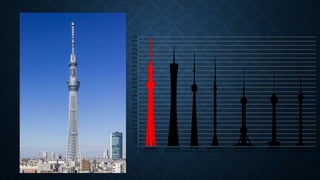
• Height of project – 634m (G+32)
• Purpose – Broadcasting tower, Restaurant
• Project duration – 4 years
• Project cost – $800 million
• Contractor – Obayashi Corp.
FOUNDATION DETAILS
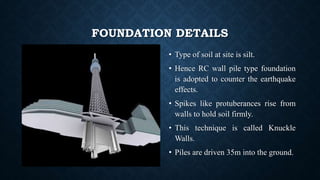
• Type of soil at site is silt.
• Hence RC wall pile type foundation
is adopted to counter the earthquake
effects.
• Spikes like protuberances rise from
walls to hold soil firmly.
• This technique is called Knuckle
Walls.
• Piles are driven 35m into the ground.
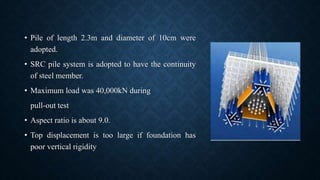
• Pile of length 2.3m and diameter of 10cm were
adopted.
• SRC pile system is adopted to have the continuity
of steel member.
• Maximum load was 40,000kN during
pull-out test
• Aspect ratio is about 9.0.
• Top displacement is too large if foundation has
poor vertical rigidity
DESIGN CRITERIA
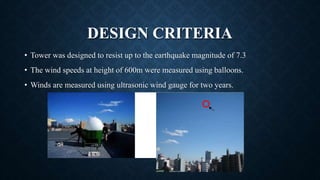
• Tower was designed to resist up to the earthquake magnitude of 7.3
• The wind speeds at height of 600m were measured using balloons.
• Winds are measured using ultrasonic wind gauge for two years.
VIBRATION CONTROL
SYSTEM
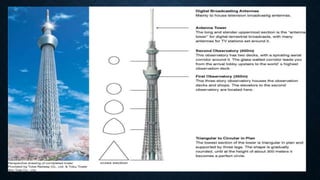
• Two methods are used – Tuned Mass Damper(TMD)
Core Column System
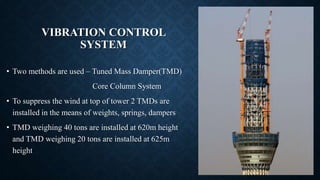
• To suppress the wind at top of tower 2 TMDs are
installed in the means of weights, springs, dampers
• TMD weighing 40 tons are installed at 620m height
and TMD weighing 20 tons are installed at 625m
height
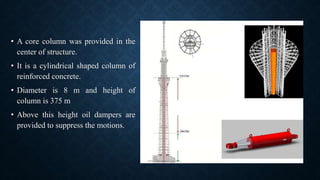
• A core column was provided in the
center of structure.
• It is a cylindrical shaped column of
reinforced concrete.
• Diameter is 8 m and height of
column is 375 m
• Above this height oil dampers are
provided to suppress the motions.
SAFETY MEASURES
• Providing waterproof canvas to workers to protect from wind and
dizzying.
• 2 safety lines are implemented instead of one to all the workers.
• 100 m steel protective panels are setup over the railway just beneath
the tower.
• Building huge steel scaffolding in ground and placing in required
position using cranes.
Tokyo Sky Tree

Tokyo Sky Tree

  • 1.
    CASE STUDY ON TOKYOSKY TREE Presented By J. Sai Akhil (13131A0140)
  • 2.
    POINTS TO BECOVERED • Details of project • Introduction of structure • Foundation details • Design criteria • Vibration control system • Safety measures
  • 3.
    DETAILS OF PROJECT •Project name – Tokyo Sky Tree • Location – Sumida, Tokyo • Height of project – 634m (G+32) • Purpose – Broadcasting tower, Restaurant • Project duration – 4 years • Project cost – $800 million • Contractor – Obayashi Corp.
  • 6.
    FOUNDATION DETAILS • Typeof soil at site is silt. • Hence RC wall pile type foundation is adopted to counter the earthquake effects. • Spikes like protuberances rise from walls to hold soil firmly. • This technique is called Knuckle Walls. • Piles are driven 35m into the ground.
  • 7.
    • Pile oflength 2.3m and diameter of 10cm were adopted. • SRC pile system is adopted to have the continuity of steel member. • Maximum load was 40,000kN during pull-out test • Aspect ratio is about 9.0. • Top displacement is too large if foundation has poor vertical rigidity
  • 8.
    DESIGN CRITERIA • Towerwas designed to resist up to the earthquake magnitude of 7.3 • The wind speeds at height of 600m were measured using balloons. • Winds are measured using ultrasonic wind gauge for two years.
  • 9.
    VIBRATION CONTROL SYSTEM • Twomethods are used – Tuned Mass Damper(TMD) Core Column System • To suppress the wind at top of tower 2 TMDs are installed in the means of weights, springs, dampers • TMD weighing 40 tons are installed at 620m height and TMD weighing 20 tons are installed at 625m height
  • 10.
    • A corecolumn was provided in the center of structure. • It is a cylindrical shaped column of reinforced concrete. • Diameter is 8 m and height of column is 375 m • Above this height oil dampers are provided to suppress the motions.
  • 11.
    SAFETY MEASURES • Providingwaterproof canvas to workers to protect from wind and dizzying. • 2 safety lines are implemented instead of one to all the workers. • 100 m steel protective panels are setup over the railway just beneath the tower. • Building huge steel scaffolding in ground and placing in required position using cranes.