FUNCTIONS
FUNCTIONS
FUNCTIONS
SOME IMPORTANT
FUNCTIONS
FUNCTIONS
Then, the
function defined by f(x)=c for all xR
SOME IMPORTANT FUNCTIONS
Constant function: Let ‘c’ be the fixed number.
is called a constant
function.
Clearly, domain of (f)=R and Range of (f)={c}
X' X
Y
Y'
f(x)=c
(0, c)
O
FUNCTIONS
Identity function
Clearly dom (f)=R and Range (f)=R
X' X
Y'
Y
O
The function defined f(x)=x for all xR is called the
identity function.
FUNCTIONS
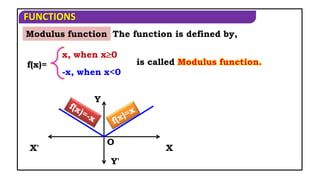
Modulus function
X' X
Y'
Y
O
f(x)=
x, when x0
-x, when x<0
is called Modulus function.
The function is defined by,
FUNCTIONS
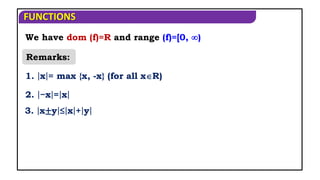
We have dom (f)=R and range (f)=[0, )
Remarks:
1. x = max {x, -x} (for all xR)
2. −x = x
3. x±y ≤ x + y
FUNCTIONS
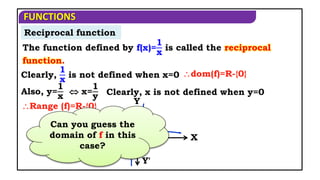
Reciprocal function
Y'
X' X
Y
O
dom(f)=R-{0}
Clearly, x is not defined when y=0
Range (f)=R-{0}
Clearly,
1
x
is not defined when x=0
Also, y=
1
x
 x=
1
y
The function defined by f(x)=
1
x
is called the reciprocal
function.
Can you guess the
domain of f in this
case?
FUNCTIONS
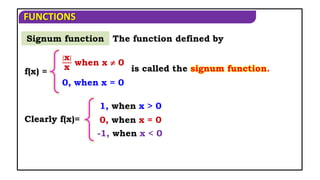
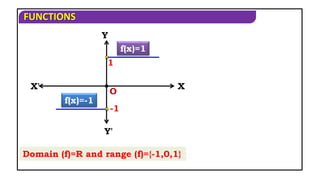
Signum function
f(x) =
x
x
when x  0
0, when x = 0
Clearly f(x)=
1, when x > 0
0, when x = 0
-1, when x < 0
is called the signum function.
The function defined by
FUNCTIONS
O
X' X
Y'
Y
f(x)=1
f(x)=-1
-1
1
Domain (f)=R and range (f)={-1,0,1}
FUNCTIONS
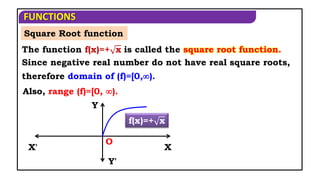
Square Root function
The function f(x)=+ x is called the square root function.
Since negative real number do not have real square roots,
therefore domain of (f)=[0,).
Also, range (f)=[0, ).
X' X
Y'
Y
O
f(x)=+ x
FUNCTIONS
Greatest Integer Function or Step Function
We have domain of (f)=R and range of (f)=Z
X' X
Y'
Y
O
Thus f(x)=n if nx<n+1 (nZ)
The function f(x)=[x] defined as the greatest integer not
exceeding x, is called the greatest Integer function.
FUNCTIONS
Properties of greatest integer function
(i) nx<n+1[x]=n where nZ
(ii) x-1<[x]x<[x]+1
(iii) m [x]nmx<n+1 where m,nZ
(iv) [x+n]=[x]+n, (where n  Z)
(v) [x]+[-x]=
0, when x  Z
-1, when x  Z
FUNCTIONS
Where {x}= fractional part of x
(vi) [x+y]=
[x]+[y] (when {x}+{y}<1
[x]+[y]+1 (when {x}+{y}1
(vii) [x]=x iff xz
(viii) x[x] for all x  R
FUNCTIONS
Fractional Part Function
X' X
Y'
Y
O
-1
1
Clearly 0{x}<1
We have domain(f)=R and range of (f)=[0, 1)
The function defined as f(x)={x}=x-[x] is called the fractional
part function.
FUNCTIONS
(iii) If x is an integer i.e., x=nZ then {x}=x-[x]=n-[n]=n-n=0
(v) f(x)={x} has period 1
(iv) {x}+{-x}=
0, when x  Z
-1, when x  Z
Thus {x}=0 when xZ
Properties of Fractional-Part Function
(i) 0{x}<1
(ii) [{x}]=0
FUNCTIONS
Exponential Function
The function f(x)=ex is called exponential function.
In general, if a is a positive real number (a1),
then the exponential function is defined as f(x)=ax
So, domain of (f)=R
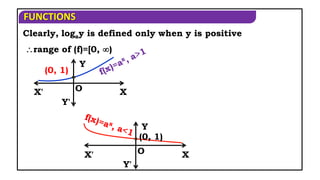
Also, y = ax
X' X
Y'
Y
(0, 1)
O
Since f(x)=ex is defined for all xR
Range of (f)=(0,∞)
logy = x log a
log y
log a
= x
x = log a y
FUNCTIONS
Clearly, logay is defined only when y is positive
range of (f)=[0, )
X' X
Y'
Y
O
X' X
Y'
Y
(0, 1)
O
(0, 1)
FUNCTIONS
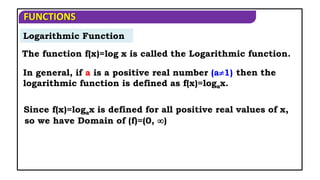
then the
logarithmic function is defined as f(x)=logax.
Logarithmic Function
The function f(x)=log x is called the Logarithmic function.
In general, if a is a positive real number (a1)
Since f(x)=logax is defined for all positive real values of x,
so we have Domain of (f)=(0, )
FUNCTIONS
Also, y = logax
y =
logx
loga
yloga = logx
logay = logx
x = ay
Clearly, ay defined for all yR
FUNCTIONS
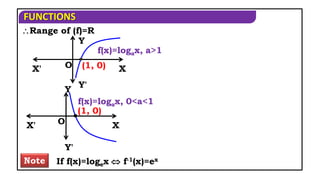
X' X
Y'
Y
(1, 0)
O
f(x)=logax, a>1
X' X
Y'
Y
(1, 0)
O
f(x)=logax, 0<a<1
Note
Range of (f)=R
If f(x)=logex  f-1(x)=ex
FUNCTIONS
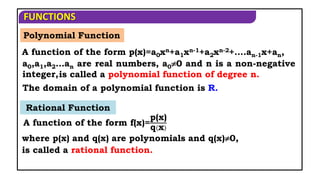
Polynomial Function
A function of the form p(x)=a0xn+a1xn-1+a2xn-2+….an-1x+an,
a0,a1,a2…an are real numbers, a00 and n is a non-negative
integer,is called a polynomial function of degree n.
The domain of a polynomial function is R.
Rational Function
A function of the form f(x)=
p(x)
q x
where p(x) and q(x) are polynomials and q(x)0,
is called a rational function.
FUNCTIONS
DOMAIN
FUNCTIONS
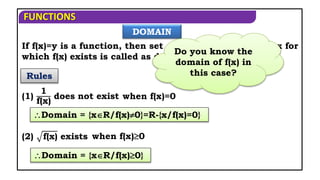
If f(x)=y is a function, then set of all possible values of x for
which f(x) exists is called as domain of f.
Rules
DOMAIN
(1)
1
f(x)
does not exist
Domain = {xR/f(x)0}=R-{x/f(x)=0}
(2) f(x) exists
Domain = {xR/f(x)0}
when f(x)=0
Do you know the
domain of f(x) in
this case?
when f(x)0
FUNCTIONS
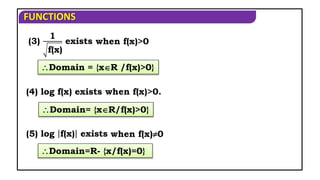
(3)
1
f(x)
exists
Domain = {xR /f(x)>0}
(4) log f(x) exists
Domain= {xR/f(x)>0}
(5) log f(x) exists
Domain=R- {x/f(x)=0}
when f(x)>0
when f(x)>0.
when f(x)0
FUNCTIONS
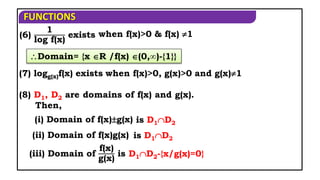
(8) D1, D2 are domains of f(x) and g(x).
Then,
(i) Domain of f(x)g(x)
(6)
1
log f(x)
exists
Domain= {x R /f(x) (0,∞)-{1}}
(7) logg(x)f(x) exists
(ii) Domain of f(x)g(x)
(iii) Domain of
f(x)
g(x)
is
when f(x)>0 & f(x) 1
when f(x)>0, g(x)>0 and g(x)1
is D1D2
is D1D2
D1D2-{x/g(x)=0}
FUNCTIONS
Important Note: Useful results while calculating domain
are (when <).
x(,)
x[,]
(i) (x-)(x-)<0
(ii) (x-)(x-)0
(iii) (x-)(x-)>0
(iv) (x-)(x-)0
 <x<
 x
 x< or x>
 x or x
x(-∞,)(, ∞)
x(-∞,][, ∞)
FUNCTIONS
f(x)=y is a function such that for several values of x, we get
several values to y. Now set of all values of y is called the
range of f.
Rules
RANGE
(1) f(x)=acosx+bsinx+c, then range of f(x) is
[c- a𝟐+b𝟐
,c+ a𝟐+b𝟐
]
(2) If a2+b2+c2=k, then range of ab+bc+ca is
−k
2
,k
(3) While calculating range useful result is AMGMHM
FUNCTIONS
Domain and Range of standard functions
S.NO FUNCTION DOMAIN RANGE
1 y=ax xR y(0,∞)
2 y=logex x(0,∞) yR
3 y=[x] xR yZ
4 y= x xR y[0,∞)
5 y= x x[0,∞) y[0,∞)
6 y=Sinx xR y[-1,1]
7 y=Cosx xR y[-1,1]
FUNCTIONS
S.NO FUNCTION DOMAIN RANGE
8 y=Tanx xR-{(2n+1)
π
2
;nZ} yR
9 y=Cotx xR-{n;nZ} yR
10 y=Secx xR-{(2n+1)
π
2
;nZ} y(-∞,-1][1,∞)
11 y=Cosecx xR-{n;nZ} y(-∞,-1][1,∞)
12 y=Sin−𝟏x x[-1,1] y −
π
2
,
π
2
13 y=Cos−𝟏
x x[-1,1] y[0,]
14 y=Tan−𝟏
x xR y −
π
2
,
π
2
Domain and Range of standard functions
FUNCTIONS
S.NO FUNCTION DOMAIN RANGE
15 y=Cot−1x xR y(0, )
16 y=Sec−1x x(-∞,-1][1,∞) y[0, /2) (/2, ]
17 y=Cosec−1x x(-∞,-1][1,∞) y [-/2,0) (0, /2]
18 y=Sinhx xR yR
19 y=Coshx xR y[1, ∞)
20 y=Tanhx xR y(-1,1)
21 y=Cothx x(-∞,0)(0,∞) y(-∞,-1)(1,∞)
Domain and Range of standard functions
FUNCTIONS
S.NO FUNCTION DOMAIN RANGE
22 y=Sechx xR y(0,1]
23 y=Cosechx x(-∞,0)(0,∞) y(-∞,0)(0,∞)
24 y=Sinh−1x xR yR
25 y=Cosh−1x x[1, ∞) y[0,∞)
26 y=Tanh−1x x(-1,1) yR
27 y=Coth−1x x(-∞,-1)(1,∞) y(-∞,0)(0,∞)
28 y=Sech−1x x(0,1] y[0,∞)
29 y=Cosech−1x x(-∞,0)(0,∞) y(-∞,0)(0,∞)
Domain and Range of standard functions
FUNCTIONS
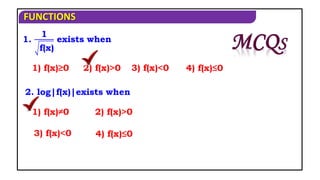
1.
1
f(x)
exists when
1) f(x)≥0 2) f(x)>0 3) f(x)<0 4) f(x)≤0
2. log|f(x)|exists when
1) f(x)≠0 2) f(x)>0
3) f(x)<0 4) f(x)≤0
FUNCTIONS
3. If (x-)(x-)≤0, which of the following is true
1) <x< 2) x 3) x< or x> 4) x or x
4. f(x)=acosx+bsinx+c then range of f(x) is
1) [c- a𝟐+b𝟐
,c+ a𝟐+b𝟐
]
2) (c- a𝟐+b𝟐
,c+ a𝟐+b𝟐
)
3) (c- a𝟐+b𝟐
,c+ a𝟐+b𝟐
]
4) [c- a𝟐+b𝟐
,c+ a𝟐+b𝟐
)
FUNCTIONS
Thank you…

TYPES OF IMPORTANT FUNCTION THEORY WITH EXAMPLES

  • 1.
  • 2.
  • 3.
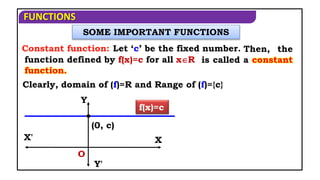
    FUNCTIONS Then, the function definedby f(x)=c for all xR SOME IMPORTANT FUNCTIONS Constant function: Let ‘c’ be the fixed number. is called a constant function. Clearly, domain of (f)=R and Range of (f)={c} X' X Y Y' f(x)=c (0, c) O
  • 4.
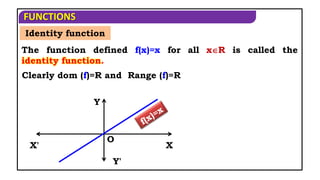
    FUNCTIONS Identity function Clearly dom(f)=R and Range (f)=R X' X Y' Y O The function defined f(x)=x for all xR is called the identity function.
  • 5.
    FUNCTIONS Modulus function X' X Y' Y O f(x)= x,when x0 -x, when x<0 is called Modulus function. The function is defined by,
  • 6.
    FUNCTIONS We have dom(f)=R and range (f)=[0, ) Remarks: 1. x = max {x, -x} (for all xR) 2. −x = x 3. x±y ≤ x + y
  • 7.
    FUNCTIONS Reciprocal function Y' X' X Y O dom(f)=R-{0} Clearly,x is not defined when y=0 Range (f)=R-{0} Clearly, 1 x is not defined when x=0 Also, y= 1 x  x= 1 y The function defined by f(x)= 1 x is called the reciprocal function. Can you guess the domain of f in this case?
  • 8.
    FUNCTIONS Signum function f(x) = x x whenx  0 0, when x = 0 Clearly f(x)= 1, when x > 0 0, when x = 0 -1, when x < 0 is called the signum function. The function defined by
  • 9.
  • 10.
    FUNCTIONS Square Root function Thefunction f(x)=+ x is called the square root function. Since negative real number do not have real square roots, therefore domain of (f)=[0,). Also, range (f)=[0, ). X' X Y' Y O f(x)=+ x
  • 11.
    FUNCTIONS Greatest Integer Functionor Step Function We have domain of (f)=R and range of (f)=Z X' X Y' Y O Thus f(x)=n if nx<n+1 (nZ) The function f(x)=[x] defined as the greatest integer not exceeding x, is called the greatest Integer function.
  • 12.
    FUNCTIONS Properties of greatestinteger function (i) nx<n+1[x]=n where nZ (ii) x-1<[x]x<[x]+1 (iii) m [x]nmx<n+1 where m,nZ (iv) [x+n]=[x]+n, (where n  Z) (v) [x]+[-x]= 0, when x  Z -1, when x  Z
  • 13.
    FUNCTIONS Where {x}= fractionalpart of x (vi) [x+y]= [x]+[y] (when {x}+{y}<1 [x]+[y]+1 (when {x}+{y}1 (vii) [x]=x iff xz (viii) x[x] for all x  R
  • 14.
    FUNCTIONS Fractional Part Function X'X Y' Y O -1 1 Clearly 0{x}<1 We have domain(f)=R and range of (f)=[0, 1) The function defined as f(x)={x}=x-[x] is called the fractional part function.
  • 15.
    FUNCTIONS (iii) If xis an integer i.e., x=nZ then {x}=x-[x]=n-[n]=n-n=0 (v) f(x)={x} has period 1 (iv) {x}+{-x}= 0, when x  Z -1, when x  Z Thus {x}=0 when xZ Properties of Fractional-Part Function (i) 0{x}<1 (ii) [{x}]=0
  • 16.
    FUNCTIONS Exponential Function The functionf(x)=ex is called exponential function. In general, if a is a positive real number (a1), then the exponential function is defined as f(x)=ax So, domain of (f)=R Also, y = ax X' X Y' Y (0, 1) O Since f(x)=ex is defined for all xR Range of (f)=(0,∞) logy = x log a log y log a = x x = log a y
  • 17.
    FUNCTIONS Clearly, logay isdefined only when y is positive range of (f)=[0, ) X' X Y' Y O X' X Y' Y (0, 1) O (0, 1)
  • 18.
    FUNCTIONS then the logarithmic functionis defined as f(x)=logax. Logarithmic Function The function f(x)=log x is called the Logarithmic function. In general, if a is a positive real number (a1) Since f(x)=logax is defined for all positive real values of x, so we have Domain of (f)=(0, )
  • 19.
    FUNCTIONS Also, y =logax y = logx loga yloga = logx logay = logx x = ay Clearly, ay defined for all yR
  • 20.
    FUNCTIONS X' X Y' Y (1, 0) O f(x)=logax,a>1 X' X Y' Y (1, 0) O f(x)=logax, 0<a<1 Note Range of (f)=R If f(x)=logex  f-1(x)=ex
  • 21.
    FUNCTIONS Polynomial Function A functionof the form p(x)=a0xn+a1xn-1+a2xn-2+….an-1x+an, a0,a1,a2…an are real numbers, a00 and n is a non-negative integer,is called a polynomial function of degree n. The domain of a polynomial function is R. Rational Function A function of the form f(x)= p(x) q x where p(x) and q(x) are polynomials and q(x)0, is called a rational function.
  • 22.
  • 23.
    FUNCTIONS If f(x)=y isa function, then set of all possible values of x for which f(x) exists is called as domain of f. Rules DOMAIN (1) 1 f(x) does not exist Domain = {xR/f(x)0}=R-{x/f(x)=0} (2) f(x) exists Domain = {xR/f(x)0} when f(x)=0 Do you know the domain of f(x) in this case? when f(x)0
  • 24.
    FUNCTIONS (3) 1 f(x) exists Domain = {xR/f(x)>0} (4) log f(x) exists Domain= {xR/f(x)>0} (5) log f(x) exists Domain=R- {x/f(x)=0} when f(x)>0 when f(x)>0. when f(x)0
  • 25.
    FUNCTIONS (8) D1, D2are domains of f(x) and g(x). Then, (i) Domain of f(x)g(x) (6) 1 log f(x) exists Domain= {x R /f(x) (0,∞)-{1}} (7) logg(x)f(x) exists (ii) Domain of f(x)g(x) (iii) Domain of f(x) g(x) is when f(x)>0 & f(x) 1 when f(x)>0, g(x)>0 and g(x)1 is D1D2 is D1D2 D1D2-{x/g(x)=0}
  • 26.
    FUNCTIONS Important Note: Usefulresults while calculating domain are (when <). x(,) x[,] (i) (x-)(x-)<0 (ii) (x-)(x-)0 (iii) (x-)(x-)>0 (iv) (x-)(x-)0  <x<  x  x< or x>  x or x x(-∞,)(, ∞) x(-∞,][, ∞)
  • 27.
    FUNCTIONS f(x)=y is afunction such that for several values of x, we get several values to y. Now set of all values of y is called the range of f. Rules RANGE (1) f(x)=acosx+bsinx+c, then range of f(x) is [c- a𝟐+b𝟐 ,c+ a𝟐+b𝟐 ] (2) If a2+b2+c2=k, then range of ab+bc+ca is −k 2 ,k (3) While calculating range useful result is AMGMHM
  • 28.
    FUNCTIONS Domain and Rangeof standard functions S.NO FUNCTION DOMAIN RANGE 1 y=ax xR y(0,∞) 2 y=logex x(0,∞) yR 3 y=[x] xR yZ 4 y= x xR y[0,∞) 5 y= x x[0,∞) y[0,∞) 6 y=Sinx xR y[-1,1] 7 y=Cosx xR y[-1,1]
  • 29.
    FUNCTIONS S.NO FUNCTION DOMAINRANGE 8 y=Tanx xR-{(2n+1) π 2 ;nZ} yR 9 y=Cotx xR-{n;nZ} yR 10 y=Secx xR-{(2n+1) π 2 ;nZ} y(-∞,-1][1,∞) 11 y=Cosecx xR-{n;nZ} y(-∞,-1][1,∞) 12 y=Sin−𝟏x x[-1,1] y − π 2 , π 2 13 y=Cos−𝟏 x x[-1,1] y[0,] 14 y=Tan−𝟏 x xR y − π 2 , π 2 Domain and Range of standard functions
  • 30.
    FUNCTIONS S.NO FUNCTION DOMAINRANGE 15 y=Cot−1x xR y(0, ) 16 y=Sec−1x x(-∞,-1][1,∞) y[0, /2) (/2, ] 17 y=Cosec−1x x(-∞,-1][1,∞) y [-/2,0) (0, /2] 18 y=Sinhx xR yR 19 y=Coshx xR y[1, ∞) 20 y=Tanhx xR y(-1,1) 21 y=Cothx x(-∞,0)(0,∞) y(-∞,-1)(1,∞) Domain and Range of standard functions
  • 31.
    FUNCTIONS S.NO FUNCTION DOMAINRANGE 22 y=Sechx xR y(0,1] 23 y=Cosechx x(-∞,0)(0,∞) y(-∞,0)(0,∞) 24 y=Sinh−1x xR yR 25 y=Cosh−1x x[1, ∞) y[0,∞) 26 y=Tanh−1x x(-1,1) yR 27 y=Coth−1x x(-∞,-1)(1,∞) y(-∞,0)(0,∞) 28 y=Sech−1x x(0,1] y[0,∞) 29 y=Cosech−1x x(-∞,0)(0,∞) y(-∞,0)(0,∞) Domain and Range of standard functions
  • 32.
    FUNCTIONS 1. 1 f(x) exists when 1) f(x)≥02) f(x)>0 3) f(x)<0 4) f(x)≤0 2. log|f(x)|exists when 1) f(x)≠0 2) f(x)>0 3) f(x)<0 4) f(x)≤0
  • 33.
    FUNCTIONS 3. If (x-)(x-)≤0,which of the following is true 1) <x< 2) x 3) x< or x> 4) x or x 4. f(x)=acosx+bsinx+c then range of f(x) is 1) [c- a𝟐+b𝟐 ,c+ a𝟐+b𝟐 ] 2) (c- a𝟐+b𝟐 ,c+ a𝟐+b𝟐 ) 3) (c- a𝟐+b𝟐 ,c+ a𝟐+b𝟐 ] 4) [c- a𝟐+b𝟐 ,c+ a𝟐+b𝟐 )
  • 34.