Data Science | Design | Technology
https://www.meetup.com/DSDTMTL
(February 12, 2018)
Agenda
5:45 - 6:00: Welcome
6:00 - 6:15: News & Introduction
6:15 - 7:15: Studies in Gameful Interaction
Design and Games User Research
7:15 - 8:00: Networking
2
Gamification
3
• 1400 meetup members …and counting
• Looking for speakers
(Data Science | UX Design | Technology)
• Upcoming Meetups / Events
• DSDT (March)
• (Feb 15): Hackfest: Cloud & Kubernetes
• (Feb 22): TLM UX – UX & Agile
• (Feb 28): Data Driven MTL – Big Data encryption
• (Feb): NeuroTechMTL – Hacknights every 2 weeks
4
R&D Technologist
(x2)
R&D UX Designer
(x1)
Software Engineer
(x2)
Special Event
February 12
"Studies in Gameful Interaction Design
& Games User Research"
Dr Lennart Nacke, Director of the HCI Games Group
| Associate professor for human-computer interaction
5
Merci / Thank You
6
@jdalabsmtl
Data Science | Design | Technology
(Check for next DSDT meetup at https://www.meetup.com/DSDTMTL)
STUDIES IN GAMEFUL
INTERACTION DESIGN AND
GAMES USER RESEARCH
DR. LENNART NACKE, ASSOCIATE PROFESSOR
HCI GAMES GROUP, GAMES INSTITUTE, UNIVERSITY OF WATERLOO
ASSOCIATE DIRECTOR, GRADUATE STUDIES, STRATFORD CAMPUS
WIN THIS BOOK TONIGHT
• Tweet a picture and/or your favourite
quote from this talk @gamesurbook
using the #gurbook hashtag.
• Draw a number and show your tweet
at the end of this talk.
WHO AM I?
• Associate Professor, Games User Research and Gamification
• Associate Director, Graduate Studies in Digital Experience
Innovation at University of Waterloo’s Stratford Campus
• Ph.D. in Game Development, Keyword: Fun
• Director of the HCI Games Group at the University of
Waterloo
• Contact: @acagamic on Twitter or Lennart Nacke on LinkedIn
TODAY’S AGENDA
1. Why UX matters
2. Game UX – A Model of Play Experience
3. Gameful Interaction Design
• Examples and Studies
4. Games User Research
• Examples and Studies
5. Closing Thoughts
6. Questions
SEARCH FIELD OR CHECKOUT LINK?
A
B
GAME UX PLAYER EXPERIENCE
• Context
• time-based
• location-based
• social
• cultural
• Players
• internal influences
• user types and characteristics
• Game System
• technology issues
• game system issues
Engl,S.,&Nacke,L.E.(2013).Contextualinfluencesonmobileplayerexperience–Agame
userexperiencemodel.EntertainmentComputing,4(1),83-91.
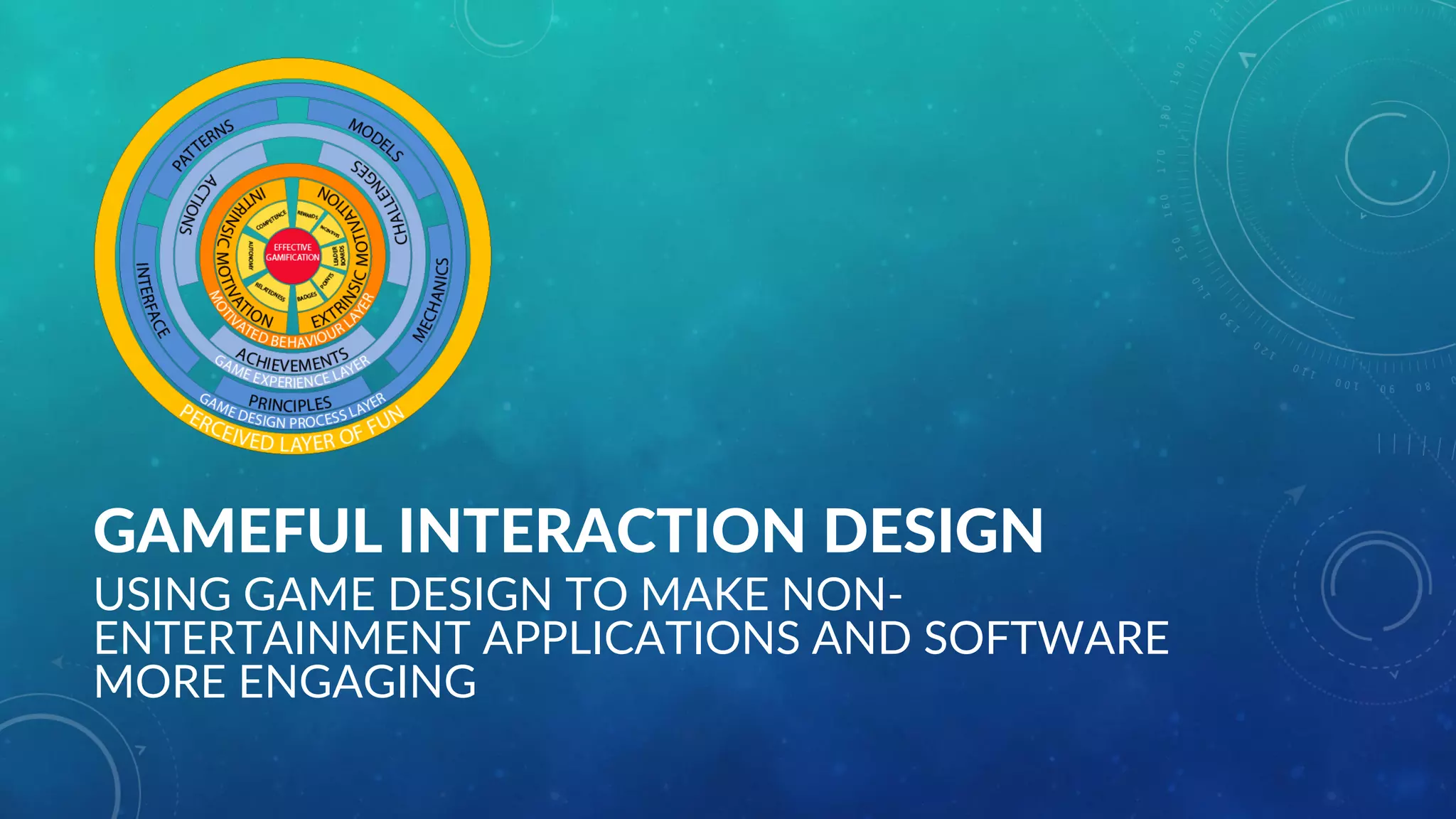
GAMEFUL INTERACTION DESIGN
USING GAME DESIGN TO MAKE NON-
ENTERTAINMENT APPLICATIONS AND SOFTWARE
MORE ENGAGING
Experiencing and
interpreting novel
information
may cause
neurophysiological
pleasure
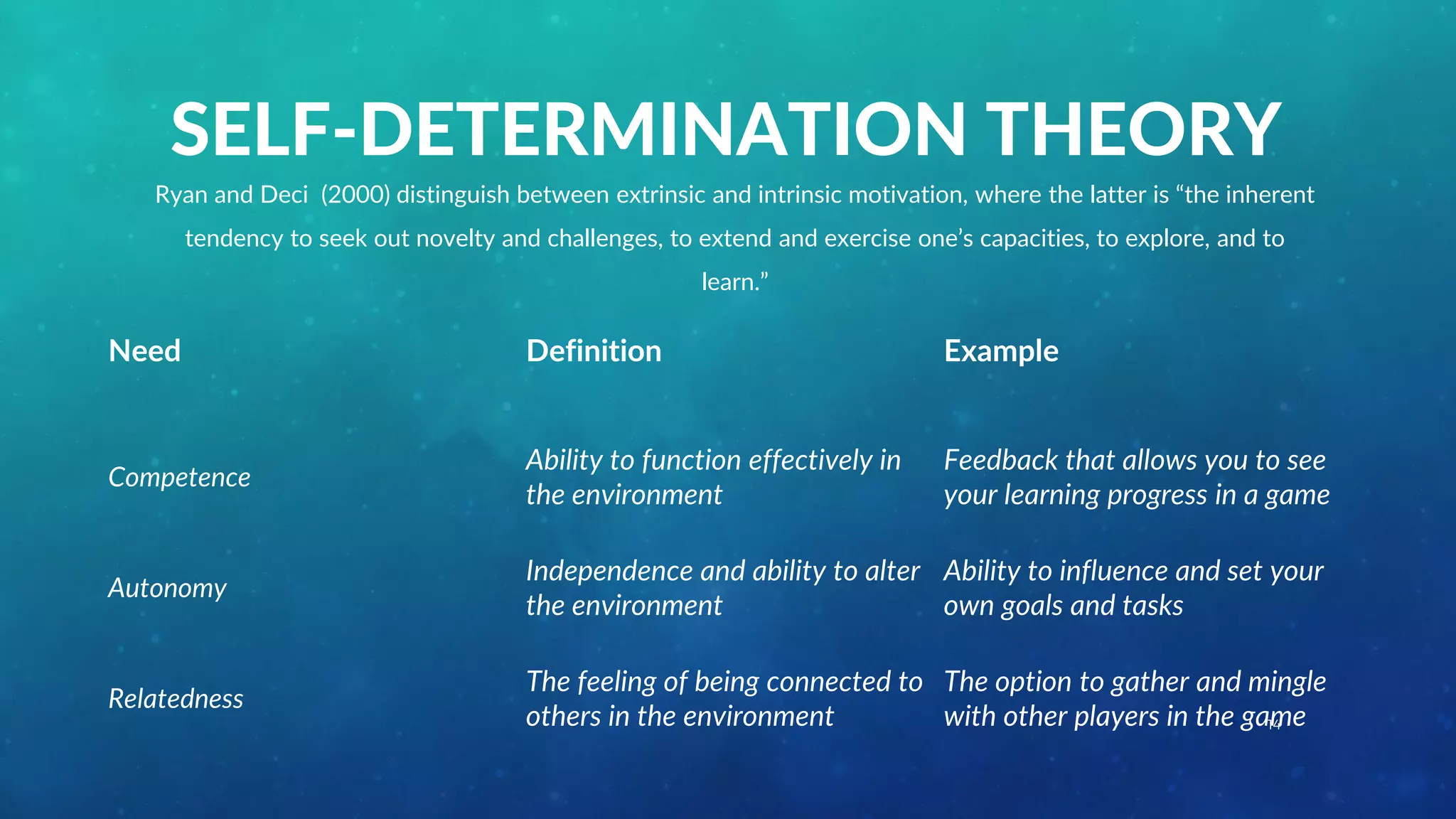
Need Definition Example
Competence
Ability to function effectively in
the environment
Feedback that allows you to see
your learning progress in a game
Autonomy
Independence and ability to alter
the environment
Ability to influence and set your
own goals and tasks
Relatedness
The feeling of being connected to
others in the environment
The option to gather and mingle
with other players in the game
SELF-DETERMINATION THEORY
Ryan and Deci (2000) distinguish between extrinsic and intrinsic motivation, where the latter is “the inherent
tendency to seek out novelty and challenges, to extend and exercise one’s capacities, to explore, and to
learn.”
USER TYPE HEXAD MODEL
15
Andrzej Marczewski. 2015. User Types. In Even Ninja Monkeys Like to Play: Gamification, Game Thinking & Motivational Design. Gamified UK.
Gustavo F. Tondello, Rina R. Wehbe, Lisa Diamond, Marc Busch, Andrzej Marczewski, and Lennart E. Nacke. 2016. The Gamification User Types
Hexad Scale. In Proceedings of CHI PLAY ’16, 229–243.
GAMEFUL DESIGN ELEMENTS
Gustavo F. Tondello, Alberto Mora, and Lennart E. Nacke. 2017. Elements of Gameful Design Emerging from User Preferences. In Proceedings of CHI PLAY ’17, 129–142.
Andrzej Marczewski , https://www.gamified.uk/user-types/gamification-mechanics-elements/
GAMEFUL DESIGN ELEMENTS
Individual
Motivations
Immersion
Progression
External Motivations
Risk/Reward
Customization
Incentive
Social
Motivations
Socialization
Assistance
Altruism
Results of Principal Components Analysis (N=196)
Icons are CC-BY 3.0 by Game-icons.net
Gustavo F. Tondello, Alberto Mora, and Lennart E. Nacke. 2017. Elements of Gameful Design Emerging from User Preferences. In Proceedings of CHI PLAY ’17, 129–142.
CALIBRATION GAMES
• Games can help overcome monotony
in mundane tasks
• More engaging calibration is crucial
while keeping the calibration data
accurate
• Three games to demonstrate
enjoyable calibration
David R. Flatla, Carl Gutwin, Lennart E. Nacke, Scott Bateman, and Regan L. Mandryk. 2011. Calibration games: making
calibration tasks enjoyable by adding motivating game elements. In Proceedings of the 24th annual ACM symposium on
User interface software and technology (UIST '11). ACM, New York, NY, USA, 403-412. DOI=10.1145/2047196.2047248
Design breakdown:
1. Challenge
2. Theme
3. Reward
4. Progress
1
9
CLEVER
Elm,D.,Tondello,G.F.,Kappen,D.L.,Ganaba,M.,Stocco,M.,&Nacke,L.E.(2016,October).CLEVER:ATriviaand
StrategyGameforEnterpriseKnowledgeLearning.InProceedingsofthe2016AnnualSymposiumonComputer-
HumanInteractioninPlayCompanionExtendedAbstracts(pp.61-66).ACM.
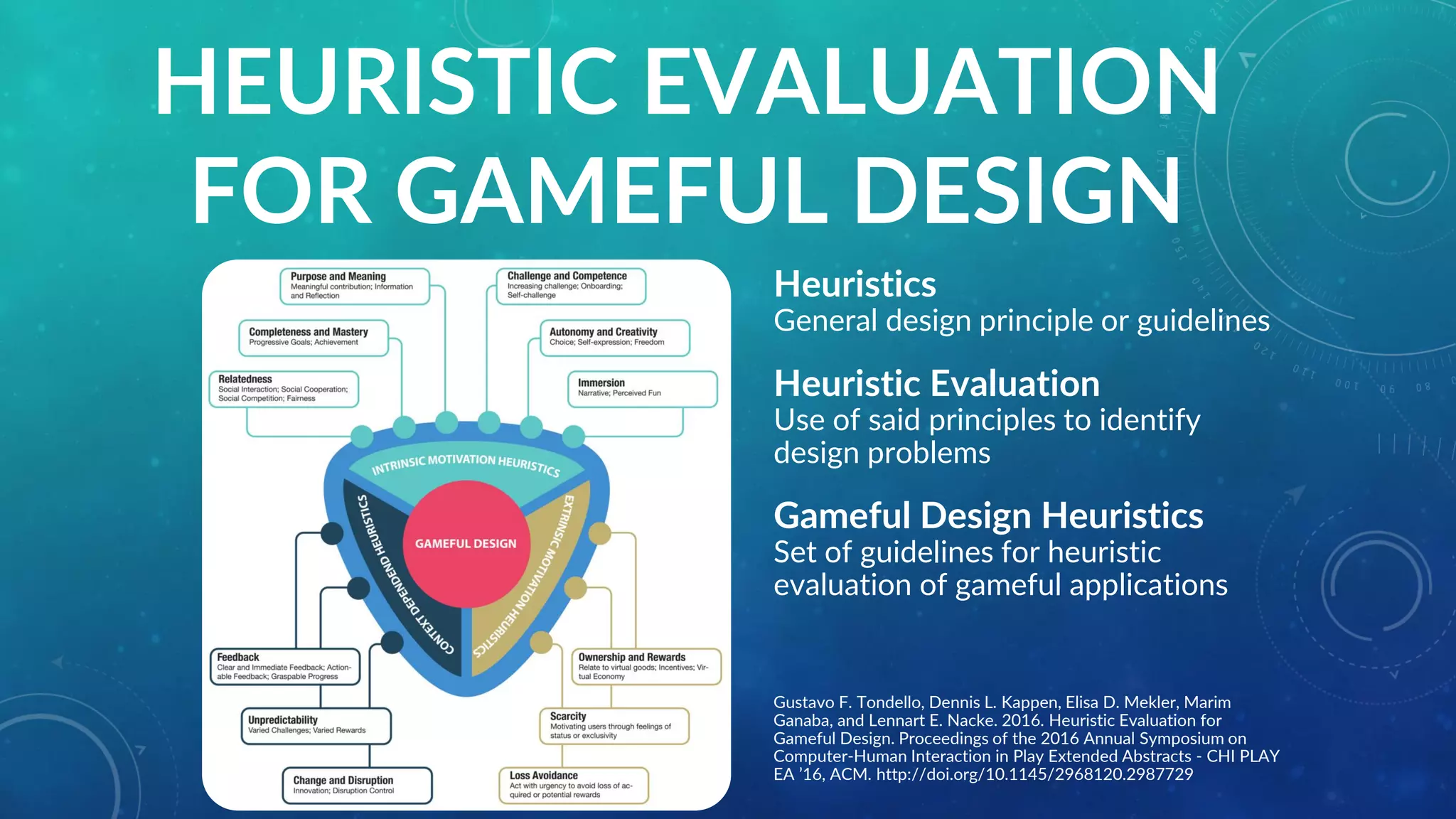
HEURISTIC EVALUATION
FOR GAMEFUL DESIGN
Gustavo F. Tondello, Dennis L. Kappen, Elisa D. Mekler, Marim
Ganaba, and Lennart E. Nacke. 2016. Heuristic Evaluation for
Gameful Design. Proceedings of the 2016 Annual Symposium on
Computer-Human Interaction in Play Extended Abstracts - CHI PLAY
EA ’16, ACM. http://doi.org/10.1145/2968120.2987729
Heuristics
General design principle or guidelines
Heuristic Evaluation
Use of said principles to identify
design problems
Gameful Design Heuristics
Set of guidelines for heuristic
evaluation of gameful applications
GAMES USER RESEARCH
THE APPLIED FIELD THAT CONCERNS EVALUATING IF A GAME IS ACHIEVING THE
INTENDED PLAYER EXPERIENCE
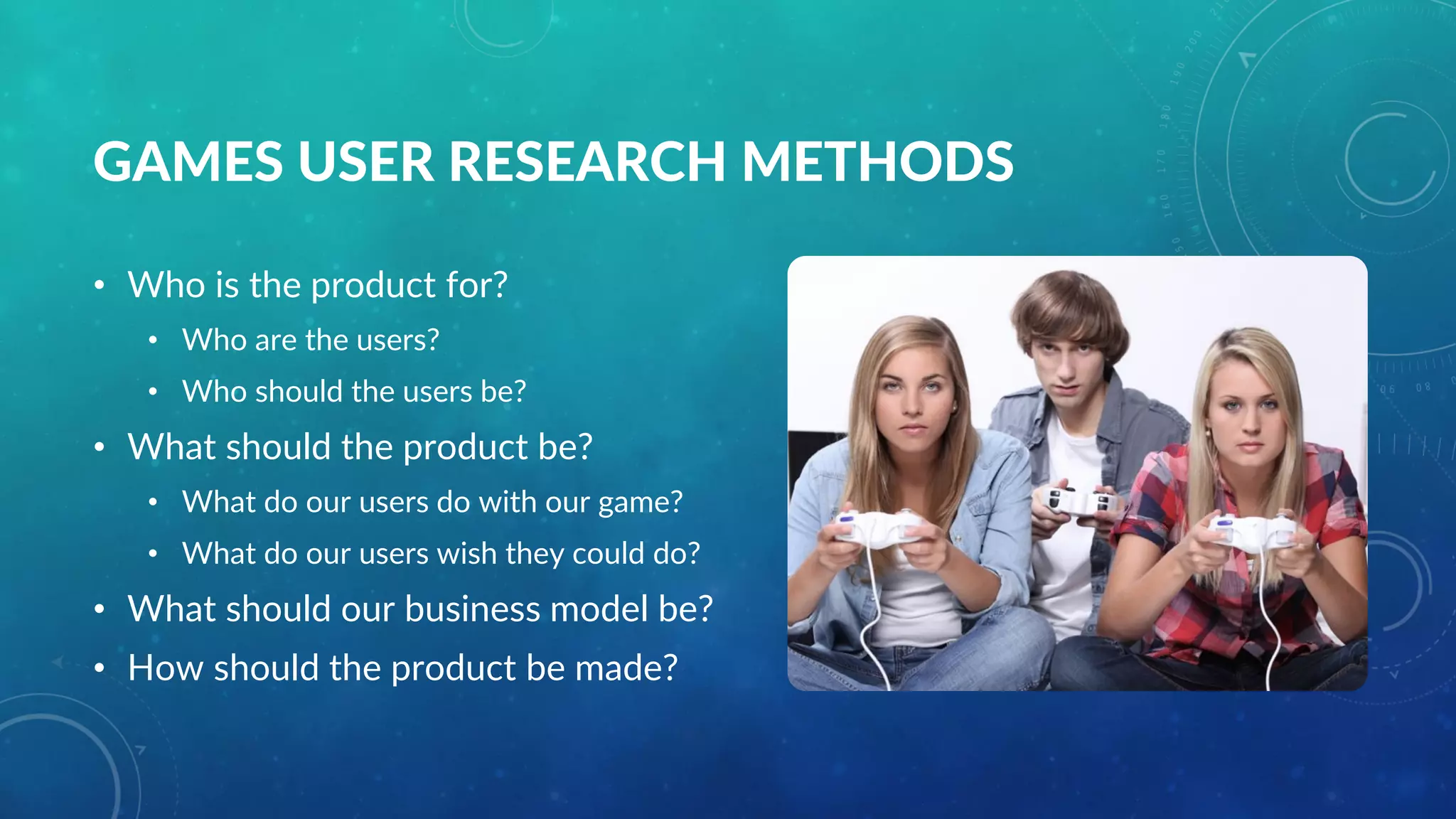
GAMES USER RESEARCH METHODS
• Who is the product for?
• Who are the users?
• Who should the users be?
• What should the product be?
• What do our users do with our game?
• What do our users wish they could do?
• What should our business model be?
• How should the product be made?
GAMES USER RESEARCH METHODS
An overview of GUR methods. Michael C. Medlock, Microsoft Game Studios. Chapter 7. Games User Research.
2
4
OBSERVATION
Especially for a game’s designers watching
somebody play the game is of high value. Seeing
how players deal with the game’s challenges,
where they get stuck or frustrated in the game
level, can lead to profound insights into the
gameplay experience for game designers.
BEHAVIOURAL OBSERVATION
PHYSIOLOGICAL SENSORS
• Body information that indexes feeling
and thinking
• Brain (EEG)
• Skin (GSR)
• Heart (EKG/ECG)
• Muscles (EMG)
• Eyes (Eye Tracking)
BIOMETRIC STORYBOARDS
• Comparison study (N=24) of different player testing
approaches
• A single User Experience (UX) graph
• Intended UX
• Actual UX
• Players rated the gameplay quality of the BioSt User Test (UT)
game and fun and visuals of both UT games significantly higher
than the Non-UT game
• “The BioSt UT team had the most significant changes in their
version […] they […] polish existing mechanics.”
Pejman Mirza-Babaei, Lennart E. Nacke, John Gregory, Nick Collins, and Geraldine Fitzpatrick. 2013. How does it play better?: exploring user
testing and biometric storyboards in games user research. In Proceedings of the SIGCHI Conference on Human Factors in Computing Systems
(CHI '13). ACM, New York, NY, USA, 1499-1508. DOI=10.1145/2470654.2466200
Source: Neurable.com
EVALUATING VR IMMERSION
1. Audio Feedback is generally important but visual senses are more
prominent in VR and more important to design for
2. Avoid forced camera movements when porting PC titles to VR
3. Limit play session time for gamepad-based VR navigation and consider
game design that can accommodate players that need a break
4. Design for exploration in VR gameplay, the sensory experience is more
important than progression in gameplay
Rogers, Ribeiro, Wehbe, Weber, and Nacke. (2018) Vanishing Importance: Studying Immersive Effects of
Game Audio Perception on Player Experiences in Virtual Reality. To be published at CHI 2018.
TODAY’S TAKEAWAYS
• UX design matters because it can improve the perception and
success of products, systems, and services
• Engaging player experience depends on context, players, and
game systems
• Gameful design is most effective when personalized
• Games user research uses many different methods for
scientifically evaluating experience
• Audio in VR is not as pronounced as expected
CLOSING THOUGHTS
• Sensors are becoming more
pervasive
• How do humans managed
embedded, supporting, and
sometimes controlling technologies?
• Game technology is becoming
fully immersive
• Can we use it for more than
gaming? Health applications?
Knowledge management?
WANT TO LEARN MORE?
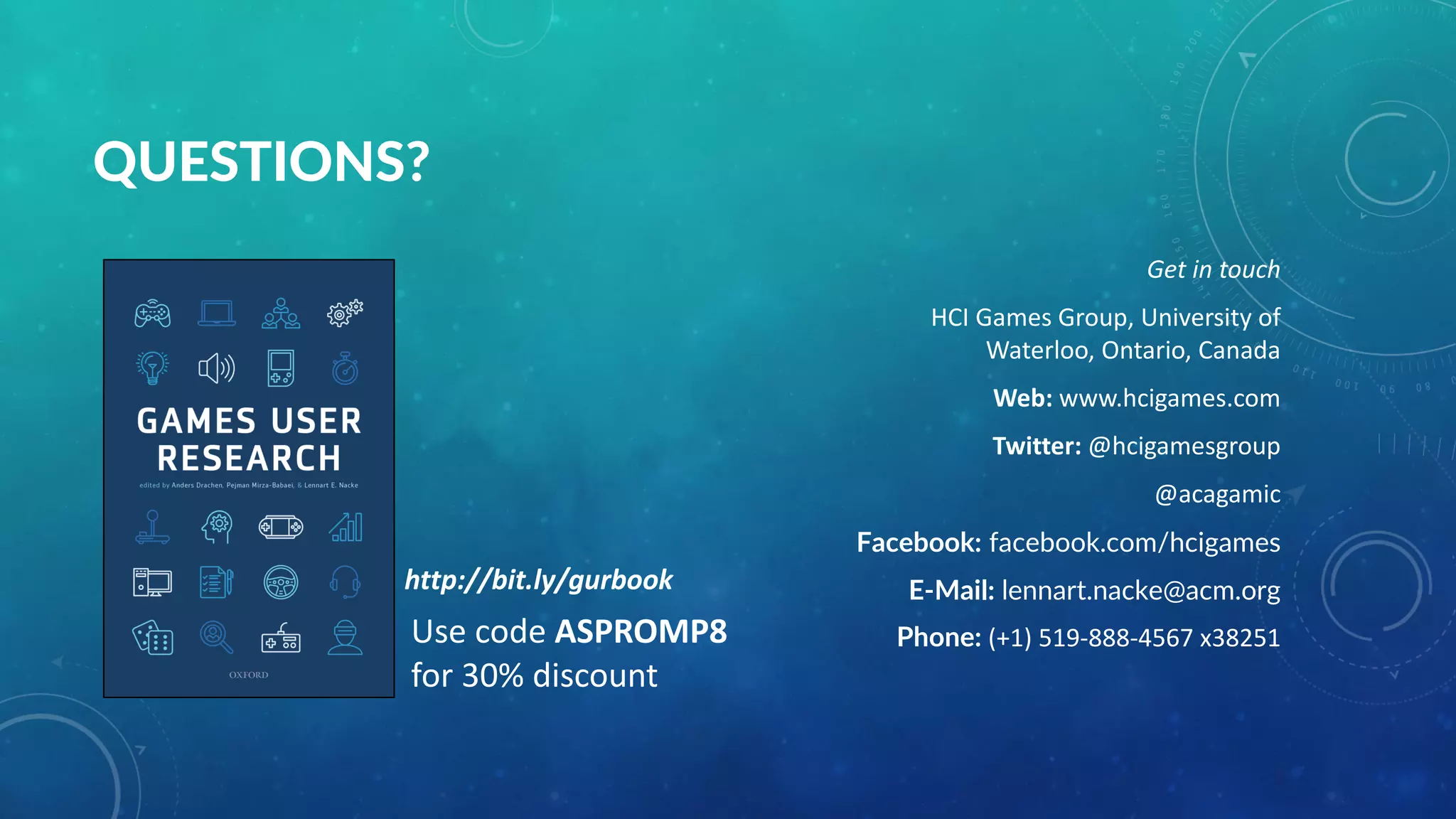
Use code ASPROMP8
for 30% discount
http://bit.ly/gurbook
QUESTIONS?
Get in touch
HCI Games Group, University of
Waterloo, Ontario, Canada
Web: www.hcigames.com
Twitter: @hcigamesgroup
@acagamic
Facebook: facebook.com/hcigames
E-Mail: lennart.nacke@acm.org
Phone: (+1) 519-888-4567 x38251Use code ASPROMP8
for 30% discount
http://bit.ly/gurbook

DSDT Meetup February 2018

  • 1.
    Data Science |Design | Technology https://www.meetup.com/DSDTMTL (February 12, 2018)
  • 2.
    Agenda 5:45 - 6:00:Welcome 6:00 - 6:15: News & Introduction 6:15 - 7:15: Studies in Gameful Interaction Design and Games User Research 7:15 - 8:00: Networking 2 Gamification
  • 3.
    3 • 1400 meetupmembers …and counting • Looking for speakers (Data Science | UX Design | Technology) • Upcoming Meetups / Events • DSDT (March) • (Feb 15): Hackfest: Cloud & Kubernetes • (Feb 22): TLM UX – UX & Agile • (Feb 28): Data Driven MTL – Big Data encryption • (Feb): NeuroTechMTL – Hacknights every 2 weeks
  • 4.
    4 R&D Technologist (x2) R&D UXDesigner (x1) Software Engineer (x2)
  • 5.
    Special Event February 12 "Studiesin Gameful Interaction Design & Games User Research" Dr Lennart Nacke, Director of the HCI Games Group | Associate professor for human-computer interaction 5
  • 6.
    Merci / ThankYou 6 @jdalabsmtl Data Science | Design | Technology (Check for next DSDT meetup at https://www.meetup.com/DSDTMTL)
  • 7.
    STUDIES IN GAMEFUL INTERACTIONDESIGN AND GAMES USER RESEARCH DR. LENNART NACKE, ASSOCIATE PROFESSOR HCI GAMES GROUP, GAMES INSTITUTE, UNIVERSITY OF WATERLOO ASSOCIATE DIRECTOR, GRADUATE STUDIES, STRATFORD CAMPUS
  • 8.
    WIN THIS BOOKTONIGHT • Tweet a picture and/or your favourite quote from this talk @gamesurbook using the #gurbook hashtag. • Draw a number and show your tweet at the end of this talk.
  • 9.
    WHO AM I? •Associate Professor, Games User Research and Gamification • Associate Director, Graduate Studies in Digital Experience Innovation at University of Waterloo’s Stratford Campus • Ph.D. in Game Development, Keyword: Fun • Director of the HCI Games Group at the University of Waterloo • Contact: @acagamic on Twitter or Lennart Nacke on LinkedIn
  • 12.
    TODAY’S AGENDA 1. WhyUX matters 2. Game UX – A Model of Play Experience 3. Gameful Interaction Design • Examples and Studies 4. Games User Research • Examples and Studies 5. Closing Thoughts 6. Questions
  • 16.
    SEARCH FIELD ORCHECKOUT LINK? A B
  • 17.
    GAME UX PLAYEREXPERIENCE • Context • time-based • location-based • social • cultural • Players • internal influences • user types and characteristics • Game System • technology issues • game system issues Engl,S.,&Nacke,L.E.(2013).Contextualinfluencesonmobileplayerexperience–Agame userexperiencemodel.EntertainmentComputing,4(1),83-91.
  • 18.
    GAMEFUL INTERACTION DESIGN USINGGAME DESIGN TO MAKE NON- ENTERTAINMENT APPLICATIONS AND SOFTWARE MORE ENGAGING
  • 19.
    Experiencing and interpreting novel information maycause neurophysiological pleasure
  • 20.
    Need Definition Example Competence Abilityto function effectively in the environment Feedback that allows you to see your learning progress in a game Autonomy Independence and ability to alter the environment Ability to influence and set your own goals and tasks Relatedness The feeling of being connected to others in the environment The option to gather and mingle with other players in the game SELF-DETERMINATION THEORY Ryan and Deci (2000) distinguish between extrinsic and intrinsic motivation, where the latter is “the inherent tendency to seek out novelty and challenges, to extend and exercise one’s capacities, to explore, and to learn.”
  • 21.
    USER TYPE HEXADMODEL 15 Andrzej Marczewski. 2015. User Types. In Even Ninja Monkeys Like to Play: Gamification, Game Thinking & Motivational Design. Gamified UK. Gustavo F. Tondello, Rina R. Wehbe, Lisa Diamond, Marc Busch, Andrzej Marczewski, and Lennart E. Nacke. 2016. The Gamification User Types Hexad Scale. In Proceedings of CHI PLAY ’16, 229–243.
  • 22.
    GAMEFUL DESIGN ELEMENTS GustavoF. Tondello, Alberto Mora, and Lennart E. Nacke. 2017. Elements of Gameful Design Emerging from User Preferences. In Proceedings of CHI PLAY ’17, 129–142. Andrzej Marczewski , https://www.gamified.uk/user-types/gamification-mechanics-elements/
  • 23.
    GAMEFUL DESIGN ELEMENTS Individual Motivations Immersion Progression ExternalMotivations Risk/Reward Customization Incentive Social Motivations Socialization Assistance Altruism Results of Principal Components Analysis (N=196) Icons are CC-BY 3.0 by Game-icons.net Gustavo F. Tondello, Alberto Mora, and Lennart E. Nacke. 2017. Elements of Gameful Design Emerging from User Preferences. In Proceedings of CHI PLAY ’17, 129–142.
  • 24.
    CALIBRATION GAMES • Gamescan help overcome monotony in mundane tasks • More engaging calibration is crucial while keeping the calibration data accurate • Three games to demonstrate enjoyable calibration David R. Flatla, Carl Gutwin, Lennart E. Nacke, Scott Bateman, and Regan L. Mandryk. 2011. Calibration games: making calibration tasks enjoyable by adding motivating game elements. In Proceedings of the 24th annual ACM symposium on User interface software and technology (UIST '11). ACM, New York, NY, USA, 403-412. DOI=10.1145/2047196.2047248 Design breakdown: 1. Challenge 2. Theme 3. Reward 4. Progress
  • 25.
  • 26.
    HEURISTIC EVALUATION FOR GAMEFULDESIGN Gustavo F. Tondello, Dennis L. Kappen, Elisa D. Mekler, Marim Ganaba, and Lennart E. Nacke. 2016. Heuristic Evaluation for Gameful Design. Proceedings of the 2016 Annual Symposium on Computer-Human Interaction in Play Extended Abstracts - CHI PLAY EA ’16, ACM. http://doi.org/10.1145/2968120.2987729 Heuristics General design principle or guidelines Heuristic Evaluation Use of said principles to identify design problems Gameful Design Heuristics Set of guidelines for heuristic evaluation of gameful applications
  • 27.
    GAMES USER RESEARCH THEAPPLIED FIELD THAT CONCERNS EVALUATING IF A GAME IS ACHIEVING THE INTENDED PLAYER EXPERIENCE
  • 28.
    GAMES USER RESEARCHMETHODS • Who is the product for? • Who are the users? • Who should the users be? • What should the product be? • What do our users do with our game? • What do our users wish they could do? • What should our business model be? • How should the product be made?
  • 29.
    GAMES USER RESEARCHMETHODS An overview of GUR methods. Michael C. Medlock, Microsoft Game Studios. Chapter 7. Games User Research.
  • 30.
    2 4 OBSERVATION Especially for agame’s designers watching somebody play the game is of high value. Seeing how players deal with the game’s challenges, where they get stuck or frustrated in the game level, can lead to profound insights into the gameplay experience for game designers. BEHAVIOURAL OBSERVATION
  • 31.
    PHYSIOLOGICAL SENSORS • Bodyinformation that indexes feeling and thinking • Brain (EEG) • Skin (GSR) • Heart (EKG/ECG) • Muscles (EMG) • Eyes (Eye Tracking)
  • 32.
    BIOMETRIC STORYBOARDS • Comparisonstudy (N=24) of different player testing approaches • A single User Experience (UX) graph • Intended UX • Actual UX • Players rated the gameplay quality of the BioSt User Test (UT) game and fun and visuals of both UT games significantly higher than the Non-UT game • “The BioSt UT team had the most significant changes in their version […] they […] polish existing mechanics.” Pejman Mirza-Babaei, Lennart E. Nacke, John Gregory, Nick Collins, and Geraldine Fitzpatrick. 2013. How does it play better?: exploring user testing and biometric storyboards in games user research. In Proceedings of the SIGCHI Conference on Human Factors in Computing Systems (CHI '13). ACM, New York, NY, USA, 1499-1508. DOI=10.1145/2470654.2466200
  • 33.
    Source: Neurable.com EVALUATING VRIMMERSION 1. Audio Feedback is generally important but visual senses are more prominent in VR and more important to design for 2. Avoid forced camera movements when porting PC titles to VR 3. Limit play session time for gamepad-based VR navigation and consider game design that can accommodate players that need a break 4. Design for exploration in VR gameplay, the sensory experience is more important than progression in gameplay Rogers, Ribeiro, Wehbe, Weber, and Nacke. (2018) Vanishing Importance: Studying Immersive Effects of Game Audio Perception on Player Experiences in Virtual Reality. To be published at CHI 2018.
  • 34.
    TODAY’S TAKEAWAYS • UXdesign matters because it can improve the perception and success of products, systems, and services • Engaging player experience depends on context, players, and game systems • Gameful design is most effective when personalized • Games user research uses many different methods for scientifically evaluating experience • Audio in VR is not as pronounced as expected
  • 35.
    CLOSING THOUGHTS • Sensorsare becoming more pervasive • How do humans managed embedded, supporting, and sometimes controlling technologies? • Game technology is becoming fully immersive • Can we use it for more than gaming? Health applications? Knowledge management?
  • 36.
    WANT TO LEARNMORE? Use code ASPROMP8 for 30% discount http://bit.ly/gurbook
  • 37.
    QUESTIONS? Get in touch HCIGames Group, University of Waterloo, Ontario, Canada Web: www.hcigames.com Twitter: @hcigamesgroup @acagamic Facebook: facebook.com/hcigames E-Mail: lennart.nacke@acm.org Phone: (+1) 519-888-4567 x38251Use code ASPROMP8 for 30% discount http://bit.ly/gurbook