Intro to Game
Thinking
Lennart Nacke, PhD, Chief Cheerleader
MotiviUX,Inc.andUniversityof Waterloo
#flUXible2018
@acagamic
motiviux.com
Who am I?
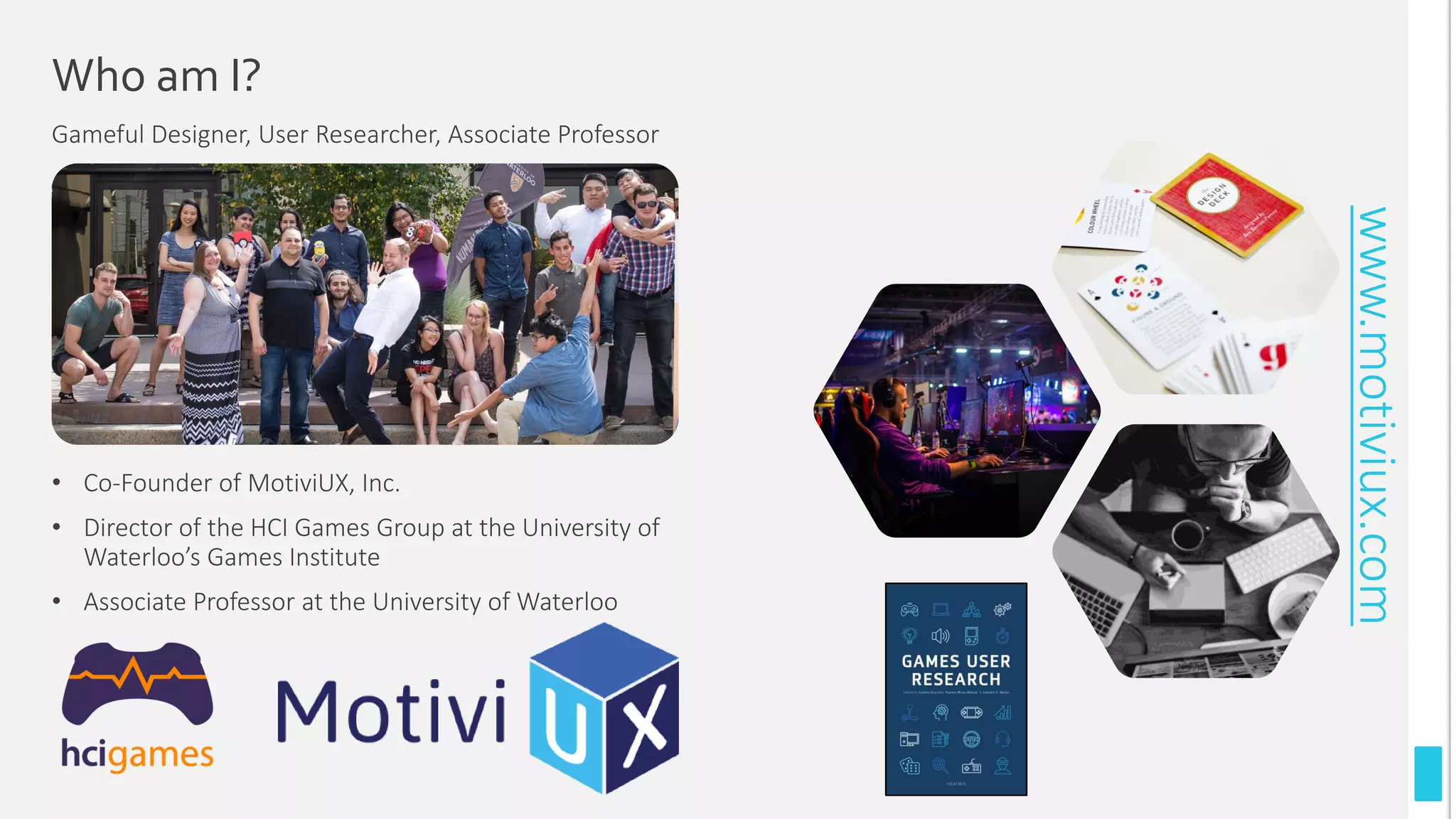
Gameful Designer, User Researcher, Associate Professor
• Co-Founder of MotiviUX, Inc.
• Director of the HCI Games Group at the University of
Waterloo’s Games Institute
• Associate Professor at the University of Waterloo
www.motiviux.com
What is
Gamification?
An approach to systems design that
uses game design elements to solve
motivation and engagement
problems.
15
Three Different Approaches to GameThinking
17
On today’s menu, we will discuss game thinking as
1.A thought model
2.A user journey
3.A design process
ThoughtModel
Game Thinking as a Thought Model
18
GameThinking as aThought
Model
“The use of games and game-like
approaches to solve problems and create
better experiences.” – Andrzej Marczewski
Game Thinking as an Umbrella Term
• Playful/Gameful design
• Serious games
• Gamification
• Simulation
• Play/Games/Toys
19
Andrzej Marczewski. 2016. https://www.gamified.uk/gamification-framework/differences-between-gamification-and-games/
GameThinking as an UmbrellaTerm
Andrzej Marczewski. 2016. https://www.gamified.uk/gamification-framework/differences-between-gamification-and-games/
Game-inspired/Playful
Design
Inspired by games but without game elements
21
Serious Games
22
Games for non-entertainment
purposes like teaching,
promoting a meaningful
message, or creating real-
world outcomes
Gamification
Intrinsic and extrinsic motivation with game elements
23
Simulation
24
A virtual representation of a
real-world system (often for
training purposes) without
gameplay elements
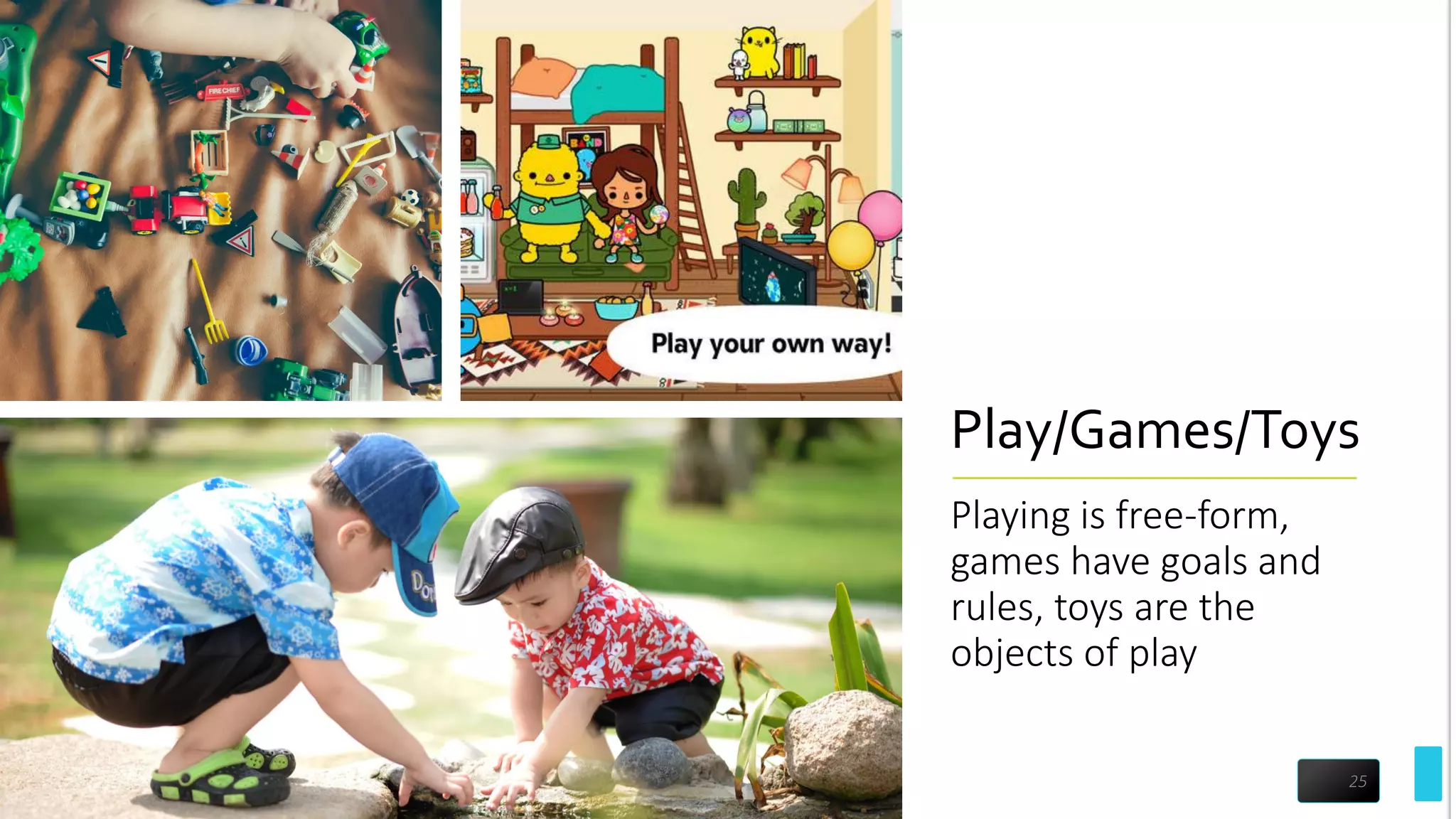
Play/Games/Toys
Playing is free-form,
games have goals and
rules, toys are the
objects of play
25
UserJourney
Game Thinking as a User Journey
26
Design for Skill-Building
Your users needs and goals change over time. Know their
journey and design with the journey in mind.
27Players Journey By Amy Jo Kim, see http://amyjokim.com/blog/2014/04/08/the-players-journey/
Your users learn your systems as a visitor first, then a
newcomer, a regular, and finally they become experts or
enthusiasts.
Build a core learning loop first as a simple version of the
regular user experience you are creating.
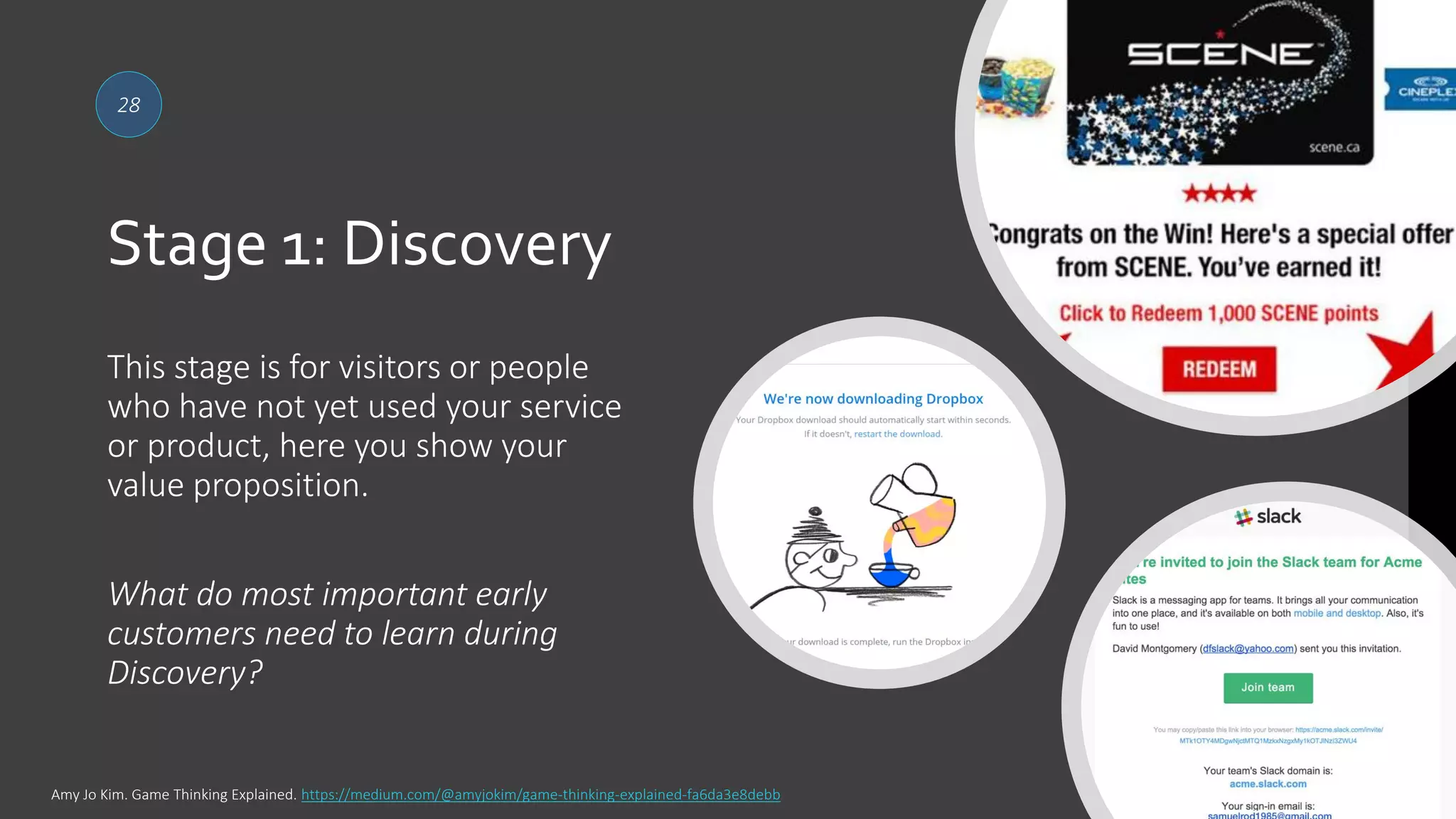
Stage 1: Discovery
28
This stage is for visitors or people
who have not yet used your service
or product, here you show your
value proposition.
What do most important early
customers need to learn during
Discovery?
Amy Jo Kim. Game Thinking Explained. https://medium.com/@amyjokim/game-thinking-explained-fa6da3e8debb
Stage 2: Onboarding
29
This stage is for newcomers, who are
using the product or service but need to
learn and get value out of it quickly.
What are the most important skills to
develop / things to learn during
Onboarding?
Amy Jo Kim. Game Thinking Explained. https://medium.com/@amyjokim/game-thinking-explained-fa6da3e8debb
Stage 3: Habit-
building
30
This is the hook or core loop in your
application that the user keeps
coming back to: a pleasurable,
repeatable activity.
What repeatable, pleasurable
activity will pull people back for
Habit-building?
Amy Jo Kim. Game Thinking Explained. https://medium.com/@amyjokim/game-thinking-explained-fa6da3e8debb
FOCUS POINT:The Learning Loop
How to create habit-building experiences
• Cues and triggers
• Internal, Situational, External, Engaged
• What’s the internal trigger/urge/need that
drives someone to seek out my product?
• Repeatable pleasurable activity
• Triggered by emotion
• Internal urge or need
• In games, we call this a core mechanic (a rule in
action)
• Skill-building feedback
• Provide feedback and help players improve
• Feedback loops to help people get better at
core activity
• Progress and investment
• Show a progress and investment path
• Allow users to customize, build, collect 31
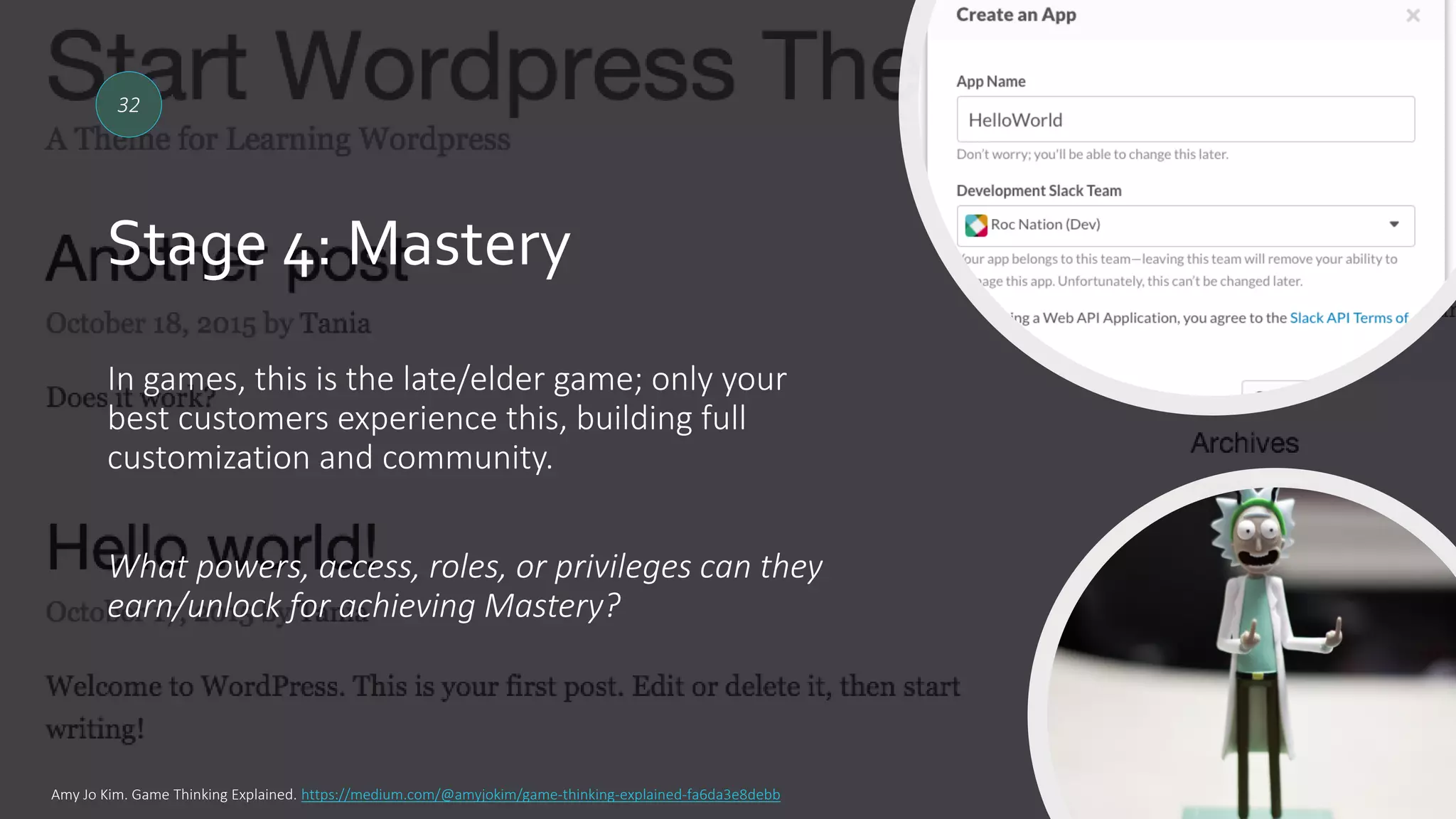
Stage 4: Mastery
32
In games, this is the late/elder game; only your
best customers experience this, building full
customization and community.
What powers, access, roles, or privileges can they
earn/unlock for achieving Mastery?
Amy Jo Kim. Game Thinking Explained. https://medium.com/@amyjokim/game-thinking-explained-fa6da3e8debb
A GameThinking Roadmap for Products and Services
In your design process, focus on your learning loop first, then create onboarding, then discovery, last mastery.
33
Amy Jo Kim. Game Thinking. https://gamethinking.io/
DesignProcess
Game Thinking as a Design Process
34
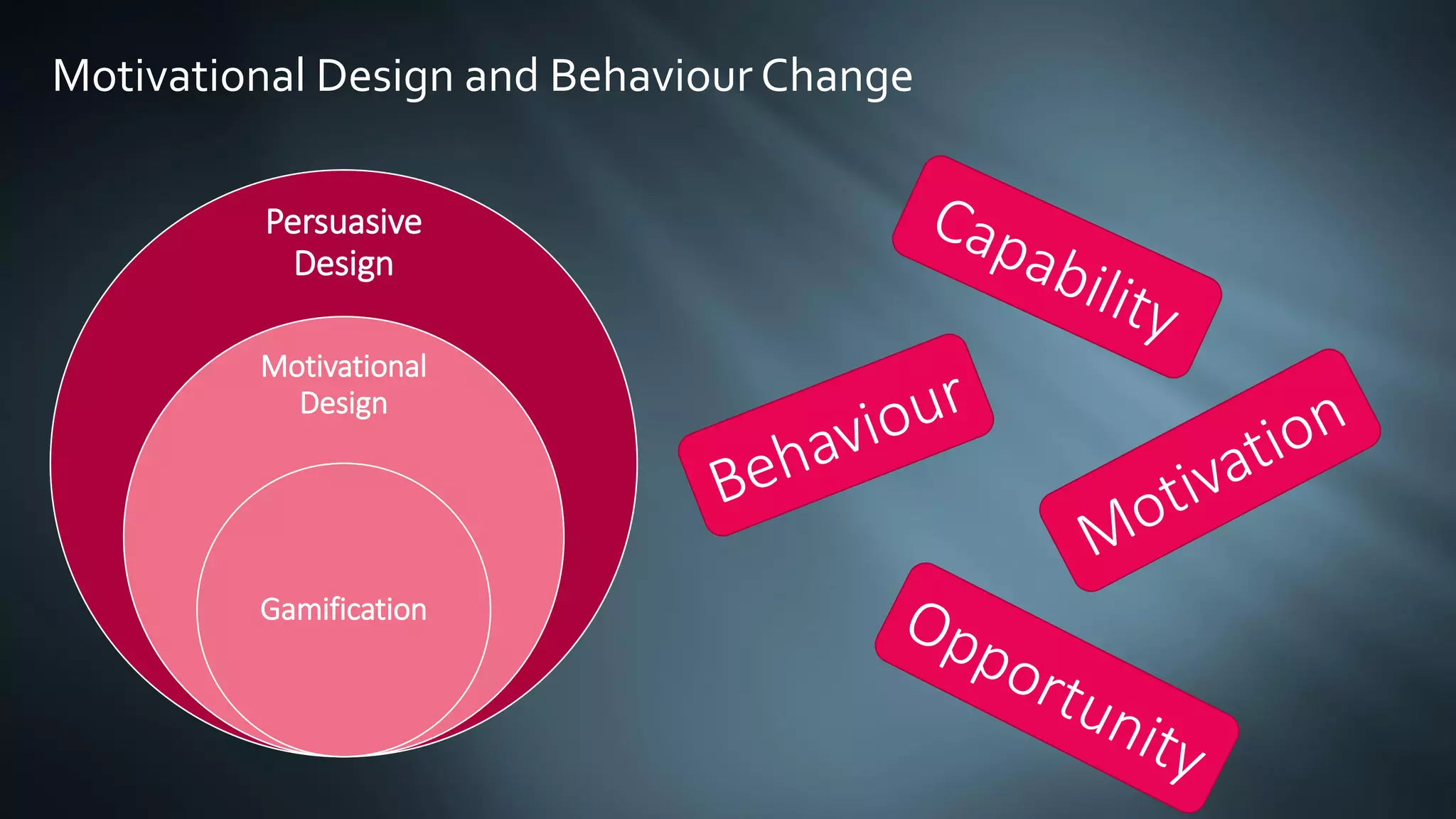
Motivational Design and Behaviour Change
Persuasive
Design
Motivational
Design
Gamification
Motivational Design and Behaviour Change
Capability
Motivation
Opportunity
Behaviour
Thanks to Sebastian Deterding for the examples.
Motivational Design Process
1. Define target audience & behavior
• Who has to change what behavior when, where, and how?
2. Understand target behaviours
• Identify hurdles & enablers
3. Identify fitting theoretical mediators and behaviour change techniques
4. Define metrics for success
37http://codingconduct.cc/The-MAO-Model-Research-for-Behavior-Change
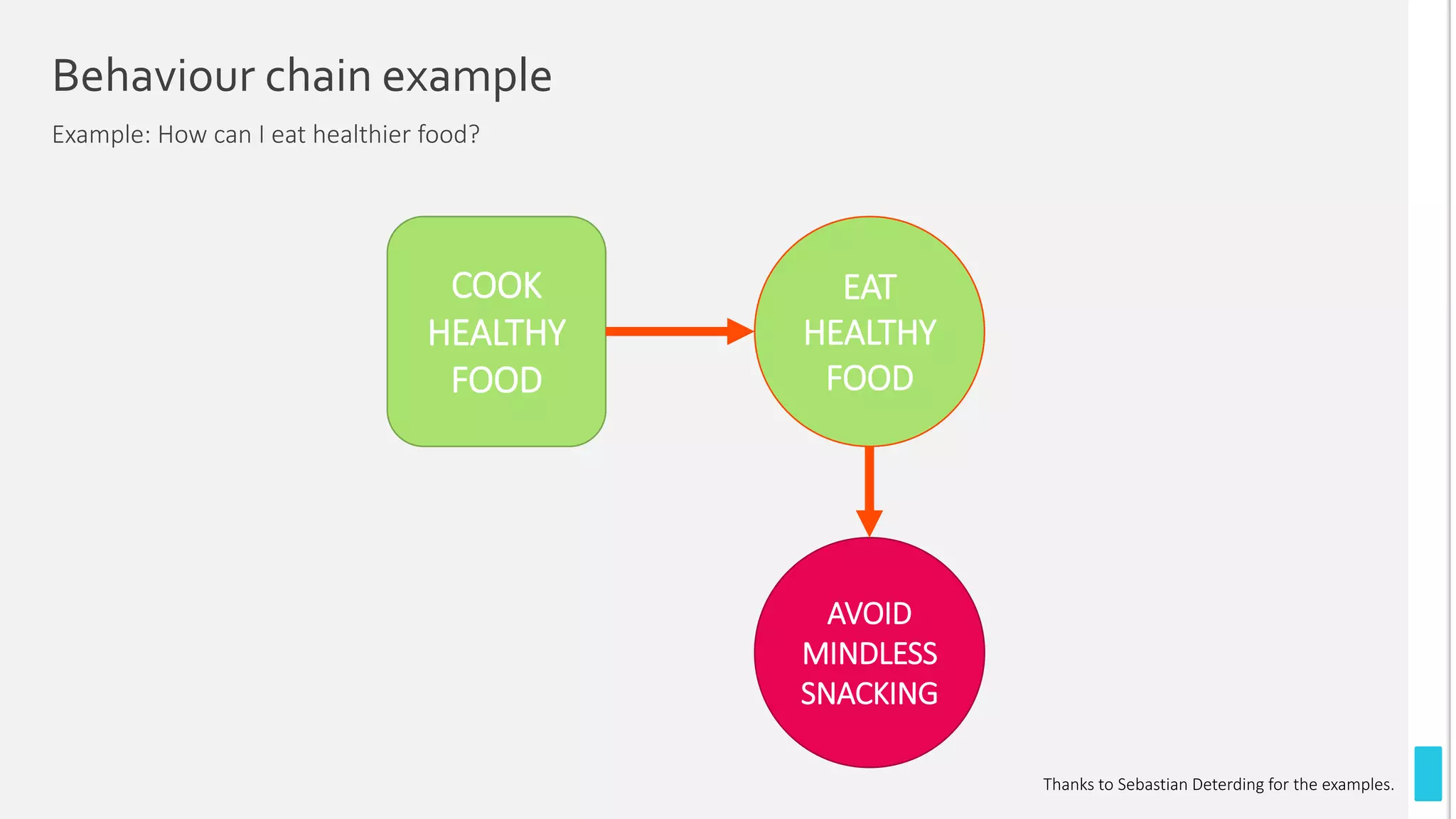
Behaviour chain example
Example: How can I eat healthier food?
EAT
HEALTHY
FOOD
Thanks to Sebastian Deterding for the examples.
Behaviour chain example
Example: How can I eat healthier food?
EAT
HEALTHY
FOOD
AVOID
MINDLESS
SNACKING
Thanks to Sebastian Deterding for the examples.
Behaviour chain example
Example: How can I eat healthier food?
EAT
HEALTHY
FOOD
AVOID
MINDLESS
SNACKING
COOK
HEALTHY
FOOD
Thanks to Sebastian Deterding for the examples.
Behaviour chain example
Example: How can I eat healthier food?
EAT
HEALTHY
FOOD
AVOID
MINDLESS
SNACKING
COOK
HEALTHY
FOOD
SHOP
HEALTHY
FOOD
Thanks to Sebastian Deterding for the examples.
Behaviour chain example
Example: How can I eat healthier food?
EAT
HEALTHY
FOOD
AVOID
MINDLESS
SNACKING
COOK
HEALTHY
FOOD
SHOP
HEALTHY
FOOD
PLAN
HEALTHY
MEALS
Thanks to Sebastian Deterding for the examples.
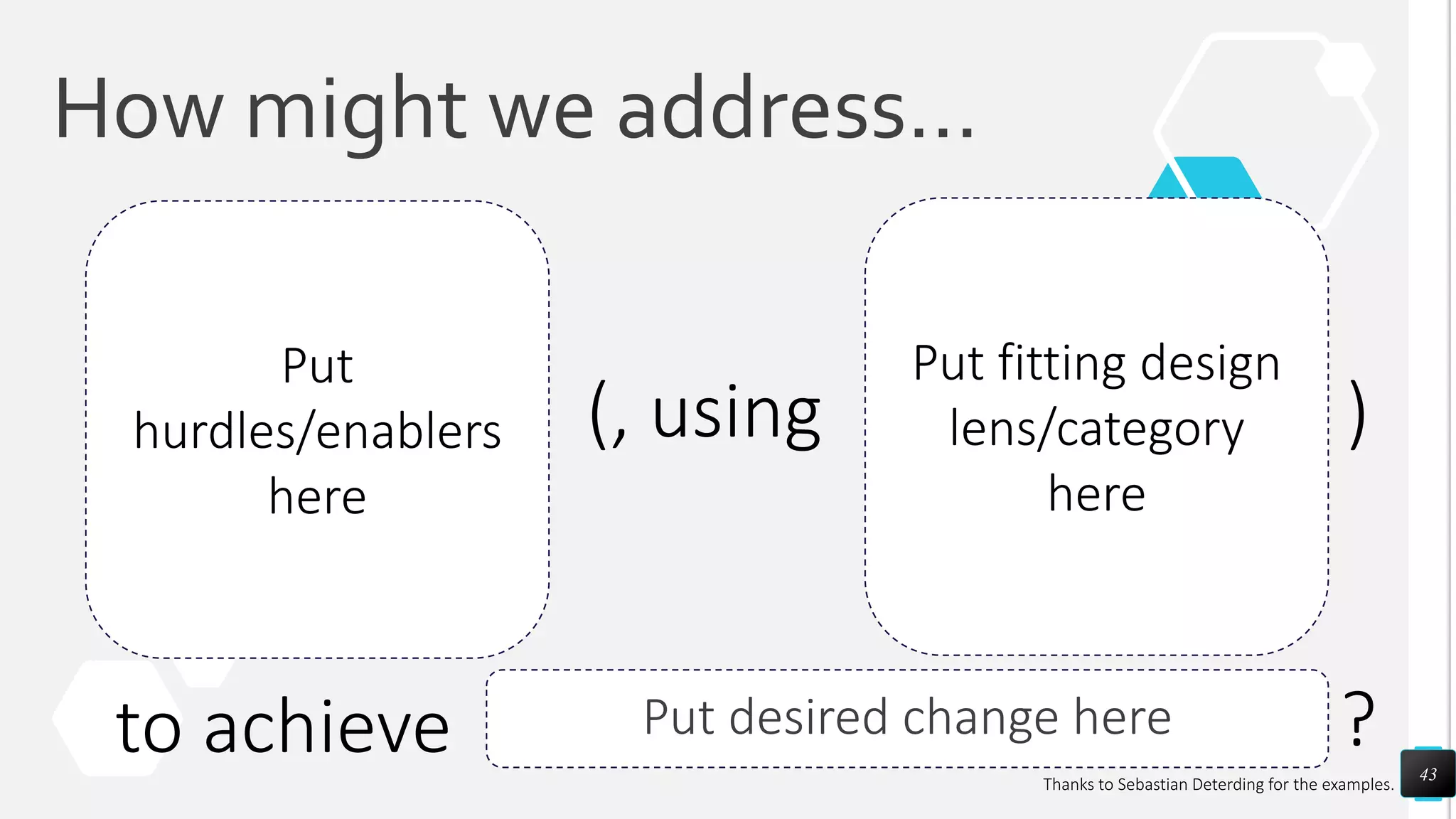
How might we address…
43
Put
hurdles/enablers
here
Put fitting design
lens/category
here
Put desired change here
(, using )
to achieve ?
Thanks to Sebastian Deterding for the examples.
How might we address…
44
AVOID MINDLESS
SNACKING
Put fitting design
lens/category
here
EAT HEALTHY FOOD
(, using )
to achieve ?
http://www.funkydesignspaces.com/plex/
How might we address…
45
AVOID MINDLESS
SNACKING
Put fitting design
lens/category
here
EAT HEALTHY FOOD
(, using )
to achieve ?
http://getmentalnotes.com/
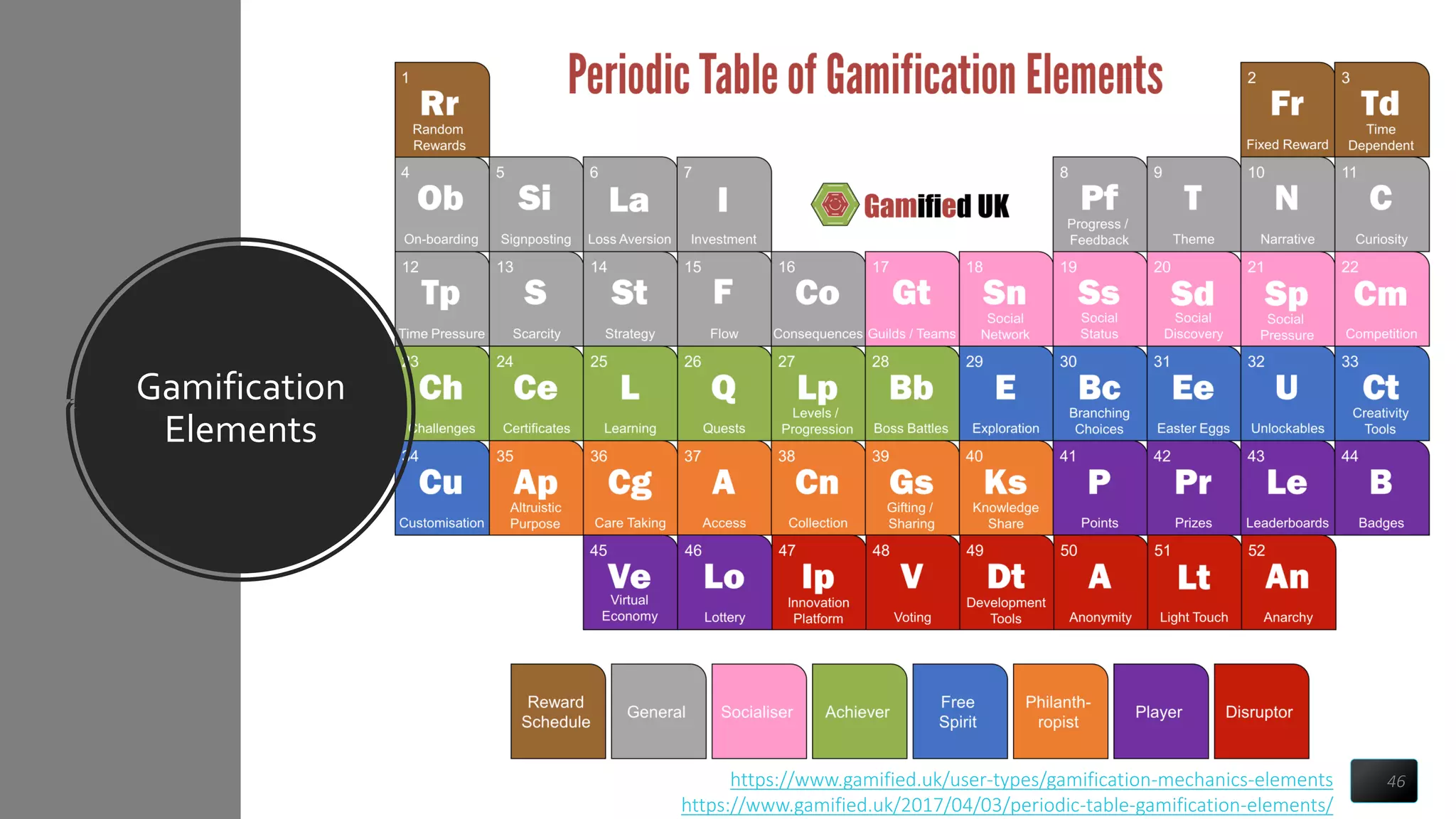
46
Gamification
Elements
https://www.gamified.uk/user-types/gamification-mechanics-elements
https://www.gamified.uk/2017/04/03/periodic-table-gamification-elements/
Examples of Game Mechanics
47https://www.gamified.uk/user-types/gamification-mechanics-elements
Examples of Game Mechanics
48https://www.gamified.uk/user-types/gamification-mechanics-elements
SUMMARY OF GAMETHINKING
Get in touch with us for gameful design made personal and to find out about our services at: http://motiviux.com/
49
1.A thought model
• Game thinking can be used as an umbrella term for all the different areas
of working with games
• Game thinking includes gamification
2.A user journey
• Game thinking guides how your user experiences your product at
different stages
• You have to focus on creating a repeatable, pleasurable activity in your
learning loop that is core to your system, product, or service
3.A design process
• You have to understand the hurdles or enablers of behaviour change to
build successful gameful user experiences
ThankYou
Lennart Nacke
lennart@motiviux.com
www.motiviux.com
Slides at: https://www.slideshare.net/acagamic
Introduction to Game Thinking (Fluxible 2018)

Introduction to Game Thinking (Fluxible 2018)

  • 1.
    Intro to Game Thinking LennartNacke, PhD, Chief Cheerleader MotiviUX,Inc.andUniversityof Waterloo #flUXible2018 @acagamic motiviux.com
  • 2.
    Who am I? GamefulDesigner, User Researcher, Associate Professor • Co-Founder of MotiviUX, Inc. • Director of the HCI Games Group at the University of Waterloo’s Games Institute • Associate Professor at the University of Waterloo www.motiviux.com
  • 3.
    What is Gamification? An approachto systems design that uses game design elements to solve motivation and engagement problems. 15
  • 5.
    Three Different Approachesto GameThinking 17 On today’s menu, we will discuss game thinking as 1.A thought model 2.A user journey 3.A design process
  • 6.
  • 7.
    GameThinking as aThought Model “Theuse of games and game-like approaches to solve problems and create better experiences.” – Andrzej Marczewski Game Thinking as an Umbrella Term • Playful/Gameful design • Serious games • Gamification • Simulation • Play/Games/Toys 19 Andrzej Marczewski. 2016. https://www.gamified.uk/gamification-framework/differences-between-gamification-and-games/
  • 8.
    GameThinking as anUmbrellaTerm Andrzej Marczewski. 2016. https://www.gamified.uk/gamification-framework/differences-between-gamification-and-games/
  • 9.
  • 10.
    Serious Games 22 Games fornon-entertainment purposes like teaching, promoting a meaningful message, or creating real- world outcomes
  • 11.
    Gamification Intrinsic and extrinsicmotivation with game elements 23
  • 12.
    Simulation 24 A virtual representationof a real-world system (often for training purposes) without gameplay elements
  • 13.
    Play/Games/Toys Playing is free-form, gameshave goals and rules, toys are the objects of play 25
  • 14.
  • 15.
    Design for Skill-Building Yourusers needs and goals change over time. Know their journey and design with the journey in mind. 27Players Journey By Amy Jo Kim, see http://amyjokim.com/blog/2014/04/08/the-players-journey/ Your users learn your systems as a visitor first, then a newcomer, a regular, and finally they become experts or enthusiasts. Build a core learning loop first as a simple version of the regular user experience you are creating.
  • 16.
    Stage 1: Discovery 28 Thisstage is for visitors or people who have not yet used your service or product, here you show your value proposition. What do most important early customers need to learn during Discovery? Amy Jo Kim. Game Thinking Explained. https://medium.com/@amyjokim/game-thinking-explained-fa6da3e8debb
  • 17.
    Stage 2: Onboarding 29 Thisstage is for newcomers, who are using the product or service but need to learn and get value out of it quickly. What are the most important skills to develop / things to learn during Onboarding? Amy Jo Kim. Game Thinking Explained. https://medium.com/@amyjokim/game-thinking-explained-fa6da3e8debb
  • 18.
    Stage 3: Habit- building 30 Thisis the hook or core loop in your application that the user keeps coming back to: a pleasurable, repeatable activity. What repeatable, pleasurable activity will pull people back for Habit-building? Amy Jo Kim. Game Thinking Explained. https://medium.com/@amyjokim/game-thinking-explained-fa6da3e8debb
  • 19.
    FOCUS POINT:The LearningLoop How to create habit-building experiences • Cues and triggers • Internal, Situational, External, Engaged • What’s the internal trigger/urge/need that drives someone to seek out my product? • Repeatable pleasurable activity • Triggered by emotion • Internal urge or need • In games, we call this a core mechanic (a rule in action) • Skill-building feedback • Provide feedback and help players improve • Feedback loops to help people get better at core activity • Progress and investment • Show a progress and investment path • Allow users to customize, build, collect 31
  • 20.
    Stage 4: Mastery 32 Ingames, this is the late/elder game; only your best customers experience this, building full customization and community. What powers, access, roles, or privileges can they earn/unlock for achieving Mastery? Amy Jo Kim. Game Thinking Explained. https://medium.com/@amyjokim/game-thinking-explained-fa6da3e8debb
  • 21.
    A GameThinking Roadmapfor Products and Services In your design process, focus on your learning loop first, then create onboarding, then discovery, last mastery. 33 Amy Jo Kim. Game Thinking. https://gamethinking.io/
  • 22.
    DesignProcess Game Thinking asa Design Process 34
  • 23.
    Motivational Design andBehaviour Change Persuasive Design Motivational Design Gamification
  • 24.
    Motivational Design andBehaviour Change Capability Motivation Opportunity Behaviour Thanks to Sebastian Deterding for the examples.
  • 25.
    Motivational Design Process 1.Define target audience & behavior • Who has to change what behavior when, where, and how? 2. Understand target behaviours • Identify hurdles & enablers 3. Identify fitting theoretical mediators and behaviour change techniques 4. Define metrics for success 37http://codingconduct.cc/The-MAO-Model-Research-for-Behavior-Change
  • 26.
    Behaviour chain example Example:How can I eat healthier food? EAT HEALTHY FOOD Thanks to Sebastian Deterding for the examples.
  • 27.
    Behaviour chain example Example:How can I eat healthier food? EAT HEALTHY FOOD AVOID MINDLESS SNACKING Thanks to Sebastian Deterding for the examples.
  • 28.
    Behaviour chain example Example:How can I eat healthier food? EAT HEALTHY FOOD AVOID MINDLESS SNACKING COOK HEALTHY FOOD Thanks to Sebastian Deterding for the examples.
  • 29.
    Behaviour chain example Example:How can I eat healthier food? EAT HEALTHY FOOD AVOID MINDLESS SNACKING COOK HEALTHY FOOD SHOP HEALTHY FOOD Thanks to Sebastian Deterding for the examples.
  • 30.
    Behaviour chain example Example:How can I eat healthier food? EAT HEALTHY FOOD AVOID MINDLESS SNACKING COOK HEALTHY FOOD SHOP HEALTHY FOOD PLAN HEALTHY MEALS Thanks to Sebastian Deterding for the examples.
  • 31.
    How might weaddress… 43 Put hurdles/enablers here Put fitting design lens/category here Put desired change here (, using ) to achieve ? Thanks to Sebastian Deterding for the examples.
  • 32.
    How might weaddress… 44 AVOID MINDLESS SNACKING Put fitting design lens/category here EAT HEALTHY FOOD (, using ) to achieve ? http://www.funkydesignspaces.com/plex/
  • 33.
    How might weaddress… 45 AVOID MINDLESS SNACKING Put fitting design lens/category here EAT HEALTHY FOOD (, using ) to achieve ? http://getmentalnotes.com/
  • 34.
  • 35.
    Examples of GameMechanics 47https://www.gamified.uk/user-types/gamification-mechanics-elements
  • 36.
    Examples of GameMechanics 48https://www.gamified.uk/user-types/gamification-mechanics-elements
  • 37.
    SUMMARY OF GAMETHINKING Getin touch with us for gameful design made personal and to find out about our services at: http://motiviux.com/ 49 1.A thought model • Game thinking can be used as an umbrella term for all the different areas of working with games • Game thinking includes gamification 2.A user journey • Game thinking guides how your user experiences your product at different stages • You have to focus on creating a repeatable, pleasurable activity in your learning loop that is core to your system, product, or service 3.A design process • You have to understand the hurdles or enablers of behaviour change to build successful gameful user experiences
  • 38.