Name:-Sunipa Bera
B. Tech CSE (CSF)
Roll No. :-17
Subject: DS
Prn No.: 190105181016
Topic:- Stack & Queue
Stack
&
Queue
What is a
Stack?
A stack is a data structure of ordered items suc
h that items can be inserted and removed only
at one end.
• A stack is a LIFO (Last-In/ First-Out) data
structure
• A stack is sometimes also called a pushdown
store.
• What are some applications of stacks?
 Program execution
 Parsing
 Evaluating postfix expressions
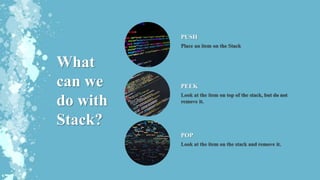
PUSH
Place an item on the Stack
PEEK
Look at the item on top of the stack, but do not
remove it.
POP
Look at the item on the stack and remove it.
What
can we
do with
Stack?
Stacks
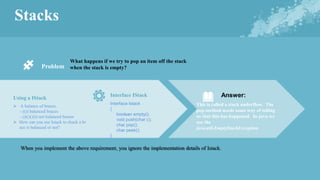
Using a IStack
 A balance of braces.
- (()) balanced braces
- ()(()()))) not balanced braces
 How can you use Istack to check a br
ace is balanced or not?
Interface IStack Answer:
Problem
When you implement the above requirement, you ignore the implementation details of Istack.
What happens if we try to pop an item off the stack
when the stack is empty?
This is called a stack underflow. The
pop method needs some way of telling
us that this has happened. In java we
use the
java.util.EmptyStackException
Interface Istack
{
boolean empty();
void push(char c);
char pop();
char peek();
}
Implementing a
stack using an
array is fairly easy.
• The bottom of the stack is at
data[0]
• The top of the stack is at
data[numItems-1]
• push onto the stack at
data[numItems]
• pop off of the stack at
data[numItems-1]
Implementing a
stack using a
linked list isn’t
that bad either…
• Store the items in the stack in a linked
list
• The top of the stack is the head node,
the bottom of the stack is the end of
the list
• push by adding to the front of the list
• pop by removing from the front of the
list
Reversing A Word
We can use a stack to reverse the letters in a word. How?
Read each letter in th
e word and push it o
nto the
stack
When you reach
the end of the
word, pop the
letters off the stack an
d print them out.
What is a
Queue?
A data structure of ordered items such that item
s can be inserted only at one end and removed a
t the other end.
e.g. A line at the supermarket
• A queue is called a FIFO (First in-First out)
data structure.
• What are some applications of queues?
 Round-robin scheduling in processors
 Input/ Output processing
 Queueing of packets for delivery in
networks
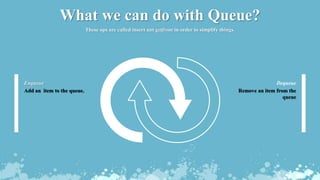
What we can do with Queue?
These ops are called insert ant getfront in order to simplify things.
Add an item to the queue.
Enqueue
Remove an item from the
queue
Dequeue
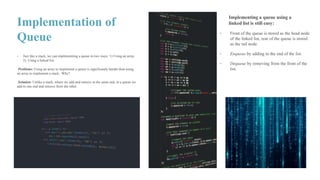
Implementation of
Queue
• Just like a stack, we can implementing a queue in two ways: 1) Using an array
2). Using a linked list.
Problems: Using an array to implement a queue is significantly harder than using
an array to implement a stack. Why?
Solution: Unlike a stack, where we add and remove at the same end, in a queue we
add to one end and remove from the other.
Implementing a queue using a
linked list is still easy:
• Front of the queue is stored as the head node
of the linked list, rear of the queue is stored
as the tail node.
• Enqueue by adding to the end of the list
• Dequeue by removing from the front of the
list.
Infographic Style
Insert the title of your subtitle Here
Option 1
Option 2
Option 2 Sketch of Insert
Option 2 sketch of
getforce
 Enqueue at data[0] and shift all of
the rest of the items in the array
down to make room.
 Dequeue from data[numItems-1]
• Enqueue at data[rear+1]
• Dequeue at data[front]
• The rear variable always contains the
index of the last item in the queue.
• The front variable always contains the
index of the first item in the queue.
• When we reach the end of the array,
wrap around to the front again.
insert(Object item)
{
if(manyItems == 0) front = rear = 0;
else rear = (rear + 1) mod size;
data[rear] = item;
manyItems++;
}
Object getFront()
{
answer = data[front];
front = (front + 1) mod size;
manyItems--;
return answer
Biblography
- W3school
- tutorialspoint
Thank You

Ds stack & queue

  • 1.
    Name:-Sunipa Bera B. TechCSE (CSF) Roll No. :-17 Subject: DS Prn No.: 190105181016 Topic:- Stack & Queue
  • 2.
  • 3.
    What is a Stack? Astack is a data structure of ordered items suc h that items can be inserted and removed only at one end. • A stack is a LIFO (Last-In/ First-Out) data structure • A stack is sometimes also called a pushdown store. • What are some applications of stacks?  Program execution  Parsing  Evaluating postfix expressions
  • 4.
    PUSH Place an itemon the Stack PEEK Look at the item on top of the stack, but do not remove it. POP Look at the item on the stack and remove it. What can we do with Stack?
  • 5.
    Stacks Using a IStack A balance of braces. - (()) balanced braces - ()(()()))) not balanced braces  How can you use Istack to check a br ace is balanced or not? Interface IStack Answer: Problem When you implement the above requirement, you ignore the implementation details of Istack. What happens if we try to pop an item off the stack when the stack is empty? This is called a stack underflow. The pop method needs some way of telling us that this has happened. In java we use the java.util.EmptyStackException Interface Istack { boolean empty(); void push(char c); char pop(); char peek(); }
  • 6.
    Implementing a stack usingan array is fairly easy. • The bottom of the stack is at data[0] • The top of the stack is at data[numItems-1] • push onto the stack at data[numItems] • pop off of the stack at data[numItems-1] Implementing a stack using a linked list isn’t that bad either… • Store the items in the stack in a linked list • The top of the stack is the head node, the bottom of the stack is the end of the list • push by adding to the front of the list • pop by removing from the front of the list
  • 7.
    Reversing A Word Wecan use a stack to reverse the letters in a word. How? Read each letter in th e word and push it o nto the stack When you reach the end of the word, pop the letters off the stack an d print them out.
  • 8.
    What is a Queue? Adata structure of ordered items such that item s can be inserted only at one end and removed a t the other end. e.g. A line at the supermarket • A queue is called a FIFO (First in-First out) data structure. • What are some applications of queues?  Round-robin scheduling in processors  Input/ Output processing  Queueing of packets for delivery in networks
  • 9.
    What we cando with Queue? These ops are called insert ant getfront in order to simplify things. Add an item to the queue. Enqueue Remove an item from the queue Dequeue
  • 10.
    Implementation of Queue • Justlike a stack, we can implementing a queue in two ways: 1) Using an array 2). Using a linked list. Problems: Using an array to implement a queue is significantly harder than using an array to implement a stack. Why? Solution: Unlike a stack, where we add and remove at the same end, in a queue we add to one end and remove from the other. Implementing a queue using a linked list is still easy: • Front of the queue is stored as the head node of the linked list, rear of the queue is stored as the tail node. • Enqueue by adding to the end of the list • Dequeue by removing from the front of the list.
  • 11.
    Infographic Style Insert thetitle of your subtitle Here Option 1 Option 2 Option 2 Sketch of Insert Option 2 sketch of getforce  Enqueue at data[0] and shift all of the rest of the items in the array down to make room.  Dequeue from data[numItems-1] • Enqueue at data[rear+1] • Dequeue at data[front] • The rear variable always contains the index of the last item in the queue. • The front variable always contains the index of the first item in the queue. • When we reach the end of the array, wrap around to the front again. insert(Object item) { if(manyItems == 0) front = rear = 0; else rear = (rear + 1) mod size; data[rear] = item; manyItems++; } Object getFront() { answer = data[front]; front = (front + 1) mod size; manyItems--; return answer
  • 12.
  • 13.